EP3545682B1 - Decodiererseitige bewegungsvektorwiederherstellung für videocodierung - Google Patents
Decodiererseitige bewegungsvektorwiederherstellung für videocodierung Download PDFInfo
- Publication number
- EP3545682B1 EP3545682B1 EP18735922.9A EP18735922A EP3545682B1 EP 3545682 B1 EP3545682 B1 EP 3545682B1 EP 18735922 A EP18735922 A EP 18735922A EP 3545682 B1 EP3545682 B1 EP 3545682B1
- Authority
- EP
- European Patent Office
- Prior art keywords
- motion vector
- current frame
- decoder
- motion
- refined
- Prior art date
- Legal status (The legal status is an assumption and is not a legal conclusion. Google has not performed a legal analysis and makes no representation as to the accuracy of the status listed.)
- Active
Links
Images





Classifications
-
- H—ELECTRICITY
- H04—ELECTRIC COMMUNICATION TECHNIQUE
- H04N—PICTORIAL COMMUNICATION, e.g. TELEVISION
- H04N19/00—Methods or arrangements for coding, decoding, compressing or decompressing digital video signals
- H04N19/44—Decoders specially adapted therefor, e.g. video decoders which are asymmetric with respect to the encoder
-
- H—ELECTRICITY
- H04—ELECTRIC COMMUNICATION TECHNIQUE
- H04N—PICTORIAL COMMUNICATION, e.g. TELEVISION
- H04N19/00—Methods or arrangements for coding, decoding, compressing or decompressing digital video signals
- H04N19/50—Methods or arrangements for coding, decoding, compressing or decompressing digital video signals using predictive coding
- H04N19/503—Methods or arrangements for coding, decoding, compressing or decompressing digital video signals using predictive coding involving temporal prediction
- H04N19/51—Motion estimation or motion compensation
- H04N19/513—Processing of motion vectors
- H04N19/517—Processing of motion vectors by encoding
-
- H—ELECTRICITY
- H04—ELECTRIC COMMUNICATION TECHNIQUE
- H04N—PICTORIAL COMMUNICATION, e.g. TELEVISION
- H04N19/00—Methods or arrangements for coding, decoding, compressing or decompressing digital video signals
- H04N19/50—Methods or arrangements for coding, decoding, compressing or decompressing digital video signals using predictive coding
- H04N19/503—Methods or arrangements for coding, decoding, compressing or decompressing digital video signals using predictive coding involving temporal prediction
- H04N19/51—Motion estimation or motion compensation
- H04N19/513—Processing of motion vectors
- H04N19/517—Processing of motion vectors by encoding
- H04N19/52—Processing of motion vectors by encoding by predictive encoding
-
- H—ELECTRICITY
- H04—ELECTRIC COMMUNICATION TECHNIQUE
- H04N—PICTORIAL COMMUNICATION, e.g. TELEVISION
- H04N19/00—Methods or arrangements for coding, decoding, compressing or decompressing digital video signals
- H04N19/50—Methods or arrangements for coding, decoding, compressing or decompressing digital video signals using predictive coding
- H04N19/503—Methods or arrangements for coding, decoding, compressing or decompressing digital video signals using predictive coding involving temporal prediction
- H04N19/51—Motion estimation or motion compensation
- H04N19/527—Global motion vector estimation
-
- H—ELECTRICITY
- H04—ELECTRIC COMMUNICATION TECHNIQUE
- H04N—PICTORIAL COMMUNICATION, e.g. TELEVISION
- H04N19/00—Methods or arrangements for coding, decoding, compressing or decompressing digital video signals
- H04N19/50—Methods or arrangements for coding, decoding, compressing or decompressing digital video signals using predictive coding
- H04N19/503—Methods or arrangements for coding, decoding, compressing or decompressing digital video signals using predictive coding involving temporal prediction
- H04N19/51—Motion estimation or motion compensation
- H04N19/577—Motion compensation with bidirectional frame interpolation, i.e. using B-pictures
-
- H—ELECTRICITY
- H04—ELECTRIC COMMUNICATION TECHNIQUE
- H04N—PICTORIAL COMMUNICATION, e.g. TELEVISION
- H04N19/00—Methods or arrangements for coding, decoding, compressing or decompressing digital video signals
- H04N19/90—Methods or arrangements for coding, decoding, compressing or decompressing digital video signals using coding techniques not provided for in groups H04N19/10-H04N19/85, e.g. fractals
- H04N19/96—Tree coding, e.g. quad-tree coding
Definitions
- the techniques described herein relate generally to video coding, and particularly to decoder-side motion vector restoration.
- Motion compensation refinement is disclosed in document JCTVC-D120. Similar methods are disclosed in document JVET-D1001_v1, JVET-E0052, JCTVC-D167 and WO 2012/045225 A1 .
- Video coding involves compressing (and decompressing) a digital video signal.
- video coding standards include the H.264 video compression standard, and its successor High Efficiency Video Coding (HEVC).
- Moving video is formed by taking snapshots of the signal at periodic time intervals, such that playing back the series of snapshots, or frames, produces the appearance of motion.
- Video encoders include a prediction model that attempts to reduce redundancy using similarities between neighboring video frames.
- a predicted frame is created from one or more past or future frames that are often referred to as reference frames. Frames that do not serve as reference frames are often referred to as non-reference frames.
- each frame can include thousands or millions of pixels, video coding techniques typically do not process all of a frame's pixels at once. Therefore, a coded frame is divided into blocks that are often referred to as macroblocks. Instead of directly encoding the raw pixel values for each block, the encoder tries to find a block similar to the one it is encoding in a reference frame. If the encoder finds a similar block, the encoder can encode that block using a motion vectors, which is a two-dimensional vector that points to the matching block in the reference frame.
- Some techniques explicitly signal motion information to the decoder. Examples of such modes include merge mode and advanced motion vector prediction (AMVP) mode in High Efficiency Video Coding (HEVC).
- AMVP advanced motion vector prediction
- HEVC High Efficiency Video Coding
- decoder-side motion vector refinement tools can be used to refine, predict, and/or generate motion information such that the motion information can be derived without being explicitly signaled.
- apparatus, systems, and methods are provided for decoder-side motion vector restoration techniques that improve the execution speed and efficiency of decoder-side motion vector refinement techniques.
- Some embodiments relate to a decoding method for decoding video data.
- the method includes receiving compressed video data related to a set of frames, and calculating, using a decoder-side predictor refinement technique, a new motion vector for a current frame from the set of frames, wherein the new motion vector estimates motion for the current frame based on one or more reference frames.
- the calculating includes retrieving a first motion vector associated with the current frame, executing a first portion of the decoding process using the first motion vector, retrieving a second motion vector associated with the current frame that is different than the first motion vector, and executing a second portion of the decoding process using the second motion vector.
- the first motion vector comprises an unrefined motion vector
- the second motion vector comprises a refined motion vector
- the refined MV is refined using a decoder-side predictor refinement technique
- the first portion of the decoding process comprises a parsing portion, a motion vector derivation portion, or both
- the second portion of the decoding process comprises a reconstruction portion
- the decoding method includes retrieving a third motion vector associated with a second frame, wherein the third motion vector is a refined motion vector, executing the first portion of the decoding process using the first motion vector and the third motion vector, and executing the second portion of the decoding process using the second motion vector and the third motion vector.
- executing the first portion of the decoding process comprises executing a motion vector derivation portion using the first motion vector and the third motion vector, wherein the motion vector derivation portion comprises motion vector prediction derivation, merge candidate derivation, or both.
- executing the first portion of the decoding process comprises referring to the first motion vector as a decoded motion vector of the current frame.
- the decoding method includes using the second motion vector and the third motion vector to perform motion compensation, overlapped block motion compensation, deblocking, or any combination thereof.
- the decoding method includes determining a coding tree unit constraint is not applied to the compressed video data, and retrieving the first motion vector associated with the current frame includes retrieving an unrefined motion vector of the current frame, and a refined motion vector associated with a second frame.
- retrieving the first motion vector associated with the current frame includes retrieving an unrefined motion vector of a current coding tree unit row, a refined motion vector of an upper coding tree unit row, other tile, or other slice, and a refined motion vector associated with a second frame.
- Some embodiments relate to a decoding method for decoding video data.
- the method includes receiving compressed video data related to a set of frames, and calculating, using a decoder-side predictor refinement technique, a new motion vector for a current frame from the set of frames, wherein the new motion vector estimates motion for the current frame based on one or more reference frames.
- the calculating includes receiving a signal indicative of a starting candidate index for a starting motion vector candidate list, determining a first motion vector candidate in the starting motion vector candidate list and a second motion vector candidate comprise a difference that is below a predetermined threshold, removing the second motion vector candidate from the starting motion vector candidate list, not adding the second motion vector candidate to the starting motion vector candidate list, or both, and calculating the new motion vector based on the candidate list and the starting candidate index.
- the decoding method includes analyzing a new motion vector candidate, the motion vector candidate comprising a motion vector pair, determining, based on the analysis, that the motion vector pair is along a same motion trajectory, and adding the motion vector pair to the starting motion vector candidate list.
- the decoding method includes analyzing a new motion vector candidate, the motion vector candidate comprising a motion vector pair, determining, based on the analysis, that the motion vector pair is not along a same motion trajectory, separating the motion vector pair into two new candidate motion vector pairs, and adding the two candidate motion vectors to the starting motion vector candidate list.
- separating includes adding the first motion vector of the motion vector pair to a first of the two new candidate motion vector pairs, filling the first of the two new candidate motion vector pairs with a mirrored motion vector of the first motion vector, adding the second motion vector of the motion vector pair to a second of the two new candidate motion vector pairs, and filling the second of the two new candidate motion vector pairs with a mirrored motion vector of the second motion vector.
- Some embodiments relate to an encoding method for encoding video data.
- the method includes calculating compressed video data related to a set of frames, comprising calculating a new motion vector for a current frame from the set of frames, wherein the new motion vector estimates motion for the current frame based on one or more reference frames, including calculating a first motion vector associated with the current frame, executing a first portion of the encoding process using the first motion vector, calculating a second motion vector associated with the current frame that is different than the first motion vector, and executing a second portion of the encoding process using the second motion vector.
- calculating the second motion vector includes calculating a refined motion vector, wherein the refined motion vector is calculated using an encoder-side refinement technique, storing the refined motion vector in a motion vector buffer set, and executing the second portion of the encoding process comprises executing a motion compensation portion, an overlapped block motion compensation portion, a deblocking portion, or some combination thereof.
- the first motion vector comprises an unrefined motion vector
- the second motion vector comprises a refined motion vector
- the refined MV is refined using a decoder-side predictor refinement technique
- the first portion of the decoding process comprises a parsing portion, a motion vector derivation portion, or both
- the second portion of the decoding process comprises a reconstruction portion
- Some embodiments relate to an apparatus configured to decode video data.
- the apparatus includes a processor in communication with memory.
- the processor is configured to execute instructions stored in the memory that cause the processor to receive compressed video data related to a set of frames, and calculate, using a decoder-side predictor refinement technique, a new motion vector for a current frame from the set of frames, wherein the new motion vector estimates motion for the current frame based on one or more reference frames.
- the calculating includes receiving a signal indicative of a starting candidate index for a starting motion vector candidate list, determining a first motion vector candidate in the starting motion vector candidate list and a second motion vector candidate comprise a difference that is below a predetermined threshold, removing the second motion vector candidate from the starting motion vector candidate list, not adding the second motion vector candidate to the starting motion vector candidate list, or both, and calculating the new motion vector based on the candidate list and the starting candidate index.
- the processor is configured to execute instructions stored in the memory that cause the processor to analyze a new motion vector candidate, the motion vector candidate comprising a motion vector pair, determine, based on the analysis, that the motion vector pair is along a same motion trajectory; and add the motion vector pair to the starting motion vector candidate list.
- the processor is configured to execute instructions stored in the memory that cause the processor to analyze a new motion vector candidate, the motion vector candidate comprising a motion vector pair, determine, based on the analysis, that the motion vector pair is not along a same motion trajectory, separate the motion vector pair into two new candidate motion vector pairs, and add the two candidate motion vectors to the starting motion vector candidate list.
- Some embodiments relate to an apparatus configured to encode video data.
- the apparatus includes a processor in communication with memory.
- the processor being configured to execute instructions stored in the memory that cause the processor to calculate compressed video data related to a set of frames, comprising calculating a new motion vector for a current frame from the set of frames, wherein the new motion vector estimates motion for the current frame based on one or more reference frames, including calculating a first motion vector associated with the current frame, executing a first portion of the encoding process using the first motion vector, calculating a second motion vector associated with the current frame that is different than the first motion vector; and executing a second portion of the encoding process using the second motion vector.
- calculating the first motion vector includes calculating an unrefined motion vector, an unrefined motion vector set, or both, and executing the first portion of the encoding process comprises executing a syntax encoding portion, a motion vector derivation portion, a motion vector prediction derivation portion, or some combination thereof.
- calculating the second motion vector comprises calculating a refined motion vector, wherein the refined motion vector is calculated using an encoder-side refinement technique, storing the refined motion vector in a motion vector buffer set, and executing the second portion of the encoding process comprises executing a motion compensation portion, an overlapped block motion compensation portion, a deblocking portion, or some combination thereof.
- Decoder-side predictor refinement tools can cause processing delays due to how the motion vectors (MVs) are computed and reconstructed.
- Techniques can be used to allow for similar execution timing as compared to the execution of traditional decoding methods that do not predict MVs (e.g., such as when the motion vector information is signaled from the encoder).
- a decoding process can be adjusted so that the MVs can be reconstructed early in the process, thereby allowing the decoder to pre-fetch the requisite reference pixels in a manner that hides the latency cycles required to fetch the data.
- the unrefined MV can be (a) restored back into the MV buffer and/or (b) not changed, so that the unrefined MV can be used by the decoder-side MV refinement tools or used to derive the reference MV or the MV candidates (e.g. the merge candidate list and the advance motion vector predictor list) for the following blocks.
- the decoder may also use the unrefined MV for deblocking, overlapped block motion compensation (OBMC), and/or temporal collocated MV derivation.
- OBMC overlapped block motion compensation
- the techniques described herein allow the decoder to use a different MV (e.g., other than the unrefined MV) for processing performed after the parsing stage, such as deblocking, OBMC, and/or temporal collocated MV derivation.
- the first MV used for parsing e.g. the MV/MVP derivation
- the second MV used for other processing including deblocking, OBMC and/or temporal collocated MV derivation, can be a refined MV.
- the decoder uses two sets of motion vectors: the decoder uses one set of MVs for a first part of the decoding process (e.g., for parsing, including MV derivation and pixel pre-fetching), and uses the second set of MVs for a second part of the decoding process (e.g., for reconstruction, including motion compensation, OBMC and/or deblocking).
- CTU row data is incorporated to allow additional processing with refined MVs (e.g., using refined MV of the upper CTU row).
- the first set of MVs can include an unrefined motion vector of a current coding tree unit row, a refined motion vector of an upper coding tree unit row, and a refined motion vector associated with a second frame.
- the second set of MVs can include a refined MV of the current picture, and a refined MV of the other picture.
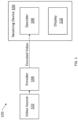
- FIG. 1 shows an exemplary video coding configuration 100, according to some embodiments.
- Video source 102 is a video source, and can be, for example, digital television, internet-based video, video calling, and/or the like.
- Encoder 104 encodes the video source into encoded video.
- the encoder 104 can reside on the same device that generated the video source 102 (e.g., a cell phone, for video calling), and/or may reside on a different device.
- the receiving device 106 receives encoded video from the encoder 104.
- the receiving device 104 may receive the video as a video product (e.g., a digital video disc, or other computer readable media), through a broadcast network, through a mobile network (e.g., a cellular network), and/or through the Internet.
- a video product e.g., a digital video disc, or other computer readable media
- the receiving device 104 may receive the video as a video product (e.g., a digital video disc,
- the receiving device 106 can be, for example, a computer, a cell phone, or a television.
- the receiving device 106 includes a decoder 108 that is configured to decode the encoded video.
- the receiving device 106 also includes a display 110 for displaying the decoded video.
- the decoder e.g., decoder 108 in the receiving device 106
- can employ receiver-side prediction tools often called receiver-side predictor refinement tools or decoder-side predictor refinement tools.
- An example of a receiver-side predictor refinement tool is Pattern-based Motion Vector Derivation (PMVD) mode, which may also be referred to as Frame Rate Up-Conversion (FRUC) mode.
- PMVD is described in, for example, Joint Video Exploration Team (JVET) Document JVET-F1001, entitled Algorithm Description of Joint Exploration Test Model 6 (JEM 6), which is hereby incorporated by reference herein in its entirety.
- decoder-side predictor refinement tools include bi-directional optical flow (BIO) and decoder-side motion vector refinement (DMVR).
- BIO bi-directional optical flow
- DMVR decoder-side motion vector refinement
- BIO was proposed by Samsung in the third JCTVC meeting and 52th VCEG meeting, and it is disclosed in the documents, JCTVC-C204 and VECG-AZ05.
- BIO utilizes the assumptions of optical flow and steady motion to achieve the sample-level motion refinement. It is typically applied only for truly bi-directional predicted blocks, which is predicted from two reference frames and one is the previous frame and the other is the latter frame.
- BIO utilizes one 5x5 window to derive the motion refinement of one sample, so for one NxN block, the motion compensated results and corresponding gradient information of one (N+4)x(N+4) block are required to derive the sample-based motion refinement of current block. And one 6-Tap gradient filter and one 6-Tap interpolation filter are used to generate the gradient information in BIO. Therefore, the computational complexity of BIO is much higher than that of traditional bi-directional prediction. For additional information, see D. Marpe, H. Schwarz, and T. Wiegand: Context-Based Adaptive Binary Arithmetic Coding in the H.264 / AVC Video Compression Standard, IEEE Transactions on Circuits and Systems for Video Technology, Vol. 13, No. 7, pp. 620-636, July 2003 , incorporated by reference herein in its entirety.
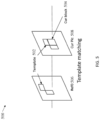
- PMVD itself can be performed using different modes such as, for example, bi-lateral matching merge mode or template matching merge mode.
- which mode for the decoder to use is signaled in the encoded video.
- the encoder signals to the decoder to use PMVD mode, and also signals which particular PMVD mode.
- a FRUC_mrg_flag is signaled when the merge_flag or skip_flag is true. If the FRUC_mrg_flag is 1, then a FRUC_merge_mode is signaled to indicate whether the bilateral matching merge mode (e.g., described further in conjunction with FIGS. 2-4 ) or template matching merge mode (e.g., described further in conjunction with FIG. 5 ) is selected.
- both PMVD modes use decoded pixels to derive the motion vector for the current block.
- a new temporal motion vector prediction (MVP) called temporal derived MVP is derived by scanning all MVs in all reference frames.
- a picture often refers to a number of frames (e.g., one picture includes sixteen frames). Those reference frames are put into one or two reference picture list.
- P-slice only one reference picture list is used.
- B-slice two reference picture lists are used.
- two reference picture lists are used to store past and future pictures, which are often referred to as LIST_0 for past pictures and LIST_1 for future pictures.
- the MV is scaled to point to the current frame.
- the block that is pointed by the scaled MV in the current frame is the target current block.
- the MV is further scaled to point to the reference picture for which refIdx is equal to 0 in LIST_0 for the target current block.
- the further scaled MV is stored in the LIST_0 MV field for the target current block.
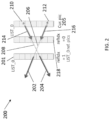
- FIG. 2 shows an example 200 of deriving the temporal derived MVPs.
- the decoder scans all the LIST_0 MVs in LIST_0 reference pictures for which the refIdx is equal to 1.
- a scaled MV that points to the current picture is derived for each LIST_0 MV (shown by dotted arrows 206 and 208 for reference picture 201).
- a 4x4 block 210, 212 in the current picture 205 is pointed to by each of the scaled MVs.
- another scaled MV 214, 216 is assigned to the pointed 4x4 blocks 210, 212, respectively, in current picture where the scaled MV 214, 216 is along the associated scaled MV 202, 204 but the start point is the current picture 205 and the end point is the reference picture 218 with refIdx equal to 0 in LIST_0.
- the decoder scans all the MVs in all 4x4 blocks in all reference pictures to generate the temporal derived LIST_0 and LIST_1 MVPs of current frame. For each MV, the MV is scaled to get the crossed block in current picture. The decoder then calculates the scaled MVP and assigns it to the crossed block (as shown as the block pointed by the dotted arrows 206, 208).
- FIG. 3 shows an example of PMVD bilateral matching merge mode.
- the decoder finds the two most similar reference blocks in LIST_0 and LIST_1 that lie in the same trajectory.
- the decoder selects one macroblock (or "block") 302 in reference frame Ref0 304 from LIST_0 and a second block 306 in reference frame Ref1 308 from LIST_1.
- the decoder essentially assumes motion is constant, and uses the middle point of both macroblocks to generate motion trajectory 310.
- the decoder uses the motion trajectory 310 to find the current prediction macroblock (or "block”) 312 in cur pic 300.
- the decoder calculates the difference between block 302 and block 306.
- the decoder If there is only a small difference, then the decoder knows that the blocks are very similar. In some examples, the decoder can calculate the sum of absolute distance (or "SAD") to calculate the difference between the two blocks. The decoder changes the motion trajectory to minimize the difference between the blocks.
- SAD sum of absolute distance
- the decoder constructs the starting motion vector (MV) list in LIST_0 and LIST_1, respectively.
- the decoder uses eleven candidates for the list, including seven MVs of merge candidates and four temporally derived MV predictions (or MVPs).
- the decoder evaluates these eleven candidates to select the best starting point. In particular, the decoder searches for a pair across the two neighboring frames.
- the decoder analyzes the 22 motion vectors to derive 22 motion vector pairs.
- the decoder generates the MV pairs by scaling the motion trajectory. For each MV in one list, a MV pair is generated by composing of this MV and the mirrored MV that is derived by scaling the MV to the other list.
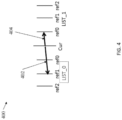
- FIG. 4 shows an example 400 of scaling a motion trajectory.
- the motion trajectory 402 from the Cur pic to ref1 in LIST_0 is scaled as shown with motion trajectory 404 from Cur pic to ref0 in LIST_1.
- the decoder calculates a cost for each of the 22 motion vector pairs (e.g., using SAD) and selects the MV pair with the smallest cost as the starting point of bilateral matching merge mode.
- the motion compensation for this sub-PU is performed to generate the predictor for this sub-PU.
- the second stage, sub-PU-level searching, is not applied, and the corresponding MVs are set equal to the MVs in the first stage.
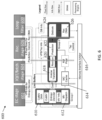
- FIG. 6 shows an exemplary decoder architecture 600, according to some embodiments.
- the Entropy Decoder includes, e.g., a CABAC or CAVLC entropy decoder, which parses the syntaxes from the bitstream.
- the ColMV DMA 610 stores the collocated temporal MVs.
- the MV Dispatch 612 reconstructs the MVs of the blocks and issues the memory fetch instruction to the MC cache 614 and DRAM (not shown) through the memory interface arbiter 616.
- the Inverse Transform 618 includes inverse quantization and inverse transform (IQIT) that generates the reconstructed residual 620.
- Prediction block 622 generates the inter motion compensation and intra prediction predictors.
- Deblock 624 is to reduce the block artifact and the Rec DMA 626 stores the reconstructed pixels to the external DRAM. Further detail of exemplary components of this architecture is discussed in C.-T. Huang et al., "A 249MPixel/s HEVC video-decoder chip for Quad Full HD applications," Digest of Technical Papers IEEE International Solid-State Circuits Conference (ISSCC), pp. 162-163, Feb. 2013 , which is hereby incorporated by reference herein in its entirety. Of note, the architecture is broken up into four stages in order to pipeline the architecture: the EC stage 602, the IQIT (inverse quantization and inverse transform)/fetch stage 604, the reconstruction stage 606 and the loop filter stage 608.
- the EC stage 602 the IQIT (inverse quantization and inverse transform)/fetch stage 604
- the reconstruction stage 606 the loop filter stage 608.
- the final MV can be derived in both the EC stage 602 (which includes parsing) and the reconstruction stage 606.
- the decoder derives the final MV in the parsing stage, and pre-fetches the required reference pixel data in the parsing stage (EC stage 602). This can be done, for example, to reduce/hide the DRAM access time.
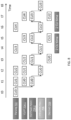
- FIG. 7 shows an example of a decoder pipeline execution 700 when executing a decoder architecture, such as the decoder architecture shown in FIG. 6 , according to some embodiments.
- FIG. 7 includes the parsing stage 702, during which the motion vectors are reconstructed as described above.
- the IQ/IT stage 704-1 generates the reconstructed residual for the current block.
- the Reference Pixels Fetch stage 704-2 fetches reference pixel data from memory. Reference frames are often stored in external memory, such as DRAM. Thus, if the decoder wants to do motion compensation on a reference frame, the decoder first needs to go to external memory to retrieve the reference data. Typically a lot of latency time is required to get data from external memory.
- the Intra/MC (Motion Compensation) reconstruction stage 706 performs the prediction.
- the deblocking (DB)/Sample Adaptive Offset (SAO) stage 708 performs in-loop filtering process to improve the quality of the decoded frame.
- the decoder first decodes CU0, then CU1 and so forth. To give an example using CU0, at t0, the decoder decodes CU0 in the parsing stage 702 including reconstructing the MVs. Then, at t1 CU0 moves to IQ/IT stage 704-1. In order to do motion compensation in the Intra/MC Reconstruction stage 706, the decoder needs to do a pre-fetch in the previous stage (the Ref Pixels fetch stage 704-2).
- the data is pre-fetched in the Ref Pixels fetch stage 704-2 and stored in local memory (e.g., SRAM or cache memory).
- local memory e.g., SRAM or cache memory
- the MVs can be reconstructed in the parsing stage.
- the required reference pixels can be fetched from the DRAM and stored in the local memory, e.g. SRAM or cache memory.
- the reference data can be loaded from the local memory without latency cycles.
- decoder-side predictor refinement tools use the neighboring block(s) to derive the motion vector (e.g., PMVD, such as how template matching merge mode uses the neighboring block to derive motion vector).
- PMVD such as how template matching merge mode uses the neighboring block to derive motion vector
- the template block is not generated until the third stage (the Intra/MC Reconstruction stage 706).
- the final MVs of a PMVD coded block depend on the PMVD searching process in the Intra/MC Reconstruction stage 706, which means the MVs cannot be reconstructed in the Parsing stage 702, and therefore the data pre-fetch is not feasible at stage Ref Pixels fetch 704-2.
- FIG. 8 shows an example of a decoder pipeline execution when executing a decoder-side predictor refinement tool.
- PMVD the MVs for CU0 depend on the PMVD searching process in the Intra/MC Reconstruction stage 706 (which is also performed at t2)
- the MVs cannot be reconstructed in the Parsing stage 702 for CU01 (at time t1), and so the data cannot be pre-fetched for CU1 at t2 at stage Ref Pixels fetch 704-2.
- This problem similarly affects the processing of each CU, and therefore results ultimately in only one CU processing finishing per two time slots.
- FIG. 8 shows that for t4 and t5, the decoder only completes processing CU1, compared to FIG. 7 , where CU1 completes processing at t4 and CU2 completes processing at t5.
- decoder-side prediction refinement techniques e.g., PMVD
- the techniques allow the data to be pre-fetched in a manner that still hides the latency cycles, such as shown in FIG. 7 , rather than causing a delay as shown in FIG. 8 .
- PMVD decoder-side prediction refinement techniques
- the discussion below refers to PMVD as an example, although a person of skill can appreciate that the techniques can be adapted for other decoder-side prediction refinement techniques (e.g., BIO and DMVR).
- the original candidate MV is preserved in the MV buffer for the next decoding process.
- the selected merge candidate MVs e.g., the starting, or unrefined MVs
- the MC of the PMVD block uses the PMVD derived MVs, but the selected merge candidate MVs are stored back to the MV buffers for the future referencing. This can allow, for example, the MVs to be reconstructed in Parsing stage 702, and the reference pixels can be pre-fetched at stage 704-2.
- the current block is a PMVD coded block
- a larger reference block e.g., including the refinement search range
- the MV is not refined for the current block, but the decoder uses the refined MV for compensation.
- the decoder can be configured not to change the MV in the MV buffer.
- the decoder can store the starting point (e.g., the starting MV(s)) in the MV buffer, and do the refinement to generate a refinement MV that is only used to generate motion compensation data, without changing the MV in the MV buffer.
- the MV buffers for the future referencing e.g. the merge candidate list and AMVP candidate list generation
- the decoder can signal a starting candidate for PMVD.
- the decoder can signal a starting candidate index that is used to select a starting MV from a MV candidate list. This can be done, for example, so that the decoder knows which candidate out of the eleven candidates will be used as the starting candidate for PMVD.
- the decoder can first generate the eleven starting candidates, and the encoder can signal to the decoder which is best. This signaling can allow, for example, the decoder to skip template matching and to proceed right to the refinement since the decoder knows staring candidate (e.g., the decoder can perform refinement using template matching and the Diamond Search technique to refine the MV around the starting candidate). While the MV is will be refined by diamond search, in proposed method will only store the starting candidate, not the refined motion vector.
- the LIST_0 and LIST_1 MVs in merge candidates are used as starting MVs.
- a best MV candidate can be implicitly derived by searching all these MVs. This can require a lot of memory bandwidth.
- the merge index for bilateral matching merge mode or template matching merge mode is signaled.
- the signaled merge index can indicate, for example, the best starting MVs in LIST_0 and LIST_1 in template matching merge mode, and the best two MV pairs (one is derived from the LIST_0 and the other is derived from the LIST_1) in bilateral matching merge mode.
- some techniques provide for signaling the starting MV (e.g., to signal the starting candidate, such as described above for PMVD) by generating a starting MV candidate list and signaling a candidate index.
- PMVD since PMVD performs the MV refinement, two similar starting MV candidates might have the same refined final MV.
- the similar MVs in the candidate list generation can be removed from the candidate list, or pruned, since they might have the same refined final MV since PMVD searches for a local minimum around the starting candidate.
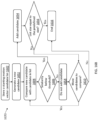
- FIG. 16A shows an exemplary method 1600 for pruning a motion vector candidate list, according to some embodiments.
- FIG. 16B shows an exemplary method 1650 for creating a motion vector candidate list, according to some embodiments.
- the list may be empty first, and whenever a new candidate may be added, the techniques can determine whether the new candidate is redundant or not with any existing motion vector candidates in the list. If it is redundant, then the new candidate is not added.
- the decoder stores a starting motion vector candidate list.
- the traditional merge candidate list generation process e.g., described above
- the traditional merge candidate list generation process can be used to generate the PMVD merge candidate list.
- steps 1604-1610 in FIG. 16A for MV derivation a newly added MV can be compared with the MVs that are already in the candidate list. If one (or more) of the MVs is similar to the newly added MV, the newly added MV will be removed from the list.
- the decoder compares the new candidate with an existing candidate in the candidate MV list to determine a similarity of the candidates.
- the decoder compares the similarity to a predetermined threshold.
- step 1610 if there are more candidates in the candidate MV list to check, the method 1600 iterates back to step 1604 for each remaining candidate in the candidate list. Otherwise, if all MV candidates in the MV candidate list have been compared to the new candidate (and each comparison has been above the threshold at step 1606), at step 1612 the decoder maintains the new MV candidate in the MV candidate list.
- step 1614 method 1600 takes the first "N" candidates in the starting motion vector candidate list. The value of N can be a predetermined value. N can be used to ensure that the ultimate list size is below a predetermined maximum size. In some examples, if the starting motion vector candidate list has less than N candidates, then step 1614 does not modify the starting motion vector candidate list. Method 1600 proceeds to step 1616 and ends.
- method 1650 includes some similar steps as method 1600 in FIG. 16A , including steps 1602, 1604, 1606, 1610, and 1616, as discussed further below.
- the decoder stores a starting motion vector candidate list. For example, the starting motion vector candidate list may be empty.
- the decoder generates a new motion vector candidate.
- the decoder compares the new candidate with an existing candidate in the starting MV candidate list to determine a similarity of the candidates. In some examples, if there are not yet any candidates in the starting MV candidate list, while not shown method 1650 can proceed directly to step 1654 and add the candidate to the starting MV candidate list.
- the decoder compares the similarity to a predetermined threshold. If the similarity is not below the predetermined threshold, the decoder proceeds to step 1654 and does not add the new MV to the list (and proceeds to step 1610). If the similarity is below the predetermined threshold, method 1650 proceeds to step 1654 and adds the candidate to the list. From step 1654, the method 1650 proceeds to step 1656 and determines whether the list size is equal to a predetermined size. If not, the method proceeds to step 1610. Otherwise, the method proceeds to step 1616 and ends. At step 1610 if there are more candidates to check, the method 1650 iterates back to step 1604 for each remaining candidate. Otherwise, method 1650 proceeds to step 1616 and ends.
- the similarity of the MV can be determined based on whether (a) the reference frame indices (or POC) are the same, and/or (b) the MV difference is smaller than a threshold.
- the sum of absolute MV distance of MVx and MVy can be calculated using Equation 1: abs MVx 0 ⁇ MVx 1 + abs MVy 0 ⁇ MVy 1 ⁇ K ; where K is a pixel distance such as, for example, a half pixel, one integer pixel, two integer pixels, three integer pixels, three and a half integer pixels, etc.
- the absolute MV distance of MVx and absolute MV distance of MVy can be compared against K, using Equation 2 below: abs MVx 0 ⁇ MVx 1 ⁇ K & & abs MVy 0 ⁇ MVy 1 ⁇ K ; where K, like with equation one, can be a half pixel, one integer pixel, two integer pixels, three integer pixels, three and a half integer pixels, etc.
- the candidate MV pair can be checked to determine whether they are in the same motion trajectory.
- the original merge candidate MV can be checked to determine whether the MVs in LIST_0 and LIST_1 are in the same motion trajectory.
- FIG. 14 shows an example of whether candidate MV pairs are in the same motion trajectory, according to some embodiments. If the MVs in LIST_0 and LIST_1 are in the same motion trajectory as shown in 1402, the candidate MV is added into the list; otherwise, if the MVs in LIST_0 and LIST_1 are not in the same motion trajectory as shown in 1404, the MVs of LIST_0 and LIST_1 are separated into two candidate MVs.
- each bi-prediction MV candidate is separated into two candidates. One candidate is the LIST_0 MV, and the other is the LIST_1 MV. Then, each candidate (e.g., each uni-predicted candidate) is used to generate the missing list MV by filling the missing list MV with the mirrored MV of the valid list.
- a MV search method can be predefined (e.g., a three step diamond search). For example, for a diamond search, the step size of the first step diamond search is half of one pixel (half-pixel). The step size of the second step cross search is one quarter of one pixel (quarter-pixel). The step size of the third step cross search is 1/8 of one pixel (1/8 pixel). In some embodiments, both (a) the merge index of the staring MV and (b) a coarse grain MVD are signaled. The MVD can be the refinement position index of the first step diamond search, and/or a conventional MVD.
- the MVD unit can be 1/16- pixel, 1/8- pixel, quarter-pixel, half-pixel, one-pixel, two-pixel, or any predefined unit.
- the MVs of the selected merge index plus the signaled MVD (or the MV of the refinement position) can be used as the PMVD starting MV, which are stored into the MV buffer for merge candidate and AMVP candidate derivation referencing.
- the PMVD search can start from the PMVD starting MV.
- the final PMVD derived MV is only for the MC.
- the starting MVs of the PMVD coded block can be reconstructed in parsing stage.
- only one MVD, and/or only one MVD refinement position index is signaled. If the merge candidate is a bi-predicted candidate, the MVD is added only on the LIST_0 or LIST_1. For bilateral matching merge mode, if the MVD is added on the LIST_0, the LIST_1 starting MV can be the mirrored MV of the LIST_0 starting MV.
- coarse grain MVD is not coded but derived in the search process at decoder. For example, we can partition the search process into three stages, the first step diamond search, the second step cross search, and the third step cross search.
- the coarse grain MVD can be the result of search process in the first step diamond search or the second step cross search.
- a picture is divided into coding tree units (CTUs), which are the basic processing unit for HEVC.
- the CTUs are coded in raster scan order.
- most information of the upper CTU rows is available in parsing stage (e.g., including the MV information) since the row was already processed.
- the decoder-side derived MVs in CTUs from the upper CTU-row can be referenced (or used), for example, for merge candidate list and AMVP list generation, since the information is available in the parsing stage.
- the decoder can use the derived MVs in those CTUs even though the decoder-side derived MVs in current CTU-row cannot be used since they are not available.
- a CTU-row constraint can be used with the techniques described herein, such that the PMVD derived MVs in upper CTU-row can be referred to (e.g. when not referring to the MV of the PMVD coded block) or can be used (e.g. when storing the merge candidate MVs, storing the merge candidate MVs and mirrored MV, sending the merge index for PMVD and bilateral mirrored MV (and only evaluating one MV), signaling the merge index and coarse grain MVD, and/or AMVP mode and PMVD).
- the merge candidate MVs can be used for merge candidate derivation and AMVP candidate derivation.
- the final PMVD derived MVs can be used.
- the MVs are not available for merge candidate derivation and AMVP candidate derivation.
- the final PMVD derived MVs are used.
- the CTU-row constraint can be changed to CTU constraint or any predefined or derived area constraint. For example, when not referring to the MV of the PMVD coded block, if the CTU constraint is applied, the MVs of PMVD coded blocks in the current CTU are not available while the MVs of the PMVD coded blocks in different CTUs are available.
- Overlapped block motion compensation is a coding tool that can be used to reduce block artifacts in motion compensation.
- JEM 6 Joint Exploration Test Model 6
- the neighboring block is compensated by the MV of the current block.
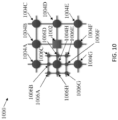
- FIG. 11 which is an excerpt of FIG. 14 in section 2.3.4 of JVET-F1001
- OBMC is performed at the sub-block level for all motion compensation (MC) block boundaries, where the "sub-block" size is set equal to 4 ⁇ 4.
- JVET-F1001 explains that when OBMC is applied to the current sub-block, besides current motion vectors, motion vectors of four connected neighboring sub-blocks, if available and if not identical to the current motion vector, are also used to derive the prediction block for the current sub-block.
- These multiple prediction blocks are based on multiple motion vectors that are combined to generate the final prediction signal of the current sub-block.
- JVET-F1001 further explains that the prediction block based on motion vectors of a neighboring sub-block is denoted as P N , with N indicating an index for the neighboring above, below, left and right sub-blocks and prediction block based on motion vectors of the current sub-block is denoted as P C .
- P N is based on the motion information of a neighboring sub-block that contains the same motion information to the current sub-block
- OBMC is not performed from P N . Otherwise, every sample of P N is added to the same sample in P C , namely four rows/columns of P N are added to P C .
- the weighting factors ⁇ 1/4, 1/8, 1/16, 1/32 ⁇ are used for P N and the weighting factors ⁇ 3/4, 7/8, 15/16, 31/32 ⁇ are used for P C .
- the exceptions are small MC blocks, (when height or width of the coding block is equal to 4 or a CU is coded with sub-CU mode), for which only two rows/columns of P N are added to P C .
- weighting factors ⁇ 1/4, 1/8 ⁇ are used for P N and weighting factors ⁇ 3/4, 7/8 ⁇ are used for P C .
- For P N generated based on motion vectors of vertically (horizontally) neighboring sub-block samples in the same row (column) of P N are added to P C with a same weighting factor.
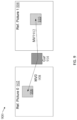
- FIG. 12A shows an exemplary high level summary of OBMC method 1200.
- MVA 1202 represents the original MV.
- MVA 1202 is refined to MVA' 1204.
- MVA' 1204 is used for OBMC at the block boundaries, resulting in blended sections 1206 and 1208 based on MVA' 1204.
- some embodiments include using the starting MV (not the refined MV) or the partial refined MV (starting MV + signaled MV offset) to reference the neighboring block in the parsing stage and the pre-fetch stage (e.g., stages 602 and 604 in FIG. 6 ).
- such techniques can result in using the starting MV for other processing, such as deblocking, OBMC, and temporal collocated MV derivation. Using the starting MV for other such processing may introduce blocking artifacts.
- FIG. 12B shows an exemplary result 1250 of applying OBMC using the staring MV 1202 (e.g., a restored MV).
- blended sections 1206 and 1208 based on MVA' 1204
- blended sections 1252 and 1254 in FIG. 12B are based on MVA 1202. This can cause, for example, a block artifact since the neighboring block is MVA' 1204 but the MV used for blending is MVA 1202.
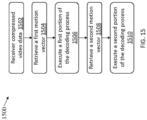
- FIG. 15 shows an exemplary decoding method 1500 for decoding video data that uses two MVs, according to some embodiments.
- the decoder receives compressed video data related to a set of frames.
- the decoder calculates, using a decoder-side predictor refinement technique, a new motion vector for a frame from the set of frames.
- the decoder retrieves (e.g., from a first buffer) a first motion vector (e.g., an unrefined MV) associated with the current frame.
- a first motion vector e.g., an unrefined MV
- the decoder executes a first portion of the decoding process (e.g., the parsing stage, a MV/MVP derivation, and/or a MV refinement technique) using the first motion vector.
- the decoder retrieves a second motion vector (e.g., from a second buffer) associated with the current frame (e.g., a refined MV).
- the decoder executes a second portion of the decoding process (e.g., the reconstruction stage, the motion compensation portion, a deblocking portion, and/or OBMC) using the second motion vector.
- two sets of MVs can be used: (1) a first set of MVs used for the parsing stage (e.g., parsing stage 702 in FIG. 7 ), including for MV/MVP derivation and/or pixel pre-fetch, and (2) a second set of MVs for reconstruction (e.g., during Intra/MC Rec. stage 706 in FIG. 7 ), including for motion compensation, OBMC and/or deblocking.
- the first set of MVs can store the original (unrefined) MV
- the second set of MVs can store the refined MV.
- Such techniques can facilitate, for example, OBMC and/or deblocking to use the modified MV.
- modified MV can avoid additional blocking artifacts (e.g., such as which could be caused by running OBMC and/or deblocking using unrefined MVs) and/or can provide a better coding gain compared to using unrefined MVs.
- additional blocking artifacts e.g., such as which could be caused by running OBMC and/or deblocking using unrefined MVs
- an individual unrefined MV set can be used in the parsing stage (e.g., for merge candidate list generation and/or AMVP candidate list generation).
- the MVs in the unrefined MV set are not refined by a decoder-side MV refinement tool, and can be used for MV parsing and MV reconstruction. Then the reconstructed MVs are used for reference pixel fetching.
- the MVs refined by a decoder-side MV refinement tool can be stored in another MV buffer set.
- the refined MVs can be used for motion compensation, OBMC, deblocking, and/or other tools that won't change the parsing process according to the MVs.
- the refined MV set can be used for temporal MV derivation in the parsing stage and the MV reconstruction stage. For example, for merge candidate list generation and AMVP candidate list generation, when deriving the spatial neighboring MVs, the unrefined MV set is used, while when deriving the temporal collocated MVs, the refined MV set is used.
- the first MV set (e.g., used for the parsing stage) can store the MVs of the second MV set (e.g., used for reconstruction) if the MV is in the upper CTU row.
- the parsing stage can access the second MV set for the upper CTU row. This can, for example, reduce the unrefined MV buffer size. For example, the buffer size can be reduced by only needing to keep the MV of one block row of a CTU and one block column of a CTU.
- the MVs that will not be referred to by the neighboring spatial blocks in the current CTU row in the parsing stage and MV reconstruction stage can be discarded.
- only the refined MVs need to be stored.
- the unrefined MVs can be stored just in the parsing pipeline stage and the pre-fetch pipeline stage (e.g., stages 702 and 704-2 in FIG. 7 ).
- the techniques can use the refined MVs from the CUs that were processed before the N previous CUs.
- the MV in the CUs before the last 5 decoded CU can use the refined MV.
- the same concept can be applied for the tile/slice boundary. For example, if the reference MV is in different tile or different slice, then the parsing stage can access the second MV set for the MV in different tile or different slice.
- the first MV set (the unrefined MVs) can be used for Merge/AMVP candidate generation and/or starting MV generation.
- the generated MV is used for reference pixel fetching.
- the MV set contains (a) the unrefined MV of the current picture (e.g., the left column, above row, and cur CTU), and (b) the refined MV of the other picture (e.g., the temporal collocated picture).
- the MV set contains the unrefined MV of the current picture for the current CTU 1302, the left column 1304, and the above row 1306.
- the MV set contains (a) the unrefined MV of the current CTU row (left column and cur CTU), (b) the refined MV of upper CTU row (above row), and (c) the refined MV of the other picture.
- the MV set contains the unrefined MV of the current CTU row for the cur CTU 1302 and the left column 1304, and the refined MV of upper CTU row for the above row 1306.
- the second MV set can be used for motion compensation, OBMC and/or deblocking.
- the second MV set contains (a) the refined MV of the current picture, and (b) the refined MV of the other picture.
- the MV set contains the refined MV of the current picture for the cur CTU 1302, the left column 1304, and the above row 1306.
- the proposed multiple MVs/MV sets method can be also applied in the encoder.
- an individual unrefined MV set can be used in the syntax encoding stage, MV derivation, and/or MVP derivation (e.g. merge candidate list generation, and/or AMVP candidate list generation).
- the MVs in the unrefined MV set are not refined by a decoder-side MV refinement tool, and can be used for MV encoding and MVP generation.
- the MVs refined by a decoder-side MV refinement tool can be stored in another MV buffer set.
- the refined MVs can be used for motion compensation, OBMC, deblocking, and/or other tools that won't change the parsing process according to the MVs.
- decoder-side MV refinement tools may change the MV of a block (e.g., which can result in a parsing issue or reference pixel pre-fetch issue as discussed above).
- the difference between refined MV and the starting MV can be constrained to a pre-defined threshold. For example, if the difference between the refined MV and the starting MV is larger than the predetermined threshold (e.g., 4, 8, or 16 integer pixel distance), then the refined MV is first clipped (e.g., set just below, or equal to, the threshold) and then stored as the clipped MV. For example, the MV can be clipped by starting MV ⁇ 4, 8, or 16 integer pixel. If the difference between refined MV and the starting MV is smaller than this threshold, the refined MV can be stored directly.
- the predetermined threshold e.g. 4, 8, or 16 integer pixel distance
- the impact of a decoder-side MV refinement tool changing the MV of a block can be reduced by removing the pruning process between these refined MVs and other MVs in the MV/MVP derivation (e.g., in merge candidate list reconstruction or AMVP list reconstruction).
- the pruning process used to remove the redundancy among possible candidates is only applied on those MVs which are not refined at decoder.
- the refined MVs can be directly added into the candidate list without using the pruning process.
- eliminating such pruning can be combined with the other techniques described above (e.g. the refined MV clipping and the multiple MVs/MV sets) to further reduce the impact.
- the techniques described herein may be embodied in computer-executable instructions implemented as software, including as application software, system software, firmware, middleware, embedded code, or any other suitable type of computer code.
- Such computer-executable instructions may be written using any of a number of suitable programming languages and/or programming or scripting tools, and also may be compiled as executable machine language code or intermediate code that is executed on a framework or virtual machine.
- these computer-executable instructions may be implemented in any suitable manner, including as a number of functional facilities, each providing one or more operations to complete execution of algorithms operating according to these techniques.
- a "functional facility,” however instantiated, is a structural component of a computer system that, when integrated with and executed by one or more computers, causes the one or more computers to perform a specific operational role.
- a functional facility may be a portion of or an entire software element.
- a functional facility may be implemented as a function of a process, or as a discrete process, or as any other suitable unit of processing.
- each functional facility may be implemented in its own way; all need not be implemented the same way.
- these functional facilities may be executed in parallel and/or serially, as appropriate, and may pass information between one another using a shared memory on the computer(s) on which they are executing, using a message passing protocol, or in any other suitable way.
- functional facilities include routines, programs, objects, components, data structures, etc. that perform particular tasks or implement particular abstract data types.
- functionality of the functional facilities may be combined or distributed as desired in the systems in which they operate.
- one or more functional facilities carrying out techniques herein may together form a complete software package.
- These functional facilities may, in alternative embodiments, be adapted to interact with other, unrelated functional facilities and/or processes, to implement a software program application.
- Some exemplary functional facilities have been described herein for carrying out one or more tasks. It should be appreciated, though, that the functional facilities and division of tasks described is merely illustrative of the type of functional facilities that may implement the exemplary techniques described herein, and that embodiments are not limited to being implemented in any specific number, division, or type of functional facilities. In some implementations, all functionality may be implemented in a single functional facility. It should also be appreciated that, in some implementations, some of the functional facilities described herein may be implemented together with or separately from others (i.e., as a single unit or separate units), or some of these functional facilities may not be implemented.
- Computer-executable instructions implementing the techniques described herein may, in some embodiments, be encoded on one or more computer-readable media to provide functionality to the media.
- Computer-readable media include magnetic media such as a hard disk drive, optical media such as a Compact Disk (CD) or a Digital Versatile Disk (DVD), a persistent or non-persistent solid-state memory (e.g., Flash memory, Magnetic RAM, etc.), or any other suitable storage media.
- Such a computer-readable medium may be implemented in any suitable manner.
- “computer-readable media” also called “computer-readable storage media” refers to tangible storage media. Tangible storage media are non-transitory and have at least one physical, structural component.
- At least one physical, structural component has at least one physical property that may be altered in some way during a process of creating the medium with embedded information, a process of recording information thereon, or any other process of encoding the medium with information. For example, a magnetization state of a portion of a physical structure of a computer-readable medium may be altered during a recording process.
- some techniques described above comprise acts of storing information (e.g., data and/or instructions) in certain ways for use by these techniques.
- information e.g., data and/or instructions
- the information may be encoded on a computer-readable storage media.
- advantageous structures may be used to impart a physical organization of the information when encoded on the storage medium. These advantageous structures may then provide functionality to the storage medium by affecting operations of one or more processors interacting with the information; for example, by increasing the efficiency of computer operations performed by the processor(s).
- these instructions may be executed on one or more suitable computing device(s) operating in any suitable computer system, or one or more computing devices (or one or more processors of one or more computing devices) may be programmed to execute the computer-executable instructions.
- a computing device or processor may be programmed to execute instructions when the instructions are stored in a manner accessible to the computing device or processor, such as in a data store (e.g., an on-chip cache or instruction register, a computer-readable storage medium accessible via a bus, a computer-readable storage medium accessible via one or more networks and accessible by the device/processor, etc.).
- a data store e.g., an on-chip cache or instruction register, a computer-readable storage medium accessible via a bus, a computer-readable storage medium accessible via one or more networks and accessible by the device/processor, etc.
- Functional facilities comprising these computer-executable instructions may be integrated with and direct the operation of a single multi-purpose programmable digital computing device, a coordinated system of two or more multi-purpose computing device sharing processing power and jointly carrying out the techniques described herein, a single computing device or coordinated system of computing device (co-located or geographically distributed) dedicated to executing the techniques described herein, one or more Field-Programmable Gate Arrays (FPGAs) for carrying out the techniques described herein, or any other suitable system.
- FPGAs Field-Programmable Gate Arrays
- a computing device may comprise at least one processor, a network adapter, and computer-readable storage media.
- a computing device may be, for example, a desktop or laptop personal computer, a personal digital assistant (PDA), a smart mobile phone, a server, or any other suitable computing device.
- PDA personal digital assistant
- a network adapter may be any suitable hardware and/or software to enable the computing device to communicate wired and/or wirelessly with any other suitable computing device over any suitable computing network.
- the computing network may include wireless access points, switches, routers, gateways, and/or other networking equipment as well as any suitable wired and/or wireless communication medium or media for exchanging data between two or more computers, including the Internet.
- Computer-readable media may be adapted to store data to be processed and/or instructions to be executed by processor. The processor enables processing of data and execution of instructions. The data and instructions may be stored on the computer-readable storage media.
- a computing device may additionally have one or more components and peripherals, including input and output devices. These devices can be used, among other things, to present a user interface. Examples of output devices that can be used to provide a user interface include printers or display screens for visual presentation of output and speakers or other sound generating devices for audible presentation of output. Examples of input devices that can be used for a user interface include keyboards, and pointing devices, such as mice, touch pads, and digitizing tablets. As another example, a computing device may receive input information through speech recognition or in other audible format.
- Embodiments have been described where the techniques are implemented in circuitry and/or computer-executable instructions. It should be appreciated that some embodiments may be in the form of a method, of which at least one example has been provided. The acts performed as part of the method may be ordered in any suitable way. Accordingly, embodiments may be constructed in which acts are performed in an order different than illustrated, which may include performing some acts simultaneously, even though shown as sequential acts in illustrative embodiments.
- exemplary is used herein to mean serving as an example, instance, or illustration. Any embodiment, implementation, process, feature, etc. described herein as exemplary should therefore be understood to be an illustrative example and should not be understood to be a preferred or advantageous example unless otherwise indicated.
Landscapes
- Engineering & Computer Science (AREA)
- Multimedia (AREA)
- Signal Processing (AREA)
- Compression Or Coding Systems Of Tv Signals (AREA)
Claims (3)
- Decodierverfahren zum Decodieren von Videodaten, wobei das Verfahren Folgendes umfasst:Empfangen (1502) von komprimierten Videodaten, die sich auf einen Satz von Frames beziehen, wobei der Satz von Frames einen aktuellen Frame und einen vorherigen Frame des aktuellen Frames umfasst und ein Satz von Codiereinheiten eines aktuellen Bildes ist; undBerechnen, unter Verwendung einer decoderseitigen Prädiktorverfeinerungstechnik, eines neuen Bewegungsvektors für den aktuellen Frame aus dem Satz von Frames, wobei der neue Bewegungsvektor Bewegung für den aktuellen Frame basierend auf einem oder mehreren Referenzframes schätzt, umfassend:wenn eine Codierbaumeinheit-Zeilenbeschränkung nicht auf die komprimierten Videodaten angewendet wird, das Abrufen (1504) des ersten Bewegungsvektors, der mit dem aktuellen Frame verknüpft ist, Abrufen von Folgendem umfasst:dem nicht verfeinerten Bewegungsvektor, der mit dem aktuellen Frame verknüpft ist, der ein nicht verfeinerter Bewegungsvektor des aktuellen Frames ist; unddem verfeinerten Bewegungsvektor, der mit einem zweiten Frame verknüpft ist; undwenn die Codierbaumeinheit-Zeilenbeschränkung auf die komprimierten Videodaten angewendet wird, das Abrufen (1504) des ersten Bewegungsvektors, der mit dem aktuellen Frame verknüpft ist, Abrufen von Folgendem umfasst:dem nicht verfeinerten Bewegungsvektor, der mit dem aktuellen Frame verknüpft ist, der ein nicht verfeinerter Bewegungsvektor einer aktuellen Codierbaumeinheit-Zeile ist;einem verfeinerten Bewegungsvektor einer oberen Codierbaumeinheit-Zeile; unddem verfeinerten Bewegungsvektor, der mit dem zweiten Frame verknüpft ist;Ausführen eines ersten Abschnitts eines Decodierprozesses unter Verwendung der abgerufenen Bewegungsvektoren, wobei der Decodierprozess ein Decodierprozess des aktuellen Frames ist, der erste Abschnitt des Decodierprozesses einen Bewegungsvektorableitungsabschnitt umfasst, der unter Verwendung der abgerufenen Bewegungsvektoren ausgeführt wird, und der Bewegungsvektorableitungsabschnitt eine Bewegungsvektorkandidatenlistenerzeugung umfasst;Abrufen (1508) eines zweiten Bewegungsvektors, der mit dem aktuellen Frame verknüpft ist, der sich von den zuvor abgerufenen Bewegungsvektoren unterscheidet, wobei der zweite Bewegungsvektor einen verfeinerten Bewegungsvektor des aktuellen Bildes umfasst, der unter Verwendung einer decoderseitigen Prädiktorverfeinerungstechnik verfeinert wird; undAusführen (1510) eines zweiten Abschnitts des Decodierprozesses unter Verwendung des zweiten Bewegungsvektors, wobei der zweite Abschnitt des Decodierprozesses einen Rekonstruktionsabschnitt umfasst und der Rekonstruktionsabschnitt eine Bewegungskompensation umfasst;wobei die Bewegungsvektorkandidatenlistenerzeugung eine Zusammenführungskandidatenableitung, eine Bewegungsvektorprädiktionsableitung oder beides ist;wobei der erste Abschnitt des Decodierprozesses des aktuellen Frames neben dem Bewegungsvektorableitungsabschnitt einen Referenzpixel-Vorabrufabschnitt zum Vorabrufen von Referenzpixeln umfasst, die von dem Rekonstruktionsabschnitt des zweiten Abschnitts des Decodierprozesses des aktuellen Frames benötigt werden; undwobei das Ausführen des ersten Abschnitts des Decodierprozesses des aktuellen Frames ferner Folgendes umfasst:
Ausführen des Pixel-Vorabrufabschnitts unter Verwendung eines Bewegungsvektors, der von der Kandidatenlistenerzeugung erzeugt wird, die in dem Bewegungsvektorableitungsabschnitt enthalten ist. - Decodierverfahren nach Anspruch 1, das ferner das Verwenden der abgerufenen Bewegungsvektoren zum Durchführen der Bewegungskompensation, der Überlappungsblockbewegungskompensation, des Entblockens oder einer beliebigen Kombination davon umfasst.
- Vorrichtung (108), die konfiguriert ist, um Videodaten zu decodieren, wobei die Vorrichtung (108) einen Prozessor in Kommunikation mit einem Speicher umfasst, wobei der Prozessor konfiguriert ist, um Anweisungen auszuführen, die in dem Speicher gespeichert sind, die den Prozessor zu Folgendem veranlassen:Empfangen (1502) von komprimierten Videodaten, die sich auf einen Satz von Frames beziehen, wobei der Satz von Frames einen aktuellen Frame und einen vorherigen Frame des aktuellen Frames umfasst und ein Satz von Codiereinheiten eines aktuellen Bildes ist; undBerechnen, unter Verwendung einer decoderseitigen Prädiktorverfeinerungstechnik, eines neuen Bewegungsvektors für einen aktuellen Frame aus dem Satz von Frames, wobei der neue Bewegungsvektor Bewegung für den aktuellen Frame basierend auf einem oder mehreren Referenzframes schätzt, umfassend:wenn eine Codierbaumeinheit-Zeilenbeschränkung nicht auf die komprimierten Videodaten angewendet wird, das Abrufen (1504) des ersten Bewegungsvektors, der mit dem aktuellen Frame verknüpft ist, Abrufen von Folgendem umfasst:dem nicht verfeinerten Bewegungsvektor, der mit dem aktuellen Frame verknüpft ist, der ein nicht verfeinerter Bewegungsvektor des aktuellen Frames ist; unddem verfeinerten Bewegungsvektor, der mit einem zweiten Frame verknüpft ist; undwenn die Codierbaumeinheit-Zeilenbeschränkung auf die komprimierten Videodaten angewendet wird, das Abrufen (1504) des ersten Bewegungsvektors, der mit dem aktuellen Frame verknüpft ist, Abrufen von Folgendem umfasst:dem nicht verfeinerten Bewegungsvektor, der mit dem aktuellen Frame verknüpft ist, der ein nicht verfeinerter Bewegungsvektor einer aktuellen Codierbaumeinheit-Zeile ist;einem verfeinerten Bewegungsvektor einer oberen Codierbaumeinheit-Zeile; unddem verfeinerten Bewegungsvektor, der mit dem zweiten Frame verknüpft ist;Ausführen eines ersten Abschnitts eines Decodierprozesses unter Verwendung der abgerufenen Bewegungsvektoren, wobei der Decodierprozess ein Decodierprozess des aktuellen Frames ist, der erste Abschnitt des Decodierprozesses einen Bewegungsvektorableitungsabschnitt umfasst, der unter Verwendung der abgerufenen Bewegungsvektoren ausgeführt wird, und der Bewegungsvektorableitungsabschnitt eine Bewegungsvektorkandidatenlistenerzeugung umfasst;Abrufen (1508) eines zweiten Bewegungsvektors, der mit dem aktuellen Frame verknüpft ist, der sich von den zuvor abgerufenen Bewegungsvektoren unterscheidet, wobei der zweite Bewegungsvektor einen verfeinerten Bewegungsvektor des aktuellen Bildes umfasst, der unter Verwendung einer decoderseitigen Prädiktorverfeinerungstechnik verfeinert wird; undAusführen (1510) eines zweiten Abschnitts des Decodierprozesses unter Verwendung des zweiten Bewegungsvektors, wobei der zweite Abschnitt des Decodierprozesses einen Rekonstruktionsabschnitt umfasst und der Rekonstruktionsabschnitt eine Bewegungskompensation umfasst;wobei die Bewegungsvektorkandidatenlistenerzeugung eine Zusammenführungskandidatenableitung, eine Bewegungsvektorprädiktionsableitung oder beides ist;wobei der erste Abschnitt des Decodierprozesses des aktuellen Frames neben dem Bewegungsvektorableitungsabschnitt einen Referenzpixel-Vorabrufabschnitt zum Vorabrufen von Referenzpixeln umfasst, die von dem Rekonstruktionsabschnitt des zweiten Abschnitts des Decodierprozesses des aktuellen Frames benötigt werden; undwobei das Ausführen des ersten Abschnitts des Decodierprozesses des aktuellen Frames ferner Folgendes umfasst:
Ausführen des Pixel-Vorabrufabschnitts unter Verwendung eines Bewegungsvektors, der von der Kandidatenlistenerzeugung erzeugt wird, die in dem Bewegungsvektorableitungsabschnitt enthalten ist.
Priority Applications (1)
| Application Number | Priority Date | Filing Date | Title |
|---|---|---|---|
| EP25158081.7A EP4531399A3 (de) | 2017-01-05 | 2018-01-05 | Decodiererseitige bewegungsvektorwiederherstellung für videocodierung |
Applications Claiming Priority (4)
| Application Number | Priority Date | Filing Date | Title |
|---|---|---|---|
| US201762442472P | 2017-01-05 | 2017-01-05 | |
| US201762479350P | 2017-03-31 | 2017-03-31 | |
| US15/861,476 US12063387B2 (en) | 2017-01-05 | 2018-01-03 | Decoder-side motion vector restoration for video coding |
| PCT/CN2018/071518 WO2018127119A1 (en) | 2017-01-05 | 2018-01-05 | Decoder-side motion vector restoration for video coding |
Related Child Applications (2)
| Application Number | Title | Priority Date | Filing Date |
|---|---|---|---|
| EP25158081.7A Division EP4531399A3 (de) | 2017-01-05 | 2018-01-05 | Decodiererseitige bewegungsvektorwiederherstellung für videocodierung |
| EP25158081.7A Division-Into EP4531399A3 (de) | 2017-01-05 | 2018-01-05 | Decodiererseitige bewegungsvektorwiederherstellung für videocodierung |
Publications (3)
| Publication Number | Publication Date |
|---|---|
| EP3545682A1 EP3545682A1 (de) | 2019-10-02 |
| EP3545682A4 EP3545682A4 (de) | 2020-04-29 |
| EP3545682B1 true EP3545682B1 (de) | 2025-06-25 |
Family
ID=62712096
Family Applications (2)
| Application Number | Title | Priority Date | Filing Date |
|---|---|---|---|
| EP25158081.7A Pending EP4531399A3 (de) | 2017-01-05 | 2018-01-05 | Decodiererseitige bewegungsvektorwiederherstellung für videocodierung |
| EP18735922.9A Active EP3545682B1 (de) | 2017-01-05 | 2018-01-05 | Decodiererseitige bewegungsvektorwiederherstellung für videocodierung |
Family Applications Before (1)
| Application Number | Title | Priority Date | Filing Date |
|---|---|---|---|
| EP25158081.7A Pending EP4531399A3 (de) | 2017-01-05 | 2018-01-05 | Decodiererseitige bewegungsvektorwiederherstellung für videocodierung |
Country Status (5)
| Country | Link |
|---|---|
| US (2) | US12063387B2 (de) |
| EP (2) | EP4531399A3 (de) |
| CN (2) | CN110169073B (de) |
| TW (1) | TWI677238B (de) |
| WO (1) | WO2018127119A1 (de) |
Families Citing this family (82)
| Publication number | Priority date | Publication date | Assignee | Title |
|---|---|---|---|---|
| US11638027B2 (en) | 2016-08-08 | 2023-04-25 | Hfi Innovation, Inc. | Pattern-based motion vector derivation for video coding |
| US10523964B2 (en) * | 2017-03-13 | 2019-12-31 | Qualcomm Incorporated | Inter prediction refinement based on bi-directional optical flow (BIO) |
| CN117395394A (zh) * | 2017-03-22 | 2024-01-12 | 韩国电子通信研究院 | 使用参考块的预测方法和装置 |
| US10904565B2 (en) | 2017-06-23 | 2021-01-26 | Qualcomm Incorporated | Memory-bandwidth-efficient design for bi-directional optical flow (BIO) |
| EP3649780B1 (de) * | 2017-07-03 | 2025-06-25 | InterDigital VC Holdings, Inc. | Bewegungskompensierte vorhersage auf grundlage von bidirektionalem optischem fluss |
| US10798402B2 (en) * | 2017-10-24 | 2020-10-06 | Google Llc | Same frame motion estimation and compensation |
| CN109996081B (zh) | 2017-12-31 | 2023-09-12 | 华为技术有限公司 | 图像预测方法、装置以及编解码器 |
| JP7315480B2 (ja) * | 2018-01-30 | 2023-07-26 | パナソニック インテレクチュアル プロパティ コーポレーション オブ アメリカ | 符号化装置、復号装置、符号化方法及び復号方法 |
| US10812810B2 (en) * | 2018-02-06 | 2020-10-20 | Tencent America LLC | Method and apparatus for video coding in merge mode |
| CN117560506A (zh) | 2018-03-29 | 2024-02-13 | 华为技术有限公司 | 一种双向帧间预测方法及装置 |
| CN119324983A (zh) * | 2018-03-30 | 2025-01-17 | 英迪股份有限公司 | 图像编码/解码方法以及存储介质 |
| JP2021520710A (ja) | 2018-04-06 | 2021-08-19 | ヴィド スケール インコーポレイテッド | 簡易化された勾配導出による双方向オプティカルフロー方法 |
| US10958928B2 (en) * | 2018-04-10 | 2021-03-23 | Qualcomm Incorporated | Decoder-side motion vector derivation for video coding |
| KR102817113B1 (ko) * | 2018-04-13 | 2025-06-05 | 엘지전자 주식회사 | 비디오 처리 시스템에서 인터 예측 방법 및 장치 |
| WO2019229683A1 (en) | 2018-05-31 | 2019-12-05 | Beijing Bytedance Network Technology Co., Ltd. | Concept of interweaved prediction |
| WO2019229682A1 (en) * | 2018-05-31 | 2019-12-05 | Beijing Bytedance Network Technology Co., Ltd. | Application of interweaved prediction |
| US10863190B2 (en) * | 2018-06-14 | 2020-12-08 | Tencent America LLC | Techniques for memory bandwidth optimization in bi-predicted motion vector refinement |
| WO2020005719A1 (en) * | 2018-06-27 | 2020-01-02 | Vid Scale, Inc. | Methods and apparatus for reducing the coding latency of decoder-side motion refinement |
| CN110662052B (zh) | 2018-06-29 | 2022-07-08 | 北京字节跳动网络技术有限公司 | 更新查找表(lut)的条件 |
| WO2020003265A1 (en) | 2018-06-29 | 2020-01-02 | Beijing Bytedance Network Technology Co., Ltd. | Conditions of usage of luts |
| EP4322533A3 (de) | 2018-06-29 | 2024-03-06 | Beijing Bytedance Network Technology Co., Ltd. | Überprüfung der reihenfolge von bewegungskandidaten in lut |
| KR102627814B1 (ko) | 2018-06-29 | 2024-01-23 | 베이징 바이트댄스 네트워크 테크놀로지 컴퍼니, 리미티드 | 룩업 테이블의 업데이트: fifo, 제약된 fifo |
| SG11202013028PA (en) * | 2018-06-29 | 2021-01-28 | Beijing Bytedance Network Technology Co Ltd | Interaction between lut and amvp |
| KR102840294B1 (ko) | 2018-06-29 | 2025-07-30 | 두인 비전 컴퍼니 리미티드 | 하나 또는 다수의 룩업 테이블들을 사용하여 이전에 코딩된 모션 정보를 순서대로 저장하고 이를 사용하여 후속 블록들을 코딩하는 개념 |
| WO2020003282A1 (en) | 2018-06-29 | 2020-01-02 | Beijing Bytedance Network Technology Co., Ltd. | Managing motion vector predictors for video coding |
| KR102680903B1 (ko) | 2018-06-29 | 2024-07-04 | 베이징 바이트댄스 네트워크 테크놀로지 컴퍼니, 리미티드 | Hmvp 후보를 병합/amvp에 추가할 때의 부분/풀 프루닝 |
| CN110677669B (zh) | 2018-07-02 | 2021-12-07 | 北京字节跳动网络技术有限公司 | 具有lic的lut |
| US10638153B2 (en) * | 2018-07-02 | 2020-04-28 | Tencent America LLC | For decoder side MV derivation and refinement |
| US10701384B2 (en) | 2018-08-01 | 2020-06-30 | Tencent America LLC | Method and apparatus for improvement on decoder side motion derivation and refinement |
| GB2590228B (en) * | 2018-08-04 | 2023-04-05 | Beijing Bytedance Network Tech Co Ltd | Clipping of updated MV or derived MV |
| US11184635B2 (en) | 2018-08-31 | 2021-11-23 | Tencent America LLC | Method and apparatus for video coding with motion vector constraints |
| WO2020053798A1 (en) | 2018-09-12 | 2020-03-19 | Beijing Bytedance Network Technology Co., Ltd. | Conditions for starting checking hmvp candidates depend on total number minus k |
| SG11202101823XA (en) | 2018-09-19 | 2021-04-29 | Huawei Tech Co Ltd | Method for skipping refinement based on patch similarity in bilinear interpolation based decoder-side motion vector refinement |
| US11943467B2 (en) * | 2018-09-21 | 2024-03-26 | Vid Scale, Inc. | Affine motion estimation for affine model-based video coding |
| AU2019351346B2 (en) | 2018-09-24 | 2023-07-13 | Huawei Technologies Co., Ltd. | Image processing device and method for performing quality optimized deblocking |
| WO2020070612A1 (en) | 2018-10-06 | 2020-04-09 | Beijing Bytedance Network Technology Co., Ltd. | Improvement for temporal gradient calculating in bio |
| WO2020073928A1 (en) * | 2018-10-09 | 2020-04-16 | Huawei Technologies Co., Ltd. | Inter prediction method and apparatus |
| CN111083484B (zh) | 2018-10-22 | 2024-06-28 | 北京字节跳动网络技术有限公司 | 基于子块的预测 |
| WO2020084461A1 (en) | 2018-10-22 | 2020-04-30 | Beijing Bytedance Network Technology Co., Ltd. | Restrictions on decoder side motion vector derivation based on coding information |
| CN111083489B (zh) | 2018-10-22 | 2024-05-14 | 北京字节跳动网络技术有限公司 | 多次迭代运动矢量细化 |
| CN112913241B (zh) * | 2018-10-22 | 2024-03-26 | 北京字节跳动网络技术有限公司 | 解码器侧运动矢量推导的限制 |
| EP4300965A3 (de) * | 2018-11-05 | 2024-01-17 | Beijing Bytedance Network Technology Co., Ltd. | Interpolation zur interprädiktion mit verfeinerung |
| CN111436227B (zh) | 2018-11-12 | 2024-03-29 | 北京字节跳动网络技术有限公司 | 在视频处理中使用组合帧间-帧内预测 |
| WO2020103877A1 (en) | 2018-11-20 | 2020-05-28 | Beijing Bytedance Network Technology Co., Ltd. | Coding and decoding of video coding modes |
| US11146810B2 (en) * | 2018-11-27 | 2021-10-12 | Qualcomm Incorporated | Decoder-side motion vector refinement |
| WO2020141913A1 (ko) * | 2019-01-01 | 2020-07-09 | 엘지전자 주식회사 | 인터 예측을 기반으로 비디오 신호를 처리하기 위한 방법 및 장치 |
| WO2020141912A1 (ko) * | 2019-01-01 | 2020-07-09 | 엘지전자 주식회사 | 인터 예측을 기반으로 비디오 신호를 처리하기 위한 방법 및 장치 |
| WO2020140948A1 (en) | 2019-01-02 | 2020-07-09 | Beijing Bytedance Network Technology Co., Ltd. | Motion vector derivation between dividing patterns |
| EP3854093A4 (de) * | 2019-01-02 | 2021-10-27 | Huawei Technologies Co., Ltd. | Hardware- und software-freundliches system und verfahren zur decodiererseitigen bewegungsvektorverfeinerung mit decodiererseitiger biprädiktiver optischer flussbasierter pixelkorrektur zur biprädiktiven bewegungskompensation |
| KR20210094664A (ko) * | 2019-01-02 | 2021-07-29 | 텔레폰악티에볼라겟엘엠에릭슨(펍) | 비디오 인코딩/디코딩 시스템의 사이드 모션 정교화 |
| KR102648159B1 (ko) * | 2019-01-10 | 2024-03-18 | 베이징 바이트댄스 네트워크 테크놀로지 컴퍼니, 리미티드 | Lut 업데이트의 호출 |
| WO2020143824A1 (en) | 2019-01-13 | 2020-07-16 | Beijing Bytedance Network Technology Co., Ltd. | Interaction between lut and shared merge list |
| CN113330739B (zh) | 2019-01-16 | 2025-01-10 | 北京字节跳动网络技术有限公司 | Lut中的运动候选的插入顺序 |
| CN121967699A (zh) | 2019-02-03 | 2026-05-01 | 北京字节跳动网络技术有限公司 | Mv精度和mv差编解码之间的相互作用 |
| CN121173966A (zh) * | 2019-02-14 | 2025-12-19 | 北京字节跳动网络技术有限公司 | 解码器侧细化工具的选择性应用 |
| US11025948B2 (en) * | 2019-02-28 | 2021-06-01 | Tencent America LLC | Method and apparatus for motion prediction in video coding |
| US11190797B2 (en) * | 2019-03-01 | 2021-11-30 | Qualcomm Incorporated | Constraints on decoder-side motion vector refinement based on weights for bi-predicted prediction |
| WO2020177684A1 (en) * | 2019-03-03 | 2020-09-10 | Beijing Bytedance Network Technology Co., Ltd. | Enabling dmvr based on the information in the picture header |
| KR102635518B1 (ko) | 2019-03-06 | 2024-02-07 | 베이징 바이트댄스 네트워크 테크놀로지 컴퍼니, 리미티드 | 변환된 단예측 후보의 사용 |
| CN113475076B (zh) * | 2019-03-11 | 2024-03-12 | 阿里巴巴集团控股有限公司 | 用于对视频数据进行编码的帧间预测方法 |
| CN115633169A (zh) * | 2019-03-11 | 2023-01-20 | 北京字节跳动网络技术有限公司 | 视频编解码中的运动矢量细化 |
| CN109803175B (zh) * | 2019-03-12 | 2021-03-26 | 京东方科技集团股份有限公司 | 视频处理方法及装置、设备、存储介质 |
| KR102501210B1 (ko) | 2019-03-12 | 2023-02-17 | 베이징 다지아 인터넷 인포메이션 테크놀로지 컴퍼니 리미티드 | 결합된 인터 및 인트라-예측 모드의 제한되고 조정된 적용 |
| CN113615193B (zh) | 2019-03-22 | 2024-06-25 | 北京字节跳动网络技术有限公司 | Merge列表构建和其他工具之间的交互 |
| JP7543301B2 (ja) * | 2019-04-18 | 2024-09-02 | インターデジタル ヴイシー ホールディングス, インコーポレイテッド | 境界平滑化された動き補償に基づくオプティカルフローによるビデオ符号化および復号化の方法および装置 |
| SG11202112279WA (en) | 2019-05-11 | 2021-12-30 | Beijing Bytedance Network Technology Co Ltd | Selective use of coding tools in video processing |
| US11172212B2 (en) * | 2019-06-06 | 2021-11-09 | Qualcomm Incorporated | Decoder-side refinement tool on/off control |
| EP4300964A3 (de) * | 2019-06-21 | 2024-03-13 | VID SCALE, Inc. | Präzisionsverfeinerung zur bewegungskompensation mit optischem fluss |
| EP3973708A4 (de) | 2019-06-25 | 2023-02-22 | Zhejiang Dahua Technology Co., Ltd. | Systeme und verfahren zur interframeprädiktion |
| CN110460859B (zh) * | 2019-08-21 | 2022-03-25 | 浙江大华技术股份有限公司 | 历史运动矢量列表的使用方法、编解码器及存储装置 |
| KR102778652B1 (ko) * | 2019-08-23 | 2025-03-07 | 두인 비전 컴퍼니 리미티드 | 참조 픽처 리샘플링에서의 클리핑 |
| WO2021052491A1 (en) | 2019-09-19 | 2021-03-25 | Beijing Bytedance Network Technology Co., Ltd. | Deriving reference sample positions in video coding |
| WO2021052490A1 (en) | 2019-09-19 | 2021-03-25 | Beijing Bytedance Network Technology Co., Ltd. | Scaling window in video coding |
| CN118890491A (zh) | 2019-10-05 | 2024-11-01 | 北京字节跳动网络技术有限公司 | 基于级别的视频编解码工具的信令通知 |
| CN114556918B (zh) | 2019-10-12 | 2025-08-12 | 北京字节跳动网络技术有限公司 | 细化视频编解码工具的使用和信令 |
| JP7414980B2 (ja) | 2019-10-13 | 2024-01-16 | 北京字節跳動網絡技術有限公司 | 参照ピクチャリサンプリングと映像コーディングツールとの間の相互作用 |
| MX2022007503A (es) | 2019-12-27 | 2022-07-04 | Beijing Bytedance Network Tech Co Ltd | Se?alizacion de tipos de corte en encabezados de imagenes de video. |
| CN112218075B (zh) * | 2020-10-17 | 2022-10-28 | 浙江大华技术股份有限公司 | 候选列表的填充方法、电子设备、计算机可读存储介质 |
| WO2023186040A1 (en) * | 2022-03-31 | 2023-10-05 | Mediatek Inc. | Bilateral template with multipass decoder side motion vector refinement |
| WO2023217140A1 (en) * | 2022-05-09 | 2023-11-16 | Mediatek Inc. | Threshold of similarity for candidate list |
| US12425632B2 (en) * | 2022-05-26 | 2025-09-23 | Tencent America LLC | Systems and methods for combining subblock motion compensation and overlapped block motion compensation |
| US20250267274A1 (en) * | 2024-02-20 | 2025-08-21 | Tencent America LLC | Uni-directional optical flow |
Family Cites Families (37)
| Publication number | Priority date | Publication date | Assignee | Title |
|---|---|---|---|---|
| US8275047B2 (en) | 2001-09-20 | 2012-09-25 | Xilinx, Inc. | Method and device for block-based conditional motion compensation |
| KR100703740B1 (ko) * | 2004-10-21 | 2007-04-05 | 삼성전자주식회사 | 다 계층 기반의 모션 벡터를 효율적으로 부호화하는 방법및 장치 |
| GB0500174D0 (en) * | 2005-01-06 | 2005-02-16 | Kokaram Anil | Method for estimating motion and occlusion |
| US8054882B2 (en) | 2005-05-13 | 2011-11-08 | Streaming Networks (Pvt.) Ltd. | Method and system for providing bi-directionally predicted video coding |
| JP4712643B2 (ja) | 2006-08-17 | 2011-06-29 | 富士通セミコンダクター株式会社 | フレーム間予測処理装置、フレーム間予測方法、画像符号化装置及び画像復号装置 |
| CN101711481B (zh) * | 2006-10-18 | 2013-01-09 | 汤姆森特许公司 | 使用预测数据精选进行视频编码的方法和装置 |
| US8553758B2 (en) * | 2007-03-02 | 2013-10-08 | Sony Corporation | Motion parameter engine for true motion |
| CN101415122B (zh) | 2007-10-15 | 2011-11-16 | 华为技术有限公司 | 一种帧间预测编解码方法及装置 |
| BRPI0918478A2 (pt) | 2008-09-04 | 2015-12-01 | Thomson Licensing | métodos e aparelho para refinamento de previsão usando previsão de movimento implícito |
| US9788010B2 (en) | 2009-05-07 | 2017-10-10 | Texas Instruments Incorporated | Reducing computational complexity when video encoding uses bi-predictively encoded frames |
| US9060176B2 (en) * | 2009-10-01 | 2015-06-16 | Ntt Docomo, Inc. | Motion vector prediction in video coding |
| KR101611437B1 (ko) | 2009-10-28 | 2016-04-26 | 삼성전자주식회사 | 복수의 프레임을 참조하여 영상을 부호화, 복호화하는 방법 및 장치 |
| US20110176611A1 (en) | 2010-01-15 | 2011-07-21 | Yu-Wen Huang | Methods for decoder-side motion vector derivation |
| US8736767B2 (en) | 2010-09-29 | 2014-05-27 | Sharp Laboratories Of America, Inc. | Efficient motion vector field estimation |
| JP5579937B2 (ja) | 2010-10-06 | 2014-08-27 | インテル コーポレイション | 低複雑度の動きベクトルを導出するシステム及び方法 |
| US9609349B2 (en) * | 2010-12-14 | 2017-03-28 | M & K Holdings Inc. | Apparatus for decoding a moving picture |
| CN102710934B (zh) | 2011-01-22 | 2015-05-06 | 华为技术有限公司 | 一种运动预测或补偿方法 |
| CN102611886A (zh) | 2011-01-22 | 2012-07-25 | 华为技术有限公司 | 一种运动预测或补偿方法 |
| US9648334B2 (en) | 2011-03-21 | 2017-05-09 | Qualcomm Incorporated | Bi-predictive merge mode based on uni-predictive neighbors in video coding |
| US9131239B2 (en) | 2011-06-20 | 2015-09-08 | Qualcomm Incorporated | Unified merge mode and adaptive motion vector prediction mode candidates selection |
| US9699456B2 (en) | 2011-07-20 | 2017-07-04 | Qualcomm Incorporated | Buffering prediction data in video coding |
| KR101762294B1 (ko) * | 2011-10-18 | 2017-07-28 | 주식회사 케이티 | 영상 부호화 방법, 영상 복호화 방법, 영상 부호화기 및 영상 복호화기 |
| US20130195188A1 (en) | 2012-01-26 | 2013-08-01 | Panasonic Corporation | Image coding method, image coding apparatus, image decoding method, image decoding apparatus, and image coding and decoding apparatus |
| EP4274227A3 (de) * | 2012-02-04 | 2023-11-29 | LG Electronics Inc. | Videocodierungsverfahren, videodecodierungsverfahren und vorrichtung damit |
| US9503720B2 (en) | 2012-03-16 | 2016-11-22 | Qualcomm Incorporated | Motion vector coding and bi-prediction in HEVC and its extensions |
| US10194146B2 (en) * | 2013-03-26 | 2019-01-29 | Qualcomm Incorporated | Device and method for scalable coding of video information |
| WO2015006951A1 (en) * | 2013-07-18 | 2015-01-22 | Mediatek Singapore Pte. Ltd. | Methods for fast encoder decision |
| US9762927B2 (en) * | 2013-09-26 | 2017-09-12 | Qualcomm Incorporated | Sub-prediction unit (PU) based temporal motion vector prediction in HEVC and sub-PU design in 3D-HEVC |
| US20150271512A1 (en) | 2014-03-18 | 2015-09-24 | Texas Instruments Incorporated | Dynamic frame padding in a video hardware engine |
| US10204658B2 (en) * | 2014-07-14 | 2019-02-12 | Sony Interactive Entertainment Inc. | System and method for use in playing back panorama video content |
| US10412387B2 (en) * | 2014-08-22 | 2019-09-10 | Qualcomm Incorporated | Unified intra-block copy and inter-prediction |
| BR112017010468B1 (pt) | 2014-11-18 | 2024-01-02 | Hfi Innovation Inc | Método de decodificação de vídeo para blocos codificados no modo de interpredição e método de codificação de vídeo para blocos codificados no modo de interpredição |
| KR20170102806A (ko) * | 2016-03-02 | 2017-09-12 | 한국전자통신연구원 | 비디오 신호 부호화/복호화 방법 및 이를 위한 장치 |
| US10560718B2 (en) * | 2016-05-13 | 2020-02-11 | Qualcomm Incorporated | Merge candidates for motion vector prediction for video coding |
| JP6921870B2 (ja) * | 2016-05-24 | 2021-08-18 | エレクトロニクス アンド テレコミュニケーションズ リサーチ インスチチュートElectronics And Telecommunications Research Institute | 画像復号方法、画像符号化方法及び記録媒体 |
| US10567808B2 (en) | 2016-05-25 | 2020-02-18 | Arris Enterprises Llc | Binary ternary quad tree partitioning for JVET |
| US11638027B2 (en) * | 2016-08-08 | 2023-04-25 | Hfi Innovation, Inc. | Pattern-based motion vector derivation for video coding |
-
2018
- 2018-01-03 US US15/861,476 patent/US12063387B2/en active Active
- 2018-01-05 WO PCT/CN2018/071518 patent/WO2018127119A1/en not_active Ceased
- 2018-01-05 CN CN201880005962.2A patent/CN110169073B/zh active Active
- 2018-01-05 TW TW107100485A patent/TWI677238B/zh active
- 2018-01-05 EP EP25158081.7A patent/EP4531399A3/de active Pending
- 2018-01-05 EP EP18735922.9A patent/EP3545682B1/de active Active
- 2018-01-05 CN CN202310137534.8A patent/CN116170602A/zh active Pending
-
2024
- 2024-06-27 US US18/755,703 patent/US12568243B2/en active Active
Non-Patent Citations (1)
| Title |
|---|
| MOTOHARU UEDA (JK-HOLDINGS): "CE1:Refinement motion compensation using DMVD with merge extension", no. JCTVC-D120, 22 January 2011 (2011-01-22), XP030226701, Retrieved from the Internet <URL:http://phenix.int-evry.fr/jct/doc_end_user/documents/4_Daegu/wg11/JCTVC-D120-v2.zip JCTVC-D120.doc> [retrieved on 20110122] * |
Also Published As
| Publication number | Publication date |
|---|---|
| WO2018127119A1 (en) | 2018-07-12 |
| CN110169073A (zh) | 2019-08-23 |
| BR112019013832A2 (pt) | 2020-01-28 |
| CN110169073B (zh) | 2023-03-10 |
| EP4531399A2 (de) | 2025-04-02 |
| EP3545682A4 (de) | 2020-04-29 |
| TW201841505A (zh) | 2018-11-16 |
| CN116170602A (zh) | 2023-05-26 |
| EP3545682A1 (de) | 2019-10-02 |
| US20180192071A1 (en) | 2018-07-05 |
| US20240388733A1 (en) | 2024-11-21 |
| US12568243B2 (en) | 2026-03-03 |
| EP4531399A3 (de) | 2025-05-21 |
| US12063387B2 (en) | 2024-08-13 |
| BR112019013832A8 (pt) | 2023-02-07 |
| TWI677238B (zh) | 2019-11-11 |
Similar Documents
| Publication | Publication Date | Title |
|---|---|---|
| US12568243B2 (en) | Decoder-side motion vector restoration for video coding | |
| US12309414B2 (en) | Pattern-based motion vector derivation for video coding | |
| US11477474B2 (en) | Methods and apparatus for multi-hypothesis mode reference and constraints | |
| KR102344430B1 (ko) | 다중 참조 예측을 위한 움직임 벡터 개선 | |
| KR102760093B1 (ko) | 모션 벡터 리파인먼트 및 모션 보상을 위한 메모리 액세스 윈도우 및 패딩 | |
| CN110169061B (zh) | 编解码电子装置与方法 | |
| KR102642784B1 (ko) | 모션 벡터 리파인먼트를 위한 제한된 메모리 액세스 윈도우 | |
| WO2020038349A1 (en) | Methods and apparatus for generating affine candidates | |
| WO2015052273A1 (en) | Method and apparatus for displacement vector component prediction in video coding and decoding | |
| JP2025122190A (ja) | ビデオ符号化のための動きベクトル予測 | |
| BR112019013832B1 (pt) | Método de decodificação para decodificar dados de vídeo e aparelho configurado para decodificar dados de vídeo |
Legal Events
| Date | Code | Title | Description |
|---|---|---|---|
| STAA | Information on the status of an ep patent application or granted ep patent |
Free format text: STATUS: THE INTERNATIONAL PUBLICATION HAS BEEN MADE |
|
| PUAI | Public reference made under article 153(3) epc to a published international application that has entered the european phase |
Free format text: ORIGINAL CODE: 0009012 |
|
| STAA | Information on the status of an ep patent application or granted ep patent |
Free format text: STATUS: REQUEST FOR EXAMINATION WAS MADE |
|
| 17P | Request for examination filed |
Effective date: 20190626 |
|
| AK | Designated contracting states |
Kind code of ref document: A1 Designated state(s): AL AT BE BG CH CY CZ DE DK EE ES FI FR GB GR HR HU IE IS IT LI LT LU LV MC MK MT NL NO PL PT RO RS SE SI SK SM TR |
|
| AX | Request for extension of the european patent |
Extension state: BA ME |
|
| REG | Reference to a national code |
Ref country code: DE Ref legal event code: R079 Free format text: PREVIOUS MAIN CLASS: H04N0019577000 Ipc: H04N0019520000 |
|
| DAV | Request for validation of the european patent (deleted) | ||
| DAX | Request for extension of the european patent (deleted) | ||
| A4 | Supplementary search report drawn up and despatched |
Effective date: 20200331 |
|
| RIC1 | Information provided on ipc code assigned before grant |
Ipc: H04N 19/44 20140101ALI20200325BHEP Ipc: H04N 19/52 20140101AFI20200325BHEP Ipc: H04N 19/51 20140101ALI20200325BHEP Ipc: H04N 19/577 20140101ALI20200325BHEP |
|
| RAP1 | Party data changed (applicant data changed or rights of an application transferred) |
Owner name: HFI INNOVATION INC. |
|
| STAA | Information on the status of an ep patent application or granted ep patent |
Free format text: STATUS: EXAMINATION IS IN PROGRESS |
|
| 17Q | First examination report despatched |
Effective date: 20220405 |
|
| P01 | Opt-out of the competence of the unified patent court (upc) registered |
Effective date: 20230627 |
|
| GRAP | Despatch of communication of intention to grant a patent |
Free format text: ORIGINAL CODE: EPIDOSNIGR1 |
|
| STAA | Information on the status of an ep patent application or granted ep patent |
Free format text: STATUS: GRANT OF PATENT IS INTENDED |
|
| INTG | Intention to grant announced |
Effective date: 20241014 |
|
| GRAJ | Information related to disapproval of communication of intention to grant by the applicant or resumption of examination proceedings by the epo deleted |
Free format text: ORIGINAL CODE: EPIDOSDIGR1 |
|
| STAA | Information on the status of an ep patent application or granted ep patent |
Free format text: STATUS: EXAMINATION IS IN PROGRESS |
|
| GRAP | Despatch of communication of intention to grant a patent |
Free format text: ORIGINAL CODE: EPIDOSNIGR1 |
|
| STAA | Information on the status of an ep patent application or granted ep patent |
Free format text: STATUS: GRANT OF PATENT IS INTENDED |
|
| INTC | Intention to grant announced (deleted) | ||
| INTG | Intention to grant announced |
Effective date: 20250307 |
|
| GRAS | Grant fee paid |
Free format text: ORIGINAL CODE: EPIDOSNIGR3 |
|
| GRAA | (expected) grant |
Free format text: ORIGINAL CODE: 0009210 |
|
| STAA | Information on the status of an ep patent application or granted ep patent |
Free format text: STATUS: THE PATENT HAS BEEN GRANTED |
|
| AK | Designated contracting states |
Kind code of ref document: B1 Designated state(s): AL AT BE BG CH CY CZ DE DK EE ES FI FR GB GR HR HU IE IS IT LI LT LU LV MC MK MT NL NO PL PT RO RS SE SI SK SM TR |
|
| REG | Reference to a national code |
Ref country code: GB Ref legal event code: FG4D |
|
| REG | Reference to a national code |
Ref country code: CH Ref legal event code: EP |
|
| REG | Reference to a national code |
Ref country code: DE Ref legal event code: R096 Ref document number: 602018082901 Country of ref document: DE |
|
| REG | Reference to a national code |
Ref country code: CH Ref legal event code: EP |
|
| REG | Reference to a national code |
Ref country code: IE Ref legal event code: FG4D |
|
| PG25 | Lapsed in a contracting state [announced via postgrant information from national office to epo] |
Ref country code: FI Free format text: LAPSE BECAUSE OF FAILURE TO SUBMIT A TRANSLATION OF THE DESCRIPTION OR TO PAY THE FEE WITHIN THE PRESCRIBED TIME-LIMIT Effective date: 20250625 |
|
| REG | Reference to a national code |
Ref country code: LT Ref legal event code: MG9D |
|
| PG25 | Lapsed in a contracting state [announced via postgrant information from national office to epo] |
Ref country code: GR Free format text: LAPSE BECAUSE OF FAILURE TO SUBMIT A TRANSLATION OF THE DESCRIPTION OR TO PAY THE FEE WITHIN THE PRESCRIBED TIME-LIMIT Effective date: 20250926 Ref country code: NO Free format text: LAPSE BECAUSE OF FAILURE TO SUBMIT A TRANSLATION OF THE DESCRIPTION OR TO PAY THE FEE WITHIN THE PRESCRIBED TIME-LIMIT Effective date: 20250925 |
|
| PG25 | Lapsed in a contracting state [announced via postgrant information from national office to epo] |
Ref country code: BG Free format text: LAPSE BECAUSE OF FAILURE TO SUBMIT A TRANSLATION OF THE DESCRIPTION OR TO PAY THE FEE WITHIN THE PRESCRIBED TIME-LIMIT Effective date: 20250625 |
|
| PG25 | Lapsed in a contracting state [announced via postgrant information from national office to epo] |
Ref country code: HR Free format text: LAPSE BECAUSE OF FAILURE TO SUBMIT A TRANSLATION OF THE DESCRIPTION OR TO PAY THE FEE WITHIN THE PRESCRIBED TIME-LIMIT Effective date: 20250625 |
|
| PG25 | Lapsed in a contracting state [announced via postgrant information from national office to epo] |
Ref country code: RS Free format text: LAPSE BECAUSE OF FAILURE TO SUBMIT A TRANSLATION OF THE DESCRIPTION OR TO PAY THE FEE WITHIN THE PRESCRIBED TIME-LIMIT Effective date: 20250925 |
|
| PG25 | Lapsed in a contracting state [announced via postgrant information from national office to epo] |
Ref country code: LV Free format text: LAPSE BECAUSE OF FAILURE TO SUBMIT A TRANSLATION OF THE DESCRIPTION OR TO PAY THE FEE WITHIN THE PRESCRIBED TIME-LIMIT Effective date: 20250625 |
|
| REG | Reference to a national code |
Ref country code: NL Ref legal event code: MP Effective date: 20250625 |
|
| PG25 | Lapsed in a contracting state [announced via postgrant information from national office to epo] |
Ref country code: NL Free format text: LAPSE BECAUSE OF FAILURE TO SUBMIT A TRANSLATION OF THE DESCRIPTION OR TO PAY THE FEE WITHIN THE PRESCRIBED TIME-LIMIT Effective date: 20250625 |
|
| PG25 | Lapsed in a contracting state [announced via postgrant information from national office to epo] |
Ref country code: PT Free format text: LAPSE BECAUSE OF FAILURE TO SUBMIT A TRANSLATION OF THE DESCRIPTION OR TO PAY THE FEE WITHIN THE PRESCRIBED TIME-LIMIT Effective date: 20251027 |
|
| REG | Reference to a national code |
Ref country code: AT Ref legal event code: MK05 Ref document number: 1807869 Country of ref document: AT Kind code of ref document: T Effective date: 20250625 |
|
| PG25 | Lapsed in a contracting state [announced via postgrant information from national office to epo] |
Ref country code: IS Free format text: LAPSE BECAUSE OF FAILURE TO SUBMIT A TRANSLATION OF THE DESCRIPTION OR TO PAY THE FEE WITHIN THE PRESCRIBED TIME-LIMIT Effective date: 20251025 |
|
| PGFP | Annual fee paid to national office [announced via postgrant information from national office to epo] |
Ref country code: GB Payment date: 20251113 Year of fee payment: 9 |
|
| PG25 | Lapsed in a contracting state [announced via postgrant information from national office to epo] |
Ref country code: AT Free format text: LAPSE BECAUSE OF FAILURE TO SUBMIT A TRANSLATION OF THE DESCRIPTION OR TO PAY THE FEE WITHIN THE PRESCRIBED TIME-LIMIT Effective date: 20250625 Ref country code: SM Free format text: LAPSE BECAUSE OF FAILURE TO SUBMIT A TRANSLATION OF THE DESCRIPTION OR TO PAY THE FEE WITHIN THE PRESCRIBED TIME-LIMIT Effective date: 20250625 |
|
| PG25 | Lapsed in a contracting state [announced via postgrant information from national office to epo] |
Ref country code: CZ Free format text: LAPSE BECAUSE OF FAILURE TO SUBMIT A TRANSLATION OF THE DESCRIPTION OR TO PAY THE FEE WITHIN THE PRESCRIBED TIME-LIMIT Effective date: 20250625 |
|
| PG25 | Lapsed in a contracting state [announced via postgrant information from national office to epo] |
Ref country code: PL Free format text: LAPSE BECAUSE OF FAILURE TO SUBMIT A TRANSLATION OF THE DESCRIPTION OR TO PAY THE FEE WITHIN THE PRESCRIBED TIME-LIMIT Effective date: 20250625 |
|
| PG25 | Lapsed in a contracting state [announced via postgrant information from national office to epo] |
Ref country code: EE Free format text: LAPSE BECAUSE OF FAILURE TO SUBMIT A TRANSLATION OF THE DESCRIPTION OR TO PAY THE FEE WITHIN THE PRESCRIBED TIME-LIMIT Effective date: 20250625 |
|
| PG25 | Lapsed in a contracting state [announced via postgrant information from national office to epo] |
Ref country code: SK Free format text: LAPSE BECAUSE OF FAILURE TO SUBMIT A TRANSLATION OF THE DESCRIPTION OR TO PAY THE FEE WITHIN THE PRESCRIBED TIME-LIMIT Effective date: 20250625 |
|
| PG25 | Lapsed in a contracting state [announced via postgrant information from national office to epo] |
Ref country code: ES Free format text: LAPSE BECAUSE OF FAILURE TO SUBMIT A TRANSLATION OF THE DESCRIPTION OR TO PAY THE FEE WITHIN THE PRESCRIBED TIME-LIMIT Effective date: 20250625 |
|
| PG25 | Lapsed in a contracting state [announced via postgrant information from national office to epo] |
Ref country code: DK Free format text: LAPSE BECAUSE OF FAILURE TO SUBMIT A TRANSLATION OF THE DESCRIPTION OR TO PAY THE FEE WITHIN THE PRESCRIBED TIME-LIMIT Effective date: 20250625 |
|
| PGFP | Annual fee paid to national office [announced via postgrant information from national office to epo] |
Ref country code: DE Payment date: 20251111 Year of fee payment: 9 |
|
| PG25 | Lapsed in a contracting state [announced via postgrant information from national office to epo] |
Ref country code: IT Free format text: LAPSE BECAUSE OF FAILURE TO SUBMIT A TRANSLATION OF THE DESCRIPTION OR TO PAY THE FEE WITHIN THE PRESCRIBED TIME-LIMIT Effective date: 20250625 |
|
| PLBE | No opposition filed within time limit |
Free format text: ORIGINAL CODE: 0009261 |
|
| STAA | Information on the status of an ep patent application or granted ep patent |
Free format text: STATUS: NO OPPOSITION FILED WITHIN TIME LIMIT |