EP3543314A1 - Liquid-crystalline medium - Google Patents
Liquid-crystalline medium Download PDFInfo
- Publication number
- EP3543314A1 EP3543314A1 EP19163936.8A EP19163936A EP3543314A1 EP 3543314 A1 EP3543314 A1 EP 3543314A1 EP 19163936 A EP19163936 A EP 19163936A EP 3543314 A1 EP3543314 A1 EP 3543314A1
- Authority
- EP
- European Patent Office
- Prior art keywords
- compounds
- denotes
- formula
- atoms
- unfluorinated
- Prior art date
- Legal status (The legal status is an assumption and is not a legal conclusion. Google has not performed a legal analysis and makes no representation as to the accuracy of the status listed.)
- Granted
Links
- 0 C*c1c(C)c(F)c(*)c(-c2c(*)c(*)c(C)c(*)c2*)c1* Chemical compound C*c1c(C)c(F)c(*)c(-c2c(*)c(*)c(C)c(*)c2*)c1* 0.000 description 21
- NODHTEKUSRFRPS-LSBFRZAKSA-N Cc(cc1N/N=C(/C=CC=C2)\C2=N)ccc1O Chemical compound Cc(cc1N/N=C(/C=CC=C2)\C2=N)ccc1O NODHTEKUSRFRPS-LSBFRZAKSA-N 0.000 description 2
- DYSJQUQJVBYIOT-UHFFFAOYSA-N Cc(ccc(C)c1F)c1F Chemical compound Cc(ccc(C)c1F)c1F DYSJQUQJVBYIOT-UHFFFAOYSA-N 0.000 description 2
- FIJHVABMDQDNEH-UHFFFAOYSA-N CC(Cc1c2c(F)c(C)cc1)C2(F)F Chemical compound CC(Cc1c2c(F)c(C)cc1)C2(F)F FIJHVABMDQDNEH-UHFFFAOYSA-N 0.000 description 1
- PBEMFWGJRHQMEI-UHFFFAOYSA-N CCCC(CC1)CCC1c(cc1C(C)(C)C)cc(C(C)(C)C)c1O Chemical compound CCCC(CC1)CCC1c(cc1C(C)(C)C)cc(C(C)(C)C)c1O PBEMFWGJRHQMEI-UHFFFAOYSA-N 0.000 description 1
- JXQVNNKVZUXQTC-PZGFTPDHSA-N C[C@H](CCCC(C)C=C)[C@@H](CC1)[C@@](C)(CC2)C1[C@H]1C2[C@@](C)(CC[C@H](C)C2)C2=CC1 Chemical compound C[C@H](CCCC(C)C=C)[C@@H](CC1)[C@@](C)(CC2)C1[C@H]1C2[C@@](C)(CC[C@H](C)C2)C2=CC1 JXQVNNKVZUXQTC-PZGFTPDHSA-N 0.000 description 1
- JXMDUWWWAHLZLH-UHFFFAOYSA-N Cc(cc1)ccc1-c(ccc(-c(cc1)ccc1I)c1F)c1F Chemical compound Cc(cc1)ccc1-c(ccc(-c(cc1)ccc1I)c1F)c1F JXMDUWWWAHLZLH-UHFFFAOYSA-N 0.000 description 1
- NZCUZEIDAKIZHF-UHFFFAOYSA-N Fc(cc(cc1)-c(ccc(I)c2)c2F)c1-c(cc1)ccc1N=C=S Chemical compound Fc(cc(cc1)-c(ccc(I)c2)c2F)c1-c(cc1)ccc1N=C=S NZCUZEIDAKIZHF-UHFFFAOYSA-N 0.000 description 1
Classifications
-
- C—CHEMISTRY; METALLURGY
- C09—DYES; PAINTS; POLISHES; NATURAL RESINS; ADHESIVES; COMPOSITIONS NOT OTHERWISE PROVIDED FOR; APPLICATIONS OF MATERIALS NOT OTHERWISE PROVIDED FOR
- C09K—MATERIALS FOR MISCELLANEOUS APPLICATIONS, NOT PROVIDED FOR ELSEWHERE
- C09K19/00—Liquid crystal materials
- C09K19/52—Liquid crystal materials characterised by components which are not liquid crystals, e.g. additives with special physical aspect: solvents, solid particles
- C09K19/54—Additives having no specific mesophase characterised by their chemical composition
-
- C—CHEMISTRY; METALLURGY
- C09—DYES; PAINTS; POLISHES; NATURAL RESINS; ADHESIVES; COMPOSITIONS NOT OTHERWISE PROVIDED FOR; APPLICATIONS OF MATERIALS NOT OTHERWISE PROVIDED FOR
- C09K—MATERIALS FOR MISCELLANEOUS APPLICATIONS, NOT PROVIDED FOR ELSEWHERE
- C09K19/00—Liquid crystal materials
- C09K19/04—Liquid crystal materials characterised by the chemical structure of the liquid crystal components, e.g. by a specific unit
- C09K19/42—Mixtures of liquid crystal compounds covered by two or more of the preceding groups C09K19/06 - C09K19/40
- C09K19/44—Mixtures of liquid crystal compounds covered by two or more of the preceding groups C09K19/06 - C09K19/40 containing compounds with benzene rings directly linked
-
- C—CHEMISTRY; METALLURGY
- C09—DYES; PAINTS; POLISHES; NATURAL RESINS; ADHESIVES; COMPOSITIONS NOT OTHERWISE PROVIDED FOR; APPLICATIONS OF MATERIALS NOT OTHERWISE PROVIDED FOR
- C09K—MATERIALS FOR MISCELLANEOUS APPLICATIONS, NOT PROVIDED FOR ELSEWHERE
- C09K19/00—Liquid crystal materials
- C09K19/04—Liquid crystal materials characterised by the chemical structure of the liquid crystal components, e.g. by a specific unit
- C09K19/06—Non-steroidal liquid crystal compounds
- C09K19/08—Non-steroidal liquid crystal compounds containing at least two non-condensed rings
- C09K19/10—Non-steroidal liquid crystal compounds containing at least two non-condensed rings containing at least two benzene rings
- C09K19/12—Non-steroidal liquid crystal compounds containing at least two non-condensed rings containing at least two benzene rings at least two benzene rings directly linked, e.g. biphenyls
-
- C—CHEMISTRY; METALLURGY
- C09—DYES; PAINTS; POLISHES; NATURAL RESINS; ADHESIVES; COMPOSITIONS NOT OTHERWISE PROVIDED FOR; APPLICATIONS OF MATERIALS NOT OTHERWISE PROVIDED FOR
- C09K—MATERIALS FOR MISCELLANEOUS APPLICATIONS, NOT PROVIDED FOR ELSEWHERE
- C09K19/00—Liquid crystal materials
- C09K19/04—Liquid crystal materials characterised by the chemical structure of the liquid crystal components, e.g. by a specific unit
- C09K19/06—Non-steroidal liquid crystal compounds
- C09K19/08—Non-steroidal liquid crystal compounds containing at least two non-condensed rings
- C09K19/10—Non-steroidal liquid crystal compounds containing at least two non-condensed rings containing at least two benzene rings
- C09K19/14—Non-steroidal liquid crystal compounds containing at least two non-condensed rings containing at least two benzene rings linked by a carbon chain
- C09K19/16—Non-steroidal liquid crystal compounds containing at least two non-condensed rings containing at least two benzene rings linked by a carbon chain the chain containing carbon-to-carbon double bonds, e.g. stilbenes
-
- C—CHEMISTRY; METALLURGY
- C09—DYES; PAINTS; POLISHES; NATURAL RESINS; ADHESIVES; COMPOSITIONS NOT OTHERWISE PROVIDED FOR; APPLICATIONS OF MATERIALS NOT OTHERWISE PROVIDED FOR
- C09K—MATERIALS FOR MISCELLANEOUS APPLICATIONS, NOT PROVIDED FOR ELSEWHERE
- C09K19/00—Liquid crystal materials
- C09K19/04—Liquid crystal materials characterised by the chemical structure of the liquid crystal components, e.g. by a specific unit
- C09K19/06—Non-steroidal liquid crystal compounds
- C09K19/08—Non-steroidal liquid crystal compounds containing at least two non-condensed rings
- C09K19/10—Non-steroidal liquid crystal compounds containing at least two non-condensed rings containing at least two benzene rings
- C09K19/14—Non-steroidal liquid crystal compounds containing at least two non-condensed rings containing at least two benzene rings linked by a carbon chain
- C09K19/18—Non-steroidal liquid crystal compounds containing at least two non-condensed rings containing at least two benzene rings linked by a carbon chain the chain containing carbon-to-carbon triple bonds, e.g. tolans
-
- C—CHEMISTRY; METALLURGY
- C09—DYES; PAINTS; POLISHES; NATURAL RESINS; ADHESIVES; COMPOSITIONS NOT OTHERWISE PROVIDED FOR; APPLICATIONS OF MATERIALS NOT OTHERWISE PROVIDED FOR
- C09K—MATERIALS FOR MISCELLANEOUS APPLICATIONS, NOT PROVIDED FOR ELSEWHERE
- C09K19/00—Liquid crystal materials
- C09K19/04—Liquid crystal materials characterised by the chemical structure of the liquid crystal components, e.g. by a specific unit
- C09K19/06—Non-steroidal liquid crystal compounds
- C09K19/08—Non-steroidal liquid crystal compounds containing at least two non-condensed rings
- C09K19/30—Non-steroidal liquid crystal compounds containing at least two non-condensed rings containing saturated or unsaturated non-aromatic rings, e.g. cyclohexane rings
- C09K19/3001—Cyclohexane rings
- C09K19/3003—Compounds containing at least two rings in which the different rings are directly linked (covalent bond)
-
- C—CHEMISTRY; METALLURGY
- C09—DYES; PAINTS; POLISHES; NATURAL RESINS; ADHESIVES; COMPOSITIONS NOT OTHERWISE PROVIDED FOR; APPLICATIONS OF MATERIALS NOT OTHERWISE PROVIDED FOR
- C09K—MATERIALS FOR MISCELLANEOUS APPLICATIONS, NOT PROVIDED FOR ELSEWHERE
- C09K19/00—Liquid crystal materials
- C09K19/04—Liquid crystal materials characterised by the chemical structure of the liquid crystal components, e.g. by a specific unit
- C09K19/06—Non-steroidal liquid crystal compounds
- C09K19/08—Non-steroidal liquid crystal compounds containing at least two non-condensed rings
- C09K19/30—Non-steroidal liquid crystal compounds containing at least two non-condensed rings containing saturated or unsaturated non-aromatic rings, e.g. cyclohexane rings
- C09K19/3001—Cyclohexane rings
- C09K19/3066—Cyclohexane rings in which the rings are linked by a chain containing carbon and oxygen atoms, e.g. esters or ethers
- C09K19/3068—Cyclohexane rings in which the rings are linked by a chain containing carbon and oxygen atoms, e.g. esters or ethers chain containing -COO- or -OCO- groups
-
- C—CHEMISTRY; METALLURGY
- C09—DYES; PAINTS; POLISHES; NATURAL RESINS; ADHESIVES; COMPOSITIONS NOT OTHERWISE PROVIDED FOR; APPLICATIONS OF MATERIALS NOT OTHERWISE PROVIDED FOR
- C09K—MATERIALS FOR MISCELLANEOUS APPLICATIONS, NOT PROVIDED FOR ELSEWHERE
- C09K19/00—Liquid crystal materials
- C09K19/04—Liquid crystal materials characterised by the chemical structure of the liquid crystal components, e.g. by a specific unit
- C09K19/06—Non-steroidal liquid crystal compounds
- C09K19/34—Non-steroidal liquid crystal compounds containing at least one heterocyclic ring
- C09K19/3402—Non-steroidal liquid crystal compounds containing at least one heterocyclic ring having oxygen as hetero atom
-
- C—CHEMISTRY; METALLURGY
- C09—DYES; PAINTS; POLISHES; NATURAL RESINS; ADHESIVES; COMPOSITIONS NOT OTHERWISE PROVIDED FOR; APPLICATIONS OF MATERIALS NOT OTHERWISE PROVIDED FOR
- C09K—MATERIALS FOR MISCELLANEOUS APPLICATIONS, NOT PROVIDED FOR ELSEWHERE
- C09K19/00—Liquid crystal materials
- C09K19/04—Liquid crystal materials characterised by the chemical structure of the liquid crystal components, e.g. by a specific unit
- C09K19/42—Mixtures of liquid crystal compounds covered by two or more of the preceding groups C09K19/06 - C09K19/40
- C09K19/46—Mixtures of liquid crystal compounds covered by two or more of the preceding groups C09K19/06 - C09K19/40 containing esters
-
- C—CHEMISTRY; METALLURGY
- C09—DYES; PAINTS; POLISHES; NATURAL RESINS; ADHESIVES; COMPOSITIONS NOT OTHERWISE PROVIDED FOR; APPLICATIONS OF MATERIALS NOT OTHERWISE PROVIDED FOR
- C09K—MATERIALS FOR MISCELLANEOUS APPLICATIONS, NOT PROVIDED FOR ELSEWHERE
- C09K19/00—Liquid crystal materials
- C09K19/52—Liquid crystal materials characterised by components which are not liquid crystals, e.g. additives with special physical aspect: solvents, solid particles
-
- C—CHEMISTRY; METALLURGY
- C09—DYES; PAINTS; POLISHES; NATURAL RESINS; ADHESIVES; COMPOSITIONS NOT OTHERWISE PROVIDED FOR; APPLICATIONS OF MATERIALS NOT OTHERWISE PROVIDED FOR
- C09K—MATERIALS FOR MISCELLANEOUS APPLICATIONS, NOT PROVIDED FOR ELSEWHERE
- C09K19/00—Liquid crystal materials
- C09K19/52—Liquid crystal materials characterised by components which are not liquid crystals, e.g. additives with special physical aspect: solvents, solid particles
- C09K19/58—Dopants or charge transfer agents
- C09K19/586—Optically active dopants; chiral dopants
-
- H—ELECTRICITY
- H01—ELECTRIC ELEMENTS
- H01P—WAVEGUIDES; RESONATORS, LINES, OR OTHER DEVICES OF THE WAVEGUIDE TYPE
- H01P1/00—Auxiliary devices
- H01P1/20—Frequency-selective devices, e.g. filters
-
- H—ELECTRICITY
- H01—ELECTRIC ELEMENTS
- H01Q—ANTENNAS, i.e. RADIO AERIALS
- H01Q21/00—Antenna arrays or systems
-
- C—CHEMISTRY; METALLURGY
- C09—DYES; PAINTS; POLISHES; NATURAL RESINS; ADHESIVES; COMPOSITIONS NOT OTHERWISE PROVIDED FOR; APPLICATIONS OF MATERIALS NOT OTHERWISE PROVIDED FOR
- C09K—MATERIALS FOR MISCELLANEOUS APPLICATIONS, NOT PROVIDED FOR ELSEWHERE
- C09K19/00—Liquid crystal materials
- C09K19/04—Liquid crystal materials characterised by the chemical structure of the liquid crystal components, e.g. by a specific unit
- C09K2019/0444—Liquid crystal materials characterised by the chemical structure of the liquid crystal components, e.g. by a specific unit characterized by a linking chain between rings or ring systems, a bridging chain between extensive mesogenic moieties or an end chain group
-
- C—CHEMISTRY; METALLURGY
- C09—DYES; PAINTS; POLISHES; NATURAL RESINS; ADHESIVES; COMPOSITIONS NOT OTHERWISE PROVIDED FOR; APPLICATIONS OF MATERIALS NOT OTHERWISE PROVIDED FOR
- C09K—MATERIALS FOR MISCELLANEOUS APPLICATIONS, NOT PROVIDED FOR ELSEWHERE
- C09K19/00—Liquid crystal materials
- C09K19/04—Liquid crystal materials characterised by the chemical structure of the liquid crystal components, e.g. by a specific unit
- C09K19/06—Non-steroidal liquid crystal compounds
- C09K19/08—Non-steroidal liquid crystal compounds containing at least two non-condensed rings
- C09K19/10—Non-steroidal liquid crystal compounds containing at least two non-condensed rings containing at least two benzene rings
- C09K19/12—Non-steroidal liquid crystal compounds containing at least two non-condensed rings containing at least two benzene rings at least two benzene rings directly linked, e.g. biphenyls
- C09K2019/121—Compounds containing phenylene-1,4-diyl (-Ph-)
- C09K2019/122—Ph-Ph
-
- C—CHEMISTRY; METALLURGY
- C09—DYES; PAINTS; POLISHES; NATURAL RESINS; ADHESIVES; COMPOSITIONS NOT OTHERWISE PROVIDED FOR; APPLICATIONS OF MATERIALS NOT OTHERWISE PROVIDED FOR
- C09K—MATERIALS FOR MISCELLANEOUS APPLICATIONS, NOT PROVIDED FOR ELSEWHERE
- C09K19/00—Liquid crystal materials
- C09K19/04—Liquid crystal materials characterised by the chemical structure of the liquid crystal components, e.g. by a specific unit
- C09K19/06—Non-steroidal liquid crystal compounds
- C09K19/08—Non-steroidal liquid crystal compounds containing at least two non-condensed rings
- C09K19/10—Non-steroidal liquid crystal compounds containing at least two non-condensed rings containing at least two benzene rings
- C09K19/12—Non-steroidal liquid crystal compounds containing at least two non-condensed rings containing at least two benzene rings at least two benzene rings directly linked, e.g. biphenyls
- C09K2019/121—Compounds containing phenylene-1,4-diyl (-Ph-)
- C09K2019/123—Ph-Ph-Ph
-
- C—CHEMISTRY; METALLURGY
- C09—DYES; PAINTS; POLISHES; NATURAL RESINS; ADHESIVES; COMPOSITIONS NOT OTHERWISE PROVIDED FOR; APPLICATIONS OF MATERIALS NOT OTHERWISE PROVIDED FOR
- C09K—MATERIALS FOR MISCELLANEOUS APPLICATIONS, NOT PROVIDED FOR ELSEWHERE
- C09K19/00—Liquid crystal materials
- C09K19/04—Liquid crystal materials characterised by the chemical structure of the liquid crystal components, e.g. by a specific unit
- C09K19/06—Non-steroidal liquid crystal compounds
- C09K19/08—Non-steroidal liquid crystal compounds containing at least two non-condensed rings
- C09K19/10—Non-steroidal liquid crystal compounds containing at least two non-condensed rings containing at least two benzene rings
- C09K19/12—Non-steroidal liquid crystal compounds containing at least two non-condensed rings containing at least two benzene rings at least two benzene rings directly linked, e.g. biphenyls
- C09K2019/121—Compounds containing phenylene-1,4-diyl (-Ph-)
- C09K2019/124—Ph-Ph-Ph-Ph
-
- C—CHEMISTRY; METALLURGY
- C09—DYES; PAINTS; POLISHES; NATURAL RESINS; ADHESIVES; COMPOSITIONS NOT OTHERWISE PROVIDED FOR; APPLICATIONS OF MATERIALS NOT OTHERWISE PROVIDED FOR
- C09K—MATERIALS FOR MISCELLANEOUS APPLICATIONS, NOT PROVIDED FOR ELSEWHERE
- C09K19/00—Liquid crystal materials
- C09K19/04—Liquid crystal materials characterised by the chemical structure of the liquid crystal components, e.g. by a specific unit
- C09K19/06—Non-steroidal liquid crystal compounds
- C09K19/08—Non-steroidal liquid crystal compounds containing at least two non-condensed rings
- C09K19/10—Non-steroidal liquid crystal compounds containing at least two non-condensed rings containing at least two benzene rings
- C09K19/14—Non-steroidal liquid crystal compounds containing at least two non-condensed rings containing at least two benzene rings linked by a carbon chain
- C09K19/16—Non-steroidal liquid crystal compounds containing at least two non-condensed rings containing at least two benzene rings linked by a carbon chain the chain containing carbon-to-carbon double bonds, e.g. stilbenes
- C09K2019/161—Ph-CH=CH-Ph
-
- C—CHEMISTRY; METALLURGY
- C09—DYES; PAINTS; POLISHES; NATURAL RESINS; ADHESIVES; COMPOSITIONS NOT OTHERWISE PROVIDED FOR; APPLICATIONS OF MATERIALS NOT OTHERWISE PROVIDED FOR
- C09K—MATERIALS FOR MISCELLANEOUS APPLICATIONS, NOT PROVIDED FOR ELSEWHERE
- C09K19/00—Liquid crystal materials
- C09K19/04—Liquid crystal materials characterised by the chemical structure of the liquid crystal components, e.g. by a specific unit
- C09K19/06—Non-steroidal liquid crystal compounds
- C09K19/08—Non-steroidal liquid crystal compounds containing at least two non-condensed rings
- C09K19/10—Non-steroidal liquid crystal compounds containing at least two non-condensed rings containing at least two benzene rings
- C09K19/14—Non-steroidal liquid crystal compounds containing at least two non-condensed rings containing at least two benzene rings linked by a carbon chain
- C09K19/18—Non-steroidal liquid crystal compounds containing at least two non-condensed rings containing at least two benzene rings linked by a carbon chain the chain containing carbon-to-carbon triple bonds, e.g. tolans
- C09K2019/181—Ph-C≡C-Ph
-
- C—CHEMISTRY; METALLURGY
- C09—DYES; PAINTS; POLISHES; NATURAL RESINS; ADHESIVES; COMPOSITIONS NOT OTHERWISE PROVIDED FOR; APPLICATIONS OF MATERIALS NOT OTHERWISE PROVIDED FOR
- C09K—MATERIALS FOR MISCELLANEOUS APPLICATIONS, NOT PROVIDED FOR ELSEWHERE
- C09K19/00—Liquid crystal materials
- C09K19/04—Liquid crystal materials characterised by the chemical structure of the liquid crystal components, e.g. by a specific unit
- C09K19/06—Non-steroidal liquid crystal compounds
- C09K19/08—Non-steroidal liquid crystal compounds containing at least two non-condensed rings
- C09K19/10—Non-steroidal liquid crystal compounds containing at least two non-condensed rings containing at least two benzene rings
- C09K19/14—Non-steroidal liquid crystal compounds containing at least two non-condensed rings containing at least two benzene rings linked by a carbon chain
- C09K19/18—Non-steroidal liquid crystal compounds containing at least two non-condensed rings containing at least two benzene rings linked by a carbon chain the chain containing carbon-to-carbon triple bonds, e.g. tolans
- C09K2019/183—Ph-Ph-C≡C-Ph
-
- C—CHEMISTRY; METALLURGY
- C09—DYES; PAINTS; POLISHES; NATURAL RESINS; ADHESIVES; COMPOSITIONS NOT OTHERWISE PROVIDED FOR; APPLICATIONS OF MATERIALS NOT OTHERWISE PROVIDED FOR
- C09K—MATERIALS FOR MISCELLANEOUS APPLICATIONS, NOT PROVIDED FOR ELSEWHERE
- C09K19/00—Liquid crystal materials
- C09K19/04—Liquid crystal materials characterised by the chemical structure of the liquid crystal components, e.g. by a specific unit
- C09K19/06—Non-steroidal liquid crystal compounds
- C09K19/08—Non-steroidal liquid crystal compounds containing at least two non-condensed rings
- C09K19/10—Non-steroidal liquid crystal compounds containing at least two non-condensed rings containing at least two benzene rings
- C09K19/14—Non-steroidal liquid crystal compounds containing at least two non-condensed rings containing at least two benzene rings linked by a carbon chain
- C09K19/18—Non-steroidal liquid crystal compounds containing at least two non-condensed rings containing at least two benzene rings linked by a carbon chain the chain containing carbon-to-carbon triple bonds, e.g. tolans
- C09K2019/188—Ph-C≡C-Ph-C≡C-Ph
-
- C—CHEMISTRY; METALLURGY
- C09—DYES; PAINTS; POLISHES; NATURAL RESINS; ADHESIVES; COMPOSITIONS NOT OTHERWISE PROVIDED FOR; APPLICATIONS OF MATERIALS NOT OTHERWISE PROVIDED FOR
- C09K—MATERIALS FOR MISCELLANEOUS APPLICATIONS, NOT PROVIDED FOR ELSEWHERE
- C09K19/00—Liquid crystal materials
- C09K19/04—Liquid crystal materials characterised by the chemical structure of the liquid crystal components, e.g. by a specific unit
- C09K19/06—Non-steroidal liquid crystal compounds
- C09K19/08—Non-steroidal liquid crystal compounds containing at least two non-condensed rings
- C09K19/30—Non-steroidal liquid crystal compounds containing at least two non-condensed rings containing saturated or unsaturated non-aromatic rings, e.g. cyclohexane rings
- C09K19/3001—Cyclohexane rings
- C09K19/3003—Compounds containing at least two rings in which the different rings are directly linked (covalent bond)
- C09K2019/3016—Cy-Ph-Ph
-
- C—CHEMISTRY; METALLURGY
- C09—DYES; PAINTS; POLISHES; NATURAL RESINS; ADHESIVES; COMPOSITIONS NOT OTHERWISE PROVIDED FOR; APPLICATIONS OF MATERIALS NOT OTHERWISE PROVIDED FOR
- C09K—MATERIALS FOR MISCELLANEOUS APPLICATIONS, NOT PROVIDED FOR ELSEWHERE
- C09K19/00—Liquid crystal materials
- C09K19/04—Liquid crystal materials characterised by the chemical structure of the liquid crystal components, e.g. by a specific unit
- C09K19/06—Non-steroidal liquid crystal compounds
- C09K19/08—Non-steroidal liquid crystal compounds containing at least two non-condensed rings
- C09K19/30—Non-steroidal liquid crystal compounds containing at least two non-condensed rings containing saturated or unsaturated non-aromatic rings, e.g. cyclohexane rings
- C09K19/3001—Cyclohexane rings
- C09K19/3003—Compounds containing at least two rings in which the different rings are directly linked (covalent bond)
- C09K2019/3019—Cy-Cy-Ph-Ph
-
- C—CHEMISTRY; METALLURGY
- C09—DYES; PAINTS; POLISHES; NATURAL RESINS; ADHESIVES; COMPOSITIONS NOT OTHERWISE PROVIDED FOR; APPLICATIONS OF MATERIALS NOT OTHERWISE PROVIDED FOR
- C09K—MATERIALS FOR MISCELLANEOUS APPLICATIONS, NOT PROVIDED FOR ELSEWHERE
- C09K19/00—Liquid crystal materials
- C09K19/04—Liquid crystal materials characterised by the chemical structure of the liquid crystal components, e.g. by a specific unit
- C09K19/06—Non-steroidal liquid crystal compounds
- C09K19/08—Non-steroidal liquid crystal compounds containing at least two non-condensed rings
- C09K19/30—Non-steroidal liquid crystal compounds containing at least two non-condensed rings containing saturated or unsaturated non-aromatic rings, e.g. cyclohexane rings
- C09K19/3001—Cyclohexane rings
- C09K19/3003—Compounds containing at least two rings in which the different rings are directly linked (covalent bond)
- C09K2019/3021—Cy-Ph-Ph-Cy
-
- C—CHEMISTRY; METALLURGY
- C09—DYES; PAINTS; POLISHES; NATURAL RESINS; ADHESIVES; COMPOSITIONS NOT OTHERWISE PROVIDED FOR; APPLICATIONS OF MATERIALS NOT OTHERWISE PROVIDED FOR
- C09K—MATERIALS FOR MISCELLANEOUS APPLICATIONS, NOT PROVIDED FOR ELSEWHERE
- C09K19/00—Liquid crystal materials
- C09K19/04—Liquid crystal materials characterised by the chemical structure of the liquid crystal components, e.g. by a specific unit
- C09K19/06—Non-steroidal liquid crystal compounds
- C09K19/08—Non-steroidal liquid crystal compounds containing at least two non-condensed rings
- C09K19/30—Non-steroidal liquid crystal compounds containing at least two non-condensed rings containing saturated or unsaturated non-aromatic rings, e.g. cyclohexane rings
- C09K19/3001—Cyclohexane rings
- C09K19/3003—Compounds containing at least two rings in which the different rings are directly linked (covalent bond)
- C09K2019/3025—Cy-Ph-Ph-Ph
-
- C—CHEMISTRY; METALLURGY
- C09—DYES; PAINTS; POLISHES; NATURAL RESINS; ADHESIVES; COMPOSITIONS NOT OTHERWISE PROVIDED FOR; APPLICATIONS OF MATERIALS NOT OTHERWISE PROVIDED FOR
- C09K—MATERIALS FOR MISCELLANEOUS APPLICATIONS, NOT PROVIDED FOR ELSEWHERE
- C09K19/00—Liquid crystal materials
- C09K19/04—Liquid crystal materials characterised by the chemical structure of the liquid crystal components, e.g. by a specific unit
- C09K19/06—Non-steroidal liquid crystal compounds
- C09K19/08—Non-steroidal liquid crystal compounds containing at least two non-condensed rings
- C09K19/30—Non-steroidal liquid crystal compounds containing at least two non-condensed rings containing saturated or unsaturated non-aromatic rings, e.g. cyclohexane rings
- C09K19/3001—Cyclohexane rings
- C09K19/3066—Cyclohexane rings in which the rings are linked by a chain containing carbon and oxygen atoms, e.g. esters or ethers
- C09K19/3068—Cyclohexane rings in which the rings are linked by a chain containing carbon and oxygen atoms, e.g. esters or ethers chain containing -COO- or -OCO- groups
- C09K2019/3078—Cy-Cy-COO-Ph-Cy
-
- C—CHEMISTRY; METALLURGY
- C09—DYES; PAINTS; POLISHES; NATURAL RESINS; ADHESIVES; COMPOSITIONS NOT OTHERWISE PROVIDED FOR; APPLICATIONS OF MATERIALS NOT OTHERWISE PROVIDED FOR
- C09K—MATERIALS FOR MISCELLANEOUS APPLICATIONS, NOT PROVIDED FOR ELSEWHERE
- C09K19/00—Liquid crystal materials
- C09K19/04—Liquid crystal materials characterised by the chemical structure of the liquid crystal components, e.g. by a specific unit
- C09K19/06—Non-steroidal liquid crystal compounds
- C09K19/34—Non-steroidal liquid crystal compounds containing at least one heterocyclic ring
- C09K19/3402—Non-steroidal liquid crystal compounds containing at least one heterocyclic ring having oxygen as hetero atom
- C09K2019/3422—Non-steroidal liquid crystal compounds containing at least one heterocyclic ring having oxygen as hetero atom the heterocyclic ring being a six-membered ring
-
- C—CHEMISTRY; METALLURGY
- C09—DYES; PAINTS; POLISHES; NATURAL RESINS; ADHESIVES; COMPOSITIONS NOT OTHERWISE PROVIDED FOR; APPLICATIONS OF MATERIALS NOT OTHERWISE PROVIDED FOR
- C09K—MATERIALS FOR MISCELLANEOUS APPLICATIONS, NOT PROVIDED FOR ELSEWHERE
- C09K2219/00—Aspects relating to the form of the liquid crystal [LC] material, or by the technical area in which LC material are used
- C09K2219/11—Aspects relating to the form of the liquid crystal [LC] material, or by the technical area in which LC material are used used in the High Frequency technical field
Definitions
- the present invention relates to liquid-crystalline media and to high-frequency components comprising these media, especially microwave components for high-frequency devices, such as devices for shifting the phase of microwaves, tunable filters, tunable metamaterial structures, and electronic beam steering antennas (e.g. phased array antennas).
- microwave components for high-frequency devices such as devices for shifting the phase of microwaves, tunable filters, tunable metamaterial structures, and electronic beam steering antennas (e.g. phased array antennas).
- Liquid-crystalline media have a been used for many years in electro-optical displays ( l iquid c rystal d isplays: LCDs) in order to display information. More recently, however, liquid-crystalline media have also been proposed for use in components for microwave technology, such as, for example, in DE 10 2004 029 429.1 A and in JP 2005-120208 (A ).
- compositions are all still afflicted with several disadvantages. It is required to improve these media with respect to their general physical properties, in particular the shelf life and the stability under operation in a device have to be improved.
- the present invention relates to liquid-crystalline media comprising
- the media according to the present invention are surprisingly stable towards heat and/or light, especially UV light.
- the thermal stability is very high.
- the media according to the present invention are furthermore distinguished by a high clearing temperature and broad nematic phase range. As a result, devices containing the media are operable under extreme temperature conditions.
- the media are further distinguished by high values of the dielectric anisotropy and low rotational viscosities.
- the threshold voltage i.e. the minimum voltage at which a device is switchable, is very low.
- a low operating voltage and low threshold voltage is desired in order to enable a device having improved switching characteristics and high energy efficiency.
- Low rotational viscosities enable fast switching of the devices according to the invention.
- a further object of the present invention are components operable in the microwave region of the electromagnetic spectrum and devices comprising said components.
- Preferred components are phase shifters, varactors, wireless and radio wave antenna arrays, matching circuits, adaptive filters and others.
- Halogen is F, Cl, Br or I, preferably F or Cl, particularly preferably F.
- Preferred compounds of the formula D are the compounds selected from the group of compounds of the formulae D-1 and D-2, particularly preferred from the compounds of the formula D-1: wherein
- the medium according to the invention preferably comprises one or more compounds of formula D-1, preferably selected from the group of compounds of the formulae D-1a to D-1e
- the media according to the invention comprise, in addition to the compounds of formula D, one or more stabilisers selected from the group of compounds of the following formulae: in which
- n preferably denotes 3.
- n preferably denotes 7.
- Very particularly preferred mixtures according to the invention comprise one or more stabilisers from the group of the compounds of the formulae ST-2a-1, ST-3a-1, ST-8-1, ST-9-1 and ST-12:
- the compounds of the formulae ST-1 to ST-18 are preferably each present in the liquid-crystal mixtures according to the invention in amounts of 0.005 - 0.5%, based on the mixture.
- the compounds of formula I are selected from the group of compounds of the formulae I-1 to I-5: in which L 1 , L 2 and L 3 on each occurrence, identically or differently, denote H or F, and the other groups have the respective meanings indicated above for formula I and preferably
- the media preferably comprise one or more compounds of formula I-1, which are preferably selected from the group of the compounds of the formulae I-1a to I-1d, preferably of formula I-1b: in which R 1 has the meaning indicated above for formula I and preferably denotes unfluorinated alkyl having 1 to 7 C atoms or unfluorinated alkenyl having 2 to 7 C atoms.
- the media preferably comprise one or more compounds of formula I-2, which are preferably selected from the group of the compounds of the formulae I-2a to I-2e, preferably of formula I-2c: in which R 1 has the meaning indicated above for formula I and preferably denotes unfluorinated alkyl having 1 to 7 C atoms or unfluorinated alkenyl having 2 to 7 C atoms.
- the media preferably comprise one or more compounds of formula I-3, which are preferably selected from the group of the compounds of the formulae I-3a to I-3d, particularly preferably of formula I-3b: in which R 1 has the meaning indicated above for formula I and preferably denotes unfluorinated alkyl having 1 to 7 C atoms or unfluorinated alkenyl having 2 to 7 C atoms.
- the media preferably comprise one or more compounds of formula I-4, which are preferably selected from the group of the compounds of the formulae I-4a to I-4e, particularly preferably of formula I-4b: in which R 1 has the meaning indicated above for formula I and preferably denotes unfluorinated alkyl having 1 to 7 C atoms or unfluorinated alkenyl having 2 to 7 C atoms.
- the media preferably comprise one or more compounds of formula I-5, which are preferably selected from the group of the compounds of the formulae I-5a to I-5d, particularly preferably of formula I-5b: in which R 1 has the meaning indicated above for formula I and preferably denotes unfluorinated alkyl having 1 to 7 C atoms or unfluorinated alkenyl having 2 to 7 C atoms.
- the media preferably comprise one or more compounds of formula II, which are preferably selected from the group of the compounds of the formulae II-1 to II-3, preferably selected from the group of the compounds of the formulae II-1 and II-2: in which the occurring groups have the meanings given under formula II above and preferably
- the compounds of formula II-1 are preferably selected from the group of the compounds of the formulae II-1a to II-1e: in which
- the compounds of formula II-2 are preferably selected from the group of the compounds of the formulae II-2a and II-2b: in which
- the compounds of formula II-3 are preferably selected from the group of the compounds of the of formulae II-3a to II-3d: in which
- the compounds of formula III are preferably selected from the group of the compounds of the formulae III-1 to III-6, more preferably of the formulae selected from the group of the compounds of the formulae III-1, III-2, III-3 and III-4, and particularly preferably of formula III-1: in which
- the compounds of formula III-1 are preferably selected from the group of the compounds of the formulae III-1 a to III-1f, more preferably selected from the group of the compounds of the formulae III-1 a and III-1 b, particularly preferably of formula III-1 b,: in which
- the compounds of formula III-2 are preferably compounds of formula III-2a to III-2h: in which
- the compounds of formula III-5 are preferably selected from the compounds of formula III-5a:
- the media according to the invention comprise one or more compounds selected from the group of compounds of the formulae II-1A-1 to II-1A-12, very preferably II-1A-1 or II-1A-2: in which
- liquid-crystalline media according to the present invention in a certain embodiment, which may be the same or different from the previous preferred embodiments preferably comprise one or more compounds of formula IV, in which denotes
- the liquid-crystal medium additionally comprises one or more compounds selected from the group of compounds of the formulae V, VI, VII, VIII and IX: in which
- the liquid-crystal medium comprises one or more compounds of the formula V, preferably selected from the group of the compounds of the formulae V-1 to V-3, preferably of the formulae V-1 and/or V-2 and/or V-3, preferably of the formulae V-1 and V-2: in which the parameters have the respective meanings indicated above for formula V and preferably
- the compounds of the formula V-1 are preferably selected from the group of the compounds of the formulae V-1a to V-1d, preferably V-1c and V-1d: in which the parameters have the respective meanings indicated above for formula V-1 and in which
- the compounds of the formula V-2 are preferably selected from the group of the compounds of the formulae V-2a to V-2e and/or from the group of the compounds of the formulae V-2f and V-2g: where in each case the compounds of the formula V-2a are excluded from the compounds of the formulae V-2b and V-2c, the compounds of the formula V-2b are excluded from the compounds of the formula V-2c and the compounds of the formula V-2e are excluded from the compounds of the formula V-2f, and in which the parameters have the respective meanings indicated above for formula V-1 and in which
- the compounds of the formula V-3 are preferably compounds of the formula V-3a: in which the parameters have the respective meanings indicated above for formula V-1 and in which preferably
- the compounds of the formula V-1a are preferably selected from the group of the compounds of the formulae V-1a-1 and V-1a-2, more preferably these compounds of the formula V predominantly consist, even more preferably essentially consist and very particularly preferably completely consist thereof: in which
- the compounds of the formula V-1b are preferably compounds of the formula V-1b-1: in which
- the compounds of the formula V-1c are preferably selected from the group of the compounds of the formulae V-1c-1 to V-1c-4, particularly preferably selected from the group of the compounds of the formulae V-1c-1 and V-1c-2: in which
- the compounds of the formula V-1d are preferably selected from the group of the compounds of the formulae V-1d-1 and V-1d-2, particularly preferably the compound of the formula V-1d-2: in which
- the compounds of the formula V-2a are preferably selected from the group of the compounds of the formulae V-2a-1 and V-2a-2, particularly preferably the compounds of the formula V-2a-1: in which
- Preferred compounds of the formula V-2b are the compounds of the formula V-2b-1: in which
- (R 51 and R 52 ) is, in particular, (C n H 2n+1 and C m H 2m+1 ).
- Preferred compounds of the formula V-2c are the compounds of the formula V-2c-1: in which
- (R 51 and R 52 ) is, in particular, (C n H 2n+1 and C m H 2m+1 ).
- Preferred compounds of the formula V-2d are the compounds of the formula V-2d-1: in which
- (R 51 and R 52 ) is, in particular, (C n H 2n+1 and C m H 2m+1 ).
- Preferred compounds of the formula V-2e are the compounds of the formula V-2e-1: in which
- (R 51 and R 52 ) is, in particular, (C n H 2n+1 and O-C m H 2m+1 ).
- Preferred compounds of the formula V-2f are the compounds of the formula V-2f-1: in which
- the preferred combinations of (R 51 and R 52 ) here are, in particular, (C n H 2n+1 and C m H 2m+1 ) and (C n H 2n+1 and O-C m H 2m+1 ), particularly preferably (C n H 2n+1 and C m H 2m+1 ).
- Preferred compounds of the formula V-2g are the compounds of the formula V-2g-1: in which
- the preferred combinations of (R 51 and R 52 ) here are, in particular, (C n H 2n+1 and C m H 2m+1 ) and (C n H 2n+1 and O-C m H 2m+1 ), particularly preferably (C n H 2n+1 and O-C m H 2m+1 ).
- the compounds of the formula VI are preferably selected from the group of the compounds of the formulae VI-1 to VI-5: in which
- the compounds of the formula VI-1 are preferably selected from the group of the compounds of the formulae VI-1a and VI-1b, more preferably selected from compounds of the formula VI-1a: in which
- the preferred combinations of (R 61 and R 62 ) here are, in particular, (C n H 2n+1 and C m H 2m+1 ) and (C n H 2n+1 and O-C m H 2m+1 ), in the case of formula VI-1a particularly preferably (C n H 2n+1 and C m H 2m+1 ) and in the case of formula VI-1b particularly preferably (C n H 2n+1 and O-C m H 2m+1 ).
- the compounds of the formula VI-3 are preferably selected from the compounds of the formula VI-3a to VI-3c: in which the parameters have the meaning given above under formula VI-3 and preferably
- the compounds of the formula VI-4 are preferably selected from compounds of the formulae VI-4a to VI-4e: in which the parameters have the meaning given above under formula VI-4 and preferably
- the compounds of the formula VI-5 are preferably selected from the compounds of the formula VI-5b: in which the parameters have the meaning given above under formula VI-5 and preferably
- the compounds of the formula VII are preferably selected from the group of the compounds of the formulae VII-1 to VII-6: where the compounds of the formula VII-5 are excluded from the compounds of the formula VII-6, and
- the compounds of the formula VII-1 are preferably selected from the group of the compounds of the formulae VII-1 a to VII-1d: in which X 72 has the meaning given above for formula VII-2 and
- the compounds of the formula VII-2 are preferably selected from the group of the compounds of the formulae VII-2a and VII-2b, particularly preferably of the formula VII-2a: in which
- the preferred combinations of (R 71 and R 72 ) here are, in particular, (C n H 2n+1 and C m H 2m+1 ) and (C n H 2n+1 and O-C m H 2m+1 ), particularly preferably (C n H 2n+1 and C m H 2m+1 ).
- the compounds of the formula VII-3 are preferably compounds of the formula VII-3a: in which
- the preferred combinations of (R 71 and R 72 ) here are, in particular, (C n H 2n+1 and C m H 2m+1 ) and (C n H 2n+1 and O-C m H 2m+1 ), particularly preferably (C n H 2n+1 and C m H 2m+1 ).
- the compounds of the formula VII-4 are preferably compounds of the formula VII-4a: in which
- the preferred combinations of (R 71 and R 72 ) here are, in particular, (C n H 2n+1 and C m H 2m+1 ) and (C n H 2n+1 and O-C m H 2m+1 ), particularly preferably (C n H 2n+1 and C m H 2m+1 ).
- the compounds of the formula VII-5 are preferably selected from the group of the compounds of the formulae VII-5a and VII-5b, more preferably of the formula VII-5a: in which
- the preferred combinations of (R 71 and R 72 ) here are, in particular, (C n H 2n+1 and C m H 2m+1 ) and (C n H 2n+1 and O-C m H 2m+1 ), particularly preferably (C n H 2n+1 and C m H 2m+1 ).
- the compounds of the formula VII-6 are preferably selected from the group of the compounds of the formulae VII-6a and VII-6b: in which
- the preferred combinations of (R 71 and R 72 ) here are, in particular, (C n H 2n+1 and C m H 2m+1 ) and (C n H 2n+1 and O-C m H 2m+1 ), particularly preferably (C n H 2n+1 and C m H 2m+1 ).
- the compounds of the formula VII-7 are preferably selected from the group of the compounds of the formulae VII-7a and VII-7b: in which
- the compounds of the formula VIII are preferably selected from the group of the compounds of the formulae VIII-1 to VIII-3, more preferably these compounds of the formula VIII predominantly consist, even more preferably essentially consist and very particularly preferably completely consist thereof: in which one of
- the preferred combinations of (R 81 and R 82 ) here are, in particular, (C n H 2n+1 and C m H 2m+1 ) and (C n H 2n+1 and O-C m H 2m+1 ), particularly preferably (C n H 2n+1 and C m H 2m+1 ).
- the compounds of the formula VIII-1 are preferably selected from the group of the compounds of the formulae VIII-1 a to VIII-1 c: in which
- the preferred combinations of (R 81 and R 82 ) here are, in particular, (C n H 2n+1 and C m H 2m+1 ) and (C n H 2n+1 and O-C m H 2m+1 ), particularly preferably (C n H 2n+1 and C m H 2m+1 ).
- the compounds of the formula VIII-2 are preferably compounds of the formula VIII-2a: in which
- the compounds of the formula VIII-3 are preferably compounds of the formula VIII-3a: in which
- the preferred combinations of (R 81 and R 82 ) here are, in particular, (C n H 2n+1 and C m H 2m+1 ) and (C n H 2n+1 and O-C m H 2m+1 ).
- the compounds of the formula IX are preferably selected from the group of the compounds of the formulae IX-1 to IX-3: in which the parameters have the respective meaning indicated above under formula IX and preferably one of to denotes and in which
- the preferred combinations of (R 91 and R 92 ) here are, in particular, (C n H 2n+1 and C m H 2m+1 ) and (C n H 2n+1 and O-C m H 2m+1 ).
- the compounds of the formula IX-1 are preferably selected from the group of the compounds of the formulae IX-1a to IX-1e: in which the parameters have the meaning given above and preferably
- the compounds of the formula IX-2 are preferably selected from the group of the compounds of the formulae IX-2a and IX-2b: in which
- the preferred combination of (R 91 and R 92 ) here is, in particular, (C n H 2n+1 and C m H 2m+1 ).
- the compounds of the formula IX-3 are preferably compounds of the formulae IX-3a and IX-3b: in which
- the preferred combinations of (R 91 and R 92 ) here are, in particular, (C n H 2n+1 and C m H 2m+1 ) and (C n H 2n+1 and O-C m H 2m+1 ), particularly preferably (C n H 2n+1 and O-C m H 2m+1 ).
- the medium comprises one or more compounds of formula X in which
- the compounds of formula X are selected from the sub-formulae X-1 and X-2 X-1 in which the occurring groups and parameters have the meanings given above for formula X.
- the media according to the invention comprise one or more compounds selected from the group of compounds of the formulae X-1-1 to X-1-9
- the media according to the present invention comprise one or more chiral dopants.
- these chiral dopants have an absolute value of the helical twisting power (HTP) in the range of from 1 ⁇ m -1 to 150 ⁇ m -1 , preferably in the range of from 10 ⁇ m -1 to 100 ⁇ m -1 .
- HTP helical twisting power
- the media may comprise two or more chiral dopants, these may have opposite signs of their HTP-values. This condition is preferred for some specific embodiments, as it allows to compensate the chirality of the respective compounds to some degree and, thus, may be used to compensate various temperature dependent properties of the resulting media in the devices.
- the chiral compounds present in the media according to the present invention have the same sign of their HTP-values.
- the chiral dopants present in the media according to the instant application are mesogenic compounds and most preferably they exhibit a mesophase on their own.
- the medium comprises two or more chiral compounds which all have the same algebraic sign of the HTP.
- the temperature dependence of the HTP of the individual compounds may be high or low.
- the temperature dependence of the pitch of the medium can be compensated by mixing compounds having different temperature dependencies of the HTP in corresponding ratios.
- optically active component a multitude of chiral dopants, some of which are commercially available, is available to the person skilled in the art, such as, for example, cholesteryl nonanoate, R- and S-811, R- and S-1011, R- and S-2011, R- and S-3011, R- and S-4011, or CB15 (all Merck KGaA, Darmstadt).
- Particularly suitable dopants are compounds which contain one or more chiral groups and one or more mesogenic groups, or one or more aromatic or alicyclic groups which form a mesogenic group with the chiral group.
- Suitable chiral groups are, for example, chiral branched hydrocarbon radicals, chiral ethane diols, binaphthols or dioxolanes, furthermore mono- or polyvalent chiral groups selected from the group consisting of sugar derivatives, sugar alcohols, sugar acids, lactic acids, chiral substituted glycols, steroid derivatives, terpene derivatives, amino acids or sequences of a few, preferably 1-5, amino acids.
- Preferred chiral groups are sugar derivatives, such as glucose, mannose, galactose, fructose, arabinose and dextrose; sugar alcohols, such as, for example, sorbitol, mannitol, iditol, galactitol or anhydro derivatives thereof, in particular dianhydrohexitols, such as dianhydrosorbide (1,4:3,6-dianhydro-D-sorbide, isosorbide), dianhydromannitol (isosorbitol) or dianhydroiditol (isoiditol); sugar acids, such as, for example, gluconic acid, gulonic acid and ketogulonic acid; chiral substituted glycol radicals, such as, for example, mono- or oligoethylene or propylene glycols, in which one or more CH 2 groups are substituted by alkyl or alkoxy; amino acids, such as, for example, alanine, valine, phenyl
- the media according to the present invention preferably comprise chiral dopants which are selected from the group of known chiral dopants. Suitable chiral groups and mesogenic chiral compounds are described, for example, in DE 34 25 503 , DE 35 34 777 , DE 35 34 778 , DE 35 34 779 and DE 35 34 780 , DE 43 42 280 , EP 01 038 941 and DE 195 41 820 . Examples are also compounds listed in Table F below.
- Chiral compounds preferably used according to the present invention are selected from the group consisting of the formulae shown below.
- chiral dopants selected from the group consisting of compounds of the following formulae A-I to A-III and A-Ch: in which
- dopants selected from the group consisting of the compounds of the following formulae: in which
- Particularly preferred compounds of formula A are compounds of formula A-III.
- dopants are derivatives of the isosorbide, isomannitol or isoiditol of the following formula A-IV: in which the group is or preferably dianhydrosorbitol, and chiral ethane diols, such as, for example, diphenylethanediol (hydrobenzoin), in particular mesogenic hydrobenzoin derivatives of the following formula A-V: including the ( S , S ) enantiomers, which are not shown, in which and are each, independently of one another, 1,4-phenylene, which may also be mono-, di- or trisubstituted by L, or 1,4-cyclohexylene,
- the compounds of the formula A-IV are described in WO 98/00428 .
- the compounds of the formula A-V are described in GB-A-2,328,207 .
- Very particularly preferred dopants are chiral binaphthyl derivatives, as described in WO 02/94805 , chiral binaphthol acetal derivatives, as described in WO 02/34739 , chiral TADDOL derivatives, as described in WO 02/06265 , and chiral dopants having at least one fluorinated bridging group and a terminal or central chiral group, as described in WO 02/06196 and WO 02/06195 .
- chiral binaphthyl derivatives of the formula A-VI-1 in which ring B, R 0 and Z 0 are as defined for the formulae A-IV and A-V, and b is 0, 1, or 2, in particular those selected from the following formulae A-VI-1 a to A-VI-1 c: in which ring B, R 0 , and Z 0 are as defined for the formula A-VI-1, and
- the concentration of the one or more chiral dopant(s), in the LC medium is preferably in the range from 0.001 % to 20 %, preferably from 0.05 % to 5 %, more preferably from 0.1 % to 2 %, and, most preferably from 0.5 % to 1.5 %.
- concentration ranges apply in particular to the chiral dopant S-4011 or R-4011 (both from Merck KGaA) and for chiral dopants having the same or a similar HTP.
- S-4011 or R-4011 both from Merck KGaA
- these preferred concentrations have to be decreased, respectively increased proportionally according to the ratio of their HTP values relatively to that of S-4011.
- the pitch p of the LC media or host mixtures according to the invention is preferably in the range of from 5 to 50 ⁇ m, more preferably from 8 to 30 ⁇ m and particularly preferably from 10 to 20 ⁇ m.
- the compounds according to the present invention can be synthesized by or in analogy to known methods described in the literature (for example in the standard works such as Houben-Weyl, Methoden der Organischen Chemie [Methods of Organic Chemistry], Georg-Thieme-Verlag, Stuttgart), under reaction conditions which are known and suitable for said reactions. Use may also be made here of variants which are known per se, but are not mentioned here. In particular, they can be prepared as described in or in analogy to the following reaction schemes. Further methods for preparing the inventive compounds can be taken from the examples.
- the total concentration of compounds of formula D in the liquid-crystalline medium is in the range of from 0.01 % to 1%, preferably from 0.05 % to 0.75 %, more preferably from 0.08 % to 0.4 %, more preferably from 0.09 % to 0.3 %, particularly preferably from 0.1 % to 0.2 %.
- the total concentration of the compounds of formulae I to III in the medium is in the range of from 80 % to 99 %, more preferably from 90 % to 99 % and most preferably in the range of from 95 % to 99 %.
- the total concentration of the compounds of formula I-3, preferably of the formula I-3b, in the media is in the range of from 10 % to 70 %, more preferably from 20 % to 60 %, more preferably from 30 % to 55 % and, most preferably from 40 % to 50 %.
- the liquid-crystalline media according to the present invention preferably comprise in total 5 % to 45 %, preferably 10 % to 40 % and particularly preferably 15 % to 35 %, of compounds of formula III.
- the medium comprises one or more compounds of formula III-1, in a total concentration of 2 % to 25 %, more preferably 5 % to 20 %, particularly preferably 8 % to 16 %.
- the concentration of the compounds of formula I is preferably 15 % to 40 %, preferably 20 % to 35 % and particularly preferably 25 % to 30 %
- the concentration of the compounds of formula II is preferably 10 % to 35 %, preferably 15 % to 30 % and particularly preferably 20 % to 25 %
- the concentration of the compounds of formula III is preferably 25 % to 50 %, preferably 30 % to 45 % and particularly preferably 35 % to 40 %.
- the concentration of the compounds of formula I is preferably 10 % to 50 %, preferably 20 % to 40 % and particularly preferably 25 % to 35 %
- the concentration of the compounds of formula II is preferably 40 % to 70 % preferably 50 % to 65 % and particularly preferably 55 % to 60 %
- the concentration of the compounds of formula III is preferably 1 % to 4 %, preferably 1 % to 3 % and particularly preferably 0 %.
- the liquid-crystalline medium comprises in total 30 % or more, preferably 40 % or more and particularly preferably 50 % or more compounds of formula I, preferably selected from the group of compounds of the I-1, I-2 and I-3, particularly preferably selected from the compounds of the formulae I-2 and I-3.
- the medium according to the invention comprises a total concentration of less than 40% of compounds of formula I-1, preferably less than 20%, and particularly preferably less than 15%.
- the liquid-crystalline medium comprises one or more compounds of formula I in the range of from 1% to 20%, preferably from 5% to 15%.
- the medium comprises one or more compounds of formula I-2 in a total concentration in the range of from 5 % to 30 %, more preferably from 10 % to 25 %, and particularly preferably from 15 % to 20 %.
- the total concentration of the compounds of formula I-3 in the media according to the present invention is in the range of from 10 % to 70 %, more preferably from 20 % to 60 %, and particularly preferably from 25 % to 55 %.
- the total concentration of the compounds of formula I-3 in the media according to the present invention is 20 % or more, more preferably 25 % or more and particularly preferably 30 % or more.
- the medium comprises one or more compounds of formula II in a total concentration of 5 % to 35 %, more preferably 10 % to 30 %, particularly preferably 15 % to 20 %.
- the medium comprises one or more compounds of formula II-1 in a total concentration of 5 % to 25 %, more preferably 7 % to 20 %, particularly preferably 10 % to 15 %.
- the medium comprises one or more compounds of formula II-1 in an total concentration of 25% or less, more preferably 20% or less, particularly preferably 15% or less, very particularly preferably 10% or less.
- the liquid-crystal media in accordance with the present invention preferably have a clearing point of 90°C or more, more preferably 100°C or more, more preferably 110°C or more, more preferably 120°C or more, more preferably 130°C or more, particularly preferably 140°C or more and very particularly preferably 150°C or more.
- the liquid-crystal media in accordance with the present invention preferably have a clearing point of 160°C or less, more preferably 140°C or less, particularly preferably 120°C or less, and very particularly preferably 100°C or less.
- the nematic phase of the media according to the invention preferably extends at least from 0°C or less to 90°C or more. It is advantageous for the media according to the invention to exhibit even broader nematic phase ranges, preferably at least from -10°C or less to 120°C or more, very preferably at least from -20°C or less to 140°C or more and in particular at least from -30°C or less to 150°C or more, very particularly preferably at least from -40°C or less to 170°C or more.
- the ⁇ of the liquid-crystal medium according to the present invention is preferably 1 or more, more preferably 2 or more and very preferably 3 or more.
- the ⁇ n of the liquid-crystal media according to the present invention is preferably in the range from 0.200 or more to 0.90 or less, more preferably in the range from 0.250 or more to 0.90 or less, even more preferably in the range from 0.300 or more to 0.85 or less and very particularly preferably in the range from 0.350 or more to 0.800 or less.
- the ⁇ n of the liquid-crystal media in accordance with the present invention is preferably 0.50 or more, more preferably 0.55 or more.
- the compounds of the formulae I to III in each case include dielectrically positive compounds having a dielectric anisotropy of greater than 3, dielectrically neutral compounds having a dielectric anisotropy of less than 3 and greater than -1.5 and dielectrically negative compounds having a dielectric anisotropy of -1.5 or less.
- the compounds of the formulae I, II and III are preferably dielectrically positive.
- dielectrically positive describes compounds or components where ⁇ > 3.0
- dielectrically neutral describes those where -1.5 ⁇ ⁇ ⁇ 3.0
- dielectrically negative describes those where ⁇ ⁇ -1.5.
- ⁇ is determined at a frequency of 1 kHz and at 20°C.
- the dielectric anisotropy of the respective compound is determined from the results of a solution of 10 % of the respective individual compound in a nematic host mixture. If the solubility of the respective compound in the host mixture is less than 10 %, the concentration is reduced to 5 %.
- the capacitances of the test mixtures are determined both in a cell having homeotropic alignment and in a cell having homogeneous alignment.
- the cell thickness of both types of cells is approximately 20 ⁇ m.
- the voltage applied is a rectangular wave having a frequency of 1 kHz and an effective value of typically 0.5 V to 1.0 V, but it is always selected to be below the capacitive threshold of the respective test mixture.
- ⁇ is defined as ( ⁇ - ⁇ ), while ⁇ ave. is ( ⁇ + 2 ⁇ ) / 3.
- the host mixture used for dielectrically positive compounds is mixture ZLI-4792 and that used for dielectrically neutral and dielectrically negative compounds is mixture ZLI-3086, both from Merck KGaA, Germany.
- the absolute values of the dielectric constants of the compounds are determined from the change in the respective values of the host mixture on addition of the compounds of interest. The values are extrapolated to a concentration of the compounds of interest of 100 %.
- Components having a nematic phase at the measurement temperature of 20°C are measured as such, all others are treated like compounds.
- the expression threshold voltage in the present application refers to the optical threshold and is quoted for 10 % relative contrast (V 10 ), and the expression saturation voltage refers to the optical saturation and is quoted for 90 % relative contrast (V 90 ), in both cases unless expressly stated otherwise.
- the threshold voltages are determined using test cells produced at Merck KGaA, Germany.
- the test cells for the determination of ⁇ have a cell thickness of approximately 20 ⁇ m.
- the electrode is a circular ITO electrode having an area of 1.13 cm 2 and a guard ring.
- the orientation layers are SE-1211 from Nissan Chemicals, Japan, for homeotropic orientation ( ⁇ ) and polyimide AL-1054 from Japan Synthetic Rubber, Japan, for homogeneous orientation ( ⁇ ).
- the capacitances are determined using a Solatron 1260 frequency response analyser using a sine wave with a voltage of 0.3 V rms .
- the light used in the electro-optical measurements is white light.
- V 10 mid-grey (V 50 ) and saturation (V 90 ) voltages have been determined for 10 %, 50 % and 90 % relative contrast, respectively.
- the liquid-crystalline media are investigated with respect to their properties in the microwave frequency range as described in A. Penirschke et al. "Cavity Perturbation Method for Characterization of Liquid Crystals up to 35 GHz", 34th European Microwave Conference - Amsterdam, pp. 545-548 . Compare in this respect also A. Gaebler et al. "Direct Simulation of Material Permittivities ", 12MTC 2009 - International Instrumentation and Measurement Technology Conference, Singapore, 2009 (IEEE), pp. 463-467 , and DE 10 2004 029 429 A , in which a measurement method is likewise described in detail.
- the liquid crystal is introduced into a polytetrafluoroethylene (PTFE) or quartz capillary.
- the capillary has an inner diameter of 0.5mm and an outer diameter of 0.78mm.
- the effective length is 2.0 cm.
- the filled capillary is introduced into the centre of the cylindrical cavity with a resonance frequency of 19 GHz.
- This cavity has a length of 11.5 mm and a radius of 6 mm.
- the input signal (source) is then applied, and the frequency depending response of the cavity is recorded using a commercial vector network analyser (N5227A PNA Microwave Network Analyzer, Keysight Technologies Inc. USA. For other frequencies, the dimensions of the cavity are adapted correspondingly.
- the values for the components of the properties perpendicular and parallel to the director of the liquid crystal are obtained by alignment of the liquid crystal in a magnetic field.
- the magnetic field of a permanent magnet is used.
- the strength of the magnetic field is 0.35 tesla.
- Preferred components are phase shifters, varactors, wireless and radio wave antenna arrays, matching circuit adaptive filters and others.
- the liquid-crystal media according to the invention preferably have nematic phases in preferred ranges given above.
- the expression have a nematic phase here means on the one hand that no smectic phase and no crystallisation are observed at low temperatures at the corresponding temperature and on the other hand that no clearing occurs on heating from the nematic phase.
- the clearing point is measured in capillaries by conventional methods.
- the investigation at low temperatures is carried out in a flow viscometer at the corresponding temperature and checked by storage of bulk samples:
- the storage stability in the bulk (LTS) of the media according to the invention at a given temperature T is determined by visual inspection.
- 2 g of the media of interest are filled into a closed glass vessel (bottle) of appropriate size placed in a refrigerator at a predetermined temperature.
- the bottles are checked at defined time intervals for the occurrence of smectic phases or crystallisation. For every material and at each temperature two bottles are stored. If crystallisation or the appearance of a smectic phase is observed in at least one of the two correspondent bottles the test is terminated and the time of the last inspection before the one at which the occurrence of a higher ordered phase is observed is recorded as the respective storage stability.
- the test is finally terminated after 1000 h, i.e. an LTS value of 1000 h means that the mixture is stable at the given temperature for at least 1000 h.
- the liquid-crystal media according to the invention are characterised by high optical anisotropy values in the visible range, especially at a wavelength of 589.0 nm (i.e. at the Na"D" line).
- the birefringence at 589 nm is preferably 0.20 or more, particularly preferably 0.25 or more, particularly preferably 0.30 or more, particularly preferably 0.40 or more and very particularly preferably 0.45 or more.
- the birefringence is preferably 0.80 or less.
- the liquid crystals employed preferably have a positive dielectric anisotropy. This is preferably 2 or more, preferably 4 or more, particularly preferably 6 or more and very particularly preferably 10 or more.
- the liquid-crystal media according to the invention are characterised by high anisotropy values in the microwave range.
- the birefringence at about 19 GHz is, for example, preferably 0.14 or more, particularly preferably 0.15 or more, particularly preferably 0.20 or more, particularly preferably 0.25 or more and very particularly preferably 0.30 or more.
- the birefringence is preferably 0.80 or less.
- the dielectric anisotropy in the microwave range is defined as ⁇ r ⁇ ⁇ r , ⁇ ⁇ ⁇ r , ⁇ .
- the tunability ( ⁇ ) is defined as ⁇ ⁇ ⁇ r / ⁇ r , ⁇ .
- the material quality ( ⁇ ) is defined as ⁇ ⁇ ⁇ / tan ⁇ ⁇ r , max . , where the maximum dielectric loss is tan ⁇ ⁇ r , max . ⁇ max . tan ⁇ ⁇ r , ⁇ tan ⁇ ⁇ r , ⁇ .
- the material quality ( ⁇ ) of the preferred liquid-crystal materials is 6 or more, preferably 8 or more, preferably 10 or more, preferably 15 or more, preferably 17 or more, preferably 20 or more, particularly preferably 25 or more and very particularly preferably 30 or more.
- the preferred liquid-crystal materials have phase shifter qualities of 15°/dB or more, preferably 20°/dB or more, preferably 30°/dB or more, preferably 40°/dB or more, preferably 50°/dB or more, particularly preferably 80°/dB or more and very particularly preferably 100°/dB or more.
- liquid crystals having a negative value of the dielectric anisotropy can also advantageously be used.
- the liquid crystals employed are either individual substances or mixtures. They preferably have a nematic phase.
- alkyl preferably encompasses straight-chain and branched alkyl groups having 1 to 15 carbon atoms, in particular the straight-chain groups methyl, ethyl, propyl, butyl, pentyl, hexyl and heptyl. Groups having 2 to 10 carbon atoms are generally preferred.
- alkenyl preferably encompasses straight-chain and branched alkenyl groups having 2 to 15 carbon atoms, in particular the straight-chain groups.
- Particularly preferred alkenyl groups are C 2 - to C 7 -1E-alkenyl, C 4 -to C 7 -3E-alkenyl, C 5 - to C 7 -4-alkenyl, C 6 - to C 7 -5-alkenyl and C 7 -6-alkenyl, in particular C 2 - to C 7 -1 E-alkenyl, C 4 - to C 7 -3E-alkenyl and C 5 - to C 7 -4-alkenyl.
- alkenyl groups are vinyl, 1E-propenyl, 1E-butenyl, 1E-pentenyl, 1E-hexenyl, 1E-heptenyl, 3-butenyl, 3E-pentenyl, 3E-hexenyl, 3E-heptenyl, 4-pentenyl, 4Z-hexenyl, 4E-hexenyl, 4Z-heptenyl, 5-hexenyl, 6-heptenyl and the like. Groups having up to 5 carbon atoms are generally preferred.
- fluoroalkyl preferably encompasses straight-chain groups having a terminal fluorine, i.e. fluoromethyl, 2-fluoroethyl, 3-fluoropropyl, 4-fluorobutyl, 5-fluoropentyl, 6-fluorohexyl and 7-fluoroheptyl.
- fluorine i.e. fluoromethyl, 2-fluoroethyl, 3-fluoropropyl, 4-fluorobutyl, 5-fluoropentyl, 6-fluorohexyl and 7-fluoroheptyl.
- other positions of the fluorine are not excluded.
- oxaalkyl or “alkoxyalkyl” preferably encompasses straight-chain radicals of the formula C n H 2n+1 -O-(CH 2 ) m , in which n and m each, independently of one another, denote 1 to 10.
- n is 1 and m is 1 to 6.
- high-frequency technology means applications of electromagnetic radiation having frequencies in the range of from 1 MHz to 1 THz, preferably from 1 GHz to 500 GHz, more preferably 2 GHz to 300 GHz, particularly preferably from about 5 GHz to 150 GHz.
- the liquid-crystal media in accordance with the present invention may comprise further additives and chiral dopants in the usual concentrations.
- the total concentration of these further constituents is in the range from 0 % to 10 %, preferably 0.1 % to 6 %, based on the mixture as a whole.
- the concentrations of the individual compounds used are each preferably in the range from 0.1 % to 3 %.
- the concentration of these and similar additives is not taken into consideration when quoting the values and concentration ranges of the liquid-crystal components and liquid-crystal compounds of the liquid-crystal media in this application.
- the media according to the present invention comprise one or more chiral compounds as chiral dopants in order to adjust their cholesteric pitch.
- Their total concentration in the media according to the instant invention is preferably in the range 0.05 % to 15 %, more preferably from 1 % to 10 % and most preferably from 2 % to 6 %.
- the media according to the present invention may comprise further liquid crystal compounds in order to adjust the physical properties.
- Such compounds are known to the expert.
- Their concentration in the media according to the instant invention is preferably 0 % to 30 %, more preferably 0.1 % to 20 % and most preferably 1 % to 15 %.
- the liquid-crystal media according to the invention consist of a plurality of compounds, preferably 3 to 30, more preferably 4 to 20 and very preferably 4 to 16 compounds. These compounds are mixed in a conventional manner. In general, the desired amount of the compound used in the smaller amount is dissolved in the compound used in the larger amount. If the temperature is above the clearing point of the compound used in the higher concentration, it is particularly easy to observe completion of the dissolution process. It is, however, also possible to prepare the media in other conventional ways, for example using so-called pre-mixes, which can be, for example, homologous or eutectic mixtures of compounds, or using so-called "multibottle" systems, the constituents of which are themselves ready-to-use mixtures.
- Table C gives the meanings of the codes for the left-hand or right-hand end groups.
- Table D shows illustrative structures of compounds with their respective abbreviations.
- Table C Illustrative structures
- the following illustrative structures are compounds, which are preferably additionally used in the media: PG-n-S PU-n-S PPG-n-S PGG-n-S PPU-n-S GGP-n-S PGU-n-S CPG-n-S CGG-n-S CPU-n-S CGU-n-S PVG-n-S PVU-n-S PTG-n-S PTU-n-S P(2)TU-n-S PI(2)TU-n-S PTP(1 )-n-S PTP(1,1 )-n-S PTU-Vn-OT PPTG-n-S PGTG-n-S PPTU-n-S PTPU-n-S PTPI(c3)TU-n-F PTPI(2)WU
- Table E shows further illustrative compounds which can be used as stabiliser in the mesogenic media in accordance with the present invention.
- the total concentration of these and similar compounds in the media is preferably 5 % or less.
- the mesogenic media comprise one or more compounds selected from the group of the compounds from Table E.
- Table F shows illustrative compounds which can preferably be used as chiral dopants in the mesogenic media in accordance with the present invention.
- Table F C 15 CB 15 CM 21 CM 44 CB 45 CM 47 CC CN R/S-811 R/S-1011 R/S-2011 R/S-3011 R/S-4011 R/S-5011
- the mesogenic media comprise one or more compounds selected from the group of the compounds of Table F.
- the mesogenic media in accordance with the present application preferably comprise two or more, preferably four or more, compounds selected from the group consisting of the compounds from the above tables.
- liquid-crystal media in accordance with the present invention preferably comprise
- the voltage holding ratio (VHR) is determined in test cells produced at Merck Japan.
- the test cells have alkali-free glass substrates and are provided with polyimide alignment layers with a layer thickness of 50 nm, which result in planar alignment of the liquid crystals.
- the layer gap is uniform (3.0 ⁇ m).
- the surface area of the transparent ITO electrodes is 1 cm2.
- VHR is determined at 20°C (VHR20) and after 5 minutes in an oven at 100°C (VHR100) in a commercially available instrument from Autronic Melchers, Germany.
- the voltage used has a frequency of 60 Hz, unless indicated otherwise.
- VHR range Deviation (relative) VHR values ⁇ G VHR/VHR/% from to Approx. 99.6% 100% +/- 0.1 99.0% 99.6% +/- 0.2 98% 99% +/- 0.3 95% 98% +/- 0.5 90% 95% +/- 1 80% 90% +/- 2 60% 80% +/- 4 40% 60% +/- 8 20% 40% +/- 10 10% 20% +/- 20
- the stability to UV irradiation is investigated in a "Suntest CPS", a commercial instrument from Heraeus, Germany.
- the sealed test cells are irradiated for between 30 min and 2.0 hours, unless explicitly indicated, without additional heating.
- the irradiation power in the wavelength range from 300 nm to 800 nm is 765 W/m 2 V.
- a UV "cut-off" filter having an edge wavelength of 310 nm is used in order to simulate the so-called window glass mode.
- at least four test cells are investigated for each condition, and the respective results are indicated as averages of the corresponding individual measurements.
- Liquid-crystal mixtures N1 to N5 having the compositions and properties as indicated in the following tables are prepared and characterized with respect to their general physical properties and their applicability in microwave components at 19 GHz and 20°C. These data are given in the tables below the composition tables for the individual mixture examples.
- the stabilised mixtures S1 to S5 consist of 99.90% of mixtures N1 to N5, respectively, and 0.10% of the compound D-1c.
- Comparative Mixture C1 comprises the alternative stabiliser ST-3a-1 from the state of the art: Mixture Host c(D-1c) [%] S1 N1 0.10 S2 N2 0.10 S3 N3 0.10 S4 N4 0.10 S5 N5 0.10 Mixture Host c(ST-3a-1) [%] C1 N1 0.10
- VHR100 initial The VHR of the mixtures N1 to N5, S1 to S5 and C1 is determined as described above.
- the mixtures are split into two parts and are each filled into sealed ampoules under nitrogen and stored in an oven for 24 h and 100 h, respectively.
- the VHR is determined again (VHR heat load24 and VHR heat load100 ).
- the results are summarised in the Table 1.
- VHR after heat load Mixture VHR100 initial VH R heat load 24 VHR heat load 100 [%] [%] [%] N1 88 38 13 S1 86 78 65 C1 85 80 15 N2 85 60 17 S2 85 78 55 N3 - - - S3 - - - N4 78 80 20 S4 82 82 82 N5 - - - S5 - - -
- the stabilised mixtures S1 to S5 exhibit significantly improved VHR values after heat load compared to the unstabilised mixtures N1 to N5. Furthermore, the VHR values of comparative mixture C1 show that the stabiliser D-1c according to the invention is also effective after long term stress of 100 h, whereas the use of the stabiliser ST-3a-1 from the state of the art gives a very similar result as the unstabilised mixture N1.
- the liquid-crystal mixtures S6 to S9 and Ch1 to Ch6 are prepared according to the following tables.
- S6 to S9 and Ch1 to Ch6 show equally high VHR values after heat load as the examples above.
- Preferred cholesteric mixtures are preferred using the chiral dopants A-II-1-1 or A-III-1-1 shown below.
- the cholesteric mixtures Ch1 to Ch6 have the following composition: Mixture Host % Host Dopant % Dopant Ch1 S7 99.90 A-II-1-1 0.10 Ch2 S7 99.80 A-II-1-1 0.20 Ch3 S7 99.70 A-II-1-1 0.30 Ch4 S7 99.75 A-III-1-1 0.25 Ch5 S7 99.50 A-III-1-1 0.50 Ch6 S7 99.25 A-III-1-1 0.75
- the mixtures Ch1 to Ch6 show faster switching than the host mixture S7 without chiral dopant.
Landscapes
- Chemical & Material Sciences (AREA)
- Crystallography & Structural Chemistry (AREA)
- Engineering & Computer Science (AREA)
- Materials Engineering (AREA)
- Organic Chemistry (AREA)
- Liquid Crystal Substances (AREA)
- Organic Low-Molecular-Weight Compounds And Preparation Thereof (AREA)
Abstract
Description
- The present invention relates to liquid-crystalline media and to high-frequency components comprising these media, especially microwave components for high-frequency devices, such as devices for shifting the phase of microwaves, tunable filters, tunable metamaterial structures, and electronic beam steering antennas (e.g. phased array antennas).
- Liquid-crystalline media have a been used for many years in electro-optical displays (liquid crystal displays: LCDs) in order to display information. More recently, however, liquid-crystalline media have also been proposed for use in components for microwave technology, such as, for example, in
DE 10 2004 029 429.1 A and inJP 2005-120208 (A - A. Gaebler, F. Goelden, S. Müller, A. Penirschke and R. Jakoby "Direct Simulation of Material Permittivites using an Eigen-Susceptibility Formulation of the Vector Variational Approach", 12MTC 2009 - International Instrumentation and Measurement Technology Conference, Singapore, 2009 (IEEE), pp. 463-467, describe the corresponding properties of the known liquid-crystal mixture E7 (Merck KGaA, Germany).
-
DE 10 2004 029 429 A describes the use of liquid-crystal media in microwave technology, inter alia in phase shifters. Therein, liquid-crystalline media with respect to their properties in the corresponding frequency range have been discussed and liquid-crystalline media based on mixtures of mostly aromatic nitriles and isothiocyanates have been shown. - In
EP 2 982 730 A1 , mixtures are described that completely consist of isothiocyanate compounds. - However, these compositions are all still afflicted with several disadvantages. It is required to improve these media with respect to their general physical properties, in particular the shelf life and the stability under operation in a device have to be improved.
- Surprisingly, it has been found that it is possible to achieve liquid-crystalline media having excellent stability and at the same time a high dielectric anisotropy, suitably fast switching times, a suitable, nematic phase range, high tunability and low dielectric loss, by using compounds of formula D below.
- The present invention relates to liquid-crystalline media comprising
- a) one or more compounds of the formula D,


- R1A
- denotes H, an alkyl, alkenyl or alkoxy radical having up to 15 C atoms, in which one or more CH2-groups may be replaced by


- R2A
- denotes H, alkyl or alkenyl or alkoxy having up to 7 C atoms, in which one or more H atoms may be replaced by halogen,
- r
- is 0 or 1;
- b) one or more compounds selected from the group of compounds of the formulae I, II and III,


- R1
- denotes H, unfluorinated alkyl or unfluorinated alkoxy having 1 to 17, preferably 3 to 10 C atoms, or unfluorinated alkenyl, unfluorinated alkenyloxy or unfluorinated alkoxyalkyl having 2 to 15, preferably 3 to 10, C atoms, in which one or more CH2-groups may be replaced by


- n
- is 0, 1 or 2,


and wherein




- R2
- denotes H, unfluorinated alkyl or unfluorinated alkoxy having 1 to 17, preferably 3 to 10 C atoms, or unfluorinated alkenyl, unfluorinated alkenyloxy or unfluorinated alkoxyalkyl having 2 to 15, preferably 3 to 10, C atoms, in which one or more CH2-groups may be replaced by


- Z21
- denotes trans-CH=CH-, trans-CF=CF- or -C≡C-, preferably -C≡C- or trans-CH=CH-, and


and wherein
preferably


- R3
- denotes H, unfluorinated alkyl or unfluorinated alkoxy having 1 to 17, preferably 3 to 10 C atoms, or unfluorinated alkenyl, unfluorinated alkenyloxy or unfluorinated alkoxyalkyl having 2 to 15, preferably 3 to 10, C atoms, in which one or more CH2-groups may be replaced by


- one of Z31 and Z32 ,
- preferably Z32; denotes trans-CH=CH-, trans-CF=CF- or -C≡C- and the other one, independently thereof, denotes -C≡C-, trans-CH=CH-, trans-CF=CF- or a single bond, preferably one of them, preferably Z32; denotes -C≡C- or trans-CH=CH- and the other denotes a single bond, and


and wherein


- The media according to the present invention are surprisingly stable towards heat and/or light, especially UV light. In particular, the thermal stability is very high. The media according to the present invention are furthermore distinguished by a high clearing temperature and broad nematic phase range. As a result, devices containing the media are operable under extreme temperature conditions.
- The media are further distinguished by high values of the dielectric anisotropy and low rotational viscosities. As a result, the threshold voltage, i.e. the minimum voltage at which a device is switchable, is very low. A low operating voltage and low threshold voltage is desired in order to enable a device having improved switching characteristics and high energy efficiency. Low rotational viscosities enable fast switching of the devices according to the invention.
- These properties as a whole make the media particularly suitable for use in components and devices for high-frequency technology and applications in the microwave range, in particular devices for shifting the phase of microwaves, tunable filters, tunable metamaterial structures, and electronic beam steering antennas (e.g. phased array antennas).
A further object of the present invention are components operable in the microwave region of the electromagnetic spectrum and devices comprising said components. - Preferred components are phase shifters, varactors, wireless and radio wave antenna arrays, matching circuits, adaptive filters and others.
- Halogen is F, Cl, Br or I, preferably F or Cl, particularly preferably F.
- Preferred compounds of the formula D are the compounds selected from the group of compounds of the formulae D-1 and D-2, particularly preferred from the compounds of the formula D-1:


- R1A
- has the meaning given above and preferably denotes alkyl having 1 to 7 C atoms, particularly preferably ethyl, n-propyl, n-butyl or n-pentyl.
- The medium according to the invention preferably comprises one or more compounds of formula D-1, preferably selected from the group of compounds of the formulae D-1a to D-1e

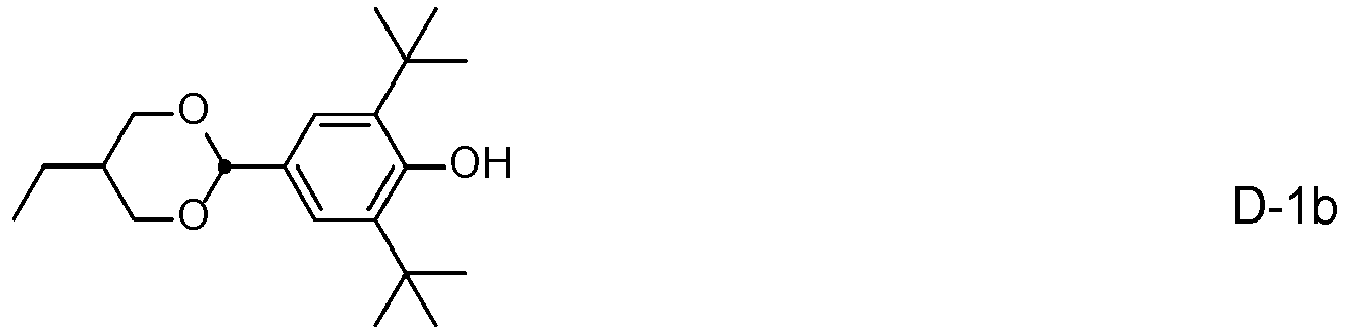


- In a preferred embodiment, the media according to the invention comprise, in addition to the compounds of formula D, one or more stabilisers selected from the group of compounds of the following formulae:


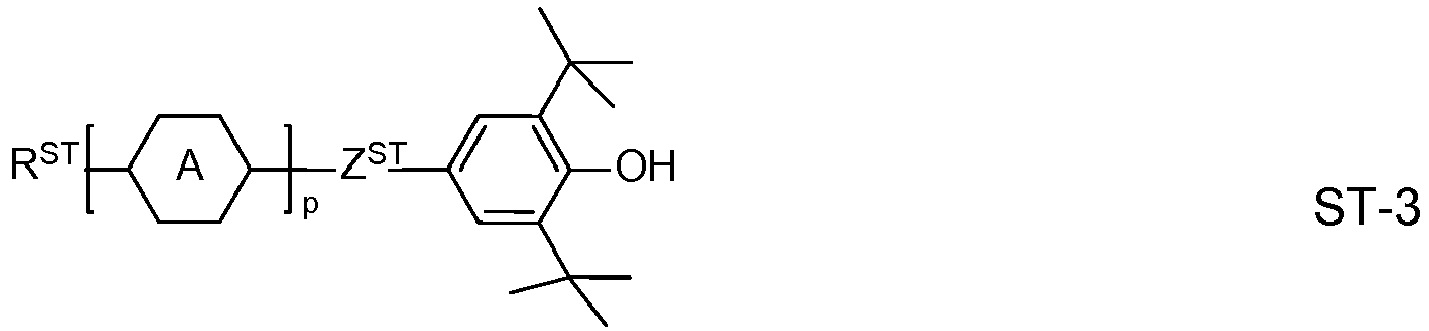


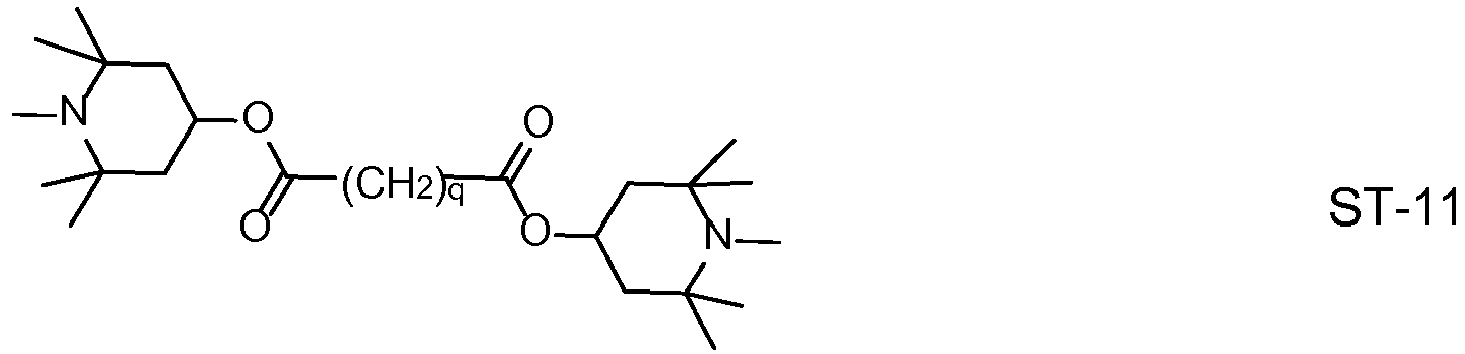


- RST
- denotes H, an alkyl or alkoxy radical having 1 to 15 C atoms, where, in addition, one or more CH2 groups in these radicals may each be replaced, independently of one another, by -O≡C-, -CF2O-, -OCF2-, -CH=CH-,


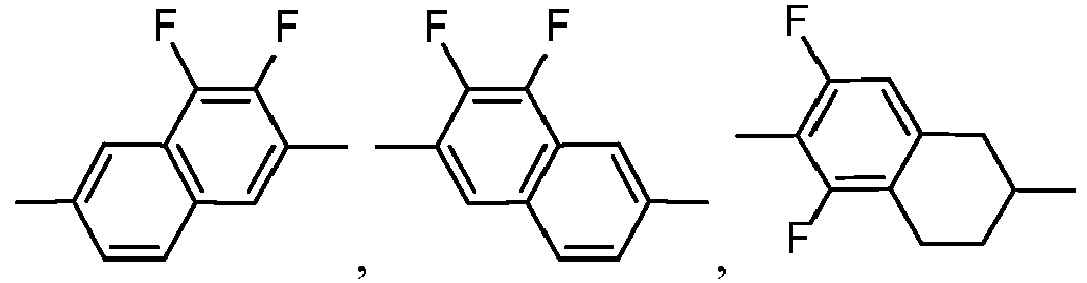
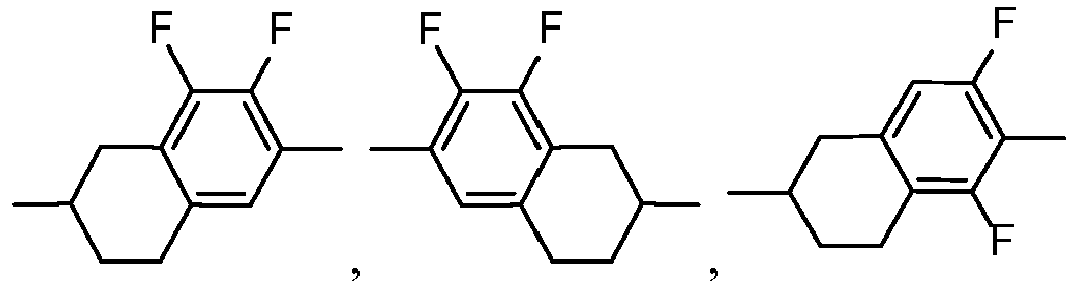


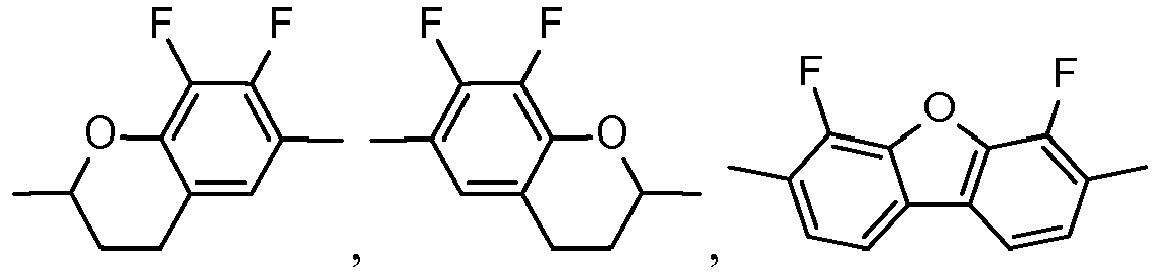
- ZST
- each, independently of one another, denote -CO-O-, -O-CO-, -CF2O-, -OCF2-, -CH2O-, -OCH2-, -CH2-, -CH2CH2-, -(CH2)4-, -CH=CH-CH2O-, -C2F4-, -CH2CF2-, -CF2CH2-, -CF=CF-, -CH=CF-, -CF=CH-, -CH=CH-, -C≡C- or a single bond,
- L1 and L2
- each, independently of one another, denote F, Cl, CF3 or CHF2,
- p
- denotes 1 or 2,
- q
- denotes 1, 2, 3, 4, 5, 6, 7, 8, 9 or 10.
- Of the compounds of the formula ST, special preference is given to the compounds of the formulae


- In the compounds of the formulae ST-3a, n preferably denotes 3. In the compounds of the formula ST-2a, n preferably denotes 7.
- Very particularly preferred mixtures according to the invention comprise one or more stabilisers from the group of the compounds of the formulae ST-2a-1, ST-3a-1, ST-8-1, ST-9-1 and ST-12:


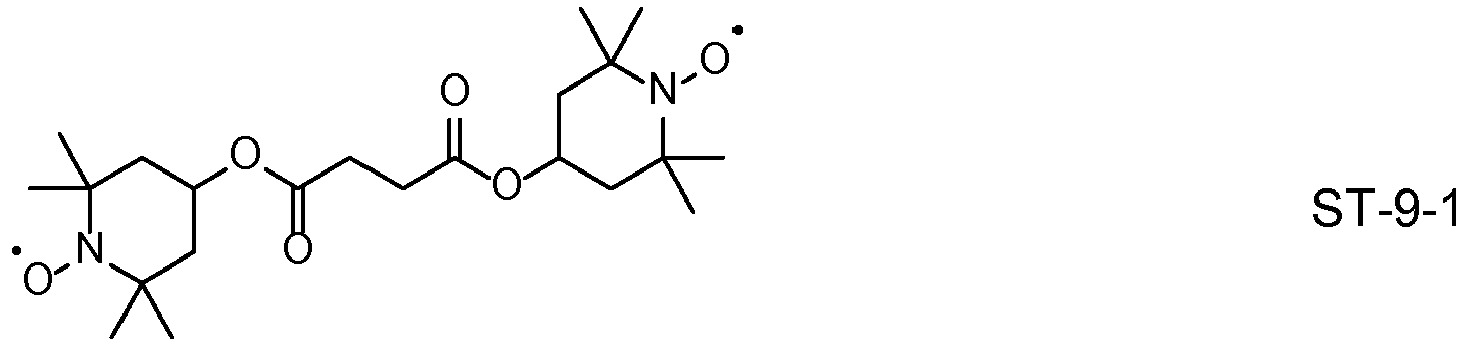

- The compounds of the formulae ST-1 to ST-18 are preferably each present in the liquid-crystal mixtures according to the invention in amounts of 0.005 - 0.5%, based on the mixture.
- In a preferred embodiment of the present invention, the compounds of formula I are selected from the group of compounds of the formulae I-1 to I-5:



L1, L2 and L3 on each occurrence, identically or differently, denote H or F, and the other groups have the respective meanings indicated above for formula I and preferably - R1
- denotes unfluorinated alkyl having 1 to 7 C atoms or unfluorinated alkenyl having 2 to 7 C atoms.
- The media preferably comprise one or more compounds of formula I-1, which are preferably selected from the group of the compounds of the formulae I-1a to I-1d, preferably of formula I-1b:




- The media preferably comprise one or more compounds of formula I-2, which are preferably selected from the group of the compounds of the formulae I-2a to I-2e, preferably of formula I-2c:





- The media preferably comprise one or more compounds of formula I-3, which are preferably selected from the group of the compounds of the formulae I-3a to I-3d, particularly preferably of formula I-3b:


- The media preferably comprise one or more compounds of formula I-4, which are preferably selected from the group of the compounds of the formulae I-4a to I-4e, particularly preferably of formula I-4b:



- The media preferably comprise one or more compounds of formula I-5, which are preferably selected from the group of the compounds of the formulae I-5a to I-5d, particularly preferably of formula I-5b:



- The media preferably comprise one or more compounds of formula II, which are preferably selected from the group of the compounds of the formulae II-1 to II-3, preferably selected from the group of the compounds of the formulae II-1 and II-2:


- R2
- denotes H, unfluorinated alkyl or alkoxy having 1 to 7 C atoms or unfluorinated alkenyl having 2 to 7 C atoms,
- R2
- denotes CnH2n+1 or CH2=CH-(CH2)Z, and
- n
- denotes an integer in the range from 0 to 15, preferably in the range from 1 to 7 and particularly preferably 1 to 5, and
- z
- denotes 0, 1, 2, 3 or 4, preferably 0 or 2.
- The compounds of formula II-1 are preferably selected from the group of the compounds of the formulae II-1a to II-1e:


- R2
- has the meaning indicated above and preferably denotes CnH2n+1 or CH2=CH-(CH2)Z, and
- n
- independently of one another, denote an integer in the range from 0 to 15, preferably in the range from 1 to 7 and particularly preferably 1 to 5, and
- z
- denotes 0, 1, 2, 3 or 4, preferably 0 or 2.
- The compounds of formula II-2 are preferably selected from the group of the compounds of the formulae II-2a and II-2b:


- R2
- has the meaning indicated above and preferably denotes CnH2n+1 or CH2=CH-(CH2)Z,
- n
- denotes an integer in the range from 0 to 15, preferably in the range from 1 to 7 and particularly preferably 1 to 5, and
- z
- denotes 0, 1, 2, 3 or 4, preferably 0 or 2.
- The compounds of formula II-3 are preferably selected from the group of the compounds of the of formulae II-3a to II-3d:


- R2
- has the meaning indicated above and preferably denotes CnH2n+1 or CH2=CH-(CH2)Z,
- n
- denotes an integer in the range from 0 to 15, preferably in the range from 1 to 7 and particularly preferably 1 to 5, and
- z
- denotes 0, 1, 2, 3 or 4, preferably 0 or 2.
- The compounds of formula III are preferably selected from the group of the compounds of the formulae III-1 to III-6, more preferably of the formulae selected from the group of the compounds of the formulae III-1, III-2, III-3 and III-4, and particularly preferably of formula III-1:


- Z31 and Z32
- independently of one another denote trans-CH=CH- or trans-CF=CF-, preferably trans-CH=CH-, and in formula III-6 alternatively one of Z31 and Z32 may denote -C≡C- and the other groups have the meanings given above under formula III, and preferably
- R3
- denotes H, unfluorinated alkyl or alkoxy having 1 to 7 C atoms or unfluorinated alkenyl having 2 to 7 C atoms,
- R3
- denotes CnH2n+1 or CH2=CH-(CH2)Z,
- n
- denotes an integer in the range from 0 to 15, preferably in the range from 1 to 7 and particularly preferably 1 to 5, and
- z
- denotes 0, 1, 2, 3 or 4, preferably 0 or 2.
- The compounds of formula III-1 are preferably selected from the group of the compounds of the formulae III-1 a to III-1f, more preferably selected from the group of the compounds of the formulae III-1 a and III-1 b, particularly preferably of formula III-1 b,:


- R3
- has the meaning indicated above and preferably denotes CnH2n+1 or CH2=CH-(CH2)Z,
- n
- denotes an integer in the range from 0 to 15, preferably in the range from 1 to 7 and particularly preferably 1 to 5, and
- z
- denotes 0, 1, 2, 3 or 4, preferably 0 or 2.
- The compounds of formula III-2 are preferably compounds of formula III-2a to III-2h:


- R3
- has the meaning indicated above and preferably denotes CnH2n+1 or CH2=CH-(CH2)Z,
- n
- denotes an integer in the range from 0 to 15, preferably in the range from 1 to 7 and particularly preferably 1 to 5, and
- z
- denotes 0, 1, 2, 3 or 4, preferably 0 or 2.
- The compounds of formula III-5 are preferably selected from the compounds of formula III-5a:

- R3
- has the meaning indicated above for formula III-5 and preferably denotes CnH2n+1, in which
- n
- denotes an integer in the range from 0 to 7, preferably in the range from 1 to 5.
- In a preferred embodiment, the media according to the invention comprise one or more compounds selected from the group of compounds of the formulae II-1A-1 to II-1A-12, very preferably II-1A-1 or II-1A-2:



- R1
- denotes alkyl or alkenyl having up to 7 C atoms, preferably ethyl, n-propyl, n-butyl or n-pentyl, n-hexyl,
- RL
- on each occurrence, the same or differently, denotes alkyl or alkenyl having 1 to 5 C atoms, or cycloalkyl or cycloalkenyl each having 3 to 6 C atoms, preferably methyl, ethyl, n-propyl, n-butyl, isopropyl, cyclopropyl, cyclobutyl, cyclopentyl or cyclopent-1-enyl, very preferably ethyl.
- Additionally, the liquid-crystalline media according to the present invention in a certain embodiment, which may be the same or different from the previous preferred embodiments preferably comprise one or more compounds of formula IV,


- s
- is 0 or 1, preferably 1,
preferably


- L4
- denotes H or alkyl having 1 to 6 C atoms, cycloalkyl having 3 to 6 C atoms or cycloalkenyl having 4 to 6 C atoms, preferably CH3, C2H5, n-C3H7, i-C3H7, cyclopropyl, cyclobutyl, cyclohexyl, cyclopent-1-enyl or cyclohex-1-enyl, and particularly preferably CH3, C2H5, cyclopropyl or cyclobutyl,
- X4
- denotes H, alkyl having 1 to 3 C atoms or halogen, preferably H, F or Cl, more preferably H or F and particularly preferably F,
- R41 to R44,
- independently of one another, denote unfluorinated alkyl or unfluorinated alkoxy, each having 1 to 15 C atoms, unfluorinated alkenyl, unfluorinated alkenyloxy or unfluorinated alkoxyalkyl, each having 2 to 15 C atoms, or cycloalkyl, alkylcycloalkyl, cycloalkenyl, alkylcycloalkenyl, alkylcycloalkylalkyl or alkylcyclo-alkenylalkyl, each having up to 15 C atoms, and alternatively one of R43 and R44 or both also denote H,
preferably - R41 and R42,
- independently of one another, denote unfluorinated alkyl or unfluorinated alkoxy, each having 1 to 7 C atoms, or unfluorinated alkenyl, unfluorinated alkenyloxy or unfluorinated alkoxyalkyl, each having 2 to 7 C atoms,
particularly preferably - R41
- denotes unfluorinated alkyl having 1 to 7 C atoms or unfluorinated alkenyl, unfluorinated alkenyloxy or unfluorinated alkoxyalkyl, each having 2 to 7 C atoms, and
particularly preferably - R42
- denotes unfluorinated alkyl or unfluorinated alkoxy, each having 1 to 7 C atoms, and
preferably - R43 and R44
- denote H, unfluorinated alkyl having 1 to 5 C atoms, unfluorinated cycloalkyl or cycloalkenyl having 3 to 7 C atoms, unfluorinated alkylcyclohexyl or unfluorinated cyclohexylalkyl, each having 4 to 12 C atoms, or unfluorinated alkylcyclohexylalkyl having 5 to 15 C atoms, particularly preferably cyclopropyl, cyclobutyl or cyclohexyl, and very particularly preferably at least one of R43 and R44 denotes n-alkyl, particularly preferably methyl, ethyl or n-propyl, and the other denotes H or n-alkyl, particularly preferably H, methyl, ethyl or n-propyl.
- In a preferred embodiment of the present application, the liquid-crystal medium additionally comprises one or more compounds selected from the group of compounds of the formulae V, VI, VII, VIII and IX:


- L51
- denotes R51 or X51,
- L52
- denotes R52 or X52,
- R51 and R52,
- independently of one another, denote H, unfluorinated alkyl or unfluorinated alkoxy having 1 to 17, preferably 3 to 10, C atoms or unfluorinated alkenyl, unfluorinated alkenyloxy or unfluorinated alkoxyalkyl having 2 to 15, preferably 3 to 10, C atoms, preferably alkyl or unfluorinated alkenyl,
- X51 and X52,
- independently of one another, denote H, F, Cl, -CN, SF5, fluorinated alkyl or fluorinated alkoxy having 1 to 7 C atoms or fluorinated alkenyl, fluorinated alkenyloxy or fluorinated alkoxyalkyl having 2 to 7 C atoms, preferably fluorinated alkoxy, fluorinated alkenyloxy, F or Cl, and


- L61
- denotes R61 and, in the case where Z61 and/or Z62 denote trans-CH=CH- or trans-CF=CF-, alternatively also denotes X61,
- L62
- denotes R62 and, in the case where Z61 and/or Z62 denote trans-CH=CH- or trans-CF=CF-, alternatively also denotes X62,
- R61 and R62,
- independently of one another, denote H, unfluorinated alkyl or unfluorinated alkoxy having 1 to 17, preferably 3 to 10, C atoms or unfluorinated alkenyl, unfluorinated alkenyloxy or unfluorinated alkoxyalkyl having 2 to 15, preferably 3 to 10, C atoms, preferably alkyl or unfluorinated alkenyl,
- X61 and X62,
- independently of one another, denote F or Cl, -CN, SF5, fluorinated alkyl or alkoxy having 1 to 7 C atoms or fluorinated alkenyl, alkenyloxy or alkoxyalkyl having 2 to 7 C atoms,
one of - Z61 and Z62
- denotes trans-CH=CH-, trans-CF=CF- or -C≡C- and the other, independently thereof, denotes trans-CH=CH-, trans-CF=CF- or a single bond, preferably one of them denotes -C≡C- or trans-CH=CH- and the other denotes a single bond, and


- x
- denotes 0 or 1;
- L71
- denotes R71 or X71,
- L72
- denotes R72 or X72,
- R71 and R72,
- independently of one another, denote H, unfluorinated alkyl or unfluorinated alkoxy having 1 to 17, preferably 3 to 10, C atoms or unfluorinated alkenyl, unfluorinated alkenyloxy or unfluorinated alkoxyalkyl having 2 to 15, preferably 3 to 10, C atoms, preferably alkyl or unfluorinated alkenyl,
- X71 and X72,
- independently of one another, denote H, F, Cl, -CN, -NCS, -SF5, fluorinated alkyl or fluorinated alkoxy having 1 to 7 C atoms or fluorinated alkenyl, unfluorinated or fluorinated alkenyloxy or unfluorinated or fluorinated alkoxyalkyl having 2 to 7 C atoms, preferably fluorinated alkoxy, fluorinated alkenyloxy, F or Cl, and
- Z71 to Z73,
- independently of one another, denote trans-CH=CH-, trans-CF=CF-, -C≡C- or a single bond, preferably one or more of them denote a single bond, particularly preferably all denote a single bond and


- R81 and R82,
- independently of one another, denote H, unfluorinated alkyl or alkoxy having 1 to 15, preferably 3 to 10, C atoms or unfluorinated alkenyl, alkenyloxy or alkoxyalkyl having 2 to 15, preferably 3 to 10, C atoms, preferably unfluorinated alkyl or alkenyl,
one of - Z81 and Z82
- denotes trans-CH=CH-, trans-CF=CF- or -C≡C- and the other, independently thereof, denotes trans-CH=CH-, trans-CF=CF- or a single bond, preferably one of them denotes -C≡C- or trans-CH=CH- and the other denotes a single bond, and


- L91
- denotes R91 or X91,
- L92
- denotes R92 or X92,
- R91 and R92,
- independently of one another, denote H, unfluorinated alkyl or alkoxy having 1 to 15, preferably 3 to 10, C atoms or unfluorinated alkenyl, alkenyloxy or alkoxyalkyl having 2 to 15, preferably 3 to 10, C atoms, preferably unfluorinated alkyl or alkenyl,
- X91 and X92,
- independently of one another, denote H, F, Cl, -CN, -NCS, -SF5, fluorinated alkyl or fluorinated alkoxy having 1 to 7 C atoms or fluorinated alkenyl, unfluorinated or fluorinated alkenyloxy or unfluorinated or fluorinated alkoxyalkyl having 2 to 7 C atoms, preferably fluorinated alkoxy, fluorinated alkenyloxy, F or Cl, and
- Z91 to Z93,
- independently of one another, denote trans-CH=CH-, trans-CF=CF-, -C≡C- or a single bond, preferably one or more of them denotes a single bond, and particularly preferably all denote a single bond,


- In a preferred embodiment of the present invention, the liquid-crystal medium comprises one or more compounds of the formula V, preferably selected from the group of the compounds of the formulae V-1 to V-3, preferably of the formulae V-1 and/or V-2 and/or V-3, preferably of the formulae V-1 and V-2:


- R51
- denotes unfluorinated alkyl having 1 to 7 C atoms or unfluorinated alkenyl having 2 to 7 C atoms,
- R52
- denotes unfluorinated alkyl having 1 to 7 C atoms or unfluorinated alkenyl having 2 to 7 C atoms or unfluorinated alkoxy having 1 to 7 C atoms,
- X51 and X52,
- independently of one another, denote F, Cl, -OCF3, -CF3, -CN or -SF5, preferably F, Cl, -OCF3 or -CN.
- The compounds of the formula V-1 are preferably selected from the group of the compounds of the formulae V-1a to V-1d, preferably V-1c and V-1d:


- Y51 and Y52,
- in each case independently of one another, denote H or F, and preferably
- R51
- denotes alkyl or alkenyl, and
- X51
- denotes F, Cl or -OCF3.
- The compounds of the formula V-2 are preferably selected from the group of the compounds of the formulae V-2a to V-2e and/or from the group of the compounds of the formulae V-2f and V-2g:







in which the parameters have the respective meanings indicated above for formula V-1 and in which - Y51 and Y52,
- in each case independently of one another, denote H or F, and preferably
- Y51 and Y52
- denotes H and the other denotes H or F, preferably like-wise denotes H.
- The compounds of the formula V-3 are preferably compounds of the formula V-3a:

- X51
- denotes F, Cl, preferably F,
- X52
- denotes F, Cl or -OCF3, preferably -OCF3.
- The compounds of the formula V-1a are preferably selected from the group of the compounds of the formulae V-1a-1 and V-1a-2, more preferably these compounds of the formula V predominantly consist, even more preferably essentially consist and very particularly preferably completely consist thereof:


- R51
- has the meaning indicated above and preferably denotes CnH2n+1, in which
- n
- denotes an integer in the range from 0 to 7, preferably in the range from 1 to 5 and particularly preferably 3 or 7.
- The compounds of the formula V-1b are preferably compounds of the formula V-1b-1:

- R51
- has the meaning indicated above and preferably denotes CnH2n+1, in which
- n
- denotes an integer in the range from 0 to 15, preferably in the range from 1 to 7 and particularly preferably 1 to 5.
- The compounds of the formula V-1c are preferably selected from the group of the compounds of the formulae V-1c-1 to V-1c-4, particularly preferably selected from the group of the compounds of the formulae V-1c-1 and V-1c-2:


- R51
- has the meaning indicated above and preferably denotes CnH2n+1, in which
- n
- denotes an integer in the range from 0 to 15, preferably in the range from 1 to 7 and particularly preferably 1 to 5.
- The compounds of the formula V-1d are preferably selected from the group of the compounds of the formulae V-1d-1 and V-1d-2, particularly preferably the compound of the formula V-1d-2:


- R51
- has the meaning indicated above and preferably denotes CnH2n+1, in which
- n
- denotes an integer in the range from 0 to 15, preferably in the range from 1 to 7 and particularly preferably 1 to 5.
- The compounds of the formula V-2a are preferably selected from the group of the compounds of the formulae V-2a-1 and V-2a-2, particularly preferably the compounds of the formula V-2a-1:


- R51
- has the meaning indicated above and preferably denotes CnH2n+1 or CH2=CH-(CH2)Z, and
- R52
- has the meaning indicated above and preferably denotes CmH2m+1 or O-CmH2m+1 or (CH2)Z-CH=CH2, and in which
- n and m,
- independently of one another, denote an integer in the range from 0 to 15, preferably in the range from 1 to 7 and particularly preferably 1 to 5, and
- z
- denotes 0, 1, 2, 3 or 4, preferably 0 or 2.
- Preferred combinations of (R51 and R52), in particular in the case of formula V-2a-1, are (CnH2n+1 and CmH2m+1), (CnH2n+1 and O-CmH2m+1), (CH2=CH-(CH2)Z and CmH2m+1), (CH2=CH-(CH2)Z and O-CmH2m+1) and (CnH2n+1 and (CH2)Z-CH=CH2).
- Preferred compounds of the formula V-2b are the compounds of the formula V-2b-1:

- R51
- has the meaning indicated above and preferably denotes CnH2n+1 or CH2=CH-(CH2)Z, and
- R52
- has the meaning indicated above and preferably denotes CmH2m+1 or O-CmH2m+1 or (CH2)Z-CH=CH2, and in which
- n and m,
- independently of one another, denote an integer in the range from 0 to 15, preferably in the range from 1 to 7 and particularly preferably 1 to 5, and
- z
- denotes 0, 1, 2, 3 or 4, preferably 0 or 2.
- The preferred combination of (R51 and R52) here is, in particular, (CnH2n+1 and CmH2m+1).
- Preferred compounds of the formula V-2c are the compounds of the formula V-2c-1:

- R51
- has the meaning indicated above and preferably denotes CnH2n+1 or CH2=CH-(CH2)Z, and
- R52
- has the meaning indicated above and preferably denotes CmH2m+1 or O-CmH2m+1 or (CH2)Z-CH=CH2, and in which
- n and m,
- independently of one another, denote an integer in the range from 0 to 15, preferably in the range from 1 to 7 and particularly preferably 1 to 5, and
- z
- denotes 0, 1, 2, 3 or 4, preferably 0 or 2.
- The preferred combination of (R51 and R52) here is, in particular, (CnH2n+1 and CmH2m+1).
- Preferred compounds of the formula V-2d are the compounds of the formula V-2d-1:

- R51
- has the meaning indicated above and preferably denotes CnH2n+1 or CH2=CH-(CH2)Z, and
- R52
- has the meaning indicated above and preferably denotes CmH2m+1 or O-CmH2m+1 or (CH2)Z-CH=CH2, and in which
- n and m,
- independently of one another, denote an integer in the range from 0 to 15, preferably in the range from 1 to 7 and particularly preferably 1 to 5, and
- z
- denotes 0, 1, 2, 3 or 4, preferably 0 or 2.
- The preferred combination of (R51 and R52) here is, in particular, (CnH2n+1 and CmH2m+1).
- Preferred compounds of the formula V-2e are the compounds of the formula V-2e-1:

- R51
- has the meaning indicated above and preferably denotes CnH2n+1 or CH2=CH-(CH2)Z, and
- R52
- has the meaning indicated above and preferably denotes CmH2m+1 or O-CmH2m+1 or (CH2)Z-CH=CH2, and in which
- n and m,
- independently of one another, denote an integer in the range from 0 to 15, preferably in the range from 1 to 7 and particularly preferably 1 to 5, and
- z
- denotes 0, 1, 2, 3 or 4, preferably 0 or 2.
- The preferred combination of (R51 and R52) here is, in particular, (CnH2n+1 and O-CmH2m+1).
- Preferred compounds of the formula V-2f are the compounds of the formula V-2f-1:

- R51
- has the meaning indicated above and preferably denotes CnH2n+1 or CH2=CH-(CH2)Z, and
- R52
- has the meaning indicated above and preferably denotes CmH2m+1 or O-CmH2m+1 or (CH2)Z-CH=CH2, and in which
- n and m,
- independently of one another, denote an integer in the range from 0 to 15, preferably in the range from 1 to 7 and particularly preferably 1 to 5, and
- z
- denotes 0, 1, 2, 3 or 4, preferably 0 or 2.
- The preferred combinations of (R51 and R52) here are, in particular, (CnH2n+1 and CmH2m+1) and (CnH2n+1 and O-CmH2m+1), particularly preferably (CnH2n+1 and CmH2m+1).
- Preferred compounds of the formula V-2g are the compounds of the formula V-2g-1:

- R51
- has the meaning indicated above and preferably denotes CnH2n+1 or CH2=CH-(CH2)Z, and
- R52
- has the meaning indicated above and preferably denotes CmH2m+1 or O-CmH2m+1 or (CH2)Z-CH=CH2, and in which
- n and m,
- independently of one another, denote an integer in the range from 0 to 15, preferably in the range from 1 to 7 and particularly preferably 1 to 5, and
- z
- denotes 0, 1, 2, 3 or 4, preferably 0 or 2.
- The preferred combinations of (R51 and R52) here are, in particular, (CnH2n+1 and CmH2m+1) and (CnH2n+1 and O-CmH2m+1), particularly preferably (CnH2n+1 and O-CmH2m+1).
- The compounds of the formula VI are preferably selected from the group of the compounds of the formulae VI-1 to VI-5:


- Z61 and Z62
- denote -C≡C-, trans-CH=CH- or trans-CF=CF-, preferably -C≡C-or trans-CH=CH-, and the other occurring groups and parameters have the meaning given above under formula VI,
- R61 and R62,
- independently of one another, denote H, unfluorinated alkyl or alkoxy having 1 to 7 C atoms or unfluorinated alkenyl having 2 to 7 C atoms,
- X62
- denotes F, Cl, -OCF3 or -CN.
- The compounds of the formula VI-1 are preferably selected from the group of the compounds of the formulae VI-1a and VI-1b, more preferably selected from compounds of the formula VI-1a:

- R61
- has the meaning indicated above and preferably denotes CnH2n+1 or CH2=CH-(CH2)Z, and
- R62
- has the meaning indicated above and preferably denotes CmH2m+1 or O-CmH2m+1 or (CH2)Z-CH=CH2, and in which
- n and m,
- independently of one another, denote an integer in the range from 0 to 15, preferably in the range from 1 to 7 and particularly preferably 1 to 5, and
- z
- denotes 0, 1, 2, 3 or 4, preferably 0 or 2.
- The preferred combinations of (R61 and R62) here are, in particular, (CnH2n+1 and CmH2m+1) and (CnH2n+1 and O-CmH2m+1), in the case of formula VI-1a particularly preferably (CnH2n+1 and CmH2m+1) and in the case of formula VI-1b particularly preferably (CnH2n+1 and O-CmH2m+1).
- The compounds of the formula VI-3 are preferably selected from the compounds of the formula VI-3a to VI-3c:


- R61
- has the meaning indicated above and preferably denotes CnH2n+1, in which
- n
- denotes an integer in the range from 0 to 7, preferably in the range from 1 to 5, and
- X62
- denotes -F, -Cl, -OCF3, or -CN.
- The compounds of the formula VI-4 are preferably selected from compounds of the formulae VI-4a to VI-4e:


- R61
- has the meaning indicated above and preferably denotes CnH2n+1, in which
- n
- denotes an integer in the range from 0 to 7, preferably in the range from 1 to 5, and
- X62
- denotes F, Cl, OCF3, or -CN.
- The compounds of the formula VI-5 are preferably selected from the compounds of the formula VI-5b:



- R61
- has the meaning indicated above and preferably denotes CnH2n+1, in which
- n
- denotes an integer in the range from 0 to 7, preferably in the range from 1 to 5, and
- X62
- denotes -F, -Cl, -OCF3, or -CN, particularly preferably-OCF3.
- The compounds of the formula VII are preferably selected from the group of the compounds of the formulae VII-1 to VII-6:






- in which the parameters have the respective meanings indicated above for formula VII,
- Y71, Y72, Y73
- independently from one another, denote H or F,
and preferably - R71
- denotes unfluorinated alkyl or alkoxy, each having 1 to 7 C atoms, or unfluorinated alkenyl having 2 to 7 C atoms,
- R72
- denotes unfluorinated alkyl or alkoxy, each having 1 to 7 C atoms, or unfluorinated alkenyl having 2 to 7 C atoms,
- X72
- denotes F, Cl; NCS or -OCF3, preferably F or NCS, and
particularly preferably - R71
- has the meaning indicated above and preferably denotes CnH2n+1 or CH2=CH-(CH2)Z, and
- R72
- has the meaning indicated above and preferably denotes CmH2m+1 or O-CmH2m+1 or (CH2)Z-CH=CH2, and in which
- n and m,
- independently of one another, denote an integer in the range from 0 to 15, preferably in the range from 1 to 7 and particularly preferably 1 to 5, and
- z
- denotes 0, 1, 2, 3 or 4, preferably 0 or 2.
- The compounds of the formula VII-1 are preferably selected from the group of the compounds of the formulae VII-1 a to VII-1d:



- R71
- has the meaning indicated above and preferably denotes CnH2n+1, in which
- n
- denotes 1 to 7, preferably 2 to 6, particularly preferably 2, 3 or 5, and
- z
- denotes 0, 1, 2, 3 or 4, preferably 0 or 2, and
- X72
- preferably denotes F.
- The compounds of the formula VII-2 are preferably selected from the group of the compounds of the formulae VII-2a and VII-2b, particularly preferably of the formula VII-2a:


- R71
- has the meaning indicated above and preferably denotes CnH2n+1 or CH2=CH-(CH2)Z, and
- R72
- has the meaning indicated above and preferably denotes CmH2m+1 or O-CmH2m+1 or (CH2)Z-CH=CH2, and in which
- n and m,
- independently of one another, denote an integer in the range from 0 to 15, preferably in the range from 1 to 7 and particularly preferably 1 to 5, and
- z
- denotes 0, 1, 2, 3 or 4, preferably 0 or 2.
- The preferred combinations of (R71 and R72) here are, in particular, (CnH2n+1 and CmH2m+1) and (CnH2n+1 and O-CmH2m+1), particularly preferably (CnH2n+1 and CmH2m+1).
- The compounds of the formula VII-3 are preferably compounds of the formula VII-3a:

- R71
- has the meaning indicated above and preferably denotes CnH2n+1 or CH2=CH-(CH2)Z, and
- R72
- has the meaning indicated above and preferably denotes CmH2m+1 or O-CmH2m+1 or (CH2)Z-CH=CH2, and in which
- n and m,
- independently of one another, denote an integer in the range from 0 to 15, preferably in the range from 1 to 7 and particularly preferably 1 to 5, and
- z
- denotes 0, 1, 2, 3 or 4, preferably 0 or 2.
- The preferred combinations of (R71 and R72) here are, in particular, (CnH2n+1 and CmH2m+1) and (CnH2n+1 and O-CmH2m+1), particularly preferably (CnH2n+1 and CmH2m+1).
- The compounds of the formula VII-4 are preferably compounds of the formula VII-4a:

- R71
- has the meaning indicated above and preferably denotes CnH2n+1 or CH2=CH-(CH2)Z, and
- R72
- has the meaning indicated above and preferably denotes CmH2m+1 or O-CmH2m+1 or (CH2)Z-CH=CH2, and in which
- n and m,
- independently of one another, denote an integer in the range from 0 to 15, preferably in the range from 1 to 7 and particularly preferably 1 to 5, and
- z
- denotes 0, 1, 2, 3 or 4, preferably 0 or 2.
- The preferred combinations of (R71 and R72) here are, in particular, (CnH2n+1 and CmH2m+1) and (CnH2n+1 and O-CmH2m+1), particularly preferably (CnH2n+1 and CmH2m+1).
- The compounds of the formula VII-5 are preferably selected from the group of the compounds of the formulae VII-5a and VII-5b, more preferably of the formula VII-5a:


- R71
- has the meaning indicated above and preferably denotes CnH2n+1 or CH2=CH-(CH2)Z, and
- R72
- has the meaning indicated above and preferably denotes CmH2m+1 or O-CmH2m+1 or (CH2)Z-CH=CH2, and in which
- n and m,
- independently of one another, denote an integer in the range from 0 to 15, preferably in the range from 1 to 7 and particularly preferably 1 to 5, and
- z
- denotes 0, 1, 2, 3 or 4, preferably 0 or 2.
- The preferred combinations of (R71 and R72) here are, in particular, (CnH2n+1 and CmH2m+1) and (CnH2n+1 and O-CmH2m+1), particularly preferably (CnH2n+1 and CmH2m+1).
- The compounds of the formula VII-6 are preferably selected from the group of the compounds of the formulae VII-6a and VII-6b:


- R71
- has the meaning indicated above and preferably denotes CnH2n+1 or CH2=CH-(CH2)Z, and
- R72
- has the meaning indicated above and preferably denotes CmH2m+1 or O-CmH2m+1 or (CH2)Z-CH=CH2, and in which
- n and m,
- independently of one another, denote an integer in the range from 0 to 15, preferably in the range from 1 to 7 and particularly preferably 1 to 5, and
- z
- denotes 0, 1, 2, 3 or 4, preferably 0 or 2.
- The preferred combinations of (R71 and R72) here are, in particular, (CnH2n+1 and CmH2m+1) and (CnH2n+1 and O-CmH2m+1), particularly preferably (CnH2n+1 and CmH2m+1).
- The compounds of the formula VII-7 are preferably selected from the group of the compounds of the formulae VII-7a and VII-7b:


- R71
- has the meaning indicated above and preferably denotes CnH2n+1 or CH2=CH-(CH2)Z,
- X72
- denotes F, -OCF3 or -NCS,
- n
- denotes an integer in the range from 0 to 15, preferably in the range from 1 to 7 and particularly preferably 1 to 5, and,
- z
- denotes 0, 1, 2, 3 or 4, preferably 0 or 2.
- The compounds of the formula VIII are preferably selected from the group of the compounds of the formulae VIII-1 to VIII-3, more preferably these compounds of the formula VIII predominantly consist, even more preferably essentially consist and very particularly preferably completely consist thereof:


one of - Y81 and Y82
- denotes H and the other denotes H or F, and
- R81
- has the meaning indicated above and preferably denotes CnH2n+1 or CH2=CH-(CH2)Z, and
- R82
- has the meaning indicated above and preferably denotes CmH2m+1 or O-CmH2m+1 or (CH2)Z-CH=CH2, and in which
- n and m,
- independently of one another, denote an integer in the range from 0 to 15, preferably in the range from 1 to 7 and particularly preferably 1 to 5, and
- z
- denotes 0, 1, 2, 3 or 4, preferably 0 or 2.
- The preferred combinations of (R81 and R82) here are, in particular, (CnH2n+1 and CmH2m+1) and (CnH2n+1 and O-CmH2m+1), particularly preferably (CnH2n+1 and CmH2m+1).
- The compounds of the formula VIII-1 are preferably selected from the group of the compounds of the formulae VIII-1 a to VIII-1 c:


- R81
- has the meaning indicated above and preferably denotes CnH2n+1 or CH2=CH-(CH2)Z, and
- R82
- has the meaning indicated above and preferably denotes CmH2m+1 or O-CmH2m+1 or (CH2)Z-CH=CH2, and in which
- n and m,
- independently of one another, denote an integer in the range from 0 to 15, preferably in the range from 1 to 7 and particularly preferably 1 to 5, and
- z
- denotes 0, 1, 2, 3 or 4, preferably 0 or 2.
- The preferred combinations of (R81 and R82) here are, in particular, (CnH2n+1 and CmH2m+1) and (CnH2n+1 and O-CmH2m+1), particularly preferably (CnH2n+1 and CmH2m+1).
- The compounds of the formula VIII-2 are preferably compounds of the formula VIII-2a:

- R81
- has the meaning indicated above and preferably denotes CnH2n+1 or CH2=CH-(CH2)Z, and
- R82
- has the meaning indicated above and preferably denotes CmH2m+1 or O-CmH2m+1 or (CH2)Z-CH=CH2, and in which
- n and m,
- independently of one another, denote an integer in the range from 0 to 15, preferably in the range from 1 to 7 and particularly preferably 1 to 5, and
- z
- denotes 0, 1, 2, 3 or 4, preferably 0 or 2.
- The preferred combinations of (R81 and R82) here are, in particular, (CnH2n+1 and CmH2m+1), (CnH2n+1 and O-CmH2m+1) and (CH2=CH-(CH2)Z and CmH2m+1), particularly preferably (CnH2n+1 and CmH2m+1).
- The compounds of the formula VIII-3 are preferably compounds of the formula VIII-3a:

- R81
- has the meaning indicated above and preferably denotes CnH2n+1 or CH2=CH-(CH2)Z, and
- R82
- has the meaning indicated above and preferably denotes CmH2m+1 or O-CmH2m+1 or (CH2)Z-CH=CH2, and in which
- n and m,
- independently of one another, denote an integer in the range from 0 to 15, preferably in the range from 1 to 7 and particularly preferably 1 to 5, and
- z
- denotes 0, 1, 2, 3 or 4, preferably 0 or 2.
- The preferred combinations of (R81 and R82) here are, in particular, (CnH2n+1 and CmH2m+1) and (CnH2n+1 and O-CmH2m+1).
- The compounds of the formula IX are preferably selected from the group of the compounds of the formulae IX-1 to IX-3:


one of


- R91
- has the meaning indicated above and preferably denotes CnH2n+1 or CH2=CH-(CH2)Z, and
- R92
- has the meaning indicated above and preferably denotes CmH2m+1 or O-CmH2m+1 or (CH2)Z-CH=CH2, and in which
- n and m,
- independently of one another, denote an integer in the range from 0 to 15, preferably in the range from 1 to 7 and particularly preferably 1 to 5, and
- z
- denotes 0, 1, 2, 3 or 4, preferably 0 or 2.
- The preferred combinations of (R91 and R92) here are, in particular, (CnH2n+1 and CmH2m+1) and (CnH2n+1 and O-CmH2m+1).
- The compounds of the formula IX-1 are preferably selected from the group of the compounds of the formulae IX-1a to IX-1e:


- R91
- has the meaning indicated above and preferably denotes CnH2n+1, and
- n
- denotes an integer in the range from 0 to 15, preferably in the range from 1 to 7 and particularly preferably 1 to 5, and
- X92
- preferably denotes F or Cl.
- The compounds of the formula IX-2 are preferably selected from the group of the compounds of the formulae IX-2a and IX-2b:


- R91
- has the meaning indicated above and preferably denotes CnH2n+1 or CH2=CH-(CH2)Z, and
- R92
- has the meaning indicated above and preferably denotes CmH2m+1 or O-CmH2m+1 or (CH2)Z-CH=CH2, and in which
- n and m,
- independently of one another, denote an integer in the range from 0 to 15, preferably in the range from 1 to 7 and particularly preferably 1 to 5, and
- z
- denotes 0, 1, 2, 3 or 4, preferably 0 or 2.
- The preferred combination of (R91 and R92) here is, in particular, (CnH2n+1 and CmH2m+1).
- The compounds of the formula IX-3 are preferably compounds of the formulae IX-3a and IX-3b:


- R91
- has the meaning indicated above and preferably denotes CnH2n+1 or CH2=CH-(CH2)Z, and
- R92
- has the meaning indicated above and preferably denotes CmH2m+1 or O-CmH2m+1 or (CH2)Z-CH=CH2, and in which
- n and m,
- independently of one another, denote an integer in the range from 0 to 15, preferably in the range from 1 to 7 and particularly preferably 1 to 5, and
- z
- denotes 0, 1, 2, 3 or 4, preferably 0 or 2.
- The preferred combinations of (R91 and R92) here are, in particular, (CnH2n+1 and CmH2m+1) and (CnH2n+1 and O-CmH2m+1), particularly preferably (CnH2n+1 and O-CmH2m+1).
- In a preferred embodiment of the present invention the medium comprises one or more compounds of formula X

- R101
- denotes H, alkyl or alkoxy having 1 to 15, preferably 3 to 10, C atoms or unfluorinated alkenyl, unfluorinated alkenyloxy or unfluorinated alkoxyalkyl having 2 to 15, preferably 3 to 10, C atoms, preferably alkyl or alkenyl,
- X101
- denotes H, F, Cl, -CN, SF5, NCS, fluorinated alkyl or fluorinated alkoxy having 1 to 7 C atoms or fluorinated alkenyl, fluorinated alkenyloxy or fluorinated alkoxyalkyl having 2 to 7 C atoms, preferably fluorinated alkoxy, fluorinated alkenyloxy, F, Cl or NCS, particularly preferably NCS,
- Y101
- denotes methyl, ethyl or Cl,
- Y102
- denotes H, methyl, ethyl, F or Cl, preferably H or F,
- Z101, Z102
- identically or differently, denote a single bond, -CH=CH-, -CF=CF- or -C≡C-,


- n
- is 0 or 1.
- Preferably, the compounds of formula X are selected from the sub-formulae X-1 and X-2 X-1


- Particularly preferably, the media according to the invention comprise one or more compounds selected from the group of compounds of the formulae X-1-1 to X-1-9


- The media according to the present invention comprise one or more chiral dopants. Preferably these chiral dopants have an absolute value of the helical twisting power (HTP) in the range of from 1 µm-1 to 150 µm-1, preferably in the range of from 10 µm-1 to 100 µm-1. In case the media comprise two or more chiral dopants, these may have opposite signs of their HTP-values. This condition is preferred for some specific embodiments, as it allows to compensate the chirality of the respective compounds to some degree and, thus, may be used to compensate various temperature dependent properties of the resulting media in the devices. Generally, however, it is preferred that most, preferably all of the chiral compounds present in the media according to the present invention have the same sign of their HTP-values.
Preferably the chiral dopants present in the media according to the instant application are mesogenic compounds and most preferably they exhibit a mesophase on their own. - In a preferred embodiment of the present invention, the medium comprises two or more chiral compounds which all have the same algebraic sign of the HTP.
- The temperature dependence of the HTP of the individual compounds may be high or low. The temperature dependence of the pitch of the medium can be compensated by mixing compounds having different temperature dependencies of the HTP in corresponding ratios.
- For the optically active component, a multitude of chiral dopants, some of which are commercially available, is available to the person skilled in the art, such as, for example, cholesteryl nonanoate, R- and S-811, R- and S-1011, R- and S-2011, R- and S-3011, R- and S-4011, or CB15 (all Merck KGaA, Darmstadt).
- Particularly suitable dopants are compounds which contain one or more chiral groups and one or more mesogenic groups, or one or more aromatic or alicyclic groups which form a mesogenic group with the chiral group.
- Suitable chiral groups are, for example, chiral branched hydrocarbon radicals, chiral ethane diols, binaphthols or dioxolanes, furthermore mono- or polyvalent chiral groups selected from the group consisting of sugar derivatives, sugar alcohols, sugar acids, lactic acids, chiral substituted glycols, steroid derivatives, terpene derivatives, amino acids or sequences of a few, preferably 1-5, amino acids.
- Preferred chiral groups are sugar derivatives, such as glucose, mannose, galactose, fructose, arabinose and dextrose; sugar alcohols, such as, for example, sorbitol, mannitol, iditol, galactitol or anhydro derivatives thereof, in particular dianhydrohexitols, such as dianhydrosorbide (1,4:3,6-dianhydro-D-sorbide, isosorbide), dianhydromannitol (isosorbitol) or dianhydroiditol (isoiditol); sugar acids, such as, for example, gluconic acid, gulonic acid and ketogulonic acid; chiral substituted glycol radicals, such as, for example, mono- or oligoethylene or propylene glycols, in which one or more CH2 groups are substituted by alkyl or alkoxy; amino acids, such as, for example, alanine, valine, phenylglycine or phenylalanine, or sequences of from 1 to 5 of these amino acids; steroid derivatives, such as, for example, cholesteryl or cholic acid radicals; terpene derivatives, such as, for example, menthyl, neomenthyl, campheyl, pineyl, terpineyl, isolongifolyl, fenchyl, carreyl, myrthenyl, nopyl, geraniyl, linaloyl, neryl, citronellyl or dihydrocitronellyl.
- The media according to the present invention preferably comprise chiral dopants which are selected from the group of known chiral dopants. Suitable chiral groups and mesogenic chiral compounds are described, for example, in
DE 34 25 503 ,DE 35 34 777 ,DE 35 34 778 ,DE 35 34 779 andDE 35 34 780 ,DE 43 42 280 ,EP 01 038 941 DE 195 41 820 . Examples are also compounds listed in Table F below. - Chiral compounds preferably used according to the present invention are selected from the group consisting of the formulae shown below.
- Particular preference is given to chiral dopants selected from the group consisting of compounds of the following formulae A-I to A-III and A-Ch:


- Ra11, Ra12 and Rb12,
- independently of one another, denote alkyl having 1 to 15 C atoms, in which, in addition, one or more non-adjacent CH2 groups may each be replaced, independently of one another, by -C(Rz)=C(Rz)-, -C≡C-, -O-, -S-, -CO-, -CO-O-, -O-CO- or -O-CO-O- in such a way that O and/or S atoms are not linked directly to one another, and in which, in addition, one or more H atoms may each be replaced by F, Cl, Br, I or CN,
preferably alkyl, more preferably n-alkyl, with the proviso that Ra12 is different from Rb12 - Ra21 and Ra22,
- independently of one another, denote alkyl having 1 to 15 C atoms, in which, in addition, one or more non-adjacent CH2 groups may each be replaced, independently of one another, by -C(Rz)=C(Rz)-, -C≡C-, -O-, -S-, -CO-, -CO-O-, -O-CO- or - O-CO-O- in such a way that O and/or S atoms are not linked directly to one another, and in which, in addition, one or more H atoms may be replaced by F, Cl, Br, I or CN,
preferably both are alkyl, more preferably n-alkyl, - Ra31, Ra31 and Rb32,
- independently of one another, denote straight-chain or branched alkyl having 1 to 15 C atoms, in which, in addition, one or more non-adjacent CH2 groups may each be replaced, independently of one another, by -C(Rz)=C(Rz)-,-C≡C-, -O-, -S-, -CO-, -CO-O-, -O-CO- or -O-CO-O- in such a way that O and/or S atoms are not linked directly to one another, and in which, in addition, one or more H atoms may be replaced by F, Cl, Br, I or CN,
preferably alkyl, more preferably n-alkyl, with the proviso that Ra32 is different from Rb32; - Rz
- denotes H, CH3, F, Cl, or CN, preferably H or F,
- R8
- has one of the meanings of Ra11 given above, preferably alkyl, more preferably n-alkyl having 1 to 15 C atoms,
- Z8
- denotes- C(O)O-, CH2O, CF2O or a single bond, preferably -C(O)O-,
- A11
- is defined as A12 below, or alternatively denotes


- A12
- denotes


L and L11, on each occurrence, independently of one another, denotes halogen, CN, or alkyl, alkenyl, alkoxy or alkenyloxy having up to 12 C atoms and in which one or more H atoms are optionally replaced with halogen, preferably methyl, ethyl, Cl or F, particularly preferably F. - A21
- denotes


- A22
- has the meanings given for A12
- A31
- has the meanings given for A11, or alternatively denotes

- A32
- has the meanings given for A12.
- n2
- on each occurrence, identically or differently, is 0, 1 or 2, and
- n3
- is 1, 2 or 3.
- Particular preference is given to dopants selected from the group consisting of the compounds of the following formulae:


- m
- is, on each occurrence, identically or differently, an integer from 1 to 9 and
- n
- is, on each occurrence, identically or differently, an integer from 2 to 9.
- Particularly preferred compounds of formula A are compounds of formula A-III.
- Further preferred dopants are derivatives of the isosorbide, isomannitol or isoiditol of the following formula A-IV:


and chiral ethane diols, such as, for example, diphenylethanediol (hydrobenzoin), in particular mesogenic hydrobenzoin derivatives of the following formula A-V:
in which

- L
- is H, F, Cl, CN or optionally halogenated alkyl, alkoxy, alkylcarbonyl, alkoxycarbonyl or alkoxycarbonyloxy having 1-7 carbon atoms,
- c
- is 0 or 1,
- X
- is CH2 or -C(O)-,
- Z0
- is -COO-, -OCO-, -CH2CH2- or a single bond, and
- R0
- is alkyl, alkoxy, alkylcarbonyl, alkoxycarbonyl or alkylcarbonyloxy having 1-12 carbon atoms.
- Examples of compounds of formula IV are:


- The compounds of the formula A-IV are described in
WO 98/00428 GB-A-2,328,207 WO 02/94805 WO 02/34739 WO 02/06265 WO 02/06196 WO 02/06195 - Particular preference is given to chiral compounds of the formula A-VI

- X1, X2, Y1 and Y2
- are each, independently of one another, F, Cl, Br, I, CN, SCN, SF5, straight-chain or branched alkyl having from 1 to 25 carbon atoms, which is unsubstituted or monosubstituted or polysubstituted by F, Cl, Br, I or CN and in which, in addition, one or more non-adjacent CH2 groups may each, independently of one another, be replaced by -O-, -S-, -NH-, NR0-, -CO-, -COO-, -OCO-, -OCOO-, -S-CO-, -CO-S-, -CH=CH- or -C≡C- in such a way that O and/or S atoms are not bonded directly to one another, a polymerisable group or cycloalkyl or aryl having up to 20 carbon atoms, which may optionally be monosubstituted or polysubstituted by halogen, preferably F, or by a polymerisable group,
- x1 and x2
- are each, independently of one another, 0, 1 or 2,
- y1 and y2
- are each, independently of one another, 0, 1, 2, 3 or 4,
- B1 and B2
- are each, independently of one another, an aromatic or partially or fully saturated aliphatic six-membered ring in which one or more CH groups may each be replaced by N and one or more non-adjacent CH2 groups may each be replaced by O or S,
- W1 and W2
- are each, independently of one another, -Z1-A1-(Z2-A2)m-R, and one of the two is alternatively R1 or A3, but both are not simultaneously H, or


- U1 and U2
- are each, independently of one another, CH2, O, S, CO or CS,
- V1 and V2
- are each, independently of one another, (CH2)n, in which from one to four non-adjacent CH2 groups may each be replaced by O or S, and one of V1 and V2 and, in the case where


- n
- is 1,2 or 3
- Z1 and Z2
- are each, independently of one another, -O-, -S-, -CO-, -COO-, -OCO-, -O-COO-, -CO-NR0-, -NR0-CO-, -O-CH2-, -CH2-O-, -S-CH2-, -CH2-S-, -CF2-O-, -O-CF2-, -CF2-S-, -S-CF2-, -CH2-CH2-, -CF2-CH2-, -CH2-CF2-, -CF2-CF2-, -CH=N-, -N=CH-, -N=N-, -CH=CH-, -CF=CH-, -CH=CF-, -CF=CF-, -C≡C-, a combination of two of these groups, where no two O and/or S and/or N atoms are bonded directly to one another, preferably -CH=CH-COO-, or -COO-CH=CH-, or a single bond,
- A1, A2 and A3
- are each, independently of one another, 1,4-phenylene, in which one or two non-adjacent CH groups may each be replaced by N, 1,4-cyclohexylene, in which one or two non-adjacent CH2 groups may each be replaced by O or S, 1,3-dioxolane-4,5-diyl, 1,4-cyclohexenylene, 1,4-bicyclo[2.2.2]octylene, piperidine-1,4-diyl, naphthalene-2,6-diyl, decahydronaphthalene-2,6-diyl or 1,2,3,4-tetrahydronaphthalene-2,6-diyl, where each of these groups may be monosubstituted or polysubstituted by L, and in addition A1 can be a single bond,
- L
- is a halogen atom, preferably F, CN, NO2, alkyl, alkoxy, alkylcarbonyl, alkoxycarbonyl or alkoxycarbonyloxy having 1-7 carbon atoms, in which one or more H atoms may each be replaced by F or Cl,
- m
- is in each case, independently, 0, 1, 2 or 3, and
- R and R1
- are each, independently of one another, H, F, Cl, Br, I, CN, SCN, SF5, straight-chain or branched alkyl having from 1 or 3 to 25 carbon atoms respectively, which may optionally be monosubstituted or polysubstituted by F, Cl, Br, I or CN, and in which one or more non-adjacent CH2 groups may each be replaced by -O-, -S-, -NH-, -NR0-, -CO-, -COO-, -OCO-, -O-COO-, -S-CO-, -CO-S-, -CH=CH- or -C≡C-, where no two O and/or S atoms are bonded directly to one another, or a polymerisable group.
- Particular preference is given to chiral binaphthyl derivatives of the formula A-VI-1

in particular those selected from the following formulae A-VI-1 a to A-VI-1 c:


- R0
- as defined for formula A-IV or H or alkyl having from 1 to 4 carbon atoms, and
- b
- is 0, 1 or 2,
- and Z0
- is, in particular, -OC(O)- or a single bond.
- The concentration of the one or more chiral dopant(s), in the LC medium is preferably in the range from 0.001 % to 20 %, preferably from 0.05 % to 5 %, more preferably from 0.1 % to 2 %, and, most preferably from 0.5 % to 1.5 %. These preferred concentration ranges apply in particular to the chiral dopant S-4011 or R-4011 (both from Merck KGaA) and for chiral dopants having the same or a similar HTP. For Chiral dopants having either a higher or a lower absolute value of the HTP compared to S-4011 these preferred concentrations have to be decreased, respectively increased proportionally according to the ratio of their HTP values relatively to that of S-4011.
- The pitch p of the LC media or host mixtures according to the invention is preferably in the range of from 5 to 50 µm, more preferably from 8 to 30 µm and particularly preferably from 10 to 20 µm.
- The compounds according to the present invention can be synthesized by or in analogy to known methods described in the literature (for example in the standard works such as Houben-Weyl, Methoden der Organischen Chemie [Methods of Organic Chemistry], Georg-Thieme-Verlag, Stuttgart), under reaction conditions which are known and suitable for said reactions. Use may also be made here of variants which are known per se, but are not mentioned here. In particular, they can be prepared as described in or in analogy to the following reaction schemes. Further methods for preparing the inventive compounds can be taken from the examples.
- Other mesogenic compounds which are not explicitly mentioned above can optionally and advantageously also be used in the media in accordance with the present invention. Such compounds are known to the person skilled in the art.
- The total concentration of compounds of formula D in the liquid-crystalline medium is in the range of from 0.01 % to 1%, preferably from 0.05 % to 0.75 %, more preferably from 0.08 % to 0.4 %, more preferably from 0.09 % to 0.3 %, particularly preferably from 0.1 % to 0.2 %.
- Preferably the total concentration of the compounds of formulae I to III in the medium is in the range of from 80 % to 99 %, more preferably from 90 % to 99 % and most preferably in the range of from 95 % to 99 %.
- The total concentration of the compounds of formula I-3, preferably of the formula I-3b, in the media is in the range of from 10 % to 70 %, more preferably from 20 % to 60 %, more preferably from 30 % to 55 % and, most preferably from 40 % to 50 %.
- The liquid-crystalline media according to the present invention preferably comprise in total 5 % to 45 %, preferably 10 % to 40 % and particularly preferably 15 % to 35 %, of compounds of formula III.
- In a preferred embodiment of the present invention the medium comprises one or more compounds of formula III-1, in a total concentration of 2 % to 25 %, more preferably 5 % to 20 %, particularly preferably 8 % to 16 %.
- In a further preferred embodiment of the present invention, in which the liquid-crystalline media comprise in each case one or more compounds of the formulae I, II and III, the concentration of the compounds of formula I is preferably 15 % to 40 %, preferably 20 % to 35 % and particularly preferably 25 % to 30 %, the concentration of the compounds of formula II is preferably 10 % to 35 %, preferably 15 % to 30 % and particularly preferably 20 % to 25 % and the concentration of the compounds of formula III is preferably 25 % to 50 %, preferably 30 % to 45 % and particularly preferably 35 % to 40 %.
- In a preferred embodiment of the present invention, in which the liquid-crystalline media comprise in each case one or more compounds of the formulae I and II, but at most 5 % and preferably no compounds of formula III, the concentration of the compounds of formula I is preferably 10 % to 50 %, preferably 20 % to 40 % and particularly preferably 25 % to 35 % the concentration of the compounds of formula II is preferably 40 % to 70 % preferably 50 % to 65 % and particularly preferably 55 % to 60 %, and the concentration of the compounds of formula III is preferably 1 % to 4 %, preferably 1 % to 3 % and particularly preferably 0 %.
- In a preferred embodiment of the present invention, the liquid-crystalline medium comprises in total 30 % or more, preferably 40 % or more and particularly preferably 50 % or more compounds of formula I, preferably selected from the group of compounds of the I-1, I-2 and I-3, particularly preferably selected from the compounds of the formulae I-2 and I-3.
- Preferably, the medium according to the invention comprises a total concentration of less than 40% of compounds of formula I-1, preferably less than 20%, and particularly preferably less than 15%.
- In a preferred embodiment of the present invention, the liquid-crystalline medium comprises one or more compounds of formula I in the range of from 1% to 20%, preferably from 5% to 15%.
- In a preferred embodiment, the medium comprises one or more compounds of formula I-2 in a total concentration in the range of from 5 % to 30 %, more preferably from 10 % to 25 %, and particularly preferably from 15 % to 20 %.
- In a preferred embodiment, the total concentration of the compounds of formula I-3 in the media according to the present invention is in the range of from 10 % to 70 %, more preferably from 20 % to 60 %, and particularly preferably from 25 % to 55 %.
- In a preferred embodiment, the total concentration of the compounds of formula I-3 in the media according to the present invention is 20 % or more, more preferably 25 % or more and particularly preferably 30 % or more.
- In a preferred embodiment of the present invention the medium comprises one or more compounds of formula II in a total concentration of 5 % to 35 %, more preferably 10 % to 30 %, particularly preferably 15 % to 20 %.
- In a preferred embodiment of the present invention the medium comprises one or more compounds of formula II-1 in a total concentration of 5 % to 25 %, more preferably 7 % to 20 %, particularly preferably 10 % to 15 %.
- In a preferred embodiment of the present invention the medium comprises one or more compounds of formula II-1 in an total concentration of 25% or less, more preferably 20% or less, particularly preferably 15% or less, very particularly preferably 10% or less.
- Further preferred embodiments of the present invention are as follows, wherein some compounds are abbreviated using the acronyms given in Table C:
- The medium comprises one or more compounds of formula D-1, preferably the compound D-1c
- The medium comprises one or more compounds of formula D-1 and one or more compounds of formula I and/or II and/or III;
- The medium comprises one or more compounds of formula III-1;
- The medium comprises one or more compounds of formula I-3b, preferably the compounds CPU-2-S and/or CPU-4-S;
- The medium comprises one or more compounds of formula PPTU-n-S in a total concentration in the range of from 10 to 20 %;
- The medium comprises one or more compounds of formula PPTU-n-S and PGTU-n-S in an total concentration in the range of from 15 to 25 %;
- The medium comprises one or more compounds of formula PTU-n-S and one or more compounds of formula CPU-n-S or CGU-n-S.
- The liquid-crystal media in accordance with the present invention preferably have a clearing point of 90°C or more, more preferably 100°C or more, more preferably 110°C or more, more preferably 120°C or more, more preferably 130°C or more, particularly preferably 140°C or more and very particularly preferably 150°C or more.
- The liquid-crystal media in accordance with the present invention preferably have a clearing point of 160°C or less, more preferably 140°C or less, particularly preferably 120°C or less, and very particularly preferably 100°C or less.
- The nematic phase of the media according to the invention preferably extends at least from 0°C or less to 90°C or more. It is advantageous for the media according to the invention to exhibit even broader nematic phase ranges, preferably at least from -10°C or less to 120°C or more, very preferably at least from -20°C or less to 140°C or more and in particular at least from -30°C or less to 150°C or more, very particularly preferably at least from -40°C or less to 170°C or more.
- The Δε of the liquid-crystal medium according to the present invention, at 1 kHz and 20°C, is preferably 1 or more, more preferably 2 or more and very preferably 3 or more.
- The Δn of the liquid-crystal media according to the present invention, at 589 nm (NaD) and 20°C, is preferably in the range from 0.200 or more to 0.90 or less, more preferably in the range from 0.250 or more to 0.90 or less, even more preferably in the range from 0.300 or more to 0.85 or less and very particularly preferably in the range from 0.350 or more to 0.800 or less.
- In a preferred embodiment of the present application, the Δn of the liquid-crystal media in accordance with the present invention is preferably 0.50 or more, more preferably 0.55 or more.
- The compounds of the formulae I to III in each case include dielectrically positive compounds having a dielectric anisotropy of greater than 3, dielectrically neutral compounds having a dielectric anisotropy of less than 3 and greater than -1.5 and dielectrically negative compounds having a dielectric anisotropy of -1.5 or less.
- The compounds of the formulae I, II and III are preferably dielectrically positive.
- In the present application, the expression dielectrically positive describes compounds or components where Δε > 3.0, dielectrically neutral describes those where -1.5 ≤ Δε ≤ 3.0 and dielectrically negative describes those where Δε < -1.5. Δε is determined at a frequency of 1 kHz and at 20°C. The dielectric anisotropy of the respective compound is determined from the results of a solution of 10 % of the respective individual compound in a nematic host mixture. If the solubility of the respective compound in the host mixture is less than 10 %, the concentration is reduced to 5 %. The capacitances of the test mixtures are determined both in a cell having homeotropic alignment and in a cell having homogeneous alignment. The cell thickness of both types of cells is approximately 20 µm. The voltage applied is a rectangular wave having a frequency of 1 kHz and an effective value of typically 0.5 V to 1.0 V, but it is always selected to be below the capacitive threshold of the respective test mixture.
- Δε is defined as (ε∥- ε⊥), while εave. is (ε∥ + 2 ε⊥) / 3.
- The host mixture used for dielectrically positive compounds is mixture ZLI-4792 and that used for dielectrically neutral and dielectrically negative compounds is mixture ZLI-3086, both from Merck KGaA, Germany. The absolute values of the dielectric constants of the compounds are determined from the change in the respective values of the host mixture on addition of the compounds of interest. The values are extrapolated to a concentration of the compounds of interest of 100 %.
- Components having a nematic phase at the measurement temperature of 20°C are measured as such, all others are treated like compounds.
- The expression threshold voltage in the present application refers to the optical threshold and is quoted for 10 % relative contrast (V10), and the expression saturation voltage refers to the optical saturation and is quoted for 90 % relative contrast (V90), in both cases unless expressly stated otherwise. The capacitive threshold voltage (V0), also called the Freeder-icks threshold (VFr), is only used if expressly mentioned.
- The parameter ranges indicated in this application all include the limit values, unless expressly stated otherwise.
- The different upper and lower limit values indicated for various ranges of properties in combination with one another give rise to additional preferred ranges.
- Throughout this application, the following conditions and definitions apply, unless expressly stated otherwise. All concentrations are quoted in per cent by weight and relate to the respective mixture as a whole, all temperatures are quoted in degrees Celsius and all temperature differences are quoted in differential degrees. All physical properties are determined in accordance with "Merck Liquid Crystals, Physical Properties of Liquid Crystals", Status Nov. 1997, Merck KGaA, Germany, and are quoted for a temperature of 20°C, unless expressly stated otherwise. The optical anisotropy (Δn) is determined at a wavelength of 589.3 nm. The dielectric anisotropy (Δε) is determined at a frequency of 1 kHz. The threshold voltages, as well as all other electro-optical properties, are determined using test cells produced at Merck KGaA, Germany. The test cells for the determination of Δε have a cell thickness of approximately 20 µm. The electrode is a circular ITO electrode having an area of 1.13 cm2 and a guard ring. The orientation layers are SE-1211 from Nissan Chemicals, Japan, for homeotropic orientation (ε∥) and polyimide AL-1054 from Japan Synthetic Rubber, Japan, for homogeneous orientation (ε⊥). The capacitances are determined using a Solatron 1260 frequency response analyser using a sine wave with a voltage of 0.3 Vrms. The light used in the electro-optical measurements is white light. A set-up using a commercially available DMS instrument from Autronic-Melchers, Germany, is used here. The characteristic voltages have been determined under perpendicular observation. The threshold (V10), mid-grey (V50) and saturation (V90) voltages have been determined for 10 %, 50 % and 90 % relative contrast, respectively.
- The liquid-crystalline media are investigated with respect to their properties in the microwave frequency range as described in A. Penirschke et al. "Cavity Perturbation Method for Characterization of Liquid Crystals up to 35 GHz", 34th European Microwave Conference - Amsterdam, pp. 545-548. Compare in this respect also A. Gaebler et al. "Direct Simulation of Material Permittivities ...", 12MTC 2009 - International Instrumentation and Measurement Technology Conference, Singapore, 2009 (IEEE), pp. 463-467, and
DE 10 2004 029 429 A , in which a measurement method is likewise described in detail. - The liquid crystal is introduced into a polytetrafluoroethylene (PTFE) or quartz capillary. The capillary has an inner diameter of 0.5mm and an outer diameter of 0.78mm. The effective length is 2.0 cm. The filled capillary is introduced into the centre of the cylindrical cavity with a resonance frequency of 19 GHz. This cavity has a length of 11.5 mm and a radius of 6 mm. The input signal (source) is then applied, and the frequency depending response of the cavity is recorded using a commercial vector network analyser (N5227A PNA Microwave Network Analyzer, Keysight Technologies Inc. USA. For other frequencies, the dimensions of the cavity are adapted correspondingly.
- The change in the resonance frequency and the Q factor between the measurement with the capillary filled with the liquid crystal and the measurement without the capillary filled with the liquid crystal is used to determine the dielectric constant and the loss angle at the corresponding target frequency by means of equations 10 and 11 in the above-mentioned publication A. Penirschke et al., 34th European Microwave Conference - Amsterdam, pp. 545-548, as described therein.
- The values for the components of the properties perpendicular and parallel to the director of the liquid crystal are obtained by alignment of the liquid crystal in a magnetic field. To this end, the magnetic field of a permanent magnet is used. The strength of the magnetic field is 0.35 tesla.
- Preferred components are phase shifters, varactors, wireless and radio wave antenna arrays, matching circuit adaptive filters and others.
- In the present application, the term compounds is taken to mean both one compound and a plurality of compounds, unless expressly stated otherwise.
- The liquid-crystal media according to the invention preferably have nematic phases in preferred ranges given above. The expression have a nematic phase here means on the one hand that no smectic phase and no crystallisation are observed at low temperatures at the corresponding temperature and on the other hand that no clearing occurs on heating from the nematic phase. At high temperatures, the clearing point is measured in capillaries by conventional methods. The investigation at low temperatures is carried out in a flow viscometer at the corresponding temperature and checked by storage of bulk samples: The storage stability in the bulk (LTS) of the media according to the invention at a given temperature T is determined by visual inspection. 2 g of the media of interest are filled into a closed glass vessel (bottle) of appropriate size placed in a refrigerator at a predetermined temperature. The bottles are checked at defined time intervals for the occurrence of smectic phases or crystallisation. For every material and at each temperature two bottles are stored. If crystallisation or the appearance of a smectic phase is observed in at least one of the two correspondent bottles the test is terminated and the time of the last inspection before the one at which the occurrence of a higher ordered phase is observed is recorded as the respective storage stability. The test is finally terminated after 1000 h, i.e. an LTS value of 1000 h means that the mixture is stable at the given temperature for at least 1000 h.
- Furthermore, the liquid-crystal media according to the invention are characterised by high optical anisotropy values in the visible range, especially at a wavelength of 589.0 nm (i.e. at the Na"D" line). The birefringence at 589 nm is preferably 0.20 or more, particularly preferably 0.25 or more, particularly preferably 0.30 or more, particularly preferably 0.40 or more and very particularly preferably 0.45 or more. In addition, the birefringence is preferably 0.80 or less.
- The liquid crystals employed preferably have a positive dielectric anisotropy. This is preferably 2 or more, preferably 4 or more, particularly preferably 6 or more and very particularly preferably 10 or more.
- Furthermore, the liquid-crystal media according to the invention are characterised by high anisotropy values in the microwave range. The birefringence at about 19 GHz is, for example, preferably 0.14 or more, particularly preferably 0.15 or more, particularly preferably 0.20 or more, particularly preferably 0.25 or more and very particularly preferably 0.30 or more. In addition, the birefringence is preferably 0.80 or less.
- The dielectric anisotropy in the microwave range is defined as

- The tunability (τ) is defined as

- The material quality (η) is defined as

the maximum dielectric loss is
- The material quality (η) of the preferred liquid-crystal materials is 6 or more, preferably 8 or more, preferably 10 or more, preferably 15 or more, preferably 17 or more, preferably 20 or more, particularly preferably 25 or more and very particularly preferably 30 or more.
- In the corresponding components, the preferred liquid-crystal materials have phase shifter qualities of 15°/dB or more, preferably 20°/dB or more, preferably 30°/dB or more, preferably 40°/dB or more, preferably 50°/dB or more, particularly preferably 80°/dB or more and very particularly preferably 100°/dB or more.
- In some embodiments, however, liquid crystals having a negative value of the dielectric anisotropy can also advantageously be used.
- The liquid crystals employed are either individual substances or mixtures. They preferably have a nematic phase.
- The term "alkyl" preferably encompasses straight-chain and branched alkyl groups having 1 to 15 carbon atoms, in particular the straight-chain groups methyl, ethyl, propyl, butyl, pentyl, hexyl and heptyl. Groups having 2 to 10 carbon atoms are generally preferred.
- The term "alkenyl" preferably encompasses straight-chain and branched alkenyl groups having 2 to 15 carbon atoms, in particular the straight-chain groups. Particularly preferred alkenyl groups are C2- to C7-1E-alkenyl, C4-to C7-3E-alkenyl, C5- to C7-4-alkenyl, C6- to C7-5-alkenyl and C7-6-alkenyl, in particular C2- to C7-1 E-alkenyl, C4- to C7-3E-alkenyl and C5- to C7-4-alkenyl. Examples of further preferred alkenyl groups are vinyl, 1E-propenyl, 1E-butenyl, 1E-pentenyl, 1E-hexenyl, 1E-heptenyl, 3-butenyl, 3E-pentenyl, 3E-hexenyl, 3E-heptenyl, 4-pentenyl, 4Z-hexenyl, 4E-hexenyl, 4Z-heptenyl, 5-hexenyl, 6-heptenyl and the like. Groups having up to 5 carbon atoms are generally preferred.
- The term "fluoroalkyl" preferably encompasses straight-chain groups having a terminal fluorine, i.e. fluoromethyl, 2-fluoroethyl, 3-fluoropropyl, 4-fluorobutyl, 5-fluoropentyl, 6-fluorohexyl and 7-fluoroheptyl. However, other positions of the fluorine are not excluded.
- The term "oxaalkyl" or "alkoxyalkyl" preferably encompasses straight-chain radicals of the formula CnH2n+1-O-(CH2)m, in which n and m each, independently of one another, denote 1 to 10. Preferably, n is 1 and m is 1 to 6.
- Compounds containing a vinyl end group and compounds containing a methyl end group have low rotational viscosity.
- In the present application, high-frequency technology means applications of electromagnetic radiation having frequencies in the range of from 1 MHz to 1 THz, preferably from 1 GHz to 500 GHz, more preferably 2 GHz to 300 GHz, particularly preferably from about 5 GHz to 150 GHz.
- The liquid-crystal media in accordance with the present invention may comprise further additives and chiral dopants in the usual concentrations. The total concentration of these further constituents is in the range from 0 % to 10 %, preferably 0.1 % to 6 %, based on the mixture as a whole. The concentrations of the individual compounds used are each preferably in the range from 0.1 % to 3 %. The concentration of these and similar additives is not taken into consideration when quoting the values and concentration ranges of the liquid-crystal components and liquid-crystal compounds of the liquid-crystal media in this application.
- Preferably the media according to the present invention comprise one or more chiral compounds as chiral dopants in order to adjust their cholesteric pitch. Their total concentration in the media according to the instant invention is preferably in the range 0.05 % to 15 %, more preferably from 1 % to 10 % and most preferably from 2 % to 6 %.
- Optionally the media according to the present invention may comprise further liquid crystal compounds in order to adjust the physical properties. Such compounds are known to the expert. Their concentration in the media according to the instant invention is preferably 0 % to 30 %, more preferably 0.1 % to 20 % and most preferably 1 % to 15 %.
- The response times are given as rise time (τοn) for the time for the change of the relative tuning, respectively of the relative contrast for the electro-optical response, from 0 % to 90 % (t90 - t0), i.e. including the delay time (t10 - t0), as decay time (τoff) for the time for the change of the relative tuning, respectively of the relative contrast for the electro-optical response, from 100 % back to 10 % (t100 - t10) and as the total response time (τtotal = τοn + τoff), respectively.
- The liquid-crystal media according to the invention consist of a plurality of compounds, preferably 3 to 30, more preferably 4 to 20 and very preferably 4 to 16 compounds. These compounds are mixed in a conventional manner. In general, the desired amount of the compound used in the smaller amount is dissolved in the compound used in the larger amount. If the temperature is above the clearing point of the compound used in the higher concentration, it is particularly easy to observe completion of the dissolution process. It is, however, also possible to prepare the media in other conventional ways, for example using so-called pre-mixes, which can be, for example, homologous or eutectic mixtures of compounds, or using so-called "multibottle" systems, the constituents of which are themselves ready-to-use mixtures.
- All temperatures, such as, for example, the melting point T(C,N) or T(C,S), the transition from the smectic (S) to the nematic (N) phase T(S,N) and the clearing point T(N,I) of the liquid crystals, are quoted in degrees Celsius. All temperature differences are quoted in differential degrees.
- In the present invention and especially in the following examples, the structures of the mesogenic compounds are indicated by means of abbreviations, also referred to as acronyms. In these acronyms, the chemical formulae are abbreviated as follows using Tables A to D below. All groups CnH2n+1, CmH2m+1 and ClH2l+1 or CnH2n-1, CmH2m-1 and ClH2l-1 denote straight-chain alkyl or alkenyl, preferably 1-E-alkenyl, respectively, in each case having n, m or I C atoms. Table A lists the codes used for the ring elements of the core structures of the compounds, while Table B shows the linking groups. Table C gives the meanings of the codes for the left-hand or right-hand end groups. Table D shows illustrative structures of compounds with their respective abbreviations.
Table A: Ring elements C 
D 
DI 
A 
AI 
P 
P(n,m) 
G 
GI 
U 
UI 
Y 
M 
MI 
N 
NI 
Np 
N3f 
N3fI 
tH 
tHI 
tH2f 
tH2fI 
dH 
K 
KI 
L 
LI 
F 
FI 
P(o) 
PI(o) 
P(i3) 
PI(ic3) 
P(t4) 
PI(t4) 
P(c3) 
PI(c3) 
P(c4) 
PI(c4) 
P(c5) 
PI(c5) 
P(e5) 
PI(e5) 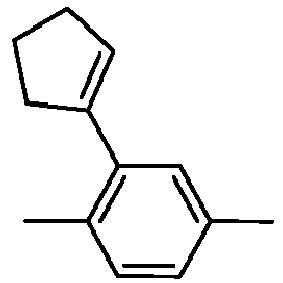
P(c6) 
PI(c6) 
P(e6) 
PI(e6) 
GI(o) 
G(o) 
in which o = 1,2,3,4,5 or 6 in which o = 1,2,3,4,5 or 6 GI(i3) 
G(i3) 
GI(t4) 
G(t4) 
GI(c3) 
G(c3) 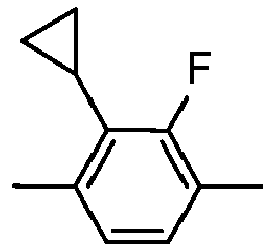
GI(c4) 
G(c4) 
GI(c5) 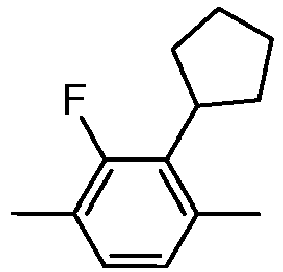
G(c5) 
GI(e5) 
G(e5) 
GI(c6) 
G(c6) 
GI(e6) 
G(e6) 
Np(1,4) 
Table B: Linking groups E -CH2CH2- Z -CO-O- V -CH=CH- ZI -O-CO- X -CF=CH- O -CH2-O- XI -CH=CF- OI -O-CH2- B -CF=CF- Q -CF2-O- T -C≡C- QI -O-CF2- W -CF2CF2- Table B: End groups Left-hand side Right-hand side Used alone -n- CnH2n+1- -n -CnH2n+1 -nO- CnH2n+1-O- -On -O-CnH2n+1 -V- CH2=CH- -V -CH=CH2 -nV- CnH2n+1-CH=CH- -nV -CnH2n-CH=CH2 -Vn- CH2=CH-CnH2n+1- -Vn -CH=CH-CnH2n+1 -nVm- CnH2n+1-CH=CH-CmH2m- -nVm -CnH2n-CH=CH-CmH2m+1 -N- N≡C- -N -C≡N -S- S=C=N- -S -N=C=S -F- F- -F -F -CL- Cl- -CL -Cl -M- CFH2- -M -CFH2 -D- CF2H- -D -CF2H -T- CF3- -T -CF3 -MO- CFH2O- -OM -OCFH2 -DO- CF2HO- -OD -OCF2H -TO- CF3O- -OT -OCF3 -FXO- CF2=CH-O- -OXF -O-CH=CF2 -A- H-C≡C- -A -C≡C-H -nA- CnH2n+1-C≡C- -An -C≡C-CnH2n+1 -NA- N≡C-C≡C- -AN -C≡C-C≡N Used in combination with others -...A...- -C≡C- -...A... -C≡C- -...V...- -CH=CH- -...V... -CH=CH- -...Z...- -CO-O- -...Z... -CO-O- -...ZI...- -O-CO- -...ZI... -O-CO- -...K...- -CO- -...K... -CO- -...W...- -CF=CF- -...W... -CF=CF- - The following table shows illustrative structures together with their respective abbreviations. These are shown in order to illustrate the meaning of the rules for the abbreviations. They furthermore represent compounds which are preferably used.
Table C: Illustrative structures The following illustrative structures are compounds, which are preferably additionally used in the media: 
PG-n-S 
PU-n-S 
PPG-n-S 
PGG-n-S 
PPU-n-S 
GGP-n-S 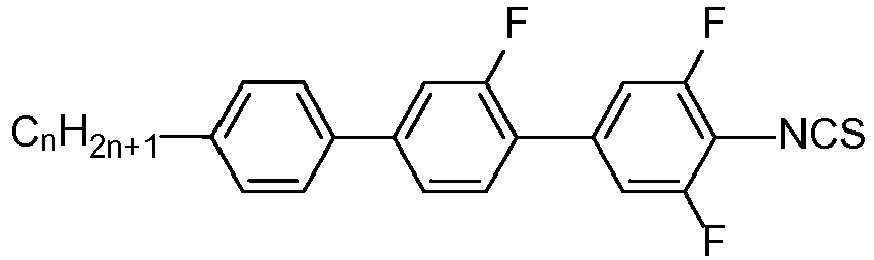
PGU-n-S 
CPG-n-S 
CGG-n-S 
CPU-n-S 
CGU-n-S 
PVG-n-S 
PVU-n-S 
PTG-n-S 
PTU-n-S 
P(2)TU-n-S 
PI(2)TU-n-S 
PTP(1 )-n-S 
PTP(1,1 )-n-S 
PTU-Vn-OT 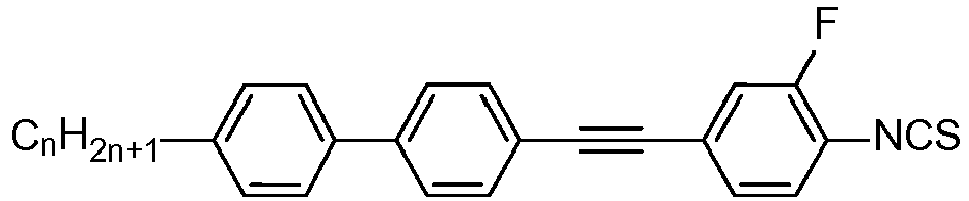
PPTG-n-S 
PGTG-n-S 
PPTU-n-S 
PTPU-n-S 
PTPI(c3)TU-n-F 
PTPI(2)WU-n-F 
PTPI(2)GU-n-F 
PTG(c3)TU-n-F 
PTN(1,4)TP-n-F 
PGP-n-m 
PGP-F-OT 
PGP-n-mV 
PGP-n-mVI 
PYP-n-m 
GGP-n-F 
GGP-n-CL 
GGP-n-m 
PGIGI-n-F 
PGIGI-n-CL 
PGU-n-F 
PGU-n-CL 
PGU-n-OT 
PPU-T-S 
PPU-TO-S 
PPTUI-n-m 
PPTY-n-m 
PGGP-n-m 
PGIGP-n-m 
PGIGP-n-Om 
PGIGP-nO-m 
PYGP-n-m 
GGPP-n-m 
PPGU-n-F 
PPGU-Vn-F 
CPTP-n-m 
CPPC-n-m 
CGPC-n-m 
CCZPC-n-m 
CPGP-n-m 
CPGP-n-mV 
CPGP-n-mVI 
CGU-n-F 
CCPU-n-F 
CCGU-n-F 
CPGU-n-F 
CPGU-n-OT 
PUQU-n-F 
PGUQU-n-F 
DPGU-n-F 
DPGU-n-OT 
APGP-n-m - The following table, Table E, shows further illustrative compounds which can be used as stabiliser in the mesogenic media in accordance with the present invention. The total concentration of these and similar compounds in the media is preferably 5 % or less.


- In a preferred embodiment of the present invention, the mesogenic media comprise one or more compounds selected from the group of the compounds from Table E.
- The following table, Table F, shows illustrative compounds which can preferably be used as chiral dopants in the mesogenic media in accordance with the present invention.
Table F 
C 15 
CB 15 
CM 21 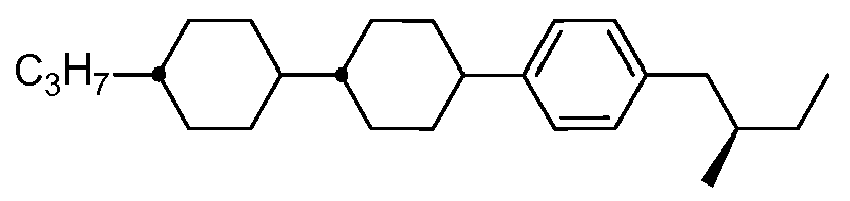
CM 44 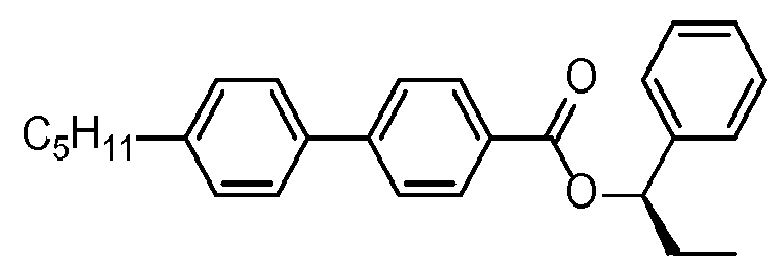
CB 45 
CM 47 
CC 
CN 
R/S-811 
R/S-1011 
R/S-2011 
R/S-3011 
R/S-4011 
R/S-5011 - In a preferred embodiment of the present invention, the mesogenic media comprise one or more compounds selected from the group of the compounds of Table F.
- The mesogenic media in accordance with the present application preferably comprise two or more, preferably four or more, compounds selected from the group consisting of the compounds from the above tables.
- The liquid-crystal media in accordance with the present invention preferably comprise
- seven or more, preferably eight or more, compounds, preferably compounds having three or more, preferably four or more, different formulae, selected from the group of the compounds from Table D.
- The following examples illustrate the present invention without limiting it in any way.
However, it is clear to the person skilled in the art from the physical properties what properties can be achieved and in what ranges they can be modified. In particular, the combination of the various properties which can preferably be achieved is thus well defined for the person skilled in the art. - The voltage holding ratio (VHR) is determined in test cells produced at Merck Japan. The test cells have alkali-free glass substrates and are provided with polyimide alignment layers with a layer thickness of 50 nm, which result in planar alignment of the liquid crystals. The layer gap is uniform (3.0 µm). The surface area of the transparent ITO electrodes is 1 cm2.
- Unless indicated otherwise, the VHR is determined at 20°C (VHR20) and after 5 minutes in an oven at 100°C (VHR100) in a commercially available instrument from Autronic Melchers, Germany. The voltage used has a frequency of 60 Hz, unless indicated otherwise.
- The accuracy of the VHR measurement values depends on the respective value of the VHR. The accuracy decreases with decreasing values. The deviations generally observed in the case of values in the various magnitude ranges are compiled in their order of magnitude in the following table.
VHR range Deviation (relative) VHR values ΔGVHR/VHR/% from to Approx. 99.6% 100% +/- 0.1 99.0% 99.6% +/- 0.2 98% 99% +/- 0.3 95% 98% +/- 0.5 90% 95% +/- 1 80% 90% +/- 2 60% 80% +/- 4 40% 60% +/- 8 20% 40% +/- 10 10% 20% +/- 20 - The stability to UV irradiation is investigated in a "Suntest CPS", a commercial instrument from Heraeus, Germany. The sealed test cells are irradiated for between 30 min and 2.0 hours, unless explicitly indicated, without additional heating. The irradiation power in the wavelength range from 300 nm to 800 nm is 765 W/m2 V. A UV "cut-off" filter having an edge wavelength of 310 nm is used in order to simulate the so-called window glass mode. In each series of experiments, at least four test cells are investigated for each condition, and the respective results are indicated as averages of the corresponding individual measurements.
- The decrease in the voltage holding ratio (ΔVHR) usually caused by the exposure, for example by heat, by UV irradiation or by LCD backlighting, is determined in accordance with the following equation (1):

- Liquid-crystal mixtures N1 to N5 having the compositions and properties as indicated in the following tables are prepared and characterized with respect to their general physical properties and their applicability in microwave components at 19 GHz and 20°C. These data are given in the tables below the composition tables for the individual mixture examples.
Mixture N1 PU-3-S 10.0 % T(N,I). [°C]: 123.5 PTU-3-S 10.0 % Δε (1 kHz, 20°C): 22.3 PTU-5-S 10.0 % ε∥ (1 kHz, 20°C): 26.9 PGU-3-S 16.0 % ε⊥ (1 kHz, 20°C): 4.7 PPTU-4-S 7.0 % γ1 [mPa·s], (20°C): 287 PPTU-5-S 7.0 % K1 [pN], (20°C): 14.0 CPU-2-S 20.0 % K3 [pN], (20°C): 19.5 CPU-4-S 20.0 % V0 [V] (20°C) 0.84 ∑ 100.0 % Mixture N2 PTU-3-S 10.0 % T(N,I). [°C]: 149.5 PTU-5-S 8.0 % Δε (1 kHz, 20°C): 23.3 PGU-3-S 18.0 % ε∥ (1 kHz, 20°C): 27.8 PPTU-4-S 7.0 % ε⊥ (1 kHz, 20°C): 4.5 PPTU-5-S 9.0 % γ1 [mPa·s], (20°C): 396 PGTU-4-S 6.0 % K1 [pN], (20°C): 16.9 CPU-2-S 22.0 % K3 [pN], (20°C): 20.8 CPU-4-S 22.0 % LTS (bulk, -20°C) [h] ≥1000 ∑ 100.0 % LTS (bulk, -30°C) [h] 768 Mixture N3 PTU-3-S 16.0 % T(N,I). [°C]: 151 PGU-3-S 14.0 % Δε (1 kHz, 20°C): 22.7 PPTU-5-S 20.0 % ε∥ (1 kHz, 20°C): 27.0 CPU-2-S 35.0 % ε⊥ (1 kHz, 20°C): 4.4 CPU-4-S 15.0 % γ1 [mPa·s], (20°C): 384 ∑ 100.0 % Mixture N4 PU-3-S 20.0 % T(N,I). [°C]: 128 PGU-3-S 20.0 % Δε (1 kHz, 20°C): 23.6 PGU-4-S 20.0 % ε∥ (1 kHz, 20°C): 28.2 CPU-2-S 20.0 % ε⊥ (1 kHz, 20°C): 5.0 CPU-4-S 20.0 % γ1 [mPa·s], (20°C): 318 ∑ 100.0 % K1 [pN], (20°C): 13.7 K3 [pN], (20°C): 18.6 V0 [V] (20°C) 0.80 Mixture N5 PTU-3-S 8.0 % T(N,I). [°C]: 151.5 PTU-5-S 8.0 % Δε (1 kHz, 20°C): 22.9 PGU-3-S 10.0 % ε∥ (1 kHz, 20°C): 27.4 PGU-4-S 6.0 % ε⊥ (1 kHz, 20°C): 4.5 PGU-5-S 4.0 % γ1 [mPa·s], (20°C): 403 PPTU-4-S 4.0 % K1 [pN], (20°C): 17.3 PPTU-5-S 8.0 % K3 [pN], (20°C): 20.4 PGTU-4-S 5.0 % V0 [V] (20°C) 0.92 PGTU-5-S 5.0 % LTS bulk [h, -30°C]: 1000 CPU-2-S 22.0 % LTS bulk [h, -40°C]: 1000 CPU-4-S 20.0 % τ [20°C, 19 GHz]: 0.307 ∑ 100.0 εr,∥ [20°C, 19 GHz]: 3.5830 εr,⊥ [20°C, 19 GHz]: 2.4838 tan δε r,∥ [20°C, 19 GHz]: 0.0058 tan δε r,⊥ [20°C, 19 GHz]: 0.0113 η [20°C, 19 GHz]: 27.2 - The mixtures N1 to N5 are stabilised with the compound D-1c

- The stabilised mixtures S1 to S5 consist of 99.90% of mixtures N1 to N5, respectively, and 0.10% of the compound D-1c.
- Comparative Mixture C1 comprises the alternative stabiliser ST-3a-1 from the state of the art:

Mixture Host c(D-1c) [%] S1 N1 0.10 S2 N2 0.10 S3 N3 0.10 S4 N4 0.10 S5 N5 0.10 Mixture Host c(ST-3a-1) [%] C1 N1 0.10 - The VHR of the mixtures N1 to N5, S1 to S5 and C1 is determined as described above (VHR100initial). Next, the mixtures are split into two parts and are each filled into sealed ampoules under nitrogen and stored in an oven for 24 h and 100 h, respectively. Afterwards the VHR is determined again (VHRheat load24 and VHRheat load100). The results are summarised in the Table 1.
Table 1 VHR after heat load: Mixture VHR100initial VH Rheat load 24 VHRheat load 100 [%] [%] [%] N1 88 38 13 S1 86 78 65 C1 85 80 15 N2 85 60 17 S2 85 78 55 N3 - - - S3 - - - N4 78 80 20 S4 82 82 82 N5 - - - S5 - - - - The stabilised mixtures S1 to S5 exhibit significantly improved VHR values after heat load compared to the unstabilised mixtures N1 to N5. Furthermore, the VHR values of comparative mixture C1 show that the stabiliser D-1c according to the invention is also effective after long term stress of 100 h, whereas the use of the stabiliser ST-3a-1 from the state of the art gives a very similar result as the unstabilised mixture N1.
- The liquid-crystal mixtures S6 to S9 and Ch1 to Ch6 are prepared according to the following tables. S6 to S9 and Ch1 to Ch6 show equally high VHR values after heat load as the examples above.
Mixture S6 PTU-3-S 14.98 % T(N,I). [°C]: 124.0 PTU-5-S 14.98 % Δn [20°C, 589.3 nm] 0.3628 PGU-3-S 14.98 % ne [20°C, 589.3 nm] 1.9034 PPTU-5-S 9.99 % no [20°C, 589.3 nm] 1.5406 CPU-2-S 27.97 % Δε (1 kHz, 20°C): 22.1 CPU-4-S 16.98 % ε∥ (1 kHz, 20°C): 26.7 D-1c 0.12 % ε⊥ (1 kHz, 20°C): 4.6 ∑ 100.00 % γ1 [mPa·s], (20°C): 307 K1 [pN], (20°C): 14.5 K3 [pN], (20°C): 18.01 LTS (bulk, -20°C) [h] ≥1000 τ [19 GHz, 20°C] 0.305 εr,⊥ [19 GHz, 20°C] 3.5338 εr,∥ [19 GHz, 20°C] 2.4562 tan δε r,∥ [19 GHz, 20°C] 0.0064 tan δε r,⊥ [19 GHz, 20°C] 0.0116 η [19 GHz, 20°C] 26.3 Mixture S7 D-1c 0.12 Klärpunkt [°C]: 151.5 PTU-3-S 7.99 Δn [589 nm, 20°C]: 0.3790 PTU-5-S 7.99 ne [589 nm, 20°C]: 1.9172 PGU-3-S 9.99 no [589 nm, 20°C]: 1.5382 PGU-4-S 5.99 Δε [1 kHz, 20°C]: 22.9 PGU-5-S 4.0 ε∥ [1 kHz, 20°C]: 27.4 PPTU-4-S 4.0 ε⊥ [1 kHz, 20°C]: 4.5 PPTU-5-S 7.99 γ1 [mPa s, 20°C]: 403 PGTU-4-S 4.99 K1 [pN, 20°C]: 17.3 PGTU-5-S 4.99 K3 [pN, 20°C]: 20.4 CPU-2-S 21.97 K3/K1 [pN, 20°C]: 1.18 CPU-4-S 19.98 V0 [V, 20°C]: 0.92 ∑ 100.0 LTS bulk [h, -10°C]: LTS bulk [h, -20°C]: LTS bulk [h, -30°C]: 1000 LTS bulk [h, -40°C]: 1000 τ [20°C, 19 GHz]: 0.307 εr,∥ [20°C, 19 GHz]: 3.5830 εr,⊥ [20°C, 19 GHz]: 2.4838 tan δε r,∥ [20°C, 19 GHz]: 0.0058 tan δε r,⊥ [20°C, 19 GHz]: 0.0113 η [20°C, 19 GHz]: 27.2 Mixture S8 D-1c 0.12 Klärpunkt [°C]: 153.5 PTU-3-S 7.99 Δn [589 nm, 20°C]: 0.3754 PTU-5-S 7.99 ne [589 nm, 20°C]: 1.9124 PGU-3-S 7.99 no [589 nm, 20°C]: 1.5370 PPTU-4-S 7.99 Δε [1 kHz, 20°C]: 21.1 PPTU-5-S 7.99 ε∥ [1 kHz, 20°C]: 25.3 PGTU-4-S 7.99 ε⊥ [1 kHz, 20°C]: 4.2 CPU-2-S 27.97 γ1 [mPa s, 20°C]: 353 CPU-4-S 23.97 K1 [pN, 20°C]: 16.1 ∑ 100.0 K3 [pN, 20°C]: 19.9 K3/K1 [pN, 20°C]: 1.24 V0 [V, 20°C]: 0.92 LTS bulk [h, -10°C]: LTS bulk [h, -20°C]: 1000 LTS bulk [h, -30°C]: 1000 LTS bulk [h, -40°C]: 1000 τ [20°C, 19 GHz]: 0.313 εr,∥ [20°C, 19 GHz]: 3.5496 εr,⊥ [20°C, 19 GHz]: 2.4374 tan δε r,∥ [20°C, 19 GHz]: 0.0057 tan δε r,⊥ [20°C, 19 GHz]: 0.0106 η [20°C, 19 GHz]: 29.5 Mixture S9 D-1c 0.12 Klärpunkt [°C]: 151 PTU-3-S 15.98 Δn [589 nm, 20°C]: 0.3779 PGU-3-S 13.98 ne [589 nm, 20°C]: 1.9169 PPTU-5-S 19.98 no [589 nm, 20°C]: 1.5390 CPU-2-S 34.96 Δε [1 kHz, 20°C]: 22.7 CPU-4-S 14.98 ε∥ [1 kHz, 20°C]: 27.0 ∑ 100.0 ε⊥ [1 kHz, 20°C]: 4.4 γ1 [mPa s, 20°C]: 384 K1 [pN, 20°C]: 16.8 K3 [pN, 20°C]: 21.6 K3/K1 [pN, 20°C]: 1.29 V0 [V, 20°C]: 0.91 LTS bulk [h, -20°C]: 1000 LTS bulk [h, -30°C]: 216 LTS bulk [h, -40°C]: 0 τ [20°C, 19 GHz]: 0.311 εr,∥ [20°C, 19 GHz]: 3.5851 εr,⊥ [20°C, 19 GHz]: 2.4705 tan δε r,|| [20°C, 19 GHz]: 0.0059 tan δε r,⊥ [20°C, 19 GHz]: 0.0106 η [20°C, 19 GHz]: 29.3 - Preferred cholesteric mixtures are preferred using the chiral dopants A-II-1-1 or A-III-1-1 shown below.


- The cholesteric mixtures Ch1 to Ch6 have the following composition:
Mixture Host % Host Dopant % Dopant Ch1 S7 99.90 A-II-1-1 0.10 Ch2 S7 99.80 A-II-1-1 0.20 Ch3 S7 99.70 A-II-1-1 0.30 Ch4 S7 99.75 A-III-1-1 0.25 Ch5 S7 99.50 A-III-1-1 0.50 Ch6 S7 99.25 A-III-1-1 0.75 - The mixtures Ch1 to Ch6 show faster switching than the host mixture S7 without chiral dopant.


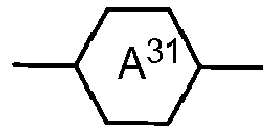


Claims (13)
- Liquid-crystal medium, characterized in that it comprisesa) one or more compounds of the formula D,


 R1A denotes H, an alkyl, alkenyl or alkoxy radical having up to 15 C atoms, in which one or more CH2-groups may be replaced by
 R2A denotes H, alkyl or alkenyl or alkoxy having up to 7 C atoms, in which one or more H atoms may be replaced by halogen,r is 0 or 1;andb) one or more compounds selected from the group of compounds of formulae I, II and III,

 R1 denotes H, unfluorinated alkyl or unfluorinated alkoxy having 1 to 17 C atoms, or unfluorinated alkenyl, unfluorinated alkenyloxy or unfluorinated alkoxyalkyl having 2 to 15 C atoms, in which one or more CH2-groups may be replaced by
 n is 0, 1 or 2,


and wherein

 R2 denotes H, unfluorinated alkyl or unfluorinated alkoxy having 1 to 17 C atoms, or unfluorinated alkenyl, unfluorinated alkenyloxy or unfluorinated alkoxyalkyl having 2 to 15 C atoms, in which one or more CH2-groups may be replaced by
 Z21 denotes trans-CH=CH-, trans-CF=CF- or -C≡C-, and


 R3 denotes H, unfluorinated alkyl or unfluorinated alkoxy having 1 to 17 C atoms, or unfluorinated alkenyl, unfluorinated alkenyloxy or unfluorinated alkoxyalkyl having 2 to 15 C atoms, in which one or more CH2-groups may be replaced by
 one of Z31 and Z32 , denotes trans-CH=CH-, trans-CF=CF- or -C≡C- and the other one, independently thereof, denotes - C≡C-, trans-CH=CH-, trans-CF=CF- or a single bond, and


- Liquid-crystal medium according to claim 1, wherein the one or more compounds of formula D are selected from the group of compounds of formulae D-1 and D-2

 R1A denotes alkyl having 1 to 7 C atoms.
 - Medium according to claim 1 or 2, wherein the total concentration of the compounds of the formula D in the medium is in the range of from 0.05 % to 1 % by weight.
- Liquid-crystal medium according to one or more of claims 1 to 3, wherein the medium comprises one or more compounds selected from the group of compounds of formula I-1 to I-5


L1, L2 and L3 on each occurrence, identically or differently, denote H or F, and
R1,

- Liquid-crystal medium according to one or more of claims 1 to 4, wherein the medium comprises one or more compounds selected from the group of compounds of the formulae II-1 to II-3


R2,
- Liquid-crystal medium according to one or more of claims 1 to 5, wherein the medium comprises one or more compounds selected from the group of compounds of the formulae III-1 to III-6



R3, Z31 and Z32 independently of one another, denote trans-CH=CH- or trans-CF=CF-, and in formula III-6 alternatively one of Z31 and Z32 may denote -C≡C-.
 - Liquid-crystal medium according to one or more of claims 1 to 6, wherein the medium additionally comprises one or more chiral compounds.
- Component for high-frequency technology, characterised in that it comprises the liquid crystal medium according to one or more of claims 1 to 7.
- Component according to Claim 8, wherein the component is suitable for operation in the microwave range.
- Component according to Claim 8 or 9, wherein the component is a liquid-crystal based antenna element, a phase shifter, a tunable filter, a tunable metamaterial structure, a matching network or a varactor.
- Microwave antenna array, characterised in that it comprises one or more components according to one or more of Claims 8 to 10.
- Use of a liquid-crystal medium according to one or more of Claims 1 to 7 in a component for high-frequency technology.
- Process for the preparation of a liquid-crystal medium according to one or more of claims 1 to 7, characterised in that one or more compounds of formula D are mixed with one or more compounds selected from the group of compounds of formulae I, II and III and optionally additional mesogenic compounds, and optionally a chiral compound are added.
Applications Claiming Priority (1)
| Application Number | Priority Date | Filing Date | Title |
|---|---|---|---|
| EP18163563 | 2018-03-23 |
Publications (2)
| Publication Number | Publication Date |
|---|---|
| EP3543314A1 true EP3543314A1 (en) | 2019-09-25 |
| EP3543314B1 EP3543314B1 (en) | 2020-09-09 |
Family
ID=61763862
Family Applications (1)
| Application Number | Title | Priority Date | Filing Date |
|---|---|---|---|
| EP19163936.8A Active EP3543314B1 (en) | 2018-03-23 | 2019-03-20 | Liquid-crystalline medium |
Country Status (6)
| Country | Link |
|---|---|
| US (1) | US20190292460A1 (en) |
| EP (1) | EP3543314B1 (en) |
| JP (1) | JP7287810B2 (en) |
| KR (1) | KR102727787B1 (en) |
| CN (1) | CN110295048B (en) |
| TW (1) | TWI821260B (en) |
Cited By (1)
| Publication number | Priority date | Publication date | Assignee | Title |
|---|---|---|---|---|
| WO2024188996A1 (en) | 2023-03-15 | 2024-09-19 | Merck Patent Gmbh | Liquid crystal device and antenna |
Families Citing this family (3)
| Publication number | Priority date | Publication date | Assignee | Title |
|---|---|---|---|---|
| JP7701914B2 (en) * | 2019-10-10 | 2025-07-02 | メルク パテント ゲゼルシャフト ミット ベシュレンクテル ハフツング | Fluorinated aromatic compounds |
| CN117004405B (en) * | 2022-04-27 | 2024-12-13 | 西安近代化学研究所 | Liquid crystal composition with wide temperature and high birefringence, optical communication component and high-frequency component |
| CN120536141A (en) * | 2024-02-19 | 2025-08-26 | 深圳引望智能技术有限公司 | Liquid crystal composition and its application |
Citations (17)
| Publication number | Priority date | Publication date | Assignee | Title |
|---|---|---|---|---|
| DE3534777A1 (en) | 1985-09-30 | 1987-04-02 | Hoechst Ag | LIQUID CRYSTAL PHASE WITH DOPERATING EFFECT |
| DE3534778A1 (en) | 1985-09-30 | 1987-04-02 | Hoechst Ag | CHIRAL ESTER OF MESOGENIC CARBONIC ACIDS, A METHOD FOR THE PRODUCTION THEREOF AND THEIR USE AS A DOPER IN LIQUID CRYSTAL PHASES |
| DE3534780A1 (en) | 1985-09-30 | 1987-04-02 | Hoechst Ag | Chiral phenol esters of mesogenic carboxylic acids, a process for the preparation thereof and the use thereof as dopes in liquid-crystal phases |
| DE4342280A1 (en) | 1993-12-11 | 1995-06-14 | Basf Ag | Polymerizable chiral compounds and their use |
| DE19541820A1 (en) | 1995-11-09 | 1997-05-15 | Consortium Elektrochem Ind | Liquid crystalline organosiloxanes containing chiral dianhydrohexite derivatives |
| WO1998000428A1 (en) | 1996-07-01 | 1998-01-08 | Merck Patent Gmbh | Chiral dopants |
| GB2328207A (en) | 1997-08-13 | 1999-02-17 | Merck Patent Gmbh | Chiral hydrobenzoin derivatives for use as dopants in liquid crystalline mixtures |
| EP1038941A1 (en) | 1999-03-25 | 2000-09-27 | Basf Aktiengesellschaft | Chiral compounds and their use as chiral dopants for preparing cholesteric liquid crystal compositions |
| WO2002006195A1 (en) | 2000-07-13 | 2002-01-24 | Merck Patent Gmbh | Chiral compounds ii |
| WO2002006196A1 (en) | 2000-07-13 | 2002-01-24 | Merck Patent Gmbh | Chiral compounds i |
| WO2002006265A1 (en) | 2000-07-13 | 2002-01-24 | Merck Patent Gmbh | Chiral compounds iii |
| WO2002034739A1 (en) | 2000-10-20 | 2002-05-02 | Merck Patent Gmbh | Chiral binaphthol derivatives |
| WO2002094805A1 (en) | 2001-05-21 | 2002-11-28 | Merck Patent Gmbh | Chiral compounds |
| DE102004029429A1 (en) | 2003-07-11 | 2005-02-03 | Merck Patent Gmbh | Control element for use in high frequency applications such as the microwave range has a liquid crystal structure |
| JP2005120208A (en) | 2003-10-16 | 2005-05-12 | Dainippon Ink & Chem Inc | Variable function device |
| EP2982730A1 (en) | 2014-08-08 | 2016-02-10 | Merck Patent GmbH | Liquid-crystalline medium and high-frequency components comprising same |
| EP3112441A1 (en) * | 2015-07-03 | 2017-01-04 | Merck Patent GmbH | Liquid crystal medium and liquid crystal display |
Family Cites Families (3)
| Publication number | Priority date | Publication date | Assignee | Title |
|---|---|---|---|---|
| JP6132122B2 (en) * | 2014-10-10 | 2017-05-24 | Dic株式会社 | Liquid crystal composition and liquid crystal display device using the same |
| WO2016066242A1 (en) * | 2014-10-31 | 2016-05-06 | Merck Patent Gmbh | Liquid-crystalline medium and high-frequency components comprising same |
| US20190185747A1 (en) * | 2016-08-25 | 2019-06-20 | Merck Patent Gmbh | Liquid-crystalline medium |
-
2019
- 2019-03-20 EP EP19163936.8A patent/EP3543314B1/en active Active
- 2019-03-22 KR KR1020190032892A patent/KR102727787B1/en active Active
- 2019-03-22 JP JP2019054818A patent/JP7287810B2/en active Active
- 2019-03-22 TW TW108109936A patent/TWI821260B/en active
- 2019-03-22 US US16/361,889 patent/US20190292460A1/en not_active Abandoned
- 2019-03-22 CN CN201910220523.XA patent/CN110295048B/en active Active
Patent Citations (17)
| Publication number | Priority date | Publication date | Assignee | Title |
|---|---|---|---|---|
| DE3534777A1 (en) | 1985-09-30 | 1987-04-02 | Hoechst Ag | LIQUID CRYSTAL PHASE WITH DOPERATING EFFECT |
| DE3534778A1 (en) | 1985-09-30 | 1987-04-02 | Hoechst Ag | CHIRAL ESTER OF MESOGENIC CARBONIC ACIDS, A METHOD FOR THE PRODUCTION THEREOF AND THEIR USE AS A DOPER IN LIQUID CRYSTAL PHASES |
| DE3534780A1 (en) | 1985-09-30 | 1987-04-02 | Hoechst Ag | Chiral phenol esters of mesogenic carboxylic acids, a process for the preparation thereof and the use thereof as dopes in liquid-crystal phases |
| DE4342280A1 (en) | 1993-12-11 | 1995-06-14 | Basf Ag | Polymerizable chiral compounds and their use |
| DE19541820A1 (en) | 1995-11-09 | 1997-05-15 | Consortium Elektrochem Ind | Liquid crystalline organosiloxanes containing chiral dianhydrohexite derivatives |
| WO1998000428A1 (en) | 1996-07-01 | 1998-01-08 | Merck Patent Gmbh | Chiral dopants |
| GB2328207A (en) | 1997-08-13 | 1999-02-17 | Merck Patent Gmbh | Chiral hydrobenzoin derivatives for use as dopants in liquid crystalline mixtures |
| EP1038941A1 (en) | 1999-03-25 | 2000-09-27 | Basf Aktiengesellschaft | Chiral compounds and their use as chiral dopants for preparing cholesteric liquid crystal compositions |
| WO2002006195A1 (en) | 2000-07-13 | 2002-01-24 | Merck Patent Gmbh | Chiral compounds ii |
| WO2002006196A1 (en) | 2000-07-13 | 2002-01-24 | Merck Patent Gmbh | Chiral compounds i |
| WO2002006265A1 (en) | 2000-07-13 | 2002-01-24 | Merck Patent Gmbh | Chiral compounds iii |
| WO2002034739A1 (en) | 2000-10-20 | 2002-05-02 | Merck Patent Gmbh | Chiral binaphthol derivatives |
| WO2002094805A1 (en) | 2001-05-21 | 2002-11-28 | Merck Patent Gmbh | Chiral compounds |
| DE102004029429A1 (en) | 2003-07-11 | 2005-02-03 | Merck Patent Gmbh | Control element for use in high frequency applications such as the microwave range has a liquid crystal structure |
| JP2005120208A (en) | 2003-10-16 | 2005-05-12 | Dainippon Ink & Chem Inc | Variable function device |
| EP2982730A1 (en) | 2014-08-08 | 2016-02-10 | Merck Patent GmbH | Liquid-crystalline medium and high-frequency components comprising same |
| EP3112441A1 (en) * | 2015-07-03 | 2017-01-04 | Merck Patent GmbH | Liquid crystal medium and liquid crystal display |
Non-Patent Citations (5)
| Title |
|---|
| "Status", November 1997, MERCK KGAA, article "Merck Liquid Crystals, Physical Properties of Liquid Crystals" |
| A. GAEBLER ET AL.: "12MTC 2009 - International Instrumentation and Measurement Technology Conference", 2009, IEEE, article "Direct Simulation of Material Permittivities ...", pages: 463 - 467 |
| A. GAEBLER; F. GOELDEN; S. MULLER; A. PENIRSCHKE; R. JAKOBY: "12MTC 2009 - International Instrumentation and Measurement Technology Conference", 2009, IEEE, article "Direct Simulation of Material Permittivites using an Eigen-Susceptibility Formulation of the Vector Variational Approach", pages: 463 - 467 |
| A. PENIRSCHKE ET AL., 34TH EUROPEAN MICROWAVE CONFERENCE - AMSTERDAM, pages 545 - 548 |
| A. PENIRSCHKE ET AL.: "Cavity Perturbation Method for Characterization of Liquid Crystals up to 35 GHz", 34TH EUROPEAN MICROWAVE CONFERENCE - AMSTERDAM, pages 545 - 548 |
Cited By (1)
| Publication number | Priority date | Publication date | Assignee | Title |
|---|---|---|---|---|
| WO2024188996A1 (en) | 2023-03-15 | 2024-09-19 | Merck Patent Gmbh | Liquid crystal device and antenna |
Also Published As
| Publication number | Publication date |
|---|---|
| TWI821260B (en) | 2023-11-11 |
| CN110295048A (en) | 2019-10-01 |
| KR20190111827A (en) | 2019-10-02 |
| JP2019167536A (en) | 2019-10-03 |
| JP7287810B2 (en) | 2023-06-06 |
| CN110295048B (en) | 2024-09-06 |
| TW201940670A (en) | 2019-10-16 |
| EP3543314B1 (en) | 2020-09-09 |
| KR102727787B1 (en) | 2024-11-11 |
| US20190292460A1 (en) | 2019-09-26 |
Similar Documents
| Publication | Publication Date | Title |
|---|---|---|
| EP3739020B1 (en) | Liquid-crystalline medium | |
| EP3543313B1 (en) | Liquid-crystalline medium | |
| EP3414300B1 (en) | Liquid-crystalline medium and high-frequency components comprising same | |
| EP3303519B1 (en) | Liquid-crystalline medium and high-frequency components comprising same | |
| IL274057B1 (en) | Isothiocyantotoluenes | |
| EP3212734B1 (en) | Liquid-crystalline medium and high-frequency components comprising same | |
| EP4041846B1 (en) | Fluorinated aromatic compounds | |
| EP3240860B1 (en) | Liquid-crystalline medium and high-frequency components comprising same | |
| EP4073205B1 (en) | Aromatic isothiocyanates | |
| WO2021037962A1 (en) | Aromatic isothiocyanates | |
| EP3234066B1 (en) | Liquid-crystalline medium and high-frequency components comprising same | |
| EP3240861B1 (en) | Liquid-crystalline medium and high-frequency components comprising same | |
| EP3543314B1 (en) | Liquid-crystalline medium | |
| TW202035661A (en) | Liquid-crystal medium | |
| TW201615806A (en) | Liquid-crystalline medium and high-frequency components comprising same | |
| CN110392726B (en) | Liquid-crystalline medium | |
| EP4263750B1 (en) | Heteroaromatic isothiocyanates |
Legal Events
| Date | Code | Title | Description |
|---|---|---|---|
| PUAI | Public reference made under article 153(3) epc to a published international application that has entered the european phase |
Free format text: ORIGINAL CODE: 0009012 |
|
| STAA | Information on the status of an ep patent application or granted ep patent |
Free format text: STATUS: REQUEST FOR EXAMINATION WAS MADE |
|
| 17P | Request for examination filed |
Effective date: 20190320 |
|
| AK | Designated contracting states |
Kind code of ref document: A1 Designated state(s): AL AT BE BG CH CY CZ DE DK EE ES FI FR GB GR HR HU IE IS IT LI LT LU LV MC MK MT NL NO PL PT RO RS SE SI SK SM TR |
|
| AX | Request for extension of the european patent |
Extension state: BA ME |
|
| GRAP | Despatch of communication of intention to grant a patent |
Free format text: ORIGINAL CODE: EPIDOSNIGR1 |
|
| STAA | Information on the status of an ep patent application or granted ep patent |
Free format text: STATUS: GRANT OF PATENT IS INTENDED |
|
| INTG | Intention to grant announced |
Effective date: 20200603 |
|
| GRAS | Grant fee paid |
Free format text: ORIGINAL CODE: EPIDOSNIGR3 |
|
| GRAA | (expected) grant |
Free format text: ORIGINAL CODE: 0009210 |
|
| STAA | Information on the status of an ep patent application or granted ep patent |
Free format text: STATUS: THE PATENT HAS BEEN GRANTED |
|
| AK | Designated contracting states |
Kind code of ref document: B1 Designated state(s): AL AT BE BG CH CY CZ DE DK EE ES FI FR GB GR HR HU IE IS IT LI LT LU LV MC MK MT NL NO PL PT RO RS SE SI SK SM TR |
|
| REG | Reference to a national code |
Ref country code: GB Ref legal event code: FG4D |
|
| REG | Reference to a national code |
Ref country code: AT Ref legal event code: REF Ref document number: 1311567 Country of ref document: AT Kind code of ref document: T Effective date: 20200915 Ref country code: CH Ref legal event code: EP |
|
| REG | Reference to a national code |
Ref country code: DE Ref legal event code: R096 Ref document number: 602019000605 Country of ref document: DE |
|
| REG | Reference to a national code |
Ref country code: IE Ref legal event code: FG4D |
|
| REG | Reference to a national code |
Ref country code: LT Ref legal event code: MG4D |
|
| PG25 | Lapsed in a contracting state [announced via postgrant information from national office to epo] |
Ref country code: HR Free format text: LAPSE BECAUSE OF FAILURE TO SUBMIT A TRANSLATION OF THE DESCRIPTION OR TO PAY THE FEE WITHIN THE PRESCRIBED TIME-LIMIT Effective date: 20200909 Ref country code: NO Free format text: LAPSE BECAUSE OF FAILURE TO SUBMIT A TRANSLATION OF THE DESCRIPTION OR TO PAY THE FEE WITHIN THE PRESCRIBED TIME-LIMIT Effective date: 20201209 Ref country code: SE Free format text: LAPSE BECAUSE OF FAILURE TO SUBMIT A TRANSLATION OF THE DESCRIPTION OR TO PAY THE FEE WITHIN THE PRESCRIBED TIME-LIMIT Effective date: 20200909 Ref country code: FI Free format text: LAPSE BECAUSE OF FAILURE TO SUBMIT A TRANSLATION OF THE DESCRIPTION OR TO PAY THE FEE WITHIN THE PRESCRIBED TIME-LIMIT Effective date: 20200909 Ref country code: BG Free format text: LAPSE BECAUSE OF FAILURE TO SUBMIT A TRANSLATION OF THE DESCRIPTION OR TO PAY THE FEE WITHIN THE PRESCRIBED TIME-LIMIT Effective date: 20201209 Ref country code: GR Free format text: LAPSE BECAUSE OF FAILURE TO SUBMIT A TRANSLATION OF THE DESCRIPTION OR TO PAY THE FEE WITHIN THE PRESCRIBED TIME-LIMIT Effective date: 20201210 Ref country code: LT Free format text: LAPSE BECAUSE OF FAILURE TO SUBMIT A TRANSLATION OF THE DESCRIPTION OR TO PAY THE FEE WITHIN THE PRESCRIBED TIME-LIMIT Effective date: 20200909 |
|
| REG | Reference to a national code |
Ref country code: AT Ref legal event code: MK05 Ref document number: 1311567 Country of ref document: AT Kind code of ref document: T Effective date: 20200909 |
|
| REG | Reference to a national code |
Ref country code: NL Ref legal event code: MP Effective date: 20200909 |
|
| PG25 | Lapsed in a contracting state [announced via postgrant information from national office to epo] |
Ref country code: PL Free format text: LAPSE BECAUSE OF FAILURE TO SUBMIT A TRANSLATION OF THE DESCRIPTION OR TO PAY THE FEE WITHIN THE PRESCRIBED TIME-LIMIT Effective date: 20200909 Ref country code: LV Free format text: LAPSE BECAUSE OF FAILURE TO SUBMIT A TRANSLATION OF THE DESCRIPTION OR TO PAY THE FEE WITHIN THE PRESCRIBED TIME-LIMIT Effective date: 20200909 Ref country code: RS Free format text: LAPSE BECAUSE OF FAILURE TO SUBMIT A TRANSLATION OF THE DESCRIPTION OR TO PAY THE FEE WITHIN THE PRESCRIBED TIME-LIMIT Effective date: 20200909 |
|
| PG25 | Lapsed in a contracting state [announced via postgrant information from national office to epo] |
Ref country code: EE Free format text: LAPSE BECAUSE OF FAILURE TO SUBMIT A TRANSLATION OF THE DESCRIPTION OR TO PAY THE FEE WITHIN THE PRESCRIBED TIME-LIMIT Effective date: 20200909 Ref country code: PT Free format text: LAPSE BECAUSE OF FAILURE TO SUBMIT A TRANSLATION OF THE DESCRIPTION OR TO PAY THE FEE WITHIN THE PRESCRIBED TIME-LIMIT Effective date: 20210111 Ref country code: RO Free format text: LAPSE BECAUSE OF FAILURE TO SUBMIT A TRANSLATION OF THE DESCRIPTION OR TO PAY THE FEE WITHIN THE PRESCRIBED TIME-LIMIT Effective date: 20200909 Ref country code: CZ Free format text: LAPSE BECAUSE OF FAILURE TO SUBMIT A TRANSLATION OF THE DESCRIPTION OR TO PAY THE FEE WITHIN THE PRESCRIBED TIME-LIMIT Effective date: 20200909 Ref country code: SM Free format text: LAPSE BECAUSE OF FAILURE TO SUBMIT A TRANSLATION OF THE DESCRIPTION OR TO PAY THE FEE WITHIN THE PRESCRIBED TIME-LIMIT Effective date: 20200909 |
|
| PG25 | Lapsed in a contracting state [announced via postgrant information from national office to epo] |
Ref country code: AL Free format text: LAPSE BECAUSE OF FAILURE TO SUBMIT A TRANSLATION OF THE DESCRIPTION OR TO PAY THE FEE WITHIN THE PRESCRIBED TIME-LIMIT Effective date: 20200909 Ref country code: AT Free format text: LAPSE BECAUSE OF FAILURE TO SUBMIT A TRANSLATION OF THE DESCRIPTION OR TO PAY THE FEE WITHIN THE PRESCRIBED TIME-LIMIT Effective date: 20200909 Ref country code: ES Free format text: LAPSE BECAUSE OF FAILURE TO SUBMIT A TRANSLATION OF THE DESCRIPTION OR TO PAY THE FEE WITHIN THE PRESCRIBED TIME-LIMIT Effective date: 20200909 Ref country code: IS Free format text: LAPSE BECAUSE OF FAILURE TO SUBMIT A TRANSLATION OF THE DESCRIPTION OR TO PAY THE FEE WITHIN THE PRESCRIBED TIME-LIMIT Effective date: 20210109 |
|
| REG | Reference to a national code |
Ref country code: DE Ref legal event code: R097 Ref document number: 602019000605 Country of ref document: DE |
|
| PG25 | Lapsed in a contracting state [announced via postgrant information from national office to epo] |
Ref country code: SK Free format text: LAPSE BECAUSE OF FAILURE TO SUBMIT A TRANSLATION OF THE DESCRIPTION OR TO PAY THE FEE WITHIN THE PRESCRIBED TIME-LIMIT Effective date: 20200909 |
|
| PLBE | No opposition filed within time limit |
Free format text: ORIGINAL CODE: 0009261 |
|
| STAA | Information on the status of an ep patent application or granted ep patent |
Free format text: STATUS: NO OPPOSITION FILED WITHIN TIME LIMIT |
|
| 26N | No opposition filed |
Effective date: 20210610 |
|
| PG25 | Lapsed in a contracting state [announced via postgrant information from national office to epo] |
Ref country code: SI Free format text: LAPSE BECAUSE OF FAILURE TO SUBMIT A TRANSLATION OF THE DESCRIPTION OR TO PAY THE FEE WITHIN THE PRESCRIBED TIME-LIMIT Effective date: 20200909 Ref country code: DK Free format text: LAPSE BECAUSE OF FAILURE TO SUBMIT A TRANSLATION OF THE DESCRIPTION OR TO PAY THE FEE WITHIN THE PRESCRIBED TIME-LIMIT Effective date: 20200909 |
|
| PG25 | Lapsed in a contracting state [announced via postgrant information from national office to epo] |
Ref country code: MC Free format text: LAPSE BECAUSE OF FAILURE TO SUBMIT A TRANSLATION OF THE DESCRIPTION OR TO PAY THE FEE WITHIN THE PRESCRIBED TIME-LIMIT Effective date: 20200909 Ref country code: IT Free format text: LAPSE BECAUSE OF FAILURE TO SUBMIT A TRANSLATION OF THE DESCRIPTION OR TO PAY THE FEE WITHIN THE PRESCRIBED TIME-LIMIT Effective date: 20200909 |
|
| REG | Reference to a national code |
Ref country code: BE Ref legal event code: MM Effective date: 20210331 |
|
| PG25 | Lapsed in a contracting state [announced via postgrant information from national office to epo] |
Ref country code: FR Free format text: LAPSE BECAUSE OF NON-PAYMENT OF DUE FEES Effective date: 20210331 Ref country code: IE Free format text: LAPSE BECAUSE OF NON-PAYMENT OF DUE FEES Effective date: 20210320 Ref country code: LU Free format text: LAPSE BECAUSE OF NON-PAYMENT OF DUE FEES Effective date: 20210320 |
|
| PG25 | Lapsed in a contracting state [announced via postgrant information from national office to epo] |
Ref country code: BE Free format text: LAPSE BECAUSE OF NON-PAYMENT OF DUE FEES Effective date: 20210331 |
|
| REG | Reference to a national code |
Ref country code: CH Ref legal event code: PL |
|
| PG25 | Lapsed in a contracting state [announced via postgrant information from national office to epo] |
Ref country code: LI Free format text: LAPSE BECAUSE OF NON-PAYMENT OF DUE FEES Effective date: 20220331 Ref country code: CH Free format text: LAPSE BECAUSE OF NON-PAYMENT OF DUE FEES Effective date: 20220331 |
|
| P01 | Opt-out of the competence of the unified patent court (upc) registered |
Effective date: 20230519 |
|
| PG25 | Lapsed in a contracting state [announced via postgrant information from national office to epo] |
Ref country code: NL Free format text: LAPSE BECAUSE OF NON-PAYMENT OF DUE FEES Effective date: 20200923 Ref country code: CY Free format text: LAPSE BECAUSE OF FAILURE TO SUBMIT A TRANSLATION OF THE DESCRIPTION OR TO PAY THE FEE WITHIN THE PRESCRIBED TIME-LIMIT Effective date: 20200909 |
|
| PG25 | Lapsed in a contracting state [announced via postgrant information from national office to epo] |
Ref country code: HU Free format text: LAPSE BECAUSE OF FAILURE TO SUBMIT A TRANSLATION OF THE DESCRIPTION OR TO PAY THE FEE WITHIN THE PRESCRIBED TIME-LIMIT; INVALID AB INITIO Effective date: 20190320 |
|
| GBPC | Gb: european patent ceased through non-payment of renewal fee |
Effective date: 20230320 |
|
| PG25 | Lapsed in a contracting state [announced via postgrant information from national office to epo] |
Ref country code: GB Free format text: LAPSE BECAUSE OF NON-PAYMENT OF DUE FEES Effective date: 20230320 |
|
| PG25 | Lapsed in a contracting state [announced via postgrant information from national office to epo] |
Ref country code: GB Free format text: LAPSE BECAUSE OF NON-PAYMENT OF DUE FEES Effective date: 20230320 |
|
| PG25 | Lapsed in a contracting state [announced via postgrant information from national office to epo] |
Ref country code: MK Free format text: LAPSE BECAUSE OF FAILURE TO SUBMIT A TRANSLATION OF THE DESCRIPTION OR TO PAY THE FEE WITHIN THE PRESCRIBED TIME-LIMIT Effective date: 20200909 |
|
| PG25 | Lapsed in a contracting state [announced via postgrant information from national office to epo] |
Ref country code: MT Free format text: LAPSE BECAUSE OF FAILURE TO SUBMIT A TRANSLATION OF THE DESCRIPTION OR TO PAY THE FEE WITHIN THE PRESCRIBED TIME-LIMIT Effective date: 20200909 |
|
| PG25 | Lapsed in a contracting state [announced via postgrant information from national office to epo] |
Ref country code: TR Free format text: LAPSE BECAUSE OF FAILURE TO SUBMIT A TRANSLATION OF THE DESCRIPTION OR TO PAY THE FEE WITHIN THE PRESCRIBED TIME-LIMIT Effective date: 20200909 |
|
| PGFP | Annual fee paid to national office [announced via postgrant information from national office to epo] |
Ref country code: DE Payment date: 20260219 Year of fee payment: 8 |