EP3538340B1 - Composition polymere extrudable en objet permeable a la vapeur d'eau - Google Patents
Composition polymere extrudable en objet permeable a la vapeur d'eau Download PDFInfo
- Publication number
- EP3538340B1 EP3538340B1 EP17804634.8A EP17804634A EP3538340B1 EP 3538340 B1 EP3538340 B1 EP 3538340B1 EP 17804634 A EP17804634 A EP 17804634A EP 3538340 B1 EP3538340 B1 EP 3538340B1
- Authority
- EP
- European Patent Office
- Prior art keywords
- blocks
- weight
- copolymer
- composition according
- peg
- Prior art date
- Legal status (The legal status is an assumption and is not a legal conclusion. Google has not performed a legal analysis and makes no representation as to the accuracy of the status listed.)
- Active
Links
Classifications
-
- C—CHEMISTRY; METALLURGY
- C08—ORGANIC MACROMOLECULAR COMPOUNDS; THEIR PREPARATION OR CHEMICAL WORKING-UP; COMPOSITIONS BASED THEREON
- C08G—MACROMOLECULAR COMPOUNDS OBTAINED OTHERWISE THAN BY REACTIONS ONLY INVOLVING UNSATURATED CARBON-TO-CARBON BONDS
- C08G81/00—Macromolecular compounds obtained by interreacting polymers in the absence of monomers, e.g. block polymers
-
- B—PERFORMING OPERATIONS; TRANSPORTING
- B29—WORKING OF PLASTICS; WORKING OF SUBSTANCES IN A PLASTIC STATE IN GENERAL
- B29C—SHAPING OR JOINING OF PLASTICS; SHAPING OF MATERIAL IN A PLASTIC STATE, NOT OTHERWISE PROVIDED FOR; AFTER-TREATMENT OF THE SHAPED PRODUCTS, e.g. REPAIRING
- B29C48/00—Extrusion moulding, i.e. expressing the moulding material through a die or nozzle which imparts the desired form; Apparatus therefor
- B29C48/022—Extrusion moulding, i.e. expressing the moulding material through a die or nozzle which imparts the desired form; Apparatus therefor characterised by the choice of material
-
- B—PERFORMING OPERATIONS; TRANSPORTING
- B29—WORKING OF PLASTICS; WORKING OF SUBSTANCES IN A PLASTIC STATE IN GENERAL
- B29C—SHAPING OR JOINING OF PLASTICS; SHAPING OF MATERIAL IN A PLASTIC STATE, NOT OTHERWISE PROVIDED FOR; AFTER-TREATMENT OF THE SHAPED PRODUCTS, e.g. REPAIRING
- B29C48/00—Extrusion moulding, i.e. expressing the moulding material through a die or nozzle which imparts the desired form; Apparatus therefor
- B29C48/03—Extrusion moulding, i.e. expressing the moulding material through a die or nozzle which imparts the desired form; Apparatus therefor characterised by the shape of the extruded material at extrusion
- B29C48/07—Flat, e.g. panels
- B29C48/08—Flat, e.g. panels flexible, e.g. films
-
- B—PERFORMING OPERATIONS; TRANSPORTING
- B29—WORKING OF PLASTICS; WORKING OF SUBSTANCES IN A PLASTIC STATE IN GENERAL
- B29C—SHAPING OR JOINING OF PLASTICS; SHAPING OF MATERIAL IN A PLASTIC STATE, NOT OTHERWISE PROVIDED FOR; AFTER-TREATMENT OF THE SHAPED PRODUCTS, e.g. REPAIRING
- B29C48/00—Extrusion moulding, i.e. expressing the moulding material through a die or nozzle which imparts the desired form; Apparatus therefor
- B29C48/03—Extrusion moulding, i.e. expressing the moulding material through a die or nozzle which imparts the desired form; Apparatus therefor characterised by the shape of the extruded material at extrusion
- B29C48/09—Articles with cross-sections having partially or fully enclosed cavities, e.g. pipes or channels
- B29C48/10—Articles with cross-sections having partially or fully enclosed cavities, e.g. pipes or channels flexible, e.g. blown foils
-
- C—CHEMISTRY; METALLURGY
- C08—ORGANIC MACROMOLECULAR COMPOUNDS; THEIR PREPARATION OR CHEMICAL WORKING-UP; COMPOSITIONS BASED THEREON
- C08G—MACROMOLECULAR COMPOUNDS OBTAINED OTHERWISE THAN BY REACTIONS ONLY INVOLVING UNSATURATED CARBON-TO-CARBON BONDS
- C08G69/00—Macromolecular compounds obtained by reactions forming a carboxylic amide link in the main chain of the macromolecule
- C08G69/40—Polyamides containing oxygen in the form of ether groups
-
- C—CHEMISTRY; METALLURGY
- C08—ORGANIC MACROMOLECULAR COMPOUNDS; THEIR PREPARATION OR CHEMICAL WORKING-UP; COMPOSITIONS BASED THEREON
- C08J—WORKING-UP; GENERAL PROCESSES OF COMPOUNDING; AFTER-TREATMENT NOT COVERED BY SUBCLASSES C08B, C08C, C08F, C08G or C08H
- C08J5/00—Manufacture of articles or shaped materials containing macromolecular substances
- C08J5/18—Manufacture of films or sheets
-
- C—CHEMISTRY; METALLURGY
- C08—ORGANIC MACROMOLECULAR COMPOUNDS; THEIR PREPARATION OR CHEMICAL WORKING-UP; COMPOSITIONS BASED THEREON
- C08K—Use of inorganic or non-macromolecular organic substances as compounding ingredients
- C08K5/00—Use of organic ingredients
- C08K5/04—Oxygen-containing compounds
- C08K5/05—Alcohols; Metal alcoholates
- C08K5/053—Polyhydroxylic alcohols
-
- C—CHEMISTRY; METALLURGY
- C08—ORGANIC MACROMOLECULAR COMPOUNDS; THEIR PREPARATION OR CHEMICAL WORKING-UP; COMPOSITIONS BASED THEREON
- C08L—COMPOSITIONS OF MACROMOLECULAR COMPOUNDS
- C08L77/00—Compositions of polyamides obtained by reactions forming a carboxylic amide link in the main chain; Compositions of derivatives of such polymers
- C08L77/02—Polyamides derived from omega-amino carboxylic acids or from lactams thereof
-
- C—CHEMISTRY; METALLURGY
- C08—ORGANIC MACROMOLECULAR COMPOUNDS; THEIR PREPARATION OR CHEMICAL WORKING-UP; COMPOSITIONS BASED THEREON
- C08L—COMPOSITIONS OF MACROMOLECULAR COMPOUNDS
- C08L77/00—Compositions of polyamides obtained by reactions forming a carboxylic amide link in the main chain; Compositions of derivatives of such polymers
- C08L77/06—Polyamides derived from polyamines and polycarboxylic acids
-
- B—PERFORMING OPERATIONS; TRANSPORTING
- B29—WORKING OF PLASTICS; WORKING OF SUBSTANCES IN A PLASTIC STATE IN GENERAL
- B29K—INDEXING SCHEME ASSOCIATED WITH SUBCLASSES B29B, B29C OR B29D, RELATING TO MOULDING MATERIALS OR TO MATERIALS FOR MOULDS, REINFORCEMENTS, FILLERS OR PREFORMED PARTS, e.g. INSERTS
- B29K2071/00—Use of polyethers, e.g. PEEK, i.e. polyether-etherketone or PEK, i.e. polyetherketone or derivatives thereof, as moulding material
- B29K2071/02—Polyalkylene oxides, e.g. PEO, i.e. polyethylene oxide, or derivatives thereof
-
- B—PERFORMING OPERATIONS; TRANSPORTING
- B29—WORKING OF PLASTICS; WORKING OF SUBSTANCES IN A PLASTIC STATE IN GENERAL
- B29K—INDEXING SCHEME ASSOCIATED WITH SUBCLASSES B29B, B29C OR B29D, RELATING TO MOULDING MATERIALS OR TO MATERIALS FOR MOULDS, REINFORCEMENTS, FILLERS OR PREFORMED PARTS, e.g. INSERTS
- B29K2077/00—Use of PA, i.e. polyamides, e.g. polyesteramides or derivatives thereof, as moulding material
-
- B—PERFORMING OPERATIONS; TRANSPORTING
- B29—WORKING OF PLASTICS; WORKING OF SUBSTANCES IN A PLASTIC STATE IN GENERAL
- B29K—INDEXING SCHEME ASSOCIATED WITH SUBCLASSES B29B, B29C OR B29D, RELATING TO MOULDING MATERIALS OR TO MATERIALS FOR MOULDS, REINFORCEMENTS, FILLERS OR PREFORMED PARTS, e.g. INSERTS
- B29K2096/00—Use of specified macromolecular materials not provided for in a single one of main groups B29K2001/00 - B29K2095/00, as moulding material
- B29K2096/04—Block polymers
-
- B—PERFORMING OPERATIONS; TRANSPORTING
- B29—WORKING OF PLASTICS; WORKING OF SUBSTANCES IN A PLASTIC STATE IN GENERAL
- B29K—INDEXING SCHEME ASSOCIATED WITH SUBCLASSES B29B, B29C OR B29D, RELATING TO MOULDING MATERIALS OR TO MATERIALS FOR MOULDS, REINFORCEMENTS, FILLERS OR PREFORMED PARTS, e.g. INSERTS
- B29K2105/00—Condition, form or state of moulded material or of the material to be shaped
- B29K2105/0085—Copolymers
-
- B—PERFORMING OPERATIONS; TRANSPORTING
- B29—WORKING OF PLASTICS; WORKING OF SUBSTANCES IN A PLASTIC STATE IN GENERAL
- B29K—INDEXING SCHEME ASSOCIATED WITH SUBCLASSES B29B, B29C OR B29D, RELATING TO MOULDING MATERIALS OR TO MATERIALS FOR MOULDS, REINFORCEMENTS, FILLERS OR PREFORMED PARTS, e.g. INSERTS
- B29K2105/00—Condition, form or state of moulded material or of the material to be shaped
- B29K2105/0094—Condition, form or state of moulded material or of the material to be shaped having particular viscosity
-
- B—PERFORMING OPERATIONS; TRANSPORTING
- B29—WORKING OF PLASTICS; WORKING OF SUBSTANCES IN A PLASTIC STATE IN GENERAL
- B29K—INDEXING SCHEME ASSOCIATED WITH SUBCLASSES B29B, B29C OR B29D, RELATING TO MOULDING MATERIALS OR TO MATERIALS FOR MOULDS, REINFORCEMENTS, FILLERS OR PREFORMED PARTS, e.g. INSERTS
- B29K2995/00—Properties of moulding materials, reinforcements, fillers, preformed parts or moulds
- B29K2995/0037—Other properties
- B29K2995/0065—Permeability to gases
-
- B—PERFORMING OPERATIONS; TRANSPORTING
- B29—WORKING OF PLASTICS; WORKING OF SUBSTANCES IN A PLASTIC STATE IN GENERAL
- B29K—INDEXING SCHEME ASSOCIATED WITH SUBCLASSES B29B, B29C OR B29D, RELATING TO MOULDING MATERIALS OR TO MATERIALS FOR MOULDS, REINFORCEMENTS, FILLERS OR PREFORMED PARTS, e.g. INSERTS
- B29K2995/00—Properties of moulding materials, reinforcements, fillers, preformed parts or moulds
- B29K2995/0037—Other properties
- B29K2995/0088—Molecular weight
-
- C—CHEMISTRY; METALLURGY
- C08—ORGANIC MACROMOLECULAR COMPOUNDS; THEIR PREPARATION OR CHEMICAL WORKING-UP; COMPOSITIONS BASED THEREON
- C08G—MACROMOLECULAR COMPOUNDS OBTAINED OTHERWISE THAN BY REACTIONS ONLY INVOLVING UNSATURATED CARBON-TO-CARBON BONDS
- C08G65/00—Macromolecular compounds obtained by reactions forming an ether link in the main chain of the macromolecule
-
- C—CHEMISTRY; METALLURGY
- C08—ORGANIC MACROMOLECULAR COMPOUNDS; THEIR PREPARATION OR CHEMICAL WORKING-UP; COMPOSITIONS BASED THEREON
- C08G—MACROMOLECULAR COMPOUNDS OBTAINED OTHERWISE THAN BY REACTIONS ONLY INVOLVING UNSATURATED CARBON-TO-CARBON BONDS
- C08G69/00—Macromolecular compounds obtained by reactions forming a carboxylic amide link in the main chain of the macromolecule
-
- C—CHEMISTRY; METALLURGY
- C08—ORGANIC MACROMOLECULAR COMPOUNDS; THEIR PREPARATION OR CHEMICAL WORKING-UP; COMPOSITIONS BASED THEREON
- C08J—WORKING-UP; GENERAL PROCESSES OF COMPOUNDING; AFTER-TREATMENT NOT COVERED BY SUBCLASSES C08B, C08C, C08F, C08G or C08H
- C08J2371/00—Characterised by the use of polyethers obtained by reactions forming an ether link in the main chain; Derivatives of such polymers
- C08J2371/02—Polyalkylene oxides
-
- C—CHEMISTRY; METALLURGY
- C08—ORGANIC MACROMOLECULAR COMPOUNDS; THEIR PREPARATION OR CHEMICAL WORKING-UP; COMPOSITIONS BASED THEREON
- C08J—WORKING-UP; GENERAL PROCESSES OF COMPOUNDING; AFTER-TREATMENT NOT COVERED BY SUBCLASSES C08B, C08C, C08F, C08G or C08H
- C08J2377/00—Characterised by the use of polyamides obtained by reactions forming a carboxylic amide link in the main chain; Derivatives of such polymers
- C08J2377/02—Polyamides derived from omega-amino carboxylic acids or from lactams thereof
-
- C—CHEMISTRY; METALLURGY
- C08—ORGANIC MACROMOLECULAR COMPOUNDS; THEIR PREPARATION OR CHEMICAL WORKING-UP; COMPOSITIONS BASED THEREON
- C08J—WORKING-UP; GENERAL PROCESSES OF COMPOUNDING; AFTER-TREATMENT NOT COVERED BY SUBCLASSES C08B, C08C, C08F, C08G or C08H
- C08J2387/00—Characterised by the use of unspecified macromolecular compounds, obtained otherwise than by polymerisation reactions only involving unsaturated carbon-to-carbon bonds
-
- C—CHEMISTRY; METALLURGY
- C08—ORGANIC MACROMOLECULAR COMPOUNDS; THEIR PREPARATION OR CHEMICAL WORKING-UP; COMPOSITIONS BASED THEREON
- C08J—WORKING-UP; GENERAL PROCESSES OF COMPOUNDING; AFTER-TREATMENT NOT COVERED BY SUBCLASSES C08B, C08C, C08F, C08G or C08H
- C08J2471/00—Characterised by the use of polyethers obtained by reactions forming an ether link in the main chain; Derivatives of such polymers
- C08J2471/02—Polyalkylene oxides
-
- C—CHEMISTRY; METALLURGY
- C08—ORGANIC MACROMOLECULAR COMPOUNDS; THEIR PREPARATION OR CHEMICAL WORKING-UP; COMPOSITIONS BASED THEREON
- C08J—WORKING-UP; GENERAL PROCESSES OF COMPOUNDING; AFTER-TREATMENT NOT COVERED BY SUBCLASSES C08B, C08C, C08F, C08G or C08H
- C08J2477/00—Characterised by the use of polyamides obtained by reactions forming a carboxylic amide link in the main chain; Derivatives of such polymers
- C08J2477/02—Polyamides derived from omega-amino carboxylic acids or from lactams thereof
-
- C—CHEMISTRY; METALLURGY
- C08—ORGANIC MACROMOLECULAR COMPOUNDS; THEIR PREPARATION OR CHEMICAL WORKING-UP; COMPOSITIONS BASED THEREON
- C08L—COMPOSITIONS OF MACROMOLECULAR COMPOUNDS
- C08L71/00—Compositions of polyethers obtained by reactions forming an ether link in the main chain; Compositions of derivatives of such polymers
-
- C—CHEMISTRY; METALLURGY
- C08—ORGANIC MACROMOLECULAR COMPOUNDS; THEIR PREPARATION OR CHEMICAL WORKING-UP; COMPOSITIONS BASED THEREON
- C08L—COMPOSITIONS OF MACROMOLECULAR COMPOUNDS
- C08L77/00—Compositions of polyamides obtained by reactions forming a carboxylic amide link in the main chain; Compositions of derivatives of such polymers
Definitions
- the present invention relates to compositions of block copolymers, easily extrudable, in particular in waterproof-breathable films, and their manufacturing process. These compositions permeable to water vapor can be used in particular in the food sector, sports equipment, or in the building industry, in particular as an insulating material under the roof of dwellings and for insulating walls.
- an increase in the content of polyether groups makes it possible to increase the permeability to water vapor of these copolymers.
- PEBA polyether blocks
- These PEBAs belong to the particular class of polyetheresteramides when they result from the copolycondensation of polyamide blocks with reactive carboxylic ends with polyether blocks with reactive ends, which are polyetherpolyols (polyetherdiols), the bonds between the polyamide blocks and the flexible polyether blocks. being ester bonds.
- PEBAs are known for their physical properties such as their flexibility, their impact resistance, and their ease of processing by injection.
- copolymers are difficult to transform by extrusion, in particular because of a low viscosity in the molten state and a low resistance in the molten state (melt strength) which results therefrom.
- a material with a Low melt strength in particular can lead to parts which deform before hardening upon cooling.
- polyamide which tends to increase the viscosity.
- extrudable polymer compositions by compounding the block copolymer with other polymers, in particular polyolefins. But in both cases, this lowers the overall level of PEG present in the polymer composition and thereby reduces its permeability to water vapor.
- the object of the invention is therefore to provide compositions based on block copolymers, which can be extrudable, for manufacturing objects, such as films, having a high water vapor permeability, corresponding to the meaning of the invention to a MVTR of at least 700 g / m2, preferably at least 800 g / m2, or even at least 1000 g / m2, per 24 hours at 23 ° C for a relative humidity of 50% and a sample thickness of 30 ⁇ m, measured according to ASTM E96B.
- thermoplastic elastomeric polymers TPE
- a block is said to be “flexible” if it has a low glass transition temperature (Tg).
- Tg glass transition temperature
- Tg glass transition temperature
- flexible or soft blocks which can be envisaged in the copolymer according to the invention, is meant in particular those chosen from polyether blocks, polyester blocks, polysiloxane blocks, such as polydimethylsiloxane or PDMS blocks, polyolefin blocks, polycarbonate blocks, and theirs. mixtures.
- the flexible blocks that can be envisaged are described for example in the patent application French n °: 0950637 page 32 line 3 to page 38 line 23.
- the polyether blocks are chosen from poly (ethylene glycol) (PEG), poly (1,2-propylene glycol) (PPG), poly (1 , 3-propylene glycol) (PO3G), poly (tetramethylene glycol) (PTMG), and their copolymers or mixtures.
- the rigid blocks can be based on polyamide, polyurethane, polyester or a mixture of these polymers. These blocks are in particular described in the patent application French n °: 0856752 .
- the rigid blocks are preferably based on polyamide.
- the polyamide blocks can contain homopolyamides or copolyamides.
- the polyamide blocks that can be envisaged in the composition of the invention are in particular those defined in the application. FR0950637 from page 27 line 18 to page 31 line 14.
- polyamide blocks As examples of polyamide blocks, mention may be made of those comprising at least one of the following molecules: PA12, PA11, PA10.10, PA6.10, PA6, PA6 / 12, a copolyamide comprising at least one of the following monomers: 6, 11, 12, 5.4, 5.9, 5.10, 5.12, 5.13, 5.14, 5.16, 5.18, 5.36, 6.4, 6.6, 6.9, 6.10, 6.12, 6.13, 6.14, 6.16, 6.18, 6.36, 10.4, 10.9, 10.10, 10.12, 10.13, 10.14, 10.16, 10.18, 10.36, 10.T, 12.4, 12.9, 12.10, 12.12, 12.13, 12.14, 12.16, 12.18, 12.36, 12.T and their mixtures or copolymers.
- said at least one block copolymer comprises at least one block chosen from: polyether blocks other than PEG (in addition to the minimum quantity of PEG polyethers with a functionality equal to 2 according to the composition of the invention), polyester blocks , polyamide blocks, polyurethane blocks, and their mixtures.
- copolymers with polyester blocks and polyether blocks also called COPE or copolyetheresters
- copolymers with polyurethane blocks and polyether blocks also called TPU abbreviation of thermoplastic polyurethanes
- copolymers with polyamide blocks and polyether blocks also called PEBA according to the IUPAC, or also polyether-block-amide
- the ratio by weight of the rigid blocks to the flexible blocks of said at least one copolymer is in the range from 0.5 to 3.
- the rigid blocks of the copolymer represent from 30 to 55% by weight, and the flexible blocks of the copolymer represent from 45 to 70% by weight, on the total weight of block copolymer.
- the number-average molar mass Mn of the flexible blocks of the copolymer is in the range from 500 to 3000 g / mol, preferably from 800 to 2000 g / mol.
- the number-average molar mass Mn of the rigid blocks of the copolymer is in the range from 500 to 3000 g / mol, preferably from 800 to 2000 g / mol.
- said at least one copolymer comprises a copolymer with rigid polyamide blocks and flexible polyether (PEBA) blocks, preferably a polyetheresteramide.
- PEBA flexible polyether
- said at least one copolymer of the composition of the invention comprises from 45 to 75% by weight of flexible polyethylene glycol (PEG) blocks, preferably from 50 to 70% by weight of PEG blocks, on the total weight of copolymer.
- PEG flexible polyethylene glycol
- said at least one copolymer of the composition of the invention comprises at least 50% by weight of PA blocks chosen from: PA6, PA6.6, PA10.10, PA10.12, PA11, PA12, PA6 / 12 , PA6 / 6.6, and mixtures thereof.
- said at least one copolymer in the composition according to the invention is chosen from the following PEBAs: PA6-PEG, PA10.10-PEG, PA10.12-PEG, PA11-PEG, PA12-PEG, PA6 / 12-PEG , PA6.6-PEG, PA6 / 6.6-PEG, and mixtures thereof.
- the weight-average molar mass of the copolymer is in the range from 100,000 to 200,000 g / mol, preferably from 100,000 to 180,000 g / mol, preferably from 100,000 to 160,000 g / mol.
- said at least one polyol is chosen from: pentaerythritol, trimethylolpropane, trimethylolethane, trimethylolpropane, hexanetriol, diglycerol, methylglucoside, tetraethanol, sorbitol, dipentaerythritol, cyclodextrin, polyetherpolyols comprising at least three hydroxyl groups, and mixtures thereof.
- a polyol of higher functionality 2 causes bridging bonds interconnecting rigid blocks of the copolymer, preferably by ester bonds.
- the average molar mass by weight of this (s) polyol (s) is at most 1000 g / mol; and is generally in the range of 50 to 1000 g / mol, preferably 50 to 500 g / mol, preferably 50 to 200 g / mol.
- the extrudable composition according to the invention comprises from 0.15 to 0.2% by weight of said polyol on the total weight of the composition.
- the extrudable composition according to the invention advantageously comprises from 3.5 to 35 ⁇ eq / g of said polyol on the total weight of the composition.
- the viscosity in the molten state at 230 ° C (Pa.s) of the composition according to the invention is greater than 300 Pa.s, preferably greater than 400 Pa.s, preferably in the range of 400 at 2000 Pa.s, preferably in the range of 500 to 2000 Pa.s, measured according to the ISO 1621-10: 2015 standard.
- composition according to the invention does not contain a polyolefin.
- the composition according to the invention further comprises (in addition to the copolymer as defined above), from 0.1 to 80%, preferably from 0.1 to 50%, preferably from 0.1 to 20 % by weight of at least one polyamide on the total weight of the composition, chosen from: PA 6, PA6 / 6.6, PA6.12, PA 12, PA11, PA10.10, PA6, PA6.6, PA6.10, PA6 / 12, a polyamide or copolyamide comprising at least one of the following monomers: 6, 11, 12, 5.4, 5.9, 5.10, 5.12, 5.13, 5.14, 5.16, 5.18, 5.36, 6.4, 6.6, 6.9, 6.10, 6.12, 6.13, 6.14, 6.16, 6.18, 6.36, 10.4, 10.9, 10.10, 10.12, 10.13, 10.14, 10.16, 10.18, 10.36, 10.T, 12.4, 12.9,12.10, 12.12, 12.13, 12.14, 12.16, 12.18, 12.36, 12.T and their mixtures or copolymers.
- a subject of the present invention is also an extrusion process characterized in that it uses an extrudable polymer composition according to the invention as defined above, to manufacture a film, a sheet, a membrane, a plate, a section, a tube, a pipe, a hollow body, a reservoir, a synthetic hose, a cable, a rod, a filament, a fiber, and their mixtures.
- the composition of the invention can advantageously be stretched by blow molding and extruded through a heated annular die.
- a subject of the present invention is also an extruded article or article capable of being manufactured by extrusion of a composition in accordance with the invention, said article having a water vapor permeability (MVTR) of at least 700 g / m2, preferably at least 100 g / m2, preferably in the range 1000 to 5000 g / m2, per 24 hours at 23 ° C for a relative humidity of 50% and a sample thickness 30 ⁇ m, measured according to ASTM E96B.
- MVTR water vapor permeability
- this extruded object according to the invention exhibits an absorption of water at saturation at 23 ° C. in the range from 50 to 500% by weight, preferably from 50 to 250%, preferably from 100 to 150% by weight, according to the ISO 62: 2008 standard, relative to the weight of the composition in accordance with the invention.
- the object extruded from the composition according to the invention advantageously exhibits a tensile modulus of elasticity of less than 500 MPa, preferably in the range from 10 to 200 MPa, preferably from 20 to 100 MPa, measured according to the ISO 527-2: 2012-1A standard.
- said object obtained by extrusion of the composition according to the invention has an instantaneous hardness in the range from 20 to 60 Shore D, preferably from 30 to 50 Shore D, according to the ISO 868: 2003 standard.
- a subject of the present invention is also the use of a polymer composition according to the invention as defined above, in an extrusion device for the manufacture of an article permeable to water vapor, with advantageous properties, in particular of MVTR, water absorption, mechanical properties, as defined above.
- the composition according to the invention is used or with an additive in polyamide, for example in PA 6, for the manufacture of packaging films for sausages for cooking and / or smoking, for example fumigation).
- the composition according to the invention is used in waterproof-breathable films for the building.
- Said object is advantageously chosen from: a packaging component, in particular agrifood, a food packaging film, a packaging film for cooking and / or smoking, in particular of sausage, and any other waterproof-breathable film, in particular used in building, textile component, sports equipment, shoe, sports shoe, shoe sole, decoration, luggage, glasses, furniture, electrical equipment, electronics, audio-visual, computer, automotive or aeronautical equipment and / or a component of medical equipment.
- a packaging component in particular agrifood, a food packaging film, a packaging film for cooking and / or smoking, in particular of sausage, and any other waterproof-breathable film, in particular used in building, textile component, sports equipment, shoe, sports shoe, shoe sole, decoration, luggage, glasses, furniture, electrical equipment, electronics, audio-visual, computer, automotive or aeronautical equipment and / or a component of medical equipment.
- the weight-average molar mass of PEBA 1 (Mw) 144,000 g / mol.
- compositions according to the present invention are not limited to this embodiment, but can comprise any type of block copolymer, alone. or as a mixture.
- Table 1 shows the results of inherent viscosity and melt viscosity of the compositions Cp1, Cp2 and Ex1, as well as the results of measurement of MVTR, water absorption at saturation, and hardness obtained on extruded objects. from these respective compositions.
- composition Ex1 according to the invention is more easily extrudable than the composition Cp2.
Landscapes
- Chemical & Material Sciences (AREA)
- Engineering & Computer Science (AREA)
- Chemical Kinetics & Catalysis (AREA)
- Medicinal Chemistry (AREA)
- Polymers & Plastics (AREA)
- Organic Chemistry (AREA)
- Health & Medical Sciences (AREA)
- Manufacturing & Machinery (AREA)
- Mechanical Engineering (AREA)
- Materials Engineering (AREA)
- Compositions Of Macromolecular Compounds (AREA)
- Manufacture Of Macromolecular Shaped Articles (AREA)
- Extrusion Moulding Of Plastics Or The Like (AREA)
- Other Resins Obtained By Reactions Not Involving Carbon-To-Carbon Unsaturated Bonds (AREA)
Description
- La présente invention concerne des compositions de copolymères à blocs, facilement extrudables, notamment en films imper-respirants, et leur procédé de fabrication. Ces compositions perméables à la vapeur d'eau sont utilisables notamment dans le domaine alimentaire, l'équipement sportif, ou dans le bâtiment, notamment comme matériau d'isolation sous la toiture des habitations et pour l'isolation des murs.
- Dans ces domaines, il est important de pouvoir disposer de films polymères présentant une perméabilité à la vapeur d'eau suffisante, pour permettre par exemple la préparation, la cuisson, le fumage d'aliments, et/ou leur conditionnement.
- Dans certains copolymères à blocs, une augmentation de la teneur en groupements polyéther permet d'augmenter la perméabilité à la vapeur d'eau de ces copolymères.
- Parmi ces copolymères à blocs, on peut citer les copolymères à blocs polyamide et blocs polyéther (PEBA). Ces PEBA appartiennent à la classe particulière des polyétheresteramides lorsqu'ils résultent de la copolycondensation de séquences polyamide à extrémités carboxyliques réactives avec des séquences polyéther à extrémités réactives, qui sont des polyétherpolyols (polyétherdiols), les liaisons entre les blocs polyamide et les blocs souples polyéther étant des liaisons ester.
- Les PEBA sont connus pour leurs propriétés physiques telles que leur flexibilité, leur tenue au choc, et leur facilité de mise en œuvre par injection.
- Toutefois, ces copolymères sont délicats à transformer par extrusion, notamment en raison d'une faible viscosité à l'état fondu et d'une faible résistance à l'état fondu (melt strength) qui en résulte. Un matériau avec une faible résistance à l'état fondu peut conduire en particulier à des pièces qui se déforment avant de durcir en refroidissant.
- Il existe différents moyens de moduler la viscosité à l'état fondu d'un polymère.
- Ainsi, il peut être envisagé d'augmenter le taux de polyamide, ce qui tend à augmenter la viscosité. Par ailleurs, on peut obtenir des compositions polymères extrudables par compoundage du copolymère à blocs avec d'autres polymères, notamment des polyoléfines. Mais dans les deux cas, cela fait baisser le taux de PEG global présent dans la composition polymère et réduit de ce fait sa perméabilité à la vapeur d'eau.
- Il est également possible d'augmenter la viscosité à l'état fondu en allongeant les chaînes du polymère, par exemple en prolongeant la polymérisation. Cette approche a été décevante en raison de la dégradation des blocs PEG, laquelle entraîne en outre à une coloration (jaunissement) du matériau, sans pouvoir atteindre les niveaux souhaités de viscosité à l'état fondu, d'au moins 300 Pa.s, mesurée selon la norme ISO 1621-10 : 2015.
- Enfin, on peut envisager d'augmenter la viscosité à l'état fondu en augmentant simultanément la taille des différents blocs du polymère, par exemple des blocs polyamide et des blocs polyéther dans le cas du PEBA.Par exemple, en passant pour un PEBA PA6-PEG, de 1500-1500 à 2000-2000, il devrait être possible d'augmenter la viscosité à l'état fondu à degré de polymérisation équivalent, sans dégrader les propriétés de perméabilité à la vapeur d'eau. Les essais conduits dans ce sens n'ont toutefois pas abouti : la réactivité entre les blocs PA et les blocs PEG est fortement réduite.
- L'invention a donc pour but de fournir des compositions à base de copolymères à blocs, extrudables, pour fabriquer des objets, tels que des films, présentant une perméabilité à la vapeur d'eau élevée, correspondant au sens de l'invention à un MVTR d'au moins 700 g/m2, de préférence d'au moins 800 g/m2, voire d'au moins 1000 g/m2, par 24 heures à 23°C pour un taux d'humidité relative de 50% et une épaisseur d'échantillon de 30 µm, mesurée selon la norme ASTM E96B.
- En effet, la demanderesse a découvert qu'il était possible d'augmenter la viscosité à l'état fondu de compositions de copolymères à blocs sans sacrifier la perméabilité à la vapeur d'eau de l'objet obtenu à partir de ces compositions de copolymères.
- La présente invention a donc pour objet une composition polymère extrudable comprenant :
- de 50 à 99,95%, de préférence de 80 à 99,95%, de préférence de 99,5 à 99,95% d'au moins un copolymère à blocs souples et blocs rigides, comprenant :
- au moins 25% en poids de blocs souples polyéthylène glycol (PEG) de fonctionnalité égale à 2, ledit PEG de fonctionnalité 2 contenant deux groupes hydroxyles au maximum, sur le poids total de copolymère,
et
- au moins 25% en poids de blocs souples polyéthylène glycol (PEG) de fonctionnalité égale à 2, ledit PEG de fonctionnalité 2 contenant deux groupes hydroxyles au maximum, sur le poids total de copolymère,
- de 0,01 à 5%, de préférence de 0,05 à 0,5% en poids d'au moins un polyol (y-compris polyéther polyol) de fonctionnalité supérieure à 2 comportant au moins trois groupes hydroxyles,
sur le poids total de la composition, - la masse molaire moyenne en poids dudit copolymère est au moins égale à 100 000 g/mol.
- Par copolymère à blocs selon l'invention, on entend les polymères thermoplastiques élastomères (TPE), qui comprennent, en alternance, des blocs ou segments dits durs ou rigides (au comportement plutôt thermoplastique) et des blocs ou segments dits souples ou flexibles (au comportement plutôt élastomère). Un bloc est dit « souple » s'il présente une faible température de transition vitreuse (Tg). Par faible température de transition vitreuse, on entend une température de transition vitreuse Tg inférieure à 15 °C, de préférence inférieure à 0°C, avantageusement inférieure à -15°C, encore plus avantageusement à -30°C, éventuellement inférieure à - 50°C.
- Par blocs souples ou mous envisageables dans le copolymère selon l'invention, on entend notamment ceux choisis parmi les blocs polyéther, les blocs polyester, les blocs polysiloxane, tels que les blocs polydiméthylsiloxane ou PDMS, les blocs polyoléfine, les blocs polycarbonate, et leurs mélanges. Les blocs souples envisageables sont décrits par exemple dans la demande de brevet
français n° : 0950637 français n° : 0856752 - Les blocs polyamide (abrégé PA) peuvent comporter des homopolyamides ou des copolyamides. Les blocs polyamide envisageables dans la composition de l'invention sont notamment ceux définis dans la demande
FR0950637 - Avantageusement, ledit au moins un copolymère à blocs comprend au moins un bloc choisi parmi : les blocs polyéther autres que PEG (en plus de la quantité minimale de polyéthers PEG de fonctionnalité égale à 2 selon la composition de l'invention), les blocs polyester, les blocs polyamide, les blocs polyuréthane, et leurs mélanges. A titre d'exemple de copolymère à blocs rigides et à blocs souples, on peut citer respectivement (a) les copolymères à blocs polyester et blocs polyéther (appelés aussi COPE ou copolyétheresters), (b) les copolymères à blocs polyuréthane et blocs polyéther (appelés aussi TPU abréviation de polyuréthanes thermoplastiques) et (c) les copolymères à blocs polyamide et blocs polyéther (appelés aussi PEBA selon l'IUPAC, ou encore polyéther-bloc-amide).
- Avantageusement, dans la composition selon l'invention, le ratio en poids des blocs rigides sur les blocs souples dudit au moins un copolymère est compris dans la gamme de 0,5 à 3.
- Avantageusement, les blocs rigides du copolymère représentent de 30 à 55% en poids, et les blocs souples du copolymère représentent de 45 à 70% en poids, sur le poids total de copolymère à blocs.
- De préférence, la masse molaire moyenne en nombre Mn des blocs souples du copolymère est comprise dans la gamme de 500 à 3000 g/mol, de préférence de 800 à 2000 g/mol.
- De préférence, la masse molaire moyenne en nombre Mn des blocs rigides du copolymère est comprise dans la gamme de 500 à 3000 g/mol, de préférence de 800 à 2000 g/mol.
- Avantageusement, ledit au moins un copolymère comprend un copolymère à blocs rigides polyamide et blocs souples polyéther (PEBA), de préférence un polyétheresteramide.
- De manière avantageuse, ledit au moins un copolymère de la composition de l'invention comprend de 45 à 75% en poids de blocs souples polyéthylène glycol (PEG), de préférence de 50 à 70% en poids de blocs PEG, sur le poids total de copolymère.
- De manière avantageuse, ledit au moins un copolymère de la composition de l'invention comprend au moins 50% en poids de blocs PA choisis parmi : PA6, PA6.6, PA10.10, PA10.12, PA11, PA12, PA6/12, PA6/6.6, et leurs mélanges.
- Avantageusement, ledit au moins un copolymère dans la composition selon l'invention est choisi parmi les PEBAs suivants : PA6-PEG, PA10.10-PEG, PA10.12-PEG, PA11-PEG, PA12-PEG, PA6/12-PEG, PA6.6-PEG, PA6/6.6-PEG, et leurs mélanges.
- Avantageusement, dans la composition selon l'invention, la masse molaire moyenne en poids du copolymère est comprise dans la gamme de 100 000 à 200 000g/mol, de préférence de 100 000 à 180 000 g/mol, de préférence de 100 000 à 160 000 g/mol.
- Par polyol de fonctionnalité supérieure à deux, on entend notamment :
- des polyols monomères, notamment des triols aliphatiques monomères tels que le glycérol, le triméthylolpropane, le pentaérythritol, et/ou
- des polyols polymères, notamment des triols à chaines polyéther, des triols de polycaprolactone, des polyols mixtes polyéther-polyester de fonctionnalité supérieure à 2.
- Avantageusement, ledit au moins un polyol est choisi parmi : le pentaérythritol, triméthylolpropane, triméthyloléthane, triméthylolpropane, hexanetriol, diglycérol, méthylglucoside, tétraéthanol, sorbitol, dipentaérythritol, cyclodextrine, les polyetherpolyols comportant au moins trois groupes hydroxyles, et leurs mélanges.
- L'ajout d'un polyol de fonctionnalité supérieure 2 provoque des liaisons de pontage reliant entre eux des blocs rigides du copolymère, de préférence par des liaisons ester.
- La masse molaire moyenne en poids de ce(s) polyol(s) est au maximum de 1000 g/mol ; et est généralement comprise dans la gamme de 50 à 1000 g/mol, de préférence de 50 à 500 g/mol, de préférence de 50 à 200 g/mol.
- Avantageusement, la composition extrudable selon l'invention comprend de 0,15 à 0,2% en poids dedit polyol sur le poids total de la composition. Pour la caractériser de manière encore plus précise, la composition extrudable selon l'invention comprend avantageusement de 3,5 à 35 µeq/g dedit polyol sur le poids total de la composition.
- Avantageusement, la viscosité à l'état fondu à 230°C (Pa.s) de la composition selon l'invention est supérieure à 300 Pa.s, de préférence supérieure à 400 Pa.s, de préférence comprise dans la gamme de 400 à 2000 Pa.s, de préférence comprise dans la gamme de 500 à 2000 Pa.s, mesurée selon la norme ISO 1621-10 : 2015.
- De manière avantageuse, la composition selon l'invention ne comporte pas de polyoléfine.
- Avantageusement, la composition selon l'invention comporte en outre (en plus du copolymère tel que défini ci-dessus), de 0,1 à 80%, de préférence de 0,1 à 50%, de préférence de 0,1 à 20% en poids d'au moins un polyamide su le poids total de la composition, choisi parmi : du PA 6, du PA6/6.6, du PA6.12, du PA 12, du PA11, du PA10.10, du PA6, du PA6.6, du PA6.10, du PA6/12, un polyamide ou copolyamide comprenant au moins un des monomères suivants : 6, 11, 12, 5.4, 5.9, 5.10, 5.12, 5.13, 5.14, 5.16, 5.18, 5.36, 6.4, 6.6, 6.9, 6.10, 6.12, 6.13, 6.14, 6.16, 6.18, 6.36, 10.4, 10.9, 10.10, 10.12, 10.13, 10.14, 10.16, 10.18, 10.36, 10.T, 12.4, 12.9,12.10, 12.12, 12.13, 12.14, 12.16, 12.18, 12.36, 12.T et leurs mélanges ou copolymères.
- La présente invention a également pour objet un procédé d'extrusion caractérisé en ce qu'il met en oeuvre une composition polymère extrudable selon l'invention telle que définie ci-dessus, pour fabriquer un film, une feuille, une membrane, une plaque, un profilé, un tube, un tuyau, un corps creux, un réservoir, un boyau synthétique, un câble, un jonc, un filament, une fibre, et leurs mélanges. Par exemple, la composition de l'invention peut avantageusement être étirée par soufflage et extrudée à travers une filière annulaire chauffée.
- La présente invention a également pour objet un article ou objet extrudé susceptible d'être fabriqué par extrusion d'une composition conforme à l'invention, ledit objet ayant une perméabilité à la vapeur d'eau (MVTR) d'au moins 700 g/m2, de préférence d'au moins 100 g/m2, de préférence compris dans la gamme de 1000 à 5000 g/m2, par 24 heures à 23°C pour un taux d'humidité relative de 50% et une épaisseur d'échantillon de 30 µm, mesurée selon la norme ASTM E96B.
- Avantageusement, cet objet extrudé selon l'invention présente une absorption en eau à saturation à 23°C comprise dans la gamme de 50 à 500% en poids, de préférence de 50 à 250%, de préférence de 100 à 150% en poids, selon la norme ISO 62 : 2008, par rapport au poids de composition conforme à l'invention.
- L'objet extrudé à partir de la composition selon l'invention présente avantageusement un module d'élasticité en traction inférieur à 500 MPa, de préférence compris dans la gamme de 10 à 200 MPa, de préférence de 20 à 100 MPa, mesuré selon la norme ISO 527-2: 2012-1A.
- Avantageusement ledit objet obtenu par extrusion de la composition selon l'invention présente une dureté instantanée comprise dans la gamme de 20 à 60 Shore D, de préférence de 30 à 50 Shore D, selon la norme ISO 868:2003.
- La présente invention a également pour objet l'utilisation d'une composition polymère selon l'invention tel que définie plus haut, dans un dispositif d'extrusion pour la fabrication d'un objet perméable à la vapeur d'eau, aux propriétés avantageuses, notamment de MVTR, absorption en eau, propriétés mécaniques, telles que définies ci-dessus. Selon un mode de réalisation avantageux, la composition selon l'invention est utilisée ou additivée dans du polyamide, par exemple dans du PA 6, pour la fabrication des films d'emballage de saucisses pour cuisson et/ou fumage, par xemple fumigation). Selon un mode de réalisation avantageux, la composition selon l'invention est utilisée dans des films imper-respirants pour le bâtiment. Ledit objet est avantageusement choisi parmi : un composant d'emballage, notamment agroalimentaire, un film d'emballage alimentaire, un film d'emballage pour cuisson et/ou fumage, notamment de saucisse, et tout autre film imper-respirant, notamment utilisé dans le bâtiment, un composant textile, d'équipement sportif, de chaussure, de chaussure de sport, de semelle de chaussure, de décoration, de bagage, de lunettes, de mobilier, d'équipement électrique, électronique, audio-visuel, informatique, d'équipement automobile ou aéronautique et/ou un composant d'équipement médical.
- Les exemples ci-dessous illustrent la présente invention sans en limiter la portée. Dans les exemples, sauf indication contraire, tous les pourcentages et parties sont exprimés en poids.
- Copolymères utilisés dans les compositions des essais (exemples et comparatifs) suivants :
- Comparatif 1 : Cp1
PEBA 1 : PA12-PEG à base de blocs PA12 de Mn=4500g/mol et de blocs PEG de Mn=1500g/mol ; le ratio bloc rigide/ bloc souple : 3.
La masse molaire moyenne en poids du PEBA 1 (Mw) = 111 000 g/mol. - Comparatif 2 : Cp2
PEBA 2 : PA6-PEG à base de blocs PA6 de Mn=1500g/mol et de blocs PEG de Mn=1500g/mol ; le ratio bloc rigide/ bloc souple : 1.
La masse molaire moyenne en poids du PEBA 1 (Mw) = 112 000 g/mol. - Composition de PEBA 2 + 0,1 % pentaérythritol (« PET »)
- La masse molaire moyenne en poids du PEBA 1 (Mw) = 144 000 g/mol.
- Bien que les essais se réfèrent à une composition à base de PEBA (Pebax®), il est bien entendu que les compositions selon la présente invention ne se limitent pas à ce mode de réalisation, mais peuvent comprendre tout type de copolymère à blocs, seul ou en mélange.
- Le tableau 1 suivant montre les résultats de viscosité inhérente et de viscosité à l'état fondu des compositions Cp1, Cp2 et Ex1, ainsi que les résultats de mesure de MVTR, d'absorption en eau à saturation, et de dureté obtenus sur objets extrudés à partir de ces compositions respectives.
Tableau 1 Essai / Composition Viscosité inhérente ISO 307 ATO : 0,5% massique dans le métacrésol à 20°C, en g/g Viscosité à l'état fondu eta* 230°C, 10rad/s (Pa.s) ISO 6721-10:2015 MVTR ASTM E96 B (par 24h, à 23°C, HR 50%, 30 µm) Absorption en eau à saturation à 23°C (%) ISO 62 :2008 Dureté Shore D ISO 868:2003 Cp1 / PEBA 1 (12/PEG 4500/1500) 1.5 700 560 <50 60 Cp2 / PEBA 2 (6/PEG 1500/1500) 1.35 200 1070 >100 40 Ex1 / PEBA 2 + 0.1% PET 1.4 500 1125 >100 40 - On observe que la composition Ex1 selon l'invention est plus facilement extrudable que la composition Cp2.
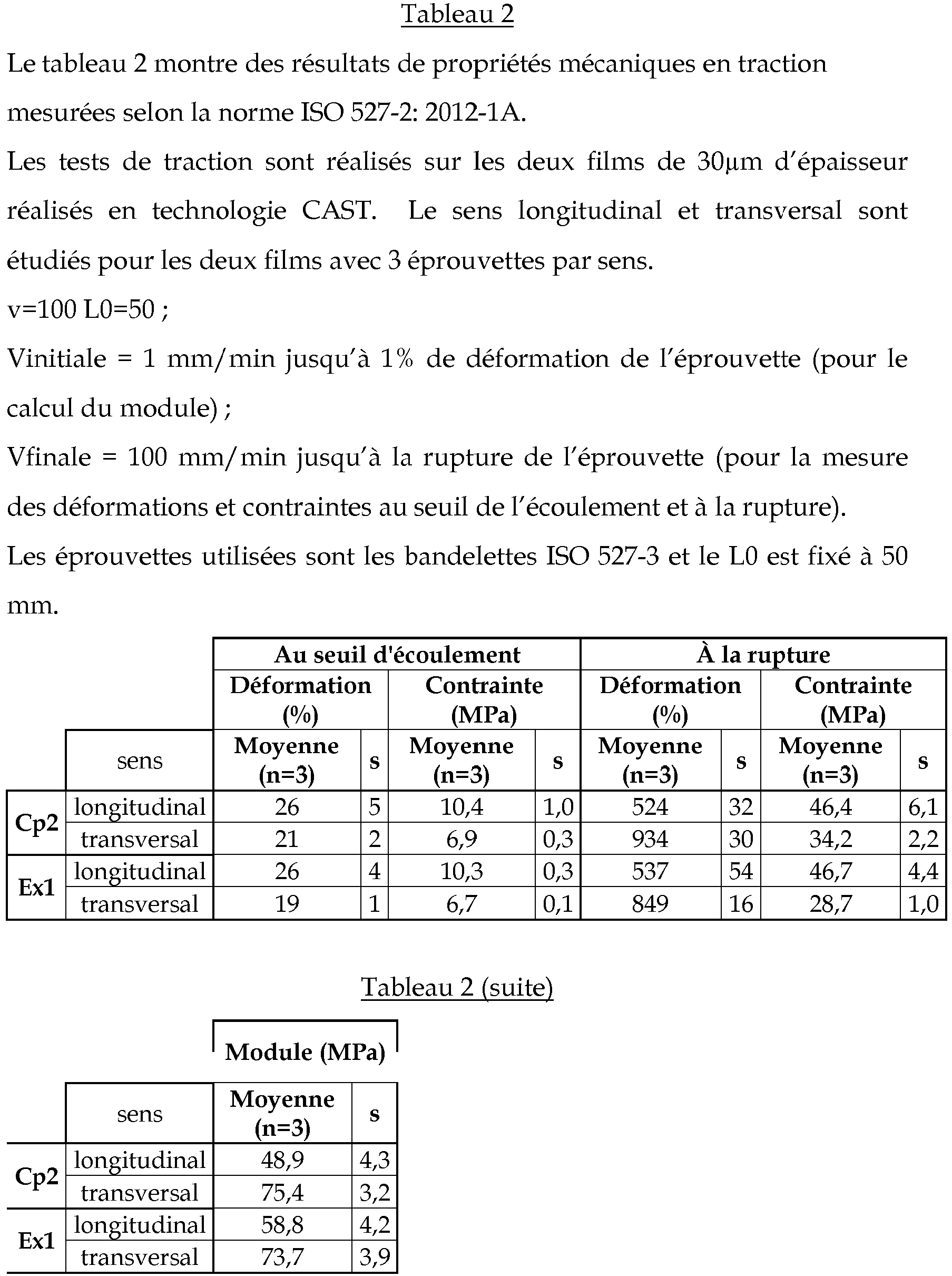
- Les propriétés mécaniques des films Cp2 et Ex1 obtenus sont similaires, que ce soit dans le sens longitudinal ou transversal de l'extrusion.
Claims (24)
- Composition polymère extrudable comprenant :- de 50 à 99,95%, de préférence de 80 à 99,95% en poids d'au moins un copolymère à blocs souples et blocs rigides, comprenant :- au moins 25% en poids de blocs souples polyéthylène glycol (PEG) de fonctionnalité égale à 2, sur le poids total de copolymère,
et- de 0,01 à 5%, de préférence de 0,05 à 0,5% en poids d'au moins un polyol de fonctionnalité supérieure à 2 comportant au moins trois groupes hydroxyles, sur le poids total de la composition,caractérisée en ce que :- la masse molaire moyenne en poids dudit copolymère est au moins égale à 100 000 g/mol ; et- la masse molaire moyenne en poids du polyol est au maximum de 1000 g/mol ; et- ledit au moins un polyol relie entre eux des blocs rigides du copolymère. - Composition extrudable selon la revendication 1, caractérisée en ce qu'elle comprend de 0,15 à 0,2% en poids dedit polyol sur le poids total de la composition.
- Composition selon la revendication 1 ou 2, dans laquelle ledit au moins un copolymère à blocs comprend au moins un bloc choisi parmi : les blocs polyéther autres que PEG, les blocs polyester, les blocs polyamide, les blocs polyuréthane, et leurs mélanges.
- Composition selon l'une quelconque des revendications précédentes, dans laquelle le ratio en poids des blocs rigides sur les blocs souples dudit au moins un copolymère est compris dans la gamme de 0,5 à 3.
- Composition selon l'une quelconque des revendications précédentes, dans laquelle :- les blocs rigides du copolymère représentent de 30 à 55% en poids, et- les blocs souples du copolymère représentent de 45 à 70% en poids, sur le poids total de copolymère à blocs.
- Composition selon l'une quelconque des revendications précédentes, caractérisée en ce que la masse molaire moyenne en nombre Mn des blocs souples du copolymère est comprise dans la gamme de 500 à 3000 g/mol, de préférence de 800 à 2000 g/mol.
- Composition selon l'une quelconque des revendications précédentes, caractérisée en ce que la masse molaire moyenne en nombre Mn des blocs rigides du copolymère est comprise dans la gamme de 500 à 3000 g/mol, de préférence de 800 à 2000 g/mol.
- Composition selon l'une quelconque des revendications précédentes, dans laquelle ledit au moins un copolymère comprend un copolymère à blocs rigides polyamide et blocs souples polyéther (PEBA).
- Composition selon l'une quelconque des revendications précédentes, dans laquelle ledit au moins un copolymère comprend de 45 à 75% en poids de blocs souples polyéthylène glycol (PEG), de préférence de 50 à 70% en poids de blocs PEG, sur le poids total de copolymère.
- Composition selon l'une quelconque des revendications précédentes, dans laquelle ledit au moins un copolymère comprend au moins 50% en poids de blocs PA choisis parmi : PA6, PA6.6, PA10.10, PA10.12, PA11, PA12, PA6/12, PA6/6.6, et leurs mélanges.
- Composition selon l'une quelconque des revendications précédentes, dans laquelle ledit au moins un copolymère est choisi parmi les PEBAs suivants: PA6-PEG, PA10.10-PEG, PA10.12-PEG, PA11-PEG, PA12-PEG, PA6/12-PEG, PA6.6-PEG, PA6/6.6-PEG, et leurs mélanges.
- Composition selon l'une quelconque des revendications précédentes, caractérisée en ce que la masse molaire moyenne en poids du copolymère est comprise dans la gamme de 100 000 à 200 000g/mol, de préférence de 100 000 à 180 000 g/mol, de préférence de 100 000 à 160 000 g/mol.
- Composition selon l'une quelconque des revendications précédentes, caractérisée en ce que la masse molaire moyenne en poids dudit au moins un polyol est comprise dans la gamme de 50 à 1000 g/mol.
- Composition selon l'une quelconque des revendications précédentes, caractérisée en ce que ledit au moins un polyol est choisi parmi : le pentaérythritol, triméthylolpropane, triméthyloléthane, triméthylolpropane, hexanetriol, diglycérol, méthylglucoside, tétraéthanol, sorbitol, dipentaérythritol, cyclodextrine, les polyetherpolyols comportant au moins trois groupes hydroxyles, et leurs mélanges.
- Composition selon l'une quelconque des revendications précédentes, caractérisée en ce que sa viscosité à l'état fondu à 230°C (Pa.s) est supérieure à 400 Pa.s, de préférence comprise dans la gamme de 400 à 2000 Pa.s, de préférence comprise dans la gamme de 500 à 2000 Pa.s, mesurée selon la norme ISO 1621-10 : 2015.
- Composition selon l'une quelconque des revendications précédentes, caractérisée en ce qu'elle ne comporte pas de polyoléfine.
- Composition selon l'une quelconque des revendications précédentes, caractérisée en ce qu'elle comporte en outre au moins un polyamide choisi parmi : du PA 12, du PA11, du PA10.10, du PA6, du PA 6.6, du PA6/12, un copolyamide comprenant au moins un des monomères suivants : 6, 11, 12, 5.4, 5.9, 5.10, 5.12, 5.13, 5.14, 5.16, 5.18, 5.36, 6.4, 6.6, 6.9, 6.10, 6.12, 6.13, 6.14, 6.16, 6.18, 6.36, 10.4, 10.9, 10.10, 10.12, 10.13, 10.14, 10.16, 10.18, 10.36, 10.T, 12.4, 12.9, 12.10, 12.12, 12.13, 12.14, 12.16, 12.18, 12.36, 12.T et leurs mélanges ou copolymères.
- Procédé d'extrusion caractérisé en ce qu'il met en oeuvre une composition polymère extrudable selon l'une quelconque des revendications 1 à 17, pour fabriquer un film, une feuille, une membrane, une plaque, un profilé, un tube, un tuyau, un corps creux, un réservoir, un boyau synthétique, un câble, un jonc, un filament, une fibre.
- Objet extrudé fabriqué selon le procédé de la revendication 18, ledit objet ayant une perméabilité à la vapeur d'eau (MVTR) d'au moins 700 g/m2, de préférence d'au moins 1000 g/m2, de préférence compris dans la gamme de 1000 à 5000 g/m2, par 24 heures à 23°C pour un taux d'humidité relative de 50% et une épaisseur d'échantillon de 30 µm, mesurée selon la norme ASTM E96B.
- Objet extrudé selon la revendication 19, caractérisé en ce qu'il présente une absorption en eau à saturation à 23°C comprise dans la gamme de 50 à 500% en poids, de préférence de 50 à 250%, de préférence de 100 à 150% en poids, selon la norme ISO 62 : 2008, par rapport au poids de PEBA.
- Objet selon la revendication 19 ou 20, caractérisé en ce qu'il présente un module d'élasticité en traction inférieur à 500 MPa, de préférence compris dans la gamme de 10 à 200 MPa, de préférence de 20 à 100 MPa, mesuré selon la norme ISO 527-2: 2012-1A.
- Objet selon l'une quelconque des revendications 19 à 21, caractérisé en ce qu'il présente une dureté instantanée comprise dans la gamme de 20 à 60 Shore D, de préférence de 30 à 50 Shore D, selon la norme ISO 868: 2003.
- Objet selon l'une quelconque des revendications 19 à 22, ledit objet étant un composant d'emballage, notamment agroalimentaire, un film d'emballage alimentaire, un film d'emballage pour cuisson et/ou fumage, notamment de saucisse, un film imper-respirant, notamment utilisé dans le bâtiment, un composant textile, d'équipement sportif, de chaussure, de chaussure de sport, de semelle de chaussure, de décoration, de bagage, de lunettes, de mobilier, d'équipement audio-visuel, informatique, d'équipement automobile ou aéronautique et/ou un composant d'équipement médical.
- Utilisation d'une composition polymère selon l'une quelconque des revendications 1 à 17, dans un dispositif d'extrusion pour la fabrication d'un objet perméable à la vapeur d'eau, tel que défini selon l'une quelconque des revendications 19 à 23.
Applications Claiming Priority (2)
| Application Number | Priority Date | Filing Date | Title |
|---|---|---|---|
| FR1661012A FR3058724B1 (fr) | 2016-11-14 | 2016-11-14 | Composition polymere extrudable en objet permeable a la vapeur d'eau |
| PCT/FR2017/053109 WO2018087501A1 (fr) | 2016-11-14 | 2017-11-14 | Composition polymere extrudable en objet permeable a la vapeur d'eau |
Publications (2)
| Publication Number | Publication Date |
|---|---|
| EP3538340A1 EP3538340A1 (fr) | 2019-09-18 |
| EP3538340B1 true EP3538340B1 (fr) | 2021-07-07 |
Family
ID=58347505
Family Applications (1)
| Application Number | Title | Priority Date | Filing Date |
|---|---|---|---|
| EP17804634.8A Active EP3538340B1 (fr) | 2016-11-14 | 2017-11-14 | Composition polymere extrudable en objet permeable a la vapeur d'eau |
Country Status (8)
| Country | Link |
|---|---|
| US (1) | US11124610B2 (fr) |
| EP (1) | EP3538340B1 (fr) |
| JP (1) | JP7060594B2 (fr) |
| CN (1) | CN109983064B (fr) |
| CA (1) | CA3042110A1 (fr) |
| FR (1) | FR3058724B1 (fr) |
| MX (1) | MX2019005345A (fr) |
| WO (1) | WO2018087501A1 (fr) |
Families Citing this family (6)
| Publication number | Priority date | Publication date | Assignee | Title |
|---|---|---|---|---|
| US11318421B2 (en) * | 2019-05-10 | 2022-05-03 | Xergy Inc. | Thin wall polyether block amide membrane tubing and module |
| US11554347B2 (en) * | 2019-05-10 | 2023-01-17 | Ffi Ionix Ip, Inc. | Thin wall polyether block amide membrane tubing and module |
| FR3093725B1 (fr) * | 2019-03-15 | 2021-10-01 | Arkema France | Copolymères à blocs rigides et à blocs souples branchés |
| FR3114098B1 (fr) * | 2020-09-15 | 2023-07-14 | Arkema France | Composition comprenant un copolymère à blocs polyamides et à blocs polyéthers |
| FR3115491B1 (fr) | 2020-10-27 | 2024-08-23 | Arkema France | Structure multicouche imper-respirante |
| GB2606046B (en) * | 2020-12-16 | 2023-08-02 | Ffi Ionix Ip Inc | Extruded thin wall polyether block amide membrane tubing and module |
Family Cites Families (16)
| Publication number | Priority date | Publication date | Assignee | Title |
|---|---|---|---|---|
| FR856752A (fr) | 1939-03-09 | 1940-08-07 | Massiot & Cie G | Grille antidiffusante de radiographie à mouvement vibratoire |
| FR950637A (fr) | 1947-07-28 | 1949-10-03 | Tricot indémaillable | |
| FR1603901A (en) * | 1968-02-20 | 1971-06-14 | Polyester and polyether-polyamide-block copolymer - comp for complex filaments | |
| IT1170089B (it) * | 1983-12-30 | 1987-06-03 | Snia Fibre | Composizione copolimerica atta alla produzione di fibre sintetiche ad elevata idrofilia, procedimento per la sua preparazione, fibre e manufatti relativi |
| FR2755970B1 (fr) * | 1996-11-19 | 1998-12-18 | Atochem Elf Sa | Materiau comprenant un polyamide, un polymere a blocs polyamide et polyether et une polyolefine fonctionnalisee, film et objet obtenus a partir de celui-ci |
| FI112587B (fi) * | 1999-06-04 | 2003-12-31 | Eriksson Capital Ab | Kestomakkaran polymeerisuoli, menetelmä kestomakkaran valmistamiseksi ja polymeerisuolen käyttö kestomakkaroiden valmistuksessa |
| FR2812647B1 (fr) * | 2000-08-04 | 2003-02-21 | Atofina | Film imper-respirant |
| US6870011B2 (en) * | 2001-01-24 | 2005-03-22 | Arizona Chemical Company | Hydrocarbon-terminated polyether-polyamide block copolymers and uses thereof |
| DE10208858A1 (de) * | 2002-03-01 | 2003-09-11 | Kalle Gmbh & Co Kg | Rauch- und wasserdampfdurchlässige Nahrungsmittelhülle aus einem thermoplastischen Gemisch |
| JP5528698B2 (ja) | 2005-04-14 | 2014-06-25 | アルケマ フランス | 熱可塑性エラストマーをベースにした混合物 |
| CN101218301B (zh) * | 2005-04-14 | 2012-11-14 | 阿肯马法国公司 | 基于热塑性弹性体的混合物 |
| FR2890969A1 (fr) * | 2005-09-16 | 2007-03-23 | Arkema Sa | Copolymeres a blocs polyamides et blocs polyethers resistants au vieillissement |
| EP1783156A1 (fr) * | 2005-11-03 | 2007-05-09 | Arkema France | Procédé de fabrication de copolymères ayant des blocs polyamide et polyether |
| WO2010089902A1 (fr) * | 2009-02-06 | 2010-08-12 | Arkema France | Utilisation d'un copolymère de peba, composition, procédé et peau |
| FR2948676B1 (fr) * | 2009-07-29 | 2011-08-26 | Addiplast | Composition thermoplastique elastomere a base de polyether bloc amides (peba) a resistance au feu amelioree, procede de fabrication de ladite composition |
| CN104497306A (zh) * | 2014-12-17 | 2015-04-08 | 江门市优巨新材料有限公司 | 含耐高温聚酰胺嵌段和聚醚嵌段的共聚物及其制备方法 |
-
2016
- 2016-11-14 FR FR1661012A patent/FR3058724B1/fr not_active Expired - Fee Related
-
2017
- 2017-11-14 CN CN201780070278.8A patent/CN109983064B/zh active Active
- 2017-11-14 WO PCT/FR2017/053109 patent/WO2018087501A1/fr not_active Ceased
- 2017-11-14 CA CA3042110A patent/CA3042110A1/fr not_active Abandoned
- 2017-11-14 JP JP2019525777A patent/JP7060594B2/ja active Active
- 2017-11-14 US US16/349,461 patent/US11124610B2/en active Active
- 2017-11-14 EP EP17804634.8A patent/EP3538340B1/fr active Active
- 2017-11-14 MX MX2019005345A patent/MX2019005345A/es unknown
Non-Patent Citations (1)
| Title |
|---|
| None * |
Also Published As
| Publication number | Publication date |
|---|---|
| US11124610B2 (en) | 2021-09-21 |
| EP3538340A1 (fr) | 2019-09-18 |
| JP2020502301A (ja) | 2020-01-23 |
| CA3042110A1 (fr) | 2018-05-17 |
| CN109983064B (zh) | 2021-09-07 |
| FR3058724B1 (fr) | 2018-12-07 |
| CN109983064A (zh) | 2019-07-05 |
| US20190338078A1 (en) | 2019-11-07 |
| JP7060594B2 (ja) | 2022-04-26 |
| FR3058724A1 (fr) | 2018-05-18 |
| WO2018087501A1 (fr) | 2018-05-17 |
| MX2019005345A (es) | 2019-08-12 |
Similar Documents
| Publication | Publication Date | Title |
|---|---|---|
| EP3538340A1 (fr) | Composition polymere extrudable en objet permeable a la vapeur d'eau | |
| EP3710518B1 (fr) | Film imper-respirant souple et étirable a base de copolymère a blocs | |
| EP2027183B1 (fr) | Copolymères à motif amides et à motif éthers ayant des propriétés optiques améliorées | |
| EP3109273B1 (fr) | Peba pour adherence directe sur tpe | |
| EP3740535A1 (fr) | Composition thermoplastique élastomère - silicone | |
| FR3114098A1 (fr) | Composition comprenant un copolymère à blocs polyamides et à blocs polyéthers | |
| EP3055346B1 (fr) | Copolymère à blocs polyamide et à bloc polyéther | |
| JP2020502301A5 (fr) | ||
| FR3041354A1 (fr) | Utilisation d'un prepolymere dans des compositions thermoplastiques transparentes, compositions les comprenant et leurs utilisations | |
| FR3073848A1 (fr) | Copolymere a blocs presentant des resistances ameliorees a l'abrasion et a la dechirure | |
| EP3129076B1 (fr) | Utilisation de peba à blocs longs pour la fabrication de tout ou partie d'un cathéter | |
| EP2582753B1 (fr) | Composition élastomérique réticulée, et produit comprenant une telle composition | |
| FR3073852B1 (fr) | Mousse de copolymere a blocs | |
| EP3938427A1 (fr) | Copolymères à blocs rigides et à blocs souples branchés | |
| EP2658927A1 (fr) | Composite bois/polymere a stabilite thermique amelioree | |
| EP1767573B1 (fr) | Copolymères à blocs polyamides et blocs polyéthers résistants au vieillissement | |
| FR3011553A1 (fr) | Piece en silicone hydrophilise et son procede de fabrication | |
| FR3074807A1 (fr) | Gaine externe de flexible offshore comportant au moins un copolymere a blocs | |
| WO2025262398A1 (fr) | Polyamide branché pour la fabrication d'une mousse | |
| WO2026027837A1 (fr) | Polymère thermoplastique utilisable pour la fabrication d'une mousse | |
| EP4247897A1 (fr) | Compositions de moulage transparentes a base de polyamides, de modifiant choc et de fibres de verre courtes et leurs utilisations | |
| EP2658700A1 (fr) | Procede d'extrusion d'un polymere en presence d'eau |
Legal Events
| Date | Code | Title | Description |
|---|---|---|---|
| STAA | Information on the status of an ep patent application or granted ep patent |
Free format text: STATUS: UNKNOWN |
|
| STAA | Information on the status of an ep patent application or granted ep patent |
Free format text: STATUS: THE INTERNATIONAL PUBLICATION HAS BEEN MADE |
|
| PUAI | Public reference made under article 153(3) epc to a published international application that has entered the european phase |
Free format text: ORIGINAL CODE: 0009012 |
|
| STAA | Information on the status of an ep patent application or granted ep patent |
Free format text: STATUS: REQUEST FOR EXAMINATION WAS MADE |
|
| 17P | Request for examination filed |
Effective date: 20190513 |
|
| AK | Designated contracting states |
Kind code of ref document: A1 Designated state(s): AL AT BE BG CH CY CZ DE DK EE ES FI FR GB GR HR HU IE IS IT LI LT LU LV MC MK MT NL NO PL PT RO RS SE SI SK SM TR |
|
| AX | Request for extension of the european patent |
Extension state: BA ME |
|
| RIN1 | Information on inventor provided before grant (corrected) |
Inventor name: LOYEN, KARINE Inventor name: PINEAU, QUENTIN Inventor name: BRIFFAUD, THIERRY Inventor name: BERDIN, LAURE |
|
| DAV | Request for validation of the european patent (deleted) | ||
| DAX | Request for extension of the european patent (deleted) | ||
| REG | Reference to a national code |
Ref country code: DE Ref legal event code: R079 Ref document number: 602017041777 Country of ref document: DE Free format text: PREVIOUS MAIN CLASS: B29C0047000000 Ipc: C08L0077020000 |
|
| RIC1 | Information provided on ipc code assigned before grant |
Ipc: B29C 48/00 20190101ALI20201127BHEP Ipc: C08L 77/02 20060101AFI20201127BHEP Ipc: C08L 77/06 20060101ALI20201127BHEP Ipc: C08G 69/40 20060101ALI20201127BHEP Ipc: C08J 5/18 20060101ALI20201127BHEP Ipc: C08K 5/053 20060101ALI20201127BHEP |
|
| GRAP | Despatch of communication of intention to grant a patent |
Free format text: ORIGINAL CODE: EPIDOSNIGR1 |
|
| STAA | Information on the status of an ep patent application or granted ep patent |
Free format text: STATUS: GRANT OF PATENT IS INTENDED |
|
| INTG | Intention to grant announced |
Effective date: 20210201 |
|
| GRAS | Grant fee paid |
Free format text: ORIGINAL CODE: EPIDOSNIGR3 |
|
| GRAA | (expected) grant |
Free format text: ORIGINAL CODE: 0009210 |
|
| STAA | Information on the status of an ep patent application or granted ep patent |
Free format text: STATUS: THE PATENT HAS BEEN GRANTED |
|
| AK | Designated contracting states |
Kind code of ref document: B1 Designated state(s): AL AT BE BG CH CY CZ DE DK EE ES FI FR GB GR HR HU IE IS IT LI LT LU LV MC MK MT NL NO PL PT RO RS SE SI SK SM TR |
|
| REG | Reference to a national code |
Ref country code: GB Ref legal event code: FG4D Free format text: NOT ENGLISH |
|
| REG | Reference to a national code |
Ref country code: AT Ref legal event code: REF Ref document number: 1408590 Country of ref document: AT Kind code of ref document: T Effective date: 20210715 |
|
| REG | Reference to a national code |
Ref country code: DE Ref legal event code: R096 Ref document number: 602017041777 Country of ref document: DE |
|
| REG | Reference to a national code |
Ref country code: IE Ref legal event code: FG4D Free format text: LANGUAGE OF EP DOCUMENT: FRENCH |
|
| REG | Reference to a national code |
Ref country code: LT Ref legal event code: MG9D |
|
| REG | Reference to a national code |
Ref country code: NL Ref legal event code: MP Effective date: 20210707 |
|
| REG | Reference to a national code |
Ref country code: AT Ref legal event code: MK05 Ref document number: 1408590 Country of ref document: AT Kind code of ref document: T Effective date: 20210707 |
|
| PG25 | Lapsed in a contracting state [announced via postgrant information from national office to epo] |
Ref country code: AT Free format text: LAPSE BECAUSE OF FAILURE TO SUBMIT A TRANSLATION OF THE DESCRIPTION OR TO PAY THE FEE WITHIN THE PRESCRIBED TIME-LIMIT Effective date: 20210707 Ref country code: BG Free format text: LAPSE BECAUSE OF FAILURE TO SUBMIT A TRANSLATION OF THE DESCRIPTION OR TO PAY THE FEE WITHIN THE PRESCRIBED TIME-LIMIT Effective date: 20211007 Ref country code: LT Free format text: LAPSE BECAUSE OF FAILURE TO SUBMIT A TRANSLATION OF THE DESCRIPTION OR TO PAY THE FEE WITHIN THE PRESCRIBED TIME-LIMIT Effective date: 20210707 Ref country code: PT Free format text: LAPSE BECAUSE OF FAILURE TO SUBMIT A TRANSLATION OF THE DESCRIPTION OR TO PAY THE FEE WITHIN THE PRESCRIBED TIME-LIMIT Effective date: 20211108 Ref country code: NL Free format text: LAPSE BECAUSE OF FAILURE TO SUBMIT A TRANSLATION OF THE DESCRIPTION OR TO PAY THE FEE WITHIN THE PRESCRIBED TIME-LIMIT Effective date: 20210707 Ref country code: NO Free format text: LAPSE BECAUSE OF FAILURE TO SUBMIT A TRANSLATION OF THE DESCRIPTION OR TO PAY THE FEE WITHIN THE PRESCRIBED TIME-LIMIT Effective date: 20211007 Ref country code: SE Free format text: LAPSE BECAUSE OF FAILURE TO SUBMIT A TRANSLATION OF THE DESCRIPTION OR TO PAY THE FEE WITHIN THE PRESCRIBED TIME-LIMIT Effective date: 20210707 Ref country code: RS Free format text: LAPSE BECAUSE OF FAILURE TO SUBMIT A TRANSLATION OF THE DESCRIPTION OR TO PAY THE FEE WITHIN THE PRESCRIBED TIME-LIMIT Effective date: 20210707 Ref country code: HR Free format text: LAPSE BECAUSE OF FAILURE TO SUBMIT A TRANSLATION OF THE DESCRIPTION OR TO PAY THE FEE WITHIN THE PRESCRIBED TIME-LIMIT Effective date: 20210707 Ref country code: FI Free format text: LAPSE BECAUSE OF FAILURE TO SUBMIT A TRANSLATION OF THE DESCRIPTION OR TO PAY THE FEE WITHIN THE PRESCRIBED TIME-LIMIT Effective date: 20210707 Ref country code: ES Free format text: LAPSE BECAUSE OF FAILURE TO SUBMIT A TRANSLATION OF THE DESCRIPTION OR TO PAY THE FEE WITHIN THE PRESCRIBED TIME-LIMIT Effective date: 20210707 |
|
| PG25 | Lapsed in a contracting state [announced via postgrant information from national office to epo] |
Ref country code: PL Free format text: LAPSE BECAUSE OF FAILURE TO SUBMIT A TRANSLATION OF THE DESCRIPTION OR TO PAY THE FEE WITHIN THE PRESCRIBED TIME-LIMIT Effective date: 20210707 Ref country code: LV Free format text: LAPSE BECAUSE OF FAILURE TO SUBMIT A TRANSLATION OF THE DESCRIPTION OR TO PAY THE FEE WITHIN THE PRESCRIBED TIME-LIMIT Effective date: 20210707 Ref country code: GR Free format text: LAPSE BECAUSE OF FAILURE TO SUBMIT A TRANSLATION OF THE DESCRIPTION OR TO PAY THE FEE WITHIN THE PRESCRIBED TIME-LIMIT Effective date: 20211008 |
|
| REG | Reference to a national code |
Ref country code: DE Ref legal event code: R097 Ref document number: 602017041777 Country of ref document: DE |
|
| PG25 | Lapsed in a contracting state [announced via postgrant information from national office to epo] |
Ref country code: DK Free format text: LAPSE BECAUSE OF FAILURE TO SUBMIT A TRANSLATION OF THE DESCRIPTION OR TO PAY THE FEE WITHIN THE PRESCRIBED TIME-LIMIT Effective date: 20210707 |
|
| PLBE | No opposition filed within time limit |
Free format text: ORIGINAL CODE: 0009261 |
|
| STAA | Information on the status of an ep patent application or granted ep patent |
Free format text: STATUS: NO OPPOSITION FILED WITHIN TIME LIMIT |
|
| PG25 | Lapsed in a contracting state [announced via postgrant information from national office to epo] |
Ref country code: SM Free format text: LAPSE BECAUSE OF FAILURE TO SUBMIT A TRANSLATION OF THE DESCRIPTION OR TO PAY THE FEE WITHIN THE PRESCRIBED TIME-LIMIT Effective date: 20210707 Ref country code: SK Free format text: LAPSE BECAUSE OF FAILURE TO SUBMIT A TRANSLATION OF THE DESCRIPTION OR TO PAY THE FEE WITHIN THE PRESCRIBED TIME-LIMIT Effective date: 20210707 Ref country code: RO Free format text: LAPSE BECAUSE OF FAILURE TO SUBMIT A TRANSLATION OF THE DESCRIPTION OR TO PAY THE FEE WITHIN THE PRESCRIBED TIME-LIMIT Effective date: 20210707 Ref country code: EE Free format text: LAPSE BECAUSE OF FAILURE TO SUBMIT A TRANSLATION OF THE DESCRIPTION OR TO PAY THE FEE WITHIN THE PRESCRIBED TIME-LIMIT Effective date: 20210707 Ref country code: CZ Free format text: LAPSE BECAUSE OF FAILURE TO SUBMIT A TRANSLATION OF THE DESCRIPTION OR TO PAY THE FEE WITHIN THE PRESCRIBED TIME-LIMIT Effective date: 20210707 Ref country code: AL Free format text: LAPSE BECAUSE OF FAILURE TO SUBMIT A TRANSLATION OF THE DESCRIPTION OR TO PAY THE FEE WITHIN THE PRESCRIBED TIME-LIMIT Effective date: 20210707 |
|
| 26N | No opposition filed |
Effective date: 20220408 |
|
| PG25 | Lapsed in a contracting state [announced via postgrant information from national office to epo] |
Ref country code: MC Free format text: LAPSE BECAUSE OF FAILURE TO SUBMIT A TRANSLATION OF THE DESCRIPTION OR TO PAY THE FEE WITHIN THE PRESCRIBED TIME-LIMIT Effective date: 20210707 |
|
| REG | Reference to a national code |
Ref country code: CH Ref legal event code: PL |
|
| PG25 | Lapsed in a contracting state [announced via postgrant information from national office to epo] |
Ref country code: LU Free format text: LAPSE BECAUSE OF NON-PAYMENT OF DUE FEES Effective date: 20211114 Ref country code: IT Free format text: LAPSE BECAUSE OF FAILURE TO SUBMIT A TRANSLATION OF THE DESCRIPTION OR TO PAY THE FEE WITHIN THE PRESCRIBED TIME-LIMIT Effective date: 20210707 |
|
| PG25 | Lapsed in a contracting state [announced via postgrant information from national office to epo] |
Ref country code: LI Free format text: LAPSE BECAUSE OF NON-PAYMENT OF DUE FEES Effective date: 20211130 Ref country code: CH Free format text: LAPSE BECAUSE OF NON-PAYMENT OF DUE FEES Effective date: 20211130 |
|
| PG25 | Lapsed in a contracting state [announced via postgrant information from national office to epo] |
Ref country code: IE Free format text: LAPSE BECAUSE OF NON-PAYMENT OF DUE FEES Effective date: 20211114 |
|
| PG25 | Lapsed in a contracting state [announced via postgrant information from national office to epo] |
Ref country code: CY Free format text: LAPSE BECAUSE OF FAILURE TO SUBMIT A TRANSLATION OF THE DESCRIPTION OR TO PAY THE FEE WITHIN THE PRESCRIBED TIME-LIMIT Effective date: 20210707 |
|
| P01 | Opt-out of the competence of the unified patent court (upc) registered |
Effective date: 20230525 |
|
| PG25 | Lapsed in a contracting state [announced via postgrant information from national office to epo] |
Ref country code: HU Free format text: LAPSE BECAUSE OF FAILURE TO SUBMIT A TRANSLATION OF THE DESCRIPTION OR TO PAY THE FEE WITHIN THE PRESCRIBED TIME-LIMIT; INVALID AB INITIO Effective date: 20171114 |
|
| PG25 | Lapsed in a contracting state [announced via postgrant information from national office to epo] |
Ref country code: MK Free format text: LAPSE BECAUSE OF FAILURE TO SUBMIT A TRANSLATION OF THE DESCRIPTION OR TO PAY THE FEE WITHIN THE PRESCRIBED TIME-LIMIT Effective date: 20210707 |
|
| PG25 | Lapsed in a contracting state [announced via postgrant information from national office to epo] |
Ref country code: TR Free format text: LAPSE BECAUSE OF FAILURE TO SUBMIT A TRANSLATION OF THE DESCRIPTION OR TO PAY THE FEE WITHIN THE PRESCRIBED TIME-LIMIT Effective date: 20210707 |
|
| PG25 | Lapsed in a contracting state [announced via postgrant information from national office to epo] |
Ref country code: MT Free format text: LAPSE BECAUSE OF FAILURE TO SUBMIT A TRANSLATION OF THE DESCRIPTION OR TO PAY THE FEE WITHIN THE PRESCRIBED TIME-LIMIT Effective date: 20210707 |
|
| PGFP | Annual fee paid to national office [announced via postgrant information from national office to epo] |
Ref country code: FR Payment date: 20250930 Year of fee payment: 9 |
|
| REG | Reference to a national code |
Ref country code: DE Ref legal event code: R081 Ref document number: 602017041777 Country of ref document: DE Owner name: ARKEMA FRANCE, FR Free format text: FORMER OWNER: ARKEMA FRANCE, COLOMBES, FR |
|
| PGFP | Annual fee paid to national office [announced via postgrant information from national office to epo] |
Ref country code: DE Payment date: 20250930 Year of fee payment: 9 |
|
| PGFP | Annual fee paid to national office [announced via postgrant information from national office to epo] |
Ref country code: GB Payment date: 20251001 Year of fee payment: 9 |
|
| PGFP | Annual fee paid to national office [announced via postgrant information from national office to epo] |
Ref country code: BE Payment date: 20251003 Year of fee payment: 9 |
|
| REG | Reference to a national code |
Ref country code: BE Ref legal event code: PD Owner name: ARKEMA FRANCE; FR Free format text: DETAILS ASSIGNMENT: CHANGE OF OWNER(S), OTHER; FORMER OWNER NAME: ARKEMA FRANCE Effective date: 20250919 |