EP3536292A1 - Absorbent article - Google Patents
Absorbent article Download PDFInfo
- Publication number
- EP3536292A1 EP3536292A1 EP17887227.1A EP17887227A EP3536292A1 EP 3536292 A1 EP3536292 A1 EP 3536292A1 EP 17887227 A EP17887227 A EP 17887227A EP 3536292 A1 EP3536292 A1 EP 3536292A1
- Authority
- EP
- European Patent Office
- Prior art keywords
- synthetic resin
- absorbent article
- oxidative
- sheet
- oxidative decomposition
- Prior art date
- Legal status (The legal status is an assumption and is not a legal conclusion. Google has not performed a legal analysis and makes no representation as to the accuracy of the status listed.)
- Granted
Links
Images


Classifications
-
- A—HUMAN NECESSITIES
- A61—MEDICAL OR VETERINARY SCIENCE; HYGIENE
- A61L—METHODS OR APPARATUS FOR STERILISING MATERIALS OR OBJECTS IN GENERAL; DISINFECTION, STERILISATION OR DEODORISATION OF AIR; CHEMICAL ASPECTS OF BANDAGES, DRESSINGS, ABSORBENT PADS OR SURGICAL ARTICLES; MATERIALS FOR BANDAGES, DRESSINGS, ABSORBENT PADS OR SURGICAL ARTICLES
- A61L15/00—Chemical aspects of, or use of materials for, bandages, dressings or absorbent pads
- A61L15/16—Bandages, dressings or absorbent pads for physiological fluids such as urine or blood, e.g. sanitary towels, tampons
- A61L15/18—Bandages, dressings or absorbent pads for physiological fluids such as urine or blood, e.g. sanitary towels, tampons containing inorganic materials
-
- A—HUMAN NECESSITIES
- A61—MEDICAL OR VETERINARY SCIENCE; HYGIENE
- A61F—FILTERS IMPLANTABLE INTO BLOOD VESSELS; PROSTHESES; DEVICES PROVIDING PATENCY TO, OR PREVENTING COLLAPSING OF, TUBULAR STRUCTURES OF THE BODY, e.g. STENTS; ORTHOPAEDIC, NURSING OR CONTRACEPTIVE DEVICES; FOMENTATION; TREATMENT OR PROTECTION OF EYES OR EARS; BANDAGES, DRESSINGS OR ABSORBENT PADS; FIRST-AID KITS
- A61F13/00—Bandages or dressings; Absorbent pads
- A61F13/15—Absorbent pads, e.g. sanitary towels, swabs or tampons for external or internal application to the body; Supporting or fastening means therefor; Tampon applicators
-
- A—HUMAN NECESSITIES
- A61—MEDICAL OR VETERINARY SCIENCE; HYGIENE
- A61F—FILTERS IMPLANTABLE INTO BLOOD VESSELS; PROSTHESES; DEVICES PROVIDING PATENCY TO, OR PREVENTING COLLAPSING OF, TUBULAR STRUCTURES OF THE BODY, e.g. STENTS; ORTHOPAEDIC, NURSING OR CONTRACEPTIVE DEVICES; FOMENTATION; TREATMENT OR PROTECTION OF EYES OR EARS; BANDAGES, DRESSINGS OR ABSORBENT PADS; FIRST-AID KITS
- A61F13/00—Bandages or dressings; Absorbent pads
- A61F13/15—Absorbent pads, e.g. sanitary towels, swabs or tampons for external or internal application to the body; Supporting or fastening means therefor; Tampon applicators
- A61F13/15203—Properties of the article, e.g. stiffness or absorbency
- A61F13/15252—Properties of the article, e.g. stiffness or absorbency compostable or biodegradable
-
- A—HUMAN NECESSITIES
- A61—MEDICAL OR VETERINARY SCIENCE; HYGIENE
- A61F—FILTERS IMPLANTABLE INTO BLOOD VESSELS; PROSTHESES; DEVICES PROVIDING PATENCY TO, OR PREVENTING COLLAPSING OF, TUBULAR STRUCTURES OF THE BODY, e.g. STENTS; ORTHOPAEDIC, NURSING OR CONTRACEPTIVE DEVICES; FOMENTATION; TREATMENT OR PROTECTION OF EYES OR EARS; BANDAGES, DRESSINGS OR ABSORBENT PADS; FIRST-AID KITS
- A61F13/00—Bandages or dressings; Absorbent pads
- A61F13/15—Absorbent pads, e.g. sanitary towels, swabs or tampons for external or internal application to the body; Supporting or fastening means therefor; Tampon applicators
- A61F13/51—Absorbent pads, e.g. sanitary towels, swabs or tampons for external or internal application to the body; Supporting or fastening means therefor; Tampon applicators characterised by the outer layers of the pads
- A61F13/511—Topsheet, i.e. the permeable cover or layer facing the skin
-
- A—HUMAN NECESSITIES
- A61—MEDICAL OR VETERINARY SCIENCE; HYGIENE
- A61F—FILTERS IMPLANTABLE INTO BLOOD VESSELS; PROSTHESES; DEVICES PROVIDING PATENCY TO, OR PREVENTING COLLAPSING OF, TUBULAR STRUCTURES OF THE BODY, e.g. STENTS; ORTHOPAEDIC, NURSING OR CONTRACEPTIVE DEVICES; FOMENTATION; TREATMENT OR PROTECTION OF EYES OR EARS; BANDAGES, DRESSINGS OR ABSORBENT PADS; FIRST-AID KITS
- A61F13/00—Bandages or dressings; Absorbent pads
- A61F13/15—Absorbent pads, e.g. sanitary towels, swabs or tampons for external or internal application to the body; Supporting or fastening means therefor; Tampon applicators
- A61F13/51—Absorbent pads, e.g. sanitary towels, swabs or tampons for external or internal application to the body; Supporting or fastening means therefor; Tampon applicators characterised by the outer layers of the pads
- A61F13/514—Backsheet, i.e. the impermeable cover or layer furthest from the skin
-
- A—HUMAN NECESSITIES
- A61—MEDICAL OR VETERINARY SCIENCE; HYGIENE
- A61F—FILTERS IMPLANTABLE INTO BLOOD VESSELS; PROSTHESES; DEVICES PROVIDING PATENCY TO, OR PREVENTING COLLAPSING OF, TUBULAR STRUCTURES OF THE BODY, e.g. STENTS; ORTHOPAEDIC, NURSING OR CONTRACEPTIVE DEVICES; FOMENTATION; TREATMENT OR PROTECTION OF EYES OR EARS; BANDAGES, DRESSINGS OR ABSORBENT PADS; FIRST-AID KITS
- A61F13/00—Bandages or dressings; Absorbent pads
- A61F13/15—Absorbent pads, e.g. sanitary towels, swabs or tampons for external or internal application to the body; Supporting or fastening means therefor; Tampon applicators
- A61F13/51—Absorbent pads, e.g. sanitary towels, swabs or tampons for external or internal application to the body; Supporting or fastening means therefor; Tampon applicators characterised by the outer layers of the pads
- A61F13/514—Backsheet, i.e. the impermeable cover or layer furthest from the skin
- A61F13/51401—Backsheet, i.e. the impermeable cover or layer furthest from the skin characterised by the material
-
- A—HUMAN NECESSITIES
- A61—MEDICAL OR VETERINARY SCIENCE; HYGIENE
- A61F—FILTERS IMPLANTABLE INTO BLOOD VESSELS; PROSTHESES; DEVICES PROVIDING PATENCY TO, OR PREVENTING COLLAPSING OF, TUBULAR STRUCTURES OF THE BODY, e.g. STENTS; ORTHOPAEDIC, NURSING OR CONTRACEPTIVE DEVICES; FOMENTATION; TREATMENT OR PROTECTION OF EYES OR EARS; BANDAGES, DRESSINGS OR ABSORBENT PADS; FIRST-AID KITS
- A61F13/00—Bandages or dressings; Absorbent pads
- A61F13/15—Absorbent pads, e.g. sanitary towels, swabs or tampons for external or internal application to the body; Supporting or fastening means therefor; Tampon applicators
- A61F13/53—Absorbent pads, e.g. sanitary towels, swabs or tampons for external or internal application to the body; Supporting or fastening means therefor; Tampon applicators characterised by the absorbing medium
-
- A—HUMAN NECESSITIES
- A61—MEDICAL OR VETERINARY SCIENCE; HYGIENE
- A61F—FILTERS IMPLANTABLE INTO BLOOD VESSELS; PROSTHESES; DEVICES PROVIDING PATENCY TO, OR PREVENTING COLLAPSING OF, TUBULAR STRUCTURES OF THE BODY, e.g. STENTS; ORTHOPAEDIC, NURSING OR CONTRACEPTIVE DEVICES; FOMENTATION; TREATMENT OR PROTECTION OF EYES OR EARS; BANDAGES, DRESSINGS OR ABSORBENT PADS; FIRST-AID KITS
- A61F13/00—Bandages or dressings; Absorbent pads
- A61F13/15—Absorbent pads, e.g. sanitary towels, swabs or tampons for external or internal application to the body; Supporting or fastening means therefor; Tampon applicators
- A61F13/53—Absorbent pads, e.g. sanitary towels, swabs or tampons for external or internal application to the body; Supporting or fastening means therefor; Tampon applicators characterised by the absorbing medium
- A61F13/534—Absorbent pads, e.g. sanitary towels, swabs or tampons for external or internal application to the body; Supporting or fastening means therefor; Tampon applicators characterised by the absorbing medium having an inhomogeneous composition through the thickness of the pad
-
- A—HUMAN NECESSITIES
- A61—MEDICAL OR VETERINARY SCIENCE; HYGIENE
- A61L—METHODS OR APPARATUS FOR STERILISING MATERIALS OR OBJECTS IN GENERAL; DISINFECTION, STERILISATION OR DEODORISATION OF AIR; CHEMICAL ASPECTS OF BANDAGES, DRESSINGS, ABSORBENT PADS OR SURGICAL ARTICLES; MATERIALS FOR BANDAGES, DRESSINGS, ABSORBENT PADS OR SURGICAL ARTICLES
- A61L15/00—Chemical aspects of, or use of materials for, bandages, dressings or absorbent pads
- A61L15/16—Bandages, dressings or absorbent pads for physiological fluids such as urine or blood, e.g. sanitary towels, tampons
- A61L15/22—Bandages, dressings or absorbent pads for physiological fluids such as urine or blood, e.g. sanitary towels, tampons containing macromolecular materials
-
- A—HUMAN NECESSITIES
- A61—MEDICAL OR VETERINARY SCIENCE; HYGIENE
- A61L—METHODS OR APPARATUS FOR STERILISING MATERIALS OR OBJECTS IN GENERAL; DISINFECTION, STERILISATION OR DEODORISATION OF AIR; CHEMICAL ASPECTS OF BANDAGES, DRESSINGS, ABSORBENT PADS OR SURGICAL ARTICLES; MATERIALS FOR BANDAGES, DRESSINGS, ABSORBENT PADS OR SURGICAL ARTICLES
- A61L15/00—Chemical aspects of, or use of materials for, bandages, dressings or absorbent pads
- A61L15/16—Bandages, dressings or absorbent pads for physiological fluids such as urine or blood, e.g. sanitary towels, tampons
- A61L15/42—Use of materials characterised by their function or physical properties
- A61L15/62—Compostable, hydrosoluble or hydrodegradable materials
-
- B—PERFORMING OPERATIONS; TRANSPORTING
- B01—PHYSICAL OR CHEMICAL PROCESSES OR APPARATUS IN GENERAL
- B01J—CHEMICAL OR PHYSICAL PROCESSES, e.g. CATALYSIS OR COLLOID CHEMISTRY; THEIR RELEVANT APPARATUS
- B01J20/00—Solid sorbent compositions or filter aid compositions; Sorbents for chromatography; Processes for preparing, regenerating or reactivating thereof
- B01J20/22—Solid sorbent compositions or filter aid compositions; Sorbents for chromatography; Processes for preparing, regenerating or reactivating thereof comprising organic material
- B01J20/24—Naturally occurring macromolecular compounds, e.g. humic acids or their derivatives
-
- B—PERFORMING OPERATIONS; TRANSPORTING
- B01—PHYSICAL OR CHEMICAL PROCESSES OR APPARATUS IN GENERAL
- B01J—CHEMICAL OR PHYSICAL PROCESSES, e.g. CATALYSIS OR COLLOID CHEMISTRY; THEIR RELEVANT APPARATUS
- B01J20/00—Solid sorbent compositions or filter aid compositions; Sorbents for chromatography; Processes for preparing, regenerating or reactivating thereof
- B01J20/28—Solid sorbent compositions or filter aid compositions; Sorbents for chromatography; Processes for preparing, regenerating or reactivating thereof characterised by their form or physical properties
- B01J20/28014—Solid sorbent compositions or filter aid compositions; Sorbents for chromatography; Processes for preparing, regenerating or reactivating thereof characterised by their form or physical properties characterised by their form
- B01J20/28033—Membrane, sheet, cloth, pad, lamellar or mat
-
- B—PERFORMING OPERATIONS; TRANSPORTING
- B32—LAYERED PRODUCTS
- B32B—LAYERED PRODUCTS, i.e. PRODUCTS BUILT-UP OF STRATA OF FLAT OR NON-FLAT, e.g. CELLULAR OR HONEYCOMB, FORM
- B32B27/00—Layered products comprising a layer of synthetic resin
- B32B27/18—Layered products comprising a layer of synthetic resin characterised by the use of special additives
-
- C—CHEMISTRY; METALLURGY
- C08—ORGANIC MACROMOLECULAR COMPOUNDS; THEIR PREPARATION OR CHEMICAL WORKING-UP; COMPOSITIONS BASED THEREON
- C08K—Use of inorganic or non-macromolecular organic substances as compounding ingredients
- C08K3/00—Use of inorganic substances as compounding ingredients
-
- C—CHEMISTRY; METALLURGY
- C08—ORGANIC MACROMOLECULAR COMPOUNDS; THEIR PREPARATION OR CHEMICAL WORKING-UP; COMPOSITIONS BASED THEREON
- C08K—Use of inorganic or non-macromolecular organic substances as compounding ingredients
- C08K3/00—Use of inorganic substances as compounding ingredients
- C08K3/10—Metal compounds
- C08K3/11—Compounds containing metals of Groups 4 to 10 or of Groups 14 to 16 of the Periodic Table
-
- C—CHEMISTRY; METALLURGY
- C08—ORGANIC MACROMOLECULAR COMPOUNDS; THEIR PREPARATION OR CHEMICAL WORKING-UP; COMPOSITIONS BASED THEREON
- C08K—Use of inorganic or non-macromolecular organic substances as compounding ingredients
- C08K3/00—Use of inorganic substances as compounding ingredients
- C08K3/18—Oxygen-containing compounds, e.g. metal carbonyls
- C08K3/20—Oxides; Hydroxides
-
- C—CHEMISTRY; METALLURGY
- C08—ORGANIC MACROMOLECULAR COMPOUNDS; THEIR PREPARATION OR CHEMICAL WORKING-UP; COMPOSITIONS BASED THEREON
- C08K—Use of inorganic or non-macromolecular organic substances as compounding ingredients
- C08K3/00—Use of inorganic substances as compounding ingredients
- C08K3/18—Oxygen-containing compounds, e.g. metal carbonyls
- C08K3/24—Acids; Salts thereof
- C08K3/26—Carbonates; Bicarbonates
-
- C—CHEMISTRY; METALLURGY
- C08—ORGANIC MACROMOLECULAR COMPOUNDS; THEIR PREPARATION OR CHEMICAL WORKING-UP; COMPOSITIONS BASED THEREON
- C08K—Use of inorganic or non-macromolecular organic substances as compounding ingredients
- C08K5/00—Use of organic ingredients
- C08K5/04—Oxygen-containing compounds
- C08K5/09—Carboxylic acids; Metal salts thereof; Anhydrides thereof
- C08K5/098—Metal salts of carboxylic acids
-
- C—CHEMISTRY; METALLURGY
- C08—ORGANIC MACROMOLECULAR COMPOUNDS; THEIR PREPARATION OR CHEMICAL WORKING-UP; COMPOSITIONS BASED THEREON
- C08L—COMPOSITIONS OF MACROMOLECULAR COMPOUNDS
- C08L101/00—Compositions of unspecified macromolecular compounds
-
- A—HUMAN NECESSITIES
- A61—MEDICAL OR VETERINARY SCIENCE; HYGIENE
- A61F—FILTERS IMPLANTABLE INTO BLOOD VESSELS; PROSTHESES; DEVICES PROVIDING PATENCY TO, OR PREVENTING COLLAPSING OF, TUBULAR STRUCTURES OF THE BODY, e.g. STENTS; ORTHOPAEDIC, NURSING OR CONTRACEPTIVE DEVICES; FOMENTATION; TREATMENT OR PROTECTION OF EYES OR EARS; BANDAGES, DRESSINGS OR ABSORBENT PADS; FIRST-AID KITS
- A61F13/00—Bandages or dressings; Absorbent pads
- A61F13/15—Absorbent pads, e.g. sanitary towels, swabs or tampons for external or internal application to the body; Supporting or fastening means therefor; Tampon applicators
- A61F13/45—Absorbent pads, e.g. sanitary towels, swabs or tampons for external or internal application to the body; Supporting or fastening means therefor; Tampon applicators characterised by the shape
- A61F13/49—Absorbent pads, e.g. sanitary towels, swabs or tampons for external or internal application to the body; Supporting or fastening means therefor; Tampon applicators characterised by the shape specially adapted to be worn around the waist, e.g. diapers or nappies
- A61F13/496—Absorbent pads, e.g. sanitary towels, swabs or tampons for external or internal application to the body; Supporting or fastening means therefor; Tampon applicators characterised by the shape specially adapted to be worn around the waist, e.g. diapers or nappies in the form of pants or briefs
-
- A—HUMAN NECESSITIES
- A61—MEDICAL OR VETERINARY SCIENCE; HYGIENE
- A61F—FILTERS IMPLANTABLE INTO BLOOD VESSELS; PROSTHESES; DEVICES PROVIDING PATENCY TO, OR PREVENTING COLLAPSING OF, TUBULAR STRUCTURES OF THE BODY, e.g. STENTS; ORTHOPAEDIC, NURSING OR CONTRACEPTIVE DEVICES; FOMENTATION; TREATMENT OR PROTECTION OF EYES OR EARS; BANDAGES, DRESSINGS OR ABSORBENT PADS; FIRST-AID KITS
- A61F13/00—Bandages or dressings; Absorbent pads
- A61F13/15—Absorbent pads, e.g. sanitary towels, swabs or tampons for external or internal application to the body; Supporting or fastening means therefor; Tampon applicators
- A61F13/15203—Properties of the article, e.g. stiffness or absorbency
- A61F13/15252—Properties of the article, e.g. stiffness or absorbency compostable or biodegradable
- A61F2013/1526—Properties of the article, e.g. stiffness or absorbency compostable or biodegradable compostable
-
- A—HUMAN NECESSITIES
- A61—MEDICAL OR VETERINARY SCIENCE; HYGIENE
- A61F—FILTERS IMPLANTABLE INTO BLOOD VESSELS; PROSTHESES; DEVICES PROVIDING PATENCY TO, OR PREVENTING COLLAPSING OF, TUBULAR STRUCTURES OF THE BODY, e.g. STENTS; ORTHOPAEDIC, NURSING OR CONTRACEPTIVE DEVICES; FOMENTATION; TREATMENT OR PROTECTION OF EYES OR EARS; BANDAGES, DRESSINGS OR ABSORBENT PADS; FIRST-AID KITS
- A61F13/00—Bandages or dressings; Absorbent pads
- A61F13/15—Absorbent pads, e.g. sanitary towels, swabs or tampons for external or internal application to the body; Supporting or fastening means therefor; Tampon applicators
- A61F13/51—Absorbent pads, e.g. sanitary towels, swabs or tampons for external or internal application to the body; Supporting or fastening means therefor; Tampon applicators characterised by the outer layers of the pads
- A61F13/514—Backsheet, i.e. the impermeable cover or layer furthest from the skin
- A61F13/51401—Backsheet, i.e. the impermeable cover or layer furthest from the skin characterised by the material
- A61F2013/51409—Backsheet, i.e. the impermeable cover or layer furthest from the skin characterised by the material being a film
- A61F2013/51433—Backsheet, i.e. the impermeable cover or layer furthest from the skin characterised by the material being a film being biodegradable
-
- A—HUMAN NECESSITIES
- A61—MEDICAL OR VETERINARY SCIENCE; HYGIENE
- A61F—FILTERS IMPLANTABLE INTO BLOOD VESSELS; PROSTHESES; DEVICES PROVIDING PATENCY TO, OR PREVENTING COLLAPSING OF, TUBULAR STRUCTURES OF THE BODY, e.g. STENTS; ORTHOPAEDIC, NURSING OR CONTRACEPTIVE DEVICES; FOMENTATION; TREATMENT OR PROTECTION OF EYES OR EARS; BANDAGES, DRESSINGS OR ABSORBENT PADS; FIRST-AID KITS
- A61F13/00—Bandages or dressings; Absorbent pads
- A61F13/15—Absorbent pads, e.g. sanitary towels, swabs or tampons for external or internal application to the body; Supporting or fastening means therefor; Tampon applicators
- A61F13/53—Absorbent pads, e.g. sanitary towels, swabs or tampons for external or internal application to the body; Supporting or fastening means therefor; Tampon applicators characterised by the absorbing medium
- A61F2013/530481—Absorbent pads, e.g. sanitary towels, swabs or tampons for external or internal application to the body; Supporting or fastening means therefor; Tampon applicators characterised by the absorbing medium having superabsorbent materials, i.e. highly absorbent polymer gel materials
-
- A—HUMAN NECESSITIES
- A61—MEDICAL OR VETERINARY SCIENCE; HYGIENE
- A61F—FILTERS IMPLANTABLE INTO BLOOD VESSELS; PROSTHESES; DEVICES PROVIDING PATENCY TO, OR PREVENTING COLLAPSING OF, TUBULAR STRUCTURES OF THE BODY, e.g. STENTS; ORTHOPAEDIC, NURSING OR CONTRACEPTIVE DEVICES; FOMENTATION; TREATMENT OR PROTECTION OF EYES OR EARS; BANDAGES, DRESSINGS OR ABSORBENT PADS; FIRST-AID KITS
- A61F13/00—Bandages or dressings; Absorbent pads
- A61F13/15—Absorbent pads, e.g. sanitary towels, swabs or tampons for external or internal application to the body; Supporting or fastening means therefor; Tampon applicators
- A61F13/53—Absorbent pads, e.g. sanitary towels, swabs or tampons for external or internal application to the body; Supporting or fastening means therefor; Tampon applicators characterised by the absorbing medium
- A61F13/534—Absorbent pads, e.g. sanitary towels, swabs or tampons for external or internal application to the body; Supporting or fastening means therefor; Tampon applicators characterised by the absorbing medium having an inhomogeneous composition through the thickness of the pad
- A61F2013/53481—Absorbent pads, e.g. sanitary towels, swabs or tampons for external or internal application to the body; Supporting or fastening means therefor; Tampon applicators characterised by the absorbing medium having an inhomogeneous composition through the thickness of the pad being biodegradable
-
- C—CHEMISTRY; METALLURGY
- C08—ORGANIC MACROMOLECULAR COMPOUNDS; THEIR PREPARATION OR CHEMICAL WORKING-UP; COMPOSITIONS BASED THEREON
- C08K—Use of inorganic or non-macromolecular organic substances as compounding ingredients
- C08K3/00—Use of inorganic substances as compounding ingredients
- C08K3/01—Use of inorganic substances as compounding ingredients characterized by their specific function
- C08K3/012—Additives activating the degradation of the macromolecular compounds
Definitions
- the present invention relates to an absorbent article, such as a disposable diaper, sanitary napkin or incontinence pad, which has a biodegradable property.
- PTL 1 proposes a biodegradable sanitary product wherein a film, nonwoven fabric, an adhesive tape and a water absorbing material, as the main structural members of the sanitary product, are biodegradable and the water absorbing material is composed of galactomannan, boron ion and a trivalent or greater polyvalent metal ion other than boron ion.
- the sanitary product disclosed in PTL 1 has excellent water absorption performance and an excellent feel, while also having excellent biodegradability in soil and compost.
- the resins used to form the nonwoven fabric (top sheet), the film (back sheet) and the adhesive tape are hydrolyzable biodegradable resins such as polylactic acid polymers, but such hydrolyzable biodegradable resins generally have lower molding workability than the aforementioned petroleum-based resins (synthetic resins) and are easily converted to low molecular weight compounds by hydrolysis, and therefore absorbent articles that include structural members such as top sheets or back sheets that have been formed using such hydrolyzable biodegradable resins are inferior to those using conventional synthetic resins, in terms of the properties necessary for an absorbent article including strength and durability, while decomposition of the resin proceeds whether the absorbent article is unused or in a state of being used, thus further impairing the properties, and this has often constituted a hindrance against use of the absorbent articles.
- One aspect (aspect 1) of the invention is an absorbent article comprising a liquid-permeable top sheet, a liquid-impermeable back sheet and an absorbent body situated between these sheets, with either or both the top sheet and the back sheet being formed of a synthetic resin sheet that includes an oxidative decomposer, wherein the oxidative decomposer is made of a mixture of a carboxylate and a rare earth compound, the synthetic resin sheet includes an oxidative decomposer in a mass ratio such that a decomposition rate index (D i ) determined based on a following formula (1) is 7.8 or less, and the absorbent article includes an oxidative decomposition accelerator composed of a peroxide, further toward a non-skin side than the absorbent body and/or inside water-sensitive capsules in the absorbent body, in a mass ratio of 40 parts by mass or greater with respect to 100 parts by mass of the oxidative decomposer.
- D i decomposition rate index
- the synthetic resin sheet forming either or both the top sheet and the back sheet in the absorbent article of aspect 1 includes an oxidative decomposer composed of a mixture of a carboxylate and a rare earth compound, in a specified mass ratio, then even if oxidative decomposition of the synthetic resin sheet by the oxidative decomposer has proceeded before the accelerating function of the oxidative decomposition accelerator is activated (that is, while the absorbent article is unused or in the state of being used), it proceeds gently, allowing the quality (structure and function) of the absorbent article to be maintained for at least 3 years.
- the absorbent article of aspect 1 includes an oxidative decomposition accelerator composed of a peroxide in a specified mass ratio, further toward the non-skin side than the absorbent body and/or inside the water-sensitive capsules in the absorbent body, the oxidative decomposition accelerator is unlikely to contact with moisture such as excreted fluid (that is, the oxidative decomposition accelerator is unlikely to reach the oxidative decomposer in the synthetic resin sheet with the moisture such as excreted fluid as the mobile medium) while the absorbent article is unused or in the state of being used, making it possible to inhibit activation of the accelerating function of the oxidative decomposition accelerator, while even after the absorbent article has been disposed of and processed in a landfill after use, the oxidative decomposition accelerator can reach the oxidative decomposer in the synthetic resin sheet, with moisture in the soil as the mobile medium, and oxidative decomposition of the synthetic resin sheet by the oxidative decomposer can be accelerated, allowing the absorbent article to be disintegr
- the absorbent article of aspect 1 can maintain the same properties as an absorbent article using structural members composed of conventional synthetic resins, whether unused or while being used, and after being disposed of and processed in a landfill after use, it can disintegrate within a short time period, thus reducing the environmental load at the landfill site.
- Another aspect (aspect 2) of the invention is the absorbent article of aspect 1 wherein the oxidative decomposition accelerator is sodium percarbonate or hydrogen peroxide.
- the oxidative decomposition accelerator of the absorbent article of aspect 2 is sodium percarbonate or hydrogen peroxide, the function and effect of the absorbent article of aspect 1 can be more precisely and more reliably exhibited.
- Yet another aspect (aspect 3) of the invention is the absorbent article of aspect 1 or 2, wherein the synthetic resin sheet includes the oxidative decomposer in a mass ratio such that the decomposition rate index (D i ) is 3.0 or greater.
- the absorbent article of aspect 3 includes the oxidative decomposer in a specified mass ratio so that the decomposition rate index (D i ) is 3.0 or greater (that is, a mass ratio in the range of 3.0 to 7.8), then even if oxidative decomposition of the synthetic resin sheet by the oxidative decomposer is accelerated before the accelerating function of the oxidative decomposition accelerator is activated, it is possible to maintain the quality of the absorbent article for a longer period of time (specifically, for longer than about 55.5 months (about 4 years and 8 months) in an environment at 24°C), while oxidative decomposition of the synthetic resin sheet by the oxidative decomposition accelerator can be accelerated after the absorbent article has been disposed of and processed in a landfill after use, allowing the absorbent article to be disintegrated within about 2 years, and the environmental load at the landfill site can be even more reliably alleviated.
- D i the decomposition rate index
- Yet another aspect (aspect 4) of the invention is the absorbent article of any one of aspects 1 to 3, wherein the absorbent article includes an oxidative decomposition accelerator further toward the non-skin side than the back sheet.
- the absorbent article of aspect 4 includes the oxidative decomposition accelerator further toward the non-skin side than the liquid-impermeable back sheet, the oxidative decomposition accelerator is even less likely to contact with excreted fluid such as urine discharged by the wearer during use of the absorbent article (that is, the oxidative decomposition accelerator is even less likely to reach the oxidative decomposer in the synthetic resin sheet with the excreted fluid as the mobile medium), and activation of the accelerating function of the oxidative decomposition accelerator during use of the absorbent article can be more reliably inhibited.
- the absorbent article of aspect 4 can more precisely exhibit the function and effect of the absorbent articles of aspects 1 to 3.
- Yet another aspect (aspect 5) of the invention is the absorbent article of aspect 4 wherein the back sheet is non-air permeable.
- the liquid-impermeable back sheet of the absorbent article of aspect 5 is non-air permeable, humidity produced from excreted fluid such as urine that has been absorbed in the absorbent body is less likely to reach the oxidative decomposition accelerator situated on the non-skin side of the back sheet (that is, the oxidative decomposition accelerator is unlikely to reach the oxidative decomposer in the synthetic resin sheet with moisture from humidity as the mobile medium), and activation of the accelerating function of the oxidative decomposition accelerator during use of the absorbent article can be even more reliably inhibited.
- the absorbent article of aspect 5 can even more reliably exhibit the function and effect of the absorbent articles of aspect 4.
- Yet another aspect (aspect 6) of the invention is the absorbent article of any one of aspects 1 to 5, wherein the absorbent article includes an oxidative decomposition accelerator between the absorbent body and the back sheet.
- the absorbent article of aspect 6 includes the oxidative decomposition accelerator between the absorbent body and the back sheet, excreted fluid such as urine discharged by the wearer during use of the absorbent article is unlikely to be absorbed in the absorbent body and thereby reach the oxidative decomposition accelerator situated on the non-skin side, (that is, the oxidative decomposition accelerator is unlikely to reach the oxidative decomposer in the synthetic resin sheet with excreted fluid as the mobile medium), and activation of the accelerating function of the oxidative decomposition accelerator during use of the absorbent article can be inhibited, while the oxidative decomposition accelerator can be deployed without using water-sensitive capsules.
- the oxidative decomposition accelerator located at approximately the center in the thickness direction of the absorbent article readily spreads out across the entire absorbent article, with the mobile medium being moisture in the soil or excreted fluid such as urine that has seeped out from the absorbent body, and therefore oxidative decomposition of the synthetic resin sheet by the oxidative decomposer can be even more efficiently and reliably accelerated by the oxidative decomposition accelerator.
- Yet another aspect (aspect 7) of the invention is the absorbent article of any one of aspects 1 to 6, wherein the absorbent body includes superabsorbent polymer particles and the water-sensitive capsules containing the oxidative decomposition accelerator inside them, and the water-sensitive capsules are in contact with the superabsorbent polymer particles in the absorbent body.
- the absorbent body of the absorbent article of aspect 7 includes superabsorbent polymer particles and water-sensitive capsules containing the oxidative decomposition accelerator inside them, and the water-sensitive capsules are in contact with the superabsorbent polymer particles in the absorbent body, then even when excreted fluid such as urine discharged by the wearer during use of the absorbent article has reached the absorbent body, the excreted fluid is absorbed into the superabsorbent polymer particles and is unlikely to reach the oxidative decomposition accelerator inside the water-sensitive capsules (that is, the oxidative decomposition accelerator is unlikely to reach the oxidative decomposer in the synthetic resin sheet with excreted fluid as the mobile medium), and it is possible to inhibit activation of the accelerating function of the oxidative decomposition accelerator during use of the absorbent article.
- the water-sensitive capsules situated in approximately the center in the thickness direction of the absorbent article can dissolve or disintegrate by moisture in the soil or excreted fluid such as urine that seeps out from the superabsorbent polymer, thus releasing the oxidative decomposition accelerator inside them, and causing the oxidative decomposition accelerator to be spread out across the entire absorbent article, with the mobile medium being moisture in the soil or excreted fluid such as urine that has seeped out from the absorbent body, and therefore oxidative decomposition of the synthetic resin sheet by the oxidative decomposer can be even more efficiently and reliably accelerated by the oxidative decomposition accelerator.
- Yet another aspect (aspect 8) of the invention is the absorbent article of aspect 7, wherein the absorbent body is composed of a first layer situated on the skin side and comprising a plurality of the superabsorbent polymer particles, and a second layer adjacent to the non-skin side of the first layer and comprising a plurality of the water-sensitive capsules.
- the absorbent body of the absorbent article of aspect 8 is composed of a first layer situated on a skin side and comprising a plurality of the superabsorbent polymer particles, and a second layer adjacent to the non-skin side of the first layer and comprising a plurality of the water-sensitive capsules, then even when excreted fluid such as urine discharged by the wearer during use of the absorbent article reaches the absorbent body, the excreted fluid is absorbed by the superabsorbent polymer particles of the first layer situated on the skin side of the absorbent body, and is even less likely to reach the oxidative decomposition accelerator in the water-sensitive capsules of the second layer that is adjacent to the non-skin side of the first layer (that is, the oxidative decomposition accelerator is even less likely to reach the oxidative decomposer in the synthetic resin sheet with excreted fluid as the mobile medium), and therefore activation of the accelerating function of the oxidative decomposition accelerator during use of the absorbent article can be even more reliably inhibited.
- the absorbent article of the invention it is possible to maintain the same properties as an absorbent article using structural members composed of conventional synthetic resins, whether unused or in a state of being used, and after being disposed of and processed in a landfill after use, the article can disintegrate within a short time period, thus reducing the environmental load at the landfill site.
- the "lengthwise direction” is the “long direction of the lengths of a longitudinal object (for example, an absorbent article) in the plan view”
- the "widthwise direction” is the “short direction of the lengths of a longitudinal object in the plan view (short direction)”
- the “thickness direction” is the “vertical direction with respect to an object placed on the horizontal plane in the expanded state” with the lengthwise direction, widthwise direction and thickness direction being in a mutually perpendicular relationship.
- the concept of the "relatively proximal side with respect to the lengthwise center axis line located at the center in the lengthwise direction and extending in the widthwise direction, in the lengthwise direction of a longitudinal object” will be referred to as the “inner side in the lengthwise direction”
- the concept of the "relatively distal side with respect to the lengthwise center axis line, in the lengthwise direction of the longitudinal object” will be referred to as the “outer side in the lengthwise direction”.
- the "relatively proximal side with respect to the widthwise center axis line located at the center in the widthwise direction and extending in the lengthwise direction, in the widthwise direction of a longitudinal object” will be referred to as the “inner side in the widthwise direction”
- the “relatively distal side with respect to the widthwise center axis line, in the widthwise direction of the longitudinal object” will be referred to as the “outer side in the widthwise direction”.
- the concept of the "relatively proximal side with respect to side of the wearer's skin when the absorbent article is worn” will be referred to as the “skin side”
- the concept of the "relatively distal side with respect to the side of the wearer's skin when the absorbent article is worn” will be referred to as the “non-skin side”, for the thickness direction of the absorbent article.
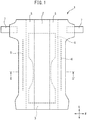
- Fig. 1 is a plan view of a disposable diaper 1 (absorbent article) having a biodegradable property according to the first embodiment of the invention, as seen in the expanded state from the top sheet side in the thickness direction
- Fig. 2 is a partial cross-sectional end view of the disposable diaper 1 along line II-II' of Fig. 1
- Fig. 3 is a perspective view showing the disposable diaper 1 when rolled up in the lengthwise direction after use for disposal.
- the disposable diaper 1 (absorbent article) according to the first embodiment of the invention has a lengthwise direction L, a widthwise direction W and a thickness direction T, which are mutually perpendicular, and in the plan view it has a longitudinal outer shape that is long in the lengthwise direction L.
- the outer shape of the absorbent article is not particularly restricted, and any desired outer shape such as essentially rectangular, essentially hourglass-shaped or ellipsoid, may be employed according to the purpose of use and the design property.
- the disposable diaper 1 of the first embodiment of the invention comprises, as its main structural members in the thickness direction T, a liquid-permeable top sheet 2 situated on the side facing the skin of the wearer, a liquid-impermeable back sheet 3 situated on the side not facing the skin of the wearer, an absorbent body 4 situated between these two sheets, a pair of side sheets 5, 5 disposed on the skin-facing side of the top sheet 2 and functioning as anti-leakage walls when the disposable diaper 1 is worn, and a liquid-impermeable outer sheet 8 joined to the non-skin side of the back sheet 3 via any desired adhesive A 1 such as a hot-melt adhesive.
- any desired adhesive A 1 such as a hot-melt adhesive.
- the disposable diaper 1 is a tape-type disposable diaper comprising a stretching member 6 made of rubber thread or the like, disposed near the edges of the pair of side sheets 5, 5 on the outer sides in the widthwise direction W and causing the sections around the left and right legs contacting with the femoral regions of the wearer to stretch in the lengthwise direction L, and connecting tape 7 made of a mechanical fastener or the like, which connects the abdominal-corresponding region and the dorsal-corresponding region of the disposable diaper 1 when the disposable diaper 1 is worn.
- the region at one end in the lengthwise direction L located at the lower end of Fig.
- Fig. 1 is the abdominal-corresponding region that corresponds to the abdominal region of the wearer of the disposable diaper 1, and the region at the other end in the lengthwise direction L located at the upper end of Fig. 1 is the dorsal-corresponding region that corresponds to the dorsal region (gluteal region) of the wearer of the disposable diaper 1.
- the top sheet 2 and back sheet 3 of the disposable diaper 1 are each formed of a synthetic resin sheet including an oxidative decomposer comprising a mixture of a carboxylate and a rare earth compound, the synthetic resin sheet including the oxidative decomposer at a mass ratio such that the decomposition rate index (D i ) is 7.8 or less, as determined based on the following formula (1).
- D i B r ⁇ S a
- B r represents a mass ratio (g/g) of the oxidative decomposer with respect to a synthetic resin component in the synthetic resin sheet
- S a represents a specific surface area (cm 2 /g) of the synthetic resin sheet.
- the disposable diaper 1 of the first embodiment also includes an oxidative decomposition accelerator composed of a peroxide further toward the non-skin side than the absorbent body 4 (specifically, in the adhesive A 1 located on the non-skin side of the back sheet 3), at a mass ratio of 40 parts by mass or greater with respect to 100 parts by mass of the oxidative decomposer.
- each synthetic resin sheet forming the top sheet 2 and back sheet 3 in the disposable diaper 1 of the first embodiment includes an oxidative decomposer composed of a mixture of a carboxylate and a rare earth compound, in a specified mass ratio, then even when oxidative decomposition of the synthetic resin sheet by the oxidative decomposer has proceeded before the accelerating function of the oxidative decomposition accelerator is activated (that is, while the disposable diaper 1 is unused or in the state of being used), it proceeds gently, allowing the quality (structure and function) of the disposable diaper to be maintained for at least 3 years.
- the disposable diaper 1 of the first embodiment includes an oxidative decomposition accelerator composed of a peroxide in a specified mass ratio, further toward the non-skin side than the absorbent body, the oxidative decomposition accelerator is unlikely to contact with moisture such as excreted fluid (that is, the oxidative decomposition accelerator is unlikely to reach the oxidative decomposer in the synthetic resin sheet with moisture such as excreted fluid as the mobile medium) while the disposable diaper 1 is unused or in the state of being used, making it possible to inhibit activation of the accelerating function of the oxidative decomposition accelerator, while even after the disposable diaper 1 has been disposed of and processed in a landfill after use in a state rolled up in the lengthwise direction L as shown in Fig.
- the oxidative decomposition accelerator can reach the oxidative decomposer in the synthetic resin sheet, with moisture in the soil as the mobile medium, and oxidative decomposition of the synthetic resin sheet by the oxidative decomposer can be accelerated, allowing the disposable diaper 1 to be disintegrated within a short time period.
- the disposable diaper 1 of the first embodiment can maintain the same properties as a disposable diaper using structural members composed of conventional synthetic resins, whether unused or in a state of being used, and after being disposed of and processed in a landfill after use, it can disintegrate within a short time period, thus reducing the environmental load at the landfill site.
- the top sheet 2 used in the disposable diaper 1 of the first embodiment is formed of a liquid-permeable synthetic resin sheet having, in the plan view, an essentially rectangular outer shape extending in the lengthwise direction L and widthwise direction W of the disposable diaper 1 and longitudinal in the lengthwise direction L, and in the thickness direction T of the disposable diaper 1, being disposed at a location (i.e. a location on the skin side) where excreted fluid such as urine discharged from the wearer is initially received, and functioning so that excreted fluid such as urine that has been discharged from the wearer is caused to rapidly migrate toward the absorbent body 4.
- the top sheet 2 has a long rectangular outer shape in the lengthwise direction L of the disposable diaper 1 in the plan view, but the invention is not limited to such a shape, and the top sheet (synthetic resin sheet) may have any desired outer shape and size.
- the liquid-permeable synthetic resin sheet used to form the top sheet may be any type of synthetic resin sheet, and for example, it may be a synthetic resin fiber sheet such as a nonwoven fabric, woven fabric or knitted fabric made of synthetic resin fibers, or a synthetic resin film molded from a synthetic resin material and formed with liquid-permeable holes, but a synthetic resin fiber sheet such as a nonwoven fabric made of synthetic resin fibers, is preferably used from the viewpoint of liquid permeability, flexibility and feel on the skin.
- nonwoven fabric is not particularly restricted so long as it has the prescribed liquid permeability, flexibility and feel on the skin, and any type of nonwoven fabric may be employed such as an air-through nonwoven fabric, spunbond nonwoven fabric, spunlace nonwoven fabric or SMS, according to the desired function and purpose of use.
- the constituent fibers used are not particularly restricted and may be fibers in any of various forms, including common forms of fibers having substantially circular cross-sectional shapes, as well as composite fibers such as core-sheath composite fibers or side-by-side composite fibers; atypical cross-section fibers in which the cross-sectional shapes are flat, for example; or solid crimped fibers with latent crimping or developed crimping.
- the synthetic resin sheet forming the top sheet 2 for the first embodiment is formed by a resin composition containing at least a synthetic resin and an oxidative decomposer.
- the resin composition may also optionally contain an additive or filler in addition to the synthetic resin and oxidative decomposer.
- Such a sheet made of a synthetic resin containing an oxidative decomposer that is, an oxidative decomposing biodegradable resin
- a sheet made of a hydrolyzable biodegradable resin such as polylactic acid, modified starch or an aliphatic polyester, and can maintain physical properties (the physical properties necessary for an absorbent article, such as strength and durability) similar to those of a sheet made of a conventional non-biodegradable synthetic resin.
- the synthetic resin component to be included in the synthetic resin sheet that may be used to form the top sheet or the back sheet described below for the invention is not particularly restricted so long as it can be used as a structural member for an absorbent article, and any synthetic resin may be used, examples of which include polyolefin-based resins such as polyethylene, polypropylene, polybutylene, ethylene-vinyl acetate copolymer, ethylene-ethyl acrylate copolymer, ethylene-acrylic acid copolymer and ionomer resins; polystyrene-based resins such as polystyrene; polyester-based resins such as polyethylene terephthalate and polybutylene terephthalate; and polyamide-based resins such as nylon, with any of these synthetic resins being used alone as single types of resins, or in combinations of two or more different resins.
- polyolefin-based resins such as polyethylene, polypropylene, polybutylene, ethylene-vinyl acetate
- Preferred among these synthetic resins are those containing 50 mass% or greater of a polyolefin-based resin or polyolefin-based resin composition, the polyolefin-based resin being most preferably polyethylene or polypropylene, from the viewpoint of strength and durability, and of oxidative decomposition of the synthetic resin sheet after the absorbent article has been used.
- the synthetic resin sheet is a nonwoven fabric
- the fibers composing the nonwoven fabric are preferred to be core-sheath composite fibers formed of polypropylene as the core and polyethylene as the sheath.
- a "polyolefin-based resin composition” is a mixture of two or more polyolefin-based resins, or a mixture of a polyolefin-based resin and another resin with the polyolefin-based resin at 50 mass% or greater.
- the oxidative decomposer is a substance that can oxidatively decompose synthetic resins and cause low molecularization of the synthetic resins to an extent allowing their biodegradation by microbes in the soil, and known ones include the oxidative decomposers disclosed in US Patent No. 3,840,512 , US Patent No. 5,308,906 , US Patent No. 5,565,503 , US Patent No. 5,854,304 and International Patent Publication No.
- the oxidative decomposer used may be an oxidative decomposer comprising a mixture of a carboxylate and a rare earth compound, in order to more precisely control progressive oxidative decomposition of the synthetic resin sheet (specifically, to control progressive oxidative decomposition of the synthetic resin sheet so that even when oxidative decomposition of the synthetic resin sheet by the oxidative decomposer proceeds before the accelerating function of the oxidative decomposition accelerator is activated (that is, while the absorbent article is still unused or is in the state of being used), it proceeds gently, allowing the quality (structure and function) of the absorbent article to be maintained for at least 3 years, while even after the absorbent article has been disposed of and processed in a landfill after use, the absorbent article can be caused to
- the carboxylate to be used as an oxidative decomposer for the invention may be a metal salt of an aliphatic carboxylic acid of 10 to 20 carbon atoms, with metal salts of stearic acid being preferred.
- metal atoms to form the metal salt of an aliphatic carboxylic acid include cobalt, cerium, iron, aluminum, antimony, barium, bismuth, chromium, copper, gallium, lanthanum, lithium, magnesium, molybdenum, nickel, calcium, silver, sodium, tin, tungsten, vanadium, yttrium, zinc and zirconium, among which cobalt, cerium and iron are preferred.
- the carboxylate used may be a single carboxylate alone, or a combination of two or more carboxylates.
- rare earth compounds to be used in the oxidative decomposer of the invention include rare earth elements such as cerium (Ce), yttrium (Y) and neodymium (Nd) belonging to Group 3 of the IUPAC Periodic Table, or their oxides, hydroxides, sulfates, nitrates, acetates, chlorides or carboxylates, and more specifically, they include cerium oxide, cerium(IV) sulfate, cerium(IV) ammonium sulfate, cerium(IV) ammonium nitrate, cerium acetate, lanthanum nitrate, cerium chloride, cerium nitrate, cerium hydroxide, cerium octylate, lanthanum oxide, yttrium oxide and scandium oxide.
- the rare earth compound used for the invention may be a single type of rare earth compound alone, or a combination of two or more different rare earth compounds.
- the synthetic resin sheet includes the oxidative decomposer at a mass ratio such that the decomposition rate index (D i ) is no greater than 7.8, as determined based on the following formula (1).
- D i B r ⁇ S a
- B r represents the mass ratio (g/g) of the oxidative decomposer with respect to the synthetic resin component in the synthetic resin sheet
- S a represents the specific surface area (cm 2 /g) of the synthetic resin sheet.
- the decomposition rate index D i is an index of the decomposition rate, taking into account the quantitative elements of the oxidative decomposer and the structural elements of the synthetic resin sheet, and it is the index represented as the product of the mass ratio B r (g/g) of the oxidative decomposer with respect to the synthetic resin component in the synthetic resin sheet, and the specific surface area S a (cm 2 /g) of the synthetic resin sheet.
- the specific surface area S a (cm 2 /g) of the synthetic resin sheet used for calculation of the decomposition rate index Di is that represented as the surface area per unit mass of the synthetic resin sheet, and for the purpose of the present specification, it can be determined in the following manner according to the form of the synthetic resin sheet.
- the synthetic resin sheet of the invention includes an oxidative decomposer composed of a mixture of a carboxylate and a rare earth compound, at a mass ratio such that the decomposition rate index (D i ) is no greater than 7.8. If the decomposition rate index (D i ) is in the range of no greater than 7.8, then the synthetic resin sheet can maintain its properties including structure and strength for at least about 3 years in an environment at 24°C after the synthetic resin sheet has been produced, while the synthetic resin sheet can disintegrate by decomposition after a prescribed period of time as elapsed.
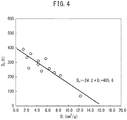
- the upper limit of 7.8 for the decomposition rate index (D i ) was calculated as the value of the decomposition rate index (D i ) such that the disintegration time (D h ) is 216 hours or longer (that is, about 3 years or longer in an environment of 24°C) in the heat acceleration test at 80°C, determined using a first order approximation determined from the relationship between the decomposition rate index (D i ) for multiple different synthetic resin sheets of previously known mixing proportion for the oxidative decomposer, and the disintegration time (D h ) based on a heat acceleration test at 80°C measured using multiple synthetic resin sheets of the same type, as described below.
- the heat acceleration test at 80°C referred to here is a shortened test that allows prediction of the time required for a synthetic resin sheet to decompose to a point so that it no longer performs its function as a synthetic resin sheet (that is, disintegration of the synthetic resin sheet by decomposition) (i.e. the disintegration time (D h )), wherein the synthetic resin sheet is placed in an environment (a 80°C temperature environment) that is harsher than an actual environment (a 24°C temperature environment) in which oxidative decomposition is promoted, so that oxidative decomposition of the synthetic resin sheet is accelerated, and the disintegration time (D h ) in the heat acceleration test at 80°C can be measured in the following manner.
- a disintegration time of 1 day (24 hours) in the heat acceleration test at 80°C corresponds to 4 months in an environment of 24°C.
- Synthetic resin sheets of Production Examples 1 to 12 were produced in the following manner, for use in determining the range of the decomposition rate index (D i ) giving the aforementioned mixing proportion of the oxidative decomposer.
- a commercially available oxidative decomposer (“P-Life", trade name of P-Life Japan, Inc., SMC2360), 3 types of polyethylene resins (low-density polyethylene (LDPE): 2.3 mass%, linear low-density polyethylene (LLDPE): 83.90 mass%, high-density polyethylene (HDPE): 10 mass%), and a pigment (titanium oxide) were kneaded in an extruder in the mixing proportion shown in Table 1, and then an inflation method was used to produce a polyethylene film for Production Example 1 with a thickness of 25 ⁇ m.
- LDPE low-density polyethylene
- LLDPE linear low-density polyethylene
- HDPE high-density polyethylene
- titanium oxide titanium oxide
- Polyethylene films for Production Examples 2 to 4 were produced in the same manner as Production Example 1, except that the mixing proportion for the oxidative decomposer and the 3 types of polyethylene resins was changed to the mixing proportions listed in Table 1.
- polyethylene films for Production Examples 5 to 8 were produced in the same manner as Production Example 1, except that the mixing proportion for the oxidative decomposer and the 3 types of polyethylene resins was changed to the mixing proportions listed in Table 1, and the film thickness was 37 ⁇ m.
- nonwoven fabrics comprising polyolefin-based resin fibers were also produced in the following manner, as different forms of synthetic resin sheets.
- a polypropylene resin containing an added commercially available oxidative decomposer (trade name: "P-Life", by P-Life Japan, Inc., SMC2360), and a polyethylene resin containing the same added oxidative decomposer, were discharged through a spinning nozzle while melting them, to obtain composite synthetic fiber (size: 2.2 dtex, length: 51 mm) having a core-sheath structure with the polypropylene resin as the core and the polyethylene resin as the sheath.
- the mixing proportion of the oxidative decomposer with respect to the polypropylene resin and the mixing proportion of the oxidative decomposer with respect to the polyethylene resin were the same.
- the laminate was bonded by hot air to produce an air-through nonwoven fabric for Production Example 9.
- Air-through nonwoven fabrics for Production Examples 10 to 12 were produced in the same manner as Production Example 9, except that the mixing proportion for the oxidative decomposer was changed to the mixing proportions listed in Table 2.
- the specific surface area and decomposition rate index (D i ) of each of the polyethylene films thus obtained in Production Examples 1 to 8 and each of the air-through nonwoven fabrics obtained in Production Examples 9 to 12 were calculated by the methods described above, and the disintegration time (D h ) of each synthetic resin sheet was measured according to ⁇ Method of measuring disintegration time (D h ) by heat acceleration test at 80°C> above.
- the calculation results and measurement results are shown in Table 1 and Table 2.
- the volume was determined from the mean specific gravity of the fibers, and the circular columnar lateral area was calculated assuming the fibers to be 10,000 m high circular columns.
- Fig. 4 is a graph showing the relationship between the decomposition rate index (D i ) and the disintegration time (D h ) in a heat acceleration test at 80°C, for the polyethylene films (synthetic resin sheets) of Production Examples 1 to 8 and the air-through nonwoven fabrics (synthetic resin sheets) of Production Examples 9 to 12.
- This first order approximation was used to calculate the value of the decomposition rate index (D i ) such that the disintegration time (D h ) was 216 hours (that is, about 3 years in an environment at 24°C) in the heat acceleration test at 80°C, giving a value of 7.8.
- the disintegration time of a synthetic resin sheet may be adjusted in consideration of the warranty period of the product or environmental effects at the landfill site.
- the disintegration time of the synthetic resin sheet can be more easily adjusted by appropriately modifying the mixing proportion of the oxidative decomposer according to the form (the type, structure and size) of the sheet and the type of synthetic resin.
- the upper limit for the disintegration time of the synthetic resin sheet (that is, the lower limit for the decomposition rate index (D i )) can be set as desired in consideration of the warranty period for use of the product and environmental effects at the landfill site, but from the viewpoint of the warranty period for use of the product (quality assurance period) before activation of the accelerating function of the oxidative decomposition accelerator, and the decomposition period after processing of the product at the landfill (after disposal), the disintegration time (D h ) in the heat acceleration test at 80°C is preferably no longer than 333 hours (that is, it includes the oxidative decomposer in a mass ratio such that the decomposition rate index (D i ) is 3.0 or greater), and more preferably the disintegration time (D h ) in the heat acceleration test at 80°C is no longer than 266 hours (that is, it includes the oxidative decomposer in a mass ratio such that the decomposition rate index (D i ) is 5.8 or greater).
- a disintegration time (D h ) of 266 hours in the heat acceleration test at 80°C corresponds to about 44.3 months (about 3 years and 8 months) in an environment at 24°C
- disintegration by oxidative decomposition can be shortened by about 20.3 months (that is, 122 hours of the heat acceleration test at 80°C), thus allowing the absorbent article to be disintegrated within approximately 24 months (about 2 years), and allowing the environmental load at the landfill site to be more reliably alleviated.
- the shortened period for the disintegration time of the synthetic resin sheet by the oxidative decomposition accelerator (for example, 122 hours in the heat acceleration test at 80°C) can be determined by conducting a heat acceleration test at 80°C using a synthetic resin sheet treated with the oxidative decomposition accelerator and a synthetic resin sheet not treated with the oxidative decomposition accelerator, and performing calculation from the relationship between the presence or absence of treatment with the oxidative decomposition accelerator and the disintegration time in the heat acceleration test at 80°C.
- the top sheet does not necessarily need to be formed of a synthetic resin sheet including the amorphous oxidative decomposer, and for example, if the effect of the invention is adequately exhibited even when the back sheet is formed of a synthetic resin sheet that includes an oxidative decomposer and the top sheet is formed of a synthetic resin sheet that does not include the oxidative decomposer, then the top sheet may be formed of a synthetic resin sheet that does not include the oxidative decomposer.
- the thickness and basis weight of the top sheet are not particularly limited so long as the effect of the invention is not inhibited, and any thickness and basis weight may be employed according to the desired liquid permeability and flexibility.
- the back sheet 3 used in the disposable diaper 1 of the first embodiment is formed of a liquid-impermeable synthetic resin sheet having, in the plan view, an essentially rectangular outer shape extending in the lengthwise direction L and widthwise direction W of the disposable diaper 1 and longitudinal in the lengthwise direction L, and in the thickness direction T of the disposable diaper 1, being disposed on the non-skin side of the absorbent body 4 and functioning to prevent permeation of excreted fluid such as urine that has been discharged by the wearer and to block outward leakage of the excreted fluid to the clothing of the wearer.
- the back sheet 3 of the first embodiment while sandwiching the absorbent body 4 against the top sheet 2, is mutually joined with the top sheet 2 and the side sheets 5, 5.
- any joining means may be used such as, for example, bonding means by bonding with an adhesive such as a hot-melt adhesive or contact bonding means by various types of embossing treatment.
- the back sheet 3 has a long essentially rectangular outer shape in the lengthwise direction L of the disposable diaper 1 in the plan view, similar to the top sheet 2, but the invention is not limited to such a shape, and the back sheet (synthetic resin sheet) may have any desired outer shape and size.
- the liquid-impermeable synthetic resin sheet used to form the back sheet may be a synthetic resin sheet similar to the top sheet described above, except for its liquid impermeability, and for example, any synthetic resin sheet may be used, including a synthetic resin fiber sheet such as a nonwoven fabric made of synthetic resin fibers that have been waterproof treated or that have hydrophobicity, or a non-porous synthetic resin film molded from a synthetic resin material.
- the synthetic resin sheet forming the back sheet 3 is formed of a resin composition containing at least a synthetic resin and an oxidative decomposer, similar to the top sheet 2 described above, and since it is the same as the synthetic resin sheet forming the top sheet 2 in terms of the type of synthetic resin, the type of oxidative decomposer, and the mixing proportions (composition), structure and function, it will not be explained in detail.
- the liquid-impermeable synthetic resin sheet forming the back sheet may have a constant air permeability or it may lack air permeability (that is, it may be non-air permeable), so long as it does not allow permeation of liquids such as excreted fluid (that is, so long as it has the prescribed liquid impermeability), but when the oxidative decomposition accelerator is disposed further toward the non-skin side than the back sheet, the back sheet is preferably non-air permeable.
- non-air permeable refers to a water vapor permeability of no greater than 50 g/m 2 /24 h according to JIS:K7129.
- the back sheet does not necessarily need to be formed of a synthetic resin sheet including the amorphous oxidative decomposer, and for example, if the effect of the invention is adequately exhibited even when the top sheet is formed of a synthetic resin sheet that includes an oxidative decomposer and the back sheet is formed of a synthetic resin sheet that does not include the oxidative decomposer, then the back sheet may be formed of a synthetic resin sheet that does not include the oxidative decomposer.
- the thickness and basis weight of the back sheet are not particularly limited so long as the effect of the invention is not inhibited, and any thickness and basis weight may be employed, depending on the desired liquid impermeability and flexibility.
- the pair of side sheets 5, 5 to be used in the disposable diaper 1 of the first embodiment are each formed of a liquid-impermeable or water-repellent synthetic resin sheet having, in the plan view, a pair of strip-like outer shapes that are long in the lengthwise direction L and extend partially in the lengthwise direction L and widthwise direction W of the disposable diaper 1, and being disposed on the skin-facing side of the top sheet 2 at both ends in the widthwise direction W of the disposable diaper 1, functioning as anti-leakage walls to block excreted fluid such as urine that has been discharged by the wearer, from leaking in the widthwise direction W of the disposable diaper 1.
- the pair of side sheets 5, 5 each have a strip-like outer shape that is long in the lengthwise direction L of the disposable diaper 1, but the invention is not limited to such a shape, and the side sheets (synthetic resin sheets) may have any desired outer shape and size.
- the liquid-impermeable or water-repellent synthetic resin sheets used to form the side sheets may be synthetic resin sheets similar to the top sheet described above, except for their liquid impermeability or water-repellency, and any synthetic resin sheets may be used including, for example, synthetic resin fiber sheets such as nonwoven fabrics made of synthetic resin fibers that have been waterproof treated or water-repellent treated, or that have hydrophobicity or water-repellency, or non-porous synthetic resin films molded from synthetic resin materials.
- the synthetic resin sheets forming the side sheets may likewise be formed of a resin composition containing at least a synthetic resin and an oxidative decomposer, similar to the top sheet described above, and since this is the same as the synthetic resin sheet forming the top sheet in terms of the type of synthetic resin, the type of oxidative decomposer, and the mixing proportions (composition), structure and function, it will not be explained in detail.
- the thickness and basis weight of the side sheets are not particularly limited so long as the effect of the invention is not inhibited, and any thickness and basis weight may be employed according to the desired leakproofness and flexibility. Since having such a pair of side sheets is not an essential constituent feature for the absorbent article of the invention, it may lack the pair of side sheets, depending on the type and intended use of the absorbent article.
- the absorbent body 4 used in the disposable diaper 1 of the first embodiment is formed of an absorbing member having, in the plan view, an essentially hourglass-like outer shape extending in the lengthwise direction L and widthwise direction W of the disposable diaper 1 and longitudinal in the lengthwise direction L, and in the thickness direction T of the disposable diaper 1, disposed between the top sheet 2 and the back sheet 3 and functioning to absorb and hold excreted fluid such as urine that has permeated the top sheet 2.
- the absorbent body 4 has an essentially hourglass-like outer shape in the plan view, but the invention is not limited to such a shape, and the absorbent body may have any desired outer shape (for example, essentially rectangular that is long in the lengthwise direction, or ellipsoid), and size.
- the absorbing member forming the absorbent body is not particularly restricted so long as it can absorb and hold excreted fluid, and any absorbing member known in the field may be used.
- the absorbing member may be constructed of an absorbent core made of an absorbent material containing water-absorbent fibers and a superabsorbent polymer, and at least one liquid-permeable core wrap sheet that covers the outer peripheral surface of the absorbent core.
- the water-absorbent fibers composing the absorbent core are not particularly restricted so long as they can absorb and hold liquid such as excreted fluid, and examples include wood pulp obtained using conifer or broadleaf tree as starting material; nonwood pulp such as kenaf, bamboo, hemp and cotton; regenerated cellulose such as rayon and fibril rayon; and semisynthetic cellulose such as acetate and triacetate, but in consideration of biodegradability and environmental effects at landfill sites when the absorbent article is processed in a landfill, it is preferred to use plant-derived cellulosic fibers such as wood pulp or nonwood pulp.
- the superabsorbent polymer composing the absorbent core is not particularly restricted so long as it can absorb and hold liquid such as excreted fluid, and for example, a starch-based, cellulosic or synthetic polymer-based superabsorbent polymer may be used, but it is preferably one that is biodegradable in consideration of environmental effects at landfill sites. Since the water-absorbent fibers and superabsorbent polymer composing the absorbent core are not essential constituent elements for the absorbent core, the absorbent core may contain only either the water-absorbent fibers or superabsorbent polymer alone.
- the core wrap sheet is not particularly restricted so long as it is liquid-permeable and can maintain the shape of the absorbent body, but it is preferably biodegradable in consideration of effect on the environment at the landfill site, and for example, a liquid-permeable sheet such as a tissue made of the aforementioned cellulosic fibers may be suitably used.
- the absorbent body may include superabsorbent polymer particles and water-sensitive capsules containing the oxidative decomposition accelerator inside them.
- An absorbent body including water-sensitive capsules will be described below in detail as yet another embodiment.
- the thickness and basis weight of the absorbent body are not particularly limited so long as the effect of the invention is not inhibited, and any thickness and basis weight may be employed according to the desired absorption property and flexibility.
- the outer sheet 8 used in the disposable diaper 1 of the first embodiment is formed of a liquid-impermeable synthetic resin sheet having, in the plan view, an essentially rectangular outer shape extending in the lengthwise direction L and widthwise direction W so as to cover the entire surface on the non-skin side of the disposable diaper 1, and being longitudinal in the lengthwise direction L, and as shown in Fig. 2 , in the thickness direction T of the disposable diaper 1, it is disposed on the non-skin side of the back sheet 3 via a desired adhesive A 1 such as a hot-melt adhesive, and functions to prevent leakage of excreted fluid such as urine that has been discharged by the wearer while defining the outer shape of the disposable diaper 1.
- a desired adhesive A 1 such as a hot-melt adhesive
- the liquid-impermeable synthetic resin sheet used to form the outer sheet may be a synthetic resin sheet similar to the back sheet described above (that is, a synthetic resin sheet similar to the top sheet described above, except for being liquid-impermeable), and any synthetic resin sheet may be used including, for example, a synthetic resin fiber sheet such as a nonwoven fabric made of synthetic resin fibers that have been waterproof treated or that have hydrophobicity (for example, a spunbond nonwoven fabric, SMS nonwoven fabric or point bond nonwoven fabric), or a non-porous synthetic resin film molded from a synthetic resin material.
- the outer sheet may be composed of a single synthetic resin sheet, or it may be composed of two or more synthetic resin sheets.
- the synthetic resin sheets forming the outer sheet may likewise be formed of a resin composition containing at least a synthetic resin and an oxidative decomposer, similar to the top sheet described above, and since this is the same as the synthetic resin sheet forming the top sheet in terms of the type of synthetic resin, the type of oxidative decomposer, and the mixing proportions (composition), structure and function, it will not be explained in detail.
- the thickness and basis weight of the outer sheet are not particularly limited so long as the effect of the invention is not inhibited, and any thickness and basis weight may be employed according to the desired liquid impermeability and flexibility. Since having such an outer sheet is not an essential constituent feature for the absorbent article of the invention, it may lack the outer sheet, depending on the type and intended use of the absorbent article.
- the adhesive A 1 joining the back sheet 3 and the outer sheet 8 is not particularly restricted, and any adhesive that is known in the relevant field may be used.
- adhesives include hot-melt adhesives such as styrene-isoprene-styrene block copolymer (SIS), styrene-butadiene-styrene block copolymer (SBS) and styrene-ethylenebutylene-ethylene copolymer (SEBS).
- the coating amount and coating form of the adhesive for the invention are not particularly restricted so long as they do not inhibit the effect of the invention, and any coating amount (for example, 0.1 g/m 2 to 10 g/m 2 ) and coating form (for example, one or more straight lines, belt shapes, spiral shapes, omega shapes or zigzag shapes) may be employed.
- the adhesive A 1 joining the back sheet 3 and the outer sheet 8 includes an oxidative decomposition accelerator composed of a peroxide in a mass ratio of 40 parts by mass or greater with respect to 100 parts by mass of the oxidative decomposer.
- the disposable diaper 1 of the first embodiment includes an oxidative decomposition accelerator composed of a peroxide in the specified mass ratio, in the adhesive A 1 that is situated further toward the non-skin side than the back sheet 3, the oxidative decomposition accelerator will be unlikely to contact with moisture such as excreted fluid (that is, the oxidative decomposition accelerator will be unlikely to reach the oxidative decomposer in the synthetic resin sheet forming the top sheet 2 or back sheet 3, with moisture such as excreted fluid as the mobile medium), whether the disposable diaper 1 is unused or in a state of being used, allowing activation of the accelerating function of the oxidative decomposition accelerator to be inhibited and allowing the oxidative decomposition accelerator to be provided without using the water-sensitive capsules.
- the oxidative decomposition accelerator can reach the oxidative decomposer in each synthetic resin sheet with moisture in the soil as the mobile medium, oxidative decomposition of each synthetic resin sheet can be accelerated by the oxidative decomposer, and the disposable diaper 1 can be disintegrated within a short time period.
- the peroxide to be used as the oxidative decomposition accelerator is not particularly restricted so long as it can accelerate oxidative decomposition of the synthetic resin by the oxidative decomposer comprising the mixture of a carboxylate and a rare earth compound, and examples include inorganic peroxides such as sodium percarbonate (Sodium percarbonate, CAS No. 15630-89-4), lithium peroxide, barium peroxide, magnesium peroxide and calcium peroxide, and hydrogen peroxide, any of which compounds may be used as single compounds or as combinations of more than one compound.
- sodium percarbonate Sodium percarbonate, CAS No. 15630-89-4
- lithium peroxide lithium peroxide
- barium peroxide magnesium peroxide and calcium peroxide
- hydrogen peroxide any of which compounds may be used as single compounds or as combinations of more than one compound.
- the oxidative decomposition accelerator used is preferably sodium percarbonate or hydrogen peroxide, from the viewpoint of allowing more precise and reliable action of oxidative decomposition of the synthetic resin by the oxidative decomposer.
- the hydrogen peroxide when the peroxide is hydrogen peroxide, the hydrogen peroxide supplies hydroxyl radicals (OH radicals) to the oxidative decomposer, and when the peroxide is a compound other than hydrogen peroxide, the hydrogen peroxide produced by dissolution in water supplies hydroxyl radicals to the oxidative decomposer, thus accelerating oxidative decomposition by the oxidative decomposer.
- the oxidative decomposition accelerator to be used in the absorbent article of the invention is used in a mass ratio of 40 parts by mass or greater with respect to 100 parts by mass of the oxidative decomposer, in order to sufficiently accelerate oxidative decomposition of the synthetic resin by the oxidative decomposer composed of the mixture of a carboxylate and a rare earth compound.
- the adhesive that joins the back sheet and outer sheet does not necessarily have to include the oxidative decomposition accelerator
- the oxidative decomposition accelerator may be included in locations other than that adhesive (for example, in the adhesive joining the absorbent body with a leakproof sheet disposed on the non-skin side of the absorbent body, as in a different embodiment described below (embodiment 2), or inside water-sensitive capsules in the absorbent body, as in yet another embodiment described below (embodiment 3)), and if the effect of the invention is adequately exhibited thereby, the adhesive joining the back sheet and the outer sheet does not need to include the oxidative decomposition accelerator.
- Fig. 5 is a partial end view corresponding to Fig. 2 , of a disposable diaper 10 according to the second embodiment of the invention.
- the disposable diaper 10 (absorbent article) of the second embodiment of the invention comprises, in the thickness direction T, a leakproof sheet 9 joined, as a structural member, to the non-skin side of the absorbent body 4 via any adhesive A 2 such as a hot-melt adhesive.
- the leakproof sheet 9 has, in the plan view, an essentially rectangular outer shape that is longitudinal in the lengthwise direction L, extending in the lengthwise direction L and the widthwise direction W so as to cover the entire surface on the non-skin side of the absorbent body 4, and it is formed on the non-skin side of the absorbent body 4 (more specifically, between the absorbent body 4 and the back sheet 3), by a liquid-impermeable synthetic resin sheet that prevents leakage of excreted fluid such as urine that has been discharged by the wearer and functions to block outward leakage of excreted fluid onto the clothing of the wearer, similar to the back sheet 3.
- the liquid-impermeable synthetic resin sheet used to form the leakproof sheet may be a synthetic resin sheet similar to the back sheet described above (that is, a synthetic resin sheet similar to the top sheet described above, except for being liquid-impermeable), and any synthetic resin sheet may be used, such as a synthetic resin film molded from a synthetic resin material that has been leakproof treated or that has hydrophobicity.
- the synthetic resin sheet forming the leakproof sheet may likewise be formed of a resin composition containing at least a synthetic resin and an oxidative decomposer, similar to the top sheet described above, and since it is the same as the synthetic resin sheet forming the top sheet in terms of the type of synthetic resin, the type of oxidative decomposer, and the mixing proportions (composition), structure and function, it will not be explained in detail.
- the thickness and basis weight of the leakproof sheet are not particularly limited so long as the effect of the invention is not inhibited, and any thickness and basis weight may be employed according to the desired liquid impermeability and flexibility. Since having such a leakproof sheet is not an essential constituent feature for the absorbent article of the invention, it may lack the leakproof sheet, depending on the type and intended use of the absorbent article.
- the adhesive A 2 in the disposable diaper 10 joining the absorbent body 4 and the leakproof sheet 9 includes the oxidative decomposition accelerator composed of a peroxide in the aforementioned specified mixing proportion (that is, in a mass ratio of 40 parts by mass or greater with respect to 100 parts by mass of the oxidative decomposer).
- the disposable diaper 10 of the second embodiment includes the oxidative decomposition accelerator composed of a peroxide in the adhesive A 2 that is situated between the absorbent body 4 and the back sheet 3, then when the disposable diaper 10 is in a state of being used (especially when the amount of excreted fluid such as urine discharged by the wearer is minimal), excreted fluid such as urine discharged by the wearer is absorbed into the absorbent body 4, thus being unlikely to reach the oxidative decomposer located on the non-skin side (that is, the oxidative decomposition accelerator is unlikely to reach the oxidative decomposer in the synthetic resin sheet forming the top sheet 2 or back sheet 3, with excreted fluid as the mobile medium), making it possible to inhibit activation of the accelerating function of the oxidative decomposition accelerator during use of the disposable diaper 10, and allowing the oxidative decomposition accelerator to be provided without using water-sensitive capsules.
- the oxidative decomposition accelerator composed of a peroxide in the adhesive A 2 that is situated between the absorbent body 4 and the
- the oxidative decomposition accelerator located at approximately the center in the thickness direction T of the disposable diaper 10 readily spreads out across the entire disposable diaper 10, with the mobile medium being moisture in the soil or excreted fluid such as urine that has seeped out from the absorbent body 4, and therefore oxidative decomposition of each synthetic resin sheet by the oxidative decomposer can be even more efficiently and reliably accelerated by the oxidative decomposition accelerator.
- the oxidative decomposition accelerator of the invention may also be included at any location other than the adhesive joining the absorbent body and leakproof sheet (for example, on the surface on the non-skin side of the leakproof sheet).
- the type of adhesive joining the absorbent body and leakproof sheet, as well as its coating coverage and manner of coating, are not particularly restricted according to the invention so long as the effect of the invention is not inhibited, and the same may be employed as for the adhesive joining the back sheet and outer sheet for the first embodiment described above.
- the second embodiment does not have an outer sheet on the non-skin side of the back sheet 3
- the absorbent article may also have an outer sheet joined with an adhesive on the non-skin side of the back sheet, as described for the first embodiment.
- Fig. 6 is a partial end view corresponding to Fig. 2 , of a disposable diaper 11 according to the third embodiment of the invention.
- the absorbent body 4 of the disposable diaper 11 of the third embodiment of the invention includes superabsorbent polymer particles and a plurality of water-sensitive capsules Cp containing the aforementioned oxidative decomposition accelerator composed of a peroxide inside them, the plurality of water-sensitive capsules Cp containing the oxidative decomposition accelerator composed of a peroxide in a mass ratio of 40 parts by mass or greater with respect to 100 parts by mass of the oxidative decomposer, for the plurality of the water-sensitive capsules Cp as a whole.
- the disposable diaper 11 of the third embodiment includes the oxidative decomposition accelerator composed of a peroxide in the specified mass ratio inside the water-sensitive capsules in the absorbent body 4, then even whether the disposable diaper 11 is unused or in the state of being used, the oxidative decomposition accelerator is unlikely to contact with moisture such as excreted fluid (that is, the oxidative decomposition accelerator is unlikely to reach the oxidative decomposer in the synthetic resin sheet forming the top sheet 2 or back sheet 3, with moisture such as excreted fluid as the mobile medium), and activation of the accelerating function of the oxidative decomposition accelerator can be inhibited.
- the oxidative decomposition accelerator composed of a peroxide in the specified mass ratio inside the water-sensitive capsules in the absorbent body 4
- the outer shells of the water-sensitive capsules Cp dissolve or disintegrate releasing the oxidative decomposition accelerator inside them, and the oxidative decomposition accelerator can thus reach the oxidative decomposer in each synthetic resin sheet with moisture in the soil as the mobile medium, oxidative decomposition of each synthetic resin sheet can be accelerated by the oxidative decomposer, and the disposable diaper 1 can be disintegrated within a short time period.
- water sensitivity means the property of gradually dissolving or disintegrating upon contact with water, which is a property including water solubility and water disintegratability. It therefore means that the water-sensitive capsules are capsules whose outer shells gradually dissolve or disintegrate upon contact with water (that is, after elapse of a prescribed dissolution time or disintegration time).
- the material forming the outer shells of the water-sensitive capsules is not particularly restricted so long as the effect of the invention is not inhibited, and examples are compounds such as polyethylene glycol or dextrin.
- the means for forming the water-sensitive capsules encapsulating the peroxide is also not particularly restricted so long as the effect of the invention is not inhibited, and it may be surface-coating means such as modification of the surfaces of the peroxide particles after the material forming the outer shells of the capsules has been dispersed on the surfaces, such as disclosed in Japanese Unexamined Patent Publication HEI No. 6-107401 , for example.
- the manner in which the water-sensitive capsules are disposed in the absorbent body is not particularly restricted so long as the effect of the invention is not inhibited, but preferably the water-sensitive capsules are disposed so as to be in contact with the superabsorbent polymer particles in the absorbent body.
- the excreted fluid such as urine discharged by the wearer during use of the absorbent article has reached the absorbent body, the excreted fluid will be absorbed into the superabsorbent polymer particles and will be unlikely to reach the oxidative decomposition accelerator inside the water-sensitive capsules (that is, the oxidative decomposition accelerator will be unlikely to reach the oxidative decomposer in the synthetic resin sheet forming the top sheet or back sheet, with excreted fluid as the mobile medium), and it will therefore be possible to inhibit activation of the accelerating function of the oxidative decomposition accelerator during use of the absorbent article.
- the water-sensitive capsules situated in approximately the center in the thickness direction of the absorbent article can dissolve or disintegrate by moisture in the soil or excreted fluid such as urine that seeps out from the superabsorbent polymer, thus releasing the oxidative decomposition accelerator inside them, and causing the oxidative decomposition accelerator to be spread out across the entire absorbent article, with the mobile medium being moisture in the soil or excreted fluid such as urine that has seeped out from the absorbent body, and therefore oxidative decomposition of each synthetic resin sheet by the oxidative decomposer can be even more efficiently and reliably accelerated by the oxidative decomposition accelerator.
- the absorbent body of the invention may also be composed of a first layer situated on the skin side and comprising a plurality of the superabsorbent polymer particles, and a second layer adjacent to the non-skin side of the first layer and comprising a plurality of the water-sensitive capsules.
- the absorbent body has such a construction, then even when excreted fluid such as urine discharged by the wearer during use of the absorbent article reaches the absorbent body, the excreted fluid will be absorbed by the superabsorbent polymer particles of the first layer situated on the skin side of the absorbent body, and will be even less likely to reach the oxidative decomposition accelerator in the water-sensitive capsules of the second layer that is adjacent to the non-skin side of the first layer (that is, the oxidative decomposition accelerator will be even less likely to reach the oxidative decomposer in each synthetic resin sheet with excreted fluid as the mobile medium), and therefore activation of the accelerating function of the oxidative decomposition accelerator during use of the absorbent article can be even more reliably inhibited.
- the third embodiment is not provided with an outer sheet situated on the non-skin side of the back sheet 3 or a leakproof sheet situated between the absorbent body 4 and the back sheet 3, there is no limitation to this aspect according to the invention, and the absorbent article may be provided with an outer sheet or leakproof sheet as in the first embodiment and second embodiment.
- An absorbent article to which the invention is applied is not limited to a tape-like disposable diaper as in the embodiments described above, and it may be applied to various types of absorbent articles such as pants-type disposable diapers, light incontinence pads, panty liners and sanitary napkins.
- the synthetic resin sheet composing the absorbent article may include any of various sheets in addition to the top sheet or back sheet, depending on the type of absorbent article in which it is to be applied.
- liquid-permeable diffusion sheets which are disposed between the top sheet and absorbent body or between the absorbent body and back sheet, and which diffuse excreted fluid such as urine in the lengthwise direction or widthwise direction; and liquid-impermeable cover sheets disposed on the skin side of the top sheet of a pants-type disposable diaper or the like.
- the absorbent article of the invention is not restricted to the embodiments described above and the examples described below, and can incorporate appropriate combinations, substitutes and modifications within a range that is not outside of the object and gist of the invention.
- the ordinal terms "first" and "second” as used throughout the present specification serve merely to distinguish between the numbered embodiments and are not used to mean any relative ordering, precedence or importance.
- a polyethylene resin containing a commercially available oxidative decomposer ("P-Life", trade name of P-Life Japan, Inc., SMC2360) in the mixing ratio (mass%) listed in Table 3 below was kneaded in an extruder, and then an inflation method was used to produce a polyethylene film with a thickness of 25 ⁇ m.
- the polyethylene film was immersed in an aqueous solution containing sodium percarbonate as an oxidative decomposition accelerator in the mixing proportion listed in Table 3 (mass ratio (parts by mass) with respect to 100 parts by mass of the oxidative decomposer), and the aqueous solution was shaken for 7 days under temperature conditions of 37°C for oxidative decomposition acceleration treatment, to obtain an oxidative decomposition acceleration-treated polyethylene film for Example 1.
- the oxidative decomposition acceleration treatment was carried out at a shaking speed of 120 rpm using a shaking apparatus (FLK-L180-E) by Font Labo Co. inside an incubator by As One Corp. (I-COVER incubating cover).
- Oxidative decomposition acceleration-treated polyethylene films for Examples 2 to 10 were obtained in the same manner as Example 1, except that the oxidative decomposer mixing ratio, oxidative decomposition accelerator mixing proportion and type of oxidative decomposition accelerator were changed as shown in Table 3.
- a polyethylene film for Comparative Example 1 was produced in the same manner as Example 1, except that oxidative decomposition acceleration treatment with an oxidative decomposition accelerator was not carried out.
- a polyethylene film for Comparative Example 2 was produced in the same manner as Example 2, except that oxidative decomposition acceleration treatment with an oxidative decomposition accelerator was not carried out.
- An oxidative decomposition acceleration-treated polyethylene film for Comparative Example 3 was produced in the same manner as Example 1, except that the oxidative decomposition accelerator mixing proportion was changed as shown in Table 3.
- the disintegration time (D h ) of each polyethylene film of Examples 1 to 10 and Comparative Examples 1 to 3 was measured according to ⁇ Method of measuring disintegration time (D h ) by heat acceleration test at 80°C> above.
- the disintegration time before activation of the accelerating function by the oxidative decomposition accelerator was calculated as the "quality assurance period before disposal (years)", from the decomposition rate index (D i ) of the oxidative decomposer and the aforementioned approximation, and based on this disintegration time (D h ), a measure of 1 day (24 hours) of disintegration time corresponding to 4 months in an environment at 24°C was utilized to calculate the disintegration time after activation of the accelerating function by the oxidative decomposition accelerator, as the "decomposition period after disposal (years)".
- Example 1 1.00 7.75 Sodium percarbonate 40 96 3.0 1.3
- Example 2 0.75 6.14 Sodium percarbonate 53 119 3.6 1.6
- Example 3 1.00 7.75 Sodium percarbonate 200 107 3.0 1.5
- Example 4 1.00 7.75 Sodium percarbonate 500 91 3.0 1.3
- Example 5 1.00 7.75 Hydrogen peroxide 40 21 3.0 0.3
- Example 6 1.00 7.75 Hydrogen peroxide 60 21 3.0 0.3
- Example 7 1.00 7.75 Hydrogen peroxide 80 21 3.0 0.3
- Example 8 0.75 6.14 Hydrogen peroxide 53 38 3.6 0.5
- Example 9 0.50 4.94 Hydrogen peroxide 80 43 4.0 0.6
- Example 10 0.25 3.00 Hydrogen peroxide
- the oxidative decomposition acceleration-treated polyethylene films of Examples 1 to 10 can notably shorten the polyethylene film (synthetic resin sheet) disintegration time, compared to the non-oxidative decomposition acceleration-treated polyethylene films of Comparative Examples 1 and 2.
- the disintegration time for a polyethylene film can be drastically shortened when the mass ratio of the oxidative decomposition accelerator is 40 parts by mass or greater with respect to 100 parts by mass of the oxidative decomposer.
Landscapes
- Health & Medical Sciences (AREA)
- Chemical & Material Sciences (AREA)
- Veterinary Medicine (AREA)
- Epidemiology (AREA)
- Engineering & Computer Science (AREA)
- Life Sciences & Earth Sciences (AREA)
- Animal Behavior & Ethology (AREA)
- General Health & Medical Sciences (AREA)
- Public Health (AREA)
- Organic Chemistry (AREA)
- Chemical Kinetics & Catalysis (AREA)
- Heart & Thoracic Surgery (AREA)
- Vascular Medicine (AREA)
- Biomedical Technology (AREA)
- Medicinal Chemistry (AREA)
- Polymers & Plastics (AREA)
- Hematology (AREA)
- Materials Engineering (AREA)
- Analytical Chemistry (AREA)
- Inorganic Chemistry (AREA)
- Dermatology (AREA)
- Absorbent Articles And Supports Therefor (AREA)
Abstract
Description
- The present invention relates to an absorbent article, such as a disposable diaper, sanitary napkin or incontinence pad, which has a biodegradable property.
- Among industrial products such as textile products and sheet products, products composed of petroleum-based resins such as polyethylene and polystyrene generate poisonous gases when subjected to disposal treatment by incineration or landfill, or remain in the soil and increase load on the environment, and therefore in recent years research is being conducted on biodegradable resin substitutes for petroleum-based resins.
- Such biodegradable resin substitutes for petroleum-based resins are also being investigated for absorbent articles such as disposable diapers, sanitary napkins and incontinence pads, and for example,
PTL 1 proposes a biodegradable sanitary product wherein a film, nonwoven fabric, an adhesive tape and a water absorbing material, as the main structural members of the sanitary product, are biodegradable and the water absorbing material is composed of galactomannan, boron ion and a trivalent or greater polyvalent metal ion other than boron ion. The sanitary product disclosed inPTL 1 has excellent water absorption performance and an excellent feel, while also having excellent biodegradability in soil and compost. - [PTL 1] Japanese Unexamined Patent Publication No.
2002-35037 - In the sanitary product (absorbent article) disclosed in
PTL 1, the resins used to form the nonwoven fabric (top sheet), the film (back sheet) and the adhesive tape are hydrolyzable biodegradable resins such as polylactic acid polymers, but such hydrolyzable biodegradable resins generally have lower molding workability than the aforementioned petroleum-based resins (synthetic resins) and are easily converted to low molecular weight compounds by hydrolysis, and therefore absorbent articles that include structural members such as top sheets or back sheets that have been formed using such hydrolyzable biodegradable resins are inferior to those using conventional synthetic resins, in terms of the properties necessary for an absorbent article including strength and durability, while decomposition of the resin proceeds whether the absorbent article is unused or in a state of being used, thus further impairing the properties, and this has often constituted a hindrance against use of the absorbent articles. - Various modifications have therefore been tried to compensate for the drawbacks of hydrolyzable biodegradable resins, such as mixing general purpose synthetic resins with the hydrolyzable biodegradable resins, or mixing oxidative decomposers with general purpose synthetic resins to allow the molecular weight of the synthetic resins to be lowered to a biodegradable state. Employing such modifications, however, lowers the decomposition rate of the resins, and therefore when the used absorbent articles are processed in a soil landfill, disintegration of the absorbent articles often becomes prolonged, increasing the environmental load at the landfill site.
- It is therefore an object of the present invention to provide an absorbent article that can maintain the same properties as an absorbent article using structural members composed of conventional synthetic resins, whether unused or while being used, and that after being disposed of and processed in a landfill after use, disintegrates within a short time period, thus reducing the environmental load at the landfill site.
- One aspect (aspect 1) of the invention is an absorbent article comprising a liquid-permeable top sheet, a liquid-impermeable back sheet and an absorbent body situated between these sheets, with either or both the top sheet and the back sheet being formed of a synthetic resin sheet that includes an oxidative decomposer, wherein
the oxidative decomposer is made of a mixture of a carboxylate and a rare earth compound,
the synthetic resin sheet includes an oxidative decomposer in a mass ratio such that a decomposition rate index (Di) determined based on a following formula (1) is 7.8 or less, and
the absorbent article includes an oxidative decomposition accelerator composed of a peroxide, further toward a non-skin side than the absorbent body and/or inside water-sensitive capsules in the absorbent body, in a mass ratio of 40 parts by mass or greater with respect to 100 parts by mass of the oxidative decomposer.
- Since the synthetic resin sheet forming either or both the top sheet and the back sheet in the absorbent article of
aspect 1 includes an oxidative decomposer composed of a mixture of a carboxylate and a rare earth compound, in a specified mass ratio, then even if oxidative decomposition of the synthetic resin sheet by the oxidative decomposer has proceeded before the accelerating function of the oxidative decomposition accelerator is activated (that is, while the absorbent article is unused or in the state of being used), it proceeds gently, allowing the quality (structure and function) of the absorbent article to be maintained for at least 3 years. In addition, since the absorbent article ofaspect 1 includes an oxidative decomposition accelerator composed of a peroxide in a specified mass ratio, further toward the non-skin side than the absorbent body and/or inside the water-sensitive capsules in the absorbent body, the oxidative decomposition accelerator is unlikely to contact with moisture such as excreted fluid (that is, the oxidative decomposition accelerator is unlikely to reach the oxidative decomposer in the synthetic resin sheet with the moisture such as excreted fluid as the mobile medium) while the absorbent article is unused or in the state of being used, making it possible to inhibit activation of the accelerating function of the oxidative decomposition accelerator, while even after the absorbent article has been disposed of and processed in a landfill after use, the oxidative decomposition accelerator can reach the oxidative decomposer in the synthetic resin sheet, with moisture in the soil as the mobile medium, and oxidative decomposition of the synthetic resin sheet by the oxidative decomposer can be accelerated, allowing the absorbent article to be disintegrated within a short time period. - Therefore, the absorbent article of
aspect 1 can maintain the same properties as an absorbent article using structural members composed of conventional synthetic resins, whether unused or while being used, and after being disposed of and processed in a landfill after use, it can disintegrate within a short time period, thus reducing the environmental load at the landfill site. - Another aspect (aspect 2) of the invention is the absorbent article of
aspect 1 wherein the oxidative decomposition accelerator is sodium percarbonate or hydrogen peroxide. - Since the oxidative decomposition accelerator of the absorbent article of
aspect 2 is sodium percarbonate or hydrogen peroxide, the function and effect of the absorbent article ofaspect 1 can be more precisely and more reliably exhibited. - Yet another aspect (aspect 3) of the invention is the absorbent article of
aspect - Since the absorbent article of
aspect 3 includes the oxidative decomposer in a specified mass ratio so that the decomposition rate index (Di) is 3.0 or greater (that is, a mass ratio in the range of 3.0 to 7.8), then even if oxidative decomposition of the synthetic resin sheet by the oxidative decomposer is accelerated before the accelerating function of the oxidative decomposition accelerator is activated, it is possible to maintain the quality of the absorbent article for a longer period of time (specifically, for longer than about 55.5 months (about 4 years and 8 months) in an environment at 24°C), while oxidative decomposition of the synthetic resin sheet by the oxidative decomposition accelerator can be accelerated after the absorbent article has been disposed of and processed in a landfill after use, allowing the absorbent article to be disintegrated within about 2 years, and the environmental load at the landfill site can be even more reliably alleviated. - Yet another aspect (aspect 4) of the invention is the absorbent article of any one of
aspects 1 to 3, wherein the absorbent article includes an oxidative decomposition accelerator further toward the non-skin side than the back sheet. - Since the absorbent article of
aspect 4 includes the oxidative decomposition accelerator further toward the non-skin side than the liquid-impermeable back sheet, the oxidative decomposition accelerator is even less likely to contact with excreted fluid such as urine discharged by the wearer during use of the absorbent article (that is, the oxidative decomposition accelerator is even less likely to reach the oxidative decomposer in the synthetic resin sheet with the excreted fluid as the mobile medium), and activation of the accelerating function of the oxidative decomposition accelerator during use of the absorbent article can be more reliably inhibited. Thus, the absorbent article ofaspect 4 can more precisely exhibit the function and effect of the absorbent articles ofaspects 1 to 3. - Yet another aspect (aspect 5) of the invention is the absorbent article of
aspect 4 wherein the back sheet is non-air permeable. - Since the liquid-impermeable back sheet of the absorbent article of
aspect 5 is non-air permeable, humidity produced from excreted fluid such as urine that has been absorbed in the absorbent body is less likely to reach the oxidative decomposition accelerator situated on the non-skin side of the back sheet (that is, the oxidative decomposition accelerator is unlikely to reach the oxidative decomposer in the synthetic resin sheet with moisture from humidity as the mobile medium), and activation of the accelerating function of the oxidative decomposition accelerator during use of the absorbent article can be even more reliably inhibited. Thus, the absorbent article ofaspect 5 can even more reliably exhibit the function and effect of the absorbent articles ofaspect 4. - Yet another aspect (aspect 6) of the invention is the absorbent article of any one of
aspects 1 to 5, wherein the absorbent article includes an oxidative decomposition accelerator between the absorbent body and the back sheet. - Since the absorbent article of
aspect 6 includes the oxidative decomposition accelerator between the absorbent body and the back sheet, excreted fluid such as urine discharged by the wearer during use of the absorbent article is unlikely to be absorbed in the absorbent body and thereby reach the oxidative decomposition accelerator situated on the non-skin side, (that is, the oxidative decomposition accelerator is unlikely to reach the oxidative decomposer in the synthetic resin sheet with excreted fluid as the mobile medium), and activation of the accelerating function of the oxidative decomposition accelerator during use of the absorbent article can be inhibited, while the oxidative decomposition accelerator can be deployed without using water-sensitive capsules. Furthermore, even after the absorbent article has been disposed of and processed in a landfill after use, the oxidative decomposition accelerator located at approximately the center in the thickness direction of the absorbent article readily spreads out across the entire absorbent article, with the mobile medium being moisture in the soil or excreted fluid such as urine that has seeped out from the absorbent body, and therefore oxidative decomposition of the synthetic resin sheet by the oxidative decomposer can be even more efficiently and reliably accelerated by the oxidative decomposition accelerator. - Yet another aspect (aspect 7) of the invention is the absorbent article of any one of
aspects 1 to 6, wherein the absorbent body includes superabsorbent polymer particles and the water-sensitive capsules containing the oxidative decomposition accelerator inside them, and the water-sensitive capsules are in contact with the superabsorbent polymer particles in the absorbent body. - Since the absorbent body of the absorbent article of
aspect 7 includes superabsorbent polymer particles and water-sensitive capsules containing the oxidative decomposition accelerator inside them, and the water-sensitive capsules are in contact with the superabsorbent polymer particles in the absorbent body, then even when excreted fluid such as urine discharged by the wearer during use of the absorbent article has reached the absorbent body, the excreted fluid is absorbed into the superabsorbent polymer particles and is unlikely to reach the oxidative decomposition accelerator inside the water-sensitive capsules (that is, the oxidative decomposition accelerator is unlikely to reach the oxidative decomposer in the synthetic resin sheet with excreted fluid as the mobile medium), and it is possible to inhibit activation of the accelerating function of the oxidative decomposition accelerator during use of the absorbent article. Furthermore, even after the absorbent article has been disposed of and processed in a landfill after use, the water-sensitive capsules situated in approximately the center in the thickness direction of the absorbent article can dissolve or disintegrate by moisture in the soil or excreted fluid such as urine that seeps out from the superabsorbent polymer, thus releasing the oxidative decomposition accelerator inside them, and causing the oxidative decomposition accelerator to be spread out across the entire absorbent article, with the mobile medium being moisture in the soil or excreted fluid such as urine that has seeped out from the absorbent body, and therefore oxidative decomposition of the synthetic resin sheet by the oxidative decomposer can be even more efficiently and reliably accelerated by the oxidative decomposition accelerator. - Yet another aspect (aspect 8) of the invention is the absorbent article of
aspect 7, wherein the absorbent body is composed of a first layer situated on the skin side and comprising a plurality of the superabsorbent polymer particles, and a second layer adjacent to the non-skin side of the first layer and comprising a plurality of the water-sensitive capsules. - Since the absorbent body of the absorbent article of
aspect 8 is composed of a first layer situated on a skin side and comprising a plurality of the superabsorbent polymer particles, and a second layer adjacent to the non-skin side of the first layer and comprising a plurality of the water-sensitive capsules, then even when excreted fluid such as urine discharged by the wearer during use of the absorbent article reaches the absorbent body, the excreted fluid is absorbed by the superabsorbent polymer particles of the first layer situated on the skin side of the absorbent body, and is even less likely to reach the oxidative decomposition accelerator in the water-sensitive capsules of the second layer that is adjacent to the non-skin side of the first layer (that is, the oxidative decomposition accelerator is even less likely to reach the oxidative decomposer in the synthetic resin sheet with excreted fluid as the mobile medium), and therefore activation of the accelerating function of the oxidative decomposition accelerator during use of the absorbent article can be even more reliably inhibited. Thus, the absorbent article ofaspect 8 can more reliably exhibit the function and effect of the absorbent articles ofaspect 7. - According to the absorbent article of the invention, it is possible to maintain the same properties as an absorbent article using structural members composed of conventional synthetic resins, whether unused or in a state of being used, and after being disposed of and processed in a landfill after use, the article can disintegrate within a short time period, thus reducing the environmental load at the landfill site.
-
-
FIG. 1 is a plan view of adisposable diaper 1 according to a first embodiment of the invention, as viewed in the thickness direction from the top sheet side, in the expanded state. -
FIG. 2 is a partial cross-sectional end view of thedisposable diaper 1 according to an embodiment of the invention, along line II-II' ofFIG. 1 . -
FIG. 3 is a perspective view showing thedisposable diaper 1 when rolled up in the lengthwise direction after use for disposal. -
FIG. 4 is a graph showing the relationship between the decomposition rate index (Di) of different synthetic resin sheets and the disintegration time Dh in a heat acceleration test at 80°C. -
FIG. 5 is a partial end view corresponding toFIG. 2 , of adisposable diaper 10 according to a second embodiment of the invention. -
FIG. 6 is a partial end view corresponding toFIG. 2 , of adisposable diaper 11 according to a third embodiment of the invention. - Preferred embodiments of the absorbent article of the invention will now be explained in greater detail with reference to the accompanying drawings. Throughout the present specification, unless otherwise specified, the concept of "viewing an object (for example, an absorbent article or absorbent body) on the horizontal plane in the expanded state in the thickness direction of the object, from the upper side in the vertical direction", will be referred to simply by the phrase "in the plan view".
- The directions used throughout the present specification are as follows, unless otherwise specified.
- Throughout the present specification, the "lengthwise direction" is the "long direction of the lengths of a longitudinal object (for example, an absorbent article) in the plan view", the "widthwise direction" is the "short direction of the lengths of a longitudinal object in the plan view (short direction)", the "thickness direction" is the "vertical direction with respect to an object placed on the horizontal plane in the expanded state", with the lengthwise direction, widthwise direction and thickness direction being in a mutually perpendicular relationship. Also, throughout the present specification, the concept of the "relatively proximal side with respect to the lengthwise center axis line located at the center in the lengthwise direction and extending in the widthwise direction, in the lengthwise direction of a longitudinal object" will be referred to as the "inner side in the lengthwise direction", and the concept of the "relatively distal side with respect to the lengthwise center axis line, in the lengthwise direction of the longitudinal object" will be referred to as the "outer side in the lengthwise direction". Similarly, the "relatively proximal side with respect to the widthwise center axis line located at the center in the widthwise direction and extending in the lengthwise direction, in the widthwise direction of a longitudinal object" will be referred to as the "inner side in the widthwise direction", and the "relatively distal side with respect to the widthwise center axis line, in the widthwise direction of the longitudinal object", will be referred to as the "outer side in the widthwise direction".
- Furthermore, throughout the present specification, unless otherwise specified, the concept of the "relatively proximal side with respect to side of the wearer's skin when the absorbent article is worn" will be referred to as the "skin side", and the concept of the "relatively distal side with respect to the side of the wearer's skin when the absorbent article is worn" will be referred to as the "non-skin side", for the thickness direction of the absorbent article.
-
Fig. 1 is a plan view of a disposable diaper 1 (absorbent article) having a biodegradable property according to the first embodiment of the invention, as seen in the expanded state from the top sheet side in the thickness direction, andFig. 2 is a partial cross-sectional end view of thedisposable diaper 1 along line II-II' ofFig. 1 .Fig. 3 is a perspective view showing thedisposable diaper 1 when rolled up in the lengthwise direction after use for disposal. - As shown in
Fig. 1 andFig. 2 , the disposable diaper 1 (absorbent article) according to the first embodiment of the invention has a lengthwise direction L, a widthwise direction W and a thickness direction T, which are mutually perpendicular, and in the plan view it has a longitudinal outer shape that is long in the lengthwise direction L. According to the invention, the outer shape of the absorbent article is not particularly restricted, and any desired outer shape such as essentially rectangular, essentially hourglass-shaped or ellipsoid, may be employed according to the purpose of use and the design property. - As shown in
Fig. 1 andFig. 2 , thedisposable diaper 1 of the first embodiment of the invention comprises, as its main structural members in the thickness direction T, a liquid-permeable top sheet 2 situated on the side facing the skin of the wearer, a liquid-impermeable back sheet 3 situated on the side not facing the skin of the wearer, anabsorbent body 4 situated between these two sheets, a pair ofside sheets top sheet 2 and functioning as anti-leakage walls when thedisposable diaper 1 is worn, and a liquid-impermeableouter sheet 8 joined to the non-skin side of theback sheet 3 via any desired adhesive A1 such as a hot-melt adhesive. Thedisposable diaper 1 is a tape-type disposable diaper comprising astretching member 6 made of rubber thread or the like, disposed near the edges of the pair ofside sheets tape 7 made of a mechanical fastener or the like, which connects the abdominal-corresponding region and the dorsal-corresponding region of thedisposable diaper 1 when thedisposable diaper 1 is worn. In thedisposable diaper 1 shown inFig. 1 , the region at one end in the lengthwise direction L located at the lower end ofFig. 1 is the abdominal-corresponding region that corresponds to the abdominal region of the wearer of thedisposable diaper 1, and the region at the other end in the lengthwise direction L located at the upper end ofFig. 1 is the dorsal-corresponding region that corresponds to the dorsal region (gluteal region) of the wearer of thedisposable diaper 1. - For the first embodiment, the
top sheet 2 andback sheet 3 of thedisposable diaper 1 are each formed of a synthetic resin sheet including an oxidative decomposer comprising a mixture of a carboxylate and a rare earth compound, the synthetic resin sheet including the oxidative decomposer at a mass ratio such that the decomposition rate index (Di) is 7.8 or less, as determined based on the following formula (1).
- The
disposable diaper 1 of the first embodiment also includes an oxidative decomposition accelerator composed of a peroxide further toward the non-skin side than the absorbent body 4 (specifically, in the adhesive A1 located on the non-skin side of the back sheet 3), at a mass ratio of 40 parts by mass or greater with respect to 100 parts by mass of the oxidative decomposer. - Since each synthetic resin sheet forming the
top sheet 2 andback sheet 3 in thedisposable diaper 1 of the first embodiment includes an oxidative decomposer composed of a mixture of a carboxylate and a rare earth compound, in a specified mass ratio, then even when oxidative decomposition of the synthetic resin sheet by the oxidative decomposer has proceeded before the accelerating function of the oxidative decomposition accelerator is activated (that is, while thedisposable diaper 1 is unused or in the state of being used), it proceeds gently, allowing the quality (structure and function) of the disposable diaper to be maintained for at least 3 years. In addition, since thedisposable diaper 1 of the first embodiment includes an oxidative decomposition accelerator composed of a peroxide in a specified mass ratio, further toward the non-skin side than the absorbent body, the oxidative decomposition accelerator is unlikely to contact with moisture such as excreted fluid (that is, the oxidative decomposition accelerator is unlikely to reach the oxidative decomposer in the synthetic resin sheet with moisture such as excreted fluid as the mobile medium) while thedisposable diaper 1 is unused or in the state of being used, making it possible to inhibit activation of the accelerating function of the oxidative decomposition accelerator, while even after thedisposable diaper 1 has been disposed of and processed in a landfill after use in a state rolled up in the lengthwise direction L as shown inFig. 3 , the oxidative decomposition accelerator can reach the oxidative decomposer in the synthetic resin sheet, with moisture in the soil as the mobile medium, and oxidative decomposition of the synthetic resin sheet by the oxidative decomposer can be accelerated, allowing thedisposable diaper 1 to be disintegrated within a short time period. - Therefore, the
disposable diaper 1 of the first embodiment can maintain the same properties as a disposable diaper using structural members composed of conventional synthetic resins, whether unused or in a state of being used, and after being disposed of and processed in a landfill after use, it can disintegrate within a short time period, thus reducing the environmental load at the landfill site. - Each of the members forming the absorbent article of the invention will now be explained in detail using the
disposable diaper 1 of the first embodiment described above. - As shown in
Fig. 1 andFig. 2 , thetop sheet 2 used in thedisposable diaper 1 of the first embodiment is formed of a liquid-permeable synthetic resin sheet having, in the plan view, an essentially rectangular outer shape extending in the lengthwise direction L and widthwise direction W of thedisposable diaper 1 and longitudinal in the lengthwise direction L, and in the thickness direction T of thedisposable diaper 1, being disposed at a location (i.e. a location on the skin side) where excreted fluid such as urine discharged from the wearer is initially received, and functioning so that excreted fluid such as urine that has been discharged from the wearer is caused to rapidly migrate toward theabsorbent body 4. - According to the first embodiment, as mentioned above, the
top sheet 2 has a long rectangular outer shape in the lengthwise direction L of thedisposable diaper 1 in the plan view, but the invention is not limited to such a shape, and the top sheet (synthetic resin sheet) may have any desired outer shape and size. - According to the invention, the liquid-permeable synthetic resin sheet used to form the top sheet may be any type of synthetic resin sheet, and for example, it may be a synthetic resin fiber sheet such as a nonwoven fabric, woven fabric or knitted fabric made of synthetic resin fibers, or a synthetic resin film molded from a synthetic resin material and formed with liquid-permeable holes, but a synthetic resin fiber sheet such as a nonwoven fabric made of synthetic resin fibers, is preferably used from the viewpoint of liquid permeability, flexibility and feel on the skin. The type of nonwoven fabric is not particularly restricted so long as it has the prescribed liquid permeability, flexibility and feel on the skin, and any type of nonwoven fabric may be employed such as an air-through nonwoven fabric, spunbond nonwoven fabric, spunlace nonwoven fabric or SMS, according to the desired function and purpose of use.
- When a synthetic resin fiber sheet such as a nonwoven fabric is used as the top sheet, the constituent fibers used are not particularly restricted and may be fibers in any of various forms, including common forms of fibers having substantially circular cross-sectional shapes, as well as composite fibers such as core-sheath composite fibers or side-by-side composite fibers; atypical cross-section fibers in which the cross-sectional shapes are flat, for example; or solid crimped fibers with latent crimping or developed crimping.
- The synthetic resin sheet forming the
top sheet 2 for the first embodiment is formed by a resin composition containing at least a synthetic resin and an oxidative decomposer. The resin composition may also optionally contain an additive or filler in addition to the synthetic resin and oxidative decomposer. Such a sheet made of a synthetic resin containing an oxidative decomposer (that is, an oxidative decomposing biodegradable resin) differs from a sheet made of a hydrolyzable biodegradable resin such as polylactic acid, modified starch or an aliphatic polyester, and can maintain physical properties (the physical properties necessary for an absorbent article, such as strength and durability) similar to those of a sheet made of a conventional non-biodegradable synthetic resin. - The synthetic resin component to be included in the synthetic resin sheet that may be used to form the top sheet or the back sheet described below for the invention is not particularly restricted so long as it can be used as a structural member for an absorbent article, and any synthetic resin may be used, examples of which include polyolefin-based resins such as polyethylene, polypropylene, polybutylene, ethylene-vinyl acetate copolymer, ethylene-ethyl acrylate copolymer, ethylene-acrylic acid copolymer and ionomer resins; polystyrene-based resins such as polystyrene; polyester-based resins such as polyethylene terephthalate and polybutylene terephthalate; and polyamide-based resins such as nylon, with any of these synthetic resins being used alone as single types of resins, or in combinations of two or more different resins. Preferred among these synthetic resins are those containing 50 mass% or greater of a polyolefin-based resin or polyolefin-based resin composition, the polyolefin-based resin being most preferably polyethylene or polypropylene, from the viewpoint of strength and durability, and of oxidative decomposition of the synthetic resin sheet after the absorbent article has been used. Particularly when the synthetic resin sheet is a nonwoven fabric, the fibers composing the nonwoven fabric are preferred to be core-sheath composite fibers formed of polypropylene as the core and polyethylene as the sheath.
- Throughout the present specification, a "polyolefin-based resin composition" is a mixture of two or more polyolefin-based resins, or a mixture of a polyolefin-based resin and another resin with the polyolefin-based resin at 50 mass% or greater.
- The oxidative decomposer is a substance that can oxidatively decompose synthetic resins and cause low molecularization of the synthetic resins to an extent allowing their biodegradation by microbes in the soil, and known ones include the oxidative decomposers disclosed in
US Patent No. 3,840,512 ,US Patent No. 5,308,906 ,US Patent No. 5,565,503 ,US Patent No. 5,854,304 and International Patent Publication No.WO88/09354 - The carboxylate to be used as an oxidative decomposer for the invention may be a metal salt of an aliphatic carboxylic acid of 10 to 20 carbon atoms, with metal salts of stearic acid being preferred. Examples of metal atoms to form the metal salt of an aliphatic carboxylic acid include cobalt, cerium, iron, aluminum, antimony, barium, bismuth, chromium, copper, gallium, lanthanum, lithium, magnesium, molybdenum, nickel, calcium, silver, sodium, tin, tungsten, vanadium, yttrium, zinc and zirconium, among which cobalt, cerium and iron are preferred. According to the invention, the carboxylate used may be a single carboxylate alone, or a combination of two or more carboxylates.
- Examples of rare earth compounds to be used in the oxidative decomposer of the invention include rare earth elements such as cerium (Ce), yttrium (Y) and neodymium (Nd) belonging to
Group 3 of the IUPAC Periodic Table, or their oxides, hydroxides, sulfates, nitrates, acetates, chlorides or carboxylates, and more specifically, they include cerium oxide, cerium(IV) sulfate, cerium(IV) ammonium sulfate, cerium(IV) ammonium nitrate, cerium acetate, lanthanum nitrate, cerium chloride, cerium nitrate, cerium hydroxide, cerium octylate, lanthanum oxide, yttrium oxide and scandium oxide. The rare earth compound used for the invention may be a single type of rare earth compound alone, or a combination of two or more different rare earth compounds. - In the
disposable diaper 1 of the first embodiment, the synthetic resin sheet includes the oxidative decomposer at a mass ratio such that the decomposition rate index (Di) is no greater than 7.8, as determined based on the following formula (1).
- The decomposition rate index Di here is an index of the decomposition rate, taking into account the quantitative elements of the oxidative decomposer and the structural elements of the synthetic resin sheet, and it is the index represented as the product of the mass ratio Br (g/g) of the oxidative decomposer with respect to the synthetic resin component in the synthetic resin sheet, and the specific surface area Sa (cm2/g) of the synthetic resin sheet. The specific surface area Sa (cm2/g) of the synthetic resin sheet used for calculation of the decomposition rate index Di is that represented as the surface area per unit mass of the synthetic resin sheet, and for the purpose of the present specification, it can be determined in the following manner according to the form of the synthetic resin sheet.
- (i) When the synthetic resin sheet is a synthetic resin film having a thickness of about 10 µm to 50 µm, the specific surface area Sa (cm2/g) of the synthetic resin sheet can be obtained by multiplying the inverse of the mass per unit area (i.e. the basis weight) of the film by 2. For the specific surface area Sa (cm2/g) in this case, the area on both sides per unit mass of the film is the specific surface area Sa (cm2/g).
- (ii) When the synthetic resin sheet is a synthetic resin fiber sheet (for example, a nonwoven fabric) comprising synthetic resin fibers having diameters of about 3 µm to 30 µm, the resin specific gravity and the size of the synthetic fibers are used to calculate the lateral area per unit mass of the synthetic fibers (the area of the sides (the cylindrical surfaces (peripheral surfaces)), assuming the shapes of the synthetic fibers to be circular columns), to obtain the specific surface area Sa (cm2/g) for the synthetic resin sheet.
- As mentioned above, the synthetic resin sheet of the invention includes an oxidative decomposer composed of a mixture of a carboxylate and a rare earth compound, at a mass ratio such that the decomposition rate index (Di) is no greater than 7.8. If the decomposition rate index (Di) is in the range of no greater than 7.8, then the synthetic resin sheet can maintain its properties including structure and strength for at least about 3 years in an environment at 24°C after the synthetic resin sheet has been produced, while the synthetic resin sheet can disintegrate by decomposition after a prescribed period of time as elapsed.
- According to the invention, the upper limit of 7.8 for the decomposition rate index (Di) was calculated as the value of the decomposition rate index (Di) such that the disintegration time (Dh) is 216 hours or longer (that is, about 3 years or longer in an environment of 24°C) in the heat acceleration test at 80°C, determined using a first order approximation determined from the relationship between the decomposition rate index (Di) for multiple different synthetic resin sheets of previously known mixing proportion for the oxidative decomposer, and the disintegration time (Dh) based on a heat acceleration test at 80°C measured using multiple synthetic resin sheets of the same type, as described below.
- The heat acceleration test at 80°C referred to here is a shortened test that allows prediction of the time required for a synthetic resin sheet to decompose to a point so that it no longer performs its function as a synthetic resin sheet (that is, disintegration of the synthetic resin sheet by decomposition) (i.e. the disintegration time (Dh)), wherein the synthetic resin sheet is placed in an environment (a 80°C temperature environment) that is harsher than an actual environment (a 24°C temperature environment) in which oxidative decomposition is promoted, so that oxidative decomposition of the synthetic resin sheet is accelerated, and the disintegration time (Dh) in the heat acceleration test at 80°C can be measured in the following manner. A disintegration time of 1 day (24 hours) in the heat acceleration test at 80°C corresponds to 4 months in an environment of 24°C.
-
- (1) The synthetic resin sheet to be measured (a synthetic resin fiber sheet such as a nonwoven fabric, or a synthetic resin film) is cut to a prescribed size of 25 mm width, 200 mm length, to obtain a synthetic resin sheet measuring sample.
- (2) One lengthwise edge of the obtained measuring sample (the top edge) is fixed with a jig, leaving the measuring sample in a hanging state, and a turn clip attached to a 10 g weight is affixed to the other lengthwise edge of the measuring sample (the lower edge), to obtain the measuring sample with a load applied.
- (3) The measuring sample with the load applied is placed in an oven set to an internal temperature of 80°C, the timer is started, and the time (h) until the strength of the measuring sample falls below 0.1 N/25 mm and tearing occurs is measured. The measured time (h) is recorded as the disintegration time (Dh) for the synthetic resin sheet.
- Different synthetic resin sheets (synthetic resin sheets of Production Examples 1 to 12) were produced in the following manner, for use in determining the range of the decomposition rate index (Di) giving the aforementioned mixing proportion of the oxidative decomposer.
- A commercially available oxidative decomposer ("P-Life", trade name of P-Life Japan, Inc., SMC2360), 3 types of polyethylene resins (low-density polyethylene (LDPE): 2.3 mass%, linear low-density polyethylene (LLDPE): 83.90 mass%, high-density polyethylene (HDPE): 10 mass%), and a pigment (titanium oxide) were kneaded in an extruder in the mixing proportion shown in Table 1, and then an inflation method was used to produce a polyethylene film for Production Example 1 with a thickness of 25 µm.
- Polyethylene films for Production Examples 2 to 4 were produced in the same manner as Production Example 1, except that the mixing proportion for the oxidative decomposer and the 3 types of polyethylene resins was changed to the mixing proportions listed in Table 1. Similarly, polyethylene films for Production Examples 5 to 8 were produced in the same manner as Production Example 1, except that the mixing proportion for the oxidative decomposer and the 3 types of polyethylene resins was changed to the mixing proportions listed in Table 1, and the film thickness was 37 µm.
- Multiple types of nonwoven fabrics comprising polyolefin-based resin fibers were also produced in the following manner, as different forms of synthetic resin sheets.
- First, a polypropylene resin containing an added commercially available oxidative decomposer (trade name: "P-Life", by P-Life Japan, Inc., SMC2360), and a polyethylene resin containing the same added oxidative decomposer, were discharged through a spinning nozzle while melting them, to obtain composite synthetic fiber (size: 2.2 dtex, length: 51 mm) having a core-sheath structure with the polypropylene resin as the core and the polyethylene resin as the sheath. The mixing proportion of the oxidative decomposer with respect to the polypropylene resin and the mixing proportion of the oxidative decomposer with respect to the polyethylene resin were the same. After laminating the obtained composite synthetic fibers at a basis weight of 25 g/m2, the laminate was bonded by hot air to produce an air-through nonwoven fabric for Production Example 9.
- Air-through nonwoven fabrics for Production Examples 10 to 12 were produced in the same manner as Production Example 9, except that the mixing proportion for the oxidative decomposer was changed to the mixing proportions listed in Table 2.
- The specific surface area and decomposition rate index (Di) of each of the polyethylene films thus obtained in Production Examples 1 to 8 and each of the air-through nonwoven fabrics obtained in Production Examples 9 to 12 were calculated by the methods described above, and the disintegration time (Dh) of each synthetic resin sheet was measured according to <Method of measuring disintegration time (Dh) by heat acceleration test at 80°C> above. The calculation results and measurement results are shown in Table 1 and Table 2. For the lateral area used for calculation of the specific surface area of the air-through nonwoven fabrics, the volume was determined from the mean specific gravity of the fibers, and the circular columnar lateral area was calculated assuming the fibers to be 10,000 m high circular columns.
-
Table 1 Construction Contents Decomposition rate index (Di) (cm2/g) Disintegration time Dh (h) Basis weight (g/m2) Specific surface area (cm2/g) Oxidative decomposer Polyethylene resin Pigment SMC2360 LDPE LLDPE HDPE Titanium oxide Prod. Ex. 1 23.5 851.1 0.25% 2.3% 83.90% 10% 3.60% 2.13 333 Prod. Ex. 2 23.5 851.1 0.50% 4.5% 81.40% 10% 3.60% 4.26 286 Prod. Ex. 3 23.5 851.1 0.75% 6.8% 78.90% 10% 3.60% 6.38 257 Prod. Ex. 4 23.5 851.1 1.00% 9.0% 76.40% 10% 3.60% 8.51 210 Prod. Ex. 5 35.0 571.4 0.25% 2.3% 83.90% 10% 3.60% 1.43 390 Prod. Ex. 6 35.0 571.4 0.50% 4.5% 81.40% 10% 3.60% 2.86 360 Prod. Ex. 7 35.0 571.4 0.75% 6.8% 78.90% 10% 3.60% 4.29 310 Prod. Ex. 8 35.0 571.4 1.00% 9.0% 76.40% 10% 3.60% 5.71 325 -
Table 2 Construction Oxidative decomposer (SMC2360) content Decomposition rate index (Di) (cm2/g) Disintegration time Dh (h) Size (dtex) Mean specific gravity Side area (cm)2 Specific surface area (cm2/g) Prod. Ex. 9 2.2 0.95 5395 2452.1 0.10% 2.45 260 Prod. Ex. 10 2.2 0.95 5395 2452.1 0.20% 4.90 240 Prod. Ex. 11 2.2 0.95 5395 2452.1 0.30% 7.36 228 Prod. Ex. 12 2.2 0.95 5395 2452.1 0.50% 12.26 68 -
Fig. 4 is a graph showing the relationship between the decomposition rate index (Di) and the disintegration time (Dh) in a heat acceleration test at 80°C, for the polyethylene films (synthetic resin sheets) of Production Examples 1 to 8 and the air-through nonwoven fabrics (synthetic resin sheets) of Production Examples 9 to 12. As shown in the graph ofFig. 4 , the decomposition rate index (Di) and disintegration time Dh in a heat acceleration test at 80°C for each of the synthetic resin sheets obtained in the Production Examples are in a mutually proportional relationship, the first order approximation being Dh = -24.2 × Di + 405.6 (that is, k = -24.2). This first order approximation was used to calculate the value of the decomposition rate index (Di) such that the disintegration time (Dh) was 216 hours (that is, about 3 years in an environment at 24°C) in the heat acceleration test at 80°C, giving a value of 7.8. - According to the invention, incidentally, the disintegration time of a synthetic resin sheet may be adjusted in consideration of the warranty period of the product or environmental effects at the landfill site. In such cases, the disintegration time of the synthetic resin sheet can be more easily adjusted by appropriately modifying the mixing proportion of the oxidative decomposer according to the form (the type, structure and size) of the sheet and the type of synthetic resin.
- The upper limit for the disintegration time of the synthetic resin sheet (that is, the lower limit for the decomposition rate index (Di)) can be set as desired in consideration of the warranty period for use of the product and environmental effects at the landfill site, but from the viewpoint of the warranty period for use of the product (quality assurance period) before activation of the accelerating function of the oxidative decomposition accelerator, and the decomposition period after processing of the product at the landfill (after disposal), the disintegration time (Dh) in the heat acceleration test at 80°C is preferably no longer than 333 hours (that is, it includes the oxidative decomposer in a mass ratio such that the decomposition rate index (Di) is 3.0 or greater), and more preferably the disintegration time (Dh) in the heat acceleration test at 80°C is no longer than 266 hours (that is, it includes the oxidative decomposer in a mass ratio such that the decomposition rate index (Di) is 5.8 or greater). For example, a disintegration time (Dh) of 266 hours in the heat acceleration test at 80°C corresponds to about 44.3 months (about 3 years and 8 months) in an environment at 24°C, and when oxidative decomposition of the synthetic resin sheet is accelerated by the oxidative decomposition accelerator after the absorbent article has been disposed of and processed in a landfill after use, disintegration by oxidative decomposition can be shortened by about 20.3 months (that is, 122 hours of the heat acceleration test at 80°C), thus allowing the absorbent article to be disintegrated within approximately 24 months (about 2 years), and allowing the environmental load at the landfill site to be more reliably alleviated.
- The shortened period for the disintegration time of the synthetic resin sheet by the oxidative decomposition accelerator (for example, 122 hours in the heat acceleration test at 80°C) can be determined by conducting a heat acceleration test at 80°C using a synthetic resin sheet treated with the oxidative decomposition accelerator and a synthetic resin sheet not treated with the oxidative decomposition accelerator, and performing calculation from the relationship between the presence or absence of treatment with the oxidative decomposition accelerator and the disintegration time in the heat acceleration test at 80°C. For example, by subtracting the disintegration time in the heat acceleration test at 80°C for the synthetic resin sheet of Example 1 that was subjected to oxidative decomposition acceleration treatment from the disintegration time in the heat acceleration test at 80°C for the synthetic resin sheet of Comparative Example 1 that was not subjected to oxidative decomposition acceleration treatment, it is possible to calculate the shortened time (h) for the disintegration time of the synthetic resin sheet by the oxidative decomposition accelerator.
- According to the invention, the top sheet does not necessarily need to be formed of a synthetic resin sheet including the amorphous oxidative decomposer, and for example, if the effect of the invention is adequately exhibited even when the back sheet is formed of a synthetic resin sheet that includes an oxidative decomposer and the top sheet is formed of a synthetic resin sheet that does not include the oxidative decomposer, then the top sheet may be formed of a synthetic resin sheet that does not include the oxidative decomposer.
- The thickness and basis weight of the top sheet are not particularly limited so long as the effect of the invention is not inhibited, and any thickness and basis weight may be employed according to the desired liquid permeability and flexibility.
- As shown in
Fig. 1 andFig. 2 , theback sheet 3 used in thedisposable diaper 1 of the first embodiment is formed of a liquid-impermeable synthetic resin sheet having, in the plan view, an essentially rectangular outer shape extending in the lengthwise direction L and widthwise direction W of thedisposable diaper 1 and longitudinal in the lengthwise direction L, and in the thickness direction T of thedisposable diaper 1, being disposed on the non-skin side of theabsorbent body 4 and functioning to prevent permeation of excreted fluid such as urine that has been discharged by the wearer and to block outward leakage of the excreted fluid to the clothing of the wearer. - Incidentally, the
back sheet 3 of the first embodiment, while sandwiching theabsorbent body 4 against thetop sheet 2, is mutually joined with thetop sheet 2 and theside sheets back sheet 3 has a long essentially rectangular outer shape in the lengthwise direction L of thedisposable diaper 1 in the plan view, similar to thetop sheet 2, but the invention is not limited to such a shape, and the back sheet (synthetic resin sheet) may have any desired outer shape and size. - According to the invention, the liquid-impermeable synthetic resin sheet used to form the back sheet may be a synthetic resin sheet similar to the top sheet described above, except for its liquid impermeability, and for example, any synthetic resin sheet may be used, including a synthetic resin fiber sheet such as a nonwoven fabric made of synthetic resin fibers that have been waterproof treated or that have hydrophobicity, or a non-porous synthetic resin film molded from a synthetic resin material. For the first embodiment, the synthetic resin sheet forming the
back sheet 3 is formed of a resin composition containing at least a synthetic resin and an oxidative decomposer, similar to thetop sheet 2 described above, and since it is the same as the synthetic resin sheet forming thetop sheet 2 in terms of the type of synthetic resin, the type of oxidative decomposer, and the mixing proportions (composition), structure and function, it will not be explained in detail. - According to the invention, the liquid-impermeable synthetic resin sheet forming the back sheet may have a constant air permeability or it may lack air permeability (that is, it may be non-air permeable), so long as it does not allow permeation of liquids such as excreted fluid (that is, so long as it has the prescribed liquid impermeability), but when the oxidative decomposition accelerator is disposed further toward the non-skin side than the back sheet, the back sheet is preferably non-air permeable. If the liquid-impermeable back sheet is non-air permeable, humidity produced from excreted fluid such as urine that has been absorbed in the absorbent body is less likely to reach the oxidative decomposition accelerator situated on the non-skin side of the back sheet (that is, the oxidative decomposition accelerator is unlikely to reach the oxidative decomposer in the synthetic resin sheet with moisture from humidity as the mobile medium), and activation of the accelerating function of the oxidative decomposition accelerator during use of the absorbent article can be even more reliably inhibited. As used herein, "non-air permeable" refers to a water vapor permeability of no greater than 50 g/m2/24 h according to JIS:K7129.
- According to the invention, the back sheet does not necessarily need to be formed of a synthetic resin sheet including the amorphous oxidative decomposer, and for example, if the effect of the invention is adequately exhibited even when the top sheet is formed of a synthetic resin sheet that includes an oxidative decomposer and the back sheet is formed of a synthetic resin sheet that does not include the oxidative decomposer, then the back sheet may be formed of a synthetic resin sheet that does not include the oxidative decomposer.
- The thickness and basis weight of the back sheet are not particularly limited so long as the effect of the invention is not inhibited, and any thickness and basis weight may be employed, depending on the desired liquid impermeability and flexibility.
- As shown in
Fig. 1 andFig. 2 , the pair ofside sheets disposable diaper 1 of the first embodiment are each formed of a liquid-impermeable or water-repellent synthetic resin sheet having, in the plan view, a pair of strip-like outer shapes that are long in the lengthwise direction L and extend partially in the lengthwise direction L and widthwise direction W of thedisposable diaper 1, and being disposed on the skin-facing side of thetop sheet 2 at both ends in the widthwise direction W of thedisposable diaper 1, functioning as anti-leakage walls to block excreted fluid such as urine that has been discharged by the wearer, from leaking in the widthwise direction W of thedisposable diaper 1. - According to the first embodiment, the pair of
side sheets disposable diaper 1, but the invention is not limited to such a shape, and the side sheets (synthetic resin sheets) may have any desired outer shape and size. - According to the invention, the liquid-impermeable or water-repellent synthetic resin sheets used to form the side sheets may be synthetic resin sheets similar to the top sheet described above, except for their liquid impermeability or water-repellency, and any synthetic resin sheets may be used including, for example, synthetic resin fiber sheets such as nonwoven fabrics made of synthetic resin fibers that have been waterproof treated or water-repellent treated, or that have hydrophobicity or water-repellency, or non-porous synthetic resin films molded from synthetic resin materials. The synthetic resin sheets forming the side sheets may likewise be formed of a resin composition containing at least a synthetic resin and an oxidative decomposer, similar to the top sheet described above, and since this is the same as the synthetic resin sheet forming the top sheet in terms of the type of synthetic resin, the type of oxidative decomposer, and the mixing proportions (composition), structure and function, it will not be explained in detail.
- The thickness and basis weight of the side sheets are not particularly limited so long as the effect of the invention is not inhibited, and any thickness and basis weight may be employed according to the desired leakproofness and flexibility. Since having such a pair of side sheets is not an essential constituent feature for the absorbent article of the invention, it may lack the pair of side sheets, depending on the type and intended use of the absorbent article.
- As shown in
Fig. 1 andFig. 2 , theabsorbent body 4 used in thedisposable diaper 1 of the first embodiment is formed of an absorbing member having, in the plan view, an essentially hourglass-like outer shape extending in the lengthwise direction L and widthwise direction W of thedisposable diaper 1 and longitudinal in the lengthwise direction L, and in the thickness direction T of thedisposable diaper 1, disposed between thetop sheet 2 and theback sheet 3 and functioning to absorb and hold excreted fluid such as urine that has permeated thetop sheet 2. According to the first embodiment, as mentioned above, theabsorbent body 4 has an essentially hourglass-like outer shape in the plan view, but the invention is not limited to such a shape, and the absorbent body may have any desired outer shape (for example, essentially rectangular that is long in the lengthwise direction, or ellipsoid), and size. - According to the invention, the absorbing member forming the absorbent body is not particularly restricted so long as it can absorb and hold excreted fluid, and any absorbing member known in the field may be used. For example, the absorbing member may be constructed of an absorbent core made of an absorbent material containing water-absorbent fibers and a superabsorbent polymer, and at least one liquid-permeable core wrap sheet that covers the outer peripheral surface of the absorbent core.
- The water-absorbent fibers composing the absorbent core are not particularly restricted so long as they can absorb and hold liquid such as excreted fluid, and examples include wood pulp obtained using conifer or broadleaf tree as starting material; nonwood pulp such as kenaf, bamboo, hemp and cotton; regenerated cellulose such as rayon and fibril rayon; and semisynthetic cellulose such as acetate and triacetate, but in consideration of biodegradability and environmental effects at landfill sites when the absorbent article is processed in a landfill, it is preferred to use plant-derived cellulosic fibers such as wood pulp or nonwood pulp. Like the water-absorbent fibers, the superabsorbent polymer composing the absorbent core is not particularly restricted so long as it can absorb and hold liquid such as excreted fluid, and for example, a starch-based, cellulosic or synthetic polymer-based superabsorbent polymer may be used, but it is preferably one that is biodegradable in consideration of environmental effects at landfill sites. Since the water-absorbent fibers and superabsorbent polymer composing the absorbent core are not essential constituent elements for the absorbent core, the absorbent core may contain only either the water-absorbent fibers or superabsorbent polymer alone.
- The core wrap sheet is not particularly restricted so long as it is liquid-permeable and can maintain the shape of the absorbent body, but it is preferably biodegradable in consideration of effect on the environment at the landfill site, and for example, a liquid-permeable sheet such as a tissue made of the aforementioned cellulosic fibers may be suitably used.
- According to a different embodiment (the third embodiment) of the invention, described below, the absorbent body may include superabsorbent polymer particles and water-sensitive capsules containing the oxidative decomposition accelerator inside them. An absorbent body including water-sensitive capsules will be described below in detail as yet another embodiment.
- The thickness and basis weight of the absorbent body are not particularly limited so long as the effect of the invention is not inhibited, and any thickness and basis weight may be employed according to the desired absorption property and flexibility.
- The
outer sheet 8 used in thedisposable diaper 1 of the first embodiment is formed of a liquid-impermeable synthetic resin sheet having, in the plan view, an essentially rectangular outer shape extending in the lengthwise direction L and widthwise direction W so as to cover the entire surface on the non-skin side of thedisposable diaper 1, and being longitudinal in the lengthwise direction L, and as shown inFig. 2 , in the thickness direction T of thedisposable diaper 1, it is disposed on the non-skin side of theback sheet 3 via a desired adhesive A1 such as a hot-melt adhesive, and functions to prevent leakage of excreted fluid such as urine that has been discharged by the wearer while defining the outer shape of thedisposable diaper 1. - According to the invention, the liquid-impermeable synthetic resin sheet used to form the outer sheet may be a synthetic resin sheet similar to the back sheet described above (that is, a synthetic resin sheet similar to the top sheet described above, except for being liquid-impermeable), and any synthetic resin sheet may be used including, for example, a synthetic resin fiber sheet such as a nonwoven fabric made of synthetic resin fibers that have been waterproof treated or that have hydrophobicity (for example, a spunbond nonwoven fabric, SMS nonwoven fabric or point bond nonwoven fabric), or a non-porous synthetic resin film molded from a synthetic resin material. The outer sheet may be composed of a single synthetic resin sheet, or it may be composed of two or more synthetic resin sheets. The synthetic resin sheets forming the outer sheet may likewise be formed of a resin composition containing at least a synthetic resin and an oxidative decomposer, similar to the top sheet described above, and since this is the same as the synthetic resin sheet forming the top sheet in terms of the type of synthetic resin, the type of oxidative decomposer, and the mixing proportions (composition), structure and function, it will not be explained in detail.
- The thickness and basis weight of the outer sheet are not particularly limited so long as the effect of the invention is not inhibited, and any thickness and basis weight may be employed according to the desired liquid impermeability and flexibility. Since having such an outer sheet is not an essential constituent feature for the absorbent article of the invention, it may lack the outer sheet, depending on the type and intended use of the absorbent article.
- For the first embodiment, the adhesive A1 joining the
back sheet 3 and theouter sheet 8 is not particularly restricted, and any adhesive that is known in the relevant field may be used. Examples of such adhesives include hot-melt adhesives such as styrene-isoprene-styrene block copolymer (SIS), styrene-butadiene-styrene block copolymer (SBS) and styrene-ethylenebutylene-ethylene copolymer (SEBS). - The coating amount and coating form of the adhesive for the invention are not particularly restricted so long as they do not inhibit the effect of the invention, and any coating amount (for example, 0.1 g/m2 to 10 g/m2) and coating form (for example, one or more straight lines, belt shapes, spiral shapes, omega shapes or zigzag shapes) may be employed.
- For the first embodiment, the adhesive A1 joining the
back sheet 3 and theouter sheet 8 includes an oxidative decomposition accelerator composed of a peroxide in a mass ratio of 40 parts by mass or greater with respect to 100 parts by mass of the oxidative decomposer. Since thedisposable diaper 1 of the first embodiment includes an oxidative decomposition accelerator composed of a peroxide in the specified mass ratio, in the adhesive A1 that is situated further toward the non-skin side than theback sheet 3, the oxidative decomposition accelerator will be unlikely to contact with moisture such as excreted fluid (that is, the oxidative decomposition accelerator will be unlikely to reach the oxidative decomposer in the synthetic resin sheet forming thetop sheet 2 or backsheet 3, with moisture such as excreted fluid as the mobile medium), whether thedisposable diaper 1 is unused or in a state of being used, allowing activation of the accelerating function of the oxidative decomposition accelerator to be inhibited and allowing the oxidative decomposition accelerator to be provided without using the water-sensitive capsules. Furthermore, after thedisposable diaper 1 has been disposed of and processed in a landfill, in a state rolled up in the lengthwise direction L, the oxidative decomposition accelerator can reach the oxidative decomposer in each synthetic resin sheet with moisture in the soil as the mobile medium, oxidative decomposition of each synthetic resin sheet can be accelerated by the oxidative decomposer, and thedisposable diaper 1 can be disintegrated within a short time period. - According to the invention, the peroxide to be used as the oxidative decomposition accelerator is not particularly restricted so long as it can accelerate oxidative decomposition of the synthetic resin by the oxidative decomposer comprising the mixture of a carboxylate and a rare earth compound, and examples include inorganic peroxides such as sodium percarbonate (Sodium percarbonate, CAS No. 15630-89-4), lithium peroxide, barium peroxide, magnesium peroxide and calcium peroxide, and hydrogen peroxide, any of which compounds may be used as single compounds or as combinations of more than one compound. Among such compounds, the oxidative decomposition accelerator used is preferably sodium percarbonate or hydrogen peroxide, from the viewpoint of allowing more precise and reliable action of oxidative decomposition of the synthetic resin by the oxidative decomposer. For oxidative decomposition accelerators composed of such peroxides, when the peroxide is hydrogen peroxide, the hydrogen peroxide supplies hydroxyl radicals (OH radicals) to the oxidative decomposer, and when the peroxide is a compound other than hydrogen peroxide, the hydrogen peroxide produced by dissolution in water supplies hydroxyl radicals to the oxidative decomposer, thus accelerating oxidative decomposition by the oxidative decomposer.
- The oxidative decomposition accelerator to be used in the absorbent article of the invention is used in a mass ratio of 40 parts by mass or greater with respect to 100 parts by mass of the oxidative decomposer, in order to sufficiently accelerate oxidative decomposition of the synthetic resin by the oxidative decomposer composed of the mixture of a carboxylate and a rare earth compound.
- According to the invention, the adhesive that joins the back sheet and outer sheet does not necessarily have to include the oxidative decomposition accelerator, and the oxidative decomposition accelerator may be included in locations other than that adhesive (for example, in the adhesive joining the absorbent body with a leakproof sheet disposed on the non-skin side of the absorbent body, as in a different embodiment described below (embodiment 2), or inside water-sensitive capsules in the absorbent body, as in yet another embodiment described below (embodiment 3)), and if the effect of the invention is adequately exhibited thereby, the adhesive joining the back sheet and the outer sheet does not need to include the oxidative decomposition accelerator.
- Additional embodiments of the invention (second embodiment and third embodiment), differing from the first embodiment described above in the aspect of the placement of the oxidative decomposition accelerator, will now be described in detail with reference to the accompanying drawings. The aspects of the construction other than the parts differing from the first embodiment are basically the same as the construction for the first embodiment, and therefore they will not be explained here.
-
Fig. 5 is a partial end view corresponding toFig. 2 , of adisposable diaper 10 according to the second embodiment of the invention. - As shown in
Fig. 5 , the disposable diaper 10 (absorbent article) of the second embodiment of the invention comprises, in the thickness direction T, aleakproof sheet 9 joined, as a structural member, to the non-skin side of theabsorbent body 4 via any adhesive A2 such as a hot-melt adhesive. Theleakproof sheet 9 has, in the plan view, an essentially rectangular outer shape that is longitudinal in the lengthwise direction L, extending in the lengthwise direction L and the widthwise direction W so as to cover the entire surface on the non-skin side of theabsorbent body 4, and it is formed on the non-skin side of the absorbent body 4 (more specifically, between theabsorbent body 4 and the back sheet 3), by a liquid-impermeable synthetic resin sheet that prevents leakage of excreted fluid such as urine that has been discharged by the wearer and functions to block outward leakage of excreted fluid onto the clothing of the wearer, similar to theback sheet 3. - According to the invention, the liquid-impermeable synthetic resin sheet used to form the leakproof sheet may be a synthetic resin sheet similar to the back sheet described above (that is, a synthetic resin sheet similar to the top sheet described above, except for being liquid-impermeable), and any synthetic resin sheet may be used, such as a synthetic resin film molded from a synthetic resin material that has been leakproof treated or that has hydrophobicity. The synthetic resin sheet forming the leakproof sheet may likewise be formed of a resin composition containing at least a synthetic resin and an oxidative decomposer, similar to the top sheet described above, and since it is the same as the synthetic resin sheet forming the top sheet in terms of the type of synthetic resin, the type of oxidative decomposer, and the mixing proportions (composition), structure and function, it will not be explained in detail.
- The thickness and basis weight of the leakproof sheet are not particularly limited so long as the effect of the invention is not inhibited, and any thickness and basis weight may be employed according to the desired liquid impermeability and flexibility. Since having such a leakproof sheet is not an essential constituent feature for the absorbent article of the invention, it may lack the leakproof sheet, depending on the type and intended use of the absorbent article.
- For the second embodiment, the adhesive A2 in the
disposable diaper 10 joining theabsorbent body 4 and theleakproof sheet 9 includes the oxidative decomposition accelerator composed of a peroxide in the aforementioned specified mixing proportion (that is, in a mass ratio of 40 parts by mass or greater with respect to 100 parts by mass of the oxidative decomposer). Since thedisposable diaper 10 of the second embodiment includes the oxidative decomposition accelerator composed of a peroxide in the adhesive A2 that is situated between theabsorbent body 4 and theback sheet 3, then when thedisposable diaper 10 is in a state of being used (especially when the amount of excreted fluid such as urine discharged by the wearer is minimal), excreted fluid such as urine discharged by the wearer is absorbed into theabsorbent body 4, thus being unlikely to reach the oxidative decomposer located on the non-skin side (that is, the oxidative decomposition accelerator is unlikely to reach the oxidative decomposer in the synthetic resin sheet forming thetop sheet 2 or backsheet 3, with excreted fluid as the mobile medium), making it possible to inhibit activation of the accelerating function of the oxidative decomposition accelerator during use of thedisposable diaper 10, and allowing the oxidative decomposition accelerator to be provided without using water-sensitive capsules. Furthermore, even after thedisposable diaper 10 has been disposed of and processed in a landfill after use, in a state rolled up in the lengthwise direction L, the oxidative decomposition accelerator located at approximately the center in the thickness direction T of thedisposable diaper 10 readily spreads out across the entiredisposable diaper 10, with the mobile medium being moisture in the soil or excreted fluid such as urine that has seeped out from theabsorbent body 4, and therefore oxidative decomposition of each synthetic resin sheet by the oxidative decomposer can be even more efficiently and reliably accelerated by the oxidative decomposition accelerator. - Since this function and effect is exhibited by including the oxidative decomposition accelerator between the absorbent body and back sheet, the oxidative decomposition accelerator of the invention may also be included at any location other than the adhesive joining the absorbent body and leakproof sheet (for example, on the surface on the non-skin side of the leakproof sheet).
- Moreover, the type of adhesive joining the absorbent body and leakproof sheet, as well as its coating coverage and manner of coating, are not particularly restricted according to the invention so long as the effect of the invention is not inhibited, and the same may be employed as for the adhesive joining the back sheet and outer sheet for the first embodiment described above.
- Incidentally, while the second embodiment does not have an outer sheet on the non-skin side of the
back sheet 3, there is no limitation to this aspect for the invention, and the absorbent article may also have an outer sheet joined with an adhesive on the non-skin side of the back sheet, as described for the first embodiment. -
Fig. 6 is a partial end view corresponding toFig. 2 , of adisposable diaper 11 according to the third embodiment of the invention. - As shown in
Fig. 6 , theabsorbent body 4 of thedisposable diaper 11 of the third embodiment of the invention includes superabsorbent polymer particles and a plurality of water-sensitive capsules Cp containing the aforementioned oxidative decomposition accelerator composed of a peroxide inside them, the plurality of water-sensitive capsules Cp containing the oxidative decomposition accelerator composed of a peroxide in a mass ratio of 40 parts by mass or greater with respect to 100 parts by mass of the oxidative decomposer, for the plurality of the water-sensitive capsules Cp as a whole. Since thedisposable diaper 11 of the third embodiment includes the oxidative decomposition accelerator composed of a peroxide in the specified mass ratio inside the water-sensitive capsules in theabsorbent body 4, then even whether thedisposable diaper 11 is unused or in the state of being used, the oxidative decomposition accelerator is unlikely to contact with moisture such as excreted fluid (that is, the oxidative decomposition accelerator is unlikely to reach the oxidative decomposer in the synthetic resin sheet forming thetop sheet 2 or backsheet 3, with moisture such as excreted fluid as the mobile medium), and activation of the accelerating function of the oxidative decomposition accelerator can be inhibited. Furthermore, after thedisposable diaper 11 has been disposed of and processed in a landfill, in a state rolled up in the lengthwise direction L, the outer shells of the water-sensitive capsules Cp dissolve or disintegrate releasing the oxidative decomposition accelerator inside them, and the oxidative decomposition accelerator can thus reach the oxidative decomposer in each synthetic resin sheet with moisture in the soil as the mobile medium, oxidative decomposition of each synthetic resin sheet can be accelerated by the oxidative decomposer, and thedisposable diaper 1 can be disintegrated within a short time period. - As used herein, "water sensitivity" means the property of gradually dissolving or disintegrating upon contact with water, which is a property including water solubility and water disintegratability. It therefore means that the water-sensitive capsules are capsules whose outer shells gradually dissolve or disintegrate upon contact with water (that is, after elapse of a prescribed dissolution time or disintegration time).
- According to the invention, the material forming the outer shells of the water-sensitive capsules is not particularly restricted so long as the effect of the invention is not inhibited, and examples are compounds such as polyethylene glycol or dextrin. The means for forming the water-sensitive capsules encapsulating the peroxide is also not particularly restricted so long as the effect of the invention is not inhibited, and it may be surface-coating means such as modification of the surfaces of the peroxide particles after the material forming the outer shells of the capsules has been dispersed on the surfaces, such as disclosed in Japanese Unexamined Patent Publication HEI No.
6-107401 - According to the invention, the manner in which the water-sensitive capsules are disposed in the absorbent body is not particularly restricted so long as the effect of the invention is not inhibited, but preferably the water-sensitive capsules are disposed so as to be in contact with the superabsorbent polymer particles in the absorbent body. If the water-sensitive capsules are in contact with the superabsorbent polymer particles in the absorbent body, then even when excreted fluid such as urine discharged by the wearer during use of the absorbent article has reached the absorbent body, the excreted fluid will be absorbed into the superabsorbent polymer particles and will be unlikely to reach the oxidative decomposition accelerator inside the water-sensitive capsules (that is, the oxidative decomposition accelerator will be unlikely to reach the oxidative decomposer in the synthetic resin sheet forming the top sheet or back sheet, with excreted fluid as the mobile medium), and it will therefore be possible to inhibit activation of the accelerating function of the oxidative decomposition accelerator during use of the absorbent article. Furthermore, even after the absorbent article has been disposed of and processed in a landfill after use, the water-sensitive capsules situated in approximately the center in the thickness direction of the absorbent article can dissolve or disintegrate by moisture in the soil or excreted fluid such as urine that seeps out from the superabsorbent polymer, thus releasing the oxidative decomposition accelerator inside them, and causing the oxidative decomposition accelerator to be spread out across the entire absorbent article, with the mobile medium being moisture in the soil or excreted fluid such as urine that has seeped out from the absorbent body, and therefore oxidative decomposition of each synthetic resin sheet by the oxidative decomposer can be even more efficiently and reliably accelerated by the oxidative decomposition accelerator.
- The absorbent body of the invention may also be composed of a first layer situated on the skin side and comprising a plurality of the superabsorbent polymer particles, and a second layer adjacent to the non-skin side of the first layer and comprising a plurality of the water-sensitive capsules. If the absorbent body has such a construction, then even when excreted fluid such as urine discharged by the wearer during use of the absorbent article reaches the absorbent body, the excreted fluid will be absorbed by the superabsorbent polymer particles of the first layer situated on the skin side of the absorbent body, and will be even less likely to reach the oxidative decomposition accelerator in the water-sensitive capsules of the second layer that is adjacent to the non-skin side of the first layer (that is, the oxidative decomposition accelerator will be even less likely to reach the oxidative decomposer in each synthetic resin sheet with excreted fluid as the mobile medium), and therefore activation of the accelerating function of the oxidative decomposition accelerator during use of the absorbent article can be even more reliably inhibited.
- Incidentally, while the third embodiment is not provided with an outer sheet situated on the non-skin side of the
back sheet 3 or a leakproof sheet situated between theabsorbent body 4 and theback sheet 3, there is no limitation to this aspect according to the invention, and the absorbent article may be provided with an outer sheet or leakproof sheet as in the first embodiment and second embodiment. - An absorbent article to which the invention is applied is not limited to a tape-like disposable diaper as in the embodiments described above, and it may be applied to various types of absorbent articles such as pants-type disposable diapers, light incontinence pads, panty liners and sanitary napkins. Furthermore, the synthetic resin sheet composing the absorbent article may include any of various sheets in addition to the top sheet or back sheet, depending on the type of absorbent article in which it is to be applied. Examples of such sheets include liquid-permeable diffusion sheets which are disposed between the top sheet and absorbent body or between the absorbent body and back sheet, and which diffuse excreted fluid such as urine in the lengthwise direction or widthwise direction; and liquid-impermeable cover sheets disposed on the skin side of the top sheet of a pants-type disposable diaper or the like.
- The absorbent article of the invention is not restricted to the embodiments described above and the examples described below, and can incorporate appropriate combinations, substitutes and modifications within a range that is not outside of the object and gist of the invention. Incidentally, the ordinal terms "first" and "second" as used throughout the present specification serve merely to distinguish between the numbered embodiments and are not used to mean any relative ordering, precedence or importance.
- The invention will now be explained in greater detail using examples and comparative examples, with the understanding that the invention is not limited only to these examples.
- A polyethylene resin containing a commercially available oxidative decomposer ("P-Life", trade name of P-Life Japan, Inc., SMC2360) in the mixing ratio (mass%) listed in Table 3 below was kneaded in an extruder, and then an inflation method was used to produce a polyethylene film with a thickness of 25 µm.
- After cutting the produced polyethylene film to a prescribed size (1 cm × 6 cm), the polyethylene film was immersed in an aqueous solution containing sodium percarbonate as an oxidative decomposition accelerator in the mixing proportion listed in Table 3 (mass ratio (parts by mass) with respect to 100 parts by mass of the oxidative decomposer), and the aqueous solution was shaken for 7 days under temperature conditions of 37°C for oxidative decomposition acceleration treatment, to obtain an oxidative decomposition acceleration-treated polyethylene film for Example 1. The oxidative decomposition acceleration treatment was carried out at a shaking speed of 120 rpm using a shaking apparatus (FLK-L180-E) by Font Labo Co. inside an incubator by As One Corp. (I-COVER incubating cover).
- Oxidative decomposition acceleration-treated polyethylene films for Examples 2 to 10 were obtained in the same manner as Example 1, except that the oxidative decomposer mixing ratio, oxidative decomposition accelerator mixing proportion and type of oxidative decomposition accelerator were changed as shown in Table 3.
- A polyethylene film for Comparative Example 1 was produced in the same manner as Example 1, except that oxidative decomposition acceleration treatment with an oxidative decomposition accelerator was not carried out.
- A polyethylene film for Comparative Example 2 was produced in the same manner as Example 2, except that oxidative decomposition acceleration treatment with an oxidative decomposition accelerator was not carried out.
- An oxidative decomposition acceleration-treated polyethylene film for Comparative Example 3 was produced in the same manner as Example 1, except that the oxidative decomposition accelerator mixing proportion was changed as shown in Table 3.
- The disintegration time (Dh) of each polyethylene film of Examples 1 to 10 and Comparative Examples 1 to 3 was measured according to <Method of measuring disintegration time (Dh) by heat acceleration test at 80°C> above. In addition, the disintegration time before activation of the accelerating function by the oxidative decomposition accelerator was calculated as the "quality assurance period before disposal (years)", from the decomposition rate index (Di) of the oxidative decomposer and the aforementioned approximation, and based on this disintegration time (Dh), a measure of 1 day (24 hours) of disintegration time corresponding to 4 months in an environment at 24°C was utilized to calculate the disintegration time after activation of the accelerating function by the oxidative decomposition accelerator, as the "decomposition period after disposal (years)". The results for the composition of each polyethylene film and the measurement results for the disintegration time, as well as the calculated quality assurance period before disposal and decomposition period after disposal, are shown in Table 3.
-
Table 3 Oxidative decomposer (SMC2360) Oxidative decomposition accelerator Disintegration time Dh (h) Quality assurance period before disposal (years) Decomposition period after disposal (years) Compositional ratio (mass%) Decomposition rate index (Di) (cm2/g) Type Content (pts by mass) Example 1 1.00 7.75 Sodium percarbonate 40 96 3.0 1.3 Example 2 0.75 6.14 Sodium percarbonate 53 119 3.6 1.6 Example 3 1.00 7.75 Sodium percarbonate 200 107 3.0 1.5 Example 4 1.00 7.75 Sodium percarbonate 500 91 3.0 1.3 Example 5 1.00 7.75 Hydrogen peroxide 40 21 3.0 0.3 Example 6 1.00 7.75 Hydrogen peroxide 60 21 3.0 0.3 Example 7 1.00 7.75 Hydrogen peroxide 80 21 3.0 0.3 Example 8 0.75 6.14 Hydrogen peroxide 53 38 3.6 0.5 Example 9 0.50 4.94 Hydrogen peroxide 80 43 4.0 0.6 Example 10 0.25 3.00 Hydrogen peroxide 160 36 4.6 0.5 Comp. Ex. 1 1.00 7.75 - - 218 3.0 - Comp. Ex. 2 0.75 6.14 - - 257 3.6 - Comp. Ex. 3 1.00 7.75 Sodium percarbonate 20 164 3.0 2.3 - As shown in Table 3, the oxidative decomposition acceleration-treated polyethylene films of Examples 1 to 10 can notably shorten the polyethylene film (synthetic resin sheet) disintegration time, compared to the non-oxidative decomposition acceleration-treated polyethylene films of Comparative Examples 1 and 2. Most notably, Examples 5 to 10 which used hydrogen peroxide as the oxidative decomposition accelerator, had especially shortened disintegration times for the polyethylene films (synthetic resin sheets), regardless of the mixing proportion.
- Based on comparison between Example 1 and Comparative Example 3, the disintegration time for a polyethylene film (synthetic resin sheet) can be drastically shortened when the mass ratio of the oxidative decomposition accelerator is 40 parts by mass or greater with respect to 100 parts by mass of the oxidative decomposer.
-
- 1
- Disposable diaper
- 2
- Top sheet
- 3
- Back sheet
- 4
- Absorbent body
- 5
- Side sheet
- 6
- Stretching member
- 7
- Connecting tape
- 8
- Outer sheet
- 9
- Leakproof sheet
- A1, A2
- Adhesive
- CP
- Water-sensitive capsules
Claims (8)
- An absorbent article comprising a liquid-permeable top sheet, a liquid-impermeable back sheet and an absorbent body situated between these sheets, with either or both the top sheet and the back sheet being formed by a synthetic resin sheet that includes an oxidative decomposer, whereinthe oxidative decomposer is made of a mixture of a carboxylate and a rare earth compound,the synthetic resin sheet includes an oxidative decomposer in a mass ratio such that a decomposition rate index (Di) determined based on a following formula (1) is 7.8 or less, andthe absorbent article includes an oxidative decomposition accelerator composed of a peroxide, further toward a non-skin side than the absorbent body and/or inside water-sensitive capsules in the absorbent body, in a mass ratio of 40 parts by mass or greater with respect to 100 parts by mass of the oxidative decomposer.

- The absorbent article according to claim 1, wherein the oxidative decomposition accelerator is sodium percarbonate or hydrogen peroxide.
- The absorbent article according to claim 1 or 2, wherein the synthetic resin sheet includes the oxidative decomposer in a mass ratio such that the decomposition rate index (Di) is 3.0 or greater.
- The absorbent article according to any one of claims 1 to 3, wherein the absorbent article includes an oxidative decomposition accelerator further toward the non-skin side than the back sheet.
- The absorbent article according to claim 4, wherein the back sheet is non-air permeable.
- The absorbent article according to any one of claims 1 to 5, wherein the absorbent article includes the oxidative decomposition accelerator between the absorbent body and the back sheet.
- The absorbent article according to any one of claims 1 to 6, whereinthe absorbent body includes superabsorbent polymer particles and the water-sensitive capsules containing the oxidative decomposition accelerator inside them, andthe water-sensitive capsules are in contact with the superabsorbent polymer particles in the absorbent body.
- The absorbent article according to claim 7, wherein the absorbent body is composed of a first layer situated on a skin side and comprising a plurality of the superabsorbent polymer particles, and a second layer adjacent to the non-skin side of the first layer and comprising a plurality of the water-sensitive capsules.
Applications Claiming Priority (3)
| Application Number | Priority Date | Filing Date | Title |
|---|---|---|---|
| JP2016257058 | 2016-12-28 | ||
| JP2017148608A JP6529550B2 (en) | 2016-12-28 | 2017-07-31 | Absorbent articles |
| PCT/JP2017/046763 WO2018124122A1 (en) | 2016-12-28 | 2017-12-26 | Absorbent article |
Publications (3)
| Publication Number | Publication Date |
|---|---|
| EP3536292A1 true EP3536292A1 (en) | 2019-09-11 |
| EP3536292A4 EP3536292A4 (en) | 2019-12-25 |
| EP3536292B1 EP3536292B1 (en) | 2020-09-30 |
Family
ID=62843957
Family Applications (1)
| Application Number | Title | Priority Date | Filing Date |
|---|---|---|---|
| EP17887227.1A Active EP3536292B1 (en) | 2016-12-28 | 2017-12-26 | Absorbent article |
Country Status (4)
| Country | Link |
|---|---|
| US (1) | US11433157B2 (en) |
| EP (1) | EP3536292B1 (en) |
| JP (1) | JP6529550B2 (en) |
| CN (1) | CN110121322A (en) |
Families Citing this family (5)
| Publication number | Priority date | Publication date | Assignee | Title |
|---|---|---|---|---|
| JP2020124433A (en) * | 2019-02-06 | 2020-08-20 | 株式会社Nfラボ | Sanitary article |
| CN117940039A (en) * | 2021-12-10 | 2024-04-26 | Ykk株式会社 | Adhesive button and manufacturing method thereof |
| US20230372894A1 (en) * | 2022-05-17 | 2023-11-23 | Freestyle World, Inc. | Disposable absorbent article with odor reducing agents |
| DE102022134647A1 (en) * | 2022-12-22 | 2024-06-27 | Paul Hartmann Ag | Absorbent incontinence product in panty form |
| JP2024168547A (en) * | 2023-05-24 | 2024-12-05 | ユニ・チャーム株式会社 | Absorbent articles and packaging |
Family Cites Families (16)
| Publication number | Priority date | Publication date | Assignee | Title |
|---|---|---|---|---|
| US3840512A (en) | 1972-11-09 | 1974-10-08 | Ici Ltd | Degradable plastics composition |
| GB8712009D0 (en) | 1987-05-21 | 1987-06-24 | Folk Drive Eng Ltd | Degradable plastics |
| US4944734A (en) * | 1989-03-09 | 1990-07-31 | Micro Vesicular Systems, Inc. | Biodegradable incontinence device with embedded granules |
| JP3191817B2 (en) * | 1991-02-26 | 2001-07-23 | トピー実業株式会社 | Oxygen generator |
| US5308906A (en) | 1991-12-11 | 1994-05-03 | Kimberly-Clark Corporation | Extrudable elastomeric composition having controlled rate of degradation |
| US5216043A (en) * | 1991-12-12 | 1993-06-01 | Minnesota Mining And Manufacturing Company | Degradable thermophastic compositions and blends with naturally biodegradable polymers |
| US5416133A (en) * | 1992-08-24 | 1995-05-16 | Gaia Research Limited Partnership | Chemically degradable polyolefin films |
| US5854304A (en) * | 1994-12-14 | 1998-12-29 | Epi Environmental Products Inc. | Degradable/compostable concentrates, process for making degradable/compostable packaging materials and the products thereof |
| US5910545A (en) | 1997-10-31 | 1999-06-08 | Kimberly-Clark Worldwide, Inc. | Biodegradable thermoplastic composition |
| US7037992B2 (en) | 1999-09-29 | 2006-05-02 | Sri International | Olefin copolymers containing hydrolytically cleavable linkages and use thereof in degradable products |
| US20010003797A1 (en) * | 1999-12-06 | 2001-06-14 | Guevara Cesar Montemayor | Degradable disposable diaper |
| JP2002035037A (en) | 2000-07-25 | 2002-02-05 | Unitika Ltd | Biodegradable hygiene products |
| US6887496B2 (en) * | 2001-12-20 | 2005-05-03 | Kimberly-Clark Worldwide, Inc. | Products for controlling microbial organic compound production |
| US7098292B2 (en) * | 2003-05-08 | 2006-08-29 | The Procter & Gamble Company | Molded or extruded articles comprising polyhydroxyalkanoate copolymer and an environmentally degradable thermoplastic polymer |
| CN105213113A (en) * | 2015-10-30 | 2016-01-06 | 浙江优全护理用品科技有限公司 | A kind of energy-saving degradable diaper and production technology thereof |
| JP6309036B2 (en) * | 2016-02-29 | 2018-04-11 | ユニ・チャーム株式会社 | Absorbent articles |
-
2017
- 2017-07-31 JP JP2017148608A patent/JP6529550B2/en active Active
- 2017-12-26 CN CN201780081258.0A patent/CN110121322A/en active Pending
- 2017-12-26 EP EP17887227.1A patent/EP3536292B1/en active Active
-
2019
- 2019-06-19 US US16/446,020 patent/US11433157B2/en active Active
Also Published As
| Publication number | Publication date |
|---|---|
| EP3536292B1 (en) | 2020-09-30 |
| JP2018108334A (en) | 2018-07-12 |
| JP6529550B2 (en) | 2019-06-12 |
| CN110121322A (en) | 2019-08-13 |
| US20190298880A1 (en) | 2019-10-03 |
| EP3536292A4 (en) | 2019-12-25 |
| US11433157B2 (en) | 2022-09-06 |
Similar Documents
| Publication | Publication Date | Title |
|---|---|---|
| US11433157B2 (en) | Absorbent article | |
| JP3558828B2 (en) | Absorbent articles | |
| US7838721B2 (en) | Disposable articles using high column AUL superabsorbents | |
| EP2762113B1 (en) | Water disintegratable absorber and absorbent article | |
| EP1455846B1 (en) | Cellulose fibers treated with acidic odor control agents | |
| CN1115169C (en) | Absorbent composite | |
| EP3162343A1 (en) | Absorbent article and wearable article including absorbent article | |
| JP5047674B2 (en) | Disposable diapers | |
| US20060069367A1 (en) | Absorbent core having two or more types of superabsorbent | |
| EP2683346B1 (en) | Absorbent article including a buffer composition | |
| EP1534204A1 (en) | Multi-functional tissue for absorbent article | |
| US20010003797A1 (en) | Degradable disposable diaper | |
| JP2011019569A (en) | Absorber and absorbent article | |
| US20060069375A1 (en) | Absorbent article with C-folded moisture barrier and methods of manufacturing same | |
| WO2020044968A1 (en) | Absorbent article | |
| JP2008099852A (en) | Disposable paper diaper | |
| WO2007040606A2 (en) | Absorbent article with c-foldedd moisture barrier and methods of manufacturing same | |
| CN108601682B (en) | Absorbent article | |
| JP7169818B2 (en) | absorbent article | |
| WO2012131931A1 (en) | Wound-covering material | |
| WO2018124122A1 (en) | Absorbent article | |
| NL2036067B1 (en) | Absorbent article | |
| JP4383287B2 (en) | Body fluid absorbent article | |
| JP5726039B2 (en) | Absorbent articles | |
| KR20090123653A (en) | Absorbent products containing bamboo fiber and thermoplastic synthetic fiber |
Legal Events
| Date | Code | Title | Description |
|---|---|---|---|
| STAA | Information on the status of an ep patent application or granted ep patent |
Free format text: STATUS: THE INTERNATIONAL PUBLICATION HAS BEEN MADE |
|
| PUAI | Public reference made under article 153(3) epc to a published international application that has entered the european phase |
Free format text: ORIGINAL CODE: 0009012 |
|
| STAA | Information on the status of an ep patent application or granted ep patent |
Free format text: STATUS: REQUEST FOR EXAMINATION WAS MADE |
|
| 17P | Request for examination filed |
Effective date: 20190606 |
|
| AK | Designated contracting states |
Kind code of ref document: A1 Designated state(s): AL AT BE BG CH CY CZ DE DK EE ES FI FR GB GR HR HU IE IS IT LI LT LU LV MC MK MT NL NO PL PT RO RS SE SI SK SM TR |
|
| AX | Request for extension of the european patent |
Extension state: BA ME |
|
| A4 | Supplementary search report drawn up and despatched |
Effective date: 20191127 |
|
| RIC1 | Information provided on ipc code assigned before grant |
Ipc: B01J 20/24 20060101ALI20191121BHEP Ipc: C08L 101/00 20060101ALI20191121BHEP Ipc: C08K 3/00 20180101ALI20191121BHEP Ipc: A61F 13/514 20060101ALI20191121BHEP Ipc: A61L 15/18 20060101ALI20191121BHEP Ipc: A61F 13/53 20060101ALI20191121BHEP Ipc: A61F 13/15 20060101AFI20191121BHEP Ipc: A61F 13/534 20060101ALI20191121BHEP Ipc: B32B 27/18 20060101ALI20191121BHEP Ipc: A61L 15/22 20060101ALI20191121BHEP Ipc: A61F 13/511 20060101ALI20191121BHEP |
|
| DAV | Request for validation of the european patent (deleted) | ||
| DAX | Request for extension of the european patent (deleted) | ||
| GRAP | Despatch of communication of intention to grant a patent |
Free format text: ORIGINAL CODE: EPIDOSNIGR1 |
|
| STAA | Information on the status of an ep patent application or granted ep patent |
Free format text: STATUS: GRANT OF PATENT IS INTENDED |
|
| INTG | Intention to grant announced |
Effective date: 20200513 |
|
| GRAS | Grant fee paid |
Free format text: ORIGINAL CODE: EPIDOSNIGR3 |
|
| GRAA | (expected) grant |
Free format text: ORIGINAL CODE: 0009210 |
|
| STAA | Information on the status of an ep patent application or granted ep patent |
Free format text: STATUS: THE PATENT HAS BEEN GRANTED |
|
| AK | Designated contracting states |
Kind code of ref document: B1 Designated state(s): AL AT BE BG CH CY CZ DE DK EE ES FI FR GB GR HR HU IE IS IT LI LT LU LV MC MK MT NL NO PL PT RO RS SE SI SK SM TR |
|
| REG | Reference to a national code |
Ref country code: GB Ref legal event code: FG4D Ref country code: CH Ref legal event code: EP |
|
| REG | Reference to a national code |
Ref country code: AT Ref legal event code: REF Ref document number: 1318013 Country of ref document: AT Kind code of ref document: T Effective date: 20201015 Ref country code: DE Ref legal event code: R096 Ref document number: 602017024823 Country of ref document: DE |
|
| REG | Reference to a national code |
Ref country code: IE Ref legal event code: FG4D |
|
| REG | Reference to a national code |
Ref country code: SE Ref legal event code: TRGR |
|
| REG | Reference to a national code |
Ref country code: NL Ref legal event code: FP |
|
| PGFP | Annual fee paid to national office [announced via postgrant information from national office to epo] |
Ref country code: NL Payment date: 20201113 Year of fee payment: 4 |
|
| PG25 | Lapsed in a contracting state [announced via postgrant information from national office to epo] |
Ref country code: HR Free format text: LAPSE BECAUSE OF FAILURE TO SUBMIT A TRANSLATION OF THE DESCRIPTION OR TO PAY THE FEE WITHIN THE PRESCRIBED TIME-LIMIT Effective date: 20200930 Ref country code: NO Free format text: LAPSE BECAUSE OF FAILURE TO SUBMIT A TRANSLATION OF THE DESCRIPTION OR TO PAY THE FEE WITHIN THE PRESCRIBED TIME-LIMIT Effective date: 20201230 Ref country code: GR Free format text: LAPSE BECAUSE OF FAILURE TO SUBMIT A TRANSLATION OF THE DESCRIPTION OR TO PAY THE FEE WITHIN THE PRESCRIBED TIME-LIMIT Effective date: 20201231 Ref country code: BG Free format text: LAPSE BECAUSE OF FAILURE TO SUBMIT A TRANSLATION OF THE DESCRIPTION OR TO PAY THE FEE WITHIN THE PRESCRIBED TIME-LIMIT Effective date: 20201230 Ref country code: FI Free format text: LAPSE BECAUSE OF FAILURE TO SUBMIT A TRANSLATION OF THE DESCRIPTION OR TO PAY THE FEE WITHIN THE PRESCRIBED TIME-LIMIT Effective date: 20200930 |
|
| PGFP | Annual fee paid to national office [announced via postgrant information from national office to epo] |
Ref country code: IT Payment date: 20201231 Year of fee payment: 4 Ref country code: SE Payment date: 20201211 Year of fee payment: 4 Ref country code: FR Payment date: 20201112 Year of fee payment: 4 |
|
| REG | Reference to a national code |
Ref country code: AT Ref legal event code: MK05 Ref document number: 1318013 Country of ref document: AT Kind code of ref document: T Effective date: 20200930 |
|
| PG25 | Lapsed in a contracting state [announced via postgrant information from national office to epo] |
Ref country code: RS Free format text: LAPSE BECAUSE OF FAILURE TO SUBMIT A TRANSLATION OF THE DESCRIPTION OR TO PAY THE FEE WITHIN THE PRESCRIBED TIME-LIMIT Effective date: 20200930 Ref country code: LV Free format text: LAPSE BECAUSE OF FAILURE TO SUBMIT A TRANSLATION OF THE DESCRIPTION OR TO PAY THE FEE WITHIN THE PRESCRIBED TIME-LIMIT Effective date: 20200930 |
|
| REG | Reference to a national code |
Ref country code: LT Ref legal event code: MG4D |
|
| PG25 | Lapsed in a contracting state [announced via postgrant information from national office to epo] |
Ref country code: CZ Free format text: LAPSE BECAUSE OF FAILURE TO SUBMIT A TRANSLATION OF THE DESCRIPTION OR TO PAY THE FEE WITHIN THE PRESCRIBED TIME-LIMIT Effective date: 20200930 Ref country code: PT Free format text: LAPSE BECAUSE OF FAILURE TO SUBMIT A TRANSLATION OF THE DESCRIPTION OR TO PAY THE FEE WITHIN THE PRESCRIBED TIME-LIMIT Effective date: 20210201 Ref country code: RO Free format text: LAPSE BECAUSE OF FAILURE TO SUBMIT A TRANSLATION OF THE DESCRIPTION OR TO PAY THE FEE WITHIN THE PRESCRIBED TIME-LIMIT Effective date: 20200930 Ref country code: EE Free format text: LAPSE BECAUSE OF FAILURE TO SUBMIT A TRANSLATION OF THE DESCRIPTION OR TO PAY THE FEE WITHIN THE PRESCRIBED TIME-LIMIT Effective date: 20200930 Ref country code: SM Free format text: LAPSE BECAUSE OF FAILURE TO SUBMIT A TRANSLATION OF THE DESCRIPTION OR TO PAY THE FEE WITHIN THE PRESCRIBED TIME-LIMIT Effective date: 20200930 Ref country code: LT Free format text: LAPSE BECAUSE OF FAILURE TO SUBMIT A TRANSLATION OF THE DESCRIPTION OR TO PAY THE FEE WITHIN THE PRESCRIBED TIME-LIMIT Effective date: 20200930 |
|
| PG25 | Lapsed in a contracting state [announced via postgrant information from national office to epo] |
Ref country code: ES Free format text: LAPSE BECAUSE OF FAILURE TO SUBMIT A TRANSLATION OF THE DESCRIPTION OR TO PAY THE FEE WITHIN THE PRESCRIBED TIME-LIMIT Effective date: 20200930 Ref country code: AT Free format text: LAPSE BECAUSE OF FAILURE TO SUBMIT A TRANSLATION OF THE DESCRIPTION OR TO PAY THE FEE WITHIN THE PRESCRIBED TIME-LIMIT Effective date: 20200930 Ref country code: AL Free format text: LAPSE BECAUSE OF FAILURE TO SUBMIT A TRANSLATION OF THE DESCRIPTION OR TO PAY THE FEE WITHIN THE PRESCRIBED TIME-LIMIT Effective date: 20200930 Ref country code: IS Free format text: LAPSE BECAUSE OF FAILURE TO SUBMIT A TRANSLATION OF THE DESCRIPTION OR TO PAY THE FEE WITHIN THE PRESCRIBED TIME-LIMIT Effective date: 20210130 Ref country code: PL Free format text: LAPSE BECAUSE OF FAILURE TO SUBMIT A TRANSLATION OF THE DESCRIPTION OR TO PAY THE FEE WITHIN THE PRESCRIBED TIME-LIMIT Effective date: 20200930 |
|
| PG25 | Lapsed in a contracting state [announced via postgrant information from national office to epo] |
Ref country code: SK Free format text: LAPSE BECAUSE OF FAILURE TO SUBMIT A TRANSLATION OF THE DESCRIPTION OR TO PAY THE FEE WITHIN THE PRESCRIBED TIME-LIMIT Effective date: 20200930 |
|
| REG | Reference to a national code |
Ref country code: DE Ref legal event code: R097 Ref document number: 602017024823 Country of ref document: DE |
|
| REG | Reference to a national code |
Ref country code: CH Ref legal event code: PL |
|
| PLBE | No opposition filed within time limit |
Free format text: ORIGINAL CODE: 0009261 |
|
| STAA | Information on the status of an ep patent application or granted ep patent |
Free format text: STATUS: NO OPPOSITION FILED WITHIN TIME LIMIT |
|
| PG25 | Lapsed in a contracting state [announced via postgrant information from national office to epo] |
Ref country code: DK Free format text: LAPSE BECAUSE OF FAILURE TO SUBMIT A TRANSLATION OF THE DESCRIPTION OR TO PAY THE FEE WITHIN THE PRESCRIBED TIME-LIMIT Effective date: 20200930 Ref country code: MC Free format text: LAPSE BECAUSE OF FAILURE TO SUBMIT A TRANSLATION OF THE DESCRIPTION OR TO PAY THE FEE WITHIN THE PRESCRIBED TIME-LIMIT Effective date: 20200930 |
|
| REG | Reference to a national code |
Ref country code: BE Ref legal event code: MM Effective date: 20201231 |
|
| 26N | No opposition filed |
Effective date: 20210701 |
|
| PG25 | Lapsed in a contracting state [announced via postgrant information from national office to epo] |
Ref country code: IE Free format text: LAPSE BECAUSE OF NON-PAYMENT OF DUE FEES Effective date: 20201226 Ref country code: LU Free format text: LAPSE BECAUSE OF NON-PAYMENT OF DUE FEES Effective date: 20201226 |
|
| PG25 | Lapsed in a contracting state [announced via postgrant information from national office to epo] |
Ref country code: LI Free format text: LAPSE BECAUSE OF NON-PAYMENT OF DUE FEES Effective date: 20201231 Ref country code: SI Free format text: LAPSE BECAUSE OF FAILURE TO SUBMIT A TRANSLATION OF THE DESCRIPTION OR TO PAY THE FEE WITHIN THE PRESCRIBED TIME-LIMIT Effective date: 20200930 Ref country code: CH Free format text: LAPSE BECAUSE OF NON-PAYMENT OF DUE FEES Effective date: 20201231 |
|
| PG25 | Lapsed in a contracting state [announced via postgrant information from national office to epo] |
Ref country code: IS Free format text: LAPSE BECAUSE OF FAILURE TO SUBMIT A TRANSLATION OF THE DESCRIPTION OR TO PAY THE FEE WITHIN THE PRESCRIBED TIME-LIMIT Effective date: 20210130 Ref country code: TR Free format text: LAPSE BECAUSE OF FAILURE TO SUBMIT A TRANSLATION OF THE DESCRIPTION OR TO PAY THE FEE WITHIN THE PRESCRIBED TIME-LIMIT Effective date: 20200930 Ref country code: MT Free format text: LAPSE BECAUSE OF FAILURE TO SUBMIT A TRANSLATION OF THE DESCRIPTION OR TO PAY THE FEE WITHIN THE PRESCRIBED TIME-LIMIT Effective date: 20200930 Ref country code: CY Free format text: LAPSE BECAUSE OF FAILURE TO SUBMIT A TRANSLATION OF THE DESCRIPTION OR TO PAY THE FEE WITHIN THE PRESCRIBED TIME-LIMIT Effective date: 20200930 |
|
| PG25 | Lapsed in a contracting state [announced via postgrant information from national office to epo] |
Ref country code: MK Free format text: LAPSE BECAUSE OF FAILURE TO SUBMIT A TRANSLATION OF THE DESCRIPTION OR TO PAY THE FEE WITHIN THE PRESCRIBED TIME-LIMIT Effective date: 20200930 |
|
| PG25 | Lapsed in a contracting state [announced via postgrant information from national office to epo] |
Ref country code: BE Free format text: LAPSE BECAUSE OF NON-PAYMENT OF DUE FEES Effective date: 20201231 |
|
| REG | Reference to a national code |
Ref country code: SE Ref legal event code: EUG |
|
| REG | Reference to a national code |
Ref country code: NL Ref legal event code: MM Effective date: 20220101 |
|
| PG25 | Lapsed in a contracting state [announced via postgrant information from national office to epo] |
Ref country code: NL Free format text: LAPSE BECAUSE OF NON-PAYMENT OF DUE FEES Effective date: 20220101 |
|
| PG25 | Lapsed in a contracting state [announced via postgrant information from national office to epo] |
Ref country code: SE Free format text: LAPSE BECAUSE OF NON-PAYMENT OF DUE FEES Effective date: 20211227 |
|
| PG25 | Lapsed in a contracting state [announced via postgrant information from national office to epo] |
Ref country code: FR Free format text: LAPSE BECAUSE OF NON-PAYMENT OF DUE FEES Effective date: 20211231 |
|
| PG25 | Lapsed in a contracting state [announced via postgrant information from national office to epo] |
Ref country code: IT Free format text: LAPSE BECAUSE OF NON-PAYMENT OF DUE FEES Effective date: 20211226 |
|
| PGFP | Annual fee paid to national office [announced via postgrant information from national office to epo] |
Ref country code: GB Payment date: 20231102 Year of fee payment: 7 |
|
| PGFP | Annual fee paid to national office [announced via postgrant information from national office to epo] |
Ref country code: DE Payment date: 20231031 Year of fee payment: 7 |
|
| REG | Reference to a national code |
Ref country code: DE Ref legal event code: R119 Ref document number: 602017024823 Country of ref document: DE |
|
| GBPC | Gb: european patent ceased through non-payment of renewal fee |
Effective date: 20241226 |
|
| PG25 | Lapsed in a contracting state [announced via postgrant information from national office to epo] |
Ref country code: DE Free format text: LAPSE BECAUSE OF NON-PAYMENT OF DUE FEES Effective date: 20250701 |
|
| PG25 | Lapsed in a contracting state [announced via postgrant information from national office to epo] |
Ref country code: GB Free format text: LAPSE BECAUSE OF NON-PAYMENT OF DUE FEES Effective date: 20241226 |