EP3533986A1 - Control apparatus - Google Patents
Control apparatus Download PDFInfo
- Publication number
- EP3533986A1 EP3533986A1 EP19151553.5A EP19151553A EP3533986A1 EP 3533986 A1 EP3533986 A1 EP 3533986A1 EP 19151553 A EP19151553 A EP 19151553A EP 3533986 A1 EP3533986 A1 EP 3533986A1
- Authority
- EP
- European Patent Office
- Prior art keywords
- internal combustion
- combustion engine
- oxygen sensor
- detection result
- air
- Prior art date
- Legal status (The legal status is an assumption and is not a legal conclusion. Google has not performed a legal analysis and makes no representation as to the accuracy of the status listed.)
- Granted
Links
Images


Classifications
-
- F—MECHANICAL ENGINEERING; LIGHTING; HEATING; WEAPONS; BLASTING
- F02—COMBUSTION ENGINES; HOT-GAS OR COMBUSTION-PRODUCT ENGINE PLANTS
- F02D—CONTROLLING COMBUSTION ENGINES
- F02D41/00—Electrical control of supply of combustible mixture or its constituents
- F02D41/02—Circuit arrangements for generating control signals
- F02D41/14—Introducing closed-loop corrections
- F02D41/1438—Introducing closed-loop corrections using means for determining characteristics of the combustion gases; Sensors therefor
- F02D41/1444—Introducing closed-loop corrections using means for determining characteristics of the combustion gases; Sensors therefor characterised by the characteristics of the combustion gases
- F02D41/1454—Introducing closed-loop corrections using means for determining characteristics of the combustion gases; Sensors therefor characterised by the characteristics of the combustion gases the characteristics being an oxygen content or concentration or the air-fuel ratio
-
- F—MECHANICAL ENGINEERING; LIGHTING; HEATING; WEAPONS; BLASTING
- F02—COMBUSTION ENGINES; HOT-GAS OR COMBUSTION-PRODUCT ENGINE PLANTS
- F02D—CONTROLLING COMBUSTION ENGINES
- F02D2200/00—Input parameters for engine control
- F02D2200/02—Input parameters for engine control the parameters being related to the engine
- F02D2200/10—Parameters related to the engine output, e.g. engine torque or engine speed
- F02D2200/1002—Output torque
-
- F—MECHANICAL ENGINEERING; LIGHTING; HEATING; WEAPONS; BLASTING
- F02—COMBUSTION ENGINES; HOT-GAS OR COMBUSTION-PRODUCT ENGINE PLANTS
- F02D—CONTROLLING COMBUSTION ENGINES
- F02D2250/00—Engine control related to specific problems or objectives
- F02D2250/18—Control of the engine output torque
- F02D2250/26—Control of the engine output torque by applying a torque limit
-
- F—MECHANICAL ENGINEERING; LIGHTING; HEATING; WEAPONS; BLASTING
- F02—COMBUSTION ENGINES; HOT-GAS OR COMBUSTION-PRODUCT ENGINE PLANTS
- F02D—CONTROLLING COMBUSTION ENGINES
- F02D2400/00—Control systems adapted for specific engine types; Special features of engine control systems not otherwise provided for; Power supply, connectors or cabling for engine control systems
- F02D2400/11—After-sales modification devices designed to be used to modify an engine afterwards
Definitions
- the invention relates to control technology for an internal combustion engine.
- Japanese Patent Laid-Open No. 10-121991 discloses technology that diagnoses occurrence of an abnormality in an intake system, in a case where an air-fuel ratio that is hardly to occur or impractical in a normal state is detected when a fuel injection amount is controlled based on a detection result of an oxygen sensor.
- An output of an internal combustion engine may be limited because of legal regulations or the like.
- motorcycle license in Europe includes a type of license in which an output of an internal combustion engine is limited equal to or smaller than 35 kW.
- an owner may modify the vehicle after purchase such that the output can exceed the output limit. For example, there is a case where a component is replaced to an air funnel that increases an intake amount.
- a fuel control system should be designed such that the output does not exceed the output limit, in spite of such modification.
- the target air-fuel ratio is maintained in an area where the fuel injection amount can be controlled by feeding back the detection result of the oxygen sensor, it is difficult to determine whether the modification is performed or not by using the diagnostic system focusing on the abnormality of the air-fuel ratio, as described in Japanese Patent Laid-Open No. 10-121991 .
- An object of the invention is to achieve restricting an output of an internal combustion engine against modification of an intake system.
- the present invention provided a control apparatus as specified in claims 1 to 8.
- Fig. 1 illustrates an example of a vehicle to which a control apparatus according to the invention can be applied, and especially, illustrates a side view (right side view) of a straddle type vehicle 100.
- a motorcycle including a front wheel FW and a rear wheel RW is exemplified as the vehicle 100 according to the exemplary embodiment, the invention can also be applied to other types of straddle type vehicles.
- the vehicle 100 includes a vehicle body frame 101 that forms a skeleton of the vehicle, a front wheel steering unit 102 is supported at a front end of the vehicle body frame 101, and a swing arm 103 is supported at a rear end of the vehicle body frame 101 so as to swing freely.
- the front wheel steering unit 102 includes a left and right pair of front forks 102a supporting the front wheel FW, and a steering handle 102b attached to an upper portion of the pair of front forks 102a.
- a front end of the swing arms 103 is supported on the vehicle body frame 101 so as to swing freely, and a rear end of the swing arms 103 supports the rear wheel RW.
- an internal combustion engine 106 and a gear changer 107 are supported by the vehicle body frame 101.
- the internal combustion engine 106 includes a main body 110 configured with a crankcase, a cylinder block, and a cylinder head, an intake passage 111, and an exhaust passage 112.
- the internal combustion engine 106 is a four cycle engine having in-line four cylinders. An output of the internal combustion engine 106 is transmitted to the rear wheel RW via the gear changer 107 and a chain transmission mechanism not illustrated.
- a fuel tank 105 is disposed above the internal combustion engine 106, and a seat 104 on which a rider sits is disposed on a rear side of the fuel tank 105.
- An air cleaner box 108 to which outside air is introduced is disposed inside the fuel tank 105.
- An air cleaner 108a connected to an outside air introduction duct and an air funnel 111a configuring the intake passage 111 are disposed in an internal space of the air cleaner box 108, and these components are configured such that air filtered in the air cleaner 108a can be introduced to the main body 110 via the air funnel 111a.
- the intake passage 111 includes the air funnel 111a, a throttle valve 111b, and an intake pipe 111c, which are provided for each of the cylinders, and the intake pipe 111c is connected to an intake port of the main body 110.
- a fuel injection valve (injector) 3 is provided for each of the cylinders, and injects fuel to the intake port.
- the exhaust passage 112 includes an exhaust pipe 112a provided for each of the cylinders and connected to an exhaust port, a collection portion 112b at which these exhaust pipes 112a are collected, a three-way catalyst 112c, and a muffler 112d.
- the control apparatus 1 is an apparatus for controlling the internal combustion engine 106, and includes a control unit (ECU) 2.
- the control unit 2 includes a processing unit 21, a storage unit 22 such as a RAM, a ROM, or the like, and an interface unit 23 that relays transmission and reception of a signal between an external device and the processing unit 21.
- the processing unit 21 is a processor represented by a CPU, executes a program stored in the storage unit 22 to control driving of the internal combustion engine 106.
- the storage unit 22 stores various kinds of data, in addition to the program that is executed by the processing unit 21.
- Detection results of various kinds of sensors 5 to 12 are inputted to the interface unit 23 via a signal processing circuit not illustrated, and the processing unit 21, based on the inputted detection results, controls a fuel injection valve 3 provided for each of the cylinders and an ignition device 4 via a driving circuit not illustrated.
- a crank angle sensor 5 detects a rotation angle of a crankshaft not illustrated of the internal combustion engine 106 to supply a signal corresponding to the rotation angle of the crankshaft to the control unit 2.
- the crank angle sensor 5 includes a cylinder determination sensor, a TDC sensor, and a CRK sensor.
- the cylinder determination sensor with respect to the specific cylinder of the internal combustion engine 106, outputs a pulse signal (called a CYL signal) at a predetermined crank angle.
- the TDC sensor with respect to a top dead center (TDC) when an intake process for each of the cylinders starts, outputs a pulse signal (called a TDC signal) at a crank angle before a predetermined crank angle (at each crank angle of 180 degrees in a four-cylinder engine).
- the CRK sensor outputs a pulse signal (called a CRK signal) at a certain crank angle period shorter than a TDC signal (e.g., a period of 30 degrees). These signals are used to control various kinds of timing such as fuel injection timing, and ignition timing, and to detect an engine speed NE of the internal combustion engine 106.
- An oxygen sensor 7 is provided on the exhaust passage 112, and detects oxygen concentration of exhaust gas.
- the oxygen sensor 7 is provided on the collection portion 112b at an upstream side of the three-way catalyst 112c, and thus the number of oxygen sensors can be reduced, compared with a configuration in which an oxygen sensor is provided for each of the exhaust pipes 112a.
- the three-way catalyst 112c purifies components such as HC, CO, and NOx in exhaust gas, and the muffler 112d suppresses exhaust sound.
- An opening sensor 6 detects opening of the four throttle valves 111b that open/close in conjunction with each other.
- a water temperature sensor 8 detects cooling water temperature of the internal combustion engine 106.
- An atmospheric pressure sensor 9 detects atmospheric pressure.
- a vehicle speed sensor 10 detects a traveling speed of the vehicle 100.
- An intake pressure sensor 11 is an intake pipe inner absolute pressure sensor that detects intake pressure just at a downstream of the throttle valves 111b.
- An intake temperature sensor 12 detects intake temperature at a downstream side of the intake pressure sensor 11.
- the control unit 2 controls driving of the internal combustion engine 106, based on the detection results of the above-described various kinds of sensors 5 to 12. In a case in which an air-fuel ratio is maintained at a predetermined air-fuel ratio, a detection result of the oxygen sensor 7 is fed back to control the fuel injection amount.
- TOUT TIM ⁇ KO 2 ⁇ K 1 + K 2
- TIM is a basic value based on an operating state of the internal combustion engine 106 (basic fuel injection time of the fuel injection valve 6), and is determined by searching a TI map set according to the engine speed NE of the internal combustion engine 106 based on a detection result of the crank angle sensor 5, and an intake pipe inner absolute pressure based on a detection result of the intake pressure sensor 11.
- the TI map in an operating state corresponding to the engine speed NE and the intake pipe inner absolute pressure on a map, is set such that an air-fuel ratio of air-fuel mixture that is supplied to the internal combustion engine 106 becomes a substantially theoretical air-fuel ratio (usually, slightly richer), and is stored in the storage unit 22.
- KO2 is a correction coefficient for correcting the basic value derived from the TI map by an estimation result of an actual air-fuel ratio derived by the oxygen sensor 7.
- KO2 is a value to be calculated from a detection result of the oxygen sensor 7, and is set such that an air-fuel ratio becomes a predetermined air-fuel ratio.
- the predetermined air-fuel ratio is an air-fuel ratio set in design, and is usually slightly richer than the theoretical air-fuel ratio. It is hereinafter referred to as a set air-fuel ratio.
- KO2 is set to 1.0 (non-correction value), in an operating state in which air-fuel ratio feedback control is not performed according to a detection result of the oxygen sensor 7, for example, immediately after starting.
- KO2 becomes a value larger than 1.0 when oxygen concentration based on a detection result of the oxygen sensor 7 is high (when air-fuel mixture is lean), and KO2 becomes a value that is relatively small when the oxygen concentration is low (when the air-fuel mixture is rich).
- K1 and K2 are another correction coefficient and another correction variable, respectively, and are determined as predetermined values such that fuel consumption characteristics according to an operating state of the internal combustion engine 106, acceleration characteristics of the internal combustion engine 106, and the like can be optimized.
- Replacing the air funnel 111a with a non-conforming component to the vehicle type may increase an intake air amount, make an output exceed the output limit assumed in design and thus be able to drive the internal combustion engine 106. For example, it is a case in which the output can exceed the limit of 35 kW in the above-described license system.
- An example of a countermeasure method will be described. In the example below, a case in which an output limit for a crankshaft output in the internal combustion engine 106 is 35 kW, and occurrence of an output exceeding the output limit is prevented, is assumed.
- Fig. 3A is an explanatory diagram of an operation region of the internal combustion engine 106.
- the operation region is defined by the opening of the throttle valve 111b (vertical axis) and the engine speed NE of the internal combustion engine 106 (horizontal axis).
- a correction region R1 and a non-correction region R2 are illustrated.
- the correction region R1 is a region in which a detection result of the oxygen sensor 7 is fed back and the fuel injection time TOUT is calculated by using the above-described expression, and is an operation region in which a fuel injection amount is controlled such that an air-fuel ratio is maintained at a set air-fuel ratio.
- the correction region R1 is a region in which throttle opening is equal to or larger than a threshold value P1 and smaller than a threshold value P2, and the engine speed NE of the internal combustion engine 106 is equal to or larger than a threshold value P3.
- the non-correction region R2 is a region in which a detection result of the oxygen sensor 7 is not fed back, and then KO2 is set to the non-correction value (1.0), the fuel injection time TOUT is calculated.
- the non-correction region R2 is a region in which throttle opening is equal to or larger than the threshold value P2, and the engine speed NE of the internal combustion engine 106 is equal to or larger than the threshold value P3. That is, the non-correction region R2 is a region in which the throttle opening is larger than that of the correction region R1, and a region that is close to full opening. Note that, a configuration in which the non-correction region R2 is also made to be a correction region, can be adopted.
- a region R3 shows a region in which an output of the internal combustion engine 106 may exceed 35kW in a case replacing the air funnel 111a with the non-conforming component increases the intake air amount.
- the region R3 overlaps both the correction region R1 and the non-correction region R2. In other words, since, in both the correction region R1 and the non-correction region R2, the output may also exceed the output limit, the countermeasure is necessary.
- the air-fuel ratio tends to be lean.
- the correction region R1 since a detection result of the oxygen sensor 7 is fed back and thus the air-fuel ratio is maintained at the set air-fuel ratio, it is difficult to determine whether the air funnel 111a has been replaced with the component manufactured by another company or not, based on the air-fuel ratio.
- focusing on the correction coefficient KO2 allows the determination.
- FIG. 3B shows an example of fluctuation of the correction coefficient KO2 in a case in which the air funnel 111a is a genuine component, by using a line L1.
- the correction coefficient KO2 fluctuates in a slightly lower value than 1.0 (around 0.9).
- the correction coefficient KO2 also increases and exceeds the non-correction value.
- a threshold value P4 is set as a value of the correction coefficient KO2 that cannot normally reach and the correction coefficient KO2 is equal to or larger than the threshold value P4, it can be determined that the air funnel 111a has been replaced with the component manufactured by another company.
- the threshold value P4 can be 1.2, for example. This means that an increase of the fuel injection amount due to the correction coefficient KO2 with respect to a basic value is 20%, which means that the fuel injection amount cannot normally increase to that volume.
- a detection result of the oxygen sensor 7 has correlation with an actual air-fuel ratio. Accordingly, from the detection result of the oxygen sensor 7, it is possible to determine whether the air funnel 111a has been replaced with the component manufactured by another company or not.
- Fig. 3C shows relation between a detection result VO2 of the oxygen sensor 7 and the engine speed NE of the internal combustion engine 106, as an example.
- a line L2 shows an example of fluctuation of the detection result VO2 in the case in which the air funnel 111a is a genuine component, and remains at a substantially constant value.
- a line L3 shows an example of fluctuation of the detection result VO2 in the case in which the air funnel 111a is a component manufactured by another company, and significantly fluctuates to a lean side when the engine speed NE exceeds a certain engine speed.
- a threshold value P5 is set as a value of the detection result VO2 that cannot normally reach, and the detection result VO2 is equal to or smaller than the threshold value P5 (in a lean case in which the air-fuel ratio is equal to or larger than an air-fuel ratio corresponding to the threshold value P5), it can be determined that the air funnel 111a has been replaced with a component manufactured by another company.
- the threshold value P5 is, for example, a value corresponding to an air-fuel ratio of 15. In a case in which the set air-fuel ratio is made to be a slightly rich air-fuel ratio, which means that the air-fuel ratio is substantially lean, and an air-fuel mixture cannot be lean normally.
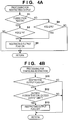
- FIG. 4A shows an example of processing in which the processing unit 21 determines whether the air funnel 111a has been replaced with a component manufactured by another company or not, and restricts an output of the internal combustion engine 106.
- the processing unit 21 obtains detection results of the opening sensor 6 and the crank angle sensor 5, and determines whether the current operation region of the internal combustion engine 106 is in the correction region R1 or the region other than the correction region R1 (non-correction region R2). If it is determined that the current operation region is in the correction region R1, the processing advances to S2, and if it is determined that the current operation region is in the region other than the correction region R1, the processing advances to S4.
- S2 it is determined whether the correction coefficient KO2 is equal to or larger than the threshold value P4 or not. If the correction coefficient KO2 is equal to or larger than the threshold value P4, it is regarded that the air funnel 111a has been replaced with a component manufactured by another company and the processing advances to S3. If the correction coefficient KO2 is smaller than the threshold value P4, one flow of the processing is finished.
- S4 it is determined whether the detection result VO2 of the oxygen sensor 7 is equal to or smaller than the threshold value P5 or not. If the detection result VO2 is equal to or smaller than the threshold value P5, it is regarded that the air funnel 111a has been replaced with a component manufactured by another company and the processing advances to S3. If the detection result VO2 is larger than the threshold value P5, one flow of the processing is finished.
- a restricting output flag is turned ON. This is a flag that is set in a predetermined storage area of the storage unit 22, and the output of the internal combustion engine 106 is restricted while the flag is ON.
- the fuel injection thinning means that, among fuel injection timings, fuel is not injected at some of the timings, for example. Specifically, for example, fuel is not injected once every three times in a combustion cycle.
- the output of the internal combustion engine 106 can be mildly restricted, and the output can be restricted while a sense of incongruity for a rider in traveling can be reduced. In this way, one flow of the processing for restricting the output is finished. Accordingly, restricting the output of the internal combustion engine 106 against modification of the intake system can be achieved.
- Fig. 4B shows an example of processing for canceling the restriction after restricting the output.
- restricting the output is canceled on condition that the operation region of the internal combustion engine 106 has transited outside the region R3. This is because there is no case in which the output exceeds the output limit (35kw) outside the region R3 even if the air funnel 111a is replaced.
- S11 it is determined whether the restricting output flag is ON or not. If the flag is ON, the processing advances to S12, and if the flag is OFF, one flow of the processing is finished.
- the processing unit 21 obtains detection results of the opening sensor 6 and the crank angle sensor 5, and determines whether the current operation region of the internal combustion engine 106 is outside a region that can exceed the output limit (outside the region R3) or not. If the current operation region is outside the region that can exceed the output limit, the processing advances to the S13, and if the current operation region is inside the region, one flow of the processing is finished (restricting the output is continued).
- the restricting output flag is turned OFF, and the control is returned to the normal control. With this, even in a case that the output is restricted, the restriction is temporary, and thus the output can be restricted in a range where normal traveling is not affected. In this way, one flow of the processing for canceling the restriction is finished.
- focusing on a correction amount of a fuel injection amount allows to achieve restricting an output of an internal combustion engine against modification of an intake system even while feedback control of an air-fuel ratio is performed.
- restricting the output of an internal combustion engine against modification of an intake system can be achieved even in an operation region in which feedback control of an air-fuel ratio is not performed.
- an air-fuel ratio is a value normally hard to occur or impractical, it is regarded that an intake system is modified, and an output of an internal combustion engine can be limited.
- the restriction is temporary, and thus the output can be restricted in a range where normal traveling is not affected.
- an output can be limited while a sense of incongruity for a rider in traveling can be reduced.
- the basic value can be more appropriately set.
- the operation region can be more appropriately divided.
Landscapes
- Engineering & Computer Science (AREA)
- Chemical & Material Sciences (AREA)
- Combustion & Propulsion (AREA)
- Mechanical Engineering (AREA)
- General Engineering & Computer Science (AREA)
- Electrical Control Of Air Or Fuel Supplied To Internal-Combustion Engine (AREA)
Abstract
Description
- The invention relates to control technology for an internal combustion engine.
- As a method for controlling a fuel injection amount of an internal combustion engine, technology in which an oxygen sensor is provided in an exhaust passage, and the fuel injection amount is set such that a target air-fuel ratio is maintained by feeding back a detection result of the oxygen sensor, has been known. Japanese Patent Laid-Open No.
10-121991 - An output of an internal combustion engine may be limited because of legal regulations or the like. For example, motorcycle license in Europe includes a type of license in which an output of an internal combustion engine is limited equal to or smaller than 35 kW. In a vehicle type coping with such a regulation, although vehicles are designed to satisfy the output limit, an owner may modify the vehicle after purchase such that the output can exceed the output limit. For example, there is a case where a component is replaced to an air funnel that increases an intake amount.
- A fuel control system should be designed such that the output does not exceed the output limit, in spite of such modification. However, since the target air-fuel ratio is maintained in an area where the fuel injection amount can be controlled by feeding back the detection result of the oxygen sensor, it is difficult to determine whether the modification is performed or not by using the diagnostic system focusing on the abnormality of the air-fuel ratio, as described in Japanese Patent Laid-Open No.
10-121991 - An object of the invention is to achieve restricting an output of an internal combustion engine against modification of an intake system.
- The present invention provided a control apparatus as specified in
claims 1 to 8. - Further features of the present invention will become apparent from the following description of exemplary embodiments with reference to the attached drawings.
-
-
Fig. 1 is a side view of a vehicle as an application example of a control apparatus according to the invention. -
Fig. 2 is a block diagram of a control apparatus according to an exemplary embodiment of the invention. -
Fig. 3A is an explanatory diagram of an operation region, and each ofFig. 3B and Fig. 3C is an explanatory diagram of a threshold value for determining modification of an intake system. - Each of
Fig. 4A and Fig. 4B is a flowchart illustrating a processing example of the control apparatus inFig. 2 . -
Fig. 1 illustrates an example of a vehicle to which a control apparatus according to the invention can be applied, and especially, illustrates a side view (right side view) of astraddle type vehicle 100. Although a motorcycle including a front wheel FW and a rear wheel RW is exemplified as thevehicle 100 according to the exemplary embodiment, the invention can also be applied to other types of straddle type vehicles. - The
vehicle 100 includes avehicle body frame 101 that forms a skeleton of the vehicle, a frontwheel steering unit 102 is supported at a front end of thevehicle body frame 101, and aswing arm 103 is supported at a rear end of thevehicle body frame 101 so as to swing freely. The frontwheel steering unit 102 includes a left and right pair offront forks 102a supporting the front wheel FW, and asteering handle 102b attached to an upper portion of the pair offront forks 102a. A front end of theswing arms 103 is supported on thevehicle body frame 101 so as to swing freely, and a rear end of theswing arms 103 supports the rear wheel RW. - In a portion between the front wheel FW and the rear wheel RW, an
internal combustion engine 106 and agear changer 107 are supported by thevehicle body frame 101. Theinternal combustion engine 106 includes amain body 110 configured with a crankcase, a cylinder block, and a cylinder head, anintake passage 111, and anexhaust passage 112. In a case of this exemplary embodiment, theinternal combustion engine 106 is a four cycle engine having in-line four cylinders. An output of theinternal combustion engine 106 is transmitted to the rear wheel RW via thegear changer 107 and a chain transmission mechanism not illustrated. - A
fuel tank 105 is disposed above theinternal combustion engine 106, and aseat 104 on which a rider sits is disposed on a rear side of thefuel tank 105. Anair cleaner box 108 to which outside air is introduced is disposed inside thefuel tank 105. Anair cleaner 108a connected to an outside air introduction duct and anair funnel 111a configuring theintake passage 111 are disposed in an internal space of theair cleaner box 108, and these components are configured such that air filtered in theair cleaner 108a can be introduced to themain body 110 via theair funnel 111a. - In addition to
Fig. 1 , with reference toFig. 2 , a configuration of an intake and exhaust system of theinternal combustion engine 106, and thecontrol apparatus 1 according to the exemplary embodiment of the invention will be described. - The
intake passage 111 includes theair funnel 111a, athrottle valve 111b, and anintake pipe 111c, which are provided for each of the cylinders, and theintake pipe 111c is connected to an intake port of themain body 110. A fuel injection valve (injector) 3 is provided for each of the cylinders, and injects fuel to the intake port. Theexhaust passage 112 includes anexhaust pipe 112a provided for each of the cylinders and connected to an exhaust port, acollection portion 112b at which theseexhaust pipes 112a are collected, a three-way catalyst 112c, and amuffler 112d. - The
control apparatus 1 is an apparatus for controlling theinternal combustion engine 106, and includes a control unit (ECU) 2. Thecontrol unit 2 includes aprocessing unit 21, a storage unit 22 such as a RAM, a ROM, or the like, and aninterface unit 23 that relays transmission and reception of a signal between an external device and theprocessing unit 21. Theprocessing unit 21 is a processor represented by a CPU, executes a program stored in the storage unit 22 to control driving of theinternal combustion engine 106. The storage unit 22 stores various kinds of data, in addition to the program that is executed by theprocessing unit 21. Detection results of various kinds ofsensors 5 to 12 are inputted to theinterface unit 23 via a signal processing circuit not illustrated, and theprocessing unit 21, based on the inputted detection results, controls afuel injection valve 3 provided for each of the cylinders and anignition device 4 via a driving circuit not illustrated. - A
crank angle sensor 5 detects a rotation angle of a crankshaft not illustrated of theinternal combustion engine 106 to supply a signal corresponding to the rotation angle of the crankshaft to thecontrol unit 2. Thecrank angle sensor 5 includes a cylinder determination sensor, a TDC sensor, and a CRK sensor. The cylinder determination sensor, with respect to the specific cylinder of theinternal combustion engine 106, outputs a pulse signal (called a CYL signal) at a predetermined crank angle. The TDC sensor, with respect to a top dead center (TDC) when an intake process for each of the cylinders starts, outputs a pulse signal (called a TDC signal) at a crank angle before a predetermined crank angle (at each crank angle of 180 degrees in a four-cylinder engine). The CRK sensor outputs a pulse signal (called a CRK signal) at a certain crank angle period shorter than a TDC signal (e.g., a period of 30 degrees). These signals are used to control various kinds of timing such as fuel injection timing, and ignition timing, and to detect an engine speed NE of theinternal combustion engine 106. - An
oxygen sensor 7 is provided on theexhaust passage 112, and detects oxygen concentration of exhaust gas. In a case of this exemplary embodiment, theoxygen sensor 7 is provided on thecollection portion 112b at an upstream side of the three-way catalyst 112c, and thus the number of oxygen sensors can be reduced, compared with a configuration in which an oxygen sensor is provided for each of theexhaust pipes 112a. The three-way catalyst 112c purifies components such as HC, CO, and NOx in exhaust gas, and themuffler 112d suppresses exhaust sound. - An
opening sensor 6 detects opening of the fourthrottle valves 111b that open/close in conjunction with each other. Awater temperature sensor 8 detects cooling water temperature of theinternal combustion engine 106. Anatmospheric pressure sensor 9 detects atmospheric pressure. Avehicle speed sensor 10 detects a traveling speed of thevehicle 100. Anintake pressure sensor 11 is an intake pipe inner absolute pressure sensor that detects intake pressure just at a downstream of thethrottle valves 111b. Anintake temperature sensor 12 detects intake temperature at a downstream side of theintake pressure sensor 11. - A control example for a fuel injection amount of the
fuel injection valve 3 will be described. Thecontrol unit 2 controls driving of theinternal combustion engine 106, based on the detection results of the above-described various kinds ofsensors 5 to 12. In a case in which an air-fuel ratio is maintained at a predetermined air-fuel ratio, a detection result of theoxygen sensor 7 is fed back to control the fuel injection amount. - As an example, in a method for controlling the fuel injection amount with injection time, based on the operational expression below, fuel injection time TOUT for the
fuel injection valve 3 that opens itself in synchronization with the TDC signal, is calculated.
- Here, TIM is a basic value based on an operating state of the internal combustion engine 106 (basic fuel injection time of the fuel injection valve 6), and is determined by searching a TI map set according to the engine speed NE of the
internal combustion engine 106 based on a detection result of thecrank angle sensor 5, and an intake pipe inner absolute pressure based on a detection result of theintake pressure sensor 11. The TI map, in an operating state corresponding to the engine speed NE and the intake pipe inner absolute pressure on a map, is set such that an air-fuel ratio of air-fuel mixture that is supplied to theinternal combustion engine 106 becomes a substantially theoretical air-fuel ratio (usually, slightly richer), and is stored in the storage unit 22. - KO2 is a correction coefficient for correcting the basic value derived from the TI map by an estimation result of an actual air-fuel ratio derived by the
oxygen sensor 7. KO2 is a value to be calculated from a detection result of theoxygen sensor 7, and is set such that an air-fuel ratio becomes a predetermined air-fuel ratio. The predetermined air-fuel ratio is an air-fuel ratio set in design, and is usually slightly richer than the theoretical air-fuel ratio. It is hereinafter referred to as a set air-fuel ratio. - KO2 is set to 1.0 (non-correction value), in an operating state in which air-fuel ratio feedback control is not performed according to a detection result of the
oxygen sensor 7, for example, immediately after starting. KO2 becomes a value larger than 1.0 when oxygen concentration based on a detection result of theoxygen sensor 7 is high (when air-fuel mixture is lean), and KO2 becomes a value that is relatively small when the oxygen concentration is low (when the air-fuel mixture is rich). K1 and K2 are another correction coefficient and another correction variable, respectively, and are determined as predetermined values such that fuel consumption characteristics according to an operating state of theinternal combustion engine 106, acceleration characteristics of theinternal combustion engine 106, and the like can be optimized. - Replacing the
air funnel 111a with a non-conforming component to the vehicle type may increase an intake air amount, make an output exceed the output limit assumed in design and thus be able to drive theinternal combustion engine 106. For example, it is a case in which the output can exceed the limit of 35 kW in the above-described license system. An example of a countermeasure method will be described. In the example below, a case in which an output limit for a crankshaft output in theinternal combustion engine 106 is 35 kW, and occurrence of an output exceeding the output limit is prevented, is assumed. -
Fig. 3A is an explanatory diagram of an operation region of theinternal combustion engine 106. In an example in the figure, the operation region is defined by the opening of thethrottle valve 111b (vertical axis) and the engine speed NE of the internal combustion engine 106 (horizontal axis). In the example in the figure, a correction region R1 and a non-correction region R2 are illustrated. - The correction region R1 is a region in which a detection result of the
oxygen sensor 7 is fed back and the fuel injection time TOUT is calculated by using the above-described expression, and is an operation region in which a fuel injection amount is controlled such that an air-fuel ratio is maintained at a set air-fuel ratio. The correction region R1 is a region in which throttle opening is equal to or larger than a threshold value P1 and smaller than a threshold value P2, and the engine speed NE of theinternal combustion engine 106 is equal to or larger than a threshold value P3. - The non-correction region R2 is a region in which a detection result of the
oxygen sensor 7 is not fed back, and then KO2 is set to the non-correction value (1.0), the fuel injection time TOUT is calculated. The non-correction region R2 is a region in which throttle opening is equal to or larger than the threshold value P2, and the engine speed NE of theinternal combustion engine 106 is equal to or larger than the threshold value P3. That is, the non-correction region R2 is a region in which the throttle opening is larger than that of the correction region R1, and a region that is close to full opening. Note that, a configuration in which the non-correction region R2 is also made to be a correction region, can be adopted. - A region R3 shows a region in which an output of the
internal combustion engine 106 may exceed 35kW in a case replacing theair funnel 111a with the non-conforming component increases the intake air amount. In the exemplary embodiment, the region R3 overlaps both the correction region R1 and the non-correction region R2. In other words, since, in both the correction region R1 and the non-correction region R2, the output may also exceed the output limit, the countermeasure is necessary. - In a case in which replacing the
air funnel 111a with a component manufactured by another company increases the intake air amount, the air-fuel ratio tends to be lean. In the correction region R1, since a detection result of theoxygen sensor 7 is fed back and thus the air-fuel ratio is maintained at the set air-fuel ratio, it is difficult to determine whether theair funnel 111a has been replaced with the component manufactured by another company or not, based on the air-fuel ratio. However, focusing on the correction coefficient KO2 allows the determination. - A case in which the correction coefficient KO2 is larger than the non-correction value (1.0), means that oxygen concentration in exhaust gas is high and the fuel injection amount increases.
Fig. 3B shows an example of fluctuation of the correction coefficient KO2 in a case in which theair funnel 111a is a genuine component, by using a line L1. As illustrated in the same figure, the correction coefficient KO2 fluctuates in a slightly lower value than 1.0 (around 0.9). In the case in which theair funnel 111a has been replaced with the component manufactured by another company, because of increasing the engine speed NE, the correction coefficient KO2 also increases and exceeds the non-correction value. In a case in which a threshold value P4 is set as a value of the correction coefficient KO2 that cannot normally reach and the correction coefficient KO2 is equal to or larger than the threshold value P4, it can be determined that theair funnel 111a has been replaced with the component manufactured by another company. The threshold value P4 can be 1.2, for example. This means that an increase of the fuel injection amount due to the correction coefficient KO2 with respect to a basic value is 20%, which means that the fuel injection amount cannot normally increase to that volume. - In the non-correction region R2, since the feedback control for maintaining the air-fuel ratio at the set air-fuel ratio does not work, a detection result of the
oxygen sensor 7 has correlation with an actual air-fuel ratio. Accordingly, from the detection result of theoxygen sensor 7, it is possible to determine whether theair funnel 111a has been replaced with the component manufactured by another company or not. -
Fig. 3C shows relation between a detection result VO2 of theoxygen sensor 7 and the engine speed NE of theinternal combustion engine 106, as an example. A line L2 shows an example of fluctuation of the detection result VO2 in the case in which theair funnel 111a is a genuine component, and remains at a substantially constant value. A line L3 shows an example of fluctuation of the detection result VO2 in the case in which theair funnel 111a is a component manufactured by another company, and significantly fluctuates to a lean side when the engine speed NE exceeds a certain engine speed. In a case in which a threshold value P5 is set as a value of the detection result VO2 that cannot normally reach, and the detection result VO2 is equal to or smaller than the threshold value P5 (in a lean case in which the air-fuel ratio is equal to or larger than an air-fuel ratio corresponding to the threshold value P5), it can be determined that theair funnel 111a has been replaced with a component manufactured by another company. The threshold value P5 is, for example, a value corresponding to an air-fuel ratio of 15. In a case in which the set air-fuel ratio is made to be a slightly rich air-fuel ratio, which means that the air-fuel ratio is substantially lean, and an air-fuel mixture cannot be lean normally. - Next, an example of processing that is performed by the
processing unit 21 will be described.Fig. 4A shows an example of processing in which theprocessing unit 21 determines whether theair funnel 111a has been replaced with a component manufactured by another company or not, and restricts an output of theinternal combustion engine 106. - In S1, the
processing unit 21 obtains detection results of theopening sensor 6 and thecrank angle sensor 5, and determines whether the current operation region of theinternal combustion engine 106 is in the correction region R1 or the region other than the correction region R1 (non-correction region R2). If it is determined that the current operation region is in the correction region R1, the processing advances to S2, and if it is determined that the current operation region is in the region other than the correction region R1, the processing advances to S4. - In S2, it is determined whether the correction coefficient KO2 is equal to or larger than the threshold value P4 or not. If the correction coefficient KO2 is equal to or larger than the threshold value P4, it is regarded that the
air funnel 111a has been replaced with a component manufactured by another company and the processing advances to S3. If the correction coefficient KO2 is smaller than the threshold value P4, one flow of the processing is finished. In S4, it is determined whether the detection result VO2 of theoxygen sensor 7 is equal to or smaller than the threshold value P5 or not. If the detection result VO2 is equal to or smaller than the threshold value P5, it is regarded that theair funnel 111a has been replaced with a component manufactured by another company and the processing advances to S3. If the detection result VO2 is larger than the threshold value P5, one flow of the processing is finished. - In S3, a restricting output flag is turned ON. This is a flag that is set in a predetermined storage area of the storage unit 22, and the output of the
internal combustion engine 106 is restricted while the flag is ON. As a method for restricting the output, fuel cut, ignition cut, and fuel injection thinning are exemplified. The fuel injection thinning means that, among fuel injection timings, fuel is not injected at some of the timings, for example. Specifically, for example, fuel is not injected once every three times in a combustion cycle. Compared with the fuel cut or the ignition cut, the output of theinternal combustion engine 106 can be mildly restricted, and the output can be restricted while a sense of incongruity for a rider in traveling can be reduced. In this way, one flow of the processing for restricting the output is finished. Accordingly, restricting the output of theinternal combustion engine 106 against modification of the intake system can be achieved. -
Fig. 4B shows an example of processing for canceling the restriction after restricting the output. In the exemplary embodiment, restricting the output is canceled on condition that the operation region of theinternal combustion engine 106 has transited outside the region R3. This is because there is no case in which the output exceeds the output limit (35kw) outside the region R3 even if theair funnel 111a is replaced. - In S11, it is determined whether the restricting output flag is ON or not. If the flag is ON, the processing advances to S12, and if the flag is OFF, one flow of the processing is finished. In S12, the
processing unit 21 obtains detection results of theopening sensor 6 and thecrank angle sensor 5, and determines whether the current operation region of theinternal combustion engine 106 is outside a region that can exceed the output limit (outside the region R3) or not. If the current operation region is outside the region that can exceed the output limit, the processing advances to the S13, and if the current operation region is inside the region, one flow of the processing is finished (restricting the output is continued). In S13, the restricting output flag is turned OFF, and the control is returned to the normal control. With this, even in a case that the output is restricted, the restriction is temporary, and thus the output can be restricted in a range where normal traveling is not affected. In this way, one flow of the processing for canceling the restriction is finished. -
- 1. A control apparatus (e.g., 1) according to the exemplary embodiment includes a control means (e.g., 2) configured to control a fuel injection amount of an internal combustion engine, and an oxygen sensor (e.g., 7) provided on an exhaust passage (e.g., 112) of the internal combustion engine, in which the control means can control the fuel injection amount so as to be maintained at a predetermined air-fuel ratio by correcting, based on a detection result of the oxygen sensor, a basic value (e.g., TOUT) based on an operating state of the internal combustion engine, and the control means restricts an output of the internal combustion engine when an increase of the correcting based on the detection result of the oxygen sensor becomes equal to or larger than a predetermined rate with respect to the basic value (e.g., S2, S3 in
Fig. 4A ). - According to the exemplary embodiment, focusing on a correction amount of a fuel injection amount allows to achieve restricting an output of an internal combustion engine against modification of an intake system even while feedback control of an air-fuel ratio is performed.
- 2. The control apparatus according to the exemplary embodiment, in which the correcting based on the detection result of the oxygen sensor is multiplying the basic value by a correction coefficient based on the detection result of the oxygen sensor, and the predetermined rate is 20%.
- According to the exemplary embodiment, when an increase of a fuel injection amount is normally hard to occur or impractical, it is regarded that an intake system is modified, and the output of an internal combustion engine can be restricted.
- 3. The control apparatus according to the exemplary embodiment, in which the control means corrects the basic value, based on the detection result of the oxygen sensor, in a first operation region (e.g., R1), and does not correct the basic value, based on the detection result of the oxygen sensor, in a second operation region (e.g., R2), and in the second operation region, the control means restricts an output of the internal combustion engine, in a case in which the detection result of the oxygen sensor shows a value corresponding to an air-fuel ratio that is equal to or larger than a predetermined air-fuel ratio being at a leaner side than the theoretical air-fuel ratio (e.g., S4, S3 in
Fig.4A ). - According to the exemplary embodiment, restricting the output of an internal combustion engine against modification of an intake system can be achieved even in an operation region in which feedback control of an air-fuel ratio is not performed.
- 4. The control apparatus according to the exemplary embodiment, in which the predetermined air-fuel ratio is 15.
- According to the exemplary embodiment, when an air-fuel ratio is a value normally hard to occur or impractical, it is regarded that an intake system is modified, and an output of an internal combustion engine can be limited.
- 5. The control apparatus according to the exemplary embodiment, in which the control means cancels restricting the output of the internal combustion engine on condition that an operation region of the internal combustion engine has transited outside a predetermined operation region (e.g.,
Fig. 4B ). - According to the exemplary embodiment, even if the output is restricted, the restriction is temporary, and thus the output can be restricted in a range where normal traveling is not affected.
- 6. The control apparatus according to the exemplary embodiment, in which the control means restricts the output of the internal combustion engine by thinning out fuel injection.
- According to the exemplary embodiment, an output can be limited while a sense of incongruity for a rider in traveling can be reduced.
- 7. The control apparatus according to the exemplary embodiment, in which the operating state is defined by an intake pipe inner absolute pressure and an engine speed of the internal combustion engine.
- According to the exemplary embodiment, the basic value can be more appropriately set.
- 8. The control apparatus according to the exemplary embodiment, in which the operation region is defined by throttle opening and an engine speed of the internal combustion engine (e.g.,
Fig. 3A ). - According to the exemplary embodiment, the operation region can be more appropriately divided.
- While the present invention has been described with reference to exemplary embodiments, it is to be understood that the invention is not limited to the disclosed exemplary embodiments. The scope of the following claims is to be accorded the broadest interpretation so as to encompass all such modifications and equivalent structures and functions.
Claims (8)
- A control apparatus (1) comprising:control means (2) configured to control a fuel injection amount of an internal combustion engine (106), andan oxygen sensor (7) provided on an exhaust passage (112) of the internal combustion engine (106), characterized in thatthe control means (2) can control the fuel injection amount so as to be maintained at a predetermined air-fuel ratio by correcting, based on a detection result of the oxygen sensor (7), a basic value based on an operating state of the internal combustion engine (106), andthe control means (2) restricts an output of the internal combustion engine (106) when an increase of the correcting based on the detection result of the oxygen sensor (7) becomes equal to or larger than a predetermined rate with respect to the basic value.
- The control apparatus according to claim 1, wherein
the correcting based on the detection result of the oxygen sensor (7) is multiplying the basic value by a correction coefficient based on the detection result of the oxygen sensor (7), and
the predetermined rate is 20%. - The control apparatus according to claim 1 or 2, wherein
the control means (2) corrects the basic value, based on the detection result of the oxygen sensor (7), in a first operation region (R1), and does not correct the basic value, based on the detection result of the oxygen sensor (7), in a second operation region (R2), and
in the second operation region (R2), the control means restricts the output of the internal combustion engine (106) when the detection result of the oxygen sensor shows a value corresponding to an air-fuel ratio that is equal to or larger than a predetermined air-fuel ratio being at a leaner side than the theoretical air-fuel ratio. - The control apparatus according to claim 3, wherein
the predetermined air-fuel ratio is 15. - The control apparatus according to any one of claims 1 to 4, wherein
the control means (2) cancels restricting the output of the internal combustion engine on condition that an operation region of the internal combustion engine (106) has transited outside a predetermined operation region. - The control apparatus according to any one of claims 1 to 5, wherein
the control means (2) restricts the output of the internal combustion engine (106) by thinning out fuel injection. - The control apparatus according to any one of claims 1 to 6, wherein
the operating state is defined by an intake pipe inner absolute pressure and an engine speed of the internal combustion engine (106). - The control apparatus according to claim 3 or 5, wherein
the operation region is defined by a throttle opening and an engine speed of the internal combustion engine (106).
Applications Claiming Priority (1)
| Application Number | Priority Date | Filing Date | Title |
|---|---|---|---|
| JP2018026377A JP6596111B2 (en) | 2018-02-16 | 2018-02-16 | Control device |
Publications (2)
| Publication Number | Publication Date |
|---|---|
| EP3533986A1 true EP3533986A1 (en) | 2019-09-04 |
| EP3533986B1 EP3533986B1 (en) | 2026-04-22 |
Family
ID=65023739
Family Applications (1)
| Application Number | Title | Priority Date | Filing Date |
|---|---|---|---|
| EP19151553.5A Active EP3533986B1 (en) | 2018-02-16 | 2019-01-14 | Control apparatus |
Country Status (2)
| Country | Link |
|---|---|
| EP (1) | EP3533986B1 (en) |
| JP (1) | JP6596111B2 (en) |
Families Citing this family (1)
| Publication number | Priority date | Publication date | Assignee | Title |
|---|---|---|---|---|
| JP7286582B2 (en) * | 2020-03-24 | 2023-06-05 | 株式会社東芝 | semiconductor equipment |
Citations (5)
| Publication number | Priority date | Publication date | Assignee | Title |
|---|---|---|---|---|
| JPH10121991A (en) | 1996-10-14 | 1998-05-12 | Fuji Heavy Ind Ltd | Failure diagnosing device for engine intake-air control system |
| FR2915241A1 (en) * | 2007-04-19 | 2008-10-24 | Renault Sas | INTERNAL COMBUSTION ENGINE WITH REGULATION OF FUEL INJECTION QUANTITY AND METHOD FOR PRODUCING FUEL INJECTION SET VALUE. |
| EP2929169A1 (en) * | 2012-12-04 | 2015-10-14 | Volvo Truck Corporation | Method and system for controlling fuel injection |
| US20150353074A1 (en) * | 2013-01-24 | 2015-12-10 | Toyota Jidosha Kabushiki Kaisha | Control apparatus for hybrid vehicle |
| US20180017006A1 (en) * | 2016-07-15 | 2018-01-18 | Hyundai Motor Company | Method of detecting engine tuning of vehicle |
Family Cites Families (2)
| Publication number | Priority date | Publication date | Assignee | Title |
|---|---|---|---|---|
| JP2518317B2 (en) * | 1987-10-14 | 1996-07-24 | 日本電装株式会社 | Fail-safe device for internal combustion engine for vehicles |
| JP2004150302A (en) * | 2002-10-29 | 2004-05-27 | Suzuki Motor Corp | Engine abnormality judgment device |
-
2018
- 2018-02-16 JP JP2018026377A patent/JP6596111B2/en not_active Expired - Fee Related
-
2019
- 2019-01-14 EP EP19151553.5A patent/EP3533986B1/en active Active
Patent Citations (5)
| Publication number | Priority date | Publication date | Assignee | Title |
|---|---|---|---|---|
| JPH10121991A (en) | 1996-10-14 | 1998-05-12 | Fuji Heavy Ind Ltd | Failure diagnosing device for engine intake-air control system |
| FR2915241A1 (en) * | 2007-04-19 | 2008-10-24 | Renault Sas | INTERNAL COMBUSTION ENGINE WITH REGULATION OF FUEL INJECTION QUANTITY AND METHOD FOR PRODUCING FUEL INJECTION SET VALUE. |
| EP2929169A1 (en) * | 2012-12-04 | 2015-10-14 | Volvo Truck Corporation | Method and system for controlling fuel injection |
| US20150353074A1 (en) * | 2013-01-24 | 2015-12-10 | Toyota Jidosha Kabushiki Kaisha | Control apparatus for hybrid vehicle |
| US20180017006A1 (en) * | 2016-07-15 | 2018-01-18 | Hyundai Motor Company | Method of detecting engine tuning of vehicle |
Also Published As
| Publication number | Publication date |
|---|---|
| JP2019143499A (en) | 2019-08-29 |
| JP6596111B2 (en) | 2019-10-23 |
| EP3533986B1 (en) | 2026-04-22 |
Similar Documents
| Publication | Publication Date | Title |
|---|---|---|
| JP4130800B2 (en) | Engine control device | |
| US7387011B2 (en) | Deterioration diagnosis system for exhaust gas sensor | |
| EP0908613B1 (en) | Engine exhaust gas control system having NOx catalyst | |
| JP3498817B2 (en) | Exhaust system failure diagnosis device for internal combustion engine | |
| JPH07259621A (en) | Fuel supply control device for internal combustion engine | |
| JP2007154840A (en) | Air-fuel ratio control device for internal combustion engine | |
| US8443656B2 (en) | Inter-cylinder air-fuel ratio imbalance abnormality detection device for multi-cylinder internal combustion engine and abnormality detection method therefor | |
| KR0166978B1 (en) | Electronic engine control method for internal combustion engine having a plurality of cylinders | |
| US8210034B2 (en) | Abnormality determination apparatus and method for oxygen sensor | |
| JPH0823333B2 (en) | Ignition timing control device for internal combustion engine | |
| US9470169B2 (en) | Control device for internal combustion engine | |
| EP3533986B1 (en) | Control apparatus | |
| JP3791032B2 (en) | Fuel injection control device for internal combustion engine | |
| JP4868173B2 (en) | Abnormality diagnosis device for internal combustion engine | |
| US20040193360A1 (en) | Control system for correcting a torque variation of an engine | |
| JP2008180225A (en) | Engine control device | |
| JP2013142370A (en) | Air-fuel ratio control apparatus of internal combustion engine | |
| US20040129068A1 (en) | Apparatus for detecting leakage in an evaporated fuel processing system | |
| JP5116096B2 (en) | Fuel injection control device for vehicle engine | |
| JP2006037924A (en) | Vehicle control device | |
| EP1674701A2 (en) | Air-fuel ratio feedback control apparatus for engines | |
| JP2001289111A (en) | Engine misfire detection device | |
| JP4172870B2 (en) | Multi-cylinder engine misfire control system | |
| JPH0763097A (en) | Engine fuel controller | |
| JP2591103B2 (en) | Fuel injection control device for internal combustion engine with EGR device |
Legal Events
| Date | Code | Title | Description |
|---|---|---|---|
| PUAI | Public reference made under article 153(3) epc to a published international application that has entered the european phase |
Free format text: ORIGINAL CODE: 0009012 |
|
| STAA | Information on the status of an ep patent application or granted ep patent |
Free format text: STATUS: REQUEST FOR EXAMINATION WAS MADE |
|
| 17P | Request for examination filed |
Effective date: 20190114 |
|
| AK | Designated contracting states |
Kind code of ref document: A1 Designated state(s): AL AT BE BG CH CY CZ DE DK EE ES FI FR GB GR HR HU IE IS IT LI LT LU LV MC MK MT NL NO PL PT RO RS SE SI SK SM TR |
|
| AX | Request for extension of the european patent |
Extension state: BA ME |
|
| STAA | Information on the status of an ep patent application or granted ep patent |
Free format text: STATUS: EXAMINATION IS IN PROGRESS |
|
| 17Q | First examination report despatched |
Effective date: 20220210 |
|
| RAP3 | Party data changed (applicant data changed or rights of an application transferred) |
Owner name: HONDA MOTOR CO., LTD. |
|
| GRAP | Despatch of communication of intention to grant a patent |
Free format text: ORIGINAL CODE: EPIDOSNIGR1 |
|
| STAA | Information on the status of an ep patent application or granted ep patent |
Free format text: STATUS: GRANT OF PATENT IS INTENDED |
|
| INTG | Intention to grant announced |
Effective date: 20251114 |
|
| GRAS | Grant fee paid |
Free format text: ORIGINAL CODE: EPIDOSNIGR3 |
|
| GRAA | (expected) grant |
Free format text: ORIGINAL CODE: 0009210 |
|
| STAA | Information on the status of an ep patent application or granted ep patent |
Free format text: STATUS: THE PATENT HAS BEEN GRANTED |
|
| AK | Designated contracting states |
Kind code of ref document: B1 Designated state(s): AL AT BE BG CH CY CZ DE DK EE ES FI FR GB GR HR HU IE IS IT LI LT LU LV MC MK MT NL NO PL PT RO RS SE SI SK SM TR |
|
| REG | Reference to a national code |
Ref country code: CH Ref legal event code: F10 Free format text: ST27 STATUS EVENT CODE: U-0-0-F10-F00 (AS PROVIDED BY THE NATIONAL OFFICE) Effective date: 20260422 Ref country code: GB Ref legal event code: FG4D |