EP3530451A1 - Structure multicouche pour la realisation d'un revetement de sol - Google Patents
Structure multicouche pour la realisation d'un revetement de sol Download PDFInfo
- Publication number
- EP3530451A1 EP3530451A1 EP19158027.3A EP19158027A EP3530451A1 EP 3530451 A1 EP3530451 A1 EP 3530451A1 EP 19158027 A EP19158027 A EP 19158027A EP 3530451 A1 EP3530451 A1 EP 3530451A1
- Authority
- EP
- European Patent Office
- Prior art keywords
- layer
- multilayer structure
- fibers
- nonwoven fabric
- aramid
- Prior art date
- Legal status (The legal status is an assumption and is not a legal conclusion. Google has not performed a legal analysis and makes no representation as to the accuracy of the status listed.)
- Granted
Links
Images
Classifications
-
- B—PERFORMING OPERATIONS; TRANSPORTING
- B60—VEHICLES IN GENERAL
- B60N—SEATS SPECIALLY ADAPTED FOR VEHICLES; VEHICLE PASSENGER ACCOMMODATION NOT OTHERWISE PROVIDED FOR
- B60N3/00—Arrangements or adaptations of other passenger fittings, not otherwise provided for
- B60N3/04—Arrangements or adaptations of other passenger fittings, not otherwise provided for of floor mats or carpets
- B60N3/048—Arrangements or adaptations of other passenger fittings, not otherwise provided for of floor mats or carpets characterised by their structure
-
- B—PERFORMING OPERATIONS; TRANSPORTING
- B32—LAYERED PRODUCTS
- B32B—LAYERED PRODUCTS, i.e. PRODUCTS BUILT-UP OF STRATA OF FLAT OR NON-FLAT, e.g. CELLULAR OR HONEYCOMB, FORM
- B32B27/00—Layered products comprising a layer of synthetic resin
- B32B27/06—Layered products comprising a layer of synthetic resin as the main or only constituent of a layer, which is next to another layer of the same or of a different material
- B32B27/08—Layered products comprising a layer of synthetic resin as the main or only constituent of a layer, which is next to another layer of the same or of a different material of synthetic resin
-
- B—PERFORMING OPERATIONS; TRANSPORTING
- B32—LAYERED PRODUCTS
- B32B—LAYERED PRODUCTS, i.e. PRODUCTS BUILT-UP OF STRATA OF FLAT OR NON-FLAT, e.g. CELLULAR OR HONEYCOMB, FORM
- B32B27/00—Layered products comprising a layer of synthetic resin
- B32B27/30—Layered products comprising a layer of synthetic resin comprising vinyl (co)polymers; comprising acrylic (co)polymers
- B32B27/304—Layered products comprising a layer of synthetic resin comprising vinyl (co)polymers; comprising acrylic (co)polymers comprising vinyl halide (co)polymers, e.g. PVC, PVDC, PVF, PVDF
-
- B—PERFORMING OPERATIONS; TRANSPORTING
- B32—LAYERED PRODUCTS
- B32B—LAYERED PRODUCTS, i.e. PRODUCTS BUILT-UP OF STRATA OF FLAT OR NON-FLAT, e.g. CELLULAR OR HONEYCOMB, FORM
- B32B27/00—Layered products comprising a layer of synthetic resin
- B32B27/40—Layered products comprising a layer of synthetic resin comprising polyurethanes
-
- B—PERFORMING OPERATIONS; TRANSPORTING
- B32—LAYERED PRODUCTS
- B32B—LAYERED PRODUCTS, i.e. PRODUCTS BUILT-UP OF STRATA OF FLAT OR NON-FLAT, e.g. CELLULAR OR HONEYCOMB, FORM
- B32B5/00—Layered products characterised by the non- homogeneity or physical structure, i.e. comprising a fibrous, filamentary, particulate or foam layer; Layered products characterised by having a layer differing constitutionally or physically in different parts
- B32B5/02—Layered products characterised by the non- homogeneity or physical structure, i.e. comprising a fibrous, filamentary, particulate or foam layer; Layered products characterised by having a layer differing constitutionally or physically in different parts characterised by structural features of a fibrous or filamentary layer
- B32B5/08—Layered products characterised by the non- homogeneity or physical structure, i.e. comprising a fibrous, filamentary, particulate or foam layer; Layered products characterised by having a layer differing constitutionally or physically in different parts characterised by structural features of a fibrous or filamentary layer the fibres or filaments of a layer being of different substances, e.g. conjugate fibres, mixture of different fibres
-
- B—PERFORMING OPERATIONS; TRANSPORTING
- B32—LAYERED PRODUCTS
- B32B—LAYERED PRODUCTS, i.e. PRODUCTS BUILT-UP OF STRATA OF FLAT OR NON-FLAT, e.g. CELLULAR OR HONEYCOMB, FORM
- B32B5/00—Layered products characterised by the non- homogeneity or physical structure, i.e. comprising a fibrous, filamentary, particulate or foam layer; Layered products characterised by having a layer differing constitutionally or physically in different parts
- B32B5/22—Layered products characterised by the non- homogeneity or physical structure, i.e. comprising a fibrous, filamentary, particulate or foam layer; Layered products characterised by having a layer differing constitutionally or physically in different parts characterised by the presence of two or more layers which are next to each other and are fibrous, filamentary, formed of particles or foamed
- B32B5/24—Layered products characterised by the non- homogeneity or physical structure, i.e. comprising a fibrous, filamentary, particulate or foam layer; Layered products characterised by having a layer differing constitutionally or physically in different parts characterised by the presence of two or more layers which are next to each other and are fibrous, filamentary, formed of particles or foamed one layer being a fibrous or filamentary layer
- B32B5/26—Layered products characterised by the non- homogeneity or physical structure, i.e. comprising a fibrous, filamentary, particulate or foam layer; Layered products characterised by having a layer differing constitutionally or physically in different parts characterised by the presence of two or more layers which are next to each other and are fibrous, filamentary, formed of particles or foamed one layer being a fibrous or filamentary layer another layer next to it also being fibrous or filamentary
-
- B—PERFORMING OPERATIONS; TRANSPORTING
- B60—VEHICLES IN GENERAL
- B60N—SEATS SPECIALLY ADAPTED FOR VEHICLES; VEHICLE PASSENGER ACCOMMODATION NOT OTHERWISE PROVIDED FOR
- B60N3/00—Arrangements or adaptations of other passenger fittings, not otherwise provided for
- B60N3/04—Arrangements or adaptations of other passenger fittings, not otherwise provided for of floor mats or carpets
- B60N3/042—Arrangements or adaptations of other passenger fittings, not otherwise provided for of floor mats or carpets of carpets
-
- D—TEXTILES; PAPER
- D06—TREATMENT OF TEXTILES OR THE LIKE; LAUNDERING; FLEXIBLE MATERIALS NOT OTHERWISE PROVIDED FOR
- D06N—WALL, FLOOR, OR LIKE COVERING MATERIALS, e.g. LINOLEUM, OILCLOTH, ARTIFICIAL LEATHER, ROOFING FELT, CONSISTING OF A FIBROUS WEB COATED WITH A LAYER OF MACROMOLECULAR MATERIAL; FLEXIBLE SHEET MATERIAL NOT OTHERWISE PROVIDED FOR
- D06N7/00—Flexible sheet materials not otherwise provided for, e.g. textile threads, filaments, yarns or tow, glued on macromolecular material
- D06N7/0005—Floor covering on textile basis comprising a fibrous substrate being coated with at least one layer of a polymer on the top surface
- D06N7/0039—Floor covering on textile basis comprising a fibrous substrate being coated with at least one layer of a polymer on the top surface characterised by the physical or chemical aspects of the layers
- D06N7/0042—Conductive or insulating layers; Antistatic layers; Flame-proof layers
-
- D—TEXTILES; PAPER
- D06—TREATMENT OF TEXTILES OR THE LIKE; LAUNDERING; FLEXIBLE MATERIALS NOT OTHERWISE PROVIDED FOR
- D06N—WALL, FLOOR, OR LIKE COVERING MATERIALS, e.g. LINOLEUM, OILCLOTH, ARTIFICIAL LEATHER, ROOFING FELT, CONSISTING OF A FIBROUS WEB COATED WITH A LAYER OF MACROMOLECULAR MATERIAL; FLEXIBLE SHEET MATERIAL NOT OTHERWISE PROVIDED FOR
- D06N7/00—Flexible sheet materials not otherwise provided for, e.g. textile threads, filaments, yarns or tow, glued on macromolecular material
- D06N7/0005—Floor covering on textile basis comprising a fibrous substrate being coated with at least one layer of a polymer on the top surface
- D06N7/0039—Floor covering on textile basis comprising a fibrous substrate being coated with at least one layer of a polymer on the top surface characterised by the physical or chemical aspects of the layers
- D06N7/0047—Special extra layers under the surface coating, e.g. wire threads
- D06N7/0049—Fibrous layer(s); Fibre reinforcement; Fibrous fillers
-
- D—TEXTILES; PAPER
- D06—TREATMENT OF TEXTILES OR THE LIKE; LAUNDERING; FLEXIBLE MATERIALS NOT OTHERWISE PROVIDED FOR
- D06N—WALL, FLOOR, OR LIKE COVERING MATERIALS, e.g. LINOLEUM, OILCLOTH, ARTIFICIAL LEATHER, ROOFING FELT, CONSISTING OF A FIBROUS WEB COATED WITH A LAYER OF MACROMOLECULAR MATERIAL; FLEXIBLE SHEET MATERIAL NOT OTHERWISE PROVIDED FOR
- D06N7/00—Flexible sheet materials not otherwise provided for, e.g. textile threads, filaments, yarns or tow, glued on macromolecular material
- D06N7/0005—Floor covering on textile basis comprising a fibrous substrate being coated with at least one layer of a polymer on the top surface
- D06N7/006—Floor covering on textile basis comprising a fibrous substrate being coated with at least one layer of a polymer on the top surface characterised by the textile substrate as base web
-
- B—PERFORMING OPERATIONS; TRANSPORTING
- B32—LAYERED PRODUCTS
- B32B—LAYERED PRODUCTS, i.e. PRODUCTS BUILT-UP OF STRATA OF FLAT OR NON-FLAT, e.g. CELLULAR OR HONEYCOMB, FORM
- B32B2260/00—Layered product comprising an impregnated, embedded, or bonded layer wherein the layer comprises an impregnation, embedding, or binder material
- B32B2260/02—Composition of the impregnated, bonded or embedded layer
- B32B2260/021—Fibrous or filamentary layer
-
- B—PERFORMING OPERATIONS; TRANSPORTING
- B32—LAYERED PRODUCTS
- B32B—LAYERED PRODUCTS, i.e. PRODUCTS BUILT-UP OF STRATA OF FLAT OR NON-FLAT, e.g. CELLULAR OR HONEYCOMB, FORM
- B32B2262/00—Composition or structural features of fibres which form a fibrous or filamentary layer or are present as additives
- B32B2262/02—Synthetic macromolecular fibres
-
- B—PERFORMING OPERATIONS; TRANSPORTING
- B32—LAYERED PRODUCTS
- B32B—LAYERED PRODUCTS, i.e. PRODUCTS BUILT-UP OF STRATA OF FLAT OR NON-FLAT, e.g. CELLULAR OR HONEYCOMB, FORM
- B32B2262/00—Composition or structural features of fibres which form a fibrous or filamentary layer or are present as additives
- B32B2262/02—Synthetic macromolecular fibres
- B32B2262/0246—Acrylic resin fibres
-
- B—PERFORMING OPERATIONS; TRANSPORTING
- B32—LAYERED PRODUCTS
- B32B—LAYERED PRODUCTS, i.e. PRODUCTS BUILT-UP OF STRATA OF FLAT OR NON-FLAT, e.g. CELLULAR OR HONEYCOMB, FORM
- B32B2262/00—Composition or structural features of fibres which form a fibrous or filamentary layer or are present as additives
- B32B2262/02—Synthetic macromolecular fibres
- B32B2262/0261—Polyamide fibres
- B32B2262/0269—Aromatic polyamide fibres
-
- B—PERFORMING OPERATIONS; TRANSPORTING
- B32—LAYERED PRODUCTS
- B32B—LAYERED PRODUCTS, i.e. PRODUCTS BUILT-UP OF STRATA OF FLAT OR NON-FLAT, e.g. CELLULAR OR HONEYCOMB, FORM
- B32B2262/00—Composition or structural features of fibres which form a fibrous or filamentary layer or are present as additives
- B32B2262/02—Synthetic macromolecular fibres
- B32B2262/0276—Polyester fibres
-
- B—PERFORMING OPERATIONS; TRANSPORTING
- B32—LAYERED PRODUCTS
- B32B—LAYERED PRODUCTS, i.e. PRODUCTS BUILT-UP OF STRATA OF FLAT OR NON-FLAT, e.g. CELLULAR OR HONEYCOMB, FORM
- B32B2262/00—Composition or structural features of fibres which form a fibrous or filamentary layer or are present as additives
- B32B2262/10—Inorganic fibres
- B32B2262/101—Glass fibres
-
- B—PERFORMING OPERATIONS; TRANSPORTING
- B32—LAYERED PRODUCTS
- B32B—LAYERED PRODUCTS, i.e. PRODUCTS BUILT-UP OF STRATA OF FLAT OR NON-FLAT, e.g. CELLULAR OR HONEYCOMB, FORM
- B32B2262/00—Composition or structural features of fibres which form a fibrous or filamentary layer or are present as additives
- B32B2262/14—Mixture of at least two fibres made of different materials
-
- B—PERFORMING OPERATIONS; TRANSPORTING
- B32—LAYERED PRODUCTS
- B32B—LAYERED PRODUCTS, i.e. PRODUCTS BUILT-UP OF STRATA OF FLAT OR NON-FLAT, e.g. CELLULAR OR HONEYCOMB, FORM
- B32B2264/00—Composition or properties of particles which form a particulate layer or are present as additives
- B32B2264/10—Inorganic particles
- B32B2264/107—Ceramic
- B32B2264/108—Carbon, e.g. graphite particles
-
- B—PERFORMING OPERATIONS; TRANSPORTING
- B32—LAYERED PRODUCTS
- B32B—LAYERED PRODUCTS, i.e. PRODUCTS BUILT-UP OF STRATA OF FLAT OR NON-FLAT, e.g. CELLULAR OR HONEYCOMB, FORM
- B32B2307/00—Properties of the layers or laminate
- B32B2307/20—Properties of the layers or laminate having particular electrical or magnetic properties, e.g. piezoelectric
- B32B2307/21—Anti-static
-
- B—PERFORMING OPERATIONS; TRANSPORTING
- B32—LAYERED PRODUCTS
- B32B—LAYERED PRODUCTS, i.e. PRODUCTS BUILT-UP OF STRATA OF FLAT OR NON-FLAT, e.g. CELLULAR OR HONEYCOMB, FORM
- B32B2307/00—Properties of the layers or laminate
- B32B2307/30—Properties of the layers or laminate having particular thermal properties
- B32B2307/306—Resistant to heat
- B32B2307/3065—Flame resistant or retardant, fire resistant or retardant
-
- B—PERFORMING OPERATIONS; TRANSPORTING
- B32—LAYERED PRODUCTS
- B32B—LAYERED PRODUCTS, i.e. PRODUCTS BUILT-UP OF STRATA OF FLAT OR NON-FLAT, e.g. CELLULAR OR HONEYCOMB, FORM
- B32B2307/00—Properties of the layers or laminate
- B32B2307/40—Properties of the layers or laminate having particular optical properties
- B32B2307/402—Coloured
-
- B—PERFORMING OPERATIONS; TRANSPORTING
- B32—LAYERED PRODUCTS
- B32B—LAYERED PRODUCTS, i.e. PRODUCTS BUILT-UP OF STRATA OF FLAT OR NON-FLAT, e.g. CELLULAR OR HONEYCOMB, FORM
- B32B2307/00—Properties of the layers or laminate
- B32B2307/40—Properties of the layers or laminate having particular optical properties
- B32B2307/402—Coloured
- B32B2307/4023—Coloured on the layer surface, e.g. ink
-
- B—PERFORMING OPERATIONS; TRANSPORTING
- B32—LAYERED PRODUCTS
- B32B—LAYERED PRODUCTS, i.e. PRODUCTS BUILT-UP OF STRATA OF FLAT OR NON-FLAT, e.g. CELLULAR OR HONEYCOMB, FORM
- B32B2307/00—Properties of the layers or laminate
- B32B2307/40—Properties of the layers or laminate having particular optical properties
- B32B2307/412—Transparent
-
- B—PERFORMING OPERATIONS; TRANSPORTING
- B32—LAYERED PRODUCTS
- B32B—LAYERED PRODUCTS, i.e. PRODUCTS BUILT-UP OF STRATA OF FLAT OR NON-FLAT, e.g. CELLULAR OR HONEYCOMB, FORM
- B32B2307/00—Properties of the layers or laminate
- B32B2307/50—Properties of the layers or laminate having particular mechanical properties
- B32B2307/554—Wear resistance
-
- B—PERFORMING OPERATIONS; TRANSPORTING
- B32—LAYERED PRODUCTS
- B32B—LAYERED PRODUCTS, i.e. PRODUCTS BUILT-UP OF STRATA OF FLAT OR NON-FLAT, e.g. CELLULAR OR HONEYCOMB, FORM
- B32B2307/00—Properties of the layers or laminate
- B32B2307/50—Properties of the layers or laminate having particular mechanical properties
- B32B2307/584—Scratch resistance
-
- B—PERFORMING OPERATIONS; TRANSPORTING
- B32—LAYERED PRODUCTS
- B32B—LAYERED PRODUCTS, i.e. PRODUCTS BUILT-UP OF STRATA OF FLAT OR NON-FLAT, e.g. CELLULAR OR HONEYCOMB, FORM
- B32B2471/00—Floor coverings
-
- B—PERFORMING OPERATIONS; TRANSPORTING
- B32—LAYERED PRODUCTS
- B32B—LAYERED PRODUCTS, i.e. PRODUCTS BUILT-UP OF STRATA OF FLAT OR NON-FLAT, e.g. CELLULAR OR HONEYCOMB, FORM
- B32B2471/00—Floor coverings
- B32B2471/02—Carpets
-
- B—PERFORMING OPERATIONS; TRANSPORTING
- B32—LAYERED PRODUCTS
- B32B—LAYERED PRODUCTS, i.e. PRODUCTS BUILT-UP OF STRATA OF FLAT OR NON-FLAT, e.g. CELLULAR OR HONEYCOMB, FORM
- B32B2605/00—Vehicles
-
- B—PERFORMING OPERATIONS; TRANSPORTING
- B32—LAYERED PRODUCTS
- B32B—LAYERED PRODUCTS, i.e. PRODUCTS BUILT-UP OF STRATA OF FLAT OR NON-FLAT, e.g. CELLULAR OR HONEYCOMB, FORM
- B32B2605/00—Vehicles
- B32B2605/003—Interior finishings
-
- B—PERFORMING OPERATIONS; TRANSPORTING
- B32—LAYERED PRODUCTS
- B32B—LAYERED PRODUCTS, i.e. PRODUCTS BUILT-UP OF STRATA OF FLAT OR NON-FLAT, e.g. CELLULAR OR HONEYCOMB, FORM
- B32B2605/00—Vehicles
- B32B2605/18—Aircraft
-
- B—PERFORMING OPERATIONS; TRANSPORTING
- B32—LAYERED PRODUCTS
- B32B—LAYERED PRODUCTS, i.e. PRODUCTS BUILT-UP OF STRATA OF FLAT OR NON-FLAT, e.g. CELLULAR OR HONEYCOMB, FORM
- B32B27/00—Layered products comprising a layer of synthetic resin
- B32B27/12—Layered products comprising a layer of synthetic resin next to a fibrous or filamentary layer
-
- B—PERFORMING OPERATIONS; TRANSPORTING
- B32—LAYERED PRODUCTS
- B32B—LAYERED PRODUCTS, i.e. PRODUCTS BUILT-UP OF STRATA OF FLAT OR NON-FLAT, e.g. CELLULAR OR HONEYCOMB, FORM
- B32B5/00—Layered products characterised by the non- homogeneity or physical structure, i.e. comprising a fibrous, filamentary, particulate or foam layer; Layered products characterised by having a layer differing constitutionally or physically in different parts
- B32B5/02—Layered products characterised by the non- homogeneity or physical structure, i.e. comprising a fibrous, filamentary, particulate or foam layer; Layered products characterised by having a layer differing constitutionally or physically in different parts characterised by structural features of a fibrous or filamentary layer
- B32B5/022—Non-woven fabric
-
- B—PERFORMING OPERATIONS; TRANSPORTING
- B32—LAYERED PRODUCTS
- B32B—LAYERED PRODUCTS, i.e. PRODUCTS BUILT-UP OF STRATA OF FLAT OR NON-FLAT, e.g. CELLULAR OR HONEYCOMB, FORM
- B32B5/00—Layered products characterised by the non- homogeneity or physical structure, i.e. comprising a fibrous, filamentary, particulate or foam layer; Layered products characterised by having a layer differing constitutionally or physically in different parts
- B32B5/02—Layered products characterised by the non- homogeneity or physical structure, i.e. comprising a fibrous, filamentary, particulate or foam layer; Layered products characterised by having a layer differing constitutionally or physically in different parts characterised by structural features of a fibrous or filamentary layer
- B32B5/024—Woven fabric
-
- B—PERFORMING OPERATIONS; TRANSPORTING
- B32—LAYERED PRODUCTS
- B32B—LAYERED PRODUCTS, i.e. PRODUCTS BUILT-UP OF STRATA OF FLAT OR NON-FLAT, e.g. CELLULAR OR HONEYCOMB, FORM
- B32B7/00—Layered products characterised by the relation between layers; Layered products characterised by the relative orientation of features between layers, or by the relative values of a measurable parameter between layers, i.e. products comprising layers having different physical, chemical or physicochemical properties; Layered products characterised by the interconnection of layers
- B32B7/04—Interconnection of layers
- B32B7/12—Interconnection of layers using interposed adhesives or interposed materials with bonding properties
-
- D—TEXTILES; PAPER
- D06—TREATMENT OF TEXTILES OR THE LIKE; LAUNDERING; FLEXIBLE MATERIALS NOT OTHERWISE PROVIDED FOR
- D06N—WALL, FLOOR, OR LIKE COVERING MATERIALS, e.g. LINOLEUM, OILCLOTH, ARTIFICIAL LEATHER, ROOFING FELT, CONSISTING OF A FIBROUS WEB COATED WITH A LAYER OF MACROMOLECULAR MATERIAL; FLEXIBLE SHEET MATERIAL NOT OTHERWISE PROVIDED FOR
- D06N2201/00—Chemical constitution of the fibres, threads or yarns
- D06N2201/02—Synthetic macromolecular fibres
-
- D—TEXTILES; PAPER
- D06—TREATMENT OF TEXTILES OR THE LIKE; LAUNDERING; FLEXIBLE MATERIALS NOT OTHERWISE PROVIDED FOR
- D06N—WALL, FLOOR, OR LIKE COVERING MATERIALS, e.g. LINOLEUM, OILCLOTH, ARTIFICIAL LEATHER, ROOFING FELT, CONSISTING OF A FIBROUS WEB COATED WITH A LAYER OF MACROMOLECULAR MATERIAL; FLEXIBLE SHEET MATERIAL NOT OTHERWISE PROVIDED FOR
- D06N2209/00—Properties of the materials
- D06N2209/06—Properties of the materials having thermal properties
- D06N2209/067—Flame resistant, fire resistant
-
- D—TEXTILES; PAPER
- D06—TREATMENT OF TEXTILES OR THE LIKE; LAUNDERING; FLEXIBLE MATERIALS NOT OTHERWISE PROVIDED FOR
- D06N—WALL, FLOOR, OR LIKE COVERING MATERIALS, e.g. LINOLEUM, OILCLOTH, ARTIFICIAL LEATHER, ROOFING FELT, CONSISTING OF A FIBROUS WEB COATED WITH A LAYER OF MACROMOLECULAR MATERIAL; FLEXIBLE SHEET MATERIAL NOT OTHERWISE PROVIDED FOR
- D06N2209/00—Properties of the materials
- D06N2209/16—Properties of the materials having other properties
- D06N2209/1685—Wear resistance
-
- D—TEXTILES; PAPER
- D06—TREATMENT OF TEXTILES OR THE LIKE; LAUNDERING; FLEXIBLE MATERIALS NOT OTHERWISE PROVIDED FOR
- D06N—WALL, FLOOR, OR LIKE COVERING MATERIALS, e.g. LINOLEUM, OILCLOTH, ARTIFICIAL LEATHER, ROOFING FELT, CONSISTING OF A FIBROUS WEB COATED WITH A LAYER OF MACROMOLECULAR MATERIAL; FLEXIBLE SHEET MATERIAL NOT OTHERWISE PROVIDED FOR
- D06N2211/00—Specially adapted uses
- D06N2211/12—Decorative or sun protection articles
- D06N2211/26—Vehicles, transportation
-
- D—TEXTILES; PAPER
- D10—INDEXING SCHEME ASSOCIATED WITH SUBLASSES OF SECTION D, RELATING TO TEXTILES
- D10B—INDEXING SCHEME ASSOCIATED WITH SUBLASSES OF SECTION D, RELATING TO TEXTILES
- D10B2503/00—Domestic or personal
- D10B2503/04—Floor or wall coverings; Carpets
Definitions
- the present invention relates to a multilayer structure for producing a floor covering, in particular for passenger transport vehicles, for example in the field of aeronautics.
- tufted floor coverings such as carpets
- This type of coating generally comprises a back made from a polymer and a surface layer made from fiber (wool, polyamide, etc.).
- This coating does not give full satisfaction in terms of durability, comfort and cleaning.
- the liners arranged in the aisles are in particular very stressed by the passage of the carriages. It is thus common that all the carpets of a cabin are deposited to replace them, and this several times a year. This obviously generates an additional operating cost and a downtime of the important device which is undesirable.
- One of the aims of the invention is therefore to propose a multilayer structure for producing a floor covering, in particular for passenger transport vehicles, having good fire resistance properties, while having a better durability. as carpets and good cleaning properties, dimensional stability and limitation of telegraphing.
- One of the aims of the invention is notably to propose a floor covering that can meet the FAR 25.853 standard.
- Another object of the invention is to provide a multilayer structure that can have a wide variety of decorations.
- a multilayer structure for producing a floor covering of a transport vehicle, said multilayer structure (1) successively comprising an upper plastic wear layer, a first adhesive layer, a woven reinforcement, a second adhesive layer, a nonwoven fabric layer comprising self-extinguishing fibers, said layers being bonded together to form the multilayer structure.
- the nonwoven fabric layer includes self-extinguishing fibers to improve the fire resistance of the multilayer structure while improving the walking comfort of the flooring.
- Self-extinguishing fibers are generally fibers with an oxygen limit value (OIT) greater than 0.21 according to standard NF EN ISO 4589-2 / A1.
- OIT oxygen limit value
- the nonwoven textile layer may in particular comprise fibers chosen from polyetherimide, polyester, polyacrylate, aramid, para-aramid, oxidized polyacrylonytrile, aromatic polyamide and mixtures thereof.
- the quantity of each type of fiber can easily be adapted by those skilled in the art to reach an oxygen limit index value greater than 0.21, in particular from the oxygen limit index values of each type of fiber used in the realization of the nonwoven textile layer.
- the nonwoven textile layer has an oxygen limit index greater than 0.28 according to the NF EN ISO 4589-2 / A1 standard. It has been found that the best fire resistance results of the multilayer structure were obtained with a layer of nonwoven fabric having an oxygen limit index greater than 0.28 according to the standard NF EN ISO 4589-2 / A1. This oxygen limit index value makes it possible in particular to obtain a floor covering according to the invention that can meet the FAR 25.853 standard in terms of fire resistance without, however, greatly increasing the manufacturing cost of the floor covering.
- the nonwoven textile layer has an oxygen limit index greater than 0.32 according to the NF EN ISO 4589-2 / A1 standard.
- This oxygen limit index value makes it possible in particular to obtain a floor covering that can meet the FAR 25.853 standard in terms of fire resistance, that the upper layer of wear of the multilayer structure is made from a self-extinguishing polymer, such as PVC, or from another polymer not necessarily self-extinguishing, such as TPU.
- the layer of nonwoven fabric has an oxygen limit index of less than 0.42, preferably less than 0.40 according to the standard NF EN ISO 4589-2 / A1. Although oxygen limit index values greater than 0.40 are conceivable, the materials making it possible to achieve them generally result in a surcharge on the floor covering.
- the nonwoven textile layer has an oxygen limit index between 0.28 and 0.42 and more preferably between 0.32 and 0.40 in order to obtain a good compromise between the cost of manufacture and fire behavior of the flooring.
- the nonwoven fabric layer comprises fibers selected from polyetherimide, polyester, polyacrylate, aramid, para-aramid, oxidized polyacrylonitrile, aromatic polyamide fibers, and mixtures thereof.
- the non-woven fabric layer can be made from a blend of polyester fibers and polyetherimide fibers, a mixture of polyester fibers and aramid fibers, a blend of polyacrylate fibers and aramid fibers, a blend of polyester fibers and aramid fibers, or of a mixture of oxidized polyacrylonytrile fibers and para-aramid fibers.
- the layer of nonwoven fabric may be bonded to an adhesive underlayer, to facilitate the laying of the floor covering.
- An adhesive layer may in particular have a backside coated with an adhesive.
- An adhesive sublayer may also consist of a double-sided adhesive film, one face being bonded to the nonwoven fabric layer and the other face to be in contact with the ground.
- the woven reinforcement is made from glass fibers, polyamide fibers or polyester fibers.
- the woven reinforcement improves the rigidity and dimensional stability of the multilayer structure.
- the woven frame is preferably woven in plain weave, although twill or satin weave may be used.
- the woven armor is preferably made from glass fibers, polyamide fibers or polyester fibers.
- the first and second adhesive layers are used to bond together the upper wear layer and the woven reinforcement as well as the woven reinforcement and the nonwoven fabric layer.
- the first and / or the second adhesive layer can in particular be made from polyurethane glue.
- the first and / or the second adhesive layer may consist of a hot-melt film or a double-sided film, namely a polymer film having an adhesive on both sides.
- the woven reinforcement is impregnated with a mixture comprising a plastic material and carbon black. Coating the woven reinforcement with a mixture of plastic and carbon black allows it to be impregnated.
- the woven reinforcement may also be impregnated by dipping in a mixture comprising a plastic material and carbon black.
- PVAC polyvinyl acetate
- carbon black of in order to obtain an impregnation of 10 to 40 grams of said mixture per square meter of woven reinforcement.
- the central position, between the upper layer of wear and the layer of nonwoven fabric, of the woven reinforcement in the multilayer structure perfectly dissipates the electrical charges present on the upper face of the upper layer of wear in any the surface of the multilayer structure.
- the woven reinforcement is impregnated with a thermoplastic or thermosetting polymer.
- a thermosetting polymer may especially be chosen from the group comprising polyester resin, phenolic resin, epoxy resin, polysulfone, vinylester resin, epoxy-acrylic resin, and mixtures thereof.
- the upper layer of wear provides the flooring with properties of resistance to fouling and durability.
- the upper wear layer is for example made of polyvinyl chloride or polyurethane and generally has a thickness of between 0.15 and 1 mm, preferably between 0.35 and 0.60 mm.
- the wear layer may be made by any known means, in particular by calendering or by extrusion through a flat die.
- the upper layer of wear is preferably transparent to visible light so that the decoration of a printed film bonded in reverse of the wear layer can be visible through the upper layer of light. 'wear.
- the multilayer structure may comprise a printed decorative film layer disposed between the upper wear layer and the first adhesive layer.
- the decor film is directly printed by any known technique such as rotogravure or digital printing techniques.
- a wide variety of decorations can be proposed.
- digital printing solutions make it possible to obtain a very realistic decor.
- the printed film may in particular be a polymer film.
- a decoration can be directly printed on the back of the transparent top layer of wear.
- the multilayer structure comprises one or more plastic interlayer layers disposed between the printed decorative film layer and the first adhesive layer.
- the intermediate layer (s) make it possible to reduce the toxicity of the fumes generated by the combustion of the surface layer and / or the printed polymer film, especially when these are made from polymers that are not self extinguishing.
- the multilayer structure comprises between the second adhesive layer and the nonwoven fabric layer comprising self-extinguishing fibers a second woven reinforcement impregnated with a thermosetting polymer bonded by a third adhesive layer.
- the second woven reinforcement impregnated with a thermosetting polymer gives the structure a greater rigidity and makes it possible to limit the phenomena of telegraphing.
- the thermosetting polymer may in particular be a phenolic resin.
- the third adhesive layer may in particular be made from polyurethane glue or consist of a hot melt film or a double-sided film, namely a polymer film having an adhesive on both sides.
- the invention relates to a multilayer structure (1) for producing a floor covering, in particular for passenger transport vehicles, for example in the field of aeronautics.
- the multilayer structure (1) according to the invention has good fire resistance properties, better durability than carpets and good cleaning properties, dimensional stability and limitation of telegraphing.
- the multilayer structure (1) according to the invention may be in any form, in particular panel, slab, and preferably roll.
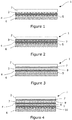
- the multilayer structure (1) comprises successively a wear upper layer (2) made of plastic material, a first adhesive layer (3), a woven reinforcement (4), a second adhesive layer (5), a non-textile layer woven fabric (6) comprising self-extinguishing fibers, said layers being bonded together to form the multilayer structure (1).
- the main functions of the upper plastic wear layer (2) are slip control, wear resistance and ease of cleaning.
- the upper wear layer may optionally be grained or varnished on the surface.
- the upper wear layer (2) may be constituted by a calendered layer or extruded, or even pressed. It can in particular be obtained from plasticized PVC.
- an upper wear layer can be obtained from a composition comprising a polymer, for example PVC or polyurethane, a plasticizer and optionally fillers. , stabilizers, lubricants, additives and pigments.
- the upper wear layer may consist of one or more layers.
- the woven reinforcement (4) can hardly be bonded with a plastic layer or a layer of nonwoven fabric (6) with conventional hot lamination techniques.
- the upper wear layer (2) is hot rolled on the woven reinforcement (4) they do not have good adhesion and delaminate easily.
- the upper wear layer (2) is not directly related to the woven reinforcement (4) without intermediate layer.
- the first and second adhesive layers (3,5) are able to bond the upper wear layer (2) and the woven reinforcement (4) as well as the woven reinforcement and the non-woven fabric layer together. -woven without presenting a risk of delamination.
- the first and / or the second adhesive layer can in particular be made from polyurethane glue.
- the first and / or the second adhesive layer may consist of a hot-melt film such as a copolyamide or thermoplastic polyurethane (TPU) film or a co-polyester film (coPes).
- the woven reinforcement (4) improves the rigidity and dimensional stability of the multilayer structure.
- the woven reinforcement (4) is preferably woven in a plain weave, although twill or satin weave may be used.
- the woven armor (4) is preferably made from glass fibers, polyamide fibers or polyester fibers.
- the glass fibers may in particular have a titration of between 22 Tex and 68 Tex.
- the polyester fibers may in particular have a titration of the order of 1100 decitex.
- the polyamide fibers may in particular have a titration of between 44 decitex and 78 decitex.
- the woven reinforcement (4) generally has a thickness of between 150 ⁇ m and 300 ⁇ m, preferably between 215 ⁇ m and 225 ⁇ m.
- the woven reinforcement (4) generally has a weight per unit area of between 150 and 300 g / m 2, although this value depends on the nature of the fibers used.
- the woven reinforcement (4) advantageously has, especially when made from glass fibers, a number of warp yarns of between 17 and 18 threads per centimeter and a number of weft threads of between 13.5 and 14 threads per centimeter. Below 17 yarns per centimeter or 13.5 threads per centimeter, the woven reinforcement (4) obtained is too porous, especially with a titration between 22 and 68 Tex. Above 18 warp threads per centimeter or 14 weft threads per centimeter, the woven armature is difficult to achieve with conventional production tools, especially with a titration between 22 and 68 Tex.
- the nonwoven fabric layer (6) comprises self-extinguishing fibers so as to improve the fire resistance of the multilayer structure while improving the walking comfort of the flooring.
- the nonwoven fabric layer may in particular comprise fibers selected from polyetherimide, polyester, polyacrylate, aramid, para-aramid, oxidized polyacrylonitrile, aromatic polyamide fibers and mixtures thereof.
- the quantity of each type of fiber can easily be adapted by those skilled in the art to reach an oxygen limit index value greater than 0.21, 0.28 or 0.32 according to the NF EN ISO 4589 standard. -2 / A1, in particular from the oxygen limit index values of each type of fiber used in the production of the nonwoven fabric layer and according to the desired applications.
- the nonwoven fabric layer (6) can be made from a blend of polyester and polyetherimide fibers, a mixture of polyester fibers and aramid fibers, a blend of polyacrylate fibers and aramid fibers, a blend of polyester fibers and aramid fibers, or a blend of oxidized polyacrylonytrile fibers and para-aramid fibers.
- the nonwoven fabric layer (6) can be made by any known means, especially by the dry route, by the melted route, by the wet route or by in situ formation. Known techniques for consolidating the nonwoven textile layer (6) may also be employed, in particular chemical or hydraulic consolidation. Preferably, the nonwoven textile layer (6) is made by dry process comprising a needling consolidation step for binding the fibers together.
- the fibers of the nonwoven textile layer (6) are not partially or totally impregnated with a thermoplastic and / or thermosetting resin in order not to limit their displacement in the layer of nonwoven fabric (6). ) and maintain good flexibility properties.
- the nonwoven textile layer (6) generally has a thickness of between 0.5 mm and 1 cm, preferably between 3 mm and 5 mm. A thickness of less than 3 mm generally decreases the walking comfort of the multilayer structure. A thickness greater than 5mm significantly degrades the puncture resistance of the multilayer structure. In fact, a thickness of the nonwoven textile layer (6) of between 3 mm and 5 mm makes it possible to obtain a good compromise between comfort and resistance to punching.
- the layer of nonwoven fabric (6) advantageously has a weight per unit area of between 50 g / m 2 and 1000 g / m 2 , preferably between 250 g / m 2 and 450 g / m 2 .
- a surface mass greater than 450 g / m 2 can in particular degrade the puncture resistance of the multilayer structure (1).
- a surface density of less than 250g / m 2 can, on the contrary, improve the resistance to punching but degrade the comfort when walking the structure.
- a basis weight of 250 g / m2 and 450g / m2 provides a good compromise between comfort and puncture resistance.
- the multilayer structure (1) comprises successively a wear upper layer (2) made of plastic material, a first adhesive layer (3), a woven reinforcement (4), a second adhesive layer (5), a non-textile layer woven fabric (6) comprising self-extinguishing fibers, said layers being bonded together to form the multilayer structure (1).
- the upper plastic wear layer (2) is bonded to the woven reinforcement (4) via the first adhesive layer (3).
- the woven reinforcement (4) is bonded to the nonwoven fabric layer (6) via a second adhesive layer (5).
- the multilayer structure (1) comprises successively a transparent upper plastic wear layer (2), a printed decorative film (7) disposed between the upper wear layer (2) and the first adhesive layer (3) and visible through the upper layer (2), a first adhesive layer (3), a woven reinforcement (4), a second adhesive layer (5) and a nonwoven fabric layer comprising self-extinguishing fibers, said layers being bonded together to form the multilayer structure (1).
- the printed decorative film (7) is directly printed by any known technique such as gravure printing or digital printing techniques. A wide variety of decorations can be proposed.
- the printed film may in particular be a polymer film made from polyvinyl chloride (PVC), polyethylene terephthalate glycol (PETG) or poly (ethylene terephthalate) (PET), a thickness generally between 0, 2 and 0.5 mm.
- PVC polyvinyl chloride
- PETG polyethylene terephthalate glycol
- PET poly (ethylene terephthalate)
- the printed decorative film (7) can not be hot rolled on the woven reinforcement (4) to bind them.
- the first adhesive layer (3) makes it possible to bond together the printed decorative film (7) and the woven reinforcement (4) without presenting any risk of delamination.
- the multilayer structure (1) successively comprises a transparent top layer of plastics wear (2), a printed decorative film (7) visible through the upper layer (2), a plastic interlayer layer (8) disposed between the printed decorative film layer (7) and a first adhesive layer (3), a woven reinforcement (4), a second adhesive layer (5) and a layer nonwoven fabric comprising self-extinguishing fibers.
- the plastic interlayer (8) makes it possible to reduce the toxicity of the fumes generated by the combustion of the upper wear layer and / or the printed polymer film, especially when these are made from polymer that is not self extinguishing.
- a multilayer structure comprising a thermoplastic polyurethane (TPU) upper wear layer and / or a polyethylene terephthalate glycol (PETG) printed polymer film in combination with an intermediate layer made of polychloride. of vinyl (PVC).
- PVC polychloride. of vinyl
- the presence of the intermediate layer made from PVC makes it possible to limit the propagation of flames and the appearance of toxic fumes during the combustion of the multilayer structure.
- This embodiment makes it possible in particular to obtain a floor covering compliant with the ABD0031 standard.
- the thickness of the intermediate layer is generally between 0.2 mm and 0.5 mm.
- the plastic interlayer (8) can not be hot rolled onto the woven reinforcement (4) to bond them.
- the first adhesive layer (3) makes it possible to bond the plastic interlayer (8) and the woven reinforcement (4) to one another without presenting any risk of delamination.
- the multilayer structure (1) successively comprises a transparent upper plastic wear layer (2), a first adhesive layer (3), a woven armature (4), a second adhesive layer (5), a second woven armature impregnated with a thermosetting polymer (9), a third adhesive layer (10) and a nonwoven fabric layer comprising self-extinguishing fibers (6).
- the second woven reinforcement impregnated with a thermosetting polymer (9) provides the structure (1) with greater rigidity and makes it possible to limit the telegraphing phenomena.
- the thermosetting polymer may in particular be a phenolic resin.
- the third adhesive layer (10) can in particular be made from polyurethane glue or consist of a film thermofusible or a double-sided film, namely a polymeric film having an adhesive on both sides thereof.
- the multilayer structure thus formed can be used as a floor covering in the field of aeronautics, in the form of a roll.
- the flooring obtained also meets the FAR 25.853 standard in terms of resistance to flammability which makes its use possible in aircraft.
- the dimensional stability results according to EN 434 are also very satisfactory.
- the walking comfort of the flooring obtained is very satisfactory, the layer of non-woven fabric giving it good cushioning.
- the invention does provide a multilayer structure for the production of a floor covering, especially for passenger transport vehicles, having good fire resistance properties, while having a very good durability. and good cleaning properties, dimensional stability.
- the invention makes it possible to obtain a floor covering that meets the FAR 25.853 standard.
- the floor covering thus obtained is sufficiently durable to satisfy the abrasion and punching resistance tests according to IS09352 (2012) and NF EN ISO 24343-1 (April 2012).
- a visual test does not detect any appearance of defects on the upper face of the surface layer due to telegraphing roughness of the support.
- a multilayer structure (1) according to the invention is similar to Example 2 with the only difference that the nonwoven textile layer (6) has a basis weight of 250 g / m 2 and 2.7 mm. thickness.
- the nonwoven fabric layer (6) is made from a blend of aramid and polyacrylate fibers. This layer of nonwoven fabric has an oxygen limit index of 33.1% (0.331).
- the flooring thus obtained is sufficiently durable to meet the abrasion and punching resistance tests according to ISO9352 (2012) and NF EN ISO 24343-1 (April 2012).
- a visual test does not detect any appearance of defects on the upper face of the surface layer due to telegraphing roughness of the support.
Landscapes
- Engineering & Computer Science (AREA)
- Textile Engineering (AREA)
- Transportation (AREA)
- Mechanical Engineering (AREA)
- Laminated Bodies (AREA)
Abstract
Description
- La présente invention concerne une structure multicouche pour la réalisation d'un revêtement de sol, notamment pour des véhicules de transport de personnes, par exemple dans le domaine de l'aéronautique.
- Il est courant dans le domaine de l'aéronautique d'utiliser des revêtements de sol tuftés, tel que des moquettes, pour recouvrir les allées et les zones sous les sièges des cabines des avions. Ce type de revêtement comprend généralement un envers réalisé à partir d'un polymère et une couche de surface réalisé à partir de fibre (laine, polyamide,...). Ce revêtement ne donne cependant pas entière satisfaction en terme de durabilité, de confort et de nettoyage. Les revêtements disposés dans les allées sont notamment très sollicités par le passage des chariots. Il est ainsi courant que l'intégralité des moquettes d'une cabine soient déposées pour les remplacer, et ce plusieurs fois par ans. Ceci engendre bien évidemment un surcoût d'exploitation et un temps d'immobilisation de l'appareil important qui n'est pas souhaitable.
- D'autre part, l'aspect esthétique est un facteur de plus en plus important pour les constructeurs et exploitant d'un appareil. L'utilisation de moquettes limite ainsi la variété des décors et couleurs qui peuvent être proposés. Des décors tels que des imitations de bois sont notamment exclus.
- Il est également connu de l'état de la technique, dans le domaine de l'habitat, une structure multicouche comprenant successivement une couche supérieure d'usure transparente composée au moins de polychlorure de vinyle (PVC), un film décor imprimé en PVC et une couche d'envers réalisée par imprégnation d'un plastisol PVC sur un textile non-tissé feutré, le non-tissé étant destiné à être au contact du sol à recouvrir. Ce type de revêtement est couramment utilisé en rénovation de sol carrelés car il permet de réduire le phénomène de « télégraphing », qui se traduit par la transmission des irrégularités du support sur le revêtement de sol. Ce type de revêtement ne peut cependant pas être directement utilisé dans le domaine de l'aéronautique qui impose des normes de résistance au feu, de durabilité, de glissance et de stabilité dimensionnelle très exigeantes.
- L'un des buts de l'invention est donc de proposer une structure multicouche pour la réalisation d'un revêtement de sol, notamment pour des véhicules de transport de personnes, présentant de bonnes propriétés de résistance au feu, tout en présentant une meilleure durabilité que des moquettes et des bonnes propriétés de nettoyage, de stabilité dimensionnelle et de limitation du télégraphing.
- Un des buts de l'invention est notamment de proposer un revêtement de sol pouvant répondre à la norme FAR 25.853.
- Un autre but de l'invention est de proposer une structure multicouche pouvant présenter une grande variété de décors.
- A cet effet, il est proposé une structure multicouche pour la réalisation d'un revêtement de sol d'un véhicule de transport, ladite structure multicouche (1) comprenant successivement une couche supérieure d'usure en matière plastique, une première couche adhésive, une armature tissée, une seconde couche adhésive, une couche de textile non-tissé comprenant des fibres auto-extinguibles, lesdites couches étant liées ensemble pour former la structure multicouche.
- La couche de textile non-tissé comprend des fibres auto-extinguibles de manière à améliorer la résistance au feu de la structure multicouche tout en améliorant le confort à la marche du revêtement de sol. Des fibres auto-extinguibles sont généralement des fibres présentant un indice limite d'oxygène (I.L.O) supérieur à 0,21 selon la norme NF EN ISO 4589-2/A1. Afin de présenter un indice limite d'oxygène supérieur à 0,21, la couche de textile non-tissé peut notamment comprendre des fibres choisies parmi les fibres de polyétherimide, de polyester, de polyacrylate, d'aramide, de para-aramide, de polyacrylonytrile oxydé, de polyamide aromatique et leurs mélanges. La quantité de chaque type de fibre pourra aisément être adaptée par l'homme du métier pour atteindre une valeur d'indice limite d'oxygène supérieure à 0,21, notamment à partir des valeur d'indice limite d'oxygène de chaque type de fibre utilisé dans la réalisation de la couche de textile non-tissé.
- Avantageusement, la couche de textile non-tissé présente un indice limite d'oxygène supérieur à 0,28 selon la norme NF EN ISO 4589-2/A1. Il a été constaté que des meilleurs résultats de résistance au feu de la structure multicouche étaient obtenus avec une couche de textile non-tissé présentant un indice limite d'oxygène supérieur à 0,28 selon la norme NF EN ISO 4589-2/A1. Cette valeur d'indice limite d'oxygène permet notamment d'obtenir un revêtement de sol selon l'invention pouvant répondre à la norme FAR 25.853 en terme de résistance au feu sans toutefois trop augmenter le prix de fabrication du revêtement de sol.
- Avantageusement, la couche de textile non-tissé présente un indice limite d'oxygène supérieur à 0,32 selon la norme NF EN ISO 4589-2/A1. Cette valeur d'indice limite d'oxygène permet notamment d'obtenir un revêtement de sol pouvant répondre à la norme FAR 25.853 en terme de résistance au feu, que la couche supérieure d'usure de la structure multicouche soit réalisée à partir d'un polymère auto-extinguible, tel que le PVC, ou à partir d'un autre polymère pas nécessairement auto-extinguible, tel que le TPU.
- Avantageusement, la couche de textile non-tissé présente un indice limite d'oxygène inférieur à 0,42, préférentiellement inférieur à 0,40 selon la norme NF EN ISO 4589-2/A1. Bien que des valeurs d'indice limite d'oxygène supérieure à 0,40 soient envisageables, les matériaux permettant de les atteindre entrainent généralement un surcout du revêtement de sol. De façon préférentielle, la couche de textile non-tissé présente un indice limite d'oxygène compris entre 0,28 et 0,42 et plus préférentiellement compris entre 0,32 et 0,40 afin d'obtenir un bon compromis entre le coût de fabrication et le comportement au feu du revêtement de sol.
- De façon préférentielle, la couche de textile non-tissé comprend des fibres choisies parmi les fibres de polyétherimide, de polyester, de polyacrylate, d'aramide, de para-aramide, de polyacrylonytrile oxydé, de polyamide aromatique, et leurs mélanges.
- Afin d'améliorer le confort du revêtement de sol tout en conservant de bonnes propriétés de résistance au feu et en limitant les coûts de fabrication, la couche de textile non-tissé peut être réalisée à partir d'un mélange de fibres de polyester et de fibres de polyétherimide, d'un mélange de fibres de polyester et de fibres d'aramide, d'un mélange de fibres de polyacrylate et de fibres d'aramide, d'un mélange de fibres de polyester et de fibres d'aramide, ou d'un mélange de fibres de polyacrylonytrile oxydé et de fibres de para-aramide.
- De façon générale, la couche de textile non-tissé peut être liée à une sous-couche adhésive, afin de faciliter la pose du revêtement de sol. Une sous-couche adhésivée peut notamment présenter une face d'envers enduite d'un adhésif. Une sous-couche adhésivée peut également consister en un film adhésif double face, une face étant liée à la couche de textile non-tissé et l'autre face étant destinée à être en contact avec le sol.
- De façon préférentielle, l'armature tissée est réalisée à partir de fibres de verre, de fibres de polyamide ou de fibres de polyester.
- L'armature tissée améliore la rigidité et la stabilité dimensionnelle de la structure multicouche. L'armature tissée est préférentiellement tissé selon une armure toile, bien qu'une armure sergé ou satin puisse être utilisée. L'armure tissée est de préférence réalisée à partir de fibres de verre, de fibres de polyamide ou de fibres de polyester.
- La première et la seconde couche adhésive permettent de lier entre elles la couche supérieure d'usure et l'armature tissée ainsi que l'armature tissée et la couche de textile non-tissé. La première et/ou la seconde couche adhésive peuvent notamment être réalisées à partir de colle polyuréthane. Alternativement la première et/ou la seconde couche adhésive peuvent consister en un film thermofusible ou un film double face, à savoir un film polymère présentant un adhésif sur ses deux faces.
- De façon avantageuse et afin d'obtenir une structure multicouche présentant des propriétés antistatiques, il peut être envisagé que l'armature tissée soit imprégnée d'un mélange comprenant une matière plastique et du noir de carbone. Enduire l'armature tissée d'un mélange comprenant une matière plastique et du noir de carbone permet de l'imprégner. L'armature tissée peut également être imprégnée par trempage dans une mélange comprenant une matière plastique et du noir de carbone. A titre d'exemple et de manière à obtenir une structure multicouche pouvant satisfaire la norme NF EN 1815 (2016), il est possible d'imprégner l'armature tissée avec un mélange de polyacétate de vinyle (PVAC) et de noir de carbone de manière à obtenir une imprégnation de 10 à 40 grammes dudit mélange par mètre carrés d'armature tissée. La position centrale, entre la couche supérieure d'usure et la couche de textile non-tissée, de l'armature tissée dans la structure multicouche permet de dissiper parfaitement les charges électriques présentes sur la face supérieure de la couche supérieure d'usure dans toute la surface de la structure multicouche.
- De façon avantageuse, l'armature tissée est imprégnée d'un polymère thermoplastique ou thermodurcissable. Afin d'obtenir une structure multicouche présentant une plus grande rigidité et de limiter les phénomènes de télégraphing, il peut être envisagé que l'armature tissée soit imprégnée d'un polymère thermodurcissable. Le polymère thermodurcissable ou thermoplastique peut notamment être choisi dans le groupe comprenant la résine polyester, la résine phénolique, la résine époxy, le polysulfone, la résine vinylester, la résine époxy-acrylique, et leurs mélanges.
- La couche supérieure d'usure apporte au revêtement de sol des propriétés de résistance à l'encrassement et de durabilité. La couche supérieure d'usure est par exemple réalisée en polychlorure de vinyle ou en polyuréthane et présente généralement une épaisseur comprise entre 0,15 et 1 mm, préférentiellement entre 0,35 et 0,60 mm. La couche d'usure peut être réalisée par tout moyen connu, notamment par calandrage ou par extrusion au travers d'une filière plate.
- Selon l'invention, la couche supérieure d'usure est de préférence transparente à la lumière visible de manière à ce que le décor d'un film imprimé lié en envers de la couche d'usure puisse être visible au travers de la couche supérieure d'usure.
- Ainsi, de façon avantageuse, la structure multicouche peut comprendre une couche de film décor imprimé disposée entre la couche supérieure d'usure et la première couche adhésive.
- Le film décor est directement imprimé par toute technique connue telle que l'héliogravure ou des techniques d'impression numérique. Une grande variété de décors peut ainsi être proposée. Des solutions d'impression numérique permettent notamment d'obtenir un décor très réaliste. Le film imprimé peut notamment être un film polymère. De façon alternative, un décor peut être directement imprimé en envers de la couche supérieure d'usure transparente.
- De façon préférentielle, la structure multicouche comprend une ou plusieurs couches intercalaires en matière plastique disposées entre la couche de film décor imprimé et la première couche adhésive.
- La ou les couche(s) intercalaire(s) permettent de diminuer la toxicité des fumées engendrées par la combustion de la couche de surface et/ou du film polymère imprimé, notamment lorsque ceux-ci sont réalisés à partir de polymères n'étant pas auto extinguibles.
- De façon préférentielle, la structure multicouche comprend entre la seconde couche adhésive et la couche de textile non-tissé comprenant des fibres auto-extinguibles une seconde armature tissée imprégnée d'un polymère thermodurcissable liée par une troisième couche adhésive. La seconde armature tissée imprégnée d'un polymère thermodurcissable apporte à la structure une plus grande rigidité et permet de limiter les phénomènes de télégraphing. Le polymère thermodurcissable peut notamment être une résine phénolique. La troisième couche adhésive peut notamment être réalisée à partir de colle polyuréthane ou consister en un film thermofusible ou un film double face, à savoir un film polymère présentant un adhésif sur ses deux faces.
- D'autres avantages et caractéristiques ressortiront mieux de la description qui va suivre, donnée à titre d'exemple non limitatif, de la structure multicouche selon l'invention, à partir des dessins annexés dans lesquels :
- la
figure 1 est une représentation schématique et en coupe transversale d'un premier exemple de réalisation de la structure multicouche selon l'invention ; - la
figure 2 est une représentation schématique similaire à celle de lafigure 1 , illustrant un second mode de réalisation de la structure multicouche selon l'invention ; - la
figure 3 est une représentation schématique similaire à celle de lafigure 1 , illustrant un troisième mode de réalisation de la structure multicouche selon l'invention ; - la
figure 4 est une représentation schématique similaire à celle de lafigure 1 , illustrant un quatrième mode de réalisation de la structure multicouche selon l'invention ; - L'invention concerne une structure multicouche (1) pour la réalisation d'un revêtement de sol notamment pour des véhicules de transport de personnes, par exemple dans le domaine de l'aéronautique. La structure multicouche (1) selon l'invention présente de bonnes propriétés de résistance au feu, une meilleure durabilité que des moquettes et des bonnes propriétés de nettoyage, de stabilité dimensionnelle et de limitation du télégraphing.
- La structure multicouche (1) selon l'invention peut se présenter sous toute forme, notamment en panneau, en dalle, et de préférence en rouleau.
- En référence aux
figures 1 à 4 , la structure multicouche (1) comprend successivement une couche supérieure d'usure (2) en matière plastique, une première couche adhésive (3), une armature tissée (4), une seconde couche adhésive (5), une couche de textile non-tissé (6) comprenant des fibres auto-extinguibles, lesdites couches étant liées ensemble pour former la structure multicouche (1). Les fonctions principales de la couche supérieure d'usure en matière plastique (2) sont la maîtrise de la glissance, la résistance à l'usure et la facilité de nettoyage. La couche supérieure d'usure peut éventuellement être grainée ou vernie en surface. - La couche supérieure d'usure (2) peut être constituée par une couche calandrée ou extrudée, voire pressée. Elle peut notamment être obtenue à partir de PVC plastifié. De façon générale et d'une manière bien connue de l'homme du métier, une couche supérieure d'usure peut être obtenue à partir d'une composition comprenant un polymère, par exemple du PVC ou du polyuréthane, un plastifiant et éventuellement des charges, des stabilisants, des lubrifiants, des additifs et des pigments. La couche supérieure d'usure peut être constituée d'une ou plusieurs couches.
- L'armature tissée (4) peut difficilement être liée avec une couche en matière plastique ou une couche de textile non-tissé (6) avec des techniques classiques de lamination à chaud. Notamment, si la couche supérieure d'usure (2) est laminée à chaud sur l'armature tissée (4) celles-ci ne présentent pas une bonne adhérence et se délaminent facilement. Ainsi la couche supérieure d'usure (2) n'est pas directement liée à l'armature tissée (4) sans couche intermédiaire. De ce fait, la première et la seconde couche adhésive (3,5) permettent de lier entre elles la couche supérieure d'usure (2) et l'armature tissée (4) ainsi que l'armature tissée et la couche de textile non-tissé sans présenter de risque de délamination. La première et/ou la seconde couche adhésive peuvent notamment être réalisées à partir de colle polyuréthane. Alternativement la première et/ou la seconde couche adhésive peuvent consister en un film thermofusible tel qu'un film copolyamide ou polyuréthane thermoplastique (TPU) ou encore un film co-polyester (coPes).
- L'armature tissée (4) améliore la rigidité et la stabilité dimensionnelle de la structure multicouche. L'armature tissée (4) est préférentiellement tissée selon une armure toile, bien qu'une armure sergé ou satin puisse être utilisée. L'armure tissée (4) est de préférence réalisée à partir de fibres de verre, de fibres de polyamide ou de fibres de polyester. Les fibres de verre peuvent notamment présenter un titrage compris entre 22 Tex et 68 Tex. Les fibres de polyester peuvent notamment présenter un titrage de l'ordre de 1100 décitex. Les fibres de polyamide peuvent notamment présenter un titrage compris entre 44 décitex et 78 décitex.
- L'armature tissée (4) présente généralement une épaisseur comprise entre 150 µm et 300 µm, préférentiellement entre 215 µm et 225 µm. L'armature tissée (4) présente généralement une masse surfacique comprise entre 150 et 300 g/m2 bien que cette valeur dépende de la nature des fibres utilisées.
- L'armature tissée (4) présente avantageusement, notamment lorsqu'elle est réalisée à partir de fibres de verre, un nombre de fils de chaîne compris entre 17 et 18 fils par centimètres et un nombre de fils de trame compris entre 13,5 et 14 fils par centimètres. En dessous de 17 fils de chaîne par centimètres ou de 13,5 fils de trame par centimètres, l'armature tissée (4) obtenue est trop poreuse, notamment avec un titrage compris entre 22 et 68 Tex. Au-dessus de 18 fils de chaîne par centimètres ou de 14 fils de trame par centimètres, l'armature tissée est difficilement réalisable avec des outils de production classiques, notamment avec un titrage compris entre 22 et 68 Tex.
- La couche de textile non-tissé (6) comprend des fibres auto-extinguibles de manière à améliorer la résistance au feu de la structure multicouche tout en améliorant le confort à la marche du revêtement de sol. La couche de textile non-tissé peut notamment comprendre des fibres choisies parmi les fibres de polyétherimide, de polyester, de polyacrylate, d'aramide, de para-aramide, de polyacrylonytrile oxydé, de polyamide aromatique et leurs mélanges. La quantité de chaque type de fibre pourra aisément être adaptée par l'homme du métier pour atteindre une valeur d'indice limite d'oxygène supérieure à 0,21, à 0,28 ou à 0,32 selon la norme NF EN ISO 4589-2/A1, notamment à partir des valeur d'indice limite d'oxygène de chaque type de fibre utilisé dans la réalisation de la couche de textile non-tissé et en fonction des applications souhaitées.
- Afin d'améliorer le confort du revêtement de sol tout en conservant de bonnes propriétés de résistance au feu et en limitant les coûts de fabrication, la couche de textile non-tissé (6) peut être réalisée à partir d'un mélange de fibres de polyester et de fibres de polyétherimide, d'un mélange de fibres de polyester et de fibres d'aramide, d'un mélange de fibres de polyacrylate et de fibres d'aramide, d'un mélange de fibres de polyester et de fibres d'aramide, ou d'un mélange de fibres de polyacrylonytrile oxydé et de fibres de para-aramide.
- La couche de textile non-tissé (6) peut être réalisée par tous moyens connus, notamment par voie sèche, par voie fondue, par voie humide ou encore par formation in situ. Des techniques connues de consolidation de la couche de textile non-tissé (6) peuvent également être employées, notamment la consolidation chimique ou hydraulique. De façon préférentielle, la couche de textile non-tissé (6) est réalisée par voie sèche comprenant une étape de consolidation par aiguilletage permettant de lier les fibres entre elles.
- De façon préférentielle, les fibres de la couche de textile non-tissé (6) ne sont pas partiellement voire totalement imprégnées d'une résine thermoplastique et/ou thermodurcissable afin de ne pas limiter leur déplacement dans la couche de textile non-tissé (6) et de conserver de bonnes propriétés de souplesse.
- La couche de textile non-tissé (6) présente généralement une épaisseur comprise entre 0,5 mm et 1 cm, préférentiellement entre 3 mm et 5 mm. Une épaisseur inférieure à 3 mm diminue généralement le confort à la marche de la structure multicouche. Une épaisseur supérieure à 5mm dégrade significativement la résistance au poinçonnement de la structure multicouche. De fait, une épaisseur de la couche de textile non-tissé (6) comprise entre 3 mm et 5 mm permet d'obtenir un bon compromis entre le confort et la résistance au poinçonnement.
- La couche de textile non-tissé (6) présente avantageusement une masse surfacique comprise entre 50 g/m2 et 1000 g/m2, préférentiellement entre 250 g/m2 et 450g/m2. Une masse surfacique supérieure à 450g/m2 peut notamment dégrader la résistance au poinçonnement de la structure multicouche (1). Une masse surfacique inférieure à 250g/m2 peut au contraire améliorer la résistance au poinçonnement mais dégrader le confort à la marche de la structure. De fait, une masse surfacique comprise entre 250 g/m2 et 450g/m2, permet d'obtenir un bon compromis entre le confort et la résistance au poinçonnement.
- Selon une première forme de réalisation illustrée à la
figure 1 , la structure multicouche (1) comprend successivement une couche supérieure d'usure (2) en matière plastique, une première couche adhésive (3), une armature tissée (4), une seconde couche adhésive (5), une couche de textile non-tissé (6) comprenant des fibres auto-extinguibles, lesdites couches étant liées ensemble pour former la structure multicouche (1). La couche supérieure d'usure en matière plastique (2) est liée à l'armature tissée (4) par l'intermédiaire de la première couche adhésive (3). L'armature tissée (4) est liée la couche de textile non-tissé (6) par l'intermédiaire d'une seconde couche adhésive (5). - Selon une deuxième forme de réalisation illustrée à la
figure 2 , la structure multicouche (1) comprend successivement une couche supérieure d'usure transparente en matière plastique (2), un film décor imprimé (7) disposée entre la couche supérieure d'usure (2) et la première couche adhésive (3) et visible au travers de la couche supérieure (2), une première couche adhésive (3), une armature tissée (4), une seconde couche adhésive (5) et une couche de textile non-tissé comprenant des fibres auto-extinguibles, lesdites couches étant liées ensemble pour former la structure multicouche (1). - Le film décor imprimé (7) est directement imprimé par toute technique connue telle que l'héliogravure ou des techniques d'impression numérique. Une grande variété de décors peuvent ainsi être proposés. Le film imprimé peut notamment être un film polymère réalisé à partir de polychlorure de vinyle (PVC), de polyéthylène-térephtalate-glycol (PETG) ou encore de poly(éthylène téréphtalate) (PET), d'une épaisseur généralement comprise entre 0,2 et 0,5 mm. Le film décor imprimé (7) et la couche supérieure d'usure (2) sont liés par tout moyen connu tel que la lamination à chaud.
- Dans ce mode de réalisation le film décor imprimé (7) ne peut pas être laminé à chaud sur l'armature tissée (4) pour les lier. De fait, la première couche adhésive (3) permet de lier entre eux le film décor imprimé (7) et l'armature tissée (4) sans présenter de risque de délamination.
- Selon une troisième forme de réalisation illustrée à la
figure 3 , la structure multicouche (1) comprend successivement une couche supérieure d'usure transparente en matière plastique (2), un film décor imprimé (7) visible au travers de la couche supérieure (2), une couche intercalaire en matière plastique (8) disposée entre la couche de film décor imprimé (7) et une première couche adhésive (3), une armature tissée (4), une seconde couche adhésive (5) et une couche de textile non-tissé comprenant des fibres auto-extinguibles. - La couche intercalaire en matière plastique (8) permet de diminuer la toxicité des fumées engendrées par la combustion de la couche supérieure d'usure et/ou du film polymère imprimé, notamment lorsque ceux-ci sont réalisés à partir de polymère n'étant pas auto extinguibles. Il est par exemple possible de réaliser une structure multicouche comprenant une couche supérieure d'usure en polyuréthane thermoplastique (TPU) et/ou un film polymère imprimé en polyéthylène-térephtalate-glycol (PETG) en association avec une couche intercalaire réalisée à partir de polychlorure de vinyle (PVC). La présence de la couche intercalaire réalisée à partir de PVC permet de limiter la propagation de flammes et l'apparition de fumées toxiques lors de la combustion de la structure multicouche. Ce mode de réalisation permet notamment d'obtenir un revêtement de sol conforme à la norme ABD0031. L'épaisseur de la couche intercalaire est généralement comprise entre 0,2 mm et 0,5 mm.
- Dans ce mode de réalisation la couche intercalaire en matière plastique (8) ne peut pas être laminé à chaud sur l'armature tissée (4) pour les lier. De fait, la première couche adhésive (3) permet de lier entre eux la couche intercalaire en matière plastique (8) et l'armature tissée (4) sans présenter de risque de délamination.
- Selon une quatrième forme de réalisation illustrée à la
figure 4 , la structure multicouche (1) comprend successivement une couche supérieure d'usure transparente en matière plastique (2), une première couche adhésive (3), une armature tissée (4), une seconde couche adhésive (5), une seconde armature tissée imprégnée d'un polymère thermodurcissable (9), une troisième couche adhésive (10) et une couche de textile non-tissé comprenant des fibres auto-extinguibles (6). La seconde armature tissée imprégnée d'un polymère thermodurcissable (9) apporte à la structure (1) une plus grande rigidité et permet de limiter les phénomènes de télégraphing. Le polymère thermodurcissable peut notamment être une résine phénolique. La troisième couche adhésive (10) peut notamment être réalisée à partir de colle polyuréthane ou consister en un film thermofusible ou un film double face, à savoir un film polymère présentant un adhésif sur ses deux faces. - Il est réalisée une structure multicouche (1) selon l'invention et telle que décrite selon la
figure 2 . - Cette structure multicouche (1) comprend successivement :
- une couche supérieure d'usure (2) transparente en PVC calandrée de 0,45 mm d'épaisseur
- Un film décor imprimé (7) en PVC de 0,3 mm d'épaisseur. Le film décor est imprimé en impression numérique puis complexé à la couche supérieure d'usure par un procédé de lamination à chaud
- Une première couche de colle polyuréthane (3) de 35g/m2
- Une armature tissé (4) en fibres de verre de 68 Tex. L'armature présente une armure toile, une masse surfacique de 219 g/m2, une épaisseur de 0,2 mm, 17,4 fils de chaîne par centimètre et 13,8 fils de trame par centimètre
- Une seconde couche de colle polyuréthane (5) de 90g/m2
- Une couche de textile non-tissé (6) de 300g/m2 et de 3 mm d'épaisseur. La couche de textile non-tissé est réalisée à partir d'un mélange de fibres de polyétherimide et de fibres de polyester. Cette couche de textile non-tissé est commercialisée par la société National Nonwoven selon la dénomiation commerciale KushnBlok® Composite Cushioning Felt (CCF).
- La structure multicouche ainsi formée peut être utilisée en tant que revêtement de sol dans le domaine de l'aéronautique, se présentant sous forme de rouleau.
- Différents tests sont effectués sur le revêtement de sol ainsi obtenu. Les résultats de ces test sont présentés dans le tableau 1.
Tableau 1 Test Norme Valeur Résistance à l'abrasion ISO9352 (2012) 143 ± 3 mg Résistance à l'indentation - poinçonnement NF EN ISO 24343-1 (avril 2012) 0,4 mm Résistance à l'inflammabilité Durée de combustion FAR 25.853 4 ± 1 s Longueur brulée 80 ± 10 mm Durée de combustion des gouttes 0 s Glissance FAR 25.793 Coefficient de friction dynamique sur cuir sec MIL-W-5044C 0.55 ± 0.01 Poids ISO 2286 (2016) 1533 ± 12 g/m2 Epaisseur ISO 2286 (2016) 4,52 ± 0,08 mm Stabilité dimensionnelle L ISO 23999 (2012) 0,10 ± 0,03 % Stabilité dimensionnelle T ISO 23999 (2012) 0,10 ± 0,04 % - Il ressort des résultats de ces tests que le revêtement de sol selon l'invention est suffisamment durable pour satisfaire les tests de résistance à l'abrasion et au poinçonnement selon l'ISO9352 (2012) et la NF EN ISO 24343-1 (avril 2012) . D'autre part, un test visuel ne constate pas d'apparition de défauts sur la face supérieure de la couche de surface dus au télégraphing d'aspérités du support.
- Le revêtement de sol obtenu satisfait également la norme FAR 25.853 en terme de résistance à l'inflammabilité ce qui rend son utilisation possible dans des avions.
- Les résultats de stabilité dimensionnelle selon la norme EN 434 sont également très satisfaisants. Le confort à la marche du revêtement de sol obtenu est très satisfaisant, la couche de textile non-tissé lui conférant un bon amorti.
- Il ressort de ce qui précède que l'invention fournit bien une structure multicouche pour la réalisation d'un revêtement de sol, notamment pour des véhicules de transport de personnes, présentant de bonnes propriétés de résistance au feu, tout en présentant une très bonne durabilité et des bonnes propriétés de nettoyage, de stabilité dimensionnelle. L'invention permet notamment l'obtention d'un revêtement de sol répondant à la norme FAR 25.853.
- Il est réalisée une structure multicouche (1) selon l'invention similaire à l'exemple 1.
- Cette structure multicouche (1) comprend successivement :
- une couche supérieure d'usure (2) transparente en PVC calandrée de 0,45 mm d'épaisseur
- Un film décor imprimé (7) en PVC de 0,3 mm d'épaisseur. Le film décor est imprimé en impression numérique puis complexé à la couche supérieure d'usure par un procédé de lamination à chaud
- Une première couche de colle polyuréthane (3) de 35g/m2
- Une armature tissé (4) en fibres de verre de 68 Tex. L'armature présente une armure toile, une masse surfacique de 219 g/m2, une épaisseur de 0,2 mm, 17,4 fils de chaîne par centimètre et 13,8 fils de trame par centimètre
- Une seconde couche de colle polyuréthane (5) de 90g/m2
- Une couche de textile non-tissé (6) de 300g/m2 et de 3,2 mm d'épaisseur. La couche de textile non-tissé est réalisée à partir d'un mélange de fibres de polyétherimide et de fibres de polyester. Cette couche de textile non-tissé présente un indice limite d'oxygène de 41,3% (0,413).
- Le revêtement de sol ainsi obtenu est suffisamment durable pour satisfaire les tests de résistance à l'abrasion et au poinçonnement selon l'IS09352 (2012) et la NF EN ISO 24343-1 (avril 2012) . D'autre part, un test visuel ne constate pas d'apparition de défauts sur la face supérieure de la couche de surface dus au télégraphing d'aspérités du support.
- Celui-ci satisfait également la norme FAR 25.853 en terme de résistance à l'inflammabilité ce qui rend son utilisation possible dans des avions.
- Les résultats de stabilité dimensionnelle selon la norme EN 434 ainsi que le confort à la marche du revêtement de sol obtenu est très satisfaisant, la couche de textile non-tissé lui conférant un bon amorti.
- Il est réalisée une structure multicouche (1) selon l'invention similaire à l'exemple 2 à la seule différence que la couche de textile non-tissé (6) présente une masse surfacique de 250g/m2 et 2,7 mm d'épaisseur. La couche de textile non-tissé (6) est réalisée à partir d'un mélange de fibres d'aramide et de polyacrylate. Cette couche de textile non-tissé présente un indice limite d'oxygène de 33,1% (0,331).
- Le revêtement de sol ainsi obtenu est suffisamment durable pour satisfaire les tests de résistance à l'abrasion et au poinçonnement selon l'ISO9352 (2012) et la NF EN ISO 24343-1 (avril 2012) . D'autre part, un test visuel ne constate pas d'apparition de défauts sur la face supérieure de la couche de surface dus au télégraphing d'aspérités du support.
- Celui-ci satisfait également la norme FAR 25.853 en terme de résistance à l'inflammabilité ce qui rend son utilisation possible dans des avions.
- Les résultats de stabilité dimensionnelle selon la norme EN 434 ainsi que le confort à la marche du revêtement de sol obtenu est très satisfaisant, la couche de textile non-tissé lui conférant un bon amorti.
Claims (10)
- Structure multicouche (1) pour la réalisation d'un revêtement de sol d'un véhicule de transport, ladite structure multicouche (1) comprenant successivement une couche supérieure d'usure (2) en matière plastique, une première couche adhésive (3), une armature tissée (4), une seconde couche adhésive (5), une couche de textile non-tissé (6) comprenant des fibres auto-extinguibles, lesdites couches étant liées ensemble pour former la structure multicouche (1).
- Structure multicouche (1) selon la revendication 1, caractérisée en ce que la couche de textile non-tissé (6) présente un indice limite d'oxygène supérieur à 0,28 selon la norme NF EN ISO 4589-2/A1.
- Structure multicouche (1) selon la revendication 2, caractérisée en ce que la couche de textile non-tissé (6) présente un indice limite d'oxygène supérieur à 0,32 selon la norme NF EN ISO 4589-2/A1.
- Structure multicouche (1) selon la revendication 1, caractérisée en ce que la couche de textile non-tissé (6) comprend des fibres choisies parmi les fibres de polyétherimide, de polyester, de polyacrylate, d'aramide, de para-aramide, de polyacrylonytrile oxydé, de polyamide aromatique, et leurs mélanges.
- Structure multicouche (1) selon la revendication 4, caractérisée en ce que la couche de textile non-tissé (6) est réalisée à partir d'un mélange de fibres de polyester et de fibres de polyétherimide, d'un mélange de fibres de polyester et de fibres d'aramide, d'un mélange de fibres de polyacrylate et de fibres d'aramide, d'un mélange de fibres de polyester et de fibres d'aramide, ou d'un mélange de fibres de polyacrylonytrile oxydé et de fibres de para-aramide.
- Structure multicouche (1) selon la revendication 1, caractérisée en ce que l'armature tissée (4) est réalisée à partir de fibres de verre, de fibres de polyamide ou de fibres de polyester.
- Structure multicouche (1) selon la revendication 1, caractérisée en ce qu'elle comprend une couche de film décor imprimé (7) disposée entre la couche supérieure d'usure (2) et la première couche adhésive (3).
- Structure multicouche (1) selon la revendication 7, caractérisée en ce qu'elle comprend une couche intercalaire (8) en matière plastique, disposée entre la couche de film décor imprimé (7) et la première couche adhésive (3).
- Structure multicouche (1) selon la revendication 1, caractérisée en ce que l'armature tissée (4) est imprégnée d'un polymère thermoplastique ou thermodurcissable.
- Structure multicouche (1) selon la revendication 9, caractérisée en ce que l'armature tissée (4) est imprégnée d'un mélange comprenant une matière plastique et du noir de carbone.
Applications Claiming Priority (1)
| Application Number | Priority Date | Filing Date | Title |
|---|---|---|---|
| FR1851723A FR3078285B1 (fr) | 2018-02-27 | 2018-02-27 | Structure multicouche pour la realisation d'un revetement de sol |
Publications (2)
| Publication Number | Publication Date |
|---|---|
| EP3530451A1 true EP3530451A1 (fr) | 2019-08-28 |
| EP3530451B1 EP3530451B1 (fr) | 2021-05-12 |
Family
ID=62873429
Family Applications (1)
| Application Number | Title | Priority Date | Filing Date |
|---|---|---|---|
| EP19158027.3A Active EP3530451B1 (fr) | 2018-02-27 | 2019-02-19 | Structure multicouche pour la realisation d'un revetement de sol |
Country Status (3)
| Country | Link |
|---|---|
| US (1) | US20190263307A1 (fr) |
| EP (1) | EP3530451B1 (fr) |
| FR (1) | FR3078285B1 (fr) |
Cited By (3)
| Publication number | Priority date | Publication date | Assignee | Title |
|---|---|---|---|---|
| EP4311664A1 (fr) * | 2022-07-29 | 2024-01-31 | Gerflor | Structure multicouche pour la realisation d'un revetement de sol renforce et recyclable |
| FR3138348A1 (fr) * | 2022-07-29 | 2024-02-02 | Gerflor | Structure multicouche pour la réalisation d’un revêtement de sol renforcé et recyclable |
| EP4491385A1 (fr) * | 2023-07-11 | 2025-01-15 | Gerflor | Structure multicouche pour la realisation d'un revetement de sol renforce et recyclable |
Families Citing this family (2)
| Publication number | Priority date | Publication date | Assignee | Title |
|---|---|---|---|---|
| CN113677530A (zh) * | 2019-03-15 | 2021-11-19 | 龙喜陆工业株式会社 | 地板装饰材料 |
| PL4000916T3 (pl) * | 2020-11-13 | 2026-04-27 | Unilin, Bv | Wykładzina podłogowa i sposób jej wytwarzania |
Citations (3)
| Publication number | Priority date | Publication date | Assignee | Title |
|---|---|---|---|---|
| EP0314244A2 (fr) * | 1987-10-28 | 1989-05-03 | The Dow Chemical Company | Structures contenant des fibres carbonées retardant la flamme et antifeu, et procédés pour leur fabrication |
| JP2881354B2 (ja) * | 1992-03-16 | 1999-04-12 | ユニチカ株式会社 | 鉄道路床用不織布 |
| EP2754373A1 (fr) * | 2012-11-08 | 2014-07-16 | Yoshidafusa Orimono Co., Ltd. | Corps plan retardateur de flamme, revêtement de sol textile présentant une résistance à la génération de gaz dangereux utilisant ledit corps plan retardateur de flamme, et procédé de production dudit revêtement de sol textile présentant une résistance à la génération de gaz dangereux |
Family Cites Families (11)
| Publication number | Priority date | Publication date | Assignee | Title |
|---|---|---|---|---|
| US4018957A (en) * | 1975-04-01 | 1977-04-19 | Gaf Corporation | Coated fabric sheet-type material having resilient backing and process for making same |
| IT8254080U1 (it) * | 1982-12-17 | 1984-06-17 | Cobra Spa | Tappeto di cloruro di polivinile con disegno a stampa per interni di autoveicoli |
| DE4041470A1 (de) * | 1990-12-22 | 1992-06-25 | Bayer Ag | Intumeszenzfaehige flaechengebilde, deren herstellung und deren verwendung |
| US6670291B1 (en) * | 2000-10-18 | 2003-12-30 | 3M Innovative Properties Company | Laminate sheet material for fire barrier applications |
| JP4292823B2 (ja) * | 2003-02-19 | 2009-07-08 | 凸版印刷株式会社 | 化粧シート |
| US9190045B2 (en) * | 2012-06-20 | 2015-11-17 | Hyundai Motor Company | Noise-absorbent fabric for vehicle and method for manufacturing the same |
| EP2939828A1 (fr) * | 2014-04-29 | 2015-11-04 | Autoneum Management AG | Pièce d'habillage extérieur |
| US20150360438A1 (en) * | 2014-06-13 | 2015-12-17 | Specialty Coating & Laminating, Llc | Laminate floor liner |
| KR102143642B1 (ko) * | 2015-02-20 | 2020-08-11 | 쇼 인더스트리즈 그룹, 인코포레이티드 | 탄성 바닥재 제품 및 이의 제조 방법 |
| FR3033282B1 (fr) * | 2015-03-06 | 2017-03-24 | Gerflor | Revetement de sol multicouche |
| CN109863276B (zh) * | 2016-09-23 | 2021-11-12 | 肖氏工业集团公司 | 弹性地板产品及其制造方法 |
-
2018
- 2018-02-27 FR FR1851723A patent/FR3078285B1/fr active Active
-
2019
- 2019-02-19 EP EP19158027.3A patent/EP3530451B1/fr active Active
- 2019-02-25 US US16/284,833 patent/US20190263307A1/en active Pending
Patent Citations (3)
| Publication number | Priority date | Publication date | Assignee | Title |
|---|---|---|---|---|
| EP0314244A2 (fr) * | 1987-10-28 | 1989-05-03 | The Dow Chemical Company | Structures contenant des fibres carbonées retardant la flamme et antifeu, et procédés pour leur fabrication |
| JP2881354B2 (ja) * | 1992-03-16 | 1999-04-12 | ユニチカ株式会社 | 鉄道路床用不織布 |
| EP2754373A1 (fr) * | 2012-11-08 | 2014-07-16 | Yoshidafusa Orimono Co., Ltd. | Corps plan retardateur de flamme, revêtement de sol textile présentant une résistance à la génération de gaz dangereux utilisant ledit corps plan retardateur de flamme, et procédé de production dudit revêtement de sol textile présentant une résistance à la génération de gaz dangereux |
Cited By (4)
| Publication number | Priority date | Publication date | Assignee | Title |
|---|---|---|---|---|
| EP4311664A1 (fr) * | 2022-07-29 | 2024-01-31 | Gerflor | Structure multicouche pour la realisation d'un revetement de sol renforce et recyclable |
| FR3138348A1 (fr) * | 2022-07-29 | 2024-02-02 | Gerflor | Structure multicouche pour la réalisation d’un revêtement de sol renforcé et recyclable |
| EP4491385A1 (fr) * | 2023-07-11 | 2025-01-15 | Gerflor | Structure multicouche pour la realisation d'un revetement de sol renforce et recyclable |
| FR3150984A1 (fr) * | 2023-07-11 | 2025-01-17 | Gerflor | Structure multicouche pour la réalisation d’un revêtement de sol renforcé et recyclable |
Also Published As
| Publication number | Publication date |
|---|---|
| EP3530451B1 (fr) | 2021-05-12 |
| FR3078285A1 (fr) | 2019-08-30 |
| FR3078285B1 (fr) | 2023-09-08 |
| US20190263307A1 (en) | 2019-08-29 |
Similar Documents
| Publication | Publication Date | Title |
|---|---|---|
| EP3530451B1 (fr) | Structure multicouche pour la realisation d'un revetement de sol | |
| EP2748812B2 (fr) | Ensemble d'insonorisation, notamment pour un véhicule automobile | |
| EP3254848B1 (fr) | Revetement de sol comprenant un decor imprime par jet d'encre | |
| FR3073539A1 (fr) | Panneau rigide pour la realisation d'un revetement de sol | |
| EP3064347B1 (fr) | Revêtement de sol multicouche | |
| US20170001414A1 (en) | Polyurethane based rigid flooring laminate | |
| EP3883766A1 (fr) | Structure multicouche pour la realisation d'un revetement de sol, et procede de fabrication d'une telle structure multicouche | |
| EP3827145B1 (fr) | Panneau acoustique pour la réalisation d'un revêtement de sol | |
| EP4143022B1 (fr) | Revetêment de sol à couche d'usure ignifugée | |
| CN104302472A (zh) | 多层表面覆盖物 | |
| ES2944282T3 (es) | Alfombrilla no tejida obtenida por vía húmeda de doble capa | |
| EP3571361A1 (fr) | Panneau acoustique pour la realisation d'un revetement de sol | |
| EP4617060A2 (fr) | Structure multicouche pour la réalisation d'un revêtement de sol | |
| EP3495136B1 (fr) | Structure multicouche pour la realisation d'un revetement de sol economique, et procede de fabrication d'une telle structure multicouche | |
| EP3845376B1 (fr) | Revetement de sol a envers textile a resistance au poinçonnement et a propriete d'attenuation acoustique ameliorees | |
| EP4491385B1 (fr) | Structure multicouche pour la realisation d'un revetement de sol renforce et recyclable | |
| EP4311664A1 (fr) | Structure multicouche pour la realisation d'un revetement de sol renforce et recyclable | |
| US11976473B2 (en) | Multilayer structure for producing a printed and linoleum-based floor or wall covering | |
| EP0976869B1 (fr) | Revêtement de sol notamment pour automobiles et procédé pour son obtention | |
| EP1424193A1 (fr) | Revêtement de sol souple et procédé de fabrication d'un tel revêtement de sol | |
| CA2451458C (fr) | Feuille de materiau synthetique pour la stabilisation de revetements | |
| FR3138348A1 (fr) | Structure multicouche pour la réalisation d’un revêtement de sol renforcé et recyclable | |
| FR3144048A1 (fr) | Structure multicouche pour la réalisation d’un revêtement de sol | |
| JP2021154934A (ja) | ガラスラン用摺動テープ材 |
Legal Events
| Date | Code | Title | Description |
|---|---|---|---|
| PUAI | Public reference made under article 153(3) epc to a published international application that has entered the european phase |
Free format text: ORIGINAL CODE: 0009012 |
|
| STAA | Information on the status of an ep patent application or granted ep patent |
Free format text: STATUS: THE APPLICATION HAS BEEN PUBLISHED |
|
| AK | Designated contracting states |
Kind code of ref document: A1 Designated state(s): AL AT BE BG CH CY CZ DE DK EE ES FI FR GB GR HR HU IE IS IT LI LT LU LV MC MK MT NL NO PL PT RO RS SE SI SK SM TR |
|
| AX | Request for extension of the european patent |
Extension state: BA ME |
|
| STAA | Information on the status of an ep patent application or granted ep patent |
Free format text: STATUS: REQUEST FOR EXAMINATION WAS MADE |
|
| 17P | Request for examination filed |
Effective date: 20191231 |
|
| RBV | Designated contracting states (corrected) |
Designated state(s): AL AT BE BG CH CY CZ DE DK EE ES FI FR GB GR HR HU IE IS IT LI LT LU LV MC MK MT NL NO PL PT RO RS SE SI SK SM TR |
|
| GRAP | Despatch of communication of intention to grant a patent |
Free format text: ORIGINAL CODE: EPIDOSNIGR1 |
|
| STAA | Information on the status of an ep patent application or granted ep patent |
Free format text: STATUS: GRANT OF PATENT IS INTENDED |
|
| INTG | Intention to grant announced |
Effective date: 20210219 |
|
| GRAS | Grant fee paid |
Free format text: ORIGINAL CODE: EPIDOSNIGR3 |
|
| GRAA | (expected) grant |
Free format text: ORIGINAL CODE: 0009210 |
|
| STAA | Information on the status of an ep patent application or granted ep patent |
Free format text: STATUS: THE PATENT HAS BEEN GRANTED |
|
| AK | Designated contracting states |
Kind code of ref document: B1 Designated state(s): AL AT BE BG CH CY CZ DE DK EE ES FI FR GB GR HR HU IE IS IT LI LT LU LV MC MK MT NL NO PL PT RO RS SE SI SK SM TR |
|
| REG | Reference to a national code |
Ref country code: GB Ref legal event code: FG4D Free format text: NOT ENGLISH |
|
| REG | Reference to a national code |
Ref country code: CH Ref legal event code: EP |
|
| REG | Reference to a national code |
Ref country code: NL Ref legal event code: FP |
|
| REG | Reference to a national code |
Ref country code: DE Ref legal event code: R096 Ref document number: 602019004518 Country of ref document: DE |
|
| REG | Reference to a national code |
Ref country code: IE Ref legal event code: FG4D Free format text: LANGUAGE OF EP DOCUMENT: FRENCH |
|
| REG | Reference to a national code |
Ref country code: AT Ref legal event code: REF Ref document number: 1391909 Country of ref document: AT Kind code of ref document: T Effective date: 20210615 |
|
| REG | Reference to a national code |
Ref country code: LT Ref legal event code: MG9D |
|
| REG | Reference to a national code |
Ref country code: AT Ref legal event code: MK05 Ref document number: 1391909 Country of ref document: AT Kind code of ref document: T Effective date: 20210512 |
|
| PG25 | Lapsed in a contracting state [announced via postgrant information from national office to epo] |
Ref country code: BG Free format text: LAPSE BECAUSE OF FAILURE TO SUBMIT A TRANSLATION OF THE DESCRIPTION OR TO PAY THE FEE WITHIN THE PRESCRIBED TIME-LIMIT Effective date: 20210812 Ref country code: AT Free format text: LAPSE BECAUSE OF FAILURE TO SUBMIT A TRANSLATION OF THE DESCRIPTION OR TO PAY THE FEE WITHIN THE PRESCRIBED TIME-LIMIT Effective date: 20210512 Ref country code: FI Free format text: LAPSE BECAUSE OF FAILURE TO SUBMIT A TRANSLATION OF THE DESCRIPTION OR TO PAY THE FEE WITHIN THE PRESCRIBED TIME-LIMIT Effective date: 20210512 Ref country code: HR Free format text: LAPSE BECAUSE OF FAILURE TO SUBMIT A TRANSLATION OF THE DESCRIPTION OR TO PAY THE FEE WITHIN THE PRESCRIBED TIME-LIMIT Effective date: 20210512 Ref country code: LT Free format text: LAPSE BECAUSE OF FAILURE TO SUBMIT A TRANSLATION OF THE DESCRIPTION OR TO PAY THE FEE WITHIN THE PRESCRIBED TIME-LIMIT Effective date: 20210512 |
|
| PG25 | Lapsed in a contracting state [announced via postgrant information from national office to epo] |
Ref country code: GR Free format text: LAPSE BECAUSE OF FAILURE TO SUBMIT A TRANSLATION OF THE DESCRIPTION OR TO PAY THE FEE WITHIN THE PRESCRIBED TIME-LIMIT Effective date: 20210813 Ref country code: IS Free format text: LAPSE BECAUSE OF FAILURE TO SUBMIT A TRANSLATION OF THE DESCRIPTION OR TO PAY THE FEE WITHIN THE PRESCRIBED TIME-LIMIT Effective date: 20210912 Ref country code: LV Free format text: LAPSE BECAUSE OF FAILURE TO SUBMIT A TRANSLATION OF THE DESCRIPTION OR TO PAY THE FEE WITHIN THE PRESCRIBED TIME-LIMIT Effective date: 20210512 Ref country code: NO Free format text: LAPSE BECAUSE OF FAILURE TO SUBMIT A TRANSLATION OF THE DESCRIPTION OR TO PAY THE FEE WITHIN THE PRESCRIBED TIME-LIMIT Effective date: 20210812 Ref country code: PL Free format text: LAPSE BECAUSE OF FAILURE TO SUBMIT A TRANSLATION OF THE DESCRIPTION OR TO PAY THE FEE WITHIN THE PRESCRIBED TIME-LIMIT Effective date: 20210512 Ref country code: RS Free format text: LAPSE BECAUSE OF FAILURE TO SUBMIT A TRANSLATION OF THE DESCRIPTION OR TO PAY THE FEE WITHIN THE PRESCRIBED TIME-LIMIT Effective date: 20210512 Ref country code: SE Free format text: LAPSE BECAUSE OF FAILURE TO SUBMIT A TRANSLATION OF THE DESCRIPTION OR TO PAY THE FEE WITHIN THE PRESCRIBED TIME-LIMIT Effective date: 20210512 Ref country code: PT Free format text: LAPSE BECAUSE OF FAILURE TO SUBMIT A TRANSLATION OF THE DESCRIPTION OR TO PAY THE FEE WITHIN THE PRESCRIBED TIME-LIMIT Effective date: 20210913 |
|
| PG25 | Lapsed in a contracting state [announced via postgrant information from national office to epo] |
Ref country code: SK Free format text: LAPSE BECAUSE OF FAILURE TO SUBMIT A TRANSLATION OF THE DESCRIPTION OR TO PAY THE FEE WITHIN THE PRESCRIBED TIME-LIMIT Effective date: 20210512 Ref country code: ES Free format text: LAPSE BECAUSE OF FAILURE TO SUBMIT A TRANSLATION OF THE DESCRIPTION OR TO PAY THE FEE WITHIN THE PRESCRIBED TIME-LIMIT Effective date: 20210512 Ref country code: EE Free format text: LAPSE BECAUSE OF FAILURE TO SUBMIT A TRANSLATION OF THE DESCRIPTION OR TO PAY THE FEE WITHIN THE PRESCRIBED TIME-LIMIT Effective date: 20210512 Ref country code: SM Free format text: LAPSE BECAUSE OF FAILURE TO SUBMIT A TRANSLATION OF THE DESCRIPTION OR TO PAY THE FEE WITHIN THE PRESCRIBED TIME-LIMIT Effective date: 20210512 Ref country code: RO Free format text: LAPSE BECAUSE OF FAILURE TO SUBMIT A TRANSLATION OF THE DESCRIPTION OR TO PAY THE FEE WITHIN THE PRESCRIBED TIME-LIMIT Effective date: 20210512 Ref country code: CZ Free format text: LAPSE BECAUSE OF FAILURE TO SUBMIT A TRANSLATION OF THE DESCRIPTION OR TO PAY THE FEE WITHIN THE PRESCRIBED TIME-LIMIT Effective date: 20210512 Ref country code: DK Free format text: LAPSE BECAUSE OF FAILURE TO SUBMIT A TRANSLATION OF THE DESCRIPTION OR TO PAY THE FEE WITHIN THE PRESCRIBED TIME-LIMIT Effective date: 20210512 |
|
| REG | Reference to a national code |
Ref country code: DE Ref legal event code: R097 Ref document number: 602019004518 Country of ref document: DE |
|
| PLBE | No opposition filed within time limit |
Free format text: ORIGINAL CODE: 0009261 |
|
| STAA | Information on the status of an ep patent application or granted ep patent |
Free format text: STATUS: NO OPPOSITION FILED WITHIN TIME LIMIT |
|
| 26N | No opposition filed |
Effective date: 20220215 |
|
| PG25 | Lapsed in a contracting state [announced via postgrant information from national office to epo] |
Ref country code: IS Free format text: LAPSE BECAUSE OF FAILURE TO SUBMIT A TRANSLATION OF THE DESCRIPTION OR TO PAY THE FEE WITHIN THE PRESCRIBED TIME-LIMIT Effective date: 20210912 Ref country code: AL Free format text: LAPSE BECAUSE OF FAILURE TO SUBMIT A TRANSLATION OF THE DESCRIPTION OR TO PAY THE FEE WITHIN THE PRESCRIBED TIME-LIMIT Effective date: 20210512 |
|
| PG25 | Lapsed in a contracting state [announced via postgrant information from national office to epo] |
Ref country code: IT Free format text: LAPSE BECAUSE OF FAILURE TO SUBMIT A TRANSLATION OF THE DESCRIPTION OR TO PAY THE FEE WITHIN THE PRESCRIBED TIME-LIMIT Effective date: 20210512 |
|
| PG25 | Lapsed in a contracting state [announced via postgrant information from national office to epo] |
Ref country code: MC Free format text: LAPSE BECAUSE OF FAILURE TO SUBMIT A TRANSLATION OF THE DESCRIPTION OR TO PAY THE FEE WITHIN THE PRESCRIBED TIME-LIMIT Effective date: 20210512 |
|
| REG | Reference to a national code |
Ref country code: CH Ref legal event code: PL |
|
| REG | Reference to a national code |
Ref country code: BE Ref legal event code: MM Effective date: 20220228 |
|
| PG25 | Lapsed in a contracting state [announced via postgrant information from national office to epo] |
Ref country code: LU Free format text: LAPSE BECAUSE OF NON-PAYMENT OF DUE FEES Effective date: 20220219 |
|
| PG25 | Lapsed in a contracting state [announced via postgrant information from national office to epo] |
Ref country code: LI Free format text: LAPSE BECAUSE OF NON-PAYMENT OF DUE FEES Effective date: 20220228 Ref country code: IE Free format text: LAPSE BECAUSE OF NON-PAYMENT OF DUE FEES Effective date: 20220219 Ref country code: CH Free format text: LAPSE BECAUSE OF NON-PAYMENT OF DUE FEES Effective date: 20220228 |
|
| PG25 | Lapsed in a contracting state [announced via postgrant information from national office to epo] |
Ref country code: BE Free format text: LAPSE BECAUSE OF NON-PAYMENT OF DUE FEES Effective date: 20220228 |
|
| P01 | Opt-out of the competence of the unified patent court (upc) registered |
Effective date: 20230527 |
|
| PG25 | Lapsed in a contracting state [announced via postgrant information from national office to epo] |
Ref country code: MK Free format text: LAPSE BECAUSE OF FAILURE TO SUBMIT A TRANSLATION OF THE DESCRIPTION OR TO PAY THE FEE WITHIN THE PRESCRIBED TIME-LIMIT Effective date: 20210512 Ref country code: CY Free format text: LAPSE BECAUSE OF FAILURE TO SUBMIT A TRANSLATION OF THE DESCRIPTION OR TO PAY THE FEE WITHIN THE PRESCRIBED TIME-LIMIT Effective date: 20210512 |
|
| PG25 | Lapsed in a contracting state [announced via postgrant information from national office to epo] |
Ref country code: HU Free format text: LAPSE BECAUSE OF FAILURE TO SUBMIT A TRANSLATION OF THE DESCRIPTION OR TO PAY THE FEE WITHIN THE PRESCRIBED TIME-LIMIT; INVALID AB INITIO Effective date: 20190219 |
|
| PG25 | Lapsed in a contracting state [announced via postgrant information from national office to epo] |
Ref country code: TR Free format text: LAPSE BECAUSE OF FAILURE TO SUBMIT A TRANSLATION OF THE DESCRIPTION OR TO PAY THE FEE WITHIN THE PRESCRIBED TIME-LIMIT Effective date: 20210512 |
|
| PG25 | Lapsed in a contracting state [announced via postgrant information from national office to epo] |
Ref country code: MT Free format text: LAPSE BECAUSE OF FAILURE TO SUBMIT A TRANSLATION OF THE DESCRIPTION OR TO PAY THE FEE WITHIN THE PRESCRIBED TIME-LIMIT Effective date: 20210512 |
|
| PGFP | Annual fee paid to national office [announced via postgrant information from national office to epo] |
Ref country code: NL Payment date: 20260127 Year of fee payment: 8 |
|
| PGFP | Annual fee paid to national office [announced via postgrant information from national office to epo] |
Ref country code: GB Payment date: 20260219 Year of fee payment: 8 |
|
| PGFP | Annual fee paid to national office [announced via postgrant information from national office to epo] |
Ref country code: DE Payment date: 20260206 Year of fee payment: 8 |
|
| PGFP | Annual fee paid to national office [announced via postgrant information from national office to epo] |
Ref country code: FR Payment date: 20260227 Year of fee payment: 8 |