EP3530184A1 - Automatische identifizierung mehrerer aktivierungspfade - Google Patents
Automatische identifizierung mehrerer aktivierungspfade Download PDFInfo
- Publication number
- EP3530184A1 EP3530184A1 EP19158628.8A EP19158628A EP3530184A1 EP 3530184 A1 EP3530184 A1 EP 3530184A1 EP 19158628 A EP19158628 A EP 19158628A EP 3530184 A1 EP3530184 A1 EP 3530184A1
- Authority
- EP
- European Patent Office
- Prior art keywords
- points
- mesh
- lats
- pathway
- graph
- Prior art date
- Legal status (The legal status is an assumption and is not a legal conclusion. Google has not performed a legal analysis and makes no representation as to the accuracy of the status listed.)
- Granted
Links
Images

Classifications
-
- A—HUMAN NECESSITIES
- A61—MEDICAL OR VETERINARY SCIENCE; HYGIENE
- A61B—DIAGNOSIS; SURGERY; IDENTIFICATION
- A61B5/00—Measuring for diagnostic purposes; Identification of persons
- A61B5/24—Detecting, measuring or recording bioelectric or biomagnetic signals of the body or parts thereof
- A61B5/316—Modalities, i.e. specific diagnostic methods
- A61B5/318—Heart-related electrical modalities, e.g. electrocardiography [ECG]
- A61B5/346—Analysis of electrocardiograms
- A61B5/349—Detecting specific parameters of the electrocardiograph cycle
- A61B5/366—Detecting abnormal QRS complex, e.g. widening
-
- A—HUMAN NECESSITIES
- A61—MEDICAL OR VETERINARY SCIENCE; HYGIENE
- A61B—DIAGNOSIS; SURGERY; IDENTIFICATION
- A61B5/00—Measuring for diagnostic purposes; Identification of persons
- A61B5/24—Detecting, measuring or recording bioelectric or biomagnetic signals of the body or parts thereof
- A61B5/316—Modalities, i.e. specific diagnostic methods
-
- A—HUMAN NECESSITIES
- A61—MEDICAL OR VETERINARY SCIENCE; HYGIENE
- A61B—DIAGNOSIS; SURGERY; IDENTIFICATION
- A61B5/00—Measuring for diagnostic purposes; Identification of persons
- A61B5/24—Detecting, measuring or recording bioelectric or biomagnetic signals of the body or parts thereof
- A61B5/316—Modalities, i.e. specific diagnostic methods
- A61B5/318—Heart-related electrical modalities, e.g. electrocardiography [ECG]
-
- A—HUMAN NECESSITIES
- A61—MEDICAL OR VETERINARY SCIENCE; HYGIENE
- A61B—DIAGNOSIS; SURGERY; IDENTIFICATION
- A61B5/00—Measuring for diagnostic purposes; Identification of persons
- A61B5/24—Detecting, measuring or recording bioelectric or biomagnetic signals of the body or parts thereof
- A61B5/316—Modalities, i.e. specific diagnostic methods
- A61B5/318—Heart-related electrical modalities, e.g. electrocardiography [ECG]
- A61B5/339—Displays specially adapted therefor
-
- A—HUMAN NECESSITIES
- A61—MEDICAL OR VETERINARY SCIENCE; HYGIENE
- A61B—DIAGNOSIS; SURGERY; IDENTIFICATION
- A61B5/00—Measuring for diagnostic purposes; Identification of persons
- A61B5/72—Signal processing specially adapted for physiological signals or for diagnostic purposes
-
- G—PHYSICS
- G16—INFORMATION AND COMMUNICATION TECHNOLOGY [ICT] SPECIALLY ADAPTED FOR SPECIFIC APPLICATION FIELDS
- G16H—HEALTHCARE INFORMATICS, i.e. INFORMATION AND COMMUNICATION TECHNOLOGY [ICT] SPECIALLY ADAPTED FOR THE HANDLING OR PROCESSING OF MEDICAL OR HEALTHCARE DATA
- G16H30/00—ICT specially adapted for the handling or processing of medical images
- G16H30/20—ICT specially adapted for the handling or processing of medical images for handling medical images, e.g. DICOM, HL7 or PACS
-
- G—PHYSICS
- G16—INFORMATION AND COMMUNICATION TECHNOLOGY [ICT] SPECIALLY ADAPTED FOR SPECIFIC APPLICATION FIELDS
- G16H—HEALTHCARE INFORMATICS, i.e. INFORMATION AND COMMUNICATION TECHNOLOGY [ICT] SPECIALLY ADAPTED FOR THE HANDLING OR PROCESSING OF MEDICAL OR HEALTHCARE DATA
- G16H50/00—ICT specially adapted for medical diagnosis, medical simulation or medical data mining; ICT specially adapted for detecting, monitoring or modelling epidemics or pandemics
- G16H50/50—ICT specially adapted for medical diagnosis, medical simulation or medical data mining; ICT specially adapted for detecting, monitoring or modelling epidemics or pandemics for simulation or modelling of medical disorders
-
- A—HUMAN NECESSITIES
- A61—MEDICAL OR VETERINARY SCIENCE; HYGIENE
- A61B—DIAGNOSIS; SURGERY; IDENTIFICATION
- A61B5/00—Measuring for diagnostic purposes; Identification of persons
- A61B5/05—Detecting, measuring or recording for diagnosis by means of electric currents or magnetic fields; Measuring using microwaves or radio waves
- A61B5/053—Measuring electrical impedance or conductance of a portion of the body
- A61B5/0538—Measuring electrical impedance or conductance of a portion of the body invasively, e.g. using a catheter
-
- G—PHYSICS
- G16—INFORMATION AND COMMUNICATION TECHNOLOGY [ICT] SPECIALLY ADAPTED FOR SPECIFIC APPLICATION FIELDS
- G16H—HEALTHCARE INFORMATICS, i.e. INFORMATION AND COMMUNICATION TECHNOLOGY [ICT] SPECIALLY ADAPTED FOR THE HANDLING OR PROCESSING OF MEDICAL OR HEALTHCARE DATA
- G16H50/00—ICT specially adapted for medical diagnosis, medical simulation or medical data mining; ICT specially adapted for detecting, monitoring or modelling epidemics or pandemics
- G16H50/20—ICT specially adapted for medical diagnosis, medical simulation or medical data mining; ICT specially adapted for detecting, monitoring or modelling epidemics or pandemics for computer-aided diagnosis, e.g. based on medical expert systems
Definitions
- the present invention relates to the field of electrophysiology, and particularly to the identification and treatment of cardiac arrhythmias.
- a local activation time of a particular area of the heart is the time at which the wavefront of electrical propagation passes through the area.
- a local activation time is typically measured from a particular reference time, such as a particular point in time in the QRS complex of a body-surface electrocardiogram (ECG) recording.
- ECG body-surface electrocardiogram
- cardiac arrhythmia Some types of cardiac arrhythmia are caused by the electrical activation of cardiac tissue over two or more separate activation pathways having different respective rates of propagation.
- an apparatus that includes a display and a processor.
- the processor is configured to construct a computerized electroanatomical model of a portion of a heart, the model including a mesh, which approximates the portion of the heart, and a plurality of points, at different respective locations on the mesh, having respective associated local activation times (LATs) that were ascertained from electrocardiographic signals acquired from the portion.
- LATs local activation times
- the processor is further configured to identify, based on the respective locations of the points, a plurality of pairs of neighboring ones of the points, and to construct a graph that interconnects each of the identified pairs and is weighted by a plurality of first weights derived at least in part from the respective locations and LATs of the points, such that each interconnected pair has a respective first weight.
- the processor is further configured to identify a first pathway through the graph, from a first one of the points having a lowest one of the LATs to a second one of the points having a highest one of the LATs, that minimizes a first sum of the first weights over multiple pathways from the first point to the second point.
- the processor is further configured to reweight the graph by a plurality of second weights derived at least in part from the respective locations and LATs of the points, such that each interconnected pair has a respective second weight, identify a second pathway through the graph, from the first point to the second point, that minimizes a second sum of the second weights over the pathways, and display the mesh on the display, with the identified first pathway and second pathway superimposed over the mesh.
- each of the first weight and the second weight is derived from (i) a distance between the interconnected pair, and (ii) a difference between the respective LATs of the interconnected pair.
- the distance is a geodesic distance with respect to a surface of the mesh.
- the first weight is a quotient of the distance and the difference
- the second weight is an inverse of the first weight
- the processor is configured to identify the pairs of neighboring points by:
- the processor is configured to partition the mesh by computing a Voronoi tesselation of the mesh with respect to the points.
- a method that includes constructing a computerized electroanatomical model of a portion of a heart, the model including a mesh, which approximates the portion of the heart, and a plurality of points, at different respective locations on the mesh, having respective associated local activation times (LATs) that were ascertained from electrocardiographic signals acquired from the portion.
- the method further includes, based on the respective locations of the points, identifying a plurality of pairs of neighboring ones of the points, and constructing a graph that interconnects each of the identified pairs and is weighted by a plurality of first weights derived at least in part from the respective locations and LATs of the points, such that each interconnected pair has a respective first weight.
- the method further includes identifying a first pathway through the graph, from a first one of the points having a lowest one of the LATs to a second one of the points having a highest one of the LATs, that minimizes a first sum of the first weights over multiple pathways from the first point to the second point.
- the method further includes reweighting the graph by a plurality of second weights derived at least in part from the respective locations and LATs of the points, such that each interconnected pair has a respective second weight, identifying a second pathway through the graph, from the first point to the second point, that minimizes a second sum of the second weights over the pathways, and displaying the mesh, with the identified first pathway and second pathway superimposed over the mesh.
- a computer software product including a tangible non-transitory computer-readable medium in which program instructions are stored.
- the instructions when read by a processor, cause the processor to construct a computerized electroanatomical model of a portion of a heart, the model including a mesh, which approximates the portion of the heart, and a plurality of points, at different respective locations on the mesh, having respective associated local activation times (LATs) that were ascertained from electrocardiographic signals acquired from the portion.
- LATs local activation times
- the instructions further cause the processor to identify, based on the respective locations of the points, a plurality of pairs of neighboring ones of the points, and construct a graph that interconnects each of the identified pairs and is weighted by a plurality of first weights derived at least in part from the respective locations and LATs of the points, such that each interconnected pair has a respective first weight.
- the instructions further cause the processor to identify a first pathway through the graph, from a first one of the points having a lowest one of the LATs to a second one of the points having a highest one of the LATs, that minimizes a first sum of the first weights over multiple pathways from the first point to the second point.
- the instructions further cause the processor to reweight the graph by a plurality of second weights derived at least in part from the respective locations and LATs of the points, such that each interconnected pair has a respective second weight, identify a second pathway through the graph, from the first point to the second point, that minimizes a second sum of the second weights over the pathways, and display the mesh, with the identified first pathway and second pathway superimposed over the mesh.
- a method that includes constructing a computerized electroanatomical model of a portion of a heart, the model including a mesh, which approximates the portion of the heart, and a plurality of points, at different respective locations on the mesh, having respective associated local activation times (LATs) that were ascertained from electrocardiographic signals acquired from the portion.
- the method further includes constructing a graph that interconnects the points.
- the method further includes, based on the respective locations and LATs of the points, identifying, from a plurality of pathways, through the graph, from a first one of the points having a lowest one of the LATs to a second one of the points having a highest one of the LATs, both a shortest pathway and a longest pathway, and displaying the mesh, with the identified shortest pathway and longest pathway superimposed over the mesh.
- one or more electrodes disposed at the distal end of a catheter, are used to acquire intracardiac electrocardiographic (ECG) signals from cardiac tissue, such as myocardial tissue, of a subject.
- ECG intracardiac electrocardiographic
- a processor may ascertain the local activation time (LAT) at various points on the tissue.
- LAT local activation time
- the processor may then construct, and display, an electroanatomical map of the tissue, which includes an anatomical map of the relevant portion of the heart, annotated to indicate the ascertained LAT values.
- the processor may project each point at which an LAT was acquired onto a mesh that models the relevant portion of the heart, and then color the mesh in accordance with the LATs.
- embodiments of the present invention provide techniques for automatically identifying one or more activation pathways on an electroanatomical map.
- the processor may first identify the point having the lowest LAT value, referred to hereinbelow as the "start point,” along with the point having the highest LAT value, referred to hereinbelow as the "end point.”
- the processor may then compute both the fastest (i.e., longest) and slowest (i.e., shortest) propagation pathway from the start point to the end point.
- the processor may annotate the electroanatomical map to display both of the pathways.
- the fastest and slowest pathways will be identical, or at least relatively close to one another.
- the two pathways may be relatively different.
- the physician may more readily diagnose, and treat, the subject. For example, the physician may decide to ablate some of the tissue over which the slowest pathway passes.
- the processor first partitions the mesh surface into a plurality of regions, such that each region of the mesh surface contains a different respective one of the LAT points. For example, the processor may construct a Voronoi tesselation of the mesh surface, based on the points at which the LATs were acquired. The processor then identifies the neighboring LAT points of each given LAT point, by identifying those regions that border the region of the given LAT point. Subsequently, the processor constructs a graph that connects each of the LAT points to each of its neighbors, and then finds the slowest and fastest pathways that traverse the graph from the start point to the end point.
- the processor may weight each edge of the graph (with, possibly, a few exceptions, as further described below with reference to Fig. 3A ) by the implied velocity between the two LAT points that are interconnected by the edge.
- This implied velocity may be defined, for example, as the quotient of the geodesic distance between the points and the difference between the respective LATs of the points.
- the processor may then find the path through the graph, from the start point to the end point, that minimizes the sum of the weights of the edges.
- the processor may weight each edge (with, possibly, a few exceptions) by the inverse of the implied velocity, and then minimize the sum of the weights.
- embodiments described herein do not, typically, interpolate the LAT points, or partition the mesh into a number of regions that is greater than the number of LAT points. As a result, the computation of the activation pathways is relatively fast.
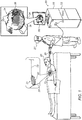
- FIG. 1 is a schematic illustration of an electroanatomical mapping procedure, in accordance with some embodiments of the present invention.
- Fig. 1 depicts a physician 27 performing an electroanatomical mapping procedure on a subject 25, using a catheter 29.
- the distal end 31 of catheter 29 comprises a plurality of electrodes 32.
- physician 27 By navigating catheter 29 within the heart 23 of the subject, physician 27 causes electrodes 32 to contact, and acquire intracardiac ECG signals from, a portion 30 of the heart (including, for example, a myocardial or epicardial surface of the heart), at a plurality of different locations.
- the ECG signals are received by a processor (PROC) 22.
- PROC processor
- Catheter 29 further comprises one or more position sensors (not shown), which continually output signals indicating the position and orientation of the catheter. Based on these signals, processor 22 ascertains the position of each of the electrodes, and hence, the anatomical location from which each ECG signal was acquired. Processor 22 further processes the ECG signals, such as to ascertain the LATs indicated by these signals. Using the ascertained LATs, along with a mesh 34 that approximates portion 30, the processor constructs a computerized electroanatomical model (or "map") 24 of portion 30.
- a computerized electroanatomical model or "map"
- the processor may use any suitable technique to track the electrodes.
- catheter 29 may comprise one or more electromagnetic position sensors, which, in the presence of an external magnetic field, generate signals that vary with the positions of the sensors. Based on these signals, the processor may ascertain the electrodes' respective locations.
- processor 22 may ascertain the respective impedances between the electrode and a plurality of external electrodes coupled to subject 25 at various different locations, and then compute the ratios between these impedances, these ratios being indicative of the electrode's location.
- the processor may use both electromagnetic tracking and impedance-based tracking, as described, for example, in US Patent 8,456,182 , whose disclosure is incorporated herein by reference.
- processor 22 displays model 24 on a display 26.
- the processor annotates mesh 34 to indicate the ascertained LATs.
- the processor may color mesh 34 in accordance with a color scale, such that varying LAT values are mapped to different respective colors, as indicated by the various hatch patterns in Fig. 1 .
- the processor further superimposes, on mesh 34, both a fastest activation pathway 36 and a slowest activation pathway 38, which may be identified as described in detail below with reference to the subsequent figures.
- the surface of mesh 34 corresponds to the (convex) epicardial surface of the heart, rather than the (concave) myocardial surface, such that the information in model 24 may be more easily displayed.
- processor 22 resides within a console 28, which is coupled to catheter 29 via an electrical interface 35, such as a port or socket.
- electrical interface 35 such as a port or socket.
- the ECG signals from the electrodes, along with the position signals from the position sensors, are received, by processor 22, via electrical interface 35.
- processor 22 may be embodied as a single processor, or a cooperatively networked or clustered set of processors.
- Processor 22 is typically a programmed digital computing device configured to implement the functionality described herein in hardware, software, or any suitable combination of hardware and software elements.
- ASIC application-specific integrated circuit
- FPGA field-programmable gate array
- GPU graphics processing unit
- the processor may comprise a central processing unit (CPU), random access memory (RAM), nonvolatile secondary storage, such as a hard drive or CD ROM drive, network interfaces, and/or peripheral devices.
- Program code including software programs, and/or data are loaded into the RAM for execution and processing by the CPU and results are generated for display, output, transmittal, or storage, as is known in the art.
- the program code and/or data may be downloaded to the computer in electronic form, over a network, for example, or it may, alternatively or additionally, be provided and/or stored on non-transitory tangible media, such as magnetic, optical, or electronic memory.
- Such program code and/or data when provided to the processor, produce a machine or special-purpose computer, configured to perform the tasks described herein.
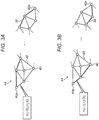
- Fig. 2 and to Figs. 3A-B , which collectively illustrate, schematically, a method for identifying activation pathways, in accordance with some embodiments of the present invention.
- Fig. 2 shows the construction of model 24.
- the processor first builds mesh 34, based on an anatomical mapping procedure performed in advance of the procedure described above with reference to Fig. 1 .
- mesh 34 is a triangular mesh, comprising a plurality of connected triangles that collectively approximate (or "model") the relevant portion of the heart.
- the processor also acquires a point cloud 39 of LAT points 40, by processing any intracardiac ECG signals received from electrodes 32, as described above with reference to Fig. 1 .
- Each such point 40 has an associated three-dimensional coordinate "(x,y,z)" that describes the location of the point, and an associated LAT "t,” which is the LAT acquired at coordinate (x,y,z).
- LAT LAT acquired at coordinate (x,y,z).
- point cloud 39 typically includes at least several hundred points.
- the processor projects point cloud 39 onto mesh 34, such that each point 40 is mapped to the appropriate location on mesh 34.
- the processor also identifies the point 40 having the smallest LAT, referred to hereinbelow as the "start point,” along with the point 40 having the largest LAT, referred to hereinbelow as the "end point.”
- the anatomical mapping of the relevant portion of the subject's heart is performed concurrently with the acquisition of points 40, such that points 40 are already defined in the coordinate system of mesh 34, and a projection of points 40 may, therefore, not be necessary.
- the processor identifies, based on the LATs and on the respective locations of points 40 on the mesh, both a slowest activation pathway and a fastest activation pathway.
- the slowest activation pathway passes from the start point to the end point with a minimum velocity, relative to the other activation pathways that pass from the start point to the end point; hence, the slowest activation pathway is also the shortest activation pathway.
- the fastest activation pathway passes from the start point to the end point with a maximum velocity, relative to the other activation pathways; hence, the fastest activation pathway is also the longest activation pathway.
- the processor first constructs a weighted graph 44, in which points 40 are interconnected by a plurality of edges 48 having respective weights that are derived, at least in part, from the respective locations and LATs of the points. (In other words, at least some of the weights are derived from the respective locations and LATs of at least some of the points.)
- the processor then optimizes a function of the weights over all of the legitimate pathways, through the graph, that connect the start point to the end point. (A legitimate pathway is any pathway along which the LAT is strictly increasing.)
- the processor first identifies each pair of neighboring LAT points. Subsequently, for each of the identified pairs of neighboring points (40 i , 40 j ) having respective LATs (t i , t j ), where t j > t i , the processor computes a weight w ij . The processor then constructs graph 44, such that graph 44 interconnects each of the identified pairs with the weight that was computed for the pair. In other words, the processor constructs graph 44 such that each edge 48 connecting any given pair of neighboring points has the weight that was computed for the pair.
- the weight for the pair is derived from the distance D ij between the pair and the difference t j - t i between the respective LATs of the pair.
- the processor may calculate the weight between 40 i and 40 j as D ij /(t j - t i ), i.e., the velocity between the points that is implied by the respective locations and LATs of the points.
- the processor may calculate the weight as (t j - t i )/D ij , i.e., the inverse of the implied velocity.
- the distance D ij between the pair of neighboring points, which is used for calculating w ij is the geodesic distance, with respect to the surface of mesh 34, between the pair of points.
- the processor may use any suitable method, such as the fast marching method, which is described in Sethian, James A., "A fast marching level set method for monotonically advancing fronts," Proceedings of the National Academy of Sciences 93.4 (1996): 1591-1595 , which is incorporated herein by reference.
- the processor partitions mesh 34 into a plurality of partitions 42, such that each of partitions 42 contains a different respective one of LAT points 40.
- Partitions 42 may alternatively be referred to as "cells" or "regions."
- the processor may compute a Voronoi tesselation of the mesh with respect to the LAT points, such that every point within any given partition 42 is closer to the LAT point that is contained within the partition than to any other LAT point.
- the processor identifies each pair of neighboring LAT points in response to the pair being contained in any two of the partitions that border one another along a common border 46. In other words, the processor identifies each pair of partitions that border one another, and then identifies, as neighbors, the LAT points that are contained, respectively, within these two partitions.
- Fig. 3A shows the identification of slowest activation pathway 38 between a start point 40s and an end point 40e, using graph 44. (The identified pathway is indicated by the thickened edges of graph 44.)
- the processor computes the weight w ij for most, or all, pairs of neighboring points (40 i , 40 j ) as the implied velocity between the two points, i.e., the quotient of D ij and t j - t i . Subsequently, the processor minimizes the sum of the computed weights over multiple pathways that connect start point 40s to end point 40e.
- the processor finds the connected sequence of edges 48 that connects start point 40s to end point 40e and has a minimum sum of weights, relative to other connected sequences of edges connecting start point 40s to end point 40e.
- the processor may use any suitable algorithm, such as Dijksta's algorithm or the fast marching method.
- the processor may set the respective weights for one or more edges to infinity, to prevent any pathway from passing over these edges, in response to these edges passing through non-conductive tissue.
- Fig. 3B shows the identification of the fastest activation pathway 36 between start point 40s and end point 40e.
- the processor computes the weight for most, or all, pairs of neighboring points as the inverse of the implied velocity between the points.
- the processor may enforce a maximum inverse velocity, and/or set one or more weights to infinity.
- the processor minimizes the sum of the computed weights over multiple pathways that connect start point 40s to end point 40e, using Dijksta's algorithm, the fast marching method, or any other suitable algorithm. (It is noted that a single execution of fast marching may be used for both computing the geodesic distances between the points, and finding the fastest or slowest activation pathway.)
- the processor does not need to reconstruct graph 44 to identify the other activation pathway. Rather, the processor may simply compute the necessary weights, reweight the graph by the new weights, and then minimize the sum of the new weights as described above.
- each edge in graph 44 has a single weight, which quantifies the velocity, or inverse thereof, in moving from the lower-LAT point to the higher-LAT point.
- the weight-sum-minimizing algorithm considers only legitimate pathways, along which the LAT is strictly increasing.
- illegitimate pathways may be avoided by assigning two weights to each edge: a first weight w ij , which, as described above, is associated with moving from the lower-LAT point 40 i to the higher-LAT point 40 j , and a second weight w ji , which is infinite.
- any pathway that proceeds from 40 j to 40 i will perforce not be selected by the weight-sum-minimizing algorithm, due to having an infinite sum of weights.
- the processor displays the mesh that approximates the relevant cardiac anatomy, with the identified pathways superimposed over the mesh.
- the processor may identify and display any other suitable activation pathway, by choosing appropriate weights for graph 44.
Landscapes
- Health & Medical Sciences (AREA)
- Life Sciences & Earth Sciences (AREA)
- Engineering & Computer Science (AREA)
- Public Health (AREA)
- Medical Informatics (AREA)
- General Health & Medical Sciences (AREA)
- Biomedical Technology (AREA)
- Pathology (AREA)
- Heart & Thoracic Surgery (AREA)
- Biophysics (AREA)
- Molecular Biology (AREA)
- Surgery (AREA)
- Animal Behavior & Ethology (AREA)
- Physics & Mathematics (AREA)
- Veterinary Medicine (AREA)
- Cardiology (AREA)
- Primary Health Care (AREA)
- Epidemiology (AREA)
- Radiology & Medical Imaging (AREA)
- Nuclear Medicine, Radiotherapy & Molecular Imaging (AREA)
- Computer Vision & Pattern Recognition (AREA)
- Databases & Information Systems (AREA)
- Artificial Intelligence (AREA)
- Data Mining & Analysis (AREA)
- Physiology (AREA)
- Psychiatry (AREA)
- Signal Processing (AREA)
- Measurement And Recording Of Electrical Phenomena And Electrical Characteristics Of The Living Body (AREA)
- Measuring And Recording Apparatus For Diagnosis (AREA)
- Nitrogen Condensed Heterocyclic Rings (AREA)
- Pharmaceuticals Containing Other Organic And Inorganic Compounds (AREA)
Applications Claiming Priority (1)
| Application Number | Priority Date | Filing Date | Title |
|---|---|---|---|
| US15/902,554 US10665338B2 (en) | 2018-02-22 | 2018-02-22 | Automatic identification of multiple activation pathways |
Publications (3)
| Publication Number | Publication Date |
|---|---|
| EP3530184A1 true EP3530184A1 (de) | 2019-08-28 |
| EP3530184B1 EP3530184B1 (de) | 2024-06-26 |
| EP3530184C0 EP3530184C0 (de) | 2024-06-26 |
Family
ID=65729064
Family Applications (1)
| Application Number | Title | Priority Date | Filing Date |
|---|---|---|---|
| EP19158628.8A Active EP3530184B1 (de) | 2018-02-22 | 2019-02-21 | Automatische identifizierung mehrerer aktivierungspfade |
Country Status (7)
| Country | Link |
|---|---|
| US (1) | US10665338B2 (de) |
| EP (1) | EP3530184B1 (de) |
| JP (1) | JP7350494B2 (de) |
| CN (1) | CN110179458B (de) |
| AU (1) | AU2019201271A1 (de) |
| CA (1) | CA3034368A1 (de) |
| IL (1) | IL264786B2 (de) |
Families Citing this family (5)
| Publication number | Priority date | Publication date | Assignee | Title |
|---|---|---|---|---|
| US11445935B2 (en) * | 2018-11-26 | 2022-09-20 | Biosense Webster (Israel) Ltd. | Finding the origin of an arrythmia |
| GB2583497B (en) * | 2019-04-30 | 2022-03-02 | Pacertool As | Patient specific electrode positioning |
| US12303281B2 (en) * | 2020-07-01 | 2025-05-20 | Biosense Webster (Israel) Ltd. | Mapping resolution of electrophysiological (EP) wave propagating on the surface of patient heart |
| US11730413B2 (en) * | 2020-07-01 | 2023-08-22 | Biosense Webster (Israel) Ltd. | Analyzing multi-electrode catheter signals to determine electrophysiological (EP) wave propagation vector |
| US20220175295A1 (en) * | 2020-12-08 | 2022-06-09 | Biosense Webster (Israel) Ltd. | Signal processing of velocity streams of a signal flow for coherent mapping of an anatomical structure |
Citations (4)
| Publication number | Priority date | Publication date | Assignee | Title |
|---|---|---|---|---|
| US8456182B2 (en) | 2008-09-30 | 2013-06-04 | Biosense Webster, Inc. | Current localization tracker |
| US20170055864A1 (en) * | 2015-09-02 | 2017-03-02 | St. Jude Medical, Cardiology Division, Inc. | Methods and Systems for Identifying and Mapping Cardiac Activation Wavefronts |
| CN106725448A (zh) * | 2006-05-17 | 2017-05-31 | 圣朱德医疗有限公司房颤分公司 | 用于将电生理学信息映射到复杂几何形状上的系统和方法 |
| EP3254618A1 (de) * | 2016-06-10 | 2017-12-13 | Biosense Webster (Israel) Ltd. | Identifizierung und visualisierung von herzaktivierungssequenz in mehrkanaligen aufzeichnungen |
Family Cites Families (15)
| Publication number | Priority date | Publication date | Assignee | Title |
|---|---|---|---|---|
| US5999288A (en) * | 1998-02-02 | 1999-12-07 | Telcordia Technologies, Inc. | Connection set-up and path assignment in wavelength division multiplexed ring networks |
| US6301496B1 (en) * | 1998-07-24 | 2001-10-09 | Biosense, Inc. | Vector mapping of three-dimensionally reconstructed intrabody organs and method of display |
| KR20040016995A (ko) | 2001-07-16 | 2004-02-25 | 웨이브마켓 인코포레이티드 | 무선 통신 네트워크에서 이동국들에 경보 기반 서비스들을제공하는 시스템 |
| US7257250B2 (en) * | 2003-10-29 | 2007-08-14 | International Business Machines Corporation | System, method, and program product for extracting a multiresolution quadrilateral-based subdivision surface representation from an arbitrary two-manifold polygon mesh |
| US20080225044A1 (en) * | 2005-02-17 | 2008-09-18 | Agency For Science, Technology And Research | Method and Apparatus for Editing Three-Dimensional Images |
| US7831076B2 (en) * | 2006-12-08 | 2010-11-09 | Biosense Webster, Inc. | Coloring electroanatomical maps to indicate ultrasound data acquisition |
| US8478388B2 (en) * | 2009-04-07 | 2013-07-02 | Pacesetter, Inc. | Cardiac coordinate system for motion analysis |
| EP2266459A1 (de) * | 2009-06-24 | 2010-12-29 | Cortius B.V. i.o. | Inverse Abbildung von elektrischer Aktivität eines Herzmuskels |
| FR2948475A1 (fr) | 2009-07-24 | 2011-01-28 | Bionext | Procede de caracterisation d'objets tridimensionnels |
| US8429153B2 (en) | 2010-06-25 | 2013-04-23 | The United States Of America As Represented By The Secretary Of The Army | Method and apparatus for classifying known specimens and media using spectral properties and identifying unknown specimens and media |
| EP2615969B8 (de) * | 2010-09-17 | 2017-08-02 | Cardioinsight Technologies, Inc. | System und verfahren zur berechnung von aktivierungskarten |
| US9277872B2 (en) * | 2011-01-13 | 2016-03-08 | Rhythmia Medical, Inc. | Electroanatomical mapping |
| US8909502B2 (en) * | 2011-12-29 | 2014-12-09 | St. Jude Medical, Atrial Fibrillation Division, Inc. | Method and system for constructing an electrophysiology map |
| US9895079B2 (en) * | 2012-09-26 | 2018-02-20 | Biosense Webster (Israel) Ltd. | Electropotential mapping |
| US9662033B2 (en) * | 2014-12-31 | 2017-05-30 | Biosense Webster (Israel) Ltd. | System and method for visualizing electrophysiology data |
-
2018
- 2018-02-22 US US15/902,554 patent/US10665338B2/en active Active
-
2019
- 2019-02-11 IL IL264786A patent/IL264786B2/en unknown
- 2019-02-20 CA CA3034368A patent/CA3034368A1/en not_active Abandoned
- 2019-02-21 EP EP19158628.8A patent/EP3530184B1/de active Active
- 2019-02-21 JP JP2019029171A patent/JP7350494B2/ja active Active
- 2019-02-22 AU AU2019201271A patent/AU2019201271A1/en not_active Abandoned
- 2019-02-22 CN CN201910136871.9A patent/CN110179458B/zh active Active
Patent Citations (4)
| Publication number | Priority date | Publication date | Assignee | Title |
|---|---|---|---|---|
| CN106725448A (zh) * | 2006-05-17 | 2017-05-31 | 圣朱德医疗有限公司房颤分公司 | 用于将电生理学信息映射到复杂几何形状上的系统和方法 |
| US8456182B2 (en) | 2008-09-30 | 2013-06-04 | Biosense Webster, Inc. | Current localization tracker |
| US20170055864A1 (en) * | 2015-09-02 | 2017-03-02 | St. Jude Medical, Cardiology Division, Inc. | Methods and Systems for Identifying and Mapping Cardiac Activation Wavefronts |
| EP3254618A1 (de) * | 2016-06-10 | 2017-12-13 | Biosense Webster (Israel) Ltd. | Identifizierung und visualisierung von herzaktivierungssequenz in mehrkanaligen aufzeichnungen |
Non-Patent Citations (2)
| Title |
|---|
| CARDENES, RUBEN ET AL.: "International Workshop on Statistical Atlases and Computational Models of the Heart", 2013, SPRINGER, article "Estimation of electrical pathways finding minimal cost paths from electro-anatomical mapping of the left ventricle" |
| SETHIAN, JAMES A.: "A fast marching level set method for monotonically advancing fronts", PROCEEDINGS OF THE NATIONAL ACADEMY OF SCIENCES, vol. 93.4, 1996, pages 1591 - 1595 |
Also Published As
| Publication number | Publication date |
|---|---|
| IL264786A (en) | 2019-05-30 |
| CA3034368A1 (en) | 2019-08-22 |
| IL264786B2 (en) | 2023-04-01 |
| IL264786B (en) | 2022-12-01 |
| US10665338B2 (en) | 2020-05-26 |
| EP3530184B1 (de) | 2024-06-26 |
| EP3530184C0 (de) | 2024-06-26 |
| JP7350494B2 (ja) | 2023-09-26 |
| JP2019177135A (ja) | 2019-10-17 |
| AU2019201271A1 (en) | 2019-09-05 |
| CN110179458A (zh) | 2019-08-30 |
| CN110179458B (zh) | 2024-07-12 |
| US20190259490A1 (en) | 2019-08-22 |
Similar Documents
| Publication | Publication Date | Title |
|---|---|---|
| EP3530184B1 (de) | Automatische identifizierung mehrerer aktivierungspfade | |
| EP3473177B1 (de) | Referenzimpedanzkarten für gewebenäherungsindikationen | |
| US12408858B2 (en) | Volumetric LAT map | |
| EP4166083A1 (de) | Prognostizierte elektroanatomische karten zur ablationsplanung | |
| US10398338B2 (en) | Systems and methods for guiding a multi-pole sensor catheter to locate cardiac arrhythmia sources | |
| EP3614338B1 (de) | Automatische identifizierung von pulmonalen venen nach der abbildung | |
| EP4094688B1 (de) | Berechnung von lokalen ausbreitungsgeschwindigkeiten für herzkarten | |
| Shillieto et al. | Catheter simulator software tool to generate electrograms of any multi-polar diagnostic catheter from 3D atrial tissue | |
| EP4094687B1 (de) | Berechnung von lokalen ausbreitungsgeschwindigkeiten in echtzeit | |
| JP2025507628A (ja) | 心房細動を示すecg信号の自動記憶及び表示 |
Legal Events
| Date | Code | Title | Description |
|---|---|---|---|
| PUAI | Public reference made under article 153(3) epc to a published international application that has entered the european phase |
Free format text: ORIGINAL CODE: 0009012 |
|
| STAA | Information on the status of an ep patent application or granted ep patent |
Free format text: STATUS: THE APPLICATION HAS BEEN PUBLISHED |
|
| AK | Designated contracting states |
Kind code of ref document: A1 Designated state(s): AL AT BE BG CH CY CZ DE DK EE ES FI FR GB GR HR HU IE IS IT LI LT LU LV MC MK MT NL NO PL PT RO RS SE SI SK SM TR |
|
| AX | Request for extension of the european patent |
Extension state: BA ME |
|
| STAA | Information on the status of an ep patent application or granted ep patent |
Free format text: STATUS: REQUEST FOR EXAMINATION WAS MADE |
|
| 17P | Request for examination filed |
Effective date: 20200212 |
|
| RBV | Designated contracting states (corrected) |
Designated state(s): AL AT BE BG CH CY CZ DE DK EE ES FI FR GB GR HR HU IE IS IT LI LT LU LV MC MK MT NL NO PL PT RO RS SE SI SK SM TR |
|
| STAA | Information on the status of an ep patent application or granted ep patent |
Free format text: STATUS: EXAMINATION IS IN PROGRESS |
|
| 17Q | First examination report despatched |
Effective date: 20221019 |
|
| REG | Reference to a national code |
Ref country code: DE Ref legal event code: R079 Free format text: PREVIOUS MAIN CLASS: A61B0005040000 Ipc: A61B0005316000 Ref document number: 602019054070 Country of ref document: DE |
|
| GRAP | Despatch of communication of intention to grant a patent |
Free format text: ORIGINAL CODE: EPIDOSNIGR1 |
|
| STAA | Information on the status of an ep patent application or granted ep patent |
Free format text: STATUS: GRANT OF PATENT IS INTENDED |
|
| RIC1 | Information provided on ipc code assigned before grant |
Ipc: G16H 50/50 20180101ALI20230629BHEP Ipc: G16H 50/20 20180101ALI20230629BHEP Ipc: A61B 5/318 20210101ALI20230629BHEP Ipc: A61B 5/0538 20210101ALI20230629BHEP Ipc: A61B 5/316 20210101AFI20230629BHEP |
|
| INTG | Intention to grant announced |
Effective date: 20230731 |
|
| GRAJ | Information related to disapproval of communication of intention to grant by the applicant or resumption of examination proceedings by the epo deleted |
Free format text: ORIGINAL CODE: EPIDOSDIGR1 |
|
| STAA | Information on the status of an ep patent application or granted ep patent |
Free format text: STATUS: EXAMINATION IS IN PROGRESS |
|
| INTC | Intention to grant announced (deleted) | ||
| GRAP | Despatch of communication of intention to grant a patent |
Free format text: ORIGINAL CODE: EPIDOSNIGR1 |
|
| STAA | Information on the status of an ep patent application or granted ep patent |
Free format text: STATUS: GRANT OF PATENT IS INTENDED |
|
| INTG | Intention to grant announced |
Effective date: 20240126 |
|
| GRAS | Grant fee paid |
Free format text: ORIGINAL CODE: EPIDOSNIGR3 |
|
| GRAA | (expected) grant |
Free format text: ORIGINAL CODE: 0009210 |
|
| STAA | Information on the status of an ep patent application or granted ep patent |
Free format text: STATUS: THE PATENT HAS BEEN GRANTED |
|
| AK | Designated contracting states |
Kind code of ref document: B1 Designated state(s): AL AT BE BG CH CY CZ DE DK EE ES FI FR GB GR HR HU IE IS IT LI LT LU LV MC MK MT NL NO PL PT RO RS SE SI SK SM TR |
|
| REG | Reference to a national code |
Ref country code: GB Ref legal event code: FG4D |
|
| REG | Reference to a national code |
Ref country code: CH Ref legal event code: EP |
|
| REG | Reference to a national code |
Ref country code: DE Ref legal event code: R096 Ref document number: 602019054070 Country of ref document: DE |
|
| U01 | Request for unitary effect filed |
Effective date: 20240712 |
|
| U07 | Unitary effect registered |
Designated state(s): AT BE BG DE DK EE FI FR IT LT LU LV MT NL PT RO SE SI Effective date: 20240902 |
|
| PG25 | Lapsed in a contracting state [announced via postgrant information from national office to epo] |
Ref country code: HR Free format text: LAPSE BECAUSE OF FAILURE TO SUBMIT A TRANSLATION OF THE DESCRIPTION OR TO PAY THE FEE WITHIN THE PRESCRIBED TIME-LIMIT Effective date: 20240626 |
|
| PG25 | Lapsed in a contracting state [announced via postgrant information from national office to epo] |
Ref country code: GR Free format text: LAPSE BECAUSE OF FAILURE TO SUBMIT A TRANSLATION OF THE DESCRIPTION OR TO PAY THE FEE WITHIN THE PRESCRIBED TIME-LIMIT Effective date: 20240927 |
|
| PG25 | Lapsed in a contracting state [announced via postgrant information from national office to epo] |
Ref country code: NO Free format text: LAPSE BECAUSE OF FAILURE TO SUBMIT A TRANSLATION OF THE DESCRIPTION OR TO PAY THE FEE WITHIN THE PRESCRIBED TIME-LIMIT Effective date: 20240926 Ref country code: HR Free format text: LAPSE BECAUSE OF FAILURE TO SUBMIT A TRANSLATION OF THE DESCRIPTION OR TO PAY THE FEE WITHIN THE PRESCRIBED TIME-LIMIT Effective date: 20240626 Ref country code: GR Free format text: LAPSE BECAUSE OF FAILURE TO SUBMIT A TRANSLATION OF THE DESCRIPTION OR TO PAY THE FEE WITHIN THE PRESCRIBED TIME-LIMIT Effective date: 20240927 Ref country code: RS Free format text: LAPSE BECAUSE OF FAILURE TO SUBMIT A TRANSLATION OF THE DESCRIPTION OR TO PAY THE FEE WITHIN THE PRESCRIBED TIME-LIMIT Effective date: 20240926 |
|
| PG25 | Lapsed in a contracting state [announced via postgrant information from national office to epo] |
Ref country code: PL Free format text: LAPSE BECAUSE OF FAILURE TO SUBMIT A TRANSLATION OF THE DESCRIPTION OR TO PAY THE FEE WITHIN THE PRESCRIBED TIME-LIMIT Effective date: 20240626 |
|
| PG25 | Lapsed in a contracting state [announced via postgrant information from national office to epo] |
Ref country code: IS Free format text: LAPSE BECAUSE OF FAILURE TO SUBMIT A TRANSLATION OF THE DESCRIPTION OR TO PAY THE FEE WITHIN THE PRESCRIBED TIME-LIMIT Effective date: 20241026 |
|
| PG25 | Lapsed in a contracting state [announced via postgrant information from national office to epo] |
Ref country code: CZ Free format text: LAPSE BECAUSE OF FAILURE TO SUBMIT A TRANSLATION OF THE DESCRIPTION OR TO PAY THE FEE WITHIN THE PRESCRIBED TIME-LIMIT Effective date: 20240626 |
|
| PG25 | Lapsed in a contracting state [announced via postgrant information from national office to epo] |
Ref country code: SK Free format text: LAPSE BECAUSE OF FAILURE TO SUBMIT A TRANSLATION OF THE DESCRIPTION OR TO PAY THE FEE WITHIN THE PRESCRIBED TIME-LIMIT Effective date: 20240626 |
|
| PG25 | Lapsed in a contracting state [announced via postgrant information from national office to epo] |
Ref country code: ES Free format text: LAPSE BECAUSE OF FAILURE TO SUBMIT A TRANSLATION OF THE DESCRIPTION OR TO PAY THE FEE WITHIN THE PRESCRIBED TIME-LIMIT Effective date: 20240626 Ref country code: SM Free format text: LAPSE BECAUSE OF FAILURE TO SUBMIT A TRANSLATION OF THE DESCRIPTION OR TO PAY THE FEE WITHIN THE PRESCRIBED TIME-LIMIT Effective date: 20240626 |
|
| PG25 | Lapsed in a contracting state [announced via postgrant information from national office to epo] |
Ref country code: SM Free format text: LAPSE BECAUSE OF FAILURE TO SUBMIT A TRANSLATION OF THE DESCRIPTION OR TO PAY THE FEE WITHIN THE PRESCRIBED TIME-LIMIT Effective date: 20240626 Ref country code: SK Free format text: LAPSE BECAUSE OF FAILURE TO SUBMIT A TRANSLATION OF THE DESCRIPTION OR TO PAY THE FEE WITHIN THE PRESCRIBED TIME-LIMIT Effective date: 20240626 Ref country code: PL Free format text: LAPSE BECAUSE OF FAILURE TO SUBMIT A TRANSLATION OF THE DESCRIPTION OR TO PAY THE FEE WITHIN THE PRESCRIBED TIME-LIMIT Effective date: 20240626 Ref country code: IS Free format text: LAPSE BECAUSE OF FAILURE TO SUBMIT A TRANSLATION OF THE DESCRIPTION OR TO PAY THE FEE WITHIN THE PRESCRIBED TIME-LIMIT Effective date: 20241026 Ref country code: ES Free format text: LAPSE BECAUSE OF FAILURE TO SUBMIT A TRANSLATION OF THE DESCRIPTION OR TO PAY THE FEE WITHIN THE PRESCRIBED TIME-LIMIT Effective date: 20240626 Ref country code: CZ Free format text: LAPSE BECAUSE OF FAILURE TO SUBMIT A TRANSLATION OF THE DESCRIPTION OR TO PAY THE FEE WITHIN THE PRESCRIBED TIME-LIMIT Effective date: 20240626 |
|
| U20 | Renewal fee for the european patent with unitary effect paid |
Year of fee payment: 7 Effective date: 20250107 |
|
| PGFP | Annual fee paid to national office [announced via postgrant information from national office to epo] |
Ref country code: GB Payment date: 20250102 Year of fee payment: 7 |
|
| PLBE | No opposition filed within time limit |
Free format text: ORIGINAL CODE: 0009261 |
|
| STAA | Information on the status of an ep patent application or granted ep patent |
Free format text: STATUS: NO OPPOSITION FILED WITHIN TIME LIMIT |
|
| 26N | No opposition filed |
Effective date: 20250327 |
|
| PG25 | Lapsed in a contracting state [announced via postgrant information from national office to epo] |
Ref country code: MC Free format text: LAPSE BECAUSE OF FAILURE TO SUBMIT A TRANSLATION OF THE DESCRIPTION OR TO PAY THE FEE WITHIN THE PRESCRIBED TIME-LIMIT Effective date: 20240626 |
|
| REG | Reference to a national code |
Ref country code: CH Ref legal event code: PL |
|
| PG25 | Lapsed in a contracting state [announced via postgrant information from national office to epo] |
Ref country code: CH Free format text: LAPSE BECAUSE OF NON-PAYMENT OF DUE FEES Effective date: 20250228 |