EP3529781B1 - Verfahren zur herstellung einer 3d-streukurve, die ein 3d-ohr eines individuums darstellt, und zugehöriges system - Google Patents
Verfahren zur herstellung einer 3d-streukurve, die ein 3d-ohr eines individuums darstellt, und zugehöriges system Download PDFInfo
- Publication number
- EP3529781B1 EP3529781B1 EP17777279.5A EP17777279A EP3529781B1 EP 3529781 B1 EP3529781 B1 EP 3529781B1 EP 17777279 A EP17777279 A EP 17777279A EP 3529781 B1 EP3529781 B1 EP 3529781B1
- Authority
- EP
- European Patent Office
- Prior art keywords
- ear
- point
- interest
- image
- landmark
- Prior art date
- Legal status (The legal status is an assumption and is not a legal conclusion. Google has not performed a legal analysis and makes no representation as to the accuracy of the status listed.)
- Active
Links
Images


Classifications
-
- G—PHYSICS
- G06—COMPUTING OR CALCULATING; COUNTING
- G06T—IMAGE DATA PROCESSING OR GENERATION, IN GENERAL
- G06T19/00—Manipulating three-dimensional [3D] models or images for computer graphics
- G06T19/20—Editing of three-dimensional [3D] images, e.g. changing shapes or colours, aligning objects or positioning parts
-
- G—PHYSICS
- G06—COMPUTING OR CALCULATING; COUNTING
- G06T—IMAGE DATA PROCESSING OR GENERATION, IN GENERAL
- G06T17/00—Three-dimensional [3D] modelling for computer graphics
-
- G—PHYSICS
- G06—COMPUTING OR CALCULATING; COUNTING
- G06T—IMAGE DATA PROCESSING OR GENERATION, IN GENERAL
- G06T7/00—Image analysis
- G06T7/30—Determination of transform parameters for the alignment of images, i.e. image registration
- G06T7/33—Determination of transform parameters for the alignment of images, i.e. image registration using feature-based methods
-
- G—PHYSICS
- G06—COMPUTING OR CALCULATING; COUNTING
- G06T—IMAGE DATA PROCESSING OR GENERATION, IN GENERAL
- G06T2219/00—Indexing scheme for manipulating 3D models or images for computer graphics
- G06T2219/20—Indexing scheme for editing of 3D models
- G06T2219/2021—Shape modification
Definitions
- the present invention relates to a method for developing a 3D point cloud representative of a 3D ear of an individual, and associated system.
- VR virtual reality
- 3D sound rendering of 3D sound on the headset, which is essential especially in video game applications, VR cinema or even in physical simulators.
- Binaural synthesis is a technique for rendering spatialized sound in headphones that consists of reproducing the alterations (attenuations, reflections, diffractions) that the sound signal undergoes from its source to the entrance of the auditory canals. Assuming the subject to be static, such alterations can be modeled for each ear and each direction of space as a linear and time-invariant system, characterized by its transfer function, called "Head Related Transfer Function" in English and acronym HRTF.
- HRTF Transfer Function
- Another approach is to acquire a three-dimensional or 3D mesh of the listener's torso and calculate a set of HRTFs using a boundary element method, or BEM, from this mesh.
- BEM boundary element method
- One aim of the invention is to propose a method for constructing a three-dimensional or 3D mesh of an individual's ears, in a manner that is both simplified and reliable.
- a method for developing a 3D point cloud representative of a 3D ear of an individual from a first set of at least one 2D image of said ear, by using a parametric or configurable 3D ear model.
- the weights of the weighted errors determine the contribution of each distance error in the minimization process.
- the less reliable landmark interest points regarding their locations in the image will induce less error during optimization.
- the cost function corresponds to the sum of the weighted re-projection errors associated with the landmark interest points.
- the respective weighting of a re-projection error associated with a landmark interest point depends on its relative difficulty in finding it.
- the landmark points of interest in the image are those located on the strongly curved contours of the inner ear.
- the points of the outer ear are more difficult to adjust to their precise anatomical location on the weakly curved contours in the image.
- the weighting process makes it possible to take into consideration cases of occultation of certain parts of the ear in the image, thus canceling the contribution of a landmark point of interest if it was not found in the image, for example.
- the more difficult a landmark interest point is to find the lower the weighting of the re-projection error associated with it.
- the second set of at least one landmark interest point characteristic of an ear comprises at least one point of the tragus, and/or at least one point of the anti-tragus, and/or at least one point of the helix, and/or at least one point of the anti-helix.
- the characteristics of the inner ear as well as those of the outer ear are taken into consideration for the reconstruction of the shape of said ear.
- the method further comprises a step consisting of estimating a set of transfer functions relating to the head adapted to said ear by the boundary element method from the previous steps.
- the method allows the customization of the aforementioned transfer functions from 2D images, easily accessible to the average user.
- a system for developing a 3D point cloud representative of a 3D ear of an individual, from a first set of at least one 2D image of said ear, by using a parametric 3D ear model, comprising a calculator configured to implement the method as previously described.
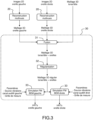
- FIG. 3 schematically illustrates an embodiment of a method 20 within the framework of HRTF estimation, according to one aspect of the invention.
- FIG. 2 illustrates the method 20 for developing a 3D point cloud representative of a 3D ear of an individual, from a first set of at least one 2D image of said ear, by using a parametric 3D ear model.
- Rendering a relief by reconstructing the 3D structure of an object requires at least two 2D images.
- the human vision system establishes geometric relationships by exploiting correspondences between 2D images.
- the "structure from motion” technique allows the 3D reconstruction of an object simultaneously with the calibration of the cameras providing the multiple images used.
- the "structure from shading” technique exploits the illuminations and shadows in the 2D images for the relief restitution. This requires an appropriate study of the illumination and reflectance properties (reflection factor), as well as the variations of the shadow gradients in the images.
- Both techniques allow for the reconstruction of concave surfaces, and rely on tracking points representing salient features, such as contours, corners or areas with uniform color intensities, extracted from the photometric content of the images and/or on knowledge of the camera calibration. They are robust in applications using ordered sequences of images or videos in which tracking of this information is possible or when the acquisition process is controlled. However, being based mainly on texture, they may fail in reconstructing the details of certain occluded morphological elements extracted from ear shapes and which are related to the anatomy of the ear. Model-based methods are preferred for this type of problem and allow the reconstruction of the complete shape from a statistical model and the analysis of the content of the image.
- the anatomical elements such as the tragus, the antitragus, the intertragic notch, as well as points on the contours of the helix, the lobe or lobule and the scapha are the primitives, in the image, used.
- FIG. 1 illustrates different characteristic regions of an ear 1, such as the tragus 2, the anti-tragus 3, the intertragic notch 4, the helix 5, the anti-helix 6, the concha 7, the scapha 8, the triangular fossa 9, and the lobule or lobe 10.
- the reconstructed 3D ears are merged with data representing the torso/head assembly, the resulting composite mesh is used to compute a set of HRTFs called the reconstructed HRTF set.
- the quality of the reconstructed ears is then evaluated.
- an objective and purely quantitative comparison by metric comparison of the scanned ear mesh and the 3D ear mesh obtained by reconstruction is performed.
- the scanned ear comes from the 3D ear shape database used to calculate the parametric model.
- This comparison makes it possible to evaluate the similarity of the reconstructed 3D point cloud compared to the scan to judge the quality of the reconstruction. It is therefore a question of proving the effectiveness of the method by evaluating it on all the true 3D ear shapes of the individuals that were used for the construction of the parametric model.
- HRTF sets are calculated, which will serve as references for comparison. These reference sets are calculated from other composite meshes, in which only the ears are changed. These HRTF sets are then evaluated for each subject through spatialized sound localization tests.
- the deformable model or parametric model is built from a database of 3D scans of ears.
- this involves the use of a scanner designed specifically to scan the ear canal.
- the result obtained is a 3D mesh representing only the shape of the ear. No information related to the texture is available.
- a manual cleaning operation is performed to keep similar contents for all the meshes used. Alternatively, this cleaning operation can be performed automatically.
- the cleaning operation means the selection of points from the entire point cloud.
- a crucial step is necessary before the principal component analysis acronym PCA for the construction of the deformable model.
- This involves a dense matching of a maximum of vertices (3D representation of coordinates of a point) of all the aligned examples in the database. This is done by taking into account local geometric features for each 3D vertex of each example, in this case the method called "surface patch histogram of index shape" in English, acronym SPHIS.
- the model is generated by principal component analysis PCA on the points retained by the dense matching.
- Each eigenvector corresponds to a deformation mode applied to the average shape (one deformation per vertex), defined statistically from the PCA on the examples in the database.
- the present invention requires a set of points of interest or "landmarks" in English to be located on a 2D image representing the morphological structure of an ear.
- the area corresponding to the ear is detected by the method of Viola and Jones described in the paper "Rapid object detection using a boosted cascade of simple features" in Proceedings of the 2001 IEEE Computer Society Conference on Computer Vision and Pattern Recognition, 2001, CVPR 2001, volume 1, pages I-511-I-518 vol.1, 2001 .
- Constrained local models perform learning on local areas or patches of pixel properties in the vicinity of predefined characteristic points of the object to be learned in order to to predict, by regression, the parameters of the model representing a 2D shape in an image and subsequently locate points representing this shape in the image.
- This approach constrained to local properties allows, unlike the approaches used before (active appearance models performing learning on all the pixels of the image delimiting the shape to be classified), to avoid imprecisions linked to illumination conditions, or to possible occlusions in the image of an object.
- a set of points of interest is first identified, in a step 22, for example semi-automatically.
- the user is then invited to select these characteristics in a reference image, in a step 23.
- the selected points are then adjusted to the closest position in the image determining an extremum of curvature on its neighborhood, in a step 24.
- This is inspired by the inherent property of the defined points of interest (at least one point of the tragus, and/or at least one point of the anti-tragus, and/or at least one point of the helix, and/or at least one point of the anti-helix) called landmark points of interest.
- An optional step 25 allows an adjustment of the weights allowing to cancel the weights associated with points of interest-reference which were not found in the image because of an occultation, for example.
- a multi-view method is proposed for 3D model registrations and deformation for 3D ear shape reconstruction, as illustrated in figure 2 .
- An orthographic projection configuration is assumed in the image, or in other words a projection along the direction orthogonal to the image plane.
- the acquisition of 2D images of an ear is acquired at a distance greater than 1 meter from the device taking the 2D images.
- the recalibration in step 27, is carried out by iteratively optimizing the set of parameters with the aim of minimizing a cost function. This is the reprojection error between the estimates of projection of the submodel vertices and their corresponding predicted landmark interest points in the 2D images.
- r j (3 ⁇ 1) represents the rotation vector associated with the pose of the jth 2D image
- t j (3 ⁇ 1) represents the translation vector associated with the pose of the jth image
- the optimization of the cost function of the relation R5 allows the calculation of the model parameters. These parameters are used for the generation, from the dense model of the relation R1, of the 3D shape of the ear. The poses associated with the different views are also found.
- the torso/head meshes in this study are obtained by stereoscopic reconstruction, for example from 75 photos of the subject.
- the subjects wear, for example, a swimming cap.
- the assembly of the ear and torso meshes is, for example, entirely carried out using the free software Meshlab.
- the two ear meshes are aligned with the torso mesh using the alignment tool.
- the ears are removed from the torso mesh, and then the three meshes are merged into one.
- the gaps in the mesh are filled using the Poisson surface reconstruction algorithm.
- the mesh is standardized using, for example, the "Adaptive Remesher" tool from the open source software OpenFlipper.
- the final mesh has an average edge length of about 1.8 mm and a maximum edge length of 2.9 mm.
- this mesh can be used for BEM calculations for frequencies up to 20 kHz.
- HRTFs are calculated by the boundary element method (BEM).
- BEM boundary element method
- the multilevel fast multipole method or FMM
- FMM multilevel fast multipole method
- the document Wolfgang Kreuzer, Piotr Majdak, and Zhengsheng Chen “Fast multipole boundary element method to calculate head-related transfer functions for a wide frequency range” in The Journal of the Acoustical Society of America, 126(3): 1280-1290, 2009 , which allows simulations up to 20kHz to be performed in a reasonable time.
- two simulations are performed in steps 33, one for each ear.
- "virtual microphones” are placed on a sphere with a radius of one meter around the subject, while placing a sound source at the bottom of the ear canal of the ear concerned.
- the sound source is a vibrating surface element. This vibration is defined by the edge conditions applied to this surface element.
- FIG 3 schematically illustrates a mode of implementation of the method 20 of the figure 2 , in the context of HRTF estimation.
- the method 20 as described above makes it possible to reconstruct a 3D left ear and a 3D right ear, from which a fusion 31 is performed with a 3D torso/head model to obtain a 3D torso/head and ear mesh which then undergoes a regularization 32 to obtain a uniform mesh.
- This regularization 32 consists of remeshing the 3D shape in such a way that the resulting mesh has edge lengths of between 0.5 mm and 3 mm.
- the resulting 3D torso/head and ears mesh then allows, through a Boundary Element Method type simulation step 33,
- the parameters respectively define a vibration source in the ear canal of the left ear and a vibration source in the ear canal of the right ear, as well as a spherical grid of measurement points encompassing the mesh, to obtain a set of HRTFs for the left ear and a set of HRTFs for the right ear.
- the steps of the method described above may be performed by one or more programmable processors executing a computer program to perform the functions of the invention by operating on input data and generating output data.
- a computer program may be written in any form of programming language, including compiled or interpreted languages, and the computer program may be deployed in any form, including as a stand-alone program or as a subroutine, element, or other unit suitable for use in a computing environment.
- a computer program may be deployed for execution on a computer or on multiple computers at a single site or distributed across multiple sites and connected together by a communications network.
Landscapes
- Engineering & Computer Science (AREA)
- Physics & Mathematics (AREA)
- Theoretical Computer Science (AREA)
- General Physics & Mathematics (AREA)
- Computer Graphics (AREA)
- Software Systems (AREA)
- Computer Vision & Pattern Recognition (AREA)
- Architecture (AREA)
- Computer Hardware Design (AREA)
- General Engineering & Computer Science (AREA)
- Geometry (AREA)
- Processing Or Creating Images (AREA)
- Computing Systems (AREA)
- Image Processing (AREA)
Claims (7)
- Verfahren zum Herstellen einer 3D-Punktwolke, die ein 3D-Ohr (1) einer Person darstellt, aus einem ersten Satz von mindestens einem 2D-Bild des Ohrs (1) durch Verwenden eines parametrischen 3D-Ohrmodells, umfassend die folgenden Schritte:- Auswählen (23), in jedem 2D-Bild des ersten Satzes, eines zweiten Satzes von mindestens einem Bezugspunkt von Interesse eines Ohrs;- in Beziehung setzen (26), wenn der erste Satz mindestens zwei 2D-Bilder umfasst, eines jeden jeweiligen Bezugspunktes von Interesse;- Bestimmen (27) von Werten der Lageparameter der Person, zu der das Ohr gehört, bei der Aufnahme jedes 2D-Bildes des ersten Satzes und von Werten der Parameter des parametrischen 3D-Ohrmodells aus dem zweiten Satz von mindestens einem Bezugspunkt von Interesse eines Ohrs durch Minimieren einer Kostenfunktion in Bezug auf gewichtete Distanzfehler (22) zwischen der geschätzten Reprojektion eines 3D-Scheitelpunktes in dem parametrischen Ohrmodell und der vorhergesagten Lokalisierung des ihm entsprechenden Bezugspunktes von Interesse, die in dem 2D-Bild erkannt wurde, wobei die Gewichtung eines -Bezugspunktes von Interesse, der dem Innenohr entspricht, größer ist als die Gewichtung eines Bezugspunktes von Interesse, der dem Außenohr entspricht.
- Verfahren nach Anspruch 1, wobei die Kostenfunktion der Summe der gewichteten Reprojektionsfehler entspricht, die den Bezugspunkten von Interesse zugeordnet sind.
- Verfahren nach Anspruch 2, wobei die jeweilige Gewichtung eines Reprojektionsfehlers, der einem Bezugspunkt von Interesse zugeordnet ist, von seiner relativen Schwierigkeit, ihn zu finden, abhängt.
- Verfahren nach Anspruch 3, wobei je schwieriger es ist, einen Bezugspunkt von Interesse zu finden, desto geringer die Gewichtung des Reprojektionsfehlers ist, der ihm zugeordnet ist.
- Verfahren nach einem der Ansprüche 1 bis 4, wobei der zweite Satz von mindestens einem charakteristischen Bezugspunkt von Interesse eines Ohrs (1) mindestens einen Punkt des Tragus (2) und/oder mindestens einen Punkt des Antitragus (3) und/oder mindestens einen Punkt der Helix (5) und/oder mindestens einen Punkt der Antihelix (6) umfasst.
- Verfahren nach einem der vorhergehenden Ansprüche, ferner umfassend einen Schritt des Schätzens (30) einer Gruppe von kopfbezogenen Übertragungsfunktionen, die für das Ohr geeignet ist, durch eine Randelementmethode basierend auf den vorhergehenden Schritten.
- System zum Erzeugen einer 3D-Punktwolke, die ein 3D-Ohr (1) einer Person darstellt, aus einem ersten Satz von mindestens einem 2D-Bild des Ohrs durch Verwenden eines parametrischen 3D-Ohrmodells, umfassend einen Computer, der dafür konfiguriert ist, das Verfahren nach einem der vorhergehenden Ansprüche zu vollführen.
Applications Claiming Priority (2)
| Application Number | Priority Date | Filing Date | Title |
|---|---|---|---|
| FR1660285A FR3057981B1 (fr) | 2016-10-24 | 2016-10-24 | Procede d'elaboration d'un nuage de points 3d representatif d'une oreille 3d d'un individu, et systeme associe |
| PCT/EP2017/074987 WO2018077574A1 (fr) | 2016-10-24 | 2017-10-02 | Procédé d'élaboration d'un nuage de points 3d représentatif d'une oreille 3d d'un individu, et système associé |
Publications (2)
| Publication Number | Publication Date |
|---|---|
| EP3529781A1 EP3529781A1 (de) | 2019-08-28 |
| EP3529781B1 true EP3529781B1 (de) | 2024-10-30 |
Family
ID=57681627
Family Applications (1)
| Application Number | Title | Priority Date | Filing Date |
|---|---|---|---|
| EP17777279.5A Active EP3529781B1 (de) | 2016-10-24 | 2017-10-02 | Verfahren zur herstellung einer 3d-streukurve, die ein 3d-ohr eines individuums darstellt, und zugehöriges system |
Country Status (4)
| Country | Link |
|---|---|
| US (1) | US10818100B2 (de) |
| EP (1) | EP3529781B1 (de) |
| FR (1) | FR3057981B1 (de) |
| WO (1) | WO2018077574A1 (de) |
Families Citing this family (5)
| Publication number | Priority date | Publication date | Assignee | Title |
|---|---|---|---|---|
| EP3671557B1 (de) * | 2018-12-20 | 2025-03-12 | RaySearch Laboratories AB | Datenerweiterung |
| CN111340944B (zh) * | 2020-02-26 | 2022-05-17 | 清华大学 | 基于隐式函数和人体模板的单图像人体三维重建方法 |
| US12039270B2 (en) * | 2020-08-05 | 2024-07-16 | Baldu USA LLC | Disentangle syntax and semantics in sentence representation with decomposable variational autoencoder |
| CN121218086A (zh) * | 2024-06-25 | 2025-12-26 | 京东方科技集团股份有限公司 | 音效处理装置、音效处理方法和扩展现实设备 |
| CN121120934B (zh) * | 2025-09-03 | 2026-04-10 | 惠州市鸿轩和科技有限公司 | 一种用于耳模三维模型的获取方法、系统及储存介质 |
Family Cites Families (5)
| Publication number | Priority date | Publication date | Assignee | Title |
|---|---|---|---|---|
| US20120183161A1 (en) * | 2010-09-03 | 2012-07-19 | Sony Ericsson Mobile Communications Ab | Determining individualized head-related transfer functions |
| US9420260B2 (en) * | 2013-12-12 | 2016-08-16 | Scott L McGregor | Methods and apparatus for 3D imaging and custom manufacturing |
| FR3040807B1 (fr) * | 2015-09-07 | 2022-10-14 | 3D Sound Labs | Procede et systeme d'elaboration d'une fonction de transfert relative a la tete adaptee a un individu |
| EP3351172B1 (de) * | 2015-09-14 | 2021-05-19 | Yamaha Corporation | Ohrformanalyseverfahren, ohrformanalysevorrichtung und verfahren zur erzeugung eines ohrformmodells |
| FI20165211A (fi) * | 2016-03-15 | 2017-09-16 | Ownsurround Ltd | Järjestely HRTF-suodattimien valmistamiseksi |
-
2016
- 2016-10-24 FR FR1660285A patent/FR3057981B1/fr active Active
-
2017
- 2017-10-02 US US16/344,341 patent/US10818100B2/en active Active
- 2017-10-02 WO PCT/EP2017/074987 patent/WO2018077574A1/fr not_active Ceased
- 2017-10-02 EP EP17777279.5A patent/EP3529781B1/de active Active
Also Published As
| Publication number | Publication date |
|---|---|
| FR3057981B1 (fr) | 2019-07-26 |
| US10818100B2 (en) | 2020-10-27 |
| EP3529781A1 (de) | 2019-08-28 |
| US20200051325A1 (en) | 2020-02-13 |
| FR3057981A1 (fr) | 2018-04-27 |
| WO2018077574A1 (fr) | 2018-05-03 |
Similar Documents
| Publication | Publication Date | Title |
|---|---|---|
| CN111598998B (zh) | 三维虚拟模型重建方法、装置、计算机设备和存储介质 | |
| EP3827603B1 (de) | Personalisierte hrtfs über optische erfassung | |
| EP3529781B1 (de) | Verfahren zur herstellung einer 3d-streukurve, die ein 3d-ohr eines individuums darstellt, und zugehöriges system | |
| JP7715249B2 (ja) | 情報処理装置、情報処理方法及び情報処理プログラム | |
| US12067662B2 (en) | Advanced automatic rig creation processes | |
| WO2022001236A1 (zh) | 三维模型生成方法、装置、计算机设备及存储介质 | |
| US12530744B2 (en) | Photo relighting and background replacement based on machine learning models | |
| CN107578435B (zh) | 一种图像深度预测方法及装置 | |
| Zhi et al. | Towards fast and convenient end-to-end HRTF personalization | |
| CN117557714A (zh) | 三维重建方法、电子设备及可读存储介质 | |
| CN107767358B (zh) | 一种图像中物体模糊度确定方法和装置 | |
| WO2021245273A1 (fr) | Procédé et dispositif de reconstruction tridimensionnelle d'un visage avec partie dentée à partir d'une seule image | |
| CN115039137A (zh) | 基于亮度估计渲染虚拟对象的方法、用于训练神经网络的方法以及相关产品 | |
| KR102559691B1 (ko) | 뉴럴 렌더링 기반 형상 색상 통합 3d 메시 복원 방법 및 장치 | |
| CN113989434A (zh) | 一种人体三维重建方法及设备 | |
| CN116958378A (zh) | 面部贴图重建方法、装置、计算机可读介质及电子设备 | |
| Lee et al. | 3D-PSSIM: Projective structural similarity for 3D mesh quality assessment robust to topological irregularities | |
| US20240355051A1 (en) | Differentiable facial internals meshing model | |
| CN119251390A (zh) | 耦合DUSt3R和U-Net语义分割的文物三维建模方法 | |
| CN117635838A (zh) | 三维人脸重建方法、设备、存储介质及装置 | |
| CN115116468A (zh) | 一种视频生成方法、装置、存储介质及电子设备 | |
| EP1095358B1 (de) | Verfahren zur modellierung von gegenständen oder dreidimensionalen szenen | |
| Di Giusto et al. | Deep learning for photogrammetric ear point clouds denoising | |
| Pollack et al. | Non-rigid registration algorithms can improve the quality on human pinna geometries acquired from photogrammetry | |
| Watson et al. | Correspondence between 3D ear depth information derived from 2D images and MRI: Use of a neural-network model |
Legal Events
| Date | Code | Title | Description |
|---|---|---|---|
| STAA | Information on the status of an ep patent application or granted ep patent |
Free format text: STATUS: UNKNOWN |
|
| STAA | Information on the status of an ep patent application or granted ep patent |
Free format text: STATUS: THE INTERNATIONAL PUBLICATION HAS BEEN MADE |
|
| PUAI | Public reference made under article 153(3) epc to a published international application that has entered the european phase |
Free format text: ORIGINAL CODE: 0009012 |
|
| STAA | Information on the status of an ep patent application or granted ep patent |
Free format text: STATUS: REQUEST FOR EXAMINATION WAS MADE |
|
| 17P | Request for examination filed |
Effective date: 20190424 |
|
| AK | Designated contracting states |
Kind code of ref document: A1 Designated state(s): AL AT BE BG CH CY CZ DE DK EE ES FI FR GB GR HR HU IE IS IT LI LT LU LV MC MK MT NL NO PL PT RO RS SE SI SK SM TR |
|
| AX | Request for extension of the european patent |
Extension state: BA ME |
|
| 19U | Interruption of proceedings before grant |
Effective date: 20190524 |
|
| 19W | Proceedings resumed before grant after interruption of proceedings |
Effective date: 20200302 |
|
| RAP1 | Party data changed (applicant data changed or rights of an application transferred) |
Owner name: MIMI HEARING TECHNOLOGIES GMBH |
|
| STAA | Information on the status of an ep patent application or granted ep patent |
Free format text: STATUS: EXAMINATION IS IN PROGRESS |
|
| 17Q | First examination report despatched |
Effective date: 20211223 |
|
| DAV | Request for validation of the european patent (deleted) | ||
| DAX | Request for extension of the european patent (deleted) | ||
| GRAP | Despatch of communication of intention to grant a patent |
Free format text: ORIGINAL CODE: EPIDOSNIGR1 |
|
| STAA | Information on the status of an ep patent application or granted ep patent |
Free format text: STATUS: GRANT OF PATENT IS INTENDED |
|
| RIC1 | Information provided on ipc code assigned before grant |
Ipc: G06T 7/33 20170101ALI20240514BHEP Ipc: G06T 7/30 20170101ALI20240514BHEP Ipc: G06T 19/20 20110101AFI20240514BHEP |
|
| INTG | Intention to grant announced |
Effective date: 20240529 |
|
| GRAS | Grant fee paid |
Free format text: ORIGINAL CODE: EPIDOSNIGR3 |
|
| GRAA | (expected) grant |
Free format text: ORIGINAL CODE: 0009210 |
|
| STAA | Information on the status of an ep patent application or granted ep patent |
Free format text: STATUS: THE PATENT HAS BEEN GRANTED |
|
| AK | Designated contracting states |
Kind code of ref document: B1 Designated state(s): AL AT BE BG CH CY CZ DE DK EE ES FI FR GB GR HR HU IE IS IT LI LT LU LV MC MK MT NL NO PL PT RO RS SE SI SK SM TR |
|
| REG | Reference to a national code |
Ref country code: GB Ref legal event code: FG4D Free format text: NOT ENGLISH |
|
| REG | Reference to a national code |
Ref country code: CH Ref legal event code: EP |
|
| REG | Reference to a national code |
Ref country code: DE Ref legal event code: R096 Ref document number: 602017085783 Country of ref document: DE |
|
| REG | Reference to a national code |
Ref country code: IE Ref legal event code: FG4D Free format text: LANGUAGE OF EP DOCUMENT: FRENCH |
|
| REG | Reference to a national code |
Ref country code: LT Ref legal event code: MG9D |
|
| REG | Reference to a national code |
Ref country code: NL Ref legal event code: MP Effective date: 20241030 |
|
| PG25 | Lapsed in a contracting state [announced via postgrant information from national office to epo] |
Ref country code: PT Free format text: LAPSE BECAUSE OF FAILURE TO SUBMIT A TRANSLATION OF THE DESCRIPTION OR TO PAY THE FEE WITHIN THE PRESCRIBED TIME-LIMIT Effective date: 20250228 Ref country code: HR Free format text: LAPSE BECAUSE OF FAILURE TO SUBMIT A TRANSLATION OF THE DESCRIPTION OR TO PAY THE FEE WITHIN THE PRESCRIBED TIME-LIMIT Effective date: 20241030 Ref country code: IS Free format text: LAPSE BECAUSE OF FAILURE TO SUBMIT A TRANSLATION OF THE DESCRIPTION OR TO PAY THE FEE WITHIN THE PRESCRIBED TIME-LIMIT Effective date: 20250228 |
|
| PG25 | Lapsed in a contracting state [announced via postgrant information from national office to epo] |
Ref country code: FI Free format text: LAPSE BECAUSE OF FAILURE TO SUBMIT A TRANSLATION OF THE DESCRIPTION OR TO PAY THE FEE WITHIN THE PRESCRIBED TIME-LIMIT Effective date: 20241030 Ref country code: NL Free format text: LAPSE BECAUSE OF FAILURE TO SUBMIT A TRANSLATION OF THE DESCRIPTION OR TO PAY THE FEE WITHIN THE PRESCRIBED TIME-LIMIT Effective date: 20241030 |
|
| REG | Reference to a national code |
Ref country code: AT Ref legal event code: MK05 Ref document number: 1737691 Country of ref document: AT Kind code of ref document: T Effective date: 20241030 |
|
| PG25 | Lapsed in a contracting state [announced via postgrant information from national office to epo] |
Ref country code: BG Free format text: LAPSE BECAUSE OF FAILURE TO SUBMIT A TRANSLATION OF THE DESCRIPTION OR TO PAY THE FEE WITHIN THE PRESCRIBED TIME-LIMIT Effective date: 20241030 |
|
| PG25 | Lapsed in a contracting state [announced via postgrant information from national office to epo] |
Ref country code: ES Free format text: LAPSE BECAUSE OF FAILURE TO SUBMIT A TRANSLATION OF THE DESCRIPTION OR TO PAY THE FEE WITHIN THE PRESCRIBED TIME-LIMIT Effective date: 20241030 |
|
| PG25 | Lapsed in a contracting state [announced via postgrant information from national office to epo] |
Ref country code: NO Free format text: LAPSE BECAUSE OF FAILURE TO SUBMIT A TRANSLATION OF THE DESCRIPTION OR TO PAY THE FEE WITHIN THE PRESCRIBED TIME-LIMIT Effective date: 20250130 |
|
| PG25 | Lapsed in a contracting state [announced via postgrant information from national office to epo] |
Ref country code: GR Free format text: LAPSE BECAUSE OF FAILURE TO SUBMIT A TRANSLATION OF THE DESCRIPTION OR TO PAY THE FEE WITHIN THE PRESCRIBED TIME-LIMIT Effective date: 20250131 Ref country code: LV Free format text: LAPSE BECAUSE OF FAILURE TO SUBMIT A TRANSLATION OF THE DESCRIPTION OR TO PAY THE FEE WITHIN THE PRESCRIBED TIME-LIMIT Effective date: 20241030 Ref country code: AT Free format text: LAPSE BECAUSE OF FAILURE TO SUBMIT A TRANSLATION OF THE DESCRIPTION OR TO PAY THE FEE WITHIN THE PRESCRIBED TIME-LIMIT Effective date: 20241030 |
|
| PG25 | Lapsed in a contracting state [announced via postgrant information from national office to epo] |
Ref country code: PL Free format text: LAPSE BECAUSE OF FAILURE TO SUBMIT A TRANSLATION OF THE DESCRIPTION OR TO PAY THE FEE WITHIN THE PRESCRIBED TIME-LIMIT Effective date: 20241030 |
|
| PG25 | Lapsed in a contracting state [announced via postgrant information from national office to epo] |
Ref country code: RS Free format text: LAPSE BECAUSE OF FAILURE TO SUBMIT A TRANSLATION OF THE DESCRIPTION OR TO PAY THE FEE WITHIN THE PRESCRIBED TIME-LIMIT Effective date: 20250130 |
|
| PG25 | Lapsed in a contracting state [announced via postgrant information from national office to epo] |
Ref country code: SM Free format text: LAPSE BECAUSE OF FAILURE TO SUBMIT A TRANSLATION OF THE DESCRIPTION OR TO PAY THE FEE WITHIN THE PRESCRIBED TIME-LIMIT Effective date: 20241030 |
|
| PG25 | Lapsed in a contracting state [announced via postgrant information from national office to epo] |
Ref country code: DK Free format text: LAPSE BECAUSE OF FAILURE TO SUBMIT A TRANSLATION OF THE DESCRIPTION OR TO PAY THE FEE WITHIN THE PRESCRIBED TIME-LIMIT Effective date: 20241030 |
|
| PG25 | Lapsed in a contracting state [announced via postgrant information from national office to epo] |
Ref country code: EE Free format text: LAPSE BECAUSE OF FAILURE TO SUBMIT A TRANSLATION OF THE DESCRIPTION OR TO PAY THE FEE WITHIN THE PRESCRIBED TIME-LIMIT Effective date: 20241030 |
|
| PG25 | Lapsed in a contracting state [announced via postgrant information from national office to epo] |
Ref country code: RO Free format text: LAPSE BECAUSE OF FAILURE TO SUBMIT A TRANSLATION OF THE DESCRIPTION OR TO PAY THE FEE WITHIN THE PRESCRIBED TIME-LIMIT Effective date: 20241030 |
|
| PG25 | Lapsed in a contracting state [announced via postgrant information from national office to epo] |
Ref country code: SK Free format text: LAPSE BECAUSE OF FAILURE TO SUBMIT A TRANSLATION OF THE DESCRIPTION OR TO PAY THE FEE WITHIN THE PRESCRIBED TIME-LIMIT Effective date: 20241030 |
|
| PG25 | Lapsed in a contracting state [announced via postgrant information from national office to epo] |
Ref country code: CZ Free format text: LAPSE BECAUSE OF FAILURE TO SUBMIT A TRANSLATION OF THE DESCRIPTION OR TO PAY THE FEE WITHIN THE PRESCRIBED TIME-LIMIT Effective date: 20241030 |
|
| PG25 | Lapsed in a contracting state [announced via postgrant information from national office to epo] |
Ref country code: IT Free format text: LAPSE BECAUSE OF FAILURE TO SUBMIT A TRANSLATION OF THE DESCRIPTION OR TO PAY THE FEE WITHIN THE PRESCRIBED TIME-LIMIT Effective date: 20241030 |
|
| REG | Reference to a national code |
Ref country code: DE Ref legal event code: R097 Ref document number: 602017085783 Country of ref document: DE |
|
| PLBE | No opposition filed within time limit |
Free format text: ORIGINAL CODE: 0009261 |
|
| STAA | Information on the status of an ep patent application or granted ep patent |
Free format text: STATUS: NO OPPOSITION FILED WITHIN TIME LIMIT |
|
| PG25 | Lapsed in a contracting state [announced via postgrant information from national office to epo] |
Ref country code: SE Free format text: LAPSE BECAUSE OF FAILURE TO SUBMIT A TRANSLATION OF THE DESCRIPTION OR TO PAY THE FEE WITHIN THE PRESCRIBED TIME-LIMIT Effective date: 20241030 |
|
| 26N | No opposition filed |
Effective date: 20250731 |
|
| PGFP | Annual fee paid to national office [announced via postgrant information from national office to epo] |
Ref country code: FR Payment date: 20250930 Year of fee payment: 9 |
|
| PGFP | Annual fee paid to national office [announced via postgrant information from national office to epo] |
Ref country code: DE Payment date: 20250930 Year of fee payment: 9 |
|
| PGFP | Annual fee paid to national office [announced via postgrant information from national office to epo] |
Ref country code: GB Payment date: 20251001 Year of fee payment: 9 |