EP3671557B1 - Datenerweiterung - Google Patents
Datenerweiterung Download PDFInfo
- Publication number
- EP3671557B1 EP3671557B1 EP18214457.6A EP18214457A EP3671557B1 EP 3671557 B1 EP3671557 B1 EP 3671557B1 EP 18214457 A EP18214457 A EP 18214457A EP 3671557 B1 EP3671557 B1 EP 3671557B1
- Authority
- EP
- European Patent Office
- Prior art keywords
- dataset
- weight
- eigenvector
- pdm
- surface model
- Prior art date
- Legal status (The legal status is an assumption and is not a legal conclusion. Google has not performed a legal analysis and makes no representation as to the accuracy of the status listed.)
- Active
Links
Images


Classifications
-
- G—PHYSICS
- G06—COMPUTING OR CALCULATING; COUNTING
- G06T—IMAGE DATA PROCESSING OR GENERATION, IN GENERAL
- G06T19/00—Manipulating three-dimensional [3D] models or images for computer graphics
- G06T19/20—Editing of three-dimensional [3D] images, e.g. changing shapes or colours, aligning objects or positioning parts
-
- G—PHYSICS
- G06—COMPUTING OR CALCULATING; COUNTING
- G06F—ELECTRIC DIGITAL DATA PROCESSING
- G06F18/00—Pattern recognition
- G06F18/20—Analysing
- G06F18/21—Design or setup of recognition systems or techniques; Extraction of features in feature space; Blind source separation
- G06F18/214—Generating training patterns; Bootstrap methods, e.g. bagging or boosting
- G06F18/2148—Generating training patterns; Bootstrap methods, e.g. bagging or boosting characterised by the process organisation or structure, e.g. boosting cascade
-
- G—PHYSICS
- G06—COMPUTING OR CALCULATING; COUNTING
- G06V—IMAGE OR VIDEO RECOGNITION OR UNDERSTANDING
- G06V10/00—Arrangements for image or video recognition or understanding
- G06V10/70—Arrangements for image or video recognition or understanding using pattern recognition or machine learning
- G06V10/74—Image or video pattern matching; Proximity measures in feature spaces
- G06V10/75—Organisation of the matching processes, e.g. simultaneous or sequential comparisons of image or video features; Coarse-fine approaches, e.g. multi-scale approaches; using context analysis; Selection of dictionaries
- G06V10/755—Deformable models or variational models, e.g. snakes or active contours
- G06V10/7553—Deformable models or variational models, e.g. snakes or active contours based on shape, e.g. active shape models [ASM]
-
- G—PHYSICS
- G06—COMPUTING OR CALCULATING; COUNTING
- G06T—IMAGE DATA PROCESSING OR GENERATION, IN GENERAL
- G06T2219/00—Indexing scheme for manipulating 3D models or images for computer graphics
- G06T2219/20—Indexing scheme for editing of 3D models
- G06T2219/2021—Shape modification
-
- G—PHYSICS
- G06—COMPUTING OR CALCULATING; COUNTING
- G06V—IMAGE OR VIDEO RECOGNITION OR UNDERSTANDING
- G06V2201/00—Indexing scheme relating to image or video recognition or understanding
- G06V2201/03—Recognition of patterns in medical or anatomical images
Definitions
- the present disclosure relates to data augmentation.
- the disclosure relates to generation of datasets representing body parts.
- Computational models of body parts are used in a number of scenarios.
- computational models of organs are useful to study different medical phenomena.
- artificial intelligence (Al) systems can be used to identify such phenomena in scans from patients. To do this, the systems must learn what different phenomena look like so that they can be identified accurately. In many cases, this is achieved by inputting a number of training datasets into an Al system.
- the training datasets are models representing real patients that have already been studied by an expert in the field. This allows the Al system to know what it should find in the datasets, and therefore learn to identify features of interest present in other input datasets. This is known as machine learning.
- the first reference dataset represents a corresponding part of a body and is derived from a real body.
- Determining the mapping comprises using a deformable image registration algorithm based on the first and second surface model datasets.
- the deformable image registration algorithm produces only positive Jacobians.
- generating the output dataset comprises applying the mapping to the second reference dataset.
- generating the PDM comprises using principal component analysis.
- the average dataset is a mean average of the input dataset.
- the one or more weight-eigenvector pairs comprises a plurality of weight-eigenvector pairs.
- the plurality of weight-eigenvector pairs comprises a linear combination of the eigenvectors.
- the present disclosure presents a method of generating data representing an ROI that is different from existing datasets and is also realistic (human-like), rather than currently known artificial geometries which do not produce realistic geometries of ROIs.
- the method comprises generating a point distribution model (PDM) for a particular ROI based on an input dataset.
- a point distribution model represents the average geometry of a shape and some statistical modes of geometric variation inferred from an input set of shapes.
- the input dataset comprises a plurality of datasets each representing the ROI for which the PDM is to be generated.
- each dataset in the input dataset may be derived from a scan of a patient, as discussed above.
- each dataset in the input dataset may be artificially derived.
- the input dataset may comprise a combination of datasets derived from real patient scans and artificially derived datasets.
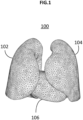
- this may be surface data representing the ROI, for example data points representing the surfaces of the lungs 102, 104 and heart 106 of ROI 100 in three dimensions.
- the data sets may be volume data representing the ROI, for example data points representing the volumes of the organs 102-106 of ROI 100 in three dimensions.
- PCA Principal component analysis
- x m x a + ⁇ 0 e 0 + ⁇ 1 e 1 + ⁇ 2 e 2 + ... + ⁇ n e n
- x m the model dataset
- x a the average shape across the input dataset
- e x is an eigenvector describing the x th mode of variation
- ⁇ x is a scaling value, or weight, for the x th eigenvector
- n+1 is the number of modes of variation.
- the average is the mean average.
- there is a plurality of modes of variation i.e., n>0.
- e 0 represents the most common variation, with the subsequent eigenvectors representing less and less common variations until e n , which represents the least common variation.
- Modifying any of the weights from zero will produce a model dataset, x m , that is different from the average dataset.
- a single weight is modified.
- a subset of the plurality of weights are modified.
- all weights ⁇ 0 to ⁇ n are modified.
- the weights may be modified within an interval to ensure that large deformations that would be unrealistic are not generated.
- the intervals may be defined based on the standard deviation of the input dataset around the mean surface. For example, each value of ⁇ may be limited to ⁇ 3 standard deviations.
- the standard deviation of a given principal component may be defined as the square root of its corresponding eigenvalue.
- each weight is modified in a random manner.
- each weight is modified systematically. For example, each weight is modified incrementally from an initial weight. For example, if an initial value of ⁇ 2 is given as 0.34, the value of ⁇ 2 can be modified incrementally, for example to 0.35, 0.36 and so on, to ensure that model dataset will change continuously starting from the first surface model dataset. Such modification could also be useful when modelling dynamic phenomena such as a breathing cycle.
- model datasets can be generated.
- the PDM is based on an input dataset comprising real geometries
- the variations that are captured are realistic and so the model datasets are also realistic.
- an ROI comprises a number of organs, such as ROI 100
- the described method allows the organs to deform with each other in the model datasets, so one of the organs is not deformed unrealistically in relation to others (for example, producing two lungs of different sizes, which is rare in reality).
- Known methods of geometry generation cannot guarantee this.
- the model datasets, x m , generated from the PDM are deformed versions of the average volume in the PDM.
- each model dataset, x m , generated from the PDM can be used in a training dataset for a machine learning process for an Al system.
- the machine learning process may be a deep learning process.
- the Al system may be an image segmentation algorithm. By increasing the training dataset, the machine learning process becomes more thorough and robust and the Al system more accurate. In this way, the Al system has an improved performance.
- the algorithm may be able to more accurately segment images of ROIs that are input into the algorithm.
- the geometries could be used for adaptive scenarios where it is desired to predict future patient geometries.
- an ROI for a given patient can look different at different times. This may be, for example, at different stages of the breathing cycle, where the lungs would have different shapes and sizes.
- the geometry of an ROI may change at different stages of treatment, either if the treatment has worked or if it has side effects.
- the approach discussed above allows geometries to be generated that correspond to a desired outcome after a given stage of treatment, which can then be compared against a patient's real geometry to indicate success or otherwise of the treatment.
- the methods described herein allow generation of geometries for any application field where realistically deformed data is required.
- Figure 2 shows a method 200 for generating data representing the volume of part of a body.
- the part of a body may be an ROI, such as ROI 100, comprising at least one organ, such as organs 102-106.
- the body is a human body.
- a PDM for the ROI is generated based on an input dataset.
- the input dataset comprises data representing the volume of the ROI, and in some embodiments is derived from at least one real body, for example from a patient.
- the input dataset may comprise a plurality of datasets each representing the same ROI from different patients.
- the PDM defines an output dataset based on an average dataset and one or more weight-eigenvector pairs.
- the PDM is generated using principal component analysis, and comprises a mean average of the input dataset and a linear combination of eigenvectors.
- an output dataset is generated based on the PDM.
- the output dataset is generated by modifying at least one weight in the weight-eigenvector pairs, such that the output dataset is different from the average dataset.
- the weights are modified within an interval defined by the standard deviation of the input dataset.
- the weights may be modified randomly or incrementally from an initial weight.
- One, some or all of the weights in the linear combination may be modified to produce the output dataset.
- the output dataset is used as part of a training set for machine learning of an Al system.
- this may be deep learning for an image segmentation algorithm.
- Multiple output datasets can be generated such that the training set is as large as possible, which ensures that the Al system is robustly trained. This results in a system that has improved performance.
- model datasets generated from the PDM can be developed to produce further datasets at a relatively low computational cost.
- surface data only can be used at different stages to generate different volume datasets. By using surface data rather than volume data, the computational burden associated with computing eigenvectors is greatly reduced. To achieve this for a given model dataset, x m , generated from the PDM, the model dataset is related to one or more reference datasets.
- the PDM is used to generate a first model dataset using the methods described above.
- the input dataset comprises only surface data representing the ROI and, as such, the model dataset that is generated from the PDM also comprises surface data representing the ROI for a new geometry.
- the modification of the weights described above is performed such that the first model dataset generally corresponds to a reference dataset as closely as possible.
- the reference dataset is derived from a real body and represents a ROI corresponding to that of the input dataset and the PDM.
- the reference dataset comprises surface data that represents a corresponding ROI, while in other embodiments the reference dataset comprises volume data that represents a corresponding ROI. Using surface data allows simpler modification of the PDM to match the reference ROI.
- model dataset which is a triangulated surface
- volume data for example and image from a CT scan
- image segmentation can be difficult for ROIs or parts of an ROI with a fuzzy border.
- surface data the surfaces/ROls/organs are already segmented from the image by an expert, for example a doctor, making it much easier to adapt the PDM to an already existing surface.
- Rotation, translation and scaling of the model dataset generated by the PDM can also be used to provide better correspondence to the reference dataset.
- Each output dataset generated using the mapping method can be used in a training dataset to provide a more thorough and robust machine learning process for an Al system, and as such a more accurate Al system.
- the algorithm may be able to more accurately segment images of ROIs that are input into the algorithm.
- geometries generated from the PDM can be used for adaptive scenarios where it is desired to predict future patient geometries, or in any application field where realistically deformed data is required.
- the weight values corresponding to the first model dataset are modified to provide a second model dataset that is different from the first model dataset.
- the weights are modified within an interval defined by the standard deviation of the input dataset.
- the weights may be modified randomly or incrementally from an initial weight.
- One, some or all of the weights in the linear combination may be modified to produce the second model dataset.
Landscapes
- Engineering & Computer Science (AREA)
- Theoretical Computer Science (AREA)
- Software Systems (AREA)
- General Physics & Mathematics (AREA)
- Physics & Mathematics (AREA)
- Computer Vision & Pattern Recognition (AREA)
- General Engineering & Computer Science (AREA)
- Evolutionary Computation (AREA)
- Artificial Intelligence (AREA)
- Architecture (AREA)
- Computer Graphics (AREA)
- Computer Hardware Design (AREA)
- Data Mining & Analysis (AREA)
- Health & Medical Sciences (AREA)
- Multimedia (AREA)
- Computing Systems (AREA)
- Databases & Information Systems (AREA)
- General Health & Medical Sciences (AREA)
- Medical Informatics (AREA)
- Bioinformatics & Computational Biology (AREA)
- Evolutionary Biology (AREA)
- Bioinformatics & Cheminformatics (AREA)
- Life Sciences & Earth Sciences (AREA)
- Apparatus For Radiation Diagnosis (AREA)
- Image Analysis (AREA)
- Measuring And Recording Apparatus For Diagnosis (AREA)
- Image Generation (AREA)
- Medical Treatment And Welfare Office Work (AREA)
Claims (12)
- Verfahren (300) zum Erzeugen von Daten, die das Volumen eines Teils eines Körpers (100, 102, 104, 106) darstellen, das Verfahren umfassend:Erzeugen (302) eines Punktverteilungsmodells "PDM" basierend auf einem Eingabedatensatz, umfassend Daten, die mindestens eine Oberfläche eines Teils eines Körpers darstellen, wobei das PDM einen Oberflächenmodelldatensatz für den Teil des Körpers basierend auf einem Durchschnittsdatensatz und einem oder mehreren Gewichtungs-Eigenvektor-Paaren definiert;Erzeugen (304) eines ersten Oberflächenmodelldatensatzes basierend auf dem PDM durch Modifizieren von mindestens einer Gewichtung der einen oder der mehreren Gewichtungs-Eigenvektor-Paare, derart, dass der erste Oberflächenmodelldatensatz im Allgemeinen einem ersten Referenzdatensatz entspricht, wobei sich der erste Oberflächenmodelldatensatz von dem Durchschnittsdatensatz unterscheidet;Modifizieren (306) von mindestens einer Gewichtung des einen oder der mehreren Gewichtungs-Eigenvektor-Paare, um einen zweiten Oberflächenmodelldatensatz bereitzustellen, der sich von dem ersten Oberflächenmodelldatensatz unterscheidet;Bestimmen (308) einer Zuordnung zwischen dem ersten und dem zweiten Oberflächenmodelldatensatz und gekennzeichnet durchErzeugen (310) eines Ausgabevolumendatensatzes für den Teil des Körpers durch Anwenden der Zuordnung auf einen zweiten Referenzdatensatz, der zweite Referenzdatensatz umfassend Volumendaten, die das Volumen eines entsprechenden Teils eines Körpers darstellen, der Ausgabevolumendatensatz umfassend Daten, die ein deformiertes Volumen des entsprechenden Teils des Körpers darstellen, wobei sich der erste Referenzdatensatz von dem zweiten Referenzdatensatz unterscheidet.
- Verfahren (300) nach Anspruch 1, wobei der Teil eines Körpers (100, 102, 104, 106) mindestens ein Organ (102, 104, 106) umfasst.
- Verfahren (300) nach einem der vorstehenden Ansprüche, wobei der Körper ein menschlicher Körper ist.
- Verfahren (300) nach einem der vorstehenden Ansprüche, wobei der Eingabedatensatz von mindestens einem realen Körper abgeleitet ist und eine Vielzahl von Datensätzen umfasst, die jeweils denselben Teil eines jeweiligen Körpers darstellen.
- Verfahren (300) nach Anspruch 5, wobei der erste Referenzdatensatz einen entsprechenden Teil eines Körpers (100, 102, 104, 106) darstellt und von einem realen Körper abgeleitet ist.
- Verfahren (300) nach einem der vorstehenden Ansprüche, wobei das Erzeugen des PDM das Verwenden einer Hauptkomponentenanalyse umfasst, wobei der durchschnittliche Datensatz ein Mittelwert des Eingabedatensatzes ist und das eine oder die mehreren Gewichtungs-Eigenvektor-Paare eine lineare Kombination der Eigenvektoren umfassen.
- Verfahren (300) nach Anspruch 8, wobei das PDM durch die Gleichung definiert ist

- Verfahren (300) nach einem der vorstehenden Ansprüche, wobei das Modifizieren von mindestens einer Gewichtung des einen oder der mehreren Gewichtungs-Eigenvektor-Paare das Modifizieren der Gewichtung innerhalb eines Intervalls umfasst, das basierend auf der Standardabweichung des Eingabedatensatzes definiert ist.
- Verfahren (300) nach einem der vorstehenden Ansprüche, wobei das Modifizieren von mindestens einer Gewichtung des einen oder der mehreren Gewichtungs-Eigenvektor-Paare das inkrementelle Modifizieren der Gewichtung von einer Anfangsgewichtung umfasst.
- Verfahren (300) nach einem der vorstehenden Ansprüche, wobei der zweite Referenzdatensatz einen entsprechenden Teil eines Körpers (100, 102, 104, 106) darstellt und von einem realen Körper abgeleitet ist.
- Verfahren (300) nach einem der vorstehenden Ansprüche, ferner umfassend das Verwenden (312) des Ausgabevolumendatensatzes als Teil eines Trainingssatzes für einen Deep-Learning-Prozess für ein künstliches Intelligenzsystem.
- Computerlesbares Medium (400), umfassend Anweisungen, die, wenn sie auf einem Prozessor ablaufen, den Prozessor veranlassen, das Verfahren nach einem der Ansprüche 1 bis 11 durchzuführen.
Priority Applications (5)
| Application Number | Priority Date | Filing Date | Title |
|---|---|---|---|
| EP18214457.6A EP3671557B1 (de) | 2018-12-20 | 2018-12-20 | Datenerweiterung |
| JP2021534901A JP7551620B2 (ja) | 2018-12-20 | 2019-12-16 | データ拡張 |
| PCT/EP2019/085274 WO2020126993A1 (en) | 2018-12-20 | 2019-12-16 | Data augmentation |
| CN201980076205.9A CN113056744B (zh) | 2018-12-20 | 2019-12-16 | 数据扩充 |
| US17/415,776 US12260507B2 (en) | 2018-12-20 | 2019-12-16 | Data augmentation |
Applications Claiming Priority (1)
| Application Number | Priority Date | Filing Date | Title |
|---|---|---|---|
| EP18214457.6A EP3671557B1 (de) | 2018-12-20 | 2018-12-20 | Datenerweiterung |
Publications (2)
| Publication Number | Publication Date |
|---|---|
| EP3671557A1 EP3671557A1 (de) | 2020-06-24 |
| EP3671557B1 true EP3671557B1 (de) | 2025-03-12 |
Family
ID=65003126
Family Applications (1)
| Application Number | Title | Priority Date | Filing Date |
|---|---|---|---|
| EP18214457.6A Active EP3671557B1 (de) | 2018-12-20 | 2018-12-20 | Datenerweiterung |
Country Status (5)
| Country | Link |
|---|---|
| US (1) | US12260507B2 (de) |
| EP (1) | EP3671557B1 (de) |
| JP (1) | JP7551620B2 (de) |
| CN (1) | CN113056744B (de) |
| WO (1) | WO2020126993A1 (de) |
Families Citing this family (2)
| Publication number | Priority date | Publication date | Assignee | Title |
|---|---|---|---|---|
| EP3671557B1 (de) * | 2018-12-20 | 2025-03-12 | RaySearch Laboratories AB | Datenerweiterung |
| EP3836022A1 (de) * | 2019-12-12 | 2021-06-16 | Koninklijke Philips N.V. | Datenerweiterung für ein maschinenlernverfahren |
Family Cites Families (39)
| Publication number | Priority date | Publication date | Assignee | Title |
|---|---|---|---|---|
| GB2353451B (en) * | 1999-08-20 | 2003-09-10 | Univ London | Morphing of an object using the morphological behaviour of another object |
| US6873718B2 (en) * | 2001-10-12 | 2005-03-29 | Siemens Corporate Research, Inc. | System and method for 3D statistical shape model for the left ventricle of the heart |
| US20060025689A1 (en) * | 2002-06-07 | 2006-02-02 | Vikram Chalana | System and method to measure cardiac ejection fraction |
| GB0225716D0 (en) * | 2002-11-05 | 2002-12-11 | Univ Edinburgh | Virtual models |
| GB0503236D0 (en) * | 2005-02-16 | 2005-03-23 | Ccbr As | Vertebral fracture quantification |
| US7894664B2 (en) * | 2006-03-22 | 2011-02-22 | University Of Washington | Conditional shape model for image processing |
| US8155399B2 (en) * | 2007-06-12 | 2012-04-10 | Utc Fire & Security Corporation | Generic face alignment via boosting |
| CN101350016B (zh) * | 2007-07-20 | 2010-11-24 | 富士通株式会社 | 三维模型检索装置及方法 |
| WO2009100020A2 (en) * | 2008-01-31 | 2009-08-13 | University Of Southern California | Facial performance synthesis using deformation driven polynomial displacement maps |
| CN101625767B (zh) * | 2008-07-10 | 2013-07-10 | 北京石油化工学院 | 非平行轮廓医学影像的点云式三维表面重建方法 |
| SG178569A1 (en) * | 2009-08-24 | 2012-03-29 | Singapore Health Serv Pte Ltd | A method and system of determining a grade of nuclear cataract |
| US8478077B2 (en) * | 2011-03-20 | 2013-07-02 | General Electric Company | Optimal gradient pursuit for image alignment |
| US9147129B2 (en) * | 2011-11-18 | 2015-09-29 | Honeywell International Inc. | Score fusion and training data recycling for video classification |
| US9014501B2 (en) * | 2012-02-23 | 2015-04-21 | University Of Georgia Research Foundation, Inc. | Methods and systems for enhancing data |
| US8837771B2 (en) * | 2012-02-28 | 2014-09-16 | Siemens Aktiengesellschaft | Method and system for joint multi-organ segmentation in medical image data using local and global context |
| US9076201B1 (en) * | 2012-03-30 | 2015-07-07 | University Of Louisville Research Foundation, Inc. | Volumetric deformable registration method for thoracic 4-D computed tomography images and method of determining regional lung function |
| US9269156B2 (en) * | 2012-07-24 | 2016-02-23 | Siemens Aktiengesellschaft | Method and system for automatic prostate segmentation in magnetic resonance images |
| US9390502B2 (en) * | 2013-04-22 | 2016-07-12 | Kabushiki Kaisha Toshiba | Positioning anatomical landmarks in volume data sets |
| US10376715B2 (en) * | 2013-08-08 | 2019-08-13 | Washington University | System and method for the validation and quality assurance of computerized contours of human anatomy |
| US9420260B2 (en) * | 2013-12-12 | 2016-08-16 | Scott L McGregor | Methods and apparatus for 3D imaging and custom manufacturing |
| US9524582B2 (en) * | 2014-01-28 | 2016-12-20 | Siemens Healthcare Gmbh | Method and system for constructing personalized avatars using a parameterized deformable mesh |
| US10430551B2 (en) * | 2014-11-06 | 2019-10-01 | Siemens Healthcare Gmbh | Scan data retrieval with depth sensor data |
| US10614174B2 (en) * | 2015-01-30 | 2020-04-07 | Dentsply Sirona Inc. | System and method for adding surface detail to digital crown models created using statistical techniques |
| US9814549B2 (en) * | 2015-09-14 | 2017-11-14 | DENTSPLY SIRONA, Inc. | Method for creating flexible arch model of teeth for use in restorative dentistry |
| US10229493B2 (en) * | 2016-03-16 | 2019-03-12 | International Business Machines Corporation | Joint segmentation and characteristics estimation in medical images |
| WO2018001099A1 (zh) * | 2016-06-30 | 2018-01-04 | 上海联影医疗科技有限公司 | 一种血管提取方法与系统 |
| CN106469465A (zh) | 2016-08-31 | 2017-03-01 | 深圳市唯特视科技有限公司 | 一种基于灰度和深度信息的三维人脸重建方法 |
| FR3057981B1 (fr) * | 2016-10-24 | 2019-07-26 | Mimi Hearing Technologies GmbH | Procede d'elaboration d'un nuage de points 3d representatif d'une oreille 3d d'un individu, et systeme associe |
| WO2018107149A1 (en) * | 2016-12-09 | 2018-06-14 | Children's National Medical Center | Image segmentation of complex structures |
| US10163003B2 (en) | 2016-12-28 | 2018-12-25 | Adobe Systems Incorporated | Recognizing combinations of body shape, pose, and clothing in three-dimensional input images |
| US10507002B2 (en) * | 2017-05-23 | 2019-12-17 | Siemens Healthcare Gmbh | X-ray system and method for standing subject |
| CN107909653B (zh) * | 2017-11-15 | 2021-03-30 | 电子科技大学 | 一种基于稀疏主成分分析的心脏软组织三维重建方法 |
| AU2018377863B2 (en) * | 2017-12-01 | 2022-08-04 | Hearables 3D Pty Ltd | Customization method and apparatus |
| US11508107B2 (en) * | 2018-02-26 | 2022-11-22 | Didimo, Inc. | Additional developments to the automatic rig creation process |
| CN108596193B (zh) * | 2018-04-27 | 2021-11-02 | 东南大学 | 一种搭建针对人耳识别的深度学习网络结构的方法及系统 |
| US11507822B2 (en) * | 2018-10-31 | 2022-11-22 | General Electric Company | Scalable artificial intelligence model generation systems and methods for healthcare |
| US12260607B2 (en) * | 2018-12-15 | 2025-03-25 | The Brigham And Women's Hospital, Inc. | Augmented digital microscopy for lesion analysis |
| EP3671557B1 (de) * | 2018-12-20 | 2025-03-12 | RaySearch Laboratories AB | Datenerweiterung |
| US11547323B2 (en) * | 2020-02-14 | 2023-01-10 | Siemens Healthcare Gmbh | Patient model estimation from camera stream in medicine |
-
2018
- 2018-12-20 EP EP18214457.6A patent/EP3671557B1/de active Active
-
2019
- 2019-12-16 US US17/415,776 patent/US12260507B2/en active Active
- 2019-12-16 WO PCT/EP2019/085274 patent/WO2020126993A1/en not_active Ceased
- 2019-12-16 JP JP2021534901A patent/JP7551620B2/ja active Active
- 2019-12-16 CN CN201980076205.9A patent/CN113056744B/zh active Active
Also Published As
| Publication number | Publication date |
|---|---|
| CN113056744B (zh) | 2025-04-04 |
| CN113056744A (zh) | 2021-06-29 |
| WO2020126993A1 (en) | 2020-06-25 |
| EP3671557A1 (de) | 2020-06-24 |
| JP2022513286A (ja) | 2022-02-07 |
| US20220076069A1 (en) | 2022-03-10 |
| JP7551620B2 (ja) | 2024-09-17 |
| US12260507B2 (en) | 2025-03-25 |
Similar Documents
| Publication | Publication Date | Title |
|---|---|---|
| US11443428B2 (en) | Systems and methods for probablistic segmentation in anatomical image processing | |
| US12327359B2 (en) | Image segmentation and tracking based on statistical shape model | |
| US10964071B2 (en) | Systems and methods for data and model-driven image reconstruction and enhancement | |
| Davies et al. | Statistical models of shape: Optimisation and evaluation | |
| US11580381B2 (en) | Complex-valued neural network with learnable non-linearities in medical imaging | |
| CN110728274B (zh) | 医疗设备计算机辅助扫描方法、医疗设备及可读存储介质 | |
| KR20210048523A (ko) | 이미지 처리 방법, 장치, 전자 기기 및 컴퓨터 판독 가능 기억 매체 | |
| CN108022238A (zh) | 对3d图像中对象进行检测的方法、计算机存储介质和系统 | |
| US20230141392A1 (en) | Systems and methods for human pose and shape recovery | |
| CN115830016A (zh) | 医学图像配准模型训练方法及设备 | |
| US7305369B2 (en) | Method and apparatus for producing three dimensional shapes | |
| CN113096137A (zh) | 一种oct视网膜图像领域适应分割方法及系统 | |
| US12154245B1 (en) | Apparatus and methods for visualization within a three-dimensional model using neural networks | |
| Claes et al. | A robust statistical surface registration framework using implicit function representations-application in craniofacial reconstruction | |
| WO2020054503A1 (ja) | 機械学習装置、推定装置、プログラム及び学習済みモデル | |
| US12260507B2 (en) | Data augmentation | |
| CN113610746B (zh) | 一种图像处理方法、装置、计算机设备及存储介质 | |
| US20250355928A1 (en) | Apparatus and methods for visualization within a three-dimensional model using neural networks | |
| US11430126B2 (en) | Method and image processing apparatus for the segmentation of image data and computer program product | |
| US20210383547A1 (en) | Medical image processing | |
| CN109191425A (zh) | 医学影像分析方法 | |
| CN120221102B (zh) | 一种生物组织模型结构优化模型、方法、装置及介质 | |
| EP4485352A1 (de) | Bildsegmentierung unter verwendung eines punktverteilungsmodells | |
| US20250356485A1 (en) | Imaging for mapping a clothed person | |
| Alam et al. | Automatic brain tumor segmentation using U-ResUNet chain model approach |
Legal Events
| Date | Code | Title | Description |
|---|---|---|---|
| PUAI | Public reference made under article 153(3) epc to a published international application that has entered the european phase |
Free format text: ORIGINAL CODE: 0009012 |
|
| STAA | Information on the status of an ep patent application or granted ep patent |
Free format text: STATUS: THE APPLICATION HAS BEEN PUBLISHED |
|
| AK | Designated contracting states |
Kind code of ref document: A1 Designated state(s): AL AT BE BG CH CY CZ DE DK EE ES FI FR GB GR HR HU IE IS IT LI LT LU LV MC MK MT NL NO PL PT RO RS SE SI SK SM TR |
|
| AX | Request for extension of the european patent |
Extension state: BA ME |
|
| STAA | Information on the status of an ep patent application or granted ep patent |
Free format text: STATUS: REQUEST FOR EXAMINATION WAS MADE |
|
| 17P | Request for examination filed |
Effective date: 20201217 |
|
| RBV | Designated contracting states (corrected) |
Designated state(s): AL AT BE BG CH CY CZ DE DK EE ES FI FR GB GR HR HU IE IS IT LI LT LU LV MC MK MT NL NO PL PT RO RS SE SI SK SM TR |
|
| STAA | Information on the status of an ep patent application or granted ep patent |
Free format text: STATUS: EXAMINATION IS IN PROGRESS |
|
| 17Q | First examination report despatched |
Effective date: 20220217 |
|
| RAP3 | Party data changed (applicant data changed or rights of an application transferred) |
Owner name: RAYSEARCH LABORATORIES AB |
|
| P01 | Opt-out of the competence of the unified patent court (upc) registered |
Effective date: 20230731 |
|
| REG | Reference to a national code |
Ref country code: DE Ref legal event code: R079 Free format text: PREVIOUS MAIN CLASS: G06K0009620000 Ipc: G06V0010750000 Ref country code: DE Ref legal event code: R079 Ref document number: 602018080013 Country of ref document: DE Free format text: PREVIOUS MAIN CLASS: G06K0009620000 Ipc: G06V0010750000 |
|
| GRAP | Despatch of communication of intention to grant a patent |
Free format text: ORIGINAL CODE: EPIDOSNIGR1 |
|
| STAA | Information on the status of an ep patent application or granted ep patent |
Free format text: STATUS: GRANT OF PATENT IS INTENDED |
|
| RIC1 | Information provided on ipc code assigned before grant |
Ipc: G06T 19/20 20110101ALI20241023BHEP Ipc: G06V 10/75 20220101AFI20241023BHEP |
|
| INTG | Intention to grant announced |
Effective date: 20241113 |
|
| GRAS | Grant fee paid |
Free format text: ORIGINAL CODE: EPIDOSNIGR3 |
|
| GRAA | (expected) grant |
Free format text: ORIGINAL CODE: 0009210 |
|
| STAA | Information on the status of an ep patent application or granted ep patent |
Free format text: STATUS: THE PATENT HAS BEEN GRANTED |
|
| AK | Designated contracting states |
Kind code of ref document: B1 Designated state(s): AL AT BE BG CH CY CZ DE DK EE ES FI FR GB GR HR HU IE IS IT LI LT LU LV MC MK MT NL NO PL PT RO RS SE SI SK SM TR |
|
| REG | Reference to a national code |
Ref country code: GB Ref legal event code: FG4D |
|
| REG | Reference to a national code |
Ref country code: CH Ref legal event code: EP |
|
| REG | Reference to a national code |
Ref country code: DE Ref legal event code: R096 Ref document number: 602018080013 Country of ref document: DE |
|
| REG | Reference to a national code |
Ref country code: IE Ref legal event code: FG4D |
|
| PG25 | Lapsed in a contracting state [announced via postgrant information from national office to epo] |
Ref country code: RS Free format text: LAPSE BECAUSE OF FAILURE TO SUBMIT A TRANSLATION OF THE DESCRIPTION OR TO PAY THE FEE WITHIN THE PRESCRIBED TIME-LIMIT Effective date: 20250612 |
|
| PG25 | Lapsed in a contracting state [announced via postgrant information from national office to epo] |
Ref country code: FI Free format text: LAPSE BECAUSE OF FAILURE TO SUBMIT A TRANSLATION OF THE DESCRIPTION OR TO PAY THE FEE WITHIN THE PRESCRIBED TIME-LIMIT Effective date: 20250312 |
|
| PG25 | Lapsed in a contracting state [announced via postgrant information from national office to epo] |
Ref country code: ES Free format text: LAPSE BECAUSE OF FAILURE TO SUBMIT A TRANSLATION OF THE DESCRIPTION OR TO PAY THE FEE WITHIN THE PRESCRIBED TIME-LIMIT Effective date: 20250312 |
|
| REG | Reference to a national code |
Ref country code: LT Ref legal event code: MG9D |
|
| PG25 | Lapsed in a contracting state [announced via postgrant information from national office to epo] |
Ref country code: NO Free format text: LAPSE BECAUSE OF FAILURE TO SUBMIT A TRANSLATION OF THE DESCRIPTION OR TO PAY THE FEE WITHIN THE PRESCRIBED TIME-LIMIT Effective date: 20250612 |
|
| PG25 | Lapsed in a contracting state [announced via postgrant information from national office to epo] |
Ref country code: HR Free format text: LAPSE BECAUSE OF FAILURE TO SUBMIT A TRANSLATION OF THE DESCRIPTION OR TO PAY THE FEE WITHIN THE PRESCRIBED TIME-LIMIT Effective date: 20250312 |
|
| REG | Reference to a national code |
Ref country code: NL Ref legal event code: MP Effective date: 20250312 |
|
| PG25 | Lapsed in a contracting state [announced via postgrant information from national office to epo] |
Ref country code: LV Free format text: LAPSE BECAUSE OF FAILURE TO SUBMIT A TRANSLATION OF THE DESCRIPTION OR TO PAY THE FEE WITHIN THE PRESCRIBED TIME-LIMIT Effective date: 20250312 |
|
| PG25 | Lapsed in a contracting state [announced via postgrant information from national office to epo] |
Ref country code: GR Free format text: LAPSE BECAUSE OF FAILURE TO SUBMIT A TRANSLATION OF THE DESCRIPTION OR TO PAY THE FEE WITHIN THE PRESCRIBED TIME-LIMIT Effective date: 20250613 Ref country code: BG Free format text: LAPSE BECAUSE OF FAILURE TO SUBMIT A TRANSLATION OF THE DESCRIPTION OR TO PAY THE FEE WITHIN THE PRESCRIBED TIME-LIMIT Effective date: 20250312 |
|
| REG | Reference to a national code |
Ref country code: AT Ref legal event code: MK05 Ref document number: 1775670 Country of ref document: AT Kind code of ref document: T Effective date: 20250312 |
|
| PG25 | Lapsed in a contracting state [announced via postgrant information from national office to epo] |
Ref country code: NL Free format text: LAPSE BECAUSE OF FAILURE TO SUBMIT A TRANSLATION OF THE DESCRIPTION OR TO PAY THE FEE WITHIN THE PRESCRIBED TIME-LIMIT Effective date: 20250312 |
|
| PG25 | Lapsed in a contracting state [announced via postgrant information from national office to epo] |
Ref country code: SE Free format text: LAPSE BECAUSE OF FAILURE TO SUBMIT A TRANSLATION OF THE DESCRIPTION OR TO PAY THE FEE WITHIN THE PRESCRIBED TIME-LIMIT Effective date: 20250312 |
|
| PG25 | Lapsed in a contracting state [announced via postgrant information from national office to epo] |
Ref country code: SM Free format text: LAPSE BECAUSE OF FAILURE TO SUBMIT A TRANSLATION OF THE DESCRIPTION OR TO PAY THE FEE WITHIN THE PRESCRIBED TIME-LIMIT Effective date: 20250312 |
|
| PG25 | Lapsed in a contracting state [announced via postgrant information from national office to epo] |
Ref country code: PT Free format text: LAPSE BECAUSE OF FAILURE TO SUBMIT A TRANSLATION OF THE DESCRIPTION OR TO PAY THE FEE WITHIN THE PRESCRIBED TIME-LIMIT Effective date: 20250714 |
|
| PG25 | Lapsed in a contracting state [announced via postgrant information from national office to epo] |
Ref country code: PL Free format text: LAPSE BECAUSE OF FAILURE TO SUBMIT A TRANSLATION OF THE DESCRIPTION OR TO PAY THE FEE WITHIN THE PRESCRIBED TIME-LIMIT Effective date: 20250312 Ref country code: IT Free format text: LAPSE BECAUSE OF FAILURE TO SUBMIT A TRANSLATION OF THE DESCRIPTION OR TO PAY THE FEE WITHIN THE PRESCRIBED TIME-LIMIT Effective date: 20250312 |
|
| PG25 | Lapsed in a contracting state [announced via postgrant information from national office to epo] |
Ref country code: AT Free format text: LAPSE BECAUSE OF FAILURE TO SUBMIT A TRANSLATION OF THE DESCRIPTION OR TO PAY THE FEE WITHIN THE PRESCRIBED TIME-LIMIT Effective date: 20250312 |
|
| PG25 | Lapsed in a contracting state [announced via postgrant information from national office to epo] |
Ref country code: CZ Free format text: LAPSE BECAUSE OF FAILURE TO SUBMIT A TRANSLATION OF THE DESCRIPTION OR TO PAY THE FEE WITHIN THE PRESCRIBED TIME-LIMIT Effective date: 20250312 Ref country code: EE Free format text: LAPSE BECAUSE OF FAILURE TO SUBMIT A TRANSLATION OF THE DESCRIPTION OR TO PAY THE FEE WITHIN THE PRESCRIBED TIME-LIMIT Effective date: 20250312 |
|
| PG25 | Lapsed in a contracting state [announced via postgrant information from national office to epo] |
Ref country code: RO Free format text: LAPSE BECAUSE OF FAILURE TO SUBMIT A TRANSLATION OF THE DESCRIPTION OR TO PAY THE FEE WITHIN THE PRESCRIBED TIME-LIMIT Effective date: 20250312 |
|
| PG25 | Lapsed in a contracting state [announced via postgrant information from national office to epo] |
Ref country code: SK Free format text: LAPSE BECAUSE OF FAILURE TO SUBMIT A TRANSLATION OF THE DESCRIPTION OR TO PAY THE FEE WITHIN THE PRESCRIBED TIME-LIMIT Effective date: 20250312 |
|
| PG25 | Lapsed in a contracting state [announced via postgrant information from national office to epo] |
Ref country code: IS Free format text: LAPSE BECAUSE OF FAILURE TO SUBMIT A TRANSLATION OF THE DESCRIPTION OR TO PAY THE FEE WITHIN THE PRESCRIBED TIME-LIMIT Effective date: 20250712 |
|
| REG | Reference to a national code |
Ref country code: DE Ref legal event code: R097 Ref document number: 602018080013 Country of ref document: DE |
|
| PGFP | Annual fee paid to national office [announced via postgrant information from national office to epo] |
Ref country code: DE Payment date: 20251119 Year of fee payment: 8 |
|
| PGFP | Annual fee paid to national office [announced via postgrant information from national office to epo] |
Ref country code: GB Payment date: 20251119 Year of fee payment: 8 |
|
| PG25 | Lapsed in a contracting state [announced via postgrant information from national office to epo] |
Ref country code: DK Free format text: LAPSE BECAUSE OF FAILURE TO SUBMIT A TRANSLATION OF THE DESCRIPTION OR TO PAY THE FEE WITHIN THE PRESCRIBED TIME-LIMIT Effective date: 20250312 |
|
| PGFP | Annual fee paid to national office [announced via postgrant information from national office to epo] |
Ref country code: FR Payment date: 20251119 Year of fee payment: 8 |
|
| PLBE | No opposition filed within time limit |
Free format text: ORIGINAL CODE: 0009261 |
|
| STAA | Information on the status of an ep patent application or granted ep patent |
Free format text: STATUS: NO OPPOSITION FILED WITHIN TIME LIMIT |
|
| REG | Reference to a national code |
Ref country code: CH Ref legal event code: L10 Free format text: ST27 STATUS EVENT CODE: U-0-0-L10-L00 (AS PROVIDED BY THE NATIONAL OFFICE) Effective date: 20260121 |
|
| 26N | No opposition filed |
Effective date: 20251215 |