EP3528811B1 - Vortioxetine et inhibiteurs de mao pour le traitement de la dépression - Google Patents
Vortioxetine et inhibiteurs de mao pour le traitement de la dépression Download PDFInfo
- Publication number
- EP3528811B1 EP3528811B1 EP17902621.6A EP17902621A EP3528811B1 EP 3528811 B1 EP3528811 B1 EP 3528811B1 EP 17902621 A EP17902621 A EP 17902621A EP 3528811 B1 EP3528811 B1 EP 3528811B1
- Authority
- EP
- European Patent Office
- Prior art keywords
- vortioxetine
- body fat
- disorder
- patient
- maoi
- Prior art date
- Legal status (The legal status is an assumption and is not a legal conclusion. Google has not performed a legal analysis and makes no representation as to the accuracy of the status listed.)
- Active
Links
Images

Classifications
-
- A—HUMAN NECESSITIES
- A61—MEDICAL OR VETERINARY SCIENCE; HYGIENE
- A61K—PREPARATIONS FOR MEDICAL, DENTAL OR TOILETRY PURPOSES
- A61K31/00—Medicinal preparations containing organic active ingredients
- A61K31/33—Heterocyclic compounds
- A61K31/395—Heterocyclic compounds having nitrogen as a ring hetero atom, e.g. guanethidine or rifamycins
- A61K31/495—Heterocyclic compounds having nitrogen as a ring hetero atom, e.g. guanethidine or rifamycins having six-membered rings with two or more nitrogen atoms as the only ring heteroatoms, e.g. piperazine or tetrazines
-
- A—HUMAN NECESSITIES
- A61—MEDICAL OR VETERINARY SCIENCE; HYGIENE
- A61K—PREPARATIONS FOR MEDICAL, DENTAL OR TOILETRY PURPOSES
- A61K31/00—Medicinal preparations containing organic active ingredients
- A61K31/13—Amines
- A61K31/135—Amines having aromatic rings, e.g. ketamine, nortriptyline
-
- A—HUMAN NECESSITIES
- A61—MEDICAL OR VETERINARY SCIENCE; HYGIENE
- A61K—PREPARATIONS FOR MEDICAL, DENTAL OR TOILETRY PURPOSES
- A61K31/00—Medicinal preparations containing organic active ingredients
- A61K31/13—Amines
- A61K31/15—Oximes (>C=N—O—); Hydrazines (>N—N<); Hydrazones (>N—N=) ; Imines (C—N=C)
-
- A—HUMAN NECESSITIES
- A61—MEDICAL OR VETERINARY SCIENCE; HYGIENE
- A61K—PREPARATIONS FOR MEDICAL, DENTAL OR TOILETRY PURPOSES
- A61K31/00—Medicinal preparations containing organic active ingredients
- A61K31/16—Amides, e.g. hydroxamic acids
- A61K31/165—Amides, e.g. hydroxamic acids having aromatic rings, e.g. colchicine, atenolol, progabide
-
- A—HUMAN NECESSITIES
- A61—MEDICAL OR VETERINARY SCIENCE; HYGIENE
- A61K—PREPARATIONS FOR MEDICAL, DENTAL OR TOILETRY PURPOSES
- A61K45/00—Medicinal preparations containing active ingredients not provided for in groups A61K31/00 - A61K41/00
- A61K45/06—Mixtures of active ingredients without chemical characterisation, e.g. antiphlogistics and cardiaca
-
- A—HUMAN NECESSITIES
- A61—MEDICAL OR VETERINARY SCIENCE; HYGIENE
- A61P—SPECIFIC THERAPEUTIC ACTIVITY OF CHEMICAL COMPOUNDS OR MEDICINAL PREPARATIONS
- A61P25/00—Drugs for disorders of the nervous system
- A61P25/24—Antidepressants
-
- A—HUMAN NECESSITIES
- A61—MEDICAL OR VETERINARY SCIENCE; HYGIENE
- A61K—PREPARATIONS FOR MEDICAL, DENTAL OR TOILETRY PURPOSES
- A61K2300/00—Mixtures or combinations of active ingredients, wherein at least one active ingredient is fully defined in groups A61K31/00 - A61K41/00
Definitions
- SSRIs Selective serotonin reuptake inhibitors
- Vortioxetine also called Brintellix or Trintellix is a SSRI that is used for treating major depressive disorders (see Anon in "Highlights of Prescribing Information", September 2013, pages 1-29 , as provided by H. Lundbeck A/S and Takeda Pharmaceuticals America, Inc. for vortioxetine).
- Vortioxetine can function as a serotonin modulator and stimulator, which can antagonize postsynaptic serotonin receptors and inhibit the reuptake of serotonin, and therefore can increase the availability of serotonin in the synaptic cleft and in the system.
- Patients with major depressive disorders who are treated with vortioxetine for a period of time may require that treatment with vortioxetine be replaced with treatment with monoamine oxidase inhibitors (MAOIs), which can also elevate the levels of serotonin.
- MAOIs can be used as the primary treatment if vortioxetine is not effective in certain patients.
- the recommendation washout period for patients who switch to MAOIs from vortioxetine is a wait of at least 21 days.
- this recommendation presumes that every patient requires the same washout period and may overlook that certain patient populations may require different washout periods when transitioning from vortioxetine to an MAOI.
- the present applicants have discovered that certain patient populations or subpopulations are at higher risk of developing serotonin syndrome when transitioning from treatment with vortioxetine to MAOIs than was previously known, based on specific physiological characteristics, as described herein.
- the present disclosure describes new methods for addressing the risks of serotonin syndrome in such populations or subpopulations.
- vortioxetine is presently considered safe, even for patients with poor and intermediate CYP2D6 enzyme function (i.e., "poor and intermediate CYP2D6 metabolizers"), patients with specific physiological characteristics as described herein experience a substantially greater exposure to vortioxetine than previously known, and therefore after ceasing administration of vortioxetine, require substantially longer "washout" periods prior to starting administration of an MAOI in order to reduce the risk of serotonin syndrome to acceptable levels. More specifically, the present applicants have found that while all drugs exhibit some level of variability in exposure among different patients, previously unknown linkages between body fat and elimination half-life result in substantially higher than anticipated vortioxetine exposure in some patient populations as described herein.
- the invention provides vortioxetine for use in a method of treating a psychiatric disorder in a patient in combination with a MAOI, the method comprising: (a) administering vortioxetine; then (b) stopping the administration of vortioxetine; and (c) administering the first dose of a MAOI more than 24 days after step (b); wherein the psychiatric disorder is selected from the group consisting of depression, major depressive disorder, pre-menstrual dysphoric disorder, acute depressive episodes with bipolar I, treatment resistant depression, general anxiety disorder, obsessive compulsive disorder, panic disorder, post-traumatic stress disorder, social anxiety disorder, bulimia nervosa, cognitive dysfunction in pre-menstrual dysphoric disorder, attention deficit hyperactivity disorder, attention deficit hyperactivity disorder in adult patients, and combinations thereof; and wherein said patient is obese and has at least one of the following characteristics: i) a BMI of at least 35; ii)
- the patient is an intermediate CYP2D6 metabolizer. In some embodiments, the patient is a poor CYP2D6 metabolizer.
- the delay period in step (c) is at least 4 weeks.
- the patient has a BMI of at least about 40 or at least about 50.
- the patient has a % IBW of at least about 250%.
- the patient has a waist size greater than about 121.92 cm (48 inches).
- the patient has a % body fat at least about 50%.
- the patient has a % android body fat of at least about 50%.
- the patient has a % gynoid body fat of at least about 50%.
- the patient has a total body fat at least about 50 kg.
- the patient is an intermediate CYP2D6 metabolizer.
- the patient is a poor CYP2D6 metabolizer.
- the invention provides a MAOI for use in a method of treating a psychiatric disorder in a patient who is being treated with vortioxetine, said method comprising transitioning the patient to treatment with a MAOI intended to treat psychiatric disorders by: (a) stopping administration of vortioxetine; and (b) administering the first dose of the MAOI more than 24 days after step (a); wherein the psychiatric disorder is selected from the group consisting of depression, major depressive disorder, pre-menstrual dysphoric disorder, acute depressive episodes with bipolar I, treatment resistant depression, general anxiety disorder, obsessive compulsive disorder, panic disorder, post-traumatic stress disorder, social anxiety disorder, bulimia nervosa, cognitive dysfunction in pre-menstrual dysphoric disorder, attention deficit hyperactivity disorder, attention deficit hyperactivity disorder in adult patients, and combinations thereof; wherein said patient is obese and has at least one of the following characteristics: i) a BMI of at least 35
- the delay period in step (b) is for at least 7.5 times the maximum t 1/2 of vortioxetine in patients having one or more of the physiological characteristics described herein.
- the patient has a BMI of at least about 40 or at least about 50.
- the patient has a % IBW of at least about 250%.
- the patient has waist size greater than about 121.92 cm (48 inches).
- the patient has a % body fat at least about 50%.
- the patient has a % android body fat of at least about 50%.
- the patient has a % gynoid body fat of at least about 50%.
- the patient has a total body fat at least about 50 kg.
- the patient is an intermediate CYP2D6 metabolizer.
- the patient is a poor CYP2D6 metabolizer.
- steady-state plasma level of vortioxetine is essentially linear with dose
- the term "steady-state vortioxetine plasma concentration in ng/mL" as used in the above equation refers to the steady-state plasma concentration of vortioxetine normalized to a 5 mg dose.
- the measured steady-state plasma level for that patient can be divided by 2 in order to obtain the steady-state plasma concentration value normalized to a dose of 5 mg.
- the steady state value normalized to a 5 mg dose is obtained by dividing the measured steady-state plasma level of vortioxetine by 3 or 4, respectively.
- the minimum estimated t 1/2 value calculated using the above equation is greater than 66 hours because such patients have steady-state plasma levels (normalized to that of a 5 mg vortioxetine dose) and/or total body fat levels such that the estimated t 1/2 using the above equation is greater than 66 hours.
- the patient has a total body fat of at least 43 kg.
- the appropriate delay time can be determined by estimating the time required to achieve the same plasma level as a patient with normal weight and normal CYP2D6 metabolizer status (i.e., extensive CYP2D6 metabolizers) taking the same vortioxetine dose, 21 days after stopping the vortioxetine dose.
- the time required to obtain the "21 day equivalency" plasma level of such a "normal” patient would provide the same degree of safety - or alternatively stated, the same degree of risk - of serotonin syndrome.
- the estimated t 1/2 calculated as above for an obese and possibly intermediate/poor CYP2D6 metabolizer can be used to calculate the delay time required for the steady-state vortioxetine plasma level of that patient to drop to the 21 day equivalent level of a patient with normal weight and normal CYP2D6 metabolizer status (i.e., extensive CYP2D6 metabolizers) taking the same vortioxetine dose.
- the patient has a steady-state vortioxetine plasma level ranging from about 1.4-10 ng/mL. In other embodiments, the patient has a steady-state vortioxetine plasma level ranging from about 11-16 ng/mL. In other embodiments, the patient has a steady-state vortioxetine plasma level greater than about 16 ng/mL. In some embodiments, the patient is an intermediate CYP2D6 metabolizer. In some embodiments, the obese patient is a poor CYP2D6 metabolizer.
- the patient has a total body fat ranging from about 43-104 kg. In some embodiments, when the total body fat is less than about 100 kg, the steady-state plasma concentration is at least about 6 ng/mL. In other embodiments, when the steady-state plasma concentration is less than about 6 ng/mL, the total body fat is at least about 100 kg.
- the patient is an extensive CYP2D6 metabolizer with a total body fat of about 60 kg or more, wherein the estimated half-life based on average steady vortioxetine plasma levels is about 70 hours or more. In some embodiments, the patient is an extensive CYP2D6 metabolizer with a total body fat of about 40 kg or more, wherein the estimated half-life based on the highest steady vortioxetine plasma levels of that population is about 70 hours or more.
- the invention provides a MAOI for use in a method of treating a psychiatric disorder in a patient who has previously been administered vortioxetine, the method comprising administering the first dose of the MAOI more than 24 days after the administration of vortioxetine was stopped; wherein the psychiatric disorder is selected from the group consisting of depression, major depressive disorder, pre-menstrual dysphoric disorder, acute depressive episodes with bipolar I, treatment resistant depression, general anxiety disorder, obsessive compulsive disorder, panic disorder, post-traumatic stress disorder, social anxiety disorder, bulimia nervosa, cognitive dysfunction in pre-menstrual dysphoric disorder, attention deficit hyperactivity disorder, attention deficit hyperactivity disorder in adult patients, and combinations thereof; and wherein said patient is obese and has at least one of the following characteristics: i) a BMI of at least 35; ii) a %IBW of at least 150%; iii) a waist size greater than 106
- the invention provides vortioxetine for use in a method of treating a psychiatric disorder in a patient in combination with a MAOI.
- the invention also provides a MAOI for use in a method of treating a psychiatric disorder in a patient who is being treated with vortioxetine patient or who has previously been administered vortioxetine.
- disclosed herein are methods of treating a major depressive disorder in a patient with vortioxetine, wherein after treating the patient with vortioxetine, administration of vortioxetine is stopped, and the patient being treated with vortioxetine, particularly patients having one or more of the physiological characteristics described herein is subsequently treated with a MAOI.
- Methods of transitioning or switching patients to a MAOI intended to treat psychiatric disorders are also described herein.
- the present disclosure also describes methods of preventing or decreasing the risk of serotonin syndrome in obese patients switching from vortioxetine to MAOIs (including those for treating psychiatric disorders).
- Serotonin or 5-hydroxytryptamine
- neurotransmitters such as serotonin can be released by presynaptic neuron cells to the synaptic clefts. The released serotonin can then be in contact with postsynaptic neuron cells. The postsynaptic cells can release certain levels of serotonin, which can be taken up by the receptors on the presynaptic neuron cells. Maintaining adequate levels of serotonin can be critical for regulating mood and producing new brain cells. Therefore, the imbalance of serotonin metabolism may lead to depression and other psychiatric disorders. However, serotonin excess leads to symptoms similar to an ecstasy overdose, ranging from shivering and diarrhea to muscle rigidity, irregular heartbeat, fever, seizures, and loss of consciousness. Such severe symptoms can be fatal.
- SSRIs Selective serotonin reuptake inhibitors
- MDD major depressive disorders
- anxiety disorders SSRIs
- SSRIs can interact with neurotransmitters such as serotonin and may restrict the reuptake of serotonin by the presynaptic neuron cells, and thereby can elevate the levels of serotonin in synaptic clefts. Serotonin then remains in the synaptic cleft for a longer period of time and can stimulate the signaling between synaptic neuron cells.
- vortioxetine i.e., Brintellix, Trintellix
- depressive disorders such as depression, major depressive disorder (MDD), pre-menstrual dysphoric disorder (PMDD), acute depressive episodes with bipolar I, treatment resistant depression, general anxiety disorder (GAD), obsessive compulsive disorder (OCD), panic disorder, post-traumatic stress disorder (PTSD), social anxiety disorder, bulimia nervosa, cognitive dysfunction in pre-menstrual dysphoric disorder, attention deficit hyperactivity disorder (ADHD), attention deficit hyperactivity disorder in adult patients, and combinations of any of the foregoing.
- vortioxetine can be indicated for the treatment of MDD.
- vortioxetine can be indicated for the treatment of anxiety related disorders. In one embodiment, vortioxetine can be indicated for the treatment of general anxiety disorder. In one embodiment, vortioxetine can be indicated for the treatment of panic disorder. In one embodiment, vortioxetine can be indicated for the treatment of post-traumatic stress disorder. In one embodiment, vortioxetine can be indicated for the treatment of social anxiety disorder. In one embodiment, vortioxetine can be indicated for the treatment of binge eating disorder. In some embodiments, vortioxetine can be indicated for the treatment of cognitive dysfunction in MDD. In some embodiments, vortioxetine can be indicated for the treatment of attention deficit hyperactivity disorders in patients.
- vortioxetine can be used for treating menopausal depression, children and adolescents with depressive or anxiety disorder, and MDD in children and adolescents. In other embodiments, vortioxetine can be used as an adjunct to schizophrenia treatment.
- the use of MAOIs intended to treat psychiatric disorders with vortioxetine, or within 21 days of stopping treatment with vortioxetine is contraindicated because of an increased risk of serotonin syndrome.
- patients with a BMI ⁇ 35 should wait at least 24.5 days after stopping treatment with vortioxetine before starting an MAOI.
- exposure to vortioxetine is increased in patients with intermediate or worse (e.g., poor) CYP2D6 metabolizer status, thus, the use of MAOIs is contraindicated within 35 days of stopping treatment with vortioxetine.
- patients with a BMI ⁇ 35 and intermediate or worse (e.g., poor) CYP2D6 metabolizer status should wait at least 42 days after stopping vortioxetine before starting an MAOI due to increased risk of serotonin syndrome.
- vortioxetine can be indicated for the treatment of social phobia. In some embodiments, vortioxetine can be indicated for the treatment of substance abuse dependence. In some embodiments, vortioxetine can be indicated for the treatment of autism. In some embodiments, vortioxetine can be indicated for the treatment of Tourette's syndrome.
- vortioxetine can be indicated for the treatment of corticosteroid-induced memory impairment. In some embodiments, vortioxetine can be indicated for the treatment of marijuana dependence. In some embodiments, vortioxetine can be indicated for the treatment of separation anxiety disorder. In some embodiments, vortioxetine can be indicated for the treatment of pediatric body dysmorphic disorder. In some embodiments, vortioxetine can be indicated for the treatment of attenuated psychosis syndrome. In some embodiments, vortioxetine can be indicated for the treatment of cocaine use in cocaine and opioid addicts. In some embodiments, vortioxetine can be indicated for the treatment of depersonalization disorder.
- MAOIs can include Eldepryl (selegiline). In some embodiments, MAOIs can include Emsam (selegiline). In some embodiments, MAOIs can include Zelapar (selegiline). In some embodiments, MAOIs can include Azilect (rasagiline). In some embodiments, MAOIs can include Nardil (phenelzine). In some embodiments, MAOIs can include Parnate (tranylcypromine). In some embodiments, MAOIs can include Marplan (isocarboxazid). In other embodiments, MAOIs can include Linezolid. In other embodiments, MAOIs can include Methylene Blue.
- MAOIs can be indicated for the treatment of major depressive disorder. In some embodiments, MAOIs can be indicated for the treatment for depressed patients who are clinically characterized as atypical, non-endogenous, and/or neurotic. In some embodiments, MAOIs can be indicated for the treatment of major depressive episode without Melancholia. In some embodiments, MAOIs can be indicated for the treatment of panic disorder. In some embodiments, MAOIs can be indicated for the treatment of generalized anxiety disorder. In some embodiments, MAOIs can be indicated for the treatment of phobias. In some embodiments, MAOIs can be indicated for the treatment of post-traumatic stress disorder.
- This "delay” or waiting period between ceasing or stopping the administration of vortioxetine and initiating administration of an MAOI can equivalently be characterized as the time that elapses between stopping administration of vortioxetine and administering the first dose of an MAOI.
- the skilled artisan will recognize that additional doses of MAOI are typically administered subsequently, but the “delay” or “washout” period as described herein is the time that elapses between stopping administration of vortioxetine and the first dose that initiates administration with an MAOI.
- At least about 4 weeks, at least 5 weeks, at least 6 weeks, at least 7 weeks, at least 8 weeks, at least 9 weeks, or at least 10 weeks inclusive of all ranges and subranges therebetween, should elapse between discontinuation of vortioxetine and initiation of treatment with an MAOI for patients having the physiological characteristics described herein, including any of the MAOIs disclosed herein
- a time period equal to at least about 8.5 half-lives, at least about 9 half-lives, inclusive of all ranges and subranges therebetween, of vortioxetine should elapse before starting therapy with the MAOI for patients having the physiological characteristics described herein, including any of the MAOIs disclosed herein.
- vortioxetine contains the beta polymorph of vortioxetine hydrobromide.
- Current recommended dosing levels of vortioxetine are 10 mg/day as the starting dosage and increase to 20 mg/day. Alternatively, 5 mg/day may be used if higher doses are intolerable.
- the mean terminal half-life (t 1/2 ) of vortioxetine is about 66 hours and the steady-state plasma concentrations can be achieved within 2 weeks of dosing.
- the prescription of vortioxetine can include those described in the "Highlights of Prescribing Information" for vortioxetine provided by the drug manufacturers, Lundbeck and Takeda, in the TRINTELLIX label revised 3/2017.
- Monoamine oxidase inhibitors similarly to SSRIs, can increase the levels of neurotransmitters including serotonin by inhibiting monoamine oxidases, which may be catabolizing enzymes of serotonin and other neurotransmitters.
- MAOIs can be administered as a second course of treatment after the treatment with vortioxetine to treat psychiatric disorders.
- MAOI refers to any drugs in the monoamine oxidase inhibitor class or similar drugs or treatments that may exert similar serotonergic effects when being used with SSRIs as described herein.
- Serotonin syndrome e.g. serotonin toxicity, serotonin shock
- serotonin syndrome symptoms may include, but are not limited to, increased heart rate, mental status changes, neuromuscular symptoms, shivering, seizures, and gastrointestinal syndromes.
- vortioxetine and MAOIs affect serotonin levels by different and independent biochemical mechanisms (synaptic uptake of serotonin, and monoamine oxidase inhibition), too rapid a transition from treatment with vortioxetine to treatment with an MAOI can result in clinically significant plasma levels of both drugs. As a result, serotonin clearance is inhibited by both biochemical mechanisms, rather than by a single biochemical mechanism when clinically significant levels of only one drug are present, resulting in excessive serotonin levels.
- contraindications or washout periods are advised when transitioning to the use of MAOIs intended to treat psychiatric disorders from all SSRIs, including vortioxetine.
- traindication refers to a condition or factor that serves as a reason to withhold a certain medical treatment due to the harm that it would cause patients.
- the contraindications can range from 2 to 5 weeks in length. Alternatively, the contraindications can be 7.5 times the stated half-life of the SSRIs.
- any of the methods described herein can include a step of advising a patient that use of an MAOI after treatment with vortioxetine, or after ceasing administration of vortioxetine for any of the delay or washout periods described herein, is contraindicated.
- the methods described herein can include a step of advising a patient that one of the particular delay or washout periods is appropriate, or alternatively that a shorter washout period is contraindicated, depending upon the patient's particular physiological characteristics as described herein.
- Vortioxetine For example, according to the drug label for vortioxetine (TRINTELLIX® label, revised 8/2016), patients are advised to wait for at least 21 days after stopping vortioxetine before starting an MAOI intended to treat psychiatric disorders.
- the drug label of vortioxetine does not recognize that any stratification of the patient populations are required, and does not recognize the need to provide customized recommendations for washout periods related to the transition from vortioxetine to MAOIs for the particular patient populations identified herein.
- the present disclosure provides methods for transitioning a patient, particularly patients with at least one of the physiological characteristics described herein, being treated with vortioxetine to treatment with a monoamine oxidase inhibitor.
- the physiological characteristics of patients that may require a more extended washout period prior to treatment with a MAOI includes reduced hepatic enzyme function, specifically reduced CYP2D6 enzyme function (such patients are characterized in the art as intermediate or poor CYP2D6 metabolizers), and/or a weight or body fat status variously characterized as described herein.
- the patients can have various characteristics of body fat status.
- body fat status refers to at least seven characteristics (BMI, %IBW, waist size, % body fat, % android fat, % gynoid fat, and total body fat) as described herein.
- the body fat status may be referred to as obesity, and the patients may be referred to as obese, or obese patients.
- certain classes of patients i.e., patients having the particular physiological characteristics described herein such as body fat and weight status, and optionally hepatic metabolizing enzyme status, treated with vortioxetine, have substantially higher steady state plasma levels of vortioxetine, and/or exhibit a substantially longer elimination half-lives (t 1/2 ) of vortioxetine compared to those exhibited in "normal" patients - i.e., patients who do not exhibit the specific physiological characteristics described herein such as BMI of at least about 35, %IBW of at least about 150%, waist size greater than about 106.68 cm (42 inches), % body fat greater than about 40%, % android body fat greater than about 40%, % gynoid body fat greater than about 40%, total body fat greater than about 40 kg, optionally in combination with impaired hepatic function , e.g., intermediate or poor CYP2D6 metabolizers.
- patients having the particular physiological characteristics described herein such as body fat and weight status, and
- Such patients require a substantially longer washout period before transition to an MAOI compared to normal patients (e.g., non-obese patients with normal hepatic metabolizing enzyme function) to avoid adverse effects such as serotonin syndrome than has hitherto been recognized in the art.
- normal patients e.g., non-obese patients with normal hepatic metabolizing enzyme function
- Conventionally, no such distinction between patients having such physiological characteristics has been recognized as requiring any change in "washout" periods between dosing with vortioxetine and MAOIs, as the effects of such physiological characteristics on steady state plasma levels of vortioxetine and/or elimination half-life was not previously known.
- Vortioxetine can be metabolized primarily through oxidation via P450 isozymes such as CYP2D6.
- vortioxetine can be metabolized through oxidation via P450 isozymes such as CYP3A4/5, CYP2C9, CYP2C19, CYP2A6, CYP2C8, or CYP2B6.
- P450 isozymes such as CYP3A4/5, CYP2C9, CYP2C19, CYP2A6, CYP2C8, or CYP2B6.
- Each individual may have different activity levels of the P450 isozymes to metabolize vortioxetine.
- Categorizations of metabolizers may include, but are not limited to allelic heterogeneity in the P450 isozyme genes.
- the CYP2D6 gene can have allelic heterogeneity and its functionality (i.e., associated enzyme activity) can be categorized as full functionality, decreased functionality, and non-functionality.
- CYP2D6 genotype can be categorized based on its metabolic status by using the "gene dose" method and can have the following scoring scale: (1) alleles with full functionality: a value of 1, (2) alleles with reduced functionality: a value of 0.5, and (3) alleles with no functionality: a value of 0.
- the identification of the metabolic status of CYP2D6 as disclosed herein includes those described in Areberg et al., (above), which is hereby incorporated by reference in its entirety for all purposes.
- the "normal" or typical patient has 2 normally functioning CYP2D6 alleles, and has full “normal” CYP2D6 enzyme functionality or activity and is referred to as an "extensive CYP2D6 metabolizer.”
- Patients with one non-functional CYP2D6 allele and one normally functioning allele have reduced CYP2D6 enzyme function and are termed “intermediate CYP2D6 metabolizers.”
- Patients with 2 non-functional CYP2D6 alleles have little or no CYP2D6 functionality or activity and are termed “poor CYP2D6 metabolizers.”
- the invention provides vortioxetine for use in a method of treating a psychiatric disorder in a patient in combination with a MAOI.
- the invention also provides a MAOI for use in a method of treating a psychiatric disorder in a patient who is being treated with vortioxetine patient or who has previously been administered vortioxetine.
- the present disclosure also provides methods for transitioning a patient having one or more of the physiological characteristics as described herein, who may be categorized as an intermediate CYP2D6 metabolizer or a poor CYP2D6 metabolizer, being treated with vortioxetine to treatment with a MAOI.
- the term “extensive CYP2D6 metabolizer” refers to a person who may have the gene dose for the CYP2D6 allele score of 1.5 or 2 and may have superior capabilities for metabolizing vortioxetine compared to his or her counterpart who is assigned as “intermediate CYP2D6 metabolizer” or “poor CYP2D6 metabolizer.”
- the term “intermediate CYP2D6 metabolizer” refers to a person who may have the gene dose for the CYP2D6 allele score of 0.5 to 1 and may have superior capabilities for metabolizing vortioxetine compared to his or her counterpart who is assigned as “poor CYP2D6 metabolizer.”
- the term “poor CYP2D6 metabolizer” refers to a person who may have the gene dose for the CYP2D6 allele score of 0 and may have the least capabilities for metabolizing vortioxe
- the class of patients treated by the methods of the present disclosure have a body mass index (BMI; expressed in units of kg/m 2 unless otherwise specified) of at least about 36, at least about 37, at least about 38, at least about 39, at least about 40, at least about 41, at least about 42, at least about 43, at least about 44, at least about 45, at least about 46, at least about 47, at least about 48, at least about 49, at least about 50, at least about 51, at least about 52, at least about 53, at least about 54, at least about 55, at least about 56, at least about 57, at least about 58, at least about 59, at least about 60, at least about 61, at least about 62, at least about 63, at least about 64, at least about 65, at least about 66, at least about 67, at least about 68, at least about 69, at least about 70, at least about 71, at least about 72, at least about 73, at least about 74, at least about 75, at least about BMI
- a patient with a BMI of at least about 35 to at least about 39.9, at least about 35.5 to at least about 39, at least about 36 to at least about 38.5, at least about 36.5 to at least about 38, or at least about 37 to at least about 37.5, inclusive of all ranges and subranges therebetween, and any BMI described herein, can be considered obese.
- a patient treated by the methods of the present disclosure has a BMI of 40 or more, 50 or more, 60 or more, 70 or more, 80 or more, 90 or more, 100 or more, 110 or more, 120 or more, 130 or more, 140 or more, 150 or more, 160 or more, 170 or more, 180 or more, 190 or more, 200 or more, or 210 or more, inclusive of all ranges and subranges therebetween.
- the patient treated by the methods of the present disclosure can be an adult human.
- the patient can be a male human.
- the patient can be a female human.
- the patient is a patient with a BMI of at least about the 95 th percentile, at least about 96 th percentile, at least about the 97 th percentile, at least about 98 th percentile, at least about 99 th percentile, or at least about 100 th percentile, inclusive of all ranges and subranges therebetween, and any BMI percentile described herein, and can be considered obese.
- the patient is about 5 to about 19 years old or about 7 to about 18 years old.
- the patient treated according to the methods of the present invention is a female patient in the first trimester through third trimester of a pregnancy and has a BMI of at least about 35 to at least about 39.9, at least about 35.5 to at least about 39, at least about 36 to at least about 38.5, at least about 36.5 to at least about 38, at least about 37 to at least about 37.5, inclusive of all ranges and subranges therebetween, and can be considered severely obese.
- methods of calculating BMI may include, but are not limited to body weight in kilogram / (height in meters) 2 , body weight in pounds/ (height in inches) 2 ] x 703, and the like.
- the patient treated according to the methods of the present disclosure can alternatively be described as having a % ideal body weight (%IBW) of at least about 151%, at least about 152%, at least about 153%, at least about 154%, at least about 155%, at least about 156%, at least about 157%, at least about 158%, at least about 159%, at least about 160%, at least about 161%, at least about 162%, at least about 163%, at least about 164%, at least about 165%, at least about 166%, at least about 167%, at least about 168%, at least about 169%, at least about 170%, at least about 171%, at least about 172%, at least about 173%, at least about 174%, at least about 175%, at least about 176%, at least about 177%, at least about 178%, at least about 179%, at least about 180%, at least about 181%, at least about 182%, at least about 183%, at least about 184%, at least about 185%, at least about 186%, at least
- the patient treated according to the present disclosure can alternatively be described as having a waist size or waist circumference greater than about 109.22 cm (43 inches), greater than about 111.76 cm (44 inches), greater than about 114.3 cm (45 inches), greater than about 116.84 cm (46 inches), greater than about 119.38 cm (47 inches), greater than about 121.92 cm (48 inches), greater than about 124.46 cm (49 inches), greater than about 127 cm (50 inches), greater than about 129.54 cm (51 inches), greater than about 132.08 cm (52 inches), greater than about 134.62 cm (53 inches), greater than about 137.16 cm (54 inches), greater than about 139.7 cm (55 inches), greater than about 142.24 cm (56 inches), greater than about 144.78 cm (57 inches), greater than about 147.32 cm (58 inches), greater than about 149.86 cm (59 inches), greater than about 152.4 cm (60 inches), greater than about 154.94 cm (61 inches), greater than about 157
- the patient treated according to the methods of the present disclosure can alternatively be described as having a % body fat greater than about 41%, greater than about 42%, greater than about 43%, greater than about 44%, greater than about 45%, greater than about 46%, greater than about 47%, greater than about 48%, greater than about 49%, or greater than about 50%, inclusive of all ranges and subranges therebetween, and any % body fat described herein.
- the patient has a % body fat of at least about 50%.
- methods of calculating % body fat can include, but are not limited to total body fat expressed as a percentage of total body weight. Other standards for obesity can be used. For example, the American Council on Exercise suggests that an "average" percentage of body fat for women is about 25-31%, and for men, about 18-24%, and for obese women, about 32% and higher, and obese men, about 25% and higher.
- the patient can alternatively be described as having a % android body fat greater than about 41%, greater than about 42%, greater than about 43%, greater than about 44%, greater than about 45%, greater than about 46%, greater than about 47%, greater than about 48%, greater than about 49%, greater than about 50%, greater than about 51%, greater than about 52%, greater than about 53%, greater than about 54%, greater than about 55%, greater than about 56%, greater than about 57%, greater than about 58%, greater than about 59%, greater than about 60%, greater than about 61%, greater than about 62%, greater than about 63%, greater than about 64%, greater than about 65%, greater than about 66%, greater than about 67%, greater than about 68%, greater than about 69%, greater than about 70%, greater than about 71%, greater than about 72%, greater than about 73%, greater than about 74%, greater than about 75%, greater than about 76%, greater than about 77%, greater than about 78%, greater than about 79%, or greater than
- the patient can alternatively be described as having a % android body fat of at least about 41%, at least about 42%, at least about 43%, at least about 44%, at least about 45%, at least about 46%, at least about 47%, at least about 48%, at least about 49%, at least about 50%, at least about 51%, at least about 52%, at least about 53%, at least about 54%, at least about 55%, at least about 56%, at least about 57%, at least about 58%, at least about 59%, at least about 60%, at least about 61%, at least about 62%, at least about 63%, at least about 64%, at least about 65%, at least about 66%, at least about 67%, at least about 68%, at least about 69%, at least about 70%, at least about 71%, at least about 72%, at least about 73%, at least about 74%, at least about 75%, at least about 76%, at least about 77%, at least about 78%, at least about 79%, or at
- the patient can alternatively be described as having a % gynoid body fat greater than about 41%, greater than about 42%, greater than about 43%, greater than about 44%, greater than about 45%, greater than about 46%, greater than about 47%, greater than about 48%, greater than about 49%, greater than about 50%, greater than about 51%, greater than about 52%, greater than about 53%, greater than about 54%, greater than about 55%, greater than about 56%, greater than about 57%, greater than about 58%, greater than about 59%, greater than about 60%, greater than about 61%, greater than about 62%, greater than about 63%, greater than about 64%, greater than about 65%, greater than about 66%, greater than about 67%, greater than about 68%, greater than about 69%, greater than about 70%, greater than about 71%, greater than about 72%, greater than about 73%, greater than about 74%, greater than about 75%, greater than about 76%, greater than about 77%, greater than about 78%, greater than about 79%, greater than about
- the patient can alternatively be described as having a total body fat content greater than about 41 kg, greater than about 42 kg, greater than about 43 kg, greater than about 44 kg, greater than about 45 kg, greater than about 46 kg, greater than about 47 kg, greater than about 48 kg, greater than about 49 kg, greater than about 50 kg, greater than about 51 kg, greater than about 52 kg, greater than about 53 kg, greater than about 54 kg, greater than about 55 kg, greater than about 56 kg, greater than about 57 kg, greater than about 58 kg, greater than about 59 kg, greater than about 60 kg, greater than about 61 kg, greater than about 62 kg, greater than about 63 kg, greater than about 64 kg, greater than about 65 kg, greater than about 66 kg, greater than about 67 kg, greater than about 68 kg, greater than about 69 kg, greater than about 70 kg, greater than about 71 kg, greater than about 72 kg, greater than about 73 kg, greater than about 74 kg, greater than about 75 kg, greater than about 76 kg, greater than about 77
- obesity status of patients treated with the methods of the present disclosure can be measured by waist-to-hip ratio. In other embodiments, obesity status of patients can be measured by skinfold thickness. In other embodiments, obesity status of patients can be measured by bioelectric impedance. In other embodiments, obesity status of patients can be measured by underwater weighing or densitometry. In other embodiments, the obesity status of patients can be measured by air-displacement plethysmography. In other embodiments, obesity status of patients can be measured by dilution method or hydrometry. In other embodiments, the obesity status of patients can be measured by dual energy X-ray absorptiometry. In other embodiments, the obesity status of patients can be measured by computerized tomography and magnetic resonance imaging.
- the obesity status can be defined by, but is not limited to adopting the clinical standards, conventional standards, and/or the standards published by the World Health Organization and Center of Disease Control when using the methods described herein.
- the WHO defines an obese person as a person with a BMI of 30 or more, an overweight person is one with a BMI equal to or more than 25 (to less than 30).
- the CDC defines normal as a BMI of 18.5 to less than 25, 25.0 to less than 30 as overweight, and 30.0 or higher as obese.
- the CDC further subdivides obesity into 3 classes: Class 1, a BMI of 30 to less than 35; Class 2, a BMI of 35 to less than 40; and Class 3, as a BMI of 40 or higher.
- the CDC sometimes refers to Class 3 obesity as "extreme” or "severe” obesity.
- the term "about” refers to an amount somewhat more or less than the stated parameter value, for example plus or minus five or ten percent of the object that "about” modifies, or as one of skill in the art would recognize from the context (e.g., approximately 50% of the interval between values).
- the term “about” also includes the value referenced. For example, a BMI of about 40 includes 40, as well as values somewhat below or above 40.
- the patient treated by the methods of the present disclosure can be characterized by two or more of the physiological characteristics described herein.
- the patient can have a BMI of at least about 35 and can have a % IBW of at least 150%.
- the patient can have a BMI of at least about 35 and can have a waist size greater than about 106.68 cm (42 inches).
- the patient can have a BMI of at least about 35 and can have a % body fat greater than about 40%.
- the patient can have a BMI of at least about 35 and can have a % android body fat greater than about 40%.
- the patient can have a BMI of at least about 35 and can have a % gynoid body fat greater than about 40%. In some embodiments, the patient can have a BMI of at least about 35 and can have total body fat greater than about 40 kg. In various other embodiments, the patient can have any combination of two or more of any of the specific physiological parameters described herein.
- the patient can have three or more of the physiological parameters described herein, for example a BMI of at least about 35, a % IBW of at least 150%, and waist size greater than about 106.68 cm (42 inches).
- the patient can have a BMI of at least about 35, a % IBW of at least 150%, and a % body fat greater than about 40%.
- the patient can have a BMI of at least about 35, a % IBW of at least 150%, and a % android body fat greater than about 40%.
- the patient can have a BMI of at least about 35, a % IBW of at least 150%, and a % gynoid body fat greater than about 40%. In some embodiments, the patient can have a BMI of at least about 35, a % IBW of at least 150%, and total body fat greater than about 40 kg. In various other embodiments, the patient can have any combination of three or more of any of the specific physiological parameters described herein.
- the patient can have four or more of the physiological parameters described herein, for example the patient can have a BMI of at least about 35, a % IBW of at least 150%, waist size greater than about 106.68 cm (42 inches), and a % body fat greater than about 40%. In some embodiments, the patient can have a BMI of at least about 35, a % IBW of at least 150%, waist size greater than about 106.68 cm (42 inches), and a % android body fat greater than about 40%.
- the patient can have a BMI of at least about 35, a % IBW of at least 150%, waist size greater than about 106.68 cm (42 inches), and a % gynoid body fat greater than about 40%. In some embodiments, the patient can have a BMI of at least about 35, a % IBW of at least 150%, a waist size greater than about 106.68 cm (42 inches), and total body fat greater than about 43 kg.
- the patient can have a BMI of at least about 35, a % IBW of at least 150%, a waist size greater than about 106.68 cm (42 inches), a % body fat greater than about 40%, and a % android body fat greater than about 40%.
- the patient can have a BMI of at least about 35, a % IBW of at least 150%, a waist size greater than about 106.68 cm (42 inches), a % body fat greater than about 40%, and a % gynoid body fat greater than about 40%.
- the patient can have a BMI of at least about 35, a % IBW of at least 150%, a waist size greater than about 106.68 cm (42 inches), a % body fat greater than about 40%, and total body fat greater than about 40 kg.
- the patient can have a BMI of at least about 35, a % IBW of at least 150%, a waist size greater than about 106.68 cm (42 inches), a % body fat greater than about 40%, a % android body fat greater than about 40%, in % gynoid body fat greater than about 40%, and total body fat greater than about 40 kg.
- the patient who has a BMI of at least about 35, in % IBW of at least 150%, a waist size greater than about 106.68 cm (42 inches), and a % body fat greater than about 40%, a % android body fat greater than about 40%, a % gynoid body fat greater than about 40%, and total body fat greater than about 40 kg.
- the patient can have any combination of any or all of the specific physiological parameters described herein.
- the patient can have a maximum vortioxetine t 1/2 of about 171 hours.
- the patient can have a waist size greater than about 106.68 cm (42 inches), a % body fat greater than about 40%, and a % android body fat greater than about 40%. In some embodiments, the patient can have a waist size greater than about 106.68 cm (42 inches), a % body fat greater than about 40%, and a % gynoid body fat greater than about 40%. In some embodiments, the patient can have a waist size greater than about 106.68 cm (42 inches), a % body fat greater than about 40%, and total body fat greater than about 40 kg.
- the patient can have a % body fat greater than about 40%, a % android body fat greater than about 40%, and a % gynoid body fat greater than about 40%. In some embodiments, the patient can have a % body fat greater than about 40%, a % android body fat greater than about 40%, and total body fat greater than about 40 kg. In some embodiments, the patient can have a % body fat greater than about 40%, a % gynoid body fat greater than about 40%, and total body fat greater than about 40 kg. In some embodiments, a % android body fat greater than about 40%, and a % gynoid body fat greater than about 40%, and total body fat greater than about 43 kg. In some embodiments, the patient can have any combinations of obesity characteristics described herein
- patients with at least one of the obesity characteristics described herein can be an intermediate CYP2D6 metabolizer. In other embodiments, the patients with at least one of the obesity characteristics described herein can be a poor CYP2D6 metabolizer. In some embodiments, the patients with at least one of the obesity characteristics described herein can be an extensive CYP2D6 metabolizer.
- the CYP2D6 genotype can be tested by using targeted variant analysis. In some embodiments, the CYP2D6 genotype can be tested by using sequence analysis of select exons.
- the present disclosure also provides methods for switching patients to a monoamine oxidase (MAOI) intended to treat psychiatric disorders
- MAOI monoamine oxidase
- the patient described herein has at least one of the physiological characteristics as described herein.
- the "washout" period or delay in the administration of the MAOI after cessation of treatment with vortioxetine to the patient can be more than about 25 days, more than about 26 days, more than about 27 days, more than about 28 days, more than about 29 days, more than about 30 days, more than about 31 days, more than about 32 days, more than about 33 days, more than about 34 days, more than about 35 days, more than about 36 days, more than about 37 days, more than about 38 days, more than about 39 days, more than about 40 days, more than about 41 days, more than about 42 days, more than about 43 days, more than about 44 days, more than about 45 days, more than about 46 days, more than about 47 days, more than about 48 days, more than about 49 days, more than about 50 days, more than about 51 days, more than about 52 days, more than about 53 days, more than about 54 days, more than about 55 days, more than about 56 days, more than about 57days, more than about 58 days, more than about 59 days, more
- delaying administration of the MAOI after cessation of vortioxetine can be for at least 4 weeks, at least 5 weeks, at least 6 weeks, at least 8 weeks, at least 9 weeks, at least 10 weeks, inclusive of all ranges and subranges therebetween. In one embodiment, delaying administration of the MAOI after cessation of vortioxetine is for at least 4 weeks.
- the present disclosure also provides methods of transitioning an obese patient (for example as defined by one or more of the physiological parameters described herein) being treated with vortioxetine to treatment with a MAOI intended to treat psychiatric disorders.
- the methods comprise (a) stopping administering vortioxetine and (b) delaying administration of the MAOI after step (a) for a time or washout period as described herein.
- the patient described herein has at least one of the physiological characteristics as described herein.
- the present disclosure also provides methods for switching patients to a monoamine oxidase inhibitor (MAOI) intended to treat psychiatric disorders.
- the methods contain (a) stopping administering vortioxetine and (b) delaying administration of the MAOI after step (a).
- the patient described herein has at least one of the seven physiological characteristics as described above.
- the delaying in step (b) can be at least about 25 days, at least about 26 days, at least about 27 days, at least about 28 days, at least about 29 days, at least about 30 days, at least about 31 days, at least about 32 days, at least about 33 days, at least about 34 days, at least about 35 days, at least about 36 days, at least about 37 days, at least about 38 days, at least about 39 days, at least about 40 days, at least about 41 days, at least about 42 days, at least about 43 days, at least about 44 days, at least about 45 days, at least about 46 days, at least about 47 days, at least about 48 days, at least about 49 days, at least about 50 days, at least about 51 days, at least about 52 days, at least about 53 days, at least about 54 days, at least about 55 days, at least about 56 days, at least about 57 days, at least about 58 days, at least about 59 days, or at least about 60 days, inclusive of all ranges and subranges therebetween.
- the average t 1/2 of vortioxetine in patients treated by the methods of the present disclosure can range from about 80 to 170 hours, including about 80 hours, about 85 hours, about 90 hours, about 95 hours, about 100 hours, about 105 hours, about 110 hours, about 115 hours, about 120 hours, about 125 hours, about 130 hours, about 135 hours, about 140 hours, about 145 hours, about 150 hours, about 155 hours, about 160 hours, about 165 hours, or about 170 hours, inclusive of all ranges and subranges therebetween.
- patients with a vortioxetine half-life greater than about 110 hours require a delay before administering an MAOI of at least about 5 weeks.
- a suitable washout period for patients according to the methods disclosed herein can be determined by multiplying the t 1/2 of the patient by 7.5.
- the t 1/2 can be determined using methods known in the art from the particular patient.
- the t 1/2 can be estimated as described herein, for example by establishing the average or maximum t 1/2 for patients having the physiological characteristics described herein, and using the average or maximum t 1/2 as an estimate of the t 1/2 for patients with similar physiological characteristics (e.g., obese patients as described herein).
- the estimated t 1/2 can be calculated based on specific physiological parameters as described herein.
- the average t 1/2 of vortioxetine is at least about 79 hours in patients who have a BMI at least about 35. In some embodiments, the average t 1/2 is at least about 88 hours for patients who have a BMI of at least about 40. In some embodiments, the average t 1/2 of vortioxetine can be at least about 80 to 90 hours (e.g., about 80, about 85, or about 90 hours, inclusive of all ranges and subranges therebetween) in patients who have a BMI at least about 50. In one embodiment, the average t 1/2 of vortioxetine is at least about 89.5 hours in patients who have a BMI at least about 50.
- the average t 1/2 of vortioxetine can be at least about 80 to 92 hours (e.g., about 80, about 81, about 82, about 83, about 84, about 85, about 86, about 87, about 88, about 89, about 90, about 91, or about 92 hours, inclusive of all ranges and subranges therebetween) in patients who have a % IBW of at least about 250%.
- the average t 1/2 of vortioxetine is at least about 90 hours in patients who have a % IBW of at least about 250%.
- the average t 1/2 of vortioxetine can be at least about 77 to 84 hours (e.g., about 77, about 78, about 79, about 80, about 81, about 82, about 83, or about 84, inclusive of all ranges and subranges therebetween) in patients who have a waist size greater than about 106.68 cm (42 inches). In one embodiment, the average t 1/2 of vortioxetine is at least about 79 hours in patients who have a waist size greater than about 106.68 cm (42 inches).
- the average t 1/2 of vortioxetine can be at least about 84 to 94 hours (e.g., about 84, about 85, about 86, about 87, about 88, about 89, about 90, about 91, about 92, about 93, or about 94 hours, inclusive of all ranges and subranges therebetween) in patients who have a waist size greater than about 121.92 cm (48 inches). In one embodiment, the average t 1/2 of vortioxetine is at least about 90 hours in patients who have a waist size greater than about 121.92 cm (48 inches).
- the average t 1/2 of vortioxetine can be at least about 77 to 82 hours (e.g. about 77, about 78, about 79, about 80, about 81, or about 82 hours, inclusive of all ranges and subranges therebetween) in patients who have a % body fat greater than about 40%. In one embodiment, the average t 1/2 of vortioxetine is at least about 79 hours in patients who have a % body fat greater than about 40%. In one embodiment, the average t 1/2 of vortioxetine is at least about 77 hours in patients who have % body fat greater than about 50%.
- the average t 1/2 of vortioxetine can be at least about 77 to 84 hours (e.g., about 77, about 78, about 79, about 80, about 81, about 82, about 83, or about 84 hours, inclusive of all ranges and subranges therebetween) in patients who have android body fat greater than about 50%. In one embodiment, the average t 1/2 of vortioxetine is at least about 79 hours in patients who have android body fat greater than about 50%.
- the average t 1/2 of vortioxetine can be at least about 77 to 84 hours (e.g., about 77, about 78, about 79, about 80, about 81, about 82, about 83, or about 84 hours, inclusive of all ranges and subranges therebetween) in patients who have gynoid body fat greater than about 50%.
- the average t 1/2 of vortioxetine is at least about 79 hours in patients who have gynoid body fat greater than about 50%.
- the average t 1/2 of vortioxetine can be at least about 77 to 85 hours (e.g., about 77, about 78, about 79., about 80, about 81, about 82, about 83, about 84, or about 85 hours, inclusive of all ranges and subranges therebetween) in patients who have total body fat greater than about 40 kg.
- the average t 1/2 of vortioxetine is at least about 79 hours in obese patients who have total body fat greater than about 40 kg.
- the average t 1/2 of vortioxetine can be at least about 86 to 96 hours (e.g., about 86, about 87, about 88, about 89, about 90, about 91, about 92, about 93, about 94, about 95, or about 96 hours, inclusive of all ranges and subranges therebetween) in patients who have total body fat greater than about 50 kg.
- the average t 1/2 of vortioxetine is at least about 94 hours in obese patients who have total body fat greater than about 50 kg.
- the average t 1/2 of vortioxetine can be at least about 164 to 174 hours (e.g., about 164, about 165, about 166, about 167, about 168, about 169, about 170, about 171, about 172, about 173, or about 174 hours, inclusive of all ranges and subranges therebetween) in obese patients as described herein who are also intermediate CYP2D6 metabolizers.
- the average t 1/2 of vortioxetine is at least about 171 hours in obese intermediate CYP2D6 metabolizers.
- a washout period of at least 7.5 times the average t 1/2 of vortioxetine in patients as described herein who have a BMI at least about 35 can be more than about 4 to 5 weeks, including about 4, or about 5 weeks, inclusive of all ranges and subranges therebetween. In one embodiment, 7.5 times the average t 1/2 of vortioxetine is at least about 4 weeks in patients who have a BMI at least about 35. In one embodiment, 7.5 times the average t 1/2 of vortioxetine is at least about 4 weeks in patients who have BMI at least about 50.
- 7.5 times the average t 1/2 of vortioxetine can be about 4 weeks in patients who have % IBW of at least about 150%. In some embodiments, 7.5 times the average t 1/2 of vortioxetine can be about 5 weeks in patients who have a % IBW of at least about 250%. In one embodiment, 7.5 times the average t 1/2 of vortioxetine is at least about 4 weeks in patients who have % IBW of at least about 250%.
- 7.5 times the average t 1/2 of vortioxetine in patients as described herein can be about 5 weeks in patients who have a waist size greater than about 106.68 cm (42 inches). In some embodiments, 7.5 times the average t 1/2 of vortioxetine can be about 6 weeks in patients who have a waist size greater than about 121.92 cm (48 inches). In one embodiment, 7.5 times the average t 1/2 of vortioxetine is at least about 4 weeks in patients who have a waist size greater than about 121.92 cm (48 inches). In some embodiments, 7.5 times the average t 1/2 of vortioxetine can be about 5 weeks in patients who have a % body fat greater than about 40%. In some embodiments, 7.5 times the average t 1/2 of vortioxetine can be about 5 weeks in patients who have a % body fat greater than about 50%.
- 7.5 times the average t 1/2 of vortioxetine can be about 5 weeks in patients who have android body fat greater than about 40In some embodiments, 7.5 times the average t 1/2 of vortioxetine can be about 5 weeks in patients who have android body fat greater than about 50%. In some embodiments, 7.5 times the average t 1/2 of vortioxetine can be 5 weeks in patients who have gynoid body fat greater than about 40%. In some embodiments, 7.5 times the average t 1/2 of vortioxetine can be about 5 weeks in patients who have gynoid body fat greater than about 50%.have gynoid body fat greater than about 50%.
- 7.5 times the average t 1/2 of vortioxetine can be about 5 weeks in patients who have total body fat greater than about 40 kg. In some embodiments, 7.5 times the average t 1/2 of vortioxetine can be greater than about 4 to 6 weeks in patients who have total body fat greater than about 50 kg. In one embodiment, 7.5 times the average t 1/2 of vortioxetine is at least about 4 weeks in patients who have total body fat greater than about 50 kg. In some embodiments, 7.5 times the average t 1/2 of vortioxetine can be at least about 6 to 8 weeks (e.g. about 6, about 7, or about 8 weeks) in obese intermediate CYP2D6 metabolizers. In one embodiment, 7.5 times the average t 1/2 of vortioxetine is at least about 7 weeks in obese intermediate CYP2D6 metabolizers.
- normal refers to a non-obese state in a person who can have at least one of the following characteristics: BMI less than about 35, % IBW less than about 150%, waist size less than about 42, % body fat less than about 40%, % android body fat less than about 40%, % gynoid body fat less than about 40%, and total body fat less than about 40 kg.
- Unless otherwise modified "normal metabolizer” also means an extensive CYP2D6 metabolizer.
- the delaying in step (b) is for at least 7.5 times the maximum t 1/2 of vortioxetine in obese patients.
- the maximum t 1/2 of vortioxetine can be at least about 164 to 174 hours (e.g., about 164, about 165, about 166, about 167, about 168, about 169, about 170, about 171, about 172, about 173, or about 174 hours, inclusive of all ranges and subranges therebetween) in obese patients who have a BMI of at least about 35.
- the maximum t 1/2 of vortioxetine is at least about 171 hours in obese patients who have a BMI of at least about 35.
- the maximum t 1/2 of vortioxetine can be at least about 115 to 125 hours (e.g., about 115, about 116, about 117, about 118, about 119, about 120, about 121, about 122, about 123, about 124, or about 125 hours, inclusive of all ranges and subranges therebetween) in obese patients who have a BMI of at least about 50.
- the maximum t 1/2 of vortioxetine is at least about 129 hours in obese patients who have BMI of at least about 50.
- the maximum t 1/2 of vortioxetine can be at least about 164 to 174 hours (e.g., about 164, about 165, about 166, about 167, about 168, about 169, about 170, about 171, about 172, about 173, or about 174 hours, inclusive of all ranges and subranges therebetween) in patients who have a BMI of at least about 40. In one embodiment, the maximum t 1/2 of vortioxetine is at least about 171 hours in patients who have a BMI of at least about 40.
- the maximum t 1/2 of vortioxetine can be at least about 163 to 173 hours (about 163, about 164, about 165, about 166, about 167, about 168, about 169, about 170, about 171, about 172, or about 173 hours, inclusive of all ranges and subranges therebetween) in obese patients who have a % IBW of at least about 150%. In one embodiment, the maximum t 1/2 of vortioxetine is at least about 171 hours in obese patients who have a % IBW of at least about 150%.
- the maximum t 1/2 of vortioxetine can be at least about 115 to 125 hours (e.g., about 115, about 116, about 117, about 118, about 119, about 120, about 121, about 122, about 123, about 124, or about 125 hours, inclusive of all ranges and subranges therebetween) in obese patients who have a % IBW of at least about 250%.
- the maximum t 1/2 of vortioxetine is at least about 129 hours in obese patients who have a % IBW of at least about 250%.
- the maximum t 1/2 of vortioxetine can be at least about 162 to 172 hours (e.g., about 162, about 163, about 164, about 165, about 166, about 167, about 168, about 169, about 170, about 171, or about 172 hours, inclusive of all ranges and subranges therebetween) in obese patients who have a waist size greater than about 106.68 cm (42 inches). In one embodiment, the maximum t 1/2 of vortioxetine is at least about 171 hours in obese patients who have a waist size greater than about 106.68 cm (42 inches).
- the maximum t 1/2 of vortioxetine can be at least about 162 to 172 hours (e.g., about 162, about 163, about 164, about 165, about 166, about 167, about 168, about 169, about 170, about 171, or about 172 hours, inclusive of all ranges and subranges therebetween) in obese patients who have a waist size greater than about 121.92 cm (48 inches). In one embodiment, the maximum t 1/2 of vortioxetine is at least about 171 hours in obese patients who have a waist size greater than about 121.92 cm (48 inches).
- the maximum t 1/2 of vortioxetine can be at least about 163 to 173 hours (e.g., about 163, about 164, about 165, about 160, about 167, about 168, about 169, about 170, about 171, about 172, or about 173 hours, inclusive of all ranges and subranges therebetween) in obese patients who have a % body fat greater than about 40%.
- the maximum t 1/2 of vortioxetine is at least about 171 hours in obese patients who have a % body fat greater than about 40%.
- the maximum t 1/2 of vortioxetine can be at least about 115 to 130 hours (e.g., about 115, about 116, about 117, about 118, about 119, about 120, about 121, about 122, about 123, about 124, about 125, about 126, about 127, about 128 about 129 or about 130 hours, inclusive of all ranges and subranges therebetween in obese patients who have a % body fat greater than about 50%.
- the maximum t 1/2 of vortioxetine is at least about 129 hours in obese patients who have a % body fat greater than about 50%.
- the maximum t 1/2 of vortioxetine can be at least about 163 to 173 hours (e.g., about 163, about 164, about 165, about 160, about 167, about 168, about 169, about 170, about 171, about 172, or about 173 hours, inclusive of all ranges and subranges therebetween) in obese patients who have android body fat greater than about 40%.
- the maximum t 1/2 of vortioxetine is at least about 171 hours in obese patients who have android body fat greater than about 40%.
- the maximum t 1/2 of vortioxetine can be at least about 163 to 173 hours (e.g., about 163, about 164, about 165, about 160, about 167, about 168, about 169, about 170, about 171, about 172, or about 173 hours, inclusive of all ranges and subranges therebetween) in obese patients who have android body fat greater than about 50%.
- the maximum t 1/2 of vortioxetine is at least about 171 hours in obese patients who have android body fat greater than about 50%.
- the maximum t 1/2 of vortioxetine can be at least about 115 to 130 hours (e.g., about 115, about 116, about 117, about 118, about 119, about 120, about 121, about 122, about 123, about 124, about 125, about 126, about 127, about 128, about 129, or about 130 hours, inclusive of all ranges and sub ranges therebetween) in obese patients who have gynoid body fat greater than about 40%.
- the maximum t 1/2 of vortioxetine is at least about 129 hours in obese patients who have gynoid body fat greater than about 40%.
- the maximum t 1/2 of vortioxetine can be at least about 115 to 130 hours (e.g., about 115, about 116, about 117, about 118, about 119, about 120, about 121, about 122, about 123, about 124, about 125, about 126, about 127, about 128, about 129 or about 130 hours, inclusive of all ranges and sub ranges therebetween) in obese patients who have gynoid body fat greater than about 50%.
- the maximum t 1/2 of vortioxetine can be at least about 129 in obese patients who have gynoid body fat greater than about 50%.
- the maximum t 1/2 of vortioxetine can be at least about 163 to 173 hours (e.g., about 163, about 164, about 165, about 160, about 167, about 168, about 169, about 170, about 171, about 172, or about 173 hours, inclusive of all ranges and subranges therebetween) in patients who have total body fat greater than about 40 kg. In one embodiment, the maximum t 1/2 of vortioxetine is at least about 171 hours in patients who have total body fat greater than about 40 kg.
- the maximum t 1/2 of vortioxetine can be at least about 163 to 173 hours (e.g., about 163, about 164, about 165, about 160, about 167, about 168, about 169, about 170, about 171, about 172, or about 173 hours, inclusive of all ranges and subranges therebetween) in patients who have total body fat greater than about 50 kg. In one embodiment, the maximum t 1/2 of vortioxetine is at least about 171 hours in patients who have total body fat greater than about 50 kg.
- the maximum t 1/2 of vortioxetine can be at least about 163 to 173 hours (e.g., about 163, about 164, about 165, about 166, about 167, about 168, about 169, about 170, about 171, about 72, or about 173 hours, inclusive of all ranges and subranges therebetween) in obese intermediate metabolizers. In one embodiment, the maximum t 1/2 of vortioxetine is at least about 171 hours in obese intermediate metabolizers.
- 7.5 times the maximum t 1/2 of vortioxetine can be at least about 6, 7, or 8 weeks in patients who have BMI at least about 35. In one embodiment, 7.5 times the maximum t 1/2 of vortioxetine is at least about 7 weeks in patients who have a BMI of at least about 35. In some embodiments, 7.5 times the maximum t 1/2 of vortioxetine can be at least about 4 to 6 weeks in patients who have a BMI of at least about 50. In one embodiment, 7.5 times the maximum t 1/2 of vortioxetine is at least about 6 weeks in patients who have a BMI of at least about 50.
- 7.5 times the maximum t 1/2 of vortioxetine can be at least about 6 to 8 weeks in patients who have a % IBW of at least about 150%. In one embodiment, 7.5 times the maximum t 1/2 of vortioxetine can be at least about 7 weeks in obese patients who have a % IBW of at least about 150%. In some embodiments, 7.5 times the maximum t 1/2 of vortioxetine can be at least about 6 to 8 weeks in patients who have a % IBW of at least about 250%. In one embodiment, 7.5 times the maximum t 1/2 of vortioxetine is at least about 6 weeks in patients who have a % IBW of at least about 250%.
- 7.5 times the maximum t 1/2 of vortioxetine can be at least about 7 to 11 weeks and all ranges and subranges therebetween in patients who have a waist size greater than about 106.68 cm (42 inches). In one embodiment, 7.5 times the maximum t 1/2 of vortioxetine is at least about 7 weeks in patients who have a waist size greater than about 106.68 cm (42 inches). In some embodiments, 7.5 times the maximum t 1/2 of vortioxetine can be at least about 7 to 11 weeks in patients who have a waist size greater than about 121.92 cm (48 inches).
- 7.5 times the maximum t 1/2 of vortioxetine is at least about 7 weeks in patients who have a waist size greater than about 121.92 cm (48 inches). In some embodiments, 7.5 times the maximum t 1/2 of vortioxetine can be at least about 7 to 11 weeks in patients who have a % body fat greater than about 40%. In one embodiment, 7.5 times the maximum t 1/2 of vortioxetine is at least about 7 weeks in patients who have a % body fat greater than about 40%. In some embodiments, 7.5 times the maximum t 1/2 of vortioxetine can be at least about 6 to 8 weeks in patients who have a % body fat greater than about 50%. In one embodiment, 7.5 times the maximum t 1/2 of vortioxetine is at least about 6 weeks in patients who have a % body fat greater than about 50
- 7.5 times the maximum t 1/2 of vortioxetine can be at least about 7 to 11 weeks and all ranges and subranges therebetween in patients who have android body fat greater than about 40%. In one embodiment, 7.5 times the maximum t 1/2 of vortioxetine is at least about 7 weeks in patients who have android body fat greater than about 40%. In some embodiments, 7.5 times the maximum t 1/2 of vortioxetine can be at least about 6 to 8 weeks in patients who have android body fat greater than about 50%. In one embodiment, 7.5 times the maximum t 1/2 of vortioxetine is at least about 6 weeks in patients who have android body fat greater than about 50%.
- 7.5 times the maximum t 1/2 of vortioxetine can be at least about 8 to 11 weeks in patients who have gynoid body fat greater than about 40%. In one embodiment, 7.5 times the maximum t 1/2 of vortioxetine is at least about 8 weeks in patients who have gynoid body fat greater than about 40%. In some embodiments, 7.5 times the maximum t 1/2 of vortioxetine can be at least about 6 to 8 weeks in patients who have gynoid body fat greater than about 50%. In one embodiment, 7.5 times the maximum t 1/2 of vortioxetine is at least about 6 weeks in patients who have gynoid body fat greater than about 50%.
- 7.5 times the maximum t 1/2 of vortioxetine can be at least about 8 to 11 weeks in patients who have total body fat greater than about 40 kg. In one embodiment, 7.5 times the maximum t 1/2 of vortioxetine is at least about 8 weeks in patients who have total body fat greater than about 40 kg. In some embodiments, 7.5 times the maximum t 1/2 of vortioxetine can be at least about 8 to 11 weeks in patients who have total body fat greater than about 50 kg. In one embodiment, 7.5 times the maximum t 1/2 of vortioxetine is at least about 8 weeks in patients who have total body fat greater than about 50 kg.
- 7.5 times the maximum t 1/2 of vortioxetine can be at least about 8 to 9 weeks in obese intermediate CYP2D6 metabolizers. In one embodiment, 7.5 times the maximum t 1/2 of vortioxetine is at least about 8 weeks in obese intermediate CYP2D6 metabolizers.
- the present disclosure also provides methods for transitioning an obese patient being treated with vortioxetine to treatment with a monoamine oxidase inhibitor (MAOI).
- the methods comprise (a) stopping administration of vortioxetine and (b) delaying administration of the MAOI after step (a).
- the patient described herein has at least one of the body fat characteristics as described herein.
- the time required for delaying administration is at least the time required for the average washout plasma level of the obese patient to be equivalent to the 21 day plasma level of a normal patient.
- the present disclosure also provides methods for switching patients or obese patients to a monoamine oxidase (MAOI) intended to treat psychiatric disorders.
- the methods comprise (a) stopping administration of vortioxetine and (b) delaying administration of the MAOI after step (a).
- the time required for delaying administration is at least the time required for the average washout plasma level of the obese patient to be equivalent to the 21 day plasma level of a normal patient.
- the patient described herein has at least one of the obesity characteristics as described herein.
- the plasma level of vortioxetine in a patient at a particular time depends upon the dose administered and the amount of time that has passed between administration of the last dose and measurement of the plasma level.
- the plasma levels measured in a patient 21 days after ceasing administration depend on the dose of vortioxetine administered prior to ceasing administration.
- average 21 day plasma level refers to the average vortioxetine plasma level 21 days after ceasing daily administration of a 5 mg dose of vortioxetine to a normal (non-obese patient).
- the delay time between cessation of treatment with vortioxetine and initiation of treatment with an MAOI can be determined by comparing the plasma level of an obese patient as described herein with the average 21 day plasma level of a normal patient.
- the delay period for an obese patient is the time required for the average plasma level of obese patients during the washout period to become equivalent to the average 21 day plasma level of a normal patient.
- the delaying in step (b) is for at least the time required for maximum washout plasma level (i.e. the maximum plasma level at a particular time after cessation of administration of vortioxetine) of an obese patient to be equivalent to the 21 day plasma level of a normal patient. That is, the delay in step (b) is the time required for the maximum washout plasma level in a population of obese patients (as described herein) to be equivalent to the 21 day plasma level of a normal patient.
- the average 21 day plasma level of the normal patient is the 21 day plasma level of the average normal patient administered a daily dose of 20 mg vortioxetine and exhibiting a t 1/2 of 66 hours.
- the average 21 day plasma level of the normal patient is the 21 day plasma level of an average normal patient administered a daily dose of 10 mg vortioxetine and exhibiting a t 1/2 of 66 hours. In other embodiments, the average 21 day plasma level of the normal patient is the 21 plasma level of an average normal patient administered a daily dose of 5 mg vortioxetine and exhibiting a t 1/2 of 66 hours.
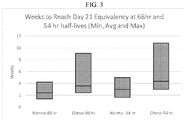
- the 21 day plasma level of the normal patient can be calculated using regression methods known in the art for a 66 hour or 54 hour t 1/2 , and the delay time for the patient as described herein is calculated using the estimated vortioxetine t 1/2 equation disclosed above to calculate the time required for the patient's plasma level of vortioxetine to fall to the 21 day equivalent level of the normal patient.
- the obese patient can have a steady-state vortioxetine plasma level ranging from about 2 to 5 ng/ml, 5 to 13 ng/mL, for example about 2, about 3, about 4, about 5, about 6, about 7, about 8, about 9, about 10, about 11, about 12, or about 13 ng/mL, inclusive of all ranges and subranges therebetween, and any steady-state vortioxetine plasma level described herein.
- the obese patient can have a steady-state vortioxetine plasma level of about 10 ng/mL.
- the obese patient has a steady-state vortioxetine plasma level ranging from about 7 to 11 ng/mL.
- the obese patient can have a steady-state vortioxetine plasma level ranging from about 9 to 19 ng/mL, for example about 9, about 10, about 11, about 12, about 13, about 14, about 15, about 16, about 17, about 18, or about 19 ng/mL, inclusive of all ranges and subranges therebetween. In some embodiments, the obese patient has a steady-state vortioxetine plasma level ranging from about 11 to 16 ng/mL.
- the obese patient can have a steady-state vortioxetine plasma level greater than about 13 ng/mL, greater than about 14 ng/mL, greater than about 16 ng/mL, greater than about 17 ng/mL, greater than about 18 ng/mL, greater than about 19 ng/mL, greater than about 20 ng/mL, greater than about 21 ng/mL, greater than about 22 ng/mL, greater than about 23 ng/mL, greater than about 24 ng/mL, greater than about 25 ng/mL, greater than about 26 ng/mL, greater than about 27 ng/mL, greater than about 28 ng/mL, greater than about 29 ng/mL, greater than about 30 ng/mL, inclusive of all ranges and subranges therebetween, and any steady-state vortioxetine plasma level described herein.
- the obese patient has a steady-state vortioxetine plasma level greater than about 16 ng/mL
- the obese patients described herein can also be an extensive CYP2D6 metabolizer, an intermediate CYP2D6 metabolizer, or a poor CYP2D6 metabolizer.
- the total body fat in kilograms can be any of the values described herein, and the 5 mg dose normalized steady-state vortioxetine plasma concentration can be any of the values described herein in any combination with the total body fat values described herein.
- the estimated vortioxetine t 1/2 can be at least about 80 to about 250 hours, including about 80, about 85, about 90, about 95, about 100, about 105, about 10, about 115, about 120, about 25, about 130, about 135, about 140, about 145, about 150, about 155, about 160, about 165, about 170, about 175, about 180, about 185, about 190, about 195, about 100 200, about 205, about 210, about 215, about 220, about 225, about 230, about 235, about 240, about 245, or about 250 hours, inclusive of all ranges and sub ranges therebetween.
- Table 1 Vortioxetine Half-Life and Subject Characteristics Subject T 1/2 (h) Css (ng/mL) Weight (kg) BMI (kg/m 2 ) Waist (in) %IBW % Total Fat % Android Fat % Gynoid Fat Total Fat (kg) Metab.
- the plasma elimination half-life of vortioxetine was correlated to the subjects' BMI.
- the half-life of vortioxetine in normal subjects ranged from about 30 to 80 hours with an average of about 54 hours whereas the half-life of vortioxetine in obese subjects ranged from about 54 to 171 hours with an average of about 79 hours.
- Obese subjects administered with vortioxetine 5 mg/day continued to have measurable drug plasma concentrations at least 28 days after discontinuing vortioxetine, which were as high as the highest maximum plasma concentrations of normal subjects after 2 weeks of washout. Therefore, the studies showed that obese subjects may require longer washout period after discontinuing vortioxetine and before starting monoamine oxidase inhibitors.
- the 21 day “delay” period (between ceasing administration of vortioxetine and initiating administration of MAOI) provided in the TRINTELLIX label is approximately 7.5 times the elimination half-life. If the half-life values presented in Table 2 and Fig. 1 are presented as recommended delay periods, the average recommended delay for "obese" patients should be longer than 21 days, and for some patients should be more than twice as long (nearly 8 weeks as shown by the "Max" values in Table 3 and Fig. 2 ). Table 3: Delay in Weeks MAOI Delay at 7.5 X Half-Life (Weeks) Cohort Min Average Max Normal 1.4 2.4 3.6 Obese 2.4 3.5 7.6
- Another way to view the impact of obesity on vortioxetine levels during the "washout" period after ceasing vortioxetine administration is to determine the delay time required for an "obese" patient (BMI ⁇ 35) to achieve the same plasma level of vortioxetine as a "normal” patient (BMI ⁇ 25) after a 21 day “washout” period.
- the analysis was carried out assuming normal CYP2D6 metabolizer status and either a 66 hour half-life as reported in the TRINTELLIX label, or the approximately 54 hour half-life measured in Applicants' study, above. The results are shown in FIG. 4.
- the average number of weeks required for the plasma levels of obese patients to achieve "21 day equivalency" with normal patients is higher than the 3 weeks specified in the TRINTELLIX label, with most obese patients requiring a substantially longer “washout” period, as much as 3+ fold longer.
- Table 4 Half-Life Estimates (hrs) Based on Total Body Fat (Kg) and Metabolizer Status Total Fat (Kg) Metabolizer Status 10 20 30 40 50 60 70 80 90 100 Extensive (a) 21 32 42 52 62 73 83 93 103 114 Extensive (b) 39 49 59 70 80 90 100 111 121 131 IM (c) 102 112 123 133 143 153 164 174 184 194 IM (d) 116 126 136 147 157 167 177 188 198 208 PM (e) 215 225 235 245 256 266 276 286 297 307 (a) average of obese steady-state concentration for extensive metabolizers (b) high of extensive metabolizers (c) average of intermediate metabolizer (IM) values (d) high of IM values (e) estimated poor metabolizer (PM values).
- IM intermediate metabolizer
- the half-life values of Table 4 can alternatively be expressed as the weeks of "washout” or delay between cessation of vortioxetine administration and initiation of MAOI administration, based on 7.5 X the calculated half-life (Table 5), 21 day equivalency to normal patients with a 66 hour vortioxetine half-life (Table 6), and 21 day equivalency to normal patients with a 54 hour vortioxetine half-life (Table 7).
- the delay period can be calculated based on any particular values in Table 1, or any statistical parameter for characterizing the subject population of Table, such as the arithmetic mean, geometric mean, maximum, minimum, maximum or minimum 90% confidence interval, etc.
- the half-life e.g., 7.5 x the average t 1/2 , 7.5 x the maximum t 1/2 , and so forth, or the 21 day equivalency to a normal weight extensive metabolizer subject, based on the average t 1/2 or the maximum t 1/2 or any of the aforementioned statistically parameters).
- Table 5 Weeks of Delay (7.5 X half-life) Based on Total Body Fat (Kg) and Metabolizer Status Total Fat (Kg) Metabolizer Status 10 20 30 40 50 60 70 80 90 100 Extensive (a) 3.2 3.7 4.2 4.6 5.1 Extensive (b) 3.1 3.6 4.0 4.5 4.9 5.4 5.9 IM (c) 4.6 5.0 5.5 5.9 6.4 6.8 7.3 7.8 8.2 8.7 IM (d) 5.2 5.6 6.1 6.5 7.0 7.5 7.9 8.4 8.8 9.3 PM (e) 9.6 10. 0 10. 5 11. 0 11. 4 11.9 12. 3 12.8 13.
- Table 7 Weeks of Delay (21 day equivalency to Normal, 54 hr half-life) Based on Total Body Fat (Kg) and Metabolizer Status Total Fat (Kg) Metabolizer Status 10 20 30 40 50 60 70 80 90 100 Exten sive (a) 3.5 4.1 4.6 5.2 5.8 6.4 Exten sive (b) 3.3 3.9 4.5 5.0 5.6 6.2 6.7 7.3 IM (c) 5.7 6.3 6.8 7.4 8.0 8.6 9.1 9.7 10.3 10.8 IM (d) 6.5 7.0 7.6 8.2 8.8 9.3 9.9 10.5 11.0 11.6 PM (e) 12.0 12.6 13.1 13.7 14.3 14.8 15.4 16.0 16.6 17.1 (a) average of obese steady-state concentration for extensive metabolizers (b) high of extensive metabolizers (c) average of intermediate metabolizer (IM) values (d) high of IM values (e) estimated poor metabolizer (PM values).
Landscapes
- Health & Medical Sciences (AREA)
- Veterinary Medicine (AREA)
- Public Health (AREA)
- General Health & Medical Sciences (AREA)
- Animal Behavior & Ethology (AREA)
- Life Sciences & Earth Sciences (AREA)
- Medicinal Chemistry (AREA)
- Chemical & Material Sciences (AREA)
- Pharmacology & Pharmacy (AREA)
- Epidemiology (AREA)
- Neurology (AREA)
- Bioinformatics & Cheminformatics (AREA)
- Nuclear Medicine, Radiotherapy & Molecular Imaging (AREA)
- Organic Chemistry (AREA)
- Chemical Kinetics & Catalysis (AREA)
- Neurosurgery (AREA)
- Biomedical Technology (AREA)
- General Chemical & Material Sciences (AREA)
- Engineering & Computer Science (AREA)
- Psychiatry (AREA)
- Pain & Pain Management (AREA)
- Pharmaceuticals Containing Other Organic And Inorganic Compounds (AREA)
- Medicines That Contain Protein Lipid Enzymes And Other Medicines (AREA)
- Acyclic And Carbocyclic Compounds In Medicinal Compositions (AREA)
- Pyrrole Compounds (AREA)
Claims (15)
- Vortioxétine destinée à être utilisée dans une méthode de traitement d'un trouble psychiatrique chez un patient en association avec un inhibiteur de la monoamine oxydase (IMAO), la méthode comprenant :(a) l'administration de vortioxétine ; puis(b) l'arrêt de l'administration de vortioxétine ; et(c) l'administration de la première dose d'un IMAO plus de 24 jours après l'étape (b) ;le trouble psychiatrique étant choisi dans le groupe constitué par une dépression, un trouble dépressif majeur, un trouble dysphorique prémenstruel, des épisodes dépressifs aigus avec bipolarité I, une dépression résistante aux traitements, un trouble anxieux général, un trouble obsessionnel compulsif, un trouble panique, un trouble de stress post-traumatique, un trouble d'anxiété sociale, la boulimie nerveuse, un dysfonctionnement cognitif lié à un trouble dysphorique prémenstruel, un trouble du déficit de l'attention avec hyperactivité, un trouble du déficit de l'attention avec hyperactivité chez des patients adultes et des associations de ceux-ci ;et ledit patient étant obèse et ayant au moins l'une des caractéristiques suivantes :i) un IMC d'au moins 35 ;ii) un % du poids idéal d'au moins 150 % ;iii) un tour de taille supérieur à 106,68 cm (42 pouces) ;iv) un % de graisse corporelle supérieur à 40 % ;v) un % de graisse corporelle androïde supérieur à 40 % ;vi) un % de graisse corporelle gynoïde supérieur à 40 % ; etvii) une graisse corporelle totale supérieure à 40 kg.
- Vortioxétine destinée à être utilisée dans une méthode comme revendiqué dans la revendication 1, ledit trouble psychiatrique étant un trouble dépressif majeur.
- Vortioxétine destinée à être utilisée dans une méthode comme revendiqué dans la revendication 1, l'IMAO étant un IMAO destiné à traiter des troubles psychiatriques.
- Vortioxétine destinée à être utilisée dans une méthode comme revendiqué dans la revendication 1, le patient ayant :i) un IMC d'au moins 40 ;ii) un IMC d'au moins 50 ;iii) un % du poids idéal d'au moins 250 % ;iv) un tour de taille supérieur à 121,92 cm (48 pouces) ;v) un % de graisse corporelle d'au moins 50 % ;vi) un % de graisse corporelle androïde d'au moins 50 % ;vii) un % de graisse corporelle gynoïde d'au moins 50 % ; et/ouviii)une graisse corporelle totale d'au moins 50 kg.
- Vortioxétine destinée à être utilisée dans une méthode comme revendiqué dans la revendication 1, la méthode comprenant l'administration de la première dose d'IMAO :i) au moins 4 semaines après l'étape (b) ; ouii) au moins 5 semaines après l'étape (b).
- IMAO destiné à être utilisé dans une méthode de traitement d'un trouble psychiatrique chez un patient qui est en cours de traitement avec de la vortioxétine, ladite méthode comprenant la transition du patient vers le traitement avec un IMAO destiné à traiter des troubles psychiatriques par :(a) l'arrêt de l'administration de vortioxétine ; et(b) l'administration de la première dose de l'IMAO plus de 24 jours après l'étape (a) ;le trouble psychiatrique étant choisi dans le groupe constitué par une dépression, un trouble dépressif majeur, un trouble dysphorique prémenstruel, des épisodes dépressifs aigus avec bipolarité I, une dépression résistante aux traitements, un trouble anxieux général, un trouble obsessionnel compulsif, un trouble panique, un trouble de stress post-traumatique, un trouble d'anxiété sociale, la boulimie nerveuse, un dysfonctionnement cognitif lié à un trouble dysphorique prémenstruel, un trouble du déficit de l'attention avec hyperactivité, un trouble du déficit de l'attention avec hyperactivité chez des patients adultes et des associations de ceux-ci ;ledit patient étant obèse et ayant au moins l'une des caractéristiques suivantes :i) un IMC d'au moins 35 ;ii) un % du poids idéal d'au moins 150 % ;iii) un tour de taille supérieur à 106,68 cm (42 pouces) ;iv) un % de graisse corporelle supérieur à 40 % ;v) un % de graisse corporelle androïde supérieur à 40 % ;vi) un % de graisse corporelle gynoïde supérieur à 40 % ; etvii) une graisse corporelle totale supérieure à 40 kg.
- IMAO destiné à être utilisé dans une méthode comme revendiqué dans la revendication 6, la méthode comprenant l'administration de la première dose d'IMAO dans l'étape (b) :i) au moins 4 semaines après l'étape (a) ; ouii) au moins 5 semaines après l'étape (a).
- IMAO destiné à être utilisé dans une méthode comme revendiqué dans la revendication 6, le patient ayant un IMC d'au moins 35.
- IMAO destiné à être utilisé dans une méthode comme revendiqué dans l'une quelconque des revendications 6-8, le patient ayant :i) un IMC d'au moins 40 ;ii) un IMC d'au moins 50 ;iii) un % du poids idéal d'au moins 250 % ;iv) un tour de taille supérieur à 121,92 cm (48 pouces) ;v) un % de graisse corporelle d'au moins 50 % ;vi) un % de graisse corporelle androïde d'au moins 50 % ;vii) un % de graisse corporelle gynoïde d'au moins 50 % ; et/ouviii)une graisse corporelle totale d'au moins 50 kg.
- IMAO destiné à être utilisé dans une méthode de traitement d'un trouble psychiatrique chez un patient auquel de la vortioxétine a auparavant été administrée, la méthode comprenant l'administration de la première dose de l'IMAO plus de 24 jours après l'arrêt de l'administration de vortioxétine ;
le trouble psychiatrique étant choisi dans le groupe constitué par une dépression, un trouble dépressif majeur, un trouble dysphorique prémenstruel, des épisodes dépressifs aigus avec bipolarité I, une dépression résistante aux traitements, un trouble anxieux général, un trouble obsessionnel compulsif, un trouble panique, un trouble de stress post-traumatique, un trouble d'anxiété sociale, la boulimie nerveuse, un dysfonctionnement cognitif lié à un trouble dysphorique prémenstruel, un trouble du déficit de l'attention avec hyperactivité, un trouble du déficit de l'attention avec hyperactivité chez des patients adultes et des associations de ceux-ci ;
et ledit patient étant obèse et ayant au moins l'une des caractéristiques suivantes :i) un IMC d'au moins 35 ;ii) un % du poids idéal d'au moins 150 % ;iii) un tour de taille supérieur à 106,68 cm (42 pouces) ;iv) un % de graisse corporelle supérieur à 40 % ;v) un % de graisse corporelle androïde supérieur à 40 % ;vi) un % de graisse corporelle gynoïde supérieur à 40 % ; etvii) une graisse corporelle totale supérieure à 40 kg. - IMAO destiné à être utilisé dans une méthode comme revendiqué dans la revendication 10, ledit trouble psychiatrique étant un ordre dépressif majeur.
- IMAO destiné à être utilisé dans une méthode comme revendiqué dans la revendication 10, l'IMAO étant un IMAO destiné à traiter des troubles psychiatriques.
- IMAO destiné à être utilisé dans une méthode comme revendiqué dans la revendication 10, le patient ayant :i) un IMC d'au moins 40 ;ii) un IMC d'au moins 50 ;iii) un % du poids idéal d'au moins 250 % ;iv) un tour de taille supérieur à 121,92 cm (48 pouces) ;v) un % de graisse corporelle d'au moins 50 % ;vi) un % de graisse corporelle androïde d'au moins 50 % ;vii) un % de graisse corporelle gynoïde d'au moins 50 % ; et/ouviii)une graisse corporelle totale d'au moins 50 kg.
- IMAO destiné à être utilisé dans une méthode comme revendiqué dans la revendication 10, la méthode comprenant l'administration de la première dose d'IMAO au moins 4 semaines après l'arrêt de l'administration de vortioxétine.
- IMAO destiné à être utilisé dans une méthode comme revendiqué dans la revendication 10, la méthode comprenant l'administration de la première dose d'IMAO au moins 5 semaines après l'arrêt de l'administration de vortioxétine.
Priority Applications (4)
| Application Number | Priority Date | Filing Date | Title |
|---|---|---|---|
| PL17902621T PL3528811T3 (pl) | 2017-03-30 | 2017-03-30 | Wortioksetyna i inhibitory mao do leczenia depresji |
| SI201730880T SI3528811T1 (sl) | 2017-03-30 | 2017-03-30 | Vortioksetin in zaviralci MAO za zdravljenje depresije |
| HRP20211241TT HRP20211241T1 (hr) | 2017-03-30 | 2017-03-30 | Vortioksetin i inhibitori mao za liječenje depresije |
| EP21185388.2A EP3915564A1 (fr) | 2017-03-30 | 2017-03-30 | Vortioxétine et inhibiteurs de mao pour le traitement de la dépression |
Applications Claiming Priority (2)
| Application Number | Priority Date | Filing Date | Title |
|---|---|---|---|
| US15/474,675 US20180280381A1 (en) | 2017-03-30 | 2017-03-30 | Methods of treating depression |
| PCT/US2017/025131 WO2018182639A1 (fr) | 2017-03-30 | 2017-03-30 | Méthodes de traitement de la dépression |
Related Child Applications (1)
| Application Number | Title | Priority Date | Filing Date |
|---|---|---|---|
| EP21185388.2A Division EP3915564A1 (fr) | 2017-03-30 | 2017-03-30 | Vortioxétine et inhibiteurs de mao pour le traitement de la dépression |
Publications (3)
| Publication Number | Publication Date |
|---|---|
| EP3528811A1 EP3528811A1 (fr) | 2019-08-28 |
| EP3528811A4 EP3528811A4 (fr) | 2020-07-08 |
| EP3528811B1 true EP3528811B1 (fr) | 2021-07-14 |
Family
ID=63672211
Family Applications (2)
| Application Number | Title | Priority Date | Filing Date |
|---|---|---|---|
| EP21185388.2A Withdrawn EP3915564A1 (fr) | 2017-03-30 | 2017-03-30 | Vortioxétine et inhibiteurs de mao pour le traitement de la dépression |
| EP17902621.6A Active EP3528811B1 (fr) | 2017-03-30 | 2017-03-30 | Vortioxetine et inhibiteurs de mao pour le traitement de la dépression |
Family Applications Before (1)
| Application Number | Title | Priority Date | Filing Date |
|---|---|---|---|
| EP21185388.2A Withdrawn EP3915564A1 (fr) | 2017-03-30 | 2017-03-30 | Vortioxétine et inhibiteurs de mao pour le traitement de la dépression |
Country Status (14)
| Country | Link |
|---|---|
| US (2) | US20180280381A1 (fr) |
| EP (2) | EP3915564A1 (fr) |
| JP (2) | JP6801129B2 (fr) |
| KR (1) | KR102171214B1 (fr) |
| AU (1) | AU2017407364B2 (fr) |
| CA (1) | CA3048206C (fr) |
| DK (1) | DK3528811T3 (fr) |
| ES (1) | ES2890326T3 (fr) |
| HR (1) | HRP20211241T1 (fr) |
| MX (1) | MX386540B (fr) |
| PL (1) | PL3528811T3 (fr) |
| SI (1) | SI3528811T1 (fr) |
| WO (1) | WO2018182639A1 (fr) |
| ZA (1) | ZA201906319B (fr) |
Families Citing this family (3)
| Publication number | Priority date | Publication date | Assignee | Title |
|---|---|---|---|---|
| US20190216803A1 (en) | 2017-03-30 | 2019-07-18 | Rundle Research, LLC | Methods of treating depression with vortioxetine |
| US20210393621A1 (en) | 2018-10-26 | 2021-12-23 | The Research Foundation For The State University Of New York | Combination serotonin specific reuptake inhibitor and serotonin 1a receptor partial agonist for reducing l-dopa-induced dyskinesia |
| KR20250077661A (ko) | 2023-11-23 | 2025-06-02 | 재단법인 환동해산업연구원 | 항우울 및 항비만 효과를 가지는 해양생물자원 추출물 및 그 제조방법 |
Family Cites Families (4)
| Publication number | Priority date | Publication date | Assignee | Title |
|---|---|---|---|---|
| US5708035A (en) * | 1991-02-04 | 1998-01-13 | Sepracor Inc. | Methods of use and compositions of R(-) fluoxetine |
| US9211288B2 (en) * | 2012-12-13 | 2015-12-15 | H. Lundbeck A/S | Compositions comprising vortioxetine and donepezil |
| AU2015227296A1 (en) * | 2014-03-05 | 2016-09-08 | Takeda Pharmaceutical Company Limited | Method for treating depression and major depressive disorder |
| WO2015136446A1 (fr) * | 2014-03-11 | 2015-09-17 | Nestec S.A. | Méthodes de choix de traitement par antidépresseur pour traiter la dépression |
-
2017
- 2017-03-30 ES ES17902621T patent/ES2890326T3/es active Active
- 2017-03-30 HR HRP20211241TT patent/HRP20211241T1/hr unknown
- 2017-03-30 DK DK17902621.6T patent/DK3528811T3/da active
- 2017-03-30 AU AU2017407364A patent/AU2017407364B2/en active Active
- 2017-03-30 WO PCT/US2017/025131 patent/WO2018182639A1/fr not_active Ceased
- 2017-03-30 CA CA3048206A patent/CA3048206C/fr active Active
- 2017-03-30 EP EP21185388.2A patent/EP3915564A1/fr not_active Withdrawn
- 2017-03-30 US US15/474,675 patent/US20180280381A1/en not_active Abandoned
- 2017-03-30 SI SI201730880T patent/SI3528811T1/sl unknown
- 2017-03-30 JP JP2019566940A patent/JP6801129B2/ja active Active
- 2017-03-30 EP EP17902621.6A patent/EP3528811B1/fr active Active
- 2017-03-30 PL PL17902621T patent/PL3528811T3/pl unknown
- 2017-03-30 MX MX2019011555A patent/MX386540B/es unknown
- 2017-03-30 KR KR1020197031967A patent/KR102171214B1/ko active Active
-
2018
- 2018-06-06 US US16/001,322 patent/US10799498B2/en active Active
-
2019
- 2019-09-25 ZA ZA2019/06319A patent/ZA201906319B/en unknown
-
2020
- 2020-11-25 JP JP2020195177A patent/JP2021028339A/ja not_active Withdrawn
Non-Patent Citations (1)
| Title |
|---|
| None * |
Also Published As
| Publication number | Publication date |
|---|---|
| MX386540B (es) | 2025-03-11 |
| JP6801129B2 (ja) | 2020-12-16 |
| EP3915564A1 (fr) | 2021-12-01 |
| US10799498B2 (en) | 2020-10-13 |
| WO2018182639A1 (fr) | 2018-10-04 |
| PL3528811T3 (pl) | 2022-01-10 |
| KR102171214B1 (ko) | 2020-10-28 |
| EP3528811A4 (fr) | 2020-07-08 |
| AU2017407364B2 (en) | 2019-11-07 |
| DK3528811T3 (da) | 2021-09-27 |
| US20180311235A1 (en) | 2018-11-01 |
| CA3048206C (fr) | 2019-12-24 |
| KR20190127956A (ko) | 2019-11-13 |
| US20180280381A1 (en) | 2018-10-04 |
| HRP20211241T1 (hr) | 2021-11-12 |
| JP2021028339A (ja) | 2021-02-25 |
| ES2890326T3 (es) | 2022-01-18 |
| SI3528811T1 (sl) | 2022-01-31 |
| AU2017407364A1 (en) | 2019-10-10 |
| JP2020512397A (ja) | 2020-04-23 |
| CA3048206A1 (fr) | 2018-10-04 |
| EP3528811A1 (fr) | 2019-08-28 |
| ZA201906319B (en) | 2021-05-26 |
Similar Documents
| Publication | Publication Date | Title |
|---|---|---|
| Greden | Physical symptoms of depression: unmet needs | |
| Denys et al. | Quetiapine addition to serotonin reuptake inhibitor treatment in patients with treatment-refractory obsessive-compulsive disorder: an open-label study | |
| Kratochvil et al. | Atomoxetine alone or combined with fluoxetine for treating ADHD with comorbid depressive or anxiety symptoms | |
| Dunlop et al. | The role of dopamine in the pathophysiology of depression | |
| Sousa et al. | A randomized clinical trial of cognitive-behavioral group therapy and sertraline in the treatment of obsessive-compulsive disorder | |
| Hirschfeld et al. | Time course of depression‐symptom improvement during treatment with duloxetine | |
| Richelson | Treatment of acute depression | |
| US10799498B2 (en) | Methods of treating depression | |
| US20120010242A1 (en) | Low dose pipamperone in treating mood disorders | |
| Levin et al. | Life-threatening serotonin toxicity due to a citalopram-fluconazole drug interaction: case reports and discussion | |
| US12508261B2 (en) | Methods of treating depression with vortioxetine | |
| US10398691B2 (en) | Methods of treating depression | |
| Tranulis et al. | The paradox of quetiapine in obsessive-compulsive disorder | |
| JP2024502431A (ja) | 肥満患者における、ブレクスピプラゾールを用いた精神疾患の治療方法 | |
| US20250057833A1 (en) | Methods of treating psychiatric disorders in obese patients with brexpiprazole | |
| US20220202810A1 (en) | Methods of treating psychiatric disorders in obese patients with brexpiprazole | |
| Yamauchi et al. | Vortioxetine can be used safely to treat depression after implantable cardioverter defibrillator implantation for congenital long QT syndrome: a case report | |
| Birrer | Depression and aging too often do mix: Accurate recognition is half the battle | |
| EP4637768A1 (fr) | Posologie d'ilopéridone pour le traitement d'un trouble bipolaire i et de la schizophrénie | |
| Buffum et al. | The psychopharmacologic treatment of depression in elders: Medical conditions, life circumstances, and the type and number of medications currently taken are considerations in selecting an anti-depressant medication | |
| Thase et al. | P. 1 Affective disorders and antidepressants S143 | |
| Marciniak et al. | Health care costs among medication-treated managed care enrollees with anxiety disorders | |
| Lam | Long QT syndrome associated with fluvoxamine. |
Legal Events
| Date | Code | Title | Description |
|---|---|---|---|
| STAA | Information on the status of an ep patent application or granted ep patent |
Free format text: STATUS: THE INTERNATIONAL PUBLICATION HAS BEEN MADE |
|
| PUAI | Public reference made under article 153(3) epc to a published international application that has entered the european phase |
Free format text: ORIGINAL CODE: 0009012 |
|
| STAA | Information on the status of an ep patent application or granted ep patent |
Free format text: STATUS: REQUEST FOR EXAMINATION WAS MADE |
|
| 17P | Request for examination filed |
Effective date: 20190523 |
|
| AK | Designated contracting states |
Kind code of ref document: A1 Designated state(s): AL AT BE BG CH CY CZ DE DK EE ES FI FR GB GR HR HU IE IS IT LI LT LU LV MC MK MT NL NO PL PT RO RS SE SI SK SM TR |
|
| AX | Request for extension of the european patent |
Extension state: BA ME |
|
| STAA | Information on the status of an ep patent application or granted ep patent |
Free format text: STATUS: EXAMINATION IS IN PROGRESS |
|
| A4 | Supplementary search report drawn up and despatched |
Effective date: 20200609 |
|
| DAV | Request for validation of the european patent (deleted) | ||
| DAX | Request for extension of the european patent (deleted) | ||
| RIC1 | Information provided on ipc code assigned before grant |
Ipc: C07D 295/096 20060101ALI20200604BHEP Ipc: A61P 25/24 20060101ALI20200604BHEP Ipc: A61K 31/495 20060101AFI20200604BHEP |
|
| 17Q | First examination report despatched |
Effective date: 20200701 |
|
| RIN1 | Information on inventor provided before grant (corrected) |
Inventor name: SRINIVASAN, SUNDAR Inventor name: CHOW, CHRISTINA |
|
| GRAP | Despatch of communication of intention to grant a patent |
Free format text: ORIGINAL CODE: EPIDOSNIGR1 |
|
| STAA | Information on the status of an ep patent application or granted ep patent |
Free format text: STATUS: GRANT OF PATENT IS INTENDED |
|
| RIC1 | Information provided on ipc code assigned before grant |
Ipc: A61K 31/495 20060101AFI20210125BHEP Ipc: A61K 31/135 20060101ALI20210125BHEP Ipc: A61P 25/24 20060101ALI20210125BHEP Ipc: A61K 31/15 20060101ALI20210125BHEP Ipc: A61K 31/165 20060101ALI20210125BHEP |
|
| INTG | Intention to grant announced |
Effective date: 20210223 |
|
| RIN1 | Information on inventor provided before grant (corrected) |
Inventor name: SRINIVASAN, SUNDAR Inventor name: CHOW, CHRISTINA |
|
| GRAS | Grant fee paid |
Free format text: ORIGINAL CODE: EPIDOSNIGR3 |
|
| GRAA | (expected) grant |
Free format text: ORIGINAL CODE: 0009210 |
|
| STAA | Information on the status of an ep patent application or granted ep patent |
Free format text: STATUS: THE PATENT HAS BEEN GRANTED |
|
| AK | Designated contracting states |
Kind code of ref document: B1 Designated state(s): AL AT BE BG CH CY CZ DE DK EE ES FI FR GB GR HR HU IE IS IT LI LT LU LV MC MK MT NL NO PL PT RO RS SE SI SK SM TR |
|
| REG | Reference to a national code |
Ref country code: GB Ref legal event code: FG4D |
|
| REG | Reference to a national code |
Ref country code: DE Ref legal event code: R096 Ref document number: 602017042316 Country of ref document: DE |
|
| REG | Reference to a national code |
Ref country code: HR Ref legal event code: TUEP Ref document number: P20211241T Country of ref document: HR |
|
| REG | Reference to a national code |
Ref country code: IE Ref legal event code: FG4D |
|
| REG | Reference to a national code |
Ref country code: FI Ref legal event code: FGE |
|
| REG | Reference to a national code |
Ref country code: AT Ref legal event code: REF Ref document number: 1410124 Country of ref document: AT Kind code of ref document: T Effective date: 20210815 |
|
| REG | Reference to a national code |
Ref country code: DK Ref legal event code: T3 Effective date: 20210921 |
|
| REG | Reference to a national code |
Ref country code: NL Ref legal event code: FP |
|
| REG | Reference to a national code |
Ref country code: NO Ref legal event code: T2 Effective date: 20210714 |
|
| REG | Reference to a national code |
Ref country code: SE Ref legal event code: TRGR |
|
| REG | Reference to a national code |
Ref country code: LT Ref legal event code: MG9D |
|
| REG | Reference to a national code |
Ref country code: HR Ref legal event code: T1PR Ref document number: P20211241 Country of ref document: HR |
|
| REG | Reference to a national code |
Ref country code: ES Ref legal event code: FG2A Ref document number: 2890326 Country of ref document: ES Kind code of ref document: T3 Effective date: 20220118 |
|
| PG25 | Lapsed in a contracting state [announced via postgrant information from national office to epo] |
Ref country code: PT Free format text: LAPSE BECAUSE OF FAILURE TO SUBMIT A TRANSLATION OF THE DESCRIPTION OR TO PAY THE FEE WITHIN THE PRESCRIBED TIME-LIMIT Effective date: 20211115 Ref country code: BG Free format text: LAPSE BECAUSE OF FAILURE TO SUBMIT A TRANSLATION OF THE DESCRIPTION OR TO PAY THE FEE WITHIN THE PRESCRIBED TIME-LIMIT Effective date: 20211014 Ref country code: LT Free format text: LAPSE BECAUSE OF FAILURE TO SUBMIT A TRANSLATION OF THE DESCRIPTION OR TO PAY THE FEE WITHIN THE PRESCRIBED TIME-LIMIT Effective date: 20210714 Ref country code: RS Free format text: LAPSE BECAUSE OF FAILURE TO SUBMIT A TRANSLATION OF THE DESCRIPTION OR TO PAY THE FEE WITHIN THE PRESCRIBED TIME-LIMIT Effective date: 20210714 |
|
| PG25 | Lapsed in a contracting state [announced via postgrant information from national office to epo] |
Ref country code: GR Free format text: LAPSE BECAUSE OF FAILURE TO SUBMIT A TRANSLATION OF THE DESCRIPTION OR TO PAY THE FEE WITHIN THE PRESCRIBED TIME-LIMIT Effective date: 20211015 |
|
| REG | Reference to a national code |
Ref country code: AT Ref legal event code: UEP Ref document number: 1410124 Country of ref document: AT Kind code of ref document: T Effective date: 20210714 |
|
| REG | Reference to a national code |
Ref country code: DE Ref legal event code: R097 Ref document number: 602017042316 Country of ref document: DE |
|
| REG | Reference to a national code |
Ref country code: HR Ref legal event code: ODRP Ref document number: P20211241 Country of ref document: HR Payment date: 20220324 Year of fee payment: 6 |
|
| PLBE | No opposition filed within time limit |
Free format text: ORIGINAL CODE: 0009261 |
|
| STAA | Information on the status of an ep patent application or granted ep patent |
Free format text: STATUS: NO OPPOSITION FILED WITHIN TIME LIMIT |
|
| PG25 | Lapsed in a contracting state [announced via postgrant information from national office to epo] |
Ref country code: SM Free format text: LAPSE BECAUSE OF FAILURE TO SUBMIT A TRANSLATION OF THE DESCRIPTION OR TO PAY THE FEE WITHIN THE PRESCRIBED TIME-LIMIT Effective date: 20210714 Ref country code: SK Free format text: LAPSE BECAUSE OF FAILURE TO SUBMIT A TRANSLATION OF THE DESCRIPTION OR TO PAY THE FEE WITHIN THE PRESCRIBED TIME-LIMIT Effective date: 20210714 Ref country code: RO Free format text: LAPSE BECAUSE OF FAILURE TO SUBMIT A TRANSLATION OF THE DESCRIPTION OR TO PAY THE FEE WITHIN THE PRESCRIBED TIME-LIMIT Effective date: 20210714 Ref country code: EE Free format text: LAPSE BECAUSE OF FAILURE TO SUBMIT A TRANSLATION OF THE DESCRIPTION OR TO PAY THE FEE WITHIN THE PRESCRIBED TIME-LIMIT Effective date: 20210714 Ref country code: CZ Free format text: LAPSE BECAUSE OF FAILURE TO SUBMIT A TRANSLATION OF THE DESCRIPTION OR TO PAY THE FEE WITHIN THE PRESCRIBED TIME-LIMIT Effective date: 20210714 Ref country code: AL Free format text: LAPSE BECAUSE OF FAILURE TO SUBMIT A TRANSLATION OF THE DESCRIPTION OR TO PAY THE FEE WITHIN THE PRESCRIBED TIME-LIMIT Effective date: 20210714 |
|
| 26N | No opposition filed |
Effective date: 20220419 |
|
| REG | Reference to a national code |
Ref country code: HR Ref legal event code: ODRP Ref document number: P20211241 Country of ref document: HR Payment date: 20230207 Year of fee payment: 7 |
|
| P01 | Opt-out of the competence of the unified patent court (upc) registered |
Effective date: 20230426 |
|
| REG | Reference to a national code |
Ref country code: HR Ref legal event code: ODRP Ref document number: P20211241 Country of ref document: HR Payment date: 20240131 Year of fee payment: 8 |
|
| PG25 | Lapsed in a contracting state [announced via postgrant information from national office to epo] |
Ref country code: MK Free format text: LAPSE BECAUSE OF FAILURE TO SUBMIT A TRANSLATION OF THE DESCRIPTION OR TO PAY THE FEE WITHIN THE PRESCRIBED TIME-LIMIT Effective date: 20210714 Ref country code: CY Free format text: LAPSE BECAUSE OF FAILURE TO SUBMIT A TRANSLATION OF THE DESCRIPTION OR TO PAY THE FEE WITHIN THE PRESCRIBED TIME-LIMIT Effective date: 20210714 |
|
| PG25 | Lapsed in a contracting state [announced via postgrant information from national office to epo] |
Ref country code: HU Free format text: LAPSE BECAUSE OF FAILURE TO SUBMIT A TRANSLATION OF THE DESCRIPTION OR TO PAY THE FEE WITHIN THE PRESCRIBED TIME-LIMIT; INVALID AB INITIO Effective date: 20170330 |
|
| PGFP | Annual fee paid to national office [announced via postgrant information from national office to epo] |
Ref country code: NL Payment date: 20250217 Year of fee payment: 9 |
|
| PGFP | Annual fee paid to national office [announced via postgrant information from national office to epo] |
Ref country code: MC Payment date: 20250227 Year of fee payment: 9 |
|
| PGFP | Annual fee paid to national office [announced via postgrant information from national office to epo] |
Ref country code: DE Payment date: 20250204 Year of fee payment: 9 Ref country code: IS Payment date: 20250214 Year of fee payment: 9 |
|
| REG | Reference to a national code |
Ref country code: HR Ref legal event code: ODRP Ref document number: P20211241 Country of ref document: HR Payment date: 20250124 Year of fee payment: 9 |
|
| PGFP | Annual fee paid to national office [announced via postgrant information from national office to epo] |
Ref country code: DK Payment date: 20250317 Year of fee payment: 9 Ref country code: FI Payment date: 20250314 Year of fee payment: 9 |
|
| PGFP | Annual fee paid to national office [announced via postgrant information from national office to epo] |
Ref country code: LU Payment date: 20250313 Year of fee payment: 9 |
|
| PGFP | Annual fee paid to national office [announced via postgrant information from national office to epo] |
Ref country code: SE Payment date: 20250211 Year of fee payment: 9 |
|
| PGFP | Annual fee paid to national office [announced via postgrant information from national office to epo] |
Ref country code: NO Payment date: 20250312 Year of fee payment: 9 |
|
| PGFP | Annual fee paid to national office [announced via postgrant information from national office to epo] |
Ref country code: BE Payment date: 20250214 Year of fee payment: 9 Ref country code: AT Payment date: 20250225 Year of fee payment: 9 |
|
| PGFP | Annual fee paid to national office [announced via postgrant information from national office to epo] |
Ref country code: FR Payment date: 20250210 Year of fee payment: 9 |
|
| PGFP | Annual fee paid to national office [announced via postgrant information from national office to epo] |
Ref country code: IT Payment date: 20250211 Year of fee payment: 9 Ref country code: GB Payment date: 20250206 Year of fee payment: 9 |
|
| PGFP | Annual fee paid to national office [announced via postgrant information from national office to epo] |
Ref country code: MT Payment date: 20250318 Year of fee payment: 9 Ref country code: TR Payment date: 20250317 Year of fee payment: 9 |
|
| PGFP | Annual fee paid to national office [announced via postgrant information from national office to epo] |
Ref country code: ES Payment date: 20250411 Year of fee payment: 9 |
|
| PGFP | Annual fee paid to national office [announced via postgrant information from national office to epo] |
Ref country code: CH Payment date: 20250401 Year of fee payment: 9 |
|
| REG | Reference to a national code |
Ref country code: HR Ref legal event code: ODRP Ref document number: P20211241 Country of ref document: HR Payment date: 20260121 Year of fee payment: 10 |
|
| PGFP | Annual fee paid to national office [announced via postgrant information from national office to epo] |
Ref country code: IE Payment date: 20260123 Year of fee payment: 10 |
|
| PGFP | Annual fee paid to national office [announced via postgrant information from national office to epo] |
Ref country code: HR Payment date: 20260121 Year of fee payment: 10 |
|
| PGFP | Annual fee paid to national office [announced via postgrant information from national office to epo] |
Ref country code: PL Payment date: 20260128 Year of fee payment: 10 |
|
| PGFP | Annual fee paid to national office [announced via postgrant information from national office to epo] |
Ref country code: LV Payment date: 20260120 Year of fee payment: 10 |
|
| PGFP | Annual fee paid to national office [announced via postgrant information from national office to epo] |
Ref country code: SI Payment date: 20260126 Year of fee payment: 10 |