EP3528706B1 - System und verfahren für digitalisierten digit symbol substitution test - Google Patents
System und verfahren für digitalisierten digit symbol substitution test Download PDFInfo
- Publication number
- EP3528706B1 EP3528706B1 EP17863089.3A EP17863089A EP3528706B1 EP 3528706 B1 EP3528706 B1 EP 3528706B1 EP 17863089 A EP17863089 A EP 17863089A EP 3528706 B1 EP3528706 B1 EP 3528706B1
- Authority
- EP
- European Patent Office
- Prior art keywords
- feature values
- pair
- examinee
- multiple bins
- bins
- Prior art date
- Legal status (The legal status is an assumption and is not a legal conclusion. Google has not performed a legal analysis and makes no representation as to the accuracy of the status listed.)
- Active
Links
Images




Classifications
-
- G—PHYSICS
- G09—EDUCATION; CRYPTOGRAPHY; DISPLAY; ADVERTISING; SEALS
- G09B—EDUCATIONAL OR DEMONSTRATION APPLIANCES; APPLIANCES FOR TEACHING, OR COMMUNICATING WITH, THE BLIND, DEAF OR MUTE; MODELS; PLANETARIA; GLOBES; MAPS; DIAGRAMS
- G09B19/00—Teaching not covered by other main groups of this subclass
-
- A—HUMAN NECESSITIES
- A61—MEDICAL OR VETERINARY SCIENCE; HYGIENE
- A61B—DIAGNOSIS; SURGERY; IDENTIFICATION
- A61B5/00—Measuring for diagnostic purposes; Identification of persons
- A61B5/16—Devices for psychotechnics; Testing reaction times ; Devices for evaluating the psychological state
- A61B5/163—Devices for psychotechnics; Testing reaction times ; Devices for evaluating the psychological state by tracking eye movement, gaze, or pupil change
-
- G—PHYSICS
- G06—COMPUTING OR CALCULATING; COUNTING
- G06N—COMPUTING ARRANGEMENTS BASED ON SPECIFIC COMPUTATIONAL MODELS
- G06N7/00—Computing arrangements based on specific mathematical models
- G06N7/01—Probabilistic graphical models, e.g. probabilistic networks
-
- G—PHYSICS
- G09—EDUCATION; CRYPTOGRAPHY; DISPLAY; ADVERTISING; SEALS
- G09B—EDUCATIONAL OR DEMONSTRATION APPLIANCES; APPLIANCES FOR TEACHING, OR COMMUNICATING WITH, THE BLIND, DEAF OR MUTE; MODELS; PLANETARIA; GLOBES; MAPS; DIAGRAMS
- G09B7/00—Electrically-operated teaching apparatus or devices working with questions and answers
Definitions
- the embodiments herein generally relate to digit symbol substitution test (DSST) and, more particularly, to system and method for visual Bayesian data fusion.
- DSST digit symbol substitution test
- Digit Symbol Substitution Test is a neuropsychological test sensitive to brain damage, dementia, age and depression. However, the test is not sensitive to the location of the brain damage except for damage comprising part of the visual field.
- the DSST consists of 9 digits and corresponding symbols.
- a user or an examinee should remember where each symbol matches a digit. Initially, the examinee is shown a key containing numbers from 1 to 9 and under each number, a corresponding symbol is given. Further, the examinee is shown a series of boxes containing numbers in top boxes and the boxes below the top boxes are kept as blank. After a short period of time, the examinee is asked to copy the corresponding symbol under each number.
- a score is then calculated and the score is the number of correct items completed within the prescribed time limit.
- the initial rounds of the DSST tests are simple and the later rounds are challenging due to time exhaustion.
- the most obvious application of the DSST is to memory.
- DSST is used to test brain injury, especially for athletes suffering concussions.
- US 2013/0090562 A1 discloses a method for assessing cognitive function wherein a set of images are presented to a subject and the eye movements of the subject are monitored.
- WO 2014/146168 A1 discloses a method to monitor a user performing tasks.
- US 2002/0072859 A1 discloses a mentation test method to perform conjecture of brain's mentation age, discrimination of early stage of dementia and prediction of onset of dementia.
- a processor-implemented method includes steps of: partitioning a display area of a digitized digit symbol substitution test (DSST) device into multiple bins based on distance and degree from a center position of the display area; displaying a series of number symbol pairs as a lookup table on top of the display, termed as a lookup area; displaying a question and answer (QA) pair corresponding to the series of number symbol pairs to an examinee in multiple trials, wherein the location of the QA pair is changed in each of the multiple trials so that equal number of pairs are present in the multiple bins; computing feature values for the QA pair in each of the multiple bins in the multiple trials, wherein the feature values comprise a response time and an accuracy of response by the examinee; determining probabilities of the feature values in each of the multiple bins; and computing an entropy value based on the probabilities of the feature values in each
- a system for digitized digit symbol substitution test includes a DSST device including one or more memories; and one or more hardware processors, the one or more memories coupled to the one or more hardware processors, wherein the one or more hardware processors are capable of executing programmed instructions stored in the one or more memories to: partition a display area in the DSST device into multiple bins based on distance and degree from a center position of the display area; display a series of number symbol pairs as a lookup table on top of the display, termed as a lookup area; display a question and answer (QA) pair corresponding to the series of number symbol pairs to an examinee in multiple trials, wherein the location of the QA pair is changed in each of the multiple trials so that equal number of pairs are present in the multiple bins; compute feature values for the QA pair in each of the multiple bins in the multiple trials, wherein the feature values comprise a response time and an accuracy of response by the examinee; determine probabilities of the feature values in each of
- a non-transitory computer-readable medium having embodied thereon a computer program for executing a method for digitized digit symbol substitution test (DSST) includes steps of: partitioning a display area of a digitized digit symbol substitution test (DSST) device into multiple bins based on distance and degree from a center position of the display area; displaying a series of number symbol pairs as a lookup table on top of the display, termed as a lookup area; displaying a question and answer (QA) pair corresponding to the series of number symbol pairs to an examinee in multiple trials, wherein the location of the QA pair is changed in each of the multiple trials so that equal number of pairs are present in the multiple bins; computing feature values for the QA pair in each of the multiple bins in the multiple trials, wherein the feature values comprise a response time and an accuracy of response by the examinee; determining probabilities of the feature values in each of the multiple bins; and computing an entropy value based on the probabilities
- any block diagram herein represents conceptual views of illustrative systems embodying the principles of the present subject matter.
- any flow charts, flow diagrams, state transition diagrams, pseudo code, and the like represent various processes which may be substantially represented in computer readable medium and so executed by a computing device or processor, whether or not such computing device or processor is explicitly shown.
- FIG. 1 illustrates a block diagram of a system 100 for digitized DSST, in accordance with an example embodiment.
- the system 100 may be embodied in, or is in direct communication with a computing device.
- the system 100 a DSST device 102, sensors 104 communicatively coupled to the DSST device 102 and a space bar 114.
- sensors 104 are connected to the digital DSST device 102 and attached to an examinee.
- the sensors used include eye tracker, galvanic skin response (GSR) sensor, electroencephalogram (EEG) sensor, photoplethysmography (PPG) sensor and a peripheral capillary oxygen saturation (SpO2) sensor.
- GSR galvanic skin response
- EEG electroencephalogram
- PPG photoplethysmography
- SpO2 peripheral capillary oxygen saturation
- an eye tracker 104a is connected to the digitized DSST device.
- the eye tracker is used to identify the nature of gaze.
- the nature of the gaze indicates the attention, confusion, working memory related states and rest time in various locations of the stimulus.
- the sensors attached to the examinee monitors the mental states of the examinee during the test.
- the sensors used during the test includes a GSR sensor 104b to determine stress during the test, n EEG sensor 104c to get the temporal data associated with the mental states of the examinee, a PPG sensor 104d to determine the heart rate variability and a SpO2 sensor.
- the DSST device 102 includes or is otherwise in communication with one or more hardware processors such as processor(s) 106, one or more memories such as a memory 108, a network interface unit such as a network interface unit 110 and a lookup area 112 (i.e., a display).
- processors such as processor(s) 106
- memories such as a memory 108
- network interface unit such as a network interface unit 110
- a lookup area 112 i.e., a display
- the processor 106, memory 108, and the network interface unit 110 may be coupled by a system bus such as a system bus or a similar mechanism.
- FIG. 1 shows example components of the system 100, in other implementations, the system 100 may contain fewer components, additional components, different components, or differently arranged components than depicted in FIG. 1 .
- the processor 106 may include circuitry implementing, among others, audio and logic functions associated with the communication, and imaging, displaying, decoding and rendering functions.
- the processor 106 may include, but are not limited to, one or more digital signal processors (DSPs), one or more microprocessor, one or more special-purpose computer chips, one or more field-programmable gate arrays (FPGAs), one or more application-specific integrated circuits (ASICs), one or more computer(s), various analog to digital converters, digital to analog converters, and/or other support circuits.
- DSPs digital signal processors
- FPGAs field-programmable gate arrays
- ASICs application-specific integrated circuits
- the processor 106 thus may also include the functionality to encode messages and/or data or information.
- the processor 106 may include, among other things, a clock, an arithmetic logic unit (ALU) and logic gates configured to support operation of the processor 102. Further, the processor 106 may include functionality to execute one or more software programs, which may be stored in the memory 108 or otherwise accessible to the processor 106.
- ALU arithmetic logic unit
- processors may be provided through the use of dedicated hardware as well as hardware capable of executing software in association with appropriate software.
- the functions may be provided by a single dedicated processor, by a single shared processor, or by a plurality of individual processors, some of which may be shared.
- explicit use of the term "processor” should not be construed to refer exclusively to hardware capable of executing software, and may implicitly include, without limitation DSP hardware, network processor, application specific integrated circuit (ASIC), FPGA, read only memory (ROM) for storing software, random access memory (RAM), and non-volatile storage. Other hardware, conventional, and/or custom, may also be included.
- the interface(s) 110 may include a variety of software and hardware interfaces, for example, interfaces for peripheral device(s), such as a keyboard, a mouse, an external memory, and a printer.
- the interface(s) 110 can facilitate multiple communications within a wide variety of networks and protocol types, including wired networks, for example, local area network (LAN), cable, etc., and wireless networks, such as Wireless LAN (WLAN), cellular, or satellite.
- LAN local area network
- WLAN Wireless LAN
- cellular or satellite.
- the one or more memories such as a memory 108, may store any number of pieces of information, and data, used by the system to implement the functions of the system.
- the memory 108 may include for example, volatile memory and/or non-volatile memory. Examples of volatile memory may include, but are not limited to volatile random access memory.
- the non-volatile memory may additionally or alternatively comprise an electrically erasable programmable read only memory (EEPROM), flash memory, hard drive, or the like.
- EEPROM electrically erasable programmable read only memory
- flash memory volatile random access memory
- hard drive or the like.
- Some examples of the volatile memory includes, but are not limited to, random access memory, dynamic random access memory, static random access memory, and the like.
- the non-volatile memory includes, but are not limited to, hard disks, magnetic tapes, optical disks, programmable read only memory, erasable programmable read only memory, electrically erasable programmable read only memory, flash memory, and the like.
- the memory 108 may be configured to store information, data, applications, instructions or the like for enabling the system 100 to carry out various functions in accordance with various example embodiments. Additionally or alternatively, the memory 108 may be configured to store instructions which when executed by the processor 106 causes the system to behave in a manner as described in various embodiments.
- the memory 108 includes a DSST module 112 and/or other modules.
- the module 112 include routines, programs, objects, components, data structures, etc., which perform particular tasks or implement particular abstract data types.
- the other modules may include programs or coded instructions that supplement applications and functions of the system 100.
- the DSST module 112 trains the examinee with a version 1 of the digitized DSST. For example, digits from 1 to 9 and their corresponding symbols are stored in a lookup table (i.e., lookup area) on a display area of the digitized DSST device 102. As shown in FIG. 2 , lookup table entries 200 are fixed and placed at the top location of the display screen of the digitized DSST device 102 in the version 1 of the digitized DSST. The query digit-symbol appears at the center of the screen. The examinee is asked to undergo the test.
- a lookup table i.e., lookup area
- the examinee presses the "space bar" button. For the non-matching pair, the examinee should wait for 3 seconds. The waiting response of the examinee is taken as a correct response for the non-matching symbol-digit pair. For every correct decision, the score is incremented.
- the number of digit-symbol pair trial is fixed to 50 and the delay between the disappearance of the previous query digit-symbol pair and the new query digit-symbol pair is 300 milliseconds.
- the digitized DSST can be adapted to any regional language for the numerals.
- response time per trial, total time, correctness score and insights drawn from the physiological sensors are measured from the digitized DSST.
- the insights drawn from the physiological sensors are cognitive load, anxiety, attention and the like.
- the insights are used to detect the motivation and involvement of the examinee during the entire digital DSST.
- the motivation and the involvement of the examinee is considered as important since the score calculated during the digitized DSST does not give the true reflection of the behavior of the examinee if there is no involvement.
- the features, response time per trial, total time, correctness score and insights drawn from the physiological sensors gives valuable information about the neuropsychological condition of the examinee. For example, the time spent in the lookup area, QA and time wander are determined as follows:
- the DSST module 112 then analyzes neuropsychological condition of the examinee using the response time per trial, total time, correctness score and the insights drawn from the physiological sensors. In other words, the DSST module 112 determines memory related functions using the version 1. Since the lookup table entries are fixed in version 1, the examinee tend to remember the symbols with their corresponding numbers. The DSST module 112 determined the memory related functions based on a number of transitions made from the query area (QA) to the lookup area (LUA) and the QA to the target LUA (TLUA). This can be used to derive the memorization index which is inversely proportional to the no. of transitions. For example, the DSST module 112 determines the transition made from the QA to the LUA using the following procedure.
- the DSST module 112 determines the transition made from the LUA to the QA using the following procedure.
- the DSST module 112 trains the examinee with version 2 of the digitized DSST, as shown in FIGS. 3A and 3B .
- the version 2 is similar to version 1 except that the symbol entries in the lookup table changes with the trial.
- the effect of memorization is nullified as there is no provision to retain the digit-symbol pair in mind.
- the physiological changes involved are due to the working memory load. This can be used to derive the index of cognitive activity. For example, the nature of eye movement is one of the main cognitive deficits in Schizophrenic subjects.
- the DSST module 112 analyzes nature of eye movement of the examinee in the one of the multiple trials based on the length of the path traversed by eyes of the examinee from the QA pair to the target location in the lookup area and a length of shortest path between the QA pair and the target location in the lookup area. In this example, the DSST module 112 derive the features (e.g., degree centrality, link density, clustering coefficient, and diameter) from the scanpath obtained by the gaze analysis in each trial. In an embodiment, the DSST module 112 extracts eye gaze data (x,y) per trial and derives a scan path S which contains the transitions from the 9 locations in the LUA, QA and the NROI. This array is then used to construct an adjacency matrix A and then the following graph related features are computed.
- the features e.g., degree centrality, link density, clustering coefficient, and diameter
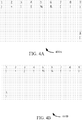
- the DSST module 1122 trains the examinee with version 3 of the DSST, as shown in FIGS. 4A and 4B .
- the QA keeps changing its location with trials. This forces the subject to perform a dual search- locating the position of the QA and then finding the TLUA. The defects like visual neglect can be tracked using this version. Also, this adds additional load on the subject and hence, this version could be compared with version 1 and 2 for changes in the load imposed on the subject.
- version 1 and 2 the QA was positioned in the center, but in version 3 it moves away from the center. Hence, this can be used to derive the index of visuo-spatial neglect that is based on the accuracy and response time in matching the query-symbol pair against the lookup table with the increase in distance of the QA from the center of the screen.
- the DSST module 112 divides the 360 degree into N angular bins. Further, the DSST module divides the distance from the center position into M bins using concentric circles. This is shown in FIG. 5 .
- the design of the positions of the query symbol pair is such that there are equal number of pairs in all the bins for both angular and distance bins.
- the DSST module 112 computes an average response times and accuracy of response (through the spacebar) for the query symbol pair in each bin. As shown in a graph 600 of FIG.
- the angular bins are plotted in X axis
- the distance bins are plotted in Y axis
- the average feature values are plotted in Z axis.
- the maximum value of H is log 2 (M ⁇ N) when all the bins are equally probable, indicating no visual neglect.
- the least value of H is 0 when any one bin has probability of 1, indicating maximum visual neglect.
- index of visuo-spatial neglect is 1 - H/log 2 (M ⁇ N), where its range is between 0 and 1. This index gives information on how a feature (e.g. response time, accuracy, eyegaze and scan path related direct or derived features etc.) is distributed over visual space (i.e., the display area).
- the Index (1 - H/log 2 (M ⁇ N)) is close to 0 (indicative of no visuospatial neglect), else if it is unevenly distributed to a maximum extend then the index is close to 1 (indicative of high visuospatial neglect).
- FIG. 7 is a flowchart illustrating a method for digitized DSST, according to an embodiment of a present subject matter.
- the processor-implemented method 700 may be described in the general context of computer executable instructions.
- computer executable instructions can include routines, programs, objects, components, data structures, procedures, modules, functions, etc., that perform particular functions or implement particular abstract data types.
- the method 700 may also be practiced in a distributed computing environment where functions are performed by remote processing devices that are linked through a communication network.
- the order in which the method 700 is described is not intended to be construed as a limitation, and any number of the described method blocks can be combined in any order to implement the method 700, or an alternative method.
- the method 700 can be implemented in any suitable hardware, software, firmware, or combination thereof.
- the method 700 depicted in the flow chart may be executed by a system, for example, the system 100 of FIG. 1 .
- a display area of a digitized digit symbol substitution test (DSST) device is partitioned into multiple bins based on distance and degree from a center position of the display area.
- 360 degree is partitioned into a first set of the multiple bins.
- distance from the center position is partitioned into remaining set of the multiple bins using concentric circles.
- a series of number symbol pair as a lookup table on top of the display area, termed as lookup area.
- a question and answer (QA) pair corresponding to the series of number symbol pairs is displayed on the digitized DSST device to an examinee in multiple trials, where the location of the QA pair is changed in each of the multiple trials so that equal number of pairs are present in the multiple bins.
- feature values for the QA pair are computed in each of the multiple bins in the multiple trials when target location is identified.
- the target location in the lookup table is termed as the number symbol pair in the lookup table for which the number matches with the number of the number symbol pair of the QA.
- the feature values include a response time and an accuracy of response by the examinee.
- the examinee is enabled to provide input for the QA pair in each of the multiple bins in each of the multiple trials through a spacebar in the digitized DSST device. Further, the feature values are computed for the QA pair in each of the multiple bins in the multiple trials upon receiving the input from the examinee for the QA pair in each of the multiple bins in each of the multiple trials.
- probabilities of the feature values are determined in each of the multiple bins.
- an average of the feature values is determined in each of the multiple bins. Further, the probabilities of the average of the feature values in each of the multiple bins is determined using normalization.
- an entropy value is computed based on the probabilities of the feature values in each of the multiple bins, the entropy value provides information on distribution of the feature values in the display area.
- the entropy value is maximum when the distribution of the feature values in the display area is probable and wherein the entropy value is minimum when the distribution of the feature values in the display area is not probable.
- a length of a path traversed by eyes of the examinee from a QA pair to the target location in the lookup area is computed in one of the multiple trials. Further, nature of eye movement (i.e., speed of processing) of the examinee in the one of the multiple trials based on the length of the path traversed by eyes of the examinee from the QA pair to the target location in the lookup area and a length of shortest path between the QA pair and the target location in the lookup area. This is explained in more detail with reference to FIG. 1 .
- non-transitory computer-readable storage means contain program-code means for implementation of one or more steps of the method, when the program runs on a server or mobile device or any suitable programmable device.
- the hardware device can be any kind of device which can be programmed including e.g. any kind of computer like a server or a personal computer, or the like, or any combination thereof.
- the device may also include means which could be e.g. hardware means like e.g. an application-specific integrated circuit (ASIC), a field-programmable gate array (FPGA), or a combination of hardware and software means, e.g.
- ASIC application-specific integrated circuit
- FPGA field-programmable gate array
- the means can include both hardware means and software means.
- the method embodiments described herein could be implemented in hardware and software.
- the device may also include software means.
- the embodiments may be implemented on different hardware devices, e.g. using a plurality of CPUs.
- the embodiments herein can comprise hardware and software elements.
- the embodiments that are implemented in software include but are not limited to, firmware, resident software, microcode, etc.
- the functions performed by various modules described herein may be implemented in other modules or combinations of other modules.
- a computer-usable or computer readable medium can be any apparatus that can comprise, store, communicate, propagate, or transport the program for use by or in connection with the instruction execution system, apparatus, or device.
Landscapes
- Engineering & Computer Science (AREA)
- Physics & Mathematics (AREA)
- Theoretical Computer Science (AREA)
- General Physics & Mathematics (AREA)
- Health & Medical Sciences (AREA)
- Business, Economics & Management (AREA)
- Educational Technology (AREA)
- Life Sciences & Earth Sciences (AREA)
- Educational Administration (AREA)
- Entrepreneurship & Innovation (AREA)
- Biophysics (AREA)
- Probability & Statistics with Applications (AREA)
- Pathology (AREA)
- Biomedical Technology (AREA)
- Heart & Thoracic Surgery (AREA)
- Medical Informatics (AREA)
- Molecular Biology (AREA)
- Surgery (AREA)
- Animal Behavior & Ethology (AREA)
- General Health & Medical Sciences (AREA)
- Public Health (AREA)
- Veterinary Medicine (AREA)
- Psychology (AREA)
- Psychiatry (AREA)
- Hospice & Palliative Care (AREA)
- Developmental Disabilities (AREA)
- Child & Adolescent Psychology (AREA)
- Social Psychology (AREA)
- Algebra (AREA)
- Artificial Intelligence (AREA)
- Computational Mathematics (AREA)
- Data Mining & Analysis (AREA)
- Evolutionary Computation (AREA)
- Mathematical Analysis (AREA)
- Mathematical Optimization (AREA)
- Pure & Applied Mathematics (AREA)
- Computing Systems (AREA)
- General Engineering & Computer Science (AREA)
- Mathematical Physics (AREA)
- Software Systems (AREA)
Claims (16)
- Prozessorimplementiertes Verfahren, das Folgendes umfasst:Unterteilen eines Anzeigebereichs einer Testvorrichtung zur Substitution eines digitalisierten Ziffernsymbols (DSST-Vorrichtung) in mehrere Klassen anhand eines Abstands und eines Gradmaßes von einer Mittelposition des Anzeigebereichs;Anzeigen einer Reihe von Zahlensymbolpaaren als eine Nachschlagetabelle oben auf der Anzeige, bezeichnet als Nachschlagebereich;Anzeigen eines Frage-und-Antwort-Paars (QA-Paars), das der Reihe von Zahlensymbolpaaren entspricht, für einen Prüfling in mehreren Prüfungen, wobei der Ort des QA-Paars in jeder der Prüfungen geändert wird, so dass eine gleiche Anzahl von Paaren in den verschiedenen Klassen vorhanden ist;Berechnen von Merkmalswerten für die QA-Paare in jeder der Klassen in den verschiedenen Prüfungen, wobei die Merkmalswerte eine Antwortzeit und eine Genauigkeit der Antwort durch den Prüfling umfassen;Bestimmen von Wahrscheinlichkeiten der Merkmalswerte in jeder der Klassen; undBerechnen eines Entropiewertes basierend auf den Wahrscheinlichkeiten der Merkmalswerte in jeder der Klassen, wobei der Entropiewert Informationen über die Verteilung der Merkmalswerte in dem Anzeigebereich liefert.
- Verfahren nach Anspruch 1, wobei das Unterteilen des Anzeigebereichs der digitalisierten DSST-Vorrichtung in die Klassen anhand des Abstands und des Gradmaßes von der Mittelposition des Anzeigebereichs Folgendes umfasst:um die Mittelposition des Anzeigebereichs Unterteilen von 360 Grad in eine erste Gruppe der Klassen; undUnterteilen eines Abstands von der Mittelposition in eine verbleibende Gruppe der Klassen unter Verwendung von konzentrischen Kreisen.
- Verfahren nach Anspruch 1, wobei das Berechnen der Merkmalswerte für das QA-Paar in jeder der Klassen in den Prüfungen, wobei die Merkmalswerte die Antwortzeit und die Genauigkeit der Antwort durch den Prüfling umfassen, Folgendes umfasst:Ermöglichen für den Prüfling, eine Eingabe für das QA-Paar in jeder der Klassen in jeder der Prüfungen durch eine Leertaste in dem digitalisieren DSST-System zu liefern; undBerechnen der Merkmalswerte für das QA-Paar in jeder der Klassen in den Prüfungen bei Empfangen der Eingabe von dem Prüfling für das QA-Paar in jeder der Klassen in jeder der Prüfungen.
- Verfahren nach Anspruch 1, wobei das Bestimmen der Wahrscheinlichkeiten der Merkmalswerte in jeder der Klassen Folgendes umfasst:Bestimmen eines Mittelwerts der Merkmalswerte in jeder der Klassen; undBestimmen der Wahrscheinlichkeiten des Mittelwerts der Merkmalswerte in jeder der Klassen.
- Verfahren nach Anspruch 1, wobei das Bestimmen der Wahrscheinlichkeiten der Merkmalswerte in jeder der Klassen Folgendes umfasst:
Bestimmen der Wahrscheinlichkeiten der Merkmalswerte in jeder der Klassen unter Verwendung einer Normierung. - Verfahren nach Anspruch 1, wobei der Entropiewert maximal ist, wenn die Verteilung der Merkmalswerte in dem Anzeigebereich wahrscheinlich ist, und wobei der Entropiewert minimal ist, wenn die Verteilung der Merkmalswerte in dem Nachschlagebereich nicht wahrscheinlich ist.
- Verfahren nach Anspruch 1, das ferner Folgendes umfasst:Berechnen einer Länge eines Wegs, der durch Augen des Prüflings von einem QA-Paar zu einem Zielort in dem Nachschlagebereich in einer der Prüfungen durchquert wird; undAnalysieren der Verarbeitungsgeschwindigkeit des Prüflings in der einen der Prüfungen anhand der Länge des Wegs, der durch Augen des Prüflings von dem QA-Paar zu dem Zielort in dem Nachschlagebereich durchquert wird, und einer Länge eines kürzesten Wegs zwischen dem QA-Paar und dem Zielort in dem Nachschlagebereich.
- Verfahren nach Anspruch 1, wobei der Zielort in der Nachschlagetabelle als das Zahlensymbolpaar in der Nachschlagetabelle benannt ist, für das die Zahl mit der Zahl des Zahlensymbolpaars der QA übereinstimmt.
- System, das Folgendes umfasst:
eine Testvorrichtung zur Substitution eines digitalisierten Ziffernsymbols (DSST-Vorrichtung), wobei die DSST-Vorrichtung Folgendes umfasst:einen oder mehrere Speicher; undeinen oder mehrere Hardware-Prozessoren, wobei der oder die Speicher mit dem oder den Hardware-Prozessoren gekoppelt sind, wobei der oder die Hardware-Prozessoren programmierte Anweisungen ausführen können, die in dem oder den Speichern gespeichert sind, zum:Unterteilen eines Anzeigebereichs in der DSST-Vorrichtung in mehrere Klassen anhand eines Abstands und eines Gradmaßes von einer Mittelposition des Anzeigebereichs;Anzeigen einer Reihe von Zahlensymbolpaaren als eine Nachschlagetabelle oben auf der Anzeige, bezeichnet als Nachschlagebereich;Anzeigen eines Frage-und-Antwort-Paars (QA-Paars), das der Reihe von Zahlensymbolen entspricht, für einen Prüfling in mehreren Prüfungen, wobei der Ort des QA-Paars in jeder der Prüfungen geändert wird, so dass eine gleiche Anzahl von Paaren in den verschiedenen Klassen vorhanden ist;Berechnen von Merkmalswerten für das QA-Paar in jeder der Klassen in den verschiedenen Prüfungen, wobei die Merkmalswerte eine Antwortzeit und eine Genauigkeit der Antwort durch den Prüfling umfassen;Bestimmen von Wahrscheinlichkeiten der Merkmalswerte in jeder der Klassen; undBerechnen eines Entropiewertes basierend auf den Wahrscheinlichkeiten der Merkmalswerte in jeder der Klassen, wobei der Entropiewert Informationen über die Verteilung der Merkmalswerte in dem Anzeigebereich liefert. - System nach Anspruch 9, wobei ein oder mehrere Hardware-Prozessoren programmierte Anweisungen ausführen können zum:Unterteilen von 360 Grad in eine erste Gruppe der Klassen um die Mittelposition des Anzeigebereichs; undUnterteilen eines Abstands von der Mittelposition in eine verbleibende Gruppe der Klassen unter Verwendung von konzentrischen Kreisen.
- System nach Anspruch 9, wobei ein oder mehrere Hardware-Prozessoren programmierte Anweisungen ausführen können zum:Ermöglichen für den Prüfling, eine Eingabe für das QA-Paar in jeder der Klassen in jeder der Prüfungen durch eine Leertaste in dem digitalisieren DSST-System zu liefern; undBerechnen der Merkmalswerte für das QA-Paar in jeder der Klassen in den verschiedenen Prüfungen bei Empfangen der Eingabe von dem Prüfling für das QA-Paar in jeder der Klassen in jeder der Prüfungen.
- System nach Anspruch 9, wobei ein oder mehrere Hardware-Prozessoren programmierte Anweisungen ausführen können zum:Bestimmen eines Mittelwerts der Merkmalswerte in jeder der Klassen; undBestimmen der Wahrscheinlichkeiten des Mittelwerts der Merkmalswerte in jeder der Klassen.
- System nach Anspruch 9, wobei ein oder mehrere Hardware-Prozessoren programmierte Anweisungen ausführen können zum:
Bestimmen der Wahrscheinlichkeiten der Merkmalswerte in jeder der Klassen unter Verwendung einer Normierung. - System nach Anspruch 9, wobei der Entropiewert maximal ist, wenn die Verteilung der Merkmalswerte in dem Anzeigebereich wahrscheinlich ist, und wobei der Entropiewert minimal ist, wenn die Verteilung der Merkmalswerte in dem Nachschlagebereich nicht wahrscheinlich ist.
- System nach Anspruch 9, wobei ein oder mehrere Hardware-Prozessoren programmierte Anweisungen ausführen können zum:Berechnen einer Länge eines Wegs, der durch Augen des Prüflings von einem QA-Paar zu einem Zielort in dem Nachschlagebereich in einer der Prüfungen durchquert wird; undAnalysieren der Verarbeitungsgeschwindigkeit des Prüflings in der einen der Prüfungen anhand der Länge des Wegs, der durch Augen des Prüflings von dem QA-Paar zu dem Zielort in dem Nachschlagebereich durchquert wird, und einer Länge eines kürzesten Wegs zwischen dem QA-Paar und dem Zielort in dem Nachschlagebereich.
- System nach Anspruch 15, wobei der Zielort in der Nachschlagetabelle als das Zahlensymbolpaar in der Nachschlagetabelle benannt ist, für das die Zahl mit der Zahl des Zahlensymbolpaars der QA übereinstimmt.
Applications Claiming Priority (2)
| Application Number | Priority Date | Filing Date | Title |
|---|---|---|---|
| IN201621036029 | 2016-10-21 | ||
| PCT/IB2017/056483 WO2018073769A1 (en) | 2016-10-21 | 2017-10-18 | System and method for digitized digit symbol substitution test |
Publications (3)
| Publication Number | Publication Date |
|---|---|
| EP3528706A1 EP3528706A1 (de) | 2019-08-28 |
| EP3528706A4 EP3528706A4 (de) | 2020-06-24 |
| EP3528706B1 true EP3528706B1 (de) | 2021-07-14 |
Family
ID=62018296
Family Applications (1)
| Application Number | Title | Priority Date | Filing Date |
|---|---|---|---|
| EP17863089.3A Active EP3528706B1 (de) | 2016-10-21 | 2017-10-18 | System und verfahren für digitalisierten digit symbol substitution test |
Country Status (6)
| Country | Link |
|---|---|
| US (1) | US11462123B2 (de) |
| EP (1) | EP3528706B1 (de) |
| AU (2) | AU2017345509A1 (de) |
| CA (1) | CA3041418C (de) |
| SG (1) | SG11201903556QA (de) |
| WO (1) | WO2018073769A1 (de) |
Family Cites Families (10)
| Publication number | Priority date | Publication date | Assignee | Title |
|---|---|---|---|---|
| JP3784630B2 (ja) * | 2000-10-06 | 2006-06-14 | 株式会社総合医科学研究所 | 精神検査方法及び精神機能検査装置 |
| US7320000B2 (en) * | 2002-12-04 | 2008-01-15 | International Business Machines Corporation | Method and apparatus for populating a predefined concept hierarchy or other hierarchical set of classified data items by minimizing system entrophy |
| US20040229198A1 (en) * | 2003-05-15 | 2004-11-18 | Cns Vital Signs, Llc | Methods and systems for computer-based neurocognitive testing |
| US20050177066A1 (en) * | 2004-01-07 | 2005-08-11 | Vered Aharonson | Neurological and/or psychological tester |
| US20070166675A1 (en) * | 2005-12-15 | 2007-07-19 | Posit Science Corporation | Cognitive training using visual stimuli |
| CN102245085B (zh) * | 2008-10-14 | 2015-10-07 | 俄亥俄大学 | 利用眼跟踪的认知和语言评估 |
| WO2010051037A1 (en) | 2008-11-03 | 2010-05-06 | Bruce Reiner | Visually directed human-computer interaction for medical applications |
| US20130090562A1 (en) * | 2011-10-07 | 2013-04-11 | Baycrest Centre For Geriatric Care | Methods and systems for assessing cognitive function |
| US11426069B2 (en) | 2013-03-13 | 2022-08-30 | The Henry M. Jackson Foundation For The Advancement Of Military Medicine, Inc. | Enhanced neuropsychological assessment with eye tracking |
| WO2014146168A1 (en) * | 2013-03-19 | 2014-09-25 | National Ict Australia Limited | Automatic detection of task transition |
-
2017
- 2017-10-18 WO PCT/IB2017/056483 patent/WO2018073769A1/en not_active Ceased
- 2017-10-18 AU AU2017345509A patent/AU2017345509A1/en not_active Abandoned
- 2017-10-18 US US16/343,691 patent/US11462123B2/en active Active
- 2017-10-18 CA CA3041418A patent/CA3041418C/en active Active
- 2017-10-18 EP EP17863089.3A patent/EP3528706B1/de active Active
- 2017-10-18 SG SG11201903556QA patent/SG11201903556QA/en unknown
-
2021
- 2021-03-10 AU AU2021201517A patent/AU2021201517B2/en active Active
Also Published As
| Publication number | Publication date |
|---|---|
| US20190385475A1 (en) | 2019-12-19 |
| CA3041418C (en) | 2022-03-22 |
| WO2018073769A1 (en) | 2018-04-26 |
| AU2021201517B2 (en) | 2023-10-26 |
| AU2021201517A1 (en) | 2021-04-01 |
| EP3528706A1 (de) | 2019-08-28 |
| AU2017345509A1 (en) | 2019-05-23 |
| US11462123B2 (en) | 2022-10-04 |
| CA3041418A1 (en) | 2018-04-26 |
| SG11201903556QA (en) | 2019-05-30 |
| EP3528706A4 (de) | 2020-06-24 |
Similar Documents
| Publication | Publication Date | Title |
|---|---|---|
| KR102141617B1 (ko) | 인공 신경망을 이용하여 부정맥을 추정하기 위한 방법, 시스템 및 비일시성의 컴퓨터 판독 가능한 기록 매체 | |
| JP7757275B2 (ja) | Ecgベースの将来の心房細動予測システムおよび方法 | |
| Lown et al. | Machine learning detection of Atrial Fibrillation using wearable technology | |
| US12582315B2 (en) | Electrocardiogram analysis apparatus, electrocardiogram analyzing method, and non-transitory computer-readable storage medium | |
| US20200221957A1 (en) | Discordance monitoring | |
| AU2022201530A1 (en) | Apparatus, systems and methods for predicting, screening and monitoring of encephalopathy/delirium | |
| Zamaro et al. | VOR gain calculation methods in video head impulse recordings | |
| US20220308664A1 (en) | System and methods for evaluating images and other subjects | |
| Kaiser et al. | Differential diagnosis of wide QRS tachycardias: comparison of two electrocardiographic algorithms | |
| EA008979B1 (ru) | Улучшенный способ и система для выявления и/или прогнозирования биологических аномалий, например церебральных нарушений | |
| KR101796055B1 (ko) | 다중 뇌 연결망 구축을 통한 뇌 상태 모니터링 방법 및 장치 | |
| Momeni et al. | Real-time cognitive workload monitoring based on machine learning using physiological signals in rescue missions | |
| Karlsson et al. | Altered alpha/beta desynchronization during item–context binding contributes to the associative deficit in older age | |
| EP3769683A1 (de) | Überwachung des stressniveaus von benutzern unter verwendung eines atemsignals und alarmieren darüber | |
| AU2021201517B2 (en) | System and method for digitized digit symbol substitution test | |
| EP4100757B1 (de) | Vorrichtung zur überwachung eines patienten, der sich einer magnetresonanztomographie unterzieht | |
| JP7206287B2 (ja) | 認知機能の活動のリアルタイム測定のためのシステムおよびかかるシステムを較正する方法 | |
| Newman et al. | Towards the automatic detection of activities of daily living using eye-movement and accelerometer data with neural networks | |
| JP2019200770A (ja) | 表示制御装置、表示制御方法、及び表示制御プログラム | |
| Chaikovsky et al. | Artificial intelligence in monitoring and correction of functional state based on electrocardiosignal | |
| Sabirli et al. | A comparative study of the validity and reliability of two wireless telemetry electrocardiogram devices in the emergency medicine department | |
| US20230309847A1 (en) | Apparatus and method for measuring triglyceride level | |
| EP4283622A1 (de) | Gerät zur bestimmung der kognitiven leistung | |
| Sun | Learning models for diagnosis and prognosis from electrocardiogram data | |
| Sailaja et al. | Employing Deep Learning as Electrocardiogram Analysis |
Legal Events
| Date | Code | Title | Description |
|---|---|---|---|
| STAA | Information on the status of an ep patent application or granted ep patent |
Free format text: STATUS: THE INTERNATIONAL PUBLICATION HAS BEEN MADE |
|
| PUAI | Public reference made under article 153(3) epc to a published international application that has entered the european phase |
Free format text: ORIGINAL CODE: 0009012 |
|
| STAA | Information on the status of an ep patent application or granted ep patent |
Free format text: STATUS: REQUEST FOR EXAMINATION WAS MADE |
|
| 17P | Request for examination filed |
Effective date: 20190418 |
|
| AK | Designated contracting states |
Kind code of ref document: A1 Designated state(s): AL AT BE BG CH CY CZ DE DK EE ES FI FR GB GR HR HU IE IS IT LI LT LU LV MC MK MT NL NO PL PT RO RS SE SI SK SM TR |
|
| AX | Request for extension of the european patent |
Extension state: BA ME |
|
| DAV | Request for validation of the european patent (deleted) | ||
| DAX | Request for extension of the european patent (deleted) | ||
| A4 | Supplementary search report drawn up and despatched |
Effective date: 20200528 |
|
| RIC1 | Information provided on ipc code assigned before grant |
Ipc: A61B 5/16 20060101AFI20200520BHEP |
|
| GRAP | Despatch of communication of intention to grant a patent |
Free format text: ORIGINAL CODE: EPIDOSNIGR1 |
|
| STAA | Information on the status of an ep patent application or granted ep patent |
Free format text: STATUS: GRANT OF PATENT IS INTENDED |
|
| INTG | Intention to grant announced |
Effective date: 20210129 |
|
| GRAS | Grant fee paid |
Free format text: ORIGINAL CODE: EPIDOSNIGR3 |
|
| GRAA | (expected) grant |
Free format text: ORIGINAL CODE: 0009210 |
|
| STAA | Information on the status of an ep patent application or granted ep patent |
Free format text: STATUS: THE PATENT HAS BEEN GRANTED |
|
| AK | Designated contracting states |
Kind code of ref document: B1 Designated state(s): AL AT BE BG CH CY CZ DE DK EE ES FI FR GB GR HR HU IE IS IT LI LT LU LV MC MK MT NL NO PL PT RO RS SE SI SK SM TR |
|
| REG | Reference to a national code |
Ref country code: GB Ref legal event code: FG4D |
|
| REG | Reference to a national code |
Ref country code: NL Ref legal event code: FP |
|
| REG | Reference to a national code |
Ref country code: IE Ref legal event code: FG4D |
|
| REG | Reference to a national code |
Ref country code: DE Ref legal event code: R096 Ref document number: 602017042287 Country of ref document: DE |
|
| REG | Reference to a national code |
Ref country code: AT Ref legal event code: REF Ref document number: 1410013 Country of ref document: AT Kind code of ref document: T Effective date: 20210815 |
|
| REG | Reference to a national code |
Ref country code: LT Ref legal event code: MG9D |
|
| REG | Reference to a national code |
Ref country code: AT Ref legal event code: MK05 Ref document number: 1410013 Country of ref document: AT Kind code of ref document: T Effective date: 20210714 |
|
| PG25 | Lapsed in a contracting state [announced via postgrant information from national office to epo] |
Ref country code: RS Free format text: LAPSE BECAUSE OF FAILURE TO SUBMIT A TRANSLATION OF THE DESCRIPTION OR TO PAY THE FEE WITHIN THE PRESCRIBED TIME-LIMIT Effective date: 20210714 Ref country code: SE Free format text: LAPSE BECAUSE OF FAILURE TO SUBMIT A TRANSLATION OF THE DESCRIPTION OR TO PAY THE FEE WITHIN THE PRESCRIBED TIME-LIMIT Effective date: 20210714 Ref country code: FI Free format text: LAPSE BECAUSE OF FAILURE TO SUBMIT A TRANSLATION OF THE DESCRIPTION OR TO PAY THE FEE WITHIN THE PRESCRIBED TIME-LIMIT Effective date: 20210714 Ref country code: ES Free format text: LAPSE BECAUSE OF FAILURE TO SUBMIT A TRANSLATION OF THE DESCRIPTION OR TO PAY THE FEE WITHIN THE PRESCRIBED TIME-LIMIT Effective date: 20210714 Ref country code: HR Free format text: LAPSE BECAUSE OF FAILURE TO SUBMIT A TRANSLATION OF THE DESCRIPTION OR TO PAY THE FEE WITHIN THE PRESCRIBED TIME-LIMIT Effective date: 20210714 Ref country code: AT Free format text: LAPSE BECAUSE OF FAILURE TO SUBMIT A TRANSLATION OF THE DESCRIPTION OR TO PAY THE FEE WITHIN THE PRESCRIBED TIME-LIMIT Effective date: 20210714 Ref country code: BG Free format text: LAPSE BECAUSE OF FAILURE TO SUBMIT A TRANSLATION OF THE DESCRIPTION OR TO PAY THE FEE WITHIN THE PRESCRIBED TIME-LIMIT Effective date: 20211014 Ref country code: LT Free format text: LAPSE BECAUSE OF FAILURE TO SUBMIT A TRANSLATION OF THE DESCRIPTION OR TO PAY THE FEE WITHIN THE PRESCRIBED TIME-LIMIT Effective date: 20210714 Ref country code: NO Free format text: LAPSE BECAUSE OF FAILURE TO SUBMIT A TRANSLATION OF THE DESCRIPTION OR TO PAY THE FEE WITHIN THE PRESCRIBED TIME-LIMIT Effective date: 20211014 Ref country code: PT Free format text: LAPSE BECAUSE OF FAILURE TO SUBMIT A TRANSLATION OF THE DESCRIPTION OR TO PAY THE FEE WITHIN THE PRESCRIBED TIME-LIMIT Effective date: 20211115 |
|
| PG25 | Lapsed in a contracting state [announced via postgrant information from national office to epo] |
Ref country code: PL Free format text: LAPSE BECAUSE OF FAILURE TO SUBMIT A TRANSLATION OF THE DESCRIPTION OR TO PAY THE FEE WITHIN THE PRESCRIBED TIME-LIMIT Effective date: 20210714 Ref country code: LV Free format text: LAPSE BECAUSE OF FAILURE TO SUBMIT A TRANSLATION OF THE DESCRIPTION OR TO PAY THE FEE WITHIN THE PRESCRIBED TIME-LIMIT Effective date: 20210714 Ref country code: GR Free format text: LAPSE BECAUSE OF FAILURE TO SUBMIT A TRANSLATION OF THE DESCRIPTION OR TO PAY THE FEE WITHIN THE PRESCRIBED TIME-LIMIT Effective date: 20211015 |
|
| REG | Reference to a national code |
Ref country code: DE Ref legal event code: R097 Ref document number: 602017042287 Country of ref document: DE |
|
| PG25 | Lapsed in a contracting state [announced via postgrant information from national office to epo] |
Ref country code: DK Free format text: LAPSE BECAUSE OF FAILURE TO SUBMIT A TRANSLATION OF THE DESCRIPTION OR TO PAY THE FEE WITHIN THE PRESCRIBED TIME-LIMIT Effective date: 20210714 |
|
| PLBE | No opposition filed within time limit |
Free format text: ORIGINAL CODE: 0009261 |
|
| STAA | Information on the status of an ep patent application or granted ep patent |
Free format text: STATUS: NO OPPOSITION FILED WITHIN TIME LIMIT |
|
| PG25 | Lapsed in a contracting state [announced via postgrant information from national office to epo] |
Ref country code: SM Free format text: LAPSE BECAUSE OF FAILURE TO SUBMIT A TRANSLATION OF THE DESCRIPTION OR TO PAY THE FEE WITHIN THE PRESCRIBED TIME-LIMIT Effective date: 20210714 Ref country code: SK Free format text: LAPSE BECAUSE OF FAILURE TO SUBMIT A TRANSLATION OF THE DESCRIPTION OR TO PAY THE FEE WITHIN THE PRESCRIBED TIME-LIMIT Effective date: 20210714 Ref country code: RO Free format text: LAPSE BECAUSE OF FAILURE TO SUBMIT A TRANSLATION OF THE DESCRIPTION OR TO PAY THE FEE WITHIN THE PRESCRIBED TIME-LIMIT Effective date: 20210714 Ref country code: EE Free format text: LAPSE BECAUSE OF FAILURE TO SUBMIT A TRANSLATION OF THE DESCRIPTION OR TO PAY THE FEE WITHIN THE PRESCRIBED TIME-LIMIT Effective date: 20210714 Ref country code: CZ Free format text: LAPSE BECAUSE OF FAILURE TO SUBMIT A TRANSLATION OF THE DESCRIPTION OR TO PAY THE FEE WITHIN THE PRESCRIBED TIME-LIMIT Effective date: 20210714 Ref country code: AL Free format text: LAPSE BECAUSE OF FAILURE TO SUBMIT A TRANSLATION OF THE DESCRIPTION OR TO PAY THE FEE WITHIN THE PRESCRIBED TIME-LIMIT Effective date: 20210714 |
|
| 26N | No opposition filed |
Effective date: 20220419 |
|
| REG | Reference to a national code |
Ref country code: BE Ref legal event code: MM Effective date: 20211031 |
|
| PG25 | Lapsed in a contracting state [announced via postgrant information from national office to epo] |
Ref country code: MC Free format text: LAPSE BECAUSE OF FAILURE TO SUBMIT A TRANSLATION OF THE DESCRIPTION OR TO PAY THE FEE WITHIN THE PRESCRIBED TIME-LIMIT Effective date: 20210714 |
|
| PG25 | Lapsed in a contracting state [announced via postgrant information from national office to epo] |
Ref country code: LU Free format text: LAPSE BECAUSE OF NON-PAYMENT OF DUE FEES Effective date: 20211018 Ref country code: IT Free format text: LAPSE BECAUSE OF FAILURE TO SUBMIT A TRANSLATION OF THE DESCRIPTION OR TO PAY THE FEE WITHIN THE PRESCRIBED TIME-LIMIT Effective date: 20210714 Ref country code: BE Free format text: LAPSE BECAUSE OF NON-PAYMENT OF DUE FEES Effective date: 20211031 |
|
| PG25 | Lapsed in a contracting state [announced via postgrant information from national office to epo] |
Ref country code: IE Free format text: LAPSE BECAUSE OF NON-PAYMENT OF DUE FEES Effective date: 20211018 |
|
| PG25 | Lapsed in a contracting state [announced via postgrant information from national office to epo] |
Ref country code: CY Free format text: LAPSE BECAUSE OF FAILURE TO SUBMIT A TRANSLATION OF THE DESCRIPTION OR TO PAY THE FEE WITHIN THE PRESCRIBED TIME-LIMIT Effective date: 20210714 |
|
| P01 | Opt-out of the competence of the unified patent court (upc) registered |
Effective date: 20230526 |
|
| PG25 | Lapsed in a contracting state [announced via postgrant information from national office to epo] |
Ref country code: HU Free format text: LAPSE BECAUSE OF FAILURE TO SUBMIT A TRANSLATION OF THE DESCRIPTION OR TO PAY THE FEE WITHIN THE PRESCRIBED TIME-LIMIT; INVALID AB INITIO Effective date: 20171018 |
|
| PG25 | Lapsed in a contracting state [announced via postgrant information from national office to epo] |
Ref country code: MK Free format text: LAPSE BECAUSE OF FAILURE TO SUBMIT A TRANSLATION OF THE DESCRIPTION OR TO PAY THE FEE WITHIN THE PRESCRIBED TIME-LIMIT Effective date: 20210714 |
|
| PG25 | Lapsed in a contracting state [announced via postgrant information from national office to epo] |
Ref country code: MT Free format text: LAPSE BECAUSE OF FAILURE TO SUBMIT A TRANSLATION OF THE DESCRIPTION OR TO PAY THE FEE WITHIN THE PRESCRIBED TIME-LIMIT Effective date: 20210714 |
|
| REG | Reference to a national code |
Ref country code: CH Ref legal event code: U11 Free format text: ST27 STATUS EVENT CODE: U-0-0-U10-U11 (AS PROVIDED BY THE NATIONAL OFFICE) Effective date: 20251101 |
|
| PGFP | Annual fee paid to national office [announced via postgrant information from national office to epo] |
Ref country code: NL Payment date: 20251024 Year of fee payment: 9 |
|
| PG25 | Lapsed in a contracting state [announced via postgrant information from national office to epo] |
Ref country code: TR Free format text: LAPSE BECAUSE OF FAILURE TO SUBMIT A TRANSLATION OF THE DESCRIPTION OR TO PAY THE FEE WITHIN THE PRESCRIBED TIME-LIMIT Effective date: 20210714 |
|
| PGFP | Annual fee paid to national office [announced via postgrant information from national office to epo] |
Ref country code: DE Payment date: 20251028 Year of fee payment: 9 |
|
| PGFP | Annual fee paid to national office [announced via postgrant information from national office to epo] |
Ref country code: GB Payment date: 20251023 Year of fee payment: 9 |
|
| PGFP | Annual fee paid to national office [announced via postgrant information from national office to epo] |
Ref country code: FR Payment date: 20251027 Year of fee payment: 9 |
|
| PGFP | Annual fee paid to national office [announced via postgrant information from national office to epo] |
Ref country code: CH Payment date: 20251101 Year of fee payment: 9 |