EP3527698A1 - Method for producing porous metallic body, and plating device - Google Patents
Method for producing porous metallic body, and plating device Download PDFInfo
- Publication number
- EP3527698A1 EP3527698A1 EP18842699.3A EP18842699A EP3527698A1 EP 3527698 A1 EP3527698 A1 EP 3527698A1 EP 18842699 A EP18842699 A EP 18842699A EP 3527698 A1 EP3527698 A1 EP 3527698A1
- Authority
- EP
- European Patent Office
- Prior art keywords
- porous body
- power supply
- rotation shaft
- supply brush
- resin porous
- Prior art date
- Legal status (The legal status is an assumption and is not a legal conclusion. Google has not performed a legal analysis and makes no representation as to the accuracy of the status listed.)
- Granted
Links
Images






Classifications
-
- C—CHEMISTRY; METALLURGY
- C25—ELECTROLYTIC OR ELECTROPHORETIC PROCESSES; APPARATUS THEREFOR
- C25D—PROCESSES FOR THE ELECTROLYTIC OR ELECTROPHORETIC PRODUCTION OF COATINGS; ELECTROFORMING; APPARATUS THEREFOR
- C25D1/00—Electroforming
-
- C—CHEMISTRY; METALLURGY
- C25—ELECTROLYTIC OR ELECTROPHORETIC PROCESSES; APPARATUS THEREFOR
- C25D—PROCESSES FOR THE ELECTROLYTIC OR ELECTROPHORETIC PRODUCTION OF COATINGS; ELECTROFORMING; APPARATUS THEREFOR
- C25D5/00—Electroplating characterised by the process; Pretreatment or after-treatment of workpieces
- C25D5/54—Electroplating of non-metallic surfaces
- C25D5/56—Electroplating of non-metallic surfaces of plastics
-
- B—PERFORMING OPERATIONS; TRANSPORTING
- B01—PHYSICAL OR CHEMICAL PROCESSES OR APPARATUS IN GENERAL
- B01D—SEPARATION
- B01D39/00—Filtering material for liquid or gaseous fluids
- B01D39/14—Other self-supporting filtering material ; Other filtering material
- B01D39/20—Other self-supporting filtering material ; Other filtering material of inorganic material, e.g. asbestos paper, metallic filtering material of non-woven wires
-
- C—CHEMISTRY; METALLURGY
- C23—COATING METALLIC MATERIAL; COATING MATERIAL WITH METALLIC MATERIAL; CHEMICAL SURFACE TREATMENT; DIFFUSION TREATMENT OF METALLIC MATERIAL; COATING BY VACUUM EVAPORATION, BY SPUTTERING, BY ION IMPLANTATION OR BY CHEMICAL VAPOUR DEPOSITION, IN GENERAL; INHIBITING CORROSION OF METALLIC MATERIAL OR INCRUSTATION IN GENERAL
- C23C—COATING METALLIC MATERIAL; COATING MATERIAL WITH METALLIC MATERIAL; SURFACE TREATMENT OF METALLIC MATERIAL BY DIFFUSION INTO THE SURFACE, BY CHEMICAL CONVERSION OR SUBSTITUTION; COATING BY VACUUM EVAPORATION, BY SPUTTERING, BY ION IMPLANTATION OR BY CHEMICAL VAPOUR DEPOSITION, IN GENERAL
- C23C18/00—Chemical coating by decomposition of either liquid compounds or solutions of the coating forming compounds, without leaving reaction products of surface material in the coating; Contact plating
- C23C18/16—Chemical coating by decomposition of either liquid compounds or solutions of the coating forming compounds, without leaving reaction products of surface material in the coating; Contact plating by reduction or substitution, e.g. electroless plating
- C23C18/1601—Process or apparatus
- C23C18/1633—Process of electroless plating
- C23C18/1646—Characteristics of the product obtained
- C23C18/165—Multilayered product
- C23C18/1653—Two or more layers with at least one layer obtained by electroless plating and one layer obtained by electroplating
-
- C—CHEMISTRY; METALLURGY
- C25—ELECTROLYTIC OR ELECTROPHORETIC PROCESSES; APPARATUS THEREFOR
- C25D—PROCESSES FOR THE ELECTROLYTIC OR ELECTROPHORETIC PRODUCTION OF COATINGS; ELECTROFORMING; APPARATUS THEREFOR
- C25D1/00—Electroforming
- C25D1/003—3D structures, e.g. superposed patterned layers
-
- C—CHEMISTRY; METALLURGY
- C25—ELECTROLYTIC OR ELECTROPHORETIC PROCESSES; APPARATUS THEREFOR
- C25D—PROCESSES FOR THE ELECTROLYTIC OR ELECTROPHORETIC PRODUCTION OF COATINGS; ELECTROFORMING; APPARATUS THEREFOR
- C25D1/00—Electroforming
- C25D1/08—Perforated or foraminous objects, e.g. sieves
-
- C—CHEMISTRY; METALLURGY
- C25—ELECTROLYTIC OR ELECTROPHORETIC PROCESSES; APPARATUS THEREFOR
- C25D—PROCESSES FOR THE ELECTROLYTIC OR ELECTROPHORETIC PRODUCTION OF COATINGS; ELECTROFORMING; APPARATUS THEREFOR
- C25D17/00—Constructional parts, or assemblies thereof, of cells for electrolytic coating
- C25D17/005—Contacting devices
-
- C—CHEMISTRY; METALLURGY
- C25—ELECTROLYTIC OR ELECTROPHORETIC PROCESSES; APPARATUS THEREFOR
- C25D—PROCESSES FOR THE ELECTROLYTIC OR ELECTROPHORETIC PRODUCTION OF COATINGS; ELECTROFORMING; APPARATUS THEREFOR
- C25D17/00—Constructional parts, or assemblies thereof, of cells for electrolytic coating
- C25D17/10—Electrodes, e.g. composition, counter electrode
- C25D17/14—Electrodes, e.g. composition, counter electrode for pad-plating
-
- H—ELECTRICITY
- H01—ELECTRIC ELEMENTS
- H01M—PROCESSES OR MEANS, e.g. BATTERIES, FOR THE DIRECT CONVERSION OF CHEMICAL ENERGY INTO ELECTRICAL ENERGY
- H01M4/00—Electrodes
- H01M4/02—Electrodes composed of, or comprising, active material
- H01M4/64—Carriers or collectors
- H01M4/66—Selection of materials
- H01M4/661—Metal or alloys, e.g. alloy coatings
-
- H—ELECTRICITY
- H01—ELECTRIC ELEMENTS
- H01M—PROCESSES OR MEANS, e.g. BATTERIES, FOR THE DIRECT CONVERSION OF CHEMICAL ENERGY INTO ELECTRICAL ENERGY
- H01M4/00—Electrodes
- H01M4/02—Electrodes composed of, or comprising, active material
- H01M4/64—Carriers or collectors
- H01M4/70—Carriers or collectors characterised by shape or form
- H01M4/72—Grids
- H01M4/74—Meshes or woven material; Expanded metal
-
- B—PERFORMING OPERATIONS; TRANSPORTING
- B01—PHYSICAL OR CHEMICAL PROCESSES OR APPARATUS IN GENERAL
- B01D—SEPARATION
- B01D39/00—Filtering material for liquid or gaseous fluids
- B01D39/14—Other self-supporting filtering material ; Other filtering material
- B01D39/20—Other self-supporting filtering material ; Other filtering material of inorganic material, e.g. asbestos paper, metallic filtering material of non-woven wires
- B01D39/2027—Metallic material
-
- C—CHEMISTRY; METALLURGY
- C23—COATING METALLIC MATERIAL; COATING MATERIAL WITH METALLIC MATERIAL; CHEMICAL SURFACE TREATMENT; DIFFUSION TREATMENT OF METALLIC MATERIAL; COATING BY VACUUM EVAPORATION, BY SPUTTERING, BY ION IMPLANTATION OR BY CHEMICAL VAPOUR DEPOSITION, IN GENERAL; INHIBITING CORROSION OF METALLIC MATERIAL OR INCRUSTATION IN GENERAL
- C23C—COATING METALLIC MATERIAL; COATING MATERIAL WITH METALLIC MATERIAL; SURFACE TREATMENT OF METALLIC MATERIAL BY DIFFUSION INTO THE SURFACE, BY CHEMICAL CONVERSION OR SUBSTITUTION; COATING BY VACUUM EVAPORATION, BY SPUTTERING, BY ION IMPLANTATION OR BY CHEMICAL VAPOUR DEPOSITION, IN GENERAL
- C23C18/00—Chemical coating by decomposition of either liquid compounds or solutions of the coating forming compounds, without leaving reaction products of surface material in the coating; Contact plating
- C23C18/16—Chemical coating by decomposition of either liquid compounds or solutions of the coating forming compounds, without leaving reaction products of surface material in the coating; Contact plating by reduction or substitution, e.g. electroless plating
- C23C18/31—Coating with metals
- C23C18/32—Coating with nickel, cobalt or mixtures thereof with phosphorus or boron
- C23C18/34—Coating with nickel, cobalt or mixtures thereof with phosphorus or boron using reducing agents
- C23C18/36—Coating with nickel, cobalt or mixtures thereof with phosphorus or boron using reducing agents using hypophosphites
-
- H—ELECTRICITY
- H01—ELECTRIC ELEMENTS
- H01M—PROCESSES OR MEANS, e.g. BATTERIES, FOR THE DIRECT CONVERSION OF CHEMICAL ENERGY INTO ELECTRICAL ENERGY
- H01M4/00—Electrodes
- H01M4/02—Electrodes composed of, or comprising, active material
- H01M4/64—Carriers or collectors
- H01M4/66—Selection of materials
-
- H—ELECTRICITY
- H01—ELECTRIC ELEMENTS
- H01M—PROCESSES OR MEANS, e.g. BATTERIES, FOR THE DIRECT CONVERSION OF CHEMICAL ENERGY INTO ELECTRICAL ENERGY
- H01M4/00—Electrodes
- H01M4/02—Electrodes composed of, or comprising, active material
- H01M4/64—Carriers or collectors
- H01M4/70—Carriers or collectors characterised by shape or form
- H01M4/80—Porous plates, e.g. sintered carriers
-
- Y—GENERAL TAGGING OF NEW TECHNOLOGICAL DEVELOPMENTS; GENERAL TAGGING OF CROSS-SECTIONAL TECHNOLOGIES SPANNING OVER SEVERAL SECTIONS OF THE IPC; TECHNICAL SUBJECTS COVERED BY FORMER USPC CROSS-REFERENCE ART COLLECTIONS [XRACs] AND DIGESTS
- Y02—TECHNOLOGIES OR APPLICATIONS FOR MITIGATION OR ADAPTATION AGAINST CLIMATE CHANGE
- Y02E—REDUCTION OF GREENHOUSE GAS [GHG] EMISSIONS, RELATED TO ENERGY GENERATION, TRANSMISSION OR DISTRIBUTION
- Y02E60/00—Enabling technologies; Technologies with a potential or indirect contribution to GHG emissions mitigation
- Y02E60/10—Energy storage using batteries
Definitions
- the present invention relates to a method for producing a metal porous body and a plating apparatus.
- a sheet-like metal porous body having a skeleton with a three-dimensional network structure has been used for various uses such as a filter that requires heat resistance, a battery electrode plate, a catalyst support, and a metal composite.
- a method for producing the metal porous body a method has been known in which, after the surface of the skeleton of a resin porous body is subjected to electrical conduction treatment, metal plating is performed by means of electroplating treatment and treatment of removing the resin porous body is performed, thereby obtaining a metal porous body (see, for example, PATENT LITERATURE 1).
- electroplating treatment is repeatedly performed in a plurality of plating tanks while the resin porous body is being sequentially fed by feeding rollers and electrode rollers that serve as power supply cathodes outside the plating tanks.
- a current is sent to each electrode roller by bringing a rotation shaft of the electrode roller and a power supply brush into sliding contact with each other (see, for example, PATENT LITERATURE 2).
- a method for producing a metal porous body according to the present disclosure is a method for producing a metal porous body, comprising the steps of:
- a plating apparatus is a plating apparatus for performing electroplating treatment on a surface of a skeleton of a conductive resin porous body obtained by forming a conductive layer on a surface of a skeleton of a sheet-like resin porous body having the skeleton with a three-dimensional network structure, to form a metal plating layer, the plating apparatus comprising:
- the power supply brush made of copper is likely to corrode due to influence of corrosive fumes in an electroplating atmosphere.
- the surface of the power supply brush is porous, and thus corrosion of the power supply brush is further accelerated.
- the power supply brush made of copper has low abrasion resistance, and thus, due to continued contact with the rotation shaft of the electrode roller, the power supply brush is easily abraded generating abrasion powder. Therefore, it is necessary to frequently replace the power supply brush, so that there is a problem that the productivity of the metal porous body decreases.
- jerkiness When the power supply brush is corroded or abrasion powder is generated therefrom, jerkiness (rotational failure) easily occurs in rotation of the electrode roller. In particular, jerkiness of the electrode roller easily occurs when the electrode roller is rotated at a low speed.
- a metal porous body having a small coating weight per unit area a metal porous body having a small plating thickness
- a plating thickness is greatly varied, and the skeleton of the metal porous body may be cracked to reduce the strength, resulting in a decrease in the quality of the metal porous body.
- an object of the present disclosure is to provide a method for producing a metal porous body and a plating apparatus that can improve the quality and the productivity of the metal porous body.
- the plating apparatus according to the above (10) is a plating apparatus that can execute the method for producing a metal porous body according to the above (1).
- the power supply brush is formed by a material containing iron as a main component, the abrasion resistance of the power supply brush is improved, the amount of abrasion powder generated from the power supply brush is reduced, and rotation of the electrode roller is stabilized.
- at least the surface of the rotation shaft of the electrode roller is formed by a material containing iron or nickel as a main component, corrosion of the rotation shaft is inhibited, and rotation of the electrode roller is stabilized. Since jerkiness of the rotation shaft of the electrode roller is inhibited, the thickness of the metal plating layer formed on the surface of the skeleton of the conductive resin porous body is less varied.
- FIG. 1 is a schematic diagram showing a metal porous body having a skeleton with a three-dimensional network structure (hereinafter, also referred to merely as a "metal porous body") which is obtained by a method for producing a metal porous body according to an embodiment of the present invention.
- the metal porous body 10 has sheet-like appearance and has a skeleton 11 forming a three-dimensional network structure. A large number of pores defined by the three-dimensional network structure are formed so as to be arranged from the surface of the metal porous body 10 to the interior of the metal porous body 10.
- the metal porous body 10 can be used, for example, as a positive electrode plate 21 of a battery 20 as shown in FIG. 2 . That is, as shown in FIG. 2 , the battery 20 in which the metal porous body 10 is used mainly includes the positive electrode plate 21, a separator 22, and a negative electrode plate 23 that are disposed within a casing 24. The positive electrode plate 21, the separator 22, and the negative electrode plate 23 are disposed within the casing 24 in a state of being layered. The layered body of the positive electrode plate 21, the separator 22, and the negative electrode plate 23 is held in a wound state.
- the positive electrode plate 21 includes the metal porous body 10 and an active material (not shown) with which the metal porous body 10 is filled.
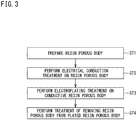
- FIG. 3 is a flowchart showing the method for producing a metal porous body according to the embodiment of the present invention. Hereinafter, the flow of the entirety of the method for producing the metal porous body 10 will be described with reference to FIG. 3 .
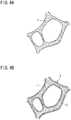
- FIG. 4A is an enlarged schematic view of the surface of a resin porous body 1 serving as a base.
- a large number of pores defined by a three-dimensional network structure are formed so as to be arranged from the surface of the resin porous body 1 to the interior of the resin porous body 1.
- step ST2 electrical conduction treatment is performed on the surface of the skeleton of the resin porous body 1 (step ST2).
- a conductive resin porous body 3 having a conductive layer 2 formed by a thin electric conductor on the surface of the skeleton of the resin porous body 1 as shown in FIG. 4B can be obtained.
- step ST3 electroplating treatment is performed on the surface of the skeleton of the conductive resin porous body 3 (step ST3).
- a plated resin porous body 5 having a metal plating layer 4 formed on the surface of the skeleton of the conductive resin porous body 3 as shown in FIG. 4C can be obtained.
- step ST4 treatment of removing the resin porous body 1, which is the base, from the plated resin porous body 5 is performed.
- the resin porous body 1 is eliminated by burning or the like, whereby the metal porous body 10 in which only the metal plating layer 4 is left can be obtained (see FIG. 4D ).
- each step will be sequentially described in detail.
- the sheet-like resin porous body 1 having the skeleton with the three-dimensional network structure is prepared.
- the material of the resin porous body 1 include a resin foam, a nonwoven fabric, felt, and a woven fabric, and these materials may be combined as necessary.
- the material of the resin porous body 1 is not particularly limited, but a material that can be eliminated by burning after the metal plating layer 4 is formed on the surface of the skeleton by the electroplating treatment is preferable.
- the material of the resin porous body 1 is preferably a flexible material, since a sheet-like material is particularly easily broken due to handling thereof if the rigidity of the material is high.
- a resin foam is preferably used as the material of the resin porous body 1.
- the resin foam only needs to be porous, and a known or commercially-available one can be used. Examples of such a material include foamed urethane and foamed styrene. Among them, foamed urethane is particularly preferable from the viewpoint of having a high porosity.
- the thickness, the porosity, and the average pore size of the resin foam are not particularly limited in the present invention, and can be set as appropriate according to use.
- the thickness of the resin foam is, for example, not less than 1.0 mm and not greater than 2.5 mm, preferably not less than 1.0 mm and not greater than 1.6 mm, and more preferably not less than 1.0 mm and not greater than 1.3 mm.
- the average pore size of the resin foam is, for example, not less than 250 ⁇ m and not greater than 500 ⁇ m, preferably not less than 300 ⁇ m and not greater than 450 ⁇ m, and more preferably not less than 300 ⁇ m and not greater than 400 ⁇ m.
- the method for the electrical conduction treatment is not particularly limited as long as the conductive layer 2 can be formed on the surface of the skeleton of the resin porous body 1.
- the material for forming the conductive layer 2 include metals such as nickel, titanium, and stainless steel, and carbon powder such as graphite and amorphous carbon including carbon black, etc. Among them, particularly, carbon powder is preferable, and carbon black is more preferable.
- the conductive layer 2 only needs to be continuously formed on the surface of the skeleton of the resin porous body 1.
- the weight of the conductive layer 2 per unit area is not particularly limited, and may be normally not less than about 5 g/m 2 and not greater than about 15 g/m 2 , and preferably not less than about 7 g/m 2 and not greater than about 10 g/m 2 .
- the electrical conduction treatment for example, in the case of using nickel, electroless plating treatment, sputtering treatment, and the like are preferable.
- a material such as carbon black, graphite, or a metal such as titanium and stainless steel
- treatment in which a mixture obtained by adding a binder to fine powder of the material is applied to the surface of the skeleton of the resin porous body 1 is preferable.
- the resin porous body 1 may be immersed into a known electroless nickel plating bath such as a nickel sulfate aqueous solution containing sodium hypophosphite as a reducing agent. Before the immersion into the plating bath, the resin porous body 1 may be immersed as necessary into an activation liquid containing a very small amount of palladium ions (a cleaning liquid manufactured by JAPAN KANIGEN Co., Ltd.) or the like.
- a known electroless nickel plating bath such as a nickel sulfate aqueous solution containing sodium hypophosphite as a reducing agent.
- an activation liquid containing a very small amount of palladium ions a cleaning liquid manufactured by JAPAN KANIGEN Co., Ltd.
- the resin porous body 1 may be attached to a substrate holder, then a DC voltage may be applied between the substrate holder and a target (nickel) while inert gas is being introduced, whereby ionized inert gas may be collided against the nickel, and the blown nickel particles may be accumulated on the surface of the skeleton of the resin porous body 1.
- a DC voltage may be applied between the substrate holder and a target (nickel) while inert gas is being introduced, whereby ionized inert gas may be collided against the nickel, and the blown nickel particles may be accumulated on the surface of the skeleton of the resin porous body 1.
- the thickness of the metal plating layer is increased by at least one of the above electroless plating treatment and the above sputtering treatment, it is not necessary to perform electroplating treatment.
- a method is preferably adopted in which, as described above, first, electrical conduction treatment is performed on the resin porous body 1, and then the metal plating layer 4 is formed on the surface of the skeleton of the conductive resin porous body 3 by electroplating treatment.
- the electroplating treatment only needs to be performed according to an ordinary method.
- a known or commercially-available one can be used as a plating bath.
- the plating bath include a Watts bath, a chlorination bath, and a sulfamic acid bath.
- the conductive resin porous body 3 is immersed into the plating bath, the conductive resin porous body 3 and a counter electrode plate of a plating metal are connected to a cathode and an anode, respectively, and a DC or pulse interrupted current is applied thereto, whereby the metal plating layer 4 can be further formed on the conductive layer 2 on the surface of the skeleton of the conductive resin porous body 3.
- the metal plating layer 4 only needs to be formed on the conductive layer 2 such that the conductive layer 2 is not exposed (see FIG. 4C ).
- FIG. 5 is a side cross-sectional view showing an example of a plating apparatus 30 that continuously performs electroplating treatment on the sheet-like conductive resin porous body 3.
- the plating apparatus 30 of the present embodiment is configured to feed the sheet-like conductive resin porous body 3 from the left side to the right side in FIG. 5 , and includes a first plating tank 31, a second plating tank 32 disposed at the downstream side of the first plating tank 31, and a power supply device 50 (see FIG. 7 ).
- the first plating tank 31 includes a plating bath 33, a cylindrical electrode 34 (cylindrical cathode), and an anode 35 (cylindrical anode) provided on an inner wall of a container.
- a plating bath 33 a cylindrical electrode 34 (cylindrical cathode), and an anode 35 (cylindrical anode) provided on an inner wall of a container.
- the second plating tank 32 includes a plurality of tanks 36 for forming the metal plating layer 4 on the other surface side (the upper surface side in FIG. 5 ) of the conductive resin porous body 3.
- the conductive resin porous body 3 undergoes metal plating by being sequentially fed and passing through plating baths 39 in a state of being held between a plurality of feeding rollers 37 and a plurality of electrode rollers 38, which are disposed adjacent to the respective tanks 36.
- an anode 40 is provided at the other surface side of the conductive resin porous body 3 with the plating bath 39 interposed therebetween.
- the metal plating layer 4 is formed on the other surface side of the conductive resin porous body 3.
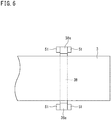
- FIG. 6 is a plan view showing a structure for supplying power to the rotation shafts 38a of the electrode roller 38.
- the rotation shafts 38a of the electrode roller 38 are provided at both axial end portions of the electrode roller 38 which rotates in contact with the sheet-like conductive resin porous body 3.
- Each of the rotation shafts 38a of each electrode roller 38 is supplied with power by a plurality of power supply brushes 51 each of which is in sliding contact with a part of the outer circumferential surface of the rotation shaft 38a.
- Each power supply brush 51 is formed by a material containing iron as a main component, such that a large current can be applied to the rotation shaft 38a of the electrode roller 38.
- the power supply brush 51 is designed such that the power supply brush 51 is abraded against the rotation shaft 38a of the electrode roller 38.
- a power supply brush made of copper, which has low abrasion resistance is used.
- the power supply brush 51 is formed by a material containing iron, which has excellent abrasion resistance, as a main component, the amount of abrasion powder generated can be reduced. Since the amount of abrasion powder generated from the power supply brush 51 is small, rotation of the electrode roller can be stabilized. In addition, progress of abrasion of the power supply brush 51 is slow, and thus the frequency of replacement of the power supply brush 51 can be also reduced.
- the power supply brush 51 and the rotation shaft 38a are in contact with each other with a later-described lubricant interposed therebetween, the power supply brush 51 is preferably formed by a sintered body.
- each rotation shaft 38a of each electrode roller 38 is formed by a material containing iron or nickel as a main component, and thus has excellent abrasion resistance and excellent corrosion resistance.
- the rotation shaft 38a is preferably formed by a material that contains iron as a main component and whose periphery is coated with a material containing nickel as a main component. Since nickel has better corrosion resistance than iron, the corrosion resistance of the rotation shaft 38a can be further enhanced. Furthermore, since the difference between the ionization tendency of iron and the ionization tendency of nickel is small, progress of corrosion due to contact between different types of metals can be delayed.
- a core portion of the rotation shaft 38a is formed by a material containing copper as a main component, the periphery of the material containing copper as a main component is coated with a material containing iron as a main component, and the periphery of the material containing iron as a main component is further coated with a material containing nickel as a main component. Since the core portion of the rotation shaft 38a is formed by the material containing copper as a main component, the electric resistance during supply of power from the rotation shaft 38a to the electrode roller 38 can be reduced. In addition, since the surface of the rotation shaft 38a is formed by the material containing nickel as a main component, the rotation shaft 38a has excellent corrosion resistance.
- the nickel in the surface of the rotation shaft 38a is gradually abraded, since the material containing iron as a main component is present under the nickel, the copper of the core portion can be prevented from being exposed. Furthermore, since the difference between the ionization tendency of nickel and the ionization tendency of iron is smaller than the difference between the ionization tendency of nickel and the ionization tendency of copper, progress of corrosion due to contact between different types of metals can be delayed.
- Each power supply brush 51 is designed such that the power supply brush 51 is abraded against the rotation shaft 38a of the electrode roller 38.
- the coefficient of dynamic friction of each power supply brush 51 is not less than 0.01 and not greater than 0.40, and preferably not less than 0.10 and not greater than 0.30. In the case where the coefficient of dynamic friction of the power supply brush 51 is not less than 0.01, the power supply brush can be obtained at relatively low cost. In addition, when the coefficient of dynamic friction of the power supply brush 51 is not greater than 0.40, the slidability of the power supply brush 51 is improved, so that an amount of abrasion of the power supply brush 51 can be reduced.
- FIG. 7 is a cross-sectional view showing the power supply device 50 including the plurality of power supply brushes 51.
- the power supply device 50 is provided at each of both axial end portions of the electrode roller 38.
- the power supply device 50 of the present embodiment includes the plurality of (in this example, two) power supply brushes 51, a plurality of biasing members 52 that press and bias the respective power supply brushes 51 against the outer circumferential surface of the rotation shaft 38a of the electrode roller 38, and a casing 53.
- the core portion of the rotation shaft 38a of the electrode roller 38 is formed by a material 383 containing copper as a main component.
- the periphery of the material 383 containing copper as a main component is coated with a material 382 containing iron as a main component, and the periphery of the material 382 containing iron as a main component is coated with a material 381 containing nickel as a main component.
- the casing 53 is formed, for example, by a metal member having electric conductivity.
- the casing 53 of the present embodiment is formed in a rectangular cross-sectional shape so as to surround the rotation shaft 38a of the electrode roller 38, and the biasing members 52 are attached to two surfaces, that is, the upper surface and the left surface, among four inner surfaces of the casing 53.
- Each biasing member 52 is not particularly limited as long as the biasing member 52 presses and biases the power supply brush 51 against the outer circumferential surface of the rotation shaft 38a of the electrode roller 38.
- each biasing member 52 of the present embodiment is formed by a plate spring that is bent in an S cross-sectional shape.
- One end portion of each biasing member 52 is attached to the corresponding inner surface of the casing 53, for example, by a fixing plate 56A and a bolt 57A, and the power supply brush 51 is connected to the other end portion of each biasing member 52, for example, by a fixing plate 56B and a bolt 57B.
- contact surfaces 51a (described later) of the two power supply brushes 51 are pressed against the outer circumferential surface of the rotation shaft 38a of the electrode roller 38 from the upper side and the left side in FIG. 7 by the biasing force of the corresponding biasing members 52.
- Each biasing member 52 is preferably formed by a metal member having both excellent electric conductivity and excellent heat dissipation.
- Each biasing member 52 in the plating apparatus of the present embodiment is formed by a metal member obtained by tinning copper having electric conductivity and having excellent heat dissipation.
- the fixing plates 56A and 56B also have heat dissipation.
- the biasing member 52 and the fixing plates 56A and 56B serve as a heat dissipation member that dissipates heat generated in the power supply brush 51 connected to this biasing member 52, to the outside.
- the heat dissipation member connected to the power supply brush 51 may be formed by a member other than the biasing member 52 and the fixing plates 56A and 56B, or may be formed by the biasing member 52, the fixing plates 56A and 56B, and the casing 53.
- each power supply brush 51 a surface that faces the outer circumferential surface of the rotation shaft 38a of the electrode roller 38 is the contact surface 51a that is in sliding contact with the outer circumferential surface.
- the contact surface 51a is formed in a circular arc shape along the outer circumferential surface of the rotation shaft 38a of the electrode roller 38.
- a lubricant 58 not containing conductive metal powder is preferably applied to the contact surface 51a.
- “Not containing conductive metal powder” means to include not only the case where conductive metal powder is not contained at all but also the case where conductive metal powder is contained in a certain amount such that the advantageous effects of the present embodiment are achieved.
- a lubricating oil that is a liquid, or grease is used as the lubricant 58.
- liquid paraffin which is a lubricating oil
- paraffin is a type of hydrocarbon compound (organic compound), is a generic term for alkanes having 20 or more carbon atoms (chain saturated hydrocarbons having the general formula of C n H 2n+2 ), and is considered synonymous for aliphatic saturated hydrocarbons C n H 2n+2 in some cases regardless of the number of carbon atoms.
- paraffin is a mixture of hydrocarbons obtained from petroleum or crude oil through processes such as distillation and refinement and is a colorless and transparent liquid. Liquid paraffin can be considered as a pure hydrocarbon since liquid paraffin is highly purified by removing impurities such as aromatic hydrocarbons and sulfur compounds contained in lube-oil distillate of petroleum that is a raw material.
- the liquid paraffin is a mixture (weight-average molecular weight: 483) of hydrocarbons (the number of carbon atoms is not less than about 15 and not greater than about 20), and a reagent having a purity of about 95% equivalent to first class grade is preferably used.
- the density of the liquid paraffin is preferably not less than 0.855 g/ml, and is, for example, 0.87 g/ml in the present embodiment.
- the viscosity of the liquid paraffin is preferably the low viscosity to the lower limit of the intermediate viscosity from the viewpoint of easy handling.
- the viscosity of the liquid paraffin is, for example, 75.8 cSt
- the kinetic viscosity of the liquid paraffin is, for example, 67.65 cSt (mm 2 /s at 40°C)
- the lubricant 58 is stored within a container 59 that is disposed on the lower surface within the casing 53 and below the rotation shaft 38a of the electrode roller 38.
- An opening 59a is formed at the upper side of the container 59.
- a part of the outer circumference of the rotation shaft 38a of the electrode roller 38 is immersed in the lubricant 58 within the container 59 through the opening 59a. Accordingly, by rotating the electrode roller 38, the lubricant 58 within the container 59 is applied to the entirety of the outer circumferential surface of the rotation shaft 38a.
- each power supply brush 51 can supply power to the rotation shaft 38a by bringing the contact surface 51a of the power supply brush 51 into sliding contact with the outer circumferential surface of the rotation shaft 38a with the lubricant 58 interposed therebetween.
- the dropping abrasion powder can be received within the container 59 through the opening 59a.
- FIG. 8A is a side view showing the power supply brush 51.
- FIG. 8B is a diagram of the power supply brush 51 as seen from the lower side in FIG. 8A .
- a plurality of (in this example, three) slit-shaped grooves 55 are formed on the contact surface 51a of the power supply brush 51. These grooves 55 are formed on the contact surface 51a at regular intervals in the longitudinal direction of the contact surface 51a (the right-left direction in FIG. 8A and FIG. 8 ).
- Each groove 55 is formed so as to extend in a direction crossing a tangent direction T (see FIG. 8B ) in which the contact surface 51a of the power supply brush 51 is tangent to the rotation shaft 38a of the electrode roller 38.
- each groove 55 is formed so as to extend linearly over the entirety of the contact surface 51a in the lateral direction of the contact surface 51a (the up-down direction in FIG. 8A and FIG. 8 ) in a state of being inclined at a predetermined angle (for example, 30°) relative to the lateral direction. Accordingly, abrasion powder generated on the contact surface 51a of the power supply brush 51 due to sliding contact with the rotation shaft 38a of the electrode roller 38 can be efficiently guided and discharged to the outside by the plurality of grooves 55.
- the current density during supply of power from each power supply brush 51 to the rotation shaft 38a of the electrode roller 38 (the ratio of the current to the total cross-sectional area of the power supply brush 51) is not less than about 5 A/cm 2 and not greater than about 15 A/cm 2 and preferably not less than 8 A/cm 2 and not greater than 13 A/cm 2 .
- the current density is not less than 5 A/cm 2
- the entirety of the power supply device 50 can be reduced.
- voltage loss can be reduced.
- the current density is not greater than 15 A/cm 2 , a rise in the temperature of the power supply brush 51 can be inhibited.
- the weight of the metal plating layer 4 per unit area is not particularly limited, and is normally not less than about 150 g/m 2 and not greater than about 400 g/m 2 , and the sum of the weight of the conductive layer 2 per unit area and the weight of the metal plating layer 4 per unit area is preferably not less than 200 g/m 2 and not greater than 350 g/m 2 .
- the above sum of the weights per unit area is not less than 150 g/m 2 , desired strength of the metal porous body can be ensured.
- the above sum of the weights per unit area is not greater than 400 g/m 2 , heat generation of the power supply brush can be inhibited.
- the electroplating treatment is not limited to the electroplating treatment of the present embodiment, and, for example, a plating treatment method using a preliminary plating tank or a plating treatment method using a preliminary plating tank and a lift type main plating tank may be adopted.
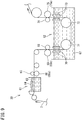
- FIG. 9 is a schematic diagram showing a modification of the plating apparatus 30.
- the plating apparatus 30 includes a preliminary plating tank 61 and a lift type main plating tank 62 disposed at the downstream side of the preliminary plating tank 61.
- the preliminary plating tank 61 includes a plating bath 63, an anode 64 (cylindrical anode), a presser roller 65, and an electrode roller 66 having a rotation shaft 66a (power supply cathode) at each end portion thereof.
- the conductive resin porous body 3 preliminarily undergoes plating on one side surface (the upper surface side in FIG. 9 ) of the conductive resin porous body 3 by being sequentially fed and passing through the inside of the plating bath 63 in a state of being held between the presser roller 65 and the electrode roller 66,
- the main plating tank 62 includes a plating bath 67, a first presser roller 68, a first electrode roller 69 having a rotation shaft 69a (power supply cathode) at each end portion thereof, a pair of first anodes 70 (cylindrical anodes), a first feeding roller 71, a second feeding roller 72, a pair of second anodes 73 (cylindrical anodes), a second presser roller 74, and a second electrode roller 75 having a rotation shaft 75a (power supply cathode) at each end portion thereof.
- the conductive resin porous body 3 is sequentially drawn in between the pair of first anodes 70 within the plating bath 67 in a state of being held between the first presser roller 68 and the first electrode roller 69. At this time, plating is performed on both surface sides of the conductive resin porous body 3 by supplying power to the rotation shafts 69a of the first electrode roller 69 and the pair of first anodes 70.
- the conductive resin porous body 3 is sequentially fed between the pair of second anodes 73 by the first feeding roller 71 and the second feeding roller 72 within the plating bath 67. Then, the conductive resin porous body 3 is sequentially lifted from the inside of the plating bath 67 in a state of being held between the second presser roller 74 and the second electrode roller 75. At this time, plating is performed on both surface sides of the conductive resin porous body 3 by supplying power to the pair of second anodes 73 and the rotation shafts 75a of the second electrode roller 75.
- the rotation shafts 66a of the electrode roller 66 of the preliminary plating tank 61 are supplied with power by power supply brushes (not shown) that are in sliding contact with the rotation shafts 66a.
- the rotation shafts 69a and the rotation shafts 75a of the first electrode roller 69 and the second electrode roller 75 of the main plating tank 62 are supplied with power by power supply brushes (not shown) that are in sliding contact with the rotation shafts 69a and the rotation shafts 75a.
- the power supply brushes that supply power to the rotation shafts 66a, 69a, and 75a of the respective electrode rollers 66, 69, and 75 are formed similar to the above embodiment, and thus the description thereof is omitted.
- the resin porous body 1 is removed from the plated resin porous body 5 in an acidic atmosphere such as atmospheric air not lower than about 600°C and not higher than 800°C and preferably not lower than 600°C and not higher than 700°C, and then heating is performed in a reductive atmosphere at 750°C or higher (higher temperatures are desirable but the temperature is preferably not higher than 1000°C, since higher temperatures are disadvantageous in cost, or from the viewpoint of the material of the body of a reducing furnace).
- an acidic atmosphere such as atmospheric air not lower than about 600°C and not higher than 800°C and preferably not lower than 600°C and not higher than 700°C
- heating is performed in a reductive atmosphere at 750°C or higher (higher temperatures are desirable but the temperature is preferably not higher than 1000°C, since higher temperatures are disadvantageous in cost, or from the viewpoint of the material of the body of a reducing furnace).
- reductive gas hydrogen gas or mixed gas of hydrogen and carbon dioxide or inert gas can be used, or these gases can be also used in combination as necessary.
- hydrogen gas is always added to reductive gas, since the efficiency of redox is improved.
- each power supply brush 51 is formed by a material containing iron as a main component, the abrasion resistance of the power supply brush 51 is improved, and, in the electroplating treatment, the amount of abrasion powder generated from the power supply brush 51 is reduced, and rotation of each electrode roller 38 is stabilized.
- at least the surface of each rotation shaft 38a of each electrode roller 38 is formed by a material containing iron or nickel as a main component, corrosion of the rotation shaft 38a is inhibited, and rotation of the electrode roller 38 is stabilized.
- each rotation shaft 38a is formed by a material that contains iron as a main component and whose periphery is coated with a material containing nickel as a main component, progress of corrosion due to contact between different types of metals can be delayed, since the difference between the ionization tendency of iron and the ionization tendency of nickel is small. Furthermore, since nickel has better corrosion resistance than iron, corrosion of the rotation shaft 38a can be further inhibited. Since corrosion of the rotation shaft 38a is inhibited, the frictional resistance between each power supply brush 51 and the rotation shaft 38a can be reduced, and rotation of the electrode roller 38 can be stabilized. As a result, the quality of the metal porous body 10 can be improved.
- each rotation shaft 38a is a material containing copper as a main component
- the periphery of the copper is coated with a material containing iron as a main component
- the periphery of the material containing iron as a main component is coated with a material containing nickel as a main component
- the electric resistance during supply of power to the electrode roller 38 can be reduced.
- the surface of the rotation shaft 38a has high corrosion resistance, and even when the surface of the rotation shaft 38a is abraded little by little, the material that contains copper as a main component and is the core portion does not become exposed.
- each power supply brush 51 is in sliding contact with the rotation shaft 38a with the lubricant, not containing conductive metal powder, interposed therebetween, the frictional resistance between the power supply brush 51 and the rotation shaft 38a of the electrode roller 38 can be reduced, and rotation of the electrode roller 38 can be stabilized. Since the lubricant 58 does not contain conductive metal powder, deterioration of the electrical conductivity of the lubricant due to oxidization of metal powder does not occur.
- each electrode roller 38 By rotating each electrode roller 38, the lubricant 58 within the container 59 can be applied to the entirety of the outer circumferential surface of the rotation shaft 38a.
- the contact surface 51a of each power supply brush 51 can be brought into sliding contact with the rotation shaft 38a of the electrode roller 38 with the lubricant 58 interposed therebetween.
- the container 59 is disposed below the rotation shaft 38a of the electrode roller 38, when abrasion powder generated on the contact surface 51a of the power supply brush 51 drops due to the weight thereof or the like, the dropping abrasion powder can be received within the container 59 through the opening 59a. Accordingly, the abrasion powder can be easily collected during maintenance work.
- each power supply brush 51 heat generated in each power supply brush 51 can be dissipated to the outside by the biasing member 52 and the fixing plates 56A and 56B connected to the power supply brush 51. Accordingly, a rise in the temperature of the power supply brush 51 can be effectively inhibited, and thus corrosion of the power supply brush 51 due to a rise in the temperature of the power supply brush 51 can be inhibited.
- abrasion powder generated on the contact surface 51a of each power supply brush 51 can be guided and discharged to the outside by the grooves 55 formed on the contact surface 51a. Accordingly, the abrasion powder can be inhibited from aggregating into lumps and accumulating between the contact surface 51a of the power supply brush 51 and the rotation shaft 38a of the electrode roller 38. Thus, a decrease in the contact area between the contact surface 51a and the rotation shaft 38a of the electrode roller 38 can be inhibited, and the contact area that is stable can be ensured.
- each groove 55 is formed so as to extend in the direction crossing the tangent direction T in which the contact surface 51a of the power supply brush 51 is tangent to the rotation shaft 38a of the electrode roller 38, the abrasion powder can be efficiently guided and discharged to the outside by the groove 55. Accordingly, the abrasion powder can be further inhibited from aggregating into lumps and accumulating between the contact surface 51a of the power supply brush 51 and the rotation shaft 38a of the electrode roller 38.
- the power supply brushes 51 are disposed at the respective rotation shafts 38a provided at both axial end portions of the electrode roller 38, and power is supplied to each rotation shaft 38a, in the electroplating treatment, while the contact surfaces 51a of the corresponding power supply brushes 51 are brought into sliding contact with the rotation shaft 38a with the lubricant 58 interposed therebetween. Accordingly, at the time of supply of power, it is possible to adjust the current density to be in an appropriate range via the power supply brushes 51, which are disposed at the respective rotation shafts 38a provided at both axial end portions of the electrode roller 38.
- each power supply brush 51 is biased and pressed against the rotation shaft 38a of the electrode roller 38 by the biasing member 52, the contact pressure between the contact surface 51a of the power supply brush 51 and the rotation shaft 38a of the electrode roller 38 can be increased.
- each power supply brush 51 is composed of a sintered body, also due to recesses and projections being formed on the surface of the power supply brush 51, even if the lubricant 58 not containing conductive metal powder is used, a layer of the lubricant 58 becomes partially thin (at a portion where each local projection of the power supply brush 51 and the electrode roller 38 are in contact with each other). Thus, even with the lubricant 58 not containing conductive metal powder, flow of a current can be inhibited from being blocked.
- the method for producing a metal porous body according to the above embodiment has been described for the case of application to a method for producing a metal porous body that is used as an electrode of a battery, the use of the metal porous body is not necessarily limited to an electrode of a battery, and the method may be applied to a method for producing a metal porous body that is used as a filter, a catalyst support, a metal composite, or the like that requires heat resistance. However, it is particularly effective to apply the method for producing a metal porous body according to the above embodiment to a method for producing a metal porous body that is used as an electrode of a battery.
Landscapes
- Chemical & Material Sciences (AREA)
- Chemical Kinetics & Catalysis (AREA)
- Electrochemistry (AREA)
- Engineering & Computer Science (AREA)
- Materials Engineering (AREA)
- Organic Chemistry (AREA)
- Metallurgy (AREA)
- General Chemical & Material Sciences (AREA)
- Crystallography & Structural Chemistry (AREA)
- Life Sciences & Earth Sciences (AREA)
- Geology (AREA)
- Mechanical Engineering (AREA)
- Electroplating Methods And Accessories (AREA)
Abstract
Description
- The present invention relates to a method for producing a metal porous body and a plating apparatus.
- This application claims priority on Japanese Patent Application No.
2017-240171 filed on December 15, 2017 - Conventionally, a sheet-like metal porous body having a skeleton with a three-dimensional network structure has been used for various uses such as a filter that requires heat resistance, a battery electrode plate, a catalyst support, and a metal composite. As a method for producing the metal porous body, a method has been known in which, after the surface of the skeleton of a resin porous body is subjected to electrical conduction treatment, metal plating is performed by means of electroplating treatment and treatment of removing the resin porous body is performed, thereby obtaining a metal porous body (see, for example, PATENT LITERATURE 1).
- In the method for producing the metal porous body described in
PATENT LITERATURE 1, in performing the electroplating treatment, in order to form a metal plating layer on a single surface side or each surface side of a sheet-like resin porous body having a skeleton surface made conductive, electroplating treatment is repeatedly performed in a plurality of plating tanks while the resin porous body is being sequentially fed by feeding rollers and electrode rollers that serve as power supply cathodes outside the plating tanks. A current is sent to each electrode roller by bringing a rotation shaft of the electrode roller and a power supply brush into sliding contact with each other (see, for example, PATENT LITERATURE 2). -
- PATENT LITERATURE 1: Japanese Laid-Open Patent Publication No.
2015-153648 - PATENT LITERATURE 2: Japanese Laid-Open Utility Model Publication No.
H5-97082 - PATENT LITERATURE 3: Japanese Utility Model Registration No.
3075438 - PATENT LITERATURE 4: Japanese Laid-Open Patent Publication No.
2001-157413 - PATENT LITERATURE 5: Japanese Laid-Open Patent Publication No.
2011-205816 - PATENT LITERATURE 6: Japanese Laid-Open Patent Publication No.
2001-346363 - PATENT LITERATURE 7: Japanese Laid-Open Patent Publication No.
H6-84775 - A method for producing a metal porous body according to the present disclosure is a method for producing a metal porous body, comprising the steps of:
- performing electrical conduction treatment on a surface of a skeleton of a sheet-like resin porous body having the skeleton with a three-dimensional network structure, to obtain a conductive resin porous body having a conductive layer;
- performing electroplating treatment on a surface of a skeleton of the conductive resin porous body to obtain a plated resin porous body having a metal plating layer; and
- performing treatment of removing at least the resin porous body from the plated resin porous body to obtain a metal porous body, wherein
- in the electroplating treatment, the conductive resin porous body is supplied with power by a rotating electrode roller,
- the electrode roller is supplied with power by bringing a power supply brush formed by a material containing iron as a main component into sliding contact with a part of a rotation shaft, and
- at least a surface of at least the part of the rotation shaft with which the power supply brush is brought into contact is formed by a material containing iron or nickel as a main component.
- A plating apparatus according to the present disclosure is a plating apparatus for performing electroplating treatment on a surface of a skeleton of a conductive resin porous body obtained by forming a conductive layer on a surface of a skeleton of a sheet-like resin porous body having the skeleton with a three-dimensional network structure, to form a metal plating layer, the plating apparatus comprising:
- a plating tank;
- an electrode roller capable of supplying power to the conductive resin porous body by rotating a rotation shaft while feeding the conductive resin porous body to the plating tank; and
- a power supply brush configured to come into sliding contact with the rotation shaft of the electrode roller, wherein
- the power supply brush is formed by a material containing iron as a main component, and
- at least a surface of at least a part of the rotation shaft with which the power supply brush is in contact is formed by a material containing iron or nickel as a main component.
-
-
FIG. 1 is a schematic diagram showing a metal porous body having a skeleton with a three-dimensional network structure. -
FIG. 2 is a schematic diagram showing a battery in which the metal porous body is used as a positive electrode plate. -
FIG. 3 is a flowchart showing a method for producing a metal porous body according to an embodiment of the present invention. -
FIG. 4A is an enlarged schematic view of the surface of a resin porous body having a skeleton with a three-dimensional network structure. -
FIG. 4B is an enlarged schematic view of the surface of a conductive resin porous body having a skeleton with a three-dimensional network structure. -
FIG. 4C is an enlarged schematic view of the surface of a resin porous body having a skeleton with a three-dimensional network structure. -
FIG. 4D is an enlarged schematic view of the surface of a metal porous body having a skeleton with a three-dimensional network structure. -
FIG. 5 is a side cross-sectional view showing an example of a plating apparatus. -
FIG. 6 is a plan view showing a structure for supplying power to an electrode roller. -
FIG. 7 is a cross-sectional view showing a power supply device. -
FIG. 8A is a side view showing a power supply brush. -
FIG. 8B is a diagram of the power supply brush as seen from the lower side ofFIG. 8A . -
FIG. 9 is a schematic diagram showing a modification of the plating apparatus. - In the case of performing electroplating treatment on a sheet-like resin porous body as in the above-described conventional art, it is necessary to apply a large current to each electrode roller, since the surface area of the resin porous body is large. Therefore, a sintered body containing copper as a main component is generally used for a power supply brush for supplying power to each electrode roller.
- However, the power supply brush made of copper is likely to corrode due to influence of corrosive fumes in an electroplating atmosphere. In particular, in the case where the power supply brush is made of a sintered body in order to improve sliding characteristics, the surface of the power supply brush is porous, and thus corrosion of the power supply brush is further accelerated. In addition, the power supply brush made of copper has low abrasion resistance, and thus, due to continued contact with the rotation shaft of the electrode roller, the power supply brush is easily abraded generating abrasion powder. Therefore, it is necessary to frequently replace the power supply brush, so that there is a problem that the productivity of the metal porous body decreases.
- When the power supply brush is corroded or abrasion powder is generated therefrom, jerkiness (rotational failure) easily occurs in rotation of the electrode roller. In particular, jerkiness of the electrode roller easily occurs when the electrode roller is rotated at a low speed. In producing a metal porous body having a small coating weight per unit area (a metal porous body having a small plating thickness), when jerkiness occurs in the electrode roller, a plating thickness is greatly varied, and the skeleton of the metal porous body may be cracked to reduce the strength, resulting in a decrease in the quality of the metal porous body.
- Therefore, the present disclosure has been made in view of such circumstances, and an object of the present disclosure is to provide a method for producing a metal porous body and a plating apparatus that can improve the quality and the productivity of the metal porous body.
- According to the present disclosure, it is possible to provide a method for producing a metal porous body and a plating apparatus that can improve the quality and the productivity of the metal porous body.
- First, contents of embodiments of the present invention will be listed and described.
- (1) A method for producing a metal porous body according to an embodiment of the present invention is a method for producing a metal porous body, comprising the steps of:
- performing electrical conduction treatment on a surface of a skeleton of a sheet-like resin porous body having the skeleton with a three-dimensional network structure, to obtain a conductive resin porous body having a conductive layer;
- performing electroplating treatment on a surface of a skeleton of the conductive resin porous body to obtain a plated resin porous body having a metal plating layer; and
- performing treatment of removing at least the resin porous body from the plated resin porous body to obtain a metal porous body, wherein
- in the electroplating treatment, the conductive resin porous body is supplied with power by a rotating electrode roller,
- the electrode roller is supplied with power by bringing a power supply brush formed by a material containing iron as a main component into sliding contact with a part of a rotation shaft, and
- at least a surface of at least the part of the rotation shaft with which the power supply brush is brought into contact is formed by a material containing iron or nickel as a main component.
The "main component" refers to a component having a highest mass content, and another component may be intentionally or inevitably contained as long as the advantageous effects of the present invention are achieved.
According to the embodiment of the invention described in the above (1), it is possible to provide a method, for producing a metal porous body, which can improve the quality and the productivity of the metal porous body. Since the power supply brush is formed by a material containing iron as a main component, the abrasion resistance of the power supply brush is improved, the amount of abrasion powder generated from the power supply brush is reduced, and rotation of the electrode roller is stabilized. In addition, since at least the surface of the rotation shaft of the electrode roller is formed by a material containing iron or nickel as a main component, corrosion of the rotation shaft is inhibited, and rotation of the electrode roller is stabilized. Since jerkiness of the rotation shaft of the electrode roller is inhibited, the thickness of the metal plating layer formed on the surface of the skeleton of the conductive resin porous body is less varied. As a result, in the case of producing the metal porous body in which the thickness of the metal plating layer is small, cracking can be inhibited from occurring in the skeleton of the metal porous body thereby to reduce the strength of the metal porous body, and thus the quality of the metal porous body can be improved. - (2) In the method for producing a metal porous body according to the above (1), the rotation shaft is preferably formed by a material that contains iron as a main component and whose periphery is coated with a material containing nickel as a main component.
According to the embodiment of the invention described in the above (2), progress of corrosion due to contact between different types of metals can be delayed, since the difference between the ionization tendency of iron and the ionization tendency of nickel is small. Furthermore, since nickel has better corrosion resistance than iron, corrosion of the rotation shaft can be further inhibited. Since corrosion of the rotation shaft is inhibited, the frictional resistance between the power supply brush and the rotation shaft can be reduced, and rotation of the electrode roller can be stabilized. As a result, the quality of the metal porous body can be improved. - (3) In the method for producing a metal porous body according to the above (1) or (2), preferably, the rotation shaft has a core portion that is a material containing copper as a main component, a periphery of the copper is coated with a material containing iron as a main component, and further, a periphery of the material containing iron as a main component is coated with a material containing nickel as a main component.
According to the embodiment of the invention described in the above (3), since the core portion of the rotation shaft of the electrode roller is formed by a material containing copper as a main component, the electric resistance during supply of power to the electrode roller can be reduced. In addition, since the surface of the copper of the core portion of the rotation shaft is coated with iron, and the surface of the iron is further coated with nickel, the surface of the rotation shaft has high corrosion resistance, and even when the surface of the rotation shaft is abraded little by little, the copper of the core portion does not become exposed. Furthermore, since the difference between the ionization tendency of nickel and the ionization tendency of iron is smaller than the difference between the ionization tendency of nickel and the ionization tendency of copper, progress of corrosion due to contact between different types of metals can be delayed. Owing to the above, corrosion of the surface of the rotation shaft can be inhibited, rotation of the electrode roller can be stabilized, and further, the quality of the metal porous body can be improved. - (4) In the method for producing a metal porous body according to any one of the above (1) to (3), the power supply brush is preferably in sliding contact with the rotation shaft with a lubricant, not containing conductive metal powder, interposed therebetween.
According to the embodiment of the invention described in the above (4), the frictional resistance between the rotation shaft of the electrode roller and the power supply brush can be reduced, and rotation of the electrode roller can be stabilized.
Generally, in the case of applying a fluid between components for the purpose of applying electricity, a method in which a conductive material such as metal powder is mixed into the fluid to cause the fluid itself to have electrical conductivity, is adopted. However, if conductive metal powder is contained in a lubricant that corresponds to the fluid, when the lubricant is used over a long period of time, the metal powder in the lubricant may be oxidized, resulting in significant deterioration of electrical conductivity. In addition, by the metal powder aggregating into lumps and accumulating between the contact surface of the power supply brush and the rotation shaft of the electrode roller, the contact area between the contact surface and the rotation shaft of the electrode roller may be decreased.
On the other hand, according to the embodiment of the invention described in the above (4), since the lubricant does not contain conductive metal powder, deterioration of electrical conductivity due to oxidization of metal powder can be prevented. In addition, since metal powder can be prevented from aggregating into lumps and accumulating between the contact surface of the power supply brush and the rotation shaft of the electrode roller, a decrease in the contact area between the contact surface and the rotation shaft of the electrode roller can be prevented, and the contact area that is stable can be ensured. - (5) In the method for producing a metal porous body according to any one of the above (1) to (4), when the electrode roller is rotated, the rotation shaft is preferably immersed into a lubricant stored within a container that is disposed below the rotation shaft.
According to the embodiment of the invention described in the above (5), by rotating the electrode roller, the lubricant within the container can be applied to the entire outer circumference of the rotation shaft. Thus, with a simple configuration, the contact surface of the power supply brush that is in contact with the rotation shaft can be brought into sliding contact with the rotation shaft of the electrode roller with the lubricant interposed therebetween. In addition, since the container is disposed below the rotation shaft of the electrode roller, when abrasion powder generated on the contact surface of the power supply brush drops due to the weight thereof or the like, the dropping abrasion powder can be received within the container. Accordingly, the abrasion powder can be easily collected during maintenance work. - (6) In the method for producing a metal porous body according to any one of the above (1) to (5), heat generated in the power supply brush is preferably dissipated to the outside by a heat dissipation member connected to the power supply brush.
According to the embodiment of the invention described in the above (6), a rise in the temperature of the power supply brush can be effectively inhibited by the heat dissipation member, and thus corrosion of the power supply brush due to a rise in the temperature of the power supply brush can be inhibited. - (7) In the method for producing a metal porous body according to any one of the above (1) to (6), abrasion powder generated by abrasion of the power supply brush is preferably guided and discharged to the outside by a groove formed on a contact surface of the power supply brush that is in contact with the rotation shaft.
According to the embodiment of the invention described in the above (7), abrasion powder of the power supply brush can be inhibited from aggregating into lumps and accumulating between the rotation shaft and the contact surface of the power supply brush that is in contact with the rotation shaft. Furthermore, a decrease in the contact area between the contact surface and the rotation shaft of the electrode roller can be inhibited, and the contact area that is stable can be ensured. - (8) In the method for producing a metal porous body according to the above (7), the groove is preferably formed so as to extend in a direction crossing a tangent direction tangent to the rotation shaft.
According to the embodiment of the invention described in the above (8), since the abrasion powder can be efficiently guided and discharged to the outside by the groove, the abrasion powder can be further inhibited from aggregating into lumps and accumulating between the contact surface of the power supply brush and the rotation shaft of the electrode roller. - (9) In the method for producing a metal porous body according to any one of the above (1) to (8), the power supply brush is preferably biased and pressed against the rotation shaft by a biasing member.
According to the embodiment of the invention described in the above (9), the contact pressure between the contact surface of the power supply brush and the rotation shaft of the electrode roller can be increased by the biasing member. - (10) A plating apparatus according to an embodiment of the present invention is a plating apparatus for performing electroplating treatment on a surface of a skeleton of a conductive resin porous body obtained by forming a conductive layer on a surface of a skeleton of a sheet-like resin porous body having the skeleton with a three-dimensional network structure, to form a metal plating layer, the plating apparatus comprising:
- a plating tank;
- an electrode roller capable of supplying power to the conductive resin porous body by rotating a rotation shaft while feeding the conductive resin porous body to the plating tank; and
- a power supply brush configured to come into sliding contact with the rotation shaft of the electrode roller, wherein
- the power supply brush is formed by a material containing iron as a main component, and
- at least a surface of at least a part of the rotation shaft with which the power supply brush is in contact is formed by a material containing iron or nickel as a main component.
- According to the embodiment of the invention described in the above (10), it is possible to provide a plating apparatus that can improve the quality and the productivity of a metal porous body. In addition, the plating apparatus according to the above (10) is a plating apparatus that can execute the method for producing a metal porous body according to the above (1).
- In the plating apparatus, since the power supply brush is formed by a material containing iron as a main component, the abrasion resistance of the power supply brush is improved, the amount of abrasion powder generated from the power supply brush is reduced, and rotation of the electrode roller is stabilized. In addition, since at least the surface of the rotation shaft of the electrode roller is formed by a material containing iron or nickel as a main component, corrosion of the rotation shaft is inhibited, and rotation of the electrode roller is stabilized. Since jerkiness of the rotation shaft of the electrode roller is inhibited, the thickness of the metal plating layer formed on the surface of the skeleton of the conductive resin porous body is less varied. As a result, in the case of producing the metal porous body in which the thickness of the metal plating layer is small, cracking can be inhibited from occurring in the skeleton of the metal porous body thereby to reduce the strength of the metal porous body, and thus the quality of the metal porous body can be improved.
- Hereinafter, embodiments of the present invention will be described in detail with reference to the accompanying drawings. It should be noted that at least parts of the embodiment described below may be combined as desired.
-
FIG. 1 is a schematic diagram showing a metal porous body having a skeleton with a three-dimensional network structure (hereinafter, also referred to merely as a "metal porous body") which is obtained by a method for producing a metal porous body according to an embodiment of the present invention. The metalporous body 10 has sheet-like appearance and has askeleton 11 forming a three-dimensional network structure. A large number of pores defined by the three-dimensional network structure are formed so as to be arranged from the surface of the metalporous body 10 to the interior of the metalporous body 10. - The metal
porous body 10 can be used, for example, as apositive electrode plate 21 of abattery 20 as shown inFIG. 2 . That is, as shown inFIG. 2 , thebattery 20 in which the metalporous body 10 is used mainly includes thepositive electrode plate 21, aseparator 22, and anegative electrode plate 23 that are disposed within acasing 24. Thepositive electrode plate 21, theseparator 22, and thenegative electrode plate 23 are disposed within thecasing 24 in a state of being layered. The layered body of thepositive electrode plate 21, theseparator 22, and thenegative electrode plate 23 is held in a wound state. Thepositive electrode plate 21 includes the metalporous body 10 and an active material (not shown) with which the metalporous body 10 is filled. -
FIG. 3 is a flowchart showing the method for producing a metal porous body according to the embodiment of the present invention. Hereinafter, the flow of the entirety of the method for producing the metalporous body 10 will be described with reference toFIG. 3 . - First, a sheet-like resin porous body that has a skeleton with a three-dimensional network structure and serves as a base is prepared (step ST1).
FIG. 4A is an enlarged schematic view of the surface of a resinporous body 1 serving as a base. In the resinporous body 1, a large number of pores defined by a three-dimensional network structure are formed so as to be arranged from the surface of the resinporous body 1 to the interior of the resinporous body 1. - Next, electrical conduction treatment is performed on the surface of the skeleton of the resin porous body 1 (step ST2). By this step, a conductive resin
porous body 3 having aconductive layer 2 formed by a thin electric conductor on the surface of the skeleton of the resinporous body 1 as shown inFIG. 4B can be obtained. - Subsequently, electroplating treatment is performed on the surface of the skeleton of the conductive resin porous body 3 (step ST3). By this step, a plated resin
porous body 5 having ametal plating layer 4 formed on the surface of the skeleton of the conductive resinporous body 3 as shown inFIG. 4C can be obtained. - Next, treatment of removing the resin
porous body 1, which is the base, from the plated resinporous body 5 is performed (step ST4). In this removing treatment, the resinporous body 1 is eliminated by burning or the like, whereby the metalporous body 10 in which only themetal plating layer 4 is left can be obtained (seeFIG. 4D ). Hereinafter, each step will be sequentially described in detail. - The sheet-like resin
porous body 1 having the skeleton with the three-dimensional network structure is prepared. Examples of the material of the resinporous body 1 include a resin foam, a nonwoven fabric, felt, and a woven fabric, and these materials may be combined as necessary. In addition, the material of the resinporous body 1 is not particularly limited, but a material that can be eliminated by burning after themetal plating layer 4 is formed on the surface of the skeleton by the electroplating treatment is preferable. - The material of the resin
porous body 1 is preferably a flexible material, since a sheet-like material is particularly easily broken due to handling thereof if the rigidity of the material is high. In the present embodiment, a resin foam is preferably used as the material of the resinporous body 1. The resin foam only needs to be porous, and a known or commercially-available one can be used. Examples of such a material include foamed urethane and foamed styrene. Among them, foamed urethane is particularly preferable from the viewpoint of having a high porosity. The thickness, the porosity, and the average pore size of the resin foam are not particularly limited in the present invention, and can be set as appropriate according to use. - The thickness of the resin foam is, for example, not less than 1.0 mm and not greater than 2.5 mm, preferably not less than 1.0 mm and not greater than 1.6 mm, and more preferably not less than 1.0 mm and not greater than 1.3 mm.
- In addition, the average pore size of the resin foam is, for example, not less than 250 µm and not greater than 500 µm, preferably not less than 300 µm and not greater than 450 µm, and more preferably not less than 300 µm and not greater than 400 µm.
- Next, for performing electroplating treatment, electrical conduction treatment is performed in advance on the surface of the skeleton of the resin
porous body 1. The method for the electrical conduction treatment is not particularly limited as long as theconductive layer 2 can be formed on the surface of the skeleton of the resinporous body 1. Examples of the material for forming theconductive layer 2 include metals such as nickel, titanium, and stainless steel, and carbon powder such as graphite and amorphous carbon including carbon black, etc. Among them, particularly, carbon powder is preferable, and carbon black is more preferable. Theconductive layer 2 only needs to be continuously formed on the surface of the skeleton of the resinporous body 1. The weight of theconductive layer 2 per unit area is not particularly limited, and may be normally not less than about 5 g/m2 and not greater than about 15 g/m2, and preferably not less than about 7 g/m2 and not greater than about 10 g/m2. - As specific examples of the electrical conduction treatment, for example, in the case of using nickel, electroless plating treatment, sputtering treatment, and the like are preferable. In addition, in the case of using a material such as carbon black, graphite, or a metal such as titanium and stainless steel, treatment in which a mixture obtained by adding a binder to fine powder of the material is applied to the surface of the skeleton of the resin
porous body 1 is preferable. - As the electroless plating treatment using nickel, for example, the resin
porous body 1 may be immersed into a known electroless nickel plating bath such as a nickel sulfate aqueous solution containing sodium hypophosphite as a reducing agent. Before the immersion into the plating bath, the resinporous body 1 may be immersed as necessary into an activation liquid containing a very small amount of palladium ions (a cleaning liquid manufactured by JAPAN KANIGEN Co., Ltd.) or the like. - As the sputtering treatment using nickel, for example, the resin
porous body 1 may be attached to a substrate holder, then a DC voltage may be applied between the substrate holder and a target (nickel) while inert gas is being introduced, whereby ionized inert gas may be collided against the nickel, and the blown nickel particles may be accumulated on the surface of the skeleton of the resinporous body 1. - When the thickness of the metal plating layer is increased by at least one of the above electroless plating treatment and the above sputtering treatment, it is not necessary to perform electroplating treatment. However, from the viewpoint of productivity and cost, a method is preferably adopted in which, as described above, first, electrical conduction treatment is performed on the resin
porous body 1, and then themetal plating layer 4 is formed on the surface of the skeleton of the conductive resinporous body 3 by electroplating treatment. - The electroplating treatment only needs to be performed according to an ordinary method. For example, in the case of nickel plating, a known or commercially-available one can be used as a plating bath. Examples of the plating bath include a Watts bath, a chlorination bath, and a sulfamic acid bath. In the above electroless plating treatment or sputtering treatment, the conductive resin
porous body 3 is immersed into the plating bath, the conductive resinporous body 3 and a counter electrode plate of a plating metal are connected to a cathode and an anode, respectively, and a DC or pulse interrupted current is applied thereto, whereby themetal plating layer 4 can be further formed on theconductive layer 2 on the surface of the skeleton of the conductive resinporous body 3. Themetal plating layer 4 only needs to be formed on theconductive layer 2 such that theconductive layer 2 is not exposed (seeFIG. 4C ). -
FIG. 5 is a side cross-sectional view showing an example of aplating apparatus 30 that continuously performs electroplating treatment on the sheet-like conductive resinporous body 3. Theplating apparatus 30 of the present embodiment is configured to feed the sheet-like conductive resinporous body 3 from the left side to the right side inFIG. 5 , and includes afirst plating tank 31, asecond plating tank 32 disposed at the downstream side of thefirst plating tank 31, and a power supply device 50 (seeFIG. 7 ). - The
first plating tank 31 includes a platingbath 33, a cylindrical electrode 34 (cylindrical cathode), and an anode 35 (cylindrical anode) provided on an inner wall of a container. By the conductive resinporous body 3 passing through the inside of the platingbath 33 along thecylindrical electrode 34, themetal plating layer 4 is formed on one surface side (the lower surface side inFIG. 5 ) of the conductive resinporous body 3. - The
second plating tank 32 includes a plurality oftanks 36 for forming themetal plating layer 4 on the other surface side (the upper surface side inFIG. 5 ) of the conductive resinporous body 3. The conductive resinporous body 3 undergoes metal plating by being sequentially fed and passing through platingbaths 39 in a state of being held between a plurality of feedingrollers 37 and a plurality ofelectrode rollers 38, which are disposed adjacent to therespective tanks 36. In each of the plurality oftanks 36, ananode 40 is provided at the other surface side of the conductive resinporous body 3 with the platingbath 39 interposed therebetween. By supplying power to theanodes 40 androtation shafts 38a of the electrode rollers 38 (tank-outer power supply cathodes), themetal plating layer 4 is formed on the other surface side of the conductive resinporous body 3. -
FIG. 6 is a plan view showing a structure for supplying power to therotation shafts 38a of theelectrode roller 38. Therotation shafts 38a of theelectrode roller 38 are provided at both axial end portions of theelectrode roller 38 which rotates in contact with the sheet-like conductive resinporous body 3. Each of therotation shafts 38a of eachelectrode roller 38 is supplied with power by a plurality of power supply brushes 51 each of which is in sliding contact with a part of the outer circumferential surface of therotation shaft 38a. - Each
power supply brush 51 is formed by a material containing iron as a main component, such that a large current can be applied to therotation shaft 38a of theelectrode roller 38. In addition, thepower supply brush 51 is designed such that thepower supply brush 51 is abraded against therotation shaft 38a of theelectrode roller 38. Conventionally, a power supply brush made of copper, which has low abrasion resistance, is used. However, in the present embodiment, since thepower supply brush 51 is formed by a material containing iron, which has excellent abrasion resistance, as a main component, the amount of abrasion powder generated can be reduced. Since the amount of abrasion powder generated from thepower supply brush 51 is small, rotation of the electrode roller can be stabilized. In addition, progress of abrasion of thepower supply brush 51 is slow, and thus the frequency of replacement of thepower supply brush 51 can be also reduced. - In the case where the
power supply brush 51 and therotation shaft 38a are in contact with each other with a later-described lubricant interposed therebetween, thepower supply brush 51 is preferably formed by a sintered body. - At least the surface of each
rotation shaft 38a of eachelectrode roller 38 is formed by a material containing iron or nickel as a main component, and thus has excellent abrasion resistance and excellent corrosion resistance. To further enhance the corrosion resistance of therotation shaft 38a, therotation shaft 38a is preferably formed by a material that contains iron as a main component and whose periphery is coated with a material containing nickel as a main component. Since nickel has better corrosion resistance than iron, the corrosion resistance of therotation shaft 38a can be further enhanced. Furthermore, since the difference between the ionization tendency of iron and the ionization tendency of nickel is small, progress of corrosion due to contact between different types of metals can be delayed. - To decrease the electric resistance of each
rotation shaft 38a of eachelectrode roller 38, preferably, a core portion of therotation shaft 38a is formed by a material containing copper as a main component, the periphery of the material containing copper as a main component is coated with a material containing iron as a main component, and the periphery of the material containing iron as a main component is further coated with a material containing nickel as a main component. Since the core portion of therotation shaft 38a is formed by the material containing copper as a main component, the electric resistance during supply of power from therotation shaft 38a to theelectrode roller 38 can be reduced. In addition, since the surface of therotation shaft 38a is formed by the material containing nickel as a main component, therotation shaft 38a has excellent corrosion resistance. Furthermore, even when the nickel in the surface of therotation shaft 38a is gradually abraded, since the material containing iron as a main component is present under the nickel, the copper of the core portion can be prevented from being exposed. Furthermore, since the difference between the ionization tendency of nickel and the ionization tendency of iron is smaller than the difference between the ionization tendency of nickel and the ionization tendency of copper, progress of corrosion due to contact between different types of metals can be delayed. - Each
power supply brush 51 is designed such that thepower supply brush 51 is abraded against therotation shaft 38a of theelectrode roller 38. The coefficient of dynamic friction of eachpower supply brush 51 is not less than 0.01 and not greater than 0.40, and preferably not less than 0.10 and not greater than 0.30. In the case where the coefficient of dynamic friction of thepower supply brush 51 is not less than 0.01, the power supply brush can be obtained at relatively low cost. In addition, when the coefficient of dynamic friction of thepower supply brush 51 is not greater than 0.40, the slidability of thepower supply brush 51 is improved, so that an amount of abrasion of thepower supply brush 51 can be reduced. -
FIG. 7 is a cross-sectional view showing thepower supply device 50 including the plurality of power supply brushes 51. Thepower supply device 50 is provided at each of both axial end portions of theelectrode roller 38. Thepower supply device 50 of the present embodiment includes the plurality of (in this example, two) power supply brushes 51, a plurality of biasingmembers 52 that press and bias the respective power supply brushes 51 against the outer circumferential surface of therotation shaft 38a of theelectrode roller 38, and acasing 53. - In the
power supply device 50 shown inFIG. 7 , the core portion of therotation shaft 38a of theelectrode roller 38 is formed by amaterial 383 containing copper as a main component. The periphery of the material 383 containing copper as a main component is coated with a material 382 containing iron as a main component, and the periphery of the material 382 containing iron as a main component is coated with a material 381 containing nickel as a main component. - The
casing 53 is formed, for example, by a metal member having electric conductivity. Thecasing 53 of the present embodiment is formed in a rectangular cross-sectional shape so as to surround therotation shaft 38a of theelectrode roller 38, and the biasingmembers 52 are attached to two surfaces, that is, the upper surface and the left surface, among four inner surfaces of thecasing 53. - Each biasing
member 52 is not particularly limited as long as the biasingmember 52 presses and biases thepower supply brush 51 against the outer circumferential surface of therotation shaft 38a of theelectrode roller 38. For example, each biasingmember 52 of the present embodiment is formed by a plate spring that is bent in an S cross-sectional shape. One end portion of each biasingmember 52 is attached to the corresponding inner surface of thecasing 53, for example, by a fixingplate 56A and abolt 57A, and thepower supply brush 51 is connected to the other end portion of each biasingmember 52, for example, by a fixingplate 56B and abolt 57B. Accordingly,contact surfaces 51a (described later) of the two power supply brushes 51 are pressed against the outer circumferential surface of therotation shaft 38a of theelectrode roller 38 from the upper side and the left side inFIG. 7 by the biasing force of thecorresponding biasing members 52. - Each biasing
member 52 is preferably formed by a metal member having both excellent electric conductivity and excellent heat dissipation. Each biasingmember 52 in the plating apparatus of the present embodiment is formed by a metal member obtained by tinning copper having electric conductivity and having excellent heat dissipation. In addition, in the present embodiment, the fixingplates member 52 and the fixingplates power supply brush 51 connected to this biasingmember 52, to the outside. The heat dissipation member connected to thepower supply brush 51 may be formed by a member other than the biasingmember 52 and the fixingplates member 52, the fixingplates casing 53. - In each
power supply brush 51, a surface that faces the outer circumferential surface of therotation shaft 38a of theelectrode roller 38 is thecontact surface 51a that is in sliding contact with the outer circumferential surface. Thecontact surface 51a is formed in a circular arc shape along the outer circumferential surface of therotation shaft 38a of theelectrode roller 38. In addition, alubricant 58 not containing conductive metal powder is preferably applied to thecontact surface 51a. "Not containing conductive metal powder" means to include not only the case where conductive metal powder is not contained at all but also the case where conductive metal powder is contained in a certain amount such that the advantageous effects of the present embodiment are achieved. - As the
lubricant 58, a lubricating oil that is a liquid, or grease is used. In the present embodiment, liquid paraffin, which is a lubricating oil, is used as thelubricant 58. Here, paraffin is a type of hydrocarbon compound (organic compound), is a generic term for alkanes having 20 or more carbon atoms (chain saturated hydrocarbons having the general formula of CnH2n+2), and is considered synonymous for aliphatic saturated hydrocarbons CnH2n+2 in some cases regardless of the number of carbon atoms. In addition, paraffin is a mixture of hydrocarbons obtained from petroleum or crude oil through processes such as distillation and refinement and is a colorless and transparent liquid. Liquid paraffin can be considered as a pure hydrocarbon since liquid paraffin is highly purified by removing impurities such as aromatic hydrocarbons and sulfur compounds contained in lube-oil distillate of petroleum that is a raw material. - In the method for producing a metal porous body according to the embodiment of the present invention, the liquid paraffin is a mixture (weight-average molecular weight: 483) of hydrocarbons (the number of carbon atoms is not less than about 15 and not greater than about 20), and a reagent having a purity of about 95% equivalent to first class grade is preferably used. In addition, the density of the liquid paraffin is preferably not less than 0.855 g/ml, and is, for example, 0.87 g/ml in the present embodiment.
- When a low viscosity is defined as being not less than 40 cSt and not greater than 75 cSt, an intermediate viscosity is defined as being not less than 75 cSt and not greater than 300 cSt, and a high viscosity is defined as not less than 300 cSt, the viscosity of the liquid paraffin is preferably the low viscosity to the lower limit of the intermediate viscosity from the viewpoint of easy handling. In the present embodiment, the viscosity of the liquid paraffin is, for example, 75.8 cSt, and the kinetic viscosity of the liquid paraffin is, for example, 67.65 cSt (mm2/s at 40°C)
- The
lubricant 58 is stored within acontainer 59 that is disposed on the lower surface within thecasing 53 and below therotation shaft 38a of theelectrode roller 38. Anopening 59a is formed at the upper side of thecontainer 59. A part of the outer circumference of therotation shaft 38a of theelectrode roller 38 is immersed in thelubricant 58 within thecontainer 59 through theopening 59a. Accordingly, by rotating theelectrode roller 38, thelubricant 58 within thecontainer 59 is applied to the entirety of the outer circumferential surface of therotation shaft 38a. Thus, eachpower supply brush 51 can supply power to therotation shaft 38a by bringing thecontact surface 51a of thepower supply brush 51 into sliding contact with the outer circumferential surface of therotation shaft 38a with thelubricant 58 interposed therebetween. In addition, when abrasion powder generated on thecontact surface 51a of eachpower supply brush 51 drops due to the weight thereof or the like, the dropping abrasion powder can be received within thecontainer 59 through theopening 59a. -
FIG. 8A is a side view showing thepower supply brush 51. In addition,FIG. 8B is a diagram of thepower supply brush 51 as seen from the lower side inFIG. 8A . As shown inFIG. 8A and FIG. 8B , a plurality of (in this example, three) slit-shapedgrooves 55 are formed on thecontact surface 51a of thepower supply brush 51. Thesegrooves 55 are formed on thecontact surface 51a at regular intervals in the longitudinal direction of thecontact surface 51a (the right-left direction inFIG. 8A and FIG. 8 ). - Each
groove 55 is formed so as to extend in a direction crossing a tangent direction T (seeFIG. 8B ) in which thecontact surface 51a of thepower supply brush 51 is tangent to therotation shaft 38a of theelectrode roller 38. In the present embodiment, eachgroove 55 is formed so as to extend linearly over the entirety of thecontact surface 51a in the lateral direction of thecontact surface 51a (the up-down direction inFIG. 8A and FIG. 8 ) in a state of being inclined at a predetermined angle (for example, 30°) relative to the lateral direction. Accordingly, abrasion powder generated on thecontact surface 51a of thepower supply brush 51 due to sliding contact with therotation shaft 38a of theelectrode roller 38 can be efficiently guided and discharged to the outside by the plurality ofgrooves 55. - The current density during supply of power from each
power supply brush 51 to therotation shaft 38a of the electrode roller 38 (the ratio of the current to the total cross-sectional area of the power supply brush 51) is not less than about 5 A/cm2 and not greater than about 15 A/cm2 and preferably not less than 8 A/cm2 and not greater than 13 A/cm2. When the current density is not less than 5 A/cm2, the entirety of thepower supply device 50 can be reduced. In addition, since the distance from thepower supply device 50 to the correspondingtank 36 is short, voltage loss can be reduced. When the current density is not greater than 15 A/cm2, a rise in the temperature of thepower supply brush 51 can be inhibited. - The weight of the
metal plating layer 4 per unit area is not particularly limited, and is normally not less than about 150 g/m2 and not greater than about 400 g/m2, and the sum of the weight of theconductive layer 2 per unit area and the weight of themetal plating layer 4 per unit area is preferably not less than 200 g/m2 and not greater than 350 g/m2. When the above sum of the weights per unit area is not less than 150 g/m2, desired strength of the metal porous body can be ensured. When the above sum of the weights per unit area is not greater than 400 g/m2, heat generation of the power supply brush can be inhibited. - The electroplating treatment is not limited to the electroplating treatment of the present embodiment, and, for example, a plating treatment method using a preliminary plating tank or a plating treatment method using a preliminary plating tank and a lift type main plating tank may be adopted.
-
FIG. 9 is a schematic diagram showing a modification of theplating apparatus 30. In the present modification, theplating apparatus 30 includes apreliminary plating tank 61 and a lift typemain plating tank 62 disposed at the downstream side of thepreliminary plating tank 61. - The
preliminary plating tank 61 includes a platingbath 63, an anode 64 (cylindrical anode), apresser roller 65, and anelectrode roller 66 having arotation shaft 66a (power supply cathode) at each end portion thereof. The conductive resinporous body 3 preliminarily undergoes plating on one side surface (the upper surface side inFIG. 9 ) of the conductive resinporous body 3 by being sequentially fed and passing through the inside of the platingbath 63 in a state of being held between thepresser roller 65 and theelectrode roller 66, - The
main plating tank 62 includes a platingbath 67, afirst presser roller 68, afirst electrode roller 69 having arotation shaft 69a (power supply cathode) at each end portion thereof, a pair of first anodes 70 (cylindrical anodes), afirst feeding roller 71, asecond feeding roller 72, a pair of second anodes 73 (cylindrical anodes), asecond presser roller 74, and asecond electrode roller 75 having arotation shaft 75a (power supply cathode) at each end portion thereof. - In the
main plating tank 62, the conductive resinporous body 3 is sequentially drawn in between the pair offirst anodes 70 within the platingbath 67 in a state of being held between thefirst presser roller 68 and thefirst electrode roller 69. At this time, plating is performed on both surface sides of the conductive resinporous body 3 by supplying power to therotation shafts 69a of thefirst electrode roller 69 and the pair offirst anodes 70. - Next, the conductive resin
porous body 3 is sequentially fed between the pair ofsecond anodes 73 by thefirst feeding roller 71 and thesecond feeding roller 72 within the platingbath 67. Then, the conductive resinporous body 3 is sequentially lifted from the inside of the platingbath 67 in a state of being held between thesecond presser roller 74 and thesecond electrode roller 75. At this time, plating is performed on both surface sides of the conductive resinporous body 3 by supplying power to the pair ofsecond anodes 73 and therotation shafts 75a of thesecond electrode roller 75. - The
rotation shafts 66a of theelectrode roller 66 of thepreliminary plating tank 61 are supplied with power by power supply brushes (not shown) that are in sliding contact with therotation shafts 66a. Similarly, therotation shafts 69a and therotation shafts 75a of thefirst electrode roller 69 and thesecond electrode roller 75 of themain plating tank 62 are supplied with power by power supply brushes (not shown) that are in sliding contact with therotation shafts 69a and therotation shafts 75a. - The power supply brushes that supply power to the
rotation shafts respective electrode rollers - Treatment of removing the resin
porous body 1 from the plated resin porous body 5 (seeFIG. 4C ) obtained by the electroplating treatment is performed. In this removing treatment, for example, the resinporous body 1 is removed from the plated resinporous body 5 in an acidic atmosphere such as atmospheric air not lower than about 600°C and not higher than 800°C and preferably not lower than 600°C and not higher than 700°C, and then heating is performed in a reductive atmosphere at 750°C or higher (higher temperatures are desirable but the temperature is preferably not higher than 1000°C, since higher temperatures are disadvantageous in cost, or from the viewpoint of the material of the body of a reducing furnace). As reductive gas, hydrogen gas or mixed gas of hydrogen and carbon dioxide or inert gas can be used, or these gases can be also used in combination as necessary. In particular, it is preferred if hydrogen gas is always added to reductive gas, since the efficiency of redox is improved. - As described above, in the method for producing a metal porous body according to the present embodiment and the plating apparatus, since each
power supply brush 51 is formed by a material containing iron as a main component, the abrasion resistance of thepower supply brush 51 is improved, and, in the electroplating treatment, the amount of abrasion powder generated from thepower supply brush 51 is reduced, and rotation of eachelectrode roller 38 is stabilized. In addition, since at least the surface of eachrotation shaft 38a of eachelectrode roller 38 is formed by a material containing iron or nickel as a main component, corrosion of therotation shaft 38a is inhibited, and rotation of theelectrode roller 38 is stabilized. Since jerkiness of eachrotation shaft 38a of eachelectrode roller 38 is inhibited, the thickness of themetal plating layer 4 formed on the surface of the skeleton of the conductive resinporous body 3 is less varied. As a result, in the case of producing the metalporous body 10 in which the thickness of themetal plating layer 4 is small, cracking can be inhibited from occurring in the skeleton of the metalporous body 10 thereby to reduce the strength of the metalporous body 10, and thus the quality of the metalporous body 10 can be improved. - In the case where each
rotation shaft 38a is formed by a material that contains iron as a main component and whose periphery is coated with a material containing nickel as a main component, progress of corrosion due to contact between different types of metals can be delayed, since the difference between the ionization tendency of iron and the ionization tendency of nickel is small. Furthermore, since nickel has better corrosion resistance than iron, corrosion of therotation shaft 38a can be further inhibited. Since corrosion of therotation shaft 38a is inhibited, the frictional resistance between eachpower supply brush 51 and therotation shaft 38a can be reduced, and rotation of theelectrode roller 38 can be stabilized. As a result, the quality of the metalporous body 10 can be improved. - In the case where the core portion of each
rotation shaft 38a is a material containing copper as a main component, the periphery of the copper is coated with a material containing iron as a main component, and further, the periphery of the material containing iron as a main component is coated with a material containing nickel as a main component, the electric resistance during supply of power to theelectrode roller 38 can be reduced. The surface of therotation shaft 38a has high corrosion resistance, and even when the surface of therotation shaft 38a is abraded little by little, the material that contains copper as a main component and is the core portion does not become exposed. Furthermore, since the difference between the ionization tendency of nickel and the ionization tendency of iron is smaller than the difference between the ionization tendency of nickel and the ionization tendency of copper, progress of corrosion due to contact between different types of metals can be delayed. Owing to the above, corrosion of the surface of eachrotation shaft 38a can be inhibited, rotation of eachelectrode roller 38 can be stabilized, and further, the quality of the metalporous body 10 can be improved. - Since each
power supply brush 51 is in sliding contact with therotation shaft 38a with the lubricant, not containing conductive metal powder, interposed therebetween, the frictional resistance between thepower supply brush 51 and therotation shaft 38a of theelectrode roller 38 can be reduced, and rotation of theelectrode roller 38 can be stabilized. Since thelubricant 58 does not contain conductive metal powder, deterioration of the electrical conductivity of the lubricant due to oxidization of metal powder does not occur. In addition, since metal powder does not aggregate into lumps and accumulate between thecontact surface 51a of thepower supply brush 51 and therotation shaft 38a of theelectrode roller 38, a decrease in the contact area between thecontact surface 51a and therotation shaft 38a of theelectrode roller 38 can be prevented, and the contact area that is stable can be ensured. - By rotating each
electrode roller 38, thelubricant 58 within thecontainer 59 can be applied to the entirety of the outer circumferential surface of therotation shaft 38a. Thus, with a simple configuration, thecontact surface 51a of eachpower supply brush 51 can be brought into sliding contact with therotation shaft 38a of theelectrode roller 38 with thelubricant 58 interposed therebetween. In addition, since thecontainer 59 is disposed below therotation shaft 38a of theelectrode roller 38, when abrasion powder generated on thecontact surface 51a of thepower supply brush 51 drops due to the weight thereof or the like, the dropping abrasion powder can be received within thecontainer 59 through theopening 59a. Accordingly, the abrasion powder can be easily collected during maintenance work. - In the electroplating treatment, heat generated in each
power supply brush 51 can be dissipated to the outside by the biasingmember 52 and the fixingplates power supply brush 51. Accordingly, a rise in the temperature of thepower supply brush 51 can be effectively inhibited, and thus corrosion of thepower supply brush 51 due to a rise in the temperature of thepower supply brush 51 can be inhibited. - In the electroplating treatment, abrasion powder generated on the
contact surface 51a of eachpower supply brush 51 can be guided and discharged to the outside by thegrooves 55 formed on thecontact surface 51a. Accordingly, the abrasion powder can be inhibited from aggregating into lumps and accumulating between thecontact surface 51a of thepower supply brush 51 and therotation shaft 38a of theelectrode roller 38. Thus, a decrease in the contact area between thecontact surface 51a and therotation shaft 38a of theelectrode roller 38 can be inhibited, and the contact area that is stable can be ensured. - Since each
groove 55 is formed so as to extend in the direction crossing the tangent direction T in which thecontact surface 51a of thepower supply brush 51 is tangent to therotation shaft 38a of theelectrode roller 38, the abrasion powder can be efficiently guided and discharged to the outside by thegroove 55. Accordingly, the abrasion powder can be further inhibited from aggregating into lumps and accumulating between thecontact surface 51a of thepower supply brush 51 and therotation shaft 38a of theelectrode roller 38. - The power supply brushes 51 are disposed at the
respective rotation shafts 38a provided at both axial end portions of theelectrode roller 38, and power is supplied to eachrotation shaft 38a, in the electroplating treatment, while the contact surfaces 51a of the corresponding power supply brushes 51 are brought into sliding contact with therotation shaft 38a with thelubricant 58 interposed therebetween. Accordingly, at the time of supply of power, it is possible to adjust the current density to be in an appropriate range via the power supply brushes 51, which are disposed at therespective rotation shafts 38a provided at both axial end portions of theelectrode roller 38. - In the electroplating treatment, since each
power supply brush 51 is biased and pressed against therotation shaft 38a of theelectrode roller 38 by the biasingmember 52, the contact pressure between thecontact surface 51a of thepower supply brush 51 and therotation shaft 38a of theelectrode roller 38 can be increased. - In addition, since the contact pressure can be increased by the biasing
member 52, in the case where eachpower supply brush 51 is composed of a sintered body, also due to recesses and projections being formed on the surface of thepower supply brush 51, even if thelubricant 58 not containing conductive metal powder is used, a layer of thelubricant 58 becomes partially thin (at a portion where each local projection of thepower supply brush 51 and theelectrode roller 38 are in contact with each other). Thus, even with thelubricant 58 not containing conductive metal powder, flow of a current can be inhibited from being blocked. Therefore, in the present embodiment, more significant effects are achieved by using a sintered body as each power supply brush, increasing the contact pressure between the contact surface of thepower supply brush 51 and therotation shaft 38a of theelectrode roller 38 by the biasingmember 52, and combining the use of thelubricant 58 not containing conductive metal powder. - Although the method for producing a metal porous body according to the above embodiment has been described for the case of application to a method for producing a metal porous body that is used as an electrode of a battery, the use of the metal porous body is not necessarily limited to an electrode of a battery, and the method may be applied to a method for producing a metal porous body that is used as a filter, a catalyst support, a metal composite, or the like that requires heat resistance. However, it is particularly effective to apply the method for producing a metal porous body according to the above embodiment to a method for producing a metal porous body that is used as an electrode of a battery.
- It should be noted that the embodiments disclosed herein are to be considered in all respects as illustrative and not restrictive. The scope of the present invention is defined by the scope of the claims rather than by the meaning described above, and all changes which come within the meaning and range of equivalency of the claims are therefore intended to be embraced therein.
-
- 1
- resin porous body
- 2
- conductive layer
- 3
- conductive resin porous body
- 4
- metal plating layer
- 5
- plated resin porous body
- 10
- metal porous body
- 11
- skeleton
- 20
- battery
- 21
- positive electrode plate
- 22
- separator
- 23
- negative electrode plate
- 24
- casing
- 30
- plating apparatus
- 31
- first plating tank
- 32
- second plating tank
- 33
- plating bath
- 34
- cylindrical electrode
- 35
- anode
- 36
- tank
- 37
- feeding roller
- 38
- electrode roller
- 38a
- rotation shaft
- 381
- material containing nickel as main component
- 382
- material containing iron as main component
- 383
- material containing copper as main component
- 39
- plating bath
- 40
- anode
- 50
- power supply device
- 51
- power supply brush
- 51a
- contact surface
- 52
- biasing member (heat dissipation member)
- 53
- casing
- 55
- groove
- 56A, 56B
- fixing plate (heat dissipation member)
- 57A,
- 57B bolt
- 58
- lubricant
- 59
- container
- 59a
- opening
- 61
- preliminary plating tank
- 62
- main plating tank
- 63
- plating bath
- 64
- anode
- 65
- presser roller
- 66
- electrode roller
- 66a
- rotation shaft
- 67
- plating bath
- 68
- first presser roller
- 69
- first electrode roller
- 69a
- rotation shaft
- 70
- first anode
- 71
- first feeding roller
- 72
- second feeding roller
- 73
- second anode
- 74
- second presser roller
- 75
- second electrode roller
- 75a
- rotation shaft
- T
- tangent direction
Claims (10)
- A method for producing a metal porous body, comprising the steps of:performing electrical conduction treatment on a surface of a skeleton of a sheet-like resin porous body having the skeleton with a three-dimensional network structure, to obtain a conductive resin porous body having a conductive layer;performing electroplating treatment on a surface of a skeleton of the conductive resin porous body to obtain a plated resin porous body having a metal plating layer; andperforming treatment of removing at least the resin porous body from the plated resin porous body to obtain a metal porous body, whereinin the electroplating treatment, the conductive resin porous body is supplied with power by a rotating electrode roller,the electrode roller is supplied with power by bringing a power supply brush formed by a material containing iron as a main component into sliding contact with a part of a rotation shaft, andat least a surface of at least the part of the rotation shaft with which the power supply brush is brought into contact is formed by a material containing iron or nickel as a main component.
- The method for producing a metal porous body according to claim 1, wherein the rotation shaft is formed by a material that contains iron as a main component and whose periphery is coated with a material containing nickel as a main component.
- The method for producing a metal porous body according to claim 1 or 2, wherein the rotation shaft has a core portion that is a material containing copper as a main component, a periphery of the copper is coated with a material containing iron as a main component, and further, a periphery of the material containing iron as a main component is coated with a material containing nickel as a main component.
- The method for producing a metal porous body according to any one of claims 1 to 3, wherein the power supply brush is in sliding contact with the rotation shaft with a lubricant, not containing conductive metal powder, interposed therebetween.
- The method for producing a metal porous body according to any one of claims 1 to 4, wherein, when the electrode roller is rotated, the rotation shaft is immersed into a lubricant stored within a container that is disposed below the rotation shaft.
- The method for producing a metal porous body according to any one of claims 1 to 5, wherein heat generated in the power supply brush is dissipated to the outside by a heat dissipation member connected to the power supply brush.
- The method for producing a metal porous body according to any one of claims 1 to 6, wherein abrasion powder generated by abrasion of the power supply brush is guided and discharged to the outside by a groove formed on a contact surface of the power supply brush that is in contact with the rotation shaft.
- The method for producing a metal porous body according to claim 7, wherein the groove is formed so as to extend in a direction crossing a tangent direction tangent to the rotation shaft.
- The method for producing a metal porous body according to any one of claims 1 to 8, wherein the power supply brush is biased and pressed against the rotation shaft by a biasing member.
- A plating apparatus for performing electroplating treatment on a surface of a skeleton of a conductive resin porous body obtained by forming a conductive layer on a surface of a skeleton of a sheet-like resin porous body having the skeleton with a three-dimensional network structure, to form a metal plating layer, the plating apparatus comprising:a plating tank;an electrode roller capable of supplying power to the conductive resin porous body by rotating a rotation shaft while feeding the conductive resin porous body to the plating tank; anda power supply brush configured to come into sliding contact with the rotation shaft of the electrode roller, whereinthe power supply brush is formed by a material containing iron as a main component, andat least a surface of at least a part of the rotation shaft with which the power supply brush is in contact is formed by a material containing iron or nickel as a main component.
Applications Claiming Priority (2)
| Application Number | Priority Date | Filing Date | Title |
|---|---|---|---|
| JP2017240171 | 2017-12-15 | ||
| PCT/JP2018/030067 WO2019116633A1 (en) | 2017-12-15 | 2018-08-10 | Method for producing porous metallic body, and plating device |
Publications (3)
| Publication Number | Publication Date |
|---|---|
| EP3527698A1 true EP3527698A1 (en) | 2019-08-21 |
| EP3527698A4 EP3527698A4 (en) | 2020-07-01 |
| EP3527698B1 EP3527698B1 (en) | 2022-03-30 |
Family
ID=66820845
Family Applications (1)
| Application Number | Title | Priority Date | Filing Date |
|---|---|---|---|
| EP18842699.3A Active EP3527698B1 (en) | 2017-12-15 | 2018-08-10 | Method for producing porous metallic body, and plating device |
Country Status (5)
| Country | Link |
|---|---|
| US (1) | US11118277B2 (en) |
| EP (1) | EP3527698B1 (en) |
| JP (1) | JP7040700B2 (en) |
| KR (1) | KR102227226B1 (en) |
| WO (1) | WO2019116633A1 (en) |
Cited By (1)
| Publication number | Priority date | Publication date | Assignee | Title |
|---|---|---|---|---|
| CN111519217A (en) * | 2020-05-07 | 2020-08-11 | 吉林大学 | Slush molding die and reinforcement treatment method and application thereof |
Families Citing this family (1)
| Publication number | Priority date | Publication date | Assignee | Title |
|---|---|---|---|---|
| KR102816850B1 (en) * | 2023-12-28 | 2025-06-09 | (주)피엔티 | Electrolytic and electroless plating apparatus |
Family Cites Families (27)
| Publication number | Priority date | Publication date | Assignee | Title |
|---|---|---|---|---|
| US2341157A (en) * | 1939-01-16 | 1944-02-08 | John S Nachtman | Electroplating apparatus |
| JPS5052216U (en) * | 1973-09-14 | 1975-05-20 | ||
| LU85086A1 (en) * | 1983-11-11 | 1985-07-17 | Cockerill Sambre Sa | DEVICE FOR THE ELECTROLYTIC DEPOSITION OF A LAYER OF A COVERING METAL ON A METAL STRIP |
| JPH01162798A (en) * | 1987-12-18 | 1989-06-27 | Nkk Corp | Method for removing metal sticking to conductor roll for electroplating |
| JP3549162B2 (en) | 1990-06-18 | 2004-08-04 | 本田技研工業株式会社 | Fairing for motorcycles |
| KR950014636B1 (en) | 1990-09-21 | 1995-12-11 | 삼성전기주식회사 | Electroless nickel plating method of shaft |
| JP2559713Y2 (en) | 1992-06-09 | 1998-01-19 | 上村工業株式会社 | Power supply device for printed circuit boards |
| JPH0684775A (en) | 1992-08-31 | 1994-03-25 | Hitachi Ltd | Rotation mechanism |
| KR950014636A (en) * | 1993-11-17 | 1995-06-16 | 민경식 | Vehicle reversal prevention method and device |
| KR0126617Y1 (en) * | 1995-06-16 | 1998-11-02 | 유의수 | Rotary axis brush of rod wire electro-plating apparatus |
| JP3388693B2 (en) * | 1996-12-04 | 2003-03-24 | 日本ステンレス工材株式会社 | Electroplated drum |
| JP3308844B2 (en) * | 1997-02-20 | 2002-07-29 | 新日本製鐵株式会社 | Collector-less conductor roll |
| JP3517588B2 (en) * | 1998-06-01 | 2004-04-12 | キヤノン株式会社 | Electrodeposition apparatus and its control method |
| KR200209228Y1 (en) * | 1998-11-24 | 2001-03-02 | 문상돈 | Rotary shaft power supply device of electroplating equipment |
| JP2001157413A (en) | 1999-11-24 | 2001-06-08 | Asmo Co Ltd | Power supply brush device |
| JP2001346363A (en) | 2000-05-31 | 2001-12-14 | Hitachi Chem Co Ltd | Carbon brush material |
| JP3075438U (en) | 2000-08-07 | 2001-02-23 | 栄電子工業株式会社 | Feed roller in continuous plating equipment |
| US7606873B2 (en) * | 2003-10-23 | 2009-10-20 | Microsoft Corporation | Initiating distribution of server based content via web-enabled device |
| JP3959059B2 (en) * | 2003-11-04 | 2007-08-15 | 新日本製鐵株式会社 | Energizing roll device |
| KR20090081792A (en) * | 2008-01-25 | 2009-07-29 | 엘에스엠트론 주식회사 | Metal foil electrolytic plating apparatus with stable electrode roll energization structure |
| WO2009124393A1 (en) * | 2008-04-11 | 2009-10-15 | Cardarelli Francois | Electrochemical process for the recovery of metallic iron and sulfuric acid values from iron-rich sulfate wastes, mining residues and pickling liquors |
| JP5825705B2 (en) | 2010-03-26 | 2015-12-02 | 東洋炭素株式会社 | Carbon brush |
| JP2012033853A (en) * | 2010-04-28 | 2012-02-16 | Fujifilm Corp | Insulation light reflection substrate |
| JP5648588B2 (en) * | 2011-06-03 | 2015-01-07 | 住友電気工業株式会社 | Aluminum structure manufacturing method and aluminum structure |
| JP6251938B2 (en) * | 2014-02-17 | 2017-12-27 | 富山住友電工株式会社 | Porous metal and method for producing the same, electrode plate and battery |
| KR101806912B1 (en) * | 2015-02-16 | 2017-12-08 | 가부시키가이샤 알박 | Contact type power feeding device |
| MX356327B (en) * | 2015-11-20 | 2018-05-10 | Manuel Ontiveros Balcazar Alberto | Method for coating metal strips with a plurality of layers by means of an electroplating system. |
-
2018
- 2018-08-10 WO PCT/JP2018/030067 patent/WO2019116633A1/en not_active Ceased
- 2018-08-10 EP EP18842699.3A patent/EP3527698B1/en active Active
- 2018-08-10 KR KR1020197005086A patent/KR102227226B1/en active Active
- 2018-08-10 US US16/335,856 patent/US11118277B2/en active Active
- 2018-08-10 JP JP2018557164A patent/JP7040700B2/en active Active
Cited By (1)
| Publication number | Priority date | Publication date | Assignee | Title |
|---|---|---|---|---|
| CN111519217A (en) * | 2020-05-07 | 2020-08-11 | 吉林大学 | Slush molding die and reinforcement treatment method and application thereof |
Also Published As
| Publication number | Publication date |
|---|---|
| JPWO2019116633A1 (en) | 2020-10-22 |
| EP3527698A4 (en) | 2020-07-01 |
| KR20190073348A (en) | 2019-06-26 |
| US11118277B2 (en) | 2021-09-14 |
| EP3527698B1 (en) | 2022-03-30 |
| KR102227226B1 (en) | 2021-03-11 |
| WO2019116633A1 (en) | 2019-06-20 |
| US20210040634A1 (en) | 2021-02-11 |
| JP7040700B2 (en) | 2022-03-23 |
Similar Documents
| Publication | Publication Date | Title |
|---|---|---|
| JP5466664B2 (en) | Porous metal foil and method for producing the same | |
| JP5400826B2 (en) | Composite metal foil and manufacturing method thereof | |
| JP6722266B2 (en) | Electrolytic copper foil, electrode including the same, secondary battery including the same, and manufacturing method thereof | |
| CN105934540B (en) | Manufacture method, aluminium sheet, electrical storage device collector and the electrical storage device of aluminium sheet | |
| JP5613138B2 (en) | Method for producing porous copper foil | |
| KR101048013B1 (en) | Rack for anodizing metal | |
| EP3527698B1 (en) | Method for producing porous metallic body, and plating device | |
| TW201245495A (en) | Method for synthesizing fluorine compound by electrolysis and electrode therefor | |
| TW201608582A (en) | Aluminum plate | |
| US11459666B2 (en) | Method for producing metal porous body, and plating apparatus | |
| JP4578348B2 (en) | Electrode for hydrogen generation | |
| JP2012172220A (en) | Plating apparatus and plating method | |
| KR101729229B1 (en) | Stainless Steel Electrodes for Alkaline Water Electrolysis and Preparation Method thereof | |
| TW201506207A (en) | Metal substrate having wear resistance and lubricity and method for manufacturing the same | |
| JP6437070B2 (en) | Coating equipment | |
| JP6029202B2 (en) | Method of electroplating pure iron on aluminum or aluminum alloy material | |
| JP2008169402A (en) | Electrochemical reaction method | |
| JP6657548B2 (en) | Method for manufacturing porous metal body and plating apparatus | |
| JPWO2018211740A1 (en) | Aluminum plating film and method of manufacturing aluminum plating film | |
| WO2018168129A1 (en) | Method for forming plating | |
| JP2015107446A (en) | Coating apparatus | |
| Ban et al. | Electrodeposition of diamond-like carbon (DLC) films on Mg by plasma electrolysis | |
| JP6748332B2 (en) | Current collecting member for cylinder body plating device and plating device |
Legal Events
| Date | Code | Title | Description |
|---|---|---|---|
| STAA | Information on the status of an ep patent application or granted ep patent |
Free format text: STATUS: UNKNOWN |
|
| STAA | Information on the status of an ep patent application or granted ep patent |
Free format text: STATUS: THE INTERNATIONAL PUBLICATION HAS BEEN MADE |
|
| PUAI | Public reference made under article 153(3) epc to a published international application that has entered the european phase |
Free format text: ORIGINAL CODE: 0009012 |
|
| STAA | Information on the status of an ep patent application or granted ep patent |
Free format text: STATUS: REQUEST FOR EXAMINATION WAS MADE |
|
| 17P | Request for examination filed |
Effective date: 20190214 |
|
| AK | Designated contracting states |
Kind code of ref document: A1 Designated state(s): AL AT BE BG CH CY CZ DE DK EE ES FI FR GB GR HR HU IE IS IT LI LT LU LV MC MK MT NL NO PL PT RO RS SE SI SK SM TR |
|
| AX | Request for extension of the european patent |
Extension state: BA ME |
|
| R17P | Request for examination filed (corrected) |
Effective date: 20190214 |
|
| A4 | Supplementary search report drawn up and despatched |
Effective date: 20200529 |
|
| RIC1 | Information provided on ipc code assigned before grant |
Ipc: H01R 13/24 20060101ALI20200525BHEP Ipc: C25D 7/00 20060101ALI20200525BHEP Ipc: H01M 4/66 20060101ALI20200525BHEP Ipc: C25D 1/00 20060101AFI20200525BHEP Ipc: C25D 7/06 20060101ALI20200525BHEP Ipc: H01M 4/80 20060101ALI20200525BHEP Ipc: C25D 1/08 20060101ALI20200525BHEP Ipc: C25D 5/56 20060101ALI20200525BHEP Ipc: H01R 4/60 20060101ALI20200525BHEP Ipc: C25D 17/00 20060101ALI20200525BHEP Ipc: C25D 5/06 20060101ALI20200525BHEP Ipc: C23C 18/16 20060101ALI20200525BHEP Ipc: C25D 17/14 20060101ALI20200525BHEP Ipc: C23C 18/36 20060101ALN20200525BHEP Ipc: C25D 21/00 20060101ALI20200525BHEP |
|
| STAA | Information on the status of an ep patent application or granted ep patent |
Free format text: STATUS: EXAMINATION IS IN PROGRESS |
|
| 17Q | First examination report despatched |
Effective date: 20210218 |
|
| DAV | Request for validation of the european patent (deleted) | ||
| DAX | Request for extension of the european patent (deleted) | ||
| RIC1 | Information provided on ipc code assigned before grant |
Ipc: H01M 4/80 20060101ALN20210916BHEP Ipc: C23C 18/36 20060101ALN20210916BHEP Ipc: H01R 13/24 20060101ALI20210916BHEP Ipc: H01R 4/60 20060101ALI20210916BHEP Ipc: C25D 17/00 20060101ALI20210916BHEP Ipc: C23C 18/16 20060101ALI20210916BHEP Ipc: C25D 17/14 20060101ALI20210916BHEP Ipc: C25D 5/06 20060101ALI20210916BHEP Ipc: C25D 5/56 20060101ALI20210916BHEP Ipc: H01M 4/66 20060101ALI20210916BHEP Ipc: C25D 21/00 20060101ALI20210916BHEP Ipc: C25D 7/06 20060101ALI20210916BHEP Ipc: C25D 7/00 20060101ALI20210916BHEP Ipc: C25D 1/08 20060101ALI20210916BHEP Ipc: C25D 1/00 20060101AFI20210916BHEP |
|
| GRAP | Despatch of communication of intention to grant a patent |
Free format text: ORIGINAL CODE: EPIDOSNIGR1 |
|
| STAA | Information on the status of an ep patent application or granted ep patent |
Free format text: STATUS: GRANT OF PATENT IS INTENDED |
|
| INTG | Intention to grant announced |
Effective date: 20211021 |
|
| GRAS | Grant fee paid |
Free format text: ORIGINAL CODE: EPIDOSNIGR3 |
|
| GRAA | (expected) grant |
Free format text: ORIGINAL CODE: 0009210 |
|
| STAA | Information on the status of an ep patent application or granted ep patent |
Free format text: STATUS: THE PATENT HAS BEEN GRANTED |
|
| AK | Designated contracting states |
Kind code of ref document: B1 Designated state(s): AL AT BE BG CH CY CZ DE DK EE ES FI FR GB GR HR HU IE IS IT LI LT LU LV MC MK MT NL NO PL PT RO RS SE SI SK SM TR |
|
| REG | Reference to a national code |
Ref country code: GB Ref legal event code: FG4D |
|
| REG | Reference to a national code |
Ref country code: CH Ref legal event code: EP |
|
| REG | Reference to a national code |
Ref country code: DE Ref legal event code: R096 Ref document number: 602018033137 Country of ref document: DE |
|
| REG | Reference to a national code |
Ref country code: AT Ref legal event code: REF Ref document number: 1479257 Country of ref document: AT Kind code of ref document: T Effective date: 20220415 |
|
| REG | Reference to a national code |
Ref country code: IE Ref legal event code: FG4D |
|
| REG | Reference to a national code |
Ref country code: LT Ref legal event code: MG9D |
|
| PG25 | Lapsed in a contracting state [announced via postgrant information from national office to epo] |
Ref country code: SE Free format text: LAPSE BECAUSE OF FAILURE TO SUBMIT A TRANSLATION OF THE DESCRIPTION OR TO PAY THE FEE WITHIN THE PRESCRIBED TIME-LIMIT Effective date: 20220330 Ref country code: RS Free format text: LAPSE BECAUSE OF FAILURE TO SUBMIT A TRANSLATION OF THE DESCRIPTION OR TO PAY THE FEE WITHIN THE PRESCRIBED TIME-LIMIT Effective date: 20220330 Ref country code: NO Free format text: LAPSE BECAUSE OF FAILURE TO SUBMIT A TRANSLATION OF THE DESCRIPTION OR TO PAY THE FEE WITHIN THE PRESCRIBED TIME-LIMIT Effective date: 20220630 Ref country code: LT Free format text: LAPSE BECAUSE OF FAILURE TO SUBMIT A TRANSLATION OF THE DESCRIPTION OR TO PAY THE FEE WITHIN THE PRESCRIBED TIME-LIMIT Effective date: 20220330 Ref country code: HR Free format text: LAPSE BECAUSE OF FAILURE TO SUBMIT A TRANSLATION OF THE DESCRIPTION OR TO PAY THE FEE WITHIN THE PRESCRIBED TIME-LIMIT Effective date: 20220330 Ref country code: BG Free format text: LAPSE BECAUSE OF FAILURE TO SUBMIT A TRANSLATION OF THE DESCRIPTION OR TO PAY THE FEE WITHIN THE PRESCRIBED TIME-LIMIT Effective date: 20220630 |
|
| REG | Reference to a national code |
Ref country code: NL Ref legal event code: MP Effective date: 20220330 |
|
| REG | Reference to a national code |
Ref country code: AT Ref legal event code: MK05 Ref document number: 1479257 Country of ref document: AT Kind code of ref document: T Effective date: 20220330 |
|
| PG25 | Lapsed in a contracting state [announced via postgrant information from national office to epo] |
Ref country code: LV Free format text: LAPSE BECAUSE OF FAILURE TO SUBMIT A TRANSLATION OF THE DESCRIPTION OR TO PAY THE FEE WITHIN THE PRESCRIBED TIME-LIMIT Effective date: 20220330 Ref country code: GR Free format text: LAPSE BECAUSE OF FAILURE TO SUBMIT A TRANSLATION OF THE DESCRIPTION OR TO PAY THE FEE WITHIN THE PRESCRIBED TIME-LIMIT Effective date: 20220701 Ref country code: FI Free format text: LAPSE BECAUSE OF FAILURE TO SUBMIT A TRANSLATION OF THE DESCRIPTION OR TO PAY THE FEE WITHIN THE PRESCRIBED TIME-LIMIT Effective date: 20220330 |
|
| PG25 | Lapsed in a contracting state [announced via postgrant information from national office to epo] |
Ref country code: NL Free format text: LAPSE BECAUSE OF FAILURE TO SUBMIT A TRANSLATION OF THE DESCRIPTION OR TO PAY THE FEE WITHIN THE PRESCRIBED TIME-LIMIT Effective date: 20220330 |
|
| PG25 | Lapsed in a contracting state [announced via postgrant information from national office to epo] |
Ref country code: SM Free format text: LAPSE BECAUSE OF FAILURE TO SUBMIT A TRANSLATION OF THE DESCRIPTION OR TO PAY THE FEE WITHIN THE PRESCRIBED TIME-LIMIT Effective date: 20220330 Ref country code: SK Free format text: LAPSE BECAUSE OF FAILURE TO SUBMIT A TRANSLATION OF THE DESCRIPTION OR TO PAY THE FEE WITHIN THE PRESCRIBED TIME-LIMIT Effective date: 20220330 Ref country code: RO Free format text: LAPSE BECAUSE OF FAILURE TO SUBMIT A TRANSLATION OF THE DESCRIPTION OR TO PAY THE FEE WITHIN THE PRESCRIBED TIME-LIMIT Effective date: 20220330 Ref country code: PT Free format text: LAPSE BECAUSE OF FAILURE TO SUBMIT A TRANSLATION OF THE DESCRIPTION OR TO PAY THE FEE WITHIN THE PRESCRIBED TIME-LIMIT Effective date: 20220801 Ref country code: ES Free format text: LAPSE BECAUSE OF FAILURE TO SUBMIT A TRANSLATION OF THE DESCRIPTION OR TO PAY THE FEE WITHIN THE PRESCRIBED TIME-LIMIT Effective date: 20220330 Ref country code: EE Free format text: LAPSE BECAUSE OF FAILURE TO SUBMIT A TRANSLATION OF THE DESCRIPTION OR TO PAY THE FEE WITHIN THE PRESCRIBED TIME-LIMIT Effective date: 20220330 Ref country code: CZ Free format text: LAPSE BECAUSE OF FAILURE TO SUBMIT A TRANSLATION OF THE DESCRIPTION OR TO PAY THE FEE WITHIN THE PRESCRIBED TIME-LIMIT Effective date: 20220330 Ref country code: AT Free format text: LAPSE BECAUSE OF FAILURE TO SUBMIT A TRANSLATION OF THE DESCRIPTION OR TO PAY THE FEE WITHIN THE PRESCRIBED TIME-LIMIT Effective date: 20220330 |
|
| PG25 | Lapsed in a contracting state [announced via postgrant information from national office to epo] |
Ref country code: PL Free format text: LAPSE BECAUSE OF FAILURE TO SUBMIT A TRANSLATION OF THE DESCRIPTION OR TO PAY THE FEE WITHIN THE PRESCRIBED TIME-LIMIT Effective date: 20220330 Ref country code: IS Free format text: LAPSE BECAUSE OF FAILURE TO SUBMIT A TRANSLATION OF THE DESCRIPTION OR TO PAY THE FEE WITHIN THE PRESCRIBED TIME-LIMIT Effective date: 20220730 Ref country code: AL Free format text: LAPSE BECAUSE OF FAILURE TO SUBMIT A TRANSLATION OF THE DESCRIPTION OR TO PAY THE FEE WITHIN THE PRESCRIBED TIME-LIMIT Effective date: 20220330 |
|
| REG | Reference to a national code |
Ref country code: DE Ref legal event code: R097 Ref document number: 602018033137 Country of ref document: DE |
|
| PG25 | Lapsed in a contracting state [announced via postgrant information from national office to epo] |
Ref country code: DK Free format text: LAPSE BECAUSE OF FAILURE TO SUBMIT A TRANSLATION OF THE DESCRIPTION OR TO PAY THE FEE WITHIN THE PRESCRIBED TIME-LIMIT Effective date: 20220330 |
|
| PLBE | No opposition filed within time limit |
Free format text: ORIGINAL CODE: 0009261 |
|
| STAA | Information on the status of an ep patent application or granted ep patent |
Free format text: STATUS: NO OPPOSITION FILED WITHIN TIME LIMIT |
|
| 26N | No opposition filed |
Effective date: 20230103 |
|
| PG25 | Lapsed in a contracting state [announced via postgrant information from national office to epo] |
Ref country code: MC Free format text: LAPSE BECAUSE OF FAILURE TO SUBMIT A TRANSLATION OF THE DESCRIPTION OR TO PAY THE FEE WITHIN THE PRESCRIBED TIME-LIMIT Effective date: 20220330 |
|
| REG | Reference to a national code |
Ref country code: CH Ref legal event code: PL |
|
| GBPC | Gb: european patent ceased through non-payment of renewal fee |
Effective date: 20220810 |
|
| PG25 | Lapsed in a contracting state [announced via postgrant information from national office to epo] |
Ref country code: LU Free format text: LAPSE BECAUSE OF NON-PAYMENT OF DUE FEES Effective date: 20220810 Ref country code: LI Free format text: LAPSE BECAUSE OF NON-PAYMENT OF DUE FEES Effective date: 20220831 Ref country code: CH Free format text: LAPSE BECAUSE OF NON-PAYMENT OF DUE FEES Effective date: 20220831 |
|
| REG | Reference to a national code |
Ref country code: BE Ref legal event code: MM Effective date: 20220831 |
|
| PG25 | Lapsed in a contracting state [announced via postgrant information from national office to epo] |
Ref country code: SI Free format text: LAPSE BECAUSE OF FAILURE TO SUBMIT A TRANSLATION OF THE DESCRIPTION OR TO PAY THE FEE WITHIN THE PRESCRIBED TIME-LIMIT Effective date: 20220330 |
|
| P01 | Opt-out of the competence of the unified patent court (upc) registered |
Effective date: 20230515 |
|
| PG25 | Lapsed in a contracting state [announced via postgrant information from national office to epo] |
Ref country code: IT Free format text: LAPSE BECAUSE OF FAILURE TO SUBMIT A TRANSLATION OF THE DESCRIPTION OR TO PAY THE FEE WITHIN THE PRESCRIBED TIME-LIMIT Effective date: 20220330 Ref country code: IE Free format text: LAPSE BECAUSE OF NON-PAYMENT OF DUE FEES Effective date: 20220810 Ref country code: FR Free format text: LAPSE BECAUSE OF NON-PAYMENT OF DUE FEES Effective date: 20220831 |
|
| PG25 | Lapsed in a contracting state [announced via postgrant information from national office to epo] |
Ref country code: BE Free format text: LAPSE BECAUSE OF NON-PAYMENT OF DUE FEES Effective date: 20220831 |
|
| PG25 | Lapsed in a contracting state [announced via postgrant information from national office to epo] |
Ref country code: GB Free format text: LAPSE BECAUSE OF NON-PAYMENT OF DUE FEES Effective date: 20220810 |
|
| PG25 | Lapsed in a contracting state [announced via postgrant information from national office to epo] |
Ref country code: HU Free format text: LAPSE BECAUSE OF FAILURE TO SUBMIT A TRANSLATION OF THE DESCRIPTION OR TO PAY THE FEE WITHIN THE PRESCRIBED TIME-LIMIT; INVALID AB INITIO Effective date: 20180810 |
|
| PG25 | Lapsed in a contracting state [announced via postgrant information from national office to epo] |
Ref country code: CY Free format text: LAPSE BECAUSE OF FAILURE TO SUBMIT A TRANSLATION OF THE DESCRIPTION OR TO PAY THE FEE WITHIN THE PRESCRIBED TIME-LIMIT Effective date: 20220330 |
|
| PG25 | Lapsed in a contracting state [announced via postgrant information from national office to epo] |
Ref country code: MK Free format text: LAPSE BECAUSE OF FAILURE TO SUBMIT A TRANSLATION OF THE DESCRIPTION OR TO PAY THE FEE WITHIN THE PRESCRIBED TIME-LIMIT Effective date: 20220330 |
|
| PG25 | Lapsed in a contracting state [announced via postgrant information from national office to epo] |
Ref country code: MT Free format text: LAPSE BECAUSE OF FAILURE TO SUBMIT A TRANSLATION OF THE DESCRIPTION OR TO PAY THE FEE WITHIN THE PRESCRIBED TIME-LIMIT Effective date: 20220330 |
|
| PGFP | Annual fee paid to national office [announced via postgrant information from national office to epo] |
Ref country code: DE Payment date: 20250702 Year of fee payment: 8 |
|
| PG25 | Lapsed in a contracting state [announced via postgrant information from national office to epo] |
Ref country code: TR Free format text: LAPSE BECAUSE OF FAILURE TO SUBMIT A TRANSLATION OF THE DESCRIPTION OR TO PAY THE FEE WITHIN THE PRESCRIBED TIME-LIMIT Effective date: 20220330 |