EP3526041B1 - Film d'emballage pour produit sensible organoleptique, et procédé, article d'emballage et produit emballé correspondant - Google Patents
Film d'emballage pour produit sensible organoleptique, et procédé, article d'emballage et produit emballé correspondant Download PDFInfo
- Publication number
- EP3526041B1 EP3526041B1 EP17788079.6A EP17788079A EP3526041B1 EP 3526041 B1 EP3526041 B1 EP 3526041B1 EP 17788079 A EP17788079 A EP 17788079A EP 3526041 B1 EP3526041 B1 EP 3526041B1
- Authority
- EP
- European Patent Office
- Prior art keywords
- layer
- seal
- tie
- ethylene
- multilayer film
- Prior art date
- Legal status (The legal status is an assumption and is not a legal conclusion. Google has not performed a legal analysis and makes no representation as to the accuracy of the status listed.)
- Active
Links
Images

Classifications
-
- B—PERFORMING OPERATIONS; TRANSPORTING
- B32—LAYERED PRODUCTS
- B32B—LAYERED PRODUCTS, i.e. PRODUCTS BUILT-UP OF STRATA OF FLAT OR NON-FLAT, e.g. CELLULAR OR HONEYCOMB, FORM
- B32B27/00—Layered products comprising a layer of synthetic resin
- B32B27/32—Layered products comprising a layer of synthetic resin comprising polyolefins
-
- B—PERFORMING OPERATIONS; TRANSPORTING
- B32—LAYERED PRODUCTS
- B32B—LAYERED PRODUCTS, i.e. PRODUCTS BUILT-UP OF STRATA OF FLAT OR NON-FLAT, e.g. CELLULAR OR HONEYCOMB, FORM
- B32B7/00—Layered products characterised by the relation between layers; Layered products characterised by the relative orientation of features between layers, or by the relative values of a measurable parameter between layers, i.e. products comprising layers having different physical, chemical or physicochemical properties; Layered products characterised by the interconnection of layers
- B32B7/04—Interconnection of layers
- B32B7/12—Interconnection of layers using interposed adhesives or interposed materials with bonding properties
-
- B—PERFORMING OPERATIONS; TRANSPORTING
- B32—LAYERED PRODUCTS
- B32B—LAYERED PRODUCTS, i.e. PRODUCTS BUILT-UP OF STRATA OF FLAT OR NON-FLAT, e.g. CELLULAR OR HONEYCOMB, FORM
- B32B1/00—Layered products having a non-planar shape
-
- B—PERFORMING OPERATIONS; TRANSPORTING
- B32—LAYERED PRODUCTS
- B32B—LAYERED PRODUCTS, i.e. PRODUCTS BUILT-UP OF STRATA OF FLAT OR NON-FLAT, e.g. CELLULAR OR HONEYCOMB, FORM
- B32B1/00—Layered products having a non-planar shape
- B32B1/08—Tubular products
-
- B—PERFORMING OPERATIONS; TRANSPORTING
- B32—LAYERED PRODUCTS
- B32B—LAYERED PRODUCTS, i.e. PRODUCTS BUILT-UP OF STRATA OF FLAT OR NON-FLAT, e.g. CELLULAR OR HONEYCOMB, FORM
- B32B27/00—Layered products comprising a layer of synthetic resin
- B32B27/06—Layered products comprising a layer of synthetic resin as the main or only constituent of a layer, which is next to another layer of the same or of a different material
- B32B27/08—Layered products comprising a layer of synthetic resin as the main or only constituent of a layer, which is next to another layer of the same or of a different material of synthetic resin
-
- B—PERFORMING OPERATIONS; TRANSPORTING
- B32—LAYERED PRODUCTS
- B32B—LAYERED PRODUCTS, i.e. PRODUCTS BUILT-UP OF STRATA OF FLAT OR NON-FLAT, e.g. CELLULAR OR HONEYCOMB, FORM
- B32B27/00—Layered products comprising a layer of synthetic resin
- B32B27/18—Layered products comprising a layer of synthetic resin characterised by the use of special additives
-
- B—PERFORMING OPERATIONS; TRANSPORTING
- B32—LAYERED PRODUCTS
- B32B—LAYERED PRODUCTS, i.e. PRODUCTS BUILT-UP OF STRATA OF FLAT OR NON-FLAT, e.g. CELLULAR OR HONEYCOMB, FORM
- B32B27/00—Layered products comprising a layer of synthetic resin
- B32B27/28—Layered products comprising a layer of synthetic resin comprising synthetic resins not wholly covered by any one of the sub-groups B32B27/30 - B32B27/42
-
- B—PERFORMING OPERATIONS; TRANSPORTING
- B32—LAYERED PRODUCTS
- B32B—LAYERED PRODUCTS, i.e. PRODUCTS BUILT-UP OF STRATA OF FLAT OR NON-FLAT, e.g. CELLULAR OR HONEYCOMB, FORM
- B32B27/00—Layered products comprising a layer of synthetic resin
- B32B27/30—Layered products comprising a layer of synthetic resin comprising vinyl (co)polymers; comprising acrylic (co)polymers
- B32B27/304—Layered products comprising a layer of synthetic resin comprising vinyl (co)polymers; comprising acrylic (co)polymers comprising vinyl halide (co)polymers, e.g. PVC, PVDC, PVF, PVDF
-
- B—PERFORMING OPERATIONS; TRANSPORTING
- B32—LAYERED PRODUCTS
- B32B—LAYERED PRODUCTS, i.e. PRODUCTS BUILT-UP OF STRATA OF FLAT OR NON-FLAT, e.g. CELLULAR OR HONEYCOMB, FORM
- B32B27/00—Layered products comprising a layer of synthetic resin
- B32B27/30—Layered products comprising a layer of synthetic resin comprising vinyl (co)polymers; comprising acrylic (co)polymers
- B32B27/306—Layered products comprising a layer of synthetic resin comprising vinyl (co)polymers; comprising acrylic (co)polymers comprising vinyl acetate or vinyl alcohol (co)polymers
-
- B—PERFORMING OPERATIONS; TRANSPORTING
- B32—LAYERED PRODUCTS
- B32B—LAYERED PRODUCTS, i.e. PRODUCTS BUILT-UP OF STRATA OF FLAT OR NON-FLAT, e.g. CELLULAR OR HONEYCOMB, FORM
- B32B27/00—Layered products comprising a layer of synthetic resin
- B32B27/32—Layered products comprising a layer of synthetic resin comprising polyolefins
- B32B27/325—Layered products comprising a layer of synthetic resin comprising polyolefins comprising polycycloolefins
-
- B—PERFORMING OPERATIONS; TRANSPORTING
- B32—LAYERED PRODUCTS
- B32B—LAYERED PRODUCTS, i.e. PRODUCTS BUILT-UP OF STRATA OF FLAT OR NON-FLAT, e.g. CELLULAR OR HONEYCOMB, FORM
- B32B27/00—Layered products comprising a layer of synthetic resin
- B32B27/34—Layered products comprising a layer of synthetic resin comprising polyamides
-
- B—PERFORMING OPERATIONS; TRANSPORTING
- B32—LAYERED PRODUCTS
- B32B—LAYERED PRODUCTS, i.e. PRODUCTS BUILT-UP OF STRATA OF FLAT OR NON-FLAT, e.g. CELLULAR OR HONEYCOMB, FORM
- B32B27/00—Layered products comprising a layer of synthetic resin
- B32B27/36—Layered products comprising a layer of synthetic resin comprising polyesters
-
- B—PERFORMING OPERATIONS; TRANSPORTING
- B32—LAYERED PRODUCTS
- B32B—LAYERED PRODUCTS, i.e. PRODUCTS BUILT-UP OF STRATA OF FLAT OR NON-FLAT, e.g. CELLULAR OR HONEYCOMB, FORM
- B32B29/00—Layered products comprising a layer of paper or cardboard
-
- B—PERFORMING OPERATIONS; TRANSPORTING
- B32—LAYERED PRODUCTS
- B32B—LAYERED PRODUCTS, i.e. PRODUCTS BUILT-UP OF STRATA OF FLAT OR NON-FLAT, e.g. CELLULAR OR HONEYCOMB, FORM
- B32B29/00—Layered products comprising a layer of paper or cardboard
- B32B29/08—Corrugated paper or cardboard
-
- B—PERFORMING OPERATIONS; TRANSPORTING
- B32—LAYERED PRODUCTS
- B32B—LAYERED PRODUCTS, i.e. PRODUCTS BUILT-UP OF STRATA OF FLAT OR NON-FLAT, e.g. CELLULAR OR HONEYCOMB, FORM
- B32B2250/00—Layers arrangement
- B32B2250/05—5 or more layers
-
- B—PERFORMING OPERATIONS; TRANSPORTING
- B32—LAYERED PRODUCTS
- B32B—LAYERED PRODUCTS, i.e. PRODUCTS BUILT-UP OF STRATA OF FLAT OR NON-FLAT, e.g. CELLULAR OR HONEYCOMB, FORM
- B32B2264/00—Composition or properties of particles which form a particulate layer or are present as additives
-
- B—PERFORMING OPERATIONS; TRANSPORTING
- B32—LAYERED PRODUCTS
- B32B—LAYERED PRODUCTS, i.e. PRODUCTS BUILT-UP OF STRATA OF FLAT OR NON-FLAT, e.g. CELLULAR OR HONEYCOMB, FORM
- B32B2307/00—Properties of the layers or laminate
- B32B2307/30—Properties of the layers or laminate having particular thermal properties
-
- B—PERFORMING OPERATIONS; TRANSPORTING
- B32—LAYERED PRODUCTS
- B32B—LAYERED PRODUCTS, i.e. PRODUCTS BUILT-UP OF STRATA OF FLAT OR NON-FLAT, e.g. CELLULAR OR HONEYCOMB, FORM
- B32B2307/00—Properties of the layers or laminate
- B32B2307/50—Properties of the layers or laminate having particular mechanical properties
- B32B2307/546—Flexural strength; Flexion stiffness
-
- B—PERFORMING OPERATIONS; TRANSPORTING
- B32—LAYERED PRODUCTS
- B32B—LAYERED PRODUCTS, i.e. PRODUCTS BUILT-UP OF STRATA OF FLAT OR NON-FLAT, e.g. CELLULAR OR HONEYCOMB, FORM
- B32B2307/00—Properties of the layers or laminate
- B32B2307/70—Other properties
- B32B2307/714—Inert, i.e. inert to chemical degradation, corrosion
-
- B—PERFORMING OPERATIONS; TRANSPORTING
- B32—LAYERED PRODUCTS
- B32B—LAYERED PRODUCTS, i.e. PRODUCTS BUILT-UP OF STRATA OF FLAT OR NON-FLAT, e.g. CELLULAR OR HONEYCOMB, FORM
- B32B2307/00—Properties of the layers or laminate
- B32B2307/70—Other properties
- B32B2307/72—Density
-
- B—PERFORMING OPERATIONS; TRANSPORTING
- B32—LAYERED PRODUCTS
- B32B—LAYERED PRODUCTS, i.e. PRODUCTS BUILT-UP OF STRATA OF FLAT OR NON-FLAT, e.g. CELLULAR OR HONEYCOMB, FORM
- B32B2307/00—Properties of the layers or laminate
- B32B2307/70—Other properties
- B32B2307/724—Permeability to gases, adsorption
- B32B2307/7242—Non-permeable
-
- B—PERFORMING OPERATIONS; TRANSPORTING
- B32—LAYERED PRODUCTS
- B32B—LAYERED PRODUCTS, i.e. PRODUCTS BUILT-UP OF STRATA OF FLAT OR NON-FLAT, e.g. CELLULAR OR HONEYCOMB, FORM
- B32B2307/00—Properties of the layers or laminate
- B32B2307/70—Other properties
- B32B2307/724—Permeability to gases, adsorption
- B32B2307/7242—Non-permeable
- B32B2307/7248—Odour barrier
-
- B—PERFORMING OPERATIONS; TRANSPORTING
- B32—LAYERED PRODUCTS
- B32B—LAYERED PRODUCTS, i.e. PRODUCTS BUILT-UP OF STRATA OF FLAT OR NON-FLAT, e.g. CELLULAR OR HONEYCOMB, FORM
- B32B2307/00—Properties of the layers or laminate
- B32B2307/70—Other properties
- B32B2307/732—Dimensional properties
-
- B—PERFORMING OPERATIONS; TRANSPORTING
- B32—LAYERED PRODUCTS
- B32B—LAYERED PRODUCTS, i.e. PRODUCTS BUILT-UP OF STRATA OF FLAT OR NON-FLAT, e.g. CELLULAR OR HONEYCOMB, FORM
- B32B2439/00—Containers; Receptacles
-
- B—PERFORMING OPERATIONS; TRANSPORTING
- B32—LAYERED PRODUCTS
- B32B—LAYERED PRODUCTS, i.e. PRODUCTS BUILT-UP OF STRATA OF FLAT OR NON-FLAT, e.g. CELLULAR OR HONEYCOMB, FORM
- B32B2439/00—Containers; Receptacles
- B32B2439/40—Closed containers
-
- B—PERFORMING OPERATIONS; TRANSPORTING
- B32—LAYERED PRODUCTS
- B32B—LAYERED PRODUCTS, i.e. PRODUCTS BUILT-UP OF STRATA OF FLAT OR NON-FLAT, e.g. CELLULAR OR HONEYCOMB, FORM
- B32B2439/00—Containers; Receptacles
- B32B2439/40—Closed containers
- B32B2439/46—Bags
-
- B—PERFORMING OPERATIONS; TRANSPORTING
- B32—LAYERED PRODUCTS
- B32B—LAYERED PRODUCTS, i.e. PRODUCTS BUILT-UP OF STRATA OF FLAT OR NON-FLAT, e.g. CELLULAR OR HONEYCOMB, FORM
- B32B2439/00—Containers; Receptacles
- B32B2439/70—Food packaging
-
- B—PERFORMING OPERATIONS; TRANSPORTING
- B32—LAYERED PRODUCTS
- B32B—LAYERED PRODUCTS, i.e. PRODUCTS BUILT-UP OF STRATA OF FLAT OR NON-FLAT, e.g. CELLULAR OR HONEYCOMB, FORM
- B32B27/00—Layered products comprising a layer of synthetic resin
- B32B27/30—Layered products comprising a layer of synthetic resin comprising vinyl (co)polymers; comprising acrylic (co)polymers
Definitions
- the presently disclosed subject matter relates generally to polymeric films, and more specifically to polymeric films suitable for use in packaging consumable products, such as water.
- Organoleptic-sensitive products such as water have been successfully packaged in bottles made from polyesters and other rigid resin options for some time.
- This type of packaging is particularly suitable for water because the polyester resin that comprises the bottle does not impart any detectable undesirable taste or flavor to the stored water. It is believed that the unwanted taste or flavor found in packaged beverages can be attributed to extractables leached from certain resins.
- the inner sealant layer resin of the packaging film structures plays the most important role since it comes into direct contact with the beverage. Therefore, bottles made from polyesters and other rigid materials are desirable for packaging water because minimal extractables are usually recorded. However, these bottles have a number of undesirable features, such as rigidity, excess weight, and limited portability.
- Flexible pouches are starting to displace polycarbonate based bottles in the marketplace for water dispensing units, due to customer concerns over jug cleanliness and presence of phthalates in polycarbonates. These flexible pouches, which are run on vertical form fill seal packaging equipment, need to have excellent abuse resistance during handling immediately after packing and throughout distribution. They need also to exhibit good conformity to the piercing probe used on the water dispensing unit to avoid leakage inside the unit. They also need to maintain the water organoleptics throughout the package life. Flexible pouches used in this market are either solely polyolefin based or polyolefin based with a nylon core.
- the films used in this market lack adequate organoleptic barrier properties to provide a sufficient barrier to external source of tainting.
- One of the primary causes of external tainting is the cardboard boxes in which the pouches are stored into.
- Cardboard contains non-negligible amounts of recycled fibers to which various additives including biocides.
- fillers and/or bleaching agents are added during the cardboard production.
- the presence of moisture in the cardboard increases its odor and contributes to the migration of odorant molecules from the ambient into the water contained in the pouches.
- Molecules derived from carbon sulfides, decenal, 4-methylphenol or 2-nonenal are among potential compounds with high odor impact capable of tainting the water.
- Coextruded films containing an EVOH layer have been considered to prevent water tainting from an external source but the presence of an EVOH is detrimental to the pouch abuse properties resulting in excess pinholing and pouch breakage immediately after pouch filling.
- the presence of an EVOH layer in the film also results in poor conformity to the piercing probe resulting in leakage inside the water dispenser.
- organoleptic-sensitive products such as water
- a new film, packaging article, process, and packaged product disclosed herein has the advantage of using a thin layer of a PETG containing layer to provide the odor/taste barrier properties while maintaining the abuse and piercing properties required for a water packaging application.
- a first aspect is directed to a multilayer film for use in packaging organoleptic sensitive products.
- the film has an outer sealant layer, a bulk layer, a first tie layer, a core layer, a second tie layer, a third tie layer, and an odor barrier layer.
- the outer sealant layer comprises a homogeneous ethylene/ ⁇ -olefin copolymer having a density of at least 0.906 g/cc.
- the bulk layer comprises an ethylene/ ⁇ -olefin copolymer having a density of from 0.89 to 0.93 g/cm 3 .
- the first bulk layer is between the seal layer and the core layer.
- the first tie layer is between the sealant layer and the core layer, and the first tie layer comprises a first modified polyolefin.
- the core layer comprises at least one member selected from the group consisting of polyamide, saponified ethylene/vinyl acetate copolymer, polyvinylidene chloride.
- the second tie layer is between the core layer and the odor barrier tie layer.
- the second tie layer comprises a second modified polyolefin.
- the third tie layer comprises a modified ethylene/ ⁇ -olefin copolymer having a density of from 0.89 to 0.93 g/cm 3 .
- the third tie is between the second tie layer and the odor barrier layer.
- the odor barrier layer comprises at least one member selected from the group consisting of a polyester, amorphous polyamide, polycarbonate, polyvinylalcohol, and/or cyclic olefin copolymer, wherein the odor barrier layer comprises glycol-modified polyethylene terephthalate (PETG) in an amount of 90 to 100 Wt.-% based on layer weight.
- PETG glycol-modified polyethylene terephthalate
- a second aspect is directed to a process for producing a multilayer film comprising coextruding a multilayer film for use in packaging organoleptic sensitive products.
- the coextruded layers comprise: (A) an outer sealant layer comprising homogeneous ethylene/ ⁇ -olefin copolymer having a density of at least 0.906 g/cc; (B) a bulk layer comprising an ethylene/ ⁇ -olefin copolymer having a density of from 0.89 to 0.93 g/cm 3 , the first bulk layer being between the seal layer and the core layer; (C) a first tie layer between the sealant layer and the core layer, the first tie layer comprising a first modified polyolefin; (D) a core layer comprising at least one member selected from the group consisting of polyamide, saponified ethylene/vinyl acetate copolymer, polyvinylidene chloride; (E) a second tie layer between the core layer and the odor barrier tie layer, the second
- the coextrusion is carried out in an upward blown film process.
- the coextrusion is carried out in a downward blown film process.
- the coextrusion is carried out in a downward cast film process.
- the seal layer is coextruded at a temperature of from 345°F to 395°F, or from 350°F to 390°F, or from 350°C to 380°F, or from 350°F to 370°F, or from 350°F to 360°F, or about 350°F.
- the coextrusion is carried out in a manner so as to produce a coextruded multilayer film according to any of the embodiments of the first aspect of the invention.
- the multilayer film has an elongation at break of at least 200%.
- a third aspect is directed to a form-fill-seal packaging article comprising a multilayer film having a seal layer heat sealed to itself and an outer odor barrier layer.
- the packaging article comprises a backseam fin seal, a first end seal, and a second end seal.
- the backseam fin seal runs a length of the packaging article.
- the backseam fin seal is a heat seal of the seal layer to itself.
- the backseam fin seal converts the multilayer film into a backseamed tubing.
- the first end seal is at a first end of the backseamed tubing.
- the first end seal is transverse to the backseam fin seal.
- the first end seal conforms a first end seal portion of the backseamed tubing into a first lay-flat configuration.
- the second end seal is at a second end of the backseamed tubing.
- the second end seal is also transverse to the backseam fin seal.
- the second end seal conforms a second end seal portion of the backseamed tubing into a second lay-flat configuration.
- the multilayer film comprises: (i) an outer sealant layer comprising homogeneous ethylene/ ⁇ -olefin copolymer having a density of at least 0.906 g/cc; (ii) a bulk layer comprising an ethylene/ ⁇ -olefin copolymer having a density of from 0.89 to 0.93 g/cm 3 , the first bulk layer being between the seal layer and the core layer; (iii) a first tie layer between the sealant layer and the core layer, the first tie layer comprising a first modified polyolefin; (iv) a core layer comprising at least one member selected from the group consisting of polyamide, saponified ethylene/vinyl acetate copolymer, polyvinylidene chloride; (v) a second tie layer between the core layer and the odor barrier tie layer, the second tie layer comprising a second modified polyolefin; (vi) a third tie layer comprising a modified ethylene/ ⁇ -olefin copo
- the outer sealant layer is in accordance with the outer sealant layer of the first aspect.
- the first bulk layer is in accordance with the bulk layer of the first aspect.
- the first tie layer is in accordance with the first tie layer of the first aspect.
- the core layer is in accordance with the core layer of the first aspect.
- the second tie layer is in accordance with the first tie layer of the first aspect.
- the third tie layer is in accordance with the third tie layer of the first aspect.
- the odor barrier layer is in accordance with the odor barrier layer of the first aspect.
- the multilayer film is a coextruded film.
- the multilayer film has an elongation at break of at least 200%, or any other elongation at break of the first aspect.
- a fourth aspect is directed to a multilayer laminate comprising (A) a coextruded multilayer film, (B) a lamination adhesive layer, and (C) an odor barrier layer.
- the coextruded multilayer film comprises: (i) an outer sealant layer comprising homogeneous ethylene/ ⁇ -olefin copolymer having a density of at least 0.906 g/cc; (ii) a first bulk layer comprising an ethylene/ ⁇ -olefin copolymer having a density of from 0.89 to 0.93 g/cm 3 , the first bulk layer being between the seal layer and the core layer; (iii) a first tie layer between the sealant layer and the core layer, the first tie layer comprising a first modified polyolefin; (iv) a core layer comprising at least one member selected from the group consisting of polyamide, saponified ethylene/vinyl acetate copolymer, polyvinylidene chloride; (v) a second
- the lamination adhesive layer has a first principal surface adhered to the surface of the skin layer opposite the second bulk layer of the multilayer film.
- the odor barrier layer comprises at least one member selected from the group consisting of a polyester, amorphous polyamide, polycarbonate, polyvinylalcohol, and/or cyclic olefin copolymer.
- the outer sealant layer is in accordance with the outer sealant layer of the first aspect.
- the first bulk layer is in accordance with the bulk layer of the first aspect.
- the first tie layer is in accordance with the first tie layer of the first aspect.
- the core layer is in accordance with the core layer of the first aspect.
- the second tie layer is in accordance with the first tie layer of the first aspect.
- the second bulk layer comprises an ethylene/ ⁇ -olefin copolymer having a density of from 0.89 to 0.920 g/cm 3 , and a melt index of less than 2.0 g/10 min.
- the odor barrier layer is in accordance with the odor barrier layer of the first aspect.
- the multilayer film is in accordance with the multilayer film of the first aspect.
- the multilayer film has an elongation at break of at least 200%, or any other elongation at break of the first aspect.
- a fifth aspect is directed to a process for producing an adhesive-laminated film comprising coextruding a first multilayer film, and laminating a second film to the first multilayer film.
- the first multilayer film comprises: (i) an outer sealant layer comprising homogeneous ethylene/ ⁇ -olefin copolymer having a density of at least 0.906 g/cc; (ii) a bulk layer comprising an ethylene/ ⁇ -olefin copolymer having a density of from 0.89 to 0.93 g/cm 3 , the first bulk layer being between the seal layer and the core layer; (iii) a first tie layer between the sealant layer and the core layer, the first tie layer comprising a first modified polyolefin; (iv) a core layer comprising at least one member selected from the group consisting of polyamide, saponified ethylene/vinyl acetate copolymer, polyvinylidene chloride; (v) a second tie layer between the core layer
- the second film comprises an odor barrier layer to an outer surface of the outer skin layer.
- the laminating is carried out with a lamination adhesive.
- the odor barrier layer comprises at least one member selected from the group consisting of a polyester, amorphous polyamide, polycarbonate, polyvinylalcohol, and/or cyclic olefin copolymer.
- the coextrusion is carried out in an upward blown film process.
- the coextrusion is carried out in a downward upward blown film process.
- the coextrusion is carried out in a downward cast film process.
- the seal layer is coextruded at a temperature of from 345°F to 395°F, or from350°F to 390°F, or from 350°C to 380°F, or from 350°F to 370°F, or from 350°F to 360°F, or at about 350°F.
- a sixth aspect is directed to a form-fill-seal packaging article comprising a multilayer film having a seal layer heat sealed to itself and an odor barrier layer.
- the packaging article comprises: (A) a backseam fin seal running a length of the packaging article, the backseam fin seal being a heat seal of the seal layer to itself, the backseam fin seal converting the multilayer film into a backseamed tubing; (B) a first end seal at a first end of the backseamed tubing, the first end seal being transverse to the backseam fin seal, the first end seal conforming a first end seal portion of the backseamed tubing into a first lay-flat configuration; and (C) a second end seal at a second end of the backseamed tubing, the second end seal also being transverse to the backseam fin seal, the second end seal conforming a second end seal portion of the backseamed tubing into a second lay-flat configuration.
- the multilayer film comprises: (i) an outer sealant layer comprising homogeneous ethylene/ ⁇ -olefin copolymer having a density of at least 0.906 g/cc; (ii) a first bulk layer comprising an ethylene/ ⁇ -olefin copolymer having a density of from 0.89 to 0.93 g/cm 3 , the first bulk layer being between the seal layer and the core layer; (iii) a first tie layer between the sealant layer and the core layer, the first tie layer comprising a first modified polyolefin; (iv) a core layer comprising at least one member selected from the group consisting of polyamide, saponified ethylene/vinyl acetate copolymer, polyvinylidene chloride; (v) a second tie layer between the core layer and the skin tie layer, the second tie layer comprising a second modified polyolefin; (vi) a second bulk layer comprising an ethylene/ ⁇ -olefin copolymer having
- the outer sealant layer is in accordance with the outer sealant layer of the first aspect.
- the first bulk layer is in accordance with the bulk layer of the first aspect.
- the first tie layer is in accordance with the first tie layer of the first aspect.
- the core layer is in accordance with the core layer of the first aspect.
- the second tie layer is in accordance with the first tie layer of the first aspect.
- the second bulk layer comprises an ethylene/ ⁇ -olefin copolymer having a density of from 0.89 to 0.920 g/cm 3 , and a melt index of less than 2.0 g/10 min.
- the odor barrier layer is in accordance with the odor barrier layer of the first aspect.
- the multilayer film is in accordance with the multilayer film of the first aspect.
- the multilayer film has an elongation at break of at least 200%, or any other elongation at break of the first aspect.
- a seventh aspect is directed to a packaging article comprising an inner pouch inside an outer pouch.
- the inner pouch is made from a multilayer film comprising: (a) an outer sealant layer comprising homogeneous ethylene/ ⁇ -olefin copolymer having a density of at least 0.906 g/cc; (b) a bulk layer comprising an ethylene/ ⁇ -olefin copolymer having a density of from 0.89 to 0.93 g/cm 3 , the first bulk layer being between the seal layer and the core layer; (c) a first tie layer between the sealant layer and the core layer, the first tie layer comprising a first modified polyolefin; and (d) a core layer comprising at least one member selected from the group consisting of polyamide, saponified ethylene/vinyl acetate copolymer, polyvinylidene chloride, (e) a second tie layer between the core layer and the skin tie layer, the second tie layer comprising a second modified polyolefin;
- the outer pouch is made from a film comprising an odor barrier layer which comprises at least one member selected from the group consisting of a polyester, amorphous polyamide, polycarbonate, polyvinylalcohol, and/or cyclic olefin copolymer.
- the multilayer film from which the inner pouch is made is a coextruded film.
- the outer sealant layer is in accordance with the outer sealant layer of the first aspect.
- the first bulk layer is in accordance with the bulk layer of the first aspect.
- the first tie layer is in accordance with the first tie layer of the first aspect.
- the core layer is in accordance with the core layer of the first aspect.
- the second tie layer is in accordance with the first tie layer of the first aspect.
- the second bulk layer comprises an ethylene/ ⁇ -olefin copolymer having a density of from 0.89 to 0.920 g/cm 3 , and a melt index of less than 2.0 g/10 min.
- the odor barrier layer is in accordance with the odor barrier layer of the first aspect.
- the multilayer film is in accordance with the multilayer film of the first aspect.
- the multilayer film has an elongation at break of at least 200%, or any other elongation at break of the first aspect.
- An eighth aspect is directed to a packaged product comprising an organoleptic sensitive product inside a hermetically sealed packaging article according to the third aspect or the sixth aspect.
- the organoleptic sensitive product comprises water. In an embodiment, the organoleptic sensitive product is water.
- the hermetically sealed packaging article is inside a container comprising cardboard.
- the cardboard comprises corrugated cardboard.
- a ninth aspect is directed to a packaging article according to the third aspect or the sixth aspect, further comprising a fitment for dispensing a flowable product, the fitment being installed in the multilayer film.
- the multilayer film has an elongation at break of at least 200% or any other elongation at break of the first aspect.
- the term "adhered” as applied to layers of a multilayer film (or multilayer laminated article) refers to the positioning of two layers in contact with one another with or without an intervening layer (such as a tie layer), adhesive, or other layer therebetween.
- the phrase “directly adhered” refers to layers in direct contact with one another, with no intervening layer(s).
- the phrase “indirectly adhered” refers to layers not in direct contact with one another, i.e., with one or more intervening layers.
- polymer refers to the product of a polymerization reaction, and can be inclusive of homopolymers, copolymers, terpolymers.
- the layers of a film can consist essentially of a single polymer, or can contain one or more additional polymers present as a blend.
- polymer and the term “resin” are used interchangeably, and are considered to be equivalents to one another.
- polyolefin refers to any polymerized olefin, which can be linear, branched, cyclic, aliphatic, aromatic, substituted, or unsubstituted. More specifically, included in the term “polyolefin” are homopolymers of olefin, copolymers of olefin, co-polymers of an olefin and a non-olefinic comonomer co-polymerizable with the olefin, such as vinyl monomers, modified polymers thereof.
- the polyolefin can be a copolymer (including terpolymer) made up of at least 50 wt % olefin-derived units, examples of which include ethylene/C 3-16 ⁇ -olefin copolymers, and combinations thereof.
- the polyolefin can comprise mer units derived from any olefin, including preferably one or more of ethylene, propylene, 1-butene, isobutylene, 2-butene, cyclobutene, 1-pentene, 1-hexene, 4-methyl-1-pentene, 1-octene, 3-methyl-1-butene, 4-methyl-1-butene, cyclopentene, 1-hexene, cyclohexene, 1-octene, 1-decene, 1-dodecene, and combinations thereof.
- any olefin including preferably one or more of ethylene, propylene, 1-butene, isobutylene, 2-butene, cyclobutene, 1-pentene, 1-hexene, 4-methyl-1-pentene, 1-octene, 3-methyl-1-butene, 4-methyl-1-butene, cyclopentene, 1-hexene, cyclohexene, 1-octene
- ethylene/alpha-olefin copolymer and "ethylene/ ⁇ -olefin copolymer” include heterogeneous copolymer such as Ziegler Natta (“Z-N”) catalyzed (“Z-N") linear low density polyethylene (LLDPE) with a density usually in the range of from about 0.915 g/cm 3 to about 0.930 g/cm 3 , Z-N linear medium density polyethylene (LMDPE) with a density usually in the range of from about 0.930 g/cm 3 to about 0.945 g/cm 3 , and Z-N very low and ultra low density polyethylene (VLDPE and ULDPE) with a density lower than about 0.915 g/cm 3 .
- Z-N Ziegler Natta
- Z-N Z-N linear low density polyethylene
- LLDPE linear medium density polyethylene
- VLDPE and ULDPE very low and ultra low density polyethylene
- VLDPE can have a density within the range of from .880 g/cm 3 to about .912 g/cm 3 , as well as a melt index of from 0.5 to 5 g/10 minutes.
- these phrases include homogeneous copolymers such as metallocene-catalyzed EXACT® and EXCEED® copolymer from Exxon, single-site AFFINITY® resins from Dow, and TAFMER® copolymer from Mitsui.
- All these materials can include co-polymers of ethylene with one or more co-monomers selected from C 4 -C 10 ⁇ -olefins including butene-1, hexene-1, octene-1, in which the molecules of the copolymers include long chains with relatively few side chain branches or crosslinked structures.
- Polymers providing low O 2 -transmission rate include ethylene/vinyl alcohol copolymer (EVOH) and polyvinylidene dichloride (PVDC), polyamide, co-polyamide, poly(glycolic acid), polyester, polyacrylonitrile (available as BAREXTM resin), as well as vinylidene chloride copolymer(s) including vinylidene chloride/methyl acrylate copolymer, vinylidene chloride/vinyl chloride copolymer.
- An O 2 -barrier layer may include a blend of one or more of the above low OTR resins, or blends thereof.
- Oxygen barrier materials can further comprise high aspect ratio fillers that create a tortuous path for permeation (e.g., nanocomposites). Oxygen barrier properties can be further enhanced by the incorporation of an oxygen scavenger, such as an organic oxygen scavenger.
- an oxygen scavenger such as an organic oxygen scavenger.
- metal foil, metallized substrates (e.g., metallized polyethylene terephthalate (“PET”), metallized polyamide, and/or metallized polypropylene), and/or coatings comprising SiOx or AlOx compounds can be used to provide low oxygen transmission to a package.
- a barrier layer can have a gas (e.g., oxygen) permeability of less than or equal to about 500 cc/m 2 /24 hrs/atm at 73°F, in some embodiments less than about 100 cc/m 2 /24 hrs/atm at 73°F, in some embodiments less than about 50 cc/m 2 /24 hrs/atm at 73°F, and in some embodiments less than about 25 cc/m 2 /24 hrs/atm at 73°F, in accordance with ASTM D-3985.
- a gas e.g., oxygen
- the term "bulk layer” as used herein refers to a layer used to increase the abuse-resistance, toughness, modulus, of a film.
- the bulk layer can comprise polyolefin (including but not limited to) at least one member selected from the group comprising ethylene/alpha-olefin copolymer, ethylene/alpha-olefin copolymer plastomer, low density polyethylene, linear low density polyethylene, and/or polyethylene vinyl acetate copolymers.
- tainer as used herein includes, but is not limited to, any of a wide variety of packages or storage devices including pouches, bags, boxes, cartons, envelopes, bottles, constructed from a polymeric film.
- container also includes any packaging or storage device that has been designed for or in support of bioprocessing applications.
- elastomer refers to any polymer or composition of polymers (such as blends of polymers) consistent with the ASTM D1566 definition. Elastomer includes mixed blends of polymers such as melt mixing and/or reactor blends of polymers.
- film includes plastic web, regardless of whether it is a traditional film (up to 10 mils in thickness) or sheet (greater than 10 mils in thickness).
- linear low density polyethylene or “LLDPE” refers to a copolymer comprising ethylene mer units and from 1-20 wt % of higher ⁇ -olefin mer units.
- the ⁇ -olefin mer comprises at least one member selected from the group consisting of 1-butene, 3-methyl-1-butene, 3-methyl-1-pentene, 1-hexene, 4-methyl-1-pentene, 3-methyl-1-hexene, 1-octene and 1-decene.
- low density polyethylene or "LDPE” refers to an ethylene homopolymer having a specific gravity of from .91 to .925g/cm 3 , and also includes physical blends of two or more different LDPE homopolymers.
- polyamide refers to polymers having amide linkages along the molecular chain, and preferably to synthetic polyamides such as nylons.
- polyamide further encompasses both polymers comprising repeating units derived from monomers (such as caprolactam) which polymerize to form a polyamide, as well as polymers of diamines and diacids, and copolymers of two or more amide monomers (including nylon copolymers, terpolymers).
- the term "seal” refers to any seal of a first region of an outer film surface to a second region of an outer film surface, including heat seal, adhesive seal, or even corona bonding.
- the seal is formed by heating one or both of the film regions to a temperature at or above its seal initiation temperatures.
- the sealing can be performed by any one or more of a wide variety of methods, including sealing via melt-bead sealing, thermal sealing, impulse sealing, dielectric sealing, radio frequency sealing, ultrasonic sealing, hot air sealing, hot wire sealing, infrared radiation sealing.
- seal layer refers to an outer film layer, or layers, involved in the sealing of the film to itself, another film layer of the same or another film, and/or another article that is not a film. It should also be recognized that up to the outer 1-10 mils of a film can be involved in the sealing of the film to itself or another layer.
- a sealant layer sealed by heat-sealing layer comprises any thermoplastic polymer.
- the heat-sealing layer can comprise, for example, thermoplastic polyolefin, thermoplastic polyamide, thermoplastic polyester, and thermoplastic polyvinyl chloride.
- skin layer refers to an outer layer of a multilayer film. Such outer film layers are subject to abuse during storage and handling of the packaged products.
- Tie layer refers to an internal film layer having the primary purpose of adhering two layers to one another.
- Tie layers can comprise any nonpolar polymer having a polar group grafted thereon, such that the polymer is capable of covalent bonding to polar polymers such as polyamide, PGA, and/or ethylene/vinyl alcohol copolymer.
- Tie layers can comprise at least one member selected from the group including, but not limited to, modified polyolefin, modified ethylene/vinyl acetate copolymer, and/or homogeneous ethylene/alpha-olefin copolymer.
- Tie layers can comprise at least one member selected from the group consisting of anhydride modified grafted linear low density polyethylene, anhydride grafted low density polyethylene, homogeneous ethylene/alpha-olefin copolymer, and/or anhydride grafted ethylene/vinyl acetate copolymer.
- TOC total organic carbon
- TOC total organic carbon
- the term "TOC" is the total concentration of organic carbon atoms covalently bonded in the organic molecules of a given water sample. TOC is a broadly useful measurement to monitor the quality of drinking water. While organic molecules may be present in the water, the associated packaging can also contribute to the TOC value by leaching low molecular weight compounds. Particularly, the low molecular weight compounds can include additives (such as slip agents and/or antioxidants), residual comonomer and oligomer from the polymeric film resins, and products of decomposition-associated processes such as extrusion, corona treatment. Low molecular weight compounds such as ketones or aldehydes generated at the film surface through oxidative processes are particularly known to affect the organoleptic properties of water.
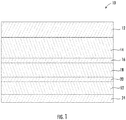
- FIG. 1 illustrates a multilayer film in accordance with the first aspect of the invention as set forth above.
- Film 10 includes sealant layer 12, bulk layer 14, first tie layer 16, core layer 18, second tie layer 20, third tie layer 22, and odor barrier layer 24.
- each of layers 12, 14, 16, 18, 20, 22, and 24 are directly adhered to one another.
- additional layers may be utilized in film 10. Additional materials can be incorporated into one or more of the film layers as appropriate, including (but not limited to) antiblock agents, slip agents, antifog agents.
- additives can also be included in one or more film layers to impart properties desired for the particular article being manufactured, such as (but not limited to) fillers, pigments, dyes, antioxidants, stabilizers, processing aids, plasticizers, fire retardants, ultraviolet-absorbers.
- Film 10 can have any total thickness desired, and each layer can have any thickness desired, so long as the film provides the desired properties for the particular packaging operation in which the film is used.
- the total film thickness can be about 0.5 to 15 mils; in some embodiments, from about 1 to 12 mils; in some embodiments, from about 2 to 10 mils; in some embodiments, from about 3 to 8 mils; and in some embodiments, from about 4 to 6 mils.
- film 5 can have a thickness of at least (or no more than) 0.5, 1, 1.5, 2, 2.5, 3, 3.5, 4, 4.5, 5, 5.5, 6, 6.5, 7, 7.5, 8, 8.5, 9, 9.5, 10, 10.5, 11, 11.5, 12, 12.5, 13, 13.5, 14, 14.5, or 15 mils.
- FIG. 1 is not drawn to scale and the layers can be of varying thicknesses compared to one another.
- the presently disclosed subject matter can include films comprising less or more than 7 layers.
- the disclosed film can have from 2 to 20 layers; in some embodiments, from 5 to 12 layers; and in some embodiments, from 5 to 10 layers.
- the disclosed film can have 2, 3, 4, 5, 6, 7, 8, 9, 10, 11, 12, 13, 14, 15, 16, 17, 18, 19, or 20 layers.
- the disclosed film can comprise more than 20 layers, such as in embodiments wherein the film components comprise microlayering technology.
- Film 10 can be constructed using any suitable process known to those of ordinary skill in the art, including (but not limited to) coextrusion, lamination, extrusion coating, and combinations thereof. Upward blown film production processes, downward cast film production processes, and extrusion-coating film production processes, are well known to those of skill in the art, as evidenced by the figures and description thereof in USPN 7,611,770, to Kennedy et al , and USPN 3,741,253 to Brax et al ., and USPN 8,012,520 B2, to Mudar et al.
- sealant layer 12 comprises 97 wt. % ssLLD1, which was a single site catalyzed, bimodal ethylene/octene linear low density copolymer which was commercially available as SURPASS® FPs317-A homogeneous LLDPE with density of 0.921 g/cm 3 and melt index of 4 g/10 min.
- SURPASS® FPs317-A homogeneous LLDPE with density of 0.921 g/cm 3 and melt index of 4 g/10 min.
- the bimodal nature of this LLDPE is beneficial in terms of lowering melt temperature upon exit of the coextrusion die which in terms limits thermo-oxidation of the sealant surface.
- the sealant layer is stabilized by the addition of an anti-oxidant package, i.e. AMPACET 10555 primary and secondary antioxidant in LLDPE.
- an anti-oxidant package i.e. AMPACET 10555 primary and secondary antioxidant in LLDPE.
- the presence of excess antioxidant may also be beneficial when packaging slightly ozonated water, i.e., to limit the formation of aldehydes at the sealant surface.
- the relatively high melt index of the bimodal ethylene/octene copolymer is believed to (i) limit melt temperature rise at increasing shear rate which is beneficial in reducing auto-oxidative process, and (ii) provide improved seal caulkability versus lower melt index resins.
- the slip properties of the seal layer are provided by an antiblock masterbatch, i.e., AMPACET 1000214N silica antiblock in LLDPE. It is further believed that a high molecular weight silicon-based masterbatch may improve slip properties and hot release on packaging equipment as well as on the film production line.
- an antiblock masterbatch i.e., AMPACET 1000214N silica antiblock in LLDPE. It is further believed that a high molecular weight silicon-based masterbatch may improve slip properties and hot release on packaging equipment as well as on the film production line.
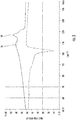
- FIG. 2 is a DSC curve for the bimodal ssLLD6, i.e., the single site catalyzed, bimodal ethylene/hexene linear low density copolymer having a density of 0.920 g/cc and a melt index of 1.9 g/10 min.
- Resin ssLLD6 was commercially available as EVOLUE® SP2320E homogeneous linear low density ethylene/hexene copolymer.
- the DSC curve for ssLLD6 was generated by holding the sample for 1.0 min at 30°C; followed by heating the sample from 30°C to 147°C at a rate of 10°C per minute; followed by holding the sample at 147°C for 1.0 min, followed by cooling the sample from 147°C to -43°C at 10°C per minute; followed by holding the sample at -43°C for one minute; followed by heating the sample from -43°C to 147°C at 10°C per minute.
- the bimodal composition of ssLLD1 is apparent from the upper curve in FIG. 2 , which is a second heating curve, whereas the lower curve in FIG. 2 is a recrystallization curve (i.e., freezing curve) and does not reveal the bimodal composition of ssLLD1.
- the upper curve in FIG. 2 reveals the bimodal nature of ssLLD6 in that the upper curve has a first melt peak 26 at 107.7°C (i.e., the first component of the ssLLD1 bimodal polymer) and a second melt peak 28 at 116.7°C (i.e., the second component of the bimodal ssLLD1 polymer). These two peaks show the bimodal composition of ssLLD1.
- FIG. 3 is a DSC curve for ssLLD4, i.e., the single site catalyzed, bimodal ethylene/octene linear low density copolymer having a density of 0.917 g/cc and a melt index of 1.0 g/10 min.
- the DSC curve for ssLLD4 was generated using the same equipment and same procedure as for the generation of the DSC curve for ssLLD1, i.e., as described above.
- Resin ssLLD4 was commercially available as SURPASS® FPs016-C homogeneous linear low density ethylene/octene copolymer.
- the bimodal composition of ssLLD4 is apparent from the upper curve in FIG. 3 , which is a second heating curve, whereas the lower curve in FIG. 3 is a recrystallization curve (i.e., freezing curve) and does not reveal the bimodal composition of ssLLD4.
- the upper curve in FIG. 3 reveals the bimodal nature of ssLLD6 in that the upper curve has a first melt peak 30 at 110.4°C (i.e., the first component of the bimodal ssLLD4 polymer) and a second melt peak 32 at 115.4°C (i.e., the second component of the bimodal ssLLD4 polymer). These two peaks show the bimodal composition of ssLLD4.
- 98 wt. % of bulk layer 14 was composed of a homogeneous ethylene/hexene copolymer, i.e., EXCEED® XP 8656 ML homogeneous ethylene/hexene copolymer having a density of 0.916 g/cm 3 and a melt index of 0.6 g/10 min.
- the fractional melt index of this copolymer is believed to improve bubble stability during upward blown film manufacture, and to provide the multilayer film with improved abuse resistance, i.e., improved flex crack resistance and improved drop test results, particularly when dropping a pouch filled with water at 13°C immediately after packaging and before the nylon contained in the core layer was fully hydrated.
- the alpha-olefin copolymer was present in a blend with the same antioxidant masterbatch used in the seal layer.
- the antioxidant is believed to limit the formation of oxidized species in the layer adjacent to the food contact layer.
- Bulk Layer 14 renders the multilayer film more abuse-resistant at low temperature and immediately after packing. Bulk layer 14 is one of the thickest layers of the multilayer film, i.e., about 30% of the total structure.
- 100 wt. % of core layer 18 was composed of copolyamide 6/66, i.e., ULTRAMID®C33 copolyamide 6/66 having a melting point of 195-197°C and a density of 1.12 g/cm 3 .
- Core layer 18 made up 20% of the total film thickness, and provided the multilayer film with heat-resistance during forming and sealing of the film to make a form-fill-seal pouch. Core layer 18 also provided the multilayer film with enhanced piercing properties (for insertion and installation of fitment), as well as abuse-resistance. Keeping the nylon layer thin contributed to film softness (i.e.
- polyamide is believed to be one of the biggest contributors to extractables.
- Nylon copolymer in the core layer is also preferred because it should result in lower extrusion temperature and therefore higher thermal stability than PA6 (i.e., polycaprolactam, which is a homopolymer).
- PA6 i.e., polycaprolactam, which is a homopolymer.
- the hydration of the polyamide 6/66 layer provided the film with high drop test performance after the film was properly aged.
- the core layer was 20% of total film thickness in preferred film No. 17, further work has demonstrated that the core layer can be thinned down to a thickness of only 14 % of total film thickness, with the film manufacturing process, the packaging process, and the packaged product performance all being good.
- each of the 1 st tie layer 16 and the 2 nd tie layer 20 was composed of a blend of (i) 70 wt % (based on total layer weight) PLEXAR® 3236 maleic anhydride-modified linear low density polyethylene with density 0.921 g/cc, a melt index of 2.0 g/10 minutes, and a vicat softening point 212°F, and (ii) 30 wt % (based on total layer weight) EXCEED® XP 8656 ML homogeneous linear low density ethylene/C 6 copolymer having a density of 0.916 g/cm 3 and a melt index of 0.6 g/10 min.
- the 1 st tie layer 16 served to adhere the bulk layer to the core layer.
- the 2 nd tie layer 20 served to adhere the core layer to the 3 rd tie layer 22.
- the selection of PLEXAR® 3236 maleic anhydride-modified LLDPE as 70 wt % of the 1 st tie layer 16 is also believed to provide the 1 st tie layer 16 with a low total organic compound contribution (small compounds that can produce an undesirable organoleptic effect), as the PLEXAR® 3236 maleic anhydride-modified LLDPE made up the majority of the 1 st and 2 nd tie layers 16 and 20 and was produced on a clean catalyst system.
- anhydride modified LLDPE-based tie resin with a density of 0.921 g/cc was found to perform well in the 1 st and 2 nd tie layers 16 and 20, it is believed that lower density material such as an anhydride-modified VLDPE-based tie resin could provide additional overall structure toughness.
- the 30 wt % non-modified, fractional melt index ethylene/hexene resin in the 1 st and 2 nd tie layers 16 and 20 is believed to improve the overall film toughness without affecting the bond strength of the tie resin to the nylon core.
- 3 rd tie layer 22 was composed of a blend of (i) 68 wt % ADMER® AT2146E maleic anhydride-modified ethylene/octene tie resin copolymer having a density of 0.915 g/cm 3 and a melt index of 1.3 g/10 min, and (ii) 30 wt % ENABLE® 2005 HH homogeneous et/hexene copolymer having a density of 0.920 g/cc and a melt index of 0.5 g/10 min.
- the lower density (0.915 g/cc) and low melt index (1.3 g/10 min) of the anhydride-modified ethylene/octene tie layer resin relative to the anhydride-modified tie layer resin of the 1 st and 2 nd tie layers 16 and 20 is believed to be beneficial in terms of both film toughness and adhesion to the stiff PETG odor barrier layer as it deforms better at the interface of the 3 rd tie layer 22 and the PETG odor barrier layer 24.
- the toughness of the 3 rd tie layer 22 is further improved by the 30wt % presence of the single site catalyzed ENABLE® 2005 HH homogeneous et/hexene copolymer having a density of 0.920 g/cc and a fractional melt index of 0.5 g/10 min at 190°C. Moreover, the thickness of the 3 rd tie layer 22 (15% based on total film thickness) is believed to contribute to minimizing the curl exhibited by the film. An antioxidant masterbatch was also provided in 3 rd tie layer 22 to provide further heat stabilization.
- the polyester in the outer layer can be a polyethylene terephthalate homopolymer or copolymer.
- PET homopolymer is made by polymerizing terephthalic acid with ethylene glycol
- PETG is a copolymer of terephthalic acid, ethylene glycol, and cyclohexanedimethanol (CHDM).
- CHDM is present in PETG at a level high enough so that PETG is amorphous.
- PETG is beneficial in running lower extrusion temperature relative to homopolymer PET. The lower processing temperature of PETG limits the surface oxidation of the film as it exits the die.
- the polyester may be polyethylene furanoate.
- AVANTIUM® bio-based polyester is a polyethylene furanoate which per unit thickness exhibits only one tenth the oxygen transmission rate of polyethylene terephthalate (PET), one fourth the carbon dioxide transmission rate of PET, and one half the water vapor transmission rate of PET.
- PET polyethylene terephthalate
- Polyethylene furanoate is more heat-resistant than PET, with a glass transition temperature (T g ) 12°C higher than PET, with a melt point of 165°C, which is higher than PET.
- T g glass transition temperature
- polyethylene furanoate is recyclable alone or in a blend with PET.
- Polyethylene furanoate can be extruded to form films.
- Polyethylene furanoate is made by polymerizing ethylene glycol and 2,5- furandicarboxylic acid (FDCA). Polyethylene furanoate is renewable, as it is bio-based.
- amorphous polymers may be used in place of amorphous PETG, such as PCTG (polycyclohexylene dimethylene terephthalate), PCTA (polycyclohexanedimethanol terephtalic acid), cyclic olefin copolymer (e.g., ethylene/norbornene copolymer), and amorphous polyamide (e.g., polyamide 6I6T).
- PCTG polycyclohexylene dimethylene terephthalate
- PCTA polycyclohexanedimethanol terephtalic acid
- cyclic olefin copolymer e.g., ethylene/norbornene copolymer
- amorphous polyamide e.g., polyamide 6I6T
- PBT i.e., polybutylene terephthalate
- copolyesters thereof e.g., PBTG, a copolymer of terephthalic acid, butylene glycol, and cyclohexanedimethanol (CHDM)
- PBTG polybutylene terephthalate
- CHDM cyclohexanedimethanol
- odor barrier layer 24 was composed of a blend of (i) 98 wt % EASTAR® PETG 6763 polyethylene terephthalate/ glycol (i.e., PETG) having a density of 1.27 g/cc and a melt index of 2.8 g/10 min.
- PETG odor barrier layer provided a barrier to odorous and aromatic compounds capable of migrating from the ambient to the inside of the packaging article.
- the presence of the PETG odor barrier layer was relegated to a thin skin layer due to the brittle nature of the PETG polymer which was capable of providing adequate odor/taste barrier.
- Maintaining the flexibility and toughness of the pouch was beneficial to performance, due to the handling conditions around the water pouch at the time of packaging and during distribution and use.
- Providing a relatively thin PETG odor barrier layer allowed the other film layers to bare the blunt of the deformation more easily before the skin layer was forced to contribute its abuse resistance.
- PETG tends to stick to equipment.
- Amorphous silica and wax ester has been added to amorphous PETG to lower the coefficient of friction upon emergence from the die and in subsequent processing, to prevent blocking of the film to itself, and to improve film tracking on processing equipment at room temperature. It has also been found advantageous to add polydimethylsiloxane (PDMS) to the amorphous polyester to provide the polyester outside layer with high temperature release properties, causing the film to readily release from the heat seal bar during the heat sealing process.
- PDMS polydimethylsiloxane
- sealant layer 12 and odor barrier layer 24 are incompatible in that they do not heat seal to one another, necessitating a fin seal of the seal layer to itself in the backseam running the length of a form-fill-and-seal packaging article.
- PET polyethylene terephthalate
- PETG was also selected over PET in part because of the stronger affinity of PETG for polyolefin, making the bond between the odor barrier layer and the 3 rd tie layer stronger than it would have been with PET as the odor barrier polymer.
- This stronger bond provides greater adhesion and improved processability as PETG can be extruded at lower temperature than PET, thereby lowering the thermal oxidation of the odor barrier layer polymer, and providing the odor barrier layer with lower moisture sensitivity.
- a slip/antiblock masterbatch was added to the odor barrier layer for processability in extrusion and machinability on the form-fill-and-seal; machine.
- the slip package in AB-3 is based on ester waxes which do not appear to transfer and migrate to the sealant surface and have an adverse organoleptic effect. The slip characteristics of the skin affect the piercing performance. Film No. 16 exhibited excellent conformity to the piercing probe.
- the seal layer contains less than 10 parts per billion of total organic carbon, or less than 5 ppb, or less than 1 ppb total organic carbon, or less than 0.8 ppb, or less than 0.7 ppb, or less than 0.6 ppb.
- the seal layer further comprises antiblocking particulates and an antioxidant.
- the antiblocking agent can be a polysiloxane.
- the seal layer is does not comprise wax.
- the seal layer has thickness of from 5% to 25%, based on total thickness of the multilayer film, and the homogeneous ethylene/ alpha-olefin copolymer in the seal layer has a melt index of at least 1.0 g/10 min
- the homogeneous ethylene/ ⁇ -olefin copolymer in the seal layer comprises a bimodal homogeneous ethylene/ ⁇ -olefin copolymer
- the bimodal homogeneous ethylene/ ⁇ -olefin copolymer comprises a first homogeneous ethylene/ ⁇ -olefin copolymer component and a second homogeneous ethylene/ ⁇ -olefin copolymer component, wherein the first homogeneous ethylene/ ⁇ -olefin copolymer component has a melting point below the melting point of the second homogeneous ethylene/ ⁇ -olefin copolymer component.
- the bimodal homogeneous ethylene/ ⁇ -olefin copolymer has a density of at least 0.910 g/cc, or at least 0.908 g/cm 3 , or at least 0.91 g/cm 3 or at least 0.912 g/cm 3 , or at least 0.915 g/cm 3 .
- the bimodal homogeneous ethylene/ ⁇ -olefin copolymer has a melt index of at least 3 g/10 min.
- the bimodal homogeneous ethylene/ ⁇ -olefin copolymer has a melt index of from 3 to 5 g/10 min.
- the first homogeneous ethylene/ ⁇ -olefin copolymer component has a melting point of at least 113°C (or from 105°C to 113°C, or from 108°C to 113°C, or from 110°C to 113°C), and the second homogeneous ethylene/ ⁇ -olefin copolymer component has a melting point of greater than113°C(or from >113°C to 125°C; or from >113°C to 120°C; or from >113°C to 118°C; or from >113.1°C to 116°C).
- the first homogeneous ethylene/ ⁇ -olefin copolymer component has a melting point of from 108°C to 113°C
- the second homogeneous ethylene/ ⁇ -olefin copolymer component has a melting point of from >113°C to 118°C.
- the multilayer film is coextruded.
- the bulk layer has a thickness of from 15% to 60%, based on total thickness of the multilayer film (or from 15% to 50%, based on total thickness of the multilayer film; or from 15% to 40%, based on total thickness of the multilayer film).
- the ethylene/ ⁇ -olefin copolymer in the bulk layer is a single site catalyzed copolymer and has a density of from 0.90 g/cm 3 to 0.925 g/cm 3 (or at least 0.88 g/cm 3 ; or at least 0.89 g/cm 3 ; or at least 0.90 g/cm 3 ; or at least 0.91 g/cm 3 ; or at least 0.915g/cm 3 ; or from 0.88 g/cm 3 to 0.93 g/cm 3 ; or from 0.89 g/cm 3 to 0.925 g/cm 3 ; or from 0.90 g/cm 3 to 0.92 g/cm 3 ; or from 0.91 g/cm 3 to 0.92 g/cm 3 ).
- the ethylene/ ⁇ -olefin copolymer in the bulk layer has a melt index of less than 1.0 g/10 min (or from 0.2 to 0.9 g/10 min, or from 0.3 to 0.8 g/10 min, or from 0.4 to 0.6 g/10 min).
- the bulk layer further comprises an antioxidant.
- the core layer comprises polyamide.
- the core layer comprises polyamide copolymer.
- the core polyamide copolymer comprises polyamide 6/66.
- the core layer has a thickness of from 13% to 25%, based on total thickness of the multilayer film (or from 14% to 20%, based on total thickness of the multilayer film).
- the first tie layer comprises at least one member selected from the group consisting of anhydride-modified polyolefin and acid-modified polyolefin
- the second tie layer comprises at least one member selected from the group consisting of anhydride-modified polyolefin and acid-modified polyolefin.
- the anhydride-modified polyolefin comprises a single site catalyzed anhydride-modified ethylene/ ⁇ -olefin copolymer
- the acid-modified polyolefin comprises a single site catalyzed acid-modified ethylene/ ⁇ -olefin copolymer.
- the anhydride-modified polyolefin comprises at least one member selected from the group consisting of anhydride-modified linear low density polyethylene, anhydride-modified very low density polyethylene, and anhydride-modified ultra low density polyethylene
- the acid-modified polyolefin comprises at least one member selected from the group consisting of acid-modified linear low density polyethylene, acid-modified very low density polyethylene, and acid-modified ultra low density polyethylene.
- the first tie layer contains less than 10 parts per billion of total organic carbon (or less than 5 ppb, or less than 1 ppb).
- the core layer comprises polyamide and the multilayer film does not contain polyvinylidene chloride.
- the core layer comprises polyamide and the multilayer film does not contain ethylene/vinyl alcohol copolymer.
- the second tie layer has the same composition as the first tie layer.
- the modified ethylene/ ⁇ -olefin copolymer in the third tie layer has a density of from 0.89 to 0.920 g/cm 3 (or from 0.90 to 0.919 g/cm 3 , or from 0.905 to 0.918 g/cm 3 , or from 0.910 to 0.917 g/cm 3 , or from 0.914 to 0.916 g/cm 3 ), and a melt index of less than 2.0 g/10 min (or from 0.5 to 1.9 g/10 min, or from 0.9 to 1.7 g/10 min, or from 1.0 to 1.6 g/10 min, or from 1.1 to 1.5 g/10 min, or from 1.2 to 1.4 g/10 min).
- the modified ethylene/ ⁇ -olefin copolymer in the third tie layer is anhydride modified and has a density of from 0.910 to 0.917 g/cm 3 and has a melt index of 1.0 to 1.6 g/10 min
- the third tie layer further comprises a single site catalyzed unmodified ethylene /a-olefin copolymer having a melt index of less than 1.0 g/10 min (or from 0.1 to 0.9 g/10 min, or from 0.2 to 0.8 g/10 min, or from 0.3 to 0.7 g/10 min, or from 0.4 to 0.6 g/10 min).
- the third tie layer further comprises an antioxidant.
- the PETG based layer is a skin layer. In another embodiment, the PETG-based layer can positioned inside the film itself.
- the odor barrier layer has a thickness of from 1% to 15% based on total thickness of the multilayer film (or from 2% to 10%, or from 3% to 7%) and preferably further comprises polydimethylsiloxane heat-release agent, silica anti-blocking agent, and wax slip agent.
- the odor barrier layer comprises at least one barrier polymer selected from the group consisting of PET, PETG, PCTG, PCTA, PBT, PBTG, cyclic olefin copolymer, and amorphous polyamide.
- the odor barrier layer comprises at least one barrier polymer selected from the group consisting of PETG, PCTG, PCTA, PBTG, ethylene/norbornene copolymer, polyamide 6I/6T, the odor barrier layer comprising the barrier polymer in an amount of from 90 to 100 wt %, based on layer weight.
- the odor barrier layer comprises glycol-modified polyethylene terephthalate in an amount of from 90 to 100 wt %, based on layer weight.
- the odor barrier layer further comprises at least one member selected from the group consisting of antiblock agent and slip agent.
- the slip agent is an amide wax which does not migrate to the surface of the seal layer.
- the odor barrier layer is free of wax.
- the odor barrier layer is an outer layer, i.e., a skin layer.
- the polyvinyl alcohol can be PVAL or PVOH.
- Polyvinylalcohol can be co-extruded or applied as a coating on the outer surface of the film.
- the cyclic olefin copolymer has a glass transition temperature (“Tg") of at least 65°C, alternatively at least 70°C.
- Tg glass transition temperature
- Ethylene/ norbornene copolymer is a preferred cyclic olefin copolymer.
- the multilayer film has an elongation at break of at least 200 % (or at least 250%, or at least 300%, or at least 350%, or at least 400%, or at least 450%, or at least 500%, or at least 550%, or at least 600%).
- the elongation at break can be measured in accordance with ASTM D 882 at 23°C.
- the coextrusion is carried out in an upward blown film process.
- the coextrusion is carried out in a downward cast film process.
- the seal layer is coextruded at a temperature of from 345°F to 395°F, or from 350°F to 390°F, or from 350°C to 380°F, or from 350°F to 370°F, or from 350°F to 360°F, or about 350°F.
- the coextrusion is carried out in a manner so as to produce a coextruded multilayer film according to any of the embodiments of the first aspect of the invention.
- the multilayer film has an elongation at break of at least 200%.
- the multilayer film can comprise one or more additional abuse layers.
- the abuse layer(s) can be any film layer, so long as the film layer serves to resist abrasion, puncture, or other potential causes of reduction of package and/or container integrity or package/container appearance quality.
- the multilayer film can comprise at least one additional bulk layer that functions to increase the abuse resistance, toughness, and/or modulus of the film.
- the disclosed film can comprise one or more barrier layers adapted for rendering the layer or the film relatively impermeable to a gas.
- the disclosed film can comprise the following combination A/B/C/D/C/B/E, where A represents a sealant layer; B represents an intermediate layer (such as the first and second intermediate layers disclosed herein), C represents a tie layer; D represents a core layer; and E represents a skin layer.
- A represents a sealant layer
- B represents an intermediate layer (such as the first and second intermediate layers disclosed herein), C represents a tie layer
- D represents a core layer
- E represents a skin layer.
- One or more additional tie layers can optionally be used between any one or more layers of the above multilayer film structures.
- one or more abuse, barrier, and/or bulk layers can be used in between any one or more layers of the above multilayer film structures, as would be known to those of ordinary skill in the art.
- the multilayer film can be used to construct a wide variety of packages, including (but not limited to) pouches suitable for transporting and dispensing filtered water (reverse osmosis) or ozonated water.
- pouches suitable for transporting and dispensing filtered water (reverse osmosis) or ozonated water.
- Any of the wide variety of pouches known and used in the art can be constructed, including (but not limited to) lay flat pouches, stand-up pouches, side seal pouches.
- Any size pouch can be constructed, such as (but not limited to) 5-10 liter pouches.
- the pouches can be placed in a dispensing unit where the pouches are perforated by a spigot for water delivery.
- the spigot can cooperate with a fitment on the pouch. Suitable fitments are not limited and can be any fitment known or used in the packaging art.
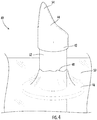
- FIG. 4 illustrates a fitment-with probe-pierced-through-film 40, with fitment 42 having piercing probe 44 with a puncturing tip 54 and flange 46.
- a portion 48 of film 50 was stretched up along a portion of probe shaft 52 of fitment 42.
- the film conformed well around the probe. Excessive force was not required to force the probe to perforate the film.
- Packaging articles made from the multilayer film can be used for a variety of purposes, including storing, transporting, and dispensing water.
- the multilayer film comprises little or no extractables.
- the packaging material does not adversely affect the organoleptic properties of the product inside the package.
- Pouches constructed from the disclosed films have a very low TOC value.
- the TOC value attributed to the pouch is less than 10 ppb (for 5x5 inch pouches filled with deionized water aged 48 hours at 40°C, followed by aging 24 hours at room temperature and then measurement using a Sievers M5310 C TOC analyzer, available from GE Analytical Instruments).
- the disclosed film structures exhibit lower TOC values compared to traditional polyethylene-based structures currently used in the market today.
- Table 1 is a table of the various resins and other components used to make the multilayer films 1-17 disclosed in Tables 2-17.
- Table 18 is a comparative film in commercial use today, with generic identity of resins in each layer known, but with name brand identity of resins in each layer unknown.
- Tables 2-17 provide the layer arrangement, layer function, layer thickness, and layer composition, for multilayer films.
- PA-1 ULTRAMID® C33 copolyamide 6/66 relative viscosity 3.19-3.41 (ISO 307), m.p. 195-197°C (ISO 3146), and density 1.12 g/cc (ISO 1183). BASF Corporation, Florham Park, N.J. PA-2 ULTRAMID® C40 L copolyamide 6/66 with density of 1.12 g/cc (ISO 1183) and melting point of 192-194°C (ISO 3146). BASF Corp., Florham Park, N.J.
- Layer Film No. 9 (for lamination to PET film; for overbagging with, e.g., Film No. 13) function Seal 1 st Bulk 1 st Tie Barrier 2 nd Tie 2 nd Bulk Skin compos.
- Layer Film No. 12 (for lamination to PET film; for overbagging with, e.g., Film No. 13) function Seal 1 st Bulk 1 st Tie Barrier 2 nd Tie 2 nd Bulk Skin compos. 97% ssLLD1 2% AOX 1% AB-2 98% ssLLD2 2% AOX 100% mLLD-1 100% PA-1 100% mLLD-1 98% ssLLD2 2% AOX 65% ssLLD1 30% ssLLD2 1.5% AB-2 2% AOX 1.5% PDMS-2 Vol.
- Layer Film No. 13 (Film converted to bag that is used to package water-filled pouch made from Film No. 12) function Seal 1 st Bulk 1 st Tie Barrier 2 nd Tie 2 nd Bulk Skin compos. 82% ssVLD 15% zLLD 3% AB-4 100% mVLD 90% PA-6 10% aPA 100% EVOH 90% PA-6 10% aPA 65% mVLD 30% mSEBS 5% PET 100% coPET Vol.
- Film Nos. 1-4 were manufactured by cast coextrusion. This method is well known to those of ordinary skill in the art. Film Nos. 1-4, as disclosed in Tables 2-5 are provided as comparative examples. When converted into packaging articles and used to package water, with the packages being placed in cardboard boxes, they generated an organoleptic effect upon the water which was rated as "moderately disliked” (7 on a 1-9 scale, with 9 being “dislike extremely” and 1 being “like extremely”) in a forced aging study. In contrast, Film No. 16, disclosed in Table 16, exhibited a rating of "like moderately” (rating of 3 on the same 1 to 9 scale) in the forced aging study.
- Film No. 16 was fully coextruded on a blown film line using a 1.65:1 blow up ratio (i.e., ratio of the diameter of the die ⁇ the smaller number ⁇ to the diameter of the blown bubble ⁇ the larger number ⁇ ).
- An equivalent structure could have been produced using various cast processes, i.e., flat cast, downward cast, downward blown.
- An alternative to full coextrusion is the separately produced and lamination process including the production of, for example, a seal/1 st bulk/ 1 st tie/core/2 nd tie/2 nd bulk/skin multilayer coextruded film where both the seal layer and the skin layer would be based on polyolefinic resin, followed by laminating this polyolefin-based multilayer film to a monolayer or multilayer film containing an odor barrier layer, e.g., a biaxially oriented PET film.
- the lamination could be carried out by any conventional lamination process including adhesive lamination, heat lamination.
- the lamination approach requires more processing steps than a full coextrusion approach.
- Film No. 16 was converted into packaging articles on a vertical form fill seal system equipped with a fin seal collar to produce flexible pouches with a longitudinal fin seal and two transverse end seals.
- the resulting packaging articles were used to package water.
- the sealant layer in contact with the water contained very low levels of low molecular weight compounds to prevent taint the water by the film itself.
- the odor barrier layer constituted a functional barrier to prevent tainting caused external factors such as taste contamination in the presence of wet cardboards.
- Form-fill-seal pouches made from Film No. 16 could be used in water packaging, with the pouches placed in a dispensing unit where they are perforated by a spigot for water delivery.
- the spigot can be used in combination with a fitment, but not necessarily.
- the capacity of the pouches would typically be in the range of from 5 to 10 liters.
- Vertical form-fill-seal packaging can be carried out with the equipment and processes known to those of skill in the art, including, for example, the equipment and processes disclosed in USPN 2,956,383 , USPN 3,045,404 , and USPN 4,589,247 .
- Pouches were constructed on an ONPACK 2002 vertical form-fill-seal machine using a 630 mm tooling and a seal bar composed of 5 ribs to produce the leading and trailing end seals.
- the leading end seal corresponded to the pouch bottom as it leaves the ONPACK machine while the trailing end seal corresponds to the pouch top.
- the trailing end seal of pouch "n" was made at the same time that the leading end seal of pouch "n+1".
- the pouch dimensions were 410 mm x 300 mm (in lay-flat configuration, including seals) and had a targeted volume of 6 liters, corresponding to a weight of 13.3 pounds.
- the pouches were filled with water with temperature of 13°C or 25°C.
- a total of 40 pouches were produced for each treatment. 20 Pouches were dropped from a height of 60 cm within 10 minutes of production, 20 pouches were dropped from a height of 80 cm after 24 hours of aging at room temperature using a free-fall drop tester. Also, drop testing was performed at heights up to 100 cm, in order to differentiate the performance of various structures.
- Filled pouches should achieve a minimum level of abuse performance at the time of production to pass the abuse associated with conveying from the packaging machine to the boxing station, at which location the filled pouches are dropped into a box and stacked on top of each other.
- Filled pouches need to be able to withstand a minimum of 3 consecutive drops from a height of 60 cm with water at a temperature of 13°C, with the dropping being carried out immediately after filling the pouches with water, i.e., with no hydration period After a 24 hour aging period, the moisture content of the polyamide layer is about 9.5 wt%.
- the film needs to be abuse-resistant immediately after packaging so that the water pouches can survive the first hours of handling until hydration of the film takes place.
- Tables 20, 21, and 22 provide various drop test results for various films disclosed herein. The results indicate a significant improvement in the number of failures when the pouches are allowed to age for 24 hours. The improvement is believed to be associated with the absorption of moisture by the polyamide film layer, which depresses the glass transition temperature of the polyamide below the service temperature at which the film is tested. As a result, the pouches deform in ductile manner rather than breaking in a brittle manner when dropped.
- Water-filled pouches were prepared on an ONPACK 2002 as described above for the drop testing, except that the pouches were 330 mm x 330 mm (in lay-flat configuration, not including seals) in size when in lay-flat configuration.
- Samples aged at conditions A and B were: (i) stored for 11 days at 110°F, then (ii) allowed to cool down to 73°F for an additional 20 days at the conclusion of which taste testing was conducted.
- Samples aged at condition C were aged for 21 days at 110°F, and then allowed to cool overnight before taste testing was conducted by a taste test panel of 3 testers or 4 testers, depending upon the test day.
- Samples were prepared by making a single form-fill-seal pouch from each of from three films, with the control being un-aged water. All water was DEER PARK brand bottled water. The pouches were 13" x 13" and each contained 6 liters of water, and each sample was placed in a foil liner with a piece of cardboard (540 mm x 260 mm x 7 mm thick) wetted with 50 ml water. Each pouch was aged in the pouch with the wet cardboard for 8 days at 110°F, following which the water-filled pouches were removed from the foil liners, allowed to cool to room temperature and remain at room temperature for 7 days until testing.
- Table 24 1 2 3 4 5 6 7 8 9 Like Extremely Like Very Much Like Moderately Like Slightly Neither Like nor Dislike Dislike Slightly Dislike Moderately Dislike Very Much Dislike Extremely Film No. 12 7.0 Film No. 16 3.4 FX735 7.8 Control 2.4
Landscapes
- Engineering & Computer Science (AREA)
- Mechanical Engineering (AREA)
- Laminated Bodies (AREA)
- Wrappers (AREA)
Claims (15)
- Film multicouche pour une utilisation pour l'emballage de produits organoleptiques sensibles, comprenant :A) une couche d'étanchéité externe comprenant un copolymère d'éthylène/α-oléfine homogène ayant une densité d'au moins 0,906 g/cm3 ;B) une couche de masse comprenant un copolymère d'éthylène/α-oléfine ayant une densité de 0,89 à 0,93 g/cm3, la première couche de masse étant comprise entre la couche d'étanchéité externe et la couche de cœur ;C) une première couche de liaison entre la couche d'étanchéité externe et la couche de cœur, la première couche de liaison comprenant une première polyoléfine modifiée ; etD) une couche de cœur comprenant au moins un élément choisi dans le groupe constitué par un polyamide, un copolymère d'éthylène/acétate de vinyle saponifié, un polychlorure de vinylidène,E) une deuxième couche de liaison entre la couche de cœur et la couche de liaison barrière contre les odeurs, la deuxième couche de liaison comprenant une seconde polyoléfine modifiée ;F) une troisième couche de liaison comprenant un copolymère d'éthylène/α-oléfine modifié ayant une densité de 0,89 à 0,93 g/cm3, la troisième couche de liaison étant comprise entre la deuxième couche de liaison et la couche barrière contre les odeurs ; etG) une couche barrière contre les odeurs comprenant au moins un polymère barrière contre les odeurs choisi dans le groupe constitué par un polyester, un polyamide amorphe, un polycarbonate, un alcool polyvinylique et un copolymère oléfinique cyclique, la couche barrière contre les odeurs comprenant un glycol-téréphtalate de polyéthylène modifié (PETG) en une quantité de 90 à 100 % en poids sur la base du poids de la couche.
- Film multicouche selon la revendication 1, dans lequel la couche d'étanchéité comprend en outre des particules anti-adhérentes et un antioxydant, la couche d'étanchéité contient moins de 10 parties par milliard de carbone organique total, la couche d'étanchéité a une épaisseur de 5 % à 25 %, sur la base de l'épaisseur totale du film multicouche, et le copolymère d'éthylène/α-oléfine homogène dans la couche d'étanchéité a un indice de fusion d'au moins 1,0 g/10 min.
- Film multicouche selon la revendication 1, dans lequel le copolymère d'éthylène/α-oléfine homogène dans la couche d'étanchéité comprend un copolymère d'éthylène/α-oléfine homogène bimodal ayant une densité d'au moins 0,910 g/cm3 et un indice de fusion d'au moins 3 g/10 min, et le copolymère d'éthylène/α-oléfine homogène bimodal comprend un premier composant du copolymère d'éthylène/α-oléfine homogène ayant un point de fusion ≤ 113 °C, et un second composant du copolymère d'éthylène/α-oléfine homogène ayant un point de fusion > 113 °C.
- Film multicouche selon la revendication 1, dans lequel le copolymère d'éthylène/α-oléfine dans la couche de masse est un copolymère catalysé en un seul site ayant une densité de 0,90 g/cm3 à 0,925 g/cm3 et un indice de fusion inférieur à 1,0 g/10 min, la couche de masse a une épaisseur de 15 % à 60 % sur la base de l'épaisseur totale du film multicouche, et la couche de masse comprend en outre un antioxydant.
- Film multicouche selon la revendication 1, dans lequel la couche de cœur comprend un polyamide 6/66, et la couche de cœur a une épaisseur de 13 % à 25 %, sur la base de l'épaisseur totale du film multicouche.
- Film multicouche selon la revendication 1, dans lequel la couche barrière contre les odeurs a une épaisseur de 1 % à 15 % sur la base de l'épaisseur totale du film multicouche et comprend en outre de préférence un agent de démoulage thermique de polydiméthylsiloxane, un agent anti-adhérent de silice et un agent de glissement de cire.
- Film multicouche selon la revendication 1, dans lequel la première et la seconde polyoléfine modifiées comprennent au moins un élément indépendamment choisi dans le groupe constitué par une polyoléfine modifiée par un anhydride qui comprend au moins un copolymère d'éthylène/α-oléfine modifié par un anhydride catalysé en un seul site choisi dans le groupe constitué par un polyéthylène basse densité linéaire modifié par un anhydride, un polyéthylène très basse densité modifié par un anhydride et un polyéthylène ultra basse densité modifié par un anhydride, et une polyoléfine modifiée par un acide qui comprend au moins un copolymère d'éthylène/α-oléfine modifié par un acide catalysé en un seul site choisi dans le groupe constitué par un polyéthylène basse densité linéaire modifié par un acide, un polyéthylène très basse densité modifié par un acide et un polyéthylène ultra basse densité modifié par un acide.
- Film multicouche selon la revendication 1, dans lequel la première couche de liaison contient moins de 10 parties par milliard de carbone organique total.
- Film multicouche selon la revendication 1, dans lequel le copolymère d'éthylène/α-oléfine modifié dans la troisième couche de liaison a une densité de 0,89 à 0,920 g/cm3, et un indice de fusion inférieur à 2,0 g/10 min, et la troisième couche de liaison comprend en outre un antioxydant.
- Procédé de production d'un film multicouche comprenant la coextrusion d'un film multicouche pour une utilisation dans l'emballage de produits organoleptiques sensibles, les couches coextrudées comprenant :A) une couche d'étanchéité externe comprenant un copolymère d'éthylène/α-oléfine homogène ayant une densité d'au moins 0,906 g/cm3 ;B) une couche de masse comprenant un copolymère d'éthylène/α-oléfine ayant une densité de 0,89 à 0,93 g/cm3, la première couche de masse étant comprise entre la couche d'étanchéité et la couche de cœur ;C) une première couche de liaison entre la couche d'étanchéité et la couche de cœur, la première couche de liaison comprenant une première polyoléfine modifiée ; etD) une couche de cœur comprenant au moins un élément choisi dans le groupe constitué par un polyamide, un copolymère d'éthylène/acétate de vinyle saponifié, un polychlorure de vinylidène,E) une deuxième couche de liaison entre la couche de cœur et la couche de liaison barrière contre les odeurs, la deuxième couche de liaison comprenant une seconde polyoléfine modifiée ;F) une troisième couche de liaison comprenant un copolymère d'éthylène/α-oléfine modifié ayant une densité de 0,89 à 0,93 g/cm3, la troisième couche de liaison étant comprise entre la deuxième couche de liaison et la couche barrière contre les odeurs ; etG) une couche barrière contre les odeurs comprenant au moins un polymère barrière contre les odeurs choisi dans le groupe constitué par un polyester, un polyamide amorphe, un polycarbonate, un alcool polyvinylique et un copolymère oléfinique cyclique, dans lequel la couche barrière contre les odeurs comprend un glycol-téréphtalate de polyéthylène modifié (PETG) en une quantité de 90 à 100 % en poids sur la base du poids de la couche.
- Procédé selon la revendication 10, dans lequel la coextrusion est réalisée dans un procédé de film soufflé vers le haut ou dans un procédé de film coulé vers le bas et la couche d'étanchéité est coextrudée à une température de 345 °F à 395 °F (174 °C à 202 °C), et le film multicouche a une élongation à la rupture d'au moins 200 % mesurée conformément à la norme ASTM D 882 à 23 °C.
- Article d'emballage de formage-remplissage-scellage comprenant un film multicouche selon la revendication 1 ayant une couche d'étanchéité thermoscellée à elle-même et une couche barrière contre les odeurs externe, comprenant :a) un scellage à bord replié de couture arrière s'étendant sur une longueur de l'article d'emballage, le scellage à bord replié de couture arrière étant un thermoscellage de la couche d'étanchéité à elle-même, le scellage à bord replié de couture arrière convertissant le film multicouche en un tube à couture arrière,b) un premier scellage d'extrémité au niveau d'une première extrémité du tube à couture arrière, le premier scellage d'extrémité étant transversal par rapport au scellage à bord replié de couture arrière, le premier scellage d'extrémité conformant une première partie du scellage d'extrémité du tube à couture arrière dans une première configuration à plat ; etc) un second scellage d'extrémité au niveau d'une seconde extrémité du tube à couture arrière, le second scellage d'extrémité étant également transversal au scellage à bord replié de couture arrière, le second scellage d'extrémité conformant une seconde partie du scellage d'extrémité du tube à couture arrière dans une seconde configuration à plat.
- Article d'emballage de formage-remplissage-scellage selon la revendication 12, dans lequel le film multicouche a un allongement à la rupture d'au moins 200 % mesuré conformément à la norme ASTM D 882 à 23 °C, et dans lequel l'article d'emballage comprend en outre un accessoire pour distribuer un produit fluide, l'accessoire étant installé dans le film multicouche.
- Article d'emballage de formage-remplissage-scellage comprenant un film multicouche ayant une couche d'étanchéité thermoscellée à elle-même et une couche barrière contre les odeurs,I) l'article d'emballage comprenant :A) un scellage à bord replié de couture arrière s'étendant sur une longueur de l'article d'emballage, le scellage à bord replié de couture arrière étant un thermoscellage de la couche d'étanchéité à elle-même, le scellage à bord replié de couture arrière convertissant le film multicouche en un tube à couture arrière,B) un premier scellage d'extrémité au niveau d'une première extrémité du tube à couture arrière, le premier scellage d'extrémité étant transversal par rapport au scellage à bord replié de couture arrière, le premier scellage d'extrémité conformant une première partie du scellage d'extrémité du tube à couture arrière dans une première configuration à plat ; etC) un second scellage d'extrémité au niveau d'une seconde extrémité du tube à couture arrière, le second scellage d'extrémité étant également transversal au scellage à bord replié de couture arrière, le second scellage d'extrémité conformant une seconde partie du scellage d'extrémité du tube à couture arrière dans une seconde configuration à plat ; etII) dans lequel le film multicouche comprend :i) une couche d'étanchéité externe comprenant un copolymère d'éthylène/α-oléfine homogène ayant une densité d'au moins 0,906 g/cm3 ;ii) une couche de masse comprenant un copolymère d'éthylène/α-oléfine ayant une densité de 0,89 à 0,93 g/cm3, la première couche de masse étant comprise entre la couche d'étanchéité et la couche de cœur ;iii) une première couche de liaison entre la couche d'étanchéité et la couche de cœur, la première couche de liaison comprenant une première polyoléfine modifiée ; etiv) une couche de cœur comprenant au moins un élément choisi dans le groupe constitué par un polyamide, un copolymère d'éthylène/acétate de vinyle saponifié, un polychlorure de vinylidène,v) une seconde couche de liaison entre la couche de cœur et la couche de liaison superficielle, la deuxième couche de liaison comprenant une seconde polyoléfine modifiée ;vi) une seconde couche de masse comprenant un copolymère d'éthylène/α-oléfine ayant une densité de 0,89 à 0,93 g/cm3, la seconde couche de masse étant comprise entre la seconde couche de liaison et la couche superficielle ; etvii) une couche superficielle comprenant au moins un élément choisi dans le groupe constitué par une polyoléfine, un polyamide, un polychlorure de vinylidène et un copolymère d'éthylène/alcool vinylique ;viii) une couche adhésive de stratification ayant une première surface principale collée à la surface de la couche superficielle opposée à la seconde couche de masse du film multicouche ; etix) une couche barrière contre les odeurs ayant une première surface principale collée de manière directe ou indirecte à la seconde surface principale de la couche adhésive de stratification, la couche barrière contre les odeurs comprenant au moins un polymère barrière contre les odeurs choisi dans le groupe constitué par un polyester, un polyamide amorphe, un polycarbonate, un alcool polyvinylique et un copolymère oléfinique cyclique, dans lequel la couche barrière contre les odeurs comprend un glycol-téréphtalate de polyéthylène modifié (PETG) en une quantité de 90 à 100 % en poids sur la base du poids de la couche.
- Produit emballé comprenant un produit organoleptique sensible à l'intérieur d'un article d'emballage de formage-remplissage-scellage hermétiquement scellé selon l'une quelconque des revendications 12 à 14.
Applications Claiming Priority (3)
| Application Number | Priority Date | Filing Date | Title |
|---|---|---|---|
| US201662408323P | 2016-10-14 | 2016-10-14 | |
| US201762483675P | 2017-04-10 | 2017-04-10 | |
| PCT/US2017/056455 WO2018071742A1 (fr) | 2016-10-14 | 2017-10-13 | Film d'emballage pour produit sensible organoleptique, et procédé, article d'emballage et produit emballé correspondant |
Publications (2)
| Publication Number | Publication Date |
|---|---|
| EP3526041A1 EP3526041A1 (fr) | 2019-08-21 |
| EP3526041B1 true EP3526041B1 (fr) | 2020-08-05 |
Family
ID=60162329
Family Applications (1)
| Application Number | Title | Priority Date | Filing Date |
|---|---|---|---|
| EP17788079.6A Active EP3526041B1 (fr) | 2016-10-14 | 2017-10-13 | Film d'emballage pour produit sensible organoleptique, et procédé, article d'emballage et produit emballé correspondant |
Country Status (5)
| Country | Link |
|---|---|
| US (1) | US11285696B2 (fr) |
| EP (1) | EP3526041B1 (fr) |
| CN (1) | CN110177690A (fr) |
| AU (1) | AU2017342437B2 (fr) |
| WO (1) | WO2018071742A1 (fr) |
Families Citing this family (11)
| Publication number | Priority date | Publication date | Assignee | Title |
|---|---|---|---|---|
| US20200406592A1 (en) * | 2018-03-07 | 2020-12-31 | Sealed Air Corporation (Us) | Polyethylene recyclable film with high strength and/or barrier |
| TWI833782B (zh) | 2018-08-31 | 2024-03-01 | 美商陶氏全球科技有限責任公司 | 經氣味管理之造口膜 |
| TWI839373B (zh) | 2018-08-31 | 2024-04-21 | 美商陶氏全球科技有限責任公司 | 用於氣味抑制之組合物及膜 |
| JP6622433B1 (ja) * | 2019-02-28 | 2019-12-18 | 株式会社アイセロ | 包装用フィルム、フィルムバッグ、及びそれの製造方法 |
| EP4045320B1 (fr) * | 2019-10-15 | 2026-05-13 | Cryovac, LLC | Élastomère contenant un film multicouche et son procédé de fabrication |
| EP4110606A1 (fr) * | 2020-02-26 | 2023-01-04 | Sealed Air Corporation (US) | Film d'article de calage à base de matériaux de récupération |
| EP4288280A1 (fr) * | 2021-02-03 | 2023-12-13 | Dow Global Technologies LLC | Stratifiés formant barrière comprenant des couches de voile extrudées de copolymère d'éthylène |
| AU2022316110A1 (en) * | 2021-07-19 | 2024-01-18 | Liqui-Box Corporation | Recyclable flexible high barrier films and bags for packaging flowable materials |
| AU2022271461A1 (en) * | 2021-11-30 | 2023-06-15 | Flexopack S.A. | Vacuum skin packaging film |
| US12649302B2 (en) | 2021-12-16 | 2026-06-09 | Dow Global Technologies Llc | Multilayer films and articles comprising multilayer films |
| EP4446111A1 (fr) * | 2023-04-11 | 2024-10-16 | Yparex B.V. | Tuyau multicouche |
Family Cites Families (19)
| Publication number | Priority date | Publication date | Assignee | Title |
|---|---|---|---|---|
| US2956383A (en) | 1959-05-19 | 1960-10-18 | Hayssen Mfg Company | Product settling attachments for packaging machines |
| US3045404A (en) | 1961-01-26 | 1962-07-24 | Forgrove Mach | Wrapping machines |
| US3741253A (en) | 1971-03-30 | 1973-06-26 | Grace W R & Co | Laminates of ethylene vinyl acetate polymers and polymers of vinylidene chloride |
| JPS60154206U (ja) | 1984-03-27 | 1985-10-15 | オリヒロ株式会社 | 横シ−ルしわ防止装置 |
| EP0248661A1 (fr) | 1986-06-04 | 1987-12-09 | Multilastic Limited | Dispositif pour la fabrication des treillis à ressorts |
| US6682825B1 (en) | 1994-06-06 | 2004-01-27 | Cryovac, Inc. | Films having enhanced sealing characteristics and packages containing same |
| US6780373B1 (en) * | 1996-12-20 | 2004-08-24 | Cryovac, Inc. | Method of making an easy open tear film |
| US6500559B2 (en) * | 1998-05-04 | 2002-12-31 | Cryovac, Inc. | Multiple layer film with amorphous polyamide layer |
| US6379812B1 (en) * | 2000-05-31 | 2002-04-30 | Cryovac, Inc. | High modulus, multilayer film |
| US7273629B2 (en) | 2000-11-28 | 2007-09-25 | Cryovac, Inc. | Meat package with reduced leaker rates |
| US6984442B2 (en) * | 2002-07-19 | 2006-01-10 | Cryovac, Inc. | Multilayer film comprising an amorphous polymer |
| US7041352B2 (en) | 2003-07-01 | 2006-05-09 | Pechiney Emballage Flexible Europe | Thermoplastic structures for the storing and transporting of organoleptic sensitive products |
| US7686907B1 (en) * | 2005-02-01 | 2010-03-30 | Brigham Young University | Phase-changing sacrificial materials for manufacture of high-performance polymeric capillary microchips |
| US8323254B2 (en) * | 2006-10-26 | 2012-12-04 | Convatec Technologies, Inc. | Silicone based tube for transporting malodoriforous matter from the human body |
| US10189621B2 (en) * | 2007-05-21 | 2019-01-29 | Cryovac, Inc. | Bag made from high-strength heat-shrinkable film exhibiting directional tear, and process utilizing same |
| BRPI0910190A2 (pt) | 2008-07-02 | 2016-01-19 | Dow Global Technologies Inc | película, bolsa de película e composição |
| EP2468661A1 (fr) | 2010-12-23 | 2012-06-27 | Amcor Flexibles Kreuzlingen Ltd. | Conditionnement bag-in-box |
| BR112013026790B1 (pt) * | 2011-04-18 | 2022-01-04 | Inguran, Llc | Membros poliméricos e métodos para marcar membros poliméricos |
| JP2020051944A (ja) * | 2018-09-27 | 2020-04-02 | セイコーエプソン株式会社 | 電子部品搬送装置および電子部品検査装置 |
-
2017
- 2017-10-13 EP EP17788079.6A patent/EP3526041B1/fr active Active
- 2017-10-13 CN CN201780077673.9A patent/CN110177690A/zh active Pending
- 2017-10-13 WO PCT/US2017/056455 patent/WO2018071742A1/fr not_active Ceased
- 2017-10-13 US US16/341,676 patent/US11285696B2/en active Active
- 2017-10-13 AU AU2017342437A patent/AU2017342437B2/en active Active
Non-Patent Citations (1)
| Title |
|---|
| None * |
Also Published As
| Publication number | Publication date |
|---|---|
| EP3526041A1 (fr) | 2019-08-21 |
| WO2018071742A1 (fr) | 2018-04-19 |
| AU2017342437B2 (en) | 2021-11-11 |
| NZ751989A (en) | 2021-08-27 |
| US20200039173A1 (en) | 2020-02-06 |
| US11285696B2 (en) | 2022-03-29 |
| CN110177690A (zh) | 2019-08-27 |
| AU2017342437A1 (en) | 2019-04-18 |
Similar Documents
| Publication | Publication Date | Title |
|---|---|---|
| US11285696B2 (en) | Packaging film for organoleptic sensitive product, and process, packaging article, and packaged product thereof | |
| EP2110240B1 (fr) | Stratifié imprimé stérilisable pour un conditionnement aseptique | |
| US8734922B2 (en) | Multilayer film for packaging fluid products | |
| US20100272869A1 (en) | Dimensionally Stable Sterilizable Coextruded Film for Aspetic Packaging | |
| AU2001264675B2 (en) | High modulus, multilayer film | |
| EP2720861B1 (fr) | Film stérilisable pour emballage aseptisé | |
| EP1866158B1 (fr) | Film coextrude sterilisable pour un emballage aseptique | |
| US7029734B1 (en) | Packaging film, package and process for aseptic packaging | |
| WO2015134721A1 (fr) | Film soufflé coextrudé de barrière vis-à-vis de l'humidité et stratifié et emballage réalisés à partir de ce dernier | |
| US8435642B2 (en) | Polymeric blend providing improved oxygen resistance | |
| AU2018210069A1 (en) | Heat-shrinkable multilayer film | |
| WO2005061224A1 (fr) | Lamine | |
| US9005514B2 (en) | Method of making and using EVOH blends providing improved oxygen resistance | |
| EP3774336B1 (fr) | Film barrière autoclavable | |
| CN118119508A (zh) | 用于高压蒸煮应用的可回收包装膜 | |
| US20220072833A1 (en) | Packaging film with thermoplastic polyurethane elastomer | |
| NZ751989B2 (en) | Packaging film for organoleptic sensitive product, and process, packaging article, and packaged product thereof |
Legal Events
| Date | Code | Title | Description |
|---|---|---|---|
| STAA | Information on the status of an ep patent application or granted ep patent |
Free format text: STATUS: UNKNOWN |
|
| STAA | Information on the status of an ep patent application or granted ep patent |
Free format text: STATUS: THE INTERNATIONAL PUBLICATION HAS BEEN MADE |
|
| PUAI | Public reference made under article 153(3) epc to a published international application that has entered the european phase |
Free format text: ORIGINAL CODE: 0009012 |
|
| STAA | Information on the status of an ep patent application or granted ep patent |
Free format text: STATUS: REQUEST FOR EXAMINATION WAS MADE |
|
| 17P | Request for examination filed |
Effective date: 20190402 |
|
| AK | Designated contracting states |
Kind code of ref document: A1 Designated state(s): AL AT BE BG CH CY CZ DE DK EE ES FI FR GB GR HR HU IE IS IT LI LT LU LV MC MK MT NL NO PL PT RO RS SE SI SK SM TR |
|
| AX | Request for extension of the european patent |
Extension state: BA ME |
|
| DAV | Request for validation of the european patent (deleted) | ||
| DAX | Request for extension of the european patent (deleted) | ||
| GRAP | Despatch of communication of intention to grant a patent |
Free format text: ORIGINAL CODE: EPIDOSNIGR1 |
|
| STAA | Information on the status of an ep patent application or granted ep patent |
Free format text: STATUS: GRANT OF PATENT IS INTENDED |
|
| INTG | Intention to grant announced |
Effective date: 20200219 |
|
| GRAS | Grant fee paid |
Free format text: ORIGINAL CODE: EPIDOSNIGR3 |
|
| GRAA | (expected) grant |
Free format text: ORIGINAL CODE: 0009210 |
|
| STAA | Information on the status of an ep patent application or granted ep patent |
Free format text: STATUS: THE PATENT HAS BEEN GRANTED |
|
| AK | Designated contracting states |
Kind code of ref document: B1 Designated state(s): AL AT BE BG CH CY CZ DE DK EE ES FI FR GB GR HR HU IE IS IT LI LT LU LV MC MK MT NL NO PL PT RO RS SE SI SK SM TR |
|
| REG | Reference to a national code |
Ref country code: GB Ref legal event code: FG4D |
|
| REG | Reference to a national code |
Ref country code: CH Ref legal event code: EP |
|
| REG | Reference to a national code |
Ref country code: AT Ref legal event code: REF Ref document number: 1298155 Country of ref document: AT Kind code of ref document: T Effective date: 20200815 |
|
| REG | Reference to a national code |
Ref country code: DE Ref legal event code: R096 Ref document number: 602017021247 Country of ref document: DE |
|
| REG | Reference to a national code |
Ref country code: IE Ref legal event code: FG4D |
|
| REG | Reference to a national code |
Ref country code: LT Ref legal event code: MG4D |
|
| REG | Reference to a national code |
Ref country code: NL Ref legal event code: MP Effective date: 20200805 |
|
| REG | Reference to a national code |
Ref country code: AT Ref legal event code: MK05 Ref document number: 1298155 Country of ref document: AT Kind code of ref document: T Effective date: 20200805 |
|
| PG25 | Lapsed in a contracting state [announced via postgrant information from national office to epo] |
Ref country code: FI Free format text: LAPSE BECAUSE OF FAILURE TO SUBMIT A TRANSLATION OF THE DESCRIPTION OR TO PAY THE FEE WITHIN THE PRESCRIBED TIME-LIMIT Effective date: 20200805 Ref country code: AT Free format text: LAPSE BECAUSE OF FAILURE TO SUBMIT A TRANSLATION OF THE DESCRIPTION OR TO PAY THE FEE WITHIN THE PRESCRIBED TIME-LIMIT Effective date: 20200805 Ref country code: NO Free format text: LAPSE BECAUSE OF FAILURE TO SUBMIT A TRANSLATION OF THE DESCRIPTION OR TO PAY THE FEE WITHIN THE PRESCRIBED TIME-LIMIT Effective date: 20201105 Ref country code: ES Free format text: LAPSE BECAUSE OF FAILURE TO SUBMIT A TRANSLATION OF THE DESCRIPTION OR TO PAY THE FEE WITHIN THE PRESCRIBED TIME-LIMIT Effective date: 20200805 Ref country code: GR Free format text: LAPSE BECAUSE OF FAILURE TO SUBMIT A TRANSLATION OF THE DESCRIPTION OR TO PAY THE FEE WITHIN THE PRESCRIBED TIME-LIMIT Effective date: 20201106 Ref country code: BG Free format text: LAPSE BECAUSE OF FAILURE TO SUBMIT A TRANSLATION OF THE DESCRIPTION OR TO PAY THE FEE WITHIN THE PRESCRIBED TIME-LIMIT Effective date: 20201105 Ref country code: SE Free format text: LAPSE BECAUSE OF FAILURE TO SUBMIT A TRANSLATION OF THE DESCRIPTION OR TO PAY THE FEE WITHIN THE PRESCRIBED TIME-LIMIT Effective date: 20200805 Ref country code: HR Free format text: LAPSE BECAUSE OF FAILURE TO SUBMIT A TRANSLATION OF THE DESCRIPTION OR TO PAY THE FEE WITHIN THE PRESCRIBED TIME-LIMIT Effective date: 20200805 Ref country code: LT Free format text: LAPSE BECAUSE OF FAILURE TO SUBMIT A TRANSLATION OF THE DESCRIPTION OR TO PAY THE FEE WITHIN THE PRESCRIBED TIME-LIMIT Effective date: 20200805 Ref country code: PT Free format text: LAPSE BECAUSE OF FAILURE TO SUBMIT A TRANSLATION OF THE DESCRIPTION OR TO PAY THE FEE WITHIN THE PRESCRIBED TIME-LIMIT Effective date: 20201207 |
|
| PG25 | Lapsed in a contracting state [announced via postgrant information from national office to epo] |
Ref country code: PL Free format text: LAPSE BECAUSE OF FAILURE TO SUBMIT A TRANSLATION OF THE DESCRIPTION OR TO PAY THE FEE WITHIN THE PRESCRIBED TIME-LIMIT Effective date: 20200805 Ref country code: RS Free format text: LAPSE BECAUSE OF FAILURE TO SUBMIT A TRANSLATION OF THE DESCRIPTION OR TO PAY THE FEE WITHIN THE PRESCRIBED TIME-LIMIT Effective date: 20200805 Ref country code: LV Free format text: LAPSE BECAUSE OF FAILURE TO SUBMIT A TRANSLATION OF THE DESCRIPTION OR TO PAY THE FEE WITHIN THE PRESCRIBED TIME-LIMIT Effective date: 20200805 Ref country code: NL Free format text: LAPSE BECAUSE OF FAILURE TO SUBMIT A TRANSLATION OF THE DESCRIPTION OR TO PAY THE FEE WITHIN THE PRESCRIBED TIME-LIMIT Effective date: 20200805 Ref country code: IS Free format text: LAPSE BECAUSE OF FAILURE TO SUBMIT A TRANSLATION OF THE DESCRIPTION OR TO PAY THE FEE WITHIN THE PRESCRIBED TIME-LIMIT Effective date: 20201205 |
|
| PG25 | Lapsed in a contracting state [announced via postgrant information from national office to epo] |
Ref country code: EE Free format text: LAPSE BECAUSE OF FAILURE TO SUBMIT A TRANSLATION OF THE DESCRIPTION OR TO PAY THE FEE WITHIN THE PRESCRIBED TIME-LIMIT Effective date: 20200805 Ref country code: CZ Free format text: LAPSE BECAUSE OF FAILURE TO SUBMIT A TRANSLATION OF THE DESCRIPTION OR TO PAY THE FEE WITHIN THE PRESCRIBED TIME-LIMIT Effective date: 20200805 Ref country code: DK Free format text: LAPSE BECAUSE OF FAILURE TO SUBMIT A TRANSLATION OF THE DESCRIPTION OR TO PAY THE FEE WITHIN THE PRESCRIBED TIME-LIMIT Effective date: 20200805 Ref country code: RO Free format text: LAPSE BECAUSE OF FAILURE TO SUBMIT A TRANSLATION OF THE DESCRIPTION OR TO PAY THE FEE WITHIN THE PRESCRIBED TIME-LIMIT Effective date: 20200805 Ref country code: SM Free format text: LAPSE BECAUSE OF FAILURE TO SUBMIT A TRANSLATION OF THE DESCRIPTION OR TO PAY THE FEE WITHIN THE PRESCRIBED TIME-LIMIT Effective date: 20200805 |
|
| REG | Reference to a national code |
Ref country code: DE Ref legal event code: R097 Ref document number: 602017021247 Country of ref document: DE |
|
| PG25 | Lapsed in a contracting state [announced via postgrant information from national office to epo] |
Ref country code: AL Free format text: LAPSE BECAUSE OF FAILURE TO SUBMIT A TRANSLATION OF THE DESCRIPTION OR TO PAY THE FEE WITHIN THE PRESCRIBED TIME-LIMIT Effective date: 20200805 |
|
| REG | Reference to a national code |
Ref country code: CH Ref legal event code: PL |
|
| PLBE | No opposition filed within time limit |
Free format text: ORIGINAL CODE: 0009261 |
|
| STAA | Information on the status of an ep patent application or granted ep patent |
Free format text: STATUS: NO OPPOSITION FILED WITHIN TIME LIMIT |
|
| PG25 | Lapsed in a contracting state [announced via postgrant information from national office to epo] |
Ref country code: LU Free format text: LAPSE BECAUSE OF NON-PAYMENT OF DUE FEES Effective date: 20201013 Ref country code: MC Free format text: LAPSE BECAUSE OF FAILURE TO SUBMIT A TRANSLATION OF THE DESCRIPTION OR TO PAY THE FEE WITHIN THE PRESCRIBED TIME-LIMIT Effective date: 20200805 Ref country code: SK Free format text: LAPSE BECAUSE OF FAILURE TO SUBMIT A TRANSLATION OF THE DESCRIPTION OR TO PAY THE FEE WITHIN THE PRESCRIBED TIME-LIMIT Effective date: 20200805 |
|
| 26N | No opposition filed |
Effective date: 20210507 |
|
| REG | Reference to a national code |
Ref country code: BE Ref legal event code: MM Effective date: 20201031 |
|
| PG25 | Lapsed in a contracting state [announced via postgrant information from national office to epo] |
Ref country code: IT Free format text: LAPSE BECAUSE OF FAILURE TO SUBMIT A TRANSLATION OF THE DESCRIPTION OR TO PAY THE FEE WITHIN THE PRESCRIBED TIME-LIMIT Effective date: 20200805 |
|
| PG25 | Lapsed in a contracting state [announced via postgrant information from national office to epo] |
Ref country code: LI Free format text: LAPSE BECAUSE OF NON-PAYMENT OF DUE FEES Effective date: 20201031 Ref country code: SI Free format text: LAPSE BECAUSE OF FAILURE TO SUBMIT A TRANSLATION OF THE DESCRIPTION OR TO PAY THE FEE WITHIN THE PRESCRIBED TIME-LIMIT Effective date: 20200805 Ref country code: CH Free format text: LAPSE BECAUSE OF NON-PAYMENT OF DUE FEES Effective date: 20201031 Ref country code: BE Free format text: LAPSE BECAUSE OF NON-PAYMENT OF DUE FEES Effective date: 20201031 |
|
| PG25 | Lapsed in a contracting state [announced via postgrant information from national office to epo] |
Ref country code: IE Free format text: LAPSE BECAUSE OF NON-PAYMENT OF DUE FEES Effective date: 20201013 |
|
| PG25 | Lapsed in a contracting state [announced via postgrant information from national office to epo] |
Ref country code: TR Free format text: LAPSE BECAUSE OF FAILURE TO SUBMIT A TRANSLATION OF THE DESCRIPTION OR TO PAY THE FEE WITHIN THE PRESCRIBED TIME-LIMIT Effective date: 20200805 Ref country code: MT Free format text: LAPSE BECAUSE OF FAILURE TO SUBMIT A TRANSLATION OF THE DESCRIPTION OR TO PAY THE FEE WITHIN THE PRESCRIBED TIME-LIMIT Effective date: 20200805 Ref country code: CY Free format text: LAPSE BECAUSE OF FAILURE TO SUBMIT A TRANSLATION OF THE DESCRIPTION OR TO PAY THE FEE WITHIN THE PRESCRIBED TIME-LIMIT Effective date: 20200805 |
|
| PG25 | Lapsed in a contracting state [announced via postgrant information from national office to epo] |
Ref country code: MK Free format text: LAPSE BECAUSE OF FAILURE TO SUBMIT A TRANSLATION OF THE DESCRIPTION OR TO PAY THE FEE WITHIN THE PRESCRIBED TIME-LIMIT Effective date: 20200805 |
|
| P01 | Opt-out of the competence of the unified patent court (upc) registered |
Effective date: 20230427 |
|
| PGFP | Annual fee paid to national office [announced via postgrant information from national office to epo] |
Ref country code: DE Payment date: 20251028 Year of fee payment: 9 |
|
| PGFP | Annual fee paid to national office [announced via postgrant information from national office to epo] |
Ref country code: GB Payment date: 20251023 Year of fee payment: 9 |
|
| PGFP | Annual fee paid to national office [announced via postgrant information from national office to epo] |
Ref country code: FR Payment date: 20251027 Year of fee payment: 9 |