EP3525017A1 - Beleuchtungsvorrichtung mit lichtleiter und lichtmischer für eine mehrfarbige lichtquelle - Google Patents
Beleuchtungsvorrichtung mit lichtleiter und lichtmischer für eine mehrfarbige lichtquelle Download PDFInfo
- Publication number
- EP3525017A1 EP3525017A1 EP19000074.5A EP19000074A EP3525017A1 EP 3525017 A1 EP3525017 A1 EP 3525017A1 EP 19000074 A EP19000074 A EP 19000074A EP 3525017 A1 EP3525017 A1 EP 3525017A1
- Authority
- EP
- European Patent Office
- Prior art keywords
- light
- mixer
- lighting device
- light guide
- nominal diameter
- Prior art date
- Legal status (The legal status is an assumption and is not a legal conclusion. Google has not performed a legal analysis and makes no representation as to the accuracy of the status listed.)
- Granted
Links
Images



Classifications
-
- G—PHYSICS
- G02—OPTICS
- G02B—OPTICAL ELEMENTS, SYSTEMS OR APPARATUS
- G02B6/00—Light guides; Structural details of arrangements comprising light guides and other optical elements, e.g. couplings
- G02B6/0001—Light guides; Structural details of arrangements comprising light guides and other optical elements, e.g. couplings specially adapted for lighting devices or systems
- G02B6/0005—Light guides; Structural details of arrangements comprising light guides and other optical elements, e.g. couplings specially adapted for lighting devices or systems the light guides being of the fibre type
- G02B6/0006—Coupling light into the fibre
-
- G—PHYSICS
- G02—OPTICS
- G02B—OPTICAL ELEMENTS, SYSTEMS OR APPARATUS
- G02B6/00—Light guides; Structural details of arrangements comprising light guides and other optical elements, e.g. couplings
- G02B6/0001—Light guides; Structural details of arrangements comprising light guides and other optical elements, e.g. couplings specially adapted for lighting devices or systems
- G02B6/0005—Light guides; Structural details of arrangements comprising light guides and other optical elements, e.g. couplings specially adapted for lighting devices or systems the light guides being of the fibre type
- G02B6/001—Light guides; Structural details of arrangements comprising light guides and other optical elements, e.g. couplings specially adapted for lighting devices or systems the light guides being of the fibre type the light being emitted along at least a portion of the lateral surface of the fibre
-
- G—PHYSICS
- G02—OPTICS
- G02B—OPTICAL ELEMENTS, SYSTEMS OR APPARATUS
- G02B6/00—Light guides; Structural details of arrangements comprising light guides and other optical elements, e.g. couplings
- G02B6/04—Light guides; Structural details of arrangements comprising light guides and other optical elements, e.g. couplings formed by bundles of fibres
-
- B—PERFORMING OPERATIONS; TRANSPORTING
- B60—VEHICLES IN GENERAL
- B60Q—ARRANGEMENT OF SIGNALLING OR LIGHTING DEVICES, THE MOUNTING OR SUPPORTING THEREOF OR CIRCUITS THEREFOR, FOR VEHICLES IN GENERAL
- B60Q3/00—Arrangement of lighting devices for vehicle interiors; Lighting devices specially adapted for vehicle interiors
- B60Q3/60—Arrangement of lighting devices for vehicle interiors; Lighting devices specially adapted for vehicle interiors characterised by optical aspects
- B60Q3/62—Arrangement of lighting devices for vehicle interiors; Lighting devices specially adapted for vehicle interiors characterised by optical aspects using light guides
Definitions
- the invention relates to a lighting device with a multi-colored light source according to the preamble of claim 1.
- a lighting device with a coupling device for coupling light from a light source into a light guide of a vehicle is known.
- the light guide can be composed of a glass fiber bundle.
- optical fibers are increasingly used, which can forward the light of a light source very variable to different locations in the interior of the motor vehicle.
- the optical fibers are formed by glass fibers, while increasingly light sources such as LEDs are used as the light source.
- the light source is located directly on the end face of the light guide, so that the light occurs perpendicular to the light guide surface.
- the coupling device therefore comprises a hollow body with an at least partially reflecting inner wall, wherein the inner wall may have different reflection coefficients for different light colors.
- the disadvantage is that despite all the emitted light does not have sufficient homogeneity in terms of color and intensity.
- the invention is therefore based on the object to provide a lighting device that is simple in construction and in which the homogeneity of the light is improved in terms of color and / or intensity.
- a lighting device which improves the light mixer with little effort in such a way that focusing of the beam path is achieved with significantly reduced loss.
- a better mixing of the light e.g. the red, green and blue portion of an RGB LED, and on the other hand achieves a reduction in the losses in the coupling into a target cross section, which is preferably smaller than the cross section of the emitter surface.
- the invention relates to a lighting device 1 with a multicolor light source 8, which couples light via an elongated light mixer 5 in a light guide 2.
- the light guide 2 is fixed at its one end 22 relative to the light mixer 5.
- the light source 8 is positioned to the end face 23 of the light mixer 5.
- the light guide 2 is permanently connected to the light mixer 5 at its one end 22 via an injection molding sprue.
- the light mixer 5 is designed along its length such that at least 60% of the incoming light undergoes at least two internal reflections before being coupled into the light guide 2.
- Fig. 5 shows the sprue technical sprue of light guide 2 and light mixer 5 can be fixed via a mechanical strain relief clamp 6.
- the strain relief clamp 6 may be formed as a ferrule, in particular crimp ferrule.
- the Switzerlandentlastungsschelle 6 forms a support member which exerts a fixing force on the light guide 2 in particular when the light guide 2 is formed as an optical fiber bundle, in particular fiber bundle, and thus pliable Forming foothills.
- the optical fiber bundle may be surrounded by a tube 21.
- the optical fiber bundle may alternatively be formed by yarn ends of a textile fabric.
- the light mixer 5 is preferably formed rigid.
- the light mixer 5 is transparent and has at least three different regions 25, 26, 27 with different optical reflection or transmission properties over its entire length. For example, only the inclination of the edge surfaces changes between the regions 25, 26, 27. This then actually other reflection angles are connected. Both the material and the surface can remain the same and thus do not change the transmission properties.
- the light mixer 5 is preferably formed with a first end 25.1 of a first region 25 lying in the direction of the light source 8, a second end 27.1 of a second region 27 lying in the direction of the fiber bundle 2 and an intermediate region of a third region 26 located therebetween.
- the light mixer 5 is preferably formed club-shaped.
- the first end 25.1 then preferably has a first nominal diameter qE which is greater than a second nominal diameter qA of the second end 27.1, and the first qE and the second qA nominal diameter are then preferably smaller than a third nominal diameter qV of the transition region of the third region 26 with a maximum thickening of an outer contour of the light mixer 5.
- the light mixer 5 is designed to reflect the light rays passing through it by total internal reflection.
- the light mixer 5 has due to the material used a correspondingly high refractive index of the material, which is preferably in the range of 1.4 to 1.8. Suitable materials are glass or plastic materials whose consistency is selectable. It can also be visual effective coatings may be applied to the light mixer 5. Decisive is preferably that the occurring in the light mixer 5, due to its shape and its material total reflection meets the requirements of the objective in terms of mixing of the light and maximizing the efficiency.
- Essential for the optical reflection or transmission properties of the light guide are also selected according to the invention for the light mixer 5 different regions 25, 26, 27, which differ, for example, in their spatial form to act on the direction of the light reflected in the light mixer 5 light rays.
- the first region 25 forms due to an axially widening cross-section, a reflection zone, so that, for example, the number of reflections is increased, which has an advantageous effect on a mixture of different light colors.
- the first region 25 can thus be used in a bowl-like manner to optimize the radiation input.
- a maximum nominal diameter qV is reached, the axial extension of which is in turn selectable in order to give the light mixer 5, for example, a central rod-shaped section.
- the cross section of the light mixer 5 tapers in the second region 27. A so-called funnel effect is established, which serves to direct the light with respect to the second end 27.1 for coupling into the fiber end 22.
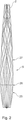
- Fig. 2 shows the light beam path for the above-described light mixer 5 and illustrates the coupling of light into the light guide 2 with increased intensity.
- the broadening in the first region 25 as far as the third region 26 with a third nominal diameter leads to a focussing on the end 27.1 of the second region 27 and thus on one end of the mixing lens formed by the light mixer 5.
- a larger nominal diameter of the first end 25.1 opposite the light source 8 can thus be used for optimal coupling of the light, since the cross-sectional change towards a smaller nominal diameter of the second region 27 then no longer leads to a significant loss of intensity.
- the third nominal diameter qV of the transition region in the third region 26 is at most 1.5 times the first nominal diameter qE of the first region 25 and thus the nominal diameter of the coupling to the light source 8.
- the light mixer 5 may also have a cuboid spatial form, but the previously described design variants for the first, second and third nominal diameter of the regions 25, 26, 27 apply unchanged.
- the light mixer 5 should fulfill at least two requirements: on the one hand the guarantee of adequate color mixing on the shortest possible distance and on the other hand an increase of the efficiency with a reduction of the cross section from the first end 25.1 (coupling cross section) to the second end 27.1 (FIG. outlet cross section).
- the three diameters described above are of the same shape, but this is not absolutely necessary.
- Possible cross-sectional shapes include square, round, elliptical, trigonal, tetragonal, pentagonal, hexagonal, heptagonal, etc.
- An overall length of the light mixer 5 is preferably formed with a length LE of the first region 25 and a length LA of the second region 27.
- the aspect ratio of these regions 25, 27 may be divided such that, for example, the second region 27 is 3 to 6 times has length of the first region 25.
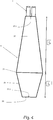
- the third region 26 may be limited to a transitional plane of maximum thickening, as in FIG Fig. 4 is shown. Alternatively, the region 26 may define a length between the first region 25 and the second region 27.
- the third nominal diameter qV in the transition region of the third region 26 is preferably less than 3 times the second nominal diameter qA of the second end 27.1 in the region of the coupling-out surface of the light mixer 5 is.
- the third nominal diameter qV is less than twice the second nominal diameter qA of the second end 27.1 in the region of the coupling-out surface.
- a fiber bundle of the light guide 2 can be integrated at this end in the light mixer 5 in the field of injection molding sprue.
- the fibers of the light guide 2 may then be fused as a unit to the light mixer 5.
- the special feature here is that this process can be done in an injection molding process.
- the fibers of the light guide 2 preferably merge with the light mixer material, for example PMMA, PC.
- An advantage lies in the reduction of the necessary components.
- a one-piece production is the result, wherein the light mixer 5 as described above is optically formed with preferably at least three different regions 25, 26, 27th
- 8 multicolor LEDs in particular RGB LEDs, can be used as the light source.
- light can be coupled in and out of several wavelengths, in particular light of three different wavelengths and / or light of the colors red, green and blue.
- the LEDs and the light mixer 5 are then preferably positioned perpendicular to each other.
- the light mixer 5 is preferably formed from a plastic such as PMMA or polycarbonate.
- a light guide which preferably has a rigid part, which serves the light mixture and has a preferably considerably larger limp portion, which serves for light distribution and light emission.
- the preferably pliable portion may be designed so that it leads light into at least two demarcated areas.
- the light can be guided in such a way that no further boundary surface is passed from the entry into the overall system (rigid and limp) in the rigid part up to the exit in the limp part.
- the light-guiding part of the system can thus have a common outer optical interface.
- the flexurally rigid part can be designed so that 60% of the guided beams pass through at least two internal reflections before they pass into the limp part.
- the pliable portion may be coated with a polymer of optically low density. Spurs of the material that surrounds the limp part can protrude into the bending-resistant part of the light guide for better mechanical adhesion.
- the pliable part may also be polygonal and have one or more tapers and extensions. Furthermore, latching elements can be provided on the rigid part.
- the pliable part of the light guide can be designed in the form of a textile surface. Particularly preferred, but not exhaustive, are called fabric, knitted fabric, knitted fabric or scrim. Finally, the limp part can be covered by another translucent layer either directly or indirectly.
Landscapes
- Physics & Mathematics (AREA)
- General Physics & Mathematics (AREA)
- Optics & Photonics (AREA)
- Non-Portable Lighting Devices Or Systems Thereof (AREA)
- Light Guides In General And Applications Therefor (AREA)
- Optical Couplings Of Light Guides (AREA)
Abstract
Description
- Die Erfindung betrifft eine Beleuchtungsvorrichtung mit einer mehrfarbigen Lichtquelle nach dem Oberbegriff des Anspruchs 1.
- Aus
DE 10 2010 046 342 B4 ist eine Beleuchtungsvorrichtung mit einer Kopplungsvorrichtung zur Einkopplung von Licht eines Leuchtmittels in einen Lichtleiter eines Fahrzeugs bekannt. Der Lichtleiter kann sich dabei aus einem Glasfaserbündel zusammensetzen. Für die Beleuchtung des Innenraums eines Kraftwagens werden zunehmend Lichtleiter eingesetzt, welche das Licht einer Lichtquelle sehr variabel an verschiedene Orte im Innenraum des Kraftwagens weiterleiten können. In der Regel werden die Lichtleiter durch Glasfasern gebildet, während als Lichtquelle zunehmend moderne Leuchtmittel, wie z.B. LEDs, Verwendung finden. Für eine hohe Lichtausbeute ist es erforderlich, das Licht der Lichtquelle möglichst effizient in den Lichtleiter einzukoppeln. Üblicherweise befindet sich die Lichtquelle direkt an der Stirnfläche des Lichtleiters, so dass das Licht senkrecht auf die Lichtleiterfläche auftritt. Das Licht der Lichtquelle trifft dann nur in der Mitte des Lichtleiters ideal auf. Je entfernter das Licht von der Mitte auftritt, desto ungünstiger werden die Einkopplungswerte. Werden als Lichtquelle mehrfarbige LEDs verwendet, so kann sich eine schlechte Farbmischung ergeben. Die Kopplungsvorrichtung umfasst daher einen Hohlkörper mit einer zumindest teilweise reflektierenden Innenwand, wobei die Innenwand unterschiedliche Reflexionskoeffizienten für verschiedene Lichtfarben aufweisen kann. Nachteilig ist jedoch, dass trotz allem das ausgestrahlte Licht keine hinreichende Homogenität hinsichtlich Farbe und Intensität aufweist. - Der Erfindung liegt daher die Aufgabe zugrunde, eine Beleuchtungsvorrichtung zu schaffen, die einfach aufgebaut ist und bei der die Homogenität des Lichts hinsichtlich Farbe und/oder Intensität verbessert ist.
- Diese Aufgabe wird durch die Merkmale des Anspruchs 1 gelöst.
- Hierdurch wird eine Beleuchtungsvorrichtung geschaffen, die mit wenig Aufwand den Lichtmischer derart verbessert, dass eine Fokussierung des Strahlenverlaufs bei signifikant reduziertem Verlust erreicht wird. Zum einen wird nämlich eine bessere Durchmischung des Lichts, z.B. des Rot-, Grün- und Blau-Anteils einer RGB-LED, und zum anderen eine Reduzierung der Verluste bei der Einkopplung in einen Zielquerschnitt erreicht, welcher vorzugsweise kleiner als der Querschnitt der Emitterfläche ist.
- Weitere Vorteile und Ausgestaltungen der Erfindung sind der nachfolgenden Beschreibung und den Unteransprüchen zu entnehmen.
- Die Erfindung wird nachstehend anhand der in den beigefügten Abbildungen dargestellten Ausführungsbeispiele näher erläutert.
-
Fig. 1 zeigt schematisch einen Schnitt einer Beleuchtungsvorrichtung gemäß einem ersten Ausführungsbeispiel, -
Fig. 2 zeigt schematisch einen Strahlenverlauf in einem Lichtmischer einer Beleuchtungsvorrichtung nachFig. 1 , -
Fig. 3 zeigt schematisch eine perspektivische Ansicht eines Lichtmischers einer Beleuchtungsvorrichtung nachFig. 1 , -
Fig. 4 zeigt schematisch einen Längsschnitt eines Lichtleiters eines Lichtmischers einer Beleuchtungsvorrichtung nachFig. 1 , -
Fig. 5 zeigt schematisch eine Ansicht einer Beleuchtungsvorrichtung gemäß einem weiteren Ausführungsbeispiel. - Wie
Fig. 1 zeigt, betrifft die Erfindung eine Beleuchtungsvorrichtung 1 mit einer mehrfarbigen Lichtquelle 8, die Licht über einen länglich ausgebildeten Lichtmischer 5 in einen Lichtleiter 2 einkoppelt. Der Lichtleiter 2 ist dazu an seinem einen Ende 22 gegenüber dem Lichtmischer 5 fixiert. Die Lichtquelle 8 ist zur Stirnfläche 23 des Lichtmischers 5 positioniert. Der Lichtleiter 2 ist an seinem einen Ende 22 über einen spritzgießtechnischen Anguss mit dem Lichtmischer 5 dauerhaft verbunden. Ferner ist der Lichtmischer 5 auf seiner Länge derart ausgelegt, dass mindestens 60 % des eintretenden Lichts mindestens zwei innere Reflexionen vor der Einkopplung in den Lichtleiter 2 erfährt. - Wie
Fig. 5 zeigt, kann der spritztechnische Anguss von Lichtleiter 2 und Lichtmischer 5 über eine mechanische Zugentlastungsschelle 6 fixiert sein. Die Zugentlastungsschelle 6 kann als Ferrule, insbesondere Crimpferrule, ausgebildet sein. Die Zugentlastungsschelle 6 bildet ein Halterungselement, das eine fixierende Kraft auf den Lichtleiter 2 ausübt insbesondere dann, wenn der Lichtleiter 2 als ein Lichtleiterbündel, insbesondere Faserbündel, ausgebildet ist und damit biegeschlaffe Ausläufer bildet. Das Lichtleiterbündel kann von einem Schlauch 21 umgeben sein. Das Lichtleiterbündel kann alternativ von Fadenenden eines textilen Flächengebildes gebildet sein. Demgegenüber ist der Lichtmischer 5 vorzugsweise biegesteif ausgebildet. - Erfindungsgemäß ist vorgesehen, dass der Lichtmischer 5 transparent ist und auf seiner Gesamtlänge mindestens drei verschiedene Regionen 25, 26, 27 mit unterschiedlichen optischen Reflexions- oder Übertragungseigenschaften aufweist. Beispielsweise ändert sich zwischen den Regionen 25, 26, 27 nur die Neigung der Randflächen. Damit sind dann tatsächlich andere Reflexionswinkel verbunden. Dabei können sowohl das Material als auch die Oberfläche gleich bleiben und insoweit die Übertragungseigenschaften nicht ändern.
- Wie insbesondere
Fig. 4 zeigt, ist der Lichtmischer 5 ferner vorzugsweise mit einem in Richtung der Lichtquelle 8 liegenden ersten Ende 25.1 einer ersten Region 25, einem in Richtung des Faserbündels 2 liegenden zweiten Ende 27.1 einer zweiten Region 27 und einem dazwischenliegenden Übergangsbereich einer dritten Region 26 ausgebildet. - Wie weiterhin in den
Fig. 1 bis Fig. 4 dargestellt ist, ist der Lichtmischer 5 vorzugsweise keulenförmig ausgebildet. Das erste Ende 25.1 weist dann vorzugsweise eine erste Nennweite qE auf, die größer ist als eine zweite Nennweite qA des zweiten Endes 27.1, und die erste qE und die zweite qA Nennweite sind dann vorzugsweise kleiner als eine dritte Nennweite qV des Übergangsbereichs der dritten Region 26 mit einer maximalen Verdickung einer Außenkontur des Lichtmischer 5. - Der Lichtmischer 5 ist zur Reflexion der durch ihn hindurchtretenden Lichtstrahlen durch innere Totalreflexion ausgeführt. Dazu besitzt der Lichtmischer 5 bedingt durch das verwendete Material einen entsprechend hohen Brechungsindex des Materials, der vorzugsweise im Bereich von 1,4 bis 1,8 liegt. Geeignete Materialien sind Glas oder Plastwerkstoffe, deren Konsistenz wählbar ist. Es können auch optisch wirksame Beschichtungen auf den Lichtmischer 5 aufgebracht sein. Entscheidend ist vorzugsweise, dass die im Lichtmischer 5 stattfindende, durch seine Form und sein Material bedingte Totalreflexion den Anforderungen der Zielsetzung hinsichtlich Durchmischung des Lichts und der Maximierung der Effizienz gerecht wird.
- Wesentlich für die optischen Reflexions- oder Übertragungseigenschaften des Lichtleiters sind darüber hinaus die erfindungsgemäß für den Lichtmischer 5 gewählten verschiedenen Regionen 25, 26, 27, die sich beispielsweise in ihrer Raumform unterscheiden, um auf die Richtung der im Lichtmischer 5 reflektierten Lichtstrahlen einzuwirken.
- Wie beispielsweise
Fig.4 zeigt, bildet die erste Region 25 bedingt durch einen axial sich erweiternden Querschnitt eine Reflexionszone, damit beispielsweise die Anzahl an Reflexionen erhöht wird, was sich vorteilhaft auf eine Mischung unterschiedlicher Lichtfarben auswirkt. Die erste Region 25 kann also schüsselartig zur Optimierung des Strahleneingangs genutzt werden. Im Übergangsbereich der dritten Region 26 wird eine maximale Nennweite qV erreicht, deren axiale Erstreckung wiederum wählbar ist, um dem Lichtmischer 5 beispielsweise einen mittigen stabförmigen Abschnitt zu verleihen. Hin zum zweiten Ende 27.1 verjüngt sich der Querschnitt des Lichtmischers 5 in der zweiten Region 27. Ein sogenannter Trichtereffekt wird begründet, der dazu dient, das Licht zu richten in Bezug auf das zweite Ende 27.1 zur Einkopplung in das Faserende 22. -
Fig. 2 zeigt den Lichtstrahlenverlauf für den vorstehend beschriebenen Lichtmischer 5 und verdeutlicht die Einkopplung von Licht in den Lichtleiter 2 mit erhöhter Intensität. Wie im Strahlenverlauf gemäßFig. 2 gezeigt, führt die Verbreiterung in der ersten Region 25 bis hin zur dritten Region 26 mit einer dritten Nennweite zu einer Fokussierung auf das Ende 27.1 der zweiten Region 27 und damit auf ein Ende der von dem Lichtmischer 5 gebildeten Mischlinse. Eine größere Nennweite des ersten Endes 25.1 gegenüberliegend der Lichtquelle 8 kann so genutzt werden zur optimalen Einkopplung des Lichts, da die Querschnittsveränderung hin zu einer kleineren Nennweite der zweiten Region 27 dann zu keinem signifikanten Intensitätsverlust mehr führt. Vorteilhaft ist insoweit, dass die dritte Nennweite qV des Übergangsbereichs in der dritten Region 26 maximal das 1,5-fache der ersten Nennweite qE der ersten Region 25 und damit der Nennweite der Einkopplung an der Lichtquelle 8 beträgt. - Wie
Fig. 3 zeigt, kann der Lichtmischer 5 alternativ auch eine quaderförmige Raumform besitzen, wobei jedoch die zuvor beschriebenen Gestaltungsvarianten zur ersten, zweiten und dritten Nennweite der Regionen 25, 26, 27 unverändert gelten. Der Lichtmischer 5 sollte in seiner Funktion als Mischlinse nämlich mindestens zwei Anforderungen erfüllen: Zum einen die Gewährleistung einer hinreichenden Farbmischung auf möglichst kurzer Strecke und zum anderen eine Steigerung der Effizienz bei einer Reduzierung des Querschnitts vom ersten Ende 25.1 (Einkopplungsquerschnitt) zum zweiten Ende 27.1 (Austrittsquerschnitt). - Vorzugsweise sind die drei vorstehend beschriebenen Nennweiten von derselben Form, was aber nicht zwingend erforderlich ist. Mögliche Querschnittsformen sind unter anderem quadratisch, rund, elliptisch, trigonal, tetragonal, pentagonal, hexagonal, heptagonal, usw.
- Eine Gesamtlänge des Lichtmischers 5 ist vorzugsweise ausgebildet mit einer Länge LE der ersten Region 25 und einer Länge LA der zweiten Region 27. Das Längenverhältnis dieser Regionen 25, 27 kann derart aufgeteilt sein, dass beispielsweise die zweite Region 27 das 3- bis 6-fache an Länge der ersten Region 25 besitzt. Die dritte Region 26 kann als Übergangsbereich der maximalen Verdickung auf eine Übergangsebene beschränkt sein, wie in
Fig. 4 dargestellt ist. Alternativ kann die Region 26 eine Länge zwischen der ersten Region 25 und der zweiten Region 27 definieren. Hinsichtlich der Nennweiten qE, qA und qV ist beispielsweise vorgesehen, dass die dritte Nennweite qV im Übergangsbereich der dritten Region 26 vorzugsweise weniger als das 3-fache der zweiten Nennweite qA des zweiten Endes 27.1 im Bereich der Auskopplungsfläche des Lichtmischers 5 beträgt. Bei den inFig. 2 undFig. 3 gezeigten Ausführungsbeispielen des Lichtmischers 5 ist vorgesehen, dass die dritte Nennweite qV weniger als das 2-fache der zweiten Nennweite qA des zweiten Endes 27.1 im Bereich der Auskopplungsfläche beträgt. Hierdurch wird eine Optimierung bezüglich einer Reduzierung der Querschnittsveränderungen erreicht. - Ein Faserbündel des Lichtleiters 2 kann an diesem Ende auch in den Lichtmischer 5 im Bereich des spritzgießtechnischen Angusses eingebunden sein. Die Fasern des Lichtleiters 2 können dann als eine Einheit zum Lichtmischer 5 verschmolzen sein.
- Die Besonderheit ist hier, dass dieser Vorgang in einem Spritzgussprozess erfolgen kann. Dabei verschmelzen vorzugsweise die Fasern des Lichtleiters 2 mit dem Lichtmischerwerkstoff, beispielsweise PMMA, PC. Ein Vorteil liegt auch in der Verringerung der notwendigen Bauteile. Eine einstückige Herstellung ist das Ergebnis, wobei der Lichtmischer 5 wie zuvor beschrieben optisch ausgebildet ist mit vorzugsweise mindestens drei verschiedenen Regionen 25, 26, 27.
- Wie bereits ausgeführt, können als Lichtquelle 8 mehrfarbige LEDs, insbesondere RGB LEDs, verwendet werden. Ein- und auskoppelbar ist somit Licht mehrerer Wellenlängen, insbesondere Licht dreier unterschiedlicher Wellenlängen und/oder Licht der Farben rot, grün und blau.
- Die LEDs und der Lichtmischer 5 sind dann vorzugsweise senkrecht zueinander positioniert. Der Lichtmischer 5 ist vorzugsweise gebildet aus einem Kunststoff wie beispielsweise PMMA oder Polycarbonat.
- Erfindungsgemäß ist folglich ein Lichtleiter vorgesehen, der vorzugsweise einen biegesteifen Teil aufweist, welcher der Lichtmischung dient und einen vorzugsweise erheblich größeren biegeschlaffen Anteil aufweist, welcher zur Lichtverteilung und Lichtemission dient. Der vorzugsweise biegeschlaffe Anteil kann so ausgeführt sein, dass er Licht in mindestens zwei abgegrenzte Bereiche führt.
- Das Licht kann hierbei so geführt sein, dass vom Eintritt in das Gesamtsystem (biegesteif und biegeschlaff) im biegesteifen Teil bis zum Austritt im biegeschlaffen Teil keine weitere Grenzfläche passiert wird. Der lichtführende Teil des Systems kann also über eine gemeinsame äußere optische Grenzfläche verfügen. Wie bereits vorstehend ausgeführt, kann der biegesteife Teil so ausgebildet sein, dass 60 % der geführten Strahlen mindestens zwei interne Reflexionen durchlaufen, bevor sie in den biegeschlaffen Teil übergehen.
- Dabei kann der biegeschlaffe Anteil mit einem Polymer optisch niedriger Dichte ummantelt sein. Ausläufer des den biegeschlaffen Teil ummantelnden Materials können in den biegesteifen Teil des Lichtleiters hineinragen für eine bessere mechanische Haftung. Der biegeschlaffe Anteil kann ferner vieleckig ausgeführt sein und über eine oder mehrere Verjüngungen und Ausweitungen verfügen. An dem biegesteifen Teil können ferner Verrastungselemente vorgesehen sein.
- Der biegeschlaffe Teil des Lichtleiters kann in Form einer textilen Fläche ausgeführt sein. Besonders bevorzugt, aber nicht abschließend, werden genannt Gewebe, Gestrick, Gewirk oder Gelege. Schließlich kann der biegeschlaffen Teil durch eine weitere transluzente Schicht entweder direkt oder indirekt ummantelt sein.
Claims (11)
- Beleuchtungsvorrichtung mit einer mehrfarbigen Lichtquelle (8), die Licht über einen länglich ausgebildeten Lichtmischer (5) in einen Lichtleiter (2) einkoppelt, wozu der Lichtleiter (2) an seinem einen Ende (22) gegenüber dem Lichtmischer (5) fixiert ist, und die Lichtquelle (8) zur Stirnfläche (23) des Lichtmischers (5) positioniert ist, dadurch gekennzeichnet, dass der Lichtleiter (2) an seinem einen Ende über einen spritzgießtechnischen Anguss mit dem Lichtmischer (5) dauerhaft verbunden ist, und der Lichtmischer (5) auf seiner Länge derart ausgelegt ist, dass mindestens 60 % des eintretenden Lichts mindestens zwei innere Reflexionen vor der Einkopplung in den Lichtleiter (2) erfährt.
- Beleuchtungsvorrichtung nach Anspruch 1, dadurch gekennzeichnet, dass der spritztechnische Anguss von Lichtleiter (2) und Lichtmischer (5) über eine mechanische Zugentlastungsschelle fixiert ist.
- Beleuchtungsvorrichtung nach Anspruch 2, dadurch gekennzeichnet, dass die Zugentlastungsschelle als Ferrule ausgebildet ist.
- Beleuchtungsvorrichtung nach einem der Ansprüche 1 bis 3, dadurch gekennzeichnet, dass der Lichtleiter (2) als Lichtleiterbündel ausgebildet ist.
- Beleuchtungsvorrichtung nach Anspruch 4, dadurch gekennzeichnet, dass das Lichtleiterbündel von Fadenenden eines textilen Flächengebildes gebildet ist.
- Beleuchtungsvorrichtung nach einem der Ansprüche 1 bis 5, dadurch gekennzeichnet, das der Lichtmischer (5) auf seiner Gesamtlänge mindestens drei verschiedene Regionen (25, 26, 27) mit unterschiedlichen optischen Reflexions- oder Übertragungseigenschaften aufweist.
- Beleuchtungsvorrichtung (1) nach einem der Ansprüche 1 bis 6, dadurch gekennzeichnet, dass der Lichtleiter (5) keulenförmig ausgebildet ist, wobei ein erstes Ende (25.1) eine erste Nennweite (qE) aufweist, die größer ist als eine zweite Nennweite (qA) eines zweiten Endes (27.1), und die erste (qE) und die zweite (qA) Nennweite kleiner sind als eine dritte Nennweite (qV) eines Übergangsbereichs einer dritten Region (26) mit einer maximalen Verdickung einer Außenkontur des Lichtleiters (5).
- Beleuchtungsvorrichtung nach Anspruch 7, dadurch gekennzeichnet, dass eine Gesamtlänge des Lichtleiters (5) des Lichtmischers (20) das 3- bis 6-fache der dritten Nennweite (qV) des Übergangsbereichs einer dritten Region (26) mit maximaler Verdickung beträgt.
- Beleuchtungsvorrichtung (1) nach einem der Ansprüche 1 bis 6, dadurch gekennzeichnet, dass der Lichtleiter (5) des Lichtmischers (20) faserseitig eine Stirnfläche aufweist, die direkt stoßseitig an einem Ende (22) des Faserbündels (21) anschließt.
- Beleuchtungsvorrichtung nach einem der Ansprüche 1 bis 9, dadurch gekennzeichnet, dass als Lichtquelle (8) mehrfarbige LEDs verwendet werden.
- Beleuchtungsvorrichtung (1) nach Anspruch 18, dadurch gekennzeichnet, dass der Lichtleiter (5) und der Lichtmischer (5) aus demselben Kunststoff wie beispielsweise PMMA oder Polycarbonat gebildet sind
Applications Claiming Priority (1)
| Application Number | Priority Date | Filing Date | Title |
|---|---|---|---|
| DE102018001029.6A DE102018001029A1 (de) | 2018-02-08 | 2018-02-08 | Beleuchtungsvorrichtung mit einem seitenemittierenden lichtleitenden Faserbündel |
Publications (2)
| Publication Number | Publication Date |
|---|---|
| EP3525017A1 true EP3525017A1 (de) | 2019-08-14 |
| EP3525017B1 EP3525017B1 (de) | 2022-08-31 |
Family
ID=65365768
Family Applications (2)
| Application Number | Title | Priority Date | Filing Date |
|---|---|---|---|
| EP19000073.7A Active EP3524877B1 (de) | 2018-02-08 | 2019-02-07 | Beleuchtungsvorrichtung mit einem seitenemittierenden lichtleitenden faserbündel |
| EP19000074.5A Active EP3525017B1 (de) | 2018-02-08 | 2019-02-08 | Beleuchtungsvorrichtung mit lichtleiter und lichtmischer für eine mehrfarbige lichtquelle |
Family Applications Before (1)
| Application Number | Title | Priority Date | Filing Date |
|---|---|---|---|
| EP19000073.7A Active EP3524877B1 (de) | 2018-02-08 | 2019-02-07 | Beleuchtungsvorrichtung mit einem seitenemittierenden lichtleitenden faserbündel |
Country Status (2)
| Country | Link |
|---|---|
| EP (2) | EP3524877B1 (de) |
| DE (1) | DE102018001029A1 (de) |
Cited By (1)
| Publication number | Priority date | Publication date | Assignee | Title |
|---|---|---|---|---|
| EP4382800A1 (de) | 2022-12-06 | 2024-06-12 | HELLA GmbH & Co. KGaA | Beleuchtungsvorrichtung für ein fahrzeug und fahrzeug mit solch einer beleuchtungsvorrichtung |
Families Citing this family (7)
| Publication number | Priority date | Publication date | Assignee | Title |
|---|---|---|---|---|
| CN113188083B (zh) * | 2021-05-12 | 2022-10-14 | 荣成康派斯新能源车辆股份有限公司 | 一种智能发光星空车顶 |
| DE102021123276A1 (de) * | 2021-09-08 | 2023-03-09 | HELLA GmbH & Co. KGaA | Lichtleiter-Kopplungseinrichtung und Verfahren zu deren Herstellung |
| FR3128765B1 (fr) * | 2021-10-29 | 2023-11-17 | Valeo Vision | Module optique d’un dispositif lumineux d’un véhicule automobile |
| CN114347896A (zh) * | 2021-12-31 | 2022-04-15 | 宁波福尔达智能科技股份有限公司 | 一种rgb氛围灯灯头、氛围灯及车辆 |
| CN114312556A (zh) * | 2021-12-31 | 2022-04-12 | 宁波福尔达智能科技股份有限公司 | 一种氛围灯总成、车辆门板及车辆 |
| DE102022207724A1 (de) * | 2022-07-27 | 2024-02-01 | UNO MINDA Europe GmbH | Beleuchtungsmodul |
| EP4488974B1 (de) | 2023-07-04 | 2025-07-02 | Bizerba SE & Co. KG | Verkaufsvorrichtung |
Citations (6)
| Publication number | Priority date | Publication date | Assignee | Title |
|---|---|---|---|---|
| DE10139578A1 (de) * | 2001-08-10 | 2003-04-10 | Hella Kg Hueck & Co | Innenleuchte für Fahrzeuge |
| DE10236499A1 (de) * | 2002-08-09 | 2004-02-26 | Sidler Gmbh & Co. | Fahrzeugleuchtenanordnung mit biegsamem Lichtleiter |
| DE102006004996A1 (de) * | 2005-02-01 | 2006-08-24 | Schott Ag | Lichtmischer für LED |
| EP2284583A1 (de) * | 2009-08-14 | 2011-02-16 | Automotive Lighting Reutlingen GmbH | Beleuchtungseinrichtung für ein Kraftfahrzeug |
| DE102010046342B4 (de) | 2010-09-23 | 2012-11-08 | Audi Ag | Beleuchtungsvorrichtung sowie Fahrzeug mit einer Beleuchtungsvorrichtung |
| EP3270050A1 (de) * | 2016-07-14 | 2018-01-17 | Valeo North America, Inc. | Faseroptische lichtplatte mit homogener lichtausgabe |
Family Cites Families (8)
| Publication number | Priority date | Publication date | Assignee | Title |
|---|---|---|---|---|
| US5271079A (en) * | 1991-11-08 | 1993-12-14 | Finisar Corporation | Light mixing device with fiber optic output |
| US6937791B2 (en) * | 2003-05-02 | 2005-08-30 | The Boeing Company | Optical coupling apparatus and method |
| DE102007014871B4 (de) | 2007-03-26 | 2012-09-27 | Schott Ag | Beleuchtungseinrichtung, insbesondere für Fahrzeuge |
| DE102008009138A1 (de) * | 2008-02-14 | 2009-08-27 | Schott Ag | Seitenemittierende brechwertangepasste Faser |
| DE102008044938B4 (de) * | 2008-08-29 | 2013-10-10 | Schott Ag | Verfahren zur Terminierung von lichtleitenden Faserbündeln sowie Hülse mit einem Faserbündel |
| WO2012083957A1 (en) * | 2010-12-23 | 2012-06-28 | Martin Professional A/S | Optical light mixer providing a homogenized and uniform light beam |
| DE102012022716A1 (de) * | 2012-11-21 | 2013-05-29 | Daimler Ag | Mischen und Einkoppeln von Licht in einen Lichtleiter mittels einer Umlenkvorrichtung und einem Mischerstab |
| DE102015106049C5 (de) | 2015-04-21 | 2022-11-03 | Schott Ag | Beleuchtungsvorrichtung mit seitenemittierendem lichtleitenden Faserbündel |
-
2018
- 2018-02-08 DE DE102018001029.6A patent/DE102018001029A1/de active Pending
-
2019
- 2019-02-07 EP EP19000073.7A patent/EP3524877B1/de active Active
- 2019-02-08 EP EP19000074.5A patent/EP3525017B1/de active Active
Patent Citations (6)
| Publication number | Priority date | Publication date | Assignee | Title |
|---|---|---|---|---|
| DE10139578A1 (de) * | 2001-08-10 | 2003-04-10 | Hella Kg Hueck & Co | Innenleuchte für Fahrzeuge |
| DE10236499A1 (de) * | 2002-08-09 | 2004-02-26 | Sidler Gmbh & Co. | Fahrzeugleuchtenanordnung mit biegsamem Lichtleiter |
| DE102006004996A1 (de) * | 2005-02-01 | 2006-08-24 | Schott Ag | Lichtmischer für LED |
| EP2284583A1 (de) * | 2009-08-14 | 2011-02-16 | Automotive Lighting Reutlingen GmbH | Beleuchtungseinrichtung für ein Kraftfahrzeug |
| DE102010046342B4 (de) | 2010-09-23 | 2012-11-08 | Audi Ag | Beleuchtungsvorrichtung sowie Fahrzeug mit einer Beleuchtungsvorrichtung |
| EP3270050A1 (de) * | 2016-07-14 | 2018-01-17 | Valeo North America, Inc. | Faseroptische lichtplatte mit homogener lichtausgabe |
Cited By (1)
| Publication number | Priority date | Publication date | Assignee | Title |
|---|---|---|---|---|
| EP4382800A1 (de) | 2022-12-06 | 2024-06-12 | HELLA GmbH & Co. KGaA | Beleuchtungsvorrichtung für ein fahrzeug und fahrzeug mit solch einer beleuchtungsvorrichtung |
Also Published As
| Publication number | Publication date |
|---|---|
| EP3525017B1 (de) | 2022-08-31 |
| EP3524877B1 (de) | 2022-07-20 |
| DE102018001029A1 (de) | 2019-08-08 |
| EP3524877A1 (de) | 2019-08-14 |
Similar Documents
| Publication | Publication Date | Title |
|---|---|---|
| EP3525017B1 (de) | Beleuchtungsvorrichtung mit lichtleiter und lichtmischer für eine mehrfarbige lichtquelle | |
| DE4309389C2 (de) | Optisches Beleuchtungssystem mit einer optischen Kupplungseinheit | |
| DE69715918T2 (de) | Faseroptisches beleuchtungssystem | |
| EP2028510B1 (de) | Beleuchtungseinrichtung, insbesondere für Fahrzeuge | |
| EP3086027B1 (de) | Beleuchtungsvorrichtung mit seitenemittierendem lichtleitenden faserbündel | |
| DE102008021290B4 (de) | Lichtleiterstruktur für eine Kraftfahrzeugbeleuchtungseinrichtung und Kraftfahrzeugbeleuchtungseinrichtung mit einer solchen Lichtleiterstruktur | |
| WO2013050589A2 (de) | Strahlungsquelle sowie lichtleiteinrichtung | |
| DE102019123694A1 (de) | Seitenemittierender Lichtleiter und Verfahren zu dessen Herstellung | |
| DE3923185A1 (de) | Monomoden-koppler | |
| DE2842535A1 (de) | Abzweigelement | |
| DE102006037797B4 (de) | Kraftfahrzeugleuchte | |
| DE102012211284A1 (de) | Lichtleitelement und Lichtleiter | |
| DE102010033423A1 (de) | Endoskop mit einstellbarer Blickrichtung | |
| DE10103100A1 (de) | Lichtmischstab mit einer Eintrittsfläche und einer Austrittsfläche und Verwendung eines solchen Lichtmischstabes bei einer Optikvorrichtung mit einer zu beleuchtenden Fläche | |
| DE102011011462A1 (de) | Lichtleitelement mit Auskoppelstellen | |
| EP2603732B1 (de) | Anordnung zur lichtabgabe mit lichtlenkelement und reflektor | |
| DE10250912B4 (de) | Einkoppelvorrichtung | |
| DE60131434T2 (de) | Leuchtensystem mit faseroptischer Frontplatte | |
| EP3543600B1 (de) | Mischstab zum mischen eines lichtstrahlbündels sowie beleuchtungsvorrichtung mit einem solchen mischstab | |
| DE102005059958A1 (de) | Beleuchtungseinrichtung | |
| DE2931530A1 (de) | Anordnung zur auskopplung von licht aus einer lichtleitfaser-uebertragungsstrecke | |
| DE102022120505A1 (de) | Beleuchtungseinrichtung für fluoreszenzbildgeführte Chirurgie und chirurgisches Instrument | |
| DE102018113970B4 (de) | Kabel mit lichtemittierendem Element | |
| DE102006015156A1 (de) | Beleuchtungseinrichtung für den Innenraum eines Kraftfahrzeugs | |
| WO2011032784A1 (de) | Stabförmiges optisches element, insbesondere in anordnung mit lichtquelle und wellenleiter, sowie verfahren zum erzeugen eines solchen elements |
Legal Events
| Date | Code | Title | Description |
|---|---|---|---|
| PUAI | Public reference made under article 153(3) epc to a published international application that has entered the european phase |
Free format text: ORIGINAL CODE: 0009012 |
|
| STAA | Information on the status of an ep patent application or granted ep patent |
Free format text: STATUS: THE APPLICATION HAS BEEN PUBLISHED |
|
| AK | Designated contracting states |
Kind code of ref document: A1 Designated state(s): AL AT BE BG CH CY CZ DE DK EE ES FI FR GB GR HR HU IE IS IT LI LT LU LV MC MK MT NL NO PL PT RO RS SE SI SK SM TR |
|
| AX | Request for extension of the european patent |
Extension state: BA ME |
|
| STAA | Information on the status of an ep patent application or granted ep patent |
Free format text: STATUS: REQUEST FOR EXAMINATION WAS MADE |
|
| 17P | Request for examination filed |
Effective date: 20200213 |
|
| RBV | Designated contracting states (corrected) |
Designated state(s): AL AT BE BG CH CY CZ DE DK EE ES FI FR GB GR HR HU IE IS IT LI LT LU LV MC MK MT NL NO PL PT RO RS SE SI SK SM TR |
|
| RIN1 | Information on inventor provided before grant (corrected) |
Inventor name: KRETSCHMER, STEFAN Inventor name: KUEMPFEL, THOMAS Inventor name: MOHR, BENJAMIN Inventor name: WILMS, HANS-WALTER |
|
| STAA | Information on the status of an ep patent application or granted ep patent |
Free format text: STATUS: EXAMINATION IS IN PROGRESS |
|
| 17Q | First examination report despatched |
Effective date: 20201023 |
|
| GRAP | Despatch of communication of intention to grant a patent |
Free format text: ORIGINAL CODE: EPIDOSNIGR1 |
|
| STAA | Information on the status of an ep patent application or granted ep patent |
Free format text: STATUS: GRANT OF PATENT IS INTENDED |
|
| INTG | Intention to grant announced |
Effective date: 20220321 |
|
| GRAS | Grant fee paid |
Free format text: ORIGINAL CODE: EPIDOSNIGR3 |
|
| GRAA | (expected) grant |
Free format text: ORIGINAL CODE: 0009210 |
|
| STAA | Information on the status of an ep patent application or granted ep patent |
Free format text: STATUS: THE PATENT HAS BEEN GRANTED |
|
| AK | Designated contracting states |
Kind code of ref document: B1 Designated state(s): AL AT BE BG CH CY CZ DE DK EE ES FI FR GB GR HR HU IE IS IT LI LT LU LV MC MK MT NL NO PL PT RO RS SE SI SK SM TR |
|
| REG | Reference to a national code |
Ref country code: CH Ref legal event code: EP Ref country code: GB Ref legal event code: FG4D Free format text: NOT ENGLISH |
|
| REG | Reference to a national code |
Ref country code: AT Ref legal event code: REF Ref document number: 1515708 Country of ref document: AT Kind code of ref document: T Effective date: 20220915 |
|
| REG | Reference to a national code |
Ref country code: DE Ref legal event code: R096 Ref document number: 502019005456 Country of ref document: DE |
|
| REG | Reference to a national code |
Ref country code: IE Ref legal event code: FG4D Free format text: LANGUAGE OF EP DOCUMENT: GERMAN |
|
| REG | Reference to a national code |
Ref country code: LT Ref legal event code: MG9D |
|
| REG | Reference to a national code |
Ref country code: NL Ref legal event code: MP Effective date: 20220831 |
|
| PG25 | Lapsed in a contracting state [announced via postgrant information from national office to epo] |
Ref country code: SE Free format text: LAPSE BECAUSE OF FAILURE TO SUBMIT A TRANSLATION OF THE DESCRIPTION OR TO PAY THE FEE WITHIN THE PRESCRIBED TIME-LIMIT Effective date: 20220831 Ref country code: RS Free format text: LAPSE BECAUSE OF FAILURE TO SUBMIT A TRANSLATION OF THE DESCRIPTION OR TO PAY THE FEE WITHIN THE PRESCRIBED TIME-LIMIT Effective date: 20220831 Ref country code: NO Free format text: LAPSE BECAUSE OF FAILURE TO SUBMIT A TRANSLATION OF THE DESCRIPTION OR TO PAY THE FEE WITHIN THE PRESCRIBED TIME-LIMIT Effective date: 20221130 Ref country code: LV Free format text: LAPSE BECAUSE OF FAILURE TO SUBMIT A TRANSLATION OF THE DESCRIPTION OR TO PAY THE FEE WITHIN THE PRESCRIBED TIME-LIMIT Effective date: 20220831 Ref country code: LT Free format text: LAPSE BECAUSE OF FAILURE TO SUBMIT A TRANSLATION OF THE DESCRIPTION OR TO PAY THE FEE WITHIN THE PRESCRIBED TIME-LIMIT Effective date: 20220831 Ref country code: FI Free format text: LAPSE BECAUSE OF FAILURE TO SUBMIT A TRANSLATION OF THE DESCRIPTION OR TO PAY THE FEE WITHIN THE PRESCRIBED TIME-LIMIT Effective date: 20220831 |
|
| PG25 | Lapsed in a contracting state [announced via postgrant information from national office to epo] |
Ref country code: PL Free format text: LAPSE BECAUSE OF FAILURE TO SUBMIT A TRANSLATION OF THE DESCRIPTION OR TO PAY THE FEE WITHIN THE PRESCRIBED TIME-LIMIT Effective date: 20220831 Ref country code: IS Free format text: LAPSE BECAUSE OF FAILURE TO SUBMIT A TRANSLATION OF THE DESCRIPTION OR TO PAY THE FEE WITHIN THE PRESCRIBED TIME-LIMIT Effective date: 20221231 Ref country code: HR Free format text: LAPSE BECAUSE OF FAILURE TO SUBMIT A TRANSLATION OF THE DESCRIPTION OR TO PAY THE FEE WITHIN THE PRESCRIBED TIME-LIMIT Effective date: 20220831 Ref country code: GR Free format text: LAPSE BECAUSE OF FAILURE TO SUBMIT A TRANSLATION OF THE DESCRIPTION OR TO PAY THE FEE WITHIN THE PRESCRIBED TIME-LIMIT Effective date: 20221201 |
|
| PG25 | Lapsed in a contracting state [announced via postgrant information from national office to epo] |
Ref country code: SM Free format text: LAPSE BECAUSE OF FAILURE TO SUBMIT A TRANSLATION OF THE DESCRIPTION OR TO PAY THE FEE WITHIN THE PRESCRIBED TIME-LIMIT Effective date: 20220831 Ref country code: RO Free format text: LAPSE BECAUSE OF FAILURE TO SUBMIT A TRANSLATION OF THE DESCRIPTION OR TO PAY THE FEE WITHIN THE PRESCRIBED TIME-LIMIT Effective date: 20220831 Ref country code: PT Free format text: LAPSE BECAUSE OF FAILURE TO SUBMIT A TRANSLATION OF THE DESCRIPTION OR TO PAY THE FEE WITHIN THE PRESCRIBED TIME-LIMIT Effective date: 20230102 Ref country code: ES Free format text: LAPSE BECAUSE OF FAILURE TO SUBMIT A TRANSLATION OF THE DESCRIPTION OR TO PAY THE FEE WITHIN THE PRESCRIBED TIME-LIMIT Effective date: 20220831 Ref country code: DK Free format text: LAPSE BECAUSE OF FAILURE TO SUBMIT A TRANSLATION OF THE DESCRIPTION OR TO PAY THE FEE WITHIN THE PRESCRIBED TIME-LIMIT Effective date: 20220831 Ref country code: CZ Free format text: LAPSE BECAUSE OF FAILURE TO SUBMIT A TRANSLATION OF THE DESCRIPTION OR TO PAY THE FEE WITHIN THE PRESCRIBED TIME-LIMIT Effective date: 20220831 |
|
| PG25 | Lapsed in a contracting state [announced via postgrant information from national office to epo] |
Ref country code: SK Free format text: LAPSE BECAUSE OF FAILURE TO SUBMIT A TRANSLATION OF THE DESCRIPTION OR TO PAY THE FEE WITHIN THE PRESCRIBED TIME-LIMIT Effective date: 20220831 Ref country code: EE Free format text: LAPSE BECAUSE OF FAILURE TO SUBMIT A TRANSLATION OF THE DESCRIPTION OR TO PAY THE FEE WITHIN THE PRESCRIBED TIME-LIMIT Effective date: 20220831 |
|
| REG | Reference to a national code |
Ref country code: DE Ref legal event code: R097 Ref document number: 502019005456 Country of ref document: DE |
|
| P01 | Opt-out of the competence of the unified patent court (upc) registered |
Effective date: 20230524 |
|
| PG25 | Lapsed in a contracting state [announced via postgrant information from national office to epo] |
Ref country code: NL Free format text: LAPSE BECAUSE OF FAILURE TO SUBMIT A TRANSLATION OF THE DESCRIPTION OR TO PAY THE FEE WITHIN THE PRESCRIBED TIME-LIMIT Effective date: 20220831 Ref country code: AL Free format text: LAPSE BECAUSE OF FAILURE TO SUBMIT A TRANSLATION OF THE DESCRIPTION OR TO PAY THE FEE WITHIN THE PRESCRIBED TIME-LIMIT Effective date: 20220831 |
|
| PLBE | No opposition filed within time limit |
Free format text: ORIGINAL CODE: 0009261 |
|
| STAA | Information on the status of an ep patent application or granted ep patent |
Free format text: STATUS: NO OPPOSITION FILED WITHIN TIME LIMIT |
|
| 26N | No opposition filed |
Effective date: 20230601 |
|
| PG25 | Lapsed in a contracting state [announced via postgrant information from national office to epo] |
Ref country code: SI Free format text: LAPSE BECAUSE OF FAILURE TO SUBMIT A TRANSLATION OF THE DESCRIPTION OR TO PAY THE FEE WITHIN THE PRESCRIBED TIME-LIMIT Effective date: 20220831 |
|
| PG25 | Lapsed in a contracting state [announced via postgrant information from national office to epo] |
Ref country code: MC Free format text: LAPSE BECAUSE OF FAILURE TO SUBMIT A TRANSLATION OF THE DESCRIPTION OR TO PAY THE FEE WITHIN THE PRESCRIBED TIME-LIMIT Effective date: 20220831 |
|
| REG | Reference to a national code |
Ref country code: CH Ref legal event code: PL |
|
| REG | Reference to a national code |
Ref country code: BE Ref legal event code: MM Effective date: 20230228 |
|
| PG25 | Lapsed in a contracting state [announced via postgrant information from national office to epo] |
Ref country code: LU Free format text: LAPSE BECAUSE OF NON-PAYMENT OF DUE FEES Effective date: 20230208 Ref country code: LI Free format text: LAPSE BECAUSE OF NON-PAYMENT OF DUE FEES Effective date: 20230228 Ref country code: CH Free format text: LAPSE BECAUSE OF NON-PAYMENT OF DUE FEES Effective date: 20230228 |
|
| REG | Reference to a national code |
Ref country code: IE Ref legal event code: MM4A |
|
| PG25 | Lapsed in a contracting state [announced via postgrant information from national office to epo] |
Ref country code: IE Free format text: LAPSE BECAUSE OF NON-PAYMENT OF DUE FEES Effective date: 20230208 |
|
| PG25 | Lapsed in a contracting state [announced via postgrant information from national office to epo] |
Ref country code: BE Free format text: LAPSE BECAUSE OF NON-PAYMENT OF DUE FEES Effective date: 20230228 |
|
| PG25 | Lapsed in a contracting state [announced via postgrant information from national office to epo] |
Ref country code: IT Free format text: LAPSE BECAUSE OF FAILURE TO SUBMIT A TRANSLATION OF THE DESCRIPTION OR TO PAY THE FEE WITHIN THE PRESCRIBED TIME-LIMIT Effective date: 20220831 |
|
| PG25 | Lapsed in a contracting state [announced via postgrant information from national office to epo] |
Ref country code: BG Free format text: LAPSE BECAUSE OF FAILURE TO SUBMIT A TRANSLATION OF THE DESCRIPTION OR TO PAY THE FEE WITHIN THE PRESCRIBED TIME-LIMIT Effective date: 20220831 |
|
| PG25 | Lapsed in a contracting state [announced via postgrant information from national office to epo] |
Ref country code: BG Free format text: LAPSE BECAUSE OF FAILURE TO SUBMIT A TRANSLATION OF THE DESCRIPTION OR TO PAY THE FEE WITHIN THE PRESCRIBED TIME-LIMIT Effective date: 20220831 |
|
| PGFP | Annual fee paid to national office [announced via postgrant information from national office to epo] |
Ref country code: DE Payment date: 20250430 Year of fee payment: 7 |
|
| PG25 | Lapsed in a contracting state [announced via postgrant information from national office to epo] |
Ref country code: CY Free format text: LAPSE BECAUSE OF FAILURE TO SUBMIT A TRANSLATION OF THE DESCRIPTION OR TO PAY THE FEE WITHIN THE PRESCRIBED TIME-LIMIT; INVALID AB INITIO Effective date: 20190208 |
|
| PG25 | Lapsed in a contracting state [announced via postgrant information from national office to epo] |
Ref country code: HU Free format text: LAPSE BECAUSE OF FAILURE TO SUBMIT A TRANSLATION OF THE DESCRIPTION OR TO PAY THE FEE WITHIN THE PRESCRIBED TIME-LIMIT; INVALID AB INITIO Effective date: 20190208 |
|
| PG25 | Lapsed in a contracting state [announced via postgrant information from national office to epo] |
Ref country code: TR Free format text: LAPSE BECAUSE OF FAILURE TO SUBMIT A TRANSLATION OF THE DESCRIPTION OR TO PAY THE FEE WITHIN THE PRESCRIBED TIME-LIMIT Effective date: 20220831 |
|
| PGFP | Annual fee paid to national office [announced via postgrant information from national office to epo] |
Ref country code: GB Payment date: 20260219 Year of fee payment: 8 |
|
| PGFP | Annual fee paid to national office [announced via postgrant information from national office to epo] |
Ref country code: AT Payment date: 20260219 Year of fee payment: 8 |
|
| PGFP | Annual fee paid to national office [announced via postgrant information from national office to epo] |
Ref country code: FR Payment date: 20260218 Year of fee payment: 8 |