EP3524659A1 - Resin member and sheet using same, method for producing resin member, and heat storage material and heat control sheet using same - Google Patents
Resin member and sheet using same, method for producing resin member, and heat storage material and heat control sheet using same Download PDFInfo
- Publication number
- EP3524659A1 EP3524659A1 EP17858442.1A EP17858442A EP3524659A1 EP 3524659 A1 EP3524659 A1 EP 3524659A1 EP 17858442 A EP17858442 A EP 17858442A EP 3524659 A1 EP3524659 A1 EP 3524659A1
- Authority
- EP
- European Patent Office
- Prior art keywords
- resin member
- straight
- olefin
- carbon atoms
- saturated hydrocarbon
- Prior art date
- Legal status (The legal status is an assumption and is not a legal conclusion. Google has not performed a legal analysis and makes no representation as to the accuracy of the status listed.)
- Granted
Links
Images




Classifications
-
- C—CHEMISTRY; METALLURGY
- C09—DYES; PAINTS; POLISHES; NATURAL RESINS; ADHESIVES; COMPOSITIONS NOT OTHERWISE PROVIDED FOR; APPLICATIONS OF MATERIALS NOT OTHERWISE PROVIDED FOR
- C09K—MATERIALS FOR MISCELLANEOUS APPLICATIONS, NOT PROVIDED FOR ELSEWHERE
- C09K5/00—Heat-transfer, heat-exchange or heat-storage materials, e.g. refrigerants; Materials for the production of heat or cold by chemical reactions other than by combustion
- C09K5/02—Materials undergoing a change of physical state when used
- C09K5/06—Materials undergoing a change of physical state when used the change of state being from liquid to solid or vice versa
- C09K5/063—Materials absorbing or liberating heat during crystallisation; Heat storage materials
-
- C—CHEMISTRY; METALLURGY
- C08—ORGANIC MACROMOLECULAR COMPOUNDS; THEIR PREPARATION OR CHEMICAL WORKING-UP; COMPOSITIONS BASED THEREON
- C08L—COMPOSITIONS OF MACROMOLECULAR COMPOUNDS
- C08L23/00—Compositions of homopolymers or copolymers of unsaturated aliphatic hydrocarbons having only one carbon-to-carbon double bond; Compositions of derivatives of such polymers
- C08L23/02—Compositions of homopolymers or copolymers of unsaturated aliphatic hydrocarbons having only one carbon-to-carbon double bond; Compositions of derivatives of such polymers not modified by chemical after-treatment
- C08L23/04—Homopolymers or copolymers of ethene
- C08L23/08—Copolymers of ethene
- C08L23/0807—Copolymers of ethene with unsaturated hydrocarbons only containing four or more carbon atoms
- C08L23/0815—Copolymers of ethene with unsaturated hydrocarbons only containing four or more carbon atoms with aliphatic 1-olefins containing one carbon-to-carbon double bond
-
- C—CHEMISTRY; METALLURGY
- C08—ORGANIC MACROMOLECULAR COMPOUNDS; THEIR PREPARATION OR CHEMICAL WORKING-UP; COMPOSITIONS BASED THEREON
- C08J—WORKING-UP; GENERAL PROCESSES OF COMPOUNDING; AFTER-TREATMENT NOT COVERED BY SUBCLASSES C08B, C08C, C08F, C08G or C08H
- C08J3/00—Processes of treating or compounding macromolecular substances
- C08J3/02—Making solutions, dispersions, lattices or gels by other methods than by solution, emulsion or suspension polymerisation techniques
- C08J3/03—Making solutions, dispersions, lattices or gels by other methods than by solution, emulsion or suspension polymerisation techniques in aqueous media
- C08J3/075—Macromolecular gels
-
- C—CHEMISTRY; METALLURGY
- C08—ORGANIC MACROMOLECULAR COMPOUNDS; THEIR PREPARATION OR CHEMICAL WORKING-UP; COMPOSITIONS BASED THEREON
- C08J—WORKING-UP; GENERAL PROCESSES OF COMPOUNDING; AFTER-TREATMENT NOT COVERED BY SUBCLASSES C08B, C08C, C08F, C08G or C08H
- C08J5/00—Manufacture of articles or shaped materials containing macromolecular substances
- C08J5/18—Manufacture of films or sheets
-
- C—CHEMISTRY; METALLURGY
- C08—ORGANIC MACROMOLECULAR COMPOUNDS; THEIR PREPARATION OR CHEMICAL WORKING-UP; COMPOSITIONS BASED THEREON
- C08K—Use of inorganic or non-macromolecular organic substances as compounding ingredients
- C08K5/00—Use of organic ingredients
- C08K5/01—Hydrocarbons
-
- C—CHEMISTRY; METALLURGY
- C08—ORGANIC MACROMOLECULAR COMPOUNDS; THEIR PREPARATION OR CHEMICAL WORKING-UP; COMPOSITIONS BASED THEREON
- C08K—Use of inorganic or non-macromolecular organic substances as compounding ingredients
- C08K5/00—Use of organic ingredients
- C08K5/04—Oxygen-containing compounds
- C08K5/09—Carboxylic acids; Metal salts thereof; Anhydrides thereof
-
- C—CHEMISTRY; METALLURGY
- C08—ORGANIC MACROMOLECULAR COMPOUNDS; THEIR PREPARATION OR CHEMICAL WORKING-UP; COMPOSITIONS BASED THEREON
- C08K—Use of inorganic or non-macromolecular organic substances as compounding ingredients
- C08K5/00—Use of organic ingredients
- C08K5/04—Oxygen-containing compounds
- C08K5/09—Carboxylic acids; Metal salts thereof; Anhydrides thereof
- C08K5/098—Metal salts of carboxylic acids
-
- C—CHEMISTRY; METALLURGY
- C08—ORGANIC MACROMOLECULAR COMPOUNDS; THEIR PREPARATION OR CHEMICAL WORKING-UP; COMPOSITIONS BASED THEREON
- C08L—COMPOSITIONS OF MACROMOLECULAR COMPOUNDS
- C08L23/00—Compositions of homopolymers or copolymers of unsaturated aliphatic hydrocarbons having only one carbon-to-carbon double bond; Compositions of derivatives of such polymers
- C08L23/02—Compositions of homopolymers or copolymers of unsaturated aliphatic hydrocarbons having only one carbon-to-carbon double bond; Compositions of derivatives of such polymers not modified by chemical after-treatment
- C08L23/04—Homopolymers or copolymers of ethene
- C08L23/06—Polyethylene
-
- C—CHEMISTRY; METALLURGY
- C08—ORGANIC MACROMOLECULAR COMPOUNDS; THEIR PREPARATION OR CHEMICAL WORKING-UP; COMPOSITIONS BASED THEREON
- C08L—COMPOSITIONS OF MACROMOLECULAR COMPOUNDS
- C08L23/00—Compositions of homopolymers or copolymers of unsaturated aliphatic hydrocarbons having only one carbon-to-carbon double bond; Compositions of derivatives of such polymers
- C08L23/02—Compositions of homopolymers or copolymers of unsaturated aliphatic hydrocarbons having only one carbon-to-carbon double bond; Compositions of derivatives of such polymers not modified by chemical after-treatment
- C08L23/10—Homopolymers or copolymers of propene
- C08L23/12—Polypropene
-
- F—MECHANICAL ENGINEERING; LIGHTING; HEATING; WEAPONS; BLASTING
- F28—HEAT EXCHANGE IN GENERAL
- F28D—HEAT-EXCHANGE APPARATUS, NOT PROVIDED FOR IN ANOTHER SUBCLASS, IN WHICH THE HEAT-EXCHANGE MEDIA DO NOT COME INTO DIRECT CONTACT
- F28D20/00—Heat storage plants or apparatus in general; Regenerative heat-exchange apparatus not covered by groups F28D17/00 or F28D19/00
- F28D20/02—Heat storage plants or apparatus in general; Regenerative heat-exchange apparatus not covered by groups F28D17/00 or F28D19/00 using latent heat
-
- C—CHEMISTRY; METALLURGY
- C08—ORGANIC MACROMOLECULAR COMPOUNDS; THEIR PREPARATION OR CHEMICAL WORKING-UP; COMPOSITIONS BASED THEREON
- C08L—COMPOSITIONS OF MACROMOLECULAR COMPOUNDS
- C08L2203/00—Applications
- C08L2203/16—Applications used for films
-
- C—CHEMISTRY; METALLURGY
- C08—ORGANIC MACROMOLECULAR COMPOUNDS; THEIR PREPARATION OR CHEMICAL WORKING-UP; COMPOSITIONS BASED THEREON
- C08L—COMPOSITIONS OF MACROMOLECULAR COMPOUNDS
- C08L2203/00—Applications
- C08L2203/30—Applications used for thermoforming
-
- C—CHEMISTRY; METALLURGY
- C08—ORGANIC MACROMOLECULAR COMPOUNDS; THEIR PREPARATION OR CHEMICAL WORKING-UP; COMPOSITIONS BASED THEREON
- C08L—COMPOSITIONS OF MACROMOLECULAR COMPOUNDS
- C08L2205/00—Polymer mixtures characterised by other features
- C08L2205/02—Polymer mixtures characterised by other features containing two or more polymers of the same C08L -group
-
- Y—GENERAL TAGGING OF NEW TECHNOLOGICAL DEVELOPMENTS; GENERAL TAGGING OF CROSS-SECTIONAL TECHNOLOGIES SPANNING OVER SEVERAL SECTIONS OF THE IPC; TECHNICAL SUBJECTS COVERED BY FORMER USPC CROSS-REFERENCE ART COLLECTIONS [XRACs] AND DIGESTS
- Y02—TECHNOLOGIES OR APPLICATIONS FOR MITIGATION OR ADAPTATION AGAINST CLIMATE CHANGE
- Y02E—REDUCTION OF GREENHOUSE GAS [GHG] EMISSIONS, RELATED TO ENERGY GENERATION, TRANSMISSION OR DISTRIBUTION
- Y02E60/00—Enabling technologies; Technologies with a potential or indirect contribution to GHG emissions mitigation
- Y02E60/14—Thermal energy storage
Definitions
- the present invention relates to a resin member and a sheet using same, a method for producing resin member, and heat storage material and heat control sheet using same.
- heat storage materials are provided for temporarily saving thermal energy in order to take out thermal energy from time to time in air conditioning equipment in automobiles, buildings, underground malls, automobile engines, electronic components, and the like.
- An example of the heat storage material includes a material accumulating or dissipating heat by utilizing a phase transition of a substance.
- a material using hydrocarbon compounds is known.
- Hydrocarbon compounds have excellent heat storage properties by reversibly undergoing phase transition. However, since hydrocarbon compounds are in a liquid state on the high temperature side of the phase transition and may bleed out, some kind of bleeding prevention measures must be applied.
- Patent Literature 1 discloses a heat storage material containing a styrene-ethylene-ethylene-propylene-styrene copolymer and a paraffinic wax as a heat storage material for suppressing bleeding.
- Patent Literature 1 Japanese Unexamined Patent Publication No. 2014-88517
- the heat storage material may be used while is wound around an object in a pulled state.
- the heat storage material is required to have small distortion against tensile force (that is, high elastic modulus).
- a heat storage material as disclosed in Patent Literature 1 is used, a sufficient elastic modulus can not necessarily be obtained.
- the present invention has been made in view of such circumstances, and an object of the present invention is to provide a resin member having a high elastic modulus and a method for producing the same, and a heat storage material. Another object of the present invention is to provide a sheet using the resin member and a thermal control sheet using the heat storage material.
- the present invention is a resin member comprising a copolymer of ethylene and an olefin having 3 or more carbon atoms, a straight-chain saturated hydrocarbon compound, and a gelling agent.
- the present invention is a resin member comprising a copolymer of ethylene and an olefin having 3 or more carbon atoms, a straight-chain saturated hydrocarbon compound, and at least one selected from the group consisting of a carboxylic acid and a carboxylic acid metal salt.
- the present invention is a heat storage material comprising a copolymer of ethylene and an olefin having 3 or more carbon atoms, a straight-chain saturated hydrocarbon compound, and a gelling agent.
- the present invention is a heat storage material comprising a copolymer of ethylene and an olefin having 3 or more carbon atoms, a straight-chain saturated hydrocarbon compound, and at least one selected from the group consisting of a carboxylic acid and a carboxylic acid metal salt.
- the present invention is a method for producing a resin member, the method comprising a step of heating and melting and then molding a composition comprising a copolymer of ethylene and an olefin having 3 or more carbon atoms, a straight-chain saturated hydrocarbon compound, and a gelling agent.
- the present invention is a method for producing a resin member, the method comprising a step of heating and melting and then molding a composition comprising a copolymer of ethylene and an olefin having 3 or more carbon atoms, a straight-chain saturated hydrocarbon compound, and at least one selected from the group consisting of a carboxylic acid and a carboxylic acid metal salt.
- the molding may be an injection molding, a compression molding, or a transfer molding.
- the number of carbon atoms of the olefin may be 3 to 8.
- the number of carbon atoms of the olefin is preferably 8.
- the resin member when the melting point of the straight-chain saturated hydrocarbon compound is 50°C or more, the resin member preferably further comprises at least one selected from the group consisting of polyethylene and polypropylene.
- the present invention is a sheet comprising a metal layer and a resin layer formed on the metal layer and composed of the above-described resin member.
- the present invention is a heat control sheet comprising a metal layer and a heat storage layer formed on the metal layer and composed of the above-described heat storage material.
- the present invention can provide a resin member having a high elastic modulus and a method for producing the same, and a heat storage material, and also can provide a sheet using the resin member and a heat control sheet using the heat storage material.
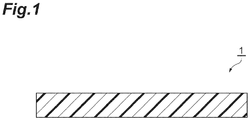
- Figure 1 is a schematic cross-sectional view showing one embodiment of the resin member.
- the resin member 1 includes a copolymer of ethylene and an olefin having 3 or more carbon atoms (hereinafter also referred to as “component (A)”), a straight-chain saturated hydrocarbon compound (hereinafter referred to as “component (B)”), and a gelling agent (hereinafter also referred to as “component (C)").
- component (A) ethylene and an olefin having 3 or more carbon atoms
- component (B) straight-chain saturated hydrocarbon compound
- component (C) a gelling agent
- the resin member 1 may be, for example, in the form of a sheet (film).
- the number of carbon atoms of the olefin constituting the copolymer (hereinafter also simply referred to as "olefin”) is 3 or more and for example 3 to 8.
- the olefin may be linear or branched.
- Examples of a copolymer of ethylene and an olefin having 3 or more carbon atoms include a copolymer of ethylene and propylene (C3), a copolymer of ethylene and butene (C4), a copolymer of ethylene and pentene (C5), a copolymer of ethylene and hexene (C6), a copolymer of ethylene and heptene (C7), a copolymer of ethylene and octene (C8), a copolymer of ethylene and nonene (C9), and a copolymer of ethylene and decene (C10).
- the value in parentheses shown in the specific examples indicates the number of carbons.
- copolymers a copolymer of ethylene and an olefin having 3 to 8 carbon atoms is preferable to be used since easily available.
- a copolymer of ethylene and an olefin having 3 or more carbon atoms may be used alone or in combination of two or more.
- the content of the component (A) is preferably 5% by mass or more, more preferably 10% by mass or more, and furthermore preferably 15% by mass or more based on the total amount of the resin member.
- the content of the component (A) is preferably 50% by mass or less, more preferably 40% by mass or less, and furthermore preferably 30% by mass or less based on the total amount of the resin member.
- the component (B) has a melting point within a range of 0 to 100°C, for example.
- the component (B) may be linear or branched.
- Specific examples of the component (B) include n-tetradecane (C14, 6°C), n-pentadecane (C15, 9°C), n-hexadecane (C16, 18°C), n-heptadecane (C17, 21°C), n-octadecane (C18, 28°C), n-nanodecane (C19, 32°C), n-eicosane (C20, 37°C.), n-heneicosane
- the values in parentheses shown in the specific examples indicates the number of carbons and the melting point, respectively.
- the above melting point is a temperature at the point where the baseline crosses the tangent line of the maximum slope of the melting (endothermic) peak of the thermogram obtained in heating at a temperature rising rate of 10°C/min by using a differential scanning calorimeter (for example, "8500” manufactured by Perkin Elmer).
- the component (B) may be a petroleum wax containing a linear saturated hydrocarbon compound as a main component.
- the petroleum wax is a purified product from vacuum distillation components of petroleum or natural gas as a raw material.
- Specific examples of the petroleum wax include Paraffin Wax (48 to 69°C (melting point, the same applies hereinafter)), HNP (64 to 77°C), SP (60 to 74°C), EMW (49°C), and the like manufactured by Nippon Seiro Co., Ltd. These components (B) may be used alone or in combination of two or more.
- the content of the component (B) is preferably 40% by mass or more, more preferably 45% by mass or more, and furthermore preferably 50% by mass or more based on the total amount of the resin member.
- the content of the component (B) is preferably 90% by mass or less, more preferably 80% by mass or less, and furthermore preferably 70% by mass or less based on the total amount of the resin member.
- the number of carbon atoms of the olefin in the component (A) is preferably 8 from the viewpoint of superior suppression of fluidity of the straight-chain saturated hydrocarbon compound.
- the component (C) is not particularly limited as long as it is a component capable of gelling the component (B).
- the component (C) may be, for example, a carboxylic acid or a carboxylic acid metal salt.
- the resin member 1 includes a copolymer of ethylene and the olefin having 3 or more carbon atoms, a straight-chain saturated hydrocarbon compound, and at least one selected from the group consisting of a carboxylic acid and a carboxylic acid metal salt.
- a carboxylic acid in the component (C) is preferably a carboxylic acid having a straight-chain hydrocarbon group (straight-chain aliphatic carboxylic acid), from the viewpoint of good compatibility with the straight-chain saturated hydrocarbon compound.
- the number of carbon atoms of the carboxylic acid is preferably 10 or more, such as 10 to 40, 10 to 30, or 10 to 25.
- the carboxylic acid may be saturated or unsaturated.
- carboxylic acid examples include, but are not limited to, lauric acid (C12 (number of carbon atoms, the same applies below)), myristic acid (C14), palmitic acid (C16), stearic acid (C18), isostearic acid (CI8), docosahexaenoic acid (C22), behenic acid (C21), undecylenic acid (C11), oleic acid (C18), erucic acid (C22), linoleic acid (C18), arachidonic acid (C20), linolenic acid (CI8), and sapienic acid (C16).
- the carboxylic acid may be used alone or in combination of two or more.
- the carboxylic acid constituting a carboxylic acid metal salt in the component (C) are preferable to be a carboxylic acid having a straight-chain hydrocarbon group (straight-chain fat group carboxylic acid), from the viewpoint of good compatibility with a straight-chain saturated hydrocarbon compound and a carboxylic acid.
- the number of carbon atoms of the carboxylic acid constituting a carboxylic acid metal salt is preferable to be 6 or more, such as 6 to 30, 6 to 25, or 8 to 20.
- the carboxylic acid constituting a carboxylic acid metal salt may be saturated or unsaturated.
- the metal constituting a carboxylic acid metal salt is a metal capable of forming salts with a carboxylic acid, and an example thereof is aluminum.
- carboxylic acid metal salt examples include aluminum stearate (C18 (number of carbon atoms, the same applies below)), aluminum laurate (C12), aluminum oleate (C18), aluminum behenate (C21), aluminum palmitate (C16), and aluminum 2-ethylhexanoate (C8).
- the carboxylic acid metal salt may be used alone or in combination of two or more.
- the content of the component (C) is preferably 3% by mass or more based on the total amount of the resin member.
- the content of the component (C) is preferably 10% by mass or less, more preferably 8% by mass or less, and furthermore preferably 6% by mass or less, based on the total amount of the resin member.
- the resin member 1 may further include a polymer having a melting point of 100°C or more (hereinafter also referred to as "component (D)").
- component (D) is a component other than a copolymer of ethylene and an olefin having 3 or more carbon atoms (component (A)).
- the resin member 1 includes the component (D), and thereby formation of a physical inter-network structure can be expected and the resin member 1 is excellent in suppressing flowability and maintaining the shape at a high temperature (for example, 50°C or more).
- the melting point of the component (D) may be 100°C or more, 120°C or more, or 140°C or more.
- the melting point of the component (D) may be 250°C or less, 230°C or less, or 200°C or less.
- the component (D) is desirable to have good compatibility with the component (A) and the component (B).
- the component (D) may be a linear polymer, a branched polymer, a modified polymer, a copolymer, or the like.
- the component (D) may be, for example, polyethylene (ethylene homopolymer), polypropylene (propylene homopolymer), or the like.
- the component (D) may be a modified polymer of polyethylene or polypropylene, a copolymer of ethylene or propylene and another monomer, or the like, which further include monomer units other than ethylene or propylene.
- the copolymer may be, for example, a block copolymer.
- the component (D) may be used alone or in combination of two or more.
- the resin member 1 preferably further includes at least one selected from the group consisting of polyethylene (ethylene homopolymer) and polypropylene (propylene homopolymer) as the component (D), from the viewpoint of the resin member 1 being further superior in suppressing flowability and maintaining the shape in the temperature range of 50°C or more.
- the content of the component (D) is preferably 5% by mass or more, preferably 30% by mass or less, more preferably 25% by mass or less, and furthermore preferably 20% by mass or less, based on the total amount of the resin member.
- the resin member 1 may further include other components in addition to the above components (A) to (D).
- the other components include inorganic components such as glass and talc, and light absorbing agents for suppressing photodegradation.
- the content of the other components is preferable to be, for example, 10% by mass or less, based on the total amount of the resin member.
- the resin member 1 described above can be obtained, for example, by the following method.
- a copolymer (component (A)) of ethylene and an olefin having 3 or more carbon atoms and, if necessary, a polymer having a melting point of 100°C or more (component (D)) are added and mixed.
- a carboxylic acid and a carboxylic acid metal salt (component (C)) are added and further homogeneously mixed to obtain the resin member 1.
- the resin member 1 can also be obtained by heating and melting, and then molding a composition containing the components (A) to (C), if necessary, the component (D), and other components.
- the method for producing the resin member 1 comprises a step (molding step) of heating and melting, and then molding a composition containing the components (A) to (C), if necessary, the component (D), and other components.
- the molding in the molding step may be an injection molding, a compression molding, or a transfer molding.
- the resin member 1 can store heat or dissipate heat by utilizing phase transition, it is preferably used as a heat storage material.
- "resin member” can be read as "heat storage material”.
- the heat storage material according to one embodiment includes a copolymer of ethylene and an olefin having 3 or more carbon atoms, a straight-chain saturated hydrocarbon compound, and a gelling agent.
- the heat storage material according to another embodiment includes a copolymer of ethylene and an olefin having 3 or more carbon atoms, a straight-chain saturated hydrocarbon compound, and at least one selected from the group consisting of a carboxylic acid and a carboxylic acid metal salt.
- the heat storage material (resin member) of the present embodiment can be utilized in various fields.
- the heat storage material (resin member) is used for, for example, air-conditioning equipment (efficiency improvement in air-conditioning equipment) in automobiles, buildings, public facilities, underground malls, and the like; piping in plants and the like (thermal storage of pipes); automobile engines (heat insulation around the engines); electronic components (prevention of temperature rise of electronic components); underwear fibers; and the like. Since the heat storage material (resin member) does not need a casing and the heat storage material (resin member) alone has high elastic modulus, it can be pasted to, wound around, or attached in various conditions to the object to be attached.
- Figure 2 is a schematic cross-sectional view showing one embodiment of a sheet using the resin member. As shown in Figure 2 , the sheet 2 comprises the metal layer 3 and the resin layer 4 formed on the metal layer 3.
- the metal layer 3 is composed of, for example, aluminum, copper, or the like.
- the thickness of the metal layer 3 is, for example, 100 ⁇ m or less.
- the resin layer 4 is composed of the resin member (heat storage material) 1 described above.
- the thickness of the resin layer 4 is, for example, 1 to 30 mm, 2 to 20 mm, or 5 to 10 mm.
- the sheet 2 is obtained, for example, by pressure lamination of the resin member 1 and the metal layer 3. In this case, if necessary, heating may be performed at the temperature or less at which the resin member 1 is held in shape.
- the sheet 2 is a sheet having high reflectance of sunlight at high temperature (for example, 20°C or more) and low reflectance of sunlight at low temperature (for example, 15°C or less).
- the sheet 2 is used for, for example, a roof, a road, and the like.
- the sheet 2 is laid on a roof, a road, or the like, and thereby the resin layer 4 becomes transparent as the straight-chain hydrocarbon compound becomes a liquid state at high temperature (for example, in the summer), and the metal layer 3 reflects the solar heat, allowing the sheet 2 to suppress temperature rise of roofs, roads, and the like.
- the resin layer 4 becomes opaque because the straight-chain hydrocarbon compound becomes solid or semi-solid.
- the metal layer 3 does not reflect the solar heat, the resin layer 4 absorbs heat, and the temperature decrease of the roof, road, and the like is suppressed. That is, the sheet 2 according to the present embodiment can achieve temperature rise suppression at high temperature and suppression of temperature drop at low temperature, and is utilized as an auxiliary function of the air conditioner.
- the sheet 2 can suppress temperature rise at high temperature and suppress temperature decrease at low temperature, it is preferably used as a heat control sheet.
- sheet can be read as "thermal control sheet”.
- the thermal control sheet according to the present embodiment comprises a metal layer and a heat storage layer formed on the metal layer and consisting of a heat storage material.
- a copolymer of ethylene and an olefin having 3 or more carbon atoms, a straight-chain saturated hydrocarbon compound, and a carboxylic acid and a carboxylic acid metal salt as described below were used to prepare the resin member having the composition shown in Table 1.
- a copolymer of ethylene and an olefin having 3 or more carbon atoms and, if necessary, a polymer (component (D)) having a melting point of 100°C or more were added and mixed.
- a carboxylic acid and a carboxylic acid metal salt were added and further homogeneously mixed to obtain the resin member.
- the melting point of the straight-chain saturated hydrocarbon compound was calculated from the peak temperature of melting in a temperature rising process at a temperature rising rate of 10°C/min by differential thermal analysis (DSC).
- a resin member having a size of 30 mm ⁇ 5 mm ⁇ 1 mm was used as a sample, and the sample was pulled using a tensile tester under the condition of 25°C, a chuck distance of 10 mm, and a pulling rate of 500 mm/min.
- the elastic modulus was measured when the distortion amount of the sample was doubled (the length in the pulling direction of the sample was 200% of the initial length).
- Example 3 With respect to the resin members in Example 3 and Comparative Example 3, the temperature was raised from 25°C to 90°C at a temperature rising rate of 10°C/min using a viscoelasticity measuring tester and then decreased from 90°C at a temperature falling rate of 10°C/minute, and the elastic modulus at 80°C was measured. Measurement was carried out in tensile vibration mode under the condition of 10 Hz and distortion amount of 10 ⁇ m.
- the results of measurements 1 and 2 of elastic modulus are shown in Table 1.
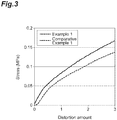
- Measurement results of Example 1 and Comparative Example 1 are shown in Figure 3
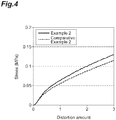
- measurement results of Example 2 and Comparative Example 2 are shown in Figure 4
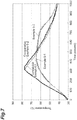
- measurement results of Example 3 and Comparative Example 3 are shown in Figure 5 .
- the sample (the resin member) was placed on a hot plate and the temperature was raised from 30°C in interval of 5°C (temperature rising rate: about 5°C/min), and the temperature (°C) at which shape change started was measured.
- the measurement results are shown in Table 1.
- the states at a temperature less than or equal to the melting point and a temperature more than the melting point of the straight-chain saturated hydrocarbon compound were confirmed.
- a metal layer such as an aluminum foil makes it effective that the metal layer such as an aluminum foil reflects sunlight at a temperature more than the melting point, and the reflection of sunlight can be expected to be suppressed at a temperature less than or equal to the melting point.
- a composition having the same composition as in Example 3 was subjected to compression molding to obtain a substantially rectangular resin member with length 70 mm ⁇ width 20 mm ⁇ thickness 5 mm. More specifically, it was pressurized (heated and melted) for 1 minute under the condition of 200°C and 10 MPa, and then cooled to obtain a resin member.
- Example 6 With respect to the obtained resin members in Example 5 and Comparative Example 6, a temperature change test was carried out as shown in Figure 6 .
- the resin member 11 was placed on a transistor (product name "IGBT IXA 70I 1200NA” manufactured by IXYS Corporation) 12 connected to a power supply (not shown) via a silver paste (product name "oil compound X-23-7868-2D” manufactured by Shin-Etsu Chemical Co., Ltd., not shown).
- the transistor 12 was then heated to 120°C for about 300 seconds (application condition: 10 V/1 A), and thereby a change in the surface temperature of the resin member 11 during the temperature rising process was measured by thermography (product name "FSV-1200", Apiste Co., Ltd.).
- Example 6 a composition having the same composition as in each of Examples 1 to 3 was molded into a sheet having length 50 mmxwidth 100 mmxthickness 1 mm by pressurizing and heating press (compression molding).
- the pressurizing and heating conditions are as follows:
- a sample having length 50 mm ⁇ width 3 mm ⁇ thickness 1 mm was cut out from this molded body and used for measurement of viscoelasticity.
- the viscoelasticity was measured using ARES/RSAG2 manufactured by TA Instrument, Inc. in a tensile vibration mode with a chuck distance of 20 mm, an amplitude of 10Hz, and a distortion amount of 10 ⁇ m at a temperature rising/falling rate of 10°C/min.
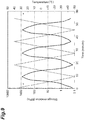
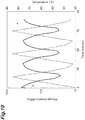
- the measurement results are shown in Figure 8 (Example 6), Figure 9 (Example 7), and Figure 10 (Example 8), respectively.
- the resin member (heat storage material) of the present invention was found to have the effect of availability with no case as a resin member (heat storage material) that can be molded into an arbitrary shape by a commonly used molding method such as injection molding, compression molding, and transfer molding, and can suppress a temperature change.
Landscapes
- Chemical & Material Sciences (AREA)
- Chemical Kinetics & Catalysis (AREA)
- Organic Chemistry (AREA)
- Polymers & Plastics (AREA)
- Health & Medical Sciences (AREA)
- Medicinal Chemistry (AREA)
- Engineering & Computer Science (AREA)
- Materials Engineering (AREA)
- Physics & Mathematics (AREA)
- Thermal Sciences (AREA)
- Combustion & Propulsion (AREA)
- Dispersion Chemistry (AREA)
- Manufacturing & Machinery (AREA)
- Mechanical Engineering (AREA)
- General Engineering & Computer Science (AREA)
- Compositions Of Macromolecular Compounds (AREA)
- Laminated Bodies (AREA)
- Building Environments (AREA)
Abstract
Description
- The present invention relates to a resin member and a sheet using same, a method for producing resin member, and heat storage material and heat control sheet using same.
- Conventionally, heat storage materials are provided for temporarily saving thermal energy in order to take out thermal energy from time to time in air conditioning equipment in automobiles, buildings, underground malls, automobile engines, electronic components, and the like.
- An example of the heat storage material includes a material accumulating or dissipating heat by utilizing a phase transition of a substance. As such a heat storage material, for example, a material using hydrocarbon compounds is known. Hydrocarbon compounds have excellent heat storage properties by reversibly undergoing phase transition. However, since hydrocarbon compounds are in a liquid state on the high temperature side of the phase transition and may bleed out, some kind of bleeding prevention measures must be applied.
- In response to such a problem, for example,
Patent Literature 1 discloses a heat storage material containing a styrene-ethylene-ethylene-propylene-styrene copolymer and a paraffinic wax as a heat storage material for suppressing bleeding. - Patent Literature 1: Japanese Unexamined Patent Publication No.
2014-88517 - For example, the heat storage material may be used while is wound around an object in a pulled state. In such a case, the heat storage material is required to have small distortion against tensile force (that is, high elastic modulus). However, when a heat storage material as disclosed in
Patent Literature 1 is used, a sufficient elastic modulus can not necessarily be obtained. - The present invention has been made in view of such circumstances, and an object of the present invention is to provide a resin member having a high elastic modulus and a method for producing the same, and a heat storage material. Another object of the present invention is to provide a sheet using the resin member and a thermal control sheet using the heat storage material.
- In one aspect, the present invention is a resin member comprising a copolymer of ethylene and an olefin having 3 or more carbon atoms, a straight-chain saturated hydrocarbon compound, and a gelling agent. In another aspect, the present invention is a resin member comprising a copolymer of ethylene and an olefin having 3 or more carbon atoms, a straight-chain saturated hydrocarbon compound, and at least one selected from the group consisting of a carboxylic acid and a carboxylic acid metal salt.
- In another aspect, the present invention is a heat storage material comprising a copolymer of ethylene and an olefin having 3 or more carbon atoms, a straight-chain saturated hydrocarbon compound, and a gelling agent. In another aspect, the present invention is a heat storage material comprising a copolymer of ethylene and an olefin having 3 or more carbon atoms, a straight-chain saturated hydrocarbon compound, and at least one selected from the group consisting of a carboxylic acid and a carboxylic acid metal salt.
- In another aspect, the present invention is a method for producing a resin member, the method comprising a step of heating and melting and then molding a composition comprising a copolymer of ethylene and an olefin having 3 or more carbon atoms, a straight-chain saturated hydrocarbon compound, and a gelling agent. In another aspect, the present invention is a method for producing a resin member, the method comprising a step of heating and melting and then molding a composition comprising a copolymer of ethylene and an olefin having 3 or more carbon atoms, a straight-chain saturated hydrocarbon compound, and at least one selected from the group consisting of a carboxylic acid and a carboxylic acid metal salt. In these producing methods, the molding may be an injection molding, a compression molding, or a transfer molding.
- In each of the above aspects, the number of carbon atoms of the olefin may be 3 to 8.
- In each of the above aspects, when the melting point of the straight-chain saturated hydrocarbon compound is less than 50°C, the number of carbon atoms of the olefin is preferably 8.
- In each of the above aspects, when the melting point of the straight-chain saturated hydrocarbon compound is 50°C or more, the resin member preferably further comprises at least one selected from the group consisting of polyethylene and polypropylene.
- In another aspect, the present invention is a sheet comprising a metal layer and a resin layer formed on the metal layer and composed of the above-described resin member.
- In another aspect, the present invention is a heat control sheet comprising a metal layer and a heat storage layer formed on the metal layer and composed of the above-described heat storage material.
- The present invention can provide a resin member having a high elastic modulus and a method for producing the same, and a heat storage material, and also can provide a sheet using the resin member and a heat control sheet using the heat storage material.
-
-
Figure 1 is a schematic cross-sectional view showing one embodiment of a resin member. -
Figure 2 is a schematic cross-sectional view showing one embodiment of a sheet using the resin member. -
Figure 3 is a graph showing the measurement results of elastic modulus in Example 1 and Comparative Example 1. -
Figure 4 is a graph showing the measurement results of elastic modulus in Example 2 and Comparative Example 2. -
Figure 5 is a graph showing the measurement results of elastic modulus in Example 3 and Comparative Example 3. -
Figure 6 is a schematic diagram for explaining a method of a temperature change test. -
Figure 7 is a graph showing the results of the temperature change test in Example 5 and Comparative Example 6. -
Figure 8 is a graph showing the measurement results of storage modulus in Example 6. -
Figure 9 is a graph showing the measurement results of storage modulus in Example 7. -
Figure 10 is a graph showing the measurement results of storage modulus in Example 8. - Hereinafter, embodiments of the present invention will be described in detail with reference to the drawings as appropriate.
-
Figure 1 is a schematic cross-sectional view showing one embodiment of the resin member. In one embodiment, theresin member 1 includes a copolymer of ethylene and an olefin having 3 or more carbon atoms (hereinafter also referred to as "component (A)"), a straight-chain saturated hydrocarbon compound (hereinafter referred to as "component (B)"), and a gelling agent (hereinafter also referred to as "component (C)"). Theresin member 1 may be, for example, in the form of a sheet (film). - The number of carbon atoms of the olefin constituting the copolymer (hereinafter also simply referred to as "olefin") is 3 or more and for example 3 to 8. When the olefin has 4 or more carbon atoms, the olefin may be linear or branched. Examples of a copolymer of ethylene and an olefin having 3 or more carbon atoms include a copolymer of ethylene and propylene (C3), a copolymer of ethylene and butene (C4), a copolymer of ethylene and pentene (C5), a copolymer of ethylene and hexene (C6), a copolymer of ethylene and heptene (C7), a copolymer of ethylene and octene (C8), a copolymer of ethylene and nonene (C9), and a copolymer of ethylene and decene (C10). The value in parentheses shown in the specific examples indicates the number of carbons. Of these copolymers, a copolymer of ethylene and an olefin having 3 to 8 carbon atoms is preferable to be used since easily available. A copolymer of ethylene and an olefin having 3 or more carbon atoms may be used alone or in combination of two or more.
- The content of the component (A) is preferably 5% by mass or more, more preferably 10% by mass or more, and furthermore preferably 15% by mass or more based on the total amount of the resin member. The content of the component (A) is preferably 50% by mass or less, more preferably 40% by mass or less, and furthermore preferably 30% by mass or less based on the total amount of the resin member.
- From the viewpoint of obtaining a heat storage effect within a practical range, the component (B) has a melting point within a range of 0 to 100°C, for example. The component (B) may be linear or branched. Specific examples of the component (B) include n-tetradecane (C14, 6°C), n-pentadecane (C15, 9°C), n-hexadecane (C16, 18°C), n-heptadecane (C17, 21°C), n-octadecane (C18, 28°C), n-nanodecane (C19, 32°C), n-eicosane (C20, 37°C.), n-heneicosane
- (C21, 41°C), n-docosane (C22, 46°C), n-tricosane (C23, 47°C), n-tetracosane (C24, 50°C), n-pentacosane (C25, 54°C), n-hexacosane (C26, 56°C), n-heptacosane (C27, 60°C), n-octacosane (C28, 65°C), n-nonacosane (C29, 66°C), n-triacontane (C30, 67°C), n-tetracontane (C40, 81°C), n-pentacontane (C50, 91°C), and n-hexacontane (C60, 98°C). The values in parentheses shown in the specific examples indicates the number of carbons and the melting point, respectively. The above melting point is a temperature at the point where the baseline crosses the tangent line of the maximum slope of the melting (endothermic) peak of the thermogram obtained in heating at a temperature rising rate of 10°C/min by using a differential scanning calorimeter (for example, "8500" manufactured by Perkin Elmer).
- The component (B) may be a petroleum wax containing a linear saturated hydrocarbon compound as a main component. The petroleum wax is a purified product from vacuum distillation components of petroleum or natural gas as a raw material. Specific examples of the petroleum wax include Paraffin Wax (48 to 69°C (melting point, the same applies hereinafter)), HNP (64 to 77°C), SP (60 to 74°C), EMW (49°C), and the like manufactured by Nippon Seiro Co., Ltd. These components (B) may be used alone or in combination of two or more.
- The content of the component (B) is preferably 40% by mass or more, more preferably 45% by mass or more, and furthermore preferably 50% by mass or more based on the total amount of the resin member. The content of the component (B) is preferably 90% by mass or less, more preferably 80% by mass or less, and furthermore preferably 70% by mass or less based on the total amount of the resin member.
- When the melting point of the straight-chain saturated hydrocarbon compound is less than 50°C, the number of carbon atoms of the olefin in the component (A) is preferably 8 from the viewpoint of superior suppression of fluidity of the straight-chain saturated hydrocarbon compound.
- The component (C) is not particularly limited as long as it is a component capable of gelling the component (B). The component (C) may be, for example, a carboxylic acid or a carboxylic acid metal salt. That is, in another embodiment, the
resin member 1 includes a copolymer of ethylene and the olefin having 3 or more carbon atoms, a straight-chain saturated hydrocarbon compound, and at least one selected from the group consisting of a carboxylic acid and a carboxylic acid metal salt. - A carboxylic acid in the component (C) is preferably a carboxylic acid having a straight-chain hydrocarbon group (straight-chain aliphatic carboxylic acid), from the viewpoint of good compatibility with the straight-chain saturated hydrocarbon compound. The number of carbon atoms of the carboxylic acid is preferably 10 or more, such as 10 to 40, 10 to 30, or 10 to 25. The carboxylic acid may be saturated or unsaturated. Examples of the carboxylic acid include, but are not limited to, lauric acid (C12 (number of carbon atoms, the same applies below)), myristic acid (C14), palmitic acid (C16), stearic acid (C18), isostearic acid (CI8), docosahexaenoic acid (C22), behenic acid (C21), undecylenic acid (C11), oleic acid (C18), erucic acid (C22), linoleic acid (C18), arachidonic acid (C20), linolenic acid (CI8), and sapienic acid (C16). The carboxylic acid may be used alone or in combination of two or more.
- The carboxylic acid constituting a carboxylic acid metal salt in the component (C) are preferable to be a carboxylic acid having a straight-chain hydrocarbon group (straight-chain fat group carboxylic acid), from the viewpoint of good compatibility with a straight-chain saturated hydrocarbon compound and a carboxylic acid. The number of carbon atoms of the carboxylic acid constituting a carboxylic acid metal salt is preferable to be 6 or more, such as 6 to 30, 6 to 25, or 8 to 20. The carboxylic acid constituting a carboxylic acid metal salt may be saturated or unsaturated. The metal constituting a carboxylic acid metal salt is a metal capable of forming salts with a carboxylic acid, and an example thereof is aluminum. Specific examples of the carboxylic acid metal salt include aluminum stearate (C18 (number of carbon atoms, the same applies below)), aluminum laurate (C12), aluminum oleate (C18), aluminum behenate (C21), aluminum palmitate (C16), and aluminum 2-ethylhexanoate (C8). The carboxylic acid metal salt may be used alone or in combination of two or more.
- The content of the component (C) is preferably 3% by mass or more based on the total amount of the resin member. The content of the component (C) is preferably 10% by mass or less, more preferably 8% by mass or less, and furthermore preferably 6% by mass or less, based on the total amount of the resin member.
- The
resin member 1 may further include a polymer having a melting point of 100°C or more (hereinafter also referred to as "component (D)"). The component (D) is a component other than a copolymer of ethylene and an olefin having 3 or more carbon atoms (component (A)). Theresin member 1 includes the component (D), and thereby formation of a physical inter-network structure can be expected and theresin member 1 is excellent in suppressing flowability and maintaining the shape at a high temperature (for example, 50°C or more). - The melting point of the component (D) may be 100°C or more, 120°C or more, or 140°C or more. The melting point of the component (D) may be 250°C or less, 230°C or less, or 200°C or less.
- The component (D) is desirable to have good compatibility with the component (A) and the component (B). The component (D) may be a linear polymer, a branched polymer, a modified polymer, a copolymer, or the like. The component (D) may be, for example, polyethylene (ethylene homopolymer), polypropylene (propylene homopolymer), or the like. The component (D) may be a modified polymer of polyethylene or polypropylene, a copolymer of ethylene or propylene and another monomer, or the like, which further include monomer units other than ethylene or propylene. The copolymer may be, for example, a block copolymer. The component (D) may be used alone or in combination of two or more.
- When the melting point of the component (B) is 50°C or more, the
resin member 1 preferably further includes at least one selected from the group consisting of polyethylene (ethylene homopolymer) and polypropylene (propylene homopolymer) as the component (D), from the viewpoint of theresin member 1 being further superior in suppressing flowability and maintaining the shape in the temperature range of 50°C or more. - When the
resin member 1 includes the component (D), the content of the component (D) is preferably 5% by mass or more, preferably 30% by mass or less, more preferably 25% by mass or less, and furthermore preferably 20% by mass or less, based on the total amount of the resin member. - The
resin member 1 may further include other components in addition to the above components (A) to (D). Examples of the other components include inorganic components such as glass and talc, and light absorbing agents for suppressing photodegradation. The content of the other components is preferable to be, for example, 10% by mass or less, based on the total amount of the resin member. - The
resin member 1 described above can be obtained, for example, by the following method. In the condition that the straight-chain saturated hydrocarbon compound (component (B)) is heated to a temperature higher than the melting point, a copolymer (component (A)) of ethylene and an olefin having 3 or more carbon atoms and, if necessary, a polymer having a melting point of 100°C or more (component (D)) are added and mixed. After homogeneously mixing, a carboxylic acid and a carboxylic acid metal salt (component (C)) are added and further homogeneously mixed to obtain theresin member 1. - The
resin member 1 can also be obtained by heating and melting, and then molding a composition containing the components (A) to (C), if necessary, the component (D), and other components. The method for producing theresin member 1 comprises a step (molding step) of heating and melting, and then molding a composition containing the components (A) to (C), if necessary, the component (D), and other components. The molding in the molding step may be an injection molding, a compression molding, or a transfer molding. - As described above, since the
resin member 1 can store heat or dissipate heat by utilizing phase transition, it is preferably used as a heat storage material. In this specification, "resin member" can be read as "heat storage material". The heat storage material according to one embodiment includes a copolymer of ethylene and an olefin having 3 or more carbon atoms, a straight-chain saturated hydrocarbon compound, and a gelling agent. The heat storage material according to another embodiment includes a copolymer of ethylene and an olefin having 3 or more carbon atoms, a straight-chain saturated hydrocarbon compound, and at least one selected from the group consisting of a carboxylic acid and a carboxylic acid metal salt. - The heat storage material (resin member) of the present embodiment can be utilized in various fields. The heat storage material (resin member) is used for, for example, air-conditioning equipment (efficiency improvement in air-conditioning equipment) in automobiles, buildings, public facilities, underground malls, and the like; piping in plants and the like (thermal storage of pipes); automobile engines (heat insulation around the engines); electronic components (prevention of temperature rise of electronic components); underwear fibers; and the like. Since the heat storage material (resin member) does not need a casing and the heat storage material (resin member) alone has high elastic modulus, it can be pasted to, wound around, or attached in various conditions to the object to be attached.
-
Figure 2 is a schematic cross-sectional view showing one embodiment of a sheet using the resin member. As shown inFigure 2 , thesheet 2 comprises themetal layer 3 and theresin layer 4 formed on themetal layer 3. - The
metal layer 3 is composed of, for example, aluminum, copper, or the like. The thickness of themetal layer 3 is, for example, 100 µm or less. - The
resin layer 4 is composed of the resin member (heat storage material) 1 described above. The thickness of theresin layer 4 is, for example, 1 to 30 mm, 2 to 20 mm, or 5 to 10 mm. - The
sheet 2 is obtained, for example, by pressure lamination of theresin member 1 and themetal layer 3. In this case, if necessary, heating may be performed at the temperature or less at which theresin member 1 is held in shape. - When the
sheet 2 according to the present embodiment includes, for example, n-hexadecane as a straight-chain saturated hydrocarbon compound, thesheet 2 is a sheet having high reflectance of sunlight at high temperature (for example, 20°C or more) and low reflectance of sunlight at low temperature (for example, 15°C or less). Thesheet 2 is used for, for example, a roof, a road, and the like. Thesheet 2 is laid on a roof, a road, or the like, and thereby theresin layer 4 becomes transparent as the straight-chain hydrocarbon compound becomes a liquid state at high temperature (for example, in the summer), and themetal layer 3 reflects the solar heat, allowing thesheet 2 to suppress temperature rise of roofs, roads, and the like. Meanwhile, at low temperature (for example, in the winter), theresin layer 4 becomes opaque because the straight-chain hydrocarbon compound becomes solid or semi-solid. In this case, themetal layer 3 does not reflect the solar heat, theresin layer 4 absorbs heat, and the temperature decrease of the roof, road, and the like is suppressed. That is, thesheet 2 according to the present embodiment can achieve temperature rise suppression at high temperature and suppression of temperature drop at low temperature, and is utilized as an auxiliary function of the air conditioner. - As described above, since the
sheet 2 can suppress temperature rise at high temperature and suppress temperature decrease at low temperature, it is preferably used as a heat control sheet. In the above description, "sheet" can be read as "thermal control sheet". The thermal control sheet according to the present embodiment comprises a metal layer and a heat storage layer formed on the metal layer and consisting of a heat storage material. - The present invention will be specifically described based on examples, but the present invention is not limited to these Examples.
- In Examples and Comparative Examples, a copolymer of ethylene and an olefin having 3 or more carbon atoms, a straight-chain saturated hydrocarbon compound, and a carboxylic acid and a carboxylic acid metal salt as described below were used to prepare the resin member having the composition shown in Table 1. In the condition that the straight-chain saturated hydrocarbon compound was heated to a temperature higher than the melting point, a copolymer of ethylene and an olefin having 3 or more carbon atoms and, if necessary, a polymer (component (D)) having a melting point of 100°C or more were added and mixed. After homogeneously mixing, a carboxylic acid and a carboxylic acid metal salt were added and further homogeneously mixed to obtain the resin member.
-
- A-1: Copolymer of ethylene and octene (product name "ENGAGE8150" manufactured by Dow Chemical Japan, Ltd.)
- A-2: Copolymer of ethylene and propylene (product name "Esprene V141" manufactured by Sumitomo Chemical Co., Ltd.)
-
- B-1: n-hexadecane (melting point: 18°C)
- B-2: n-pentadecane (melting point: 9°C)
- B-3: HNP-9 (paraffin wax manufactured by Nippon Seiro Co., Ltd., melting point: 74 to 76 °C)
-
- C-1: Oleic acid
- C-2: Aluminum 2-ethylhexanoate
- D-1: Polypropylene (product name "Nobrene AU891E2" manufactured by Sumitomo Chemical Co., Ltd., melting point: 170°C)
- The melting point of the straight-chain saturated hydrocarbon compound was calculated from the peak temperature of melting in a temperature rising process at a temperature rising rate of 10°C/min by differential thermal analysis (DSC).
- With respect to Examples 1 and 2 and Comparative Examples 1, 2, 4, and 5, a resin member having a size of 30 mm×5 mm×1 mm was used as a sample, and the sample was pulled using a tensile tester under the condition of 25°C, a chuck distance of 10 mm, and a pulling rate of 500 mm/min. The elastic modulus was measured when the distortion amount of the sample was doubled (the length in the pulling direction of the sample was 200% of the initial length).
- With respect to the resin members in Example 3 and Comparative Example 3, the temperature was raised from 25°C to 90°C at a temperature rising rate of 10°C/min using a viscoelasticity measuring tester and then decreased from 90°C at a temperature falling rate of 10°C/minute, and the elastic modulus at 80°C was measured. Measurement was carried out in tensile vibration mode under the condition of 10 Hz and distortion amount of 10 µm.
- The results of
measurements Figure 3 , measurement results of Example 2 and Comparative Example 2 are shown inFigure 4 , and measurement results of Example 3 and Comparative Example 3 are shown inFigure 5 . - With respect to the obtained resin member, the heat of fusion (J/g) was calculated from the peak area of melting in the temperature rising process at a temperature rising rate of 10°C/min by differential thermal analysis (DSC). The results are shown in Table 1.
- The sample (the resin member) was placed on a hot plate and the temperature was raised from 30°C in interval of 5°C (temperature rising rate: about 5°C/min), and the temperature (°C) at which shape change started was measured. The measurement results are shown in Table 1.
[Table 1] Example 1 Comparative Example 1 Example 2 Comparative Example 2 Example 3 Comparative Example 3 Comparative Example 4 Comparative Example 5 Composition (mass%) A-1 28 30 28 30 - - - - A-2 - - - - 19 20 - - B-1 67 70 - - - - 93 - B-2 - - 67 70 - - - - B-3 - - - - 57 60 - 100 C-1 2 - 2 - 2 - 2 - C-2 3 - 3 - 3 - 5 - D-1 - - - - 19 20 - - Measurement of elastic modulus 11.18 Standard 1.14 Standard - - Not measurable Not measurable Measurement of elastic modulus 2 - - - - 105 Standard - - Heat of fusion of resin member (J/g) 135 138 123 108 121 132 201 212 Shape holding temperature (°C) 65 65 65 60 120 90 <30 Liquid - With respect to the film-like resin member having the composition in Example 1, the states at a temperature less than or equal to the melting point and a temperature more than the melting point of the straight-chain saturated hydrocarbon compound were confirmed. As a result, it became a transparent state at a temperature more than the melting point, and at a temperature less than or equal to the melting point, since hexadecane, which is a straight-chain saturated hydrocarbon compound, was crystallized, it became a white state. From this, combining the film-like resin member and a metal layer such as an aluminum foil makes it effective that the metal layer such as an aluminum foil reflects sunlight at a temperature more than the melting point, and the reflection of sunlight can be expected to be suppressed at a temperature less than or equal to the melting point.
- A composition having the same composition as in Example 3 was subjected to compression molding to obtain a substantially rectangular resin member with
length 70 mm×width 20 mm×thickness 5 mm. More specifically, it was pressurized (heated and melted) for 1 minute under the condition of 200°C and 10 MPa, and then cooled to obtain a resin member. - Only the polypropylene (D-1) was subjected to compression molding under the same condition as in Example 5 to obtain a resin member having the same shape as in Example 5.
- With respect to the obtained resin members in Example 5 and Comparative Example 6, a temperature change test was carried out as shown in
Figure 6 . Theresin member 11 was placed on a transistor (product name "IGBT IXA 70I 1200NA" manufactured by IXYS Corporation) 12 connected to a power supply (not shown) via a silver paste (product name "oil compound X-23-7868-2D" manufactured by Shin-Etsu Chemical Co., Ltd., not shown). Thetransistor 12 was then heated to 120°C for about 300 seconds (application condition: 10 V/1 A), and thereby a change in the surface temperature of theresin member 11 during the temperature rising process was measured by thermography (product name "FSV-1200", Apiste Co., Ltd.). Afterwards, the temperature of theresin member 11 was lowered by turning off the power supply, and the surface temperature of theresin member 11 in the temperature falling process was similarly measured by thermography. The measurement results are shown inFigure 7 . Measurements were made twice for each of the resin members in Example 5 and Comparative Example 6.Figure 7 shows the measurement results of the first (Example 5-1) and the second (Example 5-2) in Example 5 and the measurement results of the first (Comparative Example 6-1) and the second (Comparative Example 6-2) in Comparative Example 6. - As shown in
Figure 7 , in the resin member in Example 5, it was found that the latent heat effect remarkably appeared as compared with the resin member in Comparative Example 6; the temperature change accompanying melting was small in the temperature rising process; and the temperature change accompanying solidification was also small in the temperature falling process. Furthermore, as shown inFigure 7 , in the resin member in Example 5, it was confirmed that the temperature rising process and temperature falling process were able to be repeated and the shape was held even at a high temperature. The resin member in Example 5 was found to be useful as a resin member including a heat storage material like the resin member in Comparative Example 6 which was generally used as a resin member (molded body). - In the case that the composition consisting of only the straight-chain saturated hydrocarbon HNP-9 (B-3) as the same in Comparative Example 5 was prepared in the same manner as in Example 5, the obtained resin member was subjected to the above temperature change test, but measurement was impossible since the resin member became liquid at the melting point or more. In the case of using a heat storage material such as a straight-chain saturated hydrocarbon, it is considered that the resin member is required to be accommodated in some case composed of metal, resin, or the like.
- In Examples 6 to 8, a composition having the same composition as in each of Examples 1 to 3 was molded into a
sheet having length 50mmxwidth 100mmxthickness 1 mm by pressurizing and heating press (compression molding). The pressurizing and heating conditions are as follows: - Examples 6 and 7: 1 MPa, 80°C, 1 minute
- Example 8: 1 MPa, 200°C, 1 minute
- A
sample having length 50 mm×width 3 mm×thickness 1 mm was cut out from this molded body and used for measurement of viscoelasticity. The viscoelasticity was measured using ARES/RSAG2 manufactured by TA Instrument, Inc. in a tensile vibration mode with a chuck distance of 20 mm, an amplitude of 10Hz, and a distortion amount of 10 µm at a temperature rising/falling rate of 10°C/min. The measurement results are shown inFigure 8 (Example 6),Figure 9 (Example 7), andFigure 10 (Example 8), respectively. - As described above, the resin member (heat storage material) of the present invention was found to have the effect of availability with no case as a resin member (heat storage material) that can be molded into an arbitrary shape by a commonly used molding method such as injection molding, compression molding, and transfer molding, and can suppress a temperature change.
- 1: resin member, 2: sheet, 3: metal layer, 4: resin layer.
Claims (18)
- A resin member comprising:a copolymer of ethylene and an olefin having 3 or more carbon atoms;a straight-chain saturated hydrocarbon compound; anda gelling agent.
- A resin member comprising:a copolymer of ethylene and an olefin having 3 or more carbon atoms;a straight-chain saturated hydrocarbon compound; andat least one selected from the group consisting of a carboxylic acid and a carboxylic acid metal salt.
- The resin member according to claim 1 or 2, wherein a number of carbon atoms of the olefin is 3 to 8.
- The resin member according to any one of claims 1 to 3, wherein a melting point of the straight-chain saturated hydrocarbon compound is less than 50°C, and the number of carbon atoms of the olefin is 8.
- The resin member according to any one of claims 1 to 3, wherein a melting point of the straight-chain saturated hydrocarbon compound is 50°C or more, and the resin member further comprises at least one selected from the group consisting of a polyethylene and a polypropylene.
- A sheet comprising:a metal layer; anda resin layer formed on the metal layer and composed of the resin member according to any one of claims 1 to 5.
- A heat storage material comprising:a copolymer of ethylene and an olefin having 3 or more carbon atoms;a straight-chain saturated hydrocarbon compound; anda gelling agent.
- A heat storage material comprising:a copolymer of ethylene and an olefin having 3 or more carbon atoms;a straight-chain saturated hydrocarbon compound; andat least one selected from the group consisting of a carboxylic acid and a carboxylic acid metal salt.
- The heat storage material according to claim 7 or 8, wherein a number of carbon atoms of the olefin is 3 to 8.
- The heat storage material according to any one of claims 7 to 9, wherein a melting point of the straight-chain saturated hydrocarbon compound is less than 50°C, and the number of carbon atoms of the olefin is 8.
- The heat storage material according to any one of claims 7 to 9, wherein a melting point of the straight-chain saturated hydrocarbon compound is 50°C or more, and the heat storage material further comprises at least one selected from the group consisting of a polyethylene and a polypropylene.
- A heat control sheet comprising:a metal layer; anda heat storage layer formed on the metal layer and composed of the heat storage material according to any one of claims 7 to 11.
- A method for producing a resin member, comprising a step of heating and melting and then molding a composition comprising a copolymer of ethylene and an olefin having 3 or more carbon atoms, a straight-chain saturated hydrocarbon compound, and a gelling agent.
- A method for producing a resin member, comprising a step of heating and melting and then molding a composition comprising a copolymer of ethylene and an olefin having 3 or more carbon atoms, a straight-chain saturated hydrocarbon compound, and at least one selected from the group consisting of a carboxylic acid and a carboxylic acid metal salt.
- The method for producing a resin member according to claim 13 or 14, wherein the molding is an injection molding, a compression molding, or a transfer molding.
- The method for producing a resin member according to any one of claims 13 to 15, wherein a number of carbon atoms of the olefin is 3 to 8.
- The method for producing a resin member according to any one of claims 13 to 16, wherein a melting point of the straight-chain saturated hydrocarbon compound is less than 50°C, and the number of carbon atoms of the olefin is 8.
- The method for producing a resin member according to any one of claims 13 to 17, wherein a melting point of the straight-chain saturated hydrocarbon compound is 50°C or more, and the composition further comprises at least one selected from the group consisting of a polyethylene and a polypropylene.
Applications Claiming Priority (3)
| Application Number | Priority Date | Filing Date | Title |
|---|---|---|---|
| PCT/JP2016/079991 WO2018066131A1 (en) | 2016-10-07 | 2016-10-07 | Resin member and sheet using same, and heat storage material and heat control sheet using same |
| JP2017093129 | 2017-05-09 | ||
| PCT/JP2017/036150 WO2018066605A1 (en) | 2016-10-07 | 2017-10-04 | Resin member and sheet using same, method for producing resin member, and heat storage material and heat control sheet using same |
Publications (3)
| Publication Number | Publication Date |
|---|---|
| EP3524659A1 true EP3524659A1 (en) | 2019-08-14 |
| EP3524659A4 EP3524659A4 (en) | 2020-06-03 |
| EP3524659B1 EP3524659B1 (en) | 2022-05-04 |
Family
ID=61831063
Family Applications (1)
| Application Number | Title | Priority Date | Filing Date |
|---|---|---|---|
| EP17858442.1A Active EP3524659B1 (en) | 2016-10-07 | 2017-10-04 | Resin member and sheet using same, method for producing resin member, and heat storage material and heat control sheet using same |
Country Status (7)
| Country | Link |
|---|---|
| US (1) | US11441022B2 (en) |
| EP (1) | EP3524659B1 (en) |
| JP (1) | JP6977732B2 (en) |
| KR (1) | KR102526227B1 (en) |
| CN (1) | CN109844057A (en) |
| TW (1) | TWI784974B (en) |
| WO (1) | WO2018066605A1 (en) |
Families Citing this family (1)
| Publication number | Priority date | Publication date | Assignee | Title |
|---|---|---|---|---|
| JP7412199B2 (en) * | 2020-02-04 | 2024-01-12 | 株式会社カネカ | Method for manufacturing heat storage material |
Family Cites Families (18)
| Publication number | Priority date | Publication date | Assignee | Title |
|---|---|---|---|---|
| US3164578A (en) * | 1962-07-26 | 1965-01-05 | Du Pont | Recovery process for polyolefins |
| JPS5790083A (en) | 1980-11-22 | 1982-06-04 | Ajinomoto Co Inc | Heat insulation medium |
| US5053446A (en) * | 1985-11-22 | 1991-10-01 | University Of Dayton | Polyolefin composites containing a phase change material |
| JP2826211B2 (en) | 1990-10-15 | 1998-11-18 | 松下電工株式会社 | Oily substance carrier and method for producing the same |
| JP2588314B2 (en) | 1991-04-19 | 1997-03-05 | 積水化学工業株式会社 | Inorganic high filling composition for foaming |
| JPH0517760A (en) * | 1991-07-10 | 1993-01-26 | Mitsubishi Cable Ind Ltd | Thermal energy storing type heater |
| JPH0532964A (en) | 1991-07-26 | 1993-02-09 | Cosmo Sogo Kenkyusho:Kk | Heat storage material |
| JPH0665565A (en) | 1992-08-18 | 1994-03-08 | Matsushita Electric Works Ltd | Heat storage composition |
| JPH06192647A (en) | 1992-12-22 | 1994-07-12 | Matsushita Electric Works Ltd | Storage body |
| JPH0748561A (en) * | 1993-08-06 | 1995-02-21 | Matsushita Electric Works Ltd | Heat storage body and manufacturing method thereof |
| JPH08143860A (en) * | 1994-11-22 | 1996-06-04 | Matsushita Electric Works Ltd | Production of heat storage unit |
| US5765389A (en) * | 1997-04-24 | 1998-06-16 | Ival O. Salyer | Cooling unit with integral thermal energy storage |
| CN1482204A (en) * | 2002-09-11 | 2004-03-17 | 云南玮昊能源发展有限公司 | Energy-accumulating temp-controlled thermoplastic cross-link high-molecular composite material with solid-solid phase change and its preparing process |
| CN100551989C (en) * | 2008-02-01 | 2009-10-21 | 南京凯汇工业科技有限公司 | A kind of phase-change heat conductive material and preparation method thereof |
| CN104245807B (en) | 2012-03-16 | 2017-09-05 | 陶氏环球技术有限责任公司 | Foamable compositions, foams and articles thereof |
| US20150203734A1 (en) * | 2012-08-10 | 2015-07-23 | Jsr Corporation | Heat storage material composition |
| JP6040710B2 (en) | 2012-10-31 | 2016-12-07 | 北川工業株式会社 | Thermal storage material composition and thermal storage material |
| KR101432393B1 (en) * | 2012-12-28 | 2014-08-20 | 삼성전기주식회사 | Epoxy Resin Composition for Sealing Geomagnetic Sensor Module, and Geomagnetic Sensor Module Sealed with the Composition |
-
2017
- 2017-10-04 EP EP17858442.1A patent/EP3524659B1/en active Active
- 2017-10-04 WO PCT/JP2017/036150 patent/WO2018066605A1/en not_active Ceased
- 2017-10-04 US US16/339,743 patent/US11441022B2/en active Active
- 2017-10-04 KR KR1020197009770A patent/KR102526227B1/en active Active
- 2017-10-04 JP JP2018543940A patent/JP6977732B2/en active Active
- 2017-10-04 CN CN201780061271.XA patent/CN109844057A/en active Pending
- 2017-10-06 TW TW106134483A patent/TWI784974B/en active
Also Published As
| Publication number | Publication date |
|---|---|
| KR102526227B1 (en) | 2023-04-27 |
| CN109844057A (en) | 2019-06-04 |
| JP6977732B2 (en) | 2021-12-08 |
| US20200048442A1 (en) | 2020-02-13 |
| EP3524659B1 (en) | 2022-05-04 |
| JPWO2018066605A1 (en) | 2019-07-25 |
| TW201827558A (en) | 2018-08-01 |
| TWI784974B (en) | 2022-12-01 |
| KR20190065276A (en) | 2019-06-11 |
| WO2018066605A1 (en) | 2018-04-12 |
| EP3524659A4 (en) | 2020-06-03 |
| US11441022B2 (en) | 2022-09-13 |
Similar Documents
| Publication | Publication Date | Title |
|---|---|---|
| Li et al. | Thermal sensitive flexible phase change materials with high thermal conductivity for thermal energy storage | |
| Li | A nano-graphite/paraffin phase change material with high thermal conductivity | |
| Yanping et al. | Theoretic prediction of melting temperature and latent heat for a fatty acid eutectic mixture | |
| Guo et al. | Paraffin/wood flour/high‐density polyethylene composites for thermal energy storage material in buildings: a morphology, thermal performance, and mechanical property study | |
| Zhao et al. | Microstructure and thermal properties of a paraffin/expanded graphite phase-change composite for thermal storage | |
| Fredi et al. | Multifunctional structural composites for thermal energy storage | |
| Sari-Bey et al. | Thermal characterization of polymer matrix composites containing microencapsulated paraffin in solid or liquid state | |
| US11535782B2 (en) | Resin member and sheet using same, and heat storage material and heat control sheet using same | |
| Krupa et al. | Positive influence of expanded graphite on the physical behavior of phase change materials based on linear low-density polyethylene and paraffin wax | |
| Liu et al. | Preparation and energy storage properties of a lauric acid/octadecanol eutectic mixture | |
| CN107216858B (en) | Preparation method of heat-conducting phase-change energy-storage interface composition | |
| KR20200139167A (en) | Resin member, manufacturing method of resin member, and heat storage body | |
| EP3524659B1 (en) | Resin member and sheet using same, method for producing resin member, and heat storage material and heat control sheet using same | |
| JP7298615B2 (en) | Composition, sheet and heat storage material | |
| Chinnasamy et al. | Thermophysical investigation of metallic nanocomposite phase change materials for indoor thermal management | |
| Brahimi et al. | Investigation of the thermal efficiency of hollow bricks filled with bio-organic phase change material mixture | |
| Zhang et al. | Thermal properties of ternary carbonate/T-ZnOw for thermal energy storage in high-temperature concentrating solar power systems | |
| WO2018066131A1 (en) | Resin member and sheet using same, and heat storage material and heat control sheet using same | |
| JP7124833B2 (en) | Resin member, sheet, heat storage material, and method for manufacturing resin member | |
| US20160090521A1 (en) | Paraffin-based composition and latent heat storage material | |
| Wang et al. | Thermal Properties of 1-Tetradecanol/Polyvinyl Butyral Composite Phase Change Materials with Expanded Graphite for Latent Heat Storage | |
| Nishad et al. | Composite panels utilizing TetraPak and microencapsulated phase change material for enhanced building thermal management | |
| JP2019073594A (en) | Thermal storage thermally conductive particle and resin composition | |
| Zheng et al. | The Effect of Hydroxylated Multi-Walled Carbon Nanotubes on the Properties of Peg-Cacl2 Form-Stable Phase Change Materials. Energies 2021, 14, 1403 |
Legal Events
| Date | Code | Title | Description |
|---|---|---|---|
| STAA | Information on the status of an ep patent application or granted ep patent |
Free format text: STATUS: THE INTERNATIONAL PUBLICATION HAS BEEN MADE |
|
| PUAI | Public reference made under article 153(3) epc to a published international application that has entered the european phase |
Free format text: ORIGINAL CODE: 0009012 |
|
| STAA | Information on the status of an ep patent application or granted ep patent |
Free format text: STATUS: REQUEST FOR EXAMINATION WAS MADE |
|
| 17P | Request for examination filed |
Effective date: 20190417 |
|
| AK | Designated contracting states |
Kind code of ref document: A1 Designated state(s): AL AT BE BG CH CY CZ DE DK EE ES FI FR GB GR HR HU IE IS IT LI LT LU LV MC MK MT NL NO PL PT RO RS SE SI SK SM TR |
|
| AX | Request for extension of the european patent |
Extension state: BA ME |
|
| DAV | Request for validation of the european patent (deleted) | ||
| DAX | Request for extension of the european patent (deleted) | ||
| A4 | Supplementary search report drawn up and despatched |
Effective date: 20200507 |
|
| RIC1 | Information provided on ipc code assigned before grant |
Ipc: C09K 5/06 20060101AFI20200429BHEP Ipc: F28D 20/02 20060101ALI20200429BHEP |
|
| STAA | Information on the status of an ep patent application or granted ep patent |
Free format text: STATUS: EXAMINATION IS IN PROGRESS |
|
| 17Q | First examination report despatched |
Effective date: 20210222 |
|
| GRAP | Despatch of communication of intention to grant a patent |
Free format text: ORIGINAL CODE: EPIDOSNIGR1 |
|
| STAA | Information on the status of an ep patent application or granted ep patent |
Free format text: STATUS: GRANT OF PATENT IS INTENDED |
|
| INTG | Intention to grant announced |
Effective date: 20211119 |
|
| RAP3 | Party data changed (applicant data changed or rights of an application transferred) |
Owner name: HITACHI CHEMICAL COMPANY, LTD. |
|
| GRAS | Grant fee paid |
Free format text: ORIGINAL CODE: EPIDOSNIGR3 |
|
| GRAA | (expected) grant |
Free format text: ORIGINAL CODE: 0009210 |
|
| STAA | Information on the status of an ep patent application or granted ep patent |
Free format text: STATUS: THE PATENT HAS BEEN GRANTED |
|
| RAP3 | Party data changed (applicant data changed or rights of an application transferred) |
Owner name: SHOWA DENKO MATERIALS CO., LTD. |
|
| AK | Designated contracting states |
Kind code of ref document: B1 Designated state(s): AL AT BE BG CH CY CZ DE DK EE ES FI FR GB GR HR HU IE IS IT LI LT LU LV MC MK MT NL NO PL PT RO RS SE SI SK SM TR |
|
| REG | Reference to a national code |
Ref country code: GB Ref legal event code: FG4D |
|
| REG | Reference to a national code |
Ref country code: CH Ref legal event code: EP |
|
| REG | Reference to a national code |
Ref country code: AT Ref legal event code: REF Ref document number: 1489052 Country of ref document: AT Kind code of ref document: T Effective date: 20220515 |
|
| REG | Reference to a national code |
Ref country code: IE Ref legal event code: FG4D Ref country code: DE Ref legal event code: R096 Ref document number: 602017057098 Country of ref document: DE |
|
| REG | Reference to a national code |
Ref country code: LT Ref legal event code: MG9D |
|
| REG | Reference to a national code |
Ref country code: NL Ref legal event code: MP Effective date: 20220504 |
|
| REG | Reference to a national code |
Ref country code: AT Ref legal event code: MK05 Ref document number: 1489052 Country of ref document: AT Kind code of ref document: T Effective date: 20220504 |
|
| PG25 | Lapsed in a contracting state [announced via postgrant information from national office to epo] |
Ref country code: SE Free format text: LAPSE BECAUSE OF FAILURE TO SUBMIT A TRANSLATION OF THE DESCRIPTION OR TO PAY THE FEE WITHIN THE PRESCRIBED TIME-LIMIT Effective date: 20220504 Ref country code: PT Free format text: LAPSE BECAUSE OF FAILURE TO SUBMIT A TRANSLATION OF THE DESCRIPTION OR TO PAY THE FEE WITHIN THE PRESCRIBED TIME-LIMIT Effective date: 20220905 Ref country code: NO Free format text: LAPSE BECAUSE OF FAILURE TO SUBMIT A TRANSLATION OF THE DESCRIPTION OR TO PAY THE FEE WITHIN THE PRESCRIBED TIME-LIMIT Effective date: 20220804 Ref country code: NL Free format text: LAPSE BECAUSE OF FAILURE TO SUBMIT A TRANSLATION OF THE DESCRIPTION OR TO PAY THE FEE WITHIN THE PRESCRIBED TIME-LIMIT Effective date: 20220504 Ref country code: LT Free format text: LAPSE BECAUSE OF FAILURE TO SUBMIT A TRANSLATION OF THE DESCRIPTION OR TO PAY THE FEE WITHIN THE PRESCRIBED TIME-LIMIT Effective date: 20220504 Ref country code: HR Free format text: LAPSE BECAUSE OF FAILURE TO SUBMIT A TRANSLATION OF THE DESCRIPTION OR TO PAY THE FEE WITHIN THE PRESCRIBED TIME-LIMIT Effective date: 20220504 Ref country code: GR Free format text: LAPSE BECAUSE OF FAILURE TO SUBMIT A TRANSLATION OF THE DESCRIPTION OR TO PAY THE FEE WITHIN THE PRESCRIBED TIME-LIMIT Effective date: 20220805 Ref country code: FI Free format text: LAPSE BECAUSE OF FAILURE TO SUBMIT A TRANSLATION OF THE DESCRIPTION OR TO PAY THE FEE WITHIN THE PRESCRIBED TIME-LIMIT Effective date: 20220504 Ref country code: ES Free format text: LAPSE BECAUSE OF FAILURE TO SUBMIT A TRANSLATION OF THE DESCRIPTION OR TO PAY THE FEE WITHIN THE PRESCRIBED TIME-LIMIT Effective date: 20220504 Ref country code: BG Free format text: LAPSE BECAUSE OF FAILURE TO SUBMIT A TRANSLATION OF THE DESCRIPTION OR TO PAY THE FEE WITHIN THE PRESCRIBED TIME-LIMIT Effective date: 20220804 Ref country code: AT Free format text: LAPSE BECAUSE OF FAILURE TO SUBMIT A TRANSLATION OF THE DESCRIPTION OR TO PAY THE FEE WITHIN THE PRESCRIBED TIME-LIMIT Effective date: 20220504 |
|
| PG25 | Lapsed in a contracting state [announced via postgrant information from national office to epo] |
Ref country code: RS Free format text: LAPSE BECAUSE OF FAILURE TO SUBMIT A TRANSLATION OF THE DESCRIPTION OR TO PAY THE FEE WITHIN THE PRESCRIBED TIME-LIMIT Effective date: 20220504 Ref country code: PL Free format text: LAPSE BECAUSE OF FAILURE TO SUBMIT A TRANSLATION OF THE DESCRIPTION OR TO PAY THE FEE WITHIN THE PRESCRIBED TIME-LIMIT Effective date: 20220504 Ref country code: LV Free format text: LAPSE BECAUSE OF FAILURE TO SUBMIT A TRANSLATION OF THE DESCRIPTION OR TO PAY THE FEE WITHIN THE PRESCRIBED TIME-LIMIT Effective date: 20220504 Ref country code: IS Free format text: LAPSE BECAUSE OF FAILURE TO SUBMIT A TRANSLATION OF THE DESCRIPTION OR TO PAY THE FEE WITHIN THE PRESCRIBED TIME-LIMIT Effective date: 20220904 |
|
| PG25 | Lapsed in a contracting state [announced via postgrant information from national office to epo] |
Ref country code: SM Free format text: LAPSE BECAUSE OF FAILURE TO SUBMIT A TRANSLATION OF THE DESCRIPTION OR TO PAY THE FEE WITHIN THE PRESCRIBED TIME-LIMIT Effective date: 20220504 Ref country code: SK Free format text: LAPSE BECAUSE OF FAILURE TO SUBMIT A TRANSLATION OF THE DESCRIPTION OR TO PAY THE FEE WITHIN THE PRESCRIBED TIME-LIMIT Effective date: 20220504 Ref country code: RO Free format text: LAPSE BECAUSE OF FAILURE TO SUBMIT A TRANSLATION OF THE DESCRIPTION OR TO PAY THE FEE WITHIN THE PRESCRIBED TIME-LIMIT Effective date: 20220504 Ref country code: EE Free format text: LAPSE BECAUSE OF FAILURE TO SUBMIT A TRANSLATION OF THE DESCRIPTION OR TO PAY THE FEE WITHIN THE PRESCRIBED TIME-LIMIT Effective date: 20220504 Ref country code: DK Free format text: LAPSE BECAUSE OF FAILURE TO SUBMIT A TRANSLATION OF THE DESCRIPTION OR TO PAY THE FEE WITHIN THE PRESCRIBED TIME-LIMIT Effective date: 20220504 Ref country code: CZ Free format text: LAPSE BECAUSE OF FAILURE TO SUBMIT A TRANSLATION OF THE DESCRIPTION OR TO PAY THE FEE WITHIN THE PRESCRIBED TIME-LIMIT Effective date: 20220504 |
|
| REG | Reference to a national code |
Ref country code: DE Ref legal event code: R097 Ref document number: 602017057098 Country of ref document: DE |
|
| PLBE | No opposition filed within time limit |
Free format text: ORIGINAL CODE: 0009261 |
|
| STAA | Information on the status of an ep patent application or granted ep patent |
Free format text: STATUS: NO OPPOSITION FILED WITHIN TIME LIMIT |
|
| PG25 | Lapsed in a contracting state [announced via postgrant information from national office to epo] |
Ref country code: AL Free format text: LAPSE BECAUSE OF FAILURE TO SUBMIT A TRANSLATION OF THE DESCRIPTION OR TO PAY THE FEE WITHIN THE PRESCRIBED TIME-LIMIT Effective date: 20220504 |
|
| 26N | No opposition filed |
Effective date: 20230207 |
|
| PG25 | Lapsed in a contracting state [announced via postgrant information from national office to epo] |
Ref country code: SI Free format text: LAPSE BECAUSE OF FAILURE TO SUBMIT A TRANSLATION OF THE DESCRIPTION OR TO PAY THE FEE WITHIN THE PRESCRIBED TIME-LIMIT Effective date: 20220504 Ref country code: MC Free format text: LAPSE BECAUSE OF FAILURE TO SUBMIT A TRANSLATION OF THE DESCRIPTION OR TO PAY THE FEE WITHIN THE PRESCRIBED TIME-LIMIT Effective date: 20220504 |
|
| REG | Reference to a national code |
Ref country code: CH Ref legal event code: PL |
|
| REG | Reference to a national code |
Ref country code: BE Ref legal event code: MM Effective date: 20221031 |
|
| GBPC | Gb: european patent ceased through non-payment of renewal fee |
Effective date: 20221004 |
|
| REG | Reference to a national code |
Ref country code: DE Ref legal event code: R081 Ref document number: 602017057098 Country of ref document: DE Owner name: RESONAC CORPORATION, JP Free format text: FORMER OWNER: SHOWA DENKO MATERIALS CO., LTD., TOKYO, JP |
|
| PG25 | Lapsed in a contracting state [announced via postgrant information from national office to epo] |
Ref country code: LU Free format text: LAPSE BECAUSE OF NON-PAYMENT OF DUE FEES Effective date: 20221004 |
|
| PG25 | Lapsed in a contracting state [announced via postgrant information from national office to epo] |
Ref country code: FR Free format text: LAPSE BECAUSE OF NON-PAYMENT OF DUE FEES Effective date: 20221031 Ref country code: CH Free format text: LAPSE BECAUSE OF NON-PAYMENT OF DUE FEES Effective date: 20221031 Ref country code: LI Free format text: LAPSE BECAUSE OF NON-PAYMENT OF DUE FEES Effective date: 20221031 |
|
| PG25 | Lapsed in a contracting state [announced via postgrant information from national office to epo] |
Ref country code: BE Free format text: LAPSE BECAUSE OF NON-PAYMENT OF DUE FEES Effective date: 20221031 |
|
| PG25 | Lapsed in a contracting state [announced via postgrant information from national office to epo] |
Ref country code: IE Free format text: LAPSE BECAUSE OF NON-PAYMENT OF DUE FEES Effective date: 20221004 Ref country code: GB Free format text: LAPSE BECAUSE OF NON-PAYMENT OF DUE FEES Effective date: 20221004 |
|
| PG25 | Lapsed in a contracting state [announced via postgrant information from national office to epo] |
Ref country code: IT Free format text: LAPSE BECAUSE OF FAILURE TO SUBMIT A TRANSLATION OF THE DESCRIPTION OR TO PAY THE FEE WITHIN THE PRESCRIBED TIME-LIMIT Effective date: 20220504 |
|
| PG25 | Lapsed in a contracting state [announced via postgrant information from national office to epo] |
Ref country code: HU Free format text: LAPSE BECAUSE OF FAILURE TO SUBMIT A TRANSLATION OF THE DESCRIPTION OR TO PAY THE FEE WITHIN THE PRESCRIBED TIME-LIMIT; INVALID AB INITIO Effective date: 20171004 |
|
| PG25 | Lapsed in a contracting state [announced via postgrant information from national office to epo] |
Ref country code: CY Free format text: LAPSE BECAUSE OF FAILURE TO SUBMIT A TRANSLATION OF THE DESCRIPTION OR TO PAY THE FEE WITHIN THE PRESCRIBED TIME-LIMIT Effective date: 20220504 |
|
| PG25 | Lapsed in a contracting state [announced via postgrant information from national office to epo] |
Ref country code: MK Free format text: LAPSE BECAUSE OF FAILURE TO SUBMIT A TRANSLATION OF THE DESCRIPTION OR TO PAY THE FEE WITHIN THE PRESCRIBED TIME-LIMIT Effective date: 20220504 |
|
| PG25 | Lapsed in a contracting state [announced via postgrant information from national office to epo] |
Ref country code: TR Free format text: LAPSE BECAUSE OF FAILURE TO SUBMIT A TRANSLATION OF THE DESCRIPTION OR TO PAY THE FEE WITHIN THE PRESCRIBED TIME-LIMIT Effective date: 20220504 |
|
| PG25 | Lapsed in a contracting state [announced via postgrant information from national office to epo] |
Ref country code: MT Free format text: LAPSE BECAUSE OF FAILURE TO SUBMIT A TRANSLATION OF THE DESCRIPTION OR TO PAY THE FEE WITHIN THE PRESCRIBED TIME-LIMIT Effective date: 20220504 |
|
| PG25 | Lapsed in a contracting state [announced via postgrant information from national office to epo] |
Ref country code: BG Free format text: LAPSE BECAUSE OF FAILURE TO SUBMIT A TRANSLATION OF THE DESCRIPTION OR TO PAY THE FEE WITHIN THE PRESCRIBED TIME-LIMIT Effective date: 20220504 |
|
| PG25 | Lapsed in a contracting state [announced via postgrant information from national office to epo] |
Ref country code: BG Free format text: LAPSE BECAUSE OF FAILURE TO SUBMIT A TRANSLATION OF THE DESCRIPTION OR TO PAY THE FEE WITHIN THE PRESCRIBED TIME-LIMIT Effective date: 20220504 |
|
| PGFP | Annual fee paid to national office [announced via postgrant information from national office to epo] |
Ref country code: DE Payment date: 20250902 Year of fee payment: 9 |