EP3524656A1 - Novel hydrogelator - Google Patents
Novel hydrogelator Download PDFInfo
- Publication number
- EP3524656A1 EP3524656A1 EP17859395.0A EP17859395A EP3524656A1 EP 3524656 A1 EP3524656 A1 EP 3524656A1 EP 17859395 A EP17859395 A EP 17859395A EP 3524656 A1 EP3524656 A1 EP 3524656A1
- Authority
- EP
- European Patent Office
- Prior art keywords
- group
- hydrogelator
- compound
- gelation
- carbon atom
- Prior art date
- Legal status (The legal status is an assumption and is not a legal conclusion. Google has not performed a legal analysis and makes no representation as to the accuracy of the status listed.)
- Withdrawn
Links
- 150000001875 compounds Chemical class 0.000 claims abstract description 111
- 229910052799 carbon Inorganic materials 0.000 claims abstract description 39
- 125000004432 carbon atom Chemical group C* 0.000 claims abstract description 39
- 125000000217 alkyl group Chemical group 0.000 claims abstract description 19
- 125000001424 substituent group Chemical group 0.000 claims abstract description 17
- 125000001997 phenyl group Chemical group [H]C1=C([H])C([H])=C(*)C([H])=C1[H] 0.000 claims abstract description 13
- 125000006165 cyclic alkyl group Chemical group 0.000 claims abstract description 12
- 125000005843 halogen group Chemical group 0.000 claims abstract description 11
- 125000005647 linker group Chemical group 0.000 claims abstract description 10
- 125000003342 alkenyl group Chemical group 0.000 claims abstract description 8
- 125000000449 nitro group Chemical group [O-][N+](*)=O 0.000 claims abstract description 7
- 239000003125 aqueous solvent Substances 0.000 claims description 39
- 239000000017 hydrogel Substances 0.000 claims description 35
- 125000002947 alkylene group Chemical group 0.000 claims description 11
- 125000003710 aryl alkyl group Chemical group 0.000 claims description 10
- 125000000008 (C1-C10) alkyl group Chemical group 0.000 claims description 9
- 125000003118 aryl group Chemical group 0.000 claims description 9
- 150000002016 disaccharides Chemical class 0.000 claims description 7
- 125000000027 (C1-C10) alkoxy group Chemical group 0.000 claims description 6
- 125000004448 alkyl carbonyl group Chemical group 0.000 claims description 6
- 125000004104 aryloxy group Chemical group 0.000 claims description 6
- 150000002772 monosaccharides Chemical class 0.000 claims description 6
- 125000000732 arylene group Chemical group 0.000 claims description 5
- 238000000034 method Methods 0.000 abstract description 12
- -1 heptenyl group Chemical group 0.000 description 187
- 238000001879 gelation Methods 0.000 description 105
- LFQSCWFLJHTTHZ-UHFFFAOYSA-N Ethanol Chemical compound CCO LFQSCWFLJHTTHZ-UHFFFAOYSA-N 0.000 description 83
- OKKJLVBELUTLKV-UHFFFAOYSA-N Methanol Chemical compound OC OKKJLVBELUTLKV-UHFFFAOYSA-N 0.000 description 66
- XLYOFNOQVPJJNP-UHFFFAOYSA-N water Substances O XLYOFNOQVPJJNP-UHFFFAOYSA-N 0.000 description 59
- 229910001868 water Inorganic materials 0.000 description 59
- HEMHJVSKTPXQMS-UHFFFAOYSA-M Sodium hydroxide Chemical compound [OH-].[Na+] HEMHJVSKTPXQMS-UHFFFAOYSA-M 0.000 description 55
- 239000000243 solution Substances 0.000 description 45
- 238000012360 testing method Methods 0.000 description 36
- VEXZGXHMUGYJMC-UHFFFAOYSA-N Hydrochloric acid Chemical compound Cl VEXZGXHMUGYJMC-UHFFFAOYSA-N 0.000 description 34
- 239000002904 solvent Substances 0.000 description 34
- 239000007787 solid Substances 0.000 description 30
- 239000000203 mixture Substances 0.000 description 28
- WYURNTSHIVDZCO-UHFFFAOYSA-N Tetrahydrofuran Chemical compound C1CCOC1 WYURNTSHIVDZCO-UHFFFAOYSA-N 0.000 description 24
- VLKZOEOYAKHREP-UHFFFAOYSA-N n-Hexane Chemical compound CCCCCC VLKZOEOYAKHREP-UHFFFAOYSA-N 0.000 description 24
- KDLHZDBZIXYQEI-UHFFFAOYSA-N Palladium Chemical compound [Pd] KDLHZDBZIXYQEI-UHFFFAOYSA-N 0.000 description 23
- 239000000499 gel Substances 0.000 description 23
- 230000015572 biosynthetic process Effects 0.000 description 22
- ZMXDDKWLCZADIW-UHFFFAOYSA-N N,N-Dimethylformamide Chemical compound CN(C)C=O ZMXDDKWLCZADIW-UHFFFAOYSA-N 0.000 description 21
- DNIAPMSPPWPWGF-VKHMYHEASA-N (+)-propylene glycol Chemical compound C[C@H](O)CO DNIAPMSPPWPWGF-VKHMYHEASA-N 0.000 description 20
- YPFDHNVEDLHUCE-UHFFFAOYSA-N 1,3-propanediol Substances OCCCO YPFDHNVEDLHUCE-UHFFFAOYSA-N 0.000 description 20
- 229920000166 polytrimethylene carbonate Polymers 0.000 description 20
- 238000011282 treatment Methods 0.000 description 17
- CSCPPACGZOOCGX-UHFFFAOYSA-N Acetone Chemical compound CC(C)=O CSCPPACGZOOCGX-UHFFFAOYSA-N 0.000 description 15
- WEVYAHXRMPXWCK-UHFFFAOYSA-N Acetonitrile Chemical compound CC#N WEVYAHXRMPXWCK-UHFFFAOYSA-N 0.000 description 15
- 239000000872 buffer Substances 0.000 description 14
- 239000003960 organic solvent Substances 0.000 description 14
- 238000003756 stirring Methods 0.000 description 14
- IAZDPXIOMUYVGZ-WFGJKAKNSA-N Dimethyl sulfoxide Chemical compound [2H]C([2H])([2H])S(=O)C([2H])([2H])[2H] IAZDPXIOMUYVGZ-WFGJKAKNSA-N 0.000 description 12
- FAPWRFPIFSIZLT-UHFFFAOYSA-M Sodium chloride Chemical compound [Na+].[Cl-] FAPWRFPIFSIZLT-UHFFFAOYSA-M 0.000 description 12
- 239000007864 aqueous solution Substances 0.000 description 12
- 239000011780 sodium chloride Substances 0.000 description 12
- YLQBMQCUIZJEEH-UHFFFAOYSA-N tetrahydrofuran Natural products C=1C=COC=1 YLQBMQCUIZJEEH-UHFFFAOYSA-N 0.000 description 12
- 238000007669 thermal treatment Methods 0.000 description 12
- 238000003786 synthesis reaction Methods 0.000 description 11
- 238000009210 therapy by ultrasound Methods 0.000 description 10
- 238000005160 1H NMR spectroscopy Methods 0.000 description 9
- XEKOWRVHYACXOJ-UHFFFAOYSA-N Ethyl acetate Chemical compound CCOC(C)=O XEKOWRVHYACXOJ-UHFFFAOYSA-N 0.000 description 9
- 238000006243 chemical reaction Methods 0.000 description 9
- 239000000463 material Substances 0.000 description 9
- 239000011541 reaction mixture Substances 0.000 description 9
- GFNKTLQTQSALEJ-UHFFFAOYSA-N 1-isocyanato-4-nitrobenzene Chemical compound [O-][N+](=O)C1=CC=C(N=C=O)C=C1 GFNKTLQTQSALEJ-UHFFFAOYSA-N 0.000 description 8
- GUBGYTABKSRVRQ-DCSYEGIMSA-N Beta-Lactose Chemical compound OC[C@H]1O[C@@H](O[C@H]2[C@H](O)[C@@H](O)[C@H](O)O[C@@H]2CO)[C@H](O)[C@@H](O)[C@H]1O GUBGYTABKSRVRQ-DCSYEGIMSA-N 0.000 description 8
- IAZDPXIOMUYVGZ-UHFFFAOYSA-N Dimethylsulphoxide Chemical compound CS(C)=O IAZDPXIOMUYVGZ-UHFFFAOYSA-N 0.000 description 8
- 239000001257 hydrogen Substances 0.000 description 8
- 229910052739 hydrogen Inorganic materials 0.000 description 8
- 229930195724 β-lactose Natural products 0.000 description 8
- 238000011156 evaluation Methods 0.000 description 7
- 238000001914 filtration Methods 0.000 description 7
- 239000008363 phosphate buffer Substances 0.000 description 7
- 239000000047 product Substances 0.000 description 7
- KBPLFHHGFOOTCA-UHFFFAOYSA-N 1-Octanol Chemical compound CCCCCCCCO KBPLFHHGFOOTCA-UHFFFAOYSA-N 0.000 description 6
- LYCAIKOWRPUZTN-UHFFFAOYSA-N Ethylene glycol Chemical compound OCCO LYCAIKOWRPUZTN-UHFFFAOYSA-N 0.000 description 6
- PEDCQBHIVMGVHV-UHFFFAOYSA-N Glycerine Chemical compound OCC(O)CO PEDCQBHIVMGVHV-UHFFFAOYSA-N 0.000 description 6
- KFZMGEQAYNKOFK-UHFFFAOYSA-N Isopropanol Chemical compound CC(C)O KFZMGEQAYNKOFK-UHFFFAOYSA-N 0.000 description 6
- DNIAPMSPPWPWGF-UHFFFAOYSA-N Propylene glycol Chemical compound CC(O)CO DNIAPMSPPWPWGF-UHFFFAOYSA-N 0.000 description 6
- PAFZNILMFXTMIY-UHFFFAOYSA-N cyclohexylamine Chemical compound NC1CCCCC1 PAFZNILMFXTMIY-UHFFFAOYSA-N 0.000 description 6
- 230000000694 effects Effects 0.000 description 6
- 239000002244 precipitate Substances 0.000 description 6
- 239000011369 resultant mixture Substances 0.000 description 6
- 239000000725 suspension Substances 0.000 description 6
- RTZKZFJDLAIYFH-UHFFFAOYSA-N Diethyl ether Chemical compound CCOCC RTZKZFJDLAIYFH-UHFFFAOYSA-N 0.000 description 5
- UFHFLCQGNIYNRP-UHFFFAOYSA-N Hydrogen Chemical compound [H][H] UFHFLCQGNIYNRP-UHFFFAOYSA-N 0.000 description 5
- 239000003054 catalyst Substances 0.000 description 5
- 125000000113 cyclohexyl group Chemical group [H]C1([H])C([H])([H])C([H])([H])C([H])(*)C([H])([H])C1([H])[H] 0.000 description 5
- 238000010992 reflux Methods 0.000 description 5
- PAYRUJLWNCNPSJ-UHFFFAOYSA-N Aniline Chemical compound NC1=CC=CC=C1 PAYRUJLWNCNPSJ-UHFFFAOYSA-N 0.000 description 4
- XKRFYHLGVUSROY-UHFFFAOYSA-N Argon Chemical compound [Ar] XKRFYHLGVUSROY-UHFFFAOYSA-N 0.000 description 4
- HEDRZPFGACZZDS-UHFFFAOYSA-N Chloroform Chemical compound ClC(Cl)Cl HEDRZPFGACZZDS-UHFFFAOYSA-N 0.000 description 4
- AMQJEAYHLZJPGS-UHFFFAOYSA-N N-Pentanol Chemical compound CCCCCO AMQJEAYHLZJPGS-UHFFFAOYSA-N 0.000 description 4
- JHIVVAPYMSGYDF-UHFFFAOYSA-N cyclohexanone Chemical compound O=C1CCCCC1 JHIVVAPYMSGYDF-UHFFFAOYSA-N 0.000 description 4
- 125000001511 cyclopentyl group Chemical group [H]C1([H])C([H])([H])C([H])([H])C([H])(*)C1([H])[H] 0.000 description 4
- ZSIAUFGUXNUGDI-UHFFFAOYSA-N hexan-1-ol Chemical compound CCCCCCO ZSIAUFGUXNUGDI-UHFFFAOYSA-N 0.000 description 4
- RYHBNJHYFVUHQT-UHFFFAOYSA-N 1,4-Dioxane Chemical compound C1COCCO1 RYHBNJHYFVUHQT-UHFFFAOYSA-N 0.000 description 3
- ZWEHNKRNPOVVGH-UHFFFAOYSA-N 2-Butanone Chemical compound CCC(C)=O ZWEHNKRNPOVVGH-UHFFFAOYSA-N 0.000 description 3
- GUBGYTABKSRVRQ-XLOQQCSPSA-N Alpha-Lactose Chemical compound O[C@@H]1[C@@H](O)[C@@H](O)[C@@H](CO)O[C@H]1O[C@@H]1[C@@H](CO)O[C@H](O)[C@H](O)[C@H]1O GUBGYTABKSRVRQ-XLOQQCSPSA-N 0.000 description 3
- UHOVQNZJYSORNB-UHFFFAOYSA-N Benzene Chemical compound C1=CC=CC=C1 UHOVQNZJYSORNB-UHFFFAOYSA-N 0.000 description 3
- YMWUJEATGCHHMB-UHFFFAOYSA-N Dichloromethane Chemical compound ClCCl YMWUJEATGCHHMB-UHFFFAOYSA-N 0.000 description 3
- GUBGYTABKSRVRQ-QKKXKWKRSA-N Lactose Natural products OC[C@H]1O[C@@H](O[C@H]2[C@H](O)[C@@H](O)C(O)O[C@@H]2CO)[C@H](O)[C@@H](O)[C@H]1O GUBGYTABKSRVRQ-QKKXKWKRSA-N 0.000 description 3
- PXHVJJICTQNCMI-UHFFFAOYSA-N Nickel Chemical compound [Ni] PXHVJJICTQNCMI-UHFFFAOYSA-N 0.000 description 3
- YXFVVABEGXRONW-UHFFFAOYSA-N Toluene Chemical compound CC1=CC=CC=C1 YXFVVABEGXRONW-UHFFFAOYSA-N 0.000 description 3
- CSCPPACGZOOCGX-WFGJKAKNSA-N acetone d6 Chemical compound [2H]C([2H])([2H])C(=O)C([2H])([2H])[2H] CSCPPACGZOOCGX-WFGJKAKNSA-N 0.000 description 3
- CDQSJQSWAWPGKG-UHFFFAOYSA-N butane-1,1-diol Chemical compound CCCC(O)O CDQSJQSWAWPGKG-UHFFFAOYSA-N 0.000 description 3
- 239000007795 chemical reaction product Substances 0.000 description 3
- 238000004587 chromatography analysis Methods 0.000 description 3
- 125000004122 cyclic group Chemical group 0.000 description 3
- 238000004821 distillation Methods 0.000 description 3
- 125000001495 ethyl group Chemical group [H]C([H])([H])C([H])([H])* 0.000 description 3
- 239000000706 filtrate Substances 0.000 description 3
- 239000012530 fluid Substances 0.000 description 3
- 239000001963 growth medium Substances 0.000 description 3
- 150000002402 hexoses Chemical class 0.000 description 3
- 150000002431 hydrogen Chemical class 0.000 description 3
- 239000008101 lactose Substances 0.000 description 3
- 125000002496 methyl group Chemical group [H]C([H])([H])* 0.000 description 3
- 238000000746 purification Methods 0.000 description 3
- 238000001953 recrystallisation Methods 0.000 description 3
- 238000001226 reprecipitation Methods 0.000 description 3
- 238000000967 suction filtration Methods 0.000 description 3
- CXWXQJXEFPUFDZ-UHFFFAOYSA-N tetralin Chemical compound C1=CC=C2CCCCC2=C1 CXWXQJXEFPUFDZ-UHFFFAOYSA-N 0.000 description 3
- 238000002834 transmittance Methods 0.000 description 3
- 238000005406 washing Methods 0.000 description 3
- YBLJYSTXRAWBBH-ZFYZTMLRSA-N (2s,3r,4s,5s,6r)-6-(hydroxymethyl)-2-methyloxane-2,3,4,5-tetrol Chemical compound C[C@]1(O)O[C@H](CO)[C@@H](O)[C@H](O)[C@H]1O YBLJYSTXRAWBBH-ZFYZTMLRSA-N 0.000 description 2
- YBLJYSTXRAWBBH-VEIUFWFVSA-N (2s,3s,4s,5s,6r)-6-(hydroxymethyl)-2-methyloxane-2,3,4,5-tetrol Chemical compound C[C@]1(O)O[C@H](CO)[C@@H](O)[C@H](O)[C@@H]1O YBLJYSTXRAWBBH-VEIUFWFVSA-N 0.000 description 2
- DHKHKXVYLBGOIT-UHFFFAOYSA-N 1,1-Diethoxyethane Chemical compound CCOC(C)OCC DHKHKXVYLBGOIT-UHFFFAOYSA-N 0.000 description 2
- RFFLAFLAYFXFSW-UHFFFAOYSA-N 1,2-dichlorobenzene Chemical compound ClC1=CC=CC=C1Cl RFFLAFLAYFXFSW-UHFFFAOYSA-N 0.000 description 2
- IVLXQGJVBGMLRR-UHFFFAOYSA-N 2-aminoacetic acid;hydron;chloride Chemical compound Cl.NCC(O)=O IVLXQGJVBGMLRR-UHFFFAOYSA-N 0.000 description 2
- BWDBEAQIHAEVLV-UHFFFAOYSA-N 6-methylheptan-1-ol Chemical compound CC(C)CCCCCO BWDBEAQIHAEVLV-UHFFFAOYSA-N 0.000 description 2
- BTBUEUYNUDRHOZ-UHFFFAOYSA-N Borate Chemical compound [O-]B([O-])[O-] BTBUEUYNUDRHOZ-UHFFFAOYSA-N 0.000 description 2
- WQZGKKKJIJFFOK-QTVWNMPRSA-N D-mannopyranose Chemical compound OC[C@H]1OC(O)[C@@H](O)[C@@H](O)[C@@H]1O WQZGKKKJIJFFOK-QTVWNMPRSA-N 0.000 description 2
- 239000006144 Dulbecco’s modified Eagle's medium Substances 0.000 description 2
- WQZGKKKJIJFFOK-GASJEMHNSA-N Glucose Natural products OC[C@H]1OC(O)[C@H](O)[C@@H](O)[C@@H]1O WQZGKKKJIJFFOK-GASJEMHNSA-N 0.000 description 2
- BZLVMXJERCGZMT-UHFFFAOYSA-N Methyl tert-butyl ether Chemical compound COC(C)(C)C BZLVMXJERCGZMT-UHFFFAOYSA-N 0.000 description 2
- LRHPLDYGYMQRHN-UHFFFAOYSA-N N-Butanol Chemical compound CCCCO LRHPLDYGYMQRHN-UHFFFAOYSA-N 0.000 description 2
- OFBQJSOFQDEBGM-UHFFFAOYSA-N Pentane Chemical compound CCCCC OFBQJSOFQDEBGM-UHFFFAOYSA-N 0.000 description 2
- 239000012980 RPMI-1640 medium Substances 0.000 description 2
- VMHLLURERBWHNL-UHFFFAOYSA-M Sodium acetate Chemical compound [Na+].CC([O-])=O VMHLLURERBWHNL-UHFFFAOYSA-M 0.000 description 2
- 239000000654 additive Substances 0.000 description 2
- 230000000996 additive effect Effects 0.000 description 2
- WQZGKKKJIJFFOK-PHYPRBDBSA-N alpha-D-galactose Chemical compound OC[C@H]1O[C@H](O)[C@H](O)[C@@H](O)[C@H]1O WQZGKKKJIJFFOK-PHYPRBDBSA-N 0.000 description 2
- 229910052786 argon Inorganic materials 0.000 description 2
- QVGXLLKOCUKJST-UHFFFAOYSA-N atomic oxygen Chemical compound [O] QVGXLLKOCUKJST-UHFFFAOYSA-N 0.000 description 2
- 125000001797 benzyl group Chemical group [H]C1=C([H])C([H])=C(C([H])=C1[H])C([H])([H])* 0.000 description 2
- WQZGKKKJIJFFOK-VFUOTHLCSA-N beta-D-glucose Chemical compound OC[C@H]1O[C@@H](O)[C@H](O)[C@@H](O)[C@@H]1O WQZGKKKJIJFFOK-VFUOTHLCSA-N 0.000 description 2
- HQABUPZFAYXKJW-UHFFFAOYSA-N butan-1-amine Chemical compound CCCCN HQABUPZFAYXKJW-UHFFFAOYSA-N 0.000 description 2
- 125000000484 butyl group Chemical group [H]C([*])([H])C([H])([H])C([H])([H])C([H])([H])[H] 0.000 description 2
- 238000010531 catalytic reduction reaction Methods 0.000 description 2
- MVPPADPHJFYWMZ-UHFFFAOYSA-N chlorobenzene Chemical compound ClC1=CC=CC=C1 MVPPADPHJFYWMZ-UHFFFAOYSA-N 0.000 description 2
- 229940125782 compound 2 Drugs 0.000 description 2
- 229940126214 compound 3 Drugs 0.000 description 2
- 229940125898 compound 5 Drugs 0.000 description 2
- 239000002537 cosmetic Substances 0.000 description 2
- 125000001995 cyclobutyl group Chemical group [H]C1([H])C([H])([H])C([H])(*)C1([H])[H] 0.000 description 2
- 125000001559 cyclopropyl group Chemical group [H]C1([H])C([H])([H])C1([H])* 0.000 description 2
- NNBZCPXTIHJBJL-UHFFFAOYSA-N decalin Chemical compound C1CCCC2CCCCC21 NNBZCPXTIHJBJL-UHFFFAOYSA-N 0.000 description 2
- DIOQZVSQGTUSAI-UHFFFAOYSA-N decane Chemical compound CCCCCCCCCC DIOQZVSQGTUSAI-UHFFFAOYSA-N 0.000 description 2
- 238000006297 dehydration reaction Methods 0.000 description 2
- LOKCTEFSRHRXRJ-UHFFFAOYSA-I dipotassium trisodium dihydrogen phosphate hydrogen phosphate dichloride Chemical compound P(=O)(O)(O)[O-].[K+].P(=O)(O)([O-])[O-].[Na+].[Na+].[Cl-].[K+].[Cl-].[Na+] LOKCTEFSRHRXRJ-UHFFFAOYSA-I 0.000 description 2
- 125000003438 dodecyl group Chemical group [H]C([H])([H])C([H])([H])C([H])([H])C([H])([H])C([H])([H])C([H])([H])C([H])([H])C([H])([H])C([H])([H])C([H])([H])C([H])([H])C([H])([H])* 0.000 description 2
- 230000007613 environmental effect Effects 0.000 description 2
- 235000013305 food Nutrition 0.000 description 2
- 229930182830 galactose Natural products 0.000 description 2
- 239000008103 glucose Substances 0.000 description 2
- 125000005456 glyceride group Chemical group 0.000 description 2
- 229960001269 glycine hydrochloride Drugs 0.000 description 2
- 238000010438 heat treatment Methods 0.000 description 2
- ZXEKIIBDNHEJCQ-UHFFFAOYSA-N isobutanol Chemical compound CC(C)CO ZXEKIIBDNHEJCQ-UHFFFAOYSA-N 0.000 description 2
- 239000012948 isocyanate Substances 0.000 description 2
- 239000007788 liquid Substances 0.000 description 2
- 239000002609 medium Substances 0.000 description 2
- LQNUZADURLCDLV-UHFFFAOYSA-N nitrobenzene Chemical compound [O-][N+](=O)C1=CC=CC=C1 LQNUZADURLCDLV-UHFFFAOYSA-N 0.000 description 2
- GLDOVTGHNKAZLK-UHFFFAOYSA-N octadecan-1-ol Chemical compound CCCCCCCCCCCCCCCCCCO GLDOVTGHNKAZLK-UHFFFAOYSA-N 0.000 description 2
- IOQPZZOEVPZRBK-UHFFFAOYSA-N octan-1-amine Chemical compound CCCCCCCCN IOQPZZOEVPZRBK-UHFFFAOYSA-N 0.000 description 2
- 239000001301 oxygen Substances 0.000 description 2
- 229910052760 oxygen Inorganic materials 0.000 description 2
- 239000003973 paint Substances 0.000 description 2
- 150000002972 pentoses Chemical class 0.000 description 2
- 125000000843 phenylene group Chemical group C1(=C(C=CC=C1)*)* 0.000 description 2
- 239000002953 phosphate buffered saline Substances 0.000 description 2
- 230000035484 reaction time Effects 0.000 description 2
- 239000011347 resin Substances 0.000 description 2
- 229920005989 resin Polymers 0.000 description 2
- 230000004043 responsiveness Effects 0.000 description 2
- ZNJHFNUEQDVFCJ-UHFFFAOYSA-M sodium;2-[4-(2-hydroxyethyl)piperazin-1-yl]ethanesulfonic acid;hydroxide Chemical compound [OH-].[Na+].OCCN1CCN(CCS(O)(=O)=O)CC1 ZNJHFNUEQDVFCJ-UHFFFAOYSA-M 0.000 description 2
- CIJQGPVMMRXSQW-UHFFFAOYSA-M sodium;2-aminoacetic acid;hydroxide Chemical compound O.[Na+].NCC([O-])=O CIJQGPVMMRXSQW-UHFFFAOYSA-M 0.000 description 2
- 239000011877 solvent mixture Substances 0.000 description 2
- 239000000126 substance Substances 0.000 description 2
- 150000005846 sugar alcohols Polymers 0.000 description 2
- 125000000999 tert-butyl group Chemical group [H]C([H])([H])C(*)(C([H])([H])[H])C([H])([H])[H] 0.000 description 2
- VZGDMQKNWNREIO-UHFFFAOYSA-N tetrachloromethane Chemical compound ClC(Cl)(Cl)Cl VZGDMQKNWNREIO-UHFFFAOYSA-N 0.000 description 2
- 239000002699 waste material Substances 0.000 description 2
- HDTRYLNUVZCQOY-UHFFFAOYSA-N α-D-glucopyranosyl-α-D-glucopyranoside Natural products OC1C(O)C(O)C(CO)OC1OC1C(O)C(O)C(O)C(CO)O1 HDTRYLNUVZCQOY-UHFFFAOYSA-N 0.000 description 1
- SZUVGFMDDVSKSI-WIFOCOSTSA-N (1s,2s,3s,5r)-1-(carboxymethyl)-3,5-bis[(4-phenoxyphenyl)methyl-propylcarbamoyl]cyclopentane-1,2-dicarboxylic acid Chemical compound O=C([C@@H]1[C@@H]([C@](CC(O)=O)([C@H](C(=O)N(CCC)CC=2C=CC(OC=3C=CC=CC=3)=CC=2)C1)C(O)=O)C(O)=O)N(CCC)CC(C=C1)=CC=C1OC1=CC=CC=C1 SZUVGFMDDVSKSI-WIFOCOSTSA-N 0.000 description 1
- GHYOCDFICYLMRF-UTIIJYGPSA-N (2S,3R)-N-[(2S)-3-(cyclopenten-1-yl)-1-[(2R)-2-methyloxiran-2-yl]-1-oxopropan-2-yl]-3-hydroxy-3-(4-methoxyphenyl)-2-[[(2S)-2-[(2-morpholin-4-ylacetyl)amino]propanoyl]amino]propanamide Chemical compound C1(=CCCC1)C[C@@H](C(=O)[C@@]1(OC1)C)NC([C@H]([C@@H](C1=CC=C(C=C1)OC)O)NC([C@H](C)NC(CN1CCOCC1)=O)=O)=O GHYOCDFICYLMRF-UTIIJYGPSA-N 0.000 description 1
- QFLWZFQWSBQYPS-AWRAUJHKSA-N (3S)-3-[[(2S)-2-[[(2S)-2-[5-[(3aS,6aR)-2-oxo-1,3,3a,4,6,6a-hexahydrothieno[3,4-d]imidazol-4-yl]pentanoylamino]-3-methylbutanoyl]amino]-3-(4-hydroxyphenyl)propanoyl]amino]-4-[1-bis(4-chlorophenoxy)phosphorylbutylamino]-4-oxobutanoic acid Chemical compound CCCC(NC(=O)[C@H](CC(O)=O)NC(=O)[C@H](Cc1ccc(O)cc1)NC(=O)[C@@H](NC(=O)CCCCC1SC[C@@H]2NC(=O)N[C@H]12)C(C)C)P(=O)(Oc1ccc(Cl)cc1)Oc1ccc(Cl)cc1 QFLWZFQWSBQYPS-AWRAUJHKSA-N 0.000 description 1
- ALSTYHKOOCGGFT-KTKRTIGZSA-N (9Z)-octadecen-1-ol Chemical compound CCCCCCCC\C=C/CCCCCCCCO ALSTYHKOOCGGFT-KTKRTIGZSA-N 0.000 description 1
- 125000006585 (C6-C10) arylene group Chemical group 0.000 description 1
- 0 *CNC(Nc(cc1)ccc1[N+]([O-])=O)=O Chemical compound *CNC(Nc(cc1)ccc1[N+]([O-])=O)=O 0.000 description 1
- AVQQQNCBBIEMEU-UHFFFAOYSA-N 1,1,3,3-tetramethylurea Chemical compound CN(C)C(=O)N(C)C AVQQQNCBBIEMEU-UHFFFAOYSA-N 0.000 description 1
- SCYULBFZEHDVBN-UHFFFAOYSA-N 1,1-Dichloroethane Chemical compound CC(Cl)Cl SCYULBFZEHDVBN-UHFFFAOYSA-N 0.000 description 1
- 125000006433 1-ethyl cyclopropyl group Chemical group [H]C([H])([H])C([H])([H])C1(*)C([H])([H])C1([H])[H] 0.000 description 1
- 125000006438 1-i-propyl cyclopropyl group Chemical group [H]C([H])([H])C([H])(C([H])([H])[H])C1(*)C([H])([H])C1([H])[H] 0.000 description 1
- 125000006432 1-methyl cyclopropyl group Chemical group [H]C([H])([H])C1(*)C([H])([H])C1([H])[H] 0.000 description 1
- VBICKXHEKHSIBG-UHFFFAOYSA-N 1-monostearoylglycerol Chemical compound CCCCCCCCCCCCCCCCCC(=O)OCC(O)CO VBICKXHEKHSIBG-UHFFFAOYSA-N 0.000 description 1
- 125000006439 1-n-propyl cyclopropyl group Chemical group [H]C([H])([H])C([H])([H])C([H])([H])C1(*)C([H])([H])C1([H])[H] 0.000 description 1
- 125000001637 1-naphthyl group Chemical group [H]C1=C([H])C([H])=C2C(*)=C([H])C([H])=C([H])C2=C1[H] 0.000 description 1
- KWKAKUADMBZCLK-UHFFFAOYSA-N 1-octene Chemical group CCCCCCC=C KWKAKUADMBZCLK-UHFFFAOYSA-N 0.000 description 1
- OWEGMIWEEQEYGQ-UHFFFAOYSA-N 100676-05-9 Natural products OC1C(O)C(O)C(CO)OC1OCC1C(O)C(O)C(O)C(OC2C(OC(O)C(O)C2O)CO)O1 OWEGMIWEEQEYGQ-UHFFFAOYSA-N 0.000 description 1
- XNWFRZJHXBZDAG-UHFFFAOYSA-N 2-METHOXYETHANOL Chemical compound COCCO XNWFRZJHXBZDAG-UHFFFAOYSA-N 0.000 description 1
- QQZOPKMRPOGIEB-UHFFFAOYSA-N 2-Oxohexane Chemical compound CCCCC(C)=O QQZOPKMRPOGIEB-UHFFFAOYSA-N 0.000 description 1
- OSBLTNPMIGYQGY-UHFFFAOYSA-N 2-amino-2-(hydroxymethyl)propane-1,3-diol;2-[2-[bis(carboxymethyl)amino]ethyl-(carboxymethyl)amino]acetic acid;boric acid Chemical compound OB(O)O.OCC(N)(CO)CO.OC(=O)CN(CC(O)=O)CCN(CC(O)=O)CC(O)=O OSBLTNPMIGYQGY-UHFFFAOYSA-N 0.000 description 1
- ASJSAQIRZKANQN-CRCLSJGQSA-N 2-deoxy-D-ribose Chemical compound OC[C@@H](O)[C@@H](O)CC=O ASJSAQIRZKANQN-CRCLSJGQSA-N 0.000 description 1
- ZNQVEEAIQZEUHB-UHFFFAOYSA-N 2-ethoxyethanol Chemical compound CCOCCO ZNQVEEAIQZEUHB-UHFFFAOYSA-N 0.000 description 1
- 125000001622 2-naphthyl group Chemical group [H]C1=C([H])C([H])=C2C([H])=C(*)C([H])=C([H])C2=C1[H] 0.000 description 1
- LEACJMVNYZDSKR-UHFFFAOYSA-N 2-octyldodecan-1-ol Chemical compound CCCCCCCCCCC(CO)CCCCCCCC LEACJMVNYZDSKR-UHFFFAOYSA-N 0.000 description 1
- 125000000094 2-phenylethyl group Chemical group [H]C1=C([H])C([H])=C(C([H])=C1[H])C([H])([H])C([H])([H])* 0.000 description 1
- 125000003903 2-propenyl group Chemical group [H]C([*])([H])C([H])=C([H])[H] 0.000 description 1
- 125000006201 3-phenylpropyl group Chemical group [H]C1=C([H])C([H])=C(C([H])=C1[H])C([H])([H])C([H])([H])C([H])([H])* 0.000 description 1
- ZCYVEMRRCGMTRW-UHFFFAOYSA-N 7553-56-2 Chemical group [I] ZCYVEMRRCGMTRW-UHFFFAOYSA-N 0.000 description 1
- WKBOTKDWSSQWDR-UHFFFAOYSA-N Bromine atom Chemical group [Br] WKBOTKDWSSQWDR-UHFFFAOYSA-N 0.000 description 1
- DKPFZGUDAPQIHT-UHFFFAOYSA-N Butyl acetate Natural products CCCCOC(C)=O DKPFZGUDAPQIHT-UHFFFAOYSA-N 0.000 description 1
- OJRUSAPKCPIVBY-KQYNXXCUSA-N C1=NC2=C(N=C(N=C2N1[C@H]3[C@@H]([C@@H]([C@H](O3)COP(=O)(CP(=O)(O)O)O)O)O)I)N Chemical compound C1=NC2=C(N=C(N=C2N1[C@H]3[C@@H]([C@@H]([C@H](O3)COP(=O)(CP(=O)(O)O)O)O)O)I)N OJRUSAPKCPIVBY-KQYNXXCUSA-N 0.000 description 1
- DWGWCWDDNTVOGF-UHFFFAOYSA-N Cl.Cl.Cl.Cl.Cl.Cl Chemical compound Cl.Cl.Cl.Cl.Cl.Cl DWGWCWDDNTVOGF-UHFFFAOYSA-N 0.000 description 1
- XDTMQSROBMDMFD-UHFFFAOYSA-N Cyclohexane Chemical compound C1CCCCC1 XDTMQSROBMDMFD-UHFFFAOYSA-N 0.000 description 1
- GUBGYTABKSRVRQ-CUHNMECISA-N D-Cellobiose Chemical compound O[C@@H]1[C@@H](O)[C@H](O)[C@@H](CO)O[C@H]1O[C@@H]1[C@@H](CO)OC(O)[C@H](O)[C@H]1O GUBGYTABKSRVRQ-CUHNMECISA-N 0.000 description 1
- HMFHBZSHGGEWLO-SOOFDHNKSA-N D-ribofuranose Chemical compound OC[C@H]1OC(O)[C@H](O)[C@@H]1O HMFHBZSHGGEWLO-SOOFDHNKSA-N 0.000 description 1
- ZAFNJMIOTHYJRJ-UHFFFAOYSA-N Diisopropyl ether Chemical compound CC(C)OC(C)C ZAFNJMIOTHYJRJ-UHFFFAOYSA-N 0.000 description 1
- XTHFKEDIFFGKHM-UHFFFAOYSA-N Dimethoxyethane Chemical compound COCCOC XTHFKEDIFFGKHM-UHFFFAOYSA-N 0.000 description 1
- 102000004190 Enzymes Human genes 0.000 description 1
- 108090000790 Enzymes Proteins 0.000 description 1
- 229930091371 Fructose Natural products 0.000 description 1
- RFSUNEUAIZKAJO-ARQDHWQXSA-N Fructose Chemical compound OC[C@H]1O[C@](O)(CO)[C@@H](O)[C@@H]1O RFSUNEUAIZKAJO-ARQDHWQXSA-N 0.000 description 1
- 239000005715 Fructose Substances 0.000 description 1
- 101001018064 Homo sapiens Lysosomal-trafficking regulator Proteins 0.000 description 1
- AYRXSINWFIIFAE-SCLMCMATSA-N Isomaltose Natural products OC[C@H]1O[C@H](OC[C@@H](O)[C@@H](O)[C@H](O)[C@@H](O)C=O)[C@@H](O)[C@@H](O)[C@@H]1O AYRXSINWFIIFAE-SCLMCMATSA-N 0.000 description 1
- 102100033472 Lysosomal-trafficking regulator Human genes 0.000 description 1
- GUBGYTABKSRVRQ-PICCSMPSSA-N Maltose Natural products O[C@@H]1[C@@H](O)[C@H](O)[C@@H](CO)O[C@@H]1O[C@@H]1[C@@H](CO)OC(O)[C@H](O)[C@H]1O GUBGYTABKSRVRQ-PICCSMPSSA-N 0.000 description 1
- NTIZESTWPVYFNL-UHFFFAOYSA-N Methyl isobutyl ketone Chemical compound CC(C)CC(C)=O NTIZESTWPVYFNL-UHFFFAOYSA-N 0.000 description 1
- UIHCLUNTQKBZGK-UHFFFAOYSA-N Methyl isobutyl ketone Natural products CCC(C)C(C)=O UIHCLUNTQKBZGK-UHFFFAOYSA-N 0.000 description 1
- RJUFJBKOKNCXHH-UHFFFAOYSA-N Methyl propionate Chemical compound CCC(=O)OC RJUFJBKOKNCXHH-UHFFFAOYSA-N 0.000 description 1
- 235000010703 Modiola caroliniana Nutrition 0.000 description 1
- 244000038561 Modiola caroliniana Species 0.000 description 1
- FXHOOIRPVKKKFG-UHFFFAOYSA-N N,N-Dimethylacetamide Chemical compound CN(C)C(C)=O FXHOOIRPVKKKFG-UHFFFAOYSA-N 0.000 description 1
- SECXISVLQFMRJM-UHFFFAOYSA-N N-Methylpyrrolidone Chemical compound CN1CCCC1=O SECXISVLQFMRJM-UHFFFAOYSA-N 0.000 description 1
- OISZIRHDSSOUKW-UHFFFAOYSA-N Nc(cc1)ccc1NC(Nc1ccccc1)=O Chemical compound Nc(cc1)ccc1NC(Nc1ccccc1)=O OISZIRHDSSOUKW-UHFFFAOYSA-N 0.000 description 1
- CTQNGGLPUBDAKN-UHFFFAOYSA-N O-Xylene Chemical compound CC1=CC=CC=C1C CTQNGGLPUBDAKN-UHFFFAOYSA-N 0.000 description 1
- RZJSEHAIFSSZRZ-UHFFFAOYSA-N OB(O)O.OB(O)O.OB(O)O.CC(=O)ON(OC(C)=O)CCN(OC(C)=O)OC(C)=O Chemical compound OB(O)O.OB(O)O.OB(O)O.CC(=O)ON(OC(C)=O)CCN(OC(C)=O)OC(C)=O RZJSEHAIFSSZRZ-UHFFFAOYSA-N 0.000 description 1
- XBDQKXXYIPTUBI-UHFFFAOYSA-M Propionate Chemical compound CCC([O-])=O XBDQKXXYIPTUBI-UHFFFAOYSA-M 0.000 description 1
- PYMYPHUHKUWMLA-LMVFSUKVSA-N Ribose Natural products OC[C@@H](O)[C@@H](O)[C@@H](O)C=O PYMYPHUHKUWMLA-LMVFSUKVSA-N 0.000 description 1
- CZMRCDWAGMRECN-UGDNZRGBSA-N Sucrose Chemical compound O[C@H]1[C@H](O)[C@@H](CO)O[C@@]1(CO)O[C@@H]1[C@H](O)[C@@H](O)[C@H](O)[C@@H](CO)O1 CZMRCDWAGMRECN-UGDNZRGBSA-N 0.000 description 1
- 229930006000 Sucrose Natural products 0.000 description 1
- GWEVSGVZZGPLCZ-UHFFFAOYSA-N Titan oxide Chemical compound O=[Ti]=O GWEVSGVZZGPLCZ-UHFFFAOYSA-N 0.000 description 1
- HDTRYLNUVZCQOY-WSWWMNSNSA-N Trehalose Natural products O[C@@H]1[C@@H](O)[C@@H](O)[C@@H](CO)O[C@@H]1O[C@@H]1[C@H](O)[C@@H](O)[C@@H](O)[C@@H](CO)O1 HDTRYLNUVZCQOY-WSWWMNSNSA-N 0.000 description 1
- OHRWHIOLZGLRKH-UHFFFAOYSA-M [Na+].NCC(O)=O.NCC(O)=O.NCC(O)=O.CCCCCCCCCCCCOS([O-])(=O)=O Chemical compound [Na+].NCC(O)=O.NCC(O)=O.NCC(O)=O.CCCCCCCCCCCCOS([O-])(=O)=O OHRWHIOLZGLRKH-UHFFFAOYSA-M 0.000 description 1
- QHHPMKKJBURYIQ-UHFFFAOYSA-N [O-][N+](c(cc1)ccc1NC(Nc1ccccc1)=O)=O Chemical compound [O-][N+](c(cc1)ccc1NC(Nc1ccccc1)=O)=O QHHPMKKJBURYIQ-UHFFFAOYSA-N 0.000 description 1
- KXKVLQRXCPHEJC-UHFFFAOYSA-N acetic acid trimethyl ester Natural products COC(C)=O KXKVLQRXCPHEJC-UHFFFAOYSA-N 0.000 description 1
- 239000002253 acid Substances 0.000 description 1
- 230000002378 acidificating effect Effects 0.000 description 1
- 150000007513 acids Chemical class 0.000 description 1
- 239000004480 active ingredient Substances 0.000 description 1
- 150000001298 alcohols Chemical class 0.000 description 1
- 150000001338 aliphatic hydrocarbons Chemical class 0.000 description 1
- HDTRYLNUVZCQOY-LIZSDCNHSA-N alpha,alpha-trehalose Chemical compound O[C@@H]1[C@@H](O)[C@H](O)[C@@H](CO)O[C@@H]1O[C@@H]1[C@H](O)[C@@H](O)[C@H](O)[C@@H](CO)O1 HDTRYLNUVZCQOY-LIZSDCNHSA-N 0.000 description 1
- HMFHBZSHGGEWLO-UHFFFAOYSA-N alpha-D-Furanose-Ribose Natural products OCC1OC(O)C(O)C1O HMFHBZSHGGEWLO-UHFFFAOYSA-N 0.000 description 1
- 125000003277 amino group Chemical group 0.000 description 1
- 150000003863 ammonium salts Chemical class 0.000 description 1
- BFNBIHQBYMNNAN-UHFFFAOYSA-N ammonium sulfate Chemical compound N.N.OS(O)(=O)=O BFNBIHQBYMNNAN-UHFFFAOYSA-N 0.000 description 1
- 229910052921 ammonium sulfate Inorganic materials 0.000 description 1
- 235000011130 ammonium sulphate Nutrition 0.000 description 1
- 238000004458 analytical method Methods 0.000 description 1
- 125000002078 anthracen-1-yl group Chemical group [H]C1=C([H])C([H])=C2C([H])=C3C([*])=C([H])C([H])=C([H])C3=C([H])C2=C1[H] 0.000 description 1
- 125000000748 anthracen-2-yl group Chemical group [H]C1=C([H])C([H])=C2C([H])=C3C([H])=C([*])C([H])=C([H])C3=C([H])C2=C1[H] 0.000 description 1
- 125000004653 anthracenylene group Chemical group 0.000 description 1
- 239000003963 antioxidant agent Substances 0.000 description 1
- 230000003078 antioxidant effect Effects 0.000 description 1
- BTFJIXJJCSYFAL-UHFFFAOYSA-N arachidyl alcohol Natural products CCCCCCCCCCCCCCCCCCCCO BTFJIXJJCSYFAL-UHFFFAOYSA-N 0.000 description 1
- 150000004945 aromatic hydrocarbons Chemical class 0.000 description 1
- GUBGYTABKSRVRQ-QUYVBRFLSA-N beta-maltose Chemical compound OC[C@H]1O[C@H](O[C@H]2[C@H](O)[C@@H](O)[C@H](O)O[C@@H]2CO)[C@H](O)[C@@H](O)[C@@H]1O GUBGYTABKSRVRQ-QUYVBRFLSA-N 0.000 description 1
- 230000000975 bioactive effect Effects 0.000 description 1
- 239000012267 brine Substances 0.000 description 1
- 125000001246 bromo group Chemical group Br* 0.000 description 1
- 125000004369 butenyl group Chemical group C(=CCC)* 0.000 description 1
- KVNRLNFWIYMESJ-UHFFFAOYSA-N butyronitrile Chemical compound CCCC#N KVNRLNFWIYMESJ-UHFFFAOYSA-N 0.000 description 1
- 125000002915 carbonyl group Chemical group [*:2]C([*:1])=O 0.000 description 1
- 238000004113 cell culture Methods 0.000 description 1
- 229910052801 chlorine Inorganic materials 0.000 description 1
- 125000001309 chloro group Chemical group Cl* 0.000 description 1
- 229940125797 compound 12 Drugs 0.000 description 1
- 229940126543 compound 14 Drugs 0.000 description 1
- 229940125758 compound 15 Drugs 0.000 description 1
- 125000006637 cyclobutyl carbonyl group Chemical group 0.000 description 1
- 125000004976 cyclobutylene group Chemical group 0.000 description 1
- 125000000582 cycloheptyl group Chemical group [H]C1([H])C([H])([H])C([H])([H])C([H])([H])C([H])(*)C([H])([H])C1([H])[H] 0.000 description 1
- 125000000596 cyclohexenyl group Chemical group C1(=CCCCC1)* 0.000 description 1
- 125000006639 cyclohexyl carbonyl group Chemical group 0.000 description 1
- 125000006638 cyclopentyl carbonyl group Chemical group 0.000 description 1
- 125000006255 cyclopropyl carbonyl group Chemical group [H]C1([H])C([H])([H])C1([H])C(*)=O 0.000 description 1
- 125000004980 cyclopropylene group Chemical group 0.000 description 1
- 125000002704 decyl group Chemical group [H]C([H])([H])C([H])([H])C([H])([H])C([H])([H])C([H])([H])C([H])([H])C([H])([H])C([H])([H])C([H])([H])C([H])([H])* 0.000 description 1
- 238000011161 development Methods 0.000 description 1
- 150000001983 dialkylethers Chemical class 0.000 description 1
- 235000014113 dietary fatty acids Nutrition 0.000 description 1
- LVXHNCUCBXIIPE-UHFFFAOYSA-L disodium;hydrogen phosphate;hydrate Chemical compound O.[Na+].[Na+].OP([O-])([O-])=O LVXHNCUCBXIIPE-UHFFFAOYSA-L 0.000 description 1
- 238000004090 dissolution Methods 0.000 description 1
- JRBPAEWTRLWTQC-UHFFFAOYSA-N dodecylamine Chemical compound CCCCCCCCCCCCN JRBPAEWTRLWTQC-UHFFFAOYSA-N 0.000 description 1
- 150000002170 ethers Chemical class 0.000 description 1
- 125000001301 ethoxy group Chemical group [H]C([H])([H])C([H])([H])O* 0.000 description 1
- 125000004672 ethylcarbonyl group Chemical group [H]C([H])([H])C([H])([H])C(*)=O 0.000 description 1
- 125000000816 ethylene group Chemical group [H]C([H])([*:1])C([H])([H])[*:2] 0.000 description 1
- 229930195729 fatty acid Natural products 0.000 description 1
- 239000000194 fatty acid Substances 0.000 description 1
- ZZUFCTLCJUWOSV-UHFFFAOYSA-N furosemide Chemical compound C1=C(Cl)C(S(=O)(=O)N)=CC(C(O)=O)=C1NCC1=CC=CO1 ZZUFCTLCJUWOSV-UHFFFAOYSA-N 0.000 description 1
- 239000011245 gel electrolyte Substances 0.000 description 1
- 125000003976 glyceryl group Chemical group [H]C([*])([H])C(O[H])([H])C(O[H])([H])[H] 0.000 description 1
- 229940075529 glyceryl stearate Drugs 0.000 description 1
- 150000008282 halocarbons Chemical class 0.000 description 1
- 125000003187 heptyl group Chemical group [H]C([*])([H])C([H])([H])C([H])([H])C([H])([H])C([H])([H])C([H])([H])C([H])([H])[H] 0.000 description 1
- FUZZWVXGSFPDMH-UHFFFAOYSA-M hexanoate Chemical compound CCCCCC([O-])=O FUZZWVXGSFPDMH-UHFFFAOYSA-M 0.000 description 1
- 125000006038 hexenyl group Chemical group 0.000 description 1
- 125000004051 hexyl group Chemical group [H]C([H])([H])C([H])([H])C([H])([H])C([H])([H])C([H])([H])C([H])([H])* 0.000 description 1
- 239000003906 humectant Substances 0.000 description 1
- 125000004435 hydrogen atom Chemical group [H]* 0.000 description 1
- 238000005984 hydrogenation reaction Methods 0.000 description 1
- 125000002887 hydroxy group Chemical group [H]O* 0.000 description 1
- 150000002484 inorganic compounds Chemical class 0.000 description 1
- 229910010272 inorganic material Inorganic materials 0.000 description 1
- 229910052740 iodine Inorganic materials 0.000 description 1
- 125000000959 isobutyl group Chemical group [H]C([H])([H])C([H])(C([H])([H])[H])C([H])([H])* 0.000 description 1
- DLRVVLDZNNYCBX-RTPHMHGBSA-N isomaltose Chemical compound O[C@@H]1[C@@H](O)[C@H](O)[C@@H](CO)O[C@@H]1OC[C@@H]1[C@@H](O)[C@H](O)[C@@H](O)C(O)O1 DLRVVLDZNNYCBX-RTPHMHGBSA-N 0.000 description 1
- 125000001449 isopropyl group Chemical group [H]C([H])([H])C([H])(*)C([H])([H])[H] 0.000 description 1
- 150000002576 ketones Chemical class 0.000 description 1
- AUHZEENZYGFFBQ-UHFFFAOYSA-N mesitylene Substances CC1=CC(C)=CC(C)=C1 AUHZEENZYGFFBQ-UHFFFAOYSA-N 0.000 description 1
- 125000001827 mesitylenyl group Chemical group [H]C1=C(C(*)=C(C([H])=C1C([H])([H])[H])C([H])([H])[H])C([H])([H])[H] 0.000 description 1
- 125000000956 methoxy group Chemical group [H]C([H])([H])O* 0.000 description 1
- 229940017219 methyl propionate Drugs 0.000 description 1
- 125000004674 methylcarbonyl group Chemical group CC(=O)* 0.000 description 1
- 125000001570 methylene group Chemical group [H]C([H])([*:1])[*:2] 0.000 description 1
- 239000010445 mica Substances 0.000 description 1
- 229910052618 mica group Inorganic materials 0.000 description 1
- 125000001421 myristyl group Chemical group [H]C([*])([H])C([H])([H])C([H])([H])C([H])([H])C([H])([H])C([H])([H])C([H])([H])C([H])([H])C([H])([H])C([H])([H])C([H])([H])C([H])([H])C([H])([H])C([H])([H])[H] 0.000 description 1
- 125000006606 n-butoxy group Chemical group 0.000 description 1
- 125000004108 n-butyl group Chemical group [H]C([H])([H])C([H])([H])C([H])([H])C([H])([H])* 0.000 description 1
- 125000004676 n-butylcarbonyl group Chemical group [H]C([H])([H])C([H])([H])C([H])([H])C([H])([H])C(*)=O 0.000 description 1
- GOQYKNQRPGWPLP-UHFFFAOYSA-N n-heptadecyl alcohol Natural products CCCCCCCCCCCCCCCCCO GOQYKNQRPGWPLP-UHFFFAOYSA-N 0.000 description 1
- 125000003136 n-heptyl group Chemical group [H]C([H])([H])C([H])([H])C([H])([H])C([H])([H])C([H])([H])C([H])([H])C([H])([H])* 0.000 description 1
- 125000001298 n-hexoxy group Chemical group [H]C([H])([H])C([H])([H])C([H])([H])C([H])([H])C([H])([H])C([H])([H])O* 0.000 description 1
- 125000001280 n-hexyl group Chemical group C(CCCCC)* 0.000 description 1
- 125000003935 n-pentoxy group Chemical group [H]C([H])([H])C([H])([H])C([H])([H])C([H])([H])C([H])([H])O* 0.000 description 1
- 125000000740 n-pentyl group Chemical group [H]C([H])([H])C([H])([H])C([H])([H])C([H])([H])C([H])([H])* 0.000 description 1
- 125000003506 n-propoxy group Chemical group [H]C([H])([H])C([H])([H])C([H])([H])O* 0.000 description 1
- 125000004123 n-propyl group Chemical group [H]C([H])([H])C([H])([H])C([H])([H])* 0.000 description 1
- 125000006252 n-propylcarbonyl group Chemical group [H]C([H])([H])C([H])([H])C([H])([H])C(*)=O 0.000 description 1
- 125000004957 naphthylene group Chemical group 0.000 description 1
- 230000007935 neutral effect Effects 0.000 description 1
- 229910052759 nickel Inorganic materials 0.000 description 1
- 150000002825 nitriles Chemical class 0.000 description 1
- 125000001400 nonyl group Chemical group [H]C([*])([H])C([H])([H])C([H])([H])C([H])([H])C([H])([H])C([H])([H])C([H])([H])C([H])([H])C([H])([H])[H] 0.000 description 1
- TVMXDCGIABBOFY-UHFFFAOYSA-N octane Chemical compound CCCCCCCC TVMXDCGIABBOFY-UHFFFAOYSA-N 0.000 description 1
- 125000004365 octenyl group Chemical group C(=CCCCCCC)* 0.000 description 1
- 125000002347 octyl group Chemical group [H]C([*])([H])C([H])([H])C([H])([H])C([H])([H])C([H])([H])C([H])([H])C([H])([H])C([H])([H])[H] 0.000 description 1
- 229940055577 oleyl alcohol Drugs 0.000 description 1
- XMLQWXUVTXCDDL-UHFFFAOYSA-N oleyl alcohol Natural products CCCCCCC=CCCCCCCCCCCO XMLQWXUVTXCDDL-UHFFFAOYSA-N 0.000 description 1
- 150000002894 organic compounds Chemical class 0.000 description 1
- 229910052763 palladium Inorganic materials 0.000 description 1
- 125000002958 pentadecyl group Chemical group [H]C([*])([H])C([H])([H])C([H])([H])C([H])([H])C([H])([H])C([H])([H])C([H])([H])C([H])([H])C([H])([H])C([H])([H])C([H])([H])C([H])([H])C([H])([H])C([H])([H])C([H])([H])[H] 0.000 description 1
- HWGNBUXHKFFFIH-UHFFFAOYSA-I pentasodium;[oxido(phosphonatooxy)phosphoryl] phosphate Chemical compound [Na+].[Na+].[Na+].[Na+].[Na+].[O-]P([O-])(=O)OP([O-])(=O)OP([O-])([O-])=O HWGNBUXHKFFFIH-UHFFFAOYSA-I 0.000 description 1
- 125000002255 pentenyl group Chemical group C(=CCCC)* 0.000 description 1
- 125000001147 pentyl group Chemical group C(CCCC)* 0.000 description 1
- 239000002304 perfume Substances 0.000 description 1
- 239000003208 petroleum Substances 0.000 description 1
- 125000000951 phenoxy group Chemical group [H]C1=C([H])C([H])=C(O*)C([H])=C1[H] 0.000 description 1
- 239000003495 polar organic solvent Substances 0.000 description 1
- 229920001451 polypropylene glycol Polymers 0.000 description 1
- 238000002360 preparation method Methods 0.000 description 1
- 239000003755 preservative agent Substances 0.000 description 1
- 230000002335 preservative effect Effects 0.000 description 1
- 230000002265 prevention Effects 0.000 description 1
- BDERNNFJNOPAEC-UHFFFAOYSA-N propan-1-ol Chemical compound CCCO BDERNNFJNOPAEC-UHFFFAOYSA-N 0.000 description 1
- FVSKHRXBFJPNKK-UHFFFAOYSA-N propionitrile Chemical compound CCC#N FVSKHRXBFJPNKK-UHFFFAOYSA-N 0.000 description 1
- 125000001436 propyl group Chemical group [H]C([*])([H])C([H])([H])C([H])([H])[H] 0.000 description 1
- 125000004805 propylene group Chemical group [H]C([H])([H])C([H])([*:1])C([H])([H])[*:2] 0.000 description 1
- 102000004169 proteins and genes Human genes 0.000 description 1
- 108090000623 proteins and genes Proteins 0.000 description 1
- 238000000425 proton nuclear magnetic resonance spectrum Methods 0.000 description 1
- 238000006722 reduction reaction Methods 0.000 description 1
- 150000003839 salts Chemical class 0.000 description 1
- 238000012216 screening Methods 0.000 description 1
- 239000013535 sea water Substances 0.000 description 1
- 125000002914 sec-butyl group Chemical group [H]C([H])([H])C([H])([H])C([H])(*)C([H])([H])[H] 0.000 description 1
- 239000001632 sodium acetate Substances 0.000 description 1
- 235000017281 sodium acetate Nutrition 0.000 description 1
- 159000000000 sodium salts Chemical class 0.000 description 1
- 235000019832 sodium triphosphate Nutrition 0.000 description 1
- HPALAKNZSZLMCH-UHFFFAOYSA-M sodium;chloride;hydrate Chemical compound O.[Na+].[Cl-] HPALAKNZSZLMCH-UHFFFAOYSA-M 0.000 description 1
- 238000006467 substitution reaction Methods 0.000 description 1
- 239000005720 sucrose Substances 0.000 description 1
- 125000000020 sulfo group Chemical group O=S(=O)([*])O[H] 0.000 description 1
- HXJUTPCZVOIRIF-UHFFFAOYSA-N sulfolane Chemical compound O=S1(=O)CCCC1 HXJUTPCZVOIRIF-UHFFFAOYSA-N 0.000 description 1
- 239000004094 surface-active agent Substances 0.000 description 1
- 125000006253 t-butylcarbonyl group Chemical group [H]C([H])([H])C(C(*)=O)(C([H])([H])[H])C([H])([H])[H] 0.000 description 1
- 239000000454 talc Substances 0.000 description 1
- 229910052623 talc Inorganic materials 0.000 description 1
- 125000000383 tetramethylene group Chemical group [H]C([H])([*:1])C([H])([H])C([H])([H])C([H])([H])[*:2] 0.000 description 1
- OGIDPMRJRNCKJF-UHFFFAOYSA-N titanium oxide Inorganic materials [Ti]=O OGIDPMRJRNCKJF-UHFFFAOYSA-N 0.000 description 1
- 125000002889 tridecyl group Chemical group [H]C([*])([H])C([H])([H])C([H])([H])C([H])([H])C([H])([H])C([H])([H])C([H])([H])C([H])([H])C([H])([H])C([H])([H])C([H])([H])C([H])([H])C([H])([H])[H] 0.000 description 1
- VLPFTAMPNXLGLX-UHFFFAOYSA-N trioctanoin Chemical compound CCCCCCCC(=O)OCC(OC(=O)CCCCCCC)COC(=O)CCCCCCC VLPFTAMPNXLGLX-UHFFFAOYSA-N 0.000 description 1
- 239000006097 ultraviolet radiation absorber Substances 0.000 description 1
- 125000002948 undecyl group Chemical group [H]C([*])([H])C([H])([H])C([H])([H])C([H])([H])C([H])([H])C([H])([H])C([H])([H])C([H])([H])C([H])([H])C([H])([H])C([H])([H])[H] 0.000 description 1
- PXXNTAGJWPJAGM-UHFFFAOYSA-N vertaline Natural products C1C2C=3C=C(OC)C(OC)=CC=3OC(C=C3)=CC=C3CCC(=O)OC1CC1N2CCCC1 PXXNTAGJWPJAGM-UHFFFAOYSA-N 0.000 description 1
- 125000000391 vinyl group Chemical group [H]C([*])=C([H])[H] 0.000 description 1
- 239000002351 wastewater Substances 0.000 description 1
- 238000003911 water pollution Methods 0.000 description 1
- 239000008096 xylene Substances 0.000 description 1
Images


Classifications
-
- C—CHEMISTRY; METALLURGY
- C09—DYES; PAINTS; POLISHES; NATURAL RESINS; ADHESIVES; COMPOSITIONS NOT OTHERWISE PROVIDED FOR; APPLICATIONS OF MATERIALS NOT OTHERWISE PROVIDED FOR
- C09K—MATERIALS FOR MISCELLANEOUS APPLICATIONS, NOT PROVIDED FOR ELSEWHERE
- C09K3/00—Materials not provided for elsewhere
-
- A—HUMAN NECESSITIES
- A61—MEDICAL OR VETERINARY SCIENCE; HYGIENE
- A61K—PREPARATIONS FOR MEDICAL, DENTAL OR TOILETRY PURPOSES
- A61K8/00—Cosmetics or similar toiletry preparations
- A61K8/18—Cosmetics or similar toiletry preparations characterised by the composition
- A61K8/30—Cosmetics or similar toiletry preparations characterised by the composition containing organic compounds
- A61K8/60—Sugars; Derivatives thereof
-
- C—CHEMISTRY; METALLURGY
- C07—ORGANIC CHEMISTRY
- C07H—SUGARS; DERIVATIVES THEREOF; NUCLEOSIDES; NUCLEOTIDES; NUCLEIC ACIDS
- C07H15/00—Compounds containing hydrocarbon or substituted hydrocarbon radicals directly attached to hetero atoms of saccharide radicals
- C07H15/20—Carbocyclic rings
- C07H15/203—Monocyclic carbocyclic rings other than cyclohexane rings; Bicyclic carbocyclic ring systems
-
- A—HUMAN NECESSITIES
- A61—MEDICAL OR VETERINARY SCIENCE; HYGIENE
- A61K—PREPARATIONS FOR MEDICAL, DENTAL OR TOILETRY PURPOSES
- A61K47/00—Medicinal preparations characterised by the non-active ingredients used, e.g. carriers or inert additives; Targeting or modifying agents chemically bound to the active ingredient
- A61K47/06—Organic compounds, e.g. natural or synthetic hydrocarbons, polyolefins, mineral oil, petrolatum or ozokerite
- A61K47/26—Carbohydrates, e.g. sugar alcohols, amino sugars, nucleic acids, mono-, di- or oligo-saccharides; Derivatives thereof, e.g. polysorbates, sorbitan fatty acid esters or glycyrrhizin
Definitions
- the present invention relates to a novel gelator, and more particularly to a novel hydrogelator that can form a gel in an aqueous solvent and contains a monourea compound having a sugar structure.
- gels are widely used in various fields, including industrial fields, commodity fields, environmental fields, medical fields, perfumery and cosmetic fields, food fields, agricultural fields, biologically relevant fields, and analytical fields.
- gels are used in the fields of paint, resin, etc., specifically, a gel is added to a paint or a resin for adjustment of the fluidity thereof.
- a gel is used for gelation of, for example, waste oil, waste liquid, or wastewater to form a solid for the purpose of, for example, prevention of water pollution.
- the term "gel” refers to a three-dimensional network structure formed of a chemical substance containing a fluid such as water or an organic solvent.
- organogel The structure wherein the fluid is an organic solvent
- hydrogel the structure wherein the fluid is water
- Patent Document 1 International Publication WO 2012/121394
- Hydrogels are used in a wide range of fields as described above, and are expected to be used in extended applications in the future.
- An object of the present invention is to provide a novel gelator, in particular, a novel gelator that can form a hydrogel, which can be produced by a simple method and has a structure which has not yet been proposed.
- the present inventors have conducted extensive studies for solving the aforementioned problems, and have applied a monourea compound having a sugar structure to a gelator. Surprisingly, the inventors have found that the gelator can form a gel in various aqueous solvents. The present invention has been accomplished on the basis of this finding.
- a first aspect of the present invention is a hydrogelator comprising a compound of the following Formula [1]:
- a second aspect of the present invention is the hydrogelator according to the first aspect, wherein the sugar group S g is a monovalent group having a structure derived from a monosaccharide or a disaccharide.
- a third aspect of the present invention is the hydrogelator according to the second aspect, wherein the linking group A is a linear alkylene group having a carbon atom number of 1 to 15 or a C 6-15 arylene group, and R is a linear alkyl group having a carbon atom number of 1 to 15, a cyclic alkyl group having a carbon atom number of 3 to 10, or a phenyl group unsubstituted or substituted with at least one substituent selected from the group consisting of a C 1-10 alkyl group, a halogen atom, and a C 7-18 aralkyl group.
- the linking group A is a linear alkylene group having a carbon atom number of 1 to 15 or a C 6-15 arylene group
- R is a linear alkyl group having a carbon atom number of 1 to 15, a cyclic alkyl group having a carbon atom number of 3 to 10, or a phenyl group unsubstituted or substituted with at least one
- a fourth aspect of the present invention is a hydrogel comprising the hydrogelator according to any one of the first to third aspects and an aqueous solvent.
- a fifth aspect of the present invention is a compound of the following Formula [1]:
- the hydrogelator of the present invention has an effect of being able to form a gel through gelation of an aqueous solvent.
- hydrogelator of the present invention has an effect of having high gelation ability.
- the hydrogelator of the present invention has an effect of being able to be produced by a simple method.
- the hydrogelator of the present invention is composed of a monourea compound of the following Formula [1] having a sugar structure:
- the sugar group represented by S g is a monovalent group having a sugar-derived structure, specifically, a residue obtained through removal of one hydroxy group from a sugar.
- the sugar group may be substituted with a substituent such as an alkyl group (e.g., a methyl group or an ethyl group) or a sulfo group.
- a substituent such as an alkyl group (e.g., a methyl group or an ethyl group) or a sulfo group.
- the sugar is preferably a monosaccharide or a disaccharide, more preferably a disaccharide, from the viewpoint of gelation activity.
- the monosaccharide is preferably a pentose or a hexose.
- pentose examples include ribose, deoxyribose, and fructose.
- hexose examples include glucose, mannose, galactose, methyl- ⁇ -glucose, and methyl- ⁇ -mannose.
- hexoses are preferred, and glucose, mannose, galactose, methyl- ⁇ -glucose, and methyl- ⁇ -mannose are particularly preferred.
- disaccharide examples include lactose, maltose, isomaltose, trehalose, sucrose, and cellobiose.
- lactose is particularly preferred.
- linking group represented by A No particular limitation is imposed on the linking group represented by A.
- the linking group include a linear or branched alkylene group having a carbon atom number of 1 to 15, a cyclic alkylene group having a carbon atom number of 3 to 15, and a C 6-15 arylene group.
- Examples of the linear or branched alkylene group having a carbon atom number of 1 to 15 include methylene group, ethylene group, propylene group, butylene group, octylene group, and branched groups of these alkylene groups.
- Examples of the cyclic alkylene group having a carbon atom number of 3 to 15 are not only groups composed only of cyclic alkylene groups (e.g., cyclopropylene group, cyclobutylene group, and cyclohexene group), but also linear and/or branched alkylene groups having a ring structure (e.g., a cyclopentyl ring or a cyclohexyl ring) and having a carbon atom number of 3 to 15.
- cyclic alkylene group having a carbon atom number of 3 to 15 are not only groups composed only of cyclic alkylene groups (e.g., cyclopropylene group, cyclobutylene group, and cyclohexene group), but also linear and/or branched alkylene groups having a ring structure (e.g., a cyclopentyl ring or a cyclohexyl ring) and having a carbon atom number of 3 to 15.
- Examples of the C 6-15 arylene group include phenylene group, naphthylene group, and anthrylene group.
- Examples of the linear or branched alkyl group having a carbon atom number of 1 to 15 represented by R include methyl group, ethyl group, propyl group, butyl group, pentyl group, hexyl group, heptyl group, octyl group, nonyl group, decyl group, undecyl group, dodecyl group, tridecyl group, tetradecyl group, pentadecyl group, and branched groups of these alkyl groups.
- Examples of the cyclic alkyl group having a carbon atom number of 3 to 15 represented by R are not only groups composed only of cyclic alkyl groups (e.g., cyclopropyl group, cyclobutyl group, cyclopentyl group, cyclohexyl group, and cycloheptyl group), but also linear and/or branched alkyl groups having a ring structure (e.g., a cyclopentyl ring or a cyclohexyl ring) and having a carbon atom number of 3 to 15.
- cyclic alkyl group having a carbon atom number of 3 to 15 represented by R are not only groups composed only of cyclic alkyl groups (e.g., cyclopropyl group, cyclobutyl group, cyclopentyl group, cyclohexyl group, and cycloheptyl group), but also linear and/or branched alkyl groups having a ring structure (e
- Examples of the linear or branched alkenyl group having a carbon atom number of 2 to 15 represented by R include vinyl group, allyl group, butenyl group, pentenyl group, hexenyl group, heptenyl group, octenyl group, and branched groups of these alkenyl groups.
- Examples of the C 6-18 aryl group represented by R include phenyl group, 1-naphthyl group, 2-naphthyl group, 1-anthryl group, 2-anthryl group, 9-anthryl group, 1-phenanthryl group, 2-phenanthryl group, 3-phenanthryl group, 4-phenanthryl group, and 9-phenanthryl group.
- Examples of the C 1-10 alkyl group serving as a substituent of the C 6-18 aryl group include linear, branched, or cyclic alkyl groups, such as methyl group, ethyl group, n-propyl group, i-propyl group, cyclopropyl group, n-butyl group, i-butyl group, s-butyl group, t-butyl group, cyclobutyl group, 1-methyl-cyclopropyl group, 2-methyl-cyclopropyl group, n-pentyl group, 1-methyl-n-butyl group, 2-methyl-n-butyl group, 3-methyl-n-butyl group, 1,1-dimethyl-n-propyl group, 1,2-dimethyl-n-propyl group, 2,2-dimethyl-n-propyl group, 1-ethyl-n-propyl group, cyclopentyl group, 1-methyl-cyclobutyl group, 2-methyl-cyclobut
- Examples of the C 1-10 alkoxy group serving as the substituent include groups obtained through bonding of oxygen to any of the aforementioned alkyl groups, such as methoxy group, ethoxy group, n-propoxy group, i-propoxy group, n-butoxy group, i-butoxy group, s-butoxy group, t-butoxy group, n-pentoxy group, 1-methyl-n-butoxy group, 2-methyl-n-butoxy group, 3-methyl-n-butoxy group, 1,1-dimethyl-n-propoxy group, 1,2-dimethyl-n-propoxy group, 2,2-dimethyl-n-propoxy group, 1-ethyl-n-propoxy group, n-hexyloxy group, 1-methyl-n-pentyloxy group, 2-methyl-n-pentyloxy group, 3-methyl-n-pentyloxy group, 4-methyl-n-pentyloxy group, 1,1-dimethyl-n-butoxy group, 1,2-dimethyl-n-but
- Examples of the C 6-18 aryloxy group serving as the substituent include groups obtained through bonding of oxygen to any of the aforementioned aryl groups, such as phenyloxy group (phenoxy group), ⁇ -naphthyloxy group, ⁇ -naphthyloxy group, 1-anthryloxy group, 2-anthryloxy group, 9-anthryloxy group, 1-phenanthryloxy group, 2-phenanthryloxy group, 3-phenanthryloxy group, 4-phenanthryloxy group, and 9-phenanthryloxy group.
- halogen atom serving as the substituent examples include a chlorine atom, a bromine atom, and an iodine atom.
- Examples of the C 2-10 alkylcarbonyl group serving as the substituent include groups obtained through bonding of a carbonyl group to any of the aforementioned alkyl groups, such as methylcarbonyl group, ethylcarbonyl group, n-propylcarbonyl group, i-propylcarbonyl group, cyclopropylcarbonyl group, n-butylcarbonyl group, i-butylcarbonyl group, s-butylcarbonyl group, t-butylcarbonyl group, cyclobutylcarbonyl group, 1-methyl-cyclopropylcarbonyl group, 2-methyl-cyclopropylcarbonyl group, n-pentylcarbonyl group, 1-methyl-n-butylcarbonyl group, 2-methyl-n-butylcarbonyl group, 3-methyl-n-butylcarbonyl group, 1,1-dimethyl-n-propylcarbonyl group, 1,2-dimethyl-n-propy
- Examples of the C 7-18 aralkyl group serving as the substituent include groups obtained through substitution of a hydrogen atom of any of the aforementioned alkyl groups with an aryl group, such as benzyl group, phenethyl group, 3-phenylpropyl group, 4-phenylbutyl group, 5-phenylpentyl group, 6-phenylhexyl group, ⁇ -naphthylmethyl group, ⁇ -naphthylmethyl group, 1-anthrylmethyl group, 2-anthrylmethyl group, 9-anthrylmethyl group, 1-phenanthrylmethyl group, 2-phenanthrylmethyl group, 3-phenanthrylmethyl group, 4-phenanthrylmethyl group, 9-phenanthrylmethyl group, ⁇ -naphthylethyl group, ⁇ -naphthylethyl group, 1-anthrylethyl group, 2-anthrylethyl group, 9-anthrylethyl group, 1-phenanth
- S g is preferably a monovalent group having a disaccharide-derived structure, most preferably a monovalent group having a lactose-derived structure, from the viewpoint that the hydrogelator of the present invention is used for effective gelation of various aqueous solvents described below.
- A is preferably a linear alkylene group having a carbon atom number of 1 to 15 or a C 6-15 arylene group, more preferably a linear alkylene group having a carbon atom number of 1 to 10 or a C 6-10 arylene group, and most preferably a phenylene group.
- R is preferably a linear alkyl group having a carbon atom number of 1 to 15, more preferably a linear alkyl group having a carbon atom number of 4 to 15, particularly preferably a linear alkyl group having a carbon atom number of 4 to 12, and most preferably a butyl group, an n-octyl group, and a dodecyl group.
- R is preferably a cyclic alkyl group having a carbon atom number of 3 to 10, most preferably a cyclohexyl group.
- R is preferably a phenyl group unsubstituted or substituted with at least one substituent selected from the group consisting of a C 1-10 alkyl group, a halogen atom, and a C 7-18 aralkyl group. More preferably, R is a phenyl group unsubstituted or substituted with at least one substituent selected from the group consisting of a C 1-5 alkyl group, a halogen atom, and a C 7-10 aralkyl group.
- R is preferably an unsubstituted phenyl group, or a phenyl group substituted with a tert-butyl group, a benzyl group, or a bromo group, from the viewpoint of achievement of higher gelation ability.
- the compound of Formula [1] which is the hydrogelator of the present invention
- any of various aqueous solvents described below the compound self-assembles to form a fibrous or lamellar secondary aggregate.
- the resultant secondary aggregate probably contributes to gelation of the solvent.
- suitable or optimal groups can be selected for S g , A, and R in Formula [1] in consideration of the level of affinity of the secondary aggregate to a solvent to be gelled or the level of solubility of the compound of Formula [1] in a solvent to be gelled.
- the compound of Formula [1] is also a subject matter of the present invention.
- the compound of Formula [1] can be readily synthesized by, for example, the following method (steps 1 to 3). (wherein A, R, and S g have the same meanings as defined above in Formula [1].)
- step 1 an NO 2 -substituted isocyanate ester compound (a) is reacted with an amine compound (b).
- step 2 the nitro group of a monourea compound (c) obtained in step 1 is then subjected to reduction.
- step 3 a monourea compound (d) having an amino group obtained in step 2 is reacted with a sugar (e).
- the usable organic solvent include alcohols (e.g., methanol, ethanol, propanol, butanol, and octanol), cellosolves (e.g., methoxyethanol and ethoxyethanol), aprotic polar organic solvents (e.g., N,N-dimethylformamide (DMF), dimethyl sulfoxide (DMSO), N,N-dimethylacetamide, tetramethylurea, sulfolane, N-methylpyrrolidone, and N,N-dimethylimidazolidinone), ethers (e.g., diethyl ether, diisopropyl ether, t-butyl methyl ether (TBME), tetrahydrofuran, and dio
- alcohols e.
- the reaction temperature can be appropriately selected within a range of room temperature (25°C or thereabouts) to the reflux temperature of an organic solvent used for the aforementioned reaction.
- the reaction time can be appropriately selected within a range of one hour to about five days.
- the solvent is distilled off, and the resultant product may optionally be purified by any known purification technique, such as chromatography, recrystallization, reprecipitation, distillation, or washing.
- the reaction in step 2 is catalytic reduction.
- the catalytic reduction can be performed by any known method, for example, a method involving the use of a hydrogenation catalyst, such as nickel (Ni) or palladium (Pd).
- a hydrogenation catalyst such as nickel (Ni) or palladium (Pd).
- the solvent is distilled off, and the resultant product may optionally be purified by any known purification technique, such as chromatography, recrystallization, reprecipitation, distillation, or washing.
- the reaction in step 3 is dehydration reaction.
- Examples of the organic solvent that can be used for the dehydration reaction include organic solvents exemplified above in step 1.
- the reaction temperature can be appropriately selected within a range of room temperature (25°C or thereabouts) to the reflux temperature of an organic solvent used for the aforementioned reaction.
- the reaction time can be appropriately selected within a range of one hour to about 14 days.
- the solvent is distilled off, and the resultant product may optionally be purified by any known purification technique, such as chromatography, recrystallization, reprecipitation, distillation, or washing.
- the hydrogel of the present invention can be produced by gelation of a solvent with the aforementioned hydrogelator.
- the hydrogel is produced by, for example, a method in which a predetermined amount of the hydrogelator is heat-dissolved in a solvent and the resultant solution is cooled, or a method in which a predetermined amount of the hydrogelator is added to a solvent and the resultant mixture is subjected to, for example, ultrasonic treatment or vibration treatment.
- the hydrogelator is preferably dissolved in the solvent completely.
- the hydrogelator may optionally be heated.
- gelation refers to the case where a fluent liquid substantially loses its fluidity.
- the amount of the hydrogelator of the present invention used for gelation of a solvent, so long as the effects of the present invention are achieved.
- the amount of the hydrogelator is generally 0.001 to 20% by mass, for example, 0.05 to 5% by mass, relative to the mass of a solvent to be gelled. In the present specification, etc., "% by mass” may also be referred to as "wt%.”
- the solvent include aqueous solvents.
- the hydrogel of the present invention can be formed so as to contain the hydrogelator and an aqueous solvent.
- aqueous solvent used in the present invention, so long as the solvent contains at least water.
- aqueous solvent include water, a buffer, an inorganic aqueous solution (e.g., an acidic aqueous solution, a basic aqueous solution, or a neutral aqueous solution), and a solvent mixture of water and a hydrophilic organic solvent (the solvent mixture is herein referred to as "hydrophilic organic solution").
- buffer examples include sodium triphosphate buffer, Tris-hydrochloride (Tris-HCl) buffer, 4-(2-hydroxyethyl)-1-piperazineethanesulfonic acid-sodium hydroxide (HEPES-NaOH) buffer, sodium acetate (NaOAc) buffer, borate buffer, borate-sodium hydroxide (Borate NaOH) buffer, Tris-glycine-sodium dodecyl sulfate (Tris-glycine-SDS) buffer, Tris-borate-ethylenediamine tetraacetate (Tris-Borate-EDTA) buffer, phosphate-buffered saline (PBS), glycine-sodium hydroxide (Glycine-NaOH) buffer, glycine-hydrochloride (Glycine-HCl) buffer, phosphate buffer, and sodium dihydrogen phosphate-sodium hydroxide (NaH 2 PO 4 -NaOH) buffer.
- inorganic aqueous solution examples include aqueous solutions of acids such as hydrochloric acid, aqueous solutions of alkalis such as sodium hydroxide, and aqueous solutions of inorganic salts such as sodium salts and ammonium salts (including seawater, brine, and saline).
- acids such as hydrochloric acid
- alkalis such as sodium hydroxide
- inorganic salts such as sodium salts and ammonium salts (including seawater, brine, and saline).
- hydrophilic organic solvent used in the hydrophilic organic solution, so long as the organic solvent dissolves in water in any proportion.
- the hydrophilic organic solvent include an alcohol, acetone, cyclohexanone, acetonitrile, dioxane, glycerol, and dimethyl sulfoxide.
- the alcohol is preferably a water-soluble alcohol that dissolves freely in water, more preferably a C 1-9 alcohol, a polyhydric alcohol, a higher alcohol, or a glyceride.
- Examples of the C 1-9 alcohol include methanol, ethanol, 2-propanol, i-butanol, pentanol, hexanol, 1-octanol, and isooctanol;
- examples of the polyhydric alcohol include butanediol, ethylene glycol, propylene glycol, and polypropylene glycol;
- examples of the higher alcohol include octyldodecanol, stearyl alcohol, and oleyl alcohol; and examples of the glyceride include trioctanoin, glyceryl tri(caprylcaprylate), and glyceryl stearate.
- the hydrophilic organic solvent used in the hydrophilic organic solution is preferably methanol, ethanol, 2-propanol, i-butanol, pentanol, hexanol, 1-octanol, isooctanol, acetone, cyclohexanone, acetonitrile, dioxane, glycerol, butanediol, propylene glycol, ethylene glycol, and dimethyl sulfoxide, more preferably ethanol and butanediol.
- the ratio of the hydrophilic organic solvent in the hydrophilic organic solution used in the present invention may be, for example, 10 wt% to 90 wt%.
- the hydrogelator of the present invention can be applied to a culture medium.
- the culture medium include Dulbecco's modified Eagle medium (D-MEM), Roswell Park Memorial Institute 1640 medium (RPMI1640 medium), and Ham's F12 medium (F12 medium).
- the hydrogel can be produced by the following process: the hydrogelator of the present invention is added to any of the aforementioned media, such as water, a buffer, a culture medium, an inorganic aqueous solution, or a hydrophilic organic solution; the resultant mixture is optionally subjected to, for example, heating with stirring or ultrasonic treatment; and then the resultant product is left to stand at room temperature.
- the gel strength can be adjusted by varying the concentration of the hydrogelator.
- the hydrogel formed with the hydrogelator of the present invention may optionally be mixed with an additive (e.g., a surfactant, an ultraviolet absorber, a humectant, a preservative, an antioxidant, a perfume, an organic compound such as a bioactive substance (pharmaceutically active ingredient), or an inorganic compound such as titanium oxide, talc, mica, or water) depending on, for example, the intended use of the hydrogel, so long as the additive does not impede the gelation ability of the hydrogelator.
- an additive e.g., a surfactant, an ultraviolet absorber, a humectant, a preservative, an antioxidant, a perfume, an organic compound such as a bioactive substance (pharmaceutically active ingredient), or an inorganic compound such as titanium oxide, talc, mica, or water
- the hydrogelator of the present invention enables gelation of various aqueous solvents as described above
- the hydrogelator of the present invention and the hydrogel formed with the hydrogelator can be used for materials in a variety of fields, including a cosmetic base material, a medical base material, a gel electrolyte, a cell culture base material, a base material for storage of biomolecules such as cells or proteins, a base material for external use, a biochemical base material, a base material for foods, a contact lens, a disposable diaper, an artificial actuator, and a base material for dryland agriculture.
- the hydrogelator or the hydrogel can be widely used as a bioreactor carrier for enzymes, etc. in study fields, medical fields, analytical fields, and various industrial fields.
- a 300 mL three-necked flask, a three-way cock, a septum, and a stirring bar were assembled together, and the resultant container was dried with a heat gun. After the container was purged with Ar, 357 mg (1.39 mmol) of compound 2 was added, and the container was flushed with Ar. Subsequently, 47 mg (10 wt%) of a palladium/carbon catalyst (Pd/C) was added, and the container was flushed with Ar. To the container, 73 mL of ethanol was added, and the container was purged with hydrogen, followed by stirring of the mixture at room temperature for one hour.
- Pd/C palladium/carbon catalyst
- a Schlenk flask, a stirring bar, and a septum were assembled together, and the resultant container was dried with a heat gun.
- 100 mg (0.440 mmol) of compound 3 and 151 mg (0.440 mmol) of ⁇ -lactose were added, and then 2 mL of methanol was added.
- the resultant mixture was stirred under reflux (65°C-70°C) for four days. Thereafter, the presence of a white precipitate caused the solvent to become invisible and prevented stirring of the mixture. Therefore, the precipitate was separated by filtration, and the precipitate was reprecipitated with N,N-dimethylformamide and ethyl acetate.
- the product obtained by filtration was washed a plurality of times with a small amount of cold water, and then washed once with water at ambient temperature, to thereby produce a compound of Formula 4 as a brown solid (actual yield: 44.3 mg, percent yield: 18%).
- a 100 mL two-necked flask, a three-way cock, a septum, a stirring bar, and a Dimroth condenser were assembled together, and the resultant container was dried with a heat gun.
- the container was purged with Ar, and then 1.55 g (9.45 mmol) of 4-nitrophenyl isocyanate was added.
- 40 mL of tetrahydrofuran and 3.06 mL (18.5 mmol) of octylamine were added in this order.
- the resultant mixture was stirred at 40°C for one day, and then the solvent was distilled off under reduced pressure.
- a 200 mL three-necked flask, a three-way cock, a septum, and a stirring bar were assembled together, and the resultant container was dried with a heat gun. After the container was purged with Ar, 355 mg (1.21 mmol) of compound 5 was added, and the container was flushed with Ar. Subsequently, 140 mg of a palladium/carbon catalyst (Pd/C) was added, and the container was flushed with Ar. To the container, 50 mL of methanol was added, and the container was purged with hydrogen, followed by stirring of the mixture at room temperature for 40 minutes.
- Pd/C palladium/carbon catalyst
- a 200 mL two-necked flask, a three-way cock, and a stirring bar were assembled together, and the resultant container was dried with a heat gun.
- 0.49 mL (4.27 mmol) of cyclohexylamine and 0.700 g (4.27 mmol) of 4-nitrophenyl isocyanate were added, and the container was flushed with Ar.
- 0.49 mL (4.27 mmol) of cyclohexylamine was added, and the mixture was stirred at room temperature for one day.
- a 500 mL three-necked flask, a three-way cock, a septum, and a stirring bar were assembled together, and the resultant container was dried with a heat gun. After the container was purged with Ar, 1.06 g (4.04 mmol) of compound 8 was added, and the container was flushed with Ar. Subsequently, 138 mg (14 wt%) of a palladium/carbon catalyst (Pd/C) was added, and the container was flushed with Ar. To the container, 150 mL of methanol was added, and the container was purged with hydrogen, followed by stirring of the mixture at room temperature for two hours.
- Pd/C palladium/carbon catalyst
- a Schlenk flask, a stirring bar, and a septum were assembled together, and the resultant container was dried with a heat gun.
- 101 mg (0.434 mmol) of compound 9 and 150 mg (0.453 mmol) of ⁇ -lactose were added, and then 3 mL of methanol was added.
- the resultant mixture was stirred under reflux for four days, and then the resultant white precipitate was separated by filtration.
- the product obtained by filtration was washed with methanol and then washed with cold water, to thereby produce a compound of Formula 10 as a white solid (actual yield: 92.2 mg, 38%).
- Example 1 Each of the three compounds synthesized in Example 1 was used as a hydrogelator and evaluated for its gelation ability in various aqueous solvents (pure water, phosphate buffer, saline, 30% 1,3-propanediol, 70% 1,3-propanediol, 30% ethanol, and 70% ethanol).
- aqueous solvents pure water, phosphate buffer, saline, 30% 1,3-propanediol, 70% 1,3-propanediol, 30% ethanol, and 70% ethanol.
- the gelation test was performed as follows.
- the hydrogelator was weighed and added to a 2.0 mL screw-top sample vial, and each of the aqueous solvents was added to the vial, to thereby prepare a sample having a hydrogelator concentration of 1.0% by mass.
- the sample vial was heated on a hot plate at 120°C to thereby dissolve the hydrogelator in the solvent. Thereafter, the sample vial was left to stand still at room temperature overnight, followed by observation of gel formation.
- FIG. 1 Photographs of sample vials after being left to cool in the gelation test of the hydrogelator composed of the compound of Formula 4
- FIG. 2 photographs of sample vials after being left to cool in the gelation test of the hydrogelator composed of the compound of Formula 7
- FIG. 3 photographs of sample vials after being left to cool in the gelation test of the hydrogelator composed of the compound of Formula 10).
- the hydrogelator of the present invention was found to have the ability to form a gel in aqueous solvents.
- Gelation was performed in aqueous solvents having different pH values (aqueous hydrochloric acid solution, pure water, and aqueous sodium hydroxide solution) to examine the pH responsiveness of gelation ability.
- the gelation test was performed in the same manner as described in [Example 2].
- FIG. 4 Photographs of sample vials after being left to cool in the gelation test of the hydrogelator composed of the compound of Formula 4
- FIG. 5 photographs of sample vials after being left to cool in the gelation test of the hydrogelator composed of the compound of Formula 7
- FIG. 6 photographs of sample vials after being left to cool in the gelation test of the hydrogelator composed of the compound of Formula 10).
- the hydrogelator of the present invention was found to have the ability to form a gel in aqueous solvents having a pH of 1 to 10.
- Each of the three compounds synthesized in Example 1 was used as a hydrogelator to obtain its minimum gelation concentration [i.e., concentration at which a gel is formed (excluding the case of partial gelation) to have such a strength that the gel does not break even when the sample vial is inverted] in various aqueous solvents [pure water, aqueous hydrochloric acid solution (pH 3), aqueous sodium hydroxide solution (pH 10), saline, 30% ethanol, 30% 1,3-propanediol, and 70% 1,3-propanediol].
- the gelation test was performed in the same manner as described in [Example 2].
- FIG. 7 Photographs of sample vials after being left to cool in the gelation test of the hydrogelator composed of the compound of Formula 4
- FIG. 8 photographs of sample vials after being left to cool in the gelation test of the hydrogelator composed of the compound of Formula 7
- FIG. 9 photographs of sample vials after being left to cool in the gelation test of the hydrogelator composed of the compound of Formula 10).
- Aqueous solvent Hydrogelator Compound of Formula 4 Compound of Formula 7 Compound of Formula 10 Minimum gelation concentration (% by mass) Minimum gelation concentration (% by mass) Minimum gelation concentration (% by mass) Pure water 1.0 0.1 0.5 Aqueous hydrochloric acid solution (pH 3) 0.5 nd 1.0 Aqueous sodium hydroxide solution (pH 10) 1.0 0.1 0.5 Saline nd nd 0.5 30% Ethanol 1.0 0.1 nd 30% 1,3-Propanediol nd 0.1 1.0 70% 1,3-Propanediol nd 0.5 nd
- the hydrogelator of the present invention was found to have high gelation ability.
- the compound of Formula 10 synthesized in Example 1 was used as a hydrogelator and evaluated for its gelation ability with respect to various gelation treatments [thermal treatment (40°C and 60°C), ultrasonic treatment, and vibration treatment].
- a predetermined amount of the hydrogelator was weighed and added to 2.0 mL screw-top sample vials, and pure water was added to the vials, to thereby prepare samples having hydrogelator concentrations shown in Table 4 (0.5% by mass and 1.0% by mass). Subsequently, the sample vials were heated on a hot plate at 40°C for 15 minutes, to thereby dissolve the hydrogelator in pure water. Thereafter, the sample vials were left to stand still at room temperature for 30 minutes, followed by observation of gel formation.
- the thermal treatment was performed in the same manner as described in [Thermal Treatment (40°C)], except that the heating temperature was changed to 60°C.
- the hydrogelator was weighed and added to a 2.0 mL screw-top sample vial, and pure water was added to the vial, to thereby prepare a sample having a hydrogelator concentration of 1.0% by mass. Subsequently, the sample vial was subjected to ultrasonic treatment for 10 minutes with a Bransonic tabletop ultrasonic cleaner (2510J-DTH, available from Branson). Thereafter, the sample vial was left to stand still at room temperature for 30 minutes, followed by observation of gel formation.
- a Bransonic tabletop ultrasonic cleaner (2510J-DTH, available from Branson
- the hydrogelator was weighed and added to a 2.0 mL screw-top sample vial, and pure water was added to the vial, to thereby prepare a sample having a hydrogelator concentration of 1.0% by mass. Subsequently, vibration was applied to a bottom portion of the sample vial with a handy massager (available from Thrive) for about three minutes. Thereafter, the sample vial was left to stand still at room temperature for 30 minutes, followed by observation of gel formation.
- FIG. 10 Photographs of sample vials after being left to stand still are shown in FIG. 10 [photographs of sample vials after being left to cool following the thermal treatment (40°C) of the hydrogelator composed of the compound of Formula 10]
- FIG. 11 photographs of sample vials after being left to cool following the thermal treatment (60°C) of the hydrogelator composed of the compound of Formula 10]
- FIG. 12 a photograph of a sample vial after being left to stand still following the ultrasonic treatment of the hydrogelator composed of the compound of Formula 10
- FIG. 13 a photograph of a sample vial after being left to stand still following the vibration treatment of the hydrogelator composed of the compound of Formula 10].
- Table 4 Gelation treatment Hydrogelator (Compound of Formula 10) 0.5% by mass 1.0% by mass Thermal treatment (40°C) G G Thermal treatment (60°C) G G Ultrasonic treatment nd G Vibration treatment nd G
- the hydrogelator of the present invention was found to have the ability to form a hydrogel not only by thermal treatment, but also by ultrasonic treatment or vibration treatment at room temperature.
- FIG. 14 shows a photograph of the sample vial after being left to cool in the gelation test.
- FIG. 15 shows photographs of the sample vials after being left to cool in the gelation test.
- the compound of Formula 7 synthesized in Example 6 was able to form a gel not only in pure water, but also in an aqueous solution of hydrochloric acid or sodium hydroxide (pH: 4 to 9), saline, a mixture of ethanol and water, and a mixture of 1,3-propanediol and water.
- a hydrogelator (the compound of Formula 10 synthesized in Example 6) and 500 ⁇ L of pure water were added to a sample vial, to thereby prepare a sample. Subsequently, the sample vial was heated on a hot plate at 120°C to thereby dissolve the hydrogelator in pure water. Thereafter, the resultant solution was left to stand still at room temperature, resulting in formation of a hydrogel. The minimum gelation concentration was 0.3% by mass, and the thus-formed hydrogel exhibited transparency.
- FIG. 16 shows a photograph of the sample vial after being left to cool in the gelation test.
- a hydrogelator (the compound of Formula 10 synthesized in Example 6) was added to sample vials, and pure water was added to the vials, to thereby prepare samples having hydrogelator concentrations of 0.1% by mass, 0.3% by mass, 0.5% by mass, 0.75% by mass, and 1.0% by mass. Subsequently, the sample vials were heated on a hot plate at 120°C to thereby dissolve the hydrogelator in pure water. Thereafter, the resultant solutions were left to stand still at room temperature. As a result, the solution having a hydrogelator concentration of 0.1% by mass exhibited no viscosity, i.e., the state of sol. In contrast, a hydrogel was formed in any of the other samples. The transmittances of the resultant sol and hydrogels were measured. The results are shown in FIG. 17 .
- the hydrogels of the samples having a hydrogelator concentration of 0.5% by mass or less exhibited high transparency, but the hydrogels of the samples having a hydrogelator concentration exceeding 0.5% by mass exhibited lower transmittance.
- the compound of Formula 10 synthesized in Example 6 was used as a hydrogelator and evaluated for its gelation ability with respect to vibration treatment.
- the gelation test with vibration treatment was performed as follows.
- the hydrogelator and pure water were added to a sample vial to thereby prepare a sample. Subsequently, vibration was applied to a bottom portion of the sample vial with a vortex mixer for about five minutes (2,500 rpm). Thereafter, the sample vial was left to stand still at room temperature, resulting in formation of a hydrogel ( FIG. 18 ). The minimum gelation concentration was 0.5% by mass.
- the compound of Formula 10 synthesized in Example 6 was able to form a gel by vibration treatment not only in pure water, but also in an aqueous solution of hydrochloric acid or sodium hydroxide (pH: 3 to 10), saline, phosphate buffer, a mixture of ethanol and water, and a mixture of 1,3-propanediol and water.
- a hydrogelator (the compound of Formula 10 synthesized in Example 6) was weighed and added, and 500 ⁇ L of pure water was added to the vial, to thereby prepare a sample having a hydrogelator concentration of 1.0% by mass. Subsequently, the sample vial was heated on a hot plate at 120°C to thereby dissolve the hydrogelator in pure water. Thereafter, the resultant solution was left to stand still at room temperature, resulting in formation of a hydrogel. The hydrogel was observed with a scanning electron microscope (SEM). FIG. 19 shows a scanning electron microscope (SEM) photograph of the hydrogel.
- a hydrogelator (the compound of Formula 13) was added to a sample vial, and 500 ⁇ L of pure water was added to the vial, to thereby prepare a sample. Subsequently, the sample vial was heated on a hot plate at 120°C to thereby dissolve the hydrogelator in pure water. Thereafter, the resultant solution was left to stand still at room temperature, resulting in formation of a hydrogel. The minimum gelation concentration was 1.0% by mass, and the thus-formed hydrogel exhibited semi-transparency.
- FIG. 20 shows a photograph of the sample vial after being left to cool in the gelation test.
- the compound of Formula 13 was able to form a gel not only in pure water, but also in an aqueous solution of hydrochloric acid or sodium hydroxide (pH: 4 to 10), saline, and a mixture of ethanol and water.
- a hydrogelator (the compound of Formula 16) and pure water were added to a sample vial to thereby prepare a sample. Subsequently, the sample vial was heated on a hot plate at 120°C to thereby dissolve the hydrogelator in pure water. Thereafter, the resultant solution was left to stand still at room temperature, resulting in formation of a suspension without gelation.
- the compound of Formula 16 was able to form a gel in a mixture of ethanol and water and a mixture of 1,3-propanediol and water.
Landscapes
- Chemical & Material Sciences (AREA)
- Health & Medical Sciences (AREA)
- Organic Chemistry (AREA)
- Life Sciences & Earth Sciences (AREA)
- Engineering & Computer Science (AREA)
- General Health & Medical Sciences (AREA)
- Biochemistry (AREA)
- Molecular Biology (AREA)
- Biotechnology (AREA)
- Genetics & Genomics (AREA)
- Materials Engineering (AREA)
- Veterinary Medicine (AREA)
- Epidemiology (AREA)
- Public Health (AREA)
- Animal Behavior & Ethology (AREA)
- General Chemical & Material Sciences (AREA)
- Pharmacology & Pharmacy (AREA)
- Medicinal Chemistry (AREA)
- Oil, Petroleum & Natural Gas (AREA)
- Chemical Kinetics & Catalysis (AREA)
- Birds (AREA)
- Cosmetics (AREA)
- Organic Low-Molecular-Weight Compounds And Preparation Thereof (AREA)
- Medicinal Preparation (AREA)
- General Preparation And Processing Of Foods (AREA)
- Saccharide Compounds (AREA)
Abstract
Description
- The present invention relates to a novel gelator, and more particularly to a novel hydrogelator that can form a gel in an aqueous solvent and contains a monourea compound having a sugar structure.
- In general, gels are widely used in various fields, including industrial fields, commodity fields, environmental fields, medical fields, perfumery and cosmetic fields, food fields, agricultural fields, biologically relevant fields, and analytical fields. For example, gels are used in the fields of paint, resin, etc., specifically, a gel is added to a paint or a resin for adjustment of the fluidity thereof. Alternatively, a gel is used for gelation of, for example, waste oil, waste liquid, or wastewater to form a solid for the purpose of, for example, prevention of water pollution. The term "gel" refers to a three-dimensional network structure formed of a chemical substance containing a fluid such as water or an organic solvent. The structure wherein the fluid is an organic solvent is called "organogel," and the structure wherein the fluid is water is called "hydrogel."
- In recent years, attempts have been made to apply gels to various techniques, such as sensing and screening of biologically relevant samples or environmental samples. Such application requires gelation in aqueous environments, i.e., development of hydrogels or hydrogelators.
- A variety of hydrogels or hydrogelators have hitherto been proposed, and an exemplary gelator has been reported which contains a sugar derivative derived from any monosaccharide (Patent Document 1).
- Patent Document 1: International Publication
WO 2012/121394 - Hydrogels are used in a wide range of fields as described above, and are expected to be used in extended applications in the future.
- An object of the present invention is to provide a novel gelator, in particular, a novel gelator that can form a hydrogel, which can be produced by a simple method and has a structure which has not yet been proposed.
- The present inventors have conducted extensive studies for solving the aforementioned problems, and have applied a monourea compound having a sugar structure to a gelator. Surprisingly, the inventors have found that the gelator can form a gel in various aqueous solvents. The present invention has been accomplished on the basis of this finding.
- Accordingly, a first aspect of the present invention is a hydrogelator comprising a compound of the following Formula [1]:

- (wherein Sg is a sugar group,
- A is a divalent linking group, and
- R is a linear or branched alkyl group having a carbon atom number of 1 to 15, a cyclic alkyl group having a carbon atom number of 3 to 15, a linear or branched alkenyl group having a carbon atom number of 2 to 15, or a C6-18 aryl group unsubstituted or substituted with at least one substituent selected from the group consisting of a C1-10 alkyl group, a C1-10 alkoxy group, a C6-18 aryloxy group, a halogen atom, a nitro group, a phenyl group, a C2-10 alkylcarbonyl group, and a C7-18 aralkyl group).
- A second aspect of the present invention is the hydrogelator according to the first aspect, wherein the sugar group Sg is a monovalent group having a structure derived from a monosaccharide or a disaccharide.
- A third aspect of the present invention is the hydrogelator according to the second aspect, wherein the linking group A is a linear alkylene group having a carbon atom number of 1 to 15 or a C6-15 arylene group, and R is a linear alkyl group having a carbon atom number of 1 to 15, a cyclic alkyl group having a carbon atom number of 3 to 10, or a phenyl group unsubstituted or substituted with at least one substituent selected from the group consisting of a C1-10 alkyl group, a halogen atom, and a C7-18 aralkyl group.
- A fourth aspect of the present invention is a hydrogel comprising the hydrogelator according to any one of the first to third aspects and an aqueous solvent.
- A fifth aspect of the present invention is a compound of the following Formula [1]:

- (wherein Sg is a sugar group,
- A is a divalent linking group, and
- R is a linear or branched alkyl group having a carbon atom number of 1 to 15, a cyclic alkyl group having a carbon atom number of 3 to 15, a linear or branched alkenyl group having a carbon atom number of 2 to 15, or a C6-18 aryl group unsubstituted or substituted with at least one substituent selected from the group consisting of a C1-10 alkyl group, a C1-10 alkoxy group, a C6-18 aryloxy group, a halogen atom, a nitro group, a phenyl group, a C2-10 alkylcarbonyl group, and a C7-18 aralkyl group).
- The hydrogelator of the present invention has an effect of being able to form a gel through gelation of an aqueous solvent.
- Further, the hydrogelator of the present invention has an effect of having high gelation ability.
- Furthermore, the hydrogelator of the present invention has an effect of being able to be produced by a simple method.
-
-
FIG. 1 shows photographs of sample vials after being left to cool in the gelation test of a hydrogelator composed of a compound of Formula 4 in various aqueous solvents in Example 2 (aqueous solvents used: pure water, phosphate buffer, saline, 30% 1,3-propanediol, 70% 1,3-propanediol, 30% ethanol, and 70% ethanol) (Sus: suspension, PG: partial gelation). -
FIG. 2 shows photographs of sample vials after being left to cool in the gelation test of a hydrogelator composed of a compound of Formula 7 in various aqueous solvents in Example 2 (aqueous solvents used: pure water, phosphate buffer, saline, 30% 1,3-propanediol, 70% 1,3-propanediol, 30% ethanol, and 70% ethanol) (Sus: suspension). -
FIG. 3 shows photographs of sample vials after being left to cool in the gelation test of a hydrogelator composed of a compound of Formula 10 in various aqueous solvents in Example 2 (aqueous solvents used: pure water, phosphate buffer, saline, 30% 1,3-propanediol, 70% 1,3-propanediol, 30% ethanol, and 70% ethanol) (Sol: no viscosity of solution). -
FIG. 4 shows photographs of sample vials after being left to cool in the gelation test of a hydrogelator composed of a compound of Formula 4 in aqueous solvents having different pH values in Example 3 (aqueous solvents used;pH 1 to 5: aqueous hydrochloric acid solution, pH 7: pure water, and pH 8 to 10: aqueous sodium hydroxide solution) (Sus: suspension, PG: partial gelation). -
FIG. 5 shows photographs of sample vials after being left to cool in the gelation test of a hydrogelator composed of a compound of Formula 7 in aqueous solvents having different pH values in Example 3 (aqueous solvents used;pH 1 to 5: aqueous hydrochloric acid solution, pH 7: pure water, and pH 8 to 10: aqueous sodium hydroxide solution) (Sus: suspension). -
FIG. 6 shows photographs of sample vials after being left to cool in the gelation test of a hydrogelator composed of a compound of Formula 10 in aqueous solvents having different pH values in Example 3 (aqueous solvents used;pH 1 to 5: aqueous hydrochloric acid solution, pH 7: pure water, and pH 8 to 10: aqueous sodium hydroxide solution) (Sol: no viscosity of solution). -
FIG. 7 shows photographs of sample vials after being left to cool in the gelation test of a hydrogelator composed of a compound of Formula 4 in various aqueous solvents in Example 4 [aqueous solvents used: pure water (minimum gelation concentration: 1.0 wt%), aqueous hydrochloric acid solution (pH 3) (minimum gelation concentration: 0.5 wt%), aqueous sodium hydroxide solution (pH 10) (minimum gelation concentration: 1.0 wt%), and 30% ethanol (minimum gelation concentration: 1.0 wt%)]. -
FIG. 8 shows photographs of sample vials after being left to cool in the gelation test of a hydrogelator composed of a compound of Formula 7 in various aqueous solvents in Example 4 [aqueous solvents used: pure water (minimum gelation concentration: 0.1 wt%), aqueous sodium hydroxide solution (pH 10) (minimum gelation concentration: 0.1 wt%), 30% ethanol (minimum gelation concentration: 0.1 wt%), 30% 1,3-propanediol (minimum gelation concentration: 0.1 wt%), and 70% 1,3-propanediol (minimum gelation concentration: 0.5 wt%)]. -
FIG. 9 shows photographs of sample vials after being left to cool in the gelation test of a hydrogelator composed of a compound of Formula 10 in various aqueous solvents in Example 4 [aqueous solvents used: pure water (minimum gelation concentration: 0.5 wt%), aqueous hydrochloric acid solution (pH 3) (minimum gelation concentration: 1.0 wt%), aqueous sodium hydroxide solution (pH 10) (minimum gelation concentration: 0.5 wt%), saline (minimum gelation concentration: 0.5 wt%), and 30% 1,3-propanediol (minimum gelation concentration: 1.0 wt%)]. -
FIG. 10 shows photographs of sample vials after being left to cool in the gelation test of a hydrogelator composed of a compound of Formula 10 by thermal treatment (40°C) in Example 5 (gelation concentration: 0.5 wt% and 1.0 wt%). -
FIG. 11 shows photographs of sample vials after being left to cool in the gelation test of a hydrogelator composed of a compound of Formula 10 by thermal treatment (60°C) in Example 5 (gelation concentration: 0.5 wt% and 1.0 wt%). -
FIG. 12 shows a photograph of a sample vial after being left to stand still in the gelation test of a hydrogelator composed of a compound ofFormula 10 by ultrasonic treatment in Example 5 (gelation concentration: 1.0 wt%). -
FIG. 13 shows a photograph of a sample vial after being left to stand still in the gelation test of a hydrogelator composed of a compound ofFormula 10 by vibration treatment in Example 5 (gelation concentration: 1.0 wt%). -
FIG. 14 shows a photograph of a sample vial after being left to cool in the gelation test of a hydrogelator composed of a compound of Formula 4 in Example 7 (gelation concentration: 1.0 wt%). -
FIG. 15 shows photographs of sample vials after being left to cool in the gelation test of a hydrogelator composed of a compound of Formula 7 in Example 8 [(left) gelation concentration: 0.1 wt%, (right) gelation concentration: 0.5 wt%] (G: gelation). -
FIG. 16 shows a photograph of a sample vial after being left to cool in the gelation test of a hydrogelator composed of a compound of Formula 10 in Example 9. -
FIG. 17 is a graph showing the results of evaluation of the transparency of a hydrogel in Example 10. -
FIG. 18 shows photographs of a sample vial after being left to stand still in the gelation test of a hydrogelator composed of a compound of Formula 10 by vibration treatment in Example 11 [left: photograph of a sample vial before vibration treatment, center: photograph showing vibration treatment, right: photograph of the sample vial after being left to stand still]. -
FIG. 19 shows a scanning electron microscope (SEM) photograph in Example 12. -
FIG. 20 shows a photograph of a sample vial after being left to cool in the gelation test of a hydrogelator composed of a compound of Formula 13 in Example 14. - The hydrogelator of the present invention is composed of a monourea compound of the following Formula [1] having a sugar structure:

- (wherein Sg is a sugar group,
- A is a divalent linking group, and
- R is a linear or branched alkyl group having a carbon atom number of 1 to 15, a cyclic alkyl group having a carbon atom number of 3 to 15, a linear or branched alkenyl group having a carbon atom number of 2 to 15, or a C6-18 aryl group unsubstituted or substituted with at least one substituent selected from the group consisting of a C1-10 alkyl group, a C1-10 alkoxy group, a C6-18 aryloxy group, a halogen atom, a nitro group, a phenyl group, a C2-10 alkylcarbonyl group, and a C7-18 aralkyl group).
- The sugar group represented by Sg is a monovalent group having a sugar-derived structure, specifically, a residue obtained through removal of one hydroxy group from a sugar.
- The sugar group may be substituted with a substituent such as an alkyl group (e.g., a methyl group or an ethyl group) or a sulfo group.
- No particular limitation is imposed on the type of the sugar, but the sugar is preferably a monosaccharide or a disaccharide, more preferably a disaccharide, from the viewpoint of gelation activity.
- The monosaccharide is preferably a pentose or a hexose.
- Examples of the pentose include ribose, deoxyribose, and fructose.
- Examples of the hexose include glucose, mannose, galactose, methyl-α-glucose, and methyl-α-mannose.
- Among these monosaccharides, hexoses are preferred, and glucose, mannose, galactose, methyl-α-glucose, and methyl-α-mannose are particularly preferred.
- Examples of the disaccharide include lactose, maltose, isomaltose, trehalose, sucrose, and cellobiose. Among these disaccharides, lactose is particularly preferred.
- No particular limitation is imposed on the linking group represented by A. Examples of the linking group include a linear or branched alkylene group having a carbon atom number of 1 to 15, a cyclic alkylene group having a carbon atom number of 3 to 15, and a C6-15 arylene group.
- Examples of the linear or branched alkylene group having a carbon atom number of 1 to 15 include methylene group, ethylene group, propylene group, butylene group, octylene group, and branched groups of these alkylene groups.
- Examples of the cyclic alkylene group having a carbon atom number of 3 to 15 are not only groups composed only of cyclic alkylene groups (e.g., cyclopropylene group, cyclobutylene group, and cyclohexene group), but also linear and/or branched alkylene groups having a ring structure (e.g., a cyclopentyl ring or a cyclohexyl ring) and having a carbon atom number of 3 to 15.
- Examples of the C6-15 arylene group include phenylene group, naphthylene group, and anthrylene group.
- Examples of the linear or branched alkyl group having a carbon atom number of 1 to 15 represented by R include methyl group, ethyl group, propyl group, butyl group, pentyl group, hexyl group, heptyl group, octyl group, nonyl group, decyl group, undecyl group, dodecyl group, tridecyl group, tetradecyl group, pentadecyl group, and branched groups of these alkyl groups.
- Examples of the cyclic alkyl group having a carbon atom number of 3 to 15 represented by R are not only groups composed only of cyclic alkyl groups (e.g., cyclopropyl group, cyclobutyl group, cyclopentyl group, cyclohexyl group, and cycloheptyl group), but also linear and/or branched alkyl groups having a ring structure (e.g., a cyclopentyl ring or a cyclohexyl ring) and having a carbon atom number of 3 to 15.
- Examples of the linear or branched alkenyl group having a carbon atom number of 2 to 15 represented by R include vinyl group, allyl group, butenyl group, pentenyl group, hexenyl group, heptenyl group, octenyl group, and branched groups of these alkenyl groups.
- Examples of the C6-18 aryl group represented by R include phenyl group, 1-naphthyl group, 2-naphthyl group, 1-anthryl group, 2-anthryl group, 9-anthryl group, 1-phenanthryl group, 2-phenanthryl group, 3-phenanthryl group, 4-phenanthryl group, and 9-phenanthryl group.
- Examples of the C1-10 alkyl group serving as a substituent of the C6-18 aryl group include linear, branched, or cyclic alkyl groups, such as methyl group, ethyl group, n-propyl group, i-propyl group, cyclopropyl group, n-butyl group, i-butyl group, s-butyl group, t-butyl group, cyclobutyl group, 1-methyl-cyclopropyl group, 2-methyl-cyclopropyl group, n-pentyl group, 1-methyl-n-butyl group, 2-methyl-n-butyl group, 3-methyl-n-butyl group, 1,1-dimethyl-n-propyl group, 1,2-dimethyl-n-propyl group, 2,2-dimethyl-n-propyl group, 1-ethyl-n-propyl group, cyclopentyl group, 1-methyl-cyclobutyl group, 2-methyl-cyclobutyl group, 3-methyl-cyclobutyl group, 1,2-dimethyl-cyclopropyl group, 2,3-dimethyl-cyclopropyl group, 1-ethyl-cyclopropyl group, 2-ethyl-cyclopropyl group, n-hexyl group, 1-methyl-n-pentyl group, 2-methyl-n-pentyl group, 3-methyl-n-pentyl group, 4-methyl-n-pentyl group, 1,1-dimethyl-n-butyl group, 1,2-dimethyl-n-butyl group, 1,3-dimethyl-n-butyl group, 2,2-dimethyl-n-butyl group, 2,3-dimethyl-n-butyl group, 3,3-dimethyl-n-butyl group, 1-ethyl-n-butyl group, 2-ethyl-n-butyl group, 1,1,2-trimethyl-n-propyl group, 1,2,2-trimethyl-n-propyl group, 1-ethyl-1-methyl-n-propyl group, 1-ethyl-2-methyl-n-propyl group, cyclohexyl group, 1-methyl-cyclopentyl group, 2-methyl-cyclopentyl group, 3-methyl-cyclopentyl group, 1-ethyl-cyclobutyl group, 2-ethyl-cyclobutyl group, 3-ethyl-cyclobutyl group, 1,2-dimethyl-cyclobutyl group, 1,3-dimethyl-cyclobutyl group, 2,2-dimethyl-cyclobutyl group, 2,3-dimethyl-cyclobutyl group, 2,4-dimethyl-cyclobutyl group, 3,3-dimethyl-cyclobutyl group, 1-n-propyl-cyclopropyl group, 2-n-propyl-cyclopropyl group, 1-i-propyl-cyclopropyl group, 2-i-propyl-cyclopropyl group, 1,2,2-trimethyl-cyclopropyl group, 1,2,3-trimethyl-cyclopropyl group, 2,2,3-trimethyl-cyclopropyl group, 1-ethyl-2-methyl-cyclopropyl group, 2-ethyl-1-methyl-cyclopropyl group, 2-ethyl-2-methyl-cyclopropyl group, 2-ethyl-3-methyl-cyclopropyl group, n-heptyl group, n-octyl group, 2-ethylhexyl group, n-nonyl group, and n-decyl group.
- Examples of the C1-10 alkoxy group serving as the substituent include groups obtained through bonding of oxygen to any of the aforementioned alkyl groups, such as methoxy group, ethoxy group, n-propoxy group, i-propoxy group, n-butoxy group, i-butoxy group, s-butoxy group, t-butoxy group, n-pentoxy group, 1-methyl-n-butoxy group, 2-methyl-n-butoxy group, 3-methyl-n-butoxy group, 1,1-dimethyl-n-propoxy group, 1,2-dimethyl-n-propoxy group, 2,2-dimethyl-n-propoxy group, 1-ethyl-n-propoxy group, n-hexyloxy group, 1-methyl-n-pentyloxy group, 2-methyl-n-pentyloxy group, 3-methyl-n-pentyloxy group, 4-methyl-n-pentyloxy group, 1,1-dimethyl-n-butoxy group, 1,2-dimethyl-n-butoxy group, 1,3-dimethyl-n-butoxy group, 2,2-dimethyl-n-butoxy group, 2,3-dimethyl-n-butoxy group, 3,3-dimethyl-n-butoxy group, 1-ethyl-n-butoxy group, 2-ethyl-n-butoxy group, 1,1,2-trimethyl-n-propoxy group, 1,2,2,-trimethyl-n-propoxy group, 1-ethyl-1-methyl-n-propoxy group, and 1-ethyl-2-methyl-n-propoxy group.
- Examples of the C6-18 aryloxy group serving as the substituent include groups obtained through bonding of oxygen to any of the aforementioned aryl groups, such as phenyloxy group (phenoxy group), α-naphthyloxy group, β-naphthyloxy group, 1-anthryloxy group, 2-anthryloxy group, 9-anthryloxy group, 1-phenanthryloxy group, 2-phenanthryloxy group, 3-phenanthryloxy group, 4-phenanthryloxy group, and 9-phenanthryloxy group.
- Examples of the halogen atom serving as the substituent include a chlorine atom, a bromine atom, and an iodine atom.
- Examples of the C2-10 alkylcarbonyl group serving as the substituent include groups obtained through bonding of a carbonyl group to any of the aforementioned alkyl groups, such as methylcarbonyl group, ethylcarbonyl group, n-propylcarbonyl group, i-propylcarbonyl group, cyclopropylcarbonyl group, n-butylcarbonyl group, i-butylcarbonyl group, s-butylcarbonyl group, t-butylcarbonyl group, cyclobutylcarbonyl group, 1-methyl-cyclopropylcarbonyl group, 2-methyl-cyclopropylcarbonyl group, n-pentylcarbonyl group, 1-methyl-n-butylcarbonyl group, 2-methyl-n-butylcarbonyl group, 3-methyl-n-butylcarbonyl group, 1,1-dimethyl-n-propylcarbonyl group, 1,2-dimethyl-n-propylcarbonyl group, 2,2-dimethyl-n-propylcarbonyl group, 1-ethyl-n-propylcarbonyl group, cyclopentylcarbonyl group, 1-methyl-cyclobutylcarbonyl group, 2-methyl-cyclobutylcarbonyl group, 3-methyl-cyclobutylcarbonyl group, 1,2-dimethyl-cyclopropylcarbonyl group, 2,3-dimethyl-cyclopropylcarbonyl group, 1-ethyl-cyclopropylcarbonyl group, 2-ethyl-cyclopropylcarbonyl group, n-hexylcarbonyl group, 1-methyl-n-pentylcarbonyl group, 2-methyl-n-pentylcarbonyl group, 3-methyl-n-pentylcarbonyl group, 4-methyl-n-pentylcarbonyl group, 1,1-dimethyl-n-butylcarbonyl group, 1,2-dimethyl-n-butylcarbonyl group, 1,3-dimethyl-n-butylcarbonyl group, 2,2-dimethyl-n-butylcarbonyl group, 2,3-dimethyl-n-butylcarbonyl group, 3,3-dimethyl-n-butylcarbonyl group, 1-ethyl-n-butylcarbonyl group, 2-ethyl-n-butylcarbonyl group, 1,1,2-trimethyl-n-propylcarbonyl group, 1,2,2-trimethyl-n-propylcarbonyl group, 1-ethyl-1-methyl-n-propylcarbonyl group, 1-ethyl-2-methyl-n-propylcarbonyl group, cyclohexylcarbonyl group, 1-methyl-cyclopentylcarbonyl group, 2-methyl-cyclopentylcarbonyl group, 3-methyl-cyclopentylcarbonyl group, 1-ethyl-cyclobutylcarbonyl group, 2-ethyl-cyclobutylcarbonyl group, 3-ethyl-cyclobutylcarbonyl group, 1,2-dimethyl-cyclobutylcarbonyl group, 1,3-dimethyl-cyclobutylcarbonyl group, 2,2-dimethyl-cyclobutylcarbonyl group, 2,3-dimethyl-cyclobutylcarbonyl group, 2,4-dimethyl-cyclobutylcarbonyl group, 3,3-dimethyl-cyclobutylcarbonyl group, 1-n-propyl-cyclopropylcarbonyl group, 2-n-propyl-cyclopropylcarbonyl group, 1-i-propyl-cyclopropylcarbonyl group, 2-i-propyl-cyclopropylcarbonyl group, 1,2,2-trimethyl-cyclopropylcarbonyl group, 1,2,3-trimethyl-cyclopropylcarbonyl group, 2,2,3-trimethyl-cyclopropylcarbonyl group, 1-ethyl-2-methyl-cyclopropylcarbonyl group, 2-ethyl-1-methyl-cyclopropylcarbonyl group, 2-ethyl-2-methyl-cyclopropylcarbonyl group, and 2-ethyl-3-methyl-cyclopropylcarbonyl group.
- Examples of the C7-18 aralkyl group serving as the substituent include groups obtained through substitution of a hydrogen atom of any of the aforementioned alkyl groups with an aryl group, such as benzyl group, phenethyl group, 3-phenylpropyl group, 4-phenylbutyl group, 5-phenylpentyl group, 6-phenylhexyl group, α-naphthylmethyl group, β-naphthylmethyl group, 1-anthrylmethyl group, 2-anthrylmethyl group, 9-anthrylmethyl group, 1-phenanthrylmethyl group, 2-phenanthrylmethyl group, 3-phenanthrylmethyl group, 4-phenanthrylmethyl group, 9-phenanthrylmethyl group, α-naphthylethyl group, β-naphthylethyl group, 1-anthrylethyl group, 2-anthrylethyl group, 9-anthrylethyl group, 1-phenanthrylethyl group, 2-phenanthrylethyl group, 3-phenanthrylethyl group, 4-phenanthrylethyl group, and 9-phenanthrylethyl group.
- In Formula [1], Sg is preferably a monovalent group having a disaccharide-derived structure, most preferably a monovalent group having a lactose-derived structure, from the viewpoint that the hydrogelator of the present invention is used for effective gelation of various aqueous solvents described below.
- In Formula [1], A is preferably a linear alkylene group having a carbon atom number of 1 to 15 or a C6-15 arylene group, more preferably a linear alkylene group having a carbon atom number of 1 to 10 or a C6-10 arylene group, and most preferably a phenylene group.
- In Formula [1], R is preferably a linear alkyl group having a carbon atom number of 1 to 15, more preferably a linear alkyl group having a carbon atom number of 4 to 15, particularly preferably a linear alkyl group having a carbon atom number of 4 to 12, and most preferably a butyl group, an n-octyl group, and a dodecyl group.
- Also, R is preferably a cyclic alkyl group having a carbon atom number of 3 to 10, most preferably a cyclohexyl group.
- Also, R is preferably a phenyl group unsubstituted or substituted with at least one substituent selected from the group consisting of a C1-10 alkyl group, a halogen atom, and a C7-18 aralkyl group. More preferably, R is a phenyl group unsubstituted or substituted with at least one substituent selected from the group consisting of a C1-5 alkyl group, a halogen atom, and a C7-10 aralkyl group. In particular, R is preferably an unsubstituted phenyl group, or a phenyl group substituted with a tert-butyl group, a benzyl group, or a bromo group, from the viewpoint of achievement of higher gelation ability.
- When the compound of Formula [1], which is the hydrogelator of the present invention, is added to any of various aqueous solvents described below, the compound self-assembles to form a fibrous or lamellar secondary aggregate. The resultant secondary aggregate probably contributes to gelation of the solvent. Thus, suitable or optimal groups can be selected for Sg, A, and R in Formula [1] in consideration of the level of affinity of the secondary aggregate to a solvent to be gelled or the level of solubility of the compound of Formula [1] in a solvent to be gelled.
- The compound of Formula [1] is also a subject matter of the present invention.
- In the compound of Formula [1], Sg, A, and R have the same meanings as defined above in [Hydrogelator].
- The compound of Formula [1] can be readily synthesized by, for example, the following method (
steps 1 to 3).


- In
step 1, an NO2-substituted isocyanate ester compound (a) is reacted with an amine compound (b). In step 2, the nitro group of a monourea compound (c) obtained instep 1 is then subjected to reduction. In step 3, a monourea compound (d) having an amino group obtained in step 2 is reacted with a sugar (e). - No particular limitation is imposed on the organic solvent that can be used in
step 1, so long as it dissolves the NO2-substituted isocyanate ester compound (a) and the amine compound (b). Examples of the usable organic solvent include alcohols (e.g., methanol, ethanol, propanol, butanol, and octanol), cellosolves (e.g., methoxyethanol and ethoxyethanol), aprotic polar organic solvents (e.g., N,N-dimethylformamide (DMF), dimethyl sulfoxide (DMSO), N,N-dimethylacetamide, tetramethylurea, sulfolane, N-methylpyrrolidone, and N,N-dimethylimidazolidinone), ethers (e.g., diethyl ether, diisopropyl ether, t-butyl methyl ether (TBME), tetrahydrofuran, and dioxane), aliphatic hydrocarbons (e.g., pentane, hexane, cyclohexane, octane, decane, decalin, and petroleum ether), aromatic hydrocarbons (e.g., benzene, chlorobenzene, o-dichlorobenzene, nitrobenzene, toluene, xylene, mesitylene, and tetralin), halogenated hydrocarbons (e.g., chloroform, dichloromethane, dichloroethane, and carbon tetrachloride), ketones (e.g., acetone, methyl ethyl ketone, methyl butyl ketone, and methyl isobutyl ketone), lower fatty acid esters (e.g., methyl acetate, ethyl acetate, butyl acetate, and methyl propionate), alkoxyalkanes (e.g., dimethoxyethane and diethoxyethane), and nitriles (e.g., acetonitrile, propionitrile, and butyronitrile). - The reaction temperature can be appropriately selected within a range of room temperature (25°C or thereabouts) to the reflux temperature of an organic solvent used for the aforementioned reaction. The reaction time can be appropriately selected within a range of one hour to about five days.
- After completion of the reaction, the solvent is distilled off, and the resultant product may optionally be purified by any known purification technique, such as chromatography, recrystallization, reprecipitation, distillation, or washing.
- The reaction in step 2 is catalytic reduction. The catalytic reduction can be performed by any known method, for example, a method involving the use of a hydrogenation catalyst, such as nickel (Ni) or palladium (Pd).
- After completion of the reaction, the solvent is distilled off, and the resultant product may optionally be purified by any known purification technique, such as chromatography, recrystallization, reprecipitation, distillation, or washing.
- The reaction in step 3 is dehydration reaction. Examples of the organic solvent that can be used for the dehydration reaction include organic solvents exemplified above in
step 1. - The reaction temperature can be appropriately selected within a range of room temperature (25°C or thereabouts) to the reflux temperature of an organic solvent used for the aforementioned reaction. The reaction time can be appropriately selected within a range of one hour to about 14 days.
- After completion of the reaction, the solvent is distilled off, and the resultant product may optionally be purified by any known purification technique, such as chromatography, recrystallization, reprecipitation, distillation, or washing.
- The hydrogel of the present invention can be produced by gelation of a solvent with the aforementioned hydrogelator. Specifically, the hydrogel is produced by, for example, a method in which a predetermined amount of the hydrogelator is heat-dissolved in a solvent and the resultant solution is cooled, or a method in which a predetermined amount of the hydrogelator is added to a solvent and the resultant mixture is subjected to, for example, ultrasonic treatment or vibration treatment. Generally, in the case of the method involving heat-dissolution, the hydrogelator is preferably dissolved in the solvent completely. In the case of the method involving, for example, ultrasonic treatment or vibration treatment, the hydrogelator may optionally be heated.
- The term "gelation" as used herein refers to the case where a fluent liquid substantially loses its fluidity.
- No particular limitation is imposed on the amount of the hydrogelator of the present invention used for gelation of a solvent, so long as the effects of the present invention are achieved. The amount of the hydrogelator is generally 0.001 to 20% by mass, for example, 0.05 to 5% by mass, relative to the mass of a solvent to be gelled. In the present specification, etc., "% by mass" may also be referred to as "wt%."
- No particular limitation is imposed on the aforementioned solvent, so long as it does not impede gelation. Preferred examples of the solvent include aqueous solvents.
- The hydrogel of the present invention can be formed so as to contain the hydrogelator and an aqueous solvent.
- No particular limitation is imposed on the "aqueous solvent" used in the present invention, so long as the solvent contains at least water. Examples of the aqueous solvent include water, a buffer, an inorganic aqueous solution (e.g., an acidic aqueous solution, a basic aqueous solution, or a neutral aqueous solution), and a solvent mixture of water and a hydrophilic organic solvent (the solvent mixture is herein referred to as "hydrophilic organic solution").
- Examples of the buffer include sodium triphosphate buffer, Tris-hydrochloride (Tris-HCl) buffer, 4-(2-hydroxyethyl)-1-piperazineethanesulfonic acid-sodium hydroxide (HEPES-NaOH) buffer, sodium acetate (NaOAc) buffer, borate buffer, borate-sodium hydroxide (Borate NaOH) buffer, Tris-glycine-sodium dodecyl sulfate (Tris-glycine-SDS) buffer, Tris-borate-ethylenediamine tetraacetate (Tris-Borate-EDTA) buffer, phosphate-buffered saline (PBS), glycine-sodium hydroxide (Glycine-NaOH) buffer, glycine-hydrochloride (Glycine-HCl) buffer, phosphate buffer, and sodium dihydrogen phosphate-sodium hydroxide (NaH2PO4-NaOH) buffer.
- Examples of the inorganic aqueous solution include aqueous solutions of acids such as hydrochloric acid, aqueous solutions of alkalis such as sodium hydroxide, and aqueous solutions of inorganic salts such as sodium salts and ammonium salts (including seawater, brine, and saline).
- No particular limitation is imposed on the hydrophilic organic solvent used in the hydrophilic organic solution, so long as the organic solvent dissolves in water in any proportion. Examples of the hydrophilic organic solvent include an alcohol, acetone, cyclohexanone, acetonitrile, dioxane, glycerol, and dimethyl sulfoxide.
- The alcohol is preferably a water-soluble alcohol that dissolves freely in water, more preferably a C1-9 alcohol, a polyhydric alcohol, a higher alcohol, or a glyceride.
- Examples of the C1-9 alcohol include methanol, ethanol, 2-propanol, i-butanol, pentanol, hexanol, 1-octanol, and isooctanol; examples of the polyhydric alcohol include butanediol, ethylene glycol, propylene glycol, and polypropylene glycol; examples of the higher alcohol include octyldodecanol, stearyl alcohol, and oleyl alcohol; and examples of the glyceride include trioctanoin, glyceryl tri(caprylcaprylate), and glyceryl stearate.
- Of these, the hydrophilic organic solvent used in the hydrophilic organic solution is preferably methanol, ethanol, 2-propanol, i-butanol, pentanol, hexanol, 1-octanol, isooctanol, acetone, cyclohexanone, acetonitrile, dioxane, glycerol, butanediol, propylene glycol, ethylene glycol, and dimethyl sulfoxide, more preferably ethanol and butanediol.
- No particular limitation is imposed on the ratio of the hydrophilic organic solvent in the hydrophilic organic solution used in the present invention, and the ratio may be, for example, 10 wt% to 90 wt%.
- The hydrogelator of the present invention can be applied to a culture medium. Examples of the culture medium include Dulbecco's modified Eagle medium (D-MEM), Roswell Park Memorial Institute 1640 medium (RPMI1640 medium), and Ham's F12 medium (F12 medium).
- The hydrogel can be produced by the following process: the hydrogelator of the present invention is added to any of the aforementioned media, such as water, a buffer, a culture medium, an inorganic aqueous solution, or a hydrophilic organic solution; the resultant mixture is optionally subjected to, for example, heating with stirring or ultrasonic treatment; and then the resultant product is left to stand at room temperature. The gel strength can be adjusted by varying the concentration of the hydrogelator.
- The hydrogel formed with the hydrogelator of the present invention may optionally be mixed with an additive (e.g., a surfactant, an ultraviolet absorber, a humectant, a preservative, an antioxidant, a perfume, an organic compound such as a bioactive substance (pharmaceutically active ingredient), or an inorganic compound such as titanium oxide, talc, mica, or water) depending on, for example, the intended use of the hydrogel, so long as the additive does not impede the gelation ability of the hydrogelator.
- Since the hydrogelator of the present invention enables gelation of various aqueous solvents as described above, the hydrogelator of the present invention and the hydrogel formed with the hydrogelator can be used for materials in a variety of fields, including a cosmetic base material, a medical base material, a gel electrolyte, a cell culture base material, a base material for storage of biomolecules such as cells or proteins, a base material for external use, a biochemical base material, a base material for foods, a contact lens, a disposable diaper, an artificial actuator, and a base material for dryland agriculture. Also, the hydrogelator or the hydrogel can be widely used as a bioreactor carrier for enzymes, etc. in study fields, medical fields, analytical fields, and various industrial fields.
- The present invention will next be described in more detail by way of examples, but the present invention is not limited to the following examples.
- In the examples, the following apparatuses and conditions were used for preparation of samples and analysis of properties.
- (1) 1H-NMR spectrum
Apparatus: JNM ECA-600 (available from JEOL Ltd.) - (2) Vortex mixer
Apparatus: VORTEX3 (available from IKA) - (3) Transmittance
Apparatus: JASCO V-630 spectrometer (available from JASCO Corporation) - (4) Scanning electron microscope (SEM)
Apparatus: JEOL JSM-6300 spectrometer (available from JEOL Ltd.) -

- A 100 mL two-necked flask, a three-way cock, and a stirring bar were assembled together, and the resultant container was dried with a heat gun. To the container, 599.0 mg (3.65 mmol) of 4-nitrophenyl isocyanurate was added, and the container was flushed with argon (Ar). After addition of 36 mL of tetrahydrofuran, 0.66 mL (7.30 mmol) of aniline was added, and the mixture was stirred at room temperature for two days. Thereafter, the solvent was distilled off, and the resultant reaction product was reprecipitated with acetone and hexane, followed by suction filtration, to thereby produce a target compound as a white solid (actual yield: 869 mg, percent yield: 93%).
1H-NMR (400 MHz, Acetone-d6) δ: 8.79 (1H, s), 8.34 (1H, s), 8.16 (2H, dd, J = 7.1, 2.2 Hz), 7.76 (2H, td, J = 6.2, 3.7 Hz), 7.52 (2H, d, J = 7.8 Hz), 7.29-7.25 (2H, m), 7.00 (1H, t, J = 7.6 Hz).
- A 300 mL three-necked flask, a three-way cock, a septum, and a stirring bar were assembled together, and the resultant container was dried with a heat gun. After the container was purged with Ar, 357 mg (1.39 mmol) of compound 2 was added, and the container was flushed with Ar. Subsequently, 47 mg (10 wt%) of a palladium/carbon catalyst (Pd/C) was added, and the container was flushed with Ar. To the container, 73 mL of ethanol was added, and the container was purged with hydrogen, followed by stirring of the mixture at room temperature for one hour. The resultant reaction mixture was filtered, and the filtrate was distilled off under reduced pressure, to thereby produce a target compound as a white solid (actual yield: 285 mg, percent yield: 90%).
1H-NMR (400 MHz, Acetone-d6) δ: 7.97 (1H, s), 7.70 (1H, s), 7.52 (2H, d, J = 7.3 Hz), 7.22 (4H, dtd, J = 15.3, 6.1, 2.8 Hz), 6.95-6.91 (1H, m), 6.61 (2H, dt, J = 9.4, 2.4 Hz), 4.40 (1H, s).
- A Schlenk flask, a stirring bar, and a septum were assembled together, and the resultant container was dried with a heat gun. To the container, 100 mg (0.440 mmol) of compound 3 and 151 mg (0.440 mmol) of β-lactose were added, and then 2 mL of methanol was added. The resultant mixture was stirred under reflux (65°C-70°C) for four days. Thereafter, the presence of a white precipitate caused the solvent to become invisible and prevented stirring of the mixture. Therefore, the precipitate was separated by filtration, and the precipitate was reprecipitated with N,N-dimethylformamide and ethyl acetate. The product obtained by filtration was washed a plurality of times with a small amount of cold water, and then washed once with water at ambient temperature, to thereby produce a compound of Formula 4 as a brown solid (actual yield: 44.3 mg, percent yield: 18%).
1H-NMR (DMSO-d6) δ = 8.49 (1H, s), 8.22 (1H, s), 7.41 (2H, d, J = 7.8 Hz), 7.25 (2H, t, J = 7.8 Hz), 7.16 (2H, d, J = 8.8 Hz), 6.92 (1H, t, J = 7.6 Hz), 6.64 (2H, d, J = 8.8 Hz), 6.03 (1H, d, J = 7.8 Hz), 5.10 (1H, d, J = 3.9 Hz), 4.98 (1H, d, J = 5.4 Hz), 4.78 (1H, d, J = 5.4 Hz), 4.73 (1H, s), 4.66 (1H, t, J = 4.9 Hz), 4.51 (2H, dd, J = 10.5, 5.1 Hz), 4.38 (1H, t, J = 8.3 Hz), 4.24 (1H, d, J = 7.3 Hz), 3.70 (1H, s). -
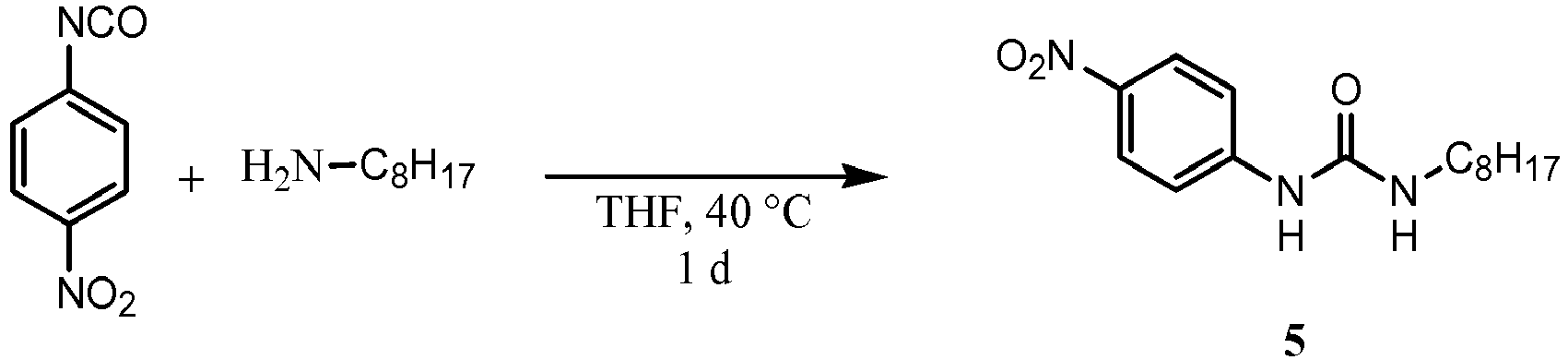
- A 100 mL two-necked flask, a three-way cock, a septum, a stirring bar, and a Dimroth condenser were assembled together, and the resultant container was dried with a heat gun. The container was purged with Ar, and then 1.55 g (9.45 mmol) of 4-nitrophenyl isocyanate was added. Subsequently, 40 mL of tetrahydrofuran and 3.06 mL (18.5 mmol) of octylamine were added in this order. The resultant mixture was stirred at 40°C for one day, and then the solvent was distilled off under reduced pressure. The resultant reaction product was reprecipitated with tetrahydrofuran and hexane, followed by suction filtration, to thereby produce a target compound (actual yield: 2.47 g, percent yield: 63%).
1H-NMR (400 MHz, DMSO-d6) δ = 9.19 (1H, s), 8.12 (2H, d, J = 9.3 Hz), 7.60 (2H, d, J = 9.3 Hz), 6.41 (1H, s), 3.08 (2H, q, J = 6.5 Hz), 1.42 (2H, s), 1.25 (11H, s), 0.83 (3H, t, J = 6.8H).
- A 200 mL three-necked flask, a three-way cock, a septum, and a stirring bar were assembled together, and the resultant container was dried with a heat gun. After the container was purged with Ar, 355 mg (1.21 mmol) of compound 5 was added, and the container was flushed with Ar. Subsequently, 140 mg of a palladium/carbon catalyst (Pd/C) was added, and the container was flushed with Ar. To the container, 50 mL of methanol was added, and the container was purged with hydrogen, followed by stirring of the mixture at room temperature for 40 minutes. The resultant reaction mixture was filtered, and the filtrate was distilled off under reduced pressure, to thereby produce a target compound as a white solid (actual yield: 306 mg, percent yield: 96%).
1H-NMR (DMSO-d6) δ = 7.80 (1H, s), 6.98 (2H, d, J = 8.8 Hz), 6.45 (2H, d, J = 8.3 Hz), 5.85 (1H, s), 4.64 (1H, s), 3.01 (2H, q, J = 6.5 Hz), 1.38 (2H, s), 1.25 (11H, s), 0.86 (3H, t, J = 6.8 Hz).
- A Schlenk flask, a stirring bar, and a septum were assembled together, and the resultant container was dried with a heat gun. To the container, 108 mg (0.380 mmol) of compound 6 and 149 mg (0.436 mmol) of β-lactose were added, and then 3.0 mL of methanol was added. The resultant mixture was stirred under reflux (about 65°C) for three days, and then the resultant precipitate was separated by filtration. The product obtained by filtration was washed twice with cold water, to thereby produce a compound of Formula 7 as a mauve solid (actual yield: 0.139 g, percent yield: 63%).
1H-NMR (DMSO-d6) δ = 7.90 (1H, s), 7.08 (2H, d, J = 8.8 Hz), 6.58 (2H, d, J = 9.3 Hz), 5.90-5.87 (2H, m), 5.10 (1H, d, J = 3.9 Hz), 4.96 (1H, d, J = 5.4 Hz), 4.78 (1H, d, J = 4.9 Hz), 4.71 (1H, s), 4.67 (1H, t, J = 5.1 Hz), 4.50 (2H, dd, J = 12.4, 5.1 Hz), 4.35 (1H, t, J = 8.0 Hz), 4.23 (1H, d, J = 6.8 Hz), 3.70 (1H, dd, J = 10.0, 5.1 Hz), 3.02 (2H, q, J = 6.5 Hz), 1.39 (2H, t, J = 6.3 Hz), 1.26 (11H, s), 0.86 (3H, t, J = 6.8 Hz). -

- A 200 mL two-necked flask, a three-way cock, and a stirring bar were assembled together, and the resultant container was dried with a heat gun. To the container, 0.49 mL (4.27 mmol) of cyclohexylamine and 0.700 g (4.27 mmol) of 4-nitrophenyl isocyanate were added, and the container was flushed with Ar. After addition of 40 mL of tetrahydrofuran, 0.49 mL (4.27 mmol) of cyclohexylamine was added, and the mixture was stirred at room temperature for one day. Thereafter, the solvent was distilled off, and the resultant reaction product was reprecipitated with tetrahydrofuran and hexane, followed by suction filtration, to thereby produce a target compound as a white solid (actual yield: 1.06 g, percent yield: 95%).
1H-NMR (ACETONE-d6) δ = 8.42 (1H, s), 8.13 (2H, td, J = 9.3, 2.4 Hz), 7.71 (2H, dt, J = 9.3, 2.4 Hz), 5.92 (1H, s), 3.62 (1H, s), 1.93-1.90 (2H, m), 1.72-1.70 (2H, m), 1.61-1.58 (1H, m), 1.40-1.34 (2H, m), 1.28-1.18 (3H, m).
- A 500 mL three-necked flask, a three-way cock, a septum, and a stirring bar were assembled together, and the resultant container was dried with a heat gun. After the container was purged with Ar, 1.06 g (4.04 mmol) of compound 8 was added, and the container was flushed with Ar. Subsequently, 138 mg (14 wt%) of a palladium/carbon catalyst (Pd/C) was added, and the container was flushed with Ar. To the container, 150 mL of methanol was added, and the container was purged with hydrogen, followed by stirring of the mixture at room temperature for two hours. The resultant reaction mixture was filtered, and the filtrate was distilled off under reduced pressure, to thereby produce a target compound as a white solid (actual yield: 1.04 g, percent yield: 111%).
1H-NMR (DMSO-d6) δ = 7.74 (1H, s), 6.98 (2H, d, J = 8.8 Hz), 6.45 (2H, d, J = 8.3 Hz), 5.80 (1H, d, J = 8.3 Hz), 4.64 (1H, s), 1.76-1.73 (2H, m), 1.63-1.61 (2H, m), 1.52-1.49 (1H, m), 1.28-1.25 (2H, m), 1.13-1.10 (3H, m).
- A Schlenk flask, a stirring bar, and a septum were assembled together, and the resultant container was dried with a heat gun. To the container, 101 mg (0.434 mmol) of compound 9 and 150 mg (0.453 mmol) of β-lactose were added, and then 3 mL of methanol was added. The resultant mixture was stirred under reflux for four days, and then the resultant white precipitate was separated by filtration. The product obtained by filtration was washed with methanol and then washed with cold water, to thereby produce a compound of
Formula 10 as a white solid (actual yield: 92.2 mg, 38%).
1H-NMR (DMSO-d6) δ = 7.84 (1H, s), 7.08 (2H, d, J = 8.8 Hz), 6.58 (2H, d, J = 8.8 Hz), 5.91 (1H, d, J = 7.3 Hz), 5.84 (1H, d, J = 7.8 Hz), 5.10 (1H, d, J = 4.4 Hz), 4.97 (1H, d, J = 5.4 Hz), 4.79 (1H, d, J = 5.4 Hz), 4.72 (1H, s), 4.66 (1H, d, J = 5.4 Hz), 4.52-4.49 (2H, m), 4.35 (1H, t, J = 8.3 Hz), 4.23 (1H, d, J = 7.3 Hz). - Each of the three compounds synthesized in Example 1 was used as a hydrogelator and evaluated for its gelation ability in various aqueous solvents (pure water, phosphate buffer, saline, 30% 1,3-propanediol, 70% 1,3-propanediol, 30% ethanol, and 70% ethanol).
- The gelation test was performed as follows. The hydrogelator was weighed and added to a 2.0 mL screw-top sample vial, and each of the aqueous solvents was added to the vial, to thereby prepare a sample having a hydrogelator concentration of 1.0% by mass. Subsequently, the sample vial was heated on a hot plate at 120°C to thereby dissolve the hydrogelator in the solvent. Thereafter, the sample vial was left to stand still at room temperature overnight, followed by observation of gel formation.
- A sample was determined to undergo "gelation" in the case where the solution lost its fluidity after being left to stand still and cool, and thus the solution did not flow down even when the sample vial was inverted. Each symbol in the following table denotes the state of a formed gel (the same shall apply to other tables in the present specification hereinafter). Specifically, "G" denotes gelation, "PG" denotes partial gelation, "Sus" denotes the state of suspension, and "Sol" denotes the state where the solution flowed down when the sample vial was inverted, i.e., the solution had no viscosity. The symbol "nd" corresponds to a non-evaluated sample.
- The results of evaluation are shown in Table 1. Photographs of sample vials after being left to stand still are shown in
FIG. 1 (photographs of sample vials after being left to cool in the gelation test of the hydrogelator composed of the compound of Formula 4),FIG. 2 (photographs of sample vials after being left to cool in the gelation test of the hydrogelator composed of the compound of Formula 7), andFIG. 3 (photographs of sample vials after being left to cool in the gelation test of the hydrogelator composed of the compound of Formula 10).Table 1 Aqueous solvent Hydro gelator Compound of Formula 4 Compound of Formula 7 Compound of Formula 10Pure water G G G Phosphate buffer Sus Sus G Saline PG Sus G 30% 1,3-Propanediol PG G G 70% 1,3-Propanediol Sus G Sol 30% Ethanol G G G 70% Ethanol PG G Sol - As shown in Table 1, the hydrogelator of the present invention was found to have the ability to form a gel in aqueous solvents.
- Gelation was performed in aqueous solvents having different pH values (aqueous hydrochloric acid solution, pure water, and aqueous sodium hydroxide solution) to examine the pH responsiveness of gelation ability. The gelation test was performed in the same manner as described in [Example 2].
- The results of evaluation are shown in Table 2. Photographs of sample vials after being left to stand still are shown in
FIG. 4 (photographs of sample vials after being left to cool in the gelation test of the hydrogelator composed of the compound of Formula 4),FIG. 5 (photographs of sample vials after being left to cool in the gelation test of the hydrogelator composed of the compound of Formula 7), andFIG. 6 (photographs of sample vials after being left to cool in the gelation test of the hydrogelator composed of the compound of Formula 10).Table 2 Aqueous solvent pH Hydrogelator Compound of Formula 4 Compound of Formula 7 Compound of Formula 10Aqueous hydrochloric acid solution 1 Sus G Sol Aqueous hydrochloric acid solution 2 Sus Sus Sol Aqueous hydrochloric acid solution 3 G Sus G Aqueous hydrochloric acid solution 4 PG Sus G Aqueous hydrochloric acid solution 5 PG Sus G Pure water 7 G Sus G Aqueous sodium hydroxide solution 8 G Sus G Aqueous sodium hydroxide solution 9 PG G G Aqueous sodium hydroxide solution 10 G G G - As shown in Table 2, the hydrogelator of the present invention was found to have the ability to form a gel in aqueous solvents having a pH of 1 to 10.
- Each of the three compounds synthesized in Example 1 was used as a hydrogelator to obtain its minimum gelation concentration [i.e., concentration at which a gel is formed (excluding the case of partial gelation) to have such a strength that the gel does not break even when the sample vial is inverted] in various aqueous solvents [pure water, aqueous hydrochloric acid solution (pH 3), aqueous sodium hydroxide solution (pH 10), saline, 30% ethanol, 30% 1,3-propanediol, and 70% 1,3-propanediol]. The gelation test was performed in the same manner as described in [Example 2].
- The results of evaluation are shown in Table 3. Photographs of sample vials after being left to stand still are shown in
FIG. 7 (photographs of sample vials after being left to cool in the gelation test of the hydrogelator composed of the compound of Formula 4),FIG. 8 (photographs of sample vials after being left to cool in the gelation test of the hydrogelator composed of the compound of Formula 7), andFIG. 9 (photographs of sample vials after being left to cool in the gelation test of the hydrogelator composed of the compound of Formula 10).Table 3 Aqueous solvent Hydrogelator Compound of Formula 4 Compound of Formula 7 Compound of Formula 10Minimum gelation concentration (% by mass) Minimum gelation concentration (% by mass) Minimum gelation concentration (% by mass) Pure water 1.0 0.1 0.5 Aqueous hydrochloric acid solution (pH 3) 0.5 nd 1.0 Aqueous sodium hydroxide solution (pH 10) 1.0 0.1 0.5 Saline nd nd 0.5 30% Ethanol 1.0 0.1 nd 30% 1,3-Propanediol nd 0.1 1.0 70% 1,3-Propanediol nd 0.5 nd - As shown in Table 3, the hydrogelator of the present invention was found to have high gelation ability.
- The compound of
Formula 10 synthesized in Example 1 was used as a hydrogelator and evaluated for its gelation ability with respect to various gelation treatments [thermal treatment (40°C and 60°C), ultrasonic treatment, and vibration treatment]. - The gelation tests with these gelation treatments were performed as follows.
- A predetermined amount of the hydrogelator was weighed and added to 2.0 mL screw-top sample vials, and pure water was added to the vials, to thereby prepare samples having hydrogelator concentrations shown in Table 4 (0.5% by mass and 1.0% by mass). Subsequently, the sample vials were heated on a hot plate at 40°C for 15 minutes, to thereby dissolve the hydrogelator in pure water. Thereafter, the sample vials were left to stand still at room temperature for 30 minutes, followed by observation of gel formation.
- The thermal treatment was performed in the same manner as described in [Thermal Treatment (40°C)], except that the heating temperature was changed to 60°C.
- The hydrogelator was weighed and added to a 2.0 mL screw-top sample vial, and pure water was added to the vial, to thereby prepare a sample having a hydrogelator concentration of 1.0% by mass. Subsequently, the sample vial was subjected to ultrasonic treatment for 10 minutes with a Bransonic tabletop ultrasonic cleaner (2510J-DTH, available from Branson). Thereafter, the sample vial was left to stand still at room temperature for 30 minutes, followed by observation of gel formation.
- The hydrogelator was weighed and added to a 2.0 mL screw-top sample vial, and pure water was added to the vial, to thereby prepare a sample having a hydrogelator concentration of 1.0% by mass. Subsequently, vibration was applied to a bottom portion of the sample vial with a handy massager (available from Thrive) for about three minutes. Thereafter, the sample vial was left to stand still at room temperature for 30 minutes, followed by observation of gel formation.
- The results of evaluation are shown in Table 4. Photographs of sample vials after being left to stand still are shown in
FIG. 10 [photographs of sample vials after being left to cool following the thermal treatment (40°C) of the hydrogelator composed of the compound of Formula 10],FIG. 11 [photographs of sample vials after being left to cool following the thermal treatment (60°C) of the hydrogelator composed of the compound of Formula 10],FIG. 12 [a photograph of a sample vial after being left to stand still following the ultrasonic treatment of the hydrogelator composed of the compound of Formula 10], andFIG. 13 [a photograph of a sample vial after being left to stand still following the vibration treatment of the hydrogelator composed of the compound of Formula 10].Table 4 Gelation treatment Hydrogelator (Compound of Formula 10) 0.5% by mass 1.0% by mass Thermal treatment (40°C) G G Thermal treatment (60°C) G G Ultrasonic treatment nd G Vibration treatment nd G - As shown in Table 4, the hydrogelator of the present invention was found to have the ability to form a hydrogel not only by thermal treatment, but also by ultrasonic treatment or vibration treatment at room temperature.
-
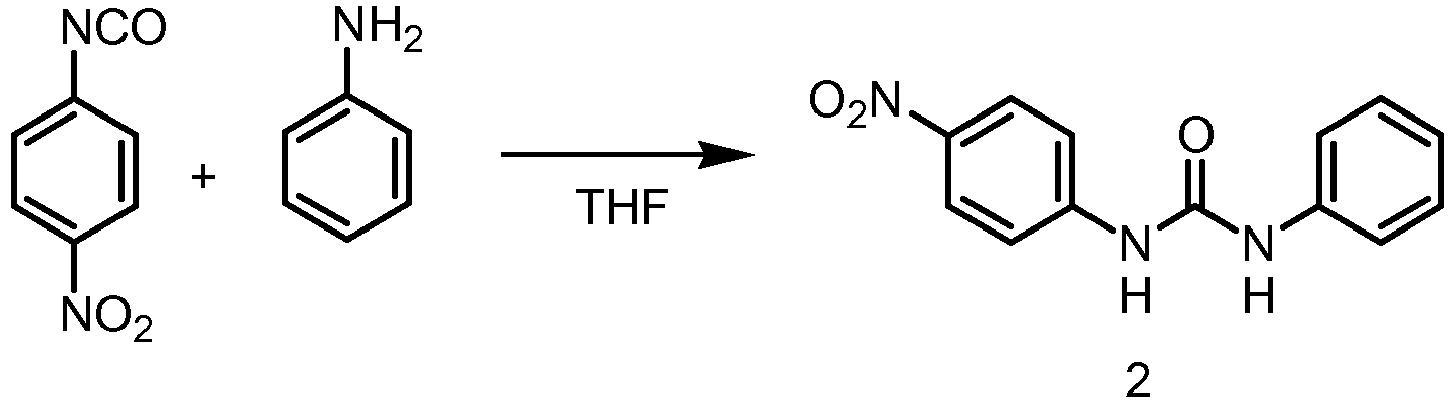
- To a 100 mL two-necked flask, 0.66 mL (7.30 mmol) of aniline, 600 mg (3.65 mmol) of 4-nitrophenyl isocyanate, and 36 mL of tetrahydrofuran (THF) were added, and the mixture was stirred in an argon (Ar) atmosphere at room temperature for two days. The solvent was distilled off under reduced pressure, and the resultant residue was reprecipitated with acetone and hexane, to thereby produce a target compound as a white solid (869 mg, 93%).

- To a 300 mL three-necked flask, 357 mg (1.39 mmol) of compound 2, 47 mg of a palladium/carbon catalyst (Pd/C), and 75 mL of ethanol (EtOH) were added, and the mixture was stirred in a hydrogen atmosphere at room temperature for one hour. The resultant reaction mixture was filtered, and then the solvent was distilled off under reduced pressure, to thereby produce a target compound as a white solid (285 mg, 90%).

- To a Schlenk flask, 100 mg (0.44 mmol) of compound 3, 151 mg (0.44 mmol) of β-lactose, and 2 mL of methanol (MeOH) were added, and the mixture was stirred in an Ar atmosphere at about 65°C for four days. The solvent was distilled off under reduced pressure, and the resultant solid was reprecipitated with dimethylformamide (DMF) and ethyl acetate. Subsequently, the resultant solid was washed with a small amount of cold water, to thereby produce a target compound as a brown solid (44.3 mg, 18%).
-

- To a 100 mL two-necked flask, 0.51 mL (3.08 mmol) of octylamine, 509 mg (3.10 mmol) of 4-nitrophenyl isocyanate, and 40 mL of DMF were added, and the mixture was stirred in an Ar atmosphere at about 60°C for two days. The solvent was distilled off under reduced pressure, and the resultant residue was reprecipitated with DMF and hexane, to thereby produce a target compound as a white solid (355 mg, 93%).

- To a 200 mL three-necked flask, 355 mg (1.21 mmol) of compound 5, 140 mg of Pd/C, and 50 mL of MeOH were added, and the mixture was stirred in a hydrogen atmosphere at room temperature for one hour. The resultant reaction mixture was filtered, and then the solvent was distilled off under reduced pressure, to thereby produce a target compound as a white solid (306 mg, 96%).

- To a Schlenk flask, 111 mg (0.42 mmol) of compound 6, 146 mg (0.42 mmol) of β-lactose, and 3 mL of MeOH were added, and the mixture was stirred in an Ar atmosphere at about 65°C for two days. The resultant reaction mixture was cooled to room temperature, and the resultant precipitate was separated by filtration. The resultant solid was washed with a small amount of cold water, to thereby produce a target compound as a pale purple solid (92 mg, 40%).
-

- To a 200 mL two-necked flask, 1.47 mL (13.1 mmol) of cyclohexylamine, 1.05 g (6.4 mmol) of 4-nitrophenyl isocyanate, and 60 mL of acetonitrile were added, and the mixture was stirred in an Ar atmosphere at room temperature for one day. The solvent was distilled off under reduced pressure, and the resultant residue was washed with acetonitrile, to thereby produce a target compound as a white solid (1.61 g, 95%).

- To a 500 mL three-necked flask, 1.02 g (3.86 mmol) of compound 8, 136 mg of Pd/C, 120 mL of MeOH, and 30 mL of EtOH were added, and the mixture was stirred in a hydrogen atmosphere at room temperature for two hours. The resultant reaction mixture was filtered, and then the solvent was distilled off under reduced pressure, to thereby produce a target compound as a white solid (0.86 g, 96%).

- To a Schlenk flask, 210 mg (0.90 mmol) of compound 9,326 mg (0.91 mmol) of β-lactose, 11.7 mg (0.09 mmol) of ammonium sulfate, and 20 mL of MeOH were added, and the mixture was stirred in an Ar atmosphere at about 65°C for four days. The solvent was distilled off under reduced pressure, and the resultant solid was washed with methanol, to thereby produce a target compound as a white solid (458 mg, 89%).
- To a sample vial, 5.05 mg of a hydrogelator (the compound of Formula 4 synthesized in Example 6) was weighed and added, and 500 µL of pure water was added to the vial, to thereby prepare a sample having a hydrogelator concentration of 1.0% by mass. Subsequently, the sample vial was heated on a hot plate at 120°C to thereby dissolve the hydrogelator in pure water. Thereafter, the resultant solution was left to stand still at room temperature, resulting in formation of a white turbid hydrogel.
FIG. 14 shows a photograph of the sample vial after being left to cool in the gelation test. - To sample vials, 0.52 mg and 2.51 mg of a hydrogelator (the compound of Formula 7 synthesized in Example 6) were weighed and added, and 500 µL of pure water was added to the vials, to thereby prepare samples having hydrogelator concentrations of 0.1% by mass and 0.5% by mass. Subsequently, the sample vials were heated on a hot plate at 120°C to thereby dissolve the hydrogelator in pure water. Thereafter, the resultant solutions were left to stand still at room temperature, resulting in formation of hydrogels. The minimum gelation concentration was 0.1% by mass, and the thus-formed hydrogels exhibited transparency.
FIG. 15 shows photographs of the sample vials after being left to cool in the gelation test. - The compound of Formula 7 synthesized in Example 6 was able to form a gel not only in pure water, but also in an aqueous solution of hydrochloric acid or sodium hydroxide (pH: 4 to 9), saline, a mixture of ethanol and water, and a mixture of 1,3-propanediol and water.
- A hydrogelator (the compound of
Formula 10 synthesized in Example 6) and 500 µL of pure water were added to a sample vial, to thereby prepare a sample. Subsequently, the sample vial was heated on a hot plate at 120°C to thereby dissolve the hydrogelator in pure water. Thereafter, the resultant solution was left to stand still at room temperature, resulting in formation of a hydrogel. The minimum gelation concentration was 0.3% by mass, and the thus-formed hydrogel exhibited transparency.FIG. 16 shows a photograph of the sample vial after being left to cool in the gelation test. - A hydrogelator (the compound of
Formula 10 synthesized in Example 6) was added to sample vials, and pure water was added to the vials, to thereby prepare samples having hydrogelator concentrations of 0.1% by mass, 0.3% by mass, 0.5% by mass, 0.75% by mass, and 1.0% by mass. Subsequently, the sample vials were heated on a hot plate at 120°C to thereby dissolve the hydrogelator in pure water. Thereafter, the resultant solutions were left to stand still at room temperature. As a result, the solution having a hydrogelator concentration of 0.1% by mass exhibited no viscosity, i.e., the state of sol. In contrast, a hydrogel was formed in any of the other samples. The transmittances of the resultant sol and hydrogels were measured. The results are shown inFIG. 17 . - As shown in
FIG. 17 , the hydrogels of the samples having a hydrogelator concentration of 0.5% by mass or less exhibited high transparency, but the hydrogels of the samples having a hydrogelator concentration exceeding 0.5% by mass exhibited lower transmittance. - The compound of
Formula 10 synthesized in Example 6 was used as a hydrogelator and evaluated for its gelation ability with respect to vibration treatment. - The gelation test with vibration treatment was performed as follows.
- The hydrogelator and pure water were added to a sample vial to thereby prepare a sample. Subsequently, vibration was applied to a bottom portion of the sample vial with a vortex mixer for about five minutes (2,500 rpm). Thereafter, the sample vial was left to stand still at room temperature, resulting in formation of a hydrogel (
FIG. 18 ). The minimum gelation concentration was 0.5% by mass. - The compound of
Formula 10 synthesized in Example 6 was able to form a gel by vibration treatment not only in pure water, but also in an aqueous solution of hydrochloric acid or sodium hydroxide (pH: 3 to 10), saline, phosphate buffer, a mixture of ethanol and water, and a mixture of 1,3-propanediol and water. - To a sample vial, 5.0 mg of a hydrogelator (the compound of
Formula 10 synthesized in Example 6) was weighed and added, and 500 µL of pure water was added to the vial, to thereby prepare a sample having a hydrogelator concentration of 1.0% by mass. Subsequently, the sample vial was heated on a hot plate at 120°C to thereby dissolve the hydrogelator in pure water. Thereafter, the resultant solution was left to stand still at room temperature, resulting in formation of a hydrogel. The hydrogel was observed with a scanning electron microscope (SEM).FIG. 19 shows a scanning electron microscope (SEM) photograph of the hydrogel. - As shown in
FIG. 19 , a fibrous aggregate was observed. -

- To a 1 L two-necked flask, 4.39 g (55 mmol) of butylamine, 4.50 g (27 mmol) of 4-nitrophenyl isocyanate, and 200 mL of THF were added, and the mixture was stirred in an Ar atmosphere at about 40°C for one day. The solvent was distilled off under reduced pressure, and the resultant residue was reprecipitated with THF and hexane, to thereby produce a target compound as a white solid (5.91 g, 91%).

- To a 200 mL three-necked flask, 636 mg (2.68 mmol) of compound 11, 106 mg of Pd/C, and 100 mL of MeOH were added, and the mixture was stirred in a hydrogen atmosphere at room temperature for one hour. The resultant reaction mixture was filtered, and then the solvent was distilled off under reduced pressure, to thereby produce a target compound as a white solid (91%).

- To a 1 L two-necked flask, 2.02 g (9.75 mmol) of compound 12, 3.35 g (9.78 mmol) of β-lactose, and 150 mL of MeOH were added, and the mixture was stirred in an Ar atmosphere at about 50°C for six days. The solvent was distilled off under reduced pressure, and the resultant solid was reprecipitated with methanol and chloroform, to thereby produce a target compound as a pale purple solid (3.36 g, 65%).
-

- To a 1 L two-necked flask, 11.4 g (62 mmol) of dodecylamine, 5.06 g (31 mmol) of 4-nitrophenyl isocyanate, and 200 mL of THF were added, and the mixture was stirred in an Ar atmosphere at about 40°C for one day. The solvent was distilled off under reduced pressure, and the resultant residue was reprecipitated with THF and hexane, to thereby produce a target compound as a white solid (9.72 g, 90%).

- To a 200 mL three-necked flask, 5.11 g (14.6 mmol) of compound 14, 106 mg of Pd/C, and 460 mL of MeOH were added, and the mixture was stirred in a hydrogen atmosphere at room temperature for one day. The resultant reaction mixture was filtered, and then the solvent was distilled off under reduced pressure, to thereby produce a target compound as a white solid (3.54 g, 79%).

- To a 500 mL two-necked flask, 2.87 g (8.98 mmol) of compound 15, 3.09 g (9.03 mmol) of β-lactose, and 200 mL of MeOH were added, and the mixture was stirred in an Ar atmosphere at about 50°C for 12 days. The solvent was distilled off under reduced pressure, and the resultant solid was washed with methanol, to thereby produce a target compound as a pale purple solid (69%).
- A hydrogelator (the compound of Formula 13) was added to a sample vial, and 500 µL of pure water was added to the vial, to thereby prepare a sample. Subsequently, the sample vial was heated on a hot plate at 120°C to thereby dissolve the hydrogelator in pure water. Thereafter, the resultant solution was left to stand still at room temperature, resulting in formation of a hydrogel. The minimum gelation concentration was 1.0% by mass, and the thus-formed hydrogel exhibited semi-transparency.
FIG. 20 shows a photograph of the sample vial after being left to cool in the gelation test. - The compound of Formula 13 was able to form a gel not only in pure water, but also in an aqueous solution of hydrochloric acid or sodium hydroxide (pH: 4 to 10), saline, and a mixture of ethanol and water.
- A hydrogelator (the compound of Formula 16) and pure water were added to a sample vial to thereby prepare a sample. Subsequently, the sample vial was heated on a hot plate at 120°C to thereby dissolve the hydrogelator in pure water. Thereafter, the resultant solution was left to stand still at room temperature, resulting in formation of a suspension without gelation.
- However, the compound of
Formula 16 was able to form a gel in a mixture of ethanol and water and a mixture of 1,3-propanediol and water.
Claims (5)
- A hydrogelator comprising a compound of the following Formula [1]:
 (wherein Sg is a sugar group,A is a divalent linking group, andR is a linear or branched alkyl group having a carbon atom number of 1 to 15, a cyclic alkyl group having a carbon atom number of 3 to 15, a linear or branched alkenyl group having a carbon atom number of 2 to 15, or a C6-18 aryl group unsubstituted or substituted with at least one substituent selected from the group consisting of a C1-10 alkyl group, a C1-10 alkoxy group, a C6-18 aryloxy group, a halogen atom, a nitro group, a phenyl group, a C2-10 alkylcarbonyl group, and a C7-18 aralkyl group).
 - The hydrogelator according to claim 1, wherein the sugar group Sg is a monovalent group having a structure derived from a monosaccharide or a disaccharide.
- The hydrogelator according to claim 2, wherein the linking group A is a linear alkylene group having a carbon atom number of 1 to 15 or a C6-15 arylene group, and R is a linear alkyl group having a carbon atom number of 1 to 15, a cyclic alkyl group having a carbon atom number of 3 to 10, or a phenyl group unsubstituted or substituted with at least one substituent selected from the group consisting of a C1-10 alkyl group, a halogen atom, and a C7-18 aralkyl group.
- A hydrogel comprising the hydrogelator according to any one of claims 1 to 3 and an aqueous solvent.
- A compound of the following Formula [1]:
 (wherein Sg is a sugar group,A is a divalent linking group, andR is a linear or branched alkyl group having a carbon atom number of 1 to 15, a cyclic alkyl group having a carbon atom number of 3 to 15, a linear or branched alkenyl group having a carbon atom number of 2 to 15, or a C6-18 aryl group unsubstituted or substituted with at least one substituent selected from the group consisting of a C1-10 alkyl group, a C1-10 alkoxy group, a C6-18 aryloxy group, a halogen atom, a nitro group, a phenyl group, a C2-10 alkylcarbonyl group, and a C7-18 aralkyl group).
Applications Claiming Priority (2)
| Application Number | Priority Date | Filing Date | Title |
|---|---|---|---|
| JP2016202988 | 2016-10-14 | ||
| PCT/JP2017/037423 WO2018070546A1 (en) | 2016-10-14 | 2017-10-16 | Novel hydrogelator |
Publications (2)
| Publication Number | Publication Date |
|---|---|
| EP3524656A1 true EP3524656A1 (en) | 2019-08-14 |
| EP3524656A4 EP3524656A4 (en) | 2019-10-16 |
Family
ID=61905653
Family Applications (1)
| Application Number | Title | Priority Date | Filing Date |
|---|---|---|---|
| EP17859395.0A Withdrawn EP3524656A4 (en) | 2016-10-14 | 2017-10-16 | NEW HYDROGEL |
Country Status (7)
| Country | Link |
|---|---|
| US (1) | US20190241598A1 (en) |
| EP (1) | EP3524656A4 (en) |
| JP (1) | JP7133174B2 (en) |
| KR (1) | KR20190067167A (en) |
| CN (1) | CN109790439A (en) |
| TW (1) | TW201829710A (en) |
| WO (1) | WO2018070546A1 (en) |
Families Citing this family (3)
| Publication number | Priority date | Publication date | Assignee | Title |
|---|---|---|---|---|
| CA3060477A1 (en) | 2018-11-09 | 2020-05-09 | Windfield Solutions, Llc | Hydrogels as rheology modifiers and methods of making the same |
| JP2020132986A (en) * | 2019-02-25 | 2020-08-31 | 東京エレクトロン株式会社 | Composition for film deposition and film deposition method |
| CN112142805B (en) * | 2020-09-09 | 2022-03-25 | 江南大学 | N-alkylglucosamine small-molecule alcohol gel and preparation method and application thereof |
Family Cites Families (4)
| Publication number | Priority date | Publication date | Assignee | Title |
|---|---|---|---|---|
| JP3845252B2 (en) | 2000-08-07 | 2006-11-15 | 独立行政法人科学技術振興機構 | Organic solvent gelling agent comprising a compound having a cholesterol moiety and a sugar moiety |
| JP3947483B2 (en) | 2003-02-28 | 2007-07-18 | 財団法人野口研究所 | Diamide type gelling agent |
| JP5750798B2 (en) * | 2011-03-01 | 2015-07-22 | 国立研究開発法人産業技術総合研究所 | Sugar-derived low-molecular hydrogelator and hydrogel containing the hydrogelator as an active ingredient |
| US9115164B2 (en) * | 2011-03-10 | 2015-08-25 | National University Corporation Shizuoka University | Substituted aromatic compound, hydrogelation agent, hydrogel, and method for gelating aqueous sample |
-
2017
- 2017-10-16 JP JP2018545094A patent/JP7133174B2/en active Active
- 2017-10-16 EP EP17859395.0A patent/EP3524656A4/en not_active Withdrawn
- 2017-10-16 WO PCT/JP2017/037423 patent/WO2018070546A1/en not_active Ceased
- 2017-10-16 TW TW106135366A patent/TW201829710A/en unknown
- 2017-10-16 US US16/341,939 patent/US20190241598A1/en not_active Abandoned
- 2017-10-16 KR KR1020197009688A patent/KR20190067167A/en not_active Withdrawn
- 2017-10-16 CN CN201780061764.3A patent/CN109790439A/en active Pending
Also Published As
| Publication number | Publication date |
|---|---|
| CN109790439A (en) | 2019-05-21 |
| JP7133174B2 (en) | 2022-09-08 |
| WO2018070546A1 (en) | 2018-04-19 |
| TW201829710A (en) | 2018-08-16 |
| EP3524656A4 (en) | 2019-10-16 |
| KR20190067167A (en) | 2019-06-14 |
| JPWO2018070546A1 (en) | 2019-09-05 |
| US20190241598A1 (en) | 2019-08-08 |
Similar Documents
| Publication | Publication Date | Title |
|---|---|---|
| Kamkaew et al. | Aza-BODIPY dyes with enhanced hydrophilicity | |
| Narayanaswamy et al. | Stimuli-responsive colorimetric and NIR fluorescence combination probe for selective reporting of cellular hydrogen peroxide | |
| JP7133174B2 (en) | New hydrogelator | |
| Liang et al. | Biomass carbon dots derived from Wedelia trilobata for the direct detection of glutathione and their imaging application in living cells | |
| Bhangu et al. | Sono-transformation of tannic acid into biofunctional ellagic acid micro/nanocrystals with distinct morphologies | |
| Jiang et al. | A fluorescent sensor for folic acid based on crown ether-bridged bis-tetraphenylethylene | |
| Zhang et al. | A reversible and selective chemosensor based on intramolecular NH⋯ NH 2 hydrogen bonding for cyanide and pH detection | |
| Zhu et al. | A series of water-soluble A–π–A′ typological indolium derivatives with two-photon properties for rapidly detecting HSO 3−/SO 3 2− in living cells | |
| JP5885256B2 (en) | Triazine ring-containing polymer | |
| Wang et al. | A bright, red-emitting water-soluble BODIPY fluorophore as an alternative to the commercial Mito Tracker Red for high-resolution mitochondrial imaging | |
| Fu et al. | An ESIPT based naphthalimide chemosensor for visualizing endogenous ONOO− in living cells | |
| DE212021000240U1 (en) | Mononuclear transition metal complexes and photocatalysts containing them for the reduction of carbon dioxide | |
| Ma et al. | Enhanced singlet oxygen generation of a soft salt through efficient energy transfer between two ionic metal complexes | |
| Colak et al. | Synthesis, characterization, solution and antioxidant properties of novel tetrakis {4-[N-((3-dimethylamino) propyl) amide] phenoxy} nickel (II) phthalocyanine and its water soluble derivatives | |
| Yang et al. | Endoplasmic reticulum-targetable selenium-doped carbon nanodots with redox-responsive fluorescence for in situ free-radical scavenging in cells and mice | |
| KR20120110620A (en) | A fluorescent molecular imaging probe for detection of reactive oxygen species and a preparation method thereof | |
| Liu et al. | Fluorogenic probes for mitochondria and lysosomes via intramolecular photoclick reaction | |
| JP7066117B2 (en) | Oil gelling agent | |
| Wippel et al. | Interference of the polyphenol epicatechin with the biological chemistry of nitric oxide-and peroxynitrite-mediated reactions | |
| Heymann et al. | Visible light initiated release of calcium ions through photochemical electron transfer reactions | |
| Lambein et al. | Isolation and characterization of 2-(β, D-glucopyranosyl)-4alanyl-3-Isoxazolin-5-one: A second UV-sensitive heterocyclic α-amino acid from Pisum sativum L. | |
| Mai | SYNTHESIS OF SOME o-AMINOPHENOL DERIVATIVES AND ANTIOXIDANT ACTIVITIES | |
| JPWO2015087968A1 (en) | Method for purifying hyperbranched polymer containing triazine ring | |
| Porter et al. | Photochemistry of borazine. Preparation and characterization of isotopically substituted B-monoaminoborazines | |
| CN112142805B (en) | N-alkylglucosamine small-molecule alcohol gel and preparation method and application thereof |
Legal Events
| Date | Code | Title | Description |
|---|---|---|---|
| PUAI | Public reference made under article 153(3) epc to a published international application that has entered the european phase |
Free format text: ORIGINAL CODE: 0009012 |
|
| 17P | Request for examination filed |
Effective date: 20190508 |
|
| AK | Designated contracting states |
Kind code of ref document: A1 Designated state(s): AL AT BE BG CH CY CZ DE DK EE ES FI FR GB GR HR HU IE IS IT LI LT LU LV MC MK MT NL NO PL PT RO RS SE SI SK SM TR |
|
| AX | Request for extension of the european patent |
Extension state: BA ME |
|
| A4 | Supplementary search report drawn up and despatched |
Effective date: 20190918 |
|
| RIC1 | Information provided on ipc code assigned before grant |
Ipc: A61K 8/60 20060101ALI20190912BHEP Ipc: A61K 47/26 20060101ALI20190912BHEP Ipc: C09K 3/00 20060101AFI20190912BHEP Ipc: C07H 15/203 20060101ALI20190912BHEP |
|
| DAV | Request for validation of the european patent (deleted) | ||
| DAX | Request for extension of the european patent (deleted) | ||
| GRAP | Despatch of communication of intention to grant a patent |
Free format text: ORIGINAL CODE: EPIDOSNIGR1 |
|
| STAA | Information on the status of an ep patent application or granted ep patent |
Free format text: STATUS: GRANT OF PATENT IS INTENDED |
|
| INTG | Intention to grant announced |
Effective date: 20200615 |
|
| STAA | Information on the status of an ep patent application or granted ep patent |
Free format text: STATUS: THE APPLICATION IS DEEMED TO BE WITHDRAWN |
|
| 18D | Application deemed to be withdrawn |
Effective date: 20201027 |