EP3523967B1 - Procédé et dispositif de codage d'une vidéo - Google Patents
Procédé et dispositif de codage d'une vidéo Download PDFInfo
- Publication number
- EP3523967B1 EP3523967B1 EP17758197.2A EP17758197A EP3523967B1 EP 3523967 B1 EP3523967 B1 EP 3523967B1 EP 17758197 A EP17758197 A EP 17758197A EP 3523967 B1 EP3523967 B1 EP 3523967B1
- Authority
- EP
- European Patent Office
- Prior art keywords
- subblock
- splitting
- value
- block
- coding parameters
- Prior art date
- Legal status (The legal status is an assumption and is not a legal conclusion. Google has not performed a legal analysis and makes no representation as to the accuracy of the status listed.)
- Active
Links
Images





Classifications
-
- H—ELECTRICITY
- H04—ELECTRIC COMMUNICATION TECHNIQUE
- H04N—PICTORIAL COMMUNICATION, e.g. TELEVISION
- H04N19/00—Methods or arrangements for coding, decoding, compressing or decompressing digital video signals
- H04N19/10—Methods or arrangements for coding, decoding, compressing or decompressing digital video signals using adaptive coding
- H04N19/102—Methods or arrangements for coding, decoding, compressing or decompressing digital video signals using adaptive coding characterised by the element, parameter or selection affected or controlled by the adaptive coding
- H04N19/103—Selection of coding mode or of prediction mode
-
- H—ELECTRICITY
- H04—ELECTRIC COMMUNICATION TECHNIQUE
- H04N—PICTORIAL COMMUNICATION, e.g. TELEVISION
- H04N19/00—Methods or arrangements for coding, decoding, compressing or decompressing digital video signals
- H04N19/10—Methods or arrangements for coding, decoding, compressing or decompressing digital video signals using adaptive coding
- H04N19/102—Methods or arrangements for coding, decoding, compressing or decompressing digital video signals using adaptive coding characterised by the element, parameter or selection affected or controlled by the adaptive coding
- H04N19/119—Adaptive subdivision aspects, e.g. subdivision of a picture into rectangular or non-rectangular coding blocks
-
- H—ELECTRICITY
- H04—ELECTRIC COMMUNICATION TECHNIQUE
- H04N—PICTORIAL COMMUNICATION, e.g. TELEVISION
- H04N19/00—Methods or arrangements for coding, decoding, compressing or decompressing digital video signals
- H04N19/10—Methods or arrangements for coding, decoding, compressing or decompressing digital video signals using adaptive coding
- H04N19/134—Methods or arrangements for coding, decoding, compressing or decompressing digital video signals using adaptive coding characterised by the element, parameter or criterion affecting or controlling the adaptive coding
- H04N19/146—Data rate or code amount at the encoder output
- H04N19/147—Data rate or code amount at the encoder output according to rate distortion criteria
-
- H—ELECTRICITY
- H04—ELECTRIC COMMUNICATION TECHNIQUE
- H04N—PICTORIAL COMMUNICATION, e.g. TELEVISION
- H04N19/00—Methods or arrangements for coding, decoding, compressing or decompressing digital video signals
- H04N19/10—Methods or arrangements for coding, decoding, compressing or decompressing digital video signals using adaptive coding
- H04N19/169—Methods or arrangements for coding, decoding, compressing or decompressing digital video signals using adaptive coding characterised by the coding unit, i.e. the structural portion or semantic portion of the video signal being the object or the subject of the adaptive coding
- H04N19/17—Methods or arrangements for coding, decoding, compressing or decompressing digital video signals using adaptive coding characterised by the coding unit, i.e. the structural portion or semantic portion of the video signal being the object or the subject of the adaptive coding the unit being an image region, e.g. an object
- H04N19/176—Methods or arrangements for coding, decoding, compressing or decompressing digital video signals using adaptive coding characterised by the coding unit, i.e. the structural portion or semantic portion of the video signal being the object or the subject of the adaptive coding the unit being an image region, e.g. an object the region being a block, e.g. a macroblock
-
- H—ELECTRICITY
- H04—ELECTRIC COMMUNICATION TECHNIQUE
- H04N—PICTORIAL COMMUNICATION, e.g. TELEVISION
- H04N19/00—Methods or arrangements for coding, decoding, compressing or decompressing digital video signals
- H04N19/46—Embedding additional information in the video signal during the compression process
Definitions
- a method and an apparatus for encoding a video into a bitstream are disclosed.
- video compression methods usually divide the picture into a set of blocks of pixels.
- a picture is divided into Coding Tree Units (CTU), which size may be 64x64, 128x128 or 256x256 pixels.
- CTU Coding Tree Unit
- Each CTU may be further subdivided using a quad-tree division, where each leaf of the quad-tree is called a Coding Unit (CU).
- CU Coding Unit
- Each CU is then given some Intra or Inter prediction parameters. To do so, a CU is spatially partitioned into one or more Prediction Units (PU), a PU may have a square or a rectangular shape.
- PU Prediction Unit
- the Partitioning of a Coding Unit into Prediction Unit(s) is done according to a partition type, signaled in the bit-stream.
- a partition type signaled in the bit-stream.
- For Intra coding unit only the partition types 2Nx2N and NxN, illustrated on figure 1 , are allowed. This means only square Prediction Units are used in Intra Coding Units. On the contrary, Inter Coding Units can use all partition types shown on figure 1 .
- a Quad-Tree plus Binary-Tree (QTBT) coding tool (“ Algorithm Description of Joint Exploration Test Model 3", Document JVET-C1001_v3, Joint Video Exploration Team of ISO/IEC JTC1/SC29/WG11, 3rd meeting, 26th May-1st June 2015, Geneva, CH ) , provides a CTU representation for representing picture data in a more flexible way than the units arrangement of the HEVC standard.
- the Quad-Tree plus Binary-Tree (QTBT) coding tool consists in a coding tree where coding units can be split both in a quad-tree and in a binary-tree fashion. Such coding tree representation of a Coding Tree Unit is illustrated on figure 2A , where solid lines indicate quad-tree partitioning and dotted lines indicate binary partitioning of a CU.
- the splitting of a coding unit is decided on the encoder side through a rate distortion optimization procedure, which consists in determining the QTBT representation of the CTU with minimal rate distortion cost.
- a CU has either a square or a rectangular shape.
- the size of coding unit is always a power of 2, and typically goes from 4 to 128.
- the QTBT decomposition of a CTU is made of two stages: first the CTU is split in a quad-tree fashion, then each quad-tree leaf can be further divided in a binary fashion, as illustrated on fig. 2B , where solid lines represent the quad-tree decomposition phase and dotted lines represent the binary decomposition that is spatially embedded in the quad-tree leaves.
- a given block may be encoded through different splitting paths, as can be seen on figure 3 .
- the sub CU (hashed filled on figure 3 ) may be obtained by:
- an apparatus for encoding a video is disclosed as set out in the appended claims.
- the present disclosure also provides a computer readable storage medium having stored thereon instructions for encoding a video according to any one of the embodiments described in the disclosure.
- the different steps of the method for encoding a video as described here above are implemented by one or more software programs or software module programs comprising software instructions intended for execution by a data processor of an apparatus for encoding a video, these software instructions being designed to command the execution of the different steps of the method according to the present principles.
- a computer program is also disclosed that is capable of being executed by a computer or by a data processor, this program comprising instructions to command the execution of the steps of a method for encoding a video as mentioned here above.
- This program can use any programming language whatsoever and be in the form of source code, object code or intermediate code between source code and object code, such as in a partially compiled form or any other desirable form whatsoever.
- the information carrier can be any entity or apparatus whatsoever capable of storing the program.
- the carrier can comprise a storage means such as a ROM, for example a CD ROM or a microelectronic circuit ROM or again a magnetic recording means, for example a floppy disk or a hard disk drive.
- the information carrier can be a transmissible carrier such as an electrical or optical signal which can be conveyed via an electrical or optical cable, by radio or by other means.
- the program according to the present principles can be especially uploaded to an Internet type network.
- the information carrier can be an integrated circuit into which the program is incorporated, the circuit being adapted to executing or to being used in the execution of the methods in question.
- the methods/apparatus may be implemented by means of software and/or hardware components.
- module or “unit” can correspond in this document equally well to a software component and to a hardware component or to a set of hardware and software components.
- a software component corresponds to one or more computer programs, one or more sub-programs of a program or more generally to any element of a program or a piece of software capable of implementing a function or a set of functions as described here below for the module concerned.
- Such a software component is executed by a data processor of a physical entity (terminal, server, etc) and is capable of accessing hardware resources of this physical entity (memories, recording media, communications buses, input/output electronic boards, user interfaces, etc).
- a hardware component corresponds to any element of a hardware unit capable of implementing a function or a set of functions as described here below for the module concerned. It can be a programmable hardware component or a component with an integrated processor for the execution of software, for example an integrated circuit, a smartcard, a memory card, an electronic board for the execution of firmware, etc.
- a picture may be partitioned into coding tree units (CTU) of square shape with a configurable size.
- CTU coding tree units
- a consecutive set of coding tree units may be grouped into a slice.
- a CTU is the root of a QTBT partitioning into Coding Units (CU).
- Figure 4 illustrates a block diagram of an exemplary encoder for encoding a video according to an embodiment of the present principle.
- the video encoder 30 disclosed here below may be conforming to any video or still picture encoding schemes.
- a picture is encoded by the encoder modules as described below.
- the video encoder 30 may include several modules for block-based video encoding, as illustrated in figure 4 .
- a picture I to be encoded is input to the video encoder 30.
- the picture I is first subdivided into a set of blocks by a subdividing module.
- Each block (BLK) of the picture I is then processed for encoding.
- a block may correspond to a coding unit from a QTBT partitioning.
- encoding and decoding processes described below are for illustration purposes. According to some embodiments, encoding or decoding modules may be added, or removed or may vary from the following modules. However, the principle disclosed herein could still be applied to these variants.
- the mode selection unit may also decide whether splitting of the block is needed according to rate/distortion optimization. In that case, the mode selection unit then operates for each subblock of the block BLK.
- the block mode selection unit performs the encoding of the block for each candidate coding mode for the block or subblocks of the block when the block has been further split and computes a rate-distortion cost for each of these coding modes.
- the coding mode providing the lowest rate-distortion cost is selected as the best coding mode for the current block BLK.
- a candidate coding mode may be any coding mode available for coding the block and depends on the video compression standards used. For instance, for an HEVC coder, candidate coding modes may be chosen from one of the 36 intra prediction modes, an inter prediction mode using an estimated motion vector, a merge coding mode deriving motion information from spatial and/or temporal neighbor blocks, etc..
- rate-distortion optimization is performed and when splitting of the current block is allowed, all available splitting modes of the current block are evaluated.
- Figure 5 illustrates different splitting modes for a current block.
- the QT_SPLIT results in 4 subblocks.
- the HOR and VER respectively results in 2 subblocks.
- the NO_SPLIT mode corresponds to the case wherein the current block is not split, it can thus be understood as resulting in one subblock of same width and height as the current block.
- rate-distortion optimization is performed for each of the subblocks of the current block resulting from the splitting mode and splitting syntax has to be taken into account when determining the rate-distortion cost associated to the splitting mode for the current block.
- the subblocks of the current block resulting from a splitting mode may be further split according to the available splitting modes or these subblocks.
- a subblock may be assigned a tree depth to indicate the number of successive splittings needed to reach that subblock.
- the mode selection unit delivers a predicted block PRED and corresponding syntax elements to be coded in the bitstream for performing the same block prediction at a decoder.
- the predicted block PRED is formed by the set of predicted subblocks delivered by the mode selection unit for each subblocks.
- a residual block RES is then obtained by subtracting the predicted block PRED from the original block BLK.
- the residual block RES is then transformed by a transform processing module delivering a transform block TCOEF of transformed coefficients.
- the transform block TCOEF is then quantized by a quantization module delivering a quantized transform block QCOEF of quantized residual transform coefficients.
- the syntax elements and quantized residual transform coefficients of the block QCOEF are then input to an entropy coding module to deliver coded data to form the coded bitstream STR.
- the quantized residual transform coefficients of the quantized transform block QCOEF are processed by an inverse quantization module delivering a block TCOEF' of dequantized transform coefficients.
- the block TCOEF' is passed to an inverse transform module for reconstructing a block of residual prediction RES'.
- the reconstructed block REC is stored in memory for use by a picture reconstruction module.
- the picture reconstruction module performs reconstruction of a decoded version I' of the picture I from the reconstructed blocks REC.
- the reconstructed picture I' is then added to a reference picture memory for later use as a reference picture for encoding the following pictures of the set of pictures to code or for encoding subsequent blocks of the picture I.
- the rate-distortion optimization for subblocks resulting from a splitting mode of the current block is done multiple times.
- a method for encoding a video is disclosed below wherein for a subblock resulting from a first splitting mode of the current block and corresponding to a subblock resulting from a second splitting mode of the current block, a rate-distortion optimization performed for that subblock may re-use coding parameters previously estimated for that subblock when the first splitting mode of the current block has been evaluated.
- a parameter CUcache(p, w, h) is associated to a subblock resulting from a splitting of the current block, or from the splitting of a subblock of the current block.
- a parameter indicates whether coding parameters have already been estimated for that subblock or not.
- block or CU may be used indifferently to designate a block.
- subblock or sub-CU may be used indifferently to designate a subblock, wherein subblock is a block at a higher depth level resulting from a splitting of a parent block into at least one subblock.
- subblock or block depending on the depth the entity is considered.
- the block being split has a lower depth (for instance 0), than a subblock resulting from the splitting (for instance depth of a subblock is 1).
- depth of the resulting subblocks is increased.
- rate-distortion optimization is performed in a recursive fashion on the subblocks of the splitting tree. Therefore, a subblock resulting from a splitting of a block may be referred as a block when the splitting of this subblock is considered.
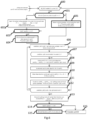
- Figure 6 illustrates a flow diagram of an exemplary method for encoding a video.
- the parameter CUcache can take two possible values, for instance 0 or 1.
- a resulting rate distortion cost associated to current CU, in the NO_SPLIT splitting configuration, noted RDcost ( currCU,NO_SPLIT ) is computed by encoding the current CU with the optimal coding parameters P * and also by integrating the rate cost associated to the splitting syntax used to signal the NO_SPLIT configuration for the current CU.
- a rectangular block is characterized in a term of relative shape (here shape means parameter related to the CU state that results from a series of splitting operations).
- shape means parameter related to the CU state that results from a series of splitting operations.
- the block is often characterized by his QT depth (where QT depth is the number of successive QT splits). This is used for example to select the contextual information of the entropy coding of coding parameters associated with the block.
- coding parameters that are signaled based on shape-dependent contextual information may concern the flag that indicates the use of adaptive transform of the coefficients of the current CU.
- step 604 mode decision and RDcost estimated at step 602 are stored in a cache memory for further use.
- the causality of the current CU is not changed for example for a first sub-CU resulting from a splitting of a parent CU.
- step 604 it is checked in step 603 whether the current CU under evaluation is a first sub-CU from the sub-CUs resulting from a splitting of a parent CU, according to a scanning order of the sub-CUs resulting from the splitting of the parent CU. For instance, it is checked if the position of the sub-CU is the same as the position of its parent CU, i.e. an index of the sub CU is 0 or not.
- Exemplary scanning orders of the sub-CUs resulting from a splitting of a parent CU are illustrated on figure 5 for the splitting modes HOR, VER, QT_SPLIT. On figure 5 , the number inside a sub-CU represents the order of the sub CU in the scanning order. Other scanning orders are also possible.
- step 606 If the current CU under evaluation is not a first sub-block from the sub-CUs resulting from a splitting of a parent CU, then the process passes to step 606.
- a candidate splitting mode is selected from the set of splitting mode, for instance the first splitting mode in the list.
- step 608 the current CU is divided into 2 or 4 smaller sub-CUs, according to the current candidate splitting mode. If the splitting mode corresponds to a binary splitting configuration, then 2 sub-CUs are obtained, with respective size according to the block spatial division illustrated by figure 3 . In case the current candidate splitting mode is equal to QT_SPLIT, then 4 sub-CUs with a same size ( width /2 , height /2) are obtained.
- step 609 once the sub coding units are obtained, a loop over each obtained sub-CU is performed. For each obtained sub-CU, the current process of figure 6 is called in a recursive way. This results in obtaining a set of optimal coding parameters for each obtained subCU.
- a Rate Distortion cost associated to the current CU and the current candidate splitting mode, noted RDcost ( currCU, candidate _ split _ mode ) is thus obtained.
- step 612 it is checked whether all available candidate splitting modes have been evaluated. If this is not the case, the process passes to step 606. Otherwise, the process passes to step 613.
- step 606 the next candidate splitting mode from the set S of candidate splitting modes is selected and the process is iterated from step 607 for such a next candidate splitting mode.
- step 613 all available candidate splitting modes have been evaluated.
- the candidate splitting mode bestSplitMode with the lowest RD cost is chosen among all candidate splitting modes that have been evaluated, i.e. for which a rate-distortion cost has been computed and stored.
- the sub CU (hatshed filled on figure 7 ) may be obtained from a parent CU (represented by bolded dotted lines on figure 7 ) split according to the following splitting paths:
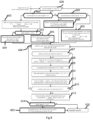
- the parameter CUcache associated to a sub-CU may take 3 possible values, for instance 0 and 1 may have a same meaning as disclosed with figure 6 , and a third value of 2 indicates that coding parameters already estimated are used as a starting point or to reduce the search ranges of the coding parameters when estimating the new coding parameters for the sub-CU.
- step 800 it is checked whether the parameter CUcache associated to the current sub-CU under evaluation (position, width, height), is 0 or not.
- step 601 If the parameter CUcache is not 0, then the process goes to step 601 wherein it is checked if the parameter CUcache is 1 or not. If so, the process goes to step 605 to restore the previously estimated coding parameters for the current sub-CU. Otherwise, the parameter CUcache has a value equal to 2, therefore the process goes to step 802.
- step 802 when the parameter CUcache has a value 2 for the current sub CU, already estimated coding parameters are partially re-used in the NO_SPLIT splitting mode of the current sub-CU.
- the best coding parameters noted P* (prediction mode, intra prediction angle, intra smoothing mode, motion vector, transform index 8) are being searched for the current sub-CU.
- P* prediction mode, intra prediction angle, intra smoothing mode, motion vector, transform index .
- splitting mode candidates HOR, VER, QT _SPLIT
- step 800 when the parameter CUcache is 0, the process goes to step 602 where full search for determining optimal coding parameters is performed.
- the cache memory and the parameter CUcache is updated at the end of the process.
- step 803 the parameter CUcache is changed from 1 to 2 for the current position, for all the block sizes, and unchanged if its value is 0 or 2.
- Figure 9 illustrates different splitting paths leading to a same splitting configuration of a sub CU.
- a current sub-CU to evaluate is shown filled with hatshed lines. It can be seen from figure 9 , that even if different splitting paths of the parent CU of the current sub-CU lead to the current sub-CU, a same splitting configuration of the current sub-CU is found.
- the current sub-CU can be obtained by:
- the current sub-CU is split into 4 sub-CUs and the top-right sub-CU has been further split horizontally.
- coding parameters estimated at a higher depth for a sub-CU are stored and re-used, including splitting configuration of the sub-CU.
- the splitting configuration and coding parameters of the block are reused.
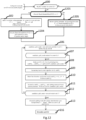
- step 1001 checking if the parameter CUcache associated to the current CU under evaluation is 1 is performed at the beginning of the process, before step 600. In this way, when the value of the parameter CUcache is 1, in step 1005, coding parameters already estimated for the current CU are restored (in a similar manner as in step 605 disclosed with figure 6 ) and the rate-distortion optimization for determining coding parameters and a best splitting mode for the current CU is by-passed.
- some normative and syntax limitations of current video compression standard should be removed.
- quadtree splitting is not allowed after a binary splitting.
- the binary tree depth is limited.
- the order of the coding tree exploration has an impact on the datas being stored in the memory cache.
- the maximum Binary Splitting Depth limitation is removed or set to a larger value, so that a sub-CU issued from a binary splitting may be further split.
- the Quadtree limitation is also removed, including the associated QTSplit syntax.
- all the quadtree splitting can be obtained with binary tree syntax, for instance by horizontal splitting followed by vertical splitting of the top and bottom sub-CUs.
- cache memory is optimally allocated and used so that already estimated coding parameters can be optimally re-used each time it is applicable.
- estimated coding parameters are stored in cache memory each time a current CU might be re-used, and without overwriting existing coding parameters already estimated for the current CU that might be re-used later.
- step 1201 if the value of the parameter CUcache is 1, the process goes to step 1205, wherein already estimated coding parameters are read from the cache memory thanks to the unique identifier. The coding parameters are then restored for the current sub-CU in a similar manner as in step 605 disclosed with figure 6 .
Landscapes
- Engineering & Computer Science (AREA)
- Multimedia (AREA)
- Signal Processing (AREA)
- Compression Or Coding Systems Of Tv Signals (AREA)
Claims (3)
- Procédé comprenant le codage d'une vidéo, dans lequel le codage de la vidéo comprend, pour au moins un bloc courant d'une image de ladite vidéo :la détermination (613) d'un mode de division pour le bloc courant parmi un ensemble de modes de divisions candidats qui inclut aucune division, une division horizontale, une division verticale et une division d'arbre quaternaire, en fonction des coûts débit-distorsion déterminés pour le bloc courant dans chacun des modes de division candidats, le mode de division déterminé étant le mode de division candidat qui présente le coût débit-distorsion le plus bas, etle codage (616) du bloc courant selon le mode de division déterminé ;dans lequel la détermination du mode de division pour le bloc courant comprend la division récursive (608) du bloc courant en sous-blocs selon chacun des modes de division candidats (606), et pour chacun des modes de division candidats, la détermination d'un coût débit-distorsion pour chacun des sous-blocs obtenus avec le mode de division candidat, où la détermination (609) d'un coût débit-distorsion pour un sous-bloc qui n'est pas divisé (600) comprend les étapes suivantes : déterminer, pour le sous-bloc, si une valeur d'un paramètre associé au sous-bloc est égale à une première valeur (800) indiquant qu'aucun paramètre de codage n'a été précédemment déterminé pour le sous-bloc,si la valeur du paramètre est égale à la première valeur, déterminer pour le sous-bloc (602) le coût débit-distorsion en déterminant les paramètres de codage du sous-bloc et en définissant le paramètre associé au sous-bloc sur une valeur donnée qui indique que les paramètres de codage ont été déterminés pour le sous-bloc, où la valeur donnée est égale à une deuxième valeur (604) lorsque le sous-bloc est un premier sous-bloc d'un bloc dans un ordre de balayage des sous-blocs du bloc (603) divisé selon un premier mode de division, et la valeur donnée est égale à une troisième valeur (801) lorsque le sous-bloc n'est pas un premier sous-bloc du bloc dans l'ordre de balayage des sous-blocs du bloc (603),sinon, si la valeur du paramètre associé au sous-bloc est égale à la deuxième valeur (601), définir (605) les paramètres de codage et le coût débit-distorsion du sous-bloc sur les paramètres de codage et le coût débit-distorsion précédemment déterminés pour un autre sous-bloc du bloc lorsque le bloc est divisé selon un deuxième mode de division, où l'autre sous-bloc se trouve à la même position dans l'image que le sous-bloc et l'autre sous-bloc a la même largeur et la même hauteur que le sous-bloc ; sinon, la valeur du paramètre associé au sous-bloc étant égale à la troisième valeur (601), déterminer (802) le coût débit-distorsion pour le sous-bloc en déterminant, pour le sous-bloc, les paramètres de codage du sous-bloc en utilisant les paramètres de codage précédemment déterminés pour l'autre sous-bloc comme point de départ.
- Appareil de codage d'une vidéo comprenant, pour au moins un bloc courant d'une image de ladite vidéo, des moyens pour :déterminer (613) un mode de division pour le bloc courant parmi un ensemble de modes de divisions candidats qui inclut aucune division, une division horizontale, une division verticale et une division d'arbre quaternaire, en fonction des coûts débit-distorsion déterminés pour le bloc courant dans chacun des modes de division candidats, le mode de division déterminé étant le mode de division candidat qui présente le coût débit-distorsion le plus bas, etcoder (616) le bloc courant selon le mode de division déterminé ;dans lequel la détermination du mode de division pour le bloc courant comprend la division récursive (608) du bloc courant en sous-blocs selon chacun des modes de division candidats (606), et pour chacun des modes de division candidats, la détermination d'un coût débit-distorsion pour chacun des sous-blocs obtenus avec le mode de division candidat, où la détermination (609) d'un coût débit-distorsion pour un sous-bloc qui n'est pas divisé (600) comprend les étapes suivantes :sinon, la valeur du paramètre associé au sous-bloc étant égale à la troisième valeur (601), déterminer (802) le coût débit-distorsion pour le sous-bloc en déterminant, pour le sous-bloc, les paramètres de codage du sous-bloc en utilisant les paramètres de codage précédemment déterminés pour l'autre sous-bloc comme point de départ.déterminer, pour le sous-bloc, si une valeur d'un paramètre associé au sous-bloc est égale à une première valeur (800) indiquant qu'aucun paramètre de codage n'a été précédemment déterminé pour le sous-bloc,si la valeur du paramètre est égale à la première valeur, déterminer pour le sous-bloc le coût débit-distorsion en déterminant les paramètres de codage du sous-bloc et en définissant le paramètre associé au sous-bloc sur une valeur donnée qui indique que les paramètres de codage ont été déterminés pour le sous-bloc, où la valeur donnée est égale à une deuxième valeur (604) lorsque le sous-bloc est un premier sous-bloc d'un bloc dans un ordre de balayage des sous-blocs du bloc (603) divisé selon un premier mode de division, et la valeur donnée est égale à une troisième valeur (801) lorsque le sous-bloc n'est pas un premier sous-bloc du bloc dans l'ordre de balayage des sous-blocs du bloc (603),sinon, si la valeur du paramètre associé au sous-bloc est égale à la deuxième valeur (601), définir (605) les paramètres de codage et le coût débit-distorsion du sous-bloc sur les paramètres de codage et le coût débit-distorsion précédemment déterminés pour un autre sous-bloc du bloc lorsque le bloc est divisé selon un deuxième mode de division, où l'autre sous-bloc se trouve à la même position dans l'image que le sous-bloc et l'autre sous-bloc a la même largeur et la même hauteur que le sous-bloc ;
- Support non transitoire lisible sur ordinateur incluant des instructions pour conduire un ou plusieurs processeurs à exécuter le procédé selon la revendication 1.
Applications Claiming Priority (2)
| Application Number | Priority Date | Filing Date | Title |
|---|---|---|---|
| EP16306323.3A EP3306928A1 (fr) | 2016-10-07 | 2016-10-07 | Procédé et dispositif de codage d'une vidéo |
| PCT/EP2017/071844 WO2018065153A1 (fr) | 2016-10-07 | 2017-08-31 | Procédé et appareil d'encodage de vidéo |
Publications (2)
| Publication Number | Publication Date |
|---|---|
| EP3523967A1 EP3523967A1 (fr) | 2019-08-14 |
| EP3523967B1 true EP3523967B1 (fr) | 2025-07-02 |
Family
ID=57138021
Family Applications (2)
| Application Number | Title | Priority Date | Filing Date |
|---|---|---|---|
| EP16306323.3A Withdrawn EP3306928A1 (fr) | 2016-10-07 | 2016-10-07 | Procédé et dispositif de codage d'une vidéo |
| EP17758197.2A Active EP3523967B1 (fr) | 2016-10-07 | 2017-08-31 | Procédé et dispositif de codage d'une vidéo |
Family Applications Before (1)
| Application Number | Title | Priority Date | Filing Date |
|---|---|---|---|
| EP16306323.3A Withdrawn EP3306928A1 (fr) | 2016-10-07 | 2016-10-07 | Procédé et dispositif de codage d'une vidéo |
Country Status (6)
| Country | Link |
|---|---|
| US (1) | US10965938B2 (fr) |
| EP (2) | EP3306928A1 (fr) |
| JP (1) | JP6837545B2 (fr) |
| KR (1) | KR102318065B1 (fr) |
| CN (1) | CN110024397B (fr) |
| WO (1) | WO2018065153A1 (fr) |
Families Citing this family (8)
| Publication number | Priority date | Publication date | Assignee | Title |
|---|---|---|---|---|
| CN110870315B (zh) | 2017-07-06 | 2023-12-01 | Lx 半导体科技有限公司 | 用于对图像进行编码/解码的方法和装置以及存储比特流的记录介质 |
| WO2020073882A1 (fr) * | 2018-10-08 | 2020-04-16 | Huawei Technologies Co., Ltd. | Décodeur vidéo et procédés correspondants |
| WO2020098803A1 (fr) * | 2018-11-15 | 2020-05-22 | Beijing Bytedance Network Technology Co., Ltd. | Harmonisation entre un mode affine et d'autres outils de codage inter |
| CN113170111B (zh) * | 2018-12-08 | 2024-03-08 | 北京字节跳动网络技术有限公司 | 视频处理方法、装置和计算机可读存储介质 |
| CN114501026B (zh) * | 2022-02-17 | 2023-04-14 | 北京百度网讯科技有限公司 | 视频编码方法、装置、设备及存储介质 |
| CN116489372B (zh) * | 2023-04-18 | 2025-09-16 | 广东博华超高清创新中心有限公司 | 一种直播场景自适应视频编码方法 |
| CN116405665A (zh) * | 2023-04-25 | 2023-07-07 | 腾讯科技(深圳)有限公司 | 编码方法、装置、设备及存储介质 |
| CN116501537B (zh) * | 2023-06-26 | 2023-09-19 | 苏州浪潮智能科技有限公司 | 磁盘阵列切换方法、系统、电子设备及存储介质 |
Family Cites Families (18)
| Publication number | Priority date | Publication date | Assignee | Title |
|---|---|---|---|---|
| US8432970B1 (en) * | 2007-12-14 | 2013-04-30 | Marvell International Ltd. | Block type selection |
| EP2395755A4 (fr) * | 2009-02-09 | 2015-01-07 | Samsung Electronics Co Ltd | Procédé et appareil de codage vidéo utilisant une transformation de fréquence de faible complexité, et procédé et appareil de décodage vidéo |
| US20100238997A1 (en) * | 2009-03-17 | 2010-09-23 | Yang En-Hui | Method and system for optimized video coding |
| KR101456498B1 (ko) * | 2009-08-14 | 2014-10-31 | 삼성전자주식회사 | 계층적 부호화 단위의 스캔 순서를 고려한 비디오 부호화 방법 및 장치, 비디오 복호화 방법 및 장치 |
| EP2559238B1 (fr) * | 2010-04-13 | 2015-06-03 | Fraunhofer-Gesellschaft zur Förderung der angewandten Forschung e.V. | Procédé et appareil de filtrage d'image adaptatif |
| EP2530642A1 (fr) * | 2011-05-31 | 2012-12-05 | Thomson Licensing | Procédé de rognage d'un contenu 3D |
| GB2495990A (en) * | 2011-10-28 | 2013-05-01 | Canon Kk | Motion compensated image coding with omission of coding mode cost calculation for a motion predictor in a set. |
| US10805617B2 (en) * | 2012-01-19 | 2020-10-13 | Texas Instruments Incorporated | Scalable prediction type coding |
| GB2509702B (en) * | 2013-01-04 | 2015-04-22 | Canon Kk | Video coding |
| JP5719401B2 (ja) * | 2013-04-02 | 2015-05-20 | 日本電信電話株式会社 | ブロックサイズ決定方法、映像符号化装置、及びプログラム |
| KR102166335B1 (ko) * | 2013-04-19 | 2020-10-15 | 삼성전자주식회사 | Sao 파라미터를 시그널링하는 비디오 부호화 방법 및 그 장치, 비디오 복호화 방법 및 그 장치 |
| WO2014190468A1 (fr) * | 2013-05-27 | 2014-12-04 | Microsoft Corporation | Codeur video pour images |
| EP3021584A4 (fr) * | 2013-07-12 | 2017-03-15 | Samsung Electronics Co., Ltd. | Procédé et appareil de décodage inter-couche de signaux vidéo à l'aide d'un vecteur de disparité basé sur la profondeur, et procédé et appareil de codage inter-couche de signaux vidéo à l'aide d'un vecteur de disparité basé sur la profondeur |
| KR102179383B1 (ko) * | 2013-08-09 | 2020-11-16 | 삼성전자주식회사 | 병합 모드 결정 방법 및 장치 |
| US10085027B2 (en) * | 2015-03-06 | 2018-09-25 | Qualcomm Incorporated | Adaptive mode checking order for video encoding |
| WO2018049594A1 (fr) * | 2016-09-14 | 2018-03-22 | Mediatek Inc. | Procédés de décision de codeur pour une structure d'arbre binaire et d'arbre quaternaire |
| CN114501006B (zh) * | 2016-09-20 | 2025-03-04 | 株式会社Kt | 视频解码方法、视频编码方法和发送压缩视频数据的装置 |
| EP3306927A1 (fr) * | 2016-10-05 | 2018-04-11 | Thomson Licensing | Procédé de codage et de décodage et dispositifs correspondants |
-
2016
- 2016-10-07 EP EP16306323.3A patent/EP3306928A1/fr not_active Withdrawn
-
2017
- 2017-08-31 KR KR1020197012991A patent/KR102318065B1/ko active Active
- 2017-08-31 JP JP2019518091A patent/JP6837545B2/ja active Active
- 2017-08-31 WO PCT/EP2017/071844 patent/WO2018065153A1/fr not_active Ceased
- 2017-08-31 CN CN201780071485.5A patent/CN110024397B/zh active Active
- 2017-08-31 EP EP17758197.2A patent/EP3523967B1/fr active Active
- 2017-08-31 US US16/340,127 patent/US10965938B2/en active Active
Non-Patent Citations (2)
| Title |
|---|
| HUANG (MEDIATEK) H ET AL: "AHG5: Speed-up for JEM-3.1", no. JVET-D0077, 5 October 2016 (2016-10-05), XP030150311, Retrieved from the Internet <URL:http://phenix.int-evry.fr/jvet/doc_end_user/documents/4_Chengdu/wg11/JVET-D0077-v1.zip JVET-D0077.doc> [retrieved on 20161005] * |
| SULLIVAN (MICROSOFT) G J ET AL: "Meeting Report of the 4th JVET Meeting (15-21 Oct. 2016, Chengdu, China)", no. JVET-D1000, 12 January 2017 (2017-01-12), XP030150459, Retrieved from the Internet <URL:http://phenix.int-evry.fr/jvet/doc_end_user/documents/4_Chengdu/wg11/JVET-D1000-v1.zip JVET-D1000-v1.doc> [retrieved on 20170112] * |
Also Published As
| Publication number | Publication date |
|---|---|
| EP3523967A1 (fr) | 2019-08-14 |
| EP3306928A1 (fr) | 2018-04-11 |
| KR20190058621A (ko) | 2019-05-29 |
| KR102318065B1 (ko) | 2021-10-27 |
| US10965938B2 (en) | 2021-03-30 |
| US20200014915A1 (en) | 2020-01-09 |
| JP2019531031A (ja) | 2019-10-24 |
| CN110024397A (zh) | 2019-07-16 |
| CN110024397B (zh) | 2022-09-16 |
| WO2018065153A1 (fr) | 2018-04-12 |
| JP6837545B2 (ja) | 2021-03-03 |
Similar Documents
| Publication | Publication Date | Title |
|---|---|---|
| US10965938B2 (en) | Method and apparatus for encoding a video | |
| US12052418B2 (en) | Method and apparatus for encoding a picture block | |
| CN111480340B (zh) | 用于运动补偿的改进的预测器候选 | |
| CN110249627B (zh) | 视频编解码的方法、装置及非暂时性计算机可读介质 | |
| EP2568706B1 (fr) | Procédé et appareil de traitement d'un signal vidéo | |
| KR101944289B1 (ko) | 인코딩 방법 및 장치, 디코딩 방법 및 장치, 및 컴퓨터 판독가능 저장 매체 | |
| US20200053368A1 (en) | Method and apparatus for encoding a video | |
| KR20150034696A (ko) | 현재 블록의 분할을 예측하여 비디오를 코딩하는 방법, 디코딩 방법 및 이에 상응하는 코딩 및 디코딩 장치 및 컴퓨터 프로그램 | |
| KR20170116043A (ko) | 그래프 기반 변환을 이용하여 비디오 신호를 처리하는 방법 및 장치 | |
| CN115002460B (zh) | 视频解码设备、视频编码设备和非暂时性计算机可读介质 | |
| EP3562156A1 (fr) | Procédé et appareil de modélisation de contexte adaptative dans le codage et le décodage vidéo | |
| CN114501019A (zh) | 关于划分预测 | |
| US20200288144A1 (en) | Method and apparatus for encoding a picture | |
| US20170353722A1 (en) | A method for encoding a digital image, decoding method, devices, and associated computer programs | |
| EP3306922A1 (fr) | Procédé et dispositif de codage d'une image | |
| EP3499889A1 (fr) | Procédé et appareil de codage d'un bloc d'image | |
| EP3469792A1 (fr) | Dispositifs et procédés de codage vidéo à l'aide de la partition basée sur la segmentation de blocs de codage vidéo | |
| US20200195969A1 (en) | Method for coding a digital image, decoding method, devices, terminal equipment and related computer programs | |
| US10827179B2 (en) | Method for coding and decoding image parameters, device for coding and decoding image parameters and computer programs corresponding thereto | |
| EP3707899B1 (fr) | Ordre de balayage automatisé de blocs subdivisés | |
| KR102628530B1 (ko) | 영상 부호화 또는 복호화하기 위한 장치 및 방법 | |
| KR20150114355A (ko) | 깊이 정보를 이용한 비디오 부호화 방법 및 장치 |
Legal Events
| Date | Code | Title | Description |
|---|---|---|---|
| STAA | Information on the status of an ep patent application or granted ep patent |
Free format text: STATUS: UNKNOWN |
|
| STAA | Information on the status of an ep patent application or granted ep patent |
Free format text: STATUS: THE INTERNATIONAL PUBLICATION HAS BEEN MADE |
|
| PUAI | Public reference made under article 153(3) epc to a published international application that has entered the european phase |
Free format text: ORIGINAL CODE: 0009012 |
|
| STAA | Information on the status of an ep patent application or granted ep patent |
Free format text: STATUS: REQUEST FOR EXAMINATION WAS MADE |
|
| 17P | Request for examination filed |
Effective date: 20190328 |
|
| AK | Designated contracting states |
Kind code of ref document: A1 Designated state(s): AL AT BE BG CH CY CZ DE DK EE ES FI FR GB GR HR HU IE IS IT LI LT LU LV MC MK MT NL NO PL PT RO RS SE SI SK SM TR |
|
| AX | Request for extension of the european patent |
Extension state: BA ME |
|
| RAP1 | Party data changed (applicant data changed or rights of an application transferred) |
Owner name: INTERDIGITAL VC HOLDINGS, INC. |
|
| DAV | Request for validation of the european patent (deleted) | ||
| DAX | Request for extension of the european patent (deleted) | ||
| STAA | Information on the status of an ep patent application or granted ep patent |
Free format text: STATUS: EXAMINATION IS IN PROGRESS |
|
| 17Q | First examination report despatched |
Effective date: 20200608 |
|
| GRAP | Despatch of communication of intention to grant a patent |
Free format text: ORIGINAL CODE: EPIDOSNIGR1 |
|
| STAA | Information on the status of an ep patent application or granted ep patent |
Free format text: STATUS: GRANT OF PATENT IS INTENDED |
|
| INTG | Intention to grant announced |
Effective date: 20250130 |
|
| GRAS | Grant fee paid |
Free format text: ORIGINAL CODE: EPIDOSNIGR3 |
|
| GRAA | (expected) grant |
Free format text: ORIGINAL CODE: 0009210 |
|
| STAA | Information on the status of an ep patent application or granted ep patent |
Free format text: STATUS: THE PATENT HAS BEEN GRANTED |
|
| AK | Designated contracting states |
Kind code of ref document: B1 Designated state(s): AL AT BE BG CH CY CZ DE DK EE ES FI FR GB GR HR HU IE IS IT LI LT LU LV MC MK MT NL NO PL PT RO RS SE SI SK SM TR |
|
| REG | Reference to a national code |
Ref country code: GB Ref legal event code: FG4D |
|
| REG | Reference to a national code |
Ref country code: CH Ref legal event code: EP |
|
| P01 | Opt-out of the competence of the unified patent court (upc) registered |
Free format text: CASE NUMBER: APP_26787/2025 Effective date: 20250605 |
|
| REG | Reference to a national code |
Ref country code: DE Ref legal event code: R096 Ref document number: 602017090295 Country of ref document: DE |
|
| REG | Reference to a national code |
Ref country code: IE Ref legal event code: FG4D |
|
| REG | Reference to a national code |
Ref country code: NL Ref legal event code: FP |
|
| PGFP | Annual fee paid to national office [announced via postgrant information from national office to epo] |
Ref country code: NL Payment date: 20250825 Year of fee payment: 9 |
|
| PGFP | Annual fee paid to national office [announced via postgrant information from national office to epo] |
Ref country code: DE Payment date: 20250827 Year of fee payment: 9 |
|
| PGFP | Annual fee paid to national office [announced via postgrant information from national office to epo] |
Ref country code: GB Payment date: 20250826 Year of fee payment: 9 |
|
| PGFP | Annual fee paid to national office [announced via postgrant information from national office to epo] |
Ref country code: FR Payment date: 20250825 Year of fee payment: 9 |
|
| PG25 | Lapsed in a contracting state [announced via postgrant information from national office to epo] |
Ref country code: PT Free format text: LAPSE BECAUSE OF FAILURE TO SUBMIT A TRANSLATION OF THE DESCRIPTION OR TO PAY THE FEE WITHIN THE PRESCRIBED TIME-LIMIT Effective date: 20251103 |
|
| REG | Reference to a national code |
Ref country code: AT Ref legal event code: MK05 Ref document number: 1810632 Country of ref document: AT Kind code of ref document: T Effective date: 20250702 |
|
| PG25 | Lapsed in a contracting state [announced via postgrant information from national office to epo] |
Ref country code: IS Free format text: LAPSE BECAUSE OF FAILURE TO SUBMIT A TRANSLATION OF THE DESCRIPTION OR TO PAY THE FEE WITHIN THE PRESCRIBED TIME-LIMIT Effective date: 20251102 |
|
| PG25 | Lapsed in a contracting state [announced via postgrant information from national office to epo] |
Ref country code: NO Free format text: LAPSE BECAUSE OF FAILURE TO SUBMIT A TRANSLATION OF THE DESCRIPTION OR TO PAY THE FEE WITHIN THE PRESCRIBED TIME-LIMIT Effective date: 20251002 |
|
| REG | Reference to a national code |
Ref country code: LT Ref legal event code: MG9D |
|
| PG25 | Lapsed in a contracting state [announced via postgrant information from national office to epo] |
Ref country code: AT Free format text: LAPSE BECAUSE OF FAILURE TO SUBMIT A TRANSLATION OF THE DESCRIPTION OR TO PAY THE FEE WITHIN THE PRESCRIBED TIME-LIMIT Effective date: 20250702 |
|
| PG25 | Lapsed in a contracting state [announced via postgrant information from national office to epo] |
Ref country code: FI Free format text: LAPSE BECAUSE OF FAILURE TO SUBMIT A TRANSLATION OF THE DESCRIPTION OR TO PAY THE FEE WITHIN THE PRESCRIBED TIME-LIMIT Effective date: 20250702 |
|
| PG25 | Lapsed in a contracting state [announced via postgrant information from national office to epo] |
Ref country code: HR Free format text: LAPSE BECAUSE OF FAILURE TO SUBMIT A TRANSLATION OF THE DESCRIPTION OR TO PAY THE FEE WITHIN THE PRESCRIBED TIME-LIMIT Effective date: 20250702 |
|
| PG25 | Lapsed in a contracting state [announced via postgrant information from national office to epo] |
Ref country code: GR Free format text: LAPSE BECAUSE OF FAILURE TO SUBMIT A TRANSLATION OF THE DESCRIPTION OR TO PAY THE FEE WITHIN THE PRESCRIBED TIME-LIMIT Effective date: 20251003 |
|
| PG25 | Lapsed in a contracting state [announced via postgrant information from national office to epo] |
Ref country code: CZ Free format text: LAPSE BECAUSE OF FAILURE TO SUBMIT A TRANSLATION OF THE DESCRIPTION OR TO PAY THE FEE WITHIN THE PRESCRIBED TIME-LIMIT Effective date: 20250702 Ref country code: SE Free format text: LAPSE BECAUSE OF FAILURE TO SUBMIT A TRANSLATION OF THE DESCRIPTION OR TO PAY THE FEE WITHIN THE PRESCRIBED TIME-LIMIT Effective date: 20250702 |
|
| PG25 | Lapsed in a contracting state [announced via postgrant information from national office to epo] |
Ref country code: LV Free format text: LAPSE BECAUSE OF FAILURE TO SUBMIT A TRANSLATION OF THE DESCRIPTION OR TO PAY THE FEE WITHIN THE PRESCRIBED TIME-LIMIT Effective date: 20250702 |
|
| PG25 | Lapsed in a contracting state [announced via postgrant information from national office to epo] |
Ref country code: PL Free format text: LAPSE BECAUSE OF FAILURE TO SUBMIT A TRANSLATION OF THE DESCRIPTION OR TO PAY THE FEE WITHIN THE PRESCRIBED TIME-LIMIT Effective date: 20250702 Ref country code: BG Free format text: LAPSE BECAUSE OF FAILURE TO SUBMIT A TRANSLATION OF THE DESCRIPTION OR TO PAY THE FEE WITHIN THE PRESCRIBED TIME-LIMIT Effective date: 20250702 |
|
| PG25 | Lapsed in a contracting state [announced via postgrant information from national office to epo] |
Ref country code: RS Free format text: LAPSE BECAUSE OF FAILURE TO SUBMIT A TRANSLATION OF THE DESCRIPTION OR TO PAY THE FEE WITHIN THE PRESCRIBED TIME-LIMIT Effective date: 20251002 |
|
| PG25 | Lapsed in a contracting state [announced via postgrant information from national office to epo] |
Ref country code: ES Free format text: LAPSE BECAUSE OF FAILURE TO SUBMIT A TRANSLATION OF THE DESCRIPTION OR TO PAY THE FEE WITHIN THE PRESCRIBED TIME-LIMIT Effective date: 20250702 |
|
| PG25 | Lapsed in a contracting state [announced via postgrant information from national office to epo] |
Ref country code: RO Free format text: LAPSE BECAUSE OF FAILURE TO SUBMIT A TRANSLATION OF THE DESCRIPTION OR TO PAY THE FEE WITHIN THE PRESCRIBED TIME-LIMIT Effective date: 20250702 |
|
| REG | Reference to a national code |
Ref country code: CH Ref legal event code: H13 Free format text: ST27 STATUS EVENT CODE: U-0-0-H10-H13 (AS PROVIDED BY THE NATIONAL OFFICE) Effective date: 20260324 |
|
| PG25 | Lapsed in a contracting state [announced via postgrant information from national office to epo] |
Ref country code: SM Free format text: LAPSE BECAUSE OF FAILURE TO SUBMIT A TRANSLATION OF THE DESCRIPTION OR TO PAY THE FEE WITHIN THE PRESCRIBED TIME-LIMIT Effective date: 20250702 |
|
| REG | Reference to a national code |
Ref country code: DE Ref legal event code: R097 Ref document number: 602017090295 Country of ref document: DE |
|
| PG25 | Lapsed in a contracting state [announced via postgrant information from national office to epo] |
Ref country code: DK Free format text: LAPSE BECAUSE OF FAILURE TO SUBMIT A TRANSLATION OF THE DESCRIPTION OR TO PAY THE FEE WITHIN THE PRESCRIBED TIME-LIMIT Effective date: 20250702 |
|
| PG25 | Lapsed in a contracting state [announced via postgrant information from national office to epo] |
Ref country code: IT Free format text: LAPSE BECAUSE OF FAILURE TO SUBMIT A TRANSLATION OF THE DESCRIPTION OR TO PAY THE FEE WITHIN THE PRESCRIBED TIME-LIMIT Effective date: 20250702 Ref country code: LU Free format text: LAPSE BECAUSE OF NON-PAYMENT OF DUE FEES Effective date: 20250831 |
|
| PG25 | Lapsed in a contracting state [announced via postgrant information from national office to epo] |
Ref country code: CH Free format text: LAPSE BECAUSE OF NON-PAYMENT OF DUE FEES Effective date: 20250831 |
|
| PG25 | Lapsed in a contracting state [announced via postgrant information from national office to epo] |
Ref country code: EE Free format text: LAPSE BECAUSE OF FAILURE TO SUBMIT A TRANSLATION OF THE DESCRIPTION OR TO PAY THE FEE WITHIN THE PRESCRIBED TIME-LIMIT Effective date: 20250702 Ref country code: SK Free format text: LAPSE BECAUSE OF FAILURE TO SUBMIT A TRANSLATION OF THE DESCRIPTION OR TO PAY THE FEE WITHIN THE PRESCRIBED TIME-LIMIT Effective date: 20250702 |
|
| REG | Reference to a national code |
Ref country code: BE Ref legal event code: MM Effective date: 20250831 |
|
| PLBE | No opposition filed within time limit |
Free format text: ORIGINAL CODE: 0009261 |
|
| STAA | Information on the status of an ep patent application or granted ep patent |
Free format text: STATUS: NO OPPOSITION FILED WITHIN TIME LIMIT |
|
| REG | Reference to a national code |
Ref country code: CH Ref legal event code: L10 Free format text: ST27 STATUS EVENT CODE: U-0-0-L10-L00 (AS PROVIDED BY THE NATIONAL OFFICE) Effective date: 20260518 |
|
| 26N | No opposition filed |
Effective date: 20260407 |
|
| PG25 | Lapsed in a contracting state [announced via postgrant information from national office to epo] |
Ref country code: MC Free format text: LAPSE BECAUSE OF FAILURE TO SUBMIT A TRANSLATION OF THE DESCRIPTION OR TO PAY THE FEE WITHIN THE PRESCRIBED TIME-LIMIT Effective date: 20250702 Ref country code: LT Free format text: LAPSE BECAUSE OF FAILURE TO SUBMIT A TRANSLATION OF THE DESCRIPTION OR TO PAY THE FEE WITHIN THE PRESCRIBED TIME-LIMIT Effective date: 20250702 |
|
| PG25 | Lapsed in a contracting state [announced via postgrant information from national office to epo] |
Ref country code: BE Free format text: LAPSE BECAUSE OF NON-PAYMENT OF DUE FEES Effective date: 20250831 Ref country code: IE Free format text: LAPSE BECAUSE OF NON-PAYMENT OF DUE FEES Effective date: 20250831 |