EP3523250B1 - Iron based media - Google Patents
Iron based media Download PDFInfo
- Publication number
- EP3523250B1 EP3523250B1 EP17777929.5A EP17777929A EP3523250B1 EP 3523250 B1 EP3523250 B1 EP 3523250B1 EP 17777929 A EP17777929 A EP 17777929A EP 3523250 B1 EP3523250 B1 EP 3523250B1
- Authority
- EP
- European Patent Office
- Prior art keywords
- iron
- based powder
- acid
- filtering medium
- media
- Prior art date
- Legal status (The legal status is an assumption and is not a legal conclusion. Google has not performed a legal analysis and makes no representation as to the accuracy of the status listed.)
- Active
Links
Images


Classifications
-
- C—CHEMISTRY; METALLURGY
- C02—TREATMENT OF WATER, WASTE WATER, SEWAGE, OR SLUDGE
- C02F—TREATMENT OF WATER, WASTE WATER, SEWAGE, OR SLUDGE
- C02F1/00—Treatment of water, waste water, or sewage
- C02F1/28—Treatment of water, waste water, or sewage by sorption
- C02F1/281—Treatment of water, waste water, or sewage by sorption using inorganic sorbents
-
- B—PERFORMING OPERATIONS; TRANSPORTING
- B01—PHYSICAL OR CHEMICAL PROCESSES OR APPARATUS IN GENERAL
- B01D—SEPARATION
- B01D15/00—Separating processes involving the treatment of liquids with solid sorbents; Apparatus therefor
- B01D15/08—Selective adsorption, e.g. chromatography
- B01D15/10—Selective adsorption, e.g. chromatography characterised by constructional or operational features
- B01D15/20—Selective adsorption, e.g. chromatography characterised by constructional or operational features relating to the conditioning of the sorbent material
- B01D15/206—Packing or coating
-
- B—PERFORMING OPERATIONS; TRANSPORTING
- B01—PHYSICAL OR CHEMICAL PROCESSES OR APPARATUS IN GENERAL
- B01D—SEPARATION
- B01D39/00—Filtering material for liquid or gaseous fluids
- B01D39/02—Loose filtering material, e.g. loose fibres
- B01D39/06—Inorganic material, e.g. asbestos fibres, glass beads or fibres
-
- B—PERFORMING OPERATIONS; TRANSPORTING
- B01—PHYSICAL OR CHEMICAL PROCESSES OR APPARATUS IN GENERAL
- B01J—CHEMICAL OR PHYSICAL PROCESSES, e.g. CATALYSIS OR COLLOID CHEMISTRY; THEIR RELEVANT APPARATUS
- B01J20/00—Solid sorbent compositions or filter aid compositions; Sorbents for chromatography; Processes for preparing, regenerating or reactivating thereof
- B01J20/02—Solid sorbent compositions or filter aid compositions; Sorbents for chromatography; Processes for preparing, regenerating or reactivating thereof comprising inorganic material
- B01J20/0203—Solid sorbent compositions or filter aid compositions; Sorbents for chromatography; Processes for preparing, regenerating or reactivating thereof comprising inorganic material comprising compounds of metals not provided for in B01J20/04
- B01J20/0225—Compounds of Fe, Ru, Os, Co, Rh, Ir, Ni, Pd, Pt
- B01J20/0229—Compounds of Fe
-
- B—PERFORMING OPERATIONS; TRANSPORTING
- B01—PHYSICAL OR CHEMICAL PROCESSES OR APPARATUS IN GENERAL
- B01J—CHEMICAL OR PHYSICAL PROCESSES, e.g. CATALYSIS OR COLLOID CHEMISTRY; THEIR RELEVANT APPARATUS
- B01J20/00—Solid sorbent compositions or filter aid compositions; Sorbents for chromatography; Processes for preparing, regenerating or reactivating thereof
- B01J20/28—Solid sorbent compositions or filter aid compositions; Sorbents for chromatography; Processes for preparing, regenerating or reactivating thereof characterised by their form or physical properties
- B01J20/28002—Solid sorbent compositions or filter aid compositions; Sorbents for chromatography; Processes for preparing, regenerating or reactivating thereof characterised by their form or physical properties characterised by their physical properties
- B01J20/28004—Sorbent size or size distribution, e.g. particle size
-
- B—PERFORMING OPERATIONS; TRANSPORTING
- B01—PHYSICAL OR CHEMICAL PROCESSES OR APPARATUS IN GENERAL
- B01J—CHEMICAL OR PHYSICAL PROCESSES, e.g. CATALYSIS OR COLLOID CHEMISTRY; THEIR RELEVANT APPARATUS
- B01J20/00—Solid sorbent compositions or filter aid compositions; Sorbents for chromatography; Processes for preparing, regenerating or reactivating thereof
- B01J20/28—Solid sorbent compositions or filter aid compositions; Sorbents for chromatography; Processes for preparing, regenerating or reactivating thereof characterised by their form or physical properties
- B01J20/28054—Solid sorbent compositions or filter aid compositions; Sorbents for chromatography; Processes for preparing, regenerating or reactivating thereof characterised by their form or physical properties characterised by their surface properties or porosity
- B01J20/28057—Surface area, e.g. B.E.T specific surface area
-
- B—PERFORMING OPERATIONS; TRANSPORTING
- B01—PHYSICAL OR CHEMICAL PROCESSES OR APPARATUS IN GENERAL
- B01J—CHEMICAL OR PHYSICAL PROCESSES, e.g. CATALYSIS OR COLLOID CHEMISTRY; THEIR RELEVANT APPARATUS
- B01J20/00—Solid sorbent compositions or filter aid compositions; Sorbents for chromatography; Processes for preparing, regenerating or reactivating thereof
- B01J20/28—Solid sorbent compositions or filter aid compositions; Sorbents for chromatography; Processes for preparing, regenerating or reactivating thereof characterised by their form or physical properties
- B01J20/28054—Solid sorbent compositions or filter aid compositions; Sorbents for chromatography; Processes for preparing, regenerating or reactivating thereof characterised by their form or physical properties characterised by their surface properties or porosity
- B01J20/28057—Surface area, e.g. B.E.T specific surface area
- B01J20/28059—Surface area, e.g. B.E.T specific surface area being less than 100 m2/g
-
- B—PERFORMING OPERATIONS; TRANSPORTING
- B01—PHYSICAL OR CHEMICAL PROCESSES OR APPARATUS IN GENERAL
- B01J—CHEMICAL OR PHYSICAL PROCESSES, e.g. CATALYSIS OR COLLOID CHEMISTRY; THEIR RELEVANT APPARATUS
- B01J20/00—Solid sorbent compositions or filter aid compositions; Sorbents for chromatography; Processes for preparing, regenerating or reactivating thereof
- B01J20/30—Processes for preparing, regenerating, or reactivating
- B01J20/3071—Washing or leaching
-
- B—PERFORMING OPERATIONS; TRANSPORTING
- B01—PHYSICAL OR CHEMICAL PROCESSES OR APPARATUS IN GENERAL
- B01J—CHEMICAL OR PHYSICAL PROCESSES, e.g. CATALYSIS OR COLLOID CHEMISTRY; THEIR RELEVANT APPARATUS
- B01J20/00—Solid sorbent compositions or filter aid compositions; Sorbents for chromatography; Processes for preparing, regenerating or reactivating thereof
- B01J20/30—Processes for preparing, regenerating, or reactivating
- B01J20/3078—Thermal treatment, e.g. calcining or pyrolizing
-
- B—PERFORMING OPERATIONS; TRANSPORTING
- B09—DISPOSAL OF SOLID WASTE; RECLAMATION OF CONTAMINATED SOIL
- B09C—RECLAMATION OF CONTAMINATED SOIL
- B09C1/00—Reclamation of contaminated soil
- B09C1/002—Reclamation of contaminated soil involving in-situ ground water treatment
-
- B—PERFORMING OPERATIONS; TRANSPORTING
- B09—DISPOSAL OF SOLID WASTE; RECLAMATION OF CONTAMINATED SOIL
- B09C—RECLAMATION OF CONTAMINATED SOIL
- B09C1/00—Reclamation of contaminated soil
- B09C1/08—Reclamation of contaminated soil chemically
-
- B—PERFORMING OPERATIONS; TRANSPORTING
- B22—CASTING; POWDER METALLURGY
- B22F—WORKING METALLIC POWDER; MANUFACTURE OF ARTICLES FROM METALLIC POWDER; MAKING METALLIC POWDER; APPARATUS OR DEVICES SPECIALLY ADAPTED FOR METALLIC POWDER
- B22F9/00—Making metallic powder or suspensions thereof
- B22F9/16—Making metallic powder or suspensions thereof using chemical processes
- B22F9/18—Making metallic powder or suspensions thereof using chemical processes with reduction of metal compounds
- B22F9/20—Making metallic powder or suspensions thereof using chemical processes with reduction of metal compounds starting from solid metal compounds
- B22F9/22—Making metallic powder or suspensions thereof using chemical processes with reduction of metal compounds starting from solid metal compounds using gaseous reductors
-
- C—CHEMISTRY; METALLURGY
- C02—TREATMENT OF WATER, WASTE WATER, SEWAGE, OR SLUDGE
- C02F—TREATMENT OF WATER, WASTE WATER, SEWAGE, OR SLUDGE
- C02F1/00—Treatment of water, waste water, or sewage
- C02F1/66—Treatment of water, waste water, or sewage by neutralisation; pH adjustment
-
- C—CHEMISTRY; METALLURGY
- C02—TREATMENT OF WATER, WASTE WATER, SEWAGE, OR SLUDGE
- C02F—TREATMENT OF WATER, WASTE WATER, SEWAGE, OR SLUDGE
- C02F1/00—Treatment of water, waste water, or sewage
- C02F1/70—Treatment of water, waste water, or sewage by reduction
- C02F1/705—Reduction by metals
-
- B—PERFORMING OPERATIONS; TRANSPORTING
- B09—DISPOSAL OF SOLID WASTE; RECLAMATION OF CONTAMINATED SOIL
- B09C—RECLAMATION OF CONTAMINATED SOIL
- B09C1/00—Reclamation of contaminated soil
- B09C1/10—Reclamation of contaminated soil microbiologically, biologically or by using enzymes
-
- B—PERFORMING OPERATIONS; TRANSPORTING
- B09—DISPOSAL OF SOLID WASTE; RECLAMATION OF CONTAMINATED SOIL
- B09C—RECLAMATION OF CONTAMINATED SOIL
- B09C2101/00—In situ
-
- C—CHEMISTRY; METALLURGY
- C02—TREATMENT OF WATER, WASTE WATER, SEWAGE, OR SLUDGE
- C02F—TREATMENT OF WATER, WASTE WATER, SEWAGE, OR SLUDGE
- C02F2101/00—Nature of the contaminant
- C02F2101/006—Radioactive compounds
-
- C—CHEMISTRY; METALLURGY
- C02—TREATMENT OF WATER, WASTE WATER, SEWAGE, OR SLUDGE
- C02F—TREATMENT OF WATER, WASTE WATER, SEWAGE, OR SLUDGE
- C02F2101/00—Nature of the contaminant
- C02F2101/10—Inorganic compounds
- C02F2101/103—Arsenic compounds
-
- C—CHEMISTRY; METALLURGY
- C02—TREATMENT OF WATER, WASTE WATER, SEWAGE, OR SLUDGE
- C02F—TREATMENT OF WATER, WASTE WATER, SEWAGE, OR SLUDGE
- C02F2101/00—Nature of the contaminant
- C02F2101/10—Inorganic compounds
- C02F2101/20—Heavy metals or heavy metal compounds
-
- C—CHEMISTRY; METALLURGY
- C02—TREATMENT OF WATER, WASTE WATER, SEWAGE, OR SLUDGE
- C02F—TREATMENT OF WATER, WASTE WATER, SEWAGE, OR SLUDGE
- C02F2101/00—Nature of the contaminant
- C02F2101/10—Inorganic compounds
- C02F2101/20—Heavy metals or heavy metal compounds
- C02F2101/22—Chromium or chromium compounds, e.g. chromates
-
- C—CHEMISTRY; METALLURGY
- C02—TREATMENT OF WATER, WASTE WATER, SEWAGE, OR SLUDGE
- C02F—TREATMENT OF WATER, WASTE WATER, SEWAGE, OR SLUDGE
- C02F2101/00—Nature of the contaminant
- C02F2101/30—Organic compounds
- C02F2101/36—Organic compounds containing halogen
Definitions
- Embodiments of the present invention concern a new iron-based media for removal of single and multiple contaminants in soil, water or waste water as well as the use of the media.
- ZVI zero-valent iron
- halogenated e.g., chlorinated
- hydrocarbon e.g., hydrocarbon
- removal of hazardous heavy metals and radionuclides may be performed by contacting contaminated water or soil with ZVI.
- Zero-valent iron has also been widely evaluated as a robust filter media for removing and/or degrading of specific organic substances, e.g., trichloroethylene (TCE), and tetrachloroethylene (PCE) and inorganic groundwater contaminants, including nitrate (N0 3 - ), hexavalent chromium (Cr(VI)), arsenic (As), selenium (Se), and radionuclides such as uranium (U), plutonium (Pu), and technetium (Tc).
- TCE trichloroethylene
- PCE tetrachloroethylene
- N0 3 - nitrate
- Cr(VI) hexavalent chromium
- Au arsenic
- Se selenium
- radionuclides such as uranium (U), plutonium (Pu), and technetium (Tc).
- a bimetallic catalyst may improve efficiency for the reduction of contaminant species with high oxidation potentials such as chromate (CrO 4 2- ) containing Cr(VI).
- the addition of carbon dioxide (CO 2 ) to lower the initial pH as a means of addressing the alkalinity generated in the ZVI/H 2 O system may improve contaminant retention efficiency.
- the addition of Fe oxides to the ZVI system has been suggested in order to catalyze the reduction of certain species such as Cr(VI), U(VI), and NO 3 - by Fe(II).
- Embodiments of a new media include a reactivity enhanced ZVI media containing iron.
- Embodiments of the new media may enable some or all of the following:
- the present invention relates to a filtering medium for reducing the content of contaminants in fluids, wherein said filtering medium includes an acid-washed iron-based powder.
- a filter medium, a method of using said filter medium and its preparation are provided in the independent claims 1, 9, 13 which comprise all essential features of the invention.
- Other preferred embodiments are disclosed in dependent claims 2-8, 10-12.
- the acid washing is hydrochloric acid washing, drying, and cooling process in a protective atmosphere, such as a N 2 atmosphere.
- the iron-based powder is a hydrogen-reduced iron powder.
- the average particle size (d50) of the acid-washed iron-based powder is 20 to 10,000 ⁇ m, preferably 20 to 500 ⁇ m, preferably 40 to 350 ⁇ m.
- the average particle size (D50) of the acid-washed iron-based powder may be 200 to 590 ⁇ m, and the BET surface area may be at least 1.6 m 2 /g.
- the average particle size (D50) of the acid-washed iron-based powder may be less than 200 ⁇ m, preferably less than 150 ⁇ m, and the BET surface area is at least 3 m 2 /g, preferably at least 4 m 2 /g.
- the apparent density of the acid-washed iron-based powder may be 0.5 to 5 g/cm 3 , preferably 1 to 3 g/cm 3 , preferably 1 to 2 g/cm 3 .
- the iron-based powder may be a hydrogen reduced iron-based powder having an average particle size (D50) between 200 and 590 ⁇ m and an Fe-content of at least 90% by weight of the iron powder.
- the acid-washed iron-based powder may have a localized chlorine concentration on the surface of at least 3 % by EDX spectral analysis, preferably at least 4 % by EDX spectral analysis.
- the iron-based acid-washed powder has a PSE(V) of less than -0.03, preferably less than -0.04, preferably less than -0.05, with a range of -0.03 to -0.5 in an equilibrium condition (after 48 hrs).
- the fraction of acid-washed iron-based powder below 150 ⁇ m may be at least 3 m 2 /g, preferably 3-10 m 2 /g, preferably 3.5-8 m 2 /g, preferably 4.0-6.0 m 2 /g, preferably 4.2 m 2 /g-5 m 2 /g.
- Embodiments of the present disclosure may include a filtering medium for reducing the content of contaminants in fluids, wherein said filtering medium includes an iron-based powder.
- the iron-based powder may have a localized chlorine concentration on the surface of at least 3 % by EDX spectral analysis, preferably at least 4 % by EDX spectral analysis.
- a method for reducing the content of contaminants in fluids including the steps of:
- one or more contaminated fluid(s) may be allowed to pass through the filtering medium up or downflow direction.
- said fluid(s) may be contaminated by at least one of chlorinated VOC, radionuclides, and heavy metals.
- the chlorinated VOC may be chosen from the group consisting of TCE, PCE, and their daughter products.
- a method for producing a filtering medium wherein the filtering medium is according to embodiments of the present disclosure, the method comprising the steps of:
- an element means one element or more than one element.
- composition comprising "about 30 wt. %" of a compound could include from 27 wt. % of the compound up to and including 33 wt. % of the compound.
- BET surface area is measured according to SS ISO 9277.
- Particle size distribution is measured according to IS 4497.
- average particle size (D50) is here defined as the particle size of a powder wherein 50% by weigh of the powder has a particle size less than D50, and 50% by weight has a particle size above D50.
- the BET surface area may be about 1.9 m 2 /g.
- the BET surface area may be 4.4 m 2 /g.
- the fraction of acid-washed iron-based powder below 150 ⁇ m may be at least 3 m 2 /g, preferably 3-10 m 2 /g, preferably 3.5-8 m 2 /g, preferably 4.0-6.0 m 2 /g, preferably 4.2 m 2 /g-5 m 2 /g.
- the acid-washing includes exposing 500 kg of iron-based powder to a 0.4 M HCI solution for at least 20 min under an inert atmosphere, e.g., N 2 atmosphere. Then, the wet media may be rinsed out at least twice with water. The drying process may occur at 130 - 190 °F under vacuum condition for 2 hrs. The final cooling process may occur at the cooling tower with crossflow N 2 gas.
- an inert atmosphere e.g., N 2 atmosphere.
- the source iron-based powder is a hydrogen-reduced iron powder.
- the source iron powder may be formed by the method described in International Patent Publication No. WO 2011/015601 A2 .
- the average particle size (D50) of the acid-washed iron-based powder is 20 to 10,000 ⁇ m, preferably 20 to 500 ⁇ m, preferably 40 to 350 ⁇ m.
- the average particle size (D50) of the acid-washed iron-based powder is 200 to 350 ⁇ m, and the BET surface area is at least 1.6 m 2 /g, preferably at least 1.8 m 2 /g.
- 80% of an embodiment of the media is -20+60 mesh (250 - 590 ⁇ m) and BET surface area is in the range of 1.6-3 m 2 /g, such as 1.91 m 2 /g.
- the average particle size (D50) of the acid-washed iron-based powder is less than 200 ⁇ m, preferably less than 150 ⁇ m, and the BET surface area is at least 3 m 2 /g, preferably at least 4 m 2 /g.
- the apparent density of the acid-washed iron-based powder may be 0.5 to 5 g/cm 3 , preferably 1 to 3 g/cm 3 , preferably 1 to 2 g/cm3.
- the apparent density is measured by the ASTM standard method of "ASTMB703 - 10 Standard Test Method for Apparent Density of Metal Powders.”
- the acid-washed iron-based powder has a Fe content of at least 90% by weight, preferably at least 93% by weight, preferably at least 97% by weight.
- the source iron-based powder may be a hydrogen reduced iron-based powder having an average particle size (D50) between 150 and 850 ⁇ m and a Fe-content of at least 90% by weight of the iron powder.
- D50 average particle size
- the acid-washed iron-based powder has a localized chlorine concentration in an area on the surface of at least 3 % by EDX spectral analysis, preferably at least 4 % by EDX spectral analysis.
- the acid-washed iron-based powder has multiple separate areas (e.g., at least two, at least three, at least four areas) on the surface with a localized chlorine concentration of at least 3 % by EDX spectral analysis, preferably at least 4 % by EDX spectral analysis, as measured by a scanning electron microscopy (e.g. SEM, Hitachi S-2600N) coupled with Energy-dispersive X-ray spectroscopy (e.g.
- the acid-washed iron-based powder has an area, or multiple separate areas, on the surface with no measureable or at least no effective localized chlorine concentration by EDX spectral analysis.
- SEM analysis is conducted, wherein the operator chooses a spot based on morphology observation and conducts an analysis with EDS. It gives a relative weight percentage of elements on the spot selected, and the weight percentage of chloride is defined as "localized chlorine concentration.”
- the size of the measured area is determined by the SEM and may have a diameter of about 0.5-1.2 ⁇ m.
- the filtering medium may be placed in a column and the fluid(s) pass through the column by up/down flow direction.
- the filtering medium may be added, e.g., via injection, to soil to filter ground water.
- the fluid(s) that are filtered may be contaminated by at least one of chlorinated volatile organic compounds (VOC), radionuclides, or heavy metals.
- VOC chlorinated volatile organic compounds
- the chlorinated VOC may be chosen from the group of PCE, TCE, and their daughter products.
- the fluid may have an acidic pH.
- U(VI) may be removed, from 100 ⁇ g/L to ⁇ 1 ⁇ g/L, in the presence of O 2 and/or NO 3 .
- This is a surprising effect, as a uranium [U(VI)] removal process generally involves with reduction to U(IV).
- oxidants O 2 , NO 3 , etc.
- embodiments of the present invention removed U(VI), e.g., from 100 ⁇ g/L to ⁇ 1 ⁇ g/L, even in the presence of oxidants.
- Mn content (wt%) may be a maximum of 0.20%, preferably a maximum of 0.15% and most preferably a maximum of 0.10%.
- the particle size of source media e.g., hydrogen reduced iron based media
- may be: Mainly +60-20 mesh (250-590 ⁇ m), BET surface area 0.2 m 2 /g Sieve Analysis Sieve Number Micron % by Sieve 30 590 3.90% 48 295 54.44% 60 250 18.34% 100 149 19.72% 140 105 2.16% 200 74 0.44% Pan - 1.00%
- the filtering medium may be prepared by the steps of FIG. 2 .
- Embodiments of the present disclosure may have a larger surface area compared to known ZVI media.
- the surface area of embodiments of the present disclosure may be 4.4 - 7.1 m 2 /g, which is approximately 3 to 76 times greater than known ZVI with identical particle size range (45 - 150 ⁇ m).
- Figure 1 shows the BET surface area and apparent density (AD) of various ZVI media in less than 150 ⁇ m particle size. Apparent density of nano-ZVI media is the greatest due to the smaller particle size.
- a nano-ZVI has an average particle size diameter of less than 100 nm.
- embodiments of the present disclosure show a larger surface area in spite of having smaller apparent density, which indicates the internal pore structure on the embodiments of the present disclosure.
- a batch of HCI acid-washing process may include exposing 500 kg of source media to a 0.4 M HCI solution for at least 20 min under N 2 atmosphere. Then, the wet media may be rinsed out at least twice with water. The drying process may occur at 54-87 oC (130-190 oF) under vacuum condition for 2 hrs. The final cooling process may occur at the cooling tower with crossflow N 2 gas.
- the morphology of the new media is shown in Figures 3A and 3B .
- the SEM image reveals the porous internal structure.
- EDS analysis suggested approximately 4.3 % of chlorine adhered on the localized surface of the media.
- the other chemical properties are oxygen ( ⁇ 2.0 %), manganese ( ⁇ 0.14 %), and iron ( ⁇ 93.6 %). Further analysis confirmed that trace amount of chlorine ( ⁇ 4.3 %) on the local surface are preferred.
- Embodiments of the present disclosure show a high reactivity by removing multiple contaminants simultaneously without being interfered by co-existing chemical species, unlike other ZVI media. For example, 100 ⁇ g/L of U(VI) may be removed while 55 ⁇ g/L of As is also removed.
- Embodiments of the present disclosure show exceptional reactivity, which is believed to originate in the high BET surface area of the media, which is approximately 3 to 76 times greater than other ZVI media in identical particle size range. Additionally, SEM-EDS analysis presents the sponge-like surface morphology with chlorine adhered, which may contribute the high reactivity of the new media as well.
- the samples were put directly on the top of an aluminum holder.
- a scanning electron microscopy SEM, Hitachi S-2600N
- EDS Energy-dispersive X-ray spectroscopy
- the operating voltage was 20 kv
- the beam current was 55 ⁇ A.
- the penetration depth of the electron beam was approximately 1.0-1.2 ⁇ m.
- embodiments of the present disclosure may be quantified by the production of hydrogen gas from the water. It could be applied for enhancement of dehalogenation microbial activities during soil remediation. Treatability of radionuclides (U, Th, As) for embodiments of the present disclosure was successfully confirmed by batch and column experiments. In addition, robustness of embodiments of the present disclosure against the ambient electron acceptors (NO 3 and/or O 2 ) was proved during the experiments. For example, embodiments of the present disclosure were able to remove U(VI) and As while being exposed to a concentration of 23 mg/L of NO 3 -N and an open atmosphere condition of O 2 . Selenium in high TDS containing groundwater was successfully removed by a series of columns with embodiments of the present disclosure.
- the selenium concentration in the effluent was sustained less than 2 ⁇ g/L during the study although the groundwater contained high TDS (e.g., a concentration of 1530 mg/L).
- Hydrogen gas production from individual ZVI media was quantified in a controlled experiment condition.
- Deoxygenated water was prepared by purging nitrogen gas into DI water over two hours, and identical amount of ZVI media was added to the 250 mL flask (24 g in 200 mL deoxygenated DI water) at ⁇ 25°C. Pressure of the headspace and ambient temperature were monitored. The pressurized gas was released daily to prevent leaking by pressure build-up. The pressure reading was converted into gas volume by using the ideal gas law. The presence of hydrogen gas was confirmed by a GC with TCD detector.
- Figure 4 shows summarized results. The new media shows 4 times higher (0.04 L/day) gas production rate than that of ZVI-2 (0.01 L/day).
- Total yield of gas production is 6 times greater for the new media (1.2 L) than ZVI-2 (0.2 L) at the end of the experiment.
- the new media kept producing gas at the end of experiment, but ZVI-2 appears to reach its maximum gas production.
- the uniquely high hydrogen gas production of the embodiment of the new media is believed to be originated from the manufacturing process of the media, since the hydrogen gas production from the source media was negligible.
- the hydrogen gas production from ZVI media was measured by the following procedure:
- the hydrogen gas production rate may be at least 0.5 mL/g-day, at least 0.8 mL/g-day, at least, at least 1.2 mL/g-day, 1.6 mL/g-day, for example up to 3.6 mL/g-day, for 30 days of gas collection test, as measured in the procedure above, with 24g of ZVI media in 200mL of the deoxygenated DI water.
- embodiments of the new media continuously produce hydrogen gas for 200 days, unlike other ZVI media.
- Embodiments of the new media show the superior reactivity represented by a high hydrogen gas production capacity as shown in Figure 4 .
- embodiments of the new media maintain the pH in a circum-neutral range (e.g., a pH of about 6-8) when the media reacts with water, unlike other zero valent iron (ZVI) media, which generally raise the pH above 8 ( Figure 5A ).
- ZVI zero valent iron
- FIG. 5A presents a pH-E h behavior of various ZVI media in Fe-H 2 O system using a pH-E h diagram. While the E h of the new media decreases (toward more reductive condition), the pH maintains at a circum-neutral condition (pH 6 - 8). On the other hand, other ZVI media lower the E h in concert with raises the pH over time. The combination of both lower E h and maintained pH may generate a favorable condition for hydrogen production from water (closer to the line of H 2 O( a q)/H 2 (g)).
- Figures 5B and 5C shows the comparison of PSE value of various ZVI media previously tested, including other acid treated Cleanit ® LC and HCI treated other ZVI media.
- the final PSE of the new media is -0.057 V ( Figure 5C ).
- other ZVI media show the PSE value ranging from -0.03 to 0.030 V.
- the PSE value clearly demonstrates strong reductive potential of the new media along with a unique capability of maintaining the pH of the system.
- the comparison of PSE value reassures that the unique property of embodiments of the new media was not be duplicated by other acid treatment of Cleanit ® LC nor HCI treatment with other tested ZVI media.
- the media has a PSE (V) of less than -0.03, preferably less than -0.04, preferably less than -0.05, for example a range of -0.03 to -0.5 in an equilibrium condition (e.g., no significant change after 48 hrs), as measured according to the procedure described below.
- V PSE
- the media may have a PSE(V) of less than -0.03, preferably less than -0.04, preferably less than -0.05, for example a range of -0.03 to -0.5 in an equilibrium condition (e.g., no significant change after 48 hrs), in combination with pH of 8 or less, or a pH in a range of 6-8, as measured according to the procedure described below.
- PSE(V) of less than -0.03, preferably less than -0.04, preferably less than -0.05, for example a range of -0.03 to -0.5 in an equilibrium condition (e.g., no significant change after 48 hrs), in combination with pH of 8 or less, or a pH in a range of 6-8, as measured according to the procedure described below.
- Cleanit ® LC a source media to produce the new media (available from North American Hoganas), ZVI-1 ⁇ n-ZVI: other ZVI media, LC-H 2 SO 4 : H 2 SO 4 treated LC, LC-HNO 3 : HNO 3 treated LC, ZVI-1_HCl: HCI treated ZVI-1, ZVI-4_HCI: HCI treated ZVI-4).
- the parameter, PSE demonstrates the surprising property of embodiments of the new media, i.e. lowering redox potential (E h ) without substantially raising the pH, unlike other ZVI media.
- the PSE value of embodiments of the new media confirms novelty of the new media by comparison of the PSE values of other ZVI media.
- Zero valent iron and microbial dehalogenation are a proven and widely accepted in-situ remediation technology for contaminated soil and groundwater. It is especially effective for degradation of chlorinated VOC, such as PCE, TCE, and daughter products. Each technology can be applied independently. However, if ZVI is applied with proper carbon source, synergetic effect is expected. For example, based on our discovery, ZVI can decompose chlorinated VOCs (e.g., PCE, TCE) in two pathways, such as abiotic and biotic pathway. If a carbon source (e.g., ethanol, organic acid, acetic acid, guar gum, etc.) is available, the two pathways may occur simultaneously. Since microorganism metabolism generally requires two basic resources, such as a carbon source and an energy source, ZVI can be an energy source and another chemical can be a carbon source for biotic pathway. For abiotic pathway, ZVI can act alone to break down the contaminants.
- a carbon source e.g., ethanol, organic acid,
- the ZVI can be an electron/hydrogen donor promoting dehalogenation activity of microbes. Therefore, ZVI media having greater hydrogen gas production potential, such as embodiments of the present invention, will be more effective for degradation of chlorinated VOC.
- the hydrogen gas production rate and yield of an embodiment of the new media are several times higher than other ZVI media.
- the pH stabilizing ability of an embodiment of the present invention may be beneficial for microbial activities since pH 6 - 8 is considered favorable pH conditions for microbial soil remediation.
- the contaminant concentrations applied in the synthesized groundwater were several times higher than the drinking water standards in the State of California, U.S.A.
- 5 g of an embodiment of the new media was mixed with 200 mL of the synthesized groundwater with and without NO 3 at inside and outside of an anoxic chamber to examine the effect of O 2 and NO 3 over time.
- 1" ID x 8" L up-flow columns with ⁇ 100 g of the new media were set-up in parallel.
- Table 2 summarizes operation conditions of the column experiments, wherein the EBCT is Empty Bed Contact Time, which calculates resident time of water by assuming there is no media in the column (empty volume / flow rate).
- Table 4 Water characteristics of the high TDS groundwater containing Se. Parameters Units Groundwater pH 7.95 Alkalinity mg/L as CaCO 3 113.75 Selenium ⁇ g/L 21.6 Chloride mg/L 441 Chromium ⁇ g/L 0.51 Nitrate mg/L as N 5.44 Sodium mg/L 306 Calcium mg/L 153 Magnesium mg/L 63 Sulfate mg/L 147.3 Potassium mg/L 4.61 TDS mg/L 1563 Conductivity ⁇ S/cm 2379
Landscapes
- Chemical & Material Sciences (AREA)
- Organic Chemistry (AREA)
- Chemical Kinetics & Catalysis (AREA)
- Analytical Chemistry (AREA)
- Life Sciences & Earth Sciences (AREA)
- Engineering & Computer Science (AREA)
- Environmental & Geological Engineering (AREA)
- Hydrology & Water Resources (AREA)
- Water Supply & Treatment (AREA)
- Inorganic Chemistry (AREA)
- Soil Sciences (AREA)
- Thermal Sciences (AREA)
- Physics & Mathematics (AREA)
- Geology (AREA)
- General Chemical & Material Sciences (AREA)
- Solid-Sorbent Or Filter-Aiding Compositions (AREA)
- Powder Metallurgy (AREA)
- Treatment Of Water By Oxidation Or Reduction (AREA)
- Water Treatment By Sorption (AREA)
- Cleaning And De-Greasing Of Metallic Materials By Chemical Methods (AREA)
- Catalysts (AREA)
- Gas Separation By Absorption (AREA)
- Filtering Materials (AREA)
Description
- Embodiments of the present invention concern a new iron-based media for removal of single and multiple contaminants in soil, water or waste water as well as the use of the media.
- At least since the 1980s zero-valent iron (ZVI) is known to be effective in dehalogenation of halogenated hydrocarbons, occurring as contaminants, for example, in contaminated water or soil. The chemical reactions behind the dehalogenation, seem to be rather complex and involve reaction steps as direct electron transfer, hydrogen gas evolvement and formation of ferrous iron.
- Not only decomposition of halogenated, e.g., chlorinated, hydrocarbon have been proven to be facilitated by ZVI, but also removal of hazardous heavy metals and radionuclides may be performed by contacting contaminated water or soil with ZVI.
- Zero-valent iron has also been widely evaluated as a robust filter media for removing and/or degrading of specific organic substances, e.g., trichloroethylene (TCE), and tetrachloroethylene (PCE) and inorganic groundwater contaminants, including nitrate (N03 -), hexavalent chromium (Cr(VI)), arsenic (As), selenium (Se), and radionuclides such as uranium (U), plutonium (Pu), and technetium (Tc).
- However, several common limitations have been observed to the application of ZVI for groundwater and wastewater treatment. The limitations include:
- Development of an oxidized passivation layer (i.e., metal hydroxides and metal carbonates) on the ZVI media surface that hinders continued effectiveness and reduces hydraulic conductivity.
- Narrow effective pH range for select target contaminants.
- Interference by alternate electron acceptors under oxic conditions, examples of such electron acceptors may be oxygen (O2), NO3 -, and sulfate (SO4 2-).
- Limited effectiveness for certain contaminants.
- Potential release of immobilized contaminants from the aged and/or spent ZVI media.
- Several approaches have been proposed for enhancing the reactivity of ZVI media to address the recognized limitations discussed above. For example, the addition of a bimetallic catalyst may improve efficiency for the reduction of contaminant species with high oxidation potentials such as chromate (CrO4 2-) containing Cr(VI). The addition of carbon dioxide (CO2) to lower the initial pH as a means of addressing the alkalinity generated in the ZVI/H2O system may improve contaminant retention efficiency. Furthermore, the addition of Fe oxides to the ZVI system has been suggested in order to catalyze the reduction of certain species such as Cr(VI), U(VI), and NO3 - by Fe(II). Some relevant prior art documents are:
WO 2004/105984 ,JP2009235204 - Embodiments of a new media include a reactivity enhanced ZVI media containing iron. Embodiments of the new media may enable some or all of the following:
- high hydrogen gas production. For example, embodiments of the new media may present a high reactivity with greater hydrogen gas production from the water compared to known ZVI media. For example, embodiments of the new media show at least 4 times higher gas production rate, and total yield of gas production is 6 times greater than known ZVI media.
- multiple contaminants removal. For example, embodiments of the new media are able to achieve simultaneous removal of multiple contaminants in one step treatment, e.g., multiple radionuclides and contaminants removal from contaminated groundwater.
- pH control. Laboratory data show that embodiments of the new media may stabilize the pH of the system at circum-neutral range (e.g., 6-8 pH), which is a benefit when embodiments of the new media are applied with microbial in-situ soil remediation process, and other remediation processes.
- no interference from alternative electron acceptors. For example, embodiments of the new media may create a highly reductive condition, which eliminates or significantly reduces the interference from other electron acceptors, e.g., O2, NO3 -, and SO4 2-.
- Embodiments of the new media may further be characterized by:
- having a porous structure with fine pores.
- remarkably high surface area in relation to a relatively coarse particle size distribution (e.g. BET specific surface area of at least 1.2m2/g).
- passive layer removal. One purpose of the acid washing is to remove the passive oxide layer on the surface of ZVI media. The manufacturing of embodiments of the new media may use hydrochloric acid for the acid washing process. However, through a controlled acid washing process (acid concentration, washing cycle, temperature, protective atmosphere such as N2 atmosphere), a fraction of chlorine adheres on the surface of the new media; then acting as a catalyst.
- low Mn content (e.g., less than 0.2 wt%, less than 0.16 wt%, less than 0.14 wt%) to prevent a discoloring problem of the treated water
- The present invention relates to a filtering medium for reducing the content of contaminants in fluids, wherein said filtering medium includes an acid-washed iron-based powder.
- A filter medium, a method of using said filter medium and its preparation are provided in the
independent claims 1, 9, 13 which comprise all essential features of the invention. Other preferred embodiments are disclosed in dependent claims 2-8, 10-12. - The acid washing is hydrochloric acid washing, drying, and cooling process in a protective atmosphere, such as a N2 atmosphere.
- The iron-based powder is a hydrogen-reduced iron powder.
- The average particle size (d50) of the acid-washed iron-based powder is 20 to 10,000 µm, preferably 20 to 500 µm, preferably 40 to 350 µm.
- In an embodiment of the present disclosure, the average particle size (D50) of the acid-washed iron-based powder may be 200 to 590 µm, and the BET surface area may be at least 1.6 m2/g.
- In an embodiment of the present disclosure, the average particle size (D50) of the acid-washed iron-based powder may be less than 200 µm, preferably less than 150 µm, and the BET surface area is at least 3 m2/g, preferably at least 4 m2/g.
- In an embodiment of the present disclosure, the apparent density of the acid-washed iron-based powder may be 0.5 to 5 g/cm3, preferably 1 to 3 g/cm3, preferably 1 to 2 g/cm3.
- In an embodiment of the present disclosure, the iron-based powder may be a hydrogen reduced iron-based powder having an average particle size (D50) between 200 and 590 µm and an Fe-content of at least 90% by weight of the iron powder.
- In an embodiment of the present disclosure, the acid-washed iron-based powder may have a localized chlorine concentration on the surface of at least 3 % by EDX spectral analysis, preferably at least 4 % by EDX spectral analysis.
- The iron-based acid-washed powder has a PSE(V) of less than -0.03, preferably less than -0.04, preferably less than -0.05, with a range of -0.03 to -0.5 in an equilibrium condition (after 48 hrs).
- In an embodiment of the present disclosure, the fraction of acid-washed iron-based powder below 150 µm may be at least 3 m2/g, preferably 3-10 m2/g, preferably 3.5-8 m2/g, preferably 4.0-6.0 m2/g, preferably 4.2 m2/g-5 m2/g.
- Embodiments of the present disclosure may include a filtering medium for reducing the content of contaminants in fluids, wherein said filtering medium includes an iron-based powder. The iron-based powder may have a localized chlorine concentration on the surface of at least 3 % by EDX spectral analysis, preferably at least 4 % by EDX spectral analysis.
- According to the invention, there is provided a method for reducing the content of contaminants in fluids including the steps of:
- a) providing a filtering medium according to embodiments of the present disclosure,
- b) bringing one or more contaminated fluid(s) in contact with the filtering medium to reduce the content of contaminants in said one or more fluid(s),
- c) optionally removing the filtering medium from the one or more fluid(s) with a reduced content of contaminants.
- In an embodiment of the present disclosure, in step b) one or more contaminated fluid(s) may be allowed to pass through the filtering medium up or downflow direction.
- In an embodiment of the present disclosure, said fluid(s) may be contaminated by at least one of chlorinated VOC, radionuclides, and heavy metals. The chlorinated VOC may be chosen from the group consisting of TCE, PCE, and their daughter products.
- According to the invention, there is provided a method for producing a filtering medium, wherein the filtering medium is according to embodiments of the present disclosure, the method comprising the steps of:
- - - hydrochloric acid washing,
- - - drying and cooling process, in a protective atmosphere, such as an N2 atmosphere.
-
- FIG. 1
- provides a chart of BET surface area and apparent density of various ZVI media, with a particle size of less than 150 µm, as determined by a sieve test.
- FIG. 2
- provides a summary of an embodiment of a manufacturing process for an embodiment of the new media.
- FIGs. 3A-B
- provide an SEM image (
FIG. 3A ) and an EDX spectrum (FIG. 3B ) of an embodiment of the new media. An arrow points to an area with chlorine adhered on the new media surface. - FIG. 4
- provides a chart of hydrogen gas production from various ZVI media quantified by monitoring pressure build-up at the headspace per day (24g ZVI media in 200mL deoxygenated water).
- FIGs. 5A-C
- provide a chart of pH-Eh behavior of various ZVI media (1g ZVI in 50mL deoxygenated water, no head space; The location of each sample's label is the final pH-Eh data of the sample at the end of the experiment.
FIGs. 5B-C show a comparison of PSE values from various ZVI media.FIG. 5B : PSE vs. time;FIG. 5C : Final PSE at the end of the experiment. - FIGs. 6A-B
- provide a reactivity assessment of hydrochloric acid washed ZVI media and various acid washed source media.
FIG. 6A shows hydrogen gas production (24g ZVI media in 200mL deoxygenated water);FIG. 6B shows pH-Eh behavior (1g ZVI in 50mL deoxygenated water, no head space; The location of each sample's label is the final pH-Eh data of the sample at the end of the experiment. - FIGs. 7A-B
- provide concentration profiles of U and As during the batch experiments.
FIG. 7A : U;FIG. 7B : As. - FIGs. 8A-B
- provides the effect of NO3 on the concentration profiles of U during the batch experiments.
FIG. 8A with NO3;FIG. 8B without NO3. - FIGs. 9A-C
- provides effluent U and As concentrations in column testes with various EBCT.
FIG. 9A : 120 min EBCT;FIG. 9B : 30 min EBCT;FIG. 9C : 7.5 min EBCT. - FIG. 10
- Concentration of Se in the influent and the effluent from each column.
- FIGs. 11A-B
- Concentration of contaminant in supernatant after 3 hr of reaction time.
FIG. 11A : As;FIG. 11B : Cr(VI). - FIGs. 12A-B
- Breakthrough curve of contaminant based on empty Bed Volume (BV). Normalized by maximum effluent concentration.
FIG. 12A : As;FIG. 12B : Cr(VI). - Various examples and embodiments of the inventive subject matter disclosed here are possible and will be apparent to a person of ordinary skill in the art, given the benefit of this disclosure. In this disclosure reference to "some embodiments," "certain embodiments," "certain exemplary embodiments" and similar phrases each means that those embodiments are non-limiting examples of the inventive subject matter, and there may be alternative embodiments which are not excluded.
- The articles "a," "an," and "the" are used herein to refer to one or more than one (i.e., to at least one) of the grammatical object of the article. By way of example, "an element" means one element or more than one element.
- As used herein, the term "about" means ±10% of the noted value. By way of example only, a composition comprising "about 30 wt. %" of a compound could include from 27 wt. % of the compound up to and including 33 wt. % of the compound.
- The word "comprising" is used in a manner consistent with its open-ended meaning, that is, to mean that a given product or process can optionally also have additional features or elements beyond those expressly described. It is understood that wherever embodiments are described with the language "comprising," otherwise analogous embodiments described in terms of "consisting of" and/or "consisting essentially of" are also contemplated and within the scope of this disclosure.
- Specific surface area, "BET surface area" is measured according to SS ISO 9277. Particle size distribution is measured according to IS 4497. The term "average particle size (D50)" is here defined as the particle size of a powder wherein 50% by weigh of the powder has a particle size less than D50, and 50% by weight has a particle size above D50.
- According to the invention there is provided a filtering medium for reducing the content of contaminants in fluids. At a +60 mesh fraction, the BET surface area may be about 1.9 m2/g. At a -100 mesh fraction, the BET surface area may be 4.4 m2/g. In embodiments, the fraction of acid-washed iron-based powder below 150 µm may be at least 3 m2/g, preferably 3-10 m2/g, preferably 3.5-8 m2/g, preferably 4.0-6.0 m2/g, preferably 4.2 m2/g-5 m2/g.
- The acid-washing includes exposing 500 kg of iron-based powder to a 0.4 M HCI solution for at least 20 min under an inert atmosphere, e.g., N2 atmosphere. Then, the wet media may be rinsed out at least twice with water. The drying process may occur at 130 - 190 °F under vacuum condition for 2 hrs. The final cooling process may occur at the cooling tower with crossflow N2 gas.
- The source iron-based powder is a hydrogen-reduced iron powder. For example, the source iron powder may be formed by the method described in
International Patent Publication No. WO 2011/015601 A2 . - The average particle size (D50) of the acid-washed iron-based powder is 20 to 10,000 µm, preferably 20 to 500 µm, preferably 40 to 350 µm.
- In an embodiment, the average particle size (D50) of the acid-washed iron-based powder is 200 to 350 µm, and the BET surface area is at least 1.6 m2/g, preferably at least 1.8 m2/g. For example, 80% of an embodiment of the media is -20+60 mesh (250 - 590 µm) and BET surface area is in the range of 1.6-3 m2/g, such as 1.91 m2/g.
- In an embodiment, the average particle size (D50) of the acid-washed iron-based powder is less than 200 µm, preferably less than 150 µm, and the BET surface area is at least 3 m2/g, preferably at least 4 m2/g.
- The apparent density of the acid-washed iron-based powder may be 0.5 to 5 g/cm3, preferably 1 to 3 g/cm3, preferably 1 to 2 g/cm3. The apparent density is measured by the ASTM standard method of "ASTMB703 - 10 Standard Test Method for Apparent Density of Metal Powders."
- The acid-washed iron-based powder has a Fe content of at least 90% by weight, preferably at least 93% by weight, preferably at least 97% by weight.
- In an embodiment, the source iron-based powder may be a hydrogen reduced iron-based powder having an average particle size (D50) between 150 and 850 µm and a Fe-content of at least 90% by weight of the iron powder.
- In an embodiment, the acid-washed iron-based powder has a localized chlorine concentration in an area on the surface of at least 3 % by EDX spectral analysis, preferably at least 4 % by EDX spectral analysis. In an embodiment, the acid-washed iron-based powder has multiple separate areas (e.g., at least two, at least three, at least four areas) on the surface with a localized chlorine concentration of at least 3 % by EDX spectral analysis, preferably at least 4 % by EDX spectral analysis, as measured by a scanning electron microscopy (e.g. SEM, Hitachi S-2600N) coupled with Energy-dispersive X-ray spectroscopy (e.g. EDS, Quartz XOne) applied for the analysis. The operating voltage is set to 20 kV, and the beam current is set to 55 µA, with a penetration depth of the electron beam of approximately 1.0-1.2 µm. Correspondingly, in an embodiment, the acid-washed iron-based powder has an area, or multiple separate areas, on the surface with no measureable or at least no effective localized chlorine concentration by EDX spectral analysis. To determine localized chlorine concentration, SEM analysis is conducted, wherein the operator chooses a spot based on morphology observation and conducts an analysis with EDS. It gives a relative weight percentage of elements on the spot selected, and the weight percentage of chloride is defined as "localized chlorine concentration." The size of the measured area is determined by the SEM and may have a diameter of about 0.5-1.2 µm.
- In an embodiment, the filtering medium may be placed in a column and the fluid(s) pass through the column by up/down flow direction.
- In an embodiment, the filtering medium may be added, e.g., via injection, to soil to filter ground water.
- The fluid(s) that are filtered may be contaminated by at least one of chlorinated volatile organic compounds (VOC), radionuclides, or heavy metals. The chlorinated VOC may be chosen from the group of PCE, TCE, and their daughter products. The fluid may have an acidic pH.
- In an embodiment, U(VI) may be removed, from 100 µg/L to <1 µg/L, in the presence of O2 and/or NO3.This is a surprising effect, as a uranium [U(VI)] removal process generally involves with reduction to U(IV). Thus, if there are oxidants present (O2, NO3, etc.), the removal of U(VI) is difficult. However, embodiments of the present invention removed U(VI), e.g., from 100 µg/L to <1 µg/L, even in the presence of oxidants.
- In an embodiment, Mn content (wt%) may be a maximum of 0.20%, preferably a maximum of 0.15% and most preferably a maximum of 0.10%.
- In an embodiment, the particle size of source media, e.g., hydrogen reduced iron based media, may be:
Mainly +60-20 mesh (250-590 µm), BET surface area = 0.2 m2/g Sieve Analysis Sieve Number Micron % by Sieve 30 590 3.90% 48 295 54.44% 60 250 18.34% 100 149 19.72% 140 105 2.16% 200 74 0.44% Pan - 1.00% - In an embodiment, the particle size of an embodiment of the present invention, an acid-washed hydrogen-reduced iron based media may be:
Mainly +60-20 mesh (250-590 µm), BET surface area = 1.91 m2/g Properties Physical Properties Apparent Density (g/cc) 1.42 g/cm3 BET Surface Area (m2/g) 1.91m2/g Particle Size Distribution +20 mesh 850 micron <0.2 % +60 mesh 250 microns 79.9 % +100 mesh 149 microns 17.2 % +140 mesh 105 microns 0.73 % +200 mesh 74 microns 0.73 % +325 mesh 45 microns 0.23 % -325 mesh -45 microns 1.13 % Chemical Properties (%) Fe 97.84 % Oxygen 2.02 % Mn 0.14% - Fine fraction (-100 mesh, <150 µm), BET surface area = 4.42 m2/g
- In an embodiment, the filtering medium may be prepared by the steps of
FIG. 2 . - Embodiments of the present disclosure may have a larger surface area compared to known ZVI media. For example, the surface area of embodiments of the present disclosure may be 4.4 - 7.1 m2/g, which is approximately 3 to 76 times greater than known ZVI with identical particle size range (45 - 150 µm).
Figure 1 shows the BET surface area and apparent density (AD) of various ZVI media in less than 150 µm particle size. Apparent density of nano-ZVI media is the greatest due to the smaller particle size. A nano-ZVI has an average particle size diameter of less than 100 nm. However, embodiments of the present disclosure show a larger surface area in spite of having smaller apparent density, which indicates the internal pore structure on the embodiments of the present disclosure. Comparison of the surface area between source media and an embodiment of the present disclosure (the "new media") indicated that the manufacturing process increases the surface area significantly (from 0.2 to 1.9 m2/g). The manufacturing process of the new media is summarized inFigure 2 . A batch of HCI acid-washing process may include exposing 500 kg of source media to a 0.4 M HCI solution for at least 20 min under N2 atmosphere. Then, the wet media may be rinsed out at least twice with water. The drying process may occur at 54-87 ºC (130-190 ºF) under vacuum condition for 2 hrs. The final cooling process may occur at the cooling tower with crossflow N2 gas. The morphology of the new media is shown inFigures 3A and3B . The SEM image reveals the porous internal structure. In addition, EDS analysis suggested approximately 4.3 % of chlorine adhered on the localized surface of the media. The other chemical properties are oxygen (≈ 2.0 %), manganese (≈ 0.14 %), and iron (≈ 93.6 %). Further analysis confirmed that trace amount of chlorine (< 4.3 %) on the local surface are preferred. - Embodiments of the present disclosure show a high reactivity by removing multiple contaminants simultaneously without being interfered by co-existing chemical species, unlike other ZVI media. For example, 100 µg/L of U(VI) may be removed while 55 µg/L of As is also removed. Embodiments of the present disclosure show exceptional reactivity, which is believed to originate in the high BET surface area of the media, which is approximately 3 to 76 times greater than other ZVI media in identical particle size range. Additionally, SEM-EDS analysis presents the sponge-like surface morphology with chlorine adhered, which may contribute the high reactivity of the new media as well.
- For the SEM-EDS analysis, the samples were put directly on the top of an aluminum holder. A scanning electron microscopy (SEM, Hitachi S-2600N) coupled with Energy-dispersive X-ray spectroscopy (EDS, Quartz XOne) was applied for the analysis. The operating voltage was 20 kv, and the beam current was 55 µA. The penetration depth of the electron beam was approximately 1.0-1.2 µm.
- The reactivity of embodiments of the present disclosure may be quantified by the production of hydrogen gas from the water. It could be applied for enhancement of dehalogenation microbial activities during soil remediation. Treatability of radionuclides (U, Th, As) for embodiments of the present disclosure was successfully confirmed by batch and column experiments. In addition, robustness of embodiments of the present disclosure against the ambient electron acceptors (NO3 and/or O2) was proved during the experiments. For example, embodiments of the present disclosure were able to remove U(VI) and As while being exposed to a concentration of 23 mg/L of NO3-N and an open atmosphere condition of O2. Selenium in high TDS containing groundwater was successfully removed by a series of columns with embodiments of the present disclosure. The selenium concentration in the effluent was sustained less than 2 µg/L during the study although the groundwater contained high TDS (e.g., a concentration of 1530 mg/L). These test results prove the unique abilities and characteristics of the new media for a patent.
- Authenticity of embodiments of the new media was investigated by comparison of the reactivity. Hydrogen gas production from water was used as an indicator of the reactivity due to general ZVI reactions in water (eq.1 - 3).


- Hydrogen gas production from individual ZVI media was quantified in a controlled experiment condition. Deoxygenated water was prepared by purging nitrogen gas into DI water over two hours, and identical amount of ZVI media was added to the 250 mL flask (24 g in 200 mL deoxygenated DI water) at ~25°C. Pressure of the headspace and ambient temperature were monitored. The pressurized gas was released daily to prevent leaking by pressure build-up. The pressure reading was converted into gas volume by using the ideal gas law. The presence of hydrogen gas was confirmed by a GC with TCD detector.
Figure 4 shows summarized results. The new media shows 4 times higher (0.04 L/day) gas production rate than that of ZVI-2 (0.01 L/day). Total yield of gas production is 6 times greater for the new media (1.2 L) than ZVI-2 (0.2 L) at the end of the experiment. In addition, the new media kept producing gas at the end of experiment, but ZVI-2 appears to reach its maximum gas production. The uniquely high hydrogen gas production of the embodiment of the new media is believed to be originated from the manufacturing process of the media, since the hydrogen gas production from the source media was negligible. - The hydrogen gas production from ZVI media was measured by the following procedure:
- 1. Prepared deoxygenated water by purging N2 gas through DI water in a 2L beaker at least 2 hours.
- 2. 24g of ZVI media was added to a 250mL Erlenmeyer flask.
- 3. 200mL of the deoxygenated DI water was added to the flask while N2 gas purging, and put on a rubber cap with gas releasing valves. All valves should be in a closed position.
- 4. Headspace of each flask was purged with N2 gas at least 5 minutes with controlling valves to avoid atmosphere contact. After the purge, all valves should be closed.
- 5. Put the flasks on the orbital shaker, and connected the top valve with an air-lock top.
- 6. Room temperature was maintained at ~25°C.
- 7. Pressure of the headspace and ambient temperature were monitored daily. The pressurized gas in the headspace was released daily to prevent leaking by pressure build-up.
- 8. The pressure reading (psi) was converted into gas volume (mL) by using the ideal gas law (PV=nRT). The presence of hydrogen gas was confirmed by a GC with TCD detector after collecting the gas in a gas collection bag for 2 weeks.
- In an embodiment of the new media, the hydrogen gas production rate may be at least 0.5 mL/g-day, at least 0.8 mL/g-day, at least, at least 1.2 mL/g-day, 1.6 mL/g-day, for example up to 3.6 mL/g-day, for 30 days of gas collection test, as measured in the procedure above, with 24g of ZVI media in 200mL of the deoxygenated DI water.
- Without passivation, embodiments of the new media continuously produce hydrogen gas for 200 days, unlike other ZVI media.
- Embodiments of the new media show the superior reactivity represented by a high hydrogen gas production capacity as shown in
Figure 4 . In addition, embodiments of the new media maintain the pH in a circum-neutral range (e.g., a pH of about 6-8) when the media reacts with water, unlike other zero valent iron (ZVI) media, which generally raise the pH above 8 (Figure 5A ). - A mechanism of the high hydrogen gas production from embodiments of the new media may be hypothesized by the pH-Eh behavior.
Figure 5A presents a pH-Eh behavior of various ZVI media in Fe-H2O system using a pH-Eh diagram. While the Eh of the new media decreases (toward more reductive condition), the pH maintains at a circum-neutral condition (pH 6 - 8). On the other hand, other ZVI media lower the Eh in concert with raises the pH over time. The combination of both lower Eh and maintained pH may generate a favorable condition for hydrogen production from water (closer to the line of H2O(aq)/H2(g)). - A parameter, PSE (pH specific Eh), is shown in Equation 1:

- The values of Eh and pH used for the calculation were collected at the end of the experiments. PSE is useful for evaluation of the redox potential change along with the pH effect of each ZVI media.
-
Figures 5B and 5C shows the comparison of PSE value of various ZVI media previously tested, including other acid treated Cleanit® LC and HCI treated other ZVI media. - The final PSE of the new media is -0.057 V (
Figure 5C ). On the other hand, other ZVI media show the PSE value ranging from -0.03 to 0.030 V. The PSE value clearly demonstrates strong reductive potential of the new media along with a unique capability of maintaining the pH of the system. In addition, the comparison of PSE value reassures that the unique property of embodiments of the new media was not be duplicated by other acid treatment of Cleanit® LC nor HCI treatment with other tested ZVI media. - According to the invention, the media has a PSE (V) of less than -0.03, preferably less than -0.04, preferably less than -0.05, for example a range of -0.03 to -0.5 in an equilibrium condition (e.g., no significant change after 48 hrs), as measured according to the procedure described below.
- In an embodiment of the present disclosure, the media may have a PSE(V) of less than -0.03, preferably less than -0.04, preferably less than -0.05, for example a range of -0.03 to -0.5 in an equilibrium condition (e.g., no significant change after 48 hrs), in combination with pH of 8 or less, or a pH in a range of 6-8, as measured according to the procedure described below.
- Cleanit® LC: a source media to produce the new media (available from North American Hoganas), ZVI-1 ~ n-ZVI: other ZVI media, LC-H2SO4: H2SO4 treated LC, LC-HNO3: HNO3 treated LC, ZVI-1_HCl: HCI treated ZVI-1, ZVI-4_HCI: HCI treated ZVI-4).
- The parameter, PSE demonstrates the surprising property of embodiments of the new media, i.e. lowering redox potential (Eh) without substantially raising the pH, unlike other ZVI media. In addition, the PSE value of embodiments of the new media confirms novelty of the new media by comparison of the PSE values of other ZVI media.
- The pH and Eh were measured according to the following procedure:
- 1. Prepare deoxygenated water by purging N2 gas through DI water in a 2L beaker at least 2 hours.
- 2. Put 1g of ZVI media in a 50mL Digi-tube.
- 3. Carefully, fill the tube with the deoxygenated water without headspace, and put an air-tight cap on.
- 4. Repeat the
procedure # 2, #3 twice, in order to prepare triplicate samples. - 5. Place the tubes on a mechanical shaker in a horizontal position, and start mixing. The mixing speed should be above 100 RPM intending complete mixing without breaking apart the ZVI by collision.
- 6. At pre-determined time, take out each tube from the shaker, and put in an upright position for 30 min for separation of ZVI and liquid phase.
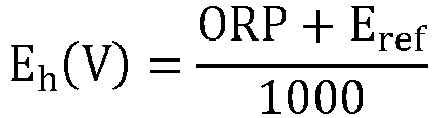
- 7. Carefully open the cap, and measure the oxidation reduction potential (ORP) (mV) with an ORP probe. After the ORP measurement, measure the pH with a pH probe. Then, put the cap back on immediately, and put the tube in the shaker.
- 8. Repeat the measurements for all triplicates, and use the average value.
- 9. Eh value is calculated by the equation in below (Eref = 220 mV).
- Zero valent iron and microbial dehalogenation are a proven and widely accepted in-situ remediation technology for contaminated soil and groundwater. It is especially effective for degradation of chlorinated VOC, such as PCE, TCE, and daughter products. Each technology can be applied independently. However, if ZVI is applied with proper carbon source, synergetic effect is expected. For example, based on our discovery, ZVI can decompose chlorinated VOCs (e.g., PCE, TCE) in two pathways, such as abiotic and biotic pathway. If a carbon source (e.g., ethanol, organic acid, acetic acid, guar gum, etc.) is available, the two pathways may occur simultaneously. Since microorganism metabolism generally requires two basic resources, such as a carbon source and an energy source, ZVI can be an energy source and another chemical can be a carbon source for biotic pathway. For abiotic pathway, ZVI can act alone to break down the contaminants.
- Along with abiotic reductive dechlorination on the surface of ZVI, the ZVI can be an electron/hydrogen donor promoting dehalogenation activity of microbes. Therefore, ZVI media having greater hydrogen gas production potential, such as embodiments of the present invention, will be more effective for degradation of chlorinated VOC. The hydrogen gas production rate and yield of an embodiment of the new media are several times higher than other ZVI media. In addition, the pH stabilizing ability of an embodiment of the present invention may be beneficial for microbial activities since pH 6 - 8 is considered favorable pH conditions for microbial soil remediation.
- Application of ZVI for removal of radionuclides, especially nano-ZVI on U removal, has been investigated by many researchers. However, several limitations have been reported for full-scale application, e.g. media handling difficulty resulting from the fine particle size, interference by alternate electron acceptors (O2, NO3, SO4) and multiple contaminants, potential release of immobilized contaminants from the aged and/or spent ZVI media, and so on. In order to evaluate the ability of an embodiment of the new media to remove multiple radionuclides (U, Th) and background contaminant (As) simultaneously in a poor quality alkaline groundwater with elevated levels of SO4 and NO3, batch and column experiments were conducted using a synthesized groundwater. The composition of the synthesized groundwater is shown in Table 1. The contaminant concentrations applied in the synthesized groundwater were several times higher than the drinking water standards in the State of California, U.S.A. For the batch experiment, 5 g of an embodiment of the new media was mixed with 200 mL of the synthesized groundwater with and without NO3 at inside and outside of an anoxic chamber to examine the effect of O2 and NO3 over time. For the column experiment, 1" ID x 8" L up-flow columns with ≈100 g of the new media were set-up in parallel. Table 2 summarizes operation conditions of the column experiments, wherein the EBCT is Empty Bed Contact Time, which calculates resident time of water by assuming there is no media in the column (empty volume / flow rate). It is important to note that the objective of the column experiments was to evaluate the impact of total contaminant loading on subsequent extractability using the regulatory extraction methods. Thus, the total volume of water treated by the new media column was controlled approximately 8 L of the synthesized groundwater. After that, the stability of the removed contaminants on the new media was confirmed by regulatory extraction methods for solid waste (e.g., TTLC, STLC, and TCLP).
Table 1. Composition of synthesized groundwater. Parameters Units Synthetic groundwater pH 7.4 Alkalinity mg/L as CaCO3 200 Uranium µg/ L 100 Thorium µg/ L 100 Arsenic µg/L 55 Nitrate mg/L as N 23 Sodium mg/L 93 Calcium mg/ L 80 Magnesium mg/L 36 Sulfate mg/ L 60 Table 2. Summary of column experiment conditions. Conditions Flow rate (mL/min) EBCT (min) Water Volume Treated (L) Bed Volume (BV) Treated Long EBCT 0.23 120 8.6 287 Medium EBCT 0.87 30 8.4 280 Short EBCT 3.9 7.5 8.1 270 - Residual concentrations of U and As in solution for the batch experiments are displayed in
Figures 7A and 7B . Soluble Th is not presented due to a very low concentration (under the detection limit) in the synthesized groundwater, which indicates that Th was precipitated readily by water chemistry and no impacts on the performance of an embodiment of the new media. No reduction of soluble U and As concentration was observed in the absence of the new media (Control) regardless of the experiment atmosphere. Level of As decreased faster than U level, with only 1- 2 µg/L remaining in solution at the first sampling interval (i.e. 4 hrs), and the As levels remained constant throughout the duration of the experiment. This suggests that both As(III) and As(V), regardless of the oxidation state, are removed rapidly by an embodiment of the new media. Although it was slower than As, residual U levels in solution with an embodiment of the new media in both oxic and anoxic condition were decreased to <1 µg/L over time. No significant change in soluble U was observed in the Control without the new media. In addition, U levels in solution with an embodiment of the new media decreased dramatically over the first 24 hours of equilibration regardless of the presence or absence of NO3 shown inFigures 8A and 8B . This is a major evident that other electron acceptors (NO3 and O2) do not appear to hinder U immobilization by the new media. - Treatability of radionuclides and background contaminants (U, Th, As) using the new media was proved by the continuous column experiments with various EBCTs. The results are shown in
Figures 9A ,9B , and9C . All contaminants were removed very effectively from the synthesized groundwater regardless of EBCTs. Uranium and Th concentrations in the effluent were maintained both <1 µg/L (influent = 100 µg/L each), and As concentration was stable at 1- 2 µg/L (influent = 55 µg/L) during the column experiments. In addition, co-presence of electron acceptors, such as NO3 or O2, did not interfere with the removal of target contaminants. - Stability of the removed As and U on the used media was confirmed by various regulatory extraction methods (TTLC, STLC, TCLP), and the results are summarized in Table 3. After the column experiments, the columns were dismantled and the used
media 1/3 from the top, middle, and bottom of the column was sampled and dried for the extraction tests. The concentration of U extracted from the used media by TTLC should not be exceeded the 500 mg/kg according to the NRC licencing19, and that of As should be lower than 500 mg/kg by TTLC and 5 mg/L by TCLP and STLC extraction methods. The concentrations of As and U extracted from the used an embodiment of the new media are all under the regulatory limit, which imply the stability of the contaminants on the new media.Table 3. Summary of column residual extraction results for the TTLC, STLC and TCLP extractions. Leachate Volume TTLC* STLC** TCLP*** Recovered As U As U As U Liters Treatment Section Mass mg/kg mg/kg mg/L mg/L mg/L mg/ L gm Limit 500 500 Limit 5.0 5.0 Limit 5.0 5.0 8.6 120 m EBCT Outlet 28.77 5.259 0.015 0.0023 <0.0005 <0.002 <0.010 Middle 29.48 5.426 0.010 0.0022 <0.0005 <0.002 <0.010 Inlet 47.05 16.94 23.59 0.0274 0.1477 <0.002 0.051 8.4 30 min EBCT Outlet 30.32 5.29 0.017 0.0021 <0.0005 <0.002 <0.010 Middle 34.97 5.60 0.041 0.0018 <00005 <0.002 <0.010 Inlet 39.37 17.55 23.87 0.0426 0.1634 <0.002 0.071 8.1 7.5 min EBCT Outlet 28.61 5.03 0.015 0.0026 <0.0005 <0.002 <0.010 Middle 35.03 5.74 0.014 0.0020 <0.0005 <0.002 <0.010 Inlet 41.41 16.79 22.67 0.0590 0.1837 <0.002 0.104 ∗TT1.C-Total Threshold Limit Concentration (Based on EP A 3050B ∗∗ STLC-Soluble Threshold Limit Concentration: pH 5.0 Na-Citrate Extraction ∗∗∗Toxicity Characteristic Leaching(TCLP);EPA Method 1311 - Selenium removal from a high TDS containing groundwater was tested using an embodiment of the new media in a series of columns. The influent had approximately 20 µg/L of Se and 1530 mg/L of TDS. The details of the water characteristics are shown in Table 4. Series of 1" up-flow columns with an embodiment of the new media (≈ 120 g) were set-up for the experiment. The EBCT of the column was 15 min each, total 4 columns were installed.
Figure 10 shows the concentration of Se in the influent and each effluent from the column during the experiment. The Se concentration in the final effluent (Eff-4) was sustained less than 5 µg/L (MCL for Se) throughout the study. The new media appears to be less inhibited by the high TDS in the influent. The results confirm the robustness of the new media in terms of the removal of multiple contaminants without the negative effect from the ambient ions.Table 4. Water characteristics of the high TDS groundwater containing Se. Parameters Units Groundwater pH 7.95 Alkalinity mg/L as CaCO3 113.75 Selenium µg/L 21.6 Chloride mg/L 441 Chromium µg/L 0.51 Nitrate mg/L as N 5.44 Sodium mg/L 306 Calcium mg/L 153 Magnesium mg/L 63 Sulfate mg/L 147.3 Potassium mg/L 4.61 TDS mg/L 1563 Conductivity µS/cm 2379 - The uniqueness of embodiments of the new media may be shown by comparison of contaminant removal through batch sorption and breakthrough column experiments
-
- 1. Contaminant: As 30 mg/L, Cr(VI) 100 mg/L in synthesized wastewater (pH 5.5-6.0)
- 2. Media tested: HCI (the new media), H2SO4, HNO3 washed source media (identical washing procedure applied), unwashed source media; the source media is a hydrogen reduced iron powder produced according to
International Patent Publication No. WO 2011/015601 A2 -
- a. Batch sorption experiment
- i. 1 g media in 30 mL synthesized wastewater containing As or Cr(VI)
- ii. 3 hr reaction time on a mechanical shaker
- iii. Triplicates for each data
- b. Breakthrough column experiment
- i. 3.6-3.8 g of each media in a ID 0.6
cm x L 10 cm, upflow column - ii. 10 min Empty Bed Contact Time (EBCT)
- i. 3.6-3.8 g of each media in a ID 0.6
- c. Analysis: ICP-MS after 0.22 µm filtration
- Final concentrations of As and Cr(VI) in supernatant after 3 hr. of batch sorption experiment are shown in
Figures 11A and 11B . Initial concentration was 30 and 100 mg/L for As and Cr(VI), respectively. The new media removed about 99.95% As and 95.98% Cr(VI) after 3 hr of contact time compared to a blank test (wastewater without media, 3 hr contact time). The As and Cr(VI) removal capacity of the new media was far exceeding that of other acid washed media and source media. It confirms the unique ability of the new media in terms of contaminant removal. - The superior contaminant removal ability of the new media also presented by a breakthrough column experiment using the identical synthesized wastewater. Breakthrough curves of the column filled with each media are shown in
Figures 12A and 12B . The effluent concentration was normalized by the average concentration of contaminants in column effluent after the concentrations were stabilized. Empty Bed Volume (BV) of the half point of influent concentration (0.5 C/C0) is an indication of the contaminant front moving through the column. The 0.5 C/C0 of an embodiment of the new media column for As was 90 BV, and that of Cr(VI) was 108 BV. The other media columns showed much earlier BV to reach the 0.5 C/C0 point. The comparison of the breakthrough curve tests reconfirms the unique contaminant removal ability of the new media.
| New med ia(HCl washe d) | H2SO 4washe d | HNO3 washed | Source Media | |
| O2 content (%) | 2.02 | 6.04 | 3.14 | 1.07 |
| Mn content (%) | 0.14 | 0.22 | 0.30 | 0.34 |
| BET surface area (m2/g) | 1.91 | 8.2 | 1.9 | 0.2 |
Claims (13)
- A filtering medium for reducing the content of contaminants in fluids, wherein said filtering medium comprises an acid-washed iron-based powder,wherein the acid-washed iron-based powder is a hydrogen-reduced iron powder formed by washing an iron-based powder in HCI,wherein the BET surface area of the acid-washed iron-based powder is 1.2-10 m2/g, preferably 1.4-8 m2/g, preferably, 1.6-5 m2/g,wherein the acid-washed iron-based powder has a Fe content of at least 90% by weight, preferably at least 93% by weight, preferably at least 97% by weight,wherein the acid-washed iron-based powder has a PSE value of less than -0.03 V, preferably less than -0.04 V, preferably less than -0.05 V, with a range of -0.03 V to -0.5 V in an equilibrium condition after 48 hours, wherein PSE is defined in Volts as Eh/pH, whereby Eh(V)=(ORP + Eref) / 1000, wherein ORP is the oxidation reduction potential (mV) and Eref is 220 mV; measured in a total volume of 50 ml of deoxygenated water and 1 gram of said iron-based powder and wherein the average particle size (D50) of the acid-washed iron-based powder is 20 to 10,000 µm, preferably 20 to 500 µm, preferably 40 to 350 µm.
- The filtering medium of claim 1, wherein the acid washing comprises hydrochloric acid washing, drying, and cooling process in a protective atmosphere, such as a N2 atmosphere.
- The filtering medium of any of claims 1 or 2, wherein the average particle size (D50) of the acid-washed iron-based powder is 200 to 590 µm, and the BET surface area is at least 1.6 m2/g.
- The filtering medium of any of claims 1-3, wherein the average particle size (D50) of the acid-washed iron-based powder is less than 200 µm, preferably less than 150 µm, and the BET surface area is at least 3 m2/g, preferably at least 4 m2/g.
- The filtering medium of any of claims 1-4, wherein the apparent density of the acid-washed iron-based powder is 0.5 to 5 g/cm3, preferably 1 to 3 g/cm3, preferably 1 to 2 g/cm3.
- The filtering medium of any of claims 1-5, wherein the iron-based powder is a hydrogen reduced iron-based powder having an average particle size (D50) between 200 and 590 µm and an Fe-content of at least 90% by weight of the iron powder.
- The filtering medium of any of claims 1-6, wherein the acid-washed iron-based powder has a localized chlorine concentration on the surface of at least 3 % by EDX spectral analysis, preferably at least 4 % by EDX spectral analysis.
- The filtering medium of any of claims 1-7, wherein the fraction of acid-washed iron-based powder below 150 µm is at least 3 m2/g, preferably 3-10 m2/g, preferably 3.5-8 m2/g, preferably 4.0-6.0 m2/g, preferably 4.2 m2/g-5 m2/g.
- A method for reducing the content of contaminants in fluids comprising the steps of:a) providing a filtering medium according to any of claims 1-8,b) bringing one or more contaminated fluid(s) in contact with the filtering medium to reduce the content of contaminants in said one or more fluid(s),c) optionally removing the filtering medium from the one or more fluid(s) with a reduced content of contaminants.
- The method according to claim 9, wherein in step b) one or more contaminated fluid(s) is/are allowed to pass through the filtering medium up or downflow direction.
- The method according to any of claims 9-10, wherein said fluid(s) is/are contaminated by at least one of chlorinated VOC, radionuclides, and heavy metals.
- The method according to claim 11, wherein the chlorinated VOC is chosen from the group consisting of TCE, PCE, and their daughter products.
- A method for producing a filtering medium, wherein the filtering medium is according to any of claims 1-8, the method comprising the steps of:- hydrochloric acid washing by exposing 500 kg of iron-based powder to a 0.4 M HCI solution for at least 20 min under an inert atmosphere,- drying and cooling process in a protective atmosphere, such as an N2 atmosphere.
Applications Claiming Priority (3)
| Application Number | Priority Date | Filing Date | Title |
|---|---|---|---|
| US201662404887P | 2016-10-06 | 2016-10-06 | |
| EP16197543.8A EP3318534A1 (en) | 2016-11-07 | 2016-11-07 | Iron based media |
| PCT/EP2017/075572 WO2018065614A1 (en) | 2016-10-06 | 2017-10-06 | Iron based media |
Publications (2)
| Publication Number | Publication Date |
|---|---|
| EP3523250A1 EP3523250A1 (en) | 2019-08-14 |
| EP3523250B1 true EP3523250B1 (en) | 2022-03-23 |
Family
ID=57442437
Family Applications (2)
| Application Number | Title | Priority Date | Filing Date |
|---|---|---|---|
| EP16197543.8A Withdrawn EP3318534A1 (en) | 2016-10-06 | 2016-11-07 | Iron based media |
| EP17777929.5A Active EP3523250B1 (en) | 2016-10-06 | 2017-10-06 | Iron based media |
Family Applications Before (1)
| Application Number | Title | Priority Date | Filing Date |
|---|---|---|---|
| EP16197543.8A Withdrawn EP3318534A1 (en) | 2016-10-06 | 2016-11-07 | Iron based media |
Country Status (11)
| Country | Link |
|---|---|
| US (1) | US10913665B2 (en) |
| EP (2) | EP3318534A1 (en) |
| JP (1) | JP7211939B2 (en) |
| KR (1) | KR102511492B1 (en) |
| CN (1) | CN109906203B (en) |
| AU (1) | AU2017339569B2 (en) |
| CA (1) | CA3038896A1 (en) |
| MX (1) | MX2019003882A (en) |
| RU (1) | RU2752401C2 (en) |
| WO (1) | WO2018065614A1 (en) |
| ZA (1) | ZA201902096B (en) |
Families Citing this family (9)
| Publication number | Priority date | Publication date | Assignee | Title |
|---|---|---|---|---|
| CA3095046A1 (en) | 2018-03-29 | 2019-10-03 | Oerlikon Metco (Us) Inc. | Reduced carbides ferrous alloys |
| US10919784B2 (en) | 2018-08-17 | 2021-02-16 | Badwater Alchemy Holdings LLC | Iron-based desalination |
| EP3870727A1 (en) | 2018-10-26 | 2021-09-01 | Oerlikon Metco (US) Inc. | Corrosion and wear resistant nickel based alloys |
| US11491522B2 (en) * | 2019-02-18 | 2022-11-08 | Tersus Environmental Llc | Zero-valent metal suspension in non-aqueous phase for water remediation |
| US11123779B2 (en) | 2019-02-18 | 2021-09-21 | Tersus Environmental Llc | Method and a chemical composition for accelerated in situ biochemical remediation |
| CN113631750A (en) | 2019-03-28 | 2021-11-09 | 欧瑞康美科(美国)公司 | Thermally sprayed iron-based alloys for coating engine cylinder bores |
| CA3136967A1 (en) | 2019-05-03 | 2020-11-12 | Oerlikon Metco (Us) Inc. | Powder feedstock for wear resistant bulk welding configured to optimize manufacturability |
| KR102870036B1 (en) | 2019-07-09 | 2025-10-13 | 오를리콘 메트코 (유에스) 아이엔씨. | Iron-based alloys designed for wear and corrosion resistance |
| CN113060780B (en) * | 2021-03-05 | 2022-09-16 | 绍兴文理学院 | A method for rapid removal of uranium in water by aging modified zero-valent iron |
Citations (1)
| Publication number | Priority date | Publication date | Assignee | Title |
|---|---|---|---|---|
| JP2009235204A (en) * | 2008-03-26 | 2009-10-15 | Dowa Eco-System Co Ltd | Organohalogen compound decomposing agent, its production process and purification process using the decomposing agent |
Family Cites Families (23)
| Publication number | Priority date | Publication date | Assignee | Title |
|---|---|---|---|---|
| US3718594A (en) * | 1970-11-30 | 1973-02-27 | Eastman Kodak Co | Method of preparing magnetically responsive carrier particles |
| JPS62204200A (en) * | 1986-03-05 | 1987-09-08 | 原子燃料工業株式会社 | Method of processing waste liquor containing radioactive nuclear substance |
| RU2071807C1 (en) | 1992-04-07 | 1997-01-20 | Юрий Васильевич Тахистов | Filtering apparatus |
| DE19716882A1 (en) | 1997-04-22 | 1998-10-29 | Basf Ag | Silicon-containing iron powder |
| US6485696B1 (en) | 1998-10-30 | 2002-11-26 | The United States Of America As Represented By The Secretary Of The Interior | Recovery/removal of metallic elements from waste water using ozone |
| JP2001232375A (en) | 2000-12-28 | 2001-08-28 | Hitachi Ltd | Method for separating transition elements in solution |
| GB0222393D0 (en) | 2002-09-26 | 2002-11-06 | Univ Brighton | Method for soil remediation and engineering |
| AU2003902704A0 (en) * | 2003-05-29 | 2003-06-19 | Crc For Waste Management And Pollution Control Limited Of Unsw | Process for producing a nanoscale zero-valent metal |
| DE10331785B4 (en) | 2003-07-11 | 2007-08-23 | H. C. Starck Gmbh & Co. Kg | Process for producing fine metal, alloy and composite powders |
| JP2005111311A (en) | 2003-10-03 | 2005-04-28 | Toyo Ink Mfg Co Ltd | Soil purification agent and soil purification method |
| RU2005129810A (en) | 2005-09-14 | 2007-03-27 | Общество с ограниченной ответственностью "ГРЕЙС" (RU) | METHOD FOR CLEANING WATER |
| JP4963984B2 (en) | 2007-02-23 | 2012-06-27 | 株式会社神戸製鋼所 | Arsenic removal method in contaminated water and treatment agent used therefor |
| JP5137232B2 (en) * | 2007-04-02 | 2013-02-06 | Dowaメタルマイン株式会社 | Method for producing porous iron oxide and method for treating water to be treated |
| CN101514036A (en) * | 2009-03-26 | 2009-08-26 | 上海大学 | Method for removing aromatics compound in water body |
| JP5414410B2 (en) * | 2009-07-28 | 2014-02-12 | Jfeミネラル株式会社 | Decomposing material for organic halogen compounds and method for producing the same |
| US9272331B2 (en) | 2009-08-05 | 2016-03-01 | Hoganas Ab | Permeable porous composite |
| MY158781A (en) | 2009-09-18 | 2016-11-15 | Texas A & M Univ Sys | Zero valent iron/iron oxide mineral/ferrous iron composite for treament of a contaminated fluid |
| JP5721255B2 (en) | 2011-01-17 | 2015-05-20 | Dowaエコシステム株式会社 | Method for producing iron powder for treating organohalogen compounds, and purification method for soil / groundwater contamination |
| WO2013062989A2 (en) * | 2011-10-24 | 2013-05-02 | Metamateria Technologies, Llc | Porous composite media for removing phosphorus from water |
| JP2013173110A (en) * | 2012-02-27 | 2013-09-05 | Hitachi Plant Technologies Ltd | Flocculant, flocculation method and water treatment device |
| JP6334263B2 (en) * | 2013-10-17 | 2018-05-30 | Jfeミネラル株式会社 | Purification method for heavy metal contaminated soil |
| CN104402107B (en) * | 2014-12-02 | 2016-08-17 | 济南大学 | A kind of method processing organic wastewater based on Polyaniline-Supported type nano zero valence iron |
| CN104975181A (en) | 2015-07-01 | 2015-10-14 | 昆明理工大学 | Treatment method of uranium-containing waste water |
-
2016
- 2016-11-07 EP EP16197543.8A patent/EP3318534A1/en not_active Withdrawn
-
2017
- 2017-10-06 CN CN201780068380.4A patent/CN109906203B/en active Active
- 2017-10-06 AU AU2017339569A patent/AU2017339569B2/en active Active
- 2017-10-06 WO PCT/EP2017/075572 patent/WO2018065614A1/en not_active Ceased
- 2017-10-06 CA CA3038896A patent/CA3038896A1/en active Pending
- 2017-10-06 US US15/726,800 patent/US10913665B2/en active Active
- 2017-10-06 MX MX2019003882A patent/MX2019003882A/en unknown
- 2017-10-06 JP JP2019518444A patent/JP7211939B2/en active Active
- 2017-10-06 RU RU2019113156A patent/RU2752401C2/en active
- 2017-10-06 KR KR1020197012780A patent/KR102511492B1/en active Active
- 2017-10-06 EP EP17777929.5A patent/EP3523250B1/en active Active
-
2019
- 2019-04-03 ZA ZA2019/02096A patent/ZA201902096B/en unknown
Patent Citations (1)
| Publication number | Priority date | Publication date | Assignee | Title |
|---|---|---|---|---|
| JP2009235204A (en) * | 2008-03-26 | 2009-10-15 | Dowa Eco-System Co Ltd | Organohalogen compound decomposing agent, its production process and purification process using the decomposing agent |
Also Published As
| Publication number | Publication date |
|---|---|
| US20180099877A1 (en) | 2018-04-12 |
| AU2017339569B2 (en) | 2022-12-15 |
| CN109906203A (en) | 2019-06-18 |
| JP7211939B2 (en) | 2023-01-24 |
| US10913665B2 (en) | 2021-02-09 |
| KR102511492B1 (en) | 2023-03-17 |
| EP3318534A1 (en) | 2018-05-09 |
| BR112019006872A2 (en) | 2019-07-02 |
| ZA201902096B (en) | 2020-10-28 |
| CN109906203B (en) | 2022-11-25 |
| JP2019537504A (en) | 2019-12-26 |
| CA3038896A1 (en) | 2018-04-12 |
| RU2019113156A (en) | 2020-11-06 |
| EP3523250A1 (en) | 2019-08-14 |
| RU2019113156A3 (en) | 2020-11-25 |
| AU2017339569A1 (en) | 2019-05-02 |
| KR20190058611A (en) | 2019-05-29 |
| WO2018065614A1 (en) | 2018-04-12 |
| MX2019003882A (en) | 2019-06-10 |
| RU2752401C2 (en) | 2021-07-27 |
Similar Documents
| Publication | Publication Date | Title |
|---|---|---|
| US10913665B2 (en) | Iron based media | |
| Xu et al. | Reductive immobilization of chromate in water and soil using stabilized iron nanoparticles | |
| Shubair et al. | Multilayer system of nanoscale zero valent iron and Nano-Fe/Cu particles for nitrate removal in porous media | |
| Makris et al. | Aluminum-based drinking-water treatment residuals: A novel sorbent for perchlorate removal | |
| Cheng et al. | Removing pentachlorophenol from water using a nanoscale zero-valent iron/H2O2 system | |
| Sun et al. | Treatment of groundwater polluted by arsenic compounds by zero valent iron | |
| Zhang | Nanoscale iron particles for environmental remediation: an overview | |
| Li et al. | Catalytic debromination of tetrabromobisphenol A by Ni/nZVI bimetallic particles | |
| Kang et al. | Oxidative degradation of organic compounds using zero-valent iron in the presence of natural organic matter serving as an electron shuttle | |
| Lin et al. | Fine structure characterization of zero-valent iron nanoparticles for decontamination of nitrites and nitrates in wastewater and groundwater | |
| Yang et al. | Improving reductive performance of zero valent iron by H2O2/HCl pretreatment: a case study on nitrate reduction | |
| TWI626092B (en) | New powder, powder composition, method for use thereof and use of the powder and powder composition | |
| US20070256985A1 (en) | In Situ Remediation of Inorganic Contaminants Using Stabilized Zero-Valent Iron Nanoparticles | |
| WO2008119063A1 (en) | Simultaneous reduction/oxidation process for destroying an organic solvent | |
| Parshetti et al. | Dechlorination of chlorinated hydrocarbons by bimetallic Ni/Fe immobilized on polyethylene glycol-grafted microfiltration membranes under anoxic conditions | |
| Zhao et al. | One-time removal of Cr (VI) and carbon tetrachloride from groundwater by silicate stabilized green rust: The slow release of reactive sites driven by Fe (III)-Cr (III) oxides formation | |
| US7850854B2 (en) | Method for perchlorate removal and destruction | |
| Zhong et al. | Natural siderite derivatives activated peroxydisulfate toward oxidation of organic contaminant: A green soil remediation strategy | |
| Le et al. | Effects of common dissolved anions on the reduction of para-chloronitrobenzene by zero-valent iron in groundwater | |
| Ruhl et al. | Influence of hydronium, sulfate, chloride and other non-carbonate ions on hydrogen generation by anaerobic corrosion of granular cast iron | |
| Cai et al. | Effect of humic acid and metal ions on the debromination of BDE209 by nZVM prepared from steel pickling waste liquor | |
| FALYOUNA | Synthesis of Novel Iron-based Nanomaterials for the Removal of the Antibiotic Ciprofloxacin from Water | |
| Groza et al. | Zero-valent iron used for radioactive waste water treatment | |
| BR112019006872B1 (en) | IRON-BASED FILTRATION MEDIUM, ITS PRODUCTION METHOD AND METHOD FOR REDUCING CONTAMINANT CONTENT IN FLUIDS | |
| Nurmi et al. | Reduction of TNT and RDX by core material from an iron permeable reactive barrier |
Legal Events
| Date | Code | Title | Description |
|---|---|---|---|
| STAA | Information on the status of an ep patent application or granted ep patent |
Free format text: STATUS: UNKNOWN |
|
| STAA | Information on the status of an ep patent application or granted ep patent |
Free format text: STATUS: THE INTERNATIONAL PUBLICATION HAS BEEN MADE |
|
| PUAI | Public reference made under article 153(3) epc to a published international application that has entered the european phase |
Free format text: ORIGINAL CODE: 0009012 |
|
| STAA | Information on the status of an ep patent application or granted ep patent |
Free format text: STATUS: REQUEST FOR EXAMINATION WAS MADE |
|
| 17P | Request for examination filed |
Effective date: 20190506 |
|
| AK | Designated contracting states |
Kind code of ref document: A1 Designated state(s): AL AT BE BG CH CY CZ DE DK EE ES FI FR GB GR HR HU IE IS IT LI LT LU LV MC MK MT NL NO PL PT RO RS SE SI SK SM TR |
|
| AX | Request for extension of the european patent |
Extension state: BA ME |
|
| DAV | Request for validation of the european patent (deleted) | ||
| DAX | Request for extension of the european patent (deleted) | ||
| STAA | Information on the status of an ep patent application or granted ep patent |
Free format text: STATUS: EXAMINATION IS IN PROGRESS |
|
| 17Q | First examination report despatched |
Effective date: 20200211 |
|
| STAA | Information on the status of an ep patent application or granted ep patent |
Free format text: STATUS: THE APPLICATION IS DEEMED TO BE WITHDRAWN |
|
| 18D | Application deemed to be withdrawn |
Effective date: 20200623 |
|
| STAA | Information on the status of an ep patent application or granted ep patent |
Free format text: STATUS: EXAMINATION IS IN PROGRESS |
|
| D18D | Application deemed to be withdrawn (deleted) | ||
| GRAP | Despatch of communication of intention to grant a patent |
Free format text: ORIGINAL CODE: EPIDOSNIGR1 |
|
| STAA | Information on the status of an ep patent application or granted ep patent |
Free format text: STATUS: GRANT OF PATENT IS INTENDED |
|
| GRAJ | Information related to disapproval of communication of intention to grant by the applicant or resumption of examination proceedings by the epo deleted |
Free format text: ORIGINAL CODE: EPIDOSDIGR1 |
|
| GRAP | Despatch of communication of intention to grant a patent |
Free format text: ORIGINAL CODE: EPIDOSNIGR1 |
|
| INTG | Intention to grant announced |
Effective date: 20211012 |
|
| INTG | Intention to grant announced |
Effective date: 20211026 |
|
| GRAS | Grant fee paid |
Free format text: ORIGINAL CODE: EPIDOSNIGR3 |
|
| GRAA | (expected) grant |
Free format text: ORIGINAL CODE: 0009210 |
|
| STAA | Information on the status of an ep patent application or granted ep patent |
Free format text: STATUS: THE PATENT HAS BEEN GRANTED |
|
| AK | Designated contracting states |
Kind code of ref document: B1 Designated state(s): AL AT BE BG CH CY CZ DE DK EE ES FI FR GB GR HR HU IE IS IT LI LT LU LV MC MK MT NL NO PL PT RO RS SE SI SK SM TR |
|
| REG | Reference to a national code |
Ref country code: CH Ref legal event code: EP |
|
| REG | Reference to a national code |
Ref country code: IE Ref legal event code: FG4D |
|
| REG | Reference to a national code |
Ref country code: DE Ref legal event code: R096 Ref document number: 602017054962 Country of ref document: DE |
|
| REG | Reference to a national code |
Ref country code: AT Ref legal event code: REF Ref document number: 1477325 Country of ref document: AT Kind code of ref document: T Effective date: 20220415 |
|
| REG | Reference to a national code |
Ref country code: LT Ref legal event code: MG9D |
|
| REG | Reference to a national code |
Ref country code: NL Ref legal event code: MP Effective date: 20220323 |
|
| PG25 | Lapsed in a contracting state [announced via postgrant information from national office to epo] |
Ref country code: SE Free format text: LAPSE BECAUSE OF FAILURE TO SUBMIT A TRANSLATION OF THE DESCRIPTION OR TO PAY THE FEE WITHIN THE PRESCRIBED TIME-LIMIT Effective date: 20220323 Ref country code: RS Free format text: LAPSE BECAUSE OF FAILURE TO SUBMIT A TRANSLATION OF THE DESCRIPTION OR TO PAY THE FEE WITHIN THE PRESCRIBED TIME-LIMIT Effective date: 20220323 Ref country code: NO Free format text: LAPSE BECAUSE OF FAILURE TO SUBMIT A TRANSLATION OF THE DESCRIPTION OR TO PAY THE FEE WITHIN THE PRESCRIBED TIME-LIMIT Effective date: 20220623 Ref country code: LT Free format text: LAPSE BECAUSE OF FAILURE TO SUBMIT A TRANSLATION OF THE DESCRIPTION OR TO PAY THE FEE WITHIN THE PRESCRIBED TIME-LIMIT Effective date: 20220323 Ref country code: HR Free format text: LAPSE BECAUSE OF FAILURE TO SUBMIT A TRANSLATION OF THE DESCRIPTION OR TO PAY THE FEE WITHIN THE PRESCRIBED TIME-LIMIT Effective date: 20220323 Ref country code: BG Free format text: LAPSE BECAUSE OF FAILURE TO SUBMIT A TRANSLATION OF THE DESCRIPTION OR TO PAY THE FEE WITHIN THE PRESCRIBED TIME-LIMIT Effective date: 20220623 |
|
| REG | Reference to a national code |
Ref country code: AT Ref legal event code: MK05 Ref document number: 1477325 Country of ref document: AT Kind code of ref document: T Effective date: 20220323 |
|
| PG25 | Lapsed in a contracting state [announced via postgrant information from national office to epo] |
Ref country code: LV Free format text: LAPSE BECAUSE OF FAILURE TO SUBMIT A TRANSLATION OF THE DESCRIPTION OR TO PAY THE FEE WITHIN THE PRESCRIBED TIME-LIMIT Effective date: 20220323 Ref country code: GR Free format text: LAPSE BECAUSE OF FAILURE TO SUBMIT A TRANSLATION OF THE DESCRIPTION OR TO PAY THE FEE WITHIN THE PRESCRIBED TIME-LIMIT Effective date: 20220624 Ref country code: FI Free format text: LAPSE BECAUSE OF FAILURE TO SUBMIT A TRANSLATION OF THE DESCRIPTION OR TO PAY THE FEE WITHIN THE PRESCRIBED TIME-LIMIT Effective date: 20220323 |
|
| PG25 | Lapsed in a contracting state [announced via postgrant information from national office to epo] |
Ref country code: NL Free format text: LAPSE BECAUSE OF FAILURE TO SUBMIT A TRANSLATION OF THE DESCRIPTION OR TO PAY THE FEE WITHIN THE PRESCRIBED TIME-LIMIT Effective date: 20220323 |
|
| PG25 | Lapsed in a contracting state [announced via postgrant information from national office to epo] |
Ref country code: SM Free format text: LAPSE BECAUSE OF FAILURE TO SUBMIT A TRANSLATION OF THE DESCRIPTION OR TO PAY THE FEE WITHIN THE PRESCRIBED TIME-LIMIT Effective date: 20220323 Ref country code: SK Free format text: LAPSE BECAUSE OF FAILURE TO SUBMIT A TRANSLATION OF THE DESCRIPTION OR TO PAY THE FEE WITHIN THE PRESCRIBED TIME-LIMIT Effective date: 20220323 Ref country code: RO Free format text: LAPSE BECAUSE OF FAILURE TO SUBMIT A TRANSLATION OF THE DESCRIPTION OR TO PAY THE FEE WITHIN THE PRESCRIBED TIME-LIMIT Effective date: 20220323 Ref country code: PT Free format text: LAPSE BECAUSE OF FAILURE TO SUBMIT A TRANSLATION OF THE DESCRIPTION OR TO PAY THE FEE WITHIN THE PRESCRIBED TIME-LIMIT Effective date: 20220725 Ref country code: ES Free format text: LAPSE BECAUSE OF FAILURE TO SUBMIT A TRANSLATION OF THE DESCRIPTION OR TO PAY THE FEE WITHIN THE PRESCRIBED TIME-LIMIT Effective date: 20220323 Ref country code: EE Free format text: LAPSE BECAUSE OF FAILURE TO SUBMIT A TRANSLATION OF THE DESCRIPTION OR TO PAY THE FEE WITHIN THE PRESCRIBED TIME-LIMIT Effective date: 20220323 Ref country code: CZ Free format text: LAPSE BECAUSE OF FAILURE TO SUBMIT A TRANSLATION OF THE DESCRIPTION OR TO PAY THE FEE WITHIN THE PRESCRIBED TIME-LIMIT Effective date: 20220323 Ref country code: AT Free format text: LAPSE BECAUSE OF FAILURE TO SUBMIT A TRANSLATION OF THE DESCRIPTION OR TO PAY THE FEE WITHIN THE PRESCRIBED TIME-LIMIT Effective date: 20220323 |
|
| PG25 | Lapsed in a contracting state [announced via postgrant information from national office to epo] |
Ref country code: PL Free format text: LAPSE BECAUSE OF FAILURE TO SUBMIT A TRANSLATION OF THE DESCRIPTION OR TO PAY THE FEE WITHIN THE PRESCRIBED TIME-LIMIT Effective date: 20220323 Ref country code: IS Free format text: LAPSE BECAUSE OF FAILURE TO SUBMIT A TRANSLATION OF THE DESCRIPTION OR TO PAY THE FEE WITHIN THE PRESCRIBED TIME-LIMIT Effective date: 20220723 Ref country code: AL Free format text: LAPSE BECAUSE OF FAILURE TO SUBMIT A TRANSLATION OF THE DESCRIPTION OR TO PAY THE FEE WITHIN THE PRESCRIBED TIME-LIMIT Effective date: 20220323 |
|
| REG | Reference to a national code |
Ref country code: DE Ref legal event code: R097 Ref document number: 602017054962 Country of ref document: DE |
|
| PLBE | No opposition filed within time limit |
Free format text: ORIGINAL CODE: 0009261 |
|
| STAA | Information on the status of an ep patent application or granted ep patent |
Free format text: STATUS: NO OPPOSITION FILED WITHIN TIME LIMIT |
|
| PG25 | Lapsed in a contracting state [announced via postgrant information from national office to epo] |
Ref country code: DK Free format text: LAPSE BECAUSE OF FAILURE TO SUBMIT A TRANSLATION OF THE DESCRIPTION OR TO PAY THE FEE WITHIN THE PRESCRIBED TIME-LIMIT Effective date: 20220323 |
|
| 26N | No opposition filed |
Effective date: 20230102 |
|
| PG25 | Lapsed in a contracting state [announced via postgrant information from national office to epo] |
Ref country code: SI Free format text: LAPSE BECAUSE OF FAILURE TO SUBMIT A TRANSLATION OF THE DESCRIPTION OR TO PAY THE FEE WITHIN THE PRESCRIBED TIME-LIMIT Effective date: 20220323 Ref country code: MC Free format text: LAPSE BECAUSE OF FAILURE TO SUBMIT A TRANSLATION OF THE DESCRIPTION OR TO PAY THE FEE WITHIN THE PRESCRIBED TIME-LIMIT Effective date: 20220323 |
|
| REG | Reference to a national code |
Ref country code: CH Ref legal event code: PL |
|
| REG | Reference to a national code |
Ref country code: BE Ref legal event code: MM Effective date: 20221031 |
|
| PG25 | Lapsed in a contracting state [announced via postgrant information from national office to epo] |
Ref country code: LU Free format text: LAPSE BECAUSE OF NON-PAYMENT OF DUE FEES Effective date: 20221006 |
|
| PG25 | Lapsed in a contracting state [announced via postgrant information from national office to epo] |
Ref country code: LI Free format text: LAPSE BECAUSE OF NON-PAYMENT OF DUE FEES Effective date: 20221031 Ref country code: IT Free format text: LAPSE BECAUSE OF FAILURE TO SUBMIT A TRANSLATION OF THE DESCRIPTION OR TO PAY THE FEE WITHIN THE PRESCRIBED TIME-LIMIT Effective date: 20220323 Ref country code: CH Free format text: LAPSE BECAUSE OF NON-PAYMENT OF DUE FEES Effective date: 20221031 |
|
| PG25 | Lapsed in a contracting state [announced via postgrant information from national office to epo] |
Ref country code: BE Free format text: LAPSE BECAUSE OF NON-PAYMENT OF DUE FEES Effective date: 20221031 |
|
| PG25 | Lapsed in a contracting state [announced via postgrant information from national office to epo] |
Ref country code: IE Free format text: LAPSE BECAUSE OF NON-PAYMENT OF DUE FEES Effective date: 20221006 |
|
| PG25 | Lapsed in a contracting state [announced via postgrant information from national office to epo] |
Ref country code: HU Free format text: LAPSE BECAUSE OF FAILURE TO SUBMIT A TRANSLATION OF THE DESCRIPTION OR TO PAY THE FEE WITHIN THE PRESCRIBED TIME-LIMIT; INVALID AB INITIO Effective date: 20171006 |
|
| PG25 | Lapsed in a contracting state [announced via postgrant information from national office to epo] |
Ref country code: CY Free format text: LAPSE BECAUSE OF FAILURE TO SUBMIT A TRANSLATION OF THE DESCRIPTION OR TO PAY THE FEE WITHIN THE PRESCRIBED TIME-LIMIT Effective date: 20220323 |
|
| PG25 | Lapsed in a contracting state [announced via postgrant information from national office to epo] |
Ref country code: MK Free format text: LAPSE BECAUSE OF FAILURE TO SUBMIT A TRANSLATION OF THE DESCRIPTION OR TO PAY THE FEE WITHIN THE PRESCRIBED TIME-LIMIT Effective date: 20220323 |
|
| PG25 | Lapsed in a contracting state [announced via postgrant information from national office to epo] |
Ref country code: MT Free format text: LAPSE BECAUSE OF FAILURE TO SUBMIT A TRANSLATION OF THE DESCRIPTION OR TO PAY THE FEE WITHIN THE PRESCRIBED TIME-LIMIT Effective date: 20220323 |
|
| PGFP | Annual fee paid to national office [announced via postgrant information from national office to epo] |
Ref country code: GB Payment date: 20240905 Year of fee payment: 8 |
|
| PGFP | Annual fee paid to national office [announced via postgrant information from national office to epo] |
Ref country code: FR Payment date: 20240923 Year of fee payment: 8 |
|
| PGFP | Annual fee paid to national office [announced via postgrant information from national office to epo] |
Ref country code: DE Payment date: 20240904 Year of fee payment: 8 |
|
| PG25 | Lapsed in a contracting state [announced via postgrant information from national office to epo] |
Ref country code: TR Free format text: LAPSE BECAUSE OF FAILURE TO SUBMIT A TRANSLATION OF THE DESCRIPTION OR TO PAY THE FEE WITHIN THE PRESCRIBED TIME-LIMIT Effective date: 20220323 |