EP3518330A1 - Cathode active material and method of manufacturing same, and nonaqueous electrolyte secondary battery - Google Patents
Cathode active material and method of manufacturing same, and nonaqueous electrolyte secondary battery Download PDFInfo
- Publication number
- EP3518330A1 EP3518330A1 EP17852916.0A EP17852916A EP3518330A1 EP 3518330 A1 EP3518330 A1 EP 3518330A1 EP 17852916 A EP17852916 A EP 17852916A EP 3518330 A1 EP3518330 A1 EP 3518330A1
- Authority
- EP
- European Patent Office
- Prior art keywords
- positive electrode
- rate
- active material
- electrode active
- cycle
- Prior art date
- Legal status (The legal status is an assumption and is not a legal conclusion. Google has not performed a legal analysis and makes no representation as to the accuracy of the status listed.)
- Pending
Links
- 239000011255 nonaqueous electrolyte Substances 0.000 title claims abstract description 42
- 238000004519 manufacturing process Methods 0.000 title claims description 11
- 239000006182 cathode active material Substances 0.000 title 1
- 239000007774 positive electrode material Substances 0.000 claims abstract description 252
- 239000002131 composite material Substances 0.000 claims abstract description 40
- 230000004069 differentiation Effects 0.000 claims abstract description 4
- 239000002243 precursor Substances 0.000 claims description 253
- PXHVJJICTQNCMI-UHFFFAOYSA-N nickel Substances [Ni] PXHVJJICTQNCMI-UHFFFAOYSA-N 0.000 claims description 186
- 239000011572 manganese Substances 0.000 claims description 167
- 239000000203 mixture Substances 0.000 claims description 148
- BVKZGUZCCUSVTD-UHFFFAOYSA-L Carbonate Chemical compound [O-]C([O-])=O BVKZGUZCCUSVTD-UHFFFAOYSA-L 0.000 claims description 81
- 150000001875 compounds Chemical class 0.000 claims description 81
- 238000001354 calcination Methods 0.000 claims description 78
- 229910052744 lithium Inorganic materials 0.000 claims description 65
- 239000000243 solution Substances 0.000 claims description 61
- WHXSMMKQMYFTQS-UHFFFAOYSA-N Lithium Chemical compound [Li] WHXSMMKQMYFTQS-UHFFFAOYSA-N 0.000 claims description 56
- 229910052759 nickel Inorganic materials 0.000 claims description 48
- 229910052748 manganese Inorganic materials 0.000 claims description 47
- 230000001590 oxidative effect Effects 0.000 claims description 46
- -1 aluminum compound Chemical class 0.000 claims description 42
- 229910052782 aluminium Inorganic materials 0.000 claims description 26
- 238000002156 mixing Methods 0.000 claims description 19
- 150000002697 manganese compounds Chemical class 0.000 claims description 16
- 150000002816 nickel compounds Chemical class 0.000 claims description 16
- 238000000634 powder X-ray diffraction Methods 0.000 claims description 16
- 150000001869 cobalt compounds Chemical class 0.000 claims description 12
- 150000002642 lithium compounds Chemical class 0.000 claims description 11
- 229910002483 Cu Ka Inorganic materials 0.000 claims description 10
- 239000011164 primary particle Substances 0.000 claims description 10
- 239000011888 foil Substances 0.000 claims description 9
- 239000011163 secondary particle Substances 0.000 claims description 8
- 239000006104 solid solution Substances 0.000 claims description 6
- 230000002194 synthesizing effect Effects 0.000 claims description 6
- 229910013467 LiNixCoyMnzO2 Inorganic materials 0.000 claims description 3
- 229910005518 NiaCobMnc Inorganic materials 0.000 claims description 3
- 229910000473 manganese(VI) oxide Inorganic materials 0.000 claims description 3
- 238000004438 BET method Methods 0.000 claims description 2
- 239000000843 powder Substances 0.000 description 93
- XGZVUEUWXADBQD-UHFFFAOYSA-L lithium carbonate Chemical compound [Li+].[Li+].[O-]C([O-])=O XGZVUEUWXADBQD-UHFFFAOYSA-L 0.000 description 88
- 239000007864 aqueous solution Substances 0.000 description 83
- 238000006243 chemical reaction Methods 0.000 description 81
- 230000000052 comparative effect Effects 0.000 description 61
- 230000014759 maintenance of location Effects 0.000 description 55
- CDBYLPFSWZWCQE-UHFFFAOYSA-L Sodium Carbonate Chemical compound [Na+].[Na+].[O-]C([O-])=O CDBYLPFSWZWCQE-UHFFFAOYSA-L 0.000 description 52
- VZSRBBMJRBPUNF-UHFFFAOYSA-N 2-(2,3-dihydro-1H-inden-2-ylamino)-N-[3-oxo-3-(2,4,6,7-tetrahydrotriazolo[4,5-c]pyridin-5-yl)propyl]pyrimidine-5-carboxamide Chemical compound C1C(CC2=CC=CC=C12)NC1=NC=C(C=N1)C(=O)NCCC(N1CC2=C(CC1)NN=N2)=O VZSRBBMJRBPUNF-UHFFFAOYSA-N 0.000 description 51
- 238000000034 method Methods 0.000 description 50
- 239000002245 particle Substances 0.000 description 33
- 239000000463 material Substances 0.000 description 31
- 229910052596 spinel Inorganic materials 0.000 description 31
- 239000011029 spinel Substances 0.000 description 31
- 125000005842 heteroatom Chemical group 0.000 description 28
- 229910000029 sodium carbonate Inorganic materials 0.000 description 26
- 229940099596 manganese sulfate Drugs 0.000 description 21
- 239000011702 manganese sulphate Substances 0.000 description 21
- 235000007079 manganese sulphate Nutrition 0.000 description 21
- SQQMAOCOWKFBNP-UHFFFAOYSA-L manganese(II) sulfate Chemical compound [Mn+2].[O-]S([O-])(=O)=O SQQMAOCOWKFBNP-UHFFFAOYSA-L 0.000 description 21
- LGQLOGILCSXPEA-UHFFFAOYSA-L nickel sulfate Chemical compound [Ni+2].[O-]S([O-])(=O)=O LGQLOGILCSXPEA-UHFFFAOYSA-L 0.000 description 21
- 229910000363 nickel(II) sulfate Inorganic materials 0.000 description 21
- DIZPMCHEQGEION-UHFFFAOYSA-H aluminium sulfate (anhydrous) Chemical compound [Al+3].[Al+3].[O-]S([O-])(=O)=O.[O-]S([O-])(=O)=O.[O-]S([O-])(=O)=O DIZPMCHEQGEION-UHFFFAOYSA-H 0.000 description 20
- XLYOFNOQVPJJNP-UHFFFAOYSA-N water Substances O XLYOFNOQVPJJNP-UHFFFAOYSA-N 0.000 description 19
- 229910000361 cobalt sulfate Inorganic materials 0.000 description 17
- 229940044175 cobalt sulfate Drugs 0.000 description 17
- KTVIXTQDYHMGHF-UHFFFAOYSA-L cobalt(2+) sulfate Chemical compound [Co+2].[O-]S([O-])(=O)=O KTVIXTQDYHMGHF-UHFFFAOYSA-L 0.000 description 17
- PWHULOQIROXLJO-UHFFFAOYSA-N Manganese Chemical compound [Mn] PWHULOQIROXLJO-UHFFFAOYSA-N 0.000 description 16
- 229910017052 cobalt Inorganic materials 0.000 description 15
- 239000010941 cobalt Substances 0.000 description 15
- GUTLYIVDDKVIGB-UHFFFAOYSA-N cobalt atom Chemical compound [Co] GUTLYIVDDKVIGB-UHFFFAOYSA-N 0.000 description 15
- 239000002002 slurry Substances 0.000 description 15
- 239000008151 electrolyte solution Substances 0.000 description 10
- OKTJSMMVPCPJKN-UHFFFAOYSA-N Carbon Chemical compound [C] OKTJSMMVPCPJKN-UHFFFAOYSA-N 0.000 description 8
- NIPNSKYNPDTRPC-UHFFFAOYSA-N N-[2-oxo-2-(2,4,6,7-tetrahydrotriazolo[4,5-c]pyridin-5-yl)ethyl]-2-[[3-(trifluoromethoxy)phenyl]methylamino]pyrimidine-5-carboxamide Chemical compound O=C(CNC(=O)C=1C=NC(=NC=1)NCC1=CC(=CC=C1)OC(F)(F)F)N1CC2=C(CC1)NN=N2 NIPNSKYNPDTRPC-UHFFFAOYSA-N 0.000 description 7
- 238000003756 stirring Methods 0.000 description 7
- HBBGRARXTFLTSG-UHFFFAOYSA-N Lithium ion Chemical compound [Li+] HBBGRARXTFLTSG-UHFFFAOYSA-N 0.000 description 6
- 239000013078 crystal Substances 0.000 description 6
- 230000000694 effects Effects 0.000 description 6
- 229910001416 lithium ion Inorganic materials 0.000 description 6
- 229910052751 metal Inorganic materials 0.000 description 6
- 229910052723 transition metal Inorganic materials 0.000 description 6
- 150000003624 transition metals Chemical class 0.000 description 6
- 239000011230 binding agent Substances 0.000 description 5
- 239000006258 conductive agent Substances 0.000 description 5
- 229910002804 graphite Inorganic materials 0.000 description 5
- 239000010439 graphite Substances 0.000 description 5
- 239000002904 solvent Substances 0.000 description 5
- 229910003543 Li(Ni0.33Co0.33Mn0.33)O2 Inorganic materials 0.000 description 4
- VSCWAEJMTAWNJL-UHFFFAOYSA-K aluminium trichloride Chemical compound Cl[Al](Cl)Cl VSCWAEJMTAWNJL-UHFFFAOYSA-K 0.000 description 4
- PPQREHKVAOVYBT-UHFFFAOYSA-H dialuminum;tricarbonate Chemical compound [Al+3].[Al+3].[O-]C([O-])=O.[O-]C([O-])=O.[O-]C([O-])=O PPQREHKVAOVYBT-UHFFFAOYSA-H 0.000 description 4
- IEJIGPNLZYLLBP-UHFFFAOYSA-N dimethyl carbonate Chemical compound COC(=O)OC IEJIGPNLZYLLBP-UHFFFAOYSA-N 0.000 description 4
- 238000001035 drying Methods 0.000 description 4
- 239000003792 electrolyte Substances 0.000 description 4
- AMWRITDGCCNYAT-UHFFFAOYSA-L hydroxy(oxo)manganese;manganese Chemical compound [Mn].O[Mn]=O.O[Mn]=O AMWRITDGCCNYAT-UHFFFAOYSA-L 0.000 description 4
- AMXOYNBUYSYVKV-UHFFFAOYSA-M lithium bromide Chemical compound [Li+].[Br-] AMXOYNBUYSYVKV-UHFFFAOYSA-M 0.000 description 4
- 229910052808 lithium carbonate Inorganic materials 0.000 description 4
- KWGKDLIKAYFUFQ-UHFFFAOYSA-M lithium chloride Chemical compound [Li+].[Cl-] KWGKDLIKAYFUFQ-UHFFFAOYSA-M 0.000 description 4
- PQXKHYXIUOZZFA-UHFFFAOYSA-M lithium fluoride Chemical compound [Li+].[F-] PQXKHYXIUOZZFA-UHFFFAOYSA-M 0.000 description 4
- HSZCZNFXUDYRKD-UHFFFAOYSA-M lithium iodide Chemical compound [Li+].[I-] HSZCZNFXUDYRKD-UHFFFAOYSA-M 0.000 description 4
- IIPYXGDZVMZOAP-UHFFFAOYSA-N lithium nitrate Chemical compound [Li+].[O-][N+]([O-])=O IIPYXGDZVMZOAP-UHFFFAOYSA-N 0.000 description 4
- 229910003002 lithium salt Inorganic materials 0.000 description 4
- 159000000002 lithium salts Chemical class 0.000 description 4
- 239000002184 metal Substances 0.000 description 4
- 239000007787 solid Substances 0.000 description 4
- 239000000725 suspension Substances 0.000 description 4
- 238000005406 washing Methods 0.000 description 4
- IJGRMHOSHXDMSA-UHFFFAOYSA-N Atomic nitrogen Chemical compound N#N IJGRMHOSHXDMSA-UHFFFAOYSA-N 0.000 description 3
- MKYBYDHXWVHEJW-UHFFFAOYSA-N N-[1-oxo-1-(2,4,6,7-tetrahydrotriazolo[4,5-c]pyridin-5-yl)propan-2-yl]-2-[[3-(trifluoromethoxy)phenyl]methylamino]pyrimidine-5-carboxamide Chemical compound O=C(C(C)NC(=O)C=1C=NC(=NC=1)NCC1=CC(=CC=C1)OC(F)(F)F)N1CC2=C(CC1)NN=N2 MKYBYDHXWVHEJW-UHFFFAOYSA-N 0.000 description 3
- AFCARXCZXQIEQB-UHFFFAOYSA-N N-[3-oxo-3-(2,4,6,7-tetrahydrotriazolo[4,5-c]pyridin-5-yl)propyl]-2-[[3-(trifluoromethoxy)phenyl]methylamino]pyrimidine-5-carboxamide Chemical compound O=C(CCNC(=O)C=1C=NC(=NC=1)NCC1=CC(=CC=C1)OC(F)(F)F)N1CC2=C(CC1)NN=N2 AFCARXCZXQIEQB-UHFFFAOYSA-N 0.000 description 3
- 239000002033 PVDF binder Substances 0.000 description 3
- FAPWRFPIFSIZLT-UHFFFAOYSA-M Sodium chloride Chemical group [Na+].[Cl-] FAPWRFPIFSIZLT-UHFFFAOYSA-M 0.000 description 3
- 238000002441 X-ray diffraction Methods 0.000 description 3
- 239000006230 acetylene black Substances 0.000 description 3
- 229910001873 dinitrogen Inorganic materials 0.000 description 3
- 229920002981 polyvinylidene fluoride Polymers 0.000 description 3
- 239000000523 sample Substances 0.000 description 3
- 239000012488 sample solution Substances 0.000 description 3
- BNGXYYYYKUGPPF-UHFFFAOYSA-M (3-methylphenyl)methyl-triphenylphosphanium;chloride Chemical compound [Cl-].CC1=CC=CC(C[P+](C=2C=CC=CC=2)(C=2C=CC=CC=2)C=2C=CC=CC=2)=C1 BNGXYYYYKUGPPF-UHFFFAOYSA-M 0.000 description 2
- 229910021503 Cobalt(II) hydroxide Inorganic materials 0.000 description 2
- OIFBSDVPJOWBCH-UHFFFAOYSA-N Diethyl carbonate Chemical compound CCOC(=O)OCC OIFBSDVPJOWBCH-UHFFFAOYSA-N 0.000 description 2
- XTHFKEDIFFGKHM-UHFFFAOYSA-N Dimethoxyethane Chemical compound COCCOC XTHFKEDIFFGKHM-UHFFFAOYSA-N 0.000 description 2
- KMTRUDSVKNLOMY-UHFFFAOYSA-N Ethylene carbonate Chemical compound O=C1OCCO1 KMTRUDSVKNLOMY-UHFFFAOYSA-N 0.000 description 2
- VEXZGXHMUGYJMC-UHFFFAOYSA-N Hydrochloric acid Chemical compound Cl VEXZGXHMUGYJMC-UHFFFAOYSA-N 0.000 description 2
- 229910002983 Li2MnO3 Inorganic materials 0.000 description 2
- 229910003005 LiNiO2 Inorganic materials 0.000 description 2
- 229910021380 Manganese Chloride Inorganic materials 0.000 description 2
- GLFNIEUTAYBVOC-UHFFFAOYSA-L Manganese chloride Chemical compound Cl[Mn]Cl GLFNIEUTAYBVOC-UHFFFAOYSA-L 0.000 description 2
- 229910021586 Nickel(II) chloride Inorganic materials 0.000 description 2
- 239000011149 active material Substances 0.000 description 2
- 229910045601 alloy Inorganic materials 0.000 description 2
- 239000000956 alloy Substances 0.000 description 2
- AZDRQVAHHNSJOQ-UHFFFAOYSA-N alumane Chemical class [AlH3] AZDRQVAHHNSJOQ-UHFFFAOYSA-N 0.000 description 2
- XAGFODPZIPBFFR-UHFFFAOYSA-N aluminium Chemical compound [Al] XAGFODPZIPBFFR-UHFFFAOYSA-N 0.000 description 2
- WNROFYMDJYEPJX-UHFFFAOYSA-K aluminium hydroxide Chemical compound [OH-].[OH-].[OH-].[Al+3] WNROFYMDJYEPJX-UHFFFAOYSA-K 0.000 description 2
- CECABOMBVQNBEC-UHFFFAOYSA-K aluminium iodide Chemical compound I[Al](I)I CECABOMBVQNBEC-UHFFFAOYSA-K 0.000 description 2
- 229940118662 aluminum carbonate Drugs 0.000 description 2
- ANBBXQWFNXMHLD-UHFFFAOYSA-N aluminum;sodium;oxygen(2-) Chemical compound [O-2].[O-2].[Na+].[Al+3] ANBBXQWFNXMHLD-UHFFFAOYSA-N 0.000 description 2
- 230000015572 biosynthetic process Effects 0.000 description 2
- 229910052797 bismuth Inorganic materials 0.000 description 2
- 229910052793 cadmium Inorganic materials 0.000 description 2
- 239000006229 carbon black Substances 0.000 description 2
- 150000004649 carbonic acid derivatives Chemical class 0.000 description 2
- 150000004770 chalcogenides Chemical class 0.000 description 2
- 229910021446 cobalt carbonate Inorganic materials 0.000 description 2
- GVPFVAHMJGGAJG-UHFFFAOYSA-L cobalt dichloride Chemical compound [Cl-].[Cl-].[Co+2] GVPFVAHMJGGAJG-UHFFFAOYSA-L 0.000 description 2
- UFMZWBIQTDUYBN-UHFFFAOYSA-N cobalt dinitrate Chemical compound [Co+2].[O-][N+]([O-])=O.[O-][N+]([O-])=O UFMZWBIQTDUYBN-UHFFFAOYSA-N 0.000 description 2
- 229910001981 cobalt nitrate Inorganic materials 0.000 description 2
- 229910000428 cobalt oxide Inorganic materials 0.000 description 2
- ZOTKGJBKKKVBJZ-UHFFFAOYSA-L cobalt(2+);carbonate Chemical compound [Co+2].[O-]C([O-])=O ZOTKGJBKKKVBJZ-UHFFFAOYSA-L 0.000 description 2
- AVWLPUQJODERGA-UHFFFAOYSA-L cobalt(2+);diiodide Chemical compound [Co+2].[I-].[I-] AVWLPUQJODERGA-UHFFFAOYSA-L 0.000 description 2
- ASKVAEGIVYSGNY-UHFFFAOYSA-L cobalt(ii) hydroxide Chemical compound [OH-].[OH-].[Co+2] ASKVAEGIVYSGNY-UHFFFAOYSA-L 0.000 description 2
- IVMYJDGYRUAWML-UHFFFAOYSA-N cobalt(ii) oxide Chemical compound [Co]=O IVMYJDGYRUAWML-UHFFFAOYSA-N 0.000 description 2
- 239000002180 crystalline carbon material Substances 0.000 description 2
- YNQRWVCLAIUHHI-UHFFFAOYSA-L dilithium;oxalate Chemical compound [Li+].[Li+].[O-]C(=O)C([O-])=O YNQRWVCLAIUHHI-UHFFFAOYSA-L 0.000 description 2
- 238000007580 dry-mixing Methods 0.000 description 2
- 238000004993 emission spectroscopy Methods 0.000 description 2
- 150000002170 ethers Chemical class 0.000 description 2
- PQVSTLUFSYVLTO-UHFFFAOYSA-N ethyl n-ethoxycarbonylcarbamate Chemical compound CCOC(=O)NC(=O)OCC PQVSTLUFSYVLTO-UHFFFAOYSA-N 0.000 description 2
- 230000002349 favourable effect Effects 0.000 description 2
- 238000011049 filling Methods 0.000 description 2
- 239000000706 filtrate Substances 0.000 description 2
- 238000011835 investigation Methods 0.000 description 2
- 229910052745 lead Inorganic materials 0.000 description 2
- XIXADJRWDQXREU-UHFFFAOYSA-M lithium acetate Chemical compound [Li+].CC([O-])=O XIXADJRWDQXREU-UHFFFAOYSA-M 0.000 description 2
- 229940071264 lithium citrate Drugs 0.000 description 2
- WJSIUCDMWSDDCE-UHFFFAOYSA-K lithium citrate (anhydrous) Chemical compound [Li+].[Li+].[Li+].[O-]C(=O)CC(O)(CC([O-])=O)C([O-])=O WJSIUCDMWSDDCE-UHFFFAOYSA-K 0.000 description 2
- 229940040692 lithium hydroxide monohydrate Drugs 0.000 description 2
- GLXDVVHUTZTUQK-UHFFFAOYSA-M lithium hydroxide monohydrate Substances [Li+].O.[OH-] GLXDVVHUTZTUQK-UHFFFAOYSA-M 0.000 description 2
- 229910021450 lithium metal oxide Inorganic materials 0.000 description 2
- FUJCRWPEOMXPAD-UHFFFAOYSA-N lithium oxide Chemical compound [Li+].[Li+].[O-2] FUJCRWPEOMXPAD-UHFFFAOYSA-N 0.000 description 2
- 229910001947 lithium oxide Inorganic materials 0.000 description 2
- MHCFAGZWMAWTNR-UHFFFAOYSA-M lithium perchlorate Chemical compound [Li+].[O-]Cl(=O)(=O)=O MHCFAGZWMAWTNR-UHFFFAOYSA-M 0.000 description 2
- 229910001486 lithium perchlorate Inorganic materials 0.000 description 2
- 229910001386 lithium phosphate Inorganic materials 0.000 description 2
- INHCSSUBVCNVSK-UHFFFAOYSA-L lithium sulfate Inorganic materials [Li+].[Li+].[O-]S([O-])(=O)=O INHCSSUBVCNVSK-UHFFFAOYSA-L 0.000 description 2
- 229910001496 lithium tetrafluoroborate Inorganic materials 0.000 description 2
- GKQWYZBANWAFMQ-UHFFFAOYSA-M lithium;2-hydroxypropanoate Chemical compound [Li+].CC(O)C([O-])=O GKQWYZBANWAFMQ-UHFFFAOYSA-M 0.000 description 2
- OFJHGWPRBMPXCX-UHFFFAOYSA-M lithium;2-oxopropanoate Chemical compound [Li+].CC(=O)C([O-])=O OFJHGWPRBMPXCX-UHFFFAOYSA-M 0.000 description 2
- 239000011656 manganese carbonate Substances 0.000 description 2
- 235000006748 manganese carbonate Nutrition 0.000 description 2
- 229940093474 manganese carbonate Drugs 0.000 description 2
- 239000011565 manganese chloride Substances 0.000 description 2
- 235000002867 manganese chloride Nutrition 0.000 description 2
- 229940099607 manganese chloride Drugs 0.000 description 2
- IPJKJLXEVHOKSE-UHFFFAOYSA-L manganese dihydroxide Chemical compound [OH-].[OH-].[Mn+2] IPJKJLXEVHOKSE-UHFFFAOYSA-L 0.000 description 2
- MIVBAHRSNUNMPP-UHFFFAOYSA-N manganese(2+);dinitrate Chemical compound [Mn+2].[O-][N+]([O-])=O.[O-][N+]([O-])=O MIVBAHRSNUNMPP-UHFFFAOYSA-N 0.000 description 2
- WPBNNNQJVZRUHP-UHFFFAOYSA-L manganese(2+);methyl n-[[2-(methoxycarbonylcarbamothioylamino)phenyl]carbamothioyl]carbamate;n-[2-(sulfidocarbothioylamino)ethyl]carbamodithioate Chemical compound [Mn+2].[S-]C(=S)NCCNC([S-])=S.COC(=O)NC(=S)NC1=CC=CC=C1NC(=S)NC(=O)OC WPBNNNQJVZRUHP-UHFFFAOYSA-L 0.000 description 2
- 229910000016 manganese(II) carbonate Inorganic materials 0.000 description 2
- XMWCXZJXESXBBY-UHFFFAOYSA-L manganese(ii) carbonate Chemical compound [Mn+2].[O-]C([O-])=O XMWCXZJXESXBBY-UHFFFAOYSA-L 0.000 description 2
- QWYFOIJABGVEFP-UHFFFAOYSA-L manganese(ii) iodide Chemical compound [Mn+2].[I-].[I-] QWYFOIJABGVEFP-UHFFFAOYSA-L 0.000 description 2
- 239000007773 negative electrode material Substances 0.000 description 2
- QMMRZOWCJAIUJA-UHFFFAOYSA-L nickel dichloride Chemical compound Cl[Ni]Cl QMMRZOWCJAIUJA-UHFFFAOYSA-L 0.000 description 2
- 229910000480 nickel oxide Inorganic materials 0.000 description 2
- 229910000008 nickel(II) carbonate Inorganic materials 0.000 description 2
- ZULUUIKRFGGGTL-UHFFFAOYSA-L nickel(ii) carbonate Chemical compound [Ni+2].[O-]C([O-])=O ZULUUIKRFGGGTL-UHFFFAOYSA-L 0.000 description 2
- BFDHFSHZJLFAMC-UHFFFAOYSA-L nickel(ii) hydroxide Chemical compound [OH-].[OH-].[Ni+2] BFDHFSHZJLFAMC-UHFFFAOYSA-L 0.000 description 2
- BFSQJYRFLQUZKX-UHFFFAOYSA-L nickel(ii) iodide Chemical compound I[Ni]I BFSQJYRFLQUZKX-UHFFFAOYSA-L 0.000 description 2
- KBJMLQFLOWQJNF-UHFFFAOYSA-N nickel(ii) nitrate Chemical compound [Ni+2].[O-][N+]([O-])=O.[O-][N+]([O-])=O KBJMLQFLOWQJNF-UHFFFAOYSA-N 0.000 description 2
- 239000003960 organic solvent Substances 0.000 description 2
- TWNQGVIAIRXVLR-UHFFFAOYSA-N oxo(oxoalumanyloxy)alumane Chemical compound O=[Al]O[Al]=O TWNQGVIAIRXVLR-UHFFFAOYSA-N 0.000 description 2
- GNRSAWUEBMWBQH-UHFFFAOYSA-N oxonickel Chemical compound [Ni]=O GNRSAWUEBMWBQH-UHFFFAOYSA-N 0.000 description 2
- 229920003196 poly(1,3-dioxolane) Polymers 0.000 description 2
- 229920001343 polytetrafluoroethylene Polymers 0.000 description 2
- 239000004810 polytetrafluoroethylene Substances 0.000 description 2
- 239000002244 precipitate Substances 0.000 description 2
- 238000002360 preparation method Methods 0.000 description 2
- 239000000047 product Substances 0.000 description 2
- RUOJZAUFBMNUDX-UHFFFAOYSA-N propylene carbonate Chemical compound CC1COC(=O)O1 RUOJZAUFBMNUDX-UHFFFAOYSA-N 0.000 description 2
- 229910052710 silicon Inorganic materials 0.000 description 2
- 229910001388 sodium aluminate Inorganic materials 0.000 description 2
- 238000003786 synthesis reaction Methods 0.000 description 2
- RBTVSNLYYIMMKS-UHFFFAOYSA-N tert-butyl 3-aminoazetidine-1-carboxylate;hydrochloride Chemical compound Cl.CC(C)(C)OC(=O)N1CC(N)C1 RBTVSNLYYIMMKS-UHFFFAOYSA-N 0.000 description 2
- 229910052718 tin Inorganic materials 0.000 description 2
- TWQULNDIKKJZPH-UHFFFAOYSA-K trilithium;phosphate Chemical compound [Li+].[Li+].[Li+].[O-]P([O-])([O-])=O TWQULNDIKKJZPH-UHFFFAOYSA-K 0.000 description 2
- 238000009423 ventilation Methods 0.000 description 2
- 229910052725 zinc Inorganic materials 0.000 description 2
- YIWGJFPJRAEKMK-UHFFFAOYSA-N 1-(2H-benzotriazol-5-yl)-3-methyl-8-[2-[[3-(trifluoromethoxy)phenyl]methylamino]pyrimidine-5-carbonyl]-1,3,8-triazaspiro[4.5]decane-2,4-dione Chemical compound CN1C(=O)N(c2ccc3n[nH]nc3c2)C2(CCN(CC2)C(=O)c2cnc(NCc3cccc(OC(F)(F)F)c3)nc2)C1=O YIWGJFPJRAEKMK-UHFFFAOYSA-N 0.000 description 1
- 229910032387 LiCoO2 Inorganic materials 0.000 description 1
- 229910002993 LiMnO2 Inorganic materials 0.000 description 1
- 229910001290 LiPF6 Inorganic materials 0.000 description 1
- 229910002097 Lithium manganese(III,IV) oxide Inorganic materials 0.000 description 1
- SECXISVLQFMRJM-UHFFFAOYSA-N N-Methylpyrrolidone Chemical compound CN1CCCC1=O SECXISVLQFMRJM-UHFFFAOYSA-N 0.000 description 1
- 238000007792 addition Methods 0.000 description 1
- 239000011248 coating agent Substances 0.000 description 1
- 238000000576 coating method Methods 0.000 description 1
- 230000007547 defect Effects 0.000 description 1
- 238000009792 diffusion process Methods 0.000 description 1
- 238000011156 evaluation Methods 0.000 description 1
- 230000004907 flux Effects 0.000 description 1
- 230000006872 improvement Effects 0.000 description 1
- 239000012535 impurity Substances 0.000 description 1
- YWXYYJSYQOXTPL-SLPGGIOYSA-N isosorbide mononitrate Chemical compound [O-][N+](=O)O[C@@H]1CO[C@@H]2[C@@H](O)CO[C@@H]21 YWXYYJSYQOXTPL-SLPGGIOYSA-N 0.000 description 1
- 238000012986 modification Methods 0.000 description 1
- 230000004048 modification Effects 0.000 description 1
- 238000005457 optimization Methods 0.000 description 1
- 230000009257 reactivity Effects 0.000 description 1
- 238000005096 rolling process Methods 0.000 description 1
- 238000005070 sampling Methods 0.000 description 1
- 238000007086 side reaction Methods 0.000 description 1
- 235000015096 spirit Nutrition 0.000 description 1
- 238000003860 storage Methods 0.000 description 1
Images

Classifications
-
- H—ELECTRICITY
- H01—ELECTRIC ELEMENTS
- H01M—PROCESSES OR MEANS, e.g. BATTERIES, FOR THE DIRECT CONVERSION OF CHEMICAL ENERGY INTO ELECTRICAL ENERGY
- H01M4/00—Electrodes
- H01M4/02—Electrodes composed of, or comprising, active material
- H01M4/36—Selection of substances as active materials, active masses, active liquids
- H01M4/362—Composites
- H01M4/366—Composites as layered products
-
- C—CHEMISTRY; METALLURGY
- C01—INORGANIC CHEMISTRY
- C01G—COMPOUNDS CONTAINING METALS NOT COVERED BY SUBCLASSES C01D OR C01F
- C01G53/00—Compounds of nickel
-
- C—CHEMISTRY; METALLURGY
- C01—INORGANIC CHEMISTRY
- C01G—COMPOUNDS CONTAINING METALS NOT COVERED BY SUBCLASSES C01D OR C01F
- C01G53/00—Compounds of nickel
- C01G53/40—Complex oxides containing nickel and at least one other metal element
- C01G53/42—Complex oxides containing nickel and at least one other metal element containing alkali metals, e.g. LiNiO2
- C01G53/44—Complex oxides containing nickel and at least one other metal element containing alkali metals, e.g. LiNiO2 containing manganese
-
- C—CHEMISTRY; METALLURGY
- C01—INORGANIC CHEMISTRY
- C01G—COMPOUNDS CONTAINING METALS NOT COVERED BY SUBCLASSES C01D OR C01F
- C01G53/00—Compounds of nickel
- C01G53/40—Complex oxides containing nickel and at least one other metal element
- C01G53/42—Complex oxides containing nickel and at least one other metal element containing alkali metals, e.g. LiNiO2
- C01G53/44—Complex oxides containing nickel and at least one other metal element containing alkali metals, e.g. LiNiO2 containing manganese
- C01G53/50—Complex oxides containing nickel and at least one other metal element containing alkali metals, e.g. LiNiO2 containing manganese of the type (MnO2)n-, e.g. Li(NixMn1-x)O2 or Li(MyNixMn1-x-y)O2
-
- C—CHEMISTRY; METALLURGY
- C01—INORGANIC CHEMISTRY
- C01G—COMPOUNDS CONTAINING METALS NOT COVERED BY SUBCLASSES C01D OR C01F
- C01G53/00—Compounds of nickel
- C01G53/40—Complex oxides containing nickel and at least one other metal element
- C01G53/42—Complex oxides containing nickel and at least one other metal element containing alkali metals, e.g. LiNiO2
- C01G53/44—Complex oxides containing nickel and at least one other metal element containing alkali metals, e.g. LiNiO2 containing manganese
- C01G53/56—Complex oxides containing nickel and at least one other metal element containing alkali metals, e.g. LiNiO2 containing manganese of the type (MnO3)2-, e.g. Li2(NixMn1-x)O3 or Li2(MyNixMn1-x-y)O3
-
- C—CHEMISTRY; METALLURGY
- C01—INORGANIC CHEMISTRY
- C01G—COMPOUNDS CONTAINING METALS NOT COVERED BY SUBCLASSES C01D OR C01F
- C01G53/00—Compounds of nickel
- C01G53/80—Compounds containing nickel, with or without oxygen or hydrogen, and containing one or more other elements
- C01G53/82—Compounds containing nickel, with or without oxygen or hydrogen, and containing two or more other elements
-
- H—ELECTRICITY
- H01—ELECTRIC ELEMENTS
- H01M—PROCESSES OR MEANS, e.g. BATTERIES, FOR THE DIRECT CONVERSION OF CHEMICAL ENERGY INTO ELECTRICAL ENERGY
- H01M10/00—Secondary cells; Manufacture thereof
- H01M10/05—Accumulators with non-aqueous electrolyte
- H01M10/052—Li-accumulators
-
- H—ELECTRICITY
- H01—ELECTRIC ELEMENTS
- H01M—PROCESSES OR MEANS, e.g. BATTERIES, FOR THE DIRECT CONVERSION OF CHEMICAL ENERGY INTO ELECTRICAL ENERGY
- H01M10/00—Secondary cells; Manufacture thereof
- H01M10/05—Accumulators with non-aqueous electrolyte
- H01M10/052—Li-accumulators
- H01M10/0525—Rocking-chair batteries, i.e. batteries with lithium insertion or intercalation in both electrodes; Lithium-ion batteries
-
- H—ELECTRICITY
- H01—ELECTRIC ELEMENTS
- H01M—PROCESSES OR MEANS, e.g. BATTERIES, FOR THE DIRECT CONVERSION OF CHEMICAL ENERGY INTO ELECTRICAL ENERGY
- H01M10/00—Secondary cells; Manufacture thereof
- H01M10/42—Methods or arrangements for servicing or maintenance of secondary cells or secondary half-cells
- H01M10/44—Methods for charging or discharging
- H01M10/446—Initial charging measures
-
- H—ELECTRICITY
- H01—ELECTRIC ELEMENTS
- H01M—PROCESSES OR MEANS, e.g. BATTERIES, FOR THE DIRECT CONVERSION OF CHEMICAL ENERGY INTO ELECTRICAL ENERGY
- H01M4/00—Electrodes
- H01M4/02—Electrodes composed of, or comprising, active material
- H01M4/36—Selection of substances as active materials, active masses, active liquids
-
- H—ELECTRICITY
- H01—ELECTRIC ELEMENTS
- H01M—PROCESSES OR MEANS, e.g. BATTERIES, FOR THE DIRECT CONVERSION OF CHEMICAL ENERGY INTO ELECTRICAL ENERGY
- H01M4/00—Electrodes
- H01M4/02—Electrodes composed of, or comprising, active material
- H01M4/36—Selection of substances as active materials, active masses, active liquids
- H01M4/48—Selection of substances as active materials, active masses, active liquids of inorganic oxides or hydroxides
- H01M4/50—Selection of substances as active materials, active masses, active liquids of inorganic oxides or hydroxides of manganese
- H01M4/505—Selection of substances as active materials, active masses, active liquids of inorganic oxides or hydroxides of manganese of mixed oxides or hydroxides containing manganese for inserting or intercalating light metals, e.g. LiMn2O4 or LiMn2OxFy
-
- H—ELECTRICITY
- H01—ELECTRIC ELEMENTS
- H01M—PROCESSES OR MEANS, e.g. BATTERIES, FOR THE DIRECT CONVERSION OF CHEMICAL ENERGY INTO ELECTRICAL ENERGY
- H01M4/00—Electrodes
- H01M4/02—Electrodes composed of, or comprising, active material
- H01M4/36—Selection of substances as active materials, active masses, active liquids
- H01M4/48—Selection of substances as active materials, active masses, active liquids of inorganic oxides or hydroxides
- H01M4/52—Selection of substances as active materials, active masses, active liquids of inorganic oxides or hydroxides of nickel, cobalt or iron
- H01M4/525—Selection of substances as active materials, active masses, active liquids of inorganic oxides or hydroxides of nickel, cobalt or iron of mixed oxides or hydroxides containing iron, cobalt or nickel for inserting or intercalating light metals, e.g. LiNiO2, LiCoO2 or LiCoOxFy
-
- C—CHEMISTRY; METALLURGY
- C01—INORGANIC CHEMISTRY
- C01P—INDEXING SCHEME RELATING TO STRUCTURAL AND PHYSICAL ASPECTS OF SOLID INORGANIC COMPOUNDS
- C01P2002/00—Crystal-structural characteristics
- C01P2002/20—Two-dimensional structures
-
- C—CHEMISTRY; METALLURGY
- C01—INORGANIC CHEMISTRY
- C01P—INDEXING SCHEME RELATING TO STRUCTURAL AND PHYSICAL ASPECTS OF SOLID INORGANIC COMPOUNDS
- C01P2002/00—Crystal-structural characteristics
- C01P2002/60—Compounds characterised by their crystallite size
-
- C—CHEMISTRY; METALLURGY
- C01—INORGANIC CHEMISTRY
- C01P—INDEXING SCHEME RELATING TO STRUCTURAL AND PHYSICAL ASPECTS OF SOLID INORGANIC COMPOUNDS
- C01P2002/00—Crystal-structural characteristics
- C01P2002/70—Crystal-structural characteristics defined by measured X-ray, neutron or electron diffraction data
- C01P2002/72—Crystal-structural characteristics defined by measured X-ray, neutron or electron diffraction data by d-values or two theta-values, e.g. as X-ray diagram
-
- C—CHEMISTRY; METALLURGY
- C01—INORGANIC CHEMISTRY
- C01P—INDEXING SCHEME RELATING TO STRUCTURAL AND PHYSICAL ASPECTS OF SOLID INORGANIC COMPOUNDS
- C01P2002/00—Crystal-structural characteristics
- C01P2002/70—Crystal-structural characteristics defined by measured X-ray, neutron or electron diffraction data
- C01P2002/74—Crystal-structural characteristics defined by measured X-ray, neutron or electron diffraction data by peak-intensities or a ratio thereof only
-
- C—CHEMISTRY; METALLURGY
- C01—INORGANIC CHEMISTRY
- C01P—INDEXING SCHEME RELATING TO STRUCTURAL AND PHYSICAL ASPECTS OF SOLID INORGANIC COMPOUNDS
- C01P2006/00—Physical properties of inorganic compounds
- C01P2006/12—Surface area
-
- C—CHEMISTRY; METALLURGY
- C01—INORGANIC CHEMISTRY
- C01P—INDEXING SCHEME RELATING TO STRUCTURAL AND PHYSICAL ASPECTS OF SOLID INORGANIC COMPOUNDS
- C01P2006/00—Physical properties of inorganic compounds
- C01P2006/40—Electric properties
-
- H—ELECTRICITY
- H01—ELECTRIC ELEMENTS
- H01M—PROCESSES OR MEANS, e.g. BATTERIES, FOR THE DIRECT CONVERSION OF CHEMICAL ENERGY INTO ELECTRICAL ENERGY
- H01M4/00—Electrodes
- H01M4/02—Electrodes composed of, or comprising, active material
- H01M2004/021—Physical characteristics, e.g. porosity, surface area
-
- H—ELECTRICITY
- H01—ELECTRIC ELEMENTS
- H01M—PROCESSES OR MEANS, e.g. BATTERIES, FOR THE DIRECT CONVERSION OF CHEMICAL ENERGY INTO ELECTRICAL ENERGY
- H01M4/00—Electrodes
- H01M4/02—Electrodes composed of, or comprising, active material
- H01M2004/026—Electrodes composed of, or comprising, active material characterised by the polarity
- H01M2004/028—Positive electrodes
Definitions
- the present invention relates to positive electrode active materials for non-aqueous electrolyte secondary batteries and methods for producing the same, and non-aqueous electrolyte secondary batteries using the same.
- LiMn 2 O 4 having a spinel structure, LiMnO 2 having a zigzag layered structure, LiCoO 2 and LiNiO 2 each having a layered rock salt structure, and the like as a positive electrode active material useful for high energy type lithium ion secondary batteries having a voltage of 4V class.
- a lithium ion secondary battery using LiNiO 2 has been noticed as a battery having a large charge/discharge capacity.
- this material is poor in heat stability and cycle property during charge, so more improvement in properties is demanded.
- Patent Literatures 1 and 2 a positive electrode active material comprising a composite oxide having a specified composition and a positive electrode active material comprising a lithium-metal oxide which is lithium-rich and manganese-rich.
- the material comprising a composite oxide contains Li, Ni, Co and Mn, has an excessive lithium phase, and is focused on a discharge capacity when applied with a high load current as well as a charge/discharge efficiency.
- the material comprising a lithium-metal oxide is focused on the discharge capacity during repeated charge/discharge in addition to an average voltage and a specific capacity.
- these positive electrode active materials cannot fully satisfy an energy density demanded for recent lithium ion secondary batteries, and also cannot fully satisfy cycle property and rate property.
- Non-Patent Literature 1 Composite 'Layered-Layered-Spinel' Cathode Structures for Lithium-Ion Batteries. M.M. Thackeray et al., J. Electrochem. Soc., 160 (2013) A31 .
- An object of the present invention is to obtain a positive electrode active material for a non-aqueous electrolyte secondary battery, which can provide the battery with less voltage drop during repeated charge/discharge and a high energy density, a method for producing the positive electrode active material, and a non-aqueous electrolyte secondary battery which has a positive electrode containing the positive electrode active material.
- An object of the present invention is to obtain a positive electrode active material for a non-aqueous electrolyte secondary battery, which can provide the battery with excellent cycle property, excellent rate property and also a high energy density, a method for producing the positive electrode active material, and a non-aqueous electrolyte secondary battery which has a positive electrode containing the positive electrode active material.
- the positive electrode active material I according to the present invention I-1 is represented by the compositional formula (I): (1- ⁇ )(LiNi x Co y Mn z O 2 ) ⁇ Li 2 MnO 3 (I)
- the positive electrode active material I according to the present invention 1-1 or the present invention 1-2 has a discharge energy density during 1 st cycle in the condition (1-1) of 880 - 1100Wh/kg.
- the method for producing the positive electrode active material I according to the present invention comprises:
- a mixture solution is prepared by blending a nickel compound and a manganese compound so that a molar ratio of Ni and Mn, i.e., Ni : Mn is 0.25 - 0.45 : 0.55 - 0.75, or a mixture solution is prepared by blending a nickel compound, a cobalt compound and a manganese compound so that a molar ratio of Ni, Co and Mn, i.e., Ni : Co : Mn is 0.25 - 0.45 : 0.02 - 0.10 : 0.50 - 0.70; and the carbonate precursor compound is synthesized by using the mixture solution.
- a surface of primary particles and/or secondary particles of the layered lithium-composite oxide is covered with an aluminum compound and/or a solid solution of the aluminum compound is prepared over the surface of the primary particles and/or the secondary particles of the layered lithium-composite oxide so that an amount of the aluminum compound is 0.1 - 0.7wt% relative to the positive electrode active material.
- non-aqueous electrolyte secondary battery I (hereinafter also referred to as “non-aqueous electrolyte secondary battery I") according to the present invention, comprises a positive electrode containing the positive electrode active material I according to the present invention I-1, the present invention 1-2 or the present invention 1-3.
- the positive electrode active material (hereinafter also referred to as "positive electrode active material II") according to the present invention, comprises a layered lithium-composite oxide containing Li, Ni and Mn, and optionally containing Co, wherein a relative height intensity ratio of (IIa) to (IIb), (IIa)/(IIb), is 0.015 - 0.035, in which
- a cycle property 93% or more
- the cycle property is obtained by using a discharge capacity during 4 th cycle and a discharge capacity during 29 th cycle, and is represented by the equation:
- Cycle property % Discharge capacity during 29 th cycle / Discharge capacity during 4 th cycle ⁇ 100
- a rate property is 80% or more
- the rate property is obtained by using the discharge capacity during 4 th cycle and a discharge capacity during 7 th cycle, and is represented by the equation:
- Rate property % Discharge capacity during 7 th cycle / Discharge capacity during 4 th cycle ⁇ 100
- the condition (II-1) is set as, under a circumstance at 25°C:
- the positive electrode active material according to the present invention II-2 has a discharge energy density during 1 st cycle in the condition (II-1) of 880 - 1100Wh/kg.
- non-aqueous electrolyte secondary battery II comprises a positive electrode containing the positive electrode active material II according to the present invention II-1, the present invention II-2, the present invention II-3 or the present invention II-4.
- the positive electrode active material I can be obtained, which can provide a battery with a high energy density retention as well as less voltage drop during repeated charge/discharge and a high energy density.
- the positive electrode active material II can be obtained, which can provide a battery with excellent cycle property, excellent rate property and also a high energy density.
- the positive electrode active material I according to the present invention will be described.
- the positive electrode active material I according to the present invention comprises a lithium-rich layered lithium-composite oxide containing Li, Ni and Mn, and optionally containing Co.
- the layered lithium-composite oxide in the present invention can be, for example, represented by the following compositional formula (I). (1- ⁇ )(LiNi x Co y Mn z O 2 ) ⁇ Li 2 MnO 3 (I)
- the range of ⁇ is preferably 0.21 ⁇ ⁇ ⁇ 0.40, more preferably 0.25 ⁇ ⁇ ⁇ 0.38.
- the range of x is preferably 0.45 ⁇ x ⁇ 0.51, more preferably 0.46 ⁇ x ⁇ 0.50.
- the range of y is preferably 0 ⁇ y ⁇ 0.12, more preferably 0 ⁇ y ⁇ 0.09.
- the average valence of Ni is preferably from +1.90 to +2.25, more preferably from +1.98 to +2.16.
- the energy density lowers although voltage drop is less and the energy density retention heightens.
- ⁇ is more than the above-mentioned upper limit and x is less than the above-mentioned lower limit, the voltage drop also increases although the energy density heightens.
- y/x becomes to be too large, the voltage drop during charge/discharge increases and the energy density retention lowers.
- condition (1-1) is set as, under a circumstance at 25°C:
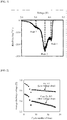
- FIG. 1 shows a graph made in Example I-1 mentioned later, of which horizontal axis is the voltage V and vertical axis is the value dQ/dV.
- the graph has the peak 1, the peak 2, and the peak 3.
- of the value dQ/dV for the peak top of the peak 3 is too small, the energy density lowers because r becomes to be small.
- the range of r is 0 ⁇ r ⁇ 0.25, preferably 0.05 ⁇ r ⁇ 0.23, and more preferably 0.07 ⁇ r ⁇ 0.21.
- is a parameter to which Li 2 MnO 3 in the compositional formula (I) relates. Accordingly it is considered that the energy density lowers when
- a Co content in the positive electrode active material I according to the present invention is significantly lower than that in a NCM type material having a layered rock salt structure, such as Li(Ni 0.33 Co 0.33 Mn 0.33 )O 2 . It is generally known that the energy density can be heightened by heightening the Co content and the energy density retention can be heightened by modifying a composition of the material. However, the followings are important view points in the present invention. That is, it has been found that the voltage drop can be suppressed and the energy density can be heightened by lowering the Co content without limit.
- the discharge energy density during 1 st cycle in the condition (1-1) is 880 - 1100Wh/kg.
- the discharge energy density is lower than the lower limit, there is no significance of the energy density in comparison with a ternary type material, i.e., Li(Ni 0.33 Co 0.33 Mn 0.33 )O 2 , which has been already actually used.
- the discharge energy density is higher than the upper limit, there is tendency that the energy density retention lowers. More preferable range of the discharge energy density is 900 - 1050Wh/kg.
- the energy density retention is obtained by using a discharge energy density during 26 th cycle and a discharge energy density during 7 th cycle, and is represented by the following equation.
- Energy density retention Discharge energy density 26 th cycle / Discharge energy density during 7 th cycle ⁇ 100
- the energy density retention is preferably 93% or more, and more preferably 94% or more.
- the condition (1-2) is set as, under a circumstance at 25°C:
- FIG. 2 shows a graph made by subjecting samples of Example I-1 and Comparative Example 1-3 mentioned later to charge/discharge under the condition (1-2), of which horizontal axis is a cycle number of times and vertical axis is an average discharge voltage.
- the discharge voltage significantly drops with repeating the charge/discharge in Comparative Example 1-3, the discharge voltage less drops even though the charge/discharge is repeated in Example 1-1.
- the positive electrode active material I according to the present invention can be produced by mixing previously synthesized particle powder of a carbonate precursor compound containing transition metals with a lithium compound to give a mixture, and subjecting the mixture to calcination.
- the particle powder of the carbonate precursor compound containing transition metals can be prepared in accordance with the following procedures. That is, to a reaction vessel are supplied a mixture solution containing a nickel compound and a manganese compound each having a prescribed concentration and optionally containing a cobalt compound having a prescribed concentration, and an alkaline aqueous solution, and then pH of a content of the reaction vessel is controlled to be within a suitable range.
- An overflowed suspension from the reaction vessel is pumped to an additional vessel which allows adjustment of the solid concentration and then recirculated to the reaction vessel, and reaction is continued till a particle concentration of the precursor compound in the reaction vessel and the concentration vessel becomes to be 0.1 - 15mol/L.
- the particle powder of the precursor compound can be prepared from the overflowed suspension without procedures by using the concentration vessel. After those, washing with water and drying are carried out to give the carbonate precursor compound.
- the mixture solution is prepared by blending the nickel compound and the manganese compound each having a prescribed concentration and optionally blending the cobalt compound having a prescribed concentration so that the ratio of Ni, Mn and optional Co becomes to be within the desired range in consideration of composition of the aimed layered lithium-composite oxide.
- the mixture solution is prepared by blending the nickel compound and the manganese compound so that the molar ratio of Ni and Mn, i.e., Ni : Mn is 0.25 - 0.45 : 0.55 - 0.75, more 0.30 - 0.40 : 0.60 - 0.70.
- the mixture solution is prepared by blending the nickel compound, the cobalt compound and the manganese compound so that the molar ratio of Ni, Co and Mn, i.e., Ni : Co : Mn is 0.25 - 0.45 : 0.02 - 0.10 : 0.50 - 0.70, more 0.30 - 0.40 : 0.03 - 0.08 : 0.55 - 0.65.
- the above-mentioned suitable range of pH is 6.8 - 13.2, preferably 6.9 - 12.5, more preferably 7.0 - 12.0.
- the pH is less than 6.8 during reaction of the mixture solution containing the nickel compound and the manganese compound each having a prescribed concentration and optionally containing the cobalt compound having a prescribed concentration, it becomes to be difficult that forming reaction of precipitate of, in particular, Ni occurs, and the carbonate precursor compound having the targeted composition cannot be prepared. As a result, the energy density and the energy density retention lower.
- the pH is more than 13.2 during the reaction, a primary particle diameter of the carbonate precursor compound becomes to be large, and the energy density and the energy density retention lower.
- the pH is more than 13.2 because a filling rate of the positive electrode active material I when producing an electrode lowers due to no preparation of spheric precursor compounds.
- the lithium compound and the carbonate precursor compound are mixed with each other so that the molar ratio of Li to a sum of Ni, Mn and optional Co, i.e., Li/(Ni + Co + Mn), is 1.25 - 1.39, preferably 1.25 - 1.38 to give the mixture, and the mixture is subjected to calcination under an oxidizing atmosphere at 840 - 1000°C to give the layered lithium-composite oxide.
- a calcination temperature is lower than 840°C, the desired crystals cannot be formed.
- the calcination temperature is higher than 1000°C, the energy density lowers due to excess progress of crystal growth. It is preferred that the calcination temperature is 850 - 970°C.
- the lithium compound and the particle powder of the carbonate precursor compound containing transition metals can be mixed with each other by a dry mixing or a wet mixing as long as uniform mix can be carried out.
- the precursor used in the present invention is composed of a carbonate. Accordingly, it is preferred to decompose the carbonate and to prevent the carbonate from remaining by satisfactory ventilation during calcination.
- nickel compounds used for the present invention for example, without specific limitations are cited nickel sulfate, nickel oxide, nickel hydroxide, nickel nitrate, nickel carbonate, nickel chloride, nickel iodide, metallic nickel, and the like.
- nickel sulfate nickel oxide, nickel hydroxide, nickel nitrate, nickel carbonate, nickel chloride, nickel iodide, metallic nickel, and the like.
- nickel sulfate is nickel sulfate.
- cobalt compounds used for the present invention for example, without specific limitations are cited cobalt sulfate, cobalt oxide, cobalt hydroxide, cobalt nitrate, cobalt carbonate, cobalt chloride, cobalt iodide, metallic cobalt, and the like.
- cobalt sulfate for example, without specific limitations are cited cobalt sulfate, cobalt oxide, cobalt hydroxide, cobalt nitrate, cobalt carbonate, cobalt chloride, cobalt iodide, metallic cobalt, and the like.
- cobalt sulfate Preferable example is cobalt sulfate.
- manganese compounds used for the present invention for example, without specific limitations are cited manganese sulfate, manganese oxide, manganese hydroxide, manganese nitrate, manganese carbonate, manganese chloride, manganese iodide, metallic manganese, and the like.
- manganese sulfate for example, without specific limitations are cited manganese sulfate, manganese oxide, manganese hydroxide, manganese nitrate, manganese carbonate, manganese chloride, manganese iodide, metallic manganese, and the like.
- manganese sulfate Preferable example is manganese sulfate.
- lithium compounds various lithium salts can be used for the present invention without specific limitations.
- lithium hydroxide monohydrate lithium nitrate, lithium carbonate, lithium acetate, lithium bromide, lithium chloride, lithium citrate, lithium fluoride, lithium iodide, lithium lactate, lithium oxalate, lithium phosphate, lithium pyruvate, lithium sulfate, lithium oxide, and the like.
- lithium carbonate Preferable example is lithium carbonate.
- a surface of primary particles and/or secondary particles of the layered lithium-composite oxide can be covered with an aluminum compound, and/or a solid solution of the aluminum compound can be prepared over the surface of the primary particles and/or the secondary particles of the layered lithium-composite oxide.
- Covering with the aluminum compound can be carried out in accordance with the following procedures. That is, after the layered lithium-composite oxide is deflocculated in pure water and drops of the aluminum compound are put thereto with stirring, these are filtrated and washed with water, and dried at 80 - 120°C or so. Then, calcination is carried out at 300 - 500°C or so for approximately 5 hours in an electric furnace under air circulation.
- the solid solution of the aluminum compound can be prepared by appropriately adjusting a drying temperature, a calcination temperature, and the like which are set when the covering with the aluminum compound is carried out.
- aluminum compounds used for the present invention for example, without specific limitations are cited aluminum sulfate, aluminum oxide, aluminum hydroxide, aluminum nitrate, aluminum carbonate, aluminum chloride, aluminum iodide, sodium aluminate, metallic aluminum, and the like.
- aluminum sulfate aluminum oxide, aluminum hydroxide, aluminum nitrate, aluminum carbonate, aluminum chloride, aluminum iodide, sodium aluminate, metallic aluminum, and the like.
- aluminum sulfate aluminum oxide, aluminum hydroxide, aluminum nitrate, aluminum carbonate, aluminum chloride, aluminum iodide, sodium aluminate, metallic aluminum, and the like.
- aluminum sulfate aluminum oxide, aluminum hydroxide, aluminum nitrate, aluminum carbonate, aluminum chloride, aluminum iodide, sodium aluminate, metallic aluminum, and the like.
- aluminum sulfate aluminum oxide, aluminum hydroxide, aluminum nitrate, aluminum carbonate, aluminum chloride, aluminum iod
- the surface of the layered lithium-composite oxide is covered with the aluminum compound so that the amount of the aluminum compound is preferably 0.1 - 0.7wt%, more preferably 0.2 - 0.6wt% relative to the positive electrode active material I.
- non-aqueous electrolyte secondary battery I comprising a positive electrode containing the positive electrode active material I according to the present invention.
- the positive electrode containing the positive electrode active material I is produced in accordance with an ordinary method. That is, a conductive agent is added to a binder, and these are mixed with each other.
- a conductive agent for example, acetylene black, carbon black, graphite, and the like are preferred.
- the binder for example, polytetrafluoroethylene, polyvinylidene fluoride, and the like are preferred.
- the non-aqueous electrolyte secondary battery I according to the present invention is produced by using the positive electrode containing the positive electrode active material I, and is constituted of the positive electrode, a negative electrode, and an electrolytic solution containing an electrolyte.
- a negative electrode active material there can be used, for example, at least one nonmetallic element or metallic element selected from the group consisting of Si, Al, Sn, Pb, Zn, Bi and Cd, an alloy containing the element(s) or a chalcogenide containing the element(s), and metallic lithium, graphite, a low crystalline carbon material, and the like.
- an organic solvent including at least one of carbonates such as propylene carbonate and dimethyl carbonate, and ethers such as dimethoxyethane, as well as a combination of ethylene carbonate and diethyl carbonate.
- the electrolyte there can be used by being dissolved to the above-mentioned solvent at least one of lithium salts such as lithium perchlorate and lithium tetrafluoroborate, as well as lithium hexafluorophosphate.
- lithium salts such as lithium perchlorate and lithium tetrafluoroborate, as well as lithium hexafluorophosphate.
- the non-aqueous electrolyte secondary battery I comprising a positive electrode containing the positive electrode active material I according to the present invention has the discharge energy density during 1 st cycle in the above-mentioned condition (1-1) of preferably 880 - 1100Wh/kg, more preferably 900 - 1050Wh/kg.
- the non-aqueous electrolyte secondary battery I comprising a positive electrode containing the positive electrode active material I according to the present invention has the energy density retention based on the above-mentioned condition (1-2) of preferably 93% or more, more preferably 94% or more.
- the positive electrode active material I having the specified composition which can provide a battery with less voltage drop during repeated charge/discharge, a high energy density, and also a high energy density retention. Additionally in the present invention, can be obtained the positive electrode active material I which can provide the battery with high battery characteristics in spite of the fact that the amount of Co which is a high-cost rare metal is reduced.
- the positive electrode active material II according to the present invention will be described.
- the positive electrode active material II according to the present invention comprises a lithium-rich layered lithium-composite oxide containing Li, Ni and Mn, and optionally containing Co.
- the positive electrode active material II can be represented, for example, by the following compositional formula (II). Li 1+ ⁇ (Ni a Co b Mn c ) 1- ⁇ O 2 (II)
- the range of ⁇ is 0.11 ⁇ ⁇ ⁇ 0.18, more 0.12 ⁇ ⁇ ⁇ 0.17
- the range of a is 0.20 ⁇ a ⁇ 0.40, more 0.22 ⁇ a ⁇ 0.38
- the range of b is 0 ⁇ b ⁇ 0.08, more 0 ⁇ b ⁇ 0.07
- compositional formula (II) when ⁇ is less than the above-mentioned lower limit and a is more than the above-mentioned upper limit, the energy density lowers although the cycle property and the rate property become to be excellent.
- ⁇ is more than the above-mentioned upper limit and a is less than the above-mentioned lower limit, the cycle property and the rate property become to be poor although the energy density can be heightened.
- b is more than the above-mentioned upper limit, a crystallite becomes to be too large while highly crystalline because growth of the crystallite is accelerated during synthesis of a lithium compound and a carbonate precursor compound. As a result, the rate property lowers.
- an impurity phase having a spinel structure i.e., spinel hetero phase
- an impurity phase having a spinel structure i.e., spinel hetero phase
- generation of the spinel hetero phase can be seen by a X-ray diffraction (XRD).
- XRD X-ray diffraction
- the spinel hetero phase generates, an apparent half-value width of (104) diffracted X-ray broadens, so a crystallite size may be calculated as a smaller value than the original value. Accordingly, considerable generation of the spinel hetero phase is out of the scope and spirits of the present invention, which affects a half-value width of (104) diffracted X-ray.
- the positive electrode active material II has a relative height intensity ratio of (IIa) to (IIb), i.e., (IIa)/(IIb), of 0.015 - 0.035, preferably 0.017 - 0.034.
- the relative height intensity ratio is less than the lower limit, the energy density lowers although the cycle property and the rate property become to be excellent.
- the positive electrode active material II has no practical application.
- the relative height intensity ratio is more than the upper limit, the cycle property and the rate property become to be poor although the energy density heightens.
- the positive electrode active material II has no practical application.
- the positive electrode active material II according to the present invention has a crystallite size calculated by using Scherrer's equation from (104) diffracted X-ray of 25 - 40nm, preferably 26 - 39nm in the powder X-ray diffraction pattern obtained by using Cu-Ka ray.
- the (104) diffracted X-ray when being indexed in a space group R-3m is used as the crystallite size. Because (003) diffracted X-ray includes information pertaining to only c-axis direction and (110) diffracted X-ray includes information pertaining to only ab-axis direction, these (003) diffracted X-ray and (110) diffracted X-ray are not preferred as a peak for calculation of the crystallite size.
- crystallite size is less than the lower limit.
- a volume occupied by a surface of a crystallite relative to an inside of the crystallite becomes to be large.
- contribution of a surface of the material, of which structure most greatly varies, becomes to be significant, and reactivity of the material with an electrolytic solution becomes to be high. Accordingly, it is not preferred that the crystallite size is less than the lower limit.
- the crystallite size is more than the upper limit, during the positive electrode active material II is used as a positive electrode active material for a non-aqueous electrolyte secondary battery, a diffusion length of Li within the crystallite becomes to be long, so the rate property becomes to be poor. Accordingly, it is not preferred that the crystallite size is more than the upper limit.
- X-ray diffractometer "SmartLab” commercially available from Rigaku Corporation
- X-ray source Cu-K ⁇ ray Accelerating voltage: 45kV Accelerating current: 200mA
- Sampling width 0.01deg
- Scan range 15 - 70deg
- Scan speed 0.9sec
- Divergence slit width 0.65deg
- Light receiving slit width 0.2mm
- Scattering slit 0.65deg
- the obtained X-ray diffraction data was analyzed by using an accompanying soft of the above-mentioned X-ray diffractometer, i.e., "PDXL" commercially available from Rigaku Corporation, without removing peaks derived from K ⁇ 2 ray. After removing peaks among all peaks, which could not be indexed in the space group R-3m, optimization at an automatic mode was carried out, and the crystallite size corresponding to a peak represented by an index (104) in the space group R-3m was obtained.
- PXL X-ray diffractometer
- the positive electrode active material II has a BET specific surface area of 3.5 - 8.5m 2 /g, preferably 3.7 - 8.3m 2 /g, more preferably 4.0 - 8.0m 2 /g.
- BET specific surface area is less than the lower limit, during the positive electrode active material II is used as a positive electrode active material for a non-aqueous electrolyte secondary battery, an area contacting with the electrolytic solution becomes to be small and the rate property becomes to be poor. Accordingly, it is not preferred that the BET specific surface area is less than the lower limit.
- the BET specific surface area is more than the upper limit, during the positive electrode active material II is used as a positive electrode active material for a non-aqueous electrolyte secondary battery, the area contacting with the electrolytic solution becomes to be large and side reactions with the electrolytic solution become to be remarkable. Accordingly, it is not preferred that the BET specific surface area is more than the upper limit.
- the BET specific surface area can be measured, for example, in accordance with the following method. That is, after a sample is dried and deaerated at 120°C for 45 minutes under nitrogen gas, the BET specific surface area is measured by using BET specific surface area measuring apparatus "MONOSORB" commercially available from Yuasa Ionics Corporation.
- the crystallinity of the particles shows degree of low defects in a crystal lattice. It is considered by the inventors that the crystallinity of the particles can be heightened and the cycle property of a non-aqueous electrolyte secondary battery can be improved when the particles are used as a positive electrode active material for the battery by carrying out calcination for synthesis of the lithium-composite oxide at a temperature as high as possible.
- calcination is carried out at an overly high temperature in order to heighten the crystallinity of the particles, the following weaknesses occur. That is, the crystallite size becomes to be large, so the rate property becomes to be poor even if the cycle property is improved. Accordingly, it is necessary to set the calcination temperature within the suitable range.
- a Co content in the positive electrode active material II according to the present invention is significantly lower than that in the ternary type material having a layered rock salt structure, such as Li(Ni 0.33 Co 0.33 Mn 0.33 )O 2 .
- the energy density can be heightened by heightening the Co content.
- the followings are important view points in the present invention. That is, it has been found that the positive electrode active material II can be produced, which can provide a battery with excellent cycle property, excellent rate property and also a high energy density, as well as can prevent the crystallite from excessively growing during calcination at a high temperature by lowering the content of Co without limit, which shows effects as a crystal growth flux.
- the cycle property is obtained by using a discharge capacity during 4 th cycle and a discharge capacity during 29 th cycle, and is represented by the following equation. Also the rate property is obtained by using the discharge capacity during 4 th cycle and a discharge capacity during 7 th cycle, and is represented by the following equation.
- Cycle property % Discharge capacity during 29 th cycle / Discharge capacity during 4 th cycle ⁇ 100
- the cycle property is preferably 93% or more, more preferably 94% or more.
- Rate property % Discharge capacity during 7 th cycle / Discharge capacity during 4 th cycle ⁇ 100
- the rate property is preferably 80% or more, more preferably 81% or more.
- condition (II-1) is set as, under a circumstance at 25°C:
- the C rate represents an hour rate and 1C rate is converted into 270mA/g.
- the discharge energy density during 1 st cycle in the condition (II-1) is 880 - 1100Wh/kg.
- the discharge energy density is lower than the lower limit, there is no significance of the energy density in comparison with the ternary type material, i.e., Li(Ni 0.33 Co 0.33 Mn 0.33 )O 2 , which has been already actually used.
- the discharge energy density is higher than the upper limit, there is tendency that the energy density retention lowers. More preferable range of the discharge energy density is 900 - 1050Wh/kg.
- cycle property and the rate property derived from the positive electrode active material II according to the present invention can be calculated by carrying out the charge/discharge under the condition (II-1) and measuring the discharge capacity during each cycle.
- the positive electrode active material II according to the present invention can be produced by mixing previously synthesized particle powder of a carbonate precursor compound containing transition metals with a lithium compound to give a mixture, and subjecting the mixture to calcination.
- the particle powder of the carbonate precursor compound containing transition metals can be prepared in accordance with the following procedures. That is, to a reaction vessel are supplied a mixture solution containing a nickel compound and a manganese compound each having a prescribed concentration and optionally containing a cobalt compound having a prescribed concentration, and an alkaline aqueous solution, and then pH of a content of the vessel is controlled to be within a suitable range.
- An overflowed suspension from the reaction vessel is pumped to an additional vessel which allows adjustment of the solid concentration and then recirculated to the reaction vessel, and reaction is continued till a particle concentration of the precursor compound in the reaction vessel and the concentration vessel becomes to be 0.1 - 15mol/L.
- the particle powder of the precursor compound can be prepared from the overflowed suspension without procedures by using the concentration vessel. After those, washing with water and drying are carried out to give the carbonate precursor compound.
- the mixture solution is prepared by blending the nickel compound and the manganese compound each having a prescribed concentration and optionally blending the cobalt compound having a prescribed concentration so that the ratio of Ni, Mn and optional Co becomes to be within the desired range in consideration of composition of the aimed layered lithium-composite oxide.
- the mixture solution is prepared by blending the nickel compound and the manganese compound so that the molar ratio of Ni and Mn, i.e., Ni : Mn is 0.20 - 0.40 : 0.60 - 0.80, more 0.22 - 0.38 : 0.62 - 0.78.
- the mixture solution is prepared by blending the nickel compound, the cobalt compound and the manganese compound so that the molar ratio of Ni, Co and Mn, i.e., Ni : Co : Mn is 0.20 - 0.40 : 0.005 - 0.08 : 0.50 - 0.70, more 0.22 - 0.38 : 0.01 - 0.07 : 0.55 - 0.65.
- the above-mentioned preferable range of pH is 7.0 - 13.0, more preferably 7.2 - 12.5, particular preferably 7.4 - 12.0.
- pH is less than 7.0 during reaction of the mixture solution containing the nickel compound and the manganese compound each having a prescribed concentration and optionally containing the cobalt compound having a prescribed concentration
- the energy density lowers.
- the pH is more than 13.0 during the reaction, a primary particle diameter of the carbonate precursor compound becomes to be large. As a result, there is tendency that the energy density lowers.
- the pH is more than 13.0 because a filling rate of the positive electrode active material II when producing an electrode lowers due to no preparation of spheric precursor compounds.
- the lithium compound and the carbonate precursor compound are mixed with each other so that the molar ratio of Li to a sum of Ni, Mn and optional Co, i.e., Li/(Ni + Co + Mn), is 1.25 - 1.41, preferably 1.25 - 1.40 to give the mixture, and the mixture is subjected to calcination under an oxidizing atmosphere at 840 - 1000°C to give the layered lithium-composite oxide.
- a calcination temperature is lower than 840°C, the desired crystals cannot be formed.
- the calcination temperature is higher than 1000°C, the energy density lowers due to excess progress of crystal growth. It is preferred that the calcination temperature is 850 - 970°C.
- the lithium compound and the particle powder of the carbonate precursor compound containing transition metals can be mixed with each other by a dry mixing or a wet mixing as long as uniform mix can be carried out.
- the precursor used in the present invention is composed of a carbonate. Accordingly, it is preferred to decompose the carbonate and to prevent the carbonate from remaining by satisfactory ventilation during calcination.
- nickel compounds used for the present invention for example, without specific limitations are cited nickel sulfate, nickel oxide, nickel hydroxide, nickel nitrate, nickel carbonate, nickel chloride, nickel iodide, metallic nickel, and the like.
- nickel sulfate nickel oxide, nickel hydroxide, nickel nitrate, nickel carbonate, nickel chloride, nickel iodide, metallic nickel, and the like.
- nickel sulfate is nickel sulfate.
- cobalt compounds used for the present invention for example, without specific limitations are cited cobalt sulfate, cobalt oxide, cobalt hydroxide, cobalt nitrate, cobalt carbonate, cobalt chloride, cobalt iodide, metallic cobalt, and the like.
- cobalt sulfate for example, without specific limitations are cited cobalt sulfate, cobalt oxide, cobalt hydroxide, cobalt nitrate, cobalt carbonate, cobalt chloride, cobalt iodide, metallic cobalt, and the like.
- cobalt sulfate Preferable example is cobalt sulfate.
- manganese compounds used for the present invention for example, without specific limitations are cited manganese sulfate, manganese oxide, manganese hydroxide, manganese nitrate, manganese carbonate, manganese chloride, manganese iodide, metallic manganese, and the like.
- manganese sulfate for example, without specific limitations are cited manganese sulfate, manganese oxide, manganese hydroxide, manganese nitrate, manganese carbonate, manganese chloride, manganese iodide, metallic manganese, and the like.
- manganese sulfate Preferable example is manganese sulfate.
- lithium compounds various lithium salts can be used for the present invention without specific limitations.
- lithium hydroxide monohydrate lithium nitrate, lithium carbonate, lithium acetate, lithium bromide, lithium chloride, lithium citrate, lithium fluoride, lithium iodide, lithium lactate, lithium oxalate, lithium phosphate, lithium pyruvate, lithium sulfate, lithium oxide, and the like.
- lithium carbonate Preferable example is lithium carbonate.
- a surface of primary particles and/or secondary particles of the layered lithium-composite oxide can be covered with an aluminum compound, and/or a solid solution of the aluminum compound can be prepared over the surface of the primary particles and/or the secondary particles of the layered lithium-composite oxide.
- Covering with the aluminum compound can be carried out in accordance with the following procedures. That is, after the layered lithium-composite oxide is deflocculated in pure water and drops of the aluminum compound are put thereto with stirring, these are filtrated and washed with water, and dried at 80 - 120°C or so. Then, calcination is carried out at 300 - 500°C or so for approximately 5 hours in an electric furnace under air circulation.
- the solid solution of the aluminum compound can be prepared by appropriately adjusting a drying temperature, a calcination temperature, and the like which are set when the covering with the aluminum compound is carried out.
- aluminum compounds used for the present invention for example, without specific limitations are cited aluminum sulfate, aluminum oxide, aluminum hydroxide, aluminum nitrate, aluminum carbonate, aluminum chloride, aluminum iodide, sodium aluminate, metallic aluminum, and the like.
- aluminum sulfate aluminum oxide, aluminum hydroxide, aluminum nitrate, aluminum carbonate, aluminum chloride, aluminum iodide, sodium aluminate, metallic aluminum, and the like.
- aluminum sulfate aluminum oxide, aluminum hydroxide, aluminum nitrate, aluminum carbonate, aluminum chloride, aluminum iodide, sodium aluminate, metallic aluminum, and the like.
- aluminum sulfate aluminum oxide, aluminum hydroxide, aluminum nitrate, aluminum carbonate, aluminum chloride, aluminum iodide, sodium aluminate, metallic aluminum, and the like.
- aluminum sulfate aluminum oxide, aluminum hydroxide, aluminum nitrate, aluminum carbonate, aluminum chloride, aluminum iod
- the surface of the layered lithium-composite oxide is covered with the aluminum compound so that the amount of the aluminum compound is preferably 0.1 - 0.7wt%, more preferably 0.2 - 0.6wt% relative to the positive electrode active material II.
- non-aqueous electrolyte secondary battery II comprising a positive electrode containing the positive electrode active material II according to the present invention.
- the positive electrode containing the positive electrode active material II is produced in accordance with an ordinary method. That is, a conductive agent is added to a binder, and these are mixed with each other.
- a conductive agent for example, acetylene black, carbon black, graphite, and the like are preferred.
- the binder for example, polytetrafluoroethylene, polyvinylidene fluoride, and the like are preferred.
- the non-aqueous electrolyte secondary battery II according to the present invention is produced by using the positive electrode containing the positive electrode active material II, and is constituted of the positive electrode, a negative electrode, and an electrolytic solution containing an electrolyte.
- a negative electrode active material there can be used, for example, at least one nonmetallic element or metallic element selected from the group consisting of Si, Al, Sn, Pb, Zn, Bi and Cd, an alloy containing the element(s) or a chalcogenide containing the element(s), and metallic lithium, graphite, a low crystalline carbon material, and the like.
- an organic solvent including at least one of carbonates such as propylene carbonate and dimethyl carbonate, and ethers such as dimethoxyethane, as well as a combination of ethylene carbonate and diethyl carbonate.
- the electrolyte there can be used by being dissolved to the above-mentioned solvent at least one of lithium salts such as lithium perchlorate and lithium tetrafluoroborate, as well as lithium hexafluorophosphate.
- lithium salts such as lithium perchlorate and lithium tetrafluoroborate, as well as lithium hexafluorophosphate.
- the non-aqueous electrolyte secondary battery II comprising a positive electrode containing the positive electrode active material II according to the present invention has the cycle property of preferably 93% or more, more preferably 94% or more and has the rate property of preferably 80% or more, more preferably 81% or more when the battery II is subjected to charge/discharge under the above-mentioned condition (II-1).
- the cycle property is obtained by using the discharge capacity during 4 th cycle and the discharge capacity during 29 th cycle, and is represented by the following equation.
- the rate property is obtained by using the discharge capacity during 4 th cycle and the discharge capacity during 7 th cycle, and is represented by the following equation.
- Cycle property % Discharge capacity during 29 th cycle / Discharge capacity during 4 th cycle ⁇ 100
- Rate property % Discharge capacity during 7 th cycle / Discharge capacity during 4 th cycle ⁇ 100
- the non-aqueous electrolyte secondary battery II comprising a positive electrode containing the positive electrode active material II according to the present invention has the discharge energy density during 1 st cycle in the above-mentioned condition (II-1) of preferably 880 - 1100Wh/kg, more preferably 900 - 1050Wh/kg.
- the crystallite size calculated by using Scherrer's equation from (104) diffracted X-ray is adjusted to the specified range, i.e., 25 - 40nm, in the powder X-ray diffraction pattern obtained by using Cu-Ka ray. Further the BET specific surface area is adjusted to the specified range, i.e., 3.5 - 8.5m 2 /g. Accordingly, can be obtained the positive electrode active material II which can provide a battery with excellent cycle property, excellent rate property, and also a high energy density. Additionally in the present invention, can be obtained the positive electrode active material II which can provide the battery with high battery characteristics in spite of the fact that the amount of Co which is a high-cost rare metal is reduced.
- the composition of the positive electrode active material I or the positive electrode active material II is determined in accordance with the following procedures. That is, a sample, i.e., 0.2g of each positive electrode active material, is heated and dissolved in 25mL of a hydrochloric acid solution having a concentration of 20% to give a sample solution. After the sample solution is cooled, the sample solution is transferred to a volumetric flask having a capacity of 100mL, and then pure water is added thereto to give an adjusted solution. The quantity of each element in the positive electrode active material is determined by using the adjusted solution and ICAP Spectrometer "Optima8300" commercially available from PerkinElmer Japan Co., Ltd.
- a coin cell is assembled by using the positive electrode active material I or the positive electrode active material II in accordance with the following procedures. That is, are mixed 84% by weight of each positive electrode active material, 4% by weight of acetylene black and 4% by weight of graphite "KS-6" as the conductive agent, and 8% by weight of polyvinylidene fluoride as the binder, which has been dissolved in N-methylpyrrolidone, to give a mixture. Then, Al metallic foil is coated with the mixture and dried at 110°C to give a sheet. A sample sheet having a diameter of 15mm is stamped out from this sheet and crimped under 3t/cm 2 to give a positive electrode.
- a coating amount of the positive electrode was 10mg/cm 2 , and a density of the positive electrode after rolling was 2.5g/cm 3 .
- a sheet having a diameter of 16mm is stamped out from metallic lithium foil to give a negative electrode having a thickness of 500 ⁇ m.
- a coin cell having 2032 size is assembled by using these positive electrode, negative electrode, and electrolytic solution.
- a coin cell was assembled in accordance with the above-mentioned method by using the obtained positive electrode active material as a positive electrode and a lithium foil as a negative electrode.
- the coin cell was subjected to the charge/discharge under the above-mentioned condition (1-1). Based on a voltage V and a battery capacity Q with discharge during 5 th cycle, was plotted a graph of which horizontal axis is the voltage V and vertical axis is the value dQ/dV. The graph is shown in FIG. 1 .
- the coin cell was subjected to the charge/discharge under the above-mentioned condition (1-2), and a discharge voltage during each cycle was measured.
- the relationship between the cycle number of times and the average discharge voltage was plotted as a graph. The graph is shown in FIG. 2 .
- the coprecipitated precursor was a carbonate precursor compound represented by the formula: (Ni 0.35 Co 0.05 Mn 0.60 )CO 3 .
- the mixture was subjected to calcination under the oxidizing atmosphere at 850°C for 5 hours in the electric furnace to give a positive electrode active material.
- a coin cell was assembled in the same manner as in Example 1-1 by using the obtained positive electrode active material.
- the coprecipitated precursor was a carbonate precursor compound represented by the formula: (Ni 0.310 Co 0.055 Mn 0.635 )CO 3 .
- the mixture was subjected to calcination under the oxidizing atmosphere at 880°C for 5 hours in the electric furnace to give a positive electrode active material.
- a coin cell was assembled in the same manner as in Example 1-1 by using the obtained positive electrode active material.
- the coprecipitated precursor was a carbonate precursor compound represented by the formula: (Ni 0.35 Mn 0.65 )CO 3 .
- 100g of the particle powder of the lithium-composite oxide was supplied to 50mL of pure water with stirring, of which temperature was kept at 30°C, to give a slurry of an intermediate calcined material.
- To the slurry of the intermediate calcined material were put drops of 6mL of an aluminum sulfate aqueous solution having an aluminum sulfate concentration of 1.0mol/L.
- a reaction system of the slurry and the aluminum sulfate aqueous solution was filtrated and washed with water, and then dried at 120°C.
- the reaction system was subjected to calcination under air circulation at 400°C for 5 hours in the electric furnace to give a positive electrode active material.
- a surface treated amount of the positive electrode active material with the aluminum sulfate was 0.31wt%.
- a coin cell was assembled in the same manner as in Example 1-1 by using the obtained positive electrode active material.
- Powder of a coprecipitated precursor was synthesized in the same manner as in Example 1-1 except for the following procedures. That is, drops of the sodium carbonate aqueous solution were put to the reaction vessel so that a reacting solution in the reaction vessel had pH of 8.50 ( ⁇ 0.01).
- the coprecipitated precursor was a carbonate precursor compound represented by the formula: (Ni 0.35 Mn 0.65 )CO 3 .
- the mixture was subjected to calcination under the oxidizing atmosphere at 900°C for 5 hours in the electric furnace to give a positive electrode active material.
- a coin cell was assembled in the same manner as in Example 1-1 by using the obtained positive electrode active material.
- Powder of a coprecipitated precursor was synthesized in the same manner as in Example 1-2 except for the following procedures. That is, drops of the sodium carbonate aqueous solution were put to the reaction vessel so that a reacting solution in the reaction vessel had pH of 7.50 ( ⁇ 0.01).
- the coprecipitated precursor was a carbonate precursor compound represented by the formula: (Ni 0.35 Co 0.05 Mn 0.60 )CO 3 .
- the mixture was subjected to calcination under the oxidizing atmosphere at 850°C for 5 hours in the electric furnace to give a positive electrode active material.
- a coin cell was assembled in the same manner as in Example 1-1 by using the obtained positive electrode active material.
- Powder of a coprecipitated precursor was synthesized in the same manner as in Example 1-3 except for the following procedures. That is, drops of the sodium carbonate aqueous solution were put to the reaction vessel so that a reacting solution in the reaction vessel had pH of 9.00 ( ⁇ 0.01).
- the coprecipitated precursor was a carbonate precursor compound represented by the formula: (Ni 0.310 CO 0.055 Mn 0.635 )CO 3 .
- the mixture was subjected to calcination under the oxidizing atmosphere at 880°C for 5 hours in the electric furnace to give a positive electrode active material.
- a coin cell was assembled in the same manner as in Example 1-1 by using the obtained positive electrode active material.
- a positive electrode active material was produced by using the particle powder of the lithium-composite oxide and the aluminum sulfate aqueous solution in the same manner as in Example 1-4.
- the surface treated amount of the positive electrode active material with the aluminum sulfate was 0.31wt%.
- a coin cell was assembled in the same manner as in Example 1-1 by using the obtained positive electrode active material.
- the coprecipitated precursor was a carbonate precursor compound represented by the formula: (Ni 0.35 Co 0.10 Mn 0.55 )CO 3 .
- the mixture was subjected to calcination under the oxidizing atmosphere at 880°C for 5 hours in the electric furnace to give a positive electrode active material.
- a coin cell was assembled in the same manner as in Example 1-1 by using the obtained positive electrode active material.
- the coprecipitated precursor was a carbonate precursor compound represented by the formula: (Ni 0.42 Co 0.05 Mn 0.53 )CO 3 .
- the mixture was subjected to calcination under the oxidizing atmosphere at 910°C for 5 hours in the electric furnace to give a positive electrode active material.
- a coin cell was assembled in the same manner as in Example 1-1 by using the obtained positive electrode active material.
- the coprecipitated precursor was a carbonate precursor compound represented by the formula: (Ni 0.20 Co 0.13 Mn 0.67 )CO 3 .
- the mixture was subjected to calcination under the oxidizing atmosphere at 880°C for 5 hours in the electric furnace to give a positive electrode active material.
- a coin cell was assembled in the same manner as in Example 1-1 by using the obtained positive electrode active material.
- the coin cell was subjected to the charge/discharge under the above-mentioned condition (1-2), and a discharge voltage during each cycle was measured.
- the relationship between the cycle number of times and the average discharge voltage was plotted as a graph. The graph is shown in FIG. 2 .
- the coprecipitated precursor was a carbonate precursor compound represented by the formula: (Ni 0.25 CO 0.10 Mn 0.65 )CO 3 .
- the mixture was subjected to calcination under the oxidizing atmosphere at 830°C for 5 hours in the electric furnace to give a positive electrode active material.
- a coin cell was assembled in the same manner as in Example 1-1 by using the obtained positive electrode active material.
- Powder of a coprecipitated precursor was synthesized in the same manner as in Comparative Example 1-1 except for the following procedures. That is, drops of the sodium carbonate aqueous solution were put to the reaction vessel so that a reacting solution in the reaction vessel had pH of 7.50 ( ⁇ 0.01).
- the coprecipitated precursor was a carbonate precursor compound represented by the formula: (Ni 0.35 Co 0.10 Mn 0.55 )CO 3 .
- the mixture was subjected to calcination under the oxidizing atmosphere at 880°C for 5 hours in the electric furnace to give a positive electrode active material.
- a coin cell was assembled in the same manner as in Example 1-1 by using the obtained positive electrode active material.
- Powder of a coprecipitated precursor was synthesized in the same manner as in Comparative Example 1-2 except for the following procedures. That is, drops of the sodium carbonate aqueous solution were put to the reaction vessel so that a reacting solution in the reaction vessel had pH of 9.00 ( ⁇ 0.01).
- the coprecipitated precursor was a carbonate precursor compound represented by the formula: (Ni 0.42 Co 0.05 Mn 0.53 )CO 3 .
- the mixture was subjected to calcination under the oxidizing atmosphere at 910°C for 5 hours in the electric furnace to give a positive electrode active material.
- a coin cell was assembled in the same manner as in Example 1-1 by using the obtained positive electrode active material.
- Powder of a coprecipitated precursor was synthesized in the same manner as in Comparative Example 1-3 except for the following procedures. That is, drops of the sodium carbonate aqueous solution were put to the reaction vessel so that a reacting solution in the reaction vessel had pH of 9.50 ( ⁇ 0.01).
- the coprecipitated precursor was a carbonate precursor compound represented by the formula: (Ni 0.20 Co 0.13 Mn 0.67 )CO 3 .
- the mixture was subjected to calcination under the oxidizing atmosphere at 880°C for 5 hours in the electric furnace to give a positive electrode active material.
- a coin cell was assembled in the same manner as in Example 1-1 by using the obtained positive electrode active material.
- Powder of a coprecipitated precursor was synthesized in the same manner as in Comparative Example 1-4 except for the following procedures. That is, drops of the sodium carbonate aqueous solution were put to the reaction vessel so that a reacting solution in the reaction vessel had pH of 8.50 ( ⁇ 0.01).
- the coprecipitated precursor was a carbonate precursor compound represented by the formula: (Ni 0.25 CO 0.10 Mn 0.65 )CO 3 .
- the mixture was subjected to calcination under the oxidizing atmosphere at 830°C for 5 hours in the electric furnace to give a positive electrode active material.
- a coin cell was assembled in the same manner as in Example 1-1 by using the obtained positive electrode active material.
- the coprecipitated precursor was a carbonate precursor compound represented by the formula: (Ni 0.35 Mn 0.65 )CO 3 .
- a coin cell was assembled in the same manner as in Example 1-1 by using the obtained positive electrode active material.
- the coprecipitated precursor was a carbonate precursor compound represented by the formula: (Ni 0.35 Co 0.05 Mn 0.60 )CO 3 .
- a coin cell was assembled in the same manner as in Example 1-1 by using the obtained positive electrode active material.
- Powder of a coprecipitated precursor was synthesized in the same manner as in Example 1-3 except for the following procedures. That is, drops of the sodium carbonate aqueous solution were put to the reaction vessel so that a reacting solution in the reaction vessel had pH of 6.50 ( ⁇ 0.01).
- the coprecipitated precursor was a carbonate precursor compound represented by the formula: (Ni 0.310 Co 0.055 Mn 0.635 )CO 3 .
- the mixture was subjected to calcination under the oxidizing atmosphere at 880°C for 5 hours in the electric furnace to give a positive electrode active material.
- a coin cell was assembled in the same manner as in Example 1-1 by using the obtained positive electrode active material.
- a positive electrode active material was produced by using the particle powder of the lithium-composite oxide and the aluminum sulfate aqueous solution in the same manner as in Example 1-4.
- the surface treated amount of the positive electrode active material with the aluminum sulfate was 0.31wt%.
- a coin cell was assembled in the same manner as in Example 1-1 by using the obtained positive electrode active material.
- Table 1-1 Ex. No. Composition Li/(Ni+Co+Mn) (Co is optional) pH Calcination temperature (°C) Surface treated amount (wt%) ⁇ x y z Average valence of Ni (valence) I-1 0.30 0.50 0.00 0.50 +2.00 1.30 8.00 900 0.00 I-2 0.25 0.46 0.07 0.47 +2.00 1.25 8.00 850 0.00 I-3 0.38 0.49 0.09 0.42 +2.16 1.375 8.00 880 0.00 I-4 0.30 0.50 0.00 0.50 +2.00 1.30 8.00 900 0.31 I-5 0.30 0.50 0.00 0.50 +2.00 1.30 8.50 900 0.00 I-6 0.25 0.46 0.07 0.47 +2.00 1.25 7.50 850 0.00 I-7 0.38 0.49 0.09 0.42 +2.16 1.375 9.00 880 0.00 I-8 0.30 0.50 0.00 0.50 +2.00 1.30 8.00 900 0.00 I-6 0.25 0.46 0.07 0.47 +2.00 1.25 7.50 850 0.00 I-7 0.38 0.49
- All of the positive electrode active materials in Examples 1-1 to 1-4 have the energy density of 880 - 1100Wh/kg and the energy density retention of 93% or more. All of the positive electrode active materials in Examples 1-5 to 1-8 in which each pH condition has been changed from that in Examples 1-1 to 1-4 also have the energy density of 880 - 1100Wh/kg and the energy density retention of 93% or more. From these results, it has been found that the positive electrode active material I according to the present invention can provide a battery with a high energy density retention in spite of a high energy density because the peak intensity ratio r is within the range specified in the present invention, i.e., 0 ⁇ r ⁇ 0.25. Also the positive electrode active material I is a favorable and excellent positive electrode material from the viewpoint of cost because the material I contains Co which is a high-cost rare metal in a low content.
- each Li/(Ni + Co + Mn) is too small in Comparative Examples I-1,1-2,1-5 and I-6. All of the positive electrode active materials produced in these comparative examples do not make the peak 3 in the graph and the peak intensity ratio r is zero. Such positive electrode active materials have a low energy density, i.e., less than 880Wh/kg, and the energy density retention derived from each material is not high. Each Li/(Ni + Co + Mn) is too large in Comparative Examples 1-3 and 1-7, and each calcination temperature is too low in Comparative Examples 1-4 and 1-8.
- All of the positive electrode active materials produced in these comparative examples have too large
- Such positive electrode active materials have a significantly low energy density retention although the energy density is high.
- the calcination temperature is too low in Comparative Example 1-9, and the positive electrode active material produced in this comparative example has too large
- Such positive electrode active material has a significantly low energy density retention although the energy density is high.
- the calcination temperature is too high in Comparative Example I-10, and the positive electrode active material produced in this comparative example does not make the peak 3 in the graph and the peak intensity ratio r is zero, to the contrary.
- Such positive electrode active material has a low energy density, i.e., less than 880Wh/kg, and the energy density retention derived from the material is not high.
- the pH during synthesizing the carbonate precursor compound is too low in Comparative Example I-11, and the positive electrode active material produced in this comparative example does not make the peak 3 in the graph and the peak intensity ratio r is zero.
- Such positive electrode active material has a low energy density, i.e., less than 880Wh/kg.
- the pH during synthesizing the carbonate precursor compound is too high in Comparative Example 1-12, and the positive electrode active material produced in this comparative example does not make the peak 3 in the graph and the peak intensity ratio r is zero.
- positive electrode active material has a low energy density, i.e., less than 880Wh/kg.
- the positive electrode active material in Example 1-1 shows less discharge voltage drop even if the charge/discharge is repeated.
- the positive electrode active material in Comparative Example 1-3 shows great discharge voltage drop with repeating the charge/discharge.
- the positive electrode active material I according to the present invention can provide a battery with less voltage drop during repeated charge/discharge, a high energy density, and also a high energy density retention, so the material I is effective as a positive electrode active material for a non-aqueous electrolyte secondary battery.
- the powder X-ray diffraction for powder of the positive electrode active material was carried out in accordance with the above-mentioned method. From the obtained data, the relative height intensity ratio and the crystallite size were calculated. The powder X-ray diffraction pattern is shown in FIG. 3 . The BET specific surface area, the cycle property, the rate property, and the energy density were obtained in accordance with the above-mentioned methods, respectively. The results are shown in Tables II-2 and II-3 described later. The presence or absence of the spinel hetero phase is also shown in Table II-2.
- the coprecipitated precursor was a carbonate precursor compound represented by the formula: (Ni 0.35 Co 0.01 Mn 0.64 )CO 3 .
- the mixture was subjected to calcination under the oxidizing atmosphere at 930°C for 5 hours in the electric furnace to give a positive electrode active material.
- the relative height intensity ratio, the crystallite size, the BET specific surface area, the cycle property, the rate property, and the energy density were obtained in the same manner as in Example II-1.
- the results are shown in Tables II-2 and II-3 described later.
- the presence or absence of the spinel hetero phase is also shown in Table II-2.
- the coprecipitated precursor was a carbonate precursor compound represented by the formula: (Ni 0.33 Co 0.03 Mn 0.64 )CO 3 .
- the mixture was subjected to calcination under the oxidizing atmosphere at 880°C for 5 hours in the electric furnace to give a positive electrode active material.
- the relative height intensity ratio, the crystallite size, the BET specific surface area, the cycle property, the rate property, and the energy density were obtained in the same manner as in Example II-1.
- the results are shown in Tables II-2 and II-3 described later.
- the presence or absence of the spinel hetero phase is also shown in Table II-2.
- the coprecipitated precursor was a carbonate precursor compound represented by the formula: (Ni 0.30 Co 0.06 Mn 0.64 )CO 3 .
- the mixture was subjected to calcination under the oxidizing atmosphere at 930°C for 5 hours in the electric furnace to give a positive electrode active material.
- the relative height intensity ratio, the crystallite size, the BET specific surface area, the cycle property, the rate property, and the energy density were obtained in the same manner as in Example II-1.
- the results are shown in Tables II-2 and II-3 described later.
- the presence or absence of the spinel hetero phase is also shown in Table II-2.
- the coprecipitated precursor was a carbonate precursor compound represented by the formula: (Ni 0.30 Co 0.06 Mn 0.64 )CO 3 .
- 100g of the particle powder of the lithium-composite oxide was supplied to 50mL of pure water with stirring, of which temperature was kept at 30°C, to give a slurry of an intermediate calcined material.
- To the slurry of the intermediate calcined material were put drops of 6mL of an aluminum sulfate aqueous solution having an aluminum sulfate concentration of 1.0mol/L.
- a reaction system of the slurry and the aluminum sulfate aqueous solution was filtrated and washed with water, and then dried at 120°C.
- the reaction system was subjected to calcination under air circulation at 400°C for 5 hours in the electric furnace to give a positive electrode active material.
- a surface treated amount of the positive electrode active material with the aluminum sulfate was 0.34wt%.
- the relative height intensity ratio, the crystallite size, the BET specific surface area, the cycle property, the rate property, and the energy density were obtained in the same manner as in Example II-1.
- the results are shown in Tables II-2 and II-3 described later.
- the presence or absence of the spinel hetero phase is also shown in Table II-2.
- Powder of a coprecipitated precursor was synthesized in the same manner as in Example II-1 except for the following procedures. That is, drops of the sodium carbonate aqueous solution were put to the reaction vessel so that a reacting solution in the reaction vessel had pH of 9.50 ( ⁇ 0.01).
- the coprecipitated precursor was a carbonate precursor compound represented by the formula: (Ni 0.35 Mn 0.65 )CO 3 .
- the mixture was subjected to calcination under the oxidizing atmosphere at 900°C for 5 hours in the electric furnace to give a positive electrode active material.
- the relative height intensity ratio, the crystallite size, the BET specific surface area, the cycle property, the rate property, and the energy density were obtained in the same manner as in Example II-1.
- the results are shown in Tables II-2 and II-3 described later.
- the presence or absence of the spinel hetero phase is also shown in Table II-2.
- Powder of a coprecipitated precursor was synthesized in the same manner as in Example II-2 except for the following procedures. That is, drops of the sodium carbonate aqueous solution were put to the reaction vessel so that a reacting solution in the reaction vessel had pH of 9.00 ( ⁇ 0.01).
- the coprecipitated precursor was a carbonate precursor compound represented by the formula: (Ni 0.35 Co 0.01 Mn 0.64 )CO 3 .
- the mixture was subjected to calcination under the oxidizing atmosphere at 930°C for 5 hours in the electric furnace to give a positive electrode active material.
- the relative height intensity ratio, the crystallite size, the BET specific surface area, the cycle property, the rate property, and the energy density were obtained in the same manner as in Example II-1.
- the results are shown in Tables II-2 and II-3 described later.
- the presence or absence of the spinel hetero phase is also shown in Table II-2.
- Powder of a coprecipitated precursor was synthesized in the same manner as in Example II-3 except for the following procedures. That is, drops of the sodium carbonate aqueous solution were put to the reaction vessel so that a reacting solution in the reaction vessel had pH of 8.50 ( ⁇ 0.01).
- the coprecipitated precursor was a carbonate precursor compound represented by the formula: (Ni 0.33 Co 0.03 Mn 0.64 )CO 3 .
- the mixture was subjected to calcination under the oxidizing atmosphere at 880°C for 5 hours in the electric furnace to give a positive electrode active material.
- the relative height intensity ratio, the crystallite size, the BET specific surface area, the cycle property, the rate property, and the energy density were obtained in the same manner as in Example II-1.
- the results are shown in Tables II-2 and II-3 described later.
- the presence or absence of the spinel hetero phase is also shown in Table II-2.
- Powder of a coprecipitated precursor was synthesized in the same manner as in Example II-4 except for the following procedures. That is, drops of the sodium carbonate aqueous solution were put to the reaction vessel so that a reacting solution in the reaction vessel had pH of 7.50 ( ⁇ 0.01).
- the coprecipitated precursor was a carbonate precursor compound represented by the formula: (Ni 0.30 Co 0.06 Mn 0.64 )CO 3 .
- the mixture was subjected to calcination under the oxidizing atmosphere at 930°C for 5 hours in the electric furnace to give a positive electrode active material.
- the relative height intensity ratio, the crystallite size, the BET specific surface area, the cycle property, the rate property, and the energy density were obtained in the same manner as in Example II-1.
- the results are shown in Tables II-2 and II-3 described later.
- the presence or absence of the spinel hetero phase is also shown in Table II-2.
- the coprecipitated precursor was a carbonate precursor compound represented by the formula: (Ni 0.30 Co 0.06 Mn 0.64 )CO 3 .
- 100g of the particle powder of the lithium-composite oxide was supplied to 50mL of pure water with stirring, of which temperature was kept at 30°C, to give a slurry of an intermediate calcined material.
- To the slurry of the intermediate calcined material were put drops of 6mL of an aluminum sulfate aqueous solution having an aluminum sulfate concentration of 1.0mol/L.
- a reaction system of the slurry and the aluminum sulfate aqueous solution was filtrated and washed with water, and then dried at 120°C.
- the reaction system was subjected to calcination under air circulation at 400°C for 5 hours in the electric furnace to give a positive electrode active material.
- a surface treated amount of the positive electrode active material with the aluminum sulfate was 0.34wt%.
- the relative height intensity ratio, the crystallite size, the BET specific surface area, the cycle property, the rate property, and the energy density were obtained in the same manner as in Example II-1.
- the results are shown in Tables II-2 and II-3 described later.
- the presence or absence of the spinel hetero phase is also shown in Table II-2.
- the coprecipitated precursor was a carbonate precursor compound represented by the formula: (Ni 0.25 CO 0.10 Mn 0.65 )CO 3 .
- the mixture was subjected to calcination under the oxidizing atmosphere at 880°C for 5 hours in the electric furnace to give a positive electrode active material.
- the relative height intensity ratio, the crystallite size, the BET specific surface area, the cycle property, the rate property, and the energy density were obtained in the same manner as in Example II-1.
- the results are shown in Tables II-2 and II-3 described later.
- the presence or absence of the spinel hetero phase is also shown in Table II-2.
- the coprecipitated precursor was a carbonate precursor compound represented by the formula: (Ni 0.23 Co 0.10 Mn 0.67 )CO 3 .
- the mixture was subjected to calcination under the oxidizing atmosphere at 910°C for 5 hours in the electric furnace to give a positive electrode active material.
- the relative height intensity ratio, the crystallite size, the BET specific surface area, the cycle property, the rate property, and the energy density were obtained in the same manner as in Example II-1.
- the results are shown in Tables II-2 and II-3 described later.
- the presence or absence of the spinel hetero phase is also shown in Table II-2.
- the coprecipitated precursor was a carbonate precursor compound represented by the formula: (Ni 0.30 Co 0.20 Mn 0.50 )CO 3 .
- the mixture was subjected to calcination under the oxidizing atmosphere at 880°C for 5 hours in the electric furnace to give a positive electrode active material.
- the relative height intensity ratio, the crystallite size, the BET specific surface area, the cycle property, the rate property, and the energy density were obtained in the same manner as in Example II-1.
- the results are shown in Tables II-2 and II-3 described later.
- the presence or absence of the spinel hetero phase is also shown in Table II-2.
- the coprecipitated precursor was a carbonate precursor compound represented by the formula: (Ni 0.30 Co 0.20 Mn 0.50 )CO 3 .
- the mixture was subjected to calcination under the oxidizing atmosphere at 910°C for 5 hours in the electric furnace to give a positive electrode active material.
- the relative height intensity ratio, the crystallite size, the BET specific surface area, the cycle property, the rate property, and the energy density were obtained in the same manner as in Example II-1.
- the results are shown in Tables II-2 and II-3 described later.
- the presence or absence of the spinel hetero phase is also shown in Table II-2.
- Powder of a coprecipitated precursor was synthesized in the same manner as in Comparative Example II-1 except for the following procedures. That is, drops of the sodium carbonate aqueous solution were put to the reaction vessel so that a reacting solution in the reaction vessel had pH of 9.50 ( ⁇ 0.01).
- the coprecipitated precursor was a carbonate precursor compound represented by the formula: (Ni 0.25 Co 0.10 Mn 0.65 )CO 3 .
- the mixture was subjected to calcination under the oxidizing atmosphere at 880°C for 5 hours in the electric furnace to give a positive electrode active material.
- the relative height intensity ratio, the crystallite size, the BET specific surface area, the cycle property, the rate property, and the energy density were obtained in the same manner as in Example II-1.
- the results are shown in Tables II-2 and II-3 described later.
- the presence or absence of the spinel hetero phase is also shown in Table II-2.
- Powder of a coprecipitated precursor was synthesized in the same manner as in Comparative Example II-2 except for the following procedures. That is, drops of the sodium carbonate aqueous solution were put to the reaction vessel so that a reacting solution in the reaction vessel had pH of 9.00 ( ⁇ 0.01).
- the coprecipitated precursor was a carbonate precursor compound represented by the formula: (Ni 0.23 Co 0.10 Mn 0.67 )CO 3 .
- the mixture was subjected to calcination under the oxidizing atmosphere at 910°C for 5 hours in the electric furnace to give a positive electrode active material.
- the relative height intensity ratio, the crystallite size, the BET specific surface area, the cycle property, the rate property, and the energy density were obtained in the same manner as in Example II-1.
- the results are shown in Tables II-2 and II-3 described later.
- the presence or absence of the spinel hetero phase is also shown in Table II-2.
- Powder of a coprecipitated precursor was synthesized in the same manner as in Comparative Example II-3 except for the following procedures. That is, drops of the sodium carbonate aqueous solution were put to the reaction vessel so that a reacting solution in the reaction vessel had pH of 8.50 ( ⁇ 0.01).
- the coprecipitated precursor was a carbonate precursor compound represented by the formula: (Ni 0.30 Co 0.20 Mn 0.50 )CO 3 .
- the mixture was subjected to calcination under the oxidizing atmosphere at 880°C for 5 hours in the electric furnace to give a positive electrode active material.
- the relative height intensity ratio, the crystallite size, the BET specific surface area, the cycle property, the rate property, and the energy density were obtained in the same manner as in Example II-1.
- the results are shown in Tables II-2 and II-3 described later.
- the presence or absence of the spinel hetero phase is also shown in Table II-2.
- Powder of a coprecipitated precursor was synthesized in the same manner as in Comparative Example II-4 except for the following procedures. That is, drops of the sodium carbonate aqueous solution were put to the reaction vessel so that a reacting solution in the reaction vessel had pH of 7.50 ( ⁇ 0.01).
- the coprecipitated precursor was a carbonate precursor compound represented by the formula: (Ni 0.30 Co 0.20 Mn 0.50 )CO 3 .
- the mixture was subjected to calcination under the oxidizing atmosphere at 910°C for 5 hours in the electric furnace to give a positive electrode active material.
- the relative height intensity ratio, the crystallite size, the BET specific surface area, the cycle property, the rate property, and the energy density were obtained in the same manner as in Example II-1.
- the results are shown in Tables II-2 and II-3 described later.
- the presence or absence of the spinel hetero phase is also shown in Table II-2.
- the coprecipitated precursor was a carbonate precursor compound represented by the formula: (Ni 0.35 Mn 0.65 )CO 3 .
- the relative height intensity ratio, the crystallite size, the BET specific surface area, the cycle property, the rate property, and the energy density were obtained in the same manner as in Example II-1.
- the results are shown in Tables II-2 and II-3 described later.
- the presence or absence of the spinel hetero phase is also shown in Table II-2.
- the coprecipitated precursor was a carbonate precursor compound represented by the formula: (Ni 0.35 Co 0.01 Mn 0.64 )CO 3 .
- the relative height intensity ratio, the crystallite size, the BET specific surface area, the cycle property, the rate property, and the energy density were obtained in the same manner as in Example II-1.
- the results are shown in Tables II-2 and II-3 described later.
- the presence or absence of the spinel hetero phase is also shown in Table II-2.
- Powder of a coprecipitated precursor was synthesized in the same manner as in Example II-3 except for the following procedures. That is, drops of the sodium carbonate aqueous solution were put to the reaction vessel so that a reacting solution in the reaction vessel had pH of 6.50 ( ⁇ 0.01).
- the coprecipitated precursor was a carbonate precursor compound represented by the formula: (Ni 0.33 Co 0.03 Mn 0.64 )CO 3 .
- the mixture was subjected to calcination under the oxidizing atmosphere at 880°C for 5 hours in the electric furnace to give a positive electrode active material.
- the relative height intensity ratio, the crystallite size, the BET specific surface area, the cycle property, the rate property, and the energy density were obtained in the same manner as in Example II-1.
- the results are shown in Tables II-2 and II-3 described later.
- the presence or absence of the spinel hetero phase is also shown in Table II-2.
- Powder of a coprecipitated precursor was synthesized in the same manner as in Example II-4 except for the following procedures. That is, drops of the sodium carbonate aqueous solution were put to the reaction vessel so that a reacting solution in the reaction vessel had pH of 13.50 ( ⁇ 0.01).
- the coprecipitated precursor was a carbonate precursor compound represented by the formula: (Ni 0.30 Co 0.06 Mn 0.64 )CO 3 .
- the mixture was subjected to calcination under the oxidizing atmosphere at 930°C for 5 hours in the electric furnace to give a positive electrode active material.
- the relative height intensity ratio, the crystallite size, the BET specific surface area, the cycle property, the rate property, and the energy density were obtained in the same manner as in Example II-1.
- the results are shown in Tables II-2 and II-3 described later.
- the presence or absence of the spinel hetero phase is also shown in Table II-2.
- Table II-1 In the following Table II-1 are shown the composition of each positive electrode active material ( ⁇ , a, b and c in the above-mentioned compositional formula (II)), pH during synthesizing the carbonate precursor compound, the calcination temperature, and the surface treated amount of the positive electrode active material with the aluminum compound.
- Table II-2 In the following Table II-2 are shown the presence or absence of the spinel hetero phase, the relative height intensity ratio, the crystallite size, and the BET specific surface area. Also in the following Table II-3 are shown the cycle property, the rate property, and the energy density. Table II-1 Ex. No.
- Composition pH Calcination temperature (°C) Surface treated amount (wt%) ⁇ a b c II-1 0.13 0.35 0.00 0.65 7.80 900 0.00 II-2 0.13 0.35 0.01 0.64 7.80 930 0.00 II-3 0.13 0.33 0.03 0.64 7.80 880 0.00 II-4 0.17 0.30 0.06 0.64 7.80 930 0.00 II-5 0.17 0.30 0.06 0.64 7.80 930 0.34 II-6 0.13 0.35 0.00 0.65 9.50 900 0.00 II-7 0.13 0.35 0.01 0.64 9.00 930 0.00 II-8 0.13 0.33 0.03 0.64 8.50 880 0.00 II-9 0.17 0.30 0.06 0.64 7.50 930 0.00 II-10 0.17 0.30 0.06 0.64 7.50 930 0.34 Com. Ex. No.
- Composition pH Calcination temperature (°C) Surface treated amount (wt%) ⁇ a b c II-1 0.15 0.25 0.10 0.65 7.80 880 0.00 II-2 0.15 0.23 0.10 0.67 7.80 910 0.00 II-3 0.11 0.30 0.20 0.50 7.80 880 0.00 II-4 0.09 0.30 0.20 0.50 7.80 910 0.00 II-5 0.15 0.25 0.10 0.65 9.50 880 0.00 II-6 0.15 0.23 0.10 0.67 9.00 910 0.00 II-7 0.11 0.30 0.20 0.50 8.50 880 0.00 II-8 0.09 0.30 0.20 0.50 7.50 910 0.00 II-9 0.13 0.35 0.00 0.65 7.80 830 0.00 II-10 0.13 0.35 0.01 0.64 7.80 1100 0.00 II-11 0.13 0.33 0.03 0.64 6.50 880 0.00 II-12 0.17 0.30 0.06 0.64 13.50 930 0.00 Table II-2 Spinel hetero phase Property of powder Relative height intensity ratio (IIa)/(IIb) Crystallite size (nm) B
- the BET specific surface area is more than 8.5m 2 /g although the relative height intensity ratio (IIa)/(IIb) is within the range of 0.015 - 0.035 and the crystallite size is within the range of 25 - 40nm in Comparative Examples II-1, II-5 and II-6.
- Such positive electrode active materials show poor cycle property and/or poor rate property although the energy density is high.
- the crystallite size is more than 40nm although the relative height intensity ratio (IIa)/(IIb) is within the range of 0.015 - 0.035 and the BET specific surface area is within the range of 3.5 - 8.5m 2 /g in Comparative Example II-2.
- Such positive electrode active material shows poor rate property although the cycle property is excellent and the energy density is high.
- the BET specific surface area is significantly more than 8.5m 2 /g although the relative height intensity ratio (IIa)/(IIb) is within the range of 0.015 - 0.035 and the crystallite size is within the range of 25 - 40nm in Comparative Examples II-3 and II-7.
- Such positive electrode active materials have a low energy density.
- the crystallite size is more than 40nm and the BET specific surface area is more than 8.5m 2 /g although the relative height intensity ratio (IIa)/(IIb) is within the range of 0.015 - 0.035 in Comparative Example II-4.
- Such positive electrode active material shows poor cycle property and has a low energy density although the rate property is excellent.
- the crystallite size is significantly more than 40nm although the relative height intensity ratio (IIa)/(IIb) is within the range of 0.015 - 0.035 and the BET specific surface area is within the range of 3.5 - 8.5m 2 /g in Comparative Example II-8.
- Such positive electrode active material has a low energy density.
- the relative height intensity ratio (IIa)/(IIb) is less than 0.015 although the crystallite size is within the range of 25 - 40nm and the BET specific surface area is within the range of 3.5 - 8.5m 2 /g in Comparative Example II-9.
- Such positive electrode active material shows poor cycle property although the energy density is high and the rate property is excellent.
- the relative height intensity ratio (IIa)/(IIb) is more than 0.035, the crystallite size is significantly more than 40nm, and the BET specific surface area is less than 3.5 in Comparative Example 11-10.
- Such positive electrode active material shows poor rate property and has a low energy density.
- the relative height intensity ratio (IIa)/(IIb) is more than 0.035 although the crystallite size is within the range of 25 - 40nm and the BET specific surface area is within the range of 3.5 - 8.5m 2 /g in Comparative Example 11-11.
- Such positive electrode active material shows poor rate property although the energy density is high and the cycle property is excellent.
- the BET specific surface area is more than 8.5m 2 /g although the relative height intensity ratio (IIa)/(IIb) is within the range of 0.015 - 0.035 and the crystallite size is within the range of 25 - 40nm in Comparative Example II-12.
- Such positive electrode active material shows poor cycle property although the energy density is high and the rate property is excellent.
- the positive electrode active material II according to the present invention can provide a battery with excellent cycle property, excellent rate property, and also a high energy density, so the material II is effective as a positive electrode active material for a non-aqueous electrolyte secondary battery.
- the positive electrode active material I according to the present invention can provide a battery with a high energy density retention as well as less voltage drop during repeated charge/discharge and a high energy density, so the material I is suitable as a positive electrode active material for a non-aqueous electrolyte secondary battery.
- the positive electrode active material II according to the present invention can provide a battery with excellent cycle property, excellent rate property, and also a high energy density, so the material II is also suitable as a positive electrode active material for a non-aqueous electrolyte secondary battery.
Landscapes
- Chemical & Material Sciences (AREA)
- Organic Chemistry (AREA)
- Inorganic Chemistry (AREA)
- Chemical Kinetics & Catalysis (AREA)
- Electrochemistry (AREA)
- General Chemical & Material Sciences (AREA)
- Engineering & Computer Science (AREA)
- Manufacturing & Machinery (AREA)
- Composite Materials (AREA)
- Materials Engineering (AREA)
- Battery Electrode And Active Subsutance (AREA)
Abstract
Description
- The present invention relates to positive electrode active materials for non-aqueous electrolyte secondary batteries and methods for producing the same, and non-aqueous electrolyte secondary batteries using the same.
- In recent years, portable and cordless electronic devices such as audio-visual (AV) devices and personal computers have been rapidly developed. As a driving power source for these electronic devices, there is an increasing demand for secondary batteries having a small size, a light weight, and a high energy density. Also, in consideration of recent global environment, electric cars and hybrid cars have been developed and put into practice. As a result, there is an increasing demand for lithium ion secondary batteries having excellent storage property, which will be used for a power source having a large size. Under these circumstances, lithium ion secondary batteries having a large charge/discharge capacity have been noticed.
- So far there have been known generally LiMn2O4 having a spinel structure, LiMnO2 having a zigzag layered structure, LiCoO2 and LiNiO2 each having a layered rock salt structure, and the like as a positive electrode active material useful for high energy type lithium ion secondary batteries having a voltage of 4V class. Among them, a lithium ion secondary battery using LiNiO2 has been noticed as a battery having a large charge/discharge capacity. However, this material is poor in heat stability and cycle property during charge, so more improvement in properties is demanded.
- In accordance with demand for more increase of capacity, it has been found that a positive electrode active material containing Li2MnO3, having higher capacity, shows a large discharge capacity.
- Other than these materials, there have been proposed a positive electrode active material comprising a composite oxide having a specified composition and a positive electrode active material comprising a lithium-metal oxide which is lithium-rich and manganese-rich (
Patent Literatures 1 and 2). The material comprising a composite oxide contains Li, Ni, Co and Mn, has an excessive lithium phase, and is focused on a discharge capacity when applied with a high load current as well as a charge/discharge efficiency. The material comprising a lithium-metal oxide is focused on the discharge capacity during repeated charge/discharge in addition to an average voltage and a specific capacity. However, these positive electrode active materials cannot fully satisfy an energy density demanded for recent lithium ion secondary batteries, and also cannot fully satisfy cycle property and rate property. -
- [Patent Literature 1] Japanese Laid-Open Patent Publication No.
2014-116162 - [Patent Literature 2] Japanese Laid-Open Patent Publication No.
2013-503450 - [Non-Patent Literature 1] Composite 'Layered-Layered-Spinel' Cathode Structures for Lithium-Ion Batteries. M.M. Thackeray et al., J. Electrochem. Soc., 160 (2013) A31.
- There are currently most demanded:
- a non-aqueous electrolyte secondary battery showing less voltage drop during repeated charge/discharge and having a high energy density, and a positive electrode active material used for the battery; and
- a non-aqueous electrolyte secondary battery showing excellent cycle property and excellent rate property and also having a high energy density, and a positive electrode active material used for the battery. However, batteries and materials which fully satisfy necessary demands have not been proposed yet.
- In particular, secondary batteries having a light weight and a large capacity are greatly desired for the electric cars and the like.
- An object of the present invention is to obtain a positive electrode active material for a non-aqueous electrolyte secondary battery, which can provide the battery with less voltage drop during repeated charge/discharge and a high energy density, a method for producing the positive electrode active material, and a non-aqueous electrolyte secondary battery which has a positive electrode containing the positive electrode active material.
- An object of the present invention is to obtain a positive electrode active material for a non-aqueous electrolyte secondary battery, which can provide the battery with excellent cycle property, excellent rate property and also a high energy density, a method for producing the positive electrode active material, and a non-aqueous electrolyte secondary battery which has a positive electrode containing the positive electrode active material.
- The positive electrode active material (hereinafter also referred to as "positive electrode active material I") according to the present invention, comprises a layered lithium-composite oxide containing Li, Ni and Mn, and optionally containing Co, wherein
when a non-aqueous electrolyte secondary battery in which the positive electrode active material is used for a positive electrode and a lithium foil is used for a negative electrode is subjected to charge/discharge under a condition (1-1), in a graph of which horizontal axis is a voltage "V" and vertical axis is a value dQ/dV from differentiation of a battery capacity "Q" by the voltage "V" based on the voltage "V" and the battery capacity "Q" with discharge during 5th cycle,
a peak intensity ratio "r" represented by the equation:
- |Ia| is an absolute value of the value dQ/dV for a peak top of a
peak 1 having the peak top within a range of more than 3.9V to 4.4V or less, - |Ib| is an absolute value of the value dQ/dV for a peak top of a
peak 2 having the peak top within a range of more than 3.5V to 3.9V or less, and - |Ic| is an absolute value of the value dQ/dV for a peak top of a
peak 3 having the peak top within a range of 2.0V or more to 3.5V or less, - 1st cycle from 2.0V to 4.6V with charge at 0.07C rate (cccv) and discharge at 0.07C rate (cc),
- 2nd cycle from 2.0V to 4.6V with charge at 0.07C rate (cc) and discharge at 0.07C rate (cc),
- 3rd cycle from 2.0V to 4.3V with charge at 0.1C rate (cc) and discharge at 0.1C rate (cc),
- 4th cycle from 2.0V to 4.3V with charge at 0.1C rate (cc) and discharge at 1C rate (cc), and
- 5th cycle from 2.0V to 4.45V with charge at 0.1C rate (cc) and discharge at 1C rate (cc),
- It is preferred that the positive electrode active material I according to the present invention I-1, is represented by the compositional formula (I):
(1-α)(LiNixCoyMnzO2)·αLi2MnO3 (I)
- in the compositional formula (I), when x, y and z are assumed as x + y + z = 1, and when assumption is made that an average valence of Li is +1, an average valence of Co is +3, an average valence of Mn is +4 and an average valence of O is -2,
- a range of α is 0.21 ≤ α ≤ 0.40, a range of x is 0.45 ≤ x ≤ 0.51, a range of y is 0 ≤ y ≤ 0.12, and an average valence of Ni is from +1.90 to +2.25.
- It is preferred that the positive electrode active material I according to the present invention 1-1 or the present invention 1-2, has a discharge energy density during 1st cycle in the condition (1-1) of 880 - 1100Wh/kg.
- The method for producing the positive electrode active material I according to the present invention, comprises:
- a step of synthesizing a carbonate precursor compound containing Ni and Mn, and optionally containing Co under a condition of pH = 6.8 - 13.2;
- a step of preparing a mixture by mixing a lithium compound with the carbonate precursor compound so that a molar ratio of Li to a sum of Ni, Mn and Co, Li/(Ni + Co + Mn), is 1.25 - 1.39; and
- a step of preparing the layered lithium-composite oxide by calcination of the mixture under an oxidizing atmosphere at 840 - 1000°C.
- It is preferred that in the method according to the present invention 1-4,
a mixture solution is prepared by blending a nickel compound and a manganese compound so that a molar ratio of Ni and Mn, i.e., Ni : Mn is 0.25 - 0.45 : 0.55 - 0.75, or
a mixture solution is prepared by blending a nickel compound, a cobalt compound and a manganese compound so that a molar ratio of Ni, Co and Mn, i.e., Ni : Co : Mn is 0.25 - 0.45 : 0.02 - 0.10 : 0.50 - 0.70; and
the carbonate precursor compound is synthesized by using the mixture solution. - It is preferred that in the method according to the present invention 1-4 or the present invention 1-5,
a surface of primary particles and/or secondary particles of the layered lithium-composite oxide is covered with an aluminum compound and/or a solid solution of the aluminum compound is prepared over the surface of the primary particles and/or the secondary particles of the layered lithium-composite oxide so that an amount of the aluminum compound is 0.1 - 0.7wt% relative to the positive electrode active material. - The non-aqueous electrolyte secondary battery (hereinafter also referred to as "non-aqueous electrolyte secondary battery I") according to the present invention, comprises a positive electrode containing the positive electrode active material I according to the present invention I-1, the present invention 1-2 or the present invention 1-3.
- The positive electrode active material (hereinafter also referred to as "positive electrode active material II") according to the present invention, comprises a layered lithium-composite oxide containing Li, Ni and Mn, and optionally containing Co, wherein
a relative height intensity ratio of (IIa) to (IIb), (IIa)/(IIb), is 0.015 - 0.035, in which - (IIa) is a height intensity of a maximum diffraction peak at 2θ = 20.8 ± 1° and
- (IIb) is a height intensity of a maximum diffraction peak at 2θ = 18.6 ± 1°,
- It is preferred that for the positive electrode active material according to the present invention II-1,
when a non-aqueous electrolyte secondary battery in which the positive electrode active material is used for a positive electrode and a lithium foil is used for a negative electrode is subjected to charge/discharge under a condition (II-1),
a cycle property is 93% or more, the cycle property is obtained by using a discharge capacity during 4th cycle and a discharge capacity during 29th cycle, and is represented by the equation:
a rate property is 80% or more, the rate property is obtained by using the discharge capacity during 4th cycle and a discharge capacity during 7th cycle, and is represented by the equation:
- 1st cycle from 2.0V to 4.6V with charge at 0.07C rate (cccv) and discharge at 0.07C rate (cc),
- 2nd cycle from 2.0V to 4.6V with charge at 0.07C rate (cc) and discharge at 0.07C rate (cc),
- 3rd cycle from 2.0V to 4.3V with charge at 0.1C rate (cc) and discharge at 0.07C rate (cc),
- 4th cycle from 2.0V to 4.3V with charge at 0.1C rate (cc) and discharge at 0.1C rate (cc),
- 5th cycle from 2.0V to 4.3V with charge at 0.1C rate (cc) and discharge at 0.2C rate (cc),
- 6th cycle from 2.0V to 4.3V with charge at 0.1C rate (cc) and discharge at 0.5C rate (cc),
- 7th cycle from 2.0V to 4.3V with charge at 0.1C rate (cc) and discharge at 1C rate (cc),
- 8th cycle from 2.0V to 4.45V with charge at 0.1C rate (cc) and discharge at 1C (cc), and
- 9th - 29th cycles each from 2.0V to 4.3V with charge at 0.2C rate (cc) and discharge at 0.5C rate (cc),
- It is preferred that the positive electrode active material according to the present invention II-2, has a discharge energy density during 1st cycle in the condition (II-1) of 880 - 1100Wh/kg.
- It is preferred that the positive electrode active material according to the present invention II-1, the present invention II-2 or the present invention II-3 is represented by the compositional formula (II):
Li1+β(NiaCobMnc)1-βO2 (II)
in the compositional formula (II), a range of β is 0.11 ≤ β ≤ 0.18, a range of a is 0.20 ≤ a ≤ 0.40, a range of b is 0 ≤ b ≤ 0.08, and a, b and c are fixed as a + b + c = 1. - The non-aqueous electrolyte secondary battery (hereinafter also referred to as "non-aqueous electrolyte secondary battery II") according to the present invention, comprises a positive electrode containing the positive electrode active material II according to the present invention II-1, the present invention II-2, the present invention II-3 or the present invention II-4.
- According to the present invention, the positive electrode active material II can be obtained, which can provide a battery with excellent cycle property, excellent rate property and also a high energy density.
-
-
FIG. 1 shows a graph made in Example I-1, of which horizontal axis is a voltage V and vertical axis is a value dQ/dV. -
FIG. 2 shows a graph made by subjecting samples of Example 1-1 and Comparative Example 1-3 to charge/discharge under the condition (1-2), of which horizontal axis is a cycle number of times and vertical axis is an average discharge voltage. -
FIG. 3 shows a powder X-ray diffraction pattern of a positive electrode active material of Example II-1. - The positive electrode active material I according to the present invention will be described.
- The positive electrode active material I according to the present invention comprises a lithium-rich layered lithium-composite oxide containing Li, Ni and Mn, and optionally containing Co.
- The layered lithium-composite oxide in the present invention can be, for example, represented by the following compositional formula (I).
(1-α)(LiNixCoyMnzO2)·αLi2MnO3 (I)
In the compositional formula (I), when x, y and z are assumed as x + y + z = 1, and when assumption is made that an average valence of Li is +1, an average valence of Co is +3, an average valence of Mn is +4 and an average valence of O is -2, it is preferred that α, x, y and an average valence of Ni are within the following respective ranges. - That is, the range of α is preferably 0.21 ≤ α ≤ 0.40, more preferably 0.25 ≤ α ≤ 0.38. The range of x is preferably 0.45 ≤ x ≤ 0.51, more preferably 0.46 ≤ x ≤ 0.50. The range of y is preferably 0 ≤ y ≤ 0.12, more preferably 0 ≤ y ≤ 0.09. The average valence of Ni is preferably from +1.90 to +2.25, more preferably from +1.98 to +2.16.
- In the present invention, when α and x are less than the above-mentioned respective lower limits, the energy density lowers although voltage drop is less and the energy density retention heightens. When α is more than the above-mentioned upper limit and x is less than the above-mentioned lower limit, the voltage drop also increases although the energy density heightens. When y/x becomes to be too large, the voltage drop during charge/discharge increases and the energy density retention lowers.
- When the non-aqueous electrolyte secondary battery I in which the positive electrode active material I is used for a positive electrode and a lithium foil is used for a negative electrode is subjected to charge/discharge under the following condition (I-1), in a graph of which horizontal axis is a voltage "V" and vertical axis is a value dQ/dV from differentiation of a battery capacity "Q" by the voltage "V" based on the voltage "V" and the battery capacity "Q" with discharge during 5th cycle, a peak intensity ratio "r" represented by the following equation satisfies 0 < r ≤ 0.25.

- |Ia| is an absolute value of the value dQ/dV for a peak top of a
peak 1 having the peak top within a range of more than 3.9V to 4.4V or less, - |Ib| is an absolute value of the value dQ/dV for a peak top of a
peak 2 having the peak top within a range of more than 3.5V to 3.9V or less, and - |Ic| is an absolute value of the value dQ/dV for a peak top of a
peak 3 having the peak top within a range of 2.0V or more to 3.5V or less. - The condition (1-1) is set as, under a circumstance at 25°C:
- 1st cycle from 2.0V to 4.6V with charge at 0.07C rate (cccv) and discharge at 0.07C rate (cc),
- 2nd cycle from 2.0V to 4.6V with charge at 0.07C rate (cc) and discharge at 0.07C rate (cc),
- 3rd cycle from 2.0V to 4.3V with charge at 0.1C rate (cc) and discharge at 0.1C rate (cc),
- 4th cycle from 2.0V to 4.3V with charge at 0.1C rate (cc) and discharge at 1C rate (cc), and
- 5th cycle from 2.0V to 4.45V with charge at 0.1C rate (cc) and discharge at 1C rate (cc). The above-mentioned C rate represents an hour rate and 1C rate is converted into 270mA/g.
- The peak intensity ratio r will be described by using drawings.
FIG. 1 shows a graph made in Example I-1 mentioned later, of which horizontal axis is the voltage V and vertical axis is the value dQ/dV. As shown inFIG. 1 , it can be seen that the graph has thepeak 1, thepeak 2, and thepeak 3. It has been found that when the absolute value |Ic| of the value dQ/dV for the peak top of thepeak 3 is too small, the energy density lowers because r becomes to be small. It has been also found that when |Ic| is too large, the voltage drop increases because r becomes to be large, and the energy density retention lowers. In the present invention, the range of r is 0 < r ≤ 0.25, preferably 0.05 ≤ r ≤ 0.23, and more preferably 0.07 ≤ r ≤ 0.21. - It is considered by the inventors that |Ic| is a parameter to which Li2MnO3 in the compositional formula (I) relates. Accordingly it is considered that the energy density lowers when |Ic| becomes to be small. It is also considered by the inventors that |Ic| is a parameter which pertains to degree of occurring in the voltage drop during charge/discharge. There is tendency that although the energy density heightens when |Ic| becomes to be large, the voltage drop increases and the energy density retention lowers. Accordingly it can be considered that the positive electrode active material I can be obtained, which can provide a battery with less voltage drop, a high energy density and also a high energy density retention, when |Ic| is set within the suitable range.
- As a result of earnest investigation by the inventors, it has been found that a Co content in the positive electrode active material I according to the present invention is significantly lower than that in a NCM type material having a layered rock salt structure, such as Li(Ni0.33Co0.33Mn0.33)O2. It is generally known that the energy density can be heightened by heightening the Co content and the energy density retention can be heightened by modifying a composition of the material. However, the followings are important view points in the present invention. That is, it has been found that the voltage drop can be suppressed and the energy density can be heightened by lowering the Co content without limit.
- In the present invention, it is preferred that the discharge energy density during 1st cycle in the condition (1-1) is 880 - 1100Wh/kg. When the discharge energy density is lower than the lower limit, there is no significance of the energy density in comparison with a ternary type material, i.e., Li(Ni0.33Co0.33Mn0.33)O2, which has been already actually used. When the discharge energy density is higher than the upper limit, there is tendency that the energy density retention lowers. More preferable range of the discharge energy density is 900 - 1050Wh/kg.
- In the present invention, when charge/discharge under a condition (1-2) is carried out, the energy density retention is obtained by using a discharge energy density during 26th cycle and a discharge energy density during 7th cycle, and is represented by the following equation.

- The energy density retention is preferably 93% or more, and more preferably 94% or more. The condition (1-2) is set as, under a circumstance at 25°C:
- 1st cycle from 2.0V to 4.6V with charge at 0.07C rate (cccv) and discharge at 0.07C rate (cc),
- 2nd cycle from 2.0V to 4.6V with charge at 0.07C rate (cc) and discharge at 0.07C rate (cc),
- 3rd cycle from 2.0V to 4.6V with charge at 0.1C rate (cc) and discharge at 0.1C rate (cc),
- 4th cycle from 2.0V to 4.6V with charge at 0.1C rate (cc) and discharge at 0.2C rate (cc),
- 5th cycle from 2.0V to 4.6V with charge at 0.1C rate (cc) and discharge at 0.5C rate (cc),
- 6th cycle from 2.0V to 4.6V with charge at 0.1C rate (cc) and discharge at 1C rate (cc), and
- 7th - 26th cycles each from 2.0V to 4.6V with charge at 0.2C rate (cc) and discharge at 0.5C rate (cc).
- It can be seen by measuring the discharge voltage during each cycle that a battery containing the positive electrode active material I according to the present invention shows less voltage drop during the repeated charge/discharge under the condition (1-2).
FIG. 2 shows a graph made by subjecting samples of Example I-1 and Comparative Example 1-3 mentioned later to charge/discharge under the condition (1-2), of which horizontal axis is a cycle number of times and vertical axis is an average discharge voltage. As shown inFIG. 2 , although the discharge voltage significantly drops with repeating the charge/discharge in Comparative Example 1-3, the discharge voltage less drops even though the charge/discharge is repeated in Example 1-1. - The method for producing the positive electrode active material I, according to the present invention, will be described.
- The positive electrode active material I according to the present invention can be produced by mixing previously synthesized particle powder of a carbonate precursor compound containing transition metals with a lithium compound to give a mixture, and subjecting the mixture to calcination.
- The particle powder of the carbonate precursor compound containing transition metals (carbonate precursor compound containing Ni and Mn, and optionally containing Co) can be prepared in accordance with the following procedures. That is, to a reaction vessel are supplied a mixture solution containing a nickel compound and a manganese compound each having a prescribed concentration and optionally containing a cobalt compound having a prescribed concentration, and an alkaline aqueous solution, and then pH of a content of the reaction vessel is controlled to be within a suitable range. An overflowed suspension from the reaction vessel is pumped to an additional vessel which allows adjustment of the solid concentration and then recirculated to the reaction vessel, and reaction is continued till a particle concentration of the precursor compound in the reaction vessel and the concentration vessel becomes to be 0.1 - 15mol/L. The particle powder of the precursor compound can be prepared from the overflowed suspension without procedures by using the concentration vessel. After those, washing with water and drying are carried out to give the carbonate precursor compound.
- When the particle powder of the carbonate precursor compound containing Ni and Mn, and optionally containing Co is synthesized, it is preferred that the mixture solution is prepared by blending the nickel compound and the manganese compound each having a prescribed concentration and optionally blending the cobalt compound having a prescribed concentration so that the ratio of Ni, Mn and optional Co becomes to be within the desired range in consideration of composition of the aimed layered lithium-composite oxide.
- When the particle powder of the carbonate precursor compound containing Ni and Mn is synthesized, it is preferred that the mixture solution is prepared by blending the nickel compound and the manganese compound so that the molar ratio of Ni and Mn, i.e., Ni : Mn is 0.25 - 0.45 : 0.55 - 0.75, more 0.30 - 0.40 : 0.60 - 0.70.
- When the particle powder of the carbonate precursor compound containing Ni, Co and Mn is synthesized, it is preferred that the mixture solution is prepared by blending the nickel compound, the cobalt compound and the manganese compound so that the molar ratio of Ni, Co and Mn, i.e., Ni : Co : Mn is 0.25 - 0.45 : 0.02 - 0.10 : 0.50 - 0.70, more 0.30 - 0.40 : 0.03 - 0.08 : 0.55 - 0.65.
- The above-mentioned suitable range of pH is 6.8 - 13.2, preferably 6.9 - 12.5, more preferably 7.0 - 12.0. When the pH is less than 6.8 during reaction of the mixture solution containing the nickel compound and the manganese compound each having a prescribed concentration and optionally containing the cobalt compound having a prescribed concentration, it becomes to be difficult that forming reaction of precipitate of, in particular, Ni occurs, and the carbonate precursor compound having the targeted composition cannot be prepared. As a result, the energy density and the energy density retention lower. When the pH is more than 13.2 during the reaction, a primary particle diameter of the carbonate precursor compound becomes to be large, and the energy density and the energy density retention lower. Also it is not preferred that the pH is more than 13.2 because a filling rate of the positive electrode active material I when producing an electrode lowers due to no preparation of spheric precursor compounds.
- Then, the lithium compound and the carbonate precursor compound are mixed with each other so that the molar ratio of Li to a sum of Ni, Mn and optional Co, i.e., Li/(Ni + Co + Mn), is 1.25 - 1.39, preferably 1.25 - 1.38 to give the mixture, and the mixture is subjected to calcination under an oxidizing atmosphere at 840 - 1000°C to give the layered lithium-composite oxide.
- When a calcination temperature is lower than 840°C, the desired crystals cannot be formed. When the calcination temperature is higher than 1000°C, the energy density lowers due to excess progress of crystal growth. It is preferred that the calcination temperature is 850 - 970°C.
- The lithium compound and the particle powder of the carbonate precursor compound containing transition metals can be mixed with each other by a dry mixing or a wet mixing as long as uniform mix can be carried out.
- The precursor used in the present invention is composed of a carbonate. Accordingly, it is preferred to decompose the carbonate and to prevent the carbonate from remaining by satisfactory ventilation during calcination.
- As the nickel compounds used for the present invention, for example, without specific limitations are cited nickel sulfate, nickel oxide, nickel hydroxide, nickel nitrate, nickel carbonate, nickel chloride, nickel iodide, metallic nickel, and the like. Preferable example is nickel sulfate.
- As the cobalt compounds used for the present invention, for example, without specific limitations are cited cobalt sulfate, cobalt oxide, cobalt hydroxide, cobalt nitrate, cobalt carbonate, cobalt chloride, cobalt iodide, metallic cobalt, and the like. Preferable example is cobalt sulfate.
- As the manganese compounds used for the present invention, for example, without specific limitations are cited manganese sulfate, manganese oxide, manganese hydroxide, manganese nitrate, manganese carbonate, manganese chloride, manganese iodide, metallic manganese, and the like. Preferable example is manganese sulfate.
- As the lithium compounds, various lithium salts can be used for the present invention without specific limitations. For example, are cited lithium hydroxide monohydrate, lithium nitrate, lithium carbonate, lithium acetate, lithium bromide, lithium chloride, lithium citrate, lithium fluoride, lithium iodide, lithium lactate, lithium oxalate, lithium phosphate, lithium pyruvate, lithium sulfate, lithium oxide, and the like. Preferable example is lithium carbonate.
- In order to more improve the energy density retention and a charge/discharge efficiency of a battery containing the positive electrode active material I, a surface of primary particles and/or secondary particles of the layered lithium-composite oxide can be covered with an aluminum compound, and/or a solid solution of the aluminum compound can be prepared over the surface of the primary particles and/or the secondary particles of the layered lithium-composite oxide.
- Covering with the aluminum compound can be carried out in accordance with the following procedures. That is, after the layered lithium-composite oxide is deflocculated in pure water and drops of the aluminum compound are put thereto with stirring, these are filtrated and washed with water, and dried at 80 - 120°C or so. Then, calcination is carried out at 300 - 500°C or so for approximately 5 hours in an electric furnace under air circulation.
- The solid solution of the aluminum compound can be prepared by appropriately adjusting a drying temperature, a calcination temperature, and the like which are set when the covering with the aluminum compound is carried out.
- As the aluminum compounds used for the present invention, for example, without specific limitations are cited aluminum sulfate, aluminum oxide, aluminum hydroxide, aluminum nitrate, aluminum carbonate, aluminum chloride, aluminum iodide, sodium aluminate, metallic aluminum, and the like. Preferable example is aluminum sulfate.
- The surface of the layered lithium-composite oxide is covered with the aluminum compound so that the amount of the aluminum compound is preferably 0.1 - 0.7wt%, more preferably 0.2 - 0.6wt% relative to the positive electrode active material I. As a result, effects for more improving the energy density retention and effects for improving the charge/discharge efficiency can be more fully exhibited.
- Will be described the non-aqueous electrolyte secondary battery I comprising a positive electrode containing the positive electrode active material I according to the present invention.
- The positive electrode containing the positive electrode active material I is produced in accordance with an ordinary method. That is, a conductive agent is added to a binder, and these are mixed with each other. As the conductive agent, for example, acetylene black, carbon black, graphite, and the like are preferred. As the binder, for example, polytetrafluoroethylene, polyvinylidene fluoride, and the like are preferred.
- The non-aqueous electrolyte secondary battery I according to the present invention is produced by using the positive electrode containing the positive electrode active material I, and is constituted of the positive electrode, a negative electrode, and an electrolytic solution containing an electrolyte.
- As a negative electrode active material, there can be used, for example, at least one nonmetallic element or metallic element selected from the group consisting of Si, Al, Sn, Pb, Zn, Bi and Cd, an alloy containing the element(s) or a chalcogenide containing the element(s), and metallic lithium, graphite, a low crystalline carbon material, and the like.
- As a solvent of the electrolytic solution, there can be used an organic solvent including at least one of carbonates such as propylene carbonate and dimethyl carbonate, and ethers such as dimethoxyethane, as well as a combination of ethylene carbonate and diethyl carbonate.
- As the electrolyte, there can be used by being dissolved to the above-mentioned solvent at least one of lithium salts such as lithium perchlorate and lithium tetrafluoroborate, as well as lithium hexafluorophosphate.
- The non-aqueous electrolyte secondary battery I comprising a positive electrode containing the positive electrode active material I according to the present invention has the discharge energy density during 1st cycle in the above-mentioned condition (1-1) of preferably 880 - 1100Wh/kg, more preferably 900 - 1050Wh/kg.
- The non-aqueous electrolyte secondary battery I comprising a positive electrode containing the positive electrode active material I according to the present invention has the energy density retention based on the above-mentioned condition (1-2) of preferably 93% or more, more preferably 94% or more.
- In the present invention, by adjusting the peak intensity ratio r to the specified range, i.e., 0 < r ≤ 0.25, can be obtained the positive electrode active material I having the specified composition, which can provide a battery with less voltage drop during repeated charge/discharge, a high energy density, and also a high energy density retention. Additionally in the present invention, can be obtained the positive electrode active material I which can provide the battery with high battery characteristics in spite of the fact that the amount of Co which is a high-cost rare metal is reduced.
- The positive electrode active material II according to the present invention will be described.
- The positive electrode active material II according to the present invention comprises a lithium-rich layered lithium-composite oxide containing Li, Ni and Mn, and optionally containing Co.
- The positive electrode active material II according to the present invention can be represented, for example, by the following compositional formula (II).
Li1+β(NiaCobMnc)1-βO2 (II)
In the compositional formula (II), it is preferred that: the range of β is 0.11 ≤ β ≤ 0.18, more 0.12 ≤ β ≤ 0.17; the range of a is 0.20 ≤ a ≤ 0.40, more 0.22 ≤ a ≤ 0.38; the range of b is 0 ≤ b ≤ 0.08, more 0 ≤ b ≤ 0.07; and a, b and c are fixed as a + b + c = 1. - In the compositional formula (II), when β is less than the above-mentioned lower limit and a is more than the above-mentioned upper limit, the energy density lowers although the cycle property and the rate property become to be excellent. When β is more than the above-mentioned upper limit and a is less than the above-mentioned lower limit, the cycle property and the rate property become to be poor although the energy density can be heightened. When b is more than the above-mentioned upper limit, a crystallite becomes to be too large while highly crystalline because growth of the crystallite is accelerated during synthesis of a lithium compound and a carbonate precursor compound. As a result, the rate property lowers. Additionally when β is less than the above-mentioned lower limit, an impurity phase having a spinel structure, i.e., spinel hetero phase, generates, so the battery capacity is reduced. Generation of the spinel hetero phase can be seen by a X-ray diffraction (XRD). As disclosed in
Non-Patent Literature 1, in case the spinel hetero phase generates, an apparent half-value width of (104) diffracted X-ray broadens, so a crystallite size may be calculated as a smaller value than the original value. Accordingly, considerable generation of the spinel hetero phase is out of the scope and spirits of the present invention, which affects a half-value width of (104) diffracted X-ray. - The positive electrode active material II according to the present invention has a relative height intensity ratio of (IIa) to (IIb), i.e., (IIa)/(IIb), of 0.015 - 0.035, preferably 0.017 - 0.034. The value (IIa) is a height intensity of a maximum diffraction peak at 2θ = 20.8 ± 1° and the value (IIb) is a height intensity of a maximum diffraction peak at 2θ = 18.6 ± 1° in a powder X-ray diffraction pattern obtained by using Cu-Ka ray. When the relative height intensity ratio is less than the lower limit, the energy density lowers although the cycle property and the rate property become to be excellent. As a result, the positive electrode active material II has no practical application. When the relative height intensity ratio is more than the upper limit, the cycle property and the rate property become to be poor although the energy density heightens. As a result, also the positive electrode active material II has no practical application.
- The positive electrode active material II according to the present invention has a crystallite size calculated by using Scherrer's equation from (104) diffracted X-ray of 25 - 40nm, preferably 26 - 39nm in the powder X-ray diffraction pattern obtained by using Cu-Ka ray. In the present invention, the (104) diffracted X-ray when being indexed in a space group R-3m is used as the crystallite size. Because (003) diffracted X-ray includes information pertaining to only c-axis direction and (110) diffracted X-ray includes information pertaining to only ab-axis direction, these (003) diffracted X-ray and (110) diffracted X-ray are not preferred as a peak for calculation of the crystallite size. Other diffracted X-rays are also not preferred as the peak for calculation of the crystallite size because each peak intensity is low. When the crystallite size is less than the lower limit, a volume occupied by a surface of a crystallite relative to an inside of the crystallite becomes to be large. As a result, during the positive electrode active material II is used as a positive electrode active material for a non-aqueous electrolyte secondary battery, contribution of a surface of the material, of which structure most greatly varies, becomes to be significant, and reactivity of the material with an electrolytic solution becomes to be high. Accordingly, it is not preferred that the crystallite size is less than the lower limit. When the crystallite size is more than the upper limit, during the positive electrode active material II is used as a positive electrode active material for a non-aqueous electrolyte secondary battery, a diffusion length of Li within the crystallite becomes to be long, so the rate property becomes to be poor. Accordingly, it is not preferred that the crystallite size is more than the upper limit.
- In the present invention, conditions for the X-ray diffraction are as follows.
X-ray diffractometer: "SmartLab" commercially available from Rigaku Corporation X-ray source: Cu-Kα ray Accelerating voltage: 45kV Accelerating current: 200mA Sampling width: 0.01deg Scan range: 15 - 70deg Scan speed: 0.9sec Divergence slit width: 0.65deg Light receiving slit width: 0.2mm Scattering slit: 0.65deg - The obtained X-ray diffraction data was analyzed by using an accompanying soft of the above-mentioned X-ray diffractometer, i.e., "PDXL" commercially available from Rigaku Corporation, without removing peaks derived from Kα2 ray. After removing peaks among all peaks, which could not be indexed in the space group R-3m, optimization at an automatic mode was carried out, and the crystallite size corresponding to a peak represented by an index (104) in the space group R-3m was obtained.
- The positive electrode active material II according to the present invention has a BET specific surface area of 3.5 - 8.5m2/g, preferably 3.7 - 8.3m2/g, more preferably 4.0 - 8.0m2/g. When the BET specific surface area is less than the lower limit, during the positive electrode active material II is used as a positive electrode active material for a non-aqueous electrolyte secondary battery, an area contacting with the electrolytic solution becomes to be small and the rate property becomes to be poor. Accordingly, it is not preferred that the BET specific surface area is less than the lower limit. When the BET specific surface area is more than the upper limit, during the positive electrode active material II is used as a positive electrode active material for a non-aqueous electrolyte secondary battery, the area contacting with the electrolytic solution becomes to be large and side reactions with the electrolytic solution become to be remarkable. Accordingly, it is not preferred that the BET specific surface area is more than the upper limit. The BET specific surface area can be measured, for example, in accordance with the following method. That is, after a sample is dried and deaerated at 120°C for 45 minutes under nitrogen gas, the BET specific surface area is measured by using BET specific surface area measuring apparatus "MONOSORB" commercially available from Yuasa Ionics Corporation.
- In the present invention, it is considered that heightening crystallinity of active material particles and simultaneously minifying the crystallite size of the particles are preferred in order to provide a non-aqueous electrolyte secondary battery with excellent cycle property and excellent rate property when the particles are used as a positive electrode active material for the battery.
- The crystallinity of the particles shows degree of low defects in a crystal lattice. It is considered by the inventors that the crystallinity of the particles can be heightened and the cycle property of a non-aqueous electrolyte secondary battery can be improved when the particles are used as a positive electrode active material for the battery by carrying out calcination for synthesis of the lithium-composite oxide at a temperature as high as possible. However, when calcination is carried out at an overly high temperature in order to heighten the crystallinity of the particles, the following weaknesses occur. That is, the crystallite size becomes to be large, so the rate property becomes to be poor even if the cycle property is improved. Accordingly, it is necessary to set the calcination temperature within the suitable range.
- A Co content in the positive electrode active material II according to the present invention is significantly lower than that in the ternary type material having a layered rock salt structure, such as Li(Ni0.33Co0.33Mn0.33)O2. As a result of earnest investigation by the inventors, it has been found that the energy density can be heightened by heightening the Co content. However, the followings are important view points in the present invention. That is, it has been found that the positive electrode active material II can be produced, which can provide a battery with excellent cycle property, excellent rate property and also a high energy density, as well as can prevent the crystallite from excessively growing during calcination at a high temperature by lowering the content of Co without limit, which shows effects as a crystal growth flux.
- When the non-aqueous electrolyte secondary battery II in which the positive electrode active material II is used for a positive electrode and a lithium foil is used for a negative electrode is subjected to charge/discharge under a condition (II-1), the cycle property is obtained by using a discharge capacity during 4th cycle and a discharge capacity during 29th cycle, and is represented by the following equation. Also the rate property is obtained by using the discharge capacity during 4th cycle and a discharge capacity during 7th cycle, and is represented by the following equation.

- The cycle property is preferably 93% or more, more preferably 94% or more.

- The rate property is preferably 80% or more, more preferably 81% or more.
- The condition (II-1) is set as, under a circumstance at 25°C:
- 1st cycle from 2.0V to 4.6V with charge at 0.07C rate (cccv) and discharge at 0.07C rate (cc),
- 2nd cycle from 2.0V to 4.6V with charge at 0.07C rate (cc) and discharge at 0.07C rate (cc),
- 3rd cycle from 2.0V to 4.3V with charge at 0.1C rate (cc) and discharge at 0.07C rate (cc),
- 4th cycle from 2.0V to 4.3V with charge at 0.1C rate (cc) and discharge at 0.1C rate (cc),
- 5th cycle from 2.0V to 4.3V with charge at 0.1C rate (cc) and discharge at 0.2C rate (cc),
- 6th cycle from 2.0V to 4.3V with charge at 0.1C rate (cc) and discharge at 0.5C rate (cc),
- 7th cycle from 2.0V to 4.3V with charge at 0.1C rate (cc) and discharge at 1C rate (cc),
- 8th cycle from 2.0V to 4.45V with charge at 0.1C rate (cc) and discharge at 1C rate (cc), and
- 9th - 29th cycles each from 2.0V to 4.3V with charge at 0.2C rate (cc) and discharge at 0.5C rate (cc).
- The C rate represents an hour rate and 1C rate is converted into 270mA/g.
- In the present invention, it is preferred that the discharge energy density during 1st cycle in the condition (II-1) is 880 - 1100Wh/kg. When the discharge energy density is lower than the lower limit, there is no significance of the energy density in comparison with the ternary type material, i.e., Li(Ni0.33Co0.33Mn0.33)O2, which has been already actually used. When the discharge energy density is higher than the upper limit, there is tendency that the energy density retention lowers. More preferable range of the discharge energy density is 900 - 1050Wh/kg.
- Thus the cycle property and the rate property derived from the positive electrode active material II according to the present invention can be calculated by carrying out the charge/discharge under the condition (II-1) and measuring the discharge capacity during each cycle.
- The method for producing the positive electrode active material II according to the present invention will be described.
- The positive electrode active material II according to the present invention can be produced by mixing previously synthesized particle powder of a carbonate precursor compound containing transition metals with a lithium compound to give a mixture, and subjecting the mixture to calcination.
- The particle powder of the carbonate precursor compound containing transition metals (carbonate precursor compound containing Ni and Mn, and optionally containing Co) can be prepared in accordance with the following procedures. That is, to a reaction vessel are supplied a mixture solution containing a nickel compound and a manganese compound each having a prescribed concentration and optionally containing a cobalt compound having a prescribed concentration, and an alkaline aqueous solution, and then pH of a content of the vessel is controlled to be within a suitable range. An overflowed suspension from the reaction vessel is pumped to an additional vessel which allows adjustment of the solid concentration and then recirculated to the reaction vessel, and reaction is continued till a particle concentration of the precursor compound in the reaction vessel and the concentration vessel becomes to be 0.1 - 15mol/L. The particle powder of the precursor compound can be prepared from the overflowed suspension without procedures by using the concentration vessel. After those, washing with water and drying are carried out to give the carbonate precursor compound.
- When the particle powder of the carbonate precursor compound containing Ni and Mn, and optionally containing Co is synthesized, it is preferred that the mixture solution is prepared by blending the nickel compound and the manganese compound each having a prescribed concentration and optionally blending the cobalt compound having a prescribed concentration so that the ratio of Ni, Mn and optional Co becomes to be within the desired range in consideration of composition of the aimed layered lithium-composite oxide.
- When the particle powder of the carbonate precursor compound containing Ni and Mn is synthesized, it is preferred that the mixture solution is prepared by blending the nickel compound and the manganese compound so that the molar ratio of Ni and Mn, i.e., Ni : Mn is 0.20 - 0.40 : 0.60 - 0.80, more 0.22 - 0.38 : 0.62 - 0.78.
- When the particle powder of the carbonate precursor compound containing Ni, Co and Mn is synthesized, it is preferred that the mixture solution is prepared by blending the nickel compound, the cobalt compound and the manganese compound so that the molar ratio of Ni, Co and Mn, i.e., Ni : Co : Mn is 0.20 - 0.40 : 0.005 - 0.08 : 0.50 - 0.70, more 0.22 - 0.38 : 0.01 - 0.07 : 0.55 - 0.65.
- The above-mentioned preferable range of pH is 7.0 - 13.0, more preferably 7.2 - 12.5, particular preferably 7.4 - 12.0. When the pH is less than 7.0 during reaction of the mixture solution containing the nickel compound and the manganese compound each having a prescribed concentration and optionally containing the cobalt compound having a prescribed concentration, it becomes to be difficult that forming reaction of precipitate of, in particular, Ni occurs, and the carbonate precursor compound having the targeted composition cannot be prepared. As a result, there is tendency that the energy density lowers. When the pH is more than 13.0 during the reaction, a primary particle diameter of the carbonate precursor compound becomes to be large. As a result, there is tendency that the energy density lowers. Also it is not preferred that the pH is more than 13.0 because a filling rate of the positive electrode active material II when producing an electrode lowers due to no preparation of spheric precursor compounds.
- Then, the lithium compound and the carbonate precursor compound are mixed with each other so that the molar ratio of Li to a sum of Ni, Mn and optional Co, i.e., Li/(Ni + Co + Mn), is 1.25 - 1.41, preferably 1.25 - 1.40 to give the mixture, and the mixture is subjected to calcination under an oxidizing atmosphere at 840 - 1000°C to give the layered lithium-composite oxide.
- When a calcination temperature is lower than 840°C, the desired crystals cannot be formed. When the calcination temperature is higher than 1000°C, the energy density lowers due to excess progress of crystal growth. It is preferred that the calcination temperature is 850 - 970°C.
- The lithium compound and the particle powder of the carbonate precursor compound containing transition metals can be mixed with each other by a dry mixing or a wet mixing as long as uniform mix can be carried out.
- The precursor used in the present invention is composed of a carbonate. Accordingly, it is preferred to decompose the carbonate and to prevent the carbonate from remaining by satisfactory ventilation during calcination.
- As the nickel compounds used for the present invention, for example, without specific limitations are cited nickel sulfate, nickel oxide, nickel hydroxide, nickel nitrate, nickel carbonate, nickel chloride, nickel iodide, metallic nickel, and the like. Preferable example is nickel sulfate.
- As the cobalt compounds used for the present invention, for example, without specific limitations are cited cobalt sulfate, cobalt oxide, cobalt hydroxide, cobalt nitrate, cobalt carbonate, cobalt chloride, cobalt iodide, metallic cobalt, and the like. Preferable example is cobalt sulfate.
- As the manganese compounds used for the present invention, for example, without specific limitations are cited manganese sulfate, manganese oxide, manganese hydroxide, manganese nitrate, manganese carbonate, manganese chloride, manganese iodide, metallic manganese, and the like. Preferable example is manganese sulfate.
- As the lithium compounds, various lithium salts can be used for the present invention without specific limitations. For example, are cited lithium hydroxide monohydrate, lithium nitrate, lithium carbonate, lithium acetate, lithium bromide, lithium chloride, lithium citrate, lithium fluoride, lithium iodide, lithium lactate, lithium oxalate, lithium phosphate, lithium pyruvate, lithium sulfate, lithium oxide, and the like. Preferable example is lithium carbonate.
- In order to more improve the energy density retention and a charge/discharge efficiency of a battery containing the positive electrode active material II, a surface of primary particles and/or secondary particles of the layered lithium-composite oxide can be covered with an aluminum compound, and/or a solid solution of the aluminum compound can be prepared over the surface of the primary particles and/or the secondary particles of the layered lithium-composite oxide.
- Covering with the aluminum compound can be carried out in accordance with the following procedures. That is, after the layered lithium-composite oxide is deflocculated in pure water and drops of the aluminum compound are put thereto with stirring, these are filtrated and washed with water, and dried at 80 - 120°C or so. Then, calcination is carried out at 300 - 500°C or so for approximately 5 hours in an electric furnace under air circulation.
- The solid solution of the aluminum compound can be prepared by appropriately adjusting a drying temperature, a calcination temperature, and the like which are set when the covering with the aluminum compound is carried out.
- As the aluminum compounds used for the present invention, for example, without specific limitations are cited aluminum sulfate, aluminum oxide, aluminum hydroxide, aluminum nitrate, aluminum carbonate, aluminum chloride, aluminum iodide, sodium aluminate, metallic aluminum, and the like. Preferable example is aluminum sulfate.
- The surface of the layered lithium-composite oxide is covered with the aluminum compound so that the amount of the aluminum compound is preferably 0.1 - 0.7wt%, more preferably 0.2 - 0.6wt% relative to the positive electrode active material II. As a result, effects for more improving the energy density retention and effects for improving the charge/discharge efficiency can be more fully exhibited.
- Will be described the non-aqueous electrolyte secondary battery II comprising a positive electrode containing the positive electrode active material II according to the present invention.
- The positive electrode containing the positive electrode active material II is produced in accordance with an ordinary method. That is, a conductive agent is added to a binder, and these are mixed with each other. As the conductive agent, for example, acetylene black, carbon black, graphite, and the like are preferred. As the binder, for example, polytetrafluoroethylene, polyvinylidene fluoride, and the like are preferred.
- The non-aqueous electrolyte secondary battery II according to the present invention is produced by using the positive electrode containing the positive electrode active material II, and is constituted of the positive electrode, a negative electrode, and an electrolytic solution containing an electrolyte.
- As a negative electrode active material, there can be used, for example, at least one nonmetallic element or metallic element selected from the group consisting of Si, Al, Sn, Pb, Zn, Bi and Cd, an alloy containing the element(s) or a chalcogenide containing the element(s), and metallic lithium, graphite, a low crystalline carbon material, and the like.
- As a solvent of the electrolytic solution, there can be used an organic solvent including at least one of carbonates such as propylene carbonate and dimethyl carbonate, and ethers such as dimethoxyethane, as well as a combination of ethylene carbonate and diethyl carbonate.
- As the electrolyte, there can be used by being dissolved to the above-mentioned solvent at least one of lithium salts such as lithium perchlorate and lithium tetrafluoroborate, as well as lithium hexafluorophosphate.
- The non-aqueous electrolyte secondary battery II comprising a positive electrode containing the positive electrode active material II according to the present invention has the cycle property of preferably 93% or more, more preferably 94% or more and has the rate property of preferably 80% or more, more preferably 81% or more when the battery II is subjected to charge/discharge under the above-mentioned condition (II-1). The cycle property is obtained by using the discharge capacity during 4th cycle and the discharge capacity during 29th cycle, and is represented by the following equation. The rate property is obtained by using the discharge capacity during 4th cycle and the discharge capacity during 7th cycle, and is represented by the following equation.

- The non-aqueous electrolyte secondary battery II comprising a positive electrode containing the positive electrode active material II according to the present invention has the discharge energy density during 1st cycle in the above-mentioned condition (II-1) of preferably 880 - 1100Wh/kg, more preferably 900 - 1050Wh/kg.
- In the present invention, to the specified range, i.e., 0.015 - 0.035 is adjusted the relative height intensity ratio of (IIa) to (IIb), i.e., (IIa)/(IIb), in which (IIa) is the height intensity of the maximum diffraction peak at 2θ = 20.8 ± 1° and (IIb) is the height intensity of the maximum diffraction peak at 2θ = 18.6 ± 1°, in the powder X-ray diffraction pattern obtained by using Cu-Ka ray. Also the crystallite size calculated by using Scherrer's equation from (104) diffracted X-ray is adjusted to the specified range, i.e., 25 - 40nm, in the powder X-ray diffraction pattern obtained by using Cu-Ka ray. Further the BET specific surface area is adjusted to the specified range, i.e., 3.5 - 8.5m2/g. Accordingly, can be obtained the positive electrode active material II which can provide a battery with excellent cycle property, excellent rate property, and also a high energy density. Additionally in the present invention, can be obtained the positive electrode active material II which can provide the battery with high battery characteristics in spite of the fact that the amount of Co which is a high-cost rare metal is reduced.
- In this specification, the composition of the positive electrode active material I or the positive electrode active material II is determined in accordance with the following procedures. That is, a sample, i.e., 0.2g of each positive electrode active material, is heated and dissolved in 25mL of a hydrochloric acid solution having a concentration of 20% to give a sample solution. After the sample solution is cooled, the sample solution is transferred to a volumetric flask having a capacity of 100mL, and then pure water is added thereto to give an adjusted solution. The quantity of each element in the positive electrode active material is determined by using the adjusted solution and ICAP Spectrometer "Optima8300" commercially available from PerkinElmer Japan Co., Ltd.
- In this specification, a coin cell is assembled by using the positive electrode active material I or the positive electrode active material II in accordance with the following procedures. That is, are mixed 84% by weight of each positive electrode active material, 4% by weight of acetylene black and 4% by weight of graphite "KS-6" as the conductive agent, and 8% by weight of polyvinylidene fluoride as the binder, which has been dissolved in N-methylpyrrolidone, to give a mixture. Then, Al metallic foil is coated with the mixture and dried at 110°C to give a sheet. A sample sheet having a diameter of 15mm is stamped out from this sheet and crimped under 3t/cm2 to give a positive electrode. In the present invention, a coating amount of the positive electrode was 10mg/cm2, and a density of the positive electrode after rolling was 2.5g/cm3. A sheet having a diameter of 16mm is stamped out from metallic lithium foil to give a negative electrode having a thickness of 500µm. In a solvent prepared by mixing EC with DMC in a volume ratio of EC : DMC = 1 : 2 is dissolved 1mol/L of LiPF6 to give an electrolytic solution. A coin cell having 2032 size is assembled by using these positive electrode, negative electrode, and electrolytic solution.
- The powder X-ray diffraction for powder of the positive electrode active material II was carried out under the above-mentioned conditions by using the above-mentioned powder X-ray diffractometer "SmartLab" commercially available from Rigaku Corporation. From the obtained powder X-ray diffraction pattern was calculated the relative height intensity ratio of (IIa) being the height intensity of a maximum diffraction peak at 2θ = 20.8 ± 1° to (IIb) being the height intensity of a maximum diffraction peak at 2θ = 18.6 ± 1°, i.e., (IIa)/(IIb). The obtained data was analyzed by using the accompanying soft of the powder X-ray diffractometer, i.e., "PDXL", and the crystallite size was calculated by using Scherrer's equation from (104) diffracted X-ray.
- The present invention will be concretely described by using specific examples of the present invention and comparative examples. However, the present invention is not limited to these examples.
- Were prepared 0.1mol/L of a nickel sulfate aqueous solution and 0.1mol/L of a manganese sulfate aqueous solution. The nickel sulfate aqueous solution and the manganese sulfate aqueous solution were mixed with each other so that a molar ratio of nickel and manganese was adjusted to Ni : Mn = 0.35 : 0.65 to give a mixture solution. Was prepared 1mol/L of a sodium carbonate aqueous solution. To a sealed type reaction vessel was supplied 8L of water, and a temperature inside the reaction vessel was kept at 40°C under nitrogen gas circulation. Drops of the mixture solution and the sodium carbonate aqueous solution were continuously put to the reaction vessel with stirring at a speed of 5mL/min. Simultaneously drops of the sodium carbonate aqueous solution were put to the reaction vessel so that a reacting solution in the reaction vessel had pH of 8.00 (± 0.01). During reaction of the reacting solution, only a filtrate was removed from a reaction system by using a concentration vessel and a solid content was stirred at 500rpm for 20 hours with retaining in the reaction vessel. After reaction, a slurry of a coprecipitated product was collected. The collected slurry was filtrated and washed with water. After washing with water, the slurry was dried overnight at 120°C to give powder of a coprecipitated precursor.
- The coprecipitated precursor was subjected to ICP emission spectrometry. As a result, it was found that the coprecipitated precursor was a carbonate precursor compound represented by the formula: (Ni0.35Mn0.65)CO3. Lithium carbonate powder was weighed so that a molar ratio of lithium to the coprecipitated precursor was adjusted to Li/(Ni + Mn) = 1.30, and the lithium carbonate powder was fully mixed with the coprecipitated precursor to give a mixture. The mixture was subjected to calcination under an oxidizing atmosphere at 900°C for 5 hours in an electric furnace to give a positive electrode active material.
- A coin cell was assembled in accordance with the above-mentioned method by using the obtained positive electrode active material as a positive electrode and a lithium foil as a negative electrode. The coin cell was subjected to the charge/discharge under the above-mentioned condition (1-1). Based on a voltage V and a battery capacity Q with discharge during 5th cycle, was plotted a graph of which horizontal axis is the voltage V and vertical axis is the value dQ/dV. The graph is shown in
FIG. 1 . - From the graph shown in
FIG. 1 , the values |Ia|, |Ib| and |Ic| were determined and the peak intensity ratio r was calculated by using these values. The obtained values are as follows.
|Ia| = 171mAhg-1V-1
|Ib| = 257mAhg-1V-1
|Ic| = 64mAhg-1V-1
r = 0.13 - Were determined the energy density with discharge during 1st cycle in the above-mentioned condition (1-1) and the energy density retention based on the above-mentioned condition (1-2). The obtained values are as follows.
Energy density = 944Wh/kg
Energy density retention = 96.3% - The coin cell was subjected to the charge/discharge under the above-mentioned condition (1-2), and a discharge voltage during each cycle was measured. The relationship between the cycle number of times and the average discharge voltage was plotted as a graph. The graph is shown in
FIG. 2 . - Powder of a coprecipitated precursor was synthesized in the same manner as in Example 1-1 except for the following procedures. That is, the nickel sulfate aqueous solution, a cobalt sulfate aqueous solution and the manganese sulfate aqueous solution were mixed with each other so that a molar ratio of nickel, cobalt and manganese was adjusted to Ni : Co : Mn = 0.35 : 0.05 : 0.60 to give a mixture solution.
- It was found that the coprecipitated precursor was a carbonate precursor compound represented by the formula: (Ni0.35Co0.05Mn0.60)CO3. Lithium carbonate powder was weighed so that a molar ratio of lithium to the coprecipitated precursor was adjusted to Li/(Ni + Co + Mn) = 1.25, and the lithium carbonate powder was fully mixed with the coprecipitated precursor to give a mixture. The mixture was subjected to calcination under the oxidizing atmosphere at 850°C for 5 hours in the electric furnace to give a positive electrode active material.
- A coin cell was assembled in the same manner as in Example 1-1 by using the obtained positive electrode active material. Was plotted a graph of which horizontal axis is the voltage V and vertical axis is the value dQ/dV. From the graph, the values |Ia|, |Ib| and |Ic| were determined and the peak intensity ratio r was calculated by using these values. The energy density and the energy density retention were determined in the same manner as in Example 1-1. The results are shown in Table 1-2 described later.
- Powder of a coprecipitated precursor was synthesized in the same manner as in Example 1-1 except for the following procedures. That is, the nickel sulfate aqueous solution, the cobalt sulfate aqueous solution and the manganese sulfate aqueous solution were mixed with each other so that a molar ratio of nickel, cobalt and manganese was adjusted to Ni : Co : Mn = 0.310 : 0.055 : 0.635 to give a mixture solution.
- It was found that the coprecipitated precursor was a carbonate precursor compound represented by the formula: (Ni0.310Co0.055Mn0.635)CO3. Lithium carbonate powder was weighed so that a molar ratio of lithium to the coprecipitated precursor was adjusted to Li/(Ni + Co + Mn) = 1.375, and the lithium carbonate powder was fully mixed with the coprecipitated precursor to give a mixture. The mixture was subjected to calcination under the oxidizing atmosphere at 880°C for 5 hours in the electric furnace to give a positive electrode active material.
- A coin cell was assembled in the same manner as in Example 1-1 by using the obtained positive electrode active material. Was plotted a graph of which horizontal axis is the voltage V and vertical axis is the value dQ/dV. From the graph, the values |Ia|, |Ib| and |Ic| were determined and the peak intensity ratio r was calculated by using these values. The energy density and the energy density retention were determined in the same manner as in Example 1-1. The results are shown in Table 1-2 described later.
- Powder of a coprecipitated precursor was synthesized in the same manner as in Example I-1. It was found that the coprecipitated precursor was a carbonate precursor compound represented by the formula: (Ni0.35Mn0.65)CO3. Lithium carbonate powder was weighed so that a molar ratio of lithium to the coprecipitated precursor was adjusted to Li/(Ni + Mn) = 1.30, and the lithium carbonate powder was fully mixed with the coprecipitated precursor to give a mixture. The mixture was subjected to calcination under the oxidizing atmosphere at 900°C for 5 hours in the electric furnace to give particle powder of a lithium-composite oxide.
- Then 100g of the particle powder of the lithium-composite oxide was supplied to 50mL of pure water with stirring, of which temperature was kept at 30°C, to give a slurry of an intermediate calcined material. To the slurry of the intermediate calcined material were put drops of 6mL of an aluminum sulfate aqueous solution having an aluminum sulfate concentration of 1.0mol/L. A reaction system of the slurry and the aluminum sulfate aqueous solution was filtrated and washed with water, and then dried at 120°C. The reaction system was subjected to calcination under air circulation at 400°C for 5 hours in the electric furnace to give a positive electrode active material. A surface treated amount of the positive electrode active material with the aluminum sulfate was 0.31wt%.
- A coin cell was assembled in the same manner as in Example 1-1 by using the obtained positive electrode active material. Was plotted a graph of which horizontal axis is the voltage V and vertical axis is the value dQ/dV. From the graph, the values |Ia|, |Ib| and |Ic| were determined and the peak intensity ratio r was calculated by using these values. The energy density and the energy density retention were determined in the same manner as in Example 1-1. The results are shown in Table 1-2 described later.
- Powder of a coprecipitated precursor was synthesized in the same manner as in Example 1-1 except for the following procedures. That is, drops of the sodium carbonate aqueous solution were put to the reaction vessel so that a reacting solution in the reaction vessel had pH of 8.50 (± 0.01).
- It was found that the coprecipitated precursor was a carbonate precursor compound represented by the formula: (Ni0.35Mn0.65)CO3. Lithium carbonate powder was weighed so that a molar ratio of lithium to the coprecipitated precursor was adjusted to Li/(Ni + Mn) = 1.30, and the lithium carbonate powder was fully mixed with the coprecipitated precursor to give a mixture. The mixture was subjected to calcination under the oxidizing atmosphere at 900°C for 5 hours in the electric furnace to give a positive electrode active material.
- A coin cell was assembled in the same manner as in Example 1-1 by using the obtained positive electrode active material. Was plotted a graph of which horizontal axis is the voltage V and vertical axis is the value dQ/dV. From the graph, the values |Ia|, |Ib| and |Ic| were determined and the peak intensity ratio r was calculated by using these values. The energy density and the energy density retention were determined in the same manner as in Example 1-1. The results are shown in Table 1-2 described later.
- Powder of a coprecipitated precursor was synthesized in the same manner as in Example 1-2 except for the following procedures. That is, drops of the sodium carbonate aqueous solution were put to the reaction vessel so that a reacting solution in the reaction vessel had pH of 7.50 (± 0.01).
- It was found that the coprecipitated precursor was a carbonate precursor compound represented by the formula: (Ni0.35Co0.05Mn0.60)CO3. Lithium carbonate powder was weighed so that a molar ratio of lithium to the coprecipitated precursor was adjusted to Li/(Ni + Co + Mn) = 1.25, and the lithium carbonate powder was fully mixed with the coprecipitated precursor to give a mixture. The mixture was subjected to calcination under the oxidizing atmosphere at 850°C for 5 hours in the electric furnace to give a positive electrode active material.
- A coin cell was assembled in the same manner as in Example 1-1 by using the obtained positive electrode active material. Was plotted a graph of which horizontal axis is the voltage V and vertical axis is the value dQ/dV. From the graph, the values |Ia|, |Ib| and |Ic| were determined and the peak intensity ratio r was calculated by using these values. The energy density and the energy density retention were determined in the same manner as in Example 1-1. The results are shown in Table 1-2 described later.
- Powder of a coprecipitated precursor was synthesized in the same manner as in Example 1-3 except for the following procedures. That is, drops of the sodium carbonate aqueous solution were put to the reaction vessel so that a reacting solution in the reaction vessel had pH of 9.00 (± 0.01).
- It was found that the coprecipitated precursor was a carbonate precursor compound represented by the formula: (Ni0.310CO0.055Mn0.635)CO3. Lithium carbonate powder was weighed so that a molar ratio of lithium to the coprecipitated precursor was adjusted to Li/(Ni + Co + Mn) = 1.375, and the lithium carbonate powder was fully mixed with the coprecipitated precursor to give a mixture. The mixture was subjected to calcination under the oxidizing atmosphere at 880°C for 5 hours in the electric furnace to give a positive electrode active material.
- A coin cell was assembled in the same manner as in Example 1-1 by using the obtained positive electrode active material. Was plotted a graph of which horizontal axis is the voltage V and vertical axis is the value dQ/dV. From the graph, the values |Ia|, |Ib| and |Ic| were determined and the peak intensity ratio r was calculated by using these values. The energy density and the energy density retention were determined in the same manner as in Example 1-1. The results are shown in Table 1-2 described later.
- Powder of a coprecipitated precursor was synthesized in the same manner as in Example 1-1 except for the following procedures. That is, drops of the sodium carbonate aqueous solution were put to the reaction vessel so that a reacting solution in the reaction vessel had pH of 9.50 (± 0.01). It was found that the coprecipitated precursor was a carbonate precursor compound represented by the formula: (Ni0.35Mn0.65)CO3. Lithium carbonate powder was weighed so that a molar ratio of lithium to the coprecipitated precursor was adjusted to Li/(Ni + Mn) = 1.30, and the lithium carbonate powder was fully mixed with the coprecipitated precursor to give a mixture. The mixture was subjected to calcination under the oxidizing atmosphere at 900°C for 5 hours in the electric furnace to give particle powder of a lithium-composite oxide.
- Then a positive electrode active material was produced by using the particle powder of the lithium-composite oxide and the aluminum sulfate aqueous solution in the same manner as in Example 1-4. The surface treated amount of the positive electrode active material with the aluminum sulfate was 0.31wt%.
- A coin cell was assembled in the same manner as in Example 1-1 by using the obtained positive electrode active material. Was plotted a graph of which horizontal axis is the voltage V and vertical axis is the value dQ/dV. From the graph, the values |Ia|, |Ib| and |Ic| were determined and the peak intensity ratio r was calculated by using these values. The energy density and the energy density retention were determined in the same manner as in Example 1-1. The results are shown in Table 1-2 described later.
- Powder of a coprecipitated precursor was synthesized in the same manner as in Example 1-1 except for the following procedures. That is, the nickel sulfate aqueous solution, the cobalt sulfate aqueous solution and the manganese sulfate aqueous solution were mixed with each other so that a molar ratio of nickel, cobalt and manganese was adjusted to Ni : Co : Mn = 0.35 : 0.10 : 0.55 to give a mixture solution.
- It was found that the coprecipitated precursor was a carbonate precursor compound represented by the formula: (Ni0.35Co0.10Mn0.55)CO3. Lithium carbonate powder was weighed so that a molar ratio of lithium to the coprecipitated precursor was adjusted to Li/(Ni + Co + Mn) = 1.20, and the lithium carbonate powder was fully mixed with the coprecipitated precursor to give a mixture. The mixture was subjected to calcination under the oxidizing atmosphere at 880°C for 5 hours in the electric furnace to give a positive electrode active material.
- A coin cell was assembled in the same manner as in Example 1-1 by using the obtained positive electrode active material. Was plotted a graph of which horizontal axis is the voltage V and vertical axis is the value dQ/dV. From the graph, the values |Ia|, |Ib| and |Ic| were determined and the peak intensity ratio r was calculated by using these values. The energy density and the energy density retention were determined in the same manner as in Example 1-1. The results are shown in Table 1-2 described later.
- Powder of a coprecipitated precursor was synthesized in the same manner as in Example 1-1 except for the following procedures. That is, the nickel sulfate aqueous solution, the cobalt sulfate aqueous solution and the manganese sulfate aqueous solution were mixed with each other so that a molar ratio of nickel, cobalt and manganese was adjusted to Ni : Co : Mn = 0.42 : 0.05 : 0.53 to give a mixture solution.
- It was found that the coprecipitated precursor was a carbonate precursor compound represented by the formula: (Ni0.42Co0.05Mn0.53)CO3. Lithium carbonate powder was weighed so that a molar ratio of lithium to the coprecipitated precursor was adjusted to Li/(Ni + Co + Mn) = 1.20, and the lithium carbonate powder was fully mixed with the coprecipitated precursor to give a mixture. The mixture was subjected to calcination under the oxidizing atmosphere at 910°C for 5 hours in the electric furnace to give a positive electrode active material.
- A coin cell was assembled in the same manner as in Example 1-1 by using the obtained positive electrode active material. Was plotted a graph of which horizontal axis is the voltage V and vertical axis is the value dQ/dV. From the graph, the values |Ia|, |Ib| and |Ic| were determined and the peak intensity ratio r was calculated by using these values. The energy density and the energy density retention were determined in the same manner as in Example 1-1. The results are shown in Table 1-2 described later.
- Powder of a coprecipitated precursor was synthesized in the same manner as in Example 1-1 except for the following procedures. That is, the nickel sulfate aqueous solution, the cobalt sulfate aqueous solution and the manganese sulfate aqueous solution were mixed with each other so that a molar ratio of nickel, cobalt and manganese was adjusted to Ni : Co : Mn = 0.20 : 0.13 : 0.67 to give a mixture solution.
- It was found that the coprecipitated precursor was a carbonate precursor compound represented by the formula: (Ni0.20Co0.13Mn0.67)CO3. Lithium carbonate powder was weighed so that a molar ratio of lithium to the coprecipitated precursor was adjusted to Li/(Ni + Co + Mn) = 1.40, and the lithium carbonate powder was fully mixed with the coprecipitated precursor to give a mixture. The mixture was subjected to calcination under the oxidizing atmosphere at 880°C for 5 hours in the electric furnace to give a positive electrode active material.
- A coin cell was assembled in the same manner as in Example 1-1 by using the obtained positive electrode active material. Was plotted a graph of which horizontal axis is the voltage V and vertical axis is the value dQ/dV. From the graph, the values |Ia|, |Ib| and |Ic| were determined and the peak intensity ratio r was calculated by using these values. The energy density and the energy density retention were determined in the same manner as in Example 1-1. The results are shown in Table 1-2 described later.
- The coin cell was subjected to the charge/discharge under the above-mentioned condition (1-2), and a discharge voltage during each cycle was measured. The relationship between the cycle number of times and the average discharge voltage was plotted as a graph. The graph is shown in
FIG. 2 . - Powder of a coprecipitated precursor was synthesized in the same manner as in Example 1-1 except for the following procedures. That is, the nickel sulfate aqueous solution, the cobalt sulfate aqueous solution and the manganese sulfate aqueous solution were mixed with each other so that a molar ratio of nickel, cobalt and manganese was adjusted to Ni : Co : Mn = 0.25 : 0.10 : 0.65 to give a mixture solution.
- It was found that the coprecipitated precursor was a carbonate precursor compound represented by the formula: (Ni0.25CO0.10Mn0.65)CO3. Lithium carbonate powder was weighed so that a molar ratio of lithium to the coprecipitated precursor was adjusted to Li/(Ni + Co + Mn) = 1.35, and the lithium carbonate powder was fully mixed with the coprecipitated precursor to give a mixture. The mixture was subjected to calcination under the oxidizing atmosphere at 830°C for 5 hours in the electric furnace to give a positive electrode active material.
- A coin cell was assembled in the same manner as in Example 1-1 by using the obtained positive electrode active material. Was plotted a graph of which horizontal axis is the voltage V and vertical axis is the value dQ/dV. From the graph, the values |Ia|, |Ib| and |Ic| were determined and the peak intensity ratio r was calculated by using these values. The energy density and the energy density retention were determined in the same manner as in Example 1-1. The results are shown in Table 1-2 described later.
- Powder of a coprecipitated precursor was synthesized in the same manner as in Comparative Example 1-1 except for the following procedures. That is, drops of the sodium carbonate aqueous solution were put to the reaction vessel so that a reacting solution in the reaction vessel had pH of 7.50 (± 0.01).
- It was found that the coprecipitated precursor was a carbonate precursor compound represented by the formula: (Ni0.35Co0.10Mn0.55)CO3. Lithium carbonate powder was weighed so that a molar ratio of lithium to the coprecipitated precursor was adjusted to Li/(Ni + Co + Mn) = 1.20, and the lithium carbonate powder was fully mixed with the coprecipitated precursor to give a mixture. The mixture was subjected to calcination under the oxidizing atmosphere at 880°C for 5 hours in the electric furnace to give a positive electrode active material.
- A coin cell was assembled in the same manner as in Example 1-1 by using the obtained positive electrode active material. Was plotted a graph of which horizontal axis is the voltage V and vertical axis is the value dQ/dV. From the graph, the values |Ia|, |Ib| and |Ic| were determined and the peak intensity ratio r was calculated by using these values. The energy density and the energy density retention were determined in the same manner as in Example 1-1. The results are shown in Table 1-2 described later.
- Powder of a coprecipitated precursor was synthesized in the same manner as in Comparative Example 1-2 except for the following procedures. That is, drops of the sodium carbonate aqueous solution were put to the reaction vessel so that a reacting solution in the reaction vessel had pH of 9.00 (± 0.01).
- It was found that the coprecipitated precursor was a carbonate precursor compound represented by the formula: (Ni0.42Co0.05Mn0.53)CO3. Lithium carbonate powder was weighed so that a molar ratio of lithium to the coprecipitated precursor was adjusted to Li/(Ni + Co + Mn) = 1.20, and the lithium carbonate powder was fully mixed with the coprecipitated precursor to give a mixture. The mixture was subjected to calcination under the oxidizing atmosphere at 910°C for 5 hours in the electric furnace to give a positive electrode active material.
- A coin cell was assembled in the same manner as in Example 1-1 by using the obtained positive electrode active material. Was plotted a graph of which horizontal axis is the voltage V and vertical axis is the value dQ/dV. From the graph, the values |Ia|, |Ib| and |Ic| were determined and the peak intensity ratio r was calculated by using these values. The energy density and the energy density retention were determined in the same manner as in Example 1-1. The results are shown in Table 1-2 described later.
- Powder of a coprecipitated precursor was synthesized in the same manner as in Comparative Example 1-3 except for the following procedures. That is, drops of the sodium carbonate aqueous solution were put to the reaction vessel so that a reacting solution in the reaction vessel had pH of 9.50 (± 0.01).
- It was found that the coprecipitated precursor was a carbonate precursor compound represented by the formula: (Ni0.20Co0.13Mn0.67)CO3. Lithium carbonate powder was weighed so that a molar ratio of lithium to the coprecipitated precursor was adjusted to Li/(Ni + Co + Mn) = 1.40, and the lithium carbonate powder was fully mixed with the coprecipitated precursor to give a mixture. The mixture was subjected to calcination under the oxidizing atmosphere at 880°C for 5 hours in the electric furnace to give a positive electrode active material.
- A coin cell was assembled in the same manner as in Example 1-1 by using the obtained positive electrode active material. Was plotted a graph of which horizontal axis is the voltage V and vertical axis is the value dQ/dV. From the graph, the values |Ia|, |Ib| and |Ic| were determined and the peak intensity ratio r was calculated by using these values. The energy density and the energy density retention were determined in the same manner as in Example 1-1. The results are shown in Table 1-2 described later.
- Powder of a coprecipitated precursor was synthesized in the same manner as in Comparative Example 1-4 except for the following procedures. That is, drops of the sodium carbonate aqueous solution were put to the reaction vessel so that a reacting solution in the reaction vessel had pH of 8.50 (± 0.01).
- It was found that the coprecipitated precursor was a carbonate precursor compound represented by the formula: (Ni0.25CO0.10Mn0.65)CO3. Lithium carbonate powder was weighed so that a molar ratio of lithium to the coprecipitated precursor was adjusted to Li/(Ni + Co + Mn) = 1.35, and the lithium carbonate powder was fully mixed with the coprecipitated precursor to give a mixture. The mixture was subjected to calcination under the oxidizing atmosphere at 830°C for 5 hours in the electric furnace to give a positive electrode active material.
- A coin cell was assembled in the same manner as in Example 1-1 by using the obtained positive electrode active material. Was plotted a graph of which horizontal axis is the voltage V and vertical axis is the value dQ/dV. From the graph, the values |Ia|, |Ib| and |Ic| were determined and the peak intensity ratio r was calculated by using these values. The energy density and the energy density retention were determined in the same manner as in Example 1-1. The results are shown in Table 1-2 described later.
- Powder of a coprecipitated precursor was synthesized in the same manner as in Example I-1. It was found that the coprecipitated precursor was a carbonate precursor compound represented by the formula: (Ni0.35Mn0.65)CO3. Lithium carbonate powder was weighed so that a molar ratio of lithium to the coprecipitated precursor was adjusted to Li/(Ni + Mn) = 1.30, and the lithium carbonate powder was fully mixed with the coprecipitated precursor to give a mixture. The mixture was subjected to calcination under the oxidizing atmosphere at 830°C for 5 hours in the electric furnace to give a positive electrode active material.
- A coin cell was assembled in the same manner as in Example 1-1 by using the obtained positive electrode active material. Was plotted a graph of which horizontal axis is the voltage V and vertical axis is the value dQ/dV. From the graph, the values |Ia|, |Ib| and |Ic| were determined and the peak intensity ratio r was calculated by using these values. The energy density and the energy density retention were determined in the same manner as in Example 1-1. The results are shown in Table 1-2 described later.
- Powder of a coprecipitated precursor was synthesized in the same manner as in Example 1-2. It was found that the coprecipitated precursor was a carbonate precursor compound represented by the formula: (Ni0.35Co0.05Mn0.60)CO3. Lithium carbonate powder was weighed so that a molar ratio of lithium to the coprecipitated precursor was adjusted to Li/(Ni + Co + Mn) = 1.25, and the lithium carbonate powder was fully mixed with the coprecipitated precursor to give a mixture. The mixture was subjected to calcination under the oxidizing atmosphere at 1100°C for 5 hours in the electric furnace to give a positive electrode active material.
- A coin cell was assembled in the same manner as in Example 1-1 by using the obtained positive electrode active material. Was plotted a graph of which horizontal axis is the voltage V and vertical axis is the value dQ/dV. From the graph, the values |Ia|, |Ib| and |Ic| were determined and the peak intensity ratio r was calculated by using these values. The energy density and the energy density retention were determined in the same manner as in Example 1-1. The results are shown in Table 1-2 described later.
- Powder of a coprecipitated precursor was synthesized in the same manner as in Example 1-3 except for the following procedures. That is, drops of the sodium carbonate aqueous solution were put to the reaction vessel so that a reacting solution in the reaction vessel had pH of 6.50 (± 0.01).
- It was found that the coprecipitated precursor was a carbonate precursor compound represented by the formula: (Ni0.310Co0.055Mn0.635)CO3. Lithium carbonate powder was weighed so that a molar ratio of lithium to the coprecipitated precursor was adjusted to Li/(Ni + Co + Mn) = 1.375, and the lithium carbonate powder was fully mixed with the coprecipitated precursor to give a mixture. The mixture was subjected to calcination under the oxidizing atmosphere at 880°C for 5 hours in the electric furnace to give a positive electrode active material.
- A coin cell was assembled in the same manner as in Example 1-1 by using the obtained positive electrode active material. Was plotted a graph of which horizontal axis is the voltage V and vertical axis is the value dQ/dV. From the graph, the values |Ia|, |Ib| and |Ic| were determined and the peak intensity ratio r was calculated by using these values. The energy density and the energy density retention were determined in the same manner as in Example 1-1. The results are shown in Table 1-2 described later.
- Powder of a coprecipitated precursor was synthesized in the same manner as in Example 1-1 except for the following procedures. That is, drops of the sodium carbonate aqueous solution were put to the reaction vessel so that a reacting solution in the reaction vessel had pH of 13.50 (± 0.01). It was found that the coprecipitated precursor was a carbonate precursor compound represented by the formula: (Ni0.35Mn0.65)CO3. Lithium carbonate powder was weighed so that a molar ratio of lithium to the coprecipitated precursor was adjusted to Li/(Ni + Mn) = 1.30, and the lithium carbonate powder was fully mixed with the coprecipitated precursor to give a mixture. The mixture was subjected to calcination under the oxidizing atmosphere at 900°C for 5 hours in the electric furnace to give particle powder of a lithium-composite oxide.
- Then a positive electrode active material was produced by using the particle powder of the lithium-composite oxide and the aluminum sulfate aqueous solution in the same manner as in Example 1-4. The surface treated amount of the positive electrode active material with the aluminum sulfate was 0.31wt%.
- A coin cell was assembled in the same manner as in Example 1-1 by using the obtained positive electrode active material. Was plotted a graph of which horizontal axis is the voltage V and vertical axis is the value dQ/dV. From the graph, the values |Ia|, |Ib| and |Ic| were determined and the peak intensity ratio r was calculated by using these values. The energy density and the energy density retention were determined in the same manner as in Example 1-1. The results are shown in Table 1-2 described later.
- In the following Table 1-1 are shown the composition of each positive electrode active material (α, x, y, z and the average valence of Ni in the above-mentioned compositional formula (I) when x, y and z are assumed as x + y + z = 1, and when assumption is made that the average valence of Li is +1, the average valence of Co is +3, the average valence of Mn is +4 and the average valence of O is -2), Li/(Ni + Co + Mn) (Co is optionally contained), pH during synthesizing the carbonate precursor compound, the calcination temperature, and the surface treated amount of the positive electrode active material with the aluminum compound. Also in the following Table 1-2 are shown |Ia|, |Ib|, |Ic|, r, the energy density, and the energy density retention.
Table 1-1 Ex. No. Composition Li/(Ni+Co+Mn) (Co is optional) pH Calcination temperature (°C) Surface treated amount (wt%) α x y z Average valence of Ni (valence) I-1 0.30 0.50 0.00 0.50 +2.00 1.30 8.00 900 0.00 I-2 0.25 0.46 0.07 0.47 +2.00 1.25 8.00 850 0.00 I-3 0.38 0.49 0.09 0.42 +2.16 1.375 8.00 880 0.00 I-4 0.30 0.50 0.00 0.50 +2.00 1.30 8.00 900 0.31 I-5 0.30 0.50 0.00 0.50 +2.00 1.30 8.50 900 0.00 I-6 0.25 0.46 0.07 0.47 +2.00 1.25 7.50 850 0.00 I-7 0.38 0.49 0.09 0.42 +2.16 1.375 9.00 880 0.00 I-8 0.30 0.50 0.00 0.50 +2.00 1.30 9.50 900 0.31 Com. Ex. No. Composition Li/(Ni+Co+Mn) (Co is optional) pH Calcination temperature (°C) Surface treated amount (wt%) α x y z Average valence of Ni (valence) I-1 0.20 0.43 0.13 0.44 +2.00 1.20 8.00 880 0.00 I-2 0.15 0.47 0.06 0.47 +2.00 1.20 8.00 910 0.00 I-3 0.40 0.33 0.22 0.45 +1.65 1.40 8.00 880 0.00 I-4 0.35 0.39 0.15 0.46 +1.80 1.35 8.00 830 0.00 I-5 0.20 0.43 0.13 0.44 +2.00 1.20 7.50 880 0.00 I-6 0.15 0.47 0.06 0.47 +2.00 1.20 9.00 910 0.00 I-7 0.40 0.33 0.22 0.45 +1.65 1.40 9.50 880 0.00 I-8 0.35 0.39 0.15 0.46 +1.80 1.35 8.50 830 0.00 I-9 0.30 0.50 0.00 0.50 +2.00 1.30 8.00 830 0.00 I-10 0.25 0.46 0.07 0.47 +2.00 1.25 8.00 1100 0.00 I-11 0.38 0.49 0.09 0.42 +2.16 1.375 6.50 880 0.00 I-12 0.30 0.50 0.00 0.50 +2.00 1.30 13.50 900 0.31 Table 1-2 Ex. No. Electrochemical property |Ia| (mAhg-1V-1) |Ib| (mAhg-1V-1) |Ic| (mAhg-1V-1) r Energy density (Wh/kg) Energy density retention (%) I-1 171 257 64 0.13 944 96.3 I-2 142 280 46 0.10 931 95.5 I-3 143 259 63 0.14 973 95.6 I-4 131 226 66 0.16 918 97.2 I-5 175 257 66 0.13 960 95.5 I-6 147 281 41 0.09 918 95.9 I-7 146 259 66 0.14 978 95.4 I-8 135 225 73 0.17 921 96.5 Com. Ex. No. Electrochemical property |Ia| (mAhg-1V-1) |Ib| (mAhg-1V-1) |Ic| (mAhg-1V-1) r Energy density (Wh/kg) Energy density retention (%) I-1 150 301 0 0.00 865 91.7 I-2 182 315 0 0.00 875 89.3 I-3 106 180 152 0.35 1035 79.7 I-4 114 220 130 0.28 1039 83.1 I-5 148 300 0 0.00 860 91.7 I-6 190 319 0 0.00 876 80.4 I-7 110 184 185 0.39 1045 75.6 I-8 115 230 142 0.29 1044 83.0 I-9 167 251 144 0.26 952 89.1 I-10 139 276 0 0.00 861 89.9 I-11 129 225 0 0.00 835 92.3 I-12 114 217 0 0.00 841 96.4 - All of the positive electrode active materials in Examples 1-1 to 1-4 have the energy density of 880 - 1100Wh/kg and the energy density retention of 93% or more. All of the positive electrode active materials in Examples 1-5 to 1-8 in which each pH condition has been changed from that in Examples 1-1 to 1-4 also have the energy density of 880 - 1100Wh/kg and the energy density retention of 93% or more. From these results, it has been found that the positive electrode active material I according to the present invention can provide a battery with a high energy density retention in spite of a high energy density because the peak intensity ratio r is within the range specified in the present invention, i.e., 0 < r ≤ 0.25. Also the positive electrode active material I is a favorable and excellent positive electrode material from the viewpoint of cost because the material I contains Co which is a high-cost rare metal in a low content.
- On the other hand, each Li/(Ni + Co + Mn) is too small in Comparative Examples I-1,1-2,1-5 and I-6. All of the positive electrode active materials produced in these comparative examples do not make the
peak 3 in the graph and the peak intensity ratio r is zero. Such positive electrode active materials have a low energy density, i.e., less than 880Wh/kg, and the energy density retention derived from each material is not high. Each Li/(Ni + Co + Mn) is too large in Comparative Examples 1-3 and 1-7, and each calcination temperature is too low in Comparative Examples 1-4 and 1-8. All of the positive electrode active materials produced in these comparative examples have too large |Ic| which is the value dQ/dV for the peak top of thepeak 3 and the peak intensity ratio r is more than 0.25. Such positive electrode active materials have a significantly low energy density retention although the energy density is high. - The calcination temperature is too low in Comparative Example 1-9, and the positive electrode active material produced in this comparative example has too large |Ic| which is the value dQ/dV for the peak top of the
peak 3 and the peak intensity ratio r is more than 0.25. Such positive electrode active material has a significantly low energy density retention although the energy density is high. The calcination temperature is too high in Comparative Example I-10, and the positive electrode active material produced in this comparative example does not make thepeak 3 in the graph and the peak intensity ratio r is zero, to the contrary. Such positive electrode active material has a low energy density, i.e., less than 880Wh/kg, and the energy density retention derived from the material is not high. - The pH during synthesizing the carbonate precursor compound is too low in Comparative Example I-11, and the positive electrode active material produced in this comparative example does not make the
peak 3 in the graph and the peak intensity ratio r is zero. Such positive electrode active material has a low energy density, i.e., less than 880Wh/kg. The pH during synthesizing the carbonate precursor compound is too high in Comparative Example 1-12, and the positive electrode active material produced in this comparative example does not make thepeak 3 in the graph and the peak intensity ratio r is zero. Also such positive electrode active material has a low energy density, i.e., less than 880Wh/kg. - Thus even if it is tried to produce a material which can provide a battery with a high battery capacity or a material which can make the peak intensity ratio r high and can provide a battery with less voltage drop, cannot be produced a material which can achieve a balance between a high energy density and a high energy density retention.
- As shown in
FIG. 2 , the positive electrode active material in Example 1-1 shows less discharge voltage drop even if the charge/discharge is repeated. On the other hand, the positive electrode active material in Comparative Example 1-3 shows great discharge voltage drop with repeating the charge/discharge. - The followings are important view points in the present invention. That is, there has be found a parameter for achieving a balance between a high energy density and a high energy density retention, and the specified range of the parameter for satisfying conditions. Also a material having the parameter has been actually synthesized.
- From the results mentioned above, it has been found that the positive electrode active material I according to the present invention can provide a battery with less voltage drop during repeated charge/discharge, a high energy density, and also a high energy density retention, so the material I is effective as a positive electrode active material for a non-aqueous electrolyte secondary battery.
- Were prepared 0.1mol/L of a nickel sulfate aqueous solution and 0.1mol/L of a manganese sulfate aqueous solution. The nickel sulfate aqueous solution and the manganese sulfate aqueous solution were mixed with each other so that a molar ratio of nickel and manganese was adjusted to Ni : Mn = 0.35 : 0.65 to give a mixture solution. Was prepared 1mol/L of a sodium carbonate aqueous solution. To a sealed type reaction vessel was supplied 8L of water, and a temperature inside the reaction vessel was kept at 40°C under nitrogen gas circulation. Drops of the mixture solution and the sodium carbonate aqueous solution were continuously put to the reaction vessel with stirring at a speed of 5mL/min. Simultaneously drops of the sodium carbonate aqueous solution were put to the reaction vessel so that a reacting solution in the reaction vessel had pH of 7.80 (± 0.01). During reaction of the reacting solution, only a filtrate was removed from a reaction system by using a concentration vessel and a solid content was stirred at 500rpm for 20 hours with retaining in the reaction vessel. After reaction, a slurry of a coprecipitated product was collected. The collected slurry was filtrated and washed with water. After washing with water, the slurry was dried overnight at 120°C to give powder of a coprecipitated precursor.
- The coprecipitated precursor was subjected to ICP emission spectrometry. As a result, it was found that the coprecipitated precursor was a carbonate precursor compound represented by the formula: (Ni0.35Mn0.65)CO3. Lithium carbonate powder was weighed so that a molar ratio of lithium to the coprecipitated precursor was adjusted to Li/(Ni + Mn) = 1.30, and the lithium carbonate powder was fully mixed with the coprecipitated precursor to give a mixture. The mixture was subjected to calcination under an oxidizing atmosphere at 900°C for 5 hours in an electric furnace to give a positive electrode active material.
- The powder X-ray diffraction for powder of the positive electrode active material was carried out in accordance with the above-mentioned method. From the obtained data, the relative height intensity ratio and the crystallite size were calculated. The powder X-ray diffraction pattern is shown in
FIG. 3 . The BET specific surface area, the cycle property, the rate property, and the energy density were obtained in accordance with the above-mentioned methods, respectively. The results are shown in Tables II-2 and II-3 described later. The presence or absence of the spinel hetero phase is also shown in Table II-2. - Powder of a coprecipitated precursor was synthesized in the same manner as in Example II-1 except for the following procedures. That is, the nickel sulfate aqueous solution, a cobalt sulfate aqueous solution and the manganese sulfate aqueous solution were mixed with each other so that a molar ratio of nickel, cobalt and manganese was adjusted to Ni : Co : Mn = 0.35 : 0.01 : 0.64 to give a mixture solution.
- It was found that the coprecipitated precursor was a carbonate precursor compound represented by the formula: (Ni0.35Co0.01Mn0.64)CO3. Lithium carbonate powder was weighed so that a molar ratio of lithium to the coprecipitated precursor was adjusted to Li/(Ni + Co + Mn) = 1.30, and the lithium carbonate powder was fully mixed with the coprecipitated precursor to give a mixture. The mixture was subjected to calcination under the oxidizing atmosphere at 930°C for 5 hours in the electric furnace to give a positive electrode active material.
- As to the obtained powder of the positive electrode active material, the relative height intensity ratio, the crystallite size, the BET specific surface area, the cycle property, the rate property, and the energy density were obtained in the same manner as in Example II-1. The results are shown in Tables II-2 and II-3 described later. The presence or absence of the spinel hetero phase is also shown in Table II-2.
- Powder of a coprecipitated precursor was synthesized in the same manner as in Example II-1 except for the following procedures. That is, the nickel sulfate aqueous solution, the cobalt sulfate aqueous solution and the manganese sulfate aqueous solution were mixed with each other so that a molar ratio of nickel, cobalt and manganese was adjusted to Ni : Co : Mn = 0.33 : 0.03 : 0.64 to give a mixture solution.
- It was found that the coprecipitated precursor was a carbonate precursor compound represented by the formula: (Ni0.33Co0.03Mn0.64)CO3. Lithium carbonate powder was weighed so that a molar ratio of lithium to the coprecipitated precursor was adjusted to Li/(Ni + Co + Mn) = 1.30, and the lithium carbonate powder was fully mixed with the coprecipitated precursor to give a mixture. The mixture was subjected to calcination under the oxidizing atmosphere at 880°C for 5 hours in the electric furnace to give a positive electrode active material.
- As to the obtained powder of the positive electrode active material, the relative height intensity ratio, the crystallite size, the BET specific surface area, the cycle property, the rate property, and the energy density were obtained in the same manner as in Example II-1. The results are shown in Tables II-2 and II-3 described later. The presence or absence of the spinel hetero phase is also shown in Table II-2.
- Powder of a coprecipitated precursor was synthesized in the same manner as in Example II-1 except for the following procedures. That is, the nickel sulfate aqueous solution, the cobalt sulfate aqueous solution and the manganese sulfate aqueous solution were mixed with each other so that a molar ratio of nickel, cobalt and manganese was adjusted to Ni : Co : Mn = 0.30 : 0.06 : 0.64 to give a mixture solution.
- It was found that the coprecipitated precursor was a carbonate precursor compound represented by the formula: (Ni0.30Co0.06Mn0.64)CO3. Lithium carbonate powder was weighed so that a molar ratio of lithium to the coprecipitated precursor was adjusted to Li/(Ni + Co + Mn) = 1.40, and the lithium carbonate powder was fully mixed with the coprecipitated precursor to give a mixture. The mixture was subjected to calcination under the oxidizing atmosphere at 930°C for 5 hours in the electric furnace to give a positive electrode active material.
- As to the obtained powder of the positive electrode active material, the relative height intensity ratio, the crystallite size, the BET specific surface area, the cycle property, the rate property, and the energy density were obtained in the same manner as in Example II-1. The results are shown in Tables II-2 and II-3 described later. The presence or absence of the spinel hetero phase is also shown in Table II-2.
- Powder of a coprecipitated precursor was synthesized in the same manner as in Example II-4. It was found that the coprecipitated precursor was a carbonate precursor compound represented by the formula: (Ni0.30Co0.06Mn0.64)CO3. Lithium carbonate powder was weighed so that a molar ratio of lithium to the coprecipitated precursor was adjusted to Li/(Ni + Co + Mn) = 1.40, and the lithium carbonate powder was fully mixed with the coprecipitated precursor to give a mixture. The mixture was subjected to calcination under the oxidizing atmosphere at 930°C for 5 hours in the electric furnace to give particle powder of a lithium-composite oxide.
- Then 100g of the particle powder of the lithium-composite oxide was supplied to 50mL of pure water with stirring, of which temperature was kept at 30°C, to give a slurry of an intermediate calcined material. To the slurry of the intermediate calcined material were put drops of 6mL of an aluminum sulfate aqueous solution having an aluminum sulfate concentration of 1.0mol/L. A reaction system of the slurry and the aluminum sulfate aqueous solution was filtrated and washed with water, and then dried at 120°C. The reaction system was subjected to calcination under air circulation at 400°C for 5 hours in the electric furnace to give a positive electrode active material. A surface treated amount of the positive electrode active material with the aluminum sulfate was 0.34wt%.
- As to the obtained powder of the positive electrode active material, the relative height intensity ratio, the crystallite size, the BET specific surface area, the cycle property, the rate property, and the energy density were obtained in the same manner as in Example II-1. The results are shown in Tables II-2 and II-3 described later. The presence or absence of the spinel hetero phase is also shown in Table II-2.
- Powder of a coprecipitated precursor was synthesized in the same manner as in Example II-1 except for the following procedures. That is, drops of the sodium carbonate aqueous solution were put to the reaction vessel so that a reacting solution in the reaction vessel had pH of 9.50 (± 0.01).
- It was found that the coprecipitated precursor was a carbonate precursor compound represented by the formula: (Ni0.35Mn0.65)CO3. Lithium carbonate powder was weighed so that a molar ratio of lithium to the coprecipitated precursor was adjusted to Li/(Ni + Mn) = 1.30, and the lithium carbonate powder was fully mixed with the coprecipitated precursor to give a mixture. The mixture was subjected to calcination under the oxidizing atmosphere at 900°C for 5 hours in the electric furnace to give a positive electrode active material.
- As to the obtained powder of the positive electrode active material, the relative height intensity ratio, the crystallite size, the BET specific surface area, the cycle property, the rate property, and the energy density were obtained in the same manner as in Example II-1. The results are shown in Tables II-2 and II-3 described later. The presence or absence of the spinel hetero phase is also shown in Table II-2.
- Powder of a coprecipitated precursor was synthesized in the same manner as in Example II-2 except for the following procedures. That is, drops of the sodium carbonate aqueous solution were put to the reaction vessel so that a reacting solution in the reaction vessel had pH of 9.00 (± 0.01).
- It was found that the coprecipitated precursor was a carbonate precursor compound represented by the formula: (Ni0.35Co0.01Mn0.64)CO3. Lithium carbonate powder was weighed so that a molar ratio of lithium to the coprecipitated precursor was adjusted to Li/(Ni + Co + Mn) = 1.30, and the lithium carbonate powder was fully mixed with the coprecipitated precursor to give a mixture. The mixture was subjected to calcination under the oxidizing atmosphere at 930°C for 5 hours in the electric furnace to give a positive electrode active material.
- As to the obtained powder of the positive electrode active material, the relative height intensity ratio, the crystallite size, the BET specific surface area, the cycle property, the rate property, and the energy density were obtained in the same manner as in Example II-1. The results are shown in Tables II-2 and II-3 described later. The presence or absence of the spinel hetero phase is also shown in Table II-2.
- Powder of a coprecipitated precursor was synthesized in the same manner as in Example II-3 except for the following procedures. That is, drops of the sodium carbonate aqueous solution were put to the reaction vessel so that a reacting solution in the reaction vessel had pH of 8.50 (± 0.01).
- It was found that the coprecipitated precursor was a carbonate precursor compound represented by the formula: (Ni0.33Co0.03Mn0.64)CO3. Lithium carbonate powder was weighed so that a molar ratio of lithium to the coprecipitated precursor was adjusted to Li/(Ni + Co + Mn) = 1.30, and the lithium carbonate powder was fully mixed with the coprecipitated precursor to give a mixture. The mixture was subjected to calcination under the oxidizing atmosphere at 880°C for 5 hours in the electric furnace to give a positive electrode active material.
- As to the obtained powder of the positive electrode active material, the relative height intensity ratio, the crystallite size, the BET specific surface area, the cycle property, the rate property, and the energy density were obtained in the same manner as in Example II-1. The results are shown in Tables II-2 and II-3 described later. The presence or absence of the spinel hetero phase is also shown in Table II-2.
- Powder of a coprecipitated precursor was synthesized in the same manner as in Example II-4 except for the following procedures. That is, drops of the sodium carbonate aqueous solution were put to the reaction vessel so that a reacting solution in the reaction vessel had pH of 7.50 (± 0.01).
- It was found that the coprecipitated precursor was a carbonate precursor compound represented by the formula: (Ni0.30Co0.06Mn0.64)CO3. Lithium carbonate powder was weighed so that a molar ratio of lithium to the coprecipitated precursor was adjusted to Li/(Ni + Co + Mn) = 1.40, and the lithium carbonate powder was fully mixed with the coprecipitated precursor to give a mixture. The mixture was subjected to calcination under the oxidizing atmosphere at 930°C for 5 hours in the electric furnace to give a positive electrode active material.
- As to the obtained powder of the positive electrode active material, the relative height intensity ratio, the crystallite size, the BET specific surface area, the cycle property, the rate property, and the energy density were obtained in the same manner as in Example II-1. The results are shown in Tables II-2 and II-3 described later. The presence or absence of the spinel hetero phase is also shown in Table II-2.
- Powder of a coprecipitated precursor was synthesized in the same manner as in Example II-9. It was found that the coprecipitated precursor was a carbonate precursor compound represented by the formula: (Ni0.30Co0.06Mn0.64)CO3. Lithium carbonate powder was weighed so that a molar ratio of lithium to the coprecipitated precursor was adjusted to Li/(Ni + Co + Mn) = 1.40, and the lithium carbonate powder was fully mixed with the coprecipitated precursor to give a mixture. The mixture was subjected to calcination under the oxidizing atmosphere at 930°C for 5 hours in the electric furnace to give particle powder of a lithium-composite oxide.
- Then 100g of the particle powder of the lithium-composite oxide was supplied to 50mL of pure water with stirring, of which temperature was kept at 30°C, to give a slurry of an intermediate calcined material. To the slurry of the intermediate calcined material were put drops of 6mL of an aluminum sulfate aqueous solution having an aluminum sulfate concentration of 1.0mol/L. A reaction system of the slurry and the aluminum sulfate aqueous solution was filtrated and washed with water, and then dried at 120°C. The reaction system was subjected to calcination under air circulation at 400°C for 5 hours in the electric furnace to give a positive electrode active material. A surface treated amount of the positive electrode active material with the aluminum sulfate was 0.34wt%.
- As to the obtained powder of the positive electrode active material, the relative height intensity ratio, the crystallite size, the BET specific surface area, the cycle property, the rate property, and the energy density were obtained in the same manner as in Example II-1. The results are shown in Tables II-2 and II-3 described later. The presence or absence of the spinel hetero phase is also shown in Table II-2.
- Powder of a coprecipitated precursor was synthesized in the same manner as in Example II-1 except for the following procedures. That is, the nickel sulfate aqueous solution, the cobalt sulfate aqueous solution and the manganese sulfate aqueous solution were mixed with each other so that a molar ratio of nickel, cobalt and manganese was adjusted to Ni : Co : Mn = 0.25 : 0.10 : 0.65 to give a mixture solution.
- It was found that the coprecipitated precursor was a carbonate precursor compound represented by the formula: (Ni0.25CO0.10Mn0.65)CO3. Lithium carbonate powder was weighed so that a molar ratio of lithium to the coprecipitated precursor was adjusted to Li/(Ni + Co + Mn) = 1.35, and the lithium carbonate powder was fully mixed with the coprecipitated precursor to give a mixture. The mixture was subjected to calcination under the oxidizing atmosphere at 880°C for 5 hours in the electric furnace to give a positive electrode active material.
- As to the obtained powder of the positive electrode active material, the relative height intensity ratio, the crystallite size, the BET specific surface area, the cycle property, the rate property, and the energy density were obtained in the same manner as in Example II-1. The results are shown in Tables II-2 and II-3 described later. The presence or absence of the spinel hetero phase is also shown in Table II-2.
- Powder of a coprecipitated precursor was synthesized in the same manner as in Example II-1 except for the following procedures. That is, the nickel sulfate aqueous solution, the cobalt sulfate aqueous solution and the manganese sulfate aqueous solution were mixed with each other so that a molar ratio of nickel, cobalt and manganese was adjusted to Ni : Co : Mn = 0.23 : 0.10 : 0.67 to give a mixture solution.
- It was found that the coprecipitated precursor was a carbonate precursor compound represented by the formula: (Ni0.23Co0.10Mn0.67)CO3. Lithium carbonate powder was weighed so that a molar ratio of lithium to the coprecipitated precursor was adjusted to Li/(Ni + Co + Mn) = 1.35, and the lithium carbonate powder was fully mixed with the coprecipitated precursor to give a mixture. The mixture was subjected to calcination under the oxidizing atmosphere at 910°C for 5 hours in the electric furnace to give a positive electrode active material.
- As to the obtained powder of the positive electrode active material, the relative height intensity ratio, the crystallite size, the BET specific surface area, the cycle property, the rate property, and the energy density were obtained in the same manner as in Example II-1. The results are shown in Tables II-2 and II-3 described later. The presence or absence of the spinel hetero phase is also shown in Table II-2.
- Powder of a coprecipitated precursor was synthesized in the same manner as in Example II-1 except for the following procedures. That is, the nickel sulfate aqueous solution, the cobalt sulfate aqueous solution and the manganese sulfate aqueous solution were mixed with each other so that a molar ratio of nickel, cobalt and manganese was adjusted to Ni : Co : Mn = 0.30 : 0.20 : 0.50 to give a mixture solution.
- It was found that the coprecipitated precursor was a carbonate precursor compound represented by the formula: (Ni0.30Co0.20Mn0.50)CO3. Lithium carbonate powder was weighed so that a molar ratio of lithium to the coprecipitated precursor was adjusted to Li/(Ni + Co + Mn) = 1.25, and the lithium carbonate powder was fully mixed with the coprecipitated precursor to give a mixture. The mixture was subjected to calcination under the oxidizing atmosphere at 880°C for 5 hours in the electric furnace to give a positive electrode active material.
- As to the obtained powder of the positive electrode active material, the relative height intensity ratio, the crystallite size, the BET specific surface area, the cycle property, the rate property, and the energy density were obtained in the same manner as in Example II-1. The results are shown in Tables II-2 and II-3 described later. The presence or absence of the spinel hetero phase is also shown in Table II-2.
- Powder of a coprecipitated precursor was synthesized in the same manner as in Example II-1 except for the following procedures. That is, the nickel sulfate aqueous solution, the cobalt sulfate aqueous solution and the manganese sulfate aqueous solution were mixed with each other so that a molar ratio of nickel, cobalt and manganese was adjusted to Ni : Co : Mn = 0.30 : 0.20 : 0.50 to give a mixture solution.
- It was found that the coprecipitated precursor was a carbonate precursor compound represented by the formula: (Ni0.30Co0.20Mn0.50)CO3. Lithium carbonate powder was weighed so that a molar ratio of lithium to the coprecipitated precursor was adjusted to Li/(Ni + Co + Mn) = 1.20, and the lithium carbonate powder was fully mixed with the coprecipitated precursor to give a mixture. The mixture was subjected to calcination under the oxidizing atmosphere at 910°C for 5 hours in the electric furnace to give a positive electrode active material.
- As to the obtained powder of the positive electrode active material, the relative height intensity ratio, the crystallite size, the BET specific surface area, the cycle property, the rate property, and the energy density were obtained in the same manner as in Example II-1. The results are shown in Tables II-2 and II-3 described later. The presence or absence of the spinel hetero phase is also shown in Table II-2.
- Powder of a coprecipitated precursor was synthesized in the same manner as in Comparative Example II-1 except for the following procedures. That is, drops of the sodium carbonate aqueous solution were put to the reaction vessel so that a reacting solution in the reaction vessel had pH of 9.50 (± 0.01).
- It was found that the coprecipitated precursor was a carbonate precursor compound represented by the formula: (Ni0.25Co0.10Mn0.65)CO3. Lithium carbonate powder was weighed so that a molar ratio of lithium to the coprecipitated precursor was adjusted to Li/(Ni + Co + Mn) = 1.35, and the lithium carbonate powder was fully mixed with the coprecipitated precursor to give a mixture. The mixture was subjected to calcination under the oxidizing atmosphere at 880°C for 5 hours in the electric furnace to give a positive electrode active material.
- As to the obtained powder of the positive electrode active material, the relative height intensity ratio, the crystallite size, the BET specific surface area, the cycle property, the rate property, and the energy density were obtained in the same manner as in Example II-1. The results are shown in Tables II-2 and II-3 described later. The presence or absence of the spinel hetero phase is also shown in Table II-2.
- Powder of a coprecipitated precursor was synthesized in the same manner as in Comparative Example II-2 except for the following procedures. That is, drops of the sodium carbonate aqueous solution were put to the reaction vessel so that a reacting solution in the reaction vessel had pH of 9.00 (± 0.01).
- It was found that the coprecipitated precursor was a carbonate precursor compound represented by the formula: (Ni0.23Co0.10Mn0.67)CO3. Lithium carbonate powder was weighed so that a molar ratio of lithium to the coprecipitated precursor was adjusted to Li/(Ni + Co + Mn) = 1.35, and the lithium carbonate powder was fully mixed with the coprecipitated precursor to give a mixture. The mixture was subjected to calcination under the oxidizing atmosphere at 910°C for 5 hours in the electric furnace to give a positive electrode active material.
- As to the obtained powder of the positive electrode active material, the relative height intensity ratio, the crystallite size, the BET specific surface area, the cycle property, the rate property, and the energy density were obtained in the same manner as in Example II-1. The results are shown in Tables II-2 and II-3 described later. The presence or absence of the spinel hetero phase is also shown in Table II-2.
- Powder of a coprecipitated precursor was synthesized in the same manner as in Comparative Example II-3 except for the following procedures. That is, drops of the sodium carbonate aqueous solution were put to the reaction vessel so that a reacting solution in the reaction vessel had pH of 8.50 (± 0.01).
- It was found that the coprecipitated precursor was a carbonate precursor compound represented by the formula: (Ni0.30Co0.20Mn0.50)CO3. Lithium carbonate powder was weighed so that a molar ratio of lithium to the coprecipitated precursor was adjusted to Li/(Ni + Co + Mn) = 1.25, and the lithium carbonate powder was fully mixed with the coprecipitated precursor to give a mixture. The mixture was subjected to calcination under the oxidizing atmosphere at 880°C for 5 hours in the electric furnace to give a positive electrode active material.
- As to the obtained powder of the positive electrode active material, the relative height intensity ratio, the crystallite size, the BET specific surface area, the cycle property, the rate property, and the energy density were obtained in the same manner as in Example II-1. The results are shown in Tables II-2 and II-3 described later. The presence or absence of the spinel hetero phase is also shown in Table II-2.
- Powder of a coprecipitated precursor was synthesized in the same manner as in Comparative Example II-4 except for the following procedures. That is, drops of the sodium carbonate aqueous solution were put to the reaction vessel so that a reacting solution in the reaction vessel had pH of 7.50 (± 0.01).
- It was found that the coprecipitated precursor was a carbonate precursor compound represented by the formula: (Ni0.30Co0.20Mn0.50)CO3. Lithium carbonate powder was weighed so that a molar ratio of lithium to the coprecipitated precursor was adjusted to Li/(Ni + Co + Mn) = 1.20, and the lithium carbonate powder was fully mixed with the coprecipitated precursor to give a mixture. The mixture was subjected to calcination under the oxidizing atmosphere at 910°C for 5 hours in the electric furnace to give a positive electrode active material.
- As to the obtained powder of the positive electrode active material, the relative height intensity ratio, the crystallite size, the BET specific surface area, the cycle property, the rate property, and the energy density were obtained in the same manner as in Example II-1. The results are shown in Tables II-2 and II-3 described later. The presence or absence of the spinel hetero phase is also shown in Table II-2.
- Powder of a coprecipitated precursor was synthesized in the same manner as in Example II-1. It was found that the coprecipitated precursor was a carbonate precursor compound represented by the formula: (Ni0.35Mn0.65)CO3. Lithium carbonate powder was weighed so that a molar ratio of lithium to the coprecipitated precursor was adjusted to Li/(Ni + Mn) = 1.30, and the lithium carbonate powder was fully mixed with the coprecipitated precursor to give a mixture. The mixture was subjected to calcination under the oxidizing atmosphere at 830°C for 5 hours in the electric furnace to give a positive electrode active material.
- As to the obtained powder of the positive electrode active material, the relative height intensity ratio, the crystallite size, the BET specific surface area, the cycle property, the rate property, and the energy density were obtained in the same manner as in Example II-1. The results are shown in Tables II-2 and II-3 described later. The presence or absence of the spinel hetero phase is also shown in Table II-2.
- Powder of a coprecipitated precursor was synthesized in the same manner as in Example II-2. It was found that the coprecipitated precursor was a carbonate precursor compound represented by the formula: (Ni0.35Co0.01Mn0.64)CO3. Lithium carbonate powder was weighed so that a molar ratio of lithium to the coprecipitated precursor was adjusted to Li/(Ni + Co + Mn) = 1.30, and the lithium carbonate powder was fully mixed with the coprecipitated precursor to give a mixture. The mixture was subjected to calcination under the oxidizing atmosphere at 1100°C for 5 hours in the electric furnace to give a positive electrode active material.
- As to the obtained powder of the positive electrode active material, the relative height intensity ratio, the crystallite size, the BET specific surface area, the cycle property, the rate property, and the energy density were obtained in the same manner as in Example II-1. The results are shown in Tables II-2 and II-3 described later. The presence or absence of the spinel hetero phase is also shown in Table II-2.
- Powder of a coprecipitated precursor was synthesized in the same manner as in Example II-3 except for the following procedures. That is, drops of the sodium carbonate aqueous solution were put to the reaction vessel so that a reacting solution in the reaction vessel had pH of 6.50 (± 0.01).
- It was found that the coprecipitated precursor was a carbonate precursor compound represented by the formula: (Ni0.33Co0.03Mn0.64)CO3. Lithium carbonate powder was weighed so that a molar ratio of lithium to the coprecipitated precursor was adjusted to Li/(Ni + Co + Mn) = 1.30, and the lithium carbonate powder was fully mixed with the coprecipitated precursor to give a mixture. The mixture was subjected to calcination under the oxidizing atmosphere at 880°C for 5 hours in the electric furnace to give a positive electrode active material.
- As to the obtained powder of the positive electrode active material, the relative height intensity ratio, the crystallite size, the BET specific surface area, the cycle property, the rate property, and the energy density were obtained in the same manner as in Example II-1. The results are shown in Tables II-2 and II-3 described later. The presence or absence of the spinel hetero phase is also shown in Table II-2.
- Powder of a coprecipitated precursor was synthesized in the same manner as in Example II-4 except for the following procedures. That is, drops of the sodium carbonate aqueous solution were put to the reaction vessel so that a reacting solution in the reaction vessel had pH of 13.50 (± 0.01).
- It was found that the coprecipitated precursor was a carbonate precursor compound represented by the formula: (Ni0.30Co0.06Mn0.64)CO3. Lithium carbonate powder was weighed so that a molar ratio of lithium to the coprecipitated precursor was adjusted to Li/(Ni + Co + Mn) = 1.40, and the lithium carbonate powder was fully mixed with the coprecipitated precursor to give a mixture. The mixture was subjected to calcination under the oxidizing atmosphere at 930°C for 5 hours in the electric furnace to give a positive electrode active material.
- As to the obtained powder of the positive electrode active material, the relative height intensity ratio, the crystallite size, the BET specific surface area, the cycle property, the rate property, and the energy density were obtained in the same manner as in Example II-1. The results are shown in Tables II-2 and II-3 described later. The presence or absence of the spinel hetero phase is also shown in Table II-2.
- In the following Table II-1 are shown the composition of each positive electrode active material (β, a, b and c in the above-mentioned compositional formula (II)), pH during synthesizing the carbonate precursor compound, the calcination temperature, and the surface treated amount of the positive electrode active material with the aluminum compound. In the following Table II-2 are shown the presence or absence of the spinel hetero phase, the relative height intensity ratio, the crystallite size, and the BET specific surface area. Also in the following Table II-3 are shown the cycle property, the rate property, and the energy density.
Table II-1 Ex. No. Composition pH Calcination temperature (°C) Surface treated amount (wt%) β a b c II-1 0.13 0.35 0.00 0.65 7.80 900 0.00 II-2 0.13 0.35 0.01 0.64 7.80 930 0.00 II-3 0.13 0.33 0.03 0.64 7.80 880 0.00 II-4 0.17 0.30 0.06 0.64 7.80 930 0.00 II-5 0.17 0.30 0.06 0.64 7.80 930 0.34 II-6 0.13 0.35 0.00 0.65 9.50 900 0.00 II-7 0.13 0.35 0.01 0.64 9.00 930 0.00 II-8 0.13 0.33 0.03 0.64 8.50 880 0.00 II-9 0.17 0.30 0.06 0.64 7.50 930 0.00 II-10 0.17 0.30 0.06 0.64 7.50 930 0.34 Com. Ex. No. Composition pH Calcination temperature (°C) Surface treated amount (wt%) β a b c II-1 0.15 0.25 0.10 0.65 7.80 880 0.00 II-2 0.15 0.23 0.10 0.67 7.80 910 0.00 II-3 0.11 0.30 0.20 0.50 7.80 880 0.00 II-4 0.09 0.30 0.20 0.50 7.80 910 0.00 II-5 0.15 0.25 0.10 0.65 9.50 880 0.00 II-6 0.15 0.23 0.10 0.67 9.00 910 0.00 II-7 0.11 0.30 0.20 0.50 8.50 880 0.00 II-8 0.09 0.30 0.20 0.50 7.50 910 0.00 II-9 0.13 0.35 0.00 0.65 7.80 830 0.00 II-10 0.13 0.35 0.01 0.64 7.80 1100 0.00 II-11 0.13 0.33 0.03 0.64 6.50 880 0.00 II-12 0.17 0.30 0.06 0.64 13.50 930 0.00 Table II-2 Spinel hetero phase Property of powder Relative height intensity ratio (IIa)/(IIb) Crystallite size (nm) BET specific surface area (m2/g) Ex. II-1 None 0.019 29 6.1 Ex. II-2 None 0.027 35 4.3 Ex. II-3 None 0.021 28 5.6 Ex. II-4 None 0.032 37 4.1 Ex. II-5 None 0.030 35 7.6 Ex. II-6 None 0.017 26 6.9 Ex. II-7 None 0.027 31 4.8 Ex. II-8 None 0.019 27 6.1 Ex. II-9 None 0.031 39 3.8 Ex. 11-10 None 0.034 39 7.4 Com. Ex. II-1 None 0.030 38 8.9 Com. Ex. II-2 None 0.033 41 8.3 Com. Ex. II-3 None 0.018 39 10.2 Com. Ex. II-4 None 0.021 43 8.7 Com. Ex. II-5 None 0.032 32 9.0 Com. Ex. II-6 None 0.031 40 8.8 Com. Ex. II-7 None 0.019 39 10.4 Com. Ex. II-8 None 0.025 51 7.0 Com. Ex. II-9 None 0.014 26 6.6 Com. Ex. II-10 None 0.041 54 3.2 Com. Ex. II-11 None 0.036 39 3.5 Com. Ex. II-12 None 0.031 31 8.9 Table II-3 Electrochemical property Cycle property (%) Rate property (%) Energy density (Wh/kg) Ex. II-1 94.8 84.6 954 Ex. II-2 95.1 85.0 964 Ex. II-3 94.5 82.4 952 Ex. II-4 95.1 84.1 958 Ex. II-5 97.0 89.9 988 Ex. II-6 93.3 84.8 958 Ex. II-7 94.2 85.7 968 Ex. II-8 93.9 84.5 969 Ex. II-9 95.4 83.8 949 Ex. 11-10 97.1 89.6 985 Com. Ex. II-1 92.6 79.1 985 Com. Ex. II-2 94.4 76.0 917 Com. Ex. II-3 93.0 87.7 848 Com. Ex. II-4 90.9 87.1 831 Com. Ex. II-5 91.5 79.8 988 Com. Ex. II-6 93.8 78.3 923 Com. Ex. II-7 91.6 88.4 864 Com. Ex. II-8 93.4 83.9 819 Com. Ex. II-9 91.7 84.8 966 Com. Ex. II-10 93.0 75.4 878 Com. Ex. II-11 94.4 78.2 906 Com. Ex. II-12 89.7 84.4 961 - All of the positive electrode active materials in Examples II-1 to 11-10 have the energy density of 880 - 1100Wh/kg, the cycle property of 93% or more, and the rate property of 80% or more. From this result, it has been found that the positive electrode active material II according to the present invention can provide a battery with excellent cycle property and excellent rate property in spite of a high energy density because the relative height intensity ratio of (IIa) to (IIb), i.e., (IIa)/(IIb), is within the range specified in the present invention, i.e., 0.015 - 0.035, in which (IIa) is the height intensity of a maximum diffraction peak at 2θ = 20.8 ± 1° and (IIb) is the height intensity of a maximum diffraction peak at 2θ = 18.6 ± 1° in the powder X-ray diffraction pattern obtained by using Cu-Ka ray; the crystallite size calculated by using Scherrer's equation from (104) diffracted X-ray in the powder X-ray diffraction pattern obtained by using Cu-Ka ray is within the range specified in the present invention, i.e., 25 - 40nm; and the BET specific surface area is within the range specified in the present invention, i.e., 3.5 - 8.5m2/g. Also the positive electrode active material II is a favorable and excellent positive electrode material from the viewpoint of cost because the material II contains Co which is a high-cost rare metal in a low content.
- On the other hand, the BET specific surface area is more than 8.5m2/g although the relative height intensity ratio (IIa)/(IIb) is within the range of 0.015 - 0.035 and the crystallite size is within the range of 25 - 40nm in Comparative Examples II-1, II-5 and II-6. Such positive electrode active materials show poor cycle property and/or poor rate property although the energy density is high.
- The crystallite size is more than 40nm although the relative height intensity ratio (IIa)/(IIb) is within the range of 0.015 - 0.035 and the BET specific surface area is within the range of 3.5 - 8.5m2/g in Comparative Example II-2. Such positive electrode active material shows poor rate property although the cycle property is excellent and the energy density is high.
- The BET specific surface area is significantly more than 8.5m2/g although the relative height intensity ratio (IIa)/(IIb) is within the range of 0.015 - 0.035 and the crystallite size is within the range of 25 - 40nm in Comparative Examples II-3 and II-7. Such positive electrode active materials have a low energy density.
- The crystallite size is more than 40nm and the BET specific surface area is more than 8.5m2/g although the relative height intensity ratio (IIa)/(IIb) is within the range of 0.015 - 0.035 in Comparative Example II-4. Such positive electrode active material shows poor cycle property and has a low energy density although the rate property is excellent.
- The crystallite size is significantly more than 40nm although the relative height intensity ratio (IIa)/(IIb) is within the range of 0.015 - 0.035 and the BET specific surface area is within the range of 3.5 - 8.5m2/g in Comparative Example II-8. Such positive electrode active material has a low energy density.
- The relative height intensity ratio (IIa)/(IIb) is less than 0.015 although the crystallite size is within the range of 25 - 40nm and the BET specific surface area is within the range of 3.5 - 8.5m2/g in Comparative Example II-9. Such positive electrode active material shows poor cycle property although the energy density is high and the rate property is excellent.
- The relative height intensity ratio (IIa)/(IIb) is more than 0.035, the crystallite size is significantly more than 40nm, and the BET specific surface area is less than 3.5 in Comparative Example 11-10. Such positive electrode active material shows poor rate property and has a low energy density.
- The relative height intensity ratio (IIa)/(IIb) is more than 0.035 although the crystallite size is within the range of 25 - 40nm and the BET specific surface area is within the range of 3.5 - 8.5m2/g in Comparative Example 11-11. Such positive electrode active material shows poor rate property although the energy density is high and the cycle property is excellent.
- The BET specific surface area is more than 8.5m2/g although the relative height intensity ratio (IIa)/(IIb) is within the range of 0.015 - 0.035 and the crystallite size is within the range of 25 - 40nm in Comparative Example II-12. Such positive electrode active material shows poor cycle property although the energy density is high and the rate property is excellent.
- When the calcination temperature is heightened for improving the crystallinity in order to achieve excellent cycle property, in general, the crystallite size becomes to be large and the rate property becomes to be poor. Also when the calcination temperature is lowered for minifying the crystallite size in order to achieve excellent rate property, the crystallinity cannot be fully and the cycle property becomes to be poor. Accordingly, from previous knowledge has not been produced an active material which can achieve a balance between the cycle property and the rate property.
- The followings are important view points in the present invention. That is, there has be found various properties of powder, i.e., parameters, for achieving a balance between excellent cycle property and excellent rate property. Also a material having the parameters has been actually synthesized.
- From the results mentioned above, it has been found that the positive electrode active material II according to the present invention can provide a battery with excellent cycle property, excellent rate property, and also a high energy density, so the material II is effective as a positive electrode active material for a non-aqueous electrolyte secondary battery.
- The embodiments described above are examples of the art in the present disclosure. Accordingly, it is understood that various modifications, replacements, additions, omissions, and the like can be performed within the scope of the claims or within an equivalent scope thereof.
- The positive electrode active material I according to the present invention can provide a battery with a high energy density retention as well as less voltage drop during repeated charge/discharge and a high energy density, so the material I is suitable as a positive electrode active material for a non-aqueous electrolyte secondary battery.
- The positive electrode active material II according to the present invention can provide a battery with excellent cycle property, excellent rate property, and also a high energy density, so the material II is also suitable as a positive electrode active material for a non-aqueous electrolyte secondary battery.
a crystallite size calculated by using Scherrer's equation from (104) diffracted X-ray is 25 - 40nm, in the powder X-ray diffraction pattern obtained by using Cu-Ka ray; and
a BET specific surface area obtained by using a BET method is 3.5 - 8.5m2/g.
Claims (12)
- A positive electrode active material comprising a layered lithium-composite oxide containing Li, Ni and Mn, and optionally containing Co, wherein
when a non-aqueous electrolyte secondary battery in which the positive electrode active material is used for a positive electrode and a lithium foil is used for a negative electrode is subjected to charge/discharge under a condition (1-1), in a graph of which horizontal axis is a voltage "V" and vertical axis is a value dQ/dV from differentiation of a battery capacity "Q" by the voltage "V" based on the voltage "V" and the battery capacity "Q" with discharge during 5th cycle,
a peak intensity ratio "r" represented by the equation: |Ia| is an absolute value of the value dQ/dV for a peak top of a peak 1 having the peak top within a range of more than 3.9V to 4.4V or less,|Ib| is an absolute value of the value dQ/dV for a peak top of a peak 2 having the peak top within a range of more than 3.5V to 3.9V or less, and|Ic| is an absolute value of the value dQ/dV for a peak top of a peak 3 having the peak top within a range of 2.0V or more to 3.5V or less,the condition (1-1) is set as, under a circumstance at 25°C:1st cycle from 2.0V to 4.6V with charge at 0.07C rate (cccv) and discharge at 0.07C rate (cc),2nd cycle from 2.0V to 4.6V with charge at 0.07C rate (cc) and discharge at 0.07C rate (cc),3rd cycle from 2.0V to 4.3V with charge at 0.1C rate (cc) and discharge at 0.1C rate (cc),4th cycle from 2.0V to 4.3V with charge at 0.1C rate (cc) and discharge at 1C rate (cc), and5th cycle from 2.0V to 4.45V with charge at 0.1C rate (cc) and discharge at 1C rate (cc),in which the C rate represents an hour rate and 1C rate is converted into 270mA/g.
 - The positive electrode active material according to claim 1, wherein
the positive electrode active material is represented by the compositional formula (I):
(I-α)(LiNixCoyMnzO2)·αLi2MnO3 (I)
in the compositional formula (I), when x, y and z are assumed as x + y + z = 1, and when assumption is made that an average valence of Li is +1, an average valence of Co is +3, an average valence of Mn is +4 and an average valence of O is -2,a range of α is 0.21 ≤ α ≤ 0.40, a range of x is 0.45 ≤ x ≤ 0.51, a range of y is 0 ≤ y ≤ 0.12, and an average valence of Ni is from +1.90 to +2.25. - The positive electrode active material according to claim 1 or 2, wherein
a discharge energy density during 1st cycle in the condition (1-1) is 880 - 1100Wh/kg. - A method for producing the positive electrode active material according to any one of claims 1 to 3, comprising:a step of synthesizing a carbonate precursor compound containing Ni and Mn, and optionally containing Co under a condition of pH = 6.8 - 13.2;a step of preparing a mixture by mixing a lithium compound with the carbonate precursor compound so that a molar ratio of Li to a sum of Ni, Mn and Co, Li/(Ni + Co + Mn), is 1.25 - 1.39; anda step of preparing the layered lithium-composite oxide by calcination of the mixture under an oxidizing atmosphere at 840 - 1000°C.
- The method for producing the positive electrode active material, according to claim 4, wherein
a mixture solution is prepared by blending a nickel compound and a manganese compound so that a molar ratio of Ni and Mn, Ni : Mn is 0.25 - 0.45 : 0.55 - 0.75, or
a mixture solution is prepared by blending a nickel compound, a cobalt compound and a manganese compound so that a molar ratio of Ni, Co and Mn, Ni : Co : Mn is 0.25 - 0.45 : 0.02 - 0.10 : 0.50 - 0.70; and
the carbonate precursor compound is synthesized by using the mixture solution. - The method for producing the positive electrode active material, according to claim 4 or 5, wherein
a surface of primary particles and/or secondary particles of the layered lithium-composite oxide is covered with an aluminum compound and/or a solid solution of the aluminum compound is prepared over the surface of the primary particles and/or the secondary particles of the layered lithium-composite oxide so that an amount of the aluminum compound is 0.1 - 0.7wt% relative to the positive electrode active material. - A non-aqueous electrolyte secondary battery comprising a positive electrode containing the positive electrode active material according to any one of claims 1 to 3.
- A positive electrode active material comprising a layered lithium-composite oxide containing Li, Ni and Mn, and optionally containing Co, wherein
a relative height intensity ratio of (IIa) to (IIb), (IIa)/(IIb), is 0.015 - 0.035, in which(IIa) is a height intensity of a maximum diffraction peak at 2θ = 20.8 ± 1° and(IIb) is a height intensity of a maximum diffraction peak at 2θ = 18.6 ± 1°,a crystallite size calculated by using Scherrer's equation from (104) diffracted X-ray is 25 - 40nm, in the powder X-ray diffraction pattern obtained by using Cu-Ka ray; and
in a powder X-ray diffraction pattern obtained by using Cu-Ka ray;
a BET specific surface area obtained by using a BET method is 3.5 - 8.5m2/g. - The positive electrode active material according to claim 8, wherein
when a non-aqueous electrolyte secondary battery in which the positive electrode active material is used for a positive electrode and a lithium foil is used for a negative electrode is subjected to charge/discharge under a condition (II-1),
a cycle property is 93% or more, the cycle property is obtained by using a discharge capacity during 4th cycle and a discharge capacity during 29th cycle, and is represented by the equation:
a rate property is 80% or more, the rate property is obtained by using the discharge capacity during 4th cycle and a discharge capacity during 7th cycle, and is represented by the equation: 1st cycle from 2.0V to 4.6V with charge at 0.07C rate (cccv) and discharge at 0.07C rate (cc),2nd cycle from 2.0V to 4.6V with charge at 0.07C rate (cc) and discharge at 0.07C rate (cc),3rd cycle from 2.0V to 4.3V with charge at 0.1C rate (cc) and discharge at 0.07C rate (cc),4th cycle from 2.0V to 4.3V with charge at 0.1C rate (cc) and discharge at 0.1C rate (cc),5th cycle from 2.0V to 4.3V with charge at 0.1C rate (cc) and discharge at 0.2C rate (cc),6th cycle from 2.0V to 4.3V with charge at 0.1C rate (cc) and discharge at 0.5C rate (cc),7th cycle from 2.0V to 4.3V with charge at 0.1C rate (cc) and discharge at 1C rate (cc),8th cycle from 2.0V to 4.45V with charge at 0.1C rate (cc) and discharge at 1C rate (cc), and9th - 29th cycles each from 2.0V to 4.3V with charge at 0.2C rate (cc) and discharge at 0.5C rate (cc),in which the C rate represents an hour rate and 1C rate is converted into 270mA/g.
 - The positive electrode active material according to claim 9, wherein a discharge energy density during 1st cycle in the condition (II-1) is 880 - 1100Wh/kg.
- The positive electrode active material according to any one of claims 8 to 10, wherein
the positive electrode active material is represented by the compositional formula (II):
Li1+β(NiaCobMnc)1-βO2 (II)
in the compositional formula (II), a range of β is 0.11 ≤ β ≤ 0.18, a range of a is 0.20 ≤ a ≤ 0.40, a range of b is 0 ≤ b ≤ 0.08, and a, b and c are fixed as a + b + c = 1. - A non-aqueous electrolyte secondary battery comprising a positive electrode containing the positive electrode active material according to any one of claims 8 to 11.
Applications Claiming Priority (5)
| Application Number | Priority Date | Filing Date | Title |
|---|---|---|---|
| JP2016184479 | 2016-09-21 | ||
| JP2016242982 | 2016-12-15 | ||
| JP2017173299A JP6408097B2 (en) | 2016-12-15 | 2017-09-08 | Positive electrode active material and non-aqueous electrolyte secondary battery |
| JP2017173269A JP6329311B2 (en) | 2016-09-21 | 2017-09-08 | Positive electrode active material, method for producing the same, and nonaqueous electrolyte secondary battery |
| PCT/JP2017/033040 WO2018056139A1 (en) | 2016-09-21 | 2017-09-13 | Cathode active material and method of manufacturing same, and nonaqueous electrolyte secondary battery |
Publications (2)
| Publication Number | Publication Date |
|---|---|
| EP3518330A1 true EP3518330A1 (en) | 2019-07-31 |
| EP3518330A4 EP3518330A4 (en) | 2020-11-11 |
Family
ID=66253720
Family Applications (1)
| Application Number | Title | Priority Date | Filing Date |
|---|---|---|---|
| EP17852916.0A Pending EP3518330A4 (en) | 2016-09-21 | 2017-09-13 | CATHODE ACTIVE MATERIAL AND METHOD OF MANUFACTURING THEREOF AND SECONDARY BATTERY WITH ANHYDROUS ELECTROLYTE |
Country Status (4)
| Country | Link |
|---|---|
| US (1) | US11121365B2 (en) |
| EP (1) | EP3518330A4 (en) |
| KR (1) | KR102447292B1 (en) |
| CN (1) | CN109716564B (en) |
Cited By (1)
| Publication number | Priority date | Publication date | Assignee | Title |
|---|---|---|---|---|
| EP4600219A1 (en) * | 2024-01-17 | 2025-08-13 | Samsung Sdi Co., Ltd. | Positive electrode active materials, preparation methods thereof, positive electrodes, and rechargeable lithium batteries |
Families Citing this family (11)
| Publication number | Priority date | Publication date | Assignee | Title |
|---|---|---|---|---|
| CN113646928A (en) | 2019-03-15 | 2021-11-12 | 巴斯夫户田电池材料有限责任公司 | Positive electrode active material for non-aqueous electrolyte secondary battery, positive electrode for non-aqueous electrolyte secondary battery, and non-aqueous electrolyte secondary battery |
| KR102766401B1 (en) | 2019-09-19 | 2025-02-10 | 주식회사 엘지에너지솔루션 | Battery management apparatus, battery management method, battery pack and electric vehicle |
| KR102844879B1 (en) * | 2020-01-30 | 2025-08-11 | 주식회사 엘지에너지솔루션 | Method for preparing positive electrode active material for lithium secondary battery and positive electrode active material prepared thereby |
| CN113391220B (en) * | 2020-03-12 | 2023-10-13 | 郑州深澜动力科技有限公司 | Lithium ion battery attenuation source judging method and device |
| KR102808790B1 (en) | 2020-05-28 | 2025-05-16 | 아사히 가세이 가부시키가이샤 | Non-aqueous secondary battery and non-aqueous electrolyte |
| EP4394928A4 (en) * | 2022-04-28 | 2025-04-02 | Ningde Amperex Technology Limited | POSITIVE ELECTRODE MATERIAL AND ELECTROCHEMICAL APPARATUS COMPRISING SAME, AND ELECTRONIC APPARATUS |
| KR102467486B1 (en) * | 2022-06-30 | 2022-11-17 | 주식회사 탑머티리얼 | Positive active material, method of the same, positive electrode and lithium rechargeable battery comprising the same |
| KR102935764B1 (en) | 2023-04-18 | 2026-03-06 | 주식회사 엘지에너지솔루션 | Positive electrode active material, positive electrode and lithium secondary battery comprising the same |
| JP2026509552A (en) | 2023-04-18 | 2026-03-19 | エルジー エナジー ソリューション リミテッド | Positive electrode active material, positive electrode containing the same, and lithium secondary battery |
| CN116864665A (en) * | 2023-06-28 | 2023-10-10 | 珠海冠宇电池股份有限公司 | Positive electrode material, positive electrode sheet and battery |
| KR20260049675A (en) * | 2023-10-20 | 2026-04-14 | 닝더 엠프렉스 테크놀로지 리미티드 | Electrochemical devices and electronic devices |
Family Cites Families (22)
| Publication number | Priority date | Publication date | Assignee | Title |
|---|---|---|---|---|
| JP2008056561A (en) * | 2007-09-07 | 2008-03-13 | Mitsubishi Chemicals Corp | Lithium nickel manganese composite oxide, and positive electrode material for lithium secondary battery, positive electrode for lithium secondary battery and lithium secondary battery using the same |
| CN100490226C (en) * | 2007-09-14 | 2009-05-20 | 中南大学 | Coating method of porous clad material for effectively improving rate performance of lithium nickel cobalt manganese oxygen |
| KR101473322B1 (en) * | 2008-02-28 | 2014-12-24 | 삼성에스디아이 주식회사 | Cathode active material, anode and lithium battery employing the same |
| US10056644B2 (en) * | 2009-07-24 | 2018-08-21 | Zenlabs Energy, Inc. | Lithium ion batteries with long cycling performance |
| CN102484249A (en) | 2009-08-27 | 2012-05-30 | 安维亚系统公司 | Layer-layer lithium rich complex metal oxides with high specific capacity and excellent cycling |
| EP2471133A4 (en) * | 2009-08-27 | 2014-02-12 | Envia Systems Inc | Metal oxide coated positive electrode materials for lithium-based batteries |
| EP2485305B1 (en) * | 2009-09-30 | 2018-04-18 | Toda Kogyo Corp. | Positive electrode active material powder, method for producing same, and nonaqueous electrolyte secondary battery |
| JP5703626B2 (en) | 2010-08-19 | 2015-04-22 | 日亜化学工業株式会社 | Cathode active material for non-aqueous electrolyte secondary battery |
| EP2693535B1 (en) * | 2011-03-30 | 2016-08-31 | Toda Kogyo Corporation | Positive electrode active material granular powder and method for producing same, and nonaqueous electrolyte secondary battery |
| JP2013073833A (en) | 2011-09-28 | 2013-04-22 | Cosmo Oil Co Ltd | Method of preparing cathode active material for lithium ion secondary battery |
| JP2013073832A (en) | 2011-09-28 | 2013-04-22 | Cosmo Oil Co Ltd | Positive electrode active material for lithium ion secondary battery |
| WO2013121654A1 (en) * | 2012-02-16 | 2013-08-22 | 株式会社Gsユアサ | Active material for non-aqueous electrolyte secondary cell, method for manufacturing active material, electrode for non-aqueous electrolyte secondary cell, and non-aqueous electrolyte secondary cell |
| JP6003157B2 (en) * | 2012-03-30 | 2016-10-05 | 戸田工業株式会社 | Positive electrode active material particle powder, method for producing the same, and nonaqueous electrolyte secondary battery |
| JP5959953B2 (en) | 2012-06-22 | 2016-08-02 | 株式会社Gsユアサ | Non-aqueous electrolyte secondary battery active material, non-aqueous electrolyte secondary battery active material manufacturing method, non-aqueous electrolyte secondary battery electrode, and non-aqueous electrolyte secondary battery |
| JP2014116162A (en) | 2012-12-07 | 2014-06-26 | Asahi Glass Co Ltd | Positive electrode active material |
| EP2772968B1 (en) | 2013-02-28 | 2016-11-30 | Samsung SDI Co., Ltd. | Composite positive active material, method of preparing the same, and positive electrode and lithium battery containing the material |
| JP6315404B2 (en) * | 2013-06-06 | 2018-04-25 | 株式会社Gsユアサ | Non-aqueous electrolyte secondary battery positive electrode active material, method for producing the positive electrode active material, non-aqueous electrolyte secondary battery electrode, and non-aqueous electrolyte secondary battery |
| JP6542209B2 (en) | 2013-07-19 | 2019-07-10 | ビーエーエスエフ ソシエタス・ヨーロピアBasf Se | Use of reactive lithium alkoxy borate as electrolyte additive in electrolytes for lithium ion batteries |
| US10069143B2 (en) * | 2013-12-23 | 2018-09-04 | Uchicago Argonne, Llc | Cobalt-stabilized lithium metal oxide electrodes for lithium batteries |
| JP6343951B2 (en) * | 2014-02-13 | 2018-06-20 | 戸田工業株式会社 | Positive electrode active material particle powder, method for producing the same, and nonaqueous electrolyte secondary battery |
| JP6369126B2 (en) * | 2014-05-21 | 2018-08-08 | 戸田工業株式会社 | Positive electrode active material powder for non-aqueous electrolyte secondary battery, method for producing the same, and non-aqueous electrolyte secondary battery |
| JP6764655B2 (en) | 2015-03-02 | 2020-10-07 | 株式会社Gsユアサ | Lithium secondary battery |
-
2017
- 2017-09-13 KR KR1020197011276A patent/KR102447292B1/en active Active
- 2017-09-13 EP EP17852916.0A patent/EP3518330A4/en active Pending
- 2017-09-13 CN CN201780057739.8A patent/CN109716564B/en active Active
-
2019
- 2019-03-21 US US16/361,006 patent/US11121365B2/en active Active
Cited By (1)
| Publication number | Priority date | Publication date | Assignee | Title |
|---|---|---|---|---|
| EP4600219A1 (en) * | 2024-01-17 | 2025-08-13 | Samsung Sdi Co., Ltd. | Positive electrode active materials, preparation methods thereof, positive electrodes, and rechargeable lithium batteries |
Also Published As
| Publication number | Publication date |
|---|---|
| US20190221839A1 (en) | 2019-07-18 |
| EP3518330A4 (en) | 2020-11-11 |
| CN109716564B (en) | 2022-09-09 |
| US11121365B2 (en) | 2021-09-14 |
| CN109716564A (en) | 2019-05-03 |
| KR102447292B1 (en) | 2022-09-26 |
| KR20190052103A (en) | 2019-05-15 |
Similar Documents
| Publication | Publication Date | Title |
|---|---|---|
| US11121365B2 (en) | Positive electrode active material and method for producing same, and non-aqueous electrolyte secondary battery using same | |
| US11018339B2 (en) | Positive electrode active material for nonaqueous electrolyte secondary batteries, method for producing same, and nonaqueous electrolyte secondary battery using same | |
| EP2822065B1 (en) | Positive active material for rechargeable lithium battery, method of preparing the same, and positive electrode for rechargeable lithium battery and rechargeable lithium battery including the same | |
| KR101762980B1 (en) | Positive electrode active material powder, method for producing same, and nonaqueous electrolyte secondary battery | |
| KR101787141B1 (en) | Lithium composite compound particle powder, method for producing same, and nonaqueous electrolyte secondary battery | |
| US9593024B2 (en) | Electrode structures and surfaces for Li batteries | |
| US12183916B2 (en) | Positive electrode active material and method for producing same, and non-aqueous electrolyte secondary battery using same | |
| US12051804B2 (en) | Positive electrode active material particles for non-aqueous electrolyte secondary batteries and method for producing same, and non-aqueous electrolyte secondary battery | |
| US20130032753A1 (en) | Positive electrode active substance precursor particles, positive electrode active substance particles and non-aqueous electrolyte secondary battery | |
| JP5737513B2 (en) | Positive electrode active material powder for non-aqueous electrolyte secondary battery, method for producing the same, and non-aqueous electrolyte secondary battery | |
| US20150064580A1 (en) | Nitride- and oxide-modified electrode compositions and their methods of making | |
| JP6408097B2 (en) | Positive electrode active material and non-aqueous electrolyte secondary battery | |
| JP2013206679A (en) | Nonaqueous electrolyte secondary battery cathode active material and manufacturing method thereof and secondary battery | |
| US6814894B2 (en) | Lithium-manganese complex oxide, production method thereof and use thereof | |
| EP3868716A1 (en) | Process | |
| US20230092675A1 (en) | Cathode material and process | |
| KR20150084818A (en) | Lithium-manganate-particle powder for use in non-aqueous electrolyte secondary battery, method for producing same, and non-aqueous electrolyte secondary battery | |
| US20230104888A1 (en) | Positive electrode active material for non-aqueous electrolyte secondary battery and method for producing the same | |
| EP3868717A1 (en) | Process | |
| EP3767720A1 (en) | Positive electrode active material particles for non-aqueous electrolyte secondary battery and production method therefor, and non-aqueous electrolyte secondary battery | |
| EP3910708A1 (en) | Positive electrode active material for secondary cell having non-aqueous electrolyte, positive electrode for secondary cell having non-aqueous electrolyte, and secondary cell having non-aqueous electrolyte | |
| WO2022118022A1 (en) | Cathode materials | |
| WO2021214444A1 (en) | Process |
Legal Events
| Date | Code | Title | Description |
|---|---|---|---|
| STAA | Information on the status of an ep patent application or granted ep patent |
Free format text: STATUS: THE INTERNATIONAL PUBLICATION HAS BEEN MADE |
|
| PUAI | Public reference made under article 153(3) epc to a published international application that has entered the european phase |
Free format text: ORIGINAL CODE: 0009012 |
|
| STAA | Information on the status of an ep patent application or granted ep patent |
Free format text: STATUS: REQUEST FOR EXAMINATION WAS MADE |
|
| 17P | Request for examination filed |
Effective date: 20190418 |
|
| AK | Designated contracting states |
Kind code of ref document: A1 Designated state(s): AL AT BE BG CH CY CZ DE DK EE ES FI FR GB GR HR HU IE IS IT LI LT LU LV MC MK MT NL NO PL PT RO RS SE SI SK SM TR |
|
| AX | Request for extension of the european patent |
Extension state: BA ME |
|
| DAV | Request for validation of the european patent (deleted) | ||
| DAX | Request for extension of the european patent (deleted) | ||
| RIC1 | Information provided on ipc code assigned before grant |
Ipc: H01M 4/36 20060101ALI20200529BHEP Ipc: H01M 4/525 20100101ALI20200529BHEP Ipc: H01M 4/505 20100101AFI20200529BHEP Ipc: C01G 53/00 20060101ALI20200529BHEP |
|
| A4 | Supplementary search report drawn up and despatched |
Effective date: 20201008 |
|
| RIC1 | Information provided on ipc code assigned before grant |
Ipc: H01M 4/36 20060101ALI20201002BHEP Ipc: C01G 53/00 20060101ALI20201002BHEP Ipc: H01M 4/525 20100101ALI20201002BHEP Ipc: H01M 4/505 20100101AFI20201002BHEP |