EP3514204A1 - Resin composition and use of same - Google Patents
Resin composition and use of same Download PDFInfo
- Publication number
- EP3514204A1 EP3514204A1 EP17850915.4A EP17850915A EP3514204A1 EP 3514204 A1 EP3514204 A1 EP 3514204A1 EP 17850915 A EP17850915 A EP 17850915A EP 3514204 A1 EP3514204 A1 EP 3514204A1
- Authority
- EP
- European Patent Office
- Prior art keywords
- based compound
- mass
- resin composition
- parts
- ethylene
- Prior art date
- Legal status (The legal status is an assumption and is not a legal conclusion. Google has not performed a legal analysis and makes no representation as to the accuracy of the status listed.)
- Granted
Links
Classifications
-
- C—CHEMISTRY; METALLURGY
- C08—ORGANIC MACROMOLECULAR COMPOUNDS; THEIR PREPARATION OR CHEMICAL WORKING-UP; COMPOSITIONS BASED THEREON
- C08L—COMPOSITIONS OF MACROMOLECULAR COMPOUNDS
- C08L29/00—Compositions of homopolymers or copolymers of compounds having one or more unsaturated aliphatic radicals, each having only one carbon-to-carbon double bond, and at least one being terminated by an alcohol, ether, aldehydo, ketonic, acetal or ketal radical; Compositions of hydrolysed polymers of esters of unsaturated alcohols with saturated carboxylic acids; Compositions of derivatives of such polymers
- C08L29/02—Homopolymers or copolymers of unsaturated alcohols
- C08L29/04—Polyvinyl alcohol; Partially hydrolysed homopolymers or copolymers of esters of unsaturated alcohols with saturated carboxylic acids
-
- A—HUMAN NECESSITIES
- A01—AGRICULTURE; FORESTRY; ANIMAL HUSBANDRY; HUNTING; TRAPPING; FISHING
- A01G—HORTICULTURE; CULTIVATION OF VEGETABLES, FLOWERS, RICE, FRUIT, VINES, HOPS OR SEAWEED; FORESTRY; WATERING
- A01G13/00—Protection of plants
- A01G13/20—Protective coverings for plants
-
- A—HUMAN NECESSITIES
- A01—AGRICULTURE; FORESTRY; ANIMAL HUSBANDRY; HUNTING; TRAPPING; FISHING
- A01G—HORTICULTURE; CULTIVATION OF VEGETABLES, FLOWERS, RICE, FRUIT, VINES, HOPS OR SEAWEED; FORESTRY; WATERING
- A01G9/00—Cultivation in receptacles, forcing-frames or greenhouses; Edging for beds, lawn or the like
- A01G9/14—Greenhouses
-
- C—CHEMISTRY; METALLURGY
- C08—ORGANIC MACROMOLECULAR COMPOUNDS; THEIR PREPARATION OR CHEMICAL WORKING-UP; COMPOSITIONS BASED THEREON
- C08J—WORKING-UP; GENERAL PROCESSES OF COMPOUNDING; AFTER-TREATMENT NOT COVERED BY SUBCLASSES C08B, C08C, C08F, C08G or C08H
- C08J3/00—Processes of treating or compounding macromolecular substances
- C08J3/20—Compounding polymers with additives, e.g. colouring
- C08J3/22—Compounding polymers with additives, e.g. colouring using masterbatch techniques
-
- C—CHEMISTRY; METALLURGY
- C08—ORGANIC MACROMOLECULAR COMPOUNDS; THEIR PREPARATION OR CHEMICAL WORKING-UP; COMPOSITIONS BASED THEREON
- C08J—WORKING-UP; GENERAL PROCESSES OF COMPOUNDING; AFTER-TREATMENT NOT COVERED BY SUBCLASSES C08B, C08C, C08F, C08G or C08H
- C08J5/00—Manufacture of articles or shaped materials containing macromolecular substances
- C08J5/18—Manufacture of films or sheets
-
- C—CHEMISTRY; METALLURGY
- C08—ORGANIC MACROMOLECULAR COMPOUNDS; THEIR PREPARATION OR CHEMICAL WORKING-UP; COMPOSITIONS BASED THEREON
- C08K—Use of inorganic or non-macromolecular organic substances as compounding ingredients
- C08K5/00—Use of organic ingredients
- C08K5/04—Oxygen-containing compounds
- C08K5/13—Phenols; Phenolates
-
- C—CHEMISTRY; METALLURGY
- C08—ORGANIC MACROMOLECULAR COMPOUNDS; THEIR PREPARATION OR CHEMICAL WORKING-UP; COMPOSITIONS BASED THEREON
- C08K—Use of inorganic or non-macromolecular organic substances as compounding ingredients
- C08K5/00—Use of organic ingredients
- C08K5/16—Nitrogen-containing compounds
- C08K5/34—Heterocyclic compounds having nitrogen in the ring
- C08K5/3412—Heterocyclic compounds having nitrogen in the ring having one nitrogen atom in the ring
- C08K5/3432—Six-membered rings
- C08K5/3435—Piperidines
-
- E—FIXED CONSTRUCTIONS
- E02—HYDRAULIC ENGINEERING; FOUNDATIONS; SOIL SHIFTING
- E02D—FOUNDATIONS; EXCAVATIONS; EMBANKMENTS; UNDERGROUND OR UNDERWATER STRUCTURES
- E02D17/00—Excavations; Bordering of excavations; Making embankments
- E02D17/20—Securing of slopes or inclines
- E02D17/202—Securing of slopes or inclines with flexible securing means
-
- E—FIXED CONSTRUCTIONS
- E02—HYDRAULIC ENGINEERING; FOUNDATIONS; SOIL SHIFTING
- E02D—FOUNDATIONS; EXCAVATIONS; EMBANKMENTS; UNDERGROUND OR UNDERWATER STRUCTURES
- E02D31/00—Protective arrangements for foundations or foundation structures; Ground foundation measures for protecting the soil or the subsoil water, e.g. preventing or counteracting oil pollution
- E02D31/002—Ground foundation measures for protecting the soil or subsoil water, e.g. preventing or counteracting oil pollution
- E02D31/004—Sealing liners
-
- F—MECHANICAL ENGINEERING; LIGHTING; HEATING; WEAPONS; BLASTING
- F16—ENGINEERING ELEMENTS AND UNITS; GENERAL MEASURES FOR PRODUCING AND MAINTAINING EFFECTIVE FUNCTIONING OF MACHINES OR INSTALLATIONS; THERMAL INSULATION IN GENERAL
- F16L—PIPES; JOINTS OR FITTINGS FOR PIPES; SUPPORTS FOR PIPES, CABLES OR PROTECTIVE TUBING; MEANS FOR THERMAL INSULATION IN GENERAL
- F16L57/00—Protection of pipes or objects of similar shape against external or internal damage or wear
-
- F—MECHANICAL ENGINEERING; LIGHTING; HEATING; WEAPONS; BLASTING
- F16—ENGINEERING ELEMENTS AND UNITS; GENERAL MEASURES FOR PRODUCING AND MAINTAINING EFFECTIVE FUNCTIONING OF MACHINES OR INSTALLATIONS; THERMAL INSULATION IN GENERAL
- F16L—PIPES; JOINTS OR FITTINGS FOR PIPES; SUPPORTS FOR PIPES, CABLES OR PROTECTIVE TUBING; MEANS FOR THERMAL INSULATION IN GENERAL
- F16L9/00—Rigid pipes
- F16L9/12—Rigid pipes of plastics with or without reinforcement
-
- C—CHEMISTRY; METALLURGY
- C08—ORGANIC MACROMOLECULAR COMPOUNDS; THEIR PREPARATION OR CHEMICAL WORKING-UP; COMPOSITIONS BASED THEREON
- C08J—WORKING-UP; GENERAL PROCESSES OF COMPOUNDING; AFTER-TREATMENT NOT COVERED BY SUBCLASSES C08B, C08C, C08F, C08G or C08H
- C08J2329/00—Characterised by the use of homopolymers or copolymers of compounds having one or more unsaturated aliphatic radicals, each having only one carbon-to-carbon double bond, and at least one being terminated by an alcohol, ether, aldehydo, ketonic, acetal, or ketal radical; Hydrolysed polymers of esters of unsaturated alcohols with saturated carboxylic acids; Derivatives of such polymer
- C08J2329/02—Homopolymers or copolymers of unsaturated alcohols
- C08J2329/04—Polyvinyl alcohol; Partially hydrolysed homopolymers or copolymers of esters of unsaturated alcohols with saturated carboxylic acids
-
- E—FIXED CONSTRUCTIONS
- E02—HYDRAULIC ENGINEERING; FOUNDATIONS; SOIL SHIFTING
- E02D—FOUNDATIONS; EXCAVATIONS; EMBANKMENTS; UNDERGROUND OR UNDERWATER STRUCTURES
- E02D2300/00—Materials
- E02D2300/0004—Synthetics
Definitions
- Examples of other monomers include unsaturated acid such as acrylic acid, methacrylic acid, crotonic acid, or itaconic acid, or anhydride, salt, or mono- or di-alkyl ester thereof; nitrile such as acrylonitrile or methacrylonitrile; amide such as acrylamide or methacrylamide; olefin sulfonate such as vinyl sulfonic acid, allylsulfonic acid, or methallylsulfonic acid, or salt thereof; a vinyl silane compound such as vinyltrimethoxysilane, vinyltriethoxysilane, vinyl tris( ⁇ -methoxy-ethoxy)silane, or ⁇ -methacryloxypropyl methoxysilane; alkyl vinyl ethers, vinyl ketone, N-vinylpyrrolidone, vinyl chloride, and vinylidene chloride.
- unsaturated acid such as acrylic acid, methacrylic acid, crotonic acid, or it
- At least one or all of hydrogen atoms in the aliphatic hydrocarbon group having a carbon number from 1 to 10, the alicyclic hydrocarbon group having a carbon number from 3 to 10, and the aromatic hydrocarbon group having a carbon number from 6 to 10 may be substituted with a hydroxyl group, an alkoxy group, a carboxy group, or a halogen atom.
- EVOH (A) contains the structural unit shown in (I), (II), or (III) at a ratio within that range, flexibility and processability of the resin composition are improved, and consequently stretchability and heat moldability of an agricultural film, a grain storage bag, a geomembrane, or a pipe that is obtained can be improved.
- a method of containing the structural unit (I) in EVOH (A) is not particularly limited, examples of the method include a method of copolymerizing a monomer from which the structural unit (I) is derived in polymerization between ethylene and vinyl ester.
- R 4 and R 5 are both preferably a hydrogen atom.
- R 4 and R 5 are both a hydrogen atom
- one of R 6 and R 7 is an aliphatic hydrocarbon group having a carbon number from 1 to 10 and the other is a hydrogen atom.
- An alkyl group and an alkenyl group are preferred as the aliphatic hydrocarbon group.
- one of R 6 and R 7 is a methyl group or an ethyl group and the other thereof is a hydrogen atom.
- Examples of the univalent epoxy compound expressed in the formula (V) include various types of alkyl glycidyl ether.
- Examples of the univalent epoxy compound expressed in the formula (VII) include various types of alkenyl glycidyl ether.
- the univalent epoxy compounds an epoxy compound having a carbon number from 2 to 8 is preferred.
- the carbon number of the univalent epoxy compound is more preferably from 2 to 6 and further preferably from 2 to 4.
- the univalent epoxy compound is particularly preferably a compound expressed in the formula (IV) or the compound expressed in the formula (V) among the formulae.
- 1,2-epoxybutane, 2,3-epoxybutane, epoxypropane, epoxyethane, or glycidol is preferred, and among these, epoxypropane or glycidol is particularly preferred.
- the hindered phenol-based compound (C) has an ester bond or an amide bond.
- examples of such a hindered phenol-based compound (C) include Irganox 1010 (which is a trademark manufactured by BASF Japan Ltd. and has a chemical formula name of pentaerythritol tetrakis[3-(3,5-di-tert-butyl-4-hydroxyphenyl)propionate] and a molecular weight of 1178), Irganox 1076 (which is a trademark manufactured by BASF Japan Ltd.
- a content of the hindered phenol-based compound (C) in the resin composition according to the present invention is from 0.2 to 5 parts by mass with respect to 100 parts by mass of EVOH (A).
- a content of the hindered phenol-based compound (C) is preferably not less than 0.3 part by mass and more preferably not less than 0.4 part by mass.
- the content of the hindered phenol-based compound (C) is less than 0.2 part by mass, discoloration of a film after a weathering test is noticeable and a sufficient effect cannot be obtained.
- the content of the hindered phenol-based compound (C) is more than 5 parts by mass, many aggregates are produced during manufacturing of films and satisfactory films cannot be obtained.
- the content of the hindered phenol-based compound (C) is preferably not more than 3 parts by mass, more preferably not more than 2 parts by mass, and further preferably not more than 1 part by mass.
- a mass ratio (C)/(B) of the hindered phenol-based compound (C) to the hindered amine-based compound (B) in the resin composition according to the present invention is from 0.2 to 3.6.
- (C)/(B) is lower than 0.2, discoloration of a film after a weathering test is noticeable and a sufficient effect cannot be obtained.
- (C)/(B) is preferably not lower than 0.3 and more preferably not lower than 0.4.
- (C)/(B) is higher than 3.6, sufficient weatherability cannot be obtained.
- (C)/(B) is preferably not higher than 3, more preferably not higher than 1.9, further preferably not higher than 1.5, and particularly preferably not higher than 1.1.
- coloring agent examples include carbon black, phthalocyanine, quinacridone, an isoindoline-based pigment, an azo-based pigment, and rouge.
- Master batch pellets were obtained by dry-blending 100 parts by mass of EVAL H171 (which was an ethylene-vinyl alcohol copolymer manufactured by Kuraray Co., Ltd. and had an ethylene unit content of 38 mol %, a melting point of 172°C, MFR (210°C, 2160 g load) of 3.4 g/10 minutes, and a degree of saponification of 99.8 mol % or higher), 0.64 part by mass of TINUVIN NOR 371 (which was a hindered amine-based compound manufactured by BASF Japan Ltd.
- EVAL H171 which was an ethylene-vinyl alcohol copolymer manufactured by Kuraray Co., Ltd. and had an ethylene unit content of 38 mol %, a melting point of 172°C, MFR (210°C, 2160 g load) of 3.4 g/10 minutes, and a degree of saponification of 99.8 mol % or higher
- TINUVIN NOR 371 which was a hindered
- ⁇ YI YI 1 ⁇ YI 0
Landscapes
- Chemical & Material Sciences (AREA)
- Engineering & Computer Science (AREA)
- Health & Medical Sciences (AREA)
- Chemical Kinetics & Catalysis (AREA)
- Medicinal Chemistry (AREA)
- Polymers & Plastics (AREA)
- Organic Chemistry (AREA)
- Life Sciences & Earth Sciences (AREA)
- General Engineering & Computer Science (AREA)
- Manufacturing & Machinery (AREA)
- Mining & Mineral Resources (AREA)
- Environmental Sciences (AREA)
- Civil Engineering (AREA)
- Paleontology (AREA)
- Structural Engineering (AREA)
- Environmental & Geological Engineering (AREA)
- General Life Sciences & Earth Sciences (AREA)
- Mechanical Engineering (AREA)
- Materials Engineering (AREA)
- Hydrology & Water Resources (AREA)
- Toxicology (AREA)
- General Health & Medical Sciences (AREA)
- Compositions Of Macromolecular Compounds (AREA)
- Greenhouses (AREA)
- Pest Control & Pesticides (AREA)
- Manufacture Of Macromolecular Shaped Articles (AREA)
- Catching Or Destruction (AREA)
- Fodder In General (AREA)
- Protection Of Plants (AREA)
- Insects & Arthropods (AREA)
- Wood Science & Technology (AREA)
- Zoology (AREA)
Abstract
Description
- The present invention relates to an ethylene-vinyl alcohol copolymer resin composition and applications thereof and specifically to an ethylene-vinyl alcohol copolymer resin composition excellent in weatherability and mechanical strength and applications thereof. More specifically, the present invention relates to an agricultural film, a grain storage bag, a geomembrane, and a pipe which are used outdoors for a long period of time.
- In general, an ethylene-vinyl alcohol copolymer is excellent in transparency, gas barrier properties, aroma retention, solvent resistance, and oil resistance. By making use of such characteristics, the ethylene-vinyl alcohol copolymer is used as being molded into a film or a sheet for a food packaging material, a pharmaceutical packaging material, a heavy chemical packaging material, or an agricultural pesticide packaging material, or a container such as a bottle. On the other hand, by making use of barrier properties, thermal insulation, and resistance against contamination, the ethylene-vinyl alcohol copolymer is often used also for such applications as an agricultural film, a hot water circulation pipe, and a fuel pipe. In such applications as an agricultural film, a hot water circulation pipe, and a fuel pipe, however, the ethylene-vinyl alcohol copolymer is often exposed for a long period of time to ultraviolet rays (sunlight) or chemicals such as an agricultural pesticide, and lowering in physical properties (mechanical strength, gas barrier properties, and antifogging properties) of the ethylene-vinyl alcohol copolymer due to light and chemicals is a concern. In order to suppress such lowering in physical properties, an attempt to blend a hindered amine-based compound having a specific structure into a polyolefin resin composition or an ethylene-vinyl alcohol copolymer resin composition has been made. For example, PTL 1 describes blending a hindered amine-based compound having a specific structure into a polyolefin resin composition and PTL 2 describes blending a hindered amine-based compound having a specific structure into an ethylene-vinyl alcohol copolymer resin composition.
-
- PTL 1: Japanese Patent Laying-Open No.
2006-159784 - PTL 2: Japanese Patent Laying-Open No.
2014-172928 - Blending a hindered amine-based compound having a specific structure or the like into an ethylene-vinyl alcohol copolymer resin at a high concentration for maintaining weatherability, however, has led to tendency of discoloration of the ethylene-vinyl alcohol copolymer resin composition. Blending a hindered phenol-based compound having a specific structure or the like into an ethylene-vinyl alcohol copolymer resin at a high concentration for improving heat stability has led to tendency of production of aggregates in an ethylene-vinyl alcohol copolymer composition. Furthermore, when an ethylene-vinyl alcohol copolymer resin composition containing such a compound is manufactured through a high-concentration blend (which may be abbreviated below as a "master batch"), stability in extrusion from an extruder has been disadvantageous and manufacturing has disadvantageously been unstable. The present invention was made to solve the problems above, and an object thereof is to provide an ethylene-vinyl alcohol copolymer resin composition which sufficiently exhibits an effect of a hindered amine-based compound and a hindered phenol-based compound blended therein and is excellent also in moldability, a master batch, a method of manufacturing the resin composition, and an agricultural film, a grain storage bag, a geomembrane, and a pipe which contain the resin composition.
- The present invention provides a resin composition, a master batch, a method of manufacturing the resin composition, an agricultural film, a grain storage bag, a geomembrane, and a pipe shown below.
- [1] A resin composition containing:
- an ethylene-vinyl alcohol copolymer (A) in which an ethylene unit content is from 10 to 60 mol %;
- a hindered amine-based compound (B) having a 2,2,6,6-tetraalkylpiperidine ring structure and having an alkoxy group bonded to a nitrogen atom in the structure; and
- a hindered phenol-based compound (C) having an ester bond or an amide bond,
- the resin composition containing 0.1 to 5 parts by mass of the hindered amine-based compound (B) and 0.2 to 5 parts by mass of the hindered phenol-based compound (C) with respect to 100 parts by mass of the ethylene-vinyl alcohol copolymer (A), and
- a mass ratio (C)/(B) being from 0.2 to 3.6.
- [2] The resin composition in [1], in which the hindered amine-based compound (B) has a molecular weight not smaller than 1000.
- [3] The resin composition in [1] or [2], in which the hindered phenol-based compound (C) has an amide bond.
- [4] An agricultural film having a gas barrier layer composed of the resin composition in any one of [1] to [3].
- [5] The agricultural film in [4], the film being a soil fumigation film, a silage film, or a greenhouse film.
- [6] A grain storage bag having a gas barrier layer composed of the resin composition in any one of [1] to [3].
- [7] A geomembrane having a gas barrier layer composed of the resin composition in any one of [1] to [3].
- [8] A pipe having a gas barrier layer composed of the resin composition in any one of [1] to [3].
- [9] The pipe in [8], the pipe being a hot water circulation pipe or a fuel pipe.
- [10] A master batch containing:
- an ethylene-vinyl alcohol copolymer (A) in which an ethylene unit content is from 10 to 60 mol %;
- a hindered amine-based compound (B) having a 2,2,6,6-tetraalkylpiperidine ring structure and having an alkoxy group bonded to a nitrogen atom in the structure; and
- a hindered phenol-based compound (C) having an ester bond or an amide bond,
- the master batch containing 2 to 20 parts by mass of the hindered amine-based compound (B) and 1 to 14 parts by mass of the hindered phenol-based compound (C) with respect to 100 parts by mass of the ethylene-vinyl alcohol copolymer (A), and
- a mass ratio (C)/(B) being from 0.2 to 3.6.
- [11] A method of manufacturing a resin composition including:
- obtaining a master batch by melting and kneading in advance 100 parts by mass of an ethylene-vinyl alcohol copolymer (A) in which an ethylene unit content is from 10 to 60 mol %, 2 to 20 parts by mass of a hindered amine-based compound (B) having a 2,2,6,6-tetraalkylpiperidine ring structure and having an alkoxy group bonded to a nitrogen atom in the structure, and 1 to 14 parts by mass of a hindered phenol-based compound (C) having an ester bond or an amide bond; and
- melting and kneading the obtained master batch and additional ethylene-vinyl alcohol copolymer (A).
- The resin composition according to the present invention can achieve suppression of discoloration of a resin and production of aggregates and is excellent in weatherability and manufacturing stability. Use of the master batch according to the present invention leads to higher manufacturing stability in making a film. According to the manufacturing method in the present invention, the resin composition can be manufactured.
- A resin composition according to the present invention contains 100 parts by mass of an ethylene-vinyl alcohol copolymer (A) in which an ethylene unit content is from 10 to 60 mol % (which may be abbreviated below as "EVOH (A)"), a hindered amine-based compound (B) having a 2,2,6,6-tetraalkylpiperidine ring structure and having an alkoxy group bonded to a nitrogen atom in the structure (which may be abbreviated below as a "hindered amine-based compound (B)"), and a hindered phenol-based compound (C) having an ester bond or an amide bond (which may be abbreviated below as a "hindered phenol-based compound (C)"). The resin composition contains 0.1 to 5 parts by mass of the hindered amine-based compound (B) and 0.2 to 5 parts by mass of the hindered phenol-based compound (C) with respect to 100 parts by mass of EVOH (A). A mass ratio (C)/(B) is from 0.2 to 3.6. By containing the hindered amine-based compound (B) and the hindered phenol-based compound (C) together at a certain ratio, a problem derived from the hindered amine-based compound (B) (discoloration) and a problem derived from the hindered phenol-based compound (C) (production of aggregates) are overcome and high weatherability and manufacturing stability can be achieved.
- EVOH (A) is a copolymer having an ethylene unit and a vinyl alcohol unit, and it is a copolymer in which an ethylene unit content is from 10 to 60 mol %. EVOH (A) is obtained, for example, by saponifying a copolymer containing ethylene and vinyl ester by using an alkaline catalyst. Though vinyl acetate is a representative example of vinyl esters, other fatty acid vinyl esters (vinyl formate, vinyl propionate, vinyl valerate, vinyl caprate, vinyl laurate, vinyl stearate, vinyl benzoate, vinyl pivalate, and vinyl versatate) can also be used.
- The lower limit of the ethylene unit content of EVOH (A) is set to 10 mol %, preferably to 20 mol %, more preferably to 25 mol %, and further preferably to 27 mol %. The upper limit of the ethylene unit content of EVOH (A) is set to 60 mol %, preferably to 55 mol %, and more preferably to 50 mol %. The ethylene unit content lower than the lower limit may lead to lowering in melt moldability of the resin composition. In contrast, the ethylene unit content exceeding the upper limit may lead to lowering in gas barrier properties of an agricultural film, a grain storage bag, a geomembrane, or a pipe that is obtained.
- The lower limit of a degree of saponification of EVOH (A) is set preferably to 90 mol %, more preferably to 95 mol %, and further preferably to 99 mol %. The degree of saponification of EVOH (A) not lower than the lower limit is preferred from a point of view of maintaining gas barrier properties of an agricultural film, a grain storage bag, a geomembrane, or a pipe that is obtained. The upper limit of the degree of saponification may be set to 99.94 mol % or 99.97 mol %.
- EVOH (A) may contain a unit derived from a monomer other than ethylene and vinyl ester and a saponified product thereof so long as the object of the present invention is not interfered. When EVOH (A) contains a unit derived from other monomers, a content thereof with respect to all structural units in EVOH (A) is preferably not higher than 10 mol %, more preferably not higher than 5 mol %, and further preferably not higher than 3 mol %. When EVOH (A) contains a unit derived from other monomers, a lower limit value thereof may be set to 0.05 mol %. Examples of other monomers include unsaturated acid such as acrylic acid, methacrylic acid, crotonic acid, or itaconic acid, or anhydride, salt, or mono- or di-alkyl ester thereof; nitrile such as acrylonitrile or methacrylonitrile; amide such as acrylamide or methacrylamide; olefin sulfonate such as vinyl sulfonic acid, allylsulfonic acid, or methallylsulfonic acid, or salt thereof; a vinyl silane compound such as vinyltrimethoxysilane, vinyltriethoxysilane, vinyl tris(β-methoxy-ethoxy)silane, or γ-methacryloxypropyl methoxysilane; alkyl vinyl ethers, vinyl ketone, N-vinylpyrrolidone, vinyl chloride, and vinylidene chloride.
- EVOH (A) may contain at least any one of a structural unit (I) expressed in a formula (I) below, a structural unit (II) expressed in a formula (II) below, and a structural unit (III) expressed in a general formula (III) below so long as the object of the present invention is not interfered. With EVOH (A) containing such a structural unit, resistance against bending or the like of a molding and a multi-layered structure that are obtained can further be enhanced.


- In the formula (II), R4, R5, R6, and R7 each independently represent a hydrogen atom, an aliphatic hydrocarbon group having a carbon number from 1 to 10, an alicyclic hydrocarbon group having a carbon number from 3 to 10, an aromatic hydrocarbon group having a carbon number from 6 to 10, or a hydroxyl group. R4 and R5 may be bonded to each other or R6 and R7 may be bonded to each other. At least one or all of hydrogen atoms in the aliphatic hydrocarbon group having a carbon number from 1 to 10, the alicyclic hydrocarbon group having a carbon number from 3 to 10, and the aromatic hydrocarbon group having a carbon number from 6 to 10 may be substituted with a hydroxyl group, an alkoxy group, a carboxy group, or a halogen atom.
- In the general formula (III), R8, R9, R10, and R11 each independently represent a hydrogen atom, an aliphatic hydrocarbon group having a carbon number from 1 to 10, an alicyclic hydrocarbon group having a carbon number from 3 to 10, an aromatic hydrocarbon group having a carbon number from 6 to 10, or a hydroxyl group. At least one or all of hydrogen atoms in the aliphatic hydrocarbon group having a carbon number from 1 to 10, the alicyclic hydrocarbon group having a carbon number from 3 to 10, and the aromatic hydrocarbon group having a carbon number from 6 to 10 may be substituted with a hydroxyl group, an alkoxy group, a carboxy group, or a halogen atom. R12 and R13 each independently represent a hydrogen atom, a formyl group, or an alkanoyl group having a carbon number from 2 to 10.
- When EVOH (A) contains the structural unit (I), (II), or (III), the lower limit of a content thereof is set preferably to 0.5 mol %, more preferably to 1 mol %, and further preferably to 1.5 mol %. When EVOH (A) contains the structural unit (I), (II), or (III), the upper limit of the content thereof is set preferably to 30 mol %, more preferably to 15 mol %, and further preferably to 10 mol %. When EVOH (A) contains the structural unit shown in (I), (II), or (III) at a ratio within that range, flexibility and processability of the resin composition are improved, and consequently stretchability and heat moldability of an agricultural film, a grain storage bag, a geomembrane, or a pipe that is obtained can be improved.
- In the structural unit (I), (II), or (III), examples of the aliphatic hydrocarbon group having a carbon number from 1 to 10 include an alkyl group and an alkenyl group, examples of the alicyclic hydrocarbon group having a carbon number from 3 to 10 include a cycloalkyl group and a cycloalkenyl group, and examples of the aromatic hydrocarbon group having a carbon number from 6 to 10 include a phenyl group.
- In the structural unit (I), R1, R2, and R3 are each preferably independently a hydrogen atom, a methyl group, an ethyl group, a hydroxyl group, a hydroxymethyl group, and a hydroxyethyl group, and among these, they are each further preferably independently a hydrogen atom, a methyl group, a hydroxyl group, and a hydroxymethyl group. With such R1, R2, and R3, stretchability and heat moldability of an agricultural film, a grain storage bag, a geomembrane, or a pipe that is obtained can further be improved.
- Though a method of containing the structural unit (I) in EVOH (A) is not particularly limited, examples of the method include a method of copolymerizing a monomer from which the structural unit (I) is derived in polymerization between ethylene and vinyl ester. Examples of monomers from which the structural unit (I) is derived include alkene such as propylene, butylene, pentene, and hexene; and alkene having a hydroxyl group or an ester group such as 3-hydroxy-1-propene, 3-acyloxy-1-propene, 3-acyloxy-1-butene, 4-acyloxy-1-butene, 3,4-diacyloxy-1-butene, 3-acyloxy-4-hydroxy-1-butene, 4-acyloxy-3-hydroxy-1-butene, 3-acyloxy-4-methyl-1-butene, 4-acyloxy-2-methyl-1-butene, 4-acyloxy-3-methyl-1-butene, 3,4-diacyloxy-2-methyl-1-butene, 4-hydroxy-1-pentene, 5-hydroxy-1-pentene, 4,5-dihydroxy-1-pentene, 4-acyloxy-1-pentene, 5-acyloxy-1-pentene, 4,5-diacyloxy-1-pentene, 4-hydroxy-3-methyl-1-pentene, 5-hydroxy-3-methyl-1-pentene, 4,5-dihydroxy-3-methyl-1-pentene, 5,6-dihydroxy-1-hexene, 4-hydroxy-1-hexene, 5-hydroxy-1-hexene, 6-hydroxy-1-hexene, 4-acyloxy-1-hexene, 5-acyloxy-1-hexene, 6-acyloxy-1-hexene, and 5,6-diacyloxy-1-hexene. Among these, from a point of view of copolymerization reactivity and gas barrier properties of an agricultural film, a grain storage bag, a geomembrane, or a pipe that is obtained, propylene, 3-acyloxy-1-propene, 3-acyloxy-1-butene, 4-acyloxy-1-butene, and 3,4-diacyloxy-1-butene are preferred. Acyloxy is preferably acetoxy, and specifically, 3-acetoxy-1-propene, 3-acetoxy-1-butene, 4-acetoxy-1-butene, and 3,4-diacetoxy-1-butene are preferred. In an example of alkene having ester, the structural unit (I) is derived therefrom in saponification reaction.
- In the structural unit (II), R4 and R5 are both preferably a hydrogen atom. In particular, more preferably, R4 and R5 are both a hydrogen atom, one of R6 and R7 is an aliphatic hydrocarbon group having a carbon number from 1 to 10 and the other is a hydrogen atom. An alkyl group and an alkenyl group are preferred as the aliphatic hydrocarbon group. From a point of view of particular importance on gas barrier properties of an agricultural film, a grain storage bag, a geomembrane, or a pipe that is obtained, particularly preferably, one of R6 and R7 is a methyl group or an ethyl group and the other thereof is a hydrogen atom. It is also particularly preferred that one of R6 and R7 is a substituent expressed as (CH2)hOH (h being an integer from 1 to 8) and the other thereof is a hydrogen atom. In the substituent expressed as (CH2)hOH, h is preferably an integer from 1 to 4, more preferably 1 or 2, and particularly preferably 1.
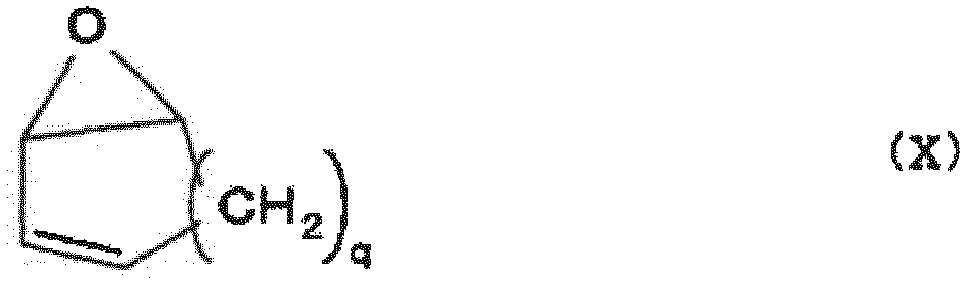
- Though a method of containing the structural unit (II) in EVOH (A) is not particularly limited, a method of containing the structural unit (II) by having a univalent epoxy compound react with EVOH (A) obtained by saponification reaction is employed. Compounds expressed in formulae (IV) to (X) below are suitably employed as a univalent epoxy compound.





- Examples of the univalent epoxy compound expressed in the formula (IV) include epoxyethane (ethylene oxide), epoxypropane, 1,2-epoxybutane, 2,3-epoxybutane, 3-methyl-1,2-epoxybutane, 1,2-epoxypentane, 3-methyl-1,2-epoxypentane, 1,2-epoxyhexane, 2,3-epoxyhexane, 3,4-epoxyhexane, 3-methyl-1,2-epoxyhexane, 3-methyl-1,2-epoxyheptane, 4-methyl-1,2-epoxyheptane, 1,2-epoxyoctane, 2,3-epoxyoctane, 1,2-epoxynonane, 2,3-epoxynonane, 1,2-epoxydecane, 1,2-epoxydodecane, epoxyethyl benzene, 1-phenyl-1,2-propane, and 3-phenyl-1,2-epoxypropane.
- Examples of the univalent epoxy compound expressed in the formula (V) include various types of alkyl glycidyl ether.
- Examples of the univalent epoxy compound expressed in the formula (VI) include various types of alkylene glycol monoglycidyl ether.
- Examples of the univalent epoxy compound expressed in the formula (VII) include various types of alkenyl glycidyl ether.
- Examples of the univalent epoxy compound expressed in the formula (VIII) include various types of epoxy alkanol such as glycidol.
- Examples of the univalent epoxy compound expressed in the formula (IX) include various types of epoxycycloalkane.
- Examples of the univalent epoxy compound expressed in the formula (X) include various types of epoxycycloalkene.
- Among the univalent epoxy compounds, an epoxy compound having a carbon number from 2 to 8 is preferred. In particular, from a point of view of ease in handling and reactivity of a compound, the carbon number of the univalent epoxy compound is more preferably from 2 to 6 and further preferably from 2 to 4. The univalent epoxy compound is particularly preferably a compound expressed in the formula (IV) or the compound expressed in the formula (V) among the formulae. Specifically, from a point of view of reactivity with EVOH (A) and gas barrier properties of an agricultural film, a grain storage bag, a geomembrane, or a pipe that is obtained, 1,2-epoxybutane, 2,3-epoxybutane, epoxypropane, epoxyethane, or glycidol is preferred, and among these, epoxypropane or glycidol is particularly preferred.
- In the structural unit (III), R8, R9, R10, and R11 are preferably a hydrogen atom or an aliphatic hydrocarbon group having a carbon number from 1 to 5, and the aliphatic hydrocarbon group is preferably a methyl group, an ethyl group, an n-propyl group, an isopropyl group, an n-butyl group, an isobutyl group, a tert-butyl group, or an n-pentyl group.
- Though a method of containing the structural unit (III) in EVOH (A) is not particularly limited, examples of the method include a method described in Japanese Patent Laying-Open No.
2014-034647 - One type of EVOH (A) alone can be used or two or more types of EVOH (A) may be used together.
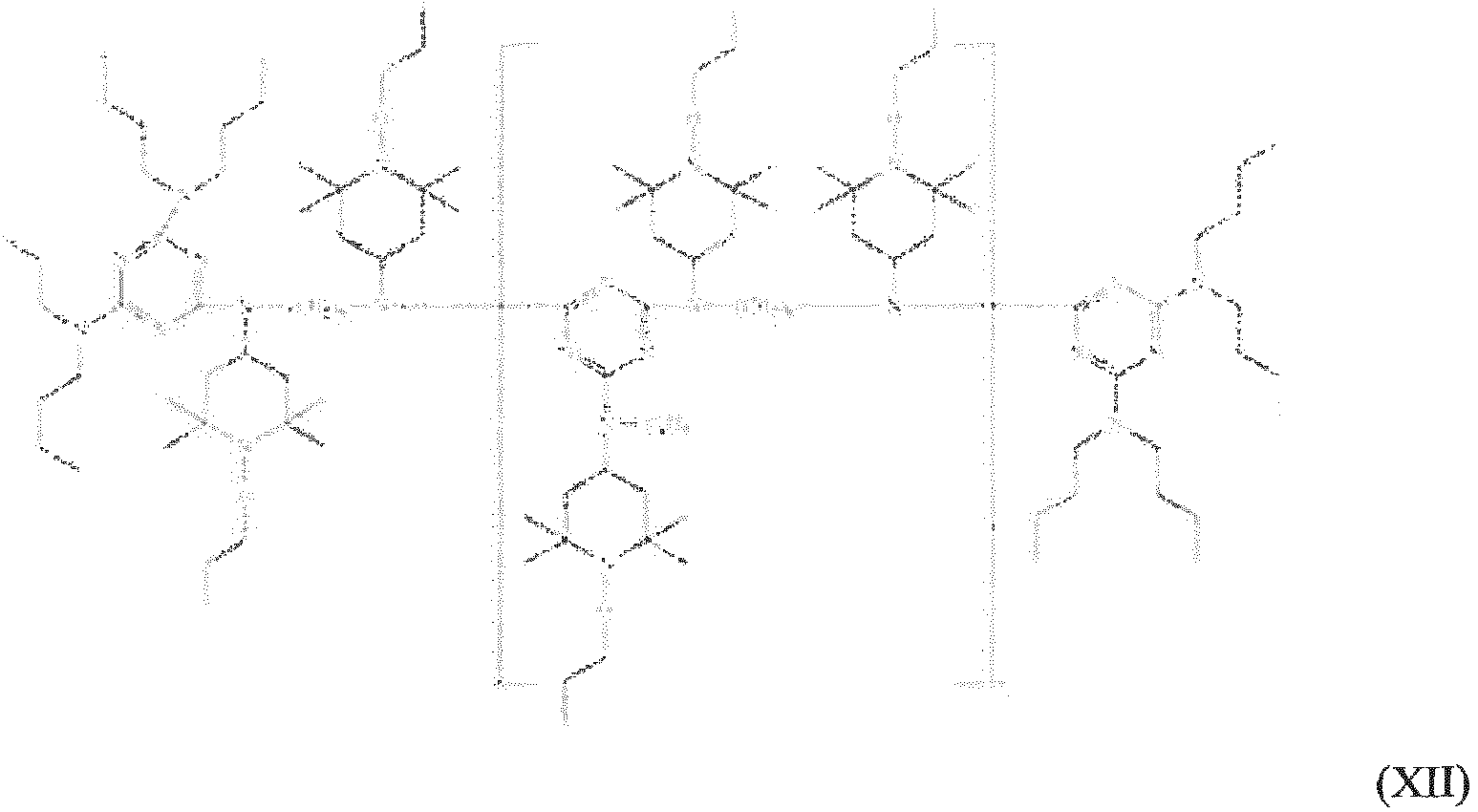
- The hindered amine-based compound (B) has a 2,2,6,6-tetraalkylpiperidine ring structure and has an alkoxy group bonded to a nitrogen atom in the structure. Examples of the hindered amine-based compound (B) include TINUVIN NOR 371 (which is manufactured by BASF Japan Ltd. and has a chemical formula name of 1-Cyclohexyloxy-2,2,6,6-tetramethyl-4-octadecylaminopiperidine, bis(1-Octyloxy-2,2,6,6-tetramethylpiperidin-4-yl)sebacate and a molecular weight from 2800 to 4000), Hostavin NOW (which is manufactured by Clariant and has a chemical formula shown as a formula (XI) below and a molecular weight of approximately 2000), and FLAMESTAB NOR 116 (which is manufactured by BASF Japan Ltd. and has a chemical formula shown as a formula (XII) below and a molecular weight of 2261), and in particular, TINUVIN NOR 371 is preferred. Such a hindered amine-based compound (B) may be used alone or two or more types thereof may be used together

- A molecular weight of the hindered amine-based compound (B) is preferably not smaller than 1000. When the molecular weight is smaller than 1000, disadvantageously, the hindered amine-based compound (B) bleeds out or volatilizes during use for a long time and an effect of weatherability is lowered. When a resin composition containing the hindered amine-based compound (B) is used to manufacture a molding, the hindered amine-based compound (B) bleeds out and contaminates a mold of a molding machine. Therefore, appearance of a surface of the molding becomes poor and moldings with clean surfaces cannot successively be manufactured. The molecular weight of the hindered amine-based compound (B) is more preferably not smaller than 1400, further preferably not smaller than 1700, and particularly preferably not smaller than 1900. The molecular weight of the hindered amine-based compound (B) may be not greater than 5000.
- A content of the hindered amine-based compound (B) in the resin composition according to the present invention is from 0.1 to 5 parts by mass with respect to 100 parts by mass of EVOH (A). A content of the hindered amine-based compound (B) is preferably not less than 0.2 part by mass and more preferably not less than 0.6 part by mass. When the content of the hindered amine-based compound (B) is less than 0.1 part by mass, sufficient weatherability cannot be obtained. When the content of the hindered amine-based compound (B) is more than 5 parts by mass, a film may significantly be colored after a weathering test, or a resin becomes soft during manufacturing and stable manufacturing cannot be performed. A content of the hindered amine-based compound (B) in the resin composition according to the present invention is preferably not more than 4 parts by mass, more preferably not more than 2.5 parts by mass, and further preferably not more than 2.0 parts by mass.
- A method of containing the hindered amine-based compound (B) in the resin composition or the master batch according to the present invention is not particularly limited. Examples of the method include a method of dry-blending EVOH (A) and the hindered amine-based compound (B) and then melting and kneading them in an extruder, a method of immersing EVOH (A) in a solution in which the hindered amine-based compound (B) has been dissolved, a method of melting EVOH (A) and mixing the hindered amine-based compound (B) therein, and a method of melting and blending EVOH (A) and the hindered amine-based compound (B) in an extruder. Among these, the method of dry-blending EVOH (A) and the hindered amine-based compound (B) and further melting and kneading them in an extruder is preferred.
- The hindered phenol-based compound (C) has an ester bond or an amide bond. Examples of such a hindered phenol-based compound (C) include Irganox 1010 (which is a trademark manufactured by BASF Japan Ltd. and has a chemical formula name of pentaerythritol tetrakis[3-(3,5-di-tert-butyl-4-hydroxyphenyl)propionate] and a molecular weight of 1178), Irganox 1076 (which is a trademark manufactured by BASF Japan Ltd. and has a chemical formula name of octadecyl-3-(3,5-di-tert-butyl-4-hydroxyphenyl)-propionate and a molecular weight of 531), Cyanox 1790 (which is a trademark manufactured by Cyanamid and has a chemical formula name of 1,3,5-tris(4-tert-butyl-3-hydroxy-2,6-dimethylbenzyl)isocyanurate and a molecular weight of 699), and Irganox 1098 (which is a trademark manufactured by BASF Japan Ltd. and has a chemical formula name of N,N'-(hexane-1,6-diyl)bis[3-(3,5-di-tert-butyl-4-hydroxyphenyl)propionamide] and a molecular weight of 637). When the resin composition according to the present invention is used for an agricultural film, it may be exposed to an agricultural pesticide such as chloropicrin or dimethyl disulfide and the film may be used under an acid condition. When the film is used under the acid condition, the hindered phenol-based compound (C) preferably has an amide bond from a point of view of stability under the acid condition, and for example, Irganox 1098 having an amide bond is preferred.
- A content of the hindered phenol-based compound (C) in the resin composition according to the present invention is from 0.2 to 5 parts by mass with respect to 100 parts by mass of EVOH (A). A content of the hindered phenol-based compound (C) is preferably not less than 0.3 part by mass and more preferably not less than 0.4 part by mass. When the content of the hindered phenol-based compound (C) is less than 0.2 part by mass, discoloration of a film after a weathering test is noticeable and a sufficient effect cannot be obtained. When the content of the hindered phenol-based compound (C) is more than 5 parts by mass, many aggregates are produced during manufacturing of films and satisfactory films cannot be obtained. The content of the hindered phenol-based compound (C) is preferably not more than 3 parts by mass, more preferably not more than 2 parts by mass, and further preferably not more than 1 part by mass.
- A mass ratio (C)/(B) of the hindered phenol-based compound (C) to the hindered amine-based compound (B) in the resin composition according to the present invention is from 0.2 to 3.6. When (C)/(B) is lower than 0.2, discoloration of a film after a weathering test is noticeable and a sufficient effect cannot be obtained. (C)/(B) is preferably not lower than 0.3 and more preferably not lower than 0.4. When (C)/(B) is higher than 3.6, sufficient weatherability cannot be obtained. (C)/(B) is preferably not higher than 3, more preferably not higher than 1.9, further preferably not higher than 1.5, and particularly preferably not higher than 1.1.
- The resin composition may contain an additive such as a heat stabilizer, an antioxidant, a plasticizer, a coloring agent, a filler, a thickener, or a resin other than the hindered amine-based compound (B) and the hindered phenol-based compound (C) so long as the effect of the present invention is not interfered. Though a method of containing such an additive in the resin composition is not particularly restricted, examples of the method include a method of melting the resin composition and mixing an additive therein, a method of melting and blending the resin composition and an additive in an extruder, and a method of mixing powders or pellets in a form of a granule, a sphere, or a columnar chip of the resin composition and a solid, a liquid, or a solution of an additive and impregnating the resin composition with the additive or spreading the additive over the resin composition. A method can be selected as appropriate in consideration of physical properties of an additive or permeability thereof to the resin composition.
- Examples of the heat stabilizer include acid or polybasic acid such as phosphoric acid, pyrophosphoric acid, phosphorous acid, oxalic acid, succinic acid, adipic acid, tartaric acid, citric acid, sodium dihydrogen phosphate, potassium dihydrogen phosphate, and acetic acid, and salt thereof. Heat stability at the time of melt molding can be improved by adding the heat stabilizer to the resin composition. In impregnation of the resin composition with a solution of the heat stabilizer, a solvent used for preparing the solution of the heat stabilizer is not particularly restricted, however, water is preferred.
- Examples of the coloring agent include carbon black, phthalocyanine, quinacridone, an isoindoline-based pigment, an azo-based pigment, and rouge.
- Examples of the filler include glass fibers, wollastonite, calcium silicate, talc, and montmorillonite.
- The master batch according to the present invention is obtained by melting and kneading EVOH (A), the hindered amine-based compound (B), and the hindered phenol-based compound (C) at a high concentration, and it is used as being diluted with EVOH (A) to a defined concentration at the time of molding into an agricultural film, a grain storage bag, a geomembrane, and a pipe according to the present invention. Specifically, the master batch contains EVOH (A), the hindered amine-based compound (B), and the hindered phenol-based compound (C), the master batch contains 2 to 20 parts by mass of hindered amine-based compound (B) and 1 to 14 parts by mass of hindered phenol-based compound (C) with respect to 100 parts by mass of EVOH (A), and a mass ratio (C)/(B) of the hindered phenol-based compound (C) to the hindered amine-based compound (B) is from 0.2 to 3.6. The content of the hindered amine-based compound (B) and the hindered phenol-based compound (C) within the range described above can lead to stable production of the master batch. Furthermore, an agricultural film, a grain storage bag, a geomembrane, and a pipe obtained by undergoing manufacturing of the master batch in which the mass ratio (C)/(B) of the hindered phenol-based compound (C) to the hindered amine-based compound (B) in the master batch is within the range have good weatherability. (C)/(B) is more preferably not lower than 0.3 and further preferably not lower than 0.4. (C)/(B) is more preferably not higher than 3, more preferably not higher than 1.9, further preferably not higher than 1.5, and particularly preferably not higher than 1.1. A total amount ((B)+(C)) of the hindered amine-based compound (B) and the hindered phenol-based compound (C) in the master batch according to the present invention is preferably not less than 7.5 parts by mass, more preferably not less than 9.0 parts by mass, further preferably not less than 10.0 parts by mass, and particularly preferably not less than 15.0 parts by mass with respect to 100 parts by mass of EVOH (A). (B)+(C) is preferably not more than 30.0 parts by mass and more preferably not more than 25.0 parts by mass with respect to 100 parts by mass of EVOH.
- The resin composition according to the present invention can be manufactured by a manufacturing method including a step of dry-blending EVOH (A), the hindered amine-based compound (B), and the hindered phenol-based compound (C) at the concentration described above and melting and kneading them or by a manufacturing method including a step of going through a master batch. Of these methods, the manufacturing method including the step of going through the master batch described previously is preferred, and manufacturing by a manufacturing method including a step of obtaining a master batch by melting and kneading in advance 100 parts by mass of EVOH (A), 2 to 20 parts by mass of the hindered amine-based compound (B), and 1 to 14 parts by mass of the hindered phenol-based compound (C) and melting and kneading the obtained master batch and additional EVOH (A) is preferred. By providing the step of obtaining a master batch in advance, as compared with other mixing methods, the hindered amine-based compound (B) and the hindered phenol-based compound (C) are well dispersed, uneven mixing at the time when a film or the like is made of the resin composition does not occur, and a film or the like free from variation in weatherability is obtained. EVOH (A) contained in a master batch may be identical to or different from EVOH (A) to be used in further melting and kneading with the master batch.
- Uneven mixing at the time when a film or the like is made of the resin composition obtained by the manufacturing method including the step of going through a master batch can be evaluated based on an SD value (a standard deviation) of fracture strength and fracture elongation in a film tensile test. A smaller SD value indicates less uneven mixing. As uneven mixing is less, variation in weatherability in a film preferably becomes less. If weatherability is varied, a part of a film deteriorates earlier when the film is used outdoors for a long period of time or a soil fumigation agent may leak when the film is used as a soil fumigation film. The SD value is preferably not greater than 10 and further preferably not greater than 8. The SD value is greater than 0 and preferably not smaller than 1 from a point of view of manufacturing cost.
- The resin composition according to the present invention is excellent in weatherability and manufacturing stability, and it is suitable for: an agricultural film such as a soil fumigation film, a silage film, and a greenhouse film; a grain storage bag; a geomembrane; and a pipe such as a hot water circulation pipe or a fuel pipe each of which has a gas barrier layer composed of such a resin composition. The present invention also provides an agricultural film (preferably, a soil fumigation film, a silage film, or a greenhouse film), a grain storage bag, a geomembrane, and a pipe (preferably, a hot water circulation pipe or a fuel pipe) each of which has a gas barrier layer composed of such a resin composition according to the present invention.
- The resin composition according to the present invention is particularly useful when it is used for a soil fumigation film for preventing evaporation of chloropicrin, methyl bromide, or the like used as a soil fumigation agent or a silage film which wraps silage exhibiting acidity as a result of fermentation. Under such a condition, the resin composition according to the present invention is exposed to an acid condition caused by an agent or silage. Deterioration of the film is accelerated as the film is used outdoors for a long period of time under the acid condition. Even under such a condition, however, the soil fumigation film or the silage film composed of the resin composition according to the present invention is excellent in weatherability. Examples
- Though the present invention will further be described below with reference to Examples, the present invention is not limited thereby.
- Master batch pellets were obtained by dry-blending 100 parts by mass of EVAL H171 (which was an ethylene-vinyl alcohol copolymer manufactured by Kuraray Co., Ltd. and had an ethylene unit content of 38 mol %, a melting point of 172°C, MFR (210°C, 2160 g load) of 3.4 g/10 minutes, and a degree of saponification of 99.8 mol % or higher), 0.64 part by mass of TINUVIN NOR 371 (which was a hindered amine-based compound manufactured by BASF Japan Ltd. and had an N-alkoxy-2,2,6,6-tetraalkylpiperidine structure), and 8.94 parts by mass of Irganox 1098 (which was N,N'-(hexane-1,6-diyl)bis[3-(3,5-di-tert-butyl-4-hydroxyphenyl)propionamide] manufactured by BASF Japan Ltd.), melting and kneading them under conditions below, and thereafter pelletizing them.
- Extruder: twin screw extruder (Labo Plastomill manufactured by Toyo Seiki Seisaku-sho, Ltd.), 25 mm φ
- The number of die holes: 2 holes (3 mm φ)
- Set temperature: C1/C2/C3/C4/C5 = 175°C/225°C/225°C/220°C/220°C
- Screw rotation: 60 rpm
- Master batch pellets were obtained as in Manufacturing Example 1 except for formulations as shown in Table 1.
-
- EVOH1: EVAL H171 (which was an ethylene-vinyl alcohol copolymer manufactured by Kuraray Co., Ltd. and had an ethylene unit content of 38 mol %, a melting point of 172°C, MFR (210°C, 2160 g load) of 3.4 g/10 minutes, and a degree of saponification of 99.8 mol % or higher)
- EVOH2: EVAL L171 (which was an ethylene-vinyl alcohol copolymer manufactured by Kuraray Co., Ltd. and had an ethylene unit content of 27 mol %, a melting point of 191°C, MFR (210°C, 2160 g load) of 4.0 g/10 minutes, and a degree of saponification of 99.8 mol % or higher)
- EVOH3: EVAL E171 (which was an ethylene-vinyl alcohol copolymer manufactured by Kuraray Co., Ltd. and had an ethylene unit content of 44 mol %, a melting point of 165°C, MFR (210°C, 2160 g load) of 3.3 g/10 minutes, and a degree of saponification of 99.8 mol % or higher)
-
- A1: TINUVIN NOR 371 (manufactured by BASF Japan Ltd.)
- A2: Hostavin NOW (manufactured by Clariant)
- A3: FLAMESTAB NOR 116 (manufactured by BASF Japan Ltd.)
-
- A4: Chimassorb 2020 (which was manufactured by BASF Japan Ltd. and had a chemical formula name of a polycondensation of dibutylamine·1,3,5-triazine·N,N'-bis(2,2,6,6-tetramethyl-4-piperidyl)-1,6-hexamethylene diamine and N-(2,2,6,6-tetramethyl-4-piperidyl)butylamine)
-
- B1: Irganox 1098 (manufactured by BASF Japan Ltd.)
- B2: Irganox 1010 (manufactured by BASF Japan Ltd.)
-
- B3: Irgafos 168 (which was manufactured by BASF Japan Ltd. and had a chemical formula name of tris(2,4-di-tert-butylphenyl)phosphite)
- B4: AO-412S (which was manufactured by ADEKA Corporation and had a chemical formula name of pentaerythritoltetrakis(3-laurylthiopropionate))
- B5: Chimassorb 81 (which was manufactured by BASF Japan Ltd. and had a chemical formula name of 2-hydroxy-4-(octyloxy)-benzophenone)
- Master batch pellets obtained in each of Manufacturing Examples 1 to 28 were evaluated as below. Table 1 shows results.
- Production of a resin which adhered to a die during pelletization (die drool) was evaluated based on criteria below.
- A: No die drool was produced.
- B: Slight die drool was produced.
- C: Die drool was produced.
- Stability of a strand during pelletization was evaluated based on criteria below
- A: A strand was stable.
- B: A strand was not stable, with its thickness being decreased or increased.
- C: A strand became soft, which caused a problem in cutting by a cutter during pelletization.
- D: A strand sagged and could not be pelletized.
- A single-layered film having a thickness of 20 µm was obtained by dry-blending 100 parts by mass of obtained master batch pellets MB-3 and 200 parts by mass of EVAL H171 and forming a film under conditions below. Table 2 shows a mass ratio ((A)/(B)/(C)) among EVOH (A), the hindered amine-based compound (B), and the hindered phenol-based compound (C) in the obtained film.
- Extruder: single screw extruder (Labo Plastomill manufactured by Toyo Seiki Seisaku-sho, Ltd.), 20 mm φ
- Set temperature: C1/C2/C3/D = 180°C/210°C/210°C/210°C
- Films were obtained as in Example 1 except for formulations as shown in Table 2. Table 2 shows a mass ratio ((A)/(B)/(C)) among EVOH (A), the hindered amine-based compound (B), and the hindered phenol-based compound (C) in each obtained film.
- The film obtained in each of Examples 1 to 14 and Comparative Examples 1 to 13 was evaluated as below. Table 2 shows results.
- Weatherability of the obtained film was evaluated by immersing the film in 0.05 M of diluted sulfuric acid at room temperature for 30 minutes, thereafter removing the liquid attached to a surface of the film with Kimtowel (a product name), thereafter conducting an accelerated weathering test for 50 hours under conditions of irradiance of 1000 W/m2, a black panel temperature of 63°C, and a relative humidity of 50% with the use of EYE Super UV Tester (SUV W-151 manufactured by Iwasaki Electric Co., Ltd.), and comparing fracture strength before the test, YI before and after the test, fracture elongation, and a rate of decrease in elongation before and after the accelerated weathering test. YI measurement and the tensile test were conducted by methods below.
- A colorimeter (NF-902 manufactured by Nippon Denshoku Industries Co., Ltd.) was employed. With YI of the film before the accelerated weathering test being denoted as YI0 and YI of the film after the test being denoted as YI1, ΔYI was calculated in accordance with an expression below. When ΔYI was negative, ΔYI was regarded as 0.

- The tensile test was conducted under conditions of a temperature of 23°C, a relative humidity of 50% RH, and a tension rate of 500 mm/min. with the use of an autograph (AGS-H manufactured by Shimadzu Corporation). A specimen cut into 50 mm long × 15 mm wide was employed.
- Aggregates like gel (equal to or greater than approximately 150 µm which could be recognized with naked eyes) in the obtained film were counted, and the count was converted to a count per 1.0 m2. Determination as below was made based on the number of aggregates.
- A: less than 20
- B: not less than 20 and less than 40
- C: not less than 40 and less than 60
- D: not less than 60
- It can be seen from Comparative Examples 1 and 2 that, when the hindered amine-based compound (B) was not contained, fracture elongation after the weathering test was poorer than in Examples. It can be seen from Comparative Example 3 that, when the hindered phenol-based compound (C) was not contained, ΔYI after the weathering test was poorer than in Examples. It can be seen from Comparative Examples 4 to 8 and 13 that, when an amount of addition of (B) or (C)/(B) was out of the scope of the present invention, deterioration of ΔYI, production of aggregates, or deterioration of fracture elongation as compared with Examples was observed. It can be seen from Comparative Example 9 that, when a hindered amine-based compound other than the hindered amine-based compound (B) was employed, fracture elongation after the weathering test was poorer than in Examples. It can be seen from Comparative Examples 10 to 12 that, when a hindered phenol-based compound other than the hindered phenol-based compound (C) was employed, ΔYI was poorer than in Examples.
- A single-layered film having a thickness of 20 µm was obtained by dry-blending 100 parts by mass of an ethylene-vinyl alcohol copolymer (EVAL H171 (which was an ethylene-vinyl alcohol copolymer manufactured by Kuraray Co., Ltd. and had an ethylene unit content of 38 mol %, a melting point of 172°C, MFR (210°C, 2160 g load) of 3.4 g/10 minutes, and a degree of saponification of 99.8 mol % or higher)), 1.0 part by mass of TINUVIN NOR 371 having an N-alkoxy-2,2,6,6-tetraalkylpiperidine structure (which was a hindered amine-based compound manufactured by BASF Japan Ltd), and 0.5 part by mass of N,N'-(hexane-1,6-diyl)bis[3-(3,5-di-tert-butyl-4- hydroxyphenyl)propionamide] (which was Irganox 1098 manufactured by BASF Japan Ltd.) and thereafter forming a film under conditions below. In a tensile test before the weathering test of the obtained film, an evaluation test as in Examples 1 to 14 was conducted to measure an SD value (a standard deviation). Table 3 shows results in comparison to Examples 5 in which an SD value was similarly measured. An SD value closer to 0 is preferred because variation in manufacturing stability and weatherability among products is less.
- Extruder: single screw extruder (Labo Plastomill manufactured by Toyo Seiki Seisaku-sho, Ltd.), 20 mm φ
- Set temperature: C1/C2/C3/D = 180°C/210°C/210°C/210°C
- It can be seen that Example 5 which had gone through a master batch was lower in SD value and less in variation among products than Example 15 which had not gone through a master batch.
- It should be understood that the embodiment and the examples disclosed herein are illustrative and non-restrictive in every respect. The scope of the present invention is defined by the terms of the claims rather than the description above and is intended to include any modifications within the scope and meaning equivalent to the terms of the claims.
| Master Batch No. | EVOH (A) | Hindered Amine (B) | Hindered Phenol (C) | Mass Ratio in Master Batch | Production Stability Test | |||||
| EVOHNo. | Grade | HA No. | Type | HP No . | Type | (A)/(B)/(C) | Strand | Die Drool | ||
| Manufacturing Example 1 | MB-1 | EVOH1 | H171 | A1 | Tinuvin nor 371 | B1 | Irganox 1098 | 100 / 0.64 / 8.94 | A | A |
| Manufacturing Example 2 | MB-2 | EVOH1 | H171 | A1 | Tinuvin nor 371 | B1 | Irganox 1098 | 100 / 1.65 / 13.19 | A | A |
| Manufacturing Example 3 | MB-3 | EVOH1 | H171 | A1 | Tinuvin nor 371 | B1 | Irganox 1098 | 100 / 3.30 / 11.54 | A | A |
| Manufacturing Example 4 | MB-4 | EVOH1 | H171 | A1 | Tinuvin nor 371 | B1 | Irganox 1098 | 100 / 5.88 / 11.76 | A | A |
| Manufacturing Example 5 | MB-5 | EVOH1 | H171 | A1 | Tinuvin nor 371 | B1 | Irganox 1098 | 100 / 11.76 / 5.88 | A | A |
| Manufacturing Example 6 | MB-6 | EVOH1 | H171 | A1 | Tinuvin nor 371 | B1 | Irganox 1098 | 100 / 13.41 /2.23 | A | A |
| Manufacturing Example 7 | MB-7 | EVOH1 | H171 | A1 | Tinuvin nor 371 | B1 | Irganox 1098 | 100 / 19.13 / 1.71 | A | A |
| Manufacturing Example 8 | MB-8 | EVOH1 | H171 | A1 | Tinuvin nor 371 | B1 | Irganox 1098 | 100 / 14.37 / 7.19 | A | A |
| Manufacturing Example 9 | MB-9 | EVOH1 | H171 | A1 | Tinuvin nor 371 | B1 | Irganox 1098 | 100 / 19.48 / 9.74 | B | B |
| Manufacturing Example 10 | MB-10 | EVOH1 | H171 | A1 | Tinuvin nor 371 | B1 | Irganox 1098 | 100 / 15.00 / 5.00 | A | A |
| Manufacturing Example 11 | MB-11 | EVOH1 | H171 | A1 | Tinuvin nor 371 | B1 | Irganox 1098 | 100 / 19.39 / 14.95 | A | A |
| Manufacturing Example 12 | MB-12 | EVOH1 | H171 | A1 | Tinuvin nor 371 | B1 | Irganox 1098 | 100 / 10.61 / 9.55 | A | A |
| Manufacturing Example 13 | MB-13 | EVOH1 | H171 | A1 | Tinuvin nor 371 | B1 | Irganox 1098 | 100 / 9.46 / 11.35 | A | A |
| Manufacturing Example 14 | MB-14 | EVOH1 | H171 | A2 | Hostavin NOW | B1 | Irganox 1098 | 100 / 11.76 / 5.88 | A | A |
| Manufacturing Example 15 | MB-15 | EVOH1 | H171 | A3 | FLAMEST AB NOR 116 | B1 | Irganox 1098 | 100 / 11.76 / 5.88 | A | A |
| Manufacturing Example 16 | MB-16 | EVOH1 | H171 | A1 | Tinuvin nor 371 | B2 | Irganox1010 | 100/ 11.76 / 5.88 | A | A |
| Manufacturing Example 17 | MB-17 | EVOH2 | L171 | A1 | Tinuvin nor 371 | B1 | Irganox 1098 | 100 / 11.76 / 5.88 | A | A |
| Manufacturing Example 18 | MB-18 | EVOH3 | E171 | A1 | Tinuvin nor 371 | B1 | Irganox 1098 | 100 / 11.76 / 5.88 | A | A |
| Manufacturing Example 19 | MB-19 | EVOH1 | H171 | - | - | B1 | Irganox 1098 | 100 / - / 7.98 | A | A |
| Manufacturing Example 20 | MB-20 | EVOH1 | H171 | A1 | Tinuvin nor 371 | - | - | 100 / 7.98 / - | A | A |
| Manufacturing Example 21 | MB-21 | EVOH1 | H171 | A1 | Tinuvin nor 371 | B1 | Irganox 1098 | 100 / 25.08 / 12.54 | C | C |
| Manufacturing Example 22 | MB-22 | EVOH1 | H171 | A1 | Tinuvin nor 371 | B1 | Irganox 1098 | 100 / 10.46 / 15.69 | D | - |
| Manufacturing Example 23 | MB-23 | EVOH1 | H171 | A4 | Chimassorb 2020 | B1 | Irganox 1098 | 100 / 11.76 / 5.88 | A | A |
| Manufacturing Example 24 | MB-24 | EVOH1 | H171 | A1 | Tinuvin nor 371 | B3 | Irgafos168 | 100 / 11.76 / 5.88 | A | A |
| Manufacturing Example 25 | MB-25 | EVOH1 | H171 | A1 | Tinuvin nor 371 | B4 | AO-412S | 100 / 11.76 / 5.88 | A | A |
| Manufacturing Example 26 | MB-26 | EVOH1 | H171 | A1 | Tinuvin nor 371 | B5 | Chimassorb 81 | 100 / 11.76 / 5.88 | A | A |
| Manufacturing Example 27 | MB-27 | EVOH1 | H171 | A1 | Tinuvin nor 371 | B1 | Irganox 1098 | 100 / 15.48 / 1.03 | A | A |
| Manufacturing Example 28 | MB-28 | EVOH1 | H171 | A1 | Tinuvin nor 371 | B1 | Irganox 1098 | 100 / 0.65 / 9.78 | A | A |
| Composition Condition | Evaluation of Film Before Weatherability Test | Evaluation of Film After Weatherability Test | |||||||||||||||
| Master Batch | EVOH (A) | Hindered Amine (B) | Hindered Phenol (C) | Mass Ratio in Resin Composition | Tensile Test | ΔYI | Tensile Test | ||||||||||
| MB No. | Parts by Mass | EVOH No. | Grade | Parts by Mass | HA No. | Type | HP No. | Type | (A)/(B/(C) | (C)/(B) | Speck | Fracture Strength (Mpa) | Fracture Elongation (%) | Fracture Elongation (%) | Rate of Decrease (%) | ||
| Example 1 | MB-3 | 100 | EVOH1 | H171 | 200 | A1 | TINUVIN NOR 371 | B1 | Irganox 1098 | 100 / 1 / 3.5 | 3.50 | B | 58.0 | 349.66 | 0.00 | 139.89 | 60.0 |
| Example 2 | MB-4 | 100 | EVOH1 | H171 | 915 | A1 | TINUVIN NOR 371 | B1 | Irganox 1098 | 100 / 0.5 / 1 | 2.00 | B | 68.5 | 356.75 | 0.02 | 128.71 | 63.9 |
| Example 3 | MB-5 | 100 | EVOH1 | H171 | 915 | A1 | TINUVIN NOR 371 | B1 | Irganox 1098 | 100 / 1 / 0.5 | 0.50 | A | 702 | 341.65 | 0.00 | 137.71 | 59.7 |
| Example 4 | MB-8 | 100 | EVOH1 | H171 | 1100 | A1 | TINUVIN NOR 371 | B1 | Irganox 1098 | 100 / 1 / 0.5 | 0.50 | A | 74.0 | 372.63 | 0.01 | 149.01 | 60.0 |
| Example 5 | MB-9 | 100 | EVOH1 | H171 | 1430 | A1 | TINUVIN NOR 371 | B1 | Irganox 1098 | 100 / 1 / 0.5 | 0.50 | A | 81.2 | 394.20 | 0.00 | 158.58 | 59.8 |
| Example 6 | MB-10 | 100 | EVOH1 | H171 | 750 | A1 | TINUVIN NOR 371 | B1 | Irganox 1098 | 100 / 1.5 / 0.5 | 0.33 | A | 72.6 | 367.16 | 0.00 | 159.22 | 56.6 |
| Example 7 | MB-11 | 100 | EVOH1 | H171 | 700 | A1 | TINUVIN NOR 371 | B1 | Irganox 1098 | 100 / 2 / 0.5 | 0.25 | A | 75.9 | 381.91 | 0.77 | 179.53 | 53.0 |
| Example 8 | MB-12 | 100 | EVOH1 | H171 | 800 | A1 | TINUVIN NOR 371 | B1 | Irganox 1098 | 100 / 1 / 0.9 | 0.90 | B | 69.0 | 379.03 | 0.00 | 152.55 | 59.8 |
| Example 9 | MB-13 | 100 | EVOH1 | H171 | 700 | A1 | TINUVIN NOR 371 | B1 | Irganox 1098 | 100 / 1 / 1.2 | 1.20 | B | 73.8 | 357.46 | 0.01 | 142.99 | 60.0 |
| Example 10 | MB-14 | 100 | EVOH1 | H171 | 915 | A2 | Hostavin NOW | B1 | Irganox 1098 | 100 / 1 / 0.5 | 0.50 | A | 72.0 | 360.12 | 0.00 | 126.00 | 65.0 |
| Example 11 | MB-15 | 100 | EVOH1 | H171 | 915 | A3 | FLAMESTAB NOR 116 | B1 | Irganox 1098 | 100 / 1 / 0.5 | 0.50 | A | 71.5 | 355.32 | 0.00 | 113.60 | 680 |
| Example 12 | MB-16 | 100 | EVOH1 | H171 | 915 | A1 | TINUVIN NOR 371 | B2 | IrganoxlOlO | 100 / 1 / 0.5 | 0.50 | A | 69.5 | 344.98 | 1.51 | 141.45 | 59.0 |
| Example 13 | MB-17 | 100 | EVOH2 | L171 | 915 | A1 | TINUVIN NOR 371 | B1 | Irganox 1098 | 100 / 1 / 0.5 | 0.50 | A | 129.0 | 286.42 | 0.00 | 115.60 | 59.6 |
| Example 14 | MB-18 | 100 | EVOH3 | E171 | 915 | A1 | TINUVIN NOR 371 | B1 | Irganox 1098 | 100 / 1 / 0.5 | 0.50 | A | 98.0 | 371.85 | 0.00 | 149.76 | 59.7 |
| Comparative Example 1 | - | - | EVOH1 | H171 | - | - | - | - | - | 100 / 0 / 0 | - | A | 98.0 | 386.24 | 0.41 | 200 | 99.5 |
| Comparative Example 2 | MB-19 | 100 | EVOH1 | H171 | 400 | - | - | B1 | Irganox 1098 | 100 / 0 / 1.5 | - | C | 695 | 342.31 | 0.00 | 2.20 | 99.4 |
| Comparative Example 3 | MB-20 | 100 | EVOH1 | H171 | 400 | A1 | TINUVIN NOR 371 | - | - | 100 / 1.5 / 0 | - | A | 71.2 | 355.32 | 3.39 | 153.94 | 56.7 |
| Comparative Example 4 | MB-27 | 100 | EVOH1 | H171 | 800 | A1 | TINUVIN NOR 371 | B1 | Irganox 1098 | 100 / 1.5 / 0.1 | 0.07 | A | 72.1 | 360.10 | 2.64 | 156.16 | 56.6 |
| Comparative Example 5 | MB-7 | 100 | EVOH1 | H171 | 200 | A1 | TINUVIN NOR 371 | B1 | Irganox 1098 | 100 / 56 / 05 | 0.09 | A | 70.7 | 338.69 | 8.89 | 248.05 | 26.8 |
| Comparative Example 6 | MB-1 | 100 | EVOH1 | H171 | 200 | A1 | TINUVIN NOR 371 | B1 | Irganox 1098 | 100 / 0.2 / 2.8 | 14.00 | C | 62.8 | 337.40 | 0.00 | 114.35 | 66.1 |
| Comparative Example 7 | MB-2 | 100 | EVOH1 | H171 | 200 | A1 | TINUVIN NOR 371 | B1 | Irganox 1098 | 100 / 0.5 / 4 | 8.00 | C | 57.6 | 300.56 | 0.00 | 108.44 | 63.9 |
| Comparative Example 8 | MB-6 | 100 | EVOH1 | H171 | 300 | A1 | TINUVIN NOR 371 | B1 | Irganox 1098 | 100 / 3 / 0.5 | 0.17 | A | 68.4 | 350.74 | 3.02 | 190.43 | 45.7 |
| Comparative Example 9 | MB-23 | 100 | EVOH1 | H171 | 915 | A4 | Chimassorb 2020 | B1 | Irganox 1098 | 100 / 1 / 0.5 | 0.50 | A | 71.2 | 354.87 | 0.00 | 100.00 | 71.8 |
| Comparative Example 10 | MB-24 | 100 | EVOH1 | H171 | 915 | A1 | TINUVIN NOR 371 | B3 | Irgafos 168 | 100 / 1 / 0.5 | 0.50 | A | 70.1 | 348.34 | 276 | 135.23 | 61.2 |
| Comparative Example 11 | MB-2S | 100 | EVOH1 | H171 | 915 | A1 | TIMUVIN NOR 371 | B4 | AO-412S | 100 / 1 / 05 | 0.50 | A | 698 | 342.28 | 2.86 | 128.85 | 62.4 |
| Comparative Example 12 | MB-26 | 100 | EVOH1 | H171 | 915 | A1 | TINUVIN NOR 371 | B5 | Chimassorb 81 | 100 / 1 / 0.5 | 0.50 | A | 71.1 | 351.85 | 2.26 | 132.82 | 62.3 |
| Comparative Example 13 | MB-28 | 100 | EVOH1 | HJ7\ | 500 | A1 | TINUVIN NOR 371 | B1 | Irganox 1098 | 100 / 0.1 / 1.5 | 15.00 | C | 70.0 | 345.22 | 0.00 | 2.00 | 99.4 |
| Composition Condition | Evaluation of Film Before Weatherability Test | Evaluation of Film After Weatherability Test | |||||||||||||||
| EVOH (A) | Hindered Amine B (B) | Hindered Phenol (C) | Weight Ratio (phr) | Tensile Test | ΔYI | YI Evaluation | Tensile Test | ||||||||||
| EVOH No. | GRADE | HA No. | Type | HP No. | Type | EVOH/HA/HP | Speck | Fracture Strength (Mpa) | SD | Fracture Elongation (%) | SD | Fracture Elongation (%) | Rate of Decrease (%) | Evaluation | |||
| Example 5 | EVOH1 | H171 | A1 | Tinuvin nor 371 | B1 | Irganox 1098 | 100 / 1 / 0.5 | A | 81.20 | 3.08 | 395.20 | 7.85 | 0.00 | A | 158.58 | 59.9 | A |
| Example 15 | EVOH1 | H171 | A1 | Tinuvin nor 371 | B1 | Irganox 1098 | 100 / 1 / 0.5 | B | 76.45 | 10.25 | 380.20 | 25.40 | 0.00 | A | 150.20 | 60.5 | A |
Claims (11)
- A resin composition comprising:an ethylene-vinyl alcohol copolymer (A) in which an ethylene unit content is from 10 to 60 mol %;a hindered amine-based compound (B) having a 2,2,6,6-tetraalkylpiperidine ring structure and having an alkoxy group bonded to a nitrogen atom in the structure; anda hindered phenol-based compound (C) having an ester bond or an amide bond,wherein the resin composition contains 0.1 to 5 parts by mass of the hindered amine-based compound (B) and 0.2 to 5 parts by mass of the hindered phenol-based compound (C) with respect to 100 parts by mass of the ethylene-vinyl alcohol copolymer (A), anda mass ratio (C)/(B) is from 0.2 to 3.6.
- The resin composition according to claim 1, wherein
the hindered amine-based compound (B) has a molecular weight not smaller than 1000. - The resin composition according to claim 1 or 2, wherein
the hindered phenol-based compound (C) has an amide bond. - An agricultural film comprising a gas barrier layer composed of the resin composition according to any one of claims 1 to 3.
- The agricultural film according to claim 4, the film being a soil fumigation film, a silage film, or a greenhouse film.
- A grain storage bag comprising a gas barrier layer composed of the resin composition according to any one of claims 1 to 3.
- A geomembrane comprising a gas barrier layer composed of the resin composition according to any one of claims 1 to 3.
- A pipe comprising a gas barrier layer composed of the resin composition according to any one of claims 1 to 3.
- The pipe according to claim 8, the pipe being a hot water circulation pipe or a fuel pipe.
- A master batch comprising:an ethylene-vinyl alcohol copolymer (A) in which an ethylene unit content is from 10 to 60 mol %;a hindered amine-based compound (B) having a 2,2,6,6-tetraalkylpiperidine ring structure and having an alkoxy group bonded to a nitrogen atom in the structure; anda hindered phenol-based compound (C) having an ester bond or an amide bond,wherein the master batch contains 2 to 20 parts by mass of the hindered amine-based compound (B) and 1 to 14 parts by mass of the hindered phenol-based compound (C) with respect to 100 parts by mass of the ethylene-vinyl alcohol copolymer (A), and a mass ratio (C)/(B) is from 0.2 to 3.6.
- A method of manufacturing a resin composition comprising:obtaining a master batch in advance by melting and kneading 100 parts by mass of an ethylene-vinyl alcohol copolymer (A) in which an ethylene unit content is from 10 to 60 mol %, 2 to 20 parts by mass of a hindered amine-based compound (B) having a 2,2,6,6-tetraalkylpiperidine ring structure and having an alkoxy group bonded to a nitrogen atom in the structure, and 1 to 14 parts by mass of a hindered phenol-based compound (C) having an ester bond or an amide bond; andmelting and kneading the obtained master batch and additional ethylene-vinyl alcohol copolymer (A).
Applications Claiming Priority (2)
| Application Number | Priority Date | Filing Date | Title |
|---|---|---|---|
| US201662393860P | 2016-09-13 | 2016-09-13 | |
| PCT/JP2017/033016 WO2018052014A1 (en) | 2016-09-13 | 2017-09-13 | Resin composition and use of same |
Publications (3)
| Publication Number | Publication Date |
|---|---|
| EP3514204A1 true EP3514204A1 (en) | 2019-07-24 |
| EP3514204A4 EP3514204A4 (en) | 2020-04-29 |
| EP3514204B1 EP3514204B1 (en) | 2021-03-17 |
Family
ID=61619550
Family Applications (1)
| Application Number | Title | Priority Date | Filing Date |
|---|---|---|---|
| EP17850915.4A Active EP3514204B1 (en) | 2016-09-13 | 2017-09-13 | Resin composition and use of same |
Country Status (5)
| Country | Link |
|---|---|
| US (1) | US10995189B2 (en) |
| EP (1) | EP3514204B1 (en) |
| JP (1) | JP6317537B1 (en) |
| CN (1) | CN109661428B (en) |
| WO (1) | WO2018052014A1 (en) |
Families Citing this family (5)
| Publication number | Priority date | Publication date | Assignee | Title |
|---|---|---|---|---|
| JP2021104579A (en) * | 2018-04-06 | 2021-07-26 | 株式会社クラレ | Geomembrane, and landfill sheet and radon barrier film using the same |
| JP7226480B2 (en) * | 2020-07-30 | 2023-02-21 | 大日本印刷株式会社 | Antiviral article and antiviral resin composition |
| US20220134724A1 (en) * | 2020-11-02 | 2022-05-05 | Kuraray Co., Ltd. | Multilayer film and the use for container type house system |
| JP7842541B2 (en) * | 2021-08-18 | 2026-04-08 | 旭化成株式会社 | Continuous fiber resin composite and method for manufacturing continuous fiber resin composite |
| JP2024002561A (en) * | 2022-06-24 | 2024-01-11 | 株式会社クラレ | Ethylene-vinyl alcohol copolymer resin composition with weather resistance |
Family Cites Families (20)
| Publication number | Priority date | Publication date | Assignee | Title |
|---|---|---|---|---|
| CA2030310A1 (en) * | 1989-12-22 | 1991-06-23 | Ronald E. Macleay | Derivatives of n-hals-substituted amic acid hydrazides |
| US5032632A (en) * | 1990-05-15 | 1991-07-16 | E. I. Du Pont De Nemours And Company | Oxidation-resistant ethylene vinyl alcohol polymer compositions |
| EP0982362A4 (en) * | 1998-03-10 | 2002-03-06 | Mitsui Chemicals Inc | Ethylene copolymer composition and use thereof |
| JP4166357B2 (en) * | 1999-03-19 | 2008-10-15 | 株式会社クラレ | Method for producing multilayer structure |
| CO5410180A1 (en) | 2002-10-22 | 2004-06-30 | Ciba Sc Holding Ag | COMPOSITION AND PROCESS TO POWER THE PRODUCTION OF BIO-MASS IN GREENHOUSES |
| DE10348483A1 (en) * | 2003-10-14 | 2005-06-02 | Tesa Ag | Aging resistant soft wrapping film made of polyolefin |
| JP2006028967A (en) * | 2004-07-20 | 2006-02-02 | Toyo Tire & Rubber Co Ltd | Thermal insulation structure and construction method of refrigerated warehouse |
| JP2006159784A (en) * | 2004-12-09 | 2006-06-22 | Sekisui Film Kk | Polyolefin-based agricultural film resistant to agricultural chemicals |
| JP2006289671A (en) * | 2005-04-07 | 2006-10-26 | Sekisui Chem Co Ltd | Agricultural film |
| FR2912150B1 (en) * | 2007-02-06 | 2009-04-10 | Arkema France | FLEXIBLE THERMOPLASTIC COMPOSITION WITH ENHANCED OILS AND USE OF SUCH A COMPOSITION |
| US20130266380A1 (en) * | 2007-11-13 | 2013-10-10 | PODenergy, Inc. | Systems and methods for off-shore energy production and CO2 sequestration |
| CA2794192C (en) * | 2010-03-25 | 2019-02-19 | Yoshikazu Yamasaki | Resin composition, method for production thereof and multilayered structure |
| JP5717721B2 (en) * | 2010-03-26 | 2015-05-13 | 株式会社クラレ | Method for producing resin composition |
| CA2794702C (en) * | 2010-03-31 | 2017-07-25 | Kuraray Co., Ltd. | Resin composition, molded article, multilayered pipe and method for producing the same |
| GB201102803D0 (en) * | 2011-02-17 | 2011-04-06 | Ind Textiles & Plastics Ltd | Chemical resistant ground membrane |
| US8470922B2 (en) * | 2011-03-03 | 2013-06-25 | Exxonmobil Chemical Patents Inc. | Ethylene-vinyl alcohol based thermoplastic elastomers and vulcanizates |
| CN102744943B (en) * | 2011-04-22 | 2015-02-25 | 白山市喜丰塑业有限公司 | Method for manufacturing agricultural film coated by high performance polyolefin |
| JP6085498B2 (en) * | 2013-03-06 | 2017-02-22 | 株式会社クラレ | Silage film |
| US20160361740A1 (en) * | 2015-06-09 | 2016-12-15 | Peixiang Xing | Geomembrane with barrier layers for odor control applications |
| JP6209569B2 (en) * | 2015-08-28 | 2017-10-04 | 株式会社フジクラ | Flame-retardant resin composition and cable using the same |
-
2017
- 2017-09-13 WO PCT/JP2017/033016 patent/WO2018052014A1/en not_active Ceased
- 2017-09-13 EP EP17850915.4A patent/EP3514204B1/en active Active
- 2017-09-13 CN CN201780055884.2A patent/CN109661428B/en active Active
- 2017-09-13 US US16/332,586 patent/US10995189B2/en active Active
- 2017-09-13 JP JP2018503614A patent/JP6317537B1/en active Active
Also Published As
| Publication number | Publication date |
|---|---|
| CN109661428A (en) | 2019-04-19 |
| JP6317537B1 (en) | 2018-04-25 |
| EP3514204B1 (en) | 2021-03-17 |
| JPWO2018052014A1 (en) | 2018-09-13 |
| US10995189B2 (en) | 2021-05-04 |
| EP3514204A4 (en) | 2020-04-29 |
| CN109661428B (en) | 2021-07-09 |
| US20200291197A1 (en) | 2020-09-17 |
| WO2018052014A1 (en) | 2018-03-22 |
Similar Documents
| Publication | Publication Date | Title |
|---|---|---|
| EP3514204B1 (en) | Resin composition and use of same | |
| KR20170097058A (en) | Poly(oxyalkylene) polymer processing additive, compositions, and methods | |
| TWI428382B (en) | Color stabilized polyolefin | |
| KR101304834B1 (en) | Method for producing resin composition for solar cell sealing material, resin composition for solar cell sealing material, solar cell sealing material, and solar cell module | |
| CN109890878B (en) | Semicrystalline polyolefin additive masterbatch composition | |
| KR20150035719A (en) | Agricultural multi-layered film | |
| CN103627056A (en) | Ultraviolet stable polyolefin mixture | |
| JP2017114927A (en) | Antistatic resin composition | |
| KR20150035720A (en) | Agricultural-use multilayered film | |
| JP6742428B2 (en) | Laminated film containing ethylene copolymer | |
| JP5756603B2 (en) | Agricultural film | |
| EP3115176B1 (en) | Method for melt molding of vinylidene fluoride resin, and melt molded product of vinylidene fluoride resin | |
| KR101235792B1 (en) | Water-resistant hydrophobic polyvinylalcohol film for packing and manufacturing method thereof | |
| JP7326837B2 (en) | Resin composition and film made of the same | |
| JP2024002561A (en) | Ethylene-vinyl alcohol copolymer resin composition with weather resistance | |
| JP4034474B2 (en) | Polyolefin resin composition | |
| EP3177683B1 (en) | Composition comprising polypropylene and polyol, and method of making the same | |
| JP5603446B2 (en) | UV-absorbing molded product formed by molding UV-absorbing material | |
| JP5208592B2 (en) | Additive for resin, masterbatch or resin composition containing the same, molded article, and method for improving resin characteristics | |
| JP2023078112A (en) | Novel polyolefin polymer and resin composition containing the same | |
| JP7105552B2 (en) | Agricultural polyolefin multilayer film | |
| KR20100065937A (en) | Polypropylene film composition | |
| JP4034473B2 (en) | Polyolefin resin material for extrusion lamination | |
| JP4832765B2 (en) | Antistatic agent for polyolefin resin | |
| BR112013016971B1 (en) | COMPOSITION AND ARTICLE |
Legal Events
| Date | Code | Title | Description |
|---|---|---|---|
| STAA | Information on the status of an ep patent application or granted ep patent |
Free format text: STATUS: THE INTERNATIONAL PUBLICATION HAS BEEN MADE |
|
| PUAI | Public reference made under article 153(3) epc to a published international application that has entered the european phase |
Free format text: ORIGINAL CODE: 0009012 |
|
| STAA | Information on the status of an ep patent application or granted ep patent |
Free format text: STATUS: REQUEST FOR EXAMINATION WAS MADE |
|
| 17P | Request for examination filed |
Effective date: 20190404 |
|
| AK | Designated contracting states |
Kind code of ref document: A1 Designated state(s): AL AT BE BG CH CY CZ DE DK EE ES FI FR GB GR HR HU IE IS IT LI LT LU LV MC MK MT NL NO PL PT RO RS SE SI SK SM TR |
|
| AX | Request for extension of the european patent |
Extension state: BA ME |
|
| DAV | Request for validation of the european patent (deleted) | ||
| DAX | Request for extension of the european patent (deleted) | ||
| A4 | Supplementary search report drawn up and despatched |
Effective date: 20200401 |
|
| RIC1 | Information provided on ipc code assigned before grant |
Ipc: C08K 5/13 20060101ALI20200326BHEP Ipc: F16L 57/00 20060101ALI20200326BHEP Ipc: C08J 5/18 20060101ALI20200326BHEP Ipc: A01G 13/02 20060101ALI20200326BHEP Ipc: C08K 5/3435 20060101ALI20200326BHEP Ipc: C08L 29/04 20060101AFI20200326BHEP Ipc: A01G 9/14 20060101ALI20200326BHEP Ipc: C08J 3/22 20060101ALI20200326BHEP |
|
| GRAP | Despatch of communication of intention to grant a patent |
Free format text: ORIGINAL CODE: EPIDOSNIGR1 |
|
| STAA | Information on the status of an ep patent application or granted ep patent |
Free format text: STATUS: GRANT OF PATENT IS INTENDED |
|
| INTG | Intention to grant announced |
Effective date: 20200929 |
|
| RIN1 | Information on inventor provided before grant (corrected) |
Inventor name: YOSHIDA, KENTARO Inventor name: CHOW, EDGARD Inventor name: HASEGAWA, TATSUYA |
|
| GRAS | Grant fee paid |
Free format text: ORIGINAL CODE: EPIDOSNIGR3 |
|
| GRAA | (expected) grant |
Free format text: ORIGINAL CODE: 0009210 |
|
| STAA | Information on the status of an ep patent application or granted ep patent |
Free format text: STATUS: THE PATENT HAS BEEN GRANTED |
|
| AK | Designated contracting states |
Kind code of ref document: B1 Designated state(s): AL AT BE BG CH CY CZ DE DK EE ES FI FR GB GR HR HU IE IS IT LI LT LU LV MC MK MT NL NO PL PT RO RS SE SI SK SM TR |
|
| REG | Reference to a national code |
Ref country code: GB Ref legal event code: FG4D |
|
| REG | Reference to a national code |
Ref country code: CH Ref legal event code: EP |
|
| REG | Reference to a national code |
Ref country code: DE Ref legal event code: R096 Ref document number: 602017034980 Country of ref document: DE |
|
| REG | Reference to a national code |
Ref country code: IE Ref legal event code: FG4D |
|
| REG | Reference to a national code |
Ref country code: AT Ref legal event code: REF Ref document number: 1372224 Country of ref document: AT Kind code of ref document: T Effective date: 20210415 |
|
| REG | Reference to a national code |
Ref country code: LT Ref legal event code: MG9D |
|
| PG25 | Lapsed in a contracting state [announced via postgrant information from national office to epo] |
Ref country code: BG Free format text: LAPSE BECAUSE OF FAILURE TO SUBMIT A TRANSLATION OF THE DESCRIPTION OR TO PAY THE FEE WITHIN THE PRESCRIBED TIME-LIMIT Effective date: 20210617 Ref country code: FI Free format text: LAPSE BECAUSE OF FAILURE TO SUBMIT A TRANSLATION OF THE DESCRIPTION OR TO PAY THE FEE WITHIN THE PRESCRIBED TIME-LIMIT Effective date: 20210317 Ref country code: HR Free format text: LAPSE BECAUSE OF FAILURE TO SUBMIT A TRANSLATION OF THE DESCRIPTION OR TO PAY THE FEE WITHIN THE PRESCRIBED TIME-LIMIT Effective date: 20210317 Ref country code: GR Free format text: LAPSE BECAUSE OF FAILURE TO SUBMIT A TRANSLATION OF THE DESCRIPTION OR TO PAY THE FEE WITHIN THE PRESCRIBED TIME-LIMIT Effective date: 20210618 Ref country code: NO Free format text: LAPSE BECAUSE OF FAILURE TO SUBMIT A TRANSLATION OF THE DESCRIPTION OR TO PAY THE FEE WITHIN THE PRESCRIBED TIME-LIMIT Effective date: 20210617 |
|
| REG | Reference to a national code |
Ref country code: AT Ref legal event code: MK05 Ref document number: 1372224 Country of ref document: AT Kind code of ref document: T Effective date: 20210317 |
|
| REG | Reference to a national code |
Ref country code: NL Ref legal event code: MP Effective date: 20210317 |
|
| PG25 | Lapsed in a contracting state [announced via postgrant information from national office to epo] |
Ref country code: LV Free format text: LAPSE BECAUSE OF FAILURE TO SUBMIT A TRANSLATION OF THE DESCRIPTION OR TO PAY THE FEE WITHIN THE PRESCRIBED TIME-LIMIT Effective date: 20210317 Ref country code: RS Free format text: LAPSE BECAUSE OF FAILURE TO SUBMIT A TRANSLATION OF THE DESCRIPTION OR TO PAY THE FEE WITHIN THE PRESCRIBED TIME-LIMIT Effective date: 20210317 Ref country code: SE Free format text: LAPSE BECAUSE OF FAILURE TO SUBMIT A TRANSLATION OF THE DESCRIPTION OR TO PAY THE FEE WITHIN THE PRESCRIBED TIME-LIMIT Effective date: 20210317 |
|
| PG25 | Lapsed in a contracting state [announced via postgrant information from national office to epo] |
Ref country code: NL Free format text: LAPSE BECAUSE OF FAILURE TO SUBMIT A TRANSLATION OF THE DESCRIPTION OR TO PAY THE FEE WITHIN THE PRESCRIBED TIME-LIMIT Effective date: 20210317 |
|
| PG25 | Lapsed in a contracting state [announced via postgrant information from national office to epo] |
Ref country code: SM Free format text: LAPSE BECAUSE OF FAILURE TO SUBMIT A TRANSLATION OF THE DESCRIPTION OR TO PAY THE FEE WITHIN THE PRESCRIBED TIME-LIMIT Effective date: 20210317 Ref country code: AT Free format text: LAPSE BECAUSE OF FAILURE TO SUBMIT A TRANSLATION OF THE DESCRIPTION OR TO PAY THE FEE WITHIN THE PRESCRIBED TIME-LIMIT Effective date: 20210317 Ref country code: CZ Free format text: LAPSE BECAUSE OF FAILURE TO SUBMIT A TRANSLATION OF THE DESCRIPTION OR TO PAY THE FEE WITHIN THE PRESCRIBED TIME-LIMIT Effective date: 20210317 Ref country code: EE Free format text: LAPSE BECAUSE OF FAILURE TO SUBMIT A TRANSLATION OF THE DESCRIPTION OR TO PAY THE FEE WITHIN THE PRESCRIBED TIME-LIMIT Effective date: 20210317 Ref country code: LT Free format text: LAPSE BECAUSE OF FAILURE TO SUBMIT A TRANSLATION OF THE DESCRIPTION OR TO PAY THE FEE WITHIN THE PRESCRIBED TIME-LIMIT Effective date: 20210317 |
|
| PG25 | Lapsed in a contracting state [announced via postgrant information from national office to epo] |
Ref country code: RO Free format text: LAPSE BECAUSE OF FAILURE TO SUBMIT A TRANSLATION OF THE DESCRIPTION OR TO PAY THE FEE WITHIN THE PRESCRIBED TIME-LIMIT Effective date: 20210317 Ref country code: SK Free format text: LAPSE BECAUSE OF FAILURE TO SUBMIT A TRANSLATION OF THE DESCRIPTION OR TO PAY THE FEE WITHIN THE PRESCRIBED TIME-LIMIT Effective date: 20210317 Ref country code: PL Free format text: LAPSE BECAUSE OF FAILURE TO SUBMIT A TRANSLATION OF THE DESCRIPTION OR TO PAY THE FEE WITHIN THE PRESCRIBED TIME-LIMIT Effective date: 20210317 Ref country code: PT Free format text: LAPSE BECAUSE OF FAILURE TO SUBMIT A TRANSLATION OF THE DESCRIPTION OR TO PAY THE FEE WITHIN THE PRESCRIBED TIME-LIMIT Effective date: 20210719 Ref country code: IS Free format text: LAPSE BECAUSE OF FAILURE TO SUBMIT A TRANSLATION OF THE DESCRIPTION OR TO PAY THE FEE WITHIN THE PRESCRIBED TIME-LIMIT Effective date: 20210717 |
|
| REG | Reference to a national code |
Ref country code: DE Ref legal event code: R097 Ref document number: 602017034980 Country of ref document: DE |
|
| PLBE | No opposition filed within time limit |
Free format text: ORIGINAL CODE: 0009261 |
|
| STAA | Information on the status of an ep patent application or granted ep patent |
Free format text: STATUS: NO OPPOSITION FILED WITHIN TIME LIMIT |
|
| PG25 | Lapsed in a contracting state [announced via postgrant information from national office to epo] |
Ref country code: DK Free format text: LAPSE BECAUSE OF FAILURE TO SUBMIT A TRANSLATION OF THE DESCRIPTION OR TO PAY THE FEE WITHIN THE PRESCRIBED TIME-LIMIT Effective date: 20210317 Ref country code: AL Free format text: LAPSE BECAUSE OF FAILURE TO SUBMIT A TRANSLATION OF THE DESCRIPTION OR TO PAY THE FEE WITHIN THE PRESCRIBED TIME-LIMIT Effective date: 20210317 Ref country code: ES Free format text: LAPSE BECAUSE OF FAILURE TO SUBMIT A TRANSLATION OF THE DESCRIPTION OR TO PAY THE FEE WITHIN THE PRESCRIBED TIME-LIMIT Effective date: 20210317 |
|
| 26N | No opposition filed |
Effective date: 20211220 |
|
| PG25 | Lapsed in a contracting state [announced via postgrant information from national office to epo] |
Ref country code: SI Free format text: LAPSE BECAUSE OF FAILURE TO SUBMIT A TRANSLATION OF THE DESCRIPTION OR TO PAY THE FEE WITHIN THE PRESCRIBED TIME-LIMIT Effective date: 20210317 |
|
| PG25 | Lapsed in a contracting state [announced via postgrant information from national office to epo] |
Ref country code: IT Free format text: LAPSE BECAUSE OF FAILURE TO SUBMIT A TRANSLATION OF THE DESCRIPTION OR TO PAY THE FEE WITHIN THE PRESCRIBED TIME-LIMIT Effective date: 20210317 |
|
| REG | Reference to a national code |
Ref country code: CH Ref legal event code: PL |
|
| REG | Reference to a national code |
Ref country code: BE Ref legal event code: MM Effective date: 20210930 |
|
| GBPC | Gb: european patent ceased through non-payment of renewal fee |
Effective date: 20210913 |
|
| PG25 | Lapsed in a contracting state [announced via postgrant information from national office to epo] |
Ref country code: IS Free format text: LAPSE BECAUSE OF FAILURE TO SUBMIT A TRANSLATION OF THE DESCRIPTION OR TO PAY THE FEE WITHIN THE PRESCRIBED TIME-LIMIT Effective date: 20210717 Ref country code: MC Free format text: LAPSE BECAUSE OF FAILURE TO SUBMIT A TRANSLATION OF THE DESCRIPTION OR TO PAY THE FEE WITHIN THE PRESCRIBED TIME-LIMIT Effective date: 20210317 |
|
| PG25 | Lapsed in a contracting state [announced via postgrant information from national office to epo] |
Ref country code: LU Free format text: LAPSE BECAUSE OF NON-PAYMENT OF DUE FEES Effective date: 20210913 Ref country code: IE Free format text: LAPSE BECAUSE OF NON-PAYMENT OF DUE FEES Effective date: 20210913 Ref country code: GB Free format text: LAPSE BECAUSE OF NON-PAYMENT OF DUE FEES Effective date: 20210913 Ref country code: BE Free format text: LAPSE BECAUSE OF NON-PAYMENT OF DUE FEES Effective date: 20210930 |
|
| PG25 | Lapsed in a contracting state [announced via postgrant information from national office to epo] |
Ref country code: LI Free format text: LAPSE BECAUSE OF NON-PAYMENT OF DUE FEES Effective date: 20210930 Ref country code: CH Free format text: LAPSE BECAUSE OF NON-PAYMENT OF DUE FEES Effective date: 20210930 |
|
| PG25 | Lapsed in a contracting state [announced via postgrant information from national office to epo] |
Ref country code: CY Free format text: LAPSE BECAUSE OF FAILURE TO SUBMIT A TRANSLATION OF THE DESCRIPTION OR TO PAY THE FEE WITHIN THE PRESCRIBED TIME-LIMIT Effective date: 20210317 |
|
| P01 | Opt-out of the competence of the unified patent court (upc) registered |
Effective date: 20230529 |
|
| PG25 | Lapsed in a contracting state [announced via postgrant information from national office to epo] |
Ref country code: HU Free format text: LAPSE BECAUSE OF FAILURE TO SUBMIT A TRANSLATION OF THE DESCRIPTION OR TO PAY THE FEE WITHIN THE PRESCRIBED TIME-LIMIT; INVALID AB INITIO Effective date: 20170913 |
|
| PG25 | Lapsed in a contracting state [announced via postgrant information from national office to epo] |
Ref country code: MK Free format text: LAPSE BECAUSE OF FAILURE TO SUBMIT A TRANSLATION OF THE DESCRIPTION OR TO PAY THE FEE WITHIN THE PRESCRIBED TIME-LIMIT Effective date: 20210317 |
|
| PG25 | Lapsed in a contracting state [announced via postgrant information from national office to epo] |
Ref country code: TR Free format text: LAPSE BECAUSE OF FAILURE TO SUBMIT A TRANSLATION OF THE DESCRIPTION OR TO PAY THE FEE WITHIN THE PRESCRIBED TIME-LIMIT Effective date: 20210317 |
|
| PG25 | Lapsed in a contracting state [announced via postgrant information from national office to epo] |
Ref country code: MT Free format text: LAPSE BECAUSE OF FAILURE TO SUBMIT A TRANSLATION OF THE DESCRIPTION OR TO PAY THE FEE WITHIN THE PRESCRIBED TIME-LIMIT Effective date: 20210317 |
|
| PGFP | Annual fee paid to national office [announced via postgrant information from national office to epo] |
Ref country code: DE Payment date: 20250730 Year of fee payment: 9 |
|
| PGFP | Annual fee paid to national office [announced via postgrant information from national office to epo] |
Ref country code: FR Payment date: 20250808 Year of fee payment: 9 |