EP3512358B1 - Fiber washing method and system - Google Patents
Fiber washing method and system Download PDFInfo
- Publication number
- EP3512358B1 EP3512358B1 EP17769174.8A EP17769174A EP3512358B1 EP 3512358 B1 EP3512358 B1 EP 3512358B1 EP 17769174 A EP17769174 A EP 17769174A EP 3512358 B1 EP3512358 B1 EP 3512358B1
- Authority
- EP
- European Patent Office
- Prior art keywords
- fraction
- minutes
- fiber
- hours
- screen unit
- Prior art date
- Legal status (The legal status is an assumption and is not a legal conclusion. Google has not performed a legal analysis and makes no representation as to the accuracy of the status listed.)
- Active
Links
Images



Classifications
-
- B—PERFORMING OPERATIONS; TRANSPORTING
- B02—CRUSHING, PULVERISING, OR DISINTEGRATING; PREPARATORY TREATMENT OF GRAIN FOR MILLING
- B02B—PREPARING GRAIN FOR MILLING; REFINING GRANULAR FRUIT TO COMMERCIAL PRODUCTS BY WORKING THE SURFACE
- B02B1/00—Preparing grain for milling or like processes
- B02B1/04—Wet treatment, e.g. washing, wetting, softening
-
- A—HUMAN NECESSITIES
- A23—FOODS OR FOODSTUFFS; TREATMENT THEREOF, NOT COVERED BY OTHER CLASSES
- A23L—FOODS, FOODSTUFFS OR NON-ALCOHOLIC BEVERAGES, NOT OTHERWISE PROVIDED FOR; PREPARATION OR TREATMENT THEREOF
- A23L29/00—Foods or foodstuffs containing additives; Preparation or treatment thereof
- A23L29/20—Foods or foodstuffs containing additives; Preparation or treatment thereof containing gelling or thickening agents
- A23L29/206—Foods or foodstuffs containing additives; Preparation or treatment thereof containing gelling or thickening agents of vegetable origin
- A23L29/212—Starch; Modified starch; Starch derivatives, e.g. esters or ethers
-
- A—HUMAN NECESSITIES
- A23—FOODS OR FOODSTUFFS; TREATMENT THEREOF, NOT COVERED BY OTHER CLASSES
- A23L—FOODS, FOODSTUFFS OR NON-ALCOHOLIC BEVERAGES, NOT OTHERWISE PROVIDED FOR; PREPARATION OR TREATMENT THEREOF
- A23L29/00—Foods or foodstuffs containing additives; Preparation or treatment thereof
- A23L29/20—Foods or foodstuffs containing additives; Preparation or treatment thereof containing gelling or thickening agents
- A23L29/206—Foods or foodstuffs containing additives; Preparation or treatment thereof containing gelling or thickening agents of vegetable origin
- A23L29/212—Starch; Modified starch; Starch derivatives, e.g. esters or ethers
- A23L29/225—Farinaceous thickening agents other than isolated starch or derivatives
-
- A—HUMAN NECESSITIES
- A23—FOODS OR FOODSTUFFS; TREATMENT THEREOF, NOT COVERED BY OTHER CLASSES
- A23L—FOODS, FOODSTUFFS OR NON-ALCOHOLIC BEVERAGES, NOT OTHERWISE PROVIDED FOR; PREPARATION OR TREATMENT THEREOF
- A23L7/00—Cereal-derived products; Malt products; Preparation or treatment thereof
- A23L7/10—Cereal-derived products
- A23L7/115—Cereal fibre products, e.g. bran, husk
-
- A—HUMAN NECESSITIES
- A23—FOODS OR FOODSTUFFS; TREATMENT THEREOF, NOT COVERED BY OTHER CLASSES
- A23L—FOODS, FOODSTUFFS OR NON-ALCOHOLIC BEVERAGES, NOT OTHERWISE PROVIDED FOR; PREPARATION OR TREATMENT THEREOF
- A23L7/00—Cereal-derived products; Malt products; Preparation or treatment thereof
- A23L7/10—Cereal-derived products
- A23L7/197—Treatment of whole grains not provided for in groups A23L7/117 - A23L7/196
-
- A—HUMAN NECESSITIES
- A23—FOODS OR FOODSTUFFS; TREATMENT THEREOF, NOT COVERED BY OTHER CLASSES
- A23N—MACHINES OR APPARATUS FOR TREATING HARVESTED FRUIT, VEGETABLES OR FLOWER BULBS IN BULK, NOT OTHERWISE PROVIDED FOR; PEELING VEGETABLES OR FRUIT IN BULK; APPARATUS FOR PREPARING ANIMAL FEEDING- STUFFS
- A23N12/00—Machines for cleaning, blanching, drying or roasting fruits or vegetables, e.g. coffee, cocoa, nuts
-
- A—HUMAN NECESSITIES
- A23—FOODS OR FOODSTUFFS; TREATMENT THEREOF, NOT COVERED BY OTHER CLASSES
- A23N—MACHINES OR APPARATUS FOR TREATING HARVESTED FRUIT, VEGETABLES OR FLOWER BULBS IN BULK, NOT OTHERWISE PROVIDED FOR; PEELING VEGETABLES OR FRUIT IN BULK; APPARATUS FOR PREPARING ANIMAL FEEDING- STUFFS
- A23N12/00—Machines for cleaning, blanching, drying or roasting fruits or vegetables, e.g. coffee, cocoa, nuts
- A23N12/02—Machines for cleaning, blanching, drying or roasting fruits or vegetables, e.g. coffee, cocoa, nuts for washing or blanching
-
- C—CHEMISTRY; METALLURGY
- C08—ORGANIC MACROMOLECULAR COMPOUNDS; THEIR PREPARATION OR CHEMICAL WORKING-UP; COMPOSITIONS BASED THEREON
- C08B—POLYSACCHARIDES; DERIVATIVES THEREOF
- C08B30/00—Preparation of starch, degraded or non-chemically modified starch, amylose, or amylopectin
- C08B30/02—Preparatory treatment, e.g. crushing of raw materials or steeping process
-
- C—CHEMISTRY; METALLURGY
- C08—ORGANIC MACROMOLECULAR COMPOUNDS; THEIR PREPARATION OR CHEMICAL WORKING-UP; COMPOSITIONS BASED THEREON
- C08B—POLYSACCHARIDES; DERIVATIVES THEREOF
- C08B30/00—Preparation of starch, degraded or non-chemically modified starch, amylose, or amylopectin
- C08B30/04—Extraction or purification
- C08B30/042—Extraction or purification from cereals or grains
- C08B30/044—Extraction or purification from cereals or grains from corn or maize
-
- C—CHEMISTRY; METALLURGY
- C08—ORGANIC MACROMOLECULAR COMPOUNDS; THEIR PREPARATION OR CHEMICAL WORKING-UP; COMPOSITIONS BASED THEREON
- C08B—POLYSACCHARIDES; DERIVATIVES THEREOF
- C08B30/00—Preparation of starch, degraded or non-chemically modified starch, amylose, or amylopectin
- C08B30/08—Concentration of starch suspensions
-
- C—CHEMISTRY; METALLURGY
- C08—ORGANIC MACROMOLECULAR COMPOUNDS; THEIR PREPARATION OR CHEMICAL WORKING-UP; COMPOSITIONS BASED THEREON
- C08B—POLYSACCHARIDES; DERIVATIVES THEREOF
- C08B30/00—Preparation of starch, degraded or non-chemically modified starch, amylose, or amylopectin
- C08B30/12—Degraded, destructured or non-chemically modified starch, e.g. mechanically, enzymatically or by irradiation; Bleaching of starch
-
- C—CHEMISTRY; METALLURGY
- C08—ORGANIC MACROMOLECULAR COMPOUNDS; THEIR PREPARATION OR CHEMICAL WORKING-UP; COMPOSITIONS BASED THEREON
- C08B—POLYSACCHARIDES; DERIVATIVES THEREOF
- C08B30/00—Preparation of starch, degraded or non-chemically modified starch, amylose, or amylopectin
- C08B30/12—Degraded, destructured or non-chemically modified starch, e.g. mechanically, enzymatically or by irradiation; Bleaching of starch
- C08B30/16—Apparatus therefor
Definitions
- the present invention relates to a fiber washing system, optimized for the use of hydrolytic enzymes in the system. Furthermore, the present invention relates to a method for improving starch and gluten yield in a wet milling process, comprising the optimized fiber washing system.
- Conventional wet milling of corn is a process designed for the recovery and purification of starch and several coproducts including germ, gluten and fiber.
- Fiber is the least valuable coproduct, so the industry has put substantial effort into increasing the yield of the more valuable products, such as starch and gluten, while decreasing the fiber fraction.
- High quality starch is valuable as it can be used for a variety of commercial purposes after further processing to products such as dried starch, modified starch, dextrins, sweeteners and alcohol.
- Gluten is usually used for animal feed, as corn gluten meal (Around 60% protein) or corn gluten feed (Around 20% protein).
- the wet milling process can vary significantly dependent on the specific mill equipment used, but usually the process include: grain cleaning, steeping, grinding, germ separation, a second grinding, fiber separation, gluten separation and starch separation.
- grain cleaning After cleaning the corn kernels, they are typically softened by soaking in water or in a dilute SO 2 solution under controlled conditions of time and temperature. Then, the kernels are grinded to break down the pericarp and the germ is separated from the rest of the kernel.
- the remaining slurry mainly consisting of fiber, starch and gluten is finely ground and screened in a fiber washing process, to separate the fiber from starch and gluten, before the gluten and starch is separated and the starch can be purified in a washing/filtration process.
- the use of enzymes in several steps of the wet milling process has been suggested, such as the use of enzymes for the steeping step of wet milling processes.
- the commercial enzyme product Steepzyme ® (available from Novozymes A/S) has been shown suitable for the first step in wet milling processes, i.e., the steeping step where corn kernels are soaked in water.
- enzyme milling a modified wet milling process that uses proteases to significantly reduce the total processing time during corn wet milling and eliminates the need for sulfur dioxide as a processing agent.
- US 2012/288900 discloses a system and a method to improve starch yield and/or gluten yield from corn kernels in a wet milling process, said method comprising the steps of:
- US 6,566,125 discloses a method for obtaining starch from maize involving soaking maize kernels in water to produce soaked maize kernels, grinding the soaked maize kernels to produce a ground maize slurry, and incubating the ground maize slurry with enzyme (e.g., protease).
- enzyme e.g., protease
- US 5,066,218 discloses a method of milling grain, especially corn, comprising cleaning the grain, steeping the grain in water to soften it, and then milling the grain with a cellulase enzyme.
- WO 2002/000731 discloses a process of treating crop kernels, comprising soaking the kernels in water for 1-12 hours, wet milling the soaked kernels and treating the kernels with one or more enzymes including an acidic protease.
- WO 2002/000911 discloses a process of starch gluten separation, comprising subjecting mill starch to an acidic protease.
- WO 2002/002644 discloses a process of washing a starch slurry obtained from the starch gluten separation step of a milling process, comprising washing the starch slurry with an aqueous solution comprising an effective amount of acidic protease.
- WO 2014/082566 and WO 2014/082564 disclose cellulolytic compositions for use in wet milling.
- the present disclosure relates to a fiber washing system which can be used in corn wet milling and is optimized for use of hydrolytic enzymes in the system.
- the present disclosure relates to a method for improving starch yield and/or gluten yield from corn kernels in a wet milling process.
- the invention relates to a fiber washing system comprising a plurality of screen units (S1... S4) being fluidly connected in a counter current washing configuration;
- the invention in a second aspect, relates to a crop kernel wet milling system comprising a fiber washing system as defined according to the invention.
- the invention relates to a method to improve starch yield and/or gluten yield from corn kernels in a wet milling process, comprising the steps of:
- Corn kernels are wet milled in order to open up the kernels and separate the kernels into its four main constituents: starch, germ, fiber and gluten.
- the wet milling process can vary significantly from mill to mill, however conventional wet milling usually comprises the following steps:
- Corn kernels are softened by soaking in water for between about 30 minutes to about 48 hours, preferably 30 minutes to about 15 hours, such as about 1 hour to about 6 hours at a temperature of about 50°C, such as between about 45°C to 60°C.
- the kernels absorb water, increasing their moisture levels from 15 percent to 45 percent and more than doubling in size.
- the optional addition of e.g. 0.1 percent sulfur dioxide (SO 2 ) and/or NaHSO 3 to the water prevents excessive bacteria growth in the warm environment.
- SO 2 sulfur dioxide
- NaHSO 3 NaHSO 3
- the starch-gluten suspension from the fiber-washing step is separated into starch and gluten.
- Gluten has a low density compared to starch. By passing mill starch through a centrifuge, the gluten is readily spun out.
- the starch slurry from the starch separation step contains some insoluble protein and much of solubles. They have to be removed before a top quality starch (high purity starch) can be made.
- the starch, with just one or two percent protein remaining, is diluted, washed 8 to 14 times, re-diluted and washed again in hydroclones to remove the last trace of protein and produce high quality starch, typically more than 99.5% pure.
- Wet milling can be used to produce, without limitation, corn steep liquor, corn gluten feed, germ, corn oil, corn gluten meal, corn starch, modified corn starch, syrups such as corn syrup, and corn ethanol.
- arabinofuranosidases/polypeptide with arabinofuranosidase activity means an alpha L-arabinofuranoside arabinofuranohydrolase (EC 3.2.1.55) that catalyzes the hydrolysis of terminal non-reducing alpha-L-arabinofuranoside residues in alpha-L-arabinosides.
- the enzyme acts on alpha-L-arabinofuranosides, alpha-L-arabinans containing (1,3)- and/or (1,2)- and/or (1,5)-linkages, arabinoxylans, and arabinogalactans.
- Alpha-L arabinofuranosidase is also known as arabinosidase, alpha-arabinosidase, alpha-L-arabinosidase, alphaarabinofuranosidase,polysaccharide alpha-L-arabinofuranosidase, alpha-L-arabinofuranoside hydrolase, L-arabinosidase, or alpha-L-arabinanase.
- Arabinofuranosidase activity can be determined using 5 mg of medium viscosity wheat arabinoxylan (Megazyme International Ireland, Ltd., Bray, Co.
- Beta-glucosidase/polypeptide with beta-glucosidase activity means a beta-D-glucoside glucohydrolase (E.C. 3.2.1.21) that catalyzes the hydrolysis of terminal non-reducing beta-D-glucose residues with the release of beta-D-glucose.
- Beta-glucosidase activity can be determined using pnitrophenyl-beta-D-glucopyranoside as substrate according to the procedure of Venturi et a/.,2002, J. Basic Microbiol. 42: 55-66 .
- beta-glucosidase is defined as 1.0 ⁇ mole of pnitrophenolate anion produced per minute at 25°C, pH 4.8 from 1 mM p-nitrophenyl-beta-Dglucopyranoside as substrate in 50 mM sodium citrate containing 0.01% TWEEN ® 20.
- Beta-xylosidase/polypeptide with beta-xylosidase activity means a beta-D-xyloside xylohydrolase (E.C. 3.2.1.37) that catalyzes the exo-hydrolysis of short beta (1 ⁇ 4)-xylooligosaccharides to remove successive D-xylose residues from non-reducing termini.
- Beta-xylosidase activity can be determined using 1 mM p-nitrophenyl-beta-D-xyloside as substrate in 100 mM sodium citrate containing 0.01% TWEEN ® 20 at pH 5, 40°C.
- beta-xylosidase is defined as 1.0 ⁇ mole of p15 nitrophenolate anion produced per minute at 40°C, pH 5 from 1 mM p-nitrophenyl-beta-Dxylosidein 100 mM sodium citrate containing 0.01% TWEEN ® 20.
- Cellobiohydrolase/polypeptide with cellobiohydrolase activity means a 1,4-beta-D-glucan cellobiohydrolase (E.C. 3.2.1.91 and E.C.
- Cellulolytic enzyme or cellulase/polypeptide with cellulase activity or cellulolytic activity means one or more (e.g., several) enzymes that hydrolyze a cellulosic material, which comprise any material comprising cellulose, such as fiber.
- Cellulytic enzymes include endoglucanase(s) (E.C 3.2.1.4), cellobiohydrolase(s) (E.C 3.2.1.91 and E.C 3.2.1.150), beta-glucosidase(s) (E.C. 3.2.1.21), or combinations thereof.
- the two basic approaches for measuring cellulolytic enzyme activity include: (1) measuring the total cellulolytic enzyme activity, and (2) measuring the individual cellulolytic enzyme activities (endoglucanases, cellobiohydrolases, and beta-glucosidases) as reviewed in Zhang et al., 2006, Biotechnology Advances 24: 452-481 .
- Total cellulolytic enzyme activity can be measured using insoluble substrates, including Whatman N o 1 filter paper, microcrystalline cellulose, bacterial cellulose, algal cellulose, cotton, pretreated lignocellulose, etc.
- the most common total cellulolytic activity assay is the filter paper assay using Whatman N o 1 filter paper as the substrate.
- the assay was established by the International Union of Pure and Applied Chemistry (IUPAC) ( Ghose, 1987, Pure Appl. Chem. 59: 257-68 ).
- Cellulolytic enzyme activity can be determined by measuring the increase in production/release of sugars during hydrolysis of a cellulosic material by cellulolytic enzyme(s) under the following conditions: 1-50 mg of cellulolytic enzyme protein/g of cellulose in pretreated corn stover (PCS) (or other pretreated cellulosic material) for 3-7 days at a suitable temperature such as 40°C-80°C, e.g., 40°C, 45°C, 50°C, 55°C, 60°C, 65°C, 70°C, 75°C, or 80°C, and a suitable pH, such as 4-9, e.g., 4.0, 4.5, 5.0, 5.5, 6.0, 6.5, 7.0, 7.5, 8.0, 8.5, or 9.0, compared to a control hydrolysis without addition of cellulolytic enzyme protein.
- PCS pretreated corn stover
- Typical conditions are 1 ml reactions, washed or unwashed PCS, 5% insoluble solids (dry weight), 50 mM sodium acetate 5 pH 5, 1 mM MnSO4, 50°C, 55°C, or 60°C, 72 hours, sugar analysis by AMINEX ® HPX-87H column chromatography (Bio-Rad Laboratories, Inc., Hercules, CA, USA).
- Hydrolytic enzymes or hydrolase/polypeptide with hydrolase activity refers to any catalytic protein that use water to break down substrates.
- Hydrolytic enzymes include cellulases (EC 3.2.1.4), xylanases (EC 3.2.1.8) arabinofuranosidases (EC 3.2.1.55 (Non-reducing end alpha-L-arabinofuranosidases); EC 3.2.1.185 (Non-reducing end beta-L-arabinofuranosidases) cellobiohydrolase I (EC 3.2.1.150), cellobiohydrolase II (E.C. 3.2.1.91), cellobiosidase (E.C. 3.2.1.176), beta-glucosidase (E.C. 3.2.1.21), beta-xylosidases (EC 3.2.1.37).
- xylanases/polypeptide with xylanase activity means a 1,4-beta-D-xylan-xylohydrolase (E.C. 3.2.1.8) that catalyzes the endohydrolysis of 1,4-beta-D-xylosidic linkages in xylans.
- Xylanase activity can be determined with 0.2% AZCL-arabinoxylan as substrate in 0.01% TRITON ® X-100 and 200 mM sodium phosphate pH 6 at 37°C.
- One unit of xylanase activity is defined as 1.0 ⁇ mole of azurine produced per minute at 37°C, pH 6 from 0.2% AZCL-arabinoxylan as substrate in 200 mM sodium phosphate pH 6.
- insolubles Insolubles: In the present context, “insolubles” is used interchangeably with “insoluble solids”; it is defined as materials that is able to pass through a 75 ⁇ m sieve and cannot be dissolved in water.
- Mill equipment refers to all equipment used on a mill. The wet milling process will vary dependent on the available mill equipment. Examples of mill equipment can be steeping tanks, evaporator, screw press, rotatory dryer, dewatering screen, centrifuge, hydrocyclone, ect. The size, and number of each mill equipment/milling lines can vary on different mills, which will affect the milling process. For example, the number of fiber washing screen units can vary and so can the size of a centrifuge.
- Retention time is the time period in which the corn kernel mass, received in the first screen unit (S1) and one or more fractions thereof, are contacted with an effective amount of one or more hydrolytic enzymes before leaving the fiber washing system again.
- the one or more fractions of corn kernel mass is incubated with one or more hydrolytic enzymes in a space (V), before it leaves the fiber washing system, as part of a first fraction (s1) from the most upstream screen unit (S1) or as part of a second fraction (f4) from the most downstream screen unit (S4).
- the volume of the system is typically set equal to the sum of the volumes of all voids in the system; however, as the tubing in the system typically is made small, and it may thus be preferred to discard the volume of the tubing in the determination of the retention time.
- Screened refers to the process of separating corn kernel mass into a first fraction s and a second fraction f and movement of these fractions from one screen unit to another.
- a screen unit may for example be a pressure-fed screen/feed pressure screen wherein material is fed through a nozzle or a rotary screen, wherein material is forced through the screen by gravity. Examples of such screens could be DSM screen and ICM screens respectively.
- a non-screening period is a non-separating period provided for incubation of corn kernel mass or fractions thereof with enzymes.
- Sequence identity The relatedness between two amino acid sequences or between two nucleotide sequences is described by the parameter "sequence identity”.
- the degree of sequence identity between two amino acid sequences is determined using the Needleman-Wunsch algorithm ( Needleman and Wunsch, 1970, J. Mol. Biol. 48: 443-453 ) as implemented in the Needle program of the EMBOSS package (EMBOSS: The European Molecular Biology Open Software Suite, Rice et al., 2000, Trends Genet. 16: 276-277 ), preferably version 3.0.0 or later. Version 6.1.0 was used.
- the optional parameters used are gap open penalty of 10, gap extension penalty of 0.5, and the EBLOSUM62 (EMBOSS version of BLOSUM62) substitution matrix.
- the output of Needle labelled "longest identity" (obtained using the -nobrief option) is used as the percent identity and is calculated as follows: (Identical Residues x 100)/(Length of Alignment- Total Number of Gaps in Alignment).
- Starch means any material comprised of complex polysaccharides of plants, composed of glucose units that occurs widely in plant tissues in the form of storage granules, consisting of amylose and amylopectin, and represented as (C 6 H 10 O 5 )n, where n is any number.
- Steeping or soaking means soaking the crop kernel with water and optionally SO 2 .
- Viscosity The viscosity of a fluid is a measure of its resistance to gradual deformation by shear stress or tensile stress. In the present application “viscosity” also refers to the informal concept of "thickness”.
- the present inventors have observed that dosing enzymes in fiber washing has a surprisingly great potential: When dosed correctly and with the appropriate retention time, the enzymes provide not only dewatering of the fiber fraction; the enzymes also release considerable amounts of valuable starch and gluten bound in the fiber. Further, the inventors have observed that with correct application of enzymes in the fiber washing process the enzymes also reduce foam formation, which reduces or may even obviate the need for anti-foaming chemicals. Hence, the present invention provides means for appropriate dosing of enzymes and means of increasing contact time between enzymes and corn kernel mass in the fiber washing process
- the present invention related to a fiber washing system comprising a plurality of screen units (S1... S4) being fluidly connected in a counter current washing configuration;
- FIG. 1 schematically illustrates a fiber washing system which is not according to the present invention.
- the fiber washing system comprises a plurality of screen units S1, S2, S3, S4 being fluidly connected in a counter current washing configuration.
- fluidly connected typically means that the screen units are connected by use of flow lines, such as pipes for transporting matter between the screen units.
- Each of the screen units S1-S4 is configured for separating a stream of corn kernel mass and liquid into two fractions: a first fraction s (s1, s2, s3, s4) and a second fraction f (f1, f2, f3, f4).
- the number of first fractions produced in the fiber washing system depends on the number screen units included in the system.
- the number of screen units in the system is preferably between 2-8, and in such embodiments the number of firsts and second fractions will also be between 2-8.
- the screen units are typically configured so that the solid matter is separated out in a separate stream whereby the second fraction f contains a higher amount measured in wt% fiber than the first fraction s.
- notation "s" preferably refers to a fibreless stream (containing starch) and notation "f” preferably refers to a fiber containing stream. Index on f and s refers to the origin of the stream. It is noted that although it is preferred that the first fractions s does not contain any fiber, this may in a practical set-up be difficult to achieve.
- each screen unit e.g. screen unit S3, receives a stream; e.g. f2, from an upstream screen unit, e.g. S2 and delivers a stream; e.g. s3, to the upstream screen unit; e.g. S2.
- the screen unit S3 receives a stream s4 from a downstream screen unit S4 and delivers a stream f3 to the downstream screen unit S4.
- process water that is typically water that is used as washing water in the system
- the process water is typically water not containing fiber.
- Corn kernel mass is typically a liquid suspension (typically a suspension in water), provided at the most upstream screen unit S1. This is in fig. 1 indicated by the arrow labelled "From milling". Thereby, and by the fluid connection between the screen units, the corn kernel mass and fractions f thereof flow downstream in the system and the process water moves upstream in the system.
- the fluid configuration in the system can be seen as the cornel kernel mass is washed in the most upstream screen unit S1 by a fluid containing high amount of starch and in the most downstream screen unit S4 washed by a fluid containing low amount of starch. Further, the corn kernel mass in the most upstream screen unit S1 contains a higher amount of starch than the fraction f of the corn kernel mass in the most downstream screen unit S4.
- One of the aims of the invention is to provide a contact time between corn kernel mass or fractions thereof and enzymes in the system, in order to increase the efficiency of the removal of the starch from fiber.
- the contact time between enzymes and corn kernel mass or fractions thereof in the system is also referred to as retention time.
- the retention time can be prolonged, which may increase the efficiency of the removal or separation of starch from fiber.
- a space V (not shown in fig.
- 1) may be arranged in the system and being fluidly connected to receive one of said first fractions s, one of said second fractions f, or a mixed first and second fraction s, f, preferably only a second fraction f, and configured to provide an incubation time for one or both fractions received in the space; and outletting the thereby incubated fraction or fractions to a downstream screen unit S4.
- a separate incubator unit arranged in the system, the flow lines connecting the screen units may also be used to provide the space.
- the fiber washing system comprises 2 screen units
- dosing is preferred between the first and second screen unit or in a space configured between screen unit 1 and screen unit 2.
- the fiber washing system comprises 3 screen units
- dosing is preferred in the second screen unit or in a space configured between screen unit 1 and screen unit 3, most preferred in screen unit 2, or a space configured between screen unit 2 and 3.
- the fiber washing system comprise 4 screen units
- dosing is preferred in the second or third screen unit or in a space configured between screen unit 1 and screen unit 4, most preferred in screen unit 2, or a space configured between screen unit 2 and 3.
- the fiber washing system comprise 5 screen units
- dosing is preferred in the second, third or fourth screen unit, or in a space configured between screen unit 1 and screen unit 5, most preferred in screen unit 3 or a space configured between screen unit 3 and 4.
- the fiber washing system comprise 6 screen units
- dosing is preferred in the second, third, fourth or fifth screen unit, or in a space configured between screen unit 1 and screen unit 6, most preferred in screen unit 4, or a space configured between screen unit 4 and 5.
- the fiber washing system comprise 7 screen units
- dosing is preferred in the second, third, fourth, fifth or sixth screen unit, or in a space configured between screen unit 1 and screen unit 7, most preferred in screen unit 4 or a space configured between screen unit 4 and 5.
- the fiber washing system comprise 8 screen units
- dosing is preferred in the second, third, fourth, fifth, sixth and seventh screen unit, or in a space configured between screen unit 1 and screen unit 8, most preferred in screen unit 5 or a space configured between screen unit 5 and 6.
- a system according to the disclosure is configured for
- the system is also configured for introducing hydrolytic enzymes into the system, which may be an inlet arranged at a preferred position to allow contact between the corn kernel mass or fractions thereof and the one or more hydrolytic enzymes.
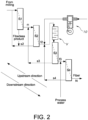
- fig. 2 schematically illustrating an embodiment of a system according to the present invention.
- the screen units S1 to S4 all comprises a screening element (screen) indicated by a slanted, dotted line inside the screen units.
- This slanted dotted line illustrate a device configured for separating out a fraction f containing fiber and a fraction preferably not containing any fiber; this could for instance be provided by a band filter or a filter in general arranged inside wall parts defining an interior void of a screen unit.
- the various fraction to be mixed are illustrated as being mixed outside the screen units S1-S4. However, they may be mixed inside the screen units.
- the space V is a separate container being fluidly connected to the screen unit S3 so that the screen unit S3 receives fluid with fiber and enzymes after the fluid with fiber and enzymes has had an incubation time in the space V.
- the space V may have baffle plates for assuring the fluid does not flow in a straight line from inlet to outlet of the container, which could otherwise short-cut the flow to provide an incubation time.
- Fig. 2 also illustrates that enzymes are applied to the streams f2 and s4 going into the space V.
- the enzymes are dosed by a dosing pump 10 illustrated schematically be a piston pump driven by a crank shaft where the amount of enzymes dosed is controlled by the rotation of the crank shaft (one-way inlet and outlet valves are present in the cylinder or cylinder head but not illustrated).
- a system according to the present invention is preferably configured for introducing hydrolytic enzymes into said first fraction (s), and/or into said second fraction (f), and/or into a mixed first and second fraction and/or into the stream of process water supplied to the system.
- the number of screen units S may be selected according to e.g. the volumetric capacity to separate into two stream and/or the other design aims.
- a system according to present invention will in general have a most upstream screen unit, a most downstream screen unit and preferably one or more intermediate screen units fluidic arranged in between the most upstream and most downstream screen units. That is, with reference to figs. 1 and 2 , a preferred system will comprise a most upstream screen unit S1 and a most downstream screen unit S4 and a number of screen units (e.g. 2) arranged in between, where arranged in between refers to being fluidly connected as illustrated in the figs. 1 and 2 .
- the fluidly connected counter current washing configuration typically comprising the plurality of screen units S1... S4 being arranged in a manner so: a second fraction f1 produced by an upstream screen unit S1 is mixed with a first fraction s3 produced by a downstream screen unit S3, and said mixed fractions being separated by a screen unit S2, being intermediate between said upstream and said downstream screen units S1, S3, into a first fraction s2 and a second fraction f2.
- mixing of a second fraction f1 and a first fraction s3 occurs prior to being inlet into an intermediate screen unit S2.
- Such a mixing may be provided by inletting the two fractions into a mixing chamber comprising stirring means providing typically a vigorous agitation of the fluid or the mixing may be provide by a manifold having an inlet for each stream and an outlet for the mixed stream.
- mixing of a second fraction f1 and a first fractions 3 may occur inside an intermediate screen unit S2. This may for instance be accomplished by the interior of the screen unit being equipped with a stirring means providing typically a vigorous agitation of the fluid inside the screen unit.
- a system according to the present invention may preferably be configured to provide a total retention time in said fiber washing system of at least 35 minutes, such as at least 40 minutes, at least 45 minutes, at least 50 minutes, at least 55 minutes, at least 60 minutes, at least 65 minutes, at least 70 minutes, at least 75 minutes, at least 80 minutes, at least 90 minutes, at least 100 minutes, at least 105 minutes, at least 110 minutes, at least 115 minutes, at least 120 minutes, during which the one or more hydrolytic enzymes is/are in contact with said corn kernel mass and/or one or more fractions thereof, where one or more fractions of corn kernel mass preferably refers to any fraction of corn kernel mass containing fiber and/or starch and/or gluten including any of fractions s and f.
- retention time refers to the time a fluid element is present in the system calculated from the time where it enters into screen unit S1 and to the time where it leaves screen unit S4. This is typically determined on the basis of e.g. the total volume in m3 of the system (volume of screen units, flow lines and space (V) divided by the total volume flow of fibreless product out from screen unit S1 in m3/h.
- the total volume flow of fibreless product is a predetermined design parameter, and the total volume of the system is then selected on the basis of this design parameter.
- the total retention time in the fiber washing system may be between 35 minutes and 5 hours, such as between 35 minutes and 4 hours, 35 minutes and 3 hours, 35 minutes and 2,5 hours, 35 minutes and 2 hours, 35 minutes and 1,5 hour, 45 minutes and 5 hours, 45 minutes and 4 hours, 45 minutes and 3 hours, 45 minutes and 2,5 hours, 45 minutes and 2 hours, 1 hour and 5 hours, 1 hour and 4 hours, 1 hour and 3 hours, 1 hour and 2,5 hours, 1 hour and 2 hours, 70 minutes and 5 hours, 70 minutes and 4 hours, 70 minutes and 3 hours, 70 minutes and 2,5 hours, 70 minutes and 2 hours, 75 minutes and 5 hours, 75 minutes and 4 hours, 75 minutes and 3 hours, 75 minutes and 2,5 hours, 75 minutes and 2 hours, 80 minutes and 5 hours, 80 minutes and 4 hours, 80 minutes and 3 hours, 80 minutes and 2,5 hours, 80 minutes and 2 hours, 85 minutes and 5 hours, 85 minutes and 4 hours, 85 minutes and 3 hours, 85 minutes and 2,5 hours, 85 minutes and 2 hours, 90 minutes and 5 hours, 90 minutes and 4 hours, 90 minutes and 3
- the dimension of the space (in m3) is configured to provide an incubation time of at least at least 5 minutes, such as at least 10 minutes, at least 15 minutes, at least 20 minutes at least 25 minutes, at least 30 minutes, at least 35 minutes, at least 40 minutes, at least 45 minutes, at least 50 minutes, at least 55 minutes, at least 60 minutes.
- the incubation time in the space (V) configured into the fiber washing procedure is less than 12 hours, less than 8 hours, less than 5 hours, less than 3 hours, less than 2,5 hours, less than 2 hours, less than 1,5 hours, less than 1 hour.
- the incubation time in said space (V) is in the range of 0.5-3 hours, such as 1-3 hours, 1-2 hours or such as 85-95 minutes.
- the flow of fibreless product may be the design parameter and the layout of the system together with a desired incubation time can be used to determine the volume of the space V.
- the space V designated for incubation preferably has a volume of at least 30 m 3 , at least 40 m 3 , at least 50 m 3 , at least 60 m 3 , at least 70, m 3 , at least 80, m 3 , at least 90, m 3 , at least 100 m 3 , at least 110 m 3 , at least 120 m 3 , at least 130 m 3 , at least 140 m 3 , at least 150 m 3 , at least 160 m 3 , at least 170 m 3 , at least 180 m 3 , at least 190 m 3 , at least 200 m 3 , at least 210 m 3 , at least 220 m 3 , at least 230 m 3 , at least 240 m 3 , at least 250 m 3 , at least 260 m 3 , at least 270 m 3 , at least 280 m 3 , at least 290 m 3 , at least 300 m 3 , at least
- the incubation time may also be in more than one space V with a total or combined volume of at least 100 m 3 , at least 110 m 3 , at least 120 m 3 , at least 130 m 3 , at least 140 m 3 , at least 150 m 3 , at least 160 m 3 , at least 170 m 3 , at least 180 m 3 , at least 190 m 3 , at least 200 m 3 , at least 210 m 3 , at least 220 m 3 , at least 230 m 3 , at least 240 m 3 , at least 250 m 3 , at least 260 m 3 , at least 270 m 3 , at least 280 m 3 , at least 290 m 3 , at least 300 m 3 , at least 400 m 3 , at least 500 m 3 .
- the fluid received in the space V is not screened.
- the fluid leaving the space V has the same composition, e.g. of starch and fiber, as the fluid received in the space V, although it preferably contains a higher proportion of starch that has been released from the fibers.
- the space V for agitation of matter contained in said space V, such as by comprising a rotor or impeller.
- the space V is arranged downstream of the most upstream screen unit S1 and upstream of said most downstream screen unit S4; in particular, the embodiment of fig. 2 illustrates that the space V is arranged to feed fluid into the second most downstream screen unit S3.
- the space may be provided in different manner and as illustrated in fig. 2 the space V may preferably be provided as a separate incubator unit.
- the incubator unit may be configured by suitable fluid lines to receive a first fraction s, a second fraction f or a combination of a first and a second fraction s,f, preferably only a second fraction f, and deliver the thereby incubated material to a downstream screen unit S3.
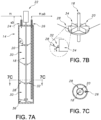
- figure 7 schematically illustrates a preferred embodiment of an incubator according to the present invention
- figure 7 illustrates the incubator in a vertical cross sectional view (left side of fig. 7 ), details on agitators arranged inside the incubator (upper right corner of fig. 7 ) and in a horizontal cross sectional view along A-A (lower right corner of fig. 7 ).
- the incubator 14 comprising a number of fluidic serially connected chambers 30 (four is shown).
- the chambers 30 are connected serially by an opening 32 forming a passage between two neighbouring chambers 30 through which opening 32 material may flow from an upstream to a downstream chamber 30.
- the flow direction "from upstream to downstream” is in the figure vertically downwardly and this flow direction is typically dictated by a pump (not shown) and/or as elucidated below, by use of impellers arranged inside the incubator 14.
- the most upstream chamber 30 is connected to receive a first fraction s, a second fraction f or a combination of a first and a second fraction s,f.
- the first and the second fraction s, f are mixed outside the incubator 14 and fed into the most upstream chamber 30.
- the most downstream chamber 30 of the incubator has an outlet connection 26 adapted to deliver incubated material out from the incubator 14.
- the incubator of fig. 7 comprises one or more agitators 20 (four are shown in fig. 7 ) configured for preventing solid decantation in the incubator 14. Decantation may be an issue to consider, since the material to be incubated in the incubator comprises solid material contained in a liquid (typically water) and the material typically has a density being different from the liquid whereby if the mixture of solid matter and liquid is left with no agitation, solid matter may (depending on the density) either settle on the bottom of a chamber or float at the surface of the liquid. To avoid this, the incubator comprises the agitators 20 to provide agitation.
- a liquid typically water
- the material typically has a density being different from the liquid whereby if the mixture of solid matter and liquid is left with no agitation, solid matter may (depending on the density) either settle on the bottom of a chamber or float at the surface of the liquid.
- the incubator comprises the agitators 20 to provide agitation.
- the incubator 14 preferably has a cylindrical shape so as to provide circular cross sections as illustrated in the cross sectional view along line A-A.
- the incubator 14 may have a number of walls, preferably funnel shaped walls 28 (in fig. 7 , three such funnel shaped walls are shown), disposed horizontally distanced inside the incubator 14 to divide the interior of the incubator 14 into chambers 30.
- the funnel shaped walls 28 are arranged so as to funnel material downwardly from one chamber to a downstream chamber 30. That is the angle ⁇ in fig. 7 is larger than 90 degrees. Typically the angle ⁇ is between 90 and 110, such as between 90 and 100, preferably between 90 and 95 degrees.
- the funnel shaped walls 28 each has its opening 32 geometrical centred at the smallest cross section of each of the funnel shaped wall.
- the bottom wall of such a most downstream chamber 30 is a sloping bottom wall 36 sloping towards an inlet of said outlet connection 26.
- the angle of the slope is typically selected as for the angle ⁇ of the funnel shaped walls 28.
- Such a one-side-sloping wall has the advantage that material contained in the chamber will be guided by the wall towards the outlet connection 26.
- the outlet connection 26 is arranged so as to outlet material from the incubator 14 at the bottom thereof. This may be embodied as a horizontal extending tube extending through the wall of the incubator 14 at position close to the bottom wall 36.
- the outlet connection 26 is in a form of a tube extending internally inside the incubator 14 from a position at the top and outside of the incubator 14 and to the bottom of the most downstream positioned chamber 30.
- the agitators 20 are preferably impellers comprising a plurality of impeller blades 34.
- the incubator 14 further comprising a shaft 18 and a motor 22 configured for rotating the shaft 14; and as the impellers are arranged on said shaft 14 rotation of the shaft 14 provides a rotation of the impellers.
- impellers beside prevents solid decantation (by agitation) also may provide a pumping action the impellers may be configured to provide a pumping action pumping material through the incubator 14.
- the combination of pumping and decantation may be designed by considering the vertical position of the impellers in the openings 32. This is illustrated in fig. 7 by the magnified view (indicated by the dotted lined circle) illustrating that each of the impellers arranged in one of said openings 32 are arranged in a position where a lower end of the impeller being disposed a distance h below an edge 32 of the opening 32.
- the distance h being preferably smaller than a height of the impeller blade 34 measured at the opening 32. If for instance, the impellers are arranged so that the height h equal zero, substantially no pumping action (towards a downstream chamber) occurs and the impeller substantially only provides a agitation action.
- the funnel shaped wall 28 is illustrated as not having a substantial thickness (compared to the height of the impeller blade 34); however, if the wall 28 is designed with a substantial thickness thereby defining an upper and lower edge, the height h is considered to be the height of the impeller blade 34 at the lower edge of the wall 28. It is noted that although it is preferred that all such impellers are arranged identical in each of the openings 32, the impellers may be arranged at different vertical heights h in each opening 32.
- fig. 7 in the magnified view also indicates a clearance c. This clearance is typically selected so as to allow the impeller to avoid mechanical contact with the funnel shaped wall 28.
- one or more of the agitators 20 / impellers are preferably each arranged in one of said openings 32, so as to provide an agitation of material flowing from one chamber 30 to a downstream chamber 30 through the opening 32.
- an incubator has a total volume larger than 50 m 3 , such as larger than 100m 3 , preferably larger than 150m 3 , such as larger than 200m 3 .
- the incubator may preferably be made, partly or fully, from stainless steel, but other materials, such as coated steel, coated stainless steel, polymers and fibre-reinforced polymers may also be used in the construction of the incubator.
- the coating may include fused glass, fused flourpolymers or a thermoset coating system based on epoxy, polyurethane, vinylesther or polyester.
- the incubator is made from a polymer
- the polymer is preferably a polyolefine preferably chosen between polypropylene or polyethylene.
- the reinforcing fibres are preferably glass or basalt, and the matrix material is preferably chosen from the group of epoxies, vinylesters or polyesters.
- an incubator according to the present invention may comprise a number of fluidic serially connected chambers 30 being two, such as three, preferably four, such as five, and even preferably six fluidic serially connected chambers 30.
- all of the fluidic serially connected chambers 30 have the same volume.
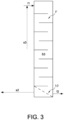
- FIG. 3 schematically illustrating a screen unit with an build-in incubator/space V.
- the screen unit/incubator comprising at the lower end, a screening element 14 and above that a space V.
- the space baffle plates are arranged to avoid short-cut in the fluid flow from the upper end (receiving in the disclosed embodiment of fig. 3 fractions f1 and s3) towards the screening element 14.
- the fiberless stream s2 is screened out providing a fiber containing fraction f2.
- thermo elements for providing an incubation temperature of the fluid inside said space (V), preferably in the range 35-70°C, such of 40-60°C, such as in the range of 46-48°C, such as in the range of 45-49°C, such as in the range of 45-48°C, such as 47C.
- the thermo elements may be arranged inside the incubation unit and/or on a shell defining the enclosure of the incubation unit.
- thermo elements are preferably thermostat-able heating/cooling elements being adapted to measure the temperature and change the heat flux into/out from the space to control the temperature of material contained in the space to be within a predefined range.
- the thermostat-able heating elements comprising electrical heating/cooling elements or liquid heating/cooling elements and temperature sensors.
- the screen unit provides a separation of fluid into two fractions s and f and the screen unit typically screens in a mechanical manner where one or more, such as all the screen units, comprises one or more screening element having openings (as illustrated e.g. in fig. 2 with a slanted, dotted lines) configured for allowing passage of solid matter below a predefined size.
- the predefined size may be defined according to a number of design criteria. However, it typically preferred than no fiber is allowed to pass through the opening. On the other hand to small opening may have a tendency to become blocked and in many instances the actual size of openings is selected by taking the blocking aspect and the screening aspect into consideration, which may result in that smaller amounts of fibers are allowed to pass through.
- one or more such as all screen units comprises rotor blade and/or sieves configured for providing said two fractions s, f.
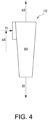
- one or more such as all screen units may be hydro-cyclones 16 as illustrated schematically in fig. 4 .
- the system is configured to introduce hydrolytic enzymes into said first fraction s and/or into said second fraction f and/or into a mixed first and second fraction and/or into the process water, by means of a dosing device 10 - see fig. 2 .
- Such a dosing device 10 is typically adapted to provide a controllable dosing quantity of enzymes, preferably according to a predetermined specific ratio between amount of enzymes and infeed of corn kernel mass to the system.
- the dosing device 10 could be a metering pump as illustrated by a piston pump in fig. 2 .
- the dosing device 10 may be a gravity flow dispenser having a controllable outflow valve configured for controlling the amount of enzyme flowing through the flow valve.
- the present invention relates to a method to improve starch yield and/or gluten yield from corn kernels in a wet milling process, comprising the steps of:
- the total retention time in the fiber washing procedure may be between 35 minutes and 5 hours, such as between 35 minutes and 4 hours, 35 minutes and 3 hours, 35 minutes and 2,5 hours, 35 minutes and 2 hours, 35 minutes and 1,5 hour, 45 minutes and 5 hours, 45 minutes and 4 hours, 45 minutes and 3 hours, 45 minutes and 2,5 hours, 45 minutes and 2 hours, 1 hour and 5 hours, 1 hour and 4 hours, 1 hour and 3 hours, 1 hour and 2,5 hours, 1 hour and 2 hours, 70 minutes and 5 hours, 70 minutes and 4 hours, 70 minutes and 3 hours, 70 minutes and 2,5 hours, 70 minutes and 2 hours, 75 minutes and 5 hours, 75 minutes and 4 hours, 75 minutes and 3 hours, 75 minutes and 2,5 hours, 75 minutes and 2 hours, 80 minutes and 5 hours, 80 minutes and 4 hours, 80 minutes and 3 hours, 80 minutes and 2,5 hours, 80 minutes and 2 hours, 85 minutes and 5 hours, 85 minutes and 4 hours, 85 minutes and 3 hours, 85 minutes and 2,5 hours, 85 minutes and 2 hours, 90 minutes and 5 hours, 90 minutes and 4 hours, 90 minutes and 3
- the one or more fractions of the corn kernel mass may be a first fraction (s), a second fraction (f), or a mixed first and second fraction as defined above.
- a space (V) is configured into the fiber washing procedure, to provide said total retention time of at least 45 minutes, such as at least 50 minutes, at least 55 minutes, at least 60 minutes, at least 65 minutes, at least 70 minutes, at least 75 minutes, at least 80 minutes, at least 90 minutes, at least 100 minutes, at least 105 minutes, at least 110 minutes, at least 115 minutes, at least 120 minutes, in which said one or more hydrolytic enzymes is/are in contact with one or more fractions of said corn kernel mass.
- the total retention time in the fiber washing procedure may be between 35 minutes and 5 hours, such as between 35 minutes and 4 hours, 35 minutes and 3 hours, 35 minutes and 2,5 hours, 35 minutes and 2 hours, 35 minutes and 1,5 hour, 45 minutes and 5 hours, 45 minutes and 4 hours, 45 minutes and 3 hours, 45 minutes and 2,5 hours, 45 minutes and 2 hours, 1 hour and 5 hours, 1 hour and 4 hours, 1 hour and 3 hours, 1 hour and 2,5 hours, 1 hour and 2 hours, 70 minutes and 5 hours, 70 minutes and 4 hours, 70 minutes and 3 hours, 70 minutes and 2,5 hours, 70 minutes and 2 hours, 75 minutes and 5 hours, 75 minutes and 4 hours, 75 minutes and 3 hours, 75 minutes and 2,5 hours, 75 minutes and 2 hours, 80 minutes and 5 hours, 80 minutes and 4 hours, 80 minutes and 3 hours, 80 minutes and 2,5 hours, 80 minutes and 2 hours, 85 minutes and 5 hours, 85 minutes and 4 hours, 85 minutes and 3 hours, 85 minutes and 2,5 hours, 85 minutes and 2 hours, 90 minutes and 5 hours, 90 minutes and 4 hours, 90 minutes and 3
- the total retention time is the time period in which the corn kernel mass, received in the first screen unit (S1) and one or more fractions thereof, are contacted with an effective amount of one or more hydrolytic enzymes before leaving the fiber washing system again.
- the one or more fractions of corn kernel mass is incubated with one or more hydrolytic enzymes in a space (V), before it leaves the fiber washing system, as part of a first fraction (s1) from the most upstream screen unit (S1) or as part of a second fraction (f4) from the most downstream screen unit (S4).
- all of the second fractions will be in contact with the one or more hydrolytic enzymes through the whole fiber washing procedure, but the enzyme concentration will vary in the different fractions (f).
- the incubation time in said space configured into the fiber washing procedure is at least 5 minutes, such as at least 10 minutes, at least 15 minutes, at least 20 minutes at least 25 minutes, at least 30 minutes, at least 35 minutes, at least 40 minutes, at least 45 minutes, at least 50 minutes, at least 55 minutes, at least 60 minutes.
- the incubation time in the space (V) configured into the fiber washing procedure is less than 12 hours, less than 8 hours, less than 5 hours, less than 3 hours, less than 2,5 hours, less than 2 hours, less than 1,5 hours, less than 1 hour.
- the incubation time in said space (V) is in the range of 0.5-3 hours, such as 1-3 hours, 1-2 hours or such as 85-95 minutes.
- the enzymes can be dosed into a screen unit, in a connection point between two screen units, in a space (V) configured into the fiber washing system or in the process water.
- the one or more hydrolytic enzymes is dosed continuous, upstream of the most downstream screen unit and downstream of the most upstream screen unit, using a dosing device with a controllable flow rate.
- the incubation time in said space V and/or total retention time in the fiber washing procedure provides reduced foam formation in the fiber washing process.
- the formation of foam is reduced by at least 90% (v/v), such as by at least 80% (v/v), such as by at least 70%(v/v), such as by at least 60% (v/v), such as by at least 50% (v/v), such as by at least 30%(v/v), or such as by at least 20% (v/v).
- the fiber washing procedure comprises 2-8 fiber washing steps.
- the fiber washing system comprise 2 screen units
- dosing is preferred between the first and second screen unit or in a space configured between screen unit 1 and screen unit 2.
- the fiber washing system comprise 3 screen units
- dosing is preferred in the second screen unit or in a space configured between screen unit 1 and screen unit 3, most preferred in screen unit 2, or a space configured between screen unit 2 and 3.
- the fiber washing system comprise 4 screen units
- dosing is preferred in the second or third screen unit or in a space configured between screen unit 1 and screen unit 4, most preferred in screen unit 2, or a space configured between screen unit 2 and 3.
- the fiber washing system comprise 5 screen units
- dosing is preferred in the second, third or fourth screen unit, or in a space configured between screen unit 1 and screen unit 5, most preferred in screen unit 3 or a space configured between screen unit 3 and 4.
- the fiber washing system comprise 6 screen units
- dosing is preferred in the second, third, fourth or fifth screen unit, or in a space configured between screen unit 1 and screen unit 6, most preferred in screen unit 4, or a space configured between screen unit 4 and 5.
- the fiber washing system comprise 7 screen units
- dosing is preferred in the second, third, fourth, fifth or sixth screen unit, or in a space configured between screen unit 1 and screen unit 7, most preferred in screen unit 4 or a space configured between screen unit 4 and 5.
- the fiber washing system comprise 8 screen units
- dosing is preferred in the second, third, fourth, fifth, sixth and seventh screen unit, or in a space configured between screen unit 1 and screen unit 8, most preferred in screen unit 5 or a space configured between screen unit 5 and 6.
- a fiber washing step comprises passing a stream of corn kernel mass and liquid/a liquid suspension, such an aqueous suspension, of corn kernel mass through a screen unit configured for separating said stream of corn kernel mass and liquid into two fractions: a first fraction s and a second fraction f, said second fraction f containing a higher amount of wt% fiber than the first fraction.
- Some material from the corn kernel mass received in the first screening unit (S1) will go through all screening units in the fiber washing system, the number of screen units depending on the specific mill, and may thus be part of more than one second fraction and/or become part of more than one first fraction, while other material from the corn kernel mass will not go through all the screen units. These fractions will become part of one or more of a first fraction and/or one or more of a second fraction, but not all second fractions.
- the material from the corn kernel mass going through all screen units in the fiber washing procedure comprise mostly fiber.
- the material from the corn kernel mass that are not going through all of the screen units in the fiber washing procedure comprise mostly starch and/or gluten.
- the wt% of starch and/or gluten is reduced in a downstream second fraction (f4) compared to an upstream second fraction (f1).
- the wt% of starch and/or gluten may be higher in an upstream first fraction (s1) compared to a downstream first fraction (s4).
- the invention provides in particular embodiments a method as described above, wherein a fraction of the corn kernel mass is contacted with an effective amount of said one or more hydrolytic enzymes, said fraction containing an amount of fiber, which corresponds to 2-15% (w/w) dry solids (DS), such as to 5-15% (w/w) DS, to 5-12% (w/w) dry solids (DS), to 5-10% (w/w) dry solids (DS), to 7.5-12.5% (w/w) DS, to 8-12% (w/w) DS or to 9-11% dry solids (DS).
- DS 2-15% dry solids
- the amount of dry solids may in particular be determined in a sample of said one or more fractions of the corn kernel mass, taken from a space (V) or incubator unit as defined above, or from an inlet into said space (V) or incubator unit, such as through an opening in space (V) or incubator unit or in said inlet.
- the inlet may be an inlet that connects space (V) or said incubator unit with a upstream screening unit (S), which is the closest upstream screening unit to space (V) or to said incubator.
- S upstream screening unit
- the sample is preferable taken from the fraction or fractions that are delivered to the space (V) or incubator unit disclosed above in such a way that the content of dry solids determined in the sample is a direct measure of the amount of dry solids present in the fraction or fractions which enter the space (V) or incubator and are contacted with the one or more hydrolytic enzymes.
- the amount of dry solids may be determined by:
- the one or more of said hydrolytic enzymes is/are selected from the group consisting of cellulases (EC 3.2.1.4), xylanases (EC 3.2.1.8) arabinofuranosidases (EC 3.2.1.55 (Non-reducing end alpha-L-arabinofuranosidases); cellobiohydrolase I (EC 3.2.1.150), cellobiohydrolase II (E.C. 3.2.1.91), cellobiosidase (E.C. 3.2.1.176), beta-glucosidase (E.C. 3.2.1.21), and beta-xylosidases (EC 3.2.1.37).
- cellulases EC 3.2.1.4
- xylanases EC 3.2.1.8
- arabinofuranosidases EC 3.2.1.55 (Non-reducing end alpha-L-arabinofuranosidases)
- cellobiohydrolase I EC 3.2.1.150
- cellobiohydrolase II E.C
- the one or more of said hydrolytic enzymes is expressed in an organism with a cellulase background, such as Trichoderma reesei.
- An organism with a cellulase background should be understood as an organism naturally expressing one or more cellulytic enzymes.
- the one or more of said hydrolytic enzymes comprise a xylanase, which is a GH10 xylanase.
- the one or more of said hydrolytic enzymes comprise a xylanase, which is a GH11 xylanase.
- the one or more of said hydrolytic enzymes comprise an arabinofuranosidase, which is a GH62 arabinofuranosidase.
- the one or more of said hydrolytic enzymes comprise a GH10 polypeptide with xylanase activity, which is selected from the group consisting of
- the one or more of said hydrolytic enzymes comprise a GH11 polypeptide with xylanase activity, which is selected from the group consisting of
- the one or more of said hydrolytic enzymes comprise a GH62 polypeptide with arabinofuranosidase activity, which is selected from the group consisting of:
- the subsequences defined above may be subsequences in which 30 amino acid residues or less, such as 25 amino acid residues or less, 20 amino acid residues or less, 15 amino acid residues or less, 10 amino acid residues or less, or 5 amino acid residues or less have been deleted.
- the amino acid sequences in items ii) and/or v) above has a length, which in 75% or more, such as 80% or more, 90% or more, 95% or more, or 98% or more of the length of the sequence set forth under the respective SEQ ID NO.
- the one or more of said hydrolytic enzymes is expressed in Trichoderma reesei and comprise a xylanase, which is a GH10 xylanase or a GH11 xylanase and a arabinofuranosidase, which is a GH62 arabinofuranosidase.
- the effective amount of one or more hydrolytic enzymes contacted with one or more fractions of the corn kernel mass does not exceed 0.5, 0.4, 0.3, 0.2 kg enzyme protein/metric tonne (MT) corn kernel mass.
- the effective amount of one or more hydrolytic enzymes contacted with one or more fractions of said corn kernel mass is between 0.010-0.5 kg/MT corn kernel mass, such as between 0.05-0.5 kg/MT corn kernel mass or 0.075-0.5 kg/MT or 0.1-0.5 kg/MT corn kernel mass or 0.01-0.4 kg/MT corn kernel mass or 0.05-0.4 kg/MT corn kernel mass or 0.075-0.4 kg/MT corn kernel mass or 0.1-0.4 kg/MT corn kernel mass or 0.01-0.3 kg/MT corn kernel mass or 0.05-0.3 kg/MT corn kernel mass or 0.075-0.3 kg/MT or 0.1-0.3 kg/MT corn kernel mass or 0.010-0.2 kg/MT corn kernel mass or 0.05-0.2 kg/MT corn kernel mass or 0.075-0.2 kg/MT or 0.1-0.2 kg/MT corn kernel mass or such as 0.075-0.10 kg/MT corn kernel mass or 0.075-0.11 kg/MT corn kernel mass..
- the invention is a wet milling process, which comprises the use of a fiber washing procedure as defined above in aspects and embodiments of the invention.
- the milling process may comprise subjecting corn kernel mass, to a fiber washing procedure wherein one or more fractions of the corn kernel mass is contacted with an effective amount of one or more hydrolytic enzymes, and step d) has a total retention time of at least 35 minutes, such as at least 40 minutes, at least 45 minutes, at least 50 minutes, at least 55 minutes, at least 60 minutes, at least 65 minutes, at least 70 minutes, at least 75 minutes, at least 80 minutes, at least 90 minutes, at least 100 minutes, at least 105 minutes, at least 110 minutes, at least 115 minutes, at least 120 minutes.
- the total retention time in the fiber washing procedure may be between 35 minutes and 5 hours, such as between 35 minutes and 4 hours, 35 minutes and 3 hours, 35 minutes and 2,5 hours, 35 minutes and 2 hours, 35 minutes and 1,5 hour, 45 minutes and 5 hours, 45 minutes and 4 hours, 45 minutes and 3 hours, 45 minutes and 2,5 hours, 45 minutes and 2 hours, 1 hour and 5 hours, 1 hour and 4 hours, 1 hour and 3 hours, 1 hour and 2,5 hours, 1 hour and 2 hours, 70 minutes and 5 hours, 70 minutes and 4 hours, 70 minutes and 3 hours, 70 minutes and 2,5 hours, 70 minutes and 2 hours, 75 minutes and 5 hours, 75 minutes and 4 hours, 75 minutes and 3 hours, 75 minutes and 2,5 hours, 75 minutes and 2 hours, 80 minutes and 5 hours, 80 minutes and 4 hours, 80 minutes and 3 hours, 80 minutes and 2,5 hours, 80 minutes and 2 hours, 85 minutes and 5 hours, 85 minutes and 4 hours, 85 minutes and 3 hours, 85 minutes and 2,5 hours, 85 minutes and 2 hours, 90 minutes and 5 hours, 90 minutes and 4 hours, 90 minutes and 5
- Example 1 The optimal enzyme dosing point in wet milling
- the model simulation was done in SuperPro Designer V.9 (evaluation version).
- the USDA model represents a 100,000 bu/day wet mill plant, including all unit operations. No change was made to the model, except to introduce the enzyme at four different points in the process, illustrated in figure 5 .
- These dose points are (1) after 2 nd grind, (2) after 3 rd grind, (3) after 4 th fiber washing step, and (4) after 6 th fiber washing step (last wash stage before fiber press).
- the enzyme feed rate was pegged at a dose of 0.20 kg/MT corn.
- a determining parameter for the simulation is the enzyme's partitioning characteristic. In this case, the simple assumption was taken that the enzyme behaves just like a soluble solid.
- the effective dose was taken as the ratio of enzyme to fiber within the relevant segment of the process. For simplicity, this segment is taken to begin at the second grind and end at the last fiber washing step just before fiber pressing. This would include every step of the process where relevant substrate-enzyme contact is expected to take place.
- a weighted averaged dose is determined for the whole segment by factoring in the residence times of the receiving tanks, placed after each screen to the individual effective dose at every process step included. The whole segment in this case, had a total residence time of 1.28 hr.
- the residence time is due to the use of receiving tanks, which some plants may or may not have.
- the tank size may vary from plant to plant. However, regardless of tank size, the conclusions arrived here shouldn't change.
- Table 2 depicts weighted average effective enzyme doses (factoring in residence times) at various stages of the wet milling process, for each of the dosing cases simulated. From this it appears that dosing in the fiber washing result in higher enzyme levels compared to 2 nd grind or 3 rd grind. The best case suggests dosing towards the end of the fiber wash steps, but not at the last wash step.
- Table 2 Weighted average enzyme conc. for the different cases (weights based on residence times of the operations included). Case Dose Location Weighted Average Effective Conc (%w / w fiber) 1 2 nd Grind 0.51 2 3 rd Grind 0.53 3 Fiber Washing step 4 0.72 4 Fiber Washing step 6 0.64
- the residual enzyme concentrations (ppm based on total product weight) under the different dosing cases are given in Table 3 below. In general, the levels are very similar for the different cases. The highest levels are found in the dry gluten feed (DGF), since most of the enzymes (>85%) end up with the steep liquor that is added back to the DGF.
- the starch slurry has the least, less than a tenth of a ppm, because of the extensive starch washing that takes place. This is important, since the starch stream is the likeliest place for the enzyme to retain any activity; all others will go through high temperature drying that would potentially deactivate the enzymes. Table 3: Residual enzyme concentrations (total weight basis) in the final product streams.
- the change in viscosity is a convenient way to follow the change in water concentration of the slurry due to enzyme treatment.
- the effective viscosity is a positive function of the volume fraction of solids ( Bailey, J.E. and Ollis, D.F., Biochemical Engineering Fundamentals 2nd ed, 1986, McGraw-Hill, Inc. page 502 ). While most likely the slurry behaves as non-Newtonian, it does not change the generality that as the solid volume fraction increases (or equivalently, the aqueous volume fraction decreases), the viscosity increases, and vice versa. So if dewatering occurs during enzyme reaction, this should cause the solid volume fraction to go down (or equivalently, the aqueous volume fraction to go up), and consequently the viscosity to go down with it.
- RVA measurements were taken continuously, and in order to summarize the results, a running average was calculated for each 10-minute duration. Each average and standard deviation calculated consist of >300 data points. Tables 4 and 5 below shows the results for the enzyme treated and control samples, respectively. Table 4: Average viscosity (in centipoise) measured within 10-min time durations over the 90-min RVA run.
- the incubation was done at 50C in an air-heated incubator with constant shaking, varying the incubation time to 10, 50 and 90 min. After incubation, the samples were cooled quickly in ice-water (5°C) before processing. The slurry was transferred on to a 100-micron sieve, while collecting the filtrate that passed through. The fiber that was retained over the sieve was pressed using a spatula to recover as much filtrate as possible. The pressed fiber was then transferred to a beaker containing 200-ml of water and stirred. This slurry was again passed through the 100-micron sieve, and the collected filtrate was combined with the first. The pressing, washing and filtering steps above were repeated once more, so that a final filtrate was recovered and combined with the first two.
- the combined filtrate was then vacuum filtered, this time through a glass micro filter paper (Whatman) which retained the insoluble solids that were released from the fiber and passed through the 100-micron screen. After passing 200 ml water over the filter paper to remove any trace of solubles, the total insoluble solids retained on the filter paper was dried and weighed. The dry weight was reported as Starch+Gluten released as percentage of fiber dry matter of starting substrate. The results are shown in Table 6. Table 6. Yield of starch and gluten released from fiber under different enzyme dose and incubation time.
- the fiber washing lay-out of the test facility consists of four screen units.
- An incubation tank 250m 3 was installed between the second and third screen unit to allow additional retention time of the corn kernel mass or fractions thereof.
- the enzymes (mature polypeptides of SEQ ID NO: 7 and 22, expressed in Trichoderma reesei) were dosed in the second screen, before the holding tank. Without the additional incubation tank, the retention time (RT) in the fiber washing system was estimated to be around 10 min (based on the total capacity of the pre-existing receiving tanks).
- the effect of retention time was evaluated by increasing the utilization capacity of the additional tank from 0%, to 40% (100m 3 , adding 40 min RT), and then finally to 80% (200m 3 , adding 80 min RT).
- the fiber was washed in a fiber washing system as described above.
- the trial without enzymes and incubation tank was run for 3 months.
- the trial without incubation tank (10 min RT), but with enzymes, was run over 4 weeks at an enzyme dose of 0,5 kg/MT corn.
- the experiment with incubation tank (100m 3 ), 50 min RT (40 min incubation time) and enzymes was run over 1 week at an enzyme dose of 0,5 kg/MT corn.
- the experiment with incubation tank (200m 3 ), 90 min RT (80 min incubation time) and enzymes was run over 2 weeks at an enzyme dose of 0,5 kg/MT corn.
- the fiber was pressed to decrease the water content before drying.
- the total starch (%) was determined by an enzymatic method established for measuring total starch in cereal products (Method 76-13, AACC International 2000).
- the total protein (%) was determined by the micro-Kjeldahl method of measuring crude protein (AACCI Method 46-13.01).
- the total starch can be divided into extractable starch (starch that can be washed off), and bound starch (starch that is stuck with the fiber even washing).
- the amount of starch remaining in a sample after an additional washing step in clean water (bound starch) was used as a control, to make sure that starch and protein were released from the fiber.
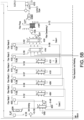
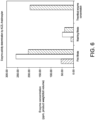
- the sample was washed with 10 L water and filtered through a 50-micron sieve to wash away extractable starch before measuring the bound starch. The process is illustrated in a flow diagram in figure 8 .
- the total starch (wt%) and protein (wt%) of dry fiber reflects the amount of starch and protein still present in the fiber after fiber wash, pressing and drying. This amount of starch and protein should in theory decrease as the retention time increase, as the hypothesis is that enzymes catalyse the release of starch and protein into the process stream.
- the effect on total starch (wt%) and total protein (wt%) of dry fiber, by change in retention time is given in table 7 below. As shown, there is a significant effect on the removal of starch and protein by the addition of the enzyme, even at the original retention time of 10 min. With increased retention time (+80 min RT) a decrease in both total starch and protein can be seen, reflecting that increased retention time in fiber washing can indeed increase the total starch and protein yields in corn wet milling.
- the total moisture (wt%) of the pressed wet fiber was calculated as: the wet fiber weight minus the dry fiber weight.
- the moisture content decreases in the wet fiber (dewatering) with addition of enzymes, but does not seem to be effected by retention time.
- the fiber sample was obtained from a wet-mill plant after the vetter press with a total dry matter content of 42.80%.
- the sample was re-suspended in buffer (pH 4, 0.02M Na Acetate) to a slurry containing various dry solids.
- buffer pH 4, 0.02M Na Acetate
- the enzyme was added at 0.9kg/MT wet corn.
- the %DS was adjusted with various amounts of water as shown in the table below to achieve a range of %DS.
- Fiber weight Water added %DS Time Incubated (min) Tube # Fiber Weight (g) Fiber DS (g) Enzyme Buffer Water add (ml) 2,00% 2 1 8,08 3,46 73 1,00 165 2,00% 2 2 8,14 3,48 74 1,00 166 2,00% 2 3 8,36 3,58 76 1,00 171 8,00% 2 4 13,54 5,80 123 1,00 59 8,00% 2 5 13,21 5,65 120 1,00 57 8,00% 2 6 13,34 5,71 121 1,00 58 12,00% 2 7 13,14 5,62 119 1,00 34 12,00% 2 8 13,23 5,66 120 1,00 34 12,00% 2 9 13,06 5,59 118 1,00 34 15,00% 2 10 13,01 5,57 118 1,00 24 15,00% 2 11 13,06 5,59 118 1,00 24 15,00% 2 12 13,08 5,60 119 1,00 24 18,
- the incubation was done at 48C in a Werner Mathis AG Labomat reactor with constant mixing for 120 minutes. After incubation, the samples were cooled quickly in ice-water (5°C) before processing.
- the slurry was then poured into an Omega 1000 Juicer and the variable autotransformer was set to 30% power for 1 minute.
- the filtrate was caught with a 75 ⁇ m screen and catch pan.
- the insoluble solids in the catch pan were transferred into a 500ml Nalgene bottle.
- the fiber was scraped out of the Omega 1000 juicer basket and washed with 200 mls of DI water in a beaker with a spatula.
- the fiber slurry was then poured back into the juicer and run for 1 minutes at 30% power. Again the filtrate was poured over a 75 ⁇ m sieve and catch pan the insoluble solids were transferred to the same Nalgene bottle.
- the juice basket was taken out of the juicer and the juicer body was rinsed with a water spray bottle to rinse any and all insoluble over the 75 ⁇ m sieve and catch pan and transferred to the 500ml Nalgene bottle.
- the bottle was then capped and the insoluble solids were separated using vacuum filtration.
- the vacuum filtration set up utilized a funnel with filter paper (Whatman) the insoluble solids slurry was poured over the filter paper under vacuum. A weight was taken of the filter paper before filtration and filter paper was put in a 50C oven to dry and a weight was taken after 24 hours in the oven.
Landscapes
- Chemical & Material Sciences (AREA)
- Engineering & Computer Science (AREA)
- Polymers & Plastics (AREA)
- Life Sciences & Earth Sciences (AREA)
- Health & Medical Sciences (AREA)
- Chemical Kinetics & Catalysis (AREA)
- Organic Chemistry (AREA)
- Medicinal Chemistry (AREA)
- Biochemistry (AREA)
- Materials Engineering (AREA)
- Food Science & Technology (AREA)
- Nutrition Science (AREA)
- Crystallography & Structural Chemistry (AREA)
- Dispersion Chemistry (AREA)
- Preparation Of Compounds By Using Micro-Organisms (AREA)
- Polysaccharides And Polysaccharide Derivatives (AREA)
- Detergent Compositions (AREA)
- Chemical Or Physical Treatment Of Fibers (AREA)
- Enzymes And Modification Thereof (AREA)
- Cereal-Derived Products (AREA)
- Apparatus Associated With Microorganisms And Enzymes (AREA)
Applications Claiming Priority (5)
| Application Number | Priority Date | Filing Date | Title |
|---|---|---|---|
| US201662395545P | 2016-09-16 | 2016-09-16 | |
| US201662426711P | 2016-11-28 | 2016-11-28 | |
| EP17151610 | 2017-01-16 | ||
| US201762468704P | 2017-03-08 | 2017-03-08 | |
| PCT/US2017/051701 WO2018053220A1 (en) | 2016-09-16 | 2017-09-15 | Fiber washing method and system |
Publications (3)
| Publication Number | Publication Date |
|---|---|
| EP3512358A1 EP3512358A1 (en) | 2019-07-24 |
| EP3512358B1 true EP3512358B1 (en) | 2024-08-14 |
| EP3512358C0 EP3512358C0 (en) | 2024-08-14 |
Family
ID=59914543
Family Applications (1)
| Application Number | Title | Priority Date | Filing Date |
|---|---|---|---|
| EP17769174.8A Active EP3512358B1 (en) | 2016-09-16 | 2017-09-15 | Fiber washing method and system |
Country Status (12)
| Country | Link |
|---|---|
| US (1) | US12005456B2 (pl) |
| EP (1) | EP3512358B1 (pl) |
| JP (1) | JP7106526B2 (pl) |
| KR (1) | KR102432635B1 (pl) |
| CN (1) | CN109688843A (pl) |
| ES (1) | ES2990148T3 (pl) |
| HU (1) | HUE069074T2 (pl) |
| MX (1) | MX2019002624A (pl) |
| MY (1) | MY196667A (pl) |
| PH (1) | PH12019500549A1 (pl) |
| PL (1) | PL3512358T3 (pl) |
| ZA (1) | ZA201902293B (pl) |
Families Citing this family (8)
| Publication number | Priority date | Publication date | Assignee | Title |
|---|---|---|---|---|
| CN109688843A (zh) | 2016-09-16 | 2019-04-26 | 诺维信公司 | 纤维洗涤方法和系统 |
| WO2019023222A1 (en) * | 2017-07-24 | 2019-01-31 | Novozymes A/S | GH5 AND GH30 IN WET MILLING |
| CN209602429U (zh) * | 2018-12-21 | 2019-11-08 | 诺维信公司 | 玉米纤维处理系统及应用其的玉米湿磨淀粉加工系统 |
| US20220205006A1 (en) * | 2019-05-15 | 2022-06-30 | Novozymes A/S | Method For Improving Yield Of Sprayed Corn Bran In Corn Wet-Milling Process |
| CN112756117A (zh) * | 2020-12-18 | 2021-05-07 | 华南理工大学 | 一种微纳米纤维素纤丝的分级分离装置、系统及方法 |
| CN113287766A (zh) * | 2021-05-29 | 2021-08-24 | 信丰茂旺源生态农业有限公司 | 一种食用菌加工用清洗机 |
| CN115005396B (zh) * | 2022-05-27 | 2024-01-16 | 临泉县宇诚机械有限公司 | 一种蔬菜包加工用前处理装置 |
| WO2024215262A1 (en) * | 2023-04-13 | 2024-10-17 | Eli̇t Mi̇ll Gida San. Ve Diş Ti̇c. A.Ş. | The new generation milling system |
Citations (4)
| Publication number | Priority date | Publication date | Assignee | Title |
|---|---|---|---|---|
| US20120244590A1 (en) * | 2011-03-24 | 2012-09-27 | Lee Tech Llc | Dry grind ethanol production process and system with front end milling method |
| US20120288900A1 (en) * | 2011-05-11 | 2012-11-15 | Baiyin Sino Biotechnology Co., Ltd. | Method of Producing Corn Starch by Enzymatic Process |
| CN104448011A (zh) * | 2014-12-04 | 2015-03-25 | 保龄宝生物股份有限公司 | 一种用于提高淀粉收率的复合酶制剂 |
| US20160257981A1 (en) * | 2013-11-26 | 2016-09-08 | Novozymes A/S | Milling Process |
Family Cites Families (29)
| Publication number | Priority date | Publication date | Assignee | Title |
|---|---|---|---|---|
| US5066218A (en) | 1987-05-13 | 1991-11-19 | Genencor International, Inc. | Composition of a steeped starched-containing grain and a cellulase enzyme |
| US4994115A (en) * | 1988-06-23 | 1991-02-19 | Cpc International Inc. | Process for producing a high total dietary corn fiber |
| US5198035A (en) * | 1991-03-29 | 1993-03-30 | Dorr-Oliver Incorporated | Corn wet milling process for manufacturing starch |
| US5891493A (en) | 1997-11-25 | 1999-04-06 | Santillo, Jr.; Humbart D. | Predigested seed food composition |
| US6566125B2 (en) | 2000-06-02 | 2003-05-20 | The United States Of America As Represented By The Secretary Of Agriculture | Use of enzymes to reduce steep time and SO2 requirements in a maize wet-milling process |
| AU2001265829A1 (en) | 2000-06-28 | 2002-01-08 | Novozymes A/S | An improved process for providing a starch product, treating milled or grinded crop kernels with an aqueous solution with an acidiic protease activity |
| AU2001265825A1 (en) | 2000-06-29 | 2002-01-08 | Novozymes A/S | Starch gluten separation process |
| WO2002002644A1 (en) | 2000-06-30 | 2002-01-10 | Novozymes A/S | A process for washing a starch slurry, using an aqueous solution with an acidic protease activity |
| US6648978B2 (en) | 2001-10-15 | 2003-11-18 | A. E. Staley Manufacturing Co. | Membrane filtration for thickening and starch washing in corn wet milling |
| US7547534B2 (en) | 2002-06-14 | 2009-06-16 | Verenium Corporation | Methods for making a composition to treat a wood, a pulp or a paper |
| US7674897B2 (en) * | 2005-09-09 | 2010-03-09 | Tate & Lyle Ingredients Americas, Inc. | Production of crystalline short chain amylose |
| US8399037B2 (en) | 2007-05-17 | 2013-03-19 | Satake Corporation | Grain or legume having increased content of functional component and a manufacturing method thereof |
| KR101442257B1 (ko) * | 2007-05-17 | 2014-09-22 | 가부시끼가이샤 사따께 | 기능성 성분의 함유량을 증가시킨 곡물 또는 콩과 식물그리고 그 제조 방법 |
| JP5277394B2 (ja) | 2008-11-10 | 2013-08-28 | 株式会社Ihi | 高周波誘導加熱装置による板端部検出装置 |
| CN103649308A (zh) | 2011-04-28 | 2014-03-19 | 诺维信股份有限公司 | 具有内切葡聚糖酶活性的多肽和编码该多肽的多核苷酸 |
| CN202626066U (zh) * | 2012-04-26 | 2012-12-26 | 河南德丰机械制造有限责任公司 | 多级卧式薯类渣浆自动分离机 |
| EP2925877A4 (en) | 2012-11-27 | 2016-06-08 | Novozymes As | milling |
| CN104812778B (zh) | 2012-11-27 | 2019-04-23 | 诺维信公司 | 研磨方法 |
| MX2015006570A (es) | 2012-11-27 | 2015-08-05 | Novozymes As | Proceso de molienda. |
| FR3021314B1 (fr) * | 2014-05-26 | 2016-05-13 | Rhodia Operations | Procede de preparation de composes p-hydroxymandeliques en reacteurs agites |
| US10041136B2 (en) | 2014-07-10 | 2018-08-07 | The United States Of America As Represented By The Secretary Of Agriculture | Glycosyl hydrolase xylanases, compositions and methods of use for efficient hydrolysis and processing of xylan |
| ES2712635T3 (es) | 2014-07-10 | 2019-05-14 | Novozymes As | Proceso para producir etanol a partir de almidón usando una xilanasa GH5 |
| EP3167055B1 (en) | 2014-07-10 | 2019-09-11 | Novozymes A/S | Polypeptides having xylanase activity and polynucleotides encoding same |
| WO2016005519A1 (en) | 2014-07-10 | 2016-01-14 | Novozymes A/S | Oligosaccharide composition and process for preparing same |
| MX383142B (es) | 2014-12-19 | 2025-03-13 | Novozymes As | Composiciones que comprenden polipéptidos que tienen actividad xilanasa y polipéptidos que tienen actividad arabinofuranosidasa. |
| WO2017088820A1 (en) | 2015-11-26 | 2017-06-01 | Novozymes A/S | Milling process |
| CN109688843A (zh) | 2016-09-16 | 2019-04-26 | 诺维信公司 | 纤维洗涤方法和系统 |
| EP3545003A4 (en) | 2016-11-25 | 2020-12-09 | Novozymes A/S | GH10 XYLANASE, GH62 ARABINOFURANOSIDASE, CRUSHING PROCESS AND OTHER APPLICATION |
| WO2019023222A1 (en) | 2017-07-24 | 2019-01-31 | Novozymes A/S | GH5 AND GH30 IN WET MILLING |
-
2017
- 2017-09-15 CN CN201780054917.1A patent/CN109688843A/zh active Pending
- 2017-09-15 US US16/326,952 patent/US12005456B2/en active Active
- 2017-09-15 MY MYPI2019001215A patent/MY196667A/en unknown
- 2017-09-15 MX MX2019002624A patent/MX2019002624A/es unknown
- 2017-09-15 ES ES17769174T patent/ES2990148T3/es active Active
- 2017-09-15 KR KR1020197009014A patent/KR102432635B1/ko active Active
- 2017-09-15 PL PL17769174.8T patent/PL3512358T3/pl unknown
- 2017-09-15 EP EP17769174.8A patent/EP3512358B1/en active Active
- 2017-09-15 JP JP2019514257A patent/JP7106526B2/ja active Active
- 2017-09-15 HU HUE17769174A patent/HUE069074T2/hu unknown
-
2019
- 2019-03-14 PH PH12019500549A patent/PH12019500549A1/en unknown
- 2019-04-11 ZA ZA2019/02293A patent/ZA201902293B/en unknown
Patent Citations (4)
| Publication number | Priority date | Publication date | Assignee | Title |
|---|---|---|---|---|
| US20120244590A1 (en) * | 2011-03-24 | 2012-09-27 | Lee Tech Llc | Dry grind ethanol production process and system with front end milling method |
| US20120288900A1 (en) * | 2011-05-11 | 2012-11-15 | Baiyin Sino Biotechnology Co., Ltd. | Method of Producing Corn Starch by Enzymatic Process |
| US20160257981A1 (en) * | 2013-11-26 | 2016-09-08 | Novozymes A/S | Milling Process |
| CN104448011A (zh) * | 2014-12-04 | 2015-03-25 | 保龄宝生物股份有限公司 | 一种用于提高淀粉收率的复合酶制剂 |
Also Published As
| Publication number | Publication date |
|---|---|
| CN109688843A (zh) | 2019-04-26 |
| JP2019536431A (ja) | 2019-12-19 |
| KR20190053867A (ko) | 2019-05-20 |
| US20200009573A1 (en) | 2020-01-09 |
| MX2019002624A (es) | 2019-06-06 |
| EP3512358A1 (en) | 2019-07-24 |
| JP7106526B2 (ja) | 2022-07-26 |
| ZA201902293B (en) | 2024-11-27 |
| ES2990148T3 (es) | 2024-11-29 |
| PH12019500549A1 (en) | 2019-06-03 |
| KR102432635B1 (ko) | 2022-08-16 |
| MY196667A (en) | 2023-04-28 |
| US12005456B2 (en) | 2024-06-11 |
| EP3512358C0 (en) | 2024-08-14 |
| PL3512358T3 (pl) | 2025-01-07 |
| HUE069074T2 (hu) | 2025-02-28 |
Similar Documents
| Publication | Publication Date | Title |
|---|---|---|
| EP3512358B1 (en) | Fiber washing method and system | |
| US12247235B2 (en) | Liquid formation comprising GH10 xylanase and GH62 arabinofuranosidase | |
| WO2018053220A1 (en) | Fiber washing method and system | |
| US20160002690A1 (en) | Milling Process | |
| EP2925877A1 (en) | Milling process | |
| CA2967071A1 (en) | Milling process | |
| EP2925790B1 (en) | Milling process | |
| US20200199638A1 (en) | Starch Extraction Method | |
| WO2014135063A1 (en) | Milling process | |
| US20230220296A1 (en) | Method for improving oil yield from germ in a wet milling process | |
| US20170275664A1 (en) | Milling Process | |
| US20230227585A1 (en) | Improved fiber-washing in corn wet-milling | |
| US20170198321A1 (en) | Milling Process | |
| CN104812907A (zh) | 研磨方法 | |
| US20170275386A1 (en) | Milling Process | |
| US20170204202A1 (en) | Milling Process |
Legal Events
| Date | Code | Title | Description |
|---|---|---|---|
| STAA | Information on the status of an ep patent application or granted ep patent |
Free format text: STATUS: UNKNOWN |
|
| STAA | Information on the status of an ep patent application or granted ep patent |
Free format text: STATUS: THE INTERNATIONAL PUBLICATION HAS BEEN MADE |
|
| PUAI | Public reference made under article 153(3) epc to a published international application that has entered the european phase |
Free format text: ORIGINAL CODE: 0009012 |
|
| STAA | Information on the status of an ep patent application or granted ep patent |
Free format text: STATUS: REQUEST FOR EXAMINATION WAS MADE |
|
| 17P | Request for examination filed |
Effective date: 20190416 |
|
| AK | Designated contracting states |
Kind code of ref document: A1 Designated state(s): AL AT BE BG CH CY CZ DE DK EE ES FI FR GB GR HR HU IE IS IT LI LT LU LV MC MK MT NL NO PL PT RO RS SE SI SK SM TR |
|
| AX | Request for extension of the european patent |
Extension state: BA ME |
|
| DAV | Request for validation of the european patent (deleted) | ||
| DAX | Request for extension of the european patent (deleted) | ||
| STAA | Information on the status of an ep patent application or granted ep patent |
Free format text: STATUS: EXAMINATION IS IN PROGRESS |
|
| 17Q | First examination report despatched |
Effective date: 20221114 |
|
| GRAP | Despatch of communication of intention to grant a patent |
Free format text: ORIGINAL CODE: EPIDOSNIGR1 |
|
| STAA | Information on the status of an ep patent application or granted ep patent |
Free format text: STATUS: GRANT OF PATENT IS INTENDED |
|
| INTG | Intention to grant announced |
Effective date: 20240304 |
|
| GRAS | Grant fee paid |
Free format text: ORIGINAL CODE: EPIDOSNIGR3 |
|
| GRAA | (expected) grant |
Free format text: ORIGINAL CODE: 0009210 |
|
| STAA | Information on the status of an ep patent application or granted ep patent |
Free format text: STATUS: THE PATENT HAS BEEN GRANTED |
|
| AK | Designated contracting states |
Kind code of ref document: B1 Designated state(s): AL AT BE BG CH CY CZ DE DK EE ES FI FR GB GR HR HU IE IS IT LI LT LU LV MC MK MT NL NO PL PT RO RS SE SI SK SM TR |
|
| REG | Reference to a national code |
Ref country code: GB Ref legal event code: FG4D |
|
| REG | Reference to a national code |
Ref country code: CH Ref legal event code: EP |
|
| REG | Reference to a national code |
Ref country code: DE Ref legal event code: R096 Ref document number: 602017084078 Country of ref document: DE |
|
| REG | Reference to a national code |
Ref country code: IE Ref legal event code: FG4D |
|
| U01 | Request for unitary effect filed |
Effective date: 20240912 |
|
| U07 | Unitary effect registered |
Designated state(s): AT BE BG DE DK EE FI FR IT LT LU LV MT NL PT RO SE SI Effective date: 20240930 |
|
| REG | Reference to a national code |
Ref country code: ES Ref legal event code: FG2A Ref document number: 2990148 Country of ref document: ES Kind code of ref document: T3 Effective date: 20241129 |
|
| REG | Reference to a national code |
Ref country code: SK Ref legal event code: T3 Ref document number: E 45268 Country of ref document: SK |
|
| PG25 | Lapsed in a contracting state [announced via postgrant information from national office to epo] |
Ref country code: NO Free format text: LAPSE BECAUSE OF FAILURE TO SUBMIT A TRANSLATION OF THE DESCRIPTION OR TO PAY THE FEE WITHIN THE PRESCRIBED TIME-LIMIT Effective date: 20241114 |
|
| PG25 | Lapsed in a contracting state [announced via postgrant information from national office to epo] |
Ref country code: GR Free format text: LAPSE BECAUSE OF FAILURE TO SUBMIT A TRANSLATION OF THE DESCRIPTION OR TO PAY THE FEE WITHIN THE PRESCRIBED TIME-LIMIT Effective date: 20241115 |
|
| PG25 | Lapsed in a contracting state [announced via postgrant information from national office to epo] |
Ref country code: IS Free format text: LAPSE BECAUSE OF FAILURE TO SUBMIT A TRANSLATION OF THE DESCRIPTION OR TO PAY THE FEE WITHIN THE PRESCRIBED TIME-LIMIT Effective date: 20241214 |
|
| PG25 | Lapsed in a contracting state [announced via postgrant information from national office to epo] |
Ref country code: HR Free format text: LAPSE BECAUSE OF FAILURE TO SUBMIT A TRANSLATION OF THE DESCRIPTION OR TO PAY THE FEE WITHIN THE PRESCRIBED TIME-LIMIT Effective date: 20240814 |
|
| PG25 | Lapsed in a contracting state [announced via postgrant information from national office to epo] |
Ref country code: RS Free format text: LAPSE BECAUSE OF FAILURE TO SUBMIT A TRANSLATION OF THE DESCRIPTION OR TO PAY THE FEE WITHIN THE PRESCRIBED TIME-LIMIT Effective date: 20241114 |
|
| PG25 | Lapsed in a contracting state [announced via postgrant information from national office to epo] |
Ref country code: RS Free format text: LAPSE BECAUSE OF FAILURE TO SUBMIT A TRANSLATION OF THE DESCRIPTION OR TO PAY THE FEE WITHIN THE PRESCRIBED TIME-LIMIT Effective date: 20241114 Ref country code: NO Free format text: LAPSE BECAUSE OF FAILURE TO SUBMIT A TRANSLATION OF THE DESCRIPTION OR TO PAY THE FEE WITHIN THE PRESCRIBED TIME-LIMIT Effective date: 20241114 Ref country code: IS Free format text: LAPSE BECAUSE OF FAILURE TO SUBMIT A TRANSLATION OF THE DESCRIPTION OR TO PAY THE FEE WITHIN THE PRESCRIBED TIME-LIMIT Effective date: 20241214 Ref country code: HR Free format text: LAPSE BECAUSE OF FAILURE TO SUBMIT A TRANSLATION OF THE DESCRIPTION OR TO PAY THE FEE WITHIN THE PRESCRIBED TIME-LIMIT Effective date: 20240814 Ref country code: GR Free format text: LAPSE BECAUSE OF FAILURE TO SUBMIT A TRANSLATION OF THE DESCRIPTION OR TO PAY THE FEE WITHIN THE PRESCRIBED TIME-LIMIT Effective date: 20241115 |
|
| U20 | Renewal fee for the european patent with unitary effect paid |
Year of fee payment: 8 Effective date: 20250102 |
|
| REG | Reference to a national code |
Ref country code: HU Ref legal event code: AG4A Ref document number: E069074 Country of ref document: HU |
|
| PG25 | Lapsed in a contracting state [announced via postgrant information from national office to epo] |
Ref country code: SM Free format text: LAPSE BECAUSE OF FAILURE TO SUBMIT A TRANSLATION OF THE DESCRIPTION OR TO PAY THE FEE WITHIN THE PRESCRIBED TIME-LIMIT Effective date: 20240814 |
|
| PG25 | Lapsed in a contracting state [announced via postgrant information from national office to epo] |
Ref country code: CZ Free format text: LAPSE BECAUSE OF FAILURE TO SUBMIT A TRANSLATION OF THE DESCRIPTION OR TO PAY THE FEE WITHIN THE PRESCRIBED TIME-LIMIT Effective date: 20240814 |
|
| REG | Reference to a national code |
Ref country code: CH Ref legal event code: PL |
|
| PLBE | No opposition filed within time limit |
Free format text: ORIGINAL CODE: 0009261 |
|
| STAA | Information on the status of an ep patent application or granted ep patent |
Free format text: STATUS: NO OPPOSITION FILED WITHIN TIME LIMIT |
|
| PG25 | Lapsed in a contracting state [announced via postgrant information from national office to epo] |
Ref country code: MC Free format text: LAPSE BECAUSE OF FAILURE TO SUBMIT A TRANSLATION OF THE DESCRIPTION OR TO PAY THE FEE WITHIN THE PRESCRIBED TIME-LIMIT Effective date: 20240814 |
|
| 26N | No opposition filed |
Effective date: 20250515 |
|
| PG25 | Lapsed in a contracting state [announced via postgrant information from national office to epo] |
Ref country code: CH Free format text: LAPSE BECAUSE OF NON-PAYMENT OF DUE FEES Effective date: 20240930 |
|
| PG25 | Lapsed in a contracting state [announced via postgrant information from national office to epo] |
Ref country code: IE Free format text: LAPSE BECAUSE OF NON-PAYMENT OF DUE FEES Effective date: 20240915 |
|
| PGFP | Annual fee paid to national office [announced via postgrant information from national office to epo] |
Ref country code: TR Payment date: 20250910 Year of fee payment: 9 Ref country code: PL Payment date: 20250827 Year of fee payment: 9 |
|
| PGFP | Annual fee paid to national office [announced via postgrant information from national office to epo] |
Ref country code: HU Payment date: 20250915 Year of fee payment: 9 Ref country code: GB Payment date: 20250821 Year of fee payment: 9 |
|
| PGFP | Annual fee paid to national office [announced via postgrant information from national office to epo] |
Ref country code: SK Payment date: 20250827 Year of fee payment: 9 |
|
| U20 | Renewal fee for the european patent with unitary effect paid |
Year of fee payment: 9 Effective date: 20250930 |
|
| PG25 | Lapsed in a contracting state [announced via postgrant information from national office to epo] |
Ref country code: CY Free format text: LAPSE BECAUSE OF FAILURE TO SUBMIT A TRANSLATION OF THE DESCRIPTION OR TO PAY THE FEE WITHIN THE PRESCRIBED TIME-LIMIT; INVALID AB INITIO Effective date: 20170915 |
|
| PGFP | Annual fee paid to national office [announced via postgrant information from national office to epo] |
Ref country code: ES Payment date: 20251014 Year of fee payment: 9 |