EP3510189B1 - Schmelzgesponnene multifilamente auf basis von thermoplastischem polyurethan, deren herstellung und verwendung - Google Patents
Schmelzgesponnene multifilamente auf basis von thermoplastischem polyurethan, deren herstellung und verwendung Download PDFInfo
- Publication number
- EP3510189B1 EP3510189B1 EP17768066.7A EP17768066A EP3510189B1 EP 3510189 B1 EP3510189 B1 EP 3510189B1 EP 17768066 A EP17768066 A EP 17768066A EP 3510189 B1 EP3510189 B1 EP 3510189B1
- Authority
- EP
- European Patent Office
- Prior art keywords
- isocyanate
- thermoplastic polyurethane
- optionally
- mol
- filaments
- Prior art date
- Legal status (The legal status is an assumption and is not a legal conclusion. Google has not performed a legal analysis and makes no representation as to the accuracy of the status listed.)
- Active
Links
Images
Classifications
-
- D—TEXTILES; PAPER
- D01—NATURAL OR MAN-MADE THREADS OR FIBRES; SPINNING
- D01F—CHEMICAL FEATURES IN THE MANUFACTURE OF ARTIFICIAL FILAMENTS, THREADS, FIBRES, BRISTLES OR RIBBONS; APPARATUS SPECIALLY ADAPTED FOR THE MANUFACTURE OF CARBON FILAMENTS
- D01F6/00—Monocomponent artificial filaments or the like of synthetic polymers; Manufacture thereof
- D01F6/58—Monocomponent artificial filaments or the like of synthetic polymers; Manufacture thereof from homopolycondensation products
- D01F6/70—Monocomponent artificial filaments or the like of synthetic polymers; Manufacture thereof from homopolycondensation products from polyurethanes
-
- C—CHEMISTRY; METALLURGY
- C08—ORGANIC MACROMOLECULAR COMPOUNDS; THEIR PREPARATION OR CHEMICAL WORKING-UP; COMPOSITIONS BASED THEREON
- C08G—MACROMOLECULAR COMPOUNDS OBTAINED OTHERWISE THAN BY REACTIONS ONLY INVOLVING UNSATURATED CARBON-TO-CARBON BONDS
- C08G18/00—Polymeric products of isocyanates or isothiocyanates
- C08G18/06—Polymeric products of isocyanates or isothiocyanates with compounds having active hydrogen
- C08G18/28—Polymeric products of isocyanates or isothiocyanates with compounds having active hydrogen characterised by the compounds used containing active hydrogen
- C08G18/30—Low-molecular-weight compounds
- C08G18/32—Polyhydroxy compounds; Polyamines; Hydroxyamines
- C08G18/3203—Polyhydroxy compounds
- C08G18/3206—Polyhydroxy compounds aliphatic
-
- C—CHEMISTRY; METALLURGY
- C08—ORGANIC MACROMOLECULAR COMPOUNDS; THEIR PREPARATION OR CHEMICAL WORKING-UP; COMPOSITIONS BASED THEREON
- C08G—MACROMOLECULAR COMPOUNDS OBTAINED OTHERWISE THAN BY REACTIONS ONLY INVOLVING UNSATURATED CARBON-TO-CARBON BONDS
- C08G18/00—Polymeric products of isocyanates or isothiocyanates
- C08G18/06—Polymeric products of isocyanates or isothiocyanates with compounds having active hydrogen
- C08G18/28—Polymeric products of isocyanates or isothiocyanates with compounds having active hydrogen characterised by the compounds used containing active hydrogen
- C08G18/40—High-molecular-weight compounds
- C08G18/4009—Two or more macromolecular compounds not provided for in one single group of groups C08G18/42 - C08G18/64
- C08G18/4018—Mixtures of compounds of group C08G18/42 with compounds of group C08G18/48
-
- C—CHEMISTRY; METALLURGY
- C08—ORGANIC MACROMOLECULAR COMPOUNDS; THEIR PREPARATION OR CHEMICAL WORKING-UP; COMPOSITIONS BASED THEREON
- C08G—MACROMOLECULAR COMPOUNDS OBTAINED OTHERWISE THAN BY REACTIONS ONLY INVOLVING UNSATURATED CARBON-TO-CARBON BONDS
- C08G18/00—Polymeric products of isocyanates or isothiocyanates
- C08G18/06—Polymeric products of isocyanates or isothiocyanates with compounds having active hydrogen
- C08G18/28—Polymeric products of isocyanates or isothiocyanates with compounds having active hydrogen characterised by the compounds used containing active hydrogen
- C08G18/40—High-molecular-weight compounds
- C08G18/42—Polycondensates having carboxylic or carbonic ester groups in the main chain
- C08G18/44—Polycarbonates
-
- C—CHEMISTRY; METALLURGY
- C08—ORGANIC MACROMOLECULAR COMPOUNDS; THEIR PREPARATION OR CHEMICAL WORKING-UP; COMPOSITIONS BASED THEREON
- C08G—MACROMOLECULAR COMPOUNDS OBTAINED OTHERWISE THAN BY REACTIONS ONLY INVOLVING UNSATURATED CARBON-TO-CARBON BONDS
- C08G18/00—Polymeric products of isocyanates or isothiocyanates
- C08G18/06—Polymeric products of isocyanates or isothiocyanates with compounds having active hydrogen
- C08G18/28—Polymeric products of isocyanates or isothiocyanates with compounds having active hydrogen characterised by the compounds used containing active hydrogen
- C08G18/40—High-molecular-weight compounds
- C08G18/48—Polyethers
- C08G18/4825—Polyethers containing two hydroxy groups
-
- C—CHEMISTRY; METALLURGY
- C08—ORGANIC MACROMOLECULAR COMPOUNDS; THEIR PREPARATION OR CHEMICAL WORKING-UP; COMPOSITIONS BASED THEREON
- C08G—MACROMOLECULAR COMPOUNDS OBTAINED OTHERWISE THAN BY REACTIONS ONLY INVOLVING UNSATURATED CARBON-TO-CARBON BONDS
- C08G18/00—Polymeric products of isocyanates or isothiocyanates
- C08G18/06—Polymeric products of isocyanates or isothiocyanates with compounds having active hydrogen
- C08G18/28—Polymeric products of isocyanates or isothiocyanates with compounds having active hydrogen characterised by the compounds used containing active hydrogen
- C08G18/65—Low-molecular-weight compounds having active hydrogen with high-molecular-weight compounds having active hydrogen
- C08G18/66—Compounds of groups C08G18/42, C08G18/48, or C08G18/52
- C08G18/6603—Compounds of groups C08G18/42, C08G18/48, or C08G18/52 with compounds of group C08G18/32 or polyamines of C08G18/38
- C08G18/6607—Compounds of groups C08G18/42, C08G18/48, or C08G18/52 with compounds of group C08G18/32 or polyamines of C08G18/38 with compounds of group C08G18/3203
-
- C—CHEMISTRY; METALLURGY
- C08—ORGANIC MACROMOLECULAR COMPOUNDS; THEIR PREPARATION OR CHEMICAL WORKING-UP; COMPOSITIONS BASED THEREON
- C08G—MACROMOLECULAR COMPOUNDS OBTAINED OTHERWISE THAN BY REACTIONS ONLY INVOLVING UNSATURATED CARBON-TO-CARBON BONDS
- C08G18/00—Polymeric products of isocyanates or isothiocyanates
- C08G18/06—Polymeric products of isocyanates or isothiocyanates with compounds having active hydrogen
- C08G18/70—Polymeric products of isocyanates or isothiocyanates with compounds having active hydrogen characterised by the isocyanates or isothiocyanates used
- C08G18/72—Polyisocyanates or polyisothiocyanates
- C08G18/74—Polyisocyanates or polyisothiocyanates cyclic
- C08G18/76—Polyisocyanates or polyisothiocyanates cyclic aromatic
- C08G18/7657—Polyisocyanates or polyisothiocyanates cyclic aromatic containing two or more aromatic rings
- C08G18/7664—Polyisocyanates or polyisothiocyanates cyclic aromatic containing two or more aromatic rings containing alkylene polyphenyl groups
-
- D—TEXTILES; PAPER
- D01—NATURAL OR MAN-MADE THREADS OR FIBRES; SPINNING
- D01D—MECHANICAL METHODS OR APPARATUS IN THE MANUFACTURE OF ARTIFICIAL FILAMENTS, THREADS, FIBRES, BRISTLES OR RIBBONS
- D01D5/00—Formation of filaments, threads, or the like
- D01D5/08—Melt spinning methods
-
- C—CHEMISTRY; METALLURGY
- C08—ORGANIC MACROMOLECULAR COMPOUNDS; THEIR PREPARATION OR CHEMICAL WORKING-UP; COMPOSITIONS BASED THEREON
- C08G—MACROMOLECULAR COMPOUNDS OBTAINED OTHERWISE THAN BY REACTIONS ONLY INVOLVING UNSATURATED CARBON-TO-CARBON BONDS
- C08G18/00—Polymeric products of isocyanates or isothiocyanates
- C08G18/06—Polymeric products of isocyanates or isothiocyanates with compounds having active hydrogen
- C08G18/08—Processes
- C08G18/16—Catalysts
- C08G18/22—Catalysts containing metal compounds
- C08G18/24—Catalysts containing metal compounds of tin
- C08G18/244—Catalysts containing metal compounds of tin tin salts of carboxylic acids
- C08G18/246—Catalysts containing metal compounds of tin tin salts of carboxylic acids containing also tin-carbon bonds
-
- C—CHEMISTRY; METALLURGY
- C08—ORGANIC MACROMOLECULAR COMPOUNDS; THEIR PREPARATION OR CHEMICAL WORKING-UP; COMPOSITIONS BASED THEREON
- C08G—MACROMOLECULAR COMPOUNDS OBTAINED OTHERWISE THAN BY REACTIONS ONLY INVOLVING UNSATURATED CARBON-TO-CARBON BONDS
- C08G18/00—Polymeric products of isocyanates or isothiocyanates
- C08G18/06—Polymeric products of isocyanates or isothiocyanates with compounds having active hydrogen
- C08G18/70—Polymeric products of isocyanates or isothiocyanates with compounds having active hydrogen characterised by the isocyanates or isothiocyanates used
- C08G18/72—Polyisocyanates or polyisothiocyanates
- C08G18/80—Masked polyisocyanates
- C08G18/8061—Masked polyisocyanates masked with compounds having only one group containing active hydrogen
-
- D—TEXTILES; PAPER
- D01—NATURAL OR MAN-MADE THREADS OR FIBRES; SPINNING
- D01D—MECHANICAL METHODS OR APPARATUS IN THE MANUFACTURE OF ARTIFICIAL FILAMENTS, THREADS, FIBRES, BRISTLES OR RIBBONS
- D01D1/00—Treatment of filament-forming or like material
- D01D1/02—Preparation of spinning solutions
-
- D—TEXTILES; PAPER
- D10—INDEXING SCHEME ASSOCIATED WITH SUBLASSES OF SECTION D, RELATING TO TEXTILES
- D10B—INDEXING SCHEME ASSOCIATED WITH SUBLASSES OF SECTION D, RELATING TO TEXTILES
- D10B2331/00—Fibres made from polymers obtained otherwise than by reactions only involving carbon-to-carbon unsaturated bonds, e.g. polycondensation products
- D10B2331/10—Fibres made from polymers obtained otherwise than by reactions only involving carbon-to-carbon unsaturated bonds, e.g. polycondensation products polyurethanes
-
- D—TEXTILES; PAPER
- D10—INDEXING SCHEME ASSOCIATED WITH SUBLASSES OF SECTION D, RELATING TO TEXTILES
- D10B—INDEXING SCHEME ASSOCIATED WITH SUBLASSES OF SECTION D, RELATING TO TEXTILES
- D10B2501/00—Wearing apparel
- D10B2501/02—Underwear
-
- D—TEXTILES; PAPER
- D10—INDEXING SCHEME ASSOCIATED WITH SUBLASSES OF SECTION D, RELATING TO TEXTILES
- D10B—INDEXING SCHEME ASSOCIATED WITH SUBLASSES OF SECTION D, RELATING TO TEXTILES
- D10B2509/00—Medical; Hygiene
- D10B2509/02—Bandages, dressings or absorbent pads
Definitions
- the invention relates to melt spun multifilaments based on thermoplastic polyurethane, their production and the use of said melt spun multifilaments to produce technical textiles and clothing such as socks, stockings, compression textiles like medical bandage, surgical hose, orthopedic elastic bandage, sport textiles, underwear etc.
- EP 0974608 B1 relates to thermoplastic polyurethanes obtainable by reacting a polyol composition (A) which consists essentially of a polyester polyol (A-1) having a crystallization enthalpy of at most 70 J/g and a number average molecular weight of from 1000 to 5000, and a polyether polyol (A-2) having a number average molecular weight of from 500 to 2500, and in which the average functionality (f) of the composition (A) is between 2.006 and 2.100, and a chain extender (C), with an organic diisocyanate (B) at a ratio that satisfies the following formula: 1.00 ⁇ b / a + c ⁇ 1.10 wherein a indicates the number of moles of all polyols constituting the polyol composition (A), b indicates the number of moles of the organic diisocyanate (B), and c indicates the number of moles of the chain extender (C).
- A polyol composition
- EP 0974608 B1 also describes elastic fibres (monofilaments) based on said thermoplastic polyurethanes and a method for producing polyurethane elastic monofilaments by melt-spinning the thermoplastic polyurethane.
- the polyurethane elastic monofilaments have good properties of spinning stability, heat resistance, hot water resistance, elastic recovery, elongation and homogeneousness. The monofilaments are easily produced using the melt spinning process.
- thermoplastic polyurethane elastomer containing a very small amount of polyurethane substrate-based small grains and having a high molecular weight and a narrow molecular weight distribution is described.
- Said thermoplastic polyurethane elastomer has an excellent melt-moldability so that it can be melt-spun into monofilaments while preventing filament breakage.
- the elastomer can be manufactured by reacting an NCO-prepolymer with a low-molecular diol in a melt polymerization process at a relatively high temperature in a short period of time.
- DE 2264611 C3 describes spirally curled textile filament made of two components as well as textile products made therefrom.
- One of the components consists of an elastomeric polyurethane which is melt-spinnable.
- the polyurethane homo-filament consists of an aged polyurethane having a melting-point higher than 200°C and below 235°C.
- the second filament is made of polyamide.
- the polyurethane is preferably prepared from a polyester polyol, a diisocyanate and a glycol chain extender.
- the polyurethane is made by reacting a polyester polyol having a molecular weight of from 1000 to 3000, a chain extender and a polyisocyanate based on diphenyl methane diisocyanate wherein the ratio of isocyanate groups to the hydroxyl groups is from 1,0 to 1,01.
- the filaments are melt- spun and air-quenched in conventional manner, and a spin-finish is applied prior to wind-up.
- EP 0905291 B1 describes melt-spun polyurethane elastic monofilaments having a degree of luster of 70 or less.
- the degree of luster is defined as (I/Io)x100, where the amount of light reflecting off the surface of the fibre is I and the amount of light reflecting off a standard white plate is Io.
- On the surface of the preferred polyurethane elastic filaments ten or more mountain-like protrusions of 0.2 to 5.0 ⁇ m in height are present every 10 ⁇ m filament in the axial direction.
- a process for producing polyurethane elastic filaments is also described, comprising melt-spinning of butylene terephthalate-based crystalline polyester (A) and thermoplastic polyurethane (B). Before spinning, the compound (A) is melt-mixed with the thermoplastic polyurethane (B).
- EP 0905291 B1 also discloses fibres comprising the polyurethane elastic filament as a core.
- thermoplastic polymer which can be used in the melt spinning process in order to produce melt spun multifilaments with good properties, like e.g. tensile strength and elongation at break and which can be used in the melt spinning process without the problem that the multifilaments are ruptured during their preparation.
- a further object of the invention was to provide a simple and efficient process for the production of the aforementioned multifilaments.
- the invention achieves said object by providing melt spun multifilaments based on thermoplastic polyurethane using specific polyols as long chain polyol components.
- a subject of the invention are melt spun multifilaments based on thermoplastic polyurethane obtained by the reaction of
- the TPU multifilaments according to the invention have good mechanical properties.
- they are found to have higher tensile strength and better elongation properties than corresponding TPU mono- or multifilaments based on pure C2- or C3-polyether polyols or based on polycarbonate polyols.
- the inventive multifilaments also retain very good elastic properties at low temperatures.
- melt spun multifilaments are based on thermoplastic polyurethane which is obtained by the reaction of
- Another subject of the invention is a process for the production of the inventive melt spun multifilaments comprising the following steps
- the TPU-granules are dried before processing in order to obtain a moisture content of less than 0.02% by weight.
- the polymers are preferably dried under vacuum at elevated temperature (e.g.: 60°C to 100°C.
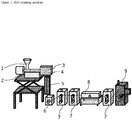
- the TPU-granules are fed at room temperature through a hopper 1 into an extruder 2.
- the extruder 2 used can be for example a single screw rotating in a heated cylinder.
- the melted TPU arrives in a spinning head 4 (comprising a distribution plate with several holes and spinneret having several nozzles) through a spinning pump 3.
- the filaments are quenched in a quenching unit 5 and are solidified by cooling, preferably air cooling and are then combined into a multifilament.
- the multifilament can be stretched to the required diameter by pulling it through e.g. duo rollers 7.
- the temperature of the extruder 2 is preferably kept between 160°C and 215°C. Decreasing the temperature below 160°C causes high pressure generation and temperatures above 215°C result in intensive bubble formation. Outside said temperature range the melt spinning process becomes instable.
- the temperature in the spinning head 4 should preferably be equal or lower than the temperature in the extruder 2, preferably 0 to 20°C lower than at the end of the extruder.
- the TPU should stay in the extruder and in the spinning head not much longer than needed depending on the TPU used. A too long (depending on the TPU used) residence time results in bubble formation in the TPU melt which most likely weakens the filaments, and the filaments break.
- Organic diisocyanates A) that can be used are by way of example diisocyanates described in Justus Liebigs Annalen der Chemie, 562, pp. 75-136 .
- Aromatic diisocyanates for example tolylene 2,4-diisocyanate, tolylene 2,4-diisocyanate/tolylene 2,6-diisocyanate mixtures, diphenylmethane 4,4'-diisocyanate, diphenylmethane 2,4'-diisocyanate, and diphenylmethane 2,2'-diisocyanate, diphenylmethane 2,4'-diisocyanate/diphenylmethane 4,4'-diisocyanate mixtures, urethane-modified liquid diphenylmethane 4,4'-diisocyanates and diphenylmethane 2,4'-diisocyanates, 4,4'-diisocyanato-1,2-diphenylethane, and naphthylene 1,5-diisocyanate.
- Aromatic diisocyanates for example tolylene 2,4-diisocyanate, tolylene 2,4-d
- diphenylmethane diisocyanate isomer mixtures with > 96% by weight content of diphenylmethane 4,4'-diisocyanate, and in particular diphenylmethane 4,4'-diisocyanate and naphthylene 1,5-diisocyanate.
- the diisocyanates mentioned can be used individually or in the form of mixtures with one another. They can also be used together with up to 15% by weight (based on the total quantity of diisocyanate) of a polyisocyanate, for example triphenylmethane 4,4',4"-triisocyanate or with polyphenyl polymethylene polyisocyanates.
- diisocyanates A) that can be used are aliphatic and cycloaliphatic diisocyanates. Mention may be made by way of example of hexamethylene diisocyanate, isophorone diisocyanate, cyclohexane 1,4-diisocyanate, 1-methylcyclohexane 2,4-diisocyanate, and 1-methylcyclohexane 2,6-diisocyanate, and also the corresponding isomer mixtures, and dicyclohexylmethane 4,4'-, 2,4'-, and 2,2'-diisocyanate, and also the corresponding isomer mixtures. It is preferable that the aliphatic organic diisocyanate used is composed of at least 50% by weight of hexamethylene 1,6-diisocyanate, with preference 75% by weight, and particularly preferably 100% by weight.
- the organic diisocyanate A) comprises at least one compound selected from the group of aliphatic, aromatic, cycloaliphatic diisocyanates, and particularly preferably at least one aliphatic and/or one aromatic diisocyanate, very particularly preferably at least one aromatic diisocyanate.
- component B) comprises at least one polyether carbonate polyol (B1) obtainable via an addition reaction of carbon dioxide and of alkylene oxides onto H-functional starter substances.
- H-functional means a starter compound which has H atoms that are active in relation to alkoxylation.
- polyether carbonate polyols via an addition reaction of alkylene oxides and CO 2 onto H-functional starters is known by way of example from EP 0222453 A , WO 2008/013731 A , and EP 2115032 A and WO 2014/060300 A and WO 2014/060348 A .
- component B mixtures of the abovementioned polyether carbonate polyols (B1) with other linear hydroxyl-terminated polyols (B2) with a number-average molar mass M n of from 500 to 5000 g/mol, preferably from 750 to 4000 g/mol, and particularly preferably from 1000 to 3000 g/mol.
- these other polyols often comprise small quantities of nonlinear compounds.
- An expression therefore often used is "essentially linear polyols”.
- Preferred other polyols are polyester diols, polyether diols, polycarbonate diols, and mixtures of these.
- Suitable polyether diols can thus be produced by reacting one or more alkylene oxides having from 2 to 4 carbon atoms in the alkylene moiety with a starter molecule which comprises two active hydrogen atoms.
- alkylene oxides are: ethylene oxide, 1,2-propylene oxide, epichlorohydrin, and 1,2-butylene oxide, and 2,3-butylene oxide. It is preferable to use ethylene oxide, propylene oxide, and mixtures of 1,2-propylene oxide and ethylene oxide.
- the alkylene oxides can be used individually, in alternating succession, or in the form of mixtures.
- starter molecules examples include: water, amino alcohols, for example N-alkyldiethanolamines, for example N-methyldiethanolamine, and diols, for example ethylene glycol, 1,3-propylene glycol, 1,4-butanediol, and 1,6-hexanediol. Mixtures of starter molecules can optionally also be used.
- Other suitable polyether diols are the tetrahydrofuran polymerization products containing hydroxyl groups. It is also possible to use proportions of from 0 to 30%, based on the bifunctional polyethers, of trifunctional polyethers, the quantity of these being however at most that which produces a thermoplastically processible product.
- the average molar masses M n of suitable polyether diols is from 500 to 6000 g/mol, preferably from 750 to 4000 g/mol, and very particularly preferably from 1000 to 3000 g/mol. They can be used either individually or else in the form of mixtures with one another.
- Suitable polyester diols can by way of example be produced from dicarboxylic acids having from 2 to 12 carbon atoms, preferably having from 4 to 6 carbon atoms, and from polyhydric alcohols.
- dicarboxylic acids that can be used are: aliphatic dicarboxylic acids, for example succinic acid, maleic acid, glutaric acid, adipic acid, suberic acid, azelaic acid, and sebacic acid, and aromatic dicarboxylic acids, for example phthalic acid, isophthalic acid, and terephthalic acid.
- the dicarboxylic acids can be used individually or in the form of mixtures, e.g. in the form of a succinic, glutaric, and adipic acid mixture.
- the corresponding dicarboxylic acid derivatives for example carboxylic diesters having from 1 to 4 carbon atoms in the alcohol moiety, carboxylic anhydrides, or acyl chlorides.
- polyhydric alcohols are glycols having from 2 to 10, preferably from 2 to 6, carbon atoms, for example ethylene glycol, diethylene glycol, 1,4-butanediol, 1,5-pentanediol, 1,6-hexanediol, 1,10-decanediol, 1,12-dodecanediol, 2,2-dimethyl-1,3-propanediol, 1,3-propanediol, and dipropylene glycol.
- the polyhydric alcohols can be used alone or optionally in a mixture with one another, as required by the desired properties.
- esters of carbonic acid with the diols mentioned in particular those having from 4 to 6 carbon atoms, for example 1,4-butanediol or 1,6-hexanediol, condensates of hydroxycarboxylic acids, for example hydroxycaproic acid, and polymerization products of lactones, for example optionally substituted caprolactones.
- polyester diols used are ethanediol polyadipates, 1,4-butanediolpolyadipates, ethanediol 1,4-butanediol polyadipates, 1,6-hexanediol neopentyl glycol polyadipates, 1,6-hexanediol 1,4-butanediol polyadipates, and polycaprolactones.
- the number-average molar mass M n of the polyester diols is from 500 to 5000 g/mol, preferably from 600 to 4000 g/mol, and particularly preferably from 800 to 3000 g/mol, and they can be used individually or in the form of mixtures with one another.
- Chain extenders C) used can comprise low-molecular-weight compounds with a molar mass of ⁇ 60 and ⁇ 490 g/mol, preferably ⁇ 62 and ⁇ 400 g/mol, and particularly preferably ⁇ 62 and ⁇ 300 g/mol, where these have two isocyanate-reactive groups.
- the chain extenders C) comprise, or consist of, diols, diamines, or diol/diamine mixtures, however preferably diols.
- Suitable chain extenders are diols such as ethanediol, 1,3-propanediol, 1,4-butanediol, 1,5-pentanediol, 1,6-hexanediol, 1,8-octanediol, 1,10-decanediol, 1,12-dodecanediol, diethylene glycol, dipropylene glycol, neopentyl glycol, diesters of terephthalic acid with glycols having from 2 to 4 carbon atoms, for example bis(ethylene glycol) terephthlate or bis(1,4-butanediol) terephthlate, hydroxyalkylene ethers of hydroquinone, for example 1,4-di(hydroxyethyl)hydroquinone, and ethoxylated bisphenols, and also reaction products of these with ⁇ -caprolactone.
- diols such as
- Preferred chains extenders are aliphatic diols having from 2 to 14 carbon atoms, for example ethanediol, 1,3-propanediol, 1,4-butanediol, 1,5-pentanediol, 1,6-hexanediol, 1,8-octanediol, 1,10-decanediol, 1,12-dodecanediol, diethylene glycol, dipropylene glycol, neopentyl glycol, and 1,4-di(hydroxyethyl)hydroquinone.
- chain extenders are (cyclo)aliphatic diamines, for example isophoronediamine, ethylenediamine, 1,2-propylenediamine, 1,3-propylenediamine, N-methylpropylene-1,3-diamine, N,N'-dimethylethylenediamine, and aromatic diamines, for example 2,4-tolylenediamine and 2,6-tolylenediamine, 3,5-diethyl-2,4-tolylenediamine, and 3,5-diethyl-2,6-tolylenediamine, and primary mono-, di-, tri-, or tetraalkyl-substituted 4,4'-diaminodiphenylmethanes.
- aromatic diamines for example 2,4-tolylenediamine and 2,6-tolylenediamine, 3,5-diethyl-2,4-tolylenediamine, and 3,5-diethyl-2,6-tolylenediamine, and primary mono-, di-, tri
- Chain terminators D) that can be used are low-molecular-weight compounds having an isocyanate-reactive group, for example monoalcohols or monoamines. It is preferable to use at least one compound selected from the group of 1-octanol, stearyl alcohol, 1-butylamine, and stearylamine, and it is particularly preferable to use 1-octanol.
- Suitable catalysts E can optionally be used in the first and/or second step of the process of the invention.
- the conventional tertiary amines known from the prior art e.g. triethylamine, dimethylcyclohexylamine, N-methylmorpholine, N,N'-dimethylpiperazine, 2-(dimethylaminoethoxy)ethanol, diazabicyclo[2.2.2]octane, and also organometallic compounds, for example titanium compounds, iron compounds, or tin compounds, for example tin diacetate, tin dioctanoate, tin dilaurate, or the dialkyltin salts of aliphatic carboxylic acids, for example dibutyltin diacetate or dibutyltin dilaurate, are suitable catalysts for the production of TPUs.
- Preferred catalysts are organometallic compounds, in particular titanium compounds or iron compounds or tin compounds.
- the total quantity of catalysts in the TPUs is generally about 0 to 5% by weight, preferably from 0.0001 to 1% by weight, and particularly preferably from 0.0002 to 0.5% by weight.
- auxiliaries and/or additional substances F Mention may be made by way of example of lubricants, for example fatty acid esters, metal soaps of these, fatty acid amides, fatty acid ester amides, and silicone compounds, antiblocking agents, inhibitors, stabilizers with respect to hydrolysis, UV or other light, heat, and discoloration, flame retardants, dyes, pigments, inorganic and/or organic fillers.
- lubricants for example fatty acid esters, metal soaps of these, fatty acid amides, fatty acid ester amides, and silicone compounds, antiblocking agents, inhibitors, stabilizers with respect to hydrolysis, UV or other light, heat, and discoloration, flame retardants, dyes, pigments, inorganic and/or organic fillers.
- the inventive melt spun multifilaments are used to produce technical textiles and clothing such as socks, stockings, compression textiles like medical bandage, surgical hose, orthopedic elastic bandage, sport textiles, underwear etc.
- the TPUs were continuously produced as follows: The mixture comprising the polyol/polyol mixture (B), Tyzor AA105 (E) and additives (F), which had been heated to about 200 °C, was intensively mixed together with the isocyanate (A), which had been heated to about 170°C by means of a heat exchanger, in a pipe with 4 static mixers manufactured by Sulzer (Type DN6 with 10 mixer elements and a shearing rate of 500 sec -1 ). The mixture was then fed into the inlet of a screw device (ZSK 53 manufactured by Werner&Pfleiderer) and was then fed through the extruder with a number of revolutions of 280 r.p.m. at 200 °C. At the end of the extruder the TPU strands were cooled by water, cut into granules and then dried.
- ZSK 53 manufactured by Werner&Pfleiderer
- Table 1 describes the components used and the proportions thereof, for the production of the TPUs.
- Table 1 Molar proportions of the starting components for the synthesis of the TPUs Example Polyol no. Polyol [mol] 4,4'-MDI [mol] 1,4-Butanediol / 1,6-Hexanediol [mol] Catalyst [ppm] Additives [% by weight] 1 1 and 2 0.5 and 0.5 4.01 2.76 and 0.25 C1: 34.5 A1: 0.06 A9: 0.90 2 1 and 2 0.5 and 0.5 4.54 3.46 and 0.0 C1: 15 A1: 0.10 A3: 0.30 A4: 0.35 A7: 0.12 A9: 0.50 3* 1 1 3.18 1.98 and 0.20 C1: 30 A1: 0.33 A3: 0.91 A8: 0.11 A9: 0.59 4* 6 1 2.27 1.27 C2: 250 A1: 0.24 A5: 0.50 A6: 0.30 A10: 0.59 5* 3 and 4
- the TPU does not contain more than 0.02 % by weight of moisture.
- the TPU granules were dried overnight under vacuum at 80 °C in an oven. The dried TPU granules were collected in aluminum bags and sealed with a hot press to protect the dried granules from atmospheric moisture.
- the melt spinning machine used consists of the following parts: a hopper 1, an extruder 2, a spinning pump 3, a spinning head 4, a filament quenching unit 5, a take-up roller 6, duo rollers 7, optionally a relaxation unit 8 and a winder 9 [see Figure 1 ].
- the melt spinning machine was prepared before the melt spinning experiment as follows: The extruder 2, spinning pump 3 and spinning head 4 were heated.
- the dried polymer was filled into the hopper 1 under a constant flow of nitrogen to avoid the intake of moisture.
- the pressure at the extruder head was set to 35 bar.
- the extruder 2 and spinning pump 3 were started.
- the rotations per minute (RPM) of the spinning was constant and the RPM of the extruder 2 varied to keep the extruder head pressure at 35 bar.
- the purging was carried out for 1 hour to ensure that no traces of previous polymer were remaining in the machine.
- the filaments were produced and were cooled below the spinning head 4 (comprising a distribution plate and a spinneret) in the quenching unit 5 with air and collected in form of a bundle of filaments (multifilament), passed over the take-up roller 6, three duo rollers 7 and collected on a winder 9.
- the TPU-granules were dried before processing in order to obtain a moisture content of less than 0,02% by weight.
- the polymers were dried in a vacuum oven at 80°C and 10 mbar for about 12 hours.
- the dried TPU-granules were fed at room temperature through the hopper 1 under a constant flow of nitrogen into the extruder 2.
- the extruder used in the experiments had a single screw rotating in a heated cylinder .
- From the extruder 2 the melted TPU arrived in a spinning head 4 through a spinning pump 3.
- After leaving the spinning head the filaments were quenched in a quenching unit 5 and solidified by air cooling.
- the filaments were combined to a bundle (multifilament).
- the multifilament was stretched by pulling it through the duo rollers 7 and collecting it on the winder 9.
- the process parameters are described in the tables.
- the fineness of the multifilaments was determined according to the DIN EN ISO 2060.
- the tensile strength and the elongation of the multifilaments was measured in accordance to the DIN EN ISO 2062.
- Table 4 describes the properties determined for the comparative TPU-multifilaments from Table 2.
- Table 5 describes the properties determined for the inventive TPU-multifilaments from Table 3.
- Table 5 Multifilament properties Example 1 2 3 4 5 6 Fineness [dtex] 395.47 441.97 385.43 426.33 374.4 277.23 Tensile strength [cN/tex] 7.4 6.14 7.01 7.2 7.35 5.41 Elongation [%] 401.4 330.4 401.7 405.6 413 460.9
- the TPU-multifilaments of the invention have a markedly better level of mechanical properties than the respective comparative multifilaments, this being particularly apparent from the tensile strength as well as the elongation at break.
Landscapes
- Chemical & Material Sciences (AREA)
- Chemical Kinetics & Catalysis (AREA)
- Health & Medical Sciences (AREA)
- Medicinal Chemistry (AREA)
- Polymers & Plastics (AREA)
- Organic Chemistry (AREA)
- Engineering & Computer Science (AREA)
- Textile Engineering (AREA)
- General Chemical & Material Sciences (AREA)
- Mechanical Engineering (AREA)
- Polyurethanes Or Polyureas (AREA)
- Artificial Filaments (AREA)
Claims (4)
- Schmelzgesponnene Multifilamente auf Basis von thermoplastischem Polyurethan, das durch Umsetzung vonA) mindestens einem organischen Isocyanat,B) mindestens einem Polyol mit einer zahlenmittleren Molmasse Mn ≥ 500 und ≤ 5000 g/mol und mindestens zwei isocyanatreaktiven Gruppen,C) mindestens einem Kettenverlängerungsmittel mit einer Molmasse ≥ 60 und ≤ 490 g/mol und mit zwei isocyanatreaktiven Gruppen
undD) gegebenenfalls einem monofunktionellen Kettenabbrecher, der eine isocyanatreaktive Gruppe aufweist,E) gegebenenfalls Katalysatoren,F) gegebenenfalls Hilfs- und/oder Zusatzmitteln erhältlich ist,wobei Komponente B)B1) mindestens ein Polyethercarbonatpolyol, das durch Anlagerung von Kohlendioxid und Alkylenoxiden an H-funktionelle Startersubstanzen erhältlich ist,B2) 0 bis 70 Gew.-%, bezogen auf B), mindestens eines oder mehrerer Polyole, die von B1) verschieden sind,umfasst
und wobei das Molverhältnis der Isocyanatgruppen von A) zur Summe der isocyanatreaktiven Gruppen in B), C) und gegebenenfalls D) ≥ 0,9:1 und ≤ 1,2:1 ist. - Schmelzgesponnene Multifilamente nach Anspruch 1 auf Basis von thermoplastischem Polyurethan, das durch Umsetzung vonA) mindestens einem organischen Isocyanat aus der Gruppe bestehend aus 4,4'-Methylendiphenylisocyanat (4,4'-MDI), 1,6-Hexamethylendiisocyanat und 4,4'-Diisocyanatodicyclohexylmethan (hydriertem 4,4'-MDI),B) mindestens einem Polyol mit einer zahlenmittleren Molmasse Mn ≥ 1000 und ≤ 3000 g/mol und mit einer zahlenmittleren Funktionalität von 1,9 bis 2,1,C) mindestens einem Kettenverlängerungsmittel mit einer Molmasse ≥ 60 und ≤ 300 g/mol und mit zwei isocyanatreaktiven Gruppen
undD) gegebenenfalls einem monofunktionellen Kettenabbrecher, der eine isocyanatreaktive Gruppe aufweist,E) gegebenenfalls Katalysatoren,F) gegebenenfalls Hilfs- und/oder Zusatzmitteln erhältlich ist,wobei Komponente B)B1) mindestens ein Polyethercarbonatpolyol, das durch Anlagerung von Kohlendioxid und Propylenoxid oder einer Mischung von Propylenoxid mit bis zu 30 Gew.-%, bezogen auf die Alkylenoxidmischung, Ethylenoxid an H-funktionelle Startersubstanzen erhältlich ist,B2) 0 bis 70 Gew.-%, bezogen auf B), mindestens eines oder mehrere Polyole, die von B1) verschieden sind,umfasst
und wobei das Molverhältnis der Isocyanatgruppen von A) zur Summe der isocyanatreaktiven Gruppen in B), C) und gegebenenfalls D) ≥ 0,9:1 und ≤ 1,2:1 ist. - Verfahren zur Herstellung der schmelzgesponnenen Multifilamente nach Anspruch 1 oder 2, das folgende Schritte umfasst:i) Trocknen des thermoplastischen Polyurethans nach Anspruch 1 oder 2, bis der Feuchtigkeitsgehalt des thermoplastischen Polyurethans weniger als 0,02 Gew.-% beträgt,ii) Einspeisen des getrockneten thermoplastischen Polyurethans in Form von Granulat über einen Trichter (1) in einen Extruder (2), in dem das Granulat von thermoplastischem Polyurethan aufgeschmolzen wird,iii) Einspeisen des geschmolzenen thermoplastischen Polyurethans in einen Spinnkopf (4) mit einer Verteilerplatte und einer Spinndüse mit Düsenöffnungen,iv) Bilden von Filamenten durch Hindurchführen des geschmolzenen thermoplastischen Polyurethans durch die Düsenöffnungen der Spinndüse,v) Abkühlen der Filamente und dadurch Verfestigen der Filamente,vi) Kombinieren der Filamente zu einem Multifilament,vii) Aufwickeln des Multifilaments auf einer an einem Wickler (9) befestigten Spule.
- Verwendung der schmelzgesponnenen Multifilamente zur Herstellung von technischen Textilien und Kleidung wie Socken, Strümpfen, Kompressionstextilien wie medizinischen Bandagen, Kompressionsstrümpfen, orthopädischen elastischen Bandagen, Sporttextilien und Unterwäsche.
Applications Claiming Priority (2)
| Application Number | Priority Date | Filing Date | Title |
|---|---|---|---|
| EP16188112 | 2016-09-09 | ||
| PCT/EP2017/072657 WO2018046699A1 (en) | 2016-09-09 | 2017-09-08 | Melt spun multifilaments based on thermoplastic polyurethane, their production and use |
Publications (2)
| Publication Number | Publication Date |
|---|---|
| EP3510189A1 EP3510189A1 (de) | 2019-07-17 |
| EP3510189B1 true EP3510189B1 (de) | 2020-07-15 |
Family
ID=57003340
Family Applications (1)
| Application Number | Title | Priority Date | Filing Date |
|---|---|---|---|
| EP17768066.7A Active EP3510189B1 (de) | 2016-09-09 | 2017-09-08 | Schmelzgesponnene multifilamente auf basis von thermoplastischem polyurethan, deren herstellung und verwendung |
Country Status (6)
| Country | Link |
|---|---|
| US (1) | US11346021B2 (de) |
| EP (1) | EP3510189B1 (de) |
| CN (1) | CN109642348B (de) |
| RU (1) | RU2019110228A (de) |
| TW (1) | TWI758322B (de) |
| WO (1) | WO2018046699A1 (de) |
Families Citing this family (10)
| Publication number | Priority date | Publication date | Assignee | Title |
|---|---|---|---|---|
| TWI771366B (zh) * | 2017-02-10 | 2022-07-21 | 德商巴斯夫歐洲公司 | 製造彈性纖維的方法,製造彈性纖維製品的方法,彈性纖維及彈性纖維製品 |
| CN109853071A (zh) * | 2018-12-27 | 2019-06-07 | 无锡金通高纤股份有限公司 | 一种热塑性聚氨酯单丝的制备方法 |
| CN111575817A (zh) * | 2019-02-19 | 2020-08-25 | 海宁新高纤维有限公司 | 一种热塑性聚氨酯纤维的制造方法 |
| TWI906317B (zh) * | 2020-06-24 | 2025-12-01 | 沙烏地阿拉伯商沙烏地阿美科技公司 | 多元醇組合物及方法 |
| EP4212654A4 (de) * | 2020-09-11 | 2024-04-10 | Asahi Kasei Kabushiki Kaisha | Elastische polyurethanfaser, sammelelement damit und sanitärmaterial |
| TW202302704A (zh) | 2021-06-23 | 2023-01-16 | 沙烏地阿拉伯商沙烏地阿美科技公司 | 多元醇組合物及方法 |
| CN113480140A (zh) * | 2021-07-27 | 2021-10-08 | 成都光明光电股份有限公司 | 光学玻璃熟料的制造装置及制造方法 |
| CN115894844B (zh) * | 2022-11-02 | 2024-12-17 | 河北邦泰氨纶科技有限公司 | 一种自消光热塑性聚氨酯弹性体及其制备方法与应用 |
| TWI901160B (zh) * | 2024-05-31 | 2025-10-11 | 冠瑞國際實業有限公司 | 無汙染琥珀之紗線製造方法 |
| EP4663677A1 (de) | 2024-06-13 | 2025-12-17 | Covestro Deutschland AG | Verfahren zur herstellung eines polyurethan-basierten elastomers |
Family Cites Families (14)
| Publication number | Priority date | Publication date | Assignee | Title |
|---|---|---|---|---|
| GB1292301A (en) | 1968-11-06 | 1972-10-11 | Monsanto Co | A helically crimped bicomponent polyamidepolyurethane filament |
| GB1393801A (en) | 1971-04-01 | 1975-05-14 | Monsanto Co | Helically crimped bicomponent yarn and garment made therefrom |
| DE2901774A1 (de) | 1979-01-18 | 1980-07-24 | Elastogran Gmbh | Rieselfaehiges, mikrobenbestaendiges farbstoff- und/oder hilfsmittelkonzentrat auf basis eines polyurethan-elastomeren und verfahren zu seiner herstellung |
| GB8528071D0 (en) | 1985-11-14 | 1985-12-18 | Shell Int Research | Polycarbonates |
| EP0592668B1 (de) | 1991-07-03 | 1999-03-10 | Kanebo, Ltd. | Verfahren und vorrichtung zur herstellung eines thermoplastischen polyurethan-elastomers |
| DE4301355A1 (de) * | 1993-01-20 | 1994-07-21 | Basf Ag | Klebfreie, hochelastische mono- und multifile Polyurethan-Elastomerfäden, Verfahren zu ihrer Herstellung und ihre Verwendung sowie teilvernetzte thermoplastische Polyurethane hierfür |
| JPH0848740A (ja) * | 1994-08-03 | 1996-02-20 | Nisshinbo Ind Inc | ポリウレタン |
| EP0905291B1 (de) | 1996-06-03 | 2003-09-17 | Kanebo, Ltd. | Polyurethanfäden |
| JP4132244B2 (ja) | 1998-07-06 | 2008-08-13 | 株式会社クラレ | 熱可塑性ポリウレタンからなるポリウレタン弾性繊維およびその製造方法 |
| US7977501B2 (en) | 2006-07-24 | 2011-07-12 | Bayer Materialscience Llc | Polyether carbonate polyols made via double metal cyanide (DMC) catalysis |
| CN101611074B (zh) | 2007-01-30 | 2012-07-25 | 巴斯夫欧洲公司 | 制备聚醚碳酸酯多元醇的方法 |
| DE102012218846A1 (de) | 2012-10-16 | 2014-04-17 | Bayer Materialscience Ag | Herstellung und Verwendung neuer thermoplastischer Polyurethan-Elastomere auf Basis von Polyethercarbonatpolyolen |
| DE102012218848A1 (de) | 2012-10-16 | 2014-04-17 | Bayer Materialscience Ag | Herstellung und Verwendung neuer thermoplastischer Polyurethan-Elastomere auf Basis von Polyethercarbonatpolyolen |
| KR102093607B1 (ko) * | 2012-12-26 | 2020-03-26 | 미쯔비시 케미컬 주식회사 | 폴리카보네이트디올 및 그것을 사용한 폴리우레탄 |
-
2017
- 2017-09-07 TW TW106130570A patent/TWI758322B/zh not_active IP Right Cessation
- 2017-09-08 CN CN201780055015.XA patent/CN109642348B/zh not_active Expired - Fee Related
- 2017-09-08 EP EP17768066.7A patent/EP3510189B1/de active Active
- 2017-09-08 US US16/330,484 patent/US11346021B2/en active Active
- 2017-09-08 WO PCT/EP2017/072657 patent/WO2018046699A1/en not_active Ceased
- 2017-09-08 RU RU2019110228A patent/RU2019110228A/ru not_active Application Discontinuation
Non-Patent Citations (1)
| Title |
|---|
| None * |
Also Published As
| Publication number | Publication date |
|---|---|
| CN109642348A (zh) | 2019-04-16 |
| TWI758322B (zh) | 2022-03-21 |
| RU2019110228A (ru) | 2020-10-09 |
| WO2018046699A1 (en) | 2018-03-15 |
| CN109642348B (zh) | 2022-07-05 |
| US20190226123A1 (en) | 2019-07-25 |
| EP3510189A1 (de) | 2019-07-17 |
| TW201819448A (zh) | 2018-06-01 |
| US11346021B2 (en) | 2022-05-31 |
Similar Documents
| Publication | Publication Date | Title |
|---|---|---|
| US11346021B2 (en) | Melt spun multifilaments based on thermoplastic polyurethane, their production and use | |
| EP1639161B1 (de) | Schmelzspinnverfahren zur herstellung von gummibanden und monofilamenten | |
| US6197915B1 (en) | Thermoplastic polyurethanes, polyurethane elastic fibers therefrom, and method for producing the fibers | |
| EP1611177B1 (de) | Schmelzgesponnene tpu-fasern und verfahren | |
| KR101799924B1 (ko) | 성긴 게이지의 일정한 압축력의 탄성 섬유로 구성된 고 강도 직물 | |
| US5565270A (en) | Process for the production of elastane filaments | |
| KR102520789B1 (ko) | 탄성 섬유의 제조 방법, 탄성 섬유 물품의 제조 방법, 탄성 섬유 및 탄성 섬유 물품 | |
| EP0449036B1 (de) | Polyurethan, elastische Polyurethan-Faser, sowie Polyesterpolycarbonatdiol, das zu deren Herstellung verwendet wird | |
| EP0397121B1 (de) | Elastische Polyurethanfaser | |
| TW438917B (en) | Elastane yarn and production thereof | |
| TW201136967A (en) | Spandex with high uniformity | |
| JP4481328B2 (ja) | 熱可塑性ポリウレタン | |
| CA2114281A1 (en) | Non-tacky, highly elastic polyurethane elastomer monofilaments and multifilaments, process for their production, their use, and partially crosslinked thermoplastic polyurethanes for this purpose | |
| KR20020067539A (ko) | 저온에서 고정성이 낮은 스판덱스 | |
| HK1179668B (en) | Polyurethane elastic yarn and production method thereof | |
| HK1179668A1 (en) | Polyurethane elastic yarn and production method thereof |
Legal Events
| Date | Code | Title | Description |
|---|---|---|---|
| STAA | Information on the status of an ep patent application or granted ep patent |
Free format text: STATUS: UNKNOWN |
|
| STAA | Information on the status of an ep patent application or granted ep patent |
Free format text: STATUS: THE INTERNATIONAL PUBLICATION HAS BEEN MADE |
|
| PUAI | Public reference made under article 153(3) epc to a published international application that has entered the european phase |
Free format text: ORIGINAL CODE: 0009012 |
|
| STAA | Information on the status of an ep patent application or granted ep patent |
Free format text: STATUS: REQUEST FOR EXAMINATION WAS MADE |
|
| 17P | Request for examination filed |
Effective date: 20190409 |
|
| AK | Designated contracting states |
Kind code of ref document: A1 Designated state(s): AL AT BE BG CH CY CZ DE DK EE ES FI FR GB GR HR HU IE IS IT LI LT LU LV MC MK MT NL NO PL PT RO RS SE SI SK SM TR |
|
| AX | Request for extension of the european patent |
Extension state: BA ME |
|
| RIN1 | Information on inventor provided before grant (corrected) |
Inventor name: MANVI, PAVAN KUMAR Inventor name: GUERTLER, CHRISTOPH Inventor name: SEIDE, GUNNAR Inventor name: GRIES, THOMAS Inventor name: NORWIG, JOCHEN Inventor name: WAMPRECHT, CHRISTIAN |
|
| DAV | Request for validation of the european patent (deleted) | ||
| DAX | Request for extension of the european patent (deleted) | ||
| GRAP | Despatch of communication of intention to grant a patent |
Free format text: ORIGINAL CODE: EPIDOSNIGR1 |
|
| STAA | Information on the status of an ep patent application or granted ep patent |
Free format text: STATUS: GRANT OF PATENT IS INTENDED |
|
| INTG | Intention to grant announced |
Effective date: 20200429 |
|
| GRAS | Grant fee paid |
Free format text: ORIGINAL CODE: EPIDOSNIGR3 |
|
| GRAA | (expected) grant |
Free format text: ORIGINAL CODE: 0009210 |
|
| STAA | Information on the status of an ep patent application or granted ep patent |
Free format text: STATUS: THE PATENT HAS BEEN GRANTED |
|
| AK | Designated contracting states |
Kind code of ref document: B1 Designated state(s): AL AT BE BG CH CY CZ DE DK EE ES FI FR GB GR HR HU IE IS IT LI LT LU LV MC MK MT NL NO PL PT RO RS SE SI SK SM TR |
|
| REG | Reference to a national code |
Ref country code: CH Ref legal event code: EP Ref country code: GB Ref legal event code: FG4D |
|
| REG | Reference to a national code |
Ref country code: IE Ref legal event code: FG4D |
|
| REG | Reference to a national code |
Ref country code: DE Ref legal event code: R096 Ref document number: 602017019905 Country of ref document: DE |
|
| REG | Reference to a national code |
Ref country code: AT Ref legal event code: REF Ref document number: 1291143 Country of ref document: AT Kind code of ref document: T Effective date: 20200815 |
|
| REG | Reference to a national code |
Ref country code: DE Ref legal event code: R081 Ref document number: 602017019905 Country of ref document: DE Owner name: COVESTRO INTELLECTUAL PROPERTY GMBH & CO. KG, DE Free format text: FORMER OWNER: COVESTRO DEUTSCHLAND AG, 51373 LEVERKUSEN, DE |
|
| RAP2 | Party data changed (patent owner data changed or rights of a patent transferred) |
Owner name: COVESTRO DEUTSCHLAND AG |
|
| RAP2 | Party data changed (patent owner data changed or rights of a patent transferred) |
Owner name: COVESTRO INTELLECTUAL PROPERTY GMBH & CO. KG |
|
| REG | Reference to a national code |
Ref country code: LT Ref legal event code: MG4D |
|
| REG | Reference to a national code |
Ref country code: AT Ref legal event code: MK05 Ref document number: 1291143 Country of ref document: AT Kind code of ref document: T Effective date: 20200715 |
|
| REG | Reference to a national code |
Ref country code: NL Ref legal event code: MP Effective date: 20200715 |
|
| PG25 | Lapsed in a contracting state [announced via postgrant information from national office to epo] |
Ref country code: GR Free format text: LAPSE BECAUSE OF FAILURE TO SUBMIT A TRANSLATION OF THE DESCRIPTION OR TO PAY THE FEE WITHIN THE PRESCRIBED TIME-LIMIT Effective date: 20201016 Ref country code: NO Free format text: LAPSE BECAUSE OF FAILURE TO SUBMIT A TRANSLATION OF THE DESCRIPTION OR TO PAY THE FEE WITHIN THE PRESCRIBED TIME-LIMIT Effective date: 20201015 Ref country code: ES Free format text: LAPSE BECAUSE OF FAILURE TO SUBMIT A TRANSLATION OF THE DESCRIPTION OR TO PAY THE FEE WITHIN THE PRESCRIBED TIME-LIMIT Effective date: 20200715 Ref country code: SE Free format text: LAPSE BECAUSE OF FAILURE TO SUBMIT A TRANSLATION OF THE DESCRIPTION OR TO PAY THE FEE WITHIN THE PRESCRIBED TIME-LIMIT Effective date: 20200715 Ref country code: BG Free format text: LAPSE BECAUSE OF FAILURE TO SUBMIT A TRANSLATION OF THE DESCRIPTION OR TO PAY THE FEE WITHIN THE PRESCRIBED TIME-LIMIT Effective date: 20201015 Ref country code: PT Free format text: LAPSE BECAUSE OF FAILURE TO SUBMIT A TRANSLATION OF THE DESCRIPTION OR TO PAY THE FEE WITHIN THE PRESCRIBED TIME-LIMIT Effective date: 20201116 Ref country code: LT Free format text: LAPSE BECAUSE OF FAILURE TO SUBMIT A TRANSLATION OF THE DESCRIPTION OR TO PAY THE FEE WITHIN THE PRESCRIBED TIME-LIMIT Effective date: 20200715 Ref country code: HR Free format text: LAPSE BECAUSE OF FAILURE TO SUBMIT A TRANSLATION OF THE DESCRIPTION OR TO PAY THE FEE WITHIN THE PRESCRIBED TIME-LIMIT Effective date: 20200715 Ref country code: FI Free format text: LAPSE BECAUSE OF FAILURE TO SUBMIT A TRANSLATION OF THE DESCRIPTION OR TO PAY THE FEE WITHIN THE PRESCRIBED TIME-LIMIT Effective date: 20200715 Ref country code: AT Free format text: LAPSE BECAUSE OF FAILURE TO SUBMIT A TRANSLATION OF THE DESCRIPTION OR TO PAY THE FEE WITHIN THE PRESCRIBED TIME-LIMIT Effective date: 20200715 |
|
| PG25 | Lapsed in a contracting state [announced via postgrant information from national office to epo] |
Ref country code: RS Free format text: LAPSE BECAUSE OF FAILURE TO SUBMIT A TRANSLATION OF THE DESCRIPTION OR TO PAY THE FEE WITHIN THE PRESCRIBED TIME-LIMIT Effective date: 20200715 Ref country code: PL Free format text: LAPSE BECAUSE OF FAILURE TO SUBMIT A TRANSLATION OF THE DESCRIPTION OR TO PAY THE FEE WITHIN THE PRESCRIBED TIME-LIMIT Effective date: 20200715 Ref country code: LV Free format text: LAPSE BECAUSE OF FAILURE TO SUBMIT A TRANSLATION OF THE DESCRIPTION OR TO PAY THE FEE WITHIN THE PRESCRIBED TIME-LIMIT Effective date: 20200715 Ref country code: IS Free format text: LAPSE BECAUSE OF FAILURE TO SUBMIT A TRANSLATION OF THE DESCRIPTION OR TO PAY THE FEE WITHIN THE PRESCRIBED TIME-LIMIT Effective date: 20201115 |
|
| PG25 | Lapsed in a contracting state [announced via postgrant information from national office to epo] |
Ref country code: NL Free format text: LAPSE BECAUSE OF FAILURE TO SUBMIT A TRANSLATION OF THE DESCRIPTION OR TO PAY THE FEE WITHIN THE PRESCRIBED TIME-LIMIT Effective date: 20200715 |
|
| REG | Reference to a national code |
Ref country code: DE Ref legal event code: R097 Ref document number: 602017019905 Country of ref document: DE |
|
| PG25 | Lapsed in a contracting state [announced via postgrant information from national office to epo] |
Ref country code: RO Free format text: LAPSE BECAUSE OF FAILURE TO SUBMIT A TRANSLATION OF THE DESCRIPTION OR TO PAY THE FEE WITHIN THE PRESCRIBED TIME-LIMIT Effective date: 20200715 Ref country code: DK Free format text: LAPSE BECAUSE OF FAILURE TO SUBMIT A TRANSLATION OF THE DESCRIPTION OR TO PAY THE FEE WITHIN THE PRESCRIBED TIME-LIMIT Effective date: 20200715 Ref country code: CZ Free format text: LAPSE BECAUSE OF FAILURE TO SUBMIT A TRANSLATION OF THE DESCRIPTION OR TO PAY THE FEE WITHIN THE PRESCRIBED TIME-LIMIT Effective date: 20200715 Ref country code: EE Free format text: LAPSE BECAUSE OF FAILURE TO SUBMIT A TRANSLATION OF THE DESCRIPTION OR TO PAY THE FEE WITHIN THE PRESCRIBED TIME-LIMIT Effective date: 20200715 Ref country code: SM Free format text: LAPSE BECAUSE OF FAILURE TO SUBMIT A TRANSLATION OF THE DESCRIPTION OR TO PAY THE FEE WITHIN THE PRESCRIBED TIME-LIMIT Effective date: 20200715 |
|
| REG | Reference to a national code |
Ref country code: CH Ref legal event code: PL |
|
| PLBE | No opposition filed within time limit |
Free format text: ORIGINAL CODE: 0009261 |
|
| STAA | Information on the status of an ep patent application or granted ep patent |
Free format text: STATUS: NO OPPOSITION FILED WITHIN TIME LIMIT |
|
| PG25 | Lapsed in a contracting state [announced via postgrant information from national office to epo] |
Ref country code: AL Free format text: LAPSE BECAUSE OF FAILURE TO SUBMIT A TRANSLATION OF THE DESCRIPTION OR TO PAY THE FEE WITHIN THE PRESCRIBED TIME-LIMIT Effective date: 20200715 |
|
| REG | Reference to a national code |
Ref country code: BE Ref legal event code: MM Effective date: 20200930 |
|
| 26N | No opposition filed |
Effective date: 20210416 |
|
| PG25 | Lapsed in a contracting state [announced via postgrant information from national office to epo] |
Ref country code: LU Free format text: LAPSE BECAUSE OF NON-PAYMENT OF DUE FEES Effective date: 20200908 Ref country code: SK Free format text: LAPSE BECAUSE OF FAILURE TO SUBMIT A TRANSLATION OF THE DESCRIPTION OR TO PAY THE FEE WITHIN THE PRESCRIBED TIME-LIMIT Effective date: 20200715 |
|
| PG25 | Lapsed in a contracting state [announced via postgrant information from national office to epo] |
Ref country code: CH Free format text: LAPSE BECAUSE OF NON-PAYMENT OF DUE FEES Effective date: 20200930 Ref country code: BE Free format text: LAPSE BECAUSE OF NON-PAYMENT OF DUE FEES Effective date: 20200930 Ref country code: SI Free format text: LAPSE BECAUSE OF FAILURE TO SUBMIT A TRANSLATION OF THE DESCRIPTION OR TO PAY THE FEE WITHIN THE PRESCRIBED TIME-LIMIT Effective date: 20200715 Ref country code: IE Free format text: LAPSE BECAUSE OF NON-PAYMENT OF DUE FEES Effective date: 20200908 Ref country code: LI Free format text: LAPSE BECAUSE OF NON-PAYMENT OF DUE FEES Effective date: 20200930 |
|
| PGFP | Annual fee paid to national office [announced via postgrant information from national office to epo] |
Ref country code: GB Payment date: 20210818 Year of fee payment: 5 |
|
| PG25 | Lapsed in a contracting state [announced via postgrant information from national office to epo] |
Ref country code: TR Free format text: LAPSE BECAUSE OF FAILURE TO SUBMIT A TRANSLATION OF THE DESCRIPTION OR TO PAY THE FEE WITHIN THE PRESCRIBED TIME-LIMIT Effective date: 20200715 Ref country code: MT Free format text: LAPSE BECAUSE OF FAILURE TO SUBMIT A TRANSLATION OF THE DESCRIPTION OR TO PAY THE FEE WITHIN THE PRESCRIBED TIME-LIMIT Effective date: 20200715 Ref country code: CY Free format text: LAPSE BECAUSE OF FAILURE TO SUBMIT A TRANSLATION OF THE DESCRIPTION OR TO PAY THE FEE WITHIN THE PRESCRIBED TIME-LIMIT Effective date: 20200715 |
|
| PG25 | Lapsed in a contracting state [announced via postgrant information from national office to epo] |
Ref country code: MK Free format text: LAPSE BECAUSE OF FAILURE TO SUBMIT A TRANSLATION OF THE DESCRIPTION OR TO PAY THE FEE WITHIN THE PRESCRIBED TIME-LIMIT Effective date: 20200715 Ref country code: MC Free format text: LAPSE BECAUSE OF FAILURE TO SUBMIT A TRANSLATION OF THE DESCRIPTION OR TO PAY THE FEE WITHIN THE PRESCRIBED TIME-LIMIT Effective date: 20200715 |
|
| PGFP | Annual fee paid to national office [announced via postgrant information from national office to epo] |
Ref country code: IT Payment date: 20220829 Year of fee payment: 6 Ref country code: DE Payment date: 20220609 Year of fee payment: 6 |
|
| PGFP | Annual fee paid to national office [announced via postgrant information from national office to epo] |
Ref country code: FR Payment date: 20220822 Year of fee payment: 6 |
|
| GBPC | Gb: european patent ceased through non-payment of renewal fee |
Effective date: 20220908 |
|
| PG25 | Lapsed in a contracting state [announced via postgrant information from national office to epo] |
Ref country code: GB Free format text: LAPSE BECAUSE OF NON-PAYMENT OF DUE FEES Effective date: 20220908 |
|
| REG | Reference to a national code |
Ref country code: DE Ref legal event code: R119 Ref document number: 602017019905 Country of ref document: DE |
|
| PG25 | Lapsed in a contracting state [announced via postgrant information from national office to epo] |
Ref country code: FR Free format text: LAPSE BECAUSE OF NON-PAYMENT OF DUE FEES Effective date: 20230930 Ref country code: DE Free format text: LAPSE BECAUSE OF NON-PAYMENT OF DUE FEES Effective date: 20240403 |
|
| PG25 | Lapsed in a contracting state [announced via postgrant information from national office to epo] |
Ref country code: IT Free format text: LAPSE BECAUSE OF NON-PAYMENT OF DUE FEES Effective date: 20230908 |
|
| PG25 | Lapsed in a contracting state [announced via postgrant information from national office to epo] |
Ref country code: IT Free format text: LAPSE BECAUSE OF NON-PAYMENT OF DUE FEES Effective date: 20230908 |