EP3505650A1 - Method for producing alloy steel - Google Patents
Method for producing alloy steel Download PDFInfo
- Publication number
- EP3505650A1 EP3505650A1 EP16915315.2A EP16915315A EP3505650A1 EP 3505650 A1 EP3505650 A1 EP 3505650A1 EP 16915315 A EP16915315 A EP 16915315A EP 3505650 A1 EP3505650 A1 EP 3505650A1
- Authority
- EP
- European Patent Office
- Prior art keywords
- alloy steel
- steel
- alloy
- molten
- manganese
- Prior art date
- Legal status (The legal status is an assumption and is not a legal conclusion. Google has not performed a legal analysis and makes no representation as to the accuracy of the status listed.)
- Withdrawn
Links
Images


Classifications
-
- C—CHEMISTRY; METALLURGY
- C22—METALLURGY; FERROUS OR NON-FERROUS ALLOYS; TREATMENT OF ALLOYS OR NON-FERROUS METALS
- C22C—ALLOYS
- C22C33/00—Making ferrous alloys
- C22C33/04—Making ferrous alloys by melting
-
- C—CHEMISTRY; METALLURGY
- C22—METALLURGY; FERROUS OR NON-FERROUS ALLOYS; TREATMENT OF ALLOYS OR NON-FERROUS METALS
- C22C—ALLOYS
- C22C1/00—Making non-ferrous alloys
- C22C1/02—Making non-ferrous alloys by melting
-
- C—CHEMISTRY; METALLURGY
- C22—METALLURGY; FERROUS OR NON-FERROUS ALLOYS; TREATMENT OF ALLOYS OR NON-FERROUS METALS
- C22C—ALLOYS
- C22C33/00—Making ferrous alloys
- C22C33/04—Making ferrous alloys by melting
- C22C33/06—Making ferrous alloys by melting using master alloys
-
- C—CHEMISTRY; METALLURGY
- C22—METALLURGY; FERROUS OR NON-FERROUS ALLOYS; TREATMENT OF ALLOYS OR NON-FERROUS METALS
- C22C—ALLOYS
- C22C33/00—Making ferrous alloys
- C22C33/08—Making cast-iron alloys
-
- C—CHEMISTRY; METALLURGY
- C22—METALLURGY; FERROUS OR NON-FERROUS ALLOYS; TREATMENT OF ALLOYS OR NON-FERROUS METALS
- C22C—ALLOYS
- C22C38/00—Ferrous alloys, e.g. steel alloys
- C22C38/04—Ferrous alloys, e.g. steel alloys containing manganese
-
- C—CHEMISTRY; METALLURGY
- C21—METALLURGY OF IRON
- C21C—PROCESSING OF PIG-IRON, e.g. REFINING, MANUFACTURE OF WROUGHT-IRON OR STEEL; TREATMENT IN MOLTEN STATE OF FERROUS ALLOYS
- C21C7/00—Treating molten ferrous alloys, e.g. steel, not covered by groups C21C1/00 - C21C5/00
- C21C7/04—Removing impurities by adding a treating agent
- C21C7/076—Use of slags or fluxes as treating agents
Definitions
- the present disclosure herein relates to a method for producing alloy steel, and more particularly, to a method for producing alloy steel, the method being capable of suppressing a temperature drop or contamination of the alloy steel.
- high manganese steels mean steels containing approximately 1-5 wt% of manganese. Recently, high functional products such as high-strength high-formability steel materials for vehicle have been developed, and high-manganese steel having a manganese content increased up to approximately 25 wt% is being produced.
- the high-manganese steel is produced in such a way that while tapping molten steel completely refined in a converter, a manganese-containing metal or an alloy (hereinafter, referred to as a ferroalloy) is added to control the manganese concentration.
- a ferroalloy a manganese-containing metal or an alloy
- the heat amount required for melting the ferroalloy increases, and the required heat amount may be secured by raising the converter end point temperature of molten steel.
- the converter end point temperature of molten steel is raised as such, the blow amount of oxygen increases and the concentration of oxygen in the molten steel increases. Accordingly, problems of a decrease in yield due to oxidation of the molten steel and erosion of converter refractories occur.
- the present disclosure provides a method for producing alloy steel, the method being capable of ensuring cleanliness of the alloy steel.
- the present disclosure provides a method for producing alloy steel, the method being capable of improving productivity by reducing the time for producing the alloy steel through omission or reduction of additional process time.
- a method for producing alloy steel includes: producing first alloy steel in a temperature holding furnace; maintaining the first alloy steel at a temperature of no lower than a melting point in the temperature holding furnace; and producing second alloy steel having an alloy content lower than an alloy content in the first alloy steel by mixing the first alloy steel and molten steel.
- the producing of the first alloy steel in the temperature holding furnace may include: charging first molten steel in the temperature holding furnace; and adding at least any one of a ferroalloy and a molten ferroalloy into the first molten steel.
- the charging of the first molten steel into the temperature holding furnace may include introducing, into the temperature holding furnace, slag to be positioned on a melt surface of the first molten steel, and in the maintaining of the first alloy steel at a temperature of no lower than the melting point, a slag layer may be formed on the melt surface of the first alloy steel by using the slag.
- the producing of the first alloy steel in the temperature holding furnace may include: tapping a completely refined first molten steel; adding, into the first molten steel, at least any one of a ferroalloy and a molten ferroalloy and producing third alloy steel; charging the third alloy steel into the temperature holding furnace; and adding, into the third alloy steel, at least any one of a ferroalloy and a molten ferroalloy and producing first alloy steel having an alloy content more than an alloy content in the third alloy steel.
- the maintaining of the first alloy steel at a temperature of no lower than the melting point may include raising the alloy content in the first alloy steel by performing at least once the adding of at least any one of a ferroalloy and a molten ferroalloy into the first alloy steel.
- the maintaining of the first alloy steel at a temperature of no lower than the melting point may include further charging molten steel into the temperature holding furnace.
- the alloy content in the first alloy steel may be controlled to be greater than approximately 25 wt% and no greater than approximately 50 wt%.
- At least any one of the producing of the first alloy steel and the maintaining of the first alloy steel at a temperature of no lower than the melting point may include supplying the temperature holding furnace with a heat source.
- the producing of the second alloy steel may include mixing fourth alloy steel which is produced by adding, into the second molten steel, any one of a ferroalloy and a molten ferroalloy in the tapping of the completely refined second molten steel, and an alloy content in the fourth alloy steel may be lower than the alloy content in the first alloy steel.
- molten steel is charged into a temperature holding furnace, a ferroalloy and a molten ferroalloy are added to produce first alloy steel, and second alloy steel having a target alloy content may be produced by mixing the first alloy steel and the molten steel.
- the first alloy steel may have an alloy content which is lower than the alloy content in the molten ferroalloy produced by melting a metal or the ferroalloy and is higher than the alloy content in the second alloy steel.
- a method for producing alloy steel may produce second alloy steel having a target alloy content through melt mixing of first alloy steel having a higher alloy content and molten steel. That is, unlike a typical method, for producing alloy steel, in which alloy steel is produced by adding a solid ferroalloy in molten steel, or through melt mixing of a ferroalloy and molten steel, second alloy steel may be produced by melt mixing of first alloy steel, having a more alloy content than a target alloy content, and molten steel.
- the first alloy steel is produced in a temperature holding furnace shielded from the outside, and hence may be maintained at the temperature of no lower than the melting point thereof while suppressing a phenomenon in which the first alloy steel is contaminated, for example, the first alloy steel absorbs nitrogen. Accordingly, the cleanliness of the first alloy steel may be secured, so that a post-process for the second alloy steel, which is produced through melt mixing of the first alloy steel and molten steel, may be omitted or reduced, and thus, the total process time may be reduced and productivity may be improved.
- FIG. 2 is a flowchart showing a method for producing alloy steel in accordance with an exemplary embodiment.
- a method for producing alloy steel in accordance with an exemplary embodiment may include: charging first molten steel completely refined in a converter (S110); inserting at least any one of a ferroalloy and a molten ferroalloy into a temperature holding furnace in which the first molten steel has been inserted and producing a first ferroalloy (S120); preparing second molten steel (S130); and producing second alloy steel by melt mixing of the first alloy steel and the second molten steel (S140).
- the ferroalloy may be pure metal or an alloy, such as manganese metal or a manganese alloy containing manganese.
- the ferroalloy may be produced by smelting manganese metal or a manganese alloy containing manganese in a separate smelting furnace.
- the first alloy steel may contain various materials such as nickel, chrome, or the like in addition to manganese.
- manganese metal or a manganese alloy will be referred to as manganese
- melted manganese metal or a melted manganese alloy will be referred to as molten manganese.
- the first alloy steel may have a higher alloy content than the second alloy steel having a target alloy content or alloy concentration, that is, a manganese content (or a manganese concentration), and have a lower alloy content than the molten ferroalloy.
- the manganese content in the first alloy steel may be greater than approximately 25 wt% and no greater than approximately 50 wt%.
- the reason why the upper limit of the manganese content in the first alloy steel is set to be no greater than approximately 50 wt% is because in general, when the content of an alloy in steel is no greater than approximately 50 wt%, the steel is considered as alloy steel, and when exceeding approximately 50 wt%, the steel is considered as a ferroalloy.
- the second alloy steel is produced by melt mixing of molten steel and a molten alloy steel having a lower manganese content than that in the typical art, and thus, the nitrogen adsorption to the molten alloy steel is suppressed and the nitrogen content in the finally produced alloy steel may be reduced.
- the ferroalloy When solid manganese is added into the first molten steel in producing the first alloy steel, the ferroalloy may be melted by the heat of the first molten steel or the manganese may also be melted by further providing a heat source. At this point, the ferroalloy may be preheated and added so that the ferroalloy may easily be melted by the heat of the first molten steel, and a heat source supply means such as an induction coil may be provided to the temperature holding furnace so that a required heat source may be supplied when producing the first alloy steel.
- a heat source supply means such as an induction coil
- a heat source may further be supplied if necessary, or may not be supplied.
- a smaller amount of heat source may be supplied than that when solid manganese is added.
- the first alloy steel produced in the temperature holding furnace may be maintained at a temperature of no lower than the melting point thereof inside the temperature holding furnace until melt mixing with the second molten steel. At this point, while maintaining the first alloy steel, a denitrification process may further be performed inside the temperature holding furnace to remove the nitrogen component in the first alloy steel.
- slag may be formed on the melt surface of the first alloy steel stored in the temperature holding furnace so as to suppress the nitrogen adsorption phenomenon of the first alloy steel.
- the slag present on the melt surface of the first molten steel may be mixed with the first molten steel and charged into the temperature holding furnace.
- the slag has CaO-Al 2 O 3 as a main ingredient, and may cover the melt surface of the first molten steel inside the temperature holding furnace and prevent the melt surface from contacting the air present inside the temperature holding furnace.
- the slag may naturally flow into the temperature holding furnace while charging the first molten steel into the temperature holding furnace, or may forcibly be introduced to form a slag layer on the melt surface of the first molten steel.
- the nitrogen adsorption is suppressed, so that the denitrification process of the first alloy steel may be omitted, or the additional denitrification process time may be reduced.
- manganese or molten manganese may further be added, so that the manganese content in the first alloy steel may gradually be increased within the above-mentioned range.
- the amount of the first alloy steel subjected to melt mixing with the second molten steel may be reduced. Accordingly, since the amount of the second molten steel subjected to melt mixing with the first alloy steel is relatively increased, there is a merit in that the amount of second alloy steel required for casing may be sufficiently secured, and the time and costs spent for producing the first alloy steel may be reduced.
- the manganese content in the first alloy steel may exceed the indicated range.
- the first molten steel may further be added to adjust the manganese content in the first alloy steel within the indicated range.
- an inert gas such as argon (Ar) is blown into the temperature holding furnace to uniformly stir and mix the first molten steel, the manganese, and the molten manganese.
- the first alloy steel produced through such a method may be produced in an amount greater than one batch amount used for melt mixing and be stored in the temperature holding furnace, and accordingly, a melt mixing process may continuously be performed, if necessary.
- the second molten steel may be produced for melt mixing with the first alloy steel.
- the second molten steel may be carbon steel completely refined in a converter, and, for example, may contain approximately 0.2 wt% to approximately 0.4 wt% of carbon.
- the first alloy steel stored in the temperature holding furnace may be tapped and the melt mixing of the second molten steel and the first alloy steel is performed, and thus, the second alloy steel may be produced.
- the ratio of melt mixing of the first alloy steel and the second molten steel may be adjusted.
- the second alloy steel is transported to casting equipment and casting may be performed.
- a refining process such as an LF process or a vacuum process may also be performed.
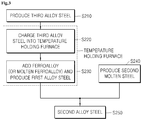
- FIG. 3 is a flowchart sequentially showing a method for producing alloy steel in accordance with a modified exemplary embodiment
- FIG. 4 is a flowchart sequentially showing a method for producing alloy steel in accordance with another modified exemplary embodiment.
- the difference from the exemplary embodiment described above will be described.
- forming a slag layer on the melt surface of first alloy steel, supplying a heat source to a temperature holding furnace, further adding first molten steel to adjust the manganese content in the first alloy steel, or the like may be performed in the same way.
- a method for producing alloy steel in accordance with a modified exemplary embodiment may include: producing third alloy steel at the outside of a temperature holding furnace (S210); charging the third alloy steel into the temperature holding furnace (S220); adding at least any one of manganese and molten manganese into the temperature holding furnace and producing first alloy steel (S230); producing second molten steel (S240); and melt mixing the first alloy steel and the second molten steel to produce second alloy steel (S250).
- This modified exemplary embodiment may produce alloy steel through almost the same method as the above-mentioned exemplary embodiment except for the producing of the first alloy steel.
- the producing of the third alloy steel may be performed such that at least any one of manganese or molten manganese is added to the first alloy steel.
- first molten steel is directly charged into the temperature holding furnace to produce first alloy steel, but in the modified exemplary embodiment, the first molten steel is not charged into the temperature holding furnace but is produced at the outside of the furnace, and is then charged into the temperature holding furnace and may be used for producing the first alloy steel.
- the third alloy steel may be produced so as to have a lower manganese content than the manganese content in the first alloy steel to be produced later. This is because when the manganese content in the third alloy steel is too high, a nitrogen adsorption phenomenon may rapidly occur due to contact with the air.
- the third alloy steel may be produced so as to have the manganese content of approximately 0.5 wt% to approximately 20 wt% in the third alloy steel.
- the second alloy steel may be produced by melt mixing of the first alloy steel and the second molten steel.
- the first alloy steel may also be produced by charging the third alloy steel into the temperature holding furnace, and further adding the first molten steel, manganese and molten manganese.
- a method for producing alloy steel in accordance with another modified exemplary embodiment may include: charging first molten steel into a temperature holding furnace (S310); adding at least any one of manganese and molten manganese into the first molten steel and producing first alloy steel (S320); producing second molten steel (S330); producing fourth alloy steel at the outside of the temperature holding furnace (S340); and melt mixing the first alloy steel, the fourth alloy steel, and second molten steel to produce second alloy steel (S350).
- This modified exemplary embodiment may be performed by combining, with the producing method of second alloy steel in accordance with the exemplary embodiment described above, the further producing of the fourth alloy steel produced at the outside of the temperature holding furnace and the melt mixing with the fourth alloy steel.
- the fourth alloy steel may be produced by using the completely refined third molten steel, and may be produced by almost the same way as the above-mentioned producing of the third alloy steel.
- the fourth alloy steel may be produce so as to have a lower manganese content than the manganese content in the first alloy steel.
- the fourth alloy steel may be produced so as to have the same as or similar alloy content to the third alloy steel.
- the fourth alloy steel is produced at the outside of the temperature holding furnace and nitrogen adsorption phenomenon to the fourth alloy steel may occur due to contact with the air, and thus, in order to suppress the nitrogen adsorption phenomenon, it is desirable to control the manganese content in the fourth alloy steel to be relatively low.
- the produced amount of the first alloy steel may not be greatly increased, and thus, time and energy spent for producing and maintaining the first alloy steel may be reduced.
- alloy steel having excellent quality may be produced while avoiding burden of increasing the manganese content in the first alloy steel.
- Alloy steel having a manganese content of approximately 47.8 wt% was maintained in a temperature holding furnace for approximately 24 hours, and then, the concentration of nitrogen contained in the alloy steel was measured. In experimental example 1, a slag layer was not formed on the alloy steel.
- Alloy steel having a manganese content of approximately 45.9 wt% was maintained in a temperature holding furnace for approximately 26 hours, and then, the concentration of nitrogen contained in the alloy steel was measured.
- a slag layer was formed on the melt surface of the alloy steel.
- Alloy steel having a manganese content of approximately 81.5 wt% was maintained in a temperature holding furnace for approximately 49 hours, and then, the concentration of nitrogen contained in the alloy steel was measured. As described above, when the manganese content exceeds approximately 50 wt%, the alloy steel is closer to a ferroalloy than to alloy steel.
- the alloy steel of the experimental example 1 and the alloy steel of experimental example 2 have manganese contents of approximately 2 wt% and the difference in the manganese contents is not remarkable.
- the nitrogen content in the alloy steel it may be found that the alloy steel of experimental example 2 has a nitrogen content which is only approximately one half of that of experimental example 1. It is interpreted that this is because in experimental example 2, a slag layer is formed on the melt surface of the alloy steel and thus contact between the alloy steel and the air is prevented inside the temperature holding furnace, and thus, the nitrogen adsorption is prevented.
- the manganese content is almost two times the manganese contents of the alloy steels of experimental examples 1 and 2. It may be found that the molten ferroalloy of experimental example 3 contains nitrogen approximately two to five times more than the alloy steels of experimental examples 1 and 2 because a great amount of nitrogen components are introduced inside the temperature holding furnace. Furthermore, in the case of experimental example 3, although the maintaining time inside the temperature holding furnace is shorter than those of experimental examples 1 and 2, the nitrogen content is high. This is because although FIG.
- the nitrogen content of the alloy steel increases according to the added amounts of the manganese metal, the manganese alloy ferroalloy, and the molten manganese ferroalloy, it may be found that the nitrogen content does not rapidly increase like the molten ferroalloy of experimental example 3, and a relatively low level of nitrogen content, for example, those in the ferroalloy of experimental examples 1 and 2 may be maintained.
- the added amount of manganese metal to the alloy steel in the LF process of experimental example 6 may be approximately 3 times more than the added amount of manganese metal to the second alloy steel in the LF process of experimental example 5. Accordingly, in experimental example 6, the manganese metal added to the alloy steel was added by being divided into several times, and every time when the manganese metal was added, a process for raising the temperature of the alloy steel was performed. Accordingly, in experimental example 6, the time spent for the LF process inevitably increased, and thus, much time had to be spent for providing the alloy steel used for casting.
- the LF process time is longer than in that in experimental example 5, and thus, after completing the LF process, it is desirable that the nitrogen content in the alloy steel be measured to be lower than that in experimental example 5.
- the nitrogen content in the second alloy steel produced by experimental example 5 is measured to be lower.
- alloy steel having a target alloy content was produce by melt mixing of molten steel and alloy steel having a lower alloy content than a molten ferroalloy, and thus, contamination due to contact with the air, for example, a nitrogen adsorption phenomenon, could be minimized.
- contamination of the alloy steel was minimized, and the time spent for a post-process, for example, a LF process, was thereby reduced, so that the overall time spent from the producing of the alloy steel to casting was reduced and productivity could be improved.
- a casting method in accordance with an exemplary embodiment is a method for casting a casting such as a cast slab using alloy steel containing an alloy such as manganese, and before performing casting, the time for which the alloy steel is exposed to air is reduced as much as possible, the alloy steel may be prevented from contamination or temperature drop due to the air. Accordingly, the alloy steel is produced just before performing casting and being used in the casting, and furthermore, the producing of the alloy steel is performed in the casting equipment, and thus, a temperature drop or contamination of the alloy steel due to contact with the air may be minimized.
- a molten ferroalloy is prepared by melting a solid ferroalloy, storing the molten ferroalloy at a temperature of no lower than the melting point, producing alloy steel by melt mixing of the molten ferroalloy and molten steel just before casting, and using the alloy steel in the casting, and thus, a temperature drop or contamination, which may occur in the alloy steel producing process, may be minimized.
- the time spent after the producing of the alloy steel until the casting is reduced, and thus, an additional process required due to a temperature drop of contamination of the alloy steel may be omitted. Accordingly, an increase in costs due to the additional process may be suppressed and the process efficiency and productivity may be improved.
- a method for producing alloy steel in accordance with an exemplary embodiment may secure cleanliness of alloy steel and omit a post-process or reduce the time spent for the post-process, and thus may improve the productivity of the alloy steel.
Landscapes
- Chemical & Material Sciences (AREA)
- Engineering & Computer Science (AREA)
- Materials Engineering (AREA)
- Mechanical Engineering (AREA)
- Metallurgy (AREA)
- Organic Chemistry (AREA)
- Treatment Of Steel In Its Molten State (AREA)
Abstract
Description
- The present disclosure herein relates to a method for producing alloy steel, and more particularly, to a method for producing alloy steel, the method being capable of suppressing a temperature drop or contamination of the alloy steel.
- In general, high manganese steels mean steels containing approximately 1-5 wt% of manganese. Recently, high functional products such as high-strength high-formability steel materials for vehicle have been developed, and high-manganese steel having a manganese content increased up to approximately 25 wt% is being produced.
- The high-manganese steel is produced in such a way that while tapping molten steel completely refined in a converter, a manganese-containing metal or an alloy (hereinafter, referred to as a ferroalloy) is added to control the manganese concentration. At this point, when the added amount of ferroalloy increases, the heat amount required for melting the ferroalloy increases, and the required heat amount may be secured by raising the converter end point temperature of molten steel. However, when the converter end point temperature of molten steel is raised as such, the blow amount of oxygen increases and the concentration of oxygen in the molten steel increases. Accordingly, problems of a decrease in yield due to oxidation of the molten steel and erosion of converter refractories occur. Furthermore, there is a limitation in that due to a high dissolved oxygen concentration, the added amount of deoxidizer is increased during tapping, and the amount of slag thereby increases. Furthermore, there is a limitation in that an atmospheric oxidation generation amount increases due to a high temperature of the molten steel when adding the ferroalloy, and thereby causes a decrease in yield.
- In order to solve such limitations, various methods are being attempted, and among these, a method is being applied in which the temperature of the molten steel is raised, after converter tapping, through a second refining process such as a ladle furnace (LF), Rheinstahl and Heraeus (RH), etc., and a ferroalloy is further added to correct the concentration of the ferroalloy in the molten steel. However, there is a difficulty in mass production of cast slab because the added amount of the ferroalloy is limited due to the limit in the capacity of correcting temperatures per unit time in the second refining, and a long processing time is required to thereby lead to a limit in increasing the number of continuous-continuous casting. Furthermore, there is a limitation in that the increase in the processing time in a steelmaking process causes an increase in unit production cost.
- Thus, recently, a technique is being applied in which high-manganese steel is produced by preparing a molten ferroalloy in which a ferroalloy is melted, and mixing the molten ferroalloy with molten steel. This technique uses the molten ferroalloy and hence has a merit in that high-manganese steel may be produced without securing a heat source required for a small amount of heat correction and for melting a solid ferroalloy. However, during the time for producing the molten ferroalloy and melt mixing, a nitrogen absorption phenomenon occurs due to contact with the air, and thus, the nitrogen content in the molten ferroalloy excessively increases. In particular, as illustrated in
FIG. 1 , there is a limitation in that the higher the manganese content in the manganese steel, the rapider the increase in the saturation solubility of nitrogen. Therefore, there is a limitation in that an additional process is required for controlling the nitrogen content in the molten ferroalloy or in the high-manganese steel produced through melt mixing, and thus, an increase in processing time and an additional cost are caused. - The present disclosure provides a method for producing alloy steel, the method being capable of ensuring cleanliness of the alloy steel.
- The present disclosure provides a method for producing alloy steel, the method being capable of improving productivity by reducing the time for producing the alloy steel through omission or reduction of additional process time.
- In accordance with an exemplary embodiment, a method for producing alloy steel includes: producing first alloy steel in a temperature holding furnace; maintaining the first alloy steel at a temperature of no lower than a melting point in the temperature holding furnace; and producing second alloy steel having an alloy content lower than an alloy content in the first alloy steel by mixing the first alloy steel and molten steel.
- The producing of the first alloy steel in the temperature holding furnace may include: charging first molten steel in the temperature holding furnace; and adding at least any one of a ferroalloy and a molten ferroalloy into the first molten steel.
- The charging of the first molten steel into the temperature holding furnace may include introducing, into the temperature holding furnace, slag to be positioned on a melt surface of the first molten steel, and in the maintaining of the first alloy steel at a temperature of no lower than the melting point, a slag layer may be formed on the melt surface of the first alloy steel by using the slag.
- The producing of the first alloy steel in the temperature holding furnace may include: tapping a completely refined first molten steel; adding, into the first molten steel, at least any one of a ferroalloy and a molten ferroalloy and producing third alloy steel; charging the third alloy steel into the temperature holding furnace; and adding, into the third alloy steel, at least any one of a ferroalloy and a molten ferroalloy and producing first alloy steel having an alloy content more than an alloy content in the third alloy steel.
- The maintaining of the first alloy steel at a temperature of no lower than the melting point may include raising the alloy content in the first alloy steel by performing at least once the adding of at least any one of a ferroalloy and a molten ferroalloy into the first alloy steel.
- The maintaining of the first alloy steel at a temperature of no lower than the melting point may include further charging molten steel into the temperature holding furnace.
- In the maintaining of the first alloy steel at a temperature of no lower than the melting point, the alloy content in the first alloy steel may be controlled to be greater than approximately 25 wt% and no greater than approximately 50 wt%.
- At least any one of the producing of the first alloy steel and the maintaining of the first alloy steel at a temperature of no lower than the melting point may include supplying the temperature holding furnace with a heat source.
- The producing of the second alloy steel may include mixing fourth alloy steel which is produced by adding, into the second molten steel, any one of a ferroalloy and a molten ferroalloy in the tapping of the completely refined second molten steel, and an alloy content in the fourth alloy steel may be lower than the alloy content in the first alloy steel.
- In accordance with an exemplary embodiment, molten steel is charged into a temperature holding furnace, a ferroalloy and a molten ferroalloy are added to produce first alloy steel, and second alloy steel having a target alloy content may be produced by mixing the first alloy steel and the molten steel. Here, the first alloy steel may have an alloy content which is lower than the alloy content in the molten ferroalloy produced by melting a metal or the ferroalloy and is higher than the alloy content in the second alloy steel. Accordingly, compared to a typical art in which alloy steel is produced by mixing a molten ferroalloy and molten steel, contamination, for example, nitrogen adsorption, of the alloy steel which may occur due to contact with the air in the producing of the alloy steel may be suppressed or prevented.
- Thus, cleanliness of alloy steel is secured and a post-process may be omitted or the time spent for the post-process may be reduced, and thus the productivity of the alloy steel may be improved. Accordingly, the alloy steel required for casing may effectively be supplied, and thus, the casting efficiency may also be improved.
-
-
FIG. 1 is a graph showing a change in nitrogen saturation solubility according to the manganese content in molten steel. -
FIG. 2 is a flowchart showing a method for producing alloy steel in accordance with an exemplary embodiment. -
FIG. 3 is a flow chart sequentially showing a method for producing alloy steel in accordance with an exemplary embodiment. -
FIG.4 is a flowchart sequentially showing a method for producing alloy steel in accordance with a modified exemplary embodiment. - Hereinafter, exemplary embodiments will be described in detail. The present disclosure may, however, be embodied in different forms and should not be construed as limited to the embodiments set forth herein. Rather, these embodiments are provided so that this disclosure will be thorough and complete, and will fully convey the scope of the present disclosure to those skilled in the art.
- First, a method for producing alloy steel according to an exemplary embodiment may produce second alloy steel having a target alloy content through melt mixing of first alloy steel having a higher alloy content and molten steel. That is, unlike a typical method, for producing alloy steel, in which alloy steel is produced by adding a solid ferroalloy in molten steel, or through melt mixing of a ferroalloy and molten steel, second alloy steel may be produced by melt mixing of first alloy steel, having a more alloy content than a target alloy content, and molten steel. Here, the first alloy steel is produced in a temperature holding furnace shielded from the outside, and hence may be maintained at the temperature of no lower than the melting point thereof while suppressing a phenomenon in which the first alloy steel is contaminated, for example, the first alloy steel absorbs nitrogen. Accordingly, the cleanliness of the first alloy steel may be secured, so that a post-process for the second alloy steel, which is produced through melt mixing of the first alloy steel and molten steel, may be omitted or reduced, and thus, the total process time may be reduced and productivity may be improved.
-
FIG. 2 is a flowchart showing a method for producing alloy steel in accordance with an exemplary embodiment. - Referring to
FIG. 2 , a method for producing alloy steel in accordance with an exemplary embodiment may include: charging first molten steel completely refined in a converter (S110); inserting at least any one of a ferroalloy and a molten ferroalloy into a temperature holding furnace in which the first molten steel has been inserted and producing a first ferroalloy (S120); preparing second molten steel (S130); and producing second alloy steel by melt mixing of the first alloy steel and the second molten steel (S140). Here, the ferroalloy may be pure metal or an alloy, such as manganese metal or a manganese alloy containing manganese. In addition, the ferroalloy may be produced by smelting manganese metal or a manganese alloy containing manganese in a separate smelting furnace. The first alloy steel may contain various materials such as nickel, chrome, or the like in addition to manganese. Hereinafter, an example in which the first alloy steel contains manganese will be described, manganese metal or a manganese alloy will be referred to as manganese, and melted manganese metal or a melted manganese alloy will be referred to as molten manganese. - The first alloy steel may have a higher alloy content than the second alloy steel having a target alloy content or alloy concentration, that is, a manganese content (or a manganese concentration), and have a lower alloy content than the molten ferroalloy. For example, the manganese content in the first alloy steel may be greater than approximately 25 wt% and no greater than approximately 50 wt%. The reason why the upper limit of the manganese content in the first alloy steel is set to be no greater than approximately 50 wt% is because in general, when the content of an alloy in steel is no greater than approximately 50 wt%, the steel is considered as alloy steel, and when exceeding approximately 50 wt%, the steel is considered as a ferroalloy. In addition, as described above, the higher the manganese content in manganese steel, the rapider the increase in the nitrogen saturation solubility, and thus, when the manganese content excessively increases, there is a limitation in that a denitrification process is inevitable due to a nitrogen adsorption phenomenon, and much time is spent on the denitrification process. Thus, compared to a typical art in which alloy steel is produced by melt mixing of molten steel and a molten ferroalloy which has a manganese content of greater than approximately 50 wt%, for example, contains approximately 80 wt% of manganese, the second alloy steel is produced by melt mixing of molten steel and a molten alloy steel having a lower manganese content than that in the typical art, and thus, the nitrogen adsorption to the molten alloy steel is suppressed and the nitrogen content in the finally produced alloy steel may be reduced.
- When solid manganese is added into the first molten steel in producing the first alloy steel, the ferroalloy may be melted by the heat of the first molten steel or the manganese may also be melted by further providing a heat source. At this point, the ferroalloy may be preheated and added so that the ferroalloy may easily be melted by the heat of the first molten steel, and a heat source supply means such as an induction coil may be provided to the temperature holding furnace so that a required heat source may be supplied when producing the first alloy steel.
- In addition, when molten manganese is added to the first molten steel in producing the first alloy steel, a heat source may further be supplied if necessary, or may not be supplied. When a heat source is further provided, a smaller amount of heat source may be supplied than that when solid manganese is added.
- The first alloy steel produced in the temperature holding furnace may be maintained at a temperature of no lower than the melting point thereof inside the temperature holding furnace until melt mixing with the second molten steel. At this point, while maintaining the first alloy steel, a denitrification process may further be performed inside the temperature holding furnace to remove the nitrogen component in the first alloy steel.
- Meanwhile, slag may be formed on the melt surface of the first alloy steel stored in the temperature holding furnace so as to suppress the nitrogen adsorption phenomenon of the first alloy steel. In other words, while charging the first molten steel into the temperature holding furnace to produce the first alloy steel, the slag present on the melt surface of the first molten steel may be mixed with the first molten steel and charged into the temperature holding furnace. The slag has CaO-Al2O3 as a main ingredient, and may cover the melt surface of the first molten steel inside the temperature holding furnace and prevent the melt surface from contacting the air present inside the temperature holding furnace. The slag may naturally flow into the temperature holding furnace while charging the first molten steel into the temperature holding furnace, or may forcibly be introduced to form a slag layer on the melt surface of the first molten steel. In this case, while producing the first alloy steel by adding manganese or molten manganese and maintaining the first alloy steel, the nitrogen adsorption is suppressed, so that the denitrification process of the first alloy steel may be omitted, or the additional denitrification process time may be reduced.
- In addition, while maintaining the first alloy steel in the temperature holding furnace at a temperature of no lower than the melting point thereof, manganese or molten manganese may further be added, so that the manganese content in the first alloy steel may gradually be increased within the above-mentioned range. As such, when the manganese content in the first alloy steel is gradually increased, the amount of the first alloy steel subjected to melt mixing with the second molten steel may be reduced. Accordingly, since the amount of the second molten steel subjected to melt mixing with the first alloy steel is relatively increased, there is a merit in that the amount of second alloy steel required for casing may be sufficiently secured, and the time and costs spent for producing the first alloy steel may be reduced.
- At this point, when the manganese or molten manganese is continuously added to the first alloy steel, the manganese content in the first alloy steel may exceed the indicated range. In such a case, the first molten steel may further be added to adjust the manganese content in the first alloy steel within the indicated range.
- When producing the first alloy steel, an inert gas such as argon (Ar) is blown into the temperature holding furnace to uniformly stir and mix the first molten steel, the manganese, and the molten manganese.
- The first alloy steel produced through such a method may be produced in an amount greater than one batch amount used for melt mixing and be stored in the temperature holding furnace, and accordingly, a melt mixing process may continuously be performed, if necessary.
- While the first alloy steel is produced and maintained at a temperature of no lower than the melting point, the second molten steel may be produced for melt mixing with the first alloy steel. The second molten steel may be carbon steel completely refined in a converter, and, for example, may contain approximately 0.2 wt% to approximately 0.4 wt% of carbon.
- Subsequently, when the second molten steel is produced, the first alloy steel stored in the temperature holding furnace may be tapped and the melt mixing of the second molten steel and the first alloy steel is performed, and thus, the second alloy steel may be produced. At this point, according to a target manganese content in the second alloy steel and the manganese content in the produced first alloy steel, the ratio of melt mixing of the first alloy steel and the second molten steel may be adjusted.
- After alloy steel, for example, the second alloy steel is produced through the above method, the second alloy steel is transported to casting equipment and casting may be performed. At this point, before transporting the second alloy steel to the casing equipment, in order to slightly adjust the manganese content in the second alloy steel or remove impurities in the second alloy steel, a refining process such as an LF process or a vacuum process may also be performed.
- Hereinafter, a method for producing alloy steel may be described through various modified exemplary embodiments.
-
FIG. 3 is a flowchart sequentially showing a method for producing alloy steel in accordance with a modified exemplary embodiment, andFIG. 4 is a flowchart sequentially showing a method for producing alloy steel in accordance with another modified exemplary embodiment. Here, the difference from the exemplary embodiment described above will be described. Besides, forming a slag layer on the melt surface of first alloy steel, supplying a heat source to a temperature holding furnace, further adding first molten steel to adjust the manganese content in the first alloy steel, or the like may be performed in the same way. - Referring to
FIG. 3 , a method for producing alloy steel in accordance with a modified exemplary embodiment may include: producing third alloy steel at the outside of a temperature holding furnace (S210); charging the third alloy steel into the temperature holding furnace (S220); adding at least any one of manganese and molten manganese into the temperature holding furnace and producing first alloy steel (S230); producing second molten steel (S240); and melt mixing the first alloy steel and the second molten steel to produce second alloy steel (S250). This modified exemplary embodiment may produce alloy steel through almost the same method as the above-mentioned exemplary embodiment except for the producing of the first alloy steel. - The producing of the third alloy steel may be performed such that at least any one of manganese or molten manganese is added to the first alloy steel. In the exemplary embodiment, first molten steel is directly charged into the temperature holding furnace to produce first alloy steel, but in the modified exemplary embodiment, the first molten steel is not charged into the temperature holding furnace but is produced at the outside of the furnace, and is then charged into the temperature holding furnace and may be used for producing the first alloy steel.
- For example, in a process of tapping the first molten steel completely refined in a converter, at least any one of manganese and molten manganese may be added to the first alloy steel to produce the third alloy steel. At this time, the third alloy steel may be produce so as to have a lower manganese content than the manganese content in the first alloy steel to be produced later. This is because when the manganese content in the third alloy steel is too high, a nitrogen adsorption phenomenon may rapidly occur due to contact with the air. For example, the third alloy steel may be produced so as to have the manganese content of approximately 0.5 wt% to approximately 20 wt% in the third alloy steel.
- After charging the third alloy steel into the temperature holding furnace, manganese and molten manganese are further added in almost the same way as that in the exemplary embodiment to produce the first alloy steel, and the second alloy steel may be produced by melt mixing of the first alloy steel and the second molten steel.
- Aside from this, the first alloy steel may also be produced by charging the third alloy steel into the temperature holding furnace, and further adding the first molten steel, manganese and molten manganese.
- Referring to
FIG. 4 , a method for producing alloy steel in accordance with another modified exemplary embodiment may include: charging first molten steel into a temperature holding furnace (S310); adding at least any one of manganese and molten manganese into the first molten steel and producing first alloy steel (S320); producing second molten steel (S330); producing fourth alloy steel at the outside of the temperature holding furnace (S340); and melt mixing the first alloy steel, the fourth alloy steel, and second molten steel to produce second alloy steel (S350). - This modified exemplary embodiment may be performed by combining, with the producing method of second alloy steel in accordance with the exemplary embodiment described above, the further producing of the fourth alloy steel produced at the outside of the temperature holding furnace and the melt mixing with the fourth alloy steel. The fourth alloy steel may be produced by using the completely refined third molten steel, and may be produced by almost the same way as the above-mentioned producing of the third alloy steel. In addition, the fourth alloy steel may be produce so as to have a lower manganese content than the manganese content in the first alloy steel. In addition, the fourth alloy steel may be produced so as to have the same as or similar alloy content to the third alloy steel. This is because the fourth alloy steel is produced at the outside of the temperature holding furnace and nitrogen adsorption phenomenon to the fourth alloy steel may occur due to contact with the air, and thus, in order to suppress the nitrogen adsorption phenomenon, it is desirable to control the manganese content in the fourth alloy steel to be relatively low.
- When producing the second alloy steel through the above method, the produced amount of the first alloy steel may not be greatly increased, and thus, time and energy spent for producing and maintaining the first alloy steel may be reduced. In addition, alloy steel having excellent quality may be produced while avoiding burden of increasing the manganese content in the first alloy steel.
- Hereinafter, experimental examples will be described in which the degree of nitrogen adsorption and the productivity improvement of the alloy steel produced through the method for producing alloy steel in accordance with an exemplary embodiment are examined. Here, manganese was used as an alloy material.
- Firstly, the degree of nitrogen adsorption according to manganese contents was examined when alloy steel was maintained for a predetermined time inside a temperature holding furnace, and the experimental result was described in Table 1 below. In this experiment, alloy steel and a molten ferroalloy were charged into a temperature holding furnace, a sample was gathered after a predetermined time elapsed from the time when the charged amount of each of the alloy steel and the molten ferroalloy reached approximately 100 tons, and the nitrogen content was measured.
- Alloy steel having a manganese content of approximately 47.8 wt% was maintained in a temperature holding furnace for approximately 24 hours, and then, the concentration of nitrogen contained in the alloy steel was measured. In experimental example 1, a slag layer was not formed on the alloy steel.
- Alloy steel having a manganese content of approximately 45.9 wt% was maintained in a temperature holding furnace for approximately 26 hours, and then, the concentration of nitrogen contained in the alloy steel was measured. In experimental example 2, a slag layer was formed on the melt surface of the alloy steel.
- Alloy steel having a manganese content of approximately 81.5 wt% was maintained in a temperature holding furnace for approximately 49 hours, and then, the concentration of nitrogen contained in the alloy steel was measured. As described above, when the manganese content exceeds approximately 50 wt%, the alloy steel is closer to a ferroalloy than to alloy steel.
[Table 1] Division Manganese content (wt%) Nitrogen content (wt%) Maintaining time of first alloy steel in temperature holding furnace (hours) Experimental example 1 47.8 0.086 24 Experimental example 2 45.9 0.041 26 Experimental example 3 81.23 0.112 21 - Comparing the results of experimental example 1 and experimental example 2, the alloy steel of the experimental example 1 and the alloy steel of experimental example 2 have manganese contents of approximately 2 wt% and the difference in the manganese contents is not remarkable. However, comparing the nitrogen content in the alloy steel, it may be found that the alloy steel of experimental example 2 has a nitrogen content which is only approximately one half of that of experimental example 1. It is interpreted that this is because in experimental example 2, a slag layer is formed on the melt surface of the alloy steel and thus contact between the alloy steel and the air is prevented inside the temperature holding furnace, and thus, the nitrogen adsorption is prevented.
- In addition, comparing the results of experimental examples 1 and 2 and experimental example 3, in the case of the molten ferroalloy of experimental example 3, the manganese content is almost two times the manganese contents of the alloy steels of experimental examples 1 and 2. It may be found that the molten ferroalloy of experimental example 3 contains nitrogen approximately two to five times more than the alloy steels of experimental examples 1 and 2 because a great amount of nitrogen components are introduced inside the temperature holding furnace. Furthermore, in the case of experimental example 3, although the maintaining time inside the temperature holding furnace is shorter than those of experimental examples 1 and 2, the nitrogen content is high. This is because although
FIG. 1 shows the nitrogen saturation solubility in a state in which manganese steel is in contact with the air, the greater the manganese content, the rapider the increase in the nitrogen saturation solubility due to the characteristics of the manganese steel, and thus the nitrogen adsorption actively occurs. - Through such experimental results, it could be found that even in a state of being shielded from the air, the greater the manganese content, the more rapidly the nitrogen adsorption phenomenon occurs, and thus, when the manganese content was adjusted within an appropriate range, contamination of the alloy steel may be minimized by suppressing the nitrogen adsorption phenomenon.
- In the next experiment, when producing alloy steel through the method for producing alloy steel in accordance with an exemplary embodiment, changes in the nitrogen content in the alloy steel were measured according to increases in the alloy content, that is, the manganese content in the alloy steel inside a temperature holding furnace.
- Completely refined molten steel was charged into a temperature holding furnace, alloy steel was produced by adding manganese metal, a manganese ferroalloy, and a molten manganese ferroalloy, and changes in the nitrogen content were measured according to the added amounts thereof.
[Table 2] Division Manganese content (wt%) Nitrogen content (wt%) Experimental example 4 0.4 0.011 18.3 0.039 37.1 0.046 - Referring to Table 2, the greater the added amounts of the manganese metal, the manganese ferroalloy, and the molten manganese ferroalloy into the molten steel, the gradually greater the nitrogen content contained in the alloy steel. However, even when the nitrogen content of the alloy steel increases according to the added amounts of the manganese metal, the manganese alloy ferroalloy, and the molten manganese ferroalloy, it may be found that the nitrogen content does not rapidly increase like the molten ferroalloy of experimental example 3, and a relatively low level of nitrogen content, for example, those in the ferroalloy of experimental examples 1 and 2 may be maintained.
- Finally, when producing alloy steel through the method for producing alloy steel in accordance with an exemplary embodiment, an experiment was performed in which the time spent from melt mixing of the alloy steel and molten steel to casting was measured.
- During tapping from a converter, manganese metal was added and melted into the first molten steel and was then charged to a temperature holding furnace, and a molten manganese alloy was added to the temperature holding furnace to produce first alloy steel having a manganese content of approximately 49 wt%. In addition, while tapping second molten steel completely refined in the converter and adding approximately 10 tons of manganese metal, melt mixing with approximately 80 tons of the first alloy steel was performed to produce second alloy steel. Subsequently, in an LF process, approximately 5 tons of manganese metal was charged into the second alloy steel, and the second alloy steel was controlled so as to have a manganese content of, for example, approximately 21.7 wt% and was then transported to casting equipment. At this point, the time spent from the melt mixing of the first alloy steel and the second molten steel, that is, from the tapping of the second molten steel to transportation to the casting equipment was measured to be approximately 230 minutes.
- While tapping completely refined molten steel, manganese metal was added to produce alloy steel in which the manganese content was firstly controlled. Subsequently, in an LF process, manganese was further added to the alloy steel in which the manganese content was firstly controlled, and alloy steel having the target manganese content was produced and transported to casting equipment. At this point, the amount of manganese metal added to the alloy steel in the LF process was approximately 15 tons and could be added by being divided over several times, and thus, adding of the manganese metal and a heating process could be repeatedly performed over several times. Through such processes, alloy steel having the manganese content of approximately 24.3 wt% was produced and transported to the casting equipment. At this point, the time spent from the tapping of the molten steel to the transportation to the casting equipment was measured to be approximately 361 minutes.
[Table 3] Division Manganese content (wt%) Nitrogen content (wt%) Production time (min) converter tapping -> supply to continuous casting Experimental example 5 21.7 0.0091 230 Experimental example 6 24.3 0.0219 361 - Referring to Table 3, it may be found that in case of experimental example 5, the time from the tapping of the molten steel to the transportation to the casting equipment so as to be used in casting is reduced by approximately 131 minutes compared to that in experimental example 6. This is the time spent in the LF process performed after melt mixing, and since in experimental example 5, the manganese content in the second alloy steel was controlled by using the first alloy steel mainly produced in the temperature holding furnace, the nitrogen content in the second alloy steel may be controlled to be low as in experimental examples 1, 2 and 4 described above, and thus, the time spent for the LF process may be reduced.
- Conversely, in the case of experimental example 6, when the molten steel was tapped from the converter, manganese metal was added and melted to produce the alloy steel, and in the LF process, manganese metal was further added to control the manganese content in the alloy steel. At this point, the added amount of manganese metal to the alloy steel in the LF process of experimental example 6 may be approximately 3 times more than the added amount of manganese metal to the second alloy steel in the LF process of experimental example 5. Accordingly, in experimental example 6, the manganese metal added to the alloy steel was added by being divided into several times, and every time when the manganese metal was added, a process for raising the temperature of the alloy steel was performed. Accordingly, in experimental example 6, the time spent for the LF process inevitably increased, and thus, much time had to be spent for providing the alloy steel used for casting.
- In addition, referring to Table 3, in experimental example 6, the LF process time is longer than in that in experimental example 5, and thus, after completing the LF process, it is desirable that the nitrogen content in the alloy steel be measured to be lower than that in experimental example 5. However, in experimental example 6, since the producing of the alloy steel is performed in a state of being exposed to the air, an initial nitrogen content in the alloy steel before the LF process is very high, and since there is a limit in the capability of removing nitrogen by the LF process, the nitrogen content in the second alloy steel produced by experimental example 5 is measured to be lower.
- Through the above-mentioned experimental results, it could be found that in a method for producing alloy steel in accordance with an exemplary embodiment, alloy steel having a target alloy content was produce by melt mixing of molten steel and alloy steel having a lower alloy content than a molten ferroalloy, and thus, contamination due to contact with the air, for example, a nitrogen adsorption phenomenon, could be minimized. In addition, it could be found that contamination of the alloy steel was minimized, and the time spent for a post-process, for example, a LF process, was thereby reduced, so that the overall time spent from the producing of the alloy steel to casting was reduced and productivity could be improved.
- A casting method in accordance with an exemplary embodiment is a method for casting a casting such as a cast slab using alloy steel containing an alloy such as manganese, and before performing casting, the time for which the alloy steel is exposed to air is reduced as much as possible, the alloy steel may be prevented from contamination or temperature drop due to the air. Accordingly, the alloy steel is produced just before performing casting and being used in the casting, and furthermore, the producing of the alloy steel is performed in the casting equipment, and thus, a temperature drop or contamination of the alloy steel due to contact with the air may be minimized.
- As such, in the exemplary embodiment, a molten ferroalloy is prepared by melting a solid ferroalloy, storing the molten ferroalloy at a temperature of no lower than the melting point, producing alloy steel by melt mixing of the molten ferroalloy and molten steel just before casting, and using the alloy steel in the casting, and thus, a temperature drop or contamination, which may occur in the alloy steel producing process, may be minimized. In addition, since the producing of the alloy steel and the casting are continuously performed, the time spent after the producing of the alloy steel until the casting is reduced, and thus, an additional process required due to a temperature drop of contamination of the alloy steel may be omitted. Accordingly, an increase in costs due to the additional process may be suppressed and the process efficiency and productivity may be improved.
- While the technical idea of the present invention has been specifically described in accordance with the above embodiments, it should be noted that the foregoing embodiments are provided only for illustration while not limiting the present disclosure. In addition, various embodiments may be provided to allow those skilled in the art to understand the scope of the preset invention.
- A method for producing alloy steel in accordance with an exemplary embodiment may secure cleanliness of alloy steel and omit a post-process or reduce the time spent for the post-process, and thus may improve the productivity of the alloy steel.
Claims (9)
- A method for producing alloy steel, the method comprising:producing first alloy steel in a temperature holding furnace;maintaining the first alloy steel at a temperature of no lower than a melting point in the temperature holding furnace; andproducing second alloy steel having an alloy content lower than an alloy content in the first alloy steel by mixing the first alloy steel and molten steel.
- The method of claim 1, wherein the producing of the first alloy steel in the temperature holding furnace comprises:charging first molten steel in the temperature holding furnace; andadding at least any one of a ferroalloy and a molten ferroalloy into the first molten steel.
- The method of claim 2, wherein
the charging of the first molten steel into the temperature holding furnace comprises introducing, into the temperature holding furnace, slag to be positioned on a melt surface of the first molten steel, and
in the maintaining of the first alloy steel at a temperature of no lower than the melting point, a slag layer is formed on the melt surface of the first alloy steel by using the slag. - The method of claim 1, wherein the producing of the first alloy steel in the temperature holding furnace comprises:tapping completely refined first molten steel;adding, into the first molten steel, at least any one of a ferroalloy and a molten ferroalloy and producing third alloy steel;charging the third alloy steel into the temperature holding furnace; andadding, into the third alloy steel, at least any one of a ferroalloy and a molten ferroalloy and producing first alloy steel having an alloy content more than an alloy content in the third alloy steel.
- The method of claim 3 or 4, wherein the maintaining of the first alloy steel at a temperature of no lower than the melting point comprises raising the alloy content in the first alloy steel by performing at least once the adding of a ferroalloy and a molten ferroalloy into the first alloy steel.
- The method of claim 5, wherein the maintaining of the first alloy steel at a temperature of no lower than the melting point comprises further charging molten steel into the temperature holding furnace.
- The method of claim 6, wherein in the maintaining of the first alloy steel at a temperature of no lower than the melting point, the alloy content in the first alloy steel is controlled to be greater than approximately 25 wt% and no greater than approximately 50 wt%.
- The method of claim 7, wherein at least anyone of the producing of the first alloy steel and the maintaining of the first alloy steel at a temperature of no lower than the melting point comprises supplying the temperature holding furnace with a heat source.
- The method of claim 8, wherein
the producing of the second alloy steel comprises mixing fourth alloy steel which is produced by adding, into the second molten steel, at least any one of a ferroalloy and a molten ferroalloy in the tapping of the completely refined second molten steel, and
an alloy content in the fourth alloy steel is lower than the alloy content in the first alloy steel.
Applications Claiming Priority (2)
| Application Number | Priority Date | Filing Date | Title |
|---|---|---|---|
| KR1020160110210A KR101853769B1 (en) | 2016-08-29 | 2016-08-29 | Manufacturing method of alloy steel |
| PCT/KR2016/014842 WO2018043835A1 (en) | 2016-08-29 | 2016-12-16 | Method for producing alloy steel |
Publications (2)
| Publication Number | Publication Date |
|---|---|
| EP3505650A1 true EP3505650A1 (en) | 2019-07-03 |
| EP3505650A4 EP3505650A4 (en) | 2019-08-07 |
Family
ID=61301182
Family Applications (1)
| Application Number | Title | Priority Date | Filing Date |
|---|---|---|---|
| EP16915315.2A Withdrawn EP3505650A4 (en) | 2016-08-29 | 2016-12-16 | PROCESS FOR PRODUCING ALLIED STEEL |
Country Status (7)
| Country | Link |
|---|---|
| US (1) | US11441211B2 (en) |
| EP (1) | EP3505650A4 (en) |
| JP (1) | JP2019526708A (en) |
| KR (1) | KR101853769B1 (en) |
| CN (1) | CN109661479A (en) |
| BR (1) | BR112019004016A2 (en) |
| WO (1) | WO2018043835A1 (en) |
Families Citing this family (2)
| Publication number | Priority date | Publication date | Assignee | Title |
|---|---|---|---|---|
| KR101960934B1 (en) | 2016-12-12 | 2019-07-17 | 주식회사 포스코 | Flux and the method thereof |
| KR102227824B1 (en) * | 2018-07-23 | 2021-03-15 | 주식회사 포스코 | Manufacturing method of alloy steel |
Family Cites Families (17)
| Publication number | Priority date | Publication date | Assignee | Title |
|---|---|---|---|---|
| JPS487824Y1 (en) | 1968-08-21 | 1973-02-28 | ||
| JPS5938353A (en) | 1982-08-27 | 1984-03-02 | Kawasaki Steel Corp | Amorphous mother alloy, its manufacture and method for using it |
| IN165225B (en) * | 1986-03-26 | 1989-09-02 | Bruss Ti Kirova | |
| KR100361613B1 (en) * | 1998-09-10 | 2003-01-24 | 주식회사 포스코 | Absorption prevention method of ultra low carbon and low nitrogen steel during tapping |
| JP3680660B2 (en) | 1999-10-08 | 2005-08-10 | 住友金属工業株式会社 | Low nitrogen steel manufacturing method |
| WO2008023863A1 (en) | 2006-08-23 | 2008-02-28 | Posco | A ferro-alloy inserting apparatus with reduced absorption of oxygen and absorption of nitrogen and inserting method thereof |
| KR100812017B1 (en) | 2006-08-23 | 2008-03-10 | 주식회사 포스코 | Ladle treatment method with reduced absorption and absorption |
| TW200920859A (en) * | 2007-11-02 | 2009-05-16 | Walsin Lihwa Corp | Steelmaking method of separately refining manganese and chromium for high manganese stainless steel |
| KR101047912B1 (en) * | 2007-12-31 | 2011-07-08 | 주식회사 포스코 | Method of manufacturing manganese-containing steel |
| KR100929468B1 (en) * | 2008-03-28 | 2009-12-02 | 현대제철 주식회사 | Refining method of molten steel and manufacturing method of high manganese low carbon steel using the same |
| JP2010280942A (en) | 2009-06-03 | 2010-12-16 | Nippon Yakin Kogyo Co Ltd | Method for producing low phosphorus stainless steel |
| CN102230056A (en) * | 2010-04-28 | 2011-11-02 | 鞍钢集团矿业公司 | Novel technology for smelting and modifying superhigh manganese steel |
| KR101434541B1 (en) * | 2012-12-21 | 2014-08-28 | 주식회사 포스코 | Alloy steel manufacturing methods |
| CN105452504B (en) * | 2013-04-11 | 2018-03-20 | 株式会社Posco | Water producing method containing manganese steel, holding furnace and the water production device containing manganese steel using holding furnace |
| PL2985359T3 (en) * | 2013-04-11 | 2019-03-29 | Posco | Manganese-containing molten steel production method |
| JP5985437B2 (en) * | 2013-05-27 | 2016-09-06 | 株式会社神戸製鋼所 | Method for melting high manganese chromium-containing steel |
| CN105838848B (en) * | 2016-04-06 | 2017-12-29 | 广东省材料与加工研究所 | A kind of preparation method of potassium steel |
-
2016
- 2016-08-29 KR KR1020160110210A patent/KR101853769B1/en active Active
- 2016-12-16 BR BR112019004016A patent/BR112019004016A2/en not_active Application Discontinuation
- 2016-12-16 WO PCT/KR2016/014842 patent/WO2018043835A1/en not_active Ceased
- 2016-12-16 CN CN201680088807.2A patent/CN109661479A/en active Pending
- 2016-12-16 JP JP2019510858A patent/JP2019526708A/en active Pending
- 2016-12-16 US US16/328,906 patent/US11441211B2/en active Active
- 2016-12-16 EP EP16915315.2A patent/EP3505650A4/en not_active Withdrawn
Also Published As
| Publication number | Publication date |
|---|---|
| JP2019526708A (en) | 2019-09-19 |
| CN109661479A (en) | 2019-04-19 |
| KR101853769B1 (en) | 2018-05-02 |
| WO2018043835A1 (en) | 2018-03-08 |
| US20190211425A1 (en) | 2019-07-11 |
| BR112019004016A2 (en) | 2019-05-21 |
| KR20180024286A (en) | 2018-03-08 |
| US11441211B2 (en) | 2022-09-13 |
| EP3505650A4 (en) | 2019-08-07 |
Similar Documents
| Publication | Publication Date | Title |
|---|---|---|
| JP2013049908A (en) | Method for producing high-purity steel by electroslag remelting method | |
| US20170058384A1 (en) | Fe-Cr-Ni-Mo ALLOY AND METHOD FOR PRODUCING THE SAME | |
| CN117999365A (en) | Degassing method for making steel with ultra-low carbon, nitrogen and sulfur | |
| KR20210037114A (en) | Ingot manufacturing method using electro slag remelting process and manufacturing method of mold steel for high clean die casting using the same | |
| WO2020255917A1 (en) | METHOD FOR ADDING Ca TO MOLTEN STEEL | |
| WO2023274222A1 (en) | Calcium treatment method for molten steel | |
| KR101045967B1 (en) | Method of manufacturing manganese-containing steel | |
| US11441211B2 (en) | Method for producing alloy steel | |
| JP4742740B2 (en) | Method for melting low-sulfur steel | |
| KR100802639B1 (en) | Direct alloy way of steel | |
| RU2407815C1 (en) | Procedure for production of ingots of super-pure copper in vacuum | |
| JP2010248536A (en) | Method for producing high Mn content metal | |
| CN103225009A (en) | Method for producing high-cleanness steel | |
| JP4534734B2 (en) | Melting method of low carbon high manganese steel | |
| CN115572876B (en) | Ultrapure ferrovanadium alloy and preparation method and application thereof | |
| KR102678036B1 (en) | Solvent method for high manganese steel | |
| JP5266903B2 (en) | Method for producing Mn alloy | |
| KR101709138B1 (en) | Refining method for steel | |
| RU2569621C1 (en) | Method of producing niobium-containing steel | |
| JP5985437B2 (en) | Method for melting high manganese chromium-containing steel | |
| KR101363923B1 (en) | Method for producing of steel | |
| KR101441302B1 (en) | Stainless steel and method of manufacturing the same | |
| KR20200053870A (en) | Deoxidizer and processing method for molten steel | |
| JP3807377B2 (en) | Ca treatment method for low Al molten steel | |
| KR100523106B1 (en) | method for refining a stainless steel sheet with low nitrogen |
Legal Events
| Date | Code | Title | Description |
|---|---|---|---|
| PUAI | Public reference made under article 153(3) epc to a published international application that has entered the european phase |
Free format text: ORIGINAL CODE: 0009012 |
|
| 17P | Request for examination filed |
Effective date: 20190227 |
|
| AK | Designated contracting states |
Kind code of ref document: A1 Designated state(s): AL AT BE BG CH CY CZ DE DK EE ES FI FR GB GR HR HU IE IS IT LI LT LU LV MC MK MT NL NO PL PT RO RS SE SI SK SM TR |
|
| AX | Request for extension of the european patent |
Extension state: BA ME |
|
| A4 | Supplementary search report drawn up and despatched |
Effective date: 20190704 |
|
| RIC1 | Information provided on ipc code assigned before grant |
Ipc: C22C 33/04 20060101AFI20190628BHEP Ipc: C22C 38/04 20060101ALI20190628BHEP Ipc: C22C 33/06 20060101ALI20190628BHEP Ipc: C21C 7/00 20060101ALI20190628BHEP Ipc: C21C 7/076 20060101ALN20190628BHEP |
|
| DAV | Request for validation of the european patent (deleted) | ||
| DAX | Request for extension of the european patent (deleted) | ||
| 17Q | First examination report despatched |
Effective date: 20200528 |
|
| STAA | Information on the status of an ep patent application or granted ep patent |
Free format text: STATUS: THE APPLICATION IS DEEMED TO BE WITHDRAWN |
|
| 18D | Application deemed to be withdrawn |
Effective date: 20201008 |