EP3501183B1 - Ausgeglichene drahtlose datenübertragung - Google Patents
Ausgeglichene drahtlose datenübertragung Download PDFInfo
- Publication number
- EP3501183B1 EP3501183B1 EP18768747.0A EP18768747A EP3501183B1 EP 3501183 B1 EP3501183 B1 EP 3501183B1 EP 18768747 A EP18768747 A EP 18768747A EP 3501183 B1 EP3501183 B1 EP 3501183B1
- Authority
- EP
- European Patent Office
- Prior art keywords
- component
- data
- wireless
- identification
- transmission device
- Prior art date
- Legal status (The legal status is an assumption and is not a legal conclusion. Google has not performed a legal analysis and makes no representation as to the accuracy of the status listed.)
- Active
Links
Images


Classifications
-
- H—ELECTRICITY
- H04—ELECTRIC COMMUNICATION TECHNIQUE
- H04R—LOUDSPEAKERS, MICROPHONES, GRAMOPHONE PICK-UPS OR LIKE ACOUSTIC ELECTROMECHANICAL TRANSDUCERS; ELECTRIC HEARING AIDS; PUBLIC ADDRESS SYSTEMS
- H04R1/00—Details of transducers, loudspeakers or microphones
- H04R1/10—Earpieces; Attachments therefor ; Earphones; Monophonic headphones
- H04R1/1016—Earpieces of the intra-aural type
-
- H—ELECTRICITY
- H04—ELECTRIC COMMUNICATION TECHNIQUE
- H04R—LOUDSPEAKERS, MICROPHONES, GRAMOPHONE PICK-UPS OR LIKE ACOUSTIC ELECTROMECHANICAL TRANSDUCERS; ELECTRIC HEARING AIDS; PUBLIC ADDRESS SYSTEMS
- H04R1/00—Details of transducers, loudspeakers or microphones
- H04R1/10—Earpieces; Attachments therefor ; Earphones; Monophonic headphones
- H04R1/1041—Mechanical or electronic switches, or control elements
-
- H—ELECTRICITY
- H04—ELECTRIC COMMUNICATION TECHNIQUE
- H04W—WIRELESS COMMUNICATION NETWORKS
- H04W4/00—Services specially adapted for wireless communication networks; Facilities therefor
- H04W4/80—Services using short range communication, e.g. near-field communication [NFC], radio-frequency identification [RFID] or low energy communication
-
- H—ELECTRICITY
- H04—ELECTRIC COMMUNICATION TECHNIQUE
- H04W—WIRELESS COMMUNICATION NETWORKS
- H04W52/00—Power management, e.g. Transmission Power Control [TPC] or power classes
- H04W52/02—Power saving arrangements
- H04W52/0209—Power saving arrangements in terminal devices
- H04W52/0251—Power saving arrangements in terminal devices using monitoring of local events, e.g. events related to user activity
-
- H—ELECTRICITY
- H04—ELECTRIC COMMUNICATION TECHNIQUE
- H04R—LOUDSPEAKERS, MICROPHONES, GRAMOPHONE PICK-UPS OR LIKE ACOUSTIC ELECTROMECHANICAL TRANSDUCERS; ELECTRIC HEARING AIDS; PUBLIC ADDRESS SYSTEMS
- H04R2420/00—Details of connection covered by H04R, not provided for in its groups
- H04R2420/07—Applications of wireless loudspeakers or wireless microphones
-
- H—ELECTRICITY
- H04—ELECTRIC COMMUNICATION TECHNIQUE
- H04W—WIRELESS COMMUNICATION NETWORKS
- H04W84/00—Network topologies
- H04W84/18—Self-organising networks, e.g. ad-hoc networks or sensor networks
- H04W84/20—Leader-follower arrangements
-
- H—ELECTRICITY
- H04—ELECTRIC COMMUNICATION TECHNIQUE
- H04W—WIRELESS COMMUNICATION NETWORKS
- H04W88/00—Devices specially adapted for wireless communication networks, e.g. terminals, base stations or access point devices
- H04W88/02—Terminal devices
- H04W88/04—Terminal devices adapted for relaying to or from another terminal or user
-
- Y—GENERAL TAGGING OF NEW TECHNOLOGICAL DEVELOPMENTS; GENERAL TAGGING OF CROSS-SECTIONAL TECHNOLOGIES SPANNING OVER SEVERAL SECTIONS OF THE IPC; TECHNICAL SUBJECTS COVERED BY FORMER USPC CROSS-REFERENCE ART COLLECTIONS [XRACs] AND DIGESTS
- Y02—TECHNOLOGIES OR APPLICATIONS FOR MITIGATION OR ADAPTATION AGAINST CLIMATE CHANGE
- Y02D—CLIMATE CHANGE MITIGATION TECHNOLOGIES IN INFORMATION AND COMMUNICATION TECHNOLOGIES [ICT], I.E. INFORMATION AND COMMUNICATION TECHNOLOGIES AIMING AT THE REDUCTION OF THEIR OWN ENERGY USE
- Y02D30/00—Reducing energy consumption in communication networks
- Y02D30/70—Reducing energy consumption in communication networks in wireless communication networks
Definitions
- the embodiments herein generally relate to wireless communication to multiple receiving components.
- Transmitting data wirelessly is generally known in the art.
- data may need to be sent to multiple devices concurrently over a wireless link.
- Protocols have been designed to achieve such concurrent wireless data transmission.
- One of the common implementations of those protocols is the broadcast/multicast schemes where the same data is sent to all devices simultaneously. In such protocols, no feedback is provided from the devices to the data source.
- Another way for sending the data is to designate one of the devices as a primary device and one or more other devices may be designated as secondary device(s).
- data may be sent to the primary device wirelessly first; and after receiving the data, the primary device may forward the data to the secondary device(s).
- the primary device can send additional control or synchronization information to the secondary device(s).
- Wireless earbuds are one example application that uses concurrent wireless transmission protocol mentioned above.
- a pair of wireless earbuds typically includes a right earbud and a left earbud.
- wireless earbuds employ Bluetooth to receive audio data from a master device-for example, a smartphone, a tablet, a laptop or a desktop computer.
- a master device for example, a smartphone, a tablet, a laptop or a desktop computer.
- Either the right or left earbud is designated as the primary earbud that will receive data from the master device and forward the data to the other earbud.
- US20130316642A1 discloses systems and methods among wireless nodes in a wireless communication network that enable balancing the batteries in the wireless nodes to be depleted at approximately the same rate.
- Various embodiments intelligently and dynamically swap master/slave roles among wireless nodes (e.g., wireless earpieces) coupled to a wireless source device to optimize battery life in both wireless nodes.
- the various embodiments may provide methods and systems for swapping master-slave roles so that there is reduced impact on the user experience.
- US2017311105A1 discloses systems, methods, and non-transitory computer-readable storage media for performing a role swapping operation between a pair of non-tethered wireless ear buds after detecting a triggering event. Further, state information can be coordinated between devices, including in connection with performing a role swap between buds in a pair of wireless, untethered ear buds, where one wireless ear bud is in a primary role and is responsible for a connection with a companion device, and another wireless ear bud in the pair is in a secondary role.
- Embodiments can provide concurrent (or substantially concurrent) wireless communication that can achieve load and/or battery consumption balance between or among a set of wireless devices.
- the term "concurrent" may be referred to occurrence at the same or substantially at the same time.
- the balanced concurrent wireless communication in accordance with the disclosure can improve battery life, data processing performance, communication performance, and/or any other benefits for the individual wireless devices in the set.
- a wireless device configured to employ the concurrent wireless transmission in accordance with the disclosure can include a communication component, a storage component, a data processing component, a control component, a synchronization component, and/or any other components.
- the communication component can be configured to wirelessly communicate with a transmission device and a peer wireless device.
- the transmission device may include a wireless transmitter, a base station, a smartphone, a tablet, a laptop computer, a desktop computer, and/or any other type of transmission device that may transmit wireless data concurrently to the wireless devices in the set.
- the wireless communication with the transmission device by the communication component can include receiving data from the transmission device and communicating control information with the transmission device.
- the wireless communication with the peer wireless device by the communication component can include transmitting data received from the transmission device to the peer wireless device, receiving data transmitted from the peer wireless device and communicating control information with the peer wireless device.
- the storage component can be configured to store an identification (“ID” hereinafter) or address assigned to a primary device and an identification (“ID” hereinafter) or address assigned to a secondary device.
- the data processing component can be configured to process data received from the transmission device and data received from the peer wireless device.
- the control component can be configured to control the wireless communication with the transmission device and the peer device by the communication component. The controlling of the wireless communication with the transmission device and the peer device by the control component can includes: in a first time period, receiving the data from the transmission device using the ID or address assigned to the primary device, and transmitting the data received from the transmission device to the peer wireless device; in a second time period: using the ID or address assigned to the secondary device to receive data from the peer wireless device.
- the control component can be further configured to control the communication component to communicate to the transmission device control information regarding data transmission with the transmission device in the first time period.
- the control component can be further configured to control the communication component not to communicate to the transmission device control information regarding data transmission with the transmission device.
- the control information communicated to the peer wireless device in the first time period can include information indicating to the peer wireless device that the wireless device uses the first identification as the communication identification with the transmission device.
- the wireless device and the peer wireless device can be a pair of wireless earbuds.
- the transmission device can include a wireless transmitter.
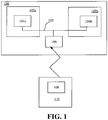
- FIG. 1 illustrates one example of such a model.
- a receiving system 100 in the centralized model may include a first component 102a, a second component 102b, a receiver 106 and/or any other components.
- the receiver 106 in the system 100 can be configured to receive data wirelessly (e.g., through a Bluetooth link) from a sender system 110.
- the sender system 110 can include a wireless transmitter 108.
- the wireless transmitter 108 may transfer data to the sender system 110, which can receive the data through the receiver 106.
- the received data contains the combined data for both component 102a and 102b.
- a processing unit 112 in the receiving system 100 can process the data to extract the relevant data for each component. After processing the data, the processing unit 112 can distribute relevant extracted data to the first component 102a and the second component 102b concurrently or substantially concurrently, via their receivers 104a and 104b, respectively.
- the receiving system 100 is a tradition wireless headset.
- the first component 102a may correspond to a data processing component (e.g., a microchip) in the left earphone
- the second component 102b can correspond to a data processing component in the right earphone.
- the receiving system 100 is not limited to a wireless headset.
- the receiving system 100 can include any system that receives data wirelessly and distributes the data to multiple components concurrently in the system 100.
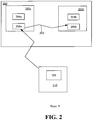
- FIG. 2 illustrates an example of such a receiving system.
- the receiving system 200 there is a first component 202a and a second component 202b.
- the link 203 between the first component 202a and the second component 202b is wireless.
- one of the first and second components may be designated as a primary device for receiving data from the sending system 210 and distributing the data to the other component, which may be designated as a secondary device.
- the first component 202a is the primary device and the second component 202b is the secondary device.
- the receiver 208 in the sending system 210 may transmit data wirelessly to the first component 202a, via the receiver 206a in the first component 202a.
- the first component 202a may then relay the data wirelessly to the second component 202b via the receiver 206b in the second component 202b.
- the sending system 210 sends a set of data (packets from transmission point of view) wirelessly to the receiving system 200 periodically or continuously.
- the first component 202a receives the set of data each time (via the receiver 206a), it responds to the sending system 210 with acknowledgement of each received packet.
- the first component 202a may then forward the received packets from the sender system 210 to the second component 202b over wireless link 203. This may involve extracting payload content specific to the second component 202b and re-packaging the extracted data in new packets by the first component 202a.
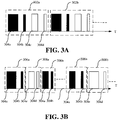
- FIG. 3A illustrates an example of traditional concurrent wireless transmission where there is a wireless link between two receiving components. It will be described with reference to FIG. 2 .
- the first component 202a the first component 202a may receive and transmit data packets over time T.
- the data packets can be logically grouped into more or less symmetric sets, e.g., set 302a and 302b as shown in this example.
- Each of the set 302a and 302b can include data packets received from the sending system 210, and data packets received from the second component 202b; and data packets sent to the sending system 200 and sent to the second component 202b.
- such a set may include a data packet 304a received from the sender system 220 which may include a control information and payload data intended for both the first component 202a and the second component 202b.
- the set 302a may include an acknowledge packet 304b sent by the first component 202a back to the sender system 210.
- the acknowledge packet 304b may acknowledge the data packet 304a has been received by first component 202a, or may inform the sender system 210 that a timeout has occurred without receiving the data packet 304b.
- the set 302a may include a data packet 304c sent by the first component 202a to the second component 202b.
- the data packet 304c may be prepared by the first component 202a after receiving the data packet 304a.
- the set 302a may include an acknowledge packet received from the second component 202b indicating whether the data packet 304c has been received by the second component 202b.
- the shaded packets are performed by the sending system 210 and first component 202a, which is the primary device, and the non-shaded packets are performed by both the first component 202a and the second component 202b.
- the second component 202b can be configured to "sniff or listen to the traffic between the sending system 210 and the receiving system 200.
- the second component 202b may extract the payload data intended for second component 202a without needing the first component 202a to forward the payload data to it.
- the second component 202b typically lacks information about the wireless connection parameters between the sender system 210 device and the first component 202b for a number of reasons such as frequency hopping sequence, encryption keys, timing synchronization, and other reasons. That is, the wireless transmission by the sender system 210 typically is dedicated to an identification or address of the first component 202a.
- control information such as encryption keys
- the second component 202b in order for the second component 202b to extract the payload data is still first sent, by the sender system 210, to the first component 202a.
- control information still needs to be forwarded to the second component 202b, by the first component 202a, over wireless link 203.
- FIG. 3B illustrates an example of the variation to the traditional concurrent wireless transmission shown in FIG. 3A .
- the first component 202a still receives data from the sending system 210 in packets 304a, and send acknowledge packets to the sending system 210 in response.
- the first component 202a need not forward data packets 304c to the second component 202b mentioned above. Instead, forward control packets 304e to the second component 202b once a while.
- the first component 202a forwards the control packet 302e to the second component 202b and receives an acknowledge packet from the second component 202b from the second component 202b, both of which may be logically grouped as a control block 308a.
- the first component 202a After the control block 308a, the first component 202a performs packets receiving and acknowledging with the sending system 210 through sets 306b-n without forwarding the received packets to the second component 202b, because the second component 202b has "picked up" the data packets 304a when the sender system 210 transmits the data packets to the first component 202a and knows how to extract data from the data packets 304a using the control information in the control packet 304e received from the first component 202a.
- the first component 202a may need to send the control packet 304e again (as shown in the control block 308b) to the second component 202b, when the sending system 210 updates certain control information, for example the encryption keys.
- the shaded packets are performed by the sending system 210 and first component 202a, which is the primary device, and the non-shaded packets are performed by both the first component 202a and the second component 202b.
- the first component 202a has more responsibilities in performing the packets (transmitting, extracting, repackaging and receiving) than the second component 202b.
- the first component 202a has substantially more work to do than the second component 202b as the "broker" of the data intended for the second component 202b.
- the first component 202a need not forward the data packets 304c to the second component 202b, it still needs to forward the control packet 304e to the second component 202b frequently, resulting in more work than the second component 202b.
- One insight provided by the inventor(s) is that the traditional concurrent wireless transmission requires an unbalanced responsibilities between the first component 202a and second component 202b, resulting in the first component 202a having to do more work than the second component 202b. This unbalance can result in performance issue such that the first component 202a has to do more processing than the second component 202b. This unbalance can also result in battery consumption issue such that the first component 202a drains battery faster than the second component 202b.
- the first component 202a and second component 202b typically has a small package and has their own batteries associated with them. This is the case for wireless earbuds.
- FIG. 4 illustrates the first component 202a can drain battery power faster than the second component 202b over time. However, it is important to balance the battery drainage of both first component 202a and second component 202b to improve the overall operating time and performance of receiving system 200.
- the first component 202a and the second component 202b may assume the role of the primary device alternatively. That is, the sending system 210 will transmit data to the first component 202a in a first time period and will transmit the data to the second component 202b in a second time period; and the wireless link 203 between the first component 202a and the second component 202b will reverse in the first and second time periods.
- this scheme requires the sending system to switch wireless connections with the first and second components in the first and second time periods.
- a solution envisioned by the inventor(s) to the above-described unbalanced concurrent wireless transmission is to have the first component 202a and second component 202b "impersonate" the primary device alternatively.
- each receiving device is typically identified by an address or an ID, which can be used for device identification and wireless configuration over wireless link.
- the second component 202b can "impersonate" the primary device by assuming an ID or address assigned to primary device.
- a synchronization packet can be sent, over the link 203, from the first component 202a in the first time period that the first component 202a is ready to switch the role with the second component 202b.
- the second component 202b can send the synchronization packet to the first component 202a that it is the ready to switch the role back with the first component 202a.
- This switch should be transparent to the sending system 210 since it only knows sending data to the first component 202a using its ID or address, In this scheme, the sending system 210 continues to operate normally during the switching between the first component 202a and second component 202b.
- FIG. 5 illustrates generally a switchover between the first component 202a and second component 202b at given time T+1 in accordance with the disclosure.
- the dotted arrow in this figure represents wireless links at the given time T shown in FIG. 2 .
- the first component 202a and second component 202b can switch their roles such that the second component 202b assumes the ID or address assigned to the first component 202a, and the first component 202a assumes the ID or address assigned to the first component 202b at the given time T+1.
- the data intended for the first component 202a is received by the second component 202b.
- the second component 202b "sniffs" the wireless link 502 and as soon as after the switch, it can extract data on the wireless link 502. From the sending system 210 point of view, during this switch process between the first component 202a and the second component 202b, the sending system 210 is not aware of the switch and thus continues to transmit data over the wireless link 502 to the first component 202a.
- FIG. 6 illustrates one example device 600 for balanced concurrent wireless transmission in accordance with the disclosure.
- the device 600 may be included in the first component 202a or second component 202b.
- the device 600 may include a data receiving component 602, a data processing component 606, a data transmission component 608, a control component 610, synchronization component 612, a storage component 604, and/or any other components.
- the data receiving component 602 may be configured to receive data over a wireless link from a sending system such sending system 210 shown in FIG. 2 .
- data receiving component 602 can be configured to receive the data in dedicated mode and/or in a listen mode. In the dedicated mode, a dedicated wireless link may be established between the sending system and device 600.
- the data receiving component 602 may be configured to listen to traffic over a wireless link (either wireless link 502 or wireless link 203) to determine if the data transmitted on the wireless link is intended for device 600. In the listen model, when it is determined that the data is intended for device 600, the data receiving component 602 may extract payload data from the packets it "picked up" from the wireless link.
- a wireless link either wireless link 502 or wireless link 203
- the data receiving component 602 may extract payload data from the packets it "picked up" from the wireless link.
- the data processing component 606 can be configured to process data received over wireless link 502 and/or wireless link 203. As mentioned above, there may be two modes of receiving the data wirelessly from the sending system 210. In the first mode, the data processing component 606 can be configured to listen to traffic on the wireless link 502, and extract data "picked up" from the wireless link 502 using the decryption key(s) received over wireless link 203 from a peer wireless device. In the second mode, the data processing component 606 can be configured to receive data directly from the sending system 210 over the wireless link 502. When processing data received from wireless link 502 in the first mode, data processing component 606 can be configured to extract data using one or more decryption keys received from a peer wireless device such as second component 202b shown in FIG. 2 . When processing data received from wireless link 203 in the second mode, the, data processing component 606 can be configured to extract certain control information such as the decryption key(s) for transmission to a peer wireless device.
- the data transmission component 608 can be configured to transmit data over the wireless link 502 and/or the wireless link 203.
- the data transmitted by the data transmission component 608 over the wireless link 502 can include acknowledge packets indicating that data packets transmitted by the sending system 210 have been received.
- the data transmitted by the data transmission component 608 over the wireless link 203 can include control information such as decryption key(s) on how to extract data from the sending system 210 and/or the actual data from the sending system 210 (in the second mode) to the peer wireless device.
- the storage component 604 can be configured to store identifications (IDs) and/or addresses for one or more wireless devices.
- IDs identifications
- the wireless device 600 may be configured to assume the role assigned to different devices in the concurrent wireless transmission in accordance with the disclosure.
- the storage component 604 can be configured to store for example, an ID or address assigned to a primary device in the concurrent wireless transmission in accordance with the disclosure, one or more IDs or addresses assigned to one or more secondary devices in the concurrent wireless transmission in accordance with the disclosure.
- the control component 610 can be configured to control the wireless receiving by the data receiving component 602, the data processing by the data processing component 606, the wireless transmission by the data transmission component 608, and/or to perform any other control functions. As mentioned above, during some time periods, the control component 610 may retrieve an ID or address assigned to the primary device and instruct the data receiving component 602 and data transmission component 608 to receive and transmit data wirelessly over link 502 and link 203 using that ID and address. In some time periods, the control component 610 may retrieve an ID or address assigned to a secondary device and instruct the data receiving component 602 and data transmission component 608 to receive and transmit data wirelessly over link 502 and link 203 using that ID and address.
- the synchronization component 612 can be configured to generate a synchronization instruction to instruct the control component 610 to use a particular the ID or address assigned to the primary device, or the ID or address assigned to a secondary device in a given time period.
- the synchronization component 612 can be configured to instruct the control component to use the ID or the address assigned to the primary device every 10 minutes for 10 minutes, and to use the ID or address assigned to the secondary device for the next 10 minutes.
- the synchronization component 612 may be configured to receive the synchronization instruction from a peer wireless device or the sending system 210 to use a particular ID or address for wireless transmission and receiving.
- the synchronization component 612 can be configured to generate the aforementioned synchronization instruction for a peer wireless device and transmit the synchronization instruction to the peer wireless device via the data transmission component 608 over link 203.
- FIG. 7 an example flowchart illustrating concurrent wireless transmission in accordance with the disclosure is shown.
- two wireless devices i.e., the first device and the second device engage in concurrent wireless transmission in accordance with the disclosure.
- the first device can have a structure shown in FIG. 6 and the second device can also have the structure shown in FIG. 6 .
- the process shown in flowchart 700 starts at time T, when the first device is using the ID or address assigned to the primary device, and the second device is using an ID or address assigned to a secondary device.
- the first device receives data from a sending system such as the sending system 210 shown in FIG. 2 .
- the data receiving at 702 can be through the wireless link 502 shown in FIG. 5 . Since the first device uses the ID or address assigned to the primary device at 702, it receives the data over the wireless link 502 from the sending system as the primary device.
- the data received at 702 may include payload data to be processed by the first device and/or payload data to be processed by the second device.
- the data received at 702 may include control information regarding how to extract the received payload data, such as one or more decryption keys.
- operations involved in 702 can be performed by a data receiving component in the first device the same as or substantially similar to data receiving component 602 described and illustrated herein.
- the first device acknowledges whether it has received the data it is supposed to receive at 702.
- operations involved in 704 can be performed by a data transmission component in the first device the same as or substantially similar to data transmission component 608 described and illustrated herein.
- the first device transmits data received at 702 to the second device over a wireless link between the two, such as wireless link 203 shown in FIG. 2 .
- the data transmitted to second device at 706 may include payload data, from the sending system, intended for the second device, and/or control information regarding how to extract the payload data intended for the second device.
- operations involved in 706 can be performed by a data transmission component in the first device the same as or substantially similar to data transmission component 608 described and illustrated herein.
- the first device processes the data received at 702.
- operations involved in 710 can be performed by a data processing component in the first device the same as or substantially similar to data processing component 606 described and illustrated herein.
- the first device may switch its role from the primary device to a secondary device.
- the role switching at 710 may involve retrieving, from a storage unit, an address or ID assigned to the secondary device and use that address or ID as the new address or ID of the first device.
- the first device may be configured to perform the switching periodically. However, this is not necessarily the only case.
- the first device may receive a synchronization instruction, for example from a peer wireless device or a control device, to perform the switch.
- operations involved in 710 can be performed by a control component and/or a synchronization component in the first device the same as or substantially similar to control component 610 and/or synchronization component 612 described and illustrated herein.
- the second device receives data transmitted by the first device at 706 over a wireless link such as wireless link 203 shown in FIG. 2 .
- the second device uses an address or ID assigned to a secondary device for receiving data wireless.
- the data received by the second device at 712 may include payload data, from the sending system, intended for the second device, and/or control information regarding how to extract the payload data intended for the second device.
- operations involved in 712 can be performed by a data receiving component in the second device the same as or substantially similar to data receiving component 712 described and illustrated herein.
- the second device acknowledges whether it has received the data it is supposed to receive at 712.
- operations involved in 714 can be performed by a data transmission component in the second device the same as or substantially similar to data transmission component 608 described and illustrated herein.
- the second device processes the data received at 712.
- operations involved in 716 can be performed by a data processing component in the second device the same as or substantially similar to data processing component 606 described and illustrated herein.
- the second device switch its role from the secondary device to the first device.
- the switching by the first device at 710 and the switching by the second device at 718 can be synchronized.
- either first device or the second device can be configured to generate a synchronization instruction to switch itself and to have the other device switch.
- the first device and second device can be configured to switch on its own at the same frequency.
- a control device may be employed to coordinate the first and second devices to switch at the same time by sending a switching instruction to both at the same.
- operations involved in 718 can be performed by a control component and/or a synchronization component in the second device the same as or substantially similar to control component 610 and/or synchronization component 612 described and illustrated herein.
- the second device receives data from the sending system.
- the data receiving at 720 can be through the wireless link 502 shown in FIG. 5 . Since the second device uses the ID or address assigned to the primary device at 720, it receives the data over the wireless link 502 from the sending system as the primary device.
- the data received at 720 may include payload data to be processed by the second device and/or payload data to be processed by the first device.
- the data received at 720 may include control information regarding how to extract the received payload data, such as one or more decryption keys.
- operations involved in 720 can be performed by a data receiving component in the second device the same as or substantially similar to data receiving component 602 described and illustrated herein.
- the second device acknowledges whether it has received the data it is supposed to receive at 720.
- operations involved in 72 can be performed by a data transmission component in the second device the same as or substantially similar to data transmission component 608 described and illustrated herein.
- the second device transmits data received at 722 to the second device over a wireless link between the two, such as wireless link 203 shown in FIG. 2 .
- the data transmitted to second device at 724 may include payload data, from the sending system, intended for the first device, and/or control information regarding how to extract the payload data intended for the first device.
- operations involved in 724 can be performed by a data transmission component in the second device the same as or substantially similar to data transmission component 608 described and illustrated herein.
- the second device processes the data received at 722.
- operations involved in 726 can be performed by a data processing component in the first device the same as or substantially similar to data processing component 606 described and illustrated herein.
- the first device receives data transmitted by the s device at 24 over a wireless link such as wireless link 203 shown in FIG. 2 .
- the first device uses an address or ID assigned to a secondary device for receiving the data.
- the data received by the second device at 728 may include payload data, from the sending system, intended for the second device, and/or control information regarding how to extract the payload data intended for the first device.
- operations involved in 728 can be performed by a data receiving component in the second device the same as or substantially similar to data receiving component 728 described and illustrated herein.
- the first device acknowledges whether it has received the data it is supposed to receive at 728.
- operations involved in 730 can be performed by a data transmission component in the first device the same as or substantially similar to data transmission component 608 described and illustrated herein.
- the first device processes the data received at 728.
- operations involved in 732 can be performed by a data processing component in the second device the same as or substantially similar to data processing component 606 described and illustrated herein.
- FIG. 8 illustrates a packet flow between the first and second device during switching in the concurrent wireless transmission in accordance with the disclosure.
- the packets flow shown in FIG. 8 is the same as FIG. 3 from the sending system point of point view.
- FIG. 3A different from FIG. 3A is that the gray shaded packets are performed by the first device, the black shaded packets are performed by the second device, and the non-shaded packets are performed by both devices, due to the role switching between the two devices as described and illustrated herein.
- the first and second devices perform equal amount of packets transmission and receiving over time T in the current wireless transmission in accordance with the disclosure.
- FIG. 9 shows a graph illustrating battery consumption between the first device and second device during the concurrent wireless transmission in accordance with the disclosure.
- the battery consumption by the first device initially can still be faster than the second device because the first device starts with the role as the primary device at time t1.
- the subsequent battery consumption will however even out as the first device and second device switch their roles during the period between t1 and t2.
- the battery consumption by the two devices will eventually be balanced t2.
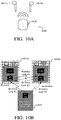
- FIG. 10A illustrates an example wireless earbud system 1000 that can be configured to employ the concurrent wireless transmission in accordance with the disclosure.
- the wireless earbud system 1000 may include a transmission device such as a USB wireless adapter, a smart phone, a laptop computer, a tablet, a desktop computer and/or any other transmission device.
- the wireless earbud system 100 may include a left earbud 1002a and a right earbud 1002b. Each earbud may perform operations described in FIG. 7 and/or include components described in FIG. 6 .
- FIG. 10B illustrates another example earbud system in accordance with some embodiments.
- the earbud system includes Bluetooth chips for the concurrent wireless transmission.
- the master device 1010 can transmit data over a wireless link #1 to the left earbud 1002a, which assumes the role of the primary device in the first time period.
- the left earbud 1002a can forward data and/or control information to the right earbud 1002b over a wireless link #2.
- the left earbud 1002a and the right earbud 1002b switch their roles; and the master device 1010 can transmit data over a wireless link #1' to the right earbud 1002b, which assumes the role of the primary device in the second time period.
- the right earbud 1002b can forward data and/or control information to the left earbud 1002a over a wireless link #2'.
- module refers to logic embodied in hardware or firmware, or to a collection of software instructions, possibly having entry and exit points, written in a programming language, such as, for example, Java, Lua, C or C++.
- a software module can be compiled and linked into an executable program, installed in a dynamic link library, or written in an interpreted programming language such as, for example, BASIC, Perl, or Python. It will be appreciated that software modules can be callable from other modules or from themselves, and/or can be invoked in response to detected events or interrupts.
- Software modules configured for execution on computing devices can be provided on a computer readable medium, such as a compact disc, digital video disc, flash drive, magnetic disc, or any other tangible medium, or as a digital download (and can be originally stored in a compressed or installable format that requires installation, decompression, or decryption prior to execution).
- a computer readable medium such as a compact disc, digital video disc, flash drive, magnetic disc, or any other tangible medium, or as a digital download (and can be originally stored in a compressed or installable format that requires installation, decompression, or decryption prior to execution).
- Such software code can be stored, partially or fully, on a memory device of the executing computing device, for execution by the computing device.
- Software instructions can be embedded in firmware, such as an EPROM.
- hardware modules can be comprised of connected logic units, such as gates and flip-flops, and/or can be comprised of programmable units, such as programmable gate arrays or processors.
- the modules or computing device functionality described herein are
- Computing system 600 can implement the techniques described herein using customized hard-wired logic, one or more ASICs or FPGAs, firmware and/or program logic which in combination with the computer system causes or programs computing system 600 to be a special-purpose machine. According to some embodiments, the operations, functionalities, and techniques and other features described herein are performed by computing system 600 in response to processors 612 executing one or more sequences of one or more instructions contained in, respectively, memory 614. Such instructions can be read into memory 614 from another storage medium, such as storage device 616. Execution of the sequences of instructions contained in memory 614 cause processors 612 to perform the process steps described herein, such as method 500 of FIG. 5 . In alternative embodiments, hard-wired circuitry can be used in place of or in combination with software instructions.
- non-transitory media refers to any non-transitory media for storing data and/or instructions that cause a machine to operate in a specific fashion.
- Such non-transitory media can comprise non-volatile media and/or volatile media.
- Non-volatile media can include, for example, optical or magnetic devices, such as storage device 616.
- Volatile media can include dynamic memory, such as memory 614.
- non-transitory media include, for example, a floppy disk, a flexible disk, hard disk, solid state drive, magnetic tape, or any other magnetic data storage medium, a CD-ROM, any other optical data storage medium, any physical medium with patterns of holes, a RAM, a PROM, and EPROM, a FLASH-EPROM, NVRAM, any other memory chip or cartridge, and networked versions of the same.
- Communication interface 618 can provide a bi-directional data communication.
- the interface may include circuitries that interface with, for example, power amplifiers 140, 150, and 340, as well as low noise amplifier 180.
- the circuitries may include, for example, frequency converters (e.g., mixers), analog-to-digital converters, symbol encoders and decoders, etc.
- Disjunctive language such as the phrase "at least one of X, Y, or Z," unless specifically stated otherwise, is intended to be understood within the context as used in general to present that an item, term, etc., may be either X, Y, or Z, or any combination thereof (e.g., X, Y, and/or Z). Thus, such disjunctive language is not generally intended to, and should not, imply that certain embodiments require at least one of X, at least one of Y, or at least one of Z to each be present.
Landscapes
- Engineering & Computer Science (AREA)
- Signal Processing (AREA)
- Physics & Mathematics (AREA)
- Acoustics & Sound (AREA)
- Computer Networks & Wireless Communication (AREA)
- Mobile Radio Communication Systems (AREA)
Claims (18)
- Drahtlose Vorrichtung (600), die dazu ausgelegt ist, Daten von einer Sendevorrichtung zu empfangen, wobei die drahtlose Vorrichtung umfasst:
eine Kommunikationskomponente, die dazu ausgelegt ist, drahtlos mit der Sendevorrichtung und einer drahtlosen Peer-Vorrichtung zu kommunizieren, wobei die drahtlose Kommunikation mit der Sendevorrichtung Empfangen von Daten von der Sendevorrichtung und Kommunizieren von Steuerinformationen mit der Sendevorrichtung umfasst, und wobei die drahtlose Kommunikation mit der drahtlosen Peer-Vorrichtung umfasst:Senden von Daten, die von der Sendevorrichtung empfangen wurden, an die drahtlose Peer-Vorrichtung;Empfangen von Daten von der drahtlosen Peer-Vorrichtung, undKommunizieren von Steuerinformationen mit der drahtlosen Peer-Vorrichtung;eine Speicherkomponente (604), die dazu ausgelegt ist, eine erste Identifikation und eine zweite Identifikation für die drahtlose Vorrichtung (600) zu speichern;eine Datenverarbeitungskomponente (606), die dazu ausgelegt ist, von der Sendevorrichtung empfangene Daten und von der drahtlosen Peer-Vorrichtung empfangene Daten zu verarbeiten; undeine Steuerkomponente (610), die dazu ausgelegt ist, die drahtlose Kommunikation mit der Sendevorrichtung und der Peer-Vorrichtung durch die Kommunikationskomponente zu steuern;dadurch gekennzeichnet, dass die Steuerung der drahtlosen Kommunikation mit der Sendevorrichtung und der Peer-Vorrichtung durch die Steuerkomponente (610) umfasst:wahlweises Umschalten zwischen der ersten Identifikation und der zweiten Identifikation als Kommunikationsidentifikation, um die Daten von der Sendevorrichtung zu empfangen;in einer ersten Zeitperiode:Verwenden der ersten Identifikation als Kommunikationsidentifikation zum Empfangen der Daten von der Sendevorrichtung, wobei in der ersten Zeitperiode die drahtlose Peer-Vorrichtung die zweite Identifikation verwendet, undSenden der von der Sendevorrichtung empfangenen Daten an die drahtlose Peer-Vorrichtung; undin einer zweiten Zeitperiode:
Verwenden der zweiten Identifikation als Kommunikationsidentifikation zum Empfangen von Daten von der drahtlosen Peer-Vorrichtung, wobei in der zweiten Zeitperiode die drahtlose Peer-Vorrichtung die erste Identifikation verwendet, um Daten von der Sendevorrichtung zu empfangen. - Drahtlose Vorrichtung (600) nach Anspruch 1, wobei die erste Identifikation der Sendevorrichtung eine Adresse einer primären Vorrichtung anzeigt und die zweite Identifikation der Sendevorrichtung eine Adresse einer sekundären Vorrichtung anzeigt.
- Drahtlose Vorrichtung (600) nach Anspruch 1, wobei in der ersten Zeitperiode die Steuerkomponente (610) ferner dazu ausgelegt ist, die Kommunikationskomponente zu steuern, um Steuerinformationen bezüglich einer Datenübertragung mit der Sendevorrichtung in der ersten Zeitperiode an die Sendevorrichtung zu kommunizieren.
- Drahtlose Vorrichtung (600) nach Anspruch 1, wobei in der zweiten Zeitperiode die Steuerkomponente (610) ferner dazu ausgelegt ist, die Kommunikationskomponente zu steuern, keine Steuerinformationen bezüglich der Datenübertragung mit der Sendevorrichtung an die Sendevorrichtung zu kommunizieren.
- Drahtlose Vorrichtung (600) nach Anspruch 1, wobei die an die drahtlose Peer-Vorrichtung kommunizierten Steuerinformationen Informationen aufweisen, die der drahtlosen Peer-Vorrichtung anzeigen, dass die drahtlose Vorrichtung (600) die erste Identifikation als Kommunikationsidentifikation mit der Sendevorrichtung verwendet.
- Drahtlose Vorrichtung (600) nach Anspruch 1, wobei die Sendevorrichtung ein Smartphone oder ein Laptop ist.
- Drahtlose Vorrichtung (600) nach Anspruch 1, wobei die drahtlose Vorrichtung und die drahtlose Peer-Vorrichtung ein Paar drahtloser Ohrhörer sind.
- Drahtlose Vorrichtung (600) nach Anspruch 7, wobei die Sendevorrichtung ein drahtloser Sender ist.
- Drahtlose Vorrichtung (600) nach Anspruch 1, wobei die drahtlose Peer-Vorrichtung eine erste drahtlose Peer-Vorrichtung ist, wobei die Speicherkomponente (604) ferner dazu ausgelegt ist, eine dritte Identifikation zu speichern, und wobei das Steuern der drahtlosen Kommunikation mit der Sendevorrichtung und der Peer-Vorrichtung durch die Steuerkomponente (610) ferner umfasst:
in einer dritten Zeitperiode:
Verwenden der dritten Identifikation als Kommunikationsidentifikation zum Empfangen von Daten von der zweiten drahtlosen Peer-Vorrichtung. - Verfahren (700) zum Empfangen von Daten von einer Sendevorrichtung unter Verwendung einer drahtlosen Vorrichtung (600a), wobei das Verfahren (700) umfasst:
drahtloses Kommunizieren mit einer Sendevorrichtung und einer drahtlosen Peer-Vorrichtung (600b), wobei die drahtlose Kommunikation mit der Sendevorrichtung Empfangen von Daten von der Sendevorrichtung und Kommunizieren von Steuerinformationen mit der Sendevorrichtung umfasst, und wobei die drahtlose Kommunikation mit der drahtlosen Peer-Vorrichtung (600b) umfasst:Senden von Daten, die von der Sendevorrichtung empfangen wurden, an die drahtlose Peer-Vorrichtung (706);Empfangen von Daten von der drahtlosen Peer-Vorrichtung (728); undKommunizieren von Steuerinformationen mit der drahtlosen Peer-Vorrichtung (730);Speichern einer ersten Identifikation und einer zweiten Identifikation für die drahtlose Vorrichtung (600a);Verarbeiten von Daten, die von der Sendevorrichtung (708) empfangen wurden, und Daten, die von der Drahtlosen Peer-Vorrichtung (732) empfangen wurden; undSteuern der drahtlosen Kommunikation mit der Sendevorrichtung (600a) und der Peer-Vorrichtung (600b) durch die Kommunikationskomponente, gekennzeichnet dadurch, dass das Steuern der drahtlosen Kommunikation mit der Sendevorrichtung (600a) und der Peer-Vorrichtung (600b) durch die Steuerkomponente (610) umfasst:wahlweises Umschalten zwischen der ersten Identifikation und der zweiten Identifikation als Kommunikationsidentifikation, um die Daten von der Sendevorrichtung (710) zu empfangen;in einer ersten Zeitperiode:Verwenden der ersten Identifikation als Kommunikationsidentifikation zum Empfangen der Daten von der Sendevorrichtung (702), wobei in der ersten Zeitperiode die drahtlose Peer-Vorrichtung die zweite Identifikation (712) verwendet, undSenden der von der Sendevorrichtung empfangenen Daten an die drahtlose Peer-Vorrichtung (706); undin einer zweiten Zeitperiode:
Verwenden der zweiten Identifikation als Kommunikationsidentifikation zum Empfangen von Daten von der drahtlosen Peer-Vorrichtung (728), wobei in der zweiten Zeitperiode die drahtlose Peer-Vorrichtung die erste Identifikation verwendet, um Daten von der Sendevorrichtung (720) zu empfangen. - Verfahren nach Anspruch 10, wobei die erste Identifikation der Sendevorrichtung eine Adresse einer primären Vorrichtung anzeigt und die zweite Identifikation der Sendevorrichtung eine Adresse einer sekundären Vorrichtung anzeigt.
- Verfahren nach Anspruch 10, wobei in der ersten Zeitperiode die Steuerkomponente (610) ferner dazu ausgelegt ist, die Kommunikationskomponente zu steuern, um Steuerinformationen bezüglich der Datenübertragung mit der Sendevorrichtung in der ersten Zeitperiode an die Sendevorrichtung zu kommunizieren.
- Verfahren nach Anspruch 10, wobei in der zweiten Zeitperiode die Steuerkomponente (610) ferner dazu ausgelegt ist, die Kommunikationskomponente zu steuern, keine Steuerinformationen bezüglich der Datenübertragung mit der Sendevorrichtung an die Sendevorrichtung zu kommunizieren.
- Verfahren nach Anspruch 10, wobei die an die drahtlose Peer-Vorrichtung (600b) kommunizierten Steuerinformationen Informationen aufweisen, die der Peerdrahtlosen Vorrichtung (600b) anzeigen, dass die drahtlose Vorrichtung (600a) die erste Identifikation als Kommunikationsidentifikation mit der Sendevorrichtung verwendet.
- Verfahren nach Anspruch 10, wobei die Sendevorrichtung ein Smartphone oder ein Laptop ist.
- Verfahren nach Anspruch 10, wobei die drahtlose Vorrichtung (600a) und die drahtlose Peer-Vorrichtung (600b) ein Paar drahtloser Ohrhörer sind.
- Verfahren nach Anspruch 16, wobei die Sendevorrichtung ein drahtloser Sender ist.
- Verfahren nach Anspruch 10, wobei die drahtlose Peer-Vorrichtung (600b) eine erste drahtlose Peer-Vorrichtung ist, wobei die Speicherkomponente (604) ferner dazu ausgelegt ist, eine dritte Identifikation zu speichern, und wobei das Steuern der drahtlosen Kommunikation mit der Sendevorrichtung und der Peer-Vorrichtung durch die Steuerkomponente (610) ferner umfasst:
in einer dritten Zeitperiode:
Verwenden der dritten Identifikation als Kommunikationsidentifikation zum Empfangen von Daten von der zweiten drahtlosen Peer-Vorrichtung.
Applications Claiming Priority (2)
| Application Number | Priority Date | Filing Date | Title |
|---|---|---|---|
| US15/807,586 US10085216B1 (en) | 2017-11-09 | 2017-11-09 | Balanced wireless data transmission |
| PCT/CN2018/085351 WO2019091056A1 (en) | 2017-11-09 | 2018-05-02 | Balanced wireless data transmission |
Publications (3)
| Publication Number | Publication Date |
|---|---|
| EP3501183A1 EP3501183A1 (de) | 2019-06-26 |
| EP3501183A4 EP3501183A4 (de) | 2019-07-24 |
| EP3501183B1 true EP3501183B1 (de) | 2021-04-28 |
Family
ID=63556912
Family Applications (1)
| Application Number | Title | Priority Date | Filing Date |
|---|---|---|---|
| EP18768747.0A Active EP3501183B1 (de) | 2017-11-09 | 2018-05-02 | Ausgeglichene drahtlose datenübertragung |
Country Status (4)
| Country | Link |
|---|---|
| US (3) | US10085216B1 (de) |
| EP (1) | EP3501183B1 (de) |
| CN (1) | CN110191453A (de) |
| WO (1) | WO2019091056A1 (de) |
Families Citing this family (8)
| Publication number | Priority date | Publication date | Assignee | Title |
|---|---|---|---|---|
| US10917930B2 (en) * | 2018-04-19 | 2021-02-09 | Qualcomm Incorporated | Reliable wireless communication with a source using relayed communication |
| CN108696784B (zh) * | 2018-06-06 | 2019-12-31 | 歌尔科技有限公司 | 一种无线耳机角色切换的方法、无线耳机及tws耳机 |
| CN109041142A (zh) * | 2018-07-27 | 2018-12-18 | Oppo广东移动通信有限公司 | 主耳机切换方法及相关设备 |
| US10631363B1 (en) * | 2018-10-23 | 2020-04-21 | Google Llc | Two stage role switch for fully wireless earbuds |
| CN113228718B (zh) * | 2018-11-09 | 2024-12-27 | 索尼互动娱乐股份有限公司 | 通信设备、电子装置和无线连接方法 |
| WO2020117404A1 (en) * | 2018-12-06 | 2020-06-11 | Amazon Technologies, Inc. | Wireless device connection handover |
| US11726761B2 (en) * | 2019-03-26 | 2023-08-15 | Tymphany Acoustic Technology (Huizhou) Co., Ltd. | Firmware upgrade for wireless stereo earbuds |
| US11995480B2 (en) * | 2020-09-11 | 2024-05-28 | Dell Products L.P. | Systems and methods for adaptive wireless forward and back channel synchronization between information handling systems |
Citations (1)
| Publication number | Priority date | Publication date | Assignee | Title |
|---|---|---|---|---|
| US20170311105A1 (en) * | 2016-04-22 | 2017-10-26 | Apple Inc. | Swapping roles between untethered wirelessly connected devices |
Family Cites Families (25)
| Publication number | Priority date | Publication date | Assignee | Title |
|---|---|---|---|---|
| WO2006041486A1 (en) * | 2004-10-01 | 2006-04-20 | Franklin Philip G | Method and apparatus for the zonal transmission of data using building lighting fixtures |
| US6240472B1 (en) * | 1998-10-22 | 2001-05-29 | Microsoft Corporation | Method and system for sharing a communications port |
| US6704584B2 (en) * | 2002-04-16 | 2004-03-09 | Thomson Licensing S.A. | Mechanism for a wireless device to relinquish its network master status based on its power reserve |
| US7379447B2 (en) * | 2003-05-02 | 2008-05-27 | Microsoft Corporation | Slotted seeded channel hopping for capacity improvement in wireless networks |
| JP4950221B2 (ja) * | 2006-01-11 | 2012-06-13 | クゥアルコム・インコーポレイテッド | デバイス能力および/または構成情報を通信する方法および装置 |
| US20110255413A1 (en) * | 2010-04-15 | 2011-10-20 | Mediatek Inc. | Communication Apparatus and ID Packet Recognition Method Thereof |
| US20120052802A1 (en) * | 2010-08-24 | 2012-03-01 | Nokia Corporation | Advertisement of an existing wireless connection |
| US8744367B2 (en) * | 2010-08-31 | 2014-06-03 | At&T Intellectual Property I, L.P. | Tail optimization protocol for cellular radio resource allocation |
| US9949205B2 (en) * | 2012-05-26 | 2018-04-17 | Qualcomm Incorporated | Smart battery wear leveling for audio devices |
| CN109379732B (zh) * | 2012-12-03 | 2021-11-23 | 索诺瓦公司 | 用于将音频信号无线流式传输到多个音频接收器设备的方法、系统 |
| CN103002065A (zh) | 2012-12-14 | 2013-03-27 | 大唐移动通信设备有限公司 | 一种主用设备与备用设备共用ip地址的方法和装置 |
| US9241044B2 (en) * | 2013-08-28 | 2016-01-19 | Hola Networks, Ltd. | System and method for improving internet communication by using intermediate nodes |
| US9232476B1 (en) * | 2014-06-11 | 2016-01-05 | Empire Technology Development Llc | Task management across low-power wireless communications |
| US10448307B2 (en) * | 2014-07-15 | 2019-10-15 | Comcast Cable Communications, Llc | Systems and methods for managing network devices |
| US10219062B2 (en) | 2015-06-05 | 2019-02-26 | Apple Inc. | Wireless audio output devices |
| US9924010B2 (en) | 2015-06-05 | 2018-03-20 | Apple Inc. | Audio data routing between multiple wirelessly connected devices |
| US9854405B2 (en) * | 2015-11-10 | 2017-12-26 | At&T Intellectual Property I, L.P. | Mobile application and device feature regulation based on profile data |
| US10575157B2 (en) * | 2016-02-25 | 2020-02-25 | Comcast Cable Communications, Llc | Resource control for network devices |
| CN206524928U (zh) | 2016-11-29 | 2017-09-26 | 东莞市库珀电子有限公司 | 一种具有有线功能的蓝牙耳机 |
| CN106792454A (zh) * | 2016-12-19 | 2017-05-31 | 建荣半导体(深圳)有限公司 | 蓝牙通信方法、通信装置、通信系统及电子设备 |
| CN106535081A (zh) * | 2016-12-20 | 2017-03-22 | 建荣半导体(深圳)有限公司 | 蓝牙模式切换方法、装置、通信系统及立体声音频传输方法 |
| CN106937197B (zh) * | 2017-01-25 | 2019-06-25 | 北京国承万通信息科技有限公司 | 双耳无线耳机及其通信控制方法 |
| CN107071618A (zh) | 2017-04-26 | 2017-08-18 | 歌尔科技有限公司 | 一种连接双耳蓝牙耳机的方法和装置 |
| CN107257516A (zh) | 2017-07-17 | 2017-10-17 | 湖南海翼电子商务股份有限公司 | 无线耳机及其配对方法 |
| CN107205192B (zh) | 2017-07-28 | 2019-10-11 | 广州黑格智能科技有限公司 | 一种双耳无线耳机及双耳无线耳机的音频播放方法 |
-
2017
- 2017-11-09 US US15/807,586 patent/US10085216B1/en active Active
-
2018
- 2018-05-02 WO PCT/CN2018/085351 patent/WO2019091056A1/en not_active Ceased
- 2018-05-02 CN CN201910512272.2A patent/CN110191453A/zh active Pending
- 2018-05-02 EP EP18768747.0A patent/EP3501183B1/de active Active
- 2018-09-24 US US16/140,511 patent/US10721689B2/en active Active
-
2020
- 2020-02-16 US US16/792,242 patent/US10972982B2/en active Active
Patent Citations (1)
| Publication number | Priority date | Publication date | Assignee | Title |
|---|---|---|---|---|
| US20170311105A1 (en) * | 2016-04-22 | 2017-10-26 | Apple Inc. | Swapping roles between untethered wirelessly connected devices |
Also Published As
| Publication number | Publication date |
|---|---|
| CN110191453A (zh) | 2019-08-30 |
| US10085216B1 (en) | 2018-09-25 |
| US20200236628A1 (en) | 2020-07-23 |
| EP3501183A1 (de) | 2019-06-26 |
| US10972982B2 (en) | 2021-04-06 |
| US10721689B2 (en) | 2020-07-21 |
| WO2019091056A1 (en) | 2019-05-16 |
| US20190141636A1 (en) | 2019-05-09 |
| EP3501183A4 (de) | 2019-07-24 |
Similar Documents
| Publication | Publication Date | Title |
|---|---|---|
| EP3501183B1 (de) | Ausgeglichene drahtlose datenübertragung | |
| EP3849223B1 (de) | Bluetooth kopfhörer-vorrichtung und kommunikationsverfahren dafür | |
| US11463824B2 (en) | Method of exchanging data packages of different sizes between first and second portable communication devices | |
| EP3972381B1 (de) | Verfahren zur unterstützung mehrerer verbindungen in einer bluetooth-netzwerkumgebung und elektronische vorrichtung dafür | |
| CN111464993B (zh) | 双耳蓝牙耳机配对方法以及用于双耳蓝牙耳机的无线耳机 | |
| US20220393798A1 (en) | Systems and methods including wireless data packet retransmission schemes | |
| CN111435844B (zh) | 双无线蓝牙通信音频数据更正方法、装置、设备及系统 | |
| CN110166951B (zh) | 无线音讯输出装置 | |
| EP3288302B1 (de) | System und verfahren zur identifizierung drahtloser vorrichtungen zur korrekten paarung | |
| WO2016060770A1 (en) | Rendering a media stream by wireless devices sharing device identifiers and encryption keys | |
| EP3998723A1 (de) | Datenübertragungsverfahren, -einrichtung und -vorrichtung | |
| CN108702651B (zh) | 平衡的无线数据传输 | |
| KR20210150919A (ko) | 블루투스 통신 환경의 다중 장치간 통신 방법 및 이를 위한 전자 장치 | |
| US9628225B2 (en) | Apparatus and method for transmitting data based on cooperation of member nodes belonging to multicast group | |
| CN114245362A (zh) | 设备回连方法和蓝牙外设 | |
| EP3133759A1 (de) | Verfahren zum austausch von unterschiedlich grossen datenpaketen zwischen ersten und zweiten tragbaren kommunikationsvorrichtungen | |
| JP6870935B2 (ja) | 第1のポータブル通信デバイスと第2のポータブル通信デバイスの間でデータ・パッケージを交換する方法 | |
| CN114845280A (zh) | 一种数据传输方法、装置、电子设备及存储介质 | |
| CN114296758B (zh) | 固件发送方法、固件接收方法及固件升级系统 | |
| JP6887769B2 (ja) | 優先周波数帯を使用して第1のポータブル通信デバイスと第2のポータブル通信デバイスの間でデータ・パッケージを交換する方法 | |
| TWI710225B (zh) | 無線藍牙裝置的控制器及方法 |
Legal Events
| Date | Code | Title | Description |
|---|---|---|---|
| STAA | Information on the status of an ep patent application or granted ep patent |
Free format text: STATUS: UNKNOWN |
|
| STAA | Information on the status of an ep patent application or granted ep patent |
Free format text: STATUS: THE INTERNATIONAL PUBLICATION HAS BEEN MADE |
|
| PUAI | Public reference made under article 153(3) epc to a published international application that has entered the european phase |
Free format text: ORIGINAL CODE: 0009012 |
|
| STAA | Information on the status of an ep patent application or granted ep patent |
Free format text: STATUS: REQUEST FOR EXAMINATION WAS MADE |
|
| 17P | Request for examination filed |
Effective date: 20180924 |
|
| AK | Designated contracting states |
Kind code of ref document: A1 Designated state(s): AL AT BE BG CH CY CZ DE DK EE ES FI FR GB GR HR HU IE IS IT LI LT LU LV MC MK MT NL NO PL PT RO RS SE SI SK SM TR |
|
| AX | Request for extension of the european patent |
Extension state: BA ME |
|
| RIN1 | Information on inventor provided before grant (corrected) |
Inventor name: YOUNIS, WALEED |
|
| A4 | Supplementary search report drawn up and despatched |
Effective date: 20190626 |
|
| RIC1 | Information provided on ipc code assigned before grant |
Ipc: H04W 88/04 20090101ALI20190619BHEP Ipc: H04R 1/10 20060101AFI20190619BHEP Ipc: H04W 84/20 20090101ALI20190619BHEP Ipc: H04W 4/80 20180101ALI20190619BHEP Ipc: H04W 52/02 20090101ALI20190619BHEP |
|
| GRAJ | Information related to disapproval of communication of intention to grant by the applicant or resumption of examination proceedings by the epo deleted |
Free format text: ORIGINAL CODE: EPIDOSDIGR1 |
|
| GRAP | Despatch of communication of intention to grant a patent |
Free format text: ORIGINAL CODE: EPIDOSNIGR1 |
|
| STAA | Information on the status of an ep patent application or granted ep patent |
Free format text: STATUS: EXAMINATION IS IN PROGRESS |
|
| 17Q | First examination report despatched |
Effective date: 20200609 |
|
| GRAP | Despatch of communication of intention to grant a patent |
Free format text: ORIGINAL CODE: EPIDOSNIGR1 |
|
| STAA | Information on the status of an ep patent application or granted ep patent |
Free format text: STATUS: GRANT OF PATENT IS INTENDED |
|
| INTG | Intention to grant announced |
Effective date: 20201215 |
|
| DAV | Request for validation of the european patent (deleted) | ||
| DAX | Request for extension of the european patent (deleted) | ||
| GRAS | Grant fee paid |
Free format text: ORIGINAL CODE: EPIDOSNIGR3 |
|
| GRAA | (expected) grant |
Free format text: ORIGINAL CODE: 0009210 |
|
| STAA | Information on the status of an ep patent application or granted ep patent |
Free format text: STATUS: THE PATENT HAS BEEN GRANTED |
|
| AK | Designated contracting states |
Kind code of ref document: B1 Designated state(s): AL AT BE BG CH CY CZ DE DK EE ES FI FR GB GR HR HU IE IS IT LI LT LU LV MC MK MT NL NO PL PT RO RS SE SI SK SM TR |
|
| REG | Reference to a national code |
Ref country code: GB Ref legal event code: FG4D |
|
| REG | Reference to a national code |
Ref country code: CH Ref legal event code: EP |
|
| REG | Reference to a national code |
Ref country code: DE Ref legal event code: R096 Ref document number: 602018016326 Country of ref document: DE |
|
| REG | Reference to a national code |
Ref country code: AT Ref legal event code: REF Ref document number: 1388485 Country of ref document: AT Kind code of ref document: T Effective date: 20210515 |
|
| REG | Reference to a national code |
Ref country code: IE Ref legal event code: FG4D |
|
| REG | Reference to a national code |
Ref country code: LT Ref legal event code: MG9D |
|
| REG | Reference to a national code |
Ref country code: AT Ref legal event code: MK05 Ref document number: 1388485 Country of ref document: AT Kind code of ref document: T Effective date: 20210428 |
|
| PG25 | Lapsed in a contracting state [announced via postgrant information from national office to epo] |
Ref country code: NL Free format text: LAPSE BECAUSE OF FAILURE TO SUBMIT A TRANSLATION OF THE DESCRIPTION OR TO PAY THE FEE WITHIN THE PRESCRIBED TIME-LIMIT Effective date: 20210428 Ref country code: AT Free format text: LAPSE BECAUSE OF FAILURE TO SUBMIT A TRANSLATION OF THE DESCRIPTION OR TO PAY THE FEE WITHIN THE PRESCRIBED TIME-LIMIT Effective date: 20210428 Ref country code: BG Free format text: LAPSE BECAUSE OF FAILURE TO SUBMIT A TRANSLATION OF THE DESCRIPTION OR TO PAY THE FEE WITHIN THE PRESCRIBED TIME-LIMIT Effective date: 20210728 Ref country code: FI Free format text: LAPSE BECAUSE OF FAILURE TO SUBMIT A TRANSLATION OF THE DESCRIPTION OR TO PAY THE FEE WITHIN THE PRESCRIBED TIME-LIMIT Effective date: 20210428 Ref country code: LT Free format text: LAPSE BECAUSE OF FAILURE TO SUBMIT A TRANSLATION OF THE DESCRIPTION OR TO PAY THE FEE WITHIN THE PRESCRIBED TIME-LIMIT Effective date: 20210428 Ref country code: HR Free format text: LAPSE BECAUSE OF FAILURE TO SUBMIT A TRANSLATION OF THE DESCRIPTION OR TO PAY THE FEE WITHIN THE PRESCRIBED TIME-LIMIT Effective date: 20210428 |
|
| PG25 | Lapsed in a contracting state [announced via postgrant information from national office to epo] |
Ref country code: RS Free format text: LAPSE BECAUSE OF FAILURE TO SUBMIT A TRANSLATION OF THE DESCRIPTION OR TO PAY THE FEE WITHIN THE PRESCRIBED TIME-LIMIT Effective date: 20210428 Ref country code: SE Free format text: LAPSE BECAUSE OF FAILURE TO SUBMIT A TRANSLATION OF THE DESCRIPTION OR TO PAY THE FEE WITHIN THE PRESCRIBED TIME-LIMIT Effective date: 20210428 Ref country code: PT Free format text: LAPSE BECAUSE OF FAILURE TO SUBMIT A TRANSLATION OF THE DESCRIPTION OR TO PAY THE FEE WITHIN THE PRESCRIBED TIME-LIMIT Effective date: 20210830 Ref country code: NO Free format text: LAPSE BECAUSE OF FAILURE TO SUBMIT A TRANSLATION OF THE DESCRIPTION OR TO PAY THE FEE WITHIN THE PRESCRIBED TIME-LIMIT Effective date: 20210728 Ref country code: PL Free format text: LAPSE BECAUSE OF FAILURE TO SUBMIT A TRANSLATION OF THE DESCRIPTION OR TO PAY THE FEE WITHIN THE PRESCRIBED TIME-LIMIT Effective date: 20210428 Ref country code: LV Free format text: LAPSE BECAUSE OF FAILURE TO SUBMIT A TRANSLATION OF THE DESCRIPTION OR TO PAY THE FEE WITHIN THE PRESCRIBED TIME-LIMIT Effective date: 20210428 Ref country code: GR Free format text: LAPSE BECAUSE OF FAILURE TO SUBMIT A TRANSLATION OF THE DESCRIPTION OR TO PAY THE FEE WITHIN THE PRESCRIBED TIME-LIMIT Effective date: 20210729 Ref country code: IS Free format text: LAPSE BECAUSE OF FAILURE TO SUBMIT A TRANSLATION OF THE DESCRIPTION OR TO PAY THE FEE WITHIN THE PRESCRIBED TIME-LIMIT Effective date: 20210828 |
|
| REG | Reference to a national code |
Ref country code: NL Ref legal event code: MP Effective date: 20210428 |
|
| REG | Reference to a national code |
Ref country code: CH Ref legal event code: PL |
|
| PG25 | Lapsed in a contracting state [announced via postgrant information from national office to epo] |
Ref country code: SK Free format text: LAPSE BECAUSE OF FAILURE TO SUBMIT A TRANSLATION OF THE DESCRIPTION OR TO PAY THE FEE WITHIN THE PRESCRIBED TIME-LIMIT Effective date: 20210428 Ref country code: EE Free format text: LAPSE BECAUSE OF FAILURE TO SUBMIT A TRANSLATION OF THE DESCRIPTION OR TO PAY THE FEE WITHIN THE PRESCRIBED TIME-LIMIT Effective date: 20210428 Ref country code: ES Free format text: LAPSE BECAUSE OF FAILURE TO SUBMIT A TRANSLATION OF THE DESCRIPTION OR TO PAY THE FEE WITHIN THE PRESCRIBED TIME-LIMIT Effective date: 20210428 Ref country code: LI Free format text: LAPSE BECAUSE OF NON-PAYMENT OF DUE FEES Effective date: 20210531 Ref country code: MC Free format text: LAPSE BECAUSE OF FAILURE TO SUBMIT A TRANSLATION OF THE DESCRIPTION OR TO PAY THE FEE WITHIN THE PRESCRIBED TIME-LIMIT Effective date: 20210428 Ref country code: LU Free format text: LAPSE BECAUSE OF NON-PAYMENT OF DUE FEES Effective date: 20210502 Ref country code: CH Free format text: LAPSE BECAUSE OF NON-PAYMENT OF DUE FEES Effective date: 20210531 Ref country code: DK Free format text: LAPSE BECAUSE OF FAILURE TO SUBMIT A TRANSLATION OF THE DESCRIPTION OR TO PAY THE FEE WITHIN THE PRESCRIBED TIME-LIMIT Effective date: 20210428 Ref country code: CZ Free format text: LAPSE BECAUSE OF FAILURE TO SUBMIT A TRANSLATION OF THE DESCRIPTION OR TO PAY THE FEE WITHIN THE PRESCRIBED TIME-LIMIT Effective date: 20210428 Ref country code: RO Free format text: LAPSE BECAUSE OF FAILURE TO SUBMIT A TRANSLATION OF THE DESCRIPTION OR TO PAY THE FEE WITHIN THE PRESCRIBED TIME-LIMIT Effective date: 20210428 Ref country code: SM Free format text: LAPSE BECAUSE OF FAILURE TO SUBMIT A TRANSLATION OF THE DESCRIPTION OR TO PAY THE FEE WITHIN THE PRESCRIBED TIME-LIMIT Effective date: 20210428 |
|
| REG | Reference to a national code |
Ref country code: DE Ref legal event code: R097 Ref document number: 602018016326 Country of ref document: DE |
|
| REG | Reference to a national code |
Ref country code: BE Ref legal event code: MM Effective date: 20210531 |
|
| PLBE | No opposition filed within time limit |
Free format text: ORIGINAL CODE: 0009261 |
|
| STAA | Information on the status of an ep patent application or granted ep patent |
Free format text: STATUS: NO OPPOSITION FILED WITHIN TIME LIMIT |
|
| 26N | No opposition filed |
Effective date: 20220131 |
|
| PG25 | Lapsed in a contracting state [announced via postgrant information from national office to epo] |
Ref country code: IE Free format text: LAPSE BECAUSE OF NON-PAYMENT OF DUE FEES Effective date: 20210502 |
|
| PG25 | Lapsed in a contracting state [announced via postgrant information from national office to epo] |
Ref country code: IS Free format text: LAPSE BECAUSE OF FAILURE TO SUBMIT A TRANSLATION OF THE DESCRIPTION OR TO PAY THE FEE WITHIN THE PRESCRIBED TIME-LIMIT Effective date: 20210828 Ref country code: FR Free format text: LAPSE BECAUSE OF NON-PAYMENT OF DUE FEES Effective date: 20210628 Ref country code: AL Free format text: LAPSE BECAUSE OF FAILURE TO SUBMIT A TRANSLATION OF THE DESCRIPTION OR TO PAY THE FEE WITHIN THE PRESCRIBED TIME-LIMIT Effective date: 20210428 |
|
| PG25 | Lapsed in a contracting state [announced via postgrant information from national office to epo] |
Ref country code: IT Free format text: LAPSE BECAUSE OF FAILURE TO SUBMIT A TRANSLATION OF THE DESCRIPTION OR TO PAY THE FEE WITHIN THE PRESCRIBED TIME-LIMIT Effective date: 20210428 Ref country code: BE Free format text: LAPSE BECAUSE OF NON-PAYMENT OF DUE FEES Effective date: 20210531 |
|
| PG25 | Lapsed in a contracting state [announced via postgrant information from national office to epo] |
Ref country code: CY Free format text: LAPSE BECAUSE OF FAILURE TO SUBMIT A TRANSLATION OF THE DESCRIPTION OR TO PAY THE FEE WITHIN THE PRESCRIBED TIME-LIMIT Effective date: 20210428 |
|
| PG25 | Lapsed in a contracting state [announced via postgrant information from national office to epo] |
Ref country code: HU Free format text: LAPSE BECAUSE OF FAILURE TO SUBMIT A TRANSLATION OF THE DESCRIPTION OR TO PAY THE FEE WITHIN THE PRESCRIBED TIME-LIMIT; INVALID AB INITIO Effective date: 20180502 |
|
| PG25 | Lapsed in a contracting state [announced via postgrant information from national office to epo] |
Ref country code: MK Free format text: LAPSE BECAUSE OF FAILURE TO SUBMIT A TRANSLATION OF THE DESCRIPTION OR TO PAY THE FEE WITHIN THE PRESCRIBED TIME-LIMIT Effective date: 20210428 |
|
| PG25 | Lapsed in a contracting state [announced via postgrant information from national office to epo] |
Ref country code: MT Free format text: LAPSE BECAUSE OF FAILURE TO SUBMIT A TRANSLATION OF THE DESCRIPTION OR TO PAY THE FEE WITHIN THE PRESCRIBED TIME-LIMIT Effective date: 20210428 |
|
| PGFP | Annual fee paid to national office [announced via postgrant information from national office to epo] |
Ref country code: DE Payment date: 20250521 Year of fee payment: 8 |
|
| PGFP | Annual fee paid to national office [announced via postgrant information from national office to epo] |
Ref country code: GB Payment date: 20250527 Year of fee payment: 8 |
|
| PG25 | Lapsed in a contracting state [announced via postgrant information from national office to epo] |
Ref country code: TR Free format text: LAPSE BECAUSE OF FAILURE TO SUBMIT A TRANSLATION OF THE DESCRIPTION OR TO PAY THE FEE WITHIN THE PRESCRIBED TIME-LIMIT Effective date: 20210428 |