EP3501002B1 - Feinkörnige objekterkennung in robotersystemen - Google Patents
Feinkörnige objekterkennung in robotersystemen Download PDFInfo
- Publication number
- EP3501002B1 EP3501002B1 EP18760373.3A EP18760373A EP3501002B1 EP 3501002 B1 EP3501002 B1 EP 3501002B1 EP 18760373 A EP18760373 A EP 18760373A EP 3501002 B1 EP3501002 B1 EP 3501002B1
- Authority
- EP
- European Patent Office
- Prior art keywords
- level
- category
- neural network
- instance
- images
- Prior art date
- Legal status (The legal status is an assumption and is not a legal conclusion. Google has not performed a legal analysis and makes no representation as to the accuracy of the status listed.)
- Active
Links
Images


Classifications
-
- G—PHYSICS
- G06—COMPUTING OR CALCULATING; COUNTING
- G06V—IMAGE OR VIDEO RECOGNITION OR UNDERSTANDING
- G06V10/00—Arrangements for image or video recognition or understanding
- G06V10/70—Arrangements for image or video recognition or understanding using pattern recognition or machine learning
- G06V10/82—Arrangements for image or video recognition or understanding using pattern recognition or machine learning using neural networks
-
- B—PERFORMING OPERATIONS; TRANSPORTING
- B25—HAND TOOLS; PORTABLE POWER-DRIVEN TOOLS; MANIPULATORS
- B25J—MANIPULATORS; CHAMBERS PROVIDED WITH MANIPULATION DEVICES
- B25J9/00—Programme-controlled manipulators
- B25J9/16—Programme controls
- B25J9/1694—Programme controls characterised by use of sensors other than normal servo-feedback from position, speed or acceleration sensors, perception control, multi-sensor controlled systems, sensor fusion
- B25J9/1697—Vision controlled systems
-
- G—PHYSICS
- G06—COMPUTING OR CALCULATING; COUNTING
- G06F—ELECTRIC DIGITAL DATA PROCESSING
- G06F18/00—Pattern recognition
- G06F18/20—Analysing
- G06F18/21—Design or setup of recognition systems or techniques; Extraction of features in feature space; Blind source separation
- G06F18/213—Feature extraction, e.g. by transforming the feature space; Summarisation; Mappings, e.g. subspace methods
- G06F18/2135—Feature extraction, e.g. by transforming the feature space; Summarisation; Mappings, e.g. subspace methods based on approximation criteria, e.g. principal component analysis
- G06F18/21355—Feature extraction, e.g. by transforming the feature space; Summarisation; Mappings, e.g. subspace methods based on approximation criteria, e.g. principal component analysis nonlinear criteria, e.g. embedding a manifold in a Euclidean space
-
- G—PHYSICS
- G06—COMPUTING OR CALCULATING; COUNTING
- G06F—ELECTRIC DIGITAL DATA PROCESSING
- G06F18/00—Pattern recognition
- G06F18/20—Analysing
- G06F18/21—Design or setup of recognition systems or techniques; Extraction of features in feature space; Blind source separation
- G06F18/214—Generating training patterns; Bootstrap methods, e.g. bagging or boosting
-
- G—PHYSICS
- G06—COMPUTING OR CALCULATING; COUNTING
- G06F—ELECTRIC DIGITAL DATA PROCESSING
- G06F18/00—Pattern recognition
- G06F18/20—Analysing
- G06F18/24—Classification techniques
- G06F18/241—Classification techniques relating to the classification model, e.g. parametric or non-parametric approaches
- G06F18/2413—Classification techniques relating to the classification model, e.g. parametric or non-parametric approaches based on distances to training or reference patterns
-
- G—PHYSICS
- G06—COMPUTING OR CALCULATING; COUNTING
- G06F—ELECTRIC DIGITAL DATA PROCESSING
- G06F18/00—Pattern recognition
- G06F18/20—Analysing
- G06F18/28—Determining representative reference patterns, e.g. by averaging or distorting; Generating dictionaries
-
- G—PHYSICS
- G06—COMPUTING OR CALCULATING; COUNTING
- G06V—IMAGE OR VIDEO RECOGNITION OR UNDERSTANDING
- G06V10/00—Arrangements for image or video recognition or understanding
- G06V10/20—Image preprocessing
- G06V10/25—Determination of region of interest [ROI] or a volume of interest [VOI]
-
- G—PHYSICS
- G06—COMPUTING OR CALCULATING; COUNTING
- G06V—IMAGE OR VIDEO RECOGNITION OR UNDERSTANDING
- G06V10/00—Arrangements for image or video recognition or understanding
- G06V10/70—Arrangements for image or video recognition or understanding using pattern recognition or machine learning
- G06V10/764—Arrangements for image or video recognition or understanding using pattern recognition or machine learning using classification, e.g. of video objects
-
- G—PHYSICS
- G06—COMPUTING OR CALCULATING; COUNTING
- G06V—IMAGE OR VIDEO RECOGNITION OR UNDERSTANDING
- G06V10/00—Arrangements for image or video recognition or understanding
- G06V10/70—Arrangements for image or video recognition or understanding using pattern recognition or machine learning
- G06V10/77—Processing image or video features in feature spaces; using data integration or data reduction, e.g. principal component analysis [PCA] or independent component analysis [ICA] or self-organising maps [SOM]; Blind source separation
- G06V10/7715—Feature extraction, e.g. by transforming the feature space, e.g. multi-dimensional scaling [MDS]; Mappings, e.g. subspace methods
-
- G—PHYSICS
- G06—COMPUTING OR CALCULATING; COUNTING
- G06V—IMAGE OR VIDEO RECOGNITION OR UNDERSTANDING
- G06V10/00—Arrangements for image or video recognition or understanding
- G06V10/70—Arrangements for image or video recognition or understanding using pattern recognition or machine learning
- G06V10/77—Processing image or video features in feature spaces; using data integration or data reduction, e.g. principal component analysis [PCA] or independent component analysis [ICA] or self-organising maps [SOM]; Blind source separation
- G06V10/772—Determining representative reference patterns, e.g. averaging or distorting patterns; Generating dictionaries
-
- G—PHYSICS
- G06—COMPUTING OR CALCULATING; COUNTING
- G06V—IMAGE OR VIDEO RECOGNITION OR UNDERSTANDING
- G06V10/00—Arrangements for image or video recognition or understanding
- G06V10/70—Arrangements for image or video recognition or understanding using pattern recognition or machine learning
- G06V10/77—Processing image or video features in feature spaces; using data integration or data reduction, e.g. principal component analysis [PCA] or independent component analysis [ICA] or self-organising maps [SOM]; Blind source separation
- G06V10/774—Generating sets of training patterns; Bootstrap methods, e.g. bagging or boosting
-
- G—PHYSICS
- G06—COMPUTING OR CALCULATING; COUNTING
- G06V—IMAGE OR VIDEO RECOGNITION OR UNDERSTANDING
- G06V20/00—Scenes; Scene-specific elements
- G06V20/10—Terrestrial scenes
-
- G—PHYSICS
- G06—COMPUTING OR CALCULATING; COUNTING
- G06F—ELECTRIC DIGITAL DATA PROCESSING
- G06F18/00—Pattern recognition
- G06F18/20—Analysing
- G06F18/24—Classification techniques
- G06F18/241—Classification techniques relating to the classification model, e.g. parametric or non-parametric approaches
- G06F18/2411—Classification techniques relating to the classification model, e.g. parametric or non-parametric approaches based on the proximity to a decision surface, e.g. support vector machines
-
- G—PHYSICS
- G06—COMPUTING OR CALCULATING; COUNTING
- G06V—IMAGE OR VIDEO RECOGNITION OR UNDERSTANDING
- G06V10/00—Arrangements for image or video recognition or understanding
- G06V10/10—Image acquisition
- G06V10/12—Details of acquisition arrangements; Constructional details thereof
- G06V10/14—Optical characteristics of the device performing the acquisition or on the illumination arrangements
- G06V10/141—Control of illumination
-
- H—ELECTRICITY
- H04—ELECTRIC COMMUNICATION TECHNIQUE
- H04N—PICTORIAL COMMUNICATION, e.g. TELEVISION
- H04N7/00—Television systems
- H04N7/18—Closed-circuit television [CCTV] systems, i.e. systems in which the video signal is not broadcast
- H04N7/183—Closed-circuit television [CCTV] systems, i.e. systems in which the video signal is not broadcast for receiving images from a single remote source
- H04N7/185—Closed-circuit television [CCTV] systems, i.e. systems in which the video signal is not broadcast for receiving images from a single remote source from a mobile camera, e.g. for remote control
Definitions
- the present disclosure is related to robotic systems and, in particular, to fine-grained object recognition in deep detection embedding networks for home service robots.
- One important function of a home service robot is to be able to recognize small indoor objects such as cups, plates, controllers, cell-phones, keys, and bottles.
- small indoor objects such as cups, plates, controllers, cell-phones, keys, and bottles.
- it is difficult to perform recognition of small object due to the personalization of certain objects and a resulting fine-grained recognition issue.
- Objects in a specific home for a home service robot may be personalized by a user making the object unique.
- Unique objects are harder to detect and recognize.
- a home service robot not only needs to recognize a television controller category, a cup category, or a shoe category, but it also needs to discriminate between different instances within these categories. That is, the robot needs to be able to tell the difference between different controllers, one model of cell phone versus another, different shapes, sized, and colors of cups, or different sizes, styles, textures, and colors of shoes.
- Subset Feature Learning for Fine-Grained Category Classification by ZongYuan Ge et al., 7 June 2015 IEEE discloses method to best learn deep CNN feature for fine-grained image classification.
- a subset learning system is disclosed which first splits the classes into visually similar subsets and then learns domain-specific features for each subset.
- Deep neural networks for object detection by Christian Szegedy et al., 5 December 2013 discloses a method for object detection using deep neural networks (DNNs).
- DNNs deep neural networks
- a multi-scale inference procedure is defined to produce high-resolution object detections at a low cost by a few network application.
- the present invention is defined by a method for instance-level object recognition in a robotic system according to independent claim 1, a robotic system according to independent claim 12, a non-transitory computer-readable media according to independent claim 18. Additional features of the invention are provided in the dependent claims. In the following, parts of the description and drawings referring to embodiments which are not covered by the claims are not presented as embodiments of the invention, but as examples useful for understanding the invention.
- a first aspect provides a method for instance-level object recognition in a robotic system, the method comprising: obtaining an image of an object from an imaging device; determining, through a category-level deep detection neural network, a pre-defined category of the object, of a plurality of predefined categories of obj ects, based on the image of the object and pre-defined category-level object images stored in the robotic system; generating a feature map for the pre-defined category of the object determined by the category-level deep detection neural network; generating embedded features, based on the feature map, using an instance-level deep detection neural network corresponding to the pre-defined category of the object, wherein each pre-defined category of the plurality of predefined categories of objects comprises a corresponding different instance-level deep detection neural network; recognizing an instance-level of the object based on classification of the embedded features; and performing a robotic operation by the robotic system based on the instance-level recognition of the object.
- the feature map is a forward-computed feature map of a last shared layer
- Example 2 the subject matter of the first aspect optionally includes wherein obtaining the image of the object comprises obtaining a plurality of images of the object, each image obtained from a different perspective and/or lighting condition.
- Example 3 the subject matter of Example 2 optionally includes using a deep attention neural network to generate a heat map for each of the plurality of images that emphasizes the category-level objects in the one or more images.
- Example 4 the subject matter of Example 3 optionally includes wherein generating the heat map comprises generating an attention value for each pixel of the one or more images wherein a higher attention value corresponds to a higher possibility of the pixel being the foreground object of interest.
- Example 5 the subject matter of Example 4 optionally includes generating a binary object mask image based on the heat map wherein pixels with attention values higher than a threshold are labeled as a first logical state and all other pixels are labeled with a second logical state that is opposite to the first logical state.
- Example 6 the subject matter of Example 5 optionally includes extracting the object of the pre-defined category from the mask image based on the pixels labeled as the first logical state.
- Example 7 the subject matter of Example 6 optionally includes augmenting training data generated from a smallest rectangular box that contains the extracted category-level object.
- Example 8 the subject matter of Example 7 optionally includes wherein generating the augmented training data comprises: removing image pixels corresponding to the extracted category-level object from the mask image; and embedding the removed image pixels into a set of background scene images to generate a set background scene images without the object to be used as augmented training images.
- Example 9 the subject matter of Example 8 optionally includes training the deep attention neural network on the pre-defined categories of objects by pre-defining object categories that are common to the environment in which the robotic system is deployed.
- Example 10 the subject matter of Example 9 optionally includes wherein training the deep attention neural network further comprises generating a forward-computed feature map for each category-level object.
- Example 11 the subject matter of Example 10 optionally includes wherein training the deep attention neural network to recognize instance-level objects comprises: generating the embedded features based on the forward-computed feature map; and adjusting the category-level object detection to determine a recognition of the instance-level objects based on the embedded features.
- a second aspect provides a robotic system, comprising: an imaging device coupled to the robot and positioned to capture images of objects within a field of view of the imaging device; a memory comprising instructions and pre-defined categories of object images; and one or more processors coupled to and in communication with the imaging device and the memory, wherein the one or more processors execute the instructions to: obtaining an image of an object from the imaging device; determining, through a category-level deep detection neural network, a pre-defined category of the object, of the plurality of predefined categories of obj ects, based on the image of the object and the pre-defined category-level object images stored in memory; generating a feature map for the object of the pre-defined category determined by the category-level deep detection neural network; generating embedded features, based on the feature map, using an instance-level deep detection neural network corresponding to the pre-defined category of the object, wherein each pre-defined category of the plurality of predefined categories of objects comprises a corresponding different instance-level deep detection neural network; and
- Example 13 the subject matter of the second aspect optionally includes wherein the one or more processors further execute the instructions to pre-train a deep attention neural network with publicly available images or pre-defined objects prior to deployment to the environment.
- Example 14 the subject matter of Example 13 optionally includes wherein the one or more processors further execute the instructions to detect the pre-defined objects in the particular environment based on automatically obtained new training data obtained at the environment.
- Example 15 the subject matter of Example 14 optionally includes wherein the one or more processors further execute the instructions to: obtain images of the instance-level objects in the environment in which the robotic system is deployed; and transfer the images to a server remote from the environment in which the robotic system is deployed to fine tune the deep attention neural network to recognize instance-level objects of the category-level objects.
- Example 16 the subject matter of Example 15 optionally includes wherein the one or more processors further execute the instructions to: generate a set of background scene images that do not include the category-level object; and embed segmented foreground images into the set of background scene images.
- Example 17 the subject matter of Example 16 optionally includes wherein the one or more processor further execute the instructions to randomly sample the background scene images at different times and locations in the environment in which the robotic system is deployed.
- Example 18 is a non-transitory computer-readable media storing computer instructions for fine grained object recognition in a robotic system, that when executed by one or more processors, cause the one or more processors to perform the steps of: obtain an image of an object from an imaging device; determine, through a category-level deep detection neural network, a pre-defined category of the object, of a plurality of predefined categories of objects, based on the image of the object and pre-defined category-level object images stored in the robotic system; generate a feature map for the pre-defined category of the object determined by the category-level deep detection neural network; generate embedded features, based on the feature map, using an instance-level deep detection neural network corresponding to the pre-defined category of the object, wherein each pre-defined category of the plurality of predefined categories of objects comprises a corresponding different instance-level deep detection neural network; and recognize an instance-level of the object based on classification of the embedded features.
- Example 19 the subject matter of Example 18 optionally includes wherein the executed instructions cause the one or more processors to perform bounding box annotation by determining a smallest box that bounds the category-level objects in an associated image.
- Example 20 the subject matter of Example 19 optionally includes wherein the executed instructions further cause the one or more processors to treat pixels in the image that are outside of the smallest box as hard background pixels.
- An object category or category-level object may be defined as a type of object. For example, cups, phones, shoes, and bottles are considered categories of objects.
- An instance of an object or an instance-level object refers to brands, types, or even models of that particular object category. In the example of a phone object, an instance of that phone would be a cell phone versus a home phone, a particular brand of phone, or even a particular model of a brand of phone (i.e. iPhone 4 versus iPhone 6).
- the disclosed embodiments provide fine-grained object recognition by combining deep neural networks, a deep attention neural network for automatic training data acquisition, a deep detection neural network for category-level object detection, and a deep embedding neural network for fine-grained instance-level object recognition.
- the object recognition method employs a training stage and a testing stage to accomplish the recognition.
- a neural network comprises a large number of highly interconnected processing elements (neurons) working in unison to solve a specific problem (e.g., instance-level object classification).
- the neural network is not programmed but instead uses an arbitrary function approximation mechanism that "learns" from observed data after a certain amount of pre-training.
- the goal of the neural network is to solve problems in the same way that the human brain would.
- the neural network extracts patterns that are too complex to be noticed by either humans or other computer techniques. Deep attention, deep embedding, and instance-level detection neural networks each have specific tasks as defined by their label but operate in a substantially similar fashion.
- the deep attention network is pre-trained over a large amount of training data that is agnostic to specific homes.
- the deep attention network is pre-trained prior to use by a user in a home environment (e.g., during manufacture).
- the pre-training generates a heat map that emphasizes objects of interest.
- An object of interest may be defined as relatively small objects usable by a user such as telephones, keys, cups, articles of clothing, remote controls, bottles, etc.
- Such objects of interest also referred to as category-level objects, are automatically segmented out to generate annotated training data (e.g., segmented foreground images) for the later detection and recognition steps.
- the deep attention network may not be changed after pre-training and the network is deployed on the robotic system.
- the deep detection neural network is trained to detect the category-level objects based upon the pre-training data using the deep attention network.
- the network may be pre-trained to detect a set of pre-defined popular object categories that are common for most household use (e.g., environment to which the robotic system is deployed) and, when the robotic system is deployed in a specific home, the parameters of the pre-trained network can be further fine-tuned to better accommodate specific object category detections in the specific home environment. For example, when new, uncommon object categories are introduced to the robotic system for detection, the network parameters may be either fine-tuned or re-trained if necessary to detect the new object categories.
- the deep embedding network may be trained to recognize instance-level objects. For each category-level object, the deep embedding network may be trained to embed the detected category-level objects in that category into a multi-dimensional feature space based on which object classification category can be further applied to distinguish different instance-level objects.
- the deep embedding network shares part of its structure and parameters with the deep detection neural network. This reduces computation complexity in both the training stage and the test stage and alleviates overfitting when the training set is small.
- the system may automatically obtain object-level training data with only a minimum amount of manual annotation from human supervision.
- human supervision may be used when an unknown object is introduced to the robot and the format of the supervision may be limited to providing associated object categories.
- the proposed system may avoid use of complicated region-level annotation, which is very expensive for humans to label.
- the robotic system may also provide a scalable effective solution for personalized and fine-grained object detection and recognition in home service robots. Compared with the conventional solution of training category-level detectors, the disclosed robotic system is able to distinguish instance-level objects.
- the disclosed robotic system provides: better scalability where a relatively smaller-capacity network can be used to detect category-level objects and instance-level objects in a hierarchical way, while the end-to-end solution requires much higher-capacity networks to distinguish the many object instances; reduced computations such that when a new object instance is added, the network only needs to fine-tune or re-train the corresponding embedding network of the associated object category, while the conventional solution requires fine-tuning or re-training of the entire end-to-end network; and reduced overfitting where the smaller-capacity network can be well trained using a relatively small amount of training data.
- FIG. 1 is a flow diagram showing a training stage of a method for fine-grained object recognition in a robotic system, according to various embodiments.
- images are obtained by the robotic system using an imaging device (e.g., camera).
- the images may include one or more video sequences of an object showing multiple different viewpoints of the object or one or more still images of the object showing the multiple different viewpoints.
- the user may place the object by a relatively simple and clean background when the object is introduced to the robotic system.
- the object may be placed on a featureless table or a carpet with a simple texture. This reduces the noise (e.g., images unrelated to the object) in the images of the object.
- the robotic system may automatically move around the object to capture image frames of the object from a variety of views and angles.
- the user may introduce only one object at a time to the robotic system in order to avoid confusion.
- the user may be requested to point out the object of interest and perform continuous tracking later on during data acquisition.
- the user may leave the object in the location over a period of time (e.g., one day) so that the robotic system can capture image frames of the object under different lighting conditions and from different perspectives.
- a pre-trained deep attention network is used for automatic object annotation.
- the object annotation block 103 provides generic attended foreground detection by indicating where the most attended foreground region is in the image, based on the pre-trained deep attention network 105.
- Different types of annotation may be used. For example, an object bounding box and an exact object mask are two such types of annotation. These types of annotation are for purposes of illustration only as other types may be used.
- the deep attention network 105 is pre-trained using a relatively large amount of training data targeted at generating a heat map of an input image frame to emphasize training on a foreground of the objects of interest and filter out other portions of the image such as background objects, table features, or table texture.
- a heat map may be generated as a graphical representation of data where the individual values contained in a matrix that represents colors in the image.
- the pre-trained heat map data is stored in the deep attention network 105.
- the deep attention network 105 may be fixed once the robotic system is deployed to a particular home.
- the heat map of the input image includes an attention value over each pixel, where each attention value is a number (can be floating number or integer) and higher attention values mean a higher possibility of the pixel being the foreground object of interest.
- each attention value is a number (can be floating number or integer) and higher attention values mean a higher possibility of the pixel being the foreground object of interest.
- foreground objects of interest can be extracted as the foreground connected regions.
- An automatic image segmentation method can be used to extract the foreground objects of interest based on the heat map.
- the binary object mask image 107 is input to data augmentation blocks 109, 111 along two separate paths.
- the data augmentation blocks 109, 111 provide improvement of the pre-training data from the deep attention network 105.
- the data augmentation blocks 109, 111 provide substantially identical functions to generate substantially identical augmented data, as described subsequently.
- the generated augmented data is used differently in the category-level object detection model training block 113 and the instance-level object embedding model training block 115.
- the object bounding box is the smallest rectangular box that contains (i.e., bounds) the foreground object mask.
- the original image frame as well as the bounding boxes are used as training data in the data augmentation blocks 109, 111.
- the image pixels corresponding to the foreground object mask are removed and embedded into a set of background scene images to generate a set background scene images without the object to be used as augmented training images.
- the set of background scene images without the object are randomly sampled from different times and locations at the particular home where the robotic system operates. Some randomness may be added with respect to the location and angle of foreground object embedding.
- the background images as well as the bounding boxes of the foreground objects in the generated images are used as the augmented training data.
- an automatic binary image segmentation process may be performed during the data augmentation 109, 111.
- an automatic binary image segmentation process may be performed during the data augmentation 109, 111.
- the method described in V. Lempitsky et al., Image segmentation with a bounding box prior ICCV 2009 can be used to segment the foreground object from the background. Since the background of the image frames for automatic object annotation is relatively simple, such a process may be able to generate a better foreground object mask than without.
- the segmented foreground is also embedded into the set of scene background images without the object, in the same way as the original object masks, to generate additional augmented training data.
- the category-level object detection model training block 113 trains a category-level object deep detection network 117.
- the deep detection neural network 117 can be pre-trained to detect a set of pre-defined object categories that are common for most homes (e.g., cups, bottles, shoes, etc.). Such pre-training can store publically available annotated training images or images that were pre-trained by the user in memory of the robotic system. When the robotic system is deployed to the particular home, the pre-trained network can be fine-tuned to detect these pre-defined categories of objects in the particular home based on the automatically obtained new training data obtained at the particular home. For newly added object categories that are personalized for the specific home, the deep object detection network 117 may be further fine-tuned to accommodate the detection of these new categories.
- pre-defined object categories that are common for most homes (e.g., cups, bottles, shoes, etc.).
- Such pre-training can store publically available annotated training images or images that were pre-trained by the user in memory of the robotic system.
- the pre-trained network can be fine-tuned to detect these pre-defined categories of objects in the
- the instance-level object embedding model training block 115 provides the ability to distinguish personalized and fine-grain object instances in a particular home or other deployed environment based on data from the original object mask block 107, the augmented training data block 109, and the deep object detection network 117.
- the training data from the deep object detection network 117 is also used in the instance-level object embedding model training block 115 by the sharing of network structures and parameters.
- a number of layers of the pre-trained detection network can be either fixed or tuned with very small learning rates.
- the structure of the last classification layer may be changed to add in the new category and the last few layers of the network may be fine-tuned with a large learning rate or re-trained.
- a deep object embedding network 119 is trained for each object category. This may be accomplished by embedding the image pixels within the foreground object bounding box into a multi-dimensional feature space.
- the deep object embedding network 119 with a triplet-loss layer shares part of its structures and parameters with the deep object detection network 117.
- a triplet-loss layer computes an output embedded feature so that the squared distance between all training samples of the same object instance is small, while the squared distance between a pair of training samples from different object instances is large. That is, the embedded feature space is discriminative to distinguish different object instances in the object category. This reduces computation complexity in both the training and test stages and alleviates overfitting when the training set is small.
- the first set of layers in the deep detection neural network is directly used as the first set of layers in the deep embedding network, and the parameters of these layers are fixed as the parameters from the deep detection neural network.
- layers are the convolutional layers before the last few fully connected layers and classification layers. Then, a few fully-connected layers are attached to these fixed layers, and the triplet-loss layer is attached to the end of the deep embedding network.
- An embedding features block 121 generates embedded features for an object classification model training block 123 based on which object classifier is trained to recognize each object instance in a corresponding object category.
- the embedding features block 121 includes a different, corresponding deep instance-level detection neural network for each pre-defined category of an object.
- a support vector machine classifier may be used as the classifier trained over the multi-dimensional feature space.
- the resulting object classifier block 125 is then used in the testing stage, as discussed subsequently with reference to FIG. 2 .
- FIG. 2 is a flow diagram showing a testing stage of the method for fine-grained object recognition in a robotic system, according to various embodiments.
- the robotic system Given an input image sequence (e.g., video, plurality of images) 201 to identify an object, the robotic system first detects category-level objects in block 203. This category-level object detection is accomplished from the image frames based on the deep object detection network 117 as accumulated during the training stage of FIG. 1 . The result is the detected object in block 205.
- an input image sequence e.g., video, plurality of images
- an instance-level object embedding block 207 takes the detected object 205 and the training data from the deep object embedding network 119 and generates a multi-dimensional embedding feature in block 209.
- the multi-dimensional embedding feature is generated for each detected object 205 based on the objects corresponding deep object embedding network 119 for the object category.
- the object classifiers 125 from the training stage are used to perform object classification on the embedded features to generate different instance-level objects.
- the result, in block 213, is a recognized instance-level object.
- the robotic system may then perform a robotic operation using the resulting recognition of the instance-level object.
- the blocks of FIGs. 1 and 2 are located in the local robotic system.
- the computationally heavy parts of the system may be moved to other computation platforms.
- the more computationally heavy functions may be moved to a computer server that is communicated with over a wired or wireless channel from the robotic system.
- FIG. 3 illustrates one embodiment of a framework of such a system.
- FIG. 3 is diagram of a robotic system having a robot portion 300 and a server portion 301, according to various embodiments.
- the category-level object detection modules are hosted on the robot 300 and all other parts are moved to the server 301.
- the advantage of this design is both the reduced amount of data being transferred and the reduced computation.
- the transferred data are the forward-computed feature maps of the last shared layer of the deep detection neural network and the deep embedding network that correspond to the detected objects.
- the feature maps are typically much smaller than the original image frames to transfer.
- the embedding network can directly use the transferred feature map to continue with the embedding feature computation.
- FIG. 3 simply shows the offloading of the instance-level computations to the server 301 that is remote from the robotic system (e.g., not located at the deployed environment). Thus, reference may be made to the previous discussion for operation of this system.
- the robot 300 comprises the imaging device that provides the image sequences 301.
- the imaging device may be any image sensor for either still images or video sequences.
- the robot 300 further includes the deep object detecting network 117 that is coupled to the category-level object block 203.
- the resulting category-level detected object block 205 is also part of the robot 300.
- the category-level detected object is transferred to the server 301 for further processing to determine the instance-level object.
- the server 301 includes the instance-level object embedding block 207 that uses the category-level detected object from the robot and the training data from the deep object embedding network 119.
- the embedding feature block 209 is also part of the server 301 to take the object classifiers 125 from the training stage to perform object classification in the object classification block 211 of the server 300 on the embedded features to generate different instance-level objects.
- the result, in block 213, is the recognized instance-level object block 213 that is transferred back to the robot 300 for further use such as a robotic operation (e.g., pick up the object, move the object, operate the object).
- the robot 300 may make use of the recognized object in many ways. For example, if the user instructs the robot to fill a particular cup, the robot can use the described embodiments to determine an instance of that particular cup, versus other cups, and fill that cup. The robot 300 may make other uses of the recognized objects depending on the user's desire and/or the robot's capabilities.
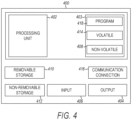
- FIG. 4 is a block diagram illustrating circuitry for a robotic system 400 for performing methods, according to example embodiments. All components need not be used in various embodiments.
- the robotic system may also be referred to as a computing device or a computer 400.
- One example robotic system 400 may include a processing unit 402, memory 403, removable storage 410, and non-removable storage 412.
- the processing unit 402 may comprise one or more processors (e.g., control circuitry) that execute instructions stored in memory 403 to realize the embodiments of FIGs. 1-3 .
- processors e.g., control circuitry
- the various data storage elements are illustrated as part of the robotic system 400, the storage may also or alternatively include cloud-based storage accessible via a network, such as the Internet or server based storage that is accessible over a wired or wireless channel.
- the memory 403 may include volatile memory 414 and non-volatile memory 408.
- the robotic system 400 may include, or have access to, a computing environment that includes a variety of computer-readable media, such as volatile memory 414 and non-volatile memory 408, removable storage 410 and non-removable storage 412.
- Computer storage includes random access memory (RAM), read only memory (ROM), erasable programmable read-only memory (EPROM) and electrically erasable programmable read-only memory (EEPROM), flash memory or other memory technologies, compact disc read-only memory (CD ROM), Digital Versatile Disks (DVD) or other optical disk storage, magnetic cassettes, magnetic tape, magnetic disk storage or other magnetic storage devices, or any other medium capable of storing computer-readable instructions.
- the robotic device 400 may include or have access to a computing environment that includes input 406, output 404, and a communication connection 416.
- the output 404 may include a display device, such as a touchscreen, that also may serve as an input device.
- the input 406 may include one or more of a touchscreen, touchpad, mouse, keyboard, camera, one or more device-specific buttons, one or more sensors integrated within or coupled via wired or wireless data connections to the robotic system 400, and other input devices.
- the computer may operate in a networked environment using the communication connection 416 to connect to one or more remote computers, such as database servers.
- the communication connection 416 may include any radios necessary to implement one or more radio access technologies.
- the remote computer may include a personal computer (PC), server, router, network PC, a peer device or other common network node, or the like.
- the communication connection may include a Local Area Network (LAN), a Wide Area Network (WAN), cellular, WiFi, Bluetooth, or other networks.
- Computer-readable instructions stored on a computer-readable medium are executable by the processing unit 402 of the computer 400.
- a hard drive, CD-ROM, and RAM are some examples of articles including a non-transitory computer-readable medium such as a storage device.
- the terms computer-readable medium and storage device do not include carrier waves to the extent carrier waves are deemed too transitory.
- the embodiments discloses herein provide multiple benefits over conventional object classification.
- the embodiments provide an automatic system that obtains object-level training data with only a minimum amount of manual annotation.
- Human supervision may only be used when an unknown object is introduced to the robot.
- the format of supervision is limited to providing associated object categories.
- the robotic system does not need complicated region-level annotation that may be very expensive for human to label.
- the robotic system also provides a scalable and effective solution for personalized and fine-grained object detection and recognition in home service robots. Compared with the conventional prior art solution of training category-level detectors, the robotic system is able to distinguish instance-level objects. Additionally, the conventional solution of training end-to-end deep object detection networks that treat each object instance as a single class, the proposed system has three major benefits: better scalability where a relatively smaller-capacity network can be used to detect category-level objects, while the end-to-end solution requires much higher-capacity networks to distinguish the many object instances; reduced computation such that when a new object instance is added, the network only needs to fine-tune or re-train the corresponding embedding network of the associated object category, while the end-to-end solution requires to fine-tune or re-train the entire end-to-end network; and reduced overfitting where the smaller-capacity network can be well trained using the small amount of noisy training data.
- a system for instance-level object recognition in a robotic system includes means for obtaining an image of an object from an imaging device and means for determining, through a category-level deep detection neural network, a pre-defined category of the object, of a plurality of predefined categories of objects, based on the image of the object and pre-defined category-level object images stored in the robotic system.
- the system further includes means for generating a feature map for the pre-defined category of the object determined by the category-level deep detection neural network and means for generating embedded features, based on the feature map, using an instance-level deep detection neural network corresponding to the pre-defined category of the object, wherein each pre-defined category of the plurality of predefined categories of objects comprises a corresponding different instance-level deep detection neural network.
- the system also includes means for recognizing an instance-level of the object based on classification of the embedded features and also means for performing a robotic operation by the robotic system based on the instance-level recognition of the object.
- the present embodiments combine three deep neural networks for obj ect detection and recognition in home service robots.
- the deep neural networks include a deep attention network for automatic training data acquisition, a deep detection neural network for category-level object detection, and a deep embedding network for fine-grained instance-level object recognition.
- the functions or algorithms described herein may be implemented in software in one embodiment.
- the software may consist of computer executable instructions stored on computer readable media or computer readable storage device such as one or more non-transitory memories or other type of hardware based storage devices, either local or networked.
- modules which may be software, hardware, firmware or any combination thereof. Multiple functions may be performed in one or more modules as desired, and the embodiments described are merely examples.
- the software may be executed on a digital signal processor, ASIC, microprocessor, or other type of processor operating on a computer system, such as a personal computer, server or other computer system, turning such computer system into a specifically programmed machine.
Landscapes
- Engineering & Computer Science (AREA)
- Theoretical Computer Science (AREA)
- General Physics & Mathematics (AREA)
- Physics & Mathematics (AREA)
- Computer Vision & Pattern Recognition (AREA)
- Evolutionary Computation (AREA)
- Artificial Intelligence (AREA)
- Multimedia (AREA)
- Data Mining & Analysis (AREA)
- General Health & Medical Sciences (AREA)
- Medical Informatics (AREA)
- Software Systems (AREA)
- Databases & Information Systems (AREA)
- Computing Systems (AREA)
- Health & Medical Sciences (AREA)
- Bioinformatics & Cheminformatics (AREA)
- Life Sciences & Earth Sciences (AREA)
- Bioinformatics & Computational Biology (AREA)
- Evolutionary Biology (AREA)
- General Engineering & Computer Science (AREA)
- Mechanical Engineering (AREA)
- Robotics (AREA)
- Image Analysis (AREA)
- Signal Processing (AREA)
Claims (20)
- Verfahren zur Objekterkennung auf Instanzebene in einem Robotersystem, wobei das Verfahren Folgendes umfasst:Erlangen (201) von mindestens einem Bild eines Objekts von einem bildgebenden Gerät;Bestimmen (203), durch ein neuronales Tiefendetektionsnetzwerk auf Kategorieebene (117), einer vordefinierten Kategorie des Objekts aus einer Vielzahl von vordefinierten Objektkategorien basierend auf dem mindestens einen Bild des Objekts und vordefinierten Objektbildern auf Kategorieebene, die in dem Robotersystem gespeichert sind;Generieren einer Merkmalskarte für das Objekt der vordefinierten Kategorie, die durch das neuronale Tiefendetektionsnetzwerk auf Kategorieebene (117) bestimmt wird;Generieren eingebetteter Merkmale basierend auf der Merkmalskarte unter Verwendung eines neuronalen Tiefendetektionsnetzwerks auf Instanzebene (119), das der vordefinierten Kategorie des Objekts entspricht, wobei jede vordefinierte Kategorie der Vielzahl von vordefinierten Objektkategorien ein entsprechendes anderes neuronales Tiefendetektionsnetzwerk auf Instanzebene umfasst;Erkennen einer Instanzebene des Objekts basierend auf der Klassifizierung der eingebetteten Merkmale; undDurchführen einer Roboteroperation durch das Robotersystem basierend auf der Erkennung des Objekts auf Instanzebene,wobei die Merkmalskarte eine vorwärtsberechnete Merkmalskarte einer letzten gemeinsam genutzten Schicht des neuronalen Tiefendetektionsnetzwerks auf Kategorieebene (117) und des neuronalen Tiefendetektionsnetzwerks auf Instanzebene (119) ist, die dem Objekt entsprechen.
- Verfahren nach Anspruch 1, wobei das Erlangen des mindestens einen Bildes des Objekts Erlangen einer Vielzahl von Bildern des Objekts umfasst, wobei jedes Bild aus einer anderen Perspektive und/oder unter anderen Lichtbedingungen erlangt wird.
- Verfahren nach Anspruch 2, das nach dem Schritt des Erlangens des mindestens einen Bildes des Objekts ferner Verwenden eines neuronalen Tiefenaufmerksamkeitsnetzwerks (105) zum Generieren einer Heatmap für jedes der Vielzahl von Bildern umfasst, welche die Objekte auf Kategorieebene in dem einen oder den mehreren Bildern hervorhebt.
- Verfahren nach Anspruch 3, wobei das Generieren der Heatmap Generieren eines Aufmerksamkeitswerts für jedes Pixel des einen oder der mehreren Bilder umfasst, wobei ein höherer Aufmerksamkeitswert einer höheren Wahrscheinlichkeit entspricht, dass das Pixel ein Vordergrundobjekt von Interesse ist.
- Verfahren nach Anspruch 4, ferner umfassend Generieren eines binären Objektmaskenbildes basierend auf der Heatmap, wobei Pixel mit Aufmerksamkeitswerten über einem Schwellenwert als ein erster logischer Zustand gekennzeichnet werden und alle anderen Pixel mit einem zweiten logischen Zustand gekennzeichnet werden, der dem ersten logischen Zustand entgegengesetzt ist.
- Verfahren nach Anspruch 5, ferner umfassend Extrahieren des Objekts der vordefinierten Kategorie aus dem Maskenbild basierend auf den als erster logischer Zustand gekennzeichneten Pixeln.
- Verfahren nach Anspruch 6, ferner umfassend Erweitern von Trainingsdaten, die aus einem kleinsten rechteckigen Rahmen generiert werden, der das extrahierte Objekt auf Kategorieebene enthält.
- Verfahren nach Anspruch 7, wobei das Generieren der erweiterten Trainingsdaten Folgendes umfasst:Entfernen von Bildpixeln, die dem extrahierten Objekt auf Kategorieebene entsprechen, aus dem Maskenbild; undEinbetten der entfernten Bildpixel in einen Satz von Hintergrundbildern, um einen Satz von Hintergrundbildern ohne das Objekt zu generieren, der als erweiterte Trainingsbilder zu verwenden ist.
- Verfahren nach Anspruch 8, ferner umfassend Trainieren des neuronalen Tiefenaufmerksamkeitsnetzwerks (105) anhand der vordefinierten Objektkategorien durch Vordefinieren von Objektkategorien, die in der Umgebung, in der das Robotersystem eingesetzt wird, üblich sind.
- Verfahren nach Anspruch 9, wobei das Trainieren des neuronalen Tiefenaufmerksamkeitsnetzwerks (105) ferner Generieren einer vorwärtsberechneten Merkmalskarte für jedes Objekt auf Kategorieebene umfasst.
- Verfahren nach Anspruch 10, wobei das Trainieren des neuronalen Tiefenaufmerksamkeitsnetzwerks (105) zum Erkennen des Objekts auf Instanzebene Folgendes umfasst:Generieren der eingebetteten Merkmale basierend auf der vorwärtsberechneten Merkmalskarte; undAnpassen der Objektdetektion auf Kategorieebene, um eine Erkennung des Objekts auf Instanzebene basierend auf den eingebetteten Merkmalen zu bestimmen.
- Robotersystem (400), umfassend:ein Bildgebungsgerät, das mit dem Roboter verbunden ist undderart positioniert ist, dass es Bilder von Objekten innerhalb eines Sichtfelds des Bildgebungsgeräts aufnimmt;einen Speicher (403), der Anweisungen und vordefinierte Kategorien von Objektbildern umfasst; undeinen oder mehrere Prozessoren (402), die mit dem Bildgebungsgerät und dem Speicher (403) verbunden sind und kommunizieren, wobei der eine oder die mehreren Prozessoren (402) die Anweisungen für Folgendes ausführen:Erlangen mindestens eines Bildes eines Objekts vom Bildgebungsgerät;Bestimmen, durch ein neuronales Tiefendetektionsnetzwerk auf Kategorieebene (117), einer vordefinierten Kategorie des Objekts aus der Vielzahl von vordefinierten Objektkategorien basierend auf dem mindestens einen Bild des Objekts und den vordefinierten Objektbildern auf Kategorieebene, die in dem Speicher gespeichert sind;Generieren einer Merkmalskarte für das Objekt der vordefinierten Kategorie, die durch das neuronale Tiefendetektionsnetzwerk auf Kategorieebene (117) bestimmt wird;Generieren eingebetteter Merkmale basierend auf der Merkmalskarte unter Verwendung eines neuronalen Tiefendetektionsnetzwerks auf Instanzebene (119), das der vordefinierten Kategorie des Objekts entspricht, wobei jede vordefinierte Kategorie der Vielzahl von vordefinierten Objektkategorien ein entsprechendes anderes neuronales Tiefendetektionsnetzwerk auf Instanzebene umfasst;Erkennen einer Instanzebene des Objekts basierend auf der Klassifizierung der eingebetteten Merkmale; undDurchführen einer Roboteroperation durch das Robotersystem basierend auf der Erkennung des Objekts auf Instanzebene,wobei die Merkmalskarte eine vorwärtsberechnete Merkmalskarte einer letzten gemeinsam genutzten Schicht des neuronalen Tiefendetektionsnetzwerks auf Kategorieebene (117) und des neuronalen Tiefendetektionsnetzwerks auf Instanzebene (119) ist, die dem Objekt entsprechen.
- System (400) nach Anspruch 12, wobei der eine oder die mehreren Prozessoren (402) ferner die Anweisungen ausführen, um ein neuronales Tiefenaufmerksamkeitsnetzwerk mit öffentlich verfügbaren Bildern oder vordefinierten Objekten vorab zu trainieren, bevor es in der Umgebung eingesetzt wird.
- System (400) nach Anspruch 13, wobei der eine oder die mehreren Prozessoren (402) ferner die Anweisungen ausführen, um die vordefinierten Objekte in der bestimmten Umgebung basierend auf automatisch erlangten neuen Trainingsdaten, die in der Umgebung erlangt wurden, zu detektieren.
- System (400) nach Anspruch 14, wobei der eine oder die mehreren Prozessoren (402) ferner die Anweisungen für Folgendes ausführen:Erlangen von Bildern der Objekte auf Instanzebene in der Umgebung, in der das Robotersystem eingesetzt wird; undÜbertragen der Bilder auf einen Server außerhalb der Umgebung, in der das Robotersystem eingesetzt wird, um das neuronale Tiefenaufmerksamkeitsnetzwerk derart zu optimieren, dass es Objekte auf Instanzebene der Objekte auf Kategorieebene erkennt.
- System (400) nach Anspruch 15, wobei der eine oder die mehreren Prozessoren (402) ferner die Anweisungen für Folgendes ausführen:Generieren eines Satzes von Hintergrundbildern, die das Objekt auf Kategorieebene nicht enthalten; undEinbetten segmentierter Vordergrundbilder in den Satz von Hintergrundbildern, um zusätzliche erweiterte Trainingsdaten zu generieren.
- System (400) nach Anspruch 16, wobei der eine oder die mehreren Prozessoren (402) ferner die Anweisungen ausführen, um die Hintergrundbilder zu verschiedenen Zeiten und an verschiedenen Orten in der Umgebung, in der das Robotersystem eingesetzt wird, zufällig abzutasten.
- Nichtflüchtiges computerlesbares Medium, auf dem Computeranweisungen für feinkörnige Objekterkennung in einem Robotersystem gespeichert sind, die bei Ausführung durch einen oder mehrere Prozessoren den einen oder die mehreren Prozessoren dazu veranlassen, die folgenden Schritte durchzuführen:Erlangen von mindestens einem Bild eines Objekts von einem bildgebenden Gerät;Bestimmen, durch ein neuronales Tiefendetektionsnetzwerk auf Kategorieebene (117), einer vordefinierten Kategorie des Objekts aus einer Vielzahl von vordefinierten Objektkategorien basierend auf dem mindestens einen Bild des Objekts und vordefinierten Objektbildern auf Kategorieebene, die in dem Robotersystem gespeichert sind;Generieren einer Merkmalskarte für das Objekt der vordefinierten Kategorie, die durch das neuronale Tiefendetektionsnetzwerk auf Kategorieebene (117) bestimmt wird;Generieren eingebetteter Merkmale basierend auf der Merkmalskarte unter Verwendung eines neuronalen Tiefendetektionsnetzwerks auf Instanzebene (119), das der vordefinierten Kategorie des Objekts entspricht, wobei jede vordefinierte Kategorie der Vielzahl von vordefinierten Objektkategorien ein entsprechendes anderes neuronales Tiefendetektionsnetzwerk auf Instanzebene umfasst;Erkennen einer Instanzebene des Objekts basierend auf der Klassifizierung der eingebetteten Merkmale; undDurchführen einer Roboteroperation durch das Robotersystem basierend auf der Erkennung des Objekts auf Instanzebene,wobei die Merkmalskarte eine vorwärtsberechnete Merkmalskarte einer letzten gemeinsam genutzten Schicht des neuronalen Tiefendetektionsnetzwerks auf Kategorieebene (117) und des neuronalen Tiefendetektionsnetzwerks auf Instanzebene (119) ist, die dem Objekt entsprechen.
- Nichtflüchtiges computerlesbares Medium nach Anspruch 18, wobei die ausgeführten Anweisungen den einen oder die mehreren Prozessoren dazu veranlassen, eine Begrenzungsrahmenanmerkung durchführen, indem sie einen kleinsten Rahmen bestimmen, der die Objekte auf Kategorieebene in einem zugehörigen Bild begrenzt.
- Nichtflüchtiges computerlesbares Medium nach Anspruch 19, wobei die ausgeführten Anweisungen den einen oder die mehreren Prozessoren ferner dazu veranlassen, Pixel in dem mindestens einen Bild, die außerhalb des kleinsten Rahmens liegen, als harte Hintergrundpixel zu behandeln.
Applications Claiming Priority (2)
| Application Number | Priority Date | Filing Date | Title |
|---|---|---|---|
| US15/449,541 US10322510B2 (en) | 2017-03-03 | 2017-03-03 | Fine-grained object recognition in robotic systems |
| PCT/CN2018/078019 WO2018157873A1 (en) | 2017-03-03 | 2018-03-05 | Fine-grained object recognition in robotic systems |
Publications (3)
| Publication Number | Publication Date |
|---|---|
| EP3501002A1 EP3501002A1 (de) | 2019-06-26 |
| EP3501002A4 EP3501002A4 (de) | 2019-08-14 |
| EP3501002B1 true EP3501002B1 (de) | 2024-10-02 |
Family
ID=63357156
Family Applications (1)
| Application Number | Title | Priority Date | Filing Date |
|---|---|---|---|
| EP18760373.3A Active EP3501002B1 (de) | 2017-03-03 | 2018-03-05 | Feinkörnige objekterkennung in robotersystemen |
Country Status (4)
| Country | Link |
|---|---|
| US (1) | US10322510B2 (de) |
| EP (1) | EP3501002B1 (de) |
| CN (1) | CN109643448B (de) |
| WO (1) | WO2018157873A1 (de) |
Families Citing this family (37)
| Publication number | Priority date | Publication date | Assignee | Title |
|---|---|---|---|---|
| JP6333871B2 (ja) * | 2016-02-25 | 2018-05-30 | ファナック株式会社 | 入力画像から検出した対象物を表示する画像処理装置 |
| US10242449B2 (en) | 2017-01-04 | 2019-03-26 | Cisco Technology, Inc. | Automated generation of pre-labeled training data |
| US10769491B2 (en) * | 2017-09-01 | 2020-09-08 | Sri International | Machine learning system for generating classification data and part localization data for objects depicted in images |
| US11559887B2 (en) * | 2017-09-20 | 2023-01-24 | Google Llc | Optimizing policy controllers for robotic agents using image embeddings |
| US10730181B1 (en) | 2017-12-27 | 2020-08-04 | X Development Llc | Enhancing robot learning |
| US11475291B2 (en) | 2017-12-27 | 2022-10-18 | X Development Llc | Sharing learned information among robots |
| US11017317B2 (en) * | 2017-12-27 | 2021-05-25 | X Development Llc | Evaluating robot learning |
| US11301733B2 (en) * | 2018-05-18 | 2022-04-12 | Google Llc | Learning data augmentation strategies for object detection |
| US10885395B2 (en) | 2018-06-17 | 2021-01-05 | Pensa Systems | Method for scaling fine-grained object recognition of consumer packaged goods |
| US10733480B2 (en) * | 2018-07-18 | 2020-08-04 | Adobe Inc. | Custom Auto Tagging of Multiple Objects |
| CN110942056A (zh) * | 2018-09-21 | 2020-03-31 | 深圳云天励飞技术有限公司 | 服饰关键点定位方法、装置、电子设备及介质 |
| WO2020082382A1 (en) * | 2018-10-26 | 2020-04-30 | Intel Corporation | Method and system of neural network object recognition for image processing |
| CN109711241B (zh) * | 2018-10-30 | 2021-07-20 | 百度在线网络技术(北京)有限公司 | 物体检测方法、装置与电子设备 |
| US10949635B2 (en) | 2019-04-11 | 2021-03-16 | Plus One Robotics, Inc. | Systems and methods for identifying package properties in an automated industrial robotics system |
| CN110059654A (zh) * | 2019-04-25 | 2019-07-26 | 台州智必安科技有限责任公司 | 一种基于细粒度识别的菜品自动结算及饮食健康管理方法 |
| US20200364442A1 (en) * | 2019-05-15 | 2020-11-19 | Getac Technology Corporation | System for detecting surface pattern of object and artificial neural network-based method for detecting surface pattern of object |
| CN110253581A (zh) * | 2019-06-25 | 2019-09-20 | 华北水利水电大学 | 一种基于视觉识别的辅助抓取方法 |
| US20210001488A1 (en) * | 2019-07-03 | 2021-01-07 | Dishcraft Robotics, Inc. | Silverware processing systems and methods |
| CN112184802B (zh) * | 2019-07-05 | 2023-10-20 | 杭州海康威视数字技术股份有限公司 | 标定框的调整方法、装置及存储介质 |
| JP7542802B2 (ja) * | 2019-07-25 | 2024-09-02 | 学校法人中部大学 | ニューラルネットワークを用いた画像認識装置および画像認識装置に用いられるプログラム |
| US11203116B2 (en) * | 2019-08-02 | 2021-12-21 | Teradyne, Inc. | System and method for predicting robotic tasks with deep learning |
| CN110503146B (zh) * | 2019-08-21 | 2021-12-14 | 杭州比智科技有限公司 | 数据增强方法、装置、计算设备及计算机存储介质 |
| WO2021040104A1 (ko) * | 2019-08-30 | 2021-03-04 | 엘지전자 주식회사 | 로봇 |
| US12118773B2 (en) | 2019-12-23 | 2024-10-15 | Sri International | Machine learning system for technical knowledge capture |
| US11087172B2 (en) * | 2019-12-31 | 2021-08-10 | Plus One Robotics, Inc. | Systems and methods for creating training data |
| JP7467157B2 (ja) * | 2020-02-19 | 2024-04-15 | キヤノン株式会社 | 学習装置、画像認識装置、学習方法、画像認識装置の制御方法およびプログラム |
| CN113706437B (zh) * | 2020-05-21 | 2024-03-15 | 国网智能科技股份有限公司 | 一种输电线路细粒度螺栓缺陷诊断方法及系统 |
| CN112070211B (zh) * | 2020-08-21 | 2024-04-05 | 北京科技大学 | 基于计算卸载机制的图像识别方法 |
| CN113723388B (zh) * | 2021-08-06 | 2023-12-29 | 盛视科技股份有限公司 | 一种基于x光图像的袋装垃圾分类检测方法 |
| EP4395965A4 (de) * | 2021-09-01 | 2025-07-30 | Mujin Inc | Robotersystem mit überlappungsverarbeitungsmechanismus und verfahren zum betrieb davon |
| US20240005701A1 (en) * | 2021-09-23 | 2024-01-04 | Intel Corporation | Methods and apparatus for team classification in sports analysis |
| CN113902901B (zh) * | 2021-09-30 | 2024-04-26 | 北京工业大学 | 一种基于轻量化检测的物体分离方法与系统 |
| CN114255476B (zh) * | 2021-12-07 | 2025-07-15 | 中原动力智能机器人有限公司 | 行人识别方法、装置、智能机器人及存储介质 |
| US20230241773A1 (en) * | 2022-01-28 | 2023-08-03 | Intrinsic Innovation Llc | Category-level manipulation from visual demonstration |
| CN115424086A (zh) * | 2022-07-26 | 2022-12-02 | 北京邮电大学 | 多视角的细粒度识别方法、装置、电子设备及介质 |
| TWI802496B (zh) * | 2022-08-24 | 2023-05-11 | 開必拓數據股份有限公司 | 用於檢測應用的自動正確取像及校準系統 |
| JP2024091177A (ja) * | 2022-12-23 | 2024-07-04 | 富士通株式会社 | 特定プログラム、特定方法および情報処理装置 |
Family Cites Families (8)
| Publication number | Priority date | Publication date | Assignee | Title |
|---|---|---|---|---|
| JPH0737087A (ja) | 1993-07-19 | 1995-02-07 | Matsushita Electric Ind Co Ltd | 画像処理装置 |
| CN100593172C (zh) * | 2008-04-18 | 2010-03-03 | 首都师范大学 | 一种基于显微图像的微生物识别系统及方法 |
| US9158965B2 (en) * | 2012-06-14 | 2015-10-13 | The Board Of Trustees Of The Leland Stanford Junior University | Method and system for optimizing accuracy-specificity trade-offs in large scale visual recognition |
| CN103955702B (zh) | 2014-04-18 | 2017-02-15 | 西安电子科技大学 | 基于深度rbf网络的sar图像地物分类方法 |
| US9665802B2 (en) * | 2014-11-13 | 2017-05-30 | Nec Corporation | Object-centric fine-grained image classification |
| US10572735B2 (en) | 2015-03-31 | 2020-02-25 | Beijing Shunyuan Kaihua Technology Limited | Detect sports video highlights for mobile computing devices |
| US9928448B1 (en) * | 2016-09-23 | 2018-03-27 | International Business Machines Corporation | Image classification utilizing semantic relationships in a classification hierarchy |
| US10262237B2 (en) * | 2016-12-08 | 2019-04-16 | Intel Corporation | Technologies for improved object detection accuracy with multi-scale representation and training |
-
2017
- 2017-03-03 US US15/449,541 patent/US10322510B2/en active Active
-
2018
- 2018-03-05 EP EP18760373.3A patent/EP3501002B1/de active Active
- 2018-03-05 CN CN201880003293.5A patent/CN109643448B/zh active Active
- 2018-03-05 WO PCT/CN2018/078019 patent/WO2018157873A1/en not_active Ceased
Also Published As
| Publication number | Publication date |
|---|---|
| CN109643448B (zh) | 2021-02-12 |
| US10322510B2 (en) | 2019-06-18 |
| WO2018157873A1 (en) | 2018-09-07 |
| US20180250826A1 (en) | 2018-09-06 |
| EP3501002A4 (de) | 2019-08-14 |
| EP3501002A1 (de) | 2019-06-26 |
| CN109643448A (zh) | 2019-04-16 |
Similar Documents
| Publication | Publication Date | Title |
|---|---|---|
| EP3501002B1 (de) | Feinkörnige objekterkennung in robotersystemen | |
| CN112001488B (zh) | 训练生成型对抗性网络 | |
| JP6330385B2 (ja) | 画像処理装置、画像処理方法およびプログラム | |
| Bautista et al. | Convolutional neural network for vehicle detection in low resolution traffic videos | |
| US20180157892A1 (en) | Eye detection method and apparatus | |
| US12217176B2 (en) | Automatic identification and classification of adversarial attacks | |
| GB2588538A (en) | Anti-spoofing | |
| CN110176024B (zh) | 在视频中对目标进行检测的方法、装置、设备和存储介质 | |
| CN111886600B (zh) | 一种用于图像的实例级别分割的设备和方法 | |
| GB2581626A (en) | Method and system for classifying an object-of-interest using an artificial neural network | |
| JP2018028899A5 (de) | ||
| EP2579184B1 (de) | Mobile Vorrichtung und Steuerungsverfahren dafür | |
| KR101753097B1 (ko) | 차량검출방법, 차량검출을 위한 데이터베이스의 구조, 및 차량검출을 위한 데이터베이스 구축방법 | |
| US20220261670A1 (en) | Methods of Processing and Generating Image Data in a Connectionist Network | |
| WO2017165332A1 (en) | 2d video analysis for 3d modeling | |
| US12073602B2 (en) | Automated key frame selection | |
| EP4035068B1 (de) | Merkmalsdetektor und deskriptor | |
| US20240104882A1 (en) | Universal visual correspondence imaging system and method | |
| KR20190102906A (ko) | 전자 장치 및 그 제어 방법 | |
| Song et al. | Background subtraction based on Gaussian mixture models using color and depth information | |
| AU2014277847A1 (en) | A method or computing device for configuring parameters of a feature extractor | |
| JP6103765B2 (ja) | 行動認識装置、方法及びプログラム並びに認識器構築装置 | |
| CN108345835A (zh) | 一种基于仿复眼感知的目标识别方法 | |
| JP4788525B2 (ja) | 物体識別パラメータ学習システム、物体識別パラメータ学習方法および物体識別パラメータ学習用プログラム | |
| Bekele et al. | Multi-attribute residual network (MAResNet) for soft-biometrics recognition in surveillance scenarios |
Legal Events
| Date | Code | Title | Description |
|---|---|---|---|
| STAA | Information on the status of an ep patent application or granted ep patent |
Free format text: STATUS: THE INTERNATIONAL PUBLICATION HAS BEEN MADE |
|
| PUAI | Public reference made under article 153(3) epc to a published international application that has entered the european phase |
Free format text: ORIGINAL CODE: 0009012 |
|
| STAA | Information on the status of an ep patent application or granted ep patent |
Free format text: STATUS: REQUEST FOR EXAMINATION WAS MADE |
|
| 17P | Request for examination filed |
Effective date: 20190320 |
|
| AK | Designated contracting states |
Kind code of ref document: A1 Designated state(s): AL AT BE BG CH CY CZ DE DK EE ES FI FR GB GR HR HU IE IS IT LI LT LU LV MC MK MT NL NO PL PT RO RS SE SI SK SM TR |
|
| AX | Request for extension of the european patent |
Extension state: BA ME |
|
| A4 | Supplementary search report drawn up and despatched |
Effective date: 20190716 |
|
| RIC1 | Information provided on ipc code assigned before grant |
Ipc: G06K 9/62 20060101ALI20190710BHEP Ipc: G06K 9/20 20060101ALI20190710BHEP Ipc: G06K 9/00 20060101ALI20190710BHEP Ipc: G06T 7/00 20170101AFI20190710BHEP Ipc: B25J 9/16 20060101ALI20190710BHEP Ipc: H04N 7/18 20060101ALI20190710BHEP Ipc: G06K 9/32 20060101ALI20190710BHEP |
|
| DAV | Request for validation of the european patent (deleted) | ||
| DAX | Request for extension of the european patent (deleted) | ||
| STAA | Information on the status of an ep patent application or granted ep patent |
Free format text: STATUS: EXAMINATION IS IN PROGRESS |
|
| 17Q | First examination report despatched |
Effective date: 20210211 |
|
| GRAP | Despatch of communication of intention to grant a patent |
Free format text: ORIGINAL CODE: EPIDOSNIGR1 |
|
| STAA | Information on the status of an ep patent application or granted ep patent |
Free format text: STATUS: GRANT OF PATENT IS INTENDED |
|
| RIC1 | Information provided on ipc code assigned before grant |
Ipc: G06F 18/2413 20230101ALI20240403BHEP Ipc: G06V 20/10 20220101ALI20240403BHEP Ipc: G06V 10/82 20220101ALI20240403BHEP Ipc: G06V 10/25 20220101ALI20240403BHEP Ipc: G06V 10/774 20220101ALI20240403BHEP Ipc: G06V 10/772 20220101ALI20240403BHEP Ipc: G06V 10/77 20220101ALI20240403BHEP Ipc: G06V 10/764 20220101ALI20240403BHEP Ipc: B25J 9/16 20060101ALI20240403BHEP Ipc: H04N 7/18 20060101ALI20240403BHEP Ipc: G06T 7/00 20170101AFI20240403BHEP |
|
| INTG | Intention to grant announced |
Effective date: 20240425 |
|
| GRAS | Grant fee paid |
Free format text: ORIGINAL CODE: EPIDOSNIGR3 |
|
| GRAA | (expected) grant |
Free format text: ORIGINAL CODE: 0009210 |
|
| STAA | Information on the status of an ep patent application or granted ep patent |
Free format text: STATUS: THE PATENT HAS BEEN GRANTED |
|
| AK | Designated contracting states |
Kind code of ref document: B1 Designated state(s): AL AT BE BG CH CY CZ DE DK EE ES FI FR GB GR HR HU IE IS IT LI LT LU LV MC MK MT NL NO PL PT RO RS SE SI SK SM TR |
|
| REG | Reference to a national code |
Ref country code: GB Ref legal event code: FG4D |
|
| REG | Reference to a national code |
Ref country code: CH Ref legal event code: EP |
|
| REG | Reference to a national code |
Ref country code: DE Ref legal event code: R096 Ref document number: 602018074947 Country of ref document: DE |
|
| REG | Reference to a national code |
Ref country code: IE Ref legal event code: FG4D |
|
| P01 | Opt-out of the competence of the unified patent court (upc) registered |
Free format text: CASE NUMBER: APP_53654/2024 Effective date: 20240926 |
|
| REG | Reference to a national code |
Ref country code: LT Ref legal event code: MG9D |
|
| REG | Reference to a national code |
Ref country code: NL Ref legal event code: MP Effective date: 20241002 |
|
| REG | Reference to a national code |
Ref country code: AT Ref legal event code: MK05 Ref document number: 1729025 Country of ref document: AT Kind code of ref document: T Effective date: 20241002 |
|
| PG25 | Lapsed in a contracting state [announced via postgrant information from national office to epo] |
Ref country code: NL Free format text: LAPSE BECAUSE OF FAILURE TO SUBMIT A TRANSLATION OF THE DESCRIPTION OR TO PAY THE FEE WITHIN THE PRESCRIBED TIME-LIMIT Effective date: 20241002 |
|
| PG25 | Lapsed in a contracting state [announced via postgrant information from national office to epo] |
Ref country code: NL Free format text: LAPSE BECAUSE OF FAILURE TO SUBMIT A TRANSLATION OF THE DESCRIPTION OR TO PAY THE FEE WITHIN THE PRESCRIBED TIME-LIMIT Effective date: 20241002 |
|
| PG25 | Lapsed in a contracting state [announced via postgrant information from national office to epo] |
Ref country code: IS Free format text: LAPSE BECAUSE OF FAILURE TO SUBMIT A TRANSLATION OF THE DESCRIPTION OR TO PAY THE FEE WITHIN THE PRESCRIBED TIME-LIMIT Effective date: 20250202 Ref country code: PT Free format text: LAPSE BECAUSE OF FAILURE TO SUBMIT A TRANSLATION OF THE DESCRIPTION OR TO PAY THE FEE WITHIN THE PRESCRIBED TIME-LIMIT Effective date: 20250203 Ref country code: HR Free format text: LAPSE BECAUSE OF FAILURE TO SUBMIT A TRANSLATION OF THE DESCRIPTION OR TO PAY THE FEE WITHIN THE PRESCRIBED TIME-LIMIT Effective date: 20241002 |
|
| PGFP | Annual fee paid to national office [announced via postgrant information from national office to epo] |
Ref country code: DE Payment date: 20250204 Year of fee payment: 8 |
|
| PG25 | Lapsed in a contracting state [announced via postgrant information from national office to epo] |
Ref country code: FI Free format text: LAPSE BECAUSE OF FAILURE TO SUBMIT A TRANSLATION OF THE DESCRIPTION OR TO PAY THE FEE WITHIN THE PRESCRIBED TIME-LIMIT Effective date: 20241002 |
|
| PG25 | Lapsed in a contracting state [announced via postgrant information from national office to epo] |
Ref country code: BG Free format text: LAPSE BECAUSE OF FAILURE TO SUBMIT A TRANSLATION OF THE DESCRIPTION OR TO PAY THE FEE WITHIN THE PRESCRIBED TIME-LIMIT Effective date: 20241002 |
|
| PG25 | Lapsed in a contracting state [announced via postgrant information from national office to epo] |
Ref country code: ES Free format text: LAPSE BECAUSE OF FAILURE TO SUBMIT A TRANSLATION OF THE DESCRIPTION OR TO PAY THE FEE WITHIN THE PRESCRIBED TIME-LIMIT Effective date: 20241002 |
|
| PG25 | Lapsed in a contracting state [announced via postgrant information from national office to epo] |
Ref country code: NO Free format text: LAPSE BECAUSE OF FAILURE TO SUBMIT A TRANSLATION OF THE DESCRIPTION OR TO PAY THE FEE WITHIN THE PRESCRIBED TIME-LIMIT Effective date: 20250102 |
|
| PG25 | Lapsed in a contracting state [announced via postgrant information from national office to epo] |
Ref country code: LV Free format text: LAPSE BECAUSE OF FAILURE TO SUBMIT A TRANSLATION OF THE DESCRIPTION OR TO PAY THE FEE WITHIN THE PRESCRIBED TIME-LIMIT Effective date: 20241002 Ref country code: AT Free format text: LAPSE BECAUSE OF FAILURE TO SUBMIT A TRANSLATION OF THE DESCRIPTION OR TO PAY THE FEE WITHIN THE PRESCRIBED TIME-LIMIT Effective date: 20241002 Ref country code: GR Free format text: LAPSE BECAUSE OF FAILURE TO SUBMIT A TRANSLATION OF THE DESCRIPTION OR TO PAY THE FEE WITHIN THE PRESCRIBED TIME-LIMIT Effective date: 20250103 |
|
| PG25 | Lapsed in a contracting state [announced via postgrant information from national office to epo] |
Ref country code: CZ Free format text: LAPSE BECAUSE OF FAILURE TO SUBMIT A TRANSLATION OF THE DESCRIPTION OR TO PAY THE FEE WITHIN THE PRESCRIBED TIME-LIMIT Effective date: 20241002 Ref country code: PL Free format text: LAPSE BECAUSE OF FAILURE TO SUBMIT A TRANSLATION OF THE DESCRIPTION OR TO PAY THE FEE WITHIN THE PRESCRIBED TIME-LIMIT Effective date: 20241002 |
|
| PG25 | Lapsed in a contracting state [announced via postgrant information from national office to epo] |
Ref country code: RS Free format text: LAPSE BECAUSE OF FAILURE TO SUBMIT A TRANSLATION OF THE DESCRIPTION OR TO PAY THE FEE WITHIN THE PRESCRIBED TIME-LIMIT Effective date: 20250102 |
|
| PG25 | Lapsed in a contracting state [announced via postgrant information from national office to epo] |
Ref country code: SM Free format text: LAPSE BECAUSE OF FAILURE TO SUBMIT A TRANSLATION OF THE DESCRIPTION OR TO PAY THE FEE WITHIN THE PRESCRIBED TIME-LIMIT Effective date: 20241002 |
|
| REG | Reference to a national code |
Ref country code: DE Ref legal event code: R097 Ref document number: 602018074947 Country of ref document: DE |
|
| PG25 | Lapsed in a contracting state [announced via postgrant information from national office to epo] |
Ref country code: DK Free format text: LAPSE BECAUSE OF FAILURE TO SUBMIT A TRANSLATION OF THE DESCRIPTION OR TO PAY THE FEE WITHIN THE PRESCRIBED TIME-LIMIT Effective date: 20241002 |
|
| PG25 | Lapsed in a contracting state [announced via postgrant information from national office to epo] |
Ref country code: EE Free format text: LAPSE BECAUSE OF FAILURE TO SUBMIT A TRANSLATION OF THE DESCRIPTION OR TO PAY THE FEE WITHIN THE PRESCRIBED TIME-LIMIT Effective date: 20241002 |
|
| PG25 | Lapsed in a contracting state [announced via postgrant information from national office to epo] |
Ref country code: RO Free format text: LAPSE BECAUSE OF FAILURE TO SUBMIT A TRANSLATION OF THE DESCRIPTION OR TO PAY THE FEE WITHIN THE PRESCRIBED TIME-LIMIT Effective date: 20241002 |
|
| PG25 | Lapsed in a contracting state [announced via postgrant information from national office to epo] |
Ref country code: SK Free format text: LAPSE BECAUSE OF FAILURE TO SUBMIT A TRANSLATION OF THE DESCRIPTION OR TO PAY THE FEE WITHIN THE PRESCRIBED TIME-LIMIT Effective date: 20241002 |
|
| PG25 | Lapsed in a contracting state [announced via postgrant information from national office to epo] |
Ref country code: IT Free format text: LAPSE BECAUSE OF FAILURE TO SUBMIT A TRANSLATION OF THE DESCRIPTION OR TO PAY THE FEE WITHIN THE PRESCRIBED TIME-LIMIT Effective date: 20241002 |
|
| PLBE | No opposition filed within time limit |
Free format text: ORIGINAL CODE: 0009261 |
|
| STAA | Information on the status of an ep patent application or granted ep patent |
Free format text: STATUS: NO OPPOSITION FILED WITHIN TIME LIMIT |
|
| PG25 | Lapsed in a contracting state [announced via postgrant information from national office to epo] |
Ref country code: SE Free format text: LAPSE BECAUSE OF FAILURE TO SUBMIT A TRANSLATION OF THE DESCRIPTION OR TO PAY THE FEE WITHIN THE PRESCRIBED TIME-LIMIT Effective date: 20241002 |
|
| 26N | No opposition filed |
Effective date: 20250703 |
|
| PG25 | Lapsed in a contracting state [announced via postgrant information from national office to epo] |
Ref country code: MC Free format text: LAPSE BECAUSE OF FAILURE TO SUBMIT A TRANSLATION OF THE DESCRIPTION OR TO PAY THE FEE WITHIN THE PRESCRIBED TIME-LIMIT Effective date: 20241002 |
|
| REG | Reference to a national code |
Ref country code: CH Ref legal event code: H13 Free format text: ST27 STATUS EVENT CODE: U-0-0-H10-H13 (AS PROVIDED BY THE NATIONAL OFFICE) Effective date: 20251023 |
|
| PG25 | Lapsed in a contracting state [announced via postgrant information from national office to epo] |
Ref country code: LU Free format text: LAPSE BECAUSE OF NON-PAYMENT OF DUE FEES Effective date: 20250305 |
|
| GBPC | Gb: european patent ceased through non-payment of renewal fee |
Effective date: 20250305 |
|
| REG | Reference to a national code |
Ref country code: BE Ref legal event code: MM Effective date: 20250331 |
|
| PG25 | Lapsed in a contracting state [announced via postgrant information from national office to epo] |
Ref country code: GB Free format text: LAPSE BECAUSE OF NON-PAYMENT OF DUE FEES Effective date: 20250305 |
|
| PG25 | Lapsed in a contracting state [announced via postgrant information from national office to epo] |
Ref country code: FR Free format text: LAPSE BECAUSE OF NON-PAYMENT OF DUE FEES Effective date: 20250331 |
|
| PG25 | Lapsed in a contracting state [announced via postgrant information from national office to epo] |
Ref country code: BE Free format text: LAPSE BECAUSE OF NON-PAYMENT OF DUE FEES Effective date: 20250331 |
|
| PG25 | Lapsed in a contracting state [announced via postgrant information from national office to epo] |
Ref country code: CH Free format text: LAPSE BECAUSE OF NON-PAYMENT OF DUE FEES Effective date: 20250331 |
|
| PG25 | Lapsed in a contracting state [announced via postgrant information from national office to epo] |
Ref country code: IE Free format text: LAPSE BECAUSE OF NON-PAYMENT OF DUE FEES Effective date: 20250305 |