EP3500167B1 - Erkennung der kalorienaufnahme durch verdauung - Google Patents
Erkennung der kalorienaufnahme durch verdauung Download PDFInfo
- Publication number
- EP3500167B1 EP3500167B1 EP17752116.8A EP17752116A EP3500167B1 EP 3500167 B1 EP3500167 B1 EP 3500167B1 EP 17752116 A EP17752116 A EP 17752116A EP 3500167 B1 EP3500167 B1 EP 3500167B1
- Authority
- EP
- European Patent Office
- Prior art keywords
- respiration
- respiration signal
- activity
- subject
- sensor
- Prior art date
- Legal status (The legal status is an assumption and is not a legal conclusion. Google has not performed a legal analysis and makes no representation as to the accuracy of the status listed.)
- Active
Links
Images



Classifications
-
- A—HUMAN NECESSITIES
- A61—MEDICAL OR VETERINARY SCIENCE; HYGIENE
- A61B—DIAGNOSIS; SURGERY; IDENTIFICATION
- A61B5/00—Measuring for diagnostic purposes; Identification of persons
- A61B5/103—Measuring devices for testing the shape, pattern, colour, size or movement of the body or parts thereof, for diagnostic purposes
- A61B5/11—Measuring movement of the entire body or parts thereof, e.g. head or hand tremor or mobility of a limb
- A61B5/113—Measuring movement of the entire body or parts thereof, e.g. head or hand tremor or mobility of a limb occurring during breathing
-
- A—HUMAN NECESSITIES
- A61—MEDICAL OR VETERINARY SCIENCE; HYGIENE
- A61B—DIAGNOSIS; SURGERY; IDENTIFICATION
- A61B5/00—Measuring for diagnostic purposes; Identification of persons
- A61B5/08—Measuring devices for evaluating the respiratory organs
- A61B5/0806—Measuring devices for evaluating the respiratory organs by whole-body plethysmography
-
- A—HUMAN NECESSITIES
- A61—MEDICAL OR VETERINARY SCIENCE; HYGIENE
- A61B—DIAGNOSIS; SURGERY; IDENTIFICATION
- A61B5/00—Measuring for diagnostic purposes; Identification of persons
- A61B5/08—Measuring devices for evaluating the respiratory organs
- A61B5/0816—Measuring devices for examining respiratory frequency
-
- A—HUMAN NECESSITIES
- A61—MEDICAL OR VETERINARY SCIENCE; HYGIENE
- A61B—DIAGNOSIS; SURGERY; IDENTIFICATION
- A61B5/00—Measuring for diagnostic purposes; Identification of persons
- A61B5/103—Measuring devices for testing the shape, pattern, colour, size or movement of the body or parts thereof, for diagnostic purposes
- A61B5/11—Measuring movement of the entire body or parts thereof, e.g. head or hand tremor or mobility of a limb
-
- A—HUMAN NECESSITIES
- A61—MEDICAL OR VETERINARY SCIENCE; HYGIENE
- A61B—DIAGNOSIS; SURGERY; IDENTIFICATION
- A61B5/00—Measuring for diagnostic purposes; Identification of persons
- A61B5/103—Measuring devices for testing the shape, pattern, colour, size or movement of the body or parts thereof, for diagnostic purposes
- A61B5/11—Measuring movement of the entire body or parts thereof, e.g. head or hand tremor or mobility of a limb
- A61B5/1118—Determining activity level
-
- A—HUMAN NECESSITIES
- A61—MEDICAL OR VETERINARY SCIENCE; HYGIENE
- A61B—DIAGNOSIS; SURGERY; IDENTIFICATION
- A61B5/00—Measuring for diagnostic purposes; Identification of persons
- A61B5/48—Other medical applications
- A61B5/4866—Evaluating metabolism
-
- A—HUMAN NECESSITIES
- A61—MEDICAL OR VETERINARY SCIENCE; HYGIENE
- A61B—DIAGNOSIS; SURGERY; IDENTIFICATION
- A61B5/00—Measuring for diagnostic purposes; Identification of persons
- A61B5/68—Arrangements of detecting, measuring or recording means, e.g. sensors, in relation to patient
- A61B5/6801—Arrangements of detecting, measuring or recording means, e.g. sensors, in relation to patient specially adapted to be attached to or worn on the body surface
- A61B5/683—Means for maintaining contact with the body
- A61B5/6831—Straps, bands or harnesses
-
- A—HUMAN NECESSITIES
- A61—MEDICAL OR VETERINARY SCIENCE; HYGIENE
- A61B—DIAGNOSIS; SURGERY; IDENTIFICATION
- A61B5/00—Measuring for diagnostic purposes; Identification of persons
- A61B5/72—Signal processing specially adapted for physiological signals or for diagnostic purposes
- A61B5/7203—Signal processing specially adapted for physiological signals or for diagnostic purposes for noise prevention, reduction or removal
- A61B5/7207—Signal processing specially adapted for physiological signals or for diagnostic purposes for noise prevention, reduction or removal of noise induced by motion artifacts
- A61B5/721—Signal processing specially adapted for physiological signals or for diagnostic purposes for noise prevention, reduction or removal of noise induced by motion artifacts using a separate sensor to detect motion or using motion information derived from signals other than the physiological signal to be measured
-
- A—HUMAN NECESSITIES
- A61—MEDICAL OR VETERINARY SCIENCE; HYGIENE
- A61B—DIAGNOSIS; SURGERY; IDENTIFICATION
- A61B5/00—Measuring for diagnostic purposes; Identification of persons
- A61B5/72—Signal processing specially adapted for physiological signals or for diagnostic purposes
- A61B5/7235—Details of waveform analysis
- A61B5/7264—Classification of physiological signals or data, e.g. using neural networks, statistical classifiers, expert systems or fuzzy systems
- A61B5/7267—Classification of physiological signals or data, e.g. using neural networks, statistical classifiers, expert systems or fuzzy systems involving training the classification device
-
- A—HUMAN NECESSITIES
- A61—MEDICAL OR VETERINARY SCIENCE; HYGIENE
- A61B—DIAGNOSIS; SURGERY; IDENTIFICATION
- A61B5/00—Measuring for diagnostic purposes; Identification of persons
- A61B5/103—Measuring devices for testing the shape, pattern, colour, size or movement of the body or parts thereof, for diagnostic purposes
- A61B5/11—Measuring movement of the entire body or parts thereof, e.g. head or hand tremor or mobility of a limb
- A61B5/113—Measuring movement of the entire body or parts thereof, e.g. head or hand tremor or mobility of a limb occurring during breathing
- A61B5/1135—Measuring movement of the entire body or parts thereof, e.g. head or hand tremor or mobility of a limb occurring during breathing by monitoring thoracic expansion
-
- A—HUMAN NECESSITIES
- A61—MEDICAL OR VETERINARY SCIENCE; HYGIENE
- A61B—DIAGNOSIS; SURGERY; IDENTIFICATION
- A61B5/00—Measuring for diagnostic purposes; Identification of persons
- A61B5/68—Arrangements of detecting, measuring or recording means, e.g. sensors, in relation to patient
- A61B5/6801—Arrangements of detecting, measuring or recording means, e.g. sensors, in relation to patient specially adapted to be attached to or worn on the body surface
- A61B5/6813—Specially adapted to be attached to a specific body part
- A61B5/6824—Arm or wrist
-
- G—PHYSICS
- G16—INFORMATION AND COMMUNICATION TECHNOLOGY [ICT] SPECIALLY ADAPTED FOR SPECIFIC APPLICATION FIELDS
- G16H—HEALTHCARE INFORMATICS, i.e. INFORMATION AND COMMUNICATION TECHNOLOGY [ICT] SPECIALLY ADAPTED FOR THE HANDLING OR PROCESSING OF MEDICAL OR HEALTHCARE DATA
- G16H50/00—ICT specially adapted for medical diagnosis, medical simulation or medical data mining; ICT specially adapted for detecting, monitoring or modelling epidemics or pandemics
- G16H50/70—ICT specially adapted for medical diagnosis, medical simulation or medical data mining; ICT specially adapted for detecting, monitoring or modelling epidemics or pandemics for mining of medical data, e.g. analysing previous cases of other patients
Definitions
- the present invention relates to a device, system and method for detecting caloric intake due to digestion.
- Caloric intake i.e. food/drink intake
- Food intake reporting is also a problem area in the field of elderly care. Additionally, it is relevant for new-born nutrition and some patients categories such as cancer patients, where malnutrition is a primary determinant of low survival.
- malnutrition is a primary determinant of low survival.
- it is at the moment not assessable via an unobtrusive effortless method. Users are asked to indicate when they ingest anything and often to detail what they ingest. This is a cumbersome and time-consuming procedure which suffers of underreporting and poor adherence.
- US 2015/080672 A1 discloses a wearable breathing sensor, such as a piezoelectric chest belt system, for generating a breathing signal that is analyzed by a classifier to identify apnea patterns indicating that the subject has swallowed during breathing. These breathing signals are computer-analyzed to extract inferences regarding the subject's eating and drinking patterns and thereby provide data for monitoring food or beverage intake for remote health monitoring.
- a wearable breathing sensor such as a piezoelectric chest belt system
- DONG BO ET AL "Wearable sensing for liquid intake monitoring via apnea detection in breathing signals” BIOMEDICAL ENGINEERING LETTERS, THE KOREAN SOCIETY OF MEDICAL AND BIOLOGICAL ENGINEERING, KOREA, vol. 4, no. 4, 11 October 2014 (2014-10-11), pages 378-387 , describes a system that works based on the observation that a person's otherwise continuous breathing process is interrupted by a short apnea when a swallow occurs as a part of the intake process and that detects the swallows via recognizing apneas extracted from breathing signal captured by a wearable sensor chest-belt.
- JOHN SMITH ET AL "Coordination of Eating, Drinking and Breathing in Adults", CHEST, vol. 96, no. 3, 1 September 1989 (1989-09-01), pages 578-582 , describes a study of the coordination of breathing and swallowing at rest as well as during eating and drinking. Ventilation was monitored using respiratory inductive plethysmography and swallowing was recorded by submental electromyogram.
- KAREN M. HIIEMAE ET AL "Eating and Breathing: Interactions Between Respiration and Feeding on Solid Food", DYSPHAGIA, vol. 18, no. 3, 1 August 2003 (2003-08-01), pages 169-178 , describes a study to determine how eating, especially bolus formation in the pharynx, affects respiration. Nasal air pressures, masseter electromyography (EMG), and videofluorography (VFG) were examined.
- EMG masseter electromyography
- VFG videofluorography
- a device for detecting caloric intake due to digestion is presented as defined in the independent claim 1.
- a computer program which comprises program code means for causing a computer to perform the steps of the method as claimed in claim 7 when said computer program is carried out on a computer.
- the present invention is based on the idea that more oxygen is needed when the caloric content of foods and/or drinks (i.e. regardless if solid or fluid) is broken down and oxidized to provide energy. Consequently, the living being breathes deeper (leading to increased amplitude) and/or faster (leading to increased frequency / decreased inter-breath intervals), which eventually determines an alteration in respiratory rate variability.
- This idea is exploited by the present invention to detect when caloric intake occurs by evaluating respiration signal features (in the frequency domain), in particular changes of such respiration signal features, which are related to changes in oxidation.
- respiration signal features in the frequency domain
- the commonly used user-dependent subjective food/drink intake self-report is thus replaced by an automatic unobtrusive approach based on respiration signal features, e.g. respiration patterns.
- respiration signal features shall be understood as a statistically or, more generally, a mathematically derived parameter, which describes a typical behavior present in the signal.
- respiration signal features are: the dominant frequency, the amplitude of the signal corresponding to the dominant frequency, mean distance between the breaths, the variance of the distances between the breaths, etc.
- the present invention does not require detecting swallowing events. Additionally, detecting swallowing would be confused by artifacts such as talking, coughing, etc. According to the present invention, these types of artifacts are filtered out. Different from US 2015/080672 A1 , the present invention looks into stable breathing patterns, which are representing how respiration is characterized over a certain period of time. This is an advantage compared to swallowing detection since the latter would always require high quality respiration waves in order to catheterize the morphology of the signal. According to the present invention the high accuracy morphology is not needed, even though it could optionally be used. Known methods look at swallowing and/or apnea events associated with caloric intake.
- respiration signal features are obtained from the respiration signal and an analysis unit is configured to determine one or more of the dominant frequency, the inter-breath interval length and amplitude of the respiration signal as one or more respiration signal features.
- said analysis unit is configured to use one or more feature thresholds for detecting changes of the one or more determined respiration signal features.
- one of more features values may be compared with thresholds to detect changes.
- the features thresholds may be determined in advance, e.g. through measurements or simulations.
- Feature thresholds may be defined in general for all subjects, or may be assigned to groups of subjects (e.g. according to criteria like weight, age, gender, health condition, etc.), or may even defined individually for a monitored subject (e.g. after a training phase of the system).
- said analysis unit is configured to select subsequent time windows, in particular overlapping time windows, of the obtained respiration signal for the analysis by the analysis unit and to detect changes of the one or more determined respiration signal features among selected subsequent time windows. In this way, changes of one or more respiration signal feature from one time window to the next time window are comparable in a better way.
- the device comprises an activity input for obtaining activity data indicating a subject's physical activity and said analysis unit is configured to select time windows for the analysis based on the activity data. Since activity may distort or tamper the respiration signal and the detection of respiration signal features, the activity data will help to select appropriate time windows in which the respiration signal is not distorted or tampered by subject activity (such as walking around or running).
- the analysis unit is thus configured to select time windows in which the activity data indicate no activity or an activity related to caloric food intake or an activity below a predetermined intensity. For instance, if the subject is sitting still or is only slowly moving the upper part of the body while sitting and eating, the activity data will indicate no or only low-level activity so that time windows of the respiration signal during such periods can be used for the analysis, while time windows during which the subject walks around in the room while eating will be excluded from the analysis.
- the analysis unit may also be configured to determine the duration of the time windows based on the intensity and duration of a detected activity.
- the physical activity e.g. through a physical activity classifier
- unreliable elevated respiration values non linkable to caloric intake can be removed.
- intensity and duration of the activity may be used to determine the level of hyperventilation (elevated respiration) and recovery time. Based on this information the duration of the time windows may be selected appropriately.
- respiration waves which may be distorted by coughing or speaking, may be removed.
- the analysis unit may be configured to determine the inter-breath interval length as one respiration signal feature and to detect a post-prandial period if the inter-breath interval length decreases.
- the dominant frequency may be used additionally or alternatively, i.e. said analysis unit may be configured to determine the dominant frequency as one respiration signal feature and to detect a post-prandial period if the dominant frequency increases.
- the respiration sensor comprises a wearable sensor, in particular a respiration belt, a wrist worn sensor, an ECG sensor, or a contact photoplethysmography sensor, or a remote sensor, in particular a remote photoplethysmography sensor or a camera.
- the respiration signal can be acquired by a contact or non-contact (remote) sensor.
- the system may further comprise an activity sensor, in particular an accelerometer or a remote camera, for acquiring activity data indicating a subject's physical activity.
- an activity sensor in particular an accelerometer or a remote camera
- Both the activity sensor and the respiration sensor may be integrated into a common user device worn by the subject.
- the user device may be a smartphone, wrist watch, etc., wherein appropriate sensors are additionally provided or existing sensors (e.g. the inertial sensor as commonly provided in a smartphone) may be used to acquire a respiration signal and/or activity data.
- Fig. 1 shows a schematic diagram of an embodiment of a system 1 and a device 10 for caloric intake detection of a subject 100.
- the system 1 comprises a respiration sensor 20 for detecting a subject's respiration and for generating a respiration signal 21 indicating the subject's respiration.
- the respiration sensor 10 is a wearable sensor that is worn at the subject's body, in this example a respiration belt (e.g. band holding a piezo element as sensor to monitor movements of the chest reflecting the subject's respiration).
- Other usable wearable sensors include a wrist worn sensor, an ECG sensor, or a contact photoplethysmography sensor.
- the system 1 further comprises a device 10 for caloric intake detection based on the generated respiration signal 21.
- the device 10 includes a respiration input 11 for obtaining (i.e. receiving or retrieving the respiration signal 21 indicating the subject's respiration as acquired by the respiration sensor 20.
- a respiration input 11 for obtaining (i.e. receiving or retrieving the respiration signal 21 indicating the subject's respiration as acquired by the respiration sensor 20.
- the respiration sensor 20 may be connected to the device 10 through wires (e.g. directly or via a computer network, such as a LAN) or in a wireless manner, e.g. a communication network (e.g. UMTS, LTE, etc.) or another wireless network (e.g. WiFi, Bluetooth, Zigbee, etc.).
- the respiration input 11 may thus e.g. be a corresponding data interface, such as a Bluetooth interface, a WiFi interface, a wired terminal, etc.
- the device 10 further comprises an analysis unit 12 for analyzing the obtained respiration signal 21 by determining one or more respiration signal features and detecting changes of the one or more determined respiration signal features to detect periods of caloric intake by the subject. This will be explained in more detail below, for instance with reference to Figs. 3 to 5 .
- the analysis unit 12 may e.g. be implemented in hard- and/or software, as one or more programmed processors or computers (e.g. a hospital workstation, a caregiver's PC, etc.) or as an application running on a user device (e.g. a smartphone, laptop, tablet, etc.).
- the device 10 may further comprise an output 13 for issuing a caloric intake information that indicates detected information about the subject's caloric intake, such as the number and periods of intake within a certain time frame (e.g. during a whole day) or eating behaviors (e.g. eating frequency).
- the output 13 may e.g. an output interface for communicating the caloric intake information, to a remote destination, e.g. a nurse's user device, a central supervision monitor, etc., or may be a user interface, like a display and/or loudspeaker, that directly issues (visible and/or audible) the caloric intake information, e.g. as a table or diagram.
- an alarm notice may be issued if it is found that the caloric intake, e.g. of an elderly person or a patient, was much too low over a certain period so that e.g. a caregiver is notified to take care of this situation.
- Fig. 2 shows a schematic diagram of an embodiment of a system 2 and a device 30 according to the present invention.
- the system 2 comprises a remote sensor 22 as respiration sensor, in particular a camera for acquiring video data of the subject 100. From the movements of the chest or belly area extracted from the video data in a commonly known way (e.g. by image processing methods) a respiration signal 23 can be derived that is provided to the respiration input 11 of the device 30.
- the system 2 comprises an activity sensor 40, in this example an accelerometer mounted to the subject's upper body (e.g. by a chest belt) for acquiring activity data 41 indicating a subject's physical activity.
- the activity sensor 40 may be mounted to other body portions, e.g. an arm, a leg, etc., or may be of a different type.
- the video data 23 acquired by the camera 22 may also be used as activity data to detect physical activity of the subject 100.
- the device 30 comprises an activity input 14 for obtaining (i.e. receiving or retrieving) the activity data 41.
- the analysis unit 12 is configured to select time windows for the analysis based on the activity data 41, i.e. to select portion of the respiration signal 21 at which the subject's activity does not or not substantially distort or tamper the respiration signal 21. This improves the accuracy of the caloric intake detection.
- a continuous unobtrusive respiration signal may be used, which can be collected by means of one or more unobtrusive wearable (s) (e.g. of a piezo respiration band, PPG watch) as well as one or more contactless sensor(s) (e.g. vital signs camera) is used here to quantify the oxygen need of a living being which is correlated with the caloric intake of the living being.
- unobtrusive wearable e.g. of a piezo respiration band, PPG watch
- contactless sensor(s) e.g. vital signs camera
- respiration is generally seen as a periodic wave signal.
- Known methods need to identify an interruption of the periodicity, generated for example by an apnea due to ingestion (in the time domain).
- Known methods are limited by the fact that apneas can be generated by several other behaviors.
- the present invention looks instead at the frequency domain, following the principle that caloric intake produced increases oxygen need.
- the consequent increases in O 2 intake is mainly achieved by a combination of changes in respiration frequency (faster), amplitude (greater), and variability in general (variability takes into account both frequency and amplitude changes). It is noted that higher O 2 demand is also induced by exercise, which is the reason why it is preferred to detect these episodes and understand when full recovery has been achieved.
- caloric intake can increase oxidation, because the body has to burn the food/drinks ingested or expend oxygen to build new protein.
- Non-caloric intake does not affect oxidation. In fact, this is a clear advantage over known approaches, which cannot recognize the difference between swallowing saliva, water, etc. from caloric intake by consumption of food and/or drinks.
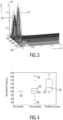
- Fig. 3 shows a diagram illustrating a running spectral analysis of a respiration signal of a single subject in a pre-prandial and post-prandial phase.
- the diagram shows the power amplitude P over the frequency f at different moments in time.
- P the respiration spectral signal
- the respiration spectral signal can differ from before having consumed a meal (curves 50) to immediately after (curves 51) and again to 3 hours after the meal (curves 52).
- curves 52 were acquired with a piezo respiration band.
- This figure thus clearly proofs that the eating period can be identified.
- the difference in signal amplitude between the peak (in curve 51) and the preceding interval (curve 50) is clearly visible. By comparing these two segments it can be determined that caloric intake happened in the time frame between the time at which the respiration signal represented by curve 50 and the time at which the respiration signal represented by curve 51 have been acquired.
- respiration signal features which detect intake, are dominant frequency and respiration variability, in this case inter-breath intervals.
- a "stable breathing pattern” means respiration that is far enough from significant physical activity moments which would alter the metabolic rate.
- the level of physical activity and the duration of its effect on the metabolic rate and the respiration can e.g. be easily modeled by using a motion sensor (e.g. accelerometer).
- a motion sensor e.g. accelerometer
- the analysis of the respiration signal applied according to the present invention ill not take the input into account.
- the motion is below a certain threshold, given the motion history in terms of bout intensity and duration (which determine the time constant), the analysis will be kept on hold until the time constant determines that the effect of the activity bout over the metabolic rate and respiration is ceased.
- Fig. 4 shows a diagram illustrating the dominant frequency of a respiration signal of a subject in a pre-prandial and post-prandial phase.
- Fig. 4 particularly shows how the dominant frequency increases with digestion. These data are based on 10 subjects who had different meals ranging from 300 kcal to 900 kcal. Results are normalized for pre-meal values.
- the horizontal lines 60, 61, 62 represent the median values of the dominant frequency distributions, the boxes 63, 64 represent the standard deviations and the crosses 65 represent the outliers. As can be seen, the dominant frequency significantly increases after the meal.
- Fig. 5 shows a diagram illustrating the inter-breath interval of a subject in a pre-prandial and post-prandial phase.
- Fig. 5 particularly shows how the inter-breath interval (IBI) decreases with digestion.
- IBI inter-breath interval
- the digestive process starts in the mouth at the time when food and/or drinks are ingested.
- Caloric intake triggers an increase in the oxidative processes, which as a consequence increases oxygen uptake.
- respiration signal features in particular changes of the respiration signal in the frequency domain that are related to an increase in oxidation allowing the conclusion that caloric intake of the subject started by ingesting food and/or drinks. This can particularly be determined from time course variations of respiration signal features in the frequency domain, i.e. by monitoring the respiration signal in the frequency domain over time.
- Fig. 6 shows a schematic diagram of a third embodiment of a system 3 and a device 80 according to the present invention and corresponding signals.
- the respiration input 11 and the activity input 14 are omitted in this diagram, but the device 80 only shows the elements of the analysis unit 12 as provided in this embodiment.
- the activity classifier 81 classifies if the change in the IBI is due to a previously done physical activity, as retrieved from the activity data 41, allowing the exclusion of the subsequent time window of the respiration signal 21 from the analysis process.
- the size of the time window is chosen according to the intensity and duration of the physical activity done.
- the activity classifier 81 allows also selecting segments of the respiration signal 21 when it is stable (e.g. subject is not moving, for instance during sitting activities).
- the raw respiration signal 90 may undergo cleaning processing in a cleaning signal processing unit 82, which may include a filter 83 and a concealing unit 84 for filtering and concealing it to obtain a cleaned respiration signal 91.
- a feature extraction unit 85 one or more respiration signal features 92 are extracted from the cleaned respiration signal 91.
- a classifier 86 is provided for classification into food intake or no food intake in a certain time window.
- respiration signal may be a separate element to conceal respiration signal when this is influenced by physical activity about a certain threshold.
- a simple embodiment for the classifier 86 is a threshold driven detection: when the respiration signal feature is above a certain threshold (absolute or depending from the previous period not influenced by food intake or physical activity) the current analyzed time window is classified as subsequent a food intake event.
- the classifier 86 is implemented using a machine learning technique (e.g. a support vector machine) that can detect the food intake events from more than one respiration signal feature.
- the activity classifier 81 can help to quantify the amount of respiration signal due to the activity and filter/remove it without discharge of part of the recordings.
- Fig. 7 shows a flow chart of a first part of an embodiment of a method according to the present invention
- Fig. 8 shows a flow chart of a second part of an embodiment of a method according to the present invention.
- step S10 a measurement of the respiration signal 21 is made, of which a portion S (e.g. of 3.5 min) is treated in the next steps.
- steps S11 and S12 a short term activity signal 41a and a long term activity signal 41b are measured, which are used to detect in step S13 if an activity took place in the last X minutes and if a vigorous activity took place in the last X+Y minutes. If this is the case, the method proceeds to step S14, in which the method goes to the next portion S of the respiration signal 21, which is obtained in step S10. Otherwise, the method proceeds to step S15.
- step S15 the portion S is segmented into segments S w , e.g. subsequent windows of 10 s with 5 s overlap.
- step S16 it is checked if the segments S w are stable / not flat, e.g. by checking 25% std (S) ⁇ std(S w ) ⁇ 75% std(S) (std meaning the standard deviation).
- step S17 it is checked if the number of stable / not flat segments S w is greater than a predetermined number. If this is the case, the respiration signal features for the portion S are calculated in step S18, which are then stored in a features memory in step S19. The method then proceeds to step S14. If the check in step S17 is negative, the method directly proceeds to step S14.
- step S21 the features at the second time t2 are different from the features at the first time t1 (with a certain margin). If this is not the case, it is assumed in step S22 that there is no food intake between t1 and t2. If this is the case, it is assumed in step S23 that there is food intake between t1 and t2.
- steps S24 and S25 the first and second times t1, t2 are shifted, e.g. by (t2-t1)/2, and the method proceeds with step S20. Further, in both cases, following steps S22 and S23 it is checked in step S26 if there is another equal detection in an adjacent segment S. In the positive case, the adjacent food intake detections are grouped together in step S27, which is then stored in a food intake detections memory in step S28. In the negative case, the food intake detection is directly stored in the food intake detections memory in step S28. This ends the method.
- respiration a physiological signal
- a respiration signal contains a series of features such as dominant frequency and respiration variability derived feature, which are related to the increased oxygen need due to digestion. Respiration data is processed appropriately in order to extract such features.
- the respiration signal may be filtered to remove motion and other artifacts and unreliable parts of it may be concealed by means of an activity classifier.
- the respiration signal is used to see if from the relevant food/drink intake features such as increased in frequency and/or change in respiratory variability, intake is detected.
- the present invention can be used in many fields of application, including weight management programs, undernutrition in patients and undernutrition in elderly people.
- a computer program may be stored/distributed on a suitable non-transitory medium, such as an optical storage medium or a solid-state medium supplied together with or as part of other hardware, but may also be distributed in other forms, such as via the Internet or other wired or wireless telecommunication systems.
- a suitable non-transitory medium such as an optical storage medium or a solid-state medium supplied together with or as part of other hardware, but may also be distributed in other forms, such as via the Internet or other wired or wireless telecommunication systems.
Landscapes
- Health & Medical Sciences (AREA)
- Life Sciences & Earth Sciences (AREA)
- Engineering & Computer Science (AREA)
- Physics & Mathematics (AREA)
- Animal Behavior & Ethology (AREA)
- Veterinary Medicine (AREA)
- Biophysics (AREA)
- Pathology (AREA)
- Public Health (AREA)
- Biomedical Technology (AREA)
- Heart & Thoracic Surgery (AREA)
- Medical Informatics (AREA)
- Molecular Biology (AREA)
- Surgery (AREA)
- General Health & Medical Sciences (AREA)
- Physiology (AREA)
- Artificial Intelligence (AREA)
- Pulmonology (AREA)
- Signal Processing (AREA)
- Dentistry (AREA)
- Oral & Maxillofacial Surgery (AREA)
- Psychiatry (AREA)
- Computer Vision & Pattern Recognition (AREA)
- Obesity (AREA)
- Hematology (AREA)
- Evolutionary Computation (AREA)
- Fuzzy Systems (AREA)
- Mathematical Physics (AREA)
- Measurement Of The Respiration, Hearing Ability, Form, And Blood Characteristics Of Living Organisms (AREA)
- Investigating Or Analysing Biological Materials (AREA)
Claims (8)
- Vorrichtung (10, 30, 80) zum Erkennen von Kalorienaufnahme aufgrund von Verdauung, wobei die Vorrichtung umfasst:- einen Atmungseingang (11) zum Erhalten eines Atmungssignals, das die Atmung der Person angibt,- einen Aktivitätseingang (14) zum Erhalten von Aktivitätsdaten, welche die körperliche Aktivität einer Person angeben,- eine Analyseeinheit (12) zum Analysieren des erhaltenen Atmungssignals durchAuswählen von Zeitfenstern des erhaltenen Atmungssignals für die Analyse auf Grundlage der Aktivitätsdaten, wobei die Aktivitätsdaten keine Aktivität oder eine auf Kalorienaufnahme bezogene Aktivität oder eine Aktivität unterhalb einer vorbestimmten Intensität angeben,Bestimmen von einem oder mehreren aus dominanter Frequenz, Länge des Intervalls zwischen den Atemzügen und Amplitude des Atmungssignals als Atmungssignalmerkmale aus dem erhaltenen Atmungssignal,Erkennen einer oder mehrerer Änderungen des einen oder der mehreren bestimmten Atmungssignalmerkmale im Laufe der Zeit, undErkennen eines Zeitraums als Zeitraum von Kalorienaufnahme aufgrund der Verdauung durch die Person, wenn während des Zeitraums erkannt wurde, dass die dominante Frequenz zunimmt, die Länge des Intervalls zwischen den Atemzügen abnimmt und/oder die Amplitude des Atmungssignals zunimmt.
- Vorrichtung nach Anspruch 1,
wobei die Analyseeinheit (12) konfiguriert ist, um einen oder mehrere Merkmalsschwellen zum Erkennen von Änderungen des einen oder der mehreren bestimmten Atmungssignalmerkmale zu verwenden. - Vorrichtung nach Anspruch 1,
wobei die Analyseeinheit (12) konfiguriert ist, um aufeinanderfolgende Zeitfenster, insbesondere überlappende Zeitfenster, des erhaltenen Atmungssignals für die Analyse durch die Analyseeinheit auszuwählen, und Änderungen des einen oder der mehreren bestimmten Atmungssignalmerkmale unter ausgewählten aufeinanderfolgenden Zeitfenstern zu erkennen. - Vorrichtung nach Anspruch 1,
wobei die Analyseeinheit (12) konfiguriert ist, um die Dauer der Zeitfenster auf Grundlage der Intensität und Dauer einer erkannten Aktivität zu bestimmen. - System zur Erkennung von Kalorienaufnahme, wobei das System umfasst:- einen Atmungssensor (20, 22) zum Erkennen der Atmung einer Person und zum Erzeugen eines Atmungssignals, das die Atmung der Person angibt, und- einen Aktivitätssensor (40), insbesondere einen Beschleunigungsmesser oder eine Fernkamera, zum Erfassen von Aktivitätsdaten, welche die körperliche Aktivität einer Person angeben,- eine Vorrichtung (10, 30, 80) nach einem der Ansprüche 1 bis 4, zur Erkennung von Kalorienaufnahme auf Grundlage des generierten Atmungssignals und der erfassten Aktivitätsdaten.
- System nach Anspruch 5,
wobei der Atmungssensor (20, 22) einen tragbaren Sensor, insbesondere einen Atemgürtel, einen am Handgelenk getragenen Sensor, einen EKG-Sensor oder einen Kontakt-Photoplethysmographie-Sensor, oder einen Fernsensor, insbesondere einen Fern-Photoplethysmographie-Sensor oder eine Kamera, umfasst. - Verfahren zur Verwendung durch einen Computer, Prozessor oder eine Vorrichtung nach einem der Ansprüche 1 bis 4 zur automatischen Erkennung von Kalorienaufnahme aufgrund der Verdauung, wobei das Verfahren umfasst:- Erhalten eines Atmungssignals, das die Atmung der Person angibt,- Erhalten von Aktivitätsdaten, welche die körperliche Aktivität einer Person angeben,- Analysieren des erhaltenen Atmungssignals durchAuswählen von Zeitfenstern des erhaltenen Atmungssignals für die Analyse auf Grundlage der Aktivitätsdaten, wobei die Aktivitätsdaten keine Aktivität oder eine auf Kalorienaufnahme bezogene Aktivität oder eine Aktivität unterhalb einer vorbestimmten Intensität angeben,Bestimmen von einem oder mehreren aus dominanter Frequenz, Länge des Intervalls zwischen den Atemzügen und Amplitude des Atmungssignals als Atmungssignalmerkmale aus dem erhaltenen Atmungssignal,Erkennen einer oder mehrerer Änderungen des einen oder der mehreren bestimmten Atmungssignalmerkmale im Laufe der Zeit, undErkennen eines Zeitraums als Zeitraum von Kalorienaufnahme aufgrund der Verdauung durch die Person, wenn während des Zeitraums erkannt wurde, dass die dominante Frequenz zunimmt, die Länge des Intervalls zwischen den Atemzügen abnimmt und/oder die Amplitude des Atmungssignals zunimmt.
- Computerprogramm, umfassend Programmcodemittel, um einen Computer zu veranlassen, die Schritte des Verfahrens nach Anspruch 7 auszuführen, wenn das Computerprogramm auf dem Computer ausgeführt wird.
Applications Claiming Priority (2)
| Application Number | Priority Date | Filing Date | Title |
|---|---|---|---|
| EP16184732 | 2016-08-18 | ||
| PCT/EP2017/070549 WO2018033504A1 (en) | 2016-08-18 | 2017-08-14 | Device, system and method for caloric intake detection |
Publications (3)
| Publication Number | Publication Date |
|---|---|
| EP3500167A1 EP3500167A1 (de) | 2019-06-26 |
| EP3500167C0 EP3500167C0 (de) | 2024-06-26 |
| EP3500167B1 true EP3500167B1 (de) | 2024-06-26 |
Family
ID=56740915
Family Applications (1)
| Application Number | Title | Priority Date | Filing Date |
|---|---|---|---|
| EP17752116.8A Active EP3500167B1 (de) | 2016-08-18 | 2017-08-14 | Erkennung der kalorienaufnahme durch verdauung |
Country Status (4)
| Country | Link |
|---|---|
| US (1) | US11832935B2 (de) |
| EP (1) | EP3500167B1 (de) |
| CN (1) | CN109862828B (de) |
| WO (1) | WO2018033504A1 (de) |
Families Citing this family (1)
| Publication number | Priority date | Publication date | Assignee | Title |
|---|---|---|---|---|
| JP2020106318A (ja) * | 2018-12-26 | 2020-07-09 | メディカルフォトニクス株式会社 | 吸収カロリー計測装置、吸収カロリー計測方法、及び、吸収カロリー計測プログラム |
Family Cites Families (12)
| Publication number | Priority date | Publication date | Assignee | Title |
|---|---|---|---|---|
| WO2006033104A1 (en) | 2004-09-22 | 2006-03-30 | Shalon Ventures Research, Llc | Systems and methods for monitoring and modifying behavior |
| AU2007256872B2 (en) * | 2006-06-01 | 2013-03-14 | Resmed Sensor Technologies Limited | Apparatus, system, and method for monitoring physiological signs |
| EP2142095A1 (de) * | 2007-05-02 | 2010-01-13 | Earlysense Ltd. | Überwachung, vorhersage und behandlung von klinischen episoden |
| US9198621B2 (en) * | 2007-06-18 | 2015-12-01 | University of Pittsburgh—of the Commonwealth System of Higher Education | Method, apparatus and system for food intake and physical activity assessment |
| WO2009131664A2 (en) * | 2008-04-21 | 2009-10-29 | Carl Frederick Edman | Metabolic energy monitoring system |
| FR2940038A1 (fr) | 2008-12-22 | 2010-06-25 | Rbi | Procede et systeme de surveillance de la deglutition |
| JP5302289B2 (ja) * | 2009-12-18 | 2013-10-02 | 韓國電子通信研究院 | 携帯型消費熱量測定装置 |
| CN102114321B (zh) * | 2009-12-31 | 2013-05-01 | 孙大力 | 用于深呼吸训练的设备 |
| WO2013138071A1 (en) * | 2012-03-15 | 2013-09-19 | Board Of Trustees Of Michigan State University | Food intake monitoring system using apnea detection in breathing signals |
| US20160232811A9 (en) * | 2012-06-14 | 2016-08-11 | Robert A. Connor | Eyewear System for Monitoring and Modifying Nutritional Intake |
| US20150148632A1 (en) * | 2013-11-26 | 2015-05-28 | David Alan Benaron | Calorie Monitoring Sensor And Method For Cell Phones, Smart Watches, Occupancy Sensors, And Wearables |
| CA2996475A1 (en) | 2014-09-12 | 2016-03-17 | Blacktree Fitness Technologies Inc. | Portable devices and methods for measuring nutritional intake |
-
2017
- 2017-08-14 WO PCT/EP2017/070549 patent/WO2018033504A1/en not_active Ceased
- 2017-08-14 CN CN201780050587.9A patent/CN109862828B/zh active Active
- 2017-08-14 US US16/323,982 patent/US11832935B2/en active Active
- 2017-08-14 EP EP17752116.8A patent/EP3500167B1/de active Active
Also Published As
| Publication number | Publication date |
|---|---|
| CN109862828A (zh) | 2019-06-07 |
| EP3500167C0 (de) | 2024-06-26 |
| US11832935B2 (en) | 2023-12-05 |
| EP3500167A1 (de) | 2019-06-26 |
| CN109862828B (zh) | 2022-07-26 |
| WO2018033504A1 (en) | 2018-02-22 |
| US20190167154A1 (en) | 2019-06-06 |
Similar Documents
| Publication | Publication Date | Title |
|---|---|---|
| US12236767B2 (en) | Machine learning based monitoring system | |
| CN111246798B (zh) | 呼吸紊乱的自动检测 | |
| US11510613B2 (en) | Biological condition determining apparatus and biological condition determining method | |
| JP6149515B2 (ja) | 検知方法,検知装置および検知プログラム | |
| Wang et al. | Unconstrained video monitoring of breathing behavior and application to diagnosis of sleep apnea | |
| US9336594B2 (en) | Cardiac pulse rate estimation from source video data | |
| US11547298B2 (en) | Abnormality determination apparatus and non-transitory computer readable medium storing program | |
| US20140330132A1 (en) | Physiological characteristic detection based on reflected components of light | |
| EP3504649B1 (de) | Vorrichtung, system und verfahren zur patientenüberwachung zur vorhersage und verhinderung von bettstürzen | |
| WO2013166341A1 (en) | Physiological characteristic detection based on reflected components of light | |
| US10959662B2 (en) | Seizure prediction using cardiovascular features | |
| CN109997178A (zh) | 用于提醒紧急服务的计算机系统 | |
| Peng et al. | Multimodality sensor system for long-term sleep quality monitoring | |
| Grifantini | How's My Sleep?: Personal sleep trackers are gaining in popularity, but their accuracy is still open to debate | |
| US20250302378A1 (en) | Method for monitoring the sleep of a user, and corresponding monitoring device and computer program | |
| JP2020506770A (ja) | 心房細動を検出するための方法及びシステム | |
| Carter et al. | SleepVST: Sleep staging from near-infrared video signals using pre-trained transformers | |
| JP7419904B2 (ja) | 生体モニタ装置、生体モニタ方法及びプログラム | |
| Pouyan et al. | Sleep state classification using pressure sensor mats | |
| US11832935B2 (en) | Device, system and method for caloric intake detection | |
| CN117729879A (zh) | 用于确定与对象的心血管系统有关的健康信息的设备、系统和方法 | |
| EP4033495B1 (de) | System und verfahren zur beurteilung von verhaltensaufgaben | |
| EP3970127A1 (de) | Kontaktlose identifizierung von schlaf- und wachperioden für die altenpflege | |
| WO2024224135A1 (en) | System for identifying respiratory suffering from faciae imaging on a patient, and method using said device | |
| EP3838120A1 (de) | Auf pharmakologischer annotation basierende schlafqualitätserfassung |
Legal Events
| Date | Code | Title | Description |
|---|---|---|---|
| STAA | Information on the status of an ep patent application or granted ep patent |
Free format text: STATUS: UNKNOWN |
|
| STAA | Information on the status of an ep patent application or granted ep patent |
Free format text: STATUS: THE INTERNATIONAL PUBLICATION HAS BEEN MADE |
|
| PUAI | Public reference made under article 153(3) epc to a published international application that has entered the european phase |
Free format text: ORIGINAL CODE: 0009012 |
|
| STAA | Information on the status of an ep patent application or granted ep patent |
Free format text: STATUS: REQUEST FOR EXAMINATION WAS MADE |
|
| 17P | Request for examination filed |
Effective date: 20190318 |
|
| AK | Designated contracting states |
Kind code of ref document: A1 Designated state(s): AL AT BE BG CH CY CZ DE DK EE ES FI FR GB GR HR HU IE IS IT LI LT LU LV MC MK MT NL NO PL PT RO RS SE SI SK SM TR |
|
| AX | Request for extension of the european patent |
Extension state: BA ME |
|
| DAV | Request for validation of the european patent (deleted) | ||
| DAX | Request for extension of the european patent (deleted) | ||
| RAP1 | Party data changed (applicant data changed or rights of an application transferred) |
Owner name: KONINKLIJKE PHILIPS N.V. |
|
| STAA | Information on the status of an ep patent application or granted ep patent |
Free format text: STATUS: EXAMINATION IS IN PROGRESS |
|
| 17Q | First examination report despatched |
Effective date: 20220405 |
|
| RAP1 | Party data changed (applicant data changed or rights of an application transferred) |
Owner name: VERSUNI HOLDING B.V. |
|
| GRAP | Despatch of communication of intention to grant a patent |
Free format text: ORIGINAL CODE: EPIDOSNIGR1 |
|
| STAA | Information on the status of an ep patent application or granted ep patent |
Free format text: STATUS: GRANT OF PATENT IS INTENDED |
|
| INTG | Intention to grant announced |
Effective date: 20240409 |
|
| GRAS | Grant fee paid |
Free format text: ORIGINAL CODE: EPIDOSNIGR3 |
|
| GRAA | (expected) grant |
Free format text: ORIGINAL CODE: 0009210 |
|
| STAA | Information on the status of an ep patent application or granted ep patent |
Free format text: STATUS: THE PATENT HAS BEEN GRANTED |
|
| AK | Designated contracting states |
Kind code of ref document: B1 Designated state(s): AL AT BE BG CH CY CZ DE DK EE ES FI FR GB GR HR HU IE IS IT LI LT LU LV MC MK MT NL NO PL PT RO RS SE SI SK SM TR |
|
| REG | Reference to a national code |
Ref country code: GB Ref legal event code: FG4D |
|
| REG | Reference to a national code |
Ref country code: CH Ref legal event code: EP |
|
| REG | Reference to a national code |
Ref country code: DE Ref legal event code: R096 Ref document number: 602017082812 Country of ref document: DE |
|
| U01 | Request for unitary effect filed |
Effective date: 20240712 |
|
| U07 | Unitary effect registered |
Designated state(s): AT BE BG DE DK EE FI FR IT LT LU LV MT NL PT SE SI Effective date: 20240725 |
|
| U20 | Renewal fee for the european patent with unitary effect paid |
Year of fee payment: 8 Effective date: 20240826 |
|
| PG25 | Lapsed in a contracting state [announced via postgrant information from national office to epo] |
Ref country code: HR Free format text: LAPSE BECAUSE OF FAILURE TO SUBMIT A TRANSLATION OF THE DESCRIPTION OR TO PAY THE FEE WITHIN THE PRESCRIBED TIME-LIMIT Effective date: 20240626 |
|
| PG25 | Lapsed in a contracting state [announced via postgrant information from national office to epo] |
Ref country code: GR Free format text: LAPSE BECAUSE OF FAILURE TO SUBMIT A TRANSLATION OF THE DESCRIPTION OR TO PAY THE FEE WITHIN THE PRESCRIBED TIME-LIMIT Effective date: 20240927 |
|
| PG25 | Lapsed in a contracting state [announced via postgrant information from national office to epo] |
Ref country code: NO Free format text: LAPSE BECAUSE OF FAILURE TO SUBMIT A TRANSLATION OF THE DESCRIPTION OR TO PAY THE FEE WITHIN THE PRESCRIBED TIME-LIMIT Effective date: 20240926 Ref country code: HR Free format text: LAPSE BECAUSE OF FAILURE TO SUBMIT A TRANSLATION OF THE DESCRIPTION OR TO PAY THE FEE WITHIN THE PRESCRIBED TIME-LIMIT Effective date: 20240626 Ref country code: GR Free format text: LAPSE BECAUSE OF FAILURE TO SUBMIT A TRANSLATION OF THE DESCRIPTION OR TO PAY THE FEE WITHIN THE PRESCRIBED TIME-LIMIT Effective date: 20240927 Ref country code: RS Free format text: LAPSE BECAUSE OF FAILURE TO SUBMIT A TRANSLATION OF THE DESCRIPTION OR TO PAY THE FEE WITHIN THE PRESCRIBED TIME-LIMIT Effective date: 20240926 |
|
| PG25 | Lapsed in a contracting state [announced via postgrant information from national office to epo] |
Ref country code: PL Free format text: LAPSE BECAUSE OF FAILURE TO SUBMIT A TRANSLATION OF THE DESCRIPTION OR TO PAY THE FEE WITHIN THE PRESCRIBED TIME-LIMIT Effective date: 20240626 |
|
| PG25 | Lapsed in a contracting state [announced via postgrant information from national office to epo] |
Ref country code: IS Free format text: LAPSE BECAUSE OF FAILURE TO SUBMIT A TRANSLATION OF THE DESCRIPTION OR TO PAY THE FEE WITHIN THE PRESCRIBED TIME-LIMIT Effective date: 20241026 |
|
| PG25 | Lapsed in a contracting state [announced via postgrant information from national office to epo] |
Ref country code: CZ Free format text: LAPSE BECAUSE OF FAILURE TO SUBMIT A TRANSLATION OF THE DESCRIPTION OR TO PAY THE FEE WITHIN THE PRESCRIBED TIME-LIMIT Effective date: 20240626 |
|
| PG25 | Lapsed in a contracting state [announced via postgrant information from national office to epo] |
Ref country code: RO Free format text: LAPSE BECAUSE OF FAILURE TO SUBMIT A TRANSLATION OF THE DESCRIPTION OR TO PAY THE FEE WITHIN THE PRESCRIBED TIME-LIMIT Effective date: 20240626 Ref country code: SK Free format text: LAPSE BECAUSE OF FAILURE TO SUBMIT A TRANSLATION OF THE DESCRIPTION OR TO PAY THE FEE WITHIN THE PRESCRIBED TIME-LIMIT Effective date: 20240626 |
|
| PG25 | Lapsed in a contracting state [announced via postgrant information from national office to epo] |
Ref country code: ES Free format text: LAPSE BECAUSE OF FAILURE TO SUBMIT A TRANSLATION OF THE DESCRIPTION OR TO PAY THE FEE WITHIN THE PRESCRIBED TIME-LIMIT Effective date: 20240626 Ref country code: SM Free format text: LAPSE BECAUSE OF FAILURE TO SUBMIT A TRANSLATION OF THE DESCRIPTION OR TO PAY THE FEE WITHIN THE PRESCRIBED TIME-LIMIT Effective date: 20240626 |
|
| PG25 | Lapsed in a contracting state [announced via postgrant information from national office to epo] |
Ref country code: SM Free format text: LAPSE BECAUSE OF FAILURE TO SUBMIT A TRANSLATION OF THE DESCRIPTION OR TO PAY THE FEE WITHIN THE PRESCRIBED TIME-LIMIT Effective date: 20240626 Ref country code: SK Free format text: LAPSE BECAUSE OF FAILURE TO SUBMIT A TRANSLATION OF THE DESCRIPTION OR TO PAY THE FEE WITHIN THE PRESCRIBED TIME-LIMIT Effective date: 20240626 Ref country code: RO Free format text: LAPSE BECAUSE OF FAILURE TO SUBMIT A TRANSLATION OF THE DESCRIPTION OR TO PAY THE FEE WITHIN THE PRESCRIBED TIME-LIMIT Effective date: 20240626 Ref country code: PL Free format text: LAPSE BECAUSE OF FAILURE TO SUBMIT A TRANSLATION OF THE DESCRIPTION OR TO PAY THE FEE WITHIN THE PRESCRIBED TIME-LIMIT Effective date: 20240626 Ref country code: IS Free format text: LAPSE BECAUSE OF FAILURE TO SUBMIT A TRANSLATION OF THE DESCRIPTION OR TO PAY THE FEE WITHIN THE PRESCRIBED TIME-LIMIT Effective date: 20241026 Ref country code: ES Free format text: LAPSE BECAUSE OF FAILURE TO SUBMIT A TRANSLATION OF THE DESCRIPTION OR TO PAY THE FEE WITHIN THE PRESCRIBED TIME-LIMIT Effective date: 20240626 Ref country code: CZ Free format text: LAPSE BECAUSE OF FAILURE TO SUBMIT A TRANSLATION OF THE DESCRIPTION OR TO PAY THE FEE WITHIN THE PRESCRIBED TIME-LIMIT Effective date: 20240626 |
|
| REG | Reference to a national code |
Ref country code: CH Ref legal event code: PL |
|
| PG25 | Lapsed in a contracting state [announced via postgrant information from national office to epo] |
Ref country code: MC Free format text: LAPSE BECAUSE OF FAILURE TO SUBMIT A TRANSLATION OF THE DESCRIPTION OR TO PAY THE FEE WITHIN THE PRESCRIBED TIME-LIMIT Effective date: 20240626 Ref country code: CH Free format text: LAPSE BECAUSE OF NON-PAYMENT OF DUE FEES Effective date: 20240831 |
|
| PLBE | No opposition filed within time limit |
Free format text: ORIGINAL CODE: 0009261 |
|
| STAA | Information on the status of an ep patent application or granted ep patent |
Free format text: STATUS: NO OPPOSITION FILED WITHIN TIME LIMIT |
|
| GBPC | Gb: european patent ceased through non-payment of renewal fee |
Effective date: 20240926 |
|
| 26N | No opposition filed |
Effective date: 20250327 |
|
| PG25 | Lapsed in a contracting state [announced via postgrant information from national office to epo] |
Ref country code: GB Free format text: LAPSE BECAUSE OF NON-PAYMENT OF DUE FEES Effective date: 20240926 |
|
| PG25 | Lapsed in a contracting state [announced via postgrant information from national office to epo] |
Ref country code: IE Free format text: LAPSE BECAUSE OF NON-PAYMENT OF DUE FEES Effective date: 20240814 |
|
| U20 | Renewal fee for the european patent with unitary effect paid |
Year of fee payment: 9 Effective date: 20250825 |
|
| PG25 | Lapsed in a contracting state [announced via postgrant information from national office to epo] |
Ref country code: CY Free format text: LAPSE BECAUSE OF FAILURE TO SUBMIT A TRANSLATION OF THE DESCRIPTION OR TO PAY THE FEE WITHIN THE PRESCRIBED TIME-LIMIT; INVALID AB INITIO Effective date: 20170814 |
|
| PG25 | Lapsed in a contracting state [announced via postgrant information from national office to epo] |
Ref country code: HU Free format text: LAPSE BECAUSE OF FAILURE TO SUBMIT A TRANSLATION OF THE DESCRIPTION OR TO PAY THE FEE WITHIN THE PRESCRIBED TIME-LIMIT; INVALID AB INITIO Effective date: 20170814 |
|
| U1N | Appointed representative for the unitary patent procedure changed after the registration of the unitary effect |
Representative=s name: MARKS & CLERK LLP; GB |