EP3497403B1 - Geo-locating individuals based on a derived social network - Google Patents
Geo-locating individuals based on a derived social network Download PDFInfo
- Publication number
- EP3497403B1 EP3497403B1 EP17840323.4A EP17840323A EP3497403B1 EP 3497403 B1 EP3497403 B1 EP 3497403B1 EP 17840323 A EP17840323 A EP 17840323A EP 3497403 B1 EP3497403 B1 EP 3497403B1
- Authority
- EP
- European Patent Office
- Prior art keywords
- user
- visit
- venue
- identifier
- centroid
- Prior art date
- Legal status (The legal status is an assumption and is not a legal conclusion. Google has not performed a legal analysis and makes no representation as to the accuracy of the status listed.)
- Active
Links
Images

Classifications
-
- H—ELECTRICITY
- H04—ELECTRIC COMMUNICATION TECHNIQUE
- H04W—WIRELESS COMMUNICATION NETWORKS
- H04W4/00—Services specially adapted for wireless communication networks; Facilities therefor
- H04W4/02—Services making use of location information
- H04W4/023—Services making use of location information using mutual or relative location information between multiple location based services [LBS] targets or of distance thresholds
-
- G—PHYSICS
- G06—COMPUTING OR CALCULATING; COUNTING
- G06N—COMPUTING ARRANGEMENTS BASED ON SPECIFIC COMPUTATIONAL MODELS
- G06N20/00—Machine learning
-
- H—ELECTRICITY
- H04—ELECTRIC COMMUNICATION TECHNIQUE
- H04L—TRANSMISSION OF DIGITAL INFORMATION, e.g. TELEGRAPHIC COMMUNICATION
- H04L67/00—Network arrangements or protocols for supporting network services or applications
- H04L67/50—Network services
- H04L67/52—Network services specially adapted for the location of the user terminal
-
- H—ELECTRICITY
- H04—ELECTRIC COMMUNICATION TECHNIQUE
- H04L—TRANSMISSION OF DIGITAL INFORMATION, e.g. TELEGRAPHIC COMMUNICATION
- H04L67/00—Network arrangements or protocols for supporting network services or applications
- H04L67/50—Network services
- H04L67/535—Tracking the activity of the user
Definitions
- Embodiments of the present invention generally relate to analyzing user location data, and, in particular, to geo-locating individuals based on a derived social network.
- Document US 2006/270419 A1 discloses a method of establishing a connection between users of mobile devices, which includes receiving, at a computer, a location of a first user from a first mobile device, receiving, from a second mobile device, a location of a second user having an acquaintance relationship to the first user, and sending a message to the first mobile device based on the proximity of the first user to the second user.
- Document US 2006/240774 A1 discloses a terminal device comprising a processing unit for controlling the functions of the terminal device, a communication unit for communicating with one or more communication devices, and a user interface.
- Techniques are described herein to overcome the constraints of tracking an individual user's location by leveraging a user's derived social network. That is, even if a user has not disclosed her exact location, if the user is co-dwelling with a social connection who has disclosed his location, the user's most likely location can be inferred based on the location of the social connection.
- the techniques described herein leverage a user's social network and other data sources to make reliable inferences on a user's exact location based on GPS information associated with the user (e.g., generated by their phone).
- GPS information associated with the user e.g., generated by their phone.
- an amount of time a user dwells at a particular location also referred to herein as a "visit" with reference to an amount of time a social connection dwells at the same location also informs venue information associated with the user.
- the systems and methods described herein receive information about two users A and B and information about their dwelling (latitude and longitude, horizontal accuracy, arrival and departure time).
- the systems and methods described herein determine that A was located at venue V (e.g. Restaurant Mario) (because the user told the system and/or because of strong algorithmic evidence), and can tag B at the same venue by leveraging social connection information between A and B and other contextual information (e.g., temporal and geographic proximity of the users' respective visits, users' own preferences and habits).
- FIG. 1 is a system diagram showing a networked system 100, according to some embodiments of the present disclosure.
- FIG. 1 shows a user device 102, network 104, server 106, and a database 108.
- a user device 102 can be associated with a user participating in the location tracking systems and methods described herein and can collect information from users participating in the networked system.
- the user device 102 can include any computerized device capable of recording and transmitting information about a user's proximity to another user or to a location.
- the computerized device can include a smart phone, tablet, computer, laptop, car, or smart watch that may be installed with a mobile application that facilitates the gathering of data.
- the user device 102 can include vehicle-mounted data collection agents such auto onboard diagnostics modules, telemetries and telematics modules, transponders, onboard GPS modules, and other systems that collect relevant data.
- vehicle-mounted data collection agents such auto onboard diagnostics modules, telemetries and telematics modules, transponders, onboard GPS modules, and other systems that collect relevant data.
- user device 102 can include consumer wearable devices or fitness monitors such as the Jawbone Up, Fitbit Charge, or Apple Watch devices.
- data can be transmitted directly from user device 302 to network 304 (e.g., in the case of the mobile application) or can be collected through an intermediate step.
- an intermediate module may be utilized to gather information from the onboard device and transmit it over a wireless link to a smartphone where it may then be transmitted to network 304.
- a mobile application can be installed on a user's smartphone computing device and provide the user with the ability to opt-in to various data collection mechanisms.
- a user can permit the system described herein, via the mobile app, to gather the user's contacts, Facebook friends, Instagram friends, position data over time, and payments made using the smartphone computing device, telephone and messaging patterns.
- a user device 102 can take the form of an application or applets that is provided with various connected devices.
- an app embedded in a DVR could transmit data concerning viewing habits and preferences
- software embedded in a car's navigation system could transmit data concerning position and driving patterns.
- Network 104 enables communication between the user device 102.
- Network 104 can be public network such as the Internet, with each of the user device 102 and server 104 connected via a gateway using communication protocols such as Wi-Fi, Ethernet and 4G wireless.
- network 104 can be a closed network such as a local area network (LAN) with the various components of the relationship analytics system not accessible on the open Internet.
- communications via network 304 can be encrypted, or additional security protocols me be utilized such as virtual private network (VPN) or secure socket shell (SSH) tunneling.
- VPN virtual private network
- SSH secure socket shell
- Server 106 can include one or more server computers implementing a database 108 for holding the data gathered about the user.
- a particular configuration of server 106 can depend on a number of factors such as the type of database, the anticipated size of the database, and user performance expectations.
- the system is scalable and additional processing capacity can be added as demand increases.
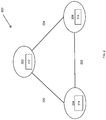
- FIG. 2 is a diagram showing a social graph 200, according to some embodiments of the present disclosure.
- the social graph 200 includes nodes 202 204 206, node parameters 212 214 216, and links 220 222 224.
- a social graph 200 is one way to represent entities and relationship between entities. Other methods of visualizing entities and relationship to entities (e.g., matrix) are equally applicable to the systems and methods described herein.
- Nodes 202 204 206 represent entities and are each associated with a set of parameters 212 214 216.
- the parameters 212 214 216 can be assigned to the nodes 202 204 206, respectively, based on information received from data collection nodes 110.
- the entities can include people, organizations, and devices.
- the parameters 212 214 216 can include information identifying the entity and describing at least one of a relationship to a location, activity, or transaction associated with the entity. For example, if the entity is as person, the parameters can include an identification number, birthday, gender, employer, credit rating, location (and location accuracy), salary, recent transactions, and recent activities.
- the node can include properties such as company ID, vendor ID, company name, year of founding, address, industry, industry ranking, credit rating, location information, represented as the latitude and longitude of the company, and an indicator of the confidence in the accuracy of the location coordinates.
- Company location information can be useful for determining the movement and interaction of individuals.
- parameter information can be associated with a time that the parameter information is observed, received or processed.
- transactions can refer to purchases (e.g., clothes, food, travel, merchandise) and activities can refer to events (e.g., sporting events, classes, parties).
- events e.g., sporting events, classes, parties.
- a node (e.g., node 202) can be connected to other nodes (e.g., node 204 and node 206) via links 220 222 224.
- the links can represent the strength of relationships between entities or the strengths between parameters associated with the entities.
- the strength of a relationship between entities can vary depending on the nature of the entities involved and the evidence at hand. In some embodiments and as described in more detail below, smaller scores are considered better and are analogous to distance.
- a relationship strength value can be referred to as the distance between nodes and measured in units referred to herein as axons.
- sub-graphs representing the effective reach of an entity are provided. These sub-graphs-known as ego networks-are distance-limited sub-graphs for an entity.
- ego networks are the basic unit for all further processing.
- An ego network can be generated using the following guidelines:
- a maximum traversal distance can be set that restricts the sub-graph to paths that are less than the maximum traversal distance measured in axons.
- the maximum traversal distance may be set to 100,000 axons, but others settings can be utilized depending on the application.
- Hop penalties can be applied to the distance for each hop in the path by multiplying the distance by the penalty. For example, if a first hop between nodes has a penalty of 5 and the first hop's distance was 100 axons, it would effectively have a scaled distance of 500 axons.
- a traversal timeout can be incorporated to restrict large networks that can cause a processing delay.
- the traversal timeout is a palliative measure that should not be necessary in a well-balanced graph.
- a traversal timeout may be set to 15 seconds, but variations may be utilized depending on the system.
- ego network generation can be enforced such as limitations on the network characteristics that are considered during traversal.
- different social graphs can be created based on a desired commonality factor between entities.
- the relevant ego networks can be distinctive from each other in this case. For example, in determining an entity's effects on node 202, link 220 to node 204 may be stronger if the inquiry relates to the entity that will have the most correlation to node 202 in terms of relevant restaurant suggestions in City A, while link 224 to node 206 may be stronger if the inquiry relates to the entity that will have the most correlation to node 202 in terms of relevant retailer for casual clothing.
- information associated with users' visits to various locations (and possibly venues) table can be used to compute the similarity between every pair of users. If two users are found to be similar enough, they can become an entity in the overall connection graph. For every connection, there are two nodes (e.g., 202 and 204) representing each of the two users - and a weight (or score) (e.g., 220), which is a real number between 0 and 1 indicating the strength of the connection between the two nodes.
- a weight or score
- the confidence level associated with the presence of a social connection between the users increases accordingly. Closer connections will often spend more time together, in diverse locations (e.g., not just at work, but also at the bar after work, and at one user's home together on the weekend). More distant connections will often spend relatively less time together, in less varied locations.
- a commonality factor can be determined for an entity based on a changed parameter for the entity. For example, when an entity travels to a new location, a social graph can be created based on factors that are relevant to traveling to a new place (e.g., hotel, rental car, restaurants). As another example, the changed parameter can include a particular purchase or a noticed pattern of purchases. In some embodiments, changed parameters can determine an entity's familiarity with an area. The social graph can look very different in an entity's home town than in a place the entity has never visited before. For example, a hotel can have a different relevance value in an entity's home town than it does in a new place that the entity is visiting (a place with less familiarity). In some embodiments, changed parameter information includes both a location and time associated with the changed parameter.
- a scoring relationship strength can vary depending on the nature of the entities involved and the information available. For example, a relationship between two individuals may be assessed using metrics such as the length of that relationship, whether the relationship is personal or professional, how often two individuals are in the same location, and how often the individuals visit similar locations, among others. Similarly, the relationship between an individual and a particular brand may include how long the individual has been purchasing that brand, how often the individual purchases competing brands, and how often one product is purchased at the same time as another product, among others. While there may be overlap among relationship characteristics depending on the type, there may also be differences.
- a score can be assessed in axons, which was mentioned briefly above. Smaller scores are considered better, and are analogous to distance.
- the centrality of an entity can also be scored to quantify the entity's connectedness within the network, which in turn measures the influence of that entity.
- weighted interconnections that score the relationships based upon the characteristics of the relationships.
- characteristics include duration, vintage, interaction, trust/variety, control, and harmony. Additional details describing the calculation of weights for connections between two users can be found in U.S. Application No. 15/298,353 , titled “System and Method for Detecting Interaction and Influence in Networks," filed October 20, 2016.
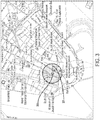
- FIG. 3 is a diagram showing a GPS information associated with a user visit, according to some embodiments of the present disclosure.
- FIG. 3 shows a centroid 300, and a centroid radius 301.
- a “visit” is a GPS pair (lat, Ion) with a start and end time (e.g. "2016/28/11 10:30:00+00:00") generated by a particular user device (e.g. mobile phone).
- the visit can be represented in space with a circle: a centroid 300 is where the visit is recorded by the device and the radius 301 depicts the horizontal accuracy of that recording, as judged by the device. Generally, the bigger the radius, the less confidence there is about the position of the user.
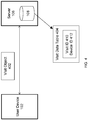
- FIG. 4 is a diagram showing a collection of location information associated with a user visit, according to some embodiments of the present disclosure.
- FIG. 4 shows a visit object 402, database 404, a user data table 406, visit ID 410, and device ID 412.
- Visit object 402 is uploaded from user device 102 to server 106.
- Visit object 402 includes location information for the user including centroid, accuracy, start and end time.
- the format of the visit object can be any format agreed upon by the user device 102 and server 106, for example in JSON format as illustrated below:
- Server 106 can persist visit object 402 information in a database 108 for further analysis.
- the information in the database 108 can be organized in a visit data table 404 that assigns to each object a visit ID 410 and device ID 412 in the table 404.
- Any data structure that stores the association between IDs and the object can be used, for example, an integer table as shown below: Visit Id Device Id 111 AAAABBBB 222 CCCCDDDD ... ... ...
- the visit ID 410 can be used to correlate a venue with the user.
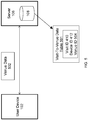
- FIG. 5 is a diagram showing a collection of venue information associated with a user visit, according to some embodiments of the present disclosure.
- FIG. 5 shows venue data 502 and venue ID 504 stored in data table 501.
- Venue data 502 corresponds to venue information associated with a user's location.
- venue data 502 is obtained via a "check-in.”
- a "check-in,” as used herein, refers to an action that is performed voluntarily by a user of the user device 102 confirming that a visit should be tagged with a venue (e.g., Restaurant Mario).
- Venues can be provided to an application running on the user device 102 from a table of venues. Other venue confirmation procedures that map a visit to a venue can also be used (e.g., credit card transaction, strong algorithmic evidence from other software applications).
- the venue information can be tagged with a venue ID 504, for example, a shown below: Venue Id Name 2222 Bar X 3333 Restaurant Y ... ....
- Venue data 502 which has been confirmed, can be uploaded as an object mapping the visit ID 410 with a venue ID 504.
- a venue ID 504 can correspond to a unique ID assigned to a venue.
- the venue data 502 object can be of any format agreed upon by the user device 102 and server 106, for example in JSON format as illustrated below:
- the venue ID 504 can be stored in the database in a manner that correlates the visit ID 111 with the venue ID 504.
- an integer table can be used as shown below: Visit Id Device Id Venue ID 111 AAAABBBB 2222 222 CCCCDDDD ....
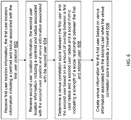
- FIG. 6 is flowchart showing an assignment of venue information for a user, according to some embodiments, of the present disclosure.
- first user location information is received, the first user location information including a centroid and radius associated with the first user position.
- location information can include a user location (e.g., expressed as a centroid using longitude and latitude), a duration associated with a user being present at the location (e.g., measured by a start time and end time), and a confidence level of the user being at the location (e.g., measured by a radius associated with the centroid).
- second user location information is received, the second user location information including a centroid and radius associated with the second user position and venue information associated with the second user.
- location information can include a user location (e.g., expressed as a centroid using longitude and latitude), a duration associated with a user being present at the location (e.g., measured by a start time and end time), and a confidence level of the user being at the location (e.g., measured by a radius associated with the centroid).
- the server receives information related to the particular venue the second user is at.
- a venue can be a location (lat, Ion pair) augmented with semantic meta-data: e.g., category (restaurant, hotel, stadium, etc.), name, hours of operations etc..
- "check-in" information is also associated with a confidence level regarding the reliability of the matching between the dwell and the venue in question. Factors that contribute to the reliability include user confirmation of the venue (e.g., a manual check-in by a user regarding the venue), third-party verification of the venue (e.g., purchases made by a user at a venue) and other algorithmic evidence.
- a relationship score is determined between the first user and the second user based on an amount of overlap between a first user radius and a second user radius and a social metric indicating a strength of a social relationship between the first and second user.
- a social metric indicating a strength of a social relationship between the first and second user.
- the threshold can be chosen to be relatively small, for example to gather more user data (e.g., to trigger more user confirmation and improve user engagement with the software application), while in other embodiments the threshold can be set to higher as to minimize the number of false positives (for example, in highly sensitive data application, one may prefer to make less inferences but also less mistakes).
- venue information is created for the first user based on venue information associated with the second user when the venue correlation score exceeds a threshold. For example, assume the following scenario:
- the value of the features in the decision-making algorithm can be calculated that can perform venue matching for USER 2 if conditions are met, for example:
- each of the features noted above can be calculated in different ways (e.g.: horizontal accuracy could be used explicitly in the spatial overlap).
- the algorithm making the final decision can be different in different embodiments: for example, the three features can be multiplied and a threshold heuristically set based on domain-specific knowledge (similar to the IF-THEN relationship illustrated above); or, as another example, the distribution of these scores can be estimated and the threshold decided as the value marking the nth percentile (i.e. the value making n% of scores as not strong enough to allow venue-matching).
- a machine learning algorithm suitable for a decision problem can be used (e.g. logistic regression, decision tree) to learn the optimal way to make the final venue-matching decision based on spatio-temporal features and the social connection.
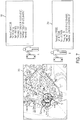
- FIG. 7 is a diagram showing an example of assigning venue information, according to some embodiments of the present disclosure.
- FIG. 7 shows a spatial overlap map 700, user A centroid 701, user B centroid 702, user A visit object 703 and user B visit object 704.
- User A is a user having already having a confirmed venue
- user B is a user being assigned a venue based on the systems and methods described herein.
- spatial overlap map 700 user A centroid 701 and user B centroid 702 are very close and the horizontal (radial) components of each centroid overlap. Even though user A centroid 701 and user B centroid 702 do not match exactly (e.g., the GPS signals (the visits) generated by their devices are slightly displaced), there is a chance the two users are in the same venue.
- User A visit object 703 and user B visit object 704 include location information.
- the location information includes device ID, latitude, longitude, hAccuracy (horizontal accuracy in latitude/longitude, as opposed to vertical accuracy in altitude), start time and end time.
- the time at which user A and user B are found at the locations shown in space overlap map 700 overlaps (e.g., start time and end time for user A is 10:30 and 12:32 while the start time and end time for user B is 10:21 and 12:43). That is, user B's visit begins just a few minutes before and ends just a few minutes after the user A's visit. Generally, the more closely users' visit times match, the more likely they are to be together.
- User A visit object 703 further includes venue ID information, while user B visit object 704 does not include venue ID information.
- venue ID information can be assigned when a confidence level regarding the reliability of the venue information exceeds a threshold.
- Factors that contribute to the reliability of the venue information include user confirmation of the venue (e.g., a manual check-in by a user regarding the venue) and third-party verification of the venue (e.g., purchases made by a user at a venue).
- user A visit object 703 has venue information because the system determined that user A had reliable venue information.
- User B can be assigned the venue information of user A based on the strength of the correlation between their location information and their social connection information. As described, the systems and methods described herein can consider the strength of the social connections between A and B as described above in FIG. 2 and in U.S. Application No. 15/298,353 , titled “System and Method for Detecting Interaction and Influence in Networks," filed October 20, 2016, the contents of which are incorporated herein. Assuming user A and user B are close social connections (e.g., have a score of 0.96) and the location information overlap is significant (exceeds a confidence threshold), the venue ID of user A can either be assigned or suggested to user B.
- the subject matter described herein can be implemented in digital electronic circuitry, or in computer software, firmware, or hardware, including the structural means disclosed in this specification and structural equivalents thereof, or in combinations of them.
- the subject matter described herein can be implemented as one or more computer program products, such as one or more computer programs tangibly embodied in an information carrier (e.g., in a machine readable storage device), or embodied in a propagated signal, for execution by, or to control the operation of, data processing apparatus (e.g., a programmable processor, a computer, or multiple computers).
- a computer program (also known as a program, software, software application, or code) can be written in any form of programming language, including compiled or interpreted languages, and it can be deployed in any form, including as a stand-alone program or as a module, component, subroutine, or other unit suitable for use in a computing environment.
- a computer program does not necessarily correspond to a file.
- a program can be stored in a portion of a file that holds other programs or data, in a single file dedicated to the program in question, or in multiple coordinated files (e.g., files that store one or more modules, sub programs, or portions of code).
- a computer program can be deployed to be executed on one computer or on multiple computers at one site or distributed across multiple sites and interconnected by a communication network.
- processors suitable for the execution of a computer program include, by way of example, both general and special purpose microprocessors, and any one or more processor of any kind of digital computer.
- a processor will receive instructions and data from a read only memory or a random access memory or both.
- the essential elements of a computer are a processor for executing instructions and one or more memory devices for storing instructions and data.
- a computer will also include, or be operatively coupled to receive data from or transfer data to, or both, one or more mass storage devices for storing data, e.g., magnetic, magneto optical disks, or optical disks.
- Information carriers suitable for embodying computer program instructions and data include all forms of nonvolatile memory, including by way of example semiconductor memory devices, (e.g., EPROM, EEPROM, and flash memory devices); magnetic disks, (e.g., internal hard disks or removable disks); magneto optical disks; and optical disks (e.g., CD and DVD disks).
- semiconductor memory devices e.g., EPROM, EEPROM, and flash memory devices
- magnetic disks e.g., internal hard disks or removable disks
- magneto optical disks e.g., CD and DVD disks
- optical disks e.g., CD and DVD disks.
- the processor and the memory can be supplemented by, or incorporated in, special purpose logic circuitry.
- the subject matter described herein can be implemented on a computer having a display device, e.g., a CRT (cathode ray tube) or LCD (liquid crystal display) monitor, for displaying information to the user and a keyboard and a pointing device, (e.g., a mouse or a trackball), by which the user can provide input to the computer.
- a display device e.g., a CRT (cathode ray tube) or LCD (liquid crystal display) monitor
- a keyboard and a pointing device e.g., a mouse or a trackball
- Other kinds of devices can be used to provide for interaction with a user as well.
- feedback provided to the user can be any form of sensory feedback, (e.g., visual feedback, auditory feedback, or tactile feedback), and input from the user can be received in any form, including acoustic, speech, or tactile input.
- the subject matter described herein can be implemented in a computing system that includes a back end component (e.g., a data server), a middleware component (e.g., an application server), or a front end component (e.g., a client computer having a graphical user interface or a web browser through which a user can interact with an implementation of the subject matter described herein), or any combination of such back end, middleware, and front end components.
- the components of the system can be interconnected by any form or medium of digital data communication, e.g., a communication network. Examples of communication networks include a local area network ("LAN”) and a wide area network (“WAN”), e.g., the Internet.
- LAN local area network
- WAN wide area network
Landscapes
- Engineering & Computer Science (AREA)
- Computer Networks & Wireless Communication (AREA)
- Signal Processing (AREA)
- Software Systems (AREA)
- Theoretical Computer Science (AREA)
- General Engineering & Computer Science (AREA)
- Computer Vision & Pattern Recognition (AREA)
- Medical Informatics (AREA)
- Evolutionary Computation (AREA)
- Physics & Mathematics (AREA)
- Computing Systems (AREA)
- Data Mining & Analysis (AREA)
- General Physics & Mathematics (AREA)
- Mathematical Physics (AREA)
- Artificial Intelligence (AREA)
- Computer Hardware Design (AREA)
- Management, Administration, Business Operations System, And Electronic Commerce (AREA)
- Telephonic Communication Services (AREA)
- Information Transfer Between Computers (AREA)
Priority Applications (2)
| Application Number | Priority Date | Filing Date | Title |
|---|---|---|---|
| SI201730925T SI3497403T1 (sl) | 2016-08-11 | 2017-08-11 | Geo-lociranje posameznikov na osnovi izvedene socialne mreže |
| PL17840323T PL3497403T3 (pl) | 2016-08-11 | 2017-08-11 | Geolokalizowanie osób na podstawie pochodnej sieci społecznościowej |
Applications Claiming Priority (2)
| Application Number | Priority Date | Filing Date | Title |
|---|---|---|---|
| US201662373664P | 2016-08-11 | 2016-08-11 | |
| PCT/US2017/046443 WO2018031860A1 (en) | 2016-08-11 | 2017-08-11 | Geo-locating individuals based on a derived social network |
Publications (3)
| Publication Number | Publication Date |
|---|---|
| EP3497403A1 EP3497403A1 (en) | 2019-06-19 |
| EP3497403A4 EP3497403A4 (en) | 2019-09-04 |
| EP3497403B1 true EP3497403B1 (en) | 2021-08-11 |
Family
ID=61159574
Family Applications (1)
| Application Number | Title | Priority Date | Filing Date |
|---|---|---|---|
| EP17840323.4A Active EP3497403B1 (en) | 2016-08-11 | 2017-08-11 | Geo-locating individuals based on a derived social network |
Country Status (12)
| Country | Link |
|---|---|
| US (3) | US10264080B2 (lt) |
| EP (1) | EP3497403B1 (lt) |
| CN (1) | CN109891190B (lt) |
| DK (1) | DK3497403T3 (lt) |
| ES (1) | ES2892198T3 (lt) |
| HU (1) | HUE057108T2 (lt) |
| LT (1) | LT3497403T (lt) |
| PL (1) | PL3497403T3 (lt) |
| PT (1) | PT3497403T (lt) |
| RU (1) | RU2701122C1 (lt) |
| SI (1) | SI3497403T1 (lt) |
| WO (1) | WO2018031860A1 (lt) |
Families Citing this family (7)
| Publication number | Priority date | Publication date | Assignee | Title |
|---|---|---|---|---|
| US10732297B2 (en) * | 2016-08-30 | 2020-08-04 | Faraday&Future Inc. | Geo-pairing detection |
| CN109547924B (zh) * | 2018-11-26 | 2021-06-01 | 苏州达家迎信息技术有限公司 | 位置信息分享方法、装置、设备及存储介质 |
| US11070947B2 (en) * | 2019-07-25 | 2021-07-20 | Ford Global Technologies, Llc | Distributed wireless network assisted object location |
| US11869014B2 (en) * | 2020-05-29 | 2024-01-09 | Salesforce, Inc. | Physical proximity graphing |
| US20220171773A1 (en) * | 2020-12-01 | 2022-06-02 | International Business Machines Corporation | Optimizing expansion of user query input in natural language processing applications |
| CN114219053B (zh) * | 2022-02-23 | 2023-04-18 | 北京淇瑀信息科技有限公司 | 用户位置信息处理方法、装置及电子设备 |
| CN116456281B (zh) * | 2023-05-12 | 2024-08-06 | 中国电信股份有限公司广东研究院 | 基于种子用户轨迹确定共址用户的方法及相关设备 |
Family Cites Families (56)
| Publication number | Priority date | Publication date | Assignee | Title |
|---|---|---|---|---|
| US6275707B1 (en) * | 1999-10-08 | 2001-08-14 | Motorola, Inc. | Method and apparatus for assigning location estimates from a first transceiver to a second transceiver |
| DE60121924T2 (de) * | 2000-03-13 | 2007-02-15 | Nokia Corp. | Dienstanbietung in einem kommunikationssystem |
| US7127068B2 (en) * | 2000-05-24 | 2006-10-24 | Info Space, Inc. | Geographical comparison system and method |
| US6968179B1 (en) * | 2000-07-27 | 2005-11-22 | Microsoft Corporation | Place specific buddy list services |
| AU2003278466A1 (en) | 2002-12-05 | 2004-06-23 | Koninklijke Philips Electronics N.V. | Transportation payment |
| US20090018918A1 (en) | 2004-11-04 | 2009-01-15 | Manyworlds Inc. | Influence-based Social Network Advertising |
| US7593740B2 (en) * | 2004-05-12 | 2009-09-22 | Google, Inc. | Location-based social software for mobile devices |
| US7231209B2 (en) * | 2005-04-20 | 2007-06-12 | Nokia Corporation | Radio system, terminal device, computer program product, and method of defining availability of queried devices |
| US8320936B2 (en) * | 2005-05-31 | 2012-11-27 | Telefonaktiebolaget ELM Bricsson (publ) | Positioning in a mobile communications system |
| US9105039B2 (en) * | 2006-01-30 | 2015-08-11 | Groupon, Inc. | System and method for providing mobile alerts to members of a social network |
| WO2007106937A1 (en) * | 2006-03-20 | 2007-09-27 | Riform Pty Ltd | Proximity recording device and method |
| US20070225911A1 (en) | 2006-03-23 | 2007-09-27 | Rich Chanick | User positional and venue information integration system and method |
| US9031583B2 (en) * | 2007-04-11 | 2015-05-12 | Qualcomm Incorporated | Notification on mobile device based on location of other mobile device |
| US8923887B2 (en) * | 2007-09-24 | 2014-12-30 | Alcatel Lucent | Social networking on a wireless communication system |
| JP5762746B2 (ja) | 2007-11-14 | 2015-08-12 | クゥアルコム・インコーポレイテッドQualcomm Incorporated | 地理的ユーザプロファイルに基づいてターゲット・コンテンツ・メッセージの適切性を決定するように地理的ユーザプロファイルを決定するための方法およびシステム |
| US8024431B2 (en) * | 2007-12-21 | 2011-09-20 | Domingo Enterprises, Llc | System and method for identifying transient friends |
| US20120047087A1 (en) | 2009-03-25 | 2012-02-23 | Waldeck Technology Llc | Smart encounters |
| WO2010118003A2 (en) | 2009-04-06 | 2010-10-14 | Globys, Inc. | Contextual targeting based upon customer occasions |
| GB0907361D0 (en) * | 2009-04-29 | 2009-06-10 | Lok8U Ltd | A tracking and communications device |
| KR101626446B1 (ko) * | 2009-08-21 | 2016-06-02 | 삼성전자주식회사 | 외부 장치를 연결하는 방법 및 그 장치 |
| US8433334B2 (en) * | 2010-01-15 | 2013-04-30 | Apple Inc. | Managing a location database for network-based positioning system |
| US20120066303A1 (en) * | 2010-03-03 | 2012-03-15 | Waldeck Technology, Llc | Synchronized group location updates |
| US8521131B1 (en) | 2010-03-23 | 2013-08-27 | Amazon Technologies, Inc. | Mobile device security |
| US8538389B1 (en) * | 2010-07-02 | 2013-09-17 | Mlb Advanced Media, L.P. | Systems and methods for accessing content at an event |
| JP2012015924A (ja) | 2010-07-02 | 2012-01-19 | Sony Computer Entertainment Inc | 通信システム、通信方法、プログラム及び情報記憶媒体 |
| US8284748B2 (en) * | 2010-07-07 | 2012-10-09 | Apple Inc. | Ad hoc formation and tracking of location-sharing groups |
| US8983978B2 (en) | 2010-08-31 | 2015-03-17 | Apple Inc. | Location-intention context for content delivery |
| US9247521B2 (en) * | 2010-09-01 | 2016-01-26 | Guang Yang | Localization based on individual location patterns |
| US8504062B2 (en) * | 2010-11-01 | 2013-08-06 | Wavemarket, Inc. | System and method for aggregating and associating mobile device location data |
| US10438299B2 (en) | 2011-03-15 | 2019-10-08 | Visa International Service Association | Systems and methods to combine transaction terminal location data and social networking check-in |
| US20120259791A1 (en) * | 2011-04-07 | 2012-10-11 | Sabina Zoidze | System and method for social networking |
| US8494554B2 (en) * | 2011-06-03 | 2013-07-23 | Apple Inc. | Mobile device location estimation |
| KR101602078B1 (ko) | 2011-07-20 | 2016-03-09 | 이베이 인크. | 실시간 위치 인식 추천 |
| US8787944B2 (en) | 2011-08-18 | 2014-07-22 | Rivada Research, Llc | Method and system for providing enhanced location based information for wireless handsets |
| US9208511B2 (en) * | 2011-08-22 | 2015-12-08 | Simple Rules, Inc. | System and method for location-based recommendations |
| EP2769560B1 (en) * | 2011-10-17 | 2019-07-17 | Nokia Technologies Oy | An automatic approach for the personalized privacy recommendation related to the location |
| US8463295B1 (en) * | 2011-12-07 | 2013-06-11 | Ebay Inc. | Systems and methods for generating location-based group recommendations |
| US8521128B1 (en) * | 2011-12-09 | 2013-08-27 | Google Inc. | Method, system, and computer program product for obtaining crowd-sourced location information |
| JP5855924B2 (ja) * | 2011-12-09 | 2016-02-09 | 桑原 雅人 | サーバ装置、通信システム、制御方法およびプログラム |
| US8761797B1 (en) * | 2012-02-14 | 2014-06-24 | Google Inc. | Location accuracy based on map viewport |
| JP5929501B2 (ja) * | 2012-05-21 | 2016-06-08 | ソニー株式会社 | 情報処理装置、情報処理方法およびプログラム |
| US9326263B2 (en) * | 2012-06-13 | 2016-04-26 | At&T Mobility Ii Llc | Site location determination using crowd sourced propagation delay and location data |
| WO2013192591A2 (en) * | 2012-06-22 | 2013-12-27 | Google Inc. | Ranking nearby destinations based on visit likelihoods and predicting future visits to places from location history |
| US8447516B1 (en) * | 2012-08-31 | 2013-05-21 | Google Inc. | Efficient proximity detection |
| US9338622B2 (en) | 2012-10-04 | 2016-05-10 | Bernt Erik Bjontegard | Contextually intelligent communication systems and processes |
| JP6197372B2 (ja) * | 2012-10-12 | 2017-09-20 | 株式会社リコー | 情報処理装置、情報処理方法及び情報処理プログラム |
| US8738036B1 (en) * | 2013-05-29 | 2014-05-27 | Joingo, Llc | Method and system for wayfinding at a venue |
| WO2015056269A1 (en) | 2013-10-20 | 2015-04-23 | Anagog Ltd | Method, system and product for automatic parking payment and policy detection |
| WO2015061295A1 (en) | 2013-10-22 | 2015-04-30 | Northeastern University | Flux-less direct soldering by ultrasonic surface activation |
| US20150156245A1 (en) * | 2013-12-02 | 2015-06-04 | Continental Automotive Gmbh | Navigation and communication system for a means of transport |
| KR102008452B1 (ko) * | 2014-02-19 | 2019-08-07 | 삼성전자주식회사 | 전자 장치의 정보 수집 방법 및 그 전자 장치 |
| US9310205B2 (en) * | 2014-02-20 | 2016-04-12 | Stubhub, Inc. | Interactive venue assistant |
| US9888347B1 (en) * | 2014-04-17 | 2018-02-06 | Google Inc. | Resolving location criteria using user location data |
| US10187343B2 (en) * | 2014-12-18 | 2019-01-22 | Facebook, Inc. | Location data for defining places and traffic |
| KR101640222B1 (ko) * | 2014-12-31 | 2016-07-15 | 라인 가부시키가이샤 | 위치 공유 서비스 제공 장치, 방법 및 컴퓨터 프로그램 |
| HK1258802A1 (zh) | 2015-10-20 | 2019-11-22 | 阿克森维伯股份公司 | 用於检测网络中的交互和影响的系统和方法 |
-
2017
- 2017-08-11 CN CN201780062122.5A patent/CN109891190B/zh active Active
- 2017-08-11 DK DK17840323.4T patent/DK3497403T3/da active
- 2017-08-11 HU HUE17840323A patent/HUE057108T2/hu unknown
- 2017-08-11 US US15/674,778 patent/US10264080B2/en active Active
- 2017-08-11 RU RU2019106499A patent/RU2701122C1/ru active
- 2017-08-11 LT LTEPPCT/US2017/046443T patent/LT3497403T/lt unknown
- 2017-08-11 ES ES17840323T patent/ES2892198T3/es active Active
- 2017-08-11 PL PL17840323T patent/PL3497403T3/pl unknown
- 2017-08-11 PT PT17840323T patent/PT3497403T/pt unknown
- 2017-08-11 SI SI201730925T patent/SI3497403T1/sl unknown
- 2017-08-11 WO PCT/US2017/046443 patent/WO2018031860A1/en not_active Ceased
- 2017-08-11 EP EP17840323.4A patent/EP3497403B1/en active Active
-
2018
- 2018-12-18 US US16/224,094 patent/US10362124B2/en active Active
-
2019
- 2019-06-13 US US16/440,052 patent/US10542105B2/en active Active
Non-Patent Citations (1)
| Title |
|---|
| None * |
Also Published As
| Publication number | Publication date |
|---|---|
| ES2892198T3 (es) | 2022-02-02 |
| WO2018031860A1 (en) | 2018-02-15 |
| CN109891190A (zh) | 2019-06-14 |
| RU2701122C1 (ru) | 2019-09-24 |
| EP3497403A1 (en) | 2019-06-19 |
| CN109891190B (zh) | 2020-12-29 |
| ES2892198T8 (es) | 2022-02-10 |
| SI3497403T1 (sl) | 2022-01-31 |
| PL3497403T3 (pl) | 2022-01-10 |
| EP3497403A4 (en) | 2019-09-04 |
| US20190297153A1 (en) | 2019-09-26 |
| US20180048720A1 (en) | 2018-02-15 |
| HUE057108T2 (hu) | 2022-04-28 |
| US10542105B2 (en) | 2020-01-21 |
| DK3497403T3 (da) | 2021-10-04 |
| LT3497403T (lt) | 2021-11-25 |
| US10264080B2 (en) | 2019-04-16 |
| PT3497403T (pt) | 2021-10-04 |
| US10362124B2 (en) | 2019-07-23 |
| US20190124166A1 (en) | 2019-04-25 |
Similar Documents
| Publication | Publication Date | Title |
|---|---|---|
| EP3497403B1 (en) | Geo-locating individuals based on a derived social network | |
| US10735532B2 (en) | System and method for detecting interaction and influence in networks | |
| US12379225B2 (en) | Safety-aware route recommendation system and method | |
| US20210081392A1 (en) | Systems, methods, and apparatus for providing content to related compute devices based on obfuscated location data | |
| Shi et al. | ParkCrowd: Reliable crowdsensing for aggregation and dissemination of parking space information | |
| US8583471B1 (en) | Inferring household income for users of a social networking system | |
| EP3320512A1 (en) | Mobile attribute time-series profiling analytics | |
| US20160162936A1 (en) | Notification of possible customers | |
| RU2691223C2 (ru) | Платформа персональных логических возможностей | |
| Khan et al. | Believe: Privacy-aware secure multi-party computation for real-time connected and autonomous vehicles and micro-mobility data validation using blockchain—a study on new york city data | |
| US12566809B2 (en) | Graph learning and automated behavior coordination platform | |
| CN110278524A (zh) | 用户位置确定方法、图模型生成方法、装置及服务器 | |
| US20140047346A1 (en) | User interface elements for transportation sharing | |
| US9412098B1 (en) | Systems and methods for daily task optimization | |
| US20250031015A1 (en) | Integration of digital history with visits to physical venues | |
| US10552920B2 (en) | Detecting location data of co-located users having a common interest | |
| Malekzadeh et al. | Mobility deviation index: incorporating geographical context into analysis of human mobility | |
| Landau et al. | Reversing Privacy Risks: Strict Limitations on the Use of Communications Metadata and Telemetry Information | |
| HK40010089B (en) | Geo-locating individuals based on a derived social network | |
| HK40010089A (en) | Geo-locating individuals based on a derived social network | |
| Cheng et al. | Practical context awareness information system for wireless vehicular networks based on a core telematics platform | |
| CN121682619A (zh) | 数据处理方法、交易风险确定方法、装置、设备、介质和程序产品 | |
| Ishaya | Business Intelligence Through Personalised Location-Aware Service Delivery |
Legal Events
| Date | Code | Title | Description |
|---|---|---|---|
| STAA | Information on the status of an ep patent application or granted ep patent |
Free format text: STATUS: THE INTERNATIONAL PUBLICATION HAS BEEN MADE |
|
| PUAI | Public reference made under article 153(3) epc to a published international application that has entered the european phase |
Free format text: ORIGINAL CODE: 0009012 |
|
| STAA | Information on the status of an ep patent application or granted ep patent |
Free format text: STATUS: REQUEST FOR EXAMINATION WAS MADE |
|
| 17P | Request for examination filed |
Effective date: 20190311 |
|
| AK | Designated contracting states |
Kind code of ref document: A1 Designated state(s): AL AT BE BG CH CY CZ DE DK EE ES FI FR GB GR HR HU IE IS IT LI LT LU LV MC MK MT NL NO PL PT RO RS SE SI SK SM TR |
|
| AX | Request for extension of the european patent |
Extension state: BA ME |
|
| RIN1 | Information on inventor provided before grant (corrected) |
Inventor name: ANNICQ, THOMAS Inventor name: YOSHIDA, KATHERINE Inventor name: TAGLIABUE, JACOPO Inventor name: OBERLI, ROMAN |
|
| A4 | Supplementary search report drawn up and despatched |
Effective date: 20190806 |
|
| RIC1 | Information provided on ipc code assigned before grant |
Ipc: G06F 15/16 20060101ALI20190731BHEP Ipc: G01C 21/00 20060101AFI20190731BHEP Ipc: H04W 4/02 20180101ALI20190731BHEP Ipc: H04W 4/18 20090101ALI20190731BHEP Ipc: H04W 64/00 20090101ALI20190731BHEP Ipc: G06Q 50/00 20120101ALI20190731BHEP |
|
| DAV | Request for validation of the european patent (deleted) | ||
| DAX | Request for extension of the european patent (deleted) | ||
| STAA | Information on the status of an ep patent application or granted ep patent |
Free format text: STATUS: EXAMINATION IS IN PROGRESS |
|
| 17Q | First examination report despatched |
Effective date: 20200406 |
|
| GRAP | Despatch of communication of intention to grant a patent |
Free format text: ORIGINAL CODE: EPIDOSNIGR1 |
|
| STAA | Information on the status of an ep patent application or granted ep patent |
Free format text: STATUS: GRANT OF PATENT IS INTENDED |
|
| INTG | Intention to grant announced |
Effective date: 20210301 |
|
| GRAS | Grant fee paid |
Free format text: ORIGINAL CODE: EPIDOSNIGR3 |
|
| GRAA | (expected) grant |
Free format text: ORIGINAL CODE: 0009210 |
|
| STAA | Information on the status of an ep patent application or granted ep patent |
Free format text: STATUS: THE PATENT HAS BEEN GRANTED |
|
| AK | Designated contracting states |
Kind code of ref document: B1 Designated state(s): AL AT BE BG CH CY CZ DE DK EE ES FI FR GB GR HR HU IE IS IT LI LT LU LV MC MK MT NL NO PL PT RO RS SE SI SK SM TR |
|
| REG | Reference to a national code |
Ref country code: CH Ref legal event code: EP |
|
| REG | Reference to a national code |
Ref country code: DE Ref legal event code: R096 Ref document number: 602017043989 Country of ref document: DE |
|
| REG | Reference to a national code |
Ref country code: IE Ref legal event code: FG4D Ref country code: AT Ref legal event code: REF Ref document number: 1419816 Country of ref document: AT Kind code of ref document: T Effective date: 20210915 |
|
| REG | Reference to a national code |
Ref country code: FI Ref legal event code: FGE |
|
| REG | Reference to a national code |
Ref country code: PT Ref legal event code: SC4A Ref document number: 3497403 Country of ref document: PT Date of ref document: 20211004 Kind code of ref document: T Free format text: AVAILABILITY OF NATIONAL TRANSLATION Effective date: 20210928 Ref country code: DK Ref legal event code: T3 Effective date: 20211001 |
|
| REG | Reference to a national code |
Ref country code: SE Ref legal event code: TRGR |
|
| REG | Reference to a national code |
Ref country code: NL Ref legal event code: FP |
|
| REG | Reference to a national code |
Ref country code: EE Ref legal event code: FG4A Ref document number: E021430 Country of ref document: EE Effective date: 20210928 |
|
| REG | Reference to a national code |
Ref country code: SK Ref legal event code: T3 Ref document number: E 38262 Country of ref document: SK |
|
| REG | Reference to a national code |
Ref country code: NO Ref legal event code: T2 Effective date: 20210811 |
|
| PG25 | Lapsed in a contracting state [announced via postgrant information from national office to epo] |
Ref country code: RS Free format text: LAPSE BECAUSE OF FAILURE TO SUBMIT A TRANSLATION OF THE DESCRIPTION OR TO PAY THE FEE WITHIN THE PRESCRIBED TIME-LIMIT Effective date: 20210811 Ref country code: HR Free format text: LAPSE BECAUSE OF FAILURE TO SUBMIT A TRANSLATION OF THE DESCRIPTION OR TO PAY THE FEE WITHIN THE PRESCRIBED TIME-LIMIT Effective date: 20210811 Ref country code: BG Free format text: LAPSE BECAUSE OF FAILURE TO SUBMIT A TRANSLATION OF THE DESCRIPTION OR TO PAY THE FEE WITHIN THE PRESCRIBED TIME-LIMIT Effective date: 20211111 |
|
| REG | Reference to a national code |
Ref country code: ES Ref legal event code: FG2A Ref document number: 2892198 Country of ref document: ES Kind code of ref document: T3 Effective date: 20220202 |
|
| PG25 | Lapsed in a contracting state [announced via postgrant information from national office to epo] |
Ref country code: GR Free format text: LAPSE BECAUSE OF FAILURE TO SUBMIT A TRANSLATION OF THE DESCRIPTION OR TO PAY THE FEE WITHIN THE PRESCRIBED TIME-LIMIT Effective date: 20211112 |
|
| REG | Reference to a national code |
Ref country code: HU Ref legal event code: AG4A Ref document number: E057108 Country of ref document: HU |
|
| REG | Reference to a national code |
Ref country code: DE Ref legal event code: R097 Ref document number: 602017043989 Country of ref document: DE |
|
| PG25 | Lapsed in a contracting state [announced via postgrant information from national office to epo] |
Ref country code: SM Free format text: LAPSE BECAUSE OF FAILURE TO SUBMIT A TRANSLATION OF THE DESCRIPTION OR TO PAY THE FEE WITHIN THE PRESCRIBED TIME-LIMIT Effective date: 20210811 Ref country code: MC Free format text: LAPSE BECAUSE OF FAILURE TO SUBMIT A TRANSLATION OF THE DESCRIPTION OR TO PAY THE FEE WITHIN THE PRESCRIBED TIME-LIMIT Effective date: 20210811 Ref country code: AL Free format text: LAPSE BECAUSE OF FAILURE TO SUBMIT A TRANSLATION OF THE DESCRIPTION OR TO PAY THE FEE WITHIN THE PRESCRIBED TIME-LIMIT Effective date: 20210811 |
|
| PLBE | No opposition filed within time limit |
Free format text: ORIGINAL CODE: 0009261 |
|
| STAA | Information on the status of an ep patent application or granted ep patent |
Free format text: STATUS: NO OPPOSITION FILED WITHIN TIME LIMIT |
|
| 26N | No opposition filed |
Effective date: 20220512 |
|
| PG25 | Lapsed in a contracting state [announced via postgrant information from national office to epo] |
Ref country code: CY Free format text: LAPSE BECAUSE OF FAILURE TO SUBMIT A TRANSLATION OF THE DESCRIPTION OR TO PAY THE FEE WITHIN THE PRESCRIBED TIME-LIMIT Effective date: 20210811 |
|
| PG25 | Lapsed in a contracting state [announced via postgrant information from national office to epo] |
Ref country code: MK Free format text: LAPSE BECAUSE OF FAILURE TO SUBMIT A TRANSLATION OF THE DESCRIPTION OR TO PAY THE FEE WITHIN THE PRESCRIBED TIME-LIMIT Effective date: 20210811 |
|
| PG25 | Lapsed in a contracting state [announced via postgrant information from national office to epo] |
Ref country code: MT Free format text: LAPSE BECAUSE OF FAILURE TO SUBMIT A TRANSLATION OF THE DESCRIPTION OR TO PAY THE FEE WITHIN THE PRESCRIBED TIME-LIMIT Effective date: 20210811 |
|
| PGFP | Annual fee paid to national office [announced via postgrant information from national office to epo] |
Ref country code: SI Payment date: 20250717 Year of fee payment: 9 |
|
| PGFP | Annual fee paid to national office [announced via postgrant information from national office to epo] |
Ref country code: LU Payment date: 20250827 Year of fee payment: 9 Ref country code: NL Payment date: 20250826 Year of fee payment: 9 |
|
| PGFP | Annual fee paid to national office [announced via postgrant information from national office to epo] |
Ref country code: HU Payment date: 20250730 Year of fee payment: 9 |
|
| PGFP | Annual fee paid to national office [announced via postgrant information from national office to epo] |
Ref country code: FI Payment date: 20250825 Year of fee payment: 9 Ref country code: ES Payment date: 20250901 Year of fee payment: 9 Ref country code: PT Payment date: 20250723 Year of fee payment: 9 |
|
| PGFP | Annual fee paid to national office [announced via postgrant information from national office to epo] |
Ref country code: LT Payment date: 20250721 Year of fee payment: 9 Ref country code: DK Payment date: 20250825 Year of fee payment: 9 Ref country code: DE Payment date: 20250827 Year of fee payment: 9 |
|
| PGFP | Annual fee paid to national office [announced via postgrant information from national office to epo] |
Ref country code: NO Payment date: 20250827 Year of fee payment: 9 |
|
| PGFP | Annual fee paid to national office [announced via postgrant information from national office to epo] |
Ref country code: TR Payment date: 20250721 Year of fee payment: 9 Ref country code: PL Payment date: 20250731 Year of fee payment: 9 Ref country code: IT Payment date: 20250820 Year of fee payment: 9 |
|
| PGFP | Annual fee paid to national office [announced via postgrant information from national office to epo] |
Ref country code: BE Payment date: 20250827 Year of fee payment: 9 Ref country code: GB Payment date: 20250827 Year of fee payment: 9 |
|
| PGFP | Annual fee paid to national office [announced via postgrant information from national office to epo] |
Ref country code: AT Payment date: 20250827 Year of fee payment: 9 Ref country code: FR Payment date: 20250825 Year of fee payment: 9 |
|
| PGFP | Annual fee paid to national office [announced via postgrant information from national office to epo] |
Ref country code: SE Payment date: 20250827 Year of fee payment: 9 Ref country code: CH Payment date: 20250901 Year of fee payment: 9 |
|
| PGFP | Annual fee paid to national office [announced via postgrant information from national office to epo] |
Ref country code: IE Payment date: 20250827 Year of fee payment: 9 Ref country code: EE Payment date: 20250721 Year of fee payment: 9 Ref country code: CZ Payment date: 20250724 Year of fee payment: 9 |
|
| PGFP | Annual fee paid to national office [announced via postgrant information from national office to epo] |
Ref country code: RO Payment date: 20250725 Year of fee payment: 9 |
|
| PGFP | Annual fee paid to national office [announced via postgrant information from national office to epo] |
Ref country code: SK Payment date: 20250718 Year of fee payment: 9 |
|
| PGFP | Annual fee paid to national office [announced via postgrant information from national office to epo] |
Ref country code: LV Payment date: 20250718 Year of fee payment: 9 |