EP3493305B1 - Resin composition for power storage device electrode - Google Patents
Resin composition for power storage device electrode Download PDFInfo
- Publication number
- EP3493305B1 EP3493305B1 EP17834554.2A EP17834554A EP3493305B1 EP 3493305 B1 EP3493305 B1 EP 3493305B1 EP 17834554 A EP17834554 A EP 17834554A EP 3493305 B1 EP3493305 B1 EP 3493305B1
- Authority
- EP
- European Patent Office
- Prior art keywords
- mass
- resin composition
- formula
- polymer particles
- monomer
- Prior art date
- Legal status (The legal status is an assumption and is not a legal conclusion. Google has not performed a legal analysis and makes no representation as to the accuracy of the status listed.)
- Active
Links
Images

Classifications
-
- H—ELECTRICITY
- H01—ELECTRIC ELEMENTS
- H01M—PROCESSES OR MEANS, e.g. BATTERIES, FOR THE DIRECT CONVERSION OF CHEMICAL ENERGY INTO ELECTRICAL ENERGY
- H01M4/00—Electrodes
- H01M4/02—Electrodes composed of, or comprising, active material
- H01M4/62—Selection of inactive substances as ingredients for active masses, e.g. binders, fillers
- H01M4/621—Binders
- H01M4/622—Binders being polymers
-
- C—CHEMISTRY; METALLURGY
- C08—ORGANIC MACROMOLECULAR COMPOUNDS; THEIR PREPARATION OR CHEMICAL WORKING-UP; COMPOSITIONS BASED THEREON
- C08F—MACROMOLECULAR COMPOUNDS OBTAINED BY REACTIONS ONLY INVOLVING CARBON-TO-CARBON UNSATURATED BONDS
- C08F2/00—Processes of polymerisation
- C08F2/12—Polymerisation in non-solvents
- C08F2/16—Aqueous medium
- C08F2/22—Emulsion polymerisation
-
- C—CHEMISTRY; METALLURGY
- C08—ORGANIC MACROMOLECULAR COMPOUNDS; THEIR PREPARATION OR CHEMICAL WORKING-UP; COMPOSITIONS BASED THEREON
- C08F—MACROMOLECULAR COMPOUNDS OBTAINED BY REACTIONS ONLY INVOLVING CARBON-TO-CARBON UNSATURATED BONDS
- C08F220/00—Copolymers of compounds having one or more unsaturated aliphatic radicals, each having only one carbon-to-carbon double bond, and only one being terminated by only one carboxyl radical or a salt, anhydride ester, amide, imide or nitrile thereof
- C08F220/02—Monocarboxylic acids having less than ten carbon atoms; Derivatives thereof
- C08F220/04—Acids; Metal salts or ammonium salts thereof
- C08F220/06—Acrylic acid; Methacrylic acid; Metal salts or ammonium salts thereof
-
- C—CHEMISTRY; METALLURGY
- C08—ORGANIC MACROMOLECULAR COMPOUNDS; THEIR PREPARATION OR CHEMICAL WORKING-UP; COMPOSITIONS BASED THEREON
- C08F—MACROMOLECULAR COMPOUNDS OBTAINED BY REACTIONS ONLY INVOLVING CARBON-TO-CARBON UNSATURATED BONDS
- C08F220/00—Copolymers of compounds having one or more unsaturated aliphatic radicals, each having only one carbon-to-carbon double bond, and only one being terminated by only one carboxyl radical or a salt, anhydride ester, amide, imide or nitrile thereof
- C08F220/02—Monocarboxylic acids having less than ten carbon atoms; Derivatives thereof
- C08F220/10—Esters
- C08F220/12—Esters of monohydric alcohols or phenols
-
- C—CHEMISTRY; METALLURGY
- C08—ORGANIC MACROMOLECULAR COMPOUNDS; THEIR PREPARATION OR CHEMICAL WORKING-UP; COMPOSITIONS BASED THEREON
- C08F—MACROMOLECULAR COMPOUNDS OBTAINED BY REACTIONS ONLY INVOLVING CARBON-TO-CARBON UNSATURATED BONDS
- C08F220/00—Copolymers of compounds having one or more unsaturated aliphatic radicals, each having only one carbon-to-carbon double bond, and only one being terminated by only one carboxyl radical or a salt, anhydride ester, amide, imide or nitrile thereof
- C08F220/02—Monocarboxylic acids having less than ten carbon atoms; Derivatives thereof
- C08F220/10—Esters
- C08F220/12—Esters of monohydric alcohols or phenols
- C08F220/14—Methyl esters, e.g. methyl (meth)acrylate
-
- C—CHEMISTRY; METALLURGY
- C08—ORGANIC MACROMOLECULAR COMPOUNDS; THEIR PREPARATION OR CHEMICAL WORKING-UP; COMPOSITIONS BASED THEREON
- C08F—MACROMOLECULAR COMPOUNDS OBTAINED BY REACTIONS ONLY INVOLVING CARBON-TO-CARBON UNSATURATED BONDS
- C08F220/00—Copolymers of compounds having one or more unsaturated aliphatic radicals, each having only one carbon-to-carbon double bond, and only one being terminated by only one carboxyl radical or a salt, anhydride ester, amide, imide or nitrile thereof
- C08F220/02—Monocarboxylic acids having less than ten carbon atoms; Derivatives thereof
- C08F220/10—Esters
- C08F220/12—Esters of monohydric alcohols or phenols
- C08F220/16—Esters of monohydric alcohols or phenols of phenols or of alcohols containing two or more carbon atoms
- C08F220/18—Esters of monohydric alcohols or phenols of phenols or of alcohols containing two or more carbon atoms with acrylic or methacrylic acids
-
- C—CHEMISTRY; METALLURGY
- C08—ORGANIC MACROMOLECULAR COMPOUNDS; THEIR PREPARATION OR CHEMICAL WORKING-UP; COMPOSITIONS BASED THEREON
- C08F—MACROMOLECULAR COMPOUNDS OBTAINED BY REACTIONS ONLY INVOLVING CARBON-TO-CARBON UNSATURATED BONDS
- C08F220/00—Copolymers of compounds having one or more unsaturated aliphatic radicals, each having only one carbon-to-carbon double bond, and only one being terminated by only one carboxyl radical or a salt, anhydride ester, amide, imide or nitrile thereof
- C08F220/02—Monocarboxylic acids having less than ten carbon atoms; Derivatives thereof
- C08F220/52—Amides or imides
- C08F220/54—Amides, e.g. N,N-dimethylacrylamide or N-isopropylacrylamide
- C08F220/56—Acrylamide; Methacrylamide
-
- C—CHEMISTRY; METALLURGY
- C08—ORGANIC MACROMOLECULAR COMPOUNDS; THEIR PREPARATION OR CHEMICAL WORKING-UP; COMPOSITIONS BASED THEREON
- C08F—MACROMOLECULAR COMPOUNDS OBTAINED BY REACTIONS ONLY INVOLVING CARBON-TO-CARBON UNSATURATED BONDS
- C08F222/00—Copolymers of compounds having one or more unsaturated aliphatic radicals, each having only one carbon-to-carbon double bond, and at least one being terminated by a carboxyl radical and containing at least one other carboxyl radical in the molecule; Salts, anhydrides, esters, amides, imides, or nitriles thereof
- C08F222/02—Acids; Metal salts or ammonium salts thereof, e.g. maleic acid or itaconic acid
-
- H—ELECTRICITY
- H01—ELECTRIC ELEMENTS
- H01G—CAPACITORS; CAPACITORS, RECTIFIERS, DETECTORS, SWITCHING DEVICES, LIGHT-SENSITIVE OR TEMPERATURE-SENSITIVE DEVICES OF THE ELECTROLYTIC TYPE
- H01G11/00—Hybrid capacitors, i.e. capacitors having different positive and negative electrodes; Electric double-layer [EDL] capacitors; Processes for the manufacture thereof or of parts thereof
- H01G11/22—Electrodes
- H01G11/30—Electrodes characterised by their material
- H01G11/32—Carbon-based
- H01G11/38—Carbon pastes or blends; Binders or additives therein
-
- H—ELECTRICITY
- H01—ELECTRIC ELEMENTS
- H01M—PROCESSES OR MEANS, e.g. BATTERIES, FOR THE DIRECT CONVERSION OF CHEMICAL ENERGY INTO ELECTRICAL ENERGY
- H01M10/00—Secondary cells; Manufacture thereof
- H01M10/05—Accumulators with non-aqueous electrolyte
- H01M10/052—Li-accumulators
-
- H—ELECTRICITY
- H01—ELECTRIC ELEMENTS
- H01M—PROCESSES OR MEANS, e.g. BATTERIES, FOR THE DIRECT CONVERSION OF CHEMICAL ENERGY INTO ELECTRICAL ENERGY
- H01M4/00—Electrodes
- H01M4/02—Electrodes composed of, or comprising, active material
- H01M4/13—Electrodes for accumulators with non-aqueous electrolyte, e.g. for lithium-accumulators; Processes of manufacture thereof
- H01M4/133—Electrodes based on carbonaceous material, e.g. graphite-intercalation compounds or CFx
-
- H—ELECTRICITY
- H01—ELECTRIC ELEMENTS
- H01M—PROCESSES OR MEANS, e.g. BATTERIES, FOR THE DIRECT CONVERSION OF CHEMICAL ENERGY INTO ELECTRICAL ENERGY
- H01M4/00—Electrodes
- H01M4/02—Electrodes composed of, or comprising, active material
- H01M4/13—Electrodes for accumulators with non-aqueous electrolyte, e.g. for lithium-accumulators; Processes of manufacture thereof
- H01M4/139—Processes of manufacture
- H01M4/1393—Processes of manufacture of electrodes based on carbonaceous material, e.g. graphite-intercalation compounds or CFx
-
- H—ELECTRICITY
- H01—ELECTRIC ELEMENTS
- H01M—PROCESSES OR MEANS, e.g. BATTERIES, FOR THE DIRECT CONVERSION OF CHEMICAL ENERGY INTO ELECTRICAL ENERGY
- H01M4/00—Electrodes
- H01M4/02—Electrodes composed of, or comprising, active material
- H01M4/64—Carriers or collectors
- H01M4/66—Selection of materials
- H01M4/665—Composites
- H01M4/667—Composites in the form of layers, e.g. coatings
-
- H—ELECTRICITY
- H01—ELECTRIC ELEMENTS
- H01M—PROCESSES OR MEANS, e.g. BATTERIES, FOR THE DIRECT CONVERSION OF CHEMICAL ENERGY INTO ELECTRICAL ENERGY
- H01M4/00—Electrodes
- H01M4/02—Electrodes composed of, or comprising, active material
- H01M2004/026—Electrodes composed of, or comprising, active material characterised by the polarity
- H01M2004/027—Negative electrodes
-
- H—ELECTRICITY
- H01—ELECTRIC ELEMENTS
- H01M—PROCESSES OR MEANS, e.g. BATTERIES, FOR THE DIRECT CONVERSION OF CHEMICAL ENERGY INTO ELECTRICAL ENERGY
- H01M4/00—Electrodes
- H01M4/02—Electrodes composed of, or comprising, active material
- H01M2004/026—Electrodes composed of, or comprising, active material characterised by the polarity
- H01M2004/028—Positive electrodes
-
- Y—GENERAL TAGGING OF NEW TECHNOLOGICAL DEVELOPMENTS; GENERAL TAGGING OF CROSS-SECTIONAL TECHNOLOGIES SPANNING OVER SEVERAL SECTIONS OF THE IPC; TECHNICAL SUBJECTS COVERED BY FORMER USPC CROSS-REFERENCE ART COLLECTIONS [XRACs] AND DIGESTS
- Y02—TECHNOLOGIES OR APPLICATIONS FOR MITIGATION OR ADAPTATION AGAINST CLIMATE CHANGE
- Y02E—REDUCTION OF GREENHOUSE GAS [GHG] EMISSIONS, RELATED TO ENERGY GENERATION, TRANSMISSION OR DISTRIBUTION
- Y02E60/00—Enabling technologies; Technologies with a potential or indirect contribution to GHG emissions mitigation
- Y02E60/10—Energy storage using batteries
Definitions
- the present invention relates to a resin composition for an electrode of a power storage device.
- the power storage devices generally include an electrode composed of a metal foil and a mixture layer containing, e.g., an active material.
- the mixture layer is applied to the metal foil.
- a resin (binder) for an electrode of a power storage device is added to the mixture layer.
- the binder since the binder itself has poor insulation and poor ion permeability, the addition of the binder impairs the capacity and input-output characteristics of a battery. It is known that ion conductivity is significantly reduced particularly at low temperatures or when an electrode plate is compressed. This may lead to poor durability and low capacity.
- Patent Documents 1, 2, and 3 a binder that can improve battery characteristics has been proposed (see, e.g., Patent Documents 1, 2, and 3).
- Patent Document 1 discloses a binder for an electrode of a lithium secondary battery.
- the binder includes a resin obtained by copolymerization of a monomer mixture that contains 0.01 to 30% by mass of a carboxyl group containing monomer (a-1), 20 to 60% by mass of acrylonitrile (a-2), and a copolymerizable monomer (a-3) as a reminder.
- Patent Document 2 discloses a binder that includes resin particles.
- the resin particles are obtained by polymerization of (a) 1 to 80 parts by weight of a (meth)acrylic acid ester monomer, (b) 1 to 20 parts by weight of an unsaturated carboxylic acid monomer, and (c) 0.001 to 40 parts by weight of a vinyl monomer with respect to 100 parts by weight of binder resin.
- Patent Document 3 discloses a binder for an electrode.
- the binder includes two types of macromolecules with different elastic moduli.
- JP 2014 123495 A describes a binder composition for an electrode that can be obtained by the copolymerization of an ethylenic unsaturated carboxylic acid ester compound, a sulfonic acid derivative having a (meth) acryloyl group and an ethylenic unsaturated carboxylic acid.
- US 2011/176255 A1 describes a method for manufacturing an electrode for an electrochemical element that is characterized by comprising the steps of (1) forming an electrode active material layer on a surface of a base material by using an electrode composition containing an electrode active material, an electroconductive material, and a binder, (2) laminating a current collector on the electrode active material layer formed on the surface of the base material, followed by hot pressing to bond the electrode active material layer and the current collector to each other, and (3) separating the base material from the electrode active material layer.
- JP 2010 278125 A describes a method of manufacturing an electrode for an electrochemical element that is characterized by forming an electrode layer by supplying an electrode material charged by triboelectrification onto at least one surface of a current collector; and the electrochemical element obtained by the method.
- the triboelectrification is preferably electrostatic charging by friction between the electrode material and a substance containing a fluorine-containing group.
- the conventional resin (binder) for an electrode of a power storage device has high solubility in an electrolyte solution or poor compatibility with an electrolyte solution.
- the electrode including the conventional resin is not sufficiently effective in reducing the ionic resistance of a battery because the conventional resin is not permeable to alkali ions contained in the electrolyte solution. Accordingly, the battery characteristics are insufficient when the electrode uses the conventional resin for an electrode of a power storage device.
- the reason for insufficient battery characteristics with the electrode including the conventional resin (binder) may be due to the ionic resistance.
- the resin for an electrode of a power storage device has been required to have new properties to improve the battery characteristics.
- one or more embodiments of the present invention provide a resin composition that is used for an electrode of a power storage device and that can improve battery characteristics while ensuring good binding properties with an electrode.
- the resin composition contains polymer particles containing a constitutional unit (A-2) derived from a compound expressed by the following formula (I) and a constitutional unit (B-2) derived from at least one compound selected from a compound expressed by the following formula (II), a compound expressed by the following formula (III), and unsaturated dibasic acid,
- the method includes a polymerization step of polymerizing a monomer mixture containing a monomer (A-2) and a monomer (B-2) to form polymer particles.
- the monomer (A-2) is a compound expressed by the following formula (I).
- the monomer (B-2) is at least one compound selected from a compound expressed by the following formula (II), a compound expressed by the following formula (III), and unsaturated dibasic acid.
- An amount of the monomer (A-2) used in the polymerization step is 50% by mass or more and 99.9% by mass or less with respect to a total amount of monomers.
- An amount of the monomer (B-2) used in the polymerization step is 0.1% by mass or more and 20% by mass or less with respect to the total amount of monomers.
- An amount of a surfactant used in the polymerization step is 0.05% by mass or less with respect to the total amount of monomers.
- R 1 represents a hydrogen atom or a methyl group
- R 2 represents at least one selected from a linear or branched alkyl group having 1 to 6 carbon atoms and -CH 2 OR 3
- R 3 represents a linear or branched alkyl group having 4 to 6 carbon atoms
- X represents -O- or -NH-.
- R 1 represents a hydrogen atom or a methyl group
- M represents a hydrogen atom or a cation.
- R 1 represents a hydrogen atom or a methyl group
- X represents -O- or -NH-
- R 4 represents at least one selected from -(CH2) n OH, -R 5 SO 3 M, -R 6 N(R 7 )(R 8 ), and -R 6 N + (R 7 )(R 8 )(R 9 ) ⁇ Y -
- n represents 1 or more and 4 or less
- R 5 represents a linear or branched alkylene group having 1 to 5 carbon atoms
- M represents a hydrogen atom or a cation
- R 6 represents a linear or branched alkylene group having 1 to 4 carbon atoms
- R 7 and R 8 are the same or different and represent a linear or branched alkyl group having 1 to 3 carbon atoms
- R 9 represents a linear or branched alkyl group having 1 to 3 carbon atoms
- Y - represents an anion.
- the electrode includes a current collector and a mixture layer provided on the current collector.
- the mixture layer includes an active material and the resin composition for an electrode of a power storage device of the present invention.
- One or more embodiments of the present invention can provide a resin composition that is used for an electrode of a power storage device and that has excellent ion permeability while ensuring good binding properties with an electrode.
- one or more embodiments of the present invention can provide a method for producing a resin composition that is used for an electrode of a power storage device and that can improve battery characteristics while ensuring good binding properties with an electrode.
- FIG. 1 shows the results of the charge-discharge cycle characteristics of lithium ion secondary batteries produced by using negative electrodes of Example 13 and Comparative Example 4.
- the resin composition of the present invention contains polymer particles.
- the polymer particles contain a constitutional unit (A-2) derived from a compound expressed by the formula (I) and a constitutional unit (B-2) derived from at least one compound selected from a compound expressed by the formula (II), a compound expressed by the formula (III), and unsaturated dibasic acid.
- a content of the constitutional unit (A-2) in all constitutional units of the polymer particles is 50% by mass or more and 99.9% by mass or less.
- a content of the constitutional unit (B-2) in all constitutional units of the polymer particles is 0.1% by mass or more and 20% by mass or less.
- a surface tension of the resin composition is 55 mN/m or more.
- the resin composition of the present invention can improve battery characteristics while ensuring good binding properties with an electrode.
- the details of the mechanism for exhibiting this effect are still not clear, but may be assumed as follows.
- the resin composition of the present invention contains predetermined polymer particles and has a surface tension at a predetermined level or higher. This may impart good binding properties to the resin composition as a binder, and may also provide the resin composition with excellent compatibility with an electrolyte solution used in a power storage device. Therefore, the resin composition can avoid inhibiting the migration of alkali ions such as lithium ions contained in the electrolyte solution. Accordingly, a battery produced by using the resin composition of the present invention may reduce the internal resistance and improve the battery characteristics. However, this is only an assumption and the present invention is not limited to the above mechanism.
- the electrolyte solution may be used for a power storage device and have, e.g., a solubility parameter (sp) of 8.0 (cal/cm 3 ) 1/2 or more and 11.5 (cal/cm 3 ) 1/2 or less.
- sp solubility parameter
- Examples of the electrolyte solution generally include ionic liquids and a solution obtained by dissolving electrolyte in an organic solvent.
- the organic solvent may be, e.g., esters.
- the organic solvent may be one, two, or a combination of three or more selected from the following: cyclic carbonic acid esters such as ethylene carbonate (EC, sp: 11.0) and propylene carbonate (PC, sp: 10.19); chain carbonic acid esters such as dimethyl carbonate (DMC, sp: 8.51), ethyl methyl carbonate (EMC, sp: 8.52), and diethyl carbonate (DEC, sp: 8.53); chain carboxylic acid esters such as ethyl propionate (sp: 8.72); and cyclic lactones.
- cyclic carbonic acid esters such as ethylene carbonate (EC, sp: 11.0) and propylene carbonate (PC, sp: 10.19
- chain carbonic acid esters such as dimethyl carbonate (DMC, sp: 8.51), ethyl methyl carbonate (EMC,
- mixed solvents of cyclic carbonic acid esters and chain carbonic acid esters are preferred.
- the mixed solvents include the following: a mixed solvent (sp: 10.12) containing EC and DEC at a volume ratio of 1/1; a mixed solvent (sp: 9.61) containing EC and DEC at a volume ratio of 317; a mixed solvent (sp: 9.50) containing EC and MEC at a volume ratio of 317; a mixed solvent (sp: 9.18) containing PC and DEC at a volume ratio of 2/8; a mixed solvent (sp: 9.58) containing EC, DEC, and DMC at a volume ratio of 1/1/1; and a mixed solvent (sp: 9.65) containing EC, DEC, and EMC at a volume ratio of 1/1/1.
- the electrolyte is an ionic compound that is dissolved in an organic solvent and has the function of conducting electricity.
- the electrolyte may be, e.g., lithium salts such as LiClO 4 , LiPF 6 , LiBF 4 , LiCF 3 SO 3 , LiN(CF 3 SO 2 ) 2 , LiCF 3 CO 2 , LiCl, LiBr, and LiSCN. These lithium salts may be used individually or in combinations of two or more. In particular, LiPF 6 and LiBF 4 are preferred.
- ionic liquids examples include the following: alkyl salts of bis(fluorosulfonyl)amide (FSA) and bis(trifluoromethanesulfonyl)amide (TFSA); N-methyl propyl pyrrolidinium (P13); diethyl methyl methoxyethyl ammonium (DEME); and triglyme (G3).
- FSA fluorosulfonylamide
- TFSA bis(trifluoromethanesulfonyl)amide
- P13 N-methyl propyl pyrrolidinium
- DEME diethyl methyl methoxyethyl ammonium
- G3 triglyme
- the polymer particles preferably have low solubility so that they are stable in the electrolyte solution.
- the solubility of the polymer particles in the electrolyte solution is preferably less than 3% by mass, more preferably 1.5% by mass or less, even more preferably 1% by mass or less, and further preferably less than 1% by mass.
- the solubility may be measured, e.g., with a method as described in Examples.
- the solubility parameter (sp) of the polymer particles is preferably 9.0 (cal/cm 3 ) 1/2 or more, more preferably 9.3 (cal/cm 3 ) 1/2 or more, and further preferably 9.5 (cal/cm 3 ) 1/2 or more.
- the solubility parameter (sp) of the polymer particles is preferably 11.0 (cal/cm 3 ) 1/2 or less, more preferably 10.7 (cal/cm 3 ) 1/2 or less, and further preferably 10.5 (cal/cm 3 ) 1/2 or less.
- the solubility parameter (sp) is calculated with a Fedors method [R. F.
- the solubility parameter (sp) may be adjusted by taking into account the ratio of the hydrophilic functional group to the hydrophobic functional group in raw materials for monomers and the order of polarity of these functional groups.
- a difference in the solubility parameter ⁇ sp between the polymer particles and the electrolyte solution is preferably 1.0 (cal/cm 3 ) 1/2 or less, more preferably 0.9 (cal/cm 3 ) 1/2 or less, even more preferably 0.8 (cal/cm 3 ) 1/2 or less, and further preferably 0.7 (cal/cm 3 ) 1/2 or less. Controlling the ⁇ sp value in a predetermined range can facilitate the permeation of the electrolyte solution.
- the glass transition temperature (Tg) of the polymer particles is preferably within a predetermined range.
- the Tg of the polymer particles is preferably a predetermined value or less so as to ensure the binding properties with an electrode and not to inhibit the permeation of the electrolyte solution.
- the Tg of the polymer particles is preferably 60°C or less, and more preferably 30°C or less.
- the Tg of the polymer particles is preferably a predetermined value or more.
- the Tg of the polymer particles is preferably - 50°C or more, and more preferably - 30°C or more. This is because the permeation of the electrolyte solution and the binding strength may depend on a change in the form of the binder with temperature of the electrolyte solution due to a difference in the Tg of the polymer particles themselves.
- the Tg can be adjusted by appropriately selecting the monomer composition ratio and the molecular weight based on the Tg of various known homopolymers.
- the glass transition temperature (Tg) may be measured, e.g., with a method as described in Examples.
- the polymer particles contain a constitutional unit (A-2) derived from at least one monofunctional monomer (also referred to as a "monomer (A-2)” in the following) and a constitutional unit (B-2) derived from at least one monofunctional monomer (also referred to as a "monomer (B-2)” in the following).
- A-2) and B-2) may be used individually or in combinations of two or more.
- the monomer (A-2) is a compound expressed by the following formula (I).
- R 1 represents a hydrogen atom or a methyl group.
- R 2 represents at least one selected from a linear or branched alkyl group having 1 to 6 carbon atoms and -CH 2 OR 3 .
- R 2 is more preferably a linear or branched alkyl group having 1 to 6 carbon atoms, and further preferably a linear or branched alkyl group having 1 to 4 carbon atoms.
- R 3 represents a linear or branched alkyl group having 4 to 6 carbon atoms.
- X represents -O- or -NH-.
- R 1 in the formula (I), R 1 in the following formula (II), and R 1 in the following formula (III) are independent of each other.
- the monomer (A-2) may be, e.g., one or a combination of two or more selected from alkyl ester (meth)acrylate, ester (meth)acrylate containing a cycloalkyl group, and monofunctional (meth)acrylamide.
- alkyl ester (meth)acrylate examples include the following: methyl (meth)acrylate; ethyl acrylate; n-propyl (meth)acrylate; isopropyl (meth)acrylate; n-butyl (meth)acrylate; isobutyl (meth)acrylate; sec-butyl (meth)acrylate; tert-butyl (meth)acrylate; n-pentyl (meth)acrylate; and n-hexyl (meth)acrylate.
- ester (meth)acrylate containing a cycloalkyl group examples include the following: cyclohexyl (meth)acrylate.
- Examples of the monofunctional (meth)acrylamide include the following: methyl (meth)acrylamide; ethyl (meth)acrylamide; n-propyl (meth)acrylamide; isopropyl (meth)acrylamide; n-butyl (meth)acrylamide; isobutyl (meth)acrylamide; sec-butyl (meth)acrylamide; tert-butyl (meth)acrylamide; n-pentyl (meth)acrylamide; n-hexyl (meth)acrylamide; and cyclohexyl (meth)acrylamide.
- the monomer (A-2) is preferably one or a combination of two or more selected from methyl methacrylate (MMA), ethyl methacrylate (EMA), n-butyl methacrylate (BMA), ethyl acrylate (EA), and n-butyl acrylate (BA).
- MMA methyl methacrylate
- EMA ethyl methacrylate
- BMA n-butyl methacrylate
- EA ethyl acrylate
- BA n-butyl acrylate
- the content of the constitutional unit (A-2) in all constitutional units of the polymer particles is 50% by mass or more, preferably 60% by mass or more, more preferably 70% by mass or more, even more preferably 80% by mass or more, and further preferably 90% by mass or more.
- the content of the constitutional unit (A-2) is 99.9% by mass or less, preferably 99.5% by mass or less, more preferably 99% by mass or less, even more preferably 98% by mass or less, and further preferably 97% by mass or less.
- the content of the constitutional unit (A-2) can be determined with a known analysis method or analyzer. If the constitutional unit (A-2) is derived from two or more types of monomers (A-2), the content of the constitutional unit (A-2) indicates the total amount of these monomers (A-2).
- the monomer (B-2) is at least one compound selected from a compound expressed by the following formula (II) (also referred to as a "monomer (B1)” in the following), a compound expressed by the following formula (III) (also referred to as a “monomer (B2)” in the following), and unsaturated dibasic acid (also referred to as a "monomer (B3)” in the following).
- the monomer (B-2) is preferably the monomer (B1).
- R 1 represents a hydrogen atom or a methyl group.
- M represents a hydrogen atom or a cation and is preferably a cation.
- the cation is preferably at least one of an alkali metal ion and an ammonium ion.
- the cation is more preferably at least one selected from an ammonium ion, a lithium ion, a sodium ion, and a potassium ion.
- the cation is further preferably at least one of a lithium ion and a sodium ion.
- the monomer (B1) may be obtained by neutralizing, e.g., a monomer of the formula (II) where M is a hydrogen atom with an alkali (e.g., sodium hydroxide, potassium hydroxide, lithium hydroxide, or ammonia).
- an alkali e.g., sodium hydroxide, potassium hydroxide, lithium hydroxide, or ammonia
- a monomer of the formula (II) where M is a hydrogen atom may be neutralized after it has been polymerized to form a polymer and used as a constitutional unit of the polymer. From the viewpoint of controlling the polymerization reaction, the neutralization is preferably performed after the monomer is polymerized and used as a constitutional unit of the polymer.
- the monomer (B1) may be, e.g., one or a combination of two or more selected from acrylic acid, methacrylic acid, and their salts.
- the salt may be, e.g., at least one selected from an ammonium salt, a sodium salt, a lithium salt, and a potassium salt.
- R 1 represents a hydrogen atom or a methyl group.
- X represents -O- or -NH-.
- R 4 represents at least one selected from -(CH2) n OH, -R 5 SO 3 M, -R 6 N(R 7 )(R 8 ), and -R 6 N + (R 7 )(R 8 )(R 9 ) ⁇ Y - .
- n represents the average number of moles added, and is 1 or more and 4 or less.
- R 5 represents a linear or branched alkylene group having 1 to 5 carbon atoms.
- M represents a hydrogen atom or a cation. The cation may be the same as that represented by M in the formula (II).
- R 6 represents a linear or branched alkylene group having 1 to 4 carbon atoms.
- R 7 and R 8 are the same or different and represent a linear or branched alkyl group having 1 to 3 carbon atoms.
- R 9 represents a linear or branched alkyl group having 1 to 3 carbon atoms.
- Y - represents an anion. Examples of the anion include the following: a halide ion such as a chloride ion, a bromide ion, or a fluoride ion; a sulfate ion; and a phosphate ion.
- the monomer (B2) may be obtained by neutralizing, e.g., a monomer of the formula (III) where M is a hydrogen atom with an alkali.
- a monomer of the formula (III) where M is a hydrogen atom may be neutralized after it has been polymerized to form a polymer and used as a constitutional unit of the polymer. From the viewpoint of controlling the polymerization reaction, the neutralization is preferably performed after the monomer is polymerized and used as a constitutional unit of the polymer.
- the monomer (B2) may be at least one selected from ester (meth)acrylate containing a hydroxyl group and ester (meth)acrylate containing a nitrogen atom.
- ester (meth)acrylate containing a hydroxyl group include the following: hydroxyethyl (meth)acrylate and hydroxypropyl (meth)acrylate.
- ester (meth)acrylate containing a nitrogen atom include the following: dimethylaminoethyl (meth)acrylate; dimethylaminopropyl (meth)acrylate; and trimethylammonioethyl (meth)acrylate.
- the monomer (B2) is preferably at least one selected from hydroxyethyl (meth)acrylate and hydroxypropyl (meth)acrylate.
- the monomer (B2) is more preferably at least one of hydroxyethyl methacrylate and hydroxyethyl acrylate.
- the monomer (B3) is unsaturated dibasic acid.
- the monomer (B3) may be, e.g., at least one selected from unsaturated dibasic acid having 4 to 12 carbon atoms and its salts.
- the number of carbon atoms is preferably 4 to 8, and more preferably 4 to 6.
- examples of the monomer (B3) include the following: maleic acid; fumaric acid; citraconic acid; mesaconic acid; itaconic acid; 2-pentenedioic acid; 3-hexenedioic acid; and their salts.
- the monomer (B3) is preferably at least one selected from maleic acid, fumaric acid, itaconic acid, and their salts.
- the monomer (B3) is more preferably at least one of maleic acid and its salts.
- the salt is preferably at least one selected from an ammonium salt, a lithium salt, a sodium salt, and a potassium salt.
- the salt is more preferably at least one of a lithium salt and a sodium salt.
- the unsaturated dibasic acid may be neutralized with an alkali.
- the unsaturated dibasic acid may be neutralized after it has been polymerized. From the viewpoint of controlling the polymerization reaction, the neutralization is preferably performed after the monomer is polymerized and used as a constitutional unit of the polymer.
- the content of the constitutional unit (B-2) in all constitutional units of the polymer particles is 0.1% by mass or more, preferably 0.5% by mass or more, more preferably 1% by mass or more, even more preferably 2% by mass or more, and further preferably 3% by mass or more.
- the content of the constitutional unit (B-2) is 20% by mass or less, preferably 15% by mass or less, more preferably 10% by mass or less, even more preferably 8% by mass or less, and further preferably 6% by mass or less.
- the content of the constitutional unit (B-2) can be determined with a known analysis method or analyzer. If the constitutional unit (B-2) is derived from two or more types of monomers (B-2), the content of the constitutional unit (B-2) indicates the total amount of these monomers (B-2).
- the ratio (A-2/B-2) of the content of the constitutional unit (A-2) to the content of the constitutional unit (B-2) in the polymer particles is preferably 500 or less, more preferably 100 or less, and further preferably 50 or less.
- the ratio (A-2/B-2) is preferably 5 or more, more preferably 10 or more, and further preferably 20 or more.
- the total content of the constitutional unit (A-2) and the constitutional unit (B-2) in all constitutional units of the polymer particles is preferably 80% by mass or more, more preferably 90% by mass or more, and further preferably 100% by mass.
- the polymer particles may contain another constitutional unit other than the constitutional units derived from the above monofunctional monomers to the extent that it does not interfere with the effects of the present invention.
- another constitutional unit may be a constitutional unit (also referred to as a "constitutional unit (C)" in the following) derived from a monomer (also referred to as a “monomer (C)” in the following) that is copolymerizable with the above monofunctional monomers.
- the monomer (C) may be used individually or in combinations of two or more.
- the monomer (C) may be, e.g., a polyfunctional monomer.
- the monomer (C) is a cross-linkable monomer having at least two vinyl groups.
- the cross-linkable monomer having at least two vinyl groups include polyfunctional (meth)acrylate and an aromatic divinyl compound.
- the polyfunctional monomer means a monomer having at least two unsaturated bonds.
- the polyfunctional (meth)acrylate monomer (C) may be, e.g., a compound expressed by the following formula (IV).
- R 10 is preferably a hydrogen atom or a methyl group.
- X is preferably -O- or -NH-.
- n is preferably an integer of 1 to 20.
- X in the formula (III) and X in the formula (IV) are independent of each other.
- the compound expressed by the formula (IV) may be, e.g., at least one ester di(meth)acrylate selected from the following: ethylene glycol di(meth)acrylate; diethylene glycol di(meth)acrylate; triethylene glycol di(meth)acrylate; decaethylene glycol di(meth)acrylate; and pentadecaethylene glycol di(meth)acrylate.
- ester di(meth)acrylate selected from the following: ethylene glycol di(meth)acrylate; diethylene glycol di(meth)acrylate; triethylene glycol di(meth)acrylate; decaethylene glycol di(meth)acrylate; and pentadecaethylene glycol di(meth)acrylate.
- polyfunctional (meth)acrylate monomers (C) may be, e.g., at least one selected from the following: 1,3-butylene glycol di(meth)acrylate; 1,4-butanediol di(meth)acrylate; 1,6-hexanediol di(meth)acrylate; glycerol di(meth)acrylate; polyethylene glycol di(meth)acrylate; allyl (meth)acrylate; trimethylolpropane tri(meth)acrylate; pentaerythritol tetra(meth)acrylate; diethylene glycol phthalate di(meth)acrylate; caprolactone-modified dipentaerythritol hexa(meth)acrylate; caprolactone-modified hydroxypivalate ester neopentyl glycol di(meth)acrylate; polyester (meth)acrylate; and urethane (meth)acrylate.
- the aromatic divinyl compound monomer (C) may be, e.g., at least one selected from divinylbenzene, divinylnaphthalene; and their derivatives.
- the content of the constitutional unit (C) in the polymer particles is preferably 0.001 mol% or more, more preferably 0.01 mol% or more, and further preferably 0.05 mol% or more with respect to the total number of moles of the constitutional units derived from the monofunctional monomers of the polymer. From the same viewpoint, the content of the constitutional unit (C) is preferably 1 mol% or less, more preferably 0.9 mol% or less, and further preferably 0.8 mol% or less. If the constitutional unit (C) is derived from two or more types of monomers (C), the content of the constitutional unit (C) indicates the total amount of these monomers (C).
- the polymer particles can be produced by polymerizing, e.g., the monofunctional monomer and optionally the polyfunctional monomer.
- One aspect of the present invention relates to a method for producing polymer particles.
- the method includes a polymerization step of polymerizing a monomer mixture containing the monofunctional monomer and optionally the polyfunctional monomer.
- the polymerization method may be any known method such as an emulsion polymerization method, a solution polymerization, a suspension polymerization method, or a bulk polymerization method. From the viewpoint of ease of production of the polymer, the emulsion polymerization method is preferred.
- the content of the constitutional unit (A-2) in all constitutional units of the polymer particles can be considered as a ratio of the amount of the monomer (A-2) used to the total amount of monomers used in the polymerization.
- the content of the constitutional unit (B-2) in all constitutional units of the polymer particles can be considered as a ratio of the amount of the monomer (B-2) used to the total amount of monomers used in the polymerization.
- the content ratio (A-2/B-2) of the constitutional unit (A-2) to the constitutional unit (B-2) can be considered as a ratio of the amount of the monomer (A-2) used to the amount of the monomer (B-2) used in the total amount of monomers used in the polymerization.
- the total content of the constitutional unit (A-2) and the constitutional unit (B-2) in all constitutional units of the polymer particles can be considered as a ratio of the total amount of the monomer (A-2) and the monomer (B-2) used to the total amount of monomers used in the polymerization.
- the content of the constitutional unit (C) in the polymer particles can be considered as a ratio of the amount of the monomer (C) used to the total number of moles of the monofunctional monomers used in the polymerization.
- the emulsion polymerization method may be either a known method that uses an emulsifier or a method that is substantially free from an emulsifier (i.e., a so-called soap-free emulsion polymerization method). From the viewpoint of battery characteristics, compatibility with the electrolyte solution, and the physical properties of the binder, the soap-free emulsion polymerization method is preferred.
- the polymer particles may be produced by emulsion polymerization, and preferably soap-free emulsion polymerization of, e.g., a monomer mixture containing the monofunctional monomer.
- the emulsifier is preferably a water-soluble emulsifier.
- the water-soluble emulsifier may be, e.g., at least one surfactant selected from an anionic surfactant, a nonionic surfactant, a cationic surfactant, an amphoteric surfactant, a high-molecular surfactant, and a reactive surfactant.
- the reactive surfactant is preferred.
- the reactive surfactant is a surfactant that is incorporated into the polymer during polymerization. These surfactants may be used individually or in combinations of two or more.
- anionic surfactant examples include the following: sulfuric acid ester salts such as polyoxyalkylene alkyl ether sulfuric acid ester salt (e.g., polyoxyethylene lauryl ether sodium sulfate), polyoxyalkyl ether sulfuric acid ester salt, polyoxyalkylene alkylphenyl ether sulfuric acid ester salt (e.g., polyoxyethylene nonylphenyl ether sodium sulfate), polyoxyalkylene carboxylic acid ester sulfuric acid ester salt, alkyl allyl polyether sulfuric acid salt, and alkyl sulfuric acid ester salts (e.g., sodium lauryl sulfate); sulfonic acid salts such as alkyl aryl sulfonates (e.g., sodium dodecylbenzenesulfonate) and alkyl sulfonic acid ester salts (e.g., sodium lauryl sulfonate); and phosphoric acid ester salts
- nonionic surfactant examples include the following: polyoxyethylene alkyl ethers such as polyoxyethylene lauryl ether; polyoxyethylene alkyl aryl ethers such as polyoxyethylene nonylphenyl ether; sorbitan fatty acid ester; polyoxyethylene sorbitan fatty acid ester; fatty acid monoglycerides such as glycerol monolaurate; a polyoxyethylene-oxypropylene copolymer; and a condensation product of ethylene oxide and aliphatic amine, amide, or acid.
- polyoxyethylene alkyl ethers such as polyoxyethylene lauryl ether
- polyoxyethylene alkyl aryl ethers such as polyoxyethylene nonylphenyl ether
- sorbitan fatty acid ester polyoxyethylene sorbitan fatty acid ester
- fatty acid monoglycerides such as glycerol monolaurate
- a polyoxyethylene-oxypropylene copolymer a condensation product of ethylene oxide
- Examples of the cationic surfactant include alkyl pyridinyl chloride and alkyl ammonium chloride.
- amphoteric surfactant examples include lauryl betaine, stearyl betaine, and lauryl dimethylamine oxide.
- high-molecular surfactant examples include the following: modified starch; modified cellulose; polyvinyl alcohol; sodium poly(meth)acrylate; potassium poly(meth)acrylate; ammonium poly(meth)acrylate; polyhydroxyethyl (meth)acrylate; polyhydroxypropyl (meth)acrylate; and a copolymer of two or more types of polymerizable monomers which are constitutional units of these polymers or a copolymer of the polymerizable monomers and other monomers.
- the reactive surfactant may be, e.g., a reactive emulsifier that has a vinyl polymerizable double bond in molecules.
- the reactive surfactant may be, e.g., polyoxyalkylene alkenyl ether.
- the amount of the emulsifier used in the emulsion polymerization is 0.05% by mass or less, preferably 0.02% by mass or less, more preferably 0.01% by mass or less, and further preferably substantially 0% by mass with respect to the total amount of monomers.
- the amount of the emulsifier used in the emulsion polymerization can be defined as the amount of the surfactant used in the polymerization step.
- a polymerization initiator may be used.
- the polymerization initiator is preferably a water-soluble polymerization initiator.
- examples of the water-soluble polymerization initiator include the following: persulfates such as ammonium persulfate and potassium persulfate; and peroxides such as hydrogen peroxide and t-butyl hydroperoxide. Among them, persulfates are preferred, and ammonium persulfate is more preferred.
- the amount of the polymerization initiator used in the polymerization step may be appropriately determined and is preferably 0.01% by mass or more and 2% by mass or less with respect to the total amount of monomers.
- the amount of the polymerization initiator used in the polymerization step is preferably 0.01 mol% or more, more preferably 0.05 mol% or more, and further preferably 0.1 mol% or more with respect to the total amount of monomers.
- the amount of the polymerization initiator used in the polymerization step is preferably 5 mol% or less, more preferably 3 mol% or less, and further preferably 1 mol% or less.
- water such as ion exchanged water may be used as a solvent.
- the amount of water used in the polymerization step may be appropriately determined and is, e.g., 40 parts by mass or more and 1500 parts by mass or less (corresponding to a polymerization solid content of 6.25 to 71.4% by mass) with respect to 100 parts by mass of the total amount of monomers.
- a reducing agent that can be combined with the polymerization initiator may be used.
- the reducing agent include sulfite and pyrosulfite.
- a chain transfer agent may be used.
- the chain transfer agent may be any known chain transfer agent.
- Examples of the chain transfer agent include mercapto compounds such as isopropyl alcohol, n-dodecyl mercaptan, octyl mercaptan, tert-butyl mercaptan, thioglycolic acid, thiomalic acid, thiosalicylic acid, and mercaptoethanol.
- the polymerization conditions may be appropriately set in accordance with, e.g., the types of the polymerization initiator, monomers, and solvent that are to be used.
- the polymerization reaction may be performed in a nitrogen atmosphere at 60 to 100°C.
- the polymerization time may be set to, e.g., 0.5 to 20 hours.
- the arrangement of constitutional units in the polymer particles can take any form such as random, block, or graft.
- the polymer composition analysis may be performed, e.g., with NMR spectrum, UV-vis spectrum, IR spectrum, or affinity chromatography.
- the polymer particles may be in the form of powder or polymer particle dispersion in which the polymer particles are dispersed in water.
- the average particle size of the polymer particles is preferably 0.1 ⁇ m or more, and more preferably 0.2 ⁇ m or more. Furthermore, the average particle size of the polymer particles is preferably 1 ⁇ m or less, more preferably 0.9 ⁇ m or less, even more preferably 0.8 ⁇ m or less, and further preferably less than 0.7 ⁇ m.
- the polymer particles preferably have absorption properties for the electrolyte solution.
- the amount of the electrolyte solution absorbed by the polymer particles is preferably 130% or more, more preferably 200% or more, even more preferably 300% or more, and further preferably 500% or more.
- the amount of absorption of the electrolyte solution is preferably 10000% or less, more preferably 8000% or less, and further preferably 5000% or less.
- the amount of absorption of the electrolyte solution may be measured with a method as described in Examples.
- a power storage device including the electrode that is produced by using the resin composition of the present invention can improve the battery characteristics.
- the content of the polymer particles in the resin composition of the present invention is preferably 20% by mass or more, more preferably 30% by mass or more, and further preferably 40% by mass or more. Furthermore, the content of the polymer particles is preferably 70% by mass or less, more preferably 65% by mass or less, and further preferably 60% by mass or less.
- the resin composition of the present invention may further contain an aqueous medium.
- the aqueous medium may be, e.g., ion exchanged water.
- the resin composition may be in the form of, e.g., a polymer particle dispersion in which the polymer particles are dispersed in the aqueous medium.
- a mixed solution containing the polymer particles obtained by the above emulsion polymerization method can be directly used as a polymer particle dispersion.
- the content of the aqueous medium in the resin composition of the present invention may be the remainder after subtracting the amounts of the polymer particles and other optional components (as will be described later) from the total amount of the resin composition.
- the resin composition of the present invention may contain optional components other than the polymer particles and the aqueous medium to the extent that they do not interfere with the effects of the present invention.
- the other optional components may be, e.g., at least one selected from a surfactant, a thickening agent, an antifoaming agent, and a neutralizing agent.
- the surfactant may be any known surfactant.
- the surfactant may be selected from the above surfactants that can be used as an emulsifier.
- the content of the surfactant is preferably 0.5% by mass or less, more preferably 0.2% by mass or less, even more preferably 0.1% by mass or less, and further preferably substantially 0% by mass with respect to the total solid content of the resin composition. Furthermore, from the viewpoint of the physical properties of the binder and an improvement in battery characteristics, the content of the surfactant is preferably 0.05% by mass or less, more preferably 0.02% by mass or less, even more preferably 0.01% by mass or less, and further preferably substantially 0% by mass with respect to the total solid content of the resin composition.
- the resin composition of the present invention contains substantially no surfactant.
- the content of the surfactant in the resin composition also includes the surfactant derived from the emulsifier used in the emulsion polymerization.
- the resin composition of the present invention can be produced by blending the polymer particles and optionally the aqueous medium and other optional components with a known method.
- One aspect of the present invention relates to a method for producing a resin composition (also referred to as a "production method of the present invention" in the following).
- the production method of the present invention includes a blending step of blending at least the polymer particles.
- the blending may be performed, e.g., with a known mixing device such as a stirrer, a disperser, or a homomixer.
- the blending amount of each component in the blending step may be the same as the content of each component in the resin composition, as described above.
- the production method of the present invention may include a polymerization step of polymerizing a monomer mixture containing the monofunctional monomer and optionally the polyfunctional monomer to form polymer particles.
- the polymerization method and the types and amounts of components that can be used for polymerization in the polymerization step of the production method of the present invention may be the same as those in the polymerization step of the production method of the polymer particles, as described above.
- the resin composition of the present invention may be used, e.g., as an electrode material for a power storage device or as a binder for an electrode of a power storage device.
- the resin composition of the present invention may be, e.g., a binder for a positive electrode or a binder for a negative electrode and is preferably a binder for a negative electrode.
- the power storage device include a secondary battery and a capacitor.
- the resin composition of the present invention is preferably used, e.g., as a material of a lithium ion secondary battery.
- the surface tension of the resin composition of the present invention is preferably 55 mN/m or more, and more preferably 57 mN/m or more. Furthermore, the surface tension of the resin composition is preferably 72 mN/m or less. In one or more embodiments, when the resin composition of the present invention is in the form of a polymer particle dispersion, the surface tension of the polymer particle dispersion is preferably 55 mN/m or more, and more preferably 57 mN/m or more. Furthermore, the surface tension of the polymer particle dispersion is preferably 72 mN/m or less. The surface tension may be measured with a method as described in Examples.
- the resin composition of the present invention may be used in the production of a mixture layer of an electrode (positive electrode and/or negative electrode) for a power storage device.
- One aspect of the present invention relates to an electrode for a power storage device (also referred to as an "electrode of the present invention” in the following).
- the electrode of the present invention includes a current collector and a mixture layer provided on the current collector.
- the mixture layer includes an active material and the resin composition of the present invention.
- the mixture layer may be obtained by preparing a slurry containing, e.g., an active material, the resin composition of the present invention, and a solvent, applying the slurry to a current collector, and drying the slurry to remove the solvent in the slurry.
- the active material may be appropriately selected in accordance with, e.g., the type of a power storage device.
- the active material may be, e.g., a carbon material, a silicon material, a titanium material, or a tin material.
- the active material may be, e.g., a metal oxide, a metal phosphate, or a sulfur material.
- the solvent may be any solvent in which the resin composition of the present invention can be dissolved. Examples of the solvent include water and N-methylpyrrolidone (NMP).
- the current collector may be selected from conductive materials, including, e.g., metal foils such as copper foil, nickel foil, aluminum foil, and stainless foil.
- the present invention relates to a power storage device (referred to as a "power storage device of the present invention” in the following).
- the power storage device of the present invention includes the electrode of the present invention and an electrolyte solution.
- the power storage device of the present invention can be produced, e.g., with a known method for producing a power storage device.
- the method for producing a power storage device may include the following steps: stacking two electrodes (positive electrode and negative electrode) with a separator interposed between them; winding or laminating this layered body to correspond to the shape of a battery; placing the wound or laminated body in a battery container or laminated container; putting an electrolyte solution into the container; and sealing the container.
- EGDMA ethylene glycol dimethacrylate (manufactured by Wako Pure Chemical Industries, Ltd.) (R 10 : CH 3 , X: O)
- SBR styrene butadiene rubber
- BM-400B styrene butadiene rubber
- AES sodium polyoxyethylene lauryl ether sulfate
- EEL 20C sodium polyoxyethylene lauryl ether sulfate
- a 1 L four-necked separable glass flask were placed 74 g of MMA as a monomer (A-2), 120 g of BA and 6 g of AA as a monomer (B-2), and 340 of ion exchanged water. This solution was stirred for a predetermined time (0.5 hours) in a nitrogen atmosphere. Then, the temperature of the reaction solution in the flask was increased to about 70°C. Subsequently, a polymerization initiator solution, in which 1 g of APS was dissolved in 10 g of ion exchanged water, was added to the flask, and the reaction solution in the flask was held at about 70 to 75°C for 6 hours.
- the reaction solution was polymerized and aged, resulting in a polymer particle dispersion. Thereafter, the polymer particle dispersion in the flask was cooled to room temperature and neutralized with 29.14 g of 1N NaOH aqueous solution. Then, aggregates were removed by using a 200 mesh filter cloth. The polymer particle dispersion was condensed to a concentration of about 30 to 35% by mass, so that a polymer particle dispersion of Example 7 was prepared Table 4 shows the amounts and types of components used in the preparation of the polymer particle dispersion of Example 7.
- Polymer particle dispersions of Examples 8 to 12 were prepared in the same manner as Example 7 except that the monomer (A-2) and the monomer (B-2) were changed so that each polymer included constitutional units as shown in Table 4, the amount of the polymerization initiator added was changed as shown in Table 4, and the type of the neutralization salt was changed as shown in Table 4.
- Table 4 shows the amounts and types of components used in the preparation of the polymer particle dispersions of Examples 8 to 12.
- Apolymer particle dispersion of Comparative Example 2 was SBR.
- Apolymer particle dispersion of Comparative Example 3 was prepared in the same manner as Example 7 except that 340 g of ion exchanged water used in Example 7 was changed to 336 g of ion exchanged water and 4 g of emulsifier AES.
- Table 4 shows the amounts and types of components used in the preparation of the polymer particle dispersion of Comparative Example 3.
- Table 4 shows the results of the measurements of the average particle size of the polymer particles and the surface tension of the polymer particle dispersion in each of Examples 7 to 12 and Comparative Example 3. Table 4 also shows the polymer particle dispersions of Examples 1 to 3.
- the average particle size of the polymer particles in each of Examples 7 to 12 and Comparative Examples 2 to 3 was measured in the same manner as the polymer particles of Examples 1 to 4 and Comparative Example 1. Table 4 shows the results.
- the polymer particle dispersion (which had been diluted with pure water until the solid content was 0.03% by mass) was adjusted to a temperature of 20°C and placed in a petri dish. Then, the surface tension of the polymer particle dispersion was measured with a Wilhelmy method (in which a platinum plate was immersed in the polymer particle dispersion and pulled up at a constant speed) using a surface tension balance ("CBVP-Z" manufactured by Kyowa Interface Science Co., Ltd).
- CBVP-Z surface tension balance
- a lithium ion secondary battery which is a type of a power storage device, was produced in the following manner.
- negative electrode pastes with the compositions shown in Table 5 were prepared in the same manner as Examples 5 to 6 and used to produce negative electrodes as follows.
- the positive electrode paste thus prepared was applied to an aluminum foil (current collector) with a bar coater, and the thickness was adjusted so that the coating would be 125 g/m 2 after drying. Then, the coating was dried at 100°C for 5 minutes with a forced-air drier, and further dried at 150°C for 10 minutes. Subsequently, the coating was roll-pressed into a positive electrode mixture layer with an electrode density of 2.8 to 3.2 g/cm 3 , which was allowed to stand at least overnight in a drying room. Thus, a positive electrode including the positive electrode mixture layer was produced.
- Each of the negative electrodes of Examples 13 to 23 and 5 to 6 and Comparative Examples 4 to 5 was punched to a size of 45 mm ⁇ 45 mm while leaving a portion to be connected to a terminal.
- the positive electrode thus produced was punched to a size of 40 mm ⁇ 40 mm while leaving a portion to be connected to a terminal.
- terminals were attached to the respective electrodes.
- the negative electrode and the positive electrode were stacked to face each other with a separator interposed between them.
- the separator had been punched to a size of 50 mm ⁇ 50 mm.
- This layered structure was sandwiched between aluminum packaging laminated films, and three sides other than the side on which the terminals were provided were heat-sealed.
- the electrolyte solution was prepared by dissolving 1 mol/L of LiPF 6 in a solvent containing ethylene carbonate (EC) and methyl ethyl carbonate (MEC) at a volume ratio (EC : MEC) of 3/7, and adding 1% by mass of vinylene carbonate (VC) to the solvent.
- EC ethylene carbonate
- MEC methyl ethyl carbonate
- the solid content concentration of the negative electrode paste and the resin composition was calculated by measuring a reduction in weight after the negative electrode paste was dried at 105°C for 24 hours. Table 5 shows the results.
- the viscosities of the positive electrode paste and the negative electrode paste were measured with a B-type viscometer (temperature: 25°C, rotational speed: 6 rpm, rotor No. 3).
- the positive electrode paste had a viscosity of 12050 mPa ⁇ s.
- Table 5 shows the results of the measurement of the viscosity of the negative electrode paste.
- the negative electrode was punched to a size of 45 mm ⁇ 45 mm, and then valley folded to form a triangle with the corners aligned together. At this time, the negative electrode was creased well by running a finger along the fold. Next, the negative electrode was unfolded and opened again to confirm whether the coating (negative electrode mixture layer) peeled off. If there was no peeling, the negative electrode was evaluated as "A”. If there was peeling, the negative electrode was evaluated as "B”. Table 5 shows the results.
- the battery characteristics were evaluated by measuring charge/discharge DCR and charge capacity under the following conditions.
- the negative electrodes of Examples 13 to 23 and 5 to 6 and Comparative Examples 4 had good binding properties. Moreover, as shown in Table 5, the resistance of the lithium ion secondary batteries including the negative electrodes of Examples 13 to 23 and 5 to 6 was reduced, and thus a decrease in the retention rate of the charge capacity was suppressed, compared to the lithium ion secondary batteries including the negative electrodes of Comparative Examples 4 to 5. In other words, the battery characteristics of the lithium ion secondary batteries including the negative electrodes of Examples 13 to 23 and 5 to 6 were improved, compared to the lithium ion secondary batteries including the negative electrodes of Comparative Examples 4 to 5.
- the lithium ion secondary battery including the negative electrode of Example 13 had a high capacity retention rate in the charge and discharge cycles at room temperature, and thus achieved excellent charge-discharge cycle characteristics, compared to the lithium ion secondary battery including the negative electrode of Comparative Example 4.
- the resin composition of the present invention has excellent ion permeability while ensuring good binding properties with an electrode, and is useful for a lithium ion battery, a lithium ion capacitor, and other power storage devices.
Landscapes
- Chemical & Material Sciences (AREA)
- Chemical Kinetics & Catalysis (AREA)
- Engineering & Computer Science (AREA)
- Health & Medical Sciences (AREA)
- Medicinal Chemistry (AREA)
- Polymers & Plastics (AREA)
- Organic Chemistry (AREA)
- General Chemical & Material Sciences (AREA)
- Electrochemistry (AREA)
- Materials Engineering (AREA)
- Power Engineering (AREA)
- Manufacturing & Machinery (AREA)
- Microelectronics & Electronic Packaging (AREA)
- Composite Materials (AREA)
- Addition Polymer Or Copolymer, Post-Treatments, Or Chemical Modifications (AREA)
- Battery Electrode And Active Subsutance (AREA)
- Compositions Of Macromolecular Compounds (AREA)
- Electric Double-Layer Capacitors Or The Like (AREA)
Description
- The present invention relates to a resin composition for an electrode of a power storage device.
- The demand for power storage devices is steadily increasing with, e.g., the recent spread of smartphones, the zero-emission controls in the automobile market, and the expanded use of natural energy. Thus, power storage devices are required to have a small size, a light weight, and a large capacity. In addition, power storage devices with higher output and higher recording density are becoming more and more necessary for automobiles or the like. To meet these requirements, the development of power storage devices such as a lithium ion secondary battery, an alkali ion secondary battery, an electric double-layer capacitor, and a lithium ion capacitor has advanced considerably.
- The power storage devices generally include an electrode composed of a metal foil and a mixture layer containing, e.g., an active material. The mixture layer is applied to the metal foil. In order to prevent the mixture layer from peeling off, a resin (binder) for an electrode of a power storage device is added to the mixture layer. However, since the binder itself has poor insulation and poor ion permeability, the addition of the binder impairs the capacity and input-output characteristics of a battery. It is known that ion conductivity is significantly reduced particularly at low temperatures or when an electrode plate is compressed. This may lead to poor durability and low capacity.
- To solve the above problems, a binder that can improve battery characteristics has been proposed (see, e.g., Patent Documents 1, 2, and 3).
- Patent Document 1 discloses a binder for an electrode of a lithium secondary battery. The binder includes a resin obtained by copolymerization of a monomer mixture that contains 0.01 to 30% by mass of a carboxyl group containing monomer (a-1), 20 to 60% by mass of acrylonitrile (a-2), and a copolymerizable monomer (a-3) as a reminder.
- Patent Document 2 discloses a binder that includes resin particles. The resin particles are obtained by polymerization of (a) 1 to 80 parts by weight of a (meth)acrylic acid ester monomer, (b) 1 to 20 parts by weight of an unsaturated carboxylic acid monomer, and (c) 0.001 to 40 parts by weight of a vinyl monomer with respect to 100 parts by weight of binder resin.
- Patent Document 3 discloses a binder for an electrode. The binder includes two types of macromolecules with different elastic moduli.
-
JP 2014 123495 A -
US 2011/176255 A1 describes a method for manufacturing an electrode for an electrochemical element that is characterized by comprising the steps of (1) forming an electrode active material layer on a surface of a base material by using an electrode composition containing an electrode active material, an electroconductive material, and a binder, (2) laminating a current collector on the electrode active material layer formed on the surface of the base material, followed by hot pressing to bond the electrode active material layer and the current collector to each other, and (3) separating the base material from the electrode active material layer. -
JP 2010 278125 A -
- Patent Document 1:
JP 2013-4229 A - Patent Document 2:
JP 2008-537841 A - Patent Document 3:
JP 2009-224239 A - However, the conventional resin (binder) for an electrode of a power storage device, as proposed in Patent Documents 1 to 3, has high solubility in an electrolyte solution or poor compatibility with an electrolyte solution. The electrode including the conventional resin is not sufficiently effective in reducing the ionic resistance of a battery because the conventional resin is not permeable to alkali ions contained in the electrolyte solution. Accordingly, the battery characteristics are insufficient when the electrode uses the conventional resin for an electrode of a power storage device.
- The reason for insufficient battery characteristics with the electrode including the conventional resin (binder) may be due to the ionic resistance. Thus, the resin for an electrode of a power storage device has been required to have new properties to improve the battery characteristics.
- In view of the above, one or more embodiments of the present invention provide a resin composition that is used for an electrode of a power storage device and that can improve battery characteristics while ensuring good binding properties with an electrode.
- One aspect of the present invention relates to a resin composition for an electrode of a power storage device. The resin composition contains polymer particles containing a constitutional unit (A-2) derived from a compound expressed by the following formula (I) and a constitutional unit (B-2) derived from at least one compound selected from a compound expressed by the following formula (II), a compound expressed by the following formula (III), and unsaturated dibasic acid,
- wherein the polymer particles are obtainable by emulsion polymerization of a monomer mixture containing a compound expressed by the formula (I), at least one compound selected from a compound expressed by the formula (II), a compound expressed by the formula (III), and unsaturated dibasic acid,
- wherein the amount of an emulsifier used in the emulsion polymerization is 0.05% by mass or less with respect to the total amount of monomers,
- a content of the constitutional unit (A-2) in all constitutional units of the polymer particles is 50% by mass or more and 99.9% by mass or less,
- a content of the constitutional unit (B-2) in all constitutional units of the polymer particles is 0.1% by mass or more and 20% by mass or less, and
- a surface tension of the resin composition is 55 mN/m or more,

- in the formula (I), R1 represents a hydrogen atom or a methyl group; R2 represents at least one selected from a linear or branched alkyl group having 1 to 6 carbon atoms and -CH2OR3; R3 represents a linear or branched alkyl group having 4 to 6 carbon atoms; and X represents -O- or -NH-,

- in the formula (II), R1 represents a hydrogen atom or a methyl group; and M represents a hydrogen atom or a cation,

- in the formula (III), R1 represents a hydrogen atom or a methyl group; X represents -O- or -NH-; R4 represents at least one selected from -(CH2)nOH, -R5SO3M, -R6N(R7)(R8), and -R6N+(R7)(R8)(R9)·Y-; n represents 1 or more and 4 or less; R5 represents a linear or branched alkylene group having 1 to 5 carbon atoms; M represents a hydrogen atom or a cation; R6 represents a linear or branched alkylene group having 1 to 4 carbon atoms; R7 and R8 are the same or different and represent a linear or branched alkyl group having 1 to 3 carbon atoms; R9 represents a linear or branched alkyl group having 1 to 3 carbon atoms; and Y- represents an anion,
- wherein the surface tension of the resin composition is obtained by measuring a surface tension of a polymer particle dispersion at a temperature of 20°C, which is a solution that has been diluted with pure water until the solid content was 0.03% by mass.
- Another aspect of the present invention relates to a method for producing the resin composition for an electrode of a power storage device. The method includes a polymerization step of polymerizing a monomer mixture containing a monomer (A-2) and a monomer (B-2) to form polymer particles. The monomer (A-2) is a compound expressed by the following formula (I). The monomer (B-2) is at least one compound selected from a compound expressed by the following formula (II), a compound expressed by the following formula (III), and unsaturated dibasic acid. An amount of the monomer (A-2) used in the polymerization step is 50% by mass or more and 99.9% by mass or less with respect to a total amount of monomers. An amount of the monomer (B-2) used in the polymerization step is 0.1% by mass or more and 20% by mass or less with respect to the total amount of monomers. An amount of a surfactant used in the polymerization step is 0.05% by mass or less with respect to the total amount of monomers.

- [In the formula (I), R1 represents a hydrogen atom or a methyl group; R2 represents at least one selected from a linear or branched alkyl group having 1 to 6 carbon atoms and -CH2OR3; R3 represents a linear or branched alkyl group having 4 to 6 carbon atoms; and X represents -O- or -NH-.]

- [In the formula (II), R1 represents a hydrogen atom or a methyl group; and M represents a hydrogen atom or a cation.]

- [In the formula (III), R1 represents a hydrogen atom or a methyl group; X represents -O- or -NH-; R4 represents at least one selected from -(CH2)nOH, -R5SO3M, -R6N(R7)(R8), and -R6N+(R7)(R8)(R9)·Y-; n represents 1 or more and 4 or less; R5 represents a linear or branched alkylene group having 1 to 5 carbon atoms; M represents a hydrogen atom or a cation; R6 represents a linear or branched alkylene group having 1 to 4 carbon atoms; R7 and R8 are the same or different and represent a linear or branched alkyl group having 1 to 3 carbon atoms; R9 represents a linear or branched alkyl group having 1 to 3 carbon atoms; and Y- represents an anion.]
- Another aspect of the present invention relates to an electrode for a power storage device. The electrode includes a current collector and a mixture layer provided on the current collector. The mixture layer includes an active material and the resin composition for an electrode of a power storage device of the present invention.
- One or more embodiments of the present invention can provide a resin composition that is used for an electrode of a power storage device and that has excellent ion permeability while ensuring good binding properties with an electrode.
- Further, one or more embodiments of the present invention can provide a method for producing a resin composition that is used for an electrode of a power storage device and that can improve battery characteristics while ensuring good binding properties with an electrode.
- [
FIG. 1] FIG. 1 shows the results of the charge-discharge cycle characteristics of lithium ion secondary batteries produced by using negative electrodes of Example 13 and Comparative Example 4. - One aspect of the present invention relates to a resin composition for an electrode of a power storage device (also referred to as a "resin composition of the present invention" in the following). The resin composition of the present invention contains polymer particles. The polymer particles contain a constitutional unit (A-2) derived from a compound expressed by the formula (I) and a constitutional unit (B-2) derived from at least one compound selected from a compound expressed by the formula (II), a compound expressed by the formula (III), and unsaturated dibasic acid. A content of the constitutional unit (A-2) in all constitutional units of the polymer particles is 50% by mass or more and 99.9% by mass or less. A content of the constitutional unit (B-2) in all constitutional units of the polymer particles is 0.1% by mass or more and 20% by mass or less. A surface tension of the resin composition is 55 mN/m or more. The resin composition of the present invention can improve battery characteristics while ensuring good binding properties with an electrode. Moreover, the use of the resin composition of the present invention in an electrode for a power storage device can improve battery characteristics.
- In one or more embodiments, the resin composition of the present invention can improve battery characteristics while ensuring good binding properties with an electrode. The details of the mechanism for exhibiting this effect are still not clear, but may be assumed as follows.
- In one or more embodiments, the resin composition of the present invention contains predetermined polymer particles and has a surface tension at a predetermined level or higher. This may impart good binding properties to the resin composition as a binder, and may also provide the resin composition with excellent compatibility with an electrolyte solution used in a power storage device. Therefore, the resin composition can avoid inhibiting the migration of alkali ions such as lithium ions contained in the electrolyte solution. Accordingly, a battery produced by using the resin composition of the present invention may reduce the internal resistance and improve the battery characteristics. However, this is only an assumption and the present invention is not limited to the above mechanism.
- Hereinafter, the resin composition of the present invention will be described in detail.
- In the present invention, the electrolyte solution may be used for a power storage device and have, e.g., a solubility parameter (sp) of 8.0 (cal/cm3)1/2 or more and 11.5 (cal/cm3)1/2 or less. Examples of the electrolyte solution generally include ionic liquids and a solution obtained by dissolving electrolyte in an organic solvent.
- The organic solvent may be, e.g., esters. Specifically, the organic solvent may be one, two, or a combination of three or more selected from the following: cyclic carbonic acid esters such as ethylene carbonate (EC, sp: 11.0) and propylene carbonate (PC, sp: 10.19); chain carbonic acid esters such as dimethyl carbonate (DMC, sp: 8.51), ethyl methyl carbonate (EMC, sp: 8.52), and diethyl carbonate (DEC, sp: 8.53); chain carboxylic acid esters such as ethyl propionate (sp: 8.72); and cyclic lactones. In particular, from the viewpoint of stability in oxidation-reduction, mixed solvents of cyclic carbonic acid esters and chain carbonic acid esters are preferred. Specific examples of the mixed solvents include the following: a mixed solvent (sp: 10.12) containing EC and DEC at a volume ratio of 1/1; a mixed solvent (sp: 9.61) containing EC and DEC at a volume ratio of 317; a mixed solvent (sp: 9.50) containing EC and MEC at a volume ratio of 317; a mixed solvent (sp: 9.18) containing PC and DEC at a volume ratio of 2/8; a mixed solvent (sp: 9.58) containing EC, DEC, and DMC at a volume ratio of 1/1/1; and a mixed solvent (sp: 9.65) containing EC, DEC, and EMC at a volume ratio of 1/1/1.
- The electrolyte is an ionic compound that is dissolved in an organic solvent and has the function of conducting electricity. The electrolyte may be, e.g., lithium salts such as LiClO4, LiPF6, LiBF4, LiCF3SO3, LiN(CF3SO2)2, LiCF3CO2, LiCl, LiBr, and LiSCN. These lithium salts may be used individually or in combinations of two or more. In particular, LiPF6 and LiBF4 are preferred.
- Examples of the ionic liquids include the following: alkyl salts of bis(fluorosulfonyl)amide (FSA) and bis(trifluoromethanesulfonyl)amide (TFSA); N-methyl propyl pyrrolidinium (P13); diethyl methyl methoxyethyl ammonium (DEME); and triglyme (G3).
- In one or more embodiments, the polymer particles preferably have low solubility so that they are stable in the electrolyte solution. In one of more embodiments, from the viewpoint of stability in the electrolyte solution, the solubility of the polymer particles in the electrolyte solution is preferably less than 3% by mass, more preferably 1.5% by mass or less, even more preferably 1% by mass or less, and further preferably less than 1% by mass. The solubility may be measured, e.g., with a method as described in Examples.
- In one or more embodiments, from the viewpoint of compatibility with the electrolyte solution, the solubility parameter (sp) of the polymer particles is preferably 9.0 (cal/cm3)1/2 or more, more preferably 9.3 (cal/cm3)1/2 or more, and further preferably 9.5 (cal/cm3)1/2 or more. From the same viewpoint, the solubility parameter (sp) of the polymer particles is preferably 11.0 (cal/cm3)1/2 or less, more preferably 10.7 (cal/cm3)1/2 or less, and further preferably 10.5 (cal/cm3)1/2 or less. In the present invention, the solubility parameter (sp) is calculated with a Fedors method [R. F. Fedors, Polym. Eng. Sci., 14, 147 (1974)]. When the polymer particles have a solubility parameter within the above range, the compatibility of the resin composition of the present invention with the electrolyte solution is improved, and thus the electrolyte solution can smoothly pass through the resin composition. If the polymer is, e.g., an acrylate polymer, the solubility parameter (sp) may be adjusted by taking into account the ratio of the hydrophilic functional group to the hydrophobic functional group in raw materials for monomers and the order of polarity of these functional groups.
- In one or more embodiments, from the viewpoint of compatibility with the electrolyte solution, a difference in the solubility parameter Δ sp between the polymer particles and the electrolyte solution is preferably 1.0 (cal/cm3)1/2 or less, more preferably 0.9 (cal/cm3)1/2 or less, even more preferably 0.8 (cal/cm3)1/2 or less, and further preferably 0.7 (cal/cm3)1/2 or less. Controlling the Δ sp value in a predetermined range can facilitate the permeation of the electrolyte solution.
- In one or more embodiments, from the viewpoint of binding properties and ion permeability, the glass transition temperature (Tg) of the polymer particles is preferably within a predetermined range. In one or more embodiments, the Tg of the polymer particles is preferably a predetermined value or less so as to ensure the binding properties with an electrode and not to inhibit the permeation of the electrolyte solution. Specifically, the Tg of the polymer particles is preferably 60°C or less, and more preferably 30°C or less. In one or more embodiments, from the viewpoint of stability in the electrolyte solution, the Tg of the polymer particles is preferably a predetermined value or more. Specifically, the Tg of the polymer particles is preferably - 50°C or more, and more preferably - 30°C or more. This is because the permeation of the electrolyte solution and the binding strength may depend on a change in the form of the binder with temperature of the electrolyte solution due to a difference in the Tg of the polymer particles themselves. The Tg can be adjusted by appropriately selecting the monomer composition ratio and the molecular weight based on the Tg of various known homopolymers. The glass transition temperature (Tg) may be measured, e.g., with a method as described in Examples.
- From the viewpoint of ease of synthesis, compatibility with the electrolyte solution, and the physical properties of the binder, the polymer particles contain a constitutional unit (A-2) derived from at least one monofunctional monomer (also referred to as a "monomer (A-2)" in the following) and a constitutional unit (B-2) derived from at least one monofunctional monomer (also referred to as a "monomer (B-2)" in the following). Each of the monomers (A-2) and (B-2) may be used individually or in combinations of two or more.
- From the viewpoint of ease of synthesis, compatibility with the electrolyte solution, and the physical properties of the binder, the monomer (A-2) is a compound expressed by the following formula (I).

- In the formula (I), from the viewpoint of ease of synthesis, R1 represents a hydrogen atom or a methyl group. From the viewpoint of compatibility with the electrolyte solution and the physical properties of the binder, R2 represents at least one selected from a linear or branched alkyl group having 1 to 6 carbon atoms and -CH2OR3. R2 is more preferably a linear or branched alkyl group having 1 to 6 carbon atoms, and further preferably a linear or branched alkyl group having 1 to 4 carbon atoms. R3 represents a linear or branched alkyl group having 4 to 6 carbon atoms. X represents -O- or -NH-. In the present invention, R1 in the formula (I), R1 in the following formula (II), and R1 in the following formula (III) are independent of each other.
- The monomer (A-2) may be, e.g., one or a combination of two or more selected from alkyl ester (meth)acrylate, ester (meth)acrylate containing a cycloalkyl group, and monofunctional (meth)acrylamide. Examples of the alkyl ester (meth)acrylate include the following: methyl (meth)acrylate; ethyl acrylate; n-propyl (meth)acrylate; isopropyl (meth)acrylate; n-butyl (meth)acrylate; isobutyl (meth)acrylate; sec-butyl (meth)acrylate; tert-butyl (meth)acrylate; n-pentyl (meth)acrylate; and n-hexyl (meth)acrylate. Examples of the ester (meth)acrylate containing a cycloalkyl group include the following: cyclohexyl (meth)acrylate. Examples of the monofunctional (meth)acrylamide include the following: methyl (meth)acrylamide; ethyl (meth)acrylamide; n-propyl (meth)acrylamide; isopropyl (meth)acrylamide; n-butyl (meth)acrylamide; isobutyl (meth)acrylamide; sec-butyl (meth)acrylamide; tert-butyl (meth)acrylamide; n-pentyl (meth)acrylamide; n-hexyl (meth)acrylamide; and cyclohexyl (meth)acrylamide. Among them, from the viewpoint of compatibility with the electrolyte solution and the physical properties of the binder, the monomer (A-2) is preferably one or a combination of two or more selected from methyl methacrylate (MMA), ethyl methacrylate (EMA), n-butyl methacrylate (BMA), ethyl acrylate (EA), and n-butyl acrylate (BA).
- From the viewpoint of ease of synthesis, the content of the constitutional unit (A-2) in all constitutional units of the polymer particles is 50% by mass or more, preferably 60% by mass or more, more preferably 70% by mass or more, even more preferably 80% by mass or more, and further preferably 90% by mass or more. From the same viewpoint, the content of the constitutional unit (A-2) is 99.9% by mass or less, preferably 99.5% by mass or less, more preferably 99% by mass or less, even more preferably 98% by mass or less, and further preferably 97% by mass or less. The content of the constitutional unit (A-2) can be determined with a known analysis method or analyzer. If the constitutional unit (A-2) is derived from two or more types of monomers (A-2), the content of the constitutional unit (A-2) indicates the total amount of these monomers (A-2).
- From the viewpoint of ease of synthesis, compatibility with the electrolyte solution, and the physical properties of the binder, the monomer (B-2) is at least one compound selected from a compound expressed by the following formula (II) (also referred to as a "monomer (B1)" in the following), a compound expressed by the following formula (III) (also referred to as a "monomer (B2)" in the following), and unsaturated dibasic acid (also referred to as a "monomer (B3)" in the following). The monomer (B-2) is preferably the monomer (B1).

- In the formula (II), from the viewpoint of ease of synthesis, R1 represents a hydrogen atom or a methyl group. From the viewpoint of dispersion stability and the physical properties of the binder, M represents a hydrogen atom or a cation and is preferably a cation. From the viewpoint of dispersion stability and the physical properties of the binder, the cation is preferably at least one of an alkali metal ion and an ammonium ion. The cation is more preferably at least one selected from an ammonium ion, a lithium ion, a sodium ion, and a potassium ion. The cation is further preferably at least one of a lithium ion and a sodium ion.
- When M in the formula (II) is a cation, the monomer (B1) may be obtained by neutralizing, e.g., a monomer of the formula (II) where M is a hydrogen atom with an alkali (e.g., sodium hydroxide, potassium hydroxide, lithium hydroxide, or ammonia). Alternatively, a monomer of the formula (II) where M is a hydrogen atom may be neutralized after it has been polymerized to form a polymer and used as a constitutional unit of the polymer. From the viewpoint of controlling the polymerization reaction, the neutralization is preferably performed after the monomer is polymerized and used as a constitutional unit of the polymer.
- The monomer (B1) may be, e.g., one or a combination of two or more selected from acrylic acid, methacrylic acid, and their salts. The salt may be, e.g., at least one selected from an ammonium salt, a sodium salt, a lithium salt, and a potassium salt.

- In the formula (III), R1 represents a hydrogen atom or a methyl group. X represents -O- or -NH-. R4 represents at least one selected from -(CH2)nOH, -R5SO3M, -R6N(R7)(R8), and -R6N+(R7)(R8)(R9)·Y-. n represents the average number of moles added, and is 1 or more and 4 or less. R5 represents a linear or branched alkylene group having 1 to 5 carbon atoms. M represents a hydrogen atom or a cation. The cation may be the same as that represented by M in the formula (II). In the present invention, M in the formula (II) and M in the formula (III) are independent of each other. R6 represents a linear or branched alkylene group having 1 to 4 carbon atoms. R7 and R8 are the same or different and represent a linear or branched alkyl group having 1 to 3 carbon atoms. R9 represents a linear or branched alkyl group having 1 to 3 carbon atoms. Y- represents an anion. Examples of the anion include the following: a halide ion such as a chloride ion, a bromide ion, or a fluoride ion; a sulfate ion; and a phosphate ion.
- When M in the formula (III) is a cation, the monomer (B2) may be obtained by neutralizing, e.g., a monomer of the formula (III) where M is a hydrogen atom with an alkali. Alternatively, a monomer of the formula (III) where M is a hydrogen atom may be neutralized after it has been polymerized to form a polymer and used as a constitutional unit of the polymer. From the viewpoint of controlling the polymerization reaction, the neutralization is preferably performed after the monomer is polymerized and used as a constitutional unit of the polymer.
- From the viewpoint of each of synthesis, the monomer (B2) may be at least one selected from ester (meth)acrylate containing a hydroxyl group and ester (meth)acrylate containing a nitrogen atom. Examples of the ester (meth)acrylate containing a hydroxyl group include the following: hydroxyethyl (meth)acrylate and hydroxypropyl (meth)acrylate. Examples of the ester (meth)acrylate containing a nitrogen atom include the following: dimethylaminoethyl (meth)acrylate; dimethylaminopropyl (meth)acrylate; and trimethylammonioethyl (meth)acrylate. The monomer (B2) is preferably at least one selected from hydroxyethyl (meth)acrylate and hydroxypropyl (meth)acrylate. The monomer (B2) is more preferably at least one of hydroxyethyl methacrylate and hydroxyethyl acrylate.
- The monomer (B3) is unsaturated dibasic acid. From the viewpoint of ease of synthesis, the monomer (B3) may be, e.g., at least one selected from unsaturated dibasic acid having 4 to 12 carbon atoms and its salts. The number of carbon atoms is preferably 4 to 8, and more preferably 4 to 6.
- From the viewpoint of ease of synthesis, examples of the monomer (B3) include the following: maleic acid; fumaric acid; citraconic acid; mesaconic acid; itaconic acid; 2-pentenedioic acid; 3-hexenedioic acid; and their salts. The monomer (B3) is preferably at least one selected from maleic acid, fumaric acid, itaconic acid, and their salts. The monomer (B3) is more preferably at least one of maleic acid and its salts.
- When the monomer (B3) is a salt of unsaturated dibasic acid, from the viewpoint of dispersion stability and the physical properties of the binder, the salt is preferably at least one selected from an ammonium salt, a lithium salt, a sodium salt, and a potassium salt. The salt is more preferably at least one of a lithium salt and a sodium salt.
- As a salt of unsaturated dibasic acid for the monomer (B3), the unsaturated dibasic acid may be neutralized with an alkali. Alternatively, the unsaturated dibasic acid may be neutralized after it has been polymerized. From the viewpoint of controlling the polymerization reaction, the neutralization is preferably performed after the monomer is polymerized and used as a constitutional unit of the polymer.
- In the polymer, from the view point of dispersion stability and the physical properties of the binder, the content of the constitutional unit (B-2) in all constitutional units of the polymer particles is 0.1% by mass or more, preferably 0.5% by mass or more, more preferably 1% by mass or more, even more preferably 2% by mass or more, and further preferably 3% by mass or more. From the same viewpoint, the content of the constitutional unit (B-2) is 20% by mass or less, preferably 15% by mass or less, more preferably 10% by mass or less, even more preferably 8% by mass or less, and further preferably 6% by mass or less. The content of the constitutional unit (B-2) can be determined with a known analysis method or analyzer. If the constitutional unit (B-2) is derived from two or more types of monomers (B-2), the content of the constitutional unit (B-2) indicates the total amount of these monomers (B-2).
- In the polymer , from the viewpoint of dispersion stability and the physical properties of the binder, the ratio (A-2/B-2) of the content of the constitutional unit (A-2) to the content of the constitutional unit (B-2) in the polymer particles is preferably 500 or less, more preferably 100 or less, and further preferably 50 or less. From the viewpoint of dispersion stability and the physical properties of the binder, the ratio (A-2/B-2) is preferably 5 or more, more preferably 10 or more, and further preferably 20 or more.
- In the polymer , from the viewpoint of compatibility with the electrolyte solution and the physical properties of the binder, the total content of the constitutional unit (A-2) and the constitutional unit (B-2) in all constitutional units of the polymer particles is preferably 80% by mass or more, more preferably 90% by mass or more, and further preferably 100% by mass.
- The polymer particles may contain another constitutional unit other than the constitutional units derived from the above monofunctional monomers to the extent that it does not interfere with the effects of the present invention. In this case, another constitutional unit may be a constitutional unit (also referred to as a "constitutional unit (C)" in the following) derived from a monomer (also referred to as a "monomer (C)" in the following) that is copolymerizable with the above monofunctional monomers. The monomer (C) may be used individually or in combinations of two or more.
- The monomer (C) may be, e.g., a polyfunctional monomer. Specifically, the monomer (C) is a cross-linkable monomer having at least two vinyl groups. Examples of the cross-linkable monomer having at least two vinyl groups include polyfunctional (meth)acrylate and an aromatic divinyl compound. In the present invention, the polyfunctional monomer means a monomer having at least two unsaturated bonds. When the polymer particles further contain the constitutional unit (C) derived from the polyfunctional monomer (C), it is possible to suppress expansion due to liquid absorption. Moreover, a battery produced by using the polymer particles that contain the constitutional unit (C) derived from the polyfunctional monomer (C) can further reduce internal resistance. Thus, the polymer particles containing the constitutional unit (C) derived from the polyfunctional monomer (C) are particularly suitable for a high capacity battery.
- The polyfunctional (meth)acrylate monomer (C) may be, e.g., a compound expressed by the following formula (IV).

- In the formula (IV), from the viewpoint of facilitating synthesis and suppressing expansion due to liquid absorption, R10 is preferably a hydrogen atom or a methyl group. From the viewpoint of suppressing expansion due to liquid absorption, X is preferably -O- or -NH-. From the viewpoint of suppressing expansion due to liquid absorption, n is preferably an integer of 1 to 20. In the present invention, X in the formula (III) and X in the formula (IV) are independent of each other.
- Specifically, the compound expressed by the formula (IV) may be, e.g., at least one ester di(meth)acrylate selected from the following: ethylene glycol di(meth)acrylate; diethylene glycol di(meth)acrylate; triethylene glycol di(meth)acrylate; decaethylene glycol di(meth)acrylate; and pentadecaethylene glycol di(meth)acrylate.
- Other polyfunctional (meth)acrylate monomers (C) may be, e.g., at least one selected from the following: 1,3-butylene glycol di(meth)acrylate; 1,4-butanediol di(meth)acrylate; 1,6-hexanediol di(meth)acrylate; glycerol di(meth)acrylate; polyethylene glycol di(meth)acrylate; allyl (meth)acrylate; trimethylolpropane tri(meth)acrylate; pentaerythritol tetra(meth)acrylate; diethylene glycol phthalate di(meth)acrylate; caprolactone-modified dipentaerythritol hexa(meth)acrylate; caprolactone-modified hydroxypivalate ester neopentyl glycol di(meth)acrylate; polyester (meth)acrylate; and urethane (meth)acrylate.
- The aromatic divinyl compound monomer (C) may be, e.g., at least one selected from divinylbenzene, divinylnaphthalene; and their derivatives.
- When the polymer particles contain the constitutional unit (C) derived from the polyfunctional monomer (C), from the viewpoint of suppressing expansion due to liquid absorption, the content of the constitutional unit (C) in the polymer particles is preferably 0.001 mol% or more, more preferably 0.01 mol% or more, and further preferably 0.05 mol% or more with respect to the total number of moles of the constitutional units derived from the monofunctional monomers of the polymer. From the same viewpoint, the content of the constitutional unit (C) is preferably 1 mol% or less, more preferably 0.9 mol% or less, and further preferably 0.8 mol% or less. If the constitutional unit (C) is derived from two or more types of monomers (C), the content of the constitutional unit (C) indicates the total amount of these monomers (C).
- The polymer particles can be produced by polymerizing, e.g., the monofunctional monomer and optionally the polyfunctional monomer. One aspect of the present invention relates to a method for producing polymer particles. The method includes a polymerization step of polymerizing a monomer mixture containing the monofunctional monomer and optionally the polyfunctional monomer. The polymerization method may be any known method such as an emulsion polymerization method, a solution polymerization, a suspension polymerization method, or a bulk polymerization method. From the viewpoint of ease of production of the polymer, the emulsion polymerization method is preferred.
- The content of the constitutional unit (A-2) in all constitutional units of the polymer particles can be considered as a ratio of the amount of the monomer (A-2) used to the total amount of monomers used in the polymerization. The content of the constitutional unit (B-2) in all constitutional units of the polymer particles can be considered as a ratio of the amount of the monomer (B-2) used to the total amount of monomers used in the polymerization. The content ratio (A-2/B-2) of the constitutional unit (A-2) to the constitutional unit (B-2) can be considered as a ratio of the amount of the monomer (A-2) used to the amount of the monomer (B-2) used in the total amount of monomers used in the polymerization. The total content of the constitutional unit (A-2) and the constitutional unit (B-2) in all constitutional units of the polymer particles can be considered as a ratio of the total amount of the monomer (A-2) and the monomer (B-2) used to the total amount of monomers used in the polymerization. The content of the constitutional unit (C) in the polymer particles can be considered as a ratio of the amount of the monomer (C) used to the total number of moles of the monofunctional monomers used in the polymerization.
- The emulsion polymerization method may be either a known method that uses an emulsifier or a method that is substantially free from an emulsifier (i.e., a so-called soap-free emulsion polymerization method). From the viewpoint of battery characteristics, compatibility with the electrolyte solution, and the physical properties of the binder, the soap-free emulsion polymerization method is preferred. The polymer particles may be produced by emulsion polymerization, and preferably soap-free emulsion polymerization of, e.g., a monomer mixture containing the monofunctional monomer.
- When an emulsifier is used in the polymerization step, from the viewpoint of ease of synthesis and polymerization stability, the emulsifier is preferably a water-soluble emulsifier. From the viewpoint of ease of synthesis and polymerization stability, the water-soluble emulsifier may be, e.g., at least one surfactant selected from an anionic surfactant, a nonionic surfactant, a cationic surfactant, an amphoteric surfactant, a high-molecular surfactant, and a reactive surfactant. From the viewpoint of binding properties and ion permeability, the reactive surfactant is preferred. The reactive surfactant is a surfactant that is incorporated into the polymer during polymerization. These surfactants may be used individually or in combinations of two or more.
- Examples of the anionic surfactant include the following: sulfuric acid ester salts such as polyoxyalkylene alkyl ether sulfuric acid ester salt (e.g., polyoxyethylene lauryl ether sodium sulfate), polyoxyalkyl ether sulfuric acid ester salt, polyoxyalkylene alkylphenyl ether sulfuric acid ester salt (e.g., polyoxyethylene nonylphenyl ether sodium sulfate), polyoxyalkylene carboxylic acid ester sulfuric acid ester salt, alkyl allyl polyether sulfuric acid salt, and alkyl sulfuric acid ester salts (e.g., sodium lauryl sulfate); sulfonic acid salts such as alkyl aryl sulfonates (e.g., sodium dodecylbenzenesulfonate) and alkyl sulfonic acid ester salts (e.g., sodium lauryl sulfonate); and phosphoric acid ester salts.
- Examples of the nonionic surfactant include the following: polyoxyethylene alkyl ethers such as polyoxyethylene lauryl ether; polyoxyethylene alkyl aryl ethers such as polyoxyethylene nonylphenyl ether; sorbitan fatty acid ester; polyoxyethylene sorbitan fatty acid ester; fatty acid monoglycerides such as glycerol monolaurate; a polyoxyethylene-oxypropylene copolymer; and a condensation product of ethylene oxide and aliphatic amine, amide, or acid.
- Examples of the cationic surfactant include alkyl pyridinyl chloride and alkyl ammonium chloride.
- Examples of the amphoteric surfactant include lauryl betaine, stearyl betaine, and lauryl dimethylamine oxide.
- Examples of the high-molecular surfactant include the following: modified starch; modified cellulose; polyvinyl alcohol; sodium poly(meth)acrylate; potassium poly(meth)acrylate; ammonium poly(meth)acrylate; polyhydroxyethyl (meth)acrylate; polyhydroxypropyl (meth)acrylate; and a copolymer of two or more types of polymerizable monomers which are constitutional units of these polymers or a copolymer of the polymerizable monomers and other monomers.
- The reactive surfactant may be, e.g., a reactive emulsifier that has a vinyl polymerizable double bond in molecules. Specifically, the reactive surfactant may be, e.g., polyoxyalkylene alkenyl ether.
- From the viewpoint of binding properties and ion permeability, the amount of the emulsifier used in the emulsion polymerization is 0.05% by mass or less, preferably 0.02% by mass or less, more preferably 0.01% by mass or less, and further preferably substantially 0% by mass with respect to the total amount of monomers. In the present invention, the amount of the emulsifier used in the emulsion polymerization can be defined as the amount of the surfactant used in the polymerization step.
- In the polymerization step, a polymerization initiator may be used. From the viewpoint of polymerization stability, the polymerization initiator is preferably a water-soluble polymerization initiator. From the viewpoint of polymerization stability, examples of the water-soluble polymerization initiator include the following: persulfates such as ammonium persulfate and potassium persulfate; and peroxides such as hydrogen peroxide and t-butyl hydroperoxide. Among them, persulfates are preferred, and ammonium persulfate is more preferred.
- The amount of the polymerization initiator used in the polymerization step may be appropriately determined and is preferably 0.01% by mass or more and 2% by mass or less with respect to the total amount of monomers. The amount of the polymerization initiator used in the polymerization step is preferably 0.01 mol% or more, more preferably 0.05 mol% or more, and further preferably 0.1 mol% or more with respect to the total amount of monomers. Furthermore, the amount of the polymerization initiator used in the polymerization step is preferably 5 mol% or less, more preferably 3 mol% or less, and further preferably 1 mol% or less.
- In the polymerization step, water such as ion exchanged water may be used as a solvent. The amount of water used in the polymerization step may be appropriately determined and is, e.g., 40 parts by mass or more and 1500 parts by mass or less (corresponding to a polymerization solid content of 6.25 to 71.4% by mass) with respect to 100 parts by mass of the total amount of monomers.
- In the polymerization step, a reducing agent that can be combined with the polymerization initiator may be used. Examples of the reducing agent include sulfite and pyrosulfite.
- In the polymerization step, a chain transfer agent may be used. The chain transfer agent may be any known chain transfer agent. Examples of the chain transfer agent include mercapto compounds such as isopropyl alcohol, n-dodecyl mercaptan, octyl mercaptan, tert-butyl mercaptan, thioglycolic acid, thiomalic acid, thiosalicylic acid, and mercaptoethanol.
- The polymerization conditions may be appropriately set in accordance with, e.g., the types of the polymerization initiator, monomers, and solvent that are to be used. For example, the polymerization reaction may be performed in a nitrogen atmosphere at 60 to 100°C. The polymerization time may be set to, e.g., 0.5 to 20 hours.
- The arrangement of constitutional units in the polymer particles can take any form such as random, block, or graft. The polymer composition analysis may be performed, e.g., with NMR spectrum, UV-vis spectrum, IR spectrum, or affinity chromatography.
- The polymer particles may be in the form of powder or polymer particle dispersion in which the polymer particles are dispersed in water.
- From the viewpoint of battery characteristics, binding properties, ion permeability, compatibility with the electrolyte solution, and the physical properties of the binder, the average particle size of the polymer particles is preferably 0.1 µm or more, and more preferably 0.2 µm or more. Furthermore, the average particle size of the polymer particles is preferably 1 µm or less, more preferably 0.9 µm or less, even more preferably 0.8 µm or less, and further preferably less than 0.7 µm.
- From the viewpoint of battery characteristics, the polymer particles preferably have absorption properties for the electrolyte solution. Specifically, from the viewpoint of battery characteristics, the amount of the electrolyte solution absorbed by the polymer particles (also referred to as the "amount of absorption of the electrolyte solution" in the following) is preferably 130% or more, more preferably 200% or more, even more preferably 300% or more, and further preferably 500% or more. From the same viewpoint, the amount of absorption of the electrolyte solution is preferably 10000% or less, more preferably 8000% or less, and further preferably 5000% or less. In the present invention, the amount of absorption of the electrolyte solution may be measured with a method as described in Examples. When the amount of the electrolyte solution absorbed by the polymer particles is not less than a predetermined value, alkali ions along with the electrolyte solution can pass through the resin or can be retained in the resin even in a portion of the electrode plate where the resin composition is filled and may obstruct the passage of the electrolyte solution, and thus ions on the surface of the active material may easily come in and out of the resin. Therefore, a power storage device including the electrode that is produced by using the resin composition of the present invention can improve the battery characteristics.
- From the viewpoint of battery characteristics and blending properties with a slurry for an electrode of a power storage device, the content of the polymer particles in the resin composition of the present invention is preferably 20% by mass or more, more preferably 30% by mass or more, and further preferably 40% by mass or more. Furthermore, the content of the polymer particles is preferably 70% by mass or less, more preferably 65% by mass or less, and further preferably 60% by mass or less.
- The resin composition of the present invention may further contain an aqueous medium. The aqueous medium may be, e.g., ion exchanged water. When the resin composition of the present invention contains an aqueous medium, the resin composition may be in the form of, e.g., a polymer particle dispersion in which the polymer particles are dispersed in the aqueous medium. In this case, e.g., a mixed solution containing the polymer particles obtained by the above emulsion polymerization method can be directly used as a polymer particle dispersion. The content of the aqueous medium in the resin composition of the present invention may be the remainder after subtracting the amounts of the polymer particles and other optional components (as will be described later) from the total amount of the resin composition.
- The resin composition of the present invention may contain optional components other than the polymer particles and the aqueous medium to the extent that they do not interfere with the effects of the present invention. The other optional components may be, e.g., at least one selected from a surfactant, a thickening agent, an antifoaming agent, and a neutralizing agent.
- The surfactant may be any known surfactant. For example, the surfactant may be selected from the above surfactants that can be used as an emulsifier.
- In the resin composition of the present invention, from the viewpoint of battery characteristics, the content of the surfactant is preferably 0.5% by mass or less, more preferably 0.2% by mass or less, even more preferably 0.1% by mass or less, and further preferably substantially 0% by mass with respect to the total solid content of the resin composition. Furthermore, from the viewpoint of the physical properties of the binder and an improvement in battery characteristics, the content of the surfactant is preferably 0.05% by mass or less, more preferably 0.02% by mass or less, even more preferably 0.01% by mass or less, and further preferably substantially 0% by mass with respect to the total solid content of the resin composition.
- In one or more embodiments, from the viewpoint of binding properties, ion permeability, and an improvement in battery characteristics, it is preferable that the resin composition of the present invention contains substantially no surfactant. In the present invention, the content of the surfactant in the resin composition also includes the surfactant derived from the emulsifier used in the emulsion polymerization.
- The resin composition of the present invention can be produced by blending the polymer particles and optionally the aqueous medium and other optional components with a known method. One aspect of the present invention relates to a method for producing a resin composition (also referred to as a "production method of the present invention" in the following). The production method of the present invention includes a blending step of blending at least the polymer particles. The blending may be performed, e.g., with a known mixing device such as a stirrer, a disperser, or a homomixer. The blending amount of each component in the blending step may be the same as the content of each component in the resin composition, as described above.
- In one or more embodiments, the production method of the present invention may include a polymerization step of polymerizing a monomer mixture containing the monofunctional monomer and optionally the polyfunctional monomer to form polymer particles. The polymerization method and the types and amounts of components that can be used for polymerization in the polymerization step of the production method of the present invention may be the same as those in the polymerization step of the production method of the polymer particles, as described above.
- The resin composition of the present invention may be used, e.g., as an electrode material for a power storage device or as a binder for an electrode of a power storage device. Moreover, the resin composition of the present invention may be, e.g., a binder for a positive electrode or a binder for a negative electrode and is preferably a binder for a negative electrode. Examples of the power storage device include a secondary battery and a capacitor. The resin composition of the present invention is preferably used, e.g., as a material of a lithium ion secondary battery.
- In one or more embodiments, from the viewpoint of the physical properties of the binder and an improvement in battery characteristics, the surface tension of the resin composition of the present invention is preferably 55 mN/m or more, and more preferably 57 mN/m or more. Furthermore, the surface tension of the resin composition is preferably 72 mN/m or less. In one or more embodiments, when the resin composition of the present invention is in the form of a polymer particle dispersion, the surface tension of the polymer particle dispersion is preferably 55 mN/m or more, and more preferably 57 mN/m or more. Furthermore, the surface tension of the polymer particle dispersion is preferably 72 mN/m or less. The surface tension may be measured with a method as described in Examples.
- The resin composition of the present invention may be used in the production of a mixture layer of an electrode (positive electrode and/or negative electrode) for a power storage device. One aspect of the present invention relates to an electrode for a power storage device (also referred to as an "electrode of the present invention" in the following). The electrode of the present invention includes a current collector and a mixture layer provided on the current collector. The mixture layer includes an active material and the resin composition of the present invention.
- The mixture layer may be obtained by preparing a slurry containing, e.g., an active material, the resin composition of the present invention, and a solvent, applying the slurry to a current collector, and drying the slurry to remove the solvent in the slurry. The active material may be appropriately selected in accordance with, e.g., the type of a power storage device. For example, when the electrode of the present invention is a negative electrode for a lithium ion secondary battery, the active material may be, e.g., a carbon material, a silicon material, a titanium material, or a tin material. When the electrode of the present invention is a positive electrode for a lithium ion secondary battery, the active material may be, e.g., a metal oxide, a metal phosphate, or a sulfur material. The solvent may be any solvent in which the resin composition of the present invention can be dissolved. Examples of the solvent include water and N-methylpyrrolidone (NMP). The current collector may be selected from conductive materials, including, e.g., metal foils such as copper foil, nickel foil, aluminum foil, and stainless foil.
- One aspect of the present invention relates to a power storage device (referred to as a "power storage device of the present invention" in the following). The power storage device of the present invention includes the electrode of the present invention and an electrolyte solution.
- The power storage device of the present invention can be produced, e.g., with a known method for producing a power storage device. The method for producing a power storage device may include the following steps: stacking two electrodes (positive electrode and negative electrode) with a separator interposed between them; winding or laminating this layered body to correspond to the shape of a battery; placing the wound or laminated body in a battery container or laminated container; putting an electrolyte solution into the container; and sealing the container.
- Hereinafter, the present invention will be described by way of examples, but the present invention is not limited to the following examples.
- The following materials were used to prepare polymer particle dispersions of Examples 7 to 12 and Comparative Examples 2 to 3, as shown in Table 4. The abbreviations for the materials used in Table 4 and the following examples are as follows.
-
- MMA: methyl methacrylate (manufactured by Wako Pure Chemical Industries, Ltd.) (R1: CH3, R2: CH3)
- EMA: ethyl methacrylate (manufactured by Wako Pure Chemical Industries, Ltd.) (R1: CH3, R2: C2H5)
- EA: ethyl acrylate (manufactured by Wako Pure Chemical Industries, Ltd.) (R1: H, R2: C2H5)
- BA: butyl acrylate (manufactured by Wako Pure Chemical Industries, Ltd.) (R1: H, R2: C4H9)
-
- MAA: methacrylic acid (manufactured by Wako Pure Chemical Industries, Ltd.) (R1: CH3)
- AA: acrylic acid (manufactured by Wako Pure Chemical Industries, Ltd.) (R1: H)
- EGDMA: ethylene glycol dimethacrylate (manufactured by Wako Pure Chemical Industries, Ltd.) (R10: CH3, X: O)
- SBR: styrene butadiene rubber ("BM-400B" manufactured by Zeon Corporation, solid content: 40% by mass)
- APS: ammonium persulfate
-
- Na: sodium
- Li: lithium
- AES: sodium polyoxyethylene lauryl ether sulfate ("EMAL 20C" manufactured by Kao Corporation, active component: 25% by mass)
- In a 1 L four-necked separable glass flask were placed 74 g of MMA as a monomer (A-2), 120 g of BA and 6 g of AA as a monomer (B-2), and 340 of ion exchanged water. This solution was stirred for a predetermined time (0.5 hours) in a nitrogen atmosphere. Then, the temperature of the reaction solution in the flask was increased to about 70°C. Subsequently, a polymerization initiator solution, in which 1 g of APS was dissolved in 10 g of ion exchanged water, was added to the flask, and the reaction solution in the flask was held at about 70 to 75°C for 6 hours. Thus, the reaction solution was polymerized and aged, resulting in a polymer particle dispersion. Thereafter, the polymer particle dispersion in the flask was cooled to room temperature and neutralized with 29.14 g of 1N NaOH aqueous solution. Then, aggregates were removed by using a 200 mesh filter cloth. The polymer particle dispersion was condensed to a concentration of about 30 to 35% by mass, so that a polymer particle dispersion of Example 7 was prepared Table 4 shows the amounts and types of components used in the preparation of the polymer particle dispersion of Example 7.
- Polymer particle dispersions of Examples 8 to 12 were prepared in the same manner as Example 7 except that the monomer (A-2) and the monomer (B-2) were changed so that each polymer included constitutional units as shown in Table 4, the amount of the polymerization initiator added was changed as shown in Table 4, and the type of the neutralization salt was changed as shown in Table 4. Table 4 shows the amounts and types of components used in the preparation of the polymer particle dispersions of Examples 8 to 12.
- Apolymer particle dispersion of Comparative Example 2 was SBR.
- Apolymer particle dispersion of Comparative Example 3 was prepared in the same manner as Example 7 except that 340 g of ion exchanged water used in Example 7 was changed to 336 g of ion exchanged water and 4 g of emulsifier AES. Table 4 shows the amounts and types of components used in the preparation of the polymer particle dispersion of Comparative Example 3.
- Table 4 shows the results of the measurements of the average particle size of the polymer particles and the surface tension of the polymer particle dispersion in each of Examples 7 to 12 and Comparative Example 3. Table 4 also shows the polymer particle dispersions of Examples 1 to 3.
- The average particle size of the polymer particles in each of Examples 7 to 12 and Comparative Examples 2 to 3 was measured in the same manner as the polymer particles of Examples 1 to 4 and Comparative Example 1. Table 4 shows the results.
- The polymer particle dispersion (which had been diluted with pure water until the solid content was 0.03% by mass) was adjusted to a temperature of 20°C and placed in a petri dish. Then, the surface tension of the polymer particle dispersion was measured with a Wilhelmy method (in which a platinum plate was immersed in the polymer particle dispersion and pulled up at a constant speed) using a surface tension balance ("CBVP-Z" manufactured by Kyowa Interface Science Co., Ltd).
[TABLE 4] Table 4 Monomer composition of polymer Polymerization initiator Emulsifier Neutralization salt Polymer particle d ispersion (resin composition) Monomer (A-2) Monomer (B-2) Monomer (C) Average particle size Surface tension MMA ENA BMA BA EA AA MAA EGDMA APS mass% mass% mass% mass% mass% mass% mass% mol% (with respect to monomer (A-2)+ (B-2)) mol% (with respect to monomer) mass% (with respect to monomer) µm mN/m Ex. 7 37 - - 60 - 3 - - 0.5 0 Na 0.33 72 Ex. 8 56 - - 41 - 3 - - 0.5 0 Na 0.42 70 Ex. 9 16 - - 81 - 3 - - 0.5 0 Na 0.34 72 Ex. 10 37 - - - 60 3 - - 0.5 0 Na 0.39 61 Ex. 11 - 37 - 60 - 3 - - 0.5 0 Na 0.32 71 Ex. 12 37 - - 60 - - 3 - 0.5 0 Na 0.45 70 Ex. 3 - - - 97 3 - - 0.5 0 Li 0.38 57 Ex. 1 - - - - 97 3 - 0.1 0.5 0 Li 0.27 59 Ex. 2 - - - - 97 3 - 0.5 0.5 0 Li 0.30 60 Comp. Ex. 2 SBR 0.13 67 Comp. Ex. 3 37 - - 60 - 3 - - 0.5 0.5 Na 0.10 50 - A lithium ion secondary battery, which is a type of a power storage device, was produced in the following manner.
- In Examples 13 to 23 and Comparative Examples 4 to 5, negative electrode pastes with the compositions shown in Table 5 were prepared in the same manner as Examples 5 to 6 and used to produce negative electrodes as follows.
- The abbreviations for the materials of a positive electrode paste are as follows.
- Positive electrode active material: NMC 111 (manufactured by NIPPON CHEMICAL INDUSTRIAL CO., LTD.), composition: LiNi1/3Mn1/3Co1/3O2 (D50: 6.5 µm, BET surface area: 0.7 m2/g)
- Positive electrode conductive material: acetylene black (product name: DENKA BLACK "HS-100" manufactured by Denka Company Limited)
- Positive electrode binder: polyvinylidene fluoride (PVDF) ("L#7208" manufactured by KUREHA CORPORATION, 8% NMP solution)
- First, 282 g of positive electrode active material, 9 g of positive electrode conductive material, and 9 g of positive electrode binder were mixed with NMP as a non-aqueous solvent, so that a positive electrode paste was adjusted. In this case, the mass ratio of the positive electrode active material, the positive electrode conductive material, and the positive electrode binder was 94 : 3 : 3 (in terms of solid content). The mixture was kneaded with a disperser. The solid content (% by mass) in the positive electrode paste was adjusted by the amount of the non-aqueous solvent. The solid content (% by mass) in the positive electrode paste means the total amount (% by mass) of solid contents of the materials, including the positive electrode active material, the positive electrode conductive material, and the positive electrode binder, contained in the positive electrode paste.
- Next, the positive electrode paste thus prepared was applied to an aluminum foil (current collector) with a bar coater, and the thickness was adjusted so that the coating would be 125 g/m2 after drying. Then, the coating was dried at 100°C for 5 minutes with a forced-air drier, and further dried at 150°C for 10 minutes. Subsequently, the coating was roll-pressed into a positive electrode mixture layer with an electrode density of 2.8 to 3.2 g/cm3, which was allowed to stand at least overnight in a drying room. Thus, a positive electrode including the positive electrode mixture layer was produced.
- Each of the negative electrodes of Examples 13 to 23 and 5 to 6 and Comparative Examples 4 to 5 was punched to a size of 45 mm × 45 mm while leaving a portion to be connected to a terminal. Similarly, the positive electrode thus produced was punched to a size of 40 mm × 40 mm while leaving a portion to be connected to a terminal. Then, terminals were attached to the respective electrodes. Next, the negative electrode and the positive electrode were stacked to face each other with a separator interposed between them. The separator had been punched to a size of 50 mm × 50 mm. This layered structure was sandwiched between aluminum packaging laminated films, and three sides other than the side on which the terminals were provided were heat-sealed. After an electrolyte solution was injected through the opening on the terminal side, the inside of the cell was brought into a vacuum state, and the terminal side was also heat-sealed. Thus, the cell was hermetically sealed, providing a lithium ion secondary battery. The electrolyte solution was prepared by dissolving 1 mol/L of LiPF6 in a solvent containing ethylene carbonate (EC) and methyl ethyl carbonate (MEC) at a volume ratio (EC : MEC) of 3/7, and adding 1% by mass of vinylene carbonate (VC) to the solvent.
- The solid content concentration of the negative electrode paste and the resin composition was calculated by measuring a reduction in weight after the negative electrode paste was dried at 105°C for 24 hours. Table 5 shows the results.
- The viscosities of the positive electrode paste and the negative electrode paste were measured with a B-type viscometer (temperature: 25°C, rotational speed: 6 rpm, rotor No. 3). The positive electrode paste had a viscosity of 12050 mPa·s. Table 5 shows the results of the measurement of the viscosity of the negative electrode paste.
- The negative electrode was punched to a size of 45 mm × 45 mm, and then valley folded to form a triangle with the corners aligned together. At this time, the negative electrode was creased well by running a finger along the fold. Next, the negative electrode was unfolded and opened again to confirm whether the coating (negative electrode mixture layer) peeled off. If there was no peeling, the negative electrode was evaluated as "A". If there was peeling, the negative electrode was evaluated as "B". Table 5 shows the results.
- The battery characteristics were evaluated by measuring charge/discharge DCR and charge capacity under the following conditions.
- Using the individual lithium ion secondary batteries thus produced, DCR during charge and discharge was measured when the state of charge (SOC) of the battery was 50%. The battery was adjusted so that the SOC was 50% for each measurement in an environment of 25°C. Then, the battery was discharged (or charged) with a current of 0.2 C, 0.33 C, 1 C, 3 C, and 5 C, and the voltages 3 seconds (or 10 seconds) after each discharge (or charge) were plotted and linearly approximated. The slope of the linear approximation was determined as a DCR. Table 5 shows the results. The smaller the DCR value, the lower the resistance and the better the battery characteristics.
- Using the individual lithium ion secondary batteries thus produced, a constant current charge was performed at a current value of 1 C until the voltage reached 4.2 V in an environment of 25°C, and then a constant voltage charge was performed at 4.2 V (constant) until the current value was 0.05 C (referred to as CC/CV). Subsequently, a constant current discharge was performed on the charged battery at a current value of 1 C until the voltage was reduced to 3.0 V The battery was charged with a constant current of 5 C until the voltage reached 4.2 V The capacity retention rate (%) of the charge capacity at each current was determined where the charge capacity after CC/CV was set to 1. Table 5 shows the results.
[TABLE 5] Table 5 Negative electrode paste Binding property DCR (mΩ) (S0 C50%) Charge capacity Resin com position (polym er particle dispersion) Active material Conductive material Thickening agent Solid content concentration Viscosity Discharge Charge Retention rate (% ) Type mass% mass% mass% mass% mass% mPa·s 3 sec 10 sec 3 sec 10 sec 5C Ex. 13 Ex. 7 2 96 1 1 52.5 11460 A 1280.5 1522.6 1288.5 1495.5 74.9 Ex. 14 Ex. 8 2 96 1 1 518 9280 A 1317.5 1551.7 1322.8 1531.3 73.8 Ex. 15 Ex. 9 2 96 1 1 52.2 13140 A 1294.1 1529.0 1313.6 1504.8 74.7 Ex. 16 Ex. 10 2 96 1 1 52.6 9400 A 1344.1 1596.3 1375.0 1581.4 72.8 Ex. 17 Ex. 11 2 96 1 1 520 11860 A 1305.5 1545.8 1325.3 1521.4 74.3 Ex. 18 Ex. 12 2 96 1 1 52.5 14340 A 1325.3 1555.7 1338.6 1543.8 74.1 Ex. 19 Ex. 7 1 97 1 1 52.4 9760 A 1311.2 1555.9 1337.0 1531.4 74.0 Ex. 20 Ex. 7 0.5 97.5 1 1 53.9 10020 A 1329.8 1571.1 1353.1 1549.7 73.7 Ex. 21 Ex. 7 4 94 1 1 512 13320 A 1329.8 1562.7 1331.2 1534.8 75.4 Ex. 22 Ex. 12 1 97 1 1 52.5 9940 A 1331.2 1564.4 1350.1 1551.4 73.8 Ex. 23 Ex. 3 2 96 1 1 52.5 12030 A 1296.4 1530.5 1308.9 1525.2 73.1 Ex. 5 Ex. 1 2 96 1 1 52.5 11460 A 1285.3 1519.2 1296.4 1510.2 74.2 Ex. 6 Ex. 2 2 96 1 1 52.6 9400 A 1273.4 1512.2 1285.3 1503.4 76.5 Comp. Ex. 4 Comp. Ex. 2 2 96 1 1 52.5 12940 A 1429.9 1682.1 1461.2 1664.6 67.5 Comp. Ex. 5 Comp. Ex. 3 2 96 1 1 51.4 13000 B 1487.1 1757.8 1510.9 1744.5 62.1 - As shown in Table 5, the negative electrodes of Examples 13 to 23 and 5 to 6 and Comparative Examples 4 had good binding properties. Moreover, as shown in Table 5, the resistance of the lithium ion secondary batteries including the negative electrodes of Examples 13 to 23 and 5 to 6 was reduced, and thus a decrease in the retention rate of the charge capacity was suppressed, compared to the lithium ion secondary batteries including the negative electrodes of Comparative Examples 4 to 5. In other words, the battery characteristics of the lithium ion secondary batteries including the negative electrodes of Examples 13 to 23 and 5 to 6 were improved, compared to the lithium ion secondary batteries including the negative electrodes of Comparative Examples 4 to 5.
- Further, the charge-discharge cycle characteristics of the lithium ion secondary batteries produced by using the negative electrodes of Example 13 and Comparative Example 4 were evaluated under the following conditions.
- Using the lithium ion secondary batteries including the negative electrodes of Example 13 and Comparative Example 4, respectively, a constant current charge was performed at a current value of 1 C until the voltage reached 4.2 V in an environment of 25°C, and then a constant voltage charge was performed at 4.2 V (fixed) until the current value was 0.05 C. Subsequently, a constant current discharge was performed on the charged battery at a current value of 3 C until the voltage was reduced to 3.0 V Defining this series of operations as a cycle, each of the batteries was repeatedly charged and discharged in 1000 cycles. The ratio of the discharge capacity after each cycle to the discharge capacity in the first cycle was calculated as a capacity retention rate (%).
FIG. 1 shows the results. - As shown in
FIG. 1 , the lithium ion secondary battery including the negative electrode of Example 13 had a high capacity retention rate in the charge and discharge cycles at room temperature, and thus achieved excellent charge-discharge cycle characteristics, compared to the lithium ion secondary battery including the negative electrode of Comparative Example 4. - As described above, the resin composition of the present invention has excellent ion permeability while ensuring good binding properties with an electrode, and is useful for a lithium ion battery, a lithium ion capacitor, and other power storage devices.
Claims (17)
- A resin composition for an electrode of a power storage device, comprising:polymer particles containing a constitutional unit (A-2) derived from a compound expressed by the following formula (I) and a constitutional unit (B-2) derived from at least one compound selected from a compound expressed by the following formula (II), a compound expressed by the following formula (III), and unsaturated dibasic acid,wherein the polymer particles are obtainable by emulsion polymerization of a monomer mixture containing a compound expressed by the formula (I), at least one compound selected from a compound expressed by the formula (II), a compound expressed by the formula (III), and unsaturated dibasic acid,wherein the amount of an emulsifier used in the emulsion polymerization is 0.05% by mass or less with respect to the total amount of monomers,a content of the constitutional unit (A-2) in all constitutional units of the polymer particles is 50% by mass or more and 99.9% by mass or less,a content of the constitutional unit (B-2) in all constitutional units of the polymer particles is 0.1% by mass or more and 20% by mass or less, anda surface tension of the resin composition is 55 mN/m or more,
 in the formula (I), R1 represents a hydrogen atom or a methyl group; R2 represents at least one selected from a linear or branched alkyl group having 1 to 6 carbon atoms and -CH2OR3; R3 represents a linear or branched alkyl group having 4 to 6 carbon atoms; and X represents -O- or -NH-,
 in the formula (II), R1 represents a hydrogen atom or a methyl group; and M represents a hydrogen atom or a cation,
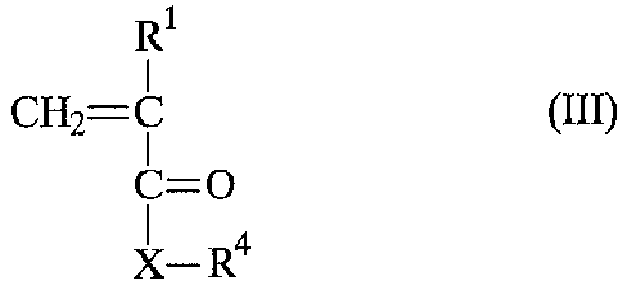 in the formula (III), R1 represents a hydrogen atom or a methyl group; X represents -O- or -NH-; R4 represents at least one selected from -(CH2)nOH, -R5SO3M, -R6N(R7)(R8), and -R6N+(R7)(R8)(R9)·Y-; n represents 1 or more and 4 or less; R5 represents a linear or branched alkylene group having 1 to 5 carbon atoms; M represents a hydrogen atom or a cation; R6 represents a linear or branched alkylene group having 1 to 4 carbon atoms; R7 and R8 are the same or different and represent a linear or branched alkyl group having 1 to 3 carbon atoms; R9 represents a linear or branched alkyl group having 1 to 3 carbon atoms; and Y- represents an anion,wherein the surface tension of the resin composition is obtained by measuring a surface tension of a polymer particle dispersion at a temperature of 20°C, which is a solution that has been diluted with pure water until the solid content was 0.03% by mass.
 - The resin composition according to claim 1, wherein a total content of the constitutional unit (A-2) and the constitutional unit (B-2) in all constitutional units of the polymer particles is 80% by mass or more.
- The resin composition according to claim 1 or 2, wherein in the formula (I), R1 represents a hydrogen atom, R2 represents a linear or branched alkyl group having 1 to 6 carbon atoms, and X represents -O-, and
wherein the constitutional unit (B-2) is derived from the compound expressed by the formula (II), and in the formula (II), R1 represents a hydrogen atom or a methyl group and M represents a hydrogen atom or a cation. - The resin composition according to any one of claims 1 to 3, wherein the ratio (A-2/B-2) of the content of the constitutional unit (A-2) to the content of the constitutional unit (B-2) in the polymer particles is 5 or more and 100 or less.
- The resin composition according to claim 1, wherein the content of the constitutional unit (B-2) in all constitutional units of the polymer particles is 1% by mass or more and 20% by mass or less.
- The resin composition according to claim 1, wherein the content of the constitutional unit (A-2) in all constitutional units of the polymer particles is 90% by mass or more and 99.9% by mass or less.
- The resin composition according to claim 1, wherein a total content of the constitutional unit (A-2) and the constitutional unit (B-2) in all constitutional units of the polymer particles is 100% by mass.
- The resin composition according to any one of claims 1 to 7, wherein the polymer particles contain a constitutional unit (C) derived from a polyfunctional monomer (C) which has at least two vinyl groups, and
a content of the constitutional unit (C) in the polymer particles is 0.001 mol% or more and 1 mol% or less with respect to a total number of moles of the constitutional unit (A-2) and the constitutional unit (B-2). - The resin composition according to claim 8, wherein the polymer particles are obtained by emulsion polymerization of a monomer mixture containing a compound expressed by the formula (I), at least one compound selected from a compound expressed by the formula (II), a compound expressed by the formula (III), and unsaturated dibasic acid, and a polyfunctional monomer (C).
- The resin composition according to claim 9, wherein the emulsion polymerization is soap-free emulsion polymerization.
- The resin composition according to any one of claims 1 to 10, wherein an average particle size of the polymer particles is 0.1 µm or more and less than 0.7 µm, determined by a laser beam diffraction particle size analyzer at room temperature.
- The resin composition according to any one of claims 1 to 11, further comprising an aqueous medium,
wherein the resin composition is in the form of a polymer particle dispersion in which the polymer particles are dispersed in the aqueous medium. - The resin composition according to any one of claims 1 to 12, serving as a binder for a positive electrode or a negative electrode.
- A method for producing a resin composition for an electrode of a power storage device according to claim 1, the resin composition comprising polymer particles,
the method comprising:a polymerization step of polymerizing a monomer mixture containing a monomer (A-2) and a monomer (B-2) to form polymer particles,wherein the monomer (A-2) is a compound expressed by the following formula (I),the monomer (B-2) is at least one compound selected from a compound expressed by the following formula (II), a compound expressed by the following formula (III), and unsaturated dibasic acid,an amount of the monomer (A-2) used in the polymerization step is 50% by mass or more and 99.9% by mass or less with respect to a total amount of monomers,an amount of the monomer (B-2) used in the polymerization step is 0.1% by mass or more and 20% by mass or less with respect to the total amount of monomers, andan amount of a surfactant used in the polymerization step is 0.05% by mass or less with respect to the total amount of monomers, in the formula (I), R1 represents a hydrogen atom or a methyl group; R2 represents at least one selected from a linear or branched alkyl group having 1 to 6 carbon atoms and -CH2OR3; R3 represents a linear or branched alkyl group having 4 to 6 carbon atoms; and X represents -O- or -NH-,
 in the formula (II), R1 represents a hydrogen atom or a methyl group; and M represents a hydrogen atom or a cation,
 in the formula (III), R1 represents a hydrogen atom or a methyl group; X represents -O- or -NH-; R4 represents at least one selected from -(CH2)nOH, -R5SO3M, -R6N(R7)(R8), and -R6N+(R7)(R8)(R9)·Y-; n represents 1 or more and 4 or less; R5 represents a linear or branched alkylene group having 1 to 5 carbon atoms; M represents a hydrogen atom or a cation; R6 represents a linear or branched alkylene group having 1 to 4 carbon atoms; R7 and R8 are the same or different and represent a linear or branched alkyl group having 1 to 3 carbon atoms; R9 represents a linear or branched alkyl group having 1 to 3 carbon atoms; and Y- represents an anion.
 - The method according to claim 14, wherein the monomer mixture further contains a polyfunctional monomer (C), and
an amount of the polyfunctional monomer (C) used in the polymerization step is 0.001 mol% or more and 1 mol% or less with respect to a total number of moles of the monomer (A-2) and the monomer (B-1) that are used in polymerization. - An electrode for a power storage device, comprising:a current collector; anda mixture layer provided on the current collector,wherein the mixture layer includes an active material and the resin composition according to any one of claims 1 to 13.
- Use of a resin composition as a binder for an electrode material for a power storage device,the resin composition comprising:polymer particles containing a constitutional unit (A-2) derived from a compound expressed by the following formula (I) and a constitutional unit (B-2) derived from at least one compound selected from a compound expressed by the following formula (II), a compound expressed by the following formula (III), and unsaturated dibasic acid,wherein the polymer particles are obtainable by emulsion polymerization of a monomer mixture containing a compound expressed by the formula (I), at least one compound selected from a compound expressed by the formula (II), a compound expressed by the formula (III), and unsaturated dibasic acid,wherein the amount of an emulsifier used in the emulsion polymerization is 0.05% by mass or less with respect to the total amount of monomers,a content of the constitutional unit (A-2) in all constitutional units of the polymer particles is 50% by mass or more and 99.9% by mass or less,a content of the constitutional unit (B-2) in all constitutional units of the polymer particles is 0.1% by mass or more and 20% by mass or less, anda surface tension of the resin composition is 55 mN/m or more,
 in the formula (I), R1 represents a hydrogen atom or a methyl group; R2 represents at least one selected from a linear or branched alkyl group having 1 to 6 carbon atoms and -CH2OR3; R3 represents a linear or branched alkyl group having 4 to 6 carbon atoms; and X represents -O- or -NH-,
 in the formula (II), R1 represents a hydrogen atom or a methyl group; and M represents a hydrogen atom or a cation,
 in the formula (III), R1 represents a hydrogen atom or a methyl group; X represents -O- or -NH-; R4 represents at least one selected from -(CH2)nOH, -R5SO3M, -R6N(R7)(R8), and -R6N+(R7)(R8)(R9)·Y-; n represents 1 or more and 4 or less; R5 represents a linear or branched alkylene group having 1 to 5 carbon atoms; M represents a hydrogen atom or a cation; R6 represents a linear or branched alkylene group having 1 to 4 carbon atoms; R7 and R8 are the same or different and represent a linear or branched alkyl group having 1 to 3 carbon atoms; R9 represents a linear or branched alkyl group having 1 to 3 carbon atoms; and Y- represents an anion,wherein the surface tension of the resin composition is obtained by measuring a surface tension of a polymer particle dispersion at a temperature of 20°C, which is a solution that has been diluted with pure water until the solid content was 0.03% by mass.
Applications Claiming Priority (2)
| Application Number | Priority Date | Filing Date | Title |
|---|---|---|---|
| JP2016149538 | 2016-07-29 | ||
| PCT/JP2017/027530 WO2018021552A1 (en) | 2016-07-29 | 2017-07-28 | Resin composition for power storage device electrode |
Publications (3)
| Publication Number | Publication Date |
|---|---|
| EP3493305A1 EP3493305A1 (en) | 2019-06-05 |
| EP3493305A4 EP3493305A4 (en) | 2019-12-11 |
| EP3493305B1 true EP3493305B1 (en) | 2024-09-18 |
Family
ID=61016939
Family Applications (1)
| Application Number | Title | Priority Date | Filing Date |
|---|---|---|---|
| EP17834554.2A Active EP3493305B1 (en) | 2016-07-29 | 2017-07-28 | Resin composition for power storage device electrode |
Country Status (7)
| Country | Link |
|---|---|
| US (1) | US11183693B2 (en) |
| EP (1) | EP3493305B1 (en) |
| JP (1) | JP6985839B2 (en) |
| KR (1) | KR102422331B1 (en) |
| CN (1) | CN109565051A (en) |
| TW (1) | TWI746608B (en) |
| WO (1) | WO2018021552A1 (en) |
Families Citing this family (9)
| Publication number | Priority date | Publication date | Assignee | Title |
|---|---|---|---|---|
| US11430973B2 (en) | 2017-04-21 | 2022-08-30 | Sanyo Chemical Industries, Ltd. | Adhesive for lithium-ion electrode, electrode for lithium-ion battery and method for manufacturing electrode for lithium-ion battery |
| CN111033833B (en) * | 2017-08-29 | 2023-04-04 | 日本瑞翁株式会社 | Binder composition for nonaqueous secondary battery electrode, slurry composition for nonaqueous secondary battery electrode, electrode for nonaqueous secondary battery, and nonaqueous secondary battery |
| JPWO2019124122A1 (en) * | 2017-12-21 | 2020-12-24 | パナソニック株式会社 | Negative electrode for non-aqueous electrolyte secondary battery and non-aqueous electrolyte secondary battery |
| CN108666578B (en) * | 2018-05-21 | 2021-07-30 | 上海洛法化工有限公司 | Lithium ion battery cathode water system binder composition and preparation process thereof |
| KR102901353B1 (en) * | 2019-06-28 | 2025-12-16 | 니폰 제온 가부시키가이샤 | Acrylic rubber, acrylic rubber composition, and rubber crosslinked product |
| US20230044170A1 (en) * | 2020-01-31 | 2023-02-09 | Zeon Corporation | Binder composition for non-aqueous secondary battery and method of producing same, slurry composition for non-aqueous secondary battery electrode, electrode for non-aqueous secondary battery, and non-aqueous secondary battery |
| CN111403749B (en) * | 2020-06-03 | 2020-09-01 | 江苏时代新能源科技有限公司 | Lithium ion battery and device thereof |
| JP2024041052A (en) * | 2022-09-13 | 2024-03-26 | 三洋化成工業株式会社 | Negative electrode composition for lithium ion batteries and method for producing negative electrodes for lithium ion batteries |
| JP7758810B1 (en) | 2024-08-19 | 2025-10-22 | 住友精化株式会社 | Secondary battery binder, slurry, electrode, method for manufacturing secondary battery, and secondary battery |
Family Cites Families (32)
| Publication number | Priority date | Publication date | Assignee | Title |
|---|---|---|---|---|
| JP4536433B2 (en) | 2004-06-24 | 2010-09-01 | 花王株式会社 | Polymer emulsion for cosmetics |
| CN101156264B (en) | 2005-04-07 | 2011-05-25 | Lg化学株式会社 | Binder with good rate property and long cycleability for lithium secondary battery |
| JP2009224239A (en) | 2008-03-18 | 2009-10-01 | Nissan Motor Co Ltd | Electrode for battery |
| WO2010035827A1 (en) | 2008-09-29 | 2010-04-01 | 日本ゼオン株式会社 | Method for manufacturing electrode for electrochemical element |
| TW201043672A (en) * | 2009-03-30 | 2010-12-16 | Jsr Corp | Composition for electrochemical-device electrode binder, electrode slurry for electrochemical device, and electrode for electrochemical device |
| JP2010278125A (en) * | 2009-05-27 | 2010-12-09 | Nippon Zeon Co Ltd | Method for producing electrode for electrochemical device and electrochemical device |
| JP5287601B2 (en) | 2009-08-25 | 2013-09-11 | 日本ゼオン株式会社 | Electrochemical element manufacturing method, electrochemical element electrode, and electrochemical element |
| KR101161143B1 (en) * | 2010-06-16 | 2012-06-29 | 주식회사 엘지화학 | Binder for Secondary Battery Providing Excellent Cycle Property |
| WO2012005496A2 (en) * | 2010-07-09 | 2012-01-12 | 주식회사 엘지화학 | Binder for secondary battery, having excellent adhesive force |
| JP5943602B2 (en) | 2010-12-28 | 2016-07-05 | 三井化学株式会社 | Acrylic aqueous dispersion and aqueous paste for electrochemical cell, and method for producing electrode / battery comprising the same |
| JP2013004229A (en) | 2011-06-14 | 2013-01-07 | Mitsubishi Rayon Co Ltd | Binder for lithium secondary battery electrode, method for producing binder for lithium secondary battery electrode, lithium secondary battery electrode, and lithium secondary battery |
| CN103289617B (en) | 2012-02-29 | 2016-03-16 | Jsr株式会社 | Binder composition for electrode, electrode slurry, electrode and electric energy storage device |
| US9583278B2 (en) | 2012-06-18 | 2017-02-28 | Jsr Corporation | Binder composition for electrical storage device electrodes, slurry for electrical storage device electrodes, electrical storage device electrode, and electrical storage device |
| WO2013191239A1 (en) | 2012-06-20 | 2013-12-27 | 日本ゼオン株式会社 | Slurry for lithium ion secondary battery negative electrodes, electrode for lithium ion secondary batteries, method for producing electrode for lithium ion secondary batteries, and lithium ion secondary battery |
| JP2014079209A (en) | 2012-10-17 | 2014-05-08 | Tsukishima Foods Industry Co Ltd | Confectionery quality improver |
| US20150284558A1 (en) | 2012-11-06 | 2015-10-08 | Mitsubishi Rayon Co., Ltd. | Method for producing (meth)acrylic resin composition, method for producing (meth)acrylic resin shaped article, (meth)acrylic resin shaped article, front-surface plate for liquid crystal display device, and touch panel |
| WO2014073647A1 (en) | 2012-11-09 | 2014-05-15 | 日本ゼオン株式会社 | Slurry composition for negative electrodes of lithium ion secondary batteries, negative electrode for lithium ion secondary batteries, method for producing negative electrode for lithium ion secondary batteries, and lithium ion secondary battery |
| KR101637889B1 (en) * | 2012-11-29 | 2016-07-08 | 주식회사 엘지화학 | Binder for Secondary Battery Exhibiting Excellent Adhesive Force |
| JP6068973B2 (en) * | 2012-12-21 | 2017-01-25 | デンカ株式会社 | Electrode binder composition |
| KR102188318B1 (en) * | 2013-05-14 | 2020-12-08 | 제온 코포레이션 | Binder composition for lithium ion secondary battery, slurry composition for lithium ion secondary battery, electrode for lithium ion secondary battery, lithium ion secondary battery, and method for producing binder composition for lithium ion secondary battery |
| CN105190968B (en) * | 2013-05-29 | 2018-07-24 | 日本瑞翁株式会社 | Binder for electrochemical element electrode, particle composite for electrochemical element electrode, electrochemical element electrode, electrochemical element, and manufacturing method of electrochemical element electrode |
| JP6218538B2 (en) * | 2013-10-02 | 2017-10-25 | 株式会社Gsユアサ | Non-aqueous secondary battery positive electrode paste, non-aqueous secondary battery positive electrode and non-aqueous secondary battery |
| JP6341271B2 (en) * | 2014-03-04 | 2018-06-13 | 株式会社大阪ソーダ | Battery electrode binder, and electrode and battery using the same |
| CN105659419B (en) | 2014-03-27 | 2019-02-19 | 积水化学工业株式会社 | Binder for storage device electrodes |
| CN105018001B (en) | 2014-04-28 | 2016-08-31 | 成都中科来方能源科技有限公司 | Water adhesive for lithium ion battery and positive/negative plate and coating barrier film |
| US20170133667A1 (en) | 2014-07-15 | 2017-05-11 | Toray Industries, Inc. | Electrode material, lithium-sulfur battery electrode, lithium-sulfur battery and electrode material production method (as amended) |
| US20180102542A1 (en) * | 2015-04-22 | 2018-04-12 | Toagosei Co., Ltd. | Binder for nonaqueous electrolyte secondary battery electrode, and use thereof |
| JP7017081B2 (en) | 2015-09-16 | 2022-02-08 | 日本ゼオン株式会社 | Binder for all-solid-state secondary battery, manufacturing method of binder for all-solid-state secondary battery and all-solid-state secondary battery |
| WO2017141791A1 (en) * | 2016-02-17 | 2017-08-24 | 日本ゼオン株式会社 | Binder composition for nonaqueous secondary battery electrodes, slurry composition for nonaqueous secondary battery electrodes, electrode for nonaqueous secondary batteries, and nonaqueous secondary battery |
| CN105576284A (en) | 2016-02-18 | 2016-05-11 | 福建蓝海黑石科技有限公司 | Anode aqueous binder of lithium ion battery and preparation method thereof |
| HUE064159T2 (en) * | 2016-03-24 | 2024-02-28 | Zeon Corp | Binder composition for nonaqueous secondary battery electrodes, slurry composition for nonaqueous secondary battery electrodes, electrode for nonaqueous secondary batteries, and nonaqueous secondary battery |
| KR20200060394A (en) * | 2017-09-28 | 2020-05-29 | 니폰 제온 가부시키가이샤 | Binder composition for secondary battery, slurry composition for secondary battery, functional layer for secondary battery, electrode layer for secondary battery and secondary battery |
-
2017
- 2017-07-28 JP JP2017146969A patent/JP6985839B2/en active Active
- 2017-07-28 WO PCT/JP2017/027530 patent/WO2018021552A1/en not_active Ceased
- 2017-07-28 US US16/321,708 patent/US11183693B2/en active Active
- 2017-07-28 TW TW106125632A patent/TWI746608B/en active
- 2017-07-28 EP EP17834554.2A patent/EP3493305B1/en active Active
- 2017-07-28 CN CN201780047222.0A patent/CN109565051A/en active Pending
- 2017-07-28 KR KR1020197003342A patent/KR102422331B1/en active Active
Also Published As
| Publication number | Publication date |
|---|---|
| JP6985839B2 (en) | 2021-12-22 |
| EP3493305A4 (en) | 2019-12-11 |
| TWI746608B (en) | 2021-11-21 |
| JP2018032623A (en) | 2018-03-01 |
| KR102422331B1 (en) | 2022-07-18 |
| KR20190037249A (en) | 2019-04-05 |
| US20200381734A1 (en) | 2020-12-03 |
| TW201819435A (en) | 2018-06-01 |
| EP3493305A1 (en) | 2019-06-05 |
| US11183693B2 (en) | 2021-11-23 |
| WO2018021552A1 (en) | 2018-02-01 |
| CN109565051A (en) | 2019-04-02 |
Similar Documents
| Publication | Publication Date | Title |
|---|---|---|
| EP3493305B1 (en) | Resin composition for power storage device electrode | |
| EP3288105B1 (en) | Binder for nonaqueous electrolyte secondary battery electrodes and use of same | |
| KR101819067B1 (en) | Positive electrode for secondary batteries, method for producing same, slurry composition, and secondary battery | |
| EP3435456B1 (en) | Binder composition for nonaqueous secondary battery electrodes, slurry composition for nonaqueous secondary battery electrodes, electrode for nonaqueous secondary batteries, and nonaqueous secondary battery | |
| JP6665857B2 (en) | Composition for non-aqueous electrolyte secondary battery electrode mixture layer, method for producing the same, and use thereof | |
| JP7317432B2 (en) | Copolymer for polymer electrolyte, gel polymer electrolyte containing the same, and lithium secondary battery | |
| EP3537514B1 (en) | Positive electrode for lithium-ion battery and lithium-ion battery | |
| KR20180041683A (en) | A composition for a non-aqueous secondary battery functional layer, a functional layer for a non-aqueous secondary battery, and a non-aqueous secondary battery | |
| KR20180083340A (en) | A composition for a non-aqueous secondary battery adhesion layer, a non-aqueous secondary battery adhesion layer, and a non-aqueous secondary battery | |
| KR102049679B1 (en) | The lithium ion secondary battery provided with the positive electrode for lithium ion secondary batteries obtained using the slurry for positive electrodes of a lithium ion secondary battery, the slurry for positive electrodes of a lithium ion secondary battery, and its manufacturing method, and the positive electrode for lithium ion secondary batteries, and its manufacturing method | |
| EP3588638A1 (en) | Composite resin for energy device electrode, composition for forming energy device electrode, positive electrode for energy device, and energy device | |
| JP6987632B2 (en) | Resin composition for power storage device electrodes | |
| EP4379939A1 (en) | Composition for electrochemical element functional layer, production method for same, functional layer for electrochemical element, and electrochemical element | |
| US11482706B2 (en) | Resin for energy device electrode, composition for forming energy device electrode, energy device electrode, and energy device | |
| JP7666787B2 (en) | In situ polymerized hybrid polymer electrolytes for high voltage lithium batteries | |
| JP5953827B2 (en) | Secondary battery electrode mixture, method for producing the same, method for producing secondary battery electrode, and method for producing secondary battery | |
| EP4411966A1 (en) | Composition for nonaqueous secondary battery functional layer, functional layer for nonaqueous secondary battery, separator for nonaqueous secondary battery, and nonaqueous secondary battery | |
| JP7847539B2 (en) | Ion conductive layer for energy storage devices | |
| EP4583294A1 (en) | Composition for electrochemical element functional layer, laminate for electrochemical element, and electrochemical element | |
| WO2025033218A1 (en) | Binder for secondary battery electrodes and use of same | |
| JP2019029177A (en) | Resin composition for electricity storage device electrode | |
| JP2022163577A (en) | Ion-conducting layer for power storage devices | |
| EP4131621A1 (en) | Organic particle dispersion for secondary cell functional layer, composition for secondary cell functional layer, cell member for secondary cell, and secondary cell |
Legal Events
| Date | Code | Title | Description |
|---|---|---|---|
| STAA | Information on the status of an ep patent application or granted ep patent |
Free format text: STATUS: THE INTERNATIONAL PUBLICATION HAS BEEN MADE |
|
| PUAI | Public reference made under article 153(3) epc to a published international application that has entered the european phase |
Free format text: ORIGINAL CODE: 0009012 |
|
| STAA | Information on the status of an ep patent application or granted ep patent |
Free format text: STATUS: REQUEST FOR EXAMINATION WAS MADE |
|
| 17P | Request for examination filed |
Effective date: 20190212 |
|
| AK | Designated contracting states |
Kind code of ref document: A1 Designated state(s): AL AT BE BG CH CY CZ DE DK EE ES FI FR GB GR HR HU IE IS IT LI LT LU LV MC MK MT NL NO PL PT RO RS SE SI SK SM TR |
|
| AX | Request for extension of the european patent |
Extension state: BA ME |
|
| DAV | Request for validation of the european patent (deleted) | ||
| DAX | Request for extension of the european patent (deleted) | ||
| A4 | Supplementary search report drawn up and despatched |
Effective date: 20191113 |
|
| RIC1 | Information provided on ipc code assigned before grant |
Ipc: C08F 222/02 20060101ALI20191107BHEP Ipc: H01M 4/133 20100101ALI20191107BHEP Ipc: H01M 4/62 20060101AFI20191107BHEP Ipc: C08F 220/12 20060101ALI20191107BHEP Ipc: C08F 220/06 20060101ALI20191107BHEP Ipc: H01M 4/02 20060101ALN20191107BHEP Ipc: H01G 11/38 20130101ALI20191107BHEP Ipc: H01M 4/13 20100101ALI20191107BHEP Ipc: H01M 4/1393 20100101ALI20191107BHEP |
|
| STAA | Information on the status of an ep patent application or granted ep patent |
Free format text: STATUS: EXAMINATION IS IN PROGRESS |
|
| 17Q | First examination report despatched |
Effective date: 20230508 |
|
| GRAP | Despatch of communication of intention to grant a patent |
Free format text: ORIGINAL CODE: EPIDOSNIGR1 |
|
| STAA | Information on the status of an ep patent application or granted ep patent |
Free format text: STATUS: GRANT OF PATENT IS INTENDED |
|
| RIC1 | Information provided on ipc code assigned before grant |
Ipc: H01M 4/02 20060101ALN20240418BHEP Ipc: H01M 4/1393 20100101ALI20240418BHEP Ipc: H01M 4/133 20100101ALI20240418BHEP Ipc: H01M 4/13 20100101ALI20240418BHEP Ipc: H01G 11/38 20130101ALI20240418BHEP Ipc: C08F 222/02 20060101ALI20240418BHEP Ipc: C08F 220/12 20060101ALI20240418BHEP Ipc: C08F 220/06 20060101ALI20240418BHEP Ipc: H01M 4/62 20060101AFI20240418BHEP |
|
| INTG | Intention to grant announced |
Effective date: 20240516 |
|
| RIN1 | Information on inventor provided before grant (corrected) |
Inventor name: GOTO, HIDEKI Inventor name: OKI, KAZUO Inventor name: TAKAHASHI, KEI Inventor name: KUWAHARA, KAZUO Inventor name: HIRAISHI, ATSUSHI |
|
| GRAS | Grant fee paid |
Free format text: ORIGINAL CODE: EPIDOSNIGR3 |
|
| GRAA | (expected) grant |
Free format text: ORIGINAL CODE: 0009210 |
|
| STAA | Information on the status of an ep patent application or granted ep patent |
Free format text: STATUS: THE PATENT HAS BEEN GRANTED |
|
| AK | Designated contracting states |
Kind code of ref document: B1 Designated state(s): AL AT BE BG CH CY CZ DE DK EE ES FI FR GB GR HR HU IE IS IT LI LT LU LV MC MK MT NL NO PL PT RO RS SE SI SK SM TR |
|
| P01 | Opt-out of the competence of the unified patent court (upc) registered |
Free format text: CASE NUMBER: APP_45971/2024 Effective date: 20240808 |
|
| RAP3 | Party data changed (applicant data changed or rights of an application transferred) |
Owner name: KAO CORPORATION |
|
| REG | Reference to a national code |
Ref country code: GB Ref legal event code: FG4D |
|
| REG | Reference to a national code |
Ref country code: CH Ref legal event code: EP |
|
| REG | Reference to a national code |
Ref country code: IE Ref legal event code: FG4D |
|
| REG | Reference to a national code |
Ref country code: DE Ref legal event code: R096 Ref document number: 602017084947 Country of ref document: DE |
|
| REG | Reference to a national code |
Ref country code: LT Ref legal event code: MG9D |
|
| PG25 | Lapsed in a contracting state [announced via postgrant information from national office to epo] |
Ref country code: NO Free format text: LAPSE BECAUSE OF FAILURE TO SUBMIT A TRANSLATION OF THE DESCRIPTION OR TO PAY THE FEE WITHIN THE PRESCRIBED TIME-LIMIT Effective date: 20241218 |
|
| PG25 | Lapsed in a contracting state [announced via postgrant information from national office to epo] |
Ref country code: GR Free format text: LAPSE BECAUSE OF FAILURE TO SUBMIT A TRANSLATION OF THE DESCRIPTION OR TO PAY THE FEE WITHIN THE PRESCRIBED TIME-LIMIT Effective date: 20241219 Ref country code: FI Free format text: LAPSE BECAUSE OF FAILURE TO SUBMIT A TRANSLATION OF THE DESCRIPTION OR TO PAY THE FEE WITHIN THE PRESCRIBED TIME-LIMIT Effective date: 20240918 |
|
| PG25 | Lapsed in a contracting state [announced via postgrant information from national office to epo] |
Ref country code: BG Free format text: LAPSE BECAUSE OF FAILURE TO SUBMIT A TRANSLATION OF THE DESCRIPTION OR TO PAY THE FEE WITHIN THE PRESCRIBED TIME-LIMIT Effective date: 20240918 |
|
| PG25 | Lapsed in a contracting state [announced via postgrant information from national office to epo] |
Ref country code: LV Free format text: LAPSE BECAUSE OF FAILURE TO SUBMIT A TRANSLATION OF THE DESCRIPTION OR TO PAY THE FEE WITHIN THE PRESCRIBED TIME-LIMIT Effective date: 20240918 |
|
| PG25 | Lapsed in a contracting state [announced via postgrant information from national office to epo] |
Ref country code: HR Free format text: LAPSE BECAUSE OF FAILURE TO SUBMIT A TRANSLATION OF THE DESCRIPTION OR TO PAY THE FEE WITHIN THE PRESCRIBED TIME-LIMIT Effective date: 20240918 |
|
| REG | Reference to a national code |
Ref country code: NL Ref legal event code: MP Effective date: 20240918 |
|
| PG25 | Lapsed in a contracting state [announced via postgrant information from national office to epo] |
Ref country code: RS Free format text: LAPSE BECAUSE OF FAILURE TO SUBMIT A TRANSLATION OF THE DESCRIPTION OR TO PAY THE FEE WITHIN THE PRESCRIBED TIME-LIMIT Effective date: 20241218 |
|
| PG25 | Lapsed in a contracting state [announced via postgrant information from national office to epo] |
Ref country code: RS Free format text: LAPSE BECAUSE OF FAILURE TO SUBMIT A TRANSLATION OF THE DESCRIPTION OR TO PAY THE FEE WITHIN THE PRESCRIBED TIME-LIMIT Effective date: 20241218 Ref country code: NO Free format text: LAPSE BECAUSE OF FAILURE TO SUBMIT A TRANSLATION OF THE DESCRIPTION OR TO PAY THE FEE WITHIN THE PRESCRIBED TIME-LIMIT Effective date: 20241218 Ref country code: LV Free format text: LAPSE BECAUSE OF FAILURE TO SUBMIT A TRANSLATION OF THE DESCRIPTION OR TO PAY THE FEE WITHIN THE PRESCRIBED TIME-LIMIT Effective date: 20240918 Ref country code: HR Free format text: LAPSE BECAUSE OF FAILURE TO SUBMIT A TRANSLATION OF THE DESCRIPTION OR TO PAY THE FEE WITHIN THE PRESCRIBED TIME-LIMIT Effective date: 20240918 Ref country code: GR Free format text: LAPSE BECAUSE OF FAILURE TO SUBMIT A TRANSLATION OF THE DESCRIPTION OR TO PAY THE FEE WITHIN THE PRESCRIBED TIME-LIMIT Effective date: 20241219 Ref country code: FI Free format text: LAPSE BECAUSE OF FAILURE TO SUBMIT A TRANSLATION OF THE DESCRIPTION OR TO PAY THE FEE WITHIN THE PRESCRIBED TIME-LIMIT Effective date: 20240918 Ref country code: BG Free format text: LAPSE BECAUSE OF FAILURE TO SUBMIT A TRANSLATION OF THE DESCRIPTION OR TO PAY THE FEE WITHIN THE PRESCRIBED TIME-LIMIT Effective date: 20240918 |
|
| REG | Reference to a national code |
Ref country code: AT Ref legal event code: MK05 Ref document number: 1725458 Country of ref document: AT Kind code of ref document: T Effective date: 20240918 |
|
| PG25 | Lapsed in a contracting state [announced via postgrant information from national office to epo] |
Ref country code: NL Free format text: LAPSE BECAUSE OF FAILURE TO SUBMIT A TRANSLATION OF THE DESCRIPTION OR TO PAY THE FEE WITHIN THE PRESCRIBED TIME-LIMIT Effective date: 20240918 |
|
| PG25 | Lapsed in a contracting state [announced via postgrant information from national office to epo] |
Ref country code: PT Free format text: LAPSE BECAUSE OF FAILURE TO SUBMIT A TRANSLATION OF THE DESCRIPTION OR TO PAY THE FEE WITHIN THE PRESCRIBED TIME-LIMIT Effective date: 20250120 Ref country code: IS Free format text: LAPSE BECAUSE OF FAILURE TO SUBMIT A TRANSLATION OF THE DESCRIPTION OR TO PAY THE FEE WITHIN THE PRESCRIBED TIME-LIMIT Effective date: 20250118 |
|
| PG25 | Lapsed in a contracting state [announced via postgrant information from national office to epo] |
Ref country code: RO Free format text: LAPSE BECAUSE OF FAILURE TO SUBMIT A TRANSLATION OF THE DESCRIPTION OR TO PAY THE FEE WITHIN THE PRESCRIBED TIME-LIMIT Effective date: 20240918 Ref country code: SM Free format text: LAPSE BECAUSE OF FAILURE TO SUBMIT A TRANSLATION OF THE DESCRIPTION OR TO PAY THE FEE WITHIN THE PRESCRIBED TIME-LIMIT Effective date: 20240918 |
|
| PG25 | Lapsed in a contracting state [announced via postgrant information from national office to epo] |
Ref country code: ES Free format text: LAPSE BECAUSE OF FAILURE TO SUBMIT A TRANSLATION OF THE DESCRIPTION OR TO PAY THE FEE WITHIN THE PRESCRIBED TIME-LIMIT Effective date: 20240918 |
|
| PG25 | Lapsed in a contracting state [announced via postgrant information from national office to epo] |
Ref country code: AT Free format text: LAPSE BECAUSE OF FAILURE TO SUBMIT A TRANSLATION OF THE DESCRIPTION OR TO PAY THE FEE WITHIN THE PRESCRIBED TIME-LIMIT Effective date: 20240918 Ref country code: EE Free format text: LAPSE BECAUSE OF FAILURE TO SUBMIT A TRANSLATION OF THE DESCRIPTION OR TO PAY THE FEE WITHIN THE PRESCRIBED TIME-LIMIT Effective date: 20240918 |
|
| PG25 | Lapsed in a contracting state [announced via postgrant information from national office to epo] |
Ref country code: CZ Free format text: LAPSE BECAUSE OF FAILURE TO SUBMIT A TRANSLATION OF THE DESCRIPTION OR TO PAY THE FEE WITHIN THE PRESCRIBED TIME-LIMIT Effective date: 20240918 Ref country code: PL Free format text: LAPSE BECAUSE OF FAILURE TO SUBMIT A TRANSLATION OF THE DESCRIPTION OR TO PAY THE FEE WITHIN THE PRESCRIBED TIME-LIMIT Effective date: 20240918 |
|
| PG25 | Lapsed in a contracting state [announced via postgrant information from national office to epo] |
Ref country code: IT Free format text: LAPSE BECAUSE OF FAILURE TO SUBMIT A TRANSLATION OF THE DESCRIPTION OR TO PAY THE FEE WITHIN THE PRESCRIBED TIME-LIMIT Effective date: 20240918 Ref country code: SK Free format text: LAPSE BECAUSE OF FAILURE TO SUBMIT A TRANSLATION OF THE DESCRIPTION OR TO PAY THE FEE WITHIN THE PRESCRIBED TIME-LIMIT Effective date: 20240918 |
|
| REG | Reference to a national code |
Ref country code: DE Ref legal event code: R097 Ref document number: 602017084947 Country of ref document: DE |
|
| PG25 | Lapsed in a contracting state [announced via postgrant information from national office to epo] |
Ref country code: DK Free format text: LAPSE BECAUSE OF FAILURE TO SUBMIT A TRANSLATION OF THE DESCRIPTION OR TO PAY THE FEE WITHIN THE PRESCRIBED TIME-LIMIT Effective date: 20240918 |
|
| PGFP | Annual fee paid to national office [announced via postgrant information from national office to epo] |
Ref country code: FR Payment date: 20250610 Year of fee payment: 9 |
|
| PLBE | No opposition filed within time limit |
Free format text: ORIGINAL CODE: 0009261 |
|
| STAA | Information on the status of an ep patent application or granted ep patent |
Free format text: STATUS: NO OPPOSITION FILED WITHIN TIME LIMIT |
|
| 26N | No opposition filed |
Effective date: 20250619 |
|
| PG25 | Lapsed in a contracting state [announced via postgrant information from national office to epo] |
Ref country code: SE Free format text: LAPSE BECAUSE OF FAILURE TO SUBMIT A TRANSLATION OF THE DESCRIPTION OR TO PAY THE FEE WITHIN THE PRESCRIBED TIME-LIMIT Effective date: 20240918 |
|
| PGFP | Annual fee paid to national office [announced via postgrant information from national office to epo] |
Ref country code: DE Payment date: 20250604 Year of fee payment: 9 |
|
| REG | Reference to a national code |
Ref country code: CH Ref legal event code: H13 Free format text: ST27 STATUS EVENT CODE: U-0-0-H10-H13 (AS PROVIDED BY THE NATIONAL OFFICE) Effective date: 20260224 |
|
| PG25 | Lapsed in a contracting state [announced via postgrant information from national office to epo] |
Ref country code: LU Free format text: LAPSE BECAUSE OF NON-PAYMENT OF DUE FEES Effective date: 20250728 |
|
| GBPC | Gb: european patent ceased through non-payment of renewal fee |
Effective date: 20250728 |
|
| REG | Reference to a national code |
Ref country code: BE Ref legal event code: MM Effective date: 20250731 |
|
| PG25 | Lapsed in a contracting state [announced via postgrant information from national office to epo] |
Ref country code: GB Free format text: LAPSE BECAUSE OF NON-PAYMENT OF DUE FEES Effective date: 20250728 |
|
| PG25 | Lapsed in a contracting state [announced via postgrant information from national office to epo] |
Ref country code: BE Free format text: LAPSE BECAUSE OF NON-PAYMENT OF DUE FEES Effective date: 20250731 |
|
| PG25 | Lapsed in a contracting state [announced via postgrant information from national office to epo] |
Ref country code: CH Free format text: LAPSE BECAUSE OF NON-PAYMENT OF DUE FEES Effective date: 20250731 |