EP3489325A1 - Organic electroluminescent device - Google Patents
Organic electroluminescent device Download PDFInfo
- Publication number
- EP3489325A1 EP3489325A1 EP19150518.9A EP19150518A EP3489325A1 EP 3489325 A1 EP3489325 A1 EP 3489325A1 EP 19150518 A EP19150518 A EP 19150518A EP 3489325 A1 EP3489325 A1 EP 3489325A1
- Authority
- EP
- European Patent Office
- Prior art keywords
- solution
- compound
- mmol
- layer
- substituted
- Prior art date
- Legal status (The legal status is an assumption and is not a legal conclusion. Google has not performed a legal analysis and makes no representation as to the accuracy of the status listed.)
- Granted
Links
- 0 CC(*)(C=C1)C=*C(C2(*)*)=C1c1c2cccc1 Chemical compound CC(*)(C=C1)C=*C(C2(*)*)=C1c1c2cccc1 0.000 description 16
- KRVPIUXLEGOOIQ-UHFFFAOYSA-N c(cc1)ccc1-c1c(cccc2)c2c(-c(cc2)cc3c2[nH]c2c3cccc2)c2c1cccc2 Chemical compound c(cc1)ccc1-c1c(cccc2)c2c(-c(cc2)cc3c2[nH]c2c3cccc2)c2c1cccc2 KRVPIUXLEGOOIQ-UHFFFAOYSA-N 0.000 description 2
- GPTZDVPQOJSRRN-UHFFFAOYSA-N c(cc1)ccc1-c1c(cccc2)c2c(-c(cc2c3c4nccc3)ccc2[n]4-c(cc2)ccc2N(c2c(cccc3)c3ccc2)c2cccc3c2cccc3)c2c1cccc2 Chemical compound c(cc1)ccc1-c1c(cccc2)c2c(-c(cc2c3c4nccc3)ccc2[n]4-c(cc2)ccc2N(c2c(cccc3)c3ccc2)c2cccc3c2cccc3)c2c1cccc2 GPTZDVPQOJSRRN-UHFFFAOYSA-N 0.000 description 2
- HIXXJIJMXJVCST-UHFFFAOYSA-N c(cc1)ccc1-c1c(cccc2)c2c(-c(cc2c3c4nccc3)ccc2[n]4-c2cccc(N(c3c(cccc4)c4ccc3)c3cccc4c3cccc4)c2)c2c1cccc2 Chemical compound c(cc1)ccc1-c1c(cccc2)c2c(-c(cc2c3c4nccc3)ccc2[n]4-c2cccc(N(c3c(cccc4)c4ccc3)c3cccc4c3cccc4)c2)c2c1cccc2 HIXXJIJMXJVCST-UHFFFAOYSA-N 0.000 description 2
- IFRGWFNWNCPVAH-UHFFFAOYSA-N Bc(cc1C(C)(C)c2c3)ccc1-c2ccc3Br Chemical compound Bc(cc1C(C)(C)c2c3)ccc1-c2ccc3Br IFRGWFNWNCPVAH-UHFFFAOYSA-N 0.000 description 1
- LTBWKAYPXIIVPC-UHFFFAOYSA-N Brc(cc1)cc2c1[nH]c1c2cccc1 Chemical compound Brc(cc1)cc2c1[nH]c1c2cccc1 LTBWKAYPXIIVPC-UHFFFAOYSA-N 0.000 description 1
- UHKVHROIRXYKOT-UHFFFAOYSA-N CC(C)(c1c2)c(cc(cc3)-[n]4c5ccccc5c5ccccc45)c3-c1ccc2-c(cc1)cc2c1[s]c1c2cccc1 Chemical compound CC(C)(c1c2)c(cc(cc3)-[n]4c5ccccc5c5ccccc45)c3-c1ccc2-c(cc1)cc2c1[s]c1c2cccc1 UHKVHROIRXYKOT-UHFFFAOYSA-N 0.000 description 1
- CNDZSUMWMNGXEA-UHFFFAOYSA-N CC(C)(c1c2)c(cc(cc3)-[n]4c5ccccc5c5ccccc45)c3-c1ccc2-c1ccc2OC(CCC=C3)C3c2c1 Chemical compound CC(C)(c1c2)c(cc(cc3)-[n]4c5ccccc5c5ccccc45)c3-c1ccc2-c1ccc2OC(CCC=C3)C3c2c1 CNDZSUMWMNGXEA-UHFFFAOYSA-N 0.000 description 1
- LPFOPHZWRQNAJI-UHFFFAOYSA-N CC1(C)c2cc(Br)ccc2-c(cc2)c1cc2-c(cc1)cc2c1[s]c1c2cccc1 Chemical compound CC1(C)c2cc(Br)ccc2-c(cc2)c1cc2-c(cc1)cc2c1[s]c1c2cccc1 LPFOPHZWRQNAJI-UHFFFAOYSA-N 0.000 description 1
- LONBOJIXBFUBKQ-UHFFFAOYSA-N CC1(C)c2cc(Br)ccc2-c(cc2)c1cc2Br Chemical compound CC1(C)c2cc(Br)ccc2-c(cc2)c1cc2Br LONBOJIXBFUBKQ-UHFFFAOYSA-N 0.000 description 1
- SRHCFJHPKQJCTR-UHFFFAOYSA-N c(cc1)ccc1-c1c(cccc2)c2c(-c(cc2)cc(c3c4cccc3)c2[n]4-c(cc2)ccc2N(c2ccccc2)c2cc3ccccc3c3c2cccc3)c2c1cccc2 Chemical compound c(cc1)ccc1-c1c(cccc2)c2c(-c(cc2)cc(c3c4cccc3)c2[n]4-c(cc2)ccc2N(c2ccccc2)c2cc3ccccc3c3c2cccc3)c2c1cccc2 SRHCFJHPKQJCTR-UHFFFAOYSA-N 0.000 description 1
- SAAAJZVRKYBQIR-UHFFFAOYSA-N c(cc1)ccc1-c1c(cccc2)c2c(-c(cc2c3c4cccc3)ccc2[n]4-c(cc2)ccc2N(c2ccccc2)c2ccccc2)c2c1cccc2 Chemical compound c(cc1)ccc1-c1c(cccc2)c2c(-c(cc2c3c4cccc3)ccc2[n]4-c(cc2)ccc2N(c2ccccc2)c2ccccc2)c2c1cccc2 SAAAJZVRKYBQIR-UHFFFAOYSA-N 0.000 description 1
- CGMOUBSQSDDNMP-UHFFFAOYSA-N c(cc1)ccc1-c1c(cccc2)c2c(-c(cc2c3c4cccc3)ccc2[n]4-c2cccc(N(c3ccccc3)c3cc4ccccc4c4ccccc34)c2)c2c1cccc2 Chemical compound c(cc1)ccc1-c1c(cccc2)c2c(-c(cc2c3c4cccc3)ccc2[n]4-c2cccc(N(c3ccccc3)c3cc4ccccc4c4ccccc34)c2)c2c1cccc2 CGMOUBSQSDDNMP-UHFFFAOYSA-N 0.000 description 1
- KHLGJHMFRVQBAU-UHFFFAOYSA-N c(cc1)ccc1-c1c(cccc2)c2c(-c(cc2c3cc(-c4cc5c(-c6ccccc6)c(cccc6)c6c(-c(cc6c7c8cccc7)ccc6[n]8-c6cccc(N(c7ccccc7)c7c(cccc8)c8ccc7)c6)c5cc4)ccc33)ccc2[n]3-c2cccc(N(c3ccccc3)c3ccccc3)c2)c2c1cccc2 Chemical compound c(cc1)ccc1-c1c(cccc2)c2c(-c(cc2c3cc(-c4cc5c(-c6ccccc6)c(cccc6)c6c(-c(cc6c7c8cccc7)ccc6[n]8-c6cccc(N(c7ccccc7)c7c(cccc8)c8ccc7)c6)c5cc4)ccc33)ccc2[n]3-c2cccc(N(c3ccccc3)c3ccccc3)c2)c2c1cccc2 KHLGJHMFRVQBAU-UHFFFAOYSA-N 0.000 description 1
- WZELQSKQOSPRGY-UHFFFAOYSA-N c(cc1)ccc1-c1c(cccc2)c2c(-c(cc2c3cccnc33)ccc2[n]3-c(cc2)ccc2N(c2ccccc2)c2ccccc2)c2c1cccc2 Chemical compound c(cc1)ccc1-c1c(cccc2)c2c(-c(cc2c3cccnc33)ccc2[n]3-c(cc2)ccc2N(c2ccccc2)c2ccccc2)c2c1cccc2 WZELQSKQOSPRGY-UHFFFAOYSA-N 0.000 description 1
- WUAGIBRGWSHWTO-UHFFFAOYSA-N c(cc1)ccc1-c1c(cccc2)c2c(-c(cc2c3cccnc33)ccc2[n]3-c2cccc(N(c3ccccc3)c3ccccc3)c2)c2c1cccc2 Chemical compound c(cc1)ccc1-c1c(cccc2)c2c(-c(cc2c3cccnc33)ccc2[n]3-c2cccc(N(c3ccccc3)c3ccccc3)c2)c2c1cccc2 WUAGIBRGWSHWTO-UHFFFAOYSA-N 0.000 description 1
Images

Classifications
-
- C—CHEMISTRY; METALLURGY
- C07—ORGANIC CHEMISTRY
- C07D—HETEROCYCLIC COMPOUNDS
- C07D209/00—Heterocyclic compounds containing five-membered rings, condensed with other rings, with one nitrogen atom as the only ring hetero atom
- C07D209/56—Ring systems containing three or more rings
- C07D209/80—[b, c]- or [b, d]-condensed
- C07D209/82—Carbazoles; Hydrogenated carbazoles
- C07D209/86—Carbazoles; Hydrogenated carbazoles with only hydrogen atoms, hydrocarbon or substituted hydrocarbon radicals, directly attached to carbon atoms of the ring system
-
- C—CHEMISTRY; METALLURGY
- C07—ORGANIC CHEMISTRY
- C07D—HETEROCYCLIC COMPOUNDS
- C07D307/00—Heterocyclic compounds containing five-membered rings having one oxygen atom as the only ring hetero atom
- C07D307/77—Heterocyclic compounds containing five-membered rings having one oxygen atom as the only ring hetero atom ortho- or peri-condensed with carbocyclic rings or ring systems
- C07D307/91—Dibenzofurans; Hydrogenated dibenzofurans
-
- C—CHEMISTRY; METALLURGY
- C07—ORGANIC CHEMISTRY
- C07D—HETEROCYCLIC COMPOUNDS
- C07D333/00—Heterocyclic compounds containing five-membered rings having one sulfur atom as the only ring hetero atom
- C07D333/50—Heterocyclic compounds containing five-membered rings having one sulfur atom as the only ring hetero atom condensed with carbocyclic rings or ring systems
- C07D333/76—Dibenzothiophenes
-
- C—CHEMISTRY; METALLURGY
- C07—ORGANIC CHEMISTRY
- C07D—HETEROCYCLIC COMPOUNDS
- C07D405/00—Heterocyclic compounds containing both one or more hetero rings having oxygen atoms as the only ring hetero atoms, and one or more rings having nitrogen as the only ring hetero atom
- C07D405/02—Heterocyclic compounds containing both one or more hetero rings having oxygen atoms as the only ring hetero atoms, and one or more rings having nitrogen as the only ring hetero atom containing two hetero rings
- C07D405/10—Heterocyclic compounds containing both one or more hetero rings having oxygen atoms as the only ring hetero atoms, and one or more rings having nitrogen as the only ring hetero atom containing two hetero rings linked by a carbon chain containing aromatic rings
-
- C—CHEMISTRY; METALLURGY
- C07—ORGANIC CHEMISTRY
- C07D—HETEROCYCLIC COMPOUNDS
- C07D409/00—Heterocyclic compounds containing two or more hetero rings, at least one ring having sulfur atoms as the only ring hetero atoms
- C07D409/02—Heterocyclic compounds containing two or more hetero rings, at least one ring having sulfur atoms as the only ring hetero atoms containing two hetero rings
- C07D409/10—Heterocyclic compounds containing two or more hetero rings, at least one ring having sulfur atoms as the only ring hetero atoms containing two hetero rings linked by a carbon chain containing aromatic rings
-
- C—CHEMISTRY; METALLURGY
- C07—ORGANIC CHEMISTRY
- C07D—HETEROCYCLIC COMPOUNDS
- C07D471/00—Heterocyclic compounds containing nitrogen atoms as the only ring hetero atoms in the condensed system, at least one ring being a six-membered ring with one nitrogen atom, not provided for by groups C07D451/00 - C07D463/00
- C07D471/02—Heterocyclic compounds containing nitrogen atoms as the only ring hetero atoms in the condensed system, at least one ring being a six-membered ring with one nitrogen atom, not provided for by groups C07D451/00 - C07D463/00 in which the condensed system contains two hetero rings
- C07D471/04—Ortho-condensed systems
-
- C—CHEMISTRY; METALLURGY
- C07—ORGANIC CHEMISTRY
- C07D—HETEROCYCLIC COMPOUNDS
- C07D519/00—Heterocyclic compounds containing more than one system of two or more relevant hetero rings condensed among themselves or condensed with a common carbocyclic ring system not provided for in groups C07D453/00 or C07D455/00
-
- C—CHEMISTRY; METALLURGY
- C07—ORGANIC CHEMISTRY
- C07F—ACYCLIC, CARBOCYCLIC OR HETEROCYCLIC COMPOUNDS CONTAINING ELEMENTS OTHER THAN CARBON, HYDROGEN, HALOGEN, OXYGEN, NITROGEN, SULFUR, SELENIUM OR TELLURIUM
- C07F7/00—Compounds containing elements of Groups 4 or 14 of the Periodic Table
- C07F7/02—Silicon compounds
- C07F7/08—Compounds having one or more C—Si linkages
- C07F7/0803—Compounds with Si-C or Si-Si linkages
- C07F7/081—Compounds with Si-C or Si-Si linkages comprising at least one atom selected from the elements N, O, halogen, S, Se or Te
-
- C—CHEMISTRY; METALLURGY
- C07—ORGANIC CHEMISTRY
- C07F—ACYCLIC, CARBOCYCLIC OR HETEROCYCLIC COMPOUNDS CONTAINING ELEMENTS OTHER THAN CARBON, HYDROGEN, HALOGEN, OXYGEN, NITROGEN, SULFUR, SELENIUM OR TELLURIUM
- C07F7/00—Compounds containing elements of Groups 4 or 14 of the Periodic Table
- C07F7/02—Silicon compounds
- C07F7/08—Compounds having one or more C—Si linkages
- C07F7/0803—Compounds with Si-C or Si-Si linkages
- C07F7/081—Compounds with Si-C or Si-Si linkages comprising at least one atom selected from the elements N, O, halogen, S, Se or Te
- C07F7/0812—Compounds with Si-C or Si-Si linkages comprising at least one atom selected from the elements N, O, halogen, S, Se or Te comprising a heterocyclic ring
-
- C—CHEMISTRY; METALLURGY
- C09—DYES; PAINTS; POLISHES; NATURAL RESINS; ADHESIVES; COMPOSITIONS NOT OTHERWISE PROVIDED FOR; APPLICATIONS OF MATERIALS NOT OTHERWISE PROVIDED FOR
- C09B—ORGANIC DYES OR CLOSELY-RELATED COMPOUNDS FOR PRODUCING DYES, e.g. PIGMENTS; MORDANTS; LAKES
- C09B57/00—Other synthetic dyes of known constitution
-
- C—CHEMISTRY; METALLURGY
- C09—DYES; PAINTS; POLISHES; NATURAL RESINS; ADHESIVES; COMPOSITIONS NOT OTHERWISE PROVIDED FOR; APPLICATIONS OF MATERIALS NOT OTHERWISE PROVIDED FOR
- C09B—ORGANIC DYES OR CLOSELY-RELATED COMPOUNDS FOR PRODUCING DYES, e.g. PIGMENTS; MORDANTS; LAKES
- C09B57/00—Other synthetic dyes of known constitution
- C09B57/008—Triarylamine dyes containing no other chromophores
-
- C—CHEMISTRY; METALLURGY
- C09—DYES; PAINTS; POLISHES; NATURAL RESINS; ADHESIVES; COMPOSITIONS NOT OTHERWISE PROVIDED FOR; APPLICATIONS OF MATERIALS NOT OTHERWISE PROVIDED FOR
- C09B—ORGANIC DYES OR CLOSELY-RELATED COMPOUNDS FOR PRODUCING DYES, e.g. PIGMENTS; MORDANTS; LAKES
- C09B69/00—Dyes not provided for by a single group of this subclass
- C09B69/008—Dyes containing a substituent, which contains a silicium atom
-
- C—CHEMISTRY; METALLURGY
- C09—DYES; PAINTS; POLISHES; NATURAL RESINS; ADHESIVES; COMPOSITIONS NOT OTHERWISE PROVIDED FOR; APPLICATIONS OF MATERIALS NOT OTHERWISE PROVIDED FOR
- C09K—MATERIALS FOR MISCELLANEOUS APPLICATIONS, NOT PROVIDED FOR ELSEWHERE
- C09K11/00—Luminescent materials, e.g. electroluminescent or chemiluminescent
- C09K11/06—Luminescent materials, e.g. electroluminescent or chemiluminescent containing organic luminescent materials
-
- H—ELECTRICITY
- H05—ELECTRIC TECHNIQUES NOT OTHERWISE PROVIDED FOR
- H05B—ELECTRIC HEATING; ELECTRIC LIGHT SOURCES NOT OTHERWISE PROVIDED FOR; CIRCUIT ARRANGEMENTS FOR ELECTRIC LIGHT SOURCES, IN GENERAL
- H05B33/00—Electroluminescent light sources
- H05B33/12—Light sources with substantially two-dimensional [2D] radiating surfaces
- H05B33/14—Light sources with substantially two-dimensional [2D] radiating surfaces characterised by the chemical or physical composition or the arrangement of the electroluminescent material, or by the simultaneous addition of the electroluminescent material in or onto the light source
-
- H—ELECTRICITY
- H10—SEMICONDUCTOR DEVICES; ELECTRIC SOLID-STATE DEVICES NOT OTHERWISE PROVIDED FOR
- H10K—ORGANIC ELECTRIC SOLID-STATE DEVICES
- H10K50/00—Organic light-emitting devices
- H10K50/10—OLEDs or polymer light-emitting diodes [PLED]
- H10K50/11—OLEDs or polymer light-emitting diodes [PLED] characterised by the electroluminescent [EL] layers
-
- H—ELECTRICITY
- H10—SEMICONDUCTOR DEVICES; ELECTRIC SOLID-STATE DEVICES NOT OTHERWISE PROVIDED FOR
- H10K—ORGANIC ELECTRIC SOLID-STATE DEVICES
- H10K85/00—Organic materials used in the body or electrodes of devices covered by this subclass
- H10K85/40—Organosilicon compounds, e.g. TIPS pentacene
-
- H—ELECTRICITY
- H10—SEMICONDUCTOR DEVICES; ELECTRIC SOLID-STATE DEVICES NOT OTHERWISE PROVIDED FOR
- H10K—ORGANIC ELECTRIC SOLID-STATE DEVICES
- H10K85/00—Organic materials used in the body or electrodes of devices covered by this subclass
- H10K85/60—Organic compounds having low molecular weight
-
- H—ELECTRICITY
- H10—SEMICONDUCTOR DEVICES; ELECTRIC SOLID-STATE DEVICES NOT OTHERWISE PROVIDED FOR
- H10K—ORGANIC ELECTRIC SOLID-STATE DEVICES
- H10K85/00—Organic materials used in the body or electrodes of devices covered by this subclass
- H10K85/60—Organic compounds having low molecular weight
- H10K85/615—Polycyclic condensed aromatic hydrocarbons, e.g. anthracene
-
- H—ELECTRICITY
- H10—SEMICONDUCTOR DEVICES; ELECTRIC SOLID-STATE DEVICES NOT OTHERWISE PROVIDED FOR
- H10K—ORGANIC ELECTRIC SOLID-STATE DEVICES
- H10K85/00—Organic materials used in the body or electrodes of devices covered by this subclass
- H10K85/60—Organic compounds having low molecular weight
- H10K85/631—Amine compounds having at least two aryl rest on at least one amine-nitrogen atom, e.g. triphenylamine
- H10K85/633—Amine compounds having at least two aryl rest on at least one amine-nitrogen atom, e.g. triphenylamine comprising polycyclic condensed aromatic hydrocarbons as substituents on the nitrogen atom
-
- H—ELECTRICITY
- H10—SEMICONDUCTOR DEVICES; ELECTRIC SOLID-STATE DEVICES NOT OTHERWISE PROVIDED FOR
- H10K—ORGANIC ELECTRIC SOLID-STATE DEVICES
- H10K85/00—Organic materials used in the body or electrodes of devices covered by this subclass
- H10K85/60—Organic compounds having low molecular weight
- H10K85/631—Amine compounds having at least two aryl rest on at least one amine-nitrogen atom, e.g. triphenylamine
- H10K85/636—Amine compounds having at least two aryl rest on at least one amine-nitrogen atom, e.g. triphenylamine comprising heteroaromatic hydrocarbons as substituents on the nitrogen atom
-
- H—ELECTRICITY
- H10—SEMICONDUCTOR DEVICES; ELECTRIC SOLID-STATE DEVICES NOT OTHERWISE PROVIDED FOR
- H10K—ORGANIC ELECTRIC SOLID-STATE DEVICES
- H10K85/00—Organic materials used in the body or electrodes of devices covered by this subclass
- H10K85/60—Organic compounds having low molecular weight
- H10K85/649—Aromatic compounds comprising a hetero atom
- H10K85/657—Polycyclic condensed heteroaromatic hydrocarbons
- H10K85/6572—Polycyclic condensed heteroaromatic hydrocarbons comprising only nitrogen in the heteroaromatic polycondensed ring system, e.g. phenanthroline or carbazole
-
- H—ELECTRICITY
- H10—SEMICONDUCTOR DEVICES; ELECTRIC SOLID-STATE DEVICES NOT OTHERWISE PROVIDED FOR
- H10K—ORGANIC ELECTRIC SOLID-STATE DEVICES
- H10K85/00—Organic materials used in the body or electrodes of devices covered by this subclass
- H10K85/60—Organic compounds having low molecular weight
- H10K85/649—Aromatic compounds comprising a hetero atom
- H10K85/657—Polycyclic condensed heteroaromatic hydrocarbons
- H10K85/6574—Polycyclic condensed heteroaromatic hydrocarbons comprising only oxygen in the heteroaromatic polycondensed ring system, e.g. cumarine dyes
-
- H—ELECTRICITY
- H10—SEMICONDUCTOR DEVICES; ELECTRIC SOLID-STATE DEVICES NOT OTHERWISE PROVIDED FOR
- H10K—ORGANIC ELECTRIC SOLID-STATE DEVICES
- H10K85/00—Organic materials used in the body or electrodes of devices covered by this subclass
- H10K85/60—Organic compounds having low molecular weight
- H10K85/649—Aromatic compounds comprising a hetero atom
- H10K85/657—Polycyclic condensed heteroaromatic hydrocarbons
- H10K85/6576—Polycyclic condensed heteroaromatic hydrocarbons comprising only sulfur in the heteroaromatic polycondensed ring system, e.g. benzothiophene
-
- C—CHEMISTRY; METALLURGY
- C09—DYES; PAINTS; POLISHES; NATURAL RESINS; ADHESIVES; COMPOSITIONS NOT OTHERWISE PROVIDED FOR; APPLICATIONS OF MATERIALS NOT OTHERWISE PROVIDED FOR
- C09K—MATERIALS FOR MISCELLANEOUS APPLICATIONS, NOT PROVIDED FOR ELSEWHERE
- C09K2211/00—Chemical nature of organic luminescent or tenebrescent compounds
- C09K2211/10—Non-macromolecular compounds
- C09K2211/1018—Heterocyclic compounds
- C09K2211/1025—Heterocyclic compounds characterised by ligands
- C09K2211/1029—Heterocyclic compounds characterised by ligands containing one nitrogen atom as the heteroatom
-
- C—CHEMISTRY; METALLURGY
- C09—DYES; PAINTS; POLISHES; NATURAL RESINS; ADHESIVES; COMPOSITIONS NOT OTHERWISE PROVIDED FOR; APPLICATIONS OF MATERIALS NOT OTHERWISE PROVIDED FOR
- C09K—MATERIALS FOR MISCELLANEOUS APPLICATIONS, NOT PROVIDED FOR ELSEWHERE
- C09K2211/00—Chemical nature of organic luminescent or tenebrescent compounds
- C09K2211/10—Non-macromolecular compounds
- C09K2211/1018—Heterocyclic compounds
- C09K2211/1025—Heterocyclic compounds characterised by ligands
- C09K2211/1029—Heterocyclic compounds characterised by ligands containing one nitrogen atom as the heteroatom
- C09K2211/1033—Heterocyclic compounds characterised by ligands containing one nitrogen atom as the heteroatom with oxygen
-
- C—CHEMISTRY; METALLURGY
- C09—DYES; PAINTS; POLISHES; NATURAL RESINS; ADHESIVES; COMPOSITIONS NOT OTHERWISE PROVIDED FOR; APPLICATIONS OF MATERIALS NOT OTHERWISE PROVIDED FOR
- C09K—MATERIALS FOR MISCELLANEOUS APPLICATIONS, NOT PROVIDED FOR ELSEWHERE
- C09K2211/00—Chemical nature of organic luminescent or tenebrescent compounds
- C09K2211/10—Non-macromolecular compounds
- C09K2211/1018—Heterocyclic compounds
- C09K2211/1025—Heterocyclic compounds characterised by ligands
- C09K2211/1029—Heterocyclic compounds characterised by ligands containing one nitrogen atom as the heteroatom
- C09K2211/1037—Heterocyclic compounds characterised by ligands containing one nitrogen atom as the heteroatom with sulfur
-
- C—CHEMISTRY; METALLURGY
- C09—DYES; PAINTS; POLISHES; NATURAL RESINS; ADHESIVES; COMPOSITIONS NOT OTHERWISE PROVIDED FOR; APPLICATIONS OF MATERIALS NOT OTHERWISE PROVIDED FOR
- C09K—MATERIALS FOR MISCELLANEOUS APPLICATIONS, NOT PROVIDED FOR ELSEWHERE
- C09K2211/00—Chemical nature of organic luminescent or tenebrescent compounds
- C09K2211/10—Non-macromolecular compounds
- C09K2211/1018—Heterocyclic compounds
- C09K2211/1025—Heterocyclic compounds characterised by ligands
- C09K2211/1044—Heterocyclic compounds characterised by ligands containing two nitrogen atoms as heteroatoms
-
- C—CHEMISTRY; METALLURGY
- C09—DYES; PAINTS; POLISHES; NATURAL RESINS; ADHESIVES; COMPOSITIONS NOT OTHERWISE PROVIDED FOR; APPLICATIONS OF MATERIALS NOT OTHERWISE PROVIDED FOR
- C09K—MATERIALS FOR MISCELLANEOUS APPLICATIONS, NOT PROVIDED FOR ELSEWHERE
- C09K2211/00—Chemical nature of organic luminescent or tenebrescent compounds
- C09K2211/10—Non-macromolecular compounds
- C09K2211/1018—Heterocyclic compounds
- C09K2211/1025—Heterocyclic compounds characterised by ligands
- C09K2211/1074—Heterocyclic compounds characterised by ligands containing more than three nitrogen atoms as heteroatoms
- C09K2211/1077—Heterocyclic compounds characterised by ligands containing more than three nitrogen atoms as heteroatoms with oxygen
-
- C—CHEMISTRY; METALLURGY
- C09—DYES; PAINTS; POLISHES; NATURAL RESINS; ADHESIVES; COMPOSITIONS NOT OTHERWISE PROVIDED FOR; APPLICATIONS OF MATERIALS NOT OTHERWISE PROVIDED FOR
- C09K—MATERIALS FOR MISCELLANEOUS APPLICATIONS, NOT PROVIDED FOR ELSEWHERE
- C09K2211/00—Chemical nature of organic luminescent or tenebrescent compounds
- C09K2211/10—Non-macromolecular compounds
- C09K2211/1018—Heterocyclic compounds
- C09K2211/1025—Heterocyclic compounds characterised by ligands
- C09K2211/1074—Heterocyclic compounds characterised by ligands containing more than three nitrogen atoms as heteroatoms
- C09K2211/1081—Heterocyclic compounds characterised by ligands containing more than three nitrogen atoms as heteroatoms with sulfur
-
- C—CHEMISTRY; METALLURGY
- C09—DYES; PAINTS; POLISHES; NATURAL RESINS; ADHESIVES; COMPOSITIONS NOT OTHERWISE PROVIDED FOR; APPLICATIONS OF MATERIALS NOT OTHERWISE PROVIDED FOR
- C09K—MATERIALS FOR MISCELLANEOUS APPLICATIONS, NOT PROVIDED FOR ELSEWHERE
- C09K2211/00—Chemical nature of organic luminescent or tenebrescent compounds
- C09K2211/10—Non-macromolecular compounds
- C09K2211/1018—Heterocyclic compounds
- C09K2211/1025—Heterocyclic compounds characterised by ligands
- C09K2211/1088—Heterocyclic compounds characterised by ligands containing oxygen as the only heteroatom
-
- C—CHEMISTRY; METALLURGY
- C09—DYES; PAINTS; POLISHES; NATURAL RESINS; ADHESIVES; COMPOSITIONS NOT OTHERWISE PROVIDED FOR; APPLICATIONS OF MATERIALS NOT OTHERWISE PROVIDED FOR
- C09K—MATERIALS FOR MISCELLANEOUS APPLICATIONS, NOT PROVIDED FOR ELSEWHERE
- C09K2211/00—Chemical nature of organic luminescent or tenebrescent compounds
- C09K2211/10—Non-macromolecular compounds
- C09K2211/1018—Heterocyclic compounds
- C09K2211/1025—Heterocyclic compounds characterised by ligands
- C09K2211/1092—Heterocyclic compounds characterised by ligands containing sulfur as the only heteroatom
-
- H—ELECTRICITY
- H10—SEMICONDUCTOR DEVICES; ELECTRIC SOLID-STATE DEVICES NOT OTHERWISE PROVIDED FOR
- H10K—ORGANIC ELECTRIC SOLID-STATE DEVICES
- H10K2101/00—Properties of the organic materials covered by group H10K85/00
- H10K2101/10—Triplet emission
-
- H—ELECTRICITY
- H10—SEMICONDUCTOR DEVICES; ELECTRIC SOLID-STATE DEVICES NOT OTHERWISE PROVIDED FOR
- H10K—ORGANIC ELECTRIC SOLID-STATE DEVICES
- H10K2101/00—Properties of the organic materials covered by group H10K85/00
- H10K2101/30—Highest occupied molecular orbital [HOMO], lowest unoccupied molecular orbital [LUMO] or Fermi energy values
-
- H—ELECTRICITY
- H10—SEMICONDUCTOR DEVICES; ELECTRIC SOLID-STATE DEVICES NOT OTHERWISE PROVIDED FOR
- H10K—ORGANIC ELECTRIC SOLID-STATE DEVICES
- H10K2101/00—Properties of the organic materials covered by group H10K85/00
- H10K2101/40—Interrelation of parameters between multiple constituent active layers or sublayers, e.g. HOMO values in adjacent layers
-
- H—ELECTRICITY
- H10—SEMICONDUCTOR DEVICES; ELECTRIC SOLID-STATE DEVICES NOT OTHERWISE PROVIDED FOR
- H10K—ORGANIC ELECTRIC SOLID-STATE DEVICES
- H10K2102/00—Constructional details relating to the organic devices covered by this subclass
-
- H—ELECTRICITY
- H10—SEMICONDUCTOR DEVICES; ELECTRIC SOLID-STATE DEVICES NOT OTHERWISE PROVIDED FOR
- H10K—ORGANIC ELECTRIC SOLID-STATE DEVICES
- H10K50/00—Organic light-emitting devices
- H10K50/10—OLEDs or polymer light-emitting diodes [PLED]
- H10K50/14—Carrier transporting layers
- H10K50/15—Hole transporting layers
-
- H—ELECTRICITY
- H10—SEMICONDUCTOR DEVICES; ELECTRIC SOLID-STATE DEVICES NOT OTHERWISE PROVIDED FOR
- H10K—ORGANIC ELECTRIC SOLID-STATE DEVICES
- H10K50/00—Organic light-emitting devices
- H10K50/10—OLEDs or polymer light-emitting diodes [PLED]
- H10K50/17—Carrier injection layers
Definitions
- the OLED has various advantages as compared to the LCD, the PDP and the FED.
- a flexible substrate for example, a plastic substrate, can be used as a base substrate for the OLED, and the OLED has excellent characteristics of driving voltage and power consumption.
- each of A and B is independently selected from the followings:
- the Formula is selected from the followings:
- the hole injection layer includes a dopant material having a lowest unoccupied molecular orbital (LUMO) level of -4.5eV to -6.0eV, and the dopant material is doped to the organic compound.
- LUMO lowest unoccupied molecular orbital
- the HIL 230 further includes a dopant material 220 having a lowest unoccupied molecular orbital (LUMO) level of -4.5eV to -6.0eV.
- the dopant material 220 may be an organic compound in Formula 2, but it is not limited thereto.
- the dopant material 220 may have 0.1 to 20 weight % with respect to a total weight of the HIL 230. Namely, the dopant material 220 is doped to the organic compound in Formula 1 to form the HIL 230 of the OLED 200.
- the ETL 260 is formed on the EML 250.
- the ETL 260 includes oxadiazole, triazole, phenanthroline, benzoxazole or benzthiazole, but it is not limited thereto.
- the second electrode 280 is formed on the EIL 270 and includes a metallic material having a relatively low work function.
- the second electrode 280 may include aluminum (Al), silver (Ag), magnesium (Mg), lithium (Li) or calcium (Ca), but it is not limited thereto.
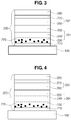
- FIG. 3 is a schematic cross-sectional view of an OLED according to a second embodiment of the invention.
- the OLED in FIG. 3 is substantially same as that in FIG. 2 except the material of the HTL. Accordingly, the explanation is focused on the material of the HTL.
- the dopant material 220 may have 0.1 to 20 weight % with respect to a total weight of the HIL 230.
- the hole injection part, the hole transport part, and the emitting part may be referred together as a first charge carrying layer 201. That is, the first charge carrying layer may include hole injection part, the hole transport part, and the emitting part. Also, in embodiments of the invention, the ETL 260 and the EIL 270 may be referred together as a second charge carrying layer 202. That is, the second charge carrying layer may include the ETL 260 and the EIL 270.
- MADN (2-methyl-9,10-bis(naphthalene-2-yl)anthracene) is deposited on the HTL to form the EML (250 ⁇ ).
- NPB is deposited on the EML to form the hole blocking layer (100 ⁇ ).
- Aluminum is deposited on the hole blocking layer to form the cathode (1500 ⁇ ).
- the UV curable epoxy and the getter are used for encapsulation such that the diode is obtained.
- the compound FL-2 is used instead of the compound FL-1.
- the HIL is formed by depositing HAT-CN without the host material in the HIL of the Example diode 1.
- NPB is used instead of the host material in the HIL of the Example diode 1.
- the driving voltage of the Example diodes 1 and 2 where each of the compounds FL-1 and FL-2 with HAT-CN is used for the HIL, is lowered.
- the Example diode 1 has the driving voltage of 7.3V
- the Example diode 2 has the driving voltage of 6.3V.
- the compound FL-12 is used instead of the compound FL-1 in the Example diode 3.
- the HIL 230 in FIG. 2 , the HIL 230 and the HTL 240' in FIG. 3 and the HIL 230, the HTL 240' and the EML 250' in FIG. 4 include an organic compound in Formula 3 instead of the organic compound in Formula 1.
- the HIL 230 may further include a dopant material having a lowest unoccupied molecular orbital (LUMO) level of -4.5eV to -6.0eV.
- the dopant material may be HAT-CN, which has 0.1 to 20 weight % with respect to a total weight of the HIL 230.
- the EML 250' may further include a blue dopant material having 0.1 to 30 weight % with respect to a total weight of the EML 250' to emit blue light.
- the dopant material for the EML 250' may be N,N'-bis(2,4-diphenyl)-N,N'-bis(2-fluorophenyl)-pyrene-1,6-diamine.
- X is selected from carbon, nitrogen, oxygen and sulfur
- Y is selected from aryl and arylamine.
- Y may be selected from phenyl, naphthyl, terphenyl, xylene, triphenlyamine, diphenylamine and phenanthrenylamine.
- HIL 50 ⁇ , host material/HAT-CN (10%)
- HTL 300 ⁇ , host material
- EML 700 ⁇ , host material/dopant material (15%)
- iv) ETL 200 ⁇ , Alq3
- v) EIL 10 ⁇ , LiF
- cathode 1000 ⁇ , Al
- the UV curable epoxy and the getter are used for encapsulation such that the diode is obtained.
- the dopant material for the EML is N,N'-bis(2,4-diphenyl)-N,N'-bis(2-fluorophenyl)-pyrene-1,6-diamine.
- the compound in Formula 4 is used the host material of the EIL, the ETL and the EML.
- the compound AN-6 is used the host material of the EIL, the ETL and the EML.
- the compound AN-8 is used the host material of the EIL, the ETL and the EML.
- the above diodes are fabricated with the same conditions except the host material of the EIL, the ETL and the EML.
- the properties of the diodes were tested and listed in Table 4.
- Table 4 @ 10 mA/cm 2 Host Volt (V) CD/A Im/W EQE (%) cd/m 2 (max) CIE x CIE y Ref.
- the diode including the organic compounds AN-1, AN-3, AN-6, AN-8 and AN-11 of the embodiment of the invention has advantages in the driving voltage, the emission efficiency, and so on. Since the organic compound has an excellent hole injection and/or transporting property, the combination of the holes and the electrons is generated at a center region of the EML such that the emission efficiency is improved.
- the organic compounds of the embodiment of the invention and the reference host have similar properties, e.g., LUMO and HOMO.
- the reference host has a strong electron property such that the hole injection and/or transportation is restricted by the reference host.
- the organic compound of the embodiment of the invention has a strong hole property, the hole injection and/or transportation becomes easier.
- the combination of the holes and the electrons is generated at a center region of the EML such that the emission efficiency is improved.
- the organic compounds of the embodiment of the invention can be used for all of the HIL, the HTL and the EML, the structure and the fabricating process of the OLED are simplified.
Landscapes
- Chemical & Material Sciences (AREA)
- Organic Chemistry (AREA)
- Engineering & Computer Science (AREA)
- Materials Engineering (AREA)
- Physics & Mathematics (AREA)
- Spectroscopy & Molecular Physics (AREA)
- Optics & Photonics (AREA)
- Electroluminescent Light Sources (AREA)
- Organic Low-Molecular-Weight Compounds And Preparation Thereof (AREA)
Abstract

wherein X is selected from carbon, nitrogen, oxygen and sulfur, and Y is selected from aryl and arylamine.
Description
- This application is a divisional application of European Patent Application No.
14 195 144.2 10-2013-0150833 10-2014-0089253 - The embodiments of the invention relate to an organic light emitting diode (OLED) and more particularly to an organic compound being capable of reducing a driving voltage and being adequate to a simple structure OLED and an OLED including the organic compound.
- Developments in information have led to developments in flat panel display devices as an image displaying device. The flat panel display device includes a liquid crystal display (LCD), a plasma display panel (PDP), a field emission display (FED) and an organic light emitting diode device (OLED), and the flat panel display device meeting the demand for thinness, light-weight and low power consumption are introduced.
- Among the flat panel display devices, the OLED has various advantages as compared to the LCD, the PDP and the FED. A flexible substrate, for example, a plastic substrate, can be used as a base substrate for the OLED, and the OLED has excellent characteristics of driving voltage and power consumption.
-
FIG. 1 is a cross-sectional view of a related art OLED. - As shown in
FIG. 1 , the OLED 20 is formed on asubstrate 10 and includes afirst electrode 21 as an anode, asecond electrode 27 as a cathode, and an organic emitting layer therebetween. To increase an emission efficiency, the organic emitting layer includes a hole injection layer (HIL) 22, a hole transporting layer (HTL) 23, an emitting material layer (EML) 24 and an electron transporting layer (ETL) 25 and an electron injection layer (EIL) 26. - Holes are provided from the
first electrode 21 into theEML 24 through theHIL 22 and theHTL 23, and electrons are provided from thesecond electrode 27 into theEML 24 through theEIL 26 and theETL 25. - The holes and the electrons are combined to form excitons, and the excitons are transformed from an excited state to a ground state. As a result, the OLED 20 emits light.
- As mentioned above, the OLED requires a plurality of layers to increase the emission efficiency. To prevent the quenching problem of the excitons, the OLED further requires an electron blocking layer and a hole blocking layer. As a result, the production costs of the OLED are increased, and the production yield of the OLED is decreased.
- In addition, there are still barriers between adjacent layers. Particularly, there is a hole injection barrier between the
HIL 22 and theHTL 23 and/or between theHTL 23 and theML 24, and the velocity of the electron injection and the electron transporting is larger than that of the hole injection and the hole transporting. Accordingly, the combination of the holes and the electrons is generated in a boundary region between theEML 24 and the HTL 23-not a center region of the EML 24- such that the emission efficiency is decreased and the driving voltage is increased. - To resolve the above problems, the simple structure OLED is required. In addition, a balance of the velocity of the holes and the electrons is required to form the excitons in the center region of the EML.
- Accordingly, the embodiment of the invention is directed to an organic compound and an OLED using the same that substantially obviate one or more of the problems due to limitations and disadvantages of the related art.
- An object of the embodiment of the invention is to provide an organic compound being capable of reducing a driving voltage.
- An object of the embodiment of the invention is to provide an organic compound being adequate to a simple structure OLED
- Another object of the embodiment of the invention is to provide an OLED having a simple structure and an improved emission efficiency.
- Additional features and advantages of the invention will be set forth in the description which follows, and in part will be apparent from the description, or may be learned by practice of the invention. The objectives and other advantages of the invention will be realized and attained by the structure particularly pointed out in the written description and claims hereof as well as the appended drawings.
- To achieve these and other advantages and in accordance with the purpose of the embodiments of the invention, as embodied and broadly described herein, there is provided an organic electroluminescent device according to
claim 1. Further embodiments are described in the dependent claims. An embodiment of the invention provides an organic compound of Formula:
- In an implementation of this embodiment, each of A and B is independently selected from substituted or non-substituted carbazole, substituted or non-substituted α -carboline, substituted or non-substituted β -carboline, substituted or non-substituted γ -carboline, substituted or non-substituted dibenzofuran, substituted or non-substituted dibenzothiophene, substituted or non-substituted aryl amine, substituted or non-substituted aryl silane and substituted or non-substituted phenyl.
- In a further implementation of this embodiment, each of A and B is independently selected from the followings:


- In a further implementation of this embodiment, the Formula is selected from the followings:




- In another embodiment of the invention, provided is an organic compound of Formula:

- In an implementation of this embodiment, Y is selected from phenyl, naphthyl, terphenyl, xylene, triphenlyamine, diphenylamine and phenanthrenylamine.
- In a further implementation of this embodiment, the Formula is selected from the followings:


- In another embodiment of the invention, provided is an organic electroluminescent device including a first electrode; a second electrode facing the first electrode; an emitting material layer between the first and second electrodes; a hole injection layer between the first electrode and the emitting material layer; and a hole transporting layer between the hole injection layer and the emitting material layer, wherein at least one of the hole injection layer, the hole transporting layer and the emitting material layer includes an organic compound of Formula:

- In an implementation of this embodiment, each of A and B is independently selected from substituted or non-substituted carbazole, substituted or non-substituted α -carboline, substituted or non-substituted β -carboline, substituted or non-substituted γ -carboline, substituted or non-substituted dibenzofuran, substituted or non-substituted dibenzothiophene, substituted or non-substituted aryl amine, substituted or non-substituted aryl silane and substituted or non-substituted phenyl.
- In a further implementation of this embodiment, each of A and B is independently selected from the followings:


- In a further implementation of this embodiment, the Formula is selected from the followings:


- In a further implementation of this embodiment, the hole injection layer includes a dopant material having a lowest unoccupied molecular orbital (LUMO) level of -4.5eV to -6.0eV, and the dopant material is doped to the organic compound.
- In a further implementation of this embodiment, all of the hole injection layer, the hole transporting layer and the emitting material layer include the organic compound.
- In a further implementation of this embodiment, the emitting material layer includes the organic compound and emits blue light.
- In another embodiment of the invention, provided is an organic electroluminescent device including a first electrode; a second electrode facing the first electrode; an emitting material layer between the first and second electrodes; a hole injection layer between the first electrode and the emitting material layer; and a hole transporting layer between the hole injection layer and the emitting material layer, wherein at least one of the hole injection layer, the hole transporting layer and the emitting material layer includes an organic compound of Formula:

- In an implementation of this embodiment, Y is selected from phenyl, naphthyl, terphenyl, xylene, triphenlyamine, diphenylamine and phenanthrenylamine.
- In a further implementation of this embodiment, the Formula is selected from the followings:


- In a further implementation of this embodiment, all of the hole injection layer, the hole transporting layer and the emitting material layer include the organic compound.
- In a further implementation of this embodiment, the hole injection layer includes a dopant material having a lowest unoccupied molecular orbital (LUMO) level of -4.5eV to -6.0eV, and the dopant material is doped to the organic compound.
- In another embodiment of the invention, provided is an organic electroluminescent device including a first electrode; a second electrode facing the first electrode; an emitting material layer between the first and second electrodes; a hole injection layer between the first electrode and the emitting material layer; and a hole transporting layer between the hole injection layer and the emitting material layer, wherein at least two of the hole injection layer, the hole transporting layer and the emitting material layer include the same host material.
- In an implementation of this embodiment, all of the hole injection layer, the hole transporting layer and the emitting material layer include the same host material.
- In a further implementation of this embodiment, the hole injection layer further includes an organic material having a lowest unoccupied molecular orbital (LUMO) level of -4.5eV to -6.0eV, and the emitting material layer further includes a dopant material doped to the host material.
- In a further implementation of this embodiment, the organic material is a material of the following Formula:

- In another embodiment of the invention, provided is an organic electroluminescent device including a first electrode; a second electrode facing the first electrode; a first charge carrying layer disposed between the first electrode and the second electrode, the first charge carrying layer being disposed adjacent to the first electrode; and a second charge carrying layer disposed between the first electrode and the second electrode, the second charge carrying layer disposed adjacent to the second electrode, wherein the first charge carrying layer includes an emitting part, a hole injection part and a hole transporting part between the hole injection part and the emitting part, wherein at least one of the hole injection part, the hole transporting part and the emitting part includes a host material having an organic compound of Formula:

- In an implementation of this embodiment. the organic compound is selected from the followings:




- In a further implementation of this embodiment, the hole injection part includes an organic material having a lowest unoccupied molecular orbital (LUMO) level of -4.5eV to -6.0eV, and the emitting part further includes a dopant material doped to the host material.
- In a further implementation of this embodiment, two or more of the emitting part, the hole injection part and the hole transporting part include the same host material having the organic compound of the Formula.
- In another aspect of the embodiment of the invention, provided is an organic electroluminescent device including a first electrode; a second electrode facing the first electrode; a first charge carrying layer disposed between the first electrode and the second electrode, the first charge carrying layer being disposed adjacent to the first electrode; and a second charge carrying layer disposed between the first electrode and the second electrode, the second charge carrying layer disposed adjacent to the second electrode, wherein the first charge carrying layer includes an emitting part, a hole injection part and a hole transporting part between the hole injection part and the emitting part, wherein at least one of the hole injection part, the hole transporting part and the emitting part includes a host material having an organic compound of Formula:

- In an implementation of this embodiment, the Formula is selected from the followings:


- In a further implementation of this embodiment, two or more of the emitting part, the hole injection part and the hole transporting part include the same host material having the organic compound of the Formula.
- It is to be understood that both the foregoing general description and the following detailed description are by example and explanatory and are intended to provide further explanation of the invention as claimed.
- The accompanying drawings, which are included to provide a further understanding of the invention and are incorporated in and constitute a part of this specification, illustrate embodiments of the invention and together with the description serve to explain the principles of the invention.
-
FIG. 1 is a cross-sectional view of the related art OLED. -
FIG. 2 is a schematic cross-sectional view of an OLED according to a first embodiment of the invention. -
FIG. 3 is a schematic cross-sectional view of an OLED according to a second embodiment of the invention. -
FIG. 4 is a schematic cross-sectional view of an OLED according to a third embodiment of the invention. -
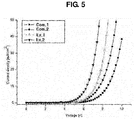
FIG. 5 is a graph showing a current density according to a driving voltage in an OLED of an example 1 of the embodiment of the invention. - Reference will now be made in detail to example embodiments, examples of which are illustrated in the accompanying drawings.
-
FIG. 2 is a schematic cross-sectional view of an OLED according to a first embodiment of the invention. - As shown in
FIG. 2 ,OLED 200 is formed on asubstrate 100 and includes afirst electrode 210, a hole injection layer (HIL) 230, a hole transporting layer (HTL) 240, an emitting material layer (EML) 250 and an electron transporting layer (ETL) 260, an electron injection layer (EIL) 270 and asecond electrode 280. - The
first electrode 210 includes a conductive material having a relatively high work function. For example, thefirst electrode 210 may include indium-tin-oxide (ITO) or indium-zinc-oxide (IZO). However, the material is not limited thereto. - The
HIL 230 is formed on thefirst electrode 210 as an anode, and includes an organic compound inFormula 1. The organic compound inFormula 1 has a hole transporting property.
- In
Formula 1, R is substituted or non-substituted C1 to C12 alkyl. A and B are symmetrically or asymmetrically positioned in 2-position or 7-position of the fluorene core, and each of A and B is independently selected from substituted or non-substituted aromatic group or substituted or non-substituted heterocyclic group. - For example, each of A and B is independently selected from substituted or non-substituted carbazole, substituted or non-substituted α -carboline, substituted or non-substituted β -carboline, substituted or non-substituted γ -carboline, substituted or non-substituted dibenzofuran, substituted or non-substituted dibenzothiophene, substituted or non-substituted aryl amine, substituted or non-substituted aryl silane and substituted or non-substituted phenyl.
- Each of A and B is independently selected from the following compounds.


- The organic compound in
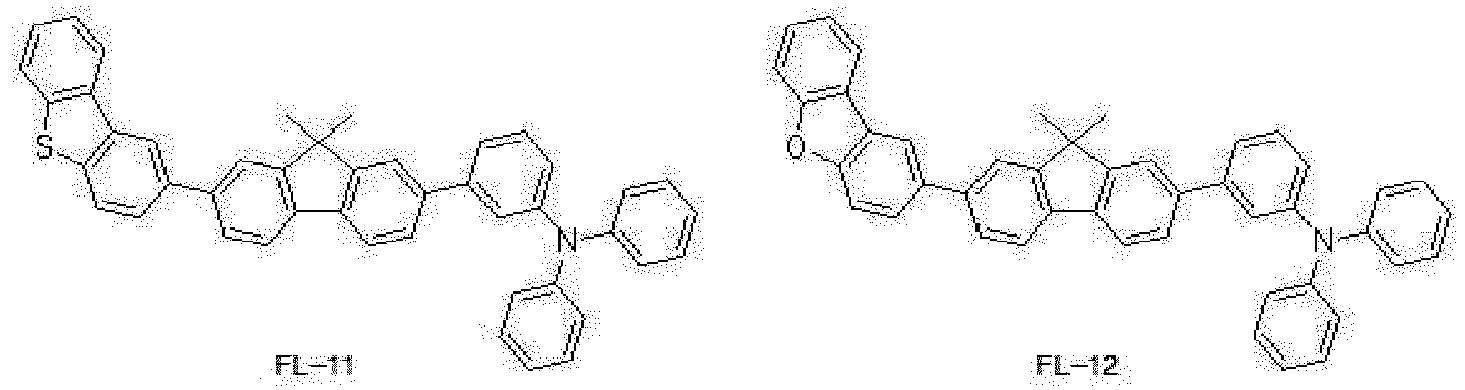
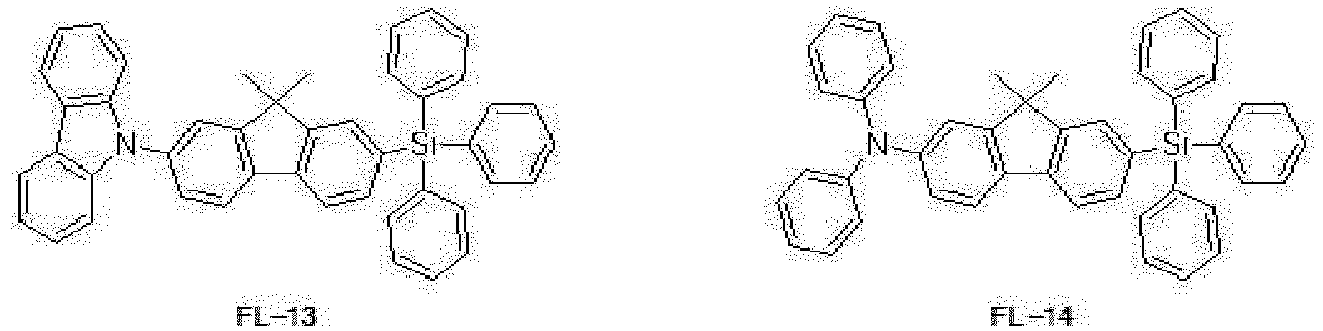
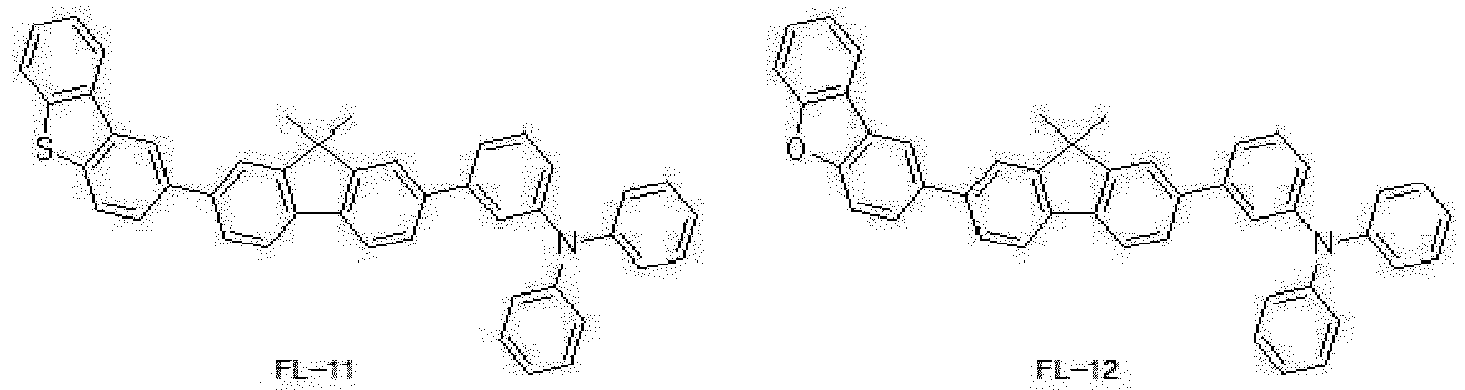
Formula 1 includes the following compounds FL-1 to FL-26.




- The
HIL 230 further includes adopant material 220 having a lowest unoccupied molecular orbital (LUMO) level of -4.5eV to -6.0eV. For example, thedopant material 220 may be an organic compound in Formula 2, but it is not limited thereto. Thedopant material 220 may have 0.1 to 20 weight % with respect to a total weight of theHIL 230. Namely, thedopant material 220 is doped to the organic compound inFormula 1 to form theHIL 230 of theOLED 200.
- A synthesis example of the organic compound is explained.
-

- 2,7-dibromo-9,9-dimethyl-9H-fluorene (10g, 28.403mmol), carbazole (9.5g, 56.806mmol), copper iodide (Cul) (4.3g, 22.722mmol), K3PO4 (36g, 170.418mmol), and trans-1,2-cyclohexanediamine (2.7mL, 22.722mmol) were dissolved in 1,4-dioxane. The solution was refluxed and stirred for 12 hours. After completion of the reaction, the solution was distilled under reduced pressure to remove the solvent. The resultant was columned with a solvent of n-hexane and methylene chloride (4:1) and was short-columned with toluene. The solution was distilled under reduced pressure and was re-crystallized in a solution of methylene chloride and petroleum ether such that the compound FL-1 was obtained, (4.0g, yield: 67%).
-

- 2,7-dibromo-9,9-dimethyl-9H-fluorene (10g, 28.403mmol), carbazole (2.37g, 14.20mmol), copper iodide (Cul) (540mg, 2.840mmol), K3PO4 (6.03g, 28.404mmol), and trans-1,2-cyclohexanediamine (0.34mL, 2.840mmol) were dissolved in 1,4-dioxane. The solution was refluxed and stirred for 12 hours. After completion of the reaction, the solution was distilled under reduced pressure to remove the solvent. The resultant was columned with a solvent of n-hexane and methylene chloride (4:1). The solution was distilled under reduced pressure and was re-crystallized in a solution of methylene chloride and petroleum ether such that the compound X1 was obtained, (4.17g, yield: 67%).

- The compound X1 (2.0g, 4.562mmol), diphenylamine (701mg, 4.148mmol), tris-(t-butyl)-phosphine (49 µℓ, 0.207mmol), and sodium tert-butoxide (798mg, 8.296mmol) were dissolved in toluene. The solution was refluxed and stirred for 12 hours with catalyst of palladium(II)acetate (Pd(OAc)2). After completion of the reaction, the solution was distilled under reduced pressure to remove the solvent. The resultant was columned with a solvent of n-hexane and methylene chloride (3:1). The solution was distilled under reduced pressure and was re-crystallized in a solution of methylene chloride and petroleum ether such that the compound FL-2 was obtained, (1.5g, yield: 69%).
-
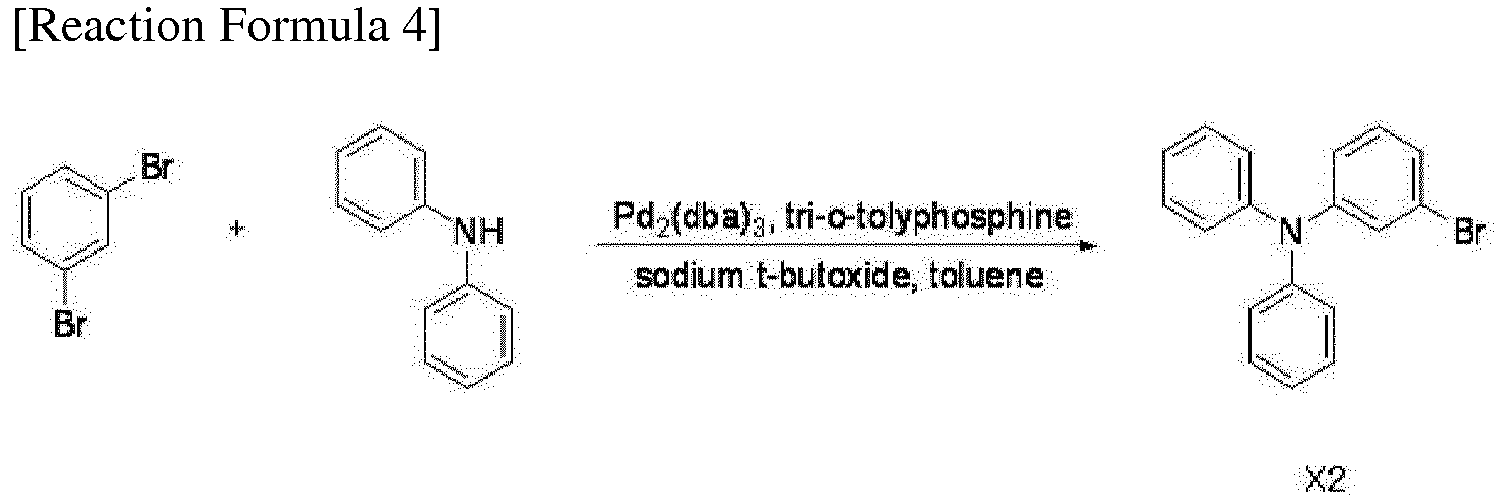
- 1,3-dibromobenzene (24.9mL, 206.83mmol), diphenylamine (10g, 59.095mmol), tri-ortho-tolyphosphine (899mg, 2.955mmol) and sodium tert-butoxide (11.4g, 118.19mmol) were dissolved in toluene. The solution was refluxed and stirred for 12 hours with catalyst of tris(dibenzylideneacetone)dipalladium(0) (Pd2(dba)3). After completion of the reaction, the solution was distilled under reduced pressure to remove the solvent. The resultant was columned with n-hexane. The solution was distilled under reduced pressure and was re-crystallized in a solution of methylene chloride and petroleum ether such that the compound X2 was obtained, (9.26g, yield: 48%).

- The compound X2 (8.9g, 27.451mmol) was dissolved in tetrahydrofuran (THF). The solution was cooled into -78°C, and 2.5M n-butyl lithium (n-BuLi) solution (14.3mL) was slowly dropped. The solution was stirred in a room temperature for 1 hour. The solution was cooled again into -78°C, and triethyl borate (7.0mL, 41.176mmol) was slowly dropped. The solution was stirred in a room temperature for 12 hours. After 12 hours, 5N HCl solution (50mL) was added, and THF was removed. The resultant was extracted by distilled water and methylene chloride. The resultant was distilled under reduced pressure to remove the solvent and was columned with methylene chloride. The solution was distilled under reduced pressure such that the compound X-3 was obtained, (4.73g, yield: 60%).

- The compound X1 (2.06g, 4.7mmol), the compound X3 (1.63g, 5.64mmol), potassium carbonate (K2CO3) (1.30mg, 9.4nnol) were dissolved in toluene and distilled water. The solution was refluxed and stirred for 12 hours with catalyst of tetrakis(triphenylphosphine)palladium(0) (217mg, 0.19mmol). After completion of the reaction, the solution was distilled under reduced pressure to remove the solvent. The resultant was columned with a solvent of n-hexane and methylene chloride (4:1). The solution was distilled under reduced pressure and was re-crystallized in a solution of methylene chloride and petroleum ether such that the compound FL-3 was obtained, (0.74g, yield: 26%).
-

- 2,7-dibromo-9,9-dimethyl-9H-fluorene (5.0g, 14.2mmol), copper iodide (Cul) (649mg, 3.41mmol), sodium iodide (Nal) (8.5g, 56.804mmol), and trans-1,2-diaminomethylamine (0.99mL, 6.25mmol) were dissolved in 1,4-dioxane. The solution was refluxed and stirred for 12 hours. After completion of the reaction, the solution was distilled under reduced pressure to remove the solvent. The resultant was columned with n-hexane. The solution was distilled under reduced pressure and was re-crystallized in a solution of methylene chloride and petroleum ether such that the compound X4 was obtained, (4.17g, yield: 65%).

- The compound X4 (2.5g, 5.59mmol), carboline (2.07g, 12.307mmol), copper iodide (Cul) (852mg, 4.48mmol), K3PO4 (7.13g, 33.57mmol), and trans-1,2-cyclohexanediamine (0.54mL, 4.48mmol) were dissolved in 1,4-dioxane. The solution was refluxed and stirred for 12 hours. After completion of the reaction, the solution was distilled under reduced pressure to remove the solvent. The resultant was columned with a solvent of n-hexane and ethylacetate (3:1). The solution was distilled under reduced pressure and was re-crystallized in a solution of methylene chloride and petroleum ether such that the compound FL-4 was obtained, (1.08g, yield: 37%).
-

- 2,7-dibromo-9,9-dimethyl-9H-fluorene (5.0 g, 14.201 mmol), dibenzo[b,d]thiophen-2-ylboronic acid (1.62 g, 7.10 mmol), Pd(pph3)4 (820 mg, 0.71 mmol), K2CO3 (1.96 g, 14.201 mmol) were put in a 250mL two-neck flask and dissolved in toluene/H2O. The solution was refluxed and stirred for 12 hours. After completion of the reaction, the solution was distilled under reduced pressure to remove the solvent. The resultant was columned with a solution of hexane and methylenechloride (9:1). The solution was distilled under reduced pressure and was re-crystallized in a solution of methylene chloride and petroleum ether such that the white solid compound was obtained, (1.61g, yield: 50%).
-


- 2-(7-bromo-9,9-dimethyl-9H-fluoren-2-yl)dibenzo[b,d]thiophene (1.61 g, 3.54 mmol), 3-(diphenylamino)phenylboronic acid (1.02 g, 3.54 mmol), Pd(pph3)4 (404 mg, 0.35 mmol), K2CO3 (978 mg, 7.08 mmol) were put in a 250mL two-neck flask and dissolved in toluene/H2O. The solution was refluxed and stirred for 12 hours. After completion of the reaction, the solution was distilled under reduced pressure to remove the solvent. The resultant was columned with a solution of hexane and methylenechloride (4:1). The solution was distilled under reduced pressure and was re-crystallized in a solution of methylene chloride and petroleum ether such that the compound FL-11 of white solid was obtained, (1.50g, yield: 68%).
-
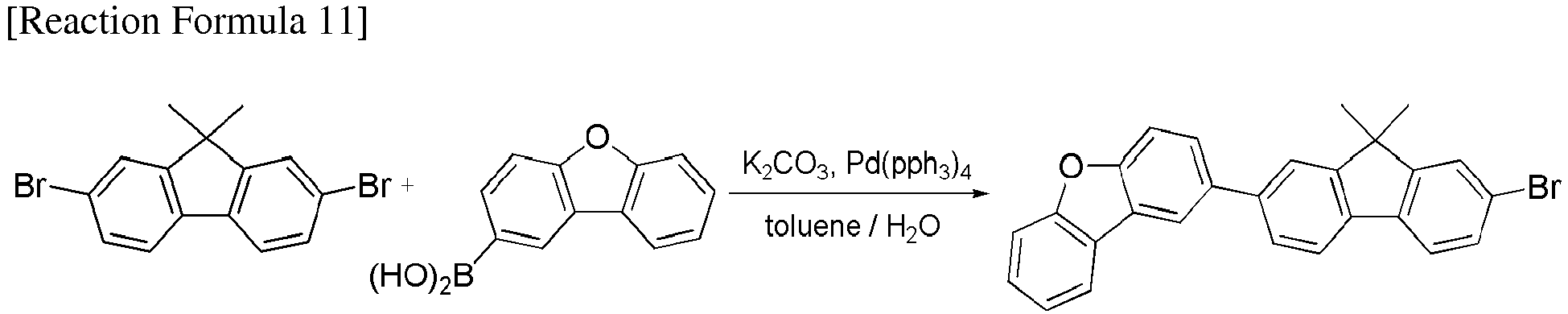
- 2,7-dibromo-9,9-dimethyl-9H-fluorene (5.0 g, 14.201 mmol), dibenzo[b,d]furan-2-ylboronic acid (1.50 g, 7.10 mmol), Pd(pph3)4 (820 mg, 0.71 mmol), K2CO3 (1.96 g, 14.201 mmol) were put in a 250mL two-neck flask and dissolved in toluene/H2O. The solution was refluxed and stirred for 12 hours. After completion of the reaction, the solution was distilled under reduced pressure to remove the solvent. The resultant was columned with a solution of hexane and methylenechloride (8:1). The solution was distilled under reduced pressure and was re-crystallized in a solution of methylene chloride and petroleum ether such that the white solid compound was obtained, (1.50g, yield: 48%).
-

- 2-(7-bromo-9,9-dimethyl-9H-fluoren-2-yl)dibenzo[b,d]furan (1.50 g, 3.42 mmol), 3-(diphenylamino)phenylboronic acid (989 mg, 3.42 mmol), Pd(pph3)4 (393 mg, 0.34 mmol), K2CO3 (945 mg, 6.84 mmol) were put in a 250mL two-neck flask and dissolved in toluene/H2O. The solution was refluxed and stirred for 12 hours. After completion of the reaction, the solution was distilled under reduced pressure to remove the solvent. The resultant was columned with a solution of hexane and methylenechloride (3:1). The solution was distilled under reduced pressure and was re-crystallized in a solution of methylene chloride and petroleum ether such that the compound FL-12 of white solid was obtained, (1.20g, yield: 58%).
-

- 2,7-dibromo-9,9-dimethyl-9H-fluorene (5.0 g, 14.201 mmol), 3-(diphenylamino)phenylboronic acid (2.05 g, 7.10 mmol), Pd(pph3)4 (820 mg, 0.71 mmol), K2CO3 (1.96 g, 14.201 mmol) were put in a 250mL two-neck flask and dissolved in toluene/H2O. The solution was refluxed and stirred for 12 hours. After completion of the reaction, the solution was distilled under reduced pressure to remove the solvent. The resultant was columned with a solution of hexane and methylenechloride (4:1). The solution was distilled under reduced pressure and was re-crystallized in a solution of methylene chloride and petroleum ether such that the white solid compound was obtained, (1.50g, yield: 41%).
-

- 3-(7-bromo-9,9-dimethyl-9H-fluoren-2-yl)-N,N-diphenylaniline (1.50 g, 2.90 mmol) were put in a 250mL two-neck flask and dissolved in diethylether. The solution was cooled into -78°C, and n-BuLi (2.5M, 1.74mL) were dropped. After three hours, chlorotriphenylsilane (989 mg, 3.42 mmol) dissolved in diethylether was slowly dropped, and the solution was refluxed and stirred at a room temperature for 12 hours. After completion of the reaction, the solution was distilled under reduced pressure to remove the solvent. The resultant was columned with a solution of hexane and methylenechloride (5:1). The solution was distilled under reduced pressure and was re-crystallized in a solution of methylene chloride and petroleum ether such that the compound FL-15 of white solid was obtained, (1.20g, yield: 59%).
- The properties of the compounds FL-1 to FL-4, FL11, FL-12 and FL-15 and NPB(N,N'-di(naphthalen-1-yl)-N,N'-diphenyl-benzidine) were tested and listed in Table 1.
Table 1 Compounds λabs a (nm) λPL b (nm) sol./77K Band gap Energy c LUMO d(eV) HOMO e (eV) ET (eV) NPB (ref.) 414 540 3.00 - 2.40 - 5.40 2.30 FL-1 360 459 3.45 - 2.13 - 5.58 2.71 FL-2 390 489 3.18 - 2.43 - 5.61 2.54 FL-3 374 491 3.32 - 2.33 - 5.65 2.53 FL-4 354 458 3.51 - 2.06 - 5.57 2.71 FL-11 371 491 3.34 - 2.32 - 5.66 2.53 FL-12 370 487 3.35 - 2.33 - 5.68 2.55 FL-15 372 485 3.34 - 2.35 - 5.69 2.56 a. Absorption onset of 0.02 mM solutions in CH2Cl2.
b. PL maxima of 2-methyl THF solutions upon excitation at UV maximum absorption.
c. Estimated from the absorption onset.
d. LUMO = - [Band gap energy - HOMO level]
e. Estimated from the Cyclic Voltammetry instrument. - As shown in Table 1, a band gap energy of the compounds FL-1 to FL-4, FL11, FL-12 and FL-15 of the embodiment of the invention is larger than the band gap energy 3.0 of NPB. Accordingly, the organic compound of the embodiment of the invention can be used as a host material of the EML as well as the material of HIL and HTL.
- The
HTL 240 is formed on theHIL 230. For example, theHTL 240 may include NPB(N,N'-di(naphthalen-1-yl)-N,N'-diphenyl-benzidine), or PD(N,N'-bis-(3-methylphenyl)-N,N'-bis-(phenyl)-benzidine), but it is not limited thereto. - The
EML 250 is formed on theHTL 240 and may include a host material with a dopant material, which may be similar or the same as thedopant material 220. Each of the host material and the dopant material is selected from a fluorescent compound and a phosphorescent compound, but it is not limited thereto. For example, for theblue EML 250, the host material may be a fluorescent compound of one of anthracene derivatives, pyrene derivatives and perylene derivatives, and the blue fluorescent dopant may be doped to the host compound. For thegreen EML 250, the host material may be a phosphorescent compound of one of carbazole derivatives or a metal complex, and the green phosphorescent dopant may be doped to the host compound. For thered EML 250, the host material may be a phosphorescent compound of one of carbazole derivatives or a metal complex, and the red phosphorescent dopant may be doped to the host compound. - The
ETL 260 is formed on theEML 250. TheETL 260 includes oxadiazole, triazole, phenanthroline, benzoxazole or benzthiazole, but it is not limited thereto. - The
EIL 270 is formed on theETL 260. TheEIL 270 includes LiF or lithium quinolate (LiQ), but it is not limited thereto. - The
second electrode 280 is formed on theEIL 270 and includes a metallic material having a relatively low work function. For example, thesecond electrode 280 may include aluminum (Al), silver (Ag), magnesium (Mg), lithium (Li) or calcium (Ca), but it is not limited thereto. -
FIG. 3 is a schematic cross-sectional view of an OLED according to a second embodiment of the invention. The OLED inFIG. 3 is substantially same as that inFIG. 2 except the material of the HTL. Accordingly, the explanation is focused on the material of the HTL. - As shown in
FIG. 3 , each of theHIL 230 and the HTL 240' of theOLED 200 of the embodiment of the invention includes the organic compound inFormula 1. As explained above, theHIL 230 further includes thedopant material 220 having the LUMO level of -4.5eV to -6.0eV. For example, thedopant material 220 may be an organic compound in Formula 2. - In the
OLED 200, there is no hole injection barrier between theHIL 230 and the HTL 240' (indicated by a dashed line), and the driving voltage of the OLED is lowered. In addition, since theHIL 230 and the HTL 240' include the same material, the production costs is decreased and the production yield is improved. Thedopant material 220 may have 0.1 to 20 weight % with respect to a total weight of theHIL 230. -
FIG. 4 is a schematic cross-sectional view of an OLED according to a third embodiment of the invention. The OLED inFIG. 4 is substantially same as that inFIG. 2 except the material of the HTL and the EML. Accordingly, the explanation is focused on the material of the HTL and EML. - As shown in
FIG. 4 , not only theHIL 230 and the HTL 240' but also the EML 250' of theOLED 200 of the embodiment of the invention includes the organic compound inFormula 1. As explained above, theHIL 230 further includes thedopant material 220 having the LUMO level of -4.5eV to -6.0eV. For example, thedopant material 220 may be an organic compound in Formula 2. Thedopant material 220 may have 0.1 to 20 weight % with respect to a total weight of theHIL 230. - In addition, the EML 250' may further include the dopant material to the organic compound in
Formula 1 as a host material. The dopant material for the EML 250' may be a fluorescent compound or a phosphorescent compound. - In the
OLED 200, there is no hole injection barrier between theHIL 230 and the HTL 240' and between the HTL 240' and the EML 250' (indicated by dashed lines), and the driving voltage of the OLED is lowered. In addition, since theHIL 230, the HTL 240' and the EML 250' include the same material, the production costs is decreased and the production yield is improved. TheHIL 230, the HTL 240', and the EML 250' may be referred to as a hole injection part, a hole transport part, and an emitting part in embodiments of the invention, for example, when no hole injection barrier is present therebetween based on one or more of the parts containing a same host material. Also, in embodiments of the invention, the hole injection part, the hole transport part, and the emitting part may be referred together as a firstcharge carrying layer 201. That is, the first charge carrying layer may include hole injection part, the hole transport part, and the emitting part. Also, in embodiments of the invention, theETL 260 and theEIL 270 may be referred together as a secondcharge carrying layer 202. That is, the second charge carrying layer may include theETL 260 and theEIL 270. - An indium-tin-oxide (ITO) layer is patterned on a substrate and washed such that an emission area of the ITO layer is to be 3mm*3mm. The substrate is washed by the UV ozone and is loaded in an evaporation system. The substrate is loaded in a vacuum chamber, and the process pressure is adjusted to 1*10-6∼1*10-7 torr. The compound FL-1 as a host material is deposited with HAT-CN in Formula 2 (10%) as a dopant material to form the HIL (50Å). NPB is deposited on the HIL to form the HTL (600Å). MADN (2-methyl-9,10-bis(naphthalene-2-yl)anthracene) is deposited on the HTL to form the EML (250Å). NPB is deposited on the EML to form the hole blocking layer (100Å). Aluminum is deposited on the hole blocking layer to form the cathode (1500Å). The UV curable epoxy and the getter are used for encapsulation such that the diode is obtained.

- The compound FL-2 is used instead of the compound FL-1.
- The HIL is formed by depositing HAT-CN without the host material in the HIL of the
Example diode 1. - NPB is used instead of the host material in the HIL of the
Example diode 1. - The current and voltage property in the
Example diodes 1 and 2 and theComparative Example diodes 1 and 2 were tested and shown inFIG. 5 . - As shown in
FIG. 5 , in comparison to theComparative Example diode 1, where only HAT-CN is used for the HIL, the driving voltage of the Comparative Example diode 2, where NPB with HAT-CN is used for the HIL, is lowered. At 10mA/cm2, theComparative Example diode 1 has the driving voltage of 8.5V, and the Comparative Example diode 2 has the driving voltage of 7.7V. - In addition, in comparison to the
Comparative Example diodes 1 and 2, the driving voltage of theExample diodes 1 and 2, where each of the compounds FL-1 and FL-2 with HAT-CN is used for the HIL, is lowered. At 10mA/cm2, theExample diode 1 has the driving voltage of 7.3V, and the Example diode 2 has the driving voltage of 6.3V. - An indium-tin-oxide (ITO) layer is patterned on a substrate and washed such that an emission area of the ITO layer is to be 3mm*3mm. The substrate is washed by the UV ozone and is loaded in an evaporation system. The substrate is loaded in a vacuum chamber, and the process pressure is adjusted to 1*10-6∼1*10-7 torr. The compound FL-1 as a host material is deposited with HAT-CN in Formula 2 (10%) as a dopant material to form the HIL (50Å). Only the compound FL-1 is deposited on the HIL to form the HTL (300Å). The compound FL-1 as a host material with 4,48-bis(2,28-diphenylvinyl)-1,18-biphenyl (DPVBi) (15%) as a dopant material is deposited on the HTL to form the EML (400Å). Alq3 is deposited on the EML to form ETL (200Å), and LiF is deposited on the ETL to form the EIL (10Å). Aluminum is deposited on the EIL to form the cathode (1000Å). The UV curable epoxy and the getter are used for encapsulation such that the diode is obtained.

- The compound FL-2 is used instead of the compound FL-1 in the Example diode 3.
- The compound FL-11 is used instead of the compound FL-1 in the Example diode 3.
- The compound FL-12 is used instead of the compound FL-1 in the Example diode 3.
- The compound FL-15 is used instead of the compound FL-1 in the Example diode 3.
- NPB is used instead of the compound FL-1 in the Example diode 3.
- The properties of the Example diodes 3 to 7 and the Comparative Example diode were tested and listed in Table 2.
Table 2 Voltage [V] Emission efficiency Quantum efficiency [%] CIEx CIEy Cd/A Lm/W Com. Ex. 3.19 1.01 0.99 1.17 0.144 0.098 Ex.1 3.20 3.30 3.24 3.70 0.142 0.110 Ex.2 3.07 3.50 3.58 4.06 0.141 0.108 Ex.3 3.10 1.73 1.75 2.02 0.143 0.098 Ex.4 3.10 1.72 1.74 2.00 0.144 0.098 Ex.5 3.10 1.33 1.35 1.57 0.142 0.098 - Referring to Table 2, in comparison to the Comparative Example diode, the properties of the Example diodes 3 to 7 (listed as Ex. 1 to 5, respectively in Table 2) using the organic compound of the embodiment of the invention are improved. Particularly, the emission efficiency and the quantum efficiency of the Example diode 4 (listed as Ex. 2) are remarkably improved, and the driving voltage of the Example diode 4 (listed as Ex. 2) is remarkably lowered.
- In the embodiment of the invention, the organic compound, which has large band gap energy and an excellent hole transporting property, is used for the host material of the HIL and EML and the material of the HTL such that the OLED has a simple structure and problems in the production costs and the production yield are overcome. In addition, the dopant material, which has a deep LUMO level, is used for the HIL such that the emission efficiency is improved and the driving voltage is reduced.
- The
HIL 230 inFIG. 2 , theHIL 230 and the HTL 240' inFIG. 3 and theHIL 230, the HTL 240' and the EML 250' inFIG. 4 include an organic compound in Formula 3 instead of the organic compound inFormula 1. TheHIL 230 may further include a dopant material having a lowest unoccupied molecular orbital (LUMO) level of -4.5eV to -6.0eV. For example, the dopant material may be HAT-CN, which has 0.1 to 20 weight % with respect to a total weight of theHIL 230. The EML 250' may further include a blue dopant material having 0.1 to 30 weight % with respect to a total weight of the EML 250' to emit blue light. For example, the dopant material for the EML 250' may be N,N'-bis(2,4-diphenyl)-N,N'-bis(2-fluorophenyl)-pyrene-1,6-diamine. - Namely, in the OLED including the first electrode, the HIL, the HTL, the EML and the second electrode, at least one of the HIL, the HTL and the EML includes the organic compound in Formula 3 such that the OLED has advantages in the emission efficiency, the quantum efficiency and the driving voltage. Particularly, all of the HIL, the HTL and the EML include the organic compound in Formula 3 such that the structure of the OLED is simplified and the problems in the production costs and the production yield are overcome.
- In addition, when all of the HIL, the HTL and the EML include the organic compound in Formula 3, which has an excellent hole transporting property, the hole injection or transporting barrier is reduced such that the emission efficiency is further improved. Namely, since the hole injection or transporting barrier is reduced, the combination of the holes and the electrons is generated at a center region of the EML such that the emission efficiency is improved.

- In Formula 3, X is selected from carbon, nitrogen, oxygen and sulfur, and Y is selected from aryl and arylamine. For example, Y may be selected from phenyl, naphthyl, terphenyl, xylene, triphenlyamine, diphenylamine and phenanthrenylamine.
- In Formula 2, Y is selected from the followings.


- For example, the organic compound in Formula 3 includes the following compounds AN-1 to AN-16.


- A synthesis example of the organic compound is explained.
-

- 3-bromocarbazole (2.54 g, 10.320 mmol), 9-phenyl-boronic acid (3.69 g, 12.384 mmol), Na2CO3 (2.2 g, 20.64 mmol), Pd(PPh3)4 (1.19 g, 1.032 mmol) were put in a 250mL two-neck flask and dissolved in toluene/ethanol/H2O. The solution was refluxed and stirred at 120°C for 12 hours. After completion of the reaction, the solution was extracted with methylenechloride/H2O and distilled under reduced pressure to remove the solvent. The resultant was columned with a solution of n-hexane and methylenechloride (4:1) and was re-crystallized in a solution of methylene chloride and petroleum ether such that the white solid compound was obtained, (2.60g, yield: 60%).
-
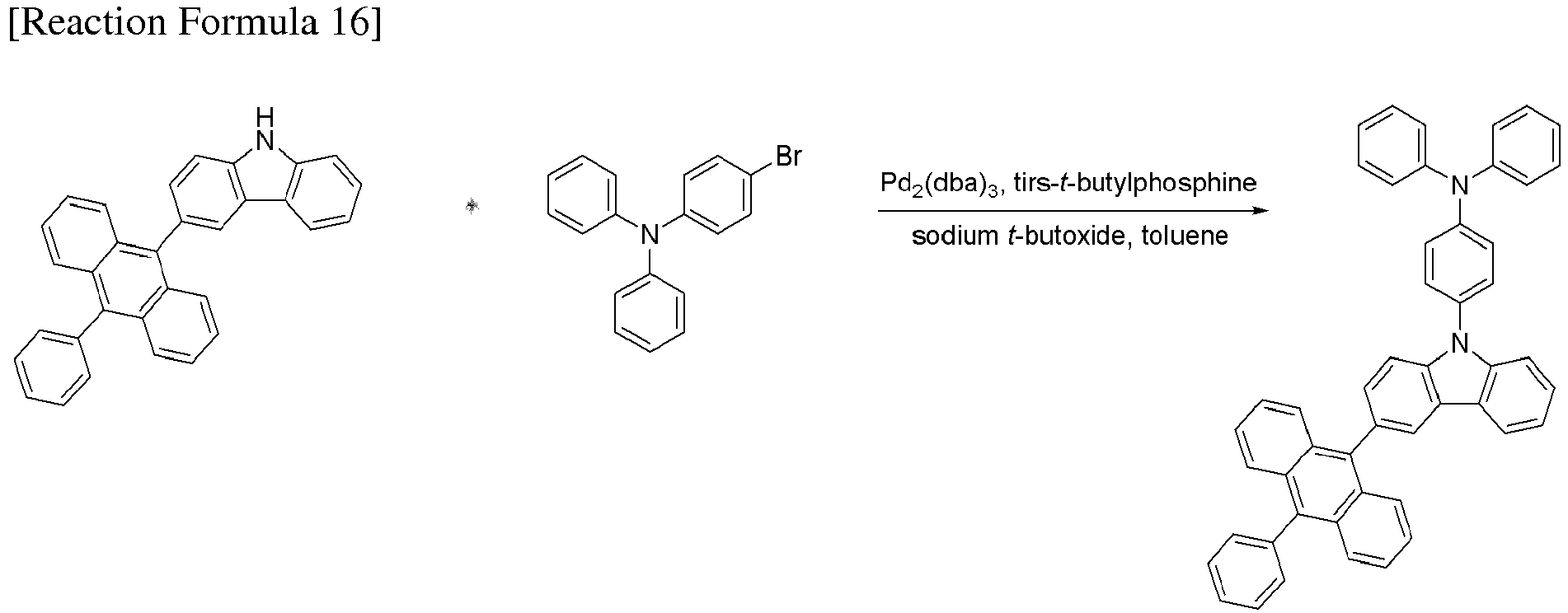
- 3-(10-phenylanthracen-9-yl)-9H-carbazole (1.68g, 4.00 mmol), 4-bromo-triphenylamine (1.43 g, 4.401 mmol), Pd2(dba)3 (110 mg, 0.120 mmol), tris-t-butylphosphine (47 µℓ, 0.200 mmol), sodium tert-butoxide (770 mg, 8.00 mmol) were put in a 250mL two-neck flask and dissolved in toluene. The solution was refluxed and stirred for 12 hours. After completion of the reaction, the solution was distilled under reduced pressure to remove the solvent. The resultant was columned with a solution of n-hexane and methylenechloride (4:1) and was re-crystallized in a solution of methylene chloride and petroleum ether such that the white solid compound AN-1 was obtained, (2.53g, yield: 95%).
-


- 3-(10-phenylanthracen-9-yl)-9H-carbazole (1.59g, 3.80 mmol), N-(4-bromophenyl)-N-phenyl-naphthalen-1-amine (1.56 g, 4.17 mmol), Pd2(dba)3 (69 mg, 0.076 mmol), tris-t-butylphosphine (27 µℓ, 0.114 mmol), sodium tert-butoxide (728 mg, 7.58 mmol) were put in a 250mL two-neck flask and dissolved in toluene. The solution was refluxed and stirred for 12 hours. After completion of the reaction, the solution was distilled under reduced pressure to remove the solvent. The resultant was columned with a solution of n-hexane and methylenechloride (3:1) and was re-crystallized in a solution of methylene chloride and petroleum ether such that the greenish solid compound AN-2 was obtained, (1.64g, yield: 61%).
-

- 9-bromophenanthrene (7.00 g, 27.22 mmol), aniline (3.7 mL, 40.84 mmol), Pd2(dba)3 (499 mg, 0.544 mmol), tris-t-butylphosphine (0.123 mL, 0.544 mmol), sodium tert-butoxide (3.90 mg, 40.84 mmol) were put in a 250mL two-neck flask and dissolved in toluene. The solution was refluxed and stirred for 12 hours. After completion of the reaction, the solution was extracted with DI water/methylenechloride and distilled under reduced pressure to remove the solvent. The resultant was columned with a solution of n-hexane and methylenechloride (3:1) and was re-crystallized in a solution of methylene chloride and petroleum ether such that the solid compound was obtained, (4.60g, yield: 63%).
-

- N-phenylphenanthren-9-amine (4.51 g, 16.74 mmol), 1,3-dibromobenzene (6.05 mL, 50.23 mmol), Pd2(dba)3 (307 mg, 0.355 mmol), tris-o-tolyphosphine (0.255 mL, 0.837 mmol), sodium tert-butoxide (3.2 g, 33.49 mmol) were put in a 250mL two-neck flask and dissolved in toluene. The solution was refluxed and stirred for 12 hours. After completion of the reaction, the solution was extracted with DI water/methylenechloride and distilled under reduced pressure to remove the solvent. The resultant was columned with a solution of n-hexane and methylenechloride (7:1). The resultant was distilled under reduced pressure and re-crystallized such that the wax compound was obtained, (2.9g, yield: 41%).
-

- 3-(10-phenylanthracen-9-yl)-9H-carbazole (1.25 g, 2.98 mmol), N-(3-bromophenyl)-N-phenylphenanthren-9-amine (1.39 g, 3.28 mmol), Pd2(dba)3 (55 mg, 0.060 mmol), tris-t-butylphosphine (0.014 mL, 0.060 mmol), sodium tert-butoxide (572 mg, 5.96 mmol) were put in a 250mL two-neck flask and dissolved in toluene. The solution was refluxed and stirred for 12 hours. After completion of the reaction, the solution was extracted with DI water/methylenechloride and distilled under reduced pressure to remove the solvent. The resultant was columned with a solution of n-hexane and methylenechloride (3:1) and was re-crystallized in a solution of methylene chloride and petroleum ether such that the solid compound AN-3 was obtained, (1.14g, yield: 50%).
-


- bromo-carboline (3.0 g, 12.14 mmol), 9-phenyl-boronic acid (3.98 g, 13.36 mmol), Na2CO3 (2.57 g, 24.28 mmol), Pd(PPh3)4 (1.40 g, 1.21 mmol) were put in a 250mL two-neck flask and dissolved in toluene/ethanol/H2O. The solution was refluxed and stirred at 120°C for 12 hours. After completion of the reaction, the solution was extracted with methylenechloride/H2O and distilled under reduced pressure to remove the solvent. The resultant was columned with a solution of n-hexane and ethylacetate (3:1) and was re-crystallized in a solution of methylene chloride and petroleum ether such that the solid compound was obtained, (2.32g, yield: 45%).
-

- 6-(10-phenylanthracen-9-yl)-9H-pyrido[2,3-b]indole (1.76 g, 4.19 mmol), 1,4-diiodobenzene (2.76 g, 8.37 mmol), CuI (319 mg, 1.67 mmol), K3PO4 (1.78 g, 8.37 mmol), trans-1,2-dicyclohexanediamine (0.2 mL, 1.67 mmol) were put in a 250mL two-neck flask and dissolved in 1,4-dioxane. The solution was refluxed and stirred at 120 °C for 12 hours. After completion of the reaction, the solution was extracted with methylenechloride/H2O and distilled under reduced pressure to remove the solvent. The resultant was columned with a solution of n-hexane and methylenechloride (1:5) and was re-crystallized in a solution of methylene chloride and petroleum ether such that the solid compound was obtained, (1.67g, yield: 64%).
-

- 6-(10-phenylanthracen-9-yl)-9H-pyrido[2,3-b]indole (1.58 g, 2.54 mmol), diphenylamine (430mg, 2.54 mmol), Pd2(dba)3 (46 mg, 0.050 mmol), tris-t-butylphosphine (0.012 mL, 0.050 mmol), sodium tert-butoxide (488 mg, 5.08 mmol) were put in a 250mL two-neck flask and dissolved in toluene. The solution was refluxed and stirred at 120 °C for 12 hours. After completion of the reaction, the solution was extracted with methylenechloride/H2O and distilled under reduced pressure to remove the solvent. The resultant was columned with a solution of n-hexane and methylenechloride (1:5) and was re-crystallized in a solution of methylene chloride and petroleum ether such that the solid compound AN-4 was obtained, (0.54g, yield: 32%).
-

- 3-(10-phenylanthracen-9-yl)-9H-carbazole (1.59g, 3.80 mmol), N-(3-bromophenyl)-N-phenyl-naphthalen-1-amine (1.56 g, 4.17 mmol), Pd2(dba)3 (69 mg, 0.076 mmol), tris-t-butylphosphine (27 µℓ, 0.114 mmol), sodium tert-butoxide (728 mg, 7.58 mmol) were put in a 250mL two-neck flask and dissolved in toluene. The solution was refluxed and stirred for 12 hours. After completion of the reaction, the solution was distilled under reduced pressure to remove the solvent. The resultant was columned with a solution of hexane and ethylacetate (3:1). The solution was distilled under reduced pressure and was re-crystallized in a solution of methylene chloride and petroleum ether such that the compound AN-6 of greenish solid was obtained, (1.64g, yield: 61%).
- 9-(3-iodophenyl)-6-(10-phenylanthracen-9-yl)-9H-pyrido[2,3-b]indole


- 6-(10-phenylanthracen-9-yl)-9H-pyrido[2,3-b]indole (1.76 g, 4.19 mmol), 1,3-diiodobenzene (2.76 g, 8.37 mmol), CuI (319 mg, 1.67 mmol), K3PO4 (1.78 g, 8.37 mmol), trans-1,2-dicyclohexanediamine (0.2 mL, 1.67 mmol) were put in a 250mL two-neck flask and dissolved in 1,4-dioxane. The solution was refluxed and stirred at 120°C for 12 hours. After completion of the reaction, the solution was extracted with methylenechloride and H2O and was distilled under reduced pressure to remove the solvent. The resultant was columned with a solution of hexane and methylenechloride (1:5). The solution was re-crystallized in a solution of methylene chloride and petroleum ether such that the white solid compound was obtained, (1.66g, yield: 63%).
-
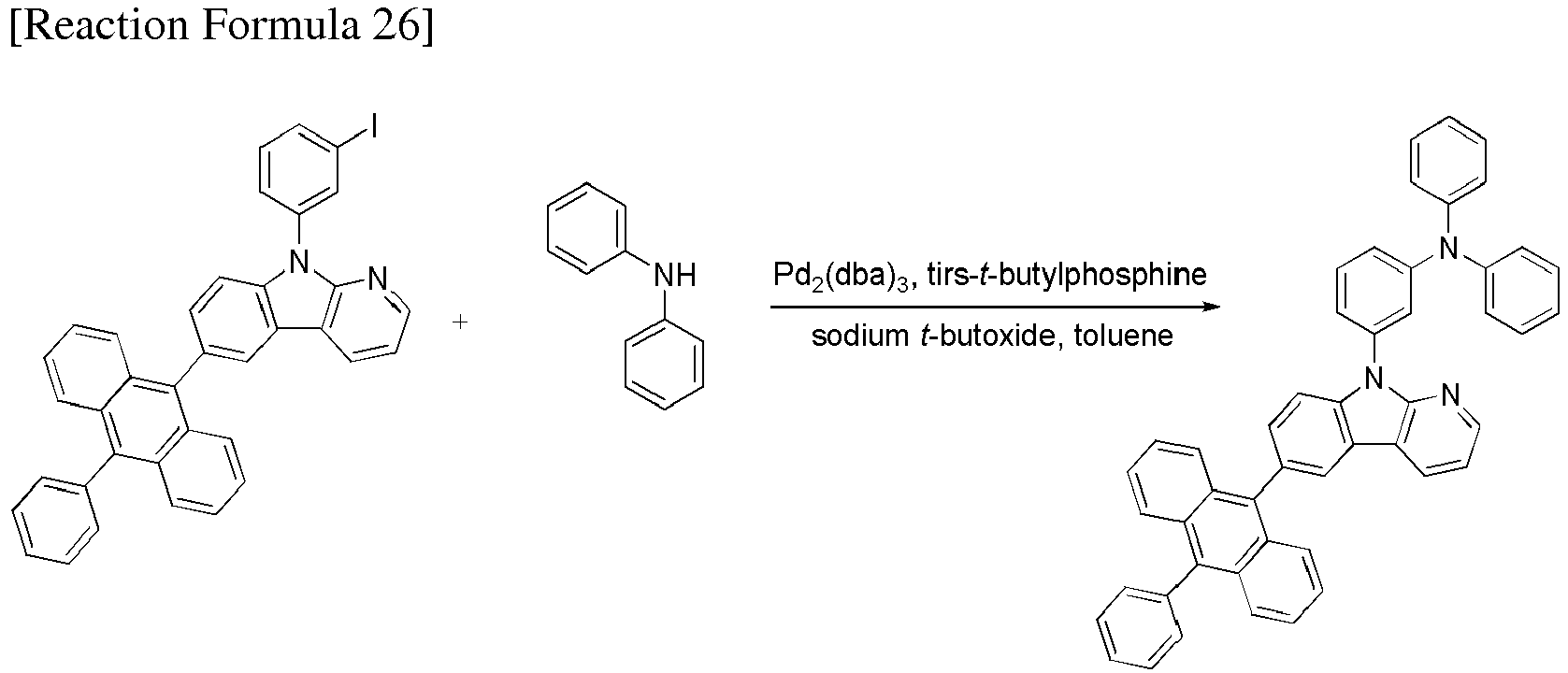
- 9-(3-iodophenyl)-6-(10-phenylanthracen-9-yl)-9H-pyrido[2,3-b]indole (1.58 g, 2.54 mmol), diphenylamine (430 mg, 2.54 mmol), Pd2(dba)3 (46 mg, 0.050 mmol), tris-t-butylphosphine (0.012 mL, 0.050 mmol), sodium tert-butoxide (488 mg, 5.08 mmol) were put in a 250mL two-neck flask and dissolved in toluene. The solution was refluxed and stirred at 120°C for 12 hours. After completion of the reaction, the solution was extracted with H2O and was distilled under reduced pressure to remove the solvent. The resultant was columned with a solution of hexane and methylenechloride (1:5). The solution was distilled under reduced pressure and was re-crystallized in a solution of methylene chloride and petroleum ether such that the compound AN-8 of solid was obtained, (0.53g, yield: 31%).
-

- 9-bromophenanthrene (7.00 g, 27.22 mmol), phenanthren-9-amine (5.26 g, 27.22 mmol), Pd2(dba)3 (499 mg, 0.544 mmol), tris-t-butylphosphine (0.123 mL, 0.544 mmol), sodium tert-butoxide (3.90 mg, 40.84 mmol) were put in a 250mL two-neck flask and dissolved in toluene. The solution was refluxed and stirred for 12 hours. After completion of the reaction, the solution was extracted with DI water/methylenechloride and distilled under reduced pressure to remove the solvent. The resultant was columned with a solution of n-hexane and methylenechloride (3:1) and was re-crystallized in a solution of methylene chloride and petroleum ether such that the solid compound was obtained, (4.50g, yield: 45%).
-

- Diphenanthren-9-ylamine (4.50 g, 12.18 mmol), 1,4-dibromobenzene (3.02 mL, 25.12 mmol), Pd2(dba)3 (307 mg, 0.355 mmol), tris-o-tolyphosphine (0.255 mL, 0.837 mmol), sodium tert-butoxide (3.2 g, 33.49 mmol) were put in a 250mL two-neck flask and dissolved in toluene. The solution was refluxed and stirred for 12 hours. After completion of the reaction, the solution was extracted with DI water/methylenechloride and distilled under reduced pressure to remove the solvent. The resultant was columned with a solution of n-hexane and methylenechloride (7:1). The resultant was distilled under reduced pressure and re-crystallized such that the wax compound was obtained, (2.8g, yield: 44%).
-


- 3-(10-phenylanthracen-9-yl)-9H-carbazole (1.25 g, 2.98 mmol), N-(4-bromophenyl)-N-phenylphenanthren-9-amine (1.56 g, 2.98 mmol), Pd2(dba)3 (55 mg, 0.060 mmol), tris-t-butylphosphine (0.014 mL, 0.060 mmol), sodium tert-butoxide (572 mg, 5.96 mmol) were put in a 250mL two-neck flask and dissolved in toluene. The solution was refluxed and stirred for 12 hours. After completion of the reaction, the solution was extracted with DI water/methylenechloride and distilled under reduced pressure to remove the solvent. The resultant was columned with a solution of n-hexane and methylenechloride (5:1). The solution was distilled under reduced pressure and was re-crystallized in a solution of methylene chloride and petroleum ether such that the solid compound AN-11 was obtained, (1.14g, yield: 44%).
- The properties of the compounds AN-1 to AN-4, AN-6, AN-8 and AN-11 and a host compound (Host(ref.)) in Formula 4 were tested and listed in Table 3.
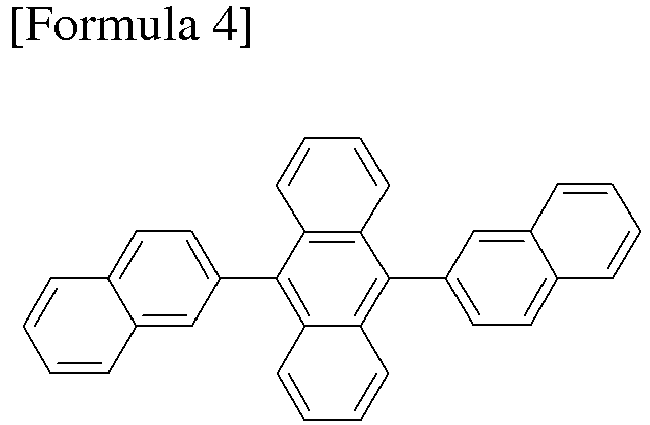
Table 3 Compounds λabs a (nm) λPL b (nm) Band gap Energy c LUMO d(eV) HOMO e (eV) Host (ref.) 417 421 3.00 - 2.50 - 5.50 AN-1 419 434 2.96 - 2.30 - 5.26 AN-2 422 451 2.94 - 2.21 - 5.15 AN-3 419 431 2.96 - 2.55 - 5.51 AN-4 418 436 2.97 - 2.30 - 5.27 AN-6 419 451 2.96 - 2.23 - 5.19 AN-8 415 436 2.99 - 2.28 - 5.27 AN-11 419 431 2.96 - 2.63 - 5.59 a. Absorption onset of 0.02 mM solutions in CH2Cl2.
b. PL maxima of 2-methyl THF solutions upon excitation at UV maximum absorption.
c. Estimated from the absorption onset.
d. LUMO = - [Band gap energy - HOMO level]
e. Estimated from the Cyclic Voltammetry instrument. - An indium-tin-oxide (ITO) layer is patterned on a substrate and washed such that an emission area of the ITO layer is to be 3mm*3mm. The substrate is washed by the UV ozone and is loaded in an evaporation system. The substrate is loaded in a vacuum chamber, and the process pressure is adjusted to 1*10-6 ∼1*10-7 torr. On the ITO layer, i) HIL (50 Å, host material/HAT-CN (10%)), ii) HTL (300 Å, host material), iii) EML (700 Å, host material/dopant material (15%)), iv) ETL (200 Å, Alq3), v) EIL (10 Å, LiF), and vi) cathode (1000 Å, Al) are sequentially deposited. The UV curable epoxy and the getter are used for encapsulation such that the diode is obtained. The dopant material for the EML is N,N'-bis(2,4-diphenyl)-N,N'-bis(2-fluorophenyl)-pyrene-1,6-diamine.
- The compound in Formula 4 is used the host material of the EIL, the ETL and the EML.
- The compound AN-1 is used the host material of the EIL, the ETL and the EML.
- The compound AN-3 is used the host material of the EIL, the ETL and the EML.
- The compound AN-6 is used the host material of the EIL, the ETL and the EML.
- The compound AN-8 is used the host material of the EIL, the ETL and the EML.
- The compound AN-11 is used the host material of the EIL, the ETL and the EML.
- The above diodes are fabricated with the same conditions except the host material of the EIL, the ETL and the EML. The properties of the diodes were tested and listed in Table 4.
Table 4 @ 10 mA/cm2 Host Volt (V) CD/A Im/W EQE (%) cd/m2(max) CIE x CIE y Ref. 3.19 1.01 0.99 1.17 100 0.144 0.098 AN-1 2.98 4.30 4.53 4.46 453 0.147 0.116 AN-3 2.99 4.12 4.33 4.53 433 0.143 0.107 AN-6 3.00 4.04 4.23 3.61 423 0.145 0.144 AN-8 3.10 1.91 1.93 2.42 193 0.144 0.087 AN-11 3.12 3.91 3.94 4.15 394 0.147 0.111 - Referring to Table 4, in comparison to the Comparative Example (Ref.), the diode including the organic compounds AN-1, AN-3, AN-6, AN-8 and AN-11 of the embodiment of the invention has advantages in the driving voltage, the emission efficiency, and so on. Since the organic compound has an excellent hole injection and/or transporting property, the combination of the holes and the electrons is generated at a center region of the EML such that the emission efficiency is improved.
- Namely, referring to Table 3, the organic compounds of the embodiment of the invention and the reference host have similar properties, e.g., LUMO and HOMO. However, the reference host has a strong electron property such that the hole injection and/or transportation is restricted by the reference host. On the other hand, since the organic compound of the embodiment of the invention has a strong hole property, the hole injection and/or transportation becomes easier. As a result, in the OLED including the organic compound of the embodiment of the invention, the combination of the holes and the electrons is generated at a center region of the EML such that the emission efficiency is improved.
- In addition, since the organic compounds of the embodiment of the invention can be used for all of the HIL, the HTL and the EML, the structure and the fabricating process of the OLED are simplified.
- It will be apparent to those skilled in the art that various modifications and variations can be made in the embodiment of the invention provided they come within the scope of the appended claims.
Claims (8)
- An organic electroluminescent device, comprising:a first electrode;a second electrode facing the first electrode;an emitting material layer between the first and second electrodes;a hole injection layer between the first electrode and the emitting material layer; anda hole transporting layer between the hole injection layer and the emitting material layer,wherein at least one of the hole injection layer, the hole transporting layer and the emitting material layer includes an organic compound of Formula:

- The organic electroluminescent device according to claim 1, wherein X is nitrogen.
- The organic electroluminescent device according to claim 1 or 2, wherein Y is selected from phenyl, naphthyl, terphenyl, xylene, triphenlyamine, diphenylamine and phenanthrenylamine.
- The organic electroluminescent device according to claim 1, wherein the Formula is selected from the followings:

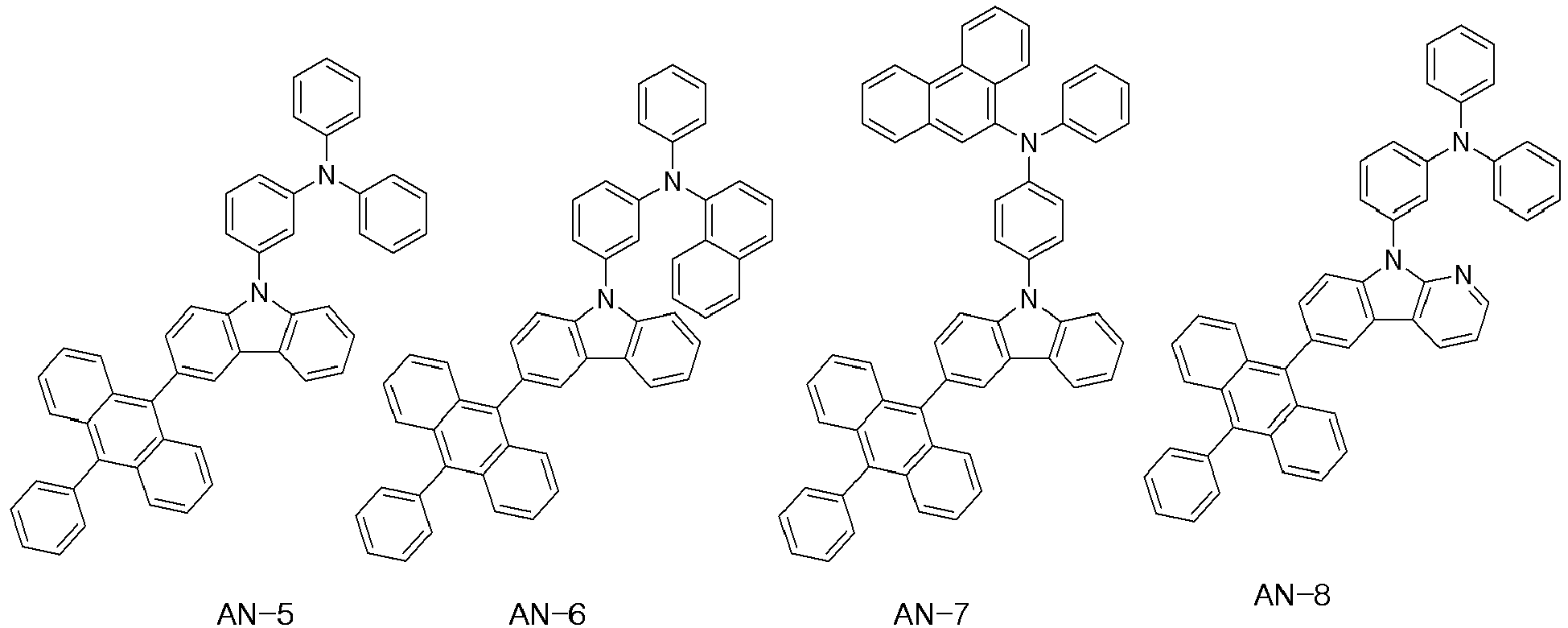


- The organic electroluminescent device according to any one of claims 1 to 4, wherein the hole injection layer includes a dopant material having a lowest unoccupied molecular orbital (LUMO) level of -4.5eV to -6.0eV, and the dopant material is doped to the organic compound.
- The organic electroluminescent device according to claim 5, wherein the dopant material is a material of the following Formula:

- The organic electroluminescent device according to any one of claims 1 to 6, wherein at least two of the hole injection layer, the hole transporting layer and the emitting material layer include the organic compound.
- The organic electroluminescent device according to any one of claims 1 to 6, wherein all of the hole injection layer, the hole transporting layer and the emitting material layer include the organic compound.
Applications Claiming Priority (3)
| Application Number | Priority Date | Filing Date | Title |
|---|---|---|---|
| KR20130150833 | 2013-12-05 | ||
| KR1020140089253A KR102237159B1 (en) | 2013-12-05 | 2014-07-15 | Organic Compound and Organic Light Emitting Diode Devices using the same |
| EP14195144.2A EP2881446B1 (en) | 2013-12-05 | 2014-11-27 | Organic compound and organic light emitting diode using the same |
Related Parent Applications (1)
| Application Number | Title | Priority Date | Filing Date |
|---|---|---|---|
| EP14195144.2A Division EP2881446B1 (en) | 2013-12-05 | 2014-11-27 | Organic compound and organic light emitting diode using the same |
Publications (2)
| Publication Number | Publication Date |
|---|---|
| EP3489325A1 true EP3489325A1 (en) | 2019-05-29 |
| EP3489325B1 EP3489325B1 (en) | 2020-06-10 |
Family
ID=52002747
Family Applications (2)
| Application Number | Title | Priority Date | Filing Date |
|---|---|---|---|
| EP19150518.9A Active EP3489325B1 (en) | 2013-12-05 | 2014-11-27 | Organic electroluminescent device |
| EP14195144.2A Active EP2881446B1 (en) | 2013-12-05 | 2014-11-27 | Organic compound and organic light emitting diode using the same |
Family Applications After (1)
| Application Number | Title | Priority Date | Filing Date |
|---|---|---|---|
| EP14195144.2A Active EP2881446B1 (en) | 2013-12-05 | 2014-11-27 | Organic compound and organic light emitting diode using the same |
Country Status (3)
| Country | Link |
|---|---|
| US (3) | US9281482B2 (en) |
| EP (2) | EP3489325B1 (en) |
| CN (2) | CN104693105B (en) |
Families Citing this family (23)
| Publication number | Priority date | Publication date | Assignee | Title |
|---|---|---|---|---|
| EP3489325B1 (en) * | 2013-12-05 | 2020-06-10 | LG Display Co., Ltd. | Organic electroluminescent device |
| JP6656800B2 (en) * | 2014-10-22 | 2020-03-04 | 三星ディスプレイ株式會社Samsung Display Co.,Ltd. | Organic electroluminescent element material and organic electroluminescent element using the same |
| CN106478609B (en) * | 2015-08-31 | 2019-03-26 | 上海和辉光电有限公司 | A kind of material applied to the field OLED |
| CN105837568B (en) * | 2016-03-23 | 2018-02-23 | 中国广州分析测试中心 | A kind of fluorenyl β carbolines class compound, its application and preparation method as luminous organic material and aggregation inducing Fluorescence Increasing material |
| CN107056737B (en) * | 2016-04-25 | 2020-04-21 | 中节能万润股份有限公司 | Photoelectric material containing dimethyl anthracene structure and application thereof |
| CN106467549B (en) * | 2016-08-03 | 2019-03-22 | 江苏三月光电科技有限公司 | A kind of compound containing benzimidazole and its application on organic electroluminescence device |
| CN106467527B (en) * | 2016-08-26 | 2019-05-21 | 江苏三月光电科技有限公司 | A kind of organic compound containing dimethylanthracene and its application on OLED |
| CN106467543B (en) * | 2016-08-26 | 2019-02-22 | 江苏三月光电科技有限公司 | A kind of organic compound with dimethyl anthracene as the core and its application |
| CN106467486B (en) * | 2016-08-26 | 2020-07-17 | 中节能万润股份有限公司 | Organic compound containing dimethylanthracene and application thereof |
| CN106496097B (en) * | 2016-08-31 | 2019-02-01 | 河南省科学院化学研究所有限公司 | A kind of synthetic method of 3-bromo-9-(9-phenylfluoren-9-yl)carbazole |
| CN106543205B (en) * | 2016-11-08 | 2019-01-08 | 江苏三月光电科技有限公司 | A kind of compound containing benzimidazole and its application on OLED |
| CN106892914B (en) * | 2017-02-23 | 2019-02-01 | 南京高光半导体材料有限公司 | Organic electroluminescent compounds, organic electroluminescent devices and their applications |
| JP2018195768A (en) * | 2017-05-19 | 2018-12-06 | 富士フイルム株式会社 | Photoelectric conversion element, solar battery, method for manufacturing photoelectric conversion element, and composition for photoelectric conversion element |
| US10516132B2 (en) * | 2017-08-24 | 2019-12-24 | Shenzhen China Star Optoelectronics Semiconductor Display Technology Co., Ltd. | Inverted quantum dot light-emitting diode and manufacturing method thereof |
| KR102718893B1 (en) * | 2018-09-07 | 2024-10-16 | 삼성전자주식회사 | Electroluminescent device, and display device comprising thereof |
| US11038136B2 (en) * | 2018-09-07 | 2021-06-15 | Samsung Electronics Co., Ltd. | Electroluminescent device, and display device comprising thereof |
| KR102640206B1 (en) | 2019-01-03 | 2024-02-23 | 삼성전자주식회사 | Conductive array, Composite membrane including the conductive array, Lithium battery including the composite membrane and Preparation method of the conductive array |
| US20210098724A1 (en) * | 2019-10-01 | 2021-04-01 | Industry-University Cooperation Foundation Hanyang University | Thin film transistor |
| CN111057005A (en) * | 2019-11-04 | 2020-04-24 | 苏州久显新材料有限公司 | Fluorene derivative and electronic device |
| KR20210085545A (en) * | 2019-12-30 | 2021-07-08 | 주식회사 동진쎄미켐 | Novel compound and organic electroluminescent device comprising the same |
| CN113121572B (en) * | 2019-12-30 | 2022-05-20 | 陕西莱特光电材料股份有限公司 | Heterocyclic compound, organic electroluminescent device, and electronic apparatus |
| WO2021136277A1 (en) * | 2019-12-30 | 2021-07-08 | 陕西莱特光电材料股份有限公司 | Heterocyclic compound, organic electroluminescence device, and electronic device |
| US20240292641A1 (en) | 2021-06-30 | 2024-08-29 | Sony Group Corporation | Semiconductor element and semiconductor device |
Citations (3)
| Publication number | Priority date | Publication date | Assignee | Title |
|---|---|---|---|---|
| US20070205412A1 (en) * | 2006-03-06 | 2007-09-06 | Jae-Soon Bae | Novel anthracene derivative and organic electronic device using the same |
| JP2011012190A (en) * | 2009-07-03 | 2011-01-20 | Toyo Ink Mfg Co Ltd | Material for low molecular weight application type organic electroluminescent element, ink composition for organic electroluminescent element and organic electroluminescent element |
| EP2296204A1 (en) * | 2008-07-01 | 2011-03-16 | Toray Industries, Inc. | Light-emitting element |
Family Cites Families (19)
| Publication number | Priority date | Publication date | Assignee | Title |
|---|---|---|---|---|
| KR100377321B1 (en) * | 1999-12-31 | 2003-03-26 | 주식회사 엘지화학 | Electronic device comprising organic compound having p-type semiconducting characteristics |
| JP4947909B2 (en) * | 2004-03-25 | 2012-06-06 | 三洋電機株式会社 | Organic electroluminescence device |
| EP2031670B1 (en) * | 2006-06-22 | 2013-11-27 | Idemitsu Kosan Co., Ltd. | Organic electroluminescent device employing heterocycle-containing arylamine derivative |
| EP2087063B1 (en) * | 2006-11-30 | 2016-10-19 | Semiconductor Energy Laboratory Co, Ltd. | Light-emitting device |
| JP5090746B2 (en) * | 2007-01-19 | 2012-12-05 | 株式会社ツジデン | Carbazole-based random copolymer |
| KR100857023B1 (en) * | 2007-05-21 | 2008-09-05 | (주)그라쎌 | Organic light emitting compound and organic light emitting device comprising the same |
| KR100910677B1 (en) * | 2007-08-10 | 2009-08-04 | 네오뷰코오롱 주식회사 | Synthesis method of luminescent material and organic light emitting device using luminescent material |
| KR100991416B1 (en) * | 2007-12-31 | 2010-11-03 | 다우어드밴스드디스플레이머티리얼 유한회사 | Organic light emitting compound and organic light emitting device comprising the same |
| JP2009209127A (en) * | 2008-02-08 | 2009-09-17 | Toyo Ink Mfg Co Ltd | Compound having carbazolyl group and use thereof |
| KR101497754B1 (en) * | 2008-03-05 | 2015-03-02 | 이데미쓰 고산 가부시키가이샤 | Polymer and organic electroluminescent device including the same |
| KR100964232B1 (en) * | 2008-09-03 | 2010-06-17 | 삼성모바일디스플레이주식회사 | Silicon-containing compound and organic electroluminescent device using same |
| WO2010073348A1 (en) * | 2008-12-25 | 2010-07-01 | 富士電機ホールディングス株式会社 | Organic el element having cathode buffer layer |
| KR101358494B1 (en) * | 2009-12-16 | 2014-02-05 | 이데미쓰 고산 가부시키가이샤 | Aromatic amine derivative, and organic electroluminescent element comprising same |
| KR20110112098A (en) * | 2010-04-06 | 2011-10-12 | 다우어드밴스드디스플레이머티리얼 유한회사 | Novel organic light emitting compound and organic electroluminescent device employing the same |
| JP5627300B2 (en) * | 2010-06-04 | 2014-11-19 | キヤノン株式会社 | Novel organic compound and organic light emitting device having the same |
| KR20120031684A (en) * | 2010-09-27 | 2012-04-04 | 롬엔드하스전자재료코리아유한회사 | Novel organic electroluminescent compounds and organic electroluminescent device using the same |
| KR20140016653A (en) * | 2012-07-30 | 2014-02-10 | 삼성디스플레이 주식회사 | Organic light emitting device comprising compounds |
| KR20120135501A (en) * | 2012-10-29 | 2012-12-14 | 에스에프씨 주식회사 | A condensed-cyclic compound and an organic light emitting diode comprising the same |
| EP3489325B1 (en) * | 2013-12-05 | 2020-06-10 | LG Display Co., Ltd. | Organic electroluminescent device |
-
2014
- 2014-11-27 EP EP19150518.9A patent/EP3489325B1/en active Active
- 2014-11-27 EP EP14195144.2A patent/EP2881446B1/en active Active
- 2014-12-04 CN CN201410734185.9A patent/CN104693105B/en active Active
- 2014-12-04 US US14/560,981 patent/US9281482B2/en active Active
- 2014-12-04 CN CN201610908337.1A patent/CN106986811B/en active Active
-
2016
- 2016-02-08 US US15/018,536 patent/US9590191B2/en active Active
- 2016-02-08 US US15/018,560 patent/US9608210B2/en active Active
Patent Citations (3)
| Publication number | Priority date | Publication date | Assignee | Title |
|---|---|---|---|---|
| US20070205412A1 (en) * | 2006-03-06 | 2007-09-06 | Jae-Soon Bae | Novel anthracene derivative and organic electronic device using the same |
| EP2296204A1 (en) * | 2008-07-01 | 2011-03-16 | Toray Industries, Inc. | Light-emitting element |
| JP2011012190A (en) * | 2009-07-03 | 2011-01-20 | Toyo Ink Mfg Co Ltd | Material for low molecular weight application type organic electroluminescent element, ink composition for organic electroluminescent element and organic electroluminescent element |
Also Published As
| Publication number | Publication date |
|---|---|
| EP3489325B1 (en) | 2020-06-10 |
| US20160155956A1 (en) | 2016-06-02 |
| US9608210B2 (en) | 2017-03-28 |
| US9281482B2 (en) | 2016-03-08 |
| CN104693105A (en) | 2015-06-10 |
| CN106986811A (en) | 2017-07-28 |
| CN106986811B (en) | 2020-08-21 |
| EP2881446B1 (en) | 2019-01-09 |
| US20150162537A1 (en) | 2015-06-11 |
| EP2881446A3 (en) | 2015-08-19 |
| US9590191B2 (en) | 2017-03-07 |
| CN104693105B (en) | 2018-12-04 |
| EP2881446A2 (en) | 2015-06-10 |
| US20160155957A1 (en) | 2016-06-02 |
Similar Documents
| Publication | Publication Date | Title |
|---|---|---|
| EP3489325B1 (en) | Organic electroluminescent device | |
| EP3389107B1 (en) | Organic el light emitting apparatus and electronic instrument | |
| EP2665342B1 (en) | Composition for organic electroluminescent element, organic electroluminescent element, display device, and illuminator | |
| EP3020783B1 (en) | Delayed fluorescence compound, and organic light emitting diode and display device using the same | |
| CN102668160B (en) | Organic electroluminescent device | |
| EP2512798B1 (en) | Oled with high efficiency blue light-emitting layer | |
| EP2816626B1 (en) | Light-emitting element material, and light-emitting element | |
| EP2595208A1 (en) | Light emitting element | |
| US12369490B2 (en) | Organic electroluminescent element, organic electroluminescent display device, and electronic device | |
| JP5977227B2 (en) | Organic electroluminescence device | |
| KR20180008922A (en) | Aromatic heterocyclic derivative, material for organic electroluminescent element, and organic electroluminescent element | |
| KR20140095491A (en) | Aromatic heterocyclic derivative, material for organic electroluminescent element, and organic electroluminescent element | |
| KR20110086021A (en) | Organic light emitting element and material for use | |
| KR20130010015A (en) | Organic light-emitting device | |
| CN107534093A (en) | Organic electroluminescence device | |
| KR20140000684A (en) | Light emitting element material and light emitting element | |
| KR102237159B1 (en) | Organic Compound and Organic Light Emitting Diode Devices using the same | |
| KR20190045159A (en) | Organic electroluminescence device and electronic device equipped with it | |
| CN1998269A (en) | Organic EL device | |
| JP2022545320A (en) | Aromatic amine compound, capping layer material, and light-emitting device | |
| US8785002B1 (en) | High-energy triplet host materials, luminescent layer comprising the same, and organic electroluminescent device comprising the luminescent layer | |
| JP2019091748A (en) | Organic electroluminescent device including dinaphthotetraphenylene compound | |
| CN106008498A (en) | Phenanthroline derivative and organic electroluminescent device using same | |
| JP6047116B2 (en) | Novel anthracene compound and organic electroluminescence device using the same | |
| US20240349528A1 (en) | Organic electroluminescent element, organic electroluminescent display device, and electronic device |
Legal Events
| Date | Code | Title | Description |
|---|---|---|---|
| PUAI | Public reference made under article 153(3) epc to a published international application that has entered the european phase |
Free format text: ORIGINAL CODE: 0009012 |
|
| STAA | Information on the status of an ep patent application or granted ep patent |
Free format text: STATUS: REQUEST FOR EXAMINATION WAS MADE |
|
| 17P | Request for examination filed |
Effective date: 20190107 |
|
| AC | Divisional application: reference to earlier application |
Ref document number: 2881446 Country of ref document: EP Kind code of ref document: P |
|
| AK | Designated contracting states |
Kind code of ref document: A1 Designated state(s): AL AT BE BG CH CY CZ DE DK EE ES FI FR GB GR HR HU IE IS IT LI LT LU LV MC MK MT NL NO PL PT RO RS SE SI SK SM TR |
|
| RBV | Designated contracting states (corrected) |
Designated state(s): AL AT BE BG CH CY CZ DE DK EE ES FI FR GB GR HR HU IE IS IT LI LT LU LV MC MK MT NL NO PL PT RO RS SE SI SK SM TR |
|
| GRAP | Despatch of communication of intention to grant a patent |
Free format text: ORIGINAL CODE: EPIDOSNIGR1 |
|
| STAA | Information on the status of an ep patent application or granted ep patent |
Free format text: STATUS: GRANT OF PATENT IS INTENDED |
|
| INTG | Intention to grant announced |
Effective date: 20200103 |
|
| GRAS | Grant fee paid |
Free format text: ORIGINAL CODE: EPIDOSNIGR3 |
|
| GRAA | (expected) grant |
Free format text: ORIGINAL CODE: 0009210 |
|
| STAA | Information on the status of an ep patent application or granted ep patent |
Free format text: STATUS: THE PATENT HAS BEEN GRANTED |
|
| AC | Divisional application: reference to earlier application |
Ref document number: 2881446 Country of ref document: EP Kind code of ref document: P |
|
| AK | Designated contracting states |
Kind code of ref document: B1 Designated state(s): AL AT BE BG CH CY CZ DE DK EE ES FI FR GB GR HR HU IE IS IT LI LT LU LV MC MK MT NL NO PL PT RO RS SE SI SK SM TR |
|
| REG | Reference to a national code |
Ref country code: GB Ref legal event code: FG4D |
|
| REG | Reference to a national code |
Ref country code: CH Ref legal event code: EP Ref country code: AT Ref legal event code: REF Ref document number: 1279189 Country of ref document: AT Kind code of ref document: T Effective date: 20200615 |
|
| REG | Reference to a national code |
Ref country code: DE Ref legal event code: R096 Ref document number: 602014066596 Country of ref document: DE |
|
| REG | Reference to a national code |
Ref country code: IE Ref legal event code: FG4D |
|
| REG | Reference to a national code |
Ref country code: LT Ref legal event code: MG4D |
|
| PG25 | Lapsed in a contracting state [announced via postgrant information from national office to epo] |
Ref country code: GR Free format text: LAPSE BECAUSE OF FAILURE TO SUBMIT A TRANSLATION OF THE DESCRIPTION OR TO PAY THE FEE WITHIN THE PRESCRIBED TIME-LIMIT Effective date: 20200911 Ref country code: NO Free format text: LAPSE BECAUSE OF FAILURE TO SUBMIT A TRANSLATION OF THE DESCRIPTION OR TO PAY THE FEE WITHIN THE PRESCRIBED TIME-LIMIT Effective date: 20200910 Ref country code: FI Free format text: LAPSE BECAUSE OF FAILURE TO SUBMIT A TRANSLATION OF THE DESCRIPTION OR TO PAY THE FEE WITHIN THE PRESCRIBED TIME-LIMIT Effective date: 20200610 Ref country code: SE Free format text: LAPSE BECAUSE OF FAILURE TO SUBMIT A TRANSLATION OF THE DESCRIPTION OR TO PAY THE FEE WITHIN THE PRESCRIBED TIME-LIMIT Effective date: 20200610 Ref country code: LT Free format text: LAPSE BECAUSE OF FAILURE TO SUBMIT A TRANSLATION OF THE DESCRIPTION OR TO PAY THE FEE WITHIN THE PRESCRIBED TIME-LIMIT Effective date: 20200610 |
|
| REG | Reference to a national code |
Ref country code: NL Ref legal event code: MP Effective date: 20200610 |
|
| PG25 | Lapsed in a contracting state [announced via postgrant information from national office to epo] |
Ref country code: BG Free format text: LAPSE BECAUSE OF FAILURE TO SUBMIT A TRANSLATION OF THE DESCRIPTION OR TO PAY THE FEE WITHIN THE PRESCRIBED TIME-LIMIT Effective date: 20200910 Ref country code: RS Free format text: LAPSE BECAUSE OF FAILURE TO SUBMIT A TRANSLATION OF THE DESCRIPTION OR TO PAY THE FEE WITHIN THE PRESCRIBED TIME-LIMIT Effective date: 20200610 Ref country code: LV Free format text: LAPSE BECAUSE OF FAILURE TO SUBMIT A TRANSLATION OF THE DESCRIPTION OR TO PAY THE FEE WITHIN THE PRESCRIBED TIME-LIMIT Effective date: 20200610 Ref country code: HR Free format text: LAPSE BECAUSE OF FAILURE TO SUBMIT A TRANSLATION OF THE DESCRIPTION OR TO PAY THE FEE WITHIN THE PRESCRIBED TIME-LIMIT Effective date: 20200610 |
|
| REG | Reference to a national code |
Ref country code: AT Ref legal event code: MK05 Ref document number: 1279189 Country of ref document: AT Kind code of ref document: T Effective date: 20200610 |
|
| PG25 | Lapsed in a contracting state [announced via postgrant information from national office to epo] |
Ref country code: AL Free format text: LAPSE BECAUSE OF FAILURE TO SUBMIT A TRANSLATION OF THE DESCRIPTION OR TO PAY THE FEE WITHIN THE PRESCRIBED TIME-LIMIT Effective date: 20200610 Ref country code: NL Free format text: LAPSE BECAUSE OF FAILURE TO SUBMIT A TRANSLATION OF THE DESCRIPTION OR TO PAY THE FEE WITHIN THE PRESCRIBED TIME-LIMIT Effective date: 20200610 |
|
| PG25 | Lapsed in a contracting state [announced via postgrant information from national office to epo] |
Ref country code: AT Free format text: LAPSE BECAUSE OF FAILURE TO SUBMIT A TRANSLATION OF THE DESCRIPTION OR TO PAY THE FEE WITHIN THE PRESCRIBED TIME-LIMIT Effective date: 20200610 Ref country code: EE Free format text: LAPSE BECAUSE OF FAILURE TO SUBMIT A TRANSLATION OF THE DESCRIPTION OR TO PAY THE FEE WITHIN THE PRESCRIBED TIME-LIMIT Effective date: 20200610 Ref country code: SM Free format text: LAPSE BECAUSE OF FAILURE TO SUBMIT A TRANSLATION OF THE DESCRIPTION OR TO PAY THE FEE WITHIN THE PRESCRIBED TIME-LIMIT Effective date: 20200610 Ref country code: CZ Free format text: LAPSE BECAUSE OF FAILURE TO SUBMIT A TRANSLATION OF THE DESCRIPTION OR TO PAY THE FEE WITHIN THE PRESCRIBED TIME-LIMIT Effective date: 20200610 Ref country code: IT Free format text: LAPSE BECAUSE OF FAILURE TO SUBMIT A TRANSLATION OF THE DESCRIPTION OR TO PAY THE FEE WITHIN THE PRESCRIBED TIME-LIMIT Effective date: 20200610 Ref country code: RO Free format text: LAPSE BECAUSE OF FAILURE TO SUBMIT A TRANSLATION OF THE DESCRIPTION OR TO PAY THE FEE WITHIN THE PRESCRIBED TIME-LIMIT Effective date: 20200610 Ref country code: PT Free format text: LAPSE BECAUSE OF FAILURE TO SUBMIT A TRANSLATION OF THE DESCRIPTION OR TO PAY THE FEE WITHIN THE PRESCRIBED TIME-LIMIT Effective date: 20201012 Ref country code: ES Free format text: LAPSE BECAUSE OF FAILURE TO SUBMIT A TRANSLATION OF THE DESCRIPTION OR TO PAY THE FEE WITHIN THE PRESCRIBED TIME-LIMIT Effective date: 20200610 |
|
| PG25 | Lapsed in a contracting state [announced via postgrant information from national office to epo] |
Ref country code: PL Free format text: LAPSE BECAUSE OF FAILURE TO SUBMIT A TRANSLATION OF THE DESCRIPTION OR TO PAY THE FEE WITHIN THE PRESCRIBED TIME-LIMIT Effective date: 20200610 Ref country code: SK Free format text: LAPSE BECAUSE OF FAILURE TO SUBMIT A TRANSLATION OF THE DESCRIPTION OR TO PAY THE FEE WITHIN THE PRESCRIBED TIME-LIMIT Effective date: 20200610 Ref country code: IS Free format text: LAPSE BECAUSE OF FAILURE TO SUBMIT A TRANSLATION OF THE DESCRIPTION OR TO PAY THE FEE WITHIN THE PRESCRIBED TIME-LIMIT Effective date: 20201010 |
|
| REG | Reference to a national code |
Ref country code: DE Ref legal event code: R097 Ref document number: 602014066596 Country of ref document: DE |
|
| PLBE | No opposition filed within time limit |
Free format text: ORIGINAL CODE: 0009261 |
|
| STAA | Information on the status of an ep patent application or granted ep patent |
Free format text: STATUS: NO OPPOSITION FILED WITHIN TIME LIMIT |
|
| PG25 | Lapsed in a contracting state [announced via postgrant information from national office to epo] |
Ref country code: DK Free format text: LAPSE BECAUSE OF FAILURE TO SUBMIT A TRANSLATION OF THE DESCRIPTION OR TO PAY THE FEE WITHIN THE PRESCRIBED TIME-LIMIT Effective date: 20200610 |
|
| 26N | No opposition filed |
Effective date: 20210311 |
|
| PG25 | Lapsed in a contracting state [announced via postgrant information from national office to epo] |
Ref country code: SI Free format text: LAPSE BECAUSE OF FAILURE TO SUBMIT A TRANSLATION OF THE DESCRIPTION OR TO PAY THE FEE WITHIN THE PRESCRIBED TIME-LIMIT Effective date: 20200610 |
|
| PG25 | Lapsed in a contracting state [announced via postgrant information from national office to epo] |
Ref country code: MC Free format text: LAPSE BECAUSE OF FAILURE TO SUBMIT A TRANSLATION OF THE DESCRIPTION OR TO PAY THE FEE WITHIN THE PRESCRIBED TIME-LIMIT Effective date: 20200610 |
|
| REG | Reference to a national code |
Ref country code: CH Ref legal event code: PL |
|
| PG25 | Lapsed in a contracting state [announced via postgrant information from national office to epo] |
Ref country code: LU Free format text: LAPSE BECAUSE OF NON-PAYMENT OF DUE FEES Effective date: 20201127 |
|
| REG | Reference to a national code |
Ref country code: BE Ref legal event code: MM Effective date: 20201130 |
|
| PG25 | Lapsed in a contracting state [announced via postgrant information from national office to epo] |
Ref country code: CH Free format text: LAPSE BECAUSE OF NON-PAYMENT OF DUE FEES Effective date: 20201130 Ref country code: LI Free format text: LAPSE BECAUSE OF NON-PAYMENT OF DUE FEES Effective date: 20201130 |
|
| PG25 | Lapsed in a contracting state [announced via postgrant information from national office to epo] |
Ref country code: IE Free format text: LAPSE BECAUSE OF NON-PAYMENT OF DUE FEES Effective date: 20201127 |
|
| PG25 | Lapsed in a contracting state [announced via postgrant information from national office to epo] |
Ref country code: TR Free format text: LAPSE BECAUSE OF FAILURE TO SUBMIT A TRANSLATION OF THE DESCRIPTION OR TO PAY THE FEE WITHIN THE PRESCRIBED TIME-LIMIT Effective date: 20200610 Ref country code: MT Free format text: LAPSE BECAUSE OF FAILURE TO SUBMIT A TRANSLATION OF THE DESCRIPTION OR TO PAY THE FEE WITHIN THE PRESCRIBED TIME-LIMIT Effective date: 20200610 Ref country code: CY Free format text: LAPSE BECAUSE OF FAILURE TO SUBMIT A TRANSLATION OF THE DESCRIPTION OR TO PAY THE FEE WITHIN THE PRESCRIBED TIME-LIMIT Effective date: 20200610 |
|
| PG25 | Lapsed in a contracting state [announced via postgrant information from national office to epo] |
Ref country code: MK Free format text: LAPSE BECAUSE OF FAILURE TO SUBMIT A TRANSLATION OF THE DESCRIPTION OR TO PAY THE FEE WITHIN THE PRESCRIBED TIME-LIMIT Effective date: 20200610 |
|
| PG25 | Lapsed in a contracting state [announced via postgrant information from national office to epo] |
Ref country code: BE Free format text: LAPSE BECAUSE OF NON-PAYMENT OF DUE FEES Effective date: 20201130 |
|
| PGFP | Annual fee paid to national office [announced via postgrant information from national office to epo] |
Ref country code: GB Payment date: 20250922 Year of fee payment: 12 |
|
| PGFP | Annual fee paid to national office [announced via postgrant information from national office to epo] |
Ref country code: FR Payment date: 20250925 Year of fee payment: 12 |
|
| PGFP | Annual fee paid to national office [announced via postgrant information from national office to epo] |
Ref country code: DE Payment date: 20250922 Year of fee payment: 12 |