EP3489227B1 - Rotigotine behenate, and manufacturing method and application thereof - Google Patents
Rotigotine behenate, and manufacturing method and application thereof Download PDFInfo
- Publication number
- EP3489227B1 EP3489227B1 EP16909205.3A EP16909205A EP3489227B1 EP 3489227 B1 EP3489227 B1 EP 3489227B1 EP 16909205 A EP16909205 A EP 16909205A EP 3489227 B1 EP3489227 B1 EP 3489227B1
- Authority
- EP
- European Patent Office
- Prior art keywords
- rotigotine
- crystal form
- behenate
- rotigotine behenate
- degrees
- Prior art date
- Legal status (The legal status is an assumption and is not a legal conclusion. Google has not performed a legal analysis and makes no representation as to the accuracy of the status listed.)
- Active
Links
Images


Classifications
-
- A—HUMAN NECESSITIES
- A61—MEDICAL OR VETERINARY SCIENCE; HYGIENE
- A61K—PREPARATIONS FOR MEDICAL, DENTAL OR TOILETRY PURPOSES
- A61K31/00—Medicinal preparations containing organic active ingredients
- A61K31/33—Heterocyclic compounds
- A61K31/38—Heterocyclic compounds having sulfur as a ring hetero atom
- A61K31/381—Heterocyclic compounds having sulfur as a ring hetero atom having five-membered rings
-
- C—CHEMISTRY; METALLURGY
- C07—ORGANIC CHEMISTRY
- C07D—HETEROCYCLIC COMPOUNDS
- C07D333/00—Heterocyclic compounds containing five-membered rings having one sulfur atom as the only ring hetero atom
- C07D333/02—Heterocyclic compounds containing five-membered rings having one sulfur atom as the only ring hetero atom not condensed with other rings
- C07D333/04—Heterocyclic compounds containing five-membered rings having one sulfur atom as the only ring hetero atom not condensed with other rings not substituted on the ring sulphur atom
- C07D333/06—Heterocyclic compounds containing five-membered rings having one sulfur atom as the only ring hetero atom not condensed with other rings not substituted on the ring sulphur atom with only hydrogen atoms, hydrocarbon or substituted hydrocarbon radicals, directly attached to the ring carbon atoms
- C07D333/08—Hydrogen atoms or radicals containing only hydrogen and carbon atoms
- C07D333/10—Thiophene
-
- A—HUMAN NECESSITIES
- A61—MEDICAL OR VETERINARY SCIENCE; HYGIENE
- A61P—SPECIFIC THERAPEUTIC ACTIVITY OF CHEMICAL COMPOUNDS OR MEDICINAL PREPARATIONS
- A61P25/00—Drugs for disorders of the nervous system
- A61P25/14—Drugs for disorders of the nervous system for treating abnormal movements, e.g. chorea, dyskinesia
- A61P25/16—Anti-Parkinson drugs
-
- C—CHEMISTRY; METALLURGY
- C07—ORGANIC CHEMISTRY
- C07B—GENERAL METHODS OF ORGANIC CHEMISTRY; APPARATUS THEREFOR
- C07B2200/00—Indexing scheme relating to specific properties of organic compounds
- C07B2200/13—Crystalline forms, e.g. polymorphs
Definitions
- the present invention relates to a rotigotine derivative, a preparation method and use thereof, in particular to a rotigotine long-chain ester, a preparation method thereof and use thereof.
- Rotigotine is a non-ergot selective dopamine receptor agonist that produces an anti-Parkinson effect by activating D3/D2/D1 dopamine receptors. Due to the first-pass effect of the liver, the oral bioavailability of rotigotine is extremely low (about 1%-5%), which renders it unsuitable for oral administration. Currently there is no cure for Parkinson's disease. Patients thus require long-term treatment or management by drugs. Therefore, it is of great clinical significance to develop a drug characterized by a concise preparation process, low cost, and long-term steady release to improve the drug accessibility.
- WO 2012/068783 discloses a rotigotine microsphere preparation capable of maintaining an effective blood drug concentration for more than two weeks. Although the microsphere preparation could achieve the objective of sustained steady release, the preparation process are complicated and accompanied by high production costs.
- WO 2016/014242 discloses a series of structurally-modified derivatives of rotigotine, including rotigotine and its esters with saturated long chain of up to 16 carbons, which overcome the defect of low blood drug concentration of rotigotine for oral administration. Nevertheless, such oral dosage forms cannot achieve the objective of sustained steady release for longer than two weeks.
- injecting the saturated long-chain esters of rotigotine disclosed in WO 2016014242 such as rotigotine caprylate and rotigotine palmitate, can cause the blood drug concentration to fluctuate significantly. As such, the effective blood drug concentration is maintained for only a short period of time, and the long-term steady release of the drug cannot be achieved.
- the inventors of the present invention conducted intensive studies on other saturated and unsaturated long-chain esters of rotigotine, and surprisingly found that only saturated long-chain ester of rotigotine with twenty-two carbons has both long-lasting effective blood drug concentration, high bioavailability, and long-term steady release, whereas saturated or unsaturated long-chain esters of rotigotine with more or fewer than twenty-two carbons do not have the aforementioned excellent effects.
- the present invention provides rotigotine behenate and a preparation method and a use thereof.
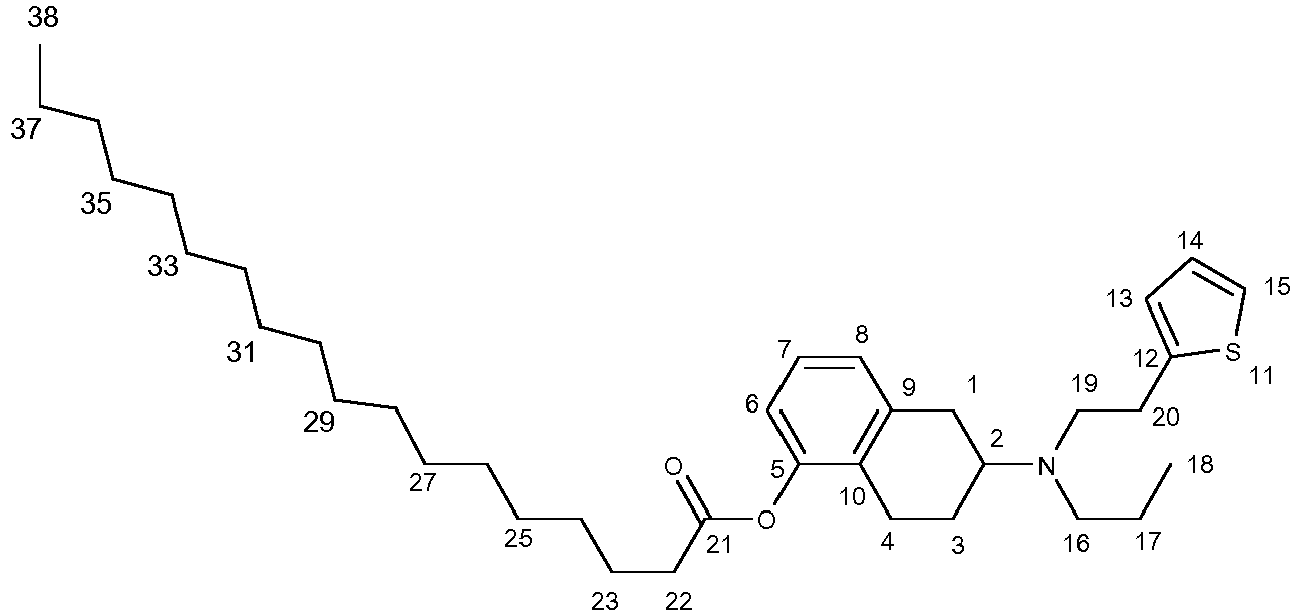
- the rotigotine behenate provided by the present invention has the following structural formula:
- the present invention provides a method for preparing rotigotine behenate, the method comprising: reacting behenoyl chloride with rotigotine to provide rotigotine behenate; or alternatively: reacting behenic acid with rotigotine to provide rotigotine behenate; or alternatively: reacting behenic anhydride with rotigotine to provide rotigotine behenate.
- the present invention provides a method for preparing rotigotine behenate: adding rotigotine to a mixture of triethylamine and dichloromethane (DCM) under nitrogen at room temperature, and then adding behenoyl chloride, washing after completion of the reaction, evaporating the solvents under reduced pressure, and purifying to provide rotigotine behenate; or alternatively: dissolving behenic acid, rotigotine and 4-(dimethylamino)pyridinium p -toluene sulfonate (DPTS) in dichloromethane (DCM) under nitrogen at room temperature, adding N , N '-dicyclohexylcarbodiimide (DCC) dropwise to the above mixture, filtering the mixture after completion of the reaction, and evaporating the solvent under reduced pressure and purifying to provide rotigotine behenate; or alternatively: dissolving behenic anhydride and rotigotine in anhydrous tetrahydr
- the rotigotine behenate crystal form (Form I) has a powder X-ray diffraction pattern substantially as shown in Fig. 4 .
- the rotigotine behenate crystal form (Form I) has TGA/DSC curves substantially as shown in Fig. 6 .
- the present invention also provides a preparation method for the rotigotine behenate crystal form (Form I): dissolving rotigotine behenate in an organic solvent, cooling and crystallizing, filtering, washing to provide the rotigotine behenate crystal form (Form I), wherein the organic solvent is selected from one or more of ethyl acetate, ethanol, methanol, cyclohexane, n -hexane, petroleum ether, tetrahydrofuran, acetone, n -heptane.
- the organic solvent is selected from one or more of ethyl acetate, ethanol, methanol, cyclohexane, n -hexane, petroleum ether, tetrahydrofuran, acetone, n -heptane.
- the organic solvent is selected from one or more of ethyl acetate, ethanol, methanol, cyclohexane, n -he
- Form II a rotigotine behenate crystal form
- One embodiment provides rotigotine behenate crystal form (Form II) having a powder X-ray diffraction pattern substantially as shown in Figure 5 .
- One embodiment provides rotigotine behenate crystal form (Form II) having TGA/DSC curves substantially as shown in Figure 7 .
- the present invention also provides a preparation method for rotigotine behenate crystal form (Form II), the method comprising: placing rotigotine behenate in a mixed solvent of tetrahydrofuran and methanol to provide a suspension, and stirring the suspension at 40 °C to provide the rotigotine behenate crystal form (Form II).
- the present invention provides a pharmaceutical composition comprising rotigotine behenate.
- the pharmaceutical compositions provided herein are administered in a parenteral form, preferably by injection, more preferably by intramuscular or subcutaneous injection.
- the rotigotine behenate pharmaceutical composition provided by the present invention can achieve a dosing interval of at least about two weeks.
- Another aspect provides the rotigotine behenate for use in treating Parkinson's disease.
- the rotigotine behenate provided by the present invention may be administered at a daily dose of from 1 mg to 1000 mg in the treatment of the aforementioned related diseases.
- the rotigotine behenate provided by the present invention is capable of reducing fluctuation in blood drug concentrations, improving the bioavailability of the drug in vivo, and achieving smooth release of rotigotine for more than two weeks.
- Rotigotine behenate prepared in Example 1 was dissolved in ethyl acetate by thermal dissolution, and subsequently methanol was added thereto, followed by cooling and crystallization. After filtering, the filter cake was washed with an appropriate amount of methanol to provide a white solid, the structure of which was determined by the following methods: Test instrument: PANalytical Empyrean X-ray powder diffraction analyzer.
- Test conditions CuK ⁇ radiation, K ⁇ 1 ( ⁇ ): 1.540598, K ⁇ 2 ( ⁇ ): 1.544426 K ⁇ 2/K ⁇ 1; Intensity ratio: 0.50, X-ray tube setting: 45 kV 40 mA, divergence slit: automatic, scanning mode: continuous , scanning range (°2TH) 3°-40° scanning step (°2TH) 0.013 scanning rate (°/min) about 10.
- TA Q200/Q2000 Differential Scanning Calorimeter provided by TA Instruments: Method: The sample was placed in an aluminum plate and covered, and was heated from room temperature to a set temperature at a rate of 10 °C /min under nitrogen.
- Thermogravimetric Analyzer provided by TA Instruments. Method: The sample was placed in an alloy plate and was heated from room temperature to a set temperature at a rate of 10 °C/min under nitrogen.
- Rotigotine behenate crystal form (Form I) XRPD data Pos.[°2Th.] Height[cts] FWHMLeft[°2Th.] d-spacing[ ⁇ ] Rel.Int.[%] 11.748580 412.859000 0.089544 7.53264 28.80 11.961550 204.388100 0.076752 7.39900 14.26 12.237820 156.078000 0.089544 7.23258 10.89 12.585540 174.660100 0.089544 7.03353 12.19 13.583960 218.506400 0.102336 6.51872 15.24 14.517520 388.543600 0.127920 6.10157 27.11 15.749400 179.957200 0.076752 5.62698 12.56 16.153840 461.856900 0.089544 5.48700 32.22 16.423700 182.669800 0.102336 5.39745 12.74 16.613510 124.542100 0.076752 5.33621 8.69 17.874630 385.559900 0.089544
- the rotigotine behenate prepared in excess in Example 1 was suspended in a mixture of solvents of tetrahydrofuran and methanol at 1:19 (v/v), and the suspension was stirred at 40 °C for 5 days to provide rotigotine behenate crystal form (Form II).
- the XRPD data for the rotigotine behenate crystal form (Form II) are shown in Table 2, the powder X-ray diffraction results are shown in Figure 5 , and the TGA/DSC curves are shown in Figure 7 . Table 2.
- Rotigotine behenate crystal form (Form II) XRPD data Pos.[°2Th.] Height[cts] FWHMLeft[°2Th.] d-spacing[ ⁇ ] Rel.Int.[%] 3.274108 129.297700 0.614016 26.98594 19.65 21.480630 657.882900 0.102336 4.13686 100.00 23.886770 260.269800 0.179088 3.72532 39.56
- Solution I 14.4 g (0.1 mol) of octanoic acid was dissolved in 300 ml of dichloromethane (DCM) under nitrogen at room temperature, and 12.7 g (0.1 mol) of oxalyl chloride was added dropwise to the above mixed solution within 30 min, and the resulting solution after completion of the reaction at room temperature was referred to as Solution I; 31.5 g (0.1 mol) of rotigotine was dissolved in a mixed solution containing 15.2 g (0.15 mol) of triethylamine and 300 ml of dichloromethane (DCM), which was referred to as solution II; Solution I was added dropwise to Solution II.
- DCM dichloromethane
- reaction mixture was washed with an equal volume of water, and the solvent of the organic phase was evaporated under reduced pressure.
- the residue was purified by column chromatography eluting with a 1:3 (v/v) ethyl acetate-petroleum ether system as the eluent, to provide a light yellow oil (40.1 g) in a yield of 69.1%.
- the white solid was washed with an appropriate amount of ethanol to give a white-like wet solid; after the abovementioned wet solid was dissolved in ethyl acetate by thermal dissolution, methanol was added to give a clear solution, followed by complete crystalization upon cooling; the mixture was filtered, and the filter cake was washed with an appropriate amount of methanol to provide a white-like solid (43.3 g) in a yield of 70.0%, melting point 30-33 °C.
- the white solid was washed with an appropriate amount of ethanol to give a white-like wet solid; after the abovementioned wet solid was dissolved in ethyl acetate by thermal dissolution, methanol was added to give a clear solution, followed by complete crystalization upon cooling; the mixture was filtered, and the filter cake was washed with an appropriate amount of methanol to provide a white-like solid (46.6 g) in a yield of 70.0%, melting point 47-49 °C.
- Test Example 1 Pharmacokinetic performance of rotigotine caprylate injection in rats
- Vehicle containing 1% of HPMC was prepared, and rotigotine caprylate was added to the vehicle to provide a 10 mg/ml of suspension (calculated as rotigotine).
- Three rats were intramuscularly injected with 2 mL/kg of the drug. Blood samples were taken from the eyelids of the rats before the administration (0h) and at 0.25h, 1h, 6h, 1d, 2d, 3d, 5d, 7d, 9d, 11d, 14d, 16d, 18d, 21d, 24d, 28d after administration. Each blood sample was placed into heparinized EP tube, and was immediately centrifuged (3000 rpm) for 10 min. The plasma was separated and stored at -35 °C for testing.
- the mean blood concentrations (ng/mL) of rotigotine in rats at different time points are shown in Table 3.
- the blood concentration-time curve of rotigotine after injection in rats is shown in Figure 8 .
- Table 3 Blood concentration of rotigotine at different time points
- Time (h) Time (d)
- Test Example 2 Pharmacokinetic performance of each drug injection in rats
- Rotigotine hydrochloride was formulated as a 0.36 mg/ml injection (calculated as rotigotine) in normal saline.
- the experimental animals were randomly divided into rotigotine oleate group (A), rotigotine palmitate group (B), rotigotine stearate group (C) and rotigotine hydrochloride group (D), with 3 rats in each group.
- the rats in Groups A, B, and C were intramuscularly injected with the corresponding drug (2ml/kg), and the rats in group D were injected intravenously with the corresponding drug (2ml/kg).
- Blood samples were taken from the eyelids of the rats in Groups A, B, and C before the administration (0h) and at 0.25h, 1h, 6h, 1d, 2d, 3d, 5d, 7d, 9d, 11d, 14d, 16d, 18d, 21d, 24d, 28d after administration. Each sample was placed into heparinized EP tube, and was immediately centrifuged (3000 rpm) for 10 min. The plasma was separated and stored at -35 °C for testing.
- Blood samples were taken from the eyelids of the rats in Group D before the administration (0h) and at 3min, 10min, 0.25h, 0.5h, 1h, 1.5h, 2h, 4h, 6h, 8h, and 12h after administration. Each blood sample was placed into heparinized EP tube, and was immediately centrifuged (3000 rpm) for 10 min. The plasma was separated and stored at -35 °C for testing.
- Test Example 3 Pharmacokinetic performance of each drug injection in rats
- Vehicle containing 1% of HPMC was prepared, and rotigotine arachidate, rotigotine behenate and rotigotine lignocerate were added to the vehicle respectively to provide 10 mg/ml of suspensions (calculated as rotigotine).
- the experimental animals were randomly divided into rotigotine arachidate group (A), rotigotine behenate group (B) and rotigotine lignocerate group (C), with 3 rats in each group, The rats in Groups A, B and C were intramuscularly injected with the corresponding drug (2ml/kg).
- Blood samples were taken from the eyelids of the rats in Groups A, B, and C before the administration (0h) and at 0.25h, 1h, 6h, 1d, 2d, 3d, 5d, 7d, 9d, 11d, 14d, 16d, 18d, 21d, 25d, 28d, 30d, 35d, 39d, 42d after administration.
- Each blood sample was placed into heparinized EP tube, and was immediately centrifuged (3000 rpm) for 10 min. The plasma was separated and stored at -35 °C for testing.
- the blood concentrations (ng/mL) of rotigotine in rats at different time points are displayed in Table 6.
- the blood concentration-time curve of rotigotine after injection in rats is shown in Figure 10 .
- Table 6 Blood concentration of rotigotine at different time points
Landscapes
- Health & Medical Sciences (AREA)
- Chemical & Material Sciences (AREA)
- Organic Chemistry (AREA)
- Animal Behavior & Ethology (AREA)
- Engineering & Computer Science (AREA)
- Biomedical Technology (AREA)
- Neurology (AREA)
- Neurosurgery (AREA)
- Bioinformatics & Cheminformatics (AREA)
- Veterinary Medicine (AREA)
- Public Health (AREA)
- Medicinal Chemistry (AREA)
- General Health & Medical Sciences (AREA)
- Pharmacology & Pharmacy (AREA)
- Life Sciences & Earth Sciences (AREA)
- Psychology (AREA)
- Nuclear Medicine, Radiotherapy & Molecular Imaging (AREA)
- General Chemical & Material Sciences (AREA)
- Chemical Kinetics & Catalysis (AREA)
- Epidemiology (AREA)
- Pharmaceuticals Containing Other Organic And Inorganic Compounds (AREA)
- Medicinal Preparation (AREA)
- Heterocyclic Compounds Containing Sulfur Atoms (AREA)
Description
- The present invention relates to a rotigotine derivative, a preparation method and use thereof, in particular to a rotigotine long-chain ester, a preparation method thereof and use thereof.
- Rotigotine is a non-ergot selective dopamine receptor agonist that produces an anti-Parkinson effect by activating D3/D2/D1 dopamine receptors. Due to the first-pass effect of the liver, the oral bioavailability of rotigotine is extremely low (about 1%-5%), which renders it unsuitable for oral administration. Currently there is no cure for Parkinson's disease. Patients thus require long-term treatment or management by drugs. Therefore, it is of great clinical significance to develop a drug characterized by a concise preparation process, low cost, and long-term steady release to improve the drug accessibility.
-
WO 2012/068783 discloses a rotigotine microsphere preparation capable of maintaining an effective blood drug concentration for more than two weeks. Although the microsphere preparation could achieve the objective of sustained steady release, the preparation process are complicated and accompanied by high production costs. -
WO 2016/014242 discloses a series of structurally-modified derivatives of rotigotine, including rotigotine and its esters with saturated long chain of up to 16 carbons, which overcome the defect of low blood drug concentration of rotigotine for oral administration. Nevertheless, such oral dosage forms cannot achieve the objective of sustained steady release for longer than two weeks. Experiments conducted by the inventors of the present invention have revealed that injecting the saturated long-chain esters of rotigotine disclosed inWO 2016014242 , such as rotigotine caprylate and rotigotine palmitate, can cause the blood drug concentration to fluctuate significantly. As such, the effective blood drug concentration is maintained for only a short period of time, and the long-term steady release of the drug cannot be achieved. - The inventors of the present invention conducted intensive studies on other saturated and unsaturated long-chain esters of rotigotine, and surprisingly found that only saturated long-chain ester of rotigotine with twenty-two carbons has both long-lasting effective blood drug concentration, high bioavailability, and long-term steady release, whereas saturated or unsaturated long-chain esters of rotigotine with more or fewer than twenty-two carbons do not have the aforementioned excellent effects.
- The present invention provides rotigotine behenate and a preparation method and a use thereof.
- The rotigotine behenate provided by the present invention has the following structural formula:

- The present invention provides a method for preparing rotigotine behenate, the method comprising: reacting behenoyl chloride with rotigotine to provide rotigotine behenate; or alternatively: reacting behenic acid with rotigotine to provide rotigotine behenate; or alternatively: reacting behenic anhydride with rotigotine to provide rotigotine behenate.
- The present invention provides a method for preparing rotigotine behenate: adding rotigotine to a mixture of triethylamine and dichloromethane (DCM) under nitrogen at room temperature, and then adding behenoyl chloride, washing after completion of the reaction, evaporating the solvents under reduced pressure, and purifying to provide rotigotine behenate; or alternatively: dissolving behenic acid, rotigotine and 4-(dimethylamino)pyridinium p-toluene sulfonate (DPTS) in dichloromethane (DCM) under nitrogen at room temperature, adding N,N'-dicyclohexylcarbodiimide (DCC) dropwise to the above mixture, filtering the mixture after completion of the reaction, and evaporating the solvent under reduced pressure and purifying to provide rotigotine behenate; or alternatively: dissolving behenic anhydride and rotigotine in anhydrous tetrahydrofuran (THF) under nitrogen, adding a catalytic amount of triethylamine, heating the mixture in oil bath, and evaporating the solvent under reduced pressure after completion of the reaction, and subsequently adding dichloromethane (DCM), followed by washing with sodium hydrogencarbonate solution, evaporating the solvent under reduced pressure and purifying to provide rotigotine behenate.
- The present invention provides a rotigotine behenate crystal form (Form I), which has characteristic peaks at 2θ (2θ (degrees)) = 21.563, 21.156, 23.295, 21.955 and 20.838 (±0.2 degrees 2θ) in the powder X-ray diffraction pattern obtained by CuKα radiation.
- In another embodiment, the rotigotine behenate crystal form (Form I) has characteristic peaks at 2θ (2θ (degrees)) = 21.563, 21.156, 23.295, 21.955, 20.838, 16.154, 19.403, 11.749, 14.518 and 17.875 (±0.2 degrees 2θ) in the powder X-ray diffraction pattern obtained by CuKα radiation.
- In another embodiment, the rotigotine behenate crystal form (Form I) has characteristic peaks at 2θ (2θ (degrees)) = 21.563, 21.156, 23.295, 21.955, 20.838, 16.154, 19.403, 11.749, 14.518, 17.875, 19.729, 20.299, 13.583, 11.962, 22.949, 23.772, 16.424, 15.749, 12.586 and 22.430 (±0.2 degrees 2θ) in the powder X-ray diffraction pattern obtained by CuKα radiation.
- In another embodiment, the rotigotine behenate crystal form (Form I) has characteristic peaks at 2θ (2θ (degrees)) = 21.563, 21.156, 23.295, 21.955, 20.838, 16.154, 19.403, 11.749, 14.518, 17.875, 19.729, 20.299, 13.583, 11.962, 22.949, 23.772, 16.424, 15.749, 12.586, 22.430, 12.238, 23.995, 18.626, 16.614, 28.574, 24.530, 25.169, 27.044, 36.329, 27.764, 29.127 and 31.490 (±0.2 degrees 2θ) in the powder X-ray diffraction pattern obtained by CuKα radiation.
- The rotigotine behenate crystal form (Form I) has a powder X-ray diffraction pattern substantially as shown in
Fig. 4 . - The rotigotine behenate crystal form (Form I) has TGA/DSC curves substantially as shown in
Fig. 6 . - The present invention also provides a preparation method for the rotigotine behenate crystal form (Form I): dissolving rotigotine behenate in an organic solvent, cooling and crystallizing, filtering, washing to provide the rotigotine behenate crystal form (Form I), wherein the organic solvent is selected from one or more of ethyl acetate, ethanol, methanol, cyclohexane, n-hexane, petroleum ether, tetrahydrofuran, acetone, n-heptane. Preferably, after the thermal dissolution of rotigotine behenate in ethyl acetate, adding methanol, cooling and crystallizing, followed by filtering and washing with an appropriate amount of methanol.
- The present invention further provides a rotigotine behenate crystal form (Form II), which has characteristic peaks at 2θ (2θ (degrees)) = 21.481, 23.887 (±0.2 degrees 2θ) in the powder X-ray diffraction pattern obtained by CuKα radiation.
- Another embodiment provides rotigotine behenate crystal form (Form II) having characteristic peaks at 2θ (2θ (degrees)) = 3.274, 21.481, 23.887 (± 0.2 degrees 2θ) in the powder X-ray diffraction pattern obtained by CuKα radiation
- One embodiment provides rotigotine behenate crystal form (Form II) having a powder X-ray diffraction pattern substantially as shown in
Figure 5 . - One embodiment provides rotigotine behenate crystal form (Form II) having TGA/DSC curves substantially as shown in
Figure 7 . - The present invention also provides a preparation method for rotigotine behenate crystal form (Form II), the method comprising: placing rotigotine behenate in a mixed solvent of tetrahydrofuran and methanol to provide a suspension, and stirring the suspension at 40 °C to provide the rotigotine behenate crystal form (Form II).
- The present invention provides a pharmaceutical composition comprising rotigotine behenate. In particular, the pharmaceutical compositions provided herein are administered in a parenteral form, preferably by injection, more preferably by intramuscular or subcutaneous injection.
- The rotigotine behenate pharmaceutical composition provided by the present invention can achieve a dosing interval of at least about two weeks.
- Another aspect provides the rotigotine behenate for use in treating Parkinson's disease.
- The rotigotine behenate provided by the present invention may be administered at a daily dose of from 1 mg to 1000 mg in the treatment of the aforementioned related diseases. The rotigotine behenate provided by the present invention is capable of reducing fluctuation in blood drug concentrations, improving the bioavailability of the drug in vivo, and achieving smooth release of rotigotine for more than two weeks.
-
-
Figure 1 shows the 1H NMR spectrum of rotigotine behenate in Example 1. -
Figure 2 shows the 13C NMR spectrum of rotigotine behenate in Example 1. -
Figure 3 shows the IR spectrum of rotigotine behenate in Example 1. -
Figure 4 shows the powder X-ray diffraction pattern of rotigotine behenate crystal form (Form I) in Example 3. -
Figure 5 shows the powder X-ray diffraction pattern of rotigotine behenate crystal form (Form II) in Example 4. -
Figure 6 shows the TGA/DSC curves of rotigotine behenate crystal form (Form I) in Example 3. -
Figure 7 shows the TGA/DSC curves of rotigotine behenate crystal form (Form II) in Example 4. -
Figure 8 shows the blood concentration-time curve of rotigotine after injection in rats in Test Example 1. -
Figure 9 shows the blood concentration-time curve of rotigotine after injection in rats in Test Example 2. -
Figure 10 shows the blood concentration-time curve of rotigotine after injection in rats in Test Example 3. - The following examples are intended to illustrate the present invention in more detail, but are not intended to limit the present invention in any way.
-

- 34.1 g (0.1 mol) of behenic acid was dissolved in 300 ml of dichloromethane (DCM) under nitrogen at room temperature, and 12.7 g (0.1 mol) of oxalyl chloride was added dropwise to the mixed solution; the resulting solution after completion of the reaction was referred to as Solution I. 31.5 g (0.1 mol) of rotigotine was dissolved in a mixed solution containing 15.2 g (0.15 mol) of triethylamine and 300 ml of dichloromethane (DCM), which was referred to as Solution II. Solution I was added dropwise to Solution II to provide a reaction solution, upon completion of the reaction, the reaction solution was washed with an equal volume of water, and the solvent of the organic phase was evaporated under reduced pressure. The residue was purified by column chromatography, with a 1:3 (v/v) ethyl acetate- petroleum ether system as the eluent, to give a white solid (44.2 g) in a yield of 69.0%, melting point 48-52 °C.
Figures 1 and 2 are the 1H NMR and the 13C NMR spectra of the titled compound, respectively, andFigure 3 is the IR spectrum of the titled compound.
- 1H NMR(CDCl3,400MHz) δ H: 7.12 (m, 2H, H-7&H-14), 6.98 (d, J=7.40 Hz, 1H, H-6), 6.92 (q, J=3.44,5.04 Hz, 1H, H-15), 6.82 (d, J=7.28 Hz, 2H, H-8&H-13), □3.01 (m 4H, H-1&H-4), 2.81 (m, 4H, H-19&H-20), 2.54 (m, 5H, H-2,H-16&H-22), 2.08 (m, 1H, H-3), 1.76 (m, 2H, H-23), 1.58 (m, 1H, H-3), 1.39 (m, 2H, H-41), 1.26 (m, 36H, H-17, H-24∼H-40), 0.88 (m, 6H, H-18&H-42);
13C NMR(CDCl3,100MHz) δ C: 172.0 (C-21), 148.9 (C-5), 143.1 (C-12), 138.8 (C-9), 128.7 (C-10), 127.1 (C-15), 126.5 (C-7), 126.2 (C-13), 124.5 (C-14), 123.1 (C-8), 119.0 (C-6), 56.4 (C-2), 52.6 (2C, C-19&C-16), 34.2 (C-22), 32.1 (C-40), 31.9 (C-20), 30.1 (C-1), 29.2-29.7(C-24∼C-39), 25.3 (C-3), 25.1 (C-23), 24.1 (C-4), 22.7 (C-41), 22.3 (C-17), 14.1 (C-42), 11.9 (C-18). -

- 3.4 g (0.01 mol) of behenic acid, 3.1 g (0.01 mol) of rotigotine and 1.4 g (0.005 mol) of 4-(dimethylamino)pyridinium-p-toluene sulfonate (DPTS) were dissolved in 20 ml of dichloromethane (DCM) under nitrogen at 0 °C, and 2.7 g (13 mmol) of N,N'-dicyclohexylcarbodiimide (DCC) was added dropwise to the above reaction mixture. The reaction mixture was filtered after completion of the reaction, and the filter cake was washed with an appropriate amount of dichloromethane (DCM). The filtrate was combined, and dichloromethane (DCM) was evaporated under reduced pressure. The residue was purified by column chromatography, with a 1:3 (v/v) ethyl acetate- petroleum ether system as the eluent, to provide a white solid (4.3 g) in a yield of 67%, melting point 48-52 °C.The 1H NMR, 13C NMR and IR spectra of the titled compound are identical to those obtained in Example 1.
- Rotigotine behenate prepared in Example 1 was dissolved in ethyl acetate by thermal dissolution, and subsequently methanol was added thereto, followed by cooling and crystallization. After filtering, the filter cake was washed with an appropriate amount of methanol to provide a white solid, the structure of which was determined by the following methods:
Test instrument: PANalytical Empyrean X-ray powder diffraction analyzer. - Test conditions: CuKα radiation, Kα1 (Å): 1.540598, Kα2 (Å): 1.544426 Kα2/Kα1; Intensity ratio: 0.50, X-ray tube setting: 45
kV 40 mA, divergence slit: automatic, scanning mode: continuous , scanning range (°2TH) 3°-40° scanning step (°2TH) 0.013 scanning rate (°/min) about 10. - Instrument: TA Q200/Q2000 Differential Scanning Calorimeter provided by TA Instruments:
Method: The sample was placed in an aluminum plate and covered, and was heated from room temperature to a set temperature at a rate of 10 °C /min under nitrogen. - Instrument: TA Q500/Q5000 Thermogravimetric Analyzer provided by TA Instruments. Method: The sample was placed in an alloy plate and was heated from room temperature to a set temperature at a rate of 10 °C/min under nitrogen.
- Result: the XRPD data of the rotigotine behenate crystal form (Form I) are shown in Table 1, the powder X-ray diffraction pattern is shown in
Figure 4 , and the TGA/DSC is shown inFig. 6 .Table 1. Rotigotine behenate crystal form (Form I) XRPD data Pos.[°2Th.] Height[cts] FWHMLeft[°2Th.] d-spacing[Å] Rel.Int.[%] 11.748580 412.859000 0.089544 7.53264 28.80 11.961550 204.388100 0.076752 7.39900 14.26 12.237820 156.078000 0.089544 7.23258 10.89 12.585540 174.660100 0.089544 7.03353 12.19 13.583960 218.506400 0.102336 6.51872 15.24 14.517520 388.543600 0.127920 6.10157 27.11 15.749400 179.957200 0.076752 5.62698 12.56 16.153840 461.856900 0.089544 5.48700 32.22 16.423700 182.669800 0.102336 5.39745 12.74 16.613510 124.542100 0.076752 5.33621 8.69 17.874630 385.559900 0.089544 4.96246 26.90 18.625840 130.024200 0.102336 4.76398 9.07 19.403000 420.054300 0.115128 4.57488 29.31 19.728520 290.907200 0.179088 4.50012 20.30 20.298570 288.026100 0.115128 4.37502 20.10 20.838250 626.098000 0.089544 4.26291 43.68 21.155780 1325.514000 0.102336 4.19964 92.48 21.562650 1433.305000 0.127920 4.12131 100.00 21.955060 799.897300 0.063960 4.04853 55.81 22.430140 173.571400 0.102336 3.96384 12.11 22.948710 198.456400 0.102336 3.87543 13.85 23.294780 1152.738000 0.127920 3.81864 80.43 23.774200 195.329500 0.076752 3.74271 13.63 23.994870 145.715100 0.102336 3.70878 10.17 24.529790 98.424370 0.255840 3.62910 6.87 25.169150 85.454170 0.153504 3.53835 5.96 27.043790 70.776630 0.153504 3.29718 4.94 27.764090 55.805020 0.153504 3.21326 3.89 28.573820 122.242000 0.358176 3.12401 8.53 29.127000 54.343720 0.307008 3.06593 3.79 31.489760 31.995680 0.153504 2.84107 2.23 36.328700 58.247280 0.204672 2.47298 4.06 - The rotigotine behenate prepared in excess in Example 1 was suspended in a mixture of solvents of tetrahydrofuran and methanol at 1:19 (v/v), and the suspension was stirred at 40 °C for 5 days to provide rotigotine behenate crystal form (Form II).
- The measurement was carried out in accordance with the methods described in Example 3.
- The TGA results showed that the weight loss was 3.1% when the sample was heated to 100 °C, and three endothermic peaks were observed in the DSC curve, which were at 30.9 °C, 41.7 °C, and 46.7 °C (peak values), respectively.
- The XRPD data for the rotigotine behenate crystal form (Form II) are shown in Table 2, the powder X-ray diffraction results are shown in
Figure 5 , and the TGA/DSC curves are shown inFigure 7 .Table 2. Rotigotine behenate crystal form (Form II) XRPD data Pos.[°2Th.] Height[cts] FWHMLeft[°2Th.] d-spacing[Å] Rel.Int.[%] 3.274108 129.297700 0.614016 26.98594 19.65 21.480630 657.882900 0.102336 4.13686 100.00 23.886770 260.269800 0.179088 3.72532 39.56 -

- 14.4 g (0.1 mol) of octanoic acid was dissolved in 300 ml of dichloromethane (DCM) under nitrogen at room temperature, and 12.7 g (0.1 mol) of oxalyl chloride was added dropwise to the above mixed solution within 30 min, and the resulting solution after completion of the reaction at room temperature was referred to as Solution I; 31.5 g (0.1 mol) of rotigotine was dissolved in a mixed solution containing 15.2 g (0.15 mol) of triethylamine and 300 ml of dichloromethane (DCM), which was referred to as solution II; Solution I was added dropwise to Solution II. The above reaction solution was washed with an equal volume of water after completion of the reaction, and the solvent of the organic phase was evaporated under reduced pressure. The residue was purified by column chromatography eluting with a 1:3 (v/v) ethyl acetate-petroleum ether system as the eluent, to provide a light yellow oil (31.8 g) in a yield of 72.1%.

- 1H NMR(CDCl3,400MHz)δ H: 7.01 (m, 2H, H-7&H-14), 6.88 (d, J=7.56 Hz, 1H, H-6), 6.81 (t, J=3.46 Hz, 1H,H-15), 6.72 (t, J=2.78 Hz, 2H, H-8&H-13), 2.92 (m 4H, H-1&H-4), 2.78 (m, 4H, H-19&H-20), 2.49 (m, 5H, H-2,H-22&H-16), 2.04 (m, 1H, H-3), 1.77 (m, 2H, H-23), 1.58 (m, 1H, H-3), 1.39 (m, 2H, H-17), 1.23 (m, 8H, H-24∼H-27), 0.96 (m, 6H, H-18&H-28).
-

- 28.3 g (0.1 mol) of oleic acid was dissolved in 300 ml of dichloromethane (DCM) under nitrogen at room temperature, and 12.7 g (0.1 mol) of oxalyl chloride was added dropwise to the above mixed solution within 30 min, and the resulting solution after completion of the reaction at room temperature was referred to as Solution I; 31.5 g ( 0.1 mol) of rotigotine was dissolved in a mixed solution containing 15.2 g (0.15 mol) of triethylamine and 300 ml of dichloromethane (DCM), which was referred to as solution II; Solution I was added dropwise to Solution II to provide a reaction mixture. Upon completion of the reaction, the reaction mixture was washed with an equal volume of water, and the solvent of the organic phase was evaporated under reduced pressure. The residue was purified by column chromatography eluting with a 1:3 (v/v) ethyl acetate-petroleum ether system as the eluent, to provide a light yellow oil (40.1 g) in a yield of 69.1%.

- 1H NMR(CDCl3, 400 MHz)δ H: 7.10 (m, 2H, H-7&H-14), 6.98 (d, J=7.58 Hz, 1H, H-6), 6.91 (t, J=3.48 Hz, 1H,H-15), 6.81 (t, J=2.80 Hz, 2H, H-8&H-13), 5.42 (m 4H, H-29&H-30), 2.94 (m 4H, H-1&H-4), 2.80 (m, 4H, H-19&H-20), 2.53 (m, 5H, H-2,H-22&H-16), 2.04 (m, 5H, H-3,H-28&H-31), 1.77 (m, 2H, H-23), 1.58 (m, 1H, H-3), 1.51 (m, 2H, H-37), 1.39 (m, 2H, H-17), 1.28 (m, 18H, H-24∼H-27& H-32∼H-36), 0.89 (m, 6H, H-18&H-38).
-

- 31.5 g (0.1 mol) of rotigotine was dissolved in a mixed solution containing 15.2 g (0.15 mol) of triethylamine and 300 ml of dichloromethane (DCM) under nitrogen at room temperature, and a mixed solution containing 27.49 g (0.1 mol) of palmitoyl chloride and 200 ml of dichloromethane (DCM) was added dropwise. The abovementioned reaction solution was washed with an equal volume of water after completion of the reaction, and the solvent of the organic phase was evaporated under reduced pressure. The residue was purified by column chromatography eluting with a 1:3 (v/v) ethyl acetate-petroleum ether system as the eluent, to provide a white-like solid (36.2 g) in a yield of 65.3%, melting point 27-30 °C.

- 1H NMR(CDCl3,400MHz) δ H: 7.11 (m, 2H, H-7&H-14), 6.97 (d, J=7.64 Hz, 1H, H-6), 6.91 (t, J=3.52 Hz, 1H,H-15), 6.80 (t, J=2.84 Hz, 2H, H-8&H-13), 2.92 (m 4H, H-1&H-4), 2.79 (m, 4H, H-19&H-20), 2.53 (m, 5H, H-2,H-22&H-16), 2.03 (m, 1H, H-3), 1.76 (m, 2H, H-23), 1.55 (m, 1H, H-3), 1.49 (m, 2H, H-35), 1.38 (m, 2H, H-17), 1.26 (m, 22H, H-24∼H-34), 0.88 (m, 6H, H-18&H-36).
-

- 1H NMR(CDCl3, 400 MHz) δ H: 7.10 (m, 2H, H-7&H-14), 6.98 (d, J=7.58 Hz, 1H, H-6), 6.91 (t, J=3.48 Hz, 1H,H-15), 6.81 (t, J=2.80 Hz, 2H, H-8&H-13), 2.94 (m 4H, H-1&H-4), 2.80 (m, 4H, H-19&H-20), 2.53 (m, 5H, H-2,H-22&H-16), 2.04 (m, 1H, H-3), 1.77 (m, 2H, H-23), 1.58 (m, 1H, H-3), 1.51 (m, 2H, H-37), 1.39 (m, 2H, H-17), 1.28 (m, 26H, H-24∼H-36), 0.89 (m, 6H, H-18&H-38).
-

- 31.2 g (0.1 mol) of arachidic acid was dissolved in 300 ml of dichloromethane (DCM) under nitrogen at room temperature, and 12.7 g (0.1 mol) of oxalyl chloride was added dropwise to the mixed solution, the resulting solution after completion of the reaction was referred to as Solution I; 31.5 g (0.1 mol) of rotigotine was dissolved in a mixed solution containing 15.2 g (0.15 mol) of triethylamine and 300 ml of dichloromethane (DCM), which was referred to as Solution II; Solution I was added dropwise to Solution II; the abovementioned reaction solution was washed with an equal volume of water after completion of the reaction, and the solvent of the organic phase was evaporated under reduced pressure evaporated to give a oil, which was subjected to the subsequent cooling to provide a white solid. The white solid was washed with an appropriate amount of ethanol to give a white-like wet solid; after the abovementioned wet solid was dissolved in ethyl acetate by thermal dissolution, methanol was added to give a clear solution, followed by complete crystalization upon cooling; the mixture was filtered, and the filter cake was washed with an appropriate amount of methanol to provide a white-like solid (43.3 g) in a yield of 70.0%, melting point 30-33 °C.

- 1H NMR(CDCl3, 400 MHz) δ H: 7.10 (m, 2H, H-7&H-14), 6.96 (d, J=7.56 Hz, 1H, H-6), 6.91 (q, J=3.40, 5.08 Hz, 1H, H-15), 6.80 (t, J=3.92 Hz, 2H, H-8&H-13), □2.94 (m 4H, H-1&H-4), 2.81 (m, 4H, H-19&H-20), 2.53 (m, 5H, H-2,H-16&H-22), 2.03 (m, 1H, H-3), 1.76 (m, 2H, H-23), 1.56 (m, 1H, H-3), 1.49 (m, 2H, H-39), 1.38 (m, 2H, H-17), 1.26 (m, 30H, H-24∼H-38), 0.88 (m, 6H, H-18&H-40).
-

- 36.8 g (0.1 mol) of lignoceric acid was dissolved in 300 ml of dichloromethane (DCM) under nitrogen at room temperature, and 12.7 g (0.1 mol) of oxalyl chloride was added dropwise to the mixed solution, the resulting solution after completion of the reaction was referred to as Solution I; 31.5 g (0.1 mol) of rotigotine was dissolved in a mixed solution containing 15.2 g (0.15 mol) of triethylamine and 300 ml of dichloromethane (DCM), which was referred to as Solution II; Solution I was added dropwise to Solution II; the abovementioned reaction solution was washed with an equal volume of water after completion of the reaction, and the solvent of the organic phase was evaporated under reduced pressure evaporated to give a oil, which was subjected to the subsequent cooling to provide a white solid. The white solid was washed with an appropriate amount of ethanol to give a white-like wet solid; after the abovementioned wet solid was dissolved in ethyl acetate by thermal dissolution, methanol was added to give a clear solution, followed by complete crystalization upon cooling; the mixture was filtered, and the filter cake was washed with an appropriate amount of methanol to provide a white-like solid (46.6 g) in a yield of 70.0%, melting point 47-49 °C.

- 1H NMR(CDCl3,400MHz) δ H: 7.11 (m, 2H, H-7&H-14), 6.96 (d, J=7.36 Hz, 1H, H-6), 6.91 (q, J=3.42,5.02 Hz, 1H, H-15), 6.81 (d, J=7.24 Hz, 2H, H-8&H-13), 2.98 (m 4H, H-1&H-4), 2.81 (m, 4H, H-19&H-20), 2.53 (m, 5H, H-2,H-16&H-22), 2.03 (m, 1H, H-3), 1.77 (m, 2H, H-23), 1.58 (m, 1H, H-3), 1.38 (m, 2H, H-43), 1.28 (m, 40H, H-17, H-24∼H-42), 0.89 (m, 6H, H-18&H-44).
-
- Rotigotine caprylate: prepared according to Comparative Example 1
- HPMC: Shanghai Ka Le Kang Coating Technology Co., Ltd., Lot No: PD341942
- Male SD rats (provided by Shandong Luye Pharma Group Ltd.), weighing 190-280 g, 3 rats.
- Vehicle containing 1% of HPMC was prepared, and rotigotine caprylate was added to the vehicle to provide a 10 mg/ml of suspension (calculated as rotigotine). Three rats were intramuscularly injected with 2 mL/kg of the drug. Blood samples were taken from the eyelids of the rats before the administration (0h) and at 0.25h, 1h, 6h, 1d, 2d, 3d, 5d, 7d, 9d, 11d, 14d, 16d, 18d, 21d, 24d, 28d after administration. Each blood sample was placed into heparinized EP tube, and was immediately centrifuged (3000 rpm) for 10 min. The plasma was separated and stored at -35 °C for testing.
- The mean blood concentrations (ng/mL) of rotigotine in rats at different time points are shown in Table 3. The blood concentration-time curve of rotigotine after injection in rats is shown in
Figure 8 .Table 3. Blood concentration of rotigotine at different time points Time (h) Time (d) Rotigotine caprylate 0 0 0 0.25 0.01042 53.0 1 0.04167 75.8 6 0.25 45.1 24 1 16.97 48 2 6.27 72 3 4.94 120 5 2.46 168 7 1.48 216 9 0.91 264 11 0.82 336 14 0.65 384 16 0.53 432 18 0.51 504 21 0.29 576 24 0.10 672 28 0 - It can be seen from Table 3 and
Figure 8 that the intramuscular injection of rotigotine caprylate in rats reaches the blood concentration peak in 1 hour, the blood concentration fluctuates significantly, and the effective blood concentration is maintained only for a short period of time, and long-term steady release cannot be achieved. -
- Rotigotine oleate: prepared according to Comparative Example 2;
- Rotigotine palmitate: prepared according to Comparative Example 3;
- Rotigotine stearate: prepared according to Comparative Example 4;
- Rotigotine hydrochloride: purity of 99.83%
- HPMC: Shanghai Ka Le Kang Coating Technology Co., Ltd. Lot No.: PD341942
- Experimental animals: Male SD rats (provided by Shandong Luye Pharma Group Ltd.), weighing 190-280 g, 12 rats in total, 3 rats in each group.
- Vehicle containing 1% of HPMC was prepared, and rotigotine oleate, rotigotine palmitate and rotigotine stearate were added to the vehicle respectively to provide 10 mg/ml of suspensions (calculated as rotigotine). Rotigotine hydrochloride was formulated as a 0.36 mg/ml injection (calculated as rotigotine) in normal saline.
- The experimental animals were randomly divided into rotigotine oleate group (A), rotigotine palmitate group (B), rotigotine stearate group (C) and rotigotine hydrochloride group (D), with 3 rats in each group. The rats in Groups A, B, and C were intramuscularly injected with the corresponding drug (2ml/kg), and the rats in group D were injected intravenously with the corresponding drug (2ml/kg).
- Blood samples were taken from the eyelids of the rats in Groups A, B, and C before the administration (0h) and at 0.25h, 1h, 6h, 1d, 2d, 3d, 5d, 7d, 9d, 11d, 14d, 16d, 18d, 21d, 24d, 28d after administration. Each sample was placed into heparinized EP tube, and was immediately centrifuged (3000 rpm) for 10 min. The plasma was separated and stored at -35 °C for testing.
- Blood samples were taken from the eyelids of the rats in Group D before the administration (0h) and at 3min, 10min, 0.25h, 0.5h, 1h, 1.5h, 2h, 4h, 6h, 8h, and 12h after administration. Each blood sample was placed into heparinized EP tube, and was immediately centrifuged (3000 rpm) for 10 min. The plasma was separated and stored at -35 °C for testing.
- The blood concentrations (ng/mL) of rotigotine in rats at different time points are shown in Tables 4 and 5. The blood concentration-time curve of rotigotine after injection in rats is shown in
Figure 9 .Table 4. Blood concentration of rotigotine at different time points Time (h) Time (d) Rotigotine oleate Rotigotine palmitate Rotigotine stearate 0 0 0 0 0 0.25 0.01042 1.53 0.51 0.15 1 0.04167 2.61 1.33 0.54 6 0.25 4.67 4.85 2.67 24 1 6.97 6.41 6.18 48 2 3.20 2.26 3.78 72 3 2.19 1.62 2.21 120 5 1.34 1.32 0.83 168 7 2.08 1.12 0.58 216 9 0.90 0.77 0.41 264 11 0.80 0.57 0.34 336 14 0.46 0.41 0.29 384 16 0.42 0.45 0.27 432 18 0.38 0.57 0.23 504 21 0.27 0.61 0.20 576 24 0.24 0.66 0.16 672 28 0.19 0.51 0.15 Table 5. Blood concentration in rats at different time points Time (h) Rotigotine 0 0 0.05 82.48 0.17 43.78 0.25 45.39 0.5 28.97 1 12.12 1.5 7.25 2 4.71 4 0.99 8 0.16 12 0.04 - As seen from Table 4, Table 5 and
Figure 9 , after intramuscular injection of the corresponding drugs in rats, the drugs in different groups reached the blood concentration peak in body early. The blood concentrations fluctuated significantly and the effective blood concentration was maintained only for a short period of time, which would not achieve the long-term steady release for more than two weeks. Additionally, the absolute bioavailability of above drugs is low, with the absolute bioavailability of rotigotine oleate, rotigotine palmitate and rotigotine stearate being 54.3%, 51.3% and 38.2%, respectively. -
- Rotigotine arachidate: prepared according to Comparative Example 5;
- Rotigotine behenate: prepared according to Example 1;
- Rotigotine lignocerate: prepared according to Comparative Example 6;
- HPMC: Shanghai Ka Le Kang Coating Technology Co., Ltd. Lot No.: PD341942
- Male SD rats (provided by Shandong Luye Pharma Group Ltd.), weighing 190-280 g, 12 rats, 3 rats in each group.
- Vehicle containing 1% of HPMC was prepared, and rotigotine arachidate, rotigotine behenate and rotigotine lignocerate were added to the vehicle respectively to provide 10 mg/ml of suspensions (calculated as rotigotine).
- The experimental animals were randomly divided into rotigotine arachidate group (A), rotigotine behenate group (B) and rotigotine lignocerate group (C), with 3 rats in each group, The rats in Groups A, B and C were intramuscularly injected with the corresponding drug (2ml/kg).
- Blood samples were taken from the eyelids of the rats in Groups A, B, and C before the administration (0h) and at 0.25h, 1h, 6h, 1d, 2d, 3d, 5d, 7d, 9d, 11d, 14d, 16d, 18d, 21d, 25d, 28d, 30d, 35d, 39d, 42d after administration. Each blood sample was placed into heparinized EP tube, and was immediately centrifuged (3000 rpm) for 10 min. The plasma was separated and stored at -35 °C for testing.
- The blood concentrations (ng/mL) of rotigotine in rats at different time points are displayed in Table 6. The blood concentration-time curve of rotigotine after injection in rats is shown in
Figure 10 .Table 6. Blood concentration of rotigotine at different time points Time (d) Time (h) Rotigotine arachidate Rotigotine behenate Rotigotine lignocerate 0 0 0 0 0 0.010417 0.25 1.45 1.01 0.231 0.041667 1 1.56 0.070 0.310 0.25 6 0.788 0.332 0.231 1 24 0.427 1.34 0.316 2 48 0.246 1.56 0.236 3 72 0.258 1.23 0.274 5 120 0.315 1.63 0.551 7 168 0.546 1.68 0.816 9 216 0.429 2.68 1.04 11 264 0.403 3.44 2.12 14 336 0.427 3.64 1.75 16 384 0.665 2.50 1.60 18 432 0.733 3.05 1.63 21 504 0.684 2.34 1.81 25 600 0.793 1.36 1.38 28 672 0.814 0.940 1.23 30 720 0.473 0.503 0.870 35 840 0.911 0.547 1.17 39 936 0.462 0.269 0.581 42 1032 0.415 0.183 0.693 - As seen from Table 6, Table 5 and
Figure 10 , after intramuscular injection of the corresponding drugs, the release of rotigotine arachidate was high in the early stage in vivo, the blood concentration was low during the release period, and the effective blood concentration was maintained only for a short period of time, the absolute bioavailability of intramuscular injection of rotigotine arachidate was 33.1%. For rotigotine lignocerate, the release in the early stage was low, and the effective blood concentration could not be obtained in the early stage. The absolute bioavailability of rotigotine lignocerate was 65.2%. In contrast, the release of rotigotine behenate in vivo has no delay period, the effective blood concentration was steady and the maintenance period can reach more than two weeks. The absolute bioavailability of intramuscular injection to the rat is 91.1%. The results of Test Examples 1-3 indicate that the unsaturated carboxylic acid ester of rotigotine, such as rotigotine oleate, reaches the blood concentration peak in body early, and the blood concentration fluctuates significantly and the effective blood concentration is maintained only for a short period of time. Rotigotine octanoate, a specific saturated carboxylic acid ester of rotigotine, reaches the blood concentration peak in body in 1 hour, and the effective blood concentration is maintained only for a short period of time. Other saturated long-chain esters, such as rotigotine palmitate and rotigotine stearate, have blood concentrations which fluctuate significantly, and the effective blood concentrations are maintained only for a short period of time which is no more than two weeks. Although the blood concentrations of rotigotine arachidate and rotigotine lignocerate do not fluctuate significantly, their effective blood concentration cannot be maintained for more than two weeks. None of the aforementioned saturated or unsaturated long-chain carboxylic acid esters of rotigotine has an absolute bioavailability equal to or higher than 70%. Only rotigotine behenate has an absolute bioavailability of higher than 90%. Its effective blood concentration shows little fluctuation and can be maintained for more than two weeks. Rotigotine behenate is thus demonstrated to have achieved the effects of reducing the fluctuation of blood concentration, improving the bioavailability in vivo, and maintaining the smooth and steady release for more than two weeks.
Claims (15)
- Rotigotine behenate, as shown in formula:

- A method for preparing the compound of claim 1, characterized by: reacting behenoyl chloride with rotigotine to provide rotigotine behenate; or reacting behenic acid with rotigotine to provide rotigotine behenate; or reacting behenic anhydride with rotigotine to provide rotigotine behenate.
- The method of claim 2, wherein: adding rotigotine to a mixed solution of triethylamine and dichloromethane (DCM) under nitrogen at room temperature, and then adding behenoyl chloride, washing after completion of the reaction, evaporating solvent under reduced pressure, and purifying to provide rotigotine behenate; or dissolving behenic acid, rotigotine and 4-(dimethylamino)pyridinium p-toluene sulfonate (DPTS) in dichloromethane (DCM) under nitrogen at room temperature, adding N,N'-dicyclohexylcarbodiimide (DCC) dropwise to the above mixed solution, filtering the mixture after completion of the reaction, and evaporating the solvent under reduced pressure and purifying to provide rotigotine behenate; or dissolving behenic anhydride and rotigotine in anhydrous tetrahydrofuran (THF) under nitrogen, adding a catalytic amount of triethylamine, heating the mixture in oil bath, and evaporating the solvent under reduced pressure after completion of the reaction, and subsequently adding dichloromethane (DCM), followed by washing with sodium hydrogencarbonate solution, evaporating the solvent under reduced pressure and purifying to provide rotigotine behenate.
- A crystal Form I of rotigotine behenate according to claim 1, characterized by characteristic peaks expressed in degrees 2θ(±0.2 2θ) at 21.563, 21.156, 23.295, 21.955 and 20.838 in a powder X-ray diffraction pattern obtained using CuKα radiation.
- The crystal Form I according to claim 4 characterized by characteristic peaks expressed in degrees 2θ(±0.2 2θ) at 21.563, 21.156, 23.295, 21.955, 20.838, 16.154, 19.403, 11.749, 14.518 and 17.875, preferably the crystal Form I is characterized by characteristic peaks expressed in degrees 2θ(±0.2 2θ) at 21.563, 21.156, 23.295, 21.955, 20.838, 16.154, 19.403, 11.749, 14.518, 17.875, 19.729, 20.299, 13.589, 11.962, 22.949, 23.772, 16.424, 15.749, 12.586, and 22.430.
- The crystal Form I according to claim 5 characterized by characteristic peaks expressed in degrees 2θ(±0.2 2θ) at 21.563, 21.156, 23.295, 21.955, 20.838, 16.154, 19.403, 11.749, 14.518, 17.875, 19.729, 20.299, 13.583, 11.962, 22.949, 23.772, 16.424, 15.749, 12.586, 22.430, 12.238, 23.995, 18.626, 16.614, 28.574, 24.530, 25.169, 27.044, 36.329, 27.764, 29.127, and 31.490, preferably the crystal Form I is further characterized by a powder X-ray diffraction pattern substantially as shown in Fig.4.
- A method for preparing the crystal Form I according to any one of claims 4-6 characterized by dissolving rotigotine behenate in an organic solvent, cooling and crystallizing, filtering, washing to provide the crystal Form I of rotigotine behenate, wherein the organic solvent is ethyl acetate, ethanol, methanol, cyclohexane, n-hexane, petroleum ether, tetrahydrofuran, acetone, n-heptane or a combination thereof.
- The method of claim 7, wherein: after the thermal dissolution of rotigotine behenate in ethyl acetate, adding methanol, cooling and crystallizing, followed by filtering and washing with an appropriate amount of methanol.
- A crystal Form II of rotigotine behenate according to claim 1, characterized by characteristic peaks expressed in degrees 2θ(±0.2 2θ) at 21.481, 23.887 in a powder X-ray diffraction pattern obtained using CuKα radiation.
- The crystal Form II according to claim 9 , characterized by characteristic peaks expressed in degrees 2θ(±0.2 2θ) at 3.274, 21.481, 23.887.
- The crystal Form II according to claim 10, characterized by a powder X-ray diffraction pattern substantially as shown in Fig.5.
- A method for preparing the crystal Form II according to any one of claims 9-11, characterized by: suspending rotigotine behenate in a mixed solvent of tetrahydrofuran and methanol to provide a suspension, and stirring the suspension at 40 °C to provide the crystal Form II of rotigotine behenate.
- A pharmaceutical composition comprising the rotigotine behenate according to claim 1.
- The composition according to claim 13, wherein the composition is administered in a parenteral form.
- Rotigotine behenate for use in the treatment of Parkinson's disease.
Priority Applications (1)
| Application Number | Priority Date | Filing Date | Title |
|---|---|---|---|
| PL16909205T PL3489227T3 (en) | 2016-07-21 | 2016-07-21 | Rotigotine behenate, and manufacturing method and application thereof |
Applications Claiming Priority (1)
| Application Number | Priority Date | Filing Date | Title |
|---|---|---|---|
| PCT/CN2016/090803 WO2018014277A1 (en) | 2016-07-21 | 2016-07-21 | Rotigotine behenate, and manufacturing method and application thereof |
Publications (3)
| Publication Number | Publication Date |
|---|---|
| EP3489227A1 EP3489227A1 (en) | 2019-05-29 |
| EP3489227A4 EP3489227A4 (en) | 2020-01-22 |
| EP3489227B1 true EP3489227B1 (en) | 2020-10-21 |
Family
ID=60992805
Family Applications (1)
| Application Number | Title | Priority Date | Filing Date |
|---|---|---|---|
| EP16909205.3A Active EP3489227B1 (en) | 2016-07-21 | 2016-07-21 | Rotigotine behenate, and manufacturing method and application thereof |
Country Status (15)
| Country | Link |
|---|---|
| US (2) | US10669249B2 (en) |
| EP (1) | EP3489227B1 (en) |
| JP (1) | JP6751208B2 (en) |
| KR (1) | KR20190031314A (en) |
| CN (1) | CN109415335B (en) |
| AU (1) | AU2016415408B2 (en) |
| BR (1) | BR112019001035A2 (en) |
| CA (1) | CA3030043C (en) |
| ES (1) | ES2855976T3 (en) |
| MY (1) | MY195897A (en) |
| PH (1) | PH12018550212A1 (en) |
| PL (1) | PL3489227T3 (en) |
| RU (1) | RU2717542C9 (en) |
| SG (1) | SG11201811543XA (en) |
| WO (1) | WO2018014277A1 (en) |
Families Citing this family (6)
| Publication number | Priority date | Publication date | Assignee | Title |
|---|---|---|---|---|
| JP6751208B2 (en) * | 2016-07-21 | 2020-09-02 | シャンドン リュイェ ファーマシューティカル カンパニー リミテッドShandong Luye Pharmaceutical Co., Ltd. | Rotigotine behenate, its preparation method and use |
| CN108341798B (en) * | 2017-01-23 | 2021-05-25 | 沈阳药科大学 | Rotigotine derivatives and their preparation and application |
| US20220340539A1 (en) * | 2019-09-30 | 2022-10-27 | Shandong Luye Pharmaceutical Co., Ltd. | Compound and preparation method therefor and use thereof |
| WO2022089408A1 (en) * | 2020-10-27 | 2022-05-05 | 广州市恒诺康医药科技有限公司 | Tetrahydronaphthalene compound, pharmaceutical composition thereof, and use thereof |
| WO2024208226A1 (en) * | 2023-04-04 | 2024-10-10 | 广州市恒诺康医药科技有限公司 | Tetrahydronaphthalene compound, pharmaceutical composition thereof and use thereof |
| CN119504742B (en) * | 2024-11-18 | 2025-10-28 | 陕西师范大学 | A total synthesis method of daptomycin and anthophen |
Family Cites Families (7)
| Publication number | Priority date | Publication date | Assignee | Title |
|---|---|---|---|---|
| DE60204229T2 (en) * | 2002-12-02 | 2006-02-02 | Schwarz Pharma Ag | Administration of rotigotine for the treatment of Parkinson's disease by iontophoresis |
| DE10361259A1 (en) * | 2003-12-24 | 2005-07-28 | Schwarz Pharma Ag | Use of Rotigotine in Early Stage Parkinson's Disease to Prevent Further Neuronal Loss |
| BR112013012726B1 (en) | 2010-11-25 | 2022-03-29 | Shan Dong Luye Pharmaceutical Co., Ltd | Rotigotine compositions, derivatives thereof, or pharmaceutically acceptable salts of rotigotine or derivatives thereof |
| US9499526B2 (en) * | 2012-05-10 | 2016-11-22 | Cellix Bio Private Limited | Compositions and methods for the treatment of neurologic diseases |
| WO2016014242A1 (en) * | 2014-07-21 | 2016-01-28 | Spriaso Llc | Compositions comprising bioreversible derivatives of hydroxy n-substituted-2-aminotetralins, dosage forms, and related methods |
| US9956201B2 (en) * | 2014-07-21 | 2018-05-01 | Spriaso Llc | Compositions comprising bioreversible derivatives of hydroxy N-substituted-2-aminotetralins, and related dosage forms |
| JP6751208B2 (en) * | 2016-07-21 | 2020-09-02 | シャンドン リュイェ ファーマシューティカル カンパニー リミテッドShandong Luye Pharmaceutical Co., Ltd. | Rotigotine behenate, its preparation method and use |
-
2016
- 2016-07-21 JP JP2019524492A patent/JP6751208B2/en active Active
- 2016-07-21 CA CA3030043A patent/CA3030043C/en not_active Expired - Fee Related
- 2016-07-21 PL PL16909205T patent/PL3489227T3/en unknown
- 2016-07-21 MY MYPI2018002909A patent/MY195897A/en unknown
- 2016-07-21 EP EP16909205.3A patent/EP3489227B1/en active Active
- 2016-07-21 ES ES16909205T patent/ES2855976T3/en active Active
- 2016-07-21 SG SG11201811543XA patent/SG11201811543XA/en unknown
- 2016-07-21 KR KR1020197005257A patent/KR20190031314A/en not_active Abandoned
- 2016-07-21 CN CN201680087177.7A patent/CN109415335B/en active Active
- 2016-07-21 BR BR112019001035-1A patent/BR112019001035A2/en not_active IP Right Cessation
- 2016-07-21 RU RU2018146096A patent/RU2717542C9/en active
- 2016-07-21 AU AU2016415408A patent/AU2016415408B2/en active Active
- 2016-07-21 US US16/309,807 patent/US10669249B2/en active Active
- 2016-07-21 WO PCT/CN2016/090803 patent/WO2018014277A1/en not_active Ceased
-
2018
- 2018-12-26 PH PH12018550212A patent/PH12018550212A1/en unknown
-
2020
- 2020-04-27 US US16/860,037 patent/US11111227B2/en active Active
Non-Patent Citations (1)
| Title |
|---|
| None * |
Also Published As
| Publication number | Publication date |
|---|---|
| JP2019523297A (en) | 2019-08-22 |
| EP3489227A4 (en) | 2020-01-22 |
| KR20190031314A (en) | 2019-03-25 |
| RU2717542C9 (en) | 2020-08-12 |
| RU2717542C1 (en) | 2020-03-24 |
| JP6751208B2 (en) | 2020-09-02 |
| CA3030043A1 (en) | 2018-01-25 |
| EP3489227A1 (en) | 2019-05-29 |
| US20200255396A1 (en) | 2020-08-13 |
| ES2855976T3 (en) | 2021-09-27 |
| US20190330177A1 (en) | 2019-10-31 |
| CN109415335B (en) | 2020-06-05 |
| PH12018550212A1 (en) | 2019-10-28 |
| US11111227B2 (en) | 2021-09-07 |
| PL3489227T3 (en) | 2021-05-04 |
| WO2018014277A1 (en) | 2018-01-25 |
| SG11201811543XA (en) | 2019-02-27 |
| CN109415335A (en) | 2019-03-01 |
| MY195897A (en) | 2023-02-27 |
| AU2016415408B2 (en) | 2019-04-11 |
| US10669249B2 (en) | 2020-06-02 |
| CA3030043C (en) | 2021-01-19 |
| AU2016415408A1 (en) | 2019-01-17 |
| BR112019001035A2 (en) | 2019-04-30 |
Similar Documents
| Publication | Publication Date | Title |
|---|---|---|
| US11111227B2 (en) | Rotigotine behenate, and manufacturing method and application thereof | |
| EP2310363B1 (en) | Anticancer oral formulation | |
| JP7153030B2 (en) | Opioid receptor (MOR) agonist salts, their fumarate salt I crystalline forms, and methods for their preparation - Patents.com | |
| EP3248983B1 (en) | Crystal form a of obeticholic acid and preparation method therefor | |
| JP2019523297A5 (en) | ||
| TW201329056A (en) | Crystalline form of cabazitaxel and process for preparing the same | |
| CN108727347B (en) | Crystal form of opioid receptor (MOR) agonist and preparation method thereof | |
| WO2023193563A1 (en) | Crystal form a of thienopyridine compound, and preparation method therefor and pharmaceutical composition thereof | |
| TWI745764B (en) | Crystalline form of opioid receptor agonist and manufacturing method thereof | |
| JP6908657B2 (en) | Polymorphs of 4- [2-dimethylamino-1- (1-hydroxycyclohexyl) ethyl] phenyl4-methylbenzoate hydrochloride, methods of making them and their use | |
| WO2024188169A1 (en) | Salt form and polycrystalline form of allopregnanolone derivative, preparation method therefor, and use thereof | |
| CN117843578A (en) | Selenium ester compound, preparation method and medical application thereof | |
| CN104650109A (en) | Taxane compound | |
| CN105566225A (en) | Crystal forms of orally-taken mitogen-activated protein kinase inhibitor and preparation method of crystal forms | |
| TWI717859B (en) | Crystalline form of opioid receptor agonist and manufacturing method thereof | |
| EP3825315B1 (en) | Crystal form as ask1 inhibitor, preparation method therefor, and application thereof | |
| HK40004499B (en) | Rotigotine behenate, and manufacturing method and application thereof | |
| HK40004499A (en) | Rotigotine behenate, and manufacturing method and application thereof | |
| WO2021047406A1 (en) | Tricyclic compound, pharmaceutical composition containing same, preparation method therefor and use thereof | |
| WO2015074605A1 (en) | Taxanes compounds, preparation method therefor, and uses thereof | |
| KR102239776B1 (en) | Novel salt of (r)-(1-methylpyrrolidin -3-yl)methyl(3'-chloro-4'-fluoro-[1,1'-biphenyl]-2-yl)carbamate and crystalline forms thereof | |
| RU2779119C2 (en) | Salt of mu-opioid receptor (mor) agonist, crystal form i of its fumarate salt, and their production method | |
| KR20160097019A (en) | Method of Preparing Crystal Compounds | |
| HK40011956A (en) | Opioid receptor (mor) agonist salt, fumarate salt i crystal form thereof and preparation method thereof |
Legal Events
| Date | Code | Title | Description |
|---|---|---|---|
| STAA | Information on the status of an ep patent application or granted ep patent |
Free format text: STATUS: THE INTERNATIONAL PUBLICATION HAS BEEN MADE |
|
| PUAI | Public reference made under article 153(3) epc to a published international application that has entered the european phase |
Free format text: ORIGINAL CODE: 0009012 |
|
| STAA | Information on the status of an ep patent application or granted ep patent |
Free format text: STATUS: REQUEST FOR EXAMINATION WAS MADE |
|
| 17P | Request for examination filed |
Effective date: 20190201 |
|
| AK | Designated contracting states |
Kind code of ref document: A1 Designated state(s): AL AT BE BG CH CY CZ DE DK EE ES FI FR GB GR HR HU IE IS IT LI LT LU LV MC MK MT NL NO PL PT RO RS SE SI SK SM TR |
|
| AX | Request for extension of the european patent |
Extension state: BA ME |
|
| DAV | Request for validation of the european patent (deleted) | ||
| DAX | Request for extension of the european patent (deleted) | ||
| A4 | Supplementary search report drawn up and despatched |
Effective date: 20200102 |
|
| RIC1 | Information provided on ipc code assigned before grant |
Ipc: A61P 25/16 20060101ALI20191217BHEP Ipc: C07D 333/10 20060101AFI20191217BHEP Ipc: A61K 31/381 20060101ALI20191217BHEP |
|
| GRAP | Despatch of communication of intention to grant a patent |
Free format text: ORIGINAL CODE: EPIDOSNIGR1 |
|
| STAA | Information on the status of an ep patent application or granted ep patent |
Free format text: STATUS: GRANT OF PATENT IS INTENDED |
|
| INTG | Intention to grant announced |
Effective date: 20200515 |
|
| GRAS | Grant fee paid |
Free format text: ORIGINAL CODE: EPIDOSNIGR3 |
|
| GRAA | (expected) grant |
Free format text: ORIGINAL CODE: 0009210 |
|
| STAA | Information on the status of an ep patent application or granted ep patent |
Free format text: STATUS: THE PATENT HAS BEEN GRANTED |
|
| AK | Designated contracting states |
Kind code of ref document: B1 Designated state(s): AL AT BE BG CH CY CZ DE DK EE ES FI FR GB GR HR HU IE IS IT LI LT LU LV MC MK MT NL NO PL PT RO RS SE SI SK SM TR |
|
| REG | Reference to a national code |
Ref country code: GB Ref legal event code: FG4D |
|
| REG | Reference to a national code |
Ref country code: CH Ref legal event code: EP |
|
| REG | Reference to a national code |
Ref country code: IE Ref legal event code: FG4D |
|
| REG | Reference to a national code |
Ref country code: DE Ref legal event code: R096 Ref document number: 602016046524 Country of ref document: DE |
|
| REG | Reference to a national code |
Ref country code: AT Ref legal event code: REF Ref document number: 1325743 Country of ref document: AT Kind code of ref document: T Effective date: 20201115 |
|
| REG | Reference to a national code |
Ref country code: NL Ref legal event code: FP |
|
| PG25 | Lapsed in a contracting state [announced via postgrant information from national office to epo] |
Ref country code: NO Free format text: LAPSE BECAUSE OF FAILURE TO SUBMIT A TRANSLATION OF THE DESCRIPTION OR TO PAY THE FEE WITHIN THE PRESCRIBED TIME-LIMIT Effective date: 20210121 Ref country code: PT Free format text: LAPSE BECAUSE OF FAILURE TO SUBMIT A TRANSLATION OF THE DESCRIPTION OR TO PAY THE FEE WITHIN THE PRESCRIBED TIME-LIMIT Effective date: 20210222 Ref country code: RS Free format text: LAPSE BECAUSE OF FAILURE TO SUBMIT A TRANSLATION OF THE DESCRIPTION OR TO PAY THE FEE WITHIN THE PRESCRIBED TIME-LIMIT Effective date: 20201021 Ref country code: GR Free format text: LAPSE BECAUSE OF FAILURE TO SUBMIT A TRANSLATION OF THE DESCRIPTION OR TO PAY THE FEE WITHIN THE PRESCRIBED TIME-LIMIT Effective date: 20210122 Ref country code: FI Free format text: LAPSE BECAUSE OF FAILURE TO SUBMIT A TRANSLATION OF THE DESCRIPTION OR TO PAY THE FEE WITHIN THE PRESCRIBED TIME-LIMIT Effective date: 20201021 |
|
| REG | Reference to a national code |
Ref country code: LT Ref legal event code: MG4D |
|
| PG25 | Lapsed in a contracting state [announced via postgrant information from national office to epo] |
Ref country code: SE Free format text: LAPSE BECAUSE OF FAILURE TO SUBMIT A TRANSLATION OF THE DESCRIPTION OR TO PAY THE FEE WITHIN THE PRESCRIBED TIME-LIMIT Effective date: 20201021 Ref country code: BG Free format text: LAPSE BECAUSE OF FAILURE TO SUBMIT A TRANSLATION OF THE DESCRIPTION OR TO PAY THE FEE WITHIN THE PRESCRIBED TIME-LIMIT Effective date: 20210121 Ref country code: IS Free format text: LAPSE BECAUSE OF FAILURE TO SUBMIT A TRANSLATION OF THE DESCRIPTION OR TO PAY THE FEE WITHIN THE PRESCRIBED TIME-LIMIT Effective date: 20210221 Ref country code: LV Free format text: LAPSE BECAUSE OF FAILURE TO SUBMIT A TRANSLATION OF THE DESCRIPTION OR TO PAY THE FEE WITHIN THE PRESCRIBED TIME-LIMIT Effective date: 20201021 |
|
| PG25 | Lapsed in a contracting state [announced via postgrant information from national office to epo] |
Ref country code: HR Free format text: LAPSE BECAUSE OF FAILURE TO SUBMIT A TRANSLATION OF THE DESCRIPTION OR TO PAY THE FEE WITHIN THE PRESCRIBED TIME-LIMIT Effective date: 20201021 |
|
| REG | Reference to a national code |
Ref country code: DE Ref legal event code: R097 Ref document number: 602016046524 Country of ref document: DE |
|
| PG25 | Lapsed in a contracting state [announced via postgrant information from national office to epo] |
Ref country code: LT Free format text: LAPSE BECAUSE OF FAILURE TO SUBMIT A TRANSLATION OF THE DESCRIPTION OR TO PAY THE FEE WITHIN THE PRESCRIBED TIME-LIMIT Effective date: 20201021 Ref country code: SM Free format text: LAPSE BECAUSE OF FAILURE TO SUBMIT A TRANSLATION OF THE DESCRIPTION OR TO PAY THE FEE WITHIN THE PRESCRIBED TIME-LIMIT Effective date: 20201021 Ref country code: CZ Free format text: LAPSE BECAUSE OF FAILURE TO SUBMIT A TRANSLATION OF THE DESCRIPTION OR TO PAY THE FEE WITHIN THE PRESCRIBED TIME-LIMIT Effective date: 20201021 Ref country code: EE Free format text: LAPSE BECAUSE OF FAILURE TO SUBMIT A TRANSLATION OF THE DESCRIPTION OR TO PAY THE FEE WITHIN THE PRESCRIBED TIME-LIMIT Effective date: 20201021 Ref country code: RO Free format text: LAPSE BECAUSE OF FAILURE TO SUBMIT A TRANSLATION OF THE DESCRIPTION OR TO PAY THE FEE WITHIN THE PRESCRIBED TIME-LIMIT Effective date: 20201021 Ref country code: SK Free format text: LAPSE BECAUSE OF FAILURE TO SUBMIT A TRANSLATION OF THE DESCRIPTION OR TO PAY THE FEE WITHIN THE PRESCRIBED TIME-LIMIT Effective date: 20201021 |
|
| PLBE | No opposition filed within time limit |
Free format text: ORIGINAL CODE: 0009261 |
|
| STAA | Information on the status of an ep patent application or granted ep patent |
Free format text: STATUS: NO OPPOSITION FILED WITHIN TIME LIMIT |
|
| PG25 | Lapsed in a contracting state [announced via postgrant information from national office to epo] |
Ref country code: DK Free format text: LAPSE BECAUSE OF FAILURE TO SUBMIT A TRANSLATION OF THE DESCRIPTION OR TO PAY THE FEE WITHIN THE PRESCRIBED TIME-LIMIT Effective date: 20201021 |
|
| REG | Reference to a national code |
Ref country code: ES Ref legal event code: FG2A Ref document number: 2855976 Country of ref document: ES Kind code of ref document: T3 Effective date: 20210927 |
|
| 26N | No opposition filed |
Effective date: 20210722 |
|
| PG25 | Lapsed in a contracting state [announced via postgrant information from national office to epo] |
Ref country code: AL Free format text: LAPSE BECAUSE OF FAILURE TO SUBMIT A TRANSLATION OF THE DESCRIPTION OR TO PAY THE FEE WITHIN THE PRESCRIBED TIME-LIMIT Effective date: 20201021 |
|
| PG25 | Lapsed in a contracting state [announced via postgrant information from national office to epo] |
Ref country code: SI Free format text: LAPSE BECAUSE OF FAILURE TO SUBMIT A TRANSLATION OF THE DESCRIPTION OR TO PAY THE FEE WITHIN THE PRESCRIBED TIME-LIMIT Effective date: 20201021 |
|
| PG25 | Lapsed in a contracting state [announced via postgrant information from national office to epo] |
Ref country code: MC Free format text: LAPSE BECAUSE OF FAILURE TO SUBMIT A TRANSLATION OF THE DESCRIPTION OR TO PAY THE FEE WITHIN THE PRESCRIBED TIME-LIMIT Effective date: 20201021 |
|
| REG | Reference to a national code |
Ref country code: BE Ref legal event code: MM Effective date: 20210731 |
|
| PG25 | Lapsed in a contracting state [announced via postgrant information from national office to epo] |
Ref country code: IS Free format text: LAPSE BECAUSE OF FAILURE TO SUBMIT A TRANSLATION OF THE DESCRIPTION OR TO PAY THE FEE WITHIN THE PRESCRIBED TIME-LIMIT Effective date: 20210221 Ref country code: LU Free format text: LAPSE BECAUSE OF NON-PAYMENT OF DUE FEES Effective date: 20210721 |
|
| PG25 | Lapsed in a contracting state [announced via postgrant information from national office to epo] |
Ref country code: IE Free format text: LAPSE BECAUSE OF NON-PAYMENT OF DUE FEES Effective date: 20210721 Ref country code: BE Free format text: LAPSE BECAUSE OF NON-PAYMENT OF DUE FEES Effective date: 20210731 |
|
| REG | Reference to a national code |
Ref country code: AT Ref legal event code: UEP Ref document number: 1325743 Country of ref document: AT Kind code of ref document: T Effective date: 20201021 |
|
| REG | Reference to a national code |
Ref country code: DE Ref legal event code: R081 Ref document number: 602016046524 Country of ref document: DE Owner name: GENEORA PHARMA (SHIJIAZHUANG) CO., LTD., SHIJI, CN Free format text: FORMER OWNER: SHANDONG LUYE PHARMACEUTICAL CO., LTD., YANTAI, SHANDONG, CN |
|
| REG | Reference to a national code |
Ref country code: GB Ref legal event code: 732E Free format text: REGISTERED BETWEEN 20230216 AND 20230222 |
|
| REG | Reference to a national code |
Ref country code: NL Ref legal event code: PD Owner name: GENEORA PHARMA (SHIJIAZHUANG) CO., LTD.; CN Free format text: DETAILS ASSIGNMENT: CHANGE OF OWNER(S), ASSIGNMENT; FORMER OWNER NAME: SHANDONG LUYE PHARMACEUTICAL CO., LTD. Effective date: 20230418 |
|
| REG | Reference to a national code |
Ref country code: AT Ref legal event code: PC Ref document number: 1325743 Country of ref document: AT Kind code of ref document: T Owner name: GENEORA PHARMA (SHIJIAZHUANG) CO., LTD., CN Effective date: 20230406 |
|
| PG25 | Lapsed in a contracting state [announced via postgrant information from national office to epo] |
Ref country code: CY Free format text: LAPSE BECAUSE OF FAILURE TO SUBMIT A TRANSLATION OF THE DESCRIPTION OR TO PAY THE FEE WITHIN THE PRESCRIBED TIME-LIMIT Effective date: 20201021 |
|
| PG25 | Lapsed in a contracting state [announced via postgrant information from national office to epo] |
Ref country code: HU Free format text: LAPSE BECAUSE OF FAILURE TO SUBMIT A TRANSLATION OF THE DESCRIPTION OR TO PAY THE FEE WITHIN THE PRESCRIBED TIME-LIMIT; INVALID AB INITIO Effective date: 20160721 |
|
| PG25 | Lapsed in a contracting state [announced via postgrant information from national office to epo] |
Ref country code: MK Free format text: LAPSE BECAUSE OF FAILURE TO SUBMIT A TRANSLATION OF THE DESCRIPTION OR TO PAY THE FEE WITHIN THE PRESCRIBED TIME-LIMIT Effective date: 20201021 |
|
| PG25 | Lapsed in a contracting state [announced via postgrant information from national office to epo] |
Ref country code: TR Free format text: LAPSE BECAUSE OF FAILURE TO SUBMIT A TRANSLATION OF THE DESCRIPTION OR TO PAY THE FEE WITHIN THE PRESCRIBED TIME-LIMIT Effective date: 20201021 |
|
| PG25 | Lapsed in a contracting state [announced via postgrant information from national office to epo] |
Ref country code: MT Free format text: LAPSE BECAUSE OF FAILURE TO SUBMIT A TRANSLATION OF THE DESCRIPTION OR TO PAY THE FEE WITHIN THE PRESCRIBED TIME-LIMIT Effective date: 20201021 |
|
| PGFP | Annual fee paid to national office [announced via postgrant information from national office to epo] |
Ref country code: PL Payment date: 20250627 Year of fee payment: 10 |
|
| PGFP | Annual fee paid to national office [announced via postgrant information from national office to epo] |
Ref country code: NL Payment date: 20250630 Year of fee payment: 10 |
|
| PGFP | Annual fee paid to national office [announced via postgrant information from national office to epo] |
Ref country code: ES Payment date: 20250811 Year of fee payment: 10 |
|
| PGFP | Annual fee paid to national office [announced via postgrant information from national office to epo] |
Ref country code: DE Payment date: 20250711 Year of fee payment: 10 |
|
| PGFP | Annual fee paid to national office [announced via postgrant information from national office to epo] |
Ref country code: IT Payment date: 20250708 Year of fee payment: 10 |
|
| PGFP | Annual fee paid to national office [announced via postgrant information from national office to epo] |
Ref country code: GB Payment date: 20250723 Year of fee payment: 10 |
|
| PGFP | Annual fee paid to national office [announced via postgrant information from national office to epo] |
Ref country code: AT Payment date: 20250626 Year of fee payment: 10 Ref country code: FR Payment date: 20250730 Year of fee payment: 10 |
|
| PGFP | Annual fee paid to national office [announced via postgrant information from national office to epo] |
Ref country code: CH Payment date: 20250801 Year of fee payment: 10 |