EP3488993A1 - Thermoplastic resin sheet having hairlike body and molded product thereof - Google Patents
Thermoplastic resin sheet having hairlike body and molded product thereof Download PDFInfo
- Publication number
- EP3488993A1 EP3488993A1 EP17831078.5A EP17831078A EP3488993A1 EP 3488993 A1 EP3488993 A1 EP 3488993A1 EP 17831078 A EP17831078 A EP 17831078A EP 3488993 A1 EP3488993 A1 EP 3488993A1
- Authority
- EP
- European Patent Office
- Prior art keywords
- resin
- resin sheet
- hairlike
- hairlike bodies
- base layer
- Prior art date
- Legal status (The legal status is an assumption and is not a legal conclusion. Google has not performed a legal analysis and makes no representation as to the accuracy of the status listed.)
- Granted
Links
Images



Classifications
-
- B—PERFORMING OPERATIONS; TRANSPORTING
- B29—WORKING OF PLASTICS; WORKING OF SUBSTANCES IN A PLASTIC STATE IN GENERAL
- B29C—SHAPING OR JOINING OF PLASTICS; SHAPING OF MATERIAL IN A PLASTIC STATE, NOT OTHERWISE PROVIDED FOR; AFTER-TREATMENT OF THE SHAPED PRODUCTS, e.g. REPAIRING
- B29C43/00—Compression moulding, i.e. applying external pressure to flow the moulding material; Apparatus therefor
- B29C43/22—Compression moulding, i.e. applying external pressure to flow the moulding material; Apparatus therefor of articles of indefinite length
- B29C43/222—Compression moulding, i.e. applying external pressure to flow the moulding material; Apparatus therefor of articles of indefinite length characterised by the shape of the surface
-
- B—PERFORMING OPERATIONS; TRANSPORTING
- B29—WORKING OF PLASTICS; WORKING OF SUBSTANCES IN A PLASTIC STATE IN GENERAL
- B29C—SHAPING OR JOINING OF PLASTICS; SHAPING OF MATERIAL IN A PLASTIC STATE, NOT OTHERWISE PROVIDED FOR; AFTER-TREATMENT OF THE SHAPED PRODUCTS, e.g. REPAIRING
- B29C51/00—Shaping by thermoforming, i.e. shaping sheets or sheet like preforms after heating, e.g. shaping sheets in matched moulds or by deep-drawing; Apparatus therefor
- B29C51/10—Forming by pressure difference, e.g. vacuum
-
- B—PERFORMING OPERATIONS; TRANSPORTING
- B29—WORKING OF PLASTICS; WORKING OF SUBSTANCES IN A PLASTIC STATE IN GENERAL
- B29C—SHAPING OR JOINING OF PLASTICS; SHAPING OF MATERIAL IN A PLASTIC STATE, NOT OTHERWISE PROVIDED FOR; AFTER-TREATMENT OF THE SHAPED PRODUCTS, e.g. REPAIRING
- B29C48/00—Extrusion moulding, i.e. expressing the moulding material through a die or nozzle which imparts the desired form; Apparatus therefor
- B29C48/001—Combinations of extrusion moulding with other shaping operations
- B29C48/002—Combinations of extrusion moulding with other shaping operations combined with surface shaping
-
- B—PERFORMING OPERATIONS; TRANSPORTING
- B29—WORKING OF PLASTICS; WORKING OF SUBSTANCES IN A PLASTIC STATE IN GENERAL
- B29C—SHAPING OR JOINING OF PLASTICS; SHAPING OF MATERIAL IN A PLASTIC STATE, NOT OTHERWISE PROVIDED FOR; AFTER-TREATMENT OF THE SHAPED PRODUCTS, e.g. REPAIRING
- B29C48/00—Extrusion moulding, i.e. expressing the moulding material through a die or nozzle which imparts the desired form; Apparatus therefor
- B29C48/001—Combinations of extrusion moulding with other shaping operations
- B29C48/0022—Combinations of extrusion moulding with other shaping operations combined with cutting
-
- B—PERFORMING OPERATIONS; TRANSPORTING
- B29—WORKING OF PLASTICS; WORKING OF SUBSTANCES IN A PLASTIC STATE IN GENERAL
- B29C—SHAPING OR JOINING OF PLASTICS; SHAPING OF MATERIAL IN A PLASTIC STATE, NOT OTHERWISE PROVIDED FOR; AFTER-TREATMENT OF THE SHAPED PRODUCTS, e.g. REPAIRING
- B29C48/00—Extrusion moulding, i.e. expressing the moulding material through a die or nozzle which imparts the desired form; Apparatus therefor
- B29C48/03—Extrusion moulding, i.e. expressing the moulding material through a die or nozzle which imparts the desired form; Apparatus therefor characterised by the shape of the extruded material at extrusion
- B29C48/07—Flat, e.g. panels
-
- B—PERFORMING OPERATIONS; TRANSPORTING
- B29—WORKING OF PLASTICS; WORKING OF SUBSTANCES IN A PLASTIC STATE IN GENERAL
- B29C—SHAPING OR JOINING OF PLASTICS; SHAPING OF MATERIAL IN A PLASTIC STATE, NOT OTHERWISE PROVIDED FOR; AFTER-TREATMENT OF THE SHAPED PRODUCTS, e.g. REPAIRING
- B29C48/00—Extrusion moulding, i.e. expressing the moulding material through a die or nozzle which imparts the desired form; Apparatus therefor
- B29C48/03—Extrusion moulding, i.e. expressing the moulding material through a die or nozzle which imparts the desired form; Apparatus therefor characterised by the shape of the extruded material at extrusion
- B29C48/07—Flat, e.g. panels
- B29C48/08—Flat, e.g. panels flexible, e.g. films
-
- B—PERFORMING OPERATIONS; TRANSPORTING
- B29—WORKING OF PLASTICS; WORKING OF SUBSTANCES IN A PLASTIC STATE IN GENERAL
- B29C—SHAPING OR JOINING OF PLASTICS; SHAPING OF MATERIAL IN A PLASTIC STATE, NOT OTHERWISE PROVIDED FOR; AFTER-TREATMENT OF THE SHAPED PRODUCTS, e.g. REPAIRING
- B29C48/00—Extrusion moulding, i.e. expressing the moulding material through a die or nozzle which imparts the desired form; Apparatus therefor
- B29C48/16—Articles comprising two or more components, e.g. co-extruded layers
- B29C48/18—Articles comprising two or more components, e.g. co-extruded layers the components being layers
- B29C48/21—Articles comprising two or more components, e.g. co-extruded layers the components being layers the layers being joined at their surfaces
-
- B—PERFORMING OPERATIONS; TRANSPORTING
- B29—WORKING OF PLASTICS; WORKING OF SUBSTANCES IN A PLASTIC STATE IN GENERAL
- B29C—SHAPING OR JOINING OF PLASTICS; SHAPING OF MATERIAL IN A PLASTIC STATE, NOT OTHERWISE PROVIDED FOR; AFTER-TREATMENT OF THE SHAPED PRODUCTS, e.g. REPAIRING
- B29C48/00—Extrusion moulding, i.e. expressing the moulding material through a die or nozzle which imparts the desired form; Apparatus therefor
- B29C48/25—Component parts, details or accessories; Auxiliary operations
- B29C48/275—Recovery or reuse of energy or materials
- B29C48/277—Recovery or reuse of energy or materials of materials
-
- B—PERFORMING OPERATIONS; TRANSPORTING
- B29—WORKING OF PLASTICS; WORKING OF SUBSTANCES IN A PLASTIC STATE IN GENERAL
- B29C—SHAPING OR JOINING OF PLASTICS; SHAPING OF MATERIAL IN A PLASTIC STATE, NOT OTHERWISE PROVIDED FOR; AFTER-TREATMENT OF THE SHAPED PRODUCTS, e.g. REPAIRING
- B29C48/00—Extrusion moulding, i.e. expressing the moulding material through a die or nozzle which imparts the desired form; Apparatus therefor
- B29C48/25—Component parts, details or accessories; Auxiliary operations
- B29C48/30—Extrusion nozzles or dies
- B29C48/305—Extrusion nozzles or dies having a wide opening, e.g. for forming sheets
- B29C48/307—Extrusion nozzles or dies having a wide opening, e.g. for forming sheets specially adapted for bringing together components, e.g. melts within the die
-
- B—PERFORMING OPERATIONS; TRANSPORTING
- B29—WORKING OF PLASTICS; WORKING OF SUBSTANCES IN A PLASTIC STATE IN GENERAL
- B29C—SHAPING OR JOINING OF PLASTICS; SHAPING OF MATERIAL IN A PLASTIC STATE, NOT OTHERWISE PROVIDED FOR; AFTER-TREATMENT OF THE SHAPED PRODUCTS, e.g. REPAIRING
- B29C48/00—Extrusion moulding, i.e. expressing the moulding material through a die or nozzle which imparts the desired form; Apparatus therefor
- B29C48/25—Component parts, details or accessories; Auxiliary operations
- B29C48/36—Means for plasticising or homogenising the moulding material or forcing it through the nozzle or die
- B29C48/395—Means for plasticising or homogenising the moulding material or forcing it through the nozzle or die using screws surrounded by a cooperating barrel, e.g. single screw extruders
- B29C48/40—Means for plasticising or homogenising the moulding material or forcing it through the nozzle or die using screws surrounded by a cooperating barrel, e.g. single screw extruders using two or more parallel screws or at least two parallel non-intermeshing screws, e.g. twin screw extruders
- B29C48/425—Means for plasticising or homogenising the moulding material or forcing it through the nozzle or die using screws surrounded by a cooperating barrel, e.g. single screw extruders using two or more parallel screws or at least two parallel non-intermeshing screws, e.g. twin screw extruders using three or more screws
-
- B—PERFORMING OPERATIONS; TRANSPORTING
- B29—WORKING OF PLASTICS; WORKING OF SUBSTANCES IN A PLASTIC STATE IN GENERAL
- B29C—SHAPING OR JOINING OF PLASTICS; SHAPING OF MATERIAL IN A PLASTIC STATE, NOT OTHERWISE PROVIDED FOR; AFTER-TREATMENT OF THE SHAPED PRODUCTS, e.g. REPAIRING
- B29C48/00—Extrusion moulding, i.e. expressing the moulding material through a die or nozzle which imparts the desired form; Apparatus therefor
- B29C48/25—Component parts, details or accessories; Auxiliary operations
- B29C48/36—Means for plasticising or homogenising the moulding material or forcing it through the nozzle or die
- B29C48/49—Means for plasticising or homogenising the moulding material or forcing it through the nozzle or die using two or more extruders to feed one die or nozzle
- B29C48/495—Feedblocks
-
- B—PERFORMING OPERATIONS; TRANSPORTING
- B29—WORKING OF PLASTICS; WORKING OF SUBSTANCES IN A PLASTIC STATE IN GENERAL
- B29C—SHAPING OR JOINING OF PLASTICS; SHAPING OF MATERIAL IN A PLASTIC STATE, NOT OTHERWISE PROVIDED FOR; AFTER-TREATMENT OF THE SHAPED PRODUCTS, e.g. REPAIRING
- B29C59/00—Surface shaping of articles, e.g. embossing; Apparatus therefor
- B29C59/02—Surface shaping of articles, e.g. embossing; Apparatus therefor by mechanical means, e.g. pressing
- B29C59/022—Surface shaping of articles, e.g. embossing; Apparatus therefor by mechanical means, e.g. pressing characterised by the disposition or the configuration, e.g. dimensions, of the embossments or the shaping tools therefor
- B29C59/025—Fibrous surfaces with piles or similar fibres substantially perpendicular to the surface
-
- B—PERFORMING OPERATIONS; TRANSPORTING
- B32—LAYERED PRODUCTS
- B32B—LAYERED PRODUCTS, i.e. PRODUCTS BUILT-UP OF STRATA OF FLAT OR NON-FLAT, e.g. CELLULAR OR HONEYCOMB, FORM
- B32B27/00—Layered products comprising a layer of synthetic resin
-
- B—PERFORMING OPERATIONS; TRANSPORTING
- B32—LAYERED PRODUCTS
- B32B—LAYERED PRODUCTS, i.e. PRODUCTS BUILT-UP OF STRATA OF FLAT OR NON-FLAT, e.g. CELLULAR OR HONEYCOMB, FORM
- B32B27/00—Layered products comprising a layer of synthetic resin
- B32B27/06—Layered products comprising a layer of synthetic resin as the main or only constituent of a layer, which is next to another layer of the same or of a different material
- B32B27/08—Layered products comprising a layer of synthetic resin as the main or only constituent of a layer, which is next to another layer of the same or of a different material of synthetic resin
-
- B—PERFORMING OPERATIONS; TRANSPORTING
- B32—LAYERED PRODUCTS
- B32B—LAYERED PRODUCTS, i.e. PRODUCTS BUILT-UP OF STRATA OF FLAT OR NON-FLAT, e.g. CELLULAR OR HONEYCOMB, FORM
- B32B27/00—Layered products comprising a layer of synthetic resin
- B32B27/18—Layered products comprising a layer of synthetic resin characterised by the use of special additives
-
- B—PERFORMING OPERATIONS; TRANSPORTING
- B32—LAYERED PRODUCTS
- B32B—LAYERED PRODUCTS, i.e. PRODUCTS BUILT-UP OF STRATA OF FLAT OR NON-FLAT, e.g. CELLULAR OR HONEYCOMB, FORM
- B32B27/00—Layered products comprising a layer of synthetic resin
- B32B27/18—Layered products comprising a layer of synthetic resin characterised by the use of special additives
- B32B27/20—Layered products comprising a layer of synthetic resin characterised by the use of special additives using fillers, pigments, thixotroping agents
-
- B—PERFORMING OPERATIONS; TRANSPORTING
- B32—LAYERED PRODUCTS
- B32B—LAYERED PRODUCTS, i.e. PRODUCTS BUILT-UP OF STRATA OF FLAT OR NON-FLAT, e.g. CELLULAR OR HONEYCOMB, FORM
- B32B27/00—Layered products comprising a layer of synthetic resin
- B32B27/18—Layered products comprising a layer of synthetic resin characterised by the use of special additives
- B32B27/22—Layered products comprising a layer of synthetic resin characterised by the use of special additives using plasticisers
-
- B—PERFORMING OPERATIONS; TRANSPORTING
- B32—LAYERED PRODUCTS
- B32B—LAYERED PRODUCTS, i.e. PRODUCTS BUILT-UP OF STRATA OF FLAT OR NON-FLAT, e.g. CELLULAR OR HONEYCOMB, FORM
- B32B27/00—Layered products comprising a layer of synthetic resin
- B32B27/30—Layered products comprising a layer of synthetic resin comprising vinyl (co)polymers; comprising acrylic (co)polymers
- B32B27/302—Layered products comprising a layer of synthetic resin comprising vinyl (co)polymers; comprising acrylic (co)polymers comprising aromatic vinyl (co)polymers, e.g. styrenic (co)polymers
-
- B—PERFORMING OPERATIONS; TRANSPORTING
- B32—LAYERED PRODUCTS
- B32B—LAYERED PRODUCTS, i.e. PRODUCTS BUILT-UP OF STRATA OF FLAT OR NON-FLAT, e.g. CELLULAR OR HONEYCOMB, FORM
- B32B27/00—Layered products comprising a layer of synthetic resin
- B32B27/30—Layered products comprising a layer of synthetic resin comprising vinyl (co)polymers; comprising acrylic (co)polymers
- B32B27/304—Layered products comprising a layer of synthetic resin comprising vinyl (co)polymers; comprising acrylic (co)polymers comprising vinyl halide (co)polymers, e.g. PVC, PVDC, PVF, PVDF
-
- B—PERFORMING OPERATIONS; TRANSPORTING
- B32—LAYERED PRODUCTS
- B32B—LAYERED PRODUCTS, i.e. PRODUCTS BUILT-UP OF STRATA OF FLAT OR NON-FLAT, e.g. CELLULAR OR HONEYCOMB, FORM
- B32B27/00—Layered products comprising a layer of synthetic resin
- B32B27/30—Layered products comprising a layer of synthetic resin comprising vinyl (co)polymers; comprising acrylic (co)polymers
- B32B27/306—Layered products comprising a layer of synthetic resin comprising vinyl (co)polymers; comprising acrylic (co)polymers comprising vinyl acetate or vinyl alcohol (co)polymers
-
- B—PERFORMING OPERATIONS; TRANSPORTING
- B32—LAYERED PRODUCTS
- B32B—LAYERED PRODUCTS, i.e. PRODUCTS BUILT-UP OF STRATA OF FLAT OR NON-FLAT, e.g. CELLULAR OR HONEYCOMB, FORM
- B32B27/00—Layered products comprising a layer of synthetic resin
- B32B27/30—Layered products comprising a layer of synthetic resin comprising vinyl (co)polymers; comprising acrylic (co)polymers
- B32B27/308—Layered products comprising a layer of synthetic resin comprising vinyl (co)polymers; comprising acrylic (co)polymers comprising acrylic (co)polymers
-
- B—PERFORMING OPERATIONS; TRANSPORTING
- B32—LAYERED PRODUCTS
- B32B—LAYERED PRODUCTS, i.e. PRODUCTS BUILT-UP OF STRATA OF FLAT OR NON-FLAT, e.g. CELLULAR OR HONEYCOMB, FORM
- B32B27/00—Layered products comprising a layer of synthetic resin
- B32B27/32—Layered products comprising a layer of synthetic resin comprising polyolefins
-
- B—PERFORMING OPERATIONS; TRANSPORTING
- B32—LAYERED PRODUCTS
- B32B—LAYERED PRODUCTS, i.e. PRODUCTS BUILT-UP OF STRATA OF FLAT OR NON-FLAT, e.g. CELLULAR OR HONEYCOMB, FORM
- B32B27/00—Layered products comprising a layer of synthetic resin
- B32B27/34—Layered products comprising a layer of synthetic resin comprising polyamides
-
- B—PERFORMING OPERATIONS; TRANSPORTING
- B32—LAYERED PRODUCTS
- B32B—LAYERED PRODUCTS, i.e. PRODUCTS BUILT-UP OF STRATA OF FLAT OR NON-FLAT, e.g. CELLULAR OR HONEYCOMB, FORM
- B32B27/00—Layered products comprising a layer of synthetic resin
- B32B27/36—Layered products comprising a layer of synthetic resin comprising polyesters
-
- B—PERFORMING OPERATIONS; TRANSPORTING
- B32—LAYERED PRODUCTS
- B32B—LAYERED PRODUCTS, i.e. PRODUCTS BUILT-UP OF STRATA OF FLAT OR NON-FLAT, e.g. CELLULAR OR HONEYCOMB, FORM
- B32B27/00—Layered products comprising a layer of synthetic resin
- B32B27/40—Layered products comprising a layer of synthetic resin comprising polyurethanes
-
- B—PERFORMING OPERATIONS; TRANSPORTING
- B32—LAYERED PRODUCTS
- B32B—LAYERED PRODUCTS, i.e. PRODUCTS BUILT-UP OF STRATA OF FLAT OR NON-FLAT, e.g. CELLULAR OR HONEYCOMB, FORM
- B32B3/00—Layered products comprising a layer with external or internal discontinuities or unevennesses, or a layer of non-planar shape; Layered products comprising a layer having particular features of form
- B32B3/26—Layered products comprising a layer with external or internal discontinuities or unevennesses, or a layer of non-planar shape; Layered products comprising a layer having particular features of form characterised by a particular shape of the outline of the cross-section of a continuous layer; characterised by a layer with cavities or internal voids ; characterised by an apertured layer
-
- B—PERFORMING OPERATIONS; TRANSPORTING
- B32—LAYERED PRODUCTS
- B32B—LAYERED PRODUCTS, i.e. PRODUCTS BUILT-UP OF STRATA OF FLAT OR NON-FLAT, e.g. CELLULAR OR HONEYCOMB, FORM
- B32B3/00—Layered products comprising a layer with external or internal discontinuities or unevennesses, or a layer of non-planar shape; Layered products comprising a layer having particular features of form
- B32B3/26—Layered products comprising a layer with external or internal discontinuities or unevennesses, or a layer of non-planar shape; Layered products comprising a layer having particular features of form characterised by a particular shape of the outline of the cross-section of a continuous layer; characterised by a layer with cavities or internal voids ; characterised by an apertured layer
- B32B3/30—Layered products comprising a layer with external or internal discontinuities or unevennesses, or a layer of non-planar shape; Layered products comprising a layer having particular features of form characterised by a particular shape of the outline of the cross-section of a continuous layer; characterised by a layer with cavities or internal voids ; characterised by an apertured layer characterised by a layer formed with recesses or projections, e.g. hollows, grooves, protuberances, ribs
-
- B—PERFORMING OPERATIONS; TRANSPORTING
- B32—LAYERED PRODUCTS
- B32B—LAYERED PRODUCTS, i.e. PRODUCTS BUILT-UP OF STRATA OF FLAT OR NON-FLAT, e.g. CELLULAR OR HONEYCOMB, FORM
- B32B7/00—Layered products characterised by the relation between layers; Layered products characterised by the relative orientation of features between layers, or by the relative values of a measurable parameter between layers, i.e. products comprising layers having different physical, chemical or physicochemical properties; Layered products characterised by the interconnection of layers
- B32B7/04—Interconnection of layers
- B32B7/12—Interconnection of layers using interposed adhesives or interposed materials with bonding properties
-
- B—PERFORMING OPERATIONS; TRANSPORTING
- B29—WORKING OF PLASTICS; WORKING OF SUBSTANCES IN A PLASTIC STATE IN GENERAL
- B29C—SHAPING OR JOINING OF PLASTICS; SHAPING OF MATERIAL IN A PLASTIC STATE, NOT OTHERWISE PROVIDED FOR; AFTER-TREATMENT OF THE SHAPED PRODUCTS, e.g. REPAIRING
- B29C59/00—Surface shaping of articles, e.g. embossing; Apparatus therefor
- B29C59/02—Surface shaping of articles, e.g. embossing; Apparatus therefor by mechanical means, e.g. pressing
- B29C59/022—Surface shaping of articles, e.g. embossing; Apparatus therefor by mechanical means, e.g. pressing characterised by the disposition or the configuration, e.g. dimensions, of the embossments or the shaping tools therefor
- B29C2059/023—Microembossing
-
- B—PERFORMING OPERATIONS; TRANSPORTING
- B29—WORKING OF PLASTICS; WORKING OF SUBSTANCES IN A PLASTIC STATE IN GENERAL
- B29C—SHAPING OR JOINING OF PLASTICS; SHAPING OF MATERIAL IN A PLASTIC STATE, NOT OTHERWISE PROVIDED FOR; AFTER-TREATMENT OF THE SHAPED PRODUCTS, e.g. REPAIRING
- B29C2791/00—Shaping characteristics in general
- B29C2791/004—Shaping under special conditions
- B29C2791/006—Using vacuum
-
- B—PERFORMING OPERATIONS; TRANSPORTING
- B29—WORKING OF PLASTICS; WORKING OF SUBSTANCES IN A PLASTIC STATE IN GENERAL
- B29C—SHAPING OR JOINING OF PLASTICS; SHAPING OF MATERIAL IN A PLASTIC STATE, NOT OTHERWISE PROVIDED FOR; AFTER-TREATMENT OF THE SHAPED PRODUCTS, e.g. REPAIRING
- B29C48/00—Extrusion moulding, i.e. expressing the moulding material through a die or nozzle which imparts the desired form; Apparatus therefor
- B29C48/001—Combinations of extrusion moulding with other shaping operations
- B29C48/0011—Combinations of extrusion moulding with other shaping operations combined with compression moulding
-
- B—PERFORMING OPERATIONS; TRANSPORTING
- B29—WORKING OF PLASTICS; WORKING OF SUBSTANCES IN A PLASTIC STATE IN GENERAL
- B29C—SHAPING OR JOINING OF PLASTICS; SHAPING OF MATERIAL IN A PLASTIC STATE, NOT OTHERWISE PROVIDED FOR; AFTER-TREATMENT OF THE SHAPED PRODUCTS, e.g. REPAIRING
- B29C48/00—Extrusion moulding, i.e. expressing the moulding material through a die or nozzle which imparts the desired form; Apparatus therefor
- B29C48/25—Component parts, details or accessories; Auxiliary operations
- B29C48/88—Thermal treatment of the stream of extruded material, e.g. cooling
- B29C48/911—Cooling
- B29C48/9135—Cooling of flat articles, e.g. using specially adapted supporting means
- B29C48/914—Cooling drums
-
- B—PERFORMING OPERATIONS; TRANSPORTING
- B29—WORKING OF PLASTICS; WORKING OF SUBSTANCES IN A PLASTIC STATE IN GENERAL
- B29C—SHAPING OR JOINING OF PLASTICS; SHAPING OF MATERIAL IN A PLASTIC STATE, NOT OTHERWISE PROVIDED FOR; AFTER-TREATMENT OF THE SHAPED PRODUCTS, e.g. REPAIRING
- B29C59/00—Surface shaping of articles, e.g. embossing; Apparatus therefor
- B29C59/02—Surface shaping of articles, e.g. embossing; Apparatus therefor by mechanical means, e.g. pressing
- B29C59/04—Surface shaping of articles, e.g. embossing; Apparatus therefor by mechanical means, e.g. pressing using rollers or endless belts
-
- B—PERFORMING OPERATIONS; TRANSPORTING
- B29—WORKING OF PLASTICS; WORKING OF SUBSTANCES IN A PLASTIC STATE IN GENERAL
- B29L—INDEXING SCHEME ASSOCIATED WITH SUBCLASS B29C, RELATING TO PARTICULAR ARTICLES
- B29L2009/00—Layered products
-
- B—PERFORMING OPERATIONS; TRANSPORTING
- B29—WORKING OF PLASTICS; WORKING OF SUBSTANCES IN A PLASTIC STATE IN GENERAL
- B29L—INDEXING SCHEME ASSOCIATED WITH SUBCLASS B29C, RELATING TO PARTICULAR ARTICLES
- B29L2031/00—Other particular articles
- B29L2031/30—Vehicles, e.g. ships or aircraft, or body parts thereof
-
- B—PERFORMING OPERATIONS; TRANSPORTING
- B29—WORKING OF PLASTICS; WORKING OF SUBSTANCES IN A PLASTIC STATE IN GENERAL
- B29L—INDEXING SCHEME ASSOCIATED WITH SUBCLASS B29C, RELATING TO PARTICULAR ARTICLES
- B29L2031/00—Other particular articles
- B29L2031/30—Vehicles, e.g. ships or aircraft, or body parts thereof
- B29L2031/3005—Body finishings
-
- B—PERFORMING OPERATIONS; TRANSPORTING
- B29—WORKING OF PLASTICS; WORKING OF SUBSTANCES IN A PLASTIC STATE IN GENERAL
- B29L—INDEXING SCHEME ASSOCIATED WITH SUBCLASS B29C, RELATING TO PARTICULAR ARTICLES
- B29L2031/00—Other particular articles
- B29L2031/34—Electrical apparatus, e.g. sparking plugs or parts thereof
-
- B—PERFORMING OPERATIONS; TRANSPORTING
- B29—WORKING OF PLASTICS; WORKING OF SUBSTANCES IN A PLASTIC STATE IN GENERAL
- B29L—INDEXING SCHEME ASSOCIATED WITH SUBCLASS B29C, RELATING TO PARTICULAR ARTICLES
- B29L2031/00—Other particular articles
- B29L2031/34—Electrical apparatus, e.g. sparking plugs or parts thereof
- B29L2031/3481—Housings or casings incorporating or embedding electric or electronic elements
-
- B—PERFORMING OPERATIONS; TRANSPORTING
- B29—WORKING OF PLASTICS; WORKING OF SUBSTANCES IN A PLASTIC STATE IN GENERAL
- B29L—INDEXING SCHEME ASSOCIATED WITH SUBCLASS B29C, RELATING TO PARTICULAR ARTICLES
- B29L2031/00—Other particular articles
- B29L2031/712—Containers; Packaging elements or accessories, Packages
-
- B—PERFORMING OPERATIONS; TRANSPORTING
- B29—WORKING OF PLASTICS; WORKING OF SUBSTANCES IN A PLASTIC STATE IN GENERAL
- B29L—INDEXING SCHEME ASSOCIATED WITH SUBCLASS B29C, RELATING TO PARTICULAR ARTICLES
- B29L2031/00—Other particular articles
- B29L2031/765—Articles provided with piles, e g. nap on cloth
-
- B—PERFORMING OPERATIONS; TRANSPORTING
- B32—LAYERED PRODUCTS
- B32B—LAYERED PRODUCTS, i.e. PRODUCTS BUILT-UP OF STRATA OF FLAT OR NON-FLAT, e.g. CELLULAR OR HONEYCOMB, FORM
- B32B2250/00—Layers arrangement
- B32B2250/02—2 layers
-
- B—PERFORMING OPERATIONS; TRANSPORTING
- B32—LAYERED PRODUCTS
- B32B—LAYERED PRODUCTS, i.e. PRODUCTS BUILT-UP OF STRATA OF FLAT OR NON-FLAT, e.g. CELLULAR OR HONEYCOMB, FORM
- B32B2250/00—Layers arrangement
- B32B2250/03—3 layers
-
- B—PERFORMING OPERATIONS; TRANSPORTING
- B32—LAYERED PRODUCTS
- B32B—LAYERED PRODUCTS, i.e. PRODUCTS BUILT-UP OF STRATA OF FLAT OR NON-FLAT, e.g. CELLULAR OR HONEYCOMB, FORM
- B32B2250/00—Layers arrangement
- B32B2250/24—All layers being polymeric
-
- B—PERFORMING OPERATIONS; TRANSPORTING
- B32—LAYERED PRODUCTS
- B32B—LAYERED PRODUCTS, i.e. PRODUCTS BUILT-UP OF STRATA OF FLAT OR NON-FLAT, e.g. CELLULAR OR HONEYCOMB, FORM
- B32B2255/00—Coating on the layer surface
- B32B2255/10—Coating on the layer surface on synthetic resin layer or on natural or synthetic rubber layer
-
- B—PERFORMING OPERATIONS; TRANSPORTING
- B32—LAYERED PRODUCTS
- B32B—LAYERED PRODUCTS, i.e. PRODUCTS BUILT-UP OF STRATA OF FLAT OR NON-FLAT, e.g. CELLULAR OR HONEYCOMB, FORM
- B32B2262/00—Composition or structural features of fibres which form a fibrous or filamentary layer or are present as additives
- B32B2262/10—Inorganic fibres
- B32B2262/101—Glass fibres
-
- B—PERFORMING OPERATIONS; TRANSPORTING
- B32—LAYERED PRODUCTS
- B32B—LAYERED PRODUCTS, i.e. PRODUCTS BUILT-UP OF STRATA OF FLAT OR NON-FLAT, e.g. CELLULAR OR HONEYCOMB, FORM
- B32B2264/00—Composition or properties of particles which form a particulate layer or are present as additives
- B32B2264/10—Inorganic particles
- B32B2264/102—Oxide or hydroxide
-
- B—PERFORMING OPERATIONS; TRANSPORTING
- B32—LAYERED PRODUCTS
- B32B—LAYERED PRODUCTS, i.e. PRODUCTS BUILT-UP OF STRATA OF FLAT OR NON-FLAT, e.g. CELLULAR OR HONEYCOMB, FORM
- B32B2270/00—Resin or rubber layer containing a blend of at least two different polymers
-
- B—PERFORMING OPERATIONS; TRANSPORTING
- B32—LAYERED PRODUCTS
- B32B—LAYERED PRODUCTS, i.e. PRODUCTS BUILT-UP OF STRATA OF FLAT OR NON-FLAT, e.g. CELLULAR OR HONEYCOMB, FORM
- B32B2274/00—Thermoplastic elastomer material
-
- B—PERFORMING OPERATIONS; TRANSPORTING
- B32—LAYERED PRODUCTS
- B32B—LAYERED PRODUCTS, i.e. PRODUCTS BUILT-UP OF STRATA OF FLAT OR NON-FLAT, e.g. CELLULAR OR HONEYCOMB, FORM
- B32B2307/00—Properties of the layers or laminate
- B32B2307/20—Properties of the layers or laminate having particular electrical or magnetic properties, e.g. piezoelectric
- B32B2307/21—Anti-static
-
- B—PERFORMING OPERATIONS; TRANSPORTING
- B32—LAYERED PRODUCTS
- B32B—LAYERED PRODUCTS, i.e. PRODUCTS BUILT-UP OF STRATA OF FLAT OR NON-FLAT, e.g. CELLULAR OR HONEYCOMB, FORM
- B32B2307/00—Properties of the layers or laminate
- B32B2307/30—Properties of the layers or laminate having particular thermal properties
- B32B2307/306—Resistant to heat
- B32B2307/3065—Flame resistant or retardant, fire resistant or retardant
-
- B—PERFORMING OPERATIONS; TRANSPORTING
- B32—LAYERED PRODUCTS
- B32B—LAYERED PRODUCTS, i.e. PRODUCTS BUILT-UP OF STRATA OF FLAT OR NON-FLAT, e.g. CELLULAR OR HONEYCOMB, FORM
- B32B2307/00—Properties of the layers or laminate
- B32B2307/40—Properties of the layers or laminate having particular optical properties
- B32B2307/402—Coloured
- B32B2307/4026—Coloured within the layer by addition of a colorant, e.g. pigments, dyes
-
- B—PERFORMING OPERATIONS; TRANSPORTING
- B32—LAYERED PRODUCTS
- B32B—LAYERED PRODUCTS, i.e. PRODUCTS BUILT-UP OF STRATA OF FLAT OR NON-FLAT, e.g. CELLULAR OR HONEYCOMB, FORM
- B32B2307/00—Properties of the layers or laminate
- B32B2307/50—Properties of the layers or laminate having particular mechanical properties
- B32B2307/536—Hardness
-
- B—PERFORMING OPERATIONS; TRANSPORTING
- B32—LAYERED PRODUCTS
- B32B—LAYERED PRODUCTS, i.e. PRODUCTS BUILT-UP OF STRATA OF FLAT OR NON-FLAT, e.g. CELLULAR OR HONEYCOMB, FORM
- B32B2307/00—Properties of the layers or laminate
- B32B2307/70—Other properties
- B32B2307/71—Resistive to light or to UV
-
- B—PERFORMING OPERATIONS; TRANSPORTING
- B32—LAYERED PRODUCTS
- B32B—LAYERED PRODUCTS, i.e. PRODUCTS BUILT-UP OF STRATA OF FLAT OR NON-FLAT, e.g. CELLULAR OR HONEYCOMB, FORM
- B32B2307/00—Properties of the layers or laminate
- B32B2307/70—Other properties
- B32B2307/714—Inert, i.e. inert to chemical degradation, corrosion
- B32B2307/7145—Rot proof, resistant to bacteria, mildew, mould, fungi
-
- B—PERFORMING OPERATIONS; TRANSPORTING
- B32—LAYERED PRODUCTS
- B32B—LAYERED PRODUCTS, i.e. PRODUCTS BUILT-UP OF STRATA OF FLAT OR NON-FLAT, e.g. CELLULAR OR HONEYCOMB, FORM
- B32B2307/00—Properties of the layers or laminate
- B32B2307/70—Other properties
- B32B2307/732—Dimensional properties
-
- B—PERFORMING OPERATIONS; TRANSPORTING
- B32—LAYERED PRODUCTS
- B32B—LAYERED PRODUCTS, i.e. PRODUCTS BUILT-UP OF STRATA OF FLAT OR NON-FLAT, e.g. CELLULAR OR HONEYCOMB, FORM
- B32B2307/00—Properties of the layers or laminate
- B32B2307/70—Other properties
- B32B2307/75—Printability
-
- B—PERFORMING OPERATIONS; TRANSPORTING
- B32—LAYERED PRODUCTS
- B32B—LAYERED PRODUCTS, i.e. PRODUCTS BUILT-UP OF STRATA OF FLAT OR NON-FLAT, e.g. CELLULAR OR HONEYCOMB, FORM
- B32B2425/00—Cards, e.g. identity cards, credit cards
-
- B—PERFORMING OPERATIONS; TRANSPORTING
- B32—LAYERED PRODUCTS
- B32B—LAYERED PRODUCTS, i.e. PRODUCTS BUILT-UP OF STRATA OF FLAT OR NON-FLAT, e.g. CELLULAR OR HONEYCOMB, FORM
- B32B2457/00—Electrical equipment
-
- B—PERFORMING OPERATIONS; TRANSPORTING
- B32—LAYERED PRODUCTS
- B32B—LAYERED PRODUCTS, i.e. PRODUCTS BUILT-UP OF STRATA OF FLAT OR NON-FLAT, e.g. CELLULAR OR HONEYCOMB, FORM
- B32B2605/00—Vehicles
- B32B2605/003—Interior finishings
-
- Y—GENERAL TAGGING OF NEW TECHNOLOGICAL DEVELOPMENTS; GENERAL TAGGING OF CROSS-SECTIONAL TECHNOLOGIES SPANNING OVER SEVERAL SECTIONS OF THE IPC; TECHNICAL SUBJECTS COVERED BY FORMER USPC CROSS-REFERENCE ART COLLECTIONS [XRACs] AND DIGESTS
- Y02—TECHNOLOGIES OR APPLICATIONS FOR MITIGATION OR ADAPTATION AGAINST CLIMATE CHANGE
- Y02P—CLIMATE CHANGE MITIGATION TECHNOLOGIES IN THE PRODUCTION OR PROCESSING OF GOODS
- Y02P70/00—Climate change mitigation technologies in the production process for final industrial or consumer products
- Y02P70/10—Greenhouse gas [GHG] capture, material saving, heat recovery or other energy efficient measures, e.g. motor control, characterised by manufacturing processes, e.g. for rolling metal or metal working
Definitions
- the present invention pertains to a thermoplastic resin sheet having hairlike bodies and a molded product thereof.
- Patent Document 1 presents a decorative sheet wherein a thermoplastic polyester based resin is extrusion laminated on a decorative paper.
- Patent Document 2 presents a decorative sheet containing resin beads.
- Patent Document 3 presents a decorative resin sheet in which a polylactic acid resin is coated with a urethane based resin and a surface thereof is heat-embossed.
- Patent Document 4 presents a decorative sheet in which, in order for a relief shape on the sheet surface not to be impaired, a protective layer consisting of anti-abrasive particles and a urethane based resin is formed on a surface of an embossed ABS resin sheet.
- Patent Document 5 presents a container having a plurality of stripes in a fixed direction and provided with a napped decorative surface formed by raising a nap from the stripes.
- the object of the present invention is to provide a sheet expressing a good tactile sensation and a molded product thereof.
- the present inventors believed that it would be good to provide a hairlike shape to a sheet surface to express a good tactile sensation and discovered that a good tactile sensation is expressed by forming hairlike bodies arranged regularly on a surface, arriving at completion of the present invention.
- the present invention which solves the above problem, is configured as follows.
- a sheet expressing a good tactile sensation can be provided.
- the resin sheet according to the first embodiment of the present invention is a thermoplastic resin sheet having hairlike bodies arranged regularly on at least one surface of a base layer, wherein a continuous phase is formed without a structural boundary between the base layer and the hairlike bodies.
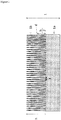
- the base layer (1a) is the portion of the surface other than the hairlike bodies, as shown in Figure 1 .
- the thickness of the base layer is the thickness from the roots of the hairlike bodies to the surface on the opposite side of the base layer. It is preferable that the average thickness of the base layer is 50-1,000 ⁇ m and more preferably, 150-800 ⁇ m. By setting the thickness to no less than 50 ⁇ m, the height of the hairlike bodies can be sufficiently expressed. Further, by setting the thickness to no greater than 1,000 ⁇ m, the hairlike bodies can be formed efficiently.
- a continuous phase is formed without a structural boundary between the base layer and the hairlike bodies. The absence of a structural boundary means that the base layer and hairlike bodies are integrally formed and that there is no structurally clear border section therebetween.
- forming a continuous phase is a state in which there are no seams between the base layer and the hairlike bodies and no discontinuities (is a continuous phase).
- the present invention differs from a structure in which hairlike bodies are transplanted to a base layer.
- the base layer and hairlike bodies have the same composition and the bonds between the base layer and the hairlike bodies may include covalent bonds.
- Covalent bonds are chemical bonds formed by an electron pair being shared by two atoms, but in thermoplastic resins which are chain molecules in which the monomers are connected, each polymer is bonded by covalent bonds and is bonded more strongly than by the van der Waals bonds or hydrogen bonds acting between the polymer molecules.
- the base layer and the hairlike bodies may be derived not from separate, but from the same solid thermoplastic resin sheet. Derived from the same solid thermoplastic resin sheet means, for example, the hairlike bodies and the base layer being obtained, directly or indirectly, based on the same solid resin sheet.
- the base layer and the hairlike bodies may be formed from the same solid thermoplastic resin sheet.
- Formed from the same solid thermoplastic resin sheet means that the hairlike bodies and the base layer are directly formed by working a single resin sheet.
- the hairlike bodies separating from the base layer due to an external stimulus is suppressed and the sheet becomes one with a good tactile sensation. Further, manufacturing with fewer steps than when transplanting hairlike bodies can be carried out.
- the base layer comprises a thermoplastic resin, and a resin comprising at least one of a styrene based resin, an olefin based resin, a polyvinyl chloride resin, a thermoplastic elastomer, a fluorine based resin, a polyester based resin, and a nylon based resin can be used as the thermoplastic resin.
- Styrene based monomers such as styrene, ⁇ -methylstyrene, p-methylstyrene, dimethylstyrene, p-t-butylstyrene, or chlorostyrene alone or copolymers thereof, copolymers of such a styrene based monomer and another monomer, for example, a styrene-acrylonitrile copolymer (AS resin), or of the styrene based monomer and yet another polymer, for example, a grafted polymer graft polymerized in the presence of a diene based rubber-like polymer such as polybutadiene, a styrene-butadiene copolymer, polyisoprene, or polychloroprene, for example, a polystyrene such as high-impact polystyrene (HIPS resin) or a styrene-acrylonitrile
- Polyolefin based resin means a resin comprising a polymer comprising ⁇ -olefin as a monomer and includes polyethylene based resins and polypropylene based resins.
- a high-density polyethylene, a low-density polyethylene, a straight chain low-density polyethylene, a straight chain medium-density polyethylene, etc. can be used as the polyethylene resin and not only these alone, but a copolymer, graft, or blend having these structures can also be used.
- the latter resin there are, for example, products of copolymerizing or blending a resin having a polar group in a polyethylene chain, such as products of copolymerizing or blending an ethylene-vinyl acetate copolymer, an ethylene-acrylic acid copolymer, an ethylene-acrylic ester copolymer, an ethylene methacrylic ester copolymer, an ethylene-vinyl acetate-vinyl chloride copolymer, or three-component copolymers with a further acid anhydride.
- a homopolypropylene, a random polypropylene, a block polypropylene, etc. can be used as the polypropylene resin.
- the structure of the homopolypropylene may be any of isotactic, atactic, or syndiotactic.
- a random polypropylene a substance preferably having 2-20 carbon atoms and more preferably having 4-12 carbon atoms, for example, ethylene, 1-butene, 1-pentene, 1-hexene, 1-heptene, 1-octene, 1-nonene, or 1-decene can be used as the ⁇ -olefin to be copolymerized with propylene.
- a block copolymer (block polypropylene), a block copolymer comprising a rubber component, a graft copolymer, etc. can be used.
- olefin based resins alone, they may be used in combination with other olefin based resins.
- a vinyl chloride homopolymer or a copolymer of vinyl chloride and another comonomer can be used as the polyvinyl chloride resin.
- the polyvinyl chloride may be a random copolymer or may be a graft copolymer.
- a substance in which, for example, an ethylene-vinyl acetate copolymer or a thermoplastic urethane polymer is made the trunk polymer and vinyl chloride is graft polymerized thereto can be raised as one example of a graft copolymer.
- the polyvinyl chloride of the present embodiment is a composition demonstrating an extrusion-moldable soft polyvinyl chloride and containing an additive such as a polymer plasticizer.
- a known polymer plasticizer can be used as the polymer plasticizer, but, for example, an ethylene copolymer polymer plasticizer such as an ethylene-vinyl acetate-carbon monoxide copolymer, an ethylene-(meth)acrylic ester-carbon monoxide copolymer, or an ethylene-vinyl acetate copolymer with a high vinyl acetate content can be raised as a preferred example.
- thermoplastic elastomer Substances having a structure in which a soft polymer substance and a hard polymer substance are combined are included as the thermoplastic elastomer. Specifically, there are styrene based elastomers, olefin based elastomers, vinyl chloride based elastomers, polyester based elastomers, polyamide based elastomers, polyurethane based elastomers, etc. Regarding polyurethane based elastomers, either polyether based or polyester based elastomers may be selected. These elastomers can be selected and used from among those generally commercially available.
- PVDF Polyvinylidene fluoride
- a diol component such as diethylene glycol, neopentyl glycol, and polyalkylene glycol
- a dicarboxylic acid component such as adipic acid, sebacic acid, phthalic acid, isophthalic acid, and 2,6-naphthalene dicarboxylic acid
- a lactam polymer such as caprolactam and laurolactam
- an aminocarboxylic acid polymer such as 6-aminocaproic acid, 11-aminoundecanoic acid, and 12-aminododecanoic acid
- a polycondensate of a diamine unit such as an aliphatic diamine such as hexamethylenediamine, decamethylenediamine, dodecamethylenediamine, and 2,2,4- or 2,4-4-trimethylhexamethylenediamine
- an alicyclic diamine such as 1,3- or 1,4-bis(aminomethyl)cyclohexane or bis(p-aminocyclohexylmethane), or an aromatic diamine such as m- or p-xylylenediamine
- a dicarboxylic acid unit such as an aliphatic dicarboxylic acid such as adipic acid, suberic acid, and sebacic acid, an alicyclic dicarboxy
- nylon 6 and nylon MXD6 are suitable.
- the melt mass flow rate of the thermoplastic resin is no less than 4 g/10 minutes at 190°C to 300°C. By setting the rate to no less than 4 g/10 min, the transferability of the shape of the hairlike bodies can be improved.
- the melt mass flow rate conforms to JIS K 7210 and is a value measured under the conditions of a load of (2.16 to 10.0 kg) at a test temperature in the temperature range from 190°C to 300°C.
- thermoplastic resin may be alloyed with the abovementioned thermoplastic resin at any ratio in a range that does not inhibit the effects of the present invention.
- the thermoplastic resin may contain other additives. Additives such as water/oil repellents, colorants such as pigments or dyes, mold release agents such as silicon oil or alkyl ester based agents, fibrous reinforcement agents such as glass fibers, granular lubricants such as talc, clay, or silica, a salt compound of sulfonic acid and an alkali metal or the like, antistatic agents, ultraviolet absorbing agents, flame retardants, and antibacterial agents can be added as the other additives in a range that does not inhibit the effects of the present invention. Further, scrap resin generated in the resin sheet manufacturing process can be mixed and used.
- the water/oil repellent there are silicon based water repellents, carnauba wax, and fluorine based water/oil repellents.
- Organopolysiloxane, dimethylpolysiloxane, methylphenylpolysiloxane, methylhydrogenpolysiloxane, etc. are examples of the silicon and among these, dimethylpolysiloxane is suitably used.
- Commercial products there are "Clinbell CB50-PP", “Clinbell CB-30PE”, “Clinbell CB-1", “Clinbell CB-50AB” (manufactured by Fuji Chemical Industries, Ltd.), etc. in which, for example, silicon is alloyed with a resin.
- carnauba wax there is, for example, "Carnauba No. 1” (manufactured by NIKKO RICA CORPORATION), etc. as commercially available products, surfactants having a perfluoroalkyl group as fluorine based oil/water repellents, and "Surflon KT-PA” (manufactured by AGC SEIMI CHEMICAL CO., LTD.) as a commercial product.
- the amount of the water/oil repellent added is preferably 1 mass% to 25 mass%.
- antistatic agent there are polyetheresteramide based polymer-type antistatic agents, ionomer polymer-type antistatic agents, etc.
- polyetheresteramide based polymer-type antistatic agents there are “Pelestat 230", “Pelestat 6500”, “Pelectron AS”, “Pelectron HS” (manufactured by Sanyo Chemical Industries, Ltd.), etc.
- ionomer based polymer-type antistatic agents there are "Entira SD100", “Entira MK400” (manufactured by DU PONT-MITSUI POLYCHEMICALS), etc.
- the amount of the antistatic agent added is preferably 5 mass% to 30 mass%.
- inorganic based and organic based antibacterial agents either may be added.
- inorganic based agents are preferable.
- metal ion (Ag, Zn, Cu) inorganic based antibacterial agents there are metal ion (Ag, Zn, Cu) inorganic based antibacterial agents, calcined shell calcium based antibacterial agents, etc.
- metal ion inorganic based antibacterial agents there are “Bactekiller BM102VT” (manufactured by Fuji Chemical Industries, Ltd.), “Novaron VZF200", “Novaron (AG300)” (manufactured by TOAGOSEI CO., LTD.), “KM-10D-G", “IM-10D-L” (manufactured by Sinanen Zeomic Co., Ltd.), etc.
- calcined shell calcium based antibacterial agents there is “Scallow” (manufactured by FID, Ltd.), etc.
- the amount of the antibacterial agent added is preferably 0.5 mass% to
- the hairlike bodies (1b) comprise a thermoplastic resin and are a portion extending hairlike from the surface of the base layer (1a), as shown in Figure 1 .
- the hairlike bodies are arranged regularly on the surface of the base layer.
- the regular arrangement means a state in which the hairlike bodies are not arranged randomly, that is, a state arranged in an orderly fashion in one direction or in two directions. Whether or not the arrangement of the hairlike bodies is regular is determined based on the state of arrangement of the roots of the hairlike bodies.
- the hairlike bodies are positioned on the base layer at a predetermined spacing and the positions of the bottom surfaces of the hairlike bodies are arranged in an orderly fashion in the longitudinal direction and the transverse direction of the base layer.
- the form of arrangement of the hairlike bodies is not particularly limited and a grid arrangement arranged vertically and horizontally, a staggered arrangement, etc. can be selected. Due to the hairlike bodies being arranged regularly on the surface of the base layer, a good tactile sensation is readily expressed, uniformly and without irregularities. Falling of the hairlike bodies occurs due to the application of a load such as, for example, tracing with a finger and finger marks in which the gloss and color tone differ from those of the surrounding portion can be formed. Further, due to the hairlike bodies, the tactile sensation can become like that of a suede-like napped sheet.
- the average height (h) of the hairlike bodies is preferably 100-1,200 ⁇ m and more preferably 200-900 ⁇ m. By setting the average height to no less than 100 ⁇ m, a good tactile sensation can be sufficiently ensured and by setting the average height to no greater than 1,200 ⁇ m, a good tactile sensation such as moistness, softness, and fluffiness is obtained.
- the length of the hairlike bodies represents the height of the hairlike bodies.
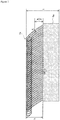
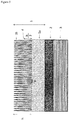
- the hairlike bodies are slanted with respect to the base layer as shown in Figure 2 or the hairlike bodies have a portion that curls as shown in Figure 3 , the distance from the surface of the base layer at the location of the hairlike bodies most removed from the surface of the base layer is made the height of the hairlike bodies.
- the height of the hairlike bodies is measured at a number of random locations on the resin sheet and a calculated average value of the measurements can be used as the average height of the hairlike bodies.
- the average diameter (d) of the hairlike bodies is preferably 1-50 ⁇ m and more preferably 5-30 ⁇ m.
- the average diameter of the hairlike bodies is preferably 1-50 ⁇ m and more preferably 5-30 ⁇ m.
- a good tactile sensation can be ensured and by setting the average diameter of the hairlike bodies to no greater than 50 ⁇ m, a good tactile sensation such as moistness, softness, and fluffiness is obtained.
- the diameter at mid-height (h/2) of the hairlike bodies is measured at a number of locations on the resin sheet and a calculated average value of the measurements is used as the average diameter of the hairlike bodies.
- the aspect ratio of the hairlike bodies when the hairlike bodies are standing roughly straight with respect to the base layer can be represented as (average height of the hairlike bodies/average diameter of the hairlike bodies).
- the aspect ratio can be represented as (average length of the hairlike bodies/average diameter of the hairlike bodies).
- the length of the hairlike bodies is measured at a number of locations on the resin sheet and a calculated average value of the measurements can be used as the average length of the hairlike bodies.
- the aspect ratio of the hairlike bodies is preferably 2-1,200, more preferably 10-600, and yet more preferably 40-200.
- the average bottom surface diameter of the hairlike bodies can also be made a standard for the aspect ratio.
- the average bottom surface diameter of the hairlike bodies is preferably 10-150 ⁇ m.
- the average bottom surface diameter of the hairlike bodies is a value in which the spacing between neighboring hairlike bodies is measured at a number of locations on the resin sheet and a calculated average value of the measurements is used.
- the aspect ratio when the bottom surface diameter of the hairlike bodies is made the standard is preferably 0.6-120. By setting the aspect ratio to no less than 0.6, a good tactile sensation can be ensured and by setting the aspect ratio to no greater than 120, a good tactile sensation such as moistness, softness, and fluffiness is obtained.
- the average spacing (t) between the hairlike bodies is preferably 20-200 ⁇ m and more preferably 40-150 ⁇ m.
- the spacing of the hairlike bodies means the distance from the center of the root of a hairlike body to the center of the root of a neighboring hairlike body. By setting the average spacing to no less than 20 ⁇ m, a good tactile sensation is ensured and by setting the average spacing to no greater than 200 ⁇ m, a good tactile sensation such as moistness, softness, and fluffiness is obtained.
- the average spacing of the hairlike bodies is a value in which the spacing between neighboring hairlike bodies is measured at a number of locations on the resin sheet and a calculated average value of the measurements is used.
- the shape of the hairlike bodies is not particularly limited and may be configured to extend hairlike in a direction away from the base layer in a shape in which the hairlike bodies gradually thin approaching the tip or in which a swelling is formed at the tip.
- the hairlike bodies may have a shape in which the cross-sectional area gradually shrinks as the hairlike bodies deviate from the base layer and then once again increases when the shape terminates.
- the shape of the tip part of the hairlike bodies may be bud-shaped or mushroom-shaped.
- the hairlike bodies may have a portion positioned at the base end extending in a direction away from the base layer, a portion that extends from the portion positioned at the base end and is curved based on a fixed curvature or a curvature that gradually changes, and furthermore, a portion that is wound in a helix shape or a spiral shape.
- the tip parts of the hairlike bodies may have a shape that is folded inward. By having such a shape, a better tactile sensation is expressed. Further, due to the bud-shaped or mushroom-shaped portion being hollow, a better tactile sensation is expressed.
- ratio of the average diameter of the width of the bud shape or mushroom shape with respect to the average diameter of the hairlike bodies be no less than 1.1.
- the height of the bud shape or mushroom shape is preferably no less than 7 ⁇ m.
- the average diameter of the hairlike bodies and the average diameter of the width and height of the bud shape or mushroom shape are measured from a scanning electron microscope photograph and the calculated average value is used.
- the hairlike bodies comprise a thermoplastic resin. The same resins that can be used in the base layer can be used as the thermoplastic resin.
- the thickness of the resin sheet is the sheet thickness combining the average height of the hairlike bodies and the average thickness of the base layer.
- the sheet thickness is preferably 150-1,500 ⁇ m and more preferably 300-1,000 ⁇ m.
- the "tactile sensation” means the feeling and texture of the surface of the resin sheet.
- a good specific texture such as moistness, softness, or fluffiness is made the good tactile sensation.
- the good tactile sensation can be specified by, other than a sensory evaluation of the texture, etc., the previously discussed aspect ratio, the ratio of the static friction coefficient with respect to the dynamic friction coefficient of the resin sheet, the value of the feeling of coldness or warmth to the touch, and the hardness of the resin.
- the ratio of the static friction coefficient with respect to the dynamic friction coefficient of the resin sheet is preferably 1.0-10.0 and more preferably 1.8-5.0.
- a good tactile sensation can be ensured.
- a good tactile sensation such as moistness, softness, and fluffiness can be expressed.
- the static friction coefficient is preferably 0.2-2.0 and the dynamic friction coefficient is preferably 0.2-2.0.
- the feeling of coldness or warmth to the touch of the resin sheet can be measured by measuring the heat transfer speed q-max (J/cm 2 ⁇ sec) when in contact and a larger q-max value represents a colder feeling and a smaller q-max value represents a warmer feeling. Consequently, q-max is preferably 0.005-0.500 and more preferably 0.100-0.350.
- q-max is preferably 0.005-0.500 and more preferably 0.100-0.350.
- the hardness of the resin can be measured with durometer hardness.
- durometer hardness In general, for resin hardnesses, soft resins such as elastomers are categorized into Shore hardness A type and hard resins such as PP are categorized into Shore hardness D type.
- the resin hardness (hardness) is preferably a hardness of 45-95 in Shore hardness A.
- An example of the resin sheet as in the second embodiment of the present invention is a resin sheet in which a sealant resin layer (2) is formed between the base layer (1) and the substrate layer (3), as shown in Figure 3 . That is, the layer configuration of the resin sheet as in the second embodiment is, from top to bottom, the hairlike bodies and the base layer (1), the sealant resin layer (2), and the substrate layer (3).
- the hairlike bodies are the same as those explained in the first embodiment, so explanation thereof is omitted.
- the thickness of the hairlike bodies and the base layer represented by the total of the average height of the hairlike bodies and the average thickness of the base layer is preferably 150-900 ⁇ m. By setting the thickness to no less than 150 ⁇ m, a good tactile sensation can be ensured and by setting the thickness to no greater than 900 ⁇ m, production costs can be suppressed.
- the substrate layer is preferably a thermoplastic resin such as a styrene based resin, an olefin based resin, a polyester based resin, a nylon based resin, an acrylic based resin, or a thermoplastic elastomer. Further, when laminating, there is lamination by coextrusion molding and lamination by extrusion laminate molding or dry laminate molding using a nonoriented film or a biaxially oriented film.
- a thermoplastic resin such as a styrene based resin, an olefin based resin, a polyester based resin, a nylon based resin, an acrylic based resin, or a thermoplastic elastomer.
- a diol component such as diethylene glycol, neopentyl glycol, and polyalkylene glycol
- a dicarboxylic acid component such as adipic acid, sebacic acid, phthalic acid, isophthalic acid, and 2,6-naphthalene dicarboxylic acid
- a lactam polymer such as caprolactam and laurolactam
- an aminocarboxylic acid polymer such as 6-aminocaproic acid, 11-aminoundecanoic acid, and 12-aminododecanoic acid
- a polycondensate of a diamine unit such as an aliphatic diamine such as hexamethylenediamine, decamethylenediamine, dodecamethylenediamine, and 2,2,4- or 2,4-4-trimethylhexamethylenediamine
- an alicyclic diamine such as 1,3- or 1,4-bis(aminomethyl)cyclohexane or bis(p-aminocyclohexylmethane), or an aromatic diamine such as m- or p-xylylenediamine
- a dicarboxylic acid unit such as an aliphatic dicarboxylic acid such as adipic acid, suberic acid, and sebacic acid, an alicyclic dicarboxy
- nylon 6 and nylon MXD6 are suitable.
- the polymer is a vinyl polymer based on methacrylic ester monomers, it can be used as an acrylic based resin and the structure thereof is not particularly limited.
- methacrylic ester monomers there are, for example, methyl methacrylate, ethyl methacrylate, propyl methacrylate, butyl methacrylate, pentyl methacrylate, hexyl methacrylate, etc.
- the alkyl group such as a propyl group, butyl group, pentyl group, or hexyl group in the methacrylic ester monomer may be straight chain or may be branched.
- the methacrylic ester resin may be a homopolymer of a methacrylic ester monomer or a copolymer of multiple methacrylic ester monomers and may have monomer units derived from known vinyl compounds other than methacrylic ester such as ethylene, propylene, butadiene, styrene, ⁇ -methylstyrene, acrylonitrile, and acrylic acid.
- the substrate layer may be alloyed with the abovementioned thermoplastic resins at any ratio in a range that does not inhibit the effects of the present invention, as necessary.
- the substrate layer may contain other additives. Additives such as water/oil repellents, colorants such as pigments or dyes, mold release agents such as silicon oil or alkyl ester based agents, fibrous reinforcement agents such as glass fibers, granular lubricants such as talc, clay, or silica, a salt compound of sulfonic acid and an alkali metal or the like, antistatic agents, ultraviolet absorbing agents, flame retardants, and antibacterial agents can be added as the other additives in a range that does not inhibit the effects of the present invention. Further, scrap resin generated in the resin sheet manufacturing process can be mixed and used.
- the sealant resin layer is to cause adhesion between the base layer and the substrate layer to be expressed and a modified olefin based resin, a hydrogenated styrene based thermoplastic elastomer, etc. can be used as resin components.
- Olefin based resins such as olefins with about 2-8 carbon atoms such as ethylene, propylene, and butene-1, copolymers of these olefins and other olefins with about 2-20 carbon atoms such as ethylene, propylene, butene-1, 3-methylbutene-1, pentene-1, 4-methylpentene-1, hexene-1, octene-1, and decene-1 or copolymers of these olefins and vinyl compounds such as vinyl acetate, vinyl chloride, acrylic acid, methacrylic acid, acrylic ester, methacrylic ester, and styrene, and olefin based rubbers such as ethylene-propylene copolymers, ethylene-propylene-diene copolymers, ethylene-butene-1 copolymers, and propylene-butene-1 copolymers modified under graft reaction conditions with unsaturated carboxylic acids such as
- an "ethylene-propylene-diene copolymer” or ethylene-propylene or butene-1 copolymer rubber modified with an unsaturated dicarboxylic acid or an anhydride thereof, in particular maleic acid or an anhydride thereof, is suitable.
- styrene-ethylene/butylene-styrene block copolymer styrene-ethylene/propylene-styrene block copolymer
- the average thickness of the sealant resin layer is preferably 20-90 ⁇ m and more preferably 40-80 ⁇ m. By setting the average thickness to no less than 20 ⁇ m, the occurrence of interlayer separation between the base layer and the substrate layer can be suppressed and by setting the average thickness to no greater than 90 ⁇ m, production costs can be suppressed.
- the resin sheet as in a third embodiment of the present invention is one in which the hairlike bodies and base layer (1) and the substrate layer (3) are directly laminated without using the sealant resin sheet (2) indicated in the second embodiment, as shown in Figure 4 . That is, the layer configuration of the resin sheet as in the third embodiment is, from top to bottom, the hairlike bodies and base layer (1)/the substrate layer (3) and is the layer configuration for the thermoplastic resin sheet as in the second embodiment from which the sealant resin layer has been removed.
- the hairlike bodies and base layer are the same as those in the first embodiment and the second embodiment, so explanation thereof is omitted.
- the substrate layer (3) in the present embodiment is preferably a layer provided with sufficient adhesion with the base layer.
- thermoplastic resin with excellent adhesion with the base layer as the substrate layer is preferable.
- the base layer is a fluorine based resin
- an acrylic based resin can be used and when the base layer is an olefin based resin, a styrene based resin composition to which a hydrogenated styrene based thermoplastic elastomer has been added can be used.
- the manufacturing method for the resin sheet as in the present application is not limited and may be any method, but typically comprises steps for melt-extruding a raw resin and adding the regularly arranged hairlike bodies to at least one surface of the obtained extruded resin sheet.
- any resin sheet molding method can be used.
- a feed block or a multi-manifold die can be used.
- the layer configurations of the embodiments of the resin sheet of the present application are basically as discussed previously, but beyond these, for example, scrap material generated in a manufacturing process for the resin sheet or molded container of the present invention may be added to the substrate layer and laminated as a further layer so long as degradation of the properties, etc. is not observed.
- the method for adding the hairlike bodies is not particularly limited and any method known by a person skilled in the art can be used.
- any method known by a person skilled in the art can be used.
- the resin sheet as in the present invention can be manufactured by extruding a resin sheet with a T-die technique and casting with a transfer roll on which a relief process has been performed and a touch roll so as to add the shapes of hairlike bodies to a surface of the resin sheet.
- a roll on which a micro-relief has been applied regularly on a surface thereof with a laser engraving or electrocasting method, an etching method, a mill engraving method, etc. can be used as the transfer roll on which a relief process has been performed.
- regular means that the relief is an arranged state that is not random, that is, is arranged in an orderly fashion in one direction or in two directions.
- the arrangement of the relief in an embodiment can be selected from a grid arrangement arranged vertically and horizontally, a staggered arrangement, etc.
- the shape of the relief part there are, for example, if a concavity, funnel-shapes (cone, quadrangular pyramid, triangular pyramid, hexagonal pyramid, etc.), semicircles, rectangles (quadrangular prism), etc.
- the diameter of the opening of the concavity, the depth of the concavity, the spacing of the concavity shapes, etc. are from micrometers to hundreds of micrometers.
- the spacing of the hairlike bodies can be adjusted by adjusting the spacing of the concavities on the transfer roll and the height of the hairlike bodies can be adjusted by adjusting the depth of the concavities on the transfer roll, and the tactile sensation can also be adjusted thereby.
- a relief process with a high aspect ratio be performed on the transfer roll surface.
- the aspect ratio (concavity depth/concavity opening diameter) when working concavity shapes into the transfer roll surface is preferably 0.5-6.0.
- a laser engraving method or an electrocasting method is suitable when performing fine work in the depth direction and thus is particularly suitably used.
- a metal, a ceramic, etc. can be used as the material of the transfer roll.
- various materials can be used as the touch roll, for example, a roll made from silicon based rubber, NBR based rubber, EPT based rubber, butyl rubber, chloroprene rubber, or fluorine rubber can be used.
- a touch roll with a rubber hardness (JIS K 6253) of 40-100 can be used.
- a teflon layer may be formed on the surface of the touch roll.
- the resin sheet of the present embodiment can be manufactured by using a roll set of the above transfer roll and touch roll.
- the resin sheet of the present embodiment can be manufactured by adjusting the temperature of the transfer roll to near the crystal fusion temperature, the glass transition point, or the melting point of the thermoplastic resin (for example, 100-150°C when using a random polypropylene) and casting with a pinch pressure between the transfer roll and the touch roll of 30-120 Kg/cm 2 .
- the cast resin sheet is taken in at a line speed of 0.5-30 m/minute using a pinch roll, etc.
- the molded product of the present invention is formed by molding the resin sheet of the present invention.
- the conventional art cannot handle three-dimensional molding, but the hairlike body sheet of the present invention comprises a thermoplastic resin, so handling of general molding is possible.
- the molding method there are general vacuum molding and pressure molding, and as applications thereof, a method for heating and softening a resin sheet in vacuum and overlaying on (molding to) a surface of an existing molded product by opening under atmospheric pressure, etc., but the molding method is not limited thereto.
- known sheet heating methods such as radiation heating with an infrared heater or the like, which is non-contact heating, can be adapted as a method to heat and soften a sheet before molding.
- vacuum/pressure molding in an embodiment, for example, a resin sheet is molded on to an existing molded product surface after heating at 60-140°C for 20-480 seconds and can be stretched to 1.05-1.50 times depending on the surface shape.
- the resin sheet to which the hairlike bodies of the present invention are added to the surface thereof can be applied to a use requiring the good tactile sensation indicated above.
- the resin sheet of the present invention can be applied to interior materials of automobiles, electronic device cladding, cosmetic container members, stationery members, etc.
- an interior material in which the abovementioned resin sheet is attached to a known instrument panel or pillar could be raised.
- an interior material to which a good tactile sensation has been added can be configured.
- an olefin based resin, a vinyl chloride based resin, or a urethane based elastomer is preferable.
- the method for attaching the resin sheet and the interior material is not particularly limited.
- transmitter housings for keyless entry systems there are transmitter housings for keyless entry systems, smartphone housings, smartphone cases, music player cases, game console housings, digital camera housings, electronic notebook housings, calculator housings, tablet housings, mobile computer housings, keyboards, mice, etc.
- a portable transmitter housing for a keyless entry system for example, JP 2005-228911 A
- a portable transmitter to which the resin sheet of the present application has been attached could be raised.
- a portable transmitter to which a good tactile sensation has been added can be configured.
- an olefin based resin or a urethane based elastomer is preferable.
- the method for attaching the resin sheet and the housing is not particularly limited.
- a cosmetic container member there are containers for face cream, pack cream, foundation, and eyeshadow and, for example, a cosmetic container in which the resin sheet of the present application has been attached to a lid member of a known container for foundation ( JP 2017-29608 A ) could be raised.
- a cosmetic container to which a good tactile sensation has been added can be configured.
- an olefin based resin or a urethane based elastomer is preferable.
- the method for attaching the resin sheet is not particularly limited.
- a stationery member there are book covers, notebook covers, pen case covers, etc. and, for example, a book cover to which a good tactile sensation and waterproofing has been added could be configured by manufacturing a known book cover (for example, JP 2007-246122 A ) using the sheet of the present invention. Further, the aspect of the book cover is not particularly limited.
- a known book cover for example, JP 2007-246122 A
- the aspect of the book cover is not particularly limited.
- the material of the sheet an olefin based resin or a urethane based elastomer is preferable.
- the method for manufacturing using the resin sheet is not particularly limited.
- a hairlike body sheet in which words or a pattern are printed on the surface of the hairlike bodies with a general printing method can be manufactured and applied to the above use.
- the material of the resin sheet to be printed on is not particularly limited, but it is preferable that the printability of the ink used in printing be considered.
- a laminated body in which the resin sheet of the present invention is laminate molded (dry laminate molded or extrusion laminate molded) with a printed article on which words, a pattern, etc. are printed (such as paper or a metal thin film) or a non-woven cloth, etc. can be manufactured, for example, a business card with a tactile sensation can be manufactured by laminate molding to the printing surface of the business card.
- the material of the resin sheet to be laminated is not particularly limited.
- the raw materials used in the examples, etc. are as follows.
- the height (h) of the hairlike bodies, the diameter (d) of the hairlike bodies, the spacing (t) of the hairlike bodies, and the thickness of the base layer of the resin sheet were measured using a laser microscope VK-X100 (manufactured by KEYENCE CORPORATION).
- the measured samples were cross-sectional slices cut from the resin sheets at three random locations with a microtome.
- the average height of the hairlike bodies was measured by measuring the height of 10 hairlike bodies of each sample and calculating the average value of the 30 measurements.
- the average diameter of the hairlike bodies was measured by measuring the diameter of 10 hairlike bodies of each sample at mid-height (h/2) and calculating the average value of the 30 measurements.
- the average spacing of the hairlike bodies was measured by measuring the distance from the center of the root of one hairlike body to the center of the root of a neighboring hairlike body at 10 locations of each sample and calculating the average value of the 30 measurements.
- the average thickness of the base layer was measured by measuring the thickness from the roots of the hairlike bodies to the other layer interface at 10 locations of each sample and calculating the average value of the 30 measurements.
- a functional evaluation of the good tactile sensation was performed by having a total of 30 people, 15 men and 15 women, touch the resin sheets.
- whether comfortableness was felt was judged with " ⁇ ” and "x”, when judged with " ⁇ "
- the resin sheet was evaluated with a specific texture such as moistness, softness, or fluffiness.
- the resin sheet was evaluated as having that texture. Further, whether the same texture was also maintained on the surface of the molded products which were vacuum/pressure molded using the resin sheets was evaluated.
- the resin sheet samples were placed on the sample stage set to 20°C for 5 minutes and after temperature adjustment of the resin sheets, contacted with a 30°C contact temperature sensor (1 mm ⁇ 1.5 mm), and the heat transfer speed (q-max) was measured over 0.2 seconds.
- the hardness of the resins was measured in accordance with JIS K 7215 by manufacturing samples having a thickness of 6 mm, a width of 25 mm, and a length of 50 mm with a hot pressing method and measuring using a type A durometer.
- the contact angle of the resin sheets was measured using an automatic contact angle meter DM-501 (manufactured by Kyowa Interface Science, Inc.). Further, purified water was used as the test liquid and the drop amount was set to 6 ⁇ L. If the contact angle was 120° or greater, the liquid repellency was high and the resin was judged to be capable of preventing the adhesion of liquids.
- the surface resistivity of the surfaces of the resin sheets was measured in accordance with JIS K 6911 at an atmospheric temperature of 23°C, an atmospheric humidity of 50% R.H., and an applied voltage of 1,000 V.
- Evaluation was performed with a film adhesion method in accordance with JIS K 2801. Various bacterial liquids were dropped onto a film surface 5 cm ⁇ 5 cm with a thickness no greater than 1 mm and the number of living bacteria was measured after the surface was covered with a polyethylene film and stored at 35°C.
- the resin sheets were heated in vacuum with a double-sided vacuum molding machine (NGF-0709-S: manufactured by Fu-Se Vacuum Forming) and then a molded product was manufactured by vacuum/pressure molding the resin sheets to a surface of a smartphone cover prepared in atmosphere.
- the sheets were heated at 80°C for 120 seconds and stretched to 1.5 times at the most stretched location.
- Resin sheets with the compositions and thicknesses shown in Table 1 and in which one surface has the surface shapes shown in Table 2 were obtained by using a 65 mm single screw-extruder, extruding resin sheets with a T-die method and, so as to add a hairlike body shape to a surface of these resin sheets, taking in at a line speed of 2-15 m/minute using a pinch roll by casting using a metal transfer roll on which a relief process had been performed with a laser engraving method and which was adjusted to 100-150°C and a silicon based rubber touch roll having a rubber hardness of 70 which was adjusted to 10-90°C.
- a three-layer resin sheet in which the layers have the compositions and thicknesses shown in Table 1 and one surface has the surface shape shown in Table 2 was obtained by using three 40 mm single-screw extruders and a feed block, extruding a three-layer resin sheet with a T-die method and, so as to add a hairlike body shape to a surface of the resin sheet, casting with a transfer roll on which a relief process had been performed with an electrocasting method and a touch roll.
- Three-layer resin sheets in which the layers have the compositions and thicknesses shown in Table 1 and one surface has the surface shape shown in Table 2 were obtained similarly to Example 3, using a transfer roll with a different size relief shape.
- Resin sheets with the compositions and thicknesses shown in Table 1 and in which one surface has the surface shape shown in Table 2 were obtained by, so as to add a hairlike body shape to a surface of the resin sheets, fabricating a 100 mm square mold in which a relief process had been performed with an electrocasting method and hot pressing an already-fabricated resin sheet using an electro-thermal press.
- a two-layer resin sheet in which the layers have the compositions and thicknesses shown in Table 1 and one surface has the surface shape shown in Table 2 was obtained by using two 40 mm single-screw extruders and a feed block, extruding a two-layer resin sheet with a T-die method and, so as to add a hairlike body shape to a surface of the resin sheet, casting with a transfer roll on which a relief process had been performed with an electrocasting method and a touch roll.
- a three-layer resin sheet in which the layers have the compositions and thicknesses shown in Table 1 and one surface has the surface shape shown in Table 2 was obtained by obtaining a three-layer resin sheet with a laminate molding method and, so as to add a hairlike body shape to a surface of the resin sheet, casting with a transfer roll on which a relief process had been performed with an electrocasting method and a touch roll.
- a three-layer resin sheet in which the layers have the compositions and thicknesses shown in Table 1 and one surface has the surface shape shown in Table 2 was obtained on the basis of Example 8 using a transfer roll with a different size relief shape.
- a resin sheet with the composition and thickness shown in Table 1 in which one surface has an embossed shape in which Rz (ten point average roughness) is 55 ⁇ m was obtained on the basis of Example 6 using, so as to add an embossed shape to a surface of the resin sheet, a transfer roll on which a relief process had been performed with a blasting method.
- a three-layer resin sheet in which the layers have the compositions and thicknesses shown in Table 1 and a surface has the surface shape shown in Table 2 was obtained on the basis of Example 3 by, so as to add a bell-like convex shape to a surface of the resin sheet, using a transfer roll on which a relief process had been performed with an etching method.
- a resin sheet with the composition and thickness shown in Table 1 and in which one surface has the surface shape shown in Table 2 was obtained on the basis of Example 1 by, so as to add a quadrangular pyramid-like concave shape to a surface of the resin sheet, using a transfer roll on which a relief process had been performed with an electrocasting method.
- a resin sheet with the composition and thickness shown in Table 1 and in which both surfaces have a smooth shape was obtained on the basis of Example 1 using a roll on which a relief process had not been performed in place of the transfer roll.
- a three-layer resin sheet in which the layers have the compositions and thicknesses shown in Table 1 and one surface has the surface shape shown in Table 2 was obtained on the basis of Example 8 by, so as to add a hexagonal pyramid-like convex shape to a surface of the resin sheet, using a transfer roll on which a relief process had been performed with an electrocasting method.
- Example 1 250 22 30 140 Staggered Arrangement ⁇ Soft Soft 93 0.274 2.0 123 - - - Example 2 300 20 30 180 Staggered Arrangement ⁇ Soft Soft 93 0.270 2.3 124 - - - Example 3 450 10 60 170 Staggered Arrangement ⁇ Fluffy Pluffy 92 0.265 2.5 125 - - - Example 4 460 10 60 180 Staggered Arrangement ⁇ Fluffy Fluffy 91 0.265 2.5 124 - - - Example 5 290 20 30 400 Staggered Arrangement ⁇ Soft Soft 91 0.270 2.1 124 - - - Example 6 400 11 100 300 Staggered Arrangement ⁇ Soft Soft 94 0.265 2.4 120 - - - Example 7 420 10 100 280 staggered Arrangement ⁇ Soft Soft 93 0.255 2.4 125 - - - Example 8 330 19 60 200 Staggered Arrangement ⁇ Soft Soft 91 0.272 2.3
- Results satisfying the evaluation standards pertaining to good tactile sensation were obtained by all the resin sheets of Examples 1-18. In addition, satisfactory results in static friction coefficient with respect to dynamic friction coefficient and contact angle were also obtained. Further, results showing antistatic properties in Example 11 and antibacterial properties in Example 12 were obtained. With regard to this, results satisfying the evaluation standards pertaining to good tactile sensation were not obtained by the resin sheets of Comparative Examples 1-5.
- the hairlike bodies do not tangle with one another and extend in a fixed direction. Further, the hairlike bodies had a configuration extending hairlike in a direction away from the base layer and in which swellings are formed at the tips thereof. That is, the shape of the hairlike bodies was a shape in which the cross-sectional area gradually shrinks as the hairlike bodies deviate from the base layer and then once again increases when the shape terminates. Further, it was observed that the shape of the tip part of the hairlike bodies was bud-shaped or mushroom-shaped and the bud-shaped or mushroom-shaped parts were partially hollow. It was observed that a better tactile sensation was expressed by having such a shape.
Landscapes
- Engineering & Computer Science (AREA)
- Mechanical Engineering (AREA)
- Manufacturing & Machinery (AREA)
- Laminated Bodies (AREA)
- Blow-Moulding Or Thermoforming Of Plastics Or The Like (AREA)
- Shaping Of Tube Ends By Bending Or Straightening (AREA)
Abstract
Description
- The present invention pertains to a thermoplastic resin sheet having hairlike bodies and a molded product thereof.
- Conventionally, sheets of paper and polymer materials are used as interior materials of automobiles and the housings of associated components, housings of electronic devices and appliances, building materials such as wallpaper, housings for toys and game consoles, and members of daily necessities. Further, as a method to provide a good tactile sensation to a surface of a sheet,
Patent Document 1, for example, presents a decorative sheet wherein a thermoplastic polyester based resin is extrusion laminated on a decorative paper. -
Patent Document 2 presents a decorative sheet containing resin beads.Patent Document 3 presents a decorative resin sheet in which a polylactic acid resin is coated with a urethane based resin and a surface thereof is heat-embossed. - Furthermore, Patent Document 4 presents a decorative sheet in which, in order for a relief shape on the sheet surface not to be impaired, a protective layer consisting of anti-abrasive particles and a urethane based resin is formed on a surface of an embossed ABS resin sheet. Patent Document 5 presents a container having a plurality of stripes in a fixed direction and provided with a napped decorative surface formed by raising a nap from the stripes.
- However, the provision of a resin sheet expressing a better tactile sensation is desired.
- [Patent Document 1]
JP H9-057934 A - [Patent Document 2]
JP 04877008 B - [Patent Document 3]
JP 2011-152795 A - [Patent Document 4]
JP 2010-280203 A - [Patent Document 5]
JP 2011-098739 A - The object of the present invention is to provide a sheet expressing a good tactile sensation and a molded product thereof.
- That is, as a result of investigation of various tactile sensation-expressing means, the present inventors believed that it would be good to provide a hairlike shape to a sheet surface to express a good tactile sensation and discovered that a good tactile sensation is expressed by forming hairlike bodies arranged regularly on a surface, arriving at completion of the present invention.
- The present invention, which solves the above problem, is configured as follows.
- (1) A thermoplastic resin sheet having hairlike bodies arranged regularly on at least one surface of a base layer, wherein a continuous phase is formed without a structural boundary between the base layer and the hairlike bodies.
- (2) The resin sheet described in (1), wherein the thermoplastic resin is a thermoplastic resin using one or more of a styrene based resin, an olefin based resin, a polyvinyl chloride resin, a thermoplastic elastomer, a fluorine based resin, a polyester based resin, and a nylon based resin.
- (3) The resin sheet described in (1) or (2), wherein the average height of the hairlike bodies is no less than 100 µm and no greater than 1,200 µm, the average diameter of the hairlike bodies is no less than 1 µm and no greater than 50 µm, and the average spacing between the hairlike bodies is no less than 20 µm and no greater than 200 µm.
- (4) The resin sheet described in any one of (1) to (3), wherein the ratio of the static friction coefficient of the surface having the hairlike bodies with respect to the dynamic friction coefficient thereof is 1.0-10.0.
- (5) The resin sheet described in any one of (1) to (4), wherein the heat transfer speed of the surface having the hairlike bodies, when in contact, is 0.005-0.500.
- (6) The resin sheet described in any one of (1) to (5), wherein the average thickness of the base layer is no less than 50 µm.
- (7) The resin sheet described in any one of (1) to (6), configured so the hairlike bodies extend hairlike in a direction away from the base layer and a swelling is formed at the tips thereof.
- (8) The resin sheet described in any one of (1) to (7), wherein the base layer and the hairlike bodies are formed from a single sheet.
- (9) The resin sheet described in any one of (1) to (8), wherein the resin sheet is a multilayer resin sheet.
- (10) The resin sheet described in any one of (1) to (9), wherein at least one substrate layer selected from a styrene based resin, an olefin based resin, a polyester based resin, a nylon based resin, an acrylic based resin, and a thermoplastic elastomer is laminated on the other surface of the base layer.
- (11) The resin sheet described in any one of (1) to (10), comprising one or more additives selected from a water and oil repellent, an antistatic agent, and an antibacterial agent.
- (12) A manufacturing method for the resin sheet described in any one of (1) to (11), characterized in that the hairlike bodies are formed by casting, with a transfer roll on which a relief process has been performed and a touch roll, a sheet that has been melt-extruded from a die with a melt extrusion technique.
- (13) A molded product of the resin sheet described in any one of (1) to (11).
- (14) The molded product described in (13), which is a stationery member.
- (15) The molded product described in (13), which is an automobile interior member, an electronic device, an electronic device cladding, a cosmetic container, or a container member that is vacuum/pressure molded on a surface of an existing molded product.
- According to the present invention, a sheet expressing a good tactile sensation can be provided.
-
-
Figure 1 is a simplified vertical side cross-sectional view showing a resin sheet according to the first embodiment of the present invention. -
Figure 2 is a simplified vertical side cross-sectional view showing a variation of the resin sheet according to the first embodiment of the present invention. -
Figure 3 is a simplified vertical side cross-sectional view showing a further variation of the resin sheet according to the first embodiment of the present invention. -
Figure 4 is a simplified plan view of the resin sheet ofFigure 1 . -
Figure 5 is a simplified vertical side cross-sectional view showing the layer structure of a resin sheet according to the second embodiment of the present invention. -
Figure 6 is a simplified vertical side cross-sectional view showing the layer structure of a resin sheet according to the third embodiment of the present invention. - Below, various embodiments of the resin sheet shall be explained, followed by an explanation of the method for manufacturing the resin sheet, but in cases in which the specific explanation of one embodiment disclosed herein applies to another embodiment, the explanation thereof for the other embodiment shall be omitted.
- The resin sheet according to the first embodiment of the present invention is a thermoplastic resin sheet having hairlike bodies arranged regularly on at least one surface of a base layer, wherein a continuous phase is formed without a structural boundary between the base layer and the hairlike bodies.
- The base layer (1a) is the portion of the surface other than the hairlike bodies, as shown in
Figure 1 . The thickness of the base layer is the thickness from the roots of the hairlike bodies to the surface on the opposite side of the base layer. It is preferable that the average thickness of the base layer is 50-1,000 µm and more preferably, 150-800 µm. By setting the thickness to no less than 50 µm, the height of the hairlike bodies can be sufficiently expressed. Further, by setting the thickness to no greater than 1,000 µm, the hairlike bodies can be formed efficiently. A continuous phase is formed without a structural boundary between the base layer and the hairlike bodies. The absence of a structural boundary means that the base layer and hairlike bodies are integrally formed and that there is no structurally clear border section therebetween. Further, forming a continuous phase is a state in which there are no seams between the base layer and the hairlike bodies and no discontinuities (is a continuous phase). On this point, the present invention differs from a structure in which hairlike bodies are transplanted to a base layer. The base layer and hairlike bodies have the same composition and the bonds between the base layer and the hairlike bodies may include covalent bonds. Covalent bonds are chemical bonds formed by an electron pair being shared by two atoms, but in thermoplastic resins which are chain molecules in which the monomers are connected, each polymer is bonded by covalent bonds and is bonded more strongly than by the van der Waals bonds or hydrogen bonds acting between the polymer molecules. - Further, the base layer and the hairlike bodies may be derived not from separate, but from the same solid thermoplastic resin sheet. Derived from the same solid thermoplastic resin sheet means, for example, the hairlike bodies and the base layer being obtained, directly or indirectly, based on the same solid resin sheet.
- Further, the base layer and the hairlike bodies may be formed from the same solid thermoplastic resin sheet. Formed from the same solid thermoplastic resin sheet means that the hairlike bodies and the base layer are directly formed by working a single resin sheet.
- By forming a continuous phase without a structural boundary between the base layer and the hairlike bodies, the hairlike bodies separating from the base layer due to an external stimulus is suppressed and the sheet becomes one with a good tactile sensation. Further, manufacturing with fewer steps than when transplanting hairlike bodies can be carried out.
- The base layer comprises a thermoplastic resin, and a resin comprising at least one of a styrene based resin, an olefin based resin, a polyvinyl chloride resin, a thermoplastic elastomer, a fluorine based resin, a polyester based resin, and a nylon based resin can be used as the thermoplastic resin.
- Styrene based monomers such as styrene, α-methylstyrene, p-methylstyrene, dimethylstyrene, p-t-butylstyrene, or chlorostyrene alone or copolymers thereof, copolymers of such a styrene based monomer and another monomer, for example, a styrene-acrylonitrile copolymer (AS resin), or of the styrene based monomer and yet another polymer, for example, a grafted polymer graft polymerized in the presence of a diene based rubber-like polymer such as polybutadiene, a styrene-butadiene copolymer, polyisoprene, or polychloroprene, for example, a polystyrene such as high-impact polystyrene (HIPS resin) or a styrene-acrylonitrile graft polymer (ABS resin) can be used as the styrene based resin. Further, a styrene based thermoplastic elastomer can also be used.
- Polyolefin based resin means a resin comprising a polymer comprising α-olefin as a monomer and includes polyethylene based resins and polypropylene based resins. A high-density polyethylene, a low-density polyethylene, a straight chain low-density polyethylene, a straight chain medium-density polyethylene, etc. can be used as the polyethylene resin and not only these alone, but a copolymer, graft, or blend having these structures can also be used. As the latter resin, there are, for example, products of copolymerizing or blending a resin having a polar group in a polyethylene chain, such as products of copolymerizing or blending an ethylene-vinyl acetate copolymer, an ethylene-acrylic acid copolymer, an ethylene-acrylic ester copolymer, an ethylene methacrylic ester copolymer, an ethylene-vinyl acetate-vinyl chloride copolymer, or three-component copolymers with a further acid anhydride.
- Further, a homopolypropylene, a random polypropylene, a block polypropylene, etc. can be used as the polypropylene resin. When using a homopolypropylene, the structure of the homopolypropylene may be any of isotactic, atactic, or syndiotactic. When using a random polypropylene, a substance preferably having 2-20 carbon atoms and more preferably having 4-12 carbon atoms, for example, ethylene, 1-butene, 1-pentene, 1-hexene, 1-heptene, 1-octene, 1-nonene, or 1-decene can be used as the α-olefin to be copolymerized with propylene. When using a block polypropylene, a block copolymer (block polypropylene), a block copolymer comprising a rubber component, a graft copolymer, etc. can be used. In addition to using these olefin based resins alone, they may be used in combination with other olefin based resins.
- A vinyl chloride homopolymer or a copolymer of vinyl chloride and another comonomer can be used as the polyvinyl chloride resin. When the polyvinyl chloride is a copolymer, the polyvinyl chloride may be a random copolymer or may be a graft copolymer. A substance in which, for example, an ethylene-vinyl acetate copolymer or a thermoplastic urethane polymer is made the trunk polymer and vinyl chloride is graft polymerized thereto can be raised as one example of a graft copolymer. The polyvinyl chloride of the present embodiment is a composition demonstrating an extrusion-moldable soft polyvinyl chloride and containing an additive such as a polymer plasticizer. A known polymer plasticizer can be used as the polymer plasticizer, but, for example, an ethylene copolymer polymer plasticizer such as an ethylene-vinyl acetate-carbon monoxide copolymer, an ethylene-(meth)acrylic ester-carbon monoxide copolymer, or an ethylene-vinyl acetate copolymer with a high vinyl acetate content can be raised as a preferred example.
- Substances having a structure in which a soft polymer substance and a hard polymer substance are combined are included as the thermoplastic elastomer. Specifically, there are styrene based elastomers, olefin based elastomers, vinyl chloride based elastomers, polyester based elastomers, polyamide based elastomers, polyurethane based elastomers, etc. Regarding polyurethane based elastomers, either polyether based or polyester based elastomers may be selected. These elastomers can be selected and used from among those generally commercially available.
- A vinylidene fluoride homopolymer and a vinylidene fluoride copolymer having vinylidene fluoride as the main component can be used as the fluorine based resin. Polyvinylidene fluoride (PVDF) resins are crystalline resins exhibiting various crystal structures such as α-type, β-type, γ-type, and αp-type, but as the vinylidene fluoride copolymer, there are, for example, vinylidene fluoride-hexafluoropropylene copolymers, vinylidene fluoride-tetrafluoroethylene copolymers, vinylidene fluoride-chlorotrifluoroethylene copolymers, vinylidene fluoride-trifluoroethylene copolymers, vinylidene fluoride-tetrafluoroethlyene-hexafluoropropylene three-component copolymers, vinylidene fluoride-chlorotrifluoroethylene-hexafluoropropylene three-component copolymers, and mixtures of two or more thereof.
- Polyethylene terephthalate, polybutylene terephthalate, polyethylene-2,6-naphthalate, polymethylene terephthalate, and a polyester based resin in which, as copolymerization components, for example, a diol component such as diethylene glycol, neopentyl glycol, and polyalkylene glycol and a dicarboxylic acid component such as adipic acid, sebacic acid, phthalic acid, isophthalic acid, and 2,6-naphthalene dicarboxylic acid are copolymerized can be used as the polyester based resin.
- A lactam polymer such as caprolactam and laurolactam, an aminocarboxylic acid polymer such as 6-aminocaproic acid, 11-aminoundecanoic acid, and 12-aminododecanoic acid, a polycondensate of a diamine unit such as an aliphatic diamine such as hexamethylenediamine, decamethylenediamine, dodecamethylenediamine, and 2,2,4- or 2,4-4-trimethylhexamethylenediamine, an alicyclic diamine such as 1,3- or 1,4-bis(aminomethyl)cyclohexane or bis(p-aminocyclohexylmethane), or an aromatic diamine such as m- or p-xylylenediamine, and a dicarboxylic acid unit such as an aliphatic dicarboxylic acid such as adipic acid, suberic acid, and sebacic acid, an alicyclic dicarboxylic acid such as cyclohexanedicarboxylic acid, or an aromatic dicarboxylic acid such as terephthalic acid and isophthalic acid, and copolymers, etc. thereof can be used as the nylon based resin. For example, there are nylon 6, nylon 9, nylon 11, nylon 12, nylon 66, nylon 610, nylon 611, nylon 612, nylon 6T, nylon 6I, nylon MXD6, nylon 6/66, nylon 6/610, nylon 6/6T, nylon 6I/6T, etc. and among these, nylon 6 and nylon MXD6 are suitable.
- It is preferable that the melt mass flow rate of the thermoplastic resin is no less than 4 g/10 minutes at 190°C to 300°C. By setting the rate to no less than 4 g/10 min, the transferability of the shape of the hairlike bodies can be improved. The melt mass flow rate conforms to JIS K 7210 and is a value measured under the conditions of a load of (2.16 to 10.0 kg) at a test temperature in the temperature range from 190°C to 300°C.
- The thermoplastic resin may be alloyed with the abovementioned thermoplastic resin at any ratio in a range that does not inhibit the effects of the present invention. Furthermore, the thermoplastic resin may contain other additives. Additives such as water/oil repellents, colorants such as pigments or dyes, mold release agents such as silicon oil or alkyl ester based agents, fibrous reinforcement agents such as glass fibers, granular lubricants such as talc, clay, or silica, a salt compound of sulfonic acid and an alkali metal or the like, antistatic agents, ultraviolet absorbing agents, flame retardants, and antibacterial agents can be added as the other additives in a range that does not inhibit the effects of the present invention. Further, scrap resin generated in the resin sheet manufacturing process can be mixed and used.
- As the water/oil repellent, there are silicon based water repellents, carnauba wax, and fluorine based water/oil repellents. Organopolysiloxane, dimethylpolysiloxane, methylphenylpolysiloxane, methylhydrogenpolysiloxane, etc. are examples of the silicon and among these, dimethylpolysiloxane is suitably used. As commercial products, there are "Clinbell CB50-PP", "Clinbell CB-30PE", "Clinbell CB-1", "Clinbell CB-50AB" (manufactured by Fuji Chemical Industries, Ltd.), etc. in which, for example, silicon is alloyed with a resin. For the carnauba wax, there is, for example, "Carnauba No. 1" (manufactured by NIKKO RICA CORPORATION), etc. as commercially available products, surfactants having a perfluoroalkyl group as fluorine based oil/water repellents, and "Surflon KT-PA" (manufactured by AGC SEIMI CHEMICAL CO., LTD.) as a commercial product. The amount of the water/oil repellent added is preferably 1 mass% to 25 mass%.
- As the antistatic agent, there are polyetheresteramide based polymer-type antistatic agents, ionomer polymer-type antistatic agents, etc. As commercially available polyetheresteramide based polymer-type antistatic agents, there are "Pelestat 230", "Pelestat 6500", "Pelectron AS", "Pelectron HS" (manufactured by Sanyo Chemical Industries, Ltd.), etc. As commercially available ionomer based polymer-type antistatic agents, there are "Entira SD100", "Entira MK400" (manufactured by DU PONT-MITSUI POLYCHEMICALS), etc. The amount of the antistatic agent added is preferably 5 mass% to 30 mass%.
- Among inorganic based and organic based antibacterial agents, either may be added. Considering dispersability, inorganic based agents are preferable. Specifically, there are metal ion (Ag, Zn, Cu) inorganic based antibacterial agents, calcined shell calcium based antibacterial agents, etc. As commercially available metal ion inorganic based antibacterial agents, there are "Bactekiller BM102VT" (manufactured by Fuji Chemical Industries, Ltd.), "Novaron VZF200", "Novaron (AG300)" (manufactured by TOAGOSEI CO., LTD.), "KM-10D-G", "IM-10D-L" (manufactured by Sinanen Zeomic Co., Ltd.), etc. As calcined shell calcium based antibacterial agents, there is "Scallow" (manufactured by FID, Ltd.), etc. The amount of the antibacterial agent added is preferably 0.5 mass% to 5 mass%.
- The hairlike bodies (1b) comprise a thermoplastic resin and are a portion extending hairlike from the surface of the base layer (1a), as shown in
Figure 1 . The hairlike bodies are arranged regularly on the surface of the base layer. Here, the regular arrangement means a state in which the hairlike bodies are not arranged randomly, that is, a state arranged in an orderly fashion in one direction or in two directions. Whether or not the arrangement of the hairlike bodies is regular is determined based on the state of arrangement of the roots of the hairlike bodies. In an embodiment, the hairlike bodies are positioned on the base layer at a predetermined spacing and the positions of the bottom surfaces of the hairlike bodies are arranged in an orderly fashion in the longitudinal direction and the transverse direction of the base layer. Further, the form of arrangement of the hairlike bodies is not particularly limited and a grid arrangement arranged vertically and horizontally, a staggered arrangement, etc. can be selected. Due to the hairlike bodies being arranged regularly on the surface of the base layer, a good tactile sensation is readily expressed, uniformly and without irregularities. Falling of the hairlike bodies occurs due to the application of a load such as, for example, tracing with a finger and finger marks in which the gloss and color tone differ from those of the surrounding portion can be formed. Further, due to the hairlike bodies, the tactile sensation can become like that of a suede-like napped sheet. - The average height (h) of the hairlike bodies is preferably 100-1,200 µm and more preferably 200-900 µm. By setting the average height to no less than 100 µm, a good tactile sensation can be sufficiently ensured and by setting the average height to no greater than 1,200 µm, a good tactile sensation such as moistness, softness, and fluffiness is obtained. When the hairlike bodies stand roughly straight with respect to the base layer, the length of the hairlike bodies represents the height of the hairlike bodies. Meanwhile, when the hairlike bodies are slanted with respect to the base layer as shown in
Figure 2 or the hairlike bodies have a portion that curls as shown inFigure 3 , the distance from the surface of the base layer at the location of the hairlike bodies most removed from the surface of the base layer is made the height of the hairlike bodies. - The height of the hairlike bodies is measured at a number of random locations on the resin sheet and a calculated average value of the measurements can be used as the average height of the hairlike bodies.
- The average diameter (d) of the hairlike bodies is preferably 1-50 µm and more preferably 5-30 µm. By setting the average diameter of the hairlike bodies to no less than 1 µm, a good tactile sensation can be ensured and by setting the average diameter of the hairlike bodies to no greater than 50 µm, a good tactile sensation such as moistness, softness, and fluffiness is obtained. The diameter at mid-height (h/2) of the hairlike bodies is measured at a number of locations on the resin sheet and a calculated average value of the measurements is used as the average diameter of the hairlike bodies.
- Further, the aspect ratio of the hairlike bodies when the hairlike bodies are standing roughly straight with respect to the base layer can be represented as (average height of the hairlike bodies/average diameter of the hairlike bodies). When the hairlike bodies are slanted with respect to the base layer or the hairlike bodies have a portion that curls, the aspect ratio can be represented as (average length of the hairlike bodies/average diameter of the hairlike bodies). The length of the hairlike bodies is measured at a number of locations on the resin sheet and a calculated average value of the measurements can be used as the average length of the hairlike bodies. In any case, the aspect ratio of the hairlike bodies is preferably 2-1,200, more preferably 10-600, and yet more preferably 40-200. By setting the aspect ratio to no less than 2, a good tactile sensation can be ensured and by setting the aspect ratio to no greater than 1,200, a good tactile sensation such as moistness, softness, and fluffiness is obtained.
- Meanwhile, the average bottom surface diameter of the hairlike bodies can also be made a standard for the aspect ratio. The average bottom surface diameter of the hairlike bodies is preferably 10-150 µm. The average bottom surface diameter of the hairlike bodies is a value in which the spacing between neighboring hairlike bodies is measured at a number of locations on the resin sheet and a calculated average value of the measurements is used. The aspect ratio when the bottom surface diameter of the hairlike bodies is made the standard is preferably 0.6-120. By setting the aspect ratio to no less than 0.6, a good tactile sensation can be ensured and by setting the aspect ratio to no greater than 120, a good tactile sensation such as moistness, softness, and fluffiness is obtained.
- The average spacing (t) between the hairlike bodies is preferably 20-200 µm and more preferably 40-150 µm. The spacing of the hairlike bodies means the distance from the center of the root of a hairlike body to the center of the root of a neighboring hairlike body. By setting the average spacing to no less than 20 µm, a good tactile sensation is ensured and by setting the average spacing to no greater than 200 µm, a good tactile sensation such as moistness, softness, and fluffiness is obtained. The average spacing of the hairlike bodies is a value in which the spacing between neighboring hairlike bodies is measured at a number of locations on the resin sheet and a calculated average value of the measurements is used.
- The shape of the hairlike bodies is not particularly limited and may be configured to extend hairlike in a direction away from the base layer in a shape in which the hairlike bodies gradually thin approaching the tip or in which a swelling is formed at the tip. In short, the hairlike bodies may have a shape in which the cross-sectional area gradually shrinks as the hairlike bodies deviate from the base layer and then once again increases when the shape terminates. Further, the shape of the tip part of the hairlike bodies may be bud-shaped or mushroom-shaped. Moreover, the hairlike bodies may have a portion positioned at the base end extending in a direction away from the base layer, a portion that extends from the portion positioned at the base end and is curved based on a fixed curvature or a curvature that gradually changes, and furthermore, a portion that is wound in a helix shape or a spiral shape. In this case, the tip parts of the hairlike bodies may have a shape that is folded inward. By having such a shape, a better tactile sensation is expressed. Further, due to the bud-shaped or mushroom-shaped portion being hollow, a better tactile sensation is expressed. When forming a bud-shaped or mushroom-shaped portion at the hairlike tips, it is preferable that ratio of the average diameter of the width of the bud shape or mushroom shape with respect to the average diameter of the hairlike bodies be no less than 1.1. The height of the bud shape or mushroom shape is preferably no less than 7 µm. The average diameter of the hairlike bodies and the average diameter of the width and height of the bud shape or mushroom shape are measured from a scanning electron microscope photograph and the calculated average value is used. The hairlike bodies comprise a thermoplastic resin. The same resins that can be used in the base layer can be used as the thermoplastic resin.
- In the present embodiment, the thickness of the resin sheet is the sheet thickness combining the average height of the hairlike bodies and the average thickness of the base layer. The sheet thickness is preferably 150-1,500 µm and more preferably 300-1,000 µm. By setting the thickness to no less than 150 µm, a good tactile sensation can be sufficiently ensured and by setting the thickness to no greater than 1,500 µm, manufacturing costs can be suppressed.
- In the present embodiment, the "tactile sensation" means the feeling and texture of the surface of the resin sheet. When touching the surface of the resin sheet, whether comfortableness is felt is judged and, when felt, a good specific texture such as moistness, softness, or fluffiness is made the good tactile sensation. Further, the good tactile sensation can be specified by, other than a sensory evaluation of the texture, etc., the previously discussed aspect ratio, the ratio of the static friction coefficient with respect to the dynamic friction coefficient of the resin sheet, the value of the feeling of coldness or warmth to the touch, and the hardness of the resin.
- The ratio of the static friction coefficient with respect to the dynamic friction coefficient of the resin sheet is preferably 1.0-10.0 and more preferably 1.8-5.0. By setting the ratio of the static friction coefficient with respect to the dynamic friction coefficient of the resin sheet to no less than 1.0, a good tactile sensation can be ensured. Further, by setting the ratio of the static friction coefficient with respect to the dynamic friction coefficient of the resin sheet to no greater than 10.0, a good tactile sensation such as moistness, softness, and fluffiness can be expressed.
- Moreover, the static friction coefficient is preferably 0.2-2.0 and the dynamic friction coefficient is preferably 0.2-2.0.
- The feeling of coldness or warmth to the touch of the resin sheet can be measured by measuring the heat transfer speed q-max (J/cm2·sec) when in contact and a larger q-max value represents a colder feeling and a smaller q-max value represents a warmer feeling. Consequently, q-max is preferably 0.005-0.500 and more preferably 0.100-0.350. By setting the heat transfer speed of the resin sheet when in contact to no less than 0.100, a good tactile sensation such as moistness, softness, and fluffiness can be ensured. Further, by setting the heat transfer speed of the resin sheet when in contact to no greater than 0.350, a good tactile sensation such as moistness, softness, and fluffiness can be expressed.
- The hardness of the resin can be measured with durometer hardness. In general, for resin hardnesses, soft resins such as elastomers are categorized into Shore hardness A type and hard resins such as PP are categorized into Shore hardness D type. The resin hardness (hardness) is preferably a hardness of 45-95 in Shore hardness A. By using a resin in the above hardness range, a good tactile sensation such as moistness, softness, and fluffiness can be expressed.
- An example of the resin sheet as in the second embodiment of the present invention is a resin sheet in which a sealant resin layer (2) is formed between the base layer (1) and the substrate layer (3), as shown in
Figure 3 . That is, the layer configuration of the resin sheet as in the second embodiment is, from top to bottom, the hairlike bodies and the base layer (1), the sealant resin layer (2), and the substrate layer (3). Here, the hairlike bodies are the same as those explained in the first embodiment, so explanation thereof is omitted. However, the thickness of the hairlike bodies and the base layer represented by the total of the average height of the hairlike bodies and the average thickness of the base layer is preferably 150-900 µm. By setting the thickness to no less than 150 µm, a good tactile sensation can be ensured and by setting the thickness to no greater than 900 µm, production costs can be suppressed. - The substrate layer is preferably a thermoplastic resin such as a styrene based resin, an olefin based resin, a polyester based resin, a nylon based resin, an acrylic based resin, or a thermoplastic elastomer. Further, when laminating, there is lamination by coextrusion molding and lamination by extrusion laminate molding or dry laminate molding using a nonoriented film or a biaxially oriented film.
- Polyethylene terephthalate, polybutylene terephthalate, polyethylene-2,6-naphthalate, polymethylene terephthalate, and a polyester based resin in which, as copolymerization components, for example, a diol component such as diethylene glycol, neopentyl glycol, and polyalkylene glycol and a dicarboxylic acid component such as adipic acid, sebacic acid, phthalic acid, isophthalic acid, and 2,6-naphthalene dicarboxylic acid are copolymerized can be used as the polyester based resin.
- A lactam polymer such as caprolactam and laurolactam, an aminocarboxylic acid polymer such as 6-aminocaproic acid, 11-aminoundecanoic acid, and 12-aminododecanoic acid, a polycondensate of a diamine unit such as an aliphatic diamine such as hexamethylenediamine, decamethylenediamine, dodecamethylenediamine, and 2,2,4- or 2,4-4-trimethylhexamethylenediamine, an alicyclic diamine such as 1,3- or 1,4-bis(aminomethyl)cyclohexane or bis(p-aminocyclohexylmethane), or an aromatic diamine such as m- or p-xylylenediamine, and a dicarboxylic acid unit such as an aliphatic dicarboxylic acid such as adipic acid, suberic acid, and sebacic acid, an alicyclic dicarboxylic acid such as cyclohexanedicarboxylic acid, or an aromatic dicarboxylic acid such as terephthalic acid and isophthalic acid, and copolymers, etc. thereof can be used as the nylon based resin. For example, there are nylon 6, nylon 9, nylon 11, nylon 12, nylon 66, nylon 610, nylon 611, nylon 612, nylon 6T, nylon 6I, nylon MXD6, nylon 6/66, nylon 6/610, nylon 6/6T, nylon 6I/6T, etc. and among these, nylon 6 and nylon MXD6 are suitable.
- If the polymer is a vinyl polymer based on methacrylic ester monomers, it can be used as an acrylic based resin and the structure thereof is not particularly limited. As the methacrylic ester monomers, there are, for example, methyl methacrylate, ethyl methacrylate, propyl methacrylate, butyl methacrylate, pentyl methacrylate, hexyl methacrylate, etc. Further, the alkyl group such as a propyl group, butyl group, pentyl group, or hexyl group in the methacrylic ester monomer may be straight chain or may be branched. The methacrylic ester resin may be a homopolymer of a methacrylic ester monomer or a copolymer of multiple methacrylic ester monomers and may have monomer units derived from known vinyl compounds other than methacrylic ester such as ethylene, propylene, butadiene, styrene, α-methylstyrene, acrylonitrile, and acrylic acid.
- The substrate layer may be alloyed with the abovementioned thermoplastic resins at any ratio in a range that does not inhibit the effects of the present invention, as necessary. Furthermore, the substrate layer may contain other additives. Additives such as water/oil repellents, colorants such as pigments or dyes, mold release agents such as silicon oil or alkyl ester based agents, fibrous reinforcement agents such as glass fibers, granular lubricants such as talc, clay, or silica, a salt compound of sulfonic acid and an alkali metal or the like, antistatic agents, ultraviolet absorbing agents, flame retardants, and antibacterial agents can be added as the other additives in a range that does not inhibit the effects of the present invention. Further, scrap resin generated in the resin sheet manufacturing process can be mixed and used.
- The sealant resin layer is to cause adhesion between the base layer and the substrate layer to be expressed and a modified olefin based resin, a hydrogenated styrene based thermoplastic elastomer, etc. can be used as resin components.
- Olefin based resins such as olefins with about 2-8 carbon atoms such as ethylene, propylene, and butene-1, copolymers of these olefins and other olefins with about 2-20 carbon atoms such as ethylene, propylene, butene-1, 3-methylbutene-1, pentene-1, 4-methylpentene-1, hexene-1, octene-1, and decene-1 or copolymers of these olefins and vinyl compounds such as vinyl acetate, vinyl chloride, acrylic acid, methacrylic acid, acrylic ester, methacrylic ester, and styrene, and olefin based rubbers such as ethylene-propylene copolymers, ethylene-propylene-diene copolymers, ethylene-butene-1 copolymers, and propylene-butene-1 copolymers modified under graft reaction conditions with unsaturated carboxylic acids such as acrylic acid, methacrylic acid, crotonic acid, isocrotonic acid, maleic acid, fumaric acid, itaconic acid, citraconic acid, and tetrahydrophthalic acid or derivatives of the acids such as halides, amides, imides, anhydrides, and esters, specifically, malonyl chloride, maleimide, maleic anhydride, citraconic anhydride, monomethyl maleate, dimethyl maleate, and glycidyl maleate can be used as the modified olefin based resin.
- Among these, an "ethylene-propylene-diene copolymer" or ethylene-propylene or butene-1 copolymer rubber modified with an unsaturated dicarboxylic acid or an anhydride thereof, in particular maleic acid or an anhydride thereof, is suitable.
- A hydrogenated copolymer of a styrene based monomer and butadiene or isoprene, a hydrogenated styrene-butadiene-styrene block copolymer (styrene-ethylene/butylene-styrene block copolymer), a hydrogenated styrene-isoprene-styrene block copolymer (styrene-ethylene/propylene-styrene block copolymer), etc. can be used as the hydrogenated styrene based thermoplastic elastomer and, in particular, a styrene-ethylene/butylene-styrene block copolymer is preferable.
- The average thickness of the sealant resin layer is preferably 20-90 µm and more preferably 40-80 µm. By setting the average thickness to no less than 20 µm, the occurrence of interlayer separation between the base layer and the substrate layer can be suppressed and by setting the average thickness to no greater than 90 µm, production costs can be suppressed.
- The resin sheet as in a third embodiment of the present invention is one in which the hairlike bodies and base layer (1) and the substrate layer (3) are directly laminated without using the sealant resin sheet (2) indicated in the second embodiment, as shown in
Figure 4 . That is, the layer configuration of the resin sheet as in the third embodiment is, from top to bottom, the hairlike bodies and base layer (1)/the substrate layer (3) and is the layer configuration for the thermoplastic resin sheet as in the second embodiment from which the sealant resin layer has been removed. Here, the hairlike bodies and base layer are the same as those in the first embodiment and the second embodiment, so explanation thereof is omitted. Meanwhile, the substrate layer (3) in the present embodiment is preferably a layer provided with sufficient adhesion with the base layer. - Further, in the resin sheet as in the third embodiment, using a thermoplastic resin with excellent adhesion with the base layer as the substrate layer is preferable. For example, when the base layer is a fluorine based resin, an acrylic based resin can be used and when the base layer is an olefin based resin, a styrene based resin composition to which a hydrogenated styrene based thermoplastic elastomer has been added can be used. When using an impact-resistant polystyrene resin and a hydrogenated styrene based thermoplastic elastomer in combination, adding 5-10 parts by mass of the hydrogenated styrene based thermoplastic elastomer with respect to 90-95 parts by mass of the impact-resistant polystyrene resin is preferred. In this case, by setting the amount of the hydrogenated styrene based thermoplastic elastomer to no less than 5 parts by mass, adhesion with the base layer becomes sufficient and the occurrence of interlayer separation can be suppressed, and by setting the amount to no greater than 10 parts by mass, the production costs can be suppressed.
- The manufacturing method for the resin sheet as in the present application is not limited and may be any method, but typically comprises steps for melt-extruding a raw resin and adding the regularly arranged hairlike bodies to at least one surface of the obtained extruded resin sheet.
- In the manufacture of a single layer sheet or a multilayer sheet, any resin sheet molding method can be used. For example, there are methods for melting and-extruding raw resins using a single-screw extruder when the sheet is single layer and multiple single-screw extruders when the sheet is multilayer and obtaining a resin sheet with a T-die. When the sheet is multilayer, a feed block or a multi-manifold die can be used. Moreover, the layer configurations of the embodiments of the resin sheet of the present application are basically as discussed previously, but beyond these, for example, scrap material generated in a manufacturing process for the resin sheet or molded container of the present invention may be added to the substrate layer and laminated as a further layer so long as degradation of the properties, etc. is not observed.
- The method for adding the hairlike bodies is not particularly limited and any method known by a person skilled in the art can be used. For example, there are a method for manufacturing using an extrusion molding technique, a method for manufacturing using a roll-to-roll technique, a method for manufacturing using a photolithography technique, a method for manufacturing using a hot pressing technique, a manufacturing method using a pattern roll and a UV curable resin, a method for manufacturing using a 3D printer, a method for covalently bonding with a polymerization reaction after embedding the hairlike bodies in the resin layer, etc.
- For example, when using an extrusion molding technique, the resin sheet as in the present invention can be manufactured by extruding a resin sheet with a T-die technique and casting with a transfer roll on which a relief process has been performed and a touch roll so as to add the shapes of hairlike bodies to a surface of the resin sheet.
- A roll on which a micro-relief has been applied regularly on a surface thereof with a laser engraving or electrocasting method, an etching method, a mill engraving method, etc. can be used as the transfer roll on which a relief process has been performed. Here, regular means that the relief is an arranged state that is not random, that is, is arranged in an orderly fashion in one direction or in two directions. The arrangement of the relief in an embodiment can be selected from a grid arrangement arranged vertically and horizontally, a staggered arrangement, etc. As the shape of the relief part, there are, for example, if a concavity, funnel-shapes (cone, quadrangular pyramid, triangular pyramid, hexagonal pyramid, etc.), semicircles, rectangles (quadrangular prism), etc. As the size thereof, the diameter of the opening of the concavity, the depth of the concavity, the spacing of the concavity shapes, etc. are from micrometers to hundreds of micrometers. The spacing of the hairlike bodies can be adjusted by adjusting the spacing of the concavities on the transfer roll and the height of the hairlike bodies can be adjusted by adjusting the depth of the concavities on the transfer roll, and the tactile sensation can also be adjusted thereby.
- Further, it is preferable that a relief process with a high aspect ratio be performed on the transfer roll surface. For example, the aspect ratio (concavity depth/concavity opening diameter) when working concavity shapes into the transfer roll surface is preferably 0.5-6.0. In performing a high aspect ratio relief process on the transfer roll surface, in comparison with an etching method, a blasting method, a mill engraving method, etc., a laser engraving method or an electrocasting method is suitable when performing fine work in the depth direction and thus is particularly suitably used.
- For example, a metal, a ceramic, etc. can be used as the material of the transfer roll. Meanwhile, various materials can be used as the touch roll, for example, a roll made from silicon based rubber, NBR based rubber, EPT based rubber, butyl rubber, chloroprene rubber, or fluorine rubber can be used. In an embodiment, a touch roll with a rubber hardness (JIS K 6253) of 40-100 can be used. Further, a teflon layer may be formed on the surface of the touch roll.
- The resin sheet of the present embodiment can be manufactured by using a roll set of the above transfer roll and touch roll.
- In an embodiment, the resin sheet of the present embodiment can be manufactured by adjusting the temperature of the transfer roll to near the crystal fusion temperature, the glass transition point, or the melting point of the thermoplastic resin (for example, 100-150°C when using a random polypropylene) and casting with a pinch pressure between the transfer roll and the touch roll of 30-120 Kg/cm2. The cast resin sheet is taken in at a line speed of 0.5-30 m/minute using a pinch roll, etc.
- Further, while the above embodiments were shown specifically, the present invention is not limited thereto.
- The molded product of the present invention is formed by molding the resin sheet of the present invention. The conventional art cannot handle three-dimensional molding, but the hairlike body sheet of the present invention comprises a thermoplastic resin, so handling of general molding is possible. As the molding method, there are general vacuum molding and pressure molding, and as applications thereof, a method for heating and softening a resin sheet in vacuum and overlaying on (molding to) a surface of an existing molded product by opening under atmospheric pressure, etc., but the molding method is not limited thereto. Further, known sheet heating methods such as radiation heating with an infrared heater or the like, which is non-contact heating, can be adapted as a method to heat and soften a sheet before molding. In vacuum/pressure molding in an embodiment, for example, a resin sheet is molded on to an existing molded product surface after heating at 60-140°C for 20-480 seconds and can be stretched to 1.05-1.50 times depending on the surface shape.
- The resin sheet to which the hairlike bodies of the present invention are added to the surface thereof can be applied to a use requiring the good tactile sensation indicated above. For example, the resin sheet of the present invention can be applied to interior materials of automobiles, electronic device cladding, cosmetic container members, stationery members, etc.
- As interior materials of automobiles, there are the portions of the automobile interior that hands touch such as the steering wheel, dashboard, levers, and switches. For example, an interior material in which the abovementioned resin sheet is attached to a known instrument panel or pillar (for example,
JP 2009-184421 A - As electronic device cladding, there are transmitter housings for keyless entry systems, smartphone housings, smartphone cases, music player cases, game console housings, digital camera housings, electronic notebook housings, calculator housings, tablet housings, mobile computer housings, keyboards, mice, etc. For example, in a known portable transmitter housing for a keyless entry system (for example,
JP 2005-228911 A - As a cosmetic container member, there are containers for face cream, pack cream, foundation, and eyeshadow and, for example, a cosmetic container in which the resin sheet of the present application has been attached to a lid member of a known container for foundation (
JP 2017-29608 A - As a stationery member, there are book covers, notebook covers, pen case covers, etc. and, for example, a book cover to which a good tactile sensation and waterproofing has been added could be configured by manufacturing a known book cover (for example,
JP 2007-246122 A - Furthermore, a hairlike body sheet in which words or a pattern are printed on the surface of the hairlike bodies with a general printing method (an offset printing method, a gravure printing method, a flexographic printing method, a screen printing method, foil stamping, etc.) can be manufactured and applied to the above use. The material of the resin sheet to be printed on is not particularly limited, but it is preferable that the printability of the ink used in printing be considered.
- Further, a laminated body in which the resin sheet of the present invention is laminate molded (dry laminate molded or extrusion laminate molded) with a printed article on which words, a pattern, etc. are printed (such as paper or a metal thin film) or a non-woven cloth, etc. can be manufactured, for example, a business card with a tactile sensation can be manufactured by laminate molding to the printing surface of the business card. The material of the resin sheet to be laminated is not particularly limited.
- The present invention shall be explained in more detail below using examples and comparative examples, but the present invention is not at all limited by the details of the examples, etc.
- The raw materials used in the examples, etc. are as follows.
- (1) Hairlike Bodies and Base Layer
- (A-1) Random PP "PM822V" (manufactured by SunAllomer Ltd.)
- (A-2) Block PP "PM854X" (manufactured by SunAllomer Ltd.)
- (B-1) Straight chain medium density PE (C4) "Neozex 45200" (manufactured by Prime Polymer Co., Ltd.)
- (B-2) Straight chain low density PE (C6) "Ultrazex 20200J" (manufactured by Prime Polymer Co., Ltd.)
- (C) Styrene based thermoplastic elastomer "SE Polymer AC15" (manufactured by Denka Company Limited)
- (D) PVC "BFV7070N" (manufactured by RIKEN TECHNOS CORP.)
- (E) PVDF "Kynar 720" (manufactured by ARKEMA K.K.)
- (F-1) TPU (urethane based elastomer) "ET880: Polyether" (manufactured by BASF SE)
- (F-2) TPU (urethane based elastomer) "ET680: Polyester" (manufactured by BASF SE)
- (G) Colorant "PE-M-SAC GW1060 White" (manufactured by Dainichiseika Color & Chemicals Mfg. Co., Ltd.)
- (H) Colorant "PE-M-MD1697 Red" (manufactured by Dainichiseika Color & Chemicals Mfg. Co., Ltd.)
- (I) Colorant "PE-M-MC6164 Yellow" (manufactured by Dainichiseika Color & Chemicals Mfg. Co., Ltd.)
- (J) Colorant "PEX 1AG057 PEARL" (manufactured by TOKYO PRINTING INK MFG CO., LTD.)
- (K) Colorant "PEX 496 SILVER AL" (manufactured by TOKYO PRINTING INK MFG CO., LTD.)
- (L-1) Colorant "Elastollan Master Color Black 590M50" (manufactured by FCI Co., Ltd.)
- (L-2) Colorant "Elastollan Master Color White 880M50" (manufactured by FCI Co., Ltd.)
- (M) Water repellent "Clinbell CB50-PP" (manufactured by Fuji Chemical Industries, Ltd.)
- (N) Antistatic agent "Pelestat 230" (manufactured by Sanyo Chemical Industries, Ltd.)
- (O) Antibacterial agent "Bactekiller BM102VT" (manufactured by Fuji Chemical Industries, Ltd.)
- (P) Mold release agent "Elastollan Master V" (manufactured by FCI Co., Ltd.)
- (2) Sealant Resin Layer
- (Q) Hydrogenated styrene based thermoplastic elastomer "Tuftec M1943" (manufactured by Asahi Kasei Corporation)
- (R) Modified olefin based polymer resin "MODIC F502" (manufactured by Mitsubishi Chemical Corporation)
- (S) Modified olefin based polymer resin "ADMER SE810" (manufactured by Mitsui Chemicals, Inc.)
- (T) Hydrogenated styrene based thermoplastic elastomer "Tuftec P2000" (manufactured by Asahi Kasei Corporation)
- (3) Substrate Layer
- (U) HIPS "Toyo Styrol H850N" (manufactured by TOYO-STYRENE CO., LTD., butadiene content: 9.0 mass%)
- (V) GPPS "HRM23" (manufactured by TOYO-STYRENE CO., LTD.)
- (W) PET film "Lumirror" (manufactured by TORAY INDUSTRIES, INC.)
- (W-1) PET resin "TRN-8550FF" (manufactured by TEIJIN LIMITED)
- (X) Nylon 6 film "Harden" (manufactured by TOYOBO CO., LTD.)
- (X-1) Nylon 6 resin "1022B" (manufactured by UBE INDUSTRIES, LTD.)
- (Y) PMMA "HBS000" (manufactured by Mitsubishi Chemical Corporation)
- The evaluation methods for the various characteristics of the resin sheets and the molded products to which the resin sheets are vacuum/pressure molded manufactured in the examples and comparative examples are as follows.
- The height (h) of the hairlike bodies, the diameter (d) of the hairlike bodies, the spacing (t) of the hairlike bodies, and the thickness of the base layer of the resin sheet were measured using a laser microscope VK-X100 (manufactured by KEYENCE CORPORATION). The measured samples were cross-sectional slices cut from the resin sheets at three random locations with a microtome. The average height of the hairlike bodies was measured by measuring the height of 10 hairlike bodies of each sample and calculating the average value of the 30 measurements. The average diameter of the hairlike bodies was measured by measuring the diameter of 10 hairlike bodies of each sample at mid-height (h/2) and calculating the average value of the 30 measurements. The average spacing of the hairlike bodies was measured by measuring the distance from the center of the root of one hairlike body to the center of the root of a neighboring hairlike body at 10 locations of each sample and calculating the average value of the 30 measurements. The average thickness of the base layer was measured by measuring the thickness from the roots of the hairlike bodies to the other layer interface at 10 locations of each sample and calculating the average value of the 30 measurements.
- A functional evaluation of the good tactile sensation was performed by having a total of 30 people, 15 men and 15 women, touch the resin sheets. When touching the surfaces of the resin sheets, whether comfortableness was felt was judged with "○" and "x", when judged with "○", the resin sheet was evaluated with a specific texture such as moistness, softness, or fluffiness. When evaluated with the same texture by no less than 80% of the evaluators, the resin sheet was evaluated as having that texture. Further, whether the same texture was also maintained on the surface of the molded products which were vacuum/pressure molded using the resin sheets was evaluated.
- (3) Ratio of static friction coefficient with respect to the dynamic friction coefficient Using a static friction measurement instrument "TL201Ts (manufactured by Trinity-Lab Inc.), the resin sheets were attached to the table thereof with the surface to which the hairlike bodies were added facing up. Using a contact made of urethane (durometer hardness: 32 ± 2), the table was moved at a speed of 10 mm/second while applying a load of 100 g and the static friction coefficient and the dynamic friction coefficient were measured.
- Using a finger robot thermolab (manufactured by KATO TECH CO., LTD.), the resin sheet samples were placed on the sample stage set to 20°C for 5 minutes and after temperature adjustment of the resin sheets, contacted with a 30°C contact temperature sensor (1 mm × 1.5 mm), and the heat transfer speed (q-max) was measured over 0.2 seconds.
- The hardness of the resins was measured in accordance with JIS K 7215 by manufacturing samples having a thickness of 6 mm, a width of 25 mm, and a length of 50 mm with a hot pressing method and measuring using a type A durometer.
- The contact angle of the resin sheets was measured using an automatic contact angle meter DM-501 (manufactured by Kyowa Interface Science, Inc.). Further, purified water was used as the test liquid and the drop amount was set to 6 µL. If the contact angle was 120° or greater, the liquid repellency was high and the resin was judged to be capable of preventing the adhesion of liquids.
- The surface resistivity of the surfaces of the resin sheets was measured in accordance with JIS K 6911 at an atmospheric temperature of 23°C, an atmospheric humidity of 50% R.H., and an applied voltage of 1,000 V.
- Evaluation was performed with a film adhesion method in accordance with JIS K 2801. Various bacterial liquids were dropped onto a film surface 5 cm × 5 cm with a thickness no greater than 1 mm and the number of living bacteria was measured after the surface was covered with a polyethylene film and stored at 35°C.
- The resin sheets were heated in vacuum with a double-sided vacuum molding machine (NGF-0709-S: manufactured by Fu-Se Vacuum Forming) and then a molded product was manufactured by vacuum/pressure molding the resin sheets to a surface of a smartphone cover prepared in atmosphere. The sheets were heated at 80°C for 120 seconds and stretched to 1.5 times at the most stretched location.
- Resin sheets with the compositions and thicknesses shown in Table 1 and in which one surface has the surface shapes shown in Table 2 were obtained by using a 65 mm single screw-extruder, extruding resin sheets with a T-die method and, so as to add a hairlike body shape to a surface of these resin sheets, taking in at a line speed of 2-15 m/minute using a pinch roll by casting using a metal transfer roll on which a relief process had been performed with a laser engraving method and which was adjusted to 100-150°C and a silicon based rubber touch roll having a rubber hardness of 70 which was adjusted to 10-90°C.
- A three-layer resin sheet in which the layers have the compositions and thicknesses shown in Table 1 and one surface has the surface shape shown in Table 2 was obtained by using three 40 mm single-screw extruders and a feed block, extruding a three-layer resin sheet with a T-die method and, so as to add a hairlike body shape to a surface of the resin sheet, casting with a transfer roll on which a relief process had been performed with an electrocasting method and a touch roll.
- Three-layer resin sheets in which the layers have the compositions and thicknesses shown in Table 1 and one surface has the surface shape shown in Table 2 were obtained similarly to Example 3, using a transfer roll with a different size relief shape.
- Resin sheets with the compositions and thicknesses shown in Table 1 and in which one surface has the surface shape shown in Table 2 were obtained by, so as to add a hairlike body shape to a surface of the resin sheets, fabricating a 100 mm square mold in which a relief process had been performed with an electrocasting method and hot pressing an already-fabricated resin sheet using an electro-thermal press.
- A two-layer resin sheet in which the layers have the compositions and thicknesses shown in Table 1 and one surface has the surface shape shown in Table 2 was obtained by using two 40 mm single-screw extruders and a feed block, extruding a two-layer resin sheet with a T-die method and, so as to add a hairlike body shape to a surface of the resin sheet, casting with a transfer roll on which a relief process had been performed with an electrocasting method and a touch roll.
- A three-layer resin sheet in which the layers have the compositions and thicknesses shown in Table 1 and one surface has the surface shape shown in Table 2 was obtained by obtaining a three-layer resin sheet with a laminate molding method and, so as to add a hairlike body shape to a surface of the resin sheet, casting with a transfer roll on which a relief process had been performed with an electrocasting method and a touch roll.
- A three-layer resin sheet in which the layers have the compositions and thicknesses shown in Table 1 and one surface has the surface shape shown in Table 2 was obtained on the basis of Example 8 using a transfer roll with a different size relief shape.
- A resin sheet with the composition and thickness shown in Table 1 in which one surface has an embossed shape in which Rz (ten point average roughness) is 55 µm was obtained on the basis of Example 6 using, so as to add an embossed shape to a surface of the resin sheet, a transfer roll on which a relief process had been performed with a blasting method.
- A three-layer resin sheet in which the layers have the compositions and thicknesses shown in Table 1 and a surface has the surface shape shown in Table 2 was obtained on the basis of Example 3 by, so as to add a bell-like convex shape to a surface of the resin sheet, using a transfer roll on which a relief process had been performed with an etching method.
- A resin sheet with the composition and thickness shown in Table 1 and in which one surface has the surface shape shown in Table 2 was obtained on the basis of Example 1 by, so as to add a quadrangular pyramid-like concave shape to a surface of the resin sheet, using a transfer roll on which a relief process had been performed with an electrocasting method.
- A resin sheet with the composition and thickness shown in Table 1 and in which both surfaces have a smooth shape was obtained on the basis of Example 1 using a roll on which a relief process had not been performed in place of the transfer roll.
- A three-layer resin sheet in which the layers have the compositions and thicknesses shown in Table 1 and one surface has the surface shape shown in Table 2 was obtained on the basis of Example 8 by, so as to add a hexagonal pyramid-like convex shape to a surface of the resin sheet, using a transfer roll on which a relief process had been performed with an electrocasting method.
- Evaluative testing of the characteristics was performed using the resin sheets obtained in the examples and comparative examples and molded products to which the resin sheets had been vacuum/pressure molded and the results are shown in Table 2.

[Table 2] Resin Sheet Evaluation Surface Shape Good Tactile Sensation Resin Hardness (A) Heat Transfer Speed (q-max) (J/cm2sec) Ratio of Static Friction Coefficient to Dynamic Friction Coefficient Contact Angle (°) Surface Resistivity (Ω/□) Antibacterial Properties Average Height of Hairlike Bodies (µm) Average Diameter of Hairlike Bodies (µm) Average Spacing of Hairlike Bodies (µm) Average Thickness ot Base Layer (µm) Hairlike Body Arrangement "Comfort" when Touched Texture when "Comfort" was Felt Texture on a Molded Article Purified Water E.coli Staphylococcus aureus Example 1 250 22 30 140 Staggered Arrangement ○ Soft Soft 93 0.274 2.0 123 - - - Example 2 300 20 30 180 Staggered Arrangement ○ Soft Soft 93 0.270 2.3 124 - - - Example 3 450 10 60 170 Staggered Arrangement ○ Fluffy Pluffy 92 0.265 2.5 125 - - - Example 4 460 10 60 180 Staggered Arrangement ○ Fluffy Fluffy 91 0.265 2.5 124 - - - Example 5 290 20 30 400 Staggered Arrangement ○ Soft Soft 91 0.270 2.1 124 - - - Example 6 400 11 100 300 Staggered Arrangement ○ Soft Soft 94 0.265 2.4 120 - - - Example 7 420 10 100 280 staggered Arrangement ○ Soft Soft 93 0.255 2.4 125 - - - Example 8 330 19 60 200 Staggered Arrangement ○ Soft Soft 91 0.272 2.3 125 - - - Example 9 510 8 100 300 Staggered Arrangement ○ Fluffy Fluffy 92 0.251 2.8 125 - - - Example 10 500 8 60 300 Staggered Arrangement ○ Fluffy Fluffy 91 0.252 2.8 135 - - - Example 11 650 6 60 250 Staggered Arrangement ○ Fluffy Fluffy 91 0.250 3.5 124 2.3×10¹¹ - - Example 12 550 7 60 300 Staggered Arrangement ○ Fluffy Fluffy 91 0.251 3.2 125 - <10 <10 Example 13 290 22 60 110 Staggered Arrangement ○ Moist Moist 80 0.133 1.3 85 - - - Example 14 250 20 30 150 Staggered Arrangement ○ Moist Moist 80 0.166 1.2 86 - - - Example 15 290 22 60 110 Staggered Arrangement ○ Moist Moist 80 0.134 1.3 85 - - - Example 16 250 20 30 150 Staggered Arrangement ○ Moist Moist 80 0.165 12 84 - - - Example 17 220 23 30 470 Staggered Arrangement ○ Dry and Smooth Dry and Smooth 94 0.300 1.1 88 - - - Example 18 220 22 30 470 Staggered Arrangement ○ Dry and Smooth Dry and Smooth 94 0.310 1.1 87 - - - Comparative Example 1 Embossed 55 (Rz) - - 400 Random × Coarse Coarse 93 0.475 1.4 124 - - - Comparative Example 2 Convex Bell Shape 88 (convex height) 100 convexity bottom) 100 300 Staggered Arrangement × Silky Silky 93 0.381 1.3 119 - - - Comparative Example 3 Concave Quadrangular Pyramid 45 (concave depth) 50 (length of one side of concavity bottom) Pitch: 50 250 Grid Arrangement × Slick Slick 92 0.421 1.1 120 - - - Comparative Example 4 Smooth - - 300 - × Slick Slick 91 0.483 1.3 85 - - - Comparative Example 5 Convex Hexagonal Pyramid 88 (convex height) 90 (diameter convexity bottom) 90 400 Staggered Arrangement × Coarse Coarse 94 0.394 1.3 131 - - - - The following is clear from the results shown in Table 2.
- Results satisfying the evaluation standards pertaining to good tactile sensation were obtained by all the resin sheets of Examples 1-18. In addition, satisfactory results in static friction coefficient with respect to dynamic friction coefficient and contact angle were also obtained. Further, results showing antistatic properties in Example 11 and antibacterial properties in Example 12 were obtained. With regard to this, results satisfying the evaluation standards pertaining to good tactile sensation were not obtained by the resin sheets of Comparative Examples 1-5.
- Further, the shapes of the resin sheets obtained in Examples 1-18 were observed under the following conditions with a field emission-type scanning electron microscope (FE-SEM, JEOL, Ltd. JSM-7001F).
- It was observed from the scanning electron microscope images that the hairlike bodies do not tangle with one another and extend in a fixed direction. Further, the hairlike bodies had a configuration extending hairlike in a direction away from the base layer and in which swellings are formed at the tips thereof. That is, the shape of the hairlike bodies was a shape in which the cross-sectional area gradually shrinks as the hairlike bodies deviate from the base layer and then once again increases when the shape terminates. Further, it was observed that the shape of the tip part of the hairlike bodies was bud-shaped or mushroom-shaped and the bud-shaped or mushroom-shaped parts were partially hollow. It was observed that a better tactile sensation was expressed by having such a shape.
- The present invention was explained above using various embodiments, but it need not be mentioned that the technical scope of the present invention is not limited to the scope described in the above embodiments. It is clear to a person skilled in the art that it is possible to add various modifications or improvements to the above embodiments. Further, it is clear from the recitations of the patent claims that aspects in which such modifications or improvements are added are included in the technical scope of the present invention.
-
- 1
- Hairlike bodies and base layer
- 1a
- Base layer
- 1b
- Hairlike bodies
- d
- Diameter of the hairlike bodies
- h
- Height of the hairlike bodies
- t
- Spacing of the hairlike bodies
- 2
- Sealant resin layer
- 3
- Substrate layer
Claims (15)
- A thermoplastic resin sheet having hairlike bodies arranged regularly on at least one surface of a base layer, wherein a continuous phase is formed without a structural boundary between the base layer and the hairlike bodies.
- The resin sheet according to claim 1, wherein the thermoplastic resin is a thermoplastic resin using at least one of a styrene based resin, an olefin based resin, a polyvinyl chloride resin, a thermoplastic elastomer, a fluorine based resin, a polyester based resin, and a nylon based resin.
- The resin sheet according to claim 1 or 2, wherein the average height of the hairlike bodies is no less than 100 µm and no greater than 1,200 µm, the average diameter of the hairlike bodies is no less than 1 µm and no greater than 50 µm, and the average spacing of the hairlike bodies is no less than 20 µm and no greater than 200 µm.
- The resin sheet according to any one of claims 1 to 3, wherein the ratio of the static friction coefficient of the surface having the hairlike bodies with respect to the dynamic friction coefficient thereof is 1.0-10.0.
- The resin sheet according to any one of claims 1 to 4, wherein the heat transfer speed of the surface having the hairlike bodies, when in contact, is 0.005-0.500.
- The resin sheet according to any one of claims 1 to 5, wherein the average thickness of the base layer is no less than 50 µm.
- The resin sheet according to any one of claims 1 to 6, configured such that the hairlike bodies extend hairlike in a direction away from the base layer and a swelling is formed at the tips thereof.
- The resin sheet according to any one of claims 1 to 7, wherein the base layer and the hairlike bodies are formed from a single sheet.
- The resin sheet according to any one of claims 1 to 8, wherein the resin sheet is a multilayer resin sheet.
- The resin sheet according to any one of claims 1 to 9, wherein at least one substrate layer selected from a styrene based resin, an olefin based resin, a polyester based resin, a nylon based resin, an acrylic based resin, and a thermoplastic elastomer is laminated on the other surface of the base layer.
- The resin sheet according to any one of claims 1-10, comprising one or more additives selected from a water and oil repellent, an antistatic agent, and an antibacterial agent.
- A manufacturing method for the resin sheet according to any one of claims 1 to 11, wherein the hairlike bodies are formed by casting, with a transfer roll on which an embossing process has been performed and a touch roll, a sheet that has been melt-extruded from a die with an extrusion molding technique.
- A molded product of the resin sheet according to any one of claims 1 to 11.
- The molded product according to claim 13, which is a stationery member.
- The molded product according to claim 13, which is an automobile interior member, an electronic device, an electronic device cladding, a cosmetic container, or a container member that is vacuum/pressure molded on a surface of an existing molded product.
Applications Claiming Priority (2)
| Application Number | Priority Date | Filing Date | Title |
|---|---|---|---|
| JP2016142822 | 2016-07-20 | ||
| PCT/JP2017/026211 WO2018016562A1 (en) | 2016-07-20 | 2017-07-20 | Thermoplastic resin sheet having hairlike body and molded product thereof |
Publications (3)
| Publication Number | Publication Date |
|---|---|
| EP3488993A1 true EP3488993A1 (en) | 2019-05-29 |
| EP3488993A4 EP3488993A4 (en) | 2020-03-11 |
| EP3488993B1 EP3488993B1 (en) | 2021-06-16 |
Family
ID=60992608
Family Applications (1)
| Application Number | Title | Priority Date | Filing Date |
|---|---|---|---|
| EP17831078.5A Active EP3488993B1 (en) | 2016-07-20 | 2017-07-20 | Thermoplastic resin sheet having hairlike body and molded product thereof |
Country Status (8)
| Country | Link |
|---|---|
| US (1) | US11904518B2 (en) |
| EP (1) | EP3488993B1 (en) |
| JP (1) | JP7049246B2 (en) |
| KR (1) | KR102393696B1 (en) |
| CN (1) | CN109476075B (en) |
| ES (1) | ES2882163T3 (en) |
| TW (1) | TWI752061B (en) |
| WO (1) | WO2018016562A1 (en) |
Families Citing this family (16)
| Publication number | Priority date | Publication date | Assignee | Title |
|---|---|---|---|---|
| JP2018131524A (en) * | 2017-02-15 | 2018-08-23 | 東レ株式会社 | the film |
| CN111601699B (en) * | 2018-01-24 | 2022-02-25 | 电化株式会社 | Thermoplastic resin sheet having hair-like bodies and molded article thereof |
| CN111712380B (en) * | 2018-02-16 | 2022-08-30 | 东丽株式会社 | Resin structure and method for producing resin structure |
| KR20210090627A (en) | 2018-11-16 | 2021-07-20 | 덴카 주식회사 | Thermoplastic resin sheet having a matrix and molded article thereof |
| ES2940187T3 (en) | 2018-12-04 | 2023-05-04 | Denka Company Ltd | Resin sheet with hairlike bodies, and resin sheet molded article with hairlike bodies |
| JP7446284B2 (en) * | 2019-03-26 | 2024-03-08 | デンカ株式会社 | Resin sheets with hair-like bodies and molded products thereof |
| JP6935045B1 (en) * | 2020-01-15 | 2021-09-15 | デンカ株式会社 | Resin sheet with trichome and its molded product |
| TWI728745B (en) | 2020-03-13 | 2021-05-21 | 財團法人工業技術研究院 | Fiber |
| EP4183582B1 (en) * | 2020-07-14 | 2025-02-26 | Denka Company Limited | Resin sheet having hair-like bodies and molded article of same |
| EP4397699A4 (en) | 2021-08-30 | 2024-12-18 | Denka Company Limited | RESIN SHEET HAVING HAIR-LIKE BODIES AND RESIN SHEET MOLDED ARTICLE |
| JP7562008B2 (en) | 2021-08-30 | 2024-10-04 | デンカ株式会社 | Resin sheet having hair-like bodies and molded product thereof |
| JP7767456B2 (en) * | 2021-12-06 | 2025-11-11 | デンカ株式会社 | Resin sheet having hair-like bodies and processed products thereof |
| WO2023145919A1 (en) * | 2022-01-31 | 2023-08-03 | 大日本印刷株式会社 | Hygroscopic film and hygroscopic laminate |
| CN114907675A (en) * | 2022-05-06 | 2022-08-16 | 延锋国际汽车技术有限公司 | Skin with surface protrusions |
| WO2024103135A1 (en) * | 2022-11-18 | 2024-05-23 | De Souza Correa Weber Luiz | Laminated substrate, method for preparing a laminated substrate, and method for sublimation printing with moulding |
| EP4674611A1 (en) | 2023-02-28 | 2026-01-07 | Denka Company Limited | Laminated resin sheet including protective layer and resin sheet body having hair-like bodies, and production method therefor and molded product thereof |
Family Cites Families (24)
| Publication number | Priority date | Publication date | Assignee | Title |
|---|---|---|---|---|
| US3390403A (en) * | 1962-12-27 | 1968-06-25 | Jan Van Tilburg | Oriented pile structure |
| US3557407A (en) | 1968-08-19 | 1971-01-26 | Jerome H Lemelson | Apparatus for surface forming sheet material |
| JPH071626A (en) * | 1993-06-17 | 1995-01-06 | Daikyo Inc | Flock interior finishing component and manufacture thereof |
| JPH08142103A (en) | 1994-11-17 | 1996-06-04 | Mitsui Toatsu Chem Inc | Manufacturing method of decorative molded article using raised skin material and mold device for implementing the same |
| JPH0957934A (en) | 1995-08-22 | 1997-03-04 | Aica Kogyo Co Ltd | Decorative sheet and manufacture thereof |
| JPH09155972A (en) * | 1995-12-12 | 1997-06-17 | Ykk Corp | Water-repellent film and manufacturing method thereof |
| US6605332B2 (en) * | 1997-07-29 | 2003-08-12 | 3M Innovative Properties Company | Unitary polymer substrate having napped surface of frayed end microfibers |
| DE19812097C1 (en) | 1998-03-19 | 1999-09-02 | Wagner | Semi-finished thermoplastic film material with fine hair piles on one surface |
| DE19843109C2 (en) * | 1998-09-21 | 2000-11-09 | Hcd Gmbh | Process for the production of a surface-structured, film-like semi-finished product with pressure application |
| US6610382B1 (en) * | 1998-10-05 | 2003-08-26 | 3M Innovative Properties Company | Friction control article for wet and dry applications |
| JP3467432B2 (en) * | 1999-06-24 | 2003-11-17 | ユニ・チャーム株式会社 | Flexible sheet for disposable wearing articles |
| US20040121120A1 (en) * | 2002-12-20 | 2004-06-24 | The Procter & Gamble Company | Apparatus for making a polymeric web exhibiting a soft and silky tactile impression |
| JP4958033B2 (en) | 2006-04-21 | 2012-06-20 | 株式会社ニッセン | Method for producing flocking for automobile interior |
| JP4877008B2 (en) | 2007-03-27 | 2012-02-15 | 大日本印刷株式会社 | Decorative sheet |
| US7578956B2 (en) | 2007-08-01 | 2009-08-25 | Velcro Industries B.V. | Touch fasteners with embedded particles |
| JP2010280203A (en) | 2009-06-08 | 2010-12-16 | Polymatech Co Ltd | Decorative sheet, method for manufacturing the same, and decorative molded object |
| JP5443130B2 (en) * | 2009-11-04 | 2014-03-19 | 菱江産業株式会社 | Packaging containers and decorative plastic sheets |
| JP5608518B2 (en) | 2010-11-12 | 2014-10-15 | 積水化学工業株式会社 | Resin sheet manufacturing apparatus and resin sheet manufacturing method |
| JP5035440B2 (en) | 2011-03-24 | 2012-09-26 | 凸版印刷株式会社 | Decorative sheet |
| JP2012223922A (en) | 2011-04-15 | 2012-11-15 | Techno Polymer Co Ltd | Decorative resin sheet |
| US9908311B2 (en) | 2012-12-07 | 2018-03-06 | Denka Company Limited | Water-repellent, thermoplastic resin sheet, and molded article |
| JP6298767B2 (en) * | 2012-12-07 | 2018-03-20 | デンカ株式会社 | Thermoplastic resin sheet and molded product with water repellency |
| WO2015159825A1 (en) * | 2014-04-15 | 2015-10-22 | 東レ株式会社 | Structure having protrusion formed on surface thereof |
| WO2015175445A1 (en) * | 2014-05-12 | 2015-11-19 | The Procter & Gamble Company | Microtextured films with improved tactile impression and/or reduced noise perception |
-
2017
- 2017-07-20 JP JP2018528855A patent/JP7049246B2/en active Active
- 2017-07-20 WO PCT/JP2017/026211 patent/WO2018016562A1/en not_active Ceased
- 2017-07-20 TW TW106124342A patent/TWI752061B/en active
- 2017-07-20 EP EP17831078.5A patent/EP3488993B1/en active Active
- 2017-07-20 ES ES17831078T patent/ES2882163T3/en active Active
- 2017-07-20 US US16/318,874 patent/US11904518B2/en active Active
- 2017-07-20 KR KR1020197002861A patent/KR102393696B1/en not_active Expired - Fee Related
- 2017-07-20 CN CN201780043564.5A patent/CN109476075B/en active Active
Also Published As
| Publication number | Publication date |
|---|---|
| TWI752061B (en) | 2022-01-11 |
| JPWO2018016562A1 (en) | 2019-06-06 |
| KR102393696B1 (en) | 2022-05-02 |
| EP3488993B1 (en) | 2021-06-16 |
| KR20190032398A (en) | 2019-03-27 |
| ES2882163T3 (en) | 2021-12-01 |
| EP3488993A4 (en) | 2020-03-11 |
| WO2018016562A1 (en) | 2018-01-25 |
| JP7049246B2 (en) | 2022-04-06 |
| CN109476075A (en) | 2019-03-15 |
| CN109476075B (en) | 2021-09-14 |
| TW201815542A (en) | 2018-05-01 |
| US11904518B2 (en) | 2024-02-20 |
| US20190283301A1 (en) | 2019-09-19 |
Similar Documents
| Publication | Publication Date | Title |
|---|---|---|
| EP3488993B1 (en) | Thermoplastic resin sheet having hairlike body and molded product thereof | |
| EP3670147B1 (en) | Resin sheet having capillaceous bodies and molded product thereof | |
| EP3744502B1 (en) | A manufacturing method for a resin sheet having hairlike bodies | |
| EP3892444B1 (en) | Resin sheet having hair-like bodies, and molded article of resin sheet having hair-like bodies | |
| EP3882010B1 (en) | Thermoplastic resin sheet having hair-like bodies, and molded article thereof | |
| EP4091795B1 (en) | Resin sheet having hair-like bodies and molded article thereof | |
| EP3928955B1 (en) | Resin sheet having hair-like bodies and molded article thereof | |
| EP4183582B1 (en) | Resin sheet having hair-like bodies and molded article of same |
Legal Events
| Date | Code | Title | Description |
|---|---|---|---|
| STAA | Information on the status of an ep patent application or granted ep patent |
Free format text: STATUS: THE INTERNATIONAL PUBLICATION HAS BEEN MADE |
|
| PUAI | Public reference made under article 153(3) epc to a published international application that has entered the european phase |
Free format text: ORIGINAL CODE: 0009012 |
|
| STAA | Information on the status of an ep patent application or granted ep patent |
Free format text: STATUS: REQUEST FOR EXAMINATION WAS MADE |
|
| 17P | Request for examination filed |
Effective date: 20190215 |
|
| AK | Designated contracting states |
Kind code of ref document: A1 Designated state(s): AL AT BE BG CH CY CZ DE DK EE ES FI FR GB GR HR HU IE IS IT LI LT LU LV MC MK MT NL NO PL PT RO RS SE SI SK SM TR |
|
| AX | Request for extension of the european patent |
Extension state: BA ME |
|
| DAV | Request for validation of the european patent (deleted) | ||
| DAX | Request for extension of the european patent (deleted) | ||
| A4 | Supplementary search report drawn up and despatched |
Effective date: 20200211 |
|
| RIC1 | Information provided on ipc code assigned before grant |
Ipc: B32B 3/30 20060101ALI20200205BHEP Ipc: B29C 51/10 20060101ALI20200205BHEP Ipc: B29L 31/00 20060101ALN20200205BHEP Ipc: B32B 27/00 20060101ALI20200205BHEP Ipc: B29C 59/04 20060101ALI20200205BHEP Ipc: B29C 59/02 20060101ALI20200205BHEP Ipc: B32B 27/08 20060101ALI20200205BHEP Ipc: B32B 3/26 20060101ALI20200205BHEP Ipc: B29C 43/22 20060101AFI20200205BHEP |
|
| RIC1 | Information provided on ipc code assigned before grant |
Ipc: B32B 27/08 20060101ALI20201028BHEP Ipc: B29C 48/495 20190101ALN20201028BHEP Ipc: B32B 27/30 20060101ALI20201028BHEP Ipc: B29C 48/08 20190101ALN20201028BHEP Ipc: B32B 27/34 20060101ALI20201028BHEP Ipc: B29C 48/21 20190101ALN20201028BHEP Ipc: B32B 27/32 20060101ALI20201028BHEP Ipc: B32B 27/18 20060101ALI20201028BHEP Ipc: B32B 7/12 20060101ALI20201028BHEP Ipc: B32B 27/36 20060101ALI20201028BHEP Ipc: B29C 43/22 20060101AFI20201028BHEP Ipc: B29C 48/00 20190101ALN20201028BHEP Ipc: B29C 51/10 20060101ALI20201028BHEP Ipc: B29C 48/305 20190101ALN20201028BHEP Ipc: B32B 3/30 20060101ALI20201028BHEP Ipc: B32B 27/20 20060101ALI20201028BHEP Ipc: B29C 59/02 20060101ALI20201028BHEP Ipc: B29C 48/425 20190101ALN20201028BHEP Ipc: B29L 31/00 20060101ALN20201028BHEP Ipc: B32B 27/00 20060101ALI20201028BHEP Ipc: B29C 48/275 20190101ALN20201028BHEP Ipc: B32B 3/26 20060101ALI20201028BHEP Ipc: B32B 27/22 20060101ALI20201028BHEP Ipc: B29C 59/04 20060101ALI20201028BHEP Ipc: B32B 27/40 20060101ALI20201028BHEP |
|
| REG | Reference to a national code |
Ref country code: DE Ref legal event code: R079 Ref document number: 602017040510 Country of ref document: DE Free format text: PREVIOUS MAIN CLASS: B29C0059040000 Ipc: B29C0043220000 |
|
| RIC1 | Information provided on ipc code assigned before grant |
Ipc: B29C 48/21 20190101ALN20201126BHEP Ipc: B29C 59/02 20060101ALI20201126BHEP Ipc: B29C 51/10 20060101ALI20201126BHEP Ipc: B32B 3/26 20060101ALI20201126BHEP Ipc: B32B 27/40 20060101ALI20201126BHEP Ipc: B32B 7/12 20060101ALI20201126BHEP Ipc: B29C 48/00 20190101ALN20201126BHEP Ipc: B29C 48/495 20190101ALN20201126BHEP Ipc: B32B 27/18 20060101ALI20201126BHEP Ipc: B29C 48/425 20190101ALN20201126BHEP Ipc: B32B 27/00 20060101ALI20201126BHEP Ipc: B29C 43/22 20060101AFI20201126BHEP Ipc: B29L 31/00 20060101ALN20201126BHEP Ipc: B32B 27/30 20060101ALI20201126BHEP Ipc: B29C 48/305 20190101ALN20201126BHEP Ipc: B29C 48/08 20190101ALN20201126BHEP Ipc: B32B 3/30 20060101ALI20201126BHEP Ipc: B32B 27/22 20060101ALI20201126BHEP Ipc: B29C 48/275 20190101ALN20201126BHEP Ipc: B32B 27/34 20060101ALI20201126BHEP Ipc: B32B 27/36 20060101ALI20201126BHEP Ipc: B32B 27/20 20060101ALI20201126BHEP Ipc: B32B 27/32 20060101ALI20201126BHEP Ipc: B29C 59/04 20060101ALI20201126BHEP Ipc: B32B 27/08 20060101ALI20201126BHEP |
|
| GRAP | Despatch of communication of intention to grant a patent |
Free format text: ORIGINAL CODE: EPIDOSNIGR1 |
|
| STAA | Information on the status of an ep patent application or granted ep patent |
Free format text: STATUS: GRANT OF PATENT IS INTENDED |
|
| RIC1 | Information provided on ipc code assigned before grant |
Ipc: B32B 27/20 20060101ALI20201217BHEP Ipc: B32B 27/34 20060101ALI20201217BHEP Ipc: B32B 27/36 20060101ALI20201217BHEP Ipc: B29C 48/425 20190101ALN20201217BHEP Ipc: B32B 27/22 20060101ALI20201217BHEP Ipc: B29C 48/495 20190101ALN20201217BHEP Ipc: B29L 31/00 20060101ALN20201217BHEP Ipc: B29C 48/275 20190101ALN20201217BHEP Ipc: B29C 48/305 20190101ALN20201217BHEP Ipc: B32B 3/30 20060101ALI20201217BHEP Ipc: B32B 27/30 20060101ALI20201217BHEP Ipc: B29C 48/21 20190101ALN20201217BHEP Ipc: B29C 48/08 20190101ALN20201217BHEP Ipc: B32B 27/00 20060101ALI20201217BHEP Ipc: B29C 48/00 20190101ALN20201217BHEP Ipc: B29C 51/10 20060101ALI20201217BHEP Ipc: B29C 43/22 20060101AFI20201217BHEP Ipc: B32B 7/12 20060101ALI20201217BHEP Ipc: B32B 27/18 20060101ALI20201217BHEP Ipc: B32B 27/40 20060101ALI20201217BHEP Ipc: B29C 59/02 20060101ALI20201217BHEP Ipc: B32B 3/26 20060101ALI20201217BHEP Ipc: B29C 59/04 20060101ALI20201217BHEP Ipc: B32B 27/08 20060101ALI20201217BHEP Ipc: B32B 27/32 20060101ALI20201217BHEP |
|
| INTG | Intention to grant announced |
Effective date: 20210120 |
|
| RIN1 | Information on inventor provided before grant (corrected) |
Inventor name: FUJIWARA, JUNPEI Inventor name: HIROKAWA, YASUSHI Inventor name: OSAWA, TOMOHIRO |
|
| GRAS | Grant fee paid |
Free format text: ORIGINAL CODE: EPIDOSNIGR3 |
|
| GRAA | (expected) grant |
Free format text: ORIGINAL CODE: 0009210 |
|
| STAA | Information on the status of an ep patent application or granted ep patent |
Free format text: STATUS: THE PATENT HAS BEEN GRANTED |
|
| AK | Designated contracting states |
Kind code of ref document: B1 Designated state(s): AL AT BE BG CH CY CZ DE DK EE ES FI FR GB GR HR HU IE IS IT LI LT LU LV MC MK MT NL NO PL PT RO RS SE SI SK SM TR |
|
| REG | Reference to a national code |
Ref country code: GB Ref legal event code: FG4D |
|
| REG | Reference to a national code |
Ref country code: CH Ref legal event code: EP |
|
| REG | Reference to a national code |
Ref country code: DE Ref legal event code: R096 Ref document number: 602017040510 Country of ref document: DE |
|
| REG | Reference to a national code |
Ref country code: AT Ref legal event code: REF Ref document number: 1401947 Country of ref document: AT Kind code of ref document: T Effective date: 20210715 |
|
| REG | Reference to a national code |
Ref country code: IE Ref legal event code: FG4D |
|
| REG | Reference to a national code |
Ref country code: LT Ref legal event code: MG9D |
|
| PG25 | Lapsed in a contracting state [announced via postgrant information from national office to epo] |
Ref country code: LT Free format text: LAPSE BECAUSE OF FAILURE TO SUBMIT A TRANSLATION OF THE DESCRIPTION OR TO PAY THE FEE WITHIN THE PRESCRIBED TIME-LIMIT Effective date: 20210616 Ref country code: FI Free format text: LAPSE BECAUSE OF FAILURE TO SUBMIT A TRANSLATION OF THE DESCRIPTION OR TO PAY THE FEE WITHIN THE PRESCRIBED TIME-LIMIT Effective date: 20210616 Ref country code: HR Free format text: LAPSE BECAUSE OF FAILURE TO SUBMIT A TRANSLATION OF THE DESCRIPTION OR TO PAY THE FEE WITHIN THE PRESCRIBED TIME-LIMIT Effective date: 20210616 Ref country code: BG Free format text: LAPSE BECAUSE OF FAILURE TO SUBMIT A TRANSLATION OF THE DESCRIPTION OR TO PAY THE FEE WITHIN THE PRESCRIBED TIME-LIMIT Effective date: 20210916 |
|
| REG | Reference to a national code |
Ref country code: AT Ref legal event code: MK05 Ref document number: 1401947 Country of ref document: AT Kind code of ref document: T Effective date: 20210616 |
|
| REG | Reference to a national code |
Ref country code: NL Ref legal event code: MP Effective date: 20210616 |
|
| PG25 | Lapsed in a contracting state [announced via postgrant information from national office to epo] |
Ref country code: LV Free format text: LAPSE BECAUSE OF FAILURE TO SUBMIT A TRANSLATION OF THE DESCRIPTION OR TO PAY THE FEE WITHIN THE PRESCRIBED TIME-LIMIT Effective date: 20210616 Ref country code: NO Free format text: LAPSE BECAUSE OF FAILURE TO SUBMIT A TRANSLATION OF THE DESCRIPTION OR TO PAY THE FEE WITHIN THE PRESCRIBED TIME-LIMIT Effective date: 20210916 Ref country code: SE Free format text: LAPSE BECAUSE OF FAILURE TO SUBMIT A TRANSLATION OF THE DESCRIPTION OR TO PAY THE FEE WITHIN THE PRESCRIBED TIME-LIMIT Effective date: 20210616 Ref country code: RS Free format text: LAPSE BECAUSE OF FAILURE TO SUBMIT A TRANSLATION OF THE DESCRIPTION OR TO PAY THE FEE WITHIN THE PRESCRIBED TIME-LIMIT Effective date: 20210616 Ref country code: GR Free format text: LAPSE BECAUSE OF FAILURE TO SUBMIT A TRANSLATION OF THE DESCRIPTION OR TO PAY THE FEE WITHIN THE PRESCRIBED TIME-LIMIT Effective date: 20210917 |
|
| REG | Reference to a national code |
Ref country code: ES Ref legal event code: FG2A Ref document number: 2882163 Country of ref document: ES Kind code of ref document: T3 Effective date: 20211201 |
|
| PG25 | Lapsed in a contracting state [announced via postgrant information from national office to epo] |
Ref country code: CZ Free format text: LAPSE BECAUSE OF FAILURE TO SUBMIT A TRANSLATION OF THE DESCRIPTION OR TO PAY THE FEE WITHIN THE PRESCRIBED TIME-LIMIT Effective date: 20210616 Ref country code: EE Free format text: LAPSE BECAUSE OF FAILURE TO SUBMIT A TRANSLATION OF THE DESCRIPTION OR TO PAY THE FEE WITHIN THE PRESCRIBED TIME-LIMIT Effective date: 20210616 Ref country code: AT Free format text: LAPSE BECAUSE OF FAILURE TO SUBMIT A TRANSLATION OF THE DESCRIPTION OR TO PAY THE FEE WITHIN THE PRESCRIBED TIME-LIMIT Effective date: 20210616 Ref country code: RO Free format text: LAPSE BECAUSE OF FAILURE TO SUBMIT A TRANSLATION OF THE DESCRIPTION OR TO PAY THE FEE WITHIN THE PRESCRIBED TIME-LIMIT Effective date: 20210616 Ref country code: NL Free format text: LAPSE BECAUSE OF FAILURE TO SUBMIT A TRANSLATION OF THE DESCRIPTION OR TO PAY THE FEE WITHIN THE PRESCRIBED TIME-LIMIT Effective date: 20210616 Ref country code: PT Free format text: LAPSE BECAUSE OF FAILURE TO SUBMIT A TRANSLATION OF THE DESCRIPTION OR TO PAY THE FEE WITHIN THE PRESCRIBED TIME-LIMIT Effective date: 20211018 Ref country code: SK Free format text: LAPSE BECAUSE OF FAILURE TO SUBMIT A TRANSLATION OF THE DESCRIPTION OR TO PAY THE FEE WITHIN THE PRESCRIBED TIME-LIMIT Effective date: 20210616 Ref country code: SM Free format text: LAPSE BECAUSE OF FAILURE TO SUBMIT A TRANSLATION OF THE DESCRIPTION OR TO PAY THE FEE WITHIN THE PRESCRIBED TIME-LIMIT Effective date: 20210616 |
|
| PG25 | Lapsed in a contracting state [announced via postgrant information from national office to epo] |
Ref country code: PL Free format text: LAPSE BECAUSE OF FAILURE TO SUBMIT A TRANSLATION OF THE DESCRIPTION OR TO PAY THE FEE WITHIN THE PRESCRIBED TIME-LIMIT Effective date: 20210616 |
|
| REG | Reference to a national code |
Ref country code: CH Ref legal event code: PL |
|
| REG | Reference to a national code |
Ref country code: DE Ref legal event code: R097 Ref document number: 602017040510 Country of ref document: DE |
|
| PG25 | Lapsed in a contracting state [announced via postgrant information from national office to epo] |
Ref country code: MC Free format text: LAPSE BECAUSE OF FAILURE TO SUBMIT A TRANSLATION OF THE DESCRIPTION OR TO PAY THE FEE WITHIN THE PRESCRIBED TIME-LIMIT Effective date: 20210616 |
|
| REG | Reference to a national code |
Ref country code: BE Ref legal event code: MM Effective date: 20210731 |
|
| PLBE | No opposition filed within time limit |
Free format text: ORIGINAL CODE: 0009261 |
|
| STAA | Information on the status of an ep patent application or granted ep patent |
Free format text: STATUS: NO OPPOSITION FILED WITHIN TIME LIMIT |
|
| PG25 | Lapsed in a contracting state [announced via postgrant information from national office to epo] |
Ref country code: LI Free format text: LAPSE BECAUSE OF NON-PAYMENT OF DUE FEES Effective date: 20210731 Ref country code: DK Free format text: LAPSE BECAUSE OF FAILURE TO SUBMIT A TRANSLATION OF THE DESCRIPTION OR TO PAY THE FEE WITHIN THE PRESCRIBED TIME-LIMIT Effective date: 20210616 Ref country code: CH Free format text: LAPSE BECAUSE OF NON-PAYMENT OF DUE FEES Effective date: 20210731 |
|
| 26N | No opposition filed |
Effective date: 20220317 |
|
| PG25 | Lapsed in a contracting state [announced via postgrant information from national office to epo] |
Ref country code: LU Free format text: LAPSE BECAUSE OF NON-PAYMENT OF DUE FEES Effective date: 20210720 Ref country code: AL Free format text: LAPSE BECAUSE OF FAILURE TO SUBMIT A TRANSLATION OF THE DESCRIPTION OR TO PAY THE FEE WITHIN THE PRESCRIBED TIME-LIMIT Effective date: 20210616 |
|
| PG25 | Lapsed in a contracting state [announced via postgrant information from national office to epo] |
Ref country code: IE Free format text: LAPSE BECAUSE OF NON-PAYMENT OF DUE FEES Effective date: 20210720 Ref country code: BE Free format text: LAPSE BECAUSE OF NON-PAYMENT OF DUE FEES Effective date: 20210731 |
|
| P01 | Opt-out of the competence of the unified patent court (upc) registered |
Effective date: 20230512 |
|
| PG25 | Lapsed in a contracting state [announced via postgrant information from national office to epo] |
Ref country code: CY Free format text: LAPSE BECAUSE OF FAILURE TO SUBMIT A TRANSLATION OF THE DESCRIPTION OR TO PAY THE FEE WITHIN THE PRESCRIBED TIME-LIMIT Effective date: 20210616 |
|
| PG25 | Lapsed in a contracting state [announced via postgrant information from national office to epo] |
Ref country code: HU Free format text: LAPSE BECAUSE OF FAILURE TO SUBMIT A TRANSLATION OF THE DESCRIPTION OR TO PAY THE FEE WITHIN THE PRESCRIBED TIME-LIMIT; INVALID AB INITIO Effective date: 20170720 |
|
| PG25 | Lapsed in a contracting state [announced via postgrant information from national office to epo] |
Ref country code: MK Free format text: LAPSE BECAUSE OF FAILURE TO SUBMIT A TRANSLATION OF THE DESCRIPTION OR TO PAY THE FEE WITHIN THE PRESCRIBED TIME-LIMIT Effective date: 20210616 |
|
| PG25 | Lapsed in a contracting state [announced via postgrant information from national office to epo] |
Ref country code: TR Free format text: LAPSE BECAUSE OF FAILURE TO SUBMIT A TRANSLATION OF THE DESCRIPTION OR TO PAY THE FEE WITHIN THE PRESCRIBED TIME-LIMIT Effective date: 20210616 |
|
| PGFP | Annual fee paid to national office [announced via postgrant information from national office to epo] |
Ref country code: GB Payment date: 20240530 Year of fee payment: 8 |
|
| PGFP | Annual fee paid to national office [announced via postgrant information from national office to epo] |
Ref country code: FR Payment date: 20240611 Year of fee payment: 8 |
|
| PG25 | Lapsed in a contracting state [announced via postgrant information from national office to epo] |
Ref country code: MT Free format text: LAPSE BECAUSE OF FAILURE TO SUBMIT A TRANSLATION OF THE DESCRIPTION OR TO PAY THE FEE WITHIN THE PRESCRIBED TIME-LIMIT Effective date: 20210616 |
|
| PGFP | Annual fee paid to national office [announced via postgrant information from national office to epo] |
Ref country code: IT Payment date: 20240612 Year of fee payment: 8 |
|
| PGFP | Annual fee paid to national office [announced via postgrant information from national office to epo] |
Ref country code: ES Payment date: 20240801 Year of fee payment: 8 |
|
| PGFP | Annual fee paid to national office [announced via postgrant information from national office to epo] |
Ref country code: DE Payment date: 20250528 Year of fee payment: 9 |
|
| GBPC | Gb: european patent ceased through non-payment of renewal fee |
Effective date: 20250720 |
|
| PG25 | Lapsed in a contracting state [announced via postgrant information from national office to epo] |
Ref country code: GB Free format text: LAPSE BECAUSE OF NON-PAYMENT OF DUE FEES Effective date: 20250720 |
|
| PG25 | Lapsed in a contracting state [announced via postgrant information from national office to epo] |
Ref country code: FR Free format text: LAPSE BECAUSE OF NON-PAYMENT OF DUE FEES Effective date: 20250731 |