EP3487342B1 - Schuhartikel mit mehreren schichten, rückhaltesystem für einen schuhartikel - Google Patents
Schuhartikel mit mehreren schichten, rückhaltesystem für einen schuhartikel Download PDFInfo
- Publication number
- EP3487342B1 EP3487342B1 EP17746314.8A EP17746314A EP3487342B1 EP 3487342 B1 EP3487342 B1 EP 3487342B1 EP 17746314 A EP17746314 A EP 17746314A EP 3487342 B1 EP3487342 B1 EP 3487342B1
- Authority
- EP
- European Patent Office
- Prior art keywords
- layer
- yarns
- component
- zonal
- knit
- Prior art date
- Legal status (The legal status is an assumption and is not a legal conclusion. Google has not performed a legal analysis and makes no representation as to the accuracy of the status listed.)
- Active
Links
Images








Classifications
-
- A—HUMAN NECESSITIES
- A43—FOOTWEAR
- A43B—CHARACTERISTIC FEATURES OF FOOTWEAR; PARTS OF FOOTWEAR
- A43B1/00—Footwear characterised by the material
- A43B1/02—Footwear characterised by the material made of fibres or fabrics made therefrom
- A43B1/04—Footwear characterised by the material made of fibres or fabrics made therefrom braided, knotted, knitted or crocheted
-
- A—HUMAN NECESSITIES
- A43—FOOTWEAR
- A43B—CHARACTERISTIC FEATURES OF FOOTWEAR; PARTS OF FOOTWEAR
- A43B23/00—Uppers; Boot legs; Stiffeners; Other single parts of footwear
- A43B23/02—Uppers; Boot legs
- A43B23/0205—Uppers; Boot legs characterised by the material
- A43B23/0235—Different layers of different material
-
- A—HUMAN NECESSITIES
- A43—FOOTWEAR
- A43B—CHARACTERISTIC FEATURES OF FOOTWEAR; PARTS OF FOOTWEAR
- A43B23/00—Uppers; Boot legs; Stiffeners; Other single parts of footwear
- A43B23/02—Uppers; Boot legs
- A43B23/0205—Uppers; Boot legs characterised by the material
- A43B23/024—Different layers of the same material
-
- A—HUMAN NECESSITIES
- A43—FOOTWEAR
- A43B—CHARACTERISTIC FEATURES OF FOOTWEAR; PARTS OF FOOTWEAR
- A43B23/00—Uppers; Boot legs; Stiffeners; Other single parts of footwear
- A43B23/02—Uppers; Boot legs
- A43B23/0245—Uppers; Boot legs characterised by the constructive form
- A43B23/026—Laminated layers
-
- A—HUMAN NECESSITIES
- A43—FOOTWEAR
- A43B—CHARACTERISTIC FEATURES OF FOOTWEAR; PARTS OF FOOTWEAR
- A43B23/00—Uppers; Boot legs; Stiffeners; Other single parts of footwear
- A43B23/02—Uppers; Boot legs
- A43B23/0245—Uppers; Boot legs characterised by the constructive form
- A43B23/0265—Uppers; Boot legs characterised by the constructive form having different properties in different directions
-
- A—HUMAN NECESSITIES
- A43—FOOTWEAR
- A43B—CHARACTERISTIC FEATURES OF FOOTWEAR; PARTS OF FOOTWEAR
- A43B3/00—Footwear characterised by the shape or the use
- A43B3/0031—Footwear characterised by the shape or the use provided with a pocket, e.g. for keys or a card
-
- A—HUMAN NECESSITIES
- A43—FOOTWEAR
- A43B—CHARACTERISTIC FEATURES OF FOOTWEAR; PARTS OF FOOTWEAR
- A43B7/00—Footwear with health or hygienic arrangements
- A43B7/14—Footwear with health or hygienic arrangements with foot-supporting parts
-
- D—TEXTILES; PAPER
- D04—BRAIDING; LACE-MAKING; KNITTING; TRIMMINGS; NON-WOVEN FABRICS
- D04B—KNITTING
- D04B1/00—Weft knitting processes for the production of fabrics or articles not dependent on the use of particular machines; Fabrics or articles defined by such processes
- D04B1/10—Patterned fabrics or articles
- D04B1/102—Patterned fabrics or articles with stitch pattern
-
- D—TEXTILES; PAPER
- D04—BRAIDING; LACE-MAKING; KNITTING; TRIMMINGS; NON-WOVEN FABRICS
- D04B—KNITTING
- D04B1/00—Weft knitting processes for the production of fabrics or articles not dependent on the use of particular machines; Fabrics or articles defined by such processes
- D04B1/22—Weft knitting processes for the production of fabrics or articles not dependent on the use of particular machines; Fabrics or articles defined by such processes specially adapted for knitting goods of particular configuration
- D04B1/24—Weft knitting processes for the production of fabrics or articles not dependent on the use of particular machines; Fabrics or articles defined by such processes specially adapted for knitting goods of particular configuration wearing apparel
-
- D—TEXTILES; PAPER
- D04—BRAIDING; LACE-MAKING; KNITTING; TRIMMINGS; NON-WOVEN FABRICS
- D04B—KNITTING
- D04B1/00—Weft knitting processes for the production of fabrics or articles not dependent on the use of particular machines; Fabrics or articles defined by such processes
- D04B1/22—Weft knitting processes for the production of fabrics or articles not dependent on the use of particular machines; Fabrics or articles defined by such processes specially adapted for knitting goods of particular configuration
- D04B1/24—Weft knitting processes for the production of fabrics or articles not dependent on the use of particular machines; Fabrics or articles defined by such processes specially adapted for knitting goods of particular configuration wearing apparel
- D04B1/26—Weft knitting processes for the production of fabrics or articles not dependent on the use of particular machines; Fabrics or articles defined by such processes specially adapted for knitting goods of particular configuration wearing apparel stockings
-
- D—TEXTILES; PAPER
- D10—INDEXING SCHEME ASSOCIATED WITH SUBLASSES OF SECTION D, RELATING TO TEXTILES
- D10B—INDEXING SCHEME ASSOCIATED WITH SUBLASSES OF SECTION D, RELATING TO TEXTILES
- D10B2403/00—Details of fabric structure established in the fabric forming process
- D10B2403/02—Cross-sectional features
- D10B2403/023—Fabric with at least two, predominantly unlinked, knitted or woven plies interlaced with each other at spaced locations or linked to a common internal co-extensive yarn system
-
- D—TEXTILES; PAPER
- D10—INDEXING SCHEME ASSOCIATED WITH SUBLASSES OF SECTION D, RELATING TO TEXTILES
- D10B—INDEXING SCHEME ASSOCIATED WITH SUBLASSES OF SECTION D, RELATING TO TEXTILES
- D10B2501/00—Wearing apparel
- D10B2501/04—Outerwear; Protective garments
- D10B2501/043—Footwear
Definitions
- Conventional articles of footwear generally include two primary elements: an upper and a sole structure.
- the upper is secured to the sole structure and forms a void within the article of footwear for comfortably and securely receiving a foot.
- the sole structure is secured to a lower surface of the upper so as to be positioned between the upper and the ground.
- the sole structure may include a midsole and an outsole.
- the midsole may be formed from a polymer foam material that attenuates ground reaction forces to lessen stresses upon the foot and leg during walking, running, and other ambulatory activities.
- the outsole may be secured to a lower surface of the midsole and forms a ground-engaging portion of the sole structure that is formed from a durable and wear-resistant material.
- the upper of the article of footwear generally extends over the instep and toe areas of the foot, along the medial and lateral sides of the foot, and around the heel area of the foot.
- An ankle opening in a heel area generally provides access to the void in the interior of the upper.
- a lacing system is often incorporated into the upper to adjust the fit of the upper, thereby facilitating entry and removal of the foot from the void within the upper.
- the upper may include a tongue that extends under the lacing system to enhance adjustability of the footwear, and the upper may incorporate a heel counter to limit movement of the heel.
- WO 2016/012665 A1 discloses a sock with zones of varying numbers of layers. The sock is formed as a single tube on a circular knitting machine. At least one end of the tube is doubled back over a portion of the remainder of the tube to form a double layer first zone.
- the objective technical problem to be solved may be considered to overcome or at least to reduce the disadvantages according to the prior art.
- the problem is solved by the subject matter of the independent claims.
- One aspect of the present disclosure provides an article of footwear according to the subject matter of claim 1.
- the present disclosure provides an upper according to the subject matter of claim 7
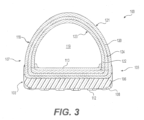
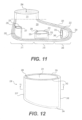
- Zonal inserts 231, 233, and 235 may be configured (e.g., sized, shaped, and formed of a material with particular properties) to provide upper 201 with specific properties proximate zonal pockets 230, 232, and 234.
- all zonal inserts 231, 233, and 235 may provide the same property to upper 201.
- each zonal insert may provide different properties, depending upon the location of the zonal insert on upper 201.
- first zonal insert 231 may be sized, shaped, or otherwise configured to act as a heel counter, which may be rigid and stiff compared to the rest of upper 201.
- Second zonal insert 233 may be sized, shaped, or otherwise configured to act as an arch support, so second zonal insert 233 may be sized, shaped, or otherwise configured to follow the contours of an arch while being supportive and cushioning.
- Third zonal insert 235 may be sized, shaped, or otherwise configured to act as a toe cap, which may be rigid and stiff compared to the rest of upper 201, but may be made of a more breathable material than that of first zonal insert 231.
- one or more zonal properties may be common to more than one or even all zonal inserts, such as cushioning, while other properties vary from zonal insert to zonal insert, such as stiffness and breathability.
- Each zonal insert 231, 233, and 235 may optionally be made from the same material, or one or more of the zonal inserts 231, 233, and 235 may be made from different materials.
- Example materials may include natural or synthetic rubber, foams, polymer sheets or plates, cushioning bladders that may be filled with foams, gas, and/or fluids, combinations of these materials, knit or other textiles, and/or other suitable materials and combinations.
- FIGS. 9-13 show that zonal inserts are disposed in the layers of upper 201 so that the zonal inserts are spaced apart/do not touch while portions of upper 201 do not contain any inserts.
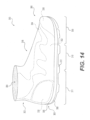
- substantially the entirety of an upper 301 may include zonal inserts that are shaped to provide properties to various zones of the upper 301.
- the upper 301 of FIGS. 14-15 is similar to the upper 201 of FIGS. 9-13 in many respects.
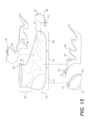
- the upper 301 is depicted as including a knit element 318 that is folded to form an outer layer 320 and an inner layer 322, shown in FIG. 15 .
- Knit element 318 may be similar in materials and structure to knit element 218 (of FIG. 9 ).
- the zonal pockets formed in an interstitial space formed between outer layer 320 and inner layer 322 and the zonal inserts positioned within those pockets are different from the zonal pockets described above.
- the zonal pockets and zonal inserts abut each other and have irregular edges that fit together like the pieces of a puzzle.
- upper 301 assists in providing an upright structural shape to upper 301, while the shapes of the pockets and inserts are configured to follow the contours of the foot of a wearer to provide more specific zonal support and properties to the various areas of upper 301 proximate the zonal pockets.
- the depicted upper 301 includes a first irregular zonal pocket 330, a second irregular zonal pocket 332, a third irregular zonal pocket 334, and a fourth irregular zonal pocket 336.
- First irregular zonal pocket 330 and first irregular zonal insert 331 are disposed in heel region 311.
- First irregular zonal insert 331 may generally have the configuration and properties of at least a portion of a heel counter.
- First irregular zonal pocket 330 is configured to receive first irregular zonal insert 331 and conforms generally to the shape of first irregular zonal insert 331.
- Second irregular zonal pocket 332 and second irregular zonal insert 333 may be partially disposed in heel region 311 and ankle region 302, span third midfoot region proximate sole structure 303, and terminate in forefoot region 309.
- Second irregular zonal insert 333 may have properties that provide flexible and cushioning support to the portions of upper proximate second irregular zonal insert 333.
- second irregular zonal pocket 332 may be configured to receive second irregular zonal insert 333 and may conform generally to the shape of second irregular zonal insert 333.
- second irregular zonal insert 333 may have a second thickness 343. Second thickness 343 may be uniform throughout second irregular zonal insert 333, or second thickness 343 may vary through second irregular zonal insert 333.
- Second irregular zonal insert 333 may also include a second perimeter edge 342 that is shaped to extend portions of second irregular zonal insert 333 away from sole structure 303 to provide cushioning along the sides of upper 300 while also providing gaps between the portions to enhance flexibility.
- third irregular zonal pocket 334 and fourth irregular zonal pocket 336 may be configured to receive third zonal insert 335 and fourth zonal insert 337, respectively, and each of these elements may include any of the features described above with respect to second irregular zonal pocket 332 and second irregular zonal insert 333.
- Any of the zonal pockets of upper 301 may be constructed similarly to the zonal pockets of upper 201 (of FIG. 9 ), but the zonal pockets of upper 301 may have different shapes.
- any of the zonal inserts of upper 301 may optionally be made of similar materials as the zonal inserts of upper 201, but this is not required.
- an upper may be knitted to include a visual and/or machine-detectable cue as to the properties of regions and/or may include visible or machine-detectible bite lines to similarly indicate to a technician or a manufacturing machine the intended placement of elements such as a sole structure or a throat opening support.
- the cue and/or bite lines may additionally or alternatively be included for purposes of providing the article of footwear with desirable aesthetic properties and effects.
- Knit element 418 depicted in FIGS. 16-19 may be similar in materials and structure to knit element 218 (of FIG. 9 ). In some respects, knit element 418 may be similar and has many of the same traits, structures, and performance characteristics of to upper 201 of article of footwear 200.
- article 400 may include zonal pockets and/or zonal inserts such as those described above, these zonal pockets are not shown for the sake of clarity. Instead, article 400 may be provided with zonal features or additional zonal features based on the type of yarn used in a zone, the type of knit stitch or other knit structure used in a zone, and/or the knit density in a zone. For the purposes of this discussion, knit density may be considered to be the number of stitches per unit of length or area.
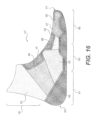
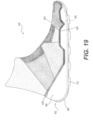
- FIG. 16 shows several different zones on knit element 418: a first zone 430, a second zone 431, a third zone 433, a fourth zone 434, a fifth zone 435, a sixth zone 436, and a seventh zone 437.
- Each of these zones may have different structural, performance, and/or aesthetic properties.
- some of the differing properties of the knit element 418 may include stretch resistance, breathability, and stiffness.
- first zone 430 spans from heel 416 to toe 414 along a lowermost portion of knit element 418.
- First zone 430 may be configured (e.g., with certain materials and/or surface characteristics) to receive a sole structure.
- first zone 430 may be stiffer than other zones to form a stable surface for receiving a sole structure.
- first zone 430 may be thicker than other zones to form a more comfortable surface for a foot.
- first zone 430 may include more thermoplastic polymer yarns than other zones so that a sole structure may be readily heat bonded and/or welded to first zone 430.
- first zone 430 may include a type of yarn that is more compatible with an adhesive than the other zones so that first zone 430 may be more easily adhesive bonded to a sole structure. In some embodiments, first zone 430 may be a combination of any of these properties.
- Second zone 431 extends from midfoot region 410 and into forefoot region 409 from a forward part of ankle region 402 along a top of knit element 418.
- second zone 431 may be more elastic than other regions so that second zone 431 may stretch to accommodate a foot insertion and return to an original size to secure knit element 418 to the foot.
- second zone 431 may be configured to receive a lacing system reinforcing structure.
- the lacing system may include eyelets, which may be punched out of the second zone 431 (e.g., post-knitting), or may be knitted directly into second zone 431.
- the eyelets may be formed by knitting float stitches (for example a one- or two-stitch float on a circular knitting machine).
- Each eyelet may include an entrance and an exit, each of which may include one or more yarns selected for durability and abrasion resistance.
- knitted eyelets may comprise high tenacity yarns and/or thermoplastic yams activated by suitable post-processing step.
- second zone 431 may be thicker than other zones to provide additional comfort to the top of a foot proximate the laces.
- second zone 431 may include more thermoplastic yarns than other zones so that a reinforcing structure may be readily heat bonded and/or welded to second zone 431.
- second zone 431 may include a type of yarn that is more compatible with an adhesive than the other zones so that second zone 431 may be more easily adhesive bonded to a reinforcing structure.
- second zone 431 may be a combination of any of these properties.
- Third zone 433 may be positioned primarily in ankle region 402. Third zone 433 may be significantly more elastic and have greater recovery capabilities than other zones, even than second zone 431, so that third zone 433 may stretch to accommodate a foot insertion and return to an original size to secure knit element 418 to the ankle of a user.
- Fourth zone 434 may be positioned adjacent third zone 433 and between first zone 430 and second zone 431. Fourth zone 434 may be positioned proximate a portion of knit element 418 designed to cover a portion of a malleolus area of a user's foot. In some embodiments, fourth zone 434 may have stretch properties similar to third zone 433, but may also have cushioning properties or other protective properties to assist in protecting the ankle of a wearer. In some embodiments, fourth zone 434 may be stiffer and/or less stretchy than third zone 433 to inhibit any potential rolling motion of a user's ankle. For example, fourth zone 434 may be selectively knit with yams having thermoplastic characteristics (e.g., that stiffen when heat activated) in order to provide ankle support.
- thermoplastic characteristics e.g., that stiffen when heat activated
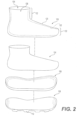
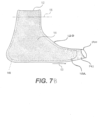
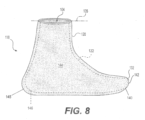
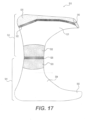
- FIG. 17 shows an embodiment of unfolded element 518 where unfolded element 518 has a generally tubular, sock-like configuration.
- First part 543 and second part 541 are nearly identical in shape, though mirror-images or oppositely-oriented.
- first part 543 and second part 541 may have a foot-like shape similar to unfolded element 138, discussed above.
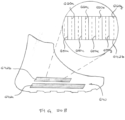
- the retention system 640 may optionally include one or more third yarns 670 (such as the depicted third yarns 670a, 670c) that shield at least one first yarn 650 from abrasion, snagging, and other causes of damage while advantageously preserving ventilation and visibility of the first yarns.
- third yarns 670 such as the depicted third yarns 670a, 670c
- the floating portions may be formed when the floating portions of the first yarns 650 skip (i.e., extend past without engaging) a series of consecutive needles on a needle bed during when knitting a course during a knitting process.
- the needle bed may be a needle bed of a circular knitting machine.
- the course-wise length along each first yarn 650 between the loops immediately adjacent to the ends of the floating portion may be referred to as the float length.
- the float length may form a relatively straight dimension that may be parallel to and define a course-wise dimension of the retention zones 642a-b (i.e., the vertical dimension from the perspective of FIG. 20A ).
- the float length may not form a relatively straight dimension, and may not define the course-wise dimension of the retention zones 642a-b.
- the number of consecutive floated courses of the first yarn 650 may generally define a wale-wise dimension of the retention zones 642a-b (i.e., the horizontal dimension from the perspective of FIG. 20A ). This knit structure results in each knitted first yarn 650 being loose from the rest of the knitted component within the retention zones 642a-b.
- the first yarns 650 have a nominal stitch length within the float length, and because the first yarns 650 may be constructed from a material with low stretch, the first yarns 650 may have very low stretch along the course-wise direction (depicted as vertical) within the retention zone 642 (at least when the first yarns 650 are taut).
- More than one retention zone 642 may be included. As shown in FIG. 20A , for example, two retention zones 642a-b may be included. Retention zone 642a may be spaced or otherwise separated from the retention zone 642b by a portion 643 of the outer knit layer 620. Portion 643 of the knitted layer may include loops formed by the first yarns 650a-g.
- providing two (or more) retention zones 642a-b may increase the amount the retention system can displace between its first and second states with respect to the inclusion of only one retention zone 642.
- machine limitations may limit maximum float length of first yarns 650a-g due to a maximum number of needles that may be skipped without interrupting the knitting process (e.g., 8 needles according to one test performed by an inventor).
- the portion 643 of the outer knit layer 620 may include loops formed by the first yarns 650a-g.
- Suitable materials for the first yarns 650 include yarns formed with low-stretch/low-elasticity materials with relatively high tensile strength, e.g., cables, strands, and cords.
- Exemplary materials that may be used for first yarns 650 may include strands or fibers having a low modulus of elasticity as well as a high tensile strength, such as tensile strands of monofilament material with a diameter of approximately 0.5mm - 2.0mm, or fibers such as SPECTRA TM , manufactured by Honeywell of Morris Township N.J.
- first yarns 650 include various filaments, fibers, and yarns, that are formed from rayon, nylon, polyester, polyacrylic, silk, cotton, carbon, glass, aramids (e.g., para-aramid fibers and meta-aramid fibers), ultra-high molecular weight polyethylene, and liquid crystal polymer. In comparison with the second yarns 660, the thickness of the first yarns 650 may be greater.
- the second yams 660a-g may be knitted to form intermeshed loops of outer knit layer 620 or may be inlaid within intermeshed loops of outer knit layer 620, and may have mechanical properties (e.g., a particular elasticity and resilience) for biasing the retention system 640 to a first state when the knitted component 601 is not on a wearer's foot.
- Exemplary materials for the second yarns 660a-g may include yarns that incorporates elastane fiber(s), such as those available from E.I. duPont de Nemours Company under the LYCRA trademark. Such yarns may have the configuration of covered LYCRA, for example yarns having a LYCRA core that is surrounded by a nylon sheath. Other fibers or filaments exhibiting elastic properties may also be utilized.
- the retention system exerts a tension force (e.g., a tension force in the first yarns 650) to retain the knitted component 601 on the wearer's foot.
- the tension force may also include tensile forces present in the second yarns.
- conventional elements like a tongue may be provided. In the illustrated embodiments, however, the sock-like nature of the knit elements may not require a traditional tongue as the ankle region may stretch to accommodate foot insertion and retract to secure the foot snugly within the knitted component.
- closure elements can also be included that is used to selectively secure a knitted component to the wearer's foot.
- a closure element can be of any suitable type, such as a lace.
- the closure element(s) may also include one or more buckles, straps, or other suitable implements for securing the knitted component to a wearer's foot.
- the knitted component may be configured to be pulled over a user's foot like a sock, and, thus, may not include any additional closure elements.
- the closure element may operate in conjunction with the retention system 640 of FIGS. 20A-20B , but it is also contemplated that the retention force provided by the retention system 640 may render an additional closure element unnecessary.
- any of the knitted components disclosed above may include additional elements.
- upper 101 (of FIG. 1 , or any other upper described herein) can include a toe guard in forefoot region that is formed of a wear-resistant material.
- the upper can additionally include logos, trademarks, symbols, and placards with care instructions and material information. It will be appreciated that any upper disclosed above can include still further elements without departing from the scope of the present disclosure.
- the filaments of the nonwoven layers, knitted materials, components, or inserts in any of the embodiments discussed above may include a thermoplastic polymer material.
- a thermoplastic polymer material melts when heated and returns to a solid state when cooled. More particularly, the thermoplastic polymer material transitions from a solid state to a softened or liquid state when subjected to sufficient heat, and then the thermoplastic polymer material transitions from the softened or liquid state to the solid state when sufficiently cooled. As such, the thermoplastic polymer material may be melted, molded, cooled, re-melted, re-molded, and cooled again through multiple cycles.
- thermoplastic polyurethane relates to heat bonding and colorability.
- thermoplastic polyurethane is relatively easy to bond with other elements, as discussed in greater detail below, and colorants may be added to thermoplastic polyurethane through various conventional processes.
Landscapes
- Engineering & Computer Science (AREA)
- Textile Engineering (AREA)
- Chemical & Material Sciences (AREA)
- Materials Engineering (AREA)
- Health & Medical Sciences (AREA)
- Epidemiology (AREA)
- General Health & Medical Sciences (AREA)
- Public Health (AREA)
- Footwear And Its Accessory, Manufacturing Method And Apparatuses (AREA)
- Knitting Of Fabric (AREA)
Claims (11)
- Fußbekleidungsartikel (100) mit einer Strickkomponente (601), die einen Überfußabschnitt und einen Unterfußabschnitt des Fußbekleidungsartikels (100) bildet, wobei die Strickkomponente (601) Folgendes umfasst:eine erste Lage (122), die eine Innenfläche (123) bildet, die einen Hohlraum (119) begrenzt,eine zweite Lage (120), wobei die zweite Lage (120) die erste Lage (122) wenigstens teilweise umgibt, wobei die zweite Lage (120) eine Außenfläche auf dem Überfußabschnitt und dem Unterfußabschnitt bildet und wobei ein Abschnitt der ersten Lage (122) mit einem Abschnitt der zweiten Lage (120) in einem Knöchelbereich (102) der Strickkomponente (601) durchgehend ist,einen Zwischenraum (129), der zwischen der ersten Lage (122) und der zweiten Lage (120) gebildet ist,wobei die Strickkomponente (601) durch wenigstens eine Tasche (230) gekennzeichnet ist, die sich in dem Zwischenraum befindet, undeine Komponente (124), die zwischen der ersten Lage (122) und der zweiten Lage (120) in der Tasche (230) angeordnet ist.
- Strickkomponente (601) nach Anspruch 1, wobei die erste Lage (122) und die zweite Lage (120) auf einer Rundstrickmaschine gebildet sind und wobei die zweite Lage (120) bezüglich der ersten Lage (122) umgekehrt ist.
- Strickkomponente (601) nach Anspruch 1, wobei wenigstens in der zweiten Lage (120) in einem Zehenbereich der Strickkomponente (601) eine Naht (132) gebildet ist, vorzugsweise wobei die Naht (132) die erste Lage (122) mit der zweiten Lage (120) verbindet.
- Strickkomponente (601) nach Anspruch 1, wobei eine Spannkraft der zweiten Lage (120) die Komponente (124) in einem Unterfußbereich des Zwischenraums (129) zurückhält, und/oder wobei die Komponente (124) in einem Unterfußbereich des Zwischenraums (129) zurückgehalten ist und wobei der Zwischenraum (129) im Wesentlichen frei von Klebstoff ist.
- Strickkomponente (601) nach Anspruch 1, wobei die Komponente eine Zwischensohle (106) ist.
- Strickkomponente (601) nach Anspruch 1, ferner mit:
einem Rückhaltesystem (640), das in der zweiten Lage (120, 620) gebildet ist, wobei das Rückhaltesystem (640) Folgendes umfasst:mehrere erste Fäden (650) und mehrere zweite Fäden (660), wobei die ersten Fäden (650) und die zweiten Fäden (660) wenigstens teilweise die zweite Lage (120, 620) der Strickkomponente (601) bilden,wobei die zweiten Fäden (660) das Rückhaltesystem (640) in einen ersten Zustand vorspannen undwobei das Rückhaltesystem (640) in einem zweiten Zustand eine Spannkraft ausübt. - Oberteil (101) für einen Fußbekleidungsartikel (100), wobei das Oberteil (101) eine Strickkomponente (100) umfasst, die einen Überfußabschnitt und einen Unterfußabschnitt des Fußbekleidungsartikels (100) bildet, wobei die Strickkomponente Folgendes umfasst:eine erste Lage (122), die eine Innenfläche (123) bildet, die einen Hohlraum (119) begrenzt,eine zweite Lage (120), wobei die zweite Lage (120) die erste Lage (122) wenigstens teilweise umgibt, wobei die zweite Lage (120) eine Außenfläche auf dem Überfußabschnitt und dem Unterfußabschnitt bildet und wobei die erste Lage (122) mit der zweiten Lage (120) in wenigstens einem Abschnitt eines Knöchelbereichs (102) des Oberteils (101) durchgehend ist, undeinen Zwischenraum (129), der zwischen der ersten Lage (122) und der zweiten Lage (120) gebildet ist,wobei das Oberteil durch wenigstens eine Tasche (230) gekennzeichnet ist, die sich in dem Zwischenraum befindet, und eine Komponente (124), die zwischen der ersten Lage (122) und der zweiten Lage (120) in der Tasche (230) angeordnet ist,wobei die Komponente (124) ein Material umfasst, das andere Eigenschaften als die erste Lage (122) und die zweite Lage (120) aufweist.
- Oberteil (101) nach Anspruch 7, wobei die Komponente (124) eine größere Steifigkeit als die erste Lage (122) und die zweite Lage (120) aufweist.
- Oberteil (101) nach Anspruch 7, wobei die Komponente (124) eine Form eines Halbstiefels aufweist, der flächengleich mit wenigstens einem Vorderfußbereich (109) und einem Mittelfußbereich (110) des Oberteils (101) ist, vorzugsweise wobei der Halbstiefel flächengleich mit einem Abschnitt eines Fersenbereichs (111) ist.
- Oberteil (101) nach Anspruch 7, wobei die Komponente (124) einen größeren Dehnungswiderstand als die erste Lage (122) und die zweite Lage (120) aufweist.
- Oberteil (101) nach Anspruch 7, ferner mit einer Naht (132), die in einem Zehenbereich des Oberteils (101) die erste Lage (122) mit der zweiten Lage (120) verbindet.
Priority Applications (1)
| Application Number | Priority Date | Filing Date | Title |
|---|---|---|---|
| EP25155657.7A EP4524308A3 (de) | 2016-07-21 | 2017-07-20 | Schuhartikel mit mehreren schichten, rückhaltesystem für einen schuhartikel |
Applications Claiming Priority (3)
| Application Number | Priority Date | Filing Date | Title |
|---|---|---|---|
| US201662365114P | 2016-07-21 | 2016-07-21 | |
| US201762491898P | 2017-04-28 | 2017-04-28 | |
| PCT/US2017/043109 WO2018017854A2 (en) | 2016-07-21 | 2017-07-20 | Article of footwear with multiple layers, retention system for an article of footwear, and methods of manufacture |
Related Child Applications (1)
| Application Number | Title | Priority Date | Filing Date |
|---|---|---|---|
| EP25155657.7A Division EP4524308A3 (de) | 2016-07-21 | 2017-07-20 | Schuhartikel mit mehreren schichten, rückhaltesystem für einen schuhartikel |
Publications (2)
| Publication Number | Publication Date |
|---|---|
| EP3487342A2 EP3487342A2 (de) | 2019-05-29 |
| EP3487342B1 true EP3487342B1 (de) | 2025-02-26 |
Family
ID=59501605
Family Applications (2)
| Application Number | Title | Priority Date | Filing Date |
|---|---|---|---|
| EP25155657.7A Pending EP4524308A3 (de) | 2016-07-21 | 2017-07-20 | Schuhartikel mit mehreren schichten, rückhaltesystem für einen schuhartikel |
| EP17746314.8A Active EP3487342B1 (de) | 2016-07-21 | 2017-07-20 | Schuhartikel mit mehreren schichten, rückhaltesystem für einen schuhartikel |
Family Applications Before (1)
| Application Number | Title | Priority Date | Filing Date |
|---|---|---|---|
| EP25155657.7A Pending EP4524308A3 (de) | 2016-07-21 | 2017-07-20 | Schuhartikel mit mehreren schichten, rückhaltesystem für einen schuhartikel |
Country Status (6)
| Country | Link |
|---|---|
| US (2) | US20170311672A1 (de) |
| EP (2) | EP4524308A3 (de) |
| CN (3) | CN113951598B (de) |
| MX (1) | MX2019000830A (de) |
| TW (2) | TWI689265B (de) |
| WO (1) | WO2018017854A2 (de) |
Families Citing this family (40)
| Publication number | Priority date | Publication date | Assignee | Title |
|---|---|---|---|---|
| MX2019000830A (es) * | 2016-07-21 | 2019-07-04 | Nike Innovate Cv | Articulo de calzado con multiples capas, sistemas de retencion para un articulo de calzado, y metodos de fabricacion. |
| US11445779B2 (en) | 2016-07-21 | 2022-09-20 | Nike, Inc. | Article of footwear with multiple layers, retention system for an article of footwear, and methods of manufacture |
| KR102568996B1 (ko) * | 2016-08-25 | 2023-08-21 | 한화비전 주식회사 | 감시카메라 설정 방법과 감시카메라 관리 방법 및 시스템 |
| US10316441B2 (en) | 2016-12-16 | 2019-06-11 | The North Face Apparel Corp. | Footwear article including circular knit structures |
| US11408104B2 (en) | 2016-12-16 | 2022-08-09 | The North Face Apparel Corp. | Footwear article including circular knit structures |
| EP3943652B1 (de) * | 2017-05-05 | 2023-09-27 | NIKE Innovate C.V. | Schuhoberteil für einen fussbekleidungsartikel mit ersten und zweiten gestrickteilen |
| DE102017008834B4 (de) * | 2017-09-20 | 2022-06-30 | Adidas Ag | Schuh mit adaptivem Fersenelement |
| DE102017223746B4 (de) * | 2017-12-22 | 2024-03-14 | Adidas Ag | Rundstrick-Schuhoberteil |
| DE102017223750B4 (de) * | 2017-12-22 | 2021-10-07 | Adidas Ag | Gestrickte oder gewirkte Komponente |
| CN108004664B (zh) * | 2018-01-18 | 2021-03-02 | 东莞市坦睿飞织鞋面设计有限公司 | 一次成型多用途无缝针织鞋面及其编织工艺 |
| CN112261887B (zh) * | 2018-04-10 | 2022-12-30 | 耐克创新有限合伙公司 | 用于鞋类制品的鞋面 |
| EP3788194B1 (de) | 2018-04-30 | 2023-03-22 | Nike Innovate C.V. | Schuhoberteil für eine fussbekleidung mit einer gitterstruktur |
| CN114847589B (zh) | 2018-05-31 | 2025-06-27 | 耐克创新有限合伙公司 | 制造具有热成型的带沟槽鞋底结构的鞋类物品的方法 |
| WO2019232495A1 (en) | 2018-05-31 | 2019-12-05 | Nike Innovate C.V. | Article of footwear with thermoformed siped sole structure |
| EP3745897B1 (de) | 2018-05-31 | 2022-02-02 | NIKE Innovate C.V. | Zwischensohlenstruktur mit lamellierung |
| FR3082103B1 (fr) | 2018-06-08 | 2020-08-28 | Decathlon Sa | Procede de fabrication d'une chaussure, et chaussure susceptible d'etre obtenue par ledit procede |
| EP3823484B1 (de) | 2018-07-20 | 2022-03-23 | Nike Innovate C.V. | Oberteil für einen schuhartikel mit einer inneren komponente und einer umhüllung |
| US11220766B2 (en) * | 2018-07-23 | 2022-01-11 | Nike, Inc. | Knitted article with raised structure and methods of manufacture |
| IT201800007798A1 (it) * | 2018-08-03 | 2020-02-03 | Lonati Spa | Procedimento per la realizzazione di manufatti semilavorati per la produzione di manufatti del tipo scarpina, calza salva-piede, calza no-show, calzature o simili a doppio spessore con una macchina circolare per calzetteria e manufatto semilavorato ottenuto con il procedimento. |
| US11278081B2 (en) * | 2018-10-10 | 2022-03-22 | Reebok International Limited | Article of footwear with dispensed components |
| WO2020146054A1 (en) * | 2019-01-07 | 2020-07-16 | All Star C.V. | Wearable article and method of manufacturing a wearable article |
| US11109641B2 (en) | 2019-03-22 | 2021-09-07 | Nike, Inc. | Article of footwear having a skin layer between a knitted component and a sole structure |
| DE102019209275B4 (de) * | 2019-06-26 | 2023-02-02 | Adidas Ag | Schuh und Schuhoberteil mit optimierten formbeständigen Eigenschaften |
| FR3098690B1 (fr) * | 2019-07-17 | 2021-07-30 | Decathlon Sa | Procédé de fabrication d’un article chaussant |
| FR3098688B1 (fr) * | 2019-07-17 | 2022-02-25 | Decathlon Sa | Procédé de fabrication d’un article chaussant |
| CN112335996A (zh) * | 2019-08-06 | 2021-02-09 | 株式会社爱世克私 | 鞋、鞋的制造方法、鞋用鞋面的制造方法 |
| TWI748744B (zh) * | 2019-11-13 | 2021-12-01 | 美商北面服飾公司 | 包括圓形針織結構之鞋類物品 |
| EP3861881B1 (de) * | 2019-12-25 | 2023-06-21 | ASICS Corporation | Schuhoberteil und verfahren zur herstellung des schuhoberteils |
| IT202000001459A1 (it) * | 2020-01-24 | 2021-07-24 | Trere Innovation S R L | Struttura e procedimento di realizzazione di una scarpa con tomaia in maglia. |
| FR3107436B1 (fr) * | 2020-02-25 | 2022-03-04 | Decathlon Sa | Article chaussant comprenant un élément textile principal comprenant un chausson textile principal et au moins une première partie textile additionnelle, et procédé de fabrication d’un tel article chaussant |
| IT202000004468A1 (it) * | 2020-03-03 | 2021-09-03 | Macpi Spa Pressing Div | Semilavorato in maglia per la fabbricazione di calze, calzature e guanti e processo per la sua realizzazione |
| CN111826787A (zh) * | 2020-07-29 | 2020-10-27 | 信泰(福建)科技有限公司 | 具有可视化记忆脉络的织物面料、鞋面以及面料的制作方法 |
| EP4225093B1 (de) | 2020-10-07 | 2025-04-30 | NIKE Innovate C.V. | Schuhartikel mit lösbar befestigter mechanischer polsterung |
| CN112481789B (zh) * | 2020-11-20 | 2022-04-01 | 信泰(福建)科技有限公司 | 通过活化定型并一体编织领口的针织鞋面及生产工艺 |
| US12201187B2 (en) * | 2021-01-15 | 2025-01-21 | Puma SE | Article of footwear having a knitted upper |
| CN114947300B (zh) * | 2021-02-26 | 2024-03-08 | 上海智宇国际贸易有限公司 | 复合的鞋类和手套类物品 |
| IT202100025304A1 (it) * | 2021-10-04 | 2023-04-04 | Tessma S R L | Calzatura costruita con doppio calzino comprensiva di rinforzi e/o protezioni fra i due calzini e relativo procedimento di realizzazione |
| US20230151517A1 (en) * | 2021-11-18 | 2023-05-18 | Hurdle Apparel Inc. | Sock and a method of knitting a sock |
| US20240197032A1 (en) * | 2022-12-15 | 2024-06-20 | Nike, Inc. | Recyclable footwear article |
| JP7733049B2 (ja) * | 2023-03-31 | 2025-09-02 | 美津濃株式会社 | シューズのアッパー用布地、シューズのアッパー及びシューズ |
Family Cites Families (28)
| Publication number | Priority date | Publication date | Assignee | Title |
|---|---|---|---|---|
| US4034581A (en) * | 1976-04-26 | 1977-07-12 | Thorneburg Hosiery Mill, Inc. | Sock with plate and float pattern and method |
| US4109492A (en) * | 1976-09-13 | 1978-08-29 | Burlington Industries, Inc. | No roll stocking and method |
| USRE34890E (en) * | 1981-08-06 | 1995-04-04 | Gore Enterprise Holdings, Inc. | Waterproof shoe construction |
| US5412957A (en) * | 1993-10-20 | 1995-05-09 | The Kendall Company | Knit therapeutic stocking with anti-slip feature |
| DE19545770A1 (de) * | 1995-12-07 | 1997-07-03 | Schmidt Ursula Dorothea | Durch Fadenflottungen gemusterte Plattierware und Verfahren zu deren Herstellung auf Rundstrickmaschinen |
| US20020152775A1 (en) * | 1999-04-29 | 2002-10-24 | Sara Lee Corporation | Seamless torso controlling garment and method of making same |
| DE10347673B4 (de) * | 2003-10-09 | 2012-01-12 | BLüCHER GMBH | Schuh, insbesondere Stiefel, mit ABC-Schutz |
| US8056149B2 (en) * | 2007-12-20 | 2011-11-15 | Converse Inc. | Combination sock and shoe |
| US8490299B2 (en) * | 2008-12-18 | 2013-07-23 | Nike, Inc. | Article of footwear having an upper incorporating a knitted component |
| US8578632B2 (en) * | 2010-07-19 | 2013-11-12 | Nike, Inc. | Decoupled foot stabilizer system |
| WO2012067645A1 (en) * | 2010-11-15 | 2012-05-24 | Flagship Brands, Llc | Knit sock with targeted compression zone |
| US8522577B2 (en) * | 2011-03-15 | 2013-09-03 | Nike, Inc. | Combination feeder for a knitting machine |
| US8839532B2 (en) * | 2011-03-15 | 2014-09-23 | Nike, Inc. | Article of footwear incorporating a knitted component |
| US9365960B2 (en) * | 2011-04-20 | 2016-06-14 | Nike, Inc. | Sock with zones of varying layers |
| BR112014017690A8 (pt) * | 2012-01-20 | 2017-07-11 | Shima Seiki Mfg | Calçado e método de fazer malha para tecido de malha |
| US9861160B2 (en) * | 2012-11-30 | 2018-01-09 | Nike, Inc. | Article of footwear incorporating a knitted component |
| FR2999881B1 (fr) * | 2012-12-21 | 2015-06-12 | Salomon Sas | Article chaussant a structure simplifiee |
| JP5749774B2 (ja) * | 2013-09-30 | 2015-07-15 | 美津濃株式会社 | シューズ |
| US10194711B2 (en) * | 2014-05-06 | 2019-02-05 | Nike, Inc. | Packaged dyed knitted component |
| US9968156B2 (en) | 2014-05-30 | 2018-05-15 | Nike, Inc. | Method of making an article of footwear including knitting a knitted component of warp knit construction forming a seamless bootie with tucked-in portion |
| FR3024022B1 (fr) * | 2014-07-22 | 2017-04-28 | Salomon Sas | Article chaussant a structure amelioree |
| JP6276906B2 (ja) * | 2014-07-25 | 2018-02-07 | 美津濃株式会社 | スポーツシューズのアッパー構造およびその製造方法 |
| US20160076175A1 (en) * | 2014-09-11 | 2016-03-17 | Myant Capital Partners Inc. | Compression fabrics with tailored comfort |
| DE102014220087B4 (de) * | 2014-10-02 | 2016-05-12 | Adidas Ag | Flachgestricktes Schuhoberteil für Sportschuhe |
| CN104366870A (zh) * | 2014-11-14 | 2015-02-25 | 天津腾达集团有限公司 | 一种内套式防水劳保鞋 |
| EP3954816B1 (de) * | 2015-04-16 | 2023-10-25 | NIKE Innovate C.V. | Schuhwerk mit einem gestrickteil, das flottierte abschnitte aufweist |
| DE102016103421B4 (de) * | 2016-02-26 | 2020-12-31 | Medi Gmbh & Co. Kg | Rundgestrickteil sowie Verfahren zur Herstellung eines solchen |
| MX2019000830A (es) | 2016-07-21 | 2019-07-04 | Nike Innovate Cv | Articulo de calzado con multiples capas, sistemas de retencion para un articulo de calzado, y metodos de fabricacion. |
-
2017
- 2017-07-20 MX MX2019000830A patent/MX2019000830A/es unknown
- 2017-07-20 WO PCT/US2017/043109 patent/WO2018017854A2/en not_active Ceased
- 2017-07-20 US US15/655,447 patent/US20170311672A1/en not_active Abandoned
- 2017-07-20 CN CN202111288272.2A patent/CN113951598B/zh active Active
- 2017-07-20 US US15/655,651 patent/US10718074B2/en active Active
- 2017-07-20 EP EP25155657.7A patent/EP4524308A3/de active Pending
- 2017-07-20 EP EP17746314.8A patent/EP3487342B1/de active Active
- 2017-07-20 CN CN201780050957.9A patent/CN109561746B/zh active Active
- 2017-07-21 CN CN201720889040.5U patent/CN207940405U/zh not_active Expired - Fee Related
- 2017-07-21 TW TW106124490A patent/TWI689265B/zh active
- 2017-07-21 TW TW106210747U patent/TWM559083U/zh unknown
Also Published As
| Publication number | Publication date |
|---|---|
| EP4524308A3 (de) | 2025-05-07 |
| TWI689265B (zh) | 2020-04-01 |
| MX2019000830A (es) | 2019-07-04 |
| US20180020763A1 (en) | 2018-01-25 |
| EP3487342A2 (de) | 2019-05-29 |
| TWM559083U (zh) | 2018-05-01 |
| CN113951598B (zh) | 2023-11-07 |
| EP4524308A2 (de) | 2025-03-19 |
| CN109561746B (zh) | 2021-11-12 |
| CN109561746A (zh) | 2019-04-02 |
| WO2018017854A2 (en) | 2018-01-25 |
| WO2018017854A3 (en) | 2018-03-22 |
| CN207940405U (zh) | 2018-10-09 |
| TW201808139A (zh) | 2018-03-16 |
| CN113951598A (zh) | 2022-01-21 |
| US10718074B2 (en) | 2020-07-21 |
| US20170311672A1 (en) | 2017-11-02 |
Similar Documents
| Publication | Publication Date | Title |
|---|---|---|
| EP3487342B1 (de) | Schuhartikel mit mehreren schichten, rückhaltesystem für einen schuhartikel | |
| US12156566B2 (en) | Zoned upper for an article of footwear | |
| US12359352B2 (en) | Knitted components exhibiting color shifting effects | |
| EP3102725B1 (de) | Strickkomponente für schuhwerksartikel mit monofilamentoberteil | |
| EP3102724B1 (de) | Schuhartikel mit einem strickelement beinhaltend einzelfilamente und schmelzfäden sowie verfahren zur herstellung desselben | |
| EP3663449B1 (de) | Schuhartikel mit einem monofilen strickelement mit peripheren gestrickabschnitten und methode zu dessen herstellung | |
| TWM572667U (zh) | 具有多層之鞋類物件及用於鞋類物件之固定系統 | |
| HK40006710A (en) | Article of footwear with multiple layers, retention system for an article of footwear, and methods of manufacture | |
| HK40006710B (zh) | 具有多层的鞋类物品、用於鞋类物品的保持系统和制造方法 |
Legal Events
| Date | Code | Title | Description |
|---|---|---|---|
| STAA | Information on the status of an ep patent application or granted ep patent |
Free format text: STATUS: UNKNOWN |
|
| STAA | Information on the status of an ep patent application or granted ep patent |
Free format text: STATUS: THE INTERNATIONAL PUBLICATION HAS BEEN MADE |
|
| PUAI | Public reference made under article 153(3) epc to a published international application that has entered the european phase |
Free format text: ORIGINAL CODE: 0009012 |
|
| STAA | Information on the status of an ep patent application or granted ep patent |
Free format text: STATUS: REQUEST FOR EXAMINATION WAS MADE |
|
| 17P | Request for examination filed |
Effective date: 20190205 |
|
| AK | Designated contracting states |
Kind code of ref document: A2 Designated state(s): AL AT BE BG CH CY CZ DE DK EE ES FI FR GB GR HR HU IE IS IT LI LT LU LV MC MK MT NL NO PL PT RO RS SE SI SK SM TR |
|
| AX | Request for extension of the european patent |
Extension state: BA ME |
|
| DAV | Request for validation of the european patent (deleted) | ||
| DAX | Request for extension of the european patent (deleted) | ||
| STAA | Information on the status of an ep patent application or granted ep patent |
Free format text: STATUS: EXAMINATION IS IN PROGRESS |
|
| 17Q | First examination report despatched |
Effective date: 20220518 |
|
| P01 | Opt-out of the competence of the unified patent court (upc) registered |
Effective date: 20230515 |
|
| GRAP | Despatch of communication of intention to grant a patent |
Free format text: ORIGINAL CODE: EPIDOSNIGR1 |
|
| STAA | Information on the status of an ep patent application or granted ep patent |
Free format text: STATUS: GRANT OF PATENT IS INTENDED |
|
| INTG | Intention to grant announced |
Effective date: 20240925 |
|
| GRAS | Grant fee paid |
Free format text: ORIGINAL CODE: EPIDOSNIGR3 |
|
| GRAA | (expected) grant |
Free format text: ORIGINAL CODE: 0009210 |
|
| STAA | Information on the status of an ep patent application or granted ep patent |
Free format text: STATUS: THE PATENT HAS BEEN GRANTED |
|
| AK | Designated contracting states |
Kind code of ref document: B1 Designated state(s): AL AT BE BG CH CY CZ DE DK EE ES FI FR GB GR HR HU IE IS IT LI LT LU LV MC MK MT NL NO PL PT RO RS SE SI SK SM TR |
|
| REG | Reference to a national code |
Ref country code: GB Ref legal event code: FG4D |
|
| REG | Reference to a national code |
Ref country code: CH Ref legal event code: EP |
|
| REG | Reference to a national code |
Ref country code: DE Ref legal event code: R096 Ref document number: 602017088009 Country of ref document: DE |
|
| REG | Reference to a national code |
Ref country code: IE Ref legal event code: FG4D |
|
| REG | Reference to a national code |
Ref country code: DE Ref legal event code: R082 Ref document number: 602017088009 Country of ref document: DE Representative=s name: MUELLER-BORE & PARTNER PATENTANWAELTE PARTG MB, DE |
|
| REG | Reference to a national code |
Ref country code: NL Ref legal event code: MP Effective date: 20250226 |
|
| PG25 | Lapsed in a contracting state [announced via postgrant information from national office to epo] |
Ref country code: RS Free format text: LAPSE BECAUSE OF FAILURE TO SUBMIT A TRANSLATION OF THE DESCRIPTION OR TO PAY THE FEE WITHIN THE PRESCRIBED TIME-LIMIT Effective date: 20250526 |
|
| PG25 | Lapsed in a contracting state [announced via postgrant information from national office to epo] |
Ref country code: FI Free format text: LAPSE BECAUSE OF FAILURE TO SUBMIT A TRANSLATION OF THE DESCRIPTION OR TO PAY THE FEE WITHIN THE PRESCRIBED TIME-LIMIT Effective date: 20250226 |
|
| PG25 | Lapsed in a contracting state [announced via postgrant information from national office to epo] |
Ref country code: PL Free format text: LAPSE BECAUSE OF FAILURE TO SUBMIT A TRANSLATION OF THE DESCRIPTION OR TO PAY THE FEE WITHIN THE PRESCRIBED TIME-LIMIT Effective date: 20250226 |
|
| PG25 | Lapsed in a contracting state [announced via postgrant information from national office to epo] |
Ref country code: ES Free format text: LAPSE BECAUSE OF FAILURE TO SUBMIT A TRANSLATION OF THE DESCRIPTION OR TO PAY THE FEE WITHIN THE PRESCRIBED TIME-LIMIT Effective date: 20250226 |
|
| PGFP | Annual fee paid to national office [announced via postgrant information from national office to epo] |
Ref country code: GB Payment date: 20250529 Year of fee payment: 9 |
|
| REG | Reference to a national code |
Ref country code: LT Ref legal event code: MG9D |
|
| PG25 | Lapsed in a contracting state [announced via postgrant information from national office to epo] |
Ref country code: NO Free format text: LAPSE BECAUSE OF FAILURE TO SUBMIT A TRANSLATION OF THE DESCRIPTION OR TO PAY THE FEE WITHIN THE PRESCRIBED TIME-LIMIT Effective date: 20250526 Ref country code: IS Free format text: LAPSE BECAUSE OF FAILURE TO SUBMIT A TRANSLATION OF THE DESCRIPTION OR TO PAY THE FEE WITHIN THE PRESCRIBED TIME-LIMIT Effective date: 20250626 |
|
| PG25 | Lapsed in a contracting state [announced via postgrant information from national office to epo] |
Ref country code: NL Free format text: LAPSE BECAUSE OF FAILURE TO SUBMIT A TRANSLATION OF THE DESCRIPTION OR TO PAY THE FEE WITHIN THE PRESCRIBED TIME-LIMIT Effective date: 20250226 |
|
| PG25 | Lapsed in a contracting state [announced via postgrant information from national office to epo] |
Ref country code: HR Free format text: LAPSE BECAUSE OF FAILURE TO SUBMIT A TRANSLATION OF THE DESCRIPTION OR TO PAY THE FEE WITHIN THE PRESCRIBED TIME-LIMIT Effective date: 20250226 |
|
| PG25 | Lapsed in a contracting state [announced via postgrant information from national office to epo] |
Ref country code: LV Free format text: LAPSE BECAUSE OF FAILURE TO SUBMIT A TRANSLATION OF THE DESCRIPTION OR TO PAY THE FEE WITHIN THE PRESCRIBED TIME-LIMIT Effective date: 20250226 Ref country code: PT Free format text: LAPSE BECAUSE OF FAILURE TO SUBMIT A TRANSLATION OF THE DESCRIPTION OR TO PAY THE FEE WITHIN THE PRESCRIBED TIME-LIMIT Effective date: 20250626 |
|
| PGFP | Annual fee paid to national office [announced via postgrant information from national office to epo] |
Ref country code: FR Payment date: 20250508 Year of fee payment: 9 |
|
| PG25 | Lapsed in a contracting state [announced via postgrant information from national office to epo] |
Ref country code: GR Free format text: LAPSE BECAUSE OF FAILURE TO SUBMIT A TRANSLATION OF THE DESCRIPTION OR TO PAY THE FEE WITHIN THE PRESCRIBED TIME-LIMIT Effective date: 20250527 Ref country code: BG Free format text: LAPSE BECAUSE OF FAILURE TO SUBMIT A TRANSLATION OF THE DESCRIPTION OR TO PAY THE FEE WITHIN THE PRESCRIBED TIME-LIMIT Effective date: 20250226 |
|
| REG | Reference to a national code |
Ref country code: AT Ref legal event code: MK05 Ref document number: 1769746 Country of ref document: AT Kind code of ref document: T Effective date: 20250226 |
|
| PG25 | Lapsed in a contracting state [announced via postgrant information from national office to epo] |
Ref country code: SE Free format text: LAPSE BECAUSE OF FAILURE TO SUBMIT A TRANSLATION OF THE DESCRIPTION OR TO PAY THE FEE WITHIN THE PRESCRIBED TIME-LIMIT Effective date: 20250226 |
|
| PG25 | Lapsed in a contracting state [announced via postgrant information from national office to epo] |
Ref country code: SM Free format text: LAPSE BECAUSE OF FAILURE TO SUBMIT A TRANSLATION OF THE DESCRIPTION OR TO PAY THE FEE WITHIN THE PRESCRIBED TIME-LIMIT Effective date: 20250226 |
|
| PG25 | Lapsed in a contracting state [announced via postgrant information from national office to epo] |
Ref country code: DK Free format text: LAPSE BECAUSE OF FAILURE TO SUBMIT A TRANSLATION OF THE DESCRIPTION OR TO PAY THE FEE WITHIN THE PRESCRIBED TIME-LIMIT Effective date: 20250226 |
|
| PGFP | Annual fee paid to national office [announced via postgrant information from national office to epo] |
Ref country code: DE Payment date: 20250528 Year of fee payment: 9 |
|
| PG25 | Lapsed in a contracting state [announced via postgrant information from national office to epo] |
Ref country code: IT Free format text: LAPSE BECAUSE OF FAILURE TO SUBMIT A TRANSLATION OF THE DESCRIPTION OR TO PAY THE FEE WITHIN THE PRESCRIBED TIME-LIMIT Effective date: 20250226 |
|
| PG25 | Lapsed in a contracting state [announced via postgrant information from national office to epo] |
Ref country code: AT Free format text: LAPSE BECAUSE OF FAILURE TO SUBMIT A TRANSLATION OF THE DESCRIPTION OR TO PAY THE FEE WITHIN THE PRESCRIBED TIME-LIMIT Effective date: 20250226 |
|
| PG25 | Lapsed in a contracting state [announced via postgrant information from national office to epo] |
Ref country code: EE Free format text: LAPSE BECAUSE OF FAILURE TO SUBMIT A TRANSLATION OF THE DESCRIPTION OR TO PAY THE FEE WITHIN THE PRESCRIBED TIME-LIMIT Effective date: 20250226 Ref country code: CZ Free format text: LAPSE BECAUSE OF FAILURE TO SUBMIT A TRANSLATION OF THE DESCRIPTION OR TO PAY THE FEE WITHIN THE PRESCRIBED TIME-LIMIT Effective date: 20250226 |
|
| PG25 | Lapsed in a contracting state [announced via postgrant information from national office to epo] |
Ref country code: RO Free format text: LAPSE BECAUSE OF FAILURE TO SUBMIT A TRANSLATION OF THE DESCRIPTION OR TO PAY THE FEE WITHIN THE PRESCRIBED TIME-LIMIT Effective date: 20250226 |
|
| PG25 | Lapsed in a contracting state [announced via postgrant information from national office to epo] |
Ref country code: SK Free format text: LAPSE BECAUSE OF FAILURE TO SUBMIT A TRANSLATION OF THE DESCRIPTION OR TO PAY THE FEE WITHIN THE PRESCRIBED TIME-LIMIT Effective date: 20250226 |
|
| REG | Reference to a national code |
Ref country code: DE Ref legal event code: R097 Ref document number: 602017088009 Country of ref document: DE |
|
| PLBE | No opposition filed within time limit |
Free format text: ORIGINAL CODE: 0009261 |
|
| STAA | Information on the status of an ep patent application or granted ep patent |
Free format text: STATUS: NO OPPOSITION FILED WITHIN TIME LIMIT |
|
| 26N | No opposition filed |
Effective date: 20251127 |