EP3485346B1 - Virtual, augmented, and mixed reality - Google Patents
Virtual, augmented, and mixed reality Download PDFInfo
- Publication number
- EP3485346B1 EP3485346B1 EP17729614.2A EP17729614A EP3485346B1 EP 3485346 B1 EP3485346 B1 EP 3485346B1 EP 17729614 A EP17729614 A EP 17729614A EP 3485346 B1 EP3485346 B1 EP 3485346B1
- Authority
- EP
- European Patent Office
- Prior art keywords
- sound
- virtual
- sound source
- audio signal
- environment
- Prior art date
- Legal status (The legal status is an assumption and is not a legal conclusion. Google has not performed a legal analysis and makes no representation as to the accuracy of the status listed.)
- Active
Links
Images






Classifications
-
- H—ELECTRICITY
- H04—ELECTRIC COMMUNICATION TECHNIQUE
- H04S—STEREOPHONIC SYSTEMS
- H04S7/00—Indicating arrangements; Control arrangements, e.g. balance control
- H04S7/30—Control circuits for electronic adaptation of the sound field
- H04S7/302—Electronic adaptation of stereophonic sound system to listener position or orientation
- H04S7/303—Tracking of listener position or orientation
- H04S7/304—For headphones
-
- G—PHYSICS
- G06—COMPUTING OR CALCULATING; COUNTING
- G06F—ELECTRIC DIGITAL DATA PROCESSING
- G06F3/00—Input arrangements for transferring data to be processed into a form capable of being handled by the computer; Output arrangements for transferring data from processing unit to output unit, e.g. interface arrangements
- G06F3/01—Input arrangements or combined input and output arrangements for interaction between user and computer
- G06F3/011—Arrangements for interaction with the human body, e.g. for user immersion in virtual reality
-
- G—PHYSICS
- G06—COMPUTING OR CALCULATING; COUNTING
- G06F—ELECTRIC DIGITAL DATA PROCESSING
- G06F3/00—Input arrangements for transferring data to be processed into a form capable of being handled by the computer; Output arrangements for transferring data from processing unit to output unit, e.g. interface arrangements
- G06F3/01—Input arrangements or combined input and output arrangements for interaction between user and computer
- G06F3/017—Gesture based interaction, e.g. based on a set of recognized hand gestures
-
- G—PHYSICS
- G06—COMPUTING OR CALCULATING; COUNTING
- G06F—ELECTRIC DIGITAL DATA PROCESSING
- G06F3/00—Input arrangements for transferring data to be processed into a form capable of being handled by the computer; Output arrangements for transferring data from processing unit to output unit, e.g. interface arrangements
- G06F3/16—Sound input; Sound output
- G06F3/165—Management of the audio stream, e.g. setting of volume, audio stream path
-
- H—ELECTRICITY
- H04—ELECTRIC COMMUNICATION TECHNIQUE
- H04R—LOUDSPEAKERS, MICROPHONES, GRAMOPHONE PICK-UPS OR LIKE ACOUSTIC ELECTROMECHANICAL TRANSDUCERS; ELECTRIC HEARING AIDS; PUBLIC ADDRESS SYSTEMS
- H04R5/00—Stereophonic arrangements
- H04R5/033—Headphones for stereophonic communication
-
- H—ELECTRICITY
- H04—ELECTRIC COMMUNICATION TECHNIQUE
- H04S—STEREOPHONIC SYSTEMS
- H04S7/00—Indicating arrangements; Control arrangements, e.g. balance control
- H04S7/30—Control circuits for electronic adaptation of the sound field
- H04S7/302—Electronic adaptation of stereophonic sound system to listener position or orientation
-
- H—ELECTRICITY
- H04—ELECTRIC COMMUNICATION TECHNIQUE
- H04S—STEREOPHONIC SYSTEMS
- H04S7/00—Indicating arrangements; Control arrangements, e.g. balance control
- H04S7/30—Control circuits for electronic adaptation of the sound field
- H04S7/305—Electronic adaptation of stereophonic audio signals to reverberation of the listening space
- H04S7/306—For headphones
-
- G—PHYSICS
- G02—OPTICS
- G02B—OPTICAL ELEMENTS, SYSTEMS OR APPARATUS
- G02B27/00—Optical systems or apparatus not provided for by any of the groups G02B1/00 - G02B26/00, G02B30/00
- G02B27/01—Head-up displays
- G02B27/0101—Head-up displays characterised by optical features
- G02B2027/0141—Head-up displays characterised by optical features characterised by the informative content of the display
-
- G—PHYSICS
- G02—OPTICS
- G02B—OPTICAL ELEMENTS, SYSTEMS OR APPARATUS
- G02B27/00—Optical systems or apparatus not provided for by any of the groups G02B1/00 - G02B26/00, G02B30/00
- G02B27/01—Head-up displays
-
- G—PHYSICS
- G06—COMPUTING OR CALCULATING; COUNTING
- G06T—IMAGE DATA PROCESSING OR GENERATION, IN GENERAL
- G06T19/00—Manipulating three-dimensional [3D] models or images for computer graphics
- G06T19/006—Mixed reality
-
- H—ELECTRICITY
- H04—ELECTRIC COMMUNICATION TECHNIQUE
- H04S—STEREOPHONIC SYSTEMS
- H04S2400/00—Details of stereophonic systems covered by H04S but not provided for in its groups
- H04S2400/11—Positioning of individual sound objects, e.g. moving airplane, within a sound field
-
- H—ELECTRICITY
- H04—ELECTRIC COMMUNICATION TECHNIQUE
- H04S—STEREOPHONIC SYSTEMS
- H04S2420/00—Techniques used stereophonic systems covered by H04S but not provided for in its groups
- H04S2420/01—Enhancing the perception of the sound image or of the spatial distribution using head related transfer functions [HRTF's] or equivalents thereof, e.g. interaural time difference [ITD] or interaural level difference [ILD]
Definitions
- Virtual reality applications are becoming increasingly popular.
- different devices may include features that enable users to audibly and visually experience a virtual environment.
- a user may use a device to play a video game.
- a display screen of the device may present virtual objects associated with the video game to the user, and speakers of the device may output sounds (e.g., virtual sounds) associated with the video game to the user.
- sounds e.g., virtual sounds
- a "virtual object” corresponds to an object that is visible to the user via a virtual reality application (e.g., the video game) but would not otherwise be visible to the user without the virtual reality application (e.g., would not be visible to the user in the "real-world").
- a "virtual sound” corresponds to a sound that is audible to the user via a virtual reality application but would not otherwise be audible to the user without the virtual reality application (e.g., would not be audible to the user in the "real-world”).
- a person may not be able to satisfactorily enjoy real-world experiences.
- the person may attempt to hear sounds (e.g., humming noises) generated by the humming bird; however, the distance between the person and the humming bird may prevent the person from hearing humming noises from the humming bird.
- sounds e.g., humming noises
- a head mounted display for adaptively augmenting virtual audio signals according to an actual audio signal-listening environment
- the HMD comprising: a processor for controlling the operation of the HMD; a microphone unit for receiving real sound; and an audio output unit for outputting a sound based on a command from the processor, wherein the processor receives the real sound using the microphone unit, obtains a virtual audio signal, extracts spatial audio parameters by using the received real sound; filters the virtual audio signal using the extracted spatial audio parameters, and outputs the filtered virtual audio signal to the audio output unit.
- the system 100 includes a device 102 that is located in an acoustical environment 150.
- the device 102 includes a headset that is configured to generate a virtual reality scene, a mixed reality scene, or an augmented reality scene.
- a "virtual reality scene” is a scene that includes virtual components (e.g., one or more virtual sounds and/or one or more virtual objects).
- virtual components e.g., one or more virtual sounds and/or one or more virtual objects.
- there are no real-world components e.g., real-world sounds or real-world objects
- an "augmented reality scene” is a scene that includes one or more virtual components and one or more real-world components.
- a “mixed reality scene” is a scene that includes one or more virtual components and one or more real-world components.
- the virtual components have properties (e.g., characteristics) that are similar to properties of the real-world components so that distinguishing between the virtual components and the real-world components using human senses may be difficult.
- a mixed reality scene includes a relatively “smooth” or seamless blend of virtual components and real-world components.
- the device 102 includes a memory 104, one or more microphones 106, one or more cameras 108, one or more speakers 110, a display screen 112, a processor 114, and a database of sound characteristics 116. Components of the device 102 may be coupled together. As a non-limiting example, the one or more microphones 106 may be coupled to the processor 114, the memory 104 may be coupled to the processor 114, the one or more cameras 108 may be coupled to the processor 114, etc. As used herein, “coupled” may include “communicatively coupled,” “electrically coupled,” or “physically coupled,” and combinations thereof.
- Two devices may be coupled (e.g., communicatively coupled, electrically coupled, or physically coupled) directly or indirectly via one or more other devices, components, wires, buses, networks (e.g., a wired network, a wireless network, or a combination thereof), etc.
- Two devices (or components) that are electrically coupled may be included in the same device or in different devices and may be connected via electronics, one or more connectors, or inductive coupling, as illustrative, non-limiting examples.
- two devices (or components) that are communicatively coupled, such as in electrical communication may send and receive electrical signals (digital signals or analog signals) directly or indirectly, such as via one or more wires, buses, networks, etc.
- the components included in the device 102 are for illustrative purposes only and are not construed to be limiting. According to one implementation, the device 102 may include additional (or fewer) components. As a non-limiting example, the device 102 may also include a volume adjuster, one or more biofeedback sensors or other sensors (e.g., an accelerometer), one or more communication components (e.g., a radiofrequency (RF) transceiver for wireless communications), etc.
- the processor 114 includes location estimation circuitry 122, audio analysis circuitry 124, virtual sound generation circuitry 126, virtual sound source generation circuitry 128, a video playback device 160, and an audio playback device 162.
- the components included in the processor 114 are for illustrative purposes only and are not construed to be limiting. According to some implementations, two or more components in the processor 114 may be combined into a single component or a single processing unit.
- the acoustical environment 150 includes "real" (e.g., real-world) objects and real sounds.
- the acoustical environment 150 includes a sound source 130 and a sound source 132.
- Each sound source 130, 132 may be an object that generates sound.
- Non-limiting examples of sounds sources are animals, people, automobiles, machines, etc.
- the sound source 130 may be a distance (D 1 ) from the device 102 according to an angular location ( ⁇ 1 ).
- the sound source 132 may be a distance (D 2 ) from the device 102 according to an angular location ( ⁇ 2 ).
- angular location includes an angular coordinate (e.g., 115 degrees)
- angular location may include a region between two angular coordinates, such as a region 190 between a first angular coordinate 191 (e.g., 90 degrees) and a second angular coordinate 192 (e.g., 135 degrees).
- the sound source 130 may be configured to generate an audio signal 140
- the sound source 132 may be configured to generate an audio signal 142.
- each audio signal 140, 142 may have one or more sound characteristics.
- the location estimation circuitry 122 of the processor 114 may be configured to determine visual parameters of the sound sources 130, 132.
- the one or more cameras 108 may capture a visual representation 170 of the acoustical environment 150.
- the one or more cameras 108 may be proximate to an audio capture device (e.g., proximate to the one or more microphones 106).
- the visual representation 170 of the acoustical environment 150 may depict the real objects in the acoustical environment 150.
- the visual representation 170 of the acoustical environment 150 may initially depict the sound source 130 and the sound source 132.
- the video playback device 160 may process (e.g., "render") the visual representation 170 of the acoustical environment 150 in response to the one or more cameras 108 capturing the visual representation 170 of the acoustical environment 150.
- the location estimation circuitry 122 may use location estimation techniques to determine the distance (D 1 ) of the sound source 130 from the device 102 and the angular location ( ⁇ 1 ) of the sound source 130 based on the rendering.
- the location estimation circuitry 122 may also use location estimation techniques to determine the distance (D 2 ) of the sound source 130 from the device 102 and the angular location ( ⁇ 2 ) of the sound source 130 based on the rendering.
- the video playback device 160 may display the visual representation 170 of the acoustical environment 150 on the display screen 112. Displaying the visual representation 170 of the acoustical environment 150 on the display screen 112 is described in greater detail with respect to FIG. 3 .
- the audio analysis circuitry 124 of the processor 114 may be configured to determine sound characteristics 164, 166 of the audio signals 140, 142.
- the one or more microphones 106 may be configured to detect the audio signals 140, 142.
- the audio analysis circuitry 124 may determine a sound characteristic 164 of the audio signal 140 in response to the one or more microphones 106 detecting the audio signal 140.
- the audio analysis circuitry 124 may determine at least one reverberation characteristic of the audio signal 140.
- the at least one reverberation characteristic may include a direct-to-reverberation ratio (DRR) of the audio signal 140.
- DDR direct-to-reverberation ratio
- the audio analysis circuitry 124 may store the sound characteristic 164 of the audio signal 140 (along with the corresponding visual parameters of the sound source 130 determined by the location estimation circuitry 122) in a database of sound characteristics 116.
- the database of sound characteristics 116 may associate sound characteristics with sound source location information.
- the sound characteristic 164 is described as a reverberation characteristic, in other non-claimed implementations, the sound characteristic 164 may include one or more other reverberation characteristics, a room impulse response (RIR), a head-related transfer function (HRTF), one or more other characteristics, or a combination thereof.
- RIR room impulse response
- HRTF head-related transfer function
- the audio analysis circuitry 124 may determine a sound characteristic 166 of the audio signal 142 in response to the one or more microphones 106 detecting the audio signal 142.
- the audio analysis circuitry 124 may determine at least one reverberation characteristic of the audio signal 142.
- the at least one reverberation characteristic may include a DRR of the audio signal 142.
- the audio analysis circuitry 124 may store the sound characteristic 166 of the audio signal 142 (along with the corresponding visual parameters of the sound source 132 determined by the location estimation circuitry 122) in the database of sound characteristics 116.
- the sound characteristics 164, 166 may be affected based on characteristics of the acoustical environment 150.
- the processor 114 may determine whether the acoustical environment 150 corresponds to an indoor environment, an outdoor environment, a partially enclosed environment, etc.
- the reverberation components of the sound characteristics 164, 166 may be altered by the characteristics of the acoustical environment 150, such as when the sound sources 130, 132 are in an open field as compared to when the sound sources 130, 132 are in an elevator.
- the audio playback device 162 may generate an audio representation 172 of the acoustical environment 150. Initially (e.g., prior to addition of mixed reality applications, as described below), the audio representation 172 of the acoustical environment 150 may include sound associated with the audio signal 140 and sound associated with the audio signal 142. The audio representation 172 of the acoustical environment 150 may be outputted using the one or more speakers 110. For example, the audio playback device 162 may provide the audio representation 172 of the acoustical environment 150 to a user of the headset (e.g., the device 102) using the one or more speakers 110 (e.g., headphones).
- a user of the headset e.g., the device 102
- the one or more speakers 110 e.g., headphones
- the sound associated with the audio signal 140 in the audio representation 172 may be generated to have a direction of arrival based on the angular location ( ⁇ 1 ) and to have a volume (e.g., a sound level) based on the distance (D 1 ). For example, if the distance (D 1 ) is relatively large, the volume of the sound associated with audio signal 140 may be relatively low.
- the audio playback device 162 may generate the sound associated with the audio signal 140 based on visual parameters of the sound source 130 and the sound characteristic 164. In other implementations, the audio playback device 162 may use the audio signal 140 as detected by the one or more microphones 106 to generate the sound associated with the audio signal 140 in the audio representation 172.
- the audio playback device may generate the sound associated with audio signal 140 by "playing back" the audio signal 140 as detected by the one or more microphones 106.
- the sound associated with the audio signal 142 in the audio representation 172 may be generated to have a direction of arrival based on the angular location ( ⁇ 2 ) and to have a volume (e.g., a sound level) based on the distance (D 2 ).
- the audio playback device 162 may generate the sound associated with the audio signal 142 based on visual parameters of the sound source 132 and the sound characteristic 166.
- the audio playback device 162 may generate the sound associated with audio signal 142 by "playing back" the audio signal 142 as detected by the one or more microphones 106.
- one or more of the audio signals 140, 142 may be generated based on user-initiated playback of an audio device.
- the sound source 130 may include a loudspeaker and the user-initiated playback may include generation of the audio signal 140 from the loudspeaker.
- a loudspeaker 502 may be placed on a user's hand. The loudspeaker 502 may generate audio signals at different locations of the environment using the loudspeaker 502.
- a headset may determine acoustical characteristics (e.g., a room impulse response (RIR) and a head-related transfer function (HRTF)) based on sound generated by the loudspeaker 502.
- the headset may include one or more microphones configured to detect each audio signal generated by the loudspeaker 502.
- the user may move his hand, and thus the loudspeaker 502, to different location of the environment to determine the acoustical characteristics.
- the headset may also update filters based on the RIR and the HRTF to generate virtual sounds within the environment.
- the user may provide a user selection indicating a particular object to the headset.
- the user may provide a user selection of a piano 504 to the headset.
- the user may also provide a user indication of a particular location of the environment.
- the user may wear a wearable sensor on the user's finger.
- the wearable sensor may indicate the particular location.
- the headset may determine one or more audio properties of a sound generated from the particular location based on the acoustical characteristics at the different locations.
- the headset may use the RIR and HRTF to determine audio properties associated with the location indicated by the wearable sensor.
- the headset may generate a virtual sound (e.g., a piano sound) associated with the particular object (e.g., the piano 504).
- the virtual sound may have the one or more audio properties, and the headset may output a sound signal based on the virtual sound.
- the user may provide a user selection indicating another particular object to the headset.
- the user may provide a user selection of a violin 506 to the headset.
- the user may also provide a user indication of a second particular location via the wearable sensor.
- the headset may determine one or more audio properties of a sound generated from the second particular location based on the acoustical characteristics at the different locations.
- the headset may generate a second virtual sound (e.g., a violin sound) associated with the violin 506.
- the virtual sound may have the one or more audio properties, and the headset may output a sound signal based on the virtual sound.
- the object sound may remain (e.g., continuously be played) without the user's hand at the location of the corresponding virtual object if a particular amount of time has transpired (e.g., enough time to generate filter acoustics has transpired).
- a particular amount of time e.g., enough time to generate filter acoustics has transpired.
- the headset has determined the characteristics (e.g., reverberation characteristics, RIR, and HRTF) at the position of the user's hand
- a virtual sound may continuously play at the position after the user moves his or her hand.
- the audio analysis circuitry 124 may generate the sound characteristic 164 of the audio signal 140 based on audio playback associated with a user's hand position.
- one or more of the audio signals 140, 142 may be generated without user-initiated playback of an audio device.
- the sound source 132 may include an animal (or other object not under control of the user) that generates the audio signal 142.
- the processor 114 may be configured to generate virtual components (e.g., virtual objects and/or virtual sounds), apply one or more virtual components to the visual representation 170 of the acoustical environment 150 displayed at the display screen 112 to generate a mixed or augmented visual scene, and apply one or more virtual components to the audio representation 172 of the acoustical environment 150 outputted at the one or more speakers 110 to generate mixed or augmented audio.
- virtual components e.g., virtual objects and/or virtual sounds
- the audio representation 172 of the acoustical environment 150 outputted at the one or more speakers 110 to generate mixed or augmented audio.
- the virtual sound generation circuitry 126 may be configured to generate a virtual sound 144
- the virtual sound source generation circuitry 128 may be configured to generate a virtual sound source 134.
- the virtual sound source generation circuitry 128 may generate the virtual sound source 134, and the video playback device 160 may be configured to modify the visual representation 170 of the acoustical environment 150 by inserting the virtual sound source 134 into the visual representation 170.
- the modified visual representation 170 may be displayed at the display screen 112, as described in further detail with respect to FIG. 3 .
- the location estimation circuitry 122 may be configured to determine visual parameters of the virtual sound source 134.
- the location estimation circuitry 122 may use location estimation techniques to determine visual parameters corresponding to a distance (D 3 ) of the virtual sound source 134 from the device 102 and an angular location ( ⁇ 3 ) of the virtual sound source 134.
- the virtual sound generation circuitry 126 may be configured to generate the virtual sound 144 based on one or more of the sound characteristics 164, 166 of the audio signals 140, 142, respectively, in such a manner that the virtual sound 144 may be perceived by a user of the device 102 to come from the virtual sound source 134.
- the virtual sound source 134 may be a bird and the virtual sound 144 may include a bird chirp sound.
- the bird chirp sound may be retrieved from a sound database and modified by the virtual sound generation circuitry 126 to enhance the user's perception that the virtual sound 144 originates from the virtual sound source 134.
- the virtual sound generation circuitry 126 may determine one or more reverberation characteristics of the virtual sound 144 based on the reverberations characteristics (e.g., the sound characteristics 164, 166 stored in the database of sound characteristics 116) of the audio signals 140, 142. To illustrate, the virtual sound generation circuitry 126 may compare the location (e.g., the distance (D 3 ) and the angular location ( ⁇ 3 )) of the virtual sound source 134 to the visual parameters associated with sound characteristics 164, 166 in the database of sound characteristics.
- the location e.g., the distance (D 3 ) and the angular location ( ⁇ 3 )
- the virtual sound generation circuitry 126 may generate reverberation characteristics for the virtual sound 144 that are substantially similar to the reverberation characteristics of the audio signal 142.
- the virtual sound generation circuitry 126 may determine whether the sound sources 130, 132 are located in one or more acoustic zones, such as a first zone of the acoustical environment 150 or a second zone of the acoustical environment 150.
- the sound characteristic 168 of the virtual sound 144 may be substantially similar to the sound characteristic 164 of the audio signal 140 if the virtual sound source 134 is located in the same zone as the sound source 130.
- the sound characteristic 168 of the virtual sound 144 may be substantially similar to the sound characteristic 166 of the audio signal 142 if the virtual sound source 134 is located in the same zone as the sound source 132.
- the sound characteristic 168 of the virtual sound 144 may be different than the sound characteristic 164 of the audio signal 140 if the virtual sound source 134 is located in a different zone than the sound source 130.
- the sound characteristic 168 of the virtual sound 144 may be different than the sound characteristic 166 of the audio signal 142 if the virtual sound source 134 is located in a different zone than the sound source 132.
- the virtual sound generation circuitry 126 is also configured to determine a direction-of-arrival of the virtual sound 144 based on the location of the virtual sound source 134 associated with the virtual sound 144. For example, the virtual sound generation circuitry 126 may determine (from the location estimation circuitry 122) the angular location ( ⁇ 3 ) of the virtual sound source 134. Based on the angular location ( ⁇ 3 ), the virtual sound generation circuitry 126 may pan the virtual sound 144 such that the user of the device 102 hears the virtual sound 144 as if the virtual sound 144 is coming from the direction of the virtual sound source 134. Thus, the virtual sound generation circuitry 126 is configured to generate the virtual sound 144 based on the one or more reverberation characteristics (e.g., the sound characteristic 168) and the direction-of-arrival.
- the virtual sound generation circuitry 126 is configured to generate the virtual sound 144 based on the one or more reverberation characteristics (e.g., the sound characteristic 168) and the direction-of-arrival
- the audio playback device 162 may be configured to modify the audio representation 172 of the acoustical environment 150 by inserting the virtual sound source 134 into the audio representation 172.
- the modified audio representation 172 of the acoustical environment 150 may be outputted at the one or more speakers 110.
- the audio playback device 162 may output a sound signal (based on the virtual sound 144) at one or more loudspeakers of the headset.
- the bird chirp sound may be retrieved from the sound database.
- the bird chirp sound retrieved from the sound database may include a digital representation of an audio signal.
- the virtual sound generation circuitry 126 may be configured to spatially filter the digital representation of the audio signal based on the sound characteristics 164, 166 to generate a spatially-filtered audio file.
- the virtual sound source generation circuitry 128 may be configured to generate a spatially-filtered audio signal based on the spatially-filtered audio file and to send the spatially-filtered audio signal to the one or more speakers 110.
- the one or more speakers 110 may be configured to project the spatially-filtered audio signal as spatially-filtered sound.
- the spatially-filtered sound may include the virtual sound 144.
- the virtual sound 144 includes a computer-generated sound.
- the one or more cameras 108 may be configured to capture a visual scene, such as the visual depiction of the acoustical environment 150.
- the location estimation circuitry 122 may determine the location of the virtual sound source 134 in the visual scene. The location may indicate the distance (D 3 ) of the virtual sound source 134 from the one or more cameras 108 and the angular location ( ⁇ 3 ) of the virtual sound source 134 with respect to the one or more cameras 108.
- the location estimation circuitry 122 may determine the distance (D 3 ) at least partially based on a depth map corresponding to the visual scene.
- the virtual sound generation circuitry 126 may determine one or more sound characteristics (e.g., the sound characteristic 168) of the virtual sound 144 based on the location of the virtual sound source 134.
- the virtual sound generation circuitry 126 may generate the virtual sound 144 based on the one or more sound characteristics, and the audio playback device 162 may output a sound signal (at the one or more speakers 110) based on the virtual sound 144 by modifying the acoustical representation 172 of the acoustical environment 150 to include the virtual sound 144.
- the processor 114 of the device 102 is configured to determine, based on the angular location and the distance, whether a particular sound source is located in the first zone 202 or in the second zone 204.
- the audio analysis circuitry 124 may determine the first sound source 130 is located in the first zone 202 based on the distance (D 1 ) between the first sound source 130 and the device 102 (e.g., the microphone(s) 106) and based on the first angular location of the first sound source 130 (e.g., relative to the microphone(s) 106).
- the processor 114 may determine that the virtual sound signal 144 originates from a source (the virtual sound source 134) that is located in the second zone 204 based on the distance (D 3 ) between the virtual sound source 134 and the device 102 and based on the third angular location ( ⁇ 3 ) of the virtual sound source 134. To generate the virtual sound signal 144, the processor 114 may retrieve a sound signal corresponding to the virtual source (e.g., a bird chirp) from a database of virtual sounds and may apply the second sound characteristic 166 to the retrieved sound signal so that the sound characteristic(s) of the virtual sound 144 from the second zone 204 mimics the sound characteristic(s) of the real-world sound (the audio signal 142) from the second sound source 132.
- a sound signal corresponding to the virtual source e.g., a bird chirp
- the processor 114 is configured to apply the first sound characteristic 164 to the retrieved sound signal so that the sound characteristic(s) of the virtual sound 144 from the first zone 204 mimics the sound characteristic(s) of the real-world sound (the audio signal 140) from the first sound source 130.
- the virtual sound may be perceived as more realistic by a user with reduced computational complexity as compared to using another technique to determine the sound characteristics of the virtual sound.
- determination of sound characteristics of a virtual sound may be performed independent of other sound signals by accessing stored tables of sound data based on the distance and direction of arrival of the virtual sound and further based on one or more properties of the acoustical environment (e.g., presence or absence of and distance from ceiling or walls, presence or absence of and distance from reflective or absorbent structures or materials, etc.).
- a more realistic virtual sound may be generated as compared to the table-based approach described above.
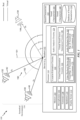
- FIG. 3 depicts a mixed reality scene from a viewpoint of a headset that is operable to combine virtual sound and virtual images into a real-world environment.
- the device 102 is depicted from a user's perspective as a headset having left display screen 302, a right display screen 303, microphones 310, 311, 312, and 313 (e.g., an array of microphones), and loudspeakers 320-323 (e.g., an array of speakers).
- the display screens 302-303 may collectively correspond to the display screen 112 of FIG. 1
- the microphones 310-313 may correspond to the microphones 106 of FIG. 1
- the loudspeakers 320-323 may correspond to the speakers 110 of FIG. 1 .
- the device 102 is in an environment that includes a first tree 340 that is closer to the device 102 than a second tree 342.
- the environment also includes a first sound source 330 and a second sound source 332.
- the device 102 may be configured to provide one or more of a virtual reality experience, a mixed reality experience, or a mixed reality experience to the wearer of the device 102.
- the left display screen 302 may display a left scene for the user's left eye and the right display screen 303 may display a right scene for the user's right eye to enable stereo vision.
- the display screens 302 and 303 are opaque and generate representations of the visual scene (e.g., including an image 350 of the first sound source 330 and an image 352 of the second sound source 332) with one or more embedded virtual objects (e.g., a virtual source 354).
- the displays 302 and 303 overlay the one or more embedded virtual objects onto the visual scene.
- the device 102 may include a single display rather than the two displays 302-303 that may provide three-dimensional (3D) viewing or that may provide two-dimensional (2D) viewing.
- the device 102 may be configured to augment the visual environment with virtual objects, augment the acoustical environment with virtual sounds, or a combination thereof.
- the device 102 may generate a virtual sound to be perceived by the user as originating at a real-world sound source.
- the device 102 may determine that the second tree 342 is to be used as a source of a virtual sound (e.g., a singing tree in a gaming application).
- the second tree 342 may be selected based on the user, such as via identifying the user pointing, tracking user eye movement or gaze, or speech recognition of the user (e.g., identifying the second tree 342).
- the device 102 may determine (e.g., via a depth map) that a distance to the second tree 342 is relatively closer to the first distance 340 than to the second distance 342 (or that the second tree 342 is in a same zone as the first sound source 330 and in a different zone from the second sound source 332, such as described in FIG. 2 ).
- the device 102 may select a sound characteristic of the virtual sound (e.g., the voice of the singing tree) based on the first sound characteristic of the first sound from the first sound source 330.
- a user of the device 102 may position a sound source (e.g., a loudspeaker) at or near the second tree 342.
- the device 102 may determine a first sound characteristic based on an audio signal that is received from the sound source (e.g., via a user initiated playback of a selected audio signal).
- the device 102 may use the first sound characteristic as a sound characteristic of the virtual sound (e.g., the voice of the singing tree).
- the device 102 may generate a virtual sound source to be displayed to the user as a source of a real-world sound.
- a third sound source 334 may be partially or completely hidden, obscured, or otherwise difficult to visually perceive.
- the device 102 may detect an audio signal from the third sound source 334 and may estimate a location of the third sound source 334 based on one or more characteristics of the detected sound. After estimating the location of the third sound source 334, the device 102 may add a virtual sound source 354 onto the display screens 302-303 to enable a user to visually discern a source of the sound.
- the device 102 may estimate the location of the third sound source 334 at least partially by comparing one or more sound characteristics of the detected audio signal to sound characteristics of other audio signals of the acoustical environment, such as audio signals from the first sound source 330 and from the second sound source 332 having characteristics stored in the database 116 of FIG. 1 .
- a distance from the device 102 to the third sound source 334 may be estimated based on the comparison and based on the distances 340 and 342 (e.g., a distance to the third sound source 334 may be estimated using a distance to, or a zone region that includes, a sound source based on a similarity with the sound characteristics of the detected sound).
- a direction of arrival may be estimated by the device 102, such as via phase differences of the audio signal at different microphones 310-313 of the device 102.
- the device 102 may estimate the location of the third sound source 334 at least partially by comparing one or more sound characteristics of the detected audio signal to sound characteristics of played back audio signals. For example, the device 102 may determine or may store in the database 116 sound characteristics based on one or more audio signals that are received from one or more sound sources (e.g., via a user initiated playback of a selected audio signal from a loudspeaker at one or more locations in the scene).
- the device 102 may generate a virtual sound and a virtual sound source to be displayed to the user as a source of the virtual sound.
- the device 102 may augment the acoustical and visual environment by adding the third sound source 334 as a virtual sound source and adding a virtual sound from the third sound source 334.
- the device 102 may select the location of the third sound source 334 (e.g., based on a gameplay scenario) and may display a visual representation of the virtual sound source 354 at an appropriate location in the displays 302-303 to appear as if the third sound source 334 were in the real-world visual scene.
- the device 102 may select one or more sound characteristics of the virtual sound from the virtual sound source 334 using one or more of the implementations described above (e.g., based on audio signals from one or more similarly-located real-world sound sources).
- FIG. 4A depicts a first scene 400 and a second scene 420.
- the first scene 400 is a visual depiction of an environment without mixed reality processing, as seen through a display screen 404 of a headset 402.
- the second scene 420 is a visual depiction of the environment with mixed reality processing, as seen through the display screen 404 of the headset 402.
- the headset 402 may correspond to the device 102 of FIG. 1 .
- the headset 402 may include similar components as the device 102 and may operate in a substantially similar manner as the device 102.
- the headset 402 includes one or more display screens 404 and one or more microphones 406.
- the one or more display screens 404 may correspond to the display screen 112 of FIG. 1 , the display screens 302, 303 of FIG. 3 , or a combination thereof.
- the one or more microphones 406 may correspond to the one or more microphones 106 of FIG. 1 .
- the one or more microphones 406 may detect sounds in the scenes 400, 420.
- the one or more microphones 406 may detect a bird sound 410 (e.g., chirping), a human voice sound 412 (e.g., talking), and a monkey sound 414.
- the location of a sound source of the bird sound 410 is determined using the audio analysis techniques described with respect to FIG. 1 .
- a processor within the headset 402 may identify the bird sound 410 and determine that the bird sound 410 is coming from a location towards the upper-left portion of the first scene 400.
- the location of a sound source of the human voice sound 412 may be determined using the audio analysis techniques described with respect to FIG. 1 .
- the processor within the headset 402 may identify the human voice sound 412 and determine that the human voice sound 412 is coming from a location towards the center of the first scene 400.
- the location of a sound source of the monkey sound may be determined using the audio analysis techniques described with respect to FIG. 1 .
- the processor within the headset 402 may identify the monkey sound 414 and determine that the monkey sound 414 is coming from a location towards the upper-right portion of the first scene 400.
- the sounds 410, 412, 414 are detectable by the one or more microphones 406, the sound sources may not be visible to a camera of the headset 402.
- the bird making the bird sound 410 may be hidden from the camera by leaves in a tree
- the human making the human voice sound 412 may be hidden from the camera by fog
- the monkey making the monkey sound 414 may be hidden from the camera by leaves in another tree.
- the headset 402 may apply the mixed reality processing techniques of FIG. 1 to the first scene 400 to generate the second scene 420.
- the processor may operate is a substantially similar manner as the virtual sound source generation circuitry 128 of FIG. 1 and insert a virtual bird 430 where the bird sound 410 is generated.
- the processor may insert a virtual human 432 where the human voice sound 412 is generated and may insert a virtual monkey 434 where the monkey sound 414 is generated.
- the virtual bird 430, the virtual human 432, and the virtual monkey 434 may be displayed at the second scene 420 through the one or more display screens 404 using the mixed reality processing techniques described with respect to FIG. 1 .
- virtual objects 430, 432, 434 may be inserted into a scene using mixed reality processing techniques to improve user experience. For example, if a user can hear sounds, but cannot see sound sources related to the sounds, the headset 402 may insert virtual sources (visible through the one or more display screens 404) at locations proximate to where the sounds are generated to improve a user experience.
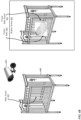
- FIG. 4B depicts a scene that is captured by a device 452 (e.g., a security camera).
- the device 452 may capture a visual depiction of the scene.
- the device 452 may correspond to (or be included in) the device 102 of FIG. 1 .
- the device 452 may include similar components as the device 102 and may operate in a substantially similar manner as the device 102.
- the scene captured by the device 452 may include a crib 448.
- the device 452 includes a plurality of microphones (not shown) configured to detect an audio signal.
- the one or more microphones may detect a baby sound 450.
- a processor within the device 452 is configured to determine a location of a sound source of the audio signal.
- the processor within the device 452 may determine a location of a sound source of the audio signal.
- the processor may determine a sound characteristic of the baby sound 450.
- the sound characteristic includes a reverberation characteristic, corresponding to a direct-to-reverberation ratio (DRR). Based on the sound characteristic, the processor may determine a distance of the sound source from the device 452.
- DRR direct-to-reverberation ratio
- the processor may determine whether the sound source is located in a first zone (e.g., a near-field zone) or located in a second zone (e.g., a far-field zone).
- the processor may also estimate a direction-of-arrival of the baby sound 450.
- the location of the sound source is based on the direction-of-arrival and a zone associated with the sound source.
- the direction-of-arrival indicates the direction of the sound source from the one or more microphones, and the zone associated with the sound source indicates how far away the sound source is from the one or more microphones.
- the device 452 may estimate one or more acoustical characteristics of the environment based on the baby sound.
- the device may generate a virtual sound based on the one or more acoustical characteristics.
- the device 452 may generate a virtual baby sound 462 that has one or more audio properties of a sound generate from the location of the sound source.
- the processor may output a sound signal at a remote location based on the virtual baby sound 462.
- a display screen 490 may be located at a different location than the device 452 (e.g., the security camera).
- the device 452 may be located in one room of a house, and the display screen 490 may be located in another room of the house.
- the device 490 may output the virtual baby sound 462 at one or more speakers located in the room of the house that includes the display screen 490.
- the device 452 may be configured to classify the sound source as a particular object based on the audio signal. For example, the device 452 may classify the sound source of the baby sound 450 as a baby.
- the device 452 may generate a virtual image of the particular object.
- the device 452 may generate a virtual baby 460.
- the device 452 may also insert the virtual image into a visual depiction of the environment. To illustrate, the device 452 may insert the virtual baby 460 into the visual depiction at the display screen 490.
- the virtual baby may be located at a particular position in the visual depiction that corresponds to the location of the sound source. For example, the virtual baby 460 may be located in the crib 448 (e.g., where the baby sound 450 is generated).
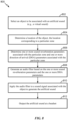
- FIG. 6 a flowchart illustrating a method 600 of augmenting a representation of an acoustical environment is depicted.
- the method 600 may be performed at a device that includes a microphone and a processor, such as the device 102 of FIG. 1 .
- An audio signal is detected at a microphone, at 602.
- the audio signal may correspond to the audio signal 140 or 142 of FIG. 1 detected at the microphone(s) 106 of the device 102.
- a sound characteristic of the audio signal is determined at a processor, at 604.
- the processor 114 of FIG. 1 may determine the first sound characteristic 164 based on the audio signal 140.
- a virtual sound is generated based on the sound characteristic of the audio signal, at 606, and the virtual sound is inserted into the representation of the acoustical environment for playback at the audio playback device, at 608.
- the virtual sound generation circuitry 126 of FIG. 1 may generate data that represents the virtual sound and that is added to the representation 172 of the acoustical environment for playback at the audio playback device 162. Inserting the virtual sound into the representation of the acoustical environment may include outputting the virtual sound at one or more loudspeakers (e.g., earphones) of an augmented-, virtual-, or mixed-reality headset.
- loudspeakers e.g., earphones
- the sound characteristic may include at least one reverberation characteristic of the audio signal.
- the at least one reverberation characteristic may include a direct-to-reverberation ratio of the audio signal.
- One or more reverberation characteristics of the virtual sound may be determined based on the at least one reverberation characteristic of the audio signal, and a direction-of-arrival of the virtual sound may be estimated based on a location of a virtual sound source associated with the virtual sound.
- the virtual sound may be generated based on the one or more reverberation characteristics and the direction-of-arrival.
- the method 600 may include determining, based on the sound characteristic, whether a sound source of the audio signal is located in a first zone of the acoustical environment or a second zone of the acoustical environment.
- the first zone e.g., the first zone 202 of FIG. 2
- the second zone e.g., the second zone 204 of FIG. 2
- a determination may be made as to whether a virtual sound source associated with the virtual sound is located in the first zone or the second zone.
- One or more characteristics of the virtual sound may be based on a location of the sound source and a location of the virtual sound source.
- a characteristic of the virtual sound may be substantially similar to the sound characteristic of the audio signal if the sound source is located in the first zone and the virtual sound source is located in the first zone, and the characteristic of the virtual sound may be different from the sound characteristic of the audio signal if the sound source is located in the first zone and the virtual sound source is located in the second zone.
- a characteristic of the virtual sound may be substantially similar to the sound characteristic of the audio signal if the sound source is located in the second zone and the virtual sound source is located in the second zone, and the characteristic of the virtual sound may be different from the sound characteristic of the audio signal if the sound source is located in the second zone and the virtual sound source is located in the first zone.
- the audio signal may be generated based on user-initiated playback of an audio device.
- the audio signal may be generated using a loudspeaker or other sound generator that is placed in the acoustical environment at or near a location of a virtual sound source of the virtual sound.
- the audio signal may be captured by the microphone(s) and processed to determine sound characteristics (e.g., direction of arrival, reverberation characteristics, etc.) that correspond to the location and that can be applied to a virtual sound for enhanced realism. For example, differences between the audio signal captured at the microphone(s) and the audio signal played out the loudspeaker may be identified and used to determine a transfer characteristic of sound from the location to the microphone(s).
- the audio signal may be generated without user-initiated playback of an audio device.
- the audio signal may be generated by a sound-producing element in the acoustical environment at or near a location of a virtual sound source of the virtual sound.
- One or more audio signals may be detected in sound captured by the microphone(s), and a location of one or more sources of the audio signals may be estimated.
- a sound characteristic of an audio signal from a source that is proximate to, or co-located with, a location of the source of the virtual sound may be used to generate the sound characteristic of the virtual sound.
- the audio playback device is incorporated in a headset that is configured to generate at least one of a virtual reality scene, an augmented reality scene, or a mixed reality scene, such as described with reference to FIG. 3 .
- a visual representation of the acoustical environment may be captured using one or more cameras and displayed at the headset, and a virtual sound source that is associated with the virtual sound may be inserted into the visual representation.
- the audio playback device may not be implemented in a headset with a visual display and may instead be incorporated in another device (e.g., a mobile phone or music player device).
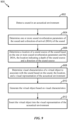
- FIG. 7 a flowchart illustrating a method 700 of augmenting a representation of an acoustical environment is depicted.
- the method 700 may be performed at a device that includes a microphone and a processor, such as the device 102 of FIG. 1 .
- implementations of the method of FIG. 7 may determine a characteristic of virtual sound that is not based on a sound characteristic of a received audio signal.
- a visual scene is captured using one or more cameras, at 702.
- the one or more cameras are proximate to an audio capture device.
- the audio capture device may be incorporated in a headset that is configured to generate at least one of a virtual reality scene, an augmented reality scene, or a mixed reality scene.
- a location of a virtual sound source in the visual scene is determined, at 704.
- the location indicates a distance of the virtual sound source from the one or more cameras and an angular location of the virtual sound source with respect to the one or more cameras.
- One or more sound characteristics of the virtual sound are determined based on the location of the virtual sound source, at 706.
- the one or more sound characteristics may include at least one reverberation characteristic of the virtual sound.
- the one or more characteristics of the virtual sound are further based on a characteristic of the acoustical environment. For example, a characteristic of the acoustical environment may be determined. The characteristic of the acoustical environment may indicate whether the acoustical environment is an indoor environment or an outdoor environment.
- the location of the virtual sound source may be compared to location information in a database that associates sound characteristics with location information, and the one or more sound characteristics of the virtual sound may be determined based on the comparison.
- the virtual sound is generated based on the one or more sound characteristics, at 708, and the virtual sound is inserted into the representation of the acoustical environment for playback at the audio playback device, at 710.
- the method 700 may include inserting the virtual sound source into the representation of the visual scene and displaying the representation of the visual scene. Inserting the virtual sound may include outputting a sound signal corresponding to the virtual sound at one or more loudspeakers of the headset.
- FIG. 8 depicts an example of a method 800 of generating a virtual audio signal.
- the method 800 may be performed at a device that includes an audio playback device, such as the device 102 of FIG. 1 .
- FIG. 9 depicts an example of a method 900 of generating a virtual object in a real-world environment.
- the method 900 may be performed at a device that includes a video playback device, such as the device 102 of FIG. 1 .
- the method 1000 also includes projecting the spatially-filtered audio signal at the speaker as a spatially-filtered sound, at 1010.
- the one or more speakers 110 may project the spatially-filtered audio signal as spatially-filtered sound.
- the spatially-filtered sound may include the virtual sound 144.
- the virtual sound 144 includes a computer-generated sound.
- the method 1100 includes determining one or more acoustical characteristics at one or more locations of an environment, at 1102.
- the loudspeaker 502 is configured to be worn at the user's hand and may generate audio signals at different locations of the environment.
- the user may move his hand and the loudspeaker 502 may generate audio signals where the user's hand is located.
- the headset of the user may include one or more microphones configured to detect the audio signals projected by the loudspeaker. Based on the detected audio signals, the headset may determine one or more acoustical characteristics at different locations of the environment.
- the method 1100 also includes inserting a virtual sound associated with the particular object into the environment, at 1110.
- the virtual sound has the one or more audio properties.
- the headset may generate a virtual piano sound that includes the audio properties of the sound generated by the loudspeaker 502 when the loudspeaker was approximately two feet in front of the user's face.
- the headset may compare the one or more acoustical characteristics to one or more entries in a memory. Each entry may be associated with a different sound.
- the headset may retrieve the virtual sound from a particular entry based on the comparison prior to insertion of the virtual sound into the environment. After the virtual sound is generated (or retrieved from memory), the headset may insert the virtual sound (e.g., a piano sound) into the environment.
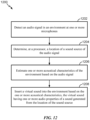
- FIG. 12 depicts an example of a method 1200 of generating virtual sound.
- the method 1200 may be performed at a device that includes an audio playback device, such as the device 102 of FIG. 1 .
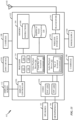
- the device 102 includes the memory 104 coupled to the processor 114. Additionally, the database of sound characteristics 116 may be coupled to (e.g., accessible by) the processor 114.
- the device 102 also includes a wireless interface 1340 coupled to an antenna 1342 via transceiver 1341.
- the device 102 may include the display screen 112 coupled to a display controller 1326.
- the one or more speakers 110, the one or more microphones 106, or both may be coupled to a coder/decoder (CODEC) 1334.
- the CODEC 1334 may include a digital-to-analog converter (DAC) 1302 and an analog-to-digital converter (ADC) 1304.
- DAC digital-to-analog converter
- ADC analog-to-digital converter
- the CODEC 1334 may receive analog signals from the one or more microphones 106 and convert the analog signals to digital signals using the analog-to-digital converter 1304.
- the CODEC 1334 may receive digital signals from the processor 114 and the CODEC 1334 may convert the digital signals to analog signals using the digital-to-analog converter 1302 and may provide the analog signals to the one or more speakers 110.
- the display screen 112 the input device 1330, the one or more speaker 110, the one or more microphones 106, the antenna 1342, the one or more cameras 108, and the power supply 1344 are external to the system-on-chip device 1322.
- each of the display screen 1328, the one or more cameras 108, the input device 1330, the one or more speakers 110, the one or more microphones 106, the antenna 1342, and the power supply 1344 can be coupled to a component of the system-on-chip device 1322, such as an interface or a controller.
- the first apparatus may also include means for inserting a virtual sound into the environment based on the one or more acoustical characteristics.
- the virtual sound may have one or more audio properties of a sound generate from the location of the sound source.
- the means for inserting the virtual sound into the environment may include the virtual sound generation circuitry 126 of FIGS. 1 and 13 , the processor of FIGS. 1 and 13 , one or more other devices, or a combination thereof.
- the second apparatus may also include means for determining one or more audio properties of a sound generated from the particular location based on the one or more acoustical characteristics.
- the means for determining the one or more audio properties may include the audio analysis circuitry 124 of FIGS. 1 and 13 , the processor of FIGS. 1 and 13 , one or more other devices, or a combination thereof.
- the second apparatus may also include means for detecting the particular location, generating the user indication of the particular location, and sending the user indication of the particular location to the means for receiving the user indication.
- the means for detecting, generating, and sending may include a wearable sensor, one or more other devices, or a combination thereof.
- a third apparatus to augment a representation of an acoustical environment includes means for detecting an audio signal.
- the means for detecting may include the one or more microphones 106 of FIGS. 1 and 13 , one or more other sensors, or a combination thereof.
- the fourth apparatus may also include means for outputting a sound signal based on the virtual sound.
- the means for outputting may include the one or more speakers 110 of FIGS. 1 and 13 , one or more other sensors, or a combination thereof.
- a fifth apparatus includes means for detecting a first audio signal.
- the first audio signal may be generated by a sound source in an acoustical environment.
- the means for detecting may include the one or more microphones 106 of FIGS. 1 and 13 , one or more other sensors, or a combination thereof.
- the fifth apparatus may also include means for determining a characteristic of the first audio signal.
- the means for determining the characteristic may include the audio analysis circuitry 124 of FIGS. 1 and 13 , the processor 114 of FIGS. 1 and 13 , one or more other devices, a processor executing instructions at a non-transitory computer readable storage medium, or a combination thereof.
- the fifth apparatus may also include means for spatially filtering a digital representation of a second audio signal based on the characteristic to generate a spatially-filtered audio file.
- the means for spatially filtering may include the virtual sound generation circuitry 126 of FIGS. 1 and 13 , the processor 114 of FIGS. 1 and 13 , one or more other devices, a processor executing instructions at a non-transitory computer readable storage medium, or a combination thereof.
- the fifth apparatus may also include means for projecting spatially-filtered sound.
- the spatially-filtered sound may be based on a spatially-filtered audio signal sent to the means for projecting, and the spatially-filtered audio signal may be based on the spatially-filtered audio file.
- the means for projecting may include the one or more speakers 110 of FIGS. 1 and 13 , one or more other sound output devices, or a combination thereof.
- a software module may reside in a memory device, such as random access memory (RAM), magnetoresistive random access memory (MRAM), spin-torque transfer MRAM (STT-MRAM), flash memory, read-only memory (ROM), programmable read-only memory (PROM), erasable programmable read-only memory (EPROM), electrically erasable programmable read-only memory (EEPROM), registers, hard disk, a removable disk, or a compact disc read-only memory (CD-ROM).
- RAM random access memory
- MRAM magnetoresistive random access memory
- STT-MRAM spin-torque transfer MRAM
- ROM read-only memory
- PROM programmable read-only memory
- EPROM erasable programmable read-only memory
- EEPROM electrically erasable programmable read-only memory
- registers hard disk, a removable disk, or a compact disc read-only memory (CD-ROM).
- An exemplary memory device is coupled to the processor such that the processor can read information from, and write information to, the memory device.
- the memory device may be integral to the processor.
- the processor and the storage medium may reside in an ASIC.
- the ASIC may reside in a computing device or a user terminal.
- the processor and the storage medium may reside as discrete components in a computing device or a user terminal.
Landscapes
- Engineering & Computer Science (AREA)
- Physics & Mathematics (AREA)
- Theoretical Computer Science (AREA)
- General Engineering & Computer Science (AREA)
- Signal Processing (AREA)
- Acoustics & Sound (AREA)
- General Physics & Mathematics (AREA)
- Human Computer Interaction (AREA)
- Multimedia (AREA)
- General Health & Medical Sciences (AREA)
- Audiology, Speech & Language Pathology (AREA)
- Health & Medical Sciences (AREA)
- Stereophonic System (AREA)
- Circuit For Audible Band Transducer (AREA)
- Optics & Photonics (AREA)
- Computer Graphics (AREA)
- Computer Hardware Design (AREA)
- Software Systems (AREA)
- Soundproofing, Sound Blocking, And Sound Damping (AREA)
Applications Claiming Priority (3)
| Application Number | Priority Date | Filing Date | Title |
|---|---|---|---|
| US201662363104P | 2016-07-15 | 2016-07-15 | |
| US15/238,591 US9906885B2 (en) | 2016-07-15 | 2016-08-16 | Methods and systems for inserting virtual sounds into an environment |
| PCT/US2017/034522 WO2018013237A1 (en) | 2016-07-15 | 2017-05-25 | Virtual, augmented, and mixed reality |
Publications (3)
| Publication Number | Publication Date |
|---|---|
| EP3485346A1 EP3485346A1 (en) | 2019-05-22 |
| EP3485346C0 EP3485346C0 (en) | 2025-02-26 |
| EP3485346B1 true EP3485346B1 (en) | 2025-02-26 |
Family
ID=60940808
Family Applications (1)
| Application Number | Title | Priority Date | Filing Date |
|---|---|---|---|
| EP17729614.2A Active EP3485346B1 (en) | 2016-07-15 | 2017-05-25 | Virtual, augmented, and mixed reality |
Country Status (9)
| Country | Link |
|---|---|
| US (1) | US9906885B2 (enExample) |
| EP (1) | EP3485346B1 (enExample) |
| JP (1) | JP2019527956A (enExample) |
| KR (1) | KR102609668B1 (enExample) |
| CN (1) | CN109416585B (enExample) |
| BR (1) | BR112019000398A8 (enExample) |
| SG (1) | SG11201810874YA (enExample) |
| TW (1) | TW201804315A (enExample) |
| WO (1) | WO2018013237A1 (enExample) |
Families Citing this family (78)
| Publication number | Priority date | Publication date | Assignee | Title |
|---|---|---|---|---|
| US10547947B2 (en) | 2016-05-18 | 2020-01-28 | Qualcomm Incorporated | Device for generating audio output |
| US10445936B1 (en) * | 2016-08-01 | 2019-10-15 | Snap Inc. | Audio responsive augmented reality |
| US10896544B2 (en) * | 2016-10-07 | 2021-01-19 | Htc Corporation | System and method for providing simulated environment |
| KR20180090022A (ko) * | 2017-02-02 | 2018-08-10 | 한국전자통신연구원 | 다중 전방향 카메라 및 마이크 기반 가상현실 제공 방법 및 가상 현실 제공 방법을 수행하는 음향 신호 처리 장치 및 영상 신호 처리 장치 |
| WO2018155026A1 (ja) * | 2017-02-27 | 2018-08-30 | ソニー株式会社 | 情報処理装置、情報処理方法、及びプログラム |
| US11361771B2 (en) * | 2017-09-22 | 2022-06-14 | Lg Electronics Inc. | Method for transmitting/receiving audio data and device therefor |
| IL297445B2 (en) | 2017-10-17 | 2024-03-01 | Magic Leap Inc | Mixed reality spatial audio |
| US10531222B2 (en) * | 2017-10-18 | 2020-01-07 | Dolby Laboratories Licensing Corporation | Active acoustics control for near- and far-field sounds |
| US10410432B2 (en) * | 2017-10-27 | 2019-09-10 | International Business Machines Corporation | Incorporating external sounds in a virtual reality environment |
| CN109992089B (zh) * | 2017-12-29 | 2024-08-27 | 索尼公司 | 电子设备、无线通信系统、方法和计算机可读存储介质 |
| US10500496B2 (en) | 2018-01-12 | 2019-12-10 | International Business Machines Corporation | Physical obstacle avoidance in a virtual reality environment |
| US20190221035A1 (en) * | 2018-01-12 | 2019-07-18 | International Business Machines Corporation | Physical obstacle avoidance in a virtual reality environment |
| US11212636B2 (en) * | 2018-02-15 | 2021-12-28 | Magic Leap, Inc. | Dual listener positions for mixed reality |
| US11477510B2 (en) | 2018-02-15 | 2022-10-18 | Magic Leap, Inc. | Mixed reality virtual reverberation |
| US11617050B2 (en) | 2018-04-04 | 2023-03-28 | Bose Corporation | Systems and methods for sound source virtualization |
| US10585641B2 (en) | 2018-04-30 | 2020-03-10 | Qualcomm Incorporated | Tagging a sound in a virtual environment |
| CN118450313A (zh) | 2018-05-03 | 2024-08-06 | 苹果公司 | 用于合成现实布景的声音处理的方法和设备 |
| US11450071B2 (en) * | 2018-05-23 | 2022-09-20 | Koninklijke Kpn N.V. | Adapting acoustic rendering to image-based object |
| WO2019225192A1 (ja) * | 2018-05-24 | 2019-11-28 | ソニー株式会社 | 情報処理装置及び情報処理方法 |
| US11032664B2 (en) * | 2018-05-29 | 2021-06-08 | Staton Techiya, Llc | Location based audio signal message processing |
| US10497161B1 (en) | 2018-06-08 | 2019-12-03 | Curious Company, LLC | Information display by overlay on an object |
| JP7478100B2 (ja) | 2018-06-14 | 2024-05-02 | マジック リープ, インコーポレイテッド | 反響利得正規化 |
| CN116156411A (zh) | 2018-06-18 | 2023-05-23 | 奇跃公司 | 用于交互式音频环境的空间音频 |
| EP3584695B1 (en) * | 2018-06-20 | 2022-08-10 | Nokia Technologies Oy | An apparatus and associated methods for presentation of first and second virtual-or-augmented reality content |
| EP3595336A1 (en) * | 2018-07-09 | 2020-01-15 | Koninklijke Philips N.V. | Audio apparatus and method of operation therefor |
| US10902678B2 (en) | 2018-09-06 | 2021-01-26 | Curious Company, LLC | Display of hidden information |
| CN113039815B (zh) * | 2018-11-09 | 2022-11-11 | 候本株式会社 | 声音生成方法及执行其的装置 |
| US11055913B2 (en) | 2018-12-04 | 2021-07-06 | Curious Company, LLC | Directional instructions in an hybrid reality system |
| US10970935B2 (en) | 2018-12-21 | 2021-04-06 | Curious Company, LLC | Body pose message system |
| JP7631198B2 (ja) | 2018-12-24 | 2025-02-18 | ディーティーエス・インコーポレイテッド | 深層学習画像解析を用いた室内音響シミュレーション |
| US10872584B2 (en) | 2019-03-14 | 2020-12-22 | Curious Company, LLC | Providing positional information using beacon devices |
| US10674307B1 (en) * | 2019-03-27 | 2020-06-02 | Facebook Technologies, Llc | Determination of acoustic parameters for a headset using a mapping server |
| EP3935474A4 (en) | 2019-04-05 | 2022-10-12 | Hewlett-Packard Development Company, L.P. | MODIFICATION OF AUDIO SIGNALS BASED ON PHYSIOLOGICAL OBSERVATIONS |
| GB2582952B (en) * | 2019-04-10 | 2022-06-15 | Sony Interactive Entertainment Inc | Audio contribution identification system and method |
| CN116828383A (zh) * | 2019-05-15 | 2023-09-29 | 苹果公司 | 音频处理 |
| US11295754B2 (en) * | 2019-07-30 | 2022-04-05 | Apple Inc. | Audio bandwidth reduction |
| CN110716641B (zh) * | 2019-08-28 | 2021-07-23 | 北京市商汤科技开发有限公司 | 交互方法、装置、设备以及存储介质 |
| US11276215B1 (en) | 2019-08-28 | 2022-03-15 | Facebook Technologies, Llc | Spatial audio and avatar control using captured audio signals |
| TWI727421B (zh) * | 2019-09-16 | 2021-05-11 | 藏識科技有限公司 | 混合實境系統 |
| US20210097727A1 (en) * | 2019-09-27 | 2021-04-01 | Audio Analytic Ltd | Computer apparatus and method implementing sound detection and responses thereto |
| US11340756B2 (en) | 2019-09-27 | 2022-05-24 | Apple Inc. | Devices, methods, and graphical user interfaces for interacting with three-dimensional environments |
| JP7446420B2 (ja) | 2019-10-25 | 2024-03-08 | マジック リープ, インコーポレイテッド | 反響フィンガプリント推定 |
| WO2021086624A1 (en) | 2019-10-29 | 2021-05-06 | Qsinx Management Llc | Audio encoding with compressed ambience |
| EP4070284A4 (en) | 2019-12-06 | 2023-05-24 | Magic Leap, Inc. | Environment acoustics persistence |
| TWI722738B (zh) | 2019-12-25 | 2021-03-21 | 亞達科技股份有限公司 | 擴增實境裝置與定位方法 |
| EP3859516B1 (en) * | 2020-02-03 | 2025-07-23 | Nokia Technologies Oy | Virtual scene |
| CN115398936A (zh) * | 2020-02-14 | 2022-11-25 | 奇跃公司 | 多应用音频渲染 |
| KR102334091B1 (ko) | 2020-03-20 | 2021-12-02 | 주식회사 코클리어닷에이아이 | 오디오 인식을 수행하는 증강현실 디바이스 및 그의 제어방법 |
| KR20210123198A (ko) | 2020-04-02 | 2021-10-13 | 주식회사 제이렙 | 증강 현실 기반의 전기 음향과 건축 음향 통합 시뮬레이션 장치 |
| CN115605912A (zh) * | 2020-05-19 | 2023-01-13 | 索尼集团公司(Jp) | 信息处理装置和信息处理方法 |
| US11246002B1 (en) | 2020-05-22 | 2022-02-08 | Facebook Technologies, Llc | Determination of composite acoustic parameter value for presentation of audio content |
| CN111672126B (zh) * | 2020-05-29 | 2023-02-10 | 腾讯科技(深圳)有限公司 | 信息显示方法、装置、设备及存储介质 |
| CN111641898B (zh) * | 2020-06-08 | 2021-12-03 | 京东方科技集团股份有限公司 | 发声装置、显示装置、发声控制方法及装置 |
| US11356795B2 (en) | 2020-06-17 | 2022-06-07 | Bose Corporation | Spatialized audio relative to a peripheral device |
| US11275629B2 (en) * | 2020-06-25 | 2022-03-15 | Microsoft Technology Licensing, Llc | Mixed reality complementary systems |
| US11755275B2 (en) * | 2020-06-29 | 2023-09-12 | Meta Platforms Technologies, Llc | Generating augmented reality experiences utilizing physical objects to represent analogous virtual objects |
| CN112071326B (zh) * | 2020-09-07 | 2024-11-22 | 三星电子(中国)研发中心 | 音效处理方法和装置 |
| US11982738B2 (en) | 2020-09-16 | 2024-05-14 | Bose Corporation | Methods and systems for determining position and orientation of a device using acoustic beacons |
| US11567625B2 (en) | 2020-09-24 | 2023-01-31 | Apple Inc. | Devices, methods, and graphical user interfaces for interacting with three-dimensional environments |
| US11615596B2 (en) * | 2020-09-24 | 2023-03-28 | Apple Inc. | Devices, methods, and graphical user interfaces for interacting with three-dimensional environments |
| US11700497B2 (en) | 2020-10-30 | 2023-07-11 | Bose Corporation | Systems and methods for providing augmented audio |
| US11696084B2 (en) | 2020-10-30 | 2023-07-04 | Bose Corporation | Systems and methods for providing augmented audio |
| US11496852B2 (en) * | 2020-12-03 | 2022-11-08 | Snap Inc. | Head-related transfer function |
| CN114693890B (zh) * | 2020-12-31 | 2024-09-10 | 华为技术有限公司 | 一种增强现实交互方法及电子设备 |
| US12094487B2 (en) * | 2021-09-21 | 2024-09-17 | Meta Platforms Technologies, Llc | Audio system for spatializing virtual sound sources |
| US11856378B2 (en) * | 2021-11-26 | 2023-12-26 | Htc Corporation | System with sound adjustment capability, method of adjusting sound and non-transitory computer readable storage medium |
| US11975264B2 (en) * | 2022-05-31 | 2024-05-07 | Sony Interactive Entertainment LLC | Gaze-based coordination of virtual effects indicators |
| GB2619541A (en) * | 2022-06-09 | 2023-12-13 | Sony Interactive Entertainment Inc | Audio processing system and method |
| WO2023245001A1 (en) | 2022-06-13 | 2023-12-21 | Bose Corporation | Systems and methods for providing augmented audio |
| WO2024063353A1 (ko) * | 2022-09-23 | 2024-03-28 | 삼성전자주식회사 | 시각적 객체와 관련된 정보에 기반하여 오디오 신호를 변경하는 전자 장치 및 그 방법 |
| EP4614308A4 (en) * | 2022-11-09 | 2026-03-11 | Samsung Electronics Co Ltd | A wearable device for recording audio signals and associated method |
| US12315363B2 (en) | 2022-12-09 | 2025-05-27 | Meta Platforms Technologies, Llc | Directional warnings in co-located play in virtual reality environments |
| CN115988381A (zh) * | 2022-12-30 | 2023-04-18 | 联想(北京)有限公司 | 定向发声方法及装置、设备 |
| WO2024175623A1 (en) * | 2023-02-22 | 2024-08-29 | Sony Semiconductor Solutions Corporation | Electronic device, method, and computer program |
| US12520096B2 (en) | 2023-03-10 | 2026-01-06 | Bose Corporation | Spatialized audio with dynamic head tracking |
| JP2024131773A (ja) * | 2023-03-16 | 2024-09-30 | キヤノン株式会社 | 信号処理装置、信号処理装置の制御方法、及びプログラム |
| US20240340603A1 (en) * | 2023-04-10 | 2024-10-10 | Meta Platforms Technologies, Llc | Visualization and Customization of Sound Space |
| WO2026095731A1 (ko) * | 2024-11-04 | 2026-05-07 | 삼성전자 주식회사 | 사운드를 생성하는 전자 장치 및 그 동작 방법 |
Family Cites Families (29)
| Publication number | Priority date | Publication date | Assignee | Title |
|---|---|---|---|---|
| FI116990B (fi) * | 1997-10-20 | 2006-04-28 | Nokia Oyj | Menetelmä ja järjestelmä akustisen virtuaaliympäristön käsittelemiseksi |
| AU2002303082A1 (en) * | 2001-01-26 | 2002-09-12 | Zaxel Systems, Inc. | Real-time virtual viewpoint in simulated reality environment |
| JP4708590B2 (ja) | 2001-03-13 | 2011-06-22 | キヤノン株式会社 | 複合現実感システム、ヘッドマウントディスプレイ装置、複合現実感実現方法及びプログラム |
| JP2003334219A (ja) * | 2002-05-21 | 2003-11-25 | Nippon Telegr & Teleph Corp <Ntt> | 遠隔地散策装置 |
| JP2005223714A (ja) * | 2004-02-06 | 2005-08-18 | Sony Corp | 音響収音装置、音響収音方法、記録媒体 |
| EP1749420A4 (en) * | 2004-05-25 | 2008-10-15 | Huonlabs Pty Ltd | AUDIO APPARATUS AND METHOD |
| JP5752414B2 (ja) * | 2007-06-26 | 2015-07-22 | コーニンクレッカ フィリップス エヌ ヴェ | バイノーラル型オブジェクト指向オーディオデコーダ |
| US8170222B2 (en) | 2008-04-18 | 2012-05-01 | Sony Mobile Communications Ab | Augmented reality enhanced audio |
| US8243970B2 (en) | 2008-08-11 | 2012-08-14 | Telefonaktiebolaget L M Ericsson (Publ) | Virtual reality sound for advanced multi-media applications |
| US9037468B2 (en) * | 2008-10-27 | 2015-05-19 | Sony Computer Entertainment Inc. | Sound localization for user in motion |
| KR101285391B1 (ko) * | 2010-07-28 | 2013-07-10 | 주식회사 팬택 | 음향 객체 정보 융합 장치 및 방법 |
| US20120207308A1 (en) | 2011-02-15 | 2012-08-16 | Po-Hsun Sung | Interactive sound playback device |
| US20120239690A1 (en) * | 2011-03-16 | 2012-09-20 | Rovi Technologies Corporation | Utilizing time-localized metadata |
| US9131305B2 (en) * | 2012-01-17 | 2015-09-08 | LI Creative Technologies, Inc. | Configurable three-dimensional sound system |
| US8831255B2 (en) | 2012-03-08 | 2014-09-09 | Disney Enterprises, Inc. | Augmented reality (AR) audio with position and action triggered virtual sound effects |
| KR20160005695A (ko) * | 2013-04-30 | 2016-01-15 | 인텔렉추얼디스커버리 주식회사 | 헤드 마운트 디스플레이 및 이를 이용한 오디오 콘텐츠 제공 방법 |
| US10262462B2 (en) * | 2014-04-18 | 2019-04-16 | Magic Leap, Inc. | Systems and methods for augmented and virtual reality |
| JP6227295B2 (ja) * | 2013-06-25 | 2017-11-08 | 日本放送協会 | 空間音響生成装置およびそのプログラム |
| US9942685B2 (en) | 2013-06-28 | 2018-04-10 | Microsoft Technology Licensing, Llc | Navigation with three dimensional audio effects |
| US9769589B2 (en) | 2013-09-27 | 2017-09-19 | Sony Interactive Entertainment Inc. | Method of improving externalization of virtual surround sound |
| DK2863654T3 (en) * | 2013-10-17 | 2018-10-22 | Oticon As | Method for reproducing an acoustic sound field |
| EP2866217A1 (en) | 2013-10-25 | 2015-04-29 | GN Store Nord A/S | An audio information system based on zones and contexts |
| CN104615243A (zh) * | 2015-01-15 | 2015-05-13 | 深圳市掌网立体时代视讯技术有限公司 | 一种头戴式多通道交互系统及多通道交互方法 |
| CN105353868B (zh) * | 2015-09-24 | 2019-05-31 | 联想(北京)有限公司 | 一种信息处理方法及电子设备 |
| CN105466413A (zh) * | 2015-11-10 | 2016-04-06 | 上海格虏博运动科技有限公司 | 一种基于智能移动平台并结合gps的增强现实实景导航技术 |
| CN105657535B (zh) * | 2015-12-29 | 2018-10-30 | 北京搜狗科技发展有限公司 | 一种音频识别方法和装置 |
| CN105611481B (zh) * | 2015-12-30 | 2018-04-17 | 北京时代拓灵科技有限公司 | 一种基于空间声的人机交互方法和系统 |
| US9881619B2 (en) | 2016-03-25 | 2018-01-30 | Qualcomm Incorporated | Audio processing for an acoustical environment |
| US10547947B2 (en) | 2016-05-18 | 2020-01-28 | Qualcomm Incorporated | Device for generating audio output |
-
2016
- 2016-08-16 US US15/238,591 patent/US9906885B2/en active Active
-
2017
- 2017-05-25 CN CN201780041372.0A patent/CN109416585B/zh active Active
- 2017-05-25 WO PCT/US2017/034522 patent/WO2018013237A1/en not_active Ceased
- 2017-05-25 BR BR112019000398A patent/BR112019000398A8/pt not_active IP Right Cessation
- 2017-05-25 SG SG11201810874YA patent/SG11201810874YA/en unknown
- 2017-05-25 TW TW106117430A patent/TW201804315A/zh unknown
- 2017-05-25 KR KR1020197000816A patent/KR102609668B1/ko active Active
- 2017-05-25 EP EP17729614.2A patent/EP3485346B1/en active Active
- 2017-05-25 JP JP2019501595A patent/JP2019527956A/ja not_active Ceased
Also Published As
| Publication number | Publication date |
|---|---|
| US9906885B2 (en) | 2018-02-27 |
| KR102609668B1 (ko) | 2023-12-04 |
| JP2019527956A (ja) | 2019-10-03 |
| BR112019000398A8 (pt) | 2023-01-31 |
| TW201804315A (zh) | 2018-02-01 |
| KR20190028697A (ko) | 2019-03-19 |
| EP3485346C0 (en) | 2025-02-26 |
| EP3485346A1 (en) | 2019-05-22 |
| BR112019000398A2 (pt) | 2019-04-30 |
| SG11201810874YA (en) | 2019-01-30 |
| CN109416585A (zh) | 2019-03-01 |
| CN109416585B (zh) | 2022-06-21 |
| WO2018013237A1 (en) | 2018-01-18 |
| US20180020312A1 (en) | 2018-01-18 |
Similar Documents
| Publication | Publication Date | Title |
|---|---|---|
| US9906885B2 (en) | Methods and systems for inserting virtual sounds into an environment | |
| JP7839859B2 (ja) | 双方向オーディオ環境のための空間オーディオ | |
| US10911882B2 (en) | Methods and systems for generating spatialized audio | |
| CN112602053B (zh) | 音频装置和音频处理的方法 | |
| CN110121695B (zh) | 虚拟现实领域中的装置及相关联的方法 | |
| CN111459444B (zh) | 在扩展现实应用中将虚拟声源映射到物理扬声器 | |
| JP6055657B2 (ja) | ゲームシステム、ゲーム処理制御方法、ゲーム装置、および、ゲームプログラム | |
| CN108141696B (zh) | 用于空间音频调节的系统和方法 | |
| JP6932206B2 (ja) | 空間オーディオの提示のための装置および関連する方法 | |
| US10798518B2 (en) | Apparatus and associated methods | |
| CN105764581A (zh) | 可变音频参数设置 | |
| US20130208900A1 (en) | Depth camera with integrated three-dimensional audio | |
| US20250170485A1 (en) | Gaming with earpiece 3d audio | |
| JP2020520576A5 (enExample) | ||
| US20210014615A1 (en) | Combined Near-Field and Far-Field Audio Rendering and Playback | |
| KR20210056414A (ko) | 혼합 현실 환경들에서 오디오-가능 접속된 디바이스들을 제어하기 위한 시스템 | |
| HK1261715A1 (en) | Virtual, augmented, and mixed reality | |
| JP2026066827A (ja) | 情報処理装置、情報処理方法、およびプログラム |
Legal Events
| Date | Code | Title | Description |
|---|---|---|---|
| STAA | Information on the status of an ep patent application or granted ep patent |
Free format text: STATUS: UNKNOWN |
|
| STAA | Information on the status of an ep patent application or granted ep patent |
Free format text: STATUS: THE INTERNATIONAL PUBLICATION HAS BEEN MADE |
|
| PUAI | Public reference made under article 153(3) epc to a published international application that has entered the european phase |
Free format text: ORIGINAL CODE: 0009012 |
|
| STAA | Information on the status of an ep patent application or granted ep patent |
Free format text: STATUS: REQUEST FOR EXAMINATION WAS MADE |
|
| 17P | Request for examination filed |
Effective date: 20181211 |
|
| AK | Designated contracting states |
Kind code of ref document: A1 Designated state(s): AL AT BE BG CH CY CZ DE DK EE ES FI FR GB GR HR HU IE IS IT LI LT LU LV MC MK MT NL NO PL PT RO RS SE SI SK SM TR |
|
| AX | Request for extension of the european patent |
Extension state: BA ME |
|
| DAV | Request for validation of the european patent (deleted) | ||
| DAX | Request for extension of the european patent (deleted) | ||
| STAA | Information on the status of an ep patent application or granted ep patent |
Free format text: STATUS: EXAMINATION IS IN PROGRESS |
|
| 17Q | First examination report despatched |
Effective date: 20201006 |
|
| GRAP | Despatch of communication of intention to grant a patent |
Free format text: ORIGINAL CODE: EPIDOSNIGR1 |
|
| STAA | Information on the status of an ep patent application or granted ep patent |
Free format text: STATUS: GRANT OF PATENT IS INTENDED |
|
| INTG | Intention to grant announced |
Effective date: 20241001 |
|
| GRAS | Grant fee paid |
Free format text: ORIGINAL CODE: EPIDOSNIGR3 |
|
| GRAA | (expected) grant |
Free format text: ORIGINAL CODE: 0009210 |
|
| STAA | Information on the status of an ep patent application or granted ep patent |
Free format text: STATUS: THE PATENT HAS BEEN GRANTED |
|
| AK | Designated contracting states |
Kind code of ref document: B1 Designated state(s): AL AT BE BG CH CY CZ DE DK EE ES FI FR GB GR HR HU IE IS IT LI LT LU LV MC MK MT NL NO PL PT RO RS SE SI SK SM TR |
|
| REG | Reference to a national code |
Ref country code: GB Ref legal event code: FG4D |
|
| REG | Reference to a national code |
Ref country code: CH Ref legal event code: EP |
|
| REG | Reference to a national code |
Ref country code: DE Ref legal event code: R096 Ref document number: 602017088002 Country of ref document: DE |
|
| REG | Reference to a national code |
Ref country code: IE Ref legal event code: FG4D |
|
| U01 | Request for unitary effect filed |
Effective date: 20250311 |
|
| U07 | Unitary effect registered |
Designated state(s): AT BE BG DE DK EE FI FR IT LT LU LV MT NL PT RO SE SI Effective date: 20250319 |
|
| U20 | Renewal fee for the european patent with unitary effect paid |
Year of fee payment: 9 Effective date: 20250410 |
|
| PG25 | Lapsed in a contracting state [announced via postgrant information from national office to epo] |
Ref country code: RS Free format text: LAPSE BECAUSE OF FAILURE TO SUBMIT A TRANSLATION OF THE DESCRIPTION OR TO PAY THE FEE WITHIN THE PRESCRIBED TIME-LIMIT Effective date: 20250526 |
|
| PG25 | Lapsed in a contracting state [announced via postgrant information from national office to epo] |
Ref country code: PL Free format text: LAPSE BECAUSE OF FAILURE TO SUBMIT A TRANSLATION OF THE DESCRIPTION OR TO PAY THE FEE WITHIN THE PRESCRIBED TIME-LIMIT Effective date: 20250226 |
|
| PG25 | Lapsed in a contracting state [announced via postgrant information from national office to epo] |
Ref country code: ES Free format text: LAPSE BECAUSE OF FAILURE TO SUBMIT A TRANSLATION OF THE DESCRIPTION OR TO PAY THE FEE WITHIN THE PRESCRIBED TIME-LIMIT Effective date: 20250226 |
|
| PG25 | Lapsed in a contracting state [announced via postgrant information from national office to epo] |
Ref country code: IS Free format text: LAPSE BECAUSE OF FAILURE TO SUBMIT A TRANSLATION OF THE DESCRIPTION OR TO PAY THE FEE WITHIN THE PRESCRIBED TIME-LIMIT Effective date: 20250626 Ref country code: NO Free format text: LAPSE BECAUSE OF FAILURE TO SUBMIT A TRANSLATION OF THE DESCRIPTION OR TO PAY THE FEE WITHIN THE PRESCRIBED TIME-LIMIT Effective date: 20250526 |
|
| PG25 | Lapsed in a contracting state [announced via postgrant information from national office to epo] |
Ref country code: HR Free format text: LAPSE BECAUSE OF FAILURE TO SUBMIT A TRANSLATION OF THE DESCRIPTION OR TO PAY THE FEE WITHIN THE PRESCRIBED TIME-LIMIT Effective date: 20250226 |
|
| PG25 | Lapsed in a contracting state [announced via postgrant information from national office to epo] |
Ref country code: GR Free format text: LAPSE BECAUSE OF FAILURE TO SUBMIT A TRANSLATION OF THE DESCRIPTION OR TO PAY THE FEE WITHIN THE PRESCRIBED TIME-LIMIT Effective date: 20250527 |
|
| PGFP | Annual fee paid to national office [announced via postgrant information from national office to epo] |
Ref country code: IE Payment date: 20250408 Year of fee payment: 9 |
|
| PG25 | Lapsed in a contracting state [announced via postgrant information from national office to epo] |
Ref country code: SM Free format text: LAPSE BECAUSE OF FAILURE TO SUBMIT A TRANSLATION OF THE DESCRIPTION OR TO PAY THE FEE WITHIN THE PRESCRIBED TIME-LIMIT Effective date: 20250226 |
|
| PG25 | Lapsed in a contracting state [announced via postgrant information from national office to epo] |
Ref country code: CZ Free format text: LAPSE BECAUSE OF FAILURE TO SUBMIT A TRANSLATION OF THE DESCRIPTION OR TO PAY THE FEE WITHIN THE PRESCRIBED TIME-LIMIT Effective date: 20250226 |
|
| PG25 | Lapsed in a contracting state [announced via postgrant information from national office to epo] |
Ref country code: SK Free format text: LAPSE BECAUSE OF FAILURE TO SUBMIT A TRANSLATION OF THE DESCRIPTION OR TO PAY THE FEE WITHIN THE PRESCRIBED TIME-LIMIT Effective date: 20250226 |
|
| REG | Reference to a national code |
Ref country code: CH Ref legal event code: H13 Free format text: ST27 STATUS EVENT CODE: U-0-0-H10-H13 (AS PROVIDED BY THE NATIONAL OFFICE) Effective date: 20251223 |
|
| PLBE | No opposition filed within time limit |
Free format text: ORIGINAL CODE: 0009261 |
|
| STAA | Information on the status of an ep patent application or granted ep patent |
Free format text: STATUS: NO OPPOSITION FILED WITHIN TIME LIMIT |
|
| PG25 | Lapsed in a contracting state [announced via postgrant information from national office to epo] |
Ref country code: CH Free format text: LAPSE BECAUSE OF NON-PAYMENT OF DUE FEES Effective date: 20250531 |
|
| PG25 | Lapsed in a contracting state [announced via postgrant information from national office to epo] |
Ref country code: MC Free format text: LAPSE BECAUSE OF FAILURE TO SUBMIT A TRANSLATION OF THE DESCRIPTION OR TO PAY THE FEE WITHIN THE PRESCRIBED TIME-LIMIT Effective date: 20250226 |
|
| 26N | No opposition filed |
Effective date: 20251127 |
|
| PGFP | Annual fee paid to national office [announced via postgrant information from national office to epo] |
Ref country code: GB Payment date: 20260320 Year of fee payment: 10 |
|
| U20 | Renewal fee for the european patent with unitary effect paid |
Year of fee payment: 10 Effective date: 20260410 |
|
| PG25 | Lapsed in a contracting state [announced via postgrant information from national office to epo] |
Ref country code: CY Free format text: LAPSE BECAUSE OF FAILURE TO SUBMIT A TRANSLATION OF THE DESCRIPTION OR TO PAY THE FEE WITHIN THE PRESCRIBED TIME-LIMIT Effective date: 20250226 |