EP3484613B1 - Functionalised chromatography medium comprising polymer nanofibres and process of preparation thereof - Google Patents
Functionalised chromatography medium comprising polymer nanofibres and process of preparation thereof Download PDFInfo
- Publication number
- EP3484613B1 EP3484613B1 EP17742288.8A EP17742288A EP3484613B1 EP 3484613 B1 EP3484613 B1 EP 3484613B1 EP 17742288 A EP17742288 A EP 17742288A EP 3484613 B1 EP3484613 B1 EP 3484613B1
- Authority
- EP
- European Patent Office
- Prior art keywords
- chromatography
- substrate
- functionalised
- reagent
- groups
- Prior art date
- Legal status (The legal status is an assumption and is not a legal conclusion. Google has not performed a legal analysis and makes no representation as to the accuracy of the status listed.)
- Active
Links
- 0 CC(*C1CCCCC1)=* Chemical compound CC(*C1CCCCC1)=* 0.000 description 3
Images





Classifications
-
- B—PERFORMING OPERATIONS; TRANSPORTING
- B01—PHYSICAL OR CHEMICAL PROCESSES OR APPARATUS IN GENERAL
- B01J—CHEMICAL OR PHYSICAL PROCESSES, e.g. CATALYSIS OR COLLOID CHEMISTRY; THEIR RELEVANT APPARATUS
- B01J20/00—Solid sorbent compositions or filter aid compositions; Sorbents for chromatography; Processes for preparing, regenerating or reactivating thereof
- B01J20/281—Sorbents specially adapted for preparative, analytical or investigative chromatography
- B01J20/286—Phases chemically bonded to a substrate, e.g. to silica or to polymers
-
- B—PERFORMING OPERATIONS; TRANSPORTING
- B01—PHYSICAL OR CHEMICAL PROCESSES OR APPARATUS IN GENERAL
- B01D—SEPARATION
- B01D15/00—Separating processes involving the treatment of liquids with solid sorbents; Apparatus therefor
- B01D15/08—Selective adsorption, e.g. chromatography
-
- B—PERFORMING OPERATIONS; TRANSPORTING
- B01—PHYSICAL OR CHEMICAL PROCESSES OR APPARATUS IN GENERAL
- B01D—SEPARATION
- B01D15/00—Separating processes involving the treatment of liquids with solid sorbents; Apparatus therefor
- B01D15/08—Selective adsorption, e.g. chromatography
- B01D15/10—Selective adsorption, e.g. chromatography characterised by constructional or operational features
- B01D15/20—Selective adsorption, e.g. chromatography characterised by constructional or operational features relating to the conditioning of the sorbent material
-
- B—PERFORMING OPERATIONS; TRANSPORTING
- B01—PHYSICAL OR CHEMICAL PROCESSES OR APPARATUS IN GENERAL
- B01D—SEPARATION
- B01D15/00—Separating processes involving the treatment of liquids with solid sorbents; Apparatus therefor
- B01D15/08—Selective adsorption, e.g. chromatography
- B01D15/10—Selective adsorption, e.g. chromatography characterised by constructional or operational features
- B01D15/22—Selective adsorption, e.g. chromatography characterised by constructional or operational features relating to the construction of the column
-
- B—PERFORMING OPERATIONS; TRANSPORTING
- B01—PHYSICAL OR CHEMICAL PROCESSES OR APPARATUS IN GENERAL
- B01D—SEPARATION
- B01D15/00—Separating processes involving the treatment of liquids with solid sorbents; Apparatus therefor
- B01D15/08—Selective adsorption, e.g. chromatography
- B01D15/26—Selective adsorption, e.g. chromatography characterised by the separation mechanism
- B01D15/38—Selective adsorption, e.g. chromatography characterised by the separation mechanism involving specific interaction not covered by one or more of groups B01D15/265 and B01D15/30 - B01D15/36, e.g. affinity, ligand exchange or chiral chromatography
- B01D15/3804—Affinity chromatography
- B01D15/3809—Affinity chromatography of the antigen-antibody type, e.g. protein A, G or L chromatography
-
- B—PERFORMING OPERATIONS; TRANSPORTING
- B01—PHYSICAL OR CHEMICAL PROCESSES OR APPARATUS IN GENERAL
- B01J—CHEMICAL OR PHYSICAL PROCESSES, e.g. CATALYSIS OR COLLOID CHEMISTRY; THEIR RELEVANT APPARATUS
- B01J20/00—Solid sorbent compositions or filter aid compositions; Sorbents for chromatography; Processes for preparing, regenerating or reactivating thereof
- B01J20/22—Solid sorbent compositions or filter aid compositions; Sorbents for chromatography; Processes for preparing, regenerating or reactivating thereof comprising organic material
- B01J20/26—Synthetic macromolecular compounds
- B01J20/265—Synthetic macromolecular compounds modified or post-treated polymers
-
- B—PERFORMING OPERATIONS; TRANSPORTING
- B01—PHYSICAL OR CHEMICAL PROCESSES OR APPARATUS IN GENERAL
- B01J—CHEMICAL OR PHYSICAL PROCESSES, e.g. CATALYSIS OR COLLOID CHEMISTRY; THEIR RELEVANT APPARATUS
- B01J20/00—Solid sorbent compositions or filter aid compositions; Sorbents for chromatography; Processes for preparing, regenerating or reactivating thereof
- B01J20/28—Solid sorbent compositions or filter aid compositions; Sorbents for chromatography; Processes for preparing, regenerating or reactivating thereof characterised by their form or physical properties
- B01J20/28014—Solid sorbent compositions or filter aid compositions; Sorbents for chromatography; Processes for preparing, regenerating or reactivating thereof characterised by their form or physical properties characterised by their form
- B01J20/28023—Fibres or filaments
-
- B—PERFORMING OPERATIONS; TRANSPORTING
- B01—PHYSICAL OR CHEMICAL PROCESSES OR APPARATUS IN GENERAL
- B01J—CHEMICAL OR PHYSICAL PROCESSES, e.g. CATALYSIS OR COLLOID CHEMISTRY; THEIR RELEVANT APPARATUS
- B01J20/00—Solid sorbent compositions or filter aid compositions; Sorbents for chromatography; Processes for preparing, regenerating or reactivating thereof
- B01J20/28—Solid sorbent compositions or filter aid compositions; Sorbents for chromatography; Processes for preparing, regenerating or reactivating thereof characterised by their form or physical properties
- B01J20/28014—Solid sorbent compositions or filter aid compositions; Sorbents for chromatography; Processes for preparing, regenerating or reactivating thereof characterised by their form or physical properties characterised by their form
- B01J20/28033—Membrane, sheet, cloth, pad, lamellar or mat
- B01J20/28038—Membranes or mats made from fibers or filaments
-
- B—PERFORMING OPERATIONS; TRANSPORTING
- B01—PHYSICAL OR CHEMICAL PROCESSES OR APPARATUS IN GENERAL
- B01J—CHEMICAL OR PHYSICAL PROCESSES, e.g. CATALYSIS OR COLLOID CHEMISTRY; THEIR RELEVANT APPARATUS
- B01J20/00—Solid sorbent compositions or filter aid compositions; Sorbents for chromatography; Processes for preparing, regenerating or reactivating thereof
- B01J20/28—Solid sorbent compositions or filter aid compositions; Sorbents for chromatography; Processes for preparing, regenerating or reactivating thereof characterised by their form or physical properties
- B01J20/28014—Solid sorbent compositions or filter aid compositions; Sorbents for chromatography; Processes for preparing, regenerating or reactivating thereof characterised by their form or physical properties characterised by their form
- B01J20/28052—Several layers of identical or different sorbents stacked in a housing, e.g. in a column
-
- B—PERFORMING OPERATIONS; TRANSPORTING
- B01—PHYSICAL OR CHEMICAL PROCESSES OR APPARATUS IN GENERAL
- B01J—CHEMICAL OR PHYSICAL PROCESSES, e.g. CATALYSIS OR COLLOID CHEMISTRY; THEIR RELEVANT APPARATUS
- B01J20/00—Solid sorbent compositions or filter aid compositions; Sorbents for chromatography; Processes for preparing, regenerating or reactivating thereof
- B01J20/281—Sorbents specially adapted for preparative, analytical or investigative chromatography
- B01J20/286—Phases chemically bonded to a substrate, e.g. to silica or to polymers
- B01J20/289—Phases chemically bonded to a substrate, e.g. to silica or to polymers bonded via a spacer
-
- B—PERFORMING OPERATIONS; TRANSPORTING
- B01—PHYSICAL OR CHEMICAL PROCESSES OR APPARATUS IN GENERAL
- B01J—CHEMICAL OR PHYSICAL PROCESSES, e.g. CATALYSIS OR COLLOID CHEMISTRY; THEIR RELEVANT APPARATUS
- B01J20/00—Solid sorbent compositions or filter aid compositions; Sorbents for chromatography; Processes for preparing, regenerating or reactivating thereof
- B01J20/30—Processes for preparing, regenerating, or reactivating
- B01J20/3085—Chemical treatments not covered by groups B01J20/3007 - B01J20/3078
-
- B—PERFORMING OPERATIONS; TRANSPORTING
- B01—PHYSICAL OR CHEMICAL PROCESSES OR APPARATUS IN GENERAL
- B01J—CHEMICAL OR PHYSICAL PROCESSES, e.g. CATALYSIS OR COLLOID CHEMISTRY; THEIR RELEVANT APPARATUS
- B01J20/00—Solid sorbent compositions or filter aid compositions; Sorbents for chromatography; Processes for preparing, regenerating or reactivating thereof
- B01J20/30—Processes for preparing, regenerating, or reactivating
- B01J20/3092—Packing of a container, e.g. packing a cartridge or column
-
- B—PERFORMING OPERATIONS; TRANSPORTING
- B01—PHYSICAL OR CHEMICAL PROCESSES OR APPARATUS IN GENERAL
- B01J—CHEMICAL OR PHYSICAL PROCESSES, e.g. CATALYSIS OR COLLOID CHEMISTRY; THEIR RELEVANT APPARATUS
- B01J20/00—Solid sorbent compositions or filter aid compositions; Sorbents for chromatography; Processes for preparing, regenerating or reactivating thereof
- B01J20/30—Processes for preparing, regenerating, or reactivating
- B01J20/32—Impregnating or coating ; Solid sorbent compositions obtained from processes involving impregnating or coating
- B01J20/3202—Impregnating or coating ; Solid sorbent compositions obtained from processes involving impregnating or coating characterised by the carrier, support or substrate used for impregnation or coating
- B01J20/3206—Organic carriers, supports or substrates
- B01J20/3208—Polymeric carriers, supports or substrates
- B01J20/321—Polymeric carriers, supports or substrates consisting of a polymer obtained by reactions involving only carbon to carbon unsaturated bonds
-
- B—PERFORMING OPERATIONS; TRANSPORTING
- B01—PHYSICAL OR CHEMICAL PROCESSES OR APPARATUS IN GENERAL
- B01J—CHEMICAL OR PHYSICAL PROCESSES, e.g. CATALYSIS OR COLLOID CHEMISTRY; THEIR RELEVANT APPARATUS
- B01J20/00—Solid sorbent compositions or filter aid compositions; Sorbents for chromatography; Processes for preparing, regenerating or reactivating thereof
- B01J20/30—Processes for preparing, regenerating, or reactivating
- B01J20/32—Impregnating or coating ; Solid sorbent compositions obtained from processes involving impregnating or coating
- B01J20/3202—Impregnating or coating ; Solid sorbent compositions obtained from processes involving impregnating or coating characterised by the carrier, support or substrate used for impregnation or coating
- B01J20/3206—Organic carriers, supports or substrates
- B01J20/3208—Polymeric carriers, supports or substrates
- B01J20/3212—Polymeric carriers, supports or substrates consisting of a polymer obtained by reactions otherwise than involving only carbon to carbon unsaturated bonds
-
- B—PERFORMING OPERATIONS; TRANSPORTING
- B01—PHYSICAL OR CHEMICAL PROCESSES OR APPARATUS IN GENERAL
- B01J—CHEMICAL OR PHYSICAL PROCESSES, e.g. CATALYSIS OR COLLOID CHEMISTRY; THEIR RELEVANT APPARATUS
- B01J20/00—Solid sorbent compositions or filter aid compositions; Sorbents for chromatography; Processes for preparing, regenerating or reactivating thereof
- B01J20/30—Processes for preparing, regenerating, or reactivating
- B01J20/32—Impregnating or coating ; Solid sorbent compositions obtained from processes involving impregnating or coating
- B01J20/3214—Impregnating or coating ; Solid sorbent compositions obtained from processes involving impregnating or coating characterised by the method for obtaining this coating or impregnating
- B01J20/3217—Resulting in a chemical bond between the coating or impregnating layer and the carrier, support or substrate, e.g. a covalent bond
-
- B—PERFORMING OPERATIONS; TRANSPORTING
- B01—PHYSICAL OR CHEMICAL PROCESSES OR APPARATUS IN GENERAL
- B01J—CHEMICAL OR PHYSICAL PROCESSES, e.g. CATALYSIS OR COLLOID CHEMISTRY; THEIR RELEVANT APPARATUS
- B01J20/00—Solid sorbent compositions or filter aid compositions; Sorbents for chromatography; Processes for preparing, regenerating or reactivating thereof
- B01J20/30—Processes for preparing, regenerating, or reactivating
- B01J20/32—Impregnating or coating ; Solid sorbent compositions obtained from processes involving impregnating or coating
- B01J20/3214—Impregnating or coating ; Solid sorbent compositions obtained from processes involving impregnating or coating characterised by the method for obtaining this coating or impregnating
- B01J20/3217—Resulting in a chemical bond between the coating or impregnating layer and the carrier, support or substrate, e.g. a covalent bond
- B01J20/3219—Resulting in a chemical bond between the coating or impregnating layer and the carrier, support or substrate, e.g. a covalent bond involving a particular spacer or linking group, e.g. for attaching an active group
-
- B—PERFORMING OPERATIONS; TRANSPORTING
- B01—PHYSICAL OR CHEMICAL PROCESSES OR APPARATUS IN GENERAL
- B01J—CHEMICAL OR PHYSICAL PROCESSES, e.g. CATALYSIS OR COLLOID CHEMISTRY; THEIR RELEVANT APPARATUS
- B01J20/00—Solid sorbent compositions or filter aid compositions; Sorbents for chromatography; Processes for preparing, regenerating or reactivating thereof
- B01J20/30—Processes for preparing, regenerating, or reactivating
- B01J20/32—Impregnating or coating ; Solid sorbent compositions obtained from processes involving impregnating or coating
- B01J20/3214—Impregnating or coating ; Solid sorbent compositions obtained from processes involving impregnating or coating characterised by the method for obtaining this coating or impregnating
- B01J20/3225—Impregnating or coating ; Solid sorbent compositions obtained from processes involving impregnating or coating characterised by the method for obtaining this coating or impregnating involving a post-treatment of the coated or impregnated product
- B01J20/3227—Impregnating or coating ; Solid sorbent compositions obtained from processes involving impregnating or coating characterised by the method for obtaining this coating or impregnating involving a post-treatment of the coated or impregnated product by end-capping, i.e. with or after the introduction of functional or ligand groups
-
- B—PERFORMING OPERATIONS; TRANSPORTING
- B01—PHYSICAL OR CHEMICAL PROCESSES OR APPARATUS IN GENERAL
- B01J—CHEMICAL OR PHYSICAL PROCESSES, e.g. CATALYSIS OR COLLOID CHEMISTRY; THEIR RELEVANT APPARATUS
- B01J20/00—Solid sorbent compositions or filter aid compositions; Sorbents for chromatography; Processes for preparing, regenerating or reactivating thereof
- B01J20/30—Processes for preparing, regenerating, or reactivating
- B01J20/32—Impregnating or coating ; Solid sorbent compositions obtained from processes involving impregnating or coating
- B01J20/3231—Impregnating or coating ; Solid sorbent compositions obtained from processes involving impregnating or coating characterised by the coating or impregnating layer
- B01J20/3242—Layers with a functional group, e.g. an affinity material, a ligand, a reactant or a complexing group
- B01J20/3244—Non-macromolecular compounds
- B01J20/3246—Non-macromolecular compounds having a well defined chemical structure
- B01J20/3248—Non-macromolecular compounds having a well defined chemical structure the functional group or the linking, spacer or anchoring group as a whole comprising at least one type of heteroatom selected from a nitrogen, oxygen or sulfur, these atoms not being part of the carrier as such
-
- B—PERFORMING OPERATIONS; TRANSPORTING
- B01—PHYSICAL OR CHEMICAL PROCESSES OR APPARATUS IN GENERAL
- B01J—CHEMICAL OR PHYSICAL PROCESSES, e.g. CATALYSIS OR COLLOID CHEMISTRY; THEIR RELEVANT APPARATUS
- B01J20/00—Solid sorbent compositions or filter aid compositions; Sorbents for chromatography; Processes for preparing, regenerating or reactivating thereof
- B01J20/30—Processes for preparing, regenerating, or reactivating
- B01J20/32—Impregnating or coating ; Solid sorbent compositions obtained from processes involving impregnating or coating
- B01J20/3231—Impregnating or coating ; Solid sorbent compositions obtained from processes involving impregnating or coating characterised by the coating or impregnating layer
- B01J20/3242—Layers with a functional group, e.g. an affinity material, a ligand, a reactant or a complexing group
- B01J20/3268—Macromolecular compounds
- B01J20/3272—Polymers obtained by reactions otherwise than involving only carbon to carbon unsaturated bonds
-
- B—PERFORMING OPERATIONS; TRANSPORTING
- B01—PHYSICAL OR CHEMICAL PROCESSES OR APPARATUS IN GENERAL
- B01J—CHEMICAL OR PHYSICAL PROCESSES, e.g. CATALYSIS OR COLLOID CHEMISTRY; THEIR RELEVANT APPARATUS
- B01J20/00—Solid sorbent compositions or filter aid compositions; Sorbents for chromatography; Processes for preparing, regenerating or reactivating thereof
- B01J20/30—Processes for preparing, regenerating, or reactivating
- B01J20/32—Impregnating or coating ; Solid sorbent compositions obtained from processes involving impregnating or coating
- B01J20/3231—Impregnating or coating ; Solid sorbent compositions obtained from processes involving impregnating or coating characterised by the coating or impregnating layer
- B01J20/3242—Layers with a functional group, e.g. an affinity material, a ligand, a reactant or a complexing group
- B01J20/3268—Macromolecular compounds
- B01J20/328—Polymers on the carrier being further modified
-
- B—PERFORMING OPERATIONS; TRANSPORTING
- B01—PHYSICAL OR CHEMICAL PROCESSES OR APPARATUS IN GENERAL
- B01J—CHEMICAL OR PHYSICAL PROCESSES, e.g. CATALYSIS OR COLLOID CHEMISTRY; THEIR RELEVANT APPARATUS
- B01J20/00—Solid sorbent compositions or filter aid compositions; Sorbents for chromatography; Processes for preparing, regenerating or reactivating thereof
- B01J20/30—Processes for preparing, regenerating, or reactivating
- B01J20/32—Impregnating or coating ; Solid sorbent compositions obtained from processes involving impregnating or coating
- B01J20/3291—Characterised by the shape of the carrier, the coating or the obtained coated product
- B01J20/3293—Coatings on a core, the core being particle or fiber shaped, e.g. encapsulated particles, coated fibers
-
- C—CHEMISTRY; METALLURGY
- C07—ORGANIC CHEMISTRY
- C07K—PEPTIDES
- C07K1/00—General methods for the preparation of peptides, i.e. processes for the organic chemical preparation of peptides or proteins of any length
- C07K1/14—Extraction; Separation; Purification
- C07K1/16—Extraction; Separation; Purification by chromatography
-
- B—PERFORMING OPERATIONS; TRANSPORTING
- B01—PHYSICAL OR CHEMICAL PROCESSES OR APPARATUS IN GENERAL
- B01D—SEPARATION
- B01D15/00—Separating processes involving the treatment of liquids with solid sorbents; Apparatus therefor
- B01D15/08—Selective adsorption, e.g. chromatography
- B01D15/26—Selective adsorption, e.g. chromatography characterised by the separation mechanism
- B01D15/32—Bonded phase chromatography
- B01D15/325—Reversed phase
- B01D15/327—Reversed phase with hydrophobic interaction
-
- B—PERFORMING OPERATIONS; TRANSPORTING
- B01—PHYSICAL OR CHEMICAL PROCESSES OR APPARATUS IN GENERAL
- B01D—SEPARATION
- B01D15/00—Separating processes involving the treatment of liquids with solid sorbents; Apparatus therefor
- B01D15/08—Selective adsorption, e.g. chromatography
- B01D15/26—Selective adsorption, e.g. chromatography characterised by the separation mechanism
- B01D15/36—Selective adsorption, e.g. chromatography characterised by the separation mechanism involving ionic interaction, e.g. ion-exchange, ion-pair, ion-suppression or ion-exclusion
- B01D15/361—Ion-exchange
- B01D15/362—Cation-exchange
-
- B—PERFORMING OPERATIONS; TRANSPORTING
- B01—PHYSICAL OR CHEMICAL PROCESSES OR APPARATUS IN GENERAL
- B01D—SEPARATION
- B01D15/00—Separating processes involving the treatment of liquids with solid sorbents; Apparatus therefor
- B01D15/08—Selective adsorption, e.g. chromatography
- B01D15/26—Selective adsorption, e.g. chromatography characterised by the separation mechanism
- B01D15/36—Selective adsorption, e.g. chromatography characterised by the separation mechanism involving ionic interaction, e.g. ion-exchange, ion-pair, ion-suppression or ion-exclusion
- B01D15/361—Ion-exchange
- B01D15/363—Anion-exchange
-
- B—PERFORMING OPERATIONS; TRANSPORTING
- B01—PHYSICAL OR CHEMICAL PROCESSES OR APPARATUS IN GENERAL
- B01D—SEPARATION
- B01D15/00—Separating processes involving the treatment of liquids with solid sorbents; Apparatus therefor
- B01D15/08—Selective adsorption, e.g. chromatography
- B01D15/26—Selective adsorption, e.g. chromatography characterised by the separation mechanism
- B01D15/38—Selective adsorption, e.g. chromatography characterised by the separation mechanism involving specific interaction not covered by one or more of groups B01D15/265 and B01D15/30 - B01D15/36, e.g. affinity, ligand exchange or chiral chromatography
- B01D15/3847—Multimodal interactions
-
- B—PERFORMING OPERATIONS; TRANSPORTING
- B01—PHYSICAL OR CHEMICAL PROCESSES OR APPARATUS IN GENERAL
- B01J—CHEMICAL OR PHYSICAL PROCESSES, e.g. CATALYSIS OR COLLOID CHEMISTRY; THEIR RELEVANT APPARATUS
- B01J2220/00—Aspects relating to sorbent materials
- B01J2220/50—Aspects relating to the use of sorbent or filter aid materials
- B01J2220/52—Sorbents specially adapted for preparative chromatography
-
- B—PERFORMING OPERATIONS; TRANSPORTING
- B01—PHYSICAL OR CHEMICAL PROCESSES OR APPARATUS IN GENERAL
- B01J—CHEMICAL OR PHYSICAL PROCESSES, e.g. CATALYSIS OR COLLOID CHEMISTRY; THEIR RELEVANT APPARATUS
- B01J2220/00—Aspects relating to sorbent materials
- B01J2220/50—Aspects relating to the use of sorbent or filter aid materials
- B01J2220/54—Sorbents specially adapted for analytical or investigative chromatography
-
- B—PERFORMING OPERATIONS; TRANSPORTING
- B01—PHYSICAL OR CHEMICAL PROCESSES OR APPARATUS IN GENERAL
- B01J—CHEMICAL OR PHYSICAL PROCESSES, e.g. CATALYSIS OR COLLOID CHEMISTRY; THEIR RELEVANT APPARATUS
- B01J2220/00—Aspects relating to sorbent materials
- B01J2220/50—Aspects relating to the use of sorbent or filter aid materials
- B01J2220/58—Use in a single column
-
- B—PERFORMING OPERATIONS; TRANSPORTING
- B01—PHYSICAL OR CHEMICAL PROCESSES OR APPARATUS IN GENERAL
- B01J—CHEMICAL OR PHYSICAL PROCESSES, e.g. CATALYSIS OR COLLOID CHEMISTRY; THEIR RELEVANT APPARATUS
- B01J2220/00—Aspects relating to sorbent materials
- B01J2220/50—Aspects relating to the use of sorbent or filter aid materials
- B01J2220/60—Use in several different columns
-
- B—PERFORMING OPERATIONS; TRANSPORTING
- B01—PHYSICAL OR CHEMICAL PROCESSES OR APPARATUS IN GENERAL
- B01J—CHEMICAL OR PHYSICAL PROCESSES, e.g. CATALYSIS OR COLLOID CHEMISTRY; THEIR RELEVANT APPARATUS
- B01J2220/00—Aspects relating to sorbent materials
- B01J2220/50—Aspects relating to the use of sorbent or filter aid materials
- B01J2220/62—In a cartridge
-
- C—CHEMISTRY; METALLURGY
- C07—ORGANIC CHEMISTRY
- C07K—PEPTIDES
- C07K1/00—General methods for the preparation of peptides, i.e. processes for the organic chemical preparation of peptides or proteins of any length
- C07K1/14—Extraction; Separation; Purification
- C07K1/16—Extraction; Separation; Purification by chromatography
- C07K1/18—Ion-exchange chromatography
-
- C—CHEMISTRY; METALLURGY
- C07—ORGANIC CHEMISTRY
- C07K—PEPTIDES
- C07K1/00—General methods for the preparation of peptides, i.e. processes for the organic chemical preparation of peptides or proteins of any length
- C07K1/14—Extraction; Separation; Purification
- C07K1/16—Extraction; Separation; Purification by chromatography
- C07K1/22—Affinity chromatography or related techniques based upon selective absorption processes
Definitions
- the invention relates to functionalised chromatography media which are suitable for isolating biological molecules from mobile phases.
- the biotechnology market is the fastest growing sector within the world pharmaceutical market, accounting for 20% ($153bn) of all market sales in 2012. This growth from 10% of the market share in 2002 is set to grow by 41% between 2012 and 2018 from $153bn to $215bn.
- MAb monoclonal antibody
- Such chromatographic separations involve binding of i) the target molecule and/or, ii) one or more impurities, to a solid phase when a liquid phase containing the target molecule and impurities is contacted with the solid phase.
- the interaction between target molecule/impurities and the solid phase can be based on charge, hydrophobicity, affinity or a combination thereof.
- porous beads yield a high surface area for binding either target or impurity. This results in a high capacity material, meaning a smaller amount of adsorbent material can be used. High capacities also increase the concentration effect achieved during the separation as more target can be bound per unit volume of adsorbent compared to the relative concentration of the load suspension. These aspects are critical for industrial scale processing where several kilograms of material might need to be purified per batch from liquid volumes that can reach up to 20,000L. Typical binding capacities for porous beads are in the region of 35-120 mg/mL dependant on the functionality of the solid phase and species bound.
- porous bead-based systems monoliths or membranes may be used.
- the flow through such materials is convective rather than diffusional, and their binding capacity is therefore far less sensitive to flow than porous bead-based systems.
- These materials can be run at far higher flowrates than porous bead-based materials, where typical residence times are in the order of 0.2-0.5 minutes.
- a nanofibre material produced by a 2-step process in which a functionalisation step is performed independently of a grafting step, exhibits such advantageous properties.
- the material produced by this method has a significantly increased binding capacity compared to a non-grafted material.
- the capacities displayed by the products of the invention are comparable or exceed those normally only achievable using porous beads, and are several fold higher than those achievable with currently commercialised membrane and monolith technologies. Furthermore, these capacities can be achieved at sub-second residence times resulting in productivity values which are 10-100 or even several 1000 times greater than conventional commercially available materials.
- the materials produced in accordance with the present invention rely on a number of surprising innovations.
- increasing the amount of grafting may increase the binding capacity of a chromatography material.
- chromatography media functionalised with charged groups that increasing the amount of those charged groups increases the charge density of the material, and the binding capacity of the material.
- Previous approaches to maximising binding capacities of materials had therefore focussed on maximising charge density.
- binding capacity may be increased independently of the charge density of the material.
- grafting and functionalization also has the effect of modulating the resistance to flow of the material, which has a detrimental impact upon the productivity of the chromatography material.
- Menkhaus et al. Menkhaus, T. J., Varadaraju, H., Zhang, L., Schneiderman, S., Bjustrom, S., Liu, L., & Fong, H. (2010). Chemical Communications, 46(21), 3720-3722. doi: 10.1039/C001802C ), which reports that increasing grafting may be associated with increased resistance to flow and increased diffusional aspects of mass transfer in convective media.
- glycidol and its derivatives are particularly preferred monomer units to use in the grafting step.
- the resultant chromatography media display improved properties (e.g., they benefit from a higher capacity and a higher productivity) than the chromatography media produced from other grafting methods, such as atom transfer radical polymerisation (ATRP).
- ATRP atom transfer radical polymerisation
- WO 2004/003542 A1 discloses coupling of preformed polyglycidol on chromatography beads, but no graft polymerisation.
- the present invention provides a process for preparing a functionalised polymeric chromatography medium.
- the described process is defined in claim 1 and comprises:
- the present invention also provides:
- the present invention involves a two-step process for preparing a functionalised polymeric chromatography medium from a polymer nanofibre substrate.
- the two steps are a polymer grafting step, and a functionalisation step.
- the functionalised polymeric chromatography media of the present invention are formed from polymeric nanofibre substrates. Each substrate is formed of one or more polymer nanofibres.
- the polymer nanofibres are typically electrospun polymer nanofibres. Such electrospun polymer nanofibres are well known to the person skilled in the art and optimised conditions for their production can be found in, for example, O. Hardick, et al., J.Mater. Sci. 46 (2011) 3890 .
- the processes of the present invention typically comprise an initial step of electrospinning a polymer to produce one or more polymer nanofibres. This may involve electrospinning a polymer to produce one or more non-woven sheets, each comprising one or more polymer nanofibres.
- Polymer nanofibres for use in the present invention have mean diameters from 10nm to 1000nm. For some applications, polymer nanofibres having mean diameters from 200nm to 800nm are appropriate. Polymer nanofibres having mean diameters from 200nm to 400nm may be appropriate for certain applications.
- the length of polymer nanofibres for use in the present invention is not particularly limited. Thus, conventional electrospinning processes can produce polymer nanofibres many hundreds of metres or even kilometres in length. Typically, though, the one or more polymer nanofibres have a length up to 10km, preferably from 10m to 10km.
- the one or more polymer nanofibres are provided in the form of one or more non-woven sheets, each comprising one or more polymer nanofibres.
- the substrate is typically formed of one or more non-woven sheets, each comprising one or more polymer nanofibres.
- a non-woven sheet comprising one or more polymer nanofibres is a mat of said one or more polymer nanofibres with each nanofibre oriented essentially randomly, i.e. it has not been fabricated so that the nanofibre or nanofibres adopts a particular pattern.
- Non-woven sheets comprising polymer nanofibres are typically provided by known methods, such as that disclosed in O. Hardick, et al., J.Mater. Sci.
- Non-woven sheets may, in certain circumstances, consist of a single polymer nanofibre. Alternatively, non-woven sheets may comprise two or more polymer nanofibres, for example 2, 3, 4, 5, 6, 7, 8, 9 or 10 polymer nanofibres.
- Non-woven sheets typically have area densities from 1 to 40g/m 2 , preferably from 5 to 25g/m 2 , in some circumstances from 1 to 20 or 5 to 15 g/m 2 .
- Non-woven sheets typically have a thickness from 5 to 120 ⁇ m, preferably from 10 to 100 ⁇ m, in some circumstances from 50 to 90 ⁇ m, in other circumstances from 5 to 40, 10 to 30 or 15 to 25 ⁇ m.
- the polymer used to produce the nanofibres used in the processes of the present invention is not particularly limited, provided the polymer is suitable for use in chromatography applications.
- the polymer is a polymer suitable for use as a chromatography medium, i.e. an adsorbent, in a chromatography method.
- Suitable polymers include polyamides such as nylon, polyacrylic acid, polymethacrylic acid, polyacrylonitrile, polystyrene, polysulfones e.g. polyethersulfone (PES), polycaprolactone, collagen, chitosan, polyethylene oxide, agarose, agarose acetate, cellulose, cellulose acetate, and combinations thereof.
- Polyethersulfone (PES) cellulose, cellulose acetate, and combinations thereof are preferred. In some cases, cellulose, cellulose acetate, and combinations thereof are preferred.
- the substrate comprises one or more nanofibres formed from one or more polymer nanofibres formed from different polymers.
- the substrate comprises one or more different polymers. Typical polymers are as defined above.
- the process of the present invention is for preparing a functionalised cellulose chromatography medium, and the process comprises providing a substrate formed of one or more cellulose acetate nanofibres.
- the process comprises providing a substrate formed of one or more non-woven sheets, each comprising one or more cellulose acetate nanofibres.
- Cellulose acetate is readily electrospun and can readily be transformed into cellulose after electrospinning.
- the process comprises providing a substrate formed of one or more non-woven sheets, each comprising one or more electrospun cellulose acetate nanofibres.
- the substrate formed of one or more polymer nanofibres comprises the one or more polymer nanofibres, typically in the form of one or more non-woven sheets as discussed above.
- the one or more polymer nanofibres or one or more non-woven sheets are not subjected to any physical processing steps before the grafting step.
- provision of a substrate involves physical modification of the polymer nanofibres optionally in the non-woven sheets, prior to the grafting step.
- physical modification may involve heating and/or pressing the polymer nanofibres/non-woven sheets, preferably heating and pressing the polymer nanofibres/non-woven sheets. These steps improve the structural stability of the material.
- the pressing and heating conditions may also be varied to alter the thickness and/or porosity of the resultant material.
- the provision of a substrate typically therefore comprises providing two or more non-woven sheets stacked one on top of the other, each said sheet comprising one or more polymer nanofibres, and simultaneously heating and pressing the stack of sheets to fuse points of contact between the nanofibres of adjacent sheets.
- provision of a substrate typically comprises providing two or more non-woven sheets stacked one on top of the other, each said sheet comprising one or more cellulose acetate nanofibres, and simultaneously heating and pressing the stack of sheets to fuse points of contact between the nanofibres of adjacent sheets.
- Preferred processing conditions for pressing and heating of polymer nanofibres/non-woven sheets can be found in WO-A-2015/052460 and WO-A-2015/052465 .
- step (ii) involves grafting one or more neutral polymer chains from the substrate provided in step (i).
- Grafting one or more neutral polymer chains from a substrate typically comprises growing one or more polymer chains from one or more functional groups present on the substrate, optionally in the presence of one or more catalysts.
- the substrate comprises one or more functional groups, preferably one or more functional groups from which a polymer chain may be grown.
- Growing a polymer chain from the one or more functional groups means building up a polymer at the one or more functional groups from individual monomer building blocks.
- the grafting step typically therefore involves growing polymer chains directly from the substrate, rather than bonding preformed polymer chains to the substrate.
- individual monomers are added to the ends of growing polymer chains that are anchored distally to the substrate.
- the grafting step comprises reacting a plurality of compounds of formula and/or its enantiomers, and/or its derivatives of formula (I) and/or enantiomers and/or diastereomers thereof: with one or more functional groups present on the nanofibre substrate, wherein R 1 , R 2 , R 3 , R 4 and R 5 may be the same or different, and are chosen from H, halo, C 1 -C 4 alkyl, or C 1 -C 4 alkoxy provided that at least one of R 1 , R 2 , R 3 , R 4 or R 5 is not hydrogen. Typically, therefore, only one type of polymer is grafted to the substrate. However, in other embodiments, more than one type of polymer may be grafted to the substrate.
- R 1 , R 2 , R 3 , R 4 and R 5 may be the same or different, and are chosen from fluoro, chloro, bromo, methyl or ethyl.
- R 1 , R 2 , R 3 , R 4 and R 5 is hydrogen.
- at least two of R 1 , R 2 , R 3 , R 4 and R 5 are hydrogen.
- at least three of R 1 , R 2 , R 3 , R 4 and R 5 are hydrogen.
- four of R 1 , R 2 , R 3 , R 4 and R 5 are hydrogen.
- R 1 is hydrogen
- at least one of R 2 and R 3 is hydrogen.
- R 2 and R 3 are hydrogen.
- R 1 , R 2 , and R 3 are hydrogen.
- the grafting step (ii) involves reacting the substrate having one or more functional groups from which polymers may be grown with a plurality of compounds of formula and/or its enantiomers.
- each different kind of polymer nanofibre may be grafted with a different polymer in the grafting step. That could, for instance, result from different functional groups being present on the different polymer nanofibres.
- the same polymer may be grafted to each of the different kinds of polymer nanofibre in the substrate.
- Typical functional groups include hydroxyl, amino and carboxyl groups.
- the functional groups are typically hydroxyl groups.
- the substrate is treated between steps (i) and (ii) to introduce the one or more functional groups, or the substrate is treated between steps (i) and (ii) to deprotect or activate any functional groups on the substrate, or the substrate is treated between steps (i) and (ii) to increase the number/density of functional groups on the substrate.
- the substrate is treated between steps (i) and (ii) to introduce the one or more functional groups, or to deprotect or activate any functional groups on the substrate. More preferably, the substrate is treated between steps (i) and (ii) to deprotect or activate any functional groups on the substrate. Even more preferably, the substrate is treated between steps (i) and (ii) to deprotect any functional groups on the substrate.
- the grafting step (ii) is carried out under conditions which additionally, in the same step, introduce the one or more functional groups, or deprotect or activate any functional groups on the substrate, or increase the number/density of functional groups on the substrate.
- the grafting step (ii) is carried out under conditions which additionally, in the same step, introduce the one or more functional groups, or deprotect or activate any functional groups on the substrate.
- the grafting step (ii) is carried out under conditions which additionally, in the same step, deprotect or activate any functional groups on the substrate.
- the grafting step (ii) is carried out under conditions which additionally, in the same step, deprotect any functional groups on the substrate.
- the functional groups are hydroxyl groups.
- the grafting step (ii) is typically carried out under conditions which additionally, in the same step, deprotect the hydroxyl groups on the substrate.
- Deprotection of the functional groups is typically effected so that the functional groups can have one or more polymer chains grown from them.
- the chromatography medium is a cellulose chromatography medium
- a cellulose acetate substrate is provided and, prior to the grafting step, the cellulose acetate is treated to convert it to cellulose.
- Conversion of cellulose acetate to cellulose is typically effected using aqueous alkali, preferably NaOH in water:ethanol, more preferably water:ethanol 2:1, for a period of greater than 12hrs, for example from 12 to 36 hours.
- a cellulose acetate substrate is provided and treated in the grafting step (ii) under conditions in which both the cellulose acetate is converted to cellulose, and the cellulose subsequently reacts with a plurality of compounds of formula and/or its enantiomers, and/or its derivatives of formula (I) and/or enantiomers and/or diastereomers thereof to generate the grafted polymer chains.
- the grafting step (ii) is typically effected in the presence of aqueous alkali, preferably NaOH or KOH, more preferably KOH, in water or water: ethanol, preferably in water, for a period of 4-6 hours.
- the present invention typically provides a process for preparing a functionalised cellulose chromatography medium, which process comprises
- the present invention alternatively provides a process for preparing a functionalised cellulose chromatography medium, which process comprises
- the substrate is treated between steps (i) and (ii) in a further step (i-a) of modifying a functional group present on the substrate to introduce a functional group from which one or more polymer chains may be grown followed by the step (ii) of growing polymer chains from the thus-modified substrate.
- Step (i-a) may involve a single step or multiple steps that together modify the functional group present on the substrate to a functional group from which one or more polymer chains may be grown.
- the substrate is typically treated between steps (i) and (ii) to deprotect any functional groups on the substrate.
- the substrate is typically treated between steps (i) and (ii) to modify functional groups present on the substrate to functional groups from which one or more polymer chains may be grown. Prior to this step, the substrate may also be treated to deprotect any functional groups on the substrate.
- alkyl halide typically is an alkyl fluoride, alkyl chloride, alkyl bromide or an alkyl iodide.
- Alkyl bromides are preferred.
- Tertiary alkyl halides are more preferred.
- Tertiary alkyl bromides are even more preferred.
- the one or more polymer chains grafted to the substrate are neutral.
- the polymer chains do not contain any groups that would be considered charged groups by a person skilled in the art, e.g. the sort of charged groups discussed below.
- the polymer chains grafted to the substrate in step (ii) do not contain any charged groups as defined herein.
- Neutrality of a polymer can be assessed by whether the polymer contains any groups which would be ionisable, i.e. protonated or deprotonated, at essentially neutral pH, e.g. pH 6-8, typically pH 6.5-7.5, usually pH 6.75-7.25, or about pH 7.
- a neutral polymer contains substantially no acidic or basic centres, i.e. substantially no functional groups that are protonated or deprotonated at pH 6-8, typically pH 6.5-7.5, usually pH 6.75-7.25, or about pH 7. This can be determined by a skilled person by assays typical in the art.
- substantially means fewer than 1 mol%, preferably fewer than 0.1 mol%, even more preferably fewer than 0.01 mol%, or even fewer than 0.001mol%.
- the grafting step (ii) involves reacting the substrate having one or more functional groups from which polymers may be grown with a plurality of compounds of formula and/or its enantiomers, and/or its derivatives of formula (I) and/or enantiomers and/or diastereomers thereof: wherein R 1 , R 2 , R 3 , R 4 and R 5 may be the same or different, and are chosen from H, halo, C 1 -C 4 alkyl, or C 1 -C 4 alkoxy provided that at least one of R 1 , R 2 , R 3 , R 4 or R 5 is not hydrogen; using a method of polymerisation known as glycidol polymerisation.
- the growth of polymer chains is carried out using glycidol polymerisation.
- R 1 , R 2 , R 3 , R 4 and R 5 may be the same or different, and are chosen from fluoro, chloro, bromo, methyl or ethyl.
- R 1 , R 2 , R 3 , R 4 and R 5 is hydrogen.
- at least two of R 1 , R 2 , R 3 , R 4 and R 5 are hydrogen.
- at least three of R 1 , R 2 , R 3 , R 4 and R 5 are hydrogen.
- four of R 1 , R 2 , R 3 , R 4 and R 5 are hydrogen.
- R 1 is hydrogen
- at least one of R 2 and R 3 is hydrogen.
- R 2 and R 3 are hydrogen.
- R 1 , R 2 , and R 3 are hydrogen.
- the grafting step (ii) involves reacting the substrate having one or more functional groups from which polymers may be grown with a plurality of compounds of formula and/or its enantiomers.
- Glycidol polymerisation is a technique known to the person skilled in the art. Glycidol polymerisation does not typically require the presence of a catalyst. However, the polymerisation may optionally be carried out in the presence of one or more appropriate catalysts. In such embodiments, typically a chemical or biological catalyst is used. Glycidol polymerisation is typically carried out in an aqueous environment. Typically, glycidol polymerisation is carried out at room temperature. Typically, glycidol polymerisation is carried out under mildly alkaline conditions. Typically, glycidol polymerisation is carried out for greater than around 5 hrs, preferably greater than around 10 hrs, more preferably greater than around 15 hrs, for instance around 16 hrs. Following glycidol polymerisation, typically the grafted product is washed in water followed by mild acid.
- Glycidol polymerisation involves polymerising glycidol and/or a glycidol derivative of formula (I) from one or more functional groups as defined herein present on the substrate. Typically, those functional groups are hydroxyl groups.
- step (ii) of the claimed process comprises reacting a plurality of compounds of formula and its enantiomers, and/or its derivatives of formula (I) and/or enantiomers and/or diastereomers thereof, with one or more hydroxyl groups present on the nanofibre substrate.
- step (ii) of the claimed process comprises reacting a plurality of compounds of formula and its enantiomers with one or more hydroxyl groups present on the nanofibre substrate.
- Glycidol polymerisation typically results in one or more poly-glycerol chains.
- the present invention therefore provides a process for preparing a functionalised polymeric chromatography medium, which process comprises
- the present invention therefore also provides a process for preparing a functionalised polymeric chromatography medium, which process comprises
- Glycidol polymerisation inevitably results in branching of the polymer chain, yielding a "bush" structure.
- one or more of the polymer chains is branched.
- Controlled radical polymerisation is a term well known to the person skilled in the art and typically refers to free radical addition polymerization of monomers wherein there is a degree of control of molecular weight of the growing polymer with respect to time.
- Examples of CRPs include atom transfer radical polymerisation (ATRP), atom generated by electron transfer (AGET) ATRP, and reversible addition-fragmentation chain transfer (RAFT).
- Polymerisation methodologies are not exclusively defined as CRPs but may include free radical polymerisation (FRP) and ring opening metathesis polymerisation (ROMP).
- ATRP may be carried out in an aqueous environment or optionally in a mixture of water and another solvent, which may be, for example, methanol, DMSO, THF, DMF or NMP.
- ATRP polymerisation is preferably carried out under substantially oxygen free conditions. Typically, ATRP is carried out at room temperature. Typically, after ATRP is carried out, the resultant material is washed with water.
- Catalysts for use in ATRP polymerisation are typically transition metals or transition metal salts complexed with one or more ligands.
- a ligand is a compound that co-ordinates to a metal ion (usually a transition metal ion).
- Suitable transition metals include copper, cobalt, molybdenum, rhodium, osmium, ruthenium, palladium, nickel and rhenium. Copper is preferred.
- Suitable ligands for copper coordinating catalysts include 2,2'-bipyridine (bpy), 4,4'-di(5-nonyl)-2,2-bipyridine (dNbpy), N,N,N',N'-tetramethylethylenediamine (TMEDA), N-propyl(2-pyridyl)methanimine (NPrPMI), 2,2':6',2"-terpyridine (tpy), 4,4',4"-tris(5-nonyl)-2,2':6',2"-terpyridine (tNtpy), N,N,N',N",N"-pentamethyldiethylenetriamine (PMDETA), N,N-bis(2-pyridylmethyl)octylamine (BPMOA), 1,1,4,7,10,10-hexamethyltriethylenetetramine (HMTETA), tris[2-(dimethylamino)ethyl]amine (Me6TREN
- ATRP polymerisation may be controlled so as to give essentially linear polymeric chains or to give a degree of branching. Substantially unbranched polymers yield a polymer "brush" structure.
- ATRP polymerisation may employ one or more different types of monomer, wherein a monomer is any individual unit used to form the polymer.
- the monomers each include one or more polymerisable groups and are typically selected from monofunctional monomers and difunctional monomers.
- suitable monofunctional monomers are methacrylates and methacrylamides, for instance N-[3-(dimethylamino)propyl]methacrylamide.
- suitable methacrylates and methacrylamides include 2-hydroxypropyl methacrylamide (HPMA) and hydroxyethylmethacrylate (HEMA).
- Difunctional monomers for example dimethacrylates or divinylsulfone, can be used to introduce branching and/or cross-linking in the ATRP polymerisation.
- the processes of the present invention involve a functionalisation step (step (iii)) of the grafted product which functionalises that product as a chromatography medium, for instance by introducing one or more ligand groups onto the grafted product.
- This step involves contacting the grafted product with a reagent which functionalises the grafted product as a chromatography medium by introducing one or more ligand groups onto the grafted product.
- step (iii) may involve a single step or multiple steps that together functionalise the product of step (ii) as a chromatography medium.
- the reagent typically functionalises the chromatography medium by introducing one or more ligand groups which render the functionalised product comprising the one or more ligand groups suitable for use as a chromatography medium.
- the one or more ligand groups introduced will depend on the particular chromatography technique for which the medium is to be used.
- the ligand groups are the groups introduced onto the grafted product that make it suitable for use as a chromatography medium. Suitable ligand groups and reagents are discussed further below.
- the grafted product is functionalised with only one type of ligand group. In other embodiments, the grafted product is functionalised with two or more types of ligand group.
- step (iii) of the claimed process involves contacting the grafted product with a reagent which functionalises the product of step (ii) as a chromatography medium by introducing one or more ligand groups, which may be the same or different, onto the grafted product.
- each different kind of polymer nanofibre may be functionalised (after grafting) with one or more ligand groups, which may be the same or different.
- each polymer graft may be functionalised with one or more ligand groups, which may be the same or different.
- processes involving multiple functionalising steps may also be used.
- Such embodiments involve functionalisation by contacting the grafted product in a batchwise fashion two or more times with a reagent.
- Batchwise functionalisation means that the grafted product is reacted with a reagent to functionalise it, that reaction is then stopped and the resultant (partially) functionalised material reacted with a separate batch of reagent. Reacting in a batchwise fashion does not simply refer to adding more portions of reagent to a reaction vessel, for instance.
- Batchwise functionalisation is typically carried out from two to ten times, i.e. 2, 3, 4, 5, 6, 7, 8, 9 or 10 times.
- Preferred processing conditions for batchwise functionalisation can be found in WO-A-2015/052460 and WO-A-2015/052465 .
- contacting with a reagent may comprise placing the grafted product in a holder, and causing a reagent to flow through the holder so that the reagent flows in contact with the grafted product which functionalises the grafted product as a chromatography medium.
- Functionalising material in this manner may in certain circumstances be more efficient than simply contacting the grafted product with the reagent, in a flask or beaker for example.
- Preferred processing conditions for flow functionalisation can be found in WO-A-2015/052460 and WO-A-2015/052465 .
- the reagent functionalises the grafted product to yield a chromatography medium, specifically a functionalised chromatography medium.
- the reagent functionalises the grafted product so that it is suitable for use in an ion exchange, affinity capture or hydrophobic chromatography method.
- contacting with the reagent yields a chromatography medium which is functionalised with one or more ligand groups, i.e one or more moieties which are negatively charged, one or more moieties which are positively charged, one or more proteins, mimetic or synthetic ligands that mimic the action of protein ligands, peptides, antibodies or fragments thereof, dyes, histidine, groups containing a metal cation, or hydrophobic groups.
- 2-chloro-N,N-diethylamine hydrochloride (DEACH) and glycidyltrimethylammonium are preferred as the reagent, particularly when the functionalised chromatography medium is for use in an anion exchange chromatography method.
- Other preferred reagents are 1,4-butanesulfone, sodium chloroacetate, TEMPO followed by sodium perchlorate, or allyl gycidyl ether followed by sodium disulphite, particularly when the funtionalised chromatography medium is for use in a cation exchange chromatography method.
- Another preferred reagent is NaIO 4 , divinylsulfone followed by Protein A, allyl glycidyl ether followed firstly by a halohydrin-forming reagent (e.g. N-bromosuccinamide) and subsequently by Protein A, or allyl glycidyl ether followed firstly by an epoxide-forming reagent and subsequently by Protein A, particularly when the functionalised chromatography medium is for use in an affinity chromatography method.
- Another preferred reagent is styrene oxide, particularly when the functionalised chromatography medium is for use in a hydrophobic chromatography method.
- the reagent is gycidyltrimethylammonium, 1,4-butanesulfone, sodium chloroacetate, NaIO 4 followed by Protein A, divinylsulfone followed by Protein A, allyl glycidyl ether followed firstly by a halohydrin-forming reagent (e.g. N-bromosuccinamide) and subsequently by Protein A, or allyl glycidyl ether followed firstly by an epoxide-forming reagent and subsequently by Protein A.
- the reagent is divinylsulfone followed by Protein A, or allyl glycidyl ether followed firstly by a halohydrin-forming reagent (e.g. N-bromosuccinamide) and subsequently by Protein A.
- the present invention provides a process for preparing a functionalised polymeric chromatography medium, wherein the functionalisation step (iii) involves multiple steps that together functionalise the product of step (ii) as a chromatography medium.
- the present invention provides a process for preparing a functionalised polymeric chromatography medium, wherein in the functionalisation step (iii):
- the present invention provides a process for preparing a functionalised polymeric chromatography medium, wherein in the functionalisation step (iii):
- the products of the process of the present invention are functionalised chromatography media, i.e. chromatography media that have had polymer grafted from them and which have then been functionalised to render them suitable for use in one or more chromatography methods by introducing one or more ligand groups onto the grafted products.
- the functionalised chromatography media are typically in the form of membranes. Such membranes are suitable for use in membrane chromatography methods. Membrane chromatography methods are well known to the person skilled in the art and are discussed in “ Membrane Processes in Biotechnologies and Pharmaceutics” ed. Catherine Charcosset, Elsevier, 2012 .
- the functionalised polymer chromatography media are suitable for use in chromatography methods chosen from ion exchange chromatography, affinity capture chromatography, hydrophobic chromatography and mixed mode chromatography.
- the chromatography method operates in "mixed mode", i.e. utilising more than one form of interaction, i.e. ion exchange, affinity capture and hydrophobic interaction.
- such "mixed mode” chromatography involves ion exchange (ionic) and hydrophobic interactions.
- the functionalised polymer chromatography media are suitable for use in chromatography methods chosen from ion exchange chromatography, affinity capture chromatography, and hydrophobic chromatography, preferably ion exchange chromatography and affinity capture chromatography.
- such chromatography methods involve passing a mobile phase containing a desired molecule over an adsorbent phase, here the functionalised chromatography medium.
- the adsorbent phase is typically chosen such that the desired molecule is retained on it in preference to other components also present in the mobile phase.
- the polymer chromatography medium is functionalised with DEAE, Q, SP, CM, Protein A, phenyl, or MEP groups, for instance DEAE, Q, SP, CM or Protein A groups.
- the polymer is cellulose and the chromatography medium is functionalised with DEAE, Q, SP, CM, Protein A, phenyl, or MEP groups, for instance DEAE, Q, SP, CM or Protein A groups.
- the functionalised chromatography medium may be cellulose derivatised with DEAE, Q, SP, CM, Protein A, phenyl, or MEP groups, for instance DEAE, Q, SP, CM or Protein A groups.
- the polymer chromatography medium is functionalised with Protein A.
- Ion exchange chromatography is a technique for separating molecules, typically ions or polar molecules, based on their ionic charge.
- Functionalised chromatography media for use in such methods therefore contain one or more moieties which are positively or negatively charged.
- Positive and/or negative charges in functionalised chromatography media are usually balanced with one or more counter ions.
- Ion exchange chromatography involves one or more of cation exchange chromatography and anion exchange chromatography.
- Functionalised chromatography media for use in cation exchange chromatography contain one or more moieties which are negatively charged.
- Typical negatively charged moieties include one or more carboxylate, sulphonate or phosphonate groups, or mixtures thereof, i.e. the moieties typically contain one or more -COO - , -SO 3 - , or -P(OH) 2 O - groups, or mixtures thereof.
- Typical functionalised chromatography media for use in cation exchange chromatography contain one or more -O-CH 2 COO - , -CH 2 COO - , -SO 3 - , -CH 2 CH 2 CH 2 SO 3 - , -CH 2 CH 2 SO 3 - , or -P(OH) 2 O - moieties.
- Functionalised chromatography media for use in anion exchange chromatography contain one or more moieties which are positively charged. Typical positively charged moieties include one or more quaternary amine groups. Typical functionalised chromatography media for use in anion exchange chromatography contain one or more -N + (CH 3 ) 3 , -N + (C 2 H 5 )H, -CH 2 CH 2 N + (C 2 H 5 )H, -CH 2 CH 2 N + (C 2 H 5 ) 2 (CH 2 CH(OH)CH 3 ), -O-CH 2 CH 2 -N + (CH 3 ) 3 , -CH 2 CH 2 N + (CH 3 ) 3 , or -CH 2 CH 2 N + (CH 3 ) 2 H moieties.
- charged group is meant a group that comprises a moiety that is ionised so that it bears a positive or negative charge, i.e. a “charged group” comprises an anionic or cationic moiety.
- a charged group is a particular example of a ligand group.
- the one or more charged groups comprise one or more carboxylate (-COO - ), sulphonate(-SO 3 - ), or phosphonate groups(-P(OH) 2 O - ) groups, or quaternary amine groups, or mixtures thereof.
- the one or more charged groups comprise all anionic groups or all cationic groups, however in certain circumstances mixtures of anionic and cationic groups are envisaged. Typically, only one type of anionic group is used, but mixtures may also be used. Typically, only one type of cationic group is used, but mixtures may also be used.
- Representative charged groups include -O-CH 2 COO - , -CH 2 COO - , -SO 3 - , -CH 2 CH 2 CH 2 SO 3 - , -CH 2 CH 2 SO 3 - , -P(OH) 2 O - , -N + (CH 3 ) 3 , -N + (C 2 H 5 )H, -CH 2 CH 2 N + (C 2 H 5 )H, -CH 2 CH 2 N + (C 2 H 5 ) 2 (CH 2 CH(OH)CH 3 ), -O-CH 2 CH 2 -N + (CH 3 ) 3 , -CH 2 CH 2 N + (CH 3 ) 3 , and -CH 2 CH 2 N + (CH 3 ) 2 H moieties.
- Typical charged groups include DEAE, Q, SP, and CM groups.
- the functionalised polymer chromatography medium is functionalised with DEAE, Q, SP, or CM groups.
- the functionalised chromatography medium may be cellulose derivatised with DEAE, Q, SP, or CM groups.
- Affinity capture chromatography is a technique for separating molecules based on their affinity to particular ligands, usually but not always biological ligands. This method may, for example, rely on the attractive forces between antibodies and antigens or enzymes and substrates.
- Functionalised chromatography media for use in affinity capture chromatography typically contain one or more moieties chosen from one or more proteins, peptides, antibodies or fragments thereof, dyes, histidine, or groups containing a metal cation. Thus, the one or more ligand group may comprise one or more such moieties.
- functionalised chromatography media for use in affinity capture chromatography may contain mimetic or synthetic ligands that mimic the action of protein ligands.
- Typical proteins for use in affinity capture chromatography are well known to the person skilled in the art and include Protein A, Protein G and Protein L. Protein A is preferred.
- Protein A is a protein well known to the skilled person. As used herein, references to "Protein A” embrace recombinant Protein A (which may have an altered sequence compared to Protein A found in Staphylococcus aureus) and tagged Protein A (as described in EP-B-0873353 and US6399750 ). Protein A may be a modified variant of Protein A, for instance cysteine modified variants of Protein A.
- Typical antibodies and fragments thereof for use in affinity capture chromatography are well known to the person skilled in the art and include IgG.
- Typical dyes for use in affinity capture chromatography are well known to the person skilled in the art and include Yellow HE-4R, Red HE-3B and Cibacron Blue F3G.
- Typical groups containing metal cations for use in affinity capture chromatography are well known to the person skilled in the art. Such groups typically contain a chelating agent to immobilize metal cations.
- the metal cation is typically chosen from copper, nickel, zinc and cobalt cations, preferably Cu 2+ , Ni 2+ , Zn 2+ and Co 2+ .
- Hydrophobic interaction chromatography is a technique for separating molecules based on their hydrophobicity.
- Functionalised chromatography media for use in such methods therefore contain one or more moieties which contain one or more hydrophobic groups.
- Typical hydrophobic groups include propyl, butyl, phenyl, and octyl groups.
- Mixed mode (or multimodal) chromatography is a technique for separating molecules based on two or more characteristics, typically hydrophobicity and ionic charge. This may involve a combination of hydrophobicity and anionic properties, or a combination of hydrophobicity and cationic properties.
- Functionalised chromatography media for use in such methods therefore typically contain one or more moieties which are positively or negatively charged, typically as defined above, and which contain one or more hydrophobic groups, typically as defined above. Positive and/or negative charges in functionalised chromatography media are usually balanced with one or more counter ions.
- Functionalised chromatography media for use in such methods may also contain one or more hydrophobic groups which are ionisable, for use in so-called Hydrophobic Charge Induction Chromatography (HCIC).
- HCIC Hydrophobic Charge Induction Chromatography
- mixed mode chromatography is Hydrophobic Charge Induction Chromatography.
- Suitable groups for use in such methods are 4-mercapto-ethyl-pyridine (MEP) groups and
- Functionalised chromatography media for use in mixed mode chromatography methods which involve a combination of hydrophobic and anionic interactions contain one or more moieties which are positively charged, typically as defined above, and one or more hydrophobic groups, typically as defined above. Suitable groups for use in such methods are N-benzyl methyl ethanolamine groups and N-benzoyl-homocysteine groups.
- Functionalised chromatography media for use in mixed mode chromatography methods which involve a combination of hydrophobic and cationic interactions contain one or more moieties which are negatively charged, typically as defined above, and one or more hydrophobic groups, typically as defined above. Suitable groups for use in such methods are N-benzoyl-homocysteine groups.
- step (iii) introducing one or more ligand groups into the grafted product such that the resultant functionalised product comprising the one or more ligand groups is suitable for use as a chromatography medium in a chromatography method.
- Typical moieties, media, reagents and methods are as defined above.
- the one or more ligand groups are introduced by reacting a suitable reagent with one or more functional groups contained on the grafted product.
- Typical functional groups include hydroxyl, amino, halogen and carboxyl groups. Since step (ii) of the method involves glycidol polymerisation, the functional groups are typically hydroxyl groups. Suitable reagents for introducing the one or more ligand groups are discussed elsewhere.
- the one or more functional groups may be activated prior to reaction with a reagent.
- Conventional activation methods known in the art may be employed.
- the functional group is an hydroxyl group
- such a group may be activated by treating with carbonyl diimidazole (CDI), bisoxiranes, cyanuric acid, N-hydroxysuccinimide esters (NHS), 2-fluoro-1-methyl pyridinium toluene-4 sulphonate (FMP), NaIO 4 , divinylsulfone, or allyl glycidyl ether.
- CDI carbonyl diimidazole
- NHS N-hydroxysuccinimide esters
- FMP 2-fluoro-1-methyl pyridinium toluene-4 sulphonate
- NaIO 4 divinylsulfone
- allyl glycidyl ether or allyl glycidyl ether.
- the functional group is an amino group
- such a group may be activated by treating with epichlorohydrine, glutaraldehyde or epoxide.
- the functional group is a carboxyl group
- such a group may be activated by treating with CDI or 1-ethyl-3-(3-dimethylaminopropyl)carbodiimide (EDC).
- EDC 1-ethyl-3-(3-dimethylaminopropyl)carbodiimide
- the functional group is a halogen atom
- such a group may be activated by treating with divinylsulfone.
- reagents include 2-chloro-N,N-diethylamine hydrochloride (DEACH), glycidyltrimethylammonium chloride (GMAC), 1,4-butanesulfone, sodium chloroacetate, NaIO 4 followed by Protein A, divinylsulfone followed by Protein A, allyl glycidyl ether followed firstly by a halohydrin-forming reagent and subsequently by Protein A, or allyl glycidyl ether followed firstly by an epoxide-forming reagent and subsequently by Protein A.
- DEACH 2-chloro-N,N-diethylamine hydrochloride
- GMAC glycidyltrimethylammonium chloride
- 1,4-butanesulfone sodium chloroacetate, NaIO 4 followed by Protein A, divinylsulfone followed by Protein A, allyl glycidyl ether followed firstly by a halohydrin-forming reagent and subsequently
- Typical halohydrin-forming reagents include an electrophilic source of a halogen and a nucleophilic source of hydroxyl.
- typical halohydrin-forming reagents include a diatomic halogen (typically, Cl 2 , Br 2 or I 2 ) in water, N-chlorosuccinamide, N-bromosuccinamide, or N-iodosuccinamide.
- a halohydrin-forming reagent generates a halohydrin species from an alkene.
- the halohydrin-forming reaction may be regioselective to yield predominantly the halohydrin product on which the halogen atom is bonded to the terminal carbon atom of the polymer chain, or it may be regioselective to yield predominantly the halohydrin product on which the hydroxyl group is bonded to the terminal carbon atom of the polymer chain, or it may have low regioselectivity.
- the halohydrin-forming reaction may be regioselective to yield predominantly the halohydrin product on which the halogen atom is bonded to the terminal carbon atom of the polymer chain.
- Typical epoxide-forming reagents include peroxyacids (such as meta- chloroperoxybenzoic acid (mcpba)), hydrogen peroxide in the presence of NaOH or H 2 O, tert-butyl hydroperoxide in the presence of vanadyl acetylacetonate, tert-butyl hydroperoxide in the presence of Ti(O i Pr) 4 and diethyltartrate, tert-butyl hydroperoxide in the presence of Ti(O i Pr) 4 and diisopropyltartrate, or oxone in the presence of a fructose-derived catalyst and a base.
- peroxyacids such as meta- chloroperoxybenzoic acid (mcpba)
- hydrogen peroxide in the presence of NaOH or H 2 O tert-butyl hydroperoxide in the presence of vanadyl acetylacetonate
- the present invention provides a two-step process for preparing a functionalised polymeric chromatography medium from a polymer nanofibre substrate, the two steps being (i) a polymer grafting step, and (ii) a functionalisation step.
- the polymer grafting step typically introduces 500-60,000 ⁇ mol/g of polymer to the substrate, preferably 1000-60,000 ⁇ mol/g. In some embodiments, the grafting step introduces 1000-2000 ⁇ mol/g. In other embodiments, the grafting step introduces 5000-10,000 ⁇ mol/g. In yet other embodiments, the grafting step introduces 30,000-60,000 ⁇ mol/g. This amount can typically be determined by an assay method measuring the amount of particular functional groups, e.g. hydroxyl groups, added to the substrate by the grafting method. A skilled person will be aware of suitable methods to use to determine the amount of particular functional groups present in a given sample of grafted material.
- An increased polymer density can be obtained by using increased amounts or higher concentrations of polymerisation reagents, or by carrying out the reaction at higher temperatures or for longer periods of time.
- the grafting step typically introduces 500-60,000 ⁇ mol/g of glycidol to the grafted product as determined by the -OH density of the grafted product.
- the -OH density of the grafted product may be determined by a titration method, typically a titration with tetrabutylammonium hydroxide.
- An increased -OH density can be obtained by using an increased amount of glycidol or a glycidol derivative having formula (I).
- the -OH content of a sample of a particular polymer is determined by the following assay:
- the -OH concentration (mol/g) of a sample of a particular polymer may be determined by determining the absolute concentration of hydroxyl groups in a sample by the above assay and dividing by the total mass of the dried sample obtained in step (2) of the assay.
- the density of ligand groups introduced in step (iii) of the process of the present invention is typically 100-2,000 ⁇ mol/g of functionalised chromatography medium.
- the density is preferably 300-1,500 ⁇ mol/g, more preferably 500-1200 ⁇ mol/g. In some embodiments, the density is 100-500 ⁇ mol/g. In other embodiments, the density is 1200-2000 ⁇ mol/g. Densities much greater than 2,000 ⁇ mol/g of functionalised chromatography medium may result in materials that are difficult to use as chromatography media.
- the density is typically determined by a titration method to determine the number of moieties in the functionalised material.
- a skilled person will be aware of suitable methods to use to determine the amount of particular moieties present in a given sample of functionalised material.
- the density can be determined as the trimethylammonium chloride density which may be determined by the following assay:
- the density can be determined as the sulfonic acid density which may be determined by the following assay:
- the two step method of the invention enables a high degree of control over the pressure drop over a sample of the material.
- This is advantageous, since absolute pressure drop over a chromatography material is a limiting factor at industrial scales.
- the normal operating parameters of most commercial pumps are such that a pressure drop of 2MPa is the maximum tolerable pressure drop.
- the present inventors have found that a surprisingly high flowrate of material is possible through materials produced in accordance with the present invention at a pressure drop of 2MPa.
- typically the pressure drop over the functionalised polymeric chromatography medium is less than 2MPa when a liquid phase is passed through a thickness of 0.05 to 10mm of the medium at a flow rate of between 1 to 640 membrane volumes per minute.
- This can be determined using standard means, e.g. an AKTA protein purification system. This is a measure of the resistance to flow of the material.
- the pressure drop is less than 1MPa, preferably less than 0.5MPa.
- the flow rate through the medium is between 1 and 60 membrane volumes per minute, preferably between 5 and 40.
- liquid phase passed through the medium is not particularly significant.
- Typical liquid phases include standard buffers, for instance Tris buffer, preferably 10mM Tris.
- the liquid phase is passed through a thickness of 0.1 to 5mm of material.
- the pressure drop over the functionalised polymeric chromatography medium is less than 1MPa when Tris buffer is passed through a thickness of 0.1 to 5mm of the medium at a flow rate of between 1 to 60 membrane volumes per minute.
- the pressure drop over the functionalised polymeric chromatography medium is less than 0.5MPa when 10mM Tris is passed through a thickness of 0.1 to 5mm of the medium at a flow rate of between 5 to 40 membrane volumes per minute.
- the functionalised chromatography material has a DBC of 10 to 210 mg/mL (10% breakthrough), preferably 20 to 195mg/mL (10% breakthrough), 30 to 180mg/mL (10% breakthrough), 40 to 165mg/mL (10% breakthrough), or 50 to 150mg/mL (10% breakthrough).
- DBC dynamic binding capacity
- the functionalised chromatography material has a DBC of 50-150 mg/mL (10% breakthrough).
- the DBC for 10% breakthrough can be determined in accordance with standard means, e.g. using an AKTA Pure system.
- DBC for 10% breakthrough is typically determined according to the following assay method:
- the productivity of the functionalised polymeric chromatography medium is 50mg/mL/min to 75,000mg/mL/min.
- the productivity is 600mg/ml/min or greater.
- the productivity is 1200mg/ml/min or greater.
- the productivity is 2400mg/ml/min or greater.
- the productivity may be 10,000mg/ml/min or greater or even 15,000mg/ml/min or greater, or 20,000mg/ml/min or greater.
- Productivities of 10,000mg/ml/min, 15,000mg/ml/min or 20,000mg/ml/min or greater are typically achievable using glycidol polymerisation.
- the productivity of a material is determined by how much material can be loaded onto the adsorbent material, per unit volume of material, per unit time. In practice this is determined as the DBC (10% breakthrough) divided by the residence time of the loading material in the holder. The residence time can, in turn, be determined from the flowrate of material passing through the holder.
- the present inventors have investigated thoroughly the relationship between the grafting step (ii) and functionalisation step (iii) and have found that by decoupling these steps from one another highly optimised materials can be produced.
- the grafting step (ii) has the effect of increasing the dynamic binding capacity (DBC) of the functionalised polymeric chromatography medium.
- DBC dynamic binding capacity
- the present invention provides a process for preparing a functionalised polymeric chromatography medium, which process comprises
- step (iii) of the claimed method usually materials functionalised with negatively charged groups, i.e. where the functionalised chromatography materials are suitable for use in a cationic exchange chromatography method, it has been found that varying the amount of functionalisation reagent used in step (iii) of the claimed method has only a small impact on charge density, but when combined with a grafting step a significant increase in binding capacity can be achieved for the same degree of functionalization. Again, therefore it is clear that it is the combination of the grafting and functionalisation steps that positively impacts DBC.
- the functionalised chromatography medium is a functionalised cellulose chromatography medium and the substrate is formed of one or more cellulose acetate nanofibres, between steps (i) and (ii) the cellulose acetate is treated to convert it to cellulose, the step of grafting one or more neutral polymer chains from the substrate involves glycidol polymerisation, and the grafted product is contacted with a reagent chosen from glycidyltrimethylammonium chloride (GMAC), 1,4-butanesulfone, sodium chloroacetate, NaIO 4 followed by Protein A, divinylsulfone followed by Protein A, allyl glycidyl ether followed firstly by a halohydrin-forming reagent (e.g. N-bromosuccinamide) and subsequently by Protein A, or allyl glycidyl ether followed firstly by an epoxide-forming reagent and subsequently by Protein A.
- GMAC glycidyltrimethylam
- the functionalised chromatography medium is a functionalised cellulose chromatography medium and the substrate is formed of one or more cellulose acetate nanofibres
- the step of grafting comprises both the conversion of cellulose acetate to cellulose and the grafting of one or more neutral polymer chains onto the resultant cellulose substrate via glycidol polymerisation
- the grafted product is contacted with a reagent chosen from glycidyltrimethylammonium chloride (GMAC), 1,4-butanesulfone,sodium chloroacetate, NaIO 4 followed by Protein A, divinylsulfone followed by Protein A, allyl glycidyl ether followed firstly by a halohydrin-forming reagent (e.g. N-bromosuccinamide) and subsequently by Protein A, or allyl glycidyl ether followed firstly by an epoxide-forming reagent and subsequently by Protein A.
- GMAC glycidyltrimethyl
- the present invention provides a process for preparing a functionalised cellulose chromatography medium, which process comprises
- step (i) comprises providing a substrate formed of one or more non-woven sheets, each comprising one or more cellulose acetate nanofibres.
- step (i) comprises providing two or more non-woven sheets stacked one on top of the other, each said sheet comprising one or more cellulose acetate nanofibres, and simultaneously heating and pressing the stack of sheets to fuse points of contact between the nanofibres of adjacent sheets.
- the present invention provides a process for preparing a functionalised cellulose chromatography medium, which process comprises
- step (i) comprises providing a substrate formed of one or more non-woven sheets, each comprising one or more cellulose acetate nanofibres.
- step (i) comprises providing two or more non-woven sheets stacked one on top of the other, each said sheet comprising one or more cellulose acetate nanofibres, and simultaneously heating and pressing the stack of sheets to fuse points of contact between the nanofibres of adjacent sheets.
- the present invention provides a process for preparing a functionalised cellulose chromatography medium, which process comprises
- step (i) comprises providing a substrate formed of one or more non-woven sheets, each comprising one or more cellulose acetate nanofibres.
- step (i) comprises providing two or more non-woven sheets stacked one on top of the other, each said sheet comprising one or more cellulose acetate nanofibres, and simultaneously heating and pressing the stack of sheets to fuse points of contact between the nanofibres of adjacent sheets.
- the present invention provides a process for preparing a functionalised cellulose chromatography medium, which process comprises
- step (i) comprises providing a substrate formed of one or more non-woven sheets, each comprising one or more cellulose acetate nanofibres.
- step (i) comprises providing two or more non-woven sheets stacked one on top of the other, each said sheet comprising one or more cellulose acetate nanofibres, and simultaneously heating and pressing the stack of sheets to fuse points of contact between the nanofibres of adjacent sheets.
- the present invention provides a process for preparing a functionalised cellulose chromatography medium, which process comprises
- step (i) comprises providing a substrate formed of one or more non-woven sheets, each comprising one or more cellulose acetate nanofibres.
- step (i) comprises providing two or more non-woven sheets stacked one on top of the other, each said sheet comprising one or more cellulose acetate nanofibres, and simultaneously heating and pressing the stack of sheets to fuse points of contact between the nanofibres of adjacent sheets.
- the present invention provides a process for preparing a functionalised cellulose chromatography medium, which process comprises
- step (i) comprises providing a substrate formed of one or more non-woven sheets, each comprising one or more cellulose acetate nanofibres.
- step (i) comprises providing two or more non-woven sheets stacked one on top of the other, each said sheet comprising one or more cellulose acetate nanofibres, and simultaneously heating and pressing the stack of sheets to fuse points of contact between the nanofibres of adjacent sheets.
- the present invention provides a process for preparing a functionalised cellulose chromatography medium, which process comprises
- step (i) comprises providing a substrate formed of one or more non-woven sheets, each comprising one or more cellulose acetate nanofibres.
- step (i) comprises providing two or more non-woven sheets stacked one on top of the other, each said sheet comprising one or more cellulose acetate nanofibres, and simultaneously heating and pressing the stack of sheets to fuse points of contact between the nanofibres of adjacent sheets.
- the present invention provides a process for preparing a functionalised cellulose chromatography medium, which process comprises
- step (i) comprises providing a substrate formed of one or more non-woven sheets, each comprising one or more cellulose acetate nanofibres.
- step (i) comprises providing two or more non-woven sheets stacked one on top of the other, each said sheet comprising one or more cellulose acetate nanofibres, and simultaneously heating and pressing the stack of sheets to fuse points of contact between the nanofibres of adjacent sheets.
- the present invention provides a process for preparing a functionalised cellulose chromatography medium, which process comprises
- step (i) comprises providing a substrate formed of one or more non-woven sheets, each comprising one or more cellulose acetate nanofibres.
- step (i) comprises providing two or more non-woven sheets stacked one on top of the other, each said sheet comprising one or more cellulose acetate nanofibres, and simultaneously heating and pressing the stack of sheets to fuse points of contact between the nanofibres of adjacent sheets.
- the present invention provides a process for preparing a functionalised cellulose chromatography medium, which process comprises
- step (i) comprises providing a substrate formed of one or more non-woven sheets, each comprising one or more cellulose acetate nanofibres.
- step (i) comprises providing two or more non-woven sheets stacked one on top of the other, each said sheet comprising one or more cellulose acetate nanofibres, and simultaneously heating and pressing the stack of sheets to fuse points of contact between the nanofibres of adjacent sheets.
- the present invention also provides a chromatography cartridge.
- the chromatography cartridge of the present invention comprises one or more functionalised chromatography media of the present invention.
- the chromatography cartridge of the present invention is obtainable by carrying out the process of the present invention and incorporating the thus-obtained product into a cartridge.
- Also provided is a process for preparing a chromatography cartridge which comprises carrying out the process of the present invention and incorporating the thus-obtained product into a cartridge.
- the chromatography cartridge is typically suitable for use in chromatography, preferably a chromatography method as defined herein.
- a chromatography cartridge of the present invention typically comprises one or more functionalised chromatography media of the present invention within a holder, for example a holder as defined above.
- the holder is typically cylindrical.
- the chromatography cartridge comprises one or more functionalised chromatography media of the present invention stacked inside a cylindrical holder.
- the chromatography cartridge comprises two or more functionalised chromatography media of the present invention.
- the chromatography cartridge comprises up to twenty functionalised chromatography media of the present invention.
- the chromatography cartridge also comprises one or more frits within the typically cylindrical holder.
- Frits are well known to the person skilled in the art and refer to rigid porous structures, typically rigid metal, polymeric or ceramic, preferably rigid metal or ceramic, porous structures. Frits are typically included in a chromatography cartridge to improve flow distribution through the cartridge and/or to support the one or more functionalised chromatography media of the present invention. Pores in typical frits have diameters from 1 to 1000 ⁇ m, preferably from 5 to 500 ⁇ m, more preferably from 10 to 150 ⁇ m. Other suitable frit pore diameters include from 1 to 20 ⁇ m, preferably from 5 to 10 ⁇ m, more preferably from 3 to 7 ⁇ m.
- the cartridge comprises two or more functionalised chromatography media of the present invention and one or more frits, the frits being located between functionalised chromatography media.
- the cartridge does not comprise frits.
- the cartridge may comprise alternative spacer materials instead of or in addition to frits.
- Typical alternative spacer materials include non-woven and woven materials.
- Non-woven polymer materials are known to the person of skill in the art. Such non-woven materials are porous, i.e. allow the passage of liquid, typically without significant pressure drop. Typically, the non-woven polymer material is polypropylene. Typically, the non-woven material has an area density of 45-150gsm.
- the cartridge comprises two or more functionalised chromatography media of the present invention and one or more non-woven polymer material layers as defined above, the one or more non-woven polymer material layers being located between functionalised chromatography media.
- Woven materials are known to the person of skill in the art. Such woven materials are porous, i.e. allow the passage of liquid, typically without significant pressure drop.
- the woven material is a woven polymer material, preferably woven polypropylene.
- the woven material has a thickness less than 1mm.
- the chromatography cartridge also comprises one or more inlet fluid distribution means and/or outlet fluid collection means.
- inlet fluid distribution means and/or outlet fluid collection means.
- outlet fluid collection means are well known to the person skilled in the art.
- the present invention also provides use of a functionalised chromatography medium of the invention or a chromatography cartridge of the invention in chromatography, particularly in a chromatography method as defined herein.
- the present invention also provides a process for isolating one or more biological molecules from a mobile phase, which process comprises contacting one or more biological molecules in a mobile phase with a functionalised chromatography medium of the invention or a chromatography cartridge of the invention.
- the chromatography medium or chromatography cartridge binds preferentially to the one or more biological molecules in the mobile phase, typically in preference to other components (for instance other biological molecules) also present in the mobile phase. This can be carried out in accordance with conventional methods known for the bind phase of such chromatographic methods.
- this chromatographic process is an ion (anion or cation) exchange, affinity capture, hydrophobic interaction or mixed mode chromatography process.
- the chromatographic process is an anion exchange chromatography process and the chromatography medium is functionalised with DEAE or Q; the chromatographic process is a cation exchange chromatography process and the chromatography medium is functionalised with SP or CM; the chromatographic process is an affinity capture chromatography process and the chromatography medium is functionalised with Protein A; or the chromatographic process is a hydrophobic interaction chromatography process and the chromatography medium is functionalised with phenyl groups.
- the present invention provides a chromatography process which comprises the above step.
- the chromatography process is carried out in accordance with a chromatography method as defined above.
- a functionalised chromatography material produced by the process of the invention has a high binding capacity and can be operated at high flowrates.
- the one or more biological molecules in a mobile phase is contacted with the functionalised chromatography medium for a period of time of one minute or less, preferably 50 seconds or less, more preferably 40 seconds or less, yet more preferably 30 seconds or less, still more preferably 20 seconds or less, or even 15 seconds or less, 12 seconds or less, 10 seconds or less, 8 seconds or less, 6 seconds or less, 4 seconds or less, 2 seconds or less, 1.5 seconds or less, or even 1 second or less.
- the chromatography process typically comprises a further step of recovering the one or more biological molecules from the functionalised chromatography medium or chromatography cartridge.
- This step can typically be effected by contacting the functionalised chromatography medium or chromatography cartridge to which is adsorbed the one or more biological molecules with an elution buffer. This can be carried out in accordance with conventional methods known for the elute phase of such chromatographic methods.
- the process is typically a bind-elute chromatographic method.
- the process may further comprise a step of washing the functionalised chromatography medium or chromatography cartridge of the invention to which is adsorbed the one or more biological molecules.
- This washing step is carried out to remove any components which are not bound to the functionalised chromatography medium or chromatography cartridge. This can be carried out in accordance with conventional methods known for the washing phase of such chromatographic methods.
- the process may further comprise a step of regenerating the functionalised chromatography medium or chromatography cartridge of the invention.
- this is effected by contacting the functionalised chromatography medium or chromatography cartridge from which the one or more biological molecules have been eluted with a buffer. This can be carried out in accordance with conventional methods known for the regeneration phase of such chromatographic methods.
- the one or more biological molecules are chosen from cells, proteins, polypeptides, antibodies, amino acids, viruses and nucleic acids, including, for example, recombinant proteins, monoclonal antibodies, viral vaccines, viral vectors, RNA, exosomes, cells and plasmid DNA.
- the monoclonal antibody may be a multispecific antibody (e.g. a bispecific antibody) or a domain-deleted antibody.
- the monoclonal antibody is a humanized antibody or a human antibody.
- Antigen-binding fragments of monoclonal antibodies may be used. Examples of antibody fragments include Fab, Fab', F(ab') 2 and Fv fragments, diabodies and single chain antibodies.
- the one or more biological molecules are one or more monoclonal antibodies, or proteins engineered to exhibit a site with an affinity for Protein A binding, and the functionalised chromatography medium optionally contained in a cartridge carries at least one Protein A ligand group.
- the chromatographic process employs a simulated or actual moving bed system.
- the process comprises introducing the one or more biological molecules in a mobile phase into one or more simulated or actual moving bed chromatography apparatuses having a plurality of linked chromatography columns, which chromatography columns contain as adsorbent the functionalised chromatography medium of the present invention.
- Any known simulated or actual moving bed apparatus may be used to carry out the chromatographic process, provided that it comprises, as adsorbent, the functionalised chromatography medium of the present invention.
- a simulated moving bed system consists of a number of individual columns containing adsorbent which are connected together in series. Eluent is passed through the columns in a first direction. The injection points of the feedstock and the eluent, and the separated component collection points in the system are periodically shifted by means of a series of valves. The overall effect is to simulate the operation of a single column containing a moving bed of the solid adsorbent.
- a simulated moving bed system consists of columns which, as in a conventional stationary bed system, contain stationary beds of solid adsorbent through which eluent is passed, but in a simulated moving bed system the operation is such as to simulate a continuous countercurrent moving bed.
- An actual moving bed system is similar in operation to a simulated moving bed system. However, rather than shifting the injection points of the feed mixture and the eluent, and the separated component collection points by means of a system of valves, instead a series of adsorption units (i.e. columns) are physically moved relative to the feed and drawoff points. Again, operation is such as to simulate a continuous countercurrent moving bed.
- the materials of the present invention are also suitable for use in methods of immobilised enzyme biocatalysis, metal scavenging, and water treatment.
- the present invention provides a method of enzyme biocatalysis, which involves a functionalised chromatographic material of the present invention.
- the present invention also provides a method of metal scavenging, which involves a functionalised chromatographic material of the present invention.
- the present invention also provides a method of water treatment, which involves a functionalised chromatographic material of the present invention. It will be appreciated that certain minor modifications may be required to the processes and products of the invention to render the products suitable for use in these methods.
- reaction media was replaced with an equal volume de-ionised water and circulated for 1 hour. The rinsing procedure was repeated once more. Finally, the materials were treated with an equal volume of aqueous ethanol (2:1-H 2 O:EtOH) before being removed from the reaction vessel.
- reaction media was replaced with an equal volume of de-ionised water and circulated for 1 hour.
- washing media was replaced with 0.01M HCl which was circulated for 1 hour whereupon it was replaced with 0.001M HCl and circulated for 1 hour.
- media was replaced with 2:1 mixture of H 2 O:EtOH which was circulated for 1 hour.
- the derivatised nanofibres were then removed from the reaction vessel.
- reaction media was replaced with an equal volume of 1:1 mixture of warm (60°C) de-ionised water:acetone which was circulated for 30 mins. The washing procedure was repeated twice more. Finally, the media was replaced with 2:1 mixture of H 2 O:EtOH which was circulated for 1 hour. The derivatised nanofibres were then removed from the reaction vessel.
- the reaction media was replaced with an equal volume of 1:1-de-ionised water:EtOH and circulated for 1 hour. The washing procedure was repeated twice more. Finally, the media was replaced with 2:1 mixture of H 2 O:EtOH which was circulated for 1 hour. The derivatised nanofibres were then removed from the reaction vessel. Finally, the media was replaced with 2:1 mixture of H 2 O:EtOH which was circulated for 1 hour. The derivatised nanofibres were then removed from the reaction vessel.
- reaction media was replaced with ultapure de-ionised water.
- nanofibre materials were gently stirred in the clean water for 30 mins. After this time, the washing media was replaced and the wash cycle repeated.
- reaction media was poured out and the beaker was replenished with water until the pH of the effluent was neutral or slightly acidic.
- Washing protocol H for halohydrin nanofibers
- reaction media was replaced with an equal volume of 1:1 mixture of de-ionised water:acetone which was circulated for 1 hour. After this time the wash solution was refreshed and the fibres washed for a further 1 hour while stirring vigorously. This process was repeated a further 3 times before the final wash of de-ionised water for a further 1 hour.
- the derivatised halohydrin nanofibers were then removed from the reaction vessel and were ready for use in the next step.
- Optimised conditions for nanofibre production can be found in, for example, O. Hardick, et al, J.Mater. Sci. 46 (2011) 3890 . Sheets of approximately 20g/m 2 material were layered and subjected to a combined heating and pressure treatment.
- Nanofibre materials were derivatised according the scheme outlined below:
- Cellulose acetate sheets (44*32mm* 150mm) obtained in accordance with the method of Preparative Example 1 were placed into a large beaker containing 5 L of a 0.075M sodium hydroxide solution in 2:1-water:ethanol. The reaction mixture was stirred at room temperature for 48 hours. The materials were then washed according to washing protocol A.
- step (ii) Materials obtained in step (ii) were typically suspended in 1Ltr 0.5M NaOH. The reaction media was circulated for 15 minutes prior to the addition of glycidyltrimethylammonium chloride (25mL, 50mL, 100mL and 200mL) in a single portion. The reaction media was circulated for a further 16 hours at room temperature. The materials were then washed according to washing protocol C.
- the trimethylammonium chloride content was determined by the following method. 50 mg of material was washed with 100 mL 0.1M HCl solution on a Buchner filter funnel and then with a further 100 mL 0.01M HCl solution. The material was then placed in a drying oven at 75°C and dried to constant mass before being torn into small pieces and then placed in a 50 mL centrifuge tube. A small magnetic stir bar and 15 mL deionised water were then added along with approximately 1 mL (added via a teat pipette) potassium chromate solution which caused the mixture to become yellow in colour. The mixture was stirred vigorously for 20 minutes before being titrated with 0.1M silver nitrate. The endpoint of the titration is identified by a change in colour from clear yellow to misty brown.
- the trimethylammonium chloride content ( ⁇ m ⁇ l/g) was calculated as the number of micromoles of silver nitrate added to reach end point/number of grams of nanofibre material used in the titration.
- Nanofibre materials were derivatised according to the scheme outlined below:
- Cellulose acetate sheets (44*32mm*150mm) obtained in accordance with the method of Preparative Example 1 were suspended in 5 L of a 0.075M sodium hydroxide solution in 2:1-water:ethanol. The reaction mixture was circulated at room temperature for 48 hours. The materials were then washed according to washing protocol A.
- Reaction media consisting of 150ml 1M NaOH (aq.) was heated up to53°C. In this was suspended glycidol functionalised material obtained in step (ii), along with 1,4-butanesulfone (6ml, 53°C, 58.6mmol). The reaction media was stirred at 60°C for 15min, 30min, and 60min. The materials were then washed according to washing protocol B.
- the sulfonic acid (S) content of the material ( ⁇ mol/g) was calculated via titration. Dried material from (iii) was washed with 0.1M HCL and 0.01M HCl. The material is then oven dried and weighed. After washing the molarity of the material is determined from the amount of NaOH added to reach pH7.
- Nanofibre materials were derivatised according the scheme outlined below:
- Cellulose acetate sheets (44*32mm* 150mm) obtained in accordance with the method of Preparative Example 1 were placed into a large beaker containing 5 L of a 0.075M sodium hydroxide solution in 2:1-water:ethanol. The reaction mixture was stirred at room temperature for 48 hours. The materials were then washed according to washing protocol A.
- Nanofibre materials were derivatised according the scheme outlined below:
- Cellulose acetate sheets (44*32mm* 150mm) obtained in accordance with the method of Preparative Example 1 were placed into a large beaker containing 5 L of a 0.075M sodium hydroxide solution in 2:1-water:ethanol. The reaction mixture was stirred at room temperature for 48 hours. The materials were then washed according to washing protocol A.
- step (i) Material obtained in step (i) was suspended in a solution of K 2 CO 3 (24.4g, 176.54 mmol K 2 CO 3 in 275 mL H 2 O) and acetonitrile (75 mL). The mixture was stirred for 15 minutes prior to the dropwise addition of divinylsulfone (50 mL, 498.1 mmol) over 2.5 hours. Upon complete addition of the divinylsulfone, the reaction was stirred for a further 1.5 hours. After this time, the nanofibre material was washed according to washing protocol C.
- step (ii) Material obtained in step (ii) was suspended in 375 mL H 2 O that contained either ethylenediamine (125mL, 1870 mmol) or 2-mercaptoethylamine hydrochloride (37.5g, 167 mmol). The mixture was stirred overnight at room temperature. After this time, the derivatised nanofibre material was washed according to washing protocol A.
- step (iii) Dry material obtained in step (iii) was placed in a centrifuge tube and 2mL acetonitrile and 0.4mL (3.24 mmol) ⁇ -bromoisobutyryl bromide were added.
- the tubes were gently agitated on an orbital shaker for 5 minutes at room temperature, whereupon triethylamine was added dropwise (0.4ml, 2.86 mmol).
- the reaction mixture was agitated for 1 hour. After this time, the derivatised nanofibre materials were washed according to washing protocol A.
- step (iv) derivatised nanofibre material obtained in step (iv) was placed in a reaction vessel to which was added 2.5 mL saturated ascorbic acid, 0.33 ml catalyst solution A and N-[3-(dimethylamino)propyl]methacylamide (1.66 mL, 9.2 mmol). The reaction mixture was gently agitated on an orbital shaker at room temperature for 4 hrs. After this time, the derivatised nanofibre materials were washed according to washing protocol A.
- Nanofibre materials were derivatised according the scheme outlined below:
- Cellulose acetate sheets (44*32mm* 150mm) obtained in accordance with the method of Preparative Example 1 were placed into a large beaker containing 5 L of a 0.075M sodium hydroxide solution in 2:1-water:ethanol. The reaction mixture was stirred at room temperature for 48 hours. The materials were then washed according to washing protocol A.
- Material from (ii) was suspended in 17.5L 0.05M NaOAc buffer modified to pH5.5.
- the reaction media was circulated for 30 mins prior to the addition of NaIO 4 (200g, 0.94 moles, dissolved in 2L of reaction media).
- the reaction media was circulated for a further 30 mins.
- the materials were then washed according to washing protocol C to provide aldehyde functionalised materials.
- step (iii) Materials from step (iii) were added to a 6 well plate.
- a protein-A solution (rSPA, 50 mg/ml Protein A in deionised water).
- the plate gently agitated on an orbital shaker for 1hr.
- the supernatant liquid was removed and replaced with reducing buffer solution A (2.5 ml per well, prepared as 0.0762g of NaCNBH 3 added to 10mL carbonate buffer, which is prepared as 0.0603g Na 2 CO 3 (0.569 mmol) and 0.337g NaHCO 3 (4.012 mmol) added to 100 mL deionised water) and agitated for a further 15 minutes.
- the protein-A coupled materials were washed according to protocol D.
- Nanofibre materials were derivatised according the scheme outlined below:
- Cellulose acetate sheets (44*32mm*150mm) obtained in accordance with the method of Preparative Example 1 were placed into a large beaker containing 5 L of a 0.075M sodium hydroxide solution in 2:1-water:ethanol. The reaction mixture was stirred at room temperature for 48 hours. The materials were then washed according to washing protocol A.
- Material from step (iii) was suspended in 70 ml of a protein A solution (50mg/mL protein A suspension to which is added 668mg (Na 2 CO 3 ) and 58mg NaHCO 3 and NaOH to reach pH 11.1). The solution was circulated for 16 hours. The materials were then washed according to washing protocol D.
- a protein A solution 50mg/mL protein A suspension to which is added 668mg (Na 2 CO 3 ) and 58mg NaHCO 3 and NaOH to reach pH 11.1.
- Nanofibre materials were derivatised according to the scheme, outlined below:
- Cellulose acetate sheets (5*65cm*100cm) were suspended in 17.5Ltr of 0.075M NaOH, in 2: 1-H 2 O:EtOH. The reaction media was circulated at room temperature for 48 hours. The materials were then washed according to washing protocol A.
- a vessel was charged with 5 mL acetone, 5mL saturated ascorbic acid, CuBr 2 (30 mg, 0.134 mmol) and 11,4,7,10,10-hexamethyltriethylenetetraamine (45 ⁇ L, 0.165 mmol).
- Material from (ii) was suspended in the reaction mixture along with divinylsulfone (2.5 mL, 24.9 mmol). The reaction mixture was gently agitated, using an orbital shaker, at room temperature, for 1 hour. After this time, the nanofibre materials were washed according to washing protocol A.
- Nanofibre materials were derivatised according the scheme outlined below:
- Cellulose acetate sheets (44*32mm* 150mm) obtained in accordance with the method of Preparative Example 1 were placed into a large beaker containing 5 L of a 0.075M sodium hydroxide solution in 2:1-water:ethanol. The reaction mixture was circulated at room temperature for 48 hours. The materials were then washed according to washing protocol A.
- step (i) Materials obtained in step (i) were suspended in 1L 0.5M NaOH. The reaction media was circulated for 15 minutes prior to the addition of glycidyltrimethylammonium chloride (25mL, 50mL, 100mL) in a single portion. The reaction media was circulated for a further 16 hours at room temperature. The materials were then washed according to washing protocol B.
- the trimethylammonium chloride content was determined by the following method. 50 mg of material was washed with 100 mL 0.1M HCl solution on a Buchner filter funnel and then with a further 100 mL 0.01M HCl solution. The material was then placed in a drying oven at 75°C and dried to constant mass before being torn into small pieces and then placed in a 50 mL centrifuge tube. A small magnetic stir bar and 15 mL deionised water were then added along with approximately 1 mL (added via a teat pipette) potassium chromate solution which caused the mixture to become yellow in colour. The mixture was stirred vigorously for 20 minutes before being titrated with 0.1M silver nitrate. The endpoint of the titration is identified by a change in colour from clear yellow to misty brown.
- the trimethylammonium chloride content ( ⁇ mol/g) was calculated as the number of micromoles of silver nitrate added to reach end point/number of grams of nanofibre material used in the titration.
- Cellulose acetate sheets (44*32mm* 150mm) obtained in accordance with the method of Preparative Example 1 were placed into a large beaker containing 5 L of a 0.075M sodium hydroxide solution in 2:1-water:ethanol. The reaction mixture was stirred at room temperature for 48 hours. The materials were then washed according to washing protocol A.
- Nanofibre materials were derivatised according to the scheme outlined below:
- the glycidol polymerisation and saponification of CA nanofiber materials was effected by taking CA nanofiber material (11x80mmx50mm) and suspending it in 1L de-ionised water. The solvent was circulated for 3 hours before being refreshed with a further 1L de-ionised water. After repeating this process 4 times, the nanofiber materials were suspended in 350ml of 1M KOH. The reaction media was circulated for 60 minutes prior to the careful addition of varying amounts of glycidol (100ml) where 25% of the glycidol was added as a single portion and the remainder added dropwise over 90 minutes. The reaction media was circulated at room temperature for 4 hours and the material was subsequently washed according to washing protocol B.
- Material from step (ii) was suspended in 70 ml of a protein A solution (50mg/mL protein A suspension to which is added 668mg (Na 2 CO 3 ) and 58mg NaHCO 3 and NaOH to reach pH 11.1). The solution was circulated for 16 hours. The materials were then washed according to washing protocol D.
- Nanofibre materials were derivatised according to the scheme outlined below:
- Cellulose acetate sheets (11x80mmx50mm) obtained in accordance with the method of Preparative Example 1 were placed into a large beaker containing 5 L of a 0.075M sodium hydroxide solution in 2:1-water:ethanol. The reaction mixture was stirred at room temperature for 48 hours. The materials were then washed according to washing protocol A.
- a single strip of material from step (iv) was placed in a polyethylene pouch.
- To this pouch was then added 25 ml of protein A solution (50mg/mL protein A suspension to which is added 668mg (Na 2 CO 3 ) and 58mg NaHCO 3 and NaOH to reach pH 11.1).
- the pouch was sealed and the resulting mixture agitated slowly on an orbital shaker for 16 hours. After this time, the derivatised materials were removed from the pouch and washed according to washing protocol H.
- Nanofibre materials were derivatised according to the scheme outlined below:
- the glycidol polymerisation and saponification of CA nanofiber materials was effected by taking CA nanofiber material (6x120mmx90mm) and suspending it in 1L de-ionised water. The solvent was circulated for 3 hours before being refreshed with a further 1L de-ionised water. After repeating this process 4 times, the nanofiber materials were suspended in 350 mL of 1M KOH. The reaction media was circulated for 5 minutes prior to the careful addition of 100mL glycidol where 25% of the glycidol was added as a single portion and the remainder added dropwise over 90 minutes. The reaction media was circulated at room temperature for 4 hours and the material was subsequently washed according to washing protocol B.
- a single strip of material from step (iii) was placed in a polyethylene pouch.
- To this pouch was then added 25 mL of protein A solution (50mg/mL protein A suspension to which is added 668mg (Na 2 CO 3 ) and 58mg NaHCO 3 and 1M NaOH (to reach pH11.1)).
- the pouch was sealed and the resulting mixture agitated slowly on an orbital shaker for 16 hours. After this time, the derivatised materials were removed from the pouch and washed according to washing protocol H.
- Loading material was passed through a selected functionalised nanofibre disc contained within a holder on an AKTA Pure system (GE Healthcare). The material was loaded under a determined membrane volume per minute flowrate (mV/min) until the concentration after the holder outlet exceeded 10% of that loaded as determined by the UV flow cell. Accounting for dead volumes in the system and the holder device the total amount of protein loaded onto the disc at the 10% breakthrough was determined through analysis of the chromatogram in the Unicorn software (GE Healthcare).
- the loading material was 1mg/mL BSA in 10 mMTris to pH 8.
- the loading material was 1mg/mL lysozyme in sodium acetate pH 4.7 10mM.
- the pressure drop ( ⁇ P) across the selected functionalised nanofibre material was determined using the AKTA Pure system (GE Healthcare). A buffer of 10 mMTris (pH 8) was passed through a functionalised nanofibre disc contained within a holder. The flowrate at which the delta column pressure ( ⁇ P) equalled 0.5 MPa was recorded.
- Example 11 Relationship between charge density and trimethylammonium functionalisation with the addition of a separate grafting step in accordance with the invention
- Example 12 Relationship between dynamic binding capacity (DBC) and trimethylammonium functionalisation with the addition of a separate grafting step in accordance with the invention
- DPCs dynamic binding capacities
- Example 13 Relationship between charge density and sulfonic acid (S) functionalization with the addition of a separate grafting step in accordance with the invention
- the sulfonic acid content of the materials was determined as set out in Example 2. The results are shown in Figure 8 . It can be observed that it is the grafting step rather than the functionalisation step that has the bigger impact on the charge density of the materials.
- Example 14 Relationship between dynamic binding capacity (DBC) and sulfonic acid (S) functionalisation with the addition of a separate grafting step in accordance with the invention
- DRCs dynamic binding capacities
- Example 15 Relationship between dynamic binding capacity (DBC) and Carboxymethyl (CM) functionalisation with the addition of a separate grafting step in accordance with the invention
- CM carboxymethyl
- DBCs dynamic binding capacities
- Example 16 relationship between degree of polymer grafting and resistance to flow at set charge densities
- a sample of material produced in accordance with Reference Example 4 was removed and washed with copious amounts of water (using a Buchner funnel) and then dried to constant mass. The sample was then weighed and shredded into a 50 mL centrifuge tube. To the tube was added exactly 10 mL of a p-toluenesulfonylisocyanate (20 mL p-toluenesulfonylisocyanate in 500 mL acetonitrile). A small stir bar was added to the centrifuge tube which was then sealed and placed in a water bath at 60°C and stirred for 60 min. After this time the sample was diluted with 20 ml H 2 O and stirred for a further 10 mins. 40 mL iso-propanol was then added and the sample stirred for a further 10 minutes before being titrated using 0.481M Bu 4 NOH on the autotitrator (use method CA OH titration).
- Binding capacities, residence times and productivity values for a variety of commercially available porous bead materials were obtained from the manufacturers. The results obtained are set out in Table 2.
- Table 2 Examples of porous bead capacities and productivities Functionality Support type Capacity Residence time (min) Productivity (mg/mL/min) GE Healthcare Life Sciences: Capto Q 1 Anion Exchange Agrose bead 100mg BSA/mL 2 1 100 GE Healthcare Life Sciences: Capto S 3 Cation Exchange Agrose bead 120mg lysozyme/ mL 4 1 120 GE Healthcare Life Sciences: MabSelectSuRe 5 Protein A (affinity) Agrose bead 35mg human 1gG/ml 6 2.4 15 GE Healthcare Life Sciences: MabSelectSuRe LX 7 Protein A (affinity) Agrose bead 60 mg human IgG/ml 6 10 1 Accessed 30th march 2016: https://www.gelifesciences.com/gehcls_images/GELS/Rel
- Dynamic binding capacity as a function of residence time was determined for A) Capto Q and bovine serum albumin (BSA), and B)Q Sepharose Fast Flow 9 . The results obtained are presented in Figure 1 . This shows that residence times below 2 minutes are not possible in these large scaleporous bead columns.
- Binding capacities, residence times and productivity values for a variety of commercially available membrane and monolith materials were determined from manufacturers' data. The results obtained are set out in Table 3.
- Table 3 Examples of membrane and monolith capacities and productivities Functionality Support type Capacity Flowrate (adsorb ant volumes/min) Residence time (min) Productivity (mg/mL/min) Sartorius StedimBiotech: Sartobind Q 10 Anion Exchange Membrane 29mg BSA/mL 5 11 0.2 145 Sartorius Stedim Biotech: Sartobind S 12 Cation Exchange Membrane 26mg lysozyme /mL 5 13 0.2 130 Sartorius Stedim Biotech: Sartobind Protein A 14 Protein A (affinity) Membrane 7.5 IgG/mL 15 5 16 0.2 37.5 BIA Separations: CIMmultus QA-8 17 Anion Exchange Monolith 20mg BSA/mL 2 18 0.5 40 BIA Separations: CIMmultus SO3 19 Cation Exchange Mono
Landscapes
- Chemical & Material Sciences (AREA)
- Analytical Chemistry (AREA)
- Chemical Kinetics & Catalysis (AREA)
- Organic Chemistry (AREA)
- Health & Medical Sciences (AREA)
- Life Sciences & Earth Sciences (AREA)
- Molecular Biology (AREA)
- Immunology (AREA)
- General Health & Medical Sciences (AREA)
- Genetics & Genomics (AREA)
- Medicinal Chemistry (AREA)
- Biophysics (AREA)
- Proteomics, Peptides & Aminoacids (AREA)
- Biochemistry (AREA)
- Solid-Sorbent Or Filter-Aiding Compositions (AREA)
- Treatment Of Liquids With Adsorbents In General (AREA)
- Peptides Or Proteins (AREA)
- Graft Or Block Polymers (AREA)
Description
- The invention relates to functionalised chromatography media which are suitable for isolating biological molecules from mobile phases.
- The biotechnology market is the fastest growing sector within the world pharmaceutical market, accounting for 20% ($153bn) of all market sales in 2012. This growth from 10% of the market share in 2002 is set to grow by 41% between 2012 and 2018 from $153bn to $215bn. There are currently around 200 monoclonal antibody (MAb) products on the market, and with over 1000 in clinical trials, the need for technological advancement in this area is clear. Over the last few decades typical fermentation titres of biomolecules in industrial settings have grown from 0.5g/L - ∼3g/L, with levels of up to 10g/L believed to be achievable in the near future based on activated advancements in molecular biology. Yet, while the downstream purification processes have also received some research and development, improvements in this area have not matched those in the upstream.
- The manufacture of therapeutic proteins requires that a high degree of purity be achieved during processing so that the protein to be administered is substantially devoid of harmful contaminants. Currently, on industrial scale, chromatography is the dominant methodology used to achieve high purity proteins. The heavily relied on chromatography unit operations are, in economic terms, the key to advancements in the downstream processing of biomolecules, such as MAbs. Chromatography accounts for up to 60% of biotherapeutic processing (Re-use of Protein A Resin: Fouling and Economics, Mar 01, 2015 BioPharm International, Volume 28, ).
- Such chromatographic separations involve binding of i) the target molecule and/or, ii) one or more impurities, to a solid phase when a liquid phase containing the target molecule and impurities is contacted with the solid phase. The interaction between target molecule/impurities and the solid phase can be based on charge, hydrophobicity, affinity or a combination thereof.
- Historically, conventional packed bed chromatography using porous beads has been an extremely powerful separation tool. The porous nature of these beads yields a high surface area for binding either target or impurity. This results in a high capacity material, meaning a smaller amount of adsorbent material can be used. High capacities also increase the concentration effect achieved during the separation as more target can be bound per unit volume of adsorbent compared to the relative concentration of the load suspension. These aspects are critical for industrial scale processing where several kilograms of material might need to be purified per batch from liquid volumes that can reach up to 20,000L. Typical binding capacities for porous beads are in the region of 35-120 mg/mL dependant on the functionality of the solid phase and species bound.
- In a porous bead-based system, the binding event between target molecule/impurity and the solid phase is dependent on diffusion into the porous bead. There is therefore a strong correlation between the residence time in a porous bead-based system and flowrate. Thus, binding capacity drops off with decreasing residence times. This in turn is accompanied by rapid reduction of capacity where times of less than 2 minutes are used in a porous bead-based system. The high flowrates required for short residence times can also be incompatible with porous beads, particularly at manufacturing scale where many litres of bead suspension are packed into a column. Here the mechanical instability of the porous beads can lead to compression or collapse events, which in turn results in a non-homogeneous column bed.
- With flowrate impacting the residence time it is critical to maximise the amount of target that can be bound to the solid phase per unit time. This allows either smaller adsorbent volumes to be used and/or the separation to be performed in less time. This metric can be defined as grams bound, per unit volume, per unit time (mg/mL/min). The typical binding capacities and residence times for porous beads discussed above result in overall productivities for single column porous bead systems around 10-120mg/mL/min.
- As alternatives to porous bead-based systems, monoliths or membranes may be used. The flow through such materials is convective rather than diffusional, and their binding capacity is therefore far less sensitive to flow than porous bead-based systems. These materials can be run at far higher flowrates than porous bead-based materials, where typical residence times are in the order of 0.2-0.5 minutes.
- However, typical binding capacities at 10% breakthrough of target for monoliths (10-20mg/mL) and membranes (7.5-29mg/mL) under dynamic flow are lower than porous beads (Gottschalk, U. (2008). Biotechnol Prog, 24(3), 496-503. doi: 10.1021/bp070452g). The inferior binding capacity of monolith and membrane materials (compared to porous bead-based materials) can be offset to some extent by utilising higher flowrates.
- The typical binding capacities and residence times for monoliths and membranes discussed above result in overall productivities of the binding event for monolith and membrane systems around 10-145mg/mL/min.
- There exists a need for chromatography materials which share high binding capacity associated with porous bead-based materials and higher flowrates that are achievable with monolith/membrane materials. Such a material would offer high capacity at high flowrates to achieve maximum productivity (mg/mL/min).
- The inventors have surprisingly found that a nanofibre material produced by a 2-step process, in which a functionalisation step is performed independently of a grafting step, exhibits such advantageous properties. The material produced by this method has a significantly increased binding capacity compared to a non-grafted material. The capacities displayed by the products of the invention are comparable or exceed those normally only achievable using porous beads, and are several fold higher than those achievable with currently commercialised membrane and monolith technologies. Furthermore, these capacities can be achieved at sub-second residence times resulting in productivity values which are 10-100 or even several 1000 times greater than conventional commercially available materials.
- The materials produced in accordance with the present invention rely on a number of surprising innovations. Firstly, it has been found by the present inventors that for a set density of ligand groups, i.e. groups bonded to the chromatography medium that selectively bind to the target biomolecule, increasing the amount of grafting may increase the binding capacity of a chromatography material. It had previously been understood in the context of chromatography media functionalised with charged groups that increasing the amount of those charged groups increases the charge density of the material, and the binding capacity of the material. Previous approaches to maximising binding capacities of materials had therefore focussed on maximising charge density. However, for the first time the present inventors have shown that by increasing grafting, binding capacity may be increased independently of the charge density of the material.
- In other cases, it has been found that altering the functionalization step can have little impact on charge density, but when combined with a grafting step a significant increase in binding capacity can be achieved for the same degree of functionalization.
- It has thus been found that the charge density and binding capacity of chromatographic materials can be controlled by changing both the degree of functionalization and degree of grafting to give a highly optimised material. This relationship between the grafting step and the subsequent functionalization step has been researched and exploited by the present inventors to produce materials with very high binding capacities at high flowrates. The relationship between charge density and dynamic binding capacity was found to be much more subtle than had previously been appreciated. Thus, for materials with the same charge density it has been found that the dynamic binding capacity could be varied by controlling the degree of grafting. This was an unexpected and highly advantageous result.
- This is highly significant, since previous attempts to increase capacity of chromatographic materials have focussed solely on increasing the density of ligand groups on the materials. Therefore, they fail to address how the capacity of the material can be controlled and increased by independently varying the conditions of the grafting and functionalization as isolated steps. In many of the known modification processes, this degree of control was simply not possible since chromatographic materials were modified with charged polymers, i.e. the grafting and functionalisation steps were carried out simultaneously.
- Importantly, as well as increasing the binding capacity of the material, grafting and functionalization also has the effect of modulating the resistance to flow of the material, which has a detrimental impact upon the productivity of the chromatography material. This is discussed in Menkhaus et al. (Menkhaus, T. J., Varadaraju, H., Zhang, L., Schneiderman, S., Bjustrom, S., Liu, L., & Fong, H. (2010). Chemical Communications, 46(21), 3720-3722. doi: 10.1039/C001802C), which reports that increasing grafting may be associated with increased resistance to flow and increased diffusional aspects of mass transfer in convective media. This may be because known methods of modifying chromatography materials typically graft a charged polymer chain from the surface of the material. Thus, increasing the degree of grafting also increases the charge density of the material with no way to independently control these to optimise binding capacity and flow characteristics of the material.
- These drawbacks have been overcome in the present invention by separating the grafting step from the step of functionalising the material. It has also been found that increasing the degree of grafting does not, in itself, increase the resistance to flow through the material. It is only when the grafted material is functionalised that resistance to flow starts to be affected.
- Further, the present inventors have discovered that glycidol and its derivatives are particularly preferred monomer units to use in the grafting step. Surprisingly, when the grafting step employs glycidol polymerisation, the resultant chromatography media display improved properties (e.g., they benefit from a higher capacity and a higher productivity) than the chromatography media produced from other grafting methods, such as atom transfer radical polymerisation (ATRP).
WO 2004/003542 A1 discloses coupling of preformed polyglycidol on chromatography beads, but no graft polymerisation. - Accordingly, the present invention provides a process for preparing a functionalised polymeric chromatography medium. The described process is defined in
claim 1 and comprises: - (i) providing a substrate formed of one or more polymer nanofibres,
- (ii) grafting one or more neutral polymer chains from the substrate, and
- (iii) contacting the grafted product with a reagent which functionalises the product of step (ii) as a chromatography medium,
wherein step (ii) comprises reacting a plurality of compounds of formula

wherein R1, R2, R3, R4 and R5 may be the same or different, and are chosen from H, halo, C1-C4 alkyl, or C1-C4 alkoxy provided that at least one of R1, R2, R3, R4 or R5 is not hydrogen. - The present invention also provides:
- A functionalised chromatography medium obtainable by the process of the present invention.
- A process for preparing a chromatography cartridge, which process comprises carrying out the process of the present invention and incorporating the thus-obtained product into a cartridge.
- A chromatography cartridge which (a) is obtainable by said process, or (b) which comprises one or more functionalised chromatography media of the invention.
- A process for isolating one or more biological molecules from a mobile phase, which process comprises contacting one or more biological molecules in a mobile phase with a functionalised chromatography medium of the invention or a chromatography cartridge of the invention.
-
-
Figure 1 shows dynamic binding capacity (DBC) as a function of residence time for a number of commercially available porous bead-based systems. -
Figure 2 shows the effect of increasing the amount of functionalisation agent on charge density of trimethylammonium functionalised material in the absence of a grafting step. -
Figure 3 shows the effect of increasing charge density on dynamic binding capacity (DBC) of trimethylammonium functionalised material in the absence of a grafting step. -
Figure 4 shows the effect of increasing the degree of polymer grafting and amount of trimethylammonium functionalisation agent on charge density for a number of materials prepared in accordance with the present invention. -
Figure 5 shows an average for the values displayed inFigure 4 . -
Figure 6 shows the effect of increasing polymer grafting on dynamic binding capacity (DBC) at set charge densities for a number of trimethylammonium functionalised materials prepared in accordance with the invention. -
Figure 7 shows the effect of increasing the charge density on dynamic binding capacity (DBC) at set polymer grafts for a number of materials prepared in accordance with the invention, compared to ungrafted materials. -
Figure 8 shows the effect of increasing the degree of polymer grafting and functionalisation reaction time on charge density for glycidol/Sulfonic Acid functionalised material. -
Figure 9 shows the impact of an independent grafting step on the dynamic binding capacity of glycidol/Sulfonic Acid functionalised material in accordance with the invention. -
Figure 10 shows the impact of grafting on the dynamic binding capacity (DBC) of glycidol/CarboxyMethyl functionalised material in accordance with the invention. -
Figure 11 shows the effect of increasing charge density and the degree of polymer grafting on resistance to flow for a number of materials prepared in accordance with the invention. -
Figure 12 shows the effect of increasing the degree of polymer grafting on resistance to flow in a number of uncharged materials. -
Figure 13 shows the effect of increasing the amount of glycidol reagent on the density of -OH groups in the grafted product. - The present invention involves a two-step process for preparing a functionalised polymeric chromatography medium from a polymer nanofibre substrate. The two steps are a polymer grafting step, and a functionalisation step.
- The functionalised polymeric chromatography media of the present invention are formed from polymeric nanofibre substrates. Each substrate is formed of one or more polymer nanofibres.
- The polymer nanofibres are typically electrospun polymer nanofibres. Such electrospun polymer nanofibres are well known to the person skilled in the art and optimised conditions for their production can be found in, for example, O. Hardick, et al., J.Mater. Sci. 46 (2011) 3890. The processes of the present invention typically comprise an initial step of electrospinning a polymer to produce one or more polymer nanofibres. This may involve electrospinning a polymer to produce one or more non-woven sheets, each comprising one or more polymer nanofibres.
- Polymer nanofibres for use in the present invention have mean diameters from 10nm to 1000nm. For some applications, polymer nanofibres having mean diameters from 200nm to 800nm are appropriate. Polymer nanofibres having mean diameters from 200nm to 400nm may be appropriate for certain applications.
- The length of polymer nanofibres for use in the present invention is not particularly limited. Thus, conventional electrospinning processes can produce polymer nanofibres many hundreds of metres or even kilometres in length. Typically, though, the one or more polymer nanofibres have a length up to 10km, preferably from 10m to 10km.
- Typically, the one or more polymer nanofibres are provided in the form of one or more non-woven sheets, each comprising one or more polymer nanofibres. Thus, the substrate is typically formed of one or more non-woven sheets, each comprising one or more polymer nanofibres. A non-woven sheet comprising one or more polymer nanofibres is a mat of said one or more polymer nanofibres with each nanofibre oriented essentially randomly, i.e. it has not been fabricated so that the nanofibre or nanofibres adopts a particular pattern. Non-woven sheets comprising polymer nanofibres are typically provided by known methods, such as that disclosed in O. Hardick, et al., J.Mater. Sci. 46 (2011) 3890. Non-woven sheets may, in certain circumstances, consist of a single polymer nanofibre. Alternatively, non-woven sheets may comprise two or more polymer nanofibres, for example 2, 3, 4, 5, 6, 7, 8, 9 or 10 polymer nanofibres.
- Non-woven sheets typically have area densities from 1 to 40g/m2, preferably from 5 to 25g/m2, in some circumstances from 1 to 20 or 5 to 15 g/m2.
Non-woven sheets typically have a thickness from 5 to 120µm, preferably from 10 to 100µm, in some circumstances from 50 to 90µm, in other circumstances from 5 to 40, 10 to 30 or 15 to 25µm. - The polymer used to produce the nanofibres used in the processes of the present invention is not particularly limited, provided the polymer is suitable for use in chromatography applications. Thus, typically, the polymer is a polymer suitable for use as a chromatography medium, i.e. an adsorbent, in a chromatography method. Suitable polymers include polyamides such as nylon, polyacrylic acid, polymethacrylic acid, polyacrylonitrile, polystyrene, polysulfones e.g. polyethersulfone (PES), polycaprolactone, collagen, chitosan, polyethylene oxide, agarose, agarose acetate, cellulose, cellulose acetate, and combinations thereof. Polyethersulfone (PES), cellulose, cellulose acetate, and combinations thereof are preferred. In some cases, cellulose, cellulose acetate, and combinations thereof are preferred.
- In some embodiments, the substrate comprises one or more nanofibres formed from one or more polymer nanofibres formed from different polymers. Thus, in this embodiment, the substrate comprises one or more different polymers. Typical polymers are as defined above.
- Typically, the process of the present invention is for preparing a functionalised cellulose chromatography medium, and the process comprises providing a substrate formed of one or more cellulose acetate nanofibres. Preferably, the process comprises providing a substrate formed of one or more non-woven sheets, each comprising one or more cellulose acetate nanofibres. Cellulose acetate is readily electrospun and can readily be transformed into cellulose after electrospinning. Thus, preferably the process comprises providing a substrate formed of one or more non-woven sheets, each comprising one or more electrospun cellulose acetate nanofibres.
- The substrate formed of one or more polymer nanofibres comprises the one or more polymer nanofibres, typically in the form of one or more non-woven sheets as discussed above. In certain embodiments, the one or more polymer nanofibres or one or more non-woven sheets are not subjected to any physical processing steps before the grafting step.
- However, in certain preferred embodiments of the invention, provision of a substrate involves physical modification of the polymer nanofibres optionally in the non-woven sheets, prior to the grafting step. Specifically, physical modification may involve heating and/or pressing the polymer nanofibres/non-woven sheets, preferably heating and pressing the polymer nanofibres/non-woven sheets. These steps improve the structural stability of the material. The pressing and heating conditions may also be varied to alter the thickness and/or porosity of the resultant material.
- Use of multiple non-woven sheets of polymer nanofibres enables a thicker material to be prepared which has a greater capacity for adsorbence (once grafted and functionalised). The provision of a substrate typically therefore comprises providing two or more non-woven sheets stacked one on top of the other, each said sheet comprising one or more polymer nanofibres, and simultaneously heating and pressing the stack of sheets to fuse points of contact between the nanofibres of adjacent sheets.
- In the case of a cellulose chromatography medium, provision of a substrate typically comprises providing two or more non-woven sheets stacked one on top of the other, each said sheet comprising one or more cellulose acetate nanofibres, and simultaneously heating and pressing the stack of sheets to fuse points of contact between the nanofibres of adjacent sheets.
- Preferred processing conditions for pressing and heating of polymer nanofibres/non-woven sheets can be found in
WO-A-2015/052460 andWO-A-2015/052465 . - The processes of the present invention involve a grafting step (step (ii)) which involves grafting one or more neutral polymer chains from the substrate provided in step (i).
- Grafting one or more neutral polymer chains from a substrate typically comprises growing one or more polymer chains from one or more functional groups present on the substrate, optionally in the presence of one or more catalysts. Thus, typically, the substrate comprises one or more functional groups, preferably one or more functional groups from which a polymer chain may be grown. Growing a polymer chain from the one or more functional groups means building up a polymer at the one or more functional groups from individual monomer building blocks.
- The grafting step typically therefore involves growing polymer chains directly from the substrate, rather than bonding preformed polymer chains to the substrate. Thus, as the polymerisation progresses, individual monomers are added to the ends of growing polymer chains that are anchored distally to the substrate.
- Growth of the polymer chains directly from the substrate enables control over the structure of the polymer coating, particularly using a polymerisation strategy whereby the polymers all grow simultaneously at a uniform rate. This enables formation of a dense and well-defined polymer coating layer.
- In the present invention, the grafting step comprises reacting a plurality of compounds of formula


wherein R1, R2, R3, R4 and R5 may be the same or different, and are chosen from H, halo, C1-C4 alkyl, or C1-C4 alkoxy provided that at least one of R1, R2, R3, R4 or R5 is not hydrogen. Typically, therefore, only one type of polymer is grafted to the substrate. However, in other embodiments, more than one type of polymer may be grafted to the substrate. - Typically, R1, R2, R3, R4 and R5 may be the same or different, and are chosen from fluoro, chloro, bromo, methyl or ethyl.
- Thus, in compounds of formula (I):
- R1 is H, halo, C1-C4 alkyl, or C1-C4 alkoxy, preferably H, fluoro, chloro, bromo, methyl or ethyl;
- R2 is H, halo, C1-C4 alkyl, or C1-C4 alkoxy, preferably H, fluoro, chloro, bromo, methyl or ethyl;
- R3 is H, halo, C1-C4 alkyl, or C1-C4 alkoxy, preferably H, fluoro, chloro, bromo, methyl or ethyl;
- R4 is H, halo, C1-C4 alkyl, or C1-C4 alkoxy, preferably H, fluoro, chloro, bromo, methyl or ethyl; and
- R5 is H, halo, C1-C4 alkyl, or C1-C4 alkoxy, preferably H, fluoro, chloro, bromo, methyl or ethyl.
- Typically, when the grafting step (ii) involves reacting the substrate having or more functional groups from which polymers may be grown with a plurality of compounds of formula (I) and/or enantiomers thereof, at least one of R1, R2, R3, R4 and R5 is hydrogen. In this case, preferably at least two of R1, R2, R3, R4 and R5 are hydrogen. More preferably, at least three of R1, R2, R3, R4 and R5 are hydrogen. Even more preferably, four of R1, R2, R3, R4 and R5 are hydrogen. Preferably, R1 is hydrogen, and at least one of R2 and R3 is hydrogen. Alternatively R2 and R3 are hydrogen. Yet more preferably, R1, R2, and R3 are hydrogen.
- Most preferably, the grafting step (ii) involves reacting the substrate having one or more functional groups from which polymers may be grown with a plurality of compounds of formula

- In embodiments where the substrate is formed from nanofibres formed from different polymers, each different kind of polymer nanofibre may be grafted with a different polymer in the grafting step. That could, for instance, result from different functional groups being present on the different polymer nanofibres. Alternatively, the same polymer may be grafted to each of the different kinds of polymer nanofibre in the substrate.
- Typical functional groups include hydroxyl, amino and carboxyl groups. In the case where the substrate is formed of one or more cellulose or cellulose acetate nanofibres, the functional groups are typically hydroxyl groups.
- Typically, the substrate is treated between steps (i) and (ii) to introduce the one or more functional groups, or the substrate is treated between steps (i) and (ii) to deprotect or activate any functional groups on the substrate, or the substrate is treated between steps (i) and (ii) to increase the number/density of functional groups on the substrate. Preferably, the substrate is treated between steps (i) and (ii) to introduce the one or more functional groups, or to deprotect or activate any functional groups on the substrate. More preferably, the substrate is treated between steps (i) and (ii) to deprotect or activate any functional groups on the substrate. Even more preferably, the substrate is treated between steps (i) and (ii) to deprotect any functional groups on the substrate.
- However, in alternative embodiments, there is no additional treating step between steps (i) and (ii). In these embodiments, typically, the grafting step (ii) is carried out under conditions which additionally, in the same step, introduce the one or more functional groups, or deprotect or activate any functional groups on the substrate, or increase the number/density of functional groups on the substrate. Preferably, the grafting step (ii) is carried out under conditions which additionally, in the same step, introduce the one or more functional groups, or deprotect or activate any functional groups on the substrate. More preferably, the grafting step (ii) is carried out under conditions which additionally, in the same step, deprotect or activate any functional groups on the substrate. Even more preferably, the grafting step (ii) is carried out under conditions which additionally, in the same step, deprotect any functional groups on the substrate.
- In a particularly preferred embodiment, the functional groups are hydroxyl groups. In this particularly preferred embodiment, the grafting step (ii) is typically carried out under conditions which additionally, in the same step, deprotect the hydroxyl groups on the substrate.
- Deprotection of the functional groups is typically effected so that the functional groups can have one or more polymer chains grown from them.
- For instance, when the chromatography medium is a cellulose chromatography medium, typically a cellulose acetate substrate is provided and, prior to the grafting step, the cellulose acetate is treated to convert it to cellulose. This involves the deprotection of acetylated hydroxyl groups to give hydroxyl groups. Conversion of cellulose acetate to cellulose is typically effected using aqueous alkali, preferably NaOH in water:ethanol, more preferably water:ethanol 2:1, for a period of greater than 12hrs, for example from 12 to 36 hours.
- Alternatively, when the chromatography medium is a cellulose chromatography medium, a cellulose acetate substrate is provided and treated in the grafting step (ii) under conditions in which both the cellulose acetate is converted to cellulose, and the cellulose subsequently reacts with a plurality of compounds of formula

- When the chromatography medium is a cellulose chromatography medium, the present invention typically provides a process for preparing a functionalised cellulose chromatography medium, which process comprises
- (i) providing a substrate formed of one or more cellulose acetate nanofibres, treating the cellulose acetate to convert it to cellulose,
- (ii) grafting one or more neutral polymer chains from the resultant cellulose substrate, and
- (iii) contacting the grafted product with a reagent which functionalises the product of step (ii) as a chromatography medium.
- When the chromatography medium is a cellulose chromatography medium, the present invention alternatively provides a process for preparing a functionalised cellulose chromatography medium, which process comprises
- (i) providing a substrate formed of one or more cellulose acetate nanofibres,
- (ii) subjecting the substrate to conditions under which both the cellulose acetate is converted to cellulose and, subsequently, one or more neutral polymer chains are grafted onto the resultant cellulose substrate, and
- (iii) contacting the grafted product with a reagent which functionalises the product of step (ii) as a chromatography medium.
- Activation of functional groups is discussed below in the context of step (iii) of the claimed process. That discussion applies equally to activation of functional groups for step (ii) of the claimed process.
- Methods for increasing the number and/or density of functional groups on the substrate will be known to the skilled person.
- When the one or more functional groups are introduced to the substrate, the substrate is treated between steps (i) and (ii) in a further step (i-a) of modifying a functional group present on the substrate to introduce a functional group from which one or more polymer chains may be grown followed by the step (ii) of growing polymer chains from the thus-modified substrate. Step (i-a) may involve a single step or multiple steps that together modify the functional group present on the substrate to a functional group from which one or more polymer chains may be grown.
- In embodiments involving glycidol polymerisation, the substrate is typically treated between steps (i) and (ii) to deprotect any functional groups on the substrate.
- Also described herein are comparative processes involving ATRP and RAFT polymerisation in the grafting step. In these processes, the substrate is typically treated between steps (i) and (ii) to modify functional groups present on the substrate to functional groups from which one or more polymer chains may be grown. Prior to this step, the substrate may also be treated to deprotect any functional groups on the substrate.
- In processes involving ATRP polymerisation, typically hydroxyl groups on the substrate are modified to introduce alkyl halide or aryl halide groups. Typically an alkyl halide is an alkyl fluoride, alkyl chloride, alkyl bromide or an alkyl iodide. Alkyl bromides are preferred. Tertiary alkyl halides are more preferred. Tertiary alkyl bromides are even more preferred.
- The one or more polymer chains grafted to the substrate are neutral. The polymer chains do not contain any groups that would be considered charged groups by a person skilled in the art, e.g. the sort of charged groups discussed below. Typically, the polymer chains grafted to the substrate in step (ii) do not contain any charged groups as defined herein.
- Neutrality of a polymer can be assessed by whether the polymer contains any groups which would be ionisable, i.e. protonated or deprotonated, at essentially neutral pH, e.g. pH 6-8, typically pH 6.5-7.5, usually pH 6.75-7.25, or about pH 7.Typically, a neutral polymer contains substantially no acidic or basic centres, i.e. substantially no functional groups that are protonated or deprotonated at pH 6-8, typically pH 6.5-7.5, usually pH 6.75-7.25, or about
pH 7. This can be determined by a skilled person by assays typical in the art. Typical procedures for the assessment of acidity and basicity, along with the theoretical aspects thereof are discussed in "Acidity and basicity of solids: Theory, assessment and utility" Editors J. Fraisard and L. Petrakis, NATO ASI Series C, volume 444, Kluwer Academic Publishers, Dordrecht, Boston and London, 1994, especially pp. 513. As used here, substantially means fewer than 1 mol%, preferably fewer than 0.1 mol%, even more preferably fewer than 0.01 mol%, or even fewer than 0.001mol%. - As mentioned above, the grafting step (ii) involves reacting the substrate having one or more functional groups from which polymers may be grown with a plurality of compounds of formula


using a method of polymerisation known as glycidol polymerisation. Thus, the growth of polymer chains is carried out using glycidol polymerisation. - Typically, R1, R2, R3, R4 and R5 may be the same or different, and are chosen from fluoro, chloro, bromo, methyl or ethyl.
- Thus, in compounds of formula (I):
- R1 is H, halo, C1-C4 alkyl, or C1-C4 alkoxy, preferably H, fluoro, chloro, bromo, methyl or ethyl;
- R2 is H, halo, C1-C4 alkyl, or C1-C4 alkoxy, preferably H, fluoro, chloro, bromo, methyl or ethyl;
- R3 is H, halo, C1-C4 alkyl, or C1-C4 alkoxy, preferably H, fluoro, chloro, bromo, methyl or ethyl;
- R4 is H, halo, C1-C4 alkyl, or C1-C4 alkoxy, preferably H, fluoro, chloro, bromo, methyl or ethyl; and
- R5 is H, halo, C1-C4 alkyl, or C1-C4 alkoxy, preferably H, fluoro, chloro, bromo, methyl or ethyl.
- Typically, when the grafting step (ii) involves reacting the substrate having or more functional groups from which polymers may be grown with a plurality of compounds of formula (I) and/or enantiomers thereof, at least one of R1, R2, R3, R4 and R5 is hydrogen. In this case, preferably at least two of R1, R2, R3, R4 and R5 are hydrogen. More preferably, at least three of R1, R2, R3, R4 and R5 are hydrogen. Even more preferably, four of R1, R2, R3, R4 and R5 are hydrogen. Preferably, R1 is hydrogen, and at least one of R2 and R3 is hydrogen. Alternatively R2 and R3 are hydrogen. Yet more preferably, R1, R2, and R3 are hydrogen.
- Most preferably, the grafting step (ii) involves reacting the substrate having one or more functional groups from which polymers may be grown with a plurality of compounds of formula

- Glycidol polymerisation is a technique known to the person skilled in the art. Glycidol polymerisation does not typically require the presence of a catalyst. However, the polymerisation may optionally be carried out in the presence of one or more appropriate catalysts. In such embodiments, typically a chemical or biological catalyst is used. Glycidol polymerisation is typically carried out in an aqueous environment. Typically, glycidol polymerisation is carried out at room temperature. Typically, glycidol polymerisation is carried out under mildly alkaline conditions. Typically, glycidol polymerisation is carried out for greater than around 5 hrs, preferably greater than around 10 hrs, more preferably greater than around 15 hrs, for instance around 16 hrs. Following glycidol polymerisation, typically the grafted product is washed in water followed by mild acid.
- Glycidol polymerisation involves polymerising glycidol and/or a glycidol derivative of formula (I) from one or more functional groups as defined herein present on the substrate. Typically, those functional groups are hydroxyl groups. Thus, typically, step (ii) of the claimed process comprises reacting a plurality of compounds of formula
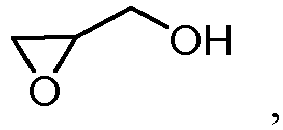

- Glycidol polymerisation typically results in one or more poly-glycerol chains.
- In an embodiment, the present invention therefore provides a process for preparing a functionalised polymeric chromatography medium, which process comprises
- (i) providing a substrate formed of one or more polymer nanofibres,
- (ii) grafting one or more neutral polymer chains from the substrate, and
- (iii) contacting the grafted product with a reagent which functionalises the product of step (ii) as a chromatography medium,
- In an embodiment, the present invention therefore also provides a process for preparing a functionalised polymeric chromatography medium, which process comprises
- (i) providing a substrate formed of one or more polymer nanofibres,
- (ii) grafting one or more neutral polymer chains from the substrate, and
- (iii) contacting the grafted product with a reagent which functionalises the product of step (ii) as a chromatography medium,
- Glycidol polymerisation inevitably results in branching of the polymer chain, yielding a "bush" structure. Thus, typically, one or more of the polymer chains is branched.
- Another polymerisation method well known to the person skilled in the art is controlled radical polymerisation (CRP). Controlled radical polymerisation is a term well known to the person skilled in the art and typically refers to free radical addition polymerization of monomers wherein there is a degree of control of molecular weight of the growing polymer with respect to time. Examples of CRPs include atom transfer radical polymerisation (ATRP), atom generated by electron transfer (AGET) ATRP, and reversible addition-fragmentation chain transfer (RAFT). Polymerisation methodologies are not exclusively defined as CRPs but may include free radical polymerisation (FRP) and ring opening metathesis polymerisation (ROMP).
- ATRP may be carried out in an aqueous environment or optionally in a mixture of water and another solvent, which may be, for example, methanol, DMSO, THF, DMF or NMP. ATRP polymerisation is preferably carried out under substantially oxygen free conditions. Typically, ATRP is carried out at room temperature. Typically, after ATRP is carried out, the resultant material is washed with water.
- Catalysts for use in ATRP polymerisation are typically transition metals or transition metal salts complexed with one or more ligands. As used herein, a ligand is a compound that co-ordinates to a metal ion (usually a transition metal ion). Suitable transition metals include copper, cobalt, molybdenum, rhodium, osmium, ruthenium, palladium, nickel and rhenium. Copper is preferred. Examples of suitable ligands for copper coordinating catalysts include 2,2'-bipyridine (bpy), 4,4'-di(5-nonyl)-2,2-bipyridine (dNbpy), N,N,N',N'-tetramethylethylenediamine (TMEDA), N-propyl(2-pyridyl)methanimine (NPrPMI), 2,2':6',2"-terpyridine (tpy), 4,4',4"-tris(5-nonyl)-2,2':6',2"-terpyridine (tNtpy), N,N,N',N",N"-pentamethyldiethylenetriamine (PMDETA), N,N-bis(2-pyridylmethyl)octylamine (BPMOA), 1,1,4,7,10,10-hexamethyltriethylenetetramine (HMTETA), tris[2-(dimethylamino)ethyl]amine (Me6TREN), tris[(2-pyridyl)methyl]amine (TPMA) and 1,4,8,11-tetraaza-1,4,8,11-tetramethylcyclotetradecane (Me4CYCLAM).
- Use of appropriate monomers and, where applicable, chain transfer agents, may enable branching of the polymers to be induced in CRP methods at the growing ends of the polymer chains, affording the possibility of bush type structures. In other cases, branching is less preferred and an essentially unbranched "brush" polymer structure may be formed.
- ATRP polymerisation may be controlled so as to give essentially linear polymeric chains or to give a degree of branching. Substantially unbranched polymers yield a polymer "brush" structure.
- ATRP polymerisation may employ one or more different types of monomer, wherein a monomer is any individual unit used to form the polymer. The monomers each include one or more polymerisable groups and are typically selected from monofunctional monomers and difunctional monomers. The polymerisable group typically comprises a C=C double bond.
- Examples of suitable monofunctional monomers are methacrylates and methacrylamides, for instance N-[3-(dimethylamino)propyl]methacrylamide. Other typical methacrylates and methacrylamides include 2-hydroxypropyl methacrylamide (HPMA) and hydroxyethylmethacrylate (HEMA).
- Difunctional monomers, for example dimethacrylates or divinylsulfone, can be used to introduce branching and/or cross-linking in the ATRP polymerisation.
- The processes of the present invention involve a functionalisation step (step (iii)) of the grafted product which functionalises that product as a chromatography medium, for instance by introducing one or more ligand groups onto the grafted product. This step involves contacting the grafted product with a reagent which functionalises the grafted product as a chromatography medium by introducing one or more ligand groups onto the grafted product.
- For the avoidance of doubt, step (iii) may involve a single step or multiple steps that together functionalise the product of step (ii) as a chromatography medium.
- The reagent typically functionalises the chromatography medium by introducing one or more ligand groups which render the functionalised product comprising the one or more ligand groups suitable for use as a chromatography medium. The one or more ligand groups introduced will depend on the particular chromatography technique for which the medium is to be used. The ligand groups are the groups introduced onto the grafted product that make it suitable for use as a chromatography medium. Suitable ligand groups and reagents are discussed further below.
- In some embodiments, the grafted product is functionalised with only one type of ligand group. In other embodiments, the grafted product is functionalised with two or more types of ligand group. Thus, step (iii) of the claimed process involves contacting the grafted product with a reagent which functionalises the product of step (ii) as a chromatography medium by introducing one or more ligand groups, which may be the same or different, onto the grafted product.
- In embodiments where the substrate comprises one or more polymer nanofibres formed from different polymers, each different kind of polymer nanofibre may be functionalised (after grafting) with one or more ligand groups, which may be the same or different.
- In embodiments where more than one type of polymer may be grafted to the substrate, each polymer graft may be functionalised with one or more ligand groups, which may be the same or different.
- Although the present invention envisages processes involving only a single treatment with a reagent, processes involving multiple functionalising steps may also be used. Such embodiments involve functionalisation by contacting the grafted product in a batchwise fashion two or more times with a reagent. Batchwise functionalisation means that the grafted product is reacted with a reagent to functionalise it, that reaction is then stopped and the resultant (partially) functionalised material reacted with a separate batch of reagent. Reacting in a batchwise fashion does not simply refer to adding more portions of reagent to a reaction vessel, for instance.
- Batchwise functionalisation is typically carried out from two to ten times, i.e. 2, 3, 4, 5, 6, 7, 8, 9 or 10 times.
- Preferred processing conditions for batchwise functionalisation can be found in
WO-A-2015/052460 andWO-A-2015/052465 . - In certain circumstances, contacting with a reagent may comprise placing the grafted product in a holder, and causing a reagent to flow through the holder so that the reagent flows in contact with the grafted product which functionalises the grafted product as a chromatography medium. Functionalising material in this manner may in certain circumstances be more efficient than simply contacting the grafted product with the reagent, in a flask or beaker for example.
- Preferred processing conditions for flow functionalisation can be found in
WO-A-2015/052460 andWO-A-2015/052465 . - The reagent functionalises the grafted product to yield a chromatography medium, specifically a functionalised chromatography medium. Typically, the reagent functionalises the grafted product so that it is suitable for use in an ion exchange, affinity capture or hydrophobic chromatography method. Thus, contacting with the reagent yields a chromatography medium which is functionalised with one or more ligand groups, i.e one or more moieties which are negatively charged, one or more moieties which are positively charged, one or more proteins, mimetic or synthetic ligands that mimic the action of protein ligands, peptides, antibodies or fragments thereof, dyes, histidine, groups containing a metal cation, or hydrophobic groups. 2-chloro-N,N-diethylamine hydrochloride (DEACH) and glycidyltrimethylammonium are preferred as the reagent, particularly when the functionalised chromatography medium is for use in an anion exchange chromatography method. Other preferred reagents are 1,4-butanesulfone, sodium chloroacetate, TEMPO followed by sodium perchlorate, or allyl gycidyl ether followed by sodium disulphite, particularly when the funtionalised chromatography medium is for use in a cation exchange chromatography method. Another preferred reagent is NaIO4, divinylsulfone followed by Protein A, allyl glycidyl ether followed firstly by a halohydrin-forming reagent (e.g. N-bromosuccinamide) and subsequently by Protein A, or allyl glycidyl ether followed firstly by an epoxide-forming reagent and subsequently by Protein A, particularly when the functionalised chromatography medium is for use in an affinity chromatography method. Another preferred reagent is styrene oxide, particularly when the functionalised chromatography medium is for use in a hydrophobic chromatography method.
- Typically, the reagent is gycidyltrimethylammonium, 1,4-butanesulfone, sodium chloroacetate, NaIO4 followed by Protein A, divinylsulfone followed by Protein A, allyl glycidyl ether followed firstly by a halohydrin-forming reagent (e.g. N-bromosuccinamide) and subsequently by Protein A, or allyl glycidyl ether followed firstly by an epoxide-forming reagent and subsequently by Protein A. Preferably, the reagent is divinylsulfone followed by Protein A, or allyl glycidyl ether followed firstly by a halohydrin-forming reagent (e.g. N-bromosuccinamide) and subsequently by Protein A.
- Thus, in preferred embodiments, the present invention provides a process for preparing a functionalised polymeric chromatography medium, wherein the functionalisation step (iii) involves multiple steps that together functionalise the product of step (ii) as a chromatography medium.
- In a particularly preferred embodiment, the present invention provides a process for preparing a functionalised polymeric chromatography medium, wherein in the functionalisation step (iii):
- (a) the grafted product is first contacted with a reagent selected from the group selected from divinyl sulfone, allyl glycidyl ether, and combinations thereof;
- (b) the product of step (a) is optionally treated with a halohydrin-forming reagent or an epoxide-forming reagent, preferably a halohydrin-forming reagent; and
- (c) the product of step (b) is contacted with Protein A.
- In another particularly preferred embodiment, the present invention provides a process for preparing a functionalised polymeric chromatography medium, wherein in the functionalisation step (iii):
- (a) the grafted product is contacted with a reagent selected from the group selected from divinyl sulfone, allyl glycidyl ether, and combinations thereof;
- (b) the product of step (a) is optionally treated with a halohydrin-forming reagent or an epoxide-forming reagent, preferably a halohydrin-forming reagent; and
- (c) the product of step (b) is contacted with Protein A.
- The products of the process of the present invention are functionalised chromatography media, i.e. chromatography media that have had polymer grafted from them and which have then been functionalised to render them suitable for use in one or more chromatography methods by introducing one or more ligand groups onto the grafted products.
- Specific chemical functionalisations are discussed in more detail below. In general terms, such chemical functionalisation changes the chemical and/or physical properties of the functionalised chromatography medium by introducing one or more charged groups. This in turn affects how the functionalised chromatography medium behaves when used in a chromatography method. The modifications may, for example, change the polarity, hydrophobicity or biological binding properties of the functionalised chromatography medium compared to its unfunctionalised form. The modifications may, in certain circumstances, change more than one of the polarity, hydrophobicity or biological binding properties of the functionalised chromatography medium compared to its unfunctionalised form. In one embodiment, the modification changes the polarity and hydrophobicity of the functionalised chromatography medium compared to its unfunctionalised form.
- The functionalised chromatography media are typically in the form of membranes. Such membranes are suitable for use in membrane chromatography methods. Membrane chromatography methods are well known to the person skilled in the art and are discussed in "Membrane Processes in Biotechnologies and Pharmaceutics" ed. Catherine Charcosset, Elsevier, 2012.
- Typically, the functionalised polymer chromatography media are suitable for use in chromatography methods chosen from ion exchange chromatography, affinity capture chromatography, hydrophobic chromatography and mixed mode chromatography. In certain circumstances, the chromatography method operates in "mixed mode", i.e. utilising more than one form of interaction, i.e. ion exchange, affinity capture and hydrophobic interaction. Typically, such "mixed mode" chromatography involves ion exchange (ionic) and hydrophobic interactions. Preferably, the functionalised polymer chromatography media are suitable for use in chromatography methods chosen from ion exchange chromatography, affinity capture chromatography, and hydrophobic chromatography, preferably ion exchange chromatography and affinity capture chromatography. In operation, such chromatography methods involve passing a mobile phase containing a desired molecule over an adsorbent phase, here the functionalised chromatography medium. The adsorbent phase is typically chosen such that the desired molecule is retained on it in preference to other components also present in the mobile phase.
- Typically, the polymer chromatography medium is functionalised with DEAE, Q, SP, CM, Protein A, phenyl, or MEP groups, for instance DEAE, Q, SP, CM or Protein A groups. Generally, the polymer is cellulose and the chromatography medium is functionalised with DEAE, Q, SP, CM, Protein A, phenyl, or MEP groups, for instance DEAE, Q, SP, CM or Protein A groups. Thus, the functionalised chromatography medium may be cellulose derivatised with DEAE, Q, SP, CM, Protein A, phenyl, or MEP groups, for instance DEAE, Q, SP, CM or Protein A groups.
- In a preferred embodiment, the polymer chromatography medium is functionalised with Protein A.
- Ion exchange chromatography is a technique for separating molecules, typically ions or polar molecules, based on their ionic charge. Functionalised chromatography media for use in such methods therefore contain one or more moieties which are positively or negatively charged. Positive and/or negative charges in functionalised chromatography media are usually balanced with one or more counter ions. Ion exchange chromatography involves one or more of cation exchange chromatography and anion exchange chromatography.
- Functionalised chromatography media for use in cation exchange chromatography contain one or more moieties which are negatively charged. Typical negatively charged moieties include one or more carboxylate, sulphonate or phosphonate groups, or mixtures thereof, i.e. the moieties typically contain one or more -COO-, -SO3 -, or -P(OH)2O- groups, or mixtures thereof. Typical functionalised chromatography media for use in cation exchange chromatography contain one or more -O-CH2COO-, -CH2COO-, -SO3 -, -CH2CH2CH2SO3 -, -CH2CH2SO3 -, or -P(OH)2O- moieties.
- Functionalised chromatography media for use in anion exchange chromatography contain one or more moieties which are positively charged. Typical positively charged moieties include one or more quaternary amine groups. Typical functionalised chromatography media for use in anion exchange chromatography contain one or more -N+(CH3)3, -N+(C2H5)H, -CH2CH2N+(C2H5)H, -CH2CH2N+(C2H5)2(CH2CH(OH)CH3), -O-CH2CH2-N+(CH3)3, -CH2CH2N+(CH3)3, or -CH2CH2N+(CH3)2H moieties.
- For the avoidance of doubt, by "charged group" is meant a group that comprises a moiety that is ionised so that it bears a positive or negative charge, i.e. a "charged group" comprises an anionic or cationic moiety. A charged group is a particular example of a ligand group.
- Typically, the one or more charged groups comprise one or more carboxylate (-COO-), sulphonate(-SO3 -), or phosphonate groups(-P(OH)2O-) groups, or quaternary amine groups, or mixtures thereof. Typically, the one or more charged groups comprise all anionic groups or all cationic groups, however in certain circumstances mixtures of anionic and cationic groups are envisaged. Typically, only one type of anionic group is used, but mixtures may also be used. Typically, only one type of cationic group is used, but mixtures may also be used.
- Representative charged groups include -O-CH2COO-, -CH2COO-, -SO3 -, -CH2CH2CH2SO3 -, -CH2CH2SO3 -, -P(OH)2O-, -N+(CH3)3, -N+(C2H5)H, -CH2CH2N+(C2H5)H, -CH2CH2N+(C2H5)2(CH2CH(OH)CH3), -O-CH2CH2-N+(CH3)3, -CH2CH2N+(CH3)3, and -CH2CH2N+(CH3)2H moieties.
- Typical charged groups include DEAE, Q, SP, and CM groups. Typically, the functionalised polymer chromatography medium is functionalised with DEAE, Q, SP, or CM groups. Thus, the functionalised chromatography medium may be cellulose derivatised with DEAE, Q, SP, or CM groups.
- Affinity capture chromatography is a technique for separating molecules based on their affinity to particular ligands, usually but not always biological ligands. This method may, for example, rely on the attractive forces between antibodies and antigens or enzymes and substrates. Functionalised chromatography media for use in affinity capture chromatography typically contain one or more moieties chosen from one or more proteins, peptides, antibodies or fragments thereof, dyes, histidine, or groups containing a metal cation. Thus, the one or more ligand group may comprise one or more such moieties. Alternatively, functionalised chromatography media for use in affinity capture chromatography may contain mimetic or synthetic ligands that mimic the action of protein ligands.
- Typical proteins for use in affinity capture chromatography are well known to the person skilled in the art and include Protein A, Protein G and Protein L. Protein A is preferred.
- Protein A is a protein well known to the skilled person. As used herein, references to "Protein A" embrace recombinant Protein A (which may have an altered sequence compared to Protein A found in Staphylococcus aureus) and tagged Protein A (as described in
EP-B-0873353 andUS6399750 ). Protein A may be a modified variant of Protein A, for instance cysteine modified variants of Protein A. - Typical antibodies and fragments thereof for use in affinity capture chromatography are well known to the person skilled in the art and include IgG.
- Typical dyes for use in affinity capture chromatography are well known to the person skilled in the art and include Yellow HE-4R, Red HE-3B and Cibacron Blue F3G.
- Typical groups containing metal cations for use in affinity capture chromatography are well known to the person skilled in the art. Such groups typically contain a chelating agent to immobilize metal cations. The metal cation is typically chosen from copper, nickel, zinc and cobalt cations, preferably Cu2+, Ni2+, Zn2+ and Co2+.
- Hydrophobic interaction chromatography is a technique for separating molecules based on their hydrophobicity. Functionalised chromatography media for use in such methods therefore contain one or more moieties which contain one or more hydrophobic groups. Typical hydrophobic groups include propyl, butyl, phenyl, and octyl groups.
- Mixed mode (or multimodal) chromatography is a technique for separating molecules based on two or more characteristics, typically hydrophobicity and ionic charge. This may involve a combination of hydrophobicity and anionic properties, or a combination of hydrophobicity and cationic properties. Functionalised chromatography media for use in such methods therefore typically contain one or more moieties which are positively or negatively charged, typically as defined above, and which contain one or more hydrophobic groups, typically as defined above. Positive and/or negative charges in functionalised chromatography media are usually balanced with one or more counter ions. Functionalised chromatography media for use in such methods may also contain one or more hydrophobic groups which are ionisable, for use in so-called Hydrophobic Charge Induction Chromatography (HCIC). Thus, in one embodiment, mixed mode chromatography is Hydrophobic Charge Induction Chromatography. Suitable groups for use in such methods are 4-mercapto-ethyl-pyridine (MEP) groups and octylamine groups.
- Functionalised chromatography media for use in mixed mode chromatography methods which involve a combination of hydrophobic and anionic interactions contain one or more moieties which are positively charged, typically as defined above, and one or more hydrophobic groups, typically as defined above. Suitable groups for use in such methods are N-benzyl methyl ethanolamine groups and N-benzoyl-homocysteine groups. Functionalised chromatography media for use in mixed mode chromatography methods which involve a combination of hydrophobic and cationic interactions contain one or more moieties which are negatively charged, typically as defined above, and one or more hydrophobic groups, typically as defined above. Suitable groups for use in such methods are N-benzoyl-homocysteine groups.
- The processes claimed in the present invention for preparing functionalised chromatography media typically involve in step (iii) introducing one or more ligand groups into the grafted product such that the resultant functionalised product comprising the one or more ligand groups is suitable for use as a chromatography medium in a chromatography method. Typical moieties, media, reagents and methods are as defined above. The one or more ligand groups are introduced by reacting a suitable reagent with one or more functional groups contained on the grafted product. Typical functional groups include hydroxyl, amino, halogen and carboxyl groups. Since step (ii) of the method involves glycidol polymerisation, the functional groups are typically hydroxyl groups. Suitable reagents for introducing the one or more ligand groups are discussed elsewhere.
- The one or more functional groups may be activated prior to reaction with a reagent. Conventional activation methods known in the art may be employed. Thus, in the case where the functional group is an hydroxyl group, such a group may be activated by treating with carbonyl diimidazole (CDI), bisoxiranes, cyanuric acid, N-hydroxysuccinimide esters (NHS), 2-fluoro-1-methyl pyridinium toluene-4 sulphonate (FMP), NaIO4, divinylsulfone, or allyl glycidyl ether. In the case where the functional group is an amino group, such a group may be activated by treating with epichlorohydrine, glutaraldehyde or epoxide. In the case where the functional group is a carboxyl group, such a group may be activated by treating with CDI or 1-ethyl-3-(3-dimethylaminopropyl)carbodiimide (EDC). In the case where the functional group is a halogen atom, such a group may be activated by treating with divinylsulfone.
- A skilled person can choose suitable reagents to introduce particular groups and moieties into particular polymers, for example on the basis of the desired ligand groups and moieties and the functional groups contained in those polymers. Typical reagents include 2-chloro-N,N-diethylamine hydrochloride (DEACH), glycidyltrimethylammonium chloride (GMAC), 1,4-butanesulfone, sodium chloroacetate, NaIO4 followed by Protein A, divinylsulfone followed by Protein A, allyl glycidyl ether followed firstly by a halohydrin-forming reagent and subsequently by Protein A, or allyl glycidyl ether followed firstly by an epoxide-forming reagent and subsequently by Protein A.
- Typical halohydrin-forming reagents include an electrophilic source of a halogen and a nucleophilic source of hydroxyl. Thus, typical halohydrin-forming reagents include a diatomic halogen (typically, Cl2, Br2 or I2) in water, N-chlorosuccinamide, N-bromosuccinamide, or N-iodosuccinamide. Typically, a halohydrin-forming reagent generates a halohydrin species from an alkene. The halohydrin-forming reaction may be regioselective to yield predominantly the halohydrin product on which the halogen atom is bonded to the terminal carbon atom of the polymer chain, or it may be regioselective to yield predominantly the halohydrin product on which the hydroxyl group is bonded to the terminal carbon atom of the polymer chain, or it may have low regioselectivity. Preferably, the halohydrin-forming reaction may be regioselective to yield predominantly the halohydrin product on which the halogen atom is bonded to the terminal carbon atom of the polymer chain.
- Typical epoxide-forming reagents include peroxyacids (such as meta-chloroperoxybenzoic acid (mcpba)), hydrogen peroxide in the presence of NaOH or H2O, tert-butyl hydroperoxide in the presence of vanadyl acetylacetonate, tert-butyl hydroperoxide in the presence of Ti(OiPr)4 and diethyltartrate, tert-butyl hydroperoxide in the presence of Ti(OiPr)4 and diisopropyltartrate, or oxone in the presence of a fructose-derived catalyst and a base.
- Typically,
- the chromatography method is a cationic exchange method, and the reagent functionalises the chromatography medium with one or more charged groups comprising one or more carboxylate, sulphonate or phosphonate moieties; or
- the chromatography method is an anionic exchange method, and the reagent functionalises the chromatography medium with one or more charged groups comprising one or more quaternary amino or diethylaminemoieties;
- the chromatography method is an affinity capture chromatography method, and the reagent functionalises the chromatography medium with one or more proteins, peptides, antibodies or fragments thereof, dyes, histidine groups, or groups containing a metal cation;
- the chromatography method is a hydrophobic interaction chromatography method, and the reagent functionalises the chromatography medium with one or more propyl, butyl, phenyl, or octyl groups; or
- the chromatography method is a mixed mode chromatography method, and the reagent functionalises the chromatography medium with one or more MEP, octylamine, N-benzyl methyl ethanolamine or N-benzoyl-homocysteine groups.
- As discussed above, the present invention provides a two-step process for preparing a functionalised polymeric chromatography medium from a polymer nanofibre substrate, the two steps being (i) a polymer grafting step, and (ii) a functionalisation step.
- The polymer grafting step typically introduces 500-60,000 µmol/g of polymer to the substrate, preferably 1000-60,000µmol/g. In some embodiments, the grafting step introduces 1000-2000µmol/g. In other embodiments, the grafting step introduces 5000-10,000µmol/g. In yet other embodiments, the grafting step introduces 30,000-60,000µmol/g. This amount can typically be determined by an assay method measuring the amount of particular functional groups, e.g. hydroxyl groups, added to the substrate by the grafting method. A skilled person will be aware of suitable methods to use to determine the amount of particular functional groups present in a given sample of grafted material.
- An increased polymer density can be obtained by using increased amounts or higher concentrations of polymerisation reagents, or by carrying out the reaction at higher temperatures or for longer periods of time.
- In the context of glycidol polymerisation, the grafting step typically introduces 500-60,000 µmol/g of glycidol to the grafted product as determined by the -OH density of the grafted product. The -OH density of the grafted product may be determined by a titration method, typically a titration with tetrabutylammonium hydroxide.
- An increased -OH density can be obtained by using an increased amount of glycidol or a glycidol derivative having formula (I).
- Preferably, the -OH content of a sample of a particular polymer is determined by the following assay:
- 1) Placing a sample of grafted material on a wetted filter paper, located in Buchner filter funnel and washing with ultrapure water while applying a vacuum to ensure the water washes through the sample;
- 2) Drying the sample to constant mass in an oven at 60°C and determining the mass of the sample.
- 3) Shredding the sample and suspending it in a 50 mL centrifuge tube containing 10ml of p-toluenesulfonylisocyanate solution (20mL p-toluenesulfonylisocyanate in 500 ml acetonitrile);
- 4) Sealing the tube and stirring the mixture with heating (60°C), in a water bath, for 1 hour;
- 5) Allowing the tube and its contents to cool to room temperature, quenching carefully with 10 mL ultrapure H2O before being transferring the mixture to a titration cup and making up to 80 mL with iso-propyl alcohol;
- 6) Stirring the mixture was stirred for 30 mins at room temperature and then titrating with tetrabutylammonium hydroxide (0.481M solution in methanol) to determine the absolute concentration of hydroxyl groups present.
- The -OH concentration (mol/g) of a sample of a particular polymer may be determined by determining the absolute concentration of hydroxyl groups in a sample by the above assay and dividing by the total mass of the dried sample obtained in step (2) of the assay.
- Following steps (ii) and (iii), the density of ligand groups introduced in step (iii) of the process of the present invention is typically 100-2,000µmol/g of functionalised chromatography medium. The density is preferably 300-1,500µmol/g, more preferably 500-1200µmol/g. In some embodiments, the density is 100-500µmol/g. In other embodiments, the density is 1200-2000µmol/g. Densities much greater than 2,000µmol/g of functionalised chromatography medium may result in materials that are difficult to use as chromatography media.
- The density is typically determined by a titration method to determine the number of moieties in the functionalised material. A skilled person will be aware of suitable methods to use to determine the amount of particular moieties present in a given sample of functionalised material.
In the context of functionalisation with trimethylammonium chloride, the density can be determined as the trimethylammonium chloride density which may be determined by the following assay: - 1)
Washing 50 mg of material with 100 mL 0.1M HCl solution on a Buchner filter funnel and then with a further 100 mL 0.01M HCl solution; - 2) Drying the material in a drying oven at 75°C to constant mass before tearing into small pieces and placing in a 50 mL centrifuge tube equipped with a small magnetic stir bar;
- 3) Adding 15 mL deionised water along with approximately 1 mL (added via a teat pipette) potassium chromate solution which causes the mixture to become yellow in colour;
- 4) Stirring the mixture was vigorously for 20 minutes before being titrating with 0.1M silver nitrate, the endpoint of the titration being identified by a change in colour from clear yellow to misty brown;
- 5) Calculating the trimethylammonium chloride content (µmol/g) as the number of micromoles of silver nitrate added to reach end point/number of grams of nanofibre material used in the titration.
- In the context of functionalisation with sulfonic acid (S) groups, the density can be determined as the sulfonic acid density which may be determined by the following assay:
- 1) Washing a dried sample of functionalised material with 0.1M HCL and 0.01M HCl;
- 2) Drying the material in an oven and weighing;
- 3) Determining the molarity of the material by the amount of NaOH that must be added to reach pH7;
- 4) Calculating the sulfonic acid (S) content (µmol/g) as the number of micromoles of NaOH added to reach pH7/number of grams of nanofibre material used in the titration.
- The two step method of the invention enables a high degree of control over the pressure drop over a sample of the material. This is advantageous, since absolute pressure drop over a chromatography material is a limiting factor at industrial scales. Specifically, the normal operating parameters of most commercial pumps are such that a pressure drop of 2MPa is the maximum tolerable pressure drop. The present inventors have found that a surprisingly high flowrate of material is possible through materials produced in accordance with the present invention at a pressure drop of 2MPa. Thus, typically the pressure drop over the functionalised polymeric chromatography medium is less than 2MPa when a liquid phase is passed through a thickness of 0.05 to 10mm of the medium at a flow rate of between 1 to 640 membrane volumes per minute. This can be determined using standard means, e.g. an AKTA protein purification system. This is a measure of the resistance to flow of the material.
- Typically, the pressure drop is less than 1MPa, preferably less than 0.5MPa.
- Typically, the flow rate through the medium is between 1 and 60 membrane volumes per minute, preferably between 5 and 40.
- The liquid phase passed through the medium is not particularly significant. Typical liquid phases include standard buffers, for instance Tris buffer, preferably 10mM Tris.
- Typically, the liquid phase is passed through a thickness of 0.1 to 5mm of material.
- Preferably, the pressure drop over the functionalised polymeric chromatography medium is less than 1MPa when Tris buffer is passed through a thickness of 0.1 to 5mm of the medium at a flow rate of between 1 to 60 membrane volumes per minute.
- More preferably, the pressure drop over the functionalised polymeric chromatography medium is less than 0.5MPa when 10mM Tris is passed through a thickness of 0.1 to 5mm of the medium at a flow rate of between 5 to 40 membrane volumes per minute.
- The combination of grafting and functionalisation steps allows a material with a high dynamic binding capacity (DBC) to be achieved. Thus, typically, the functionalised chromatography material has a DBC of 10 to 210 mg/mL (10% breakthrough), preferably 20 to 195mg/mL (10% breakthrough), 30 to 180mg/mL (10% breakthrough), 40 to 165mg/mL (10% breakthrough), or 50 to 150mg/mL (10% breakthrough). For materials where step (ii) has involved glycidol polymerisation, typically the functionalised chromatography material has a DBC of 50-150 mg/mL (10% breakthrough).
- The DBC for 10% breakthrough can be determined in accordance with standard means, e.g. using an AKTA Pure system.
- DBC for 10% breakthrough is typically determined according to the following assay method:
- 1) Loading material (For anion exchange material the loading material was 1mg/mL BSA in 10 mM Tris to
pH 8. For cation exchange material the loading material was 1mg/mL lysozyme in sodium acetate pH 4.7 10mM.)is passed through functionalised material contained within a holder on an AKTA Pure system (GE Healthcare); - 2) material is loaded under a determined membrane volume per minute flowrate (mV/min) until the concentration after the holder outlet exceeded 10% of that loaded as determined by the UV flow cell;
- 3) Accounting for dead volumes in the system and the holder device the total amount of protein loaded onto the disc at the 10% breakthrough was determined through analysis of the chromatogram in the Unicorn software (GE Healthcare).
- The high dynamic binding capacities of and high possible flowrates through the functionalised materials of the invention enable an advantageously high productivity to be achieved. Thus, typically, the productivity of the functionalised polymeric chromatography medium is 50mg/mL/min to 75,000mg/mL/min. Preferably, the productivity is 600mg/ml/min or greater. More preferably, the productivity is 1200mg/ml/min or greater. Even more preferably, the productivity is 2400mg/ml/min or greater. The productivity may be 10,000mg/ml/min or greater or even 15,000mg/ml/min or greater, or 20,000mg/ml/min or greater. Productivities of 10,000mg/ml/min, 15,000mg/ml/min or 20,000mg/ml/min or greater are typically achievable using glycidol polymerisation.
- As used herein, the productivity of a material is determined by how much material can be loaded onto the adsorbent material, per unit volume of material, per unit time. In practice this is determined as the DBC (10% breakthrough) divided by the residence time of the loading material in the holder. The residence time can, in turn, be determined from the flowrate of material passing through the holder.
- As discussed above, the present inventors have investigated thoroughly the relationship between the grafting step (ii) and functionalisation step (iii) and have found that by decoupling these steps from one another highly optimised materials can be produced.
- Thus, in certain embodiments, it has been found that the grafting step (ii) has the effect of increasing the dynamic binding capacity (DBC) of the functionalised polymeric chromatography medium. Thus, for two materials of a given density of ligand groups, a material with a higher degree of grafting has been found typically to have a higher DBC. This is particularly the case for materials functionalised with positively charged groups, i.e. where the functionalised chromatography materials are suitable for use in an anionic exchange chromatography method.
- Thus, in one embodiment, the present invention provides a process for preparing a functionalised polymeric chromatography medium, which process comprises
- (i) providing a substrate formed of one or more polymer nanofibres, as defined herein,
- (ii) grafting one or more neutral polymer chains from the substrate, as defined herein, and
- (iii) contacting the grafted product with a reagent, as defined herein, which functionalises the product of step (ii) as a chromatography medium, as defined herein, wherein the grafting step (ii) comprises reacting a plurality of compounds of formula


- In other embodiments, usually materials functionalised with negatively charged groups, i.e. where the functionalised chromatography materials are suitable for use in a cationic exchange chromatography method, it has been found that varying the amount of functionalisation reagent used in step (iii) of the claimed method has only a small impact on charge density, but when combined with a grafting step a significant increase in binding capacity can be achieved for the same degree of functionalization. Again, therefore it is clear that it is the combination of the grafting and functionalisation steps that positively impacts DBC.
- Typically, the functionalised chromatography medium is a functionalised cellulose chromatography medium and the substrate is formed of one or more cellulose acetate nanofibres, between steps (i) and (ii) the cellulose acetate is treated to convert it to cellulose, the step of grafting one or more neutral polymer chains from the substrate involves glycidol polymerisation, and the grafted product is contacted with a reagent chosen from glycidyltrimethylammonium chloride (GMAC), 1,4-butanesulfone, sodium chloroacetate, NaIO4 followed by Protein A, divinylsulfone followed by Protein A, allyl glycidyl ether followed firstly by a halohydrin-forming reagent (e.g. N-bromosuccinamide) and subsequently by Protein A, or allyl glycidyl ether followed firstly by an epoxide-forming reagent and subsequently by Protein A.
- Alternatively, the functionalised chromatography medium is a functionalised cellulose chromatography medium and the substrate is formed of one or more cellulose acetate nanofibres, the step of grafting comprises both the conversion of cellulose acetate to cellulose and the grafting of one or more neutral polymer chains onto the resultant cellulose substrate via glycidol polymerisation, and the grafted product is contacted with a reagent chosen from glycidyltrimethylammonium chloride (GMAC), 1,4-butanesulfone,sodium chloroacetate, NaIO4 followed by Protein A, divinylsulfone followed by Protein A, allyl glycidyl ether followed firstly by a halohydrin-forming reagent (e.g. N-bromosuccinamide) and subsequently by Protein A, or allyl glycidyl ether followed firstly by an epoxide-forming reagent and subsequently by Protein A.
- In a preferred embodiment, the present invention provides a process for preparing a functionalised cellulose chromatography medium, which process comprises
- (i) providing a substrate formed of one or more cellulose acetate nanofibres, treating the cellulose acetate to convert it to cellulose,
- (ii) grafting one or more neutral polymer chains from the resultant cellulose substrate, as defined herein, and
- (iii) contacting the grafted product with a reagent, as defined herein, which functionalises the product of step (ii) as a chromatography medium, as defined herein, wherein the grafting step (ii) comprises reacting a plurality of compounds of formula

- Typically in this preferred embodiment step (i) comprises providing a substrate formed of one or more non-woven sheets, each comprising one or more cellulose acetate nanofibres.
- Preferably in this preferred embodiment step (i) comprises providing two or more non-woven sheets stacked one on top of the other, each said sheet comprising one or more cellulose acetate nanofibres, and simultaneously heating and pressing the stack of sheets to fuse points of contact between the nanofibres of adjacent sheets.
- In an alternative preferred embodiment, the present invention provides a process for preparing a functionalised cellulose chromatography medium, which process comprises
- (i) providing a substrate formed of one or more cellulose acetate nanofibres,
- (ii) subjecting the substrate to conditions under which both the cellulose acetate is converted to cellulose and, subsequently, one or more neutral polymer chains are grafted onto the resultant cellulose substrate, and
- (iii) contacting the grafted product with a reagent, as defined herein, which functionalises the product of step (ii) as a chromatography medium, as defined herein, wherein the grafting step (ii) comprises reacting a plurality of compounds of formula
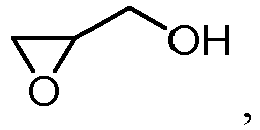
- Typically in this alternative preferred embodiment step (i) comprises providing a substrate formed of one or more non-woven sheets, each comprising one or more cellulose acetate nanofibres.
- Preferably in this alternative preferred embodiment step (i) comprises providing two or more non-woven sheets stacked one on top of the other, each said sheet comprising one or more cellulose acetate nanofibres, and simultaneously heating and pressing the stack of sheets to fuse points of contact between the nanofibres of adjacent sheets.
- In a more preferred embodiment, the present invention provides a process for preparing a functionalised cellulose chromatography medium, which process comprises
- (i) providing a substrate formed of one or more cellulose acetate nanofibres, treating the cellulose acetate to convert it to cellulose,
- (ii) grafting one or more polymer chains from the resultant cellulose substrate by reacting a plurality of compounds of formula

- (iii) contacting the grafted product with a reagent, as defined herein, which functionalises the product of step (ii) as a chromatography medium.
- Typically in this more preferred embodiment step (i) comprises providing a substrate formed of one or more non-woven sheets, each comprising one or more cellulose acetate nanofibres.
- Preferably in this more preferred embodiment step (i) comprises providing two or more non-woven sheets stacked one on top of the other, each said sheet comprising one or more cellulose acetate nanofibres, and simultaneously heating and pressing the stack of sheets to fuse points of contact between the nanofibres of adjacent sheets.
- In an alternative more preferred embodiment, the present invention provides a process for preparing a functionalised cellulose chromatography medium, which process comprises
- (i) providing a substrate formed of one or more cellulose acetate nanofibres,
- (ii) subjecting the substrate to aqueous alkaline conditions under which both the cellulose acetate is converted to cellulose and, subsequently, one or more neutral polymer chains are grafted onto the resultant cellulose substrate by reaction of a plurality of compounds of formula

- (iii) contacting the grafted product with a reagent, as defined herein, which functionalises the product of step (ii) as a chromatography medium.
- Typically in this alternative more preferred embodiment step (i) comprises providing a substrate formed of one or more non-woven sheets, each comprising one or more cellulose acetate nanofibres.
- Preferably in this alternative more preferred embodiment step (i) comprises providing two or more non-woven sheets stacked one on top of the other, each said sheet comprising one or more cellulose acetate nanofibres, and simultaneously heating and pressing the stack of sheets to fuse points of contact between the nanofibres of adjacent sheets.
- In an even more preferable embodiment, the present invention provides a process for preparing a functionalised cellulose chromatography medium, which process comprises
- (i) providing a substrate formed of one or more cellulose acetate nanofibres, treating the cellulose acetate to convert it to cellulose,
- (ii) grafting one or more polymer chains from the resultant cellulose substrate by reacting a plurality of compounds of formula

- (iii) contacting the grafted product with a reagent which functionalises the product of step (ii) as a chromatography medium suitable for use in an ion exchange or affinity chromatography method.
- Typically in this even more preferred embodiment step (i) comprises providing a substrate formed of one or more non-woven sheets, each comprising one or more cellulose acetate nanofibres.
- Preferably in this even more preferred embodiment step (i) comprises providing two or more non-woven sheets stacked one on top of the other, each said sheet comprising one or more cellulose acetate nanofibres, and simultaneously heating and pressing the stack of sheets to fuse points of contact between the nanofibres of adjacent sheets.
- In an alternative even more preferred embodiment, the present invention provides a process for preparing a functionalised cellulose chromatography medium, which process comprises
- (i) providing a substrate formed of one or more cellulose acetate nanofibres,
- (ii) subjecting the substrate to aqueous alkaline conditions under which both the cellulose acetate is converted to cellulose and, subsequently, one or more neutral polymer chains are grafted onto the resultant cellulose substrate by reaction of a plurality of compounds of formula

- (iii) contacting the grafted product with a reagent which functionalises the product of step (ii) as a chromatography medium suitable for use in an ion exchange or affinity chromatography method.
- Typically in this alternative even more preferred embodiment step (i) comprises providing a substrate formed of one or more non-woven sheets, each comprising one or more cellulose acetate nanofibres.
- Preferably in this alternative even more preferred embodiment step (i) comprises providing two or more non-woven sheets stacked one on top of the other, each said sheet comprising one or more cellulose acetate nanofibres, and simultaneously heating and pressing the stack of sheets to fuse points of contact between the nanofibres of adjacent sheets.
- In a yet more preferred embodiment, the present invention provides a process for preparing a functionalised cellulose chromatography medium, which process comprises
- (i) providing a substrate formed of one or more cellulose acetate nanofibres, treating the cellulose acetate to convert it to cellulose,
- (ii) grafting one or more polymer chains from the resultant cellulose substrate by reacting a plurality of compounds of formula

- (iii) contacting the grafted product with a reagent which functionalises the product of step (ii) as a chromatography medium suitable for use in an ion exchange or affinity chromatography method, which reagent is glycidyltrimethylammonium chloride (GMAC), 1,4-butanesulfone, sodium chloroacetate, NaIO4 followed by Protein A, divinylsulfone followed by Protein A, allyl glycidyl ether followed firstly by a halohydrin-forming reagent (e.g. N-bromosuccinamide) and subsequently by Protein A, or allyl glycidyl ether followed firstly by an epoxide-forming reagent and subsequently by Protein A.
- Typically in this yet more preferred embodiment step (i) comprises providing a substrate formed of one or more non-woven sheets, each comprising one or more cellulose acetate nanofibres.
- Preferably in this yet more preferred embodiment step (i) comprises providing two or more non-woven sheets stacked one on top of the other, each said sheet comprising one or more cellulose acetate nanofibres, and simultaneously heating and pressing the stack of sheets to fuse points of contact between the nanofibres of adjacent sheets.
- In an alternative yet more preferred embodiment, the present invention provides a process for preparing a functionalised cellulose chromatography medium, which process comprises
- (i) providing a substrate formed of one or more cellulose acetate nanofibres,
- (ii) subjecting the substrate to aqueous alkaline conditions under which both the cellulose acetate is converted to cellulose and, subsequently, one or more neutral polymer chains are grafted onto the resultant cellulose substrate by reaction of a plurality of compounds of formula

- (iii) contacting the grafted product with a reagent which functionalises the product of step (ii) as a chromatography medium suitable for use in an ion exchange or affinity chromatography method, which reagent is glycidyltrimethylammonium chloride (GMAC), 1,4-butanesulfone, sodium chloroacetate, NaIO4 followed by Protein A, divinylsulfone followed by Protein A, allyl glycidyl ether followed firstly by a halohydrin-forming reagent (e.g. N-bromosuccinamide) and subsequently by Protein A, or allyl glycidyl ether followed firstly by an epoxide-forming reagent and subsequently by Protein A.
- Typically in this alternative yet more preferred embodiment step (i) comprises providing a substrate formed of one or more non-woven sheets, each comprising one or more cellulose acetate nanofibres.
- Preferably in this alternative yet more preferred embodiment step (i) comprises providing two or more non-woven sheets stacked one on top of the other, each said sheet comprising one or more cellulose acetate nanofibres, and simultaneously heating and pressing the stack of sheets to fuse points of contact between the nanofibres of adjacent sheets.
- In a further even more preferred embodiment, the present invention provides a process for preparing a functionalised cellulose chromatography medium, which process comprises
- (i) providing a substrate formed of one or more cellulose acetate nanofibres, treating the cellulose acetate to convert it to cellulose,
- (ii) grafting one or more polymer chains from the resultant cellulose substrate by reacting a plurality of compounds of formula

- (iii) contacting the grafted product with a reagent which functionalises the product of step (ii) as a chromatography medium suitable for use in an ion exchange or affinity chromatography method, which reagent is divinylsulfone followed by Protein A, allyl glycidyl ether followed firstly by a halohydrin-forming reagent (e.g. N-bromosuccinamide) and subsequently by Protein A, or allyl glycidyl ether followed firstly by an epoxide-forming reagent and subsequently by Protein A.
- Typically in this further even more preferred embodiment step (i) comprises providing a substrate formed of one or more non-woven sheets, each comprising one or more cellulose acetate nanofibres.
- Preferably in this further even more preferred embodiment step (i) comprises providing two or more non-woven sheets stacked one on top of the other, each said sheet comprising one or more cellulose acetate nanofibres, and simultaneously heating and pressing the stack of sheets to fuse points of contact between the nanofibres of adjacent sheets.
- In an alternative further even more preferred embodiment, the present invention provides a process for preparing a functionalised cellulose chromatography medium, which process comprises
- (i) providing a substrate formed of one or more cellulose acetate nanofibres,
- (ii) subjecting the substrate to aqueous alkaline conditions under which both the cellulose acetate is converted to cellulose and, subsequently, one or more neutral polymer chains are grafted onto the resultant cellulose substrate by reaction of a plurality of compounds of formula

- (iii) contacting the grafted product with a reagent which functionalises the product of step (ii) as a chromatography medium suitable for use in an ion exchange or affinity chromatography method, which reagent is divinylsulfone followed by Protein A, allyl glycidyl ether followed firstly by a halohydrin-forming reagent (e.g. N-bromosuccinamide) and subsequently by Protein A, or allyl glycidyl ether followed firstly by an epoxide-forming reagent and subsequently by Protein A.
- Typically in this alternative further even more preferred embodiment step (i) comprises providing a substrate formed of one or more non-woven sheets, each comprising one or more cellulose acetate nanofibres.
- Preferably in this alternative further even more preferred embodiment step (i) comprises providing two or more non-woven sheets stacked one on top of the other, each said sheet comprising one or more cellulose acetate nanofibres, and simultaneously heating and pressing the stack of sheets to fuse points of contact between the nanofibres of adjacent sheets.
- The present invention also provides a chromatography cartridge. The chromatography cartridge of the present invention comprises one or more functionalised chromatography media of the present invention. Alternatively, the chromatography cartridge of the present invention is obtainable by carrying out the process of the present invention and incorporating the thus-obtained product into a cartridge.
- Also provided is a process for preparing a chromatography cartridge which comprises carrying out the process of the present invention and incorporating the thus-obtained product into a cartridge.
- The chromatography cartridge is typically suitable for use in chromatography, preferably a chromatography method as defined herein.
- A chromatography cartridge of the present invention typically comprises one or more functionalised chromatography media of the present invention within a holder, for example a holder as defined above. The holder is typically cylindrical.
- Typically, the chromatography cartridge comprises one or more functionalised chromatography media of the present invention stacked inside a cylindrical holder.
- Typically, the chromatography cartridge comprises two or more functionalised chromatography media of the present invention. Typically, the chromatography cartridge comprises up to twenty functionalised chromatography media of the present invention.
- Typically, the chromatography cartridge also comprises one or more frits within the typically cylindrical holder. Frits are well known to the person skilled in the art and refer to rigid porous structures, typically rigid metal, polymeric or ceramic, preferably rigid metal or ceramic, porous structures. Frits are typically included in a chromatography cartridge to improve flow distribution through the cartridge and/or to support the one or more functionalised chromatography media of the present invention. Pores in typical frits have diameters from 1 to 1000µm, preferably from 5 to 500µm, more preferably from 10 to 150µm. Other suitable frit pore diameters include from 1 to 20µm, preferably from 5 to 10µm, more preferably from 3 to 7µm.
- Typically, the cartridge comprises two or more functionalised chromatography media of the present invention and one or more frits, the frits being located between functionalised chromatography media.
- In some embodiments, the cartridge does not comprise frits.
- The cartridge may comprise alternative spacer materials instead of or in addition to frits. Typical alternative spacer materials include non-woven and woven materials.
- Non-woven polymer materials are known to the person of skill in the art. Such non-woven materials are porous, i.e. allow the passage of liquid, typically without significant pressure drop. Typically, the non-woven polymer material is polypropylene. Typically, the non-woven material has an area density of 45-150gsm.
- In some embodiments, the cartridge comprises two or more functionalised chromatography media of the present invention and one or more non-woven polymer material layers as defined above, the one or more non-woven polymer material layers being located between functionalised chromatography media.
- Woven materials are known to the person of skill in the art. Such woven materials are porous, i.e. allow the passage of liquid, typically without significant pressure drop. Typically, the woven material is a woven polymer material, preferably woven polypropylene. Typically, the woven material has a thickness less than 1mm.
- Typically, the chromatography cartridge also comprises one or more inlet fluid distribution means and/or outlet fluid collection means. Such means are well known to the person skilled in the art.
- The present invention also provides use of a functionalised chromatography medium of the invention or a chromatography cartridge of the invention in chromatography, particularly in a chromatography method as defined herein.
- The present invention also provides a process for isolating one or more biological molecules from a mobile phase, which process comprises contacting one or more biological molecules in a mobile phase with a functionalised chromatography medium of the invention or a chromatography cartridge of the invention. The chromatography medium or chromatography cartridge binds preferentially to the one or more biological molecules in the mobile phase, typically in preference to other components (for instance other biological molecules) also present in the mobile phase. This can be carried out in accordance with conventional methods known for the bind phase of such chromatographic methods.
- Thus, typically, this chromatographic process is an ion (anion or cation) exchange, affinity capture, hydrophobic interaction or mixed mode chromatography process.
- Preferably, the chromatographic process is an anion exchange chromatography process and the chromatography medium is functionalised with DEAE or Q; the chromatographic process is a cation exchange chromatography process and the chromatography medium is functionalised with SP or CM; the chromatographic process is an affinity capture chromatography process and the chromatography medium is functionalised with Protein A; or the chromatographic process is a hydrophobic interaction chromatography process and the chromatography medium is functionalised with phenyl groups.
- Thus, the present invention provides a chromatography process which comprises the above step. Typically, the chromatography process is carried out in accordance with a chromatography method as defined above.
- One of the advantageous findings of the present invention is that a functionalised chromatography material produced by the process of the invention has a high binding capacity and can be operated at high flowrates. Thus, typically in the chromatography process of the present invention, the one or more biological molecules in a mobile phase is contacted with the functionalised chromatography medium for a period of time of one minute or less, preferably 50 seconds or less, more preferably 40 seconds or less, yet more preferably 30 seconds or less, still more preferably 20 seconds or less, or even 15 seconds or less, 12 seconds or less, 10 seconds or less, 8 seconds or less, 6 seconds or less, 4 seconds or less, 2 seconds or less, 1.5 seconds or less, or even 1 second or less.
- The chromatography process typically comprises a further step of recovering the one or more biological molecules from the functionalised chromatography medium or chromatography cartridge. This step can typically be effected by contacting the functionalised chromatography medium or chromatography cartridge to which is adsorbed the one or more biological molecules with an elution buffer. This can be carried out in accordance with conventional methods known for the elute phase of such chromatographic methods. Thus, the process is typically a bind-elute chromatographic method.
- Between the bind and elute steps, the process may further comprise a step of washing the functionalised chromatography medium or chromatography cartridge of the invention to which is adsorbed the one or more biological molecules. This washing step is carried out to remove any components which are not bound to the functionalised chromatography medium or chromatography cartridge. This can be carried out in accordance with conventional methods known for the washing phase of such chromatographic methods.
- After the elute step, the process may further comprise a step of regenerating the functionalised chromatography medium or chromatography cartridge of the invention. Typically this is effected by contacting the functionalised chromatography medium or chromatography cartridge from which the one or more biological molecules have been eluted with a buffer. This can be carried out in accordance with conventional methods known for the regeneration phase of such chromatographic methods.
- Typically, the one or more biological molecules are chosen from cells, proteins, polypeptides, antibodies, amino acids, viruses and nucleic acids, including, for example, recombinant proteins, monoclonal antibodies, viral vaccines, viral vectors, RNA, exosomes, cells and plasmid DNA.
The monoclonal antibody may be a multispecific antibody (e.g. a bispecific antibody) or a domain-deleted antibody. Preferably the monoclonal antibody is a humanized antibody or a human antibody. Antigen-binding fragments of monoclonal antibodies may be used. Examples of antibody fragments include Fab, Fab', F(ab')2 and Fv fragments, diabodies and single chain antibodies. - Typically, the one or more biological molecules are one or more monoclonal antibodies, or proteins engineered to exhibit a site with an affinity for Protein A binding, and the functionalised chromatography medium optionally contained in a cartridge carries at least one Protein A ligand group.
- Typically, the chromatographic process employs a simulated or actual moving bed system. Thus typically, the process comprises introducing the one or more biological molecules in a mobile phase into one or more simulated or actual moving bed chromatography apparatuses having a plurality of linked chromatography columns, which chromatography columns contain as adsorbent the functionalised chromatography medium of the present invention.
- Any known simulated or actual moving bed apparatus may be used to carry out the chromatographic process, provided that it comprises, as adsorbent, the functionalised chromatography medium of the present invention.
- Simulated and actual moving bed chromatography are known techniques, familiar to those of skill in the art. The principle of operation involves countercurrent movement of a liquid eluent phase and a solid adsorbent phase. This operation allows minimal usage of solvent making the process economically viable. Such separation technology has found applications in diverse areas including purification of biological molecules using membrane adsorbents.
- A simulated moving bed system consists of a number of individual columns containing adsorbent which are connected together in series. Eluent is passed through the columns in a first direction. The injection points of the feedstock and the eluent, and the separated component collection points in the system are periodically shifted by means of a series of valves. The overall effect is to simulate the operation of a single column containing a moving bed of the solid adsorbent. Thus, a simulated moving bed system consists of columns which, as in a conventional stationary bed system, contain stationary beds of solid adsorbent through which eluent is passed, but in a simulated moving bed system the operation is such as to simulate a continuous countercurrent moving bed.
- An actual moving bed system is similar in operation to a simulated moving bed system. However, rather than shifting the injection points of the feed mixture and the eluent, and the separated component collection points by means of a system of valves, instead a series of adsorption units (i.e. columns) are physically moved relative to the feed and drawoff points. Again, operation is such as to simulate a continuous countercurrent moving bed.
- The materials of the present invention are also suitable for use in methods of immobilised enzyme biocatalysis, metal scavenging, and water treatment. Thus, the present invention provides a method of enzyme biocatalysis, which involves a functionalised chromatographic material of the present invention. The present invention also provides a method of metal scavenging, which involves a functionalised chromatographic material of the present invention. The present invention also provides a method of water treatment, which involves a functionalised chromatographic material of the present invention. It will be appreciated that certain minor modifications may be required to the processes and products of the invention to render the products suitable for use in these methods.
- The following Examples illustrate the invention.
- Unless otherwise noted all chemicals were obtained from, or are available from, companies such as Fisher Scientific, Sigma-Aldrich, FluoroChem, Repligen, and VWR.
- The reaction media was replaced with an equal volume de-ionised water and circulated for 1 hour. The rinsing procedure was repeated once more. Finally, the materials were treated with an equal volume of aqueous ethanol (2:1-H2O:EtOH) before being removed from the reaction vessel.
- The reaction media was replaced with an equal volume of de-ionised water and circulated for 1 hour. After this time, the washing media was replaced with 0.01M HCl which was circulated for 1 hour whereupon it was replaced with 0.001M HCl and circulated for 1 hour. Finally, the media was replaced with 2:1 mixture of H2O:EtOH which was circulated for 1 hour. The derivatised nanofibres were then removed from the reaction vessel.
- The reaction media was replaced with an equal volume of 1:1 mixture of warm (60°C) de-ionised water:acetone which was circulated for 30 mins. The washing procedure was repeated twice more. Finally, the media was replaced with 2:1 mixture of H2O:EtOH which was circulated for 1 hour. The derivatised nanofibres were then removed from the reaction vessel.
- 2 Ltrs of ultrapure water was pumped through the nanofibre material.
- The reaction media was replaced with an equal volume of 1:1-de-ionised water:EtOH and circulated for 1 hour. The washing procedure was repeated twice more. Finally, the media was replaced with 2:1 mixture of H2O:EtOH which was circulated for 1 hour. The derivatised nanofibres were then removed from the reaction vessel. Finally, the media was replaced with 2:1 mixture of H2O:EtOH which was circulated for 1 hour. The derivatised nanofibres were then removed from the reaction vessel.
- The reaction media was replaced with ultapure de-ionised water. The nanofibre materials were gently stirred in the clean water for 30 mins. After this time, the washing media was replaced and the wash cycle repeated.
- The reaction media was poured out and the beaker was replenished with water until the pH of the effluent was neutral or slightly acidic.
- The reaction media was replaced with an equal volume of 1:1 mixture of de-ionised water:acetone which was circulated for 1 hour. After this time the wash solution was refreshed and the fibres washed for a further 1 hour while stirring vigorously. This process was repeated a further 3 times before the final wash of de-ionised water for a further 1 hour. The derivatised halohydrin nanofibers were then removed from the reaction vessel and were ready for use in the next step.
- A solution of cellulose acetate, with a relative molecular mass of 29,000g/mol, was dissolved in common solvents prior to electrospinning to produce fibres with diameters ranging between 300-600nm. Optimised conditions for nanofibre production can be found in, for example, O. Hardick, et al, J.Mater. Sci. 46 (2011) 3890. Sheets of approximately 20g/m2 material were layered and subjected to a combined heating and pressure treatment.
- Nanofibre materials were derivatised according the scheme outlined below:

-

- Cellulose acetate sheets (44*32mm* 150mm) obtained in accordance with the method of Preparative Example 1 were placed into a large beaker containing 5 L of a 0.075M sodium hydroxide solution in 2:1-water:ethanol. The reaction mixture was stirred at room temperature for 48 hours. The materials were then washed according to washing protocol A.
-

- Materials from (i) were suspended in 1L of 0.5M NaOH. The reaction media was circulated for 15 minutes prior to the careful addition of varying amounts of Glycidol (15mL, 30mL, 60mL, 120mL, 180mL) in a single portion. The reaction media was circulated at room temperature for 16 hours and the material was subsequently washed according to washing protocol B.
-

- Materials obtained in step (ii) were typically suspended in 1Ltr 0.5M NaOH. The reaction media was circulated for 15 minutes prior to the addition of glycidyltrimethylammonium chloride (25mL, 50mL, 100mL and 200mL) in a single portion. The reaction media was circulated for a further 16 hours at room temperature. The materials were then washed according to washing protocol C.
- The trimethylammonium chloride content was determined by the following method. 50 mg of material was washed with 100 mL 0.1M HCl solution on a Buchner filter funnel and then with a further 100 mL 0.01M HCl solution. The material was then placed in a drying oven at 75°C and dried to constant mass before being torn into small pieces and then placed in a 50 mL centrifuge tube. A small magnetic stir bar and 15 mL deionised water were then added along with approximately 1 mL (added via a teat pipette) potassium chromate solution which caused the mixture to become yellow in colour. The mixture was stirred vigorously for 20 minutes before being titrated with 0.1M silver nitrate. The endpoint of the titration is identified by a change in colour from clear yellow to misty brown.
- The trimethylammonium chloride content (µmοl/g) was calculated as the number of micromoles of silver nitrate added to reach end point/number of grams of nanofibre material used in the titration.
- Nanofibre materials were derivatised according to the scheme outlined below:

-

- Cellulose acetate sheets (44*32mm*150mm) obtained in accordance with the method of Preparative Example 1 were suspended in 5 L of a 0.075M sodium hydroxide solution in 2:1-water:ethanol. The reaction mixture was circulated at room temperature for 48 hours. The materials were then washed according to washing protocol A.
-

- Materials from (i) were suspended in 1L of 0.5M NaOH. The reaction media was circulated for 15 minutes prior to the careful addition of varying amounts of glycidol (15mL, 30mL, 120mL, 180mL) in a single portion. The reaction media was circulated at room temperature for 16 hours and the material was subsequently washed according to washing protocol B.
-

- Reaction media consisting of 150ml 1M NaOH (aq.) was heated up to53°C. In this was suspended glycidol functionalised material obtained in step (ii), along with 1,4-butanesulfone (6ml, 53°C, 58.6mmol). The reaction media was stirred at 60°C for 15min, 30min, and 60min. The materials were then washed according to washing protocol B.
- The sulfonic acid (S) content of the material (µmol/g) was calculated via titration. Dried material from (iii) was washed with 0.1M HCL and 0.01M HCl. The material is then oven dried and weighed. After washing the molarity of the material is determined from the amount of NaOH added to reach pH7.
- Nanofibre materials were derivatised according the scheme outlined below:

-

- Cellulose acetate sheets (44*32mm* 150mm) obtained in accordance with the method of Preparative Example 1 were placed into a large beaker containing 5 L of a 0.075M sodium hydroxide solution in 2:1-water:ethanol. The reaction mixture was stirred at room temperature for 48 hours. The materials were then washed according to washing protocol A.
-

- Materials from (i) were suspended in 1L of 0.5M NaOH. The reaction media was circulated for 15 minutes prior to the careful addition of varying amounts of Glycidol (15mL, 30mL, 60mL, 120mL, 180mL) in a single portion. The reaction media was circulated at room temperature for 16 hours and the material was subsequently washed according to washing protocol B.
-
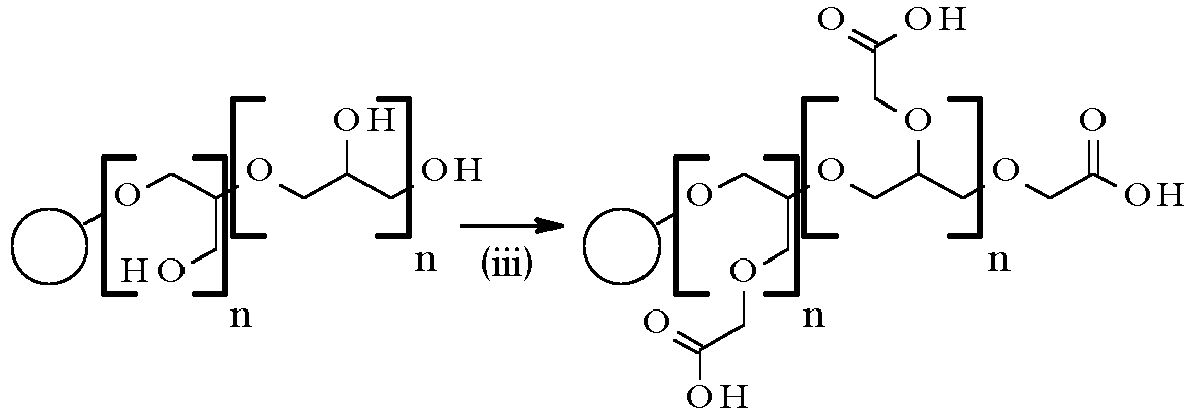
- Materials from (ii) were suspended in water (66 mL) at 62°C. A solution of sodium chloroacetate (12.8 g) in water (27.5 mL) was freshly prepared. A solution of KOH (6.2 g) in water (27.5 mL) was also freshly prepared. Both solutions were added to the reaction at a rate of 13.75 mL/hour while keeping the temperature at 62°C. The reaction was stirred vigorously at 62°C for 4h in total. After 4h at 62°C, the reaction media was removed and the nanofibre materials were washed under a continuous flow of water until the pH of the effluent was neutral. The beaker was then stirred in 0.01M hydrochloric acid aqueous solution until a steady pH of 2-3 was reached.
- Nanofibre materials were derivatised according the scheme outlined below:

-

- Cellulose acetate sheets (44*32mm* 150mm) obtained in accordance with the method of Preparative Example 1 were placed into a large beaker containing 5 L of a 0.075M sodium hydroxide solution in 2:1-water:ethanol. The reaction mixture was stirred at room temperature for 48 hours. The materials were then washed according to washing protocol A.
-

- Material obtained in step (i) was suspended in a solution of K2CO3 (24.4g, 176.54 mmol K2CO3 in 275 mL H2O) and acetonitrile (75 mL). The mixture was stirred for 15 minutes prior to the dropwise addition of divinylsulfone (50 mL, 498.1 mmol) over 2.5 hours. Upon complete addition of the divinylsulfone, the reaction was stirred for a further 1.5 hours. After this time, the nanofibre material was washed according to washing protocol C.
-

- Material obtained in step (ii) was suspended in 375 mL H2O that contained either ethylenediamine (125mL, 1870 mmol) or 2-mercaptoethylamine hydrochloride (37.5g, 167 mmol). The mixture was stirred overnight at room temperature. After this time, the derivatised nanofibre material was washed according to washing protocol A.
-

- Dry material obtained in step (iii) was placed in a centrifuge tube and 2mL acetonitrile and 0.4mL (3.24 mmol) α-bromoisobutyryl bromide were added. The tubes were gently agitated on an orbital shaker for 5 minutes at room temperature, whereupon triethylamine was added dropwise (0.4ml, 2.86 mmol). The reaction mixture was agitated for 1 hour. After this time, the derivatised nanofibre materials were washed according to washing protocol A.
-

- Typically, derivatised nanofibre material obtained in step (iv) was placed in a reaction vessel to which was added 2.5 mL saturated ascorbic acid, 0.33 ml catalyst solution A and N-[3-(dimethylamino)propyl]methacylamide (1.66 mL, 9.2 mmol). The reaction mixture was gently agitated on an orbital shaker at room temperature for 4 hrs. After this time, the derivatised nanofibre materials were washed according to washing protocol A.
- CuBr2 (0.3g, 1.343 mmol) dissolved in 10ml H2O and 0.45 mL (1.650 mmol) 1, 1,4,7,10, 10-hexamethyltriethlyenetetramine.
- Nanofibre materials were derivatised according the scheme outlined below:

-

- Cellulose acetate sheets (44*32mm* 150mm) obtained in accordance with the method of Preparative Example 1 were placed into a large beaker containing 5 L of a 0.075M sodium hydroxide solution in 2:1-water:ethanol. The reaction mixture was stirred at room temperature for 48 hours. The materials were then washed according to washing protocol A.
-

- Materials from (i) were suspended in 1L of 0.5M NaOH. The reaction media was circulated for 15 minutes prior to the careful addition of 180mL glycidol in a single portion. The reaction media was circulated at room temperature for 16 hours and the material was subsequently washed according to washing protocol B.
-
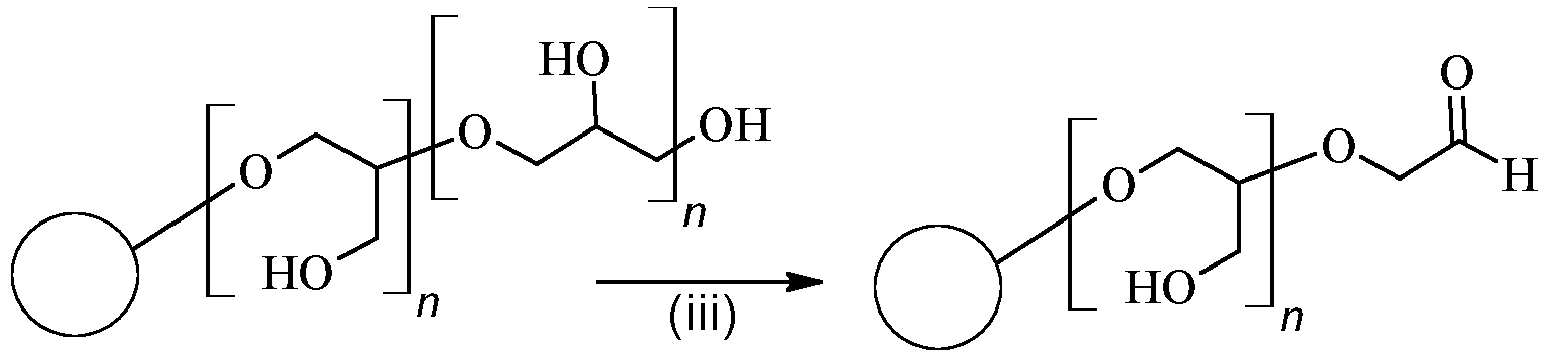
- Material from (ii) was suspended in 17.5L 0.05M NaOAc buffer modified to pH5.5. The reaction media was circulated for 30 mins prior to the addition of NaIO4 (200g, 0.94 moles, dissolved in 2L of reaction media). The reaction media was circulated for a further 30 mins. The materials were then washed according to washing protocol C to provide aldehyde functionalised materials.
- Materials from step (iii) were added to a 6 well plate. To each well was added 2 mL of a protein-A solution (rSPA, 50 mg/ml Protein A in deionised water). The plate gently agitated on an orbital shaker for 1hr. After this time, the supernatant liquid was removed and replaced with reducing buffer solution A (2.5 ml per well, prepared as 0.0762g of NaCNBH3 added to 10mL carbonate buffer, which is prepared as 0.0603g Na2CO3 (0.569 mmol) and 0.337g NaHCO3 (4.012 mmol) added to 100 mL deionised water) and agitated for a further 15 minutes. After this time the protein-A coupled materials were washed according to protocol D.
- Nanofibre materials were derivatised according the scheme outlined below:

-

- Cellulose acetate sheets (44*32mm*150mm) obtained in accordance with the method of Preparative Example 1 were placed into a large beaker containing 5 L of a 0.075M sodium hydroxide solution in 2:1-water:ethanol. The reaction mixture was stirred at room temperature for 48 hours. The materials were then washed according to washing protocol A.
-

- Materials from (i) were suspended in 1L of 1M NaOH. The reaction media was circulated for 15 minutes prior to the addition of 180mL Glycidol in a single portion. The reaction media was circulated at room temperature for 16 hours and the material was subsequently washed according to washing protocol B.
-

- Materials from (ii) were suspended in a solution that consisted of 550mL H2O with K2CO3 (48.8g, 0.35 moles) dissolved within it and 150mL acetonitrile. The reaction media was circulated for 15 minutes prior to the dropwise addition of divinylsulfone (100 ml, 0.86 moles), after which the reaction media was circulated for a further 1.5 hours. The materials were then washed according to washing protocol C.
-

- Material from step (iii) was suspended in 70 ml of a protein A solution (50mg/mL protein A suspension to which is added 668mg (Na2CO3) and 58mg NaHCO3 and NaOH to reach pH 11.1). The solution was circulated for 16 hours. The materials were then washed according to washing protocol D.
- Nanofibre materials were derivatised according to the scheme, outlined below:

-

- Cellulose acetate sheets (5*65cm*100cm) were suspended in 17.5Ltr of 0.075M NaOH, in 2: 1-H2O:EtOH. The reaction media was circulated at room temperature for 48 hours. The materials were then washed according to washing protocol A.
-

- Dried materials from (i) were suspended in 240 ml tetrahydrofuran (THF) with α-bromoisobutyryl bromide (6.24 mL, 50.4 mmol) dissolved in it. The reaction mixture was cooled to 0°C and then triethylamine (7.2 mL, 51.6 mmol) was added dropwise. The mixture was stirred at 0°C for 2 hours before being allowed to warm to room temperature. The mixture was stirred at room temperature for a further 16 hours. After this time the derivatised nanofibre materials were washed according to washing protocol A.
-

- A vessel was charged with 5 mL acetone, 5mL saturated ascorbic acid, CuBr2 (30 mg, 0.134 mmol) and 11,4,7,10,10-hexamethyltriethylenetetraamine (45 µL, 0.165 mmol). Material from (ii) was suspended in the reaction mixture along with divinylsulfone (2.5 mL, 24.9 mmol). The reaction mixture was gently agitated, using an orbital shaker, at room temperature, for 1 hour. After this time, the nanofibre materials were washed according to washing protocol A.
-

- 26mm disks of material from step (iii) were placed in a 6 well plate. To each disk was added 1mL protein-A solution (50mg/mL solution as defined above) along with 1mL of carbonate buffer solution (as defined above). The disks were gently agitated for 16 hours. After this time, the disk were washed using washing protocol D.
- Nanofibre materials were derivatised according the scheme outlined below:
-

- Cellulose acetate sheets (44*32mm* 150mm) obtained in accordance with the method of Preparative Example 1 were placed into a large beaker containing 5 L of a 0.075M sodium hydroxide solution in 2:1-water:ethanol. The reaction mixture was circulated at room temperature for 48 hours. The materials were then washed according to washing protocol A.
-

- Materials obtained in step (i) were suspended in 1L 0.5M NaOH. The reaction media was circulated for 15 minutes prior to the addition of glycidyltrimethylammonium chloride (25mL, 50mL, 100mL) in a single portion. The reaction media was circulated for a further 16 hours at room temperature. The materials were then washed according to washing protocol B.
- The trimethylammonium chloride content was determined by the following method. 50 mg of material was washed with 100 mL 0.1M HCl solution on a Buchner filter funnel and then with a further 100 mL 0.01M HCl solution. The material was then placed in a drying oven at 75°C and dried to constant mass before being torn into small pieces and then placed in a 50 mL centrifuge tube. A small magnetic stir bar and 15 mL deionised water were then added along with approximately 1 mL (added via a teat pipette) potassium chromate solution which caused the mixture to become yellow in colour. The mixture was stirred vigorously for 20 minutes before being titrated with 0.1M silver nitrate. The endpoint of the titration is identified by a change in colour from clear yellow to misty brown.
- The trimethylammonium chloride content (µmol/g) was calculated as the number of micromoles of silver nitrate added to reach end point/number of grams of nanofibre material used in the titration.
-

- Cellulose acetate sheets (44*32mm* 150mm) obtained in accordance with the method of Preparative Example 1 were placed into a large beaker containing 5 L of a 0.075M sodium hydroxide solution in 2:1-water:ethanol. The reaction mixture was stirred at room temperature for 48 hours. The materials were then washed according to washing protocol A.
-

- Materials from (i) were suspended in 1L of 0.5M NaOH. The reaction media was circulated for 15 minutes prior to the careful addition of varying amounts of glycidol (15mL, 30mL, 60mL, 120mL, 180mL) in a single portion. The reaction media was circulated at room temperature for 16 hours and the material was subsequently washed according to washing protocol G.
- Nanofibre materials were derivatised according to the scheme outlined below:

- The glycidol polymerisation and saponification of CA nanofiber materials was effected by taking CA nanofiber material (11x80mmx50mm) and suspending it in 1L de-ionised water. The solvent was circulated for 3 hours before being refreshed with a further 1L de-ionised water. After repeating this
process 4 times, the nanofiber materials were suspended in 350ml of 1M KOH. The reaction media was circulated for 60 minutes prior to the careful addition of varying amounts of glycidol (100ml) where 25% of the glycidol was added as a single portion and the remainder added dropwise over 90 minutes. The reaction media was circulated at room temperature for 4 hours and the material was subsequently washed according to washing protocol B. -

- Materials from (i) were suspended in a solution that consisted of 550mL H2O with K2CO3(48.8g, 0.35 moles) dissolved within it and 150mL acetonitrile. The reaction media was circulated for 15 minutes prior to the dropwise addition of divinylsulfone (100 ml, 0.86 moles), after which the reaction media was circulated for a further 1.5 hours. The materials were then washed according to washing protocol C.
-

- Material from step (ii) was suspended in 70 ml of a protein A solution (50mg/mL protein A suspension to which is added 668mg (Na2CO3) and 58mg NaHCO3 and NaOH to reach pH 11.1). The solution was circulated for 16 hours. The materials were then washed according to washing protocol D.
- Nanofibre materials were derivatised according to the scheme outlined below:

-
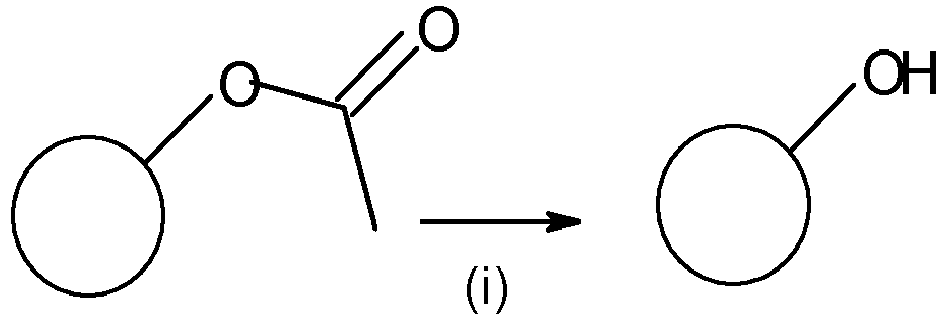
- Cellulose acetate sheets (11x80mmx50mm) obtained in accordance with the method of Preparative Example 1 were placed into a large beaker containing 5 L of a 0.075M sodium hydroxide solution in 2:1-water:ethanol. The reaction mixture was stirred at room temperature for 48 hours. The materials were then washed according to washing protocol A.
-

- Materials from (i) were suspended in 350 of 1M KOH. The reaction media was circulated for 60 minutes prior to the careful addition of varying amounts of Glycidol (60mL) where 25% of the glycidol was added as a single portion and the remainder added dropwise over 90 minutes. The reaction media was circulated at room temperature for 4 hours and the material was subsequently washed according to washing protocol B.
-
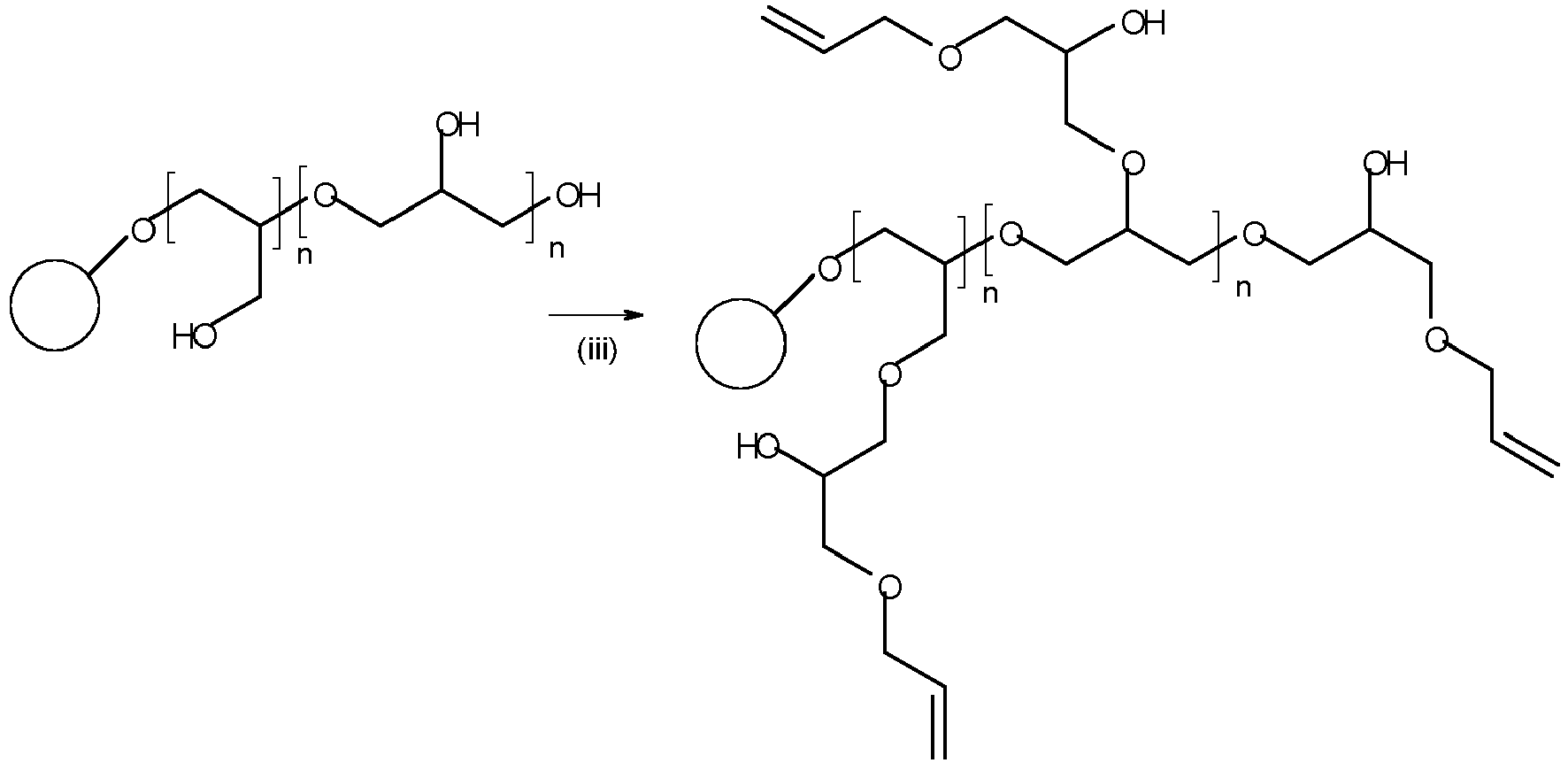
- Materials from (ii) were suspended in 1 L 1M KOH. Varying amounts of allylglycidol ether were added (20, 30, 40, 50, 60, 70, 80, 90, 100ml) by initial addition of 25% of the allylglycidyl ether followed by dropwise addition of the remainder over 90 mins. The reaction was maintained with stirring for 4 hours at room temperature. After this time the materials were subsequently washed according to washing protocol B.
-

- Materials from (iii) were suspended in 1L 3:1-H2O:MeCN with 25g N-Bromosuccinimide dissolved in it. The reaction media was circulated through the materials for 4 hours. After this time the reaction media was removed and the remaining materials washed according to washing protocol H.
-

- A single strip of material from step (iv) was placed in a polyethylene pouch. To this pouch was then added 25 ml of protein A solution (50mg/mL protein A suspension to which is added 668mg (Na2CO3) and 58mg NaHCO3 and NaOH to reach pH 11.1). The pouch was sealed and the resulting mixture agitated slowly on an orbital shaker for 16 hours. After this time, the derivatised materials were removed from the pouch and washed according to washing protocol H.
- Nanofibre materials were derivatised according to the scheme outlined below:

-

- The glycidol polymerisation and saponification of CA nanofiber materials was effected by taking CA nanofiber material (6x120mmx90mm) and suspending it in 1L de-ionised water. The solvent was circulated for 3 hours before being refreshed with a further 1L de-ionised water. After repeating this
process 4 times, the nanofiber materials were suspended in 350 mL of 1M KOH. The reaction media was circulated for 5 minutes prior to the careful addition of 100mL glycidol where 25% of the glycidol was added as a single portion and the remainder added dropwise over 90 minutes. The reaction media was circulated at room temperature for 4 hours and the material was subsequently washed according to washing protocol B. -

- Materials from (i) were suspended in 350 L 1M KOH. Varying amounts of allyl glycidyl ether were added (20, 30, 40, 50, 60, 70, 80, 90, 100 mL) by initial addition of 25% of the allyl glycidyl ether followed by dropwise addition of the remainder over 90 mins. The reaction was maintained with stirring for 6 hours at room temperature. After this time the materials were subsequently washed according to washing protocol B.
- Use of lower amounts of allyl glycidyl ether produced materials having particularly beneficial flow characteristics. Use of higher amounts of allyl glycidyl ether produced materials having higher binding capacities.
-

- Materials from (ii) were suspended in 1L 3:1-H2O:MeCN with 25g N-Bromosuccinimide dissolved in it. The reaction media was circulated through the materials for 4 hours. After this time the reaction media was removed and the remaining materials washed according to washing protocol H.
-

- A single strip of material from step (iii) was placed in a polyethylene pouch. To this pouch was then added 25 mL of protein A solution (50mg/mL protein A suspension to which is added 668mg (Na2CO3) and 58mg NaHCO3 and 1M NaOH (to reach pH11.1)). The pouch was sealed and the resulting mixture agitated slowly on an orbital shaker for 16 hours. After this time, the derivatised materials were removed from the pouch and washed according to washing protocol H.
- Loading material was passed through a selected functionalised nanofibre disc contained within a holder on an AKTA Pure system (GE Healthcare). The material was loaded under a determined membrane volume per minute flowrate (mV/min) until the concentration after the holder outlet exceeded 10% of that loaded as determined by the UV flow cell. Accounting for dead volumes in the system and the holder device the total amount of protein loaded onto the disc at the 10% breakthrough was determined through analysis of the chromatogram in the Unicorn software (GE Healthcare).
- For anion exchange material the loading material was 1mg/mL BSA in 10 mMTris to
pH 8. For cation exchange material the loading material was 1mg/mL lysozyme in sodium acetate pH 4.7 10mM. - The pressure drop (ΔP) across the selected functionalised nanofibre material was determined using the AKTA Pure system (GE Healthcare). A buffer of 10 mMTris (pH 8) was passed through a functionalised nanofibre disc contained within a holder. The flowrate at which the delta column pressure (ΔP) equalled 0.5 MPa was recorded.
- Materials were fabricated and tested in accordance with Reference Example 3 to produce trimethylammonium functionality to enable the material to operate as an anion exchanger. These were compared to grafted materials of the invention, produced and assayed according to Example 1.
- The charge densities obtained for the trimethylammonium functionalised materials are shown in
Figure 4 . An average value for each of the datapoints inFigure 4 is plotted inFigure 5 . - It is clear from
Figure 4 andFigure 5 that when a set amount of the functionalisation reagent GMAC is used, increasing the graft amount does not significantly affect the charge density. - Materials were fabricated and tested in accordance with Reference Example 3 to produce trimethylammonium functionality to enable the material to operate as an anion exchanger. The results are shown in
Figure 2 . - It can be seen from
Figure 2 that increasing the amount of functionalisation agent (glycidyltrimethylammonium chloride) increases the charge density where there has been no grafting step. - The dynamic binding capacities (DBCs) for the same materials assayed in Example 11 were determined using the method in Example 9.
- DBC plots of materials of the invention fabricated according to Example 1 are shown in
Figure 6 . The DBCs of these materials are compared to those that have not undergone the two-step grafting process of the invention (i.e. the materials of Reference Example 3) inFigure 7 . - It can be seen that the binding capacity of the grafted materials produced according to the invention are over 4 fold greater than those where no grafting has been used. Conversely to what is seen in Reference Example 6 (below) for the non-grafted materials, it is clear that for a grafted material where charge density remains constant, increasing the graft amount gives rise to increases in the binding capacity of the material.
- Materials were fabricated and tested in accordance with Reference Example 3 to produce trimethylammonium functionality to enable the material to operate as an anion exchanger. Dynamic binding capacities of these materials were determined according to Example 9.
- The results are shown in
Figure 3 . - As expected by someone skilled in the art, it can be seen from
Figure 3 that increasing the amount of functionalisation agent, glycidyltrimethylammonium chloride, increases the binding capacity where there has been no grafting step. - Materials of the invention were given S functionality to enable the material to work as cation exchange material and assayed in accordance with Example 2.
- The sulfonic acid content of the materials was determined as set out in Example 2. The results are shown in
Figure 8 . It can be observed that it is the grafting step rather than the functionalisation step that has the bigger impact on the charge density of the materials. - The dynamic binding capacities (DBCs) for the materials fabricated according to Example 2 were determined using the method in Example 9. The results are shown in
Figure 9 . - It can be seen from
Figure 9 that as seen in Example 13 there is also interdependency between the grafting step and functionalisation step. These materials created in accordance with the invention yield binding capacities between 47 and 207mg/mL at a flowrate of 160 membrane volumes (mV)/min. - Materials of the invention were given carboxymethyl (CM) functionality to enable the material to work as cation exchange material in accordance with Example 3. The dynamic binding capacities (DBCs) for these materials relating to the invention were determined using the method in Example 9. The results are shown in
Figure 10 . - It can be seen from
Figure 10 that materials fabricated in accordance with the invention can reach binding capacities between 20 and 149mg/mL at a flowrate of 160mV/min. - Materials in accordance with the invention were given dimethylamino functionality to enable the material to work as anion exchange membranes in accordance with Reference Example 1. The dynamic binding capacities (DBCs) for these materials of the invention were determined using the method in Example 9.
- The resistance to flow of the same materials assayed in Example 11 were determined using the method of Example 10.
- The results from this assay are shown in
Figure 11 . This shows a clear relationship between degree of polymer grafting and resistance to flow for the charge-functionalised materials. A clear relationship between charge density and resistance to flow can also be seen. - A sample of material produced in accordance with Reference Example 4 was removed and washed with copious amounts of water (using a Buchner funnel) and then dried to constant mass. The sample was then weighed and shredded into a 50 mL centrifuge tube. To the tube was added exactly 10 mL of a p-toluenesulfonylisocyanate (20 mL p-toluenesulfonylisocyanate in 500 mL acetonitrile). A small stir bar was added to the centrifuge tube which was then sealed and placed in a water bath at 60°C and stirred for 60 min. After this time the sample was diluted with 20 ml H2O and stirred for a further 10 mins. 40 mL iso-propanol was then added and the sample stirred for a further 10 minutes before being titrated using 0.481M Bu4NOH on the autotitrator (use method CA OH titration).
- Two inflection points are observed in the titration curve. The first occurring at approximately pH5.5 (VEP1) and the second at approximately pH 9.5 (VEP2). The amount of free OH present in the sample was calculated thus:

- OHV: Hydroxy value of sample in KOH/g sample
- VEP1: Titrant consumption until first equivalence point in mL
- VEP2: Titrant consumption until second equivalence point in mL
- C(TBOAH): Concentration of the Tetrabutylammonium chloride in mol/L
- F: Correction factor (titre) without unit
- Ma: molecular weight ok KOH; here 56.11 g/mol
- Ms: Sample size in g
- Analyses of the materials produced in accordance with Reference Example 5 show that for this particular substrate and grafting method, varying the amount of glycidol reagent gives materials with an -OH group density upwards of 6000 µmol/g. This is shown in
Figure 13 . - Materials were treated with differing amounts of glycidol in accordance with Reference Example 4 and the resistance to flow of each material (and for ungrafted RC material) measured using the assay as set out in Example 10. The results are shown in
Figure 12 . - It can be seen from
Figure 12 that there is no discernable increase in the pressure drop with respect to flow for uncharged materials having different degrees of grafting. It can therefore be concluded that there is no discernible pore clogging in the materials with increased degrees of grafting. It is clearly observable that, once a material is functionalised with charged groups a relationship between grafting amount and resistance to flow is seen, as reported in Example 16 (above) andFigure 11 . - Capacity (DBC) and productivity values for a number of materials of the invention were determined. The results obtained are set out in Table 1.
Table 1: Capacities and productivities of materials claimed in the invention Capacity 10% DBC (mg/mL) Residence time (s) Flowrates (mV/min) Productivity (mg/mL/min) No- graft Q 40 0.4 160 6,400 Glycidol Q 160 0.4 160 25,600 Glycidol S 207 0.4 160 33,120 Glycidol CM 149 0.4 160 23,840 ATRP dimethylamino material (Reference Example) 11 0.3 240 2,640 Glycidol DVS Protein A 34 0.75 80 2,720 Alternate Glycidol DVS Protein A 60 0.75 80 4,800 Glycidol Aldehyde Protein A 11 0.4 160 1,760 Alternative Halohydrin formation and derivatisation 40 0.75 80 3,200 ATRP Protein A (Reference Example) 8 0.4 240 1,920 - Binding capacities, residence times and productivity values for a variety of commercially available porous bead materials were obtained from the manufacturers. The results obtained are set out in Table 2.
Table 2: Examples of porous bead capacities and productivities Functionality Support type Capacity Residence time (min) Productivity (mg/mL/min) GE Healthcare Life Sciences: Capto Q1 Anion Exchange Agrose bead 100mg BSA/ mL 21 100 GE Healthcare Life Sciences: Capto S3 Cation Exchange Agrose bead 120mg lysozyme/ mL 41 120 GE Healthcare Life Sciences: MabSelectSuRe5 Protein A (affinity) Agrose bead 35mg human 1gG/ml6 2.4 15 GE Healthcare Life Sciences: MabSelectSuRe LX7 Protein A (affinity) Agrose bead 60 mg human IgG/ ml 6 10 1Accessed 30th march 2016: https://www.gelifesciences.com/gehcls_images/GELS/Related%20Content/Files/1335359522418/litdoc11002576_2012051418 1545. PDF
2Dynamic binding capacity at 10% breakthrough as measured at a residence time of 1 minute, 600 cm/h in aTricorn 5/100 column with 10 cm bed height in a 50 mMTris-HCl buffer, pH 8.0.
3Accessed 30th march 2016: https://www.gelifesciences.com/gehcls_images/GELS/Related%20Content/Files/1335359522418/litdoc11002576_2012051418 1545. PDF
4Dynamic binding capacity at 10% breakthrough as measured at a residence time of 1 min, 600 cm/h in aTricorn™ 5/100 column with 10 cm bed height, in a 30 mM sodium phosphate buffer, pH 6.8.
5Accessed 30th March 2016: http://www.gelifesciences.com/webapp/wcs/stores/servlet/catalog/en/GELifeSciences-uk/products/Altern ativeProductStructure_17372/17543801
6Determined at 10% breakthrough by frontal analysis at a mobile phase velocity of 500 cm/h in a column with a bed height of 20 cm.
7Accessed 30th March 2016: http://www.gelifesciences.com/webapp/wcs/stores/servlet/catalog/en/GELifeSciences-uk/products/AlternativeProductStructure_17372/17547401
8Determined at 10 % breakthrough by frontal analysis at a mobile phase velocity of 100 cm/h in a column with a bed height of 10 cm
9Accessed 30/3/2016 https://www.gelifesciences.com/gehcls_images/GELS/Related%20Content/Files/1335359522418/litdoc11002576_2012051418 1545. PDF - Dynamic binding capacity as a function of residence time was determined for A) Capto Q and bovine serum albumin (BSA), and B)Q Sepharose Fast Flow9. The results obtained are presented in
Figure 1 . This shows that residence times below 2 minutes are not possible in these large scaleporous bead columns. - Binding capacities, residence times and productivity values for a variety of commercially available membrane and monolith materials were determined from manufacturers' data. The results obtained are set out in Table 3.
Table 3: Examples of membrane and monolith capacities and productivities Functionality Support type Capacity Flowrate (adsorb ant volumes/min) Residence time (min) Productivity (mg/mL/min) Sartorius StedimBiotech: Sartobind Q10 Anion Exchange Membrane 29mg BSA/ mL 511 0.2 145 Sartorius Stedim Biotech: Sartobind S12 Cation Exchange Membrane 26mg lysozyme / mL 513 0.2 130 Sartorius Stedim Biotech: Sartobind Protein A14 Protein A (affinity) Membrane 7.5 IgG/ mL 15516 0.2 37.5 BIA Separations: CIMmultus QA-817 Anion Exchange Monolith 20mg BSA/ mL 218 0.5 40 BIA Separations: CIMmultus SO319 Cation Exchange Monolith 20mg lysozyme / mL 220 0.5 40 BIA Separations: CIM r-Protein A-821 Protein A (affinity) Monolith 10 IgG/ mL 122 1 10 10Accessed 30th March 2016: https://www.sartorius.co.uk/fileadmin/fm-dam/sartorius_media/Bioprocess-Solutions/Purification_Technologies/Membrane_Chromatography/Data_Sheets/Data_Sartobind-75-plus-150ml_SL-2086-e.pdf
11Recommended flowrate of 0.75L/min through 150mL membrane of thickness 8mm
12 Accessed 30/3/2016 https://www.gelifesciences.com/gehcls_images/GELS/Related%20Content/Files/1335359522418/litdoc11002576_2012051418 1545. PDF
13Recommended flowrate of 0.75L/min through 150mL membrane of thickness 8mm
14Accessed 30th March 2016: https://www.sartorius.co.uk/en/product/product-detail/93prap06hb-12-a/
152mL bed volume, 10 -15 mg/unit
165 -10 ml/min, bed volume 2mL
17Accessed 30th March 2016 http://www.biaseparations.com/interactions/category/30-ionexchange/product/download/file_id-2008
18Bed volume 8mL, flowrate at which capacity quoted 16mL/min
19Accessed 30th March 2016 http://www.biaseparations.com/interactions/category/30-ionexchange/product/download/file_id-2024
10Bed volume 8mL, flowrate at which capacity quoted 16mL/min
21Accessed 30th March 2016 http://www.biaseparations.com/interactions/category/29-affinity/product/download/file_id-1970
22Bed volume 8mL, flowrate at which capacity quoted 8mL/min
Claims (14)
- A process for preparing a functionalised polymeric chromatography medium, which process comprises(i) providing a substrate formed of one or more polymer nanofibres having mean diameters from 10 nm to 1000 nm,(ii) grafting one or more neutral polymer chains from the substrate, and(iii) contacting the grafted product with a reagent which functionalises the product of step (ii) as a chromatography medium, wherein step (ii) comprises reacting a plurality of compounds of formula

 with one or more functional groups present on the nanofibre substratewherein R1, R2, R3, R4 and R5 may be the same or different, and are chosen from H, halo. C1-C4 alkyl, or C1-C4 alkoxy provided that at least one of R1, R2, R3, R4 or R5 is not hydrogen, and wherein preferably step (ii) comprises reacting a plurality of compounds of formula
- The process according to claim 1, wherein:a) the polymer nanofibres comprise a polymer selected from the group consisting of cellulose, cellulose acetate, polysulfones, polyamides, polyacrylic acid, polymethacrylic acid, polyacrylonitrile, polystyrene, polyethylene oxide, and mixtures thereof, preferably wherein the polymer is selected from the group consisting of cellulose, cellulose acetate, and a mixture thereof;b) the one or more functional groups present on the nanofibre substrate comprise hydroxyl groups;c) one or more of the polymer chains is branched; and/ord) the substrate is in the form of a membrane.
- The process according to any one of claims 1 to 2, wherein the polymer nanofibres provided in step (i) comprise cellulose acetate, and wherein the grafting step (ii) is effected in the presence of aqueous alkali, preferably NaOH or KOH, in water or water: ethanol, preferably in water, for a period of 4-6 hours.
- The process according to any one of the preceding claims, wherein in the functionalisation step (iii), the functionalising reagent is selected from the group consisting of glycidyltrimethylammonium chloride (GMAC), 1,4-butansulfone, sodium chloroacetate, NaIO4 followed by Protein A, allyl glycidyl ether followed firstly by a halohydrin-forming reagent, preferably N-bromosuccinamide, and subsequently by Protein A, allyl glycidyl ether followed firstly by an epoxide-forming reagent and subsequently by Protein A, and combinations thereof.
- The process according to any one of the preceding claims, wherein in step (iii) the reagent functionalises the grafted product with ligands selected from the group consisting of negatively charged moieties, positively charged moieties, proteins, peptides, antibodies or fragments thereof, dyes, histidine, groups containing a metal cation and hydrophobic groups.
- The process according to claim 5, wherein- the reagent functionalises the chromatography medium with one or more charged groups comprising one or more carboxylate, sulphonate or phosphonate moieties;- the reagent functionalises the chromatography medium with one or more charged groups comprising one or more quaternary amino or diethylamine moieties;- the reagent functionalises the chromatography medium with one or more proteins, peptides, antibodies or fragments thereof, dyes, histidine groups, or groups containing a metal cation;- the reagent functionalises the chromatography medium with one or more propyl, butyl, phenyl, or octyl groups; or- the reagent functionalises the chromatography medium with one or more 4-mercaptoethyl-pyridine, octylamine, N-benzyl methyl ethanolamine or N-benzoyl-homocysteine groups.
- The process according to any one of the preceding claims, wherein in step (iii) the reagent functionalises the grafted product with one or more Protein A molecules.
- The process according to any one of the preceding claims, wherein in step (iii):(a) the grafted product is contacted with a reagent selected from the group selected from divinyl sulfone, allyl glycidyl ether, and combinations thereof;(b) the product of step (a) is optionally treated with a halohydrin-forming reagent; and(c) the product of step (b) is contacted with Protein A.
- The process according to any one of the preceding claims, which process comprises(i) providing a substrate formed of one or more polymer nanofibres,(ii) grafting one or more polyglycerol polymer chains from the substrate, by reacting a plurality of compounds of formula

 (iii) contacting the grafted product with a reagent which functionalises the product of step (ii) with ligands selected from the group consisting of negatively charged moieties, positively charged moieties, proteins, peptides, antibodies or fragments thereof, dyes, histidine, groups containing a metal cation and hydrophobic groups,
wherein R1, R2, R3, R4 and R5 may be the same or different, and are chosen from H, halo. C1-C4 alkyl, or C1-C4 alkoxy provided that at least one of R1, R2, R3, R4 or R5 is not hydrogen, and wherein preferably step (ii) comprises grafting one or more polyglycerol polymer chains from the substrate, by reacting a plurality of compounds of formula
- A functionalised chromatography medium obtainable by the process according to any one of the preceding claims.
- A process for preparing a chromatography cartridge, which process comprises carrying out the process of any one of claims 1 to 9 and incorporating the thus-obtained product into a cartridge.
- A chromatography cartridge which (a) is obtainable by the process of claim 11, or (b) which comprises one or more functionalised chromatography media according to claim 10.
- A process for isolating one or more biological molecules from a mobile phase, which process comprises contacting one or more biological molecules in a mobile phase with a functionalised chromatography medium according to claim 10 or a chromatography cartridge according to claim 12, wherein optionally the one or more biological molecules in a mobile phase is contacted with the functionalised chromatography medium for a period of one minute or less.
- The process according to claim 13, wherein the one or more biological molecules are one or more monoclonal antibodies, or proteins engineered to exhibit a site with an affinity for Protein A binding, and the functionalised chromatography medium carries at least one Protein A ligand group.
Priority Applications (1)
| Application Number | Priority Date | Filing Date | Title |
|---|---|---|---|
| EP21155004.1A EP3834926A1 (en) | 2016-07-14 | 2017-07-14 | Functionalized chromatography media |
Applications Claiming Priority (4)
| Application Number | Priority Date | Filing Date | Title |
|---|---|---|---|
| GBGB1612252.5A GB201612252D0 (en) | 2016-07-14 | 2016-07-14 | New composition and new process |
| GBGB1612249.1A GB201612249D0 (en) | 2016-07-14 | 2016-07-14 | New compositionand new process |
| GBGB1709996.1A GB201709996D0 (en) | 2017-06-22 | 2017-06-22 | Improved composition and process |
| PCT/GB2017/052085 WO2018011600A1 (en) | 2016-07-14 | 2017-07-14 | Functionalised chromatography medium comprising polymer nanofibres and process of preparation thereof |
Related Child Applications (1)
| Application Number | Title | Priority Date | Filing Date |
|---|---|---|---|
| EP21155004.1A Division EP3834926A1 (en) | 2016-07-14 | 2017-07-14 | Functionalized chromatography media |
Publications (2)
| Publication Number | Publication Date |
|---|---|
| EP3484613A1 EP3484613A1 (en) | 2019-05-22 |
| EP3484613B1 true EP3484613B1 (en) | 2021-02-24 |
Family
ID=59381589
Family Applications (2)
| Application Number | Title | Priority Date | Filing Date |
|---|---|---|---|
| EP21155004.1A Pending EP3834926A1 (en) | 2016-07-14 | 2017-07-14 | Functionalized chromatography media |
| EP17742288.8A Active EP3484613B1 (en) | 2016-07-14 | 2017-07-14 | Functionalised chromatography medium comprising polymer nanofibres and process of preparation thereof |
Family Applications Before (1)
| Application Number | Title | Priority Date | Filing Date |
|---|---|---|---|
| EP21155004.1A Pending EP3834926A1 (en) | 2016-07-14 | 2017-07-14 | Functionalized chromatography media |
Country Status (6)
| Country | Link |
|---|---|
| US (2) | US11097252B2 (en) |
| EP (2) | EP3834926A1 (en) |
| JP (1) | JP7055538B2 (en) |
| CN (3) | CN114749162B (en) |
| SG (1) | SG11201811783YA (en) |
| WO (1) | WO2018011600A1 (en) |
Families Citing this family (56)
| Publication number | Priority date | Publication date | Assignee | Title |
|---|---|---|---|---|
| US10967298B2 (en) | 2012-03-15 | 2021-04-06 | Flodesign Sonics, Inc. | Driver and control for variable impedence load |
| US9458450B2 (en) | 2012-03-15 | 2016-10-04 | Flodesign Sonics, Inc. | Acoustophoretic separation technology using multi-dimensional standing waves |
| US9950282B2 (en) | 2012-03-15 | 2018-04-24 | Flodesign Sonics, Inc. | Electronic configuration and control for acoustic standing wave generation |
| US10704021B2 (en) | 2012-03-15 | 2020-07-07 | Flodesign Sonics, Inc. | Acoustic perfusion devices |
| CA2935960C (en) | 2014-01-08 | 2023-01-10 | Bart Lipkens | Acoustophoresis device with dual acoustophoretic chamber |
| US11021699B2 (en) | 2015-04-29 | 2021-06-01 | FioDesign Sonics, Inc. | Separation using angled acoustic waves |
| US11377651B2 (en) | 2016-10-19 | 2022-07-05 | Flodesign Sonics, Inc. | Cell therapy processes utilizing acoustophoresis |
| US11708572B2 (en) | 2015-04-29 | 2023-07-25 | Flodesign Sonics, Inc. | Acoustic cell separation techniques and processes |
| US11459540B2 (en) | 2015-07-28 | 2022-10-04 | Flodesign Sonics, Inc. | Expanded bed affinity selection |
| US11474085B2 (en) | 2015-07-28 | 2022-10-18 | Flodesign Sonics, Inc. | Expanded bed affinity selection |
| US11214789B2 (en) | 2016-05-03 | 2022-01-04 | Flodesign Sonics, Inc. | Concentration and washing of particles with acoustics |
| US11085035B2 (en) | 2016-05-03 | 2021-08-10 | Flodesign Sonics, Inc. | Therapeutic cell washing, concentration, and separation utilizing acoustophoresis |
| CN114749162B (en) * | 2016-07-14 | 2025-04-08 | 思拓凡生物工艺研发有限公司 | Functionalized chromatographic medium containing polymer nanofibers and preparation method thereof |
| CN110494543A (en) | 2016-10-19 | 2019-11-22 | 弗洛设计声能学公司 | Pass through the affine cell extraction of acoustics |
| SG11202003907WA (en) | 2017-12-14 | 2020-05-28 | Flodesign Sonics Inc | Acoustic transducer drive and controller |
| GB201800448D0 (en) | 2018-01-11 | 2018-02-28 | Puridify Ltd | Chromatography media and methods for producing them |
| CN108409900B (en) * | 2018-03-16 | 2020-06-02 | 大连理工大学 | Vinyl sulfone derivative of zwitterionic polymer, its preparation method and application |
| WO2020092464A1 (en) | 2018-10-30 | 2020-05-07 | The Research Foundation For The State University Of New York | Compositions and methods for removal of negatively charged impurities using metal-cellulose fiber composite |
| GB201902743D0 (en) | 2019-02-28 | 2019-04-17 | Ge Healthcare Bio Sciences Ab | Improvements in and relating to optimizing the operation of a chromatography system |
| SG11202108951TA (en) | 2019-03-27 | 2021-09-29 | Cytiva Sweden Ab | A method for separating biomolecules |
| GB201904522D0 (en) * | 2019-04-01 | 2019-05-15 | Puridify Ltd | A chromatography system |
| EP3721998A1 (en) * | 2019-04-10 | 2020-10-14 | Philipps-Universität Marburg | Method for generating a hydrophilic surface on ps/dvb copolymer particles |
| CN119186024A (en) | 2019-05-15 | 2024-12-27 | 思拓凡生物工艺研发有限公司 | Chromatographic apparatus |
| JP2021101671A (en) * | 2019-12-25 | 2021-07-15 | 株式会社カネカ | Structure and method for manufacturing the same, adsorbent using the same, and method for purifying biological particles |
| EP3862078A1 (en) * | 2020-02-05 | 2021-08-11 | Pentracor GmbH | Use of an alkali hydroxide solution to regenerate an apheresis column |
| US20230117190A1 (en) | 2020-04-09 | 2023-04-20 | Puridify Limited | A chromatography device |
| CA3174665A1 (en) | 2020-04-09 | 2021-10-14 | Cytomx Therapeutics, Inc. | Compositions containing activatable antibodies |
| US20230158483A1 (en) * | 2020-04-24 | 2023-05-25 | Toyobo Co., Ltd. | Cellulose-based ion-exchange membrane, production method for same, exosome purification device, and exosome purification method |
| GB202006231D0 (en) * | 2020-04-28 | 2020-06-10 | Puridify Ltd | Seperation matrix and metod for seperation |
| GB202006310D0 (en) | 2020-04-29 | 2020-06-10 | Puridify Ltd | Preparative chromatography system and method for chromatography separations |
| GB202101114D0 (en) | 2021-01-27 | 2021-03-10 | Cytiva Bioprocess R & D Ab | PROCESS FOR mRNA PURIFICATION |
| GB202110014D0 (en) | 2021-07-12 | 2021-08-25 | Cytiva Bioprocess R & D Ab | A method for separating adeno-associated virus capsids, compositions obtained by said method and uses thereof |
| GB202113626D0 (en) | 2021-09-24 | 2021-11-10 | Cytiva Bioprocess R & D Ab | FC binding polypeptides |
| CN113908589B (en) * | 2021-10-08 | 2022-09-27 | 天津工业大学 | Hydrophobic charge induction mode membrane chromatography medium of surface imprinted antibody and preparation method thereof |
| CN114002208B (en) * | 2021-10-26 | 2022-12-02 | 清华大学 | Paper-based sensor and mobile phone small program-based portable colorimetric detection method for heavy metal ions |
| TR2021017242A1 (en) * | 2021-11-05 | 2023-05-22 | Eczacibaşi Monrol Nükleer Ürünler Sanayi̇ Ve Ti̇caret Anoni̇m Şi̇rketi̇ | PRESSURE SUPPORTED SEPARATION COLUMN |
| GB202202713D0 (en) * | 2022-02-28 | 2022-04-13 | Cytiva Bioprocess R & D Ab | Method of preparing a functionalised chromatography medium |
| GB202202777D0 (en) | 2022-03-01 | 2022-04-13 | Cytiva Bioprocess R & D Ab | A method for separating supercoiled plasmid DNA |
| GB202203478D0 (en) | 2022-03-14 | 2022-04-27 | Cytiva Bioprocess R & D Ab | Vh3 binding polypeptides |
| GB202206123D0 (en) | 2022-04-27 | 2022-06-08 | Cytiva Bioprocess R & D Ab | A pre-screening method and a method for separating adeno-associated virus capsids |
| KR20250028362A (en) | 2022-06-22 | 2025-02-28 | 씨티바 바이오프로세스 알&디 에이비 | Kappa light chain-bonded convection matrix |
| AU2023315985A1 (en) | 2022-07-25 | 2025-01-02 | Cytiva Bioprocess R&D Ab | A process and chromatography material for chromatography recovery of nucleic acid molecules |
| GB202214280D0 (en) | 2022-09-29 | 2022-11-16 | Cytiva Vioprocess R&D Ab | Chromatography ligand and chromatography material, and uses thereof |
| GB202215814D0 (en) | 2022-10-26 | 2022-12-07 | Cytiva Bioprocess R & D Ab | A chromatography device, system, and use thereof for analytic separation |
| CN116092612B (en) * | 2023-01-13 | 2025-12-05 | 昆明理工大学 | A method for predicting the adsorption capacity of pollutants by functional groups in carbon substrates using software. |
| US12065614B1 (en) | 2023-04-03 | 2024-08-20 | Saudi Arabian Oil Company | Branched cellulose-based hydraulic fracturing fluid crosslinker |
| CN116764607B (en) * | 2023-08-25 | 2023-10-24 | 成都中核高通同位素股份有限公司 | Modified adsorption resin and application thereof in separating calcium and scandium |
| EP4541444A1 (en) | 2023-10-20 | 2025-04-23 | Cytiva BioProcess R&D AB | Fusion protein for affinity capture |
| AU2024362493A1 (en) | 2023-10-20 | 2026-04-09 | Cytiva Bioprocess R&D Ab | Aav9 binding polypeptides |
| EP4541814A1 (en) | 2023-10-20 | 2025-04-23 | Cytiva BioProcess R&D AB | Stabilized polypeptides |
| WO2025149349A1 (en) | 2024-01-09 | 2025-07-17 | Cytiva Bioprocess R&D Ab | Method for separating nucleic acid molecules |
| WO2025190679A1 (en) | 2024-03-13 | 2025-09-18 | Cytiva Bioprocess R&D Ab | Chromatography ligand and chromatography material, and uses thereof |
| WO2025202371A1 (en) | 2024-03-27 | 2025-10-02 | Cytiva Bioprocess R&D Ab | Preparation of circular rna |
| WO2026057420A1 (en) | 2024-09-10 | 2026-03-19 | Cytiva Bioprocess R&D Ab | Affinity ligand for purification of antibodies of isotype iga |
| EP4717704A1 (en) | 2024-09-26 | 2026-04-01 | Cytiva BioProcess R&D AB | Novel protein a ligand that enables milder elution |
| CN120204771B (en) * | 2025-04-16 | 2026-05-01 | 舟山市食品药品检验检测研究院 | Application of solid phase extraction nanofiber material in detection of hormone drugs in aquatic products |
Family Cites Families (33)
| Publication number | Priority date | Publication date | Assignee | Title |
|---|---|---|---|---|
| US4663163A (en) * | 1983-02-14 | 1987-05-05 | Hou Kenneth C | Modified polysaccharide supports |
| SE9503925D0 (en) | 1995-11-07 | 1995-11-07 | Pharmacia Biotech Ab | Separation medium for IgG |
| CN1195225C (en) * | 2001-03-23 | 2005-03-30 | 中国科学院大连化学物理研究所 | Process for preparing affinity chromatographic medium of metal chelating from acetate fibres |
| SE0202067D0 (en) * | 2002-06-28 | 2002-06-28 | Amersham Biosciences Ab | Surface-modified base matrices |
| AU2003270769A1 (en) | 2002-09-18 | 2004-04-08 | Emembrane, Inc. | Functionalized materials and methods of using same |
| SE0400916D0 (en) * | 2004-04-05 | 2004-04-05 | Amersham Biosciences Ab | Polymeric ligands |
| MY144940A (en) * | 2005-01-25 | 2011-11-30 | Avantor Performance Mat Inc | Chromatographic media |
| SE529259C2 (en) * | 2005-08-31 | 2007-06-12 | Ge Healthcare Bio Sciences Ab | Manufacture of chromatography matrices, a chromatography matrix, a liquid chromatography column, processes for isolating target compounds and the use of a chromatography matrix for liquid chromatography |
| CN101288844B (en) * | 2007-04-20 | 2011-04-20 | 中国科学院大连化学物理研究所 | Affinity chromatography fixed phase of immobilization metal and its preparation method |
| US20090297824A1 (en) | 2008-05-28 | 2009-12-03 | Inoac Corporation | Capturing material, producing process thereof, and solid-phase extraction cartridge |
| CN102203173B (en) | 2008-09-19 | 2014-04-02 | 3M创新有限公司 | Ligand-grafted functionalized substrates |
| JP5396933B2 (en) * | 2009-03-11 | 2014-01-22 | 東ソー株式会社 | Liquid chromatography packing and biopolymer separation and purification method |
| JP5460651B2 (en) | 2010-07-28 | 2014-04-02 | ローム アンド ハース カンパニー | Grafting method for improving chromatographic media performance |
| JP5631271B2 (en) * | 2010-07-28 | 2014-11-26 | ローム アンド ハース カンパニーRohm And Haas Company | Method for making and using improved chromatographic media |
| US20130225701A1 (en) * | 2010-07-29 | 2013-08-29 | Emd Millipore Corporation | Grafting method to improve chromatography media performance |
| US9029517B2 (en) | 2010-07-30 | 2015-05-12 | Emd Millipore Corporation | Chromatography media and method |
| MX354546B (en) * | 2011-05-03 | 2018-03-09 | Avantor Performance Mat Llc | A novel chromatographic media based on allylamine and its derivative for protein purification. |
| GB201119192D0 (en) | 2011-11-07 | 2011-12-21 | Ucl Business Plc | Chromatography medium |
| US9486799B2 (en) * | 2012-09-11 | 2016-11-08 | Dionex Corporation | Glycidol functionalized anion exchange stationary phases |
| IN2015DN02055A (en) * | 2012-09-17 | 2015-08-14 | Grace W R & Co | |
| WO2014067605A1 (en) * | 2012-11-01 | 2014-05-08 | Merck Patent Gmbh | Surface modification of porous base supports |
| US20150352465A1 (en) * | 2013-01-31 | 2015-12-10 | Emid Millipore Corporation | Chromatography Media For Purifying Vaccines And Viruses |
| WO2015052460A1 (en) | 2013-10-09 | 2015-04-16 | Ucl Business Plc | Chromatography medium |
| FR3020964B1 (en) | 2014-05-16 | 2021-11-12 | Novasep Process | FLUID DISTRIBUTION UNIT FOR A CHROMATOGRAPHY COLUMN |
| CN105001376A (en) * | 2015-06-23 | 2015-10-28 | 天津大学 | Method for preparing high-capacity protein chromatographic medium through atom transfer radical polymerization |
| JP6467652B2 (en) * | 2015-07-30 | 2019-02-13 | 国立大学法人 熊本大学 | Endotoxin adsorbent |
| DE102015011844A1 (en) | 2015-09-10 | 2017-03-16 | Daimler Ag | Method and plant for producing a FMV-FMV hybrid component and FMV-FMV hybrid component |
| CN105597716A (en) * | 2016-01-14 | 2016-05-25 | 杭州飞山浩科技有限公司 | Preparation method of anion exchange chromatography stationary phase |
| CN105727911A (en) * | 2016-03-10 | 2016-07-06 | 天津大学 | Glycidyl-methacrylate-grafted and diethylamine-modified agarose gel chromatographic medium, method for preparing same and application of glycidyl-methacrylate-grafted and diethylamine-modified agarose gel chromatographic medium |
| AU2017259115B2 (en) | 2016-05-02 | 2022-03-31 | Corteva Agriscience Llc | Plant promoter and 3'UTR for transgene expression |
| CN114749162B (en) * | 2016-07-14 | 2025-04-08 | 思拓凡生物工艺研发有限公司 | Functionalized chromatographic medium containing polymer nanofibers and preparation method thereof |
| CN107051398B (en) | 2017-04-26 | 2020-01-14 | 浙江大学 | Method for preparing silk fibroin nanofiber-metal organic framework composite film |
| GB201800448D0 (en) | 2018-01-11 | 2018-02-28 | Puridify Ltd | Chromatography media and methods for producing them |
-
2017
- 2017-07-14 CN CN202210432682.8A patent/CN114749162B/en active Active
- 2017-07-14 CN CN201780043591.2A patent/CN109414680B/en active Active
- 2017-07-14 EP EP21155004.1A patent/EP3834926A1/en active Pending
- 2017-07-14 WO PCT/GB2017/052085 patent/WO2018011600A1/en not_active Ceased
- 2017-07-14 US US16/315,088 patent/US11097252B2/en active Active
- 2017-07-14 SG SG11201811783YA patent/SG11201811783YA/en unknown
- 2017-07-14 EP EP17742288.8A patent/EP3484613B1/en active Active
- 2017-07-14 CN CN202210432662.0A patent/CN114700057B/en active Active
- 2017-07-14 JP JP2019501721A patent/JP7055538B2/en active Active
-
2021
- 2021-07-15 US US17/376,567 patent/US11998890B2/en active Active
Non-Patent Citations (1)
| Title |
|---|
| None * |
Also Published As
| Publication number | Publication date |
|---|---|
| US20190308169A1 (en) | 2019-10-10 |
| WO2018011600A1 (en) | 2018-01-18 |
| CN114700057B (en) | 2024-08-06 |
| US11097252B2 (en) | 2021-08-24 |
| CN114700057A (en) | 2022-07-05 |
| EP3484613A1 (en) | 2019-05-22 |
| CN109414680A (en) | 2019-03-01 |
| CN109414680B (en) | 2022-04-19 |
| US20210346866A1 (en) | 2021-11-11 |
| US11998890B2 (en) | 2024-06-04 |
| CN114749162A (en) | 2022-07-15 |
| JP2019527617A (en) | 2019-10-03 |
| EP3834926A1 (en) | 2021-06-16 |
| CN114749162B (en) | 2025-04-08 |
| JP7055538B2 (en) | 2022-04-18 |
| SG11201811783YA (en) | 2019-01-30 |
Similar Documents
| Publication | Publication Date | Title |
|---|---|---|
| US11998890B2 (en) | Functionalised chromatography medium comprising polymer nanofibres and process of preparation thereof | |
| EP3737494B1 (en) | Chromatography media and methods for producing them | |
| US12070735B2 (en) | Chromatography medium | |
| JP2013507237A (en) | Separation matrix | |
| HK1221930B (en) | Chromatography medium | |
| WO2025190679A1 (en) | Chromatography ligand and chromatography material, and uses thereof |
Legal Events
| Date | Code | Title | Description |
|---|---|---|---|
| STAA | Information on the status of an ep patent application or granted ep patent |
Free format text: STATUS: UNKNOWN |
|
| STAA | Information on the status of an ep patent application or granted ep patent |
Free format text: STATUS: THE INTERNATIONAL PUBLICATION HAS BEEN MADE |
|
| PUAI | Public reference made under article 153(3) epc to a published international application that has entered the european phase |
Free format text: ORIGINAL CODE: 0009012 |
|
| STAA | Information on the status of an ep patent application or granted ep patent |
Free format text: STATUS: REQUEST FOR EXAMINATION WAS MADE |
|
| 17P | Request for examination filed |
Effective date: 20190114 |
|
| AK | Designated contracting states |
Kind code of ref document: A1 Designated state(s): AL AT BE BG CH CY CZ DE DK EE ES FI FR GB GR HR HU IE IS IT LI LT LU LV MC MK MT NL NO PL PT RO RS SE SI SK SM TR |
|
| AX | Request for extension of the european patent |
Extension state: BA ME |
|
| DAV | Request for validation of the european patent (deleted) | ||
| DAX | Request for extension of the european patent (deleted) | ||
| STAA | Information on the status of an ep patent application or granted ep patent |
Free format text: STATUS: EXAMINATION IS IN PROGRESS |
|
| 17Q | First examination report despatched |
Effective date: 20200609 |
|
| GRAP | Despatch of communication of intention to grant a patent |
Free format text: ORIGINAL CODE: EPIDOSNIGR1 |
|
| STAA | Information on the status of an ep patent application or granted ep patent |
Free format text: STATUS: GRANT OF PATENT IS INTENDED |
|
| INTG | Intention to grant announced |
Effective date: 20200917 |
|
| GRAS | Grant fee paid |
Free format text: ORIGINAL CODE: EPIDOSNIGR3 |
|
| GRAA | (expected) grant |
Free format text: ORIGINAL CODE: 0009210 |
|
| STAA | Information on the status of an ep patent application or granted ep patent |
Free format text: STATUS: THE PATENT HAS BEEN GRANTED |
|
| AK | Designated contracting states |
Kind code of ref document: B1 Designated state(s): AL AT BE BG CH CY CZ DE DK EE ES FI FR GB GR HR HU IE IS IT LI LT LU LV MC MK MT NL NO PL PT RO RS SE SI SK SM TR |
|
| REG | Reference to a national code |
Ref country code: CH Ref legal event code: EP |
|
| REG | Reference to a national code |
Ref country code: DE Ref legal event code: R096 Ref document number: 602017033290 Country of ref document: DE |
|
| REG | Reference to a national code |
Ref country code: AT Ref legal event code: REF Ref document number: 1363758 Country of ref document: AT Kind code of ref document: T Effective date: 20210315 |
|
| REG | Reference to a national code |
Ref country code: IE Ref legal event code: FG4D |
|
| REG | Reference to a national code |
Ref country code: NL Ref legal event code: FP |
|
| REG | Reference to a national code |
Ref country code: LT Ref legal event code: MG9D |
|
| PG25 | Lapsed in a contracting state [announced via postgrant information from national office to epo] |
Ref country code: LT Free format text: LAPSE BECAUSE OF FAILURE TO SUBMIT A TRANSLATION OF THE DESCRIPTION OR TO PAY THE FEE WITHIN THE PRESCRIBED TIME-LIMIT Effective date: 20210224 Ref country code: BG Free format text: LAPSE BECAUSE OF FAILURE TO SUBMIT A TRANSLATION OF THE DESCRIPTION OR TO PAY THE FEE WITHIN THE PRESCRIBED TIME-LIMIT Effective date: 20210524 Ref country code: GR Free format text: LAPSE BECAUSE OF FAILURE TO SUBMIT A TRANSLATION OF THE DESCRIPTION OR TO PAY THE FEE WITHIN THE PRESCRIBED TIME-LIMIT Effective date: 20210525 Ref country code: HR Free format text: LAPSE BECAUSE OF FAILURE TO SUBMIT A TRANSLATION OF THE DESCRIPTION OR TO PAY THE FEE WITHIN THE PRESCRIBED TIME-LIMIT Effective date: 20210224 Ref country code: FI Free format text: LAPSE BECAUSE OF FAILURE TO SUBMIT A TRANSLATION OF THE DESCRIPTION OR TO PAY THE FEE WITHIN THE PRESCRIBED TIME-LIMIT Effective date: 20210224 Ref country code: NO Free format text: LAPSE BECAUSE OF FAILURE TO SUBMIT A TRANSLATION OF THE DESCRIPTION OR TO PAY THE FEE WITHIN THE PRESCRIBED TIME-LIMIT Effective date: 20210524 Ref country code: PT Free format text: LAPSE BECAUSE OF FAILURE TO SUBMIT A TRANSLATION OF THE DESCRIPTION OR TO PAY THE FEE WITHIN THE PRESCRIBED TIME-LIMIT Effective date: 20210624 |
|
| REG | Reference to a national code |
Ref country code: AT Ref legal event code: MK05 Ref document number: 1363758 Country of ref document: AT Kind code of ref document: T Effective date: 20210224 |
|
| PG25 | Lapsed in a contracting state [announced via postgrant information from national office to epo] |
Ref country code: PL Free format text: LAPSE BECAUSE OF FAILURE TO SUBMIT A TRANSLATION OF THE DESCRIPTION OR TO PAY THE FEE WITHIN THE PRESCRIBED TIME-LIMIT Effective date: 20210224 Ref country code: LV Free format text: LAPSE BECAUSE OF FAILURE TO SUBMIT A TRANSLATION OF THE DESCRIPTION OR TO PAY THE FEE WITHIN THE PRESCRIBED TIME-LIMIT Effective date: 20210224 Ref country code: RS Free format text: LAPSE BECAUSE OF FAILURE TO SUBMIT A TRANSLATION OF THE DESCRIPTION OR TO PAY THE FEE WITHIN THE PRESCRIBED TIME-LIMIT Effective date: 20210224 Ref country code: SE Free format text: LAPSE BECAUSE OF FAILURE TO SUBMIT A TRANSLATION OF THE DESCRIPTION OR TO PAY THE FEE WITHIN THE PRESCRIBED TIME-LIMIT Effective date: 20210224 |
|
| PG25 | Lapsed in a contracting state [announced via postgrant information from national office to epo] |
Ref country code: IS Free format text: LAPSE BECAUSE OF FAILURE TO SUBMIT A TRANSLATION OF THE DESCRIPTION OR TO PAY THE FEE WITHIN THE PRESCRIBED TIME-LIMIT Effective date: 20210624 |
|
| PG25 | Lapsed in a contracting state [announced via postgrant information from national office to epo] |
Ref country code: EE Free format text: LAPSE BECAUSE OF FAILURE TO SUBMIT A TRANSLATION OF THE DESCRIPTION OR TO PAY THE FEE WITHIN THE PRESCRIBED TIME-LIMIT Effective date: 20210224 Ref country code: AT Free format text: LAPSE BECAUSE OF FAILURE TO SUBMIT A TRANSLATION OF THE DESCRIPTION OR TO PAY THE FEE WITHIN THE PRESCRIBED TIME-LIMIT Effective date: 20210224 Ref country code: SM Free format text: LAPSE BECAUSE OF FAILURE TO SUBMIT A TRANSLATION OF THE DESCRIPTION OR TO PAY THE FEE WITHIN THE PRESCRIBED TIME-LIMIT Effective date: 20210224 |
|
| REG | Reference to a national code |
Ref country code: DE Ref legal event code: R097 Ref document number: 602017033290 Country of ref document: DE |
|
| PG25 | Lapsed in a contracting state [announced via postgrant information from national office to epo] |
Ref country code: RO Free format text: LAPSE BECAUSE OF FAILURE TO SUBMIT A TRANSLATION OF THE DESCRIPTION OR TO PAY THE FEE WITHIN THE PRESCRIBED TIME-LIMIT Effective date: 20210224 Ref country code: DK Free format text: LAPSE BECAUSE OF FAILURE TO SUBMIT A TRANSLATION OF THE DESCRIPTION OR TO PAY THE FEE WITHIN THE PRESCRIBED TIME-LIMIT Effective date: 20210224 Ref country code: SK Free format text: LAPSE BECAUSE OF FAILURE TO SUBMIT A TRANSLATION OF THE DESCRIPTION OR TO PAY THE FEE WITHIN THE PRESCRIBED TIME-LIMIT Effective date: 20210224 |
|
| PLBE | No opposition filed within time limit |
Free format text: ORIGINAL CODE: 0009261 |
|
| STAA | Information on the status of an ep patent application or granted ep patent |
Free format text: STATUS: NO OPPOSITION FILED WITHIN TIME LIMIT |
|
| PG25 | Lapsed in a contracting state [announced via postgrant information from national office to epo] |
Ref country code: ES Free format text: LAPSE BECAUSE OF FAILURE TO SUBMIT A TRANSLATION OF THE DESCRIPTION OR TO PAY THE FEE WITHIN THE PRESCRIBED TIME-LIMIT Effective date: 20210224 Ref country code: AL Free format text: LAPSE BECAUSE OF FAILURE TO SUBMIT A TRANSLATION OF THE DESCRIPTION OR TO PAY THE FEE WITHIN THE PRESCRIBED TIME-LIMIT Effective date: 20210224 |
|
| 26N | No opposition filed |
Effective date: 20211125 |
|
| PG25 | Lapsed in a contracting state [announced via postgrant information from national office to epo] |
Ref country code: SI Free format text: LAPSE BECAUSE OF FAILURE TO SUBMIT A TRANSLATION OF THE DESCRIPTION OR TO PAY THE FEE WITHIN THE PRESCRIBED TIME-LIMIT Effective date: 20210224 |
|
| PG25 | Lapsed in a contracting state [announced via postgrant information from national office to epo] |
Ref country code: MC Free format text: LAPSE BECAUSE OF FAILURE TO SUBMIT A TRANSLATION OF THE DESCRIPTION OR TO PAY THE FEE WITHIN THE PRESCRIBED TIME-LIMIT Effective date: 20210224 |
|
| REG | Reference to a national code |
Ref country code: BE Ref legal event code: MM Effective date: 20210731 |
|
| PG25 | Lapsed in a contracting state [announced via postgrant information from national office to epo] |
Ref country code: IT Free format text: LAPSE BECAUSE OF FAILURE TO SUBMIT A TRANSLATION OF THE DESCRIPTION OR TO PAY THE FEE WITHIN THE PRESCRIBED TIME-LIMIT Effective date: 20210224 |
|
| PG25 | Lapsed in a contracting state [announced via postgrant information from national office to epo] |
Ref country code: IS Free format text: LAPSE BECAUSE OF FAILURE TO SUBMIT A TRANSLATION OF THE DESCRIPTION OR TO PAY THE FEE WITHIN THE PRESCRIBED TIME-LIMIT Effective date: 20210624 Ref country code: LU Free format text: LAPSE BECAUSE OF NON-PAYMENT OF DUE FEES Effective date: 20210714 |
|
| PG25 | Lapsed in a contracting state [announced via postgrant information from national office to epo] |
Ref country code: BE Free format text: LAPSE BECAUSE OF NON-PAYMENT OF DUE FEES Effective date: 20210731 |
|
| PG25 | Lapsed in a contracting state [announced via postgrant information from national office to epo] |
Ref country code: CY Free format text: LAPSE BECAUSE OF FAILURE TO SUBMIT A TRANSLATION OF THE DESCRIPTION OR TO PAY THE FEE WITHIN THE PRESCRIBED TIME-LIMIT Effective date: 20210224 |
|
| P01 | Opt-out of the competence of the unified patent court (upc) registered |
Effective date: 20230526 |
|
| PG25 | Lapsed in a contracting state [announced via postgrant information from national office to epo] |
Ref country code: HU Free format text: LAPSE BECAUSE OF FAILURE TO SUBMIT A TRANSLATION OF THE DESCRIPTION OR TO PAY THE FEE WITHIN THE PRESCRIBED TIME-LIMIT; INVALID AB INITIO Effective date: 20170714 |
|
| PG25 | Lapsed in a contracting state [announced via postgrant information from national office to epo] |
Ref country code: MK Free format text: LAPSE BECAUSE OF FAILURE TO SUBMIT A TRANSLATION OF THE DESCRIPTION OR TO PAY THE FEE WITHIN THE PRESCRIBED TIME-LIMIT Effective date: 20210224 |
|
| REG | Reference to a national code |
Ref country code: GB Ref legal event code: 732E Free format text: REGISTERED BETWEEN 20240425 AND 20240501 |
|
| PG25 | Lapsed in a contracting state [announced via postgrant information from national office to epo] |
Ref country code: MT Free format text: LAPSE BECAUSE OF FAILURE TO SUBMIT A TRANSLATION OF THE DESCRIPTION OR TO PAY THE FEE WITHIN THE PRESCRIBED TIME-LIMIT Effective date: 20210224 |
|
| REG | Reference to a national code |
Ref country code: NL Ref legal event code: PD Owner name: CYTIVA BIOPROCESS R&D AB; SE Free format text: DETAILS ASSIGNMENT: CHANGE OF OWNER(S), ASSIGNMENT; FORMER OWNER NAME: PURIDIFY LTD. Effective date: 20241004 |
|
| REG | Reference to a national code |
Ref country code: DE Ref legal event code: R081 Ref document number: 602017033290 Country of ref document: DE Owner name: CYTIVA BIOPROCESS R&D AB, SE Free format text: FORMER OWNER: PURIDIFY LTD., STEVENAGE, HERTFORDSHIRE, GB |
|
| PGFP | Annual fee paid to national office [announced via postgrant information from national office to epo] |
Ref country code: CZ Payment date: 20250627 Year of fee payment: 9 |
|
| PGFP | Annual fee paid to national office [announced via postgrant information from national office to epo] |
Ref country code: NL Payment date: 20250724 Year of fee payment: 9 |
|
| PGFP | Annual fee paid to national office [announced via postgrant information from national office to epo] |
Ref country code: DE Payment date: 20250728 Year of fee payment: 9 |
|
| PGFP | Annual fee paid to national office [announced via postgrant information from national office to epo] |
Ref country code: GB Payment date: 20250722 Year of fee payment: 9 |
|
| PGFP | Annual fee paid to national office [announced via postgrant information from national office to epo] |
Ref country code: FR Payment date: 20250725 Year of fee payment: 9 |
|
| PGFP | Annual fee paid to national office [announced via postgrant information from national office to epo] |
Ref country code: CH Payment date: 20250801 Year of fee payment: 9 |
|
| PGFP | Annual fee paid to national office [announced via postgrant information from national office to epo] |
Ref country code: IE Payment date: 20250718 Year of fee payment: 9 |
|
| PG25 | Lapsed in a contracting state [announced via postgrant information from national office to epo] |
Ref country code: TR Free format text: LAPSE BECAUSE OF FAILURE TO SUBMIT A TRANSLATION OF THE DESCRIPTION OR TO PAY THE FEE WITHIN THE PRESCRIBED TIME-LIMIT Effective date: 20210224 |