EP3484412B1 - Methode zur herstellung einer bioprothetischen herzklappe und bioprothetische herzklappe - Google Patents
Methode zur herstellung einer bioprothetischen herzklappe und bioprothetische herzklappe Download PDFInfo
- Publication number
- EP3484412B1 EP3484412B1 EP17742284.7A EP17742284A EP3484412B1 EP 3484412 B1 EP3484412 B1 EP 3484412B1 EP 17742284 A EP17742284 A EP 17742284A EP 3484412 B1 EP3484412 B1 EP 3484412B1
- Authority
- EP
- European Patent Office
- Prior art keywords
- stent
- biocompatible material
- biological tissue
- edge
- upstream
- Prior art date
- Legal status (The legal status is an assumption and is not a legal conclusion. Google has not performed a legal analysis and makes no representation as to the accuracy of the status listed.)
- Active
Links
Images


Classifications
-
- A—HUMAN NECESSITIES
- A61—MEDICAL OR VETERINARY SCIENCE; HYGIENE
- A61F—FILTERS IMPLANTABLE INTO BLOOD VESSELS; PROSTHESES; DEVICES PROVIDING PATENCY TO, OR PREVENTING COLLAPSING OF, TUBULAR STRUCTURES OF THE BODY, e.g. STENTS; ORTHOPAEDIC, NURSING OR CONTRACEPTIVE DEVICES; FOMENTATION; TREATMENT OR PROTECTION OF EYES OR EARS; BANDAGES, DRESSINGS OR ABSORBENT PADS; FIRST-AID KITS
- A61F2/00—Filters implantable into blood vessels; Prostheses, i.e. artificial substitutes or replacements for parts of the body; Appliances for connecting them with the body; Devices providing patency to, or preventing collapsing of, tubular structures of the body, e.g. stents
- A61F2/02—Prostheses implantable into the body
- A61F2/24—Heart valves ; Vascular valves, e.g. venous valves; Heart implants, e.g. passive devices for improving the function of the native valve or the heart muscle; Transmyocardial revascularisation [TMR] devices; Valves implantable in the body
- A61F2/2412—Heart valves ; Vascular valves, e.g. venous valves; Heart implants, e.g. passive devices for improving the function of the native valve or the heart muscle; Transmyocardial revascularisation [TMR] devices; Valves implantable in the body with soft flexible valve members, e.g. tissue valves shaped like natural valves
-
- A—HUMAN NECESSITIES
- A61—MEDICAL OR VETERINARY SCIENCE; HYGIENE
- A61F—FILTERS IMPLANTABLE INTO BLOOD VESSELS; PROSTHESES; DEVICES PROVIDING PATENCY TO, OR PREVENTING COLLAPSING OF, TUBULAR STRUCTURES OF THE BODY, e.g. STENTS; ORTHOPAEDIC, NURSING OR CONTRACEPTIVE DEVICES; FOMENTATION; TREATMENT OR PROTECTION OF EYES OR EARS; BANDAGES, DRESSINGS OR ABSORBENT PADS; FIRST-AID KITS
- A61F2/00—Filters implantable into blood vessels; Prostheses, i.e. artificial substitutes or replacements for parts of the body; Appliances for connecting them with the body; Devices providing patency to, or preventing collapsing of, tubular structures of the body, e.g. stents
- A61F2/02—Prostheses implantable into the body
- A61F2/24—Heart valves ; Vascular valves, e.g. venous valves; Heart implants, e.g. passive devices for improving the function of the native valve or the heart muscle; Transmyocardial revascularisation [TMR] devices; Valves implantable in the body
- A61F2/2412—Heart valves ; Vascular valves, e.g. venous valves; Heart implants, e.g. passive devices for improving the function of the native valve or the heart muscle; Transmyocardial revascularisation [TMR] devices; Valves implantable in the body with soft flexible valve members, e.g. tissue valves shaped like natural valves
- A61F2/2415—Manufacturing methods
-
- A—HUMAN NECESSITIES
- A61—MEDICAL OR VETERINARY SCIENCE; HYGIENE
- A61F—FILTERS IMPLANTABLE INTO BLOOD VESSELS; PROSTHESES; DEVICES PROVIDING PATENCY TO, OR PREVENTING COLLAPSING OF, TUBULAR STRUCTURES OF THE BODY, e.g. STENTS; ORTHOPAEDIC, NURSING OR CONTRACEPTIVE DEVICES; FOMENTATION; TREATMENT OR PROTECTION OF EYES OR EARS; BANDAGES, DRESSINGS OR ABSORBENT PADS; FIRST-AID KITS
- A61F2/00—Filters implantable into blood vessels; Prostheses, i.e. artificial substitutes or replacements for parts of the body; Appliances for connecting them with the body; Devices providing patency to, or preventing collapsing of, tubular structures of the body, e.g. stents
- A61F2/02—Prostheses implantable into the body
- A61F2/24—Heart valves ; Vascular valves, e.g. venous valves; Heart implants, e.g. passive devices for improving the function of the native valve or the heart muscle; Transmyocardial revascularisation [TMR] devices; Valves implantable in the body
- A61F2/2412—Heart valves ; Vascular valves, e.g. venous valves; Heart implants, e.g. passive devices for improving the function of the native valve or the heart muscle; Transmyocardial revascularisation [TMR] devices; Valves implantable in the body with soft flexible valve members, e.g. tissue valves shaped like natural valves
- A61F2/2418—Scaffolds therefor, e.g. support stents
-
- B—PERFORMING OPERATIONS; TRANSPORTING
- B65—CONVEYING; PACKING; STORING; HANDLING THIN OR FILAMENTARY MATERIAL
- B65B—MACHINES, APPARATUS OR DEVICES FOR, OR METHODS OF, PACKAGING ARTICLES OR MATERIALS; UNPACKING
- B65B11/00—Wrapping, e.g. partially or wholly enclosing, articles or quantities of material, in strips, sheets or blanks, of flexible material
- B65B11/06—Wrapping articles, or quantities of material, by conveying wrapper and contents in common defined paths
- B65B11/08—Wrapping articles, or quantities of material, by conveying wrapper and contents in common defined paths in a single straight path
- B65B11/10—Wrapping articles, or quantities of material, by conveying wrapper and contents in common defined paths in a single straight path to fold the wrappers in tubular form about contents
-
- A—HUMAN NECESSITIES
- A61—MEDICAL OR VETERINARY SCIENCE; HYGIENE
- A61F—FILTERS IMPLANTABLE INTO BLOOD VESSELS; PROSTHESES; DEVICES PROVIDING PATENCY TO, OR PREVENTING COLLAPSING OF, TUBULAR STRUCTURES OF THE BODY, e.g. STENTS; ORTHOPAEDIC, NURSING OR CONTRACEPTIVE DEVICES; FOMENTATION; TREATMENT OR PROTECTION OF EYES OR EARS; BANDAGES, DRESSINGS OR ABSORBENT PADS; FIRST-AID KITS
- A61F2/00—Filters implantable into blood vessels; Prostheses, i.e. artificial substitutes or replacements for parts of the body; Appliances for connecting them with the body; Devices providing patency to, or preventing collapsing of, tubular structures of the body, e.g. stents
- A61F2/02—Prostheses implantable into the body
- A61F2/24—Heart valves ; Vascular valves, e.g. venous valves; Heart implants, e.g. passive devices for improving the function of the native valve or the heart muscle; Transmyocardial revascularisation [TMR] devices; Valves implantable in the body
- A61F2/2409—Support rings therefor, e.g. for connecting valves to tissue
-
- A—HUMAN NECESSITIES
- A61—MEDICAL OR VETERINARY SCIENCE; HYGIENE
- A61F—FILTERS IMPLANTABLE INTO BLOOD VESSELS; PROSTHESES; DEVICES PROVIDING PATENCY TO, OR PREVENTING COLLAPSING OF, TUBULAR STRUCTURES OF THE BODY, e.g. STENTS; ORTHOPAEDIC, NURSING OR CONTRACEPTIVE DEVICES; FOMENTATION; TREATMENT OR PROTECTION OF EYES OR EARS; BANDAGES, DRESSINGS OR ABSORBENT PADS; FIRST-AID KITS
- A61F2220/00—Fixations or connections for prostheses classified in groups A61F2/00 - A61F2/26 or A61F2/82 or A61F9/00 or A61F11/00 or subgroups thereof
- A61F2220/0025—Connections or couplings between prosthetic parts, e.g. between modular parts; Connecting elements
- A61F2220/0075—Connections or couplings between prosthetic parts, e.g. between modular parts; Connecting elements sutured, ligatured or stitched, retained or tied with a rope, string, thread, wire or cable
-
- A—HUMAN NECESSITIES
- A61—MEDICAL OR VETERINARY SCIENCE; HYGIENE
- A61F—FILTERS IMPLANTABLE INTO BLOOD VESSELS; PROSTHESES; DEVICES PROVIDING PATENCY TO, OR PREVENTING COLLAPSING OF, TUBULAR STRUCTURES OF THE BODY, e.g. STENTS; ORTHOPAEDIC, NURSING OR CONTRACEPTIVE DEVICES; FOMENTATION; TREATMENT OR PROTECTION OF EYES OR EARS; BANDAGES, DRESSINGS OR ABSORBENT PADS; FIRST-AID KITS
- A61F2240/00—Manufacturing or designing of prostheses classified in groups A61F2/00 - A61F2/26 or A61F2/82 or A61F9/00 or A61F11/00 or subgroups thereof
- A61F2240/001—Designing or manufacturing processes
-
- A—HUMAN NECESSITIES
- A61—MEDICAL OR VETERINARY SCIENCE; HYGIENE
- A61F—FILTERS IMPLANTABLE INTO BLOOD VESSELS; PROSTHESES; DEVICES PROVIDING PATENCY TO, OR PREVENTING COLLAPSING OF, TUBULAR STRUCTURES OF THE BODY, e.g. STENTS; ORTHOPAEDIC, NURSING OR CONTRACEPTIVE DEVICES; FOMENTATION; TREATMENT OR PROTECTION OF EYES OR EARS; BANDAGES, DRESSINGS OR ABSORBENT PADS; FIRST-AID KITS
- A61F2250/00—Special features of prostheses classified in groups A61F2/00 - A61F2/26 or A61F2/82 or A61F9/00 or A61F11/00 or subgroups thereof
- A61F2250/0058—Additional features; Implant or prostheses properties not otherwise provided for
- A61F2250/0069—Sealing means
-
- A—HUMAN NECESSITIES
- A61—MEDICAL OR VETERINARY SCIENCE; HYGIENE
- A61L—METHODS OR APPARATUS FOR STERILISING MATERIALS OR OBJECTS IN GENERAL; DISINFECTION, STERILISATION OR DEODORISATION OF AIR; CHEMICAL ASPECTS OF BANDAGES, DRESSINGS, ABSORBENT PADS OR SURGICAL ARTICLES; MATERIALS FOR BANDAGES, DRESSINGS, ABSORBENT PADS OR SURGICAL ARTICLES
- A61L27/00—Materials for grafts or prostheses or for coating grafts or prostheses
- A61L27/36—Materials for grafts or prostheses or for coating grafts or prostheses containing ingredients of undetermined constitution or reaction products thereof, e.g. transplant tissue, natural bone, extracellular matrix
- A61L27/3604—Materials for grafts or prostheses or for coating grafts or prostheses containing ingredients of undetermined constitution or reaction products thereof, e.g. transplant tissue, natural bone, extracellular matrix characterised by the human or animal origin of the biological material, e.g. hair, fascia, fish scales, silk, shellac, pericardium, pleura, renal tissue, amniotic membrane, parenchymal tissue, fetal tissue, muscle tissue, fat tissue, enamel
Definitions
- the present invention relates to heart valves, particularly to a bioprosthetic heart valve and to a method of fabrication for a heart valve with leaflets made from biological tissue.
- valves of the heart are essential to maintain a unidirectional flow of blood around the chambers of the heart.
- Valvular disease due to congenital defects or old age can lead to issues such as stenosis or regurgitation, placing a burden on the heart which can ultimately lead to heart failure.
- Prosthetic valves comprising biological tissue in combination with a mechanical structure such as a frame (often referred to as a stent) are known and well documented.
- a mechanical structure such as a frame
- An example of such a valve can be found in US 4,666,442 .
- Such valves have an intricate layered structure with several layers of biocompatible textile and biological tissue sutured to each other. Intricate suturing of multiple layers leads to an increase in potential failure points on the implant as well as an increase in manufacturing time and cost.
- the need for multiple fabric layers and biological tissue layers leads to a decreased inner diameter, resulting in an increase in the transvalvular pressure drop.
- US 2004/176839 A1 discloses a bioprosthetic heart valve comprising a stent with a biocompatible material layer and leaflets formed from biological tissue.
- US 5 258 023 A discloses a stent covered in biocompatible material.
- US 2012/089223 A1 discloses a bioprosthetic stented heart valve covered by a sheet of a biocompatible material.
- EP 2 404 574 A1 and US 4 172 295 A disclose covered bioprosthetic heart valves.
- the present invention aims to address these problems by providing an improved bioprosthetic heart valve and method of fabrication thereof.
- the invention relates to a method of fabricating a bioprosthetic heart valve and a heart valve obtainable or obtained by such method and is defined in the appended claims.
- the present invention aims to solve the above problems by providing, according to a first embodiment, a method for fabricating a bioprosthetic heart valve; the method comprising:
- the sheet of biological tissue may be present at the leaflets themselves and upstream of the leaflets. Downstream of the leaflets, the only material coating the inner surface of the stent is a single layer of biocompatible material.
- the biocompatible material and no biological tissue may extend upstream of the leaflets. In this way, it is possible to reduce the potential risk of regurgitation (leakage) through a single layer of fabric covering the inner cuff end of the valve.
- the number of steps required to fabricate the valve is reduced, particularly the number of suture sites. This not only results in simplified, more cost effective manufacturing process, but also decreases the number of potential points of failure on the valve.
- the method for fabricating a bioprosthetic heart valve further comprises the step of trimming the biological tissue to create leaflets. This may be the final step of fabrication.
- the step of attaching the biological tissue to the biocompatible material includes the steps of:
- a protective patch is applied along the suture line.
- This protective patch may be a strip of biological tissue and exists only at the site of the stitching thereby creating a double thickness of pericardium at the stitching site alone without requiring a full double layer of biological tissue which would result in an undesirable reduction in orifice area.
- the patch may be obtained by folding and hemming the edge of the biological tissue to be stitched to the biocompatible material.
- the protective extra patch of pericardium may have a width of 2-6mm.
- the choice of width may depend on the prosthesis size as well as on the suture line pattern.
- the width may be constant along the length of the suture line or may vary in magnitude along the length of the suture line.
- the stent is an annular frame which provides a support structure to the valve and enables it to be sutured in place.
- the stent takes the form of a solid frame of a biocompatible metal or plastic.
- the stent could be formed from biocompatible wire.
- the suture line extends along a profile which matches the profile of the scalloped edge.
- the suture line could be any attachment mechanism capable of attaching one biocompatible material to another biocompatible material along a line, particularly a line with a shaped profile such as a scalloped profile. It is envisaged that the attachment along such a suture line could be formed by conventional suturing, i.e. a row of stitches. However, other suitable biocompatible mechanisms could be used such as a biocompatible adhesive.
- the upstream edge of the stent may also be scalloped, to create an undulated base to match the native anatomy.
- the cuts may extend along the direction of flow through the valve.
- the step of folding the biocompatible material at the cut region away from the biological tissue comprises folding the biocompatible material around each post and suturing the flap of biocompatible material to itself at the outer surface of the post so as to cover the entire post in no more than one layer of biocompatible material.
- the biocompatible material provided has an initial shape which is rectangular.
- the biological tissue which is sutured to the biocompatible material may also be provided in a form which has a rectangular shape.
- the biological tissue may be pre-shaped to exhibit a scalloped edge at the upstream end of the fabric.
- the step of folding the biocompatible material at the upstream end of the tubular structure around the upstream edge of the stent includes creating a cuff of biocompatible material at the upstream edge of the stent.
- the cuff may be formed from a rolled portion of the biocompatible material.
- the biocompatible material is a biocompatible fabric.
- This biocompatible material may take the form of any textile which is biocompatible.
- the biocompatible material is itself a biological tissue. That is to say, the device is fabricated by:
- the prosthetic valve could be made entirely from biological tissue such as animal pericardium. Where a valve is fabricated from pericardium, more than one type of pericardium could be used.
- a first embodiment of a fabrication method according to the present invention is described below with reference to Figures 1 to 5 .
- a sheet of biological tissue 1 and a sheet of a biocompatible material 2 are provided.
- each of the sheets has a rectangular shape.
- alternative shapes could be provided, such as those shown in Figures 6a-6d .
- the biological tissue typically takes the form of a sheet of human or animal pericardium, typically decellularised. Suitable types of animal pericardium include, but are not restricted to, porcine or bovine pericardium.
- the biological tissue is tissue-engineered; that is to say it forms a scaffold material seeded with stem cells.
- This scaffold material may be formed from decellularised animal or human tissue, or from synthetic biomaterials. Such synthetic biomaterials may be bioresorbable or biostable.
- the biocompatible material may take the form of a suitable biocompatible fabric such as: a PET and/or PTFE fabric; compact or porous polymeric sheets; and patches made from polymeric fibres (e.g. by electrospinning).
- a suitable biocompatible fabric such as: a PET and/or PTFE fabric; compact or porous polymeric sheets; and patches made from polymeric fibres (e.g. by electrospinning).
- the biocompatible material is a biological tissue. This may take the form of the same type of biological tissue as the leaflets, or a different biological tissue if different properties are desired.
- the biological tissue is attached to the biocompatible material along a suture line.
- the suture line has a scalloped profile.
- a stent, 4 is also provided.
- the stent takes the form of a solid frame, typically made from a biocompatible plastic such as acetal resins (e.g. Delrin (RTM)), Polyether ether ketone (PEEK) or a biocompatible metal such as titanium, or cobalt based alloys.
- a biocompatible plastic such as Delrin (RTM)
- PEEK Polyether ether ketone
- a biocompatible metal such as titanium, or cobalt based alloys.
- frames of a biocompatible wire could also be used.
- the stent comprises an upstream edge 41 and a downstream edge 42 as well as an inner surface (not visible in Figures 3 and 4 ) and an outer surface (visible in Figures 3 and 4 ).
- the biocompatible material 2 is folded to form a tubular structure with the attached biological tissue 1 located on the inner surface of the tubular structure.
- a first side of the (rectangular) sheet of biocompatible material is sutured to an opposite side of the sheet, the suturing extending along the length of the respective sides to seal the inner and outer surfaces of the tubular structure along its entire length in the direction of flow.
- the biological tissue, located on the inner surface of the biological tissue forms the leaflets 11 of the heart valve. Since the biological tissue is attached to the biocompatible material only at the suture line, the biological tissue located downstream of the suture line can move away from the biocompatible material towards the central axis of the tubular structure thereby forming the leaflets 11 of the valve.
- the tubular structure is placed inside the stent 4 and the stent is secured to the outer surface of the tubular structure such that the tubular structure extends in an upstream direction beyond the upstream edge of the stent and in a downstream direction beyond the downstream edge of the stent.
- the stent of Figs 3 and 4 has a flat upstream edge and a scalloped downstream edge.
- the scalloped edge 42 consists of a plurality of posts with concave portions located in-between posts. When in situ, these concave portions prevent obstruction of the coronaries.
- a plurality of reference holes 44 are located along both the upstream edge and the downstream edge, the holes extending between the inner and outer surface of the body of the stent.
- the tubular structure is sutured to the inner surface of the stent via the reference holes which are located along the downstream edge. Since the suture line 3 has the same profile as the downstream edge 42 of the stent, the suturing through the reference holes will lie upstream of the scalloped suture line.
- the biocompatible material 2 of the tubular structure is cut. This cutting occurs in regions of the biocompatible material at the downstream end of the tubular structure, more particularly in the regions of the biocompatible material located in between each of the concave portion of the scalloped stent 4 to form a flap of biocompatible material at the inner surface of each post of the stent.
- the cuts 21 extend along the direction of flow through the valve.
- the cuts are shown as simple slits.
- the cuts may have a "finger like" shape, giving rise to flaps with curved edges which follow the scalloped profiled structure of the stent, extending outwards from the downstream edge 42 of the stent by a given amount along the entire downstream edge.
- the biocompatible material flaps left behind at the cut region are folded in a direction away from the biological tissue and around the downstream edge of the stent and secured to the outer surface of the stent.
- Each flap of biocompatible material extends either side of a respective post and is folded around both sides of said post before being sutured to itself at the outer surface of the post.
- This suturing may take the form of a vertical line 23 of stitching extending along each respective post along the direction of flow through the valve.
- the biocompatible material has been folded around the posts of the downstream edge 42 of the stent and secured to itself at the outer surface of the stent; the remaining uncovered portions of the stent are covered by folding the biocompatible material at the upstream end of the tubular structure around the upstream edge 41 of the stent and attaching to the outer surface of the stent so that the inner and outer surfaces of the stent are covered with no more than a single layer of the biocompatible material.
- the biocompatible material is sutured 25 to itself and can be better secured to the stent suturing through the reference holes 44 of the stent, including reference holes at the upstream edge as well as some reference holes located at the concave portions of the downstream edge.
- Excess biocompatible material at the upstream edge of the stent is rolled and stitched 26 to form a cuff 41 for attachment and location purposes, the cuff extending radially outwards from the covered stent.
- the cuff can be cushioned by stuffing it with soft biocompatible material.
- the biological tissue 11 of the leaflets is trimmed at the downstream side to produce the desired leaflet edges 12.
- the completed device, with trimmed leaflets is shown in Figure 5 .
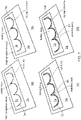
- FIGS 6a to 6d depict the initial step of attaching the biological tissue 1 to the biocompatible material 2.
- the biocompatible material 2 may take the form of a biocompatible fabric or may take the form of a second sheet of biological tissue.
- Figure 6a differs from the embodiment described in Figure 1 in that the biological tissue 1 is cut to exhibit a scalloped edge on the upstream side in proximity of the suture line created to attach the biological tissue 1 to the biocompatible material 2.
- Figure 6b differs from that of Figure 6a in that the suture line 3b uses zig-zag stitching rather than backstitch.
- FIG. 6c and 6d differ from the embodiments of 6a and 6b respectively in that a protective patch 61 is applied along the suture line.
- This protective patch takes the form of a strip of biological tissue or biocompatible material located at the opposite surface of the biological tissue to the surface in contact with the biocompatible material 2.
- the protective patch exists only at the site of the stitching without requiring a double layer of biological tissue at any location other than at the suture line.
- FIGS 7a to 7d depict the initial step of attaching the biological tissue 1a to the biocompatible material 2a.
- the biocompatible material 2a may take the form of any biocompatible fabric or may take the form of another biocompatible material such as a second sheet of biological tissue.
- Figure 7a differs from the embodiment described in Figure 6a in that the biological tissue 1a is not cut to exhibit a scalloped edge on the upstream side. Instead, a portion of biological tissue is located upstream of the suture line 3a.
- This upstream portion of biological tissue may be put to use in at least one of two ways.
- the biological tissue can be trimmed in proximity of the upstream edge 41 of the stent and sutured to the biocompatible material.
- the upstream portion of biological tissue may be used instead of the biocompatible material to cover the stent upstream of the leaflets (not shown), in which case, the biocompatible material would instead be trimmed upstream of the leaflets (i.e. 'below' the leaflets in the orientation shown in Figures 1 to 5 ). In this way, the total number of layers covering the inner surface of the stent is still kept to a minimum.
- Figure 7b differs from that of Figure 7a in that the suture line 3b uses zig-zag stitching rather than backstitch.
- FIG. 7c and 7d differ from the embodiments of 7a and 7b respectively in that a protective patch 61 is applied along the suture line.
- This protective patch takes the form of a strip of biological tissue or biocompatible material located at the opposite surface of the biological tissue to the surface in contact with the biocompatible material 2.
- the protective patch exists only at the site of the stitching without requiring a double layer of biological tissue at any location other than at the suture line.
Landscapes
- Health & Medical Sciences (AREA)
- Engineering & Computer Science (AREA)
- Biomedical Technology (AREA)
- Cardiology (AREA)
- Oral & Maxillofacial Surgery (AREA)
- Transplantation (AREA)
- Heart & Thoracic Surgery (AREA)
- Vascular Medicine (AREA)
- Life Sciences & Earth Sciences (AREA)
- Animal Behavior & Ethology (AREA)
- General Health & Medical Sciences (AREA)
- Public Health (AREA)
- Veterinary Medicine (AREA)
- Manufacturing & Machinery (AREA)
- Mechanical Engineering (AREA)
- Prostheses (AREA)
Claims (11)
- Verfahren zum Herstellen einer bioprosthetischen Herzklappe; wobei das Verfahren Folgendes umfasst:das Bereitstellen: einer Schicht eines biologischen Gewebes; einer Schicht eines biokompatiblen Materials, und eines Stents, wobei der Stent eine Stromaufwärts-Kante und eine Stromabwärts-Kante sowie eine innere Oberfläche und eine äußere Oberfläche aufweist, wobei die Stromabwärtskante des Stents gewellt ist, wobei die gewellte Kante eine Vielzahl von Stützen mit konkaven Abschnitten dazwischen definiert;das Befestigen des biologischen Gewebes an dem biokompatiblen Material entlang einer Nahtlinie;das Falten des biokompatiblen Materials, um eine rohrförmige Struktur mit dem befestigten biologischen Material zu bilden, das sich an der inneren Oberfläche der rohrförmigen Struktur befindet, wobei das biologische Gewebe die Herzklappensegel bildet;das Fixieren des Stents um die äußere Oberfläche der rohrförmigen Struktur herum, sodass sich die rohrförmige Struktur in einer Stromaufwärtsaufrichtung über die Stromaufwärtskante des Stents und in eine Stromabwärtsrichtung über die Stromabwärtskante des Stents hinaus erstreckt;das Schneiden eines Bereichs des biokompatiblen Materials, der sich zwischen jedem der konkaven Abschnitte befindet, um einen Lappen eines biokompatiblen Materials an der inneren Oberfläche jeder Stütze des Stents zu bilden;das Falten des biokompatiblen Materials an der Schnittregion von dem biologischen Gewebe weg und rund um die Stromabwärtskante des Stents und das Fixieren desselben an der äußeren Oberfläche des Stents; unddas Falten und Befestigen des biokompatiblen Materials an dem Stromaufwärts-Ende der rohrförmigen Struktur um die Stromaufwärtskante des Stents herum, sodass die innere und äußere Oberfläche des Stents mit nicht mehr als einer einzelnen Schicht des biokompatiblen Materials bedeckt sind.
- Verfahren nach Anspruch 1, das außerdem den Schritt des Zuschneidens des biologischen Gewebes zum Herstellen von Klappensegeln umfasst.
- Verfahren nach Anspruch 1 oder Anspruch 2, wobei der Schritt des Befestigens des biologischen Gewebes an dem biokompatiblen Material die folgenden Schritte umfasst:das Platzieren der Schicht des biologischen Gewebes auf dem biokompatiblen Material; unddas Nähen entlang der Nahtlinie.
- Verfahren nach Anspruch 1, wobei sich die Nahtlinie entlang eines Profils erstreckt, das dem Profil des gewellten Rands entspricht.
- Verfahren nach Anspruch 1, wobei der Schritt des Faltens des biokompatiblen Materials an der Schnittregion von dem biologischen Gewebe weg Folgendes umfasst:
das Falten des biokompatiblen Materials um jede Stütze und das Nähen des Lappens des biokompatiblen Materials an den Lappen selbst an der äußeren Oberfläche der Stütze, um die gesamte Stütze mit nicht mehr als einer Schicht des biokompatiblen Materials abzudecken. - Verfahren nach einem der vorangegangenen Ansprüche, wobei das bereitgestellte biokompatible Material ursprünglich eine rechteckige Form aufweist.
- Verfahren nach einem der vorangegangenen Ansprüche, wobei der Schritt des Faltens des biokompatiblen Materials an dem Stromaufwärts-Ende der rohrförmigen Struktur um den stromauf gelegenen Rand des Stents herum das Herstellen einer Manschette aus biokompatiblem Material an der Stromaufwärtskante des Stents umfasst.
- Verfahren nach einem der vorangegangenen Ansprüche, wobei das biokompatible Material ein biokompatibler Stoff ist.
- Verfahren nach einem der vorangegangenen Ansprüche, wobei das biokompatible Material ein biologisches Gewebe ist.
- Verfahren nach einem der vorangegangenen Ansprüche, wobei der Stent die Form eines Gerüsts aus biokompatiblem Draht aufweist.
- Bioprosthetische Herzklappe, die durch das Verfahren nach einem der vorangegangenen Ansprüche erhalten wird oder erhaltbar ist, die Folgendes umfasst:einen Stent, wobei der Stent eine Stromaufwärtskante und eine Stromabwärtskante sowie eine innere Oberfläche und eine äußere Oberfläche aufweist, wobei die Stromabwärtskante des Stents gewellt ist, wobei der gewellte Rand eine Vielzahl von Stützen mit konkaven Abschnitten dazwischen definiert;eine einzelne biokompatible Materialschicht, die um den Stent herum gefaltet ist, um die innere und die äußere Oberfläche des Stents durch nicht mehr als eine einzelne Schicht des biokompatiblen Materials vollständig abzudecken; undKlappensegel, die aus biologischem Gewebe gebildet sind, wobei das biologische Gewebe der Klappensegel mit dem biokompatiblen Material durch eine Nahtlinie an dem Stromabwärts-Ende des Stents verbunden ist.
Applications Claiming Priority (2)
| Application Number | Priority Date | Filing Date | Title |
|---|---|---|---|
| GBGB1612180.8A GB201612180D0 (en) | 2016-07-13 | 2016-07-13 | Bioprosthetic heart valve |
| PCT/GB2017/052073 WO2018011592A1 (en) | 2016-07-13 | 2017-07-13 | Bioprosthetic heart valve |
Publications (2)
| Publication Number | Publication Date |
|---|---|
| EP3484412A1 EP3484412A1 (de) | 2019-05-22 |
| EP3484412B1 true EP3484412B1 (de) | 2022-08-31 |
Family
ID=56890946
Family Applications (1)
| Application Number | Title | Priority Date | Filing Date |
|---|---|---|---|
| EP17742284.7A Active EP3484412B1 (de) | 2016-07-13 | 2017-07-13 | Methode zur herstellung einer bioprothetischen herzklappe und bioprothetische herzklappe |
Country Status (4)
| Country | Link |
|---|---|
| US (1) | US11109962B2 (de) |
| EP (1) | EP3484412B1 (de) |
| GB (1) | GB201612180D0 (de) |
| WO (1) | WO2018011592A1 (de) |
Cited By (13)
| Publication number | Priority date | Publication date | Assignee | Title |
|---|---|---|---|---|
| US11602429B2 (en) | 2019-04-01 | 2023-03-14 | Neovasc Tiara Inc. | Controllably deployable prosthetic valve |
| US11617650B2 (en) | 2012-05-30 | 2023-04-04 | Neovasc Tiara Inc. | Methods and apparatus for loading a prosthesis onto a delivery system |
| US11737872B2 (en) | 2018-11-08 | 2023-08-29 | Neovasc Tiara Inc. | Ventricular deployment of a transcatheter mitral valve prosthesis |
| US11779742B2 (en) | 2019-05-20 | 2023-10-10 | Neovasc Tiara Inc. | Introducer with hemostasis mechanism |
| US11793640B2 (en) | 2017-08-25 | 2023-10-24 | Neovasc Tiara Inc. | Sequentially deployed transcatheter mitral valve prosthesis |
| US11931254B2 (en) | 2019-06-20 | 2024-03-19 | Neovasc Tiara Inc. | Low profile prosthetic mitral valve |
| US11998447B2 (en) | 2019-03-08 | 2024-06-04 | Neovasc Tiara Inc. | Retrievable prosthesis delivery system |
| US12036117B2 (en) | 2019-04-10 | 2024-07-16 | Neovasc Tiara Inc. | Prosthetic valve with natural blood flow |
| US12053369B2 (en) | 2011-11-23 | 2024-08-06 | Neovasc Tiara Inc. | Sequentially deployed transcatheter mitral valve prosthesis |
| US12109111B2 (en) | 2015-12-15 | 2024-10-08 | Neovasc Tiara Inc. | Transseptal delivery system |
| US12138159B2 (en) | 2012-02-14 | 2024-11-12 | Neovasc Tiara Inc. | Methods and apparatus for engaging a valve prosthesis with tissue |
| US12193932B2 (en) | 2016-01-29 | 2025-01-14 | Neovasc Tiara Inc. | Prosthetic valve for avoiding obstruction of outflow |
| US12201524B2 (en) | 2016-11-21 | 2025-01-21 | Neovasc Tiara Inc. | Methods and systems for rapid retraction of a transcatheter heart valve delivery system |
Families Citing this family (5)
| Publication number | Priority date | Publication date | Assignee | Title |
|---|---|---|---|---|
| US8579964B2 (en) | 2010-05-05 | 2013-11-12 | Neovasc Inc. | Transcatheter mitral valve prosthesis |
| US9572665B2 (en) | 2013-04-04 | 2017-02-21 | Neovasc Tiara Inc. | Methods and apparatus for delivering a prosthetic valve to a beating heart |
| PL238190B1 (pl) | 2018-07-24 | 2021-07-19 | American Heart Of Poland Spolka Akcyjna | Biologiczna niskoprofilowa, rozprężana na balonie zastawka serca, zwłaszcza aortalna, implantowana przezskórnie i sposób jej wytwarzania |
| EP3890793A1 (de) * | 2018-12-05 | 2021-10-13 | Xeltis AG | Elektrogesponnener nahtring |
| WO2021168138A1 (en) * | 2020-02-18 | 2021-08-26 | Lsi Solutions, Inc. | Cardiac repair structure, apparatus, and methods thereof abstract of the disclosure |
Family Cites Families (9)
| Publication number | Priority date | Publication date | Assignee | Title |
|---|---|---|---|---|
| US4172295A (en) * | 1978-01-27 | 1979-10-30 | Shiley Scientific, Inc. | Tri-cuspid three-tissue prosthetic heart valve |
| IT1208326B (it) | 1984-03-16 | 1989-06-12 | Sorin Biomedica Spa | Protesi valvolare cardiaca provvista di lembi valvolari di tessuto biologico |
| US5258023A (en) | 1992-02-12 | 1993-11-02 | Reger Medical Development, Inc. | Prosthetic heart valve |
| US5928281A (en) * | 1997-03-27 | 1999-07-27 | Baxter International Inc. | Tissue heart valves |
| US8366769B2 (en) | 2000-06-01 | 2013-02-05 | Edwards Lifesciences Corporation | Low-profile, pivotable heart valve sewing ring |
| US20070067029A1 (en) | 2005-09-16 | 2007-03-22 | Shlomo Gabbay | Support apparatus to facilitate implantation of cardiac prosthesis |
| KR20120004677A (ko) * | 2010-07-07 | 2012-01-13 | (주) 태웅메디칼 | 이종생체조직을 이용한 인공심장판막 및 제조방법 |
| US8568475B2 (en) | 2010-10-05 | 2013-10-29 | Edwards Lifesciences Corporation | Spiraled commissure attachment for prosthetic valve |
| CN105263445B (zh) * | 2013-09-20 | 2018-09-18 | 爱德华兹生命科学公司 | 具有增加的有效孔口面积的心脏瓣膜 |
-
2016
- 2016-07-13 GB GBGB1612180.8A patent/GB201612180D0/en not_active Ceased
-
2017
- 2017-07-13 WO PCT/GB2017/052073 patent/WO2018011592A1/en not_active Ceased
- 2017-07-13 US US16/317,347 patent/US11109962B2/en active Active
- 2017-07-13 EP EP17742284.7A patent/EP3484412B1/de active Active
Cited By (13)
| Publication number | Priority date | Publication date | Assignee | Title |
|---|---|---|---|---|
| US12053369B2 (en) | 2011-11-23 | 2024-08-06 | Neovasc Tiara Inc. | Sequentially deployed transcatheter mitral valve prosthesis |
| US12138159B2 (en) | 2012-02-14 | 2024-11-12 | Neovasc Tiara Inc. | Methods and apparatus for engaging a valve prosthesis with tissue |
| US11617650B2 (en) | 2012-05-30 | 2023-04-04 | Neovasc Tiara Inc. | Methods and apparatus for loading a prosthesis onto a delivery system |
| US12109111B2 (en) | 2015-12-15 | 2024-10-08 | Neovasc Tiara Inc. | Transseptal delivery system |
| US12193932B2 (en) | 2016-01-29 | 2025-01-14 | Neovasc Tiara Inc. | Prosthetic valve for avoiding obstruction of outflow |
| US12201524B2 (en) | 2016-11-21 | 2025-01-21 | Neovasc Tiara Inc. | Methods and systems for rapid retraction of a transcatheter heart valve delivery system |
| US11793640B2 (en) | 2017-08-25 | 2023-10-24 | Neovasc Tiara Inc. | Sequentially deployed transcatheter mitral valve prosthesis |
| US11737872B2 (en) | 2018-11-08 | 2023-08-29 | Neovasc Tiara Inc. | Ventricular deployment of a transcatheter mitral valve prosthesis |
| US11998447B2 (en) | 2019-03-08 | 2024-06-04 | Neovasc Tiara Inc. | Retrievable prosthesis delivery system |
| US11602429B2 (en) | 2019-04-01 | 2023-03-14 | Neovasc Tiara Inc. | Controllably deployable prosthetic valve |
| US12036117B2 (en) | 2019-04-10 | 2024-07-16 | Neovasc Tiara Inc. | Prosthetic valve with natural blood flow |
| US11779742B2 (en) | 2019-05-20 | 2023-10-10 | Neovasc Tiara Inc. | Introducer with hemostasis mechanism |
| US11931254B2 (en) | 2019-06-20 | 2024-03-19 | Neovasc Tiara Inc. | Low profile prosthetic mitral valve |
Also Published As
| Publication number | Publication date |
|---|---|
| EP3484412A1 (de) | 2019-05-22 |
| GB201612180D0 (en) | 2016-08-24 |
| WO2018011592A1 (en) | 2018-01-18 |
| US20190298515A1 (en) | 2019-10-03 |
| US11109962B2 (en) | 2021-09-07 |
Similar Documents
| Publication | Publication Date | Title |
|---|---|---|
| EP3484412B1 (de) | Methode zur herstellung einer bioprothetischen herzklappe und bioprothetische herzklappe | |
| US12357455B2 (en) | Hybrid heart valves | |
| US20240382306A1 (en) | Prosthetic heart valve | |
| US8613765B2 (en) | Prosthetic heart valve systems | |
| US9610157B2 (en) | Leaflet abrasion mitigation | |
| US20200330223A1 (en) | Stented prosthetic heart valve having a paravalvular sealing wrap | |
| EP1977719B1 (de) | Verfahren zur Herstellung einer implantierbaren Prothesenklappe | |
| US7247167B2 (en) | Low profile heart valve prosthesis | |
| US9655719B2 (en) | Surgical heart valve flexible stent frame stiffener | |
| CN110167488A (zh) | 在框架下具有小叶流入的假体心脏瓣膜 | |
| CN105578991A (zh) | 装配有瓣膜瓣叶心脏瓣膜支撑装置 | |
| US12220312B2 (en) | Low profile cardiac valves and methods of making and using same | |
| CN116437876A (zh) | 使用单件式瓣膜子组件制造假体心脏瓣膜的系统和方法 | |
| WO2023141343A1 (en) | Cardiac valves having biased cells and methods of making same |
Legal Events
| Date | Code | Title | Description |
|---|---|---|---|
| STAA | Information on the status of an ep patent application or granted ep patent |
Free format text: STATUS: UNKNOWN |
|
| STAA | Information on the status of an ep patent application or granted ep patent |
Free format text: STATUS: THE INTERNATIONAL PUBLICATION HAS BEEN MADE |
|
| PUAI | Public reference made under article 153(3) epc to a published international application that has entered the european phase |
Free format text: ORIGINAL CODE: 0009012 |
|
| STAA | Information on the status of an ep patent application or granted ep patent |
Free format text: STATUS: REQUEST FOR EXAMINATION WAS MADE |
|
| 17P | Request for examination filed |
Effective date: 20190213 |
|
| AK | Designated contracting states |
Kind code of ref document: A1 Designated state(s): AL AT BE BG CH CY CZ DE DK EE ES FI FR GB GR HR HU IE IS IT LI LT LU LV MC MK MT NL NO PL PT RO RS SE SI SK SM TR |
|
| AX | Request for extension of the european patent |
Extension state: BA ME |
|
| DAV | Request for validation of the european patent (deleted) | ||
| DAX | Request for extension of the european patent (deleted) | ||
| GRAP | Despatch of communication of intention to grant a patent |
Free format text: ORIGINAL CODE: EPIDOSNIGR1 |
|
| STAA | Information on the status of an ep patent application or granted ep patent |
Free format text: STATUS: GRANT OF PATENT IS INTENDED |
|
| INTG | Intention to grant announced |
Effective date: 20200520 |
|
| GRAJ | Information related to disapproval of communication of intention to grant by the applicant or resumption of examination proceedings by the epo deleted |
Free format text: ORIGINAL CODE: EPIDOSDIGR1 |
|
| STAA | Information on the status of an ep patent application or granted ep patent |
Free format text: STATUS: REQUEST FOR EXAMINATION WAS MADE |
|
| INTC | Intention to grant announced (deleted) | ||
| GRAP | Despatch of communication of intention to grant a patent |
Free format text: ORIGINAL CODE: EPIDOSNIGR1 |
|
| STAA | Information on the status of an ep patent application or granted ep patent |
Free format text: STATUS: GRANT OF PATENT IS INTENDED |
|
| INTG | Intention to grant announced |
Effective date: 20210128 |
|
| GRAJ | Information related to disapproval of communication of intention to grant by the applicant or resumption of examination proceedings by the epo deleted |
Free format text: ORIGINAL CODE: EPIDOSDIGR1 |
|
| STAA | Information on the status of an ep patent application or granted ep patent |
Free format text: STATUS: REQUEST FOR EXAMINATION WAS MADE |
|
| INTC | Intention to grant announced (deleted) | ||
| GRAP | Despatch of communication of intention to grant a patent |
Free format text: ORIGINAL CODE: EPIDOSNIGR1 |
|
| STAA | Information on the status of an ep patent application or granted ep patent |
Free format text: STATUS: GRANT OF PATENT IS INTENDED |
|
| INTG | Intention to grant announced |
Effective date: 20211206 |
|
| GRAS | Grant fee paid |
Free format text: ORIGINAL CODE: EPIDOSNIGR3 |
|
| GRAA | (expected) grant |
Free format text: ORIGINAL CODE: 0009210 |
|
| STAA | Information on the status of an ep patent application or granted ep patent |
Free format text: STATUS: THE PATENT HAS BEEN GRANTED |
|
| AK | Designated contracting states |
Kind code of ref document: B1 Designated state(s): AL AT BE BG CH CY CZ DE DK EE ES FI FR GB GR HR HU IE IS IT LI LT LU LV MC MK MT NL NO PL PT RO RS SE SI SK SM TR |
|
| REG | Reference to a national code |
Ref country code: CH Ref legal event code: EP Ref country code: GB Ref legal event code: FG4D |
|
| REG | Reference to a national code |
Ref country code: AT Ref legal event code: REF Ref document number: 1514757 Country of ref document: AT Kind code of ref document: T Effective date: 20220915 Ref country code: DE Ref legal event code: R096 Ref document number: 602017061246 Country of ref document: DE |
|
| REG | Reference to a national code |
Ref country code: IE Ref legal event code: FG4D |
|
| REG | Reference to a national code |
Ref country code: NL Ref legal event code: FP |
|
| REG | Reference to a national code |
Ref country code: LT Ref legal event code: MG9D |
|
| PG25 | Lapsed in a contracting state [announced via postgrant information from national office to epo] |
Ref country code: SE Free format text: LAPSE BECAUSE OF FAILURE TO SUBMIT A TRANSLATION OF THE DESCRIPTION OR TO PAY THE FEE WITHIN THE PRESCRIBED TIME-LIMIT Effective date: 20220831 Ref country code: RS Free format text: LAPSE BECAUSE OF FAILURE TO SUBMIT A TRANSLATION OF THE DESCRIPTION OR TO PAY THE FEE WITHIN THE PRESCRIBED TIME-LIMIT Effective date: 20220831 Ref country code: NO Free format text: LAPSE BECAUSE OF FAILURE TO SUBMIT A TRANSLATION OF THE DESCRIPTION OR TO PAY THE FEE WITHIN THE PRESCRIBED TIME-LIMIT Effective date: 20221130 Ref country code: LV Free format text: LAPSE BECAUSE OF FAILURE TO SUBMIT A TRANSLATION OF THE DESCRIPTION OR TO PAY THE FEE WITHIN THE PRESCRIBED TIME-LIMIT Effective date: 20220831 Ref country code: LT Free format text: LAPSE BECAUSE OF FAILURE TO SUBMIT A TRANSLATION OF THE DESCRIPTION OR TO PAY THE FEE WITHIN THE PRESCRIBED TIME-LIMIT Effective date: 20220831 Ref country code: FI Free format text: LAPSE BECAUSE OF FAILURE TO SUBMIT A TRANSLATION OF THE DESCRIPTION OR TO PAY THE FEE WITHIN THE PRESCRIBED TIME-LIMIT Effective date: 20220831 |
|
| REG | Reference to a national code |
Ref country code: AT Ref legal event code: MK05 Ref document number: 1514757 Country of ref document: AT Kind code of ref document: T Effective date: 20220831 |
|
| PG25 | Lapsed in a contracting state [announced via postgrant information from national office to epo] |
Ref country code: PL Free format text: LAPSE BECAUSE OF FAILURE TO SUBMIT A TRANSLATION OF THE DESCRIPTION OR TO PAY THE FEE WITHIN THE PRESCRIBED TIME-LIMIT Effective date: 20220831 Ref country code: IS Free format text: LAPSE BECAUSE OF FAILURE TO SUBMIT A TRANSLATION OF THE DESCRIPTION OR TO PAY THE FEE WITHIN THE PRESCRIBED TIME-LIMIT Effective date: 20221231 Ref country code: HR Free format text: LAPSE BECAUSE OF FAILURE TO SUBMIT A TRANSLATION OF THE DESCRIPTION OR TO PAY THE FEE WITHIN THE PRESCRIBED TIME-LIMIT Effective date: 20220831 Ref country code: GR Free format text: LAPSE BECAUSE OF FAILURE TO SUBMIT A TRANSLATION OF THE DESCRIPTION OR TO PAY THE FEE WITHIN THE PRESCRIBED TIME-LIMIT Effective date: 20221201 |
|
| PG25 | Lapsed in a contracting state [announced via postgrant information from national office to epo] |
Ref country code: SM Free format text: LAPSE BECAUSE OF FAILURE TO SUBMIT A TRANSLATION OF THE DESCRIPTION OR TO PAY THE FEE WITHIN THE PRESCRIBED TIME-LIMIT Effective date: 20220831 Ref country code: RO Free format text: LAPSE BECAUSE OF FAILURE TO SUBMIT A TRANSLATION OF THE DESCRIPTION OR TO PAY THE FEE WITHIN THE PRESCRIBED TIME-LIMIT Effective date: 20220831 Ref country code: PT Free format text: LAPSE BECAUSE OF FAILURE TO SUBMIT A TRANSLATION OF THE DESCRIPTION OR TO PAY THE FEE WITHIN THE PRESCRIBED TIME-LIMIT Effective date: 20230102 Ref country code: ES Free format text: LAPSE BECAUSE OF FAILURE TO SUBMIT A TRANSLATION OF THE DESCRIPTION OR TO PAY THE FEE WITHIN THE PRESCRIBED TIME-LIMIT Effective date: 20220831 Ref country code: DK Free format text: LAPSE BECAUSE OF FAILURE TO SUBMIT A TRANSLATION OF THE DESCRIPTION OR TO PAY THE FEE WITHIN THE PRESCRIBED TIME-LIMIT Effective date: 20220831 Ref country code: CZ Free format text: LAPSE BECAUSE OF FAILURE TO SUBMIT A TRANSLATION OF THE DESCRIPTION OR TO PAY THE FEE WITHIN THE PRESCRIBED TIME-LIMIT Effective date: 20220831 Ref country code: AT Free format text: LAPSE BECAUSE OF FAILURE TO SUBMIT A TRANSLATION OF THE DESCRIPTION OR TO PAY THE FEE WITHIN THE PRESCRIBED TIME-LIMIT Effective date: 20220831 |
|
| PG25 | Lapsed in a contracting state [announced via postgrant information from national office to epo] |
Ref country code: SK Free format text: LAPSE BECAUSE OF FAILURE TO SUBMIT A TRANSLATION OF THE DESCRIPTION OR TO PAY THE FEE WITHIN THE PRESCRIBED TIME-LIMIT Effective date: 20220831 Ref country code: EE Free format text: LAPSE BECAUSE OF FAILURE TO SUBMIT A TRANSLATION OF THE DESCRIPTION OR TO PAY THE FEE WITHIN THE PRESCRIBED TIME-LIMIT Effective date: 20220831 |
|
| REG | Reference to a national code |
Ref country code: DE Ref legal event code: R097 Ref document number: 602017061246 Country of ref document: DE |
|
| PG25 | Lapsed in a contracting state [announced via postgrant information from national office to epo] |
Ref country code: AL Free format text: LAPSE BECAUSE OF FAILURE TO SUBMIT A TRANSLATION OF THE DESCRIPTION OR TO PAY THE FEE WITHIN THE PRESCRIBED TIME-LIMIT Effective date: 20220831 |
|
| PLBE | No opposition filed within time limit |
Free format text: ORIGINAL CODE: 0009261 |
|
| STAA | Information on the status of an ep patent application or granted ep patent |
Free format text: STATUS: NO OPPOSITION FILED WITHIN TIME LIMIT |
|
| 26N | No opposition filed |
Effective date: 20230601 |
|
| PG25 | Lapsed in a contracting state [announced via postgrant information from national office to epo] |
Ref country code: SI Free format text: LAPSE BECAUSE OF FAILURE TO SUBMIT A TRANSLATION OF THE DESCRIPTION OR TO PAY THE FEE WITHIN THE PRESCRIBED TIME-LIMIT Effective date: 20220831 |
|
| PG25 | Lapsed in a contracting state [announced via postgrant information from national office to epo] |
Ref country code: MC Free format text: LAPSE BECAUSE OF FAILURE TO SUBMIT A TRANSLATION OF THE DESCRIPTION OR TO PAY THE FEE WITHIN THE PRESCRIBED TIME-LIMIT Effective date: 20220831 |
|
| PG25 | Lapsed in a contracting state [announced via postgrant information from national office to epo] |
Ref country code: MC Free format text: LAPSE BECAUSE OF FAILURE TO SUBMIT A TRANSLATION OF THE DESCRIPTION OR TO PAY THE FEE WITHIN THE PRESCRIBED TIME-LIMIT Effective date: 20220831 |
|
| REG | Reference to a national code |
Ref country code: CH Ref legal event code: PL |
|
| REG | Reference to a national code |
Ref country code: BE Ref legal event code: MM Effective date: 20230731 |
|
| PG25 | Lapsed in a contracting state [announced via postgrant information from national office to epo] |
Ref country code: LU Free format text: LAPSE BECAUSE OF NON-PAYMENT OF DUE FEES Effective date: 20230713 |
|
| PG25 | Lapsed in a contracting state [announced via postgrant information from national office to epo] |
Ref country code: LU Free format text: LAPSE BECAUSE OF NON-PAYMENT OF DUE FEES Effective date: 20230713 |
|
| REG | Reference to a national code |
Ref country code: IE Ref legal event code: MM4A |
|
| PG25 | Lapsed in a contracting state [announced via postgrant information from national office to epo] |
Ref country code: CH Free format text: LAPSE BECAUSE OF NON-PAYMENT OF DUE FEES Effective date: 20230731 |
|
| PG25 | Lapsed in a contracting state [announced via postgrant information from national office to epo] |
Ref country code: BE Free format text: LAPSE BECAUSE OF NON-PAYMENT OF DUE FEES Effective date: 20230731 |
|
| PG25 | Lapsed in a contracting state [announced via postgrant information from national office to epo] |
Ref country code: IE Free format text: LAPSE BECAUSE OF NON-PAYMENT OF DUE FEES Effective date: 20230713 |
|
| PG25 | Lapsed in a contracting state [announced via postgrant information from national office to epo] |
Ref country code: IE Free format text: LAPSE BECAUSE OF NON-PAYMENT OF DUE FEES Effective date: 20230713 |
|
| PG25 | Lapsed in a contracting state [announced via postgrant information from national office to epo] |
Ref country code: BG Free format text: LAPSE BECAUSE OF FAILURE TO SUBMIT A TRANSLATION OF THE DESCRIPTION OR TO PAY THE FEE WITHIN THE PRESCRIBED TIME-LIMIT Effective date: 20220831 |
|
| PG25 | Lapsed in a contracting state [announced via postgrant information from national office to epo] |
Ref country code: BG Free format text: LAPSE BECAUSE OF FAILURE TO SUBMIT A TRANSLATION OF THE DESCRIPTION OR TO PAY THE FEE WITHIN THE PRESCRIBED TIME-LIMIT Effective date: 20220831 |
|
| PG25 | Lapsed in a contracting state [announced via postgrant information from national office to epo] |
Ref country code: CY Free format text: LAPSE BECAUSE OF FAILURE TO SUBMIT A TRANSLATION OF THE DESCRIPTION OR TO PAY THE FEE WITHIN THE PRESCRIBED TIME-LIMIT; INVALID AB INITIO Effective date: 20170713 |
|
| PG25 | Lapsed in a contracting state [announced via postgrant information from national office to epo] |
Ref country code: HU Free format text: LAPSE BECAUSE OF FAILURE TO SUBMIT A TRANSLATION OF THE DESCRIPTION OR TO PAY THE FEE WITHIN THE PRESCRIBED TIME-LIMIT; INVALID AB INITIO Effective date: 20170713 |
|
| PGFP | Annual fee paid to national office [announced via postgrant information from national office to epo] |
Ref country code: DE Payment date: 20250924 Year of fee payment: 9 |
|
| PGFP | Annual fee paid to national office [announced via postgrant information from national office to epo] |
Ref country code: NL Payment date: 20250924 Year of fee payment: 9 |
|
| PGFP | Annual fee paid to national office [announced via postgrant information from national office to epo] |
Ref country code: GB Payment date: 20250924 Year of fee payment: 9 |
|
| PGFP | Annual fee paid to national office [announced via postgrant information from national office to epo] |
Ref country code: FR Payment date: 20250924 Year of fee payment: 9 |
|
| PG25 | Lapsed in a contracting state [announced via postgrant information from national office to epo] |
Ref country code: TR Free format text: LAPSE BECAUSE OF FAILURE TO SUBMIT A TRANSLATION OF THE DESCRIPTION OR TO PAY THE FEE WITHIN THE PRESCRIBED TIME-LIMIT Effective date: 20220831 |
|
| PGFP | Annual fee paid to national office [announced via postgrant information from national office to epo] |
Ref country code: IT Payment date: 20251009 Year of fee payment: 9 |