EP3483213A1 - Acrylic rubber composition - Google Patents
Acrylic rubber composition Download PDFInfo
- Publication number
- EP3483213A1 EP3483213A1 EP17824080.0A EP17824080A EP3483213A1 EP 3483213 A1 EP3483213 A1 EP 3483213A1 EP 17824080 A EP17824080 A EP 17824080A EP 3483213 A1 EP3483213 A1 EP 3483213A1
- Authority
- EP
- European Patent Office
- Prior art keywords
- acrylic rubber
- mass
- rubber composition
- acrylic
- acrylate
- Prior art date
- Legal status (The legal status is an assumption and is not a legal conclusion. Google has not performed a legal analysis and makes no representation as to the accuracy of the status listed.)
- Granted
Links
Classifications
-
- C—CHEMISTRY; METALLURGY
- C08—ORGANIC MACROMOLECULAR COMPOUNDS; THEIR PREPARATION OR CHEMICAL WORKING-UP; COMPOSITIONS BASED THEREON
- C08L—COMPOSITIONS OF MACROMOLECULAR COMPOUNDS
- C08L33/00—Compositions of homopolymers or copolymers of compounds having one or more unsaturated aliphatic radicals, each having only one carbon-to-carbon double bond, and only one being terminated by only one carboxyl radical, or of salts, anhydrides, esters, amides, imides or nitriles thereof; Compositions of derivatives of such polymers
- C08L33/04—Homopolymers or copolymers of esters
- C08L33/06—Homopolymers or copolymers of esters of esters containing only carbon, hydrogen and oxygen, which oxygen atoms are present only as part of the carboxyl radical
- C08L33/10—Homopolymers or copolymers of methacrylic acid esters
-
- C—CHEMISTRY; METALLURGY
- C08—ORGANIC MACROMOLECULAR COMPOUNDS; THEIR PREPARATION OR CHEMICAL WORKING-UP; COMPOSITIONS BASED THEREON
- C08K—Use of inorganic or non-macromolecular organic substances as compounding ingredients
- C08K3/00—Use of inorganic substances as compounding ingredients
- C08K3/02—Elements
- C08K3/04—Carbon
-
- C—CHEMISTRY; METALLURGY
- C08—ORGANIC MACROMOLECULAR COMPOUNDS; THEIR PREPARATION OR CHEMICAL WORKING-UP; COMPOSITIONS BASED THEREON
- C08K—Use of inorganic or non-macromolecular organic substances as compounding ingredients
- C08K3/00—Use of inorganic substances as compounding ingredients
- C08K3/02—Elements
- C08K3/04—Carbon
- C08K3/042—Graphene or derivatives, e.g. graphene oxides
-
- C—CHEMISTRY; METALLURGY
- C08—ORGANIC MACROMOLECULAR COMPOUNDS; THEIR PREPARATION OR CHEMICAL WORKING-UP; COMPOSITIONS BASED THEREON
- C08L—COMPOSITIONS OF MACROMOLECULAR COMPOUNDS
- C08L23/00—Compositions of homopolymers or copolymers of unsaturated aliphatic hydrocarbons having only one carbon-to-carbon double bond; Compositions of derivatives of such polymers
- C08L23/02—Compositions of homopolymers or copolymers of unsaturated aliphatic hydrocarbons having only one carbon-to-carbon double bond; Compositions of derivatives of such polymers not modified by chemical after-treatment
- C08L23/04—Homopolymers or copolymers of ethene
- C08L23/08—Copolymers of ethene
- C08L23/0846—Copolymers of ethene with unsaturated hydrocarbons containing atoms other than carbon or hydrogen
-
- C—CHEMISTRY; METALLURGY
- C08—ORGANIC MACROMOLECULAR COMPOUNDS; THEIR PREPARATION OR CHEMICAL WORKING-UP; COMPOSITIONS BASED THEREON
- C08L—COMPOSITIONS OF MACROMOLECULAR COMPOUNDS
- C08L33/00—Compositions of homopolymers or copolymers of compounds having one or more unsaturated aliphatic radicals, each having only one carbon-to-carbon double bond, and only one being terminated by only one carboxyl radical, or of salts, anhydrides, esters, amides, imides or nitriles thereof; Compositions of derivatives of such polymers
- C08L33/04—Homopolymers or copolymers of esters
- C08L33/06—Homopolymers or copolymers of esters of esters containing only carbon, hydrogen and oxygen, which oxygen atoms are present only as part of the carboxyl radical
-
- C—CHEMISTRY; METALLURGY
- C08—ORGANIC MACROMOLECULAR COMPOUNDS; THEIR PREPARATION OR CHEMICAL WORKING-UP; COMPOSITIONS BASED THEREON
- C08L—COMPOSITIONS OF MACROMOLECULAR COMPOUNDS
- C08L33/00—Compositions of homopolymers or copolymers of compounds having one or more unsaturated aliphatic radicals, each having only one carbon-to-carbon double bond, and only one being terminated by only one carboxyl radical, or of salts, anhydrides, esters, amides, imides or nitriles thereof; Compositions of derivatives of such polymers
- C08L33/04—Homopolymers or copolymers of esters
- C08L33/06—Homopolymers or copolymers of esters of esters containing only carbon, hydrogen and oxygen, which oxygen atoms are present only as part of the carboxyl radical
- C08L33/08—Homopolymers or copolymers of acrylic acid esters
-
- C—CHEMISTRY; METALLURGY
- C09—DYES; PAINTS; POLISHES; NATURAL RESINS; ADHESIVES; COMPOSITIONS NOT OTHERWISE PROVIDED FOR; APPLICATIONS OF MATERIALS NOT OTHERWISE PROVIDED FOR
- C09K—MATERIALS FOR MISCELLANEOUS APPLICATIONS, NOT PROVIDED FOR ELSEWHERE
- C09K3/00—Materials not provided for elsewhere
-
- C—CHEMISTRY; METALLURGY
- C09—DYES; PAINTS; POLISHES; NATURAL RESINS; ADHESIVES; COMPOSITIONS NOT OTHERWISE PROVIDED FOR; APPLICATIONS OF MATERIALS NOT OTHERWISE PROVIDED FOR
- C09K—MATERIALS FOR MISCELLANEOUS APPLICATIONS, NOT PROVIDED FOR ELSEWHERE
- C09K3/00—Materials not provided for elsewhere
- C09K3/10—Materials in mouldable or extrudable form for sealing or packing joints or covers
-
- C—CHEMISTRY; METALLURGY
- C09—DYES; PAINTS; POLISHES; NATURAL RESINS; ADHESIVES; COMPOSITIONS NOT OTHERWISE PROVIDED FOR; APPLICATIONS OF MATERIALS NOT OTHERWISE PROVIDED FOR
- C09K—MATERIALS FOR MISCELLANEOUS APPLICATIONS, NOT PROVIDED FOR ELSEWHERE
- C09K3/00—Materials not provided for elsewhere
- C09K3/10—Materials in mouldable or extrudable form for sealing or packing joints or covers
- C09K3/1006—Materials in mouldable or extrudable form for sealing or packing joints or covers characterised by the chemical nature of one of its constituents
-
- F—MECHANICAL ENGINEERING; LIGHTING; HEATING; WEAPONS; BLASTING
- F16—ENGINEERING ELEMENTS AND UNITS; GENERAL MEASURES FOR PRODUCING AND MAINTAINING EFFECTIVE FUNCTIONING OF MACHINES OR INSTALLATIONS; THERMAL INSULATION IN GENERAL
- F16L—PIPES; JOINTS OR FITTINGS FOR PIPES; SUPPORTS FOR PIPES, CABLES OR PROTECTIVE TUBING; MEANS FOR THERMAL INSULATION IN GENERAL
- F16L11/00—Hoses, i.e. flexible pipes
- F16L11/04—Hoses, i.e. flexible pipes made of rubber or flexible plastics
-
- C—CHEMISTRY; METALLURGY
- C08—ORGANIC MACROMOLECULAR COMPOUNDS; THEIR PREPARATION OR CHEMICAL WORKING-UP; COMPOSITIONS BASED THEREON
- C08K—Use of inorganic or non-macromolecular organic substances as compounding ingredients
- C08K5/00—Use of organic ingredients
- C08K5/0008—Organic ingredients according to more than one of the "one dot" groups of C08K5/01 - C08K5/59
- C08K5/0025—Crosslinking or vulcanising agents; including accelerators
-
- C—CHEMISTRY; METALLURGY
- C08—ORGANIC MACROMOLECULAR COMPOUNDS; THEIR PREPARATION OR CHEMICAL WORKING-UP; COMPOSITIONS BASED THEREON
- C08L—COMPOSITIONS OF MACROMOLECULAR COMPOUNDS
- C08L2203/00—Applications
- C08L2203/18—Applications used for pipes
-
- C—CHEMISTRY; METALLURGY
- C08—ORGANIC MACROMOLECULAR COMPOUNDS; THEIR PREPARATION OR CHEMICAL WORKING-UP; COMPOSITIONS BASED THEREON
- C08L—COMPOSITIONS OF MACROMOLECULAR COMPOUNDS
- C08L2312/00—Crosslinking
-
- C—CHEMISTRY; METALLURGY
- C09—DYES; PAINTS; POLISHES; NATURAL RESINS; ADHESIVES; COMPOSITIONS NOT OTHERWISE PROVIDED FOR; APPLICATIONS OF MATERIALS NOT OTHERWISE PROVIDED FOR
- C09K—MATERIALS FOR MISCELLANEOUS APPLICATIONS, NOT PROVIDED FOR ELSEWHERE
- C09K2200/00—Chemical nature of materials in mouldable or extrudable form for sealing or packing joints or covers
- C09K2200/02—Inorganic compounds
- C09K2200/0204—Elements
- C09K2200/0208—Carbon
-
- C—CHEMISTRY; METALLURGY
- C09—DYES; PAINTS; POLISHES; NATURAL RESINS; ADHESIVES; COMPOSITIONS NOT OTHERWISE PROVIDED FOR; APPLICATIONS OF MATERIALS NOT OTHERWISE PROVIDED FOR
- C09K—MATERIALS FOR MISCELLANEOUS APPLICATIONS, NOT PROVIDED FOR ELSEWHERE
- C09K2200/00—Chemical nature of materials in mouldable or extrudable form for sealing or packing joints or covers
- C09K2200/06—Macromolecular organic compounds, e.g. prepolymers
- C09K2200/0615—Macromolecular organic compounds, e.g. prepolymers obtained by reactions only involving carbon-to-carbon unsaturated bonds
- C09K2200/0625—Polyacrylic esters or derivatives thereof
Definitions
- the present invention relates to an acrylic rubber composition having higher tensile properties and higher heat resistance and use thereof.
- Patent Document 1 a small amount of aluminum oxide is dispersed as a thermal conductive filler in a silicone resin molded article to impart high thermal conductivity while flexibility is maintained.
- Patent Document 2 discloses a resin sealed semiconductor device in which an inorganic filler is added to an epoxy resin to impart insulating properties.
- Patent Document 3 discloses a nanocomposite in which a nanosized filler such as a layered clay mineral is dispersed in a diene rubber to improve physical properties including disruptive strength and flexural fatigue resistance.
- Acrylic rubbers and vulcanizates thereof have excellent physical properties including heat aging resistance, oil resistance, mechanical characteristics, and permanent compression set characteristics and thus are typically used as materials including hose members, sealing members, and rubber vibration isolator members in an automobile engine compartment.
- Such members are also required to have more excellent physical properties including tensile properties and heat resistance to meet recent demands including emission controls and higher engine power.
- the present invention is mainly intended to provide an acrylic rubber composition having more excellent tensile properties and heat resistance.
- the present invention is also intended to provide a cured rubber produced by curing the acrylic rubber composition.
- the inventors of the present invention have found that by adding a carbon material comprising graphene oxide to an acrylic rubber, specifically by finely dispersing the carbon material on the nanosize level, tensile properties and heat resistance can be improved, and have completed the present invention.
- the present invention provides an acrylic rubber composition comprising 0.1 to 50 parts by mass of a carbon material comprising graphene oxide, relative to 100 parts by mass of an acrylic rubber.
- the acrylic rubber may be curable or may be a vulcanizable rubber.
- the acrylic rubber may include at least one functional group selected from an epoxy group, a carboxyl group, and an active chlorine group.
- the content ratio of a monomer unit having the functional group may be 0.1 to 10% by mass relative to the total mass of the acrylic rubber.
- the acrylic rubber may comprise an ethylene monomer unit.
- the content ratio of the ethylene monomer unit may be 0.1 to 10% by mass relative to the total mass of the acrylic rubber.
- the carbon material may be graphene oxide.
- the present invention also provides a vulcanizate of the acrylic rubber composition.
- the present invention also provides a vulcanized rubber produced by vulcanization of the acrylic rubber composition.
- the present invention further provides a rubber hose comprising the vulcanizate, a sealing part comprising the vulcanizate, and a rubber vibration isolator comprising the vulcanizate.
- an acrylic rubber composition having more excellent tensile properties and/or heat resistance can be provided.
- An acrylic rubber composition of the present invention comprises a carbon material including graphene oxide, and may specifically comprise the carbon material dispersed on a nano-level.
- the acrylic rubber composition of the present invention may comprise the carbon material in nano sizes in a dispersion state.
- the acrylic rubber composition of the present invention may be produced by kneading an acrylic rubber and the carbon material, for example, using a commonly used rubber kneader.
- a commonly used rubber kneader examples include, but are not necessarily limited to, a roller, a kneader, a Banbury mixer, an internal mixer, and a twin-screw extruder.
- the acrylic rubber composition of the present invention may also be produced by, for example, emulsion polymerization of an acrylic rubber in a polymerization liquid containing the carbon material.
- An acrylic rubber used in the present invention mainly comprises a (meth)acrylic acid alkyl ester and is a copolymer thereof with a curesite monomer.
- the curesite monomer is a monomer having a functional group to form a curesite (curing point).
- the acrylic rubber may be an acrylic rubber produced by further copolymerizing ethylene, that is, an ethylene-copolymerized acrylic rubber.
- the acrylic rubber may also be an acrylic rubber produced by further copolymerizing vinyl acetate or the like with a (meth)acrylic acid alkyl ester as needed; that is, a vinyl acetate-copolymerized acrylic rubber or an ethylene-vinyl acetate-copolymerized acrylic rubber may be used.
- the acrylic rubber used in the present invention may preferably be an ethylene-vinyl acetate-copolymerized acrylic rubber.
- "Mainly comprising” means that monomer units derived from the (meth)acrylic acid alkyl ester are contained in a total amount of, for example, 75% by mass to 99% by mass, preferably 80% by mass to 98% by mass, more preferably 85% by mass to 97% by mass, and even more preferably 90% by mass to 96% by mass relative to the total mass of an acrylic rubber.
- the (meth)acrylic acid alkyl ester is to be the skeleton of an acrylic rubber. By selecting the type or the mixing ratio thereof, original physical properties or basic properties including cold resistance and oil resistance of a resulting acrylic rubber composition can be adjusted.
- the (meth)acrylic acid alkyl ester is a synonym for a (meth)acrylate and includes both methacrylic acid alkyl esters (methacrylates) and acrylic acid alkyl esters (acrylates).
- examples of the (meth)acrylic acid alkyl ester include, but are not necessarily limited to, (meth)acrylic acid alkyl esters such as methyl (meth)acrylate, ethyl (meth)acrylate, n-propyl (meth)acrylate, n-butyl (meth)acrylate, isobutyl (meth)acrylate, n-pentyl (meth)acrylate, isoamyl (meth)acrylate, n-hexyl (meth)acrylate, 2-methylpentyl (meth)acrylate, n-octyl (meth)acrylate, 2-ethylhexyl (meth)acrylate, n-decyl (meth)acrylate, n-dodecyl (meth)acrylate, and n-octadecyl (meth)acrylate.
- (meth)acrylic acid alkyl esters such as methyl (meth)acrylate
- acrylic acid alkoxyalkyl esters such as 2-methoxyethyl acrylate, 2-ethoxyethyl acrylate, 2-(n-propoxy)ethyl acrylate, 2-(n-butoxy)ethyl acrylate, 3-methoxypropyl acrylate, 3-ethoxypropyl acrylate, 2-(n-propoxy)propyl acrylate, 2-(n-butoxy)propyl acrylate, and 2-(2-ethoxyethoxy)ethyl acrylate may also be used.
- These (meth)acrylic acid alkyl esters may be used singly or in combination of two or more of them.
- the acrylic rubber used in the present invention may be preferably a polymer of ethyl acrylate and n-butyl acrylate as the (meth)acrylic acid alkyl ester.
- the acrylic rubber used in the present invention preferably contains an ethyl acrylate monomer unit and an n-butyl acrylate monomer unit and more preferably contains these monomer units as main components.
- the acrylic rubber composition of the present invention may contain an ethyl acrylate monomer unit and an n-butyl acrylate monomer unit in a total amount of, for example, 75% by mass to 99% by mass, preferably 80% by mass to 98% by mass, more preferably 85% by mass to 97% by mass, and even more preferably 90% by mass to 96% by mass relative to the total mass of the acrylic rubber.
- the acrylic rubber used in the present invention may contain an ethyl acrylate monomer unit, for example, in an amount of 40 to 60% by mass, preferably 42 to 55% by mass, and more preferably 44 to 50% by mass relative to the total mass of the acrylic rubber, and may contain an n-butyl acrylate monomer unit, for example, in an amount of 40 to 60% by mass, preferably 42 to 55% by mass, and more preferably 44 to 50% by mass relative to the total mass of the acrylic rubber.
- the content ratio of the monomer units is quantitatively determined on the basis of a nuclear magnetic resonance spectrum obtained from an acrylic rubber or an acrylic rubber composition.
- cold resistance or oil resistance of a resulting acrylic rubber composition or a vulcanizate thereof can be adjusted.
- an increase in copolymerization proportion of n-butyl acrylate enables an improvement of cold resistance
- an increase in copolymerization proportion of ethyl acrylate enables an improvement of oil resistance.
- the curesite monomer may be copolymerized with a (meth)acrylic acid alkyl ester as needed to enable the formation of intermolecular crosslinkages through functional groups derived from the curesite monomer.
- the curesite monomer may be used for adjusting the hardness or elongation characteristics of an acrylic rubber.
- the curesite monomer essentially has any one functional group of a carboxyl group, an epoxy group, and an active chlorine group.
- the acrylic rubber of the present invention may be an acrylic rubber having at least one group selected from a carboxyl group, an epoxy group, and an active chlorine group.
- Examples of the curesite monomer having a carboxyl group include, but are not necessarily limited to, acrylic acid, methacrylic acid, crotonic acid, 2-pentenoic acid, maleic acid, fumaric acid, itaconic acid, maleic acid monoalkyl esters, fumaric acid monoalkyl esters, monocyclohexyl maleate, monocyclohexyl fumarate, and cinnamic acid.
- Examples of the curesite monomer having an epoxy group include, but are not necessarily limited to, glycidyl acrylate, glycidyl methacrylate, allyl glycidyl ether, and methallyl glycidyl ether.
- Examples of the curesite monomer having an active chlorine group include, but are not necessarily limited to, 2-chloroethyl vinyl ether, 2-chloroethyl acrylate, vinylbenzyl chloride, vinyl chloroacetate, and allyl chloroacetate.
- a single curesite monomer may be used, or a plurality of curesite monomers may be used in combination.
- the curesite monomer used in the present invention is preferably a maleic acid monoalkyl ester or a fumaric acid monoalkyl ester, and the carbon number of the monoalkyl group may be, for example, 1 to 8, preferably 2 to 6, and more preferably 3 to 5.
- the curesite monomer used in the present invention may be more preferably monobutyl maleate.
- the acrylic rubber of the present invention may be preferably a carboxyl group-containing acrylic rubber.
- the carboxyl group may be preferably derived from the maleic acid monoalkyl ester or the fumaric acid monoalkyl ester.
- the curesite monomer used in the present invention may be preferably glycidyl acrylate or glycidyl methacrylate.
- the curesite monomer used in the present invention may be more preferably glycidyl methacrylate.
- the acrylic rubber of the present invention may be preferably an epoxy group-containing acrylic rubber.
- the epoxy group may be preferably derived from the glycidyl acrylate or the glycidyl methacrylate.
- the content ratio of the curesite monomer unit in the acrylic rubber may be preferably 0.1 to 10% by mass, more preferably 0.5 to 10% by mass, even more preferably 1 to 5% by mass, and particularly preferably 1 to 4% by mass relative to the total mass of the acrylic rubber. If the content ratio of the curesite monomer unit is excessively low, for example, less than 0.1% by mass, the effect by curing an acrylic rubber composition may be small, and a resulting vulcanizate may have insufficient strength. If the content ratio of the curesite monomer unit is excessively high, for example, more than 10% by mass, a vulcanizate of such an acrylic rubber composition may excessively harden, and the vulcanizate may lose rubber elasticity.
- the quantitative determination of the monomer unit is performed by dissolution of a raw rubber of a copolymer in toluene and subsequent neutralization titration of the solution with potassium hydroxide.
- the quantitative determination is performed by dissolution of a raw rubber of a copolymer in chloroform and subsequent titration with a perchloric acid-acetic acid solution.
- the quantitative determination is performed by decomposition by oxygen flask combustion method and subsequent titration of the product with silver nitrate.
- the content ratio of the curesite monomer unit is the content ratio of the curesite monomer unit having a carboxyl group.
- the content ratio is the total content ratio of the curesite monomer having an epoxy group and the additional curesite monomer.
- an additional monomer copolymerizable with the (meth)acrylic acid alkyl ester or the curesite monomer may be copolymerized as long as the object of the present invention is not impaired.
- the additional copolymerizable monomer include, but are not necessarily limited to, alkyl vinyl ketones such as vinyl acetate and methyl vinyl ketone; vinyl ethers and allyl ethers such as vinyl ethyl ether and allyl methyl ether; vinyl aromatic compounds such as styrene, ⁇ -methylstyrene, chlorostyrene, vinyltoluene, and vinylnaphthalene; vinyl nitriles such as acrylonitrile and methacrylonitrile; and ethylenically unsaturated compounds such as acrylamide, propylene, butadiene, isoprene, pentadiene, vinyl chloride, vinylidene chloride, vinyl fluoride, vinylidene fluoride, ethylene
- the content ratio of the ethylene monomer unit in the acrylic rubber may be preferably 0.1 to 10% by mass, more preferably 0.5 to 5% by mass, and even more preferably 1.0 to 2.9% by mass relative to the total mass of the acrylic rubber.
- the content ratio of the monomer unit is quantitatively determined on the basis of a nuclear magnetic resonance spectrum obtained from an acrylic rubber or an acrylic rubber composition.
- the acrylic rubber may be produced through copolymerization of the above monomers by a known method including emulsion polymerization, suspension polymerization, solution polymerization, and bulk polymerization.
- the production method of the acrylic rubber may be appropriately selected by a person skilled in the art.
- Examples of the carbon material comprising graphene oxide used in the present invention include, but are not necessarily limited to, graphite, particularly include graphite oxide, graphite flakes (specifically graphite oxide flakes), graphene oxide, and carbon nanotubes.
- graphite oxide is particularly preferably used in order to achieve the effects of the present invention better.
- the content ratio of the carbon material in the acrylic rubber composition may be 0.1 to 50 parts by mass, more preferably 0.15 to 45 parts by mass, and even more preferably 0.2 to 40 parts by mass relative to 100 parts by mass of the acrylic rubber. If the content ratio is excessively low, for example, less than 0.1 parts by mass relative to 100 parts by mass of the acrylic rubber, the strength improvement effect by the carbon material may not be exerted. If the content ratio is excessively high, for example, more than 50 parts by mass relative to 100 parts by mass of the acrylic rubber, the tensile properties may deteriorate.
- the content ratio of the carbon material is determined by thermogravimetry.
- the carbon material may have an average particle diameter of, for example, 0.1 ⁇ m to 1,000 ⁇ m, preferably 0.5 ⁇ m to 300 ⁇ m, more preferably 1 ⁇ m to 200 ⁇ m, and even more preferably 5 ⁇ m to 100 ⁇ m.
- the average particle diameter may be the average of maximum diameters of any 30 particles. The maximum diameters may be determined under an atomic force microscope.
- the carbon material may typically have a thickness of 20 nm or less, for example, 0.1 to 20 nm, preferably 0.2 to 10 nm, and more preferably 0.3 to 8 nm.
- the carbon material may be kneaded in a powder state with an acrylic rubber or may be kneaded in a dispersed state in water or another polar solvent with an acrylic rubber. By such kneading, the acrylic rubber composition of the present invention may be produced.
- the graphene oxide may have an average particle diameter of, for example, 0.1 ⁇ m to 1,000 ⁇ m, preferably 0.5 ⁇ m to 300 ⁇ m, more preferably 1 ⁇ m to 200 ⁇ m, and even more preferably 5 ⁇ m to 100 ⁇ m.
- the measurement method of the average particle diameter is the same as above.
- the graphene oxide may typically have a thickness of 20 nm or less, for example, 0.1 to 20 nm, preferably 0.2 to 10 nm, and more preferably 0.3 to 8 nm.
- the graphene oxide may have a single layer structure or a multilayer structure and, for example, may include 2 to 5 layers.
- the functional group that the graphene oxide may have may be, for example, an epoxy group, a carboxyl group, a hydroxyl group, and/or a carbonyl group.
- the graphene oxide may have one or more functional groups of them.
- the graphene oxide may be produced by a method known to a person skilled in the art and may be produced, for example, by a modified Hammer's method.
- the acrylic rubber composition may further contain a vulcanizing agent or a vulcanization accelerator.
- the vulcanizing agent may be any agent commonly used for vulcanization of an acrylic rubber composition.
- the curesite monomer is a monomer having a carboxyl group
- the vulcanizing agent is preferably a polyamine compound, and a vulcanizing system containing a guanidine compound may be particularly preferably used.
- the curesite monomer is a monomer having an epoxy group
- the vulcanizing agent may be preferably an imidazole compound.
- polyamine compound examples include, but are not necessarily limited to, aromatic polyamine compounds such as 4,4'-bis(4-aminophenoxy)biphenyl, 4,4'-diaminodiphenyl sulfide, 1,3-bis(4-aminophenoxy)-2,2-dimethylpropane, 1,3-bis(4-aminophenoxy)benzene, 1,4-bis(4-aminophenoxy)benzene, 1,4-bis(4-aminophenoxy)pentane, 2,2-bis[4-(4-aminophenoxy)phenyl]propane, 2,2-bis[4-(4-aminophenoxy)phenyl] sulfone, 4,4'-diaminodiphenyl sulfone, bis[4-(3-aminophenoxy)phenyl] sulfone, 2,2-bis[4-(4-aminophenoxy)phenyl]hexafluoropropane, 3,
- guanidine compound examples include, but are not necessarily limited to, guanidine, tetramethylguanidine, dibutylguanidine, diphenylguanidine, and di-o-tolylguanidine.
- imidazole compound examples include, but are not necessarily limited to, 1-methylimidazole, 1,2-dimethylimidazole, 1-methyl-2-ethylimidazole, 1-benzyl-2-methylimidazole, 1-benzyl-2-ethylimidazole, 1-benzyl-2-ethyl-5-methylimidazole, 1-benzyl-2-phenylimidazole, 1-benzyl-2-phenylimidazole trimellitic acid salt, 1-aminoethylimidazole, 1-aminoethyl-2-methylimidazole, 1-aminoethyl-2-ethylimidazole, 1-cyanoethyl-2-methylimidazole, 1-cyanoethyl-2-phenylimidazole, 1-cyanoethyl-2-ethyl-4-methylimidazole, 1-cyanoethyl-2-undecylimidazole, 1-cyanoethyl-2-methylimi
- the content of the vulcanizing agent is not limited to particular values and is preferably 0.1 to 10 parts by mass and more preferably 0.3 to 5 parts by mass relative to 100 parts by mass of the acrylic rubber. When the content is within the range, necessary and sufficient vulcanization treatment can be performed.
- the vulcanization accelerator is added in order to control the vulcanization rate.
- Specific examples of the vulcanization accelerator include, but are not necessarily limited to, curing agents for epoxy resins, such as pyrolytic ammonium salts, organic acids, acid anhydrides, amines, sulfur, and sulfur compounds.
- the vulcanization accelerator may be added at such an amount as not to impair characteristics of a vulcanizate produced from the acrylic rubber composition in the present invention.
- the vulcanizing agent, the vulcanization accelerator, and the like may be kneaded with the acrylic rubber composition of the present invention at a temperature not higher than a vulcanization temperature.
- the acrylic rubber composition of the present invention may be molded into various intended shapes and then be vulcanized into a vulcanizate, or may be vulcanized and then be molded into various intended shapes.
- the vulcanization temperature may be appropriately set depending on mixing ratios of components in the acrylic rubber composition or a type of the vulcanizing agent, and is typically 100 to 200°C and preferably 130 to 180°C.
- the time for vulcanization is 1 to 10 hours and preferably 2 to 6 hours.
- Apparatuses for kneading, molding, or vulcanizing the acrylic rubber composition and apparatuses for kneading or molding a vulcanizate of the acrylic rubber composition may be those commonly used in the rubber industry.
- the acrylic rubber composition may contain a filler, a reinforcing agent, a plasticizer, a lubricant, an age inhibitor, a stabilizer, a silane coupling agent, and the like depending on intended practical use.
- fillers or reinforcing agents used for common rubber applications may be added, and examples include fillers or reinforcing agents, such as carbon blacks, silicas, talcs, and calcium carbonates.
- the total content of such additives is preferably 20 to 100 parts by mass relative to 100 parts by mass of the acrylic rubber composition.
- plasticizers used for common rubber applications may be added, and examples include ester plasticizers, polyoxyethylene ether plasticizers, and trimellitate plasticizers.
- the content of the plasticizer is preferably about 50 parts by mass or less relative to 100 parts by mass of the acrylic rubber composition.
- the acrylic rubber composition of the present invention and the vulcanizate thereof are suitably used specifically as rubber hoses, sealing parts such as gaskets and packings, and rubber vibration isolators.
- the present invention provides a rubber hose, a sealing part, or a rubber vibration isolator comprising the vulcanizate of the present invention.
- the rubber hose, the sealing part, and the rubber vibration isolator may be composed of only the acrylic rubber composition of the present invention or only the vulcanizate thereof, or may be a combination with other parts.
- Examples of the rubber hose include transmission oil cooler hoses, engine oil cooler hoses, air duct hoses, turbo intercooler hoses, hot air hoses, radiator hoses, power steering hoses, fuel system hoses, and drain system hoses in automobiles, construction machinery, or hydraulic machines.
- reinforcing yarns or wires may be provided inside a hose or on the outermost layer of a rubber hose as commonly performed.
- sealing part examples include engine head cover gaskets, oil pan gaskets, oil seals, lip seal packings, O-rings, transmission seal gaskets, crank shafts, cam shaft seal gaskets, valve stems, power steering seal belt cover seals, boot materials for constant velocity joints, and rack and pinion boot materials.
- Examples of the rubber vibration isolator include damper pulleys, center support cushions, and suspension bushes.
- Acrylic rubbers A and B were produced in the conditions shown below.
- a pressure-resistant reaction container having an internal volume of 40 liters, 5.6 Kg of ethyl acrylate, 5.6 Kg of n-butyl acrylate, 560 g of monobutyl maleate, 17 Kg of 4% by mass aqueous solution of partially saponified polyvinyl alcohol, and 22 g of sodium acetate were placed, and the whole was thoroughly stirred with a stirrer, giving a homogeneous suspension.
- the air in the upper part of the container was replaced with nitrogen, then ethylene was injected under pressure into the upper part of the container, and the pressure was adjusted at 3.5 MPa.
- an aqueous t-butyl hydroperoxide solution (0.25% by mass, 2 liters) was separately injected under pressure from an inlet to start polymerization.
- the temperature in the container during the reaction was maintained at 55°C, and the reaction was completed after 6 hours.
- an aqueous sodium borate solution (3.5% by mass, 7 liters) was added to solidify the polymer, and the polymer was dehydrated and dried to give an acrylic rubber A.
- the ethylene monomer unit was 2.0% by mass
- the monobutyl maleate monomer unit was 3.5% by mass
- the ethyl acrylate monomer unit was 47.5% by mass
- the n-butyl acrylate monomer unit was 47.0% by mass.
- the quantitative determination of the monobutyl maleate monomer unit was performed by dissolution of a raw rubber of the copolymer in toluene and subsequent neutralization titration with potassium hydroxide.
- the other monomer units were quantitatively determined from nuclear magnetic resonance spectra of the respective components.
- the ethylene monomer unit was 2.0% by mass
- the glycidyl methacrylate monomer unit was 3.5% by mass
- the ethyl acrylate monomer unit was 47.5% by mass
- the n-butyl acrylate monomer unit was 47.0% by mass.
- the quantitative determination of the glycidyl methacrylate monomer was performed by dissolution of a raw rubber of the copolymer in chloroform and subsequent titration with a perchloric acid-acetic acid solution.
- the other copolymer composition was quantitatively determined from nuclear magnetic resonance spectra of each component.
- the acrylic rubber A or B produced by the above method was kneaded with a HAAKE mixer and a 6-inch open roll in accordance with a formulation in Table 1, and was extruded into a sheet having a thickness of 2.4 mm.
- the sheet was subjected to press vulcanization at 170°C for 50 minutes with a press vulcanizer.
- the graphene oxide in Table 1 was prepared by oxidation of Graphene 3777 manufactured by Asbury Carbons Inc. through a modified Hammer's method. In other words, the graphene oxide was prepared in accordance with the following procedure.
- the tensile strength, the elongation at break, and the heat resistance of the produced acrylic rubber compositions were evaluated in the following conditions.
- thermogravimetry was used to heat about 10 mg of a sample to 600°C at a temperature increase rate of 20°C/min under a nitrogen atmosphere (nitrogen flow rate: 35 mL/min), and a temperature at which the sample weight decreased by 5% was determined as the decomposition temperature.
- nitrogen flow rate 35 mL/min
- the acrylic rubber compositions containing graphene oxide in Examples 1 to 8 had excellent mechanical strength particularly in tensile properties and heat resistance as compared with the acrylic rubber composition free from graphene oxide in Comparative Example 1.
- the acrylic rubber compositions containing graphene oxide at contents of more than 50 parts by mass in Comparative Examples 2 to 4 had poor evaluation results of tensile properties particularly in elongation as compared with Examples 1 to 8.
- the acrylic rubber composition containing graphene in place of graphene oxide in Comparative Example 5 had poor evaluation results of tensile properties particularly in elongation as compared with Examples 1 to 8. From these results, the acrylic rubber composition of the present invention has excellent rubber physical properties in tensile properties and heat resistance.
Landscapes
- Chemical & Material Sciences (AREA)
- Organic Chemistry (AREA)
- Health & Medical Sciences (AREA)
- Chemical Kinetics & Catalysis (AREA)
- Medicinal Chemistry (AREA)
- Polymers & Plastics (AREA)
- Engineering & Computer Science (AREA)
- General Engineering & Computer Science (AREA)
- Materials Engineering (AREA)
- Mechanical Engineering (AREA)
- Compositions Of Macromolecular Compounds (AREA)
- Sealing Material Composition (AREA)
Abstract
Description
- The present invention relates to an acrylic rubber composition having higher tensile properties and higher heat resistance and use thereof.
- To meet recent demands for higher performance and higher functions, attempts to uniformly disperse various fillers in a polymer have been performed to impart various characteristics.
- For example, in Patent Document 1, a small amount of aluminum oxide is dispersed as a thermal conductive filler in a silicone resin molded article to impart high thermal conductivity while flexibility is maintained.
- Patent Document 2 discloses a resin sealed semiconductor device in which an inorganic filler is added to an epoxy resin to impart insulating properties.
- Patent Document 3 discloses a nanocomposite in which a nanosized filler such as a layered clay mineral is dispersed in a diene rubber to improve physical properties including disruptive strength and flexural fatigue resistance.
-
- Patent Document 1:
JP-A No. 2014-229849 - Patent Document 2:
JP-A No. 2013-211556 - Patent Document 3:
JP-A No. 2003-327751 - Acrylic rubbers and vulcanizates thereof have excellent physical properties including heat aging resistance, oil resistance, mechanical characteristics, and permanent compression set characteristics and thus are typically used as materials including hose members, sealing members, and rubber vibration isolator members in an automobile engine compartment.
- Such members are also required to have more excellent physical properties including tensile properties and heat resistance to meet recent demands including emission controls and higher engine power.
- In view of the above circumstances, the present invention is mainly intended to provide an acrylic rubber composition having more excellent tensile properties and heat resistance. The present invention is also intended to provide a cured rubber produced by curing the acrylic rubber composition.
- As a result of intensive studies to solve the above problems, the inventors of the present invention have found that by adding a carbon material comprising graphene oxide to an acrylic rubber, specifically by finely dispersing the carbon material on the nanosize level, tensile properties and heat resistance can be improved, and have completed the present invention.
- The present invention provides an acrylic rubber composition comprising 0.1 to 50 parts by mass of a carbon material comprising graphene oxide, relative to 100 parts by mass of an acrylic rubber. The acrylic rubber may be curable or may be a vulcanizable rubber. The acrylic rubber may include at least one functional group selected from an epoxy group, a carboxyl group, and an active chlorine group. The content ratio of a monomer unit having the functional group may be 0.1 to 10% by mass relative to the total mass of the acrylic rubber. The acrylic rubber may comprise an ethylene monomer unit. The content ratio of the ethylene monomer unit may be 0.1 to 10% by mass relative to the total mass of the acrylic rubber. The carbon material may be graphene oxide.
- The present invention also provides a vulcanizate of the acrylic rubber composition. In other words, the present invention also provides a vulcanized rubber produced by vulcanization of the acrylic rubber composition.
- The present invention further provides a rubber hose comprising the vulcanizate, a sealing part comprising the vulcanizate, and a rubber vibration isolator comprising the vulcanizate.
- According to the present invention, an acrylic rubber composition having more excellent tensile properties and/or heat resistance can be provided.
- The present invention will now be described in detail, but the invention is not intended to be limited to the following embodiments.
- An acrylic rubber composition of the present invention comprises a carbon material including graphene oxide, and may specifically comprise the carbon material dispersed on a nano-level. In other words, the acrylic rubber composition of the present invention may comprise the carbon material in nano sizes in a dispersion state.
- The acrylic rubber composition of the present invention may be produced by kneading an acrylic rubber and the carbon material, for example, using a commonly used rubber kneader. Examples of the rubber kneader include, but are not necessarily limited to, a roller, a kneader, a Banbury mixer, an internal mixer, and a twin-screw extruder. Alternatively, the acrylic rubber composition of the present invention may also be produced by, for example, emulsion polymerization of an acrylic rubber in a polymerization liquid containing the carbon material.
- An acrylic rubber used in the present invention mainly comprises a (meth)acrylic acid alkyl ester and is a copolymer thereof with a curesite monomer. The curesite monomer is a monomer having a functional group to form a curesite (curing point). The acrylic rubber may be an acrylic rubber produced by further copolymerizing ethylene, that is, an ethylene-copolymerized acrylic rubber. The acrylic rubber may also be an acrylic rubber produced by further copolymerizing vinyl acetate or the like with a (meth)acrylic acid alkyl ester as needed; that is, a vinyl acetate-copolymerized acrylic rubber or an ethylene-vinyl acetate-copolymerized acrylic rubber may be used. The acrylic rubber used in the present invention may preferably be an ethylene-vinyl acetate-copolymerized acrylic rubber. "Mainly comprising" means that monomer units derived from the (meth)acrylic acid alkyl ester are contained in a total amount of, for example, 75% by mass to 99% by mass, preferably 80% by mass to 98% by mass, more preferably 85% by mass to 97% by mass, and even more preferably 90% by mass to 96% by mass relative to the total mass of an acrylic rubber.
- The (meth)acrylic acid alkyl ester is to be the skeleton of an acrylic rubber. By selecting the type or the mixing ratio thereof, original physical properties or basic properties including cold resistance and oil resistance of a resulting acrylic rubber composition can be adjusted. In the present invention, the (meth)acrylic acid alkyl ester is a synonym for a (meth)acrylate and includes both methacrylic acid alkyl esters (methacrylates) and acrylic acid alkyl esters (acrylates).
- In the present invention, examples of the (meth)acrylic acid alkyl ester include, but are not necessarily limited to, (meth)acrylic acid alkyl esters such as methyl (meth)acrylate, ethyl (meth)acrylate, n-propyl (meth)acrylate, n-butyl (meth)acrylate, isobutyl (meth)acrylate, n-pentyl (meth)acrylate, isoamyl (meth)acrylate, n-hexyl (meth)acrylate, 2-methylpentyl (meth)acrylate, n-octyl (meth)acrylate, 2-ethylhexyl (meth)acrylate, n-decyl (meth)acrylate, n-dodecyl (meth)acrylate, and n-octadecyl (meth)acrylate.
- As the (meth)acrylic acid alkyl ester in the present invention, acrylic acid alkoxyalkyl esters such as 2-methoxyethyl acrylate, 2-ethoxyethyl acrylate, 2-(n-propoxy)ethyl acrylate, 2-(n-butoxy)ethyl acrylate, 3-methoxypropyl acrylate, 3-ethoxypropyl acrylate, 2-(n-propoxy)propyl acrylate, 2-(n-butoxy)propyl acrylate, and 2-(2-ethoxyethoxy)ethyl acrylate may also be used. These (meth)acrylic acid alkyl esters may be used singly or in combination of two or more of them.
- The acrylic rubber used in the present invention may be preferably a polymer of ethyl acrylate and n-butyl acrylate as the (meth)acrylic acid alkyl ester. In other words, the acrylic rubber used in the present invention preferably contains an ethyl acrylate monomer unit and an n-butyl acrylate monomer unit and more preferably contains these monomer units as main components. The acrylic rubber composition of the present invention may contain an ethyl acrylate monomer unit and an n-butyl acrylate monomer unit in a total amount of, for example, 75% by mass to 99% by mass, preferably 80% by mass to 98% by mass, more preferably 85% by mass to 97% by mass, and even more preferably 90% by mass to 96% by mass relative to the total mass of the acrylic rubber.
- For example, the acrylic rubber used in the present invention may contain an ethyl acrylate monomer unit, for example, in an amount of 40 to 60% by mass, preferably 42 to 55% by mass, and more preferably 44 to 50% by mass relative to the total mass of the acrylic rubber, and may contain an n-butyl acrylate monomer unit, for example, in an amount of 40 to 60% by mass, preferably 42 to 55% by mass, and more preferably 44 to 50% by mass relative to the total mass of the acrylic rubber. The content ratio of the monomer units is quantitatively determined on the basis of a nuclear magnetic resonance spectrum obtained from an acrylic rubber or an acrylic rubber composition.
- By controlling the amounts of the above unsaturated monomers, cold resistance or oil resistance of a resulting acrylic rubber composition or a vulcanizate thereof can be adjusted. For example, when ethyl acrylate and n-butyl acrylate are used to produce an acrylic rubber, an increase in copolymerization proportion of n-butyl acrylate enables an improvement of cold resistance, whereas an increase in copolymerization proportion of ethyl acrylate enables an improvement of oil resistance.
- The curesite monomer may be copolymerized with a (meth)acrylic acid alkyl ester as needed to enable the formation of intermolecular crosslinkages through functional groups derived from the curesite monomer. The curesite monomer may be used for adjusting the hardness or elongation characteristics of an acrylic rubber. The curesite monomer essentially has any one functional group of a carboxyl group, an epoxy group, and an active chlorine group. In other words, the acrylic rubber of the present invention may be an acrylic rubber having at least one group selected from a carboxyl group, an epoxy group, and an active chlorine group.
- Examples of the curesite monomer having a carboxyl group include, but are not necessarily limited to, acrylic acid, methacrylic acid, crotonic acid, 2-pentenoic acid, maleic acid, fumaric acid, itaconic acid, maleic acid monoalkyl esters, fumaric acid monoalkyl esters, monocyclohexyl maleate, monocyclohexyl fumarate, and cinnamic acid. Examples of the curesite monomer having an epoxy group include, but are not necessarily limited to, glycidyl acrylate, glycidyl methacrylate, allyl glycidyl ether, and methallyl glycidyl ether. Examples of the curesite monomer having an active chlorine group include, but are not necessarily limited to, 2-chloroethyl vinyl ether, 2-chloroethyl acrylate, vinylbenzyl chloride, vinyl chloroacetate, and allyl chloroacetate. A single curesite monomer may be used, or a plurality of curesite monomers may be used in combination.
- The curesite monomer used in the present invention is preferably a maleic acid monoalkyl ester or a fumaric acid monoalkyl ester, and the carbon number of the monoalkyl group may be, for example, 1 to 8, preferably 2 to 6, and more preferably 3 to 5. The curesite monomer used in the present invention may be more preferably monobutyl maleate. In other words, the acrylic rubber of the present invention may be preferably a carboxyl group-containing acrylic rubber. The carboxyl group may be preferably derived from the maleic acid monoalkyl ester or the fumaric acid monoalkyl ester.
- Alternatively, the curesite monomer used in the present invention may be preferably glycidyl acrylate or glycidyl methacrylate. The curesite monomer used in the present invention may be more preferably glycidyl methacrylate. In other words, the acrylic rubber of the present invention may be preferably an epoxy group-containing acrylic rubber. The epoxy group may be preferably derived from the glycidyl acrylate or the glycidyl methacrylate.
- The content ratio of the curesite monomer unit in the acrylic rubber may be preferably 0.1 to 10% by mass, more preferably 0.5 to 10% by mass, even more preferably 1 to 5% by mass, and particularly preferably 1 to 4% by mass relative to the total mass of the acrylic rubber. If the content ratio of the curesite monomer unit is excessively low, for example, less than 0.1% by mass, the effect by curing an acrylic rubber composition may be small, and a resulting vulcanizate may have insufficient strength. If the content ratio of the curesite monomer unit is excessively high, for example, more than 10% by mass, a vulcanizate of such an acrylic rubber composition may excessively harden, and the vulcanizate may lose rubber elasticity. For a curesite monomer having a carboxyl group, the quantitative determination of the monomer unit is performed by dissolution of a raw rubber of a copolymer in toluene and subsequent neutralization titration of the solution with potassium hydroxide. For a curesite monomer having an epoxy group, the quantitative determination is performed by dissolution of a raw rubber of a copolymer in chloroform and subsequent titration with a perchloric acid-acetic acid solution. For a curesite monomer having an active chlorine group, the quantitative determination is performed by decomposition by oxygen flask combustion method and subsequent titration of the product with silver nitrate.
- When only a curesite monomer having a carboxyl group is used as the curesite monomer, the content ratio of the curesite monomer unit is the content ratio of the curesite monomer unit having a carboxyl group. When a curesite monomer having an epoxy group and an additional curesite monomer are used as the curesite monomer, the content ratio is the total content ratio of the curesite monomer having an epoxy group and the additional curesite monomer.
- In the acrylic rubber, an additional monomer copolymerizable with the (meth)acrylic acid alkyl ester or the curesite monomer may be copolymerized as long as the object of the present invention is not impaired. Examples of the additional copolymerizable monomer include, but are not necessarily limited to, alkyl vinyl ketones such as vinyl acetate and methyl vinyl ketone; vinyl ethers and allyl ethers such as vinyl ethyl ether and allyl methyl ether; vinyl aromatic compounds such as styrene, α-methylstyrene, chlorostyrene, vinyltoluene, and vinylnaphthalene; vinyl nitriles such as acrylonitrile and methacrylonitrile; and ethylenically unsaturated compounds such as acrylamide, propylene, butadiene, isoprene, pentadiene, vinyl chloride, vinylidene chloride, vinyl fluoride, vinylidene fluoride, ethylene, and vinyl propionate.
- When ethylene is copolymerized in the production of the acrylic rubber, the content ratio of the ethylene monomer unit in the acrylic rubber may be preferably 0.1 to 10% by mass, more preferably 0.5 to 5% by mass, and even more preferably 1.0 to 2.9% by mass relative to the total mass of the acrylic rubber. By copolymerization of ethylene within the numerical range, an acrylic rubber having a markedly improved strength can be produced. The content ratio of the monomer unit is quantitatively determined on the basis of a nuclear magnetic resonance spectrum obtained from an acrylic rubber or an acrylic rubber composition.
- The acrylic rubber may be produced through copolymerization of the above monomers by a known method including emulsion polymerization, suspension polymerization, solution polymerization, and bulk polymerization. The production method of the acrylic rubber may be appropriately selected by a person skilled in the art.
- Examples of the carbon material comprising graphene oxide used in the present invention include, but are not necessarily limited to, graphite, particularly include graphite oxide, graphite flakes (specifically graphite oxide flakes), graphene oxide, and carbon nanotubes. In the present invention, among these carbon materials, graphene oxide is particularly preferably used in order to achieve the effects of the present invention better.
- The content ratio of the carbon material in the acrylic rubber composition may be 0.1 to 50 parts by mass, more preferably 0.15 to 45 parts by mass, and even more preferably 0.2 to 40 parts by mass relative to 100 parts by mass of the acrylic rubber. If the content ratio is excessively low, for example, less than 0.1 parts by mass relative to 100 parts by mass of the acrylic rubber, the strength improvement effect by the carbon material may not be exerted. If the content ratio is excessively high, for example, more than 50 parts by mass relative to 100 parts by mass of the acrylic rubber, the tensile properties may deteriorate. The content ratio of the carbon material is determined by thermogravimetry.
- The carbon material may have an average particle diameter of, for example, 0.1 µm to 1,000 µm, preferably 0.5 µm to 300 µm, more preferably 1 µm to 200 µm, and even more preferably 5 µm to 100 µm. The average particle diameter may be the average of maximum diameters of any 30 particles. The maximum diameters may be determined under an atomic force microscope.
- The carbon material may typically have a thickness of 20 nm or less, for example, 0.1 to 20 nm, preferably 0.2 to 10 nm, and more preferably 0.3 to 8 nm.
- The carbon material may be kneaded in a powder state with an acrylic rubber or may be kneaded in a dispersed state in water or another polar solvent with an acrylic rubber. By such kneading, the acrylic rubber composition of the present invention may be produced.
- When the carbon material is graphene oxide, the graphene oxide may have an average particle diameter of, for example, 0.1 µm to 1,000 µm, preferably 0.5 µm to 300 µm, more preferably 1 µm to 200 µm, and even more preferably 5 µm to 100 µm. The measurement method of the average particle diameter is the same as above. The graphene oxide may typically have a thickness of 20 nm or less, for example, 0.1 to 20 nm, preferably 0.2 to 10 nm, and more preferably 0.3 to 8 nm. The graphene oxide may have a single layer structure or a multilayer structure and, for example, may include 2 to 5 layers. The functional group that the graphene oxide may have may be, for example, an epoxy group, a carboxyl group, a hydroxyl group, and/or a carbonyl group. The graphene oxide may have one or more functional groups of them. The graphene oxide may be produced by a method known to a person skilled in the art and may be produced, for example, by a modified Hammer's method.
- The acrylic rubber composition may further contain a vulcanizing agent or a vulcanization accelerator.
- The vulcanizing agent may be any agent commonly used for vulcanization of an acrylic rubber composition. For example, when the curesite monomer is a monomer having a carboxyl group, the vulcanizing agent is preferably a polyamine compound, and a vulcanizing system containing a guanidine compound may be particularly preferably used. When the curesite monomer is a monomer having an epoxy group, the vulcanizing agent may be preferably an imidazole compound.
- Examples of the polyamine compound include, but are not necessarily limited to, aromatic polyamine compounds such as 4,4'-bis(4-aminophenoxy)biphenyl, 4,4'-diaminodiphenyl sulfide, 1,3-bis(4-aminophenoxy)-2,2-dimethylpropane,
1,3-bis(4-aminophenoxy)benzene, 1,4-bis(4-aminophenoxy)benzene, 1,4-bis(4-aminophenoxy)pentane, 2,2-bis[4-(4-aminophenoxy)phenyl]propane,
2,2-bis[4-(4-aminophenoxy)phenyl] sulfone, 4,4'-diaminodiphenyl sulfone, bis[4-(3-aminophenoxy)phenyl] sulfone,
2,2-bis[4-(4-aminophenoxy)phenyl]hexafluoropropane, 3,4'-diaminodiphenyl ether, 4,4'-diaminodiphenyl ether, 4,4'-diaminobenzanilide, and bis[4-(4-aminophenoxy)phenyl]sulfone; and aliphatic polyamine compounds such as hexamethylenediamine, hexamethylenediamine carbamate, N,N'-dicinnamylidene-1,6-hexanediamine, diethylenetriamine, triethylenetetramine, and tetraethylenepentamine. - Examples of the guanidine compound include, but are not necessarily limited to, guanidine, tetramethylguanidine, dibutylguanidine, diphenylguanidine, and di-o-tolylguanidine.
- Examples of the imidazole compound include, but are not necessarily limited to, 1-methylimidazole, 1,2-dimethylimidazole, 1-methyl-2-ethylimidazole, 1-benzyl-2-methylimidazole, 1-benzyl-2-ethylimidazole, 1-benzyl-2-ethyl-5-methylimidazole, 1-benzyl-2-phenylimidazole, 1-benzyl-2-phenylimidazole trimellitic acid salt, 1-aminoethylimidazole, 1-aminoethyl-2-methylimidazole, 1-aminoethyl-2-ethylimidazole, 1-cyanoethyl-2-methylimidazole, 1-cyanoethyl-2-phenylimidazole, 1-cyanoethyl-2-ethyl-4-methylimidazole, 1-cyanoethyl-2-undecylimidazole, 1-cyanoethyl-2-methylimidazole trimellitate, 1-cyanoethyl-2-phenylimidazole trimellitate, 1-cyanoethyl-2-ethyl-4-methylimidazole trimellitate, 1-cyanoethyl-2-undecyl-imidazole trimellitate, 2,4-diamino-6-[2'-methylimidazolyl-(1)']ethyl-s-triazine/isocyanuric acid adduct, 1-cyanoethyl-2-phenyl-4,5-di-(cyanoethoxymethyl)imidazole, N-(2-methylimidazolyl-1-ethyl)urea, N,N'-bis-(2-methylimidazolyl-1-ethyl)urea, 1-(cyanoethylaminoethyl)-2-methylimidazole, N,N'-[2-methylimidazolyl-(1)-ethyl]-adipoyldiamide, N,N'-[2-methylimidazolyl-(1)-ethyl]-dodecanedioyl diamide, N,N'-[2-methylimidazolyl-(1)-ethyl]-eicosanedioyl diamide, 2,4-diamino-6-[2'-methylimidazolyl-(1)']-ethyl-s-triazine, 2,4-diamino-6-[2'-undecylimidazolyl-(1)']-ethyl-s-triazine, 1-dodecyl-2-methyl-3-benzylimidazolium chloride, and 1,3-dibenzyl-2-methylimidazolium chloride.
- The content of the vulcanizing agent is not limited to particular values and is preferably 0.1 to 10 parts by mass and more preferably 0.3 to 5 parts by mass relative to 100 parts by mass of the acrylic rubber. When the content is within the range, necessary and sufficient vulcanization treatment can be performed.
- The vulcanization accelerator is added in order to control the vulcanization rate. Specific examples of the vulcanization accelerator include, but are not necessarily limited to, curing agents for epoxy resins, such as pyrolytic ammonium salts, organic acids, acid anhydrides, amines, sulfur, and sulfur compounds. The vulcanization accelerator may be added at such an amount as not to impair characteristics of a vulcanizate produced from the acrylic rubber composition in the present invention.
- The vulcanizing agent, the vulcanization accelerator, and the like may be kneaded with the acrylic rubber composition of the present invention at a temperature not higher than a vulcanization temperature. The acrylic rubber composition of the present invention may be molded into various intended shapes and then be vulcanized into a vulcanizate, or may be vulcanized and then be molded into various intended shapes. The vulcanization temperature may be appropriately set depending on mixing ratios of components in the acrylic rubber composition or a type of the vulcanizing agent, and is typically 100 to 200°C and preferably 130 to 180°C. The time for vulcanization is 1 to 10 hours and preferably 2 to 6 hours.
- Apparatuses for kneading, molding, or vulcanizing the acrylic rubber composition and apparatuses for kneading or molding a vulcanizate of the acrylic rubber composition may be those commonly used in the rubber industry.
- The acrylic rubber composition may contain a filler, a reinforcing agent, a plasticizer, a lubricant, an age inhibitor, a stabilizer, a silane coupling agent, and the like depending on intended practical use.
- As the filler or the reinforcing agent, fillers or reinforcing agents used for common rubber applications may be added, and examples include fillers or reinforcing agents, such as carbon blacks, silicas, talcs, and calcium carbonates. The total content of such additives is preferably 20 to 100 parts by mass relative to 100 parts by mass of the acrylic rubber composition.
- As the plasticizer, plasticizers used for common rubber applications may be added, and examples include ester plasticizers, polyoxyethylene ether plasticizers, and trimellitate plasticizers. The content of the plasticizer is preferably about 50 parts by mass or less relative to 100 parts by mass of the acrylic rubber composition.
- The acrylic rubber composition of the present invention and the vulcanizate thereof are suitably used specifically as rubber hoses, sealing parts such as gaskets and packings, and rubber vibration isolators. In other words, the present invention provides a rubber hose, a sealing part, or a rubber vibration isolator comprising the vulcanizate of the present invention. The rubber hose, the sealing part, and the rubber vibration isolator may be composed of only the acrylic rubber composition of the present invention or only the vulcanizate thereof, or may be a combination with other parts.
- Examples of the rubber hose include transmission oil cooler hoses, engine oil cooler hoses, air duct hoses, turbo intercooler hoses, hot air hoses, radiator hoses, power steering hoses, fuel system hoses, and drain system hoses in automobiles, construction machinery, or hydraulic machines.
- As the structure of the rubber hose, reinforcing yarns or wires may be provided inside a hose or on the outermost layer of a rubber hose as commonly performed.
- Examples of the sealing part include engine head cover gaskets, oil pan gaskets, oil seals, lip seal packings, O-rings, transmission seal gaskets, crank shafts, cam shaft seal gaskets, valve stems, power steering seal belt cover seals, boot materials for constant velocity joints, and rack and pinion boot materials.
- Examples of the rubber vibration isolator include damper pulleys, center support cushions, and suspension bushes.
- The present invention will next be described in further detail with reference to examples, but the invention is not intended to be limited by the examples.
- Acrylic rubbers A and B were produced in the conditions shown below.
- In a pressure-resistant reaction container having an internal volume of 40 liters, 5.6 Kg of ethyl acrylate, 5.6 Kg of n-butyl acrylate, 560 g of monobutyl maleate, 17 Kg of 4% by mass aqueous solution of partially saponified polyvinyl alcohol, and 22 g of sodium acetate were placed, and the whole was thoroughly stirred with a stirrer, giving a homogeneous suspension. The air in the upper part of the container was replaced with nitrogen, then ethylene was injected under pressure into the upper part of the container, and the pressure was adjusted at 3.5 MPa. Under stirring, the temperature in the container was maintained at 55°C, and an aqueous t-butyl hydroperoxide solution (0.25% by mass, 2 liters) was separately injected under pressure from an inlet to start polymerization. The temperature in the container during the reaction was maintained at 55°C, and the reaction was completed after 6 hours. To the resulting polymerization liquid, an aqueous sodium borate solution (3.5% by mass, 7 liters) was added to solidify the polymer, and the polymer was dehydrated and dried to give an acrylic rubber A.
- As the copolymer composition of the acrylic rubber A, the ethylene monomer unit was 2.0% by mass, the monobutyl maleate monomer unit was 3.5% by mass, the ethyl acrylate monomer unit was 47.5% by mass, and the n-butyl acrylate monomer unit was 47.0% by mass. The quantitative determination of the monobutyl maleate monomer unit was performed by dissolution of a raw rubber of the copolymer in toluene and subsequent neutralization titration with potassium hydroxide. The other monomer units were quantitatively determined from nuclear magnetic resonance spectra of the respective components.
- The same procedure as for the acrylic rubber A was performed except that 150 g of glycidyl methacrylate was used in place of monobutyl maleate to start polymerization, giving an acrylic rubber B.
- As the copolymer composition of the acrylic rubber B, the ethylene monomer unit was 2.0% by mass, the glycidyl methacrylate monomer unit was 3.5% by mass, the ethyl acrylate monomer unit was 47.5% by mass, and the n-butyl acrylate monomer unit was 47.0% by mass. The quantitative determination of the glycidyl methacrylate monomer was performed by dissolution of a raw rubber of the copolymer in chloroform and subsequent titration with a perchloric acid-acetic acid solution. The other copolymer composition was quantitatively determined from nuclear magnetic resonance spectra of each component.
- The acrylic rubber A or B produced by the above method was kneaded with a HAAKE mixer and a 6-inch open roll in accordance with a formulation in Table 1, and was extruded into a sheet having a thickness of 2.4 mm. The sheet was subjected to press vulcanization at 170°C for 50 minutes with a press vulcanizer.
- Reagents described in Table 1 are as shown below.
- Stearic acid: Lunac S-90 manufactured by Kao Corporation
- Stearylamine: Farmin 80 manufactured by Kao Corporation
- Liquid paraffin: HICALL K-230 manufactured by Kaneda Co., Ltd.
- Age inhibitor: NAUGARD 445 manufactured by Uniroyal Chemical Company Ltd. (4,4'-bis(α,α-dimethylbenzyl)diphenylamine)
- 2,2-bis [4-(4-aminophenoxy)phenyl]propane: manufactured by Wakayama Seika Kogyo Co., Ltd.
- XLA-60: vulcanization accelerator manufactured by Lanxess
- Trimethylthiourea: manufactured by Ouchi Shinko Chemical Industrial Co., Ltd.
- 1-Benzyl-2-methylimidazole: manufactured by Shikoku Chemicals Corporation
- Octadecyltrimethylammonium bromide: manufactured by Toho Chemical Industry Co., Ltd.
- Graphene: Graphene 3777 manufactured by Asbury Carbons Inc.
- The graphene oxide in Table 1 was prepared by oxidation of Graphene 3777 manufactured by Asbury Carbons Inc. through a modified Hammer's method. In other words, the graphene oxide was prepared in accordance with the following procedure.
- 1. First, 1 g of graphene and 0.5 g of sodium nitrate were mixed, then 23 mL of concentrated sulfuric acid was added, and the whole was stirred for one hour to give a mixture 1.
- 2. To the mixture 1, 3 g of potassium permanganate was slowly added so that the temperature of the mixture did not exceed 20°C, giving a mixture 2.
- 3. The mixture 2 was stirred at 35°C for 12 hours, and then 500 mL of water was added while the mixture was vigorously stirred, giving a suspension.
- 4. To the suspension, 5 mL of 30% aqueous hydrogen peroxide was added to completely consume the potassium permanganate.
- 5. The suspension after the treatment in step 4 was washed with hydrochloric acid and water and was filtered, and the product was dried to give graphene oxide.
- The tensile strength, the elongation at break, and the heat resistance of the produced acrylic rubber compositions were evaluated in the following conditions.
- Measurement was performed in accordance with ASTM D 412-98.
- An apparatus for thermogravimetry was used to heat about 10 mg of a sample to 600°C at a temperature increase rate of 20°C/min under a nitrogen atmosphere (nitrogen flow rate: 35 mL/min), and a temperature at which the sample weight decreased by 5% was determined as the decomposition temperature. The measurement results of Examples and Comparative Example are shown in Table 1.
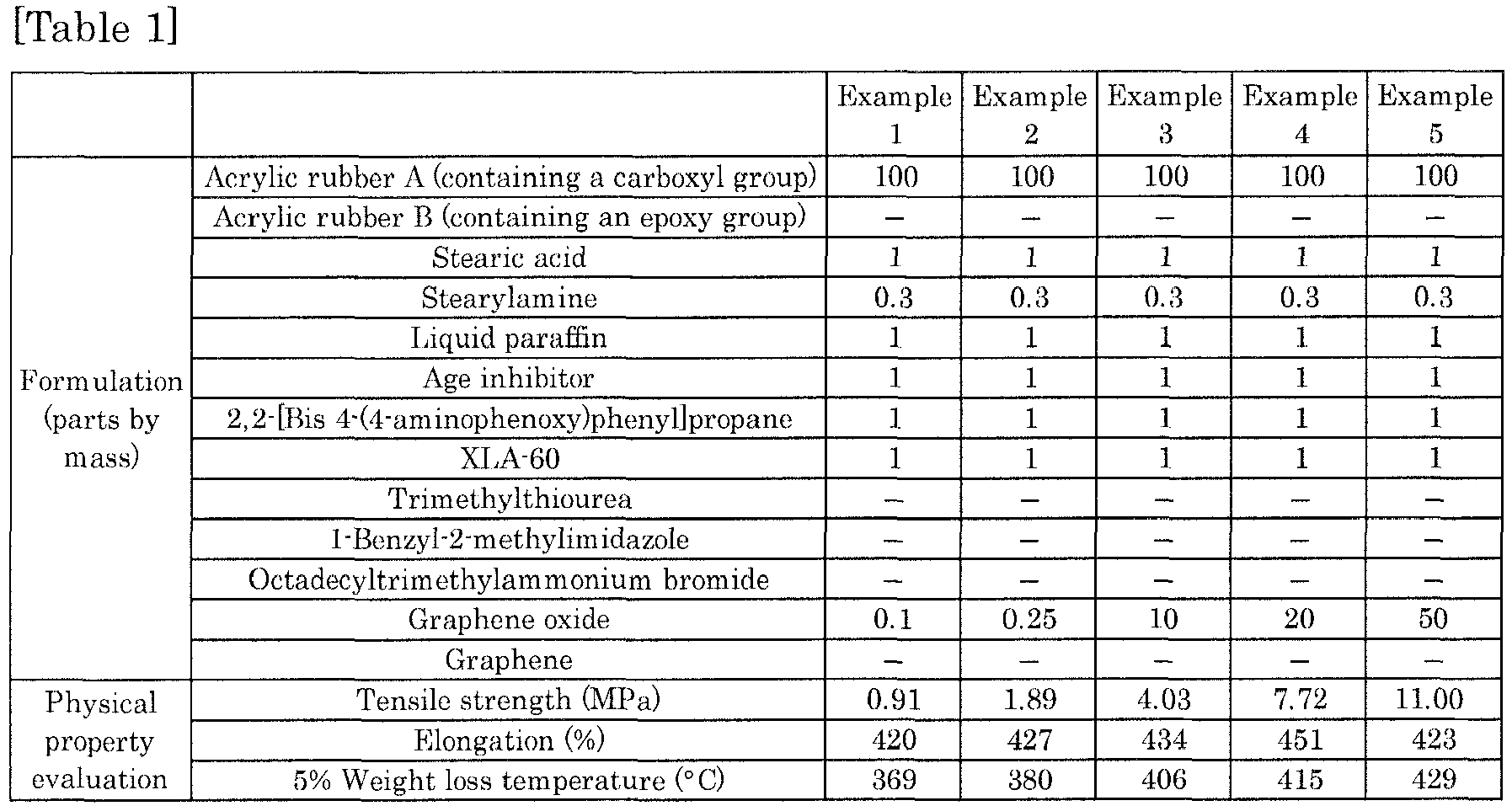

- As shown in Table 1, the acrylic rubber compositions containing graphene oxide in Examples 1 to 8 had excellent mechanical strength particularly in tensile properties and heat resistance as compared with the acrylic rubber composition free from graphene oxide in Comparative Example 1. The acrylic rubber compositions containing graphene oxide at contents of more than 50 parts by mass in Comparative Examples 2 to 4 had poor evaluation results of tensile properties particularly in elongation as compared with Examples 1 to 8. The acrylic rubber composition containing graphene in place of graphene oxide in Comparative Example 5 had poor evaluation results of tensile properties particularly in elongation as compared with Examples 1 to 8. From these results, the acrylic rubber composition of the present invention has excellent rubber physical properties in tensile properties and heat resistance.
Claims (10)
- An acrylic rubber composition comprising 0.1 to 50 parts by mass of a carbon material comprising graphene oxide, relative to 100 parts by mass of an acrylic rubber.
- The acrylic rubber composition according to claim 1, wherein the acrylic rubber includes at least one functional group selected from an epoxy group, a carboxyl group, and an active chlorine group.
- The acrylic rubber composition according to claim 2, wherein a content ratio of a monomer unit having the functional group is 0.1 to 10% by mass relative to a total mass of the acrylic rubber.
- The acrylic rubber composition according to any one of claims 1 to 3, wherein the acrylic rubber comprises an ethylene monomer unit.
- The acrylic rubber composition according to claim 4, wherein a content ratio of the ethylene monomer unit is 0.1 to 10% by mass relative to a total mass of the acrylic rubber.
- The acrylic rubber composition according to any one of claims 1 to 5, wherein the carbon material is graphene oxide.
- A vulcanizate of the acrylic rubber composition according to any one of claims 1 to 6.
- A rubber hose comprising the vulcanizate according to claim 7.
- A sealing part comprising the vulcanizate according to claim 7.
- A rubber vibration isolator comprising the vulcanizate according to claim 7.
Applications Claiming Priority (2)
| Application Number | Priority Date | Filing Date | Title |
|---|---|---|---|
| JP2016133546 | 2016-07-05 | ||
| PCT/JP2017/023571 WO2018008474A1 (en) | 2016-07-05 | 2017-06-27 | Acrylic rubber composition |
Publications (3)
| Publication Number | Publication Date |
|---|---|
| EP3483213A1 true EP3483213A1 (en) | 2019-05-15 |
| EP3483213A4 EP3483213A4 (en) | 2020-02-19 |
| EP3483213B1 EP3483213B1 (en) | 2021-04-07 |
Family
ID=60912102
Family Applications (1)
| Application Number | Title | Priority Date | Filing Date |
|---|---|---|---|
| EP17824080.0A Active EP3483213B1 (en) | 2016-07-05 | 2017-06-27 | Acrylic rubber composition |
Country Status (5)
| Country | Link |
|---|---|
| US (1) | US20190256701A1 (en) |
| EP (1) | EP3483213B1 (en) |
| JP (1) | JP7043402B2 (en) |
| CN (1) | CN109312137B (en) |
| WO (1) | WO2018008474A1 (en) |
Cited By (1)
| Publication number | Priority date | Publication date | Assignee | Title |
|---|---|---|---|---|
| EP4384581A4 (en) * | 2021-08-09 | 2025-09-24 | Zentek Ltd | CARBON-BASED NANOMATERIAL-REINFORCED ELASTOMER COATING FOR PASSIVE PREVENTION OF ICE DEPOSIT |
Families Citing this family (12)
| Publication number | Priority date | Publication date | Assignee | Title |
|---|---|---|---|---|
| EP3774947A1 (en) * | 2018-04-11 | 2021-02-17 | INEB-Instituto Nacional De Engenharia Biomédica | Stiff and strong hydrogels, production method and uses thereof |
| WO2020017001A1 (en) * | 2018-07-19 | 2020-01-23 | 横浜ゴム株式会社 | Rubber composition for hose |
| WO2020017009A1 (en) * | 2018-07-19 | 2020-01-23 | 横浜ゴム株式会社 | Rubber composition for hose |
| WO2020017010A1 (en) * | 2018-07-19 | 2020-01-23 | 横浜ゴム株式会社 | Rubber composition for hose |
| EP3841062A4 (en) * | 2018-08-24 | 2022-06-01 | Shanghai Tetrels Material Technology Co., Ltd. | Devices and methods for water-filtration membranes |
| CN110054831A (en) * | 2019-05-08 | 2019-07-26 | 福建五持恒科技发展有限公司 | A kind of graphene regeneration EVA foamed shoe sole micelle and preparation method thereof |
| CN114502641B (en) * | 2019-10-16 | 2024-01-12 | 电化株式会社 | Acrylic rubber, rubber compositions and cross-linked products thereof, rubber hoses and sealing parts |
| CN111303844B (en) * | 2020-04-11 | 2022-03-08 | 北京宏勤石油助剂有限公司 | Asphalt resin anti-sloughing agent for drilling fluid and preparation method thereof |
| CN111592613A (en) * | 2020-06-29 | 2020-08-28 | 江西岳峰集团高分子材料有限公司 | Graphene/acrylate rubber composite material and production process thereof |
| US12428301B1 (en) | 2021-03-26 | 2025-09-30 | Alvin T. Rockhill | Graphene composition |
| CN115011005A (en) * | 2022-07-27 | 2022-09-06 | 华侨大学 | A kind of amino-modified graphene oxide/natural rubber composite material and preparation method thereof |
| CN115746420A (en) * | 2022-12-01 | 2023-03-07 | 枣庄市天一实业有限公司 | High-wear-resistance hydraulic rubber pipe and preparation method thereof |
Family Cites Families (20)
| Publication number | Priority date | Publication date | Assignee | Title |
|---|---|---|---|---|
| US6407179B1 (en) * | 1999-11-02 | 2002-06-18 | Denki Kagaku Kogyo Kabushiki Kaisha | Acrylic rubber and its composition |
| US7658901B2 (en) * | 2005-10-14 | 2010-02-09 | The Trustees Of Princeton University | Thermally exfoliated graphite oxide |
| WO2009099113A1 (en) | 2008-02-05 | 2009-08-13 | Denki Kagaku Kogyo Kabushiki Kaisha | Acrylic rubber |
| JP5623293B2 (en) * | 2008-02-05 | 2014-11-12 | ザ、トラスティーズ オブ プリンストン ユニバーシティ | Functionalized graphene sheets with high carbon to oxygen ratio |
| JP5629966B2 (en) * | 2008-07-02 | 2014-11-26 | Nok株式会社 | Acrylic rubber composition |
| JP2011006509A (en) * | 2009-06-23 | 2011-01-13 | Denki Kagaku Kogyo Kk | Acrylic rubber composition |
| JP5600911B2 (en) * | 2009-09-18 | 2014-10-08 | 富士ゼロックス株式会社 | Fluorinated polyimide endless belt for fixing, belt unit and image forming apparatus |
| JP5841125B2 (en) * | 2010-03-26 | 2016-01-13 | ユニバーシティ オブ ハワイ | Resin reinforced with nanomaterials and related materials |
| WO2011162004A1 (en) | 2010-06-21 | 2011-12-29 | 電気化学工業株式会社 | Acrylic rubber composition, vulcanizate, hose part, and sealing part |
| JP5505353B2 (en) * | 2011-03-31 | 2014-05-28 | 日本ゼオン株式会社 | Acrylic rubber composition and rubber cross-linked product |
| JP2013079348A (en) * | 2011-10-05 | 2013-05-02 | Nissan Motor Co Ltd | Resin composition |
| JP6404121B2 (en) * | 2011-12-12 | 2018-10-10 | ヴォーベック・マテリアルズ・コーポレーション | Rubber composition comprising graphene and reinforcing material, and article made therefrom |
| JP2015030819A (en) * | 2013-08-05 | 2015-02-16 | 株式会社ジェイテクト | Acrylic rubber composition and sealing device provided with the same |
| CN104031297B (en) * | 2014-07-03 | 2016-01-06 | 北京化工大学 | A kind of graphene-based dielectric elastomer composite material and preparation method thereof |
| CN104072820B (en) * | 2014-07-03 | 2015-12-02 | 北京化工大学 | A kind of graphene-based dielectric elastomer composite material and preparation method thereof |
| CN104130541A (en) * | 2014-07-31 | 2014-11-05 | 宁国市裕华电器有限公司 | Explosion-proof rubber sealant cover for supercapacitors |
| CN104341622A (en) * | 2014-10-23 | 2015-02-11 | 中国印刷科学技术研究院 | Rare-earth/rubber composite material easily subjected to laser engraving |
| US11352465B2 (en) * | 2016-02-10 | 2022-06-07 | Cabot Corporation | Elastomer compounds |
| CN105949707A (en) * | 2016-06-03 | 2016-09-21 | 宁国飞鹰汽车零部件股份有限公司 | Combined type brake pad |
| CN105949697B (en) * | 2016-07-22 | 2018-06-12 | 深圳市韩宇新科技股份有限公司 | A kind of high temperature resistant acrylate rubber and preparation method thereof |
-
2017
- 2017-06-27 JP JP2018526311A patent/JP7043402B2/en not_active Expired - Fee Related
- 2017-06-27 CN CN201780036316.8A patent/CN109312137B/en not_active Expired - Fee Related
- 2017-06-27 EP EP17824080.0A patent/EP3483213B1/en active Active
- 2017-06-27 WO PCT/JP2017/023571 patent/WO2018008474A1/en not_active Ceased
- 2017-06-27 US US16/307,863 patent/US20190256701A1/en not_active Abandoned
Cited By (1)
| Publication number | Priority date | Publication date | Assignee | Title |
|---|---|---|---|---|
| EP4384581A4 (en) * | 2021-08-09 | 2025-09-24 | Zentek Ltd | CARBON-BASED NANOMATERIAL-REINFORCED ELASTOMER COATING FOR PASSIVE PREVENTION OF ICE DEPOSIT |
Also Published As
| Publication number | Publication date |
|---|---|
| EP3483213B1 (en) | 2021-04-07 |
| EP3483213A4 (en) | 2020-02-19 |
| JP7043402B2 (en) | 2022-03-29 |
| WO2018008474A1 (en) | 2018-01-11 |
| CN109312137A (en) | 2019-02-05 |
| CN109312137B (en) | 2021-07-09 |
| US20190256701A1 (en) | 2019-08-22 |
| JPWO2018008474A1 (en) | 2019-05-16 |
Similar Documents
| Publication | Publication Date | Title |
|---|---|---|
| EP3483213B1 (en) | Acrylic rubber composition | |
| EP3699208B1 (en) | Method for producing acrylic rubber, acrylic rubber, acrylic rubber composition, vulcanized substance thereof, and application for vulcanized substance | |
| EP2246373B1 (en) | Acrylic rubber | |
| JP5340143B2 (en) | Acrylic rubber composition, vulcanized rubber and use thereof | |
| JP5022165B2 (en) | Acrylic rubber composition | |
| CN103415567A (en) | Chloroprene rubber composition and vulcanized rubber thereof, and rubber molded product, vibration-damping rubber member, engine mount, and hose using vulcanized rubber | |
| JPWO2009035109A1 (en) | Chloroprene rubber composition and use thereof | |
| EP3483212B1 (en) | Acrylic rubber composition | |
| JPWO2020158132A1 (en) | Crosslinkable rubber composition, acrylic rubber and hardened rubber | |
| EP3239231A1 (en) | Crosslinkable nitrile rubber composition and crosslinked rubber material | |
| JP7541022B2 (en) | Acrylic rubber, crosslinkable rubber composition and cured rubber | |
| JP2011006509A (en) | Acrylic rubber composition | |
| WO2019003342A1 (en) | Acrylic rubber and rubber cross-link thereof | |
| JP4346800B2 (en) | Carboxyl group-containing acrylic rubber composition | |
| KR20100037026A (en) | Acrylic rubber composition and vulcanizates thereof | |
| JP2022186670A (en) | Acrylic rubber composition and crosslinked product thereof |
Legal Events
| Date | Code | Title | Description |
|---|---|---|---|
| STAA | Information on the status of an ep patent application or granted ep patent |
Free format text: STATUS: THE INTERNATIONAL PUBLICATION HAS BEEN MADE |
|
| PUAI | Public reference made under article 153(3) epc to a published international application that has entered the european phase |
Free format text: ORIGINAL CODE: 0009012 |
|
| STAA | Information on the status of an ep patent application or granted ep patent |
Free format text: STATUS: REQUEST FOR EXAMINATION WAS MADE |
|
| 17P | Request for examination filed |
Effective date: 20181224 |
|
| AK | Designated contracting states |
Kind code of ref document: A1 Designated state(s): AL AT BE BG CH CY CZ DE DK EE ES FI FR GB GR HR HU IE IS IT LI LT LU LV MC MK MT NL NO PL PT RO RS SE SI SK SM TR |
|
| AX | Request for extension of the european patent |
Extension state: BA ME |
|
| DAV | Request for validation of the european patent (deleted) | ||
| DAX | Request for extension of the european patent (deleted) | ||
| RIC1 | Information provided on ipc code assigned before grant |
Ipc: F16L 11/04 20060101ALI20200109BHEP Ipc: C09K 3/10 20060101ALI20200109BHEP Ipc: C09K 3/00 20060101ALI20200109BHEP Ipc: C08L 33/06 20060101AFI20200109BHEP Ipc: C08K 3/04 20060101ALI20200109BHEP |
|
| A4 | Supplementary search report drawn up and despatched |
Effective date: 20200117 |
|
| GRAP | Despatch of communication of intention to grant a patent |
Free format text: ORIGINAL CODE: EPIDOSNIGR1 |
|
| STAA | Information on the status of an ep patent application or granted ep patent |
Free format text: STATUS: GRANT OF PATENT IS INTENDED |
|
| INTG | Intention to grant announced |
Effective date: 20201109 |
|
| GRAS | Grant fee paid |
Free format text: ORIGINAL CODE: EPIDOSNIGR3 |
|
| GRAA | (expected) grant |
Free format text: ORIGINAL CODE: 0009210 |
|
| STAA | Information on the status of an ep patent application or granted ep patent |
Free format text: STATUS: THE PATENT HAS BEEN GRANTED |
|
| AK | Designated contracting states |
Kind code of ref document: B1 Designated state(s): AL AT BE BG CH CY CZ DE DK EE ES FI FR GB GR HR HU IE IS IT LI LT LU LV MC MK MT NL NO PL PT RO RS SE SI SK SM TR |
|
| REG | Reference to a national code |
Ref country code: GB Ref legal event code: FG4D |
|
| REG | Reference to a national code |
Ref country code: AT Ref legal event code: REF Ref document number: 1379653 Country of ref document: AT Kind code of ref document: T Effective date: 20210415 Ref country code: CH Ref legal event code: EP |
|
| REG | Reference to a national code |
Ref country code: DE Ref legal event code: R096 Ref document number: 602017036384 Country of ref document: DE |
|
| REG | Reference to a national code |
Ref country code: IE Ref legal event code: FG4D |
|
| REG | Reference to a national code |
Ref country code: LT Ref legal event code: MG9D |
|
| REG | Reference to a national code |
Ref country code: NL Ref legal event code: MP Effective date: 20210407 Ref country code: AT Ref legal event code: MK05 Ref document number: 1379653 Country of ref document: AT Kind code of ref document: T Effective date: 20210407 |
|
| PG25 | Lapsed in a contracting state [announced via postgrant information from national office to epo] |
Ref country code: LT Free format text: LAPSE BECAUSE OF FAILURE TO SUBMIT A TRANSLATION OF THE DESCRIPTION OR TO PAY THE FEE WITHIN THE PRESCRIBED TIME-LIMIT Effective date: 20210407 Ref country code: FI Free format text: LAPSE BECAUSE OF FAILURE TO SUBMIT A TRANSLATION OF THE DESCRIPTION OR TO PAY THE FEE WITHIN THE PRESCRIBED TIME-LIMIT Effective date: 20210407 Ref country code: HR Free format text: LAPSE BECAUSE OF FAILURE TO SUBMIT A TRANSLATION OF THE DESCRIPTION OR TO PAY THE FEE WITHIN THE PRESCRIBED TIME-LIMIT Effective date: 20210407 Ref country code: BG Free format text: LAPSE BECAUSE OF FAILURE TO SUBMIT A TRANSLATION OF THE DESCRIPTION OR TO PAY THE FEE WITHIN THE PRESCRIBED TIME-LIMIT Effective date: 20210707 Ref country code: AT Free format text: LAPSE BECAUSE OF FAILURE TO SUBMIT A TRANSLATION OF THE DESCRIPTION OR TO PAY THE FEE WITHIN THE PRESCRIBED TIME-LIMIT Effective date: 20210407 Ref country code: NL Free format text: LAPSE BECAUSE OF FAILURE TO SUBMIT A TRANSLATION OF THE DESCRIPTION OR TO PAY THE FEE WITHIN THE PRESCRIBED TIME-LIMIT Effective date: 20210407 |
|
| PG25 | Lapsed in a contracting state [announced via postgrant information from national office to epo] |
Ref country code: GR Free format text: LAPSE BECAUSE OF FAILURE TO SUBMIT A TRANSLATION OF THE DESCRIPTION OR TO PAY THE FEE WITHIN THE PRESCRIBED TIME-LIMIT Effective date: 20210708 Ref country code: IS Free format text: LAPSE BECAUSE OF FAILURE TO SUBMIT A TRANSLATION OF THE DESCRIPTION OR TO PAY THE FEE WITHIN THE PRESCRIBED TIME-LIMIT Effective date: 20210807 Ref country code: PL Free format text: LAPSE BECAUSE OF FAILURE TO SUBMIT A TRANSLATION OF THE DESCRIPTION OR TO PAY THE FEE WITHIN THE PRESCRIBED TIME-LIMIT Effective date: 20210407 Ref country code: NO Free format text: LAPSE BECAUSE OF FAILURE TO SUBMIT A TRANSLATION OF THE DESCRIPTION OR TO PAY THE FEE WITHIN THE PRESCRIBED TIME-LIMIT Effective date: 20210707 Ref country code: LV Free format text: LAPSE BECAUSE OF FAILURE TO SUBMIT A TRANSLATION OF THE DESCRIPTION OR TO PAY THE FEE WITHIN THE PRESCRIBED TIME-LIMIT Effective date: 20210407 Ref country code: PT Free format text: LAPSE BECAUSE OF FAILURE TO SUBMIT A TRANSLATION OF THE DESCRIPTION OR TO PAY THE FEE WITHIN THE PRESCRIBED TIME-LIMIT Effective date: 20210809 Ref country code: RS Free format text: LAPSE BECAUSE OF FAILURE TO SUBMIT A TRANSLATION OF THE DESCRIPTION OR TO PAY THE FEE WITHIN THE PRESCRIBED TIME-LIMIT Effective date: 20210407 Ref country code: SE Free format text: LAPSE BECAUSE OF FAILURE TO SUBMIT A TRANSLATION OF THE DESCRIPTION OR TO PAY THE FEE WITHIN THE PRESCRIBED TIME-LIMIT Effective date: 20210407 |
|
| REG | Reference to a national code |
Ref country code: DE Ref legal event code: R097 Ref document number: 602017036384 Country of ref document: DE |
|
| PG25 | Lapsed in a contracting state [announced via postgrant information from national office to epo] |
Ref country code: RO Free format text: LAPSE BECAUSE OF FAILURE TO SUBMIT A TRANSLATION OF THE DESCRIPTION OR TO PAY THE FEE WITHIN THE PRESCRIBED TIME-LIMIT Effective date: 20210407 Ref country code: MC Free format text: LAPSE BECAUSE OF FAILURE TO SUBMIT A TRANSLATION OF THE DESCRIPTION OR TO PAY THE FEE WITHIN THE PRESCRIBED TIME-LIMIT Effective date: 20210407 Ref country code: CZ Free format text: LAPSE BECAUSE OF FAILURE TO SUBMIT A TRANSLATION OF THE DESCRIPTION OR TO PAY THE FEE WITHIN THE PRESCRIBED TIME-LIMIT Effective date: 20210407 Ref country code: EE Free format text: LAPSE BECAUSE OF FAILURE TO SUBMIT A TRANSLATION OF THE DESCRIPTION OR TO PAY THE FEE WITHIN THE PRESCRIBED TIME-LIMIT Effective date: 20210407 Ref country code: DK Free format text: LAPSE BECAUSE OF FAILURE TO SUBMIT A TRANSLATION OF THE DESCRIPTION OR TO PAY THE FEE WITHIN THE PRESCRIBED TIME-LIMIT Effective date: 20210407 Ref country code: SM Free format text: LAPSE BECAUSE OF FAILURE TO SUBMIT A TRANSLATION OF THE DESCRIPTION OR TO PAY THE FEE WITHIN THE PRESCRIBED TIME-LIMIT Effective date: 20210407 Ref country code: SK Free format text: LAPSE BECAUSE OF FAILURE TO SUBMIT A TRANSLATION OF THE DESCRIPTION OR TO PAY THE FEE WITHIN THE PRESCRIBED TIME-LIMIT Effective date: 20210407 Ref country code: ES Free format text: LAPSE BECAUSE OF FAILURE TO SUBMIT A TRANSLATION OF THE DESCRIPTION OR TO PAY THE FEE WITHIN THE PRESCRIBED TIME-LIMIT Effective date: 20210407 |
|
| REG | Reference to a national code |
Ref country code: CH Ref legal event code: PL |
|
| PLBE | No opposition filed within time limit |
Free format text: ORIGINAL CODE: 0009261 |
|
| STAA | Information on the status of an ep patent application or granted ep patent |
Free format text: STATUS: NO OPPOSITION FILED WITHIN TIME LIMIT |
|
| REG | Reference to a national code |
Ref country code: BE Ref legal event code: MM Effective date: 20210630 |
|
| 26N | No opposition filed |
Effective date: 20220110 |
|
| GBPC | Gb: european patent ceased through non-payment of renewal fee |
Effective date: 20210707 |
|
| PG25 | Lapsed in a contracting state [announced via postgrant information from national office to epo] |
Ref country code: LU Free format text: LAPSE BECAUSE OF NON-PAYMENT OF DUE FEES Effective date: 20210627 |
|
| PG25 | Lapsed in a contracting state [announced via postgrant information from national office to epo] |
Ref country code: LI Free format text: LAPSE BECAUSE OF NON-PAYMENT OF DUE FEES Effective date: 20210630 Ref country code: IE Free format text: LAPSE BECAUSE OF NON-PAYMENT OF DUE FEES Effective date: 20210627 Ref country code: GB Free format text: LAPSE BECAUSE OF NON-PAYMENT OF DUE FEES Effective date: 20210707 Ref country code: CH Free format text: LAPSE BECAUSE OF NON-PAYMENT OF DUE FEES Effective date: 20210630 |
|
| PG25 | Lapsed in a contracting state [announced via postgrant information from national office to epo] |
Ref country code: IS Free format text: LAPSE BECAUSE OF FAILURE TO SUBMIT A TRANSLATION OF THE DESCRIPTION OR TO PAY THE FEE WITHIN THE PRESCRIBED TIME-LIMIT Effective date: 20210807 Ref country code: FR Free format text: LAPSE BECAUSE OF NON-PAYMENT OF DUE FEES Effective date: 20210630 Ref country code: AL Free format text: LAPSE BECAUSE OF FAILURE TO SUBMIT A TRANSLATION OF THE DESCRIPTION OR TO PAY THE FEE WITHIN THE PRESCRIBED TIME-LIMIT Effective date: 20210407 |
|
| PG25 | Lapsed in a contracting state [announced via postgrant information from national office to epo] |
Ref country code: IT Free format text: LAPSE BECAUSE OF FAILURE TO SUBMIT A TRANSLATION OF THE DESCRIPTION OR TO PAY THE FEE WITHIN THE PRESCRIBED TIME-LIMIT Effective date: 20210407 Ref country code: BE Free format text: LAPSE BECAUSE OF NON-PAYMENT OF DUE FEES Effective date: 20210630 |
|
| PG25 | Lapsed in a contracting state [announced via postgrant information from national office to epo] |
Ref country code: CY Free format text: LAPSE BECAUSE OF FAILURE TO SUBMIT A TRANSLATION OF THE DESCRIPTION OR TO PAY THE FEE WITHIN THE PRESCRIBED TIME-LIMIT Effective date: 20210407 |
|
| PG25 | Lapsed in a contracting state [announced via postgrant information from national office to epo] |
Ref country code: HU Free format text: LAPSE BECAUSE OF FAILURE TO SUBMIT A TRANSLATION OF THE DESCRIPTION OR TO PAY THE FEE WITHIN THE PRESCRIBED TIME-LIMIT; INVALID AB INITIO Effective date: 20170627 |
|
| PG25 | Lapsed in a contracting state [announced via postgrant information from national office to epo] |
Ref country code: MK Free format text: LAPSE BECAUSE OF FAILURE TO SUBMIT A TRANSLATION OF THE DESCRIPTION OR TO PAY THE FEE WITHIN THE PRESCRIBED TIME-LIMIT Effective date: 20210407 |
|
| PG25 | Lapsed in a contracting state [announced via postgrant information from national office to epo] |
Ref country code: TR Free format text: LAPSE BECAUSE OF FAILURE TO SUBMIT A TRANSLATION OF THE DESCRIPTION OR TO PAY THE FEE WITHIN THE PRESCRIBED TIME-LIMIT Effective date: 20210407 |
|
| PGFP | Annual fee paid to national office [announced via postgrant information from national office to epo] |
Ref country code: DE Payment date: 20240507 Year of fee payment: 8 |
|
| PG25 | Lapsed in a contracting state [announced via postgrant information from national office to epo] |
Ref country code: MT Free format text: LAPSE BECAUSE OF FAILURE TO SUBMIT A TRANSLATION OF THE DESCRIPTION OR TO PAY THE FEE WITHIN THE PRESCRIBED TIME-LIMIT Effective date: 20210407 |
|
| REG | Reference to a national code |
Ref country code: DE Ref legal event code: R119 Ref document number: 602017036384 Country of ref document: DE |
|
| PG25 | Lapsed in a contracting state [announced via postgrant information from national office to epo] |
Ref country code: DE Free format text: LAPSE BECAUSE OF NON-PAYMENT OF DUE FEES Effective date: 20260101 |