EP3483196B1 - Catalyst for polyester polymerization and method for producing polyester resin - Google Patents
Catalyst for polyester polymerization and method for producing polyester resin Download PDFInfo
- Publication number
- EP3483196B1 EP3483196B1 EP17823993.5A EP17823993A EP3483196B1 EP 3483196 B1 EP3483196 B1 EP 3483196B1 EP 17823993 A EP17823993 A EP 17823993A EP 3483196 B1 EP3483196 B1 EP 3483196B1
- Authority
- EP
- European Patent Office
- Prior art keywords
- catalyst
- magnesium
- formula
- magnesium compound
- compound
- Prior art date
- Legal status (The legal status is an assumption and is not a legal conclusion. Google has not performed a legal analysis and makes no representation as to the accuracy of the status listed.)
- Active
Links
- 0 COCCNCC* Chemical compound COCCNCC* 0.000 description 7
Classifications
-
- C—CHEMISTRY; METALLURGY
- C08—ORGANIC MACROMOLECULAR COMPOUNDS; THEIR PREPARATION OR CHEMICAL WORKING-UP; COMPOSITIONS BASED THEREON
- C08G—MACROMOLECULAR COMPOUNDS OBTAINED OTHERWISE THAN BY REACTIONS ONLY INVOLVING UNSATURATED CARBON-TO-CARBON BONDS
- C08G63/00—Macromolecular compounds obtained by reactions forming a carboxylic ester link in the main chain of the macromolecule
- C08G63/78—Preparation processes
- C08G63/82—Preparation processes characterised by the catalyst used
- C08G63/83—Alkali metals, alkaline earth metals, beryllium, magnesium, copper, silver, gold, zinc, cadmium, mercury, manganese, or compounds thereof
-
- C—CHEMISTRY; METALLURGY
- C07—ORGANIC CHEMISTRY
- C07F—ACYCLIC, CARBOCYCLIC OR HETEROCYCLIC COMPOUNDS CONTAINING ELEMENTS OTHER THAN CARBON, HYDROGEN, HALOGEN, OXYGEN, NITROGEN, SULFUR, SELENIUM OR TELLURIUM
- C07F3/00—Compounds containing elements of Groups 2 or 12 of the Periodic Table
- C07F3/02—Magnesium compounds
-
- C—CHEMISTRY; METALLURGY
- C08—ORGANIC MACROMOLECULAR COMPOUNDS; THEIR PREPARATION OR CHEMICAL WORKING-UP; COMPOSITIONS BASED THEREON
- C08G—MACROMOLECULAR COMPOUNDS OBTAINED OTHERWISE THAN BY REACTIONS ONLY INVOLVING UNSATURATED CARBON-TO-CARBON BONDS
- C08G63/00—Macromolecular compounds obtained by reactions forming a carboxylic ester link in the main chain of the macromolecule
-
- C—CHEMISTRY; METALLURGY
- C08—ORGANIC MACROMOLECULAR COMPOUNDS; THEIR PREPARATION OR CHEMICAL WORKING-UP; COMPOSITIONS BASED THEREON
- C08G—MACROMOLECULAR COMPOUNDS OBTAINED OTHERWISE THAN BY REACTIONS ONLY INVOLVING UNSATURATED CARBON-TO-CARBON BONDS
- C08G63/00—Macromolecular compounds obtained by reactions forming a carboxylic ester link in the main chain of the macromolecule
- C08G63/02—Polyesters derived from hydroxycarboxylic acids or from polycarboxylic acids and polyhydroxy compounds
- C08G63/12—Polyesters derived from hydroxycarboxylic acids or from polycarboxylic acids and polyhydroxy compounds derived from polycarboxylic acids and polyhydroxy compounds
- C08G63/16—Dicarboxylic acids and dihydroxy compounds
- C08G63/18—Dicarboxylic acids and dihydroxy compounds the acids or hydroxy compounds containing carbocyclic rings
- C08G63/181—Acids containing aromatic rings
- C08G63/183—Terephthalic acids
-
- C—CHEMISTRY; METALLURGY
- C08—ORGANIC MACROMOLECULAR COMPOUNDS; THEIR PREPARATION OR CHEMICAL WORKING-UP; COMPOSITIONS BASED THEREON
- C08G—MACROMOLECULAR COMPOUNDS OBTAINED OTHERWISE THAN BY REACTIONS ONLY INVOLVING UNSATURATED CARBON-TO-CARBON BONDS
- C08G63/00—Macromolecular compounds obtained by reactions forming a carboxylic ester link in the main chain of the macromolecule
- C08G63/66—Polyesters containing oxygen in the form of ether groups
- C08G63/668—Polyesters containing oxygen in the form of ether groups derived from polycarboxylic acids and polyhydroxy compounds
- C08G63/672—Dicarboxylic acids and dihydroxy compounds
Definitions
- the present invention relates to a catalyst for polyester polymerization, the catalyst is used for producing a polyester resin for various applications such as films, sheets, fibers, electrophotographic toner materials and the like, and a process for producing the polyester resin using the catalyst.
- Polyester resins are used for various applications such as films, sheets, fibers and the like based on their chemical and physical properties.
- various catalysts such as catalysts for promoting polycondensation reaction and co-catalysts for enhancing catalytic activity have also been studied.
- a tin compound such as dibutyltin oxide is widely used.
- a titanium compound tends to be preferably used as a catalyst rather than a tin compound having Sn-C bond such as dibutyltin oxide ( JP 3750816 A ).
- WO2014/188340 A1 discloses aromatic catalysts for polyester polymerization including calcium, zinc, or magnesium.
- the present invention has been made in view of such circumstances, and provides a catalyst for polyester polymerization capable of shortening production time of a polyester resin.
- An aspect of the present invention provides a catalyst for polyester polymerization comprising a magnesium compound (A), wherein the magnesium compound (A) has a bonding portion represented by formula (2) or (6).
- Mg-O-(CR 1 2 ) a -Q (2) Mg-O-(C) a -Q-(C) a -O-Ti (6), (a is an integer from 1 to 4, Q is a nitrogen atom or a sulfur atom, and R 1 represents hydrogen or an alkyl group having 1 to 4 carbon atoms.)
- a catalyst for polyester polymerization of the present invention comprises a magnesium compound (A) as an essential component. Further, the catalyst may comprise a titanium compound (B) and other catalyst components.
- the magnesium compound (A) has a bonding portion represented by formula (2).
- a is an integer from 1 to 4 (1, 2, 3, or 4).
- Q is a nitrogen atom or a sulfur atom.
- C is one carbon atom when "a" is 1, and when “a” is 2 to 4, it means carbon atoms bonded in a straight chain.
- R 1 represents hydrogen or an alkyl group having 1 to 4 carbon atoms. It is preferred that one or both of the two R 1 s of each carbon atom is hydrogen.
- Examples of the alkyl group having 1 to 4 carbon atoms represented by R 1 include a methyl group, an ethyl group, a propyl group, an isopropyl group, a butyl group, an isobutyl group, an s-butyl group and a t-butyl group.
- Examples of an alkylene group represented by -(CR 1 2 ) a include a methylene group, an ethylene group, a propylene group, an isopropylene group, a butylene group, an isobutylene group, an s-butylene group and a t-butylene group.
- Examples of the magnesium compound (A) having the bonding portion represented by the formula (2) include a magnesium compound (A1) not having a Ti-O bond and a magnesium compound (A2) having a Ti-O bond.
- a magnesium compound (A1) not having a Ti-O bond examples of the magnesium compound (A2) having a Ti-O bond.
- the magnesium compound (A1) not having a Ti-O bond preferably has a structure represented by formula (3).
- X 1 is -(CR 1 2 ) a -N(-Y 1 ) 2 , -(CR 1 2 ) a -S-Y 1 , or two X 1 are substituted with a portion represented by formula (4) or formula (19).
- Y 1 is R 2 , or two Y 1 are substituted with a portion represented by formula (5).
- R 2 is an alkyl group having 1 to 28 carbon atoms which may have a substituent. The carbon number of R 2 is preferably 1 to 4.
- examples of the carbon number of R 2 are 1, 2, 3, 4, 5, 6, 7, 8, 9, 10, 11, 12, 13, 14, 15, 16, 17, 18, 19, 21, 22, 23, 24, 25, 26, 27, 28 and may be within the range between any two of the numerical values exemplified here.
- substituent which R 2 may have include a hydroxyl group, an alkoxy group, an amino group, an aminoalkoxy group and the like.
- R 2 include a methyl group, an ethyl group, a propyl group, a butyl group, an octyl group, a stearyl group, a hydroxyethyl group, a hydroxypropyl group, a hydroxyisopropyl group, a hydroxybutyl group and the like.
- R 2 of the magnesium compound (A1) is preferably -(CR 1 2 ) b -Z 1 .
- "b” is 1 to 28, preferably 1 to 4. Specifically, examples of "b” are 1, 2, 3, 4, 5, 6, 7, 8, 9, 10, 11, 12, 13, 14, 15, 16, 17, 18, 19, 20, 21, 22, 23, 24, 25, 26, 27, 28 and may be within the range between any two of the numerical values exemplified here.
- Z 1 is hydrogen, a hydroxyl group, or -O-Mg-O-X 1 .
- Examples of the magnesium compound (A1) include those represented by formulas (12) to (14) and formulas (21) to (24).
- the magnesium compound (A1) used as a catalyst may be a single compound or a mixture of a plurality of compounds.
- a method for producing the magnesium compound (A1) is not particularly limited, but may be, for example, a ligand exchange reaction between a magnesium alkoxide and a heteroatom-containing alcohol (an amino alcohol or a sulfur-containing alcohol), or a reaction of magnesium oxide and a heteroatom alcohol.
- the reaction can be accelerated by a dealcoholization or dehydration under appropriate conditions of heating temperature and reduced pressure.
- a solvent may be used, if necessary.
- magnesium alkoxide examples include magnesium dimethoxide, magnesium diethoxide, magnesium diisopropoxide, magnesium di-t-butoxide and the like.
- amino alcohol examples include: an alkanolamine compound such as a monoalkanolamine compound, a dialkanolamine compound, a trialkanolamine compound and the like; an alkylamine compound such as a trialkylamine and the like.
- alkanolamine is preferable, and trialkanolamine is more preferable.
- Examples of the sulfur-containing alcohol include alkanol sulfide compounds such as a monoalkanol sulfide compound and a dialkanol sulfide compound, among which a dialkanol sulfide compound is preferable.
- a solvent that can be used is not particularly limited, but for example, alcohols such as methanol, ethanol, isopropanol, butanol and the like may be used.
- the compound of the formula (12) When a molar ratio of magnesium to amino alcohol is 1:2, the compound of the formula (12) is the main component. As the proportion of magnesium increases, the proportion of the compound of the formula (13) gradually increases, and when the molar ratio of magnesium to amino alcohol becomes 1:1, the compound of the formula (13) becomes the main component. As the proportion of magnesium increases, the proportion of the compound of the formula (14) gradually increases, and when the molar ratio of magnesium to amino alcohol becomes 3:2, the compound of the formula (14) becomes the main component.
- the compound of the formula (21) is the main component.
- the proportion of magnesium increases, the proportion of the compounds of the formulas (22) to (24) gradually increases, and when the molar ratio of magnesium and sulfur-containing alcohol becomes 1:1, the compounds of the formulas (22) to (24) is the main component.
- the magnesium compound (A2) having a Ti-O bond preferably has a bonding portion represented by formula (6).
- the bonding portion represented by the formula (6) has a Q-(C) a -O-Ti bonding portion starting from Q contained in the bonding portion of the formula (2). Since the Q-(C) a -O-Ti bonding portion contributes to the stabilization of the magnesium compound (A2), the magnesium compound (A2) has the bonding portion represented by the formula (6), whereby the magnesium compound maintains high catalytic activity over a long period of time.
- the atomic ratio of Ti to Mg is preferably from 0.1 to 10, more preferably from 0.2 to 5, and even more preferably from 0.5 to 2.
- the bonding portion represented by the formula (6) is represented by formula (7).
- the magnesium compound (A2) preferably has a structure represented by formula (8).
- X 2 is -(CR 1 2 ) a -N(-Y 2 ) 2 , -(CR 1 2 ) a S-Y 1 , or two X 2 are substituted with a portion represented by formula (9) or formula (20).
- Y 2 is R 2 , or two Y 2 are substituted with a portion represented by formula (10) or (11).
- R 2 is as described in the formula (3).
- R 2 of the magnesium compound (A2) is preferably -(CR 1 2 ) b -Z 2 .
- "b" is as described in the magnesium compound (A1).
- Z 2 is hydrogen, a hydroxyl group, -O-Mg-O-X 2 , or -O-Ti(-O-X 2 ) 3 .
- magnesium compound (A2) examples include those represented by formulas (15) to (18) and formulas (25) to (28).
- the magnesium compound (A2) used as a catalyst may be a single compound or a mixture of a plurality of compounds.
- a method for producing the magnesium compound (A2) is not particularly limited, but it may be, for example: a ligand exchange reaction with a titanium alkoxide after a ligand exchange reaction between a magnesium alkoxide and a heteroatom-containing alcohol; a ligand exchange reaction with titanium alkoxide after a reaction between magnesium oxide and a heteroatom alcohol; or a ligand exchange reaction with magnesium alkoxide after a ligand exchange reaction between titanium alkoxide and heteroatom alcohol.
- the reactions can be accelerated by a dealcoholization or dehydration under an appropriate conditions of heating temperature and reduced pressure.
- a solvent may be used, if necessary.
- titanium alkoxide examples include tetraalkyl titanate such as tetra-n-propyl titanate, tetraisopropyl titanate, tetra-n-butyl titanate, tetra-t-butyl titanate, tetraphenyl titanate, tetracyclohexyl titanate, tetrabenzyl titanate and the like; titanium (oxy) acetylacetonate, titanium tetraacetylacetonate, titanium (diisopropoxide) acetylacetonate, titanium bis (ammonium lactate) dihydroxide, titanium bis (ethylacetoacetate) diisopropoxide, titanium bis (triethanolaminate) diisopropoxide and the like.
- tetraalkyl titanate such as tetra-n-propyl titanate, tetraisopropyl titanate, tetra-n-butyl titanate, te
- magnesium alkoxide the heteroatom-containing alcohol, and the solvent, those described in the method for producing the magnesium compound (A1) can be used.
- the compounds of the formulas (25) to (26) are the main components.
- the proportion of the compounds of the formulas (27) to (28) gradually increases, and when the molar ratio of titanium, magnesium and sulfur-containing alcohol is 2:1:8, the compounds of the formulas (27) to (28) is the main component.
- the titanium compound (B) for example, the above-mentioned titanium alkoxide can be used, and titanium diisopropoxy bistriethanolaminate is particularly preferable from the viewpoint of reactivity and coloring property.
- the titanium compound (B) in combination with the magnesium compound (A), the polycondensation reaction of the alcohol component and the acid component is further accelerated.
- the titanium compound (B) may be used in combination with either of the magnesium compounds (A1) and (A2), but the effect by the combination with the magnesium compound (A1) is more conspicuous.
- a content ratio of the magnesium compound (A) and the titanium compound (B) is preferably 0.01 to 2 in a molar ratio (magnesium atoms in the magnesium compound (A) / titanium atoms in the titanium compound (B)), more preferably 0.05 to 1.0, and further more preferably 0.1 to 1.0.
- the polyester resin of the present invention may optionally contain other catalyst components such as pyrogallol, gallic acid and gallic acid ester.
- catalyst components examples include known catalysts such as dibutyltin oxide, antimony trioxide, iron acetate, zinc acetate, calcium acetate, aluminum acetate, lead acetate, zinc borate, lead borate, zinc chloride, aluminum chloride and the like.
- the polyester resin of the present invention is obtained by polycondensing an alcohol component and an acid component in the presence of a catalyst for polyester polymerization.
- the timing of adding the catalyst for polyester polymerization to the reaction system may be either before or during the reaction. From the viewpoint of obtaining a higher effect on promotion of condensation polymerization reaction, the catalyst is added preferably before reaching the reaction temperature, more preferably before the start of the reaction. In the present invention, "before the start of the reaction" means a timing in which water is not generated due to the polycondensation reaction.
- the polycondensation reaction is preferably carried out at 180 to 250 °C under an inert gas atmosphere. Furthermore, the condensation reaction is preferably carried out under a normal pressure or a reduced pressure, specifically, it is preferably carried out under a pressure of 4 to 102 kPa.
- a content of the magnesium compound (A) in the polycondensation reaction is not particularly limited, but is usually 0.001 to 1.5 parts by mass with respect to 100 parts by mass of the total solid content of the alcohol component and the acid component, more preferably 0.01 to 1.0 part by mass, and further more preferably 0.02 to 0.5 part by mass. Within the above range, the reaction time can be greatly shortened and a polyester resin excellent in color tone can be obtained.
- a content of the titanium compound (B) in the polycondensation reaction is not particularly limited, but it is usually 0.001 to 2.0 parts by mass with respect to 100 parts by mass of the total solid content of the alcohol component and the acid component, more preferably 0.05 to 1.5 parts by mass, and further more preferably 0.1 to 1.0 parts by mass.
- the alcohol component examples include divalent or more polyhydric alcohols such as ethylene glycol, propylene glycol, 1,2-propanediol, 1,3-propanediol, 1,3-butanediol, 1,4-butanediol, neopentyl glycol, 1,5-pentanediol, 1,6-hexanediol, 3-methylpentanediol, diethylene glycol, 1,4-cyclohexanedimethanol, 3-methyl-1,5-pentanediol, 2-methyl-1,3-propanediol, 2,2-diethyl-1,3-propanediol, 2-butyl-2-ethyl-1,3-propanediol, hydrogenated bisphenol A, ethylene oxide adduct or propylene oxide adduct of bisphenol A, trimethylolethane, trimethylolpropane, glycerin, pentaeryth
- the acid component examples include monocarboxylic acids such as benzoic acid and p-t-butylbenzoic acid; aliphatic dicarboxylic acids such as oxalic acid, malonic acid, maleic acid, fumaric acid, citraconic acid, itaconic acid, glutaconic acid, succinic acid, adipic acid, sebacic acid, azelaic acid, n-dodecylsuccinic acid and n-dodecenylsuccinic acid; aromatic dicarboxylic acids such as phthalic acid, isophthalic acid, and terephthalic acid; trivalent or higher polycarboxylic acids such as trimellitic acid and pyromellitic acid; anhydrides and alkyl (1 to 3 carbon atoms) esters of these acids; rosin; rosin modified with fumaric acid, maleic acid, acrylic acid; and the like.
- monocarboxylic acids such as benzoic acid and p-t-but
- Monocarboxylic acids and dibasic acids such as aromatic dicarboxylic acids and saturated aliphatic dicarboxylic acids may be used alone or in combination of two or more kinds.
- the trivalent or higher polybasic acid may be used alone or in combination of two or more kinds.
Landscapes
- Chemical & Material Sciences (AREA)
- Organic Chemistry (AREA)
- Health & Medical Sciences (AREA)
- Chemical Kinetics & Catalysis (AREA)
- Medicinal Chemistry (AREA)
- Polymers & Plastics (AREA)
- Polyesters Or Polycarbonates (AREA)
Description
- The present invention relates to a catalyst for polyester polymerization, the catalyst is used for producing a polyester resin for various applications such as films, sheets, fibers, electrophotographic toner materials and the like, and a process for producing the polyester resin using the catalyst.
- Polyester resins are used for various applications such as films, sheets, fibers and the like based on their chemical and physical properties. Depending on the application of the obtained resin, various catalysts such as catalysts for promoting polycondensation reaction and co-catalysts for enhancing catalytic activity have also been studied.
- For example, as a catalyst used for producing a polyester resin used for a binder resin of a toner, from the viewpoint of not only catalytic activity but also influence on toner performance such as chargeability, a tin compound such as dibutyltin oxide is widely used. In recent years, from the viewpoint of safety and the like, a titanium compound tends to be preferably used as a catalyst rather than a tin compound having Sn-C bond such as dibutyltin oxide (
JP 3750816 A - However, when a certain titanium compound is used as a catalyst, there is a problem that the reaction time becomes extremely longer and the resin becomes colored. Therefore, in order to shorten the reaction time, various additives have been studied. For example, in
JP 3647689 A -
WO2014/188340 A1 discloses aromatic catalysts for polyester polymerization including calcium, zinc, or magnesium. - The present invention has been made in view of such circumstances, and provides a catalyst for polyester polymerization capable of shortening production time of a polyester resin.
- An aspect of the present invention provides a catalyst for polyester polymerization comprising a magnesium compound (A), wherein the magnesium compound (A) has a bonding portion represented by formula (2) or (6).
Mg-O-(CR1 2)a-Q (2)
Mg-O-(C)a-Q-(C)a-O-Ti (6),
(a is an integer from 1 to 4, Q is a nitrogen atom or a sulfur atom, and R1 represents hydrogen or an alkyl group having 1 to 4 carbon atoms.) - As a result of intensive investigation by the present inventors to shorten the production time of the polyester resin, it has been found that when the magnesium compound (A) having a bonding portion represented by the formula (2) or (6) was used as a catalyst, the polycondensation reaction of the alcohol component and the acid component, which are raw materials of the polyester resin, is greatly promoted, and the present invention has been completed.
- Hereinafter, the present invention will be explained in detail.
- A catalyst for polyester polymerization of the present invention comprises a magnesium compound (A) as an essential component. Further, the catalyst may comprise a titanium compound (B) and other catalyst components.
- The magnesium compound (A) has a bonding portion represented by formula (2). When the magnesium compound (A) has such a bonding portion, a polycondensation reaction of an alcohol component and an acid component is promoted. In the formula (2), "a" is an integer from 1 to 4 (1, 2, 3, or 4). Q is a nitrogen atom or a sulfur atom. (C)a is one carbon atom when "a" is 1, and when "a" is 2 to 4, it means carbon atoms bonded in a straight chain.
Mg-O-(CR1 2)a-Q (2)
- In the formula (2), R1 represents hydrogen or an alkyl group having 1 to 4 carbon atoms. It is preferred that one or both of the two R1s of each carbon atom is hydrogen. Examples of the alkyl group having 1 to 4 carbon atoms represented by R1 include a methyl group, an ethyl group, a propyl group, an isopropyl group, a butyl group, an isobutyl group, an s-butyl group and a t-butyl group. Examples of an alkylene group represented by -(CR1 2)a include a methylene group, an ethylene group, a propylene group, an isopropylene group, a butylene group, an isobutylene group, an s-butylene group and a t-butylene group.
- Examples of the magnesium compound (A) having the bonding portion represented by the formula (2) include a magnesium compound (A1) not having a Ti-O bond and a magnesium compound (A2) having a Ti-O bond. Hereinafter, each compound will be described in detail.
- The magnesium compound (A1) not having a Ti-O bond preferably has a structure represented by formula (3). In the formula (3), X1 is -(CR1 2)a-N(-Y1)2, -(CR1 2)a-S-Y1, or two X1 are substituted with a portion represented by formula (4) or formula (19). Y1 is R2, or two Y1 are substituted with a portion represented by formula (5). R2 is an alkyl group having 1 to 28 carbon atoms which may have a substituent. The carbon number of R2 is preferably 1 to 4. Specifically, examples of the carbon number of R2 are 1, 2, 3, 4, 5, 6, 7, 8, 9, 10, 11, 12, 13, 14, 15, 16, 17, 18, 19, 21, 22, 23, 24, 25, 26, 27, 28 and may be within the range between any two of the numerical values exemplified here. Examples of the substituent which R2 may have include a hydroxyl group, an alkoxy group, an amino group, an aminoalkoxy group and the like. Examples of R2 include a methyl group, an ethyl group, a propyl group, a butyl group, an octyl group, a stearyl group, a hydroxyethyl group, a hydroxypropyl group, a hydroxyisopropyl group, a hydroxybutyl group and the like.
X1-O-Mg-O-X1 (3)

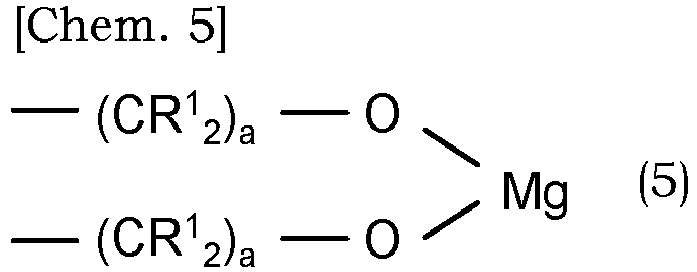

- R2 of the magnesium compound (A1) is preferably -(CR1 2)b-Z1. "b" is 1 to 28, preferably 1 to 4. Specifically, examples of "b" are 1, 2, 3, 4, 5, 6, 7, 8, 9, 10, 11, 12, 13, 14, 15, 16, 17, 18, 19, 20, 21, 22, 23, 24, 25, 26, 27, 28 and may be within the range between any two of the numerical values exemplified here. Z1 is hydrogen, a hydroxyl group, or -O-Mg-O-X1.
- Examples of the magnesium compound (A1) include those represented by formulas (12) to (14) and formulas (21) to (24). The magnesium compound (A1) used as a catalyst may be a single compound or a mixture of a plurality of compounds.


- A method for producing the magnesium compound (A1) is not particularly limited, but may be, for example, a ligand exchange reaction between a magnesium alkoxide and a heteroatom-containing alcohol (an amino alcohol or a sulfur-containing alcohol), or a reaction of magnesium oxide and a heteroatom alcohol. The reaction can be accelerated by a dealcoholization or dehydration under appropriate conditions of heating temperature and reduced pressure. In the reaction, a solvent may be used, if necessary.
- Examples of the magnesium alkoxide include magnesium dimethoxide, magnesium diethoxide, magnesium diisopropoxide, magnesium di-t-butoxide and the like.
- Examples of the amino alcohol include: an alkanolamine compound such as a monoalkanolamine compound, a dialkanolamine compound, a trialkanolamine compound and the like; an alkylamine compound such as a trialkylamine and the like. Among those amino alcohols, alkanolamine is preferable, and trialkanolamine is more preferable.
- Examples of the sulfur-containing alcohol include alkanol sulfide compounds such as a monoalkanol sulfide compound and a dialkanol sulfide compound, among which a dialkanol sulfide compound is preferable.
- A solvent that can be used is not particularly limited, but for example, alcohols such as methanol, ethanol, isopropanol, butanol and the like may be used.
- When a molar ratio of magnesium to amino alcohol is 1:2, the compound of the formula (12) is the main component. As the proportion of magnesium increases, the proportion of the compound of the formula (13) gradually increases, and when the molar ratio of magnesium to amino alcohol becomes 1:1, the compound of the formula (13) becomes the main component. As the proportion of magnesium increases, the proportion of the compound of the formula (14) gradually increases, and when the molar ratio of magnesium to amino alcohol becomes 3:2, the compound of the formula (14) becomes the main component.
- When a molar ratio of magnesium and the sulfur-containing alcohol is 1:2, the compound of the formula (21) is the main component. As the proportion of magnesium increases, the proportion of the compounds of the formulas (22) to (24) gradually increases, and when the molar ratio of magnesium and sulfur-containing alcohol becomes 1:1, the compounds of the formulas (22) to (24) is the main component.
- The magnesium compound (A2) having a Ti-O bond preferably has a bonding portion represented by formula (6). The bonding portion represented by the formula (6) has a Q-(C)a-O-Ti bonding portion starting from Q contained in the bonding portion of the formula (2). Since the Q-(C)a-O-Ti bonding portion contributes to the stabilization of the magnesium compound (A2), the magnesium compound (A2) has the bonding portion represented by the formula (6), whereby the magnesium compound maintains high catalytic activity over a long period of time. The atomic ratio of Ti to Mg is preferably from 0.1 to 10, more preferably from 0.2 to 5, and even more preferably from 0.5 to 2.
Mg-O-(C)a-Q(C)a-O-Ti (6)
- More preferably, the bonding portion represented by the formula (6) is represented by formula (7).
Mg-O-(CR1 2)a-Q-(CR1 2)a-O-Ti (7)
- The magnesium compound (A2) preferably has a structure represented by formula (8). X2 is -(CR1 2)a-N(-Y2)2, -(CR1 2)a S-Y1, or two X2 are substituted with a portion represented by formula (9) or formula (20). Y2 is R2, or two Y2 are substituted with a portion represented by formula (10) or (11). R2 is as described in the formula (3).
X2-O-Mg-O-X2 (8)


- R2 of the magnesium compound (A2) is preferably -(CR1 2)b-Z2. "b" is as described in the magnesium compound (A1). Z2 is hydrogen, a hydroxyl group, -O-Mg-O-X2, or -O-Ti(-O-X2)3.
- Examples of the magnesium compound (A2) include those represented by formulas (15) to (18) and formulas (25) to (28). The magnesium compound (A2) used as a catalyst may be a single compound or a mixture of a plurality of compounds.


- A method for producing the magnesium compound (A2) is not particularly limited, but it may be, for example: a ligand exchange reaction with a titanium alkoxide after a ligand exchange reaction between a magnesium alkoxide and a heteroatom-containing alcohol; a ligand exchange reaction with titanium alkoxide after a reaction between magnesium oxide and a heteroatom alcohol; or a ligand exchange reaction with magnesium alkoxide after a ligand exchange reaction between titanium alkoxide and heteroatom alcohol. The reactions can be accelerated by a dealcoholization or dehydration under an appropriate conditions of heating temperature and reduced pressure. In the reactions, a solvent may be used, if necessary.
- Examples of the titanium alkoxide include tetraalkyl titanate such as tetra-n-propyl titanate, tetraisopropyl titanate, tetra-n-butyl titanate, tetra-t-butyl titanate, tetraphenyl titanate, tetracyclohexyl titanate, tetrabenzyl titanate and the like; titanium (oxy) acetylacetonate, titanium tetraacetylacetonate, titanium (diisopropoxide) acetylacetonate, titanium bis (ammonium lactate) dihydroxide, titanium bis (ethylacetoacetate) diisopropoxide, titanium bis (triethanolaminate) diisopropoxide and the like.
- As the magnesium alkoxide, the heteroatom-containing alcohol, and the solvent, those described in the method for producing the magnesium compound (A1) can be used.
- When a molar ratio of titanium, magnesium and amino alcohol is 1:1:4, the compounds of the formulas (15) to (16) are the main components. As the proportion of magnesium decreases, the proportion of the compounds of the formulas (17) to (18) gradually increases, and when the molar ratio of titanium, magnesium and amino alcohol becomes 2:1:8, the formulas (17) to (18) are the main components.
- When a molar ratio of titanium, magnesium and sulfur-containing alcohol is 1:1:4, the compounds of the formulas (25) to (26) are the main components. As the ratio of magnesium decreases, the proportion of the compounds of the formulas (27) to (28) gradually increases, and when the molar ratio of titanium, magnesium and sulfur-containing alcohol is 2:1:8, the compounds of the formulas (27) to (28) is the main component.
- As the titanium compound (B), for example, the above-mentioned titanium alkoxide can be used, and titanium diisopropoxy bistriethanolaminate is particularly preferable from the viewpoint of reactivity and coloring property. By using the titanium compound (B) in combination with the magnesium compound (A), the polycondensation reaction of the alcohol component and the acid component is further accelerated. In addition, the titanium compound (B) may be used in combination with either of the magnesium compounds (A1) and (A2), but the effect by the combination with the magnesium compound (A1) is more conspicuous.
- A content ratio of the magnesium compound (A) and the titanium compound (B) is preferably 0.01 to 2 in a molar ratio (magnesium atoms in the magnesium compound (A) / titanium atoms in the titanium compound (B)), more preferably 0.05 to 1.0, and further more preferably 0.1 to 1.0.
- The polyester resin of the present invention may optionally contain other catalyst components such as pyrogallol, gallic acid and gallic acid ester.
- Examples of other catalyst components include known catalysts such as dibutyltin oxide, antimony trioxide, iron acetate, zinc acetate, calcium acetate, aluminum acetate, lead acetate, zinc borate, lead borate, zinc chloride, aluminum chloride and the like.
- The polyester resin of the present invention is obtained by polycondensing an alcohol component and an acid component in the presence of a catalyst for polyester polymerization. The timing of adding the catalyst for polyester polymerization to the reaction system may be either before or during the reaction. From the viewpoint of obtaining a higher effect on promotion of condensation polymerization reaction, the catalyst is added preferably before reaching the reaction temperature, more preferably before the start of the reaction. In the present invention, "before the start of the reaction" means a timing in which water is not generated due to the polycondensation reaction.
- The polycondensation reaction is preferably carried out at 180 to 250 °C under an inert gas atmosphere. Furthermore, the condensation reaction is preferably carried out under a normal pressure or a reduced pressure, specifically, it is preferably carried out under a pressure of 4 to 102 kPa.
- A content of the magnesium compound (A) in the polycondensation reaction is not particularly limited, but is usually 0.001 to 1.5 parts by mass with respect to 100 parts by mass of the total solid content of the alcohol component and the acid component, more preferably 0.01 to 1.0 part by mass, and further more preferably 0.02 to 0.5 part by mass. Within the above range, the reaction time can be greatly shortened and a polyester resin excellent in color tone can be obtained.
- A content of the titanium compound (B) in the polycondensation reaction is not particularly limited, but it is usually 0.001 to 2.0 parts by mass with respect to 100 parts by mass of the total solid content of the alcohol component and the acid component, more preferably 0.05 to 1.5 parts by mass, and further more preferably 0.1 to 1.0 parts by mass.
- Examples of the alcohol component include divalent or more polyhydric alcohols such as ethylene glycol, propylene glycol, 1,2-propanediol, 1,3-propanediol, 1,3-butanediol, 1,4-butanediol, neopentyl glycol, 1,5-pentanediol, 1,6-hexanediol, 3-methylpentanediol, diethylene glycol, 1,4-cyclohexanedimethanol, 3-methyl-1,5-pentanediol, 2-methyl-1,3-propanediol, 2,2-diethyl-1,3-propanediol, 2-butyl-2-ethyl-1,3-propanediol, hydrogenated bisphenol A, ethylene oxide adduct or propylene oxide adduct of bisphenol A, trimethylolethane, trimethylolpropane, glycerin, pentaerythritol and the like. From the viewpoint of adjusting the molecular weight and improving the offset resistance, a monovalent alcohol may be appropriately contained. These alcohols may be used alone or in combination of two or more kinds.
- Examples of the acid component include monocarboxylic acids such as benzoic acid and p-t-butylbenzoic acid; aliphatic dicarboxylic acids such as oxalic acid, malonic acid, maleic acid, fumaric acid, citraconic acid, itaconic acid, glutaconic acid, succinic acid, adipic acid, sebacic acid, azelaic acid, n-dodecylsuccinic acid and n-dodecenylsuccinic acid; aromatic dicarboxylic acids such as phthalic acid, isophthalic acid, and terephthalic acid; trivalent or higher polycarboxylic acids such as trimellitic acid and pyromellitic acid;
anhydrides and alkyl (1 to 3 carbon atoms) esters of these acids; rosin; rosin modified with fumaric acid, maleic acid, acrylic acid; and the like. Monocarboxylic acids and dibasic acids such as aromatic dicarboxylic acids and saturated aliphatic dicarboxylic acids may be used alone or in combination of two or more kinds. Also, the trivalent or higher polybasic acid may be used alone or in combination of two or more kinds. - Hereinafter, the present invention will be specifically described with reference to examples, but the scope of the present invention is not limited thereto. In the following description, "%" means mass%.
- 27.9 g of triethanolamine was placed in a 100 ml glass eggplant-shaped flask equipped with a stirrer. After the start of stirring, 10.70 g of magnesium diethoxide was added. The mixture was heated to 80 °C and reacted for 1 hour. Thereafter, the mixture was concentrated under a reduced pressure of 30 Torr, and the produced ethanol was distilled off. 18.44 g of magnesium compound A1a was obtained as a white solid.
- 19.7 g of N-butyl diethanolamine was placed in a 100 ml glass eggplant-shaped flask equipped with a stirring device. After the start of stirring, 7.00 g of magnesium diethoxide was added. The mixture was heated to 80 °C and reacted for 1 hour. Thereafter, the mixture was concentrated under a reduced pressure of 30 Torr, and the produced ethanol was distilled off. 18.23 g of magnesium compound A1b was obtained as a high viscosity and brown liquid.
- 39.40 g of N,N-dibutylethanolamine was placed in a 100 ml glass eggplant-shaped flask equipped with a stirring device. After the start of stirring, 3.10 g of magnesium diethoxide was added. The mixture was heated to 100 °C and reacted for 1 hour. Thereafter, the mixture was concentrated under a reduced pressure of 30 Torr. As a yellowish white liquid of a diluted solution with N, N-dibutylethanolamine, 38.48 g of magnesium compound A1c was obtained.
- 52.13 g of diethanolamine was placed in a 100 ml glass eggplant-shaped flask equipped with a stirring device. After the start of stirring, 14.76 g of magnesium diethoxide was added. The mixture was heated to 90 °C and reacted for 1 hour. Thereafter, the mixture was concentrated under a reduced pressure of 30 Torr. As a yellowish white liquid of a diluted solution with diethanolamine, 53.85 g of magnesium compound Aid was obtained.
- 0.70 g of N,N-dibutyl butanolamine was placed in a 10 ml glass eggplant-shaped flask with a stirring bar. After the start of stirring, 0.23 g of magnesium diethoxide was added. The mixture was heated to 100 °C and reacted for 1 hour. Thereafter, the mixture was concentrated under a reduced pressure of 20 Torr. 0.82 g of magnesium compound A1e was obtained as a brown liquid.
- 4.23 g of 2,2-thiodiethanol and 25.65 g of butanol were placed in a 50 ml glass eggplant-shaped flask with a stirring bar. After the start of stirring, 3.96 g of magnesium diethoxide was added. The mixture was heated to 150 °C and reacted for 1 hour while butanol and ethanol formed were distilled off. Thereafter, the mixture was concentrated under a reduced pressure of 20 Torr. 5.39 g of a magnesium compound A1f was obtained as a white solid.
- 53.99 g of triethanolamine was placed in a 100 ml glass eggplant-shaped flask equipped with a stirrer device. After the start of stirring, 17.15 g of titanium tetraisopropoxide was added dropwise. After it was confirmed that the exothermic reaction had ceased, it was heated to 100 °C, and the produced isopropanol was distilled off. Thereafter, the mixture was concentrated under a reduced pressure of 30 Torr. An orange transparent viscous liquid was obtained. Subsequently, 6.90 g of magnesium diethoxide was added and heated to 85 °C. The produced ethanol was distilled off. Thereafter, the mixture was concentrated under a reduced pressure of 20 Torr. 54.49 g of a deep orange viscous liquid was obtained (A2a). As a result of IR measurement of A2a, a new peak appeared around 795 cm-1.
- 45.76 g of triethanolamine was placed in a 100 ml glass eggplant type flask equipped with a stirring device. After the start of stirring, 21.81 g of titanium tetraisopropoxide was added dropwise. After it was confirmed that the exothermic reaction had ceased, it was heated to 90 °C, and the produced isopropanol was distilled off. Thereafter, the mixture was concentrated under a reduced pressure of 30 Torr. An orange transparent viscous liquid was obtained. Subsequently, 4.39 g of magnesium diethoxide was added and heated to 85 °C. The produced ethanol was distilled off. Thereafter, the mixture was concentrated under a reduced pressure of 20 Torr. 44.48 g of a deep orange viscous liquid was obtained (A2b). As a result of IR measurement of A2b, a new peak appeared around 795 cm-1.
- 54.91 g of triethanolamine was placed in a 100 ml glass eggplant-shaped flask equipped with a stirring device. After the start of stirring, 17.44 g of titanium tetraisopropoxide was added dropwise. After it was confirmed that the exothermic reaction had ceased, it was heated to 100 °C, and the produced isopropanol was distilled off. Thereafter, the mixture was concentrated under a reduced pressure of 30 Torr. An orange transparent viscous liquid was obtained. Subsequently, 3.51 g of magnesium diethoxide was added and heated to 90 °C. The produced ethanol was distilled off. Thereafter, the mixture was concentrated under a reduced pressure of 20 Torr. 51.45 g of a deep orange viscous liquid was obtained (A2c). As a result of IR measurement of A2c, a new peak appeared around 795 cm-1.
- 36.82 g of triethanolamine was placed in a 100 ml glass eggplant-shaped flask equipped with a stirring device. After the start of stirring, 17.54 g of titanium tetraisopropoxide was added dropwise. After it was confirmed that the exothermic reaction had ceased, it was heated to 90 °C, and the produced isopropanol was distilled off. Thereafter, the mixture was concentrated under a reduced pressure of 20 Torr. An orange transparent viscous liquid was obtained. Subsequently, 2.35 g of magnesium diethoxide was added and heated to 90 °C. The produced ethanol was distilled off. Thereafter, the mixture was concentrated under a reduced pressure of 20 Torr. 33.63 g of a deep orange viscous liquid was obtained (A2d). As a result of IR measurement of A2d, the appearance of a new peak was observed around 795 cm-1.
- 36.82 g of triethanolamine was placed in a 100 ml glass eggplant-shaped flask equipped with a stirring device. After the start of stirring, 2.35 g of magnesium diethoxide was added. The mixture was heated to 90 °C, and the produced ethanol was distilled off. Thereafter, the mixture was concentrated under a reduced pressure of 20 Torr. An orange suspension was obtained. Subsequently, 21.01 g of titanium tetrabutoxide was added dropwise. After it was confirmed that the exothermic reaction had ceased, it was heated to 115 °C and reacted for 1 hour. After cooling, insoluble matter was removed by filtration to obtain 52.77 g of an orange transparent liquid as a 78% butanol solution (A2e). As a result of IR measurement of A2e, the appearance of a new peak was observed around 797 cm-1.
- 35.38 g of diethanolamine was placed in a 100 ml glass eggplant-shaped flask equipped with a stirring device After the start of stirring, 4.81 g of magnesium diethoxide was added. The mixture was heated to 90 °C, and the produced ethanol was distilled off. Thereafter, the mixture was concentrated under a reduced pressure of 20 Torr. An orange transparent solution was obtained. Subsequently, 28.63 g of titanium tetrabutoxide was added dropwise. After it was confirmed that the exothermic reaction had ceased, 15.06 g of butanol was added, heated to 115 °C, and then the reaction was carried out for 1 hour. As a 50% butanol solution, 78.26 g of a white emulsion was obtained (A2f). As a result of IR measurement of A2f, the appearance of a new peak was observed around 781 cm-1.
- 124.27 g (0.36 mol) of polyoxypropylene (2.1)-2,2-bis(4-hydroxyphenyl)propane (BPA- PO), 49.88 g of terephthalic acid (80 mol), the catalyst shown in Table 1 were placed in a 300 ml four-necked flask equipped with a nitrogen introduction tube, a dehydration tube, a stirrer and a thermocouple and reacted at 230 to 235 °C under a nitrogen atmosphere until a conversion ratio reached 93%. Thereafter, the reaction continued until the softening point at 8 KPa reached 100 °C to obtain the polyester. The reaction time when the conversion ratio reached 93% is shown in Table 1. The numerical values of the catalyst composition in Table 1 are values in "parts by mass" when the total mass of BPA-PO and terephthalic acid is 100 parts by mass.


- Details of various compounds in Table 1 are as follows. Magnesium diethoxide: available from Wako Pure Chemical Industries, Ltd. Magnesium acetate tetrahydrate: available from Kansai Catalysis Chemistry Co. Titanium diisopropoxy bistriethanolaminate: available from Aldrich Tetrabutyl titanate: available from Wako Pure Chemical Industries, Ltd. Titanium diisopropoxy bisacetylacetonate, 75% isopropyl alcohol solution: available from Tokyo Chemical Industry Co., Ltd.
- From the above results, it is found that the catalytic activity is enhanced by using the magnesium compound (A) in the polycondensation reaction, and the polycondensation reaction of the alcohol component and the acid component is accelerated. Therefore, in Examples 1 to 14 in which the magnesium compound (A) is contained in the catalyst, in contrast to Comparative Examples 1 to 6 in which the magnesium compound (A) is not contained in the catalyst, the required reaction time for advancing the polymerization reaction of the alcohol component and the acid component is remarkably shortened.
Claims (11)
- A catalyst for polyester polymerization comprising a magnesium compound (A), wherein the magnesium compound (A) has a bonding portion represented by formula (2),
Mg-O-(CR1 2)a,-Q (2)
wherein a is an integer from 1 to 4,Q is a nitrogen atom or a sulfur atom, andR1 represents hydrogen or an alkyl group having 1 to 4 carbon atoms. - The catalyst of Claim 1, wherein the magnesium compound (A) has a structure represented by formula (3),
X1-O-Mg-O-X1 (3)
wherein:X1 is -(CR1 2)a-N(-Y1)2 or -(CR12)a S-Y1, or two X1 are substituted with a portion represented by formula (4) or formula (19); andY1 is R2, or two Y1 are substituted with a portion represented by formula (5), wherein R2 is an alkyl group having 1 to 28 carbon atoms which may have a substituent.


- The catalyst of Claim2, wherein R2 is -(CR1 2)b-Z1, wherein b is 1 to 28, and Z1 is hydrogen, a hydroxyl group, or -O-Mg-O-X1.
- The catalyst of any one of Claims 1 to 3, further comprising a titanium compound (B).
- The catalyst of any one of Claim 4, wherein a content ratio of the magnesium compound (A) and the titanium compound (B) is 0.01 to 2.0 in a molar ratio defined by magnesium atoms in the magnesium compound (A) / titanium atoms in the titanium compound (B).
- A catalyst for polyester polymerization comprising a magnesium compound (A), wherein the magnesium compound (A) has a bonding portion represented by formula (6),
Mg-O-(C)a-Q-(C)a-O-Ti (6),
wherein a is an integer from 1 to 4 andQ is a nitrogen atom or a sulfur atom. - The catalyst of Claim 6, wherein the magnesium compound (A) has a bonding portion represented by the formula (7),
Mg-O-(CR1 2)a-Q-(CR1 2)a-O-Ti (7)
wherein R1 represents hydrogen or an alkyl group having 1 to 4 carbon atoms. - The catalyst of Claim 7, wherein the magnesium compound (A) has a structure represented by formula (8),
X2-O-Mg-O-X2 (8)
wherein:X2 is -(CR1 2)a-N(-Y2)2, -(CR1 2)a S-Y1, or two X2 are substituted with a portion represented by formula (9) or formula (20); andY2 is R2, or two Y2 are substituted with a portion represented by formula (10) or (11), wherein R2 is an alkyl group having 1 to 28 carbon atoms and optionally having a substituent.


- The catalyst of Claim 8, wherein R2 is -(CR1 2)b-Z2, wherein b is 1 to 28, and Z2 is hydrogen, a hydroxyl group, -O-Mg-O-X2, or -O-Ti(-O-X2)3.
- A process for producing a polyester resin, comprising polycondensing an alcohol component and an acid component in the presence of the catalyst of any one of Claims 1 to 9.
- The process of Claim 10, wherein in the polycondensing, an existing amount of the magnesium compound (A) is 0.01 to 2 parts by mass with respect to 100 parts by mass of the raw material monomer of the polyester resin.
Applications Claiming Priority (2)
| Application Number | Priority Date | Filing Date | Title |
|---|---|---|---|
| JP2016133293 | 2016-07-05 | ||
| PCT/JP2017/022675 WO2018008386A1 (en) | 2016-07-05 | 2017-06-20 | Catalyst for polyester polymerization and method for producing polyester resin |
Publications (3)
| Publication Number | Publication Date |
|---|---|
| EP3483196A1 EP3483196A1 (en) | 2019-05-15 |
| EP3483196A4 EP3483196A4 (en) | 2020-07-22 |
| EP3483196B1 true EP3483196B1 (en) | 2021-06-16 |
Family
ID=60912568
Family Applications (1)
| Application Number | Title | Priority Date | Filing Date |
|---|---|---|---|
| EP17823993.5A Active EP3483196B1 (en) | 2016-07-05 | 2017-06-20 | Catalyst for polyester polymerization and method for producing polyester resin |
Country Status (6)
| Country | Link |
|---|---|
| US (1) | US11059837B2 (en) |
| EP (1) | EP3483196B1 (en) |
| JP (1) | JP6713534B2 (en) |
| CN (1) | CN109415501B (en) |
| ES (1) | ES2886653T3 (en) |
| WO (1) | WO2018008386A1 (en) |
Family Cites Families (16)
| Publication number | Priority date | Publication date | Assignee | Title |
|---|---|---|---|---|
| US4260735A (en) * | 1980-02-12 | 1981-04-07 | Allied Chemical Corporation | Catalytic process for preparation of polyesters |
| JPS5768924A (en) | 1980-10-16 | 1982-04-27 | Seiko Epson Corp | Coupling turning fork quartz oscillator |
| JP2953779B2 (en) * | 1990-11-30 | 1999-09-27 | 三井化学株式会社 | Method for producing propylene-based copolymer, propylene-based copolymer, propylene-based copolymer composition, and use thereof |
| JP3647689B2 (en) | 1999-09-30 | 2005-05-18 | 三菱化学株式会社 | Method for producing aliphatic polyester |
| US6166170A (en) * | 1999-12-02 | 2000-12-26 | E. I. Du Pont De Nemours And Company | Esterification catalysts and processes therefor and therewith |
| CN100492187C (en) | 2002-02-28 | 2009-05-27 | 三洋化成工业株式会社 | Toner binders |
| US20050215426A1 (en) * | 2004-03-26 | 2005-09-29 | Putzig Donald E | Esterification catalyst and process therewith |
| JP4650001B2 (en) * | 2005-01-21 | 2011-03-16 | 三菱化学株式会社 | Polyester polycondensation catalyst, production method thereof, and production method of polyester resin using the polycondensation catalyst |
| TW200704671A (en) | 2005-01-21 | 2007-02-01 | Mitsubishi Chem Corp | Catalyst for polyester polycondensation and method for producing polyester resin using the same |
| AU2006206995B2 (en) | 2005-01-21 | 2010-10-07 | Mitsubishi Chemical Corporation | Catalyst for polyester polycondensation and method for producing polyester resin using the same |
| JP2010072476A (en) * | 2008-09-19 | 2010-04-02 | Sanyo Chem Ind Ltd | Toner for electrostatic charge image development |
| EP2210910B1 (en) * | 2009-01-21 | 2013-01-02 | Nan Ya Plastics Corporation | Antimony-free PET resin and PET polyester fiber made therefrom |
| US20110313127A1 (en) | 2009-01-30 | 2011-12-22 | Naruhito Iwasa | Method for producing polylactic acid |
| GB201308978D0 (en) * | 2013-05-17 | 2013-07-03 | Imp Innovations Ltd | Method for producing polymers and block copolymers |
| BR112015028887A2 (en) | 2013-05-23 | 2017-07-25 | Saudi Basic Ind Corp | methods for preparing a polyester |
| CN104629663B (en) | 2013-11-11 | 2017-08-01 | 上海轻工业研究所有限公司 | Polyester Hot Melt Adhesive |
-
2017
- 2017-06-20 US US16/303,991 patent/US11059837B2/en active Active
- 2017-06-20 JP JP2018526006A patent/JP6713534B2/en active Active
- 2017-06-20 WO PCT/JP2017/022675 patent/WO2018008386A1/en not_active Ceased
- 2017-06-20 CN CN201780040509.0A patent/CN109415501B/en active Active
- 2017-06-20 EP EP17823993.5A patent/EP3483196B1/en active Active
- 2017-06-20 ES ES17823993T patent/ES2886653T3/en active Active
Also Published As
| Publication number | Publication date |
|---|---|
| WO2018008386A1 (en) | 2018-01-11 |
| EP3483196A1 (en) | 2019-05-15 |
| US20200317697A1 (en) | 2020-10-08 |
| US11059837B2 (en) | 2021-07-13 |
| CN109415501A (en) | 2019-03-01 |
| EP3483196A4 (en) | 2020-07-22 |
| ES2886653T3 (en) | 2021-12-20 |
| CN109415501B (en) | 2021-01-15 |
| JP6713534B2 (en) | 2020-06-24 |
| JPWO2018008386A1 (en) | 2019-04-25 |
Similar Documents
| Publication | Publication Date | Title |
|---|---|---|
| JP6408982B2 (en) | Polyester resin and method for producing the same | |
| CN103102490B (en) | Phosphorus-containing polyol, its preparation method and comprise its flame retardant polyurethane | |
| TWI618730B (en) | Preparation method of polyester resin | |
| EP1485422B1 (en) | Catalytic systems | |
| WO2016173092A1 (en) | Liquid titanium catalyst and preparation method of polyester polymer using same | |
| CN1863839A (en) | Catalyst for manufacture of esters | |
| TWI487727B (en) | Method for producing polyester resin | |
| CN117024725A (en) | Phosphorus-containing bimetallic titanium polyester catalyst, preparation method and application | |
| CN101565499A (en) | Polyester polycondensation catalyst, preparation method and application thereof | |
| CN111187401B (en) | Preparation method of polyester polyol | |
| US11059837B2 (en) | Catalyst for polyester polymerization and method for producing polyester resin | |
| TW201420631A (en) | Method of preparing biodegradable polyester-based polymer | |
| JP6357795B2 (en) | Polyester resin and method for producing the same | |
| JP3711208B2 (en) | Method for producing thermoplastic polyester elastomer | |
| CN102264795A (en) | Method for preparing polyester resin | |
| CN116589670B (en) | High-temperature-hydrolysis-resistant titanium alkoxide organic base catalyst, and preparation method and application thereof | |
| RU2519827C1 (en) | Method of producing oligo- and polyethylene terephthalates | |
| TWI332962B (en) | Mixed catalytic composition | |
| RU2523800C1 (en) | Method of producing catalyst for synthesis of oligo- and polyethylene terephthalates and method of producing oligo- and polyethylene terephthalates | |
| JPH037728A (en) | Production of polyester | |
| JPS61231019A (en) | Polyol resin | |
| JPH1077336A (en) | Method for producing copolyester | |
| CN120118295A (en) | A titanium/aluminum complex catalyst and its preparation method and application | |
| CN106700050B (en) | Composition for preparing hydrophilic polyester, hydrophilic polyester and preparation method thereof | |
| CN100532422C (en) | Preparation method of polyester and copolyester |
Legal Events
| Date | Code | Title | Description |
|---|---|---|---|
| STAA | Information on the status of an ep patent application or granted ep patent |
Free format text: STATUS: THE INTERNATIONAL PUBLICATION HAS BEEN MADE |
|
| PUAI | Public reference made under article 153(3) epc to a published international application that has entered the european phase |
Free format text: ORIGINAL CODE: 0009012 |
|
| STAA | Information on the status of an ep patent application or granted ep patent |
Free format text: STATUS: REQUEST FOR EXAMINATION WAS MADE |
|
| 17P | Request for examination filed |
Effective date: 20190104 |
|
| AK | Designated contracting states |
Kind code of ref document: A1 Designated state(s): AL AT BE BG CH CY CZ DE DK EE ES FI FR GB GR HR HU IE IS IT LI LT LU LV MC MK MT NL NO PL PT RO RS SE SI SK SM TR |
|
| AX | Request for extension of the european patent |
Extension state: BA ME |
|
| DAV | Request for validation of the european patent (deleted) | ||
| DAX | Request for extension of the european patent (deleted) | ||
| A4 | Supplementary search report drawn up and despatched |
Effective date: 20200619 |
|
| RIC1 | Information provided on ipc code assigned before grant |
Ipc: C08G 63/83 20060101AFI20200615BHEP |
|
| GRAJ | Information related to disapproval of communication of intention to grant by the applicant or resumption of examination proceedings by the epo deleted |
Free format text: ORIGINAL CODE: EPIDOSDIGR1 |
|
| STAA | Information on the status of an ep patent application or granted ep patent |
Free format text: STATUS: GRANT OF PATENT IS INTENDED |
|
| GRAP | Despatch of communication of intention to grant a patent |
Free format text: ORIGINAL CODE: EPIDOSNIGR1 |
|
| INTG | Intention to grant announced |
Effective date: 20210309 |
|
| RIN1 | Information on inventor provided before grant (corrected) |
Inventor name: ARAKI, MIKA Inventor name: KANESHIRO, HIROYUKI |
|
| GRAS | Grant fee paid |
Free format text: ORIGINAL CODE: EPIDOSNIGR3 |
|
| GRAA | (expected) grant |
Free format text: ORIGINAL CODE: 0009210 |
|
| STAA | Information on the status of an ep patent application or granted ep patent |
Free format text: STATUS: THE PATENT HAS BEEN GRANTED |
|
| AK | Designated contracting states |
Kind code of ref document: B1 Designated state(s): AL AT BE BG CH CY CZ DE DK EE ES FI FR GB GR HR HU IE IS IT LI LT LU LV MC MK MT NL NO PL PT RO RS SE SI SK SM TR |
|
| REG | Reference to a national code |
Ref country code: GB Ref legal event code: FG4D |
|
| REG | Reference to a national code |
Ref country code: CH Ref legal event code: EP |
|
| REG | Reference to a national code |
Ref country code: DE Ref legal event code: R096 Ref document number: 602017040503 Country of ref document: DE |
|
| REG | Reference to a national code |
Ref country code: AT Ref legal event code: REF Ref document number: 1402307 Country of ref document: AT Kind code of ref document: T Effective date: 20210715 |
|
| REG | Reference to a national code |
Ref country code: IE Ref legal event code: FG4D |
|
| REG | Reference to a national code |
Ref country code: NL Ref legal event code: FP |
|
| REG | Reference to a national code |
Ref country code: LT Ref legal event code: MG9D |
|
| PG25 | Lapsed in a contracting state [announced via postgrant information from national office to epo] |
Ref country code: LT Free format text: LAPSE BECAUSE OF FAILURE TO SUBMIT A TRANSLATION OF THE DESCRIPTION OR TO PAY THE FEE WITHIN THE PRESCRIBED TIME-LIMIT Effective date: 20210616 Ref country code: FI Free format text: LAPSE BECAUSE OF FAILURE TO SUBMIT A TRANSLATION OF THE DESCRIPTION OR TO PAY THE FEE WITHIN THE PRESCRIBED TIME-LIMIT Effective date: 20210616 Ref country code: HR Free format text: LAPSE BECAUSE OF FAILURE TO SUBMIT A TRANSLATION OF THE DESCRIPTION OR TO PAY THE FEE WITHIN THE PRESCRIBED TIME-LIMIT Effective date: 20210616 Ref country code: BG Free format text: LAPSE BECAUSE OF FAILURE TO SUBMIT A TRANSLATION OF THE DESCRIPTION OR TO PAY THE FEE WITHIN THE PRESCRIBED TIME-LIMIT Effective date: 20210916 |
|
| REG | Reference to a national code |
Ref country code: AT Ref legal event code: MK05 Ref document number: 1402307 Country of ref document: AT Kind code of ref document: T Effective date: 20210616 |
|
| PG25 | Lapsed in a contracting state [announced via postgrant information from national office to epo] |
Ref country code: GR Free format text: LAPSE BECAUSE OF FAILURE TO SUBMIT A TRANSLATION OF THE DESCRIPTION OR TO PAY THE FEE WITHIN THE PRESCRIBED TIME-LIMIT Effective date: 20210917 Ref country code: LV Free format text: LAPSE BECAUSE OF FAILURE TO SUBMIT A TRANSLATION OF THE DESCRIPTION OR TO PAY THE FEE WITHIN THE PRESCRIBED TIME-LIMIT Effective date: 20210616 Ref country code: NO Free format text: LAPSE BECAUSE OF FAILURE TO SUBMIT A TRANSLATION OF THE DESCRIPTION OR TO PAY THE FEE WITHIN THE PRESCRIBED TIME-LIMIT Effective date: 20210916 Ref country code: SE Free format text: LAPSE BECAUSE OF FAILURE TO SUBMIT A TRANSLATION OF THE DESCRIPTION OR TO PAY THE FEE WITHIN THE PRESCRIBED TIME-LIMIT Effective date: 20210616 Ref country code: RS Free format text: LAPSE BECAUSE OF FAILURE TO SUBMIT A TRANSLATION OF THE DESCRIPTION OR TO PAY THE FEE WITHIN THE PRESCRIBED TIME-LIMIT Effective date: 20210616 |
|
| REG | Reference to a national code |
Ref country code: ES Ref legal event code: FG2A Ref document number: 2886653 Country of ref document: ES Kind code of ref document: T3 Effective date: 20211220 |
|
| REG | Reference to a national code |
Ref country code: DE Ref legal event code: R119 Ref document number: 602017040503 Country of ref document: DE |
|
| PG25 | Lapsed in a contracting state [announced via postgrant information from national office to epo] |
Ref country code: SM Free format text: LAPSE BECAUSE OF FAILURE TO SUBMIT A TRANSLATION OF THE DESCRIPTION OR TO PAY THE FEE WITHIN THE PRESCRIBED TIME-LIMIT Effective date: 20210616 Ref country code: SK Free format text: LAPSE BECAUSE OF FAILURE TO SUBMIT A TRANSLATION OF THE DESCRIPTION OR TO PAY THE FEE WITHIN THE PRESCRIBED TIME-LIMIT Effective date: 20210616 Ref country code: EE Free format text: LAPSE BECAUSE OF FAILURE TO SUBMIT A TRANSLATION OF THE DESCRIPTION OR TO PAY THE FEE WITHIN THE PRESCRIBED TIME-LIMIT Effective date: 20210616 Ref country code: CZ Free format text: LAPSE BECAUSE OF FAILURE TO SUBMIT A TRANSLATION OF THE DESCRIPTION OR TO PAY THE FEE WITHIN THE PRESCRIBED TIME-LIMIT Effective date: 20210616 Ref country code: AT Free format text: LAPSE BECAUSE OF FAILURE TO SUBMIT A TRANSLATION OF THE DESCRIPTION OR TO PAY THE FEE WITHIN THE PRESCRIBED TIME-LIMIT Effective date: 20210616 Ref country code: RO Free format text: LAPSE BECAUSE OF FAILURE TO SUBMIT A TRANSLATION OF THE DESCRIPTION OR TO PAY THE FEE WITHIN THE PRESCRIBED TIME-LIMIT Effective date: 20210616 Ref country code: PT Free format text: LAPSE BECAUSE OF FAILURE TO SUBMIT A TRANSLATION OF THE DESCRIPTION OR TO PAY THE FEE WITHIN THE PRESCRIBED TIME-LIMIT Effective date: 20211018 |
|
| REG | Reference to a national code |
Ref country code: CH Ref legal event code: PL |
|
| PG25 | Lapsed in a contracting state [announced via postgrant information from national office to epo] |
Ref country code: PL Free format text: LAPSE BECAUSE OF FAILURE TO SUBMIT A TRANSLATION OF THE DESCRIPTION OR TO PAY THE FEE WITHIN THE PRESCRIBED TIME-LIMIT Effective date: 20210616 |
|
| REG | Reference to a national code |
Ref country code: BE Ref legal event code: MM Effective date: 20210630 |
|
| PG25 | Lapsed in a contracting state [announced via postgrant information from national office to epo] |
Ref country code: MC Free format text: LAPSE BECAUSE OF FAILURE TO SUBMIT A TRANSLATION OF THE DESCRIPTION OR TO PAY THE FEE WITHIN THE PRESCRIBED TIME-LIMIT Effective date: 20210616 Ref country code: LU Free format text: LAPSE BECAUSE OF NON-PAYMENT OF DUE FEES Effective date: 20210620 |
|
| PLBE | No opposition filed within time limit |
Free format text: ORIGINAL CODE: 0009261 |
|
| STAA | Information on the status of an ep patent application or granted ep patent |
Free format text: STATUS: NO OPPOSITION FILED WITHIN TIME LIMIT |
|
| PG25 | Lapsed in a contracting state [announced via postgrant information from national office to epo] |
Ref country code: LI Free format text: LAPSE BECAUSE OF NON-PAYMENT OF DUE FEES Effective date: 20210630 Ref country code: IE Free format text: LAPSE BECAUSE OF NON-PAYMENT OF DUE FEES Effective date: 20210620 Ref country code: DK Free format text: LAPSE BECAUSE OF FAILURE TO SUBMIT A TRANSLATION OF THE DESCRIPTION OR TO PAY THE FEE WITHIN THE PRESCRIBED TIME-LIMIT Effective date: 20210616 Ref country code: DE Free format text: LAPSE BECAUSE OF NON-PAYMENT OF DUE FEES Effective date: 20220101 Ref country code: CH Free format text: LAPSE BECAUSE OF NON-PAYMENT OF DUE FEES Effective date: 20210630 |
|
| 26N | No opposition filed |
Effective date: 20220317 |
|
| GBPC | Gb: european patent ceased through non-payment of renewal fee |
Effective date: 20210916 |
|
| PG25 | Lapsed in a contracting state [announced via postgrant information from national office to epo] |
Ref country code: AL Free format text: LAPSE BECAUSE OF FAILURE TO SUBMIT A TRANSLATION OF THE DESCRIPTION OR TO PAY THE FEE WITHIN THE PRESCRIBED TIME-LIMIT Effective date: 20210616 |
|
| PG25 | Lapsed in a contracting state [announced via postgrant information from national office to epo] |
Ref country code: GB Free format text: LAPSE BECAUSE OF NON-PAYMENT OF DUE FEES Effective date: 20210916 Ref country code: FR Free format text: LAPSE BECAUSE OF NON-PAYMENT OF DUE FEES Effective date: 20210816 Ref country code: BE Free format text: LAPSE BECAUSE OF NON-PAYMENT OF DUE FEES Effective date: 20210630 |
|
| PG25 | Lapsed in a contracting state [announced via postgrant information from national office to epo] |
Ref country code: CY Free format text: LAPSE BECAUSE OF FAILURE TO SUBMIT A TRANSLATION OF THE DESCRIPTION OR TO PAY THE FEE WITHIN THE PRESCRIBED TIME-LIMIT Effective date: 20210616 |
|
| PG25 | Lapsed in a contracting state [announced via postgrant information from national office to epo] |
Ref country code: HU Free format text: LAPSE BECAUSE OF FAILURE TO SUBMIT A TRANSLATION OF THE DESCRIPTION OR TO PAY THE FEE WITHIN THE PRESCRIBED TIME-LIMIT; INVALID AB INITIO Effective date: 20170620 |
|
| PG25 | Lapsed in a contracting state [announced via postgrant information from national office to epo] |
Ref country code: MK Free format text: LAPSE BECAUSE OF FAILURE TO SUBMIT A TRANSLATION OF THE DESCRIPTION OR TO PAY THE FEE WITHIN THE PRESCRIBED TIME-LIMIT Effective date: 20210616 |
|
| PG25 | Lapsed in a contracting state [announced via postgrant information from national office to epo] |
Ref country code: TR Free format text: LAPSE BECAUSE OF FAILURE TO SUBMIT A TRANSLATION OF THE DESCRIPTION OR TO PAY THE FEE WITHIN THE PRESCRIBED TIME-LIMIT Effective date: 20210616 |
|
| PG25 | Lapsed in a contracting state [announced via postgrant information from national office to epo] |
Ref country code: MT Free format text: LAPSE BECAUSE OF FAILURE TO SUBMIT A TRANSLATION OF THE DESCRIPTION OR TO PAY THE FEE WITHIN THE PRESCRIBED TIME-LIMIT Effective date: 20210616 |
|
| PGFP | Annual fee paid to national office [announced via postgrant information from national office to epo] |
Ref country code: NL Payment date: 20250618 Year of fee payment: 9 |
|
| PGFP | Annual fee paid to national office [announced via postgrant information from national office to epo] |
Ref country code: ES Payment date: 20250728 Year of fee payment: 9 |
|
| PGFP | Annual fee paid to national office [announced via postgrant information from national office to epo] |
Ref country code: IT Payment date: 20250624 Year of fee payment: 9 |