EP3478658B1 - Pharmaceutical mrna compositions and methods for potentiating gene silencing - Google Patents
Pharmaceutical mrna compositions and methods for potentiating gene silencing Download PDFInfo
- Publication number
- EP3478658B1 EP3478658B1 EP17820560.5A EP17820560A EP3478658B1 EP 3478658 B1 EP3478658 B1 EP 3478658B1 EP 17820560 A EP17820560 A EP 17820560A EP 3478658 B1 EP3478658 B1 EP 3478658B1
- Authority
- EP
- European Patent Office
- Prior art keywords
- rna
- sirna
- calcium channel
- artificial sequence
- asirna
- Prior art date
- Legal status (The legal status is an assumption and is not a legal conclusion. Google has not performed a legal analysis and makes no representation as to the accuracy of the status listed.)
- Active
Links
- 0 CCOC(C(C1c2ccccc2Cl)=C(COCCN)NC(C)=C1C(*C)=O)=O Chemical compound CCOC(C(C1c2ccccc2Cl)=C(COCCN)NC(C)=C1C(*C)=O)=O 0.000 description 1
Images



Classifications
-
- C—CHEMISTRY; METALLURGY
- C07—ORGANIC CHEMISTRY
- C07D—HETEROCYCLIC COMPOUNDS
- C07D211/00—Heterocyclic compounds containing hydrogenated pyridine rings, not condensed with other rings
- C07D211/04—Heterocyclic compounds containing hydrogenated pyridine rings, not condensed with other rings with only hydrogen or carbon atoms directly attached to the ring nitrogen atom
- C07D211/80—Heterocyclic compounds containing hydrogenated pyridine rings, not condensed with other rings with only hydrogen or carbon atoms directly attached to the ring nitrogen atom having two double bonds between ring members or between ring members and non-ring members
- C07D211/82—Heterocyclic compounds containing hydrogenated pyridine rings, not condensed with other rings with only hydrogen or carbon atoms directly attached to the ring nitrogen atom having two double bonds between ring members or between ring members and non-ring members with only hydrogen atoms, hydrocarbon or substituted hydrocarbon radicals, directly attached to ring carbon atoms
-
- A—HUMAN NECESSITIES
- A61—MEDICAL OR VETERINARY SCIENCE; HYGIENE
- A61K—PREPARATIONS FOR MEDICAL, DENTAL OR TOILETRY PURPOSES
- A61K31/00—Medicinal preparations containing organic active ingredients
- A61K31/70—Carbohydrates; Sugars; Derivatives thereof
- A61K31/7088—Compounds having three or more nucleosides or nucleotides
- A61K31/713—Double-stranded nucleic acids or oligonucleotides
-
- A—HUMAN NECESSITIES
- A61—MEDICAL OR VETERINARY SCIENCE; HYGIENE
- A61K—PREPARATIONS FOR MEDICAL, DENTAL OR TOILETRY PURPOSES
- A61K31/00—Medicinal preparations containing organic active ingredients
- A61K31/33—Heterocyclic compounds
- A61K31/395—Heterocyclic compounds having nitrogen as a ring hetero atom, e.g. guanethidine or rifamycins
- A61K31/435—Heterocyclic compounds having nitrogen as a ring hetero atom, e.g. guanethidine or rifamycins having six-membered rings with one nitrogen as the only ring hetero atom
- A61K31/44—Non condensed pyridines; Hydrogenated derivatives thereof
- A61K31/4422—1,4-Dihydropyridines, e.g. nifedipine, nicardipine
-
- A—HUMAN NECESSITIES
- A61—MEDICAL OR VETERINARY SCIENCE; HYGIENE
- A61K—PREPARATIONS FOR MEDICAL, DENTAL OR TOILETRY PURPOSES
- A61K31/00—Medicinal preparations containing organic active ingredients
- A61K31/13—Amines
- A61K31/135—Amines having aromatic rings, e.g. ketamine, nortriptyline
- A61K31/137—Arylalkylamines, e.g. amphetamine, epinephrine, salbutamol, ephedrine or methadone
-
- A—HUMAN NECESSITIES
- A61—MEDICAL OR VETERINARY SCIENCE; HYGIENE
- A61K—PREPARATIONS FOR MEDICAL, DENTAL OR TOILETRY PURPOSES
- A61K31/00—Medicinal preparations containing organic active ingredients
- A61K31/275—Nitriles; Isonitriles
- A61K31/277—Nitriles; Isonitriles having a ring, e.g. verapamil
-
- A—HUMAN NECESSITIES
- A61—MEDICAL OR VETERINARY SCIENCE; HYGIENE
- A61K—PREPARATIONS FOR MEDICAL, DENTAL OR TOILETRY PURPOSES
- A61K31/00—Medicinal preparations containing organic active ingredients
- A61K31/33—Heterocyclic compounds
- A61K31/395—Heterocyclic compounds having nitrogen as a ring hetero atom, e.g. guanethidine or rifamycins
- A61K31/435—Heterocyclic compounds having nitrogen as a ring hetero atom, e.g. guanethidine or rifamycins having six-membered rings with one nitrogen as the only ring hetero atom
- A61K31/44—Non condensed pyridines; Hydrogenated derivatives thereof
- A61K31/4418—Non condensed pyridines; Hydrogenated derivatives thereof having a carbocyclic group directly attached to the heterocyclic ring, e.g. cyproheptadine
-
- A—HUMAN NECESSITIES
- A61—MEDICAL OR VETERINARY SCIENCE; HYGIENE
- A61K—PREPARATIONS FOR MEDICAL, DENTAL OR TOILETRY PURPOSES
- A61K31/00—Medicinal preparations containing organic active ingredients
- A61K31/33—Heterocyclic compounds
- A61K31/395—Heterocyclic compounds having nitrogen as a ring hetero atom, e.g. guanethidine or rifamycins
- A61K31/435—Heterocyclic compounds having nitrogen as a ring hetero atom, e.g. guanethidine or rifamycins having six-membered rings with one nitrogen as the only ring hetero atom
- A61K31/44—Non condensed pyridines; Hydrogenated derivatives thereof
- A61K31/4427—Non condensed pyridines; Hydrogenated derivatives thereof containing further heterocyclic ring systems
- A61K31/4439—Non condensed pyridines; Hydrogenated derivatives thereof containing further heterocyclic ring systems containing a five-membered ring with nitrogen as a ring hetero atom, e.g. omeprazole
-
- A—HUMAN NECESSITIES
- A61—MEDICAL OR VETERINARY SCIENCE; HYGIENE
- A61K—PREPARATIONS FOR MEDICAL, DENTAL OR TOILETRY PURPOSES
- A61K31/00—Medicinal preparations containing organic active ingredients
- A61K31/33—Heterocyclic compounds
- A61K31/395—Heterocyclic compounds having nitrogen as a ring hetero atom, e.g. guanethidine or rifamycins
- A61K31/435—Heterocyclic compounds having nitrogen as a ring hetero atom, e.g. guanethidine or rifamycins having six-membered rings with one nitrogen as the only ring hetero atom
- A61K31/44—Non condensed pyridines; Hydrogenated derivatives thereof
- A61K31/4427—Non condensed pyridines; Hydrogenated derivatives thereof containing further heterocyclic ring systems
- A61K31/444—Non condensed pyridines; Hydrogenated derivatives thereof containing further heterocyclic ring systems containing a six-membered ring with nitrogen as a ring heteroatom, e.g. amrinone
-
- A—HUMAN NECESSITIES
- A61—MEDICAL OR VETERINARY SCIENCE; HYGIENE
- A61K—PREPARATIONS FOR MEDICAL, DENTAL OR TOILETRY PURPOSES
- A61K31/00—Medicinal preparations containing organic active ingredients
- A61K31/33—Heterocyclic compounds
- A61K31/395—Heterocyclic compounds having nitrogen as a ring hetero atom, e.g. guanethidine or rifamycins
- A61K31/495—Heterocyclic compounds having nitrogen as a ring hetero atom, e.g. guanethidine or rifamycins having six-membered rings with two or more nitrogen atoms as the only ring heteroatoms, e.g. piperazine or tetrazines
- A61K31/4965—Non-condensed pyrazines
- A61K31/497—Non-condensed pyrazines containing further heterocyclic rings
-
- A—HUMAN NECESSITIES
- A61—MEDICAL OR VETERINARY SCIENCE; HYGIENE
- A61K—PREPARATIONS FOR MEDICAL, DENTAL OR TOILETRY PURPOSES
- A61K31/00—Medicinal preparations containing organic active ingredients
- A61K31/33—Heterocyclic compounds
- A61K31/395—Heterocyclic compounds having nitrogen as a ring hetero atom, e.g. guanethidine or rifamycins
- A61K31/55—Heterocyclic compounds having nitrogen as a ring hetero atom, e.g. guanethidine or rifamycins having seven-membered rings, e.g. azelastine, pentylenetetrazole
- A61K31/554—Heterocyclic compounds having nitrogen as a ring hetero atom, e.g. guanethidine or rifamycins having seven-membered rings, e.g. azelastine, pentylenetetrazole having at least one nitrogen and one sulfur as ring hetero atoms, e.g. clothiapine, diltiazem
-
- A—HUMAN NECESSITIES
- A61—MEDICAL OR VETERINARY SCIENCE; HYGIENE
- A61K—PREPARATIONS FOR MEDICAL, DENTAL OR TOILETRY PURPOSES
- A61K31/00—Medicinal preparations containing organic active ingredients
- A61K31/66—Phosphorus compounds
- A61K31/665—Phosphorus compounds having oxygen as a ring hetero atom, e.g. fosfomycin
-
- A—HUMAN NECESSITIES
- A61—MEDICAL OR VETERINARY SCIENCE; HYGIENE
- A61K—PREPARATIONS FOR MEDICAL, DENTAL OR TOILETRY PURPOSES
- A61K31/00—Medicinal preparations containing organic active ingredients
- A61K31/70—Carbohydrates; Sugars; Derivatives thereof
- A61K31/7088—Compounds having three or more nucleosides or nucleotides
- A61K31/7105—Natural ribonucleic acids, i.e. containing only riboses attached to adenine, guanine, cytosine or uracil and having 3'-5' phosphodiester links
-
- A—HUMAN NECESSITIES
- A61—MEDICAL OR VETERINARY SCIENCE; HYGIENE
- A61K—PREPARATIONS FOR MEDICAL, DENTAL OR TOILETRY PURPOSES
- A61K45/00—Medicinal preparations containing active ingredients not provided for in groups A61K31/00 - A61K41/00
- A61K45/06—Mixtures of active ingredients without chemical characterisation, e.g. antiphlogistics and cardiaca
-
- A—HUMAN NECESSITIES
- A61—MEDICAL OR VETERINARY SCIENCE; HYGIENE
- A61P—SPECIFIC THERAPEUTIC ACTIVITY OF CHEMICAL COMPOUNDS OR MEDICINAL PREPARATIONS
- A61P13/00—Drugs for disorders of the urinary system
- A61P13/12—Drugs for disorders of the urinary system of the kidneys
-
- A—HUMAN NECESSITIES
- A61—MEDICAL OR VETERINARY SCIENCE; HYGIENE
- A61P—SPECIFIC THERAPEUTIC ACTIVITY OF CHEMICAL COMPOUNDS OR MEDICINAL PREPARATIONS
- A61P17/00—Drugs for dermatological disorders
-
- A—HUMAN NECESSITIES
- A61—MEDICAL OR VETERINARY SCIENCE; HYGIENE
- A61P—SPECIFIC THERAPEUTIC ACTIVITY OF CHEMICAL COMPOUNDS OR MEDICINAL PREPARATIONS
- A61P17/00—Drugs for dermatological disorders
- A61P17/02—Drugs for dermatological disorders for treating wounds, ulcers, burns, scars, keloids, or the like
-
- A—HUMAN NECESSITIES
- A61—MEDICAL OR VETERINARY SCIENCE; HYGIENE
- A61P—SPECIFIC THERAPEUTIC ACTIVITY OF CHEMICAL COMPOUNDS OR MEDICINAL PREPARATIONS
- A61P19/00—Drugs for skeletal disorders
- A61P19/02—Drugs for skeletal disorders for joint disorders, e.g. arthritis, arthrosis
-
- A—HUMAN NECESSITIES
- A61—MEDICAL OR VETERINARY SCIENCE; HYGIENE
- A61P—SPECIFIC THERAPEUTIC ACTIVITY OF CHEMICAL COMPOUNDS OR MEDICINAL PREPARATIONS
- A61P43/00—Drugs for specific purposes, not provided for in groups A61P1/00-A61P41/00
-
- A—HUMAN NECESSITIES
- A61—MEDICAL OR VETERINARY SCIENCE; HYGIENE
- A61P—SPECIFIC THERAPEUTIC ACTIVITY OF CHEMICAL COMPOUNDS OR MEDICINAL PREPARATIONS
- A61P9/00—Drugs for disorders of the cardiovascular system
-
- A—HUMAN NECESSITIES
- A61—MEDICAL OR VETERINARY SCIENCE; HYGIENE
- A61P—SPECIFIC THERAPEUTIC ACTIVITY OF CHEMICAL COMPOUNDS OR MEDICINAL PREPARATIONS
- A61P9/00—Drugs for disorders of the cardiovascular system
- A61P9/12—Antihypertensives
-
- A—HUMAN NECESSITIES
- A61—MEDICAL OR VETERINARY SCIENCE; HYGIENE
- A61P—SPECIFIC THERAPEUTIC ACTIVITY OF CHEMICAL COMPOUNDS OR MEDICINAL PREPARATIONS
- A61P9/00—Drugs for disorders of the cardiovascular system
- A61P9/14—Vasoprotectives; Antihaemorrhoidals; Drugs for varicose therapy; Capillary stabilisers
-
- C—CHEMISTRY; METALLURGY
- C12—BIOCHEMISTRY; BEER; SPIRITS; WINE; VINEGAR; MICROBIOLOGY; ENZYMOLOGY; MUTATION OR GENETIC ENGINEERING
- C12N—MICROORGANISMS OR ENZYMES; COMPOSITIONS THEREOF; PROPAGATING, PRESERVING, OR MAINTAINING MICROORGANISMS; MUTATION OR GENETIC ENGINEERING; CULTURE MEDIA
- C12N15/00—Mutation or genetic engineering; DNA or RNA concerning genetic engineering, vectors, e.g. plasmids, or their isolation, preparation or purification; Use of hosts therefor
- C12N15/09—Recombinant DNA-technology
- C12N15/11—DNA or RNA fragments; Modified forms thereof; Non-coding nucleic acids having a biological activity
- C12N15/113—Non-coding nucleic acids modulating the expression of genes, e.g. antisense oligonucleotides; Antisense DNA or RNA; Triplex- forming oligonucleotides; Catalytic nucleic acids, e.g. ribozymes; Nucleic acids used in co-suppression or gene silencing
-
- C—CHEMISTRY; METALLURGY
- C12—BIOCHEMISTRY; BEER; SPIRITS; WINE; VINEGAR; MICROBIOLOGY; ENZYMOLOGY; MUTATION OR GENETIC ENGINEERING
- C12N—MICROORGANISMS OR ENZYMES; COMPOSITIONS THEREOF; PROPAGATING, PRESERVING, OR MAINTAINING MICROORGANISMS; MUTATION OR GENETIC ENGINEERING; CULTURE MEDIA
- C12N15/00—Mutation or genetic engineering; DNA or RNA concerning genetic engineering, vectors, e.g. plasmids, or their isolation, preparation or purification; Use of hosts therefor
- C12N15/09—Recombinant DNA-technology
- C12N15/11—DNA or RNA fragments; Modified forms thereof; Non-coding nucleic acids having a biological activity
- C12N15/113—Non-coding nucleic acids modulating the expression of genes, e.g. antisense oligonucleotides; Antisense DNA or RNA; Triplex- forming oligonucleotides; Catalytic nucleic acids, e.g. ribozymes; Nucleic acids used in co-suppression or gene silencing
- C12N15/1136—Non-coding nucleic acids modulating the expression of genes, e.g. antisense oligonucleotides; Antisense DNA or RNA; Triplex- forming oligonucleotides; Catalytic nucleic acids, e.g. ribozymes; Nucleic acids used in co-suppression or gene silencing against growth factors, growth regulators, cytokines, lymphokines or hormones
-
- C—CHEMISTRY; METALLURGY
- C12—BIOCHEMISTRY; BEER; SPIRITS; WINE; VINEGAR; MICROBIOLOGY; ENZYMOLOGY; MUTATION OR GENETIC ENGINEERING
- C12N—MICROORGANISMS OR ENZYMES; COMPOSITIONS THEREOF; PROPAGATING, PRESERVING, OR MAINTAINING MICROORGANISMS; MUTATION OR GENETIC ENGINEERING; CULTURE MEDIA
- C12N2310/00—Structure or type of the nucleic acid
- C12N2310/10—Type of nucleic acid
- C12N2310/11—Antisense
-
- C—CHEMISTRY; METALLURGY
- C12—BIOCHEMISTRY; BEER; SPIRITS; WINE; VINEGAR; MICROBIOLOGY; ENZYMOLOGY; MUTATION OR GENETIC ENGINEERING
- C12N—MICROORGANISMS OR ENZYMES; COMPOSITIONS THEREOF; PROPAGATING, PRESERVING, OR MAINTAINING MICROORGANISMS; MUTATION OR GENETIC ENGINEERING; CULTURE MEDIA
- C12N2310/00—Structure or type of the nucleic acid
- C12N2310/10—Type of nucleic acid
- C12N2310/14—Type of nucleic acid interfering nucleic acids [NA]
-
- C—CHEMISTRY; METALLURGY
- C12—BIOCHEMISTRY; BEER; SPIRITS; WINE; VINEGAR; MICROBIOLOGY; ENZYMOLOGY; MUTATION OR GENETIC ENGINEERING
- C12N—MICROORGANISMS OR ENZYMES; COMPOSITIONS THEREOF; PROPAGATING, PRESERVING, OR MAINTAINING MICROORGANISMS; MUTATION OR GENETIC ENGINEERING; CULTURE MEDIA
- C12N2310/00—Structure or type of the nucleic acid
- C12N2310/30—Chemical structure
- C12N2310/31—Chemical structure of the backbone
- C12N2310/315—Phosphorothioates
-
- C—CHEMISTRY; METALLURGY
- C12—BIOCHEMISTRY; BEER; SPIRITS; WINE; VINEGAR; MICROBIOLOGY; ENZYMOLOGY; MUTATION OR GENETIC ENGINEERING
- C12N—MICROORGANISMS OR ENZYMES; COMPOSITIONS THEREOF; PROPAGATING, PRESERVING, OR MAINTAINING MICROORGANISMS; MUTATION OR GENETIC ENGINEERING; CULTURE MEDIA
- C12N2310/00—Structure or type of the nucleic acid
- C12N2310/30—Chemical structure
- C12N2310/32—Chemical structure of the sugar
- C12N2310/321—2'-O-R Modification
-
- C—CHEMISTRY; METALLURGY
- C12—BIOCHEMISTRY; BEER; SPIRITS; WINE; VINEGAR; MICROBIOLOGY; ENZYMOLOGY; MUTATION OR GENETIC ENGINEERING
- C12N—MICROORGANISMS OR ENZYMES; COMPOSITIONS THEREOF; PROPAGATING, PRESERVING, OR MAINTAINING MICROORGANISMS; MUTATION OR GENETIC ENGINEERING; CULTURE MEDIA
- C12N2310/00—Structure or type of the nucleic acid
- C12N2310/30—Chemical structure
- C12N2310/34—Spatial arrangement of the modifications
- C12N2310/346—Spatial arrangement of the modifications having a combination of backbone and sugar modifications
-
- C—CHEMISTRY; METALLURGY
- C12—BIOCHEMISTRY; BEER; SPIRITS; WINE; VINEGAR; MICROBIOLOGY; ENZYMOLOGY; MUTATION OR GENETIC ENGINEERING
- C12N—MICROORGANISMS OR ENZYMES; COMPOSITIONS THEREOF; PROPAGATING, PRESERVING, OR MAINTAINING MICROORGANISMS; MUTATION OR GENETIC ENGINEERING; CULTURE MEDIA
- C12N2310/00—Structure or type of the nucleic acid
- C12N2310/30—Chemical structure
- C12N2310/35—Nature of the modification
- C12N2310/351—Conjugate
- C12N2310/3515—Lipophilic moiety, e.g. cholesterol
-
- C—CHEMISTRY; METALLURGY
- C12—BIOCHEMISTRY; BEER; SPIRITS; WINE; VINEGAR; MICROBIOLOGY; ENZYMOLOGY; MUTATION OR GENETIC ENGINEERING
- C12N—MICROORGANISMS OR ENZYMES; COMPOSITIONS THEREOF; PROPAGATING, PRESERVING, OR MAINTAINING MICROORGANISMS; MUTATION OR GENETIC ENGINEERING; CULTURE MEDIA
- C12N2320/00—Applications; Uses
- C12N2320/30—Special therapeutic applications
- C12N2320/31—Combination therapy
Definitions
- the present invention provides compounds or agents that potentiate siRNA cellular entry or activity.
- the invention further provides methods for identifying such compounds or agents.
- RNA interference provides the ability to inhibit gene expression in a highly specific and efficient manner. RNAi leads to degradation of target mRNA by introducing into cells a double-stranded RNA, which comprises a sense strand having a sequence homologous to the mRNA of the target gene and an antisense strand having a sequence complementary to the mRNA of the target gene.
- siRNA For the development of effective therapeutic agents based on siRNA, technical hurdles associated with, for example, stability, cell entry, and silencing efficiency, must be overcome. For example, effective in vivo delivery is challenging because siRNA cannot pass through the cell membrane, due to the negative charge of the phosphate backbone structure. While in the case of in vitro delivery there are many reagents employing cationic lipids and cationic polymers to enhance cell penetration, these reagents are not suitable for use in a therapeutic context.
- compositions and methods for improving or potentiating siRNA activity including compositions that enhance siRNA cell entry, are needed to advance this promising technology.
- the invention provides compounds or agents that potentiate siRNA cellular entry or activity.
- the present invention further provides methods for identifying such agents.
- Exemplary agents that act as L-type calcium channel blockers are described herein, and which are demonstrated to potentiate cellular entry of siRNAs.
- the disclosure provides pharmaceutical compositions comprising an siRNA, such as a cell-penetrating asymmetric small interfering RNA (cp-asiRNA); and an L-type calcium channel blocker.
- an siRNA such as a cell-penetrating asymmetric small interfering RNA (cp-asiRNA)
- cp-asiRNA cell-penetrating asymmetric small interfering RNA
- L-type calcium channel blocker enhances cellular penetration of the siRNA, leading to more efficient gene silencing.
- the L-type calcium channel blocker is dihydropyridine or non-dihydropyridine L-type calcium channel blocker.
- compositions can be formulated for various delivery routes, including topical, pulmonary, and parenteral, for use in methods of treatment of a CTGF-associated disease or disorder selected from keloid, kidney fibrosis, pachydermatosis, pulmonary fibrosis, hepatic fibrosis, arthritis, hypertension, renal failure, vasculogenesis-related disorder, dermatofibrosis, and cardiovascular system disorder.
- a CTGF-associated disease or disorder selected from keloid, kidney fibrosis, pachydermatosis, pulmonary fibrosis, hepatic fibrosis, arthritis, hypertension, renal failure, vasculogenesis-related disorder, dermatofibrosis, and cardiovascular system disorder.
- a method of gene silencing in a subject comprising administering to the subject an effective amount of a small interfering RNA (siRNA); and an L-type calcium channel blocker.
- the siRNA and the L-type calcium channel blocker can be administered as a single pharmaceutical composition, or in some embodiments the siRNA and the L-type calcium channel blocker are administered as separate pharmaceutical compositions.
- the siRNA is an asymmetric siRNA (asiRNA), such as a cell penetrating asiRNA (cp-asiRNA) or a long-antisense asiRNA (lasiRNA).
- the L-type calcium channel blocker may be a dihydropyridine L-type calcium channel blocker, or a non-dihydropyridine L-type calcium channel blocker.
- one or both of the siRNA and L-type calcium channel blocker are formulated for topical, pulmonary, or parenteral delivery.
- the disclosure provides an in vitro method of screening for a compound to improve the cellular entry or gene silencing activity of an siRNA, such as a cell-penetrating asymmetric small interfering RNA (cp-asiRNA) or or a long-antisense asiRNA (lasiRNA).
- the method may comprise contacting the siRNA with a cell; and contacting a candidate compound with the cell; and detecting or quantifying siRNA in the cell, or in some embodiments, quantifying reduction in expression of a target RNA.
- the in vitro method further comprises selecting a candidate compound that increases cellular penetration or activity of an siRNA (e.g., an asiRNA, e.g. a cp-asiRNA or a lasiRNA).
- siRNA e.g., an asiRNA, e.g. a cp-asiRNA or a lasiRNA.
- compositions and methods for potentiating gene silencing with siRNAs as well as methods for preparing such compositions through compound screens.
- L-type calcium channel blockers potentiate the uptake of siRNAs, including cp-asiRNAs or lasiRNAs.
- compositions comprising an siRNA, such as a cell-penetrating asymmetric small interfering RNA (cp-asiRNA) or a long-antisense asiRNA (lasiRNA); and an L-type calcium channel blocker.
- siRNA such as a cell-penetrating asymmetric small interfering RNA (cp-asiRNA) or a long-antisense asiRNA (lasiRNA); and an L-type calcium channel blocker.
- RNAi refers to a mechanism by which a double-stranded RNA (dsRNA) comprising a first strand having a sequence complementary to the mRNA of a target gene, and a second strand having a sequence complementary to the first strand, is introduced into cells to induce the degradation of the target mRNA.
- the first strand may be an antisense strand, which refers to a polynucleotide which is substantially, that is about 80%, about 85%, about 90%, about 95%, about 96%, about 97%, about 98%, about 99%, or 100% complementary to a target mRNA.
- an antisense strand may be complementary, in whole or in part, to a molecule of mRNA (messenger RNA), an RNA sequence that is not mRNA (e.g., microRNA, piwiRNA, tRNA, rRNA and hnRNA) or a sequence of DNA that is either coding or non-coding.
- mRNA messenger RNA
- RNA sequence that is not mRNA e.g., microRNA, piwiRNA, tRNA, rRNA and hnRNA
- the first strand generally has a length of from about 16 to about 50 nucleotides, such as about 16, 17, 18, 19, 20, 21, 22, 23, 24, and 25 nucleotides.
- the region complementary to the target nucleic acid may have a length of about 16 to about 31 nucleotides, about 19 to about 25 nucleotides, or about 19 to about 21 nucleotides.
- the second strand may be a sense strand, which refers to a polynucleotide that has the same nucleotide sequence, in whole or in part, as the target nucleic acid.
- the second strand may have a length of about 13 to about 25 nucleotides, about 13 to about 21 nucleotides, or about 16 to about 21 nucleotides.
- the second strand may have about 10, 11, 12, 13, 14, 15, 16, 17, 18, 19, 20, 21, 22, 23, 24 or 25 nucleotides.
- Asymmetric siRNAs are described in US 2012/0238017 .
- asiRNAs include configurations of "17+2A", "16+3A” and "15+4A”.
- a 17+2A siRNA structure refers to a double-stranded siRNA molecule comprising a 19 nucleotide antisense strand and a 17 nucleotide sense strand having a sequence complementary thereto, wherein the 5' end of the antisense strand is a blunt end and the 3'-end of the antisense strand has a 2 nucleotide overhang.
- 16+3A siRNA structure is a double-stranded siRNA molecule comprising a 19 nucleotide antisense strand and a 16 nucleotide sense strand having a sequence complementary thereto, wherein the 5' end of the antisense strand is a blunt end and the 3' end of the antisense strand has a 3 nucleotide overhang.
- a 15+4A siRNA structure is a double-stranded siRNA molecule comprising a 19 nucleotide antisense strand and a 15 nucleotide strand having a sequence complementary thereto, wherein the 5' end of the antisense strand is a blunt end and the 3' end of the antisense strand has a 4 nucleotide overhang.
- asiRNAs provide advantages in gene silencing efficiency, with a reduction in off-target effects by the sense strand.
- one or both ends of the asiRNA comprise an overhang on a 3' end.
- the overhang is a dinucleotide overhang (e.g., dTdT).
- the asiRNA is a cell penetrating asymmetric siRNA or cp-asiRNA.
- Cp-asiRNAs are described, for example, in U.S. Patent Application Publication No. 2015/0111948 .
- the cp-asiRNA may internalize and silence a target gene in a cell without any transfection reagents.
- the cp-asiRNA comprises an asiRNA, wherein the phosphate backbone of at least one nucleotide in the nucleic acid molecule is substituted with phosphorothioate or phosphorodithioate, and further comprises a lipophilic compound conjugated thereto to facilitate cellular entry.
- the phosphate backbone(s) of nucleotides in a region of the nucleic acid molecule, other than a region complementary to a target nucleic acid may be substituted with phosphorothioate or phosphorodithioate.
- the phosphate backbone of at least one nucleotide in the nucleic acid molecule may be substituted with phosphorothioate.
- the lipophilic compound is selected from a lipid, a lipophilic peptide, and a lipophilic protein.
- the lipid may be at least one selected from cholesterol, tocopherol, and a long-chain fatty acid having 10 or more carbon atoms.
- the lipophilic compound is cholesterol, cholestene, cholestane, cholestadiene, bile acid, cholic acid, deoxycholic acid, or dehydrocholic acid.
- the lipophilic compound is cholesterol.
- the lipophilic compound may be conjugated to the end of the first or second strand of the nucleic acid molecule.
- the asiRNA is a long-antisense asiRNA or lasiRNA. LasiRNAs are described, for example, in U.S. Patent No. 9,637,742 .
- the lasiRNA comprises an asiRNA with a first strand of about 21 to about 121 nt length (e.g. about 20 to about 125 nt, or about 20 to about 115 nt, or about 20 to about 105 nt, or about 20 to about 100 nt, or about 20 to about 90 nt, or about 20 to about 80 nt, or about 20 to about 70 nt, or about 20 to about 60 nt, or about 20 to about 50 nt, or about 20 to about 40 nt, or about 20 to about 30 nt, or about 30 to about 125 nt, or about 40 to about 125 nt, or about 50 to about 125 nt, or about 60 to about 125 nt, or about 70 to about 125 nt, or about 80 to about 125 nt, or about 90 to about 125 nt, or about 100 to about 125 nt, or about 24 to about 119 nt length, or about 26-31 n
- the siRNA described herein may be composed of ribonucleotides, deoxyribonucleotides, or both, and may include a variety of modifications providing protection from nucleases or strengthening base pairing interactions.
- the nucleic acid molecule may comprise one or more nucleotides linked by phorpohorothioate bonds, nucleotides with modifications at the 2' position, or multicyclic or locked nucleotides.
- the siRNA described herein can employ a variety of oligonucleotide chemistries.
- oligonucleotide chemistries include, without limitation, 2'O-Me-modified oligonucleotides, peptide nucleic acid (PNA), locked nucleic acid (LNA), phosphorothioate, and morpholino chemistries, and combinations of any of the foregoing.
- a hydroxyl group at position 2' of ribose of at least one nucleotide included in the RNAi-inducing double-stranded nucleic acid molecule is substituted with at least one selected from a hydrogen atom, a fluorine atom, an -O-alkyl group, an -O-acyl group and an amino group.
- the phosphate backbone of at least one nucleotide, included in the nucleic acid molecule may be substituted with at least one selected from alkylphosphonate form, phosphoroamidate form and boranophosphate form.
- At least one nucleotide included in the nucleic acid molecule may be substituted with at least one selected from LNA (locked nucleic acid), UNA (unlocked nucleic acid), morpholino, and PNA (peptide nucleic acid).
- at least one of the nucleotides of the single-stranded region in the first strand may comprise a bulky base analog.
- the nucleic acid molecule comprises one or more multicyclic or locked nucleic acids (LNA).
- a locked nucleic acid is a modified RNA nucleotide.
- the ribose moiety of a locked nucleic acid nucleotide is modified with an extra bridge connecting the 2' oxygen and 4' carbon. The bridge "locks" the ribose in the 3'-endo (North) conformation, which is often found in the A-form duplexes.
- Locked nucleic acid nucleotides can be mixed with DNA or RNA residues in the polynucleotide whenever desired and hybridize with DNA or RNA according to Watson-Crick base-pairing rules.
- the locked ribose conformation enhances base stacking and backbone pre-organization. This significantly increases the hybridization properties (melting temperature) of polynucleotides.
- Polynucleotides comprising locked nucleic acid nucleotides are nuclease resistant, increasing their chemical stability.
- the nucleic acid molecule may include one or more modified nucleotides.
- modified nucleotides are described in US Patent No. 8,278,036 .
- the modified nucleotides may be selected from one or more of pseudouridine, N1-methylpseudouridine, 5-methylcytidine, or N6-methyladenosine, 5-hydroxycytidine, 5-hydroxymethylcytidine, 5-carboxycytidine, 5-formylcytidine, 5-hydroxyuridine, 5-hydroxymethyluridine, 5-carboxyuridine, 5-formyluridine, pseudouridine, 2-thiouridine, 4-thiouridine, 5-azauridine, 5- aminouridine, 5-methyluridine, 2-thiopseudouridine, 4-thiopseudouridine, 5-hydroxypseudouridine, 5-methylpseudouridine, 5-aminopseudouridine, pseudoisocytidine, N4-methylcytidine, 2-thiocy
- the present invention provides pharmceutical compositions comprising an siRNA, such as a cell-penetrating asymmetric small interfering RNA (cp-asiRNA) or or a long-antisense asiRNA (lasiRNA); and an L-type calcium channel blocker which can enhance the cellular penetration of the siRNA, leading to more efficient gene silencing.
- an siRNA such as a cell-penetrating asymmetric small interfering RNA (cp-asiRNA) or or a long-antisense asiRNA (lasiRNA)
- cp-asiRNA cell-penetrating asymmetric small interfering RNA
- lasiRNA a long-antisense asiRNA
- L-type calcium channel blocker which can enhance the cellular penetration of the siRNA, leading to more efficient gene silencing.
- the L-type calcium channel blocker is a dihydropyridine L-type calcium channel blocker.
- Exemplary dihydropyridine L-type calcium channel blocker includes, but is not limited to, amlodipine, aranidipine, azelnidipine, barnidipine, benidipine, cilnidipine, clevidipine, isradipine, efonidipine, felodipine, lacidipine, lercanidipine, manidipine, nicardipine, nifedipine, nilvadipine, nimodipine, nisoldipine, nitrendipine, and pranidipine.
- the L-type calcium channel blocker may be selected from: and
- the L-type calcium channel blocker is a non-dihydropyridine L-type calcium channel blocker.
- Exemplary non-dihydropyridine L-type calcium channel blocker includes, but is not limited to, (i) phenylalkylamine and benzothiazepin calcium channel blockers including verapamil, diltiazem, gallopamil, and fendiline; (ii) gabapentinoids including gabapentin and pregabalin; (iii) zixonotide; and (iv) mibefradil, bepridil, flunarizine, and fluspirilene.
- a method of gene silencing in a subject comprising administering to the subject an effective amount of a small interfering RNA (siRNA); and an L-type calcium channel blocker.
- the siRNA and the L-type calcium channel blocker can be administered as a single pharmaceutical composition, or in some embodiments the siRNA and the L-type calcium channel blocker are administered as separate pharmaceutical compositions.
- the siRNA is an asymmetric siRNA (asiRNA), such as a cell penetrating asiRNA (cp-asiRNA) or or a long-antisense asiRNA (lasiRNA).
- the L-type calcium channel blocker may be a dihydropyridine L-type calcium channel blocker, or a non-dihydropyridine L-type calcium channel blocker.
- Exemplary asiRNA that may be used in connection with the invention are listed in Tables 1-3 below.
- siRNA 7 sense AGACCUGUGGGAUGGGCAUtt 8 antisense CAGGUCUUGGAACAGGCGCtt asiRNA 9 sense CCUGUGGGAUGGGCAU 10 antisense CAGGUCUUGGAACAGGCGCtt lasiRNA 11 sense CCUGUGGGAUGGGCAU 12 antisense AUGCCCAUCCCACAGGUCUUGGAACAGGCGC No.
- siRNA 13 sense ACAGGAAGAUGUACGGAGAtt 14 antisense UUCCUGUAGUACAGCGAUUtt asiRNA 15 sense GGAAGAUGUACGGAGA 16 antisense UUCCUGUAGUACAGCGAUUtt lasiRNA 17 sense GGAAGAUGUACGGAGA 18 antisense UCUCCGUACAUCUUCCUGUAGUACAGCGAUU No.
- siRNA 19 sense GCACCAGCAUGAAGACAUAtt 20 antisense UAUGUCUUCAUGCUGGUGCtt asiRNA 21 sense CCAGCAUGAAGACAUA 22 antisense UAUGUCUUCAUGCUGGUGCtt lasiRNA 23 sense CCAGCAUGAAGACAUA 24 antisense UAUGUCUUCAUGCUGGUCCAGCCAGAAAGCU No.
- siRNA 25 sense GAAGACAUACCGAGCUAAAtt 26 antisense UUUAGCUCGGUAUGUCUUCtt asiRNA 27 sense GACAUACCGAGCUAAA 28 antisense UUUAGCUCGGUAUGUCUUCtt lasiRNA 29 sense GACAUACCGAGCUAAA 30 antisense UUUAGCUCGGUAUGUCUUCAUGCUGGUGCAG No.
- siRNA 31 sense GCUAAAUUCUGUGGAGUAUtt 32 antisense AUACUCCACAGAAUUUAGCtt asiRNA 33 sense AAAUUCUGUGGAGUAU 34 antisense AUACUCCACAGAAUUUAGCtt lasiRNA 35 sense AAAUUCUGUGGAGUAU 36 antisense AUACUCCACAGAAUUUAGCUCGGUAUGUCUU No.
- siRNA 37 sense GCGAGGUCAUGAAGAAGAAtt 38 antisense UUGUUCUUCAUGACCUCGCtt asiRNA 39 sense AGGUCAUGAAGAAGAA 40 antisense UUGUUCUUCAUGACCUCGCtt lasiRNA 41 sense AGGUCAUGAAGAAGAA 42 antisense UUGUUCUUCAUGACCUCGCCGUCAGGGCACU No.
- siRNA 43 sense UGGAAGAGAACAUUAAGAAtt 44 antisense UUCUUAAUGUUCUCUUCCAtt asiRNA 45 sense AAGAGAACAUUAAGAA 46 antisense UUCUUAAUGUUCUCUUCCAtt lasiRNA 47 sense AAGAGAACAUUAAGAA 48 antisense UUCUUAAUGUUCUUCCAGGUCAGCUUCGC (Capital letters: RNA; small letters: DNA) Table 2 No. siRNA NAME SEQ ID Sequence (5' ⁇ 3') No.
- siRNA 49 sense CGGCUUACCGACUGGAAGAtt 50 antisense UCUUCCAGUCGGUAAGCCGtt asiRNA 51 sense CUUACCGACUGGAAGA 52 antisense UCUUCCAGUCGGUAAGCCGtt lasiRNA 53 sense CUUACCGACUGGAAGA 54 antisense No. 10 siRNA 55 sense GCAUGAAGCCAGAGAGUGAtt 56 antisense UCACUCUGGCUUCAUGCtt asiRNA 57 sense UGAAGCCAGAGAGUGA 58 antisense UCACUCUCUGGCUUCAUGCtt lasiRNA 59 sense UGAAGCCAGAGAGUGA 60 antisense No.
- siRNA 61 sense CACCAUAGGUAGAAUGUAAtt 62 antisense UUACAUUCUACCUAUGGUGtt asiRNA 63 sense CAUAGGUAGAAUGUAA 64 antisense UUACAUUCUACCUAUGGUGtt lasiRNA (65 sense CAUAGGUAGAAUGUAA 66 antisense No. 12 siRNA 67 sense CCUGCAGGCUAGAGAAGCAtt 68 antisense UGCUUCUCUAGCCUGCAGGtt asiRNA 69 sense GCAGGCUAGAGAAGCA 70 antisense UGCUUCUCUAGCCUGCAGGtt lasiRNA 71 sense GCAGGCUAGAGAAGCA 72 antisense No.
- siRNA 73 sense CCAGAGAGUGAGAGACAUUtt 74 antisense AAUGUCUCUCACUCUGGtt asiRNA 75 sense GAGAGUGAGACAUU 76 antisense AAUGUCUCUCACUCUCUGGtt lasiRNA 77 sense GAGAGUGAGACAUU 78 antisense No. 14 siRNA 79 sense GCGAAGCUGACCUGGAAGAtt 80 antisense UCUUCCAGGUCAGCUUCGCtt asiRNA 81 sense AAGCUGACCUGGAAGA 82 antisense UCUUCCAGGUCAGCUUCGCtt lasiRNA 83 sense AAGCUGACCUGGAAGA 84 antisense No.
- siRNA 85 sense CCGGAGACAAUGACAUCUUtt 86 antisense AAGAUGUCAUUGUCUCCGGtt asiRNA 87 sense GAGACAAUGACAUCUU 88 antisense AAGAUGUCAUUGUCUCCGGtt lasiRNA 89 sense GAGACAAUGACAUCUU 90 antisense No.
- siRNA 91 sense UCUUUGAAUCGCUGUACUAtt 92 antisense UAGUACAGCGAUUCAAAGAtt asiRNA 93 sense UUGAAUCGCUGUACUA 94 antisense UAGUACAGCGAUUCAAAGAtt lasiRNA 95 sense UUGAAUCGCUGUACUA 96 antisense (Capital letters: RNA; small letters: DNA) Table 3 No. siRNA NAME SEQ ID Sequence (5' ⁇ 3') No.
- siRNA 97 sense UUGCGAAGCUGACCUGGAAtt 98 antisense UUCCAGGUCAGCUUCGCAAtt asiRNA 99 sense CGAAGCUGACCUGGAA 100 antisense UUCCAGGUCAGCUUCGCAAtt lasiRNA 101 sense CGAAGCUGACCUGGAA 102 antisense UUCCAGGUCAGCUUCGCAAGGCCUGACCAUG No.
- siRNA 103 sense CAACUAUGAUUAGAGCCAAtt 104 antisense UUGGCUCUAAUCAUAGUUGtt asiRNA 105 sense CUAUGAUUAGAGCCAA 106 antisense UUGGCUCUAAUCAUAGUUGtt lasiRNA 107 sense CUAUGAUUAGAGCCAA 108 antisense UUGGCUCUAAUCAUAGUUGGGUCUGGGCCAA No.
- siRNA 109 sense GUACCAGUGCACGUGCCUGtt 110 antisense CAGGCACGUGCACUGGUACtt asiRNA 111 sense CCAGUGCACGUGCCUG 112 antisense CAGGCACGUGCACUGGUACtt lasiRNA 113 sense CCAGUGCACGUGCCUG 114 antisense CAGGCACGUGCACUGGUACUUGCAGCUGCUC No.
- siRNA 115 sense AGUGCAUCCGUACUCCCAAtt 116 antisense UUGGGAGUACGGAUGCACUtt asiRNA 117 sense GCAUCCGUACUCCCAA 118 antisense UUGGGAGUACGGAUGCACUtt lasiRNA 119 sense GCAUCCGUACUCCCAA 120 antisense UUGGGAGUACGGAUGCACUUUUUGCCCUUCU No.
- siRNA 121 sense CAUGAUGUUCAUCAAGACCtt 122 antisense GGUCUUGAUGAACAUCAUGtt asiRNA 123 sense GAUGUUCAUCAAGACC 124 antisense GGUCUUGAUGAACAUCAUGtt lasiRNA 125 sense GAUGUUCAUCAAGACC 126 antisense GGUCUUGAUGAACAUCAUGUUCUUCUUCAUG No.
- siRNA 127 sense CCAUGACCGCCGCCAGUAUtt 128 antisense AUACUGGCGGCGGUCAUGGtt asiRNA 129 sense UGACCGCCGCCAGUAU 130 antisense AUACUGGCGGCGGUCAUGGtt lasiRNA 131 sense UGACCGCCGCCAGUAU 132 antisense AUACUGGCGGCGGUCAUGGUUGGCACUGCGG No.
- siRNA 133 sense GAACAUUAAGAAGGGCAAAtt 134 antisense UUUGCCCUUCUUAAUGUUCtt asiRNA 135 sense CAUUAAGAAGGGCAAA 136 antisense UUUGCCCUUCUUAAUGUUCtt lasiRNA 137 sense CAUUAAGAAGGGCAAA 138 antisense UUUGCCCUUCUUAAUGUUCUCUUCCAGGUCA No.
- siRNA 139 sense GGAAGACACGUUUGGCCCAtt 140 antisense UGGGCCAAACGUGUCUUCCtt asiRNA 141 sense AGACACGUUUGGCCCA 142 antisense UGGGCCAAACGUGUCUUCCtt lasiRNA 143 sense AGACACGUUUGGCCCA 144 antisense UGGGCCAAACGUGUCUUCCAGUCGGUAAGCC (Capital letters: RNA; small letters: DNA)
- the present invention provides methods for gene silencing of a target gene.
- the target gene may be selected from mRNA (messenger RNA), microRNA, piRNA (piwi-interacting RNA), a coding DNA sequence, and a non-coding DNA sequence.
- the target gene is mRNA.
- the target gene is mRNA encoding a connective tissue growth factor (CTGF).
- CGF connective tissue growth factor
- the present disclosure further provides in vitro methods of screening for a compound to improve, increase or enhance an activity of an siRNA (e.g., asi-RNA or cp-asiRNA or lasiRNA) comprising contacting the siRNA with a cell; contacting a candidate compound with the cell and/or the siRNA; and detecting the siRNA penetrated into the cell.
- the method further comprises comparing an amount of siRNA (e.g., asi-RNA or cp-asiRNA or lasiRNA) penetrated into the cell with a control to determine whether the penetration of the siRNA into the cell with the candidate compound is increased compared to that without the candidate compound.
- the control may be an experimented, known or estimated amount of the siRNA (e.g., asi-RNA or cp-asiRNA or lasiRNA) penetrated without any secondary compound to improve, increase or enhance the cell penetrating activity of the siRNA.
- the control may be a known value or a predetermined value from a previous experiment.
- the method may further comprise selecting the candidate compound that increases penetrating of an siRNA (e.g., asi-RNA or cp-asiRNA or lasiRNA) into the cell as the compound to improve the activity of the siRNA.
- the method described herein further comprises detecting a gene-silencing activity of an siRNA (e.g., asi-RNA or cp-asiRNA or lasiRNA) in the cell.
- the candidate compound that increases the gene-silencing activity of the siRNA (e.g., asi-RNA or cp-asiRNA or lasiRNA) in the cell may be selected as the compound to improve the activity of the siRNA.
- the method further comprises comparing a gene-silencing activity of the siRNA (e.g., asi-RNA or cp-asiRNA or lasiRNA) with a control to determine whether the gene-silencing activity of the siRNA with the candidate compound is increased compared to that without the candidate compound.
- the control may be an experimented, known or estimated gene-silencing activity of the siRNA (e.g., asi-RNA or cp-asiRNA or lasiRNA) without any secondary compound to improve, increase or enhance the gene-silencing activity of the siRNA.
- the control may be a known value or a predetermined value from a previous experiment.
- the method further comprises preparing a cell culture comprising the cell on a substrate. In some embodiments, the method comprises preparing a cell culture comprising the cell on a plurality of discrete substrates. In some embodiments, the cell on the substrate is contacted with an siRNA (e.g., asi-RNA or cp-asiRNA or lasiRNA) or a combination of siRNAs.
- siRNA e.g., asi-RNA or cp-asiRNA or lasiRNA
- the cell on the substrate may contact a first siRNA (e.g., asi-RNA or cp-asiRNA or lasiRNA) or a first combination of siRNAs (e.g., asi-RNAs or cp-asiRNAs or lasiRNA) and a second siRNA (e.g., asi-RNA or cp-asiRNA or lasiRNA) or a second combination of siRNAs (e.g., asi-RNAs or cp-asiRNAs or lasiRNA).
- a first siRNA e.g., asi-RNA or cp-asiRNA or lasiRNA
- a first combination of siRNAs e.g., asi-RNAs or cp-asiRNAs or lasiRNA
- a second siRNA e.g., asi-RNA or cp-asiRNA or lasiRNA
- siRNAs e.g., asi-RNA or cp-asi
- the first siRNA or the first combination of siRNAs contacting the cell on one of the plurality of discrete substrates may be different from the second siRNA or the second combination of siRNAs contacting the cell on another one of the plurality of discrete substrates.
- a cell on each of the plurality of discrete substrates may contact a different siRNA or combination of siRNAs.
- the method comprises comprising contacting a plurality of candidate compounds with the cell on a plurality of substrates, and simultaneously incubating the plurality of candidate compounds with the cell.
- the method comprises simultaneously contacting a plurality of candidate compounds with the cell on a plurality of substrates.
- the substrate is a well.
- the cell is a human cell.
- the siRNA (e.g., asi-RNA or cp-asiRNA or lasiRNA) is labeled, for example, with a fluorescent dye.
- the siRNA e.g., asi-RNA or cp-asiRNA or lasiRNA
- the amount of siRNA may be determined, for example, by measuring the amount of the label.
- the present invention provides pharmaceutical compositions which are formulated for various delivery routes, including rectal, buccal, intranasal and transdermal routes, by intra-arterial injection, intravenously, intraperitoneally, parenterally, intramuscularly, subcutaneously, orally, topically, or as an inhalant.
- the delivery routes are topical, pulmonary, or parenteral, for use in various methods of treatment as described elsewhere herein.
- one or both of the siRNA and L-type calcium channel blocker are formulated for topical, pulmonary, or parenteral delivery.
- the pharmaceutical composition is formulated for application to the skin, eyes, lungs, or systemic delivery.
- the pharmaceutical compositions are used for in vitro and/or in vivo delivery together with various delivery vehicles, such as, without limitation, liposomes, cationic polymers, antibodies, aptamers or nanoparticles.
- the pharmceutical compositions described herein may be a pharmaceutical composition for oral administration containing the siRNA (e.g., asi-RNA or cp-asiRNA or lasiRNA) and the L-type calcium channel blocker, and optionally a pharmaceutical excipient suitable for oral administration.
- the pharmaceutical composition may exclude a separate delivery vehicle for the siRNA (e.g., asi-RNA or cp-asiRNA or lasiRNA).
- the pharmaceutical composition is formulated in a form suitable for oral administration, i.e. as a solid or a liquid preparation. Suitable solid oral formulations include tablets, capsules, pills, granules, pellets and the like. Suitable liquid oral formulations include solutions, suspensions, dispersions, emulsions, oils and the like.
- the pharmceutical compositions described herein may be a pharmaceutical composition for injection containing the siRNA (e.g., asi-RNA or cp-asiRNA or lasiRNA) and the L-type calcium channel blocker described herein, and optionally a pharmaceutical excipient suitable for injection.
- the pharmaceutical composition may exclude a separate delivery vehicle for the siRNA (e.g., asi-RNA or cp-asiRNA or lasiRNA).
- the forms in which the pharmceutical compositions of the present invention may be incorporated for administration by injection include aqueous or oil suspensions, or emulsions, with sesame oil, corn oil, cottonseed oil, or peanut oil, as well as elixirs, mannitol, dextrose, or a sterile aqueous solution, and similar pharmaceutical vehicles.
- aqueous solutions in saline are used for injection.
- Ethanol, glycerol, propylene glycol and liquid polyethylene glycol (and suitable mixtures thereof), cyclodextrin derivatives, and vegetable oils may also be employed.
- the proper fluidity can be maintained, for example, by the use of a coating, such as lecithin, and in the case of dispersion, by the use of surfactants.
- the pharmaceutical composition can further comprise various antibacterial and antifungal agents, for example, parabens, chlorobutanol, phenol, sorbic acid and thimerosal.
- Sterile injectable solutions are prepared by incorporating an active pharmaceutical ingredient or combination of active pharmaceutical ingredients in the required amounts in the appropriate solvent with various other ingredients as enumerated above, followed by filtered sterilization.
- dispersions are prepared by incorporating the various sterilized active ingredients into a sterile vehicle which contains the basic dispersion medium and the required other ingredients from those enumerated above.
- certain desirable methods of preparation are vacuum-drying and freeze-drying techniques which yield a powder of the active ingredient plus any additional desired ingredient from a previously sterile-filtered solution thereof.
- the pharmaceutical compositions are administered topically to body surfaces and are thus formulated in a form suitable for topical administration.
- Suitable topical formulations include, without limitation, gels, ointments, creams, lotions, drops and the like.
- the pharmaceutical composition of the invention further includes a pharmaceutically acceptable carrier or diluent.
- Pharmaceutically acceptable carriers or diluents are well known to those skilled in the art.
- the carrier or diluent may be, in various embodiments, a solid carrier or diluent for solid formulations, a liquid carrier or diluent for liquid formulations, or mixtures thereof.
- solid carriers/diluents include, but are not limited to, a gum, a starch (e.g. corn starch, pregeletanized starch), a sugar (e.g., lactose, mannitol, sucrose, dextrose), a cellulosic material (e.g. microcrystalline cellulose), an acrylate (e.g. polymethylacrylate), calcium carbonate, magnesium oxide, talc, or mixtures thereof.
- the pharmaceutical compositions are controlled-release compositions, i.e. compositions in which the active agents are released over a period of time after administration.
- Controlled- or sustained-release compositions include formulation in lipophilic depots (e.g. fatty acids, waxes, oils).
- the composition is an immediate-release composition, i.e. a composition in which the active agents are released immediately after administration.
- the siRNA e.g., asi-RNA or cp-asiRNA or lasiRNA
- the L-type calcium channel blocker described herein are co-administered as a pharmaceutical composition.
- co-administration encompass administration of two or more active pharmaceutical ingredients to a human subject so that both active pharmaceutical ingredients and/or their metabolites are present in the human subject at the same time.
- Co-administration may include simultaneous or time-separated administration in different compositions, administration at different times in separate compositions, or administration in a pharmceutical composition in which two or more active pharmaceutical ingredients are present. Simultaneous administration in separate compositions and administration in a pharmceutical composition in which both agents are present is also encompassed in the methods of the invention.
- a pharmaceutical composition or active pharmaceutical ingredient is administered in a single dose. Such administration may be by injection, e.g., intravenous injection, in order to introduce the active pharmaceutical ingredient quickly. However, other routes, including the oral route, may be used as appropriate.
- a single dose of a pharmaceutical composition may also be used for treatment of an acute condition.
- a pharmaceutical composition or active pharmaceutical ingredient is administered in multiple doses. In an embodiment, a pharmaceutical composition is administered in multiple doses. Dosing may be once, twice, three times, four times, five times, six times, or more than six times per day. Dosing may be once a month, once every two weeks, once a week, or once every other day.
- a pharmaceutical composition is administered about once per day to about 6 times per day. In some embodiments, a pharmaceutical composition is administered once daily, while in other embodiments, a pharmaceutical composition is administered twice daily, and in other embodiments a pharmaceutical composition is administered three times daily.
- the disclosure is related to a method of gene silencing in a subject, comprising administering to the subject an effective amount of the pharmceutical composition described herein.
- siRNA e.g., asi-RNA or cp-asiRNA or lasiRNA
- the present disclosure is related to a method of treating or preventing a connective tissue growth factor (CTGF)-associated disease or disorder in a subject, comprising administering to the subject an effective amount of the pharmaceutical composition comprising an siRNA (e.g., asi-RNA or cp-asiRNA or lasiRNA) and/or a L-type calcium channel blocker as described herein.
- CTGF connective tissue growth factor
- the siRNA (e.g., asi-RNA or cp-asiRNA or lasiRNA) comprises an antisense strand of at least 19 nucleotides in length having a sequence complementarity to CTGF-encoding mRNA and a sense strand of 15 to 17 nucleotides in length having a sequence complementarity to the antisense strand.
- the CTGF-associated disease or disorder may be selected from keloid, kidney fibrosis, pachydermatosis, pulmonary fibrosis, hepatic fibrosis, arthritis, hypertension, renal failure, vasculogenesis-related disorder, dermatofibrosis, and cardiovascular system disorder.
- the siRNA (e.g., asi-RNA or cp-asiRNA or lasiRNA) may be conjugated to a lipophilic compound and has a pair of nucleic sequences selected from a pair of nucleotide sequences of SEQ ID NOs: 1 and 2, a pair of nucleotide sequences of SEQ ID NOs: 3 and 4, and a pair of nucleotide sequences of SEQ ID NOs: 5 and 6.
- Additional siRNAs e.g., asi-RNAs or cp-asiRNAs or lasiRNA
- U.S. Patent Publication No. 20150111948 are disclosed in U.S. Patent Publication No. 20150111948 .
- the present disclosure is related to a method of treating an ocular condition such as age-related macular degeneration (AMD; e.g., dry or wet AMD) in a subject in need thereof, comprising administering to the subject an effective amount of the pharmceutical composition described herein, wherein the siRNA (e.g., asi-RNA or cp-asiRNAs or lasiRNA) comprises an antisense strand of at least 19 nucleotides in length having sequence complementarity to a MyD88 mRNA sequence or a TLR3 mRNA sequence and a sense strand of 15 to 17 nucleotides in length having sequence complementarity to the antisense strand, wherein the antisense strand and the sense strand form a complex in which the 5' end of the antisense strand and the 3' end of the sense strand form a blunt end.
- siRNAs e.g., asi-RNAs or cp-asiRNAs or lasiRNA
- the present disclosure is related to a method of inhibiting and/or reducing melanin production in a subject, comprising administering to the subject an effective amount of the pharmceutical composition described herein, wherein the siRNA (e.g., asi-RNA or cp-asiRNA) comprises an antisense strand of at least 19 nucleotides in length having sequence complementarity to a tyrosinase mRNA sequence and a sense strand of 15 to 17 nucleotides in length having sequence complementarity to the antisense strand, wherein the antisense strand and the sense strand form a complex in which the 5' end of the antisense strand and the 3' end of the sense strand form a blunt end.
- the siRNA e.g., asi-RNA or cp-asiRNA
- siRNAs e.g., asi-RNAs or cp-asiRNAs or lasiRNA
- the present disclosure further provides methods of treating skin diseases or conditions including, but are not limited to, skin whitening, darkening, or scarring, atopic dermatitis, psoriasis, scleroderma, hair loss, or wrinkled skin.
- the subject being treated by methods of the invention is human.
- Example 1 High-throughput screening for improvement of cp-asiRNA gene silencing activity.
- DMSO toxicity test 2354 clinical active candidate compounds from a chemical library in Korea Chemical Bank were diluted in distilled water and stored in 96 well sealed plates. Before incubation of cp-asiGFP and chemicals, 4,000 cells of HeLa/GFP stable cell line were seeded in a 96 well plate. After 24 hours of seeding, cp-asiRNA was transfected. After 24 hours of transfection without any transfection reagent, such as lipofectamine or lipofectamine 2000, medium was changed from Opti-MEM (Gibco) to DMEM (Gibco) with 10% FBS (Gibco).
- Relative fluorescence intensity of cp-asiRNA with chemicals was measured using a multi-well plate reader ( Figure 1 ) .
- first screening relative fluorescence intensity was measured for each chemical twice.
- second screening was performed.
- the secondary screening resulted in 10 hit compounds. After analyzing the structure of the 10 compounds, 3 of the hit compounds shared a core structure and function as L-type calcium channel blocker.
- Example 2 Small molecules identified by screening improve the gene silencing of cp-asiRNAs.
- Three hit compounds confirmed by screening were retested to verify the RNA interference effect on cp-asiRNAs.
- MTT assay was performed. Based on this range (Lethal Dose 50), concentrations of the 3 hit compounds were selected, and the compounds retested within the selected ranges.
- HeLa/GFP cells were treated with Cp-asiGFPs (100 nM) and the 3 candidate chemicals. After 24 hours of incubation, medium was changed from Opti-MEM (Gibco) to DMEM (Gibco) with 10% FBS (Gibco).
- Cilnidipine which showed the most gene silencing effect on cp-asiRNAs, was selected.
- cp-asiRNA targeting GFP 50 nM and 250 nM
- cp-asiRNA targeting Survivin 0.5 ⁇ M and 1 ⁇ M
- activities of cp-asiRNAs with cilnidipine were analyzed using quantitative real-time reverse transcription-polymerase chain reaction (qRT-PCR).
- the relative GFP and Survivin mRNA levels were measured by dividing the Tubulin levels (internal control) (Panel B in Figure 2 ). Concentration-dependent enhancement of cp-asiRNA activity was observed.
- DHP Dihyropyridine L-type calcium channel blocker improves the gene silencing of cp-asiRNAs.
- Amlodipine which was not contained in the chemical library was also tested.
- This compound has a common structure with DHP and functions as L-type calcium channel blocker.
- Cp-asiGFP and cp-asisurvivin were treated with Amlodipine into HeLa/GFP and HeLa cells. Their gene silencing effect was measured by qRT-PCR after 48 hours incubation (Panel A in Figure 3 ).
- the GFP and Survivin mRNA levels were calculated by dividing by the Tubulin levels (internal control).
- NC3000 Nucleocounter (NC3000) based technique was performed using Cy3 labeled cp-asiGFP to determine whether DHP L-type calcium channel blocker affects the cellular uptake (Panel B in Figure 3 ).
- HeLa cells were treated with 100 nM Cy3 labeled cp-asiGFP with DHP L-type calcium channel blockers.
- Hoechst 33342 Biotium was used for fixed and live cell fluorescent staining of DNA and nuclei. Relative fluorescent intensity was quantified compared to the intracellular fluorescent intensity on a gated cell population. The fluorescent intensity was quantified by Nucleocounter method based on intracellular Cy3 signals.
- the normalized fluorescent intensity was calculated relative to Cy3 labeled cp-asiGFP expression shown as 1.
- the cellular uptake of the cp-asiGFP with DHP L-type calcium channel blocker was higher than that of cp-asiGFP alone.
- Non-Dihyropyridine (Non-DHP) L-type calcium channel blockers also improve the gene silencing of cp-asiRNAs
- Another type of calcium channel blocker like non-DHP L-type calcium channel blocker, is selected for testing.
- Cp-asiGFP and cp-asisurvivin with Diltiazem and Verapamil were treated into HeLa/GFP and HeLa cells.
- cp-asiGFP 50 nM, 100 nM
- cp-asisurvivin 0.3 ⁇ M, 0.5 ⁇ M, 1 ⁇ M
- qRT-PCR quantitative real-time reverse transcription-polymerase chain reaction
- the GFP and Survivin mRNA levels were calculated divided by the Tubulin levels as an internal control.
- Figure 4 when treated with Diltiazem and Verapamil, the gene silencing efficacy of cp-asiRNAs was more efficient than treatment with cp-asiRNAs alone.
- these 2 compounds also show similar effect on cp-asiRNAs compared with the DHP L-type calcium channel blocker, confirming that the enhanced gene silencing effect is influenced by the L-type calcium channel blocker.
- T-type calcium channel blocker did not improve gene silencing efficacy of cp-asiRNAs. Additionally, the cellular uptake was analyzed using Nucleocounter (NC3000) based technique. Cy3 labeled cp-asiGFP with non-DHP L-type and T-type calcium channel blocker were treated into HeLa cells. HeLa cells were incubated with Cy3 labeled cp-asiGFP (100 nM) with non-DHP L-type calcium channel blocker and T-type calcium channel blocker. After 8 hours of incubation, the intracellular fluorescent intensity on a gated cell population was quantified.
- NC3000 Nucleocounter
- the intracellular Cy3 signals was measured by NC-3000 and normalized relative to Cy3 labeled cp-asiGFP expression. As seen panel B of Figure 5 , the enhanced cellular uptake of the cp-asiGFP is only detected when treated with non-DHP L-type calcium channel blocker, not T-type calcium channel blocker.
- L-type calcium channel blocker works on various form of cp-asiRNA to improve the target gene silencing efficacy.
- cp-lasiRNA sequence information SEQ ID NOs: 145 and 146, "m”: OMe modification, “*”: phosphorothioate (PS) modification, and "chol”: cholesterol modification).
- cp-lasiCTGF sense strand 5'-mCUmUAmCCmGAmCUmGGmAA*mG*A*chol-3' antisense strand 5'-UCUUCCAGUCGGUAmAmGmCmCmGmCmGmAlNGmGmGmCmAm*mG*mG*mC*mC-3
- CTGF and GAPDH primer sequence information (SEQ ID NOs: 147-150) CTGF Forward primer 5'-CAAGGGCCTCTTCTGTGACT-3' Reverse primer 5'-CCGTCGGTACATACTCCACA-3' GAPDH Forward primer 5'-GAGTCAACGGATTTGGTCGT-3' Reverse primer 5'-GACAAGCTTCCCGTTCTCAG-3'
Landscapes
- Health & Medical Sciences (AREA)
- Life Sciences & Earth Sciences (AREA)
- Chemical & Material Sciences (AREA)
- General Health & Medical Sciences (AREA)
- Animal Behavior & Ethology (AREA)
- Pharmacology & Pharmacy (AREA)
- Public Health (AREA)
- Veterinary Medicine (AREA)
- Medicinal Chemistry (AREA)
- Engineering & Computer Science (AREA)
- Epidemiology (AREA)
- Organic Chemistry (AREA)
- Bioinformatics & Cheminformatics (AREA)
- Genetics & Genomics (AREA)
- Biomedical Technology (AREA)
- Molecular Biology (AREA)
- Nuclear Medicine, Radiotherapy & Molecular Imaging (AREA)
- Chemical Kinetics & Catalysis (AREA)
- General Chemical & Material Sciences (AREA)
- Wood Science & Technology (AREA)
- Zoology (AREA)
- Biotechnology (AREA)
- General Engineering & Computer Science (AREA)
- Biochemistry (AREA)
- Physics & Mathematics (AREA)
- Biophysics (AREA)
- Plant Pathology (AREA)
- Microbiology (AREA)
- Cardiology (AREA)
- Heart & Thoracic Surgery (AREA)
- Emergency Medicine (AREA)
- Dermatology (AREA)
- Vascular Medicine (AREA)
- Immunology (AREA)
- Orthopedic Medicine & Surgery (AREA)
- Rheumatology (AREA)
- Physical Education & Sports Medicine (AREA)
- Endocrinology (AREA)
- Urology & Nephrology (AREA)
- Pharmaceuticals Containing Other Organic And Inorganic Compounds (AREA)
Description
- The present invention provides compounds or agents that potentiate siRNA cellular entry or activity. The invention further provides methods for identifying such compounds or agents.
- RNA interference (RNAi) provides the ability to inhibit gene expression in a highly specific and efficient manner. RNAi leads to degradation of target mRNA by introducing into cells a double-stranded RNA, which comprises a sense strand having a sequence homologous to the mRNA of the target gene and an antisense strand having a sequence complementary to the mRNA of the target gene.
- For the development of effective therapeutic agents based on siRNA, technical hurdles associated with, for example, stability, cell entry, and silencing efficiency, must be overcome. For example, effective in vivo delivery is challenging because siRNA cannot pass through the cell membrane, due to the negative charge of the phosphate backbone structure. While in the case of in vitro delivery there are many reagents employing cationic lipids and cationic polymers to enhance cell penetration, these reagents are not suitable for use in a therapeutic context.
- Pharmaceutical compositions and methods for improving or potentiating siRNA activity, including compositions that enhance siRNA cell entry, are needed to advance this promising technology.
- In various aspects and embodiments, the invention provides compounds or agents that potentiate siRNA cellular entry or activity. The present invention further provides methods for identifying such agents. Exemplary agents that act as L-type calcium channel blockers are described herein, and which are demonstrated to potentiate cellular entry of siRNAs.
- In one aspect, the disclosure provides pharmaceutical compositions comprising an siRNA, such as a cell-penetrating asymmetric small interfering RNA (cp-asiRNA); and an L-type calcium channel blocker. The L-type calcium channel blocker enhances cellular penetration of the siRNA, leading to more efficient gene silencing. In some embodiments, the L-type calcium channel blocker is dihydropyridine or non-dihydropyridine L-type calcium channel blocker. The pharmaceutical compositions can be formulated for various delivery routes, including topical, pulmonary, and parenteral, for use in methods of treatment of a CTGF-associated disease or disorder selected from keloid, kidney fibrosis, pachydermatosis, pulmonary fibrosis, hepatic fibrosis, arthritis, hypertension, renal failure, vasculogenesis-related disorder, dermatofibrosis, and cardiovascular system disorder.
- In other aspects, disclosed is a method of gene silencing in a subject, where the method comprises administering to the subject an effective amount of a small interfering RNA (siRNA); and an L-type calcium channel blocker. The siRNA and the L-type calcium channel blocker can be administered as a single pharmaceutical composition, or in some embodiments the siRNA and the L-type calcium channel blocker are administered as separate pharmaceutical compositions. In some examples, the siRNA is an asymmetric siRNA (asiRNA), such as a cell penetrating asiRNA (cp-asiRNA) or a long-antisense asiRNA (lasiRNA). The L-type calcium channel blocker may be a dihydropyridine L-type calcium channel blocker, or a non-dihydropyridine L-type calcium channel blocker. In various embodiments, one or both of the siRNA and L-type calcium channel blocker are formulated for topical, pulmonary, or parenteral delivery.
- In another aspect, the disclosure provides an in vitro method of screening for a compound to improve the cellular entry or gene silencing activity of an siRNA, such as a cell-penetrating asymmetric small interfering RNA (cp-asiRNA) or or a long-antisense asiRNA (lasiRNA). The method may comprise contacting the siRNA with a cell; and contacting a candidate compound with the cell; and detecting or quantifying siRNA in the cell, or in some embodiments, quantifying reduction in expression of a target RNA. By comparing siRNA penetration or activity with a control, compounds or agents that enhance or potentiate siRNA activity or cellular entry can be identified, optionally derivatized, and formulated as pharmaceutical compositions. In some embodiments, compounds can be screened for potentiating activity in high-throughput.
- In additional embodiments, the in vitro method further comprises selecting a candidate compound that increases cellular penetration or activity of an siRNA (e.g., an asiRNA, e.g. a cp-asiRNA or a lasiRNA). These compounds can be formulated together with the siRNA, or formulated separately, and delivered to patients to potentiate the gene-silencing activity of the siRNA.
-
-
Figure 1 depicts an exemplary scheme of high-throughput screening. Panel (A): Summary of high-throughput screening strategy. Panel (B): The result of high-throughput screening and hit compounds. -
Figure 2 illustrates enhanced gene silencing efficacy of cp-asiRNAs through 3 hit compounds identified by screening. Panel (A): Validation of the enhanced gene silencing potency by 3 hit compounds. Panel (B): Further analysis of the enhanced gene silencing potency by cilnidipine. All data in the graph represent the mean ±SD of 3 independent experiments. -
Figure 3 illustrates the effect of DHP (Dihydropyridine) L-type calcium channel blocker. Panel (A): Analysis of the gene silencing activity by Amlodipine derived from DHP L-type calcium channel blocker. Panel (B): Nucleocounter (NC-3000) based quantification of cellular uptake by DHP L-type calcium channel blocker. All data in the graph represent the mean ±SD of 3 independent experiments. -
Figure 4 illustrates gene silencing efficacy of cp-asiRNAs by non-DHP L-type calcium channel blocker. All data in the graph represent the mean ±SD of 3 independent experiments. -
Figure 5 illustrates the comparison of L-type calcium channel blocker with T-type calcium channel blocker. Panel (A): the relative mRNA levels analyzed using quantitative real-time reverse transcription-polymerase chain reaction (qRT-PCR). Panel (B): Nucleocounter (NC-3000) based quantification of cellular uptake by T-type calcium channel blocker compared with L-type calcium channel blocker. All data in the graph represent the mean ±SD of 3 independent experiments. -
Figure 6 shows gene silencing efficacy of cplasiRNAs by L-type calcium channel blocker. cp-lasiCTGF (0.01 uM, 0.03 uM, 0.1 uM) with Amlodipine and Cilnidipine by concentration were treated into HeLa cells. After 24 hours, the relative mRNA levels were analyzed using quantitative real-time reverse transcription-polymerase chain reaction (qRT-PCR). The CTGF mRNA levels were measured by dividing the GAPDH levels (internal control). - Unless defined otherwise, all technical and scientific terms used herein have the same meaning as is commonly understood by one of skill in the art to which this invention belongs. All patents and publications referred to herein are incorporated by reference in their entireties.
- The present disclosure provides compositions and methods for potentiating gene silencing with siRNAs, as well as methods for preparing such compositions through compound screens. As disclosed herein, L-type calcium channel blockers potentiate the uptake of siRNAs, including cp-asiRNAs or lasiRNAs.
- In one aspect, the disclosure provides pharmaceutical compositions comprising an siRNA, such as a cell-penetrating asymmetric small interfering RNA (cp-asiRNA) or a long-antisense asiRNA (lasiRNA); and an L-type calcium channel blocker.
- As used herein, the term "RNAi" (RNA interference) refers to a mechanism by which a double-stranded RNA (dsRNA) comprising a first strand having a sequence complementary to the mRNA of a target gene, and a second strand having a sequence complementary to the first strand, is introduced into cells to induce the degradation of the target mRNA. The first strand may be an antisense strand, which refers to a polynucleotide which is substantially, that is about 80%, about 85%, about 90%, about 95%, about 96%, about 97%, about 98%, about 99%, or 100% complementary to a target mRNA. For example, an antisense strand may be complementary, in whole or in part, to a molecule of mRNA (messenger RNA), an RNA sequence that is not mRNA (e.g., microRNA, piwiRNA, tRNA, rRNA and hnRNA) or a sequence of DNA that is either coding or non-coding. The terms "antisense strand" and "guide strand" are used interchangeably herein. In various embodiments, the first strand generally has a length of from about 16 to about 50 nucleotides, such as about 16, 17, 18, 19, 20, 21, 22, 23, 24, and 25 nucleotides. In the first strand, the region complementary to the target nucleic acid may have a length of about 16 to about 31 nucleotides, about 19 to about 25 nucleotides, or about 19 to about 21 nucleotides. In addition, the second strand may be a sense strand, which refers to a polynucleotide that has the same nucleotide sequence, in whole or in part, as the target nucleic acid. The second strand may have a length of about 13 to about 25 nucleotides, about 13 to about 21 nucleotides, or about 16 to about 21 nucleotides. In various embodiments, the second strand may have about 10, 11, 12, 13, 14, 15, 16, 17, 18, 19, 20, 21, 22, 23, 24 or 25 nucleotides.
- Asymmetric siRNAs (asiRNAs) are described in
US 2012/0238017 . In some embodiments, asiRNAs include configurations of "17+2A", "16+3A" and "15+4A". A 17+2A siRNA structure refers to a double-stranded siRNA molecule comprising a 19 nucleotide antisense strand and a 17 nucleotide sense strand having a sequence complementary thereto, wherein the 5' end of the antisense strand is a blunt end and the 3'-end of the antisense strand has a 2 nucleotide overhang. Likewise, the term 16+3A siRNA structure is a double-stranded siRNA molecule comprising a 19 nucleotide antisense strand and a 16 nucleotide sense strand having a sequence complementary thereto, wherein the 5' end of the antisense strand is a blunt end and the 3' end of the antisense strand has a 3 nucleotide overhang. A 15+4A siRNA structure is a double-stranded siRNA molecule comprising a 19 nucleotide antisense strand and a 15 nucleotide strand having a sequence complementary thereto, wherein the 5' end of the antisense strand is a blunt end and the 3' end of the antisense strand has a 4 nucleotide overhang. asiRNAs provide advantages in gene silencing efficiency, with a reduction in off-target effects by the sense strand. - In some embodiments, one or both ends of the asiRNA comprise an overhang on a 3' end. In some embodiments, the overhang is a dinucleotide overhang (e.g., dTdT).
- In various embodiments, the asiRNA is a cell penetrating asymmetric siRNA or cp-asiRNA. Cp-asiRNAs are described, for example, in
U.S. Patent Application Publication No. 2015/0111948 . In some embodiments, the cp-asiRNA may internalize and silence a target gene in a cell without any transfection reagents. - In various embodiments, the cp-asiRNA comprises an asiRNA, wherein the phosphate backbone of at least one nucleotide in the nucleic acid molecule is substituted with phosphorothioate or phosphorodithioate, and further comprises a lipophilic compound conjugated thereto to facilitate cellular entry. In various embodiments, the phosphate backbone(s) of nucleotides in a region of the nucleic acid molecule, other than a region complementary to a target nucleic acid, may be substituted with phosphorothioate or phosphorodithioate. In some embodiments, the phosphate backbone of at least one nucleotide in the nucleic acid molecule may be substituted with phosphorothioate. In some embodiments, the lipophilic compound is selected from a lipid, a lipophilic peptide, and a lipophilic protein. The lipid may be at least one selected from cholesterol, tocopherol, and a long-chain fatty acid having 10 or more carbon atoms. In some embodiments, the lipophilic compound is cholesterol, cholestene, cholestane, cholestadiene, bile acid, cholic acid, deoxycholic acid, or dehydrocholic acid. In an embodiment, the lipophilic compound is cholesterol. The lipophilic compound may be conjugated to the end of the first or second strand of the nucleic acid molecule.
- In various embodiments, the asiRNA is a long-antisense asiRNA or lasiRNA. LasiRNAs are described, for example, in
U.S. Patent No. 9,637,742 - In various embodiments, the lasiRNA comprises an asiRNA with a first strand of about 21 to about 121 nt length (e.g. about 20 to about 125 nt, or about 20 to about 115 nt, or about 20 to about 105 nt, or about 20 to about 100 nt, or about 20 to about 90 nt, or about 20 to about 80 nt, or about 20 to about 70 nt, or about 20 to about 60 nt, or about 20 to about 50 nt, or about 20 to about 40 nt, or about 20 to about 30 nt, or about 30 to about 125 nt, or about 40 to about 125 nt, or about 50 to about 125 nt, or about 60 to about 125 nt, or about 70 to about 125 nt, or about 80 to about 125 nt, or about 90 to about 125 nt, or about 100 to about 125 nt, or about 24 to about 119 nt length, or about 26-31 nt length, or about 26, or about 27, or about 28, or about 29, or about 30, or about 31 nt length) comprising a region 100% complementary to a target nucleic acid, wherein the region 100% complementary to the target nucleic acid comprises the 19 most 5'nucleic acids of the first strand; and a second strand of 16 nt length that binds complementarily to the region of the first strand 100% complementary to the target nucleic acid, wherein the second strand binds to the first strand such that the first strand has a double-stranded region to which the second strand binds and a single-stranded region to which the second strand does not bind, and wherein the 5' end of the first strand and the 3' end of the second strand form a blunt end.
- In various embodiments, the siRNA described herein may be composed of ribonucleotides, deoxyribonucleotides, or both, and may include a variety of modifications providing protection from nucleases or strengthening base pairing interactions. For example, the nucleic acid molecule may comprise one or more nucleotides linked by phorpohorothioate bonds, nucleotides with modifications at the 2' position, or multicyclic or locked nucleotides.
- In some embodiments, the siRNA described herein can employ a variety of oligonucleotide chemistries. Examples of oligonucleotide chemistries include, without limitation, 2'O-Me-modified oligonucleotides, peptide nucleic acid (PNA), locked nucleic acid (LNA), phosphorothioate, and morpholino chemistries, and combinations of any of the foregoing.
- In some embodiments, a hydroxyl group at position 2' of ribose of at least one nucleotide included in the RNAi-inducing double-stranded nucleic acid molecule (e.g., asiRNA or cp-asiRNA) is substituted with at least one selected from a hydrogen atom, a fluorine atom, an -O-alkyl group, an -O-acyl group and an amino group. In some embodiments, the phosphate backbone of at least one nucleotide, included in the nucleic acid molecule, may be substituted with at least one selected from alkylphosphonate form, phosphoroamidate form and boranophosphate form.
- In some embodiments, at least one nucleotide included in the nucleic acid molecule may be substituted with at least one selected from LNA (locked nucleic acid), UNA (unlocked nucleic acid), morpholino, and PNA (peptide nucleic acid). In some embodiments, at least one of the nucleotides of the single-stranded region in the first strand may comprise a bulky base analog.
- For example, in an embodiment, the nucleic acid molecule comprises one or more multicyclic or locked nucleic acids (LNA). A locked nucleic acid is a modified RNA nucleotide. The ribose moiety of a locked nucleic acid nucleotide is modified with an extra bridge connecting the 2' oxygen and 4' carbon. The bridge "locks" the ribose in the 3'-endo (North) conformation, which is often found in the A-form duplexes. Locked nucleic acid nucleotides can be mixed with DNA or RNA residues in the polynucleotide whenever desired and hybridize with DNA or RNA according to Watson-Crick base-pairing rules. The locked ribose conformation enhances base stacking and backbone pre-organization. This significantly increases the hybridization properties (melting temperature) of polynucleotides. Polynucleotides comprising locked nucleic acid nucleotides are nuclease resistant, increasing their chemical stability.
- In some embodiments, the nucleic acid molecule may include one or more modified nucleotides. Exemplary modified nucleotides are described in
US Patent No. 8,278,036 . For example, the modified nucleotides may be selected from one or more of pseudouridine, N1-methylpseudouridine, 5-methylcytidine, or N6-methyladenosine, 5-hydroxycytidine, 5-hydroxymethylcytidine, 5-carboxycytidine, 5-formylcytidine, 5-hydroxyuridine, 5-hydroxymethyluridine, 5-carboxyuridine, 5-formyluridine, pseudouridine, 2-thiouridine, 4-thiouridine, 5-azauridine, 5- aminouridine, 5-methyluridine, 2-thiopseudouridine, 4-thiopseudouridine, 5-hydroxypseudouridine, 5-methylpseudouridine, 5-aminopseudouridine, pseudoisocytidine, N4-methylcytidine, 2-thiocytidine, 5-azacytidine, 5-aminocytidine, N4-methylpseudoisocytidine, 2-thiopseudoisocytidine, 5-hydroxypseudoisocytidine, 5-aminopseudoisocytidine, 5-methylpseudoisocytidine, 7-deazaadenosine, 6-thioguanosine, 7-deazaguanosine, 8-azaguanosine, 6-thio-7-deazaguanosine, 6-thio-8-azaguanosine, 7-deaza-8-azaguanosine, and 6-thio-7-deaza- 8-azaguanosine. In some embodiments, the modified oligonucleotides can be selected and placed such that they do not interfere with base pairing between the two strands of the nucleic acid molecule. - In various embodiments, the present invention provides pharmceutical compositions comprising an siRNA, such as a cell-penetrating asymmetric small interfering RNA (cp-asiRNA) or or a long-antisense asiRNA (lasiRNA); and an L-type calcium channel blocker which can enhance the cellular penetration of the siRNA, leading to more efficient gene silencing.
- In various embodiments, the L-type calcium channel blocker is a dihydropyridine L-type calcium channel blocker. Exemplary dihydropyridine L-type calcium channel blocker includes, but is not limited to, amlodipine, aranidipine, azelnidipine, barnidipine, benidipine, cilnidipine, clevidipine, isradipine, efonidipine, felodipine, lacidipine, lercanidipine, manidipine, nicardipine, nifedipine, nilvadipine, nimodipine, nisoldipine, nitrendipine, and pranidipine. In some embodiments, the L-type calcium channel blocker may be selected from:

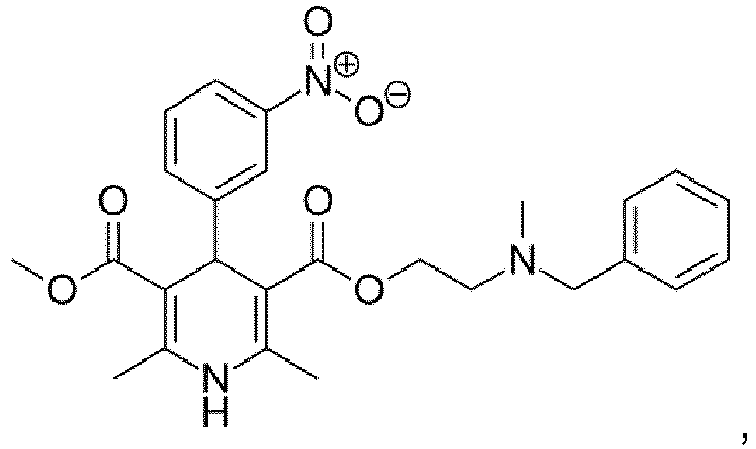


- In other embodiments, the L-type calcium channel blocker is a non-dihydropyridine L-type calcium channel blocker. Exemplary non-dihydropyridine L-type calcium channel blocker includes, but is not limited to, (i) phenylalkylamine and benzothiazepin calcium channel blockers including verapamil, diltiazem, gallopamil, and fendiline; (ii) gabapentinoids including gabapentin and pregabalin; (iii) zixonotide; and (iv) mibefradil, bepridil, flunarizine, and fluspirilene.
- In other aspects, disclosed is a method of gene silencing in a subject, where the method comprises administering to the subject an effective amount of a small interfering RNA (siRNA); and an L-type calcium channel blocker. The siRNA and the L-type calcium channel blocker can be administered as a single pharmaceutical composition, or in some embodiments the siRNA and the L-type calcium channel blocker are administered as separate pharmaceutical compositions. In some embodiments, the siRNA is an asymmetric siRNA (asiRNA), such as a cell penetrating asiRNA (cp-asiRNA) or or a long-antisense asiRNA (lasiRNA). The L-type calcium channel blocker may be a dihydropyridine L-type calcium channel blocker, or a non-dihydropyridine L-type calcium channel blocker. Exemplary asiRNA that may be used in connection with the invention are listed in Tables 1-3 below.
Table 1 No. siRNA NAME SEQ ID Sequence (5' → 3') No. 1 siRNA 1 sense GCGAGGAGUGGGUGUGUGAtt 2 antisense UCCUCGCAGCAUUUCCCGGtt asiRNA 3 sense AGGAGUGGGUGUGUGA 4 antisense UCCUCGCAGCAUUUCCCGGtt lasiRNA 5 sense AGGAGUGGGUGUGUGA 6 antisense UCACACACCCACUCCUCGCAGCAUUUCCCGG No. 2 siRNA 7 sense AGACCUGUGGGAUGGGCAUtt 8 antisense CAGGUCUUGGAACAGGCGCtt asiRNA 9 sense CCUGUGGGAUGGGCAU 10 antisense CAGGUCUUGGAACAGGCGCtt lasiRNA 11 sense CCUGUGGGAUGGGCAU 12 antisense AUGCCCAUCCCACAGGUCUUGGAACAGGCGC No. 3 siRNA 13 sense ACAGGAAGAUGUACGGAGAtt 14 antisense UUCCUGUAGUACAGCGAUUtt asiRNA 15 sense GGAAGAUGUACGGAGA 16 antisense UUCCUGUAGUACAGCGAUUtt lasiRNA 17 sense GGAAGAUGUACGGAGA 18 antisense UCUCCGUACAUCUUCCUGUAGUACAGCGAUU No. 4 siRNA 19 sense GCACCAGCAUGAAGACAUAtt 20 antisense UAUGUCUUCAUGCUGGUGCtt asiRNA 21 sense CCAGCAUGAAGACAUA 22 antisense UAUGUCUUCAUGCUGGUGCtt lasiRNA 23 sense CCAGCAUGAAGACAUA 24 antisense UAUGUCUUCAUGCUGGUCCAGCCAGAAAGCU No. 5 siRNA 25 sense GAAGACAUACCGAGCUAAAtt 26 antisense UUUAGCUCGGUAUGUCUUCtt asiRNA 27 sense GACAUACCGAGCUAAA 28 antisense UUUAGCUCGGUAUGUCUUCtt lasiRNA 29 sense GACAUACCGAGCUAAA 30 antisense UUUAGCUCGGUAUGUCUUCAUGCUGGUGCAG No. 6 siRNA 31 sense GCUAAAUUCUGUGGAGUAUtt 32 antisense AUACUCCACAGAAUUUAGCtt asiRNA 33 sense AAAUUCUGUGGAGUAU 34 antisense AUACUCCACAGAAUUUAGCtt lasiRNA 35 sense AAAUUCUGUGGAGUAU 36 antisense AUACUCCACAGAAUUUAGCUCGGUAUGUCUU No. 7 siRNA 37 sense GCGAGGUCAUGAAGAAGAAtt 38 antisense UUGUUCUUCAUGACCUCGCtt asiRNA 39 sense AGGUCAUGAAGAAGAA 40 antisense UUGUUCUUCAUGACCUCGCtt lasiRNA 41 sense AGGUCAUGAAGAAGAA 42 antisense UUGUUCUUCAUGACCUCGCCGUCAGGGCACU No. 8 siRNA 43 sense UGGAAGAGAACAUUAAGAAtt 44 antisense UUCUUAAUGUUCUCUUCCAtt asiRNA 45 sense AAGAGAACAUUAAGAA 46 antisense UUCUUAAUGUUCUCUUCCAtt lasiRNA 47 sense AAGAGAACAUUAAGAA 48 antisense UUCUUAAUGUUCUCUUCCAGGUCAGCUUCGC (Capital letters: RNA; small letters: DNA) Table 2 No. siRNA NAME SEQ ID Sequence (5' → 3') No. 9 siRNA 49 sense CGGCUUACCGACUGGAAGAtt 50 antisense UCUUCCAGUCGGUAAGCCGtt asiRNA 51 sense CUUACCGACUGGAAGA 52 antisense UCUUCCAGUCGGUAAGCCGtt lasiRNA 53 sense CUUACCGACUGGAAGA 54 antisense 
No. 10 siRNA 55 sense GCAUGAAGCCAGAGAGUGAtt 56 antisense UCACUCUCUGGCUUCAUGCtt asiRNA 57 sense UGAAGCCAGAGAGUGA 58 antisense UCACUCUCUGGCUUCAUGCtt lasiRNA 59 sense UGAAGCCAGAGAGUGA 60 antisense 
No. 11 siRNA 61 sense CACCAUAGGUAGAAUGUAAtt 62 antisense UUACAUUCUACCUAUGGUGtt asiRNA 63 sense CAUAGGUAGAAUGUAA 64 antisense UUACAUUCUACCUAUGGUGtt lasiRNA (65 sense CAUAGGUAGAAUGUAA 66 antisense 
No. 12 siRNA 67 sense CCUGCAGGCUAGAGAAGCAtt 68 antisense UGCUUCUCUAGCCUGCAGGtt asiRNA 69 sense GCAGGCUAGAGAAGCA 70 antisense UGCUUCUCUAGCCUGCAGGtt lasiRNA 71 sense GCAGGCUAGAGAAGCA 72 antisense 
No. 13 siRNA 73 sense CCAGAGAGUGAGAGACAUUtt 74 antisense AAUGUCUCUCACUCUCUGGtt asiRNA 75 sense GAGAGUGAGAGACAUU 76 antisense AAUGUCUCUCACUCUCUGGtt lasiRNA 77 sense GAGAGUGAGAGACAUU 78 antisense 
No. 14 siRNA 79 sense GCGAAGCUGACCUGGAAGAtt 80 antisense UCUUCCAGGUCAGCUUCGCtt asiRNA 81 sense AAGCUGACCUGGAAGA 82 antisense UCUUCCAGGUCAGCUUCGCtt lasiRNA 83 sense AAGCUGACCUGGAAGA 84 antisense 
No. 15 siRNA 85 sense CCGGAGACAAUGACAUCUUtt 86 antisense AAGAUGUCAUUGUCUCCGGtt asiRNA 87 sense GAGACAAUGACAUCUU 88 antisense AAGAUGUCAUUGUCUCCGGtt lasiRNA 89 sense GAGACAAUGACAUCUU 90 antisense 
No. 16 siRNA 91 sense UCUUUGAAUCGCUGUACUAtt 92 antisense UAGUACAGCGAUUCAAAGAtt asiRNA 93 sense UUGAAUCGCUGUACUA 94 antisense UAGUACAGCGAUUCAAAGAtt lasiRNA 95 sense UUGAAUCGCUGUACUA 96 antisense 
(Capital letters: RNA; small letters: DNA) Table 3 No. siRNA NAME SEQ ID Sequence (5' → 3') No. 17 siRNA 97 sense UUGCGAAGCUGACCUGGAAtt 98 antisense UUCCAGGUCAGCUUCGCAAtt asiRNA 99 sense CGAAGCUGACCUGGAA 100 antisense UUCCAGGUCAGCUUCGCAAtt lasiRNA 101 sense CGAAGCUGACCUGGAA 102 antisense UUCCAGGUCAGCUUCGCAAGGCCUGACCAUG No. 18 siRNA 103 sense CAACUAUGAUUAGAGCCAAtt 104 antisense UUGGCUCUAAUCAUAGUUGtt asiRNA 105 sense CUAUGAUUAGAGCCAA 106 antisense UUGGCUCUAAUCAUAGUUGtt lasiRNA 107 sense CUAUGAUUAGAGCCAA 108 antisense UUGGCUCUAAUCAUAGUUGGGUCUGGGCCAA No. 19 siRNA 109 sense GUACCAGUGCACGUGCCUGtt 110 antisense CAGGCACGUGCACUGGUACtt asiRNA 111 sense CCAGUGCACGUGCCUG 112 antisense CAGGCACGUGCACUGGUACtt lasiRNA 113 sense CCAGUGCACGUGCCUG 114 antisense CAGGCACGUGCACUGGUACUUGCAGCUGCUC No. 20 siRNA 115 sense AGUGCAUCCGUACUCCCAAtt 116 antisense UUGGGAGUACGGAUGCACUtt asiRNA 117 sense GCAUCCGUACUCCCAA 118 antisense UUGGGAGUACGGAUGCACUtt lasiRNA 119 sense GCAUCCGUACUCCCAA 120 antisense UUGGGAGUACGGAUGCACUUUUUGCCCUUCU No. 21 siRNA 121 sense CAUGAUGUUCAUCAAGACCtt 122 antisense GGUCUUGAUGAACAUCAUGtt asiRNA 123 sense GAUGUUCAUCAAGACC 124 antisense GGUCUUGAUGAACAUCAUGtt lasiRNA 125 sense GAUGUUCAUCAAGACC 126 antisense GGUCUUGAUGAACAUCAUGUUCUUCUUCAUG No. 22 siRNA 127 sense CCAUGACCGCCGCCAGUAUtt 128 antisense AUACUGGCGGCGGUCAUGGtt asiRNA 129 sense UGACCGCCGCCAGUAU 130 antisense AUACUGGCGGCGGUCAUGGtt lasiRNA 131 sense UGACCGCCGCCAGUAU 132 antisense AUACUGGCGGCGGUCAUGGUUGGCACUGCGG No. 23 siRNA 133 sense GAACAUUAAGAAGGGCAAAtt 134 antisense UUUGCCCUUCUUAAUGUUCtt asiRNA 135 sense CAUUAAGAAGGGCAAA 136 antisense UUUGCCCUUCUUAAUGUUCtt lasiRNA 137 sense CAUUAAGAAGGGCAAA 138 antisense UUUGCCCUUCUUAAUGUUCUCUUCCAGGUCA No. 24 siRNA 139 sense GGAAGACACGUUUGGCCCAtt 140 antisense UGGGCCAAACGUGUCUUCCtt asiRNA 141 sense AGACACGUUUGGCCCA 142 antisense UGGGCCAAACGUGUCUUCCtt lasiRNA 143 sense AGACACGUUUGGCCCA 144 antisense UGGGCCAAACGUGUCUUCCAGUCGGUAAGCC (Capital letters: RNA; small letters: DNA) - In various embodiments, the present invention provides methods for gene silencing of a target gene. In various embodiments, the target gene may be selected from mRNA (messenger RNA), microRNA, piRNA (piwi-interacting RNA), a coding DNA sequence, and a non-coding DNA sequence. In some embodiments, the target gene is mRNA. In additional embodiments, the target gene is mRNA encoding a connective tissue growth factor (CTGF).
- In another aspect, the present disclosure further provides in vitro methods of screening for a compound to improve, increase or enhance an activity of an siRNA (e.g., asi-RNA or cp-asiRNA or lasiRNA) comprising contacting the siRNA with a cell; contacting a candidate compound with the cell and/or the siRNA; and detecting the siRNA penetrated into the cell. In some embodiments, the method further comprises comparing an amount of siRNA (e.g., asi-RNA or cp-asiRNA or lasiRNA) penetrated into the cell with a control to determine whether the penetration of the siRNA into the cell with the candidate compound is increased compared to that without the candidate compound. In some embodiments, the control may be an experimented, known or estimated amount of the siRNA (e.g., asi-RNA or cp-asiRNA or lasiRNA) penetrated without any secondary compound to improve, increase or enhance the cell penetrating activity of the siRNA. The control may be a known value or a predetermined value from a previous experiment. The method may further comprise selecting the candidate compound that increases penetrating of an siRNA (e.g., asi-RNA or cp-asiRNA or lasiRNA) into the cell as the compound to improve the activity of the siRNA.
- In additional embodiments, the method described herein further comprises detecting a gene-silencing activity of an siRNA (e.g., asi-RNA or cp-asiRNA or lasiRNA) in the cell. The candidate compound that increases the gene-silencing activity of the siRNA (e.g., asi-RNA or cp-asiRNA or lasiRNA) in the cell may be selected as the compound to improve the activity of the siRNA. In further embodiments, the method further comprises comparing a gene-silencing activity of the siRNA (e.g., asi-RNA or cp-asiRNA or lasiRNA) with a control to determine whether the gene-silencing activity of the siRNA with the candidate compound is increased compared to that without the candidate compound. The control may be an experimented, known or estimated gene-silencing activity of the siRNA (e.g., asi-RNA or cp-asiRNA or lasiRNA) without any secondary compound to improve, increase or enhance the gene-silencing activity of the siRNA. The control may be a known value or a predetermined value from a previous experiment.
- In various embodiments, the method further comprises preparing a cell culture comprising the cell on a substrate. In some embodiments, the method comprises preparing a cell culture comprising the cell on a plurality of discrete substrates. In some embodiments, the cell on the substrate is contacted with an siRNA (e.g., asi-RNA or cp-asiRNA or lasiRNA) or a combination of siRNAs. For example, the cell on the substrate may contact a first siRNA (e.g., asi-RNA or cp-asiRNA or lasiRNA) or a first combination of siRNAs (e.g., asi-RNAs or cp-asiRNAs or lasiRNA) and a second siRNA (e.g., asi-RNA or cp-asiRNA or lasiRNA) or a second combination of siRNAs (e.g., asi-RNAs or cp-asiRNAs or lasiRNA). In some embodiments, the first siRNA or the first combination of siRNAs contacting the cell on one of the plurality of discrete substrates may be different from the second siRNA or the second combination of siRNAs contacting the cell on another one of the plurality of discrete substrates. A cell on each of the plurality of discrete substrates may contact a different siRNA or combination of siRNAs. In some embodiments, the method comprises comprising contacting a plurality of candidate compounds with the cell on a plurality of substrates, and simultaneously incubating the plurality of candidate compounds with the cell. In additional embodiments, the method comprises simultaneously contacting a plurality of candidate compounds with the cell on a plurality of substrates. In some embodiments, the substrate is a well. In some embodiments, the cell is a human cell.
- In some embodiments, the siRNA (e.g., asi-RNA or cp-asiRNA or lasiRNA) is labeled, for example, with a fluorescent dye. The siRNA (e.g., asi-RNA or cp-asiRNA or lasiRNA) may be detected, for example, by detecting the label. The amount of siRNA (e.g., asi-RNA or cp-asiRNA or lasiRNA) may be determined, for example, by measuring the amount of the label.
- In various embodiments, the present invention provides pharmaceutical compositions which are formulated for various delivery routes, including rectal, buccal, intranasal and transdermal routes, by intra-arterial injection, intravenously, intraperitoneally, parenterally, intramuscularly, subcutaneously, orally, topically, or as an inhalant. In some embodiments, the delivery routes are topical, pulmonary, or parenteral, for use in various methods of treatment as described elsewhere herein. In some embodiments, one or both of the siRNA and L-type calcium channel blocker are formulated for topical, pulmonary, or parenteral delivery. In some embodiments, the pharmaceutical composition is formulated for application to the skin, eyes, lungs, or systemic delivery. In various embodiments, the pharmaceutical compositions are used for in vitro and/or in vivo delivery together with various delivery vehicles, such as, without limitation, liposomes, cationic polymers, antibodies, aptamers or nanoparticles.
- In some embodiments, the pharmceutical compositions described herein may be a pharmaceutical composition for oral administration containing the siRNA (e.g., asi-RNA or cp-asiRNA or lasiRNA) and the L-type calcium channel blocker, and optionally a pharmaceutical excipient suitable for oral administration. In some embodiments, the pharmaceutical composition may exclude a separate delivery vehicle for the siRNA (e.g., asi-RNA or cp-asiRNA or lasiRNA). In various embodiments, the pharmaceutical composition is formulated in a form suitable for oral administration, i.e. as a solid or a liquid preparation. Suitable solid oral formulations include tablets, capsules, pills, granules, pellets and the like. Suitable liquid oral formulations include solutions, suspensions, dispersions, emulsions, oils and the like.
- In some embodiments, the pharmceutical compositions described herein may be a pharmaceutical composition for injection containing the siRNA (e.g., asi-RNA or cp-asiRNA or lasiRNA) and the L-type calcium channel blocker described herein, and optionally a pharmaceutical excipient suitable for injection. In some embodiments, the pharmaceutical composition may exclude a separate delivery vehicle for the siRNA (e.g., asi-RNA or cp-asiRNA or lasiRNA).
- In some embodiments, the forms in which the pharmceutical compositions of the present invention may be incorporated for administration by injection include aqueous or oil suspensions, or emulsions, with sesame oil, corn oil, cottonseed oil, or peanut oil, as well as elixirs, mannitol, dextrose, or a sterile aqueous solution, and similar pharmaceutical vehicles. In some embodiments, aqueous solutions in saline are used for injection. Ethanol, glycerol, propylene glycol and liquid polyethylene glycol (and suitable mixtures thereof), cyclodextrin derivatives, and vegetable oils may also be employed. The proper fluidity can be maintained, for example, by the use of a coating, such as lecithin, and in the case of dispersion, by the use of surfactants. The pharmaceutical composition can further comprise various antibacterial and antifungal agents, for example, parabens, chlorobutanol, phenol, sorbic acid and thimerosal.
- Sterile injectable solutions are prepared by incorporating an active pharmaceutical ingredient or combination of active pharmaceutical ingredients in the required amounts in the appropriate solvent with various other ingredients as enumerated above, followed by filtered sterilization. Generally, dispersions are prepared by incorporating the various sterilized active ingredients into a sterile vehicle which contains the basic dispersion medium and the required other ingredients from those enumerated above. In the case of sterile powders for the preparation of sterile injectable solutions, certain desirable methods of preparation are vacuum-drying and freeze-drying techniques which yield a powder of the active ingredient plus any additional desired ingredient from a previously sterile-filtered solution thereof.
- In some embodiments, the pharmaceutical compositions are administered topically to body surfaces and are thus formulated in a form suitable for topical administration. Suitable topical formulations include, without limitation, gels, ointments, creams, lotions, drops and the like.
- In various embodiments, the pharmaceutical composition of the invention further includes a pharmaceutically acceptable carrier or diluent. Pharmaceutically acceptable carriers or diluents are well known to those skilled in the art. The carrier or diluent may be, in various embodiments, a solid carrier or diluent for solid formulations, a liquid carrier or diluent for liquid formulations, or mixtures thereof. In another embodiment, solid carriers/diluents include, but are not limited to, a gum, a starch (e.g. corn starch, pregeletanized starch), a sugar (e.g., lactose, mannitol, sucrose, dextrose), a cellulosic material (e.g. microcrystalline cellulose), an acrylate (e.g. polymethylacrylate), calcium carbonate, magnesium oxide, talc, or mixtures thereof.
- In some embodiment, the pharmaceutical compositions are controlled-release compositions, i.e. compositions in which the active agents are released over a period of time after administration. Controlled- or sustained-release compositions include formulation in lipophilic depots (e.g. fatty acids, waxes, oils). In another embodiment, the composition is an immediate-release composition, i.e. a composition in which the active agents are released immediately after administration.
- In various embodiments, the siRNA (e.g., asi-RNA or cp-asiRNA or lasiRNA) and the L-type calcium channel blocker described herein are co-administered as a pharmaceutical composition. The terms "co-administration," "co-administering," "administered in combination with," "administering in combination with," "simultaneous," and "concurrent," as used herein, encompass administration of two or more active pharmaceutical ingredients to a human subject so that both active pharmaceutical ingredients and/or their metabolites are present in the human subject at the same time. Co-administration may include simultaneous or time-separated administration in different compositions, administration at different times in separate compositions, or administration in a pharmceutical composition in which two or more active pharmaceutical ingredients are present. Simultaneous administration in separate compositions and administration in a pharmceutical composition in which both agents are present is also encompassed in the methods of the invention.
- In some embodiments, a pharmaceutical composition or active pharmaceutical ingredient is administered in a single dose. Such administration may be by injection, e.g., intravenous injection, in order to introduce the active pharmaceutical ingredient quickly. However, other routes, including the oral route, may be used as appropriate. A single dose of a pharmaceutical composition may also be used for treatment of an acute condition. In some embodiments, a pharmaceutical composition or active pharmaceutical ingredient is administered in multiple doses. In an embodiment, a pharmaceutical composition is administered in multiple doses. Dosing may be once, twice, three times, four times, five times, six times, or more than six times per day. Dosing may be once a month, once every two weeks, once a week, or once every other day. In other embodiments, a pharmaceutical composition is administered about once per day to about 6 times per day. In some embodiments, a pharmaceutical composition is administered once daily, while in other embodiments, a pharmaceutical composition is administered twice daily, and in other embodiments a pharmaceutical composition is administered three times daily.
- In another aspect, the disclosure is related to a method of gene silencing in a subject, comprising administering to the subject an effective amount of the pharmceutical composition described herein. The methods of gene silencing using siRNA (e.g., asi-RNA or cp-asiRNA or lasiRNA) are described at least in
U.S. Patent Application Publication Nos. 2017/0137828 and2017/0027837 . - In some embodiments, the present disclosure is related to a method of treating or preventing a connective tissue growth factor (CTGF)-associated disease or disorder in a subject, comprising administering to the subject an effective amount of the pharmaceutical composition comprising an siRNA (e.g., asi-RNA or cp-asiRNA or lasiRNA) and/or a L-type calcium channel blocker as described herein. In some embodiments, the siRNA (e.g., asi-RNA or cp-asiRNA or lasiRNA) comprises an antisense strand of at least 19 nucleotides in length having a sequence complementarity to CTGF-encoding mRNA and a sense strand of 15 to 17 nucleotides in length having a sequence complementarity to the antisense strand. In various embodiments, the CTGF-associated disease or disorder may be selected from keloid, kidney fibrosis, pachydermatosis, pulmonary fibrosis, hepatic fibrosis, arthritis, hypertension, renal failure, vasculogenesis-related disorder, dermatofibrosis, and cardiovascular system disorder. In some embodiments, the siRNA (e.g., asi-RNA or cp-asiRNA or lasiRNA) may be conjugated to a lipophilic compound and has a pair of nucleic sequences selected from a pair of nucleotide sequences of SEQ ID NOs: 1 and 2, a pair of nucleotide sequences of SEQ ID NOs: 3 and 4, and a pair of nucleotide sequences of SEQ ID NOs: 5 and 6. Additional siRNAs (e.g., asi-RNAs or cp-asiRNAs or lasiRNA) that may be utilized for treating or preventing a CTGF-associated disease or disorder are disclosed in
U.S. Patent Publication No. 20150111948 . - In some embodiments, the present disclosure is related to a method of treating an ocular condition such as age-related macular degeneration (AMD; e.g., dry or wet AMD) in a subject in need thereof, comprising administering to the subject an effective amount of the pharmceutical composition described herein, wherein the siRNA (e.g., asi-RNA or cp-asiRNAs or lasiRNA) comprises an antisense strand of at least 19 nucleotides in length having sequence complementarity to a MyD88 mRNA sequence or a TLR3 mRNA sequence and a sense strand of 15 to 17 nucleotides in length having sequence complementarity to the antisense strand, wherein the antisense strand and the sense strand form a complex in which the 5' end of the antisense strand and the 3' end of the sense strand form a blunt end. Exemplary siRNAs (e.g., asi-RNAs or cp-asiRNAs or lasiRNA) that may be utilized for treating or preventing AMD are disclosed in
U.S. Patent Publication No. 20170137828 . - In some embodiments, the present disclosure is related to a method of inhibiting and/or reducing melanin production in a subject, comprising administering to the subject an effective amount of the pharmceutical composition described herein, wherein the siRNA (e.g., asi-RNA or cp-asiRNA) comprises an antisense strand of at least 19 nucleotides in length having sequence complementarity to a tyrosinase mRNA sequence and a sense strand of 15 to 17 nucleotides in length having sequence complementarity to the antisense strand, wherein the antisense strand and the sense strand form a complex in which the 5' end of the antisense strand and the 3' end of the sense strand form a blunt end. Exemplary siRNAs (e.g., asi-RNAs or cp-asiRNAs or lasiRNA) that may be utilized for inhibiting and/or reducing melanin production are disclosed in
U.S. Patent Publication No. 20170027837 . In some embodiments, the present disclosure further provides methods of treating skin diseases or conditions including, but are not limited to, skin whitening, darkening, or scarring, atopic dermatitis, psoriasis, scleroderma, hair loss, or wrinkled skin. - In various embodiments, the subject being treated by methods of the invention is human.
- The embodiments encompassed herein are now described with reference to the following examples. These examples are provided for the purpose of illustration only and the disclosure should in no way be construed as being limited to these examples, but rather should be construed to encompass any and all variations which become evident as a result of the teachings provided herein.
- After DMSO toxicity test, 2354 clinical active candidate compounds from a chemical library in Korea Chemical Bank were diluted in distilled water and stored in 96 well sealed plates. Before incubation of cp-asiGFP and chemicals, 4,000 cells of HeLa/GFP stable cell line were seeded in a 96 well plate. After 24 hours of seeding, cp-asiRNA was transfected. After 24 hours of transfection without any transfection reagent, such as lipofectamine or lipofectamine 2000, medium was changed from Opti-MEM (Gibco) to DMEM (Gibco) with 10% FBS (Gibco). Relative fluorescence intensity of cp-asiRNA with chemicals was measured using a multi-well plate reader (
Figure 1 ). At the first screening, relative fluorescence intensity was measured for each chemical twice. Based on first screening, five candidate chemicals with the highest intensities in each plate were selected, and a second screening was performed. The secondary screening resulted in 10 hit compounds. After analyzing the structure of the 10 compounds, 3 of the hit compounds shared a core structure and function as L-type calcium channel blocker. - Three hit compounds confirmed by screening were retested to verify the RNA interference effect on cp-asiRNAs. To set the optimal range which is not influenced by cell toxicity, MTT assay was performed. Based on this range (Lethal Dose 50), concentrations of the 3 hit compounds were selected, and the compounds retested within the selected ranges. HeLa/GFP cells were treated with Cp-asiGFPs (100 nM) and the 3 candidate chemicals. After 24 hours of incubation, medium was changed from Opti-MEM (Gibco) to DMEM (Gibco) with 10% FBS (Gibco). After 24 hours of medium change, relative GFP mRNA levels were measured using quantitative real-time reverse transcription-polymerase chain reaction (qRT-PCR) (Panel A in
Figure 2 ). When treated with the 3 chemicals, enhancement of cp-asiGFP activity was observed compared with cp-asiGFP alone. To test whether the gene silencing activity of cp-asiRNA is sequence specific, another cp-asiRNA targeting survivin (0.3 µM) was also tested. Cp-asisurvivin with the 3 candidate chemicals were added to HeLa cells and target mRNA levels were analyzed by qRT-PCR (Panel A inFigure 2 ). The GFP and Survivin mRNA levels were calculated by dividing by the Tubulin levels as an internal control. This result showed that the gene silencing activity of cp-asisurvivin was enhanced by treating with the 3 candidate compounds. - Cilnidipine, which showed the most gene silencing effect on cp-asiRNAs, was selected. cp-asiRNA targeting GFP (50 nM and 250 nM) and cp-asiRNA targeting Survivin (0.5 µM and 1 µM) with varying concentrations of cilnidipine were added to HeLa/GFP and HeLa cells. After 48 hours, activities of cp-asiRNAs with cilnidipine were analyzed using quantitative real-time reverse transcription-polymerase chain reaction (qRT-PCR). The relative GFP and Survivin mRNA levels were measured by dividing the Tubulin levels (internal control) (Panel B in
Figure 2 ). Concentration-dependent enhancement of cp-asiRNA activity was observed. These results demonstrate that the 3 hit compounds identified by screening enhance the gene silencing activity of cp-asiRNAs. - Amlodipine which was not contained in the chemical library was also tested. This compound has a common structure with DHP and functions as L-type calcium channel blocker. Cp-asiGFP and cp-asisurvivin were treated with Amlodipine into HeLa/GFP and HeLa cells. Their gene silencing effect was measured by qRT-PCR after 48 hours incubation (Panel A in
Figure 3 ). The GFP and Survivin mRNA levels were calculated by dividing by the Tubulin levels (internal control). Reduced GFP and Survivin mRNA expression level was shown by incubation with cp-asiGFP (50 nM, 100 nM, 250 nM) and cp-asisurvivin (0.3 µM, 0.5 µM, 1 µM) with varying concentrations of Amlodipine. These results show that Amlodipine also reduces the relative target mRNA level, and enhances the gene silencing effect of cp-asiRNAs in a dose-dependent manner. The results support that RNAi efficacy of cp-asiRNAs is enhanced by not only the 3 chemical compounds identified through the screen, but also DHP L-type calcium channel blocker. Continually, Nucleocounter (NC3000) based technique was performed using Cy3 labeled cp-asiGFP to determine whether DHP L-type calcium channel blocker affects the cellular uptake (Panel B inFigure 3 ). HeLa cells were treated with 100 nM Cy3 labeled cp-asiGFP with DHP L-type calcium channel blockers. After 8 hours of incubation, Hoechst 33342 (Biotium) was used for fixed and live cell fluorescent staining of DNA and nuclei. Relative fluorescent intensity was quantified compared to the intracellular fluorescent intensity on a gated cell population. The fluorescent intensity was quantified by Nucleocounter method based on intracellular Cy3 signals. The normalized fluorescent intensity was calculated relative to Cy3 labeled cp-asiGFP expression shown as 1. The cellular uptake of the cp-asiGFP with DHP L-type calcium channel blocker was higher than that of cp-asiGFP alone. The results support that DHP L-type calcium channel blocker enhances the cellular uptake, resulting in increasing the gene silencing efficacy of cp-asiRNAs. - Another type of calcium channel blocker, like non-DHP L-type calcium channel blocker, is selected for testing. Cp-asiGFP and cp-asisurvivin with Diltiazem and Verapamil were treated into HeLa/GFP and HeLa cells. After 48 hours treated with cp-asiGFP (50 nM, 100 nM) and cp-asisurvivin (0.3 µM, 0.5 µM, 1 µM) with Diltiazem and Verapamil by concentration, reduced GFP and Survivin mRNA levels were observed using quantitative real-time reverse transcription-polymerase chain reaction (qRT-PCR). The GFP and Survivin mRNA levels were calculated divided by the Tubulin levels as an internal control. As seen
Figure 4 , when treated with Diltiazem and Verapamil, the gene silencing efficacy of cp-asiRNAs was more efficient than treatment with cp-asiRNAs alone. Thus, these 2 compounds also show similar effect on cp-asiRNAs compared with the DHP L-type calcium channel blocker, confirming that the enhanced gene silencing effect is influenced by the L-type calcium channel blocker. - The effect of another type of calcium channel blocker such as T-type calcium channel blocker was tested. cp-asiGFP (50 nM, 100 nM, 250 nM) and cp-asisurvivin (0.3 µM, 0.5 µM, 1 µM) with Penfluridol and Ethosuximide by concentration were added to HeLa/GFP and HeLa cells. After 48 hours, the relative mRNA levels were analyzed using quantitative real-time reverse transcription-polymerase chain reaction (qRT-PCR). The GFP and Survivin mRNA levels were measured by dividing the Tubulin levels (internal control) (panel A in
Figure 5 ). Unlike L-type calcium channel blocker, T-type calcium channel blocker did not improve gene silencing efficacy of cp-asiRNAs. Additionally, the cellular uptake was analyzed using Nucleocounter (NC3000) based technique. Cy3 labeled cp-asiGFP with non-DHP L-type and T-type calcium channel blocker were treated into HeLa cells. HeLa cells were incubated with Cy3 labeled cp-asiGFP (100 nM) with non-DHP L-type calcium channel blocker and T-type calcium channel blocker. After 8 hours of incubation, the intracellular fluorescent intensity on a gated cell population was quantified. The intracellular Cy3 signals was measured by NC-3000 and normalized relative to Cy3 labeled cp-asiGFP expression. As seen panel B ofFigure 5 , the enhanced cellular uptake of the cp-asiGFP is only detected when treated with non-DHP L-type calcium channel blocker, not T-type calcium channel blocker. - To identify the effect of L-type calcium channel blocker on various form of cp-asiRNA, structural change and several chemical modification was applied to cp-asiRNA. The resulting RNA molecule, termed cell penetrating long asymmetric siRNA (cp-lasiRNA) showed efficient target gene silencing. cp-lasiRNA targeting CTGF(cp-lasiCTGF) with Amlodipine and Cilnidipine was treated into HeLa cells. Their gene silencing activity was measured by qRT-PCR (
Figure 6 ). L-type calcium channel blockers such as Amlodipine and Cilnidipine help to enhance the gene silencing effect of cp-lasiRNA in a dose-dependent manner. These results support that L-type calcium channel blocker works on various form of cp-asiRNA to improve the target gene silencing efficacy. - cp-lasiRNA sequence information (SEQ ID NOs: 145 and 146, "m": OMe modification, "*": phosphorothioate (PS) modification, and "chol": cholesterol modification).
cp-lasiCTGF sense strand 5'-mCUmUAmCCmGAmCUmGGmAA*mG*A*chol-3' antisense strand 5'-UCUUCCAGUCGGUAmAmGmCmCmGmCmGmAlNGmGmGmCmAm*mG*mG*mC*mC-3 - CTGF and GAPDH primer sequence information (SEQ ID NOs: 147-150)
CTGF Forward primer 5'-CAAGGGCCTCTTCTGTGACT-3' Reverse primer 5'-CCGTCGGTACATACTCCACA-3' GAPDH Forward primer 5'-GAGTCAACGGATTTGGTCGT-3' Reverse primer 5'-GACAAGCTTCCCGTTCTCAG-3' - <110> Research £ ¦ Business Foundation SUNGKYUNKWAN UNIVERSITY
- <120> PHARMACEUTICAL COMPOSITIONS AND METHODS FOR POTENTIATING GENE SILENCING
- <130> OPA17123-PCT
- <150>
KR 10-2016-0081914
<151> 2016-06-29 - <160> 150
- <170> PatentIn version 3.5
- <210> 1
<211> 21
<212> DNA
<213> Artificial Sequence - <220>
<223> Synthetic Sequence - <220>
<221> misc_feature
<222> (1)..(19)
<223> RNA - <400> 1
gcgaggagug ggugugugat t 21 - <210> 2
<211> 21
<212> DNA
<213> Artificial Sequence - <220>
<223> Synthetic Sequence - <220>
<221> misc_feature
<222> (1)..(19)
<223> RNA - <400> 2
uccucgcagc auuucccggt t 21 - <210> 3
<211> 16
<212> RNA
<213> Artificial Sequence - <220>
<223> Synthetic Sequence - <400> 3
aggagugggu guguga 16 - <210> 4
<211> 21
<212> DNA
<213> Artificial Sequence - <220>
<223> Synthetic Sequence - <220>
<221> misc_feature
<222> (1)..(19)
<223> RNA - <400> 4
uccucgcagc auuucccggt t 21 - <210> 5
<211> 16
<212> RNA
<213> Artificial Sequence - <220>
<223> Synthetic Sequence - <400> 5
aggagugggu guguga 16 - <210> 6
<211> 31
<212> RNA
<213> Artificial Sequence - <220>
<223> Synthetic Sequence - <400> 6
ucacacaccc acuccucgca gcauuucccg g 31 - <210> 7
<211> 21
<212> DNA
<213> Artificial Sequence - <220>
<223> Synthetic Sequence - <220>
<221> misc_feature
<222> (1)..(19)
<223> RNA - <400> 7
agaccugugg gaugggcaut t 21 - <210> 8
<211> 21
<212> DNA
<213> Artificial Sequence - <220>
<223> Synthetic Sequence - <220>
<221> misc_feature
<222> (1)..(19)
<223> RNA - <400> 8
caggucuugg aacaggcgct t 21 - <210> 9
<211> 16
<212> RNA
<213> Artificial Sequence - <220>
<223> Synthetic Sequence - <400> 9
ccugugggau gggcau 16 - <210> 10
<211> 21
<212> DNA
<213> Artificial Sequence - <220>
<223> Synthetic Sequence - <220>
<221> misc_feature
<222> (1)..(19)
<223> RNA - <400> 10
caggucuugg aacaggcgct t 21 - <210> 11
<211> 16
<212> RNA
<213> Artificial Sequence - <220>
<223> Synthetic Sequence - <400> 11
ccugugggau gggcau 16 - <210> 12
<211> 31
<212> RNA
<213> Artificial Sequence - <220>
<223> Synthetic Sequence - <400> 12
augcccaucc cacaggucuu ggaacaggcg c 31 - <210> 13
<211> 21
<212> DNA
<213> Artificial Sequence - <220>
<223> Synthetic Sequence - <220>
<221> misc_feature
<222> (1)..(19)
<223> RNA - <400> 13
acaggaagau guacggagat t 21 - <210> 14
<211> 21
<212> DNA
<213> Artificial Sequence - <220>
<223> Synthetic Sequence - <220>
<221> misc_feature
<222> (1)..(19)
<223> RNA - <400> 14
uuccuguagu acagcgauut t 21 - <210> 15
<211> 16
<212> RNA
<213> Artificial Sequence - <220>
<223> Synthetic Sequence - <400> 15
ggaagaugua cggaga 16 - <210> 16
<211> 21
<212> DNA
<213> Artificial Sequence - <220>
<223> Synthetic Sequence - <220>
<221> misc_feature
<222> (1)..(19)
<223> RNA - <400> 16
uuccuguagu acagcgauut t 21 - <210> 17
<211> 16
<212> RNA
<213> Artificial Sequence - <220>
<223> Synthetic Sequence - <400> 17
ggaagaugua cggaga 16 - <210> 18
<211> 31
<212> RNA
<213> Artificial Sequence - <220>
<223> Synthetic Sequence - <400> 18
ucuccguaca ucuuccugua guacagcgau u 31 - <210> 19
<211> 21
<212> DNA
<213> Artificial Sequence - <220>
<223> Synthetic Sequence - <220>
<221> misc_feature
<222> (1)..(19)
<223> RNA - <400> 19
gcaccagcau gaagacauat t 21 - <210> 20
<211> 21
<212> DNA
<213> Artificial Sequence - <220>
<223> Synthetic Sequence - <220>
<221> misc_feature
<222> (1)..(19)
<223> RNA - <400> 20
uaugucuuca ugcuggugct t 21 - <210> 21
<211> 16
<212> RNA
<213> Artificial Sequence - <220>
<223> Synthetic Sequence - <400> 21
ccagcaugaa gacaua 16 - <210> 22
<211> 21
<212> DNA
<213> Artificial Sequence - <220>
<223> Synthetic Sequence - <220>
<221> misc_feature
<222> (1)..(19)
<223> RNA - <400> 22
uaugucuuca ugcuggugct t 21 - <210> 23
<211> 16
<212> RNA
<213> Artificial Sequence - <220>
<223> Synthetic Sequence - <400> 23
ccagcaugaa gacaua 16 - <210> 24
<211> 31
<212> RNA
<213> Artificial Sequence - <220>
<223> Synthetic Sequence - <400> 24
uaugucuuca ugcuggucca gccagaaagc u 31 - <210> 25
<211> 21
<212> DNA
<213> Artificial Sequence - <220>
<223> Synthetic Sequence - <220>
<221> misc_feature
<222> (1)..(19)
<223> RNA - <400> 25
gaagacauac cgagcuaaat t 21 - <210> 26
<211> 21
<212> DNA
<213> Artificial Sequence - <220>
<223> Synthetic Sequence - <220>
<221> misc_feature
<222> (1)..(19)
<223> RNA - <400> 26
uuuagcucgg uaugucuuct t 21 - <210> 27
<211> 16
<212> RNA
<213> Artificial Sequence - <220>
<223> Synthetic Sequence - <400> 27
gacauaccga gcuaaa 16 - <210> 28
<211> 21
<212> DNA
<213> Artificial Sequence - <220>
<223> Synthetic Sequence - <220>
<221> misc_feature
<222> (1)..(19)
<223> RNA - <400> 28
uuuagcucgg uaugucuuct t 21 - <210> 29
<211> 16
<212> RNA
<213> Artificial Sequence - <220>
<223> Synthetic Sequence - <400> 29
gacauaccga gcuaaa 16 - <210> 30
<211> 31
<212> RNA
<213> Artificial Sequence - <220>
<223> Synthetic Sequence - <400> 30
uuuagcucgg uaugucuuca ugcuggugca g 31 - <210> 31
<211> 21
<212> DNA
<213> Artificial Sequence - <220>
<223> Synthetic Sequence - <220>
<221> misc_feature
<222> (1)..(19)
<223> RNA - <400> 31
gcuaaauucu guggaguaut t 21 - <210> 32
<211> 21
<212> DNA
<213> Artificial Sequence - <220>
<223> Synthetic Sequence - <220>
<221> misc_feature
<222> (1)..(19)
<223> RNA - <400> 32
auacuccaca gaauuuagct t 21 - <210> 33
<211> 16
<212> RNA
<213> Artificial Sequence - <220>
<223> Synthetic Sequence - <400> 33
aaauucugug gaguau 16 - <210> 34
<211> 21
<212> DNA
<213> Artificial Sequence - <220>
<223> Synthetic Sequence - <220>
<221> misc_feature
<222> (1)..(19)
<223> RNA - <400> 34
auacuccaca gaauuuagct t 21 - <210> 35
<211> 16
<212> RNA
<213> Artificial Sequence - <220>
<223> Synthetic Sequence - <400> 35
aaauucugug gaguau 16 - <210> 36
<211> 31
<212> RNA
<213> Artificial Sequence - <220>
<223> Synthetic Sequence - <400> 36
auacuccaca gaauuuagcu cgguaugucu u 31 - <210> 37
<211> 21
<212> DNA
<213> Artificial Sequence - <220>
<223> Synthetic Sequence - <220>
<221> misc_feature
<222> (1)..(19)
<223> RNA - <400> 37
gcgaggucau gaagaagaat t 21 - <210> 38
<211> 21
<212> DNA
<213> Artificial Sequence - <220>
<223> Synthetic Sequence - <220>
<221> misc_feature
<222> (1)..(19)
<223> RNA - <400> 38
uuguucuuca ugaccucgct t 21 - <210> 39
<211> 16
<212> RNA
<213> Artificial Sequence - <220>
<223> Synthetic Sequence - <400> 39
aggucaugaa gaagaa 16 - <210> 40
<211> 21
<212> DNA
<213> Artificial Sequence - <220>
<223> Synthetic Sequence - <220>
<221> misc_feature
<222> (1)..(19)
<223> RNA - <400> 40
uuguucuuca ugaccucgct t 21 - <210> 41
<211> 16
<212> RNA
<213> Artificial Sequence - <220>
<223> Synthetic Sequence - <400> 41
aggucaugaa gaagaa 16 - <210> 42
<211> 31
<212> RNA
<213> Artificial Sequence - <220>
<223> Synthetic Sequence - <400> 42
uuguucuuca ugaccucgcc gucagggcac u 31 - <210> 43
<211> 21
<212> DNA
<213> Artificial Sequence - <220>
<223> Synthetic Sequence - <220>
<221> misc_feature
<222> (1)..(19)
<223> RNA - <400> 43
uggaagagaa cauuaagaat t 21 - <210> 44
<211> 21
<212> DNA
<213> Artificial Sequence - <220>
<223> Synthetic Sequence - <220>
<221> misc_feature
<222> (1)..(19)
<223> RNA - <400> 44
uucuuaaugu ucucuuccat t 21 - <210> 45
<211> 16
<212> RNA
<213> Artificial Sequence - <220>
<223> Synthetic Sequence - <400> 45
aagagaacau uaagaa 16 - <210> 46
<211> 21
<212> DNA
<213> Artificial Sequence - <220>
<223> Synthetic Sequence - <220>
<221> misc_feature
<222> (1)..(19)
<223> RNA - <400> 46
uucuuaaugu ucucuuccat t 21 - <210> 47
<211> 16
<212> RNA
<213> Artificial Sequence - <220>
<223> Synthetic Sequence - <400> 47
aagagaacau uaagaa 16 - <210> 48
<211> 31
<212> RNA
<213> Artificial Sequence - <220>
<223> Synthetic Sequence - <400> 48
uucuuaaugu ucucuuccag gucagcuucg c 31 - <210> 49
<211> 21
<212> DNA
<213> Artificial Sequence - <220>
<223> Synthetic Sequence - <220>
<221> misc_feature
<222> (1)..(19)
<223> RNA - <400> 49
cggcuuaccg acuggaagat t 21 - <210> 50
<211> 21
<212> DNA
<213> Artificial Sequence - <220>
<223> Synthetic Sequence - <220>
<221> misc_feature
<222> (1)..(19)
<223> RNA - <400> 50
ucuuccaguc gguaagccgt t 21 - <210> 51
<211> 16
<212> RNA
<213> Artificial Sequence - <220>
<223> Synthetic Sequence - <400> 51
cuuaccgacu ggaaga 16 - <210> 52
<211> 21
<212> DNA
<213> Artificial Sequence - <220>
<223> Synthetic Sequence - <220>
<221> misc_feature
<222> (1)..(19)
<223> RNA - <400> 52
ucuuccaguc gguaagccgt t 21 - <210> 53
<211> 16
<212> RNA
<213> Artificial Sequence - <220>
<223> Synthetic Sequence - <400> 53
cuuaccgacu ggaaga 16 - <210> 54
<211> 31
<212> RNA
<213> Artificial Sequence - <220>
<223> Synthetic Sequence - <400> 54
ucuuccaguc gguaagccgc gagggcaggc c 31 - <210> 55
<211> 21
<212> DNA
<213> Artificial Sequence - <220>
<223> Synthetic Sequence - <220>
<221> misc_feature
<222> (1)..(19)
<223> RNA - <400> 55
gcaugaagcc agagagugat t 21 - <210> 56
<211> 21
<212> DNA
<213> Artificial Sequence - <220>
<223> Synthetic Sequence - <220>
<221> misc_feature
<222> (1)..(19)
<223> RNA - <400> 56
ucacucucug gcuucaugct t 21 - <210> 57
<211> 16
<212> RNA
<213> Artificial Sequence - <220>
<223> Synthetic Sequence - <400> 57
ugaagccaga gaguga 16 - <210> 58
<211> 21
<212> DNA
<213> Artificial Sequence - <220>
<223> Synthetic Sequence - <220>
<221> misc_feature
<222> (1)..(19)
<223> RNA - <400> 58
ucacucucug gcuucaugct t 21 - <210> 59
<211> 16
<212> RNA
<213> Artificial Sequence - <220>
<223> Synthetic Sequence - <400> 59
ugaagccaga gaguga 16 - <210> 60
<211> 31
<212> RNA
<213> Artificial Sequence - <220>
<223> Synthetic Sequence - <400> 60
ucacucucug gcuucaugcc caugucuccg u 31 - <210> 61
<211> 21
<212> DNA
<213> Artificial Sequence - <220>
<223> Synthetic Sequence - <220>
<221> misc_feature
<222> (1)..(19)
<223> RNA - <400> 61
caccauaggu agaauguaat t 21 - <210> 62
<211> 21
<212> DNA
<213> Artificial Sequence - <220>
<223> Synthetic Sequence - <220>
<221> misc_feature
<222> (1)..(19)
<223> RNA - <400> 62
uuacauucua ccuauggugt t 21 - <210> 63
<211> 16
<212> RNA
<213> Artificial Sequence - <220>
<223> Synthetic Sequence - <400> 63
cauagguaga auguaa 16 - <210> 64
<211> 21
<212> DNA
<213> Artificial Sequence - <220>
<223> Synthetic Sequence - <220>
<221> misc_feature
<222> (1)..(19)
<223> RNA - <400> 64
uuacauucua ccuauggugt t 21 - <210> 65
<211> 16
<212> RNA
<213> Artificial Sequence - <220>
<223> Synthetic Sequence - <400> 65
cauagguaga auguaa 16 - <210> 66
<211> 31
<212> RNA
<213> Artificial Sequence - <220>
<223> Synthetic Sequence - <400> 66
uuacauucua ccuauggugu ucagaaauug a 31 - <210> 67
<211> 21
<212> DNA
<213> Artificial Sequence - <220>
<223> Synthetic Sequence - <220>
<221> misc_feature
<222> (1)..(19)
<223> RNA - <400> 67
ccugcaggcu agagaagcat t 21 - <210> 68
<211> 21
<212> DNA
<213> Artificial Sequence - <220>
<223> Synthetic Sequence - <220>
<221> misc_feature
<222> (1)..(19)
<223> RNA - <400> 68
ugcuucucua gccugcaggt t 21 - <210> 69
<211> 16
<212> RNA
<213> Artificial Sequence - <220>
<223> Synthetic Sequence - <400> 69
gcaggcuaga gaagca 16 - <210> 70
<211> 21
<212> DNA
<213> Artificial Sequence - <220>
<223> Synthetic Sequence - <220>
<221> misc_feature
<222> (1)..(19)
<223> RNA - <400> 70
ugcuucucua gccugcaggt t 21 - <210> 71
<211> 16
<212> RNA
<213> Artificial Sequence - <220>
<223> Synthetic Sequence - <400> 71
gcaggcuaga gaagca 16 - <210> 72
<211> 31
<212> RNA
<213> Artificial Sequence - <220>
<223> Synthetic Sequence - <400> 72
ugcuucucua gccugcagga ggcguuguca u 31 - <210> 73
<211> 21
<212> DNA
<213> Artificial Sequence - <220>
<223> Synthetic Sequence - <220>
<221> misc_feature
<222> (1)..(19)
<223> RNA - <400> 73
ccagagagug agagacauut t 21 - <210> 74
<211> 21
<212> DNA
<213> Artificial Sequence - <220>
<223> Synthetic Sequence - <220>
<221> misc_feature
<222> (1)..(19)
<223> RNA - <400> 74
aaugucucuc acucucuggt t 21 - <210> 75
<211> 16
<212> RNA
<213> Artificial Sequence - <220>
<223> Synthetic Sequence - <400> 75
gagagugaga gacauu 16 - <210> 76
<211> 21
<212> DNA
<213> Artificial Sequence - <220>
<223> Synthetic Sequence - <220>
<221> misc_feature
<222> (1)..(19)
<223> RNA - <400> 76
aaugucucuc acucucuggt t 21 - <210> 77
<211> 16
<212> RNA
<213> Artificial Sequence - <220>
<223> Synthetic Sequence - <400> 77
gagagugaga gacauu 16 - <210> 78
<211> 31
<212> RNA
<213> Artificial Sequence - <220>
<223> Synthetic Sequence - <400> 78
aaugucucuc acucucuggc uucaugccau g 31 - <210> 79
<211> 21
<212> DNA
<213> Artificial Sequence - <220>
<223> Synthetic Sequence - <220>
<221> misc_feature
<222> (1)..(19)
<223> RNA - <400> 79
gcgaagcuga ccuggaagat t 21 - <210> 80
<211> 21
<212> DNA
<213> Artificial Sequence - <220>
<223> Synthetic Sequence - <220>
<221> misc_feature
<222> (1)..(19)
<223> RNA - <400> 80
ucuuccaggu cagcuucgct t 21 - <210> 81
<211> 16
<212> RNA
<213> Artificial Sequence - <220>
<223> Synthetic Sequence - <400> 81
aagcugaccu ggaaga 16 - <210> 82
<211> 21
<212> DNA
<213> Artificial Sequence - <220>
<223> Synthetic Sequence - <220>
<221> misc_feature
<222> (1)..(19)
<223> RNA - <400> 82
ucuuccaggu cagcuucgct t 21 - <210> 83
<211> 16
<212> RNA
<213> Artificial Sequence - <220>
<223> Synthetic Sequence - <400> 83
aagcugaccu ggaaga 16 - <210> 84
<211> 31
<212> RNA
<213> Artificial Sequence - <220>
<223> Synthetic Sequence - <400> 84
ucuuccaggu cagcuucgca aggccugacc a 31 - <210> 85
<211> 21
<212> DNA
<213> Artificial Sequence - <220>
<223> Synthetic Sequence - <220>
<221> misc_feature
<222> (1)..(19)
<223> RNA - <400> 85
ccggagacaa ugacaucuut t 21 - <210> 86
<211> 21
<212> DNA
<213> Artificial Sequence - <220>
<223> Synthetic Sequence - <220>
<221> misc_feature
<222> (1)..(19)
<223> RNA - <400> 86
aagaugucau ugucuccggt t 21 - <210> 87
<211> 16
<212> RNA
<213> Artificial Sequence - <220>
<223> Synthetic Sequence - <400> 87
gagacaauga caucuu 16 - <210> 88
<211> 21
<212> DNA
<213> Artificial Sequence - <220>
<223> Synthetic Sequence - <220>
<221> misc_feature
<222> (1)..(19)
<223> RNA - <400> 88
aagaugucau ugucuccggt t 21 - <210> 89
<211> 16
<212> RNA
<213> Artificial Sequence - <220>
<223> Synthetic Sequence - <400> 89
gagacaauga caucuu 16 - <210> 90
<211> 31
<212> RNA
<213> Artificial Sequence - <220>
<223> Synthetic Sequence - <400> 90
aagaugucau ugucuccggg acaguuguaa u 31 - <210> 91
<211> 21
<212> DNA
<213> Artificial Sequence - <220>
<223> Synthetic Sequence - <220>
<221> misc_feature
<222> (1)..(19)
<223> RNA - <400> 91
ucuuugaauc gcuguacuat t 21 - <210> 92
<211> 21
<212> DNA
<213> Artificial Sequence - <220>
<223> Synthetic Sequence - <220>
<221> misc_feature
<222> (1)..(19)
<223> RNA - <400> 92
uaguacagcg auucaaagat t 21 - <210> 93
<211> 16
<212> RNA
<213> Artificial Sequence - <220>
<223> Synthetic Sequence - <400> 93
uugaaucgcu guacua 16 - <210> 94
<211> 21
<212> DNA
<213> Artificial Sequence - <220>
<223> Synthetic Sequence - <220>
<221> misc_feature
<222> (1)..(19)
<223> RNA - <400> 94
uaguacagcg auucaaagat t 21 - <210> 95
<211> 16
<212> RNA
<213> Artificial Sequence - <220>
<223> Synthetic Sequence - <400> 95
uugaaucgcu guacua 16 - <210> 96
<211> 31
<212> RNA
<213> Artificial Sequence - <220>
<223> Synthetic Sequence - <400> 96
uaguacagcg auucaaagau gucauugucu c 31 - <210> 97
<211> 21
<212> DNA
<213> Artificial Sequence - <220>
<223> Synthetic Sequence - <220>
<221> misc_feature
<222> (1)..(19)
<223> RNA - <400> 97
uugcgaagcu gaccuggaat t 21 - <210> 98
<211> 21
<212> DNA
<213> Artificial Sequence - <220>
<223> Synthetic Sequence - <220>
<221> misc_feature
<222> (1)..(19)
<223> RNA - <400> 98
uuccagguca gcuucgcaat t 21 - <210> 99
<211> 16
<212> RNA
<213> Artificial Sequence - <220>
<223> Synthetic Sequence - <400> 99
cgaagcugac cuggaa 16 - <210> 100
<211> 21
<212> DNA
<213> Artificial Sequence - <220>
<223> Synthetic Sequence - <220>
<221> misc_feature
<222> (1)..(19)
<223> RNA - <400> 100
uuccagguca gcuucgcaat t 21 - <210> 101
<211> 16
<212> RNA
<213> Artificial Sequence - <220>
<223> Synthetic Sequence - <400> 101
cgaagcugac cuggaa 16 - <210> 102
<211> 31
<212> RNA
<213> Artificial Sequence - <220>
<223> Synthetic Sequence - <400> 102
uuccagguca gcuucgcaag gccugaccau g 31 - <210> 103
<211> 21
<212> DNA
<213> Artificial Sequence - <220>
<223> Synthetic Sequence - <220>
<221> misc_feature
<222> (1)..(19)
<223> RNA - <400> 103
caacuaugau uagagccaat t 21 - <210> 104
<211> 21
<212> DNA
<213> Artificial Sequence - <220>
<223> Synthetic Sequence - <220>
<221> misc_feature
<222> (1)..(19)
<223> RNA - <400> 104
uuggcucuaa ucauaguugt t 21 - <210> 105
<211> 16
<212> RNA
<213> Artificial Sequence - <220>
<223> Synthetic Sequence - <400> 105
cuaugauuag agccaa 16 - <210> 106
<211> 21
<212> DNA
<213> Artificial Sequence - <220>
<223> Synthetic Sequence - <220>
<221> misc_feature
<222> (1)..(19)
<223> RNA - <400> 106
uuggcucuaa ucauaguugt t 21 - <210> 107
<211> 16
<212> RNA
<213> Artificial Sequence - <220>
<223> Synthetic Sequence - <400> 107
cuaugauuag agccaa 16 - <210> 108
<211> 31
<212> RNA
<213> Artificial Sequence - <220>
<223> Synthetic Sequence - <400> 108
uuggcucuaa ucauaguugg gucugggcca a 31 - <210> 109
<211> 21
<212> DNA
<213> Artificial Sequence - <220>
<223> Synthetic Sequence - <220>
<221> misc_feature
<222> (1)..(19)
<223> RNA - <400> 109
guaccagugc acgugccugt t 21 - <210> 110
<211> 21
<212> DNA
<213> Artificial Sequence - <220>
<223> Synthetic Sequence - <220>
<221> misc_feature
<222> (1)..(19)
<223> RNA - <400> 110
caggcacgug cacugguact t 21 - <210> 111
<211> 16
<212> RNA
<213> Artificial Sequence - <220>
<223> Synthetic Sequence - <400> 111
ccagugcacg ugccug 16 - <210> 112
<211> 21
<212> DNA
<213> Artificial Sequence - <220>
<223> Synthetic Sequence - <220>
<221> misc_feature
<222> (1)..(19)
<223> RNA - <400> 112
caggcacgug cacugguact t 21 - <210> 113
<211> 16
<212> RNA
<213> Artificial Sequence - <220>
<223> Synthetic Sequence - <400> 113
ccagugcacg ugccug 16 - <210> 114
<211> 31
<212> RNA
<213> Artificial Sequence - <220>
<223> Synthetic Sequence - <400> 114
caggcacgug cacugguacu ugcagcugcu c 31 - <210> 115
<211> 21
<212> DNA
<213> Artificial Sequence - <220>
<223> Synthetic Sequence - <220>
<221> misc_feature
<222> (1)..(19)
<223> RNA - <400> 115
agugcauccg uacucccaat t 21 - <210> 116
<211> 21
<212> DNA
<213> Artificial Sequence - <220>
<223> Synthetic Sequence - <220>
<221> misc_feature
<222> (1)..(19)
<223> RNA - <400> 116
uugggaguac ggaugcacut t 21 - <210> 117
<211> 16
<212> RNA
<213> Artificial Sequence - <220>
<223> Synthetic Sequence - <400> 117
gcauccguac ucccaa 16 - <210> 118
<211> 21
<212> DNA
<213> Artificial Sequence - <220>
<223> Synthetic Sequence - <220>
<221> misc_feature
<222> (1)..(19)
<223> RNA - <400> 118
uugggaguac ggaugcacut t 21 - <210> 119
<211> 16
<212> RNA
<213> Artificial Sequence - <220>
<223> Synthetic Sequence - <400> 119
gcauccguac ucccaa 16 - <210> 120
<211> 31
<212> RNA
<213> Artificial Sequence - <220>
<223> Synthetic Sequence - <400> 120
uugggaguac ggaugcacuu uuugcccuuc u 31 - <210> 121
<211> 21
<212> DNA
<213> Artificial Sequence - <220>
<223> Synthetic Sequence - <220>
<221> misc_feature
<222> (1)..(19)
<223> RNA - <400> 121
caugauguuc aucaagacct t 21 - <210> 122
<211> 21
<212> DNA
<213> Artificial Sequence - <220>
<223> Synthetic Sequence - <220>
<221> misc_feature
<222> (1)..(19)
<223> RNA - <400> 122
ggucuugaug aacaucaugt t 21 - <210> 123
<211> 16
<212> RNA
<213> Artificial Sequence - <220>
<223> Synthetic Sequence - <400> 123
gauguucauc aagacc 16 - <210> 124
<211> 21
<212> DNA
<213> Artificial Sequence - <220>
<223> Synthetic Sequence - <220>
<221> misc_feature
<222> (1)..(19)
<223> RNA - <400> 124
ggucuugaug aacaucaugt t 21 - <210> 125
<211> 16
<212> RNA
<213> Artificial Sequence - <220>
<223> Synthetic Sequence - <400> 125
gauguucauc aagacc 16 - <210> 126
<211> 31
<212> RNA
<213> Artificial Sequence - <220>
<223> Synthetic Sequence - <400> 126
ggucuugaug aacaucaugu ucuucuucau g 31 - <210> 127
<211> 21
<212> DNA
<213> Artificial Sequence - <220>
<223> Synthetic Sequence - <220>
<221> misc_feature
<222> (1)..(19)
<223> RNA - <400> 127
ccaugaccgc cgccaguaut t 21 - <210> 128
<211> 21
<212> DNA
<213> Artificial Sequence - <220>
<223> Synthetic Sequence - <220>
<221> misc_feature
<222> (1)..(19)
<223> RNA - <400> 128
auacuggcgg cggucauggt t 21 - <210> 129
<211> 16
<212> RNA
<213> Artificial Sequence - <220>
<223> Synthetic Sequence - <400> 129
ugaccgccgc caguau 16 - <210> 130
<211> 21
<212> DNA
<213> Artificial Sequence - <220>
<223> Synthetic Sequence - <220>
<221> misc_feature
<222> (1)..(19)
<223> RNA - <400> 130
auacuggcgg cggucauggt t 21 - <210> 131
<211> 16
<212> RNA
<213> Artificial Sequence - <220>
<223> Synthetic Sequence - <400> 131
ugaccgccgc caguau 16 - <210> 132
<211> 31
<212> RNA
<213> Artificial Sequence - <220>
<223> Synthetic Sequence - <400> 132
auacuggcgg cggucauggu uggcacugcg g 31 - <210> 133
<211> 21
<212> DNA
<213> Artificial Sequence - <220>
<223> Synthetic Sequence - <220>
<221> misc_feature
<222> (1)..(19)
<223> RNA - <400> 133
gaacauuaag aagggcaaat t 21 - <210> 134
<211> 21
<212> DNA
<213> Artificial Sequence - <220>
<223> Synthetic Sequence - <220>
<221> misc_feature
<222> (1)..(19)
<223> RNA - <400> 134
uuugcccuuc uuaauguuct t 21 - <210> 135
<211> 16
<212> RNA
<213> Artificial Sequence - <220>
<223> Synthetic Sequence - <400> 135
cauuaagaag ggcaaa 16 - <210> 136
<211> 21
<212> DNA
<213> Artificial Sequence - <220>
<223> Synthetic Sequence - <220>
<221> misc_feature
<222> (1)..(19)
<223> RNA - <400> 136
uuugcccuuc uuaauguuct t 21 - <210> 137
<211> 16
<212> RNA
<213> Artificial Sequence - <220>
<223> Synthetic Sequence - <400> 137
cauuaagaag ggcaaa 16 - <210> 138
<211> 31
<212> RNA
<213> Artificial Sequence - <220>
<223> Synthetic Sequence - <400> 138
uuugcccuuc uuaauguucu cuuccagguc a 31 - <210> 139
<211> 21
<212> DNA
<213> Artificial Sequence - <220>
<223> Synthetic Sequence - <220>
<221> misc_feature
<222> (1)..(19)
<223> RNA - <400> 139
ggaagacacg uuuggcccat t 21 - <210> 140
<211> 21
<212> DNA
<213> Artificial Sequence - <220>
<223> Synthetic Sequence - <220>
<221> misc_feature
<222> (1)..(19)
<223> RNA - <400> 140
ugggccaaac gugucuucct t 21 - <210> 141
<211> 16
<212> RNA
<213> Artificial Sequence - <220>
<223> Synthetic Sequence - <400> 141
agacacguuu ggccca 16 - <210> 142
<211> 21
<212> DNA
<213> Artificial Sequence - <220>
<223> Synthetic Sequence - <220>
<221> misc_feature
<222> (1)..(19)
<223> RNA - <400> 142
ugggccaaac gugucuucct t 21 - <210> 143
<211> 16
<212> RNA
<213> Artificial Sequence - <220>
<223> Synthetic Sequence - <400> 143
agacacguuu ggccca 16 - <210> 144
<211> 31
<212> RNA
<213> Artificial Sequence - <220>
<223> Synthetic Sequence - <400> 144
ugggccaaac gugucuucca gucgguaagc c 31 - <210> 145
<211> 16
<212> RNA
<213> Artificial Sequence - <220>
<223> Synthetic Sequence - <220>
<221> OMe modification
<222> (1)..(1) - <220>
<221> OMe modification
<222> (3)..(3) - <220>
<221> OMe modification
<222> (5)..(5) - <220>
<221> OMe modification
<222> (7)..(7) - <220>
<221> OMe modification
<222> (9)..(9) - <220>
<221> OMe modification
<222> (11)..(11) - <220>
<221> OMe modification
<222> (13)..(13) - <220>
<221> Phosphorothioate (PS) modification
<222> (14)..(16) - <220>
<221> OMe modification
<222> (15)..(15) - <220>
<221> misc_binding
<222> (16)..(16)
<223> Cholesterol - <400> 145
cuuaccgacu ggaaga 16 - <210> 146
<211> 31
<212> RNA
<213> Artificial Sequence - <220>
<223> Synthetic Sequence - <220>
<221> OMe modification
<222> (13)..(31) - <220>
<221> Phosphorothioate (PS) modification
<222> (28)..(31) - <400> 146
ucuuccaguc gguaagccgc gagggcaggc c 31 - <210> 147
<211> 20
<212> DNA
<213> Artificial Sequence - <220>
<223> Synthetic Sequence - <400> 147
caagggcctc ttctgtgact 20 - <210> 148
<211> 20
<212> DNA
<213> Artificial Sequence - <220>
<223> Synthetic Sequence - <400> 148
ccgtcggtac atactccaca 20 - <210> 149
<211> 20
<212> DNA
<213> Artificial Sequence - <220>
<223> Synthetic Sequence - <400> 149
gagtcaacgg atttggtcgt 20 - <210> 150
<211> 20
<212> DNA
<213> Artificial Sequence - <220>
<223> Synthetic Sequence - <400> 150
gacaagcttc ccgttctcag 20
Claims (13)
- A pharmaceutical composition comprising a small interfering RNA (siRNA); and an L-type calcium channel blocker.
- The pharmaceutical composition of claim 1, wherein the siRNA is an asymmetric siRNA (asiRNA), a cell penetrating asiRNA (cp-asiRNA) or a longantisense asiRNA (lasiRNA).
- The pharmaceutical composition of claim 1 or claim 2, wherein the L-type calcium channel blocker is a dihydropyridine L-type calcium channel blocker or a non-dihydropyridine L-type calcium channel blocker.
- The pharmaceutical composition of claim 3, wherein the dihydropyridine L-type calcium channel blocker is selected from amlodipine, aranidipine, azelnidipine, barnidipine, benidipine, cilnidipine, clevidipine, isradipine, efonidipine, felodipine, lacidipine, lercanidipine, manidipine, nicardipine, nifedipine, nilvadipine, nimodipine, nisoldipine, nitrendipine, and pranidipine.
- The pharmaceutical composition of claim 3, wherein the non-dihydropyridine L-type calcium channel blocker is selected from (i) phenylalkylamine and benzothiazepin calcium channel blockers; (ii) gabapentinoids including gabapentin and pregabalin; (iii) zixonotide; and (iv) mibefradil, bepridil, flunarizine, and fluspirilene.
- The pharmaceutical composition of claim 5, wherein the L-type calcium channel blocker is selected from verapamil, diltiazem, gallopamil, and fendiline.
- The pharmaceutical composition of any one of claims 1 to 6, wherein the composition is formulated for topical, pulmonary, or parenteral delivery.
- The pharmaceutical composition of any one of claims 1 to 7, wherein the siRNA comprises an antisense strand having sequence complementarity to:i) a CTGF-encoding mRNA;ii) a MyD88 mRNA sequence or a TLR mRNA sequence; oriii) a tyrosinase-encoding mRNA sequence.
- The pharmaceutical composition of any one of claims 1 to 8, wherein the siRNA and the L-type calcium channel blocker are formulated as a single pharmaceutical composition or are formulated as separate pharmaceutical compositions.
- An in vitro method for making an siRNA composition, comprising:i) contacting a cell with an siRNA as claimed in any one of claims 1, 2 or 8 and a candidate compound that is an L-type calcium channel blocker;ii) quantifying penetration of the siRNA into the cell and quantifying reduction in expression of a target RNA;iii) selecting a candidate compound, which is optionally derivatized, based on the quantifying in ii), for co-formulation with the siRNA.
- The method of claim 10, wherein the siRNA is an asymmetric siRNA (asiRNA) and is labeled with a fluorescent dye.
- The method of claim 10 or claim 11, wherein the cell is a human cell.
- A pharmaceutical composition for use in a method for the treatment of a CTGF-associated disease or disorder selected from keloid, kidney fibrosis, pachydermatosis, pulmonary fibrosis, hepatic fibrosis, arthritis, hypertension, renal failure, vasculogenesis-related disorder, dermatofibrosis, and cardiovascular system disorder, wherein the pharmaceutical composition is as claimed in any one of claims 1 to 9.
Applications Claiming Priority (2)
| Application Number | Priority Date | Filing Date | Title |
|---|---|---|---|
| KR20160081914 | 2016-06-29 | ||
| PCT/KR2017/006923 WO2018004284A1 (en) | 2016-06-29 | 2017-06-29 | Pharmaceutical compositions and methods for potentiating gene silencing |
Publications (3)
| Publication Number | Publication Date |
|---|---|
| EP3478658A1 EP3478658A1 (en) | 2019-05-08 |
| EP3478658A4 EP3478658A4 (en) | 2020-01-22 |
| EP3478658B1 true EP3478658B1 (en) | 2021-09-29 |
Family
ID=60787384
Family Applications (1)
| Application Number | Title | Priority Date | Filing Date |
|---|---|---|---|
| EP17820560.5A Active EP3478658B1 (en) | 2016-06-29 | 2017-06-29 | Pharmaceutical mrna compositions and methods for potentiating gene silencing |
Country Status (8)
| Country | Link |
|---|---|
| US (1) | US11040057B2 (en) |
| EP (1) | EP3478658B1 (en) |
| JP (1) | JP7112964B2 (en) |
| KR (1) | KR101916652B1 (en) |
| CN (1) | CN109563037B (en) |
| AU (1) | AU2017289015B2 (en) |
| CA (1) | CA3029521A1 (en) |
| WO (1) | WO2018004284A1 (en) |
Families Citing this family (12)
| Publication number | Priority date | Publication date | Assignee | Title |
|---|---|---|---|---|
| EP2631291B1 (en) | 2010-10-22 | 2019-05-15 | OliX Pharmaceuticals, Inc. | Nucleic acid molecules inducing rna interference, and uses thereof |
| DK2853597T3 (en) | 2012-05-22 | 2019-04-08 | Olix Pharmaceuticals Inc | RNA INTERFERENCE-INducing NUCLEIC ACID MOLECULES WITH CELL PENETENING EQUIPMENT AND USE THEREOF |
| EP3377630A4 (en) | 2015-11-16 | 2020-01-01 | Olix Pharmaceuticals, Inc. | TREATMENT OF AGE-RELATED MACULAR DEGENERATION USING RNA COMPLEXES THAT TARGET MYD88 OR TLR3 |
| JP6944942B2 (en) | 2016-02-02 | 2021-10-06 | オリックス ファーマシューティカルズ,インコーポレーテッド | Treatment of atopic dermatitis and asthma with RNA complexes targeting IL4Rα, TRPA1, or F2RL1 |
| EP3411481A4 (en) | 2016-02-02 | 2020-02-26 | Olix Pharmaceuticals, Inc. | TREATMENT OF ANGIOGENESE-ASSOCIATED DISEASES WITH RNA COMPLEXES TARGETING ANGPT2 AND PDGFB |
| WO2017178883A2 (en) | 2016-04-11 | 2017-10-19 | Olix Pharmaceuticals, Inc. | Treatment of idiopathic pulmonary fibrosis using rna complexes that target connective tissue growth factor |
| KR101916652B1 (en) | 2016-06-29 | 2018-11-08 | 올릭스 주식회사 | Compounds improving RNA interference of small interfering RNA and use thereof |
| EP3580339A4 (en) | 2017-02-10 | 2020-12-23 | Research & Business Foundation Sungkyunkwan University | LONG DOUBLE STRANDED RNA FOR RNA INTERFERENCE |
| CN112353767A (en) * | 2020-11-16 | 2021-02-12 | 海南锦瑞制药有限公司 | Diltiazem hydrochloride and pregabalin composition, and preparation method and application thereof |
| WO2023043239A1 (en) * | 2021-09-15 | 2023-03-23 | 올릭스 주식회사 | Double-stranded rna having innate immune response-inducing effect, and use thereof |
| WO2024186166A1 (en) * | 2023-03-08 | 2024-09-12 | 올릭스 주식회사 | Double-stranded rna having innate immune response-inducing effect, and use thereof |
| WO2026054553A1 (en) * | 2024-09-06 | 2026-03-12 | 올릭스 주식회사 | Double-stranded rna for innate immune response-based anticancer therapy, and use thereof |
Family Cites Families (95)
| Publication number | Priority date | Publication date | Assignee | Title |
|---|---|---|---|---|
| US5837258A (en) | 1991-08-30 | 1998-11-17 | University Of South Florida | Induction of tissue, bone or cartilage formation using connective tissue growth factor |
| DE10160151A1 (en) | 2001-01-09 | 2003-06-26 | Ribopharma Ag | Inhibiting expression of target gene, useful e.g. for inhibiting oncogenes, by administering double-stranded RNA complementary to the target and having an overhang |
| US20050209179A1 (en) * | 2000-08-30 | 2005-09-22 | Sirna Therapeutics, Inc. | RNA interference mediated treatment of Alzheimer's disease using short interfering nucleic acid (siNA) |
| KR100872437B1 (en) | 2000-12-01 | 2008-12-05 | 막스-플랑크-게젤샤프트 츄어 푀르더룽 데어 비쎈샤프텐 에.파우. | Small RNA molecules that mediate JR interference |
| US20080188430A1 (en) | 2001-05-18 | 2008-08-07 | Sirna Therapeutics, Inc. | RNA interference mediated inhibition of hypoxia inducible factor 1 (HIF1) gene expression using short interfering nucleic acid (siNA) |
| US20050282188A1 (en) | 2001-05-18 | 2005-12-22 | Sirna Therapeutics, Inc. | RNA interference mediated inhibition of gene expression using short interfering nucleic acid (siNA) |
| US20050171040A1 (en) * | 2001-05-18 | 2005-08-04 | Sirna Therapeutics, Inc. | RNA interference mediated inhibition of cholesteryl ester transfer protein (CEPT) gene expression using short interfering nucleic acid (siNA) |
| US20040248835A1 (en) | 2001-10-26 | 2004-12-09 | Anja Krebs | Use of a double-stranded ribonucleic acid for treating an infection with a positivestrand rna-virus |
| US20040138163A1 (en) | 2002-05-29 | 2004-07-15 | Mcswiggen James | RNA interference mediated inhibition of vascular edothelial growth factor and vascular edothelial growth factor receptor gene expression using short interfering nucleic acid (siNA) |
| BRPI0312818B8 (en) * | 2002-07-19 | 2021-05-25 | Beth Israel Deaconess Medical Ct Inc | using a measure of the level of the sflt-1 polypeptide in a patient sample and using a measure of the levels of at least two of the sflt1, free vegf, or free pigf polypeptide in a patient sample using a metric |
| ES2280826T5 (en) | 2002-08-05 | 2017-08-03 | Silence Therapeutics Gmbh | Additional new forms of interfering RNA molecules |
| JP2006507841A (en) | 2002-11-14 | 2006-03-09 | ダーマコン, インコーポレイテッド | Functional and ultrafunctional siRNA |
| WO2006006948A2 (en) | 2002-11-14 | 2006-01-19 | Dharmacon, Inc. | METHODS AND COMPOSITIONS FOR SELECTING siRNA OF IMPROVED FUNCTIONALITY |
| WO2004080406A2 (en) | 2003-03-07 | 2004-09-23 | Alnylam Pharmaceuticals | Therapeutic compositions |
| US20040198640A1 (en) | 2003-04-02 | 2004-10-07 | Dharmacon, Inc. | Stabilized polynucleotides for use in RNA interference |
| US20050136437A1 (en) | 2003-08-25 | 2005-06-23 | Nastech Pharmaceutical Company Inc. | Nanoparticles for delivery of nucleic acids and stable double-stranded RNA |
| WO2005063213A1 (en) | 2003-12-19 | 2005-07-14 | Biodelivery Sciences International, Inc. | Rigid liposomal cochleate and methods of use and manufacture |
| US20060134787A1 (en) | 2004-12-22 | 2006-06-22 | University Of Massachusetts | Methods and compositions for enhancing the efficacy and specificity of single and double blunt-ended siRNA |
| WO2005062937A2 (en) | 2003-12-22 | 2005-07-14 | University Of Massachusetts | Methods and compositions for enhancing the efficacy and specificity of single and double blunt-ended sirna |
| US20060069050A1 (en) | 2004-02-17 | 2006-03-30 | University Of Massachusetts | Methods and compositions for mediating gene silencing |
| ES2423060T3 (en) | 2004-03-12 | 2013-09-17 | Alnylam Pharmaceuticals, Inc. | IRNA agents that target VEGF |
| KR101147147B1 (en) | 2004-04-01 | 2012-05-25 | 머크 샤프 앤드 돔 코포레이션 | Modified polynucleotides for reducing off-target effects in rna interference |
| US20090170794A1 (en) | 2004-09-10 | 2009-07-02 | Somagenics Inc. | Small interfering rnas that efficiently inhibit viral expression and methods of use thereof |
| NZ572403A (en) | 2004-09-24 | 2010-03-26 | Alnylam Pharmaceuticals Inc | Rnai modulation of apob and uses thereof |
| TWI386225B (en) | 2004-12-23 | 2013-02-21 | Alcon Inc | Rnai inhibition of ctgf for treatment of ocular disorders |
| US20060142228A1 (en) | 2004-12-23 | 2006-06-29 | Ambion, Inc. | Methods and compositions concerning siRNA's as mediators of RNA interference |
| US7829527B2 (en) * | 2005-02-02 | 2010-11-09 | University Of Vermont And State Agricultural College | Emergence of a R-type Ca2+ channel (Cav 2.3) contributes to cerebral artery constriction following subarachnoid hemorrhage |
| AU2006235364A1 (en) | 2005-04-08 | 2006-10-19 | Marina Biotech, Inc. | RNAi therapeutic for respiratory virus infection |
| WO2006125977A2 (en) | 2005-05-25 | 2006-11-30 | The University Of York | Hybrid interfering rna |
| BRPI0611581B1 (en) | 2005-06-24 | 2021-08-03 | Intervet International B.V. | INACTIVATED CHIMERIC FLAVIVIRUS, IMMUNOGENIC COMPOSITION, AND, VACCINE |
| HUE043492T2 (en) | 2005-08-23 | 2019-08-28 | Univ Pennsylvania | RNAs and methods for their use containing modified nucleosides |
| FR2890859B1 (en) | 2005-09-21 | 2012-12-21 | Oreal | DOUBLE-STRANDED RNA OLIGONUCLEOTIDE INHIBITING TYROSINASE EXPRESSION |
| US7825099B2 (en) | 2006-01-20 | 2010-11-02 | Quark Pharmaceuticals, Inc. | Treatment or prevention of oto-pathologies by inhibition of pro-apoptotic genes |
| CA2638906A1 (en) | 2006-01-26 | 2007-08-16 | University Of Massachusetts | Rna interference agents for therapeutic use |
| CA2640423C (en) | 2006-01-27 | 2016-03-15 | Biogen Idec Ma Inc. | Nogo receptor antagonists |
| US20070218495A1 (en) | 2006-03-16 | 2007-09-20 | Dharmacon, Inc. | Methods, libraries and computer program products for gene silencing with reduced off-target effects |
| US7700541B2 (en) * | 2006-04-06 | 2010-04-20 | Nitto Denko Corporation | Biodegradable cationic polymers |
| GB0608838D0 (en) | 2006-05-04 | 2006-06-14 | Novartis Ag | Organic compounds |
| WO2008109377A1 (en) | 2007-03-02 | 2008-09-12 | Mdrna, Inc. | Nucleic acid compounds for inhibiting vegf family gene expression and uses thereof |
| US20100105134A1 (en) | 2007-03-02 | 2010-04-29 | Mdrna, Inc. | Nucleic acid compounds for inhibiting gene expression and uses thereof |
| WO2008150897A2 (en) | 2007-05-31 | 2008-12-11 | University Of Iowa Research Foundation | Reduction of off-target rna interference toxicity |
| US20090004668A1 (en) | 2007-06-22 | 2009-01-01 | The Board Of Trustees Of The Leland Stanford Junior University | Pre-miRNA loop-modulated target regulation |
| WO2009020344A2 (en) | 2007-08-06 | 2009-02-12 | Postech Acad Ind Found | Small interfering rnas (sirnas) controlling multiple target genes and method for preparing the same |
| EP2193140B1 (en) | 2007-08-27 | 2016-11-02 | 1Globe Health Institute LLC | Compositions of asymmetric interfering rna and uses thereof |
| CN101849008A (en) | 2007-09-19 | 2010-09-29 | 应用生物系统有限公司 | SiRNA sequence-independent modification formats for reducing off-target phenotypic effects in RNAi, and stabilized forms thereof |
| CN103898110A (en) | 2007-10-03 | 2014-07-02 | 夸克制药公司 | Novel sirna structures |
| US8614311B2 (en) | 2007-12-12 | 2013-12-24 | Quark Pharmaceuticals, Inc. | RTP801L siRNA compounds and methods of use thereof |
| KR100949791B1 (en) | 2007-12-18 | 2010-03-30 | 이동기 | Novel siRNA structure and its use to minimize off-target effect and not saturate the RAN mechanism |
| JP2011518116A (en) | 2008-02-21 | 2011-06-23 | ユニバーシティ オブ ケンタッキー リサーチ ファウンデーション | Ultra-small RNA as a Toll-like receptor 3 antagonist |
| EP2318528A1 (en) | 2008-07-24 | 2011-05-11 | Rxi Pharmaceuticals Corporation | Rnai constructs and uses therof |
| WO2010026660A1 (en) | 2008-09-08 | 2010-03-11 | 学校法人福岡大学 | Rna capable of inhibiting expression of zfat gene |
| EP2340309A2 (en) | 2008-09-22 | 2011-07-06 | Rxi Pharmaceuticals Corporation | Neutral nanotransporters |
| US20100227920A1 (en) | 2008-09-29 | 2010-09-09 | The Regents Of The University Of California | Aldehyde dehydrogenase inhibitors as novel depigmenting agents |
| WO2010090762A1 (en) | 2009-02-04 | 2010-08-12 | Rxi Pharmaceuticals Corporation | Rna duplexes with single stranded phosphorothioate nucleotide regions for additional functionality |
| JP2012517815A (en) | 2009-02-18 | 2012-08-09 | サイレンス・セラピューティクス・アーゲー | Means for inhibiting the expression of ANG2 |
| JP2012520683A (en) | 2009-03-19 | 2012-09-10 | メルク・シャープ・エンド・ドーム・コーポレイション | RNA interference-mediated inhibition of connective tissue growth factor (CTGF) gene expression using small interfering nucleic acids (siNA) |
| ES2628144T3 (en) | 2009-04-03 | 2017-08-01 | Dicerna Pharmaceuticals, Inc. | Methods and compositions for specific inhibition of KRAS by asymmetric double stranded RNA |
| US8472766B2 (en) | 2009-08-14 | 2013-06-25 | Massachusetts Institute Of Technology | Waveguide coupler having continuous three-dimensional tapering |
| KR101207561B1 (en) | 2009-12-15 | 2012-12-04 | 주식회사 코리아나화장품 | siRNA oligonucleotide which inhibits Tryrosinase expression and Cosmetic composition comprising the same |
| WO2011084193A1 (en) | 2010-01-07 | 2011-07-14 | Quark Pharmaceuticals, Inc. | Oligonucleotide compounds comprising non-nucleotide overhangs |
| CN106074591B (en) | 2010-03-24 | 2020-01-14 | 菲奥医药公司 | RNA interference in ocular symptoms |
| LT2560687T (en) * | 2010-04-19 | 2017-09-25 | Nlife Therapeutics S.L. | Compositions and methods for selective delivery of oligonucleotide molecules to specific neuron types |
| US20130115613A1 (en) | 2010-05-12 | 2013-05-09 | Val-Chum, Limited Partnership | Screening assays based on mag and/or abhd6 for selecting insulin secretion promoting agent |
| WO2012074588A2 (en) * | 2010-08-30 | 2012-06-07 | President And Fellows Of Harvard College | Shear controlled release for stenotic lesions and thrombolytic therapies |
| CA2812046A1 (en) | 2010-09-15 | 2012-03-22 | Alnylam Pharmaceuticals, Inc. | Modified irna agents |
| EP2631291B1 (en) | 2010-10-22 | 2019-05-15 | OliX Pharmaceuticals, Inc. | Nucleic acid molecules inducing rna interference, and uses thereof |
| US20130324591A1 (en) | 2010-12-06 | 2013-12-05 | Quark Pharmaceuticals, Inc. | Double stranded oligonucleotide compounds comprising positional modifications |
| WO2012118911A1 (en) | 2011-03-03 | 2012-09-07 | Quark Pharmaceuticals, Inc. | Oligonucleotide modulators of the toll-like receptor pathway |
| CN102719432B (en) | 2011-03-29 | 2013-10-23 | 南京大学 | Double-stranded asymmetric small nucleic-acid-interference-molecule asiRNA inhibiting tumour apoptosis suppressor specifically and application thereof |
| KR101590586B1 (en) | 2011-05-30 | 2016-02-01 | 성균관대학교산학협력단 | Long interfering dsRNA with abilities to trigger RNA interference and immunostimulation simultaneously |
| ES2907620T3 (en) | 2011-07-18 | 2022-04-25 | Univ Kentucky Res Found | Protection of cells from degeneration induced by RNA Alu and inhibitors to protect cells |
| US9707235B1 (en) | 2012-01-13 | 2017-07-18 | University Of Kentucky Research Foundation | Protection of cells from degeneration and treatment of geographic atrophy |
| DK2853597T3 (en) * | 2012-05-22 | 2019-04-08 | Olix Pharmaceuticals Inc | RNA INTERFERENCE-INducing NUCLEIC ACID MOLECULES WITH CELL PENETENING EQUIPMENT AND USE THEREOF |
| US9611473B2 (en) | 2012-09-12 | 2017-04-04 | Quark Pharmaceuticals, Inc. | Double-stranded nucleic acid compounds |
| WO2014085154A1 (en) * | 2012-11-27 | 2014-06-05 | Beth Israel Deaconess Medical Center, Inc. | Methods for treating renal disease |
| KR101595152B1 (en) | 2013-04-10 | 2016-02-17 | 이화여자대학교 산학협력단 | Gene delivery system comprising TCTP-PTD |
| EP3591053A1 (en) | 2013-07-05 | 2020-01-08 | Bioneer Corporation | Respiratory disease-related gene specific sirna, double-helical oligo rna structure containing sirna, compositon containing same for preventing or treating respiratory disease |
| EP3027223A1 (en) | 2013-07-31 | 2016-06-08 | QBI Enterprises Ltd. | Methods of use of sphingolipid polyalkylamine oligonucleotide compounds |
| US9790506B2 (en) | 2013-10-02 | 2017-10-17 | The Regents Of The University Of California | Diagnostic and screening methods for atopic dermatitis |
| US8980273B1 (en) | 2014-07-15 | 2015-03-17 | Kymab Limited | Method of treating atopic dermatitis or asthma using antibody to IL4RA |
| WO2015120372A2 (en) * | 2014-02-10 | 2015-08-13 | University Of Rochester | Compositions and methods to inhibit ezh2 for the treatment of cardiovascular diseases |
| WO2015171641A1 (en) * | 2014-05-05 | 2015-11-12 | Brigham And Women's Hospital, Inc. | Coordinate control of pathogenic signaling by the mir-130/301 family in pulmonary hypertension and fibroproliferative diseases |
| BR122020023687B1 (en) * | 2014-05-22 | 2023-03-07 | Alnylam Pharmaceuticals, Inc | DOUBLE-STRANDED RIBONUCLEIC ACID (RNAI) AGENT, ITS USES AND PHARMACEUTICAL COMPOSITION |
| US9139648B1 (en) | 2014-07-15 | 2015-09-22 | Kymab Limited | Precision medicine by targeting human NAV1.9 variants for treatment of pain |
| ES2743493T3 (en) * | 2014-10-29 | 2020-02-19 | Haimbio Co Ltd | Composition for the treatment of cancer stem cells |
| WO2016161388A1 (en) | 2015-04-03 | 2016-10-06 | University Of Massachusetts | Fully stabilized asymmetric sirna |
| CA3022872C (en) | 2015-07-27 | 2024-01-09 | Olix Pharmaceuticals, Inc. | Rna complexes that inhibit melanin production |
| EP3377630A4 (en) | 2015-11-16 | 2020-01-01 | Olix Pharmaceuticals, Inc. | TREATMENT OF AGE-RELATED MACULAR DEGENERATION USING RNA COMPLEXES THAT TARGET MYD88 OR TLR3 |
| CA3007955A1 (en) * | 2015-12-10 | 2017-06-15 | Modernatx, Inc. | Lipid nanoparticles for delivery of therapeutic agents |
| JP6944942B2 (en) | 2016-02-02 | 2021-10-06 | オリックス ファーマシューティカルズ,インコーポレーテッド | Treatment of atopic dermatitis and asthma with RNA complexes targeting IL4Rα, TRPA1, or F2RL1 |
| EP3411481A4 (en) | 2016-02-02 | 2020-02-26 | Olix Pharmaceuticals, Inc. | TREATMENT OF ANGIOGENESE-ASSOCIATED DISEASES WITH RNA COMPLEXES TARGETING ANGPT2 AND PDGFB |
| WO2017178883A2 (en) | 2016-04-11 | 2017-10-19 | Olix Pharmaceuticals, Inc. | Treatment of idiopathic pulmonary fibrosis using rna complexes that target connective tissue growth factor |
| US20190185852A1 (en) * | 2016-05-05 | 2019-06-20 | M. Mahmood Hussain | Therapeutically modulating apob and apoai |
| KR101916652B1 (en) | 2016-06-29 | 2018-11-08 | 올릭스 주식회사 | Compounds improving RNA interference of small interfering RNA and use thereof |
| EP3580339A4 (en) | 2017-02-10 | 2020-12-23 | Research & Business Foundation Sungkyunkwan University | LONG DOUBLE STRANDED RNA FOR RNA INTERFERENCE |
-
2017
- 2017-06-27 KR KR1020170081063A patent/KR101916652B1/en active Active
- 2017-06-29 US US16/313,754 patent/US11040057B2/en active Active
- 2017-06-29 EP EP17820560.5A patent/EP3478658B1/en active Active
- 2017-06-29 CA CA3029521A patent/CA3029521A1/en active Pending
- 2017-06-29 WO PCT/KR2017/006923 patent/WO2018004284A1/en not_active Ceased
- 2017-06-29 JP JP2018567890A patent/JP7112964B2/en active Active
- 2017-06-29 AU AU2017289015A patent/AU2017289015B2/en active Active
- 2017-06-29 CN CN201780040752.2A patent/CN109563037B/en active Active
Also Published As
| Publication number | Publication date |
|---|---|
| KR20180002528A (en) | 2018-01-08 |
| EP3478658A1 (en) | 2019-05-08 |
| WO2018004284A1 (en) | 2018-01-04 |
| KR101916652B1 (en) | 2018-11-08 |
| AU2017289015A1 (en) | 2019-01-03 |
| EP3478658A4 (en) | 2020-01-22 |
| CA3029521A1 (en) | 2018-01-04 |
| US20190321388A1 (en) | 2019-10-24 |
| JP2019519565A (en) | 2019-07-11 |
| CN109563037A (en) | 2019-04-02 |
| JP7112964B2 (en) | 2022-08-04 |
| US11040057B2 (en) | 2021-06-22 |
| CN109563037B (en) | 2023-02-17 |
| AU2017289015B2 (en) | 2022-02-10 |
Similar Documents
| Publication | Publication Date | Title |
|---|---|---|
| US11040057B2 (en) | Pharmaceutical compositions and methods for potentiating gene silencing | |
| JP6936717B2 (en) | Treatment of SCNA-related diseases by inhibition of natural antisense transcripts against sodium channels, voltage-gated, alpha subunit (SCNA) | |
| EP2631291B1 (en) | Nucleic acid molecules inducing rna interference, and uses thereof | |
| CN105829535B (en) | RNA interference-inducing nucleic acids deformed to prevent off-target effects and uses thereof | |
| CA3020487C (en) | Treatment of idiopathic pulmonary fibrosis using rna complexes that target connective tissue growth factor | |
| US10519449B2 (en) | Treatment of angiogenesis-associated diseases using RNA complexes that target ANGPT2 and PDGFB | |
| TWI531370B (en) | Treatment of PAR4-related diseases by inhibiting PAR4 natural anti-strand transcript | |
| TR201815503T4 (en) | Treatment of brain-mediated neurotrophic factor (bknf) related diseases by inhibition of the native antisense transcript to bknf. | |
| WO2017085550A1 (en) | Treatment of age-related macular degeneration using rna complexes that target myd88 or tlr3 | |
| TW201406774A (en) | Inhibitors of the miR-15 family of micro-RNAs | |
| Lim et al. | Invention and early history of exon skipping and splice modulation | |
| US8933051B2 (en) | Treatment of B-cell lymphoma with microRNA | |
| EP3628737A1 (en) | Ena antisense oligonucleotide for inhibition of alpha-synuclein expression | |
| US20230340480A1 (en) | Methods for intracellular delivery and enhanced gene targeting | |
| Reed et al. | Transfection protocol for antisense oligonucleotides affects uniformity of transfection in cell culture and efficiency of mRNA target reduction | |
| WO2024163497A9 (en) | Products and compositions | |
| WO2024254589A2 (en) | Products and compositions | |
| EA049448B1 (en) | PNPLA3 EXPRESSION MODULATORS | |
| CN120752336A (en) | Products and compositions | |
| NZ797298B2 (en) | Compositions and methods for inhibiting expression of transthyretin |
Legal Events
| Date | Code | Title | Description |
|---|---|---|---|
| STAA | Information on the status of an ep patent application or granted ep patent |
Free format text: STATUS: THE INTERNATIONAL PUBLICATION HAS BEEN MADE |
|
| PUAI | Public reference made under article 153(3) epc to a published international application that has entered the european phase |
Free format text: ORIGINAL CODE: 0009012 |
|
| STAA | Information on the status of an ep patent application or granted ep patent |
Free format text: STATUS: REQUEST FOR EXAMINATION WAS MADE |
|
| 17P | Request for examination filed |
Effective date: 20190114 |
|
| AK | Designated contracting states |
Kind code of ref document: A1 Designated state(s): AL AT BE BG CH CY CZ DE DK EE ES FI FR GB GR HR HU IE IS IT LI LT LU LV MC MK MT NL NO PL PT RO RS SE SI SK SM TR |
|
| AX | Request for extension of the european patent |
Extension state: BA ME |
|
| DAV | Request for validation of the european patent (deleted) | ||
| DAX | Request for extension of the european patent (deleted) | ||
| A4 | Supplementary search report drawn up and despatched |
Effective date: 20191220 |
|
| RIC1 | Information provided on ipc code assigned before grant |
Ipc: A61P 9/00 20060101ALI20191216BHEP Ipc: C12N 15/113 20100101ALI20191216BHEP Ipc: A61K 31/7105 20060101ALI20191216BHEP Ipc: A61P 13/12 20060101ALI20191216BHEP Ipc: A61K 31/4418 20060101ALI20191216BHEP Ipc: A61K 31/554 20060101ALI20191216BHEP Ipc: A61K 31/4422 20060101AFI20191216BHEP Ipc: A61K 31/277 20060101ALI20191216BHEP Ipc: A61K 45/06 20060101ALI20191216BHEP Ipc: A61K 47/00 20060101ALI20191216BHEP |
|
| STAA | Information on the status of an ep patent application or granted ep patent |
Free format text: STATUS: EXAMINATION IS IN PROGRESS |
|
| 17Q | First examination report despatched |
Effective date: 20200914 |
|
| REG | Reference to a national code |
Ref country code: DE Ref legal event code: R079 Ref document number: 602017046879 Country of ref document: DE Free format text: PREVIOUS MAIN CLASS: C07D0211820000 Ipc: A61K0031137000 |
|
| RIC1 | Information provided on ipc code assigned before grant |
Ipc: A61P 13/12 20060101ALI20210323BHEP Ipc: A61P 43/00 20060101ALI20210323BHEP Ipc: A61P 19/02 20060101ALI20210323BHEP Ipc: A61P 17/02 20060101ALI20210323BHEP Ipc: A61P 17/00 20060101ALI20210323BHEP Ipc: A61P 9/12 20060101ALI20210323BHEP Ipc: A61P 9/14 20060101ALI20210323BHEP Ipc: A61P 9/00 20060101ALI20210323BHEP Ipc: C12N 15/113 20100101ALI20210323BHEP Ipc: A61K 45/06 20060101ALI20210323BHEP Ipc: A61K 31/7105 20060101ALI20210323BHEP Ipc: A61K 31/554 20060101ALI20210323BHEP Ipc: A61K 31/4422 20060101ALI20210323BHEP Ipc: A61K 31/277 20060101ALI20210323BHEP Ipc: A61K 31/137 20060101AFI20210323BHEP |
|
| GRAP | Despatch of communication of intention to grant a patent |
Free format text: ORIGINAL CODE: EPIDOSNIGR1 |
|
| STAA | Information on the status of an ep patent application or granted ep patent |
Free format text: STATUS: GRANT OF PATENT IS INTENDED |
|
| INTG | Intention to grant announced |
Effective date: 20210503 |
|
| GRAS | Grant fee paid |
Free format text: ORIGINAL CODE: EPIDOSNIGR3 |
|
| GRAA | (expected) grant |
Free format text: ORIGINAL CODE: 0009210 |
|
| STAA | Information on the status of an ep patent application or granted ep patent |
Free format text: STATUS: THE PATENT HAS BEEN GRANTED |
|
| AK | Designated contracting states |
Kind code of ref document: B1 Designated state(s): AL AT BE BG CH CY CZ DE DK EE ES FI FR GB GR HR HU IE IS IT LI LT LU LV MC MK MT NL NO PL PT RO RS SE SI SK SM TR |
|
| REG | Reference to a national code |
Ref country code: GB Ref legal event code: FG4D |
|
| REG | Reference to a national code |
Ref country code: CH Ref legal event code: EP Ref country code: AT Ref legal event code: REF Ref document number: 1433594 Country of ref document: AT Kind code of ref document: T Effective date: 20211015 |
|
| REG | Reference to a national code |
Ref country code: DE Ref legal event code: R096 Ref document number: 602017046879 Country of ref document: DE |
|
| REG | Reference to a national code |
Ref country code: IE Ref legal event code: FG4D |
|
| REG | Reference to a national code |
Ref country code: LT Ref legal event code: MG9D |
|
| PG25 | Lapsed in a contracting state [announced via postgrant information from national office to epo] |
Ref country code: SE Free format text: LAPSE BECAUSE OF FAILURE TO SUBMIT A TRANSLATION OF THE DESCRIPTION OR TO PAY THE FEE WITHIN THE PRESCRIBED TIME-LIMIT Effective date: 20210929 Ref country code: RS Free format text: LAPSE BECAUSE OF FAILURE TO SUBMIT A TRANSLATION OF THE DESCRIPTION OR TO PAY THE FEE WITHIN THE PRESCRIBED TIME-LIMIT Effective date: 20210929 Ref country code: HR Free format text: LAPSE BECAUSE OF FAILURE TO SUBMIT A TRANSLATION OF THE DESCRIPTION OR TO PAY THE FEE WITHIN THE PRESCRIBED TIME-LIMIT Effective date: 20210929 Ref country code: FI Free format text: LAPSE BECAUSE OF FAILURE TO SUBMIT A TRANSLATION OF THE DESCRIPTION OR TO PAY THE FEE WITHIN THE PRESCRIBED TIME-LIMIT Effective date: 20210929 Ref country code: NO Free format text: LAPSE BECAUSE OF FAILURE TO SUBMIT A TRANSLATION OF THE DESCRIPTION OR TO PAY THE FEE WITHIN THE PRESCRIBED TIME-LIMIT Effective date: 20211229 Ref country code: BG Free format text: LAPSE BECAUSE OF FAILURE TO SUBMIT A TRANSLATION OF THE DESCRIPTION OR TO PAY THE FEE WITHIN THE PRESCRIBED TIME-LIMIT Effective date: 20211229 Ref country code: LT Free format text: LAPSE BECAUSE OF FAILURE TO SUBMIT A TRANSLATION OF THE DESCRIPTION OR TO PAY THE FEE WITHIN THE PRESCRIBED TIME-LIMIT Effective date: 20210929 |
|
| REG | Reference to a national code |
Ref country code: NL Ref legal event code: MP Effective date: 20210929 |
|
| REG | Reference to a national code |
Ref country code: AT Ref legal event code: MK05 Ref document number: 1433594 Country of ref document: AT Kind code of ref document: T Effective date: 20210929 |
|
| PG25 | Lapsed in a contracting state [announced via postgrant information from national office to epo] |
Ref country code: LV Free format text: LAPSE BECAUSE OF FAILURE TO SUBMIT A TRANSLATION OF THE DESCRIPTION OR TO PAY THE FEE WITHIN THE PRESCRIBED TIME-LIMIT Effective date: 20210929 Ref country code: GR Free format text: LAPSE BECAUSE OF FAILURE TO SUBMIT A TRANSLATION OF THE DESCRIPTION OR TO PAY THE FEE WITHIN THE PRESCRIBED TIME-LIMIT Effective date: 20211230 |
|
| PG25 | Lapsed in a contracting state [announced via postgrant information from national office to epo] |
Ref country code: AT Free format text: LAPSE BECAUSE OF FAILURE TO SUBMIT A TRANSLATION OF THE DESCRIPTION OR TO PAY THE FEE WITHIN THE PRESCRIBED TIME-LIMIT Effective date: 20210929 |
|
| PG25 | Lapsed in a contracting state [announced via postgrant information from national office to epo] |
Ref country code: IS Free format text: LAPSE BECAUSE OF FAILURE TO SUBMIT A TRANSLATION OF THE DESCRIPTION OR TO PAY THE FEE WITHIN THE PRESCRIBED TIME-LIMIT Effective date: 20220129 Ref country code: SK Free format text: LAPSE BECAUSE OF FAILURE TO SUBMIT A TRANSLATION OF THE DESCRIPTION OR TO PAY THE FEE WITHIN THE PRESCRIBED TIME-LIMIT Effective date: 20210929 Ref country code: RO Free format text: LAPSE BECAUSE OF FAILURE TO SUBMIT A TRANSLATION OF THE DESCRIPTION OR TO PAY THE FEE WITHIN THE PRESCRIBED TIME-LIMIT Effective date: 20210929 Ref country code: PT Free format text: LAPSE BECAUSE OF FAILURE TO SUBMIT A TRANSLATION OF THE DESCRIPTION OR TO PAY THE FEE WITHIN THE PRESCRIBED TIME-LIMIT Effective date: 20220131 Ref country code: PL Free format text: LAPSE BECAUSE OF FAILURE TO SUBMIT A TRANSLATION OF THE DESCRIPTION OR TO PAY THE FEE WITHIN THE PRESCRIBED TIME-LIMIT Effective date: 20210929 Ref country code: NL Free format text: LAPSE BECAUSE OF FAILURE TO SUBMIT A TRANSLATION OF THE DESCRIPTION OR TO PAY THE FEE WITHIN THE PRESCRIBED TIME-LIMIT Effective date: 20210929 Ref country code: ES Free format text: LAPSE BECAUSE OF FAILURE TO SUBMIT A TRANSLATION OF THE DESCRIPTION OR TO PAY THE FEE WITHIN THE PRESCRIBED TIME-LIMIT Effective date: 20210929 Ref country code: EE Free format text: LAPSE BECAUSE OF FAILURE TO SUBMIT A TRANSLATION OF THE DESCRIPTION OR TO PAY THE FEE WITHIN THE PRESCRIBED TIME-LIMIT Effective date: 20210929 Ref country code: CZ Free format text: LAPSE BECAUSE OF FAILURE TO SUBMIT A TRANSLATION OF THE DESCRIPTION OR TO PAY THE FEE WITHIN THE PRESCRIBED TIME-LIMIT Effective date: 20210929 Ref country code: AL Free format text: LAPSE BECAUSE OF FAILURE TO SUBMIT A TRANSLATION OF THE DESCRIPTION OR TO PAY THE FEE WITHIN THE PRESCRIBED TIME-LIMIT Effective date: 20210929 |
|
| REG | Reference to a national code |
Ref country code: DE Ref legal event code: R097 Ref document number: 602017046879 Country of ref document: DE |
|
| PG25 | Lapsed in a contracting state [announced via postgrant information from national office to epo] |
Ref country code: DK Free format text: LAPSE BECAUSE OF FAILURE TO SUBMIT A TRANSLATION OF THE DESCRIPTION OR TO PAY THE FEE WITHIN THE PRESCRIBED TIME-LIMIT Effective date: 20210929 |
|
| PLBE | No opposition filed within time limit |
Free format text: ORIGINAL CODE: 0009261 |
|
| STAA | Information on the status of an ep patent application or granted ep patent |
Free format text: STATUS: NO OPPOSITION FILED WITHIN TIME LIMIT |
|
| 26N | No opposition filed |
Effective date: 20220630 |
|
| PG25 | Lapsed in a contracting state [announced via postgrant information from national office to epo] |
Ref country code: SI Free format text: LAPSE BECAUSE OF FAILURE TO SUBMIT A TRANSLATION OF THE DESCRIPTION OR TO PAY THE FEE WITHIN THE PRESCRIBED TIME-LIMIT Effective date: 20210929 |
|
| PG25 | Lapsed in a contracting state [announced via postgrant information from national office to epo] |
Ref country code: MC Free format text: LAPSE BECAUSE OF FAILURE TO SUBMIT A TRANSLATION OF THE DESCRIPTION OR TO PAY THE FEE WITHIN THE PRESCRIBED TIME-LIMIT Effective date: 20210929 |
|
| REG | Reference to a national code |
Ref country code: CH Ref legal event code: PL |
|
| REG | Reference to a national code |
Ref country code: BE Ref legal event code: MM Effective date: 20220630 |
|
| PG25 | Lapsed in a contracting state [announced via postgrant information from national office to epo] |
Ref country code: LU Free format text: LAPSE BECAUSE OF NON-PAYMENT OF DUE FEES Effective date: 20220629 Ref country code: LI Free format text: LAPSE BECAUSE OF NON-PAYMENT OF DUE FEES Effective date: 20220630 Ref country code: IE Free format text: LAPSE BECAUSE OF NON-PAYMENT OF DUE FEES Effective date: 20220629 Ref country code: CH Free format text: LAPSE BECAUSE OF NON-PAYMENT OF DUE FEES Effective date: 20220630 |
|
| PG25 | Lapsed in a contracting state [announced via postgrant information from national office to epo] |
Ref country code: BE Free format text: LAPSE BECAUSE OF NON-PAYMENT OF DUE FEES Effective date: 20220630 |
|
| P01 | Opt-out of the competence of the unified patent court (upc) registered |
Effective date: 20230530 |
|
| PG25 | Lapsed in a contracting state [announced via postgrant information from national office to epo] |
Ref country code: HU Free format text: LAPSE BECAUSE OF FAILURE TO SUBMIT A TRANSLATION OF THE DESCRIPTION OR TO PAY THE FEE WITHIN THE PRESCRIBED TIME-LIMIT; INVALID AB INITIO Effective date: 20170629 |
|
| PG25 | Lapsed in a contracting state [announced via postgrant information from national office to epo] |
Ref country code: SM Free format text: LAPSE BECAUSE OF FAILURE TO SUBMIT A TRANSLATION OF THE DESCRIPTION OR TO PAY THE FEE WITHIN THE PRESCRIBED TIME-LIMIT Effective date: 20210929 Ref country code: MK Free format text: LAPSE BECAUSE OF FAILURE TO SUBMIT A TRANSLATION OF THE DESCRIPTION OR TO PAY THE FEE WITHIN THE PRESCRIBED TIME-LIMIT Effective date: 20210929 Ref country code: CY Free format text: LAPSE BECAUSE OF FAILURE TO SUBMIT A TRANSLATION OF THE DESCRIPTION OR TO PAY THE FEE WITHIN THE PRESCRIBED TIME-LIMIT Effective date: 20210929 |
|
| PG25 | Lapsed in a contracting state [announced via postgrant information from national office to epo] |
Ref country code: MT Free format text: LAPSE BECAUSE OF FAILURE TO SUBMIT A TRANSLATION OF THE DESCRIPTION OR TO PAY THE FEE WITHIN THE PRESCRIBED TIME-LIMIT Effective date: 20210929 |
|
| PGFP | Annual fee paid to national office [announced via postgrant information from national office to epo] |
Ref country code: DE Payment date: 20250618 Year of fee payment: 9 |
|
| PGFP | Annual fee paid to national office [announced via postgrant information from national office to epo] |
Ref country code: GB Payment date: 20250618 Year of fee payment: 9 |
|
| PGFP | Annual fee paid to national office [announced via postgrant information from national office to epo] |
Ref country code: FR Payment date: 20250625 Year of fee payment: 9 |
|
| PGFP | Annual fee paid to national office [announced via postgrant information from national office to epo] |
Ref country code: IT Payment date: 20250624 Year of fee payment: 9 |
|
| PG25 | Lapsed in a contracting state [announced via postgrant information from national office to epo] |
Ref country code: TR Free format text: LAPSE BECAUSE OF FAILURE TO SUBMIT A TRANSLATION OF THE DESCRIPTION OR TO PAY THE FEE WITHIN THE PRESCRIBED TIME-LIMIT Effective date: 20210929 |