EP3478413B1 - Überwachungsvorrichtung für temperaturgesteuerte probensammlung und -transport - Google Patents
Überwachungsvorrichtung für temperaturgesteuerte probensammlung und -transport Download PDFInfo
- Publication number
- EP3478413B1 EP3478413B1 EP17818757.1A EP17818757A EP3478413B1 EP 3478413 B1 EP3478413 B1 EP 3478413B1 EP 17818757 A EP17818757 A EP 17818757A EP 3478413 B1 EP3478413 B1 EP 3478413B1
- Authority
- EP
- European Patent Office
- Prior art keywords
- temperature
- samples
- carrier
- controlled
- handheld
- Prior art date
- Legal status (The legal status is an assumption and is not a legal conclusion. Google has not performed a legal analysis and makes no representation as to the accuracy of the status listed.)
- Active
Links
Images



Classifications
-
- A—HUMAN NECESSITIES
- A01—AGRICULTURE; FORESTRY; ANIMAL HUSBANDRY; HUNTING; TRAPPING; FISHING
- A01N—PRESERVATION OF BODIES OF HUMANS OR ANIMALS OR PLANTS OR PARTS THEREOF; BIOCIDES, e.g. AS DISINFECTANTS, AS PESTICIDES OR AS HERBICIDES; PEST REPELLANTS OR ATTRACTANTS; PLANT GROWTH REGULATORS
- A01N1/00—Preservation of bodies of humans or animals, or parts thereof
- A01N1/10—Preservation of living parts
- A01N1/14—Mechanical aspects of preservation; Apparatus or containers therefor
- A01N1/142—Apparatus
- A01N1/144—Apparatus for temperature control, e.g. refrigerators or freeze-drying apparatus
- A01N1/145—Stationary or portable vessels generating cryogenic temperatures, e.g. liquid nitrogen baths
-
- A—HUMAN NECESSITIES
- A01—AGRICULTURE; FORESTRY; ANIMAL HUSBANDRY; HUNTING; TRAPPING; FISHING
- A01N—PRESERVATION OF BODIES OF HUMANS OR ANIMALS OR PLANTS OR PARTS THEREOF; BIOCIDES, e.g. AS DISINFECTANTS, AS PESTICIDES OR AS HERBICIDES; PEST REPELLANTS OR ATTRACTANTS; PLANT GROWTH REGULATORS
- A01N1/00—Preservation of bodies of humans or animals, or parts thereof
- A01N1/10—Preservation of living parts
- A01N1/14—Mechanical aspects of preservation; Apparatus or containers therefor
- A01N1/146—Non-refrigerated containers specially adapted for transporting or storing living parts whilst preserving
-
- A—HUMAN NECESSITIES
- A01—AGRICULTURE; FORESTRY; ANIMAL HUSBANDRY; HUNTING; TRAPPING; FISHING
- A01N—PRESERVATION OF BODIES OF HUMANS OR ANIMALS OR PLANTS OR PARTS THEREOF; BIOCIDES, e.g. AS DISINFECTANTS, AS PESTICIDES OR AS HERBICIDES; PEST REPELLANTS OR ATTRACTANTS; PLANT GROWTH REGULATORS
- A01N1/00—Preservation of bodies of humans or animals, or parts thereof
- A01N1/10—Preservation of living parts
- A01N1/14—Mechanical aspects of preservation; Apparatus or containers therefor
- A01N1/146—Non-refrigerated containers specially adapted for transporting or storing living parts whilst preserving
- A01N1/147—Carriers for immersion in cryogenic fluid for slow freezing or vitrification
-
- A—HUMAN NECESSITIES
- A01—AGRICULTURE; FORESTRY; ANIMAL HUSBANDRY; HUNTING; TRAPPING; FISHING
- A01N—PRESERVATION OF BODIES OF HUMANS OR ANIMALS OR PLANTS OR PARTS THEREOF; BIOCIDES, e.g. AS DISINFECTANTS, AS PESTICIDES OR AS HERBICIDES; PEST REPELLANTS OR ATTRACTANTS; PLANT GROWTH REGULATORS
- A01N1/00—Preservation of bodies of humans or animals, or parts thereof
- A01N1/10—Preservation of living parts
- A01N1/16—Physical preservation processes
- A01N1/162—Temperature processes, e.g. following predefined temperature changes over time
-
- B—PERFORMING OPERATIONS; TRANSPORTING
- B01—PHYSICAL OR CHEMICAL PROCESSES OR APPARATUS IN GENERAL
- B01L—CHEMICAL OR PHYSICAL LABORATORY APPARATUS FOR GENERAL USE
- B01L3/00—Containers or dishes for laboratory use, e.g. laboratory glassware; Droppers
- B01L3/54—Labware with identification means
- B01L3/545—Labware with identification means for laboratory containers
-
- B—PERFORMING OPERATIONS; TRANSPORTING
- B01—PHYSICAL OR CHEMICAL PROCESSES OR APPARATUS IN GENERAL
- B01L—CHEMICAL OR PHYSICAL LABORATORY APPARATUS FOR GENERAL USE
- B01L7/00—Heating or cooling apparatus; Heat insulating devices
- B01L7/50—Cryostats
-
- B—PERFORMING OPERATIONS; TRANSPORTING
- B01—PHYSICAL OR CHEMICAL PROCESSES OR APPARATUS IN GENERAL
- B01L—CHEMICAL OR PHYSICAL LABORATORY APPARATUS FOR GENERAL USE
- B01L9/00—Supporting devices; Holding devices
- B01L9/52—Supports specially adapted for flat sample carriers, e.g. for plates, slides, chips
-
- B—PERFORMING OPERATIONS; TRANSPORTING
- B01—PHYSICAL OR CHEMICAL PROCESSES OR APPARATUS IN GENERAL
- B01L—CHEMICAL OR PHYSICAL LABORATORY APPARATUS FOR GENERAL USE
- B01L9/00—Supporting devices; Holding devices
- B01L9/52—Supports specially adapted for flat sample carriers, e.g. for plates, slides, chips
- B01L9/523—Supports specially adapted for flat sample carriers, e.g. for plates, slides, chips for multisample carriers, e.g. used for microtitration plates
-
- G—PHYSICS
- G01—MEASURING; TESTING
- G01K—MEASURING TEMPERATURE; MEASURING QUANTITY OF HEAT; THERMALLY-SENSITIVE ELEMENTS NOT OTHERWISE PROVIDED FOR
- G01K1/00—Details of thermometers not specially adapted for particular types of thermometer
- G01K1/02—Means for indicating or recording specially adapted for thermometers
-
- G—PHYSICS
- G01—MEASURING; TESTING
- G01N—INVESTIGATING OR ANALYSING MATERIALS BY DETERMINING THEIR CHEMICAL OR PHYSICAL PROPERTIES
- G01N35/00—Automatic analysis not limited to methods or materials provided for in any single one of groups G01N1/00 - G01N33/00; Handling materials therefor
- G01N35/00584—Control arrangements for automatic analysers
- G01N35/00722—Communications; Identification
- G01N35/00732—Identification of carriers, materials or components in automatic analysers
-
- B—PERFORMING OPERATIONS; TRANSPORTING
- B01—PHYSICAL OR CHEMICAL PROCESSES OR APPARATUS IN GENERAL
- B01L—CHEMICAL OR PHYSICAL LABORATORY APPARATUS FOR GENERAL USE
- B01L2200/00—Solutions for specific problems relating to chemical or physical laboratory apparatus
- B01L2200/14—Process control and prevention of errors
- B01L2200/143—Quality control, feedback systems
- B01L2200/147—Employing temperature sensors
-
- B—PERFORMING OPERATIONS; TRANSPORTING
- B01—PHYSICAL OR CHEMICAL PROCESSES OR APPARATUS IN GENERAL
- B01L—CHEMICAL OR PHYSICAL LABORATORY APPARATUS FOR GENERAL USE
- B01L2200/00—Solutions for specific problems relating to chemical or physical laboratory apparatus
- B01L2200/18—Transport of container or devices
-
- B—PERFORMING OPERATIONS; TRANSPORTING
- B01—PHYSICAL OR CHEMICAL PROCESSES OR APPARATUS IN GENERAL
- B01L—CHEMICAL OR PHYSICAL LABORATORY APPARATUS FOR GENERAL USE
- B01L2300/00—Additional constructional details
- B01L2300/02—Identification, exchange or storage of information
- B01L2300/021—Identification, e.g. bar codes
- B01L2300/022—Transponder chips
-
- B—PERFORMING OPERATIONS; TRANSPORTING
- B01—PHYSICAL OR CHEMICAL PROCESSES OR APPARATUS IN GENERAL
- B01L—CHEMICAL OR PHYSICAL LABORATORY APPARATUS FOR GENERAL USE
- B01L2300/00—Additional constructional details
- B01L2300/02—Identification, exchange or storage of information
- B01L2300/023—Sending and receiving of information, e.g. using Bluetooth®
-
- B—PERFORMING OPERATIONS; TRANSPORTING
- B01—PHYSICAL OR CHEMICAL PROCESSES OR APPARATUS IN GENERAL
- B01L—CHEMICAL OR PHYSICAL LABORATORY APPARATUS FOR GENERAL USE
- B01L7/00—Heating or cooling apparatus; Heat insulating devices
- B01L7/04—Heat insulating devices, e.g. jackets for flasks
-
- F—MECHANICAL ENGINEERING; LIGHTING; HEATING; WEAPONS; BLASTING
- F25—REFRIGERATION OR COOLING; COMBINED HEATING AND REFRIGERATION SYSTEMS; HEAT PUMP SYSTEMS; MANUFACTURE OR STORAGE OF ICE; LIQUEFACTION SOLIDIFICATION OF GASES
- F25D—REFRIGERATORS; COLD ROOMS; ICE-BOXES; COOLING OR FREEZING APPARATUS NOT OTHERWISE PROVIDED FOR
- F25D25/00—Charging, supporting, and discharging the articles to be cooled
-
- F—MECHANICAL ENGINEERING; LIGHTING; HEATING; WEAPONS; BLASTING
- F25—REFRIGERATION OR COOLING; COMBINED HEATING AND REFRIGERATION SYSTEMS; HEAT PUMP SYSTEMS; MANUFACTURE OR STORAGE OF ICE; LIQUEFACTION SOLIDIFICATION OF GASES
- F25D—REFRIGERATORS; COLD ROOMS; ICE-BOXES; COOLING OR FREEZING APPARATUS NOT OTHERWISE PROVIDED FOR
- F25D2700/00—Means for sensing or measuring; Sensors therefor
- F25D2700/06—Sensors detecting the presence of a product
-
- F—MECHANICAL ENGINEERING; LIGHTING; HEATING; WEAPONS; BLASTING
- F25—REFRIGERATION OR COOLING; COMBINED HEATING AND REFRIGERATION SYSTEMS; HEAT PUMP SYSTEMS; MANUFACTURE OR STORAGE OF ICE; LIQUEFACTION SOLIDIFICATION OF GASES
- F25D—REFRIGERATORS; COLD ROOMS; ICE-BOXES; COOLING OR FREEZING APPARATUS NOT OTHERWISE PROVIDED FOR
- F25D3/00—Devices using other cold materials; Devices using cold-storage bodies
- F25D3/10—Devices using other cold materials; Devices using cold-storage bodies using liquefied gases, e.g. liquid air
- F25D3/107—Devices using other cold materials; Devices using cold-storage bodies using liquefied gases, e.g. liquid air portable, i.e. adapted to be carried personally
-
- G—PHYSICS
- G01—MEASURING; TESTING
- G01N—INVESTIGATING OR ANALYSING MATERIALS BY DETERMINING THEIR CHEMICAL OR PHYSICAL PROPERTIES
- G01N35/00—Automatic analysis not limited to methods or materials provided for in any single one of groups G01N1/00 - G01N33/00; Handling materials therefor
- G01N2035/00346—Heating or cooling arrangements
-
- G—PHYSICS
- G01—MEASURING; TESTING
- G01N—INVESTIGATING OR ANALYSING MATERIALS BY DETERMINING THEIR CHEMICAL OR PHYSICAL PROPERTIES
- G01N35/00—Automatic analysis not limited to methods or materials provided for in any single one of groups G01N1/00 - G01N33/00; Handling materials therefor
- G01N35/00584—Control arrangements for automatic analysers
- G01N35/00722—Communications; Identification
- G01N35/00732—Identification of carriers, materials or components in automatic analysers
- G01N2035/00821—Identification of carriers, materials or components in automatic analysers nature of coded information
- G01N2035/00831—Identification of carriers, materials or components in automatic analysers nature of coded information identification of the sample, e.g. patient identity, place of sampling
-
- G—PHYSICS
- G01—MEASURING; TESTING
- G01N—INVESTIGATING OR ANALYSING MATERIALS BY DETERMINING THEIR CHEMICAL OR PHYSICAL PROPERTIES
- G01N35/00—Automatic analysis not limited to methods or materials provided for in any single one of groups G01N1/00 - G01N33/00; Handling materials therefor
- G01N35/00584—Control arrangements for automatic analysers
- G01N35/00722—Communications; Identification
- G01N35/00732—Identification of carriers, materials or components in automatic analysers
- G01N2035/00821—Identification of carriers, materials or components in automatic analysers nature of coded information
- G01N2035/00851—Identification of carriers, materials or components in automatic analysers nature of coded information process control parameters
-
- G—PHYSICS
- G01—MEASURING; TESTING
- G01N—INVESTIGATING OR ANALYSING MATERIALS BY DETERMINING THEIR CHEMICAL OR PHYSICAL PROPERTIES
- G01N35/00—Automatic analysis not limited to methods or materials provided for in any single one of groups G01N1/00 - G01N33/00; Handling materials therefor
- G01N35/00584—Control arrangements for automatic analysers
- G01N35/00722—Communications; Identification
- G01N2035/00891—Displaying information to the operator
Definitions
- This invention relates generally to the monitoring of samples during collection, storage and handling in a temperature-controlled storage environment, such as the collection, freezing and cold storage of biological samples in freezers and cryogenic tanks. It relates more particularly to transfer of samples from one temperature-controlled storage environment to another, and continuous monitoring of the samples including the period of transfer from initial freezing in a controlled rate freezer, through transport to storage containers, short, medium or long-term storage, to thawing in a heated water bath.
- Biological samples must be stored at low temperature to reduce risk of cellular damage and maintain cell viability. These temperatures are usually in the range of -80°C to -200°C, typically provided by mechanical freezers or in dry ice, at - 80°C, or in liquid nitrogen vapour, at less than the glass transition temperature of water, typically at less than -150°C.
- temperatures are usually in the range of -80°C to -200°C, typically provided by mechanical freezers or in dry ice, at - 80°C, or in liquid nitrogen vapour, at less than the glass transition temperature of water, typically at less than -150°C.
- ambient temperatures of a lab or repository for example when transferring from one cryogenic storage location to another, their temperature tends to rise rapidly potentially causing the sample to thaw or otherwise suffer degradation.
- repeatedly cycling the sample temperature between frozen and partially or fully thawed can cause damage to the cell structure. In some cases, the sample is rendered no longer suitable for its intended purpose.
- the sample need not necessarily thaw, to be above its critical temperature, usually considered to be the glass transition temperature of water, and may suffer cellular damage whilst remaining in the frozen state. It is generally accepted that the sample must be held below this critical temperature at all times from the time it was first frozen to the time when it is intentionally thawed in a controlled manner for final processing.
- Transferring samples from one controlled-temperature storage vessel or transportation vessel to another exposes the sample to the ambient environment inevitably causing the temperature of the sample to rise.
- the temperature of the samples during transfer is unknown.
- processing samples in dry ice in basins and cryocarts that are open to the ambient environment, i.e. room temperature causes their temperature to rise significantly due to air circulation and non-uniform contact with colder surfaces.
- Samples are typically transferred from a controlled rate freezer to a transport vessel and then to a storage vessel, such as a freezer or liquid nitrogen tank and subsequently to another storage vessel, or to a dry shipper for transportation to another location.
- a storage vessel such as a freezer or liquid nitrogen tank and subsequently to another storage vessel, or to a dry shipper for transportation to another location.
- US 2015/204598 A1 (AFFLECK RHETT L et al) 23 July 2015 discloses a portable cryogenic workstation configured to hold one or more sample trays.
- the housing has an internal cavity configured to hold one or more samples and is configured to interface with a sample storage system which may include a load port for transferring samples and/or trays between the cavity and transfer unit.
- An identification indicia is provided in the form of a barcode, RFID tags, pre-programmable memory device or other device for identifying the sample and or racks to an operator.
- Transferring samples from one vessel or container to another typically takes place by placing the sample in an open tray or in a basin of dry ice.
- the dry ice pellets cover the base of the basin and the sample boxes, which contain the sample vials, rest on top of the pellets.
- the samples stored in vials within a particular tray or box are required to be transferred to another location or storage vessel. Accordingly, those samples that are required to be moved, have to be identified, retrieved and transferred to another tray or box.
- the original tray or box is then returned to the original storage vessel and the new tray or box is moved to the new storage vessel or container.
- the identification, retrieval and transfer of the required samples takes time and these tasks are necessarily performed outside of the temperature-controlled environment provided by the freezer or liquid nitrogen tank. While the acts of identifying, retrieving and transferring the samples to another tray or box may take place in a cooled environment, such as a dry ice basin or a liquid nitrogen charged cryocart, the sample trays and boxes do experience ambient temperatures during the process of moving the tray or box from the freezer or tank to the basin or cryocart. This practice of moving samples around within an ambient environment can suffice to raise the temperature of the sample above its critical temperature and cause cellular damage thereby impacting the integrity of the sample.
- Cryocarts have somewhat better temperature control within their vessel but are relatively large and unwieldy. This means they are limited in where they can be used and positioned in a lab. Cryocarts are also significantly more expensive to purchase and operate.
- a system for transporting, handling and monitoring samples in a temperature-controlled storage environment including: a handheld carrier configured to transfer samples to and from a temperature-controlled storage station the handheld carrier including a handle coupled to a tray portion, the tray portion configured to be slid into a port of a rack or tower provided in the temperature-controlled storage environment in order to withdraw a sample located in the port; and a portable temperature-controlled container for receiving and housing one or more carriers; wherein at least the carrier includes an integrated sample identification and temperature sensing capability configured to monitor a thermal history of one or more samples during transport, handling and storage including as the samples are conveyed between the temperature-controlled storage environment and the temperature-controlled container. That is, the carrier is adapted to be held in the hand during use.
- the carrier includes a display configured to display to a user the identification and/or temperature of one or more samples placed on the carrier.
- the display is configured to be observable by a user as the carrier is used to transfer samples to or from a temperature-controlled storage facility.
- the display may be situated on the handle portion of the carrier but away from the region of the handle that would be gripped by the user.
- the display could be configured to be observable by a user once the carrier is placed in the temperature-controlled container. More preferably, the display is configured to be observable by a user both as the carrier is used to transfer samples to or from a temperature-controlled storage facility and once the carrier is placed in the temperature-controlled container.
- the temperature-controlled container may also include an integrated sample identification and temperature sensing capability configured to monitor a thermal history of one or more samples during transport, handling and storage. Furthermore, the temperature-controlled container may include a display configured to display to a user the identification and/or temperature of one or more samples placed in the container
- the display provided on the carrier and/or the temperature-controlled container should be visible to the user at any point during collection, transport or handling to, from or within a temperature-controlled storage facility or between temperature controlled stations such as control rate freezers, cryogenic shippers, cryocarts, freezers, cryogenic storage tanks and controlled thaw baths or the like. This enables constant and continuous monitoring of the temperature of the relevant samples.
- the handheld carrier includes a handle coupled to a tray portion, the tray portion configured to be slid into a port of a rack or tower provided in the temperature-controlled storage facility in order to withdraw a sample located in the port.
- the tray portion may be configured to accommodate different numbers and arrangements of sample trays.
- the sample trays may be any suitable apparatus adapted for holding a collection of samples.
- this apparatus could take the form of a box for holding one or more samples, a microplate or mircowell plate.
- the identification sensing capability may be provided by one or more interrogators for reading one or more machine-readable tags provided on or associated with the samples.
- the machine-readable tags may be provided on the samples themselves, or could be provided on the box or microplate, such that one machine-readable tag is associated with a collection of samples.
- the machine-readable tags are distributed across the box or microplate so that each machine-readable tag is associated with a collection of proximally located samples.
- the interrogators are similarly distributed across the tray portion for reading correspondingly distributed machine-readable tags on the samples, boxes or microplates.
- the machine-readable tags provided on or associated with the samples are selected from one or more of the group including: barcodes, inductive coupling, optical coupling including laser, visible or non-visible, radio frequency, and chip or chipless radio frequency identification (RFID).
- barcodes inductive coupling
- optical coupling including laser, visible or non-visible, radio frequency, and chip or chipless radio frequency identification (RFID).
- RFID radio frequency identification
- the temperature sensing capability may be provided by one or more temperature sensors provided on or associated with the samples.
- the temperature sensors are distributed on the tray portion such that they are in thermal proximity to the samples.
- the temperature sensors provided on or associated with the samples are selected from one or more of the group including: optical including laser and infra-red, or wired including thermocouple, thermistor or resistance temperature detectors (RTD).
- optical including laser and infra-red
- wired including thermocouple, thermistor or resistance temperature detectors (RTD).
- the handheld carrier or the temperature-controlled container may include one or more integrated interrogators for reading one or more machine-readable tags, each machine-readable tag being associated with at least one sample positioned on the tray portion in thermal proximity thereto, and each machine-readable tag encoding an identifier and having a temperature dependent characteristic.
- the one or more integrated interrogators may each include an interrogation coil configured to interrogate the machine-readable tags associated each with the samples.
- the interrogation coil or coils may be positioned such that they are in proximity to a machine-readable tag associated with a sample placed on the carrier in use.
- the handheld carrier may include an integrated signal processing circuitry to generate an interrogation signal in the interrogation coil such that when the interrogation coil is in proximity with a coil antenna coupled to the machine-readable tag an excitation signal is induced in the coil antenna from the interrogation signal in the interrogation coil.
- the machine-readable tag may include at least one resonant member and the temperature dependent characteristic is a shift in resonant frequency of the at least one resonant member as a function of temperature.
- the handheld carrier may include an alert component which emits an alert if a sensed temperature exceeds a predetermined threshold.
- the alert may be one of an auditory, visual or sensory alert.
- the handheld carrier may include a communications component for transmitting the identification and/or temperature of one or more samples placed on the carrier to a remote computing system to provide a data log accessible over a communications network.
- the handle is configured to be decoupled from the tray portion to enable the handle to be used to facilitate conveyance of more than one tray portion between the temperature-controlled storage environment and the portable temperature-controlled container.
- the temperature-controlled container may be portable. This may be achieved by providing a handle on the temperature-controlled container and configuring the container such that it is practical to handle in one hand.
- the portable temperature-controlled container is configured to receive more than one carrier in a side-by-side arrangement.
- the portable temperature-controlled container may be configured for top loading or for side loading the one or more carriers.
- the portable temperature-controlled container is configured to receive more than one carrier in a stacked arrangement.
- the portable temperature-controlled container may be configured for top loading or for side loading the one or more carriers.
- the portable temperature-controlled container may include a housing having an opening forming an internal cavity configured to receive one or more handheld carriers; a lid configured to substantially close the opening; wherein the housing further includes a recess configured to receive the handle of the carrier such that closing of the lid substantially seals the internal cavity when the one or more carriers are placed in the housing.
- the lid may seal the internal cavity such that a temperature-controlled environment can be provided therein.
- An exterior of the housing may include a recess adapted to receive the handle therein such that the handle does not significantly protrude from a front face of the housing when the one or more carriers are placed in the housing.
- the housing may be configured to receive more than one handheld carrier in a side-by-side arrangement, such that each carrier is housed in a separate cavity and the lid is split to provide for individual sealing of each separate cavity.
- the portable temperature-controlled container may be used as a transport container for keeping samples cold while transporting the samples from one temperature-controlled vessel to another or it may be used as a thawing chamber for the purpose of raising the temperature of the samples in a controlled way.
- the handheld carrier is placed in the temperature-controlled container, which has previously be charged with a warm liquid. The liquid is maintained at a constant temperature and the temperature of the samples on the carrier is raised in a controlled manner.
- a handheld carrier comprising a handle coupled to a tray portion for conveying and monitoring samples during transport, handling and storage, including an integrated sample identification and temperature sensing capability configured to monitor a thermal history of one or more samples during transport, handling and storage, wherein the tray portion is configured to be slid into a port of a rack or tower provided in the first temperature-controlled storage environment in order to withdraw a sample located in the port.
- the handheld carrier includes a display configured to display to a user the identification and/or temperature of one or more samples placed on the carrier.
- the display is configured to be observable by a user as the carrier is used to transfer samples to or from the first and/or second temperature-controlled environment.
- the display may be configured to be observable by a user once the carrier is placed in the first and/or second temperature-controlled environment. More preferably, the display is configured to be observable by a user both as the carrier is used to transfer samples to or from the first temperature-controlled environment and once the carrier is placed in the second temperature-controlled environment.
- the handheld carrier includes a handle and a tray portion, the tray portion configured to be slid into a port of a rack or tower provided in the first temperature-controlled environment in order to withdraw a sample located in the port.
- the tray portion may be configured to accommodate different numbers and arrangements of sample trays or boxes.
- the identification sensing capability may be provided by one or more interrogators for reading one or more machine-readable tags provided on or associated with the samples.
- the machine-readable tags may be provided on or associated with the samples is selected from one or more of the group including: barcodes, inductive coupling, optical coupling including laser, visible or non-visible, radio frequency, and chip or chipless radio frequency identification (RFID).
- barcodes inductive coupling
- optical coupling including laser, visible or non-visible, radio frequency, and chip or chipless radio frequency identification (RFID).
- RFID radio frequency identification
- the temperature sensing capability may be provided by one or more temperature sensors provided on or associated with the samples.
- the temperature sensors are selected from one or more of the group including: optical including laser and infra-red, or wired including thermocouple, thermistor or resistance temperature detectors (RTD).
- optical including laser and infra-red
- wired including thermocouple, thermistor or resistance temperature detectors (RTD).
- the handheld carrier may include one or more integrated interrogators for reading one or more machine-readable tags, each machine-readable tag being associated with at least one sample positioned on the tray portion in thermal proximity thereto, and each machine-readable tag encoding an identifier and having a temperature dependent characteristic.
- the one or more integrated interrogators may each include an interrogation coil configured to interrogate the machine-readable tags associated each with the samples.
- the interrogation coil or coils may be positioned such that they are in proximity to a machine-readable tag associated with a sample placed on the carrier in use.
- the handheld carrier may include an integrated signal processing circuitry to generate an interrogation signal in the interrogation coil such that when the interrogation coil is in proximity with a coil antenna coupled to the machine-readable tag an excitation signal is induced in the coil antenna from the interrogation signal in the interrogation coil.
- the machine-readable tag may include at least one resonant member and the temperature dependent characteristic is a shift in resonant frequency of the at least one resonant member as a function of temperature.
- the handheld carrier may further include an alert component which emits an alert if a sensed temperature exceeds a predetermined threshold.
- the alert may be one of an auditory, visual or sensory alert.
- the handheld carrier may further include a communications component for transmitting the identification and temperature of one or more samples placed on the carrier to a remote computing system to provide a data log accessible over a communications network.
- the handle is configured to be decoupled from the tray portion to enable the handle to be used to facilitate conveyance of more than one tray portion between the temperature-controlled storage environment and the portable temperature-controlled container.
- the system may be used in a method for monitoring samples stored in a temperature-controlled storage environment during handling and transport, including transferring samples between a temperature-controlled storage station and a portable temperature-controlled container using a handheld carrier to transfer the samples to and from a temperature-controlled storage station, the portable temperature-controlled container being configured to receive and house one or more carriers; reading an identification and temperature of one or more samples placed on the carrier using an integral identification and temperature sensing capability in the carrier; and displaying to a user the identification and temperature of one or more samples placed on the carrier.
- the step of reading an identification and temperature of one or more samples placed on the carrier may include one or more integrated interrogators reading one or more machine-readable tags, each machine-readable tag being associated with a sample positioned on the carrier in thermal proximity thereto, and each machine-readable tag encoding an identifier and having a temperature dependent characteristic.
- the step of the one or more integrated interrogators reading one or more machine-readable tags may include an integrated signal processing circuitry generating an interrogation signal in one or more interrogation coils each associated with one or the one or more interrogators such that when the interrogation coil is in proximity with a coil antenna coupled to the machine-readable tag an excitation signal is induced in the coil antenna from the interrogation signal in the interrogation coil.
- the method may further include the step of transmitting the identification and temperature of one or more samples placed on the carrier to a remote computing system at predetermined intervals to provide a data log accessible over a communications network.
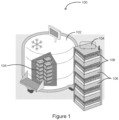
- FIG. 1 there is shown a group of structures defining a temperature-controlled storage environment 100.
- a cryogenic tank 102 that are used to store biological samples.
- a series of racks Within each cryogenic tank 102 is located a series of racks.
- One rack 104 is shown outside of the cryogenic tank 102 for improved visibility.
- Each rack 104 houses a series of boxes or trays 106 which are adapted to house samples 108.
- a cryogenic tank 102 is just one example of a temperature-controlled environment suitable for use with the present invention, and that other suitable structure could be envisaged.
- the samples 108 themselves may be contained in vials, tubes, bags such as blood bags for example, or any other suitable container. Accordingly, the tank 102, rack 106, box, microplate or microwell 106 and sample containers 108 house the biological samples in a hierarchical sense, wherein each higher hierarchical level is adapted to house one or more containers at a lower hierarchical level.
- a machine-readable tag encoding an identification is associated with one or more samples.
- the samples are typically collectively stored in microplates or boxes and the machine-readable tag or tags associated with the samples is affixed to the microplate or box. That is, one machine-readable tag may be associated with a group of samples.
- the machine-readable tags can be distributed across the box or microplate so that each machine-readable tag is associated with a collection of proximally located samples. For example, if four machine-readable tags were to be provided on a microplate in opposing quadrants, then each machine-readable tag would be associated with any samples located in that particular quadrant of the microplate.
- the machine-readable tags may be affixed to the sample container, such as a vial or test tube, directly such that there is a direct association between the machine-readable tags and the lower most hierarchical level of containers within which the biological samples are stored.
- a transfer system including a handheld carrier containing a temperature and identification tracking system to be used for the transfer of samples between one temperature-controlled storage environment and another is provided.
- the carrier itself and the system have application anytime or place it may be necessary to remove samples from a temperature-controlled environment whether for the purposes of transporting them to a temperature-controlled environment located at a remotely located facility, identifying and removing samples for processing, or conveying samples from one temperature-controlled storage environment to another located at the same facility.
- the carrier 200 includes an integrated sample identification and temperature sensing capability to facilitate monitoring of the samples 202 that are conveyed using the carrier.
- the integrated sensing capability enables a thermal history of the sample to be collected and maintained during transport, storage and or processing including throughout the duration in which the samples are not within the temperature-controlled storage environment which typically involves exposing the sample to an ambient temperature environment.
- the carrier 200 includes a handle 204 and a tray portion 206.
- the tray portion 206 is configured to carry the one or more samples to be transferred.
- the samples 202 may be conveyed in their individual sample containers, but will more typically be conveyed in a box or on a microplate 207 housing a group of samples.
- the tray portion 206 is configured to be slid into a port of a rack or tower 104 (as shown in Figure 1 ) provided in the temperature-controlled environment in order to withdraw a sample located in the port.
- the tray portion 206 has a generally flat bearing surface 210 and may have a lip 212 formed at the rear 214 of the bearing surface and on the two opposing edges 216 to assist in containing the samples 202, whilst providing an unobstructed front edge 218 to facilitate sliding of the tray portion 206 into a rack as described. Moreover, the provision of a lip 212 may go some way towards insulating the samples 202 disposed on the carrier against the ambient temperature.
- the handle 204 includes a grip portion 208 to be gripped by a user.
- an insulating cover or lid (not shown) is provided to be placed over the samples immediately when they are removed from the temperature-controlled storage environment on the carrier.
- this cover could be comprised of a foam, plastic, polystyrene or similar material having thermal insulating properties. This minimises direct contact between the samples and the ambient environment.
- the handheld carrier 200 includes a display 220 which displays the identification and/or temperature of the sample or a group of samples 202 disposed on the carrier to a user. This enables the user to visually monitor the change in temperature of the samples as they are conveyed from a first temperature-controlled environment, e.g. the cryogenic tank 102 (see Figure 1 ), to a second temperature-controlled environment, e.g. another cryogenic tank 102, or some other temperature-controlled container, such as a cryobox.
- a first temperature-controlled environment e.g. the cryogenic tank 102 (see Figure 1 )
- a second temperature-controlled environment e.g. another cryogenic tank 102, or some other temperature-controlled container, such as a cryobox.
- the display 220 is configured so that is readily observable by a user as the carrier 200 is used to convey the samples from one place to another.
- the display 220 may be situated on the handle portion 204 of the carrier 200, but away from the region of the handle that will be gripped by the user 208 to avoid the display 220 from being obscured by a user's hand.
- the display 220 is located in a region of the handle 204 that is positioned perpendicular to the grip portion 208, such that the user can easily look down at the display 220 whilst gripping the handle.
- the portion of the handle bearing the display 220 may be substantially parallel to the tray portion 206 of the carrier 200.
- Buttons 222 are provided in the vicinity of the display 220 to enable a user to switch the display ON or OFF and navigate between available data, i.e. sample ID and current temperature. It is to be understood that a similar effect could be achieved by providing the display in the form of a touch screen.
- a rechargeable power source and memory for storing the sensed data is provided in the handle. It is envisaged that the handle 204 is configured to be decoupled from the tray portion 206 as shown in Figure 3 . In this embodiment, a single handle 204 can be used to facilitate conveyance of multiple tray portions 206. This provides the advantage that the complex and costly components reside entirely in the handle of the carrier thereby reducing the cost and serviceability issues of having multiple handles.
- the handheld carrier 200 includes a communications component for transmitting the sensed data to a remote computing system. Whilst the carrier has a local memory for data storage, this feature provides access to supplementary data storage. It is envisaged that the identification and temperature is sensed continuously and the data uploaded to a database that is remote to the carrier periodically or streamed continuously as required.
- the communications component may transmit the data by wired or wireless means. The entire data log comprising the thermal history of the samples is thereby available for access and analysis from anywhere over a communications network.
- the handheld carrier 200 may be configured to accommodate more than one microplate 207 or box housing samples.
- the tray portion 206 is sized to accommodate one microplate (as shown in Figure 2 ).
- the handheld carrier 200 has integrated sample identification and temperature sensing capability in the form of embedded identification and temperature sensors 224. It should be appreciated that the sensing capabilities could be provided in any suitable form for operating at cryogenic temperatures.
- the identification sensing capability is provided by an interrogator embedded in the carrier 200, such as in the tray portion 206 as shown in Figure 2 , for reading machine-readable tags that are either provided on or associated with the samples, i.e. generally by affixing the tags to a box or microplate 207 that carries the samples 202. As previously described, a box or microplate 207 may have any suitable number of machine-readable tags affixed thereto 211.
- the carrier should ideally have correspondingly located interrogators 224 embedded therein.
- the machine-readable tags themselves could take the form of barcodes, inductive coupling, optical coupling including laser, visible or non-visible, radio frequency, and chip or chipless radio frequency identification (RFID), or any other suitable means.
- RFID radio frequency identification
- the temperature sensors are also embedded in the handheld carrier 200 and may be selected from one or more of an optical sensing means including laser and infra-red, or wired sensing means including thermocouple, thermistor or resistance temperature detectors (RTD). It is to be understood that the foregoing examples are not exhaustive and that other suitable means could be envisaged.
- the distribution of the temperature sensors may mirror the distribution of the interrogators embedded in the carrier, provided that the temperature sensors are arranged such that they will be in thermal proximity to the samples.
- Each temperature sensor may be associated with a group of samples, such that where a number of temperature sensors are provided, any variation in temperature across the group of samples held in the box or microplate can be determined.
- the handheld carrier 200 can be slid inside the port of a rack or tower to scoop up the sample tray held within.
- the identity and the temperature of the one or more samples 202 stored therein are read and displayed on the handle 204 of the carrier 200.
- the identification and the temperature may relate to a group of samples, or may be sensed and displayed for individual samples. The user can therefore ensure that the correct sample tray 207 is selected for removal from the rack 104 (see Figure 1 ) and can monitor the temperature of the samples 202 during transfer to another storage vessel, to a processing station or to a transport module, as required.
- the temperature and identification data is recorded and can be downloaded or otherwise electronically transmitted to a remote computer or a server either live or at some subsequent time. That is, a true thermal history of a sample can be maintained throughout various transport, transfer and processing activities that the sample may be subject to over the life of the sample.
- the handheld carrier 200 has embedded interrogators 224 that are read machine-readable tags that encode an identification of the sample or group of samples, and additionally has a temperature dependent characteristic. Whilst the interrogator 224 need not be in direct contact with the samples, it should be in thermal proximity thereto, such that the temperature sensed by the interrogator is representative of the actual temperature of the sample.
- the interrogator 402 of this type includes an interrogation coil 404 for generating an interrogation signal which is transferred by induction to a coil antenna 406 coupled to the machine-readable tag 408 by inducing an excitation signal in the coil antenna.
- the interrogator and machine-readable tag may be of the type described in International Patent Application PCT/AU2008/001293 , to the present Applicant.
- the machine-readable tag associated with the samples includes a plurality of micromechanical vibratable members each having a particular resonant frequency which shifts as a function of temperature. Accordingly, such a machine-readable tag is capable of both encoding encoding an identifier and having a temperature dependent characteristic.
- the handheld carrier 200 emits an alert if the sensed temperature exceeds a predetermined threshold which may be either at or below the critical temperature above which the sample may be degraded. This serves to alert the user if the sample's temperature rises too much.
- This alert could be of an auditory, visual or sensory nature, e.g. illumination of an LED, a flashing LED, or a change in colour of an LED, an audible alert such as a tone, or a vibration in the handle of the carrier.
- a barcode reader may be additionally provided on the carrier to read barcodes on the microplate to provide redundancy in the form of dual sample identification.
- the rear of the handle may have a bar code reader incorporated therein facing the microplate which may have a bar code disposed on the edge of the mircroplate.
- the handheld carrier 200 is configured to be placed inside a temperature-controlled container 500.
- the carrier 200 see Figures 2 and 3
- container 500 together form a transfer system.
- the temperature-controlled container 500 is made of a thermally insulating material with thick walls and can be cooled to cryogenic temperatures.
- the temperature-controlled container 500 is portable.
- a carry handle 518 is provided (see Figure 6 ) and the container will be suitably dimensioned to be transportable by hand.
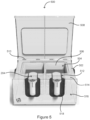
- the temperature controlled container 500 generally includes a housing 502 that has an opening 504 forming an internal cavity 506.
- the internal cavity 506 is configured to receive one or more carriers 200 therein.
- a lid 508 that may be hinged 510 to the container 500 is configured to close the opening 504.
- the housing 502 includes a recess 512 in a wall 514 of the container 500, such as for example the front wall in the illustrated embodiment.
- the recess 512 is configured to receive the handle 204 of the carrier 200 when the carrier resides in the internal cavity 506.
- the handle 204 accordingly extends through the wall 514 of the container 500 whilst being in thermally sealed engagement therewith. Once the lid 508 is closed (as shown in Figure 6 ), the internal cavity 506 is substantially sealed.
- the temperature-controlled container 500 is configured to receive more than one carrier 200 in a side-by-side arrangement as shown in Figure 5 , it would be advantageous to have a separate internal cavity 506 and split lid 508 arrangement dedicated to each carrier so that each carrier has its own temperature-controlled environment and will not be unnecessarily exposed to the ambient environment if an adjacently located carrier is being handled or otherwise.
- the temperature-controlled container 500 with a side-by-side arrangement further provides an ideal environment for handling samples, for example, if samples are to be transferred from one microplate to another. This is since the carrier with integrated identification and temperature sensing capability will not only continuously monitor the temperature, but also should also automatically record the transfer of the sample from one microplate to another in the associated database.
- the container 500 is configured to receive more than one carrier 200 in a stacked arrangement (not shown). In respect of both the stacked and the side-by-side configurations, the container 500 may be configured for either top loading or side loading.
- the front face 516 of the temperature-controlled container 500 may include a recess 518 adapted to substantially accommodate the handle 204 so that handle does not significantly protrude from the front face of the housing 502 when placed inside.
- the temperature-controlled container 500 with the lid 508 in the closed position.
- the display 222 on the handle of the carrier 200 is configured such that the display remains observable by a user when the carrier is placed in the temperature-controlled container 500 and the lid 508 closed. This enables the identification and temperature data to be navigated and observed by a user while the samples are in a temperature-controlled environment.
- the interior of the temperature-controlled container 500 includes a well at the base of the internal cavity including a reservoir for liquid nitrogen and a thermally conductive base to act as a heat sink, keeping the well cold and providing a uniform temperature across the base of the carrier.
- suitable baffles or other retaining members may be provided to contain the liquid nitrogen within the well and minimise it slopping around within the cavity.
- the temperature-controlled container 500 may have electrical connection to the carriers at ports aligned to the carrier handles, e.g. in the recess configured to receive 512 the handle 204 of the carrier 200, for charging the power source of the carrier.
- the temperature-controlled storage container 500 may also include a server or database that can communicate with the electronics of the carrier to store temperature and identification data.
- the container can be used as a thaw bath.
- the handheld carrier containing samples to be thawed can be placed inside the container and the samples contained therein would be thawed at a controlled rate.
- the handheld carrier of the invention is useful in a method for monitoring samples stored in a temperature-controlled storage environment during transport and handling.
- the method involves transferring samples between a temperature-controlled storage facility and a portable temperature-controlled container using a carrier to transfer the samples to and from a temperature-controlled storage facility.
- the portable temperature-controlled container is configured to receive and house one or more carriers. Once the samples are positioned on the carrier, the identification and temperature of the samples is read using an integral identification and temperature sensing capability provided in the carrier. The identification and temperature of the samples placed on the carrier are then displayed to a user.
- a system and apparatus which facilitates the transfer of biological samples between temperature-controlled environments in a manner that maintains the integrity of the samples by enabling a user to minimises changes in temperature of the sample by providing awareness of the sample temperature when the samples are being conveyed from one temperature-controlled environment to another. Moreover, the continuous tracking of temperature for a particular sample, enables a true thermal history of the sample to be maintained.
Landscapes
- Life Sciences & Earth Sciences (AREA)
- Health & Medical Sciences (AREA)
- Chemical & Material Sciences (AREA)
- General Health & Medical Sciences (AREA)
- Engineering & Computer Science (AREA)
- Dentistry (AREA)
- Environmental Sciences (AREA)
- Zoology (AREA)
- Wood Science & Technology (AREA)
- Chemical Kinetics & Catalysis (AREA)
- Clinical Laboratory Science (AREA)
- General Physics & Mathematics (AREA)
- Physics & Mathematics (AREA)
- Analytical Chemistry (AREA)
- Immunology (AREA)
- Pathology (AREA)
- Biochemistry (AREA)
- Automatic Analysis And Handling Materials Therefor (AREA)
Claims (14)
- Tragevorrichtung (200), umfassend einen Griff (204) und einen Magazinabschnitt (206) zum Transportieren und Überwachen von Proben (202) während des Transports, der Handhabung und der Lagerung, eine integrierte Probenidentifikations- und Temperaturerfassungsfähigkeit (224) umfassend, die eingerichtet ist, um eine thermische Vorgeschichte mindestens einer Probe (202) während Transport, Handhabung und Lagerung zu überwachen, beim Transportieren der Proben zwischen einer ersten temperaturgesteuerten Lagerumgebung und einer zweiten temperaturgesteuerten Lagerumgebung umfassend, wobei der Griff (204) mit dem Magazinabschnitt (206) gekoppelt ist, und wobei der Magazinabschnitt (206) eingerichtet ist, um in einen Port eines Gestells oder Turms geschoben zu werden, der in der ersten temperaturgesteuerten Lagerumgebung bereitgestellt ist, um eine Probe (202) zu entnehmen, die in dem Port angeordnet ist, wobei die Tragevorrichtung (200) weiterhin eine Anzeige (220) umfasst, die eingerichtet ist, um einem Benutzer die Identifikation und/oder die Temperatur mindestens einer Probe (202) anzuzeigen, die auf der Tragevorrichtung (200) angeordnet ist, wobei die Anzeige (220) eingerichtet ist, um von einem Benutzer beobachtet werden zu können, wenn die Tragevorrichtung (200) verwendet wird, um Proben (202) zu oder von der ersten und/oder zweiten temperaturgesteuerten Lagerumgebung zu übertragen und/oder wenn die Tragevorrichtung (200) in der ersten und/oder in der zweiten temperaturgesteuerten Lagerumgebung angeordnet ist
dadurch gekennzeichnet, dass der Griff (204) eingerichtet ist, um von dem Magazinabschnitt (206) entkoppelt zu sein, um dem Griff (204) zu ermöglichen, verwendet zu werden, um einen Transport von mehr als einem Magazinabschnitt (206) zwischen der ersten temperaturgesteuerten Lagerumgebung und der zweiten temperaturgesteuerten Umgebung zu unterstützen. - Tragevorrichtung (200) nach Anspruch 1, wobei die Temperaturerfassungsfähigkeit (224) von einem Sensor bereitgestellt wird, der ausgewählt ist aus der Gruppe, bestehend aus optischen, Laser und Infrarot umfassend, oder drahtgestützten Sensoren, Thermoelement-, Thermistor- oder Widerstandstemperaturdetektoren (RTD) umfassend.
- System (200, 500) zum Transportieren, Handhaben und Überwachen von Proben in einer temperaturgesteuerten Lagerumgebung, Folgendes umfassend:eine Tragevorrichtung (200) nach einem der Ansprüche 1 oder 2; undeinen tragbaren temperaturgesteuerten Behälter (500) zum Aufnehmen und Beherbergen mindestens einer Tragevorrichtung (200);wobei mindestens die Tragevorrichtung (200) eine integrierte Probenidentifikations- und Temperaturerfassungsfähigkeit (224) umfasst, die eingerichtet ist, um eine thermische Vorgeschichte mindestens einer Probe (202) während Transport, Handhabung und Lagerung zu überwachen, beim Transportieren der Proben (202) zwischen der temperaturgesteuerten Lagerumgebung und dem tragbaren temperaturgesteuerten Behälter (500) umfassend.
- System nach Anspruch 3, wobei der tragbare temperaturgesteuerte Behälter (500) eine integrierte Probenidentifikations- und Temperaturerfassungsfähigkeit (224) umfasst, die eingerichtet ist, um eine thermische Vorgeschichte mindestens einer Probe (202) während Transport, Handhabung und Lagerung zu überwachen.
- System nach Anspruch 3, wobei die Tragevorrichtung (200) eine Anzeige umfasst, die eingerichtet ist, um einem Benutzer die Identifikation und/oder Temperatur mindestens einer Probe anzuzeigen, die auf der Tragevorrichtung angeordnet ist.
- System nach Anspruch 5, wobei die Anzeige (220) an dem Griffabschnitt (204) der Tragevorrichtung (200) angeordnet ist, jedoch von dem Bereich des Griffs entfernt ist, der von dem Benutzer (208) gegriffen wird.
- System nach Anspruch 3 oder 4, wobei der Magazinabschnitt (206) der Tragevorrichtung (200) eingerichtet ist, um unterschiedliche Anzahlen und Anordnungen von Probemagazinen (207) zu beherbergen.
- System nach Anspruch 3 oder 4, wobei die Identifikationserfassungsfähigkeit (224) durch mindestens eine Abfragevorrichtung (402) bereitgestellt wird, um mindestens eine maschinenlesbare Markierung (408) zu lesen, wie beispielsweise maschinenlesbare Markierungen, die aus der Gruppe ausgewählt sind, bestehend aus Barcodes, induktiver Kopplung, sichtbarer oder nicht sichtbarer optischer Kopplung, Laser umfassend, Funkfrequenz und Chip- oder chiplose Funkfrequenzidentifikation (RFID), die an den Proben bereitgestellt sind oder diesen zugeordnet sind.
- System nach den Ansprüchen 3 oder 4, wobei die Tragevorrichtung (200) oder der tragbare temperaturgesteuerte Behälter (500) mindestens eine integrierte Abfragevorrichtung (402) zum Lesen mindestens einer maschinenlesbaren Markierung (408) umfasst, wobei jede maschinenlesbare Markierung (408) mindestens einer Probe (202) zugeordnet ist, die auf dem Magazinabschnitt (206) in thermischer Nähe dazu angeordnet ist, und wobei jede maschinenlesbare Markierung (408) eine Kennung codiert und eine temperaturabhängige Eigenschaft aufweist.
- System nach Anspruch 9, wobei die integrierten Abfragevorrichtungen (402) eine integrierte Signalverarbeitungsschaltung umfassen, um ein Abfragesignal in der Abfragespule (404) zu erzeugen, so dass, wenn die Abfragespule (404) in der Nähe einer Spulenantenne (406) ist, die mit der maschinenlesbaren Markierung (408) gekoppelt ist, ein Erregungssignal in der Spulenantenne (406) aus dem Abfragesignal in der Abfragespule (404) induziert wird.
- System nach Anspruch 9 oder 10, wobei die maschinenlesbare Markierung (408) mindestens ein Resonanzelement umfasst und die temperaturabhängige Eigenschaft eine Verschiebung der Resonanzfrequenz des mindestens einen Resonanzelements als eine Funktion der Temperatur ist.
- System nach einem der Ansprüche 3 bis 11, wobei die Tragevorrichtung (200) eine Warnkomponente, die eine Warnung ausgibt, wenn eine erfasste Temperatur einen vorbestimmten Schwellenwert übersteigt, oder eine Kommunikationskomponente zum Übertragen der Identifizierung und Temperatur mindestens einer Probe (202), die auf der Tragevorrichtung (200) angeordnet ist, an ein entferntes Computersystem umfasst, um ein Datenprotokoll bereitzustellen, auf das über ein Kommunikationsnetzwerk zugegriffen werden kann.
- System nach einem der Ansprüche 3 bis 12, wobei der tragbare temperaturgesteuerte Behälter (500) weiterhin Folgendes umfasst:ein Gehäuse (502) mit einer Öffnung (504), die einen internen Hohlraum (506) ausbildet, das eingerichtet ist, um mindestens eine Tragevorrichtung (200) aufzunehmen;einen Deckel (508), der eingerichtet ist, um die Öffnung (504) im Wesentlichen zu schließen;wobei das Gehäuse (502) weiterhin eine Aussparung (518) umfasst, die eingerichtet ist, um den Griff (204) der Tragevorrichtung (200) aufzunehmen, so dass Schließen des Deckels (508) den internen Hohlraum (506) im Wesentlichen abdichtet, wenn die mindestens eine Tragevorrichtung (200) in dem Gehäuse (502) angeordnet ist.
- System nach Anspruch 13, wobei ein Äußeres des Gehäuses (502) eine Aussparung (518) umfasst, die eingerichtet ist, um den Griff (204) darin aufzunehmen, so dass der Griff (204) nicht wesentlich aus einer Vorderseite des Gehäuses (502) vorsteht, wenn die mindestens eine Tragevorrichtung (200) in dem Gehäuse (502) angeordnet ist.
Applications Claiming Priority (2)
| Application Number | Priority Date | Filing Date | Title |
|---|---|---|---|
| AU2016902600A AU2016902600A0 (en) | 2016-07-01 | A system, method and device for transporting, handling and monitoring samples in a temperature-controlled storage environment | |
| PCT/AU2017/050683 WO2018000051A1 (en) | 2016-07-01 | 2017-06-30 | Monitoring apparatus for temperature-controlled sample collection and transport |
Publications (3)
| Publication Number | Publication Date |
|---|---|
| EP3478413A1 EP3478413A1 (de) | 2019-05-08 |
| EP3478413A4 EP3478413A4 (de) | 2020-01-08 |
| EP3478413B1 true EP3478413B1 (de) | 2025-01-29 |
Family
ID=60785609
Family Applications (1)
| Application Number | Title | Priority Date | Filing Date |
|---|---|---|---|
| EP17818757.1A Active EP3478413B1 (de) | 2016-07-01 | 2017-06-30 | Überwachungsvorrichtung für temperaturgesteuerte probensammlung und -transport |
Country Status (4)
| Country | Link |
|---|---|
| US (2) | US11589576B2 (de) |
| EP (1) | EP3478413B1 (de) |
| AU (1) | AU2017287017B2 (de) |
| WO (1) | WO2018000051A1 (de) |
Families Citing this family (22)
| Publication number | Priority date | Publication date | Assignee | Title |
|---|---|---|---|---|
| CA2957526C (en) | 2014-08-08 | 2023-03-28 | Fremon Scientific, Inc. | Smart bag used in sensing physiological and/or physical parameters of bags containing biological substance |
| US10546172B2 (en) | 2015-03-30 | 2020-01-28 | Temptime Corporation | Two dimensional barcode with dynamic environmental data system, method, and apparatus |
| JP2018517199A (ja) | 2015-03-30 | 2018-06-28 | テンプタイム コーポレーション | 動的環境データシステムを有する2次元バーコード、方法および装置 |
| US20180324900A1 (en) | 2017-05-04 | 2018-11-08 | Fremon Scientific, Inc. | Dry Heat Thawing of Biological Substances |
| CN112512603A (zh) | 2018-05-07 | 2021-03-16 | 弗莱蒙科学公司 | 解冻生物物质 |
| WO2020072463A1 (en) * | 2018-10-01 | 2020-04-09 | Elemental Machines, Inc. | Method and apparatus for local sensing |
| MX2021003898A (es) | 2018-10-05 | 2021-06-04 | Tmrw Life Sciences Inc | Aparato para conservar e identificar muestras biológicas en condiciones criogénicas. |
| MX2022005127A (es) | 2019-10-29 | 2022-08-04 | Tmrw Life Sciences Inc | Aparato para facilitar la transferencia de especimenes biologicos almacenados en condiciones criogenicas. |
| JP7413506B2 (ja) * | 2020-03-27 | 2024-01-15 | 京セラ株式会社 | 検査システム、カートリッジ、検査方法、および検査装置 |
| US11817187B2 (en) | 2020-05-18 | 2023-11-14 | TMRW Life Sciences, Inc. | Handling and tracking of biological specimens for cryogenic storage |
| US11264203B1 (en) * | 2020-08-17 | 2022-03-01 | Applied Materials Israel Ltd. | Reducing a temperature difference between a sample and a chuck of an electron beam tool |
| US12233421B2 (en) * | 2020-09-21 | 2025-02-25 | Roee Sela | Storage system for biological samples in freezing tanks in a liquid/gas nitrogen environment |
| JP7610303B2 (ja) | 2020-09-24 | 2025-01-08 | ティーエムアールダブリュ ライフサイエンシーズ,インコーポレイテツド | 極低温条件で保管された生物学的試料の移送を容易にするためのワークステーション及び装置 |
| WO2022066192A1 (en) | 2020-09-24 | 2022-03-31 | TMRW Life Sciences, Inc. | Cryogenic storage system with sensors to measure one or more parameters therewithin |
| JP7545768B2 (ja) | 2020-10-02 | 2024-09-05 | ティーエムアールダブリュ ライフサイエンシーズ,インコーポレイテツド | 無線トランスポンダタグ付き試料容器及び/又はキャリアのための位置合わせ機構を有する問い合わせ装置及び/又はシステム |
| USD963194S1 (en) | 2020-12-09 | 2022-09-06 | TMRW Life Sciences, Inc. | Cryogenic vial carrier |
| EP4259333B1 (de) | 2020-12-10 | 2026-03-04 | TMRW Life Sciences, Inc. | Probenhalter mit drahtlosem transponder |
| CN112858980B (zh) * | 2021-01-13 | 2021-09-24 | 国家电网有限公司华东分部 | 一种采样和大数据结合的关口计量异常诊断方法 |
| EP4252009B1 (de) | 2021-01-13 | 2025-03-05 | TMRW Life Sciences, Inc. | System zur entnahme und/oder platzierung von probenbehältern |
| US11241330B1 (en) | 2021-04-02 | 2022-02-08 | Brixton Biosciences, Inc. | Apparatus for creation of injectable slurry |
| US11734539B2 (en) | 2021-04-05 | 2023-08-22 | Temptime Corporation | Dynamic optical property windows in indicia with sensors |
| US12527318B2 (en) | 2021-10-08 | 2026-01-20 | TMRW Life Sciences, Inc. | Systems, apparatus and methods to pick and/or place specimen containers |
Family Cites Families (14)
| Publication number | Priority date | Publication date | Assignee | Title |
|---|---|---|---|---|
| DE10202304A1 (de) * | 2002-01-22 | 2003-07-31 | Fraunhofer Ges Forschung | Kryospeichereinrichtung mit Transponder |
| CA2560513A1 (en) * | 2004-04-08 | 2005-12-01 | Biomatrica, Inc. | Integration of sample storage and sample management for life science |
| EP1640880B1 (de) | 2004-07-20 | 2009-06-17 | Alcatel Lucent | Ein Verfahren, eine Netzdokument-Beschreibungssprache, ein Netzdokument-Übergangsprotokoll und ein Computer-Softwareprodukt zur Wiederauffindung von Netzdokumenten |
| DE102005003284B4 (de) | 2005-01-25 | 2022-05-05 | Leica Mikrosysteme Gmbh | Dewar-Gefäß zur automatisierten Gefrier- oder Tieftemperatursubstitution |
| JP4484732B2 (ja) * | 2005-03-02 | 2010-06-16 | 株式会社日立製作所 | 生体組織の輸送装置及び輸送方法 |
| US20080145919A1 (en) | 2006-12-18 | 2008-06-19 | Franklin Thomas D | Portable organ and tissue preservation apparatus, kit and methods |
| US7630864B2 (en) | 2007-01-16 | 2009-12-08 | S&S X-Ray Products, Inc. | Temperature and humidity monitoring for pharmacy shipping crate |
| US8152367B2 (en) | 2007-05-04 | 2012-04-10 | Sealed Air Corporation (Us) | Insulated container having a temperature monitoring device |
| EP2509412B1 (de) * | 2009-12-07 | 2021-01-27 | Bluechiip Pty Ltd | Probenlagerungs- und überwachungssystem |
| US20130232998A1 (en) * | 2012-03-12 | 2013-09-12 | Thermo Fisher Scientific (Asheville) Llc | Vertical storage rack for cold storage units |
| US9560846B2 (en) * | 2012-08-10 | 2017-02-07 | Paragonix Technologies, Inc. | System for hypothermic transport of biological samples |
| JP2017508984A (ja) | 2014-01-20 | 2017-03-30 | ブルックス オートメーション インコーポレイテッド | 持ち運び可能な低温ワークステーション |
| US20150356500A1 (en) * | 2014-06-10 | 2015-12-10 | The Board Of Trustees Of The Leland Stanford Junior University | Systems, Methods, and Devices for Monitoring Blood Products During Portable Storage and Transport |
| EP3020276B1 (de) | 2014-11-14 | 2018-02-28 | Milestone S.r.l. | Verfahren und Vorrichtung zum Kryopräservieren biologischer Proben |
-
2017
- 2017-06-30 EP EP17818757.1A patent/EP3478413B1/de active Active
- 2017-06-30 US US16/314,609 patent/US11589576B2/en active Active
- 2017-06-30 AU AU2017287017A patent/AU2017287017B2/en not_active Ceased
- 2017-06-30 WO PCT/AU2017/050683 patent/WO2018000051A1/en not_active Ceased
-
2023
- 2023-01-27 US US18/102,275 patent/US11944089B2/en active Active
Also Published As
| Publication number | Publication date |
|---|---|
| EP3478413A1 (de) | 2019-05-08 |
| AU2017287017B2 (en) | 2021-09-23 |
| WO2018000051A1 (en) | 2018-01-04 |
| US20190320650A1 (en) | 2019-10-24 |
| US11589576B2 (en) | 2023-02-28 |
| EP3478413A4 (de) | 2020-01-08 |
| AU2017287017A1 (en) | 2019-01-17 |
| US20230240284A1 (en) | 2023-08-03 |
| US11944089B2 (en) | 2024-04-02 |
Similar Documents
| Publication | Publication Date | Title |
|---|---|---|
| US11944089B2 (en) | Monitoring apparatus for temperature-controlled sample collection and transport | |
| US12366399B2 (en) | Portable container | |
| US20200107541A1 (en) | Apparatus to preserve and identify biological samples at cryogenic conditions | |
| US7958791B2 (en) | Cryogenic storage device comprising a transponder | |
| US7350703B2 (en) | Low temperature radio frequency identification tracking system | |
| EP2509412B1 (de) | Probenlagerungs- und überwachungssystem | |
| CN116171981A (zh) | 便携式低温工作站 | |
| AU2018385405B2 (en) | Low temperature storage systems and related methods | |
| AU2007209240A1 (en) | System for the operation and management of a fleet of refrigerated autonomous containers | |
| US20140145574A1 (en) | Endless Chain Frozen Vial Storage Module |
Legal Events
| Date | Code | Title | Description |
|---|---|---|---|
| STAA | Information on the status of an ep patent application or granted ep patent |
Free format text: STATUS: THE INTERNATIONAL PUBLICATION HAS BEEN MADE |
|
| PUAI | Public reference made under article 153(3) epc to a published international application that has entered the european phase |
Free format text: ORIGINAL CODE: 0009012 |
|
| STAA | Information on the status of an ep patent application or granted ep patent |
Free format text: STATUS: REQUEST FOR EXAMINATION WAS MADE |
|
| 17P | Request for examination filed |
Effective date: 20190129 |
|
| AK | Designated contracting states |
Kind code of ref document: A1 Designated state(s): AL AT BE BG CH CY CZ DE DK EE ES FI FR GB GR HR HU IE IS IT LI LT LU LV MC MK MT NL NO PL PT RO RS SE SI SK SM TR |
|
| AX | Request for extension of the european patent |
Extension state: BA ME |
|
| DAV | Request for validation of the european patent (deleted) | ||
| DAX | Request for extension of the european patent (deleted) | ||
| A4 | Supplementary search report drawn up and despatched |
Effective date: 20191210 |
|
| RIC1 | Information provided on ipc code assigned before grant |
Ipc: B01L 7/04 20100101ALI20191204BHEP Ipc: F25D 3/10 20060101ALI20191204BHEP Ipc: G01K 1/02 20060101ALI20191204BHEP Ipc: B01L 9/00 20060101ALI20191204BHEP Ipc: A01N 1/00 20060101ALI20191204BHEP Ipc: B01L 3/00 20060101AFI20191204BHEP Ipc: A01N 1/02 20060101ALI20191204BHEP Ipc: G01N 35/00 20060101ALI20191204BHEP Ipc: B01L 7/00 20060101ALI20191204BHEP |
|
| STAA | Information on the status of an ep patent application or granted ep patent |
Free format text: STATUS: EXAMINATION IS IN PROGRESS |
|
| 17Q | First examination report despatched |
Effective date: 20201209 |
|
| RIC1 | Information provided on ipc code assigned before grant |
Ipc: F25D 25/00 20060101ALI20230728BHEP Ipc: G01N 35/00 20060101ALI20230728BHEP Ipc: B01L 7/04 20100101ALI20230728BHEP Ipc: A01N 1/02 20060101ALI20230728BHEP Ipc: F25D 3/10 20060101ALI20230728BHEP Ipc: B01L 9/00 20060101ALI20230728BHEP Ipc: B01L 7/00 20060101ALI20230728BHEP Ipc: G01K 1/02 20060101ALI20230728BHEP Ipc: A01N 1/00 20060101ALI20230728BHEP Ipc: B01L 3/00 20060101AFI20230728BHEP |
|
| GRAP | Despatch of communication of intention to grant a patent |
Free format text: ORIGINAL CODE: EPIDOSNIGR1 |
|
| STAA | Information on the status of an ep patent application or granted ep patent |
Free format text: STATUS: GRANT OF PATENT IS INTENDED |
|
| INTG | Intention to grant announced |
Effective date: 20240409 |
|
| GRAJ | Information related to disapproval of communication of intention to grant by the applicant or resumption of examination proceedings by the epo deleted |
Free format text: ORIGINAL CODE: EPIDOSDIGR1 |
|
| STAA | Information on the status of an ep patent application or granted ep patent |
Free format text: STATUS: EXAMINATION IS IN PROGRESS |
|
| GRAP | Despatch of communication of intention to grant a patent |
Free format text: ORIGINAL CODE: EPIDOSNIGR1 |
|
| INTC | Intention to grant announced (deleted) | ||
| STAA | Information on the status of an ep patent application or granted ep patent |
Free format text: STATUS: GRANT OF PATENT IS INTENDED |
|
| INTG | Intention to grant announced |
Effective date: 20240829 |
|
| GRAS | Grant fee paid |
Free format text: ORIGINAL CODE: EPIDOSNIGR3 |
|
| GRAA | (expected) grant |
Free format text: ORIGINAL CODE: 0009210 |
|
| STAA | Information on the status of an ep patent application or granted ep patent |
Free format text: STATUS: THE PATENT HAS BEEN GRANTED |
|
| AK | Designated contracting states |
Kind code of ref document: B1 Designated state(s): AL AT BE BG CH CY CZ DE DK EE ES FI FR GB GR HR HU IE IS IT LI LT LU LV MC MK MT NL NO PL PT RO RS SE SI SK SM TR |
|
| REG | Reference to a national code |
Ref country code: GB Ref legal event code: FG4D |
|
| REG | Reference to a national code |
Ref country code: CH Ref legal event code: EP |
|
| P01 | Opt-out of the competence of the unified patent court (upc) registered |
Free format text: CASE NUMBER: APP_1634/2025 Effective date: 20250110 |
|
| REG | Reference to a national code |
Ref country code: DE Ref legal event code: R096 Ref document number: 602017087570 Country of ref document: DE |
|
| REG | Reference to a national code |
Ref country code: IE Ref legal event code: FG4D |
|
| REG | Reference to a national code |
Ref country code: NL Ref legal event code: MP Effective date: 20250129 |
|
| PG25 | Lapsed in a contracting state [announced via postgrant information from national office to epo] |
Ref country code: NL Free format text: LAPSE BECAUSE OF FAILURE TO SUBMIT A TRANSLATION OF THE DESCRIPTION OR TO PAY THE FEE WITHIN THE PRESCRIBED TIME-LIMIT Effective date: 20250129 |
|
| PG25 | Lapsed in a contracting state [announced via postgrant information from national office to epo] |
Ref country code: RS Free format text: LAPSE BECAUSE OF FAILURE TO SUBMIT A TRANSLATION OF THE DESCRIPTION OR TO PAY THE FEE WITHIN THE PRESCRIBED TIME-LIMIT Effective date: 20250429 |
|
| PG25 | Lapsed in a contracting state [announced via postgrant information from national office to epo] |
Ref country code: FI Free format text: LAPSE BECAUSE OF FAILURE TO SUBMIT A TRANSLATION OF THE DESCRIPTION OR TO PAY THE FEE WITHIN THE PRESCRIBED TIME-LIMIT Effective date: 20250129 |
|
| PG25 | Lapsed in a contracting state [announced via postgrant information from national office to epo] |
Ref country code: PL Free format text: LAPSE BECAUSE OF FAILURE TO SUBMIT A TRANSLATION OF THE DESCRIPTION OR TO PAY THE FEE WITHIN THE PRESCRIBED TIME-LIMIT Effective date: 20250129 |
|
| PG25 | Lapsed in a contracting state [announced via postgrant information from national office to epo] |
Ref country code: ES Free format text: LAPSE BECAUSE OF FAILURE TO SUBMIT A TRANSLATION OF THE DESCRIPTION OR TO PAY THE FEE WITHIN THE PRESCRIBED TIME-LIMIT Effective date: 20250129 |
|
| REG | Reference to a national code |
Ref country code: LT Ref legal event code: MG9D |
|
| PG25 | Lapsed in a contracting state [announced via postgrant information from national office to epo] |
Ref country code: NO Free format text: LAPSE BECAUSE OF FAILURE TO SUBMIT A TRANSLATION OF THE DESCRIPTION OR TO PAY THE FEE WITHIN THE PRESCRIBED TIME-LIMIT Effective date: 20250429 Ref country code: IS Free format text: LAPSE BECAUSE OF FAILURE TO SUBMIT A TRANSLATION OF THE DESCRIPTION OR TO PAY THE FEE WITHIN THE PRESCRIBED TIME-LIMIT Effective date: 20250529 |
|
| REG | Reference to a national code |
Ref country code: AT Ref legal event code: MK05 Ref document number: 1762915 Country of ref document: AT Kind code of ref document: T Effective date: 20250129 |
|
| PG25 | Lapsed in a contracting state [announced via postgrant information from national office to epo] |
Ref country code: HR Free format text: LAPSE BECAUSE OF FAILURE TO SUBMIT A TRANSLATION OF THE DESCRIPTION OR TO PAY THE FEE WITHIN THE PRESCRIBED TIME-LIMIT Effective date: 20250129 |
|
| PG25 | Lapsed in a contracting state [announced via postgrant information from national office to epo] |
Ref country code: LV Free format text: LAPSE BECAUSE OF FAILURE TO SUBMIT A TRANSLATION OF THE DESCRIPTION OR TO PAY THE FEE WITHIN THE PRESCRIBED TIME-LIMIT Effective date: 20250129 Ref country code: PT Free format text: LAPSE BECAUSE OF FAILURE TO SUBMIT A TRANSLATION OF THE DESCRIPTION OR TO PAY THE FEE WITHIN THE PRESCRIBED TIME-LIMIT Effective date: 20250529 |
|
| PG25 | Lapsed in a contracting state [announced via postgrant information from national office to epo] |
Ref country code: BG Free format text: LAPSE BECAUSE OF FAILURE TO SUBMIT A TRANSLATION OF THE DESCRIPTION OR TO PAY THE FEE WITHIN THE PRESCRIBED TIME-LIMIT Effective date: 20250129 Ref country code: GR Free format text: LAPSE BECAUSE OF FAILURE TO SUBMIT A TRANSLATION OF THE DESCRIPTION OR TO PAY THE FEE WITHIN THE PRESCRIBED TIME-LIMIT Effective date: 20250430 |
|
| PG25 | Lapsed in a contracting state [announced via postgrant information from national office to epo] |
Ref country code: AT Free format text: LAPSE BECAUSE OF FAILURE TO SUBMIT A TRANSLATION OF THE DESCRIPTION OR TO PAY THE FEE WITHIN THE PRESCRIBED TIME-LIMIT Effective date: 20250129 |
|
| PG25 | Lapsed in a contracting state [announced via postgrant information from national office to epo] |
Ref country code: SE Free format text: LAPSE BECAUSE OF FAILURE TO SUBMIT A TRANSLATION OF THE DESCRIPTION OR TO PAY THE FEE WITHIN THE PRESCRIBED TIME-LIMIT Effective date: 20250129 |
|
| PG25 | Lapsed in a contracting state [announced via postgrant information from national office to epo] |
Ref country code: SM Free format text: LAPSE BECAUSE OF FAILURE TO SUBMIT A TRANSLATION OF THE DESCRIPTION OR TO PAY THE FEE WITHIN THE PRESCRIBED TIME-LIMIT Effective date: 20250129 |
|
| PG25 | Lapsed in a contracting state [announced via postgrant information from national office to epo] |
Ref country code: DK Free format text: LAPSE BECAUSE OF FAILURE TO SUBMIT A TRANSLATION OF THE DESCRIPTION OR TO PAY THE FEE WITHIN THE PRESCRIBED TIME-LIMIT Effective date: 20250129 |
|
| PG25 | Lapsed in a contracting state [announced via postgrant information from national office to epo] |
Ref country code: IT Free format text: LAPSE BECAUSE OF FAILURE TO SUBMIT A TRANSLATION OF THE DESCRIPTION OR TO PAY THE FEE WITHIN THE PRESCRIBED TIME-LIMIT Effective date: 20250129 |
|
| PG25 | Lapsed in a contracting state [announced via postgrant information from national office to epo] |
Ref country code: CZ Free format text: LAPSE BECAUSE OF FAILURE TO SUBMIT A TRANSLATION OF THE DESCRIPTION OR TO PAY THE FEE WITHIN THE PRESCRIBED TIME-LIMIT Effective date: 20250129 Ref country code: EE Free format text: LAPSE BECAUSE OF FAILURE TO SUBMIT A TRANSLATION OF THE DESCRIPTION OR TO PAY THE FEE WITHIN THE PRESCRIBED TIME-LIMIT Effective date: 20250129 |
|
| PG25 | Lapsed in a contracting state [announced via postgrant information from national office to epo] |
Ref country code: RO Free format text: LAPSE BECAUSE OF FAILURE TO SUBMIT A TRANSLATION OF THE DESCRIPTION OR TO PAY THE FEE WITHIN THE PRESCRIBED TIME-LIMIT Effective date: 20250129 |
|
| PG25 | Lapsed in a contracting state [announced via postgrant information from national office to epo] |
Ref country code: SK Free format text: LAPSE BECAUSE OF FAILURE TO SUBMIT A TRANSLATION OF THE DESCRIPTION OR TO PAY THE FEE WITHIN THE PRESCRIBED TIME-LIMIT Effective date: 20250129 |
|
| REG | Reference to a national code |
Ref country code: DE Ref legal event code: R097 Ref document number: 602017087570 Country of ref document: DE |
|
| PLBE | No opposition filed within time limit |
Free format text: ORIGINAL CODE: 0009261 |
|
| STAA | Information on the status of an ep patent application or granted ep patent |
Free format text: STATUS: NO OPPOSITION FILED WITHIN TIME LIMIT |
|
| REG | Reference to a national code |
Ref country code: CH Ref legal event code: L10 Free format text: ST27 STATUS EVENT CODE: U-0-0-L10-L00 (AS PROVIDED BY THE NATIONAL OFFICE) Effective date: 20251210 |
|
| REG | Reference to a national code |
Ref country code: DE Ref legal event code: R119 Ref document number: 602017087570 Country of ref document: DE |
|
| 26N | No opposition filed |
Effective date: 20251030 |
|
| REG | Reference to a national code |
Ref country code: CH Ref legal event code: H13 Free format text: ST27 STATUS EVENT CODE: U-0-0-H10-H13 (AS PROVIDED BY THE NATIONAL OFFICE) Effective date: 20260127 |
|
| PG25 | Lapsed in a contracting state [announced via postgrant information from national office to epo] |
Ref country code: MC Free format text: LAPSE BECAUSE OF FAILURE TO SUBMIT A TRANSLATION OF THE DESCRIPTION OR TO PAY THE FEE WITHIN THE PRESCRIBED TIME-LIMIT Effective date: 20250129 |
|
| PG25 | Lapsed in a contracting state [announced via postgrant information from national office to epo] |
Ref country code: LU Free format text: LAPSE BECAUSE OF NON-PAYMENT OF DUE FEES Effective date: 20250630 |
|
| GBPC | Gb: european patent ceased through non-payment of renewal fee |
Effective date: 20250630 |
|
| REG | Reference to a national code |
Ref country code: BE Ref legal event code: MM Effective date: 20250630 |
|
| PG25 | Lapsed in a contracting state [announced via postgrant information from national office to epo] |
Ref country code: GB Free format text: LAPSE BECAUSE OF NON-PAYMENT OF DUE FEES Effective date: 20250630 |
|
| PG25 | Lapsed in a contracting state [announced via postgrant information from national office to epo] |
Ref country code: IE Free format text: LAPSE BECAUSE OF NON-PAYMENT OF DUE FEES Effective date: 20250630 Ref country code: DE Free format text: LAPSE BECAUSE OF NON-PAYMENT OF DUE FEES Effective date: 20260101 |
|
| PG25 | Lapsed in a contracting state [announced via postgrant information from national office to epo] |
Ref country code: BE Free format text: LAPSE BECAUSE OF NON-PAYMENT OF DUE FEES Effective date: 20250630 |
|
| PG25 | Lapsed in a contracting state [announced via postgrant information from national office to epo] |
Ref country code: FR Free format text: LAPSE BECAUSE OF NON-PAYMENT OF DUE FEES Effective date: 20250630 |