EP3470219A1 - Molded body and method for producing same - Google Patents
Molded body and method for producing same Download PDFInfo
- Publication number
- EP3470219A1 EP3470219A1 EP17810602.7A EP17810602A EP3470219A1 EP 3470219 A1 EP3470219 A1 EP 3470219A1 EP 17810602 A EP17810602 A EP 17810602A EP 3470219 A1 EP3470219 A1 EP 3470219A1
- Authority
- EP
- European Patent Office
- Prior art keywords
- molded object
- polyester
- fiber
- sheath
- based fiber
- Prior art date
- Legal status (The legal status is an assumption and is not a legal conclusion. Google has not performed a legal analysis and makes no representation as to the accuracy of the status listed.)
- Granted
Links
Images
Classifications
-
- B—PERFORMING OPERATIONS; TRANSPORTING
- B29—WORKING OF PLASTICS; WORKING OF SUBSTANCES IN A PLASTIC STATE IN GENERAL
- B29C—SHAPING OR JOINING OF PLASTICS; SHAPING OF MATERIAL IN A PLASTIC STATE, NOT OTHERWISE PROVIDED FOR; AFTER-TREATMENT OF THE SHAPED PRODUCTS, e.g. REPAIRING
- B29C70/00—Shaping composites, i.e. plastics material comprising reinforcements, fillers or preformed parts, e.g. inserts
- B29C70/04—Shaping composites, i.e. plastics material comprising reinforcements, fillers or preformed parts, e.g. inserts comprising reinforcements only, e.g. self-reinforcing plastics
- B29C70/06—Fibrous reinforcements only
- B29C70/10—Fibrous reinforcements only characterised by the structure of fibrous reinforcements, e.g. hollow fibres
-
- D—TEXTILES; PAPER
- D04—BRAIDING; LACE-MAKING; KNITTING; TRIMMINGS; NON-WOVEN FABRICS
- D04H—MAKING TEXTILE FABRICS, e.g. FROM FIBRES OR FILAMENTARY MATERIAL; FABRICS MADE BY SUCH PROCESSES OR APPARATUS, e.g. FELTS, NON-WOVEN FABRICS; COTTON-WOOL; WADDING ; NON-WOVEN FABRICS FROM STAPLE FIBRES, FILAMENTS OR YARNS, BONDED WITH AT LEAST ONE WEB-LIKE MATERIAL DURING THEIR CONSOLIDATION
- D04H1/00—Non-woven fabrics formed wholly or mainly of staple fibres or like relatively short fibres
- D04H1/40—Non-woven fabrics formed wholly or mainly of staple fibres or like relatively short fibres from fleeces or layers composed of fibres without existing or potential cohesive properties
- D04H1/42—Non-woven fabrics formed wholly or mainly of staple fibres or like relatively short fibres from fleeces or layers composed of fibres without existing or potential cohesive properties characterised by the use of certain kinds of fibres insofar as this use has no preponderant influence on the consolidation of the fleece
- D04H1/4326—Condensation or reaction polymers
- D04H1/435—Polyesters
-
- B—PERFORMING OPERATIONS; TRANSPORTING
- B32—LAYERED PRODUCTS
- B32B—LAYERED PRODUCTS, i.e. PRODUCTS BUILT-UP OF STRATA OF FLAT OR NON-FLAT, e.g. CELLULAR OR HONEYCOMB, FORM
- B32B3/00—Layered products comprising a layer with external or internal discontinuities or unevennesses, or a layer of non-planar shape; Layered products comprising a layer having particular features of form
- B32B3/26—Layered products comprising a layer with external or internal discontinuities or unevennesses, or a layer of non-planar shape; Layered products comprising a layer having particular features of form characterised by a particular shape of the outline of the cross-section of a continuous layer; characterised by a layer with cavities or internal voids ; characterised by an apertured layer
- B32B3/266—Layered products comprising a layer with external or internal discontinuities or unevennesses, or a layer of non-planar shape; Layered products comprising a layer having particular features of form characterised by a particular shape of the outline of the cross-section of a continuous layer; characterised by a layer with cavities or internal voids ; characterised by an apertured layer characterised by an apertured layer, the apertures going through the whole thickness of the layer, e.g. expanded metal, perforated layer, slit layer regular cells B32B3/12
-
- B—PERFORMING OPERATIONS; TRANSPORTING
- B32—LAYERED PRODUCTS
- B32B—LAYERED PRODUCTS, i.e. PRODUCTS BUILT-UP OF STRATA OF FLAT OR NON-FLAT, e.g. CELLULAR OR HONEYCOMB, FORM
- B32B15/00—Layered products comprising a layer of metal
- B32B15/04—Layered products comprising a layer of metal comprising metal as the main or only constituent of a layer, which is next to another layer of the same or of a different material
-
- B—PERFORMING OPERATIONS; TRANSPORTING
- B32—LAYERED PRODUCTS
- B32B—LAYERED PRODUCTS, i.e. PRODUCTS BUILT-UP OF STRATA OF FLAT OR NON-FLAT, e.g. CELLULAR OR HONEYCOMB, FORM
- B32B15/00—Layered products comprising a layer of metal
- B32B15/04—Layered products comprising a layer of metal comprising metal as the main or only constituent of a layer, which is next to another layer of the same or of a different material
- B32B15/046—Layered products comprising a layer of metal comprising metal as the main or only constituent of a layer, which is next to another layer of the same or of a different material of foam
-
- B—PERFORMING OPERATIONS; TRANSPORTING
- B32—LAYERED PRODUCTS
- B32B—LAYERED PRODUCTS, i.e. PRODUCTS BUILT-UP OF STRATA OF FLAT OR NON-FLAT, e.g. CELLULAR OR HONEYCOMB, FORM
- B32B15/00—Layered products comprising a layer of metal
- B32B15/14—Layered products comprising a layer of metal next to a fibrous or filamentary layer
-
- B—PERFORMING OPERATIONS; TRANSPORTING
- B32—LAYERED PRODUCTS
- B32B—LAYERED PRODUCTS, i.e. PRODUCTS BUILT-UP OF STRATA OF FLAT OR NON-FLAT, e.g. CELLULAR OR HONEYCOMB, FORM
- B32B3/00—Layered products comprising a layer with external or internal discontinuities or unevennesses, or a layer of non-planar shape; Layered products comprising a layer having particular features of form
- B32B3/26—Layered products comprising a layer with external or internal discontinuities or unevennesses, or a layer of non-planar shape; Layered products comprising a layer having particular features of form characterised by a particular shape of the outline of the cross-section of a continuous layer; characterised by a layer with cavities or internal voids ; characterised by an apertured layer
-
- B—PERFORMING OPERATIONS; TRANSPORTING
- B32—LAYERED PRODUCTS
- B32B—LAYERED PRODUCTS, i.e. PRODUCTS BUILT-UP OF STRATA OF FLAT OR NON-FLAT, e.g. CELLULAR OR HONEYCOMB, FORM
- B32B5/00—Layered products characterised by the non- homogeneity or physical structure, i.e. comprising a fibrous, filamentary, particulate or foam layer; Layered products characterised by having a layer differing constitutionally or physically in different parts
- B32B5/18—Layered products characterised by the non- homogeneity or physical structure, i.e. comprising a fibrous, filamentary, particulate or foam layer; Layered products characterised by having a layer differing constitutionally or physically in different parts characterised by features of a layer of foamed material
-
- B—PERFORMING OPERATIONS; TRANSPORTING
- B32—LAYERED PRODUCTS
- B32B—LAYERED PRODUCTS, i.e. PRODUCTS BUILT-UP OF STRATA OF FLAT OR NON-FLAT, e.g. CELLULAR OR HONEYCOMB, FORM
- B32B7/00—Layered products characterised by the relation between layers; Layered products characterised by the relative orientation of features between layers, or by the relative values of a measurable parameter between layers, i.e. products comprising layers having different physical, chemical or physicochemical properties; Layered products characterised by the interconnection of layers
- B32B7/04—Interconnection of layers
- B32B7/12—Interconnection of layers using interposed adhesives or interposed materials with bonding properties
-
- C—CHEMISTRY; METALLURGY
- C08—ORGANIC MACROMOLECULAR COMPOUNDS; THEIR PREPARATION OR CHEMICAL WORKING-UP; COMPOSITIONS BASED THEREON
- C08L—COMPOSITIONS OF MACROMOLECULAR COMPOUNDS
- C08L67/00—Compositions of polyesters obtained by reactions forming a carboxylic ester link in the main chain; Compositions of derivatives of such polymers
- C08L67/02—Polyesters derived from dicarboxylic acids and dihydroxy compounds
-
- D—TEXTILES; PAPER
- D04—BRAIDING; LACE-MAKING; KNITTING; TRIMMINGS; NON-WOVEN FABRICS
- D04H—MAKING TEXTILE FABRICS, e.g. FROM FIBRES OR FILAMENTARY MATERIAL; FABRICS MADE BY SUCH PROCESSES OR APPARATUS, e.g. FELTS, NON-WOVEN FABRICS; COTTON-WOOL; WADDING ; NON-WOVEN FABRICS FROM STAPLE FIBRES, FILAMENTS OR YARNS, BONDED WITH AT LEAST ONE WEB-LIKE MATERIAL DURING THEIR CONSOLIDATION
- D04H1/00—Non-woven fabrics formed wholly or mainly of staple fibres or like relatively short fibres
- D04H1/40—Non-woven fabrics formed wholly or mainly of staple fibres or like relatively short fibres from fleeces or layers composed of fibres without existing or potential cohesive properties
- D04H1/54—Non-woven fabrics formed wholly or mainly of staple fibres or like relatively short fibres from fleeces or layers composed of fibres without existing or potential cohesive properties by welding together the fibres, e.g. by partially melting or dissolving
- D04H1/541—Composite fibres, e.g. sheath-core, sea-island or side-by-side; Mixed fibres
- D04H1/5412—Composite fibres, e.g. sheath-core, sea-island or side-by-side; Mixed fibres sheath-core
-
- D—TEXTILES; PAPER
- D04—BRAIDING; LACE-MAKING; KNITTING; TRIMMINGS; NON-WOVEN FABRICS
- D04H—MAKING TEXTILE FABRICS, e.g. FROM FIBRES OR FILAMENTARY MATERIAL; FABRICS MADE BY SUCH PROCESSES OR APPARATUS, e.g. FELTS, NON-WOVEN FABRICS; COTTON-WOOL; WADDING ; NON-WOVEN FABRICS FROM STAPLE FIBRES, FILAMENTS OR YARNS, BONDED WITH AT LEAST ONE WEB-LIKE MATERIAL DURING THEIR CONSOLIDATION
- D04H1/00—Non-woven fabrics formed wholly or mainly of staple fibres or like relatively short fibres
- D04H1/40—Non-woven fabrics formed wholly or mainly of staple fibres or like relatively short fibres from fleeces or layers composed of fibres without existing or potential cohesive properties
- D04H1/54—Non-woven fabrics formed wholly or mainly of staple fibres or like relatively short fibres from fleeces or layers composed of fibres without existing or potential cohesive properties by welding together the fibres, e.g. by partially melting or dissolving
- D04H1/541—Composite fibres, e.g. sheath-core, sea-island or side-by-side; Mixed fibres
- D04H1/5418—Mixed fibres, e.g. at least two chemically different fibres or fibre blends
-
- D—TEXTILES; PAPER
- D04—BRAIDING; LACE-MAKING; KNITTING; TRIMMINGS; NON-WOVEN FABRICS
- D04H—MAKING TEXTILE FABRICS, e.g. FROM FIBRES OR FILAMENTARY MATERIAL; FABRICS MADE BY SUCH PROCESSES OR APPARATUS, e.g. FELTS, NON-WOVEN FABRICS; COTTON-WOOL; WADDING ; NON-WOVEN FABRICS FROM STAPLE FIBRES, FILAMENTS OR YARNS, BONDED WITH AT LEAST ONE WEB-LIKE MATERIAL DURING THEIR CONSOLIDATION
- D04H1/00—Non-woven fabrics formed wholly or mainly of staple fibres or like relatively short fibres
- D04H1/40—Non-woven fabrics formed wholly or mainly of staple fibres or like relatively short fibres from fleeces or layers composed of fibres without existing or potential cohesive properties
- D04H1/54—Non-woven fabrics formed wholly or mainly of staple fibres or like relatively short fibres from fleeces or layers composed of fibres without existing or potential cohesive properties by welding together the fibres, e.g. by partially melting or dissolving
- D04H1/558—Non-woven fabrics formed wholly or mainly of staple fibres or like relatively short fibres from fleeces or layers composed of fibres without existing or potential cohesive properties by welding together the fibres, e.g. by partially melting or dissolving in combination with mechanical or physical treatments other than embossing
-
- E—FIXED CONSTRUCTIONS
- E04—BUILDING
- E04C—STRUCTURAL ELEMENTS; BUILDING MATERIALS
- E04C2/00—Building elements of relatively thin form for the construction of parts of buildings, e.g. sheet materials, slabs, or panels
- E04C2/02—Building elements of relatively thin form for the construction of parts of buildings, e.g. sheet materials, slabs, or panels characterised by specified materials
- E04C2/10—Building elements of relatively thin form for the construction of parts of buildings, e.g. sheet materials, slabs, or panels characterised by specified materials of wood, fibres, chips, vegetable stems, or the like; of plastics; of foamed products
- E04C2/16—Building elements of relatively thin form for the construction of parts of buildings, e.g. sheet materials, slabs, or panels characterised by specified materials of wood, fibres, chips, vegetable stems, or the like; of plastics; of foamed products of fibres, chips, vegetable stems, or the like
-
- E—FIXED CONSTRUCTIONS
- E04—BUILDING
- E04C—STRUCTURAL ELEMENTS; BUILDING MATERIALS
- E04C2/00—Building elements of relatively thin form for the construction of parts of buildings, e.g. sheet materials, slabs, or panels
- E04C2/02—Building elements of relatively thin form for the construction of parts of buildings, e.g. sheet materials, slabs, or panels characterised by specified materials
- E04C2/26—Building elements of relatively thin form for the construction of parts of buildings, e.g. sheet materials, slabs, or panels characterised by specified materials composed of materials covered by two or more of groups E04C2/04, E04C2/08, E04C2/10 or of materials covered by one of these groups with a material not specified in one of the groups
-
- E—FIXED CONSTRUCTIONS
- E04—BUILDING
- E04C—STRUCTURAL ELEMENTS; BUILDING MATERIALS
- E04C2/00—Building elements of relatively thin form for the construction of parts of buildings, e.g. sheet materials, slabs, or panels
- E04C2/30—Building elements of relatively thin form for the construction of parts of buildings, e.g. sheet materials, slabs, or panels characterised by the shape or structure
-
- B—PERFORMING OPERATIONS; TRANSPORTING
- B29—WORKING OF PLASTICS; WORKING OF SUBSTANCES IN A PLASTIC STATE IN GENERAL
- B29K—INDEXING SCHEME ASSOCIATED WITH SUBCLASSES B29B, B29C OR B29D, RELATING TO MOULDING MATERIALS OR TO MATERIALS FOR MOULDS, REINFORCEMENTS, FILLERS OR PREFORMED PARTS, e.g. INSERTS
- B29K2105/00—Condition, form or state of moulded material or of the material to be shaped
- B29K2105/06—Condition, form or state of moulded material or of the material to be shaped containing reinforcements, fillers or inserts
- B29K2105/08—Condition, form or state of moulded material or of the material to be shaped containing reinforcements, fillers or inserts of continuous length, e.g. cords, rovings, mats, fabrics, strands or yarns
- B29K2105/0854—Condition, form or state of moulded material or of the material to be shaped containing reinforcements, fillers or inserts of continuous length, e.g. cords, rovings, mats, fabrics, strands or yarns in the form of a non-woven mat
-
- B—PERFORMING OPERATIONS; TRANSPORTING
- B29—WORKING OF PLASTICS; WORKING OF SUBSTANCES IN A PLASTIC STATE IN GENERAL
- B29K—INDEXING SCHEME ASSOCIATED WITH SUBCLASSES B29B, B29C OR B29D, RELATING TO MOULDING MATERIALS OR TO MATERIALS FOR MOULDS, REINFORCEMENTS, FILLERS OR PREFORMED PARTS, e.g. INSERTS
- B29K2267/00—Use of polyesters or derivatives thereof as reinforcement
-
- B—PERFORMING OPERATIONS; TRANSPORTING
- B32—LAYERED PRODUCTS
- B32B—LAYERED PRODUCTS, i.e. PRODUCTS BUILT-UP OF STRATA OF FLAT OR NON-FLAT, e.g. CELLULAR OR HONEYCOMB, FORM
- B32B2250/00—Layers arrangement
- B32B2250/40—Symmetrical or sandwich layers, e.g. ABA, ABCBA, ABCCBA
-
- B—PERFORMING OPERATIONS; TRANSPORTING
- B32—LAYERED PRODUCTS
- B32B—LAYERED PRODUCTS, i.e. PRODUCTS BUILT-UP OF STRATA OF FLAT OR NON-FLAT, e.g. CELLULAR OR HONEYCOMB, FORM
- B32B2307/00—Properties of the layers or laminate
- B32B2307/70—Other properties
- B32B2307/738—Thermoformability
-
- B—PERFORMING OPERATIONS; TRANSPORTING
- B32—LAYERED PRODUCTS
- B32B—LAYERED PRODUCTS, i.e. PRODUCTS BUILT-UP OF STRATA OF FLAT OR NON-FLAT, e.g. CELLULAR OR HONEYCOMB, FORM
- B32B2607/00—Walls, panels
-
- C—CHEMISTRY; METALLURGY
- C08—ORGANIC MACROMOLECULAR COMPOUNDS; THEIR PREPARATION OR CHEMICAL WORKING-UP; COMPOSITIONS BASED THEREON
- C08L—COMPOSITIONS OF MACROMOLECULAR COMPOUNDS
- C08L2205/00—Polymer mixtures characterised by other features
- C08L2205/02—Polymer mixtures characterised by other features containing two or more polymers of the same C08L -group
- C08L2205/025—Polymer mixtures characterised by other features containing two or more polymers of the same C08L -group containing two or more polymers of the same hierarchy C08L, and differing only in parameters such as density, comonomer content, molecular weight, structure
-
- C—CHEMISTRY; METALLURGY
- C08—ORGANIC MACROMOLECULAR COMPOUNDS; THEIR PREPARATION OR CHEMICAL WORKING-UP; COMPOSITIONS BASED THEREON
- C08L—COMPOSITIONS OF MACROMOLECULAR COMPOUNDS
- C08L2205/00—Polymer mixtures characterised by other features
- C08L2205/14—Polymer mixtures characterised by other features containing polymeric additives characterised by shape
- C08L2205/16—Fibres; Fibrils
Definitions
- the present invention relates to a molded object and a method for manufacturing the same.
- Molded objects having a non-woven fiber structure have been widely used from household materials to industrial materials as well as used for sanitation or medical purposes such as disposable diapers.
- Such molded objects having a non-woven fiber structure are manufactured using methods such as needle punch or hot air thermal bond, and are thereby flexible and light weight.
- hardness is low, and there have been difficulties to be used in various fields from household materials to industrial materials.
- a molded object manufactured using such a wet process has low density and has poor properties such as flexural strength or tensile strength, and therefore, there have been problems in that the object is readily bent, torn or the like when a strong weight is applied from the outside, and properties sufficient to be used in household materials or industrial materials are difficult to secure.
- the inventors of the present invention have performed studies on molded objects having high density and enhanced properties such as flexural strength or tensile strength using a non-hygroscopic resin as a binder in a dry process instead of a wet process, and have completed the present invention as a result.
- an aspect of the present invention provides a molded object having high density and enhanced properties such as flexural strength or tensile strength.
- Another aspect of the present invention provides a molded object having a small weight change caused by moisture absorption even when used for a long period of time, and having small changes in flexural strength, tensile strength and the like.
- a molded object having a non-woven fiber structure including a polyester-based fiber and a binder, wherein the binder is a non-hygroscopic copolymer resin, all or a part of the polyester-based fiber is fused by the binder, natural pores are included inside the molded object, and the molded object has apparent density of 0.5 g/cm 3 to 0.8 g/cm 3 , flexural strength of 20 MPa or greater and tensile strength of 50 MPa to 80 MPa.
- the molded object may have flexural modulus in a range of 1.0 GPa to 1.5 GPa, and tension stiffness in a range of 1.0 GPa to 1.8 GPa.
- the molded object may have tensile elongation in a range of 10% to 30%.
- the molded object may have peel-off strength in a range of 150 N to 200 N.
- the polyester-based fiber may be any one or more selected from the group consisting of polyethylene terephthalate (PET), polytrimethylene terephthalate, polybutylene terephthalate and polyethylene naphthalate.
- PET polyethylene terephthalate
- polytrimethylene terephthalate polytrimethylene terephthalate
- polybutylene terephthalate polyethylene naphthalate
- the non-hygroscopic copolymer resin may have a weight change rate of less than 0.1% after keeping a constant temperature/constant humidity for 100 hours at a temperature of 85°C and relative humidity of 85%.
- the binder may have a melting point of 160°C or higher.
- the molded object may further include a sheath-core type bicomponent fiber including a core part of a polyester-based fiber; and a sheath part that is a non-hygroscopic copolymer resin surrounding the core part.
- a method for manufacturing a molded object including a) preparing a non-woven fabric by mixing (A) a polyester-based fiber and (B) a sheath-core type bicomponent fiber including a core part of a polyester-based fiber and a sheath part that is a non-hygroscopic copolymer resin surrounding the core part, and then heating and pressurizing the result; b) installing the prepared non-woven fabric on a plurality of unwinding devices, and then moving to a heating press; and c) manufacturing a molded object by heating and pressurizing a plurality of the non-woven fabrics moved to the heating press under a temperature condition of 170°C to 210°C and a pressure condition of 1 MPa to 10 MPa.
- the method may further include, between b) and c), d) preheating for 3 minutes to 10 minutes under a temperature condition of 160°C to 210°C.
- (A) the polyester-based fiber and (B) the sheath-core type bicomponent fiber including a core part of a polyester-based fiber and a sheath part that is a non-hygroscopic copolymer resin surrounding the core part may be mixed in a weight ratio of 1:99 to 70:30.
- the number of a plurality of the non-woven fabrics may be from 2 to 10.
- the molded object may be manufactured to a thickness of 5 mm to 7 mm.
- the molded object may be used in structural members for home appliances; interior and exterior boards for construction; automotive interior and exterior materials; interior and exterior materials for trains, ships and airplanes; partition boards; or elevator structural members.
- a sandwich panel including the molded object.
- a molded object according to the present invention has high density and enhanced properties such as flexural strength or tensile strength, has a small weight change caused by moisture absorption even when used for a long period of time, and has small changes in flexural strength, tensile strength and the like, and therefore, is suited to be used in structural members for home appliances (TV back covers, boards for washing machines, and the like), interior and exterior boards for construction, automotive interior and exterior materials, interior and exterior materials for trains/ships/airplanes, various partition boards, elevator structural members and the like.
- structural members for home appliances TV back covers, boards for washing machines, and the like
- interior and exterior boards for construction automotive interior and exterior materials, interior and exterior materials for trains/ships/airplanes, various partition boards, elevator structural members and the like.
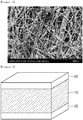
- FIG. 1 is an image observing a molded object according to the present invention using Field Emission-Scanning Electron Microscopy (FE-SEM).
- FE-SEM Field Emission-Scanning Electron Microscopy
- the present invention provides a molded object having a non-woven fiber structure, the molded object including a polyester-based fiber and a binder, wherein the binder is a non-hygroscopic copolymer resin, all or a part of the polyester-based fiber is fused by the binder, natural pores are included inside the molded object, and the molded object has apparent density of 0.5 g/cm 3 to 0.8 g/cm 3 , flexural strength of 20 MPa or greater and tensile strength of 50 MPa to 80 MPa.
- molded objects using a hygroscopic resin as a binder and manufactured using a wet process have had problems to be used in structural members for home appliances (TV back covers, boards for washing machines, and the like), interior and exterior boards for construction, automotive interior and exterior materials, interior and exterior materials for trains/ships/airplanes, various partition boards, elevator structural members and the like since the manufactured molded objects have declined properties such as flexural strength or tensile strength, and experience severe changes in various properties when used for a long period of time under a high temperature and high humidity environment.
- the inventors of the present invention have manufactured a molded object suited to be used as household materials, industrial materials or the like with the manufactured molded object having improved properties such as flexural strength or tensile strength, and also having almost no changes in various properties even when used for a long period of time under a high temperature and high humidity environment.
- the molded object according to the present invention has a non-woven fiber structure including a polyester-based fiber and a binder.
- the molded object of the present invention has a non-woven fiber structure in which fibers are entangled with each other, and therefore, air permeability becomes favorable and weight lightening may be enhanced since natural pores are included inside the molded object.
- natural pores formed by fibers being entangled with each other are included, and unlike cases of artificially forming pores by an additive such as a foaming agent, manufacturing costs may be reduced, and a foaming process may not be included increasing process efficiency.
- An average length of the polyester-based fiber included in the molded object according to the present invention is preferably from 5 mm to 100 mm.
- an average length of the fiber is less than 5 mm, an effect of high elongation may be difficult to expect due to the short fiber length.
- the average length is greater than 100 mm, the content of the fiber entangled with each other increases reducing space occupied by the gap in the molded object.
- fiber dispersion is not smooth when manufacturing the molded object, which may decline properties of the molded object.
- the binder included in the molded object according to the present invention is a non-hygroscopic copolymer resin.
- the non-hygroscopic copolymer resin used in the present invention refers to a resin having properties of not absorbing moisture in the air, and specifically, based on the molded object of the present invention manufactured using the resin, those having a molded object weight change rate (that is, a rate of increase in the moisture amount) of less than 0.1%, preferably less than 0.08% and more preferably less than 0.07% after being left unattended for 100 hours at a temperature of 85°C and relative humidity of 85% may be used.
- a molded object weight change rate that is, a rate of increase in the moisture amount
- the molded object weight change rate being greater than 0.05% means that the amount of moisture absorbed by the binder, another constitution in the molded object, is quite large.
- the non-hygroscopic copolymer resin used in the present invention means having a low absorption rate of, based on a finally manufactured molded object, the molded object weight change rate (that is, a rate of increase in the moisture amount) less than 0.1%, preferably less than 0.08% and more preferably less than 0.07% after being left unattended for 100 hours at a temperature of 85°C and relative humidity of 85%.
- non-hygroscopic copolymer resin those prepared by copolymerizing a polyester-based fiber, together with a diol-based monomer having high crystallinity and excellent elasticity and an acid component capable of providing flexibility, and satisfying the absorption rate may be used.
- polyester-based fiber any one or more selected from the group consisting of polyethylene terephthalate (PET), polytrimethylene terephthalate, polybutylene terephthalate and polyethylene naphthalate may be used
- diol-based monomer any one or more selected from the group consisting of neopentyl glycol, diethylene glycol, ethylene glycol, poly(tetramethylene) glycol, 1,4-butanediol, 1,3-propanediol, 1,6-hexanediol, 1,4-cyclohexanedimethanol and the like may be used
- acid component any one or more selected from the group consisting of isophthalic acid, adipic acid, 2,6-naphthalenedicarboxylic acid, sebacic acid, succinic acid and the like may be used.
- All or a part of the polyester-based fiber included in the molded object according to the present invention is fused by the binder that is a non-hygroscopic resin, and the binder may have a melting point of 160°C or higher.
- the molded object according to the present invention has apparent density of 0.5 g/cm 3 to 0.8 g/cm 3 . By satisfying the density range, mechanical strength sufficient to be used in packing materials of large cargos and the like may be obtained.
- the molded object according to the present invention has excellent mechanical strength with flexural strength of 20 MPa or greater and tensile strength of 50 MPa to 80 MPa. Flexural strength of the molded object is measured based on the ASTM D790, and tensile strength of the molded object is measured based on the ASTM D638.
- the molded object according to the present invention has excellent mechanical rigidity with flexural modulus in a range of 1.0 GPa to 1.5 GPa and tension stiffness in a range of 1.0 GPa to 1.8 GPa. Flexural modulus of the molded object is measured based on the ASTM D790, and tension stiffness of the molded object is measured based on the ASTM D638.
- the molded object according to the present invention has tensile elongation in a range of 10% to 30% and peel-off strength in a range of 150 N to 200 N, and thereby has an advantage of being not readily torn even when external force is applied.
- Tensile elongation of the molded object is measured based on the ASTM D638 and peel-off strength of the molded object is measured based on the KSF 4737.
- the molded object according to the present invention satisfies such mechanical strength, and therefore, may be used as structural members for home appliances (TV back covers, boards for washing machines, and the like), interior and exterior boards for construction, automotive interior and exterior materials, interior and exterior materials for trains/ships/airplanes (boards such as partitions), various partition boards, elevator structural members and the like.
- the molded object according to the present invention may further include a sheath-core type bicomponent fiber.
- the sheath-core type bicomponent fiber includes a core part of a polyester-based fiber; and a sheath part that is a non-hygroscopic copolymer resin surrounding the core part.
- the sheath-core type bicomponent fiber may be included in the molded object according to the present invention by the resin of the sheath part remaining un-melted in the fiber introduced in the step of manufacturing the molded object according to the present invention.
- any one or more selected from the group consisting of polyethylene terephthalate (PET), polytrimethylene terephthalate, polybutylene terephthalate and polyethylene naphthalate may be used.
- the same non-hygroscopic copolymer resin as the binder included in the molded object according to the present invention may be used.
- the non-hygroscopic copolymer resin refers to a resin having properties of not absorbing moisture in the air, and specifically, based on the molded object of the present invention manufactured using the resin, those having a molded object weight change rate (that is, a rate of increase in the moisture amount) of less than 0.1%, preferably less than 0.08% and more preferably less than 0.07% after being left unattended for 100 hours at a temperature of 85°C and relative humidity of 85% may be used.
- a molded object weight change rate that is, a rate of increase in the moisture amount
- the molded object weight change rate being greater than 0.05% means that the amount of moisture absorbed by the binder, another constitution in the molded object, is quite large.
- the non-hygroscopic copolymer resin used in the present invention means having a low absorption rate of, based on a finally manufactured molded object, the molded object weight change rate (that is, a rate of increase in the moisture amount) less than 0.1%, preferably less than 0.08% and more preferably less than 0.07% after being left unattended for 100 hours at a temperature of 85°C and relative humidity of 85%.
- non-hygroscopic copolymer resin those prepared by copolymerizing a polyester-based fiber, together with a diol-based monomer having high crystallinity and excellent elasticity and an acid component capable of providing flexibility, and satisfying the absorption rate may be used.
- polyester-based fiber any one or more selected from the group consisting of polyethylene terephthalate (PET), polytrimethylene terephthalate, polybutylene terephthalate and polyethylene naphthalate may be used
- diol-based monomer any one or more selected from the group consisting of neopentyl glycol, diethylene glycol, ethylene glycol, poly (tetramethylene) glycol, 1,4-butanediol, 1,3-propanediol, 1,6-hexanediol, 1,4-cyclohexanedimethanol and the like may be used
- acid component any one or more selected from the group consisting of isophthalic acid, adipic acid, 2,6-naphthalenedicarboxylic acid, sebacic acid, succinic acid and the like may be used.
- the sheath-core type bicomponent fiber is prepared using the core part component and the sheath part component through melt spinning and elongating.
- the non-hygroscopic resin as the sheath component of the sheath-core type bicomponent fiber, flexural strength and tensile strength are enhanced, and the molded object may be manufactured using a dry process, and therefore, a high density molded object is readily manufactured.
- properties and shape maintaining properties are favorable even under high temperature and high humidity atmosphere, and therefore, sagging of a non-woven fabric may be prevented.
- the molded object according to the present invention may further include a filler such as a glass fiber, a carbon fiber or a polymer fiber.
- a flame retardant such as a bromine-based organic flame retardant may be further included.
- Additives such as an impact modifier or heat stabilizer may be further included in addition thereto.
- a method for manufacturing a molded object according to the present invention may be carried out as follows.
- the method for manufacturing a molded object according to the present invention may include,
- a non-woven fabric is prepared by mixing (A) a polyester-based fiber and (B) a sheath-core type bicomponent fiber including a core part of a polyester-based fiber and a sheath part that is a non-hygroscopic copolymer resin surrounding the core part, and then heating and pressurizing the result.
- (A) the polyester-based fiber and B) the sheath-core type bicomponent fiber may be mixed in a weight ratio of 1:99 to 80:20, and used.
- the content of B) the sheath-core type bicomponent fiber is less than the above-mentioned range, fusion between fibers is not sufficient declining properties of the non-woven fabric.
- non-woven fabric may be prepared by carding mixed fibers using a roller carding machine, and then thermal bonding the result for 5 seconds to 30 seconds at a temperature of 160°C to 210°C using a heating press.
- the prepared non-woven fabric is installed on a plurality of unwinding devices, and then moved to a heating press.
- the non-woven fabrics After installing 2 to 10 of the non-woven fabrics prepared in b) on a plurality of unwinding devices matching the number, the non-woven fabrics may be moved to a heating press for manufacturing a molded object.
- the thickness of each of the non-woven fabrics becomes small, and the length of the non-woven fabric wound on one unwinding device becomes long. Accordingly, the number of the use of joining machine for linking the non-woven fabrics continuously introduced during a continuous process may be reduced leading to an advantage of simplifying the process.
- a plurality of the non-woven fabrics moved to the heating press are heated and pressurized under a temperature condition of 170°C to 210°C and a pressure condition of 1 MPa to 10 MPa to manufacture a molded object.
- the heating press used in c) is not particularly limited as long as it is commonly used in the art, and as one specific example, a double belt press and the like may be used.
- the molded object manufactured in c) may be manufactured to a thickness of 0.1 mm to 10 mm.
- the thickness being less than 0.1 mm has a problem in that excellent mechanical strength is difficult to maintain, and the thickness being greater than 10 mm has a problem in that moldability declines when bending the molded object or when deep drawing molding.
- Properties of the manufactured molded object are the same as the properties of the molded object of the present invention described above.
- the method for manufacturing a molded object according to the present invention may further include, between b) and c), d) preheating for 3 minutes to 10 minutes under a temperature condition of 160°C to 210°C.
- heat energy is applied in advance to the non-hygroscopic copolymer resin of the sheath part of the sheath-core type bicomponent fiber in the non-woven fabric, and therefore, there is an advantage in that the time of the heating and pressurizing process in c) may be shortened.
- the present invention provides a sandwich panel including the molded object.
- the sandwich panel according to the present invention includes a core layer (10) formed with the molded object according to the present invention; a skin layer (20) laminated on one or more surfaces of the core layer; and an adhesive layer adhering the core layer and the skin layer.
- the core layer (10) of the sandwich panel according to the present invention is formed with the molded object according to the present invention described above.
- the thickness of the core layer is preferably from 0.1 mm to 10 mm.
- the thickness being less than 0.1 mm has a problem in that excellent mechanical strength is difficult to maintain, and the thickness being greater than 10 mm has a problem in that moldability declines when bending the sandwich panel or when deep drawing molding.
- the skin layer (20) of the sandwich panel according to the present invention may be formed with a metal material, and may preferably include any one or more selected from the group consisting of aluminum, iron, stainless steel (SUS), magnesium and electro galvanized iron (EGI).
- a skin layer (20) including electro galvanized iron (EGI) may be used in the sandwich panel.
- a skin layer (20) including aluminum may be used in the sandwich panel.
- the thickness of the skin layer (20) may be from 0.1 mm to 0.5mm. When the thickness is less than 0.1 mm, structural rigidity of the skin layer is difficult to maintain, and the thickness being greater than 0.5 mm has problems of reducing a weight lightening effect of the sandwich panel, and increasing raw material costs.
- the adhesive layer of the sandwich panel according to the present invention is coated between the core layer (10) and the skin layer (20) to adhere the core layer (10) and the skin layer (20).
- the adhesive layer is preferably coated to a uniform thickness considering viscosity.
- the sandwich panel may be manufactured by laminating the core layer (10) and the skin layer (20), and then curing the result.
- an adhesive grows into the core layer (10) producing mechanical bonding as well as chemical bonding with components forming the core layer (10), which results in an effect of enhancing adhesive strength between the skin layer (20) and the core layer (10).
- the chemical bonding means the adhesive forming covalent bonds, hydrogen bonds, Van der Waals bonds, ionic bonds and the like with an upper surface and a lower surface of the core layer.
- the mechanical bonding means the adhesive being, while penetrating into the core layer, physically hooked like rings being hooked to each other. Such a form is also referred to as mechanical interlocking.
- the adhesive penetrates into an upper surface and a lower surface of the core layer.
- the adhesive forming the adhesive layer may include one or more types of olefin-based adhesives, urethane-based adhesives, acryl-based adhesives and epoxy-based adhesives.
- olefin-based adhesive one or more types selected from the group consisting of polyethylene, polypropylene and amorphous polyalphaolefin adhesives may be used.
- the urethane-based adhesive may be used without limit as long as it is an adhesive including a urethane structure (-NH-CO-O-).
- the acryl-based adhesive may include one or more types of polymethyl methacrylate adhesives, hydroxyl group-containing polyacrylate adhesives and carboxyl group-containing polyacrylate adhesives.
- the epoxy-based adhesive may include one or more types of bisphenol-A-type epoxy adhesives, bisphenol-F-type epoxy adhesives, novolac epoxy adhesives, linear aliphatic epoxy adhesives (linear aliphatic epoxy resins) and cycloaliphatic epoxy adhesives (cycloaliphatic epoxy resins).
- the adhesive may include photocurable adhesives, hot melt-type adhesives or heat curable adhesives, and may use any one of photocuring methods and heat curing methods.
- the sandwich panel may be manufactured by heat curing a laminate including the skin layer, the core layer and the adhesive. The heat curing may be carried out for approximately 5 hours to 2 hours at 50°C to 110°C, a curing temperature of an epoxy resin, and the curing may also be carried out for 1 hour to 10 hours at room temperature.
- the adhesive layer may be coated to a thickness of approximately 20 ⁇ m to 300 ⁇ m, however, the thickness is not limited thereto.
- the method of coating the adhesive layer on one surface of the skin layer may use any one method selected from among a die coating method, a gravure coating method, a knife coating method or a spray coating method.
- the sandwich panel according to the present invention is formed by, for example, consecutively laminating the skin layer, the core layer and the skin layer. Curing and pressing may be carried out after the lamination, however, the formation is not limited thereto.
- the sandwich panel according to the present invention has excellent moldability as well as mechanical strength.
- the sandwich panel has high density and enhanced properties such as flexural strength or tensile strength, has a small weight change caused by moisture absorption even when used for a long period of time, and has small changes in flexural strength, tensile strength and the like, and therefore, is suited to be used as structural members for home appliances (TV back covers, boards for washing machines, and the like), interior and exterior boards for construction, automotive interior and exterior materials, interior and exterior materials for trains/ships/airplanes (boards such as partitions), various partition boards, elevator structural members and the like.
- PET polyethylene terephthalate
- EZBON-L fineness 4 denier, sheath part melting point 164°C, fiber length 64 mm
- the mixed fiber went through carding using a roller carding machine, and thermally bonded for 10 seconds at a temperature of 190°C using a heating press to prepare a non-woven fabric.
- the 6 non-woven fabrics were introduced to a preheating chamber having an inside chamber temperature of 180°C, and then preheated for 3 minutes.
- the non-woven fabrics were transferred to a double belt press at a rate of 5 m/minute.
- a heating temperature of the double belt press was 180°C and the pressure was 5 MPa, and heating/pressurizing treatment was carried out for 2 minutes to manufacture a molded object having a thickness of 5.5 mm.
- a molded object was manufactured in the same manner as in Example 1 except that the polyethylene terephthalate (PET) fiber and the sheath-core type PET fiber in which a sheath part is a non-hygroscopic resin were mixed in a weight ratio of 50:50.
- PET polyethylene terephthalate
- sheath-core type PET fiber in which a sheath part is a non-hygroscopic resin were mixed in a weight ratio of 50:50.
- a molded object was manufactured in the same manner as in Example 1 except that a sheath-core type PET fiber in which a sheath part is a non-hygroscopic resin (Toray Chemical Inc., EZBON-L, fineness 4 denier, sheath part melting point 110°C, fiber length 64 mm) was used.
- a sheath-core type PET fiber in which a sheath part is a non-hygroscopic resin Toray Chemical Inc., EZBON-L, fineness 4 denier, sheath part melting point 110°C, fiber length 64 mm
- PET polyethylene terephthalate
- RPF fineness 4 denier, fiber length 51 mm
- a polyester-based hot melt adhesive film (Chemitec Korea, Co. Ltd., PE) that is a hygroscopic copolymer was placed between each of the non-woven fabrics, and the non-woven fabrics were transferred to a double belt press at a rate of 5 m/minute.
- a heating temperature of the double belt press was 110°C and the pressure was 5 MPa, and heating/pressurizing treatment was carried out for 2 minutes to manufacture a molded object having a thickness of 5.5 mm.
- a molded object was manufactured in the same manner as in Example 1 except that the heating temperature of the double belt press was employed to be 160°C.
- a molded object was manufactured in the same manner as in Example 1 except that the pressure of the double belt press was employed to be 0.5 MPa.
- Comparative Examples 1 to 4 had inferior mechanical properties compared to the examples, and particularly, Comparative Example 1 using a hygroscopic copolymer was vulnerable to peel-off due to heterogeneous material bonding, and Comparative Example 2 manufactured using a wet process had a problem of a decrease in the bonding of the water-containing region and an increase in the molded object density caused by water-containing. Comparative Example 3 manufactured at a low heating temperature had a problem of being vulnerable to peel-off since the degree of fusion of the binder decreased, and Comparative Example 4 manufactured at a low pressure had a low pressure, and pressing was not properly obtained, and as a result, there was a problem of being vulnerable to peel-off as binding between fibers became weak due to low density.
Landscapes
- Engineering & Computer Science (AREA)
- Architecture (AREA)
- Textile Engineering (AREA)
- Civil Engineering (AREA)
- Structural Engineering (AREA)
- Chemical & Material Sciences (AREA)
- Mechanical Engineering (AREA)
- Chemical Kinetics & Catalysis (AREA)
- Life Sciences & Earth Sciences (AREA)
- Wood Science & Technology (AREA)
- Polymers & Plastics (AREA)
- Medicinal Chemistry (AREA)
- Health & Medical Sciences (AREA)
- Organic Chemistry (AREA)
- Composite Materials (AREA)
- Nonwoven Fabrics (AREA)
- Laminated Bodies (AREA)
Abstract
Description
- The present invention relates to a molded object and a method for manufacturing the same.
- Molded objects having a non-woven fiber structure have been widely used from household materials to industrial materials as well as used for sanitation or medical purposes such as disposable diapers.
- Such molded objects having a non-woven fiber structure are manufactured using methods such as needle punch or hot air thermal bond, and are thereby flexible and light weight. However, hardness is low, and there have been difficulties to be used in various fields from household materials to industrial materials.
- In order to improve this, technologies manufacturing a molded object having a non-woven fiber structure that is relatively light while having structural rigidity close to metals by providing hardness using various methods have been diversely studied.
- As methods for manufacturing such a molded object, a wet process in which a binder is mixed to a fiber, and then high temperature steam is sprayed for adhering, or the result is impregnated in a solution, and the like, has been used.
- However, a molded object manufactured using such a wet process has low density and has poor properties such as flexural strength or tensile strength, and therefore, there have been problems in that the object is readily bent, torn or the like when a strong weight is applied from the outside, and properties sufficient to be used in household materials or industrial materials are difficult to secure.
- In addition, when using such a molded object for a long period of time under a high temperature and high humidity environment, moisture penetrating into the molded object increases, and accordingly, properties that the molded object has, for example, flexural strength or tensile strength, decline causing a problem.
- Furthermore, there has been a problem in that large quantities of moisture are absorbed into the molded object, and an effect of weight lightening may not be secured.
- In view of the above, the inventors of the present invention have performed studies on molded objects having high density and enhanced properties such as flexural strength or tensile strength using a non-hygroscopic resin as a binder in a dry process instead of a wet process, and have completed the present invention as a result.
- Accordingly, an aspect of the present invention provides a molded object having high density and enhanced properties such as flexural strength or tensile strength.
- Another aspect of the present invention provides a molded object having a small weight change caused by moisture absorption even when used for a long period of time, and having small changes in flexural strength, tensile strength and the like.
- According to an aspect of the present invention, there is provided a molded object having a non-woven fiber structure, the molded object including a polyester-based fiber and a binder, wherein the binder is a non-hygroscopic copolymer resin, all or a part of the polyester-based fiber is fused by the binder, natural pores are included inside the molded object, and the molded object has apparent density of 0.5 g/cm3 to 0.8 g/cm3, flexural strength of 20 MPa or greater and tensile strength of 50 MPa to 80 MPa.
- Herein, the molded object may have flexural modulus in a range of 1.0 GPa to 1.5 GPa, and tension stiffness in a range of 1.0 GPa to 1.8 GPa.
- Herein, the molded object may have tensile elongation in a range of 10% to 30%.
- Herein, the molded object may have peel-off strength in a range of 150 N to 200 N.
- Herein, the polyester-based fiber may be any one or more selected from the group consisting of polyethylene terephthalate (PET), polytrimethylene terephthalate, polybutylene terephthalate and polyethylene naphthalate.
- Herein, the non-hygroscopic copolymer resin may have a weight change rate of less than 0.1% after keeping a constant temperature/constant humidity for 100 hours at a temperature of 85°C and relative humidity of 85%.
- Herein, the binder may have a melting point of 160°C or higher.
- Herein, the molded object may further include a sheath-core type bicomponent fiber including a core part of a polyester-based fiber; and a sheath part that is a non-hygroscopic copolymer resin surrounding the core part.
- According to another aspect of the present invention, there is provided a method for manufacturing a molded object including a) preparing a non-woven fabric by mixing (A) a polyester-based fiber and (B) a sheath-core type bicomponent fiber including a core part of a polyester-based fiber and a sheath part that is a non-hygroscopic copolymer resin surrounding the core part, and then heating and pressurizing the result; b) installing the prepared non-woven fabric on a plurality of unwinding devices, and then moving to a heating press; and c) manufacturing a molded object by heating and pressurizing a plurality of the non-woven fabrics moved to the heating press under a temperature condition of 170°C to 210°C and a pressure condition of 1 MPa to 10 MPa.
- Herein, the method may further include, between b) and c), d) preheating for 3 minutes to 10 minutes under a temperature condition of 160°C to 210°C.
- Herein, in a), (A) the polyester-based fiber and (B) the sheath-core type bicomponent fiber including a core part of a polyester-based fiber and a sheath part that is a non-hygroscopic copolymer resin surrounding the core part may be mixed in a weight ratio of 1:99 to 70:30.
- Herein, the number of a plurality of the non-woven fabrics may be from 2 to 10.
- Herein, the molded object may be manufactured to a thickness of 5 mm to 7 mm.
- Herein, the molded object may be used in structural members for home appliances; interior and exterior boards for construction; automotive interior and exterior materials; interior and exterior materials for trains, ships and airplanes; partition boards; or elevator structural members.
- According to still another aspect of the present invention, there is provided a sandwich panel including the molded object.
- A molded object according to the present invention has high density and enhanced properties such as flexural strength or tensile strength, has a small weight change caused by moisture absorption even when used for a long period of time, and has small changes in flexural strength, tensile strength and the like, and therefore, is suited to be used in structural members for home appliances (TV back covers, boards for washing machines, and the like), interior and exterior boards for construction, automotive interior and exterior materials, interior and exterior materials for trains/ships/airplanes, various partition boards, elevator structural members and the like.
-
FIG. 1 is an image observing a molded object according to the present invention using Field Emission-Scanning Electron Microscopy (FE-SEM). - Hereinafter, embodiments of the present invention will be described in detail with reference to accompanying drawings so that those skilled in the art may readily implement the present invention. However, the present invention may be embodied in various different forms, and is not limited to the embodiments described herein.
- The present invention provides a molded object having a non-woven fiber structure, the molded object including a polyester-based fiber and a binder, wherein the binder is a non-hygroscopic copolymer resin, all or a part of the polyester-based fiber is fused by the binder, natural pores are included inside the molded object, and the molded object has apparent density of 0.5 g/cm3 to 0.8 g/cm3, flexural strength of 20 MPa or greater and tensile strength of 50 MPa to 80 MPa.
- Based on experimental results of the inventors of the present invention, molded objects using a hygroscopic resin as a binder and manufactured using a wet process have had problems to be used in structural members for home appliances (TV back covers, boards for washing machines, and the like), interior and exterior boards for construction, automotive interior and exterior materials, interior and exterior materials for trains/ships/airplanes, various partition boards, elevator structural members and the like since the manufactured molded objects have declined properties such as flexural strength or tensile strength, and experience severe changes in various properties when used for a long period of time under a high temperature and high humidity environment.
- However, by manufacturing a molded object using a non-hygroscopic copolymer resin as a binder and using a dry process, the inventors of the present invention have manufactured a molded object suited to be used as household materials, industrial materials or the like with the manufactured molded object having improved properties such as flexural strength or tensile strength, and also having almost no changes in various properties even when used for a long period of time under a high temperature and high humidity environment.
- The molded object according to the present invention has a non-woven fiber structure including a polyester-based fiber and a binder. The molded object of the present invention has a non-woven fiber structure in which fibers are entangled with each other, and therefore, air permeability becomes favorable and weight lightening may be enhanced since natural pores are included inside the molded object. In other words, natural pores formed by fibers being entangled with each other are included, and unlike cases of artificially forming pores by an additive such as a foaming agent, manufacturing costs may be reduced, and a foaming process may not be included increasing process efficiency.
- An average length of the polyester-based fiber included in the molded object according to the present invention is preferably from 5 mm to 100 mm. When an average length of the fiber is less than 5 mm, an effect of high elongation may be difficult to expect due to the short fiber length. On the contrary, when the average length is greater than 100 mm, the content of the fiber entangled with each other increases reducing space occupied by the gap in the molded object. In addition, when the average length is greater than 100 mm, fiber dispersion is not smooth when manufacturing the molded object, which may decline properties of the molded object.
- The binder included in the molded object according to the present invention is a non-hygroscopic copolymer resin.
- The non-hygroscopic copolymer resin used in the present invention refers to a resin having properties of not absorbing moisture in the air, and specifically, based on the molded object of the present invention manufactured using the resin, those having a molded object weight change rate (that is, a rate of increase in the moisture amount) of less than 0.1%, preferably less than 0.08% and more preferably less than 0.07% after being left unattended for 100 hours at a temperature of 85°C and relative humidity of 85% may be used.
- In terms that a hygroscopic degree of a PET fiber included in a molded object is generally less than 0.05%, the molded object weight change rate being greater than 0.05% means that the amount of moisture absorbed by the binder, another constitution in the molded object, is quite large. In such an aspect, the non-hygroscopic copolymer resin used in the present invention means having a low absorption rate of, based on a finally manufactured molded object, the molded object weight change rate (that is, a rate of increase in the moisture amount) less than 0.1%, preferably less than 0.08% and more preferably less than 0.07% after being left unattended for 100 hours at a temperature of 85°C and relative humidity of 85%.
- As such a non-hygroscopic copolymer resin, those prepared by copolymerizing a polyester-based fiber, together with a diol-based monomer having high crystallinity and excellent elasticity and an acid component capable of providing flexibility, and satisfying the absorption rate may be used.
- Specifically, as the polyester-based fiber, any one or more selected from the group consisting of polyethylene terephthalate (PET), polytrimethylene terephthalate, polybutylene terephthalate and polyethylene naphthalate may be used, and as the diol-based monomer, any one or more selected from the group consisting of neopentyl glycol, diethylene glycol, ethylene glycol, poly(tetramethylene) glycol, 1,4-butanediol, 1,3-propanediol, 1,6-hexanediol, 1,4-cyclohexanedimethanol and the like may be used, and as the acid component, any one or more selected from the group consisting of isophthalic acid, adipic acid, 2,6-naphthalenedicarboxylic acid, sebacic acid, succinic acid and the like may be used.
- All or a part of the polyester-based fiber included in the molded object according to the present invention is fused by the binder that is a non-hygroscopic resin, and the binder may have a melting point of 160°C or higher.
- The molded object according to the present invention has apparent density of 0.5 g/cm3 to 0.8 g/cm3. By satisfying the density range, mechanical strength sufficient to be used in packing materials of large cargos and the like may be obtained.
- Specifically, the molded object according to the present invention has excellent mechanical strength with flexural strength of 20 MPa or greater and tensile strength of 50 MPa to 80 MPa. Flexural strength of the molded object is measured based on the ASTM D790, and tensile strength of the molded object is measured based on the ASTM D638.
- In addition, the molded object according to the present invention has excellent mechanical rigidity with flexural modulus in a range of 1.0 GPa to 1.5 GPa and tension stiffness in a range of 1.0 GPa to 1.8 GPa. Flexural modulus of the molded object is measured based on the ASTM D790, and tension stiffness of the molded object is measured based on the ASTM D638.
- The molded object according to the present invention has tensile elongation in a range of 10% to 30% and peel-off strength in a range of 150 N to 200 N, and thereby has an advantage of being not readily torn even when external force is applied. Tensile elongation of the molded object is measured based on the ASTM D638 and peel-off strength of the molded object is measured based on the KSF 4737.
- The molded object according to the present invention satisfies such mechanical strength, and therefore, may be used as structural members for home appliances (TV back covers, boards for washing machines, and the like), interior and exterior boards for construction, automotive interior and exterior materials, interior and exterior materials for trains/ships/airplanes (boards such as partitions), various partition boards, elevator structural members and the like.
- The molded object according to the present invention may further include a sheath-core type bicomponent fiber. The sheath-core type bicomponent fiber includes a core part of a polyester-based fiber; and a sheath part that is a non-hygroscopic copolymer resin surrounding the core part. The sheath-core type bicomponent fiber may be included in the molded object according to the present invention by the resin of the sheath part remaining un-melted in the fiber introduced in the step of manufacturing the molded object according to the present invention.
- As the core part of a polyester-based fiber in the sheath-core type bicomponent fiber, any one or more selected from the group consisting of polyethylene terephthalate (PET), polytrimethylene terephthalate, polybutylene terephthalate and polyethylene naphthalate may be used.
- As the sheath part in the sheath-core type bicomponent fiber, the same non-hygroscopic copolymer resin as the binder included in the molded object according to the present invention may be used.
- Specifically, the non-hygroscopic copolymer resin refers to a resin having properties of not absorbing moisture in the air, and specifically, based on the molded object of the present invention manufactured using the resin, those having a molded object weight change rate (that is, a rate of increase in the moisture amount) of less than 0.1%, preferably less than 0.08% and more preferably less than 0.07% after being left unattended for 100 hours at a temperature of 85°C and relative humidity of 85% may be used.
- In terms that a hygroscopic degree of a PET fiber included in a molded object is generally less than 0.05%, the molded object weight change rate being greater than 0.05% means that the amount of moisture absorbed by the binder, another constitution in the molded object, is quite large. In such an aspect, the non-hygroscopic copolymer resin used in the present invention means having a low absorption rate of, based on a finally manufactured molded object, the molded object weight change rate (that is, a rate of increase in the moisture amount) less than 0.1%, preferably less than 0.08% and more preferably less than 0.07% after being left unattended for 100 hours at a temperature of 85°C and relative humidity of 85%.
- As such a non-hygroscopic copolymer resin, those prepared by copolymerizing a polyester-based fiber, together with a diol-based monomer having high crystallinity and excellent elasticity and an acid component capable of providing flexibility, and satisfying the absorption rate may be used.
- Specifically, as the polyester-based fiber, any one or more selected from the group consisting of polyethylene terephthalate (PET), polytrimethylene terephthalate, polybutylene terephthalate and polyethylene naphthalate may be used, and as the diol-based monomer, any one or more selected from the group consisting of neopentyl glycol, diethylene glycol, ethylene glycol, poly (tetramethylene) glycol, 1,4-butanediol, 1,3-propanediol, 1,6-hexanediol, 1,4-cyclohexanedimethanol and the like may be used, and as the acid component, any one or more selected from the group consisting of isophthalic acid, adipic acid, 2,6-naphthalenedicarboxylic acid, sebacic acid, succinic acid and the like may be used.
- The sheath-core type bicomponent fiber is prepared using the core part component and the sheath part component through melt spinning and elongating.
- In addition, when using the non-hygroscopic resin as the sheath component of the sheath-core type bicomponent fiber, flexural strength and tensile strength are enhanced, and the molded object may be manufactured using a dry process, and therefore, a high density molded object is readily manufactured. In addition, when used in packing materials of large cargos and the like, properties and shape maintaining properties are favorable even under high temperature and high humidity atmosphere, and therefore, sagging of a non-woven fabric may be prevented.
- In addition thereto, the molded object according to the present invention may further include a filler such as a glass fiber, a carbon fiber or a polymer fiber. In addition, a flame retardant such as a bromine-based organic flame retardant may be further included. Additives such as an impact modifier or heat stabilizer may be further included in addition thereto.
- A method for manufacturing a molded object according to the present invention may be carried out as follows.
- The method for manufacturing a molded object according to the present invention may include,
- a) preparing a non-woven fabric by mixing (A) a polyester-based fiber and (B) a sheath-core type bicomponent fiber including a core part of a polyester-based fiber and a sheath part that is a non-hygroscopic copolymer resin surrounding the core part, and then heating and pressurizing the result; b) installing the prepared non-woven fabric on a plurality of unwinding devices, and then moving to a heating press; and c) manufacturing a molded object by heating and pressurizing a plurality of the non-woven fabrics moved to the heating press under a temperature condition of 170°C to 210°C and a pressure condition of 1 MPa to 10 MPa.
- First, in a), a non-woven fabric is prepared by mixing (A) a polyester-based fiber and (B) a sheath-core type bicomponent fiber including a core part of a polyester-based fiber and a sheath part that is a non-hygroscopic copolymer resin surrounding the core part, and then heating and pressurizing the result.
- In a), (A) the polyester-based fiber and B) the sheath-core type bicomponent fiber may be mixed in a weight ratio of 1:99 to 80:20, and used. When the content of B) the sheath-core type bicomponent fiber is less than the above-mentioned range, fusion between fibers is not sufficient declining properties of the non-woven fabric.
- In a), common methods of preparing a non-woven fabric may be used as the method of preparing the non-woven fabric through heating and pressurizing, and as one example, the non-woven fabric may be prepared by carding mixed fibers using a roller carding machine, and then thermal bonding the result for 5 seconds to 30 seconds at a temperature of 160°C to 210°C using a heating press.
- Next, in b), the prepared non-woven fabric is installed on a plurality of unwinding devices, and then moved to a heating press.
- After installing 2 to 10 of the non-woven fabrics prepared in b) on a plurality of unwinding devices matching the number, the non-woven fabrics may be moved to a heating press for manufacturing a molded object. When using a plurality of non-woven fabrics using a plurality of unwinding devices as above, the thickness of each of the non-woven fabrics becomes small, and the length of the non-woven fabric wound on one unwinding device becomes long. Accordingly, the number of the use of joining machine for linking the non-woven fabrics continuously introduced during a continuous process may be reduced leading to an advantage of simplifying the process.
- Then, in c), a plurality of the non-woven fabrics moved to the heating press are heated and pressurized under a temperature condition of 170°C to 210°C and a pressure condition of 1 MPa to 10 MPa to manufacture a molded object.
- The heating press used in c) is not particularly limited as long as it is commonly used in the art, and as one specific example, a double belt press and the like may be used.
- The molded object manufactured in c) may be manufactured to a thickness of 0.1 mm to 10 mm. The thickness being less than 0.1 mm has a problem in that excellent mechanical strength is difficult to maintain, and the thickness being greater than 10 mm has a problem in that moldability declines when bending the molded object or when deep drawing molding. Properties of the manufactured molded object are the same as the properties of the molded object of the present invention described above.
- In addition, the method for manufacturing a molded object according to the present invention may further include,
between b) and c), d) preheating for 3 minutes to 10 minutes under a temperature condition of 160°C to 210°C. - When further including preheating as above, heat energy is applied in advance to the non-hygroscopic copolymer resin of the sheath part of the sheath-core type bicomponent fiber in the non-woven fabric, and therefore, there is an advantage in that the time of the heating and pressurizing process in c) may be shortened.
- The present invention provides a sandwich panel including the molded object.
- When referring to
FIG. 2 , the sandwich panel according to the present invention includes a core layer (10) formed with the molded object according to the present invention; a skin layer (20) laminated on one or more surfaces of the core layer; and an adhesive layer adhering the core layer and the skin layer. - The core layer (10) of the sandwich panel according to the present invention is formed with the molded object according to the present invention described above. The thickness of the core layer is preferably from 0.1 mm to 10 mm. The thickness being less than 0.1 mm has a problem in that excellent mechanical strength is difficult to maintain, and the thickness being greater than 10 mm has a problem in that moldability declines when bending the sandwich panel or when deep drawing molding.
- The skin layer (20) of the sandwich panel according to the present invention may be formed with a metal material, and may preferably include any one or more selected from the group consisting of aluminum, iron, stainless steel (SUS), magnesium and electro galvanized iron (EGI). As one example, in order to have excellent moldability and flexural modulus, a skin layer (20) including electro galvanized iron (EGI) may be used in the sandwich panel. In addition, for weight lightening, a skin layer (20) including aluminum may be used in the sandwich panel.
- The thickness of the skin layer (20) may be from 0.1 mm to 0.5mm. When the thickness is less than 0.1 mm, structural rigidity of the skin layer is difficult to maintain, and the thickness being greater than 0.5 mm has problems of reducing a weight lightening effect of the sandwich panel, and increasing raw material costs.
- The adhesive layer of the sandwich panel according to the present invention is coated between the core layer (10) and the skin layer (20) to adhere the core layer (10) and the skin layer (20). The adhesive layer is preferably coated to a uniform thickness considering viscosity. In the present invention, the sandwich panel may be manufactured by laminating the core layer (10) and the skin layer (20), and then curing the result. Herein, during the process of curing, an adhesive grows into the core layer (10) producing mechanical bonding as well as chemical bonding with components forming the core layer (10), which results in an effect of enhancing adhesive strength between the skin layer (20) and the core layer (10). The chemical bonding means the adhesive forming covalent bonds, hydrogen bonds, Van der Waals bonds, ionic bonds and the like with an upper surface and a lower surface of the core layer.
- The mechanical bonding means the adhesive being, while penetrating into the core layer, physically hooked like rings being hooked to each other. Such a form is also referred to as mechanical interlocking. By the natural pores included in the core layer, the adhesive penetrates into an upper surface and a lower surface of the core layer.
- The adhesive forming the adhesive layer may include one or more types of olefin-based adhesives, urethane-based adhesives, acryl-based adhesives and epoxy-based adhesives. As the olefin-based adhesive, one or more types selected from the group consisting of polyethylene, polypropylene and amorphous polyalphaolefin adhesives may be used. The urethane-based adhesive may be used without limit as long as it is an adhesive including a urethane structure (-NH-CO-O-). The acryl-based adhesive may include one or more types of polymethyl methacrylate adhesives, hydroxyl group-containing polyacrylate adhesives and carboxyl group-containing polyacrylate adhesives. The epoxy-based adhesive may include one or more types of bisphenol-A-type epoxy adhesives, bisphenol-F-type epoxy adhesives, novolac epoxy adhesives, linear aliphatic epoxy adhesives (linear aliphatic epoxy resins) and cycloaliphatic epoxy adhesives (cycloaliphatic epoxy resins).
- In addition, the adhesive may include photocurable adhesives, hot melt-type adhesives or heat curable adhesives, and may use any one of photocuring methods and heat curing methods. For example, the sandwich panel may be manufactured by heat curing a laminate including the skin layer, the core layer and the adhesive. The heat curing may be carried out for approximately 5 hours to 2 hours at 50°C to 110°C, a curing temperature of an epoxy resin, and the curing may also be carried out for 1 hour to 10 hours at room temperature.
- The adhesive layer may be coated to a thickness of approximately 20 µm to 300 µm, however, the thickness is not limited thereto.
- The method of coating the adhesive layer on one surface of the skin layer may use any one method selected from among a die coating method, a gravure coating method, a knife coating method or a spray coating method.
- The sandwich panel according to the present invention is formed by, for example, consecutively laminating the skin layer, the core layer and the skin layer. Curing and pressing may be carried out after the lamination, however, the formation is not limited thereto.
- As described above, by using a molded object exhibiting favorable mechanical properties, the sandwich panel according to the present invention has excellent moldability as well as mechanical strength. In addition, the sandwich panel has high density and enhanced properties such as flexural strength or tensile strength, has a small weight change caused by moisture absorption even when used for a long period of time, and has small changes in flexural strength, tensile strength and the like, and therefore, is suited to be used as structural members for home appliances (TV back covers, boards for washing machines, and the like), interior and exterior boards for construction, automotive interior and exterior materials, interior and exterior materials for trains/ships/airplanes (boards such as partitions), various partition boards, elevator structural members and the like.
- Hereinafter, preferred examples will be provided in order to illuminate the present invention, however, the following examples are for illustrative purposes only, and it will be obvious to those skilled in the art that various changes and modifications may be made within the category and technological ideas of the present invention, and such changes and modifications also belong to the attached claims.
- After preparing a polyethylene terephthalate (PET) fiber (Toray Chemical Inc., RPF, fineness 4 denier, fiber length 51 mm) and a sheath-core type PET fiber in which a sheath part is a non-hygroscopic resin (Toray Chemical Inc., EZBON-L, fineness 4 denier, sheath part melting point 164°C, fiber length 64 mm), these were mixed in a weight ratio of 30:70.
- The mixed fiber went through carding using a roller carding machine, and thermally bonded for 10 seconds at a temperature of 190°C using a heating press to prepare a non-woven fabric.
- After installing the non-woven fabric on 6 unwinding devices, the 6 non-woven fabrics were introduced to a preheating chamber having an inside chamber temperature of 180°C, and then preheated for 3 minutes.
- After that, the non-woven fabrics were transferred to a double belt press at a rate of 5 m/minute. Herein, a heating temperature of the double belt press was 180°C and the pressure was 5 MPa, and heating/pressurizing treatment was carried out for 2 minutes to manufacture a molded object having a thickness of 5.5 mm.
- A molded object was manufactured in the same manner as in Example 1 except that the polyethylene terephthalate (PET) fiber and the sheath-core type PET fiber in which a sheath part is a non-hygroscopic resin were mixed in a weight ratio of 50:50.
- A molded object was manufactured in the same manner as in Example 1 except that a sheath-core type PET fiber in which a sheath part is a non-hygroscopic resin (Toray Chemical Inc., EZBON-L, fineness 4 denier, sheath part melting point 110°C, fiber length 64 mm) was used.
- A polyethylene terephthalate (PET) fiber (Toray Chemical Inc., RPF, fineness 4 denier, fiber length 51 mm) went through carding using a roller carding machine and thermally bonded for 10 seconds at a temperature of 190°C using a heating press to prepare a non-woven fabric.
- After preparing 7 of the non-woven fabrics, a polyester-based hot melt adhesive film (Chemitec Korea, Co. Ltd., PE) that is a hygroscopic copolymer was placed between each of the non-woven fabrics, and the non-woven fabrics were transferred to a double belt press at a rate of 5 m/minute. Herein, a heating temperature of the double belt press was 110°C and the pressure was 5 MPa, and heating/pressurizing treatment was carried out for 2 minutes to manufacture a molded object having a thickness of 5.5 mm.
- After mixing a glass fiber to a polyethylene terephthalate (PET) fiber (Toray Chemical Inc., RPF, fineness 4 denier, fiber length 51 mm) in a weight ratio of 1:1, the result went through carding using a roller carding machine to prepare a card web, and then after overlapping 6 of these webs, the result was transferred to a conveyer belt equipped with a steam spray nozzle. After that, high temperature steam was sprayed from the steam spray nozzle in a thickness direction of the card web, and the result was passed through a web thickness adjusting roll to manufacture a molded object having a thickness of 5.5 mm.
- A molded object was manufactured in the same manner as in Example 1 except that the heating temperature of the double belt press was employed to be 160°C.
- A molded object was manufactured in the same manner as in Example 1 except that the pressure of the double belt press was employed to be 0.5 MPa.
- After preparing each of the molded objects manufactured in Examples 1 to 3 and Comparative Examples 1 to 4 into a specimen, measurements were made using the following methods, and the results are shown in the following Table 1.
- (1) Density (g/cm3) and porosity (%):
After preparing a specimen by cutting to a size of 15 mmx15 mmx1 mm, density was measured 3 times using an electronic gravimeter (VIBRA, DME-220E), and the average value was measured. Subsequently, using the density of each specimen, porosity was deduced by the following general formula.
- (2) Flexural strength (MPa) and flexural modulus (GPa): measurements were made 3 times based on the ASTM D790, and the average value was measured.
- (3) Tensile strength (MPa), tension stiffness (GPa) and tensile elongation (%): measurements were made 3 times based on the ASTM D638, and the average value was measured.
- (4) Peel-off strength (N): measurements were made 3 times based on the KSF 4737, and the average value was measured.
- As shown in Table 1, it was seen that the molded objects manufactured in Examples 1 to 3 had excellent properties of flexural strength, flexural modulus, tensile strength, tension stiffness, tensile elongation and peel-off strength while having high density.
- Meanwhile, it was seen that Comparative Examples 1 to 4 had inferior mechanical properties compared to the examples, and particularly, Comparative Example 1 using a hygroscopic copolymer was vulnerable to peel-off due to heterogeneous material bonding, and Comparative Example 2 manufactured using a wet process had a problem of a decrease in the bonding of the water-containing region and an increase in the molded object density caused by water-containing. Comparative Example 3 manufactured at a low heating temperature had a problem of being vulnerable to peel-off since the degree of fusion of the binder decreased, and Comparative Example 4 manufactured at a low pressure had a low pressure, and pressing was not properly obtained, and as a result, there was a problem of being vulnerable to peel-off as binding between fibers became weak due to low density.
| Example | Comparative Example | ||||||
| 1 | 2 | 3 | 1 | 2 | 3 | 4 | |
| Thickness | 5.53 | 5.51 | 5.55 | 6.00 | 5.61 | 5.85 | 7.13 |
| Density | 0.63 | 0.64 | 0.63 | 0.58 | 0.84 | 0.60 | 0.49 |
| Density1) | 0.64 | 0.64 | 0.63 | 0.58 | 0.84 | 0.60 | 0.49 |
| porosity | 45.0% | 45.7% | 45.0% | 50.0% | 43.8% | 51.4% | 42.1% |
| Flexural Strength (MD) | 28.95 | 23.76 | 26.18 | 1.89 | 18.56 | 20.45 | 12.22 |
| Flexural Strength (MD)* | 6.08 | 2.05 | 2.71 | 0.68 | 1.72 | 4.82 | 3.60 |
| Flexural Strength (TD) | 32.93 | 25.03 | 27.56 | 2.17 | 20.78 | 21.71 | 13.24 |
| Flexural Strength (TD)* | 8.52 | 2.99 | 3.33 | 0.72 | 1.84 | 5.49 | 3.64 |
| Flexural Modulus | 1.24 | 0.92 | 1.01 | 0.04 | 0.81 | 1.01 | 0.72 |
| Tensile Strength | 110.89 | 101.24 | 103.59 | 58.03 | 150.44 | 83.26 | 52.54 |
| Tension Stiffness | 4.76 | 3.97 | 4.13 | 2.22 | 7.81 | 2.10 | 2.15 |
| Tensile Elongation | 35.53 | 34.91 | 35.12 | 21.06 | 2.03 | 31.56 | 19.63 |
| Peel-off Strength | 172.03 | 152.24 | 165.58 | 56.44 | 78.34 | 157.73 | 70.37 |
| * Measured after being left unattended for 10 minutes at 80°C. |
Claims (15)
- A molded object having a non-woven fiber structure, the molded object comprising:a polyester-based fiber; anda binder,wherein the binder is a non-hygroscopic copolymer resin,all or a part of the polyester-based fiber is fused by the binder,natural pores are included inside the molded object, andthe molded object has apparent density of 0.5 g/cm3 to 0.8 g/cm3, flexural strength of 20 MPa or greater and tensile strength of 50 MPa to 80 MPa.
- The molded object of Claim 1, which has flexural modulus in a range of 1.0 GPa to 1.5 GPa, tension stiffness in a range of 1.0 GPa to 1.8 GPa, tensile elongation in a range of 10% to 30%, and peel-off strength in a range of 150 N to 200 N.
- The molded object of Claim 1, wherein the polyester-based fiber is any one or more selected from the group consisting of polyethylene terephthalate (PET), polytrimethylene terephthalate, polybutylene terephthalate and polyethylene naphthalate.
- The molded object of Claim 1, wherein the non-hygroscopic copolymer resin has a weight change rate of less than 0.1% after keeping a constant temperature/constant humidity for 100 hours at a temperature of 85°C and relative humidity of 85%.
- The molded object of Claim 1, wherein the binder has a melting point of 160°C or higher.
- The molded object of Claim 1, further comprising a sheath-core type bicomponent fiber including a core part of a polyester-based fiber; and a sheath part which is a non-hygroscopic copolymer resin surrounding the core part.
- The molded object of Claim 6, wherein the polyester-based fiber is any one or more selected from the group consisting of polyethylene terephthalate (PET), polytrimethylene terephthalate, polybutylene terephthalate and polyethylene naphthalate.
- The molded object of Claim 6, wherein the sheath part that is a non-hygroscopic copolymer resin has a weight change rate of less than 0.1% after keeping a constant temperature/constant humidity for 100 hours at a temperature of 85°C and relative humidity of 85%.
- A method for manufacturing a molded object comprising:a) preparing a non-woven fabric by mixing (A) a polyester-based fiber and (B) a sheath-core type bicomponent fiber including a core part of a polyester-based fiber and a sheath part that is a non-hygroscopic copolymer resin surrounding the core part, and then heating and pressurizing the result;b) installing the prepared non-woven fabric on a plurality of unwinding devices, and then moving to a heating press; andc) manufacturing a molded object by heating and pressurizing a plurality of the non-woven fabrics moved to the heating press under a temperature condition of 170°C to 210°C and a pressure condition of 1 MPa to 10 MPa.
- The method for manufacturing a molded object of Claim 9, further comprising, between b) and c), d) preheating for 3 minutes to 10 minutes under a temperature condition of 160°C to 210°C.
- The method for manufacturing a molded object of Claim 9, wherein, in a), (A) the polyester-based fiber and (B) the sheath-core type bicomponent fiber including a core part of a polyester-based fiber and a sheath part that is a non-hygroscopic copolymer resin surrounding the core part are mixed in a weight ratio of 1:99 to 70:30.
- The method for manufacturing a molded object of Claim 9, wherein the number of a plurality of the non-woven fabrics is from 2 to 10.
- The method for manufacturing a molded object of Claim 9, which is manufactured to a thickness of 5 mm to 7 mm.
- The molded object of Claim 1, which is used in structural members for home appliances; interior and exterior boards for construction; automotive interior and exterior materials; interior and exterior materials for trains, ships and airplanes; partition boards; or elevator structural members.
- A sandwich panel comprising the molded object of Claim 1.
Applications Claiming Priority (3)
| Application Number | Priority Date | Filing Date | Title |
|---|---|---|---|
| KR20160072149 | 2016-06-10 | ||
| KR1020170072748A KR102294371B1 (en) | 2016-06-10 | 2017-06-09 | A molded object and a manufacturing method thereof |
| PCT/KR2017/006082 WO2017213479A1 (en) | 2016-06-10 | 2017-06-12 | Molded body and method for producing same |
Publications (3)
| Publication Number | Publication Date |
|---|---|
| EP3470219A1 true EP3470219A1 (en) | 2019-04-17 |
| EP3470219A4 EP3470219A4 (en) | 2020-02-26 |
| EP3470219B1 EP3470219B1 (en) | 2021-08-04 |
Family
ID=60931664
Family Applications (4)
| Application Number | Title | Priority Date | Filing Date |
|---|---|---|---|
| EP17810601.9A Not-in-force EP3470218B1 (en) | 2016-06-10 | 2017-06-12 | Sandwich panel and method for manufacturing same |
| EP17810604.3A Active EP3470220B1 (en) | 2016-06-10 | 2017-06-12 | Molded body |
| EP17810602.7A Active EP3470219B1 (en) | 2016-06-10 | 2017-06-12 | Molded body and method for producing same |
| EP17810600.1A Active EP3470217B1 (en) | 2016-06-10 | 2017-06-12 | Molded body |
Family Applications Before (2)
| Application Number | Title | Priority Date | Filing Date |
|---|---|---|---|
| EP17810601.9A Not-in-force EP3470218B1 (en) | 2016-06-10 | 2017-06-12 | Sandwich panel and method for manufacturing same |
| EP17810604.3A Active EP3470220B1 (en) | 2016-06-10 | 2017-06-12 | Molded body |
Family Applications After (1)
| Application Number | Title | Priority Date | Filing Date |
|---|---|---|---|
| EP17810600.1A Active EP3470217B1 (en) | 2016-06-10 | 2017-06-12 | Molded body |
Country Status (4)
| Country | Link |
|---|---|
| US (1) | US10981341B2 (en) |
| EP (4) | EP3470218B1 (en) |
| KR (11) | KR102243566B1 (en) |
| CN (1) | CN109618554A (en) |
Families Citing this family (34)
| Publication number | Priority date | Publication date | Assignee | Title |
|---|---|---|---|---|
| KR102317516B1 (en) | 2018-03-02 | 2021-10-25 | (주)엘엑스하우시스 | A sandwich panel and a manufacturing method thereof |
| KR102243566B1 (en) | 2016-06-10 | 2021-04-23 | (주)엘지하우시스 | A molded object and a manufacturing method thereof |
| US11001035B2 (en) | 2016-06-10 | 2021-05-11 | Lg Hausys, Ltd. | Sandwich panel and a manufacturing method thereof |
| KR102317515B1 (en) | 2018-03-02 | 2021-10-25 | (주)엘엑스하우시스 | A sandwich panel and a manufacturing method thereof |
| KR102269941B1 (en) | 2018-03-02 | 2021-06-25 | (주)엘지하우시스 | A sandwich panel and a manufacturing method thereof |
| KR102317518B1 (en) | 2018-03-02 | 2021-10-25 | (주)엘엑스하우시스 | A sandwich panel and a manufacturing method thereof |
| US11198273B2 (en) | 2016-06-10 | 2021-12-14 | Lg Hausys, Ltd. | Sandwich panel and a manufacturing method thereof |
| KR102317517B1 (en) | 2018-03-02 | 2021-10-25 | (주)엘엑스하우시스 | A sandwich panel and a manufacturing method thereof |
| IL266555B2 (en) * | 2016-11-15 | 2025-03-01 | Shaw Ind Group Inc | Composite articles with a layered structure and methods for preparing them |
| KR102077993B1 (en) | 2018-07-11 | 2020-02-17 | 주식회사 케이.피 | Light-weight sandwich structure comprising double foam sheet |
| KR20200061612A (en) | 2018-11-26 | 2020-06-03 | (주)엘지하우시스 | A sandwich panel and a manufacturing method thereof |
| KR20210044363A (en) | 2019-10-14 | 2021-04-23 | (주)엘지하우시스 | A molded object and a sandwich panel using the same |
| WO2021075817A1 (en) * | 2019-10-14 | 2021-04-22 | (주)엘지하우시스 | Molded body, sandwich panel using same, method for manufacturing molded body, and method for manufacturing sandwich panel |
| KR102655190B1 (en) | 2019-10-14 | 2024-04-04 | (주)엘엑스하우시스 | Manufacturing method of a molded object and manufacturing method of a sandwich panel |
| KR102673286B1 (en) | 2019-11-22 | 2024-06-07 | (주)엘엑스하우시스 | Molded object, sandwich panel using same, and method for manufacturing same |
| KR102829700B1 (en) | 2019-11-26 | 2025-07-04 | (주)엘엑스하우시스 | Non-woven fiber assembly, sandwich panel using same, and method for manufacturing same |
| KR20210068221A (en) | 2019-11-29 | 2021-06-09 | (주)엘지하우시스 | Molded object and manufacturing method thereof |
| KR102839781B1 (en) | 2019-12-02 | 2025-07-29 | (주)엘엑스하우시스 | Molded object, sandwich panel using same, and method for manufacturing same |
| US20230356499A1 (en) | 2019-12-02 | 2023-11-09 | Lx Hausys, Ltd. | Molded Body, Sandwich Panel Using Same And Method For Manufacturing Same |
| KR102733847B1 (en) * | 2019-12-12 | 2024-11-22 | (주)엘엑스하우시스 | A interior finish material and manufacturing method thereof |
| KR102742745B1 (en) * | 2019-12-12 | 2024-12-12 | (주)엘엑스하우시스 | A interior finish material |
| KR20210138376A (en) | 2020-05-12 | 2021-11-19 | (주)엘엑스하우시스 | Method for manufacturing non-woven fabric for sandwich panel |
| KR20210156756A (en) | 2020-06-18 | 2021-12-27 | (주)엘엑스하우시스 | Molded object, sandwich panel using same, and method for manufacturing same |
| KR102993582B1 (en) | 2020-10-13 | 2026-07-22 | (주)엘엑스하우시스 | Molded object, sandwich panel using same, and method for manufacturing same |
| WO2022108330A1 (en) | 2020-11-17 | 2022-05-27 | (주)엘엑스하우시스 | Sandwich panel for protective cover of battery pack for electric vehicle, manufacturing method therefor, and protective cover of electric vehicle battery pack comprising same |
| KR20220067513A (en) | 2020-11-17 | 2022-05-24 | (주)엘엑스하우시스 | Sandwich panel for electric vehicle battery pack protective cover, manufacturing method thereof, and electric vehicle battery pack protective cover including the same |
| KR102839784B1 (en) | 2020-12-24 | 2025-07-28 | (주)엘엑스하우시스 | Sandwich panel and its manufacturing method |
| KR102573932B1 (en) | 2021-08-13 | 2023-09-01 | 주식회사 대광판넬 | Sandwich panel and method for producing the same |
| KR102361587B1 (en) | 2021-11-15 | 2022-02-15 | 좋은엘리베이터(주) | Freight elevator equipped with floor coating layer with reinforced anti-abrasion and anti-slip properties |
| KR102521669B1 (en) | 2022-05-23 | 2023-04-14 | 한신범 | Sandwich panel and method for producing the same |
| KR102560090B1 (en) | 2022-05-23 | 2023-07-27 | 주식회사 대광판넬 | Appratus for manufacturing sandwich panel |
| KR20240050542A (en) | 2022-10-11 | 2024-04-19 | 현대자동차주식회사 | Sandwich panel for automobile, manufacturing method thereof, and automobile battery pack upper cover comprising the same |
| US12172423B2 (en) | 2022-11-04 | 2024-12-24 | Saudi Arabian Oil Company | Composite sandwich panel with tailored thermal expansion coefficient |
| KR20240104659A (en) | 2022-12-28 | 2024-07-05 | (주)엘엑스하우시스 | Sandwich composite panel |
Family Cites Families (34)
| Publication number | Priority date | Publication date | Assignee | Title |
|---|---|---|---|---|
| JP3003445B2 (en) * | 1993-02-19 | 2000-01-31 | 日産自動車株式会社 | Automotive interior materials |
| US6171705B1 (en) | 1997-02-10 | 2001-01-09 | Dofasco, Inc. | Structural panel and method of manufacture |
| US6080495A (en) * | 1997-10-27 | 2000-06-27 | Wright; John | Structural panels with metal faces and corrugated plastic core |
| US6855432B1 (en) | 1999-09-03 | 2005-02-15 | E. I. Du Pont De Nemours And Company | Low activation temperature adhesive composition with high peel strength and cohesive failure |
| JP2004195833A (en) | 2002-12-19 | 2004-07-15 | Toyobo Co Ltd | Thermoplastic ester elastomer laminate |
| US20060141260A1 (en) | 2004-12-29 | 2006-06-29 | Enamul Haque | Sandwich composite material using an air-laid process and wet glass |
| JP4773726B2 (en) * | 2005-01-14 | 2011-09-14 | 株式会社カネカ | Multilayer extruded polyimide film and use thereof |
| JPWO2006092835A1 (en) * | 2005-02-28 | 2008-07-24 | ユニチカファイバー株式会社 | Automotive ceiling material and molding method thereof |
| US7446064B2 (en) | 2006-03-01 | 2008-11-04 | Alcoa Inc. | Impact resistant building panels |
| WO2007116676A1 (en) * | 2006-03-31 | 2007-10-18 | Kuraray Kuraflex Co., Ltd. | Molded object having nonwoven fibrous structure |
| KR20090068256A (en) * | 2006-09-15 | 2009-06-25 | 미쓰이 긴조꾸 고교 가부시키가이샤 | Metal composite laminates and flexible wiring boards for flexible wiring board manufacture |
| WO2008108295A1 (en) | 2007-03-08 | 2008-09-12 | Kuraray Kuraflex Co., Ltd. | Nonwoven fabric |
| US20080248278A1 (en) | 2007-04-02 | 2008-10-09 | General Electric Company | Fiber reinforced thermoplastic sheets with surface coverings and methods of making |
| KR100850765B1 (en) * | 2007-04-06 | 2008-08-06 | (주)리앤에스 | Sound-absorbing board comprising two-component fiber and high melting point thermoplastic fiber, and method for producing same |
| JP5086018B2 (en) * | 2007-09-27 | 2012-11-28 | 株式会社クラレ | Buffer material and manufacturing method thereof |
| US7871947B2 (en) | 2007-11-05 | 2011-01-18 | Milliken & Company | Non-woven composite office panel |
| JP5168009B2 (en) * | 2008-07-28 | 2013-03-21 | 宇部興産株式会社 | Polyimide and process for producing the same |
| KR101834288B1 (en) | 2008-08-18 | 2018-03-06 | 프로덕티브 리서치 엘엘씨 | Formable light weight composites |
| JP5302725B2 (en) | 2009-03-18 | 2013-10-02 | 電気化学工業株式会社 | Adhesive tape |
| KR101183146B1 (en) * | 2010-05-14 | 2012-09-14 | 코오롱글로텍주식회사 | non-woven fabric with high elasticity and recoverability, and material for cushion utilizing the same |
| JP2013063605A (en) | 2011-09-20 | 2013-04-11 | Nitto Denko Corp | Method for manufacturing polymer member, and polymer member |
| TW201343733A (en) * | 2012-02-29 | 2013-11-01 | Oji Holdings Corp | Composite material for molding a fiber-reinforced plastic and fiber-reinforced plastic molded bodies |
| KR101500036B1 (en) | 2012-08-27 | 2015-03-18 | (주)엘지하우시스 | Core for sandwich panel and method for manufacturing the same, the sandwich panel containing the same |
| EP2925517A1 (en) | 2012-11-30 | 2015-10-07 | Innventia AB | Sandwich material |
| KR101465595B1 (en) | 2013-07-11 | 2014-11-27 | 한국생산기술연구원 | Laminate of Water Absorbing Nonwoven Fabrics and Water Repellent Nonwoven Fabrics |
| JP2015068485A (en) * | 2013-09-30 | 2015-04-13 | 旭有機材工業株式会社 | Core material for vacuum insulation material and vacuum insulation material |
| EP3159444B1 (en) * | 2014-06-17 | 2020-07-29 | Kuraray Co., Ltd. | Water absorbent laminate and method for producing same |
| ES2557390B1 (en) | 2014-07-24 | 2016-11-07 | Recubrimientos Plásticos, S.A. | Multi-panel metal and magnetorheological |
| WO2016055128A1 (en) | 2014-10-06 | 2016-04-14 | Siniat International | Improved mat and related gypsum boards suitable for wet or humid areas |
| JP6265954B2 (en) | 2015-09-16 | 2018-01-24 | 古河電気工業株式会社 | Film for semiconductor backside |
| KR20170077985A (en) | 2015-12-29 | 2017-07-07 | (주) 금토일산업 | Sound absorbing-excluding sheet for auto wheel guard and method of manufacturing thereof |
| JP2017175126A (en) | 2016-03-18 | 2017-09-28 | 日東電工株式会社 | Conveying fixing jig |
| KR101744794B1 (en) | 2016-04-21 | 2017-06-09 | 주식회사 부림케미칼 | Method of manufacturing non-woven fabric for car mat by continuos process |
| KR102243566B1 (en) | 2016-06-10 | 2021-04-23 | (주)엘지하우시스 | A molded object and a manufacturing method thereof |
-
2017
- 2017-06-09 KR KR1020170072704A patent/KR102243566B1/en active Active
- 2017-06-09 KR KR1020170072733A patent/KR102066542B1/en active Active
- 2017-06-09 KR KR1020170072757A patent/KR102066544B1/en active Active
- 2017-06-09 KR KR1020170072737A patent/KR102243567B1/en active Active
- 2017-06-09 KR KR1020170072691A patent/KR102243565B1/en active Active
- 2017-06-09 KR KR1020170072754A patent/KR102294372B1/en active Active
- 2017-06-09 KR KR1020170072748A patent/KR102294371B1/en active Active
- 2017-06-09 KR KR1020170072687A patent/KR102294370B1/en active Active
- 2017-06-09 KR KR1020170072767A patent/KR102243568B1/en active Active
- 2017-06-09 KR KR1020170072712A patent/KR102066539B1/en active Active
- 2017-06-12 EP EP17810601.9A patent/EP3470218B1/en not_active Not-in-force
- 2017-06-12 EP EP17810604.3A patent/EP3470220B1/en active Active
- 2017-06-12 CN CN201780049038.XA patent/CN109618554A/en active Pending
- 2017-06-12 EP EP17810602.7A patent/EP3470219B1/en active Active
- 2017-06-12 EP EP17810600.1A patent/EP3470217B1/en active Active
-
2018
- 2018-12-10 US US16/214,586 patent/US10981341B2/en active Active
-
2020
- 2020-01-07 KR KR1020200001863A patent/KR102163085B1/en active Active
Also Published As
Similar Documents
| Publication | Publication Date | Title |
|---|---|---|
| EP3470219B1 (en) | Molded body and method for producing same | |
| US11772362B2 (en) | Sandwich panel and a manufacturing method thereof | |
| KR102317515B1 (en) | A sandwich panel and a manufacturing method thereof | |
| US11260626B2 (en) | Sandwich panel and a manufacturing method thereof | |
| KR102317518B1 (en) | A sandwich panel and a manufacturing method thereof | |
| KR20210065032A (en) | Non-woven fiber assembly, sandwich panel using same, and method for manufacturing same | |
| CN116791276A (en) | Molded body and method for producing the same | |
| KR102317516B1 (en) | A sandwich panel and a manufacturing method thereof | |
| KR102317517B1 (en) | A sandwich panel and a manufacturing method thereof |
Legal Events
| Date | Code | Title | Description |
|---|---|---|---|
| STAA | Information on the status of an ep patent application or granted ep patent |
Free format text: STATUS: THE INTERNATIONAL PUBLICATION HAS BEEN MADE |
|
| PUAI | Public reference made under article 153(3) epc to a published international application that has entered the european phase |
Free format text: ORIGINAL CODE: 0009012 |
|
| STAA | Information on the status of an ep patent application or granted ep patent |
Free format text: STATUS: REQUEST FOR EXAMINATION WAS MADE |
|
| 17P | Request for examination filed |
Effective date: 20190108 |
|
| AK | Designated contracting states |
Kind code of ref document: A1 Designated state(s): AL AT BE BG CH CY CZ DE DK EE ES FI FR GB GR HR HU IE IS IT LI LT LU LV MC MK MT NL NO PL PT RO RS SE SI SK SM TR |
|
| AX | Request for extension of the european patent |
Extension state: BA ME |
|
| DAV | Request for validation of the european patent (deleted) | ||
| DAX | Request for extension of the european patent (deleted) | ||
| A4 | Supplementary search report drawn up and despatched |
Effective date: 20200124 |
|
| RIC1 | Information provided on ipc code assigned before grant |
Ipc: D04H 1/65 20120101ALI20200120BHEP Ipc: D04H 1/541 20120101ALI20200120BHEP Ipc: E04C 2/16 20060101AFI20200120BHEP Ipc: D04H 1/558 20120101ALI20200120BHEP Ipc: D04H 1/435 20120101ALI20200120BHEP |
|
| STAA | Information on the status of an ep patent application or granted ep patent |
Free format text: STATUS: EXAMINATION IS IN PROGRESS |
|
| 17Q | First examination report despatched |
Effective date: 20200915 |
|
| REG | Reference to a national code |
Ref country code: DE Ref legal event code: R079 Ref document number: 602017043488 Country of ref document: DE Free format text: PREVIOUS MAIN CLASS: B32B0003260000 Ipc: D04H0001435000 |
|
| GRAP | Despatch of communication of intention to grant a patent |
Free format text: ORIGINAL CODE: EPIDOSNIGR1 |
|
| STAA | Information on the status of an ep patent application or granted ep patent |
Free format text: STATUS: GRANT OF PATENT IS INTENDED |
|
| RIC1 | Information provided on ipc code assigned before grant |
Ipc: D04H 1/541 20120101ALI20210121BHEP Ipc: D04H 1/435 20120101AFI20210121BHEP Ipc: E04C 2/16 20060101ALI20210121BHEP Ipc: D04H 1/558 20120101ALI20210121BHEP |
|
| INTG | Intention to grant announced |
Effective date: 20210218 |
|
| GRAS | Grant fee paid |
Free format text: ORIGINAL CODE: EPIDOSNIGR3 |
|
| GRAA | (expected) grant |
Free format text: ORIGINAL CODE: 0009210 |
|
| STAA | Information on the status of an ep patent application or granted ep patent |
Free format text: STATUS: THE PATENT HAS BEEN GRANTED |
|
| AK | Designated contracting states |
Kind code of ref document: B1 Designated state(s): AL AT BE BG CH CY CZ DE DK EE ES FI FR GB GR HR HU IE IS IT LI LT LU LV MC MK MT NL NO PL PT RO RS SE SI SK SM TR |
|
| REG | Reference to a national code |
Ref country code: GB Ref legal event code: FG4D |
|
| REG | Reference to a national code |
Ref country code: AT Ref legal event code: REF Ref document number: 1417088 Country of ref document: AT Kind code of ref document: T Effective date: 20210815 |
|
| REG | Reference to a national code |
Ref country code: CH Ref legal event code: EP |
|
| REG | Reference to a national code |
Ref country code: DE Ref legal event code: R096 Ref document number: 602017043488 Country of ref document: DE |
|
| REG | Reference to a national code |
Ref country code: IE Ref legal event code: FG4D |
|
| REG | Reference to a national code |
Ref country code: LT Ref legal event code: MG9D |
|
| REG | Reference to a national code |
Ref country code: NL Ref legal event code: MP Effective date: 20210804 |
|
| PG25 | Lapsed in a contracting state [announced via postgrant information from national office to epo] |
Ref country code: PT Free format text: LAPSE BECAUSE OF FAILURE TO SUBMIT A TRANSLATION OF THE DESCRIPTION OR TO PAY THE FEE WITHIN THE PRESCRIBED TIME-LIMIT Effective date: 20211206 Ref country code: NO Free format text: LAPSE BECAUSE OF FAILURE TO SUBMIT A TRANSLATION OF THE DESCRIPTION OR TO PAY THE FEE WITHIN THE PRESCRIBED TIME-LIMIT Effective date: 20211104 Ref country code: BG Free format text: LAPSE BECAUSE OF FAILURE TO SUBMIT A TRANSLATION OF THE DESCRIPTION OR TO PAY THE FEE WITHIN THE PRESCRIBED TIME-LIMIT Effective date: 20211104 Ref country code: LT Free format text: LAPSE BECAUSE OF FAILURE TO SUBMIT A TRANSLATION OF THE DESCRIPTION OR TO PAY THE FEE WITHIN THE PRESCRIBED TIME-LIMIT Effective date: 20210804 Ref country code: SE Free format text: LAPSE BECAUSE OF FAILURE TO SUBMIT A TRANSLATION OF THE DESCRIPTION OR TO PAY THE FEE WITHIN THE PRESCRIBED TIME-LIMIT Effective date: 20210804 Ref country code: RS Free format text: LAPSE BECAUSE OF FAILURE TO SUBMIT A TRANSLATION OF THE DESCRIPTION OR TO PAY THE FEE WITHIN THE PRESCRIBED TIME-LIMIT Effective date: 20210804 Ref country code: HR Free format text: LAPSE BECAUSE OF FAILURE TO SUBMIT A TRANSLATION OF THE DESCRIPTION OR TO PAY THE FEE WITHIN THE PRESCRIBED TIME-LIMIT Effective date: 20210804 Ref country code: ES Free format text: LAPSE BECAUSE OF FAILURE TO SUBMIT A TRANSLATION OF THE DESCRIPTION OR TO PAY THE FEE WITHIN THE PRESCRIBED TIME-LIMIT Effective date: 20210804 Ref country code: FI Free format text: LAPSE BECAUSE OF FAILURE TO SUBMIT A TRANSLATION OF THE DESCRIPTION OR TO PAY THE FEE WITHIN THE PRESCRIBED TIME-LIMIT Effective date: 20210804 |
|
| PG25 | Lapsed in a contracting state [announced via postgrant information from national office to epo] |
Ref country code: PL Free format text: LAPSE BECAUSE OF FAILURE TO SUBMIT A TRANSLATION OF THE DESCRIPTION OR TO PAY THE FEE WITHIN THE PRESCRIBED TIME-LIMIT Effective date: 20210804 Ref country code: LV Free format text: LAPSE BECAUSE OF FAILURE TO SUBMIT A TRANSLATION OF THE DESCRIPTION OR TO PAY THE FEE WITHIN THE PRESCRIBED TIME-LIMIT Effective date: 20210804 Ref country code: GR Free format text: LAPSE BECAUSE OF FAILURE TO SUBMIT A TRANSLATION OF THE DESCRIPTION OR TO PAY THE FEE WITHIN THE PRESCRIBED TIME-LIMIT Effective date: 20211105 |
|
| PG25 | Lapsed in a contracting state [announced via postgrant information from national office to epo] |
Ref country code: NL Free format text: LAPSE BECAUSE OF FAILURE TO SUBMIT A TRANSLATION OF THE DESCRIPTION OR TO PAY THE FEE WITHIN THE PRESCRIBED TIME-LIMIT Effective date: 20210804 |
|
| PG25 | Lapsed in a contracting state [announced via postgrant information from national office to epo] |
Ref country code: DK Free format text: LAPSE BECAUSE OF FAILURE TO SUBMIT A TRANSLATION OF THE DESCRIPTION OR TO PAY THE FEE WITHIN THE PRESCRIBED TIME-LIMIT Effective date: 20210804 |
|
| REG | Reference to a national code |
Ref country code: DE Ref legal event code: R097 Ref document number: 602017043488 Country of ref document: DE |
|
| PG25 | Lapsed in a contracting state [announced via postgrant information from national office to epo] |
Ref country code: SM Free format text: LAPSE BECAUSE OF FAILURE TO SUBMIT A TRANSLATION OF THE DESCRIPTION OR TO PAY THE FEE WITHIN THE PRESCRIBED TIME-LIMIT Effective date: 20210804 Ref country code: SK Free format text: LAPSE BECAUSE OF FAILURE TO SUBMIT A TRANSLATION OF THE DESCRIPTION OR TO PAY THE FEE WITHIN THE PRESCRIBED TIME-LIMIT Effective date: 20210804 Ref country code: RO Free format text: LAPSE BECAUSE OF FAILURE TO SUBMIT A TRANSLATION OF THE DESCRIPTION OR TO PAY THE FEE WITHIN THE PRESCRIBED TIME-LIMIT Effective date: 20210804 Ref country code: EE Free format text: LAPSE BECAUSE OF FAILURE TO SUBMIT A TRANSLATION OF THE DESCRIPTION OR TO PAY THE FEE WITHIN THE PRESCRIBED TIME-LIMIT Effective date: 20210804 Ref country code: CZ Free format text: LAPSE BECAUSE OF FAILURE TO SUBMIT A TRANSLATION OF THE DESCRIPTION OR TO PAY THE FEE WITHIN THE PRESCRIBED TIME-LIMIT Effective date: 20210804 Ref country code: AL Free format text: LAPSE BECAUSE OF FAILURE TO SUBMIT A TRANSLATION OF THE DESCRIPTION OR TO PAY THE FEE WITHIN THE PRESCRIBED TIME-LIMIT Effective date: 20210804 |
|
| PLBE | No opposition filed within time limit |
Free format text: ORIGINAL CODE: 0009261 |
|
| STAA | Information on the status of an ep patent application or granted ep patent |
Free format text: STATUS: NO OPPOSITION FILED WITHIN TIME LIMIT |
|
| 26N | No opposition filed |
Effective date: 20220506 |
|
| PG25 | Lapsed in a contracting state [announced via postgrant information from national office to epo] |
Ref country code: IT Free format text: LAPSE BECAUSE OF FAILURE TO SUBMIT A TRANSLATION OF THE DESCRIPTION OR TO PAY THE FEE WITHIN THE PRESCRIBED TIME-LIMIT Effective date: 20210804 |
|
| PG25 | Lapsed in a contracting state [announced via postgrant information from national office to epo] |
Ref country code: SI Free format text: LAPSE BECAUSE OF FAILURE TO SUBMIT A TRANSLATION OF THE DESCRIPTION OR TO PAY THE FEE WITHIN THE PRESCRIBED TIME-LIMIT Effective date: 20210804 |
|
| REG | Reference to a national code |
Ref country code: AT Ref legal event code: UEP Ref document number: 1417088 Country of ref document: AT Kind code of ref document: T Effective date: 20210804 |
|
| PG25 | Lapsed in a contracting state [announced via postgrant information from national office to epo] |
Ref country code: MC Free format text: LAPSE BECAUSE OF FAILURE TO SUBMIT A TRANSLATION OF THE DESCRIPTION OR TO PAY THE FEE WITHIN THE PRESCRIBED TIME-LIMIT Effective date: 20210804 |
|
| REG | Reference to a national code |
Ref country code: CH Ref legal event code: PL |
|
| REG | Reference to a national code |
Ref country code: BE Ref legal event code: MM Effective date: 20220630 |
|
| GBPC | Gb: european patent ceased through non-payment of renewal fee |
Effective date: 20220612 |
|
| PG25 | Lapsed in a contracting state [announced via postgrant information from national office to epo] |
Ref country code: LU Free format text: LAPSE BECAUSE OF NON-PAYMENT OF DUE FEES Effective date: 20220612 Ref country code: LI Free format text: LAPSE BECAUSE OF NON-PAYMENT OF DUE FEES Effective date: 20220630 Ref country code: IE Free format text: LAPSE BECAUSE OF NON-PAYMENT OF DUE FEES Effective date: 20220612 Ref country code: FR Free format text: LAPSE BECAUSE OF NON-PAYMENT OF DUE FEES Effective date: 20220630 Ref country code: CH Free format text: LAPSE BECAUSE OF NON-PAYMENT OF DUE FEES Effective date: 20220630 |
|
| PG25 | Lapsed in a contracting state [announced via postgrant information from national office to epo] |
Ref country code: GB Free format text: LAPSE BECAUSE OF NON-PAYMENT OF DUE FEES Effective date: 20220612 Ref country code: BE Free format text: LAPSE BECAUSE OF NON-PAYMENT OF DUE FEES Effective date: 20220630 |
|
| PG25 | Lapsed in a contracting state [announced via postgrant information from national office to epo] |
Ref country code: HU Free format text: LAPSE BECAUSE OF FAILURE TO SUBMIT A TRANSLATION OF THE DESCRIPTION OR TO PAY THE FEE WITHIN THE PRESCRIBED TIME-LIMIT; INVALID AB INITIO Effective date: 20170612 |
|
| PG25 | Lapsed in a contracting state [announced via postgrant information from national office to epo] |
Ref country code: MK Free format text: LAPSE BECAUSE OF FAILURE TO SUBMIT A TRANSLATION OF THE DESCRIPTION OR TO PAY THE FEE WITHIN THE PRESCRIBED TIME-LIMIT Effective date: 20210804 Ref country code: CY Free format text: LAPSE BECAUSE OF FAILURE TO SUBMIT A TRANSLATION OF THE DESCRIPTION OR TO PAY THE FEE WITHIN THE PRESCRIBED TIME-LIMIT Effective date: 20210804 |
|
| PG25 | Lapsed in a contracting state [announced via postgrant information from national office to epo] |
Ref country code: MT Free format text: LAPSE BECAUSE OF FAILURE TO SUBMIT A TRANSLATION OF THE DESCRIPTION OR TO PAY THE FEE WITHIN THE PRESCRIBED TIME-LIMIT Effective date: 20210804 |
|
| PG25 | Lapsed in a contracting state [announced via postgrant information from national office to epo] |
Ref country code: TR Free format text: LAPSE BECAUSE OF FAILURE TO SUBMIT A TRANSLATION OF THE DESCRIPTION OR TO PAY THE FEE WITHIN THE PRESCRIBED TIME-LIMIT Effective date: 20210804 |
|
| PGFP | Annual fee paid to national office [announced via postgrant information from national office to epo] |
Ref country code: DE Payment date: 20260305 Year of fee payment: 10 |
|
| PGFP | Annual fee paid to national office [announced via postgrant information from national office to epo] |
Ref country code: AT Payment date: 20260407 Year of fee payment: 10 |