EP3469747B1 - Verfahren und systeme zur schräglagenschätzung - Google Patents
Verfahren und systeme zur schräglagenschätzung Download PDFInfo
- Publication number
- EP3469747B1 EP3469747B1 EP16729972.6A EP16729972A EP3469747B1 EP 3469747 B1 EP3469747 B1 EP 3469747B1 EP 16729972 A EP16729972 A EP 16729972A EP 3469747 B1 EP3469747 B1 EP 3469747B1
- Authority
- EP
- European Patent Office
- Prior art keywords
- cost function
- skew
- time
- transmission path
- value
- Prior art date
- Legal status (The legal status is an assumption and is not a legal conclusion. Google has not performed a legal analysis and makes no representation as to the accuracy of the status listed.)
- Active
Links
Images
Classifications
-
- H—ELECTRICITY
- H04—ELECTRIC COMMUNICATION TECHNIQUE
- H04J—MULTIPLEX COMMUNICATION
- H04J3/00—Time-division multiplex systems
- H04J3/02—Details
- H04J3/06—Synchronising arrangements
- H04J3/0635—Clock or time synchronisation in a network
- H04J3/0638—Clock or time synchronisation among nodes; Internode synchronisation
- H04J3/0658—Clock or time synchronisation among packet nodes
- H04J3/0661—Clock or time synchronisation among packet nodes using timestamps
- H04J3/0667—Bidirectional timestamps, e.g. NTP or PTP for compensation of clock drift and for compensation of propagation delays
Definitions
- the present invention relates to methods and systems for estimating skew. It is particularly, but not exclusively, related to methods and systems for estimating the clock skew between a master clock (server) and slave clock (client) which are connected over a packet network.
- Timing synchronization using a protocol such as IEEE 1588 PTP and a well-designed slave clock recovery mechanism can provide time synchronization in the sub-microsecond level and lower.
- Time sync requires an accurate measurement of the communication path delay between the time server (master) and the client (slave) in order to compute the time offset between them.
- the path delay estimation is done using the important assumption that the time delay from master to slave is equal to that from slave to master.
- the communication paths are not perfectly symmetric mainly due to dissimilar forward and reverse physical link delays and queuing delays. Even in cases where the physical link delays are known and properly compensated for during clock synchronization, queuing delays which are variable can still exist when timing messages go through the packet network and queued for forwarding.
- the processing and buffering of packets in network devices introduce variations in the time latency of packets traversing the packet network. This mainly happens when timing transfer is done in an end-to-end manner without any form timing assistance from the network to help mitigate the effects of the variable queuing delays.
- time synchronisation algorithms usually estimate two parameters, the instantaneous phase offset and the skew (clock frequency difference). These estimation algorithms provide very accurate estimations over time, however, they also take a long time to converge to an accurate set of estimated parameters.
- the Kalman filter is an example of one such time synchronisation algorithm.
- WO 2005/002100A discloses a method in which skew and offset of a first clock at a first node of a network relative to a second clock at a second node is estimated by recording times of transmission and receipt of a series of messages exchanged between the nodes, determining a series of instantaneous offsets at a series of time instants, from the recorded times and deriving offset and skew from the series using a linear regression. Accuracy still depends on the skew being fairly constant, the measurements being accurate and well defined, an appropriate number of measurements, and the delays in each direction tending to be symmetric on average. The measurements can be repeated periodically to update the estimates.
- US 9,236,967B discloses methods of packet-based synchronization in non-stationary network environments can include accumulating timestamps transmitted in packets between master and slave devices that are separated from each other by a packet network. Operations are also performed to determine whether first timestamps accumulated in a first direction across the packet network demonstrate that a first packet delay variation (PDV) sequence observed from the first timestamps is stationary. Thereafter, estimates of at least one of frequency skew and phase offset between the master and slave clocks are acquired using a first algorithm, from the first timestamps accumulated in the first direction. These operations of determining further include determining whether second timestamps accumulated in a second direction demonstrate that a second packet delay variation (PDV) sequence observed from the second timestamps is stationary.
- PDV packet delay variation
- US 2011/222421A discloses a methodology that uses clock skews of a wireless local area network access point (AP) as its fingerprint to detect unauthorized APs quickly and accurately.
- the clock skew is determined from time synchronization function (TSF) timestamps sent out in beacon probes.
- TSF time synchronization function
- An object of the present invention is to provide methods and devices which can quickly generate an initial accurate estimation of the skew. Ideally such methods and devices will generate accurate estimates of the skew faster than the use of a Kalman filter.
- aspects of the present invention provide for methods and devices which obtain an estimate of the skew value of a local clock using a least squares fitting algorithm.
- a first aspect of the present invention provides a method of estimating a skew value of a local clock in a time client compared with a master clock in a time server, the method including the steps of: exchanging, between the time server and the time client, timing messages and timestamps representing the times of sending and times of receipt of the timing messages; and estimating a skew value of the local clock using a least squares fitting algorithm which minimises a cost function between each data point in a dataset and a zero skew state, wherein each data point in the dataset represents a phase offset of the local clock calculated from the timestamps.
- the method further comprises the step of using the estimated skew value of the local clock as an initial skew value in a method of synchronisation which repeatedly calculates the offset and the skew of the local clock.
- a method of synchronisation which repeatedly calculates the offset and the skew of the local clock.
- the step of estimating minimises a first cost function and a second cost function, wherein: the first cost function relates to a forward transmission path corresponding to the transmission of first timing messages from the time server to the time client, and causes the phase offset data point corresponding to the most minimally delayed message among the first timing messages to correspond to an estimated zero skew state for the forward transmission path; and the second cost function relates to a reverse transmission path corresponding to the transmission of second timing messages from the time client to the time server, and causes the phase offset data point corresponding to the most minimally delayed message among the second timing messages to correspond to an estimated zero skew state for the reverse transmission path.
- Cost functions of the form set out in the particular embodiments above have been found to be particularly effective in rapidly obtaining an accurate skew estimate.
- the accuracy of the estimated skew value is critically dependent on the choice of cost function employed by the fitting algorithm.
- the goal of the cost functions in the above embodiments is to independently identify the transformations which will normalise the instantaneous forward and reverse phases at each time instant to the ideal (no skew) instantaneous phase such that the cost function is minimised.
- the estimated skew is readily extracted from the optimised transformations.
- the skew value of the local clock may be estimated in a number of ways.
- the skew value ⁇ of the local clock may be estimated by: estimating the skew value ⁇ f for the forward transmission path by using the least squares fitting algorithm to minimize the first cost function; estimating the skew value ⁇ r for the reverse transmission path by using the least squares fitting algorithm to minimize the second cost function; and calculating ⁇ from an average of ⁇ f and ⁇ r . This applies a simple average of the skew value obtained for the forward and reverse paths.
- a weighted average may be used, for example weighted in accordance with the corresponding minimised cost function.
- the cost function can serve as a quality of fit factor, i.e. the lower the value of the cost function, the higher the weighting given to a particular component of the skew value.
- the skew value ⁇ of the local clock may be estimated by: estimating the skew value ⁇ f for the forward transmission path by using the least squares fitting algorithm to minimize the first cost function; estimating the skew value ⁇ r for the reverse transmission path by using the least squares fitting algorithm to minimize the second cost function; and setting ⁇ to be the one of ⁇ f and ⁇ r for which the corresponding minimized cost function has the lowest value.
- the skew value ⁇ of the local clock is estimated by: defining a combined cost function which includes both said first cost function and said second cost function; and estimating ⁇ by using the least squares fitting algorithm to minimize the combined cost function.
- the method of the above aspect is preferably implemented by a system according to the second aspect of this invention, as described below, but need not be.
- a second aspect of the present invention provides a time client communicably coupled to a time server over a network, the time client comprising: a local clock; and a control unit; wherein the control unit is configured to: exchange with the time server, timing messages and timestamps representing the times of sending and times of receipt of the timing messages; and estimate a skew value of the local clock using a least squares fitting algorithm which minimises a cost function between each data point in a dataset and a zero skew state, wherein each data point in the dataset represents a phase offset of the local clock calculated from the timestamps.
- control unit is further configured to use the estimated skew value of the local clock as an initial skew value in a subsequent step of synchronisation which repeatedly calculates the offset and the skew of the local clock.
- the provision of an initial skew estimate in this way can allow the synchronisation to converge to an accurate estimate of the skew and offset much faster than using the synchronisation method alone.
- a previously found skew value may be used as an initial solution in the least squares fitting algorithm. This can improve the accuracy of the skew estimate produced.
- the fitting algorithm can be run once with an initial solution for the skew of zero. The algorithm can then be run again with a subsequent set of results and using the estimated skew produced in the first run as its initial solution.
- control unit is configured to estimate said skew value by minimising a first cost function and a second cost function, wherein: the first cost function relates to a forward transmission path corresponding to the transmission of first timing messages from the time server to the time client and causes the phase offset data point corresponding to the most minimally delayed message among the first timing messages to correspond to an estimated zero skew state for the forward transmission path; and the second cost function relates to a reverse transmission path corresponding to the transmission of second timing messages from the time client to the time server, and causes the phase offset data point corresponding to the most minimally delayed message among the second timing messages to correspond to an estimated zero skew state for the reverse transmission path.
- Cost functions of the form set out in the particular embodiments above have been found to be particularly effective in rapidly obtaining an accurate skew estimate.
- the accuracy of the estimated skew value is critically dependent on the choice of cost function employed by the fitting algorithm.
- the goal of the cost functions in the above embodiments is to independently identify the transformations which will normalise the instantaneous forward and reverse phases at each time instant to the ideal (no skew) instantaneous phase such that the cost function is minimised.
- the skew value of the local clock may be estimated in a number of ways.
- the skew value ⁇ of the local clock may be estimated by: estimating the skew value ⁇ f for the forward transmission path by using the least squares fitting algorithm to minimize the first cost function; estimating the skew value ⁇ r for the reverse transmission path by using the least squares fitting algorithm to minimize the second cost function; and calculating ⁇ from an average of ⁇ f and ⁇ r . This applies a simple average of the skew value obtained for the forward and reverse paths.
- a weighted average may be used, for example weighted in accordance with the corresponding minimised cost function.
- the cost function can serve as a quality of fit factor, i.e. the lower the value of the cost function, the higher the weighting given to a particular component of the skew value.
- the skew value ⁇ of the local clock may be estimated by: estimating the skew value ⁇ f for the forward transmission path by using the least squares fitting algorithm to minimize the first cost function; estimating the skew value ⁇ r for the reverse transmission path by using the least squares fitting algorithm to minimize the second cost function; and setting ⁇ to be the one of ⁇ f and ⁇ r for which the corresponding minimized cost function has the lowest value.
- control unit is configured to estimate the skew value ⁇ of the local clock is estimated by: defining a combined cost function which includes both said first cost function and said second cost function; and estimating ⁇ by using the least squares fitting algorithm to minimize the combined cost function.
- the control unit of the time client of the above aspect preferably operates by performing a method according to the first aspect of this invention, as described above, but need not do so.
- a further aspect of the present invention provides a networked time system including a time server and at least one time client communicably coupled to the time server over a network
- the time server includes a master clock and is configured to exchange, with the time client, timing messages and timestamps representing the times of sending and times of receipt of the timing messages
- the time client includes a local clock and a control unit
- the control unit is configured to: exchange with the time server, timing messages and timestamps representing the times of sending and times of receipt of the timing messages; and estimate a skew value of the local clock using a least squares fitting algorithm which minimises a cost function between each data point in a dataset and a zero skew state, wherein each data point in the dataset represents a phase offset of the local clock calculated from the timestamps.
- control unit is further configured to use the estimated skew value of the local clock as an initial skew value in a subsequent step of synchronisation which repeatedly calculates the offset and the skew of the local clock.
- the provision of an initial skew estimate in this way can allow the synchronisation to converge to an accurate estimate of the skew and offset much faster than using the synchronisation method alone.
- a previously found skew value may be used as an initial solution in the least squares fitting algorithm. This can improve the accuracy of the skew estimate produced.
- the fitting algorithm can be run once with an initial solution for the skew of zero. The algorithm can then be run again with a subsequent set of results and using the estimated skew produced in the first run as its initial solution.
- control unit is configured to estimate said skew value by minimising a first cost function and a second cost function, wherein: the first cost function relates to a forward transmission path corresponding to the transmission of first timing messages from the time server to the time client and causes the phase offset data point corresponding to the most minimally delayed message among the first timing messages to correspond to an estimated zero skew state for the forward transmission path; and the second cost function relates to a reverse transmission path corresponding to the transmission of second timing messages from the time client to the time server, and causes the phase offset data point corresponding to the most minimally delayed message among the second timing messages to correspond to an estimated zero skew state for the reverse transmission path.
- Cost functions of the form set out in the particular embodiments above have been found to be particularly effective in rapidly obtaining an accurate skew estimate.
- the accuracy of the estimated skew value is critically dependent on the choice of cost function employed by the fitting algorithm.
- the goal of the cost functions in the above embodiments is to independently identify the transformations which will normalise the instantaneous forward and reverse phases at each time instant to the ideal (no skew) instantaneous phase such that the cost function is minimised.
- the estimated skew is readily extracted from the optimised transformations.
- the skew value of the local clock may be estimated in a number of ways.
- the skew value ⁇ of the local clock may be estimated by: estimating the skew value ⁇ f for the forward transmission path by using the least squares fitting algorithm to minimize the first cost function; estimating the skew value ⁇ r for the reverse transmission path by using the least squares fitting algorithm to minimize the second cost function; and calculating ⁇ from an average of ⁇ f and ⁇ r . This applies a simple average of the skew value obtained for the forward and reverse paths.
- a weighted average may be used, for example weighted in accordance with the corresponding minimised cost function.
- the cost function can serve as a quality of fit factor, i.e. the lower the value of the cost function, the higher the weighting given to a particular component of the skew value.
- the skew value ⁇ of the local clock may be estimated by: estimating the skew value ⁇ f for the forward transmission path by using the least squares fitting algorithm to minimize the first cost function; estimating the skew value ⁇ r for the reverse transmission path by using the least squares fitting algorithm to minimize the second cost function; and setting ⁇ to be the one of ⁇ f and ⁇ r for which the corresponding minimized cost function has the lowest value.
- control unit is configured to estimate the skew value ⁇ of the local clock is estimated by: defining a combined cost function which includes both said first cost function and said second cost function; and estimating ⁇ by using the least squares fitting algorithm to minimize the combined cost function.
- the processor of the slave device of the above aspect preferably operates by performing a method according to the second aspect of this invention, as described above, but need not do so.
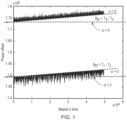
- Figure 1 shows the calculated instantaneous phase offset of timing messages over the forward and reverse paths between a master and slave, along with the true offset, changing over time.
- the time client(s) and the time server in embodiments of the invention are preferably connected by a network such as a packet network (using technologies such Ethernet, IP, MPLS, etc.).
- a network such as a packet network (using technologies such Ethernet, IP, MPLS, etc.).
- the timing messages are preferably timing messages under the IEEE 1588 Precision Time Protocol (PTP).
- PTP Precision Time Protocol
- Embodiments of the invention can generate an initial accurate estimation of the skew using a least squares fitting algorithm.
- the algorithm is a non-linear least squares fitting algorithm such as the Levenberg-Marquardt (LM) algorithm.
- LM Levenberg-Marquardt
- a previously found skew value may be used as an initial solution in the least squares fitting algorithm. This can improve the accuracy of the skew estimate produced.
- the fitting algorithm can be run once with an initial solution for the skew of zero. The algorithm can then be run again with a subsequent set of results and using the estimated skew produced in the first run as its initial solution.
- the embodiments of the invention are generally well-suited to generating an initial skew estimate, they are less well-suited to the continuous updating of the skew and offset estimates. Therefore, the subsequent synchronization steps preferably utilise a different algorithm.
- Embodiments of the invention may further include adjusting the output of the local clock by applying the calculated instantaneous phase offset and instantaneous skew to produce a local clock output which is synchronised with the master clock.
- an estimation technique such as Kalman filtering, or some other suitable technique, is usually employed.
- estimation techniques can take a significant length of time to converge. The rate of convergence of most estimation algorithms can be dramatically improved by providing the algorithm with an accurate initial skew estimate.
- Embodiments of the present invention provide techniques which generate an accurate initial estimate skew estimate which can then be used in the conventional estimation technique.
- the initial skew estimate, along with an estimate of the instantaneous phase offset is derived from a set of timestamps T 1 , T 2 , T 3 , T 4 using a non-linear least squares-fitting algorithm which, in specific embodiments, is the Levenberg-Marquardt algorithm.
- the timestamps T 1 , T 2 , T 3 , T 4 are the standard time-stamps obtained from an exchange of timing messages between a master and a slave device, for example using the IEEE 1588 Precision Time Protocol (PTP), and represent, respectively, the time of sending of a first timing message from the master to the slave, the time of receipt of the first timing message at the slave, the time of sending of a second timing message from the slave to the master and the time of receipt of the second timing message at the slave.
- PTP Precision Time Protocol
- ⁇ n ⁇ n ⁇ 1 + ⁇ n ⁇ 1 ⁇ T n
- the approach of the embodiments described below is to solve the problem optimally (like linear programming), but much more efficiency, by mixing the two approaches, i.e., a combination of function fitting and optimality of linear programming using the Levenberg-Marquardt (LM) algorithm [1].
- LM Levenberg-Marquardt
- a number of other least squares fitting algorithms can be used, such as gradient methods (Gradient Descent (steepest descent), Newton's method, Gauss-Newton's methods), QR & Singular Value Decomposition methods, direct search methods (Nelder-Mead search).
- it could be any least squares fitting algorithm that solves a problem defined by a proprietary cost function, such as the one defined below by equations 4-7.
- the LM algorithm is used to find an estimated skew value from a set of data points such that the chosen cost function is minimized.
- the goal that is set for the LM algorithm is to find a transformation function, which when applied to each data point, minimizes the cost function between each data point and the ideal instantaneous phase offset. The skew can then be estimated from the transformation function.
- cost function has a direct impact on the type of data transformation that is selected and is critical to how well the system performs. It is believed that the cost function described below and used in embodiments of the present invention provides an optimum solution.
- y(i) are the observed/measured data to be fitted
- M is the function model
- x is a vector of parameters being estimated by a fitting algorithm
- t i are the time instants at which the model M should fit the values y ( i ).
- a cost function such as the one in equation 4a, is required that enables the skew parameter to be estimated in the optimal way (similar to a linear programming approach).
- This cost function forces the LM algorithm to find an estimated skew which minimizes the distance of all data points from the notional horizontal line (zero skew) and also ensures that phase offset corresponding to the most minimally delayed packet is located on the no skew line.
- the skew estimate ⁇ is discovered, which is as close to the true ⁇ as possible, given the data in the current window.
- the LM algorithm Whilst the LM algorithm is ideal for generating the initial skew estimate, it is not as well suited to the continuous updating of the skew and instantaneous phase offset estimates.
- the LM algorithm requires many less samples (which translates directly to less time) compared to, for example, a Kalman filter approach, to find an initial accurate skew estimate.
- the LM algorithm also has relatively low computational complexity. However, a Kalman filter is overall much more computationally efficient, especially when executing using only a few minimally delayed packets. If the LM algorithm was operated continuously it would find the same minimally delayed packets, but it would require much more computation to do so.
- the preferred approach according to the present embodiment is to use the LM algorithm to find an initial skew estimate, calculate the initial instantaneous phase offset using the minimally delayed packets and then operate a Kalman filter thereafter. Due to the precision of the estimated skew that can be derived from the use of the LM algorithm, accurate minimally delayed packets are available to the Kalman filter from the start.
- the number of iterations needed to find the optimal solution can be significantly reduced by using a previously found skew value as an initial solution x 0 to the LM algorithm.
- the first run of the LM algorithm may be initialized with x 0 set to zero.
- the number of data points used in equations 7a and 7b above can be reduced by data selection prior to passing them to the LM algorithm. For example, only data points which are above (for ⁇ Ef ) and below (for ⁇ Er ) the running mean of ⁇ Ef , ⁇ Er respectively add new information.
- the running mean can, for example, be implemented as a simple exponentially weighted moving average filter with a time constant ⁇ set to 100.
- Equations 7a and 7b can be computed separately or combined into one cost function. When computed separately, two clock skew estimates are obtained, whereas only one is obtained if there is a single cost function. Different methods can be used to combine the two clock skew estimates.
- ⁇ ( ⁇ f + ⁇ r )/2
- ⁇ ⁇ 1 f Ef ⁇ ⁇ f ⁇ ⁇ f + 1 f Er ⁇ ⁇ r ⁇ ⁇ r / 1 f Ef ⁇ ⁇ f + 1 f Er ⁇ ⁇ r , where f Ef ( ⁇ f ) and f Er ( ⁇ r ) are derived from equations 7a and 7b respectively, and can serve as the quality of fitness factor. It can be seen that the better the fit, i.e., lower value of the cost function, the higher the weighting factor.
- one skew estimate may be selected from those available, based on the cost function. For example, the skew estimate with lower cost function (from either the forward or reverse direction) is selected.
- the forward and reverse cost functions may both be included in a combined LM estimation algorithm.
- a computer system includes the hardware, software and data storage devices for embodying a system or carrying out a method according to the above described embodiments.
- a computer system may comprise a central processing unit (CPU), input means, output means and data storage.
- the computer system has a monitor to provide a visual output display.
- the data storage may comprise RAM, disk drives or other computer readable media.
- the computer system may include a plurality of computing devices connected by a network and able to communicate with each other over that network.
- the methods of the above embodiments may be provided as computer programs or as computer program products or computer readable media carrying a computer program which is arranged, when run on a computer, to perform the method(s) described above.
- computer readable media includes, without limitation, any non-transitory medium or media which can be read and accessed directly by a computer or computer system.
- the media can include, but are not limited to, magnetic storage media such as floppy discs, hard disc storage media and magnetic tape; optical storage media such as optical discs or CD-ROMs; electrical storage media such as memory, including RAM, ROM and flash memory; and hybrids and combinations of the above such as magnetic/optical storage media.
Landscapes
- Engineering & Computer Science (AREA)
- Computer Networks & Wireless Communication (AREA)
- Signal Processing (AREA)
- Synchronisation In Digital Transmission Systems (AREA)
Claims (14)
- Verfahren zum Schätzen eines Versatzwertes eines lokalen Taktgebers eines Zeitclients im Vergleich zu einem Haupttaktgeber eines Zeitservers, wobei das Verfahren die folgenden Schritte enthält:Austauschen, zwischen dem Zeitserver und dem Zeitclient, von Zeitnachrichten und Zeitstempeln, die die Sende- und Empfangszeiten der Zeitnachrichten darstellen; undSchätzen eines Versatzwertes des lokalen Taktgebers unter Verwendung eines Anpassungsalgorithmus der kleinsten Quadrate,dadurch gekennzeichnet, dass der Anpassungsalgorithmus der kleinsten Quadrate eine Kostenfunktion zwischen jedem Datenpunkt in einem Datensatz und einem Nullversatzzustand minimiert, wobei jeder Datenpunkt in dem Datensatz eine aus den Zeitstempeln berechnete Phasenabweichung des lokalen Taktgebers darstellt.
- Verfahren nach Anspruch 1, das ferner den Schritt umfasst, den geschätzten Versatzwert des lokalen Taktgebers als anfänglichen Versatzwert in einem Verfahren zur Synchronisation zu verwenden, das wiederholt die Abweichung und den Versatz des lokalen Taktgebers berechnet.
- Verfahren nach Anspruch 1 oder Anspruch 2, wobei der Schritt des Schätzens eine erste Kostenfunktion und eine zweite Kostenfunktion minimiert, wobei:die erste Kostenfunktion sich auf einen Vorwärtsübertragungspfad bezieht, der der Übertragung von ersten Zeitnachrichten vom Zeitserver zum Zeitclient entspricht, und bewirkt, dass der Phasenabweichungsdatenpunkt, der der am wenigsten verzögerten Nachricht unter den ersten Zeitnachrichten entspricht, einem geschätzten Nullversatzzustand für den Vorwärtsübertragungspfad entspricht, unddie zweite Kostenfunktion sich auf einen umgekehrten Übertragungspfad bezieht, der der Übertragung von zweiten Zeitnachrichten von dem Zeitclient zu dem Zeitserver entspricht, und bewirkt, dass der Phasenabweichungsdatenpunkt, der der am wenigsten verzögerten Nachricht unter den zweiten Zeitnachrichten entspricht, einem geschätzten Nullversatzzustand für den umgekehrten Übertragungspfad entspricht, und
- Verfahren nach Anspruch 3, wobei die erste Kostenfunktion fEf (x,i) für den Vorwärtsübertragungspfad folgende Form aufweist:
 θEf [i] = T 1[i] - T 2[i] die gemessene Phasenabweichung ist, die dem Vorwärtsübertragungspfad zur Zeit der i-ten ersten Zeitnachricht entspricht, wobei T1[i] der Zeitstempel ist, der vom Zeitserver beim Senden der i-ten ersten Zeitnachricht aufgezeichnet wurde und T2[i] die Empfangszeit ist, die vom Zeitclient beim Empfang der i-ten ersten Zeitnachricht aufgezeichnet wurde;x ein Parameter ist, bezüglich dessen der Anpassungsalgorithmus der kleinsten Quadrate fEf (x,i) minimiert, wobei der Wert von x, für den fEf (x,i) minimiert wird, dem geschätzten Versatzwert αf für den Vorwärtsübertragungspfad entspricht,Nf (x,i) = x(T 1[i] - T 1[0]) eine normalisierende Funktion der Phasenabweichung θEf[i] ist und der Index i sich auf ein bestimmtes Fenster von Zeitnachrichten und die entsprechenden Zeitstempel bezieht.
 - Verfahren nach Anspruch 4, wobei nur Datenpunkte, die einem Wert von θEf [i] entsprechen, der höher als ein laufender Mittelwert von θEf ist, in der ersten Kostenfunktion fEf (x,i) verwendet werden.
- Verfahren nach einem der Ansprüche 3 bis 5, wobei die zweite Kostenfunktion fEr (x,i) für den umgekehrten Übertragungspfad folgende Form aufweist:
 θEr [i] = T 4[i] - T 3[i] die gemessene Phasenabweichung ist, die dem umgekehrten Übertragungspfad zur Zeit der i-ten zweiten Zeitnachricht entspricht, wobei T3 [i] der Zeitstempel ist, der vom Zeitclient beim Senden der i-ten zweiten Zeitnachricht aufgezeichnet wurde und T4 [i] die Empfangszeit ist, die vom Zeitserver beim Empfang der i-ten zweiten Zeitnachricht aufgezeichnet wurde;x ein Parameter ist, bezüglich dessen der Anpassungsalgorithmus der kleinsten Quadrate fEr (x,i) minimiert, wobei der Wert von x, für den fEr (x,i) minimiert wird, dem geschätzten Versatzwert αr für den umgekehrten Übertragungspfadentspricht;Nr (x, i) = x(T 4[i] - T 4[0]) eine normalisierende Funktion der Phasenabweichung θEr [i] ist und der Index i sich auf ein bestimmtes Fenster von Zeitnachrichten und die entsprechenden Zeitstempel bezieht.
 - Verfahren nach Anspruch 6, wobei nur Datenpunkte, die einem Wert von θEr [i] entsprechen, der niedriger als ein laufender Mittelwert von θEr ist, in der zweiten Kostenfunktion fEr (x,i) verwendet werden.
- Verfahren nach einem der Ansprüche 3 bis 7, wobei der Versatzwert α des lokalen Taktgebers geschätzt wird durch:Schätzen des Versatzwertes αf für den Vorwärtsübertragungspfad unter Verwendung des Anpassungsalgorithmus der kleinsten Quadrate, um die erste Kostenfunktion zu minimieren;Schätzen des Versatzwertes αr für den Rückwärtsübertragungspfad unter Verwendung des Anpassungsalgorithmus der kleinsten Quadrate, um die zweite Kostenfunktion zu minimieren; und Berechnen von α aus einem Durchschnitt von αf und αr.
- Verfahren nach einem der Ansprüche 3 bis 8, wobei der Versatzwert α des lokalen Taktgebers geschätzt wird durch:Schätzen des Versatzwertes αf für den Vorwärtsübertragungspfad unter Verwendung des Anpassungsalgorithmus der kleinsten Quadrate, um die erste Kostenfunktion zu minimieren;Schätzen des Versatzwertes αr für den Rückwärtsübertragungspfad unter Verwendung des Anpassungsalgorithmus der kleinsten Quadrate, um die zweite Kostenfunktion zu minimieren; undFestlegen von α als dasjenige von αf und αr , für das die entsprechende minimierte Kostenfunktion den niedrigsten Wert hat.
- Verfahren nach einem der Ansprüche 3 bis 9, wobei der Versatzwert α des lokalen Taktgebers geschätzt wird durch:Definieren einer kombinierten Kostenfunktion, die sowohl die erste Kostenfunktion als auch die zweite Kostenfunktion enthält; undSchätzen von α durch Verwendung des Anpassungsalgorithmus der kleinsten Quadrate, um die kombinierte Kostenfunktion zu minimieren.
- Zeitclient, der über ein Netzwerk mit einem Zeitserver gekoppelt ist, wobei der Zeitclient umfasst:einen lokalen Taktgeber; undeine Steuereinheit;wobei die Steuereinheit für Folgendes konfiguriert ist:Austauschen mit dem Zeitserver, von Zeitnachrichten und Zeitstempeln, die die Sende- und Empfangszeiten der Zeitnachrichten darstellen; undSchätzen eines Versatzwertes des lokalen Taktgebers unter Verwendung eines Anpassungsalgorithmus der kleinsten Quadrate,dadurch gekennzeichnet, dass der Anpassungsalgorithmus der kleinsten Quadrate eine Kostenfunktion zwischen jedem Datenpunkt in einem Datensatz und einem Nullversatzzustand minimiert, wobei jeder Datenpunkt in dem Datensatz eine aus den Zeitstempeln berechnete Phasenabweichung des lokalen Taktgebers darstellt.
- Zeitclient nach Anspruch 11, wobei die Steuereinheit dafür konfiguriert ist, das Verfahren nach einem der Ansprüche 2 - 10 durchzuführen.
- Vernetztes Zeitsystem, das einen Zeitserver und mindestens einen Zeitclient enthält, der über ein Netzwerk mit dem Zeitserver gekoppelt ist, wobei:der Zeitserver einen Haupttaktgeber enthält und dafür konfiguriert ist, mit dem Zeitclient Zeitnachrichten und Zeitstempel auszutauschen, die die Sende- und Empfangszeiten der Zeitnachrichten darstellen;der Zeitclient einen lokalen Taktgeber und eine Steuereinheit enthält;wobei die Steuereinheit für Folgendes konfiguriert ist:Austauschen mit dem Zeitserver, von Zeitnachrichten und Zeitstempeln, die die Sende- und Empfangszeiten der Zeitnachrichten darstellen; undSchätzen eines Versatzwertes des lokalen Taktgebers unter Verwendung eines Anpassungsalgorithmus der kleinsten Quadrate,dadurch gekennzeichnet, dass der Anpassungsalgorithmus der kleinsten Quadrate eine Kostenfunktion zwischen jedem Datenpunkt in einem Datensatz und einem Nullversatzzustand minimiert, wobei jeder Datenpunkt in dem Datensatz eine aus den Zeitstempeln berechnete Phasenabweichung des lokalen Taktgebers darstellt.
- Vernetztes Zeitsystem nach Anspruch 13, wobei die Steuereinheit dafür konfiguriert ist, das Verfahren nach einem der Ansprüche 2 bis 10 durchzuführen.
Applications Claiming Priority (1)
| Application Number | Priority Date | Filing Date | Title |
|---|---|---|---|
| PCT/GB2016/051723 WO2017212205A1 (en) | 2016-06-10 | 2016-06-10 | Methods and systems for skew estimation |
Publications (2)
| Publication Number | Publication Date |
|---|---|
| EP3469747A1 EP3469747A1 (de) | 2019-04-17 |
| EP3469747B1 true EP3469747B1 (de) | 2024-09-04 |
Family
ID=56134393
Family Applications (1)
| Application Number | Title | Priority Date | Filing Date |
|---|---|---|---|
| EP16729972.6A Active EP3469747B1 (de) | 2016-06-10 | 2016-06-10 | Verfahren und systeme zur schräglagenschätzung |
Country Status (2)
| Country | Link |
|---|---|
| EP (1) | EP3469747B1 (de) |
| WO (1) | WO2017212205A1 (de) |
Families Citing this family (2)
| Publication number | Priority date | Publication date | Assignee | Title |
|---|---|---|---|---|
| CN113965437B (zh) * | 2021-11-09 | 2022-11-01 | 上海矽昌微电子有限公司 | 一种ofdm通信系统的频域频偏估计方法和系统 |
| CN114301562B (zh) * | 2021-12-13 | 2023-05-26 | 西南科技大学 | 一种无线网络时间同步的周期自适应方法及系统 |
Family Cites Families (4)
| Publication number | Priority date | Publication date | Assignee | Title |
|---|---|---|---|---|
| WO2005002100A1 (en) * | 2003-06-30 | 2005-01-06 | Koninklijke Philips Electronics N.V. | High accuracy network clock synchronization |
| US9049225B2 (en) * | 2008-09-12 | 2015-06-02 | University Of Utah Research Foundation | Method and system for detecting unauthorized wireless access points using clock skews |
| US8644348B2 (en) * | 2011-04-20 | 2014-02-04 | Symmetricom, Inc. | Method for generating a robust timing correction in timing transfer systems |
| US9236967B1 (en) * | 2012-10-05 | 2016-01-12 | Integrated Device Technology, Inc. | Methods of packet-based synchronization in non-stationary network environments |
-
2016
- 2016-06-10 EP EP16729972.6A patent/EP3469747B1/de active Active
- 2016-06-10 WO PCT/GB2016/051723 patent/WO2017212205A1/en not_active Ceased
Also Published As
| Publication number | Publication date |
|---|---|
| EP3469747A1 (de) | 2019-04-17 |
| WO2017212205A1 (en) | 2017-12-14 |
Similar Documents
| Publication | Publication Date | Title |
|---|---|---|
| US10284414B2 (en) | Systems and methods for estimating skew | |
| US10608764B2 (en) | Methods and systems for synchronization using delay asymmetry | |
| US9671822B2 (en) | Method and devices for time transfer using end-to-end transparent clocks | |
| US10142088B2 (en) | Network clock skew estimation and calibration | |
| US7876791B2 (en) | Synchronizing apparatus and method in packet network | |
| US8018972B2 (en) | Timing over packet performance | |
| US10404393B2 (en) | Clock synchronization method and apparatus | |
| US9112628B2 (en) | Method and devices for compensating for path asymmetry | |
| US7688865B2 (en) | Method and system for clock skew and offset estimation | |
| US20090037758A1 (en) | Use of t4 timestamps to calculate clock offset and skew | |
| EP3053289B1 (de) | Verfahren und einrichtungen zur kompensation von wegasymmetrie | |
| US9270607B2 (en) | Method and devices for packet selection | |
| US20180145863A1 (en) | Methods and systems for determining optimal packets | |
| US20080151771A1 (en) | Delay measurements in network traffic | |
| EP2893656B1 (de) | Verfahren und vorrichtung zur schätzung von uhrdifferenz und gangunterschied | |
| JP4931108B2 (ja) | 高精度時刻同期処理装置およびそのプログラム,ならびにネットワーク混雑度警告装置およびそのプログラム | |
| EP3231110B1 (de) | Verfahren und vorrichtungen zur zeitübertragung mittel transparenten takten zwischen endpunkten | |
| US7822072B2 (en) | Clock filter dispersion | |
| WO2017212205A1 (en) | Methods and systems for skew estimation | |
| CN106612152A (zh) | 一种用于精确评估ieee1588同步时钟时间偏移估计量下界的方法 | |
| EP3545633B1 (de) | Verfahren und systeme zur synchronisierung mit verzögerungsasymmetrie | |
| Khlifi et al. | Low-complexity offline and online clock skew estimation and removal | |
| EP3824573B1 (de) | Peer-to-peer-transparente uhren und verfahren zum schätzen von skew in peer-to-peer transparenten uhren | |
| EP3545634B1 (de) | Verfahren und systeme zum bestimmen optimaler nachrichten | |
| EP3080951B1 (de) | Paketauswahlverfahren und -vorrichtungen |
Legal Events
| Date | Code | Title | Description |
|---|---|---|---|
| STAA | Information on the status of an ep patent application or granted ep patent |
Free format text: STATUS: THE INTERNATIONAL PUBLICATION HAS BEEN MADE |
|
| PUAI | Public reference made under article 153(3) epc to a published international application that has entered the european phase |
Free format text: ORIGINAL CODE: 0009012 |
|
| STAA | Information on the status of an ep patent application or granted ep patent |
Free format text: STATUS: REQUEST FOR EXAMINATION WAS MADE |
|
| 17P | Request for examination filed |
Effective date: 20190108 |
|
| AK | Designated contracting states |
Kind code of ref document: A1 Designated state(s): AL AT BE BG CH CY CZ DE DK EE ES FI FR GB GR HR HU IE IS IT LI LT LU LV MC MK MT NL NO PL PT RO RS SE SI SK SM TR |
|
| AX | Request for extension of the european patent |
Extension state: BA ME |
|
| RAP1 | Party data changed (applicant data changed or rights of an application transferred) |
Owner name: EMIRATES TELECOMMUNICATIONS CORPORATION Owner name: BRITISH TELECOMMUNICATIONS PUBLIC LIMITED COMPANY Owner name: KHALIFA UNIVERSITY OF SCIENCE AND TECHNOLOGY |
|
| DAV | Request for validation of the european patent (deleted) | ||
| DAX | Request for extension of the european patent (deleted) | ||
| STAA | Information on the status of an ep patent application or granted ep patent |
Free format text: STATUS: EXAMINATION IS IN PROGRESS |
|
| 17Q | First examination report despatched |
Effective date: 20210414 |
|
| GRAP | Despatch of communication of intention to grant a patent |
Free format text: ORIGINAL CODE: EPIDOSNIGR1 |
|
| STAA | Information on the status of an ep patent application or granted ep patent |
Free format text: STATUS: GRANT OF PATENT IS INTENDED |
|
| INTG | Intention to grant announced |
Effective date: 20230601 |
|
| GRAJ | Information related to disapproval of communication of intention to grant by the applicant or resumption of examination proceedings by the epo deleted |
Free format text: ORIGINAL CODE: EPIDOSDIGR1 |
|
| STAA | Information on the status of an ep patent application or granted ep patent |
Free format text: STATUS: EXAMINATION IS IN PROGRESS |
|
| INTC | Intention to grant announced (deleted) | ||
| GRAP | Despatch of communication of intention to grant a patent |
Free format text: ORIGINAL CODE: EPIDOSNIGR1 |
|
| STAA | Information on the status of an ep patent application or granted ep patent |
Free format text: STATUS: GRANT OF PATENT IS INTENDED |
|
| INTG | Intention to grant announced |
Effective date: 20240625 |
|
| GRAS | Grant fee paid |
Free format text: ORIGINAL CODE: EPIDOSNIGR3 |
|
| GRAA | (expected) grant |
Free format text: ORIGINAL CODE: 0009210 |
|
| STAA | Information on the status of an ep patent application or granted ep patent |
Free format text: STATUS: THE PATENT HAS BEEN GRANTED |
|
| AK | Designated contracting states |
Kind code of ref document: B1 Designated state(s): AL AT BE BG CH CY CZ DE DK EE ES FI FR GB GR HR HU IE IS IT LI LT LU LV MC MK MT NL NO PL PT RO RS SE SI SK SM TR |
|
| REG | Reference to a national code |
Ref country code: GB Ref legal event code: FG4D |
|
| REG | Reference to a national code |
Ref country code: CH Ref legal event code: EP |
|
| REG | Reference to a national code |
Ref country code: IE Ref legal event code: FG4D |
|
| REG | Reference to a national code |
Ref country code: DE Ref legal event code: R096 Ref document number: 602016089223 Country of ref document: DE |
|
| REG | Reference to a national code |
Ref country code: LT Ref legal event code: MG9D |
|
| REG | Reference to a national code |
Ref country code: NL Ref legal event code: MP Effective date: 20240904 |
|
| PG25 | Lapsed in a contracting state [announced via postgrant information from national office to epo] |
Ref country code: NO Free format text: LAPSE BECAUSE OF FAILURE TO SUBMIT A TRANSLATION OF THE DESCRIPTION OR TO PAY THE FEE WITHIN THE PRESCRIBED TIME-LIMIT Effective date: 20241204 |
|
| PG25 | Lapsed in a contracting state [announced via postgrant information from national office to epo] |
Ref country code: PL Free format text: LAPSE BECAUSE OF FAILURE TO SUBMIT A TRANSLATION OF THE DESCRIPTION OR TO PAY THE FEE WITHIN THE PRESCRIBED TIME-LIMIT Effective date: 20240904 Ref country code: GR Free format text: LAPSE BECAUSE OF FAILURE TO SUBMIT A TRANSLATION OF THE DESCRIPTION OR TO PAY THE FEE WITHIN THE PRESCRIBED TIME-LIMIT Effective date: 20241205 Ref country code: FI Free format text: LAPSE BECAUSE OF FAILURE TO SUBMIT A TRANSLATION OF THE DESCRIPTION OR TO PAY THE FEE WITHIN THE PRESCRIBED TIME-LIMIT Effective date: 20240904 |
|
| PG25 | Lapsed in a contracting state [announced via postgrant information from national office to epo] |
Ref country code: BG Free format text: LAPSE BECAUSE OF FAILURE TO SUBMIT A TRANSLATION OF THE DESCRIPTION OR TO PAY THE FEE WITHIN THE PRESCRIBED TIME-LIMIT Effective date: 20240904 |
|
| PG25 | Lapsed in a contracting state [announced via postgrant information from national office to epo] |
Ref country code: LV Free format text: LAPSE BECAUSE OF FAILURE TO SUBMIT A TRANSLATION OF THE DESCRIPTION OR TO PAY THE FEE WITHIN THE PRESCRIBED TIME-LIMIT Effective date: 20240904 |
|
| PG25 | Lapsed in a contracting state [announced via postgrant information from national office to epo] |
Ref country code: HR Free format text: LAPSE BECAUSE OF FAILURE TO SUBMIT A TRANSLATION OF THE DESCRIPTION OR TO PAY THE FEE WITHIN THE PRESCRIBED TIME-LIMIT Effective date: 20240904 |
|
| PG25 | Lapsed in a contracting state [announced via postgrant information from national office to epo] |
Ref country code: ES Free format text: LAPSE BECAUSE OF FAILURE TO SUBMIT A TRANSLATION OF THE DESCRIPTION OR TO PAY THE FEE WITHIN THE PRESCRIBED TIME-LIMIT Effective date: 20240904 Ref country code: RS Free format text: LAPSE BECAUSE OF FAILURE TO SUBMIT A TRANSLATION OF THE DESCRIPTION OR TO PAY THE FEE WITHIN THE PRESCRIBED TIME-LIMIT Effective date: 20241204 |
|
| PG25 | Lapsed in a contracting state [announced via postgrant information from national office to epo] |
Ref country code: RS Free format text: LAPSE BECAUSE OF FAILURE TO SUBMIT A TRANSLATION OF THE DESCRIPTION OR TO PAY THE FEE WITHIN THE PRESCRIBED TIME-LIMIT Effective date: 20241204 Ref country code: PL Free format text: LAPSE BECAUSE OF FAILURE TO SUBMIT A TRANSLATION OF THE DESCRIPTION OR TO PAY THE FEE WITHIN THE PRESCRIBED TIME-LIMIT Effective date: 20240904 Ref country code: NO Free format text: LAPSE BECAUSE OF FAILURE TO SUBMIT A TRANSLATION OF THE DESCRIPTION OR TO PAY THE FEE WITHIN THE PRESCRIBED TIME-LIMIT Effective date: 20241204 Ref country code: LV Free format text: LAPSE BECAUSE OF FAILURE TO SUBMIT A TRANSLATION OF THE DESCRIPTION OR TO PAY THE FEE WITHIN THE PRESCRIBED TIME-LIMIT Effective date: 20240904 Ref country code: HR Free format text: LAPSE BECAUSE OF FAILURE TO SUBMIT A TRANSLATION OF THE DESCRIPTION OR TO PAY THE FEE WITHIN THE PRESCRIBED TIME-LIMIT Effective date: 20240904 Ref country code: GR Free format text: LAPSE BECAUSE OF FAILURE TO SUBMIT A TRANSLATION OF THE DESCRIPTION OR TO PAY THE FEE WITHIN THE PRESCRIBED TIME-LIMIT Effective date: 20241205 Ref country code: FI Free format text: LAPSE BECAUSE OF FAILURE TO SUBMIT A TRANSLATION OF THE DESCRIPTION OR TO PAY THE FEE WITHIN THE PRESCRIBED TIME-LIMIT Effective date: 20240904 Ref country code: ES Free format text: LAPSE BECAUSE OF FAILURE TO SUBMIT A TRANSLATION OF THE DESCRIPTION OR TO PAY THE FEE WITHIN THE PRESCRIBED TIME-LIMIT Effective date: 20240904 Ref country code: BG Free format text: LAPSE BECAUSE OF FAILURE TO SUBMIT A TRANSLATION OF THE DESCRIPTION OR TO PAY THE FEE WITHIN THE PRESCRIBED TIME-LIMIT Effective date: 20240904 |
|
| REG | Reference to a national code |
Ref country code: AT Ref legal event code: MK05 Ref document number: 1721490 Country of ref document: AT Kind code of ref document: T Effective date: 20240904 |
|
| PG25 | Lapsed in a contracting state [announced via postgrant information from national office to epo] |
Ref country code: NL Free format text: LAPSE BECAUSE OF FAILURE TO SUBMIT A TRANSLATION OF THE DESCRIPTION OR TO PAY THE FEE WITHIN THE PRESCRIBED TIME-LIMIT Effective date: 20240904 |
|
| PG25 | Lapsed in a contracting state [announced via postgrant information from national office to epo] |
Ref country code: IS Free format text: LAPSE BECAUSE OF FAILURE TO SUBMIT A TRANSLATION OF THE DESCRIPTION OR TO PAY THE FEE WITHIN THE PRESCRIBED TIME-LIMIT Effective date: 20250104 Ref country code: PT Free format text: LAPSE BECAUSE OF FAILURE TO SUBMIT A TRANSLATION OF THE DESCRIPTION OR TO PAY THE FEE WITHIN THE PRESCRIBED TIME-LIMIT Effective date: 20250106 |
|
| PG25 | Lapsed in a contracting state [announced via postgrant information from national office to epo] |
Ref country code: RO Free format text: LAPSE BECAUSE OF FAILURE TO SUBMIT A TRANSLATION OF THE DESCRIPTION OR TO PAY THE FEE WITHIN THE PRESCRIBED TIME-LIMIT Effective date: 20240904 Ref country code: SM Free format text: LAPSE BECAUSE OF FAILURE TO SUBMIT A TRANSLATION OF THE DESCRIPTION OR TO PAY THE FEE WITHIN THE PRESCRIBED TIME-LIMIT Effective date: 20240904 |
|
| PG25 | Lapsed in a contracting state [announced via postgrant information from national office to epo] |
Ref country code: EE Free format text: LAPSE BECAUSE OF FAILURE TO SUBMIT A TRANSLATION OF THE DESCRIPTION OR TO PAY THE FEE WITHIN THE PRESCRIBED TIME-LIMIT Effective date: 20240904 Ref country code: AT Free format text: LAPSE BECAUSE OF FAILURE TO SUBMIT A TRANSLATION OF THE DESCRIPTION OR TO PAY THE FEE WITHIN THE PRESCRIBED TIME-LIMIT Effective date: 20240904 |
|
| PG25 | Lapsed in a contracting state [announced via postgrant information from national office to epo] |
Ref country code: CZ Free format text: LAPSE BECAUSE OF FAILURE TO SUBMIT A TRANSLATION OF THE DESCRIPTION OR TO PAY THE FEE WITHIN THE PRESCRIBED TIME-LIMIT Effective date: 20240904 |
|
| PG25 | Lapsed in a contracting state [announced via postgrant information from national office to epo] |
Ref country code: IT Free format text: LAPSE BECAUSE OF FAILURE TO SUBMIT A TRANSLATION OF THE DESCRIPTION OR TO PAY THE FEE WITHIN THE PRESCRIBED TIME-LIMIT Effective date: 20240904 Ref country code: SK Free format text: LAPSE BECAUSE OF FAILURE TO SUBMIT A TRANSLATION OF THE DESCRIPTION OR TO PAY THE FEE WITHIN THE PRESCRIBED TIME-LIMIT Effective date: 20240904 |
|
| REG | Reference to a national code |
Ref country code: DE Ref legal event code: R097 Ref document number: 602016089223 Country of ref document: DE |
|
| PGFP | Annual fee paid to national office [announced via postgrant information from national office to epo] |
Ref country code: DE Payment date: 20250402 Year of fee payment: 10 |
|
| PG25 | Lapsed in a contracting state [announced via postgrant information from national office to epo] |
Ref country code: DK Free format text: LAPSE BECAUSE OF FAILURE TO SUBMIT A TRANSLATION OF THE DESCRIPTION OR TO PAY THE FEE WITHIN THE PRESCRIBED TIME-LIMIT Effective date: 20240904 |
|
| PGFP | Annual fee paid to national office [announced via postgrant information from national office to epo] |
Ref country code: GB Payment date: 20250401 Year of fee payment: 10 |
|
| PLBE | No opposition filed within time limit |
Free format text: ORIGINAL CODE: 0009261 |
|
| STAA | Information on the status of an ep patent application or granted ep patent |
Free format text: STATUS: NO OPPOSITION FILED WITHIN TIME LIMIT |
|
| PGFP | Annual fee paid to national office [announced via postgrant information from national office to epo] |
Ref country code: FR Payment date: 20250401 Year of fee payment: 10 |
|
| 26N | No opposition filed |
Effective date: 20250605 |
|
| PG25 | Lapsed in a contracting state [announced via postgrant information from national office to epo] |
Ref country code: SE Free format text: LAPSE BECAUSE OF FAILURE TO SUBMIT A TRANSLATION OF THE DESCRIPTION OR TO PAY THE FEE WITHIN THE PRESCRIBED TIME-LIMIT Effective date: 20240904 |
|
| REG | Reference to a national code |
Ref country code: CH Ref legal event code: H13 Free format text: ST27 STATUS EVENT CODE: U-0-0-H10-H13 (AS PROVIDED BY THE NATIONAL OFFICE) Effective date: 20260127 |
|
| PG25 | Lapsed in a contracting state [announced via postgrant information from national office to epo] |
Ref country code: MC Free format text: LAPSE BECAUSE OF FAILURE TO SUBMIT A TRANSLATION OF THE DESCRIPTION OR TO PAY THE FEE WITHIN THE PRESCRIBED TIME-LIMIT Effective date: 20240904 |
|
| PG25 | Lapsed in a contracting state [announced via postgrant information from national office to epo] |
Ref country code: LU Free format text: LAPSE BECAUSE OF NON-PAYMENT OF DUE FEES Effective date: 20250610 |
|
| REG | Reference to a national code |
Ref country code: BE Ref legal event code: MM Effective date: 20250630 |
|
| PG25 | Lapsed in a contracting state [announced via postgrant information from national office to epo] |
Ref country code: IE Free format text: LAPSE BECAUSE OF NON-PAYMENT OF DUE FEES Effective date: 20250610 |
|
| PG25 | Lapsed in a contracting state [announced via postgrant information from national office to epo] |
Ref country code: BE Free format text: LAPSE BECAUSE OF NON-PAYMENT OF DUE FEES Effective date: 20250630 |
|
| PG25 | Lapsed in a contracting state [announced via postgrant information from national office to epo] |
Ref country code: CH Free format text: LAPSE BECAUSE OF NON-PAYMENT OF DUE FEES Effective date: 20250630 |