EP3467744A1 - Mobile payment method, device and system - Google Patents
Mobile payment method, device and system Download PDFInfo
- Publication number
- EP3467744A1 EP3467744A1 EP17805692.5A EP17805692A EP3467744A1 EP 3467744 A1 EP3467744 A1 EP 3467744A1 EP 17805692 A EP17805692 A EP 17805692A EP 3467744 A1 EP3467744 A1 EP 3467744A1
- Authority
- EP
- European Patent Office
- Prior art keywords
- mobile device
- information
- payment
- mobile
- party server
- Prior art date
- Legal status (The legal status is an assumption and is not a legal conclusion. Google has not performed a legal analysis and makes no representation as to the accuracy of the status listed.)
- Withdrawn
Links
Images


Classifications
-
- G—PHYSICS
- G06—COMPUTING OR CALCULATING; COUNTING
- G06Q—INFORMATION AND COMMUNICATION TECHNOLOGY [ICT] SPECIALLY ADAPTED FOR ADMINISTRATIVE, COMMERCIAL, FINANCIAL, MANAGERIAL OR SUPERVISORY PURPOSES; SYSTEMS OR METHODS SPECIALLY ADAPTED FOR ADMINISTRATIVE, COMMERCIAL, FINANCIAL, MANAGERIAL OR SUPERVISORY PURPOSES, NOT OTHERWISE PROVIDED FOR
- G06Q20/00—Payment architectures, schemes or protocols
- G06Q20/30—Payment architectures, schemes or protocols characterised by the use of specific devices or networks
- G06Q20/32—Payment architectures, schemes or protocols characterised by the use of specific devices or networks using wireless devices
- G06Q20/325—Payment architectures, schemes or protocols characterised by the use of specific devices or networks using wireless devices using wireless networks
-
- G—PHYSICS
- G06—COMPUTING OR CALCULATING; COUNTING
- G06Q—INFORMATION AND COMMUNICATION TECHNOLOGY [ICT] SPECIALLY ADAPTED FOR ADMINISTRATIVE, COMMERCIAL, FINANCIAL, MANAGERIAL OR SUPERVISORY PURPOSES; SYSTEMS OR METHODS SPECIALLY ADAPTED FOR ADMINISTRATIVE, COMMERCIAL, FINANCIAL, MANAGERIAL OR SUPERVISORY PURPOSES, NOT OTHERWISE PROVIDED FOR
- G06Q20/00—Payment architectures, schemes or protocols
- G06Q20/02—Payment architectures, schemes or protocols involving a neutral party, e.g. certification authority, notary or trusted third party [TTP]
-
- G—PHYSICS
- G06—COMPUTING OR CALCULATING; COUNTING
- G06Q—INFORMATION AND COMMUNICATION TECHNOLOGY [ICT] SPECIALLY ADAPTED FOR ADMINISTRATIVE, COMMERCIAL, FINANCIAL, MANAGERIAL OR SUPERVISORY PURPOSES; SYSTEMS OR METHODS SPECIALLY ADAPTED FOR ADMINISTRATIVE, COMMERCIAL, FINANCIAL, MANAGERIAL OR SUPERVISORY PURPOSES, NOT OTHERWISE PROVIDED FOR
- G06Q20/00—Payment architectures, schemes or protocols
- G06Q20/22—Payment schemes or models
- G06Q20/223—Payment schemes or models based on the use of peer-to-peer networks
-
- G—PHYSICS
- G06—COMPUTING OR CALCULATING; COUNTING
- G06Q—INFORMATION AND COMMUNICATION TECHNOLOGY [ICT] SPECIALLY ADAPTED FOR ADMINISTRATIVE, COMMERCIAL, FINANCIAL, MANAGERIAL OR SUPERVISORY PURPOSES; SYSTEMS OR METHODS SPECIALLY ADAPTED FOR ADMINISTRATIVE, COMMERCIAL, FINANCIAL, MANAGERIAL OR SUPERVISORY PURPOSES, NOT OTHERWISE PROVIDED FOR
- G06Q20/00—Payment architectures, schemes or protocols
- G06Q20/30—Payment architectures, schemes or protocols characterised by the use of specific devices or networks
- G06Q20/32—Payment architectures, schemes or protocols characterised by the use of specific devices or networks using wireless devices
- G06Q20/322—Aspects of commerce using mobile devices [M-devices]
- G06Q20/3223—Realising banking transactions through M-devices
-
- G—PHYSICS
- G06—COMPUTING OR CALCULATING; COUNTING
- G06Q—INFORMATION AND COMMUNICATION TECHNOLOGY [ICT] SPECIALLY ADAPTED FOR ADMINISTRATIVE, COMMERCIAL, FINANCIAL, MANAGERIAL OR SUPERVISORY PURPOSES; SYSTEMS OR METHODS SPECIALLY ADAPTED FOR ADMINISTRATIVE, COMMERCIAL, FINANCIAL, MANAGERIAL OR SUPERVISORY PURPOSES, NOT OTHERWISE PROVIDED FOR
- G06Q20/00—Payment architectures, schemes or protocols
- G06Q20/30—Payment architectures, schemes or protocols characterised by the use of specific devices or networks
- G06Q20/32—Payment architectures, schemes or protocols characterised by the use of specific devices or networks using wireless devices
- G06Q20/327—Short range or proximity payments by means of M-devices
-
- G—PHYSICS
- G06—COMPUTING OR CALCULATING; COUNTING
- G06Q—INFORMATION AND COMMUNICATION TECHNOLOGY [ICT] SPECIALLY ADAPTED FOR ADMINISTRATIVE, COMMERCIAL, FINANCIAL, MANAGERIAL OR SUPERVISORY PURPOSES; SYSTEMS OR METHODS SPECIALLY ADAPTED FOR ADMINISTRATIVE, COMMERCIAL, FINANCIAL, MANAGERIAL OR SUPERVISORY PURPOSES, NOT OTHERWISE PROVIDED FOR
- G06Q20/00—Payment architectures, schemes or protocols
- G06Q20/30—Payment architectures, schemes or protocols characterised by the use of specific devices or networks
- G06Q20/32—Payment architectures, schemes or protocols characterised by the use of specific devices or networks using wireless devices
- G06Q20/327—Short range or proximity payments by means of M-devices
- G06Q20/3278—RFID or NFC payments by means of M-devices
-
- G—PHYSICS
- G06—COMPUTING OR CALCULATING; COUNTING
- G06Q—INFORMATION AND COMMUNICATION TECHNOLOGY [ICT] SPECIALLY ADAPTED FOR ADMINISTRATIVE, COMMERCIAL, FINANCIAL, MANAGERIAL OR SUPERVISORY PURPOSES; SYSTEMS OR METHODS SPECIALLY ADAPTED FOR ADMINISTRATIVE, COMMERCIAL, FINANCIAL, MANAGERIAL OR SUPERVISORY PURPOSES, NOT OTHERWISE PROVIDED FOR
- G06Q20/00—Payment architectures, schemes or protocols
- G06Q20/30—Payment architectures, schemes or protocols characterised by the use of specific devices or networks
- G06Q20/36—Payment architectures, schemes or protocols characterised by the use of specific devices or networks using electronic wallets or electronic money safes
- G06Q20/363—Payment architectures, schemes or protocols characterised by the use of specific devices or networks using electronic wallets or electronic money safes with the personal data of a user
-
- G—PHYSICS
- G06—COMPUTING OR CALCULATING; COUNTING
- G06Q—INFORMATION AND COMMUNICATION TECHNOLOGY [ICT] SPECIALLY ADAPTED FOR ADMINISTRATIVE, COMMERCIAL, FINANCIAL, MANAGERIAL OR SUPERVISORY PURPOSES; SYSTEMS OR METHODS SPECIALLY ADAPTED FOR ADMINISTRATIVE, COMMERCIAL, FINANCIAL, MANAGERIAL OR SUPERVISORY PURPOSES, NOT OTHERWISE PROVIDED FOR
- G06Q20/00—Payment architectures, schemes or protocols
- G06Q20/38—Payment protocols; Details thereof
- G06Q20/385—Payment protocols; Details thereof using an alias or single-use codes
-
- G—PHYSICS
- G06—COMPUTING OR CALCULATING; COUNTING
- G06Q—INFORMATION AND COMMUNICATION TECHNOLOGY [ICT] SPECIALLY ADAPTED FOR ADMINISTRATIVE, COMMERCIAL, FINANCIAL, MANAGERIAL OR SUPERVISORY PURPOSES; SYSTEMS OR METHODS SPECIALLY ADAPTED FOR ADMINISTRATIVE, COMMERCIAL, FINANCIAL, MANAGERIAL OR SUPERVISORY PURPOSES, NOT OTHERWISE PROVIDED FOR
- G06Q20/00—Payment architectures, schemes or protocols
- G06Q20/38—Payment protocols; Details thereof
- G06Q20/40—Authorisation, e.g. identification of payer or payee, verification of customer or shop credentials; Review and approval of payers, e.g. check credit lines or negative lists
-
- G—PHYSICS
- G06—COMPUTING OR CALCULATING; COUNTING
- G06Q—INFORMATION AND COMMUNICATION TECHNOLOGY [ICT] SPECIALLY ADAPTED FOR ADMINISTRATIVE, COMMERCIAL, FINANCIAL, MANAGERIAL OR SUPERVISORY PURPOSES; SYSTEMS OR METHODS SPECIALLY ADAPTED FOR ADMINISTRATIVE, COMMERCIAL, FINANCIAL, MANAGERIAL OR SUPERVISORY PURPOSES, NOT OTHERWISE PROVIDED FOR
- G06Q20/00—Payment architectures, schemes or protocols
- G06Q20/38—Payment protocols; Details thereof
- G06Q20/40—Authorisation, e.g. identification of payer or payee, verification of customer or shop credentials; Review and approval of payers, e.g. check credit lines or negative lists
- G06Q20/401—Transaction verification
- G06Q20/4014—Identity check for transactions
- G06Q20/40145—Biometric identity checks
-
- G—PHYSICS
- G06—COMPUTING OR CALCULATING; COUNTING
- G06Q—INFORMATION AND COMMUNICATION TECHNOLOGY [ICT] SPECIALLY ADAPTED FOR ADMINISTRATIVE, COMMERCIAL, FINANCIAL, MANAGERIAL OR SUPERVISORY PURPOSES; SYSTEMS OR METHODS SPECIALLY ADAPTED FOR ADMINISTRATIVE, COMMERCIAL, FINANCIAL, MANAGERIAL OR SUPERVISORY PURPOSES, NOT OTHERWISE PROVIDED FOR
- G06Q20/00—Payment architectures, schemes or protocols
- G06Q20/38—Payment protocols; Details thereof
- G06Q20/40—Authorisation, e.g. identification of payer or payee, verification of customer or shop credentials; Review and approval of payers, e.g. check credit lines or negative lists
- G06Q20/405—Establishing or using transaction specific rules
-
- G—PHYSICS
- G06—COMPUTING OR CALCULATING; COUNTING
- G06Q—INFORMATION AND COMMUNICATION TECHNOLOGY [ICT] SPECIALLY ADAPTED FOR ADMINISTRATIVE, COMMERCIAL, FINANCIAL, MANAGERIAL OR SUPERVISORY PURPOSES; SYSTEMS OR METHODS SPECIALLY ADAPTED FOR ADMINISTRATIVE, COMMERCIAL, FINANCIAL, MANAGERIAL OR SUPERVISORY PURPOSES, NOT OTHERWISE PROVIDED FOR
- G06Q20/00—Payment architectures, schemes or protocols
- G06Q20/30—Payment architectures, schemes or protocols characterised by the use of specific devices or networks
- G06Q20/32—Payment architectures, schemes or protocols characterised by the use of specific devices or networks using wireless devices
- G06Q20/326—Payment applications installed on the mobile devices
Definitions
- the first mobile device and the second mobile device can be a personal computer (PC), a tablet computer, a smartphone, a personal digital assistant (PDA), a portable computer, an in-vehicle computer, etc.
- PC personal computer
- PDA personal digital assistant
- portable computer an in-vehicle computer, etc.
- the first mobile device and the second mobile device are not limited in this implementation of the present disclosure.
- the first mobile device identifier information is sent by the first mobile device to the second mobile device, and the first mobile device can send the first mobile device identifier information to the second mobile device through Bluetooth, scanning, near field communication (NFC), or other communications technologies, which is not limited in this implementation of the present disclosure.
- the first mobile device sends the first mobile device identifier information to the second mobile device through Bluetooth, scanning, NFC, or other communications technologies, so that the first mobile device can perform a payment to the second mobile device without network access.
- the third-party server sends the payment information and the account information corresponding to the first mobile device identifier information to a corresponding bank after receiving the payment information and obtaining the account information corresponding to the first mobile device identifier information, so that the corresponding bank transfers the payment amount from the account corresponding to the first mobile device identifier information to the account corresponding to the payment APP currently running in the second mobile device.
- the third-party server correspondingly stores the account information of the first mobile device and the first mobile device identifier information after obtaining the first mobile device identifier information and the account information, so that the third-party server directly obtains the account information corresponding to the first mobile device identifier information from the account information stored in the third-party server when the first mobile device performs mobile payment again.
- the predetermined threshold can be 700, 800, 900, etc., and is not limited in this implementation of the present disclosure.
- the verification method information is sent to the second mobile device when the account credit information corresponding to the second mobile device exceeds the predetermined threshold, to ensure security of payment by the first mobile device.
- the first mobile device and the second mobile device in the present disclosure are devices authenticated by the IFAA or the Authority by using a PKI system, that is, a certificate authenticated by using the previous method is stored in security zones of the first mobile device and the second mobile device, and the certificate is sent to a third-party server for identity authentication.
- the first mobile device identifier information is used to uniquely identify the first mobile device.
- the first mobile device identifier information can be a unique hardware code of the first mobile device or a certificate of the first mobile device, and is not limited in this implementation of the present disclosure.
- the third-party server separately verifies whether the token information and the device certificate of the first mobile device are correct.
- the third-party server obtains account information corresponding to the first mobile device identifier information, if it is verified that both the token information and the device certificate of the first mobile device are correct, so that the payment amount can be transferred from an account corresponding to the first mobile device identifier information to the account corresponding to the payment APP currently running in the second mobile device.
- the account information corresponding to the first mobile device identifier information is obtained when it is verified that both the token information and the device certificate of the first mobile device are correct, to ensure security of payment by the first mobile device.
- the mobile payment device further includes a verification unit 64 and a sending unit 63.
- the enabling unit 66 is configured to enable a device authorization function of the second mobile device if the verification data is correct.
- the detection unit 65 is further configured to detect whether the account credit information corresponding to the second mobile device exceeds a predetermined threshold.
- the generation unit 67 is configured to generate token information corresponding to the first mobile device identifier information.
- the verification unit 64 is further configured to separately verify whether the token information and the device certificate of the first mobile device are correct.
- the mobile payment device includes a processor and a memory.
- the previously described receiving unit, the acquisition unit, the sending unit, the verification unit, the detection unit, the enabling unit, the generation unit, etc. are stored in the memory as program units.
- the processor executes the program units stored in the memory to implement corresponding functions.
- the implementations of the present application can be provided as a method, a system, or a computer program product. Therefore, the present application can use hardware only implementations, software only implementations, or implementations with a combination of software and hardware. In addition, the present application can use a form of a computer program product that is implemented on one or more computer-usable storage media (including but not limited to a disk memory, a CD-ROM, an optical memory, etc.) that include computer-usable program code.
- a computer-usable storage media including but not limited to a disk memory, a CD-ROM, an optical memory, etc.
- These computer program instructions can be stored in a computer readable memory that can instruct the computer or the another programmable data processing device to work in a specific way, so that the instructions stored in the computer readable memory generate an artifact that includes an instruction apparatus.
- the instruction apparatus implements a specific function in one or more flows in the flowcharts and/or in one or more blocks in the block diagrams.
- a computing device includes one or more processors (CPU), an input/output interface, a network interface, and a memory.
Landscapes
- Business, Economics & Management (AREA)
- Engineering & Computer Science (AREA)
- Accounting & Taxation (AREA)
- General Business, Economics & Management (AREA)
- Strategic Management (AREA)
- Physics & Mathematics (AREA)
- General Physics & Mathematics (AREA)
- Theoretical Computer Science (AREA)
- Computer Networks & Wireless Communication (AREA)
- Finance (AREA)
- Computer Security & Cryptography (AREA)
- Development Economics (AREA)
- Economics (AREA)
- Financial Or Insurance-Related Operations Such As Payment And Settlement (AREA)
Abstract
Description
- The present application claims priority to Chinese Patent Application No.
201610383679.6 - The present disclosure relates to the field of electronic financial technologies, and in particular, to a mobile payment method, device, and system.
- With the development and popularization of mobile technologies, mobile payment gradually becomes an emerging electronic payment service mode, and mobile payment is also referred to as smartphone payment. Mobile payment is a service method that allows mobile users to use their mobile devices (usually mobile phones) to perform a payment for merchandises or services. Compared with conventional electronic payment based on the Internet, mobile payment is more flexible, timely, customized, convenient, and with many other characteristics. During mobile payment transaction, fund processing systems such as the bank counter and the cashiering platform can be directly pushed to the user, so that the user can trade with various targets anytime anywhere using the mobile device.
- Currently, mobile payment is completed by using a payment application (APP) installed in the mobile device, that is, the user needs to send payment request information to a financial server by using the payment APP in the mobile device when performing financial payment. For example, the payment request information is sent by using ALIPAY or WECHAT in the mobile device, and the financial server performs a corresponding operation on a user account included in the payment request information after receiving the payment request information. Currently, mobile payment cannot be completed without installing the payment APP.
- In view of the previously described problem, the present disclosure is proposed to provide a mobile payment method, device, and system for resolving the problem or at least partially resolving the problem.
- To achieve the previous objective, the present disclosure mainly provides the technical solutions below.
- According to one aspect, an implementation of the present disclosure provides a mobile payment method, and the method includes the following: receiving payment information sent by a second mobile device, where the payment information includes first mobile device identifier information, an account corresponding to a payment APP currently running in the second mobile device, and a payment amount corresponding to the first mobile device identifier information, the first mobile device identifier information is sent by a first mobile device to the second mobile device, and no payment APP is installed in the first mobile device; and obtaining account information corresponding to the first mobile device identifier information, so that the payment amount can be transferred from an account corresponding to the first mobile device identifier information to the account corresponding to the payment APP currently running in the second mobile device.
- According to another aspect, an implementation of the present disclosure further provides a mobile payment method, and the method includes: receiving a payment request sent by a first mobile device, where the payment request includes first mobile device identifier information; and sending payment information to a third-party server, where the payment information includes the first mobile device identifier information, an account corresponding to a payment APP currently running in a second mobile device, and a payment amount corresponding to the first mobile device identifier information, so that the third-party server obtains account information corresponding to the first mobile device identifier information, and the payment amount can be transferred from an account corresponding to the first mobile device identifier information to the account corresponding to the payment APP currently running in the second mobile device.
- According to still another aspect, an implementation of the present disclosure further provides a mobile payment device, and the mobile payment device includes: a receiving unit, configured to receive payment information sent by a second mobile device, where the payment information includes first mobile device identifier information, an account corresponding to a payment APP currently running in the second mobile device, and a payment amount corresponding to the first mobile device identifier information, the first mobile device identifier information is sent by a first mobile device to the second mobile device, and no payment APP is installed in the first mobile device; and an acquisition unit, configured to obtain account information corresponding to the first mobile device identifier information, so that the payment amount can be transferred from an account corresponding to the first mobile device identifier information to the account corresponding to the payment APP currently running in the second mobile device.
- According to yet another aspect, an implementation of the present disclosure further provides a mobile payment device, and the mobile payment device includes: a receiving unit, configured to receive a payment request sent by a first mobile device, where the payment request includes first mobile device identifier information, and no payment APP is installed in the first mobile device; and a sending unit, configured to send payment information to a third-party server, where the payment information includes the first mobile device identifier information, an account corresponding to a payment APP currently running in a second mobile device, and a payment amount corresponding to the first mobile device identifier information, so that the third-party server obtains account information corresponding to the first mobile device identifier information, and the payment amount can be transferred from an account corresponding to the first mobile device identifier information to the account corresponding to the payment APP currently running in the second mobile device.
- An implementation of the present disclosure further provides a mobile payment system, and the mobile payment system includes a first mobile device, a second mobile device, and a third-party server. The first mobile device is configured to send a payment request to the second mobile device, where the payment request includes first mobile device identifier information, and no payment APP is installed in the first mobile device; the second mobile device is configured to send payment information to the third-party server, where the payment information includes the first mobile device identifier information, an account corresponding to a payment APP currently running in the second mobile device, and a payment amount corresponding to the first mobile device identifier information; and the third-party server is configured to obtain account information corresponding to the first mobile device identifier information, so that the payment amount can be transferred from an account corresponding to the first mobile device identifier information to the account corresponding to the payment APP currently running in the second mobile device.
- Based on the previous technical solutions, the technical solutions provided in the implementations of the present disclosure have at least the advantages below.
- According to the mobile payment method, device, and system provided in the implementations of the present disclosure, the payment information sent by the second mobile device is first received, where the payment information includes the first mobile device identifier information, the account corresponding to the payment APP currently running in the second mobile device, and the payment amount corresponding to the first mobile device identifier information; and then the account information corresponding to the first mobile device identifier information is obtained, so that the payment amount can be transferred from the account corresponding to the first mobile device identifier information to the account corresponding to the payment APP currently running in the second mobile device. Compared with the existing technology in which mobile payment needs to be completed by installing a payment APP in a mobile device, in the implementations of the present disclosure, when the first mobile device needs to perform a payment to the second mobile device, the payment information of the first mobile device can be sent to the third-party server by using the second mobile device, where the payment information includes the first mobile device identifier information; and the third-party server obtains the account information corresponding to the first mobile device identifier information after receiving the payment information, so that the payment amount can be transferred from the account corresponding to the first mobile device identifier information to the account corresponding to the payment APP currently running in the second mobile device. As such, the first mobile device in the implementations of the present disclosure can also complete mobile payment when no payment APP is installed in the first mobile device.
- It becomes clear for a person skilled in the art to learn various other advantages and benefits by reading detailed description of the following preferred implementations. Accompanying drawings are merely used for showing the preferred implementations, but not considered as a limitation on the present invention. In all accompanying drawings, a same reference symbol is used to indicate a same part. In the accompanying drawings:
-
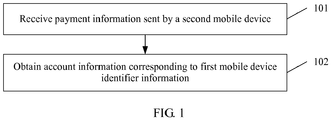
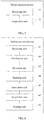
FIG. 1 is a flowchart illustrating a mobile payment method, according to an implementation of the present disclosure; -
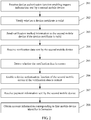
FIG. 2 is a flowchart illustrating another mobile payment method, according to an implementation of the present disclosure; -
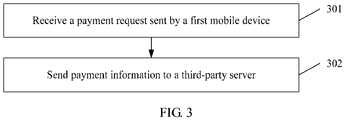
FIG. 3 is a flowchart illustrating still another mobile payment method, according to an implementation of the present disclosure; -
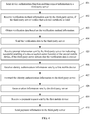
FIG. 4 is a flowchart illustrating yet another mobile payment method, according to an implementation of the present disclosure; -
FIG. 5 is a block diagram illustrating a mobile payment device, according to an implementation of the present disclosure; -
FIG. 6 is a block diagram illustrating another mobile payment device, according to an implementation of the present disclosure; -
FIG. 7 is a block diagram illustrating still another mobile payment device, according to an implementation of the present disclosure; -
FIG. 8 is a block diagram illustrating yet another mobile payment device, according to an implementation of the present disclosure; -
FIG. 9 is a structural block diagram illustrating a mobile payment system, according to an implementation of the present disclosure; and -
FIG. 10 is a schematic diagram illustrating a mobile payment application scenario, according to an implementation of the present disclosure. - Implementations of the present disclosure that are used as examples are described in more detail with reference to the accompanying drawings. Although the accompanying drawings show the implementations of the present disclosure that are used as examples, it should be understood that the present disclosure can be implemented in various forms, and shall not be limited by the implementations described here. On the contrary, these implementations are provided for clearer understanding of the present disclosure, and to completely convey the scope of the present disclosure to the person skilled in the art.
- To make the advantages of the technical solutions in the present disclosure clearer, the following describes the present disclosure in detail with reference to the accompanying drawings and the implementations.
- An implementation of the present disclosure provides a mobile payment method, and the method is applied to a third-party server. As shown in
FIG. 1 , the method includes the following steps. - 101. Receive payment information sent by a second mobile device.
- The payment information includes first mobile device identifier information, an account corresponding to a payment APP currently running in the second mobile device, and a payment amount corresponding to the first mobile device identifier information. No payment APP is installed in a first mobile device. The account corresponding to the payment APP currently running in the second mobile device can be a registered account entered when a user logs in to the payment APP by using the second mobile device. In this implementation of the present disclosure, the payment APP can be ALIPAY, WECHAT, etc., and is not limited in this implementation of the present disclosure. In this implementation of the present disclosure, the first mobile device and the second mobile device can be a personal computer (PC), a tablet computer, a smartphone, a personal digital assistant (PDA), a portable computer, an in-vehicle computer, etc. The first mobile device and the second mobile device are not limited in this implementation of the present disclosure.
- In this implementation of the present disclosure, the first mobile device and the second mobile device in the present disclosure are devices authenticated by the Internet Finance Authentication Alliance (IFAA) or the Authority by using a public key infrastructure (PKI) system, that is, a certificate authenticated by using the previous method is stored in security zones of the first mobile device and the second mobile device, and the certificate is sent to a third-party server for identity authentication. The first mobile device identifier information is used to uniquely identify the first mobile device. The first mobile device identifier information can be a unique hardware code of the first mobile device, or a certificate of the first mobile device.
- It is worthwhile to note that the first mobile device identifier information is sent by the first mobile device to the second mobile device, and the first mobile device can send the first mobile device identifier information to the second mobile device through Bluetooth, scanning, near field communication (NFC), or other communications technologies, which is not limited in this implementation of the present disclosure. In this implementation of the present disclosure, the first mobile device sends the first mobile device identifier information to the second mobile device through Bluetooth, scanning, NFC, or other communications technologies, so that the first mobile device can perform a payment to the second mobile device without network access.
- In this implementation of the present disclosure, the second mobile device is a terminal with a device authorization function that has been authenticated, and identity authentication on the second mobile device is implemented by using the third-party server. The third-party server is a server corresponding to the payment APP currently running in the second mobile device. For example, the second mobile device can send payment information of the first mobile device to an ALIPAY server only after an ALIPAY APP in the second mobile device is authenticated by the ALIPAY server. The third-party server can authenticate the second mobile device by using a device certificate of the second mobile device.
- 102. Obtain account information corresponding to first mobile device identifier information.
- Further, the payment amount can be transferred from an account corresponding to the first mobile device identifier information to the account corresponding to the payment APP currently running in the second mobile device. A process of transferring the payment amount from the account corresponding to the first mobile device identifier information to the account corresponding to the payment APP currently running in the second mobile device can include the following: sending the account information corresponding to the first mobile device identifier information and the payment information to a financial server first, and then using the financial server to transfer an amount corresponding to a first terminal account to the account of the payment application APP currently running in the second mobile device. It is worthwhile to note that if the account corresponding to the first mobile device identifier information and the account corresponding to the payment APP currently running in the second mobile device belong to a same payment APP account such as an ALIPAY account, the ALIPAY server first obtains the account information corresponding to the first mobile device identifier information after receiving the payment information, and then transfers the payment amount from the account corresponding to the first mobile device identifier information to the account corresponding to the payment APP currently running in the second mobile device. If the account corresponding to the obtained first mobile device identifier information is a bank account, the third-party server sends the payment information and the account information corresponding to the first mobile device identifier information to a corresponding bank after receiving the payment information and obtaining the account information corresponding to the first mobile device identifier information, so that the corresponding bank transfers the payment amount from the account corresponding to the first mobile device identifier information to the account corresponding to the payment APP currently running in the second mobile device.
- In this implementation of the present invention, the third-party server stores multiple pieces of account information, and the account information can be a financial account such as a bank account, an ALIPAY account, or a YU'E BAO account. Each piece of account information corresponds to one piece of first mobile device identifier information. Therefore, after receiving the payment information sent by the second mobile device, the third-party server can search the third-party server for the corresponding account information based on the first mobile device identifier information in the payment information. After the corresponding account information is obtained, the payment amount can be transferred from the account corresponding to the first mobile device identifier information to the account corresponding to the payment APP currently running in the second mobile device.
- It is worthwhile to note that the account information stored in the third-party server can be obtained based on historical payment information of the first mobile device, or can be actively provided by the first mobile device for the third-party server, or can be forwarded by the second mobile device, which is not limited in this implementation of the present disclosure. For example, the ALIPAY server automatically stores the account information of the user and the corresponding first mobile device identifier information after the user performs financial payment by using the ALIPAY APP installed in the first mobile device. Therefore, when the user performs mobile payment again, even if the user uninstalls the payment APP in the first mobile device, the third-party server can obtain the corresponding account information based on the first mobile device identifier information.
- For another example, after third-party server receives the payment information sent by the second mobile device, if the account information corresponding to the first mobile device identifier information is not found in the third-party server, the third-party server sends, to the second mobile device, prompt information indicating that the account corresponding to the first mobile device does not exist, to prompt the user of the first mobile device to provide the corresponding account information. After receiving the prompt information, the user of the first mobile device can actively send the account information to the third-party server, or can send the account information to the second mobile device through Bluetooth, scanning, NFC, or other communications technologies, and then the second mobile device forwards the account information of the first mobile device to the third-party server. It is worthwhile to note that, regardless of how the third-party server obtains the first mobile device identifier information and the account information, the third-party server correspondingly stores the account information of the first mobile device and the first mobile device identifier information after obtaining the first mobile device identifier information and the account information, so that the third-party server directly obtains the account information corresponding to the first mobile device identifier information from the account information stored in the third-party server when the first mobile device performs mobile payment again.
- In this implementation of the present disclosure, the first mobile device is a terminal with a device authorization function authenticated by the third-party server. Therefore, when the first mobile device performs a payment to the second mobile device, the first mobile device can first send the first mobile device identifier information to the second mobile device through Bluetooth, scanning, NFC, or other communications technologies, and then the second mobile device sends the payment information to the third-party server. The payment information includes the first mobile device identifier information, the account corresponding to the payment APP currently running in the second mobile device, and the payment amount corresponding to the first mobile device identifier information. The third-party server obtains the account information corresponding to the first mobile device identifier information after receiving the payment information, so that the payment amount can be transferred from the account corresponding to the first mobile device identifier information to the account corresponding to the payment APP currently running in the second mobile device. In the previously described process, it can be seen that the first mobile device only needs to send the first mobile device identifier information to the second mobile device when performing a payment to the second mobile device. Therefore, in this implementation of the present disclosure, the first mobile device can also perform mobile payment when no payment APP is installed in the first mobile device.
- According to the mobile payment method provided in this implementation of the present disclosure, the payment information sent by the second mobile device is first received, where the payment information includes the first mobile device identifier information, the account corresponding to the payment APP currently running in the second mobile device, and the payment amount corresponding to the first mobile device identifier information; and then the account information corresponding to the first mobile device identifier information is obtained, so that the payment amount can be transferred from the account corresponding to the first mobile device identifier information to the account corresponding to the payment APP currently running in the second mobile device. Compared with the existing technology in which mobile payment needs to be completed by installing a payment APP in a mobile device, in this implementation of the present disclosure, when the first mobile device needs to perform a payment to the second mobile device, the payment information of the first mobile device can be sent to the third-party server by using the second mobile device, where the payment information includes the first mobile device identifier information; and the third-party server obtains the account information corresponding to the first mobile device identifier information after receiving the payment information, so that the payment amount can be transferred from the account corresponding to the first mobile device identifier information to the account corresponding to the payment APP currently running in the second mobile device. As such, the first mobile device in this implementation of the present disclosure can also complete mobile payment when no payment APP is installed in the first mobile device.
- An implementation of the present disclosure provides another mobile payment method, and the method is applied to a third-party server. As shown in
FIG. 2 , the method includes the following steps. - 201. Receive device authorization function enabling request information sent by a second mobile device.
- The device authorization function enabling request information includes a device certificate of the second mobile device, and the second mobile device is a device authenticated by the IFAA or the Authority by using a PKI system, that is, a certificate authenticated by using the previous method is stored in a security zone of the second mobile device, and the certificate is sent to the third-party server for identity authentication. In this implementation of the present disclosure, the device certificate of the second mobile device is a certificate stored in the security zone of the second mobile device.
- 202. Verify whether a device certificate is valid.
- In this implementation of the present disclosure, whether the device certificate is valid can be verified by determining whether a corresponding device certificate exists in the third-party server. If the corresponding device certificate exists in the third-party server, it is verified that the device certificate is valid; or if no corresponding device certificate exists in the third-party server, it is verified that the device certificate is invalid.
- 203. Send verification method information to the second mobile device if the device certificate is valid.
- Further, the second mobile device obtains verification data based on the verification method information. The verification method information can be face verification, certificate verification, handwriting verification, voiceprint verification, eyeprint verification, etc., and is not limited in this implementation of the present disclosure. In this implementation of the present disclosure, the second mobile device outputs verification method prompt information after receiving the verification method information sent by the third-party server, to prompt a user to input the corresponding verification data. For example, if the received verification method information is certificate verification and voiceprint verification, certificate verification prompt information and voiceprint verification prompt information are first output, and then certificate data and voice data that are input by a user of the second mobile device are received.
- In this implementation of the present disclosure, after it is verified that the device certificate is valid, the method further includes the following: obtaining account credit information corresponding to the second mobile device, where the credit information is used to evaluate credit of the second mobile device; and detecting whether the account credit information corresponding to the second mobile device exceeds a predetermined threshold. The sending verification method information to the second mobile device includes the following: sending the verification method information to the second mobile device if the account credit information corresponding to the second mobile device exceeds the predetermined threshold. The account credit information corresponding to the second mobile device is used to evaluate the credit of the second mobile device. The credit information can be Sesame Credit in ALIPAY, and the predetermined threshold can be set based on an actual requirement. The predetermined threshold can be 700, 800, 900, etc., and is not limited in this implementation of the present disclosure. In this implementation of the present disclosure, because payment information sent by the second mobile device to the third-party server is actually financial payment made by a first mobile device to the second mobile device, the verification method information is sent to the second mobile device when the account credit information corresponding to the second mobile device exceeds the predetermined threshold, to ensure security of payment by the first mobile device.
- 204. Receive verification data sent by the second mobile device.
- 205. Detect whether the verification data is correct.
- 206. Enable a device authorization function of the second mobile device if the verification data is correct.
- It is worthwhile to note that, the second mobile device can send the payment information to the third-party server only after the device authorization function of the second mobile device is enabled. In this implementation of the present disclosure, after
step 206, the method further includes the following: sending enabling information of the second mobile device to the second mobile device, so that the second mobile device confirms the enabling information. In this implementation of the present disclosure, the enabling information of the second mobile device is sent to the second mobile device, to notify a user of the second mobile device that the device authorization function of the current device has been enabled. In this case, the second mobile device can send the payment information to the third-party server. - In this implementation of the present disclosure, after the enabling information of the second mobile device is sent to the second mobile device, the method further includes the following: receiving first mobile device identity authentication information sent by the second mobile device, where the first mobile device identity authentication information includes first mobile device identifier information; generating token information corresponding to the first mobile device identifier information; and sending the token information to the second mobile device. The first mobile device identifier information can be a unique hardware code of the first mobile device, or a certificate of the first mobile device, and is not limited in this implementation of the present disclosure.
- 207. Receive payment information sent by the second mobile device.
- The payment information includes the first mobile device identifier information, an account corresponding to a payment APP currently running in the second mobile device, and a payment amount corresponding to the first mobile device identifier information. No payment APP is installed in the first mobile device.
- In this implementation of the present disclosure, the first mobile device identifier information is sent by the first mobile device to the second mobile device, and the first mobile device can send the first mobile device identifier information to the second mobile device through Bluetooth, scanning, NFC, or other communications technologies, which is not limited in this implementation of the present disclosure. In this implementation of the present disclosure, the first mobile device sends the first mobile device identifier information to the second mobile device through Bluetooth, scanning, NFC, or other communications technologies, so that the first mobile device can perform a payment to the second mobile device without network access.
- 208. Obtain account information corresponding to first mobile device identifier information.
- Further, the payment amount can be transferred from an account corresponding to the first mobile device identifier information to the account corresponding to the payment APP currently running in the second mobile device.
- In this implementation of the present disclosure, before
step 208, the method further includes the following: separately verifying whether the token information and a device certificate of the first mobile device are correct. The obtaining account information corresponding to the first mobile device identifier information includes the following: obtaining the account information corresponding to the first mobile device identifier information if it is verified that both the token information and the device certificate of the first mobile device are correct. Separately verifying whether the token information and the device certificate of the first mobile device are correct is searching the third-party server to determine whether the corresponding token information and the device certificate of the first mobile device exist. If the corresponding token information and the device certificate of the first mobile device exist in the third-party server, it is verified that both the token information and the device certificate of the first mobile device are correct. - It is worthwhile to note that, the third-party server stores the token information only for a short time after generating the token information based on the first mobile device identifier information. For example, if the token information is generated at 14:00, and the token information can be stored in the third-party server for three minutes, token information generated after 14:03 is automatically deleted from the third-party server. In this implementation of the present disclosure, the account information corresponding to the first mobile device identifier information is obtained when it is verified that both the token information and the device certificate of the first mobile device are correct, to ensure security of payment by the first mobile device.
- In this implementation of the present disclosure, after the account information corresponding to the first mobile device identifier information is obtained, the method further includes the following: sending prompt information indicating successful payment by the first mobile device payment to the second mobile device, if the payment amount is successfully transferred from the account corresponding to the first mobile device identifier information to the account corresponding to the payment APP currently running in the second mobile device.
- In this implementation of the present disclosure, as shown in
FIG. 10 , an application scenario includes but is not limited to the following case: An ALIPAY APP is installed in a supermarket payment device, but no payment APP is installed in a mobile phone. If a user needs to perform a payment by using the mobile phone, the supermarket payment device first needs to send a device authorization function enabling request to an ALIPAY server. The ALIPAY server verifies a certificate of the supermarket payment device after receiving the request. If the verification succeeds, the ALIPAY server detects whether credit corresponding to the supermarket payment device exceeds a predetermined threshold, and sends face authentication method information to the supermarket payment device if the credit exceeds the predetermined threshold. The supermarket payment device sends a face image and the certificate to the ALIPAY server after receiving the face authentication method information. Then the ALIPAY server verifies whether the face image and the certificate are correct, and sends prompt information indicating successful device authorization function enablement to the supermarket payment device if the verification succeeds, to notify a supermarket staff that the current supermarket payment device can forward a payment request of the mobile phone. - When the user of the mobile phone needs to perform a payment for merchandises, the user first needs to obtain a token corresponding to the current payment request and send the payment request to the supermarket payment device. The supermarket payment device sends the payment information to the ALIPAY server after receiving the payment request, where the payment information includes identifier information of the mobile phone, a certificate of the mobile phone, the token corresponding to the current payment request, an account corresponding to a payment APP currently running in the supermarket payment device, and a payment amount corresponding to the mobile phone. The ALIPAY server verifies whether the certificate of the mobile phone and the token corresponding to the current payment request are correct after receiving the payment information. If it is verified that both the certificate of the mobile phone and the token corresponding to the current payment request are correct, the ALIPAY server obtains an account corresponding to identifier information of the mobile phone, and send the payment information and the amount corresponding to the mobile phone to a finance server, so that the finance server can transfer the payment amount from the account corresponding to the first mobile device identifier information to the account corresponding to the payment APP currently running in the second mobile device.
- In this application scenario, a process of obtaining the token corresponding to the current payment request is as follows: The identifier information of the mobile phone needs to be obtained first, and then identity authentication information is sent the supermarket payment device, where the identity authentication information includes the identifier information of the mobile phone. The supermarket payment device forwards the information to the ALIPAY server after receiving the identity authentication information, and then the ALIPAY server generates the token corresponding to the identifier information of the mobile phone, and sends the generated token to the supermarket payment device.
- According to the mobile payment method provided in this implementation of the present disclosure, the payment information sent by the second mobile device is first received, where the payment information includes the first mobile device identifier information, the account corresponding to the payment APP currently running in the second mobile device, and the payment amount corresponding to the first mobile device identifier information; and then the account information corresponding to the first mobile device identifier information is obtained, so that the payment amount can be transferred from the account corresponding to the first mobile device identifier information to the account corresponding to the payment APP currently running in the second mobile device. Compared with the existing technology in which mobile payment needs to be completed by installing a payment APP in a mobile device, in this implementation of the present disclosure, when the first mobile device needs to perform a payment to the second mobile device, the payment information of the first mobile device can be sent to the third-party server by using the second mobile device, where the payment information includes the first mobile device identifier information; and the third-party server obtains the account information corresponding to the first mobile device identifier information after receiving the payment information, so that the payment amount can be transferred from the account corresponding to the first mobile device identifier information to the account corresponding to the payment APP currently running in the second mobile device. As such, the first mobile device in this implementation of the present disclosure can also complete mobile payment when no payment APP is installed in the first mobile device.
- An implementation of the present disclosure provides still another mobile payment method, and the method is applied to a second mobile device. As shown in
FIG. 3 , the method includes the following steps. - 301. Receive a payment request sent by a first mobile device.
- The payment request includes first mobile device identifier information, and no payment APP is installed in the first mobile device. The first mobile device can send the first mobile device identifier information to the second mobile device through Bluetooth, scanning, NFC, or other communications technologies, which is not limited in this implementation of the present disclosure. In this implementation of the present disclosure, the first mobile device sends the first mobile device identifier information to the second mobile device through Bluetooth, scanning, NFC, or other communications technologies, so that the first mobile device can perform a payment to the second mobile device without network access.
- It is worthwhile to note that, the first mobile device and the second mobile device in the present disclosure are devices authenticated by the IFAA or the Authority by using a PKI system, that is, a certificate authenticated by using the previous method is stored in security zones of the first mobile device and the second mobile device, and the certificate is sent to a third-party server for identity authentication. The first mobile device identifier information is used to uniquely identify the first mobile device. The first mobile device identifier information can be a unique hardware code of the first mobile device or a certificate of the first mobile device, and is not limited in this implementation of the present disclosure.
- In this implementation of the present disclosure, the second mobile device is a terminal with a device authorization function that has been authenticated, and identity authentication on the second mobile device is implemented by using the third-party server. The third-party server is a server corresponding to a third-party APP in the second mobile device. For example, an ALIPAY APP in the second mobile device can send payment information of the first mobile device to an ALIPAY server only after the ALIPAY server verifies that the second mobile device has the device authorization function. The third-party server can authenticate the second mobile device by using a device certificate of the second mobile device.
- 302. Send payment information to a third-party server.
- The payment information includes the first mobile device identifier information, an account corresponding to a payment APP currently running in the second mobile device, and a payment amount corresponding to the first mobile device identifier information, so that the third-party server obtains account information corresponding to the first mobile device identifier information, and the payment amount can be transferred from an account corresponding to the first mobile device identifier information to the account corresponding to the payment APP currently running in the second mobile device.
- In this implementation of the present disclosure, the first mobile device is a terminal with a device authorization function authenticated by the third-party server. Therefore, when the first mobile device performs a payment to the second mobile device, the first mobile device can first send the first mobile device identifier information to the second mobile device through Bluetooth, scanning, NFC, or other communications technologies, and then the second mobile device sends the payment information to the third-party server. The payment information includes the first mobile device identifier information, the account corresponding to the payment APP currently running in the second mobile device, and the payment amount corresponding to the first mobile device identifier information. The third-party server obtains the account information corresponding to the first mobile device identifier information after receiving the payment information, so that the payment amount can be transferred from the account corresponding to the first mobile device identifier information to the account corresponding to the payment APP currently running in the second mobile device. In the previously described process, it can be seen that the first mobile device only needs to send the first mobile device identifier information to the second mobile device when performing a payment to the second mobile device. Therefore, in this implementation of the present disclosure, the first mobile device can also perform mobile payment when no payment APP is installed in the first mobile device.
- According to the mobile payment method provided in this implementation of the present disclosure, the payment information sent by the second mobile device is first received, where the payment information includes the first mobile device identifier information, the account corresponding to the payment APP currently running in the second mobile device, and the payment amount corresponding to the first mobile device identifier information; and then the account information corresponding to the first mobile device identifier information is obtained, so that the payment amount can be transferred from the account corresponding to the first mobile device identifier information to the account corresponding to the payment APP currently running in the second mobile device. Compared with the existing technology in which mobile payment needs to be completed by installing a payment APP in a mobile device, in this implementation of the present disclosure, when the first mobile device needs to perform a payment to the second mobile device, the payment information of the first mobile device can be sent to the third-party server by using the second mobile device, where the payment information includes the first mobile device identifier information; and the third-party server obtains the account information corresponding to the first mobile device identifier information after receiving the payment information, so that the payment amount can be transferred from the account corresponding to the first mobile device identifier information to the account corresponding to the payment APP currently running in the second mobile device. As such, the first mobile device in this implementation of the present disclosure can also complete mobile payment when no payment APP is installed in the first mobile device.
- An implementation of the present disclosure provides yet another mobile payment method, and the method is applied to a second mobile device. As shown in
FIG 4 , the method includes the following steps. - 401. Send device authorization function enabling request information to a third-party server.
- The device authorization function enabling request information includes a device certificate of the second mobile device, so that the third-party server verifies whether the device certificate is valid. It is worthwhile to note that the second mobile device is a device authenticated by the IFAA or the Authority by using a PKI system, that is, a certificate authenticated by using the previous method is stored in a security zone of the second mobile device, and the certificate is sent to the third-party server for identity authentication. In this implementation of the present disclosure, the device certificate of the second mobile device is a certificate stored in the security zone of the second mobile device.
- 402. Receive verification method information sent by the third-party server, if the third-party server verifies that a device certificate is valid.
- The verification method information can be face verification, certificate verification, handwriting verification, voiceprint verification, eyeprint verification, etc, and is not limited in this implementation of the present disclosure.
- 403. Obtain verification data based on the verification method information.
- For example, if the received verification method information is certificate verification and voiceprint verification, certificate verification prompt information and voiceprint verification prompt information are first output, and then certificate data and voice data input by a user of the second mobile device are received.
- 404. Send the verification data to the third-party server.
- Further, the third-party server detects whether the verification data is correct.
- 405. Receive prompt information sent by the third-party server for indicating successful enabling of a device authorization function of the second mobile device, if the third-party server detects that the verification data is correct.
- It is worthwhile to note that the second mobile device can send payment information to the third-party server only after the device authorization function of the second mobile device is enabled. In this implementation of the present disclosure, the prompt information indicating the successful enabling of the device authorization function of the second mobile device is used to notify the user of the second mobile device that the device authorization function of the current device has been enabled. In this case, the payment information can be sent to the third-party server by using the second mobile device.
- 406. Receive identity authentication information sent by a first mobile device.
- The identity authentication information includes first mobile device identifier information, and no payment APP is installed in the first mobile device. The first mobile device identifier information can be a unique hardware code of the first mobile device, or a certificate of the first mobile device, and is not limited in this implementation of the present disclosure.
- In this implementation of the present disclosure, the first mobile device can send the first mobile device identifier information to the second mobile device through Bluetooth, scanning, NFC, or other communications technologies, which is not limited in this implementation of the present disclosure. In this implementation of the present disclosure, the first mobile device sends the first mobile device identifier information to the second mobile device through Bluetooth, scanning, NFC, or other communications technologies, so that the first mobile device can perform a payment to the second mobile device without network access.
- 407. Forward the identity authentication information to the third-party server.
- Further, the third-party server generates token information corresponding to the first mobile device identifier information. It is worthwhile to note that, the third-party server stores the token information only for a short time after generating the token information based on the first mobile device identifier information. For example, if the token information is generated at 14:00, and the token information can be stored in the third-party server for three minutes, token information generated after 14:03 is automatically deleted from the third-party server.
- 408. Receive token information sent by the third-party server.
- 409. Receive a payment request sent by the first mobile device.
- The payment request includes the first mobile device identifier information.
- 410. Send payment information to the third-party server.
- The payment information includes the first mobile device identifier information, an account corresponding to a payment APP currently running in the second mobile device, a payment amount corresponding to the first mobile device identifier information, the token information, and a device certificate of the first mobile device.
- Further, the third-party server separately verifies whether the token information and the device certificate of the first mobile device are correct. The third-party server obtains account information corresponding to the first mobile device identifier information, if it is verified that both the token information and the device certificate of the first mobile device are correct, so that the payment amount can be transferred from an account corresponding to the first mobile device identifier information to the account corresponding to the payment APP currently running in the second mobile device. In this implementation of the present disclosure, the account information corresponding to the first mobile device identifier information is obtained when it is verified that both the token information and the device certificate of the first mobile device are correct, to ensure security of payment by the first mobile device.
- According to the mobile payment method provided in this implementation of the present disclosure, the payment information sent by the second mobile device is first received, where the payment information includes the first mobile device identifier information, the account corresponding to the payment APP currently running in the second mobile device, and the payment amount corresponding to the first mobile device identifier information; and then the account information corresponding to the first mobile device identifier information is obtained, so that the payment amount can be transferred from the account corresponding to the first mobile device identifier information to the account corresponding to the payment APP currently running in the second mobile device. Compared with the existing technology in which mobile payment needs to be completed by installing a payment APP in a mobile device, in this implementation of the present disclosure, when the first mobile device needs to perform a payment to the second mobile device, the payment information of the first mobile device can be sent to the third-party server by using the second mobile device, where the payment information includes the first mobile device identifier information; and the third-party server obtains the account information corresponding to the first mobile device identifier information after receiving the payment information, so that the payment amount can be transferred from the account corresponding to the first mobile device identifier information to the account corresponding to the payment APP currently running in the second mobile device. As such, the first mobile device in this implementation of the present disclosure can also complete mobile payment when no payment APP is installed in the first mobile device.
- Further, an implementation of the present disclosure provides a mobile payment device. As shown in
FIG. 5 , the mobile payment device includes a receivingunit 51 and anacquisition unit 52. The receivingunit 51 is configured to receive payment information sent by a second mobile device, where the payment information includes first mobile device identifier information, an account corresponding to a payment APP currently running in the second mobile device, and a payment amount corresponding to the first mobile device identifier information; the first mobile device identifier information is sent by a first mobile device to the second mobile device, and no payment APP is installed in the first mobile device. Theacquisition unit 52 is configured to obtain account information corresponding to the first mobile device identifier information, so that the payment amount can be transferred from an account corresponding to the first mobile device identifier information to the account corresponding to the payment APP currently running in the second mobile device. - It is worthwhile to note that reference can be made to the corresponding descriptions of the method shown in
FIG. 1 for other corresponding descriptions of the functional units of the mobile payment device provided in this implementation of the present disclosure. Details are omitted here. However, it is worthwhile to note that the mobile payment device in this implementation can correspondingly implement all content in the previous method implementations. - According to the mobile payment device provided in this implementation of the present disclosure, the payment information sent by the second mobile device is first received, where the payment information includes the first mobile device identifier information, the account corresponding to the payment APP currently running in the second mobile device, and the payment amount corresponding to the first mobile device identifier information; and then the account information corresponding to the first mobile device identifier information is obtained, so that the payment amount can be transferred from the account corresponding to the first mobile device identifier information to the account corresponding to the payment APP currently running in the second mobile device. Compared with the existing technology in which mobile payment needs to be completed by installing a payment APP in a mobile device, in this implementation of the present disclosure, when the first mobile device needs to perform a payment to the second mobile device, the payment information of the first mobile device can be sent to the third-party server by using the second mobile device, where the payment information includes the first mobile device identifier information; and the third-party server obtains the account information corresponding to the first mobile device identifier information after receiving the payment information, so that the payment amount can be transferred from the account corresponding to the first mobile device identifier information to the account corresponding to the payment APP currently running in the second mobile device. As such, the first mobile device in this implementation of the present disclosure can also complete mobile payment when no payment APP is installed in the first mobile device.
- Further, an implementation of the present disclosure provides another mobile payment device. As shown in
FIG. 6 , the device mobile payment includes a receivingunit 61 and anacquisition unit 62. The receivingunit 61 is configured to receive payment information sent by a second mobile device, where the payment information includes first mobile device identifier information, an account corresponding to a payment APP currently running in the second mobile device, and a payment amount corresponding to the first mobile device identifier information; the first mobile device identifier information is sent by a first mobile device to the second mobile device, and no payment APP is installed in the first mobile device. Theacquisition unit 62 is configured to obtain account information corresponding to the first mobile device identifier information, so that the payment amount can be transferred from an account corresponding to the first mobile device identifier information to the account corresponding to the payment APP currently running in the second mobile device. - Further, the mobile payment device further includes a
verification unit 64 and a sendingunit 63. - The receiving
unit 61 is further configured to receive device authorization function enabling request information sent by the second mobile device, where the device authorization function enabling request information includes a device certificate of the second mobile device. - The
verification unit 64 is configured to verify whether the device certificate is valid. - The sending
unit 63 is configured to send verification method information to the second mobile device if the device certificate is valid, so that the second mobile device obtains verification data based on the verification method information. - Further, the mobile payment device further includes a
detection unit 65 and an enablingunit 66. - The receiving
unit 61 is further configured to receive the verification data sent by the second mobile device. - The
detection unit 65 is configured to detect whether the verification data is correct. - The enabling
unit 66 is configured to enable a device authorization function of the second mobile device if the verification data is correct. - The sending
unit 63 is further configured to send enabling information of the second mobile device to the second mobile device, so that the second mobile device confirms the enabling information. - The
acquisition unit 62 is further configured to obtain account credit information corresponding to the second mobile device, where the credit information is used to evaluate credit of the second mobile device. - The
detection unit 65 is further configured to detect whether the account credit information corresponding to the second mobile device exceeds a predetermined threshold. - The sending
unit 63 is configured to send the verification method information to the second mobile device, if the account credit information corresponding to the second mobile device exceeds the predetermined threshold. - The mobile payment device further includes a
generation unit 67. - The receiving
unit 61 is further configured to receive first mobile device identity authentication information sent by the second mobile device, where the first mobile device identity authentication information includes the first mobile device identifier information. - The
generation unit 67 is configured to generate token information corresponding to the first mobile device identifier information. - The sending
unit 63 is further configured to send the token information to the second mobile device. - In this implementation of the present disclosure, the payment information sent by the second mobile device further includes the token information and a device certificate of the first mobile device.
- The
verification unit 64 is further configured to separately verify whether the token information and the device certificate of the first mobile device are correct. - The
acquisition unit 62 is configured to obtain the account information corresponding to the first mobile device identifier information, if both the token information and the device certificate of the first mobile device are correct. - The sending
unit 63 is further configured to send identity authentication failure prompt information of the first mobile device to the second mobile device, if it is verified that either the token information or the device certificate of the first mobile device is incorrect. - It is worthwhile to note that reference can be made to the corresponding descriptions of the method shown in
FIG. 2 for other corresponding descriptions of the functional units of the mobile payment device provided in this implementation of the present disclosure. Details are omitted here. However, it is worthwhile to note that the mobile payment device in this implementation can correspondingly implement all content in the previous method implementations. - According to the mobile payment device provided in this implementation of the present disclosure, the payment information sent by the second mobile device is first received, where the payment information includes the first mobile device identifier information, the account corresponding to the payment APP currently running in the second mobile device, and the payment amount corresponding to the first mobile device identifier information; and then the account information corresponding to the first mobile device identifier information is obtained, so that the payment amount can be transferred from the account corresponding to the first mobile device identifier information to the account corresponding to the payment APP currently running in the second mobile device. Compared with the existing technology in which mobile payment needs to be completed by installing a payment APP in a mobile device, in this implementation of the present disclosure, when the first mobile device needs to perform a payment to the second mobile device, the payment information of the first mobile device can be sent to the third-party server by using the second mobile device, where the payment information includes the first mobile device identifier information; and the third-party server obtains the account information corresponding to the first mobile device identifier information after receiving the payment information, so that the payment amount can be transferred from the account corresponding to the first mobile device identifier information to the account corresponding to the payment APP currently running in the second mobile device. As such, the first mobile device in this implementation of the present disclosure can also complete mobile payment when no payment APP is installed in the first mobile device.
- Further, an implementation of the present disclosure provides still another mobile payment device. As shown in
FIG. 7 , the mobile payment device includes a receivingunit 71 and a sendingunit 72. - The receiving
unit 71 is configured to receive a payment request sent by a first mobile device, where the payment request includes first mobile device identifier information, and no payment APP is installed in the first mobile device. - The sending
unit 72 is configured to send payment information to a third-party server, where the payment information includes the first mobile device identifier information, an account corresponding to a payment APP currently running in a second mobile device, and a payment amount corresponding to the first mobile device identifier information, so that the third-party server obtains account information corresponding to the first mobile device identifier information, and the payment amount can be transferred from an account corresponding to the first mobile device identifier information to the account corresponding to the payment APP currently running in the second mobile device. - It is worthwhile to note that reference can be made to the corresponding descriptions of the method shown in
FIG. 3 for other corresponding descriptions of the functional units of the mobile payment device provided in this implementation of the present disclosure. Details are omitted here. However, it is worthwhile to note that the mobile payment device in this implementation can correspondingly implement all content in the previous method implementations. - According to the mobile payment device provided in this implementation of the present disclosure, the payment information sent by the second mobile device is first received, where the payment information includes the first mobile device identifier information, the account corresponding to the payment APP currently running in the second mobile device, and the payment amount corresponding to the first mobile device identifier information; and then the account information corresponding to the first mobile device identifier information is obtained, so that the payment amount can be transferred from the account corresponding to the first mobile device identifier information to the account corresponding to the payment APP currently running in the second mobile device. Compared with the existing technology in which mobile payment needs to be completed by installing a payment APP in a mobile device, in this implementation of the present disclosure, when the first mobile device needs to perform a payment to the second mobile device, the payment information of the first mobile device can be sent to the third-party server by using the second mobile device, where the payment information includes the first mobile device identifier information; and the third-party server obtains the account information corresponding to the first mobile device identifier information after receiving the payment information, so that the payment amount can be transferred from the account corresponding to the first mobile device identifier information to the account corresponding to the payment APP currently running in the second mobile device. As such, the first mobile device in this implementation of the present disclosure can also complete mobile payment when no payment APP is installed in the first mobile device.
- Further, an implementation of the present disclosure provides yet another mobile payment device. As shown in
FIG. 8 , the mobile payment device includes a receivingunit 81 and a sendingunit 82. - The receiving
unit 81 is configured to receive a payment request sent by a first mobile device, where the payment request includes first mobile device identifier information, and no payment APP is installed in the first mobile device. - The sending
unit 82 is configured to send payment information to a third-party server, where the payment information includes the first mobile device identifier information, an account corresponding to a payment APP currently running in a second mobile device, and a payment amount corresponding to the first mobile device identifier information, so that the third-party server obtains account information corresponding to the first mobile device identifier information, and the payment amount can be transferred from an account corresponding to the first mobile device identifier information to the account corresponding to the payment APP currently running in the second mobile device. - Further, the mobile payment device further includes an
acquisition unit 83. - The sending
unit 82 is further configured to send device authorization function enabling request information to the third-party server, where the device authorization function enabling request information includes a device certificate of the second mobile device, so that the third-party server verifies whether the device certificate is valid. - The receiving
unit 81 is further configured to receive verification method information sent by the third-party server, if the third-party server verifies that the device certificate is valid. - The
acquisition unit 83 is configured to obtain verification data based on the verification method information. - The sending
unit 82 is further configured to send the verification data to the third-party server, so that the third-party server detects whether the verification data is correct. - The receiving
unit 81 is further configured to receive prompt information sent by the third-party server for indicating successful enabling of a device authorization function of the second mobile device, if the third-party server detects that the verification data is correct. - Further, the mobile payment device further includes a
forwarding unit 84. - The receiving
unit 81 is further configured to receive identity authentication information sent by the first mobile device, where the identity authentication information includes the first mobile device identifier information. - The forwarding
unit 84 is configured to forward the identity authentication information to the third-party server, so that the third-party server generates token information corresponding to the first mobile device identifier information. - The receiving
unit 81 is further configured to receive the token information sent by the third-party server. - In this implementation of the present disclosure, the payment information further includes the token information and a device certificate of the first mobile device, so that the third-party server separately verifies whether the token information and the device certificate of the first mobile device are correct.
- It is worthwhile to note that reference can be made to the corresponding descriptions of the method shown in
FIG. 4 for other corresponding descriptions of the functional units of the mobile payment device provided in this implementation of the present disclosure. Details are omitted here. However, it is worthwhile to note that the mobile payment device in this implementation can correspondingly implement all content in the previous method implementations. - According to the mobile payment device provided in this implementation of the present disclosure, the payment information sent by the second mobile device is first received, where the payment information includes the first mobile device identifier information, the account corresponding to the payment APP currently running in the second mobile device, and the payment amount corresponding to the first mobile device identifier information; and then the account information corresponding to the first mobile device identifier information is obtained, so that the payment amount can be transferred from the account corresponding to the first mobile device identifier information to the account corresponding to the payment APP currently running in the second mobile device. Compared with the existing technology in which mobile payment needs to be completed by installing a payment APP in a mobile device, in this implementation of the present disclosure, when the first mobile device needs to perform a payment to the second mobile device, the payment information of the first mobile device can be sent to the third-party server by using the second mobile device, where the payment information includes the first mobile device identifier information; and the third-party server obtains the account information corresponding to the first mobile device identifier information after receiving the payment information, so that the payment amount can be transferred from the account corresponding to the first mobile device identifier information to the account corresponding to the payment APP currently running in the second mobile device. As such, the first mobile device in this implementation of the present disclosure can also complete mobile payment when no payment APP is installed in the first mobile device.
- Further, an implementation of the present disclosure provides a mobile payment system. As shown in
FIG. 9 , the mobile payment system includes a firstmobile device 91, a secondmobile device 92, and a third-party server 93. - The first
mobile device 91 is configured to send a payment request to the second mobile device, where the payment request includes first mobile device identifier information, and no payment APP is installed in the first mobile device. - The second
mobile device 92 is configured to send payment information to the third-party server, where the payment information includes the first mobile device identifier information, an account corresponding to a payment APP currently running in the second mobile device, and a payment amount corresponding to the first mobile device identifier information. - The third-
party server 93 is configured to obtain account information corresponding to the first mobile device identifier information, so that the payment amount can be transferred from an account corresponding to the first mobile device identifier information to the account corresponding to the payment APP currently running in the second mobile device. - According to the mobile payment system provided in this implementation of the present disclosure, the payment information sent by the second mobile device is first received, where the payment information includes the first mobile device identifier information, the account corresponding to the payment APP currently running in the second mobile device, and the payment amount corresponding to the first mobile device identifier information; and then the account information corresponding to the first mobile device identifier information is obtained, so that the payment amount can be transferred from the account corresponding to the first mobile device identifier information to the account corresponding to the payment APP currently running in the second mobile device. Compared with the existing technology in which mobile payment needs to be completed by installing a payment APP in a mobile device, in this implementation of the present disclosure, when the first mobile device needs to perform a payment to the second mobile device, the payment information of the first mobile device can be sent to the third-party server by using the second mobile device, where the payment information includes the first mobile device identifier information; and the third-party server obtains the account information corresponding to the first mobile device identifier information after receiving the payment information, so that the payment amount can be transferred from the account corresponding to the first mobile device identifier information to the account corresponding to the payment APP currently running in the second mobile device. As such, the first mobile device in this implementation of the present disclosure can also complete mobile payment when no payment APP is installed in the first mobile device.
- The mobile payment device includes a processor and a memory. The previously described receiving unit, the acquisition unit, the sending unit, the verification unit, the detection unit, the enabling unit, the generation unit, etc. are stored in the memory as program units. The processor executes the program units stored in the memory to implement corresponding functions.
- The processor includes a kernel, and the kernel invokes a corresponding program unit from the memory. There can be one or more kernels. The accuracy of displaying mixed views can be improved by adjusting kernel parameters.
- The memory can include a non-persistent storage, a random access memory (RAM), and/or a nonvolatile memory in a computer readable medium, for example, a read-only memory (ROM) or a flash memory (flash RAM). The memory includes at least one storage chip.
- The present application further provides a computer program product. When a data processing device executes the computer program product, program code for initialization includes the following method steps: receiving payment information sent by a second mobile device, where the payment information includes first mobile device identifier information, an account corresponding to a payment APP currently running in the second mobile device, and a payment amount corresponding to the first mobile device identifier information, the first mobile device identifier information is sent by a first mobile device to the second mobile device, and no payment APP is installed in the first mobile device; and obtaining account information corresponding to the first mobile device identifier information, so that the payment amount can be transferred from an account corresponding to the first mobile device identifier information to the account corresponding to the payment APP currently running in the second mobile device.
- A person skilled in the art should understand that the implementations of the present application can be provided as a method, a system, or a computer program product. Therefore, the present application can use hardware only implementations, software only implementations, or implementations with a combination of software and hardware. In addition, the present application can use a form of a computer program product that is implemented on one or more computer-usable storage media (including but not limited to a disk memory, a CD-ROM, an optical memory, etc.) that include computer-usable program code.
- The present application is described with reference to the flowcharts and/or block diagrams of the method, the device, and the computer program product based on the implementations of the present application. It should be understood that computer program instructions can be used to implement each process and/or each block in the flowcharts and/or the block diagrams and a combination of a process and/or a block in the flowcharts and/or the block diagrams. These computer program instructions can be provided for a general-purpose computer, a dedicated-purpose computer, an embedded processor, or a processor of another programmable data processing device to generate a machine, so that the instructions executed by the computer or the processor of the another programmable data processing device generate an apparatus for implementing a specific function in one or more flows in the flowcharts and/or in one or more blocks in the block diagrams.
- These computer program instructions can be stored in a computer readable memory that can instruct the computer or the another programmable data processing device to work in a specific way, so that the instructions stored in the computer readable memory generate an artifact that includes an instruction apparatus. The instruction apparatus implements a specific function in one or more flows in the flowcharts and/or in one or more blocks in the block diagrams.
- These computer program instructions can be loaded onto the computer or the another programmable data processing device, so that a series of operations and steps are performed on the computer or the another programmable device, thereby generating computer-implemented processing. Therefore, the instructions executed on the computer or the another programmable device provide steps for implementing a specific function in one or more flows in the flowcharts and/or in one or more blocks in the block diagrams.
- In a typical configuration, a computing device includes one or more processors (CPU), an input/output interface, a network interface, and a memory.
- The memory can include a non-persistent storage, a random access memory (RAM), and/or a nonvolatile memory in a computer readable medium, for example, a read-only memory (ROM) or a flash memory (flash RAM). The memory is an example of the computer readable medium.
- The computer readable medium includes persistent, non-persistent, movable, and unmovable media that can implement information storage by using any method or technology. Information can be a computer readable instruction, a data structure, a program module, or other data. An example of a computer storage medium includes but is not limited to a phase-change random access memory (PRAM), a static random access memory (SRAM), a dynamic random access memory (DRAM), another type of random access memory (RAM), a read-only memory (ROM), an electrically erasable programmable read-only memory (EEPROM), a flash memory or another memory technology, a compact disc read-only memory (CD-ROM), a digital versatile disc (DVD) or another optical storage, a cassette magnetic tape, a tape and disk storage or another magnetic storage device or any other non-transmission media that can be configured to store information that a computing device can access. As described in the present application, the computer readable medium does not include computer readable transitory media (transitory media) such as a modulated data signal and a carrier.
- The previous descriptions are merely the implementations of the present application, but are not intended to limit the present application. For a person skilled in the art, the present application can have various modifications and changes. Any modifications, equivalent substitutions, improvements, etc. made in the spirit and principle of the present application shall fall in the scope of the claims in the present application.
Claims (27)
- A mobile payment method, comprising the following:receiving payment information sent by a second mobile device, wherein the payment information comprises first mobile device identifier information, an account corresponding to a payment APP currently running in the second mobile device, and a payment amount corresponding to the first mobile device identifier information, the first mobile device identifier information is sent by a first mobile device to the second mobile device, and no payment APP is installed in the first mobile device; andobtaining account information corresponding to the first mobile device identifier information, so that the payment amount can be transferred from an account corresponding to the first mobile device identifier information to the account corresponding to the payment APP currently running in the second mobile device.
- The method according to claim 1, wherein before the receiving payment information sent by a second mobile device, the method further comprises the following:receiving device authorization function enabling request information sent by the second mobile device, wherein the device authorization function enabling request information comprises a device certificate of the second mobile device;verifying whether the device certificate is valid; andsending verification method information to the second mobile device if the device certificate is valid, so that the second mobile device obtains verification data based on the verification method information.
- The method according to claim 2, wherein after the sending verification method information to the second mobile device, the method further comprises the following:receiving the verification data sent by the second mobile device;detecting whether the verification data is correct; andenabling a device authorization function of the second mobile device if the verification data is correct.
- The method according to claim 3, wherein after the enabling a device authorization function of the second mobile device, the method further comprises the following:
sending enabling information of the second mobile device to the second mobile device, so that the second mobile device confirms the enabling information. - The method according to claim 2, wherein after it is verified that the device certificate is valid, the method further comprises the following:obtaining account credit information corresponding to the second mobile device, wherein the credit information is used to evaluate credit of the second mobile device; anddetecting whether the account credit information corresponding to the second mobile device exceeds a predetermined threshold; andthe sending verification method information to the second mobile device comprises the following:
sending the verification method information to the second mobile device if the account credit information corresponding to the second mobile device exceeds the predetermined threshold. - The method according to claim 4, wherein after the sending enabling information of the second mobile device to the second mobile device, the method further comprises the following:receiving first mobile device identity authentication information sent by the second mobile device, wherein the first mobile device identity authentication information comprises the first mobile device identifier information;generating token information corresponding to the first mobile device identifier information; andsending the token information to the second mobile device.
- The method according to claim 6, wherein the payment information sent by the second mobile device further comprises the token information and a device certificate of the first mobile device, and before the obtaining account information corresponding to the first mobile device identifier information, the method further comprises the following:separately verifying whether the token information and the device certificate of the first mobile device are correct; andthe obtaining account information corresponding to the first mobile device identifier information comprises the following:
obtaining the account information corresponding to the first mobile device identifier information if both the token information and the device certificate of the first mobile device are correct. - The method according to claim 7, wherein after the separately verifying whether the token information and the device certificate of the first mobile device are correct, the method further comprises the following:
sending identity authentication failure prompt information of the first mobile device to the second mobile device if it is verified that either the token information or the device certificate of the first mobile device is incorrect. - A mobile payment method, comprising the following:receiving a payment request sent by a first mobile device, wherein the payment request comprises first mobile device identifier information, and no payment APP is installed in the first mobile device; andsending payment information to a third-party server, wherein the payment information comprises the first mobile device identifier information, an account corresponding to a payment APP currently running in a second mobile device, and a payment amount corresponding to the first mobile device identifier information, so that the third-party server obtains account information corresponding to the first mobile device identifier information, and the payment amount can be transferred from an account corresponding to the first mobile device identifier information to the account corresponding to the payment APP currently running in the second mobile device.
- The method according to claim 9, wherein before the receiving a payment request sent by a first mobile device, the method further comprises the following:sending device authorization function enabling request information to the third-party server, wherein the device authorization function enabling request information comprises a device certificate of the second mobile device, so that the third-party server verifies whether the device certificate is valid;receiving verification method information sent by the third-party server, if the third-party server verifies that the device certificate is valid; andobtaining verification data based on the verification method information.
- The method according to claim 10, wherein after the obtaining verification data based on the verification method information, the method further comprises the following:sending the verification data to the third-party server, so that the third-party server detects whether the verification data is correct; andreceiving prompt information sent by the third-party server for indicating successful enabling of a device authorization function of the second mobile device, if the third-party server detects that the verification data is correct.
- The method according to claim 11, wherein after the receiving prompt information sent by the third-party server for indicating successful enabling of a device authorization function of the second mobile device, the method further comprises the following:receiving identity authentication information sent by the first mobile device, wherein the identity authentication information comprises the first mobile device identifier information;forwarding the identity authentication information to the third-party server, so that the third-party server generates token information corresponding to the first mobile device identifier information; andreceiving the token information sent by the third-party server.
- The method according to claim 12, wherein the payment information further comprises the token information and a device certificate of the first mobile device, so that the third-party server separately verifies whether the token information and the device certificate of the first mobile device are correct.
- A mobile payment device, comprising the following:a receiving unit, configured to receive payment information sent by a second mobile device, wherein the payment information comprises first mobile device identifier information, an account corresponding to a payment APP currently running in the second mobile device, and a payment amount corresponding to the first mobile device identifier information, the first mobile device identifier information is sent by a first mobile device to the second mobile device, and no payment APP is installed in the first mobile device; andan acquisition unit, configured to obtain account information corresponding to the first mobile device identifier information, so that the payment amount can be transferred from an account corresponding to the first mobile device identifier information to the account corresponding to the payment APP currently running in the second mobile device.
- The mobile payment device according to claim 14, wherein the mobile payment device further comprises a verification unit and a sending unit;
the receiving unit is further configured to receive device authorization function enabling request information sent by the second mobile device, wherein the device authorization function enabling request information comprises a device certificate of the second mobile device;
the verification unit is configured to verify whether the device certificate is valid; and
the sending unit is configured to send verification method information to the second mobile device if the device certificate is valid, so that the second mobile device obtains verification data based on the verification method information. - The mobile payment device according to claim 15, wherein the mobile payment device further comprises a detection unit and an enabling unit;
the receiving unit is further configured to receive the verification data sent by the second mobile device;
the detection unit is configured to detect whether the verification data is correct; and
the enabling unit is configured to enable a device authorization function of the second mobile device if the verification data is correct. - The mobile payment device according to claim 16, wherein
the sending unit is further configured to send enabling information of the second mobile device to the second mobile device, so that the second mobile device confirms the enabling information. - The mobile payment device according to claim 16, wherein
the acquisition unit is further configured to obtain account credit information corresponding to the second mobile device, wherein the credit information is used to evaluate credit of the second mobile device;
the detection unit is further configured to detect whether the account credit information corresponding to the second mobile device exceeds a predetermined threshold; and
the sending unit is configured to send the verification method information to the second mobile device if the account credit information corresponding to the second mobile device exceeds the predetermined threshold. - The mobile payment device according to claim 17, wherein the mobile payment device further comprises a generation unit;
the receiving unit is further configured to receive first mobile device identity authentication information sent by the second mobile device, wherein the first mobile device identity authentication information comprises the first mobile device identifier information;
the generation unit is configured to generate token information corresponding to the first mobile device identifier information; and
the sending unit is further configured to send the token information to the second mobile device. - The mobile payment device according to claim 19, wherein the payment information sent by the second mobile device further comprises the token information and a device certificate of the first mobile device;
the verification unit is further configured to separately verify whether the token information and the device certificate of the first mobile device are correct; and
the acquisition unit is configured to obtain the account information corresponding to the first mobile device identifier information if both the token information and the device certificate of the first mobile device are correct. - The mobile payment device according to claim 20, wherein
the sending unit is further configured to send identity authentication failure prompt information of the first mobile device to the second mobile device if it is verified that either the token information or the device certificate of the first mobile device is incorrect. - A mobile payment device, comprising the following:a receiving unit, configured to receive a payment request sent by a first mobile device, wherein the payment request comprises first mobile device identifier information, and no payment APP is installed in the first mobile device; anda sending unit, configured to send payment information to a third-party server, wherein the payment information comprises the first mobile device identifier information, an account corresponding to a payment APP currently running in a second mobile device, and a payment amount corresponding to the first mobile device identifier information, so that the third-party server obtains account information corresponding to the first mobile device identifier information, and the payment amount can be transferred from an account corresponding to the first mobile device identifier information to the account corresponding to the payment APP currently running in the second mobile device.
- The mobile payment device according to claim 22, wherein the mobile payment device further comprises an acquisition unit;
the sending unit is further configured to send device authorization function enabling request information to the third-party server, wherein the device authorization function enabling request information comprises a device certificate of the second mobile device, so that the third-party server verifies whether the device certificate is valid;
the receiving unit is further configured to receive verification method information sent by the third-party server, if the third-party server verifies that the device certificate is valid; and
the acquisition unit is configured to obtain verification data based on the verification method information. - The mobile payment device according to claim 23, wherein
the sending unit is further configured to send the verification data to the third-party server, so that the third-party server detects whether the verification data is correct; and
the receiving unit is further configured to receive prompt information sent by the third-party server for indicating successful enabling of a device authorization function of the second mobile device, if the third-party server detects that the verification data is correct. - The mobile payment device according to claim 24, wherein the mobile payment device further comprises a forwarding unit;
the receiving unit is further configured to receive identity authentication information sent by the first mobile device, wherein the identity authentication information comprises the first mobile device identifier information;
the forwarding unit is configured to forward the identity authentication information to the third-party server, so that the third-party server generates token information corresponding to the first mobile device identifier information; and
the receiving unit is further configured to receive the token information sent by the third-party server. - The mobile payment device according to claim 25, wherein the payment information further comprises the token information and a device certificate of the first mobile device, so that the third-party server separately verifies whether the token information and the device certificate of the first mobile device are correct.
- A mobile payment system, comprising a first mobile device, a second mobile device, and a third-party server, wherein
the first mobile device is configured to send a payment request to the second mobile device, wherein the payment request comprises first mobile device identifier information, and no payment APP is installed in the first mobile device;
the second mobile device is configured to send payment information to the third-party server, wherein the payment information comprises the first mobile device identifier information, an account corresponding to a payment APP currently running in the second mobile device, and a payment amount corresponding to the first mobile device identifier information; and
the third-party server is configured to obtain account information corresponding to the first mobile device identifier information, so that the payment amount can be transferred from an account corresponding to the first mobile device identifier information to the account corresponding to the payment APP currently running in the second mobile device.
Applications Claiming Priority (2)
| Application Number | Priority Date | Filing Date | Title |
|---|---|---|---|
| CN201610383679.6A CN106897874B (en) | 2016-06-01 | 2016-06-01 | Mobile payment method, device and system |
| PCT/CN2017/085283 WO2017206747A1 (en) | 2016-06-01 | 2017-05-22 | Mobile payment method, device and system |
Publications (2)
| Publication Number | Publication Date |
|---|---|
| EP3467744A1 true EP3467744A1 (en) | 2019-04-10 |
| EP3467744A4 EP3467744A4 (en) | 2019-06-19 |
Family
ID=59191135
Family Applications (1)
| Application Number | Title | Priority Date | Filing Date |
|---|---|---|---|
| EP17805692.5A Withdrawn EP3467744A4 (en) | 2016-06-01 | 2017-05-22 | METHOD, DEVICE AND MOBILE PAYMENT SYSTEM |
Country Status (10)
| Country | Link |
|---|---|
| US (2) | US11100473B2 (en) |
| EP (1) | EP3467744A4 (en) |
| JP (1) | JP6917395B2 (en) |
| KR (1) | KR102372571B1 (en) |
| CN (2) | CN113095816B (en) |
| MY (1) | MY200727A (en) |
| PH (1) | PH12018502537A1 (en) |
| SG (1) | SG11201810595PA (en) |
| TW (1) | TWI688909B (en) |
| WO (1) | WO2017206747A1 (en) |
Families Citing this family (13)
| Publication number | Priority date | Publication date | Assignee | Title |
|---|---|---|---|---|
| CN105825371A (en) * | 2015-01-07 | 2016-08-03 | 阿里巴巴集团控股有限公司 | Method and device for processing service |
| CN108320388B (en) * | 2017-12-29 | 2020-01-21 | 中国银联股份有限公司 | Charging processing method and device and vehicle payment system |
| CN110942296A (en) * | 2018-09-21 | 2020-03-31 | 中国银联股份有限公司 | Transfer platform, transfer-in or transfer-out acceptance mechanism, computer storage medium and execution method |
| CN111695905B (en) * | 2019-03-15 | 2024-01-30 | 阿里巴巴集团控股有限公司 | Payment method, device, computing equipment and storage medium |
| GB2597159A (en) * | 2019-04-29 | 2022-01-19 | Apple Inc | System and method of operating a secure contactless transaction |
| CN110675539B (en) * | 2019-09-26 | 2022-08-12 | 深圳市商汤科技有限公司 | Identity verification method and device, electronic equipment and storage medium |
| CN110910132B (en) * | 2019-12-05 | 2025-07-04 | 上海商米科技集团股份有限公司 | Method and device for realizing payment function on intelligent business terminal |
| US11250281B1 (en) * | 2020-10-21 | 2022-02-15 | Daon Enterprises Limited | Enhanced liveness detection of facial image data |
| TWI841835B (en) * | 2021-04-19 | 2024-05-11 | 中華電信股份有限公司 | Payment system and method for controlling area payment terminal through mobile device and computer readable medium thereof |
| CN113742705B (en) * | 2021-08-30 | 2024-05-24 | 北京一砂信息技术有限公司 | Method and system for realizing authentication service based on IFAA numbers |
| CN114331399B (en) * | 2021-12-30 | 2025-09-09 | 展讯通信(天津)有限公司 | Data processing method, device, equipment and system |
| CN114997860B (en) * | 2022-06-02 | 2025-09-19 | 中国银联股份有限公司 | Method and device for recharging shutdown terminal |
| CN119005972A (en) * | 2024-10-21 | 2024-11-22 | 支付宝(杭州)信息技术有限公司 | Payment method, device, system and equipment based on near field communication |
Family Cites Families (41)
| Publication number | Priority date | Publication date | Assignee | Title |
|---|---|---|---|---|
| AU4501600A (en) * | 1999-04-30 | 2000-11-17 | X.Com Corporation | System and method for electronically exchanging value among distributed users |
| US8924267B1 (en) * | 2000-10-10 | 2014-12-30 | Gilbarco Inc. | Remote payment account relational system and method for retail devices |
| WO2003038698A1 (en) * | 2001-10-31 | 2003-05-08 | Mitsubishi Denki Kabushiki Kaisha | Portable terminal and pos terminal |
| US20070067620A1 (en) * | 2005-09-06 | 2007-03-22 | Ironkey, Inc. | Systems and methods for third-party authentication |
| US8662384B2 (en) * | 2006-02-28 | 2014-03-04 | Google Inc. | Text message payment |
| JP2008033789A (en) * | 2006-07-31 | 2008-02-14 | Oki Electric Ind Co Ltd | Identification / attribute authentication system, identification / attribute authentication method |
| CN101149826A (en) * | 2006-09-21 | 2008-03-26 | 邓斌涛 | Electronic payment signal transmission treatment method |
| JP2008107874A (en) * | 2006-10-23 | 2008-05-08 | Nec Infrontia Corp | Separate accounting system, mobile terminal, separate accounting method, separate accounting program, and program storage medium |
| KR20090015469A (en) * | 2007-08-08 | 2009-02-12 | 엘지엔시스(주) | Financial automation equipment and its input control method |
| KR101167501B1 (en) * | 2008-02-21 | 2012-07-23 | 한국정보통신주식회사 | System and Method for Settling Card by Phone Authentication and Recording Medium |
| GB0804803D0 (en) * | 2008-03-14 | 2008-04-16 | British Telecomm | Mobile payments |
| CN101482950A (en) * | 2009-02-12 | 2009-07-15 | 宇龙计算机通信科技(深圳)有限公司 | Network payment method, terminal and system |
| CN101841416A (en) * | 2009-12-31 | 2010-09-22 | 北京握奇数据系统有限公司 | Method, device and system for realizing mobile phone bank |
| WO2012004838A1 (en) * | 2010-07-09 | 2012-01-12 | Takeshi Mizunuma | Service provision method |
| KR101320668B1 (en) * | 2011-02-16 | 2013-10-18 | 주식회사 코밴 | Method of service for settling by credit card improving security |
| KR101384608B1 (en) * | 2011-03-21 | 2014-04-14 | 정현철 | Method for providing card payment system using phnone number and system thereof |
| CN102289754A (en) * | 2011-08-08 | 2011-12-21 | 中兴通讯股份有限公司 | Method and system for paying on mobile terminal and mobile terminal |
| CN103093340B (en) * | 2011-11-07 | 2015-10-28 | 深圳一卡通新技术有限公司 | Based on dynamic payment system and the method for asynchronous communication technology |
| CN103186861B (en) * | 2011-12-30 | 2018-04-03 | 上海博泰悦臻电子设备制造有限公司 | Electric paying method based on cloud data processing technique |
| JP5998658B2 (en) * | 2012-06-05 | 2016-09-28 | 大日本印刷株式会社 | Payment processing system, computer program, server device, server processing program, and payment processing method |
| TW201405456A (en) * | 2012-07-16 | 2014-02-01 | Chien-Kang Yang | Mobile device, payment transaction system and method of payment transaction |
| US8788421B2 (en) * | 2012-11-20 | 2014-07-22 | Mastercard International Incorporated | Systems and methods for processing electronic payments using a global payment directory |
| JP5911415B2 (en) * | 2012-12-05 | 2016-04-27 | インターナショナル・ビジネス・マシーンズ・コーポレーションInternational Business Machines Corporation | System and method for supporting payment by split account |
| CN103392186A (en) * | 2012-12-28 | 2013-11-13 | 华为技术有限公司 | A payment method, payment gateway and payment client |
| KR20140112249A (en) * | 2013-03-13 | 2014-09-23 | 이석기 | Method for mobile payment by qr code |
| CA2852514A1 (en) * | 2013-05-28 | 2014-11-28 | The Toronto-Dominion Bank | Virtual certified financial instrument system |
| KR20150021306A (en) * | 2013-08-20 | 2015-03-02 | (주)인스타페이 | Shopping payment systme and method of using graphical code including bar code or qr code |
| KR20150026566A (en) * | 2013-09-03 | 2015-03-11 | 세틀뱅크 주식회사 | Electronic settlement system and process using mobile terminal |
| US9819661B2 (en) * | 2013-09-12 | 2017-11-14 | The Boeing Company | Method of authorizing an operation to be performed on a targeted computing device |
| CN104063790B (en) * | 2013-09-18 | 2017-07-07 | 腾讯科技(深圳)有限公司 | Method and system for providing authorization through mobile terminal |
| CN104636916A (en) * | 2013-11-15 | 2015-05-20 | 腾讯科技(深圳)有限公司 | Mobile payment method and system and related equipment |
| US20150269559A1 (en) * | 2014-03-24 | 2015-09-24 | Cellum Innovacios es Szolgaltato Zrt. | Systems and methods for a quick card |
| US9942043B2 (en) * | 2014-04-23 | 2018-04-10 | Visa International Service Association | Token security on a communication device |
| WO2015162276A2 (en) * | 2014-04-24 | 2015-10-29 | Vodafone Ip Licensing Limited | Secure token implementation |
| CN104021469A (en) * | 2014-06-13 | 2014-09-03 | 捷德(中国)信息科技有限公司 | Method, equipment and system for carrying out payment transaction |
| AP2014008021A0 (en) * | 2014-10-17 | 2014-10-31 | Juma Hamis Kapaya | System & method for smart device, point of sale device, smart card and website payments using encrypted QR code |
| CN105608569A (en) * | 2014-11-24 | 2016-05-25 | 阿里巴巴集团控股有限公司 | Paying-for-another method based on payment platform and payment platform |
| CN105160526A (en) * | 2015-08-31 | 2015-12-16 | 盛世铸成科技(天津)有限公司 | Payment method and system |
| CN105550869A (en) * | 2015-10-30 | 2016-05-04 | 东莞酷派软件技术有限公司 | NFC-based remote payment method, system and intelligent terminal |
| KR20160021175A (en) * | 2016-02-11 | 2016-02-24 | 인포뱅크 주식회사 | Secured payment system in integration of online and offline |
| CN105608563A (en) * | 2016-02-29 | 2016-05-25 | 宇龙计算机通信科技(深圳)有限公司 | Payment processing method, related equipment and payment processing system |
-
2016
- 2016-06-01 CN CN202110262232.4A patent/CN113095816B/en active Active
- 2016-06-01 CN CN201610383679.6A patent/CN106897874B/en active Active
-
2017
- 2017-04-12 TW TW106112249A patent/TWI688909B/en not_active IP Right Cessation
- 2017-05-22 JP JP2018563457A patent/JP6917395B2/en active Active
- 2017-05-22 MY MYPI2018002251A patent/MY200727A/en unknown
- 2017-05-22 KR KR1020187037695A patent/KR102372571B1/en active Active
- 2017-05-22 EP EP17805692.5A patent/EP3467744A4/en not_active Withdrawn
- 2017-05-22 WO PCT/CN2017/085283 patent/WO2017206747A1/en not_active Ceased
- 2017-05-22 SG SG11201810595PA patent/SG11201810595PA/en unknown
-
2018
- 2018-11-29 PH PH12018502537A patent/PH12018502537A1/en unknown
- 2018-11-30 US US16/205,839 patent/US11100473B2/en active Active
-
2019
- 2019-12-23 US US16/725,913 patent/US11100474B2/en active Active
Also Published As
| Publication number | Publication date |
|---|---|
| CN113095816B (en) | 2024-11-01 |
| CN106897874A (en) | 2017-06-27 |
| US20200134575A1 (en) | 2020-04-30 |
| US11100473B2 (en) | 2021-08-24 |
| WO2017206747A1 (en) | 2017-12-07 |
| JP6917395B2 (en) | 2021-08-11 |
| EP3467744A4 (en) | 2019-06-19 |
| CN113095816A (en) | 2021-07-09 |
| US11100474B2 (en) | 2021-08-24 |
| US20190108496A1 (en) | 2019-04-11 |
| KR102372571B1 (en) | 2022-03-08 |
| PH12018502537A1 (en) | 2019-11-04 |
| KR20190015362A (en) | 2019-02-13 |
| MY200727A (en) | 2024-01-12 |
| JP2019517698A (en) | 2019-06-24 |
| TWI688909B (en) | 2020-03-21 |
| CN106897874B (en) | 2021-02-09 |
| SG11201810595PA (en) | 2018-12-28 |
| TW201743254A (en) | 2017-12-16 |
Similar Documents
| Publication | Publication Date | Title |
|---|---|---|
| EP3467744A1 (en) | Mobile payment method, device and system | |
| US8601602B1 (en) | Enhanced multi-factor authentication | |
| US11212871B2 (en) | Network of trust with blockchain | |
| KR20190014124A (en) | Two factor authentication | |
| US11127006B2 (en) | Network of trust | |
| US11218464B2 (en) | Information registration and authentication method and device | |
| US9549322B2 (en) | Methods and systems for authentication of a communication device | |
| US12524755B2 (en) | Network of trust for bill splitting | |
| US11908286B2 (en) | Computer-based system for provisioning new accounts using location-based authentication | |
| US11257061B2 (en) | Performing transactions when device has low battery | |
| US20240121236A1 (en) | Passcode authentication using a wallet card | |
| EP4700683A1 (en) | Transaction authentication | |
| WO2026026622A1 (en) | Key management method, mobile device for digital currency transaction, apparatus, system, and storage medium | |
| WO2026026626A1 (en) | Digital currency transaction method and system, device, apparatus, and storage medium | |
| HK1238390A1 (en) | Mobile payment method, apparatus and system | |
| HK1238390A (en) | Mobile payment method, apparatus and system | |
| HK1238390B (en) | Mobile payment method, apparatus and system |
Legal Events
| Date | Code | Title | Description |
|---|---|---|---|
| STAA | Information on the status of an ep patent application or granted ep patent |
Free format text: STATUS: THE INTERNATIONAL PUBLICATION HAS BEEN MADE |
|
| PUAI | Public reference made under article 153(3) epc to a published international application that has entered the european phase |
Free format text: ORIGINAL CODE: 0009012 |
|
| STAA | Information on the status of an ep patent application or granted ep patent |
Free format text: STATUS: REQUEST FOR EXAMINATION WAS MADE |
|
| 17P | Request for examination filed |
Effective date: 20181231 |
|
| AK | Designated contracting states |
Kind code of ref document: A1 Designated state(s): AL AT BE BG CH CY CZ DE DK EE ES FI FR GB GR HR HU IE IS IT LI LT LU LV MC MK MT NL NO PL PT RO RS SE SI SK SM TR |
|
| AX | Request for extension of the european patent |
Extension state: BA ME |
|
| A4 | Supplementary search report drawn up and despatched |
Effective date: 20190522 |
|
| RIC1 | Information provided on ipc code assigned before grant |
Ipc: G06Q 20/40 20120101ALI20190516BHEP Ipc: G06Q 20/32 20120101AFI20190516BHEP Ipc: G06Q 20/38 20120101ALI20190516BHEP Ipc: G06Q 20/36 20120101ALI20190516BHEP Ipc: G06Q 20/02 20120101ALI20190516BHEP |
|
| DAV | Request for validation of the european patent (deleted) | ||
| DAX | Request for extension of the european patent (deleted) | ||
| RAP1 | Party data changed (applicant data changed or rights of an application transferred) |
Owner name: ADVANCED NEW TECHNOLOGIES CO., LTD. |
|
| STAA | Information on the status of an ep patent application or granted ep patent |
Free format text: STATUS: EXAMINATION IS IN PROGRESS |
|
| 17Q | First examination report despatched |
Effective date: 20210225 |
|
| STAA | Information on the status of an ep patent application or granted ep patent |
Free format text: STATUS: THE APPLICATION IS DEEMED TO BE WITHDRAWN |
|
| 18D | Application deemed to be withdrawn |
Effective date: 20220910 |