EP3467494A1 - Flüssigchromatografiefüller - Google Patents
Flüssigchromatografiefüller Download PDFInfo
- Publication number
- EP3467494A1 EP3467494A1 EP17802878.3A EP17802878A EP3467494A1 EP 3467494 A1 EP3467494 A1 EP 3467494A1 EP 17802878 A EP17802878 A EP 17802878A EP 3467494 A1 EP3467494 A1 EP 3467494A1
- Authority
- EP
- European Patent Office
- Prior art keywords
- liquid chromatography
- crosslinked polymer
- volume
- analysis method
- polymer particles
- Prior art date
- Legal status (The legal status is an assumption and is not a legal conclusion. Google has not performed a legal analysis and makes no representation as to the accuracy of the status listed.)
- Withdrawn
Links
- 238000004811 liquid chromatography Methods 0.000 title claims abstract description 73
- 239000000945 filler Substances 0.000 title 1
- 239000002245 particle Substances 0.000 claims abstract description 174
- 229920006037 cross link polymer Polymers 0.000 claims abstract description 71
- 238000012856 packing Methods 0.000 claims abstract description 58
- 239000000463 material Substances 0.000 claims abstract description 44
- 239000010419 fine particle Substances 0.000 claims abstract description 21
- 238000004458 analytical method Methods 0.000 claims description 55
- 229920000642 polymer Polymers 0.000 claims description 42
- 238000001542 size-exclusion chromatography Methods 0.000 claims description 39
- YXFVVABEGXRONW-UHFFFAOYSA-N Toluene Chemical compound CC1=CC=CC=C1 YXFVVABEGXRONW-UHFFFAOYSA-N 0.000 claims description 36
- 239000011148 porous material Substances 0.000 claims description 33
- 229920001577 copolymer Polymers 0.000 claims description 18
- 238000005259 measurement Methods 0.000 claims description 17
- 238000000926 separation method Methods 0.000 claims description 13
- 238000010828 elution Methods 0.000 claims description 12
- ZWEHNKRNPOVVGH-UHFFFAOYSA-N 2-Butanone Chemical compound CCC(C)=O ZWEHNKRNPOVVGH-UHFFFAOYSA-N 0.000 claims description 9
- CSCPPACGZOOCGX-UHFFFAOYSA-N Acetone Chemical compound CC(C)=O CSCPPACGZOOCGX-UHFFFAOYSA-N 0.000 claims description 9
- UHOVQNZJYSORNB-UHFFFAOYSA-N Benzene Chemical compound C1=CC=CC=C1 UHOVQNZJYSORNB-UHFFFAOYSA-N 0.000 claims description 9
- YMWUJEATGCHHMB-UHFFFAOYSA-N Dichloromethane Chemical compound ClCCl YMWUJEATGCHHMB-UHFFFAOYSA-N 0.000 claims description 9
- ZMXDDKWLCZADIW-UHFFFAOYSA-N N,N-Dimethylformamide Chemical compound CN(C)C=O ZMXDDKWLCZADIW-UHFFFAOYSA-N 0.000 claims description 9
- WYURNTSHIVDZCO-UHFFFAOYSA-N Tetrahydrofuran Chemical compound C1CCOC1 WYURNTSHIVDZCO-UHFFFAOYSA-N 0.000 claims description 8
- RFFLAFLAYFXFSW-UHFFFAOYSA-N 1,2-dichlorobenzene Chemical compound ClC1=CC=CC=C1Cl RFFLAFLAYFXFSW-UHFFFAOYSA-N 0.000 claims description 6
- HEDRZPFGACZZDS-UHFFFAOYSA-N Chloroform Chemical compound ClC(Cl)Cl HEDRZPFGACZZDS-UHFFFAOYSA-N 0.000 claims description 6
- IAZDPXIOMUYVGZ-UHFFFAOYSA-N Dimethylsulphoxide Chemical compound CS(C)=O IAZDPXIOMUYVGZ-UHFFFAOYSA-N 0.000 claims description 6
- URLKBWYHVLBVBO-UHFFFAOYSA-N Para-Xylene Chemical group CC1=CC=C(C)C=C1 URLKBWYHVLBVBO-UHFFFAOYSA-N 0.000 claims description 6
- 230000014759 maintenance of location Effects 0.000 claims description 5
- YLQBMQCUIZJEEH-UHFFFAOYSA-N tetrahydrofuran Natural products C=1C=COC=1 YLQBMQCUIZJEEH-UHFFFAOYSA-N 0.000 claims description 4
- RELMFMZEBKVZJC-UHFFFAOYSA-N 1,2,3-trichlorobenzene Chemical compound ClC1=CC=CC(Cl)=C1Cl RELMFMZEBKVZJC-UHFFFAOYSA-N 0.000 claims description 3
- FXHOOIRPVKKKFG-UHFFFAOYSA-N N,N-Dimethylacetamide Chemical compound CN(C)C(C)=O FXHOOIRPVKKKFG-UHFFFAOYSA-N 0.000 claims description 3
- SECXISVLQFMRJM-UHFFFAOYSA-N N-Methylpyrrolidone Chemical compound CN1CCCC1=O SECXISVLQFMRJM-UHFFFAOYSA-N 0.000 claims description 3
- 238000004364 calculation method Methods 0.000 claims description 3
- 150000001875 compounds Chemical class 0.000 claims description 2
- 239000000178 monomer Substances 0.000 description 30
- 238000000034 method Methods 0.000 description 18
- 238000011088 calibration curve Methods 0.000 description 16
- 239000004793 Polystyrene Substances 0.000 description 14
- 239000007788 liquid Substances 0.000 description 14
- 229920002223 polystyrene Polymers 0.000 description 14
- 238000006116 polymerization reaction Methods 0.000 description 13
- 239000002270 dispersing agent Substances 0.000 description 11
- PPBRXRYQALVLMV-UHFFFAOYSA-N Styrene Chemical compound C=CC1=CC=CC=C1 PPBRXRYQALVLMV-UHFFFAOYSA-N 0.000 description 10
- 239000003085 diluting agent Substances 0.000 description 10
- OKKJLVBELUTLKV-UHFFFAOYSA-N Methanol Chemical compound OC OKKJLVBELUTLKV-UHFFFAOYSA-N 0.000 description 9
- 230000000052 comparative effect Effects 0.000 description 9
- 239000011259 mixed solution Substances 0.000 description 9
- 238000004132 cross linking Methods 0.000 description 8
- 230000002349 favourable effect Effects 0.000 description 8
- 239000004372 Polyvinyl alcohol Substances 0.000 description 7
- 239000012528 membrane Substances 0.000 description 7
- 229920002451 polyvinyl alcohol Polymers 0.000 description 7
- NHTMVDHEPJAVLT-UHFFFAOYSA-N Isooctane Chemical compound CC(C)CC(C)(C)C NHTMVDHEPJAVLT-UHFFFAOYSA-N 0.000 description 6
- 150000001252 acrylic acid derivatives Chemical class 0.000 description 6
- 239000007864 aqueous solution Substances 0.000 description 6
- JVSWJIKNEAIKJW-UHFFFAOYSA-N dimethyl-hexane Natural products CCCCCC(C)C JVSWJIKNEAIKJW-UHFFFAOYSA-N 0.000 description 6
- MYRTYDVEIRVNKP-UHFFFAOYSA-N 1,2-Divinylbenzene Chemical compound C=CC1=CC=CC=C1C=C MYRTYDVEIRVNKP-UHFFFAOYSA-N 0.000 description 5
- WEERVPDNCOGWJF-UHFFFAOYSA-N 1,4-bis(ethenyl)benzene Chemical compound C=CC1=CC=C(C=C)C=C1 WEERVPDNCOGWJF-UHFFFAOYSA-N 0.000 description 5
- JLBJTVDPSNHSKJ-UHFFFAOYSA-N 4-Methylstyrene Chemical compound CC1=CC=C(C=C)C=C1 JLBJTVDPSNHSKJ-UHFFFAOYSA-N 0.000 description 5
- VOWAEIGWURALJQ-UHFFFAOYSA-N Dicyclohexyl phthalate Chemical compound C=1C=CC=C(C(=O)OC2CCCCC2)C=1C(=O)OC1CCCCC1 VOWAEIGWURALJQ-UHFFFAOYSA-N 0.000 description 5
- VYPSYNLAJGMNEJ-UHFFFAOYSA-N Silicium dioxide Chemical compound O=[Si]=O VYPSYNLAJGMNEJ-UHFFFAOYSA-N 0.000 description 5
- 238000010556 emulsion polymerization method Methods 0.000 description 5
- 238000011156 evaluation Methods 0.000 description 5
- 230000007717 exclusion Effects 0.000 description 5
- 239000000203 mixture Substances 0.000 description 5
- 239000003960 organic solvent Substances 0.000 description 5
- 239000002904 solvent Substances 0.000 description 5
- 230000006866 deterioration Effects 0.000 description 4
- 238000004945 emulsification Methods 0.000 description 4
- 239000005288 shirasu porous glass Substances 0.000 description 4
- 229910001220 stainless steel Inorganic materials 0.000 description 4
- 239000010935 stainless steel Substances 0.000 description 4
- 239000000126 substance Substances 0.000 description 4
- 239000000758 substrate Substances 0.000 description 4
- 238000010558 suspension polymerization method Methods 0.000 description 4
- OZAIFHULBGXAKX-UHFFFAOYSA-N 2-(2-cyanopropan-2-yldiazenyl)-2-methylpropanenitrile Chemical compound N#CC(C)(C)N=NC(C)(C)C#N OZAIFHULBGXAKX-UHFFFAOYSA-N 0.000 description 3
- 230000007423 decrease Effects 0.000 description 3
- 238000001514 detection method Methods 0.000 description 3
- 230000000694 effects Effects 0.000 description 3
- VLKZOEOYAKHREP-UHFFFAOYSA-N n-Hexane Chemical compound CCCCCC VLKZOEOYAKHREP-UHFFFAOYSA-N 0.000 description 3
- 239000003505 polymerization initiator Substances 0.000 description 3
- 239000000741 silica gel Substances 0.000 description 3
- 229910002027 silica gel Inorganic materials 0.000 description 3
- IJGRMHOSHXDMSA-UHFFFAOYSA-N Atomic nitrogen Chemical compound N#N IJGRMHOSHXDMSA-UHFFFAOYSA-N 0.000 description 2
- YNQLUTRBYVCPMQ-UHFFFAOYSA-N Ethylbenzene Chemical compound CCC1=CC=CC=C1 YNQLUTRBYVCPMQ-UHFFFAOYSA-N 0.000 description 2
- CTQNGGLPUBDAKN-UHFFFAOYSA-N O-Xylene Chemical group CC1=CC=CC=C1C CTQNGGLPUBDAKN-UHFFFAOYSA-N 0.000 description 2
- 239000000654 additive Substances 0.000 description 2
- 230000004075 alteration Effects 0.000 description 2
- 125000003118 aryl group Chemical group 0.000 description 2
- 229920001222 biopolymer Polymers 0.000 description 2
- MVPPADPHJFYWMZ-UHFFFAOYSA-N chlorobenzene Chemical compound ClC1=CC=CC=C1 MVPPADPHJFYWMZ-UHFFFAOYSA-N 0.000 description 2
- 238000003776 cleavage reaction Methods 0.000 description 2
- 238000007720 emulsion polymerization reaction Methods 0.000 description 2
- 238000005227 gel permeation chromatography Methods 0.000 description 2
- 238000002013 hydrophilic interaction chromatography Methods 0.000 description 2
- 238000002429 nitrogen sorption measurement Methods 0.000 description 2
- 239000002861 polymer material Substances 0.000 description 2
- 230000000379 polymerizing effect Effects 0.000 description 2
- 230000000717 retained effect Effects 0.000 description 2
- 238000004366 reverse phase liquid chromatography Methods 0.000 description 2
- 230000007017 scission Effects 0.000 description 2
- 239000004094 surface-active agent Substances 0.000 description 2
- CIHOLLKRGTVIJN-UHFFFAOYSA-N tert‐butyl hydroperoxide Chemical compound CC(C)(C)OO CIHOLLKRGTVIJN-UHFFFAOYSA-N 0.000 description 2
- CHRJZRDFSQHIFI-UHFFFAOYSA-N 1,2-bis(ethenyl)benzene;styrene Chemical compound C=CC1=CC=CC=C1.C=CC1=CC=CC=C1C=C CHRJZRDFSQHIFI-UHFFFAOYSA-N 0.000 description 1
- CORMBJOFDGICKF-UHFFFAOYSA-N 1,3,5-trimethoxy 2-vinyl benzene Natural products COC1=CC(OC)=C(C=C)C(OC)=C1 CORMBJOFDGICKF-UHFFFAOYSA-N 0.000 description 1
- PRJNEUBECVAVAG-UHFFFAOYSA-N 1,3-bis(ethenyl)benzene Chemical compound C=CC1=CC=CC(C=C)=C1 PRJNEUBECVAVAG-UHFFFAOYSA-N 0.000 description 1
- OEVVKKAVYQFQNV-UHFFFAOYSA-N 1-ethenyl-2,4-dimethylbenzene Chemical compound CC1=CC=C(C=C)C(C)=C1 OEVVKKAVYQFQNV-UHFFFAOYSA-N 0.000 description 1
- NVZWEEGUWXZOKI-UHFFFAOYSA-N 1-ethenyl-2-methylbenzene Chemical compound CC1=CC=CC=C1C=C NVZWEEGUWXZOKI-UHFFFAOYSA-N 0.000 description 1
- XKMDZVINHIFHLY-UHFFFAOYSA-N 1-ethenyl-3,5-dimethylbenzene Chemical compound CC1=CC(C)=CC(C=C)=C1 XKMDZVINHIFHLY-UHFFFAOYSA-N 0.000 description 1
- JZHGRUMIRATHIU-UHFFFAOYSA-N 1-ethenyl-3-methylbenzene Chemical compound CC1=CC=CC(C=C)=C1 JZHGRUMIRATHIU-UHFFFAOYSA-N 0.000 description 1
- WYGWHHGCAGTUCH-UHFFFAOYSA-N 2-[(2-cyano-4-methylpentan-2-yl)diazenyl]-2,4-dimethylpentanenitrile Chemical compound CC(C)CC(C)(C#N)N=NC(C)(C#N)CC(C)C WYGWHHGCAGTUCH-UHFFFAOYSA-N 0.000 description 1
- PDELBHCVXBSVPJ-UHFFFAOYSA-N 2-ethenyl-1,3,5-trimethylbenzene Chemical compound CC1=CC(C)=C(C=C)C(C)=C1 PDELBHCVXBSVPJ-UHFFFAOYSA-N 0.000 description 1
- DBWWINQJTZYDFK-UHFFFAOYSA-N 2-ethenyl-1,4-dimethylbenzene Chemical compound CC1=CC=C(C)C(C=C)=C1 DBWWINQJTZYDFK-UHFFFAOYSA-N 0.000 description 1
- OZAIFHULBGXAKX-VAWYXSNFSA-N AIBN Substances N#CC(C)(C)\N=N\C(C)(C)C#N OZAIFHULBGXAKX-VAWYXSNFSA-N 0.000 description 1
- NIXOWILDQLNWCW-UHFFFAOYSA-M Acrylate Chemical compound [O-]C(=O)C=C NIXOWILDQLNWCW-UHFFFAOYSA-M 0.000 description 1
- 238000012935 Averaging Methods 0.000 description 1
- 239000004342 Benzoyl peroxide Substances 0.000 description 1
- OMPJBNCRMGITSC-UHFFFAOYSA-N Benzoylperoxide Chemical compound C=1C=CC=CC=1C(=O)OOC(=O)C1=CC=CC=C1 OMPJBNCRMGITSC-UHFFFAOYSA-N 0.000 description 1
- XDTMQSROBMDMFD-UHFFFAOYSA-N Cyclohexane Chemical compound C1CCCCC1 XDTMQSROBMDMFD-UHFFFAOYSA-N 0.000 description 1
- CERQOIWHTDAKMF-UHFFFAOYSA-M Methacrylate Chemical compound CC(=C)C([O-])=O CERQOIWHTDAKMF-UHFFFAOYSA-M 0.000 description 1
- 239000004696 Poly ether ether ketone Substances 0.000 description 1
- 239000002202 Polyethylene glycol Substances 0.000 description 1
- NIXOWILDQLNWCW-UHFFFAOYSA-N acrylic acid group Chemical group C(C=C)(=O)O NIXOWILDQLNWCW-UHFFFAOYSA-N 0.000 description 1
- 238000007792 addition Methods 0.000 description 1
- 125000000217 alkyl group Chemical group 0.000 description 1
- -1 alkylene glycol Chemical compound 0.000 description 1
- JUPQTSLXMOCDHR-UHFFFAOYSA-N benzene-1,4-diol;bis(4-fluorophenyl)methanone Chemical compound OC1=CC=C(O)C=C1.C1=CC(F)=CC=C1C(=O)C1=CC=C(F)C=C1 JUPQTSLXMOCDHR-UHFFFAOYSA-N 0.000 description 1
- 235000019400 benzoyl peroxide Nutrition 0.000 description 1
- 230000015572 biosynthetic process Effects 0.000 description 1
- 238000004587 chromatography analysis Methods 0.000 description 1
- 239000011258 core-shell material Substances 0.000 description 1
- 238000000354 decomposition reaction Methods 0.000 description 1
- 230000007850 degeneration Effects 0.000 description 1
- 230000001419 dependent effect Effects 0.000 description 1
- 238000007865 diluting Methods 0.000 description 1
- 239000006185 dispersion Substances 0.000 description 1
- LYCAIKOWRPUZTN-UHFFFAOYSA-N ethylene glycol Natural products OCCO LYCAIKOWRPUZTN-UHFFFAOYSA-N 0.000 description 1
- 239000000499 gel Substances 0.000 description 1
- 238000010438 heat treatment Methods 0.000 description 1
- 238000004128 high performance liquid chromatography Methods 0.000 description 1
- WGCNASOHLSPBMP-UHFFFAOYSA-N hydroxyacetaldehyde Natural products OCC=O WGCNASOHLSPBMP-UHFFFAOYSA-N 0.000 description 1
- 125000002768 hydroxyalkyl group Chemical group 0.000 description 1
- 239000003999 initiator Substances 0.000 description 1
- 238000004255 ion exchange chromatography Methods 0.000 description 1
- 238000000691 measurement method Methods 0.000 description 1
- 238000010907 mechanical stirring Methods 0.000 description 1
- 229910052757 nitrogen Inorganic materials 0.000 description 1
- 229940078552 o-xylene Drugs 0.000 description 1
- 150000001451 organic peroxides Chemical class 0.000 description 1
- 229920000620 organic polymer Polymers 0.000 description 1
- 229920002530 polyetherether ketone Polymers 0.000 description 1
- 229920001223 polyethylene glycol Polymers 0.000 description 1
- 229920001451 polypropylene glycol Polymers 0.000 description 1
- 238000011160 research Methods 0.000 description 1
- 238000004904 shortening Methods 0.000 description 1
- 239000000377 silicon dioxide Substances 0.000 description 1
- 239000000243 solution Substances 0.000 description 1
- 238000001179 sorption measurement Methods 0.000 description 1
- 230000003068 static effect Effects 0.000 description 1
- 125000004079 stearyl group Chemical group [H]C([*])([H])C([H])([H])C([H])([H])C([H])([H])C([H])([H])C([H])([H])C([H])([H])C([H])([H])C([H])([H])C([H])([H])C([H])([H])C([H])([H])C([H])([H])C([H])([H])C([H])([H])C([H])([H])C([H])([H])C([H])([H])[H] 0.000 description 1
- 239000000725 suspension Substances 0.000 description 1
- 239000013077 target material Substances 0.000 description 1
- 230000008685 targeting Effects 0.000 description 1
- 238000013519 translation Methods 0.000 description 1
- 238000001195 ultra high performance liquid chromatography Methods 0.000 description 1
Images

Classifications
-
- B—PERFORMING OPERATIONS; TRANSPORTING
- B01—PHYSICAL OR CHEMICAL PROCESSES OR APPARATUS IN GENERAL
- B01D—SEPARATION
- B01D15/00—Separating processes involving the treatment of liquids with solid sorbents; Apparatus therefor
- B01D15/08—Selective adsorption, e.g. chromatography
- B01D15/26—Selective adsorption, e.g. chromatography characterised by the separation mechanism
- B01D15/34—Size-selective separation, e.g. size-exclusion chromatography; Gel filtration; Permeation
-
- B—PERFORMING OPERATIONS; TRANSPORTING
- B01—PHYSICAL OR CHEMICAL PROCESSES OR APPARATUS IN GENERAL
- B01J—CHEMICAL OR PHYSICAL PROCESSES, e.g. CATALYSIS OR COLLOID CHEMISTRY; THEIR RELEVANT APPARATUS
- B01J20/00—Solid sorbent compositions or filter aid compositions; Sorbents for chromatography; Processes for preparing, regenerating or reactivating thereof
- B01J20/22—Solid sorbent compositions or filter aid compositions; Sorbents for chromatography; Processes for preparing, regenerating or reactivating thereof comprising organic material
- B01J20/26—Synthetic macromolecular compounds
- B01J20/261—Synthetic macromolecular compounds obtained by reactions only involving carbon to carbon unsaturated bonds
-
- B—PERFORMING OPERATIONS; TRANSPORTING
- B01—PHYSICAL OR CHEMICAL PROCESSES OR APPARATUS IN GENERAL
- B01J—CHEMICAL OR PHYSICAL PROCESSES, e.g. CATALYSIS OR COLLOID CHEMISTRY; THEIR RELEVANT APPARATUS
- B01J20/00—Solid sorbent compositions or filter aid compositions; Sorbents for chromatography; Processes for preparing, regenerating or reactivating thereof
- B01J20/22—Solid sorbent compositions or filter aid compositions; Sorbents for chromatography; Processes for preparing, regenerating or reactivating thereof comprising organic material
- B01J20/26—Synthetic macromolecular compounds
- B01J20/265—Synthetic macromolecular compounds modified or post-treated polymers
- B01J20/267—Cross-linked polymers
-
- B—PERFORMING OPERATIONS; TRANSPORTING
- B01—PHYSICAL OR CHEMICAL PROCESSES OR APPARATUS IN GENERAL
- B01J—CHEMICAL OR PHYSICAL PROCESSES, e.g. CATALYSIS OR COLLOID CHEMISTRY; THEIR RELEVANT APPARATUS
- B01J20/00—Solid sorbent compositions or filter aid compositions; Sorbents for chromatography; Processes for preparing, regenerating or reactivating thereof
- B01J20/28—Solid sorbent compositions or filter aid compositions; Sorbents for chromatography; Processes for preparing, regenerating or reactivating thereof characterised by their form or physical properties
- B01J20/28002—Solid sorbent compositions or filter aid compositions; Sorbents for chromatography; Processes for preparing, regenerating or reactivating thereof characterised by their form or physical properties characterised by their physical properties
- B01J20/28004—Sorbent size or size distribution, e.g. particle size
-
- B—PERFORMING OPERATIONS; TRANSPORTING
- B01—PHYSICAL OR CHEMICAL PROCESSES OR APPARATUS IN GENERAL
- B01J—CHEMICAL OR PHYSICAL PROCESSES, e.g. CATALYSIS OR COLLOID CHEMISTRY; THEIR RELEVANT APPARATUS
- B01J20/00—Solid sorbent compositions or filter aid compositions; Sorbents for chromatography; Processes for preparing, regenerating or reactivating thereof
- B01J20/28—Solid sorbent compositions or filter aid compositions; Sorbents for chromatography; Processes for preparing, regenerating or reactivating thereof characterised by their form or physical properties
- B01J20/28054—Solid sorbent compositions or filter aid compositions; Sorbents for chromatography; Processes for preparing, regenerating or reactivating thereof characterised by their form or physical properties characterised by their surface properties or porosity
- B01J20/28078—Pore diameter
- B01J20/28083—Pore diameter being in the range 2-50 nm, i.e. mesopores
-
- B—PERFORMING OPERATIONS; TRANSPORTING
- B01—PHYSICAL OR CHEMICAL PROCESSES OR APPARATUS IN GENERAL
- B01J—CHEMICAL OR PHYSICAL PROCESSES, e.g. CATALYSIS OR COLLOID CHEMISTRY; THEIR RELEVANT APPARATUS
- B01J20/00—Solid sorbent compositions or filter aid compositions; Sorbents for chromatography; Processes for preparing, regenerating or reactivating thereof
- B01J20/281—Sorbents specially adapted for preparative, analytical or investigative chromatography
- B01J20/282—Porous sorbents
- B01J20/285—Porous sorbents based on polymers
-
- B—PERFORMING OPERATIONS; TRANSPORTING
- B01—PHYSICAL OR CHEMICAL PROCESSES OR APPARATUS IN GENERAL
- B01J—CHEMICAL OR PHYSICAL PROCESSES, e.g. CATALYSIS OR COLLOID CHEMISTRY; THEIR RELEVANT APPARATUS
- B01J20/00—Solid sorbent compositions or filter aid compositions; Sorbents for chromatography; Processes for preparing, regenerating or reactivating thereof
- B01J20/30—Processes for preparing, regenerating, or reactivating
- B01J20/3092—Packing of a container, e.g. packing a cartridge or column
-
- G—PHYSICS
- G01—MEASURING; TESTING
- G01N—INVESTIGATING OR ANALYSING MATERIALS BY DETERMINING THEIR CHEMICAL OR PHYSICAL PROPERTIES
- G01N30/00—Investigating or analysing materials by separation into components using adsorption, absorption or similar phenomena or using ion-exchange, e.g. chromatography or field flow fractionation
- G01N30/02—Column chromatography
- G01N30/26—Conditioning of the fluid carrier; Flow patterns
- G01N30/28—Control of physical parameters of the fluid carrier
- G01N30/32—Control of physical parameters of the fluid carrier of pressure or speed
-
- G—PHYSICS
- G01—MEASURING; TESTING
- G01N—INVESTIGATING OR ANALYSING MATERIALS BY DETERMINING THEIR CHEMICAL OR PHYSICAL PROPERTIES
- G01N30/00—Investigating or analysing materials by separation into components using adsorption, absorption or similar phenomena or using ion-exchange, e.g. chromatography or field flow fractionation
- G01N30/02—Column chromatography
- G01N30/50—Conditioning of the sorbent material or stationary liquid
- G01N30/56—Packing methods or coating methods
-
- B—PERFORMING OPERATIONS; TRANSPORTING
- B01—PHYSICAL OR CHEMICAL PROCESSES OR APPARATUS IN GENERAL
- B01J—CHEMICAL OR PHYSICAL PROCESSES, e.g. CATALYSIS OR COLLOID CHEMISTRY; THEIR RELEVANT APPARATUS
- B01J2220/00—Aspects relating to sorbent materials
- B01J2220/50—Aspects relating to the use of sorbent or filter aid materials
- B01J2220/54—Sorbents specially adapted for analytical or investigative chromatography
-
- B—PERFORMING OPERATIONS; TRANSPORTING
- B01—PHYSICAL OR CHEMICAL PROCESSES OR APPARATUS IN GENERAL
- B01J—CHEMICAL OR PHYSICAL PROCESSES, e.g. CATALYSIS OR COLLOID CHEMISTRY; THEIR RELEVANT APPARATUS
- B01J2220/00—Aspects relating to sorbent materials
- B01J2220/50—Aspects relating to the use of sorbent or filter aid materials
- B01J2220/58—Use in a single column
-
- G—PHYSICS
- G01—MEASURING; TESTING
- G01N—INVESTIGATING OR ANALYSING MATERIALS BY DETERMINING THEIR CHEMICAL OR PHYSICAL PROPERTIES
- G01N30/00—Investigating or analysing materials by separation into components using adsorption, absorption or similar phenomena or using ion-exchange, e.g. chromatography or field flow fractionation
- G01N30/02—Column chromatography
- G01N2030/022—Column chromatography characterised by the kind of separation mechanism
- G01N2030/027—Liquid chromatography
-
- G—PHYSICS
- G01—MEASURING; TESTING
- G01N—INVESTIGATING OR ANALYSING MATERIALS BY DETERMINING THEIR CHEMICAL OR PHYSICAL PROPERTIES
- G01N30/00—Investigating or analysing materials by separation into components using adsorption, absorption or similar phenomena or using ion-exchange, e.g. chromatography or field flow fractionation
- G01N30/02—Column chromatography
- G01N30/26—Conditioning of the fluid carrier; Flow patterns
- G01N30/28—Control of physical parameters of the fluid carrier
- G01N30/32—Control of physical parameters of the fluid carrier of pressure or speed
- G01N2030/324—Control of physical parameters of the fluid carrier of pressure or speed speed, flow rate
-
- G—PHYSICS
- G01—MEASURING; TESTING
- G01N—INVESTIGATING OR ANALYSING MATERIALS BY DETERMINING THEIR CHEMICAL OR PHYSICAL PROPERTIES
- G01N30/00—Investigating or analysing materials by separation into components using adsorption, absorption or similar phenomena or using ion-exchange, e.g. chromatography or field flow fractionation
- G01N30/02—Column chromatography
- G01N30/50—Conditioning of the sorbent material or stationary liquid
- G01N30/56—Packing methods or coating methods
- G01N2030/562—Packing methods or coating methods packing
Definitions
- the present invention relates to a liquid chromatography packing material, a liquid chromatography packed column, and a liquid chromatography analysis method.
- packing materials that have been designed for ultra-high-performance liquid chromatographs, and packed columns for use in such chromatographs, include porous packing materials or core-shell structure packing materials based on silica gels of 1 to 5 ⁇ m, and methods that use packed columns filled with such packing materials.
- Various types of packed columns that use these packing materials are commercially available.
- size exclusion chromatography analysis methods using a general-purpose high-performance liquid chromatograph including analysis methods that use porous crosslinked polymer particles such as styrene-divinylbenzene-based crosslinked polymer particles, methacrylate-based crosslinked polymer particles or polyvinyl alcohol-based crosslinked polymer particles as a packing material, with that packing material being used in a packed column, are already widely known (for example, see Non-Patent Document 1).
- the crosslinked polymer particles can be obtained by polymerizing a crosslinking monomer using a suspension polymerization method.
- the pore size of the crosslinked polymer particles is controlled by altering the types of monomer and diluent used, the ratios between those components, and the polymerization conditions and the like.
- Size exclusion chromatography is a technique in which an analysis target material is separated based on the molecular size of the components in solution.
- Patent Document 1 Japanese Translation of PCT International Application, Publication No. 2013-514538
- Non-Patent Document 1 C. S. Wu, Column Handbook for Size Exclusion Chromatography, Academic Press, 1999
- silica gel-based packed columns designed for ultra-high-performance liquid chromatography have been columns designed for reversed-phase chromatography and hydrophilic interaction chromatography applications which mainly target low-molecular weight samples, typified by columns known as ODS columns that contain introduced octadecyl groups. Accordingly, these columns have not been able to be applied to size exclusion chromatography that targets polymer samples having molecular weights of 2,000 or higher, such as industrial polymer materials, polymeric additives and biopolymers.
- the drawbacks of silica gel-based packing materials that have been optimized for size exclusion chromatography include a narrow measurement range for polymer samples.
- an operation in which a plurality of columns having different molecular weight exclusion limits are linked together has typically been necessary.
- the pore size of the particles is increased for use in analyzing polymer samples, the pressure-resistant strength of the particles decreases, resulting in restrictions on the flow rate of the mobile phase.
- the present invention has been developed in light of these circumstances.
- the present invention has an object of providing a liquid chromatography packing material, and particularly a size exclusion chromatography packing material, which uses crosslinked polymer particles that combine the features of crosslinked polymer packing materials, including a broad molecular weight measurement range, favorable chemical stability and a high number of theoretical plates, and also enable high-speed analysis, as well as providing a liquid chromatography packed column, and particularly a size exclusion chromatography packed column, and a liquid chromatography analysis method.
- the inventors of the present invention discovered the following. Namely, the inventors discovered that when crosslinked polymer particles having a volume average particle size of at least 2 ⁇ m but not more than 10 ⁇ m, having an amount of fine particles with a particle size of 1 ⁇ m or less of less than 1% by volume, and having an identity coefficient (75%/25% ratio of the particle total volume) in the particle size distribution of not more than 1.15 were used as a liquid chromatography packing material, then in a packed column and an analysis method using the packing material, and particularly in size exclusion chromatography, a single column could be used in a high-performance liquid chromatograph to analyze, with a high number of theoretical plates, a polymer sample having a broad range of molecular weights, and high-speed analysis was also possible, and they were therefore able to complete the present invention.
- the present invention provides a first aspect described below.
- the first aspect of the present invention is a packing material described below.
- the present invention can provide a liquid chromatography packing material, a liquid chromatography packed column and a liquid chromatography analysis method, which combine the features of a broad molecular weight measurement range and a high number of theoretical plates, and also enable high-speed analysis.
- the average particle size of the crosslinked polymer particles and the amount of fine particles in the crosslinked polymer particles are controlled.
- compositions of the liquid chromatography packing material, the liquid chromatography packed column and the liquid chromatography analysis method according to the present invention are described below.
- the present invention is not limited to the specific compositions described below, and appropriate alterations can be made provided the effects of the present invention are retained. Further, the following examples present specific descriptions in order to facilitate better comprehension of the objects of the present invention, but unless specifically stated otherwise, these examples do not limit the scope of the present invention. Alterations, omissions and additions may be made in relation to numerical values, types, sizes, and properties and the like, provided they do not depart from the scope of the present invention. Further, provided no problems arise, the various features and preferred examples may also be combined.
- the liquid chromatography packing material of the present invention is a packing material that uses crosslinked polymer particles, wherein the volume average particle size of the crosslinked polymer particles is at least 2 ⁇ m but not more than 10 ⁇ m, the amount of fine particles having a particle size of 1 ⁇ m or less among the crosslinked polymer particles is less than 1% by volume, and the identity coefficient (75%/25% ratio of the particle total volume) in the particle size distribution is not more than 1.15.
- the liquid chromatography packing material of the present invention is preferably composed solely of the above crosslinked polymer particles.
- the volume average particle size of the crosslinked polymer particles described in the present description means the particle size described below. Namely, an image is captured of at least 2,000 crosslinked polymer particles using a particle size distribution measurement device, and the equivalent circle diameter (the diameter of a circle having the same surface area as the projected area in the particle image) of each particle is obtained from the thus obtained two-dimensional particle image (preferably a static image).
- the volume of each particle is calculated from the equivalent circle diameter, and the volume average particle size is the particle size obtained by averaging the particle sizes based on the calculated volumes. At this time, each particle is deemed to be a sphere having a diameter equal to the above equivalent circle diameter.
- Measurement of at least 2,000 particles is deemed to represent a sufficient number of measurements to obtain an average value. Specific examples of the actual number of measurements may be 6,500 or the like.
- the above particle size may represent a value measured in a state where the particle is contained within a liquid such as a suspension.
- the amount of fine particles having a particle size of 1 ⁇ m or less refers to the proportion described below. Namely, the volume of each particle is calculated using the same method as described above, these volume values are totaled to calculate a total volume thereof, and within the total volume of all the crosslinked polymer particles, the amount of fine particles is the proportion of the volume of fine particles having an equivalent circle diameter or 1 ⁇ m or less relative to the total volume of all the particles.
- the identity coefficient (75%/25% ratio of the particle total volume) means the ratio of the equivalent circle diameter (75%) of the crosslinked polymer particle corresponding with 75% by volume relative to the equivalent circle diameter (25%) of the crosslinked polymer particle corresponding with 25% by volume, when the volume of each particle is calculated using the same method as described above, and all of the crosslinked polymer particles used in the calculation are arranged in order of volume from smallest to largest.
- the identity coefficient is the value represented by (the particle size at which the abundance ratio of particles equal to or lower than that particle size is 75% by volume) / (the particle size at which the abundance ratio of particles equal to or lower than that particle size is 25% by volume).
- the average particle size of the crosslinked polymer particles and the amount of fine particles can be measured using a particle size distribution measurement device in the manner described above.
- the average particle size of the crosslinked polymer particles is typically at least 2.0 ⁇ m but not more than 10.0 ⁇ m, preferably at least 2.0 ⁇ m but not more than 7.0 ⁇ m, and more preferably at least 2.0 ⁇ m but not more than 5.0 ⁇ m.
- the average particle size is at least 2.0 ⁇ m, any increase in column pressure can be more easily avoided. Further, if the average particle size exceeds 10 ⁇ m, then the column performance tends to deteriorate.
- the amount of fine particles of 1 ⁇ m or less is typically less than 1% by volume, and the amount of particles of 1 ⁇ m or less is more preferably 0.5% by volume or less. Provided the amount of particles of 1 ⁇ m or less is less than 1% by volume, difficulty of dense packing of the column due to pressure increases can be avoided, and furthermore, the number of theoretical plates is favorable, and high-speed analysis becomes possible.
- the particle size of the crosslinked polymer particles has excellent uniformity.
- the uniformity can be expressed, for example, by the identity coefficient (volume-based).
- the identity coefficient (volume-based) is calculated using the method described above.
- the identity coefficient (volume-based) of the crosslinked polymer particles according to the present invention is not more than 1.15, and is preferably 1.10 or less. Provided the identity coefficient is not more than 1.15, any deterioration in the column performance can be prevented. By definition, the lower limit for the identity coefficient is 1.00.
- the pore size of the crosslinked polymer particles influences the separation of the polymer sample.
- the pore size of the crosslinked polymer particles can be controlled by the types, amounts and concentrations and the like of the monomers and diluents used at the time of polymerization.
- the average pore size of the crosslinked polymer particles in the present invention varies depending on the molecular weight range of the polymer sample being measured, but the average pore size is preferably at least 1 nm but not more than 60 nm, and more preferably at least 5 nm but not more than 50 nm. Provided the average pore size is at least 1 nm, a size exclusion effect with the packing material is achieved regardless of the molecular weight range of the polymer sample, whereas provided the average pore size is not more than 60 nm, deterioration in the physical strength of the packing material can be avoided.
- a single type of the above crosslinked polymer particles may be used, or a mixture of two or more types may be used.
- the average pore size means the value determined by performing a nitrogen adsorption measurement, and then determining the average pore size from the nitrogen adsorption isotherm using the BJH method. More specifically, the nitrogen adsorption measurement is performed using 0.2 g of the crosslinked polymer particles, and the volume-average pore size is calculated.
- crosslinked polymer particles used in the liquid chromatography packing material of the present invention are composed of a material that can be used in liquid chromatography, there are no particular limitations on the type of crosslinked polymer particles used.
- the particles are preferably chemically and physically stable, and undergo no decomposition or degeneration in the presence of various solvents, and also preferably have good mechanical strength stability relative to pressure.
- crosslinked polymer particles obtained by polymerizing at least one type of crosslinking monomer may be used as the crosslinked polymer particles in the present invention.
- the crosslinking monomer include polyethylene glycol di(meth)acrylates, polypropylene glycol di(meth)acrylates, alkylene glycol di(meth)acrylates, hydroxyalkyl di(meth)acrylates, alkylolalkane (meth)acrylates having at least two (meth)acrylic groups in the molecule, and aromatic crosslinking monomers.
- the non-crosslinking monomer include alkyl (meth)acrylates and aromatic non-crosslinking monomers.
- styrene-divinylbenzene copolymer particles may be used.
- crosslinked polyhydroxy (meth)acrylate particles may be used particularly favorably.
- polymerization method formation method
- polymerization can also be performed by an SPG membrane emulsion polymerization method using a Shirasu porous glass (SPG) membrane having a controlled pore size and an internal pressure micro kit MN-20 (manufactured by SPG Technology Co., Ltd.), or a microchannel emulsion polymerization method using a microchannel emulsification device (manufactured by EP Tech Co., Ltd.).
- SPG Shirasu porous glass
- MN-20 internal pressure micro kit MN-20
- microchannel emulsion polymerization method using a microchannel emulsification device manufactured by EP Tech Co., Ltd.
- the conditions used during the PG membrane emulsion polymerization method or microchannel emulsion polymerization method or the like may be selected as desired.
- emulsification may be performed by using a membrane or substrate in which a plurality of the prescribed pores have been formed, passing an oil phase through the membrane or substrate, and following passage through the membrane or substrate, obtaining liquid droplets within the liquid used for dispersion.
- the various conditions associated with the membrane or substrate such as the pore size and the like, may be selected as desired.
- the type of powerful mechanical stirring used in typical emulsion polymerization need not be performed.
- the liquid droplets of substantially uniform size that are obtained may be subjected to an optional heat treatment or the like.
- the present invention is not limited to only the methods and devices mentioned in the above examples.
- classification may be performed using a sieve or a classification device (for example, a semi-free vortex-type classifier Aerofine Classifier AC (manufactured by Nisshin Engineering eptec Inc.)), thus enabling the average particle size, the particle uniformity and the amount of fine particles to be adjusted.
- a classification device for example, a semi-free vortex-type classifier Aerofine Classifier AC (manufactured by Nisshin Engineering eptec Inc.)
- the oil layer (oil phase, the mixed solution of the monomer and the diluent), the dispersant and the polymerization initiator used during the polymerization are not particularly limited, and may be selected as desired, provided no particular problems arise.
- the monomers used in the oil layer are monomers that correspond with the crosslinked polymer particles that are to be produced.
- examples of styrene-based monomers that can be used include styrene, 2-methylstyrene, 3-methylstyrene, 4-methylstyrene, 2,4-dimethylstyrene, 2,5-dimethylstyrene, 3,5-dimethylstyrene, and 2,4,6-trimethylstyrene.
- examples of divinylbenzene monomers that can be used include o-divinylbenzene, m-divinylbenzene and p-divinylbenzene.
- the polymerization ratio between the styrene-based monomer and the divinylbenzene monomer may be controlled as desired.
- the proportion of the styrene-based monomer is preferably at least 30% by mass but not more than 70% by mass, more preferably at least 40% by mass but not more than 70% by mass, and even more preferably 50 to 65% by mass.
- the proportion of the styrene-based monomer is at least 30% by mass but not more than 70% by mass, satisfactory strength and performance can be achieved in size exclusion chromatography applications.
- the diluent that is used for diluting the monomer in the oil layer.
- organic solvents such as toluene, ethylbenzene, o-xylene, chlorobenzene, hexane, cyclohexane and isooctane can be used.
- An aqueous solution of a surfactant can be used favorably for the dispersant used in dispersing the liquid droplets that form the particles in the polymerization.
- an aqueous solution of a polyvinyl alcohol can be used particularly favorably.
- concentration of the surfactant in the dispersant and the amount added of the dispersant can influence the yield and particle size distribution and the like of the crosslinked polymer particles.
- radical initiators such as azo-based polymerization initiators (such as 2,2'-azobisisobutyronitrile (AIBN) and 2,2'-azobis(2,4-dimethylvaleronitrile)) and organic peroxides (such as benzoyl peroxide and tert-butyl hydroperoxide) can be used favorably.
- azo-based polymerization initiators such as 2,2'-azobisisobutyronitrile (AIBN) and 2,2'-azobis(2,4-dimethylvaleronitrile)
- organic peroxides such as benzoyl peroxide and tert-butyl hydroperoxide
- the liquid chromatography packed column of the present invention can use a column prepared by packing the crosslinked polymer particles in which the average particle size and the amount of fine particles have been controlled into a liquid chromatography housing.
- a liquid chromatography housing There are no limitations on the material for the liquid chromatography housing.
- a stainless steel tube or PEEK tube is preferably used, and the use of a stainless steel tube is particularly preferred.
- a stainless steel tube in which the inner surface has been coated with an organic polymer may also be used.
- the withstand pressure of the housing is preferably at least 40 MPa, more preferably at least 60 MPa, and even more preferably 75 MPa or greater.
- the inner diameter is preferably from 0.5 to 8.0 mm, more preferably from 1.0 to 6.0 mm, and particularly preferably from 2.0 to 4.6 mm. Provided the inner diameter is at least 0.5 mm, packing of the crosslinked polymer particles does not become difficult. Further, provided the inner diameter is not more than 8.0 mm, satisfactory column performance can be achieved during high-speed analysis.
- the length is preferably from 10 to 300 mm, and particularly preferably from 50 to 150 mm. Provided the length is at least 10 mm, the sample being measured can be adequately retained and separated inside the column. Further, provided the length is not more than 300 mm, the elution time for the sample does not become overly long, and the column pressure also does not become too large, meaning the column is suitable for use in high-speed analysis.
- liquid chromatography packing material and the packed column according to the present invention can be used without restriction in typical liquid chromatographs, including ultra-high-performance liquid chromatographs.
- Examples of the separation mode in the liquid chromatography include reversed phase chromatography, normal phase chromatography, hydrophilic interaction chromatography, ion exchange chromatography, and size exclusion chromatography.
- the present invention can be used particularly favorably in size exclusion chromatography targeting polymer samples having a molecular weight of 2,000 or higher.
- polymer samples can be measured in a short period of time.
- the molecular weight of the polymer sample can be measured in accordance with the elution volume (ml), which is calculated as the product of the polymer sample retention time (minutes) and the flow rate of the mobile phase (ml/minute).
- analysis can be performed favorably under conditions where the elution volume of the polymer sample is not more than 2.0 ml per column.
- the molecular weights of polymer samples having various molecular weights can be measured by size exclusion chromatography.
- the following method can be used for measuring those molecular weights.
- a calibration curve having the elution volume (ml) along the horizontal axis and a logarithmic scale of the molecular weight along the vertical axis is created using polymer standards of known molecular weights.
- the molecular weight of a polymer sample of unknown molecular weight can be determined by equivalence to the molecular weights of the polymer standards.
- the region of the calibration curve having favorably linearity indicates the molecular weight range of polymer samples that can be analyzed (the range across which molecular weights can be confirmed).
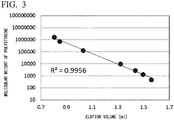
- the value of the square of R is preferably as close to 1 as possible, and is preferably at least 0.99 (see FIG. 1 and FIG. 3 ).
- a packing material having pores is used, and the fact that the degree to which components in the sample are able to enter those pores varies depending on the molecular weight of those components is utilized.
- components having a small molecular weight can enter right into the depths of the pores, whereas components having a large molecular weight cannot enter the pores, and components having an intermediate molecular weight can partially enter the pores.
- Those components that can enter into the depths of the pores have a longer retention time within the column, and therefore the order in which the components are eluted from the column is components of larger molecular weight first, followed by components of intermediate molecular weight, and then components of low molecular weight. In this manner, separation can be achieved in order of the molecular weights of the various components in the sample.
- FIG. 1 An example of a calibration curve for polymer samples is illustrated in FIG. 1 .
- Those components having a molecular weight that exceeds the molecular weight exclusion limit are all eluted at the same time.
- the calibration curve includes a part having linearity and a part having non-linearity, and only the part having linearity of the calibration curve can be used for determining a molecular weight distribution.
- the "exclusion limit molecular weight" is the molecular weight of the smallest component that is unable to enter the pores. Those components having molecular weights exceeding the exclusion limit molecular weight of the column are eluted from the column at the same time, even when there are differences in those molecular weights, and can therefore not be separated.
- polystyrenes examples include polystyrenes and the like.
- measurement of the molecular weight of a polymer sample using the present invention can typically be performed favorably within a molecular weight range from at least 100 to not more than 5,000,000 (polystyrene-equivalent values), and measurement within the molecular weight range from at least 100 to not more than 2,000,000 can be performed particularly favorably.
- the molecular weight is not more than 5,000,000, it is possible to prevent the occurrence of the situation that the polymer sample does not enter the pores of the crosslinked polymer particles, and therefore the sample is eluted without any retention within the column.
- the molecular weight is at least 100, it is possible to prevent the occurrence of the situation that it is unable to achieve linearity in the calibration curve, and therefore it becomes difficult to achieve an accurate measurement of the molecular weight.
- the liquid chromatography analysis method of the present invention aimed at high-speed analysis can be used favorably in size exclusion chromatography, and particularly in organic solvent-based size exclusion chromatography (gel permeation chromatography: GPC) that uses any of various organic solvents as the mobile phase.
- GPC gel permeation chromatography
- examples of mobile phase organic solvents that can be used favorably include tetrahydrofuran, chloroform, dichloromethane, dimethylformamide, dimethylacetamide, benzene, toluene, p-xylene, o-dichlorobenzene, trichlorobenzene, acetone, methyl ethyl ketone, dimethyl sulfoxide, and N-methylpyrrolidone.
- at least one of the solvents from the above solvent group may be used, and a mixture of two or more solvents may also be used.
- a polymer sample can be analyzed rapidly by size exclusion chromatography.
- the flow rate of the mobile phase may also be increased to enable the analysis to be performed more rapidly.
- the flow rate is preferably at least 0.3 ml/min but not more than 3.0 ml/min.
- the flow rate is preferably at least 0.5 ml/min, more preferably at least 1.1 ml/min, and even more preferably 1.5 ml/min or greater.
- the upper limit is preferably not more than 3.0 ml/min. Provided the flow rate is not more than 3.0 ml/min, it is possible to prevent the occurrence of the situation that molecular chain cleavage occurs in the polymer sample, and the cleavage makes it impossible to measure accurate molecular weights.
- the amount of fine particles having a particle size of 1 ⁇ m or less, the volume average particle size, and the identity coefficient (all volume-based values) represent values obtained based on the methods described above using a flow-type particle image analyzer FPIA-3000 (a product name, manufactured by Sysmex Corporation). The number of measured particles was about 6,500.
- the pore size represents a value obtained based on the measurement method described above (the BJH method) using an ASAP 2020 (a product name, manufactured by Micromeritics Instrument Corporation).
- a microchannel emulsification device manufactured by EP Tech Co., Ltd.
- Example 2 Using the same oil layer and dispersant as Example 1, but by performing the polymerization by the microchannel method using different conditions for the device described in Example 1, a styrene-divinylbenzene copolymer (particles) having a volume average particle size of 3.4 ⁇ m, an identity coefficient of 1.05, an amount of fine particles having a particle size of 1 ⁇ m or less that was less than the detection limit (0.05% by volume), and an average pore size of 4 nm was obtained.
- styrene-divinylbenzene copolymer particles having a volume average particle size of 3.4 ⁇ m, an identity coefficient of 1.05, an amount of fine particles having a particle size of 1 ⁇ m or less that was less than the detection limit (0.05% by volume), and an average pore size of 4 nm was obtained.
- a polymerization was performed by the microchannel method in the same manner as Example 1, thus obtaining a styrene-divinylbenzene copolymer (particles) having a volume average particle size of 3.4 ⁇ m, an identity coefficient of 1.05, an amount of fine particles having a particle size of 1 ⁇ m or less that was less than the detection limit (0.05% by volume), and an average pore size of 50 nm.
- styrene-divinylbenzene copolymer having a volume average particle size of 3.4 ⁇ m, an identity coefficient of 1.18, an amount of fine particles having a particle size of 1 ⁇ m or less of 1% by volume, and an average pore size of 50 nm was obtained.
- styrene-divinylbenzene copolymer having a volume average particle size of 3.4 ⁇ m, an identity coefficient of 1.25, an amount of fine particles having a particle size of 1 ⁇ m or less of 5% by volume, and an average pore size of 50 nm.
- a high-performance liquid chromatography analyzer Nexera-i manufactured by Shimadzu Corporation was used to perform a column evaluation, using an ultraviolet detector (UV, wavelength: 254 nm) for the detector. Tetrahydrofuran was used as the mobile phase, the flow rate was set to 0.3 ml/min, and the column temperature was set to 40°C.
- evaluation of the packing performance (number of theoretical plates) of the crosslinked polymer particles was performed using dicyclohexyl phthalate, whereas evaluation of polymer sample separation (the molecular weight range across which polymer samples can be measured and the linearity of the calibration curve) was performed using four polystyrene standards (molecular weights: 500, 1,300, 2,900 and 10,000) for Examples 1 and 2, five polystyrene standards (molecular weights: 10,000, 51,000, 127,000, 780,000 and 1,630,000) for Example 3 and Comparative Example 1, and six polystyrene standards (molecular weights: 500, 2,900, 10,000, 51,000, 127,000 and 1,630,000) for Example 4.
- Example 1 Volume average particle size [ ⁇ m] Amount of fine particles of 1 ⁇ m or less [% by volume] Identity coefficient Average pore size [nm] Column pressure [MPa] Number of theoretical plates [N/column] Elution volume per column [ml] Molecular weight range Linearity of calibration curve (square of R)
- Example 1 2.4 ⁇ 0.05% by volume 1.05 4 4.2 13047 1.55 500 to 10,000 0.998
- Example 2 3.4 ⁇ 0.05% by volume 1.05 4 2.4 11673 1.4 500 to 10,000 0.9923
- Example 3 3.4 ⁇ 0.05% by volume 1.05 50 3.5 9812 1.76 2,900 to 1,636,000 0.9961
- Example 4 3.4 ⁇ 0.05% by volume 1.05 32 3.1 13429 1.64 500 to 1,636,000 0.9944
- Comparative Example 1 3.4 1% by volume 1.18 50 3.6 5502 1.77 500 to 1,636,000 0.9933
- Comparative Example 2 3.4 5% by volume 1.25 50 Pressure loading was high, and packing was not possible
- each of the packed columns of Examples 1 to 4 exhibited an elution volume per column of not more than 2.0 ml before the dicyclohexyl phthalate was eluted, and enabled polymer samples having a broad molecular weight range to be measured with a single column.
- the linearity (square of R) of the calibration curve in the molecular weight range across which polymer samples could be measured was a favorable result of 0.99 or higher.
- the number of theoretical plates (N) was at least 9,800 plates/column.
- the linearity (square of R) of the calibration curve was also a favorable value of 0.9956.
- the present invention can provide a liquid chromatography packing material which uses crosslinked polymer particles that combine a broad molecular weight measurement range, favorable chemical stability, a small particle size, and favorable particle size uniformity.
- the liquid chromatography packing material, the liquid chromatography packed column, and the liquid chromatography analysis method of the present invention exhibit excellent separation performance, withstand pressure and flow velocity resistance, particularly in ultra-high-performance liquid chromatographs using size exclusion chromatography.
- the present invention is useful in the field of analyzing polymer samples such as industrial polymer materials, polymeric additives and biopolymers.
Landscapes
- Chemical & Material Sciences (AREA)
- Analytical Chemistry (AREA)
- Chemical Kinetics & Catalysis (AREA)
- Organic Chemistry (AREA)
- Life Sciences & Earth Sciences (AREA)
- Physics & Mathematics (AREA)
- Health & Medical Sciences (AREA)
- Biochemistry (AREA)
- General Health & Medical Sciences (AREA)
- General Physics & Mathematics (AREA)
- Immunology (AREA)
- Pathology (AREA)
- Nanotechnology (AREA)
- Engineering & Computer Science (AREA)
- Solid-Sorbent Or Filter-Aiding Compositions (AREA)
- Treatment Of Liquids With Adsorbents In General (AREA)
- Addition Polymer Or Copolymer, Post-Treatments, Or Chemical Modifications (AREA)
Applications Claiming Priority (2)
| Application Number | Priority Date | Filing Date | Title |
|---|---|---|---|
| JP2016104482 | 2016-05-25 | ||
| PCT/JP2017/019519 WO2017204292A1 (ja) | 2016-05-25 | 2017-05-25 | 液体クロマトグラフィー充填剤 |
Publications (2)
| Publication Number | Publication Date |
|---|---|
| EP3467494A1 true EP3467494A1 (de) | 2019-04-10 |
| EP3467494A4 EP3467494A4 (de) | 2020-01-01 |
Family
ID=60412404
Family Applications (1)
| Application Number | Title | Priority Date | Filing Date |
|---|---|---|---|
| EP17802878.3A Withdrawn EP3467494A4 (de) | 2016-05-25 | 2017-05-25 | Flüssigchromatografiefüller |
Country Status (5)
| Country | Link |
|---|---|
| US (1) | US20190204278A1 (de) |
| EP (1) | EP3467494A4 (de) |
| JP (1) | JPWO2017204292A1 (de) |
| CN (1) | CN109154587A (de) |
| WO (1) | WO2017204292A1 (de) |
Families Citing this family (3)
| Publication number | Priority date | Publication date | Assignee | Title |
|---|---|---|---|---|
| IL303698A (en) * | 2020-12-15 | 2023-08-01 | Proteas Bioanalytics Inc | Mass spectrometry sample processing methods, chromatography devices, and data analysis techniques for biomarker analysis |
| JP7671341B2 (ja) * | 2021-03-25 | 2025-05-01 | Jsr株式会社 | クロマトグラフィー用担体の製造方法、クロマトグラフィーカラムの製造方法、及びクロマトグラフィー用担体 |
| EP4316624A4 (de) * | 2021-03-25 | 2025-02-12 | JSR Corporation | Verfahren zur herstellung eines chromatographischen trägers, verfahren zur herstellung einer chromatographiesäule und chromatographischer träger |
Family Cites Families (9)
| Publication number | Priority date | Publication date | Assignee | Title |
|---|---|---|---|---|
| JPS6379064A (ja) * | 1986-09-22 | 1988-04-09 | Nitto Electric Ind Co Ltd | ゲル・パ−ミエイシヨンクロマトグラフイ用充填剤 |
| JP3298191B2 (ja) * | 1992-09-25 | 2002-07-02 | 東ソー株式会社 | 多孔性重合体粒子の製造方法 |
| WO1999019370A1 (en) * | 1997-10-15 | 1999-04-22 | Amersham Pharmacia Biotech K.K. | Process for producing polymer particles with uniform particle size |
| JPH11193310A (ja) * | 1997-12-27 | 1999-07-21 | Arakawa Chem Ind Co Ltd | アルキル基含有多孔質ポリマー、その製造方法及びその用途 |
| JPH11302304A (ja) * | 1998-04-17 | 1999-11-02 | Sekisui Chem Co Ltd | 高分子微粒子の製造方法及び液体クロマトグラフィー用充填剤の製造方法 |
| US6855761B2 (en) * | 1999-04-23 | 2005-02-15 | Tosoh Corporation | Monodisperse particles, process for producing the same, and uses thereof |
| JP4779186B2 (ja) * | 1999-04-23 | 2011-09-28 | 東ソー株式会社 | 粒径単分散粒子、その製造方法及びそれを用いた用途 |
| CN109078626A (zh) | 2009-12-15 | 2018-12-25 | 沃特世科技公司 | 实施体积排阻色谱的设备和方法 |
| JP6160281B2 (ja) * | 2013-01-25 | 2017-07-12 | 日立化成株式会社 | カラム用充填材 |
-
2017
- 2017-05-25 EP EP17802878.3A patent/EP3467494A4/de not_active Withdrawn
- 2017-05-25 US US16/302,253 patent/US20190204278A1/en not_active Abandoned
- 2017-05-25 CN CN201780030431.4A patent/CN109154587A/zh active Pending
- 2017-05-25 WO PCT/JP2017/019519 patent/WO2017204292A1/ja not_active Ceased
- 2017-05-25 JP JP2018519605A patent/JPWO2017204292A1/ja active Pending
Also Published As
| Publication number | Publication date |
|---|---|
| WO2017204292A1 (ja) | 2017-11-30 |
| JPWO2017204292A1 (ja) | 2019-03-22 |
| EP3467494A4 (de) | 2020-01-01 |
| US20190204278A1 (en) | 2019-07-04 |
| CN109154587A (zh) | 2019-01-04 |
Similar Documents
| Publication | Publication Date | Title |
|---|---|---|
| Stenzel et al. | Amphiphilic block copolymers based on poly (2‐acryloyloxyethyl phosphorylcholine) prepared via RAFT polymerisation as biocompatible nanocontainers | |
| Ferreira et al. | Optimizing the generation of narrow polydispersity ‘arm-first’star polymers made using RAFT polymerization | |
| JP5715953B2 (ja) | タンパク質分離処理における温度応答性重合体粒子 | |
| EP3467494A1 (de) | Flüssigchromatografiefüller | |
| Lira et al. | Structural parameters of polyacrylamide hydrogels obtained by the Equilibrium Swelling Theory | |
| Moravcová et al. | Comparison of monolithic silica and polymethacrylate capillary columns for LC | |
| Ousalem et al. | Evaluation of the porous structures of new polymer packing materials by inverse size-exclusion chromatography | |
| Ayano et al. | Temperature-responsive smart packing materials utilizing multi-functional polymers | |
| Beaudoin et al. | Polystyrene-block-poly (ethylene oxide) from nitroxide mediated polymerization: detection of minor species by coupled chromatographic techniques | |
| US4174430A (en) | Process for producing porous polystyrene gel | |
| Braun et al. | Phase separation in random copolymers from high conversion free radical polymerization, 2. Chemical heterogeneity analysis of poly (styrene‐co‐ethyl acrylate) by gradient HPLC | |
| Vivek et al. | Amphiphilic polystyrene-graft-poly (N, N-dimethylamino-2-ethyl methacrylate) hydrogels synthesized via room temperature ATRP: Studies on swelling behaviour and dye sorption | |
| Peltier et al. | Reverse-phase high performance liquid chromatography (RP-HPLC) as a powerful tool to characterise complex water-soluble copolymer architectures | |
| Rollet et al. | Separation of parent homopolymers from poly (ethylene oxide) and polystyrene-based block copolymers by liquid chromatography under limiting conditions of desorption–1. Determination of the suitable molar mass range and optimization of chromatographic conditions | |
| Lu et al. | Non-ionic, thermo-responsive DEA/DMA nanogels: Synthesis, characterization, and use for DNA separations by microchip electrophoresis | |
| Li et al. | Preparation and characterization of neutral poly (ethylene glycol) methacrylate-based monolith for normal phase liquid chromatography | |
| Maksimova et al. | Methacrylate-based monolithic layers for planar chromatography of polymers | |
| Rostami et al. | Preparation, optimization and application of poly (ethylene glycol) methyl ether methacrylate/urethane methacrylate as a new polar phase for stir bar sorptive extraction | |
| Jiao et al. | One-pot preparation of a novel monolith for high performance liquid chromatography applications | |
| Fandrich et al. | Characterization of New Amphiphilic Block Copolymers of N‐Vinyl Pyrrolidone and Vinyl Acetate, 1–Analysis of Copolymer Composition, End Groups, Molar Masses and Molar Mass Distributions | |
| Pasch et al. | New chromatographic and hyphenated techniques for hydrophilic copolymers | |
| Greyling et al. | Fractionation of poly (methacrylic acid) and poly (vinyl pyridine) in aqueous and organic mobile phases by multidetector thermal field-flow fractionation | |
| Mori | Compositional characterization of styrene copolymers by non‐exclusion liquid chromatography | |
| Gawdzik et al. | Influence of diluent composition on the porous structure of methacrylate copolymers | |
| Nakan et al. | Synthesis and characterization of hydrophilic copolymers |
Legal Events
| Date | Code | Title | Description |
|---|---|---|---|
| STAA | Information on the status of an ep patent application or granted ep patent |
Free format text: STATUS: THE INTERNATIONAL PUBLICATION HAS BEEN MADE |
|
| PUAI | Public reference made under article 153(3) epc to a published international application that has entered the european phase |
Free format text: ORIGINAL CODE: 0009012 |
|
| STAA | Information on the status of an ep patent application or granted ep patent |
Free format text: STATUS: REQUEST FOR EXAMINATION WAS MADE |
|
| 17P | Request for examination filed |
Effective date: 20181224 |
|
| AK | Designated contracting states |
Kind code of ref document: A1 Designated state(s): AL AT BE BG CH CY CZ DE DK EE ES FI FR GB GR HR HU IE IS IT LI LT LU LV MC MK MT NL NO PL PT RO RS SE SI SK SM TR |
|
| AX | Request for extension of the european patent |
Extension state: BA ME |
|
| DAV | Request for validation of the european patent (deleted) | ||
| DAX | Request for extension of the european patent (deleted) | ||
| A4 | Supplementary search report drawn up and despatched |
Effective date: 20191129 |
|
| RIC1 | Information provided on ipc code assigned before grant |
Ipc: B01J 20/28 20060101ALI20191125BHEP Ipc: B01J 20/285 20060101ALI20191125BHEP Ipc: G01N 30/26 20060101ALI20191125BHEP Ipc: G01N 30/88 20060101ALI20191125BHEP Ipc: B01J 20/26 20060101AFI20191125BHEP Ipc: G01N 30/32 20060101ALI20191125BHEP Ipc: B01J 20/30 20060101ALI20191125BHEP Ipc: B01D 15/20 20060101ALI20191125BHEP |
|
| STAA | Information on the status of an ep patent application or granted ep patent |
Free format text: STATUS: THE APPLICATION IS DEEMED TO BE WITHDRAWN |
|
| 18D | Application deemed to be withdrawn |
Effective date: 20200630 |