EP3465679B1 - Verfahren und vorrichtung zur erzeugung von präsentationen der virtuellen oder erweiterten realität mit 3d-audiopositionierung - Google Patents
Verfahren und vorrichtung zur erzeugung von präsentationen der virtuellen oder erweiterten realität mit 3d-audiopositionierung Download PDFInfo
- Publication number
- EP3465679B1 EP3465679B1 EP17803593.7A EP17803593A EP3465679B1 EP 3465679 B1 EP3465679 B1 EP 3465679B1 EP 17803593 A EP17803593 A EP 17803593A EP 3465679 B1 EP3465679 B1 EP 3465679B1
- Authority
- EP
- European Patent Office
- Prior art keywords
- audio
- scene
- components
- content
- environment
- Prior art date
- Legal status (The legal status is an assumption and is not a legal conclusion. Google has not performed a legal analysis and makes no representation as to the accuracy of the status listed.)
- Active
Links
Images





Classifications
-
- G—PHYSICS
- G10—MUSICAL INSTRUMENTS; ACOUSTICS
- G10L—SPEECH ANALYSIS TECHNIQUES OR SPEECH SYNTHESIS; SPEECH RECOGNITION; SPEECH OR VOICE PROCESSING TECHNIQUES; SPEECH OR AUDIO CODING OR DECODING
- G10L19/00—Speech or audio signals analysis-synthesis techniques for redundancy reduction, e.g. in vocoders; Coding or decoding of speech or audio signals, using source filter models or psychoacoustic analysis
- G10L19/008—Multichannel audio signal coding or decoding using interchannel correlation to reduce redundancy, e.g. joint-stereo, intensity-coding or matrixing
-
- G—PHYSICS
- G10—MUSICAL INSTRUMENTS; ACOUSTICS
- G10L—SPEECH ANALYSIS TECHNIQUES OR SPEECH SYNTHESIS; SPEECH RECOGNITION; SPEECH OR VOICE PROCESSING TECHNIQUES; SPEECH OR AUDIO CODING OR DECODING
- G10L19/00—Speech or audio signals analysis-synthesis techniques for redundancy reduction, e.g. in vocoders; Coding or decoding of speech or audio signals, using source filter models or psychoacoustic analysis
- G10L19/04—Speech or audio signals analysis-synthesis techniques for redundancy reduction, e.g. in vocoders; Coding or decoding of speech or audio signals, using source filter models or psychoacoustic analysis using predictive techniques
- G10L19/16—Vocoder architecture
- G10L19/18—Vocoders using multiple modes
- G10L19/20—Vocoders using multiple modes using sound class specific coding, hybrid encoders or object based coding
-
- G—PHYSICS
- G11—INFORMATION STORAGE
- G11B—INFORMATION STORAGE BASED ON RELATIVE MOVEMENT BETWEEN RECORD CARRIER AND TRANSDUCER
- G11B27/00—Editing; Indexing; Addressing; Timing or synchronising; Monitoring; Measuring tape travel
- G11B27/10—Indexing; Addressing; Timing or synchronising; Measuring tape travel
-
- H—ELECTRICITY
- H04—ELECTRIC COMMUNICATION TECHNIQUE
- H04S—STEREOPHONIC SYSTEMS
- H04S7/00—Indicating arrangements; Control arrangements, e.g. balance control
- H04S7/30—Control circuits for electronic adaptation of the sound field
- H04S7/302—Electronic adaptation of stereophonic sound system to listener position or orientation
- H04S7/303—Tracking of listener position or orientation
- H04S7/304—For headphones
-
- H—ELECTRICITY
- H04—ELECTRIC COMMUNICATION TECHNIQUE
- H04S—STEREOPHONIC SYSTEMS
- H04S7/00—Indicating arrangements; Control arrangements, e.g. balance control
- H04S7/30—Control circuits for electronic adaptation of the sound field
- H04S7/305—Electronic adaptation of stereophonic audio signals to reverberation of the listening space
- H04S7/306—For headphones
-
- H—ELECTRICITY
- H04—ELECTRIC COMMUNICATION TECHNIQUE
- H04S—STEREOPHONIC SYSTEMS
- H04S2400/00—Details of stereophonic systems covered by H04S but not provided for in its groups
- H04S2400/11—Positioning of individual sound objects, e.g. moving airplane, within a sound field
-
- H—ELECTRICITY
- H04—ELECTRIC COMMUNICATION TECHNIQUE
- H04S—STEREOPHONIC SYSTEMS
- H04S2420/00—Techniques used stereophonic systems covered by H04S but not provided for in its groups
- H04S2420/01—Enhancing the perception of the sound image or of the spatial distribution using head related transfer functions [HRTF's] or equivalents thereof, e.g. interaural time difference [ITD] or interaural level difference [ILD]
Definitions
- the present disclosure relates to the production and configuration of Virtual Reality or Augmented Reality presentations. More particularly, this invention pertains to a method and apparatus for enhancing a Virtual Reality and/or Augmented Reality presentation (hereafter referred to as a 'VR/AR presentation') by using 3D space information associated with at least some of the visual characters and other objects of interest that are either part of the actively viewed scene, or outside the field of view, to position the associated audio characters/objects of interest (hereafter referred to as 'audio objects' or 'audio objects of interest') in the 3D space of the VR/AR presentations. Moreover the apparatus and method further provides for the augmentation of audio objects using characteristics of the visual environment for the VR presentations and the characteristics of actual environments for the AR presentations.
- 3D movie or other similar episodic audio/visual content was prepared for analog film distribution or other relatively low fidelity analog or digital transmission, storage, projection and/or display 3D formats, e.g. anaglyph 3D.
- Advances in 3D encoding formats, presentation technology, and digital signal processing have resulted in 3D movie or episodic visual content produced in much higher quality 3D formats, e.g., stereoscopic HD 1920 x 1080p, 3D Blu-ray Discs, etc.
- Virtual Reality is a term that has been used for various types of content that simulates immersion in a partially or wholly computer-generated and/or live action three-dimensional world. Such content may include, for example, various video games and animated film content. A variation of these technologies is sometimes called "Augmented Reality.”
- Augmented Reality presentation an actual 3D presentation of the current surroundings of a user that is 'augmented' by the addition of one or more virtual objects or overlays.
- Augmented Reality content may be as simple as textual 'heads up' information about objects or people visible around the user, or as complex as transforming the entire appearance of the user's surroundings into an imaginary environment that corresponds to the user's real surroundings. Advances in encoding formats, presentation technology, motion tracking, position tracking, eye tracking, portable accelerometer and gyroscopic output/input, and related signal processing have reached a point where both virtual and augmented reality presentations can be displayed to a user in real time.
- VR virtual Reality
- AR Augmented Reality
- 3D headsets and other 3D presentation devices immerse the user in a 3D scene.
- Lenses in the headset enable the user to focus on a lightweight split display screen mounted in the headset positioned inches from the user's eyes.
- different sides of the split display show right and left stereoscopic views of video content, while the user's peripheral view is blocked or left partially unobstructed below the central field of view.
- two separate displays are used to show different images to the user's left eye and right eye respectively.
- the field of view of the display encompasses the full field of view of each eye including the peripheral view.
- an image is projected on the user's retina using controllable small lasers, mirrors or lenses. Either way, the headset enables the user to experience the displayed VR or AR content in a manner that makes the user feel like he was immersed in a real scene.
- the user may experience the augmented content as if it were a part of, or placed in, an augmented real scene.
- VR or AR content can be presented to a viewer as a 360° picture as well that can be presented on a standard screen with the image moving left or right and/or up and down either automatically or under the control of the viewer.
- the immersive AR/VR effects may be provided or enhanced by motion sensors in a headset (or elsewhere) that detect motion of the user's head, and adjust the video display(s) accordingly.
- the headset or other device
- the headset may also include tracking sensors that detect position of the user's head and/or body, and adjust the video display(s) accordingly.
- By leaning or turning the user can see a VR or AR scene from a different point of view. This responsiveness to head movement, head position and body position greatly enhances the immersive effect achievable by the headset.
- the user may thus be provided with the impression of being placed inside or 'immersed' in the VR scene.
- immersion generally encompasses both VR and AR presentations.
- Immersive headsets and other wearable immersive output devices are especially useful for game play of various types, which involve user exploration of a modeled environment generated by a rendering engine as the user controls one or more virtual camera(s) or displays using head movement, the position or orientation of the user's body, head, eye, hands, fingers, feet, or other body parts, and/or other inputs using sensors such as accelerometers, altimeters, GPS receivers, Electronic Tape Measures, Laser Distance Finders, laser or sound Digital Measuring Devices, gyroscopic sensors and so on.
- sensors such as accelerometers, altimeters, GPS receivers, Electronic Tape Measures, Laser Distance Finders, laser or sound Digital Measuring Devices, gyroscopic sensors and so on.
- the user needs to perceive a freedom of movement that is in some way analogous to human visual and aural perception when interacting with reality.
- Content produced for VR/AR presentations can provide this experience using techniques for real-time rendering that have been developed for various types of video games.
- the content may be designed as a three-dimensional computer model with defined boundaries and rules for rendering the content as a video signal.
- This content can be enhanced by stereoscopic techniques to provide stereoscopic video output, sometimes referred to as "3D," and associated with a VR/AR presentation that manages the rendering process in response to movement of the 3D headset, or head, eye, hand, finger, foot or other body part (or body part appendage such as a 'magic' wand or golf club) movement, and/or other inputs such as the sensors mentioned above to produce a resulting digital VR/AR presentation and user experience.
- the user experience can be very much like being placed or immersed inside a rendered video game environment.
- the simulated 3D environment may be used primarily to tell a story, more like traditional theater or cinema.
- the added visual effects may enhance the depth and richness of the story's narrative elements or special effects, without giving the user full control (or any control) over the narrative itself.
- a rich mixed reality experience is provided that progresses differently during each encounter (or viewing), as opposed to a standard linear book or movie wherein a set narrative or sequence of scenes is presented having a single ending. This experience depends upon direction from the viewer-which way to look, for example,-though clearly this can be influenced and directed by narrative cues, as well some random elements that may be introduced by the software.
- the narrative is not linear or predictable at the outset but variable due, for example to choices made by the viewer and other factors.
- the narrative or story being presented can evolve dramatically on the fly, creating tension and release, surprises, linear or non-linear progress, turning points, or dead ends.
- the term 'digital VR/AR presentation' is used to refer to videogame, movie, episodic, or other audiovisual content recorded, produced, rendered, and/or otherwise generated in a digital format, or audiovisual content recorded, produced, rendered or otherwise generated in a digital format to be overlaid on reality.
- the term also covers content produced in 2D, content produced in 2D and then postproduced from 2D to 3D, content produced natively in 3D, as well as content rendered from 3D animation systems.
- 3D visual information determined by analysis software and/or by an operator on a frame by frame, group of frames, or scene by scene basis and recorded in a respective log.
- the conventional method of representing 3D depth information is via a z-axis depth map, which consists of a single 2-dimensional image that has the same spatial resolution as the 3D imagery (e.g. 1920x1080 for HD video).
- Each pixel of the image contains a gray-scale value corresponding to the depth of that particular pixel in the scene.
- a gray-scale value of 256 could represent the maximum positive 3D parallax (into the screen)
- the values can then be normalized based on the depth budget of the scene, e.g. a value of 256 could represent a pixel that is 100 feet away from the viewer whereas a value of 0 could represent a pixel which is 10 feet away from the viewer.
- 3D depth information is a 3-dimensional depth volume, whereby each pixel in the 3D volume of the scene is represented by a particular value. Unlike the z-axis depth map the 3D depth volume is not limited to a single gray-scale value, and instead for each pixel both the color value (i.e. RGB value) of that particular pixel as well as the x-y-z coordinate of that pixel can be represented. Computer generated 3D imagery or other 3D visual effects techniques may more easily lend themselves to creating 3D depth volumes versus utilizing a 2D z-axis depth map. Such 3D representations of the depth information could be used for future display systems including holographic projection. Other data representations can be used to represent the depth information in a given scene including, but not limited to, 2D disparity maps and eigenvectors
- a 3D space map of the frames' visual content can be generated, or of objects of interest within frames, may be determined when preparing to position subtitles or other graphics in 3D space over the background video.
- Some audio objects of interest could have on-screen visual counterparts that can be tracked spatially. For example, as an on-screen actor moves and speaks in a scene, his position can be tracked both audially and visually.
- visual objecttracking software systems and software development kits such as the SentiSight 3.0 kit of Neurotechnology, Vilnius, Lithuania,
- Such systems can tolerate in-plane rotation, some out-of-plane rotation, and a wide range of changes in scale.
- Such systems can also manage to track visual or audio objects that are occluded (e.g., as much as 50%).
- object tracking could also identify locations of off-screen objects given sufficient, prior on-screen information, or even post on-screen info for pre-authored sequences.
- Other audio objects of interest e.g., an actor speaking while off screen, or an actor speaking while being partially or fully occluded visually, may not be tracked. In this latter case, an on-screen actor might look directly across and past the screen plane boundary at another off-screen actor with whom he converses.
- audio objects of interest may not correspond to on screen visual objects at all depending upon positioning or editorial intent, e.g., an off-screen narrator's voice may be essential to a presentation, but there may be no on-screen item that corresponds to that voice.
- its audio component or parts of the audio components relating to audio objects of interest may not include clear 3D space perception cues, either because these cues have been stripped away or otherwise lost, or because they were missing in the first place. This problem is compounded in real-time applications and environments such as video game rendering and live event broadcasting.
- an efficient scheme to optimize digital VR/AR presentation preparation with audio 3D space perception cues is required.
- an efficient scheme to optimize additional digital VR/AR presentation conversion with audio 3D space perception cues for other formats or distribution formats is required.
- information gathered in digital 3D video analysis is used as input to produce audio 3D space perception cues to enhance the 3D audiovisual experience.
- a VR/AR presentation will be enhanced, and therefore the user experience will be more enveloping and powerful, if audio cues related to the position of objects of interest in the VR/AR presentation complement the video, as relevant audio cues underscore the visual position of objects of interest in real life, e.g.
- the formats for the audio component of digital VR/AR presentations can vary in terms of production, encoding, transmission, generation, and/or presentation.
- Typical presentation formats for the audio component may vary from mono to stereo to multichannel such as 5.1, 6.1,7.1 or so-called 'object oriented' or 'immersive' audio.
- Some of these audio formats include audio cues for depth perception such as amplitude differences, phase differences, arrival time differences, reverberant vs. direct sound source level ratios, tonal balance shifts, masking, and/or surround or multi-channel directionality.
- US8755432 B2 shows a 3D movie with audio object generating apparatus, which has an authoring tool receiving audio information related to the spatial positions of audio objects and an encoder generating encoded 3D content with object positions identified by audio positioning cues.
- US2009/237564 A1 shows a method for determining the location of sound sources for an immersive audio-visual production system, which involves analyzing sound source information collected from multiple sound tracks, to determine the location of sound sources.
- US2014/233917 A1 shows a method for capturing multi-channel audio data using smart phones , wherein multi-channel audio data is generated from audio data based on the association of audio objects with video objects.
- US2013/236040 A1 shows a method of providing augmented audio to a listener wearing a headset of an augmented reality audio system, comprising playing an augmented reality audio output track with right and left ear speakers of a headset.
- An apparatus for generating an augmented reality presentation is provided in claim 1.
- a method for genrerating an augmented reality presentation is provided in claim 2.
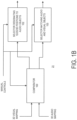
- FIG. 1 shows the components of an apparatus for implementing the invention.
- Content such as an uncompressed 3D content 60 is first presented to the apparatus for processing.
- 3D content is used to refer generically to content that can be presented on a suitable 3D apparatus and could include a 3D presentation, a VR presentation or an AR presentation.
- a 3D presentation is presentation, such as a movie, which consists of a plurality of 3D images presented in a predetermined sequence with no interaction or input from a spectator, and accompanied by a suitable 3D sound track.
- the digital 3D movie could be a sequence of 3D frames at the same native resolution as the source material (e.g., 1920 ⁇ 1080p).
- a 3D movie could be a feature movie shot with live actors, or could be a cartoon with virtual characters, or a mixture, or live action supplemented by CGI effects.
- a 3D presentation is shown either to a single viewer, or a plurality of viewers simultaneously, for example, in a movie theater and the final audio component is presented to the viewers through the audio speaker system of the movie theater.
- a VR presentation refers to a presentation, such as an interactive game in which various scenes are played in sequences determined by viewer actions, including eye tracking or focus, gestures or other body/limb movements, positioning of appendages such as a 'magic' wand or gold club, object or face recognition software, or motion tracking or depth sensing inputs provided by an appropriate VR device such as a Head Mounted Display (HMD) having audio outputs for stereo or multichannel audio and a screen presenting 3D images to a user.
- the audio component ca be presented through headphones or ear buds
- the 3D images are presented in a sequence determined by a spectator and a suitable 3D audio track is generated to suit the visual sequence,
- the 3D images may be real images of actual objects, scenes, etc.
- a VR presentation could be an interactive game in which various scenes are played in sequences determined by viewer actions, including eye tracking or focus, gestures or other body/limb movements, positioning of appendages such as a 'magic' wand or gold club, object or face recognition software, or motion tracking or depth sensing inputs provided by apparatus in a Head Mounted Display (HMD).
- the final video components of the VR presentation are shown on the screen of the VR device (not shown) and the audio components are presented through standard audio devices such as the head phones or earbuds (not shown).
- AR presentations are similar to VR presentations and consist of images of real time objects that a spectator is looking at and which images are combined with other 3D images that are superimposed or otherwise combined with the real time images.
- the other 3D images may be, for example, real 3D images taken previously, or computer generated images.
- Real objects, such as walls, or other obstacles are detected using various sensors or optical recognition elements.
- the proximity or changes in proximity to surrounding objects are determined by accelerometers, altimeters, GPS receivers, Electronic Tape Measures, Laser Distance Finders, laser or sound Digital Measuring Devices, or gyroscopic sensors.
- the AR presentations include audio and video components with the audio components being played through headphones or similar means and the video components being presented on a screen.
- planes and/or objects of visual interest correspond to audio objects of interest.
- audio objects of interest may not correspond to visual objects of interest.
- a narrator or commentator who is on- or off- screen can provide editorial dialog of a car race. The various cars in the race can emerge rapidly from the background, roar closer and closer, and then zoom past the viewer off screen.
- the visual objects of interest are the cars and there are two sets of audio objects of interest: the editorial dialog and the sound of the zooming cars.
- both the sounds of the racing cars and the editorial dialog should be provided as audio objects of interest.
- the car sounds e.g., the audio objects
- visual images e.g., the visual objects
- visual objects may pop in and out of the scene in a pseudorandom manner and various sound effects may be associated with some of these objects, or randomly spaced audio objects may be produced.
- the audio track generated herein includes not only standard audio elements such speech, sound effects, etc., but these elements are modified and new elements are added that conform to characteristics of the virtual environment of the scene being played, and, in some cases the physical environment of the viewer(s).
- the 3D content may include a Z-axis depth map indicating relative distance of various visual objects (or planes of interest, e.g. in A/R one plane for real world objects and one place for A/R overlays) for the respective 3D frames.
- a 3D Z-axis depth map consists of a two dimensional image having the general outline and surface characteristics of all the objects of interest. Objects, and object surfaces, at various locations along the Z-axis are represented on the two dimensional image by their respective outlines and surface shadings.
- Each outline includes one or more surfaces the surfaces being shaded. More particularly, each outline and each surface of the outline (if more than one) is shaded on a gray scale corresponding to the relative position of the respective objects and their surfaces.
- a 3D Z-axis depth map provides information about the relative positions of various objects of interest, and their surfaces, with respect to each other and with respect to a particular reference point such as the screen and/or the viewer.
- a particular reference point such as the screen and/or the viewer.
- other means of indicating the positions of audio or visual objects in 3D space may be used and this invention is not limited to any one of these means.
- an encoder 10 receives a 3D movie, for example in the form of an uncompressed video master 60.
- the audio/video encoder 10 generates from this master a first 3D encoded content which may be stored, recorded or distributed to customers via various distribution channels.
- the first 3D encoded content may or may not have information providing audio 3D space perception cues relative to the 3D space visual objects, or any other audio objects of interest. It does not have audio 3D information defining the acoustic environment in which the master will be played and/or the virtual environment in which the scenes take place.
- the apparatus for implementing the invention includes a 3D video encoder 10, an audio processor 21, a video processor 23 and an authoring tool 22.
- the 3D content 60 is presented to the 3D video encoder that processes the 3D content.
- the output of the encoder 10 is referred to as the first 3D encoded content.
- the video processor 23 received a 3D video tracking map such as a 3D Z-axis map described above that tracks the positions of visual objects of interest for each frame or groups of frames for encoded content.
- the 3D tracking map can be derived from a log 20, or by analyzing the first 3D encoded content using analyzer 30.
- the video processor 23 may also receive manual controls for controlling the positions of some of the visual objects.
- new visual content may also be provided to the video processor, in A/R instantiations for example, by static or changing proximity to surrounding objects determined by object recognition or face recognition software, or motion tracking or depth sensing means included in a HMD, e.g.
- New visual content may be provided to the video processor in the form of subtitles and/or other additional graphic elements (as described more fully in commonly assigned co-pending application Ser. No. 13/205,720 filed Aug. 9, 2011 , entitled METHOD AND APPARATUS FOR GENERATING ENCODED CONTENT USING DYNAMICALLY OPTIMIZED CONVERSATION FOR 3D MOVIES).
- the visual processor generates visual parameters that are provided to the authoring tool 22.
- the authoring tool can either work in real time, e.g. for a videogame, A/R, or V/R rendering purposes or performs its functions before the rendering, for example for 3D presentations.
- the audio processor 21 receives the raw audio signals (e.g., the audio tracks from the uncompressed video master) and/or other sources. For example, additional audio content may be added that was not in the original uncompressed video master.
- the audio processor 21 receives other information, such as the 3D position of various visual objects, manual and/or automated selection signals correlating certain audio tracks with either visual objects or defining audio objects (if the audio tracks either are not associated with a visual object, or are associated with an off-screen visual object).
- the audio processor 21 also receives other environmental parameters indicative of the respective environment as described in more detail below.
- the audio processor 21 then generates audio parameters indicative of the position of the audio content, such as audio objects of interest in the relevant frames. [0044] As shown in more detail in FIG.
- audio processor 21 include comparator 100 receiving the 3D video and audio tracking maps.
- the audio source i.e., the audio object of interest
- the audio source can be positioned in 2D and 3D space, i.e. along the X, Y and Z axes.
- the audio source position in the X, Y and Z axes may be important.
- Various criteria or approaches can be used to generate and/or identify the positions of audio objects, as discussed in more detail below.
- the authoring tool 22 analyzes the audio object parameters, and for each frame or set of frames, allocates the position of the audio object(s) and then generates appropriate authoring or re-authoring control signals for processing the audio source(s) in the 3D frames with cues to position them in the designated location(s).
- an evolving visual tracking map or maps can be generated from motion tracking or depth sensing means included in a HMD such as computer vision, object or face recognition software, accelerometers, altimeters, GPS receivers, Electronic Tape Measures, Laser Distance Finders, laser or sound Digital Measuring Devices, or gyroscopic sensors.
- the tracking map can be used to produce an AR overlay or other blending of AR objects or graphics with real world objects, including audio positioning.
- the audio and visual positions of the objects of interest correspond, the 3D space information for both the audio and the visual objects is recorded so that audio objects can be mapped on to the visual objects of interest.
- the depth positions e.g., the positions along the Z-axis
- the positions of the audio objects in 3D volume e.g., along all three axes X, Y and Z
- the comparator 100 receives the audio and visual tracking maps and determines if they are convergent. If there is a single visual object and a single audio present, this determination can be simple. However, if there are multiple visual and multiple audio objects present, manual controls or other means may be used to assign each audio object to each visual object. Once this identification is done, automated tracking software is provided to track the audio and visual objects consistently by component 103.
- the audio and visual objects of interest diverge, or no information is available that is indicative of whether an audio object maps to a particular visual object of interest.
- either a manual operator, or an automated analyzer running automatic object audio tracking software (if necessary) represented by component 102 can select and track the 'on-screen' audio object(s) of interest (as well as any visual objects A, B, C, or D.)
- This tracking information may be represented, for example, as a Z-axis depth map (if only depth perception is desired), or it may be represented in full 3D space along the X, Y and Z axes. If there are no audio objects of interest on screen or an audio object is obscured (e.g.
- the tracking map is extended to provide information for the occluded or off-screen audio object as well, including an audio object disposed in the same vertical plane as the viewer, or even behind the viewer.
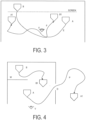
- FIGS. 2-4 provide in plan views some simple examples illustrating various audio and visual objects of interest in a scene.
- FIG. 2 shows a plan view of a stage with four performers A, B, C, D as seen by a viewer V.
- A, B, C and D may be vocalists and/or musicians and they can remain stationary or move about the stage.
- the video component of the received 3D movie shows the positions of each of the performers.
- the audio component consist of either a mixed audio track, or several tracks with the audio signals from each of the performers, in this case with substantially no audio depth perception or any other audio cues tying the tracks spatially to the performers.
- the audio component further lacks any acoustic characteristics of the desired environment, e.g., the environment in which the respective scene takes place.
- the raw audio tracks are analyzed and manipulated by the audio processor (comparator 100 or component 102 ) to generate audio parameters defining virtual audio tracks representing the sounds from each of the performers.
- the tracks are then correlated with each of the performers. This can be done either manually by an operator or automatically, for example, by processing the video component to identify the four performers using facial recognition algorithms, by recognizing their instruments, or other means.
- audio parameters are generated by the audio processor 21 representing the audio objects of interest.
- these parameters represent depth perception cues for some or for all the audio tracks.
- the positions of some of the performers are emphasized in some scenes and the positions of other performers can be emphasized at other times, based for example, on the relative loudness of the tracks, or other editorial criteria.
- the audio processor also receives the environmental parameters defining the acoustical characteristics of the respective environment and modulates the each of the audio tracks accordingly.
- the audio tracks are modified so that a viewer looking and listening to the program not only hears the sound tracks in a manner in which the sounds would be heard in a forest, but would hear additional sounds, such as chirping of birds, buzzing of bees, and so on.
- sound effect is used herein to refer to the modifications of the sounds and the addition of new sounds
- the audio object positions corresponding to the audio objects of interest are recorded so that the audio tracks corresponding to these objects can be processed with appropriate audio position cues to position them in 3D space.
- the quality of the sound tracks are also modified according to the position of the audio objects as well.
- FIG. 3 shows a plan view of a different scene in which two actors A and B are talking and moving around along paths E and F so that actor A ends up in position A1 and actor B ends up in position B1.
- the actors A and B are positioned 'off stage' behind the viewer V. All the positions are tracked and/or plotted from the video component object tracking map and corresponding audio object tracks are processed with 3D space position cues to correspond to these positions by component 103.
- the resultant audio track also includes modifications to render them more realistic, in accordance with the acoustic environment of the location where the scene takes place.
- FIG. 4 shows a plan view of a scene somewhat similar to the one in FIG. 3 .
- actor B is behind a wall W (or other obstruction) but he can still be heard as he speaks.
- Actor A is visible, and is talking to B.
- actor B moves around the wall W and forward toward position B1.
- actor A walks through a doorway D so that he is no longer visible, but may move along an arbitrary path P, and still keeps on talking.
- the two actors are moving around and talking, their positions are constantly tracked and plotted, so appropriate audio 3D space cues can be generated even if an actor is out of sight, e.g., off stage.
- FIG. 4 is not to scale since viewer V is normally much further away from the stage.
- FIG. 5 shows a flow chart of an exemplary method used by the apparatus of FIG. 1 .
- a 3D movie in a known format is received and its audio and video components are encoded in step 110.
- audio and video objects of interest are detected (for example, in a scene). This step can be performed either by an operator or automatically.
- the spatial positions of these objects are then compared. If they match (step 130 ) then they are converted into a new format, using an appropriate encoding scheme (step 140 ) and then distributed (step 150 ) through an appropriate channel. If there is no match in the spatial positions, or if there is insufficient information to detect the spatial position of an audio object, then in step 160 the spatial positions are identified by audio processor 21.
- step 170 a check is made as to whether an audio object of interest is associated with a visible object. If it is, then in step 180 the positions of the corresponding visual object (actors A, B) are continuously tracked (step 180 ) and corresponding audio cues are generated (step 190 ). If an audio object does not correspond to a visual object (for example, actor B in his original position or actor A in position A1) then different calculations are made using specific rules applicable for occluded, off-screen or otherwise hidden objects (step 200 ). For example, the movement of the hidden object (e.g., an actor moving behind a wall) can be interpolated and used to generate a corresponding audio object. Additional sound effects are also obtained at this point, based on the environmental parameters previously received.
- the hidden object e.g., an actor moving behind a wall
- step 210 the audio and visual parameters are provided to the authoring tool 22.
- the positional cues in one, two or three dimensions
- a separate field is provided with the audio cues presented as an audio 3D position map, table or other convenient form.
- the new sound effects are also provided to the authoring tool so that the coefficients generated in step 220 also define sound tracks that have been modified in accordance with the respective acoustic environment.
- the steps are implemented by the apparatus of FIG. 1 by encoding the audio component with appropriate 3D space audio perception cues.
- various parameters such as a Z-axis depth map or other indicia for the visual objects of interest, and audio tracks are stored in a log 20.
- the encoder 10 generates the first 3D encoded content for distribution, storage, recording, etc.
- content in a different, possibly enhanced, 3D format is desired, which includes 3D audio perception cues.
- the information from the log 20 is provided to audio processor 21.
- the first 3D encoded content (or the 3D uncompressed digital master-if still available) is analyzed by analyzer 30 and the resulting 3D tracking map for the visual objects of interest (e.g., a Z-axis depth map) is obtained together with tracking information indicating the positions of audio objects of interest (if available).
- the audio processor 21 uses the information obtained from the log 20 and/or analyzer 30, as well as additional control signals generated manually or automatically and environmental parameters and generates a set of audio parameters defining the positions of various audio objects of interest. These audio parameters are provided to the authoring device 22. The authoring device also receives corresponding video information regarding the positions of visual objects or each frame or groups of frames from video processor 23.
- the audio parameters are used by the authoring tool 22 to generate parameters (including 3D position perception cues) defining the way audio objects of interest are perceived in may be processed according to one or more audio object tracking map parameters to add cues such as amplitude differences, phase differences, arrival time differences, reverberant vs. direct sound source level ratios, tonal balance shifts, masking, and/or surround or multi-channel directionality.
- parameters such as amplitude differences, phase differences, arrival time differences, reverberant vs. direct sound source level ratios, tonal balance shifts, masking, and/or surround or multi-channel directionality.
- Operator controls allow for manual override of the otherwise automatic process so that editorial emphasis or de-emphasis of the audio depth perception cues can be managed as appropriate, i.e., when visual and audio objects of interest do not correspond, or when there is no on-screen audio object of interest at all, e.g. an omniscient, disembodied narrator's voice is delivering important dialog as discussed above.
- the various scenes are described as real scenes shot of real actors speaking real dialog.
- these scenes need not be based on real action and characters but could be either hybrid real and virtual actions and characters, or purely virtual ones.
- the term 'virtual actions or characters' is used to describe cartoon characters or other virtual objects or action (both visual and audio) generated animation or by a video game or other similar rendering device.
- the audio processor may include an environmental processor used to modify the raw audio tracks to account for local environmental elements.
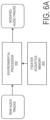
- an audio processor 21A is shown which includes an environmental processor 200 for handling a 3D presentation in a movie theater.
- the processor 200 receives local environmental characteristics from a memory holding information about the acoustics of the respective movie theater.
- the processor 200 analyzes the raw audio tracks and modifies them as necessary to compensate for the acoustics of the theater. For example, a water wall, a whispered conversation or a passing fire truck sound differently to a spectator seated in different theaters, or in different locations within a theater, in either case with reference to the different acoustic environmental characteristics.
- the environmental processor 200 compensates for this effect so that the spectator will hear a more realistic sound track-i.e. a sound track closer to what the content director originally intended.
- Fig, 6B shows another audio processor 21B designed for a VR presentation.
- audio processor 21B includes an environmental processor 210, a virtual environment detector 212 and an acoustic memory 214.
- the detector 212 detects the appropriate visual environment for a particular scene based on video information it receives. The video information may be provided by the video processor 23 in Fig. 1 .
- the appropriate acoustic characteristics for that environment are obtained from acoustic memory 214.
- the processor 210 uses this information to modify the raw audio tracks.
- the resultant parameters include or are representative of the audio depth perception cues discussed above and in Fig. 5 steps 190 and 200.
- Fig. 6C shows the details of a sound processor 21C for an AR presentation.
- both the audio and the video information are combined with real audio and video signals from the actual environment of the viewer resulting in the augmented reality.
- the raw audio tracks are fed to a respective summer 222, Summer 222 also receives real live audio signals from the actual environment of the viewer through a microphone 220.
- the combined audio tracks are provided to environmental processor 224.
- the virtual video information is provided to virtual environmental detector 226.
- the environmental detector 226 detects the virtual environment from the video signals and provides this information to acoustic memory 228.
- a real environment detector 230 is used to detect the real environment of the viewer.
- the detector 230 is connected to a video camera 232.
- the detector 230 analyzes images from the video camera to determine for example, if the viewer is in a park or his bedroom. This information is provided to the memory 228 so that the proper acoustic characteristics are presented to the processor 224.
- a geographic locator such as a GPS 236 is provided to determine the environment of the viewer based on his location.
- a sound generator 238 is used to generate a sound pattern.
- the resulting echoes are sensed through either microphone 220 or through another microphone to determine the current environment of the viewer.
- the authoring tool 22 generates a set of encoder coefficients corresponding to the audio and visual objects for each frame or group of frames.
- a second audio/video encoder 70 may, but need not, be similar or even identical to encoder 10 as shown in FIG. 1 to receive digital content based on the 3D uncompressed video master 60 in any format including any one of the formats described above.
- the encoder 70 analyzes the received digital 3D movie and determines its format automatically, or the device can receive user input or some other signal indicative of the format for the received digital 3D content.
- the encoder 70 also receives information specifying a desired output format, or is preprogrammed to convert the digital 3D content into a corresponding second encoded 3D content in a preselected different format (such as Blu-ray Disc, satellite broadcast, Nintendo 3DS, etc.)
- the encoder 70 uses a plurality of encoding coefficients stored in a memory 70 B for this purpose. Some of the encoding coefficients may be common to several different output formats while others will be unique to each format.
- the content of memory 70 B is altered by changing one or more of the predetermined coefficients with the parameters from the authoring tool 22. In some cases, the parameters from the tool 22 may not be compatible with the encoder 70. In this case, the parameters from the tool 22 are first provided to a mapping processing element 24 that maps the parameters into a format that is compatible with encoder 70. The mapped parameters replace some or all of the coefficients in memory 70 B.
- the cues for audio depth perception are discussed primarily as being indicative of the 3D position of an audio object of interest, in at least one, or two or all three dimensions, i.e., X, Y and Z.
- the authoring tool 70 not only modifies the audio signals with depth perception cues; it also creates meta data that contains the relevant inverse transforms so that a down-stream signal processor (not shown) can derive the original (or close to the original if the process is lossy), un-optimized digital 3D movie audio stream for 2D viewing.
- the metadata is stored along with the second encoded 3D content.
- the format of the second encoded 3D content is very different then the format of the first encoded 3D content, for example in terms of the intended environment.
- the first encoded 3D content may be formatted for a digital 3D movie distribution channel intended for a 70 ft. theatrical exhibition, while the second encoded 3D content is directed at a Nintendo 3DS 3.5 inch handheld screen.
- the authoring tool settings are selected accordingly, to conform to different digital 3D movie distribution channels or formats for other systematic reasons. (Details of such a transformation are described in commonly assigned pending provisional application Ser. No. 61/533,777 filed: Sep.
- the second audio/visual encoder 70 receives either the original uncompressed video master or the first 3D encoded content as an input
- the encoder 70 receive any other content as an input and cooperate with appropriate components from FIG. 1 (e.g., analyzer 30, audio and visual processors 21 and 23 and authoring tool 22 ) to generate a corresponding 3D encoded output having incorporated therein information(either in the form of audio objects, or as cues) indicative of positional information of one or more sounds specific to one or more frames.
- this information may be coupled or tied to, or it could be completely independent of the positions of any visual objects of interest.
- the present system and method provide for a means of providing an enhanced encoded 3D content efficiently through dynamic processing by identifying or generating audio objects of interest, using information from log 20 or analyzer 30 .
Landscapes
- Engineering & Computer Science (AREA)
- Physics & Mathematics (AREA)
- Acoustics & Sound (AREA)
- Signal Processing (AREA)
- Multimedia (AREA)
- Computational Linguistics (AREA)
- Health & Medical Sciences (AREA)
- Audiology, Speech & Language Pathology (AREA)
- Human Computer Interaction (AREA)
- Mathematical Physics (AREA)
- Processing Or Creating Images (AREA)
- Two-Way Televisions, Distribution Of Moving Picture Or The Like (AREA)
- Stereophonic System (AREA)
Claims (2)
- Gerät zum Erzeugen einer Darstellung der Augmented-Reality, im Folgenden AR, aus einem Inhalt, der ursprüngliche Audio- und Videokomponenten aufweist, der Inhalt einschließend eine Szene, wobei die Szene einer jeweiligen Umgebung zugeordnet ist, in der die Szene stattfindet, und die jeweilige Umgebung akustische Eigenschaften aufweist, das Gerät umfassend:- einen Audioprozessor einschließend:einen Summierer (222), der konfiguriert ist, kombinierte Audiokomponenten basierend auf der ursprünglichen Audiokomponente und basierend auf realen Audiosignalen abzugeben, die von einem mit dem Summierer verbundenen Mikrofon (220) abgegeben werden;einen virtuellen Umgebungsdetektor (226), der konfiguriert ist, die jeweilige Umgebung für die Szene basierend auf den Videokomponenten festzustellen;einen realen Umgebungsdetektor (230), der konfiguriert ist, die reale Umgebung basierend auf Bildern festzustellen, die von einer mit dem realen Umgebungsdetektor verbundenen Kamera abgegeben werden;einen Akustikspeicher, der akustische Eigenschaften ausgibt, die der erkannten jeweiligen Umgebung und der erkannten realen Umgebung zugehörig sind;einen Umgebungsprozessor (224), der die kombinierten Audiokomponenten empfängt und konfiguriert ist, die kombinierten Audiokomponenten in modifizierte Audiokomponenten basierend auf den akustischen Eigenschaften zu modifizieren- ein Autorentool, das die modifizierten Audiokomponenten und die ursprünglichen Videokomponenten empfängt und entsprechende Codierungskoeffizienten erzeugt; und- einen Codierer, der konfiguriert ist, die ursprünglichen Videokomponenten und die modifizierten Audiokomponenten zu empfangen und basierend auf den Codierungskoeffizienten einen codierten Inhalt zu erzeugen.
- Verfahren zum Erzeugen einer Darstellung der Augmented-Reality, im Folgenden AR, umfassend die folgenden Schritte:Empfangen von Inhalt, der ursprüngliche Audio- und Videokomponenten aufweist, der Inhalt einschließend eine Szene, wobei die Szene einer jeweiligen Umgebung zugeordnet ist, in der die Szene stattfindet, und die jeweilige Umgebung akustische Eigenschaften aufweist;Summieren der ursprünglichen Audiokomponente und der realen Audiosignale, die durch ein Mikrofon abgegeben werden, wobei das Summieren die kombinierten Audiokomponenten abgibt;Feststellen der jeweiligen Umgebung für die Szene basierend auf den Videokomponenten;Feststellen einer realen Umgebung basierend auf Bildern, die von einer mit einem Detektor verbundenen Kamera abgegeben werden, der diese Feststellung durchführt;Ermitteln der akustischen Eigenschaften, die der erkannten jeweiligen Umgebung und der erkannten realen Umgebung zugehörig sind;Modifizieren der kombinierten Audiokomponenten, um basierend auf den genannten akustischen Eigenschaften modifizierte Audiokomponenten zu erzeugen;Erzeugen von Codierungskoeffizienten basierend auf den ursprünglichen Videokomponenten und den modifizierten Audiokomponenten; undCodieren des Inhalts unter Verwendung der Codierungskoeffizienten, um einen codierten Inhalt zu erzeugen, der von den ursprünglichen Videokomponenten und den modifizierten Audiokomponenten abgeleitet ist.
Applications Claiming Priority (2)
| Application Number | Priority Date | Filing Date | Title |
|---|---|---|---|
| US15/163,819 US10326978B2 (en) | 2010-06-30 | 2016-05-25 | Method and apparatus for generating virtual or augmented reality presentations with 3D audio positioning |
| PCT/US2017/034502 WO2017205637A1 (en) | 2016-05-25 | 2017-05-25 | Method and apparatus for generating virtual or augmented reality presentations with 3d audio positioning |
Publications (3)
| Publication Number | Publication Date |
|---|---|
| EP3465679A1 EP3465679A1 (de) | 2019-04-10 |
| EP3465679A4 EP3465679A4 (de) | 2020-01-15 |
| EP3465679B1 true EP3465679B1 (de) | 2025-03-19 |
Family
ID=60411627
Family Applications (1)
| Application Number | Title | Priority Date | Filing Date |
|---|---|---|---|
| EP17803593.7A Active EP3465679B1 (de) | 2016-05-25 | 2017-05-25 | Verfahren und vorrichtung zur erzeugung von präsentationen der virtuellen oder erweiterten realität mit 3d-audiopositionierung |
Country Status (5)
| Country | Link |
|---|---|
| EP (1) | EP3465679B1 (de) |
| JP (1) | JP6959943B2 (de) |
| KR (2) | KR20220062684A (de) |
| CN (1) | CN109564760B (de) |
| WO (1) | WO2017205637A1 (de) |
Families Citing this family (17)
| Publication number | Priority date | Publication date | Assignee | Title |
|---|---|---|---|---|
| CN110164464A (zh) * | 2018-02-12 | 2019-08-23 | 北京三星通信技术研究有限公司 | 音频处理方法及终端设备 |
| CN113519171A (zh) * | 2019-03-19 | 2021-10-19 | 索尼集团公司 | 声音处理装置、声音处理方法和声音处理程序 |
| GB2582910A (en) * | 2019-04-02 | 2020-10-14 | Nokia Technologies Oy | Audio codec extension |
| GB2596003B (en) * | 2019-05-15 | 2023-09-20 | Apple Inc | Audio processing |
| CN113519023A (zh) | 2019-10-29 | 2021-10-19 | 苹果公司 | 具有压缩环境的音频编码 |
| TW202533213A (zh) | 2019-10-30 | 2025-08-16 | 美商杜拜研究特許公司 | 使用方向性元資料之多通道音頻編碼及解碼 |
| US11356796B2 (en) * | 2019-11-22 | 2022-06-07 | Qualcomm Incorporated | Priority-based soundfield coding for virtual reality audio |
| JP7481446B2 (ja) | 2019-12-06 | 2024-05-10 | マジック リープ, インコーポレイテッド | 環境音響持続性 |
| US11704087B2 (en) * | 2020-02-03 | 2023-07-18 | Google Llc | Video-informed spatial audio expansion |
| CN113453083B (zh) * | 2020-03-24 | 2022-06-28 | 腾讯科技(深圳)有限公司 | 多自由度场景下的沉浸式媒体获取方法、设备及存储介质 |
| CN111652986B (zh) * | 2020-06-11 | 2024-03-05 | 浙江商汤科技开发有限公司 | 舞台效果呈现方法、装置、电子设备及存储介质 |
| GB2600433B (en) | 2020-10-28 | 2023-08-09 | Sony Interactive Entertainment Inc | Audio processing |
| US12238362B2 (en) * | 2021-09-27 | 2025-02-25 | Tencent America LLC | Consistence of acoustic and visual scenes |
| CN114286278B (zh) * | 2021-12-27 | 2024-03-15 | 北京百度网讯科技有限公司 | 音频数据处理方法、装置、电子设备及存储介质 |
| CN114911990B (zh) * | 2022-05-27 | 2023-01-03 | 北京天域北斗文化科技集团有限公司 | 基于虚拟现实和智能交互的地图浏览系统 |
| US11871207B1 (en) * | 2022-09-07 | 2024-01-09 | International Business Machines Corporation | Acoustic editing |
| CN119497030A (zh) * | 2023-08-15 | 2025-02-21 | 华为技术有限公司 | 音频处理方法及电子设备 |
Family Cites Families (20)
| Publication number | Priority date | Publication date | Assignee | Title |
|---|---|---|---|---|
| US20030007648A1 (en) * | 2001-04-27 | 2003-01-09 | Christopher Currell | Virtual audio system and techniques |
| KR100542129B1 (ko) * | 2002-10-28 | 2006-01-11 | 한국전자통신연구원 | 객체기반 3차원 오디오 시스템 및 그 제어 방법 |
| FR2862799B1 (fr) * | 2003-11-26 | 2006-02-24 | Inst Nat Rech Inf Automat | Dispositif et methode perfectionnes de spatialisation du son |
| JP4947762B2 (ja) * | 2005-12-16 | 2012-06-06 | 株式会社バンダイナムコゲームス | プログラム、情報記憶媒体およびゲームシステム |
| US20090238378A1 (en) * | 2008-03-18 | 2009-09-24 | Invism, Inc. | Enhanced Immersive Soundscapes Production |
| KR101017664B1 (ko) * | 2008-06-12 | 2011-02-25 | 중앙대학교 산학협력단 | 온라인 가상 현실 운동 시스템 |
| EP2205007B1 (de) * | 2008-12-30 | 2019-01-09 | Dolby International AB | Verfahren und Vorrichtung zur Kodierung dreidimensionaler Hörbereiche und zur optimalen Rekonstruktion |
| JP2011170282A (ja) * | 2010-02-22 | 2011-09-01 | Toshiba Corp | 再生装置および再生方法 |
| US8755432B2 (en) * | 2010-06-30 | 2014-06-17 | Warner Bros. Entertainment Inc. | Method and apparatus for generating 3D audio positioning using dynamically optimized audio 3D space perception cues |
| US20120251069A1 (en) * | 2011-03-29 | 2012-10-04 | Broadcom Corporation | Audio enhancement based on video and/or other characteristics |
| US9179237B2 (en) * | 2011-12-16 | 2015-11-03 | Bose Corporation | Virtual audio system tuning |
| US20130181901A1 (en) * | 2012-01-12 | 2013-07-18 | Kanye Omari West | Multiple Screens for Immersive Audio/Video Experience |
| US8831255B2 (en) * | 2012-03-08 | 2014-09-09 | Disney Enterprises, Inc. | Augmented reality (AR) audio with position and action triggered virtual sound effects |
| US9756437B2 (en) * | 2012-07-03 | 2017-09-05 | Joe Wellman | System and method for transmitting environmental acoustical information in digital audio signals |
| WO2014036121A1 (en) * | 2012-08-31 | 2014-03-06 | Dolby Laboratories Licensing Corporation | System for rendering and playback of object based audio in various listening environments |
| JP6012343B2 (ja) * | 2012-09-03 | 2016-10-25 | 日本放送協会 | 音響再生環境提示装置および音響再生環境提示プログラム |
| US9338420B2 (en) * | 2013-02-15 | 2016-05-10 | Qualcomm Incorporated | Video analysis assisted generation of multi-channel audio data |
| US9908048B2 (en) * | 2013-06-08 | 2018-03-06 | Sony Interactive Entertainment Inc. | Systems and methods for transitioning between transparent mode and non-transparent mode in a head mounted display |
| GB2536020A (en) * | 2015-03-04 | 2016-09-07 | Sony Computer Entertainment Europe Ltd | System and method of virtual reality feedback |
| CN105466413A (zh) * | 2015-11-10 | 2016-04-06 | 上海格虏博运动科技有限公司 | 一种基于智能移动平台并结合gps的增强现实实景导航技术 |
-
2017
- 2017-05-25 EP EP17803593.7A patent/EP3465679B1/de active Active
- 2017-05-25 CN CN201780046320.2A patent/CN109564760B/zh active Active
- 2017-05-25 WO PCT/US2017/034502 patent/WO2017205637A1/en not_active Ceased
- 2017-05-25 JP JP2018561492A patent/JP6959943B2/ja active Active
- 2017-05-25 KR KR1020227015034A patent/KR20220062684A/ko not_active Ceased
- 2017-05-25 KR KR1020187037447A patent/KR20190013900A/ko not_active Ceased
Also Published As
| Publication number | Publication date |
|---|---|
| KR20220062684A (ko) | 2022-05-17 |
| WO2017205637A1 (en) | 2017-11-30 |
| JP6959943B2 (ja) | 2021-11-05 |
| KR20190013900A (ko) | 2019-02-11 |
| CN109564760B (zh) | 2025-02-11 |
| EP3465679A4 (de) | 2020-01-15 |
| JP2019523902A (ja) | 2019-08-29 |
| EP3465679A1 (de) | 2019-04-10 |
| CN109564760A (zh) | 2019-04-02 |
Similar Documents
| Publication | Publication Date | Title |
|---|---|---|
| US10819969B2 (en) | Method and apparatus for generating media presentation content with environmentally modified audio components | |
| EP3465679B1 (de) | Verfahren und vorrichtung zur erzeugung von präsentationen der virtuellen oder erweiterten realität mit 3d-audiopositionierung | |
| US10026452B2 (en) | Method and apparatus for generating 3D audio positioning using dynamically optimized audio 3D space perception cues | |
| JP7625045B2 (ja) | オーディオ装置及びオーディオ処理の方法 | |
| KR20220097888A (ko) | 비트스트림에서 오디오 효과 메타데이터의 시그널링 | |
| CA2844078C (en) | Method and apparatus for generating 3d audio positioning using dynamically optimized audio 3d space perception cues | |
| US20240406669A1 (en) | Metadata for Spatial Audio Rendering | |
| GB2632902A (en) | Metadata for spatial audio rendering | |
| CN119520873A (zh) | 视频播放方法、装置、设备及可读存储介质 |
Legal Events
| Date | Code | Title | Description |
|---|---|---|---|
| STAA | Information on the status of an ep patent application or granted ep patent |
Free format text: STATUS: THE INTERNATIONAL PUBLICATION HAS BEEN MADE |
|
| PUAI | Public reference made under article 153(3) epc to a published international application that has entered the european phase |
Free format text: ORIGINAL CODE: 0009012 |
|
| STAA | Information on the status of an ep patent application or granted ep patent |
Free format text: STATUS: REQUEST FOR EXAMINATION WAS MADE |
|
| 17P | Request for examination filed |
Effective date: 20181122 |
|
| AK | Designated contracting states |
Kind code of ref document: A1 Designated state(s): AL AT BE BG CH CY CZ DE DK EE ES FI FR GB GR HR HU IE IS IT LI LT LU LV MC MK MT NL NO PL PT RO RS SE SI SK SM TR |
|
| AX | Request for extension of the european patent |
Extension state: BA ME |
|
| DAV | Request for validation of the european patent (deleted) | ||
| DAX | Request for extension of the european patent (deleted) | ||
| A4 | Supplementary search report drawn up and despatched |
Effective date: 20191217 |
|
| RIC1 | Information provided on ipc code assigned before grant |
Ipc: H04R 5/00 20060101ALI20191211BHEP Ipc: H04S 7/00 20060101ALI20191211BHEP Ipc: G10L 19/008 20130101AFI20191211BHEP |
|
| STAA | Information on the status of an ep patent application or granted ep patent |
Free format text: STATUS: EXAMINATION IS IN PROGRESS |
|
| 17Q | First examination report despatched |
Effective date: 20210111 |
|
| GRAP | Despatch of communication of intention to grant a patent |
Free format text: ORIGINAL CODE: EPIDOSNIGR1 |
|
| STAA | Information on the status of an ep patent application or granted ep patent |
Free format text: STATUS: GRANT OF PATENT IS INTENDED |
|
| INTG | Intention to grant announced |
Effective date: 20241209 |
|
| GRAS | Grant fee paid |
Free format text: ORIGINAL CODE: EPIDOSNIGR3 |
|
| GRAA | (expected) grant |
Free format text: ORIGINAL CODE: 0009210 |
|
| STAA | Information on the status of an ep patent application or granted ep patent |
Free format text: STATUS: THE PATENT HAS BEEN GRANTED |
|
| AK | Designated contracting states |
Kind code of ref document: B1 Designated state(s): AL AT BE BG CH CY CZ DE DK EE ES FI FR GB GR HR HU IE IS IT LI LT LU LV MC MK MT NL NO PL PT RO RS SE SI SK SM TR |
|
| REG | Reference to a national code |
Ref country code: GB Ref legal event code: FG4D |
|
| REG | Reference to a national code |
Ref country code: CH Ref legal event code: EP |
|
| REG | Reference to a national code |
Ref country code: DE Ref legal event code: R096 Ref document number: 602017088420 Country of ref document: DE |
|
| REG | Reference to a national code |
Ref country code: IE Ref legal event code: FG4D |
|
| PG25 | Lapsed in a contracting state [announced via postgrant information from national office to epo] |
Ref country code: RS Free format text: LAPSE BECAUSE OF FAILURE TO SUBMIT A TRANSLATION OF THE DESCRIPTION OR TO PAY THE FEE WITHIN THE PRESCRIBED TIME-LIMIT Effective date: 20250619 |
|
| PG25 | Lapsed in a contracting state [announced via postgrant information from national office to epo] |
Ref country code: FI Free format text: LAPSE BECAUSE OF FAILURE TO SUBMIT A TRANSLATION OF THE DESCRIPTION OR TO PAY THE FEE WITHIN THE PRESCRIBED TIME-LIMIT Effective date: 20250319 |
|
| PGFP | Annual fee paid to national office [announced via postgrant information from national office to epo] |
Ref country code: DE Payment date: 20250528 Year of fee payment: 9 |
|
| REG | Reference to a national code |
Ref country code: LT Ref legal event code: MG9D |
|
| PG25 | Lapsed in a contracting state [announced via postgrant information from national office to epo] |
Ref country code: NO Free format text: LAPSE BECAUSE OF FAILURE TO SUBMIT A TRANSLATION OF THE DESCRIPTION OR TO PAY THE FEE WITHIN THE PRESCRIBED TIME-LIMIT Effective date: 20250619 |
|
| PG25 | Lapsed in a contracting state [announced via postgrant information from national office to epo] |
Ref country code: HR Free format text: LAPSE BECAUSE OF FAILURE TO SUBMIT A TRANSLATION OF THE DESCRIPTION OR TO PAY THE FEE WITHIN THE PRESCRIBED TIME-LIMIT Effective date: 20250319 |
|
| PG25 | Lapsed in a contracting state [announced via postgrant information from national office to epo] |
Ref country code: LV Free format text: LAPSE BECAUSE OF FAILURE TO SUBMIT A TRANSLATION OF THE DESCRIPTION OR TO PAY THE FEE WITHIN THE PRESCRIBED TIME-LIMIT Effective date: 20250319 |
|
| PGFP | Annual fee paid to national office [announced via postgrant information from national office to epo] |
Ref country code: FR Payment date: 20250522 Year of fee payment: 9 |
|
| PG25 | Lapsed in a contracting state [announced via postgrant information from national office to epo] |
Ref country code: GR Free format text: LAPSE BECAUSE OF FAILURE TO SUBMIT A TRANSLATION OF THE DESCRIPTION OR TO PAY THE FEE WITHIN THE PRESCRIBED TIME-LIMIT Effective date: 20250620 Ref country code: BG Free format text: LAPSE BECAUSE OF FAILURE TO SUBMIT A TRANSLATION OF THE DESCRIPTION OR TO PAY THE FEE WITHIN THE PRESCRIBED TIME-LIMIT Effective date: 20250319 |
|
| REG | Reference to a national code |
Ref country code: NL Ref legal event code: MP Effective date: 20250319 |
|
| REG | Reference to a national code |
Ref country code: AT Ref legal event code: MK05 Ref document number: 1777656 Country of ref document: AT Kind code of ref document: T Effective date: 20250319 |
|
| PG25 | Lapsed in a contracting state [announced via postgrant information from national office to epo] |
Ref country code: NL Free format text: LAPSE BECAUSE OF FAILURE TO SUBMIT A TRANSLATION OF THE DESCRIPTION OR TO PAY THE FEE WITHIN THE PRESCRIBED TIME-LIMIT Effective date: 20250319 |
|
| PG25 | Lapsed in a contracting state [announced via postgrant information from national office to epo] |
Ref country code: SE Free format text: LAPSE BECAUSE OF FAILURE TO SUBMIT A TRANSLATION OF THE DESCRIPTION OR TO PAY THE FEE WITHIN THE PRESCRIBED TIME-LIMIT Effective date: 20250319 |
|
| PG25 | Lapsed in a contracting state [announced via postgrant information from national office to epo] |
Ref country code: SM Free format text: LAPSE BECAUSE OF FAILURE TO SUBMIT A TRANSLATION OF THE DESCRIPTION OR TO PAY THE FEE WITHIN THE PRESCRIBED TIME-LIMIT Effective date: 20250319 |
|
| PG25 | Lapsed in a contracting state [announced via postgrant information from national office to epo] |
Ref country code: ES Free format text: LAPSE BECAUSE OF FAILURE TO SUBMIT A TRANSLATION OF THE DESCRIPTION OR TO PAY THE FEE WITHIN THE PRESCRIBED TIME-LIMIT Effective date: 20250319 Ref country code: PT Free format text: LAPSE BECAUSE OF FAILURE TO SUBMIT A TRANSLATION OF THE DESCRIPTION OR TO PAY THE FEE WITHIN THE PRESCRIBED TIME-LIMIT Effective date: 20250721 |
|
| PG25 | Lapsed in a contracting state [announced via postgrant information from national office to epo] |
Ref country code: IT Free format text: LAPSE BECAUSE OF FAILURE TO SUBMIT A TRANSLATION OF THE DESCRIPTION OR TO PAY THE FEE WITHIN THE PRESCRIBED TIME-LIMIT Effective date: 20250319 Ref country code: PL Free format text: LAPSE BECAUSE OF FAILURE TO SUBMIT A TRANSLATION OF THE DESCRIPTION OR TO PAY THE FEE WITHIN THE PRESCRIBED TIME-LIMIT Effective date: 20250319 |
|
| PGFP | Annual fee paid to national office [announced via postgrant information from national office to epo] |
Ref country code: GB Payment date: 20250724 Year of fee payment: 9 |
|
| PG25 | Lapsed in a contracting state [announced via postgrant information from national office to epo] |
Ref country code: AT Free format text: LAPSE BECAUSE OF FAILURE TO SUBMIT A TRANSLATION OF THE DESCRIPTION OR TO PAY THE FEE WITHIN THE PRESCRIBED TIME-LIMIT Effective date: 20250319 |
|
| PG25 | Lapsed in a contracting state [announced via postgrant information from national office to epo] |
Ref country code: CZ Free format text: LAPSE BECAUSE OF FAILURE TO SUBMIT A TRANSLATION OF THE DESCRIPTION OR TO PAY THE FEE WITHIN THE PRESCRIBED TIME-LIMIT Effective date: 20250319 Ref country code: EE Free format text: LAPSE BECAUSE OF FAILURE TO SUBMIT A TRANSLATION OF THE DESCRIPTION OR TO PAY THE FEE WITHIN THE PRESCRIBED TIME-LIMIT Effective date: 20250319 |
|
| PG25 | Lapsed in a contracting state [announced via postgrant information from national office to epo] |
Ref country code: RO Free format text: LAPSE BECAUSE OF FAILURE TO SUBMIT A TRANSLATION OF THE DESCRIPTION OR TO PAY THE FEE WITHIN THE PRESCRIBED TIME-LIMIT Effective date: 20250319 |
|
| PG25 | Lapsed in a contracting state [announced via postgrant information from national office to epo] |
Ref country code: SK Free format text: LAPSE BECAUSE OF FAILURE TO SUBMIT A TRANSLATION OF THE DESCRIPTION OR TO PAY THE FEE WITHIN THE PRESCRIBED TIME-LIMIT Effective date: 20250319 |
|
| PG25 | Lapsed in a contracting state [announced via postgrant information from national office to epo] |
Ref country code: IS Free format text: LAPSE BECAUSE OF FAILURE TO SUBMIT A TRANSLATION OF THE DESCRIPTION OR TO PAY THE FEE WITHIN THE PRESCRIBED TIME-LIMIT Effective date: 20250719 |
|
| REG | Reference to a national code |
Ref country code: DE Ref legal event code: R097 Ref document number: 602017088420 Country of ref document: DE |
|
| REG | Reference to a national code |
Ref country code: CH Ref legal event code: H13 Free format text: ST27 STATUS EVENT CODE: U-0-0-H10-H13 (AS PROVIDED BY THE NATIONAL OFFICE) Effective date: 20251223 |
|
| PG25 | Lapsed in a contracting state [announced via postgrant information from national office to epo] |
Ref country code: DK Free format text: LAPSE BECAUSE OF FAILURE TO SUBMIT A TRANSLATION OF THE DESCRIPTION OR TO PAY THE FEE WITHIN THE PRESCRIBED TIME-LIMIT Effective date: 20250319 |
|
| PG25 | Lapsed in a contracting state [announced via postgrant information from national office to epo] |
Ref country code: LU Free format text: LAPSE BECAUSE OF NON-PAYMENT OF DUE FEES Effective date: 20250525 |
|
| PG25 | Lapsed in a contracting state [announced via postgrant information from national office to epo] |
Ref country code: CH Free format text: LAPSE BECAUSE OF NON-PAYMENT OF DUE FEES Effective date: 20250531 |
|
| PLBE | No opposition filed within time limit |
Free format text: ORIGINAL CODE: 0009261 |
|
| STAA | Information on the status of an ep patent application or granted ep patent |
Free format text: STATUS: NO OPPOSITION FILED WITHIN TIME LIMIT |
|
| REG | Reference to a national code |
Ref country code: CH Ref legal event code: L10 Free format text: ST27 STATUS EVENT CODE: U-0-0-L10-L00 (AS PROVIDED BY THE NATIONAL OFFICE) Effective date: 20260128 |
|
| PG25 | Lapsed in a contracting state [announced via postgrant information from national office to epo] |
Ref country code: MC Free format text: LAPSE BECAUSE OF FAILURE TO SUBMIT A TRANSLATION OF THE DESCRIPTION OR TO PAY THE FEE WITHIN THE PRESCRIBED TIME-LIMIT Effective date: 20250319 |