EP3461628A1 - Vakuumfolie mit belüftungseigenschaften - Google Patents
Vakuumfolie mit belüftungseigenschaften Download PDFInfo
- Publication number
- EP3461628A1 EP3461628A1 EP18197241.5A EP18197241A EP3461628A1 EP 3461628 A1 EP3461628 A1 EP 3461628A1 EP 18197241 A EP18197241 A EP 18197241A EP 3461628 A1 EP3461628 A1 EP 3461628A1
- Authority
- EP
- European Patent Office
- Prior art keywords
- film
- vacuum
- embossing
- film according
- electrically conductive
- Prior art date
- Legal status (The legal status is an assumption and is not a legal conclusion. Google has not performed a legal analysis and makes no representation as to the accuracy of the status listed.)
- Granted
Links
Images

Classifications
-
- B—PERFORMING OPERATIONS; TRANSPORTING
- B29—WORKING OF PLASTICS; WORKING OF SUBSTANCES IN A PLASTIC STATE IN GENERAL
- B29C—SHAPING OR JOINING OF PLASTICS; SHAPING OF MATERIAL IN A PLASTIC STATE, NOT OTHERWISE PROVIDED FOR; AFTER-TREATMENT OF THE SHAPED PRODUCTS, e.g. REPAIRING
- B29C73/00—Repairing of articles made from plastics or substances in a plastic state, e.g. of articles shaped or produced by using techniques covered by this subclass or subclass B29D
- B29C73/04—Repairing of articles made from plastics or substances in a plastic state, e.g. of articles shaped or produced by using techniques covered by this subclass or subclass B29D using preformed elements
- B29C73/10—Repairing of articles made from plastics or substances in a plastic state, e.g. of articles shaped or produced by using techniques covered by this subclass or subclass B29D using preformed elements using patches sealing on the surface of the article
-
- B—PERFORMING OPERATIONS; TRANSPORTING
- B64—AIRCRAFT; AVIATION; COSMONAUTICS
- B64F—GROUND OR AIRCRAFT-CARRIER-DECK INSTALLATIONS SPECIALLY ADAPTED FOR USE IN CONNECTION WITH AIRCRAFT; DESIGNING, MANUFACTURING, ASSEMBLING, CLEANING, MAINTAINING OR REPAIRING AIRCRAFT, NOT OTHERWISE PROVIDED FOR; HANDLING, TRANSPORTING, TESTING OR INSPECTING AIRCRAFT COMPONENTS, NOT OTHERWISE PROVIDED FOR
- B64F5/00—Designing, manufacturing, assembling, cleaning, maintaining or repairing aircraft, not otherwise provided for; Handling, transporting, testing or inspecting aircraft components, not otherwise provided for
- B64F5/40—Maintaining or repairing aircraft
-
- B—PERFORMING OPERATIONS; TRANSPORTING
- B29—WORKING OF PLASTICS; WORKING OF SUBSTANCES IN A PLASTIC STATE IN GENERAL
- B29C—SHAPING OR JOINING OF PLASTICS; SHAPING OF MATERIAL IN A PLASTIC STATE, NOT OTHERWISE PROVIDED FOR; AFTER-TREATMENT OF THE SHAPED PRODUCTS, e.g. REPAIRING
- B29C59/00—Surface shaping of articles, e.g. embossing; Apparatus therefor
- B29C59/02—Surface shaping of articles, e.g. embossing; Apparatus therefor by mechanical means, e.g. pressing
- B29C59/026—Surface shaping of articles, e.g. embossing; Apparatus therefor by mechanical means, e.g. pressing of layered or coated substantially flat surfaces
-
- B—PERFORMING OPERATIONS; TRANSPORTING
- B29—WORKING OF PLASTICS; WORKING OF SUBSTANCES IN A PLASTIC STATE IN GENERAL
- B29C—SHAPING OR JOINING OF PLASTICS; SHAPING OF MATERIAL IN A PLASTIC STATE, NOT OTHERWISE PROVIDED FOR; AFTER-TREATMENT OF THE SHAPED PRODUCTS, e.g. REPAIRING
- B29C59/00—Surface shaping of articles, e.g. embossing; Apparatus therefor
- B29C59/02—Surface shaping of articles, e.g. embossing; Apparatus therefor by mechanical means, e.g. pressing
- B29C59/04—Surface shaping of articles, e.g. embossing; Apparatus therefor by mechanical means, e.g. pressing using rollers or endless belts
-
- B—PERFORMING OPERATIONS; TRANSPORTING
- B29—WORKING OF PLASTICS; WORKING OF SUBSTANCES IN A PLASTIC STATE IN GENERAL
- B29C—SHAPING OR JOINING OF PLASTICS; SHAPING OF MATERIAL IN A PLASTIC STATE, NOT OTHERWISE PROVIDED FOR; AFTER-TREATMENT OF THE SHAPED PRODUCTS, e.g. REPAIRING
- B29C73/00—Repairing of articles made from plastics or substances in a plastic state, e.g. of articles shaped or produced by using techniques covered by this subclass or subclass B29D
- B29C73/24—Apparatus or accessories not otherwise provided for
- B29C73/30—Apparatus or accessories not otherwise provided for for local pressing or local heating
-
- B—PERFORMING OPERATIONS; TRANSPORTING
- B29—WORKING OF PLASTICS; WORKING OF SUBSTANCES IN A PLASTIC STATE IN GENERAL
- B29K—INDEXING SCHEME ASSOCIATED WITH SUBCLASSES B29B, B29C OR B29D, RELATING TO MOULDING MATERIALS OR TO MATERIALS FOR MOULDS, REINFORCEMENTS, FILLERS OR PREFORMED PARTS, e.g. INSERTS
- B29K2079/00—Use of polymers having nitrogen, with or without oxygen or carbon only, in the main chain, not provided for in groups B29K2061/00 - B29K2077/00, as moulding material
- B29K2079/08—PI, i.e. polyimides or derivatives thereof
-
- B—PERFORMING OPERATIONS; TRANSPORTING
- B29—WORKING OF PLASTICS; WORKING OF SUBSTANCES IN A PLASTIC STATE IN GENERAL
- B29K—INDEXING SCHEME ASSOCIATED WITH SUBCLASSES B29B, B29C OR B29D, RELATING TO MOULDING MATERIALS OR TO MATERIALS FOR MOULDS, REINFORCEMENTS, FILLERS OR PREFORMED PARTS, e.g. INSERTS
- B29K2505/00—Use of metals, their alloys or their compounds, as filler
-
- B—PERFORMING OPERATIONS; TRANSPORTING
- B29—WORKING OF PLASTICS; WORKING OF SUBSTANCES IN A PLASTIC STATE IN GENERAL
- B29K—INDEXING SCHEME ASSOCIATED WITH SUBCLASSES B29B, B29C OR B29D, RELATING TO MOULDING MATERIALS OR TO MATERIALS FOR MOULDS, REINFORCEMENTS, FILLERS OR PREFORMED PARTS, e.g. INSERTS
- B29K2507/00—Use of elements other than metals as filler
- B29K2507/04—Carbon
-
- B—PERFORMING OPERATIONS; TRANSPORTING
- B29—WORKING OF PLASTICS; WORKING OF SUBSTANCES IN A PLASTIC STATE IN GENERAL
- B29K—INDEXING SCHEME ASSOCIATED WITH SUBCLASSES B29B, B29C OR B29D, RELATING TO MOULDING MATERIALS OR TO MATERIALS FOR MOULDS, REINFORCEMENTS, FILLERS OR PREFORMED PARTS, e.g. INSERTS
- B29K2995/00—Properties of moulding materials, reinforcements, fillers, preformed parts or moulds
- B29K2995/0003—Properties of moulding materials, reinforcements, fillers, preformed parts or moulds having particular electrical or magnetic properties, e.g. piezoelectric
- B29K2995/0005—Conductive
-
- B—PERFORMING OPERATIONS; TRANSPORTING
- B29—WORKING OF PLASTICS; WORKING OF SUBSTANCES IN A PLASTIC STATE IN GENERAL
- B29L—INDEXING SCHEME ASSOCIATED WITH SUBCLASS B29C, RELATING TO PARTICULAR ARTICLES
- B29L2031/00—Other particular articles
- B29L2031/30—Vehicles, e.g. ships or aircraft, or body parts thereof
- B29L2031/3076—Aircrafts
-
- Y—GENERAL TAGGING OF NEW TECHNOLOGICAL DEVELOPMENTS; GENERAL TAGGING OF CROSS-SECTIONAL TECHNOLOGIES SPANNING OVER SEVERAL SECTIONS OF THE IPC; TECHNICAL SUBJECTS COVERED BY FORMER USPC CROSS-REFERENCE ART COLLECTIONS [XRACs] AND DIGESTS
- Y02—TECHNOLOGIES OR APPLICATIONS FOR MITIGATION OR ADAPTATION AGAINST CLIMATE CHANGE
- Y02T—CLIMATE CHANGE MITIGATION TECHNOLOGIES RELATED TO TRANSPORTATION
- Y02T50/00—Aeronautics or air transport
- Y02T50/40—Weight reduction
Definitions
- the invention relates to an aid for the repair of components made of fiber composite materials such as fiberglass reinforced plastic (GRP) or CFRP (carbon fiber reinforced plastic), especially in aircraft and in the repair of aircraft.
- fiber composite materials such as fiberglass reinforced plastic (GRP) or CFRP (carbon fiber reinforced plastic)
- Fiber composites may include a reinforcing material (fibers) and a matrix.
- the matrix wraps and fixes the fibers.
- the fibers can be made of aramid, carbon, glass, wood. In aircraft, especially glass fibers and carbon fibers play a role.
- reactive resins so-called thermosets, play a major role. These may be polyester or epoxy resins.
- the matrix may also consist of thermoplastics such as polyetheretherketone (PEEK). Thermoplastics are not reactive, but can be liquefied by melting and thus enveloping fibers.
- Most fiber composites have a layered construction in which the fibers extend in a plurality of layers in different directions.
- Aircraft are nowadays partially or largely made of fiber composite components. Airbus tailfaces have been made of carbon fiber reinforced plastic for a long time. Many modern gliders mostly consist of glass fiber reinforced plastic. Current aircraft models continue to feature fuselage and / or wings made of carbon fiber reinforced Plastic or these are largely made of this material.
- Unhardened prepreg or thermoplastic material is used for this purpose.
- unhardened material is meant material whose matrix material envelops the fibers, is liquid or semi-liquid at first, or can be converted to such a state and which is later consolidated by curing or cooling.
- the curing of the material is achieved by increasing the temperature and supplying heat.
- electric blankets, hot air tents or warm air boxes are used.
- the positioning and packaging of the auxiliary materials vacuum film, tear-off fabric and ventilation fabric used is difficult and time-consuming.
- thermoplastically impregnated fiber composites must be worked partly with high temperatures of up to 400 ° C.
- An object of the present invention has been to provide auxiliaries which are suitable for the repair of thermoplastic matrix material impregnated fiber composites and make the repairs easier and faster.
- a film for the repair of aircraft components made of fiber-reinforced thermoplastic comprising an embossed film of polyimide and a coating of an electrically conductive material remedies the disadvantages of the prior art.
- the electrically conductive material have a specific resistance and a layer thickness which allow it to heat the foil by electric current. This eliminates the need for hot air tents, autoclaves, etc., which is extremely advantageous because such apparatus can not be readily operated in the required temperature range of up to 400 ° C.
- Such films according to the invention are also suitable for epoxy resin-impregnated prepregs.
- the electrically conductive material is metal or graphite powder. This is advantageously bound in a binder.
- the embossed film consists essentially of Kapton. It is preferred if the film has a thickness of 50 to 100 micrometers. It is preferred if the embossing of the film measures a depth of the embossing of 0.01 to 0.5 mm. The embossing enables the surface evacuation of gases from the (repair) vacuum construction to increase a pressure difference. The embossing replaces the use of a ventilation fabric.
- the film has a further layer of a material with release properties.
- the embossed film can be superficially modified by means of plasma, so that no connection to the substrate takes place.
- the coating leaves no residue on the substrate.
- the coating allows the vacuum film to be removed without adversely affecting the substrate.
- the applied release layer replaces a conventional release liner.
- the film is producible by a method comprising the steps of: providing the film of polyimide, printing the film with a coating containing electrically conductive material, embossing the coated film with an embossing roll is preferred. It is possible to emboss the film first and then to print or to first print the film and then emboss it. Through all this, separating film, vacuum film and heating element are combined in one material. By printing a very accurate heat input into the repair field is possible, as well as you can adjust the heat input targeted the circumstances with variable layer thickness of the printed material. The printed material replaces a conventional heating mat, which in this case would not reach the operating temperature of up to 400 ° C for thermoplastic repairs.
- FIG. 1 shows a conventional vacuum structure
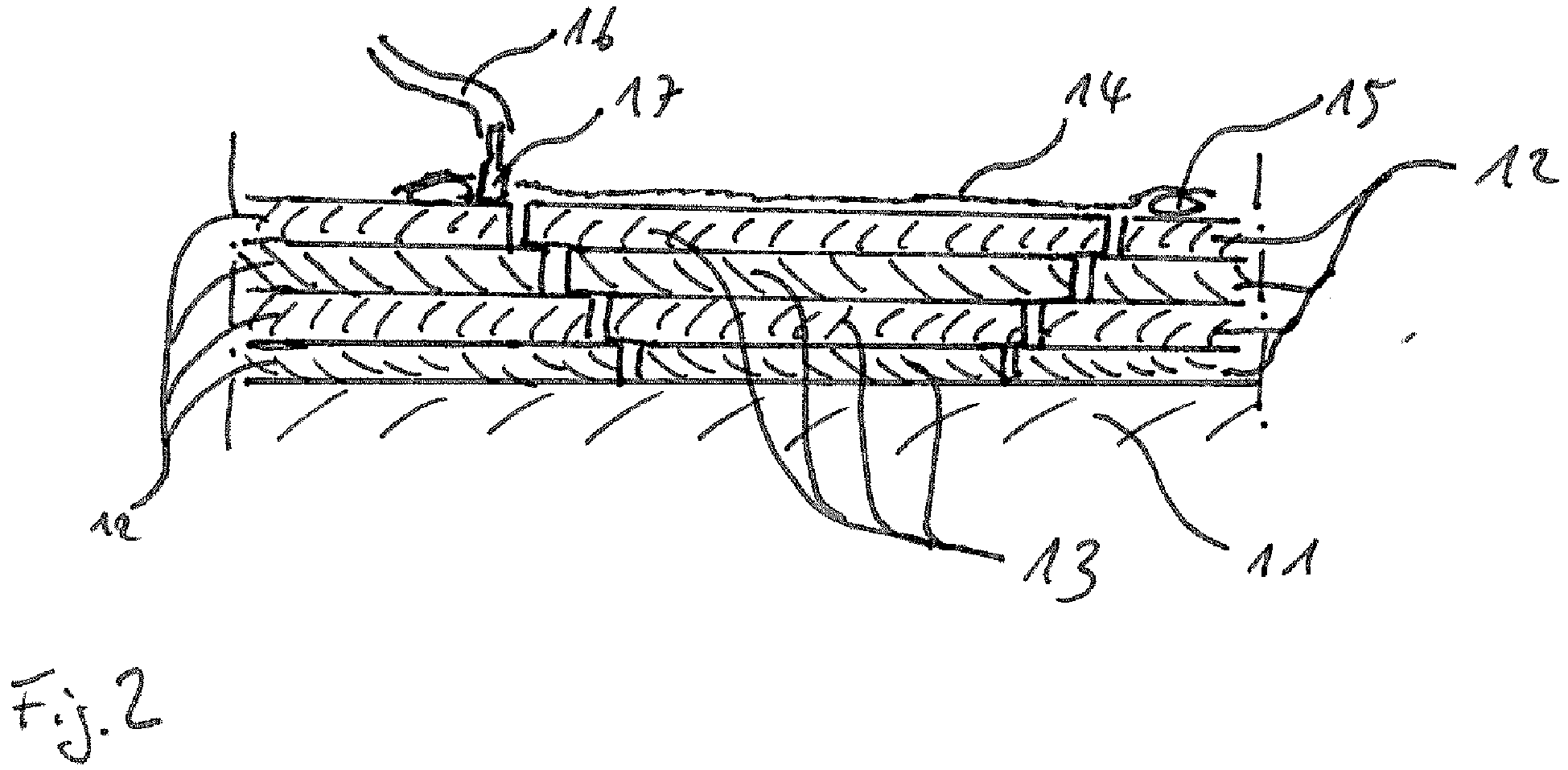
- FIG. 2 shows a new vacuum structure with a vacuum film according to the invention
- FIG. 3 shows a further embodiment of the vacuum film according to the invention
- FIG. 4 shows possible imprints of a vacuum film according to the invention.
- FIG. 1 shows a conventional vacuum structure
- a release film (2) is placed or a release agent (2) applied.
- suitable prepreg layers (1) can be applied.
- tear-off fabric can be placed with a separating film (4) on the upper side, on which a ventilation fabric (5) is placed.
- a vacuum film (6) is applied, in which a fitting (7) is introduced, which is connected to a hose (8). By applying vacuum through the hose (8), air can be sucked out of the structure.
- the ventilation fabric (6) allows a largely similar pressure distribution within the vacuum structure.
- Heat is applied to cure the prepreg material (3). This can be done by an autoclave, a heating mat, a hot air box or a warm air tent.
- FIG. 2 shows a new vacuum structure with a vacuum film according to the invention.
- FIG. 3 shows a further embodiment of the vacuum film according to the invention.
- the repair site (20) to be cured comprises uncured prepreg material or thermoplastically reinforced carbon fiber material and is covered with the vacuum film (21) having a release coating (22). This can be a plasma coating.
- a sealing means (23) seals the film (21) towards the intact component.
- the sealing means (23) may be a cemented tape.
- a fitting and a hose (24) allow the application of vacuum.
- An external electrical conductive coating (25) via electrical connections (26) and (27) allows the application of electricity and thus the generation and transfer of heat to the repair point (20) (resistance heating).
- the coating (25) may consist of metal or carbon nanotubes.
- FIG. 4 shows possible imprints of a vacuum film according to the invention
- the embossments (30) of the film may be conical or pyramidal.
- Other embossments of the film (31) according to the invention may be dellenförming or have the shape of ball sections, similar to a golf ball.
- imprints (32) according to the invention may also have the form of cubes or cuboids.
Landscapes
- Engineering & Computer Science (AREA)
- Mechanical Engineering (AREA)
- Manufacturing & Machinery (AREA)
- Transportation (AREA)
- Aviation & Aerospace Engineering (AREA)
- Casting Or Compression Moulding Of Plastics Or The Like (AREA)
- Reinforced Plastic Materials (AREA)
- Laminated Bodies (AREA)
- Moulding By Coating Moulds (AREA)
Abstract
Description
- Die Erfindung betrifft ein Hilfsmittel für die Reparatur von Bauteilen aus Faserverbundwerkstoffen wie GFK (glasfaserverstärkter Kunststoff) oder CFK (kohlefaserverstärkter Kunststoff), insbesondere im Flugzeugbau und bei der Reparatur von Flugzeugen.
- Faserverbundwerkstoffe können ein Verstärkungsmaterial (Fasern) und eine Matrix umfassen. Die Matrix umhüllt und fixiert die Fasern. Die Fasern können aus Aramid, Kohlenstoff, Glas, Holz bestehen. Im Flugzeugbau spielen vor allem Glasfasern und Kohlenstofffasern eine Rolle. Als Matrix spielen Reaktivharze, so genannte Thermosets, eine große Rolle. Diese können Polyester- oder Epoxidharze sein. Die Matrix kann auch aus thermoplastischen Kunststoffen bestehen wie beispielsweise Polyetheretherketon (PEEK). Thermoplastische Kunststoffe sind nicht reaktiv, können aber durch Aufschmelzen verflüssigt werden und so Fasern umhüllen. Meist weisen Faserverbundwerkstoffe einen schichtartigen Aufbau auf, bei dem die Fasern in einer Mehrzahl von Schichten in verschiedenen Richtungen verlaufen.
- Flugzeuge werden heutzutage teilweise oder weitgehend aus Faserverbundwerkstoffbauteilen gefertigt. Leitwerke von Airbus Flugzeugen bestehen bereits seit langer Zeit aus kohlefaserverstärktem Kunststoff. Viele moderne Segelflugzeuge bestehen größtenteils aus glasfaserverstärktem Kunststoff. Aktuelle Flugzeugmodelle weisen weiterhin Rumpf und/oder Flügel aus kohlefaserverstärktem Kunststoff auf oder diese bestehen weitgehend aus diesem Material.
- Beim Betrieb von Flugzeugen kommt es unweigerlich zu Beschädigungen durch herumfliegende Steine, Eis, Vögel oder Projektile. Besteht die Oberfläche eines Flugzeugs an der geschädigten Stelle aus Metall so ist die Reparatur relativ einfach möglich: Die schadhafte Stelle wird herausgetrennt und ein material- und größengleiches Ersatzstück eingesetzt. Dies wird durch Vernieten mit dem angrenzenden Material verbunden.
- Ein solches Vorgehen ist meist bei faserverstärkten Kunststoffwerkstoffen nicht möglich, weil das Material aus vielen Faserlagen besteht und seine Stabilität aus der Verbindung dieser einzelnen Lagen untereinander hervorgerufen wird. Daher ist es nötig, die schadhafte Stelle so zu bearbeiten, dass die Reparaturlagen an die vorhandenen intakten Lagen direkt angrenzen und jeweils durch weitere Lagen partiell bedeckt werden. Dazu wird nicht ausgehärtetes Prepreg- oder Thermoplast-Material verwendet. Unter nichtausgehärtetem Material versteht man Material, dessen Matrixmaterial die Fasern umhüllt, zunächst flüssig oder halbflüssig ist oder in einen solchen Zustand überführt werden kann und welches später durch Härten oder Abkühlen konsolidiert.
- Bei der Reparatur von Faserverbundmaterialien werden also neue, nicht ausgehärtete oder aushärtbare Faserlagen eingebracht. Um einen möglichst hohen Faseranteil nach dem Aushärten zu erreichen, erfolgt das Aushärten unter Druck.
- Üblich sind beheizte Pressen um den erforderlichen Druck zu erzeugen. Diese eignen sich in den seltensten Fällen zu Reparatur von Flugzeugen. Eine andere verbreitete Möglichkeit sind sogenannte Vakuumaufbauten. Dabei werden die auszuhärtenden Materialien in eine Folie eingeschlossen, mit Vakuum beaufschlagt und ausgehärtet. Durch den Atmosphärendruck werden dabei die auszuhärten Faserlagen zusammengedrückt, durch Zuführen von Wärme aufgeheizt und konsolidiert. Zur Aufnahme von überschüssige Matrixmaterial ist wird oft ein Abreißgewebe verwendet, welches überschüssiges Harz aufnimmt und das nach dem Aushärten leicht entfernt werden kann. Damit innerhalb des Vakuumaufbaus überall weitgehend gleicher Druck herrscht, kommen so genannte Belüftungsgewebe zum Einsatz. Diese erlauben es, dass sich Luft oder Gas innerhalb des Vakuumaufbaus weitgehend frei bewegen kann.
- Das Aushärten des Materials wird durch Temperaturerhöhung und Wärmezufuhr erreicht. Dazu werden Heizdecken, Warmluftzelte oder Warmluftboxen verwendet. Das Positionieren und Konfektionieren der verwendeten Hilfsstoffe Vakuumfolie, Abreißgewebe und Belüftungsgewebe ist schwierig und zeitintensiv. Bei den neuerdings verwendeten thermoplastisch imprägnierten Faserverbundwerkstoffen muss zum Teil mit hohen Temperaturen von bis zu 400°C gearbeitet werden.
- Eine Aufgabe der vorliegenden Erfindung war das Bereitstellen von Hilfsstoffen, die zur Reparatur von mit thermoplastischen Matrixmaterial imprägnierte Faserverbundwerkstoffen geeignet sind und die Reparaturen einfacher und schneller machen.
- Es hat sich nun für den Fachmann völlig überraschend herausgestellt, dass eine Folie für die Reparatur von Flugzeugbauteilen aus faserverstärktem thermoplastischem Kunststoff aufweisend eine geprägte Folie aus Polyimid und eine Beschichtung aus einem elektrisch leitenden Material den Nachteilen des Standes der Technik abhilft. Mit einer solchen Folie kann sehr einfach und schnell ein Vakuumaufbau bereitgestellt werden, der auch hohen Temperaturen standhält. Bevorzugt ist es, wenn das elektrisch leitende Material einen spezifischen Widerstand und eine Schichtdicke aufweisen, die es erlauben durch elektrischen Strom die Folie aufzuheizen. Dadurch kann auf Warmluftzelte, Autoklaven usw. verzichtet werden, was extrem vorteilhaft ist, da solche Apparate nicht ohne weiteres im erforderlichen Temperaturbereich von bis zu 400°C betrieben werden können. Solche erfindungsgemäßen Folien eignen sich auch für mit Epoxydharz imprägnierten Prepregs. Bevorzugt ist es dabei, wenn das elektrisch leitenden Material Metall- oder Graphitpulver ist. Vorteilhaft ist dieses im einem Bindemittel gebunden. Bevorzugt ist es, wenn die geprägte Folie im Wesentlichen aus Kapton besteht. Bevorzugt ist es, wenn die Folie eine Stärke von 50 bis 100 Mikrometer aufweist. Bevorzugt ist es, wenn die Prägung der Folie eine Tiefe der Prägung 0,01 bis 0,5 mm misst. Die Prägung ermöglicht das flächige Evakuieren von Gasen aus dem (Reparatur)vakuumaufbau zum Ausbau eines Druckunterschiedes. Die Prägung ersetzt den Einsatz eines Belüftungsgewebes. Als Prägungsgeometrien sind beispielsweise Kegel, Kegelstümpfe, Pyramiden, Pyramidenstümpfe sowie halbkugelartige Einprägungen möglich. Bevorzugt ist es, wenn die Folie eine weitere Schicht aus einem Material mit Ablöseeigenschaften aufweist. Dazu kann die geprägte Folie mittels Plasma oberflächlich derart modifiziert werden, so dass keine Verbindung zum Substrat erfolgt. Die Beschichtung hinterlässt keine Rückstände auf dem Substrat. Die Beschichtung ermöglicht ein Entfernen der Vakuumfolie, ohne dass diese das Substrat nachteilig beeinflussen kann. Die aufgebrachte Trennschicht ersetzt eine herkömmliche Trennfolie. Bevorzugt ist es, wenn die Folie herstellbar ist durch ein Verfahren, umfassend die folgenden Schritte: Bereitstellen der Folie aus Polyimid, Bedrucken der Folie mit einer Beschichtung, die elektrisch leitendes Material enthält, Prägen der beschichteten Folie mit einer Prägewalze. Es ist möglich die Folie zuerst zu prägen und nachfolgend zu bedrucken oder die Folie zuerst zu bedrucken und nachfolgend zu prägen. Durch all das werden Trennfolie, Vakuumfolie und Heizelement in einem Material vereint. Durch das Aufdrucken ist eine sehr genaue Wärmeeinbringung in das Reparaturfeld möglich, ebenso kann man mit variabler Schichtstärke des ausgedruckten Materials die Wärmeeinbringung gezielt den Gegebenheiten anpassen. Das aufgedruckte Material ersetzt eine herkömmliche Heizmatte, die in diesem Fall die Einsatztemperatur von bis zu 400°C bei Thermoplastreparaturen nicht erreichen würde.
- Die oben beschriebenen Aspekte und weitere Aspekte, Merkmale und Vorteile der Erfindung können ebenfalls aus den Beispielen der Ausführungsformen entnommen werden, welche im Folgenden unter Bezugnahme auf die anhängenden Zeichnungen beschrieben werden.
-
Figur 1 zeigt einen herkömmlichen Vakuumaufbau,Figur 2 zeigt einen neuen Vakuumaufbau mit einer erfindungsgemäßen Vakuumfolie,Figur 3 zeigt eine weitere Ausführungsform der erfindungsgemäßen Vakuumfolie,Figur 4 zeigt mögliche Prägungen einer erfindungsgemäßen Vakuumfolie. - In den Figuren werden gleiche Bezugszeichen für gleiche oder zumindest ähnliche Elemente, Komponenten oder Aspekte verwendet. Es wird angemerkt, dass im Folgenden Ausführungsformen im Detail beschrieben werden, die lediglich illustrative und nicht beschränkend sind.
-
Figur 1 zeigt einen herkömmlichen Vakuumaufbau - Auf ein Formwerkzeug oder eine intakte und nicht beschädigt Bauteilfläche (1) wird eine Trennfolie (2) gelegt oder ein Trennmittel (2) aufgebracht. Darauf können geeignete Prepreglagen (1) aufgelegt werden. Anschließend kann Abreißgewebe mit einer oberseitig liegenden Trennfolie (4) aufgelegt werden, auf welches ein Belüftungsgewebe (5) aufgelegt wird. Abschließend wird eine Vakuumfolie (6) aufgebracht, in die ein Fitting (7) eingebracht ist, welcher mit einem Schlauch (8) verbunden ist. Durch Anlegen von Vakuum durch den Schlauch (8) kann Luft aus dem Aufbau gesaugt werden. Das Belüftungsgewebe (6) erlaubt eine weitgehend gleichartige Druckverteilung innerhalb des Vakuumaufbaus. Zum Aushärten des Prepregmaterials (3) wird Wärme zugeführt. Dies kann durch einen Autoklaven, eine Heizmatte, eine Warmluftbox oder ein Warmluftzelt erfolgen. Beim Aushärten des Prepregmaterials (3) tritt überschüssiges Matrixmaterial in das Abreißgewebe (4) über. Nach dem Belüften kann die Folie (6), das Belüftungsmaterial (5) und das Abreißgewebe mit der oberseitig liegenden Trennfolie (7) nebst darin enthaltenem ausgehärtetem Matrixmaterial entfernt und entsorgt werden.
-
Figur 2 zeigt einen neuen Vakuumaufbau mit einer erfindungsgemäßen Vakuumfolie. - Auf intakte CFK-Lagen (11) werden nicht ausgehärtete Prepreglagen (13) so aufgelegt, dass sie auf Stoß zu intaktem Material (12) zu liegen kommen. Die erfindungsgemäße Folie (14) wird aufgelegt und mit einem Dichtmittel (15) rundum zum intakten Bauteil (11), (12) hin abgedichtet. Über den Schlauch (16) und den Fitting (17) wird Vakuum angelegt. Das Aushärten erfolgt unter Verwendung eines Autoklaven, einer Heizmatte, einer Warmluftbox oder eines Warmluftzeltes. Nach dem Aushärten des Bauteils bzw. der Reparaturstelle (13) kann die erfindungsgemäße Folie (14) entfernt werden. Außer der Folie (14) und dem Dichtmittel (15) fallen keine weiteren Abfälle an.
-
Figur 3 zeigt eine weitere Ausführungsform der erfindungsgemäßen Vakuumfolie. - Die auszuhärtende Reparaturstelle (20) umfasst nicht ausgehärtetes Prepregmaterial oder thermoplastisch verstärktes Material aus Kohlenstofffasern und wird mit der Vakuumfolie (21) bedeckt, die eine Beschichtung (22) mit Ablöseeigenschaften aufweist. Dies kann eine Plasmabeschichtung sein. Ein Dichtmittel (23) dichtet die Folie (21) zum intakten Bauteil hin ab. Das Dichtmittel (23) kann ein Kittband sein. Ein Fitting sowie ein Schlauch (24) erlauben das Anlegen von Vakuum. Eine außenliegende elektrische leitende Beschichtung (25) erlaubt über elektrische Anschlüsse (26) und (27) das Anlegen von Strom und damit die Erzeugung und Übertragung von Wärme auf die Reparaturstelle (20) (Widerstandsheizung). Die Beschichtung (25) kann aus Metall oder Carbon-Nanotubes bestehen.
-
Figur 4 zeigt mögliche Prägungen einer erfindungsgemäßen Vakuumfolie Die Prägungen (30) der Folie können kegel- oder pyramidenförmig sein. Andere erfindungsgemäße Prägungen der Folie (31) können dellenförming sein oder die Form von Kugel Abschnitten haben, ähnlich wie bei einem Golfball. - Weitere ebenfalls erfindungsgemäße Prägungen (32) können die Form von Würfeln oder Quadern aufweisen.
- Während die Erfindung illustriert und beschrieben wurde im Detail in den Zeichnungen und der vorangegangenen Beschreibung, ist es beabsichtigt, dass derartige Illustrationen und Beschreibungen lediglich illustrativ oder exemplarisch und nicht restriktiv sind, so dass die Erfindung nicht durch die offenbarten Ausführungsformen beschränkt ist. In den Ansprüchen schließt das Wort "aufweisend" nicht andere Elemente aus und der unbestimmte Artikel "ein" schließt eine Mehrzahl nicht aus.
- Alleinig der Umstand, dass bestimmte Merkmale in verschiedenen abhängigen Ansprüchen genannt sind, beschränkt nicht den Gegenstand der Erfindung. Auch Kombinationen dieser Merkmale können vorteilhaft eingesetzt werden. Die Bezugszeichen in den Ansprüchen sollen nicht den Umfang der Ansprüche beschränken.
-
- 1
- Intakte Bauteilfläche
- 2
- Trennfolie
- 3
- Prepreglagen
- 4
- Abreißgewebe und Trennfolie
- 5
- Belüftungsgewebe
- 6
- Vakuumfolie
- 7
- Fitting
- 8
- Vakuumschlauch
- 11
- unterliegende intakte CFK-Lagen
- 12
- In gleicher Ebene angrenzende intakte CFK-Lagen
- 13
- nicht ausgehärtete Prepreglagen bzw. Reparaturstelle
- 14
- Folie
- 15
- Dichtmittel
- 16
- Vakuumschlauch
- 17
- Fitting
- 20
- auszuhärtende Reparaturstelle
- 21
- Vakuumfolie
- 22
- Beschichtung mit Ablöseeigenschaften
- 23
- Dichtmittel
- 24
- Fitting mit Schlauch
- 25
- elektrische leitende Beschichtung
- 26, 27
- elektrische Anschlüsse
- 30
- Folie mit kegel- oder pyramidenförmigen Prägungen
- 31
- Folie mit dellenförmingen Prägungen
- 32
- Folie mit Prägungen in Form von Würfeln oder Quadern
Claims (8)
- Folie für die Reparatur von Flugzeugbauteilen aus faserverstärktem thermoplastischem Kunststoff aufweisend eine geprägte Folie aus Polyimid und eine Beschichtung aus einem elektrisch leitenden Material.
- Folie nach Anspruch 1 dadurch gekennzeichnet, dass das elektrisch leitende Material einen spezifischen Widerstand und eine Schichtdicke aufweisen, die es erlauben durch elektrischen Strom die Folie aufzuheizen.
- Folie nach einem der vorangehenden Patentansprüche dadurch gekennzeichnet, dass das elektrisch leitenden Material Metall- oder Graphitpulver ist.
- Folie nach einem der vorangehenden Patentansprüche dadurch gekennzeichnet, dass die geprägte Folie im Wesentlichen aus Kapton besteht.
- Folie nach einem der vorangehenden Patentansprüche dadurch gekennzeichnet, dass die Folie eine Stärke von 50-100 Mikrometer aufweist.
- Folie nach einem der vorangehenden Patentansprüche dadurch gekennzeichnet, dass die Prägung der Folie eine Tiefe der Prägung 0,01 bis 0,5 mm misst.
- Folie nach einem der vorangehenden Patentansprüche dadurch gekennzeichnet, dass sie eine weitere Schicht aus einem Material mit Ablöseeigenschaften aufweist.
- Folie nach einem der vorangehenden Patentansprüche dadurch gekennzeichnet, dass sie herstellbar ist durch ein Verfahren, umfassend die folgenden Schritte:- Bereitstellen der Folie aus Polyimid- Bedrucken der Folie mit einer Beschichtung, die elektrisch leitendes Material enthält.- Prägen der beschichteten Folie mit einer Prägewalze.
Applications Claiming Priority (1)
| Application Number | Priority Date | Filing Date | Title |
|---|---|---|---|
| DE102017122630.3A DE102017122630A1 (de) | 2017-09-28 | 2017-09-28 | Vakuumfolie mit belüftungseigenschaften |
Publications (2)
| Publication Number | Publication Date |
|---|---|
| EP3461628A1 true EP3461628A1 (de) | 2019-04-03 |
| EP3461628B1 EP3461628B1 (de) | 2024-07-17 |
Family
ID=63708108
Family Applications (1)
| Application Number | Title | Priority Date | Filing Date |
|---|---|---|---|
| EP18197241.5A Active EP3461628B1 (de) | 2017-09-28 | 2018-09-27 | Vakuumfolie mit belüftungseigenschaften |
Country Status (4)
| Country | Link |
|---|---|
| US (1) | US12234036B2 (de) |
| EP (1) | EP3461628B1 (de) |
| CA (1) | CA3019079A1 (de) |
| DE (1) | DE102017122630A1 (de) |
Families Citing this family (1)
| Publication number | Priority date | Publication date | Assignee | Title |
|---|---|---|---|---|
| CN112078158B (zh) * | 2019-06-12 | 2022-03-29 | 帆宣系统科技股份有限公司 | 聚酰亚胺膜的膜片贴附修补方法 |
Citations (5)
| Publication number | Priority date | Publication date | Assignee | Title |
|---|---|---|---|---|
| US5837185A (en) * | 1994-06-09 | 1998-11-17 | Livesay; Mark | Preparation of boat hulls |
| US20100108255A1 (en) * | 2008-09-11 | 2010-05-06 | Jamin Micarelli | Method For Making an Article of Armor |
| DE202010012086U1 (de) * | 2010-09-01 | 2010-12-16 | Mlt Gmbh | Vulkanisierpresse mit Heizelement mit Polyimidschicht |
| EP2796265A1 (de) * | 2013-04-24 | 2014-10-29 | Airbus Helicopters | Gerät zum Reparieren durch Erhitzung einer Verbundstoffoberfläche mit Hilfe eines Suszeptor-Heizorgans, das lokal über eine Vielzahl von Induktionsspulen aktiviert wird |
| DE102013212420A1 (de) * | 2013-06-27 | 2014-12-31 | Robert Bosch Gmbh | Spiegelnder, lichtdurchlässiger Formkörper und Verfahren zu seiner Herstellung |
Family Cites Families (10)
| Publication number | Priority date | Publication date | Assignee | Title |
|---|---|---|---|---|
| US4912594A (en) * | 1986-11-03 | 1990-03-27 | The Boeing Company | Integral lightning protection repair system and method for its use |
| IE67319B1 (en) * | 1989-10-11 | 1996-03-20 | Waterford Res & Dev Ltd | Antistatic adhesive tape |
| US5215824A (en) * | 1990-12-05 | 1993-06-01 | General Electric Co. | RF-transparent spacecraft thermal control barrier |
| US5129813A (en) * | 1991-02-11 | 1992-07-14 | Shepherd G Maury | Embossed vacuum bag, methods for producing and using said bag |
| US6391220B1 (en) * | 1999-08-18 | 2002-05-21 | Fujitsu Limited, Inc. | Methods for fabricating flexible circuit structures |
| US8545650B2 (en) * | 2009-12-08 | 2013-10-01 | The Boeing Company | Method of repairing a composite structure |
| DE102011076463B4 (de) * | 2011-05-25 | 2014-09-18 | Deutsches Zentrum für Luft- und Raumfahrt e.V. | Reparaturverfahren für ein Formteil aus einem Kunststoffmaterial |
| CN105392842B (zh) * | 2013-08-06 | 2018-06-26 | 三菱瓦斯化学株式会社 | 聚酰亚胺树脂组合物和聚酰亚胺树脂-纤维复合材料 |
| US9994008B2 (en) * | 2014-09-19 | 2018-06-12 | The Boeing Company | Method and system for compacting composite part layup utilizing a single release film layer |
| US10611104B2 (en) * | 2017-06-15 | 2020-04-07 | GM Global Technology Operations LLC | Heating elements for repair of molding defects for carbon fiber thermoplastic composites |
-
2017
- 2017-09-28 DE DE102017122630.3A patent/DE102017122630A1/de active Pending
-
2018
- 2018-09-27 EP EP18197241.5A patent/EP3461628B1/de active Active
- 2018-09-28 CA CA3019079A patent/CA3019079A1/en not_active Abandoned
- 2018-09-28 US US16/145,587 patent/US12234036B2/en active Active
Patent Citations (5)
| Publication number | Priority date | Publication date | Assignee | Title |
|---|---|---|---|---|
| US5837185A (en) * | 1994-06-09 | 1998-11-17 | Livesay; Mark | Preparation of boat hulls |
| US20100108255A1 (en) * | 2008-09-11 | 2010-05-06 | Jamin Micarelli | Method For Making an Article of Armor |
| DE202010012086U1 (de) * | 2010-09-01 | 2010-12-16 | Mlt Gmbh | Vulkanisierpresse mit Heizelement mit Polyimidschicht |
| EP2796265A1 (de) * | 2013-04-24 | 2014-10-29 | Airbus Helicopters | Gerät zum Reparieren durch Erhitzung einer Verbundstoffoberfläche mit Hilfe eines Suszeptor-Heizorgans, das lokal über eine Vielzahl von Induktionsspulen aktiviert wird |
| DE102013212420A1 (de) * | 2013-06-27 | 2014-12-31 | Robert Bosch Gmbh | Spiegelnder, lichtdurchlässiger Formkörper und Verfahren zu seiner Herstellung |
Also Published As
| Publication number | Publication date |
|---|---|
| US12234036B2 (en) | 2025-02-25 |
| EP3461628B1 (de) | 2024-07-17 |
| DE102017122630A1 (de) | 2019-03-28 |
| US20190106225A1 (en) | 2019-04-11 |
| CA3019079A1 (en) | 2019-03-28 |
Similar Documents
| Publication | Publication Date | Title |
|---|---|---|
| DE102010050740B4 (de) | Verfahren und Vorrichtung zur Herstellung eines Flugzeugstrukturbauteils | |
| DE69926527T2 (de) | Formmassen | |
| EP1897680B1 (de) | Verfahren zur Herstellung eines Sandwich-Bauteils mit einem Wabenkern | |
| DE69809522T2 (de) | Verfahren zum Formen eines inneren Druckstücks während des Formen eines Produktes | |
| DE102006007429B4 (de) | Verfahren zum autoklavfreien Verkleben von Bauteilen für Luftfahrzeuge | |
| DE102011112518B4 (de) | Verfahren zur Herstellung einer Oberflächenstruktur mit Blitzschutz sowie Fahrzeugbauteilherstellverfahren | |
| WO2008119491A2 (de) | Verfahren zur herstellung faserverstärkter hohlkörper und nach diesem verfahren erzeugte produkte | |
| DE102017113595A1 (de) | Verfahren und Vorrichtung zum Herstellen eines Bauteils aus einem Faserverbundwerkstoff | |
| DE2248358A1 (de) | Flugzeugradardom mit kanneliertem kern und herstellungsverfahren | |
| DE102008023629A1 (de) | Integrales Hohlbauteil aus Faserverbundkunststoff | |
| DE202007013755U1 (de) | Verbundwerkstoffelement | |
| DE102011076463A1 (de) | Reparaturverfahren für ein Formteil aus einem Kunststoffmaterial | |
| DE102012003731A1 (de) | Halbzeug für die Herstellung eines Faserverbund-Metallhybridlaminats und Verfahren zur Herstellung eines derartigen Halbzeuges | |
| DE102008051380B4 (de) | Verfahren zur Reparatur von faserverstärkten Kunststoffbauteilen | |
| EP2519399B1 (de) | Verfahren und ablegewerkzeug zur herstellung eines fasergeleges | |
| DE102007061566A1 (de) | Herstellung keramischer Verbundstoffartikel unter Verwendung dünner Einlagen | |
| EP4017712B1 (de) | Verfahren zum herstellen eines bauteils aus einem faserverbundwerkstoff | |
| DE102011010384B4 (de) | Verfahren zur Herstellung eines Faserverbundbauteils | |
| EP3461628B1 (de) | Vakuumfolie mit belüftungseigenschaften | |
| DE102007004314B4 (de) | Verfahren zur Herstellung eines Faserverbundbauteils mit wenigstens einem durchsetzten Bereich für ein Luft- oder Raumfahrzeug | |
| DE102008036349B4 (de) | Verfahren und Vorrichtung zur Herstellung einer Struktur, insbesondere einer Flugzeugstruktur aus einem Faserverbundwerkstoff | |
| EP3819106B1 (de) | Verfahren zur herstellung eines verbundbauteils, das mit einem faserver-stärktem kunststoffbauteil, an dem mindestens eine oberfläche mit einer beschichtung ausgebildet ist, gebildet ist | |
| DE102014221356B4 (de) | Baugruppe mit Einzelkomponenten aus einem faserverstärkten Verbundmaterial | |
| WO2023152355A1 (de) | Verbundfolie für eine dauerhafte ausstattung von formen mit einer trennschicht | |
| DE10340561A1 (de) | Leichtbau-Verbundmaterial, Zwischenprodukt für ein derartiges Leichtbau-Verbundmaterial, Verfahren zur Herstellung und Bearbeitung des Leichtbau-Verbundmaterials, sowie Verwendung für das Leichtbau-Verbundmaterial |
Legal Events
| Date | Code | Title | Description |
|---|---|---|---|
| PUAI | Public reference made under article 153(3) epc to a published international application that has entered the european phase |
Free format text: ORIGINAL CODE: 0009012 |
|
| STAA | Information on the status of an ep patent application or granted ep patent |
Free format text: STATUS: THE APPLICATION HAS BEEN PUBLISHED |
|
| AK | Designated contracting states |
Kind code of ref document: A1 Designated state(s): AL AT BE BG CH CY CZ DE DK EE ES FI FR GB GR HR HU IE IS IT LI LT LU LV MC MK MT NL NO PL PT RO RS SE SI SK SM TR |
|
| AX | Request for extension of the european patent |
Extension state: BA ME |
|
| STAA | Information on the status of an ep patent application or granted ep patent |
Free format text: STATUS: REQUEST FOR EXAMINATION WAS MADE |
|
| 17P | Request for examination filed |
Effective date: 20190930 |
|
| RBV | Designated contracting states (corrected) |
Designated state(s): AL AT BE BG CH CY CZ DE DK EE ES FI FR GB GR HR HU IE IS IT LI LT LU LV MC MK MT NL NO PL PT RO RS SE SI SK SM TR |
|
| STAA | Information on the status of an ep patent application or granted ep patent |
Free format text: STATUS: EXAMINATION IS IN PROGRESS |
|
| 17Q | First examination report despatched |
Effective date: 20211028 |
|
| GRAP | Despatch of communication of intention to grant a patent |
Free format text: ORIGINAL CODE: EPIDOSNIGR1 |
|
| STAA | Information on the status of an ep patent application or granted ep patent |
Free format text: STATUS: GRANT OF PATENT IS INTENDED |
|
| INTG | Intention to grant announced |
Effective date: 20240123 |
|
| GRAS | Grant fee paid |
Free format text: ORIGINAL CODE: EPIDOSNIGR3 |
|
| GRAA | (expected) grant |
Free format text: ORIGINAL CODE: 0009210 |
|
| STAA | Information on the status of an ep patent application or granted ep patent |
Free format text: STATUS: THE PATENT HAS BEEN GRANTED |
|
| AK | Designated contracting states |
Kind code of ref document: B1 Designated state(s): AL AT BE BG CH CY CZ DE DK EE ES FI FR GB GR HR HU IE IS IT LI LT LU LV MC MK MT NL NO PL PT RO RS SE SI SK SM TR |
|
| REG | Reference to a national code |
Ref country code: CH Ref legal event code: EP |
|
| REG | Reference to a national code |
Ref country code: DE Ref legal event code: R096 Ref document number: 502018014856 Country of ref document: DE |
|
| REG | Reference to a national code |
Ref country code: IE Ref legal event code: FG4D Free format text: LANGUAGE OF EP DOCUMENT: GERMAN |
|
| PGFP | Annual fee paid to national office [announced via postgrant information from national office to epo] |
Ref country code: DE Payment date: 20240918 Year of fee payment: 7 |
|
| PGFP | Annual fee paid to national office [announced via postgrant information from national office to epo] |
Ref country code: FR Payment date: 20240925 Year of fee payment: 7 |
|
| REG | Reference to a national code |
Ref country code: LT Ref legal event code: MG9D |
|
| REG | Reference to a national code |
Ref country code: NL Ref legal event code: MP Effective date: 20240717 |
|
| PG25 | Lapsed in a contracting state [announced via postgrant information from national office to epo] |
Ref country code: PT Free format text: LAPSE BECAUSE OF FAILURE TO SUBMIT A TRANSLATION OF THE DESCRIPTION OR TO PAY THE FEE WITHIN THE PRESCRIBED TIME-LIMIT Effective date: 20241118 |
|
| PG25 | Lapsed in a contracting state [announced via postgrant information from national office to epo] |
Ref country code: NL Free format text: LAPSE BECAUSE OF FAILURE TO SUBMIT A TRANSLATION OF THE DESCRIPTION OR TO PAY THE FEE WITHIN THE PRESCRIBED TIME-LIMIT Effective date: 20240717 |
|
| PG25 | Lapsed in a contracting state [announced via postgrant information from national office to epo] |
Ref country code: PT Free format text: LAPSE BECAUSE OF FAILURE TO SUBMIT A TRANSLATION OF THE DESCRIPTION OR TO PAY THE FEE WITHIN THE PRESCRIBED TIME-LIMIT Effective date: 20241118 Ref country code: NL Free format text: LAPSE BECAUSE OF FAILURE TO SUBMIT A TRANSLATION OF THE DESCRIPTION OR TO PAY THE FEE WITHIN THE PRESCRIBED TIME-LIMIT Effective date: 20240717 |
|
| PG25 | Lapsed in a contracting state [announced via postgrant information from national office to epo] |
Ref country code: NO Free format text: LAPSE BECAUSE OF FAILURE TO SUBMIT A TRANSLATION OF THE DESCRIPTION OR TO PAY THE FEE WITHIN THE PRESCRIBED TIME-LIMIT Effective date: 20241017 |
|
| PG25 | Lapsed in a contracting state [announced via postgrant information from national office to epo] |
Ref country code: FI Free format text: LAPSE BECAUSE OF FAILURE TO SUBMIT A TRANSLATION OF THE DESCRIPTION OR TO PAY THE FEE WITHIN THE PRESCRIBED TIME-LIMIT Effective date: 20240717 Ref country code: GR Free format text: LAPSE BECAUSE OF FAILURE TO SUBMIT A TRANSLATION OF THE DESCRIPTION OR TO PAY THE FEE WITHIN THE PRESCRIBED TIME-LIMIT Effective date: 20241018 Ref country code: PL Free format text: LAPSE BECAUSE OF FAILURE TO SUBMIT A TRANSLATION OF THE DESCRIPTION OR TO PAY THE FEE WITHIN THE PRESCRIBED TIME-LIMIT Effective date: 20240717 |
|
| PG25 | Lapsed in a contracting state [announced via postgrant information from national office to epo] |
Ref country code: BG Free format text: LAPSE BECAUSE OF FAILURE TO SUBMIT A TRANSLATION OF THE DESCRIPTION OR TO PAY THE FEE WITHIN THE PRESCRIBED TIME-LIMIT Effective date: 20240717 |
|
| PG25 | Lapsed in a contracting state [announced via postgrant information from national office to epo] |
Ref country code: LV Free format text: LAPSE BECAUSE OF FAILURE TO SUBMIT A TRANSLATION OF THE DESCRIPTION OR TO PAY THE FEE WITHIN THE PRESCRIBED TIME-LIMIT Effective date: 20240717 |
|
| PG25 | Lapsed in a contracting state [announced via postgrant information from national office to epo] |
Ref country code: IS Free format text: LAPSE BECAUSE OF FAILURE TO SUBMIT A TRANSLATION OF THE DESCRIPTION OR TO PAY THE FEE WITHIN THE PRESCRIBED TIME-LIMIT Effective date: 20241117 |
|
| PG25 | Lapsed in a contracting state [announced via postgrant information from national office to epo] |
Ref country code: HR Free format text: LAPSE BECAUSE OF FAILURE TO SUBMIT A TRANSLATION OF THE DESCRIPTION OR TO PAY THE FEE WITHIN THE PRESCRIBED TIME-LIMIT Effective date: 20240717 |
|
| PG25 | Lapsed in a contracting state [announced via postgrant information from national office to epo] |
Ref country code: ES Free format text: LAPSE BECAUSE OF FAILURE TO SUBMIT A TRANSLATION OF THE DESCRIPTION OR TO PAY THE FEE WITHIN THE PRESCRIBED TIME-LIMIT Effective date: 20240717 Ref country code: RS Free format text: LAPSE BECAUSE OF FAILURE TO SUBMIT A TRANSLATION OF THE DESCRIPTION OR TO PAY THE FEE WITHIN THE PRESCRIBED TIME-LIMIT Effective date: 20241017 |
|
| PG25 | Lapsed in a contracting state [announced via postgrant information from national office to epo] |
Ref country code: RS Free format text: LAPSE BECAUSE OF FAILURE TO SUBMIT A TRANSLATION OF THE DESCRIPTION OR TO PAY THE FEE WITHIN THE PRESCRIBED TIME-LIMIT Effective date: 20241017 Ref country code: PL Free format text: LAPSE BECAUSE OF FAILURE TO SUBMIT A TRANSLATION OF THE DESCRIPTION OR TO PAY THE FEE WITHIN THE PRESCRIBED TIME-LIMIT Effective date: 20240717 Ref country code: NO Free format text: LAPSE BECAUSE OF FAILURE TO SUBMIT A TRANSLATION OF THE DESCRIPTION OR TO PAY THE FEE WITHIN THE PRESCRIBED TIME-LIMIT Effective date: 20241017 Ref country code: LV Free format text: LAPSE BECAUSE OF FAILURE TO SUBMIT A TRANSLATION OF THE DESCRIPTION OR TO PAY THE FEE WITHIN THE PRESCRIBED TIME-LIMIT Effective date: 20240717 Ref country code: IS Free format text: LAPSE BECAUSE OF FAILURE TO SUBMIT A TRANSLATION OF THE DESCRIPTION OR TO PAY THE FEE WITHIN THE PRESCRIBED TIME-LIMIT Effective date: 20241117 Ref country code: HR Free format text: LAPSE BECAUSE OF FAILURE TO SUBMIT A TRANSLATION OF THE DESCRIPTION OR TO PAY THE FEE WITHIN THE PRESCRIBED TIME-LIMIT Effective date: 20240717 Ref country code: GR Free format text: LAPSE BECAUSE OF FAILURE TO SUBMIT A TRANSLATION OF THE DESCRIPTION OR TO PAY THE FEE WITHIN THE PRESCRIBED TIME-LIMIT Effective date: 20241018 Ref country code: FI Free format text: LAPSE BECAUSE OF FAILURE TO SUBMIT A TRANSLATION OF THE DESCRIPTION OR TO PAY THE FEE WITHIN THE PRESCRIBED TIME-LIMIT Effective date: 20240717 Ref country code: ES Free format text: LAPSE BECAUSE OF FAILURE TO SUBMIT A TRANSLATION OF THE DESCRIPTION OR TO PAY THE FEE WITHIN THE PRESCRIBED TIME-LIMIT Effective date: 20240717 Ref country code: BG Free format text: LAPSE BECAUSE OF FAILURE TO SUBMIT A TRANSLATION OF THE DESCRIPTION OR TO PAY THE FEE WITHIN THE PRESCRIBED TIME-LIMIT Effective date: 20240717 |
|
| PG25 | Lapsed in a contracting state [announced via postgrant information from national office to epo] |
Ref country code: SM Free format text: LAPSE BECAUSE OF FAILURE TO SUBMIT A TRANSLATION OF THE DESCRIPTION OR TO PAY THE FEE WITHIN THE PRESCRIBED TIME-LIMIT Effective date: 20240717 Ref country code: RO Free format text: LAPSE BECAUSE OF FAILURE TO SUBMIT A TRANSLATION OF THE DESCRIPTION OR TO PAY THE FEE WITHIN THE PRESCRIBED TIME-LIMIT Effective date: 20240717 Ref country code: DK Free format text: LAPSE BECAUSE OF FAILURE TO SUBMIT A TRANSLATION OF THE DESCRIPTION OR TO PAY THE FEE WITHIN THE PRESCRIBED TIME-LIMIT Effective date: 20240717 |
|
| REG | Reference to a national code |
Ref country code: DE Ref legal event code: R097 Ref document number: 502018014856 Country of ref document: DE |
|
| PG25 | Lapsed in a contracting state [announced via postgrant information from national office to epo] |
Ref country code: MC Free format text: LAPSE BECAUSE OF FAILURE TO SUBMIT A TRANSLATION OF THE DESCRIPTION OR TO PAY THE FEE WITHIN THE PRESCRIBED TIME-LIMIT Effective date: 20240717 Ref country code: EE Free format text: LAPSE BECAUSE OF FAILURE TO SUBMIT A TRANSLATION OF THE DESCRIPTION OR TO PAY THE FEE WITHIN THE PRESCRIBED TIME-LIMIT Effective date: 20240717 |
|
| PG25 | Lapsed in a contracting state [announced via postgrant information from national office to epo] |
Ref country code: CZ Free format text: LAPSE BECAUSE OF FAILURE TO SUBMIT A TRANSLATION OF THE DESCRIPTION OR TO PAY THE FEE WITHIN THE PRESCRIBED TIME-LIMIT Effective date: 20240717 |
|
| PG25 | Lapsed in a contracting state [announced via postgrant information from national office to epo] |
Ref country code: SK Free format text: LAPSE BECAUSE OF FAILURE TO SUBMIT A TRANSLATION OF THE DESCRIPTION OR TO PAY THE FEE WITHIN THE PRESCRIBED TIME-LIMIT Effective date: 20240717 |
|
| REG | Reference to a national code |
Ref country code: CH Ref legal event code: PL |
|
| PG25 | Lapsed in a contracting state [announced via postgrant information from national office to epo] |
Ref country code: LU Free format text: LAPSE BECAUSE OF NON-PAYMENT OF DUE FEES Effective date: 20240927 |
|
| PLBE | No opposition filed within time limit |
Free format text: ORIGINAL CODE: 0009261 |
|
| STAA | Information on the status of an ep patent application or granted ep patent |
Free format text: STATUS: NO OPPOSITION FILED WITHIN TIME LIMIT |
|
| 26N | No opposition filed |
Effective date: 20250422 |
|
| REG | Reference to a national code |
Ref country code: BE Ref legal event code: MM Effective date: 20240930 |
|
| PG25 | Lapsed in a contracting state [announced via postgrant information from national office to epo] |
Ref country code: BE Free format text: LAPSE BECAUSE OF NON-PAYMENT OF DUE FEES Effective date: 20240930 |
|
| PG25 | Lapsed in a contracting state [announced via postgrant information from national office to epo] |
Ref country code: CH Free format text: LAPSE BECAUSE OF NON-PAYMENT OF DUE FEES Effective date: 20240930 |
|
| PG25 | Lapsed in a contracting state [announced via postgrant information from national office to epo] |
Ref country code: IE Free format text: LAPSE BECAUSE OF NON-PAYMENT OF DUE FEES Effective date: 20240927 |
|
| PG25 | Lapsed in a contracting state [announced via postgrant information from national office to epo] |
Ref country code: SE Free format text: LAPSE BECAUSE OF FAILURE TO SUBMIT A TRANSLATION OF THE DESCRIPTION OR TO PAY THE FEE WITHIN THE PRESCRIBED TIME-LIMIT Effective date: 20240717 |
|
| PGFP | Annual fee paid to national office [announced via postgrant information from national office to epo] |
Ref country code: GB Payment date: 20250919 Year of fee payment: 8 |
|
| REG | Reference to a national code |
Ref country code: AT Ref legal event code: MM01 Ref document number: 1703747 Country of ref document: AT Kind code of ref document: T Effective date: 20240927 |
|
| PG25 | Lapsed in a contracting state [announced via postgrant information from national office to epo] |
Ref country code: AT Free format text: LAPSE BECAUSE OF NON-PAYMENT OF DUE FEES Effective date: 20240927 |
|
| PG25 | Lapsed in a contracting state [announced via postgrant information from national office to epo] |
Ref country code: CY Free format text: LAPSE BECAUSE OF FAILURE TO SUBMIT A TRANSLATION OF THE DESCRIPTION OR TO PAY THE FEE WITHIN THE PRESCRIBED TIME-LIMIT; INVALID AB INITIO Effective date: 20180927 Ref country code: IT Free format text: LAPSE BECAUSE OF FAILURE TO SUBMIT A TRANSLATION OF THE DESCRIPTION OR TO PAY THE FEE WITHIN THE PRESCRIBED TIME-LIMIT Effective date: 20240717 |
|
| PG25 | Lapsed in a contracting state [announced via postgrant information from national office to epo] |
Ref country code: HU Free format text: LAPSE BECAUSE OF FAILURE TO SUBMIT A TRANSLATION OF THE DESCRIPTION OR TO PAY THE FEE WITHIN THE PRESCRIBED TIME-LIMIT; INVALID AB INITIO Effective date: 20180927 |