EP3460147A2 - Wasserdurchflossene stange zum fensterputzen - Google Patents
Wasserdurchflossene stange zum fensterputzen Download PDFInfo
- Publication number
- EP3460147A2 EP3460147A2 EP18187247.4A EP18187247A EP3460147A2 EP 3460147 A2 EP3460147 A2 EP 3460147A2 EP 18187247 A EP18187247 A EP 18187247A EP 3460147 A2 EP3460147 A2 EP 3460147A2
- Authority
- EP
- European Patent Office
- Prior art keywords
- pole
- water
- clamp
- section
- fed
- Prior art date
- Legal status (The legal status is an assumption and is not a legal conclusion. Google has not performed a legal analysis and makes no representation as to the accuracy of the status listed.)
- Withdrawn
Links
- XLYOFNOQVPJJNP-UHFFFAOYSA-N water Substances O XLYOFNOQVPJJNP-UHFFFAOYSA-N 0.000 title claims abstract description 90
- 238000004140 cleaning Methods 0.000 title claims abstract description 47
- 239000012858 resilient material Substances 0.000 claims abstract description 26
- OKTJSMMVPCPJKN-UHFFFAOYSA-N Carbon Chemical compound [C] OKTJSMMVPCPJKN-UHFFFAOYSA-N 0.000 claims description 10
- 229910052799 carbon Inorganic materials 0.000 claims description 10
- 239000000835 fiber Substances 0.000 claims description 10
- 239000002131 composite material Substances 0.000 claims description 8
- 239000013536 elastomeric material Substances 0.000 claims description 4
- 239000008367 deionised water Substances 0.000 claims description 3
- 239000012530 fluid Substances 0.000 claims description 3
- 229910021641 deionized water Inorganic materials 0.000 claims description 2
- 239000000463 material Substances 0.000 description 14
- 239000004433 Thermoplastic polyurethane Substances 0.000 description 11
- 229920002803 thermoplastic polyurethane Polymers 0.000 description 11
- 230000015572 biosynthetic process Effects 0.000 description 9
- 229920001971 elastomer Polymers 0.000 description 3
- 229920002635 polyurethane Polymers 0.000 description 3
- 239000004814 polyurethane Substances 0.000 description 3
- 239000000853 adhesive Substances 0.000 description 2
- 230000001070 adhesive effect Effects 0.000 description 2
- 229920003023 plastic Polymers 0.000 description 2
- 239000004033 plastic Substances 0.000 description 2
- 238000012986 modification Methods 0.000 description 1
- 230000004048 modification Effects 0.000 description 1
Images


Classifications
-
- A—HUMAN NECESSITIES
- A47—FURNITURE; DOMESTIC ARTICLES OR APPLIANCES; COFFEE MILLS; SPICE MILLS; SUCTION CLEANERS IN GENERAL
- A47L—DOMESTIC WASHING OR CLEANING; SUCTION CLEANERS IN GENERAL
- A47L1/00—Cleaning windows
- A47L1/06—Hand implements
- A47L1/08—Hand implements with provision for supplying liquids, e.g. cleaning agents
-
- B—PERFORMING OPERATIONS; TRANSPORTING
- B08—CLEANING
- B08B—CLEANING IN GENERAL; PREVENTION OF FOULING IN GENERAL
- B08B1/00—Cleaning by methods involving the use of tools
- B08B1/10—Cleaning by methods involving the use of tools characterised by the type of cleaning tool
- B08B1/16—Rigid blades, e.g. scrapers; Flexible blades, e.g. wipers
- B08B1/165—Scrapers
-
- B—PERFORMING OPERATIONS; TRANSPORTING
- B08—CLEANING
- B08B—CLEANING IN GENERAL; PREVENTION OF FOULING IN GENERAL
- B08B3/00—Cleaning by methods involving the use or presence of liquid or steam
- B08B3/02—Cleaning by the force of jets or sprays
-
- B—PERFORMING OPERATIONS; TRANSPORTING
- B08—CLEANING
- B08B—CLEANING IN GENERAL; PREVENTION OF FOULING IN GENERAL
- B08B3/00—Cleaning by methods involving the use or presence of liquid or steam
- B08B3/02—Cleaning by the force of jets or sprays
- B08B3/026—Cleaning by making use of hand-held spray guns; Fluid preparations therefor
- B08B3/028—Spray guns
-
- B—PERFORMING OPERATIONS; TRANSPORTING
- B25—HAND TOOLS; PORTABLE POWER-DRIVEN TOOLS; MANIPULATORS
- B25G—HANDLES FOR HAND IMPLEMENTS
- B25G1/00—Handle constructions
- B25G1/04—Handle constructions telescopic; extensible; sectional
-
- F—MECHANICAL ENGINEERING; LIGHTING; HEATING; WEAPONS; BLASTING
- F16—ENGINEERING ELEMENTS AND UNITS; GENERAL MEASURES FOR PRODUCING AND MAINTAINING EFFECTIVE FUNCTIONING OF MACHINES OR INSTALLATIONS; THERMAL INSULATION IN GENERAL
- F16B—DEVICES FOR FASTENING OR SECURING CONSTRUCTIONAL ELEMENTS OR MACHINE PARTS TOGETHER, e.g. NAILS, BOLTS, CIRCLIPS, CLAMPS, CLIPS OR WEDGES; JOINTS OR JOINTING
- F16B7/00—Connections of rods or tubes, e.g. of non-circular section, mutually, including resilient connections
- F16B7/10—Telescoping systems
Definitions
- the present invention relates to equipment for window cleaning, in particular to water-fed poles for window cleaning and systems comprising water-fed poles.
- a window cleaner By using a water-fed pole, a window cleaner can clean windows on upper floors of buildings without having to work at height, e.g. climb ladders or scaffolding. Accordingly, the cleaning of windows on upper floors of buildings using a water-fed pole may be relatively safe and/or quick and/or inexpensive.
- a water-fed pole comprises a long, typically extendable (e.g. telescopic), hollow pole having at a distal end a cleaning tool. Water is fed from a high pressure source to the cleaning tool via a hose running up the inside of the pole. Clamps are typically provided on the extendable pole to hold sections of the pole together when the pole is fully or at least partially extended.
- a problem with known water-fed poles for window cleaning is wear of the pole sections caused by the clamps. Such wear can significantly shorten the service lifetime of a water-fed pole. For instance, wear may result in the clamps being unable to effectively hold sections of the pole together, in use.
- a first aspect of the invention provides a water-fed pole for window cleaning comprising:
- the provision of the resilient material in the clamping surface helps to grip the surface of the adjacent pole section and/or to reduce wear between the clamping surface and the surface of the adjacent pole section.
- the clamping surface may comprise a single, continuous surface.
- the clamping surface may comprise a plurality of discrete surface portions.
- One or more of the discrete surface portions may comprise the resilient material.
- the clamping surface may comprise a sleeve or a portion thereof.
- the resilient material may comprise a rubber.
- the resilient material may comprise an elastomeric material.
- the resilient material may be a polyurethane such as thermoplastic polyurethane (TPU).
- the pole sections may be hollow at least in part. Hollow pole sections may be preferred, to minimise the weight of the water-fed pole and thereby increase manoeuvrability and improve ease of use.
- the pole sections e.g. hollow pole sections
- the pole sections may communicate with one another so that, for example, a hose can run along the inside of at least a portion of the pole
- the pole sections may comprise, or consist essentially of, a lightweight composite material such as carbon fibre.
- a lightweight composite material such as carbon fibre may be preferred, to minimise the weight of the water-fed pole and thereby increase manoeuvrability and improve ease of use.
- the extendable pole may comprise up to 10 pole sections.
- the extendable pole may comprise two, three, four, five, six, seven, eight, nine or ten pole sections.
- the pole sections may be moveable longitudinally relative to each other.
- the extendable pole may be telescopic.
- the pole sections may decrease in diameter from the proximal (e.g. user) end to the distal (e.g. cleaning tool) end.
- Each pole section may have a length of at least 50 centimetres and/or up to 3 metres or up to 2 metres.
- the extendable pole may comprise up to 10 clamps or up to nine clamps.
- the water-fed pole may comprise one, two, three, four, five, six, seven, eight, nine or ten clamps.
- the extendable pole may comprise a handle.
- the handle may be located at or near an end of the extendable pole, e.g. an intended lower or proximal end of the extendable pole.
- the extendable pole may be fitted with a cleaning tool.
- the cleaning tool may be permanently or releasably attached to the extendable pole.
- the cleaning tool may comprise a brush, a mop, a sponge or a wiper blade.
- a hose pipe may run alongside the extendable pole for at least a portion of the length of the extendable pole.
- the hose pipe may be insertable within the extendable pole.
- the hose pipe may run alongside, e.g. run along the inside of, the extendable pole for at least a portion of the length of the extendable pole.
- the hose pipe may run along the inside of the extendable pole for substantially the entire length of the extendable pole.
- the or each clamp may comprise a lever-operated cam operable to cause, in use, the clamping surface to come into and out of contact with the surface of an adjacent pole section.
- the or each clamp may comprise an anti-rotation bush configured to limit or prevent unwanted rotation of the lever-operated cam.
- the lever-operated cam or a part thereof may sit in the anti-rotation bush.
- the anti-rotation bush may comprise two opposing plates between which the lever-operated cam of a part thereof may sit.
- One or more of the pole sections may be provided with a blade, e.g. a flexible blade, protruding from a surface, typically an outer surface.
- the blade(s) may extend in a lateral direction relative to the longitudinal axis of the pole section or in a direction having a lateral component relative to the longitudinal axis of the pole section.
- the blade(s) may extend around at least a portion of the perimeter, e.g. circumference, of the pole section.
- the blade(s) may have the form of an annulus or a portion thereof.
- the blade(s) may have the form of a helix or a portion thereof.
- the blade(s), e.g. flexible blade(s) may extend around the perimeter, e.g. circumference, of the pole section.
- the blade(s) may comprise, or consist essentially of, a polymeric material.
- the blade when a given pole section is moved longitudinally inside another of the pole sections, the blade may dislodge debris such as dirt and/or grit from the inner surface of the other pole section. Accordingly, the build-up of debris such as dirt and/or grit may be minimised. As a consequence, the service lifetime of the water-fed pole may be improved.
- a second aspect of the invention provides a water-fed pole for window cleaning comprising:
- the or each blade may be flexible.
- the or each blade may protrude from an outer surface of a given pole section.
- the or each blade may extend in a lateral direction relative to the longitudinal axis of the pole section or in a direction having a lateral component relative to the longitudinal axis of the pole section.
- the blade may extend around at least a portion of the perimeter, e.g. circumference, of the pole section.
- the blade may have the form of an annulus or a portion thereof.
- the blade may have the form of a helix or a portion thereof.
- the blade, e.g. flexible blade may extend around the perimeter, e.g. circumference, of the pole section.
- the blade may comprise, or consist essentially of, a polymeric material.
- the blade when a given pole section is moved relative to an adjacent pole section, the blade may dislodge dirt and/or grit from the surface of the adjacent pole section. Accordingly, the build-up of dirt and/or grit may be minimised. As a consequence, the service lifetime of the water-fed pole may be improved.
- At least a portion of the clamping surface may comprise a resilient material.
- the provision of the resilient material in the clamping surface helps to grip the surface of the adjacent pole section and/or to reduce wear between the clamping surface and the surface of the adjacent pole section.
- the clamping surface may comprise a single, continuous surface.
- the clamping surface may comprise a plurality of discrete surface portions.
- One or more of the discrete surface portions may comprise the resilient material.
- the clamping surface may comprise a sleeve or a portion thereof.
- the resilient material may comprise a rubber.
- the resilient material may comprise an elastomeric material.
- the resilient material may be a polyurethane such as thermoplastic polyurethane (TPU).
- the pole sections may be hollow at least in part. Hollow pole sections may be preferred, to minimise the weight of the water-fed pole and thereby increase manoeuvrability and improve ease of use.
- the pole sections e.g. hollow pole sections
- the pole sections may communicate with one another so that, for example, a hose can run along the inside of at least a portion of the pole
- the pole sections may comprise, or consist essentially of, a lightweight composite material such as carbon fibre.
- a lightweight composite material such as carbon fibre may be preferred, to minimise the weight of the water-fed pole and thereby increase manoeuvrability and improve ease of use.
- the extendable pole may comprise up to 10 pole sections.
- the extendable pole may comprise two, three, four, five, six, seven, eight, nine or ten pole sections.
- the pole sections may be moveable longitudinally relative to each other.
- the extendable pole may be telescopic.
- the pole sections may decrease in diameter from the proximal (e.g. user) end to the distal (e.g. cleaning tool) end.
- Each pole section may have a length of at least 50 centimetres and/or up to 3 metres or up to 2 metres.
- the extendable pole may comprise up to 10 clamps or up to nine clamps.
- the water-fed pole may comprise one, two, three, four, five, six, seven, eight, nine or ten clamps.
- the extendable pole may comprise a handle.
- the handle may be located at or near an end of the extendable pole, e.g. an intended lower or proximal end of the extendable pole.
- the extendable pole may be fitted with a cleaning tool.
- the cleaning tool may be permanently or releasably attached to the extendable pole.
- the cleaning tool may comprise a brush, a mop, a sponge or a wiper blade.
- a hose pipe may run alongside the extendable pole for at least a portion of the length of the extendable pole.
- the hose pipe may be insertable within the extendable pole.
- the hose pipe may run alongside, e.g. run along the inside of, the extendable pole for at least a portion of the length of the extendable pole.
- the hose pipe may run along the inside of the extendable pole for substantially the entire length of the extendable pole.
- the or each clamp may comprise a lever-operated cam operable to cause, in use, the clamping surface to come into and out of contact with the surface of an adjacent pole section.
- the or each clamp may comprise an anti-rotation bush configured to limit or prevent unwanted rotation of the lever-operated cam.
- the lever-operated cam or a part thereof may sit in the anti-rotation bush.
- the anti-rotation bush may comprise two opposing plates between which the lever-operated cam of a part thereof may sit.
- a third aspect of the invention provides a water-fed pole for window cleaning comprising:
- the anti-rotation bush may assist in maintaining a more reliable and/or consistent grip of the clamping surface on the surface of the adjacent pole section during operation of a water-fed pole.
- the lever-operated cam or a part thereof may sit in the anti-rotation bush.
- the anti-rotation bush may comprise two opposing plates between which the lever-operated cam of a part thereof may sit.
- At least a portion of the clamping surface may comprise a resilient material.
- the provision of the resilient material in the clamping surface helps to grip the surface of the adjacent pole section and/or to reduce wear between the clamping surface and the surface of the adjacent pole section.
- the clamping surface may comprise a single, continuous surface.
- the clamping surface may comprise a plurality of discrete surface portions.
- One or more of the discrete surface portions may comprise the resilient material.
- the clamping surface may comprise a sleeve or a portion thereof.
- the resilient material may comprise a rubber.
- the resilient material may comprise an elastomeric material.
- the resilient material may be a polyurethane such as thermoplastic polyurethane (TPU).
- the pole sections may be hollow at least in part. Hollow pole sections may be preferred, to minimise the weight of the water-fed pole and thereby increase manoeuvrability and improve ease of use.
- the pole sections e.g. hollow pole sections
- the pole sections may communicate with one another so that, for example, a hose can run along the inside of at least a portion of the pole
- the pole sections may comprise, or consist essentially of, a lightweight composite material such as carbon fibre.
- a lightweight composite material such as carbon fibre may be preferred, to minimise the weight of the water-fed pole and thereby increase manoeuvrability and improve ease of use.
- the extendable pole may comprise up to 10 pole sections.
- the extendable pole may comprise two, three, four, five, six, seven, eight, nine or ten pole sections.
- the pole sections may be moveable longitudinally relative to each other.
- the extendable pole may be telescopic.
- the pole sections may decrease in diameter from the proximal (e.g. user) end to the distal (e.g. cleaning tool) end.
- Each pole section may have a length of at least 50 centimetres and/or up to 3 metres or up to 2 metres.
- the extendable pole may comprise up to 10 clamps or up to nine clamps.
- the water-fed pole may comprise one, two, three, four, five, six, seven, eight, nine or ten clamps.
- the extendable pole may comprise a handle.
- the handle may be located at or near an end of the extendable pole, e.g. an intended lower or proximal end of the extendable pole.
- the extendable pole may be fitted with a cleaning tool.
- the cleaning tool may be permanently or releasably attached to the extendable pole.
- the cleaning tool may comprise a brush, a mop, a sponge or a wiper blade.
- a hose pipe may run alongside the extendable pole for at least a portion of the length of the extendable pole.
- the hose pipe may be insertable within the extendable pole.
- the hose pipe may run alongside, e.g. run along the inside of, the extendable pole for at least a portion of the length of the extendable pole.
- the hose pipe may run along the inside of the extendable pole for substantially the entire length of the extendable pole.
- One or more of the pole sections may be provided with a blade, e.g. a flexible blade, protruding from a surface, typically an outer surface.
- the blade(s) may extend in a lateral direction relative to the longitudinal axis of the pole section or in a direction having a lateral component relative to the longitudinal axis of the pole section.
- the blade(s) may extend around at least a portion of the perimeter, e.g. circumference, of the pole section.
- the blade(s) may have the form of an annulus or a portion thereof.
- the blade(s) may have the form of a helix or a portion thereof.
- the blade(s), e.g. flexible blade(s) may extend around the perimeter, e.g. circumference, of the pole section.
- the blade(s) may comprise, or consist essentially of, a polymeric material.
- the blade when a given pole section is moved longitudinally inside another of the pole sections, the blade may dislodge debris such as dirt and/or grit from the inner surface of the other pole section. Accordingly, the build-up of debris such as dirt and/or grit may be minimised. As a consequence, the service lifetime of the water-fed pole may be improved.
- Another aspect of the invention provides a system for use in window cleaning comprising: a water-fed pole according to the first aspect of the invention or a water-fed pole according to the second aspect of the invention or a water-fed pole according to the third aspect of the invention; a cleaning tool fitted to the water-fed pole; a high pressure source of water; and a hose pipe connecting and providing fluid communication between the high pressure source of water and the cleaning tool.
- the hose pipe may run alongside the extendable pole for at least a portion of the length of the pole.
- the hose pipe may run along the inside of the extendable pole for at least a portion of the length of the pole.
- the high pressure source of water may be configured to supply deionized water.
- Another aspect of the invention provides a kit of parts arranged to be assembled to form a water-fed pole for window cleaning or a system for use in window cleaning as described herein.
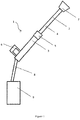
- FIG 1 shows a system 1 for use in window cleaning according to an embodiment of the invention.
- the system 1 comprises a telescopically extendable water-fed pole 2.
- the water-fed pole 2 comprises a first hollow pole section 3 and a second hollow pole section 4.
- the second hollow pole section 4 is thinner than the first hollow pole section 3.
- the second hollow pole section 4 fits within the first hollow pole section 3 and can move longitudinally relative to the first hollow pole section 3 to extend or shorten the water-fed pole 2.
- the water-fed pole 2 is shown in an extended state.
- a clamp 5 according to the invention is fitted to a distal end of the first hollow pole section 3 and is operable to clamp the first hollow pole section 3 to the second hollow pole section 4, thereby fixing the length of the water-fed pole 2.
- the clamp 5 may comprise a clamping surface arranged such that, on operation of the clamp 5, the clamping surface is brought into contact with a surface of the second hollow pole section 4 to clamp the first hollow pole section 3 to the second hollow pole section 4. At least a portion of the clamping surface may comprise a resilient material. Typical features and operation of clamps according to the invention are described in more detail below.
- a handle 6 for a user to hold when using the system 1 to clean windows.
- a cleaning tool 7 is fitted to a distal end of the second hollow pole section 4.
- the system 1 further comprises a high pressure source of water 9.
- a hose pipe 8 connects and provides fluid communication between the high pressure source of water 9 and the cleaning tool 7.
- the hose pipe 8 passes along the inside of the first hollow pole section 3 and the second hollow pole section 4.
- the water-fed pole may comprise more than two hollow pole sections.
- Each hollow pole section may be at least 50 centimetres and/or up to 3 metres or up to 2 metres long.
- the hollow pole sections may comprise, or consist essentially of, carbon fibre or another lightweight composite material.
- the cleaning tool may be permanently or releasably attached to the second hollow pole section.
- the cleaning tool may comprise a brush, a mop, a sponge or a wiper blade.
- the high pressure source of water may be configured to supply deionised water.
- the second hollow pole section may have a blade protruding from an outer surface.
- the blade may be arranged to dislodge debris such as grit or other dirt from the inner surface of the first hollow pole section when the second hollow pole section is moved longitudinally within the first hollow pole section.
- the blade may be flexible.
- the blade may be made from a polymeric material. The blade may extend around the circumference of the second hollow pole section.
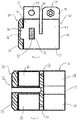
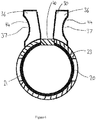
- FIG. 2 to 6 there is shown some of the component parts of a clamp for use on a water-fed pole according to the invention. The parts are shown separately and together.
- a first component part of the clamp comprises a sleeve 20 made of a resilient material, e.g. thermoplastic polyurethane (TPU).
- the sleeve 20 comprises a sleeve body 21 having a first open end 25 and a second open end 26. At the second open end 26, there is a flange 23 having a greater diameter than the sleeve body 21.
- the flange 23 has a recess 24, which is located on the outside of the sleeve body 21 and is open towards the first open end 25 of the sleeve body 21. There is another corresponding recess (not shown) on the opposite side of the sleeve body 21 from the recess 24.
- the outside of the sleeve body 21 is provided with a rectangular protrusion 22, which extends radially outwards from the sleeve body 21 and is located approximately half way between the first open end 25 and the second open end 26.
- the rectangular protrusion 22 is arranged such that its shorter sides run parallel to a longitudinal axis of the sleeve body 21.
- a second component part of the clamp comprises a clamp fitting 30.
- the clamp fitting 30 comprises a clamp body 31 having a first open end 32 and a second open end 33. As shown in Figures 4, 5 and 6 , the sleeve 20 and the clamp fitting 30 are configured to engage with each other, in use.
- the clamp body 31 is shaped and dimensioned to receive, in use, the sleeve body 21.
- a locating formation 34 is arranged to be received in the recess 24.
- another corresponding locating formation (not shown) on the opposite side of the clamp body 31 from the locating formation 34.
- the clamp body 31 has the form of a partially-split tube, in which the clamp body 31 has a first split 40 extending longitudinally from the second open end 33 to approximately half way along the length of the clamp body 31.
- the clamp body 31 comprises a first portion 42 and a second portion 43, which are separated by a second split 41, which is perpendicular to the first split 40 and extends approximately half way through the partially-split tube of the clamp body 31.
- the first portion 42 comprises the first open end 32.
- the second portion 43 comprises the second open end 33.
- first portion 42 Extending from the first portion 42 is a first pair of securing fins 38.
- the first pair of securing fins 38 is connected together, in use, by a fastening means such as a nut and bolt 39.
- a second pair of securing fins 36 Extending from the second portion 43 is a second pair of securing fins 36.
- the second pair of securing fins 36 is generally in alignment with the first pair of securing fins 38.
- the second pair of securing fins 36 is disposed either side of the first split 40.
- Each of the second pair of securing fins 36 comprises a concave portion 44 in its outward-facing face.
- Each of the second pair of securing fins 36 comprises a through hole 37 passing laterally through the securing fin 36 with one end opening into the concave portion 44. In use, a shaft (not shown) passes through the through holes 37.
- the shaft is coupled to an adjustment means such as a lever-operated cam (not shown) operable to urge the second pair of securing fins 36 together and thereby clamping the sleeve 20 to a pole section (not shown) located therein.
- the shaft may be threaded at least in part.
- the second portion 43 further comprises a rectangular hole 35, which is configured to receive, in use, the rectangular protrusion 22 of the sleeve 20. It will be appreciated that the rectangular hole 35 and the rectangular protrusion 22 need not be rectangular. They can have any shape and dimensions such that they engage with one another, in use.
- the recess 24 and the locating formation 34 may be shaped and dimensioned other than as shown in the example embodiment of Figures 2 to 6 , as long as they can engage with one another, in use.
- the clamp body may comprise, or consist essentially of, a polymeric material, e.g. a plastic.
- the clamp body may be made from a single piece of material, e.g. polymeric material.
- the clamp body may be made from a plurality of parts, which are joined together, e.g. using an adhesive.
- the sleeve 20 is placed inside the second open end 33 of the clamp body 31, as shown in Figures 4, 5 and 6 . Engagement between the recess 24 and the locating formation 34 and between the rectangular protrusion 22 and the rectangular hole 35 help to ensure that the sleeve 20 is correctly located and securely fitted within the clamp fitting 30.
- first hollow pole section (not shown) of a water-fed pole according to the invention is received in the first open end 32 of the clamp body 31.
- the clamp body 31 is fitted to the end of the first hollow pole section by tightening the nut and bolt 39 to grip and secure the end of the first hollow pole section within the first portion 42 of the clamp body 31.
- the water-fed pole comprises a second hollow pole section having a smaller diameter than the first hollow pole section.
- the second hollow pole section fits inside the first hollow pole section and can move longitudinally relative to the first hollow pole section.
- a tightening mechanism such as a lever-operated cam coupled to a shaft passing through the through holes 37 in the second pair of securing fins 36 is operated to cause the sleeve 20 to grip the second hollow pole section, thereby fixing the length of the water-fed pole.
- the tightening mechanism is released and the second hollow pole section is moved longitudinally relative to the first hollow pole section.
- the first hollow tube portion and the second hollow tube portion may be made from carbon fibre.
- the grip of the sleeve on the second hollow tube portion may be improved and/or wear of the second hollow tube portion may be reduced, because the sleeve is made from a resilient material such as TPU.
- Embodiments of the invention may include any number of hollow pole sections and a corresponding number of clamps.
- a cleaning tool may be fitted to a distal hollow pole section.
- a handle may be provided on a proximal hollow pole section.
- the proximal hollow pole section may be the largest diameter hollow pole section in telescopically extendable embodiments of water-fed poles according to the invention.
- the water-fed pole may be part of a system, which additionally comprises a source of high pressure water.
- the source of high pressure water may be connected to the cleaning tool by a hose pipe, which conveniently may pass along the inside of the hollow pole sections.
- one or more of the hollow pole sections may comprise a blade protruding from an outer surface.
- the blade may be annular and typically may be made from a flexible material, e.g. a polymeric material.
- a given hollow pole section provided with a blade on an outer surface thereof is moved longitudinally inside another of the hollow pole section, the blade may dislodge debris such as dirt and/or grit from the inner surface of the other of the hollow pole sections. Accordingly, the build-up of debris such as dirt and/or grit may be minimised. As a consequence, the in service lifetime of the water-fed pole may be improved.
- Figures 7 and 8 show another embodiment of a clamp fitting 70 for use in a clamp on a water-fed pole according to the invention.
- the clamp fitting 70 is configured for use with a sleeve (not shown) made of a resilient material such as TPU.
- the sleeve may be of the type described above in relation to Figures 2 , 4 , 5 and 6 .
- the clamp fitting 70 comprises a clamp body 71 having a first open end 72 and a second open end 73.
- a locating formation 74 for engagement, in use, with a correspondingly shaped recess on a sleeve.
- a corresponding locating formation (not shown) on the opposite side of the clamp body 71 from the locating formation 74.
- the clamp body 71 has the form of a partially-split tube, in which the clamp body 71 has a first split 80 extending longitudinally from the second open end 73 to approximately half way along the length of the clamp body 71.
- the clamp body 71 comprises a first portion 82 and a second portion 83, which are separated by a second split 81, which is perpendicular to the first split 80 and extends approximately half way through the partially-split tube of the clamp body 71.
- the first portion 82 comprises the first open end 72.
- the second portion 83 comprises the second open end 73.
- first portion 82 Extending from the first portion 82 is a first pair of securing fins 78.
- the first pair of securing fins 78 is connected together, in use, by a fastening means such as a nut and bolt (not shown).
- the second pair of securing fins 76 is generally in alignment with the first pair of securing fins 78.
- the second pair of securing fins 76 is disposed either side of the first split 80.
- the second portion 83 further comprises two holes (not shown) disposed on opposite sides of the clamp body 71, each hole being is configured to receive, in use, a correspondingly-shaped protrusion on a sleeve. It will be appreciated that the hole(s) and the protrusion(s) can have any shape and dimensions such that they engage with one another, in use.
- Each of the second pair of securing fins 76 comprises a concave portion 84 in its outward-facing face.
- Each of the second pair of securing fins 76 comprises a through hole (not shown) passing laterally through the securing fin 76 with one end opening into the concave portion 84.
- a shaft (not shown) passes through the through holes.
- the clamp fitting 70 further comprises an adjustment means comprising a lever-operated cam 85, which is pivotally coupled to an end of the shaft passing through the through holes.
- the lever-operated cam 85 is operable to urge the second pair of securing fins 76 together, thereby clamping, in use, a sleeve (not shown) received within the second portion 83 of clamp body 71 to a pole section (not shown) located within the sleeve.
- the lever-operated cam 85 comprises a lever handle 86 for a user to manipulate, in order to operate the clamp fitting 70.
- the lever-operated cam 85 is configured such that, when the clamp fitting 70 is at its tightest (i.e. with the second pair of securing fins 76 being pushed towards each other), the lever handle 86 lies flat across the tops of the second pair of securing fins 76 (as shown in Figures 7 and 8 ).
- a user operates the lever-operated cam 85 by moving the lever handle 86 away from the tops of the second pair of securing fins 76. Consequently, the lever-operated cam 85 effectively lengthens the shaft passing through the through holes in the second pair of securing fins 76, thereby allowing the second pair of securing fins 76 to move apart from one another.
- the clamp fitting 70 further comprises an anti-rotation bush 87.
- the anti-rotation bush 87 comprises a pair of opposing end plates 88 joined by a central element (not shown).
- the central element comprises a through hole, thereby allowing the anti-rotation bush 87 to be mounted on the shaft passing through the through holes in the second pair of securing fins 76.
- the anti-rotation bush 87 is mounted on the shaft between the lever-operated cam 85 and the proximal securing fin 76.
- the opposing end plates 88 are disposed either side of the proximal securing fin 76 and the lever-operated cam 85and act to limit or prevent, in use, unwanted rotation of the lever-operated cam 85. Therefore, a more reliable and/or consistent grip of a clamping surface on a surface of an adjacent pole section may be maintained during operation of a water-fed pole.
- the clamp body may comprise, or consist essentially of, a polymeric material, e.g. a plastic.
- the clamp body may be made from a single piece of material, e.g. polymeric material.
- the clamp body may be made from a plurality of parts, which are joined together, e.g. using an adhesive.
- a sleeve e.g. the sleeve 20
- a sleeve may be placed inside the second open end 73 of the clamp body 71.
- first hollow pole section (not shown) of a water-fed pole according to the invention is received in the first open end 72 of the clamp body 71.
- the clamp body 71 is fitted to the end of the first hollow pole section by tightening the nut and bolt (not shown) to grip and secure the end of the first hollow pole section within the first portion 82 of the clamp body 71.
- the water-fed pole comprises a second hollow pole section having a smaller diameter than the first hollow pole section.
- the second hollow pole section fits inside the first hollow pole section and can move longitudinally relative to the first hollow pole section.
- the second hollow pole section is moved such that it extends out of the second hollow end 73 of the clamp body 71.
- the tightening mechanism comprising the lever-operated cam 85 pivotally coupled to the shaft passing through the through holes in the second pair of securing fins 76 is operated to cause a clamping surface provided for example by a sleeve engaged with the clamp body 71 to grip the second hollow pole section, thereby fixing the length of the water-fed pole.
- the tightening mechanism is released and the second hollow pole section is moved longitudinally relative to the first hollow pole section.
- the first hollow tube portion and the second hollow tube portion may be made from carbon fibre.
- the grip of the sleeve on the second hollow tube portion may be improved and/or wear of the second hollow tube portion may be reduced, because the clamping surface provided by the sleeve may be made at least in part from a resilient material such as TPU.
- Embodiments of the invention may include any number of hollow pole sections and a corresponding number of clamps.
- a cleaning tool may be fitted to a distal hollow pole section.
- a handle may be provided on a proximal hollow pole section.
- the proximal hollow pole section may be the largest diameter hollow pole section in telescopically extendable embodiments of water-fed poles according to the invention.
- the water-fed pole may be part of a system, which additionally comprises a source of high pressure water.
- the source of high pressure water may be connected to the cleaning tool by a hose pipe, which conveniently may pass along the inside of the hollow pole sections.
- one or more of the hollow pole sections may comprise a blade protruding from an outer surface.
- the blade may be annular and typically may be made from a flexible material, e.g. a polymeric material.
- a given hollow pole section provided with a blade on an outer surface thereof is moved longitudinally inside another of the hollow pole section, the blade may dislodge debris such as dirt and/or grit from the inner surface of the other of the hollow pole sections. Accordingly, the build-up of debris such as dirt and/or grit may be minimised. As a consequence, the in service lifetime of the water-fed pole may be improved.
Landscapes
- Engineering & Computer Science (AREA)
- Mechanical Engineering (AREA)
- General Engineering & Computer Science (AREA)
- Cleaning Implements For Floors, Carpets, Furniture, Walls, And The Like (AREA)
- Cleaning By Liquid Or Steam (AREA)
Applications Claiming Priority (1)
| Application Number | Priority Date | Filing Date | Title |
|---|---|---|---|
| GB1712586.5A GB2565148B (en) | 2017-08-04 | 2017-08-04 | Water-fed pole for window cleaning |
Publications (2)
| Publication Number | Publication Date |
|---|---|
| EP3460147A2 true EP3460147A2 (de) | 2019-03-27 |
| EP3460147A3 EP3460147A3 (de) | 2019-06-12 |
Family
ID=59894776
Family Applications (1)
| Application Number | Title | Priority Date | Filing Date |
|---|---|---|---|
| EP18187247.4A Withdrawn EP3460147A3 (de) | 2017-08-04 | 2018-08-03 | Wasserdurchflossene stange zum fensterputzen |
Country Status (3)
| Country | Link |
|---|---|
| US (1) | US10716438B2 (de) |
| EP (1) | EP3460147A3 (de) |
| GB (1) | GB2565148B (de) |
Cited By (1)
| Publication number | Priority date | Publication date | Assignee | Title |
|---|---|---|---|---|
| EP4203757A4 (de) * | 2020-10-30 | 2025-03-19 | Unger Marketing International, LLC | Ausziehbares reinigungswerkzeug |
Families Citing this family (1)
| Publication number | Priority date | Publication date | Assignee | Title |
|---|---|---|---|---|
| CN114951070B (zh) * | 2022-06-13 | 2023-11-03 | 北京赛图雷机器人科技有限公司 | 一种煤矿专用电缆的清洁机器人 |
Family Cites Families (17)
| Publication number | Priority date | Publication date | Assignee | Title |
|---|---|---|---|---|
| GB1211028A (en) * | 1967-11-14 | 1970-11-04 | Barden Supply Company | Improvements in or relating to cleaning appliances |
| DE3728415A1 (de) * | 1987-04-14 | 1988-11-03 | Juergen Dipl Ing Schaefer | Teleskoprohr |
| US5823578A (en) * | 1997-05-15 | 1998-10-20 | Yah-De Co., Ltd. | Extensible metallic tube structure |
| US6045284A (en) * | 1998-07-15 | 2000-04-04 | Tery Star Industries Co., Ltd. | Extensible cleaner rod |
| US6322006B1 (en) * | 2000-12-20 | 2001-11-27 | Wen-Li Guo | Sprayer device having adjustable handle |
| WO2003033167A1 (en) * | 2001-10-17 | 2003-04-24 | Tony Pohorecki | Pressure washing apparatus and method |
| US7673910B2 (en) * | 2007-06-10 | 2010-03-09 | James Moon | Extendable fluid transport apparatus |
| CN202402413U (zh) * | 2011-12-13 | 2012-08-29 | 胡金学 | 一种伸缩管的锁紧装置 |
| CN102641070A (zh) * | 2012-04-01 | 2012-08-22 | 李向明 | 一种用于安装置物架的撑杆 |
| US8832910B2 (en) * | 2012-05-25 | 2014-09-16 | Jeh-kun Lah | Locking device for pole |
| GB2512390B (en) * | 2013-03-28 | 2016-09-14 | Gardiner Pole Systems Ltd | A clamp assembly |
| GB2527741A (en) * | 2014-05-23 | 2016-01-06 | Steven Wayne Jones | Visually tubeless water fed pole |
| GB2529880B (en) * | 2014-09-05 | 2016-11-02 | Gardiner Pole Systems Ltd | A clamp assembly |
| GB2534139A (en) * | 2015-01-12 | 2016-07-20 | Thompson Andrew | Self tensioning clamp |
| CN205093798U (zh) * | 2015-11-03 | 2016-03-23 | 冯光明 | 清洁工具 |
| GB2557661B (en) * | 2016-12-14 | 2023-04-05 | John Everingham Richard | Anti-rotational telescopic pole and cleaning tool |
| GB2560526B (en) * | 2017-03-13 | 2019-12-11 | Ionic Systems Ltd | A clamp for clamping telescopic pole members |
-
2017
- 2017-08-04 GB GB1712586.5A patent/GB2565148B/en active Active
-
2018
- 2018-08-03 EP EP18187247.4A patent/EP3460147A3/de not_active Withdrawn
- 2018-08-06 US US16/055,723 patent/US10716438B2/en active Active
Cited By (1)
| Publication number | Priority date | Publication date | Assignee | Title |
|---|---|---|---|---|
| EP4203757A4 (de) * | 2020-10-30 | 2025-03-19 | Unger Marketing International, LLC | Ausziehbares reinigungswerkzeug |
Also Published As
| Publication number | Publication date |
|---|---|
| EP3460147A3 (de) | 2019-06-12 |
| US10716438B2 (en) | 2020-07-21 |
| GB2565148B (en) | 2020-02-05 |
| GB2565148A (en) | 2019-02-06 |
| GB201712586D0 (en) | 2017-09-20 |
| US20190038092A1 (en) | 2019-02-07 |
Similar Documents
| Publication | Publication Date | Title |
|---|---|---|
| US8206200B2 (en) | Extension pole apparatus for sander | |
| US11141852B2 (en) | Telepole apparatus and related methods | |
| US10716438B2 (en) | Water-fed pole for window cleaning | |
| US11266227B1 (en) | Power driven duster and cleaner apparatus | |
| US11090798B2 (en) | Telepole apparatus and related methods | |
| US20090249569A1 (en) | Water Flow Through Pole With Locking Mechanism | |
| US10920425B2 (en) | Snow removal apparatus | |
| AU2021100579A4 (en) | Composite support pole | |
| WO2018051141A1 (en) | Window cleaning apparatus with a telescopic pole | |
| US20230234207A1 (en) | Telepole apparatus and related methods | |
| DE102012213750A1 (de) | Absaugvorrichtung | |
| US20190275659A1 (en) | Telescopic Pole For Swimming Pool Tools | |
| US5255405A (en) | Tool holding apparatus | |
| JP2023548322A (ja) | 伸縮式洗浄用具 | |
| US20200040923A1 (en) | Telescopic pole and locking mechanism | |
| IES80742B2 (en) | Device for clearing debris from gutters | |
| ES2397705T3 (es) | Prolongador para lijadora jirafa | |
| EP1627153B1 (de) | Teleskopgriff | |
| US20250035141A1 (en) | Telescoping apparatus | |
| US20110013980A1 (en) | Connecting assembly for tools and handles | |
| WO2018162131A1 (en) | Gutter cleaner | |
| US20110047726A1 (en) | Manual swimming pool cleaning apparatus employing a plurality of water jets | |
| US876371A (en) | Pneumatic brush. | |
| KR200493705Y1 (ko) | 지붕용 제설도구 | |
| CN121221006A (zh) | 洗地刮水胶条组、洗地刮水仓及清洁机器人 |
Legal Events
| Date | Code | Title | Description |
|---|---|---|---|
| PUAI | Public reference made under article 153(3) epc to a published international application that has entered the european phase |
Free format text: ORIGINAL CODE: 0009012 |
|
| AK | Designated contracting states |
Kind code of ref document: A2 Designated state(s): AL AT BE BG CH CY CZ DE DK EE ES FI FR GB GR HR HU IE IS IT LI LT LU LV MC MK MT NL NO PL PT RO RS SE SI SK SM TR |
|
| AX | Request for extension of the european patent |
Extension state: BA ME |
|
| PUAL | Search report despatched |
Free format text: ORIGINAL CODE: 0009013 |
|
| AK | Designated contracting states |
Kind code of ref document: A3 Designated state(s): AL AT BE BG CH CY CZ DE DK EE ES FI FR GB GR HR HU IE IS IT LI LT LU LV MC MK MT NL NO PL PT RO RS SE SI SK SM TR |
|
| AX | Request for extension of the european patent |
Extension state: BA ME |
|
| RIC1 | Information provided on ipc code assigned before grant |
Ipc: A47L 1/08 20060101ALI20190507BHEP Ipc: B25G 1/00 20060101AFI20190507BHEP |
|
| 17P | Request for examination filed |
Effective date: 20191212 |
|
| RBV | Designated contracting states (corrected) |
Designated state(s): AL AT BE BG CH CY CZ DE DK EE ES FI FR GB GR HR HU IE IS IT LI LT LU LV MC MK MT NL NO PL PT RO RS SE SI SK SM TR |
|
| GRAP | Despatch of communication of intention to grant a patent |
Free format text: ORIGINAL CODE: EPIDOSNIGR1 |
|
| STAA | Information on the status of an ep patent application or granted ep patent |
Free format text: STATUS: GRANT OF PATENT IS INTENDED |
|
| INTG | Intention to grant announced |
Effective date: 20200716 |
|
| RIC1 | Information provided on ipc code assigned before grant |
Ipc: B25G 1/00 20060101AFI20200703BHEP Ipc: A47L 1/08 20060101ALI20200703BHEP |
|
| STAA | Information on the status of an ep patent application or granted ep patent |
Free format text: STATUS: THE APPLICATION IS DEEMED TO BE WITHDRAWN |
|
| 18D | Application deemed to be withdrawn |
Effective date: 20201127 |