EP3458479B1 - Anti-b7-h3 antibodies and antibody drug conjugates - Google Patents
Anti-b7-h3 antibodies and antibody drug conjugates Download PDFInfo
- Publication number
- EP3458479B1 EP3458479B1 EP17732657.6A EP17732657A EP3458479B1 EP 3458479 B1 EP3458479 B1 EP 3458479B1 EP 17732657 A EP17732657 A EP 17732657A EP 3458479 B1 EP3458479 B1 EP 3458479B1
- Authority
- EP
- European Patent Office
- Prior art keywords
- antibody
- seq
- adcs
- adc
- cancer
- Prior art date
- Legal status (The legal status is an assumption and is not a legal conclusion. Google has not performed a legal analysis and makes no representation as to the accuracy of the status listed.)
- Active
Links
Images


Classifications
-
- A—HUMAN NECESSITIES
- A61—MEDICAL OR VETERINARY SCIENCE; HYGIENE
- A61K—PREPARATIONS FOR MEDICAL, DENTAL OR TOILETRY PURPOSES
- A61K31/00—Medicinal preparations containing organic active ingredients
-
- C—CHEMISTRY; METALLURGY
- C07—ORGANIC CHEMISTRY
- C07K—PEPTIDES
- C07K16/00—Immunoglobulins [IG], e.g. monoclonal or polyclonal antibodies
- C07K16/18—Immunoglobulins [IG], e.g. monoclonal or polyclonal antibodies against material from animals or humans
- C07K16/28—Immunoglobulins [IG], e.g. monoclonal or polyclonal antibodies against material from animals or humans against receptors, cell surface antigens or cell surface determinants
- C07K16/2803—Immunoglobulins [IG], e.g. monoclonal or polyclonal antibodies against material from animals or humans against receptors, cell surface antigens or cell surface determinants against the immunoglobulin superfamily
- C07K16/2827—Immunoglobulins [IG], e.g. monoclonal or polyclonal antibodies against material from animals or humans against receptors, cell surface antigens or cell surface determinants against the immunoglobulin superfamily against B7 molecules, e.g. CD80, CD86
-
- A—HUMAN NECESSITIES
- A61—MEDICAL OR VETERINARY SCIENCE; HYGIENE
- A61K—PREPARATIONS FOR MEDICAL, DENTAL OR TOILETRY PURPOSES
- A61K31/00—Medicinal preparations containing organic active ingredients
- A61K31/33—Heterocyclic compounds
- A61K31/395—Heterocyclic compounds having nitrogen as a ring hetero atom, e.g. guanethidine or rifamycins
- A61K31/435—Heterocyclic compounds having nitrogen as a ring hetero atom, e.g. guanethidine or rifamycins having six-membered rings with one nitrogen as the only ring hetero atom
- A61K31/4353—Heterocyclic compounds having nitrogen as a ring hetero atom, e.g. guanethidine or rifamycins having six-membered rings with one nitrogen as the only ring hetero atom ortho- or peri-condensed with heterocyclic ring systems
- A61K31/437—Heterocyclic compounds having nitrogen as a ring hetero atom, e.g. guanethidine or rifamycins having six-membered rings with one nitrogen as the only ring hetero atom ortho- or peri-condensed with heterocyclic ring systems the heterocyclic ring system containing a five-membered ring having nitrogen as a ring hetero atom, e.g. indolizine, beta-carboline
-
- A—HUMAN NECESSITIES
- A61—MEDICAL OR VETERINARY SCIENCE; HYGIENE
- A61K—PREPARATIONS FOR MEDICAL, DENTAL OR TOILETRY PURPOSES
- A61K31/00—Medicinal preparations containing organic active ingredients
- A61K31/33—Heterocyclic compounds
- A61K31/395—Heterocyclic compounds having nitrogen as a ring hetero atom, e.g. guanethidine or rifamycins
- A61K31/495—Heterocyclic compounds having nitrogen as a ring hetero atom, e.g. guanethidine or rifamycins having six-membered rings with two or more nitrogen atoms as the only ring heteroatoms, e.g. piperazine or tetrazines
- A61K31/498—Pyrazines or piperazines ortho- and peri-condensed with carbocyclic ring systems, e.g. quinoxaline, phenazine
-
- A—HUMAN NECESSITIES
- A61—MEDICAL OR VETERINARY SCIENCE; HYGIENE
- A61K—PREPARATIONS FOR MEDICAL, DENTAL OR TOILETRY PURPOSES
- A61K31/00—Medicinal preparations containing organic active ingredients
- A61K31/33—Heterocyclic compounds
- A61K31/395—Heterocyclic compounds having nitrogen as a ring hetero atom, e.g. guanethidine or rifamycins
- A61K31/495—Heterocyclic compounds having nitrogen as a ring hetero atom, e.g. guanethidine or rifamycins having six-membered rings with two or more nitrogen atoms as the only ring heteroatoms, e.g. piperazine or tetrazines
- A61K31/505—Pyrimidines; Hydrogenated pyrimidines, e.g. trimethoprim
- A61K31/519—Pyrimidines; Hydrogenated pyrimidines, e.g. trimethoprim ortho- or peri-condensed with heterocyclic rings
-
- A—HUMAN NECESSITIES
- A61—MEDICAL OR VETERINARY SCIENCE; HYGIENE
- A61K—PREPARATIONS FOR MEDICAL, DENTAL OR TOILETRY PURPOSES
- A61K39/00—Medicinal preparations containing antigens or antibodies
-
- A—HUMAN NECESSITIES
- A61—MEDICAL OR VETERINARY SCIENCE; HYGIENE
- A61K—PREPARATIONS FOR MEDICAL, DENTAL OR TOILETRY PURPOSES
- A61K47/00—Medicinal preparations characterised by the non-active ingredients used, e.g. carriers or inert additives; Targeting or modifying agents chemically bound to the active ingredient
-
- A—HUMAN NECESSITIES
- A61—MEDICAL OR VETERINARY SCIENCE; HYGIENE
- A61K—PREPARATIONS FOR MEDICAL, DENTAL OR TOILETRY PURPOSES
- A61K47/00—Medicinal preparations characterised by the non-active ingredients used, e.g. carriers or inert additives; Targeting or modifying agents chemically bound to the active ingredient
- A61K47/50—Medicinal preparations characterised by the non-active ingredients used, e.g. carriers or inert additives; Targeting or modifying agents chemically bound to the active ingredient the non-active ingredient being chemically bound to the active ingredient, e.g. polymer-drug conjugates
- A61K47/51—Medicinal preparations characterised by the non-active ingredients used, e.g. carriers or inert additives; Targeting or modifying agents chemically bound to the active ingredient the non-active ingredient being chemically bound to the active ingredient, e.g. polymer-drug conjugates the non-active ingredient being a modifying agent
- A61K47/62—Medicinal preparations characterised by the non-active ingredients used, e.g. carriers or inert additives; Targeting or modifying agents chemically bound to the active ingredient the non-active ingredient being chemically bound to the active ingredient, e.g. polymer-drug conjugates the non-active ingredient being a modifying agent the modifying agent being a protein, peptide or polyamino acid
- A61K47/65—Peptidic linkers, binders or spacers, e.g. peptidic enzyme-labile linkers
-
- A—HUMAN NECESSITIES
- A61—MEDICAL OR VETERINARY SCIENCE; HYGIENE
- A61K—PREPARATIONS FOR MEDICAL, DENTAL OR TOILETRY PURPOSES
- A61K47/00—Medicinal preparations characterised by the non-active ingredients used, e.g. carriers or inert additives; Targeting or modifying agents chemically bound to the active ingredient
- A61K47/50—Medicinal preparations characterised by the non-active ingredients used, e.g. carriers or inert additives; Targeting or modifying agents chemically bound to the active ingredient the non-active ingredient being chemically bound to the active ingredient, e.g. polymer-drug conjugates
- A61K47/51—Medicinal preparations characterised by the non-active ingredients used, e.g. carriers or inert additives; Targeting or modifying agents chemically bound to the active ingredient the non-active ingredient being chemically bound to the active ingredient, e.g. polymer-drug conjugates the non-active ingredient being a modifying agent
- A61K47/68—Medicinal preparations characterised by the non-active ingredients used, e.g. carriers or inert additives; Targeting or modifying agents chemically bound to the active ingredient the non-active ingredient being chemically bound to the active ingredient, e.g. polymer-drug conjugates the non-active ingredient being a modifying agent the modifying agent being an antibody, an immunoglobulin or a fragment thereof, e.g. an Fc-fragment
-
- A—HUMAN NECESSITIES
- A61—MEDICAL OR VETERINARY SCIENCE; HYGIENE
- A61K—PREPARATIONS FOR MEDICAL, DENTAL OR TOILETRY PURPOSES
- A61K47/00—Medicinal preparations characterised by the non-active ingredients used, e.g. carriers or inert additives; Targeting or modifying agents chemically bound to the active ingredient
- A61K47/50—Medicinal preparations characterised by the non-active ingredients used, e.g. carriers or inert additives; Targeting or modifying agents chemically bound to the active ingredient the non-active ingredient being chemically bound to the active ingredient, e.g. polymer-drug conjugates
- A61K47/51—Medicinal preparations characterised by the non-active ingredients used, e.g. carriers or inert additives; Targeting or modifying agents chemically bound to the active ingredient the non-active ingredient being chemically bound to the active ingredient, e.g. polymer-drug conjugates the non-active ingredient being a modifying agent
- A61K47/68—Medicinal preparations characterised by the non-active ingredients used, e.g. carriers or inert additives; Targeting or modifying agents chemically bound to the active ingredient the non-active ingredient being chemically bound to the active ingredient, e.g. polymer-drug conjugates the non-active ingredient being a modifying agent the modifying agent being an antibody, an immunoglobulin or a fragment thereof, e.g. an Fc-fragment
- A61K47/6801—Drug-antibody or immunoglobulin conjugates defined by the pharmacologically or therapeutically active agent
- A61K47/6803—Drugs conjugated to an antibody or immunoglobulin, e.g. cisplatin-antibody conjugates
-
- A—HUMAN NECESSITIES
- A61—MEDICAL OR VETERINARY SCIENCE; HYGIENE
- A61K—PREPARATIONS FOR MEDICAL, DENTAL OR TOILETRY PURPOSES
- A61K47/00—Medicinal preparations characterised by the non-active ingredients used, e.g. carriers or inert additives; Targeting or modifying agents chemically bound to the active ingredient
- A61K47/50—Medicinal preparations characterised by the non-active ingredients used, e.g. carriers or inert additives; Targeting or modifying agents chemically bound to the active ingredient the non-active ingredient being chemically bound to the active ingredient, e.g. polymer-drug conjugates
- A61K47/51—Medicinal preparations characterised by the non-active ingredients used, e.g. carriers or inert additives; Targeting or modifying agents chemically bound to the active ingredient the non-active ingredient being chemically bound to the active ingredient, e.g. polymer-drug conjugates the non-active ingredient being a modifying agent
- A61K47/68—Medicinal preparations characterised by the non-active ingredients used, e.g. carriers or inert additives; Targeting or modifying agents chemically bound to the active ingredient the non-active ingredient being chemically bound to the active ingredient, e.g. polymer-drug conjugates the non-active ingredient being a modifying agent the modifying agent being an antibody, an immunoglobulin or a fragment thereof, e.g. an Fc-fragment
- A61K47/6801—Drug-antibody or immunoglobulin conjugates defined by the pharmacologically or therapeutically active agent
- A61K47/6803—Drugs conjugated to an antibody or immunoglobulin, e.g. cisplatin-antibody conjugates
- A61K47/68031—Drugs conjugated to an antibody or immunoglobulin, e.g. cisplatin-antibody conjugates the drug being an auristatin
-
- A—HUMAN NECESSITIES
- A61—MEDICAL OR VETERINARY SCIENCE; HYGIENE
- A61K—PREPARATIONS FOR MEDICAL, DENTAL OR TOILETRY PURPOSES
- A61K47/00—Medicinal preparations characterised by the non-active ingredients used, e.g. carriers or inert additives; Targeting or modifying agents chemically bound to the active ingredient
- A61K47/50—Medicinal preparations characterised by the non-active ingredients used, e.g. carriers or inert additives; Targeting or modifying agents chemically bound to the active ingredient the non-active ingredient being chemically bound to the active ingredient, e.g. polymer-drug conjugates
- A61K47/51—Medicinal preparations characterised by the non-active ingredients used, e.g. carriers or inert additives; Targeting or modifying agents chemically bound to the active ingredient the non-active ingredient being chemically bound to the active ingredient, e.g. polymer-drug conjugates the non-active ingredient being a modifying agent
- A61K47/68—Medicinal preparations characterised by the non-active ingredients used, e.g. carriers or inert additives; Targeting or modifying agents chemically bound to the active ingredient the non-active ingredient being chemically bound to the active ingredient, e.g. polymer-drug conjugates the non-active ingredient being a modifying agent the modifying agent being an antibody, an immunoglobulin or a fragment thereof, e.g. an Fc-fragment
- A61K47/6801—Drug-antibody or immunoglobulin conjugates defined by the pharmacologically or therapeutically active agent
- A61K47/6803—Drugs conjugated to an antibody or immunoglobulin, e.g. cisplatin-antibody conjugates
- A61K47/68035—Drugs conjugated to an antibody or immunoglobulin, e.g. cisplatin-antibody conjugates the drug being a pyrrolobenzodiazepine
-
- A—HUMAN NECESSITIES
- A61—MEDICAL OR VETERINARY SCIENCE; HYGIENE
- A61K—PREPARATIONS FOR MEDICAL, DENTAL OR TOILETRY PURPOSES
- A61K47/00—Medicinal preparations characterised by the non-active ingredients used, e.g. carriers or inert additives; Targeting or modifying agents chemically bound to the active ingredient
- A61K47/50—Medicinal preparations characterised by the non-active ingredients used, e.g. carriers or inert additives; Targeting or modifying agents chemically bound to the active ingredient the non-active ingredient being chemically bound to the active ingredient, e.g. polymer-drug conjugates
- A61K47/51—Medicinal preparations characterised by the non-active ingredients used, e.g. carriers or inert additives; Targeting or modifying agents chemically bound to the active ingredient the non-active ingredient being chemically bound to the active ingredient, e.g. polymer-drug conjugates the non-active ingredient being a modifying agent
- A61K47/68—Medicinal preparations characterised by the non-active ingredients used, e.g. carriers or inert additives; Targeting or modifying agents chemically bound to the active ingredient the non-active ingredient being chemically bound to the active ingredient, e.g. polymer-drug conjugates the non-active ingredient being a modifying agent the modifying agent being an antibody, an immunoglobulin or a fragment thereof, e.g. an Fc-fragment
- A61K47/6835—Medicinal preparations characterised by the non-active ingredients used, e.g. carriers or inert additives; Targeting or modifying agents chemically bound to the active ingredient the non-active ingredient being chemically bound to the active ingredient, e.g. polymer-drug conjugates the non-active ingredient being a modifying agent the modifying agent being an antibody, an immunoglobulin or a fragment thereof, e.g. an Fc-fragment the modifying agent being an antibody or an immunoglobulin bearing at least one antigen-binding site
- A61K47/6849—Medicinal preparations characterised by the non-active ingredients used, e.g. carriers or inert additives; Targeting or modifying agents chemically bound to the active ingredient the non-active ingredient being chemically bound to the active ingredient, e.g. polymer-drug conjugates the non-active ingredient being a modifying agent the modifying agent being an antibody, an immunoglobulin or a fragment thereof, e.g. an Fc-fragment the modifying agent being an antibody or an immunoglobulin bearing at least one antigen-binding site the antibody targeting a receptor, a cell surface antigen or a cell surface determinant
-
- A—HUMAN NECESSITIES
- A61—MEDICAL OR VETERINARY SCIENCE; HYGIENE
- A61K—PREPARATIONS FOR MEDICAL, DENTAL OR TOILETRY PURPOSES
- A61K47/00—Medicinal preparations characterised by the non-active ingredients used, e.g. carriers or inert additives; Targeting or modifying agents chemically bound to the active ingredient
- A61K47/50—Medicinal preparations characterised by the non-active ingredients used, e.g. carriers or inert additives; Targeting or modifying agents chemically bound to the active ingredient the non-active ingredient being chemically bound to the active ingredient, e.g. polymer-drug conjugates
- A61K47/51—Medicinal preparations characterised by the non-active ingredients used, e.g. carriers or inert additives; Targeting or modifying agents chemically bound to the active ingredient the non-active ingredient being chemically bound to the active ingredient, e.g. polymer-drug conjugates the non-active ingredient being a modifying agent
- A61K47/68—Medicinal preparations characterised by the non-active ingredients used, e.g. carriers or inert additives; Targeting or modifying agents chemically bound to the active ingredient the non-active ingredient being chemically bound to the active ingredient, e.g. polymer-drug conjugates the non-active ingredient being a modifying agent the modifying agent being an antibody, an immunoglobulin or a fragment thereof, e.g. an Fc-fragment
- A61K47/6835—Medicinal preparations characterised by the non-active ingredients used, e.g. carriers or inert additives; Targeting or modifying agents chemically bound to the active ingredient the non-active ingredient being chemically bound to the active ingredient, e.g. polymer-drug conjugates the non-active ingredient being a modifying agent the modifying agent being an antibody, an immunoglobulin or a fragment thereof, e.g. an Fc-fragment the modifying agent being an antibody or an immunoglobulin bearing at least one antigen-binding site
- A61K47/6875—Medicinal preparations characterised by the non-active ingredients used, e.g. carriers or inert additives; Targeting or modifying agents chemically bound to the active ingredient the non-active ingredient being chemically bound to the active ingredient, e.g. polymer-drug conjugates the non-active ingredient being a modifying agent the modifying agent being an antibody, an immunoglobulin or a fragment thereof, e.g. an Fc-fragment the modifying agent being an antibody or an immunoglobulin bearing at least one antigen-binding site the antibody being a hybrid immunoglobulin
- A61K47/6877—Medicinal preparations characterised by the non-active ingredients used, e.g. carriers or inert additives; Targeting or modifying agents chemically bound to the active ingredient the non-active ingredient being chemically bound to the active ingredient, e.g. polymer-drug conjugates the non-active ingredient being a modifying agent the modifying agent being an antibody, an immunoglobulin or a fragment thereof, e.g. an Fc-fragment the modifying agent being an antibody or an immunoglobulin bearing at least one antigen-binding site the antibody being a hybrid immunoglobulin the antibody being an immunoglobulin containing regions, domains or residues from different species
-
- A—HUMAN NECESSITIES
- A61—MEDICAL OR VETERINARY SCIENCE; HYGIENE
- A61K—PREPARATIONS FOR MEDICAL, DENTAL OR TOILETRY PURPOSES
- A61K47/00—Medicinal preparations characterised by the non-active ingredients used, e.g. carriers or inert additives; Targeting or modifying agents chemically bound to the active ingredient
- A61K47/50—Medicinal preparations characterised by the non-active ingredients used, e.g. carriers or inert additives; Targeting or modifying agents chemically bound to the active ingredient the non-active ingredient being chemically bound to the active ingredient, e.g. polymer-drug conjugates
- A61K47/51—Medicinal preparations characterised by the non-active ingredients used, e.g. carriers or inert additives; Targeting or modifying agents chemically bound to the active ingredient the non-active ingredient being chemically bound to the active ingredient, e.g. polymer-drug conjugates the non-active ingredient being a modifying agent
- A61K47/68—Medicinal preparations characterised by the non-active ingredients used, e.g. carriers or inert additives; Targeting or modifying agents chemically bound to the active ingredient the non-active ingredient being chemically bound to the active ingredient, e.g. polymer-drug conjugates the non-active ingredient being a modifying agent the modifying agent being an antibody, an immunoglobulin or a fragment thereof, e.g. an Fc-fragment
- A61K47/6889—Conjugates wherein the antibody being the modifying agent and wherein the linker, binder or spacer confers particular properties to the conjugates, e.g. peptidic enzyme-labile linkers or acid-labile linkers, providing for an acid-labile immuno conjugate wherein the drug may be released from its antibody conjugated part in an acidic, e.g. tumoural or environment
-
- A—HUMAN NECESSITIES
- A61—MEDICAL OR VETERINARY SCIENCE; HYGIENE
- A61P—SPECIFIC THERAPEUTIC ACTIVITY OF CHEMICAL COMPOUNDS OR MEDICINAL PREPARATIONS
- A61P35/00—Antineoplastic agents
-
- A—HUMAN NECESSITIES
- A61—MEDICAL OR VETERINARY SCIENCE; HYGIENE
- A61P—SPECIFIC THERAPEUTIC ACTIVITY OF CHEMICAL COMPOUNDS OR MEDICINAL PREPARATIONS
- A61P43/00—Drugs for specific purposes, not provided for in groups A61P1/00-A61P41/00
-
- C—CHEMISTRY; METALLURGY
- C07—ORGANIC CHEMISTRY
- C07K—PEPTIDES
- C07K16/00—Immunoglobulins [IG], e.g. monoclonal or polyclonal antibodies
- C07K16/18—Immunoglobulins [IG], e.g. monoclonal or polyclonal antibodies against material from animals or humans
- C07K16/28—Immunoglobulins [IG], e.g. monoclonal or polyclonal antibodies against material from animals or humans against receptors, cell surface antigens or cell surface determinants
-
- A—HUMAN NECESSITIES
- A61—MEDICAL OR VETERINARY SCIENCE; HYGIENE
- A61K—PREPARATIONS FOR MEDICAL, DENTAL OR TOILETRY PURPOSES
- A61K39/00—Medicinal preparations containing antigens or antibodies
- A61K2039/505—Medicinal preparations containing antigens or antibodies comprising antibodies
-
- A—HUMAN NECESSITIES
- A61—MEDICAL OR VETERINARY SCIENCE; HYGIENE
- A61K—PREPARATIONS FOR MEDICAL, DENTAL OR TOILETRY PURPOSES
- A61K2300/00—Mixtures or combinations of active ingredients, wherein at least one active ingredient is fully defined in groups A61K31/00 - A61K41/00
-
- C—CHEMISTRY; METALLURGY
- C07—ORGANIC CHEMISTRY
- C07K—PEPTIDES
- C07K2317/00—Immunoglobulins specific features
- C07K2317/10—Immunoglobulins specific features characterized by their source of isolation or production
- C07K2317/14—Specific host cells or culture conditions, e.g. components, pH or temperature
-
- C—CHEMISTRY; METALLURGY
- C07—ORGANIC CHEMISTRY
- C07K—PEPTIDES
- C07K2317/00—Immunoglobulins specific features
- C07K2317/20—Immunoglobulins specific features characterized by taxonomic origin
- C07K2317/24—Immunoglobulins specific features characterized by taxonomic origin containing regions, domains or residues from different species, e.g. chimeric, humanized or veneered
-
- C—CHEMISTRY; METALLURGY
- C07—ORGANIC CHEMISTRY
- C07K—PEPTIDES
- C07K2317/00—Immunoglobulins specific features
- C07K2317/30—Immunoglobulins specific features characterized by aspects of specificity or valency
- C07K2317/33—Crossreactivity, e.g. for species or epitope, or lack of said crossreactivity
-
- C—CHEMISTRY; METALLURGY
- C07—ORGANIC CHEMISTRY
- C07K—PEPTIDES
- C07K2317/00—Immunoglobulins specific features
- C07K2317/30—Immunoglobulins specific features characterized by aspects of specificity or valency
- C07K2317/34—Identification of a linear epitope shorter than 20 amino acid residues or of a conformational epitope defined by amino acid residues
-
- C—CHEMISTRY; METALLURGY
- C07—ORGANIC CHEMISTRY
- C07K—PEPTIDES
- C07K2317/00—Immunoglobulins specific features
- C07K2317/50—Immunoglobulins specific features characterized by immunoglobulin fragments
- C07K2317/51—Complete heavy chain or Fd fragment, i.e. VH + CH1
-
- C—CHEMISTRY; METALLURGY
- C07—ORGANIC CHEMISTRY
- C07K—PEPTIDES
- C07K2317/00—Immunoglobulins specific features
- C07K2317/50—Immunoglobulins specific features characterized by immunoglobulin fragments
- C07K2317/515—Complete light chain, i.e. VL + CL
-
- C—CHEMISTRY; METALLURGY
- C07—ORGANIC CHEMISTRY
- C07K—PEPTIDES
- C07K2317/00—Immunoglobulins specific features
- C07K2317/50—Immunoglobulins specific features characterized by immunoglobulin fragments
- C07K2317/52—Constant or Fc region; Isotype
-
- C—CHEMISTRY; METALLURGY
- C07—ORGANIC CHEMISTRY
- C07K—PEPTIDES
- C07K2317/00—Immunoglobulins specific features
- C07K2317/50—Immunoglobulins specific features characterized by immunoglobulin fragments
- C07K2317/56—Immunoglobulins specific features characterized by immunoglobulin fragments variable (Fv) region, i.e. VH and/or VL
-
- C—CHEMISTRY; METALLURGY
- C07—ORGANIC CHEMISTRY
- C07K—PEPTIDES
- C07K2317/00—Immunoglobulins specific features
- C07K2317/50—Immunoglobulins specific features characterized by immunoglobulin fragments
- C07K2317/56—Immunoglobulins specific features characterized by immunoglobulin fragments variable (Fv) region, i.e. VH and/or VL
- C07K2317/565—Complementarity determining region [CDR]
-
- C—CHEMISTRY; METALLURGY
- C07—ORGANIC CHEMISTRY
- C07K—PEPTIDES
- C07K2317/00—Immunoglobulins specific features
- C07K2317/70—Immunoglobulins specific features characterized by effect upon binding to a cell or to an antigen
- C07K2317/76—Antagonist effect on antigen, e.g. neutralization or inhibition of binding
-
- C—CHEMISTRY; METALLURGY
- C07—ORGANIC CHEMISTRY
- C07K—PEPTIDES
- C07K2317/00—Immunoglobulins specific features
- C07K2317/90—Immunoglobulins specific features characterized by (pharmaco)kinetic aspects or by stability of the immunoglobulin
- C07K2317/92—Affinity (KD), association rate (Ka), dissociation rate (Kd) or EC50 value
-
- C—CHEMISTRY; METALLURGY
- C07—ORGANIC CHEMISTRY
- C07K—PEPTIDES
- C07K2319/00—Fusion polypeptide
- C07K2319/55—Fusion polypeptide containing a fusion with a toxin, e.g. diphteria toxin
Definitions
- the term "specific binding to B7-H3" or “specifically binds to B7-H3,” as used herein, refers to an antibody or an ADC that binds to B7-H3 and has a dissociation constant (K D ) of 1.0 x 10 -7 M or less, as determined by surface plasmon resonance. It shall be understood, however, that the antibody or ADC may be capable of specifically binding to two or more antigens which are related in sequence. For example, in one embodiment, an antibody can specifically bind to both human and a non-human (e.g., mouse or non-human primate) orthologs of B7-H3.
- K D dissociation constant
- One aspect of the invention is directed to generating glycosylation site mutants in which the O- or N-linked glycosylation site of the binding protein has been mutated.
- One skilled in the art can generate such mutants using standard well-known technologies.
- Glycosylation site mutants that retain the biological activity, but have increased or decreased binding activity, are another object of the invention.
- Differing protein glycosylation may result in differing protein characteristics.
- the efficacy of a therapeutic protein produced in a microorganism host, such as yeast, and glycosylated utilizing the yeast endogenous pathway may be reduced compared to that of the same protein expressed in a mammalian cell, such as a CHO cell line.
- Such glycoproteins may also be immunogenic in humans and show reduced half-life in vivo after administration.
- Specific receptors in humans and other animals may recognize specific glycosyl residues and promote the rapid clearance of the protein from the bloodstream.
- Other adverse effects may include changes in protein folding, solubility, susceptibility to proteases, trafficking, transport, compartmentalization, secretion, recognition by other proteins or factors, antigenicity, or allergenicity.
- a practitioner may prefer a therapeutic protein with a specific composition and pattern of glycosylation, for example glycosylation composition and pattern identical, or at least similar, to that produced in human cells or in the species-specific cells of the intended subject animal
- bifunctional antibodies may be produced in which one heavy and one light chain are an antibody of the invention and the other heavy and light chain are specific for an antigen other than the antigens of interest by crosslinking an antibody of the invention to a second antibody by standard chemical crosslinking methods.
- a recombinant expression vector encoding both the antibody heavy chain and the antibody light chain is introduced into dhfr- CHO cells by calcium phosphate-mediated transfection.
- the antibody heavy and light chain genes are each operatively linked to CMV enhancer/AdMLP promoter regulatory elements to drive high levels of transcription of the genes.
- the recombinant expression vector also carries a DHFR gene, which allows for selection of CHO cells that have been transfected with the vector using methotrexate selection/amplification. The selected transformant host cells are cultured to allow for expression of the antibody heavy and light chains and intact antibody is recovered from the culture medium.
- the solution comprising the desired ADCs that do not bind to the hydrophobic resin material may then be separated from the slurry, e.g., by filtration or by allowing the slurry to settle and removing the supernatant.
- the resulting slurry can be subjected to one or more washing steps.
- the salt concentration can be decreased.
- ADCs described herein having a DAR2 are purified from ADCs having higher or lower DARs. Such purified DAR2 ADCs are referred to herein as "E2". Purification methods for achieving a composition having E2 anti-B7-H3 ADCs.
- E2 purified DAR2 ADCs
- Purification methods for achieving a composition having E2 anti-B7-H3 ADCs In one embodiment, of the invention provides a composition comprising an ADC mixture, wherein at least 75% of the ADCs are anti-B7H3 ADCs (like those described herein) having a DAR2. In another embodiment, the invention provides a composition comprising an ADC mixture, wherein at least 80% of the ADCs are anti-B7H3 ADCs (like those described herein) having a DAR2.
- the cancer may be characterized as having EGFR overexpression.
- the ADCs of the invention may be used to treating cancer associated with an activating EGFR mutation. Examples of such mutations include, but are not limited to, an exon 19 deletion mutation, a single-point substitution mutation L858R in exon 21, a T790M point mutation, and combinations thereof.
- combination therapies which are included in the invention are the administration of an anti-B7-H3 ADC with an agent selected from the group consisting of an anti-PDl antibody (e.g. pembrolizumab), an anti-PD-Ll antibody (e.g., atezolizumab), an anti-CTLA-4 antibody (e.g. ipilimumab), a MEK inhibitor (e.g. trametinib), an ERK inhibitor, a BRAF inhibitor (e.g. dabrafenib), osimertinib, erlotinib, gefitinib, sorafenib, a CDK9 inhibitor (e.g.
- an anti-PDl antibody e.g. pembrolizumab
- an anti-PD-Ll antibody e.g., atezolizumab
- an anti-CTLA-4 antibody e.g. ipilimumab
- MEK inhibitor e.g. trametinib
- the anti-B7-H3 binding proteins described herein are used in combination with an anti-cancer agent or an antineoplastic agent.
- anti-cancer agent and “antineoplastic agent” refer to drugs used to treat malignancies, such as cancerous growths. Drug therapy may be used alone, or in combination with other treatments such as surgery or radiation therapy.
- drugs may be used in cancer treatment, depending on the nature of the organ involved. For example, breast cancers are commonly stimulated by estrogens, and may be treated with drugs which inactive the sex hormones. Similarly, prostate cancer may be treated with drugs that inactivate androgens, the male sex hormone.
- compositions of the invention may include a "therapeutically effective amount” or a “prophylactically effective amount” of an antibody or antibody portion of the invention.
- a “therapeutically effective amount” refers to an amount effective, at dosages and for periods of time necessary, to achieve the desired therapeutic result.
- a therapeutically effective amount of the antibody or antibody portion may be determined by a person skilled in the art and may vary according to factors such as the disease state, age, sex, and weight of the individual, and the ability of the antibody or antibody portion to elicit a desired response in the individual.
- a therapeutically effective amount is also one in which any toxic or detrimental effects of the antibody, or antibody portion, are outweighed by the therapeutically beneficial effects.
- an exemplary, non-limiting range for a therapeutically or prophylactically effective amount of an ADCis 0.1-20 mg/kg, more preferably 1-10 mg/kg.
- the dose of the ADC described herein is 1 to 6 mg/kg, including the individual doses recited therein, e.g. , 1 mg/kg, 2 mg/kg, 3 mg/kg, 4 mg/kg, 5 mg/kg, and 6 mg/kg.
- the dose of the ADC described herein is 1 to 200 ⁇ g/kg, including the individual doses recited therein, e.g.
- human B7-H3 can also be assayed in biological fluids by a competition immunoassay utilizing rhB7-H3 standards labeled with a detectable substance and an unlabeled anti-human B7-H3 antibody.
- the prophylactic or therapeutic agent of the invention can be delivered in a controlled release or sustained release system.
- a pump may be used to achieve controlled or sustained release (see Langer, supra; Sefton, 1987, CRC Crit. Ref. Biomed. Eng. 14:20 ; Buchwald et al., 1980, Surgery 88:507 ; Saudek et al., 1989, N. Engl. J. Med. 321:574 ).
- polymeric materials can be used to achieve controlled or sustained release of the therapies of the invention (see e.g., Medical Applications of Controlled Release, Langer and Wise (eds.), CRC Pres., Boca Raton, Fla.
- reaction was diluted with N,N-dimethylformamide/water 1/1 (1.0 mL) and purified by reverse-phase chromatography (C18 column), eluting with 5-75% acetonitrile in 0.1% TFA water, to provide the title compound.
- Example 2.123.2 To a mixed mixture of Example 2.123.2 (60 g) in acetonitrile (450 mL) and dichloromethane (150 mL) at -15 °C in an ice-salt bath was added triethylsilane (81 mL) dropwise, followed by addition of boron trifluoride diethyl ether complex (40.6 mL) at such a rate that the internal temperature did not exceed -10 °C. The mixture was then stirred at -15 °C to -10 °C for 2 hours. The reaction was quenched with saturated aqueous NaHCO 3 mixture (275 mL) and stirred for 1 hour at room temperature.
- mice Two different strains of mice were immunized in the hock with dosages containing 5 x 10 6 cells/mouse/injection or 10 ug of protein/mouse/injection in the presence of Gerbu MM adjuvant (Cooper-Casey Corporation, Valley Center, CA, US) for both primary and boost immunizations.
- Gerbu MM adjuvant Ceooper-Casey Corporation, Valley Center, CA, US
- the mice were further boosted with a mixture of human and mouse B7-H3-ECD-human Fc proteins for the final boosts.
- the antigens were prepared in PBS as follows: 200 x 10 6 cells/mL or 400 ug/mL protein.
- Pair-wise binding assays performed on Biacore T200 SPR instruments were used to determine the relative epitope grouping for a series of anti-B7-H3 mAbs.
- the assay format was Fc-based capture via immobilized anti-mouse(Fc) (Pierce 31170) or immobilized anti-human (Fc) (Pierce 31125).
- a standard amine coupling protocol was employed to immobilize the capture reagents via primary amines to the carboxy-methyl (CM) dextran surface of CM5 sensorchips (Biacore); capture antibodies were coupled to a level of approximately 2000RU.
- Epitope grouping measurements were done at 12 °C (low temperature allows for grouping information on fast off-rate mAbs), the assay buffer was HBS-EP+ (Biacore): 10 mM Hepes, pH7.4, 150 mM NaCl, 3 mM EDTA, 0.05% polysorbate 20.
- ADCs were synthesized using one of the methods described below.
- Exemplary ADCs were synthesized using one of nine exemplary methods, described below.
- boric buffer 0.05 mL, 0.5 M, pH 8
- Method H A solution of Bond-BreakerTM tris(2-carboxyethyl)phosphine (TCEP) solution (10 mM, 0.17 mL) was added to the solution of antibody (10 mg/mL, 10 mL) at room temperature. The reaction mixture was heated to 37 °C for 75 minutes. The solution of synthon (10 mM, 0.40 mL in DMSO) was added to a solution of reduced antibody cooled to room temperature. The reaction solution was let to stand for 30 minutes at room temperature. The solution of ADC was treated with saturated ammonium sulfate solution ( ⁇ 2 - 2.5 mL) until a slightly cloudy solution formed.
- TCEP tris(2-carboxyethyl)phosphine
- Vernier and VH/VL interfacing residues were back mutated as follows: L46P, L47W, G64V, F71H. Additional mutations include the following: Q1E, N60A, K64Q, D65G.
- Vernier and VH/VL interfacing residues were back mutated as follows: A43S, L46P, L47W, G64V, G66V, F71H.
- Vernier and VH/VL interfacing residues were back mutated as follows: L46P, L47W, K49Y, G64V, G66V, F71H.
- the B7-H3-targeting Bcl-xL ADCs exhibited tumor growth inhibition (TGI) and tumor growth delay (TGD), as shown in Tables 24 and 25, reflecting the antigen-dependent delivery of the B7-H3-targeting ADCs which deliver the Bcl-xL inhibitor to the B7-H3-expressing tumor cells in this xenograft mouse model.
- TGI tumor growth inhibition
- TTD tumor growth delay
Landscapes
- Health & Medical Sciences (AREA)
- Chemical & Material Sciences (AREA)
- Engineering & Computer Science (AREA)
- Bioinformatics & Cheminformatics (AREA)
- Life Sciences & Earth Sciences (AREA)
- Medicinal Chemistry (AREA)
- General Health & Medical Sciences (AREA)
- Immunology (AREA)
- Pharmacology & Pharmacy (AREA)
- Animal Behavior & Ethology (AREA)
- Public Health (AREA)
- Veterinary Medicine (AREA)
- Epidemiology (AREA)
- Organic Chemistry (AREA)
- Proteomics, Peptides & Aminoacids (AREA)
- Genetics & Genomics (AREA)
- Molecular Biology (AREA)
- Biochemistry (AREA)
- Biophysics (AREA)
- Cell Biology (AREA)
- General Chemical & Material Sciences (AREA)
- Nuclear Medicine, Radiotherapy & Molecular Imaging (AREA)
- Chemical Kinetics & Catalysis (AREA)
- Microbiology (AREA)
- Mycology (AREA)
- Peptides Or Proteins (AREA)
- Pharmaceuticals Containing Other Organic And Inorganic Compounds (AREA)
- Medicines Containing Antibodies Or Antigens For Use As Internal Diagnostic Agents (AREA)
- Plural Heterocyclic Compounds (AREA)
- Medicinal Preparation (AREA)
- Medicines That Contain Protein Lipid Enzymes And Other Medicines (AREA)
- Nitrogen Condensed Heterocyclic Rings (AREA)
- Preparation Of Compounds By Using Micro-Organisms (AREA)
Description
- The
B7 homology 3 protein (B7-H3) (also known as CD276 and B7RP-2, and referred to herein as "B7-H3") is a type I transmembrane glycoprotein of the immunoglobulin superfamily. Human B7-H3 contains a putative signal peptide, V-like and C-like Ig domains, a transmembrane region and a cytoplasmic domain. Exon duplication in humans results in the expression of two B7-H3 isoforms having either a single IgV-IgC-like domain (2IgB7-H3 isoform) or a IgV-IgC-IgV-IgC-like domain (4IgB7-H3 isoform) containing several conserved cysteine residues. The predominant B7-H3 isoform in human tissues and cell lines is the 4IgB7-H3 isoform (Steinberger et al., J. Immunol. 172(4): 2352-9 (2004)). - B7-H3 has been reported as having both co-stimulatory and co-inhibitory signaling functions (see, e.g., Chapoval et al., Nat. Immunol. 2: 269-74 (2001); Suh et al., Nat. Immunol. 4: 899-906 (2003); Prasad et al., J. Immunol. 173: 2500-6 (2004); and Wang et al., Eur. J. Immunol. 35: 428-38 (2005)). For example, in vitro studies have shown B7-H3's co-stimulatory function since B7-H3 was able to increase proliferation of cytotoxic T-lymphocytes (CTLs) and upregulate interferon gamma (IFN-γ) production in the presence of anti-CD3 antibody to mimic the T cell receptor signal (Chapoval et al., 2001). Moreover, in vivo studies using cardiac allografts in B7-H3 -/- mice showed decreased production of key cytokine, chemokine and chemokine receptor mRNA transcripts (e.g., IL-2, IFN-γ, monocyte chemoattractant protein (MCP-1) and IFN-inducible protein (IP)-10) as compared to wild-type control (Wang et al., 2005). In contrast, B7-H3 co-inhibitory function has been observed, for example, in mice where B7-H3 protein inhibited T-cell activation and effector cytokine production (Suh et al., 2003). Although no ligands have been identified for human B7-H3, murine B7-H3 has been found to bind to the triggering receptor expressed on myeloid cells (TREM-) like transcript 2 (TLT-2), a modulator of adaptive an innate immunity cellular responses. Binding of murine B7-H3 to TLT-2 on CD8+ T-cells enhances T-cell effector functions such as proliferation, cytotoxicity and cytokine production (Hashiguchi et al., Proc. Nat'1. Acad. Sci. U.S.A. 105(30): 10495-500 (2008)).
- B7-H3 is not constitutively expressed in many immune cells (e.g., natural killer (NK) cells, T-cells, and antigen-presenting cells (APCs)), however, its expression can be induced. Further, the expression of B7-H3 is not restricted to immune cells. B7-H3 transcripts are expressed in a variety of human tissues including colon, heart, liver, placenta, prostate, small intestine, testis, and uterus, as well as osteoblasts, fibroblasts, epithelial cells, and other cells of non-lymphoid lineage, potentially indicating immunological and non-immunological functions (Nygren et al. Front Biosci. 3:989-93 (2011)). However, protein expression in normal tissue is typically maintained at a low level and thus, may be subject to post-transcriptional regulation.
- B7-H3 is also expressed in a variety of human cancers, including prostate cancer, clear cell renal cell carcinoma, glioma, melanoma, lung cancer, non-small cell lung cancer (NSCLC), small cell lung cancer, pancreatic cancer, gastric cancer, acute myeloid leukemia (AML), non-Hodgkin's lymphoma (NHL), ovarian cancer, colorectal cancer, colon cancer, renal cancer, hepatocellular carcinoma, kidney cancer, head and neck cancer, hypopharyngeal squamous cell carcinoma, glioblastoma, neuroblastoma, breast cancer, endometrial cancer, and urothelial cell carcinoma. Although the role of B7-H3 in cancer cells is unclear, its expression may orchestrate signaling events that may protect cancer cells from innate and adaptive immune responses. For example, B7-H3 is overexpressed in high-grade prostatic intraepithelial neoplasia and adenocarcinomas of the prostate, and high expression levels of B7-H3 in these cancerous cells is associated with an increased risk of cancer progression after surgery (Roth et al. Cancer Res. 67(16): 7893-900 (2007)). Further, tumor B7-H3 expression in NSCLC inversely correlated with the number of tumor-infiltrating lymphocytes and significantly correlated with lymph node metastasis (Sun et al. Lung Cancer 53(2): 143-51 (2006)). The level of circulating soluble B7-H3 in NSCLC patients has also been associated with higher tumor stage, tumor size, lymph node metastasis, and distant metastasis (Yamato et al., Br. J. Cancer 101(10): 1709-16 (2009)).
- B7-H3 may also play an important role in T-cell-mediated antitumor responses in a context dependent manner. For example, gastric cancer tumor cell expression of B7-H3 positively correlated with survival time, infiltration depth, and tissue type (Wu et al., World J. Gastroenterol. 12(3): 457-9 (2006)). Further, high expression of B7-H3 in pancreatic tumor cells was associated with patient survival after surgical resection and significantly correlated with the number of tumor-infiltrating CD8+ T-cells (Loos et al., BMC Cancer 9:463 (2009).
- Antibody drug conjugates (ADC) represent a relatively new class of therapeutics comprising an antibody conjugated to a cytotoxic drug via a chemical linker. The therapeutic concept of ADCs is to combine binding capabilities of an antibody with a drug, where the antibody is used to deliver the drug to a tumor cell by means of binding to a target surface antigen, including target surface antigens that are overexpressed in the tumor cells.
- There remains a need in the art for anti-B7-H3 antibodies and anti-B7-H3 ADCs that can be used for therapeutic purposes in the treatment of cancer.
-
US 2012/0294796 relates to anti-B7-H3 antibodies and pharmaceutical compositions comprising the same.US 2012/0294796 notes that the anti-B7-H3 antibodies disclosed therein can be conjugated to or associated with a radioactive molecule, toxin (calicheamicin), chemotherapeutic molecule, liposomes or other vesicles containing containing chemotherapeutic compositions.US 2012/0294796 does not however disclose conjugating the anti-B7-H3 antibodies to Bcl-xL inhibitors. - Deryk Loo et al "abstract 1201: Anti-B7-H3 antibody-drug conjugates as potential therapeutics for solid cancer" disclose anti-B7-H3 auristatin E ADCs. However, they do not disclose conjugating anti-B7-H3 antibodies to Bcl-xL inhibitors.
- The present invention provides for antibody drug conjugates (ADCs) that specifically bind to human B7-H3. The present invention provides novel ADCs that can selectively deliver Bcl-xL inhibitors to target cancer cells, e.g., B7-H3 expressing cells.
- The present invention provides an anti-hB7-H3 Antibody Drug Conjugate (ADC) comprising the following structure:

- a heavy chain CDR3 domain comprising the amino acid sequence set forth in SEQ ID NO: 35, a heavy chain CDR2 domain comprising the amino acid sequence set forth in SEQ ID NO: 34, and a heavy chain CDR1 domain comprising the amino acid sequence set forth in SEQ ID NO: 33; and
- a light chain CDR3 domain comprising the amino acid sequence set forth in SEQ ID NO: 39, a light chain CDR2 domain comprising the amino acid sequence set forth in SEQ ID NO: 38, and a light chain CDR1 domain comprising the amino acid sequence set forth in SEQ ID NO: 37.
- In one embodiment, the Ab is an anti-hB7-H3 antibody, wherein the anti-hB7H3 antibody comprises a heavy chain variable region comprising the amino acid sequence set forth in SEQ ID NO: 147, and a light chain variable region comprising the amino acid sequence set forth in SEQ ID NO: 144. In one embodiment, Ab is an anti-hB7-H3 antibody, wherein the anti-hB7-H3 antibody comprises a heavy chain comprising the amino acid sequence set forth in SEQ ID NO: 168, and a light chain comprising the amino acid sequence set forth in SEQ ID NO: 169.
- In one embodiment, the ADC is huAb13v1-AAA, wherein AAA is a synthon disclosed in Table B, and wherein the conjugated synthon is in open form.
- In one aspect, the present invention provides a pharmaceutical composition comprising an effective amount of the ADC described herein, and a pharmaceutically acceptable carrier.
- In one aspect, the present invention provides a method for treating cancer, comprising administering a therapeutically effective amount of an ADC described herein to a subject in need thereof.
- In one embodiment, the cancer is selected from the group consisting of small cell lung cancer, non small cell lung cancer, breast cancer, ovarian cancer, a glioblastoma, prostate cancer, pancreatic cancer, colon cancer, gastric cancer, melanoma, hepatocellular carcinoma, head and neck cancer, kidney cancer, leukemia, e.g., acute myeloid leukemia (AML), and lymphoma, e.g., non-Hodgkin's lymphoma (NHL).
- In one embodiment, the cancer is a squamous cell carcinoma. In one embodiment, the squamous cell carcinoma is squamous lung cancer or squamous head and neck cancer.
- In one embodiment, the cancer is triple negative breast cancer.
- In one embodiment, the cancer is non-small cell lung cancer.
- In one embodiment, the cancer is characterized as having an activating EGFR mutation. In one embodiment, the activating EGFR mutation is selected from the group consisting of an exon 19 deletion mutation, a single-point substitution mutation L858R in exon 21, a T790M point mutation, and combinations thereof.
- In one aspect, the present invention provides a method for inhibiting or decreasing solid tumor growth in a subject having a solid tumor, said method comprising administering an effective amount of an ADC described herein to the subject having the solid tumor, such that the solid tumor growth is inhibited or decreased.
- In one embodiment, the solid tumor is a non-small cell lung carcinoma.
- In one embodiment, the ADC is administered in combination with an additional agent or an additional therapy.
- In one embodiment, the additional agent is selected from the group consisting of an anti-PD 1 antibody (e.g. pembrolizumab), an anti-PD-Ll antibody (e.g., atezolizumab), an anti-CTLA-4 antibody (e.g. ipilimumab), a MEK inhibitor (e.g. trametinib), an ERK inhibitor, a BRAF inhibitor (e.g. dabrafenib), osimertinib, erlotinib, gefitinib, sorafenib, a CDK9 inhibitor (e.g. dinaciclib), a MCL-1 inhibitor, temozolomide, a Bcl-2 inhibitor (e.g. venetoclax), a Bcl-xL inhibitor, ibrutinib, a mTOR inhibitor (e.g. everolimus), a PI3K inhibitor (e.g. buparlisib), duvelisib, idelalisib, an AKT inhibitor, a HER2 inhibitor (e.g. lapatinib), a taxane (e.g. docetaxel, paclitaxel, nab-paclitaxel), an ADC comprising an auristatin, an ADC comprising a PBD (e.g. rovalpituzumab tesirine), an ADC comprising a maytansinoid (e.g. TDM1), a TRAIL agonist, a proteasome inhibitor (e.g. bortezomib), and a nicotinamide phosphoribosyltransferase (NAMPT) inhibitor.
- In one embodiment, the anti-B7-H3 ADC of the invention is administered in combination with venetoclax to a human subject for the treatment of small cell lung cancer (SCLC).
- In one embodiment, the additional therapy is radiation.
- In one embodiment, the additional agent is a chemotherapeutic agent.
In one aspect, the present invention provides a process for the preparation of an ADC as claimed, the process comprising: - treating an antibody in an aqueous solution with an effective amount of a disulfide reducing agent at 30-40 °C for at least 15 minutes, and then cooling the antibody solution to 20-27°C;
- adding to the reduced antibody solution a solution of water/dimethyl sulfoxide comprising synthon 2.166 (Table B);
- adjusting the pH of the solution to a pH of 7.5 to 8.5;
- allowing the reaction to run for 48 to 80 hours to form the ADC;
- wherein the mass is shifted by 18 ± 2 amu for each hydrolysis of a succinimide to a succinamide as measured by electron spray mass spectrometry; and
- wherein the ADC is optionally purified by hydrophobic interaction chromatography.
- In another aspect, the present invention provides an ADC prepared by the process as described above.
-
-
Figure 1 is a graphical representation of the epitope grouping of murine anti-B7-H3 hybridoma antibodies as determined by pair-wise binding assays. -
Figure 2 depicts an antibody reduction, modification with a maleimide derivative to give a thiosuccinimide intermediate, and subsequent hydrolysis of thiosuccinimide moiety -
Figure 5 depicts the MS characterization of light chain and heavy chain of huAb13v1 1) prior to conjugation, 2) after conjugation to a maleimide derivative to give a thiosuccinimide intermediate and 3) post pH 8-mediated hydrolysis of the thiosuccinimide ring. - Aspects of the invention relate to, anti-B7-H3 ADCs, and pharmaceutical compositions thereof. Methods of using the ADCs described herein to detect human B7-H3, to inhibit human B7-H3 activity (in vitro or in vivo), and to treat cancers are also encompassed by the invention. In certain embodiments, the invention provides anti-B7-H3 ADC compositions comprising the ADCs, methods of making the ADCs, and various methods of using the ADCs.
- It will also be appreciated by skilled artisans that the various ADCs and/or ADC synthons described herein may be in the form of salts, and in certain embodiments, particularly pharmaceutically acceptable salts. The compounds of the present disclosure that possess a sufficiently acidic, a sufficiently basic, or both functional groups, can react with any of a number of inorganic bases, and inorganic and organic acids, to form a salt. Alternatively, compounds that are inherently charged, such as those with a quaternary nitrogen, can form a salt with an appropriate counterion, e.g., a halide such as a bromide, chloride, or fluoride.
- Acids commonly employed to form acid addition salts are inorganic acids such as hydrochloric acid, hydrobromic acid, hydroiodic acid, sulfuric acid, phosphoric acid, and the like, and organic acids such as p-toluenesulfonic acid, methanesulfonic acid, oxalic acid, p-bromophenylsulfonic acid, carbonic acid, succinic acid, citric acid, etc. Base addition salts include those derived from inorganic bases, such as ammonium and alkali or alkaline earth metal hydroxides, carbonates, bicarbonates, and the like.
- In the disclosure below, if both structural diagrams and nomenclature are included and if the nomenclature conflicts with the structural diagram, the structural diagram controls.
- An outline of the Detailed Description of the Invention is provided below:
- I. Definitions
- II. Anti-B7-H3 Antibodies
- II.A. Anti-B7-H3 Chimeric Antibodies
- II.B. Humanized Anti-B7-H3 Antibodies
- III. Anti-B7-H3 Antibody Drug Conjugates (ADCs)
- III.A. Anti-B7-H3 / Bcl-xL Inhibitor ADCs
- III.A.1. Bcl-xL Inhibitors
- III.A.2 Bcl-xL Linkers
Cleavable Linkers
Non-Cleavable Linkers
Groups Used to Attach Linkers to Anti-B7-H3 Antibodies
Linker Selection Considerations - III.A.3. Bcl-xL ADC Synthons
- III.A.4 Methods of Synthesis of Bcl-xL ADCs
- III.A.5. General Methods for Synthesizing Bcl-xL Inhibitors
- III.A.6. General Methods for Synthesizing Synthons
- III.A.7. General Methods for Synthesizing Anti-B7-H3 ADCs
- III.B. Anti-B7-H3 ADCs: Other Exemplary Drugs for Conjugation
- III.C. Anti-B7-H3 ADCs: Other Exemplary Linkers
- III.A. Anti-B7-H3 / Bcl-xL Inhibitor ADCs
- IV. Purification of Anti-B7-H3 ADCs
- V. Uses of Anti-B7-H3 Antibodies and Anti-B7-H3 ADCs
- VI. Pharmaceutical Compositions
- In order that the invention may be more readily understood, certain terms are first defined. In addition, it should be noted that whenever a value or range of values of a parameter are recited, it is intended that values and ranges intermediate to the recited values are also intended to be part of this invention.
- The term "anti-B7-H3 antibody" refers to an antibody that specifically binds to B7-H3. An antibody "which binds" an antigen of interest, i.e., B7-H3, is one capable of binding that antigen with sufficient affinity such that the antibody is useful in targeting a cell expressing the antigen. In a preferred embodiment, the antibody specifically binds to human B7-H3 (hB7-H3). Examples of anti-B7-H3 antibodies are disclosed in the examples below. Unless otherwise indicated, the term "anti-B7-H3 antibody" is meant to refer to an antibody which binds to wild type B7-H3 (e.g., a 4IgB7-H3 isoform of B7-H3) or any variant of B7-H3. The amino acid sequence of wild type human B7-H3 is provided below as SEQ ID NO: 149, where the signal peptide (amino acid residues 1-28) is underlined.Thus, the ADC binds human B7-H3 as defined in SEQ ID NO: 149. The extracellular domain (ECD) of human B7-H3 is provided in SEQ ID NO: 152 (inclusive of a His tag). As such, in one embodiment of the invention, the antibody of ADC binds the ECD of human B7-H3 as described in the ECD of SEQ ID NO: 152.

- The terms "specific binding" or "specifically binding", as used herein, in reference to the interaction of an antibody or an ADC with a second chemical species, mean that the interaction is dependent upon the presence of a particular structure (e.g., an antigenic determinant or epitope) on the chemical species; for example, an antibody recognizes and binds to a specific protein structure rather than to proteins generally. If an antibody or ADC is specific for epitope "A", the presence of a molecule containing epitope A (or free, unlabeled A), in a reaction containing labeled "A" and the antibody, will reduce the amount of labeled A bound to the antibody or ADC. By way of example, an antibody "binds specifically" to a target if the antibody, when labeled, can be competed away from its target by the corresponding non-labeled antibody. In one embodiment, an antibody specifically binds to a target, e.g., B7-H3, if the antibody has a KD for the target of at least about 10-4 M, 10-5 M, 10-6 M, 10-7 M, 10-8 M, 10-9 M, 10-10 M, 10-11 M, 10-12 M, or less (less meaning a number that is less than 10-12, e.g. 10-13). In one embodiment, the term "specific binding to B7-H3" or "specifically binds to B7-H3," as used herein, refers to an antibody or an ADC that binds to B7-H3 and has a dissociation constant (KD) of 1.0 x 10⁻⁷ M or less, as determined by surface plasmon resonance. It shall be understood, however, that the antibody or ADC may be capable of specifically binding to two or more antigens which are related in sequence. For example, in one embodiment, an antibody can specifically bind to both human and a non-human (e.g., mouse or non-human primate) orthologs of B7-H3.
- The term "antibody" refers to an immunoglobulin molecule that specifically binds to an antigen and comprises a heavy (H) chain(s) and a light (L chain(s). Each heavy chain is comprised of a heavy chain variable region (abbreviated herein as HCVR or VH) and a heavy chain constant region. The heavy chain constant region is comprised of three domains, CH1, CH2 and CH3. Each light chain is comprised of a light chain variable region (abbreviated herein as LCVR or VL) and a light chain constant region. The light chain constant region is comprised of one domain, CL. The VH and VL regions can be further subdivided into regions of hypervariability, termed complementarity determining regions (CDR), interspersed with regions that are more conserved, termed framework regions (FR). Each VH and VL is composed of three CDRs and four FRs, arranged from amino-terminus to carboxy-terminus in the following order: FR1, CDR1, FR2, CDR2, FR3, CDR3, FR4. An antibody can be of any type (e.g., IgG, IgE, IgM, IgD, IgA and IgY) and class (e.g., IgG1, IgG2,
IgG 3, IgG4, IgA1 and IgA2) or subclass. - While the term "antibody" is not intended to include antigen binding portions of an antibody (defined below), it is intended, in certain embodiments, to include a small number of amino acid deletions from the carboxy end of the heavy chain(s). In one embodiment, an antibody comprises a heavy chain having 1-5 amino acid deletions the carboxy end of the heavy chain. In one embodiment, an antibody is a monoclonal antibody which is an IgG, having four polypeptide chains, two heavy (H) chains, and two light (L chains) that can bind to hB7-H3. In one embodiment, an antibody is a monoclonal IgG antibody comprising a lambda or a kappa light chain.
- The term "antigen binding portion" or "antigen binding fragment" of an antibody (or simply "antibody portion" or "antibody fragment"), as used herein, refers to one or more fragments of an antibody that retain the ability to specifically bind to an antigen (e.g., hB7-H3). It has been shown that the antigen binding function of an antibody can be performed by fragments of a full-length antibody. Such antibody embodiments may also be bispecific, dual specific, or multi-specific formats; specifically binding to two or more different antigens. Examples of binding fragments encompassed within the term "antigen binding portion" of an antibody include (i) a Fab fragment, a monovalent fragment consisting of the VL, VH, CL and CH1 domains; (ii) a F(ab')2 fragment, a bivalent fragment comprising two Fab fragments linked by a disulfide bridge at the hinge region; (iii) a Fd fragment consisting of the VH and CH1 domains; (iv) a Fv fragment consisting of the VL and VH domains of a single arm of an antibody, (v) a dAb fragment (Ward et al., (1989) Nature 341:544-546,
Winter et al., PCT publication WO 90/05144 A1 - An IgG is a class of antibody comprising two heavy chains and two light chains arranged in a Y-shape. An IgG constant domain refers to a heavy or light chain constant domain. Exemplary human IgG heavy chain and light chain constant domain amino acid sequences are known in the art and represented below in Table A.
Table A: Sequences of human IgG heavy chain constant domains and light chain constant domains Protein Sequence Identifier Sequence Ig gamma-1 constant region SEQ ID NO:159 
Ig gamma-1 constant region mutant SEQ ID NO:160 
Ig Kappa constant region SEQ ID NO:161 
Ig Lambda constant region SEQ ID NO:162 
- An "isolated antibody", as used herein, is intended to refer to an antibody that is substantially free of other antibodies having different antigenic specificities (e.g., an isolated antibody that specifically binds B7-H3 is substantially free of antibodies that specifically bind antigens other than B7-H3). An isolated antibody that specifically binds B7-H3 may, however, have cross-reactivity to other antigens, such as B7-H3 molecules from other species. Moreover, an isolated antibody may be substantially free of other cellular material and/or chemicals.
- The term "humanized antibody" refers to antibodies which comprise heavy and light chain variable region sequences from a nonhuman species (e.g., a mouse) but in which at least a portion of the VH and/or VL sequence has been altered to be more "human-like", i.e., more similar to human germline variable sequences. In particular, the term "humanized antibody" is an antibody or a variant, derivative, analog or fragment thereof which immunospecifically binds to an antigen of interest and which comprises a framework (FR) region having substantially the amino acid sequence of a human antibody and a complementary determining region (CDR) having substantially the amino acid sequence of a non-human antibody. As used herein, the term "substantially" in the context of a CDR refers to a CDR having an amino acid sequence at least 80%, preferably at least 85%, at least 90%, at least 95%, at least 98% or at least 99% identical to the amino acid sequence of a non-human antibody CDR. A humanized antibody comprises substantially all of at least one, and typically two, variable domains (Fab, Fab', F(ab')2, FabC, Fv) in which all or substantially all of the CDR regions correspond to those of a non-human immunoglobulin (i.e., donor antibody) and all or substantially all of the framework regions are those of a human immunoglobulin consensus sequence. Preferably, a humanized antibody also comprises at least a portion of an immunoglobulin constant region (Fc), typically that of a human immunoglobulin. In some embodiments, a humanized antibody contains both the light chain as well as at least the variable domain of a heavy chain. The antibody also may include the CH1, hinge, CH2, CH3, and CH4 regions of the heavy chain. In some embodiments, a humanized antibody only contains a humanized light chain. In other embodiments, a humanized antibody only contains a humanized heavy chain. In specific embodiments, a humanized antibody only contains a humanized variable domain of a light chain and/or humanized heavy chain.
- The humanized antibody can be selected from any class of immunoglobulins, including IgM, IgG, IgD, IgA and IgE, and any isotype, including without limitation IgG1, IgG2, IgG3 and IgG4. The humanized antibody may comprise sequences from more than one class or isotype, and particular constant domains may be selected to optimize desired effector functions using techniques well-known in the art.
- The terms "Kabat numbering," "Kabat definitions," and "Kabat labeling" are used interchangeably herein. These terms, which are recognized in the art, refer to a system of numbering amino acid residues which are more variable (i.e., hypervariable) than other amino acid residues in the heavy and light chain variable regions of an antibody, or an antigen binding portion thereof (Kabat et al. (1971) Ann. NY Acad, Sci. 190:382-391 and, Kabat, E.A., et al. (1991) Sequences of Proteins of Immunological Interest, Fifth Edition, U.S. Department of Health and Human Services, NIH Publication No. 91-3242). For the heavy chain variable region, the hypervariable region ranges from amino acid positions 31 to 35 for CDR1, amino acid positions 50 to 65 for CDR2, and amino acid positions 95 to 102 for CDR3. For the light chain variable region, the hypervariable region ranges from amino acid positions 24 to 34 for CDR1, amino acid positions 50 to 56 for CDR2, and amino acid positions 89 to 97 for CDR3.
- As used herein, the term "CDR" refers to the complementarity determining region within antibody variable sequences. There are three CDRs in each of the variable regions of the heavy chain (HC) and the light chain (LC), which are designated CDR1, CDR2 and CDR3 (or specifically HC CDR1, HC CDR2, HC CDR3, LC CDR1, LC CDR2, and LC CDR3), for each of the variable regions. The term "CDR set" as used herein refers to a group of three CDRs that occur in a single variable region capable of binding the antigen. The exact boundaries of these CDRs have been defined differently according to different systems. The system described by Kabat (Kabat et al., Sequences of Proteins of Immunological Interest (National Institutes of Health, Bethesda, Md. (1987) and (1991)) not only provides an unambiguous residue numbering system applicable to any variable region of an antibody, but also provides precise residue boundaries defining the three CDRs. These CDRs may be referred to as Kabat CDRs. Chothia and coworkers (Chothia &Lesk, J. Mol. Biol. 196:901-917 (1987) and Chothia et al., Nature 342:877-883 (1989)) found that certain sub- portions within Kabat CDRs adopt nearly identical peptide backbone conformations, despite having great diversity at the level of amino acid sequence. These sub-portions were designated as L1, L2 and L3 or HI, H2 and H3 where the "L" and the "H" designates the light chain and the heavy chains regions, respectively. These regions may be referred to as Chothia CDRs, which have boundaries that overlap with Kabat CDRs. Other boundaries defining CDRs overlapping with the Kabat CDRs have been described by Padlan (FASEB J. 9:133-139 (1995)) and MacCallum (J. Mol. Biol. 262(5):732-45 (1996)). Still other CDR boundary definitions may not strictly follow one of the above systems, but will nonetheless overlap with the Kabat CDRs, although they may be shortened or lengthened in light of prediction or experimental findings that particular residues or groups of residues or even entire CDRs do not significantly impact antigen binding. The methods used herein may utilize CDRs defined according to any of these systems, although preferred embodiments use Kabat or Chothia defined CDRs.
- As used herein, the term "framework" or "framework sequence" refers to the remaining sequences of a variable region minus the CDRs. Because the exact definition of a CDR sequence can be determined by different systems, the meaning of a framework sequence is subject to correspondingly different interpretations. The six CDRs (CDR-L1, CDR-L2, and CDR-L3 of light chain and CDR-H1, CDR-H2, and CDR-H3 of heavy chain) also divide the framework regions on the light chain and the heavy chain into four sub-regions (FR1, FR2, FR3 and FR4) on each chain, in which CDR1 is positioned between FR1 and FR2, CDR2 between FR2 and FR3, and CDR3 between FR3 and FR4. Without specifying the particular sub-regions as FR1, FR2, FR3 or FR4, a framework region, as referred by others, represents the combined FR's within the variable region of a single, naturally occurring immunoglobulin chain. As used herein, a FR represents one of the four sub-regions, and FRs represents two or more of the four sub- regions constituting a framework region.
- The framework and CDR regions of a humanized antibody need not correspond precisely to the parental sequences, e.g., the donor antibody CDR or the consensus framework may be mutagenized by substitution, insertion and/or deletion of at least one amino acid residue so that the CDR or framework residue at that site does not correspond to either the donor antibody or the consensus framework. In a preferred embodiment, such mutations, however, will not be extensive. Usually, at least 80%, preferably at least 85%, more preferably at least 90%, and most preferably at least 95% of the humanized antibody residues will correspond to those of the parental FR and CDR sequences. As used herein, the term "consensus framework" refers to the framework region in the consensus immunoglobulin sequence. As used herein, the term "consensus immunoglobulin sequence" refers to the sequence formed from the most frequently occurring amino acids (or nucleotides) in a family of related immunoglobulin sequences (See e.g., Winnaker, From Genes to Clones (Verlagsgesellschaft, Weinheim, Germany 1987). In a family of immunoglobulins, each position in the consensus sequence is occupied by the amino acid occurring most frequently at that position in the family. If two amino acids occur equally frequently, either can be included in the consensus sequence.
- The term "human acceptor framework", as used herein, is meant to refer to a framework of an antibody or antibody fragment thereof comprising the amino acid sequence of a VH or VL framework derived from a human antibody or antibody fragment thereof or a human consensus sequence framework into which CDR's from a non-human species may be incorporated.
- "Percent (%) amino acid sequence identity" with respect to a peptide or polypeptide sequence is defined as the percentage of amino acid residues in a candidate sequence that are identical with the amino acid residues in the specific peptide or polypeptide sequence, after aligning the sequences and introducing gaps, if necessary, to achieve the maximum percent sequence identity, and not considering any conservative substitutions as part of the sequence identity. Alignment for purposes of determining percent amino acid sequence identity can be achieved in various ways that are within the skill in the art, for instance, using publicly available computer software such as BLAST, BLAST-2, ALIGN or Megalign (DNASTAR) software. Those skilled in the art can determine appropriate parameters for measuring alignment, including any algorithms needed to achieve maximal alignment over the full length of the sequences being compared.
- The term "multivalent antibody" is used herein to denote an antibody comprising two or more antigen binding sites. In certain embodiments, the multivalent antibody may be engineered to have the three or more antigen binding sites, and is generally not a naturally occurring antibody.
- The term "multispecific antibody" refers to an antibody capable of binding two or more unrelated antigens. In one embodiment, the multispecific antibody is a bispecific antibody that is capable of binding to two unrelated antigens, e.g., a bispecific antibody, or antigen-binding portion thereof, that binds B7-H3 and CD3.
- The term "activity" includes activities such as the binding specificity/affinity of an antibody or ADC for an antigen, for example, an anti-hB7-H3 antibody that binds to an hB7-H3 antigen and/or the neutralizing potency of an antibody, for example, an anti-hB7-H3 antibody whose binding to hB7-H3 inhibits the biological activity of hB7-H3, e.g., inhibition of proliferation of B7-H3 expressing cell lines, e.g., human H146 lung carcinoma cells, human H1650 lung carcinoma cells, or human EBC1 lung carcinoma cells.
- The term "non small-cell lung carcinoma (NSCLC) xenograft assay," as used herein, refers to an in vivo assay used to determine whether an anti-B7-H3 antibody or ADC, can inhibit tumor growth (e.g., further growth) and/or decrease tumor growth resulting from the transplantation of NSCLC cells into an immunodeficient mouse. An NSCLC xenograft assay includes transplantation of NSCLC cells into an immunodeficient mouse such that a tumor grows to a desired size, e.g., 200-250 mm3, whereupon the antibody or ADC is administered to the mouse to determine whether the antibody or ADC can inhibit and/or decrease tumor growth. In certain embodiments, the activity of the antibody or ADC is determined according to the percent tumor growth inhibition (%TGI) relative to a control antibody, e.g., a human IgG antibody (or collection thereof) which does not specifically bind tumor cells, e.g., is directed to an antigen not associated with cancer or is obtained from a source which is noncancerous (e.g., normal human serum). In such embodiments, the antibody (or ADC) and the control antibody are administered to the mouse at the same dose, with the same frequency, and via the same route. In one embodiment, the mouse used in the NSCLC xenograft assay is a severe combined immunodeficiency (SCID) mouse and/or an athymic CD-1 nude mouse. Examples of NSCLC cells that may be used in the NSCLC xenograft assay include, but are not limited to, H1299 cells (NCI-H1299 [H-1299] (ATCC® CRL-5803)), H1975 cells (NCI-H1975 cells [H1975] (ATCC® CRL-5908™)), and EBC-1 cells.
- The term "small-cell lung carcinoma (SCLC) xenograft assay," as used herein, refers to an in vivo assay used to determine whether an anti-B7-H3 antibody or ADC, can inhibit tumor growth (e.g., further growth) and/or decrease tumor growth resulting from the transplantation of SCLC cells into an immunodeficient mouse. An SCLC xenograft assay includes transplantation of SCLC cells into an immunodeficient mouse such that a tumor grows to a desired size, e.g., 200-250 mm3, whereupon the antibody or ADC is administered to the mouse to determine whether the antibody or ADC can inhibit and/or decrease tumor growth. In certain embodiments, the activity of the antibody or ADC is determined according to the percent tumor growth inhibition (%TGI) relative to a control antibody, e.g., a human IgG antibody (or collection thereof) which does not specifically bind tumor cells, e.g., is directed to an antigen not associated with cancer or is obtained from a source which is noncancerous (e.g., normal human serum). In such embodiments, the antibody (or ADC) and the control antibody are administered to the mouse at the same dose, with the same frequency, and via the same route. In one embodiment, the mouse used in the NSCLC xenograft assay is a severe combined immunodeficiency (SCID) mouse and/or an athymic CD-1 nude mouse. Examples of SCLC cells that may be used in the SCLC xenograft assay include, but are not limited to, H146 cells (NCI-H146 cells [H146] (ATCC® HTB-173™)), and H847 cells (NCI-H847 [H847] (ATCC® CRL-5846™)). The term "epitope" refers to a region of an antigen that is bound by an antibody or ADC. In certain embodiments, epitope determinants include chemically active surface groupings of molecules such as amino acids, sugar side chains, phosphoryl, or sulfonyl, and, in certain embodiments, may have specific three dimensional structural characteristics, and/or specific charge characteristics. In certain embodiments, an antibody is said to specifically bind an antigen when it preferentially recognizes its target antigen in a complex mixture of proteins and/or macromolecules.
- The term "surface plasmon resonance", as used herein, refers to an optical phenomenon that allows for the analysis of real-time biospecific interactions by detection of alterations in protein concentrations within a biosensor matrix, for example using the BIAcore system (Pharmacia Biosensor AB, Uppsala, Sweden and Piscataway, NJ). For further descriptions, see Jönsson, U., et al. (1993) Ann. Biol. Clin. 51:19-26; Jönsson, U., et al. (1991) Biotechniques 11:620-627; Johnsson, B., et al. (1995) J. Mol. Recognit. 8:125-131; and Johnnson, B., et al. (1991) Anal. Biochem. 198:268-277. In one embodiment, surface plasmon resonance is determined according to the methods described in Example 2.
- The term "kon" or "ka", as used herein, is intended to refer to the on rate constant for association of an antibody to the antigen to form the antibody/antigen complex.
- The term "koff" or "kd", as used herein, is intended to refer to the off rate constant for dissociation of an antibody from the antibody/antigen complex.
- The term "KD", as used herein, is intended to refer to the equilibrium dissociation constant of a particular antibody-antigen interaction (e.g., huAb13 antibody and B7-H3). KD is calculated by ka / kd.
- The term "competitive binding", as used herein, refers to a situation in which a first antibody competes with a second antibody, for a binding site on a third molecule, e.g., an antigen. In one embodiment, competitive binding between two antibodies is determined using FACS analysis.
- The term "competitive binding assay" is an assay used to determine whether two or more antibodies bind to the same epitope. In one embodiment, a competitive binding assay is a competition fluorescent activated cell sorting (FACS) assay which is used to determine whether two or more antibodies bind to the same epitope by determining whether the fluorescent signal of a labeled antibody is reduced due to the introduction of a non-labeled antibody, where competition for the same epitope will lower the level of fluorescence.
- The term "labeled antibody" as used herein, refers to an antibody, or an antigen binding portion thereof, with a label incorporated that provides for the identification of the binding protein, e.g., an antibody. Preferably, the label is a detectable marker, e.g., incorporation of a radiolabeled amino acid or attachment to a polypeptide of biotinyl moieties that can be detected by marked avidin (e.g., streptavidin containing a fluorescent marker or enzymatic activity that can be detected by optical or colorimetric methods). Examples of labels for polypeptides include, but are not limited to, the following: radioisotopes or radionuclides (e.g., 3H, 14C, 35S, 90Y, 99Tc, 111In, 125I, 131I, 177Lu, 166Ho, or 153Sm); fluorescent labels (e.g., FITC, rhodamine, lanthanide phosphors), enzymatic labels (e.g., horseradish peroxidase, luciferase, alkaline phosphatase); chemiluminescent markers; biotinyl groups; predetermined polypeptide epitopes recognized by a secondary reporter (e.g., leucine zipper pair sequences, binding sites for secondary antibodies, metal binding domains, epitope tags); and magnetic agents, such as gadolinium chelates.
- The term "antibody-drug-conjugate" or "ADC" refers to a binding protein, such as an antibody or antigen binding fragment thereof, chemically linked to one or more chemical drug(s) (also referred to herein as agent(s), warhead(s), and payload(s)) that may optionally be therapeutic or cytotoxic agents. In the present invention an ADC includes an antibody, a drug, (e.g. a cytotoxic drug), and a linker that enables attachment or conjugation of the drug to the antibody. The ADC of the invention has 2 drugs conjugated to the antibody. In the present invention the drug is a Bcl-xL inhibitor.
- The terms "anti-B7-H3 antibody drug conjugate" or "anti-B7-H3 ADC", used interchangeably herein, refer to an ADC comprising an antibody that specifically binds to B7-H3, whereby the antibody is conjugated to one or more chemical agent(s). In one embodiment, the anti-B7-H3 ADC comprises antibody huAb13v1 conjugated to a Bcl-xL inhibitor. In the present invention the anti-B7-H3 ADC binds to human B7-H3 (hB7-H3).
- The term "Bcl-xL inhibitor", as used herein, refers to a compound which antagonizes Bcl-xL activity in a cell. In one embodiment, a Bcl-xL inhibitor promotes apoptosis of a cell by inhibiting Bcl-xL activity.
- The term "drug-to-antibody ratio" or "DAR" refers to the number of drugs, e.g., Bcl-xL inhibitor, attached to the antibody of the ADC. The number of drugs, e.g., Bcl-xL inhibitors, attached to the antibody of the ADC of the present invention is 2.
- The term a "xenograft assay", as used herein, refers to a human tumor xenograft assay, wherein human tumor cells are transplanted, either under the skin or into the organ type in which the tumor originated, into immunocompromised mice that do not reject human cells.
- The term "cancer" is meant to refer to or describe the physiological condition in mammals that is typically characterized by unregulated cell growth. Examples of cancer include, but are not limited to, carcinoma, lymphoma, blastoma, sarcoma, and leukemia or lymphoid malignancies. More particular examples of such cancers include glioblastoma, acute myeloid leukemia (AML), non-Hodgkin's lymphoma (NHL), non-small cell lung cancer, lung cancer, colon cancer, colorectal cancer, head and neck cancer, breast cancer (e.g., triple negative breast cancer), pancreatic cancer, squamous cell tumors, squamous cell carcinoma (e.g., squamous cell lung cancer or squamous cell head and neck cancer), anal cancer, skin cancer, and vulvar cancer. In one embodiment, the ADCs of the invention are administered to a patient having a tumor(s) that overexpresses B7-H3. In one embodiment, the ADCs of the invention are administered to a patient having a solid tumor which is likely to over-express B7-H3. In one embodiment, the ADCs of the invention are administered to a patient having squamous cell non-small cell lung cancer (NSCLC). In one embodiment, the ADCs of the invention are administered to a patient having solid tumors, including advanced solid tumors. In one embodiment, the ADCs of the invention are administered to a patient having prostate cancer. In one embodiment, the ADCs of the invention are administered to a patient having non-small cell lung cancer. In one embodiment, the ADCs of the invention are administered to a patient having a glioblastoma. In one embodiment, the ADCs of the invention are administered to a patient having colon cancer. In one embodiment, the ADCs of the invention are administered to a patient having head and neck cancer. In one embodiment, the ADCs of the invention are administered to a patient having kidney cancer. In one embodiment, the ADCs of the invention are administered to a patient having clear cell renal cell carcinoma. In one embodiment, the ADCs of the invention are administered to a patient having glioma. In one embodiment, the ADCs of the invention are administered to a patient having melanoma. In one embodiment, the ADCs of the invention are administered to a patient having pancreatic cancer. In one embodiment, the ADCs of the invention are administered to a patient having gastric cancer. In one embodiment, the ADCs of the invention are administered to a patient having ovarian cancer. In one embodiment, the ADCs of the invention are administered to a patient having colorectal cancer. In one embodiment, the ADCs of the invention are administered to a patient having renal cancer. In one embodiment, the ADCs of the invention are administered to a patient having small cell lung cancer. In one embodiment, the ADCs of the invention are administered to a patient having hepatocellular carcinoma. In one embodiment, the ADCs of the invention are administered to a patient having hypopharyngeal squamous cell carcinoma. In one embodiment, the ADCs of the invention are administered to a patient having neuroblastoma. In one embodiment, the ADCs of the invention are administered to a patient having breast cancer. In one embodiment, the ADCs of the invention are administered to a patient having endometrial cancer. In one embodiment, the ADCs of the invention are administered to a patient having urothelial cell carcinoma. In one embodiment, the ADCs of the invention are administered to a patient having acute myeloid leukemia (AML). In one embodiment, the ADCs of the invention are administered to a patient having non-Hodgkin's lymphoma (NHL).
- The term "B7-H3 expressing tumor," as used herein, refers to a tumor which expresses B7-H3 protein. In one embodiment, B7-H3 expression in a tumor is determined using immunohistochemical staining of tumor cell membranes, where any immunohistochemical staining above background level in a tumor sample indicates that the tumor is a B7-H3 expressing tumor. Methods for detecting expression of B7-H3 in a tumor are known in the art, and include immunohistochemical assays. In contrast, a "B7-H3 negative tumor" is defined as a tumor having an absence of B7-H3 membrane staining above background in a tumor sample as determined by immunohistochemical techniques.
- The terms "overexpress," "overexpression," or "overexpressed" interchangeably refer to a gene that is transcribed or translated at a detectably greater level, usually in a cancer cell, in comparison to a normal cell. Overexpression therefore refers to both overexpression of protein and RNA (due to increased transcription, post transcriptional processing, translation, post translational processing, altered stability, and altered protein degradation), as well as local overexpression due to altered protein traffic patterns (increased nuclear localization), and augmented functional activity, e.g., as in an increased enzyme hydrolysis of substrate. Thus, overexpression refers to either protein or RNA levels. Overexpression can also be by 50%, 60%, 70%, 80%, 90% or more in comparison to a normal cell or comparison cell. In certain embodiments, the anti-B7-H3 ADCs of the invention are used to treat solid tumors likely to overexpress B7-H3.
- The term "gene amplification", as used herein, refers to a cellular process characterized by the production of multiple copies of any particular piece of DNA. For example, a tumor cell may amplify, or copy, chromosomal segments as a result of cell signals and sometimes environmental events. The process of gene amplification leads to the production of additional copies of the gene. In one embodiment, the gene is B7-H3, i.e., "B7-H3 amplification." In one embodiment, the compositions and methods disclosed herein are used to treat a subject having B7-H3 amplified cancer.
- The term "administering" as used herein is meant to refer to the delivery of a substance (e.g., an anti-B7-H3 antibody or ADC) to achieve a therapeutic objective (e.g., the treatment of a B7-H3-associated disorder). Modes of administration may be parenteral, enteral and topical. Parenteral administration is usually by injection, and includes, without limitation, intravenous, intramuscular, intraarterial, intrathecal, intracapsular, intraorbital, intracardiac, intradermal, intraperitoneal, transtracheal, subcutaneous, subcuticular, intraarticular, subcapsular, subarachnoid, intraspinal and intrasternal injection and infusion.
- The term "combination therapy" or "combination" in the context of a therapeutic method (e.g., a treatment method), as used herein, refers to the administration of two or more therapeutic substances, e.g., an ADC and an additional therapeutic agent. The additional therapeutic agent may be administered concomitant with, prior to, or following the administration of the anti-B7-H3 ADC.
- As used herein, the term "effective amount" or "therapeutically effective amount" refers to the amount of a drug, e.g., an antibody or ADC, which is sufficient to reduce or ameliorate the severity and/or duration of a disorder, e.g., cancer, or one or more symptoms thereof, prevent the advancement of a disorder, cause regression of a disorder, prevent the recurrence, development, onset or progression of one or more symptoms associated with a disorder, detect a disorder, or enhance or improve the prophylactic or therapeutic effect(s) of another therapy (e.g., prophylactic or therapeutic agent). The effective amount of an ADC may, for example, inhibit tumor growth (e.g., inhibit an increase in tumor volume), decrease tumor growth (e.g., decrease tumor volume), reduce the number of cancer cells, and/or relieve to some extent one or more of the symptoms associated with the cancer. The effective amount may, for example, improve disease free survival (DFS), improve overall survival (OS), or decrease likelihood of recurrence.
- As used herein, the term "stable" refers to compounds that possess stability sufficient to allow manufacture and that maintain the integrity of the compound for a sufficient period of time to be useful for the purpose detailed herein.
- As used herein, the following terms are intended to have the following meanings:
- The term salt when used in context of "or salt thereof' include salts commonly used to form alkali metal salts and to form addition salts of free acids or free bases. In general, these salts typically may be prepared by conventional means by reacting, for example, the appropriate acid or base with a compound of the invention
- Where a salt is intended to be administered to a patient (as opposed to, for example, being in use in an in vitro context), the salt preferably is pharmaceutically acceptable and/or physiologically compatible. The term "pharmaceutically acceptable" is used adjectivally in this patent application to mean that the modified noun is appropriate for use as a pharmaceutical product or as a part of a pharmaceutical product. The term "pharmaceutically acceptable salt" includes salts commonly used to form alkali metal salts and to form addition salts of free acids or free bases. In general, these salts typically may be prepared by conventional means by reacting, for example, the appropriate acid or base with a compound of the invention.
- The anti-B7-H3 antibodies described herein provide the ADCs of the invention with the ability to bind to B7-H3 such that the cytotoxic Bcl-xL drug attached to the antibody may be delivered to the B7-H3-expressing cell, particularly a B7-H3 expressing cancer cell.
- While the term "antibody" is used throughout, it should be noted that antibody fragments (i.e., antigen-binding portions of an anti-B7-H3 antibody) are also included in the invention and may be included in the embodiments (methods and compositions) described throughout. For example, an anti-B7-H3 antibody fragment may be conjugated to the Bcl-xL inhibitors described herein. Thus, it is within the scope of the invention that in certain embodiments, antibody fragments of the anti-B7-H3 antibodies described herein are conjugated to Bcl-xL inhibitors via linkers. In certain embodiments, the anti-B7-H3 antibody binding portion is a Fab, a Fab', a F(ab')2, a Fv, a disulfide linked Fv, an scFv, a single domain antibody, or a diabody.
- A chimeric antibody is a molecule in which different portions of the antibody are derived from different animal species, such as antibodies having a variable region derived from a murine monoclonal antibody and a human immunoglobulin constant region. Methods for producing chimeric antibodies are known in the art. See e.g., Morrison, Science 229:1202 (1985); Oi et al., BioTechniques 4:214 (1986); Gillies et al., (1989) J. Immunol. Methods 125:191-202;
U.S. Pat. Nos. 5,807,715 ;4,816,567 ; and4,816,397 . In addition, techniques developed for the production of "chimeric antibodies" (Morrison et al., 1984, Proc. Natl. Acad. Sci. 81:851-855; Neuberger et al., 1984, Nature 312:604-608; Takeda et al., 1985, Nature 314:452-454,) by splicing genes from a mouse antibody molecule of appropriate antigen specificity together with genes from a human antibody molecule of appropriate biological activity can be used. - As described in Example 3, eighteen anti-B7-H3 murine antibodies were identified having high specific binding activity against human and cynomolgus B7-H3. Chimeric antibodies, in the context of a human immunoglobulin constant region, were generated from these eighteen antibodies.
- The chimeric antibodies disclosed herein may be used in the production of humanized anti-B7-H3 antibodies. For example, following the generation and characterization of chimeric anti-B7-H3 antibodies chAb1-chAb18, antibodies chAb3, chAb13, and chAb18 were selected for humanization. Specifically, six different humanized antibodies were created based on chAb3 nine different humanized antibodies were created based on chAb13 (referred to herein as huAb13v1, huAb13v2, huAb13v3, huAb13v4, huAb13v5, huAb13v6, huAb13v7, huAb13v8, huAb13v9), and ten different humanized antibodies were created based on chAb18. Tables 18 and 19 provide the amino acid sequences of CDR, VH and VL regions of humanized chAb13.
- Generally, humanized antibodies are antibody molecules from non-human species antibody that binds the desired antigen having one or more complementarity determining regions (CDRs) from the non-human species and framework regions from a human immunoglobulin molecule. Known human Ig sequences are disclosed, e.g., www.ncbi.nlm.nih.gov/entrez- /query.fcgi; www.atcc.org/phage/hdb.html; www.sciquest.com/; www.abcam.com/; www.antibodyresource.com/onlinecomp .html; www.public.iastate.edu/.about.pedro/research_tools.html; www.mgen.uni-heidelberg.de/SD/IT/IT.html; www.whfreeman.com/immunology/CH- 05/kuby05.htm; www.library.thinkquest.org/12429/Immune/Antibody.html; www.hhmi.org/grants/lectures/1996/vlab/; www.path.cam.ac.uk/.about.mrc7/m- ikeimages.html; www.antibodyresource.com/; mcb.harvard.edu/BioLinks/Immunology.html.www.immunologylink.com/; pathbox.wustl.edu/.about.hcenter/index.- html; www.biotech.ufl.edu/.about.hcl/; www.pebio.com/pa/340913/340913.html- ; www.nal.usda.gov/awic/pubs/antibody/; www.m.ehime-u.acjp/.about.yasuhito- /Elisa.html; www.biodesign.com/table.asp; www.icnet.uk/axp/facs/davies/lin- ks.html; www.biotech.ufl.edu/.about.fccl/protocol.html; www.isac-net.org/sites_geo.html; aximtl.imt.uni-marburg.de/.about.rek/AEP- Start.html; baserv.uci.kun.nl/.about.jraats/linksl.html; www.recab.uni-hd.de/immuno.bme.nwu.edu/; www.mrc-cpe.cam.ac.uk/imt-doc/pu- blic/INTRO.html; www.ibt.unam.mx/vir/V_mice.html; imgt.cnusc.fr:8104/; www.biochem.ucl.ac.uk/.about.martin/abs/index.html; antibody.bath.ac.uk/; abgen.cvm.tamu.edu/lab/wwwabgen.html; www.unizh.ch/.about.honegger/AHOsem-inar/Slide01.html; www.cryst.bbk.ac.uk/.about.ubcg07s/; www.nimr.mrc.ac.uk/CC/ccaewg/ccaewg.htm; www.path.cam.ac.uk/.about.mrc7/h-umanisation/TAHHP.html; www.ibt.unam.mx/vir/structure/stat_aim.html; www.biosci.missouri.edu/smithgp/index.html; www.cryst.bioc.cam.ac.uk/.abo- ut.fmolina/Web-pages/Pept/spottech.html; www.jerini.de/fr roducts.htm; www.patents.ibm.com/ibm.html.Kabat et al., Sequences of Proteins of Immunological Interest, U.S. Dept. Health (1983). Such imported sequences can be used to reduce immunogenicity or reduce, enhance or modify binding, affinity, on-rate, off-rate, avidity, specificity, half-life, or any other suitable characteristic, as known in the art.
- Framework residues in the human framework regions may be substituted with the corresponding residue from the CDR donor antibody to alter, preferably improve, antigen binding. These framework substitutions are identified by methods well known in the art, e.g., by modeling of the interactions of the CDR and framework residues to identify framework residues important for antigen binding and sequence comparison to identify unusual framework residues at particular positions. (See, e.g.,
Queen et al., U.S. Pat. No. 5,585,089 ; Riechmann et al., Nature 332:323 (1988)) Three-dimensional immunoglobulin models are commonly available and are familiar to those skilled in the art. Computer programs are available which illustrate and display probable three-dimensional conformational structures of selected candidate immunoglobulin sequences. Inspection of these displays permits analysis of the likely role of the residues in the functioning of the candidate immunoglobulin sequence, i.e., the analysis of residues that influence the ability of the candidate immunoglobulin to bind its antigen. In this way, FR residues can be selected and combined from the consensus and import sequences so that the desired antibody characteristic, such as increased affinity for the target antigen(s), is achieved. In general, the CDR residues are directly and most substantially involved in influencing antigen binding. Antibodies can be humanized using a variety of techniques known in the art, such as but not limited to those described in Jones et al., Nature 321:522 (1986); Verhoeyen et al., Science 239:1534 (1988)), Sims et al., J. Immunol. 151: 2296 (1993); Chothia and Lesk, J. Mol. Biol. 196:901 (1987), Caster et al., Proc. Natl. Acad. Sci. U.S.A. 89:4285 (1992); Presta et al., J. Immunol. 151:2623 (1993), Padlan, Molecular Immunology 28(4/5):489-498 (1991); Studnicka et al., Protein Engineering 7(6):805-814 (1994); Roguska. et al., PNAS 91:969-973 (1994);PCT publication WO 91/09967 PCT/: US98/16280 US96/18978 US91/09630 US91/05939 US94/01234 GB89/01334 GB91/01134 GB92/01755 WO90/14443 WO90/14424 WO90/14430 EP 229246 EP 592,106 EP 519,596 EP 239,400 U.S. Pat. Nos. 5,565,332 ,5,723,323 ,5,976,862 ,5,824,514 ,5,817,483 ,5814476 ,5763192 ,5723323 ,5,766886 ,5,714,352 ,6,204,023 ,6,180,370 ,5,693,762 ,5,530,101 ,5,585,089 ,5,225,539 ;4,816,567 . - The nine different humanized antibodies created based on chAb13 include the following:
- A) huAb13v1 (VH amino acid sequence set forth in SEQ ID NO: 147 and VH CDR1, CDR2, and CDR3 amino acid sequences set forth in SEQ ID NOs: 33, 34, and 35, respectively; and VL amino acid sequence set forth in SEQ ID NO: 144 and VL CDR1, CDR2, and CDR3 amino acid sequences set forth in SEQ ID NOs: 37, 38, and 39, respectively);
- B) huAb13v2 (VH amino acid sequence set forth in SEQ ID NO: 146 and VH CDR1, CDR2, and CDR3 amino acid sequences set forth in SEQ ID NOs: 33, 34, and 35, respectively; and VL amino acid sequence set forth in SEQ ID NO: 143 and VL CDR1, CDR2, and CDR3 amino acid sequences set forth in SEQ ID NOs: 37, 38, and 39, respectively);
- C) huAb13v3 (VH amino acid sequence set forth in SEQ ID NO: 146 and VH CDR1, CDR2, and CDR3 amino acid sequences set forth in SEQ ID NOs: 33, 34, and 35, respectively; and VL amino acid sequence set forth in SEQ ID NO: 144 and VL CDR1, CDR2, and CDR3 amino acid sequences set forth in SEQ ID NOs: 37, 38, and 39, respectively);
- D) huAb13v4 (VH amino acid sequence set forth in SEQ ID NO: 146 and VH CDR1, CDR2, and CDR3 amino acid sequences set forth in SEQ ID NOs: 33, 34, and 35, respectively; and VL amino acid sequence set forth in SEQ ID NO: 145 and VL CDR1, CDR2, and CDR3 amino acid sequences set forth in SEQ ID NOs: 37, 38, and 39, respectively);
- E) huAb13v5 (VH amino acid sequence set forth in SEQ ID NO: 147 and VH CDR1, CDR2, and CDR3 amino acid sequences set forth in SEQ ID NOs: 33, 34, and 35, respectively; and VL amino acid sequence set forth in SEQ ID NO: 143 and VL CDR1, CDR2, and CDR3 amino acid sequences set forth in SEQ ID NOs: 37, 38, and 39, respectively);
- F) huAb13v6 (VH amino acid sequence set forth in SEQ ID NO: 147 and VH CDR1, CDR2, and CDR3 amino acid sequences set forth in SEQ ID NOs: 33, 34, and 35, respectively; and VL amino acid sequence set forth in SEQ ID NO: 145 and VL CDR1, CDR2, and CDR3 amino acid sequences set forth in SEQ ID NOs: 37, 38, and 39, respectively);
- G) huAb13v7 (VH amino acid sequence set forth in SEQ ID NO: 148 and VH CDR1, CDR2, and CDR3 amino acid sequences set forth in SEQ ID NOs: 33, 34, and 35, respectively; and VL amino acid sequence set forth in SEQ ID NO: 143 and VL CDR1, CDR2, and CDR3 amino acid sequences set forth in SEQ ID NOs: 37, 38, and 39, respectively);
- H) huAb13v8 (VH amino acid sequence set forth in SEQ ID NO: 148 and VH CDR1, CDR2, and CDR3 amino acid sequences set forth in SEQ ID NOs: 33, 34, and 35, respectively; and VL amino acid sequence set forth in SEQ ID NO: 144 and VL CDR1, CDR2, and CDR3 amino acid sequences set forth in SEQ ID NOs: 37, 38, and 39, respectively);
- I) huAb13v9 (VH amino acid sequence set forth in SEQ ID NO: 148 and VH CDR1, CDR2, and CDR3 amino acid sequences set forth in SEQ ID NOs: 33, 34, and 35, respectively; and VL amino acid sequence set forth in SEQ ID NO: 145 and VL CDR1, CDR2, and CDR3 amino acid sequences set forth in SEQ ID NOs: 37, 38, and 39, respectively).
- Thus, one aspect of the present disclosure provides antibodies comprising variable and/or CDR sequences from a humanized antibody derived from chAb13. The present disclosure features anti-B7-H3 antibodies which are derived from chAb13 and have improved characteristics, e.g., improved binding affinity to isolated B7-H3 protein and improved binding to B7-H3 expressing cells, as described in the Examples below. Collectively these novel antibodies are referred to herein as "Ab13 variant antibodies." Generally, the Ab13 variant antibodies retain the same epitope specificity as Ab13.
- Conservative amino acid substitutions may also be made in portions of the antibodies other than, or in addition to, the CDRs. For example, conservative amino acid modifications may be made in a framework region or in the Fc region. A variable region or a heavy or light chain may comprise 1, 2, 3, 4, 5, 1-2, 1-3, 1-4, 1-5, 1-10, 1-15, 1-20, 1-25, or 1-50 conservative amino acid substitutions relative to the anti-B7-H3 antibody sequences provided herein. In certain embodiments, the anti-B7-H3 antibody comprises a combination of conservative and non-conservative amino acid modification.
- To generate and to select CDRs having preferred B7-H3 binding and/or neutralizing activity with respect to hB7-H3, standard methods known in the art for generating antibodies, or antigen binding portions thereof, and assessing the B7-H3 binding and/or neutralizing characteristics of those antibodies, or antigen binding portions thereof, may be used, including but not limited to those specifically described herein.
- In certain embodiments, the antibody comprises a heavy chain constant region, such as an IgG1, IgG2, IgG3, IgG4, IgA, IgE, IgM, or IgD constant region. In certain embodiments, the anti-B7-H3 antibody, or antigen binding portion thereof, comprises a heavy chain immunoglobulin constant domain selected from the group consisting of a human IgG constant domain, a human IgM constant domain, a human IgE constant domain, and a human IgA constant domain. In further embodiments, the antibody, or antigen binding portion thereof, has an IgG1 heavy chain constant region, an IgG2 heavy chain constant region, an IgG3 constant region, or an IgG4 heavy chain constant region. Preferably, the heavy chain constant region is an IgG1 heavy chain constant region or an IgG4 heavy chain constant region. Furthermore, the antibody can comprise a light chain constant region, either a kappa light chain constant region or a lambda light chain constant region. Preferably, the antibody comprises a kappa light chain constant region. Alternatively, the antibody portion can be, for example, a Fab fragment or a single chain Fv fragment.
- In certain embodiments, the anti-B7-H3 antibody binding portion is a Fab, a Fab', a F(ab')2, a Fv, a disulfide linked Fv, an scFv, a single domain antibody, or a diabody.
- In certain embodiments, the anti-B7-H3 antibody, or antigen binding portion thereof, is a multispecific antibody, e.g. a bispecific antibody.
- Replacements of amino acid residues in the Fc portion to alter antibody effector function have been described (
Winter, et al. US Patent Nos. 5,648,260 and5,624,821 ). The Fc portion of an antibody mediates several important effector functions e.g. cytokine induction, ADCC, phagocytosis, complement dependent cytotoxicity (CDC) and half-life/ clearance rate of antibody and antigen-antibody complexes. In some cases these effector functions are desirable for therapeutic antibody but in other cases might be unnecessary or even deleterious, depending on the therapeutic objectives. Certain human IgG isotypes, particularly IgG1 and IgG3, mediate ADCC and CDC via binding to FcγRs and complement C1q, respectively. Neonatal Fc receptors (FcRn) are the critical components determining the circulating half-life of antibodies. In still another embodiment at least one amino acid residue is replaced in the constant region of the antibody, for example the Fc region of the antibody, such that effector functions of the antibody are altered. - One embodiment of the invention includes a labeled anti-B7-H3 antibody, or antibody portion thereof, where the antibody is derivatized or linked to one or more functional molecule(s) (e.g., another peptide or protein). For example, a labeled antibody can be derived by functionally linking an antibody or antibody portion of the invention (by chemical coupling, genetic fusion, noncovalent association or otherwise) to one or more other molecular entities, such as another antibody (e.g., a bispecific antibody or a diabody), a detectable agent, a pharmaceutical agent, a protein or peptide that can mediate the association of the antibody or antibody portion with another molecule (such as a streptavidin core region or a polyhistidine tag), and/or a cytotoxic or therapeutic agent selected from the group consisting of a mitotic inhibitor, an antitumor antibiotic, an immunomodulating agent, a vector for gene therapy, an alkylating agent, an antiangiogenic agent, an antimetabolite, a boron-containing agent, a chemoprotective agent, a hormone, an antihormone agent, a corticosteroid, a photoactive therapeutic agent, an oligonucleotide, a radionuclide agent, a topoisomerase inhibitor, a kinase inhibitor, a radiosensitizer, and a combination thereof.
- Useful detectable agents with which an antibody or antibody portion thereof, may be derivatized include fluorescent compounds. Exemplary fluorescent detectable agents include fluorescein, fluorescein isothiocyanate, rhodamine, 5-dimethylamine-1-napthalenesulfonyl chloride, phycoerythrin and the like. An antibody may also be derivatized with detectable enzymes, such as alkaline phosphatase, horseradish peroxidase, glucose oxidase and the like. When an antibody is derivatized with a detectable enzyme, it is detected by adding additional reagents that the enzyme uses to produce a detectable reaction product. For example, when the detectable agent horseradish peroxidase is present the addition of hydrogen peroxide and diaminobenzidine leads to a colored reaction product, which is detectable. An antibody may also be derivatized with biotin, and detected through indirect measurement of avidin or streptavidin binding.
- In one embodiment, the antibody of the invention is conjugated to an imaging agent. Examples of imaging agents that may be used in the compositions and methods described herein include, but are not limited to, a radiolabel (e.g., indium), an enzyme, a fluorescent label, a luminescent label, a bioluminescent label, a magnetic label, and biotin.
- In one embodiment, the antibodies or ADCs are linked to a radiolabel, such as, but not limited to, indium (111In). 111Indium may be used to label the antibodies and ADCs described herein for use in identifying B7-H3 positive tumors. In a certain embodiment, anti-B7-H3 antibodies (or ADCs) described herein are labeled with 111I via a bifunctional chelator which is a bifunctional cyclohexyl diethylenetriaminepentaacetic acid (DTPA) chelate (see
US Patent Nos. 5,124,471 ;5,434,287 ; and5,286,850 ). - Another embodiment of the invention provides a glycosylated binding protein wherein the anti-B7-H3 antibody or antigen binding portion thereof comprises one or more carbohydrate residues. Nascent in vivo protein production may undergo further processing, known as post-translational modification. In particular, sugar (glycosyl) residues may be added enzymatically, a process known as glycosylation. The resulting proteins bearing covalently linked oligosaccharide side chains are known as glycosylated proteins or glycoproteins. Antibodies are glycoproteins with one or more carbohydrate residues in the Fc domain, as well as the variable domain. Carbohydrate residues in the Fc domain have important effect on the effector function of the Fc domain, with minimal effect on antigen binding or half-life of the antibody (R. Jefferis, Biotechnol. Prog. 21 (2005), pp. 11-16). In contrast, glycosylation of the variable domain may have an effect on the antigen binding activity of the antibody. Glycosylation in the variable domain may have a negative effect on antibody binding affinity, likely due to steric hindrance (Co, M.S., et al., Mol. Immunol. (1993) 30:1361- 1367), or result in increased affinity for the antigen (Wallick, S.C., et al., Exp. Med. (1988) 168:1099-1109; Wright, A., et al., EMBO J. (1991) 10:2717-2723).
- One aspect of the invention is directed to generating glycosylation site mutants in which the O- or N-linked glycosylation site of the binding protein has been mutated. One skilled in the art can generate such mutants using standard well-known technologies. Glycosylation site mutants that retain the biological activity, but have increased or decreased binding activity, are another object of the invention.
- In still another embodiment, the glycosylation of the anti-B7-H3 antibody or antigen binding portion of the invention is modified. For example, an aglycoslated antibody can be made (i.e., the antibody lacks glycosylation). Glycosylation can be altered to, for example, increase the affinity of the antibody for antigen. Such carbohydrate modifications can be accomplished by, for example, altering one or more sites of glycosylation within the antibody sequence. For example, one or more amino acid substitutions can be made that result in elimination of one or more variable region glycosylation sites to thereby eliminate glycosylation at that site. Such aglycosylation may increase the affinity of the antibody for antigen. Such an approach is described in further detail in
PCT Publication WO2003016466A2 U.S. Pat. Nos. 5,714,350 and6,350,861 . - Additionally or alternatively, a modified anti-B7-H3 antibody of the invention can be made that has an altered type of glycosylation, such as a hypofucosylated antibody having reduced amounts of fucosyl residues or an antibody having increased bisecting GlcNAc structures. Such altered glycosylation patterns have been demonstrated to increase the ADCC ability of antibodies. Such carbohydrate modifications can be accomplished by, for example, expressing the antibody in a host cell with altered glycosylation machinery. Cells with altered glycosylation machinery have been described in the art and can be used as host cells in which to express recombinant antibodies of the invention to thereby produce an antibody with altered glycosylation. See, for example, Shields, R. L. et al. (2002) J. Biol. Chem. 277:26733-26740; Umana et al. (1999) Nat. Biotech. 17:176-1, as well as, European Patent No:
EP 1,176,195 ;PCT Publications WO 03/035835 WO 99/54342 80 - Protein glycosylation depends on the amino acid sequence of the protein of interest, as well as the host cell in which the protein is expressed. Different organisms may produce different glycosylation enzymes (e.g., glycosyltransferases and glycosidases), and have different substrates (nucleotide sugars) available. Due to such factors, protein glycosylation pattern, and composition of glycosyl residues, may differ depending on the host system in which the particular protein is expressed. Glycosyl residues useful in the invention may include, but are not limited to, glucose, galactose, mannose, fucose, n-acetylglucosamine and sialic acid. Preferably the glycosylated binding protein comprises glycosyl residues such that the glycosylation pattern is human.
- Differing protein glycosylation may result in differing protein characteristics. For instance, the efficacy of a therapeutic protein produced in a microorganism host, such as yeast, and glycosylated utilizing the yeast endogenous pathway may be reduced compared to that of the same protein expressed in a mammalian cell, such as a CHO cell line. Such glycoproteins may also be immunogenic in humans and show reduced half-life in vivo after administration. Specific receptors in humans and other animals may recognize specific glycosyl residues and promote the rapid clearance of the protein from the bloodstream. Other adverse effects may include changes in protein folding, solubility, susceptibility to proteases, trafficking, transport, compartmentalization, secretion, recognition by other proteins or factors, antigenicity, or allergenicity. Accordingly, a practitioner may prefer a therapeutic protein with a specific composition and pattern of glycosylation, for example glycosylation composition and pattern identical, or at least similar, to that produced in human cells or in the species-specific cells of the intended subject animal.
- Expressing glycosylated proteins different from that of a host cell may be achieved by genetically modifying the host cell to express heterologous glycosylation enzymes. Using recombinant techniques, a practitioner may generate antibodies or antigen binding portions thereof exhibiting human protein glycosylation. For example, yeast strains have been genetically modified to express non-naturally occurring glycosylation enzymes such that glycosylated proteins (glycoproteins) produced in these yeast strains exhibit protein glycosylation identical to that of animal cells, especially human cells (
U.S. patent Publication Nos. 20040018590 and20020137134 andPCT publication WO2005100584 A2 - Antibodies may be produced by any of a number of techniques. For example, expression from host cells, wherein expression vector(s) encoding the heavy and light chains is (are) transfected into a host cell by standard techniques. The various forms of the term "transfection" are intended to encompass a wide variety of techniques commonly used for the introduction of exogenous DNA into a prokaryotic or eukaryotic host cell, e.g., electroporation, calcium-phosphate precipitation, DEAE-dextran transfection and the like. Although it is possible to express antibodies in either prokaryotic or eukaryotic host cells, expression of antibodies in eukaryotic cells is preferable, and most preferable in mammalian host cells, because such eukaryotic cells (and in particular mammalian cells) are more likely than prokaryotic cells to assemble and secrete a properly folded and immunologically active antibody.
- Preferred mammalian host cells for expressing the recombinant antibodies of the invention include Chinese Hamster Ovary (CHO cells) (including dhfr- CHO cells, described in Urlaub and Chasin, (1980) Proc. Natl. Acad. Sci. USA 77:4216-4220, used with a DHFR selectable marker, e.g., as described in R.J. Kaufman and P.A. Sharp (1982) Mol. Biol. 159:601-621), NS0 myeloma cells, COS cells and SP2 cells. When recombinant expression vectors encoding antibody genes are introduced into mammalian host cells, the antibodies are produced by culturing the host cells for a period of time sufficient to allow for expression of the antibody in the host cells or, more preferably, secretion of the antibody into the culture medium in which the host cells are grown. Antibodies can be recovered from the culture medium using standard protein purification methods.
- Host cells can also be used to produce functional antibody fragments, such as Fab fragments or scFv molecules. It will be understood that variations on the above procedure are within the scope of the invention. For example, it may be desirable to transfect a host cell with DNA encoding functional fragments of either the light chain and/or the heavy chain of an antibody of this invention. Recombinant DNA technology may also be used to remove some, or all, of the DNA encoding either or both of the light and heavy chains that is not necessary for binding to the antigens of interest. The molecules expressed from such truncated DNA molecules are also encompassed by the antibodies of the invention. In addition, bifunctional antibodies may be produced in which one heavy and one light chain are an antibody of the invention and the other heavy and light chain are specific for an antigen other than the antigens of interest by crosslinking an antibody of the invention to a second antibody by standard chemical crosslinking methods.
- In a preferred system for recombinant expression of an antibody, or antigen binding portion thereof, a recombinant expression vector encoding both the antibody heavy chain and the antibody light chain is introduced into dhfr- CHO cells by calcium phosphate-mediated transfection. Within the recombinant expression vector, the antibody heavy and light chain genes are each operatively linked to CMV enhancer/AdMLP promoter regulatory elements to drive high levels of transcription of the genes. The recombinant expression vector also carries a DHFR gene, which allows for selection of CHO cells that have been transfected with the vector using methotrexate selection/amplification. The selected transformant host cells are cultured to allow for expression of the antibody heavy and light chains and intact antibody is recovered from the culture medium. Standard molecular biology techniques are used to prepare the recombinant expression vector, transfect the host cells, select for transformants, culture the host cells and recover the antibody from the culture medium. Still further the invention provides a method of synthesizing a recombinant antibody of the invention by culturing a host cell in a suitable culture medium until a recombinant antibody is synthesized. Recombinant antibodies of the invention may be produced using nucleic acid molecules corresponding to the amino acid sequences disclosed herein The method can further comprise isolating the recombinant antibody from the culture medium.
- The N- and C-termini of antibody polypeptide chains of the present invention may differ from the expected sequence due to commonly observed post-translational modifications. For example, C-terminal lysine residues are often missing from antibody heavy chains. Dick et al. (2008) Biotechnol. Bioeng. 100:1132. N-terminal glutamine residues, and to a lesser extent glutamate residues, are frequently converted to pyroglutamate residues on both light and heavy chains of therapeutic antibodies. Dick et al. (2007) Biotechnol. Bioeng. 97:544; Liu et al. (2011) JBC 28611211; Liu et al. (2011) J. Biol. Chem. 286:11211.
- Anti-B7-H3 antibodies described herein may be conjugated to a drug moiety to form an anti-B7-H3 Antibody Drug Conjugate (ADC). Antibody-drug conjugates (ADCs) may increase the therapeutic efficacy of antibodies in treating disease, e.g., cancer, due to the ability of the ADC to selectively deliver one or more drug moiety(s) to target tissues, such as a tumor-associated antigen, e.g., B7-H3 expressing tumors. Thus, the invention provides anti-B7-H3 ADCs for therapeutic use, e.g., treatment of cancer.
- Anti-B7-H3 ADCs of the invention comprise an anti-B7-H3 antibody, i.e., an antibody that specifically binds to B7-H3, linked to 2 drug moieties. The specificity of the ADC is defined by the specificity of the antibody, i.e., anti-B7-H3.
- The terms "drug," "agent," and "drug moiety" are used interchangeably herein. The terms "linked" and "conjugated" are also used interchangeably herein and indicate that the antibody and moiety are covalently linked.
- In the present invention the ADC of the claims has the following general formula (formula I):

- In the present invention, the ADC is:

a heavy chain CDR3 domain comprising the amino acid sequence set forth in SEQ ID NO: 35, a heavy chain CDR2 domain comprising the amino acid sequence set forth in SEQ ID NO: 34, and a heavy chain CDR1 domain comprising the amino acid sequence set forth in SEQ ID NO: 33; and
a light chain CDR3 domain comprising the amino acid sequence set forth in SEQ ID NO: 39, a light chain CDR2 domain comprising the amino acid sequence set forth in SEQ ID NO: 38, and a light chain CDR1 domain comprising the amino acid sequence set forth in SEQ ID NO: 37. - Dysregulated apoptotic pathways have also been implicated in the pathology of cancer. The implication that down-regulated apoptosis (and more particularly the Bcl-2 family of proteins) is involved in the onset of cancerous malignancy has revealed a novel way of targeting this still elusive disease. Research has shown, for example, the anti-apoptotic proteins,
Bcl 2 and Bcl-xL, are overexpressed in many cancer cell types. See, Zhang, 2002, Nature Reviews/Drug Discovery 1:101; Kirkin et al., 2004, Biochimica Biophysica Acta 1644:229-249; and Amundson et al., 2000, Cancer Research 60:6101-6110. The effect of this deregulation is the survival of altered cells which would otherwise have undergone apoptosis in normal conditions. The repetition of these defects associated with unregulated proliferation is thought to be the starting point of cancerous evolution. - The disclosure concerns anti-hB7-H3 ADCs comprising an anti-hB7-H3 antibody conjugated to a drug via a linker, wherein the drug is a Bcl-xL inhibitor as defined in
claim 1. - One aspect of the instant disclosure concerns Bcl-xL inhibitors that have low cell permeability. The compounds are generally heterocyclic in nature and include one or more solubilizing groups that impart the compounds with high water solubility and low cell permeability. The solubilizing groups are generally groups that are capable of hydrogen bonding, forming dipole-dipole interactions, and/or that include a polyethylene glycol polymer containing from 1 to 30 units, one or more polyols, one or more salts, or one or more groups that are charged at physiological pH.
- The Bcl-xL inhibitors bind to and inhibit anti-apoptotic Bcl-xL proteins, inducing apoptosis. The ability of specific Bcl-xL inhibitors to bind to and inhibit Bcl-xL activity may be confirmed in standard binding and activity assays, including, for example, the TR-FRET Bcl-xL binding assays described in Tao et al., 2014, ACS Med. Chem. Lett., 5:1088-1093. A specific TR-FRET Bcl-xL binding assay that can be used to confirm Bcl-xL binding is provided in Example 4, below. Typically, Bcl-xL inhibitors useful as inhibitors per se and in the ADCs described herein will exhibit a Ki in the binding assay of Example 5 of less than about 1 nM, but may exhibit a significantly lower Ki, for example a Ki of less than about 1, 0.1, or even 0.01 nM.
- Bcl-xL inhibitory activity may also be confirmed in standard cell-based cytotoxicity assays, such as the FL5.12 cellular and Molt-4 cytotoxicity assays described in Tao et al., 2014, ACS Med. Chem. Lett., 5:1088-1093. A specific Molt-4 cellular cytotoxicity assay that may be used to confirm Bcl-xL inhibitory activity of specific Bcl-xL inhibitors that are able to permeate cell membranes is provided in Examples 5 and 6, below. Typically, such cell-permeable Bcl-xL inhibitors will exhibit an EC50 of less than about 500 nM in the Molt-4 cytotoxicity assay of Examples 5 and 6, but may exhibit a significantly lower EC50, for example an EC50 of less than about 250, 100, 50, 20, 10 or even 5 nM.
- Owing to the presence of solubilizing groups, many of the Bcl-xL inhibitors described herein are expected to exhibit low or very low cell permeability, and therefore will not yield significant activity in certain cellular assays due to the inability of the compound to traverse the cell membrane, including the Molt-4 cellular toxicity assay of Examples 5 and 6. Bcl-xL inhibitory activity of compounds that do not freely traverse cell membranes may be confirmed in cellular assays with permeabilized cells. The process of mitochondrial outer-membrane permeabilization (MOMP) is controlled by the Bcl-2 family proteins. Specifically, MOMP is promoted by the pro-apoptotic Bcl-2 family proteins Bax and Bak which, upon activation oligomerize on the outer mitochondrial membrane and form pores, leading to release of cytochrome c (cyt c). The release of cyt c triggers formulation of the apoptosome which, in turn, results in caspase activation and other events that commit the cell to undergo programmed cell death (see, Goldstein et al., 2005, Cell Death and Differentiation 12:453-462). The oligomerization action of Bax and Bak is antagonized by the anti-apoptotic Bcl-2 family members, including Bcl-2 and Bcl-xL. Bcl-xL inhibitors, in cells that depend upon Bcl-xL for survival, can cause activation of Bax and/or Bak, MOMP, release of cyt c and downstream events leading to apoptosis. The process of cyt c release can be measured via western blot of both mitochondrial and cytosolic fractions of cells and used as a proxy measurement of apoptosis in cells.
- As a means of detecting Bcl-xL inhibitory activity and consequent release of cyt c for Bcl-xL inhibitors with low cell permeability, the cells can be treated with an agent that causes selective pore formation in the plasma, but not mitochondrial, membrane. Specifically, the cholesterol/phospholipid ratio is much higher in the plasma membrane than the mitochondrial membrane. As a result, short incubation with low concentrations of the cholesterol-directed detergent digitonin selectively permeabilizes the plasma membrane without significantly affecting the mitochondrial membrane. This agent forms insoluble complexes with cholesterol leading to the segregation of cholesterol from its normal phospholipid binding sites. This action, in turn, leads to the formation of holes about 40-50 Å wide in the lipid bilayer. Once the plasma membrane is permeabilized, cytosolic components able to pass over digitonin-formed holes can be washed out, including the cytochrome C that was released from mitochondria to cytosol in the apoptotic cells (Campos, 2006, Cytometry A 69(6):515-523).
- Typically, Bcl-xL inhibitors will yield an EC50 of less than about 10 nM in the Molt-4 cell permeabilized cyt c assay of Examples 5 and 6, although the compounds may exhibit significantly lower EC50S, for example, less than about 5, 1, or even 0.5 nM. As demonstrated in Example 6, Bcl-xL inhibitors having low or very low cell permeability that do not exhibit activity in the standard Molt-4 cellular toxicity assay with non-permeablized cells exhibit potent functional activity, as measured by release of cyt c, in cellular cytotoxicity assays with permeabilized cells. In addition to cytochrome c release, mitochondria undergoing apoptosis frequently lose their transmembrane mitochondrial membrane potential (Bouchier-Hayes et al., 2008, Methods 44(3): 222-228). JC-1 is a cationic carbocyanine dye that accumulates in mitochondria and fluoresces red when mitochondria are healthy and is lost when the mitochondrial membrane is compromised (percentage depolarization; Smiley et al., 1991, Proc. Natl. Acad. Sci. USA, 88: 3671-3675; Reers et al., 1991: Biochemistry, 30: 4480-4486). This loss in signal can be detected in permeabilized cells using a fluorimeter (excitation 545 nm and emission of 590 nm) and is therefore fully quantitative, enhancing both reproducibility and throughput. Typically, Bcl-xL inhibitors will yield an EC50 of less than about 10 nM in the Molt-4 cell permeabilized JC-1 assay of Examples 5 and 6, although the compounds may exhibit significantly lower EC50s, for example, less than about 5, 1, 0.5 or even 0.05 nM. As demonstrated in Example 6, Bcl-xL inhibitors having low or very low cell permeability that do not exhibit activity in the standard Molt-4 cellular toxicity assay with non-permeablized cells exhibit potent functional activity, as measured by their loss of transmembrane mitochondrial membrane potential in the JC-1 assay, in cellular cytotoxicity assays with permeabilized cells. Low permeability Bcl-xL inhibitors also exhibit potent activity when administered to cells in the form of ADCs
- Although many of the Bcl-xL inhibitors of the present disclosure selectively or specifically inhibit Bcl-xL over other anti-apoptotic Bcl-2 family proteins, selective and/or specific inhibition of Bcl-xL is not necessary. The Bcl-xL inhibitors and ADCs comprising the compounds may also, in addition to inhibiting Bcl-xL, inhibit one or more other anti-apoptotic Bcl-2 family proteins, such as, for example, Bcl-2. In some embodiments, the Bcl-xL inhibitors and/or ADCs are selective and/or specific for Bcl-xL. By specific or selective is meant that the particular Bcl-xL inhibitor and/or ADC binds or inhibits Bcl-xL to a greater extent than Bcl-2 under equivalent assay conditions. In specific embodiments, the Bcl-xL inhibitors and/or ADCs exhibit in the range of about 10-fold, 100-fold, or even greater specificity or selectivity for Bcl-xL than Bcl-2 in binding assays.
- In the ADCs described herein, the Bcl-xL inhibitors are linked to the antibody by way of linkers.
- As will be appreciated by skilled artisans, the linkers link the Bcl-xL inhibitors to the antibody by forming a covalent linkage to the Bcl-xL inhibitor at one location and a covalent linkage to antibody at another. The covalent linkages are formed by reaction between functional groups on the linker and functional groups on the inhibitors and antibody. As used herein, the expression "linker" is intended to include (i) unconjugated forms of the linker that include a functional group capable of covalently linking the linker to a Bcl-xL inhibitor and a functional group capable of covalently linking the linker to an antibody; (ii) partially conjugated forms of the linker that include a functional group capable of covalently linking the linker to an antibody and that is covalently linked to a Bcl-xL inhibitor, or vice versa; and (iii) fully conjugated forms of the linker that is covalently linked to both a Bcl-xL inhibitor and an antibody.
- Antibody-Drug Conjugate synthons are synthetic intermediates used to form ADCs. The synthons are generally compounds according to structural formula (III):
(III) D-L-Rx
or a pharmaceutically acceptable salt thereof, wherein D is a Bcl-xL inhibitor as previously described, L is a linker as previously described, and R x is a reactive group suitable for linking the synthon to an antibody. - Synthons used in the Examples of the present application are listed below in Table B. The synthon of the present invention is Example No. 2.166 (AAA).
Table B Example No. Synthon Code Synthon Structure 2.1 CZ 
2.122 TV 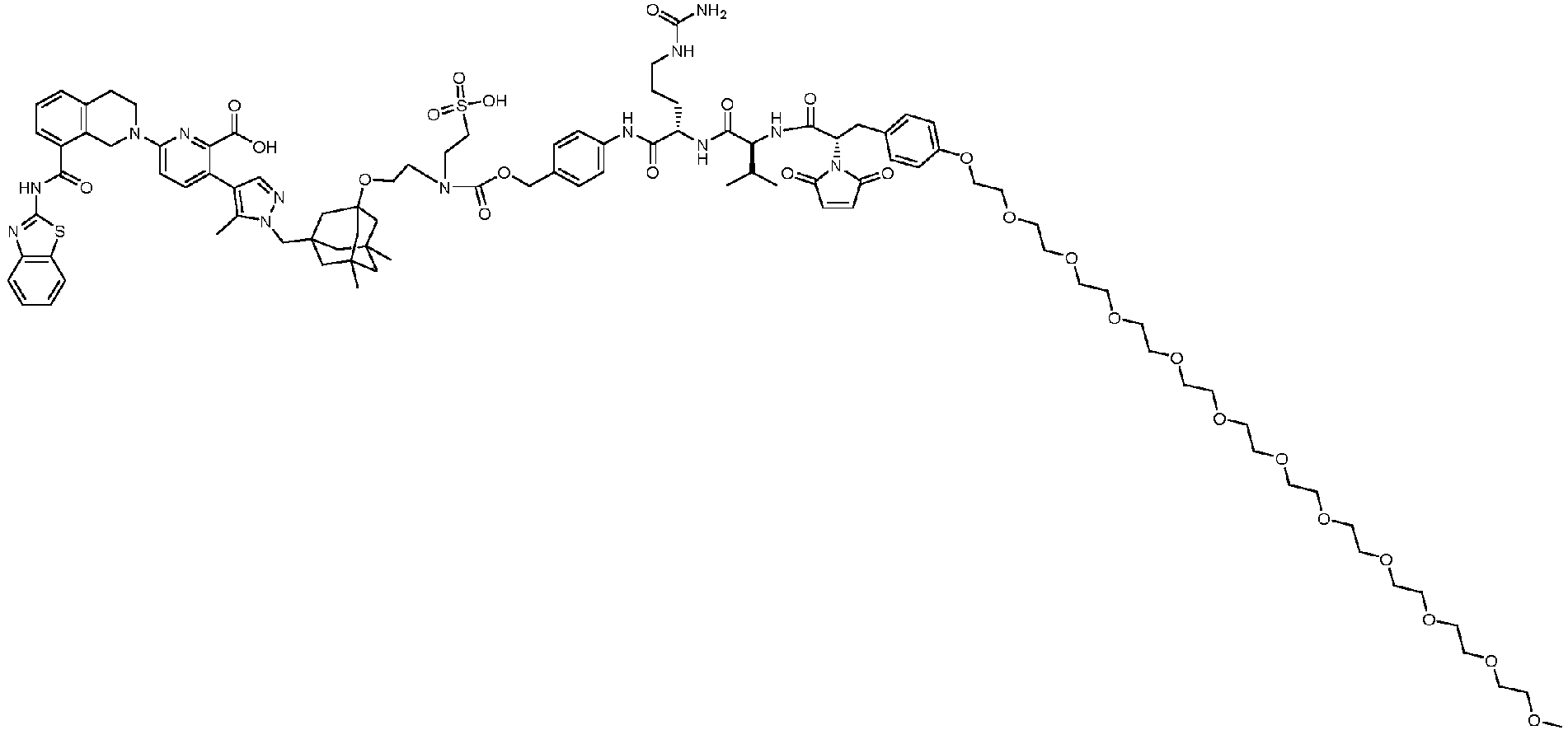
2.130 TX 
2.166 AAA 
2.167 AAD 
2.177 (control) LB 
2.178 (control) WD 
2.179 (control) ZZ 
2.180 (control) ZT 
2.181 (control) XW 
2.182 (control) SE 
2.183 (control) SR 
2.184 (control) YG 
2.185 (control) KZ 
- In the present invention the synthon is 2.166 or a pharmaceutically acceptable salt thereof. The compound name of the synthon is provided below:
6-(8-(benzo[d]thiazol-2-ylcarbamoyl)-3,4-dihydroisoquinolin-2(1H)-yl)-3-(1-((3-(2-((((2-(2-((2S,3R,4R,5S,6S)-6-carboxy-3,4,5-trihydroxytetrahydro-2H-pyran-2-yl)ethyl)-4-((S)-2-((S)-2-(2-((3S,5S)-3-(2,5-dioxo-2,5-dihydro-1H-pyrrol-1-yl)-2-oxo-5-((2-sulfoethoxy)methyl)pyrrolidin-1-yl)acetamido)-3-methylbutanamido)propanamido)benzyl)oxy)carbonyl)((S)-3,4-dihydroxybutyl)amino)ethoxy)-5,7-dimethyladamantan-1-yl)methyl)-5-methyl-1H-pyrazol-4-yl)picolinic acid; - In the present invention, the ADC, or a pharmaceutically acceptable salt thereof, is:

- Bcl-xL inhibitors, including warheads and synthons, and methods of making the same, are described in
US 2016/0339117 (AbbVie Inc.). - The Bcl-xL inhibitors and synthons described herein may be synthesized using standard, known techniques of organic chemistry. Specific methods for synthesizing exemplary Bcl-xL inhibitors and synthons that may be useful for guidance are provided in the Examples section.
- Examples of the foregoing Bcl-xL inhibtors, linkers, and synthons thereof, as well as methods of making the same, can be found in US Patent Publication No.
US 2016/0339117 . - Specific methods for synthesizing exemplary ADCs described herein are provided in the Examples section.
- The present invention also discloses a process to prepare an anti-B7-H3 ADC of the invention comprising:
- treating an antibody in an aqueous solution with an effective amount of a disulfide reducing agent at 30-40 °C for at least 15 minutes, and then cooling the antibody solution to 20-27 °C;
- adding to the reduced antibody solution a solution of water/dimethyl sulfoxide comprising synthon 2.166 (Table B);
- adjusting the pH of the solution to a pH of 7.5 to 8.5;
- allowing the reaction to run for 48 to 80 hours to form the ADC;
- wherein the mass is shifted by 18 ± 2 amu for each hydrolysis of a succinimide to a succinamide as measured by electron spray mass spectrometry; and
- wherein the ADC is optionally purified by hydrophobic interaction chromatography.
- In certain embodiments, the antibody is huAb13v1.
- The present invention is also directed to an anti-B7-H3 ADC prepared by the above-described process.
- In certain embodiments, the anti-B7-H3 ADC disclosed in the present application is formed by contacting an antibody that binds an hB7-H3 cell surface receptor or tumor associated antigen expressed on a tumor cell with a drug-linker synthon under conditions in which the drug-linker synthon covalently links to the antibody through a maleimide moiety as shown in formulae (IIf).

- Purification of the ADCs may be achieved in such a way that ADCs having certain DARs are collected. For example, HIC resin may be used to separate high drug loaded ADCs from ADCs having optimal drug to antibody ratios (DARs), e.g. a DAR of 4 or less. A hydrophobic resin is added to an ADC mixture such that undesired ADCs, i.e., higher drug loaded ADCs, bind the resin and can be selectively removed from the mixture. Separation of the ADCs may be achieved by contacting an ADC mixture (e.g., a mixture comprising a drug loaded species of ADC of 4 or less and a drug loaded species of ADC of 6 or more) with a hydrophobic resin, wherein the amount of resin is sufficient to allow binding of the drug loaded species which is being removed from the ADC mixture. The resin and ADC mixture are mixed together, such that the ADC species being removed (e.g., a drug loaded species of 6 or more) binds to the resin and can be separated from the other ADC species in the ADC mixture. The amount of resin used in the method is based on a weight ratio between the species to be removed and the resin, where the amount of resin used does not allow for significant binding of the drug loaded species that is desired. Thus, methods may be used to reduce the average DAR to less than 4. Further, the purification methods described herein may be used to isolate ADCs having any desired range of drug loaded species, e.g., a drug loaded species of 4 or less, a drug loaded species of 3 or less, a drug loaded species of 2 or less, a drug loaded species of 1 or less.
- Certain species of molecule(s) binds to a surface based on hydrophobic interactions between the species and a hydrophobic resin. In one embodiment of the present disclosure, the method refers to a purification process that relies upon the intermixing of a hydrophobic resin and a mixture of ADCs, wherein the amount of resin added to the mixture determines which species (e.g., ADCs with a DAR of 6 or more) will bind. Following production and purification of an antibody from an expression system (e.g., a mammalian expression system), the antibody is reduced and coupled to a drug through a conjugation reaction. The resulting ADC mixture often contains ADCs having a range of DARs, e.g., 1 to 8.. The ADC mixture may be purified using a process, such as, but not limited to, a batch process, such that ADCs having a drug loaded species of 2 are selected and separated from ADCs having a higher drug load.
- The ADC separation method described herein method may be performed using a batch purification method. The batch purification process generally includes adding the ADC mixture to the hydrophobic resin in a vessel, mixing, and subsequently separating the resin from the supernatant. For example, in the context of batch purification, a hydrophobic resin may be prepared in or equilibrated to the desired equilibration buffer. A slurry of the hydrophobic resin may thus be obtained. The ADC mixture may then be contacted with the slurry to adsorb the specific species of ADC(s) to be separated by the hydrophobic resin. The solution comprising the desired ADCs that do not bind to the hydrophobic resin material may then be separated from the slurry, e.g., by filtration or by allowing the slurry to settle and removing the supernatant. The resulting slurry can be subjected to one or more washing steps. In order to elute bound ADCs, the salt concentration can be decreased.
- Alternatively, purification may be performed using a circulation process, whereby the resin is packed in a container and the ADC mixture is passed over the hydrophobic resin bed until the specific species of ADC(s) to be separated have been removed. The supernatant (containing the desired ADC species) is then pumped from the container and the resin bed may be subjected to washing steps.
- Alternatively, a flow through process may be used to purify an ADC mixture to arrive at a composition comprising a majority of ADCs having a certain desired DAR. In a flow through process, resin is packed in a container, e.g., a column, and the ADC mixture is passed over the packed resin such that the desired ADC species does not substantially bind to the resin and flows through the resin, and the undesired ADC species is bound to the resin. A flow through process may be performed in a single pass mode (where the ADC species of interest are obtained as a result of a single pass through the resin of the container) or in a multi-pass mode (where the ADC species of interest are obtained as a result of multiple passes through the resin of the container). The flow through process is performed such that the weight of resin selected binds to the undesired ADC population, and the desired ADCs (e.g., DAR 2-4) flow over the resin and are collected in the flow through after one or multiple passes.
- Following a flow through process, the resin may be washed with a one or more washes following in order to further recover ADCs having the desired DAR range (found in the wash filtrate). For example, a plurality of washes having decreasing conductivity may be used to further recover ADCs having the DAR of interest. The elution material obtained from the washing of the resin may be subsequently combined with the filtrate resulting from the flow through process for improved recovery of ADCs having the DAR of interest.
- The aforementioned batch, circulation, and flow through process purification methods are based on the use of a hydrophobic resin to separate high vs. low drug loaded species of ADC. Hydrophobic resin comprises hydrophobic groups which interact with the hydrophobic properties of the ADCs. Hydrophobic groups on the ADC interact with hydrophobic groups within the hydrophobic resin. The more hydrophobic a protein is the stronger it will interact with the hydrophobic resin.
- Hydrophobic resin normally comprises a base matrix (e.g., cross-linked agarose or synthetic copolymer material) to which hydrophobic ligands (e.g., alkyl or aryl groups) are coupled. Many hydrophobic resins are available commercially. Examples include, but are not limited to,
Phenyl Sepharose™ 6 Fast Flow with low or high substitution (Pharmacia LKB Biotechnology, AB, Sweden); Phenyl Sepharose™ High Performance (Pharmacia LKB Biotechnology, AB, Sweden); Octyl Sepharose™ High Performance (Pharmacia LKB Biotechnology, AB, Sweden); Fractogel™ EMD Propyl or Fractogel™ EMD Phenyl columns (E. Merck, Germany); Macro-Prep™ Methyl or Macro-Prep™. t-Butyl Supports (Bio-Rad, California); WP HI-Propyl (C3)™ (J. T. Baker, New Jersey); and Toyopearl™ ether, hexyl, phenyl or butyl (TosoHaas, PA). In one embodiment, the hydrophobic resin is a butyl hydrophobic resin. In another embodiment, the hydrophobic resin is a phenyl hydrophobic resin. In another embodiment, the hydrophobic resin is a hexyl hydrophobic resin, an octyl hydrophobic resin, or a decyl hydrophobic resin. In one embodiment, the hydrophobic resin is a methacrylic polymer having n-butyl ligands (e.g. TOYOPEARL® Butyl-600M). - Further methods for purifying ADC mixtures to obtain a composition having a desired DAR are described in
U.S. Application No. 14/210,602 (U.S. Patent Appln. Publication No.US 2014/0286968 ). - In certain embodiments of the invention, ADCs described herein having a DAR2 are purified from ADCs having higher or lower DARs. Such purified DAR2 ADCs are referred to herein as "E2". Purification methods for achieving a composition having E2 anti-B7-H3 ADCs. In one embodiment, of the invention provides a composition comprising an ADC mixture, wherein at least 75% of the ADCs are anti-B7H3 ADCs (like those described herein) having a DAR2. In another embodiment, the invention provides a composition comprising an ADC mixture, wherein at least 80% of the ADCs are anti-B7H3 ADCs (like those described herein) having a DAR2. In another embodiment, the invention provides a composition comprising an ADC mixture, wherein at least 85% of the ADCs are anti-B7H3 ADCs (like those described herein) having a DAR2. In another embodiment, the invention provides a composition comprising an ADC mixture, wherein at least 90% of the ADCs are anti-B7H3 ADCs (like those described herein) having a DAR2.
- The ADCs of the invention preferably are capable of neutralizing human B7-H3 activity both in vivo and in vitro. Accordingly, such ADCs of the invention can be used to inhibit hB7-H3 activity, e.g., in a cell culture containing hB7-H3, in human subjects or in other mammalian subjects having B7-H3 with which an antibody of the invention cross-reacts. In one embodiment, the invention provides a method for inhibiting hB7-H3 activity comprising contacting hB7-H3 with an ADC of the invention such that hB7-H3 activity is inhibited. For example, in a cell culture containing, or suspected of containing hB7-H3, an antibody or antibody portion of the ADC of the invention can be added to the culture medium to inhibit hB7-H3 activity in the culture.
- In another embodiment, of the invention a method for reducing hB7-H3 activity in a subject, advantageously from a subject suffering from a disease or disorder in which B7-H3 activity is detrimental. The invention provides methods for reducing B7-H3 activity in a subject suffering from such a disease or disorder, which method comprises administering to the subject an ADC of the invention such that B7-H3 activity in the subject is reduced. Preferably, the B7-H3 is human B7-H3, and the subject is a human subject. Alternatively, the subject can be a mammal expressing a B7-H3 to which antibodies of the invention are capable of binding. Still further the subject can be a mammal into which B7-H3 has been introduced (e.g., by administration of B7-H3 or by expression of a B7-H3 transgene). ADCs of the invention can be administered to a human subject for therapeutic purposes. Moreover, ADCS of the invention can be administered to a non-human mammal expressing a B7-H3 with which the antibody is capable of binding for veterinary purposes or as an animal model of human disease. Regarding the latter, such animal models may be useful for evaluating the therapeutic efficacy of antibodies of the invention (e.g., testing of dosages and time courses of administration).
- As used herein, the term "a disorder in which B7-H3 expression is detrimental" is intended to include diseases and other disorders in which the presence of B7-H3 in a subject suffering from the disorder has been shown to be expressed, or has been shown to be or is suspected of being either responsible for the pathophysiology of the disorder or a factor that contributes to the disorder. For example, the ADCs of the invention may be used to target tumor cells that are expressing B7-H3. Non-limiting examples of disorders that can be treated with the ADCs of the invention, include, but are not limited to, a variety of cancers including, but not limited to, small cell lung cancer, non small cell lunch cancer (NSCLC), breast cancer, ovarian cancer, lung cancer, a glioma, prostate cancer, pancreatic cancer, colon cancer, head and neck cancer, leukemia, e.g., acute myeloid leukemia (AML), lymphoma, e.g., non-Hodgkin's lymphoma (NHL), and kidney cancer. Other examples of cancer that may be treated using the compositions and methods disclosed herein include squamous cell carcinoma (e.g., squamous lung cancer or squamous head and neck cancer), triple negative breast cancer, non-small cell lung cancer, colorectal cancer, and mesothelioma. In one embodiment, the ADCs disclosed herein are used to treat a solid tumor, e.g., inhibit growth of or decrease size of a solid tumor, overexpressing B7-H3 or which is B7-H3 positive. In one embodiment, the invention is directed to the treatment of squamous lung cancer associated with B7-H3 expression. In another embodiment, the ADCs disclosed herein are used to treat triple negative breast cancer (TNBC). Diseases and disorders described herein may be treated by anti-B7-H3 ADCs of the invention, as well as pharmaceutical compositions comprising such anti-B7-H3 ADCs.
- In certain embodiments, the cancer may be characterized as having EGFR overexpression. In one embodiment, the ADCs of the invention may be used to treating cancer associated with an activating EGFR mutation. Examples of such mutations include, but are not limited to, an exon 19 deletion mutation, a single-point substitution mutation L858R in exon 21, a T790M point mutation, and combinations thereof.
- In certain embodiments, the ADCs disclosed herein are administered to a subject in need thereof in order to treat advanced solid tumor types likely to exhibit elevated levels of B7-H3. Examples of such tumors include, but are not limited to, small cell lung cancer, breast cancer, ovarian cancer, head and neck squamous cell carcinoma, non-small cell lung cancer, triple negative breast cancer, colorectal carcinoma, and glioblastoma multiforme.
- In certain embodiments, the invention includes a method for inhibiting or decreasing solid tumor growth in a subject having a solid tumor, said method comprising administering an anti-B7-H3 ADC described herein, to the subject having the solid tumor, such that the solid tumor growth is inhibited or decreased. In certain embodiments, the solid tumor is a non-small cell lung carcinoma or a glioblastoma. In further embodiments, the solid tumor is a B7-H3-expressing solid tumors. In further embodiments, the solid tumor is an B7-H3 overexpressing solid tumors. In certain embodiments the anti-B7-H3 ADCs described herein are administered to a subject having glioblastoma multiforme, alone or in combination with an additional agent, e.g., radiation and/or temozolomide.
- In certain embodiments the anti-B7-H3 ADCs described herein are administered to a subject having small cell lung cancer, alone or in combination with an additional agent, e.g., ABT-199 (venetoclax).
- In certain embodiments the anti-B7-H3 ADCs described herein are administered to a subject having non-small cell lung cancer, alone or in combination with an additional agent, e.g., a taxane. In certain embodiments the anti-B7-H3 ADCs described herein are administered to a subject having breast cancer, alone or in combination with an additional agent, e.g., a taxane. In certain embodiments the anti-B7-H3 ADCs described herein are administered to a subject having ovarian cancer, alone or in combination with an additional agent, e.g., a taxane.
- Other combination therapies which are included in the invention are the administration of an anti-B7-H3 ADC with an agent selected from the group consisting of an anti-PDl antibody (e.g. pembrolizumab), an anti-PD-Ll antibody (e.g., atezolizumab), an anti-CTLA-4 antibody (e.g. ipilimumab), a MEK inhibitor (e.g. trametinib), an ERK inhibitor, a BRAF inhibitor (e.g. dabrafenib), osimertinib, erlotinib, gefitinib, sorafenib, a CDK9 inhibitor (e.g. dinaciclib), a MCL-1 inhibitor, temozolomide, a Bcl-xL inhibitor, a Bcl-2 inhibitor (e.g. venetoclax), ibrutinib, a mTOR inhibitor (e.g. everolimus), a PI3K inhibitor (e.g. buparlisib), duvelisib, idelalisib, an AKT inhibitor, a HER2 inhibitor (e.g. lapatinib), a taxane (e.g., docetaxel, paclitaxel, nab-paclitaxel), venetoclax, an ADC comprising an auristatin, an ADC comprising a PBD (e.g. rovalpituzumab tesirine), an ADC comprising a maytansinoid (e.g. TDM1), a TRAIL agonist, a proteasome inhibitor (e.g. bortezomib), and a nicotinamide phosphoribosyltransferase (NAMPT) inhibitor.
- Combination therapies include administration of an ADC of the invention prior to, concurrently with, or following administration of an additional therapeutic agent, including those described above.
- In certain embodiments, the invention includes a method for inhibiting or decreasing solid tumor growth in a subject having a solid tumor which was identified as an B7-H3 expressing or B7-H3 overexpressing tumor, said method comprising administering an anti-B7-H3 ADC described herein, to the subject having the solid tumor, such that the solid tumor growth is inhibited or decreased. Methods for identifying B7-H3 expressing tumors (e.g., B7-H3 overexpressing tumors) are known in the art, and include FDA-approved tests and validation assays. For example, the B7-H3 assay is a qualitative immunohistochemical (IHC) kit system used to identify B7-H3 expression in normal and neoplastic tissues routinely-fixed for histological evaluation. In addition, PCR-based assays may also be used for identifying B7-H3 overexpressing tumors. The amplified PCR products may be subsequently analyzed, for example, by gel electrophoresis using standard methods known in the art to determine the size of the PCR products. Such tests may be used to identify tumors that may be treated with the methods and compositions described herein.
- Any of the methods for gene therapy available in the art can be used according to the invention. For general reviews of the methods of gene therapy, see Goldspiel et al., 1993, Clinical Pharmacy 12:488-505; Wu and Wu, 1991, Biotherapy 3:87-95; Tolstoshev, 1993, Ann. Rev. Pharmacol. Toxicol. 32:573-596; Mulligan, Science 260:926- 932 (1993); and Morgan and Anderson, 1993, Ann. Rev. Biochem. 62:191-217; May, 1993, TIBTECH 11(5):155-215. Methods commonly known in the art of recombinant DNA technology which can be used are described in Ausubel et al. (eds.), Current Protocols in Molecular Biology, John Wiley &Sons, NY (1993); and Kriegler, Gene Transfer and Expression, A Laboratory Manual, Stockton Press, NY (1990). Detailed description of various methods of gene therapy is provided in
US20050042664 A1 . - In another aspect, this application features a method of treating (e.g., curing, suppressing, ameliorating, delaying or preventing the onset of, or preventing recurrence or relapse of) or preventing a B7-H3-associated disorder, in a subject. The method includes: administering to the subject an B7-H3 binding agent, e.g., an anti-B7-H3 antibody or fragment thereof as described herein, in an amount sufficient to treat or prevent the B7-H3-associated disorder. The B7-H3 antagonist, e.g., the anti-B7-H3 antibody or fragment thereof, can be administered to the subject, alone or in combination with other therapeutic modalities as described herein.
- Antibodies or ADCs of the invention, or antigen binding portions thereof can be used alone or in combination to treat such diseases. It should be understood that the antibodies of the invention or antigen binding portion thereof can be used alone or in combination with an additional agent, e.g., a therapeutic agent, said additional agent being selected by the skilled artisan for its intended purpose. For example, the additional agent can be a therapeutic agent art-recognized as being useful to treat the disease or condition being treated by the antibody of the invention. The additional agent also can be an agent that imparts a beneficial attribute to the therapeutic composition, e.g., an agent which affects the viscosity of the composition.
- It should further be understood that the combinations which are to be included within this invention are those combinations useful for their intended purpose. The agents set forth below are illustrative for purposes and not intended to be limited. The combinations, which are part of this invention, can be the antibodies of the invention and at least one additional agent selected from the lists below. The combination can also include more than one additional agent, e.g., two or three additional agents if the combination is such that the formed composition can perform its intended function.
- The combination therapy can include one or more B7-H3 antagonists, e.g., anti-B7-H3 antibodies or fragments thereof, formulated with, and/or co-administered with, one or more additional therapeutic agents, e.g., one or more cytokine and growth factor inhibitors, immunosuppressants, anti-inflammatory agents (e.g., systemic anti-inflammatory agents), anti-fibrotic agents, metabolic inhibitors, enzyme inhibitors, and/or cytotoxic or cytostatic agents, mitotic inhibitors, antitumor antibiotics, immunomodulating agents, vectors for gene therapy, alkylating agents, antiangiogenic agents, antimetabolites, boron-containing agents, chemoprotective agents, hormones, antihormone agents, corticosteroids, photoactive therapeutic agents, oligonucleotides, radionuclide agents, topoisomerase inhibitors, kinase inhibitors, or radiosensitizers, as described in more herein.
- In a particular embodiment, the anti-B7-H3 binding proteins described herein are used in combination with an anti-cancer agent or an antineoplastic agent. The terms "anti-cancer agent" and "antineoplastic agent" refer to drugs used to treat malignancies, such as cancerous growths. Drug therapy may be used alone, or in combination with other treatments such as surgery or radiation therapy. Several classes of drugs may be used in cancer treatment, depending on the nature of the organ involved. For example, breast cancers are commonly stimulated by estrogens, and may be treated with drugs which inactive the sex hormones. Similarly, prostate cancer may be treated with drugs that inactivate androgens, the male sex hormone. Anti-cancer agents that may be used in conjunction with the anti-B7-H3 ADCs of the invention include, among others, an anti-PDl antibody (e.g., pembrolizumab), an anti-PD-Ll antibody (e.g., atezolizumab), an anti-CTLA-4 antibody (e.g., ipilimumab), a MEK inhibitor (e.g., trametinib), an ERK inhibitor, a BRAF inhibitor (e.g., dabrafenib), osimertinib (AZD9291), erlotinib, gefitinib, sorafenib, a CDK9 inhibitor (e.g., dinaciclib), a MCL-1 inhibitor, temozolomide, a Bcl-xL inhibitor, a Bcl-2 inhibitor (e.g., venetoclax), ibrutinib, a mTOR inhibitor (e.g., everolimus), a PI3K inhibitor (e.g., buparlisib), duvelisib, idelalisib, an AKT inhibitor, a HER2 inhibitor (e.g., lapatinib), Herceptin, a taxane (e.g., docetaxel, paclitaxel, nab-paclitaxel), an ADC comprising an auristatin, an ADC comprising a PBD (e.g., rovalpituzumab tesirine), an ADC comprising a maytansinoid (e.g., TDM1), a TRAIL agonist, a proteasome inhibitor (e.g., bortezomib), and a nicotinamide phosphoribosyltransferase (NAMPT) inhibitor, as well as the following agents:
Anti-Cancer Agent Comments Examples Antibodies Antibodies which bind IGF-1R (insulin-like growth factor type 1 receptor), which is expressed on the cell surface of most human cancers A12 (fully humanized mAb) 19D12 (fully humanized mAb) Cp751-871 (fully humanized mAb) H7C10 (humanized mAb) alphaIR3 (mouse) ScFV/FC (mouse/human chimera) EM/164 (mouse) Antibodies which bind EGFR; Mutations affecting EGFR expression or activity could result in cancer Matuzumab (EMD72000) Erbitux® / Cetuximab (Imclone) Vectibix® / Panitumumab (Amgen) mAb 806 Antibodies which bind cMET (Mesechymal epithelial transition factor); a member of the MET family of receptor tyrosine kinases) Nimotuxumab (TheraCIM) AVEO (AV299) (AVEO) AMG102 (Amgen) 5D5 (OA-5d5) (Genentech) H244G11 (Pierre Fabre) Anti-ErbB3 antibodies Ab #14 (MM 121-14) Herceptin® (Trastuzumab; Genentech) 1B4C3; 2D1D12 (U3 Pharma AG) Small Molecules Targeting IGF1R Insulin-like growth factor type 1 receptor which is expressed on the cell surface of many human cancers NVP-AEW541-A BMS-536,924 (1H-benzoimidazol-2-yl)-1H-pyridin-2-one) BMS-554,417 Cycloligan TAE226 PQ401 Small Molecules Targeting EGFR EGFR; Iressa® / Gefitinib (AstraZeneca) Overexpression or mutations affecting EGFR expression or activity could result in cancer CI-1033 (PD 183805) (Pfizer) Lapatinib (GW-572016) (GlaxoSmithKline) Tykerb® / Lapatinib Ditosylate (Smith Kline Beecham) Tarceva ® / Erlotinib HCL (OSI-774) (OSI Pharma) PKI-166 (Novartis) PD-158780 EKB-569 Tyrphostin AG 1478 (4-(3-Chloroanillino)-6,7-dimethoxyquinazoline) Small Molecules Targeting cMET cMET (Mesenchymal epithelial transition factor); a member of the MET family of receptor tyrosine kinases) PHA665752 ARQ 197 Antimetabolites Flourouracil (5-FU) Capecitabine / XELODA® (HLR Roche) 5-Trifluoromethyl-2'-deoxyuridine Methotrexate sodium (Trexall) (Barr) Raltitrexed/ Tomudex® (AstraZeneca) Pemetrexed / Alimta® (Lilly) Tegafur Cytosine Arabinoside (Cytarabine, Ara-C) / Thioguanine® (GlaxoSmithKline) 5 -azacytidine 6-mercaptopurine (Mercaptopurine, 6-MP) Azathioprine / Azasan® (AAIPHARMA LLC) 6-thioguanine (6-TG) / Purinethol® (TEVA) Pentostatin / Nipent® (Hospira Inc.) Fludarabine phosphate / Fludara® (Bayer Health Care) Cladribine (2-CdA, 2-chlorodeoxyadenosine) / Leustatin® (Ortho Biotech) Alkylating agents An alkylating antineoplastic agent is an alkylating agent that attaches an alkyl group to DNA. Since cancer cells generally proliferate unrestrictively more than do healthy cells they are more sensitive to DNA damage, and alkylating agents are used clinically to treat a variety of tumors. Ribonucleotide Reductase Inhibitor (RNR) Cyclophosphamide / Cytoxan (BMS) Neosar (TEVA) Ifosfamide / Mitoxana® (ASTA Medica) Thiotepa (Bedford, Abraxis, Teva) BCNU→ 1,3-bis(2-chloroethyl)-1-nitosourea CCNU1, -(2-chloroethyl)-3-cyclohexyl-1-nitrosourea (methyl CCNU) Hexamethylmelamine (Altretamine, HMM) / Hexalen® (MGI Pharma Inc.) Busulfan / Myleran (GlaxoSmithKline) Procarbazine HCL/ Matulane (Sigma Tau Pharmaceuticals, Inc.) Dacarbazine (DTIC) Chlorambucil / Leukara® (SmithKline Beecham) Melphalan / Alkeran® (GlaxoSmithKline) Cisplatin (Cisplatinum, CDDP) / Platinol (Bristol Myers) Carboplatin / Paraplatin (BMS) Oxaliplatin /Eloxitan® (Sanofi-Aventis US) Topoisomerase Topoisomerase inhibitors are chemotherapy agents designed to interfere with the action of topoisomerase enzymes (topoisomerase I and II), which are enzymes that control the changes in DNA structure by catalyzing the breaking and rejoining of the phosphodiester backbone of DNA strands during the normal cell cycle. Doxorubicin HCL / Doxil® (Alza) inhibitors Daunorubicin citrate / Daunoxome® (Gilead) Mitoxantrone HCL / Novantrone (EMD Serono) Actinomycin D Etoposide / Vepesid® (BMS)/ Etopophos® (Hospira, Bedford, Teva Parenteral, Etc.) Topotecan HCL / Hycamtin® (GlaxoSmithKline) Teniposide (VM-26) / Vumon® (BMS) Irinotecan HCL(CPT-ll) / Camptosar® (Pharmacia & Upjohn) Microtubule Microtubules are one of the Vincristine / Oncovin® (Lilly) targeting agents components of the cytoskeleton. They have diameter of ~24 nm and length varying from several micrometers to possibly millimeters in axons of nerve cells. Microtubules serve as structural components within cells and are involved in many cellular processes including mitosis, cytokinesis, and vesicular transport. Vinblastine sulfate / Velban®(discontinued) (Lilly) Vinorelbine tartrate / Navelbine® (PierreFabre) Vindesine sulphate / Eldisine® (Lilly) Paclitaxel / Taxol® (BMS) Docetaxel / Taxotere® (Sanofi Aventis US) Nanoparticle paclitaxel (ABI-007) / Abraxane® (Abraxis BioScience, Inc.) Ixabepilone / IXEMPRA™ (BMS) Kinase inhibitors Kinases are enzymes that catalyze the transfer of phosphate groups from high-energy, phosphate-donating molecules to specific substrates, and are utilized to transmit signals and regulate complex processes in cells. Imatinib mesylate / Gleevec (Novartis) Sunitinib malate / Sutent® (Pfizer) Sorafenib tosylate / Nexavar® (Bayer) Nilotinib hydrochloride monohydrate / Tasigna® (Novartis), Osimertinib, Cobimetinib, Trametinib, Dabrafenib, Dinaciclib Protein synthesis inhibitors Induces cell apoptosis L-asparaginase / Elspar® (Merck & Co.) Immunotherapeutic agents Induces cancer patients to exhibit immune responsiveness Alpha interferon Angiogenesis Inhibitor / Avastin® (Genentech) IL-2→ Interleukin 2 (Aldesleukin) / Proleukin ® (Chiron) IL-12→ Interleukin 12 Antibody / small molecule immune checkpoint modulators Anti-CTLA-4 and PR-1 therapies Yervoy® (ipilimumab; Bristol-Myers Squibb) Opdivo® (nivolumab; Bristol-Myers Squibb) Keytrada® (pembrolizumab; Merck) Hormones Hormone therapies associated with menopause and aging seek to increase the amount of certain hormones in your body to compensate for age- or disease-related hormonal declines. Hormone therapy as a cancer treatment either reduces the level of specific hormones or alters the cancer's ability to use these hormones to grow and spread. Toremifene citrate / Fareston® (GTX, Inc.) Fulvestrant / Faslodex® (AstraZeneca) Raloxifene HCL / Evista® (Lilly) Anastrazole / Arimidex® (AstraZeneca) Letrozole / Femara® (Novartis) Fadrozole (CGS 16949A) Exemestane / Aromasin® (Pharmacia & Upjohn) Leuprolide acetate / Eligard® (QTL USA) Lupron® (TAP Pharm) Goserelin acetate / Zoladex® (AstraZeneca) Triptorelin pamoate / Trelstar® (Watson Labs) Buserelin / Suprefact® (Sanofi Aventis) Nafarelin / Synarel® (Pfizer) Cetrorelix / Cetrotide® (EMD Serono) Bicalutamide / Casodex® (AstraZeneca) Nilutamide / Nilandron® (Aventis Pharm.) Megestrol acetate / Megace® (BMS) Somatostatin Analogs (Octreotide acetate / Sandostatin® (Novartis) Glucocorticoids Anti-inflammatory drugs used to reduce swelling that causes cancer pain. Prednisolone Dexamethasone / Decadron® (Wyeth) Aromatose inhibitors Includes imidazoles Ketoconazole mTOR inhibitors the mTOR signaling pathway was originally discovered during studies of the immunosuppressive agent rapamycin. This highly conserved pathway regulates cell proliferation and metabolism in response to environmental factors, linking cell growth factor receptor signaling via phosphoinositide- 3-kinase(PI-3K) to cell growth, proliferation, and angiogenesis. Sirolimus (Rapamycin) / Rapamune® (Wyeth) Temsirolimus (CCI-779) / Torisel® (Wyeth) Deforolimus (AP23573) / (Ariad Pharm.) Everolimus (RAD00I) / Certican® (Novartis) - In addition to the above anti-cancer agents, the anti-B7-H3 ADCs described herein may be administered in combination with the agents described herein.
- In particular embodiments, the anti-B7-H3 ADCs can be administered alone or with another anti-cancer agent which acts in conjunction with or synergistically with the antibody to treat the disease associated with B7-H3 activity. Such anti-cancer agents include, for example, agents well known in the art (e.g., cytotoxins, chemotherapeutic agents, small molecules and radiation). Examples of anti-cancer agents include, but are not limited to, Panorex (Glaxo-Welcome), Rituxan (IDEC/Genentech/Hoffman la Roche), Mylotarg (Wyeth), Campath (Millennium), Zevalin (IDEC and Schering AG), Bexxar (Corixa/GSK), Erbitux (Imclone/BMS), Avastin (Genentech) and Herceptin (Genentech/Hoffman la Roche). Other anti-cancer agents include, but are not limited to, those disclosed in
U.S. Patent No. 7,598,028 and International Publication No.WO2008/100624 . One or more anti-cancer agents may be administered either simultaneously or before or after administration of an antibody or antigen binding portion thereof of the invention. - In particular embodiments of the invention, the anti-B7-H3 ADCs described herein can be used in a combination therapy with an apoptotic agent, such as a Bcl-xL inhibitor or a Bcl-2 (B-cell lymphoma 2) inhibitor (e.g., ABT-199 (venetoclax)) to treat cancer, such as leukemia, in a subject. In one embodiment, the anti-B7-H3 ADCs described herein can be used in a combination therapy with a Bcl-xL inhibitor for treating cancer. In one embodiment, the anti-B7-H3 ADCs described herein can be used in a combination therapy with venetoclax for treating cancer.
- In particular embodiments of the invention, the anti-B7-H3 ADCs described herein can be used in a combination therapy with an inhibitor of NAMPT (see examples of inhibitors in
US 2013/0303509 ; AbbVie, Inc.) to treat a subject in need thereof. NAMPT (also known as pre-B-cell-colony-enhancing factor (PBEF) and visfatin) is an enzyme that catalyzes the phosphoribosylation of nicotinamide and is the rate-limiting enzyme in one of two pathways that salvage NAD. In one embodiment of the invention, anti-B7-H3 ADCs described herein are administered in combination with a NAMPT inhibitor for the treatment of cancer in a subject. - In particular embodiments of the invention, the anti-B7-H3 ADCs described herein can be used in a combination therapy with SN-38, which is the active metabolite of the topoisomerase inhibitor irinotecan.
- In other embodiments of the invention, the anti-B7-H3 ADCs described herein can be used in a combination therapy with a PARP (poly ADP ribose polymerase) inhibitor, e.g.,veliparib, to treat cancer, including breast, ovarian and non-small cell lung cancers.
- Further examples of additional therapeutic agents that can be co-administered and/or formulated with anti-B7-H3 ADCs described herein, include, but are not limited to, one or more of: inhaled steroids; beta-agonists, e.g., short-acting or long- acting beta-agonists; antagonists of leukotrienes or leukotriene receptors; combination drugs such as ADVAIR; IgE inhibitors, e.g., anti-IgE antibodies (e.g., XOLAIR®, omalizumab); phosphodiesterase inhibitors (e.g., PDE4 inhibitors); xanthines; anticholinergic drugs; mast cell-stabilizing agents such as cromolyn; IL-4 inhibitors; IL-5 inhibitors; eotaxin/CCR3 inhibitors; antagonists of histamine or its receptors including H1, H2, H3, and H4, and antagonists of prostaglandin D or its receptors (DP1 and CRTH2). Such combinations can be used to treat, for example, asthma and other respiratory disorders. Other examples of additional therapeutic agents that can be co-administered and/or formulated with anti-B7-H3 ADCs described herein, include, but are not limited to, one or more of, an anti-PDl antibody (e.g., pembrolizumab), an anti-PD-Ll antibody (e.g., atezolizumab), an anti-CTLA-4 antibody (e.g., ipilimumab), a MEK inhibitor (e.g., trametinib), an ERK inhibitor, a BRAF inhibitor (e.g., dabrafenib), osimertinib (AZD9291), erlotinib, gefitinib, sorafenib, a CDK9 inhibitor (e.g., dinaciclib), a MCL-1 inhibitor, temozolomide, a Bcl-xL inhibitor, a Bcl-2 inhibitor (e.g., venetoclax), ibrutinib, a mTOR inhibitor (e.g., everolimus), a PI3K inhibitor (e.g., buparlisib), duvelisib, idelalisib, an AKT inhibitor, a HER2 inhibitor (e.g., lapatinib), Herceptin, a taxane (e.g., docetaxel, paclitaxel, nab-paclitaxel), an ADC comprising an auristatin, an ADC comprising a PBD (e.g., rovalpituzumab tesirine), an ADC comprising a maytansinoid (e.g., TDM1), a TRAIL agonist, a proteasome inhibitor (e.g., bortezomib), and a nicotinamide phosphoribosyltransferase (NAMPT) inhibitor. Additional examples of therapeutic agents that can be co-administered and/or formulated with one or more anti-B7-H3 antibodies or fragments thereof include one or more of: TNF antagonists (e.g., a soluble fragment of a TNF receptor, e.g., p55 or p75 human TNF receptor or derivatives thereof, e.g., 75 kD TNFR-IgG (75 kD TNF receptor-IgG fusion protein, ENBREL)); TNF enzyme antagonists, e.g., TNF converting enzyme (TACE) inhibitors; muscarinic receptor antagonists; TGF-beta antagonists; interferon gamma; perfenidone; chemotherapeutic agents, e.g., methotrexate, leflunomide, or a sirolimus (rapamycin) or an analog thereof, e.g., CCI-779; COX2 and cPLA2 inhibitors; NSAIDs; immunomodulators; p38 inhibitors, TPL-2, MK-2 and NFkB inhibitors, among others.
- Other preferred combinations are cytokine suppressive anti-inflammatory drug(s) (CSAIDs); antibodies to or antagonists of other human cytokines or growth factors, for example, IL-1, IL-2, IL-3, IL-4, IL-5, IL-6, IL-7, IL-8, IL-15, IL-16, IL-18, IL-21, IL-31, interferons, EMAP-II, GM-CSF, FGF, EGF, PDGF, and edothelin-1, as well as the receptors of these cytokines and growth factors. Antibodies of the invention, or antigen binding portions thereof, can be combined with antibodies to cell surface molecules such as CD2, CD3, CD4, CD8, CD25, CD28, CD30, CD40, CD45, CD69, CD80 (B7.1), CD86 (B7.2), CD90, CTLA, CTLA-4, PD-1, or their ligands including CD154 (gp39 or CD40L).
- Preferred combinations of therapeutic agents may interfere at different points in the inflammatory cascade; preferred examples include TNF antagonists like chimeric, humanized or human TNF antibodies, adalimumab, (HUMIRA; D2E7;
PCT Publication No. WO 97/29131 U.S. Patent No. 6,090,382 ), CA2 (RemicadeTM), CDP 571, and soluble p55 or p75 TNF receptors, derivatives, thereof, (p75TNFR1gG (EnbrelTM) or p55TNFR1gG (Lenercept), and also TNF converting enzyme (TACE) inhibitors; similarly IL-1 inhibitors (Interleukin-1-converting enzyme inhibitors, IL-1RA etc.) may be effective for the same reason. Other preferred combinations includeInterleukin 4. - The pharmaceutical compositions of the invention may include a "therapeutically effective amount" or a "prophylactically effective amount" of an antibody or antibody portion of the invention. A "therapeutically effective amount" refers to an amount effective, at dosages and for periods of time necessary, to achieve the desired therapeutic result. A therapeutically effective amount of the antibody or antibody portion may be determined by a person skilled in the art and may vary according to factors such as the disease state, age, sex, and weight of the individual, and the ability of the antibody or antibody portion to elicit a desired response in the individual. A therapeutically effective amount is also one in which any toxic or detrimental effects of the antibody, or antibody portion, are outweighed by the therapeutically beneficial effects. A "prophylactically effective amount" refers to an amount effective, at dosages and for periods of time necessary, to achieve the desired prophylactic result. Typically, since a prophylactic dose is used in subjects prior to or at an earlier stage of disease, the prophylactically effective amount will be less than the therapeutically effective amount.
- Dosage regimens may be adjusted to provide the optimum desired response (e.g., a therapeutic or prophylactic response). For example, a single bolus may be administered, several divided doses may be administered over time or the dose may be proportionally reduced or increased as indicated by the exigencies of the therapeutic situation. It is especially advantageous to formulate parenteral compositions in dosage unit form for ease of administration and uniformity of dosage. Dosage unit form as used herein refers to physically discrete units suited as unitary dosages for the mammalian subjects to be treated; each unit containing a predetermined quantity of active compound calculated to produce the desired therapeutic effect in association with the required pharmaceutical carrier. The specification for the dosage unit forms of the invention are dictated by and directly dependent on (a) the unique characteristics of the active compound and the particular therapeutic or prophylactic effect to be achieved, and (b) the limitations inherent in the art of compounding such an active compound for the treatment of sensitivity in individuals.
- An exemplary, non-limiting range for a therapeutically or prophylactically effective amount of an ADCis 0.1-20 mg/kg, more preferably 1-10 mg/kg. In one embodiment, the dose of the ADC described herein is 1 to 6 mg/kg, including the individual doses recited therein, e.g., 1 mg/kg, 2 mg/kg, 3 mg/kg, 4 mg/kg, 5 mg/kg, and 6 mg/kg. In another embodiment, the dose of the ADC described herein is 1 to 200 µg/kg, including the individual doses recited therein, e.g., 1 µg/kg, 2 µg/kg, 3 µg/kg, 4 µg/kg, 5 µg/kg, 10 µg/kg, 20 µg/kg, 30 µg/kg, 40 µg/kg, 50 µg/kg, 60 µg/kg, 80 µg/kg, 100 µg/kg, 120 µg/kg, 140 µg/kg, 160 µg/kg, 180 µg/kg and 200 µg/kg, It is to be noted that dosage values may vary with the type and severity of the condition to be alleviated. It is to be further understood that for any particular subject, specific dosage regimens should be adjusted over time according to the individual need and the professional judgment of the person administering or supervising the administration of the compositions, and that dosage ranges set forth herein are exemplary only and are not intended to limit the scope or practice of the claimed composition.
- In one embodiment, an anti-B7-H3 ADCis administered to a subject in need thereof, e.g., a subject having cancer, at a dose of 0.1 to 30 mg/kg. In another embodiment, the anti-B7-H3 antibody is administered to a subject in need thereof, e.g., a subject having cancer, as an ADC at a dose of 1 to 15 mg/kg. In another embodiment, the anti-B7-H3 antibody is administered to a subject in need thereof, e.g., a subject having cancer, as an ADC at a dose of 1 to 10 mg/kg. In another embodiment, the anti-B7-H3 antibody is administered to a subject in need thereof, e.g., a subject having cancer, as an ADC at a dose of 2 to 3. In another embodiment, the anti-B7-H3 antibodyis administered to a subject in need thereof, e.g., a subject having cancer, as an ADC at a dose of 1 to 4 mg/kg.
- In one embodiment, an anti-B7-H3 ADC described hereinis administered to a subject in need thereof, e.g., a subject having cancer, as an ADC at a dose of 1 to 200 µg/kg, In another embodiment, the anti-B7-H3 antibody is administered to a subject in need thereof, e.g., a subject having cancer, as an ADC at a dose of 5 to 150 µg/kg, In another embodiment, the anti-B7-H3 antibody is administered to a subject in need thereof, e.g., a subject having cancer, as an ADC at a dose of 5 to 100 µg/kg, In another embodiment, the anti-B7-H3 antibody is administered to a subject in need thereof, e.g., a subject having cancer, as an ADC at a dose of 5 to 90 µg/kg, In another embodiment, the anti-B7-H3 antibody is administered to a subject in need thereof, e.g., a subject having cancer, as an ADC at a dose of 5 to 80 µg/kg, In another embodiment, the anti-B7-H3 antibody is administered to a subject in need thereof, e.g., a subject having cancer, as an ADC at a dose of 5 to 70 µg/kg, In another embodiment, the anti-B7-H3 antibody is administered to a subject in need thereof, e.g., a subject having cancer, as an ADC at a dose of 5 to 60 µg/kg. In another embodiment, the anti-B7-H3 antibody is administered to a subject in need thereof, e.g., a subject having cancer, as an ADC at a dose of 10 to 80 µg/kg,
- Doses described above may be useful for the administration of anti-B7-H3 disclosed herein.
- Given their ability to bind to human B7-H3, the anti-human B7-H3 antibodies, or portions thereof (as well as ADCs thereof) can be used to detect human B7-H3 (e.g., in a biological sample, such as serum or plasma), using a conventional immunoassay, such as an enzyme linked immunosorbent assays (ELISA), an radioimmunoassay (RIA) or tissue immunohistochemistry. In one aspect, the invention provides a method for detecting human B7-H3 in a biological sample comprising contacting a biological sample with an antibody, or antibody portion and detecting either the antibody (or antibody portion) bound to human B7-H3 or unbound antibody (or antibody portion), to thereby detect human B7-H3 in the biological sample. The antibody is directly or indirectly labeled with a detectable substance to facilitate detection of the bound or unbound antibody. Suitable detectable substances include various enzymes, prosthetic groups, fluorescent materials, luminescent materials and radioactive materials. Examples of suitable enzymes include horseradish peroxidase, alkaline phosphatase, β-galactosidase, or acetylcholinesterase; examples of suitable prosthetic group complexes include streptavidin/biotin and avidin/biotin; examples of suitable fluorescent materials include umbelliferone, fluorescein, fluorescein isothiocyanate, rhodamine, dichlorotriazinylamine fluorescein, dansyl chloride or phycoerythrin; an example of a luminescent material includes luminol; and examples of suitable radioactive material include 3H, 14C, 35S, 90Y, 99Tc, 111In 125I, 131I, 177Lu, 166Ho, or 153Sm.
- Alternative to labeling the antibody, human B7-H3 can be assayed in biological fluids by a competition immunoassay utilizing rhB7-H3 standards labeled with a detectable substance and an unlabeled anti-human B7-H3 antibody. In this assay, the biological sample, the labeled rhB7-H3 standards and the anti-human B7-H3 antibody are combined and the amount of labeled rhB7-H3 standard bound to the unlabeled antibody is determined. The amount of human B7-H3 in the biological sample is inversely proportional to the amount of labeled rhB7-H3 standard bound to the anti-B7-H3 antibody. Similarly, human B7-H3 can also be assayed in biological fluids by a competition immunoassay utilizing rhB7-H3 standards labeled with a detectable substance and an unlabeled anti-human B7-H3 antibody.
- The invention also provides pharmaceutical compositions comprising an ADC of the invention and a pharmaceutically acceptable carrier. The pharmaceutical compositions comprising ADCs of the invention are for use in, but not limited to, diagnosing, detecting, or monitoring a disorder, in preventing, treating, managing, or ameliorating of a disorder or one or more symptoms thereof, and/or in research.. In another embodiment, the pharmaceutical composition comprises one or more ADCs of the invention and one or more prophylactic or therapeutic agents other than ADCs of the invention for treating a disorder in which B7-H3 activity is detrimental. Preferably, the prophylactic or therapeutic agents known to be useful for or having been or currently being used in the prevention, treatment, management, or amelioration of a disorder or one or more symptoms thereof. In accordance with these embodiments, the composition may further comprise of a carrier, diluent or excipient.
- The ADCs of the invention can be incorporated into pharmaceutical compositions suitable for administration to a subject. Typically, the pharmaceutical composition comprises an antibody or antibody portion of the invention and a pharmaceutically acceptable carrier. As used herein, "pharmaceutically acceptable carrier" includes any and all solvents, dispersion media, coatings, antibacterial and antifungal agents, isotonic and absorption delaying agents, and the like that are physiologically compatible. Examples of pharmaceutically acceptable carriers include one or more of water, saline, phosphate buffered saline, dextrose, glycerol, ethanol and the like, as well as combinations thereof. In many cases, it will be preferable to include isotonic agents, for example, sugars, polyalcohols such as mannitol, sorbitol, or sodium chloride in the composition. Pharmaceutically acceptable carriers may further comprise minor amounts of auxiliary substances such as wetting or emulsifying agents, preservatives or buffers, which enhance the shelf life or effectiveness of the ADC.
- Various delivery systems are known and can be used to administer ADCs of the invention, e.g., encapsulation in liposomes, microparticles, microcapsules, recombinant cells capable of expressing the antibody or antibody fragment, receptor-mediated endocytosis (see, e.g., Wu and Wu, J. Biol. Chem. 262:4429-4432 (1987)), construction of a nucleic acid as part of a retroviral or other vector, etc. Methods of administering a prophylactic or therapeutic agent of the invention include, but are not limited to, parenteral administration (e.g., intradermal, intramuscular, intraperitoneal, intravenous and subcutaneous), epidural administration, intratumoral administration, and mucosal administration (e.g., intranasal and oral routes). In addition, pulmonary administration can be employed, e.g., by use of an inhaler or nebulizer, and formulation with an aerosolizing agent. See, e.g.,
U.S. Pat. Nos. 6,019,968 ,5,985, 320 ,5,985,309 ,5,934, 272 ,5,874,064 ,5,855,913 ,5,290, 540 , and4,880,078 ; andPCT Publication Nos. WO 92/19244 WO 97/32572 WO 97/44013 WO 98/31346 WO 99/66903 - In a specific embodiment, it may be desirable to administer the prophylactic or therapeutic agents of the invention locally to the area in need of treatment; this may be achieved by, for example, and not by way of limitation, local infusion, by injection, or by means of an implant, said implant being of a porous or non-porous material, including membranes and matrices, such as sialastic membranes, polymers, fibrous matrices (e.g., Tissuel®), or collagen matrices. In one embodiment, an effective amount of one or more antibodies of the invention antagonists is administered locally to the affected area to a subject to prevent, treat, manage, and/or ameliorate a disorder or a symptom thereof. In another embodiment, an effective amount of one or more antibodies of the invention is administered locally to the affected area in combination with an effective amount of one or more therapies (e.g., one or more prophylactic or therapeutic agents) other than an antibody of the invention of a subject to prevent, treat, manage, and/or ameliorate a disorder or one or more symptoms thereof.
- In another embodiment, the prophylactic or therapeutic agent of the invention can be delivered in a controlled release or sustained release system. In one embodiment, a pump may be used to achieve controlled or sustained release (see Langer, supra; Sefton, 1987, CRC Crit. Ref. Biomed. Eng. 14:20; Buchwald et al., 1980, Surgery 88:507; Saudek et al., 1989, N. Engl. J. Med. 321:574). In another embodiment, polymeric materials can be used to achieve controlled or sustained release of the therapies of the invention (see e.g., Medical Applications of Controlled Release, Langer and Wise (eds.), CRC Pres., Boca Raton, Fla. (1974); Controlled Drug Bioavailability, Drug Product Design and Performance, Smolen and Ball (eds.), Wiley, New York (1984); Ranger and Peppas, 1983, J., Macromol. Sci. Rev. Macromol. Chem. 23:61; see also Levy et al., 1985, Science 228:190; During et al., 1989, Ann. Neurol. 25:351; Howard et al., 1989, J. Neurosurg. 7 1:105);
U.S. Pat. No. 5,679,377 ;U.S. Pat. No. 5, 916,597 ;U. S. Pat. No. 5,912,015 ;U.S. Pat. No. 5,989,463 ;U.S. Pat. No. 5,128,326 ;PCT Publication No. WO 99/15154 PCT Publication No. WO 99/20253 - Controlled release systems are discussed in the review by Langer (1990, Science 249:1527-1533). Any technique known to one of skill in the art can be used to produce sustained release formulations comprising one or more therapeutic agents of the invention. See, e.g.,
U. S. Pat. No. 4,526 ,938 ,PCT publication WO 91/05548 PCT publication WO 96/20698 - A pharmaceutical composition of the invention is formulated to be compatible with its intended route of administration. Examples of routes of administration include, but are not limited to, parenteral, e.g., intravenous, intradermal, subcutaneous, oral, intranasal (e.g., inhalation), transdermal (e.g., topical), transmucosal, and rectal administration. In a specific embodiment, the composition is formulated in accordance with routine procedures as a pharmaceutical composition adapted for intravenous, subcutaneous, intramuscular, oral, intranasal, or topical administration to human beings. Typically, compositions for intravenous administration are solutions in sterile isotonic aqueous buffer. Where necessary, the composition may also include a solubilizing agent and a local anesthetic such as lignocaine to ease pain at the site of the injection.
- If the method of the invention comprises intranasal administration of a composition, the composition can be formulated in an aerosol form, spray, mist or in the form of drops. In particular, prophylactic or therapeutic agents for use according to the invention can be conveniently delivered in the form of an aerosol spray presentation from pressurized packs or a nebulizer, with the use of a suitable propellant (e.g., dichlorodifluoromethane, trichlorofluoromethane, dichlorotetrafluoroethane, carbon dioxide or other suitable gas). In the case of a pressurized aerosol the dosage unit may be determined by providing a valve to deliver a metered amount. Capsules and cartridges (composed of, e.g., gelatin) for use in an inhaler or insufflator may be formulated containing a powder mix of the compound and a suitable powder base such as lactose or starch.
- If the method of the invention comprises oral administration, compositions can be formulated orally in the form of tablets, capsules, cachets, gel caps, solutions, suspensions, and the like. Tablets or capsules can be prepared by conventional means with pharmaceutically acceptable excipients such as binding agents (e.g., pregelatinised maize starch, polyvinylpyrrolidone, or hydroxypropyl methylcellulose); fillers (e.g., lactose, microcrystalline cellulose, or calcium hydrogen phosphate); lubricants (e.g., magnesium stearate, talc, or silica); disintegrants (e.g., potato starch or sodium starch glycolate) ; or wetting agents (e.g., sodium lauryl sulphate). The tablets may be coated by methods well-known in the art. Liquid preparations for oral administration may take the form of, but not limited to, solutions, syrups or suspensions, or they may be presented as a dry product for constitution with water or other suitable vehicle before use. Such liquid preparations may be prepared by conventional means with pharmaceutically acceptable additives such as suspending agents (e.g., sorbitol syrup, cellulose derivatives, or hydrogenated edible fats); emulsifying agents (e.g., lecithin or acacia); non-aqueous vehicles (e.g., almond oil, oily esters, ethyl alcohol, or fractionated vegetable oils); and preservatives (e.g., methyl or propyl-p-hydroxybenzoates or sorbic acid). The preparations may also contain buffer salts, flavoring, coloring, and sweetening agents as appropriate. Preparations for oral administration may be suitably formulated for slow release, controlled release, or sustained release of a prophylactic or therapeutic agent(s).
- The method of the invention may comprise pulmonary administration, e.g., by use of an inhaler or nebulizer, of a composition formulated with an aerosolizing agent. See, e.g.,
U.S. Pat. Nos. 6,019, 968 ,5,985, 320 ,5, 985,309 ,5,934,272 ,5,874,064 ,5,855,913 ,5,290,540 , and4,880,078 ; andPCT Publication Nos. WO 92/19244 WO 97/32572 WO 97/44013 WO 98/31346 WO 99/66903 - The method of the invention may comprise administration of a composition formulated for parenteral administration by injection (e.g., by bolus injection or continuous infusion). Formulations for injection may be presented in unit dosage form (e.g., in ampoules or in multi-dose containers) with an added preservative. The compositions may take such forms as suspensions, solutions or emulsions in oily or aqueous vehicles, and may contain formulatory agents such as suspending, stabilizing and/or dispersing agents. Alternatively, the active ingredient may be in powder form for constitution with a suitable vehicle (e.g., sterile pyrogen-free water) before use.
- The methods of the invention may additionally comprise of administration of compositions formulated as depot preparations. Such long acting formulations may be administered by implantation (e.g., subcutaneously or intramuscularly) or by intramuscular injection. Thus, for example, the compositions may be formulated with suitable polymeric or hydrophobic materials (e.g., as an emulsion in an acceptable oil) or ion exchange resins, or as sparingly soluble derivatives (e.g., as a sparingly soluble salt).
- The methods of the invention encompass administration of compositions formulated as neutral or salt forms. Pharmaceutically acceptable salts include those formed with anions such as those derived from hydrochloric, phosphoric, acetic, oxalic, tartaric acids, etc., and those formed with cations such as those derived from sodium, potassium, ammonium, calcium, ferric hydroxides, isopropylamine, triethylamine, 2- ethylamino ethanol, histidine, procaine, etc.
- Generally, the ingredients of compositions are supplied either separately or mixed together in unit dosage form, for example, as a dry lyophilized powder or water free concentrate in a hermetically sealed container such as an ampoule or sachette indicating the quantity of active agent. Where the mode of administration is infusion, composition can be dispensed with an infusion bottle containing sterile pharmaceutical grade water or saline. Where the mode of administration is by injection, an ampoule of sterile water for injection or saline can be provided so that the ingredients may be mixed prior to administration.
- In particular, the invention also provides that one or more of the prophylactic or therapeutic agents, or pharmaceutical compositions of the invention is packaged in a hermetically sealed container such as an ampoule or sachette indicating the quantity of the agent. In one embodiment, one or more of the prophylactic or therapeutic agents, or pharmaceutical compositions of the invention is supplied as a dry sterilized lyophilized powder or water free concentrate in a hermetically sealed container and can be reconstituted (e.g., with water or saline) to the appropriate concentration for administration to a subject. Preferably, one or more of the prophylactic or therapeutic agents or pharmaceutical compositions of the invention is supplied as a dry sterile lyophilized powder in a hermetically sealed container at a unit dosage of at least 5 mg, at least 10 mg, at least 15 mg, at least 25 mg, at least 35 mg, at least 45 mg, at least 50 mg, at least 75 mg, or at least 100 mg. The lyophilized prophylactic or therapeutic agents or pharmaceutical compositions of the invention should be stored at between 2° C. and 8° C. in its original container and the prophylactic or therapeutic agents, or pharmaceutical compositions of the invention should be administered within 1 week, within 5 days, within 72 hours, within 48 hours, within 24 hours, within 12 hours, within 6 hours, within 5 hours, within 3 hours, or within 1 hour after being reconstituted. In an alternative embodiment, one or more of the prophylactic or therapeutic agents or pharmaceutical compositions of the invention is supplied in liquid form in a hermetically sealed container indicating the quantity and concentration of the agent. Preferably, the liquid form of the administered composition is supplied in a hermetically sealed container at least 0.25 mg/ml, at least 0.5 mg/ml, at least 1 mg/ml, at least 2.5 mg/ml, at least 5 mg/ml, at least 8 mg/ml, at least 10 mg/ml, at least 15 mg/kg, at least 25 mg/ml, at least 50 mg/ml, at least 75 mg/ml or at least 100 mg/ml. The liquid form should be stored at between 2° C. and 8° C. in its original container.
- The antibodies and antibody-portions of the invention can be incorporated into a pharmaceutical composition suitable for parenteral administration. Preferably, the antibody or antibody-portions will be prepared as an injectable solution containing 0.1-250 mg/ml antibody. The injectable solution can be composed of either a liquid or lyophilized dosage form in a flint or amber vial, ampule or pre-filled syringe. The buffer can be L-histidine (1-50 mM), optimally 5-10 mM, at pH 5.0 to 7.0 (optimally pH 6.0). Other suitable buffers include but are not limited to, sodium succinate, sodium citrate, sodium phosphate or potassium phosphate. Sodium chloride can be used to modify the toxicity of the solution at a concentration of 0-300 mM (optimally 150 mM for a liquid dosage form). Cryoprotectants can be included for a lyophilized dosage form, principally 0-10% sucrose (optimally 0.5-1.0%). Other suitable cryoprotectants include trehalose and lactose. Bulking agents can be included for a lyophilized dosage form, principally 1-10% mannitol (optimally 2-4%). Stabilizers can be used in both liquid and lyophilized dosage forms, principally 1-50 mM L-methionine (optimally 5-10 mM). Other suitable bulking agents include glycine, arginine, can be included as 0-0.05% polysorbate-80 (optimally 0.005-0.01%). Additional surfactants include but are not limited to polysorbate 20 and BRIJ surfactants. The pharmaceutical composition comprising the antibodies and antibody-portions of the invention prepared as an injectable solution for parenteral administration, can further comprise an agent useful as an adjuvant, such as those used to increase the absorption, or dispersion of a therapeutic protein (e.g., antibody). A particularly useful adjuvant is hyaluronidase, such as Hylenex® (recombinant human hyaluronidase). Addition of hyaluronidase in the injectable solution improves human bioavailability following parenteral administration, particularly subcutaneous administration. It also allows for greater injection site volumes (i.e. greater than 1 ml) with less pain and discomfort, and minimum incidence of injection site reactions. (see
WO2004078140 ,US2006104968 incorporated herein by reference). - The compositions of this invention may be in a variety of forms. These include, for example, liquid, semi-solid and solid dosage forms, such as liquid solutions (e.g., injectable and infusible solutions), dispersions or suspensions, tablets, pills, powders, liposomes and suppositories. The preferred form depends on the intended mode of administration and therapeutic application. Typical preferred compositions are in the form of injectable or infusible solutions, such as compositions similar to those used for passive immunization of humans with other antibodies. The preferred mode of administration is parenteral (e.g., intravenous, subcutaneous, intraperitoneal, intramuscular). In a preferred embodiment, the antibody is administered by intravenous infusion or injection. In another preferred embodiment, the antibody is administered by intramuscular or subcutaneous injection.
- Therapeutic compositions typically must be sterile and stable under the conditions of manufacture and storage. The composition can be formulated as a solution, microemulsion, dispersion, liposome, or other ordered structure suitable to high drug concentration. Sterile injectable solutions can be prepared by incorporating the active compoundin the required amount in an appropriate solvent with one or a combination of ingredients enumerated above, as required, followed by filtered sterilization. Generally, dispersions are prepared by incorporating the active compound into a sterile vehicle that contains a basic dispersion medium and the required other ingredients from those enumerated above. In the case of sterile, lyophilized powders for the preparation of sterile injectable solutions, the preferred methods of preparation are vacuum drying and spray-drying that yields a powder of the active ingredient plus any additional desired ingredient from a previously sterile-filtered solution thereof. The proper fluidity of a solution can be maintained, for example, by the use of a coating such as lecithin, by the maintenance of the required particle size in the case of dispersion and by the use of surfactants. Prolonged absorption of injectable compositions can be brought about by including, in the composition, an agent that delays absorption, for example, monostearate salts and gelatin.
- The ADCs of the invention can be administered by a variety of methods known in the art, although for many therapeutic applications, the preferred route/mode of administration is subcutaneous injection, intravenous injection or infusion. As will be appreciated by the skilled artisan, the route and/or mode of administration will vary depending upon the desired results. In certain embodiments, the active compound may be prepared with a carrier that will protect the compound against rapid release, such as a controlled release formulation, including implants, transdermal patches, and microencapsulated delivery systems. Biodegradable, biocompatible polymers can be used, such as ethylene vinyl acetate, polyanhydrides, polyglycolic acid, collagen, polyorthoesters, and polylactic acid. Many methods for the preparation of such formulations are patented or generally known to those skilled in the art. See, e.g., Sustained and Controlled Release Drug Delivery Systems, J.R. Robinson, ed., Marcel Dekker, Inc., New York, 1978.
- In certain embodiments, an ADC of the invention may be orally administered, for example, with an inert diluent or an assimilable edible carrier. The compound (and other ingredients, if desired) may also be enclosed in a hard or soft shell gelatin capsule, compressed into tablets, or incorporated directly into the subject's diet. For oral therapeutic administration, the compounds may be incorporated with excipients and used in the form of ingestible tablets, buccal tablets, troches, capsules, elixirs, suspensions, syrups, wafers, and the like. To administer a compound of the invention by other than parenteral administration, it may be necessary to coat the compound with, or co-administer the compound with, a material to prevent its inactivation.
- In other embodiments, an ADC of the invention may be conjugated to a polymer-based species such that said polymer-based species may confer a sufficient size upon said antibody or antibody portion of the invention such that said antibody or antibody portion of the invention benefits from the enhanced permeability and retention effect (EPR effect) (See also
PCT Publication No. WO2006/042146A2 U.S. Publication Nos. 2004/0028687A1 ,2009/0285757A1 , and2011/0217363A1 , andU.S. Patent No. 7,695,719 . - Supplementary active compounds can also be incorporated into the compositions. In certain embodiments, an ADC of the invention is formulated with and/or co-administered with one or more additional therapeutic agents that are useful for treating disorders in which B7-H3 activity is detrimental. For example, an ADC of the invention may be formulated and/or co-administered with one or more additional antibodies that bind other targets (e.g., antibodies that bind cytokines or that bind cell surface molecules). Furthermore, one or more antibodies of the invention may be used in combination with two or more of the foregoing therapeutic agents. Such combination therapies may advantageously utilize lower dosages of the administered therapeutic agents, thus avoiding possible toxicities or complications associated with the various monotherapies.
- In certain embodiments, an ADC to B7-H3 or fragment thereof is linked to a half-life extending vehicle known in the art. Such vehicles include, but are not limited to, the Fc domain, polyethylene glycol, and dextran. Such vehicles are described, e.g., in
U.S. Application Serial No. 09/428,082 andpublished PCT Application No. WO 99/25044 - This example provides synthetic methods for exemplary Bcl-xL inhibitory compounds. Bcl-xL inhibitors and synthons were named using ACD/Name 2012 release (Build 56084, 05 April 2012, Advanced Chemistry Development Inc., Toronto, Ontario), ACD/Name 2014 release (Build 66687, 25 October 2013, Advanced Chemistry Development Inc., Toronto, Ontario), ChemDraw® Ver. 9.0.7 (CambridgeSoft, Cambridge, MA), ChemDraw® Ultra Ver. 12.0 (CambridgeSoft, Cambridge, MA), or ChemDraw® Professional Ver. 15.0.0.106. Bcl-xL inhibitor and synthon intermediates were named with ACD/Name 2012 release (Build 56084, 05 April 2012, Advanced Chemistry Development Inc., Toronto, Ontario), ACD/Name 2014 release (Build 66687, 25 October 2013, Advanced Chemistry Development Inc., Toronto, Ontario), ChemDraw® Ver. 9.0.7 (CambridgeSoft, Cambridge, MA), ChemDraw® Ultra Ver. 12.0 (CambridgeSoft, Cambridge, MA), or ChemDraw® Professional Ver. 15.0.0.106.
- Into a 50 mL round-bottomed flask at 0 °C, was added bromine (16 mL). Iron powder (7 g) was added, and the reaction was stirred at 0 °C for 30 minutes. 3,5-Dimethyladamantane-1-carboxylic acid (12 g) was added. The mixture was warmed up to room temperature and stirred for 3 days. A mixture of ice and concentrated HCl was poured into the reaction mixture. The resulting suspension was treated twice with Na2SO3 (50 g in 200 mL water) and extracted three times with dichloromethane. The combined organics were washed with IN aqueous HCl, dried over sodium sulfate, filtered, and concentrated to give the title compound.
- To a solution of Example 1.1.1 (15.4 g) in tetrahydrofuran (200 mL) was added BH3 (1M in tetrahydrofuran, 150 mL), and the mixture was stirred at room temperature overnight. The reaction mixture was then carefully quenched by adding methanol dropwise. The mixture was then concentrated under vacuum, and the residue was balanced between ethyl acetate (500 mL) and 2N aqueous HCl (100 mL). The aqueous layer was further extracted twice with ethyl acetate, and the combined organic extracts were washed with water and brine, dried over sodium sulfate, and filtered. Evaporation of the solvent gave the title compound.
- To a solution of Example 1.1.2 (8.0 g) in toluene (60 mL) was added 1H-pyrazole (1.55 g) and cyanomethylenetributylphosphorane (2.0 g), and the mixture was stirred at 90 °C overnight. The reaction mixture was concentrated, and the residue was purified by silica gel column chromatography (10:1 heptane:ethyl acetate) to give the title compound. MS (ESI) m/e 324.2 (M+H)+.
- To a solution of Example 1.1.3 (4.0 g) in ethane-1,2-diol (12 mL) was added triethylamine (3 mL). The mixture was stirred at 150 °C under microwave conditions (Biotage Initiator) for 45 minutes. The mixture was poured into water (100 mL) and extracted three times with ethyl acetate. The combined organic extracts were washed with water and brine, dried over sodium sulfate, and filtered. Evaporation of the solvent gave a residue that was purified by silica gel chromatography, eluting with 20% ethyl acetate in heptane, followed by 5% methanol in dichloromethane, to give the title compound. MS (ESI) m/e 305.2 (M+H)+.
- To a cooled (-78 °C) solution of Example 1.1.4 (6.05 g) in tetrahydrofuran (100 mL) was added n-BuLi (40 mL, 2.5M in hexane), and the mixture was stirred at-78 °C for 1.5 hours. Iodomethane (10 mL) was added through a syringe, and the mixture was stirred at-78 °C for 3 hours. The reaction mixture was then quenched with aqueous NH4Cl and extracted twice with ethyl acetate, and the combined organic extracts were washed with water and brine. After drying over sodium sulfate, the solution was filtered and concentrated, and the residue was purified by silica gel column chromatography, eluting with 5% methanol in dichloromethane, to give the title compound. MS (ESI) m/e 319.5 (M+H)+.
- To a solution of Example 1.1.5 (3.5 g) in N,N-dimethylformamide (30 mL) was added N-iodosuccinimide (3.2 g), and the mixture was stirred at room temperature for 1.5 hours. The reaction mixture was diluted with ethyl acetate (600 mL) and washed with aqueous NaHSO3, water and brine. The organic layer was dried over sodium sulfate, filtered and concentrated under reduced pressure. The residue was purified by silica gel chromatography, eluting with 20% ethyl acetate in dichloromethane, to give the title compound. MS (ESI) m/e 445.3 (M+H)+.
- A slurry of 6-amino-3-bromopicolinic acid (25 g) in 400 mL 1:1 dichloromethane/chloroform was added to nitrosonium tetrafluoroborate (18.2 g) in dichloromethane (100 mL) at 5 °C over 1 hour. The resulting mixture was stirred for another 30 minutes, then warmed to 35 °C and stirred overnight. The reaction was cooled to room temperature, and then adjusted to
pH 4 with aqueous NaH2PO4 solution. The resulting solution was extracted three times with dichloromethane, and the combined extracts were washed with brine, dried over sodium sulfate, filtered and concentrated to provide the title compound. - Para-toluenesulfonyl chloride (27.6 g) was added to a solution of Example 1.1.9 (14.5 g) and pyridine (26.7 mL) in dichloromethane (100 mL) and tert-butanol (80 mL) at 0 °C. The reaction was stirred for 15 minutes, and then warmed to room temperature, and stirred overnight. The solution was concentrated and partitioned between ethyl acetate and aqueous Na2CO3 solution. The layers were separated, and the aqueous layer extracted with ethyl acetate. The organic layers were combined, rinsed with aqueous Na2CO3 solution and brine, dried over sodium sulfate, filtered, and concentrated to provide the title compound.
- To a solution of
methyl - To a solution of Example 1.1.11 (2.25 g) and [1,1'-bis(diphenylphosphino)ferrocene]dichloropalladium(II) (205 mg) in acetonitrile (30 mL) was added triethylamine (3 mL) and pinacolborane (2 mL), and the mixture was stirred at reflux for 3 hours. The mixture was diluted with ethyl acetate (200 mL) and washed with water and brine. The organic layer was dried over sodium sulfate, filtered and concentrated under reduced pressure. Purification of the residue by silica gel chromatography, eluting with 20% ethyl acetate in hexane, provided the title compound.
- To a solution of Example 1.2.1 (2.25 g) in tetrahydrofuran (30 mL) and water (10 mL) was added Example 1.1.6 (2.0 g), 1,3,5,7-tetramethyl-6-phenyl-2,4,8-trioxa-6-phosphaadamantane (329 mg), tris(dibenzylideneacetone)dipalladium(0) (206 mg) and potassium phosphate tribasic (4.78 g). The mixture was refluxed overnight, cooled and diluted with ethyl acetate (500 mL). The resulting mixture was washed with water and brine, and the organic layer was dried over sodium sulfate, filtered and concentrated. The residue was purified by flash chromatography, eluting with 20% ethyl acetate in heptanes followed by 5% methanol in dichloromethane, to provide the title compound.
- To a cold solution of Example 1.2.2 (3.32 g) in dichloromethane (100 mL) in an ice-bath was sequentially added triethylamine (3 mL) and methanesulfonyl chloride (1.1 g). The reaction mixture was stirred at room temperature for 1.5 hours and diluted with ethyl acetate, and washed with water and brine. The organic layer was dried over sodium sulfate, filtered, and concentrated to provide the title compound.
- To a solution of Example 1.2.3 (16.5 g) in N,N-dimethylformamide (120 mL) was added sodium azide (4.22 g). The mixture was heated at 80 °C for 3 hours, cooled, diluted with ethyl acetate and washed with water and brine. The organic layer was dried over sodium sulfate, filtered, and concentrated. The residue was purified by flash chromatography, eluting with 20% ethyl acetate in heptanes, to provide the title compound.
- To a solution of Example 1.2.4 (10 g) in a mixture of tetrahydrofuran (60 mL), methanol (30 mL) and water (30 mL) was added lithium hydroxide monohydrate (1.2g). The mixture was stirred at room temperature overnight and neutralized with 2% aqueous HCl. The resulting mixture was concentrated, and the residue was dissolved in ethyl acetate (800 mL), and washed with brine. The organic layer was dried over sodium sulfate, filtered, and concentrated to provide the title compound.
- A mixture of Example 1.2.5 (10 g), benzo[d]thiazol-2-amine (3.24 g), fluoro-N,N,N',N'-tetramethylformamidinium hexafluorophosphate (5.69 g) and N,N-diisopropylethylamine (5.57 g) in N,N-dimethylformamide (20 mL) was heated at 60 °C for 3 hours, cooled and diluted with ethyl acetate. The resulting mixture was washed with water and brine. The organic layer was dried over sodium sulfate, filtered, and concentrated. The residue was purified by flash chromatography, eluting with 20% ethyl acetate in dichloromethane to give the title compound.
- To a solution of Example 1.2.6 (2.0 g) in tetrahydrofuran (30 mL) was added Pd/C (10%, 200 mg). The mixture was stirred under a hydrogen atmosphere overnight. The insoluble material was filtered off and the filtrate was concentrated to provide the title compound.
- To a solution of Example 1.2.7 (500 mg) in N,N-dimethylformamide (8 mL) was added 4-((tert-butyldiphenylsilyl)oxy)-2,2-dimethylbutyl ethenesulfonate (334 mg). The reaction was stirred at room temperature overnight and methylamine (0.3 mL) was added to quench the reaction. The resulting mixture was stirred for 20 minutes and purified by reverse-phase chromatography using an Analogix system (C18 column), eluting with 50-100% acetonitrile in water containing 0.1% v/v trifluoroacetic acid, to provide the title compound.
- Example 1.2.8 (200 mg) in dichloromethane (5 mL) was treated with trifluoroacetic acid (2.5 mL) overnight. The reaction mixture was concentrated and purified by reverse phase chromatography (C18 column), eluting with 20-60% acetonitrile in water containing 0.1% v/v trifluoroacetic acid, to provide the title compound. 1H NMR (500 MHz, dimethyl sulfoxide-d 6) δ ppm 12.86 (s, 1H), 8.32 (s, 2H), 8.02 (d, 1H), 7.78 (d, 1H), 7.60 (d, 1H), 7.51 (d, 1H), 7.40-7.49 (m, 2H), 7.31-7.39 (m, 2H), 7.27 (s, 1H), 6.95 (d, 1H), 4.94 (s, 2H), 3.87 (t, 2H), 3.81 (s, 2H), 3.15-3.25 (m, 2H), 3.03-3.13 (m, 2H), 3.00 (t, 2H), 2.79 (t, 2H), 2.09 (s, 3H), 1.39 (s, 2H), 1.22-1.34 (m, 4H), 0.94-1.18 (m, 6H), 0.85 (s, 6H). MS (ESI) m/e 854.1 (M+H)+.
- To a solution of Example 1.1.6 (9 g) and [1,1'-bis(diphenylphosphino)ferrocene]dichloropalladium(II) dichloromethane (827 mg) in acetonitrile (60 mL) was added triethylamine (10 mL) and pinacolborane (6 mL). The mixture was stirred at reflux overnight, cooled and used directly in the next step. MS (ESI) m/e 445.4 (M+H)+.
- To a solution of tert-butyl 3-bromo-6-chloropicolinate (5.92 g) in tetrahydrofuran (60 mL)and water (30 mL) was added the crude Example 1.20.1 (4.44 g), 1,3,5,7-tetramethyl-6-phenyl-2,4,8-trioxa-6-phosphaadamante (1.5 g), tris(dibenzylideneacetone)dipalladium(0) (927 mg) and K3PO4(22 g). The mixture was stirred at reflux overnight, cooled, diluted with ethyl acetate (800 mL) and washed with water and brine. The organic layer was dried over sodium sulfate, filtered, and concentrated. The residue was purified by flash chromatography, eluting with 20% ethyl acetate in heptane followed by 5% methanol in dichloromethane, to give the title compound. MS (ESI) m/e 531.1 (M+H)+.
- To a solution of methyl 7-(4,4,5,5-tetramethyl-1,3,2-dioxaborolan-2-yl)-1-naphthoate (2.47 g) in 1,4-dioxane (40 mL) and water (20 mL) was added Example 1.20.2 (4.2 g), bis(triphenylphosphine)palladium(II)dichloride (556 mg), and cesium fluoride (3.61 g), and the reaction was stirred at reflux overnight. The mixture was diluted with ethyl acetate (400 mL) and washed with water and brine, and dried over sodium sulfate. Filtration and evaporation of the solvent gave a residue that was purified by silica gel chromatography, eluting with 20% ethyl acetate in heptane followed by 5% methanol in dichloromethane, to provide the title compound. MS (ESI) m/e 680.7 (M+H)+.
- To a cooled (0 °C) solution of Example 1.43.1 (725 mg) in dichloromethane (10 mL) and triethylamine (0.5 mL) was added methanesulfonyl chloride (0.249 mL), and the mixture was stirred for 4 hours. The reaction mixture was diluted with ethyl acetate (200 mL) and washed with water and brine, and dried over sodium sulfate. Filtration and evaporation of the solvent gave the title product, which was used in the next reaction without further purification. MS (ESI) m/e 759.9 (M+H)+.
- To a solution of Example 1.43.2 (4.2 g) in N,N-dimethylformamide (30 mL) was added sodium azide (1.22 g), and the mixture was stirred for 96 hours. The reaction mixture was diluted with ethyl acetate (600 mL), washed with water and brine, and dried over sodium sulfate. Filtration and evaporation of the solvent provided the title compound. MS (ESI) m/e 705.8 (M+H)+.
- To a solution of Example 1.43.3 (3.5 g) in tetrahydrofuran/methanol/water (2:1:1, 30 mL) was added lithium hydroxide monohydrate (1.2 g), and the mixture was stirred overnight. The reaction mixture was acidified with 1N aqueous HCl and was diluted with ethyl acetate (600 mL), washed with water and brine, and dried over sodium sulfate. Filtration and evaporation of the solvent provided the title compound. MS (ESI) m/e 691.8 (M+H)+.
- To a solution of Example 1.43.4 (870 mg) in N,N-dimethylformamide (10 mL) was added benzo[d]thiazol-2-amine (284 mg), fluoro-N,N,N',N'- tetramethylformamidinium hexafluorophosphate (499 mg) and N,N-diisopropylethylamine (488 mg). The mixture was stirred at 60 °C for 3 hours. The reaction mixture was diluted with ethyl acetate (200 mL) and washed with water and brine, and dried over sodium sulfate. Filtration and evaporation of the solvent provided the title compound. MS (ESI) m/e 824.1 (M+H)+.
- To a solution of Example 1.43.5 (890 mg) in tetrahydrofuran (30 mL) was added Pd/C (90 mg). The mixture was stirred under 1 atmosphere of hydrogen overnight. The reaction mixture was filtered, and the catalyst was washed with ethyl acetate. The solvent was evaporated to provide the title compound. MS (ESI) m/e 798.1 (M+H)+.
- To a solution of Example 1.43.6 (189 mg) in N,N-dimethylformamide (6 mL) was added 4-((tert-butyldiphenylsilyl)oxy)-2,2-dimethylbutyl ethenesulfonate (106 mg). The mixture was stirred for 4 days. The mixture was diluted with ethyl acetate (300 mL) and washed with water and brine and dried over sodium sulfate. After filtration and evaporation of the solvent, the residue was dissolved in trifluoroacetic acid (10 mL) and sat overnight. The trifluoroacetic acid was evaporated under vacuum, and the residue was dissolved in dimethyl sulfoxide/methanol (1:1, 6 mL). The mixture was purified by reverse phase HPLC (Gilson system), eluting with 10-85%acetonitrile in water containing 0.1% v/v trifluoroacetic acid, to give the title compound. 1H NMR (400 MHz, dimethyl sulfoxide-d 6) δ ppm 13.09 (s, 1H), 9.02 (s, 1H), 8.31-8.43 (m, 3H), 8.16-8.26 (m, 3H), 7.93-8.08 (m, 3H), 7.82 (d, 1H), 7.66-7.75 (m, 1H), 7.46-7.55 (m, 2H), 7.37 (t, 1H), 3.90 (s, 3H), 3.17-3.28 (m, 2H), 3.07-3.16 (m, 2H), 2.82 (t, 2H), 2.24 (s, 3H), 1.44 (s, 2H), 0.99-1.37 (m, 12H), 0.87 (s, 6H). MS (ESI) m/e 849.1 (M+H)+.
- To a solution of Example 1.2.7 (213 mg) in dichloromethane (2 mL) was added (S)-2-(2,2-dimethyl-1,3-dioxolan-4-yl)acetaldehyde (42 mg). After stirring at room temperature for 30 minutes, sodium triacetoxyborohydride (144 mg) was added. The reaction mixture was stirred at room temperature overnight. Trifluoroacetic acid (2 mL) was added and stirring was continued overnight. The reaction mixture was concentrated, and the residue was purified by reverse-phase HPLC using a Gilson system, eluting with 5-85% acetonitrile in water containing 0.1% v/v trifluoroacetic acid. The desired fractions were combined and freeze-dried to provide the title compound. 1H NMR (400 MHz, dimethyl sulfoxide-d 6) δ ppm 12.86 (s, 1H), 8.22 (d, 2H), 8.05 - 8.01 (m, 1H), 7.79 (d, 1H), 7.61 (d, 1H), 7.53 - 7.41 (m, 3H), 7.36 (td, 2H), 7.28 (s, 1H), 6.95 (d, 1H), 4.95 (s, 2H), 3.88 (t, 2H), 3.82 (s, 2H), 3.26 - 2.94 (m, 7H), 2.10 (s, 3H), 1.84 - 1.75 (m, 1H), 1.52-1.63 (m, 1H), 1.45 - 1.23 (m, 6H), 1.19 - 0.96 (m, 7H), 0.86 (s, 6H). MS (ESI) m/e 834.3 (M+H)+.
- This example provides synthetic methods for exemplary synthons useful to make ADCs.
- A solution of Example 1.2.9 (0.045 g) (9H-fluoren-9-yl)methyl ((S)-3-methyl-1-(((S)-1-((4-((((4-nitrophenoxy)carbonyl)oxy)methyl)phenyl)amino)-1-oxo-5-ureidopentan-2-yl)amino)-1-oxobutan-2-yl)carbamate (0.043 g) and N,N-diisopropylethylamine (0.041 mL) were stirred together in N,N-dimethylformamide (1 mL) at room temperature. After stirring overnight, diethylamine (0.024 mL) was added to the reaction, and stirring was continued for 2 hours. The reaction was quenched with trifluoroacetic acid then purified by reverse phase HPLC using a Gilson system, eluting with 10-75% acetonitrile in water containing 0.1% v/v trifluoroacetic acid. The desired fractions were combined and freeze-dried to provide the title compound.
- A mixture of (S)-5-(hydroxymethyl)pyrrolidin-2-one (25g), benzaldehyde (25.5g) and para-toluenesulfonic acid monohydrate (0.50 g) in toluene (300 mL) was heated to reflux using a Dean-Stark trap under a drying tube for 16 hours. The reaction was cooled to room temperature, and the solvent was decanted from the insoluble materials. The organic layer was washed with saturated aqueous sodium bicarbonate mixture (2x) and brine (1x). The organic layer was dried over sodium sulfate, filtered and concentrated under reduced pressure. The residue was purified by flash chromatography on silica gel, eluting with 35/65 heptane/ethyl acetate, to give the title compound. MS (DCI) m/e 204.0 (M+H)+.
- To a cold (-77 °C) mixture of Example 2.119.1 (44.6 g) in tetrahydrofuran (670 mL) was added lithium bis(trimethylsilyl)amide (1.0M in hexanes, 250 mL) dropwise over 40 minutes, keeping Trxn < -73 °C. The reaction was stirred at -77 °C for 2 hours, and bromine (12.5 mL) was added dropwise over 20 minutes, keeping Trxn < -64 °C. The reaction was stirred at -77 °C for 75 minutes and was quenched by the addition of 150 mL cold 10% aqueous sodium thiosulfate mixture to the -77 °C reaction. The reaction was warmed to room temperature and partitioned between half-saturated aqueous ammonium chloride mixture and ethyl acetate. The layers were separated, and the organic layer was washed with water and brine, dried over sodium sulfate, filtered and concentrated under reduced pressure. The residue was purified by silica gel chromatography, eluting with a gradient of 80/20, 75/25, and 70/30 heptane/ethyl acetate to give the title compound. MS (DCI) m/e 299.0 and 301.0 (M+NH3+H)+.
- To a mixture of Example 2.119.2 (19.3 g) in N,N-dimethylformamide (100 mL) was added sodium azide (13.5 g). The reaction was heated to 60 °C for 2.5 hours. The reaction was cooled to room temperature and quenched by the addition of water (500 mL) and ethyl acetate (200 mL). The layers were separated, and the organic layer was washed brine. The combined aqueous layers were back-extracted with ethyl acetate (50 mL). The combined organic layers were dried with sodium sulfate, filtered and concentrated under reduced pressure. The residue was purified by silica gel chromatography, eluting with 78/22 heptane/ethyl acetate, to give the title compound. MS (DCI) m/e 262.0 (M+NH3+H)+.
- To a mixture of Example 2.119.4 (13.5 g) in tetrahydrofuran (500 mL) and water (50 mL) was added polymer-supported triphenylphosphine (55 g). The reaction was mechanically stirred overnight at room temperature. The reaction was filtered through diatomaceous earth, eluting with ethyl acetate and toluene. The mixture was concentrated under reduced pressure, dissolved in dichloromethane (100 mL), dried with sodium sulfate, then filtered and concentrated to give the title compound, which was used in the subsequent step without further purification. MS (DCI) m/e 219.0 (M+H)+.
- To a mixture of Example 2.119.5 (11.3 g) in N,N-dimethylformamide (100 mL) was added potassium carbonate (7.0 g), potassium iodide (4.2 g), and benzyl bromide (14.5 mL). The reaction was stirred at room temperature overnight and quenched by the addition of water and ethyl acetate. The layers were separated, and the organic layer was washed brine. The combined aqueous layers were back-extracted with ethyl acetate. The combined organic layers were dried with sodium sulfate, filtered and concentrated under reduced pressure. The residue was purified by silica gel chromatography, eluting with a gradient of 10 to 15% ethyl acetate in heptane to give a solid that was triturated with heptane to give the title compound. MS (DCI) m/e 399.1 (M+H)+.
- To a mixture of Example 2.119.6 (13 g) in tetrahydrofuran (130 mL) was added paratoluene sulfonic acid monohydrate (12.4 g) and water (50 mL), and the reaction was heated to 65 °C for 6 days. The reaction was cooled to room temperature and quenched by the addition of saturated aqueous sodium bicarbonate and ethyl acetate. The layers were separated, and the organic layer was washed with brine. The combined aqueous layers were back-extracted with ethyl acetate. The combined organic layers were dried with sodium sulfate, filtered and concentrated under reduced pressure. The waxy solids were triturated with heptane (150 mL) to give the title compound. MS (DCI) m/e 311.1 (M+H)+.
- To a mixture of Example 2.119.7 (9.3 g) and 1H-imidazole (2.2 g) in N,N-dimethylformamide was added tert-butylchlorodimethylsilane (11.2 mL, 50 weight % in toluene), and the reaction mixture was stirred overnight. The reaction mixture was quenched by the addition of water and ethyl ether. The layers were separated, and the organic layer was washed with brine. The combined aqueous layers were back-extracted with diethyl ether. The combined organic layers were dried with sodium sulfate, filtered and concentrated under reduced pressure. The residue was purified by silica gel chromatography, eluting with 35% ethyl acetate in heptane, to give the title compound. MS (DCI) m/e 425.1 (M+H)+.
- To a cold (0 °C) mixture of Example 2.119.8 (4.5 g) in tetrahydrofuran (45 mL) was added 95% sodium hydride (320 mg) in two portions. The cold mixture was stirred for 40 minutes, and tert-butyl 2-bromoacetate (3.2 mL) was added. The reaction was warmed to room temperature and stirred overnight. The reaction was quenched by the addition of water and ethyl acetate. The layers were separated, and the organic layer was washed with brine. The combined aqueous layers were back-extracted with ethyl acetate. The combined organic layers were dried with sodium sulfate, filtered and concentrated under reduced pressure. The residue was purified by silica gel chromatography, eluting with a gradient of 5-12% ethyl acetate in heptane, to give the title compound. MS (DCI) m/e 539.2 (M+H)+.
- To a mixture of Example 2.119.9 (5.3 g) in tetrahydrofuran (25 mL) was added tetrabutylammonium fluoride (11 mL, 1.0M in 95/5 tetrahydrofuran /water). The reaction was stirred at room temperature for one hour and then quenched by the addition of saturated aqueous ammonium chloride mixture, water and ethyl acetate. The layers were separated, and the organic layer was washed with brine. The combined aqueous layers were back-extracted with ethyl acetate. The combined organic layers were dried with sodium sulfate, filtered and concentrated under reduced pressure. The residue was purified by silica gel chromatography, eluting with 35% ethyl acetate in heptane, to give the title compound. MS (DCI) m/e 425.1 (M+H)+.
- To a mixture of Example 2.119.10 (4.7 g) in dimethyl sulfoxide (14 mL) was added a mixture of 4-((tert-butyldiphenylsilyl)oxy)-2,2-dimethylbutyl ethenesulfonate (14.5 g) in dimethyl sulfoxide (14 mL). Potassium carbonate (2.6 g) and water (28 µL) were added, and the reaction was heated at 60 °C under nitrogen for one day. The reaction was cooled to room temperature, and then quenched by the addition of brine mixture, water and diethyl ether. The layers were separated, and the organic layer was washed with brine. The combined aqueous layers were back-extracted with diethyl ether. The combined organic layers were dried with sodium sulfate, filtered and concentrated under reduced pressure. The residue was purified by silica gel chromatography, eluting with a gradient of 15-25% ethyl acetate in heptane, to give the title compound. MS (ESI+) m/e 871.2 (M+H)+.
- Example 2.119.11 (873 mg) was dissolved in ethyl acetate (5 mL) and methanol (15 mL), and palladium hydroxide on carbon, 20% by wt (180 mg) was added. The reaction mixture was stirred under a hydrogen atmosphere (30 psi) at room temperature for 30 hours, then at 50 °C for one hour. The reaction was cooled to room temperature, filtered, and concentrated to give the desired product. MS (ESI+) m/e 691.0 (M+H)+.
- Maleic anhydride (100 mg) was dissolved in dichloromethane (0.90 mL), and a mixture of Example 2.119.12 (650 mg) in dichloromethane (0.90 mL) was added dropwise, then heated at 40 °C for 2 hours. The reaction mixture was directly purified by silica gel chromatography, eluting with a gradient of 1.0-2.5% methanol in dichloromethane containing 0.2% acetic acid. After concentrating the product-bearing fractions, toluene (10 mL) was added, and the mixture was concentrated again to give the title compound. MS (ESI-) m/e 787.3 (M-H)-.
- Example 2.119.13 (560 mg) was slurried in toluene (7 mL), and triethylamine (220 µL) and sodium sulfate (525 mg) were added. The reaction was heated at reflux under a nitrogen atmosphere for 6 hours, and the reaction mixture was stirred at room temperature overnight. The reaction was filtered, and the solids were rinsed with ethyl acetate. The eluent was concentrated under reduced pressure, and the residue was purified by silica gel chromatography, eluting with 45/55 heptane/ethyl acetate to give the title compound.
- Example 2.119.14 (1.2 g) was dissolved in trifluoroacetic acid (15 mL) and heated to 65-70 °C under nitrogen overnight. The trifluoroacetic acid was removed under reduced pressure. The residue was dissolved in acetonitrile (2.5 mL) and purified by preparative reverse-phase liquid chromatography on a Luna C18(2) AXIA column (250 x 50 mm, 10µm particle size) using a gradient of 5-75% acetonitrile containing 0.1% trifluoroacetic acid in water over 30 minutes, to give the title compound. MS (ESI-) m/e 375.2 (M-H)-.
- The title compound was prepared by substituting Example 1.43.7 for Example 1.2.9 in Example 2.49.1. MS (ESI-) m/e 1252.4 (M-H)-.
- Example 2.119.15 (7 mg) was dissolved in N,N-dimethylformamide (0.15 mL), and O-(7-azabenzotriazol-1-yl)-N,N,N',N'-tetramethyluronium hexafluorophosphate (9 mg) and N,N-diisopropylethylamine (7 µL) were added. The mixture was stirred for 3 minutes at room temperature and added to a mixture of Example 2.119.16 (28 mg) and N,N-diisopropylethylamine (15 µL) in N,N-dimethylformamide (0.15 mL). After 1 hour, the reaction was diluted with N,N-dimethylformamide/
water 1/1 (1.0 mL) and purified by reverse-phase chromatography (C18 column), eluting with 5-75% acetonitrile in 0.1% TFA water, to provide the title compound. 1H NMR (500 MHz, dimethyl sulfoxide-d 6) δ ppm 9.95 (s, 1H), 9.02 (s, 1H), 8.37 (d, 1H), 8.22 (m, 2H), 8.18 (m, 2H), 8.08 (m, 2H), 8.03 (m, 1H), 7.96 (br d, 1H), 7.81 (d, 1H), 7.70 (t, 1H), 7.61 (br m, 3H), 7.48 (m, 2H), 7.37 (t, 1H), 7.27 (br m, 2H), 7.08 (s, 2H), 4.99 (br d, 3H), 4.68 (t, 1H), 4.39 (m, 1H), 4.20 (m, 2H), 4.04 (m, 1H), 3.87 (br d, 2H), 3.74 (br m, 1H) 3.65 (br t, 2H), 3.48 (br m, 4H), 3.43 (br m, 2H), 3.26 (br m, 2H), 3.00 (br m, 2H), 2.80 (m, 1H), 2.76 (m, 1H), 2.66 (br m, 2H), 2.36 (br m, 1H), 2.22 (s, 3H), 2.00 (m, 1H), 1.87 (m, 1H), 1.69 (br m, 1H), 1.62 (br m, 1H), 1.40 (br m, 4H), 1.31-1.02 (m, 10 H), 0.96 (m, 2H), 0.85 (m, 12H). MS (ESI-) m/e 1610.3 (M-H)-. - To a mixture of (3R,4S,5R,6R)-3,4,5-tris(benzyloxy)-6-((benzyloxy)methyl)tetrahydro-2H-pyran-2-ol (75 g) in dimethyl sulfoxide (400 mL) at 0 °C was added acetic anhydride (225 mL). The mixture was stirred for 16 hours at room temperature before it was cooled to 0 °C. A large volume of water was added, and stirring was stopped so that the reaction mixture was allowed to settle for 3 hours (the crude lactone migrated to the bottom of the flask). The supernatant was removed, and the crude mixture was diluted with ethyl acetate and was washed 3 times with water, neutralized with saturated aqueous mixture of NaHCO3, and washed again twice with water. The organic layer was then dried over magnesium sulfate, filtered and concentrated to give the title compound. MS (ESI) m/e 561 (M+Na)+.
- To a mixture of ethynyltrimethylsilane (18.23 g) in tetrahydrofuran (400 mL) under nitrogen and chilled in a dry ice/acetone bath (internal temp -65 °C) was added 2.5M BuLi in hexane (55.7 mL) dropwise, keeping the temperature below -60 °C. The mixture was stirred in a cold bath for 40 minutes, followed by an ice-water bath (internal temp rose to 0.4°C) for 40 minutes, and finally cooled to -75°C again. A mixture of Example 2.123.1 (50 g) in tetrahydrofuran (50 mL) was added dropwise, keeping the internal temperature below -70 °C. The mixture was stirred in a dry ice/acetone bath for additional 3 hours. The reaction was quenched with saturated aqueous NaHCO3 mixture (250 mL). The mixture was allowed to warm to room temperature, extracted with ethyl acetate (3x 300 mL), dried over MgSO4, filtered, and concentrated in vacuo to give the title compound. MS (ESI) m/e 659 (M+Na)+.
- To a mixed mixture of Example 2.123.2 (60 g) in acetonitrile (450 mL) and dichloromethane (150 mL) at -15 °C in an ice-salt bath was added triethylsilane (81 mL) dropwise, followed by addition of boron trifluoride diethyl ether complex (40.6 mL) at such a rate that the internal temperature did not exceed -10 °C. The mixture was then stirred at -15 °C to -10 °C for 2 hours. The reaction was quenched with saturated aqueous NaHCO3 mixture (275 mL) and stirred for 1 hour at room temperature. The mixture was then extracted with ethyl acetate (3 x 550 mL). The extracts were dried over MgSO4, filtered, and concentrated. The residue was purified by flash chromatography eluting with a gradient of 0% to 7% ethyl acetate/petroleum ether to give the title compound. MS (ESI) m/e 643 (M+Na)+.
- To a mixed mixture of Example 2.123.3 (80 g) in dichloromethane (200 mL) and methanol (1000 mL) was added IN aqueous NaOH mixture (258 mL). The mixture was stirred at room temperature for 2 hours. The solvent was removed. The residue was then partitioned between water and dichloromethane. The extracts were washed with brine, dried over Na2SO4, filtered, and concentrated to give the title compound. MS (ESI) m/e 571 (M+Na)+.
- To a mixture of Example 2.123.4 (66 g) in acetic anhydride (500 mL) cooled by an ice/water bath was added boron trifluoride diethyl ether complex (152 mL) dropwise. The mixture was stirred at room temperature for 16 hours, cooled with an ice/water bath and neutralized with saturated aqueous NaHCO3 mixture. The mixture was extracted with ethyl acetate (3x500 mL), dried over Na2SO4, filtered, and concentrated in vacuo. The residue was purified by flash chromatography eluting with a gradient of 0% to 30% ethyl acetate/petroleum ether to give the title compound. MS (ESI) m/e 357 (M+H)+.
- To a mixture of Example 2.123.5 (25 g) in methanol (440 mL) was added sodium methanolate (2.1 g). The mixture was stirred at room temperature for 2 hours, and then neutralized with 4 M HCl in dioxane. The solvent was removed, and the residue was adsorbed onto silica gel and loaded onto a silica gel column. The column was eluted with a gradient of 0 to 100% ethyl acetate/petroleum ether then 0% to 12% methanol/ethyl acetate to give the title compound. MS (ESI) m/e 211 (M+Na)+.
- A three-necked round bottom flask was charged with Example 2.123.6 (6.00 g), KBr (0.30 g), tetrabutylammonium bromide (0.41 g) and 60 mL of saturated aqueous NaHCO3 mixture. TEMPO ((2,2,6,6-tetramethylpiperidin-1-yl)oxyl, 0.15 g) in 60 mL dichloromethane was added. The mixture was stirred vigorously and cooled in an ice-salt bath to -2 °C internal temperature. A mixture of brine (12 mL), aqueous NaHCO3 mixture (24 mL) and NaOCl (154 mL) was added dropwise such that the internal temperature was maintained below 2 °C. The pH of the reaction mixture was maintained in the 8.2-8.4 range with the addition of solid Na2CO3. After a total of 6 hours, the reaction mixture was cooled to 3 °C internal temperature and ethanol (∼20 mL) was added dropwise. The mixture was stirred for ∼ 30 minutes. The mixture was transferred to a separatory funnel, and the dichloromethane layer was discarded. The pH of the aqueous layer was adjusted to 2-3 using 1 M aqueous HCl. The aqueous layer was then concentrated to dryness to afford a solid. Methanol (100 mL was) added to the dry solid, and the slurry was stirred for ∼30 minutes. The mixture was filtered over a pad of diatomaceous earth, and the residue in the funnel was washed with ∼100 mL of methanol. The filtrate was concentrated under reduced pressure to obtain the title compound.
- A 500 mL three-necked round bottom flask was charged with a suspension of Example 2.123.7 (6.45 g) in methanol (96 mL) and was cooled in an ice-salt-bath with internal temperature of - 1 °C. Neat thionyl chloride (2.79 mL) was carefully added. The internal temperature kept rising throughout the addition but did not exceed 10 °C. The reaction was allowed to slowly warm up to 15-20 °C over 2.5 hours. After 2.5 hours, the reaction was concentrated to give the title compound.
- To Example 2.123.8 (6.9 g) as a mixture in N,N-dimethylformamide (75 mL) was added 4-(dimethylamino)pyridine (0.17 g) and acetic anhydride (36.1 mL). The suspension was cooled in an ice-bath and pyridine (18.04 mL) was added via syringe over 15 minutes. The reaction was allowed to warm to room temperature overnight. Additional acetic anhydride (12 mL) and pyridine (6 mL) were added and stirring was continued for an additional 6 hours. The reaction was cooled in an ice-bath and 250 mL of saturated aqueous NaHCO3 mixture was added and stirred for 1 hour. Water (100 mL) was added, and the mixture was extracted with ethyl acetate. The organic extract was washed twice with saturated CuSO4 mixture, dried, filtered, and concentrated. The residue was purified by flash chromatography, eluting with 50% ethyl acetate/petroleum ether to give the title compound. 1H NMR (500 MHz, methanol-d4 ) δ ppm 5.29 (t, 1H), 5.08 (td, 2H), 4.48 (dd, 1H), 4.23 (d, 1H), 3.71 (s, 3H), 3.04 (d, 1H), 2.03 (s, 3H), 1.99 (s, 3H), 1.98 (s, 4H).
- A 3L fully jacketed flask equipped with a mechanical stirrer, temperature probe and an addition funnel under a nitrogen atmosphere, was charged with 2-amino-4-nitrobenzoic acid (69.1 g, Combi-Blocks) and sulfuric acid, 1.5 M aqueous (696 mL). The resulting suspension was cooled to 0 °C internal temperature, and a mixture of sodium nitrite (28.8 g) in water (250 mL) was added dropwise over 43 minutes with the temperature kept below 1 °C. The reaction was stirred at ca. 0 °C for 1 hour. A mixture of potassium iodide (107 g) in water (250 mL) was added dropwise over 44 minutes with the internal temperature kept below 1 °C. (Initially addition was exothermic and there was gas evolution). The reaction was stirred 1 hour at 0 °C. The temperature was raised to 20 °C and then stirred at ambient temperature overnight. The reaction mixture became a suspension. The reaction mixture was filtered, and the collected solid was washed with water. The wet solid (∼ 108 g) was stirred in 10 % sodium sulfite (350 ml, with ∼ 200 mL water used to wash in the solid) for 30 minutes. The suspension was acidified with concentrated hydrochloric acid (35 mL), and the solid was collected by filtration and washed with water. The solid was slurried in water (1L) and refiltered, and the solid was left to dry in the funnel overnight. The solid was then dried in a vacuum oven for 2 hours at 60 °C. The resulting solid was triturated with dichloromethane (500 mL), and the suspension was filtered and washed with additional dichloromethane. The solid was air-dried to give the title compound
- A flame-dried 3 L 3-necked flask was charged with Example 2.123.10 (51.9 g) and tetrahydrofuran (700 mL). The mixture was cooled in an ice bath to 0.5 °C, and boranetetrahydrofuran complex (443 mL, 1M in THF) was added dropwise (gas evolution) over 50 minutes, reaching a final internal temperature of 1.3 °C. The reaction mixture was stirred for 15 minutes, and the ice bath was removed. The reaction was left to come to ambient temperature over 30 minutes. A heating mantle was installed, and the reaction was heated to an internal temperature of 65.5 °C for 3 hours, and then allowed to cool to room temperature while stirring overnight. The reaction mixture was cooled in an ice bath to 0 °C and quenched by dropwise addition of methanol (400 mL). After a brief incubation period, the temperature rose quickly to 2.5 °C with gas evolution. After the first 100 mL are added over ∼ 30 minutes, the addition was no longer exothermic, and the gas evolution ceased. The ice bath was removed, and the mixture was stirred at ambient temperature under nitrogen overnight. The mixture was concentrated to a solid, dissolved in dichloromethane/methanol and adsorbed on to silica gel (∼ 150 g). The residue was loaded on a plug of silica gel (3000 mL) and eluted with dichloromethane to give the title compound.
- A 5 L flask equipped with a mechanical stirrer, heating mantle controlled by a JKEM temperature probe and a condenser was charged with Example 2.123.11 (98.83 g) and ethanol (2 L). The reaction was stirred rapidly, and iron (99 g) was added, followed by a mixture of ammonium chloride (20.84 g) in water (500 mL). The reaction was heated over the course of 20 minutes to an internal temperature of 80.3 °C, where it began to reflux vigorously. The mantle was dropped until the reflux calmed. Thereafter, the mixture was heated to 80 °C for 1.5 hour. The reaction was filtered hot through a membrane filter, and the iron residue was washed with hot 50% ethyl acetate/methanol (800 mL). The eluent was passed through a diatomaceous earth pad, and the filtrate was concentrated. The residue was partitioned between 50% brine (1500 mL) and ethyl acetate (1500 mL). The layers were separated, and the aqueous layer was extracted with ethyl acetate (400 mL x 3). The combined organic layers were dried over sodium sulfate, filtered and concentrated to give the title compound, which was used without further purification.
- A 5 L flask with a mechanical stirrer was charged with Example 2.123.12 (88 g) and dichloromethane (2 L). The suspension was cooled in an ice bath to an internal temperature of 2.5 °C, and tert-butylchlorodimethylsilane (53.3 g) was added portion-wise over 8 minutes. After 10 minutes, 1H-imidazole (33.7 g) was added portionwise to the cold reaction. The reaction was stirred 90 minutes while the internal temperature rose to 15 °C. The reaction mixture was diluted with water (3 L) and dichloromethane (1 L). The layers were separated, and the organic layer was dried over sodium sulfate, filtered, and concentrated to an oil. The residue was purified by silica gel chromatography (1600 g silica gel), eluting a gradient of 0 - 25% ethyl acetate in heptane, to give the title compound as an oil.
- To a mixture of (S)-2-((((9H-fluoren-9-yl)methoxy)carbonyl)amino)-3-methylbutanoic acid (6.5 g) in dimethoxyethane (40 mL) was added (S)-2-aminopropanoic acid (1.393 g) and sodium bicarbonate (1.314 g) in water (40 mL). Tetrahydrofuran (20 mL) was added to aid solubility. The resulting mixture was stirred at room temperature for 16 hours. Aqueous citric acid (15%, 75 mL) was added, and the mixture was extracted with 10% 2-propanol in ethyl acetate (2 x 100 mL). A precipitate formed in the organic layer. The combined organic layers were washed with water (2 x 150 mL). The organic layer was concentrated under reduced pressure and then triturated with diethyl ether (80 mL). After brief sonication, the title compound was collected by filtration. MS (ESI) m/e 411 (M+H)+.
- A mixture of Example 2.123.13 (5.44 g) and Example 2.123.14 (6.15 g) in a mixture of dichloromethane (70 mL) and methanol (35.0 mL) was added ethyl 2-ethoxyquinoline-1(2H)-carboxylate (4.08 g), and the reaction was stirred overnight. The reaction mixture was concentrated and loaded onto silica gel, eluting with a gradient of 10% to 95% heptane in ethyl acetate followed by 5% methanol in dichloromethane. The product-containing fractions were concentrated, dissolved in 0.2% methanol in dichloromethane (50 mL), loaded onto silica gel and eluted with a gradient of 0.2% to 2% methanol in dichloromethane. The product containing fractions were collected to give the title compound. MS (ESI) m/e 756.0 (M+H)+.
- A mixture of Example 2.123.9 (4.500 g), Example 2.123.15 (6.62 g), copper(I) iodide (0.083 g) and bis(triphenylphosphine)palladium(II) dichloride (0.308 g) were combined in vial and degassed. N,N-dimethylformamide (45 mL) and N-ethyl-N-isopropylpropan-2-amine (4.55 mL) were added, and the reaction vessel was flushed with nitrogen and stirred at room temperature overnight. The reaction was partitioned between water (100 mL) and ethyl acetate (250 mL). The layers were separated, and the organic layer was dried over magnesium sulfate, filtered, and concentrated. The residue was purified by silica gel chromatography, eluting with a gradient of 5% to 95% ethyl acetate in heptane. The product containing fractions were collected, concentrated and purified by silica gel chromatography, eluting with a gradient of 0.25% to 2.5% methanol in dichloromethane to give the title compound. MS (ESI) m/e 970.4 (M+H)+.
- Example 2.123.16 (4.7 g) and tetrahydrofuran (95 mL) were added to 5% Pt/C (2.42 g, wet) in a 50 mL pressure bottle and shaken for 90 minutes at room temperature under 50 psi of hydrogen. The reaction was filtered and concentrated to give the title compound. MS (ESI) m/e 974.6 (M+H)+.
- A mixture of Example 2.123.17 (5.4 g) in tetrahydrofuran (7 mL), water (7 mL) and glacial acetic acid (21 mL) was stirred overnight at room temperature. The reaction was diluted with ethyl acetate (200 mL) and washed with water (100 mL), saturated aqueous NaHCO3 mixture (100 mL), brine (100 mL), dried over magnesium sulfate, filtered, and concentrated. The residue was purified by silica gel chromatography, eluting with a gradient of 0.5% to 5% methanol in dichloromethane, to give the title compound. MS (ESI) m/e 860.4 (M+H)+.
- To a mixture of Example 2.123.18 (4.00 g) and bis(4-nitrophenyl) carbonate (2.83 g) in acetonitrile (80 mL) was added N-ethyl-N-isopropylpropan-2-amine (1.22 mL) at room temperature. After stirring overnight, the reaction was concentrated, dissolved in dichloromethane (250 mL) and washed with saturated aqueous NaHCO3 mixture (4 x 150 mL). The organic layer was dried over magnesium sulfate, filtered, and concentrated. The resulting foam was purified by silica gel chromatography, eluting with a gradient of 5% to 75% ethyl acetate in hexanes to give the title compound. MS (ESI) m/e 1025.5 (M+H)+.
- The title compound was prepared by substituting Example 2.167.1 for Example 2.119.16 in Example 2.119.17. 1H NMR (500 MHz, dimethyl sulfoxide-d 6) δ ppm 9.86 (br d, 1H), 8.17 (br d, 1H), 8.04 (m, 2H), 7.78 (d, 1H), 7.61 (d, 1H), 7.51 (br d, 1H), 7.49-7.39 (m, 4H), 7.36 (m, 2H), 7.29 (s, 1H), 7.21 (d, 1H), 7.07 (s, 2H), 6.95 (d, 1H), 5.00 (s, 2H), 4.96 (s, 2H), 4.64 (t, 1H), 4.36 (m, 1H), 4.19 (m, 1H), 4.16 (d, 1H), 4.01 (d, 1H), 3.88 (br t, 2H), 3.82 (br m, 3H), 3.75 (br m, 1H), 3.64 (t, 2H), 3.54 (d, 2H), 3.47 (m, 4H), 3.43 (br m, 4H), 3.23 (br m, 5H), 3.13 (t, 1H), 3.10 (br m, 1H), 3.01 (br m, 2H), 2.93 (t, 1H), 2.83-2.68 (m, 3H), 2.37 (m, 1H), 2.08 (s, 3H), 1.99 (br m, 2H), 1.85 (m, 1H), 1.55 (br m, 1H), 1.37 (br m, 1H), 1.28 (br m, 6H), 1.10 (br m, 7H), 0.93 (br m, 1H), 0.88-0.69 (m, 12H). MS (ESI) m/e 1713.6 (M-H)-.
Alternative Synthesis of 6-(8-(benzo[d]thiazol-2-ylcarbamoyl)-3,4-dihydroisoquinolin-2(1H)-yl)-3-(1-((3-(2-((((2-(2-((2S,3R,4R,SS,6S)-6-carboxy-3,4,5-trihydroxytetrahydro-2H-pyran-2-yl)ethyl)-4-((S)-2-((S)-2-(2-((3S,5S)-3-(2,5-dioxo-2,5-dihydro-1H-pyrrol-1-yl)-2-oxo-5-((2-sulfoethoxy)methyl)pyrrolidin-1-yl)acetamido)-3-methylbutanamido)propanamido)benzyl)oxy)carbonyl)((S)-3,4-dihydroxybutyl)amino)ethoxy)-5,7-dimethyladamantan-1-yl)methyl)-5-methyl-1H-pyrazol-4-yl)picolinic acid (Synthon AAA) - Example 2.167.1 was prepared by substituting Example 2.123.19 for (9H-fluoren-9-yl)methyl ((S)-3-methyl-1-(((S)-1-((4-((((4-nitrophenoxy)carbonyl)oxy)methyl)phenyl)amino)-1-oxo-5-ureidopentan-2-yl)amino)-1-oxobutan-2-yl)carbamate and substituting Example 1.85 for Example 1.2.9 in Example 2.49.1. MS (ESI) m/e 1355.5 (M-H)-.
- B7-H3 specific antibodies were raised using mouse hybridomas technology. Specifically, a mouse fibroblast cell line (3T12) expressing full length human B7-H3 as well as recombinant human or mouse B7-H3-ECD-human Fc fusion proteins were used as immunogens, the sequences of which are provided in Table 1. Human HCT116 cell lines expressing human B7-H3 were used for determining anti-sera titer and for screening antigen-specific antibodies. Cell lines were exposed to approximately 3000 mREM of gamma source radiation prior to immunization. Two different strains of mice were immunized in the hock with dosages containing 5 x 10⁶ cells/mouse/injection or 10 ug of protein/mouse/injection in the presence of Gerbu MM adjuvant (Cooper-Casey Corporation, Valley Center, CA, US) for both primary and boost immunizations. To increase immune response to mouse B7-H3, the mice were further boosted with a mixture of human and mouse B7-H3-ECD-human Fc proteins for the final boosts. Briefly, the antigens were prepared in PBS as follows: 200 x 106 cells/mL or 400 ug/mL protein. The calculated volume of antigen was transferred to a sterile microcentrifuge tube and equal volume of Gerbu MM was then added. The solution was mixed by gently vortexing for 1 minute. The adjuvant-antigen solution was then drawn into a proper syringe for animal injection. A total of 25 µL of the mixture was injected into the hock of each leg of the mouse. Each animal was boosted 3 times before serum titer was determined for the groups. All animals were given 2 additional boosts with an equal mixture of mouse B7-H3-ECD-human Fc and human B7-H3-ECD-human Fc proteins in adjuvant before fusion.
Table 1: Amino acid sequences of recombinant proteins used for immunization or screening Protein Amino Acid Sequence Human full length B7-H3 
Human B7-H3-ECD (fc fusion) 
Mouse B7-H3-ECD (fc fusion) 
Human B7-H3-ECD (His tag) 
Mouse B7-H3-ECD (His tag) 
Cyno B7-H3-ECD (his tag) 
Note: leader sequence, Fc, and His sequences are underlined - Cells of murine myeloma cell line (NS-0, ECACC No. 85110503) were cultured to reach the log phase stage right before fusion. Popliteal and inguinal lymph nodes were removed from each mouse and single cell suspensions were prepared sterilely. Lymphocytes were fused with myeloma cells (E. Harlow, D. Lane, Antibody: A Laboratory Manual, Cold Spring Harbor Laboratory Press, Cold Spring Harbor, NY, 1998); Kohler G. and Milstein C., "Continuous cultures of fused cell secreting antibody of predefined specificity," Nature, 256:495-497 (1975); BTX Harvard Apparatus (Holliston, MA, US) ECM 2001 technical manual). Fused hybrid cells were dispensed into 96-well plates in DMEM/10% FBS/HAT media. Supernatants from surviving hybridoma colonies were subjected to cell-based screening using human cell lines expressing the recombinant human B7-H3. Briefly, a human cell line expressing the human B7-H3 was thawed and directly dispensed into 96 well (black with clear bottom for imaging) plates at 50,000 cells/well in growth media and incubated for 2 days at 37 °C to reach 50% confluency. Hybridoma supernatants (50 µL/well) were transferred to respective plates and incubated at room temperature for 30 minutes. Media was removed from each well and goat anti-mouse IgG-AF488 (Invitrogen, No. A11029, Grand Island, NY, US) was used for detection using the InCell Analyzer 2000 (GE). Hits were expanded and binding was confirmed by FACS using a different human cell line or a mouse cell line expressing the human B7-H3 and goat anti-mouse IgG-PE for detection. Species specificity was determined using the ELISA format according to the following procedure. ELISA plates were coated with human B7-H3-ECD-human Fc, cynomolgous B7-H3-ECD-his, or mouse B7-H3-ECD-human Fc proteins overnight at room temperature. Plates were washed and hybridoma supes (100 µL) was added to each well, and incubated at room temperature for 1 hour. Plates were washed, donkey anti-mouse IgG-HRP (Jackson Immunochemicals, No. 115-035-071, West Grove, PA, US) was used for detection, and binding ODs were observed at 650 nm.
- A selection of hits were subcloned using the MoFlo (Beckman, Indianapolis, IN, US) by depositing a single cell per well into 96 well cell culture plates to ensure clonality of the cell line. Resulting colonies were screened for specificity by FACS using mouse 3T12 fibroblast cell lines expressing the human B7-H3, cynomolgous B7-H3 or mouse B7-H3. Isotype of each monoclonal antibody was determined using the Mouse Monoclonal Isostyping Kit (Roche, No. 11-493-027-001, Indianapolis, IN, USA). Hybridoma clones producing antibodies that showed high specific binding activity against human and cynomolgus B7-H3 antigen were subcloned and purified (Table 2).
Table 2: List of Anti-B7-H3 antibodies generated using mouse hybridoma technology Clone Name Species / Isotype FACS Binding (EC50 nM) Human B7-H3 Cynomolgous B7-H3 Mouse B7-H3 Ab1 mouse IgG1/k 2.10 1.79 299.0 Ab2 mouse IgG1/k 1.70 1.50 1.00 Ab3 mouse IgG1/k 1.66 1.42 0.94 Ab4 mouse IgG2b/k 4.06 3.10 1.75 Ab5 mouse IgG1/k 2.71 1.91 6.01 Ab6 mouse IgG1/k 1.59 1.53 No binding Ab7 mouse IgG1/k 3.22 2.67 67.13 Ab8 mouse IgG1/k 3.83 8.63 193.0 Ab9 mouse IgG1/k 4.49 259.0 0.72 Ab10 mouse IgG2b/k 3.97 4.46 3.80 Ab11 mouse IgG1/k 23.40 2.03 568.60 Ab12 mouse IgG1/k 3.88 6.71 8.72 Ab13 mouse IgG1/k 1.94 4.12 25.80 Ab14 mouse IgG1/k 3.03 2.97 102.2 Ab15 mouse IgG1/k 5.37 6.52 4.61 Ab16 mouse IgG1/k 3.94 4.28 318.7 Ab17 mouse IgG2b/k 2.75 2.60 2.39 Ab18 mouse IgG1/k 5.98 6.49 No binding - The binding affinity of the purified anti-B7-H3 monoclonal antibodies was determined by surface plasma resonance. Table 3 shows the association rate constants (k a) dissociation rate constants (k d) and equilibrium dissociation constants (K D) for a series of mouse hybridoma derived anti-B7-H3 monoclonal antibodies (mAbs) binding to the soluble ECDs of human B7-H3 and cyno B7-H3. The binding kinetics were derived from SPR measurements using a Biacore T200 instrument and a mAb capture approach (as described in the materials and methods below).
Table 3: Biacore kinetics of anti-B7-H3 mouse hybridoma antibodies binding to human and cynomolgus monkey B7-H3. huB7-H3 cynoB7-H3 Murine Antibody Name k a(1/MS) k d (1/s) K D (M) k a (1/Ms) k d (1/s) K D (M) Ab17 5.4E+05 1.9E-05 3.4E-11 5.1E+05 1.0E-05 1.9E-11 Ab18 2.1E+05 3.6E-05 1.7E-10 2.4E+05 2.9E-05 1.2E-10 Ab15 8.0E+04 3.4E-05 4.3E-10 7.7E+04 7.0E-05 9.1E-10 Ab4 6.9E+05 1.1E-03 1.6E-09 5.4E+05 9.6E-04 1.8E-09 Ab8 5.8E+04 9.9E-05 1.7E-09 1.6E+05 2.6E-04 1.7E-09 Ab10 4.1E+04 1.9E-04 4.6E-09 2.0E+05 4.2E-03 2.0E-08 Ab12 3.8E+04 2.5E-04 6.7E-09 5.5E+04 1.0E-05 1.8E-10 Ab5 1.3E+06 1.2E-02 9.2E-09 1.4E+06 2.8E-01 2.0E-07 Ab14 1.1E+05 1.4E-03 1.3E-08 6.9E+05 3.0E-03 4.3E-09 Ab9 6.6E+04 1.1E-03 1.7E-08 poor kinetic fit Ab13 3.3E+05 5.8E-03 1.7E-08 4.4E+05 3.7E-03 8.4E-09 Ab3 5.2E+05 1.0E-02 1.9E-08 3.8E+05 1.0E-02 2.6E-08 Ab16 1.4E+05 3.2E-03 2.4E-08 7.5E+05 5.6E-03 7.5E-09 Ab2 1.2E+05 2.9E-03 2.4E-08 2.3E+05 1.1E-02 5.0E-08 Ab11 2.0E+04 8.9E-04 4.5E-08 2.7E+04 7.2E-05 2.6E-09 Ab6 1.2E+04 1.0E-02 8.4E-07 2.8E+04 1.2E-02 4.1E-07 Ab1 no observable binding no observable binding Ab7 little observable binding little observable binding - Pair-wise binding assays performed on Biacore T200 SPR instruments were used to determine the relative epitope grouping for the murine anti-B7-H3 mAbs as described in the methods below.
Figure 1 shows an epitope grouping depiction, which describes the relative human B7-H3 epitope diversity and overlap for a series of anti-B7-H3 mAbs identified herein. Epitope groups are represented as individual ovals, some of which overlap with each other. Antibodies in different epitope groups can bind to B7-H3 simultaneously and likely bind to different epitopes while antibodies within a given epitope group cannot bind to B7-H3 simultaneously and likely bind to overlapping epitopes. The grouping information was derived from a simultaneous binding assay as described in materials and methods. Ab3, Ab4, Ab5, Ab11, Ab12, and Ab8 groupings were ambiguous. - Biacore T200 SPR instruments were used to measure the binding kinetics of human B7-H3 (analyte) binding to various mAbs (ligands). The assay format was Fc-based capture via immobilized anti-mouse (Fc) (Pierce 31170) or immobilized anti-human (Fc) (Pierce 31125). A standard amine coupling protocol was employed to immobilize the capture reagents via primary amines to the carboxy-methyl (CM) dextran surface of CM5 sensorchips (Biacore); capture antibodies were coupled to a level of approximately 5000RU. For binding kinetic measurements the assay buffer was HBS-EP+ (Biacore): 10 mM Hepes, pH7.4, 150 mM NaCl, 3 mM EDTA, 0.05% polysorbate 20. During the assay, all measurements were referenced against the capture surface alone. Each assay cycle consisted of the following steps: 1) Capture of ligand to approximately 50RU; 2) Analyte injection over both reference and test surface, 240 µL at 80 µL/min, after which the dissociation was monitored for 900 seconds at 80 µL/min; 3) Regeneration of capture surface with low pH glycine. For kinetic determinations analyte injections were 3-point, 9-fold dilution series of 900 nM, 100 nM and 11.11 nM, buffer only injections were included for secondary referencing. Data were processed and fit to a 1:1 binding model using Biacore T200 Evaluation Software to determine the binding kinetic rate constants, k a (on-rate) and k d (off-rate), and the equilibrium dissociation constant (affinity, K D).
- Pair-wise binding assays performed on Biacore T200 SPR instruments were used to determine the relative epitope grouping for a series of anti-B7-H3 mAbs. The assay format was Fc-based capture via immobilized anti-mouse(Fc) (Pierce 31170) or immobilized anti-human (Fc) (Pierce 31125). A standard amine coupling protocol was employed to immobilize the capture reagents via primary amines to the carboxy-methyl (CM) dextran surface of CM5 sensorchips (Biacore); capture antibodies were coupled to a level of approximately 2000RU. Epitope grouping measurements were done at 12 °C (low temperature allows for grouping information on fast off-rate mAbs), the assay buffer was HBS-EP+ (Biacore): 10 mM Hepes, pH7.4, 150 mM NaCl, 3 mM EDTA, 0.05% polysorbate 20. Each assay cycle consisted of the following steps in a four flowcell system: 1) separate test mAbs were captured in
flowcells flowcell 1 was reference, no test mAb); 2) all 4 flowcells were then blocked by injection with isotype control mAb or isotype mAb cocktail at 50 µg/mL; 3) all 4 flowcells were then injected with antigen or buffer only (buffer only is for double referencing, done for each mAb pair individually); 4) all 4 flowcells were then injected with 2nd test mAb at 10 µg/mL; 5) all 4 flowcells were then regenerated with glycine, pH1.5. The assay was done for each test mAb pair in reciprocal orientations. Simultaneous binding was evaluated examining the ratio of the 2nd test mAb response to the Ag response (RUmAb2/RUAg); if this ratio was equal to or greater than 0.2 the interaction was scored as a simultaneous binder. From this pair-wise binding assay data a "venn" style diagram was constructed manually to depict relative epitope groupings. - Following the identification of mouse anti-B7-H3 hybridoma antibodies, heavy and light chain variable regions (VH and VL) corresponding to the secreted antibodies were determined from cells using reverse transcriptase-polymerase chain reaction (RT-PCR). Murine variable regions were expressed in mammalian host cells in the context of a human immunoglobulin constant region to provide chimeric antibodies. Table 4 below provides the variable region amino acid sequences for the mouse chimerized hybridomas.
Table 4: Variable region amino acid sequences of anti-B7-H3 antibodies from mouse hybridomas SEQ ID NO: Clone Protein Region Residues Amino Acid Sequence 1 chAb2 VH 
2 chAb2 CDR-H1 Residues 26-35 of SEQ ID NO:1 GYTFTSYWMH 3 chAb2 CDR-H2 Residues 50-66 of SEQ ID NO:1 MIHPDSGTTNYNEKFRS 4 chAb2 CDR-H3 Residues 99-109 of SEQ ID NO:1 YYGSTYWYFDV 5 chAb2 VL 
6 chAb2 CDR-L1 Residues 24-39 of SEQ ID NO:5 RSSQSLVHINGNTYLH 7 chAb2 CDR-L2 Residues 55-61 of SEQ ID NO:5 KVSNRFS 8 chAb2 CDR-L3 Residues 94-102 of SEQ ID NO:5 SQSTHFPFT 9 chAb3 VH 
10 chAb3 CDR-H1 Residues 26-35 of SEQ ID NO:9 GYTFSSYWMH 11 chAb3 CDR-H2 Residues 50-66 of SEQ ID NO:9 LIHPDSGSTNYNEMFKN 12 chAb3 CDR-H3 Residues 99-106 of SEQ ID NO:9 GGRLYFDY 13 chAb3 VL 
14 chAb3 CDR-L1 Residues 24-39 of SEQ ID NO:13 RSSQSLVHSNGDTYLR 7 chAb3 CDR-L2 Residues 55-61 of SEQ ID NO:13 KVSNRFS 15 chAb3 CDR-L3 Residues 94-102 of SEQ ID NO:13 SQSTHVPYT 16 chAb4 VH 
17 chAb4 CDR-H1 Residues 26-35 of SEQ ID NO:16 GYSFTSYWMH 18 chAb4 CDR-H2 Residues 50-66 of SEQ ID NO:16 MIHPNSGSNNYNEKFKS 19 chAb4 CDR-H3 Residues 99-106 of SEQ ID NO:16 RLGLHFDY 20 chAb4 VL 
21 chAb4 CDR-L1 Residues 24-34 of SEQ ID NO:20 KASQNVGTAVA 22 chAb4 CDR-L2 Residues 50-56 of SEQ ID NO:20 SASNRYT 23 chAb4 CDR-L3 Residues 89-97 of SEQ ID NO:20 QQYSSYPYT 24 chAb18 VH 
25 chAb18 CDR-H1 Residues 26-35 of SEQ ID NO:24 GYSFTSYTIH 26 chAb18 CDR-H2 Residues 50-66 of SEQ ID NO:24 YINPNSRNTDYNQKFKD 27 chAb18 CDR-H3 Residues 99-110 of SEQ ID NO:24 YSGSTPYWYFDV 28 chAb18 VL 
29 chAb18 CDR-L1 Residues 24-33 of SEQ ID NO:28 RASSSVSYMN 30 chAb18 CDR-L2 Residues 49-55 of SEQ ID NO:28 ATSNLAS 31 chAb18 CDR-L3 Residues 88-96 of SEQ ID NO:28 QQWSSNPLT 32 chAb13 VH 
33 chAb13 CDR-H1 Residues 26-36 of SEQ ID NO:32 GYSITSGYSWH 34 chAb13 CDR-H2 Residues 51-66 of SEQ ID NO:32 YIHSSGSTNYNPSLKS 35 chAb13 CDR-H3 Residues 99-105 of SEQ ID NO:32 YDDYFEY 36 chAb13 VL 
37 chAb13 CDR-L1 Residues 24-34 of SEQ ID NO:36 KASQNVGFNVA 38 chAb13 CDR-L2 Residues 50-56 of SEQ ID NO:36 SASYRYS 182 chAb13 CDR-L3 Residues 89-97 of SEQ ID NO:36 QQYNSYPFT 48 chAb14 VH 
49 chAb14 CDR-H1 Residues 26-35 of SEQ ID NO:48 GFTFSSYGMS 50 chAb14 CDR-H2 Residues 50-66 of SEQ ID NO:48 TISGGGTNTYYPDSVEG 51 chAb14 CDR-H3 Residues 99-107 of SEQ ID NO:48 HYGSQTMDY 52 chAb14 VL 
53 chAb14 CDR-L1 Residues 24-34 of SEQ ID NO:52 RTSGNIHNYLT 54 chAb14 CDR-L2 Residues 50-56 of SEQ ID NO:52 NAKTLAD 55 chAb14 CDR-L3 Residues 89-97 of SEQ ID NO:52 QHFWSIMWT 56 chAb6 VH 
57 chAb6 CDR-H1 Residues 26-35 of SEQ ID NO:56 GYTFSRYWIE 58 chAb6 CDR-H2 Residues 50-66 of SEQ ID NO:56 EILPGSGSTNYNEKFKG 59 chAb6 CDR-H3 Residues 99-110 of SEQ ID NO:56 RGYGYVPYALDY 60 chAb6 VL 
61 chAb6 CDR-L1 Residues 24-34 of SEQ ID NO:60 RASQDISNSLN 62 chAb6 CDR-L2 Residues 50-56 of SEQ ID NO:60 YTSRLYS 63 chAb6 CDR-L3 Residues 89-97 of SEQ ID NO:60 QQGNTLPYT 64 chAb11 VH 
65 chAb11 CDR-H1 Residues 26-35 of SEQ ID NO:64 GFTFTNYYMS 66 chAb11 CDR-H2 Residues 50-68 of SEQ ID NO:64 FIRNKANDYTTEYSASVKG 67 chAb11 CDR-H3 Residues 101-109 of SEQ ID NO:64 ESPGNPFAY 68 chAb11 VL 
69 chAb11 CDR-L1 Residues 24-40 of SEQ ID NO:68 KSSQSLLNSGTQKNFLT 70 chAb11 CDR-L2 Residues 56-62 of SEQ ID NO:68 WASTRES 71 chAb11 CDR-L3 Residues 95-103 of SEQ ID NO:68 QNDYIYPLT 72 chAb16 VH 
73 chAb16 CDR-H1 Residues 26-35 of SEQ ID NO:72 GFDFSRYWMS 74 chAb16 CDR-H2 Residues 50-66 of SEQ ID NO:72 EINPDSSTINYTPSLKD 75 chAb16 CDR-H3 Residues 99-110 of SEQ ID NO:72 PGFGNYIYAMDY 76 chAb16 VL 
77 chAb16 CDR-L1 Residues 24-34 of SEQ ID NO:76 RASQDISNFLN 78 chAb16 CDR-L2 Residues 50-56 of SEQ ID NO:76 YTSRLYL 79 chAb16 CDR-L3 Residues 89-97 of SEQ ID NO:76 QQGNTLPPT - To generate purified chimeric antibodies, expression vectors were transiently transfected into HEK293 6E suspension cell cultures in a ratio of 60% to 40% light to heavy chain construct. 1 mg/ml of polyethylenimine (PEI) or 2.6 µL/mL of Expifectamine was used to transfect the cells. Cell supernatants were harvested after five days in shaking flasks, spun down to pellet cells, and filtered through 0.22 µm filters to separate IgG from culture contaminants. Antibody-containing supernatants were purified on Akta Pure using protein A mAb SelectSure. Columns were equilibrated in PBS pH 7.4, supernatants were then passed through the column and a wash was performed with PBS pH 7.4. IgG were eluted with 0.1 M acetic acid pH 3.5 and collected in several aliquots. Fractions containing IgG were pooled and dialyzed in PBS overnight at 4 °C. Anti-B7-H3 chimeric antibodies that were successfully expressed were characterized for the ability to bind the B7-H3 overexpressing human non-small cell lung cancer cell line NCI-H1650 (ATCC® No. CRL-5883) by FACS using the methods described below. Table 5 summarizes the binding properties of the chimeric anti-B7-H3 antibodies.
TABLE 5: In vitro characterization of B7-H3 chimeric antibodies Chimeric Ab Name Isotype Parental Hybridoma FACS binding (EC50 nM) chAb2 huIgG1/k Ab2 0.10 chAb3 huIgG1/k Ab3 0.61 chAb4 huIgG1/k Ab4 0.56 chAb18 huIgG1/k Ab18 1.14 chAb13 huIgG1/k Ab13 1.53 chAb11 huIgG1/k Ab11 1.12 chAb6 huIgG1/k Ab6 0.33 chAb16 huIgG1/k Ab16 0.27 chAb14 huIgG1/k Ab14 0.81 - Cells were harvested from flasks when approximately 80% confluent using Gibco® Cell Dissociation Buffer. Cells were washed once in PBS/1% FBS (FACS buffer) then resuspended at 2.5x10⁶ cells/mL in FACS buffer. 100 µL of cells/well were added to a round bottom 96-well plate. 10 µL of a 10x concentration of mAb/ADC (final concentrations are indicated the figures). Wells were washed twice with FACS buffer and resuspended in 50 µL of secondary Ab (AlexaFluor 488) diluted in FACS buffer. The plate was incubated at 4°C for one hour and washed twice with FACS buffer. Cells were resuspended in 100 µL of PBS/1% formaldehyde and analyzed on a Becton Dickinson LSRII flow cytometer. Data was analyzed using WinList flow cytometry analysis software.
- Nine anti-B7-H3 chimeric antibodies were conjugated to the Bcl-xL inhibiting (Bcl-xLi) synthon CZ (Example 2.1) using conjugation Method A described below. The resulting ADCs (anti-B7-H3 antibodies conjugated to synthon CZ) were tested for binding to cell surface human B7-H3 by FACS (as described in Example 6) and for cell cytotoxicity in cell lines expressing B7-H3. Of the nine antibodies, three antibodies (chAb2, chAb6, and chAb16) precipitated following conjugation to synthon CZ and showed weak cytotoxicity in cells expressing human B7-H3. Table 6 provides cell surface binding and cytotoxicity activity of anti-B7-H3 chimera ADCs against breast cancer cell HCC38 expressing human B7-H3.
TABLE 6: In vitro characterization of B7-H3 chimeric-CZ conjugates ADC Name Conjugation observation FACS Binding Human B7-H3 EC50 nM Cytotoxicity (HCC38 cell line ICsonM) Conjugation Method DAR by MS % agg by SEC chAb2-CZ Precipitates 2.60 4.77 A 1.0 5.9 chAb3-CZ Clear 0.65 0.17 A 4.6 6.3 chAb4-CZ Clear 0.54 0.26 A 1.4 5.7 chAb18-CZ Clear 1.78 0.28 A 2.3 4.3 chAb13-CZ Clear 1.49 0.18 A 3.8 8.3 chAb11-CZ Clear 1.12 2.34 A 3.2 5.6 chAb6-CZ Precipitates 0.56 80.98 A 1.3 0.5 chAb16-CZ Precipitates 0.62 21.89 A 0.9 2.3 chAb14-CZ Clear 0.50 2.01 A 1.4 1.9 - ADCs were synthesized using one of the methods described below. Exemplary ADCs were synthesized using one of nine exemplary methods, described below.
- Method A. A solution of Bond-Breaker™ tris(2-carboxyethyl)phosphine (TCEP) solution (10 mM, 0.017 mL) was added to a solution of antibody (10 mg/mL, 1 mL) preheated to 37 °C. The reaction mixture was kept at 37 °C for 1 hour. The solution of reduced antibody was added to a solution of synthon (3.3 mM, 0.160 mL in DMSO) and gently mixed for 30 minutes. The reaction solution was loaded onto a desalting column (PD10, washed with Dulbecco's phosphate-buffered saline [DPBS] 3x before use), followed by DPBS (3 mL). The purified ADC solution was filtered through a 0.2 micron, low protein-binding 13 mm syringe-filter and stored at 4 °C.
- Method B. A solution of Bond-Breaker™ tris(2-carboxyethyl)phosphine (TCEP) solution (10 mM, 0.017 mL) was added to the solution of antibody (10 mg/mL, 1 mL) preheated to 37 °C. The reaction mixture was kept at 37 °C for 1 hour. The solution of reduced antibody was adjusted to pH=8 by adding boric buffer (0.05 mL, 0.5 M, pH 8), added to a solution of synthon (3.3 mM, 0.160 mL in DMSO) and gently mixed for 4 hours. The reaction solution was loaded onto a desalting column (PD10, washed with DPBS 3x before use), followed by DPBS (1.6 mL) and eluted with additional DPBS (3 mL). The purified ADC solution was filtered through a 0.2 micron, low protein-binding 13 mm syringe-filter and stored at 4 °C.
- Method C. Conjugations were performed using a PerkinElmer Janus (part AJL8M01) robotic liquid handling system equipped with an 1235/96 tip ModuLar Dispense Technology (MDT), disposable head (part 70243540) containing a gripper arm (part 7400358), and an 8-tip Varispan pipetting arm (part 7002357) on an expanded deck. The PerkinElmer Janus system was controlled using the WinPREP version 4.8.3.315 Software.
- A Pall Filter plate 5052 was pre-wet with 100 µL 1x DPBS using the MDT. Vacuum was applied to the filter plate for 10 seconds and was followed by a 5 second vent to remove DPBS from filter plate. A 50% slurry of Protein A resin (GE MabSelect Sure) in DPBS was poured into an 8 well reservoir equipped with a magnetic ball, and the resin was mixed by passing a traveling magnet underneath the reservoir plate. The 8 tip Varispan arm, equipped with 1 mL conductive tips, was used to aspirate the resin (250 µL) and transfer to a 96-well filter plate. A vacuum was applied for 2 cycles to remove most of the buffer. Using the MDT, 150 µL of 1xPBS was aspirated and dispensed to the 96-well filter plate holding the resin. A vacuum was applied, removing the buffer from the resin. The rinse/vacuum cycle was repeated 3 times. A 2 mL, 96-well collection plate was mounted on the Janus deck, and the MDT transferred 450 µL of 5x DPBS to the collection plate for later use. Reduced antibody (2 mg) as a solution in (200 µL) DPBS was prepared as described above for Conditions A and preloaded into a 96 well plate. The solutions of reduced antibody were transferred to the filter plate wells containing the resin, and the mixture was mixed with the MDT by repeated aspiration/dispensation of a 100 µL volume within the well for 45 seconds per cycle. The aspiration/dispensation cycle was repeated for a total of 5 times over the course of 5 minutes. A vacuum was applied to the filter plate for 2 cycles, thereby removing excess antibody. The MDT tips were rinsed with water for 5 cycles (200 µL, 1 mL total volume). The MDT aspirated and dispensed 150 µL of DPBS to the filter plate wells containing resin -bound antibody, and a vacuum was applied for two cycles. The wash and vacuum sequence was repeated two more times. After the last vacuum cycle, 100 µL of 1x DPBS was dispensed to the wells containing the resin-bound antibody. The MDT then collected 30 µL each of 3.3 mM dimethyl sulfoxide solutions of synthons plated in a 96-well format and dispensed it to the filter plate containing resin-bound antibody in DPBS. The wells containing the conjugation mixture were mixed with the MDT by repeated aspiration/dispensation of a 100 µL volume within the well for 45 seconds per cycle. The aspiration/dispensation sequence was repeated for a total of 5 times over the course of 5 minutes. A vacuum was applied for 2 cycles to remove excess synthon to waste. The MDT tips were rinsed with water for 5 cycles (200 µL, 1 mL total volume). The MDT aspirated and dispensed DPBS (150 µL) to the conjugation mixture, and a vacuum was applied for two cycles. The wash and vacuum sequence was repeated two more times. The MDT gripper then moved the filter plate and collar to a holding station. The MDT placed the 2 mL collection plate containing 450 µL of 10x DPBS inside the vacuum manifold. The MDT reassembled the vacuum manifold by placement of the filter plate and collar. The MDT tips were rinsed with water for 5 cycles (200 µL, 1 mL total volume). The MDT aspirated and dispensed 100 µL of IgG Elution Buffer 3.75 (Pierce) to the conjugation mixture. After one minute, a vacuum was applied for 2 cycles, and the eluent was captured in the receiving plate containing 450 µL of 5x DPBS. The aspiration/dispensation sequence was repeated 3 additional times to deliver ADC samples with concentrations in the range of 1.5-2.5 mg/mL at pH 7.4 in DPBS.
- Method D. Conjugations were performed using a PerkinElmer Janus (part AJL8M01) robotic liquid handling system equipped with an 1235/96 tip ModuLar Dispense Technology (MDT), disposable head (part 70243540) containing a gripper arm (part 7400358), and an 8-tip Varispan pipetting arm (part 7002357) on an expanded deck. The PerkinElmer Janus system was controlled using the WinPREP version 4.8.3.315 Software.
- A Pall Filter plate 5052 was prewet with 100 µL 1x DPBS using the MDT. Vacuum was applied to the filter plate for 10 seconds and was followed by a 5 second vent to remove DPBS from filter plate. A 50% slurry of Protein A resin (GE MabSelect Sure) in DPBS was poured into an 8-well reservoir equipped with a magnetic ball, and the resin was mixed by passing a traveling magnet underneath the reservoir plate. The 8 tip Varispan arm, equipped with 1 mL conductive tips, was used to aspirate the resin (250 µL) and transfer to a 96-well filter plate. A vacuum was applied to the filter plate for 2 cycles to remove most of the buffer. The MDT aspirated and dispensed 150 µL of DPBS to the filter plate wells containing the resin. The wash and vacuum sequence was repeated two more times. A 2 mL, 96-well collection plate was mounted on the Janus deck, and the MDT transferred 450 µL of 5x DPBS to the collection plate for later use. Reduced antibody (2 mg) as a solution in (200 µL) DPBS was prepared as described above for Conditions A and dispensed into the 96-well plate. The MDT then collected 30 µL each of 3.3 mM dimethyl sulfoxide solutions of synthons plated in a 96-well format and dispensed it to the plate loaded with reduced antibody in DPBS. The mixture was mixed with the MDT by twice repeated aspiration/dispensation of a 100 µL volume within the well. After five minutes, the conjugation reaction mixture (230 µL) was transferred to the 96-well filter plate containing the resin. The wells containing the conjugation mixture and resin were mixed with the MDT by repeated aspiration/dispensation of a 100 µL volume within the well for 45 seconds per cycle. The aspiration/dispensation sequence was repeated for a total of 5 times over the course of 5 minutes. A vacuum was applied for 2 cycles to remove excess synthon and protein to waste. The MDT tips were rinsed with water for 5 cycles (200 µL, 1 mL total volume). The MDT aspirated and dispensed DPBS (150 µL) to the conjugation mixture, and a vacuum was applied for two cycles. The wash and vacuum sequence was repeated two more times. The MDT gripper then moved the filter plate and collar to a holding station. The MDT placed the 2 mL collection plate containing 450 µL of 10x DPBS inside the vacuum manifold. The MDT reassembled the vacuum manifold by placement of the filter plate and collar. The MDT tips were rinsed with water for 5 cycles (200 µL, 1 mL total volume). The MDT aspirated and dispensed 100 µL of IgG Elution Buffer 3.75 (P) to the conjugation mixture. After one minute, a vacuum was applied for 2 cycles, and the eluent was captured in the receiving plate containing 450 µL of 5x DPBS. The aspiration/dispensation sequence was repeated 3 additional times to deliver ADC samples with concentrations in the range of 1.5-2.5 mg/mL at pH 7.4 in DPBS.
- Method E. A solution of Bond-Breaker™ tris(2-carboxyethyl)phosphine (TCEP) solution (10 mM, 0.017 mL) was added to the solution of antibody (10 mg/mL, 1 mL) at room temperature. The reaction mixture was heated to 37 °C for 75 minutes. The solution of reduced antibody cooled to room temperature and was added to a solution of synthon (10 mM, 0.040 mL in DMSO) followed by addition of boric buffer (0.1 mL, 1M, pH 8). The reaction solution was let to stand for 3 days at room temperature, loaded onto a desalting column (PD10, washed with DPBS 3x5mL before use), followed by DPBS (1.6 mL) and eluted with additional DPBS (3 mL). The purified ADC solution was filtered through a 0.2 micron, low protein-binding 13 mm syringe-filter and stored at 4 °C.
- Method F. Conjugations were performed using a Tecan Freedom Evo robotic liquid handling system. The solution of antibody (10 mg/mL) was preheated to 37 °C and aliquoted to a heated 96 deep-well plate in amounts of 3 mg per well (0.3 mL) and kept at 37°C. A solution of Bond-Breaker™ tris(2-carboxyethyl)phosphine (TCEP) solution (1 mM, 0.051 mL/well) was added to antibodies, and the reaction mixture was kept at 37 °C for 75 minutes. The solution of reduced antibody was transferred to an unheated 96 deep-well plate. Corresponding solutions of synthons (5 mM, 0.024 mL in DMSO) were added to the wells with reduced antibodies and treated for 15 minutes. The reaction solutions were loaded onto a platform (8 x 12) of desalting columns (NAP5, washed with DPBS 4x before use), followed by DPBS (0.3 mL) and eluted with additional DPBS (0.8 mL). The purified ADC solutions were further aliquoted for analytics and stored at 4 °C.
- Method G. Conjugations were performed using a Tecan Freedom Evo robotic liquid handling system. The solution of antibody (10 mg/mL) was preheated to 37 °C and aliquoted onto a heated 96 deep-well plate in amounts of 3 mg per well (0.3 mL) and kept at 37 C. A solution of Bond-Breaker™ tris(2-carboxyethyl)phosphine (TCEP) solution (1 mM, 0.051 mL/well) was added to antibodies, and the reaction mixture was kept at 37 °C for 75 minutes. The solutions of reduced antibody were transferred to an unheated 96 deep-well plate. Corresponding solutions of synthons (5 mM, 0.024 mL/well in DMSO) were added to the wells with reduced antibodies followed by addition of boric buffer (pH=8, 0.03 mL/well) and treated for 3 days. The reaction solutions were loaded onto a platform (8 x 12) of desalting columns (NAP5, washed with DPBS 4x before use), followed by DPBS (0.3 mL) and eluted with additional DPBS (0.8 mL). The purified ADC solutions were further aliquoted for analytics and stored at 4 °C.
- Method H. A solution of Bond-Breaker™ tris(2-carboxyethyl)phosphine (TCEP) solution (10 mM, 0.17 mL) was added to the solution of antibody (10 mg/mL, 10 mL) at room temperature. The reaction mixture was heated to 37 °C for 75 minutes. The solution of synthon (10 mM, 0.40 mL in DMSO) was added to a solution of reduced antibody cooled to room temperature. The reaction solution was let to stand for 30 minutes at room temperature. The solution of ADC was treated with saturated ammonium sulfate solution (∼2 - 2.5 mL) until a slightly cloudy solution formed. This solution was loaded onto butyl sepharose column (5 mL of butyl sepharose) equilibrated with 30% phase B in phase A (phase A: 1.5 M ammonium sulphate, 25 mM phosphate; phase B: 25 mM phosphate, 25% isopropanol v/v). Individual fractions with DAR2 (also referred to as "E2") and DAR4 (also referred to as "E4") eluted upon applying gradient A/B up to 75% phase B. Each ADC solution was concentrated and buffer switched using centrifuge concentrators or TFF for larger scales. The purified ADC solutions were filtered through a 0.2 micron, low protein-binding 13 mm syringe-filter and stored at 4 °C.
- Method I. A solution of Bond-Breaker™ tris(2-carboxyethyl)phosphine (TCEP) solution (10 mM, 0.17 mL) was added to the solution of antibody (10 mg/mL, 10 mL) at room temperature. The reaction mixture was heated to 37 °C for 75 minutes. The solution of synthon (10 mM, 0.40 mL in DMSO) was added to a solution of reduced antibody cooled to room temperature. The reaction solution was let to stand for 30 minutes at room temperature. The solution of ADC was treated with saturated ammonium sulfate solution (∼2 - 2.5 mL) until a slightly cloudy solution formed. This solution was loaded onto a butyl sepharose column (5 mL of butyl sepharose) equilibrated with 30% phase B in Phase A (phase A: 1.5 M ammonium sulphate, 25 mM phosphate; phase B: 25 mM phosphate, 25% isopropanol v/v). Individual fractions with DAR2 (also referred to as "E2") and DAR 4 (also referred to as "E4") eluted upon applying a gradient A/B up to 75% phase B. Each ADC solution was concentrated and buffer switched using centrifuge concentrators or TFF for larger scales. The ADC solutions were treated with boric buffer (0.1 mL, 1M, pH8). The reaction solution was let stand for 3 days at room temperature, then loaded onto a desalting column (PD10, washed with DPBS 3x5mL before use), followed by DPBS (1.6 mL) and eluted with additional DPBS (3 mL). The purified ADC solution was filtered through a 0.2 micron, low protein-binding 13 mm syringe-filter and stored at 4 °C.
- The DAR and percentage aggregation of ADCs synthesized were determined by LC-MS and size exclusion chromatography (SEC), respectively.
- LC-MS analysis was performed using an Agilent 1100 HPLC system interfaced to an Agilent LC/MSD TOF 6220 ESI mass spectrometer. The ADC was reduced with 5 mM (final concentration) Bond-Breaker® TCEP solution (Thermo Scientific, Rockford, IL), loaded onto a Protein Microtrap (Michrom Bioresorces, Auburn, CA) desalting cartridge, and eluted with a gradient of 10% B to 75% B in 0.2 minutes at ambient temperature. Mobile phase A was
H 20 with 0.1% formic acid (FA), mobile phase B was acetonitrile with 0.1% FA, and the flow rate was 0.2 mL/min. Electrospray-ionization time-of-flight mass spectra of the co-eluting light and heavy chains were acquired using Agilent MassHunter™ acquisition software. The extracted intensity vs. m/z spectrum was deconvoluted using the Maximum Entropy feature of MassHunter software to determine the mass of each reduced antibody fragment. DAR was calculated from the deconvoluted spectrum by summing intensities of the naked and modified peaks for the light chain and heavy chain, normalized by multiplying intensity by the number of drugs attached. The summed, normalized intensities were divided by the sum of the intensities, and the summing results for two light chains and two heavy chains produced a final average DAR value for the full ADC. - Thiosuccinimide hydrolysis of a bioconjugate can be monitored by electrospray mass spectrometry, since the addition of water to the conjugate results in an increase of 18 Daltons to the observable molecular weight of the conjugate. When a conjugate is prepared by fully reducing the interchain disulfides of a human IgG1 antibody and conjugating the maleimide derivative to each of the resulting cysteines, each light chain of the antibody will contain a single maleimide modification and each heavy chain will contain three maleimide modifications, as described in
Figure 2 . Upon complete hydrolysis of the resulting thiosuccinimides, the mass of the light chain will therefore increase by 18 Daltons, while the mass of each heavy chain will increase by 54 Daltons. This is illustrated inFigure 5 with the conjugation and subsequent hydrolysis of an exemplary maleimide drug-linker (synthon TX,molecular weight 1736 Da) to the fully reduced huAb13v1 antibody. - Size exclusion chromatography was performed using a Shodex KW802.5 column in 0.2 M potassium phosphate pH 6.2 with 0.25 mM potassium chloride and 15% IPA at a flow rate of 0.75 ml/min. The peak area absorbance at 280 nm was determined for each of the high molecular weight and monomeric eluents by integration of the area under the curve. The % aggregate fraction of the conjugate sample was determined by dividing the peak area absorbance at 280 nM for the high molecular weight eluent by the sum of the peak area absorbances at 280 nM of the high molecular weight and monomeric eluents multiplied by 100%.
- The tumor cell lines HCC38 (breast cancer), NCI-H1650 (NSCLC) and NCI-H847 (small cell lung cancer cell line) were obtained from American Type Culture Collection (ATCC). Cells were grown in 96-well culture plates using recommended growth media overnight at a density of 5 x 10³ (HCC38) or 20 x 103 (NCI-H847) or 40 x 103 (NCI-H1650) per well. The following day, treatments were added in fresh media to triplicate wells. Cellular viability was determined 5 days later using the CellTiter-Glo Luminescent Cell Viability Assay kit (Promega), as directed in the manufacturer's protocol. Cell viability was assessed as percentage of control untreated cells.
- Of the nine chimeric antibodies tested in vitro conjugtaed to CZ synthons, four showed subnanomolar cytotoxicity (Table 6). chAb3-CZ, chAb18-CZ, and chAb13-CZ achieved DARS ranging from 2.6 to 4.2 (see Table 7) and were assessed for anti-tumor activity in a mouse small cell lung cancer cell line xenograft model NCI-H146, of human origin, using the methods described below. Antibody MSL109 (an IgG1 antibody that binds to cytomegalovirus (CMV) glycoprotein H) was used as a control, both as a naked antibody and as an ADC (conjugated to the same synthon (CZ) as the chAb3, chAb18, and chAb13 antibodies). MSL109 is an isotype matched non-targeting control. The methods of this xenograft assay are described below. The results are presented in Table 7. The results show that each of the anti-B7-H3 Bcl-xL inhibiting ADCs were able to significantly inhibit tumor growth relative to the naked antibody control (MSL109) or non-target specific Bcl-xL ADC control (MSL109-CZ).
Table 7: In vivo efficacy of chimeric anti-B7-H3 antibody as Bcl-xL drug conjugates ADC Conjugation Method DAR Dose[a]/route/ regimen Number of mice TGImax (%) TGD (%) MSL109 - - 10mg/kg/IP/ QDx1 8 0 0 MSL109-CZ A 4.2 10mg/kg/IP/ QDx1 8 34 10 chAb3-CZ A 3.5 10mg/kg/IP/ QDx1 8 87 109 chAb18-CZ A 2.6 10mg/kg/IP/ QDx1 8 90 100 chAb13-CZ A 3.7 10mg/kg/IP/ QDx1 8 81 104 [a] dose is given in mg/kg/day - NCI-H146 cells, NCI-1650 cells, and EBC-1 cells were obtained from the American Type Culture Collection (ATCC, Manassas, VA). The cells were cultured as monolayers in RPMI-1640 (NCI-H146, NCI-H1650) or MEM (EBC-1) culture media (Invitrogen, Carlsbad, CA) that was supplemented with 10 % Fetal Bovine Serum (FBS, Hyclone, Logan, UT). To generate xenografts, 5x10⁶ viable cells were inoculated subcutaneously into the right flank of immune deficient female SCID/bg mice (Charles River Laboratories, Wilmington, MA) respectively. The injection volume was 0.2 mL and composed of a 1:1 mixture of S MEM and Matrigel (BD, Franklin Lakes, NJ). Tumors were size matched at approximately 200 mm3. Antibodies and conjugates were formulated in 0.9% sodium chloride for injection and injected intraperitoneally. Injection volume did not exceed 200 µL. Therapy began within 24 hours after size matching of the tumors. Mice weighed approximately 22 g at the onset of therapy. Tumor volume was estimated two to three times weekly. Measurements of the length (L) and width (W) of the tumor were taken via electronic caliper and the volume was calculated according to the following equation: V = L x W2/2. Mice were euthanized when tumor volume reached 3,000 mm3 or skin ulcerations occurred. Eight mice were housed per cage. Food and water were available ad libitum. Mice were acclimated to the animal facilities for a period of at least one week prior to commencement of experiments. Animals were tested in the light phase of a 12-hour light: 12-hour dark schedule (lights on at 06:00 hours). As described above, human IgG control antibody (MSL109) was used as a negative control agent.
- To refer to efficacy of therapeutic agents, parameters of amplitude (TGImax), durability (TGD) of therapeutic response are used. TGImax is the maximum tumor growth inhibition during the experiment. Tumor growth inhibition is calculated by 100∗(1-Tv/Cv) where Tv and Cv are the mean tumor volumes of the treated and control groups, respectively. TGD or tumor growth delay is the extended time of a treated tumor needed to reach a volume of 1 cm3 relative to the control group. TGD is calculated by 100∗(Tt/Ct-1) where Tt and Ct are the median time periods to reach 1 cm3 of the treated and control groups, respectively.
- Anti-B7-H3 chimeric antibody chAb18 was selected for humanization based on its binding characteristics and favorable properties as an ADC, including its properties when conjugated to a Bcl-xL inhibitor (described above as exemplary conjugate CZ).
- Humanized antibodies were generated based on the variable heavy (VH) and variable light (VL) CDR sequences of chAb18. Specifically, human germline sequences were selected for constructing CDR-grafted, humanized chAb18 antibodies, where the CDR domains of the VH and VL chains were grafted onto different human heavy and light chain acceptor sequences. Based on the alignments with the VH and VL sequences of monoclonal antibody chAb18, the following human sequences were selected as acceptors:
- IGHV1-69∗06 and
IGHJ6 ∗01 for constructing heavy chain acceptor sequences - IGKV1-9∗01 and
IGKJ2 ∗01 for constructing light chain acceptor sequences - IGKV6-21∗
01and IGKJ2 ∗01 as backup acceptor for constructing light chain - Thus, the VH and VL CDRs of chAb18 were grafted into said acceptor sequences.
- To generate humanized antibodies, framework back-mutations were identified and introduced into the CDR-grafted antibody sequences by de novo synthesis of the variable domain, or mutagenic oligonucleotide primers and polymerase chain reactions, or both by methods well known in the art. Different combinations of back mutations and other mutations were constructed for each of the CDR-grafts as described below. Residue numbers for these mutations are based on the Kabat numbering system.
- For heavy chains huAb 18VH.1, one or more of the following Vernier and VH/VL interfacing residues were back mutated as follows: L46P, L47W, G64V, F71H. Additional mutations include the following: Q1E, N60A, K64Q, D65G. For light chains huAb18VL.1, one or more of the following Vernier and VH/VL interfacing residues were back mutated as follows: A43S, L46P, L47W, G64V, G66V, F71H. For light chains huAb18VL.2, one or more of the following Vernier and VH/VL interfacing residues were back mutated as follows: L46P, L47W, K49Y, G64V, G66V, F71H.
- The variable region and CDR amino acid sequences of the humanized antibodies are described in Table 8 below.
TABLE 8: VH and VL amino acid sequences of humanized versions of chAb18 SEQ ID NO: Clone Protei n Region Residues Amino Acid Sequence 116 huAb18VH.1 VH 
25 huAb18VH.1 CDR-H1 Residues 26-35 of SEQ ID NO:116 GYSFTSYTIH 26 huAb18VH.1 CDR-H2 Residues 50-66 of SEQ ID NO:116 YINPNSRNTDYNQKFKD 27 huAb18VH.1 CDR-H3 Residues 99-110 of SEQ ID NO:116 YSGSTPYWYFDV 117 huAb18VH.1a VH 
25 huAb18VH.1a CDR-H1 Residues 26-35 of SEQ ID NO:117 GYSFTSYTIH 26 huAb18VH.1a CDR-H2 Residues 50-66 of SEQ ID NO:117 YINPNSRNTDYNQKFKD 27 huAb18VH.1a CDR-H3 Residues 99-110 of SEQ ID NO:117 YSGSTPYWYFDV 118 huAb18VH.1b VH 
25 huAb18VH.1b CDR-H1 Residues 26-35 of SEQ ID NO:118 GYSFTSYTIH 119 huAb18VH.1b CDR-H2 Residues 50-66 of SEQ ID NO:118 YINPNSRNTDYAQKFQG 27 huAb18VH.1b CDR-H3 Residues 99-110 of SEQ ID NO:118 YSGSTPYWYFDV 120 huAb18VL.1 VL 
29 huAb18VL.1 CDR-L1 Residues 24-33 of SEQ ID NO:120 RASSSVSYMN 30 huAb18VL.1 CDR-L2 Residues 49-55 of SEQ ID NO:120 ATSNLAS 31 huAb18VL.1 CDR-L3 Residues 88-96 of SEQ ID NO:120 QQWSSNPLT 121 huAb18VL.1a VL 
29 hu18AbVL.1a CDR-L1 Residues 24-33 of SEQ ID NO:121 RASSSVSYMN 30 huAb18VL.1a CDR-L2 Residues 49-55 of SEQ ID NO:121 ATSNLAS 31 huAb18VL.1a CDR-L3 Residues 88-96 of SEQ ID NO:121 QQWSSNPLT 122 huAb18VL.1b VL 
29 huAb18VL.1b CDR-L1 Residues 24-33 of SEQ ID NO:122 RASSSVSYMN 30 huAb18VL.1b CDR-L2 Residues 49-55 of SEQ ID NO:122 ATSNLAS 31 huAb18VL.1b CDR-L3 Residues 88-96 of SEQ ID NO:122 QQWSSNPLT 123 huAb18VL.2 VL 
29 huAb18VL.2 CDR-L1 Residues 24-33 of SEQ ID NO:123 RASSSVSYMN 30 huAb18VL.2 CDR-L2 Residues 49-55 of SEQ ID NO:123 ATSNLAS 31 huAb18VL.2 CDR-L3 Residues 88-96 of SEQ ID NO:123 QQWSSNPLT 124 huAb18VL.2a VL 
29 huAb18VL.2a CDR-L1 Residues 24-33 of SEQ ID NO:124 RASSSVSYMN 30 huAb18VL.2a CDR-L2 Residues 49-55 of SEQ ID NO:124 ATSNLAS 31 huAb18VL.2a CDR-L3 Residues 88-96 of SEQ ID NO:124 QQWSSNPLT - Humanized variable regions of the murine monoclonal Ab18 (described above) were cloned into IgG expression vectors for functional characterization:
- Humanized Ab18VH.1 (huAb 18VH.1) is a CDR-grafted, humanized Ab18 VH containing IGHV1-69∗06 and
IGHJ6 ∗01 framework sequences. It also contains a Q1E change to prevent pyroglutamate formation. The variable and CDR sequences of huAb18VH.1 are described in Table 8. - Humanized Ab18VH1.a (huAb18VH.1a) is a humanized design based on huAb 18VH.1 and contains 4 proposed framework back-mutations: M48I, V67T, L69I, K73R. The variable and CDR sequences of huAb18VH.1a are described in Table 8.
- Humanized Ab18VH1.b (huAb 18VH.1b) is a humanized design based on huAb 18VH.1 and huAb18VH.1a and contains 1 proposed framework back-mutation L69I and 3 HCDR2 germlining changes N60A, K64Q, D65G. The variable and CDR sequences of huAb18VH.1b are described in Table 8.
- Humanized Ab18VL.1 (huAb 18VL.1) is a CDR-grafted, humanized Ab18 VL containing IGKV1-9∗01 and
IGKJ2 ∗01 framework sequences. The variable and CDR sequences of huAb18VL.1 are described in Table 8. - Humanized Ab18VL.1a (huAb 18VL.1a) is a humanized design based on huAb 18VL.1 and contains 6 proposed framework back-mutations: A43S, L46P, L47W, G64V, G66V, F71H. The variable and CDR sequences of huAb18VL.11 are described in Table 8.
- Humanized Ab18VL.1b (huAb 18VL.1b) is a humanized design based on huAb 18VL.1 and huAb18VL.1a contains 4 proposed framework back-mutations: L46P, L47W, G64V, F71H. The variable and CDR sequences of huAb18VL.1b are described in Table 8.
- Humanized Ab18VL.2 (huAb18VL.2) is a CDR-grafted, humanized Ab18 VL containing IGKV6-21∗01 and
IGKJ2 ∗01 framework sequences. The variable and CDR sequences of huAb18VL.2 are described in Table 8. - Humanized Ab18VL.2a (huAb18VL.2a) is a humanized design based on huAb18VL.2 and contains 6 proposed framework back-mutations: L46P, L47W, K49Y, G64V, G66V, F71H. The variable and CDR sequences of huAb18VL.2a are described in Table 8.
- Thus, the humanization of chAb18 resulted in 10 humanized antibodies, including huAb18v1, huAb18v2, huAb18v3, huAb18v4, huAb18v5, huAb18v6, huAb18v7, huAb18v8, huAb18v9, and huAb18v10. The variable and heavy light chains for each of these humanized versions of Ab18 are provided below:
Table 9: Anti-B7-H3 Ab18 humanized antibodies huAb18v1 huAb18 VH1 / huAb18VL1 huAb 18v2 huAb18 VH1b / huAb18VL1 huAb18v3 huAb18 VH1a / huAbVL1a huAb 18v4 huAb18 VH1b / huAb18VL1a huAb 18v5 huAn18 VH1/huAb18VL2 huAb 18v6 huAb18 VH1b/ huAb18VL2 huAb 18v7 huAb18 VH1b/ huAb18 VL2a huAb 18v8 huAb18 VH1a/ huAb18 VLlb huAb 18v9 huAb18 VH1a/ huAb18 VL2a huAb18v10 huAb18 VH1b/huAb18 VLlb - The humanization of chAb18 generated 10 variants (described above in Table 9) that retained binding to human and cyno B7-H3 as assessed by FACS (the method of which is described above in Example 6). These variants were further characterized for binding by SPR and were successfully conjugated to the Bcl-xL inhibitor synthon CZ using Method A (described above) and assessed for cell cytotoxicity as described in Example 7. Table 10 summarizes the in vitro characteristics of the various humanized Ab18 variants. The parental chAb18 from which the variants were derived was also tested as a comparator. All humanized variants had similar binding properties as assessed by biacore, and retained binding activity to cell surface expressed as conjugates with the CZ synthon. The cytotoxicity of all of the variants as CZ synthons were similar to the chAb18 from which they were derived.
TABLE 10: In vitro characterization of humanized anti-B7-H3 Ab18 variants Variant name Sequence Numbers DAR by MS % agg by SEC FACS Binding to hu B7-H3) Affinity of naked mAbs (Biacore, KD ) Cytotoxicity (HCC38 Cell line IC50) chAb18-CZ 24, 28 2.3 1.14 1.70E-10 0.28 huAb18v1-CZ 116, 120 2.6 3.3 1.27 5.20E-10 0.39 huAb 18v2-CZ 118, 120 1.8 3.3 2.25 6.90E-10 1.19 huAb18v3-CZ 117,121 2.4 3.6 1.27 2.30E-10 0.32 huAb 18v4-CZ 118, 121 2.5 5.5 0.90 5.70E-10 0.29 huAb18v5-CZ 116, 123 3.4 4.2 2.91 2.30E-10 0.12 huAb 18v6-CZ 118, 123 3.4 3.5 2.09 2.00E-10 0.14 huAb 18v7-CZ 118, 124 4.3 3.6 1.92 4.00E-10 0.03 huAb 18v8-CZ 117, 122 2.6 3.5 1.98 2.50E-10 1.3 huAb 18v9-CZ 117, 124 2.4 3.8 1.58 3.80E-10 0.9 huAb18v10-CZ 118, 122 2.7 3.2 1.19 2.50E-10 0.57 - Humanized chAb18 variants were conjugated to the CZ synthon and tested for cytotoxicity in HCC38 cell line. As described in Table 10, most humanized antibodies showed potent cytotoxicity, similar to those observed with control antibody chAb18.
- Six of the humanized chAb18 variants were selected based on in vitro cytotoxicity results described in Example 10. Specifically, antibodies huAb18v1, huAb18v3, huAb18v4, huAb18v6, huAb18v7, and huAb18v9 were each conjugated to the CZ synthon (to form an anti-B7-H3 CZ ADC) for evaluation in an in vivo xenograft model of small cell lung cancer (using NCI-H146 cells), as described in Example 8. Single dose treatment of the tumor bearing mice resulted in tumor growth inhibition and tumor growth delay and the results are summarized in Table 11. Ab095 was used as a negative control for the effect of administering IgG, as it is an isotype matched non-target specific antibody raised against tetanus toxoid. See Larrick et al., 1992, Immunological Reviews 69-85. Mice were administered 6 mg/kg of the ADC intraperitoneally QDx1.
Table 11: In vivo efficacy of anti-B7-H3 ADCS (humanized chAb18-CZ variants) ADC Conjugation Method DAR by MS Dose[a]//route/ regimen Number of mice TGImax (%) TGD (%) AB095 - n/a 6mg/kg/IP/ QDx1 8 0 0 huAb18v1-CZ A 2.6 6mg/kg/IP/ QDx1 8 79 45 huAb18v3-CZ A 2.4 6mg/kg/IP/ QDx1 8 81 39 huAB 18v4-CZ A 2.5 6mg/kg/IP/ QDx1 8 85 48 huAB 18v6-CZ A 3.4 6mg/kg/IP/ QDx1 8 86 45 huAb 18v7-CZ A 4.3 6mg/kg/IP/ QDx1 8 87 42 huAb 18v9-CZ A 2.4 6mg/kg/IP/ QDx1 8 83 35 [a] dose is given in mg/kg/day - As described in Table 11, each of the tested humanized antibodies was able to inhibit tumor growth in the mouse xenograft model.
- Anti-B7-H3 chimeric antibody chAb3 was selected for humanization based on its favorable properties as a Bcl-xL inhibiting (Bcl-xLi) conjugate. Humanized antibodies were generated based on the variable heavy (VH) and variable light (VL) CDR sequences of chAB3. Specifically, human germline sequences were selected for constructing CDR-grafted, humanized chAb3 antibodies where the CDR domains of the VH and VL chains of chAb3 were grafted onto different human heavy and light chain acceptor sequences. Based on the alignments with the VH and VL sequences of monoclonal antibody chAb3 the following human sequences were selected as acceptors:
- IGHV1-69∗06 and
IGHJ6 ∗01 for constructing heavy chain acceptor sequences - IGKV2-28∗01 and
IGKJ4 ∗01 for constructing light chain acceptor sequences- IGHV1-69 ∗ 06_IGHJ6 where xxxxxxxx represents the CDR-H3 region.

- IGKV2-28 ∗ 01 IGKJ4 where xxxxxxxxx represents the CDR-L3 region.

- IGHV1-69 ∗ 06_IGHJ6
- By grafting the corresponding VH and VL CDRs of chAb3 into said acceptor sequences, CDR-grafted, humanized, and modified VH and VL sequences were prepared. To generate humanized antibodies with potential framework back-mutations, the mutations were identified and introduced into the CDR-grafted antibody sequences by de novo synthesis of the variable domain, or mutagenic oligonucleotide primers and polymerase chain reactions, or both. Different combinations of back mutations and other mutations are constructed for each of the CDR-grafts as follows. Residue numbers for these mutations are based on the Kabat numbering system.
- The amino acid sequences of the various humanized heavy and light chain variable regions are described below in Table 12.
- For heavy chains huAb3VH.1, one or more of the following Vernier and VH/VL interfacing residues were back mutated as follows: M48I, V67A, I69L, A71V, K73R, M80V, Y91F, R94G. For light chains huAb31 VL.1, one or more of the following Vernier and VH/VL interfacing residues were back mutated as follows: 12V, Y87F.
- The following humanized variable regions of the murine monoclonal chAb3 antibody were cloned into IgG expression vectors for functional characterization:
- Humanized Ab3 VH.1 (huAb3VH.1) is a CDR-grafted, humanized Ab3 VH containing IGHV1-69∗06 and
IGHJ6 ∗01 framework sequences. It also contains a Q1E change to prevent pyroglutamate formation. - Humanized Ab3 VH.1a (huAb3VH.1a) is a humanized design based on huAb3VH.1 and contains 8 proposed framework back-mutations: M48I, V67A, I69L, A71V, K73R, M80V, Y91F, R94G.
- Humanized Ab3 VH.1b (huAb3VH.1b) is a humanized design between huAb3VH.1 and huAb3VH.1a and contains 6 proposed framework back-mutations: M48I, V67A, I69L, A71V, K73R, R94G.
- Humanized Ab3 VL.1 (huAb3VL.1) is a CDR-grafted, humanized Ab3 VL containing IGKV2-28∗01 and
IGKJ4 ∗01 framework sequences. - Humanized Ab3 VL.1a (huAb3VL.1a is a humanized design based on huAb3VL.1 and contains 2 proposed framework back-mutations: I2V, Y87F.
- Humanized Ab3 VL.1b (huAb3VL.1b) is a humanized design contains only 1 proposed framework back-mutations: I2V.
- The variable region and CDR amino acid sequences of the foregoing humanized antibodies are described in Table 12 below.
TABLE 12: VH and VL sequences of humanized versions of chAb3 SEQ ID NO: Clone Prote in Regio n Residues Amino Acid Sequence 125 huAb3VH.1 VH 
10 huAb3VH.1 CDR-H1 Residues 26-35 of SEQ ID NO:125 GYTFSSYWMH 11 huAb3VH.1 CDR-H2 Residues 50-66 of SEQ ID NO:125 LIHPDSGSTNYNEMFKN 12 huAb3VH.1 CDR-H3 Residues 99-106 of SEQ ID NO:125 GGRLYFDY 126 huAb3VH.1a VH 
10 huAb3VH.1a CDR-H1 Residues 26-35 of SEQ ID NO:126 GYTFSSYWMH 11 huAb3VH.1a CDR-H2 Residues 50-66 of SEQ ID NO:126 LIHPDSGSTNYNEMFKN 12 huAb3VH.1a CDR-H3 Residues 99-106 of SEQ ID NO:126 GGRLYFDY 127 huAb3VH.1b VH 
10 huAb3VH.1b CDR-H1 Residues 26-35 of SEQ ID NO:127 GYTFSSYWMH 11 huAb3VH.1b CDR-H2 Residues 50-66 of SEQ ID NO:127 LIHPDSGSTNYNEMFKN 12 huAb3VH.1b CDR-H3 Residues 99-106 of SEQ ID NO:127 GGRLYFDY 128 huAb3VL.1 VL 
14 huAb3VL.1 CDR-L1 Residues 24-39 of SEQ ID NO:128 RSSQSLVHSNGDTYLR 7 huAb3VL.1 CDR-L2 Residues 55-61 of SEQ ID NO:128 KVSNRFS 15 huAb3VL.1 CDR-L3 Residues 94-102 of SEQ ID NO:128 SQSTHVPYT 129 huAb3VL.1a VL 
14 huAb3VL.1a CDR-L1 Residues 24-39 of SEQ ID NO:129 RSSQSLVHSNGDTYLR 7 huAb3VL.1a CDR-L2 Residues 55-61 of SEQ ID NO:129 KVSNRFS 15 huAb3VL.1a CDR-L3 Residues 94-102 of SEQ ID NO:129 SQSTHVPYT 130 huAb3VL.1b VL 
14 huAb3VL.1b CDR-L1 Residues 24-39 of SEQ ID NO:130 RSSQSLVHSNGDTYLR 7 huAb3VL.1b CDR-L2 Residues 55-61 of SEQ ID NO:130 KVSNRFS 15 huAb3VL.1b CDR-L3 Residues 94-102 of SEQ ID NO:130 SQSTHVPYT - The humanization of chAb3 resulted in 6 humanized antibodies, including huAb3v1, huAb3v2, huAb3v3, huAb3v4, huAb18v5, and huAb3v6. The variable and heavy light chains for each of these humanized versions of Ab18 are provided below in Table 13.
Table 13: Humanized Ab3 antibodies huAb3v1 huAb3 VH1 / huAb3 VL1 huAb3v2 huAb3 VHlb / huAb3 VL1 huAb3v3 huAb3 VH1a / huAb3 VL1a huAb3v4 huAb3 VH1 / huAb3 VLlb huAb3v5 huAb3 VHlb / huAb3 VLlb huAb3v6 huAb3 VH1a / huAb3 VLlb - The humanization of chAb3 generated 6 variants (described in Table 13) that retained binding to human B7-H3 as assessed by FACS (as described in Example 6). These variants were further characterized for binding by SPR and as ADCs conjugated to the Bcl-xL inhibitor synthon (linker warhead) CZ. The humanized Ab3 antibodies were also assessed for cell cytotoxicity (using the assay described above in Example 7). Table 14 summarizes in vitro characteristics of chAb3 humanized variants. An ADC comprising chAb3 conjugated to synthon CZ was used as a control.
TABLE 14: In vitro characterization of humanized variants of chAb3 ADC Seq. Id. Number Conjugati on Method DAR by MS % agg by SEC FACS (Binding to hu B7-H3) EC50 (nM) Affinity of naked mAbs (Biacore, KD ) Cytotoxicity (HCC38 Cell line IC50) (nM) chAb3-CZ 9, 13 A 3.8 0.61 1.90E-08 0.17 huAb3v1-CZ 125, 128 A 3.6 3.3 1.45 5.20E-10 0.53 huAb3v2-CZ 127, 128 A 3.8 10.1 0.73 6.90E-10 0.13 huAb3v3-CZ 126, 129 A 3.6 2.5 1.68 2.30E-10 9.22 huAb3v4-CZ 125, 130 A 3.1 3.1 n/a 5.70E-10 n/a huAb3v5-CZ 127, 130 A 3.1 5.9 0.85 2.30E-10 0.17 huAb3v6-CZ 126, 130 A 3.3 4.9 1.78 2.00E-10 0.13 - Two of the humanized variants (huAb3v2 and huAb3v6) were selected based on potent in vitro cytotoxicity as CZ conjugates and acceptable aggregation properties for evaluation in an in vivo murine xenograft model of small cell lung cancer cells (NCI-H146 cells) as described in materials and methods in Example 8. Single dose treatment of tumor bearing mice resulted in tumor growth inhibition and tumor growth delay for both humanized antibodies conjugated to an exemplary Bcl-xL inhibitor, and the results are summarized in Table 15.
Table 15: In vivo efficacy of humanized chAb3-CZ variants ADC Conjugation Method DAR Dose[a/route/ regimen Number of mice TGImax (%) TGD (%) AB095 - 6mg/kg/IP/ QDx1 8 0 0 huAb3v2-CZ A 3.8 6mg/kg/IP/ QDx1 8 83 52 huAb3v6-CZ A 3.3 6mg/kg/IP/ QDx1 8 91 88 [a] dose is given in mg/kg/day - huAb3v2 showed favorable binding and cell killing properties. An examination of the variable region amino acid sequences of huAb3v2, however, revealed potential deamidation and/or isomerization sites.
- The amino acid sequences of huAb3 variable regions are described below, including the light chain (huAb3VL1) and the heavy chain (huAb3VH1b). The potential deamidation and/or isomerization sites in CDRs of the VH (CDR2 at amino acids "ds" and VL (CDR1 at amino acids "ng") are italicized and were thus engineered to improve antibody manufacturing. The CDRs are described in lower case letters in the sequences below.
- To make huAb3v2 variants lacking these potential deamidation and/or isomerization sites, each of the amino acids indicated below (x and z; representing the potential sites in the CDR1 of the VL and the CDR2 of the VH) were mutagenized. The resulting 30 VL variants were paired with the original huAb3v2 VH and tested for binding. The resulting 29 VH variants were paired with the original huAb3v2 VL and tested for binding. Successful VH variants were combined and tested with productive VL variants harboring changes in LCDR1 to make the final humanized variants lacking the potential deamidation and/or isomerization sites in CDRs. The amino acid sequences of the variants are provided in Table 16 below. The full length amino acid sequences of the heavy chain and light chain of the huAb3v2 variant, huAb3v2.5 are provided in SEQ ID NOs: 170 and 171, respectively. The full length amino acid sequences of the heavy chain and light chain of the huAb3v2 variant, huAb3v2.6 are provided in SEQ ID NOs: 172 and 173, respectively.
- huAb3 VL1

- xg (15 variants) (SEQ ID NO: 178)
- nz (15 variants) (SEQ ID NO: 179)
- huAb3 VHlb

- (15 variants) xs (SEQ ID NO: 180)
- (14 variants) dz (SEQ ID NO: 181)
- x = All amino acids, except: M, C, N, D, or Q.
- z = All amino acids, except: M, C, G, S, N, or P.
- Removal of potential deamidation and/or isomerization sites (described in Example 15) generated only 6 variants that retained binding to both human and cyno B7-H3 exogenously expressed on mouse 3T12 fibroblasts as assessed by FACS (as described in the methods of Example 6).
- These new anti-B7-H3 antibodies were further characterized for binding by SPR and conjugated to the Bcl-xLi synthon CZ and assessed for cell cytotoxicity (using the methods described in Example 7). Table 17 provides in vitro characteristics of six huAb3v2 humanized variants.
Table 17: In vitro characterization of humanized huAb3v2 variants, including naked antibodies and ADCs ADC Sequence number Conjugation Method DAR by MS % agg by SEC ELISA hB7-H3 EC50 nM FACS (EC50 nM) Affinity of naked mAbs (Biacore , KD ) Cytotoxicity (H847 Cell line IC50) (nM) hB7-H3 cyB7-H3 huAb3v2-CZ 127, 128 A 3.5 0.44 5.11 2.87 2.30E-09 1.49 huAb3v2.2-CZ 131, 135 A 0.7 1.8 0.10 5.29 3.68 Poor fit 26.7 huAb3v2.3-CZ 131, 137 A 1.1 1.5 0.11 6.50 4.03 Poor fit -- huAb3v2.5-CZ 139, 135 A 3.4 15.6 0.13 5.14 4.86 5.30E-09 1.57 huAb3v2.6-CZ 139, 137 A 3.3 15 0.09 5.64 3.31 5.80E-08 1.70 huAb3v2.8-CZ 141, 135 A 2.0 5.7 0.14 3.94 3.01 Poor fit 2.36 huAb3v2.9-CZ 141, 137 A 2.7 4.3 0.16 6.16 4.64 Poor fit 2.30 - As described in Table 17, the results showed that all six huAb3v2 variants had similar binding properties to cells expressing human or cynoB7-H3 as compared to the parental huAb3v2. Of the six huAb3v2 variants, four antibodies (huAb3v2.5, huAb3v2.6, huAb3v2.8, huAb3v2.9) showed potent cytotoxicity in H847 cells when conjugated to exemplary Bcl-xLi synthon CZ.
- The anti-B7-H3 chimeric antibody chAb13 was selected for humanization based on its binding characteristics and favorable properties as an ADC (conjugated to a Bcl-xL inhibitor).
- Prior to humanization, chAb13 was modified in order to minimize potential deamidation in the light chain CDR3 (QQYNSYPFT (SEQ ID NO: 182); potential deamidation site is indicated as residues "NS" (italicized)). Point mutations in the amino acid position corresponding to "N" and/or "S" within the light chain CDR3 of chAb13 were introduced, resulting in 30 variants. Antibodies containing these CDR3 light chain variants were then screened for their ability to retain the binding characteristics of chAb13. Variants comprising a CDR3 having a tryptophan (W) point mutation instead of the serine "S" in the "NS" motif (i.e., QQYNWYPFT (SEQ ID NO: 39)) retained the binding features of the parent chAb13 antibody. The substitution of the S residue with a W residue within the CDR3was surprising given the structural differences between serine and tryptophan as well as the significant role the CDR3 plays in antigen binding.
- Humanized antibodies were generated based on the variable heavy (VH) and variable light (VL) CDR sequences of chAb13, including the "NW" light chain CDR3. Specifically, human germline sequences were selected for constructing CDR-grafted, humanized chAb13 antibodies, where the CDR domains of the VH and VL chains were grafted onto different human heavy and light chain acceptor sequences. Based on the alignments with the VH and VL sequences of monoclonal antibody chAb13, the following human sequences were selected as acceptors:
- IGHV4-b∗01(0-1) and
IGHJ6 ∗01 for constructing heavy chain acceptor sequences - IGKV1-39∗01 and
IGKJ2 ∗01 for constructing light chain acceptor sequences -
- IGHV4-b_IGHJ6
where xxxxxxx represents the CDR-H3 region.

- IGKV1-39_IGKJ2
where xxxxxxxxx represents the CDR-L3 region.

- IGHV4-b_IGHJ6
- By grafting the "NW" light chain CDR3 and the remaining five corresponding VH and VL CDRs of chAb13 into said acceptor sequences, CDR-grafted, humanized, and modified VH and VL sequences were prepared. To generate humanized antibodies with potential framework back-mutations, mutations were identified and introduced into the CDR-grafted antibody sequences by de novo synthesis of the variable domain, or mutagenic oligonucleotide primers and polymerase chain reactions, or both by methods well known in the art. Different combinations of back mutations and other mutations were constructed for each of the CDR-grafts as follows. Residue numbers for these mutations are based on the Kabat numbering system.
- The following humanized variable regions of the murine monoclonal chAb13 antibodies were cloned into IgG expression vectors for functional characterization:
- Humanized Ab13 VH.1 (huAb13VH.1) is a CDR-grafted, humanized Ab13 VH containing IGHV4-b∗01(0-1) and
IGHJ6 ∗01 framework sequences. It also contains a Q1E change to prevent pyroglutamate formation. - Humanized Ab13 VH.1 (huAb13 VH.1a) is a humanized design based on huAb13VH.1 and contains 9 proposed framework back-mutation(s): S25T, P40F, K43N, I48M, V67I, T68S, V71R, S79F, R94G.
- Humanized Ab13 VH.1b (huAb13VH.1b) is an intermediate design between on huAb13VH.1 and huAb13VH.1a and contains 4 proposed framework back-mutation(s): K43N, I48M, V67I, V71R.
- Humanized Ab13 VL.1 (huAb13VL.1) is a CDR-grafted, humanized Ab13 VL containing IGKV1-39∗01 and
IGHJ6 ∗01 framework sequences. - Humanized Ab13 VL.1a (huAb13VL.1a) is a humanized design based on huAb13VL.1 and contains 4 proposed framework back-mutation(s): A43S, L46A, T85E, Y87F.
- Humanized Ab13 VL.1b (huAb13VL.1b) is an intermediate design between on huAb13VL.1 and huAb13VL.1a and contains 1 proposed framework back-mutation(s): Y87F.
- The variable region and CDR amino acid sequences of the foregoing are described in Table 18 below.
Table 18: Amino acid variable region sequences of humanized Ab13 SEQ ID NO: Clone Protein Region Residues Amino Acid Sequence 143 huAb13VL.1 VL 
37 huAb13VL.1 CDR-L1 Residues 24-34 of SEQ ID NO:143 KASQNVGFNVA 38 huAb13VL.1 CDR-L2 Residues 50-56 of SEQ ID NO:143 SASYRYS 39 huAb13VL.1 CDR-L3 Residues 89-97 of SEQ ID NO:143 QQYNWYPFT 144 huAb13VL.1a VL 
37 huAb13VL.1a CDR-L1 Residues 24-34 of SEQ ID NO:144 KASQNVGFNVA 38 huAb13VL.1a CDR-L2 Residues 50-56 of SEQ ID NO:144 SASYRYS 39 huAb13VL.1a CDR-L3 Residues 89-97 of SEQ ID NO:144 QQYNWYPFT 146 huAb13VH.1 VH 
33 huAb13VH.1 CDR-H1 Residues 26-36 of SEQ ID NO:146 GYSITSGYSWH 34 huAb13VH.1 CDR-H2 Residues 51-66 of SEQ ID NO:146 YIHSSGSTNYNPSLKS 35 huAb13VH.1 CDR-H3 Residues 99-105 of SEQ ID NO:146 YDDYFEY 145 huAB13VL.1b VL 
37 huAb13VL.1b CDR-L1 Residues 24-34 of SEQ ID NO:145 KASQNVGFNVA 38 huAb13VL.1b CDR-L2 Residues 50-56 of SEQ ID NO:145 SASYRYS 39 huAb13VL.1b CDR-L3 Residues 89-97 of SEQ ID NO:145 QQYNWYPFT 147 huAb13VH.1a VH 
33 huAb13VH.1a CDR-H1 Residues 26-36 of SEQ ID NO:147 GYSITSGYSWH 34 huAb13VH.1a CDR-H2 Residues 51-66 of SEQ ID NO:147 YIHSSGSTNYNPSLKS 35 huAb13VH.1a CDR-H3 Residues 99-105 of SEQ ID NO:147 YDDYFEY 148 huAb13VH.1b VH 
33 huAb13VH.1b CDR-H1 Residues 26-36 of SEQ ID NO:148 GYSITSGYSWH 34 huAb13VH.1b CDR-H2 Residues 51-66 of SEQ ID NO:148 YIHSSGSTNYNPSLKS 35 huAb13VH.1b CDR-H3 Residues 99-105 of SEQ ID NO:148 YDDYFEY - The 3 VH and 3 VL region amino acid sequences of humanized Ab13 variants described in Table 18 were paired together to generate 9 huAb13 variants described in Table 19. The full length amino acid sequences of the heavy chain and light chain of the huAb13v1 variant, huAb13v1 are provided in SEQ ID NOs: 168 and 169, respectively.
Table 19: Variable region sequences of engineered huAb13 variants SEQ ID NO: Clone Protein Region Residues Amino acid sequence 147 huAb13v1 VH 
33 huAb13v1 CDR-H1 Residues 26-36 of SEQ ID NO:147 GYSITSGYSWH 34 huAb13v1 CDR-H2 Residues 51-66 of SEQ ID NO:147 YIHSSGSTNYNPSLKS 35 huAb13v1 CDR-H3 Residues 99-105 of SEQ ID NO:147 YDDYFEY 144 huAb13v1 VL 
37 huAb13v1 CDR-L1 Residues 24-34 of SEQ ID NO:144 KASQNVGFNVA 38 huAb13v1 CDR-L2 Residues 50-56 of SEQ ID NO:144 SASYRYS 39 huAb13v1 CDR-L3 Residues 89-97 of SEQ ID NO:144 QQYNWYPFT 146 huAb13v2 VH 
33 huAb13v2 CDR-H1 Residues 26-36 of SEQ ID NO:146 GYSITSGYSWH 34 huAb13v2 CDR-H2 Residues 51-66 of SEQ ID NO:146 YIHSSGSTNYNPSLKS 35 huAb13v2 CDR-H3 Residues 99-105 of SEQ ID NO:146 YDDYFEY 143 huAb13v2 VL 
37 huAb13v2 CDR-L1 Residues 24-34 of SEQ ID NO:143 KASQNVGFNVA 38 huAb13v2 CDR-L2 Residues 50-56 of SEQ ID NO:143 SASYRYS 39 huAb13v2 CDR-L3 Residues 89-97 of SEQ ID NO:143 QQYNWYPFT 146 huAb13v3 VH 
33 huAb13v3 CDR-H1 Residues 26-36 of SEQ ID NO:146 GYSITSGYSWH 34 huAb13v3 CDR-H2 Residues 51-66 of SEQ ID NO:146 YIHSSGSTNYNPSLKS 35 huAb13v3 CDR-H3 Residues 99-105 of SEQ ID NO:146 YDDYFEY 144 huAb13v3 VL 
37 huAb13v3 CDR-L1 Residues 24-34 of SEQ ID NO:144 KASQNVGFNVA 38 huAb13v3 CDR-L2 Residues 50-56 of SEQ ID NO:144 SASYRYS 39 huAb13v3 CDR-L3 Residues 89-97 of SEQ ID NO:144 QQYNWYPFT 146 huAb13v4 VH 
33 huAb13v4 CDR-H1 Residues 26-36 of SEQ ID NO:146 GYSITSGYSWH 34 huAb13v4 CDR-H2 Residues 51-66 of SEQ ID NO:146 YIHSSGSTNYNPSLKS 35 huAb13v4 CDR-H3 Residues 99-105 of SEQ ID NO:146 YDDYFEY 145 huAb13v4 VL 
37 huAb13v4 CDR-L1 Residues 24-34 of SEQ ID NO:145 KASQNVGFNVA 38 huAb13v4 CDR-L2 Residues 50-56 of SEQ ID NO:145 SASYRYS 39 huAb13v4 CDR-L3 Residues 89-97 of SEQ ID NO:145 QQYNWYPFT 147 huAb13v5 VH 
33 huAb13v5 CDR-H1 Residues 26-36 of SEQ ID NO:147 GYSITSGYSWH 34 huAb13v5 CDR-H2 Residues 51-66 of SEQ ID NO:147 YIHSSGSTNYNPSLKS 35 huAb13v5 CDR-H3 Residues 99-105 of SEQ ID NO:147 YDDYFEY 143 huAb13v5 VL 
37 huAb13v5 CDR-L1 Residues 24-34 of SEQ ID NO:143 KASQNVGFNVA 38 huAb13v5 CDR-L2 Residues 50-56 of SEQ ID NO:143 SASYRYS 39 huAb13v5 CDR-L3 Residues 89-97 of SEQ ID NO:143 QQYNWYPFT 147 huAb13v6 VH 
33 huAb13v6 CDR-H1 Residues 26-36 of SEQ ID NO:147 GYSITSGYSWH 34 huAb13v6 CDR-H2 Residues 51-66 of SEQ ID NO:147 YIHSSGSTNYNPSLKS 35 huAb13v6 CDR-H3 Residues 99-105 of SEQ ID NO:147 YDDYFEY 145 huAb13v6 VL 
37 huAb13v6 CDR-L1 Residues 24-34 of SEQ ID NO:145 KASQNVGFNVA 38 huAb13v6 CDR-L2 Residues 50-56 of SEQ ID NO:145 SASYRYS 39 huAb13v6 CDR-L3 Residues 89-97 of SEQ ID NO:145 QQYNWYPFT 148 huAb13v7 VH 
33 huAb13v7 CDR-H1 Residues 26-36 of SEQ ID NO:148 GYSITSGYSWH 34 huAb13v7 CDR-H2 Residues 51-66 of SEQ ID NO:148 YIHSSGSTNYNPSLKS 35 huAb13v7 CDR-H3 Residues 99-105 of SEQ ID NO:148 YDDYFEY 143 huAb13v7 VL 
37 huAb13v7 CDR-L1 Residues 24-34 of SEQ ID NO:143 KASQNVGFNVA 38 huAb13v7 CDR-L2 Residues 50-56 of SEQ ID NO:143 SASYRYS 39 huAb13v7 CDR-L3 Residues 89-97 of SEQ ID NO:143 QQYNWYPFT 148 huAb13v8 VH 
33 huAb13v8 CDR-H1 Residues 26-36 of SEQ ID NO:148 GYSITSGYSWH 34 huAb13v8 CDR-H2 Residues 51-66 of SEQ ID NO:148 YIHSSGSTNYNPSLKS 35 huAb13v8 CDR-H3 Residues 99-105 of SEQ ID NO:148 YDDYFEY 144 huAb13v8 VL 
37 huAb13v8 CDR-L1 Residues 24-34 of SEQ ID NO:144 KASQNVGFNVA 38 huAb13v8 CDR-L2 Residues 50-56 of SEQ ID NO:144 SASYRYS 39 huAb13v8 CDR-L3 Residues 89-97 of SEQ ID NO:144 QQYNWYPFT 148 huAb13v9 VH 
33 huAb13v9 CDR-H1 Residues 26-36 of SEQ ID NO:148 GYSITSGYSWH 34 huAb13v9 CDR-H2 Residues 51-66 of SEQ ID NO:148 YIHSSGSTNYNPSLKS 35 huAb13v9 CDR-H3 Residues 99-105 of SEQ ID NO:148 YDDYFEY 145 huAb13v9 VL 
37 huAb13v9 CDR-L1 Residues 24-34 of SEQ ID NO:145 KASQNVGFNVA 38 huAb13v9 CDR-L2 Residues 50-56 of SEQ ID NO:145 SASYRYS 39 huAb13v9 CDR-L3 Residues 89-97 of SEQ ID NO:145 QQYNWYPFT - Nine huAb13 variants described in Examples 17 and 18 were generated and tested for binding to B7-H3 by FACS (according to methods described in Example 6). Six variants did not bind to human B7-H3. The remaining three variants were further characterized for binding by SPR and conjugated (via Method A) to the Bcl-xL inhibitor (specifically the linker warhead (or synthon) CZ) and assessed for cell cytotoxicity (according to methods described in Example 7). Table 20 provides the in vitro characteristics of these variants.
Table 20: In vitro characterization of huAb13 VL.1a variants conjugated to synthon (or linker payload) CZ Variant name Sequence Number DAR by MS % agg by SEC ELISA hB7-H3 EC50 nM FACS nM) (EC50 Affinity of naked mAbs (Biacore, KD ) Cytotoxicity H847 Cell line IC50) (nM) hB7-H3 cyB7-H3 chAb13-CZ 32, 36 - - 0.26 6.27 18.35 5.7E-09 - huAb13v1-CZ 147, 144 4.0 5.1 0.12 6.01 10.0 6.2E-09 0.09 huAb13v5-CZ 147, 143 3.4 2.4 0.19 5.21 10.59 Poor fit 1.60 huAb 13v6-CZ 147, 145 3.6 7.3 0.14 5.83 12.95 Poor fit 0.84 - HuAb13v1 was selected for further study due in part to its potent and superior cytotoxicity against H847 cells and similar binding characteristics as chAb13 from which it was derived. In contrast, huAb13v5 and huAb13v6 showed poor fit kinetics in Biacore experiments suggesting their binding properties are more divergent from the parental chAb13 than huAb13v1 and have reduced activity in the cell killing assay.
- Humanized antibodies huAb13v1, huAb3v2.5 and huAb3v2.6 were selected to be conjugated with several Bcl-xL inhibitor payloads (or synthons) at a 3 mg scale using Methods A, E or G, as described in Example 7. The anti-tumor activity of these ADCs was tested in cytotoxicity assays using the NCI-H1650 non-small cell lung cancer cell line as described in Example 7. As control, the in vitro anti-tumor activity of ADCs comprising the non-targeting antibody MSL109 (a monoclonal antibody that binds to the CMV glycoprotein H conjugated to Bcl-xL inhibitor payloads (or synthons) was also evaluated. The results are described in Table 21.
Table 21: In vitro tumor cell cytotoxicity of selected humanized B7-H3 ADCs with exemplary Bcl-xL inhibitor linker warheads (synthons) ADC Conjugation Method DAR by MS %agg by SEC ADC conc (mg/ml) EC50 nM H1650 huAb13v1-CZ G 4 3.9 3 0.18 huAb13v1-TX G 3.6 2.8 2.6 0.22 huAb13v1-TV G 2.4 3 3.9 0.43 huAb13v1-AAA G 2 20.2 2.7 0.37 huAb13v1-AAD G 3.7 3.3 2.7 0.21 huAb13v1-WD E 3 5.4 5.8 0.45 huAb13v1-LB A 2.2 21.9 3.7 >133 huAb13v1-ZT G 2.4 10.6 1.7 0.3 huAb13v1-ZZ G 1.4 20.3 2.5 0.42 huAb13v1-XW G 4.3 6.3 2.6 0.86 huAb13v1-SE A 3.7 4 5.4 0.63 huAb13v1-SR A 2.6 49.5 4.5 0.59 huAb13v1-YG E 3.3 2.1 3.8 0.33 huAb13v1-KZ A 2.8 16.8 3.5 178.8 huAb3v2.5-CZ G 3.3 15.6 3.6 0.40 huAb3v2.5-TX G 3.3 8.9 2.9 0.62 huAb3v2.5-TV G 3.7 10.4 3.5 0.53 huAb3v2.5-YY G 2.3 16.2 3.2 0.71 huAb3v2.5-AAA G 2 14.8 3.3 0.85 huAb3v2.5-AAD G 3.4 11.3 3.7 0.49 huAb3v2.5-WD E 2.8 11.5 5.4 0.83 huAb3v2.5-LB A 2.2 24.4 3.9 2.59 huAb3v2.5-ZT G 1.6 20.1 3.3 0.95 huAb3v2.5-ZZ G 1.2 19.4 3.7 1.1 huAb3v2.5-XW G 3.9 16.4 3.4 2.18 huAb3v2.5-SE A 3.7 10.6 5.4 0.85 huAb3v2.5-SR A 1.8 48.5 5.1 0.59 huAb3v2.5-YG E 4 8.6 3.3 0.71 huAb3v2.5-KZ A 2.6 24.5 3.4 0.87 huAb3v2.6-CZ G 3.4 15 3.6 0.40 huAb3v2.6-TX G 3.2 10.4 3.4 0.47 huAb3v2.6-TV G 3.3 10.7 3.8 0.52 huAb3v2.6-YY G 2.2 19.9 3.4 0.72 huAb3v2.6-AAA G 1.9 20.2 3.6 1.24 huAb3v2.6-AAD G 3.4 11.9 3.7 0.85 huAb3v2.6-WD E 3.1 12.4 5.3 0.79 huAb3v2.6-LB A 2.4 27.2 3.9 2.07 huAb3v2.6-ZT G 1.7 21.6 3.7 1.11 huAb3v2.6-ZZ G 1.2 20.7 3.5 1.35 huAb3v2.6-XW G 4 16.8 3.2 2.4 huAb3v2.6-SE A 3.6 11.8 5.7 1.01 huAb3v2.6-SR A 2.5 48.2 5.2 0.71 huAb3v2.6-YG E 3.7 9.9 4.8 0.68 huAb3v2.6-KZ A 3.5 26.1 3.6 5.52 MSL109-CZ G 3.2 0.5 3.7 19.50 MSL109-TX G 3.5 0.7 3 20.00 MSL109-TV G 3.6 0 2.6 31.13 MSL109-YY G 2.9 0 1.8 26.53 MSL109-AAA G 1.9 13.7 3.2 23.52 MSL109-AAD G 3 0.4 3.8 >67 MSL109-WD E 2.9 0 7.06 18.22 MSL109-LB A 1.8 0 4.2 9.88 MSL109-ZT G 2.3 7.5 2.2 >67 MSL109-ZZ G 1.4 15 3.5 >67 MSL109-XW G 3.3 3.7 3.2 >67 MSL109-SE A 3.6 33.4 6.0 29.56 MSL109-SR A 1.8 2.3 3.8 53.29 MSL109-YG E 3.1 13.2 4.0 19.93 MSL109-KZ A 2.5 18 4.3 50.16 - In contrast to the low anti-tumor activity exhibited by the ADCs comprising the non-targeting antibody MSL109 conjugated to a Bcl-xL inhibitor payload, the B7-H3-targeting ADCs exhibited greater tumor cell killing, which reflects the antigen-dependent delivery of the B7-H3-targeting ADCs to the B7-H3-expressing tumor cells.
- The anti-tumor activity of two of these ADCs was tested in cytotoxicity assays using the NCI-H146 small cell lung cancer cell line as described in Example 7. The results are described in Table 22.
Table 22: In vitro tumor cell cytotoxicity of selected humanized B7-H3 ADCs with exemplary Bcl-xL inhibitor synthons. ADC Conjugation Method DAR % agg by SEC ADC conc (mg/ml) EC50 nM H146 huAb13v1- AAA E2 I 2 3.3 11.6 2 huAb13v1-WD E2 I 2 4.5 14.5 2 - huAb13v1-AAA E2 and huAb13v1-WD E2 were tested for cytotoxicity using H146 cells. Both conjugates show potent and comparable cytotoxicity.
- Humanized anti-B7-H3 antibodies huAb13v1, huAb3v2.5 and huAb3v2.6 were selected to be conjugated with several Bcl-xL inhibitor payloads and were evaluated in xenograft models of small cell lung cancer (H146) as conjugates using a number of Bcl-xL inhibitor warheads (synthons) using the methods described in Example 7 and Example 8. The results are summarized in Table 23 and Table 24.
Table 23: In vivo efficacy of humanized anti-B7-H3 ADCs ADC Conjugation Method DAR Dose[a]/route/regimen Number of mice TGImax (%) TGD (%) AB095 - n/a 6mg/kg/IP/QDx1 8 0 0 huAb3v2.5-CZ A 3.5 6mg/kg/IP/QDx1 8 92 122 huAb3v2.6-CZ A 3.4 6mg/kg/IP/QDx1 8 93 130 huAb3v2.9-CZ A 2.8 6mg/kg/IP/QDx1 8 94 135 huAb3v2.9-TX E 1.7 6mg/kg/IP/QDx1 8 93 109 huAb3v2.6-TX E 2.7 6mg/kg/IP/QDx1 8 92 130 huAb3v2.5-TX E 2.5 6mg/kg/IP/QDx1 8 86 89 [a] dose is given in mg/kg/day Table 24: In vivo efficacy of humanized anti-B7-H3 ADCs ADC Conjugation Method DAR Dose[a]/route/regimen Number of mice TGImax (%) AB095 - n/a 6mg/kg/IP/QDx1 8 0 huAb3v2.5-AAA E 2.3 6mg/kg/IP/QDx1 8 65 huAb3v2.5-XW E 3.1 6mg/kg/IP/QDx1 8 51 huAb3v2.6-AAA E 3.5 6mg/kg/IP/QDx1 8 47 huAb3v2.6-XW E 4.0 6mg/kg/IP/QDx1 8 43 huAb13v1-AAA E 3.5 6mg/kg/IP/QDx1 8 76 huAb13v1-XW E 4.2 6mg/kg/IP/QDx1 8 35 huAb13v1-TX E2 I 2 6mg/kg/IP/QDx1 8 88 [a] dose is given in mg/kg/day - Humanized anti-B7-H3 antibody huAb13v1 was conjugated with the Bcl-xL inhibitor synthon WD and evaluated in a xenograft model of the B7-H3-positive small cell lung cancer (H1650) as conjugates using the methods described in Example 7 and Example 8. As control, the in vivo anti-tumor activity of a non-targeting IgG isotype matched antibody (AB095) was also evaluated. The results are summarized in Table 25.
Table 25: In vivo efficacy of humanized anti-B7-H3 ADC huAb13v1-WD in H1650 ADC DAR/Conjugation Method Dose mg/kg/day route/regimen TGImax (%) TGD (%) AB095(a) N.A. 10 IP/ QDx1 0 0 huAb13v1-WD- E2 2/1 1 IP/QDx1 46* 47* huAb13v1-WD- E2 2/1 3 IP/QDx1 48* 47* huAb13v1-WD- E2 2/1 10 IP/QDx1 62* 77* (a) IgG1 mAb * = p < 0.05 as compared to control treatment (AB095) ¥ = p < 0.05 as compared to the most active partner in a drug combination N.A. = not applicable - In contrast to the lack of activity observed using the non-targeting IgG isotype-matched antibody Ab095, the B7-H3-targeting Bcl-xL ADCs exhibited tumor growth inhibition (TGI) and tumor growth delay (TGD), as shown in Tables 24 and 25, reflecting the antigen-dependent delivery of the B7-H3-targeting ADCs which deliver the Bcl-xL inhibitor to the B7-H3-expressing tumor cells in this xenograft mouse model. As an additional control, the in vivo anti-tumor activity of ADCs comprising the non-targeting antibody MSL109 conjugated with Bcl-xL inhibitor synthons was evaluated in the xenograft model of the B7-H3-positive small cell lung cancer (H1650). The activity of these ADCs was compared that of the non-targeting IgG isotype matched antibody, AB095, as control. As shown in Table 26, the ADCs comprising the non-targeting antibody MSL109 conjugated with Bcl-xL inhibitor synthons exhibited very modest tumor growth inhibition and low or no tumor growth delay. In contrast, the B7-H3-targeting Bcl-xL ADCs (as shown in Table 25) exhibited, much greater tumor growth inhibition (TGI) and tumor growth delay (TGD), reflecting the antigen-dependent delivery of these ADCs to B7-H3-expressing cells in this mouse xenograft model.
Table 26. In vivo efficacy of non-targeting (MSL109) BCL-xL inhibiting ADCs in NCI-H1650 model ofNSCLC Growth Inhibition Treatment Dose[a]/route/regimen TGImax (%) TGD (%) MSL109†- H 3/IP/ Q4Dx6 18* 0 MSL109†-H 10/IP/Q4Dx6 43* 20* MSL109†-H 30/IP/ Q4Dx6 8 0 MSL109†- CZ 3/IP/Q4Dx6 29* 0 MSL109†- CZ 3/IP/ Q7Dx6 18* 0 MSL109†-CZ 10/IP/Q4Dx6 32* 16 MSL109†-CZ 30/IP/Q4Dx6 32* 12 † Non-targeting antibody [a] dose is given in mg/kg/day * = p < 0.05 as compared to control treatment (AB095) Q4Dx6 indicates one dose every 4 days for a total of 6 doses - The anti-tumor activity of huAb13v1 as CZ or TX conjugates as purified DAR2 (E2) conjugates were characterized in xenograft models of non-small cell lung cancer (H1650, H1299, H1975, and EBC1) of human origin using the methods described in Example 8. The anti-tumor activity was assessed as monotherapy and in combination with docetaxel (H1650, H1299, H1975, and EBC1). The results are presented in Table 27.
Table 27: In vivo efficacy of humanized huAb13v1 anti-B7-H3 conjugates as monotherapy and in combination with docetaxel ADC DAR/Conjugation Method Dose mg/kg/day route/regimen TGImax (%) TGD (%) EBC1 AB095 - 10 Q4Dx6/IP 0 0 huAb13v1-TX E2 2/I 10 Q4Dx6/IP 58 67 Docetaxel - 7.5 QDx1/IV 85 80 huAb13v1-TXE2 + Docetaxel 2/I 10+7.5 Q4Dx6/IP+Q Dx1/IV 140 140 NCI-H1299 AB095 10 Q4Dx6/IP 0 0 huAb13v1-TX E2 2/I 10 Q4Dx6/IP 80 24 Docetaxel - 7.5 QDx1/IV 87 48 huAb13v1-TXE2 +Docetaxel 2/I 10+7.5 Q4Dx6/IP+Q Dx1/IV 97 83 NCI-H1975 AB095 10 Q4Dx6/IP 0 0 huAb13v1-TX E2 2/I 10 Q4Dx6/IP 52 62 Docetaxel 7.5 QDx1/IV 81 77 huAb13v1-TXE2 +Docetaxel 2/I 10+7.5 Q4Dx6/IP+Q Dx1/IV 92 108 NCI-H1650 AB095 - 8 Q7Dx6/IP 0 0 huAb13v1-CZ 2/I 10 QDx1/IP 80 100 Docetaxel - 7.5 QDx1/IV 84 143 huAb13v1-CZ +Docetaxel - 10+7.5 QDx1/IP+Q Dx1/IV 99 >600 NCI-H1650 AB095(a) N.A. 10 IP/ Q14Dx3 0 0 DTX N.A. 7.5 IV/Q14Dx3 80* 158* huAb13v1-WD E2 2/I 10 IP/ Q14Dx3 67* 83* huAb13v1-WD E2 + DTX) 2/I + N.A. 10 + 7.5 IP/ Q14Dx3 + IV/Q14Dx3 98*¥ >717*¥ huAb13v1-WD E2 2/. 3 IP/ Q14Dx3 56* 75* huAb13v1-WD E2 + DTX) 2/I + N.A. 3 + 7.5 IP/ Q14Dx3 + IV/Q14Dx3 99*¥ >717*¥ huAb13v1-WD E2 2/I 1 IP/ Q14Dx3 60* 67* huAb13v1-WD E2 + DTX 2/I + N.A 1 + 7.5 IP/ Q14Dx3 + IV/Q14Dx3 88*¥ 467*¥ huAb13v1-AAA E2 2/I 10 IP/ Q14Dx3 63* 117* huAb13v1-AAA E2 + DTX 2/I + N.A 10 + 7.5 IP/ Q14Dx3 + IV/Q14Dx3 99*¥ >717*¥ huAb13v1-AAA E2 2/I 3 IP/ Q14Dx3 60* 117* huAb13v1-AAA E2 + DTX 2/I + N.A 3 + 7.5 IP/ Q14Dx3 + IV/Q14Dx3 99*¥ >717*¥ huAb13v1-AAA E2 2/I 1 IP/ Q14Dx3 50* 67* huAb13v1-AAA E2 + DTX 2/I + N.A 1 + 7.5 IP/ Q14Dx3 + IV/Q14Dx3 92*¥ >717*¥ (a) IgG1 mAb * = p < 0.05 as compared to control treatment (AB095) ¥ = p < 0.05 as compared to the most active partner in a drug combination N.A. = not applicable - The results presented in Table 27 demonstrate that above, huAb13v1 as CZ, TX, WD or AAA purified DAR2 (E2) conjugates inhibited the growth of all four NSCLC xenograft models as monotherapy. In addition, huAb13v1 as CZ, TX, WD or AAA purified DAR2 (E2) conjugates effectively combined with docetaxel to produce more sustained tumor growth inhibition. This is most dramatically illustrated in the H1650 xenograft model where the combination therapy resulted in a TGD of between 467% and >717%, whereas the individual monotherapies resulted in TGD in the range of 67% -158%. These results support the clinical utility of Bcl-xL inhibitor (Bcl-xLi) ADCs to be dosed in combination with chemotherapy.
-
SEQ ID NO: Description Amino Acid Sequence 1 chAb2 VH amino acid sequence 
2 chAb2 VH CDR1 amino acid sequence GYTFTSYWMH 3 chAb2 VH CDR2 amino acid sequence MIHPDSGTTNYNEKFRS 4 chAb2 VH CDR3 amino acid sequence YYGSTYWYFDV 5 chAb2 VL amino acid sequence 
6 chAb2 VL CDR1 amino acid sequence RSSQSLVHINGNTYLH 7 chAb2, chAb3, chAb10, huAb3VL.1, huAb3VL.1a, huAb3VL.1b, huAb3v2.1, huAb3v2.2, huAb3v2.3, huAb3v2.4, huAb3v2.5, huAb3v2.6, huAb3v2.7, huAb3v2.8, and huAb3v2.9 VL CDR2 amino acid sequence KVSNRFS 8 chAb2 VL CDR3 amino acid sequence SQSTHFPFT 9 chAb3 VH amino acid sequence 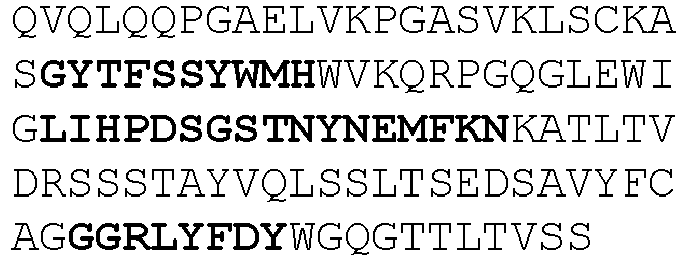
10 chAb3, huAb3VH.1, huAb3VH.1a, huAb3VH.1b, huAb3v2.1, huAb3v2.2, huAb3v2.3, huAb3v2.4, huAb3v2.5, huAb3v2.6, huAb3v2.7, huAb3v2.8, and huAb3v2.9 VH CDR1 amino acid sequence GYTFSSYWMH 11 chAb3, huAb3VH.1, huAb3VH.1a, and huAb3VH.1b VH CDR2 amino acid sequence LIHPDSGSTNYNEMFKN 12 chAb3, huAb3VH.1, huAb3VH.1a, huAb3VH.1b, huAb3v2.1, huAb3v2.2, huAb3v2.3, huAb3v2.4, huAb3v2.5, huAb3v2.6, huAb3v2.7, huAb3v2.8, and huAb3v2.9 VH CDR3 amino acid sequence GGRLYFDY 13 chAb3 VL amino acid sequence 
14 chAb3, huAb3VL.1, huAb3VL.1a, and huAb3VL.1b VL CDR1 amino acid sequence RSSQSLVHSNGDTYLR 15 chAb3, huAb3VL.1, huAb3VL.1a, huAb3VL.1b, huAb3v2.1, huAb3v2.2, huAb3v2.3, huAb3v2.4, huAb3v2.5, huAb3v2.6, huAb3v2.7, huAb3v2.8, and huAb3v2.9 VL CDR3 amino acid sequence SQSTHVPYT 16 chAb4 VH amino acid sequence 
17 chAb4 VH CDR1 amino acid sequence GYSFTSYWMH 18 chAb4 VH CDR2 amino acid sequence MIHPNSGSNNYNEKFKS 19 chAb4 VH CDR3 amino acid sequence RLGLHFDY 20 chAb4 VL amino acid sequence 
21 chAb4 VL CDR1 amino acid sequence KASQNVGTAVA 22 chAb4 VL CDR2 amino acid sequence SASNRYT 23 chAb4 VL CDR3 amino acid sequence QQYSSYPYT 24 chAb18 VH amino acid sequence 
25 chAb18, huAb18VH.1, huAb18VH.1a, and huAb18VH.1b VH CDR1 amino acid sequence GYSFTSYTIH 26 chAb18, huAb18VH.1, and huAb18VH.1a VH CDR2 amino acid sequence YINPNSRNTDYNQKFKD 27 chAb18, huAb18VH.1, huAb18VH.1a, and huAb18VH.1b VH CDR3 amino acid sequence YSGSTPYWYFDV 28 chAb18 VL amino acid sequence 
29 chAb18, huAb18VL.1, huAb18VL.1a, huAb18VL.1b, huAb18VL.2, and huAb18VL.2a, VL CDR1 amino acid sequence RASSSVSYMN 30 chAb18, huAb18VL.1, huAb18VL.1a, huAb18VL.1b, huAb18VL.2, and huAb18VL.2a, VL CDR2 amino acid sequence ATSNLAS 31 chAb18, huAb18VL.1, huAb18VL.1a, huAb18VL.1b, huAb18VL.2, and huAb18VL.2a, VL CDR3 amino acid sequence QQWSSNPLT 32 chAb13 VH amino acid sequence 
33 chAb13, huAb13Vh.1, huAb13Vh.1a, huAb13Vh.1b, huAb13v1, huAb13v2, huAb13v3, huAb13v4, huAb13v5, huAb13v6, huAb13v7, huAb13v8, and huAb13v9 VH CDR1 amino acid sequence GYSITSGYSWH 34 chAb13, huAb13Vh.1, huAb13Vh.1a, huAb13Vh.1b, huAb13v1, huAb13v2, huAb13v3, huAb13v4, huAb13v5, huAb13v6, huAb13v7, huAb13v8, and huAb13v9 VH CDR2 amino acid sequence YIHSSGSTNYNPSLKS 35 chAb13, huAb13Vh.1, huAb13Vh.1a, huAb13Vh.1b, huAb13v1, huAb13v2, huAb13v3, huAb13v4, huAb13v5, huAb13v6, huAb13v7, huAb13v8, and huAb13v9 VH CDR3 amino acid sequence YDDYFEY 36 chAb13 VL amino acid sequence 
37 chAb13, huAb13VL.1, huAb13VL.1a, huAb13VL.1b, huAb13v1, huAb13v2, huAb13v3, huAb13v4, huAb13v5, huAb13v6, huAb13v7, huAb13v8, and huAb13v9 VL CDR1 amino acid sequence KASQNVGFNVA 38 chAb13, huAb13VL.1, huAb13VL.1a, huAb13VL.1b, huAb13v1, huAb13v2, huAb13v3, huAb13v4, huAb13v5, huAb13v6, huAb13v7, huAb13v8, and huAb13v9 VL CDR2 amino acid sequence SASYRYS 39 huAb13VL.1, huAb13VL.1a, huAb13VL.1b, huAb13v1, huAb13v2, huAb13v3, huAb13v4, huAb13v5, huAb13v6, huAb13v7, huAb13v8, and huAb13v9 VL CDR3 amino acid sequence QQYNWYPFT 40 chAb12 VH amino acid sequence 
41 chAb12 VH CDR1 amino acid sequence GFTFSSYAMS 42 chAb12 VH CDR2 amino acid sequence TISSGTNYTYYPDSVKG 43 chAb12 VH CDR3 amino acid sequence QGRYSWIAY 44 chAb12 VL amino acid sequence 
45 chAb12 VL CDR1 amino acid sequence RASKSVSTSDYSYMH 46 chAb12 and chAb17 VL CDR2 amino acid LASNLES 47 chAb12 VL CDR3 amino acid sequence QHSRELLT 48 chAb14 VH amino acid sequence 
49 chAb14 and chAb8 VH CDR1 amino acid sequence GFTFSSYGMS 50 chAb14 VH CDR2 amino acid sequence TISGGGTNTYYPDSVEG 51 chAb14 VH CDR3 amino acid sequence HYGSQTMDY 52 chAb14 VL amino acid sequence 
53 chAb14 VL CDR1 amino acid sequence RTSGNIHNYLT 54 chAb14 VL CDR2 amino acid sequence NAKTLAD 55 chAb14 VL CDR3 amino acid sequence QHFWSIMWT 56 chAb6 VH amino acid sequence 
57 chAb6 VH CDR1 amino acid sequence GYTFSRYWIE 58 chAb6 VH CDR2 amino acid sequence EILPGSGSTNYNEKFKG 59 chAb6 VH CDR3 amino acid sequence RGYGYVPYALDY 60 chAb6 VL amino acid sequence 
61 chAb6 VL CDR1 amino acid sequence RASQDISNSLN 62 chAb6 VL CDR2 amino acid sequence YTSRLYS 63 chAb6 VL CDR3 amino acid sequence QQGNTLPYT 64 chAb11 VH amino acid sequence 
65 chAb11 VH CDR1 amino acid sequence GFTFTNYYMS 66 chAb11 VH CDR2 amino acid sequence FIRNKANDYTTEYSASVKG 67 chAb11 VH CDR3 amino acid sequence ESPGNPFAY 68 chAb11 VL amino acid sequence 
69 chAb11 VL CDR1 amino acid sequence KSSQSLLNSGTQKNFLT 70 chAb11 VL CDR2 amino acid sequence WASTRES 71 chAb11 VL CDR3 amino acid sequence QNDYIYPLT 72 chAb16 VH amino acid sequence 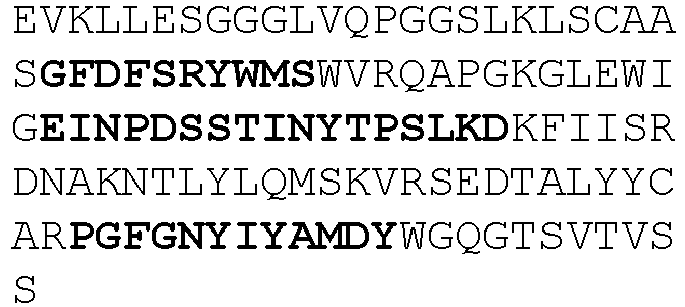
73 chAb16 VH CDR1 amino acid sequence GFDFSRYWMS 74 chAb16 VH CDR2 amino acid sequence EINPDSSTINYTPSLKD 75 chAb16 VH CDR3 amino acid sequence PGFGNYIYAMDY 76 chAb16 VL amino acid sequence 
77 chAb16 VL CDR1 amino acid sequence RASQDISNFLN 78 chAb16 VL CDR2 amino acid sequence YTSRLYL 79 chAb16 VL CDR3 amino acid sequence QQGNTLPPT 80 chAb10 VH amino acid sequence 
81 chAb10 VH CDR1 amino acid sequence GYSITSDYAWN 82 chAb10 VH CDR2 amino acid sequence HINYSGITNYNPSLKS 83 chAb10 VH CDR3 amino acid sequence RSLFYYYGSSLYAMDY 84 chAb10 VL amino acid sequence 
85 chAb10 VL CDR1 amino acid sequence RSSQSLVHSNGNTYLH 86 chAb10 VL CDR3 amino acid sequence SQSTHVPWT 87 chAb7 VH amino acid sequence 
88 chAb7 VH CDR1 amino acid sequence GFSFRGYGMS 89 chAb7 VH CDR2 amino acid sequence AISTGGNYTYYPDSVQG 90 chAb7 VH CDR3 amino acid sequence RGGNYAGFAY 91 chAb7 VL amino acid sequence 
92 chAb7 VL CDR1 amino acid sequence RPSENIYSNLA 93 chAb7 and chAb8 VL CDR2 amino acid AATNLAD 94 chAb7 VL CDR3 amino acid sequence QHFWGTPFT 95 chAb8 VH amino acid sequence 
96 chAb8 VH CDR2 amino acid sequence TISGGGNYTYCPDSVKG 97 chAb8 VH CDR3 amino acid sequence QRGYDYHYAMDF 98 chAb8 VL amino acid sequence 
99 chAb8 VL CDR1 amino acid sequence RASENIYSNLA 100 chAb8 VL CDR3 amino acid sequence QNFWGTSWT 101 chAb17 VH amino acid sequence 
102 chAb17 VH CDR1 amino acid sequence GFTFSSYIMS 103 chAb17 VH CDR2 amino acid sequence SIVSSNITYYPDSMKG 104 chAb17 VH CDR3 amino acid sequence SGTRAWFAY 105 chAb17 VL amino acid sequence 
106 chAb17 VL CDR1 amino acid sequence RASKSVSTSAYSYMH 107 chAb17 VL CDR3 amino acid sequence QHSRELPYT 108 chAb5 VH amino acid sequence 
109 chAb5 VH CDR1 amino acid sequence GYTFTTDWMH 110 chAb5 VH CDR2 amino acid sequence MIHPNSGTTNYNEKFKS 111 chAb5 VH CDR3 amino acid sequence SYWKWYFDV 112 chAb5 VL amino acid sequence 
113 chAb5 VL CDR1 amino acid sequence SASSSVSYMH 114 chAb5 VL CDR2 amino acid sequence STSNLAS 115 chAb5 VL CDR3 amino acid sequence HQWTSYMYT 116 huAb18VH.1, huAb18v1, and huAb18v5 VH amino acid sequence 
117 huAb18VH.1a, huAb18v3, huAb18v8, and huAb18v9 VH amino acid sequence 
118 huAb18VH.1b, huAb18v2, huAb18v4, huAb18v6, huAb18v7, and huAb18v10 VH amino acid sequence 
119 huAb18VH.1b VH CDR2 amino acid sequence YINPNSRNTDYAQKFQG 120 huAb18VL.1, huAb18v1, and huAb18v2 VL amino acid sequence 
121 huAb18VL.1a, huAb18v3, and huAb18v4 VL amino acid sequence 
122 huAb18VL.1b, huAb18v8, and huAb18v10 VL amino acid sequence 
123 huAb18VL.2, huAb18v5, and huAb18v6 VL amino acid sequence 
124 huAb18VL.2a, huAb18v7, and huAb18v9 VL amino acid sequence 
125 huAb3VH.1, huAb3v1, and huAb3v4 VH amino acid sequence 
126 huAb3VH.1a, huAb3v3, and huAb3v6 VH amino acid sequence 
127 huAb3VH.1b, huAb3v2, and huAb3v5 VH amino acid sequence 
128 huAb3VL.1, huAb3v1, and huAb3v2 VL amino acid sequence 
129 huAb3VL.1a and huAb3v3 VL amino acid sequence 
130 huAb3VL.1b, huAb3v4, huAb3v5, and huAb3v6 VL amino acid sequence 
131 huAb3v2.1, huAb3v2.2, and huAb3v2.3 VH amino acid sequence 
132 huAb3v2.1, huAb3v2.2, and huAb3v2.3 VH CDR2 amino acid sequence LIHPWSGSTNYNEMFKN 133 huAb3v2.1, huAb3v2.4, and huAb3v2.7 VL amino acid sequence 
134 huAb3v2.1, huAb3v2.4, and huAb3v2.7 VL CDR1 amino acid sequence RSSQSLVHSSGDTYLR 135 huAb3v2.2, huAb3v2.5, and huAb3v2.8 VL amino acid sequence 
136 huAb3v2.2, huAb3v2.5, and huAb3v2.8 VL CDR1 amino acid sequence RSSQSLVHSNRDTYLR 137 huAb3v2.3, huAb3v2.6, and huAb3v2.9 VL amino acid sequence 
138 huAb3v2.3, huAb3v2.6, and huAb3v2.9 VL CDR1 amino acid sequence RSSQSLVHSNQDTYLR 139 huAb3v2.4, huAb3v2.5, and huAb3v2.6 VH amino acid sequence 
140 huAb3v2.4, huAb3v2.5, and huAb3v2.6 VH CDR2 amino acid sequence LIHPESGSTNYNEMFKN 141 huAb3v2.7, huAb3v2.8, and huAb3v2.9 VH amino acid sequence 
142 huAb3v2.7, huAb3v2.8, and huAb3v2.9 VH CDR2 amino acid sequence LIHPISGSTNYNEMFKN 143 huAb13VL.1, huAb13v2, huAb13v5, and huAb13v7 VL amino acid sequence 144 huAb13VL.1a, huAb13v1, huAb13v3, and huAb13v8 VL amino acid sequence 
145 huAB13VL.1b, huAb13v4, huAb13v6, and huAb13v9 VL amino acid sequence 146 huAb13VH.1, huAb13v2, huAb13v3, and huAb13v4 VH amino acid sequence 
147 huAb13VH.1a, huAb13v1, huAb13v5, and huAb13v6 VH amino acid sequence 
148 huAb13VH.1b, huAb13v7, huAb13v8, and huAb13v9 VH amino acid sequence 
149 B7-H3 amino acid sequence (human) 
150 Human B7-H3-ECD (fc fusion) Note: Fc sequence is underlined 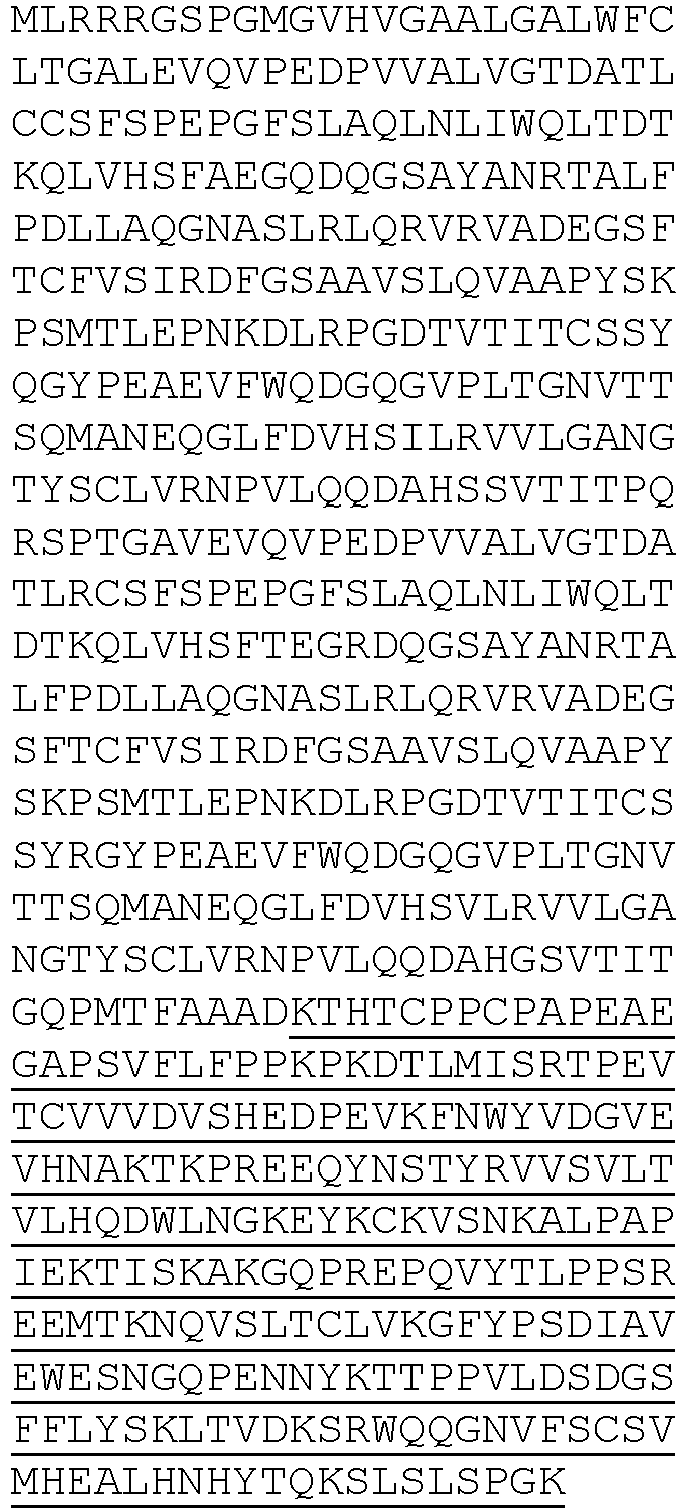
151 Mouse B7-H3-ECD (fc fusion) Note: Fc sequence is underlined 
152 Human B7-H3-ECD (his tag) 
153 Mouse B7-H3-ECD (his tag) 
154 Cynomolgus B7-H3-ECD (his tag) 
155 Amino acid sequence of IGHV1-69*06 
156 Amino acid sequence of IGHJ6*01 WGQGTTVTVSS 157 Amino acid sequence of IGKV1-9*01 
158 Amino acid sequence of IGKJ2*01 FGQGTKLEIK 159 Ig gamma-1 constant region 
160 Ig gamma-1 constant region mutant 
161 Ig Kappa constant region 
162 Ig Lambda constant region 
163 Amino acid sequence of IGKV6-21*01 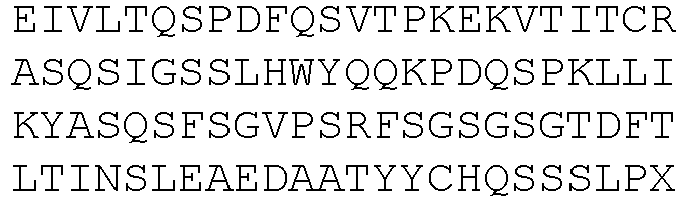
164 Amino acid sequence of IGKV2-28*01 
165 Amino acid sequence of IGKJ4*01 FGGGTKVEIK 166 Amino acid sequence of IGHV-b*01(0-1) 
167 Amino acid sequence of IGKv1-39*01 
168 Amino acid sequence of huAb13v1 heavy chain Note: Ig gamma-1 constant region mutant sequence is underlined. 
169 Amino acid sequence of huAb13v1 light chain 
Note: Ig kappa constant region sequence is underlined. 170 Amino acid sequence of huAb3v2.5 heavy chain 
Note: Ig gamma-1 constant region mutant sequence is underlined. 171 Amino acid sequence of huAb3v2.5 light chain 
Note: Ig kappa constant region sequence is underlined. 172 Amino acid sequence of huAb3v2.6 heavy chain 
Note: Ig gamma-1 constant region mutant sequence is underlined. 173 Amino acid sequence of huAb3v2.6 light chain 
Note: Ig kappa constant region sequence is underlined. 174 Amino acid sequence of IGHV1-69*06_IGHJ6 
175 Amino acid sequence of IGKV2-28*01_IGKJ4 
176 Amino acid sequence of IGHV4-b_IGHJ6 
177 Amino acid sequence of IGKV1-39_IGKJ2 
178 Amino acid sequence of huAb3 VL1 variants Note: X can be any amino acid except: M, C, N, D, or Q 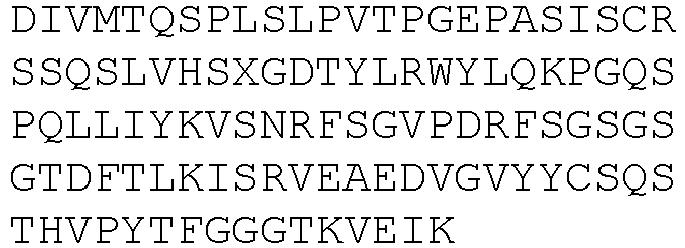
179 Amino acid sequence of huAb3 VL1 variants Note: X can be any amino acid except: M, C, G, S, N, or P 
180 Amino acid sequence of huAb3 VH1b variants Note: X can be any amino acid except: M, C, N, D, or Q 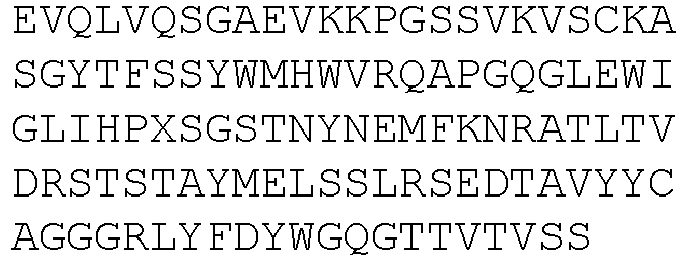
181 Amino acid sequence of huAb3 VH1b variants Note: X can be any amino acid except: M, C, G, S, N, or P 
182 chAb13 VL CDR3 amino acid sequence QQYNSYPFT -
- <110> ABBVIE INC. BRUNCKO, MILAN
- <120> ANTI-B7-H3 ANTIBODIES AND ANTIBODY DRUG CONJUGATES
- <130> 117813-12620
- <140>
<141> - <150>
US 62/347,476
<151> 2016-06-08 - <150>
US 62/366,511
<151> 2016-07-25 - <160> 182
- <170> PatentIn version 3.5
- <210> 1
<211> 120
<212> PRT
<213> Artificial Sequence - <220>
<223> Synthetic: chAb2 VH amino acid sequence - <400> 1

- <210> 2
<211> 10
<212> PRT
<213> Artificial Sequence - <220>
<223> Synthetic: chAb2 VH CDR1 amino acid sequence - <400> 2

- <210> 3
<211> 17
<212> PRT
<213> Artificial Sequence - <220>
<223> Synthetic: chAb2 VH CDR2 amino acid sequence - <400> 3

- <210> 4
<211> 11
<212> PRT
<213> Artificial Sequence - <220>
<223> Synthetic: chAb2 VH CDR3 amino acid sequence - <400> 4

- <210> 5
<211> 112
<212> PRT
<213> Artificial Sequence - <220>
<223> Synthetic: chAb2 VL amino acid sequence - <400> 5

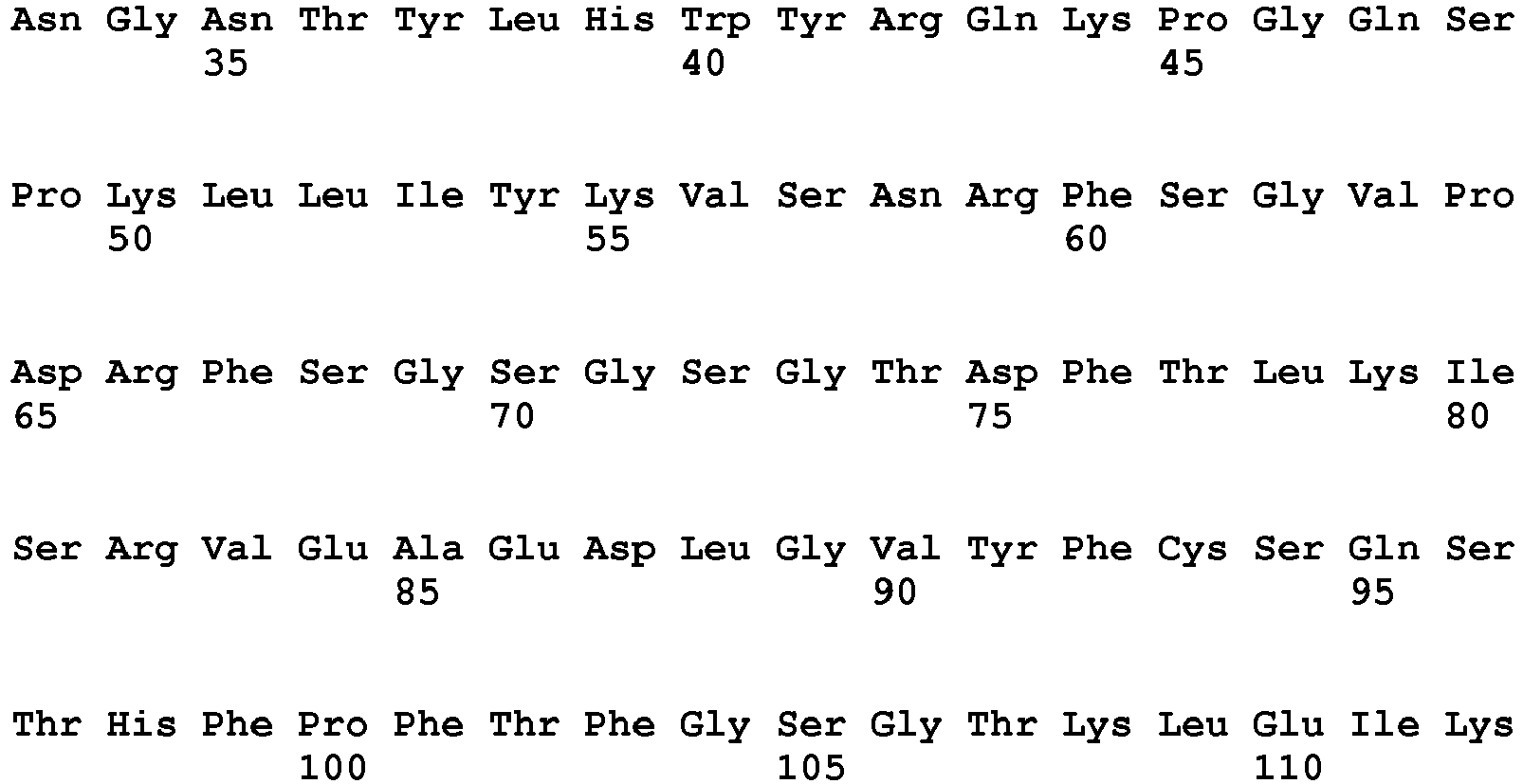
- <210> 6
<211> 16
<212> PRT
<213> Artificial Sequence - <220>
<223> Synthetic: chAb2 VL CDR1 amino acid sequence - <400> 6

- <210> 7
<211> 7
<212> PRT
<213> Artificial Sequence - <220>
<223> Synthetic: chAb2, chAb3, chAb10, huAb3VL.1, huAb3VL.1a, huAb3VL.1b, huAb3v2.1, huAb3v2.2, huAb3v2.3, huAb3v2.4, huAb3v2.5, huAb3v2.6, huAb3v2.7, huAb3v2.8, and huAb3v2.9 VL CDR2 amino acid sequence - <400> 7

- <210> 8
<211> 9
<212> PRT
<213> Artificial Sequence - <220>
<223> Synthetic: chAb2 VL CDR3 amino acid sequence - <400> 8

- <210> 9
<211> 117
<212> PRT
<213> Artificial Sequence - <220>
<223> Synthetic: chAb3 VH amino acid sequence - <400> 9

- <210> 10
<211> 10
<212> PRT
<213> Artificial Sequence - <220>
<223> Synthetic: chAb3, huAb3VH.1, huAb3VH.1a, huAb3VH.1b, huAb3v2.1, huAb3v2.2, huAb3v2.3, huAb3v2.4, huAb3v2.5, huAb3v2.6, huAb3v2.7, huAb3v2.8, and huAb3v2.9 VH CDR1 amino acid sequence - <400> 10

- <210> 11
<211> 17
<212> PRT
<213> Artificial Sequence - <220>
<223> Synthetic: chAb3, huAb3VH.1, huAb3VH.1a, and huAb3VH.lb VH CDR2 amino acid sequence - <400> 11

- <210> 12
<211> 8
<212> PRT
<213> Artificial Sequence - <220>
<223> Synthetic: chAb3, huAb3VH.1, huAb3VH.1a, huAb3VH.1b, huAb3v2.1, huAb3v2.2, huAb3v2.3, huAb3v2.4, huAb3v2.5, huAb3v2.6, huAb3v2.7, huAb3v2.8, and huAb3v2.9 VH CDR3 amino acid sequence - <400> 12

- <210> 13
<211> 112
<212> PRT
<213> Artificial Sequence - <220>
<223> Synthetic: chAb3 VL amino acid sequence - <400> 13


- <210> 14
<211> 16
<212> PRT
<213> Artificial Sequence - <220>
<223> Synthetic: chAb3, huAb3VL.1, huAb3VL.1a, and huAb3VL.1b VL CDR1 amino acid sequence - <400> 14

- <210> 15
<211> 9
<212> PRT
<213> Artificial Sequence - <220>
<223> Synthetic: chAb3, huAb3VL.1, huAb3VL.1a, huAb3VL.1b, huAb3v2.1, huAb3v2.2, huAb3v2.3, huAb3v2.4, huAb3v2.5, huAb3v2.6, huAb3v2.7, huAb3v2.8, and huAb3v2.9 VL CDR3 amino acid sequence - <400> 15

- <210> 16
<211> 117
<212> PRT
<213> Artificial Sequence - <220>
<223> Synthetic: chAb4 VH amino acid sequence - <400> 16


- <210> 17
<211> 10
<212> PRT
<213> Artificial Sequence - <220>
<223> Synthetic: chAb4 VH CDR1 amino acid sequence - <400> 17

- <210> 18
<211> 17
<212> PRT
<213> Artificial Sequence - <220>
<223> Synthetic: chAb4 VH CDR2 amino acid sequence - <400> 18

- <210> 19
<211> 8
<212> PRT
<213> Artificial Sequence - <220>
<223> Synthetic: chAb4 VH CDR3 amino acid sequence - <400> 19

- <210> 20
<211> 107
<212> PRT
<213> Artificial Sequence - <220>
<223> Synthetic: chAb4 VL amino acid sequence - <400> 20
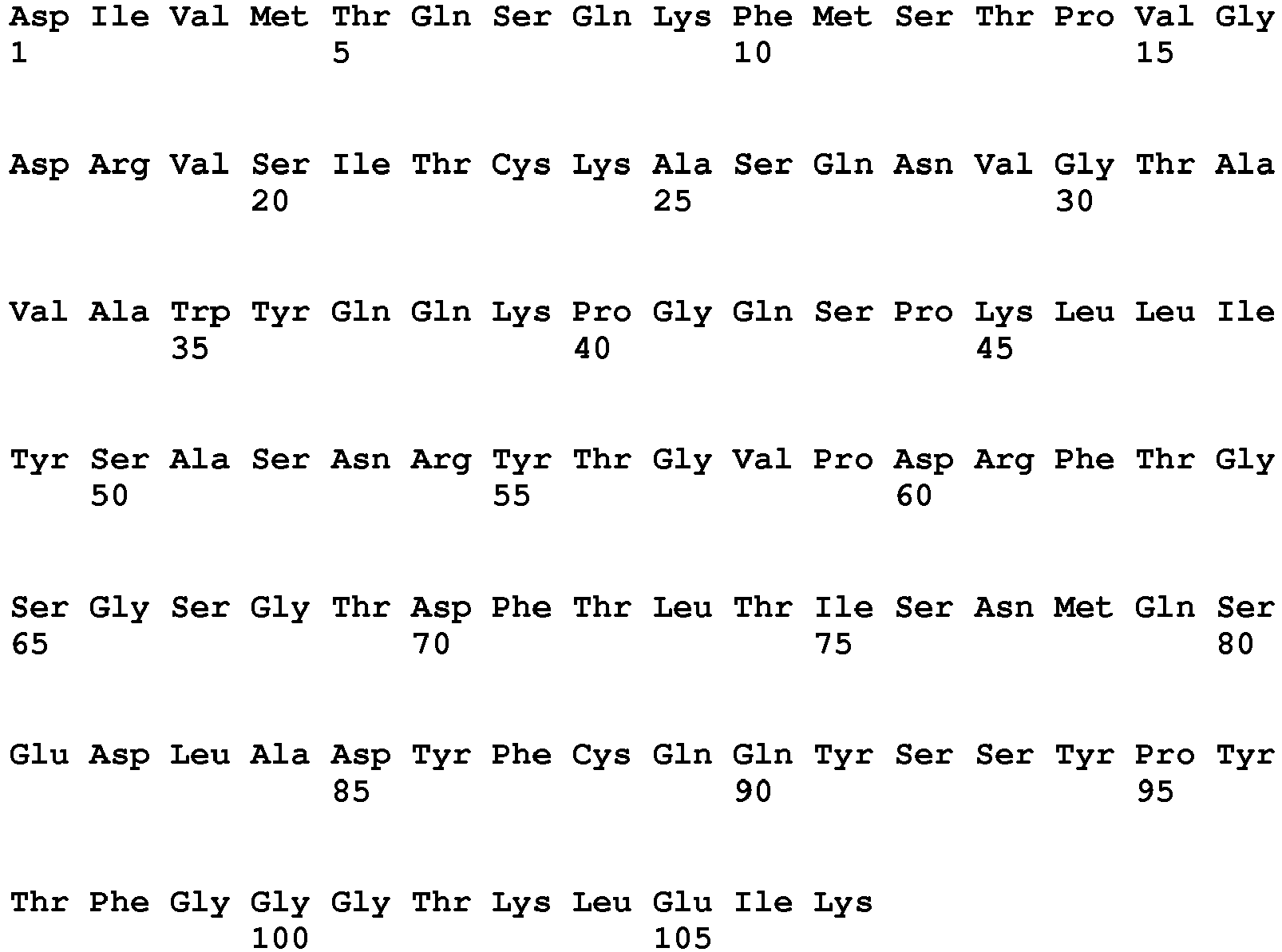
- <210> 21
<211> 11
<212> PRT
<213> Artificial Sequence - <220>
<223> Synthetic: chAb4 VL CDR1 amino acid sequence - <400> 21

- <210> 22
<211> 7
<212> PRT
<213> Artificial Sequence - <220>
<223> Synthetic: chAb4 VL CDR2 amino acid sequence - <400> 22

- <210> 23
<211> 9
<212> PRT
<213> Artificial Sequence - <220>
<223> Synthetic: chAb4 VL CDR3 amino acid sequence - <400> 23

- <210> 24
<211> 121
<212> PRT
<213> Artificial Sequence - <220>
<223> Synthetic: chAb18 VH amino acid sequence - <400> 24

- <210> 25
<211> 10
<212> PRT
<213> Artificial Sequence - <220>
<223> Synthetic: chAb18, huAb18VH.1, huAb18VH.1a, and huAb18VH.1b VH CDR1 amino acid sequence - <400> 25

- <210> 26
<211> 17
<212> PRT
<213> Artificial Sequence - <220>
<223> Synthetic: chAbl8, huAb18VH.1, and huAbl8VH.la VH CDR2 amino acid sequence - <400> 26

- <210> 27
<211> 12
<212> PRT
<213> Artificial Sequence - <220>
<223> Synthetic: chAb18, huAb18VH.1, huAb18VH.1a, and huAb18VH.1b VH CDR3 amino acid sequence - <400> 27

- <210> 28
<211> 106
<212> PRT
<213> Artificial Sequence - <220>
<223> Synthetic: chAb18 VL amino acid sequence - <400> 28


- <210> 29
<211> 10
<212> PRT
<213> Artificial Sequence - <220>
<223> Synthetic: chAbl8, huAb18VL.1, huAb18VL.1a, huAb18VL.1b, huAb18VL.2, and huAb18VL.2a, VL CDR1 amino acid sequence - <400> 29

- <210> 30
<211> 7
<212> PRT
<213> Artificial Sequence - <220>
<223> Synthetic: chAbl8, huAb18VL.1, huAb18VL.1a, huAb18VL.1b, huAb18VL.2, and huAb18VL.2a, VL CDR2 amino acid sequence - <400> 30

- <210> 31
<211> 9
<212> PRT
<213> Artificial Sequence - <220>
<223> Synthetic: chAb18, huAb18VL.1, huAb18VL.1a, huAb18VL.1b, huAb18VL.2, and huAb18VL.2a, VL CDR3 amino acid sequence - <400> 31

- <210> 32
<211> 116
<212> PRT
<213> Artificial Sequence - <220>
<223> Synthetic: chAb13 VH amino acid sequence - <400> 32

- <210> 33
<211> 11
<212> PRT
<213> Artificial Sequence - <220>
<223> Synthetic: chAbl3, huAb13Vh.1, huAb13Vh.1a, huAb13Vh.1b, huAb13v1, huAb13v2, huAb13v3, huAb13v4, huAb13v5, huAb13v6, huAb13v7, huAb13v8, and huAb13v9 VH CDR1 amino acid sequence - <400> 33

- <210> 34
<211> 16
<212> PRT
<213> Artificial Sequence - <220>
<223> Synthetic: chAbl3, huAb13Vh.1, huAb13Vh.1a, huAb13Vh.1b, huAb13v1, huAb13v2, huAb13v3, huAb13v4, huAb13v5, huAb13v6, huAb13v7, huAb13v8, and huAb13v9VH CDR2 amino acid sequence - <400> 34

- <210> 35
<211> 7
<212> PRT
<213> Artificial Sequence - <220>
<223> Synthetic: chAb13, huAb13Vh.1, huAb13Vh.1a, huAb13Vh.1b, huAb13v1, huAb13v2, huAb13v3, huAb13v4, huAb13v5, huAb13v6, huAb13v7, huAb13v8, and huAb13v9 VH CDR3 amino acid sequence - <400> 35

- <210> 36
<211> 107
<212> PRT
<213> Artificial Sequence - <220>
<223> Synthetic: chAb13 VL amino acid sequence - <400> 36


- <210> 37
<211> 11
<212> PRT
<213> Artificial Sequence - <220>
<223> Synthetic: chAbl3, huAb13VL.1, huAb13VL.1a, huAb13VL.1b, huAb13v1, huAb13v2, huAb13v3, huAb13v4, huAb13v5, huAb13v6, huAb13v7, huAb13v8, and huAb13v9 VL CDR1 amino acid sequence - <400> 37

- <210> 38
<211> 7
<212> PRT
<213> Artificial Sequence - <220>
<223> Synthetic: chAb13, huAb13VL.1, huAb13VL.1a, huAb13VL.1b, huAb13v1, huAb13v2, huAb13v3, huAb13v4, huAb13v5, huAb13v6, huAb13v7, huAb13v8, and huAb13v9 VL CDR2 amino acid sequence - <400> 38

- <210> 39
<211> 9
<212> PRT
<213> Artificial Sequence - <220>
<223> Synthetic: huAb13VL.1, huAb13VL.1a, huAb13VL.1b, huAb13v1, huAb13v2, huAb13v3, huAb13v4, huAb13v5, huAb13v6, huAb13v7, huAb13v8, and huAb13v9 VL CDR3 amino acid sequence - <400> 39

- <210> 40
<211> 118
<212> PRT
<213> Artificial Sequence - <220>
<223> Synthetic: chAb12 VH amino acid sequence - <400> 40
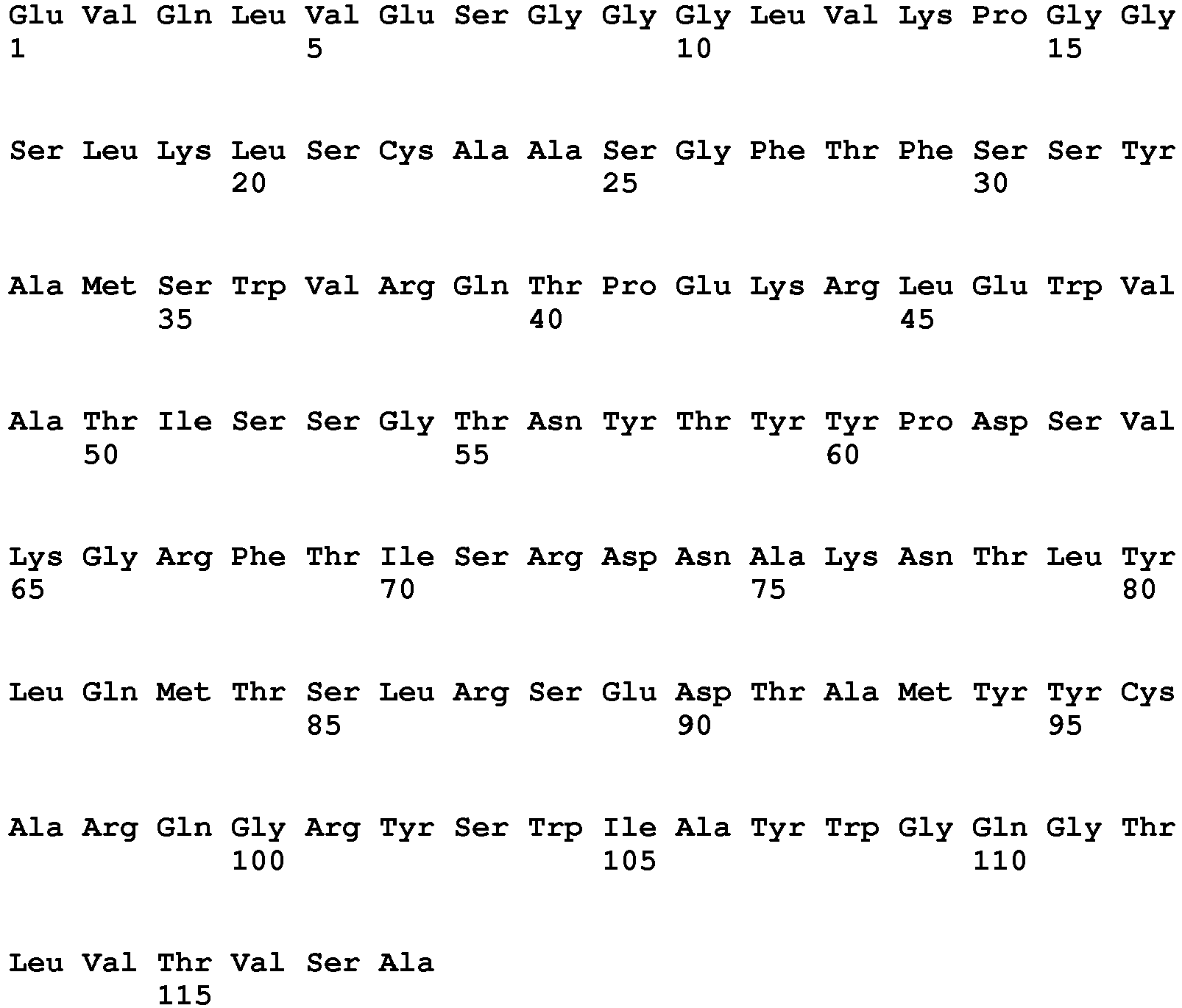
- <210> 41
<211> 10
<212> PRT
<213> Artificial Sequence - <220>
<223> Synthetic: chAb12 VH CDR1 amino acid sequence - <400> 41

- <210> 42
<211> 17
<212> PRT
<213> Artificial Sequence - <220>
<223> Synthetic: chAb12 VH CDR2 amino acid sequence - <400> 42

- <210> 43
<211> 9
<212> PRT
<213> Artificial Sequence - <220>
<223> Synthetic: chAb12 VH CDR3 amino acid sequence - <400> 43

- <210> 44
<211> 110
<212> PRT
<213> Artificial Sequence - <220>
<223> Synthetic: chAb12 VL amino acid sequence - <400> 44

- <210> 45
<211> 15
<212> PRT
<213> Artificial Sequence - <220>
<223> Synthetic: chAb12 VL CDR1 amino acid sequence - <400> 45

- <210> 46
<211> 7
<212> PRT
<213> Artificial Sequence - <220>
<223> Synthetic: chAb12 and chAb17 VL CDR2 amino acid sequence - <400> 46

- <210> 47
<211> 8
<212> PRT
<213> Artificial Sequence - <220>
<223> Synthetic: chAb12 VL CDR3 amino acid sequence - <400> 47

- <210> 48
<211> 118
<212> PRT
<213> Artificial Sequence - <220>
<223> Synthetic: chAb14 VH amino acid sequence - <400> 48


- <210> 49
<211> 10
<212> PRT
<213> Artificial Sequence - <220>
<223> Synthetic: chAb14 and chAb8 VH CDR1 amino acid sequence - <400> 49

- <210> 50
<211> 17
<212> PRT
<213> Artificial Sequence - <220>
<223> Synthetic: chAb14 VH CDR2 amino acid sequence - <400> 50

- <210> 51
<211> 9
<212> PRT
<213> Artificial Sequence - <220>
<223> Synthetic: chAb14 VH CDR3 amino acid sequence - <400> 51

- <210> 52
<211> 107
<212> PRT
<213> Artificial Sequence - <220>
<223> Synthetic: chAb14 VL amino acid sequence - <400> 52

- <210> 53
<211> 11
<212> PRT
<213> Artificial Sequence - <220>
<223> Synthetic: chAb14 VL CDR1 amino acid sequence - <400> 53

- <210> 54
<211> 7
<212> PRT
<213> Artificial Sequence - <220>
<223> Synthetic: chAb14 VL CDR2 amino acid sequence - <400> 54

- <210> 55
<211> 9
<212> PRT
<213> Artificial Sequence - <220>
<223> Synthetic: chAb14 VL CDR3 amino acid sequence - <400> 55

- <210> 56
<211> 121
<212> PRT
<213> Artificial Sequence - <220>
<223> Synthetic: chAb6 VH amino acid sequence - <400> 56

- <210> 57
<211> 10
<212> PRT
<213> Artificial Sequence - <220>
<223> Synthetic: chAb6 VH CDR1 amino acid sequence - <400> 57

- <210> 58
<211> 17
<212> PRT
<213> Artificial Sequence - <220>
<223> Synthetic: chAb6 VH CDR2 amino acid sequence - <400> 58
Gly

- <210> 59
<211> 12
<212> PRT
<213> Artificial Sequence - <220>
<223> Synthetic: chAb6 VH CDR3 amino acid sequence - <400> 59

- <210> 60
<211> 107
<212> PRT
<213> Artificial Sequence - <220>
<223> Synthetic: chAb6 VL amino acid sequence - <400> 60


- <210> 61
<211> 11
<212> PRT
<213> Artificial Sequence - <220>
<223> Synthetic: chAb6 VL CDR1 amino acid sequence - <400> 61

- <210> 62
<211> 7
<212> PRT
<213> Artificial Sequence - <220>
<223> Synthetic: chAb6 VL CDR2 amino acid sequence - <400> 62

- <210> 63
<211> 9
<212> PRT
<213> Artificial Sequence - <220>
<223> Synthetic: chAb6 VL CDR3 amino acid sequence - <400> 63

- <210> 64
<211> 120
<212> PRT
<213> Artificial Sequence - <220>
<223> Synthetic: chAb11 VH amino acid sequence - <400> 64

- <210> 65
<211> 10
<212> PRT
<213> Artificial Sequence - <220>
<223> Synthetic: chAb11 VH CDR1 amino acid sequence - <400> 65

- <210> 66
<211> 19
<212> PRT
<213> Artificial Sequence - <220>
<223> Synthetic: chAb11 VH CDR2 amino acid sequence - <400> 66

- <210> 67
<211> 9
<212> PRT
<213> Artificial Sequence - <220>
<223> Synthetic: chAb11 VH CDR3 amino acid sequence - <400> 67

- <210> 68
<211> 113
<212> PRT
<213> Artificial Sequence - <220>
<223> Synthetic: chAb11 VL amino acid sequence - <400> 68

- <210> 69
<211> 17
<212> PRT
<213> Artificial Sequence - <220>
<223> Synthetic: chAb11 VL CDR1 amino acid sequence - <400> 69

- <210> 70
<211> 7
<212> PRT
<213> Artificial Sequence - <220>
<223> Synthetic: chAb11 VL CDR2 amino acid sequence - <400> 70

- <210> 71
<211> 9
<212> PRT
<213> Artificial Sequence - <220>
<223> Synthetic: chAb11 VL CDR3 amino acid sequence - <400> 71

- <210> 72
<211> 121
<212> PRT
<213> Artificial Sequence - <220>
<223> Synthetic: chAb16 VH amino acid sequence - <400> 72


- <210> 73
<211> 10
<212> PRT
<213> Artificial Sequence - <220>
<223> Synthetic: chAbl6 VH CDR1 amino acid sequence - <400> 73

- <210> 74
<211> 17
<212> PRT
<213> Artificial Sequence - <220>
<223> Synthetic: chAbl6 VH CDR2 amino acid sequence - <400> 74

- <210> 75
<211> 12
<212> PRT
<213> Artificial Sequence - <220>
<223> Synthetic: chAbl6 VH CDR3 amino acid sequence - <400> 75


- <210> 76
<211> 107
<212> PRT
<213> Artificial Sequence - <220>
<223> Synthetic: chAb16 VL amino acid sequence - <400> 76

- <210> 77
<211> 11
<212> PRT
<213> Artificial Sequence - <220>
<223> Synthetic: chAb16 VL CDR1 amino acid sequence - <400> 77

- <210> 78
<211> 7
<212> PRT
<213> Artificial Sequence - <220>
<223> Synthetic: chAb16 VL CDR2 amino acid sequence - <400> 78

- <210> 79
<211> 9
<212> PRT
<213> Artificial Sequence - <220>
<223> Synthetic: chAb16 VL CDR3 amino acid sequence - <400> 79

- <210> 80
<211> 125
<212> PRT
<213> Artificial Sequence - <220>
<223> Synthetic: chAb10 VH amino acid sequence - <400> 80

- <210> 81
<211> 11
<212> PRT
<213> Artificial Sequence - <220>
<223> Synthetic: chAb10 VH CDR1 amino acid sequence - <400> 81

- <210> 82
<211> 16
<212> PRT
<213> Artificial Sequence - <220>
<223> Synthetic: chAb10 VH CDR2 amino acid sequence - <400> 82

- <210> 83
<211> 16
<212> PRT
<213> Artificial Sequence - <220>
<223> Synthetic: chAb10 VH CDR3 amino acid sequence - <400> 83

- <210> 84
<211> 112
<212> PRT
<213> Artificial Sequence - <220>
<223> Synthetic: chAb10 VL amino acid sequence - <400> 84
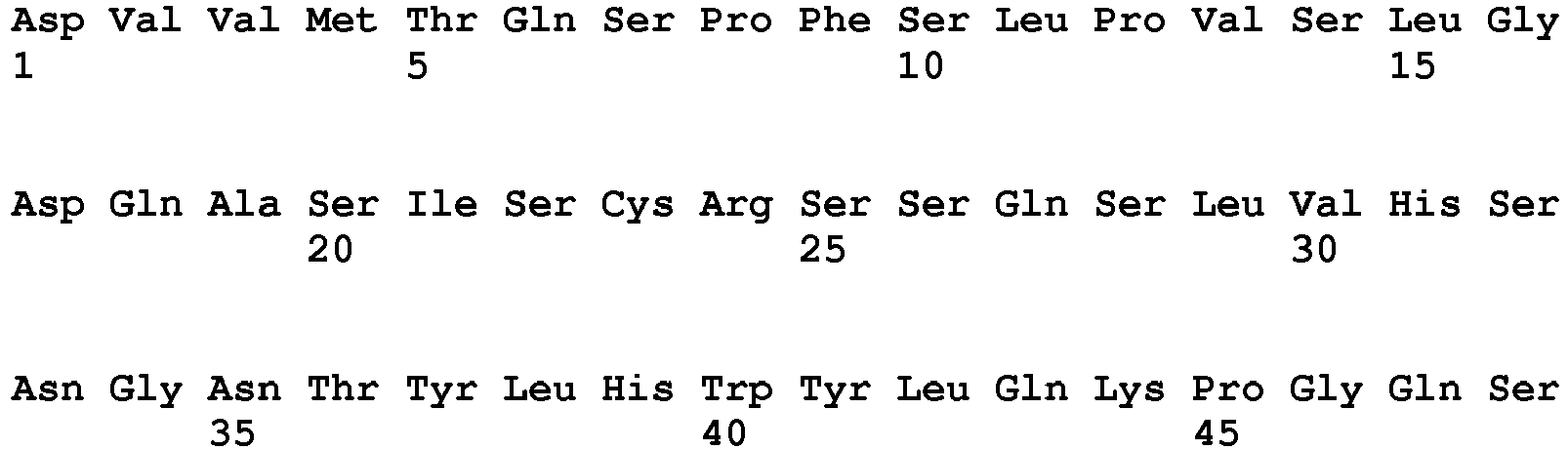

- <210> 85
<211> 16
<212> PRT
<213> Artificial Sequence - <220>
<223> Synthetic: chAb10 VL CDR1 amino acid sequence - <400> 85

- <210> 86
<211> 9
<212> PRT
<213> Artificial Sequence - <220>
<223> Synthetic: chAb10 VL CDR3 amino acid sequence - <400> 86

- <210> 87
<211> 119
<212> PRT
<213> Artificial Sequence - <220>
<223> Synthetic: chAb7 VH amino acid sequence - <400> 87


- <210> 88
<211> 10
<212> PRT
<213> Artificial Sequence - <220>
<223> Synthetic: chAb7 VH CDR1 amino acid sequence - <400> 88

- <210> 89
<211> 17
<212> PRT
<213> Artificial Sequence - <220>
<223> Synthetic: chAb7 VH CDR2 amino acid sequence - <400> 89

- <210> 90
<211> 10
<212> PRT
<213> Artificial Sequence - <220>
<223> Synthetic: chAb7 VH CDR3 amino acid sequence - <400> 90

- <210> 91
<211> 107
<212> PRT
<213> Artificial Sequence - <220>
<223> Synthetic: chAb7 VL amino acid sequence - <400> 91

- <210> 92
<211> 11
<212> PRT
<213> Artificial Sequence - <220>
<223> Synthetic: chAb7 VL CDR1 amino acid sequence - <400> 92

- <210> 93
<211> 7
<212> PRT
<213> Artificial Sequence - <220>
<223> Synthetic: chAb7 and chAb8 VL CDR2 amino acid sequence - <400> 93

- <210> 94
<211> 9
<212> PRT
<213> Artificial Sequence - <220>
<223> Synthetic: chAb7 VL CDR3 amino acid sequence - <400> 94

- <210> 95
<211> 121
<212> PRT
<213> Artificial Sequence - <220>
<223> Synthetic: chAb8 VH amino acid sequence - <400> 95

- <210> 96
<211> 17
<212> PRT
<213> Artificial Sequence - <220>
<223> Synthetic: chAb8 VH CDR2 amino acid sequence - <400> 96

- <210> 97
<211> 12
<212> PRT
<213> Artificial Sequence - <220>
<223> Synthetic: chAb8 VH CDR3 amino acid sequence - <400> 97

- <210> 98
<211> 107
<212> PRT
<213> Artificial Sequence - <220>
<223> Synthetic: chAb8 VL amino acid sequence - <400> 98


- <210> 99
<211> 11
<212> PRT
<213> Artificial Sequence - <220>
<223> Synthetic: chAb8 VL CDR1 amino acid sequence - <400> 99

- <210> 100
<211> 9
<212> PRT
<213> Artificial Sequence - <220>
<223> Synthetic: chAb8 VL CDR3 amino acid sequence - <400> 100

- <210> 101
<211> 117
<212> PRT
<213> Artificial Sequence - <220>
<223> Synthetic: chAb17 VH amino acid sequence - <400> 101
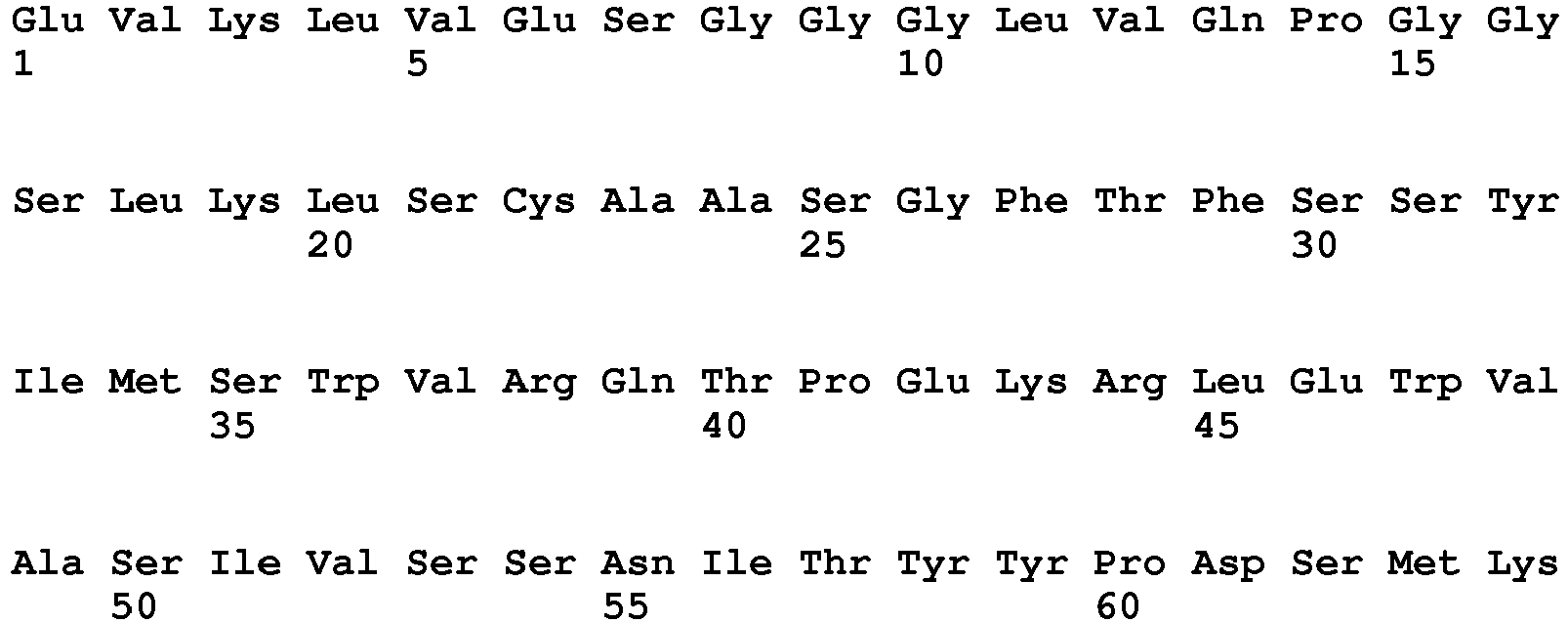

- <210> 102
<211> 10
<212> PRT
<213> Artificial Sequence - <220>
<223> Synthetic: chAb17 VH CDR1 amino acid sequence - <400> 102

- <210> 103
<211> 16
<212> PRT
<213> Artificial Sequence - <220>
<223> Synthetic: chAb17 VH CDR2 amino acid sequence - <400> 103

- <210> 104
<211> 9
<212> PRT
<213> Artificial Sequence - <220>
<223> Synthetic: chAb17 VH CDR3 amino acid sequence - <400> 104

- <210> 105
<211> 111
<212> PRT
<213> Artificial Sequence - <220>
<223> Synthetic: chAb17 VL amino acid sequence - <400> 105

- <210> 106
<211> 15
<212> PRT
<213> Artificial Sequence - <220>
<223> Synthetic: chAb17 VL CDR1 amino acid sequence - <400> 106

- <210> 107
<211> 9
<212> PRT
<213> Artificial Sequence - <220>
<223> Synthetic: chAb17 VL CDR3 amino acid sequence - <400> 107

- <210> 108
<211> 118
<212> PRT
<213> Artificial Sequence - <220>
<223> Synthetic: chAb5 VH amino acid sequence - <400> 108

- <210> 109
<211> 10
<212> PRT
<213> Artificial Sequence - <220>
<223> Synthetic: chAb5 VH CDR1 amino acid sequence - <400> 109

- <210> 110
<211> 17
<212> PRT
<213> Artificial Sequence - <220>
<223> Synthetic: chAb5 VH CDR2 amino acid sequence - <400> 110

- <210> 111
<211> 9
<212> PRT
<213> Artificial Sequence - <220>
<223> Synthetic: chAb5 VH CDR3 amino acid sequence - <400> 111

- <210> 112
<211> 106
<212> PRT
<213> Artificial Sequence - <220>
<223> Synthetic: chAb5 VL amino acid sequence - <400> 112

- <210> 113
<211> 10
<212> PRT
<213> Artificial Sequence - <220>
<223> Synthetic: chAb5 VL CDR1 amino acid sequence - <400> 113

- <210> 114
<211> 7
<212> PRT
<213> Artificial Sequence - <220>
<223> Synthetic: chAb5 VL CDR2 amino acid sequence - <400> 114

- <210> 115
<211> 9
<212> PRT
<213> Artificial Sequence - <220>
<223> Synthetic: chAb5 VL CDR3 amino acid sequence - <400> 115

- <210> 116
<211> 121
<212> PRT
<213> Artificial Sequence - <220>
<223> Synthetic: huAb18VH.1, huAb18v1, and huAb18v5 VH amino acid sequence - <400> 116


- <210> 117
<211> 121
<212> PRT
<213> Artificial Sequence - <220>
<223> Synthetic: huAb18VH.1a, huAb18v3, huAb18v8, and huAb18v9 VH amino acid sequence - <400> 117
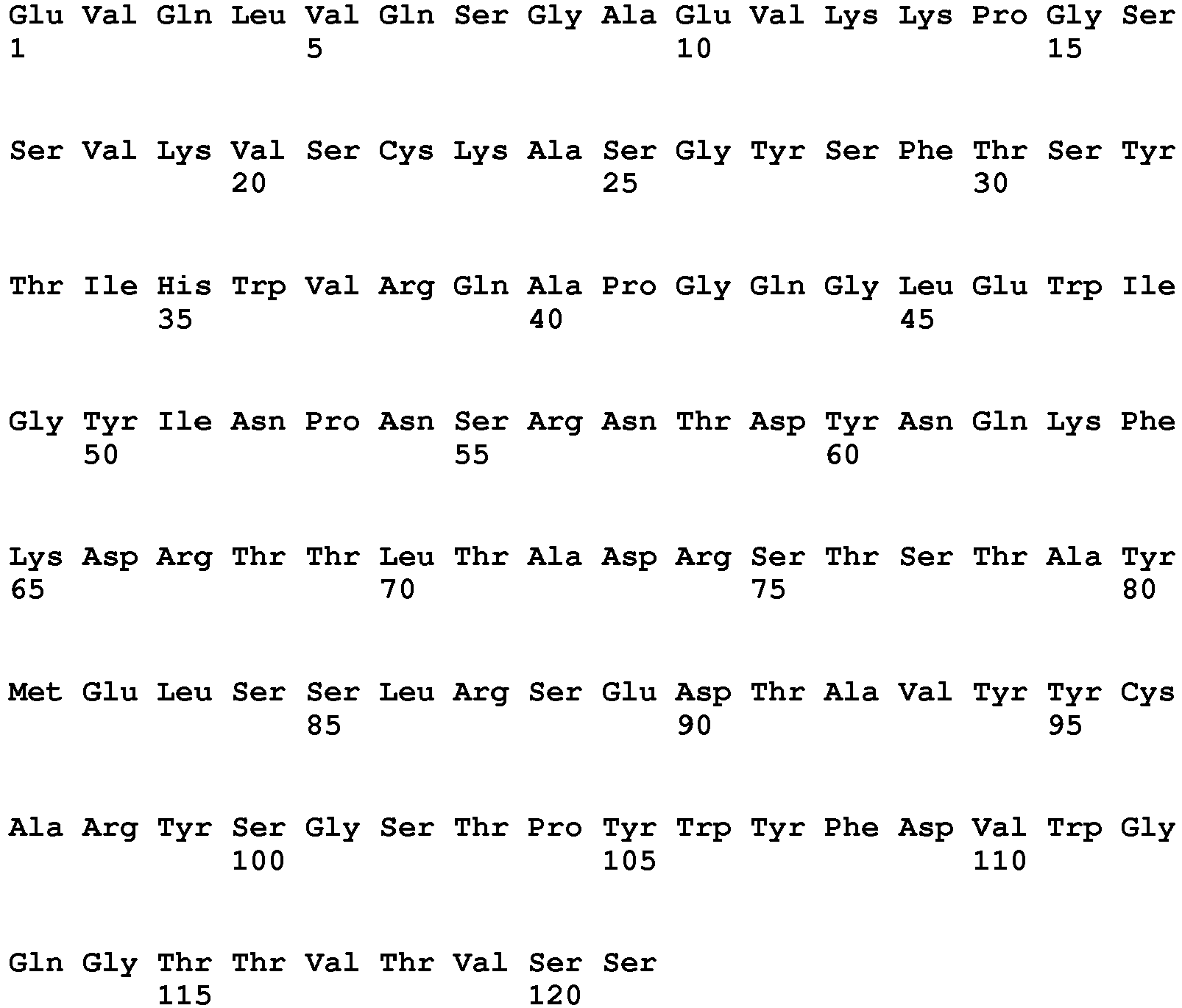
- <210> 118
<211> 121
<212> PRT
<213> Artificial Sequence - <220>
<223> Synthetic: huAb18VH.1b, huAb18v2, huAb18v4, huAb18v6, huAb18v7, and huAb18v10 VH amino acid sequence - <400> 118

- <210> 119
<211> 17
<212> PRT
<213> Artificial Sequence - <220>
<223> Synthetic: huAb18VH.1b VH CDR2 amino acid sequence - <400> 119

- <210> 120
<211> 106
<212> PRT
<213> Artificial Sequence - <220>
<223> Synthetic: huAb18VL.1, huAb18v1, and huAb18v2 VL amino acid sequence - <400> 120

- <210> 121
<211> 106
<212> PRT
<213> Artificial Sequence - <220>
<223> Synthetic: huAb18VL.1a, huAb18v3, and huAb18v4 VL amino acid sequence - <400> 121


- <210> 122
<211> 106
<212> PRT
<213> Artificial Sequence - <220>
<223> Synthetic: huAb18VL.1b, huAb18v8, and huAb18v10 VL amino acid sequence - <400> 122
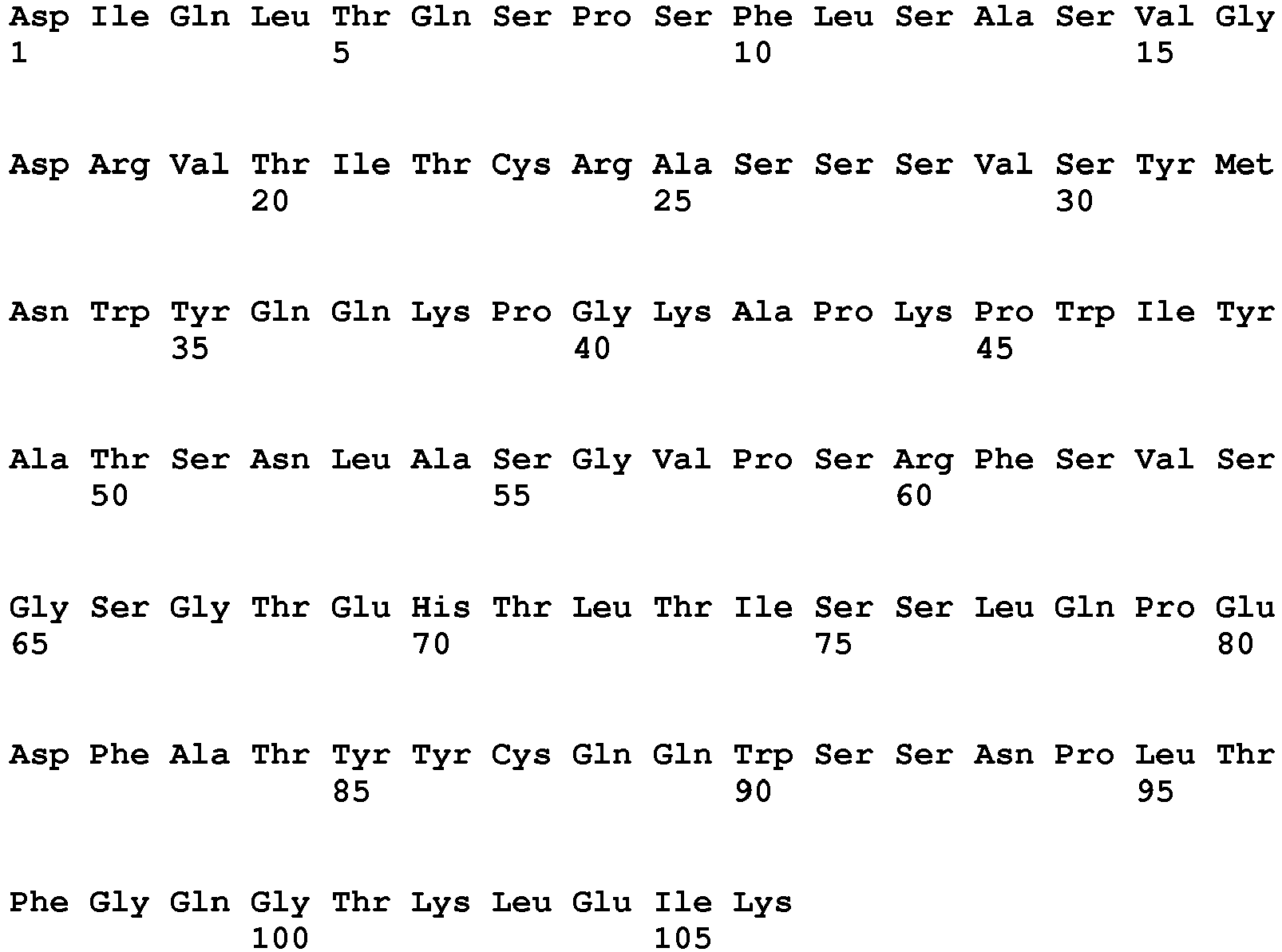
- <210> 123
<211> 106
<212> PRT
<213> Artificial Sequence - <220>
<223> Synthetic: huAb18VL.2, huAb18v5, and huAb18v6 VL amino acid sequence - <400> 123

- <210> 124
<211> 106
<212> PRT
<213> Artificial Sequence - <220>
<223> Synthetic: huAb18VL.2a, huAb18v7, and huAb18v9 VL amino acid sequence - <400> 124


- <210> 125
<211> 117
<212> PRT
<213> Artificial Sequence - <220>
<223> Synthetic: huAb3VH.1, huAb3vl, and huAb3v4 VH amino acid sequence - <400> 125

- <210> 126
<211> 117
<212> PRT
<213> Artificial Sequence - <220>
<223> Synthetic: huAb3VH.1a, huAb3v3, and huAb3v6 VH amino acid sequence - <400> 126


- <210> 127
<211> 117
<212> PRT
<213> Artificial Sequence - <220>
<223> Synthetic: huAb3VH.1b, huAb3v2, and huAb3v5 VH amino acid sequence - <400> 127


- <210> 128
<211> 112
<212> PRT
<213> Artificial Sequence - <220>
<223> Synthetic: huAb3VL.1, huAb3vl, and huAb3v2 VL amino acid sequence - <400> 128

- <210> 129
<211> 112
<212> PRT
<213> Artificial Sequence - <220>
<223> Synthetic: huAb3VL.1a and huAb3v3 VL amino acid sequence - <400> 129
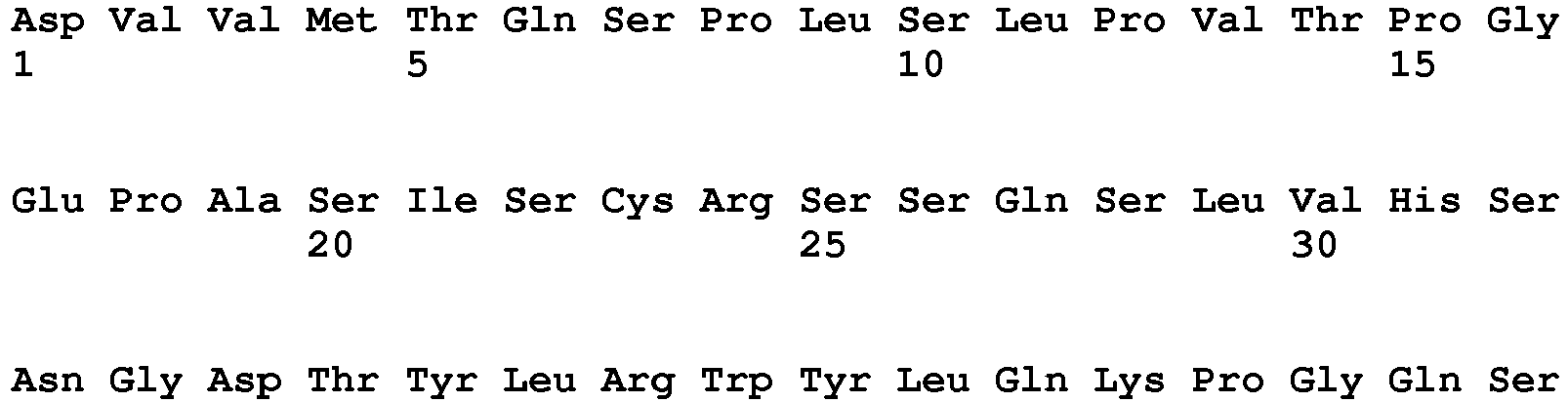

- <210> 130
<211> 112
<212> PRT
<213> Artificial Sequence - <220>
<223> Synthetic: huAb3VL.1b, huAb3v4, huAb3v5, and huAb3v6 VL amino acid sequence - <400> 130

- <210> 131
<211> 117
<212> PRT
<213> Artificial Sequence - <220>
<223> Synthetic: huAb3v2.1, huAb3v2.2, and huAb3v2.3 VH amino acid sequence - <400> 131

- <210> 132
<211> 17
<212> PRT
<213> Artificial Sequence - <220>
<223> Synthetic: huAb3v2.1, huAb3v2.2, and huAb3v2.3 VH CDR2 amino acid sequence - <400> 132

- <210> 133
<211> 112
<212> PRT
<213> Artificial Sequence - <220>
<223> Synthetic: huAb3v2.1, huAb3v2.4, and huAb3v2.7 VL amino acid sequence - <400> 133

- <210> 134
<211> 16
<212> PRT
<213> Artificial Sequence - <220>
<223> Synthetic: huAb3v2.1, huAb3v2.4, and huAb3v2.7 VL CDR1 amino acid sequence - <400> 134

- <210> 135
<211> 112
<212> PRT
<213> Artificial Sequence - <220>
<223> Synthetic: huAb3v2.2, huAb3v2.5, and huAb3v2.8 VL amino acid sequence - <400> 135


- <210> 136
<211> 16
<212> PRT
<213> Artificial Sequence - <220>
<223> Synthetic: huAb3v2.2, huAb3v2.5, and huAb3v2.8 VL CDR1 amino acid sequence - <400> 136

- <210> 137
<211> 112
<212> PRT
<213> Artificial Sequence - <220>
<223> Synthetic: huAb3v2.3, huAb3v2.6, and huAb3v2.9 VL amino acid sequence - <400> 137


- <210> 138
<211> 16
<212> PRT
<213> Artificial Sequence - <220>
<223> Synthetic: huAb3v2.3, huAb3v2.6, and huAb3v2.9 VL CDR1 amino acid sequence - <400> 138

- <210> 139
<211> 117
<212> PRT
<213> Artificial Sequence - <220>
<223> Synthetic: huAb3v2.4, huAb3v2.5, and huAb3v2.6 VH amino acid sequence - <400> 139


- <210> 140
<211> 17
<212> PRT
<213> Artificial Sequence - <220>
<223> Synthetic: huAb3v2.4, huAb3v2.5, and huAb3v2.; VH CDR2 amino acid sequence - <400> 140

- <210> 141
<211> 117
<212> PRT
<213> Artificial Sequence - <220>
<223> Synthetic: huAb3v2.7, huAb3v2.8, and huAb3v2.9 VH amino acid sequence - <400> 141


- <210> 142
<211> 17
<212> PRT
<213> Artificial Sequence - <220>
<223> Synthetic: huAb3v2.7, huAb3v2.8, and huAb3v2.9 VH CDR2 amino acid sequence - <400> 142

- <210> 143
<211> 107
<212> PRT
<213> Artificial Sequence - <220>
<223> Synthetic: huAb13VL.1, huAb13v2, huAb13v5, and huAb13v7 VL amino acid sequence - <400> 143


- <210> 144
<211> 107
<212> PRT
<213> Artificial Sequence - <220>
<223> Synthetic: huAb13VL.1a, huAb13v1, huAb13v3, and huAb13v8 VL amino acid sequence - <400> 144

- <210> 145
<211> 107
<212> PRT
<213> Artificial Sequence - <220>
<223> Synthetic: huAB13VL.1b, huAb13v4, huAb13v6, and huAb13v9 VL amino acid sequence - <400> 145


- <210> 146
<211> 116
<212> PRT
<213> Artificial Sequence - <220>
<223> Synthetic: huAb13VH.1, huAb13v2, huAb13v3, and huAb13v4 VH amino acid sequence - <400> 146

- <210> 147
<211> 116
<212> PRT
<213> Artificial Sequence - <220>
<223> Synthetic: huAb13VH.1a, huAb13v1, huAb13v5, and huAb13v6 VH amino acid sequence - <400> 147
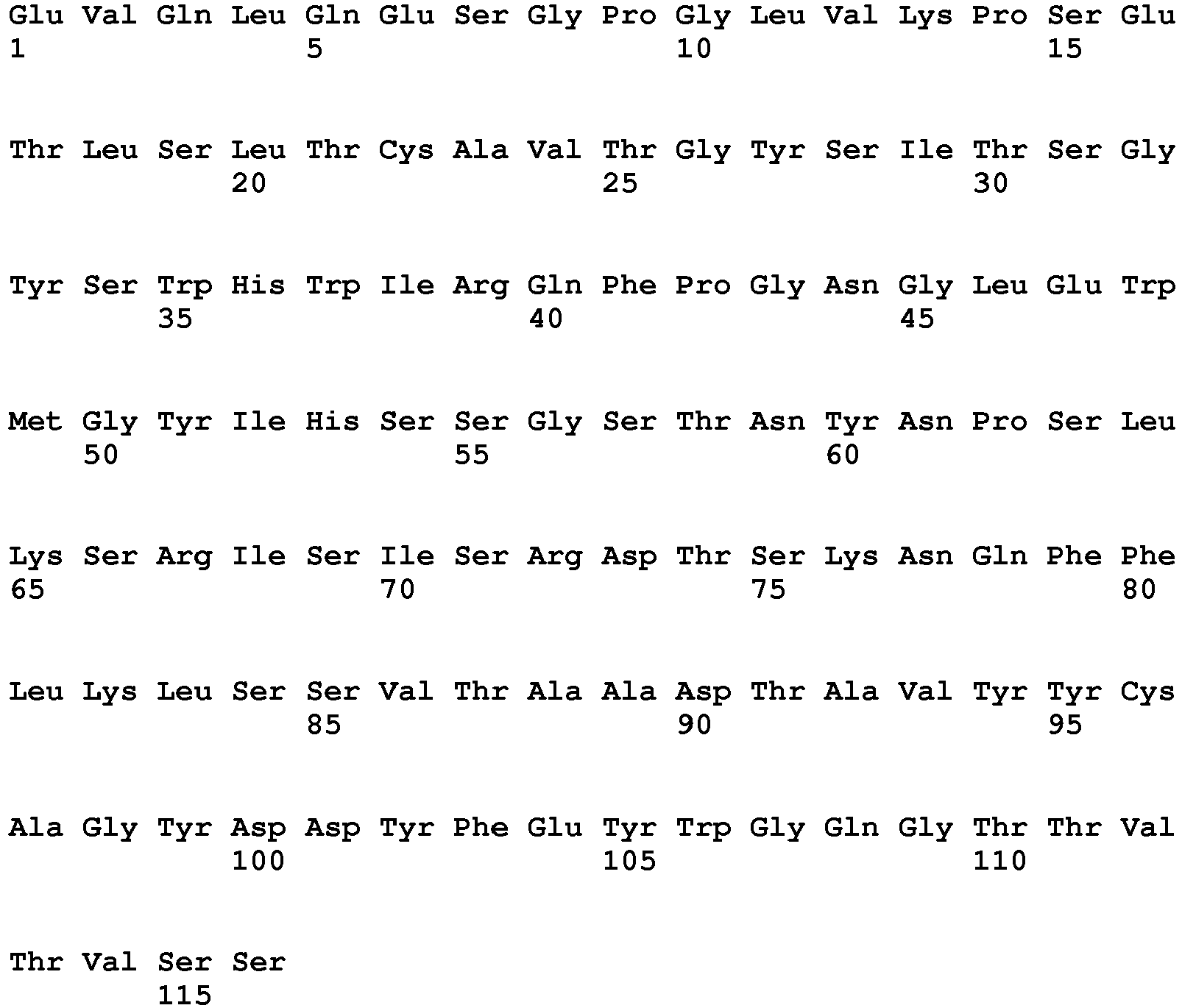
- <210> 148
<211> 116
<212> PRT
<213> Artificial Sequence - <220>
<223> Synthetic: huAb13VH.1b, huAb13v7, huAb13v8, and huAb13v9 VH amino acid sequence - <400> 148


- <210> 149
<211> 534
<212> PRT
<213> Homo sapiens - <220>
<221> misc_feature
<222> (1)..(534)
<223> B7-H3 amino acid sequence (human) - <400> 149


- <210> 150
<211> 692
<212> PRT
<213> Homo sapiens - <220>
<221> misc_feature
<222> (1)..(692)
<223> Human B7-H3-ECD (fc fusion) - <400> 150


- <210> 151
<211> 474
<212> PRT
<213> Mus musculus - <220>
<221> misc_feature
<222> (1)..(474)
<223> Mouse B7-H3-ECD (fc fusion) - <400> 151


- <210> 152
<211> 460
<212> PRT
<213> Homo sapiens - <220>
<221> misc_feature
<222> (1)..(460)
<223> Human B7-H3-ECD (his tag) - <400> 152


- <210> 153
<211> 241
<212> PRT
<213> Mus musculus - <220>
<221> misc_feature
<222> (1)..(241)
<223> Mouse B7-H3-ECD (his tag) - <400> 153


- <210> 154
<211> 473
<212> PRT
<213> Macaca fascicularis - <220>
<221> misc_feature
<222> (1)..(473)
<223> Cynomolgus B7-H3-ECD (his tag) - <400> 154

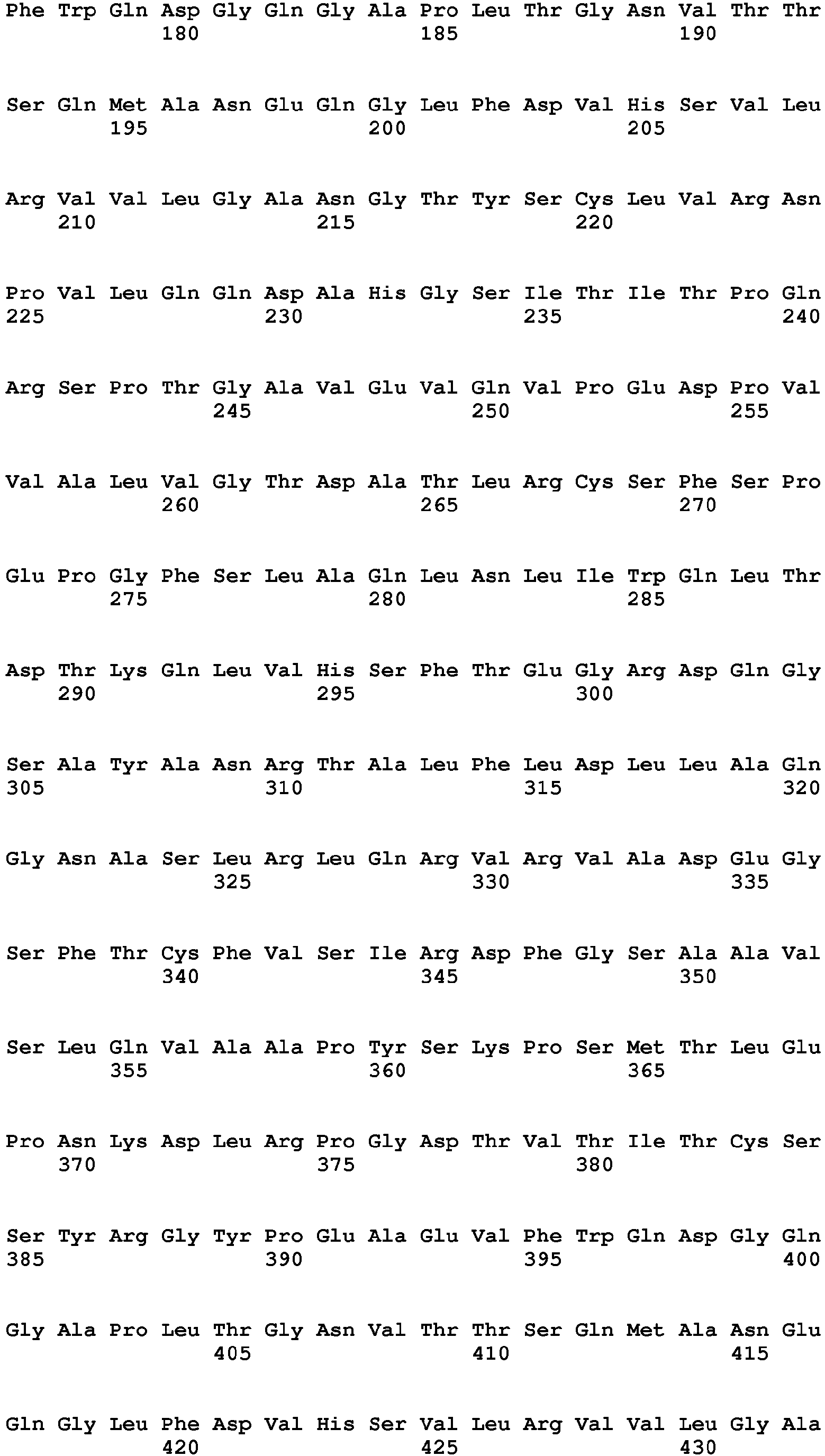

- <210> 155
<211> 98
<212> PRT
<213> Artificial Sequence - <220>
<223> Synthetic: Amino acid sequence of IGHV1-69*06 - <400> 155

- <210> 156
<211> 11
<212> PRT
<213> Artificial Sequence - <220>
<223> Synthetic: Amino acid sequence ofIGHJ6* 01 - <400> 156

- <210> 157
<211> 96
<212> PRT
<213> Artificial Sequence - <220>
<223> Synthetic: Amino acid sequence of IGKV1-9*01 - <400> 157

- <210> 158
<211> 10
<212> PRT
<213> Artificial Sequence - <220>
<223> Synthetic: Amino acid sequence ofIGKJ2* 01 - <400> 158

- <210> 159
<211> 330
<212> PRT
<213> Artificial Sequence - <220>
<223> Synthetic: Ig gamma-1 constant region - <400> 159


- <210> 160
<211> 330
<212> PRT
<213> Artificial Sequence - <220>
<223> Synthetic: Ig gamma-1 constant region mutant - <400> 160

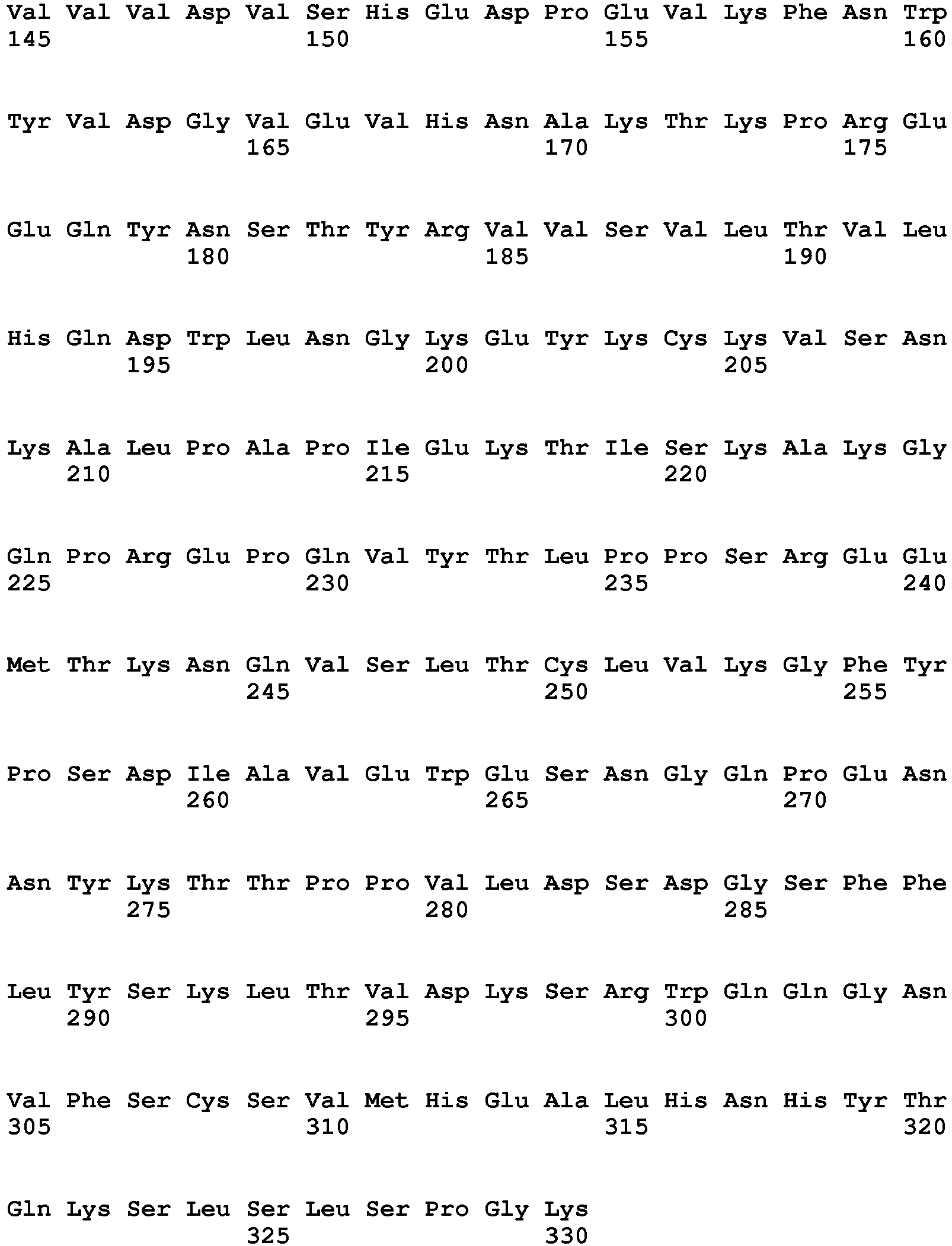
- <210> 161
<211> 107
<212> PRT
<213> Artificial Sequence - <220>
<223> Synthetic: Ig Kappa constant region - <400> 161


- <210> 162
<211> 105
<212> PRT
<213> Artificial Sequence - <220>
<223> Synthetic: Ig Lambda constant region - <400> 162

- <210> 163
<211> 96
<212> PRT
<213> Artificial Sequence - <220>
<223> Synthetic: Amino acid sequence of IGKV6-21*01 - <220>
<221> misc_feature
<222> (96)..(96)
<223> Xaa can be any naturally occurring amino acid - <400> 163

- <210> 164
<211> 101
<212> PRT
<213> Artificial Sequence - <220>
<223> Synthetic: Amino acid sequence of IGKV2-28*01 - <400> 164


- <210> 165
<211> 10
<212> PRT
<213> Artificial Sequence - <220>
<223> Synthetic: Amino acid sequence ofIGKJ4* 01 - <400> 165

- <210> 166
<211> 98
<212> PRT
<213> Artificial Sequence - <220>
<223> Synthetic: Amino acid sequence of IGHV-b*01(0-1) - <400> 166

- <210> 167
<211> 96
<212> PRT
<213> Artificial Sequence - <220>
<223> Synthetic: Amino acid sequence of IGKv1-39*01 - <400> 167

- <210> 168
<211> 446
<212> PRT
<213> Artificial Sequence - <220>
<223> Synthetic: Amino acid sequence of huAb13v1 heavy chain - <400> 168


- <210> 169
<211> 214
<212> PRT
<213> Artificial Sequence - <220>
<223> Synthetic: Amino acid sequence of huAb13v1 light chain - <400> 169


- <210> 170
<211> 447
<212> PRT
<213> Artificial Sequence - <220>
<223> Synthetic: Amino acid sequence of huAb3v2.5 heavy chain - <400> 170


- <210> 171
<211> 219
<212> PRT
<213> Artificial Sequence - <220>
<223> Synthetic: Amino acid sequence of huAb3v2.5 light chain - <400> 171


- <210> 172
<211> 447
<212> PRT
<213> Artificial Sequence - <220>
<223> Synthetic: Amino acid sequence of huAb3v2.6 heavy chain - <400> 172


- <210> 173
<211> 219
<212> PRT
<213> Artificial Sequence - <220>
<223> Synthetic: Amino acid sequence of huAb3v2.6 light chain - <400> 173


- <210> 174
<211> 117
<212> PRT
<213> Artificial Sequence - <220>
<223> Synthetic: IGHV1-69*06_IGHJ6 - <220>
<221> misc_feature
<222> (99)..(106)
<223> Xaa can be any naturally occurring amino acid; this section represents the CDR-H3 region - <400> 174


- <210> 175
<211> 112
<212> PRT
<213> Artificial Sequence - <220>
<223> Synthetic: IGKV2-28*01_IGKJ4 - <220>
<221> misc_feature
<222> (94)..(102)
<223> Xaa can be any naturally occurring amino acid ; this section represents the CDR-L3 region - <400> 175

- <210> 176
<211> 116
<212> PRT
<213> Artificial Sequence - <220>
<223> Synthetic: IGHV4-b_IGHJ6 - <220>
<221> misc_feature
<222> (99)..(105)
<223> Xaa can be any naturally occurring amino acid; this section represents the CDR-H3 region - <400> 176

- <210> 177
<211> 107
<212> PRT
<213> Artificial Sequence - <220>
<223> Synthetic: IGKV1-39_IGKJ2 - <220>
<221> misc_feature
<222> (89)..(97)
<223> Xaa can be any naturally occurring amino acid; this section represents the CDR-L3 region - <400> 177

- <210> 178
<211> 112
<212> PRT
<213> Artificial Sequence - <220>
<223> Synthetic: Amino acid sequence of huAb3 VL1 variants - <220>
<221> misc_feature
<222> (33)..(33)
<223> X can be any naturally occurring amino acid, except M, C, N, D or Q - <400> 178


- <210> 179
<211> 112
<212> PRT
<213> Artificial Sequence - <220>
<223> Synthetic: Amino acid sequence of huAb3 VL1 variants - <220>
<221> misc_feature
<222> (34)..(34)
<223> X can be any naturally occurring amino acid except M, C, G, S, N, or P - <400> 179

- <210> 180
<211> 117
<212> PRT
<213> Artificial Sequence - <220>
<223> Synthetic: Amino acid sequence of huAb3 VH1b variants - <220>
<221> misc_feature
<222> (54)..(54)
<223> X can be any naturally occurring amino acid, except M, C, N, D or Q - <400> 180

- <210> 181
<211> 117
<212> PRT
<213> Artificial Sequence - <220>
<223> Synthetic: Amino acid sequence of huAb3 VH1b variants - <220>
<221> misc_feature
<222> (55)..(55)
<223> X can be any naturally occurring amino acid except M, C, G, S, N, or P - <400> 181

- <210> 182
<211> 9
<212> PRT
<213> Artificial Sequence - <220>
<223> Synthetic: chAb13 VL CDR3 amino acid sequence - <400> 182

| SEQ ID NO: | Clone | Protein Region | Residues | Amino Acid Sequence |
| 131 | huAb3v2.1 | VH |  | |
| 10 | huAb3v2.1 | CDR-H1 | Residues 26-35 of SEQ ID NO:131 | GYTFSSYWMH |
| 132 | huAb3v2.1 | CDR-H2 | Residues 50-66 of SEQ ID NO:131 | LIHPWSGSTNYNEMFKN |
| 12 | huAb3v2.1 | CDR-H3 | Residues 99-106 of SEQ ID NO:131 | GGRLYFDY |
| 133 | huAb3v2.1 | VL |  | |
| 134 | huAb3v2.1 | CDR-L1 | Residues 24-39 of SEQ ID NO:133 | RSSQSLVHSSGDTYLR |
| 7 | huAb3v2.1 | CDR-L2 | Residues 55-61 of SEQ ID NO:133 | KVSNRFS |
| 15 | huAb3v2.1 | CDR-L3 | Residues 94-102 of SEQ ID NO:133 | SQSTHVPYT |
| 131 | huAb3v2.2 | VH |  | |
| 10 | huAb3v2.2 | CDR-H1 | Residues 26-35 of SEQ ID NO:131 | GYTFSSYWMH |
| 132 | huAb3v2.2 | CDR-H2 | Residues 50-66 of SEQ ID NO:131 | LIHPWSGSTNYNEMFKN |
| 12 | huAb3v2.2 | CDR-H3 | Residues 99-106 of SEQ ID NO:131 | GGRLYFDY |
| 135 | huAb3v2.2 | VL |  | |
| 136 | huAb3v2.2 | CDR-L1 | Residues 24-39 of SEQ ID NO:135 | RSSQSLVHSNRDTYLR |
| 7 | huAb3v2.2 | CDR-L2 | Residues 55-61 of SEQ ID NO:135 | KVSNRFS |
| 15 | huAb3v2.2 | CDR-L3 | Residues 94-102 of SEQ ID NO:135 | SQSTHVPYT |
| 131 | huAb3v2.3 | VH |  | |
| 10 | huAb3v2.3 | CDR-H1 | Residues 26-35 of SEQ ID NO:131 | GYTFSSYWMH |
| 132 | huAb3v2.3 | CDR-H2 | Residues 50-66 of SEQ ID NO:131 | LIHPWSGSTNYNEMFKN |
| 12 | huAb3v2.3 | CDR-H3 | Residues 99-106 of SEQ ID NO:131 | GGRLYFDY |
| 137 | huAb3v2.3 | VL |  | |
| 138 | huAb3v2.3 | CDR-L1 | Residues 24-39 of SEQ ID NO:137 | RSSQSLVHSNQDTYLR |
| 7 | huAb3v2.3 | CDR-L2 | Residues 55-61 of SEQ ID NO:137 | KVSNRFS |
| 15 | huAb3v2.3 | CDR-L3 | Residues 94-102 of SEQ ID NO:137 | SQSTHVPYT |
| 139 | huAb3v2.4 | VH |  | |
| 10 | huAb3v2.4 | CDR-H1 | Residues 26-35 of SEQ ID NO:139 | GYTFSSYWMH |
| 140 | huAb3v2.4 | CDR-H2 | Residues 50-66 of SEQ ID NO:139 | LIHPESGSTNYNEMFKN |
| 12 | huAb3v2.4 | CDR-H3 | Residues 99-106 of SEQ ID NO:139 | GGRLYFDY |
| 133 | huAb3v2.4 | VL |  | |
| 134 | huAb3v2.4 | CDR-L1 | Residues 24-39 of SEQ ID NO:133 | RSSQSLVHSSGDTYLR |
| 7 | huAb3v2.4 | CDR-L2 | Residues 55-61 of SEQ ID NO:133 | KVSNRFS |
| 15 | huAb3v2.4 | CDR-L3 | Residues 94-102 of SEQ ID NO:133 | SQSTHVPYT |
| 139 | huAb3v2.5 | VH |  | |
| 10 | huAb3v2.5 | CDR-H1 | Residues 26-35 of SEQ ID NO:139 | GYTFSSYWMH |
| 140 | huAb3v2.5 | CDR-H2 | Residues 50-66 of SEQ ID NO:139 | LIHPESGSTNYNEMFKN |
| 12 | huAb3v2.5 | CDR-H3 | Residues 99-106 of SEQ ID NO:139 | GGRLYFDY |
| 135 | huAb3v2.5 | VL |  | |
| 136 | huAb3v2.5 | CDR-L1 | Residues 24-39 of SEQ ID NO:135 | RSSQSLVHSNRDTYLR |
| 7 | huAb3v2.5 | CDR-L2 | Residues 55-61 of SEQ ID NO:135 | KVSNRFS |
| 15 | huAb3v2.5 | CDR-L3 | Residues 94-102 of SEQ ID NO:135 | SQSTHVPYT |
| 139 | huAb3v2.6 | VH | 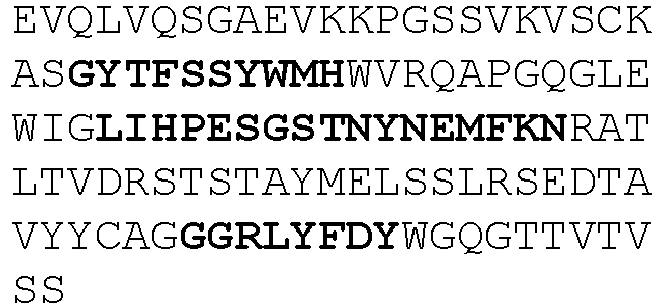 | |
| 10 | huAb3v2.6 | CDR-H1 | Residues 26-35 of SEQ ID NO:139 | GYTFSSYWMH |
| 140 | huAb3v2.6 | CDR-H2 | Residues 50-66 of SEQ ID NO:139 | LIHPESGSTNYNEMFKN |
| 12 | huAb3v2.6 | CDR-H3 | Residues 99-106 of SEQ ID NO:139 | GGRLYFDY |
| 137 | huAb3v2.6 | VL |  | |
| 138 | huAb3v2.6 | CDR-L1 | Residues 24-39 of SEQ ID NO:137 | RSSQSLVHSNQDTYLR |
| 7 | huAb3v2.6 | CDR-L2 | Residues 55-61 of SEQ ID NO:137 | KVSNRFS |
| 15 | huAb3v2.6 | CDR-L3 | Residues 94-102 of SEQ ID NO:137 | SQSTHVPYT |
| 141 | huAb3v2.7 |  | ||
| 10 | huAb3v2.7 | CDR-H1 | Residues 26-35 of SEQ ID NO:141 | GYTFSSYWMH |
| 142 | huAb3v2.7 | CDR-H2 | Residues 50-66 of SEQ ID NO:141 | LIHPISGSTNYNEMFKN |
| 12 | huAb3v2.7 | CDR-H3 | Residues 99-106 of SEQ ID NO:141 | GGRLYFDY |
| 133 | huAb3v2.7 |  | ||
| 134 | huAb3v2.7 | CDR-L1 | Residues 24-39 of SEQ ID NO:133 | RSSQSLVHSSGDTYLR |
| 7 | huAb3v2.7 | CDR-L2 | Residues 55-61 of SEQ ID NO:133 | KVSNRFS |
| 15 | huAb3v2.7 | CDR-L3 | Residues 94-102 of SEQ ID NO:133 | SQSTHVPYT |
| 141 | huAb3v2.8 | VH |  | |
| 10 | huAb3v2.8 | CDR-H1 | Residues 26-35 of SEQ ID NO:141 | GYTFSSYWMH |
| 142 | huAb3v2.8 | CDR-H2 | Residues 50-66 of SEQ ID NO:141 | LIHPISGSTNYNEMFKN |
| 12 | huAb3v2.8 | CDR-H3 | Residues 99-106 of SEQ ID NO:141 | GGRLYFDY |
| 135 | huAb3v2.8 | VL |  | |
| 136 | huAb3v2.8 | CDR-L1 | Residues 24-39 of SEQ ID NO:135 | RSSQSLVHSNRDTYLR |
| 7 | huAb3v2.8 | CDR-L2 | Residues 55-61 of SEQ ID NO:135 | KVSNRFS |
| 15 | huAb3v2.8 | CDR-L3 | Residues 94-102 of SEQ ID NO:135 | SQSTHVPYT |
| 141 | huAb3v2.9 | VH |  | |
| 10 | huAb3v2.9 | CDR-H1 | Residues 26-35 of SEQ ID NO:141 | GYTFSSYWMH |
| 142 | huAb3v2.9 | CDR-H2 | Residues 50-66 of SEQ ID NO:141 | LIHPISGSTNYNEMFKN |
| 12 | huAb3v2.9 | CDR-H3 | Residues 99-106 of SEQ ID NO:141 | GGRLYFDY |
| 137 | huAb3v2.9 | VL |  | |
| 138 | huAb3v2.9 | CDR-L1 | Residues 24-39 of SEQ ID NO:137 | RSSQSLVHSNQDTYLR |
| 7 | huAb3v2.9 | CDR-L2 | Residues 55-61 of SEQ ID NO:137 | KVSNRFS |
| 15 | huAb3v2.9 | CDR-L3 | Residues 94-102 of SEQ ID NO:137 | SQSTHVPYT |
Claims (3)
- An anti-human B7H3 (hB7-H3) antibody drug conjugate (ADC) comprising the following structure:
 a heavy chain CDR3 domain comprising the amino acid sequence set forth in SEQ ID NO: 35, a heavy chain CDR2 domain comprising the amino acid sequence set forth in SEQ ID NO: 34, and a heavy chain CDR1 domain comprising the amino acid sequence set forth in SEQ ID NO: 33; anda light chain CDR3 domain comprising the amino acid sequence set forth in SEQ ID NO: 39, a light chain CDR2 domain comprising the amino acid sequence set forth in SEQ ID NO: 38, and a light chain CDR1 domain comprising the amino acid sequence set forth in SEQ ID NO: 37.
 - An antibody-drug conjugate according to claim 1, wherein the antibody comprises a heavy chain variable region comprising SEQ ID NO: 147 and a light chain variable region comprising SEQ ID NO: 144.
- An antibody-drug conjugate according to claim 1, wherein the antibody comprises a heavy chain comprising SEQ ID NO: 168 and a light chain comprising SEQ ID NO: 169.
Priority Applications (6)
| Application Number | Priority Date | Filing Date | Title |
|---|---|---|---|
| SI201730623T SI3458479T1 (en) | 2016-06-08 | 2017-06-07 | Anti-b7-h3 antibodies and antibody drug conjugates |
| PL17732657T PL3458479T3 (en) | 2016-06-08 | 2017-06-07 | Anti-b7-h3 antibodies and antibody drug conjugates |
| HRP20210170TT HRP20210170T1 (en) | 2016-06-08 | 2017-06-07 | Anti-b7-h3 antibodies and antibody drug conjugates |
| EP24151653.3A EP4364754A3 (en) | 2016-06-08 | 2017-06-07 | Anti-b7-h3 antibodies and antibody drug conjugates |
| RS20210139A RS61828B1 (en) | 2016-06-08 | 2017-06-07 | Anti-b7-h3 antibodies and antibody drug conjugates |
| EP20198783.1A EP3835322A3 (en) | 2016-06-08 | 2017-06-07 | Anti-b7-h3 antibodies and antibody drug conjugates |
Applications Claiming Priority (3)
| Application Number | Priority Date | Filing Date | Title |
|---|---|---|---|
| US201662347476P | 2016-06-08 | 2016-06-08 | |
| US201662366511P | 2016-07-25 | 2016-07-25 | |
| PCT/US2017/036445 WO2017214335A1 (en) | 2016-06-08 | 2017-06-07 | Anti-b7-h3 antibodies and antibody drug conjugates |
Related Child Applications (3)
| Application Number | Title | Priority Date | Filing Date |
|---|---|---|---|
| EP20198783.1A Division EP3835322A3 (en) | 2016-06-08 | 2017-06-07 | Anti-b7-h3 antibodies and antibody drug conjugates |
| EP20198783.1A Division-Into EP3835322A3 (en) | 2016-06-08 | 2017-06-07 | Anti-b7-h3 antibodies and antibody drug conjugates |
| EP24151653.3A Division EP4364754A3 (en) | 2016-06-08 | 2017-06-07 | Anti-b7-h3 antibodies and antibody drug conjugates |
Publications (2)
| Publication Number | Publication Date |
|---|---|
| EP3458479A1 EP3458479A1 (en) | 2019-03-27 |
| EP3458479B1 true EP3458479B1 (en) | 2020-11-04 |
Family
ID=59153289
Family Applications (3)
| Application Number | Title | Priority Date | Filing Date |
|---|---|---|---|
| EP24151653.3A Withdrawn EP4364754A3 (en) | 2016-06-08 | 2017-06-07 | Anti-b7-h3 antibodies and antibody drug conjugates |
| EP20198783.1A Withdrawn EP3835322A3 (en) | 2016-06-08 | 2017-06-07 | Anti-b7-h3 antibodies and antibody drug conjugates |
| EP17732657.6A Active EP3458479B1 (en) | 2016-06-08 | 2017-06-07 | Anti-b7-h3 antibodies and antibody drug conjugates |
Family Applications Before (2)
| Application Number | Title | Priority Date | Filing Date |
|---|---|---|---|
| EP24151653.3A Withdrawn EP4364754A3 (en) | 2016-06-08 | 2017-06-07 | Anti-b7-h3 antibodies and antibody drug conjugates |
| EP20198783.1A Withdrawn EP3835322A3 (en) | 2016-06-08 | 2017-06-07 | Anti-b7-h3 antibodies and antibody drug conjugates |
Country Status (34)
| Country | Link |
|---|---|
| US (2) | US10640563B2 (en) |
| EP (3) | EP4364754A3 (en) |
| JP (2) | JP6751165B2 (en) |
| KR (1) | KR102434626B1 (en) |
| CN (2) | CN109963870B (en) |
| AU (2) | AU2017279550A1 (en) |
| CA (1) | CA3027045A1 (en) |
| CL (2) | CL2018003520A1 (en) |
| CO (1) | CO2018013471A2 (en) |
| CR (1) | CR20180603A (en) |
| CY (1) | CY1123783T1 (en) |
| DK (1) | DK3458479T3 (en) |
| DO (1) | DOP2018000276A (en) |
| EC (1) | ECSP19000282A (en) |
| ES (1) | ES2861499T3 (en) |
| HR (1) | HRP20210170T1 (en) |
| HU (1) | HUE053356T2 (en) |
| IL (2) | IL300274A (en) |
| LT (1) | LT3458479T (en) |
| MX (2) | MX2018015271A (en) |
| MY (1) | MY199278A (en) |
| PE (1) | PE20190177A1 (en) |
| PH (1) | PH12018502601A1 (en) |
| PL (1) | PL3458479T3 (en) |
| PT (1) | PT3458479T (en) |
| RS (1) | RS61828B1 (en) |
| RU (1) | RU2764651C2 (en) |
| SG (2) | SG10201914119TA (en) |
| SI (1) | SI3458479T1 (en) |
| TW (2) | TWI762487B (en) |
| UA (1) | UA124198C2 (en) |
| UY (1) | UY37278A (en) |
| WO (1) | WO2017214335A1 (en) |
| ZA (1) | ZA201900059B (en) |
Families Citing this family (50)
| Publication number | Priority date | Publication date | Assignee | Title |
|---|---|---|---|---|
| CA3027044A1 (en) * | 2016-06-08 | 2017-12-14 | Abbvie Inc. | Anti-b7-h3 antibodies and antibody drug conjugates |
| CN109963591B (en) * | 2017-08-04 | 2023-04-04 | 江苏恒瑞医药股份有限公司 | B7H3 antibody-drug conjugate and medical application thereof |
| WO2019225787A1 (en) | 2018-05-24 | 2019-11-28 | 에이비엘바이오 주식회사 | Anti-b7-h3 antibody and use thereof |
| SG11202011739SA (en) | 2018-05-29 | 2020-12-30 | Bristol Myers Squibb Co | Modified self-immolating moieties for use in prodrugs and conjugates and methods of using and making |
| US20210206859A1 (en) * | 2018-08-08 | 2021-07-08 | Dragonfly Therapeutics, Inc. | Proteins binding nkg2d, cd16 and a tumor-associated antigen |
| CN110950953B (en) * | 2018-09-26 | 2022-05-13 | 福州拓新天成生物科技有限公司 | Monoclonal antibody against B7-H3 and application thereof in cell therapy |
| KR20210084528A (en) * | 2018-10-26 | 2021-07-07 | 얀센 바이오테크 인코포레이티드 | Type I Interferon Signatures and Instructions for Use |
| WO2020102779A1 (en) * | 2018-11-16 | 2020-05-22 | Albert Einstein College Of Medicine | MONOCLONAL ANTIBODIES AGAINST IgV DOMAIN OF B7-H3 AND USES THEREOF |
| AU2018449846B2 (en) * | 2018-11-22 | 2023-12-14 | Beijing Kanova Biopharmaceutical Co., Ltd. | An anti-B7-H3 antibody |
| WO2020140094A1 (en) * | 2018-12-27 | 2020-07-02 | Gigagen, Inc. | Anti-b7-h3 binding proteins and methods of use thereof |
| CN109912718B (en) * | 2019-03-20 | 2020-12-11 | 北京善科生物科技有限公司 | Isolated binding proteins of the B7-H3 antigen binding domain, nucleic acids, vectors, CAR-T cells and uses thereof |
| CN111808057B (en) * | 2019-04-10 | 2023-05-09 | 四川大学 | Suzuki Reaction Using α-O-Alkenyl Sulfone as Electrophile and Its Application |
| CA3138058A1 (en) | 2019-05-20 | 2020-11-26 | Matthew T. Burger | Mcl-1 inhibitor antibody-drug conjugates and methods of use |
| JP2022537672A (en) * | 2019-07-03 | 2022-08-29 | クリスタル バイオサイエンス インコーポレイテッド | ANTI-B7-H3 ANTIBODY AND METHODS OF USE THEREOF |
| KR102732027B1 (en) * | 2019-07-09 | 2024-11-20 | 주식회사 와이바이오로직스 | Antibody specifically binding to B7-H3(CD276) and Use thereof |
| CN111454357B (en) * | 2019-08-14 | 2022-03-15 | 康诺亚生物医药科技(成都)有限公司 | Development and application of tumor therapeutic agent containing antibody |
| CN110893236A (en) * | 2019-10-09 | 2020-03-20 | 中山大学 | Lysosome-targeted antibody drug conjugate and application thereof |
| CN114929748A (en) * | 2019-11-18 | 2022-08-19 | 得克萨斯州大学系统董事会 | anti-B7-H3 monoclonal antibodies and methods of use thereof |
| US20250320269A1 (en) * | 2019-12-18 | 2025-10-16 | Albert Einstein College Of Medicine | Chimeric antigen receptors targeting b7-h3 (cd276) and associated methods |
| WO2021150792A1 (en) | 2020-01-21 | 2021-07-29 | Micurx Pharmaceuticals, Inc. | Novel compounds and composition for targeted therapy of kidney-associated cancers |
| CA3174665A1 (en) | 2020-04-09 | 2021-10-14 | Cytomx Therapeutics, Inc. | Compositions containing activatable antibodies |
| CN113527487A (en) * | 2020-04-22 | 2021-10-22 | 复星凯特生物科技有限公司 | Monoclonal antibody of anti-human B7-H3 and application thereof |
| AU2021297036A1 (en) * | 2020-06-26 | 2023-01-19 | Intocell, Inc. | Antibody-drug conjugates comprising anti-b7-h3 antibodies |
| CN112851812B (en) * | 2020-06-30 | 2021-09-14 | 广州百暨基因科技有限公司 | anti-B7H 3 antibodies and uses thereof |
| WO2022104692A1 (en) * | 2020-11-20 | 2022-05-27 | Bliss Biopharmaceutical (Hangzhou) Co., Ltd. | Engineered antibody, antibody-drug conjugate, and use thereof |
| AU2021386367A1 (en) | 2020-11-24 | 2023-06-22 | Les Laboratoires Servier | Bcl-xl inhibitor antibody-drug conjugates and methods of use thereof |
| JP7564958B2 (en) * | 2020-12-18 | 2024-10-09 | シャンハイ フダン-チャンジャン バイオ-ファーマシューティカル カンパニー リミテッド | Antibody-drug conjugates targeting B7-H3, methods of manufacture and uses thereof - Patents.com |
| JP2024500512A (en) * | 2020-12-23 | 2024-01-09 | イノベント バイオロジクス(シンガポール)プライベート リミティド | Anti-B7-H3 antibody and its use |
| CN114763381B (en) * | 2021-01-13 | 2025-01-28 | 博生吉医药科技(苏州)有限公司 | B7-H3 chimeric antigen receptor modified T cells and their applications |
| CN114763382B (en) * | 2021-01-13 | 2024-12-17 | 博生吉医药科技(苏州)有限公司 | Monoclonal antibody targeting human CD276 and application thereof |
| CN114763388B (en) * | 2021-01-13 | 2024-12-17 | 博生吉医药科技(苏州)有限公司 | B7-H3 targeted CAR-T cells and their use in the treatment of acute myeloid leukemia |
| AR124681A1 (en) | 2021-01-20 | 2023-04-26 | Abbvie Inc | ANTI-EGFR ANTIBODY-DRUG CONJUGATES |
| CN119504997A (en) * | 2021-02-09 | 2025-02-25 | 苏州宜联生物医药有限公司 | Bioactive substance conjugate and preparation method and use thereof |
| CN113358866B (en) * | 2021-04-22 | 2023-06-23 | 四川大学华西医院 | Homogeneous ultrasensitive two-dimensional visualization and fluorescence analysis method and application of tetanus antigen based on triple parallel hybridization chain reaction |
| US20240197904A1 (en) * | 2021-04-26 | 2024-06-20 | The Regents Of The University Of California | Combination therapy for treating glioblastoma |
| CN113274502B (en) * | 2021-05-05 | 2023-01-03 | 中山大学肿瘤防治中心(中山大学附属肿瘤医院、中山大学肿瘤研究所) | Compositions for specific type three-negative breast cancer immunotherapy |
| JP2024534661A (en) * | 2021-09-30 | 2024-09-20 | バイオ-テラ ソリュ-ションズ,エルティーディー. | Anti-B7-H3 antibody and its applications |
| US20250188167A1 (en) * | 2022-02-25 | 2025-06-12 | Nanjing Probio Biotech Co., Ltd. | Antibodies and variants thereof against human b7-h3 |
| CN115073311B (en) * | 2022-03-23 | 2023-05-23 | 河南大学 | A kind of synthetic method for efficiently preparing N,N'-bis(2 hydroxyethyl)aniline |
| CN119255824A (en) * | 2022-04-14 | 2025-01-03 | 德比欧药物研究有限公司 | Ligand-drug conjugates with improved pharmacokinetic and drug release properties |
| PE20251072A1 (en) | 2022-05-20 | 2025-04-10 | Novartis Ag | Antibody-drug conjugates of antineoplastic compounds and methods of using them |
| KR20250011947A (en) | 2022-05-20 | 2025-01-22 | 노파르티스 아게 | Antibody drug conjugate |
| CN118434454A (en) * | 2022-08-19 | 2024-08-02 | 北京三秀生物医药科技有限公司 | A prodrug for anti-aging related diseases and its use method |
| CN118105508A (en) * | 2022-11-29 | 2024-05-31 | 四川科伦博泰生物医药股份有限公司 | Drug linker compound and preparation method and use thereof |
| WO2024163499A1 (en) * | 2023-01-30 | 2024-08-08 | Board Of Regents, The University Of Texas System | Antibodies with selectivity for the 4ig isoform of b7-h3 and methods of use thereof |
| CN120752058A (en) | 2023-03-10 | 2025-10-03 | 诺华股份有限公司 | PanRAS inhibitor antibody-drug conjugates and methods of use thereof |
| DK4601703T3 (en) | 2023-04-18 | 2026-05-11 | Astrazeneca Ab | CONJUGATES COMPRISING CLEAVABLE LINKERS |
| US12624109B2 (en) | 2023-04-25 | 2026-05-12 | Targetthera Llc | αv-integrin targeted small molecule drug conjugates |
| AU2024332119A1 (en) * | 2023-08-25 | 2026-03-12 | Macrogenics, Inc. | B7-h3 antibody-drug conjugates |
| WO2026082020A1 (en) * | 2024-10-15 | 2026-04-23 | 一线医药(杭州)有限公司 | Bispecific antibody, antibody-drug conjugate, and application thereof |
Family Cites Families (264)
| Publication number | Priority date | Publication date | Assignee | Title |
|---|---|---|---|---|
| US1726514A (en) | 1926-11-01 | 1929-08-27 | Firm Ferd Liebschner & Sohn | Picker for looms |
| US4444887A (en) | 1979-12-10 | 1984-04-24 | Sloan-Kettering Institute | Process for making human antibody producing B-lymphocytes |
| US4399216A (en) | 1980-02-25 | 1983-08-16 | The Trustees Of Columbia University | Processes for inserting DNA into eucaryotic cells and for producing proteinaceous materials |
| US4634665A (en) | 1980-02-25 | 1987-01-06 | The Trustees Of Columbia University In The City Of New York | Processes for inserting DNA into eucaryotic cells and for producing proteinaceous materials |
| US5179017A (en) | 1980-02-25 | 1993-01-12 | The Trustees Of Columbia University In The City Of New York | Processes for inserting DNA into eucaryotic cells and for producing proteinaceous materials |
| US4434150A (en) | 1981-10-19 | 1984-02-28 | Ortho Diagnostic Systems, Inc. | Immunological reagents employing polymeric backbone possessing reactive functional groups |
| DE3378250D1 (en) | 1982-04-22 | 1988-11-24 | Ici Plc | Continuous release formulations |
| US4716111A (en) | 1982-08-11 | 1987-12-29 | Trustees Of Boston University | Process for producing human antibodies |
| US4510245A (en) | 1982-11-18 | 1985-04-09 | Chiron Corporation | Adenovirus promoter system |
| US4486414A (en) | 1983-03-21 | 1984-12-04 | Arizona Board Of Reagents | Dolastatins A and B cell growth inhibitory substances |
| GB8308235D0 (en) | 1983-03-25 | 1983-05-05 | Celltech Ltd | Polypeptides |
| US4816567A (en) | 1983-04-08 | 1989-03-28 | Genentech, Inc. | Recombinant immunoglobin preparations |
| US5807715A (en) | 1984-08-27 | 1998-09-15 | The Board Of Trustees Of The Leland Stanford Junior University | Methods and transformed mammalian lymphocyte cells for producing functional antigen-binding protein including chimeric immunoglobulin |
| US5128326A (en) | 1984-12-06 | 1992-07-07 | Biomatrix, Inc. | Drug delivery systems based on hyaluronans derivatives thereof and their salts and methods of producing same |
| US5168062A (en) | 1985-01-30 | 1992-12-01 | University Of Iowa Research Foundation | Transfer vectors and microorganisms containing human cytomegalovirus immediate-early promoter-regulatory DNA sequence |
| DE3546807C2 (en) | 1985-03-30 | 1991-03-28 | Marc Genf/Geneve Ch Ballivet | |
| US6492107B1 (en) | 1986-11-20 | 2002-12-10 | Stuart Kauffman | Process for obtaining DNA, RNA, peptides, polypeptides, or protein, by recombinant DNA technique |
| US4980286A (en) | 1985-07-05 | 1990-12-25 | Whitehead Institute For Biomedical Research | In vivo introduction and expression of foreign genetic material in epithelial cells |
| US4676980A (en) | 1985-09-23 | 1987-06-30 | The United States Of America As Represented By The Secretary Of The Department Of Health And Human Services | Target specific cross-linked heteroantibodies |
| US5618920A (en) | 1985-11-01 | 1997-04-08 | Xoma Corporation | Modular assembly of antibody genes, antibodies prepared thereby and use |
| US4968615A (en) | 1985-12-18 | 1990-11-06 | Ciba-Geigy Corporation | Deoxyribonucleic acid segment from a virus |
| DE3600905A1 (en) | 1986-01-15 | 1987-07-16 | Ant Nachrichtentech | METHOD FOR DECODING BINARY SIGNALS AND VITERBI DECODERS AND APPLICATIONS |
| GB8607679D0 (en) | 1986-03-27 | 1986-04-30 | Winter G P | Recombinant dna product |
| US5225539A (en) | 1986-03-27 | 1993-07-06 | Medical Research Council | Recombinant altered antibodies and methods of making altered antibodies |
| US4880935A (en) | 1986-07-11 | 1989-11-14 | Icrf (Patents) Limited | Heterobifunctional linking agents derived from N-succinimido-dithio-alpha methyl-methylene-benzoates |
| FR2601675B1 (en) | 1986-07-17 | 1988-09-23 | Rhone Poulenc Sante | TAXOL DERIVATIVES, THEIR PREPARATION AND THE PHARMACEUTICAL COMPOSITIONS CONTAINING THEM |
| EP0307434B2 (en) | 1987-03-18 | 1998-07-29 | Scotgen Biopharmaceuticals, Inc. | Altered antibodies |
| US4880078A (en) | 1987-06-29 | 1989-11-14 | Honda Giken Kogyo Kabushiki Kaisha | Exhaust muffler |
| US4816444A (en) | 1987-07-10 | 1989-03-28 | Arizona Board Of Regents, Arizona State University | Cell growth inhibitory substance |
| US5770701A (en) | 1987-10-30 | 1998-06-23 | American Cyanamid Company | Process for preparing targeted forms of methyltrithio antitumor agents |
| US5606040A (en) | 1987-10-30 | 1997-02-25 | American Cyanamid Company | Antitumor and antibacterial substituted disulfide derivatives prepared from compounds possessing a methyl-trithio group |
| FI102355B1 (en) | 1988-02-11 | 1998-11-30 | Bristol Myers Squibb Co | Process for Preparation of Anthracycline Immunoconjugates with a Linking Link |
| US4942184A (en) | 1988-03-07 | 1990-07-17 | The United States Of America As Represented By The Department Of Health And Human Services | Water soluble, antineoplastic derivatives of taxol |
| US5157049A (en) | 1988-03-07 | 1992-10-20 | The United States Of America As Represented By The Department Of Health & Human Services | Method of treating cancers sensitive to treatment with water soluble derivatives of taxol |
| ATE120454T1 (en) | 1988-06-14 | 1995-04-15 | Cetus Oncology Corp | COUPLING AGENT AND STERICALLY HINDERED CONJUGATES THEREOF BOUND WITH DISULFIDE. |
| US5076973A (en) | 1988-10-24 | 1991-12-31 | Arizona Board Of Regents | Synthesis of dolastatin 3 |
| ES2052027T5 (en) | 1988-11-11 | 2005-04-16 | Medical Research Council | IMMUNOGLOBULINE VARIABLE DOMAIN SEQUENCE CLONING. |
| US5530101A (en) | 1988-12-28 | 1996-06-25 | Protein Design Labs, Inc. | Humanized immunoglobulins |
| US4978744A (en) | 1989-01-27 | 1990-12-18 | Arizona Board Of Regents | Synthesis of dolastatin 10 |
| US4960790A (en) | 1989-03-09 | 1990-10-02 | University Of Kansas | Derivatives of taxol, pharmaceutical compositions thereof and methods for the preparation thereof |
| CA2016841C (en) | 1989-05-16 | 1999-09-21 | William D. Huse | A method for producing polymers having a preselected activity |
| EP0478627A4 (en) | 1989-05-16 | 1992-08-19 | William D. Huse | Co-expression of heteromeric receptors |
| CA2016842A1 (en) | 1989-05-16 | 1990-11-16 | Richard A. Lerner | Method for tapping the immunological repertoire |
| US4879278A (en) | 1989-05-16 | 1989-11-07 | Arizona Board Of Regents | Isolation and structural elucidation of the cytostatic linear depsipeptide dolastatin 15 |
| US4986988A (en) | 1989-05-18 | 1991-01-22 | Arizona Board Of Regents | Isolation and structural elucidation of the cytostatic linear depsipeptides dolastatin 13 and dehydrodolastatin 13 |
| US5413923A (en) | 1989-07-25 | 1995-05-09 | Cell Genesys, Inc. | Homologous recombination for universal donor cells and chimeric mammalian hosts |
| AU6430190A (en) | 1989-10-10 | 1991-05-16 | Pitman-Moore, Inc. | Sustained release composition for macromolecular proteins |
| US5208020A (en) | 1989-10-25 | 1993-05-04 | Immunogen Inc. | Cytotoxic agents comprising maytansinoids and their therapeutic use |
| WO1991006287A1 (en) | 1989-11-06 | 1991-05-16 | Enzytech, Inc. | Protein microspheres and methods of using them |
| US5138036A (en) | 1989-11-13 | 1992-08-11 | Arizona Board Of Regents Acting On Behalf Of Arizona State University | Isolation and structural elucidation of the cytostatic cyclodepsipeptide dolastatin 14 |
| GB8928874D0 (en) | 1989-12-21 | 1990-02-28 | Celltech Ltd | Humanised antibodies |
| ES2284161T3 (en) | 1990-01-12 | 2007-11-01 | Amgen Fremont Inc. | GENERATION OF XENOGENIC ANTIBODIES. |
| US5124471A (en) | 1990-03-26 | 1992-06-23 | The United States Of America As Represented By The Secretary Of The Department Of Health And Human Services | Bifunctional dtpa-type ligand |
| US5407683A (en) | 1990-06-01 | 1995-04-18 | Research Corporation Technologies, Inc. | Pharmaceutical solutions and emulsions containing taxol |
| GB9015198D0 (en) | 1990-07-10 | 1990-08-29 | Brien Caroline J O | Binding substance |
| DE69130647T2 (en) | 1990-08-24 | 1999-05-06 | Ixsys, Inc., San Diego, Calif. | METHOD FOR PRODUCING OLIGONUCLEOTIDES WITH REGULAR CODONES |
| US5278324A (en) | 1990-08-28 | 1994-01-11 | Virginia Tech Intellectual Properties, Inc. | Water soluble derivatives of taxol |
| US5661016A (en) | 1990-08-29 | 1997-08-26 | Genpharm International Inc. | Transgenic non-human animals capable of producing heterologous antibodies of various isotypes |
| US5545806A (en) | 1990-08-29 | 1996-08-13 | Genpharm International, Inc. | Ransgenic non-human animals for producing heterologous antibodies |
| AU8507191A (en) | 1990-08-29 | 1992-03-30 | Genpharm International, Inc. | Transgenic non-human animals capable of producing heterologous antibodies |
| US5814318A (en) | 1990-08-29 | 1998-09-29 | Genpharm International Inc. | Transgenic non-human animals for producing heterologous antibodies |
| US5625126A (en) | 1990-08-29 | 1997-04-29 | Genpharm International, Inc. | Transgenic non-human animals for producing heterologous antibodies |
| US5633425A (en) | 1990-08-29 | 1997-05-27 | Genpharm International, Inc. | Transgenic non-human animals capable of producing heterologous antibodies |
| DE69131017T2 (en) | 1990-12-20 | 1999-07-15 | Ixsys, Inc., San Diego, Calif. | OPTIMIZATION OF BINDING PROTEINS |
| US5399363A (en) | 1991-01-25 | 1995-03-21 | Eastman Kodak Company | Surface modified anticancer nanoparticles |
| ATE221379T1 (en) | 1991-05-01 | 2002-08-15 | Jackson H M Found Military Med | METHOD FOR TREATING INFECTIOUS RESPIRATORY DISEASES |
| DE69233482T2 (en) | 1991-05-17 | 2006-01-12 | Merck & Co., Inc. | Method for reducing the immunogenicity of antibody variable domains |
| US6287792B1 (en) | 1991-06-17 | 2001-09-11 | The Regents Of The University Of California | Drug delivery of antisense oligonucleotides and peptides to tissues in vivo and to cells using avidin-biotin technology |
| FR2678833B1 (en) | 1991-07-08 | 1995-04-07 | Rhone Poulenc Rorer Sa | NEW PHARMACEUTICAL COMPOSITIONS BASED ON DERIVATIVES OF THE TAXANE CLASS. |
| MX9204374A (en) | 1991-07-25 | 1993-03-01 | Idec Pharma Corp | RECOMBINANT ANTIBODY AND METHOD FOR ITS PRODUCTION. |
| US5565332A (en) | 1991-09-23 | 1996-10-15 | Medical Research Council | Production of chimeric antibodies - a combinatorial approach |
| EP0605522B1 (en) | 1991-09-23 | 1999-06-23 | Medical Research Council | Methods for the production of humanized antibodies |
| PT1696031E (en) | 1991-12-02 | 2010-06-25 | Medical Res Council | Production of anti-self antibodies from antibody segment repertoires and displayed on phage |
| GB9126094D0 (en) | 1991-12-09 | 1992-02-12 | Immune Systems Ltd | In vitro antibody production |
| JP4157160B2 (en) | 1991-12-13 | 2008-09-24 | ゾーマ テクノロジー リミテッド | Methods for the preparation of modified antibody variable regions |
| US5622929A (en) | 1992-01-23 | 1997-04-22 | Bristol-Myers Squibb Company | Thioether conjugates |
| GB9201755D0 (en) | 1992-01-28 | 1992-03-11 | British Bio Technology | Compounds |
| US5714350A (en) | 1992-03-09 | 1998-02-03 | Protein Design Labs, Inc. | Increasing antibody affinity by altering glycosylation in the immunoglobulin variable region |
| US5912015A (en) | 1992-03-12 | 1999-06-15 | Alkermes Controlled Therapeutics, Inc. | Modulated release from biocompatible polymers |
| DE69329073T2 (en) | 1992-03-23 | 2001-01-18 | Georgetown University, Washington | TAXOL ENCLOSED IN LIPOSOMES AND METHOD OF USE |
| ZA932522B (en) | 1992-04-10 | 1993-12-20 | Res Dev Foundation | Immunotoxins directed against c-erbB-2(HER/neu) related surface antigens |
| GB9213077D0 (en) | 1992-06-19 | 1992-08-05 | Erba Carlo Spa | Polymerbound taxol derivatives |
| CA2086874E (en) | 1992-08-03 | 2000-01-04 | Renzo Mauro Canetta | Methods for administration of taxol |
| US5639641A (en) | 1992-09-09 | 1997-06-17 | Immunogen Inc. | Resurfacing of rodent antibodies |
| FR2696458B1 (en) | 1992-10-05 | 1994-11-10 | Rhone Poulenc Rorer Sa | Process for the preparation of taxane derivatives. |
| FR2697752B1 (en) | 1992-11-10 | 1995-04-14 | Rhone Poulenc Rorer Sa | Antitumor compositions containing taxane derivatives. |
| FR2698543B1 (en) | 1992-12-02 | 1994-12-30 | Rhone Poulenc Rorer Sa | New taxoid-based compositions. |
| US5635483A (en) | 1992-12-03 | 1997-06-03 | Arizona Board Of Regents Acting On Behalf Of Arizona State University | Tumor inhibiting tetrapeptide bearing modified phenethyl amides |
| US6034065A (en) | 1992-12-03 | 2000-03-07 | Arizona Board Of Regents | Elucidation and synthesis of antineoplastic tetrapeptide phenethylamides of dolastatin 10 |
| US5380751A (en) | 1992-12-04 | 1995-01-10 | Bristol-Myers Squibb Company | 6,7-modified paclitaxels |
| US5410024A (en) | 1993-01-21 | 1995-04-25 | Arizona Board Of Regents Acting On Behalf Of Arizona State University | Human cancer inhibitory pentapeptide amides |
| US5780588A (en) | 1993-01-26 | 1998-07-14 | Arizona Board Of Regents | Elucidation and synthesis of selected pentapeptides |
| US5750106A (en) | 1993-01-28 | 1998-05-12 | Novartis Ag | Human monoclonal antibodies to cytomegalovirus |
| WO1994016729A1 (en) | 1993-01-28 | 1994-08-04 | Neorx Corporation | Targeted nitric oxide pathway or nitric oxide synthase modulation |
| US5934272A (en) | 1993-01-29 | 1999-08-10 | Aradigm Corporation | Device and method of creating aerosolized mist of respiratory drug |
| WO1994018219A1 (en) | 1993-02-02 | 1994-08-18 | The Scripps Research Institute | Methods for producing antibody libraries using universal or randomized immunoglobulin light chains |
| US5433364A (en) | 1993-02-19 | 1995-07-18 | Dynetics Engineering Corporation | Card package production system with burster and carrier verification apparatus |
| US6214345B1 (en) | 1993-05-14 | 2001-04-10 | Bristol-Myers Squibb Co. | Lysosomal enzyme-cleavable antitumor drug conjugates |
| US5415869A (en) | 1993-11-12 | 1995-05-16 | The Research Foundation Of State University Of New York | Taxol formulation |
| WO1995015770A1 (en) | 1993-12-09 | 1995-06-15 | Neorx Corporation | Pretargeting methods and compounds |
| US5773001A (en) | 1994-06-03 | 1998-06-30 | American Cyanamid Company | Conjugates of methyltrithio antitumor agents and intermediates for their synthesis |
| IT1275043B (en) | 1994-07-21 | 1997-07-29 | Agerbioss Snc Di Zanin R & C | METHOD AND RELATED PRODUCT FOR THE DEFENSE OF PLANTS FROM VEGETABLE PARASITES |
| US5521284A (en) | 1994-08-01 | 1996-05-28 | Arizona Board Of Regents Acting On Behalf Of Arizona State University | Human cancer inhibitory pentapeptide amides and esters |
| US5504191A (en) | 1994-08-01 | 1996-04-02 | Arizona Board Of Regents Acting On Behalf Of Arizona State University | Human cancer inhibitory pentapeptide methyl esters |
| US5530097A (en) | 1994-08-01 | 1996-06-25 | Arizona Board Of Regents Acting On Behalf Of Arizona State University | Human cancer inhibitory peptide amides |
| US5554725A (en) | 1994-09-14 | 1996-09-10 | Arizona Board Of Regents Acting On Behalf Of Arizona State University | Synthesis of dolastatin 15 |
| US5599902A (en) | 1994-11-10 | 1997-02-04 | Arizona Board Of Regents Acting On Behalf Of Arizona State University | Cancer inhibitory peptides |
| US5663149A (en) | 1994-12-13 | 1997-09-02 | Arizona Board Of Regents Acting On Behalf Of Arizona State University | Human cancer inhibitory pentapeptide heterocyclic and halophenyl amides |
| ATE252894T1 (en) | 1995-01-05 | 2003-11-15 | Univ Michigan | SURFACE-MODIFIED NANOPARTICLES AND METHODS FOR THEIR PRODUCTION AND USE |
| US5840929A (en) | 1995-04-14 | 1998-11-24 | Bristol-Myers Squibb Company | C4 methoxy ether derivatives of paclitaxel |
| US6019968A (en) | 1995-04-14 | 2000-02-01 | Inhale Therapeutic Systems, Inc. | Dispersible antibody compositions and methods for their preparation and use |
| EP0822830B1 (en) | 1995-04-27 | 2008-04-02 | Amgen Fremont Inc. | Human anti-IL-8 antibodies, derived from immunized xenomice |
| US5705503A (en) | 1995-05-25 | 1998-01-06 | Goodall; Brian Leslie | Addition polymers of polycycloolefins containing functional substituents |
| US5712374A (en) | 1995-06-07 | 1998-01-27 | American Cyanamid Company | Method for the preparation of substantiallly monomeric calicheamicin derivative/carrier conjugates |
| US5714586A (en) | 1995-06-07 | 1998-02-03 | American Cyanamid Company | Methods for the preparation of monomeric calicheamicin derivative/carrier conjugates |
| US6127977A (en) | 1996-11-08 | 2000-10-03 | Cohen; Nathan | Microstrip patch antenna with fractal structure |
| AU710347B2 (en) | 1995-08-31 | 1999-09-16 | Alkermes Controlled Therapeutics, Inc. | Composition for sustained release of an agent |
| US6090382A (en) | 1996-02-09 | 2000-07-18 | Basf Aktiengesellschaft | Human antibodies that bind human TNFα |
| US6331431B1 (en) | 1995-11-28 | 2001-12-18 | Ixsys, Inc. | Vacuum device and method for isolating periplasmic fraction from cells |
| EP0871490B1 (en) | 1995-12-22 | 2003-03-19 | Bristol-Myers Squibb Company | Branched hydrazone linkers |
| HU230048B1 (en) | 1996-02-09 | 2015-06-29 | Abbvie Biotechnology Ltd | Use of human tnf-alpha binding antibodies |
| EP0881299A4 (en) * | 1996-02-15 | 2004-12-15 | Chugai Seiyakukabushiki Kaisha | MONOCLONAL ANTIBODIES RECOGNIZING ANTIGENS PRESENT ON THE SURFACE OF ENDOTHELIAL CELLS OF A TUMOR VESSEL |
| IT1282692B1 (en) | 1996-02-27 | 1998-03-31 | San Raffaele Centro Fond | CYTOKINES MODIFIED FOR THERAPY USE |
| AU2063197A (en) | 1996-03-04 | 1997-09-22 | Massachusetts Institute Of Technology | Materials and methods for enhancing cellular internalization |
| US5714352A (en) | 1996-03-20 | 1998-02-03 | Xenotech Incorporated | Directed switch-mediated DNA recombination |
| US5855913A (en) | 1997-01-16 | 1999-01-05 | Massachusetts Instite Of Technology | Particles incorporating surfactants for pulmonary drug delivery |
| US5985309A (en) | 1996-05-24 | 1999-11-16 | Massachusetts Institute Of Technology | Preparation of particles for inhalation |
| US5874064A (en) | 1996-05-24 | 1999-02-23 | Massachusetts Institute Of Technology | Aerodynamically light particles for pulmonary drug delivery |
| US5821263A (en) | 1996-08-26 | 1998-10-13 | Bristol-Myers Squibb Company | Sulfenamide taxane derivatives |
| US5773464A (en) | 1996-09-30 | 1998-06-30 | Bristol-Myers Squibb Company | C-10 epoxy taxanes |
| US5916771A (en) | 1996-10-11 | 1999-06-29 | Abgenix, Inc. | Production of a multimeric protein by cell fusion method |
| WO1998022451A1 (en) | 1996-11-19 | 1998-05-28 | Daiichi Pharmaceutical Co., Ltd. | Taxol derivatives |
| ATE549918T1 (en) | 1996-12-03 | 2012-04-15 | Amgen Fremont Inc | HUMAN ANTIBODIES THAT EXPRESSLY BIND HUMAN TNF ALPHA |
| US5977386A (en) | 1996-12-24 | 1999-11-02 | Bristol-Myers Squibb Company | 6-thio-substituted paclitaxels |
| ES2236832T3 (en) | 1997-01-16 | 2005-07-16 | Massachusetts Institute Of Technology | PREPARATION OF PARTICLES FOR INHALATION. |
| AU750451B2 (en) | 1997-02-13 | 2002-07-18 | Bone Care International, Inc. | Targeted therapeutic delivery of vitamin D compounds |
| EP0973540B1 (en) | 1997-02-25 | 2005-11-02 | Arizona Board Of Regents | Isolation and structural elucidation of the cytostatic linear and cyclo-depsipeptides dolastatin 16, dolastatin 17, and dolastatin 18 |
| TR199902553T2 (en) | 1997-04-14 | 2000-03-21 | Micromet Gesellschaft F�R Biomedizinische Forschung Mbh | New methods and uses for the production of antigen receptors against the human body. |
| US6235883B1 (en) | 1997-05-05 | 2001-05-22 | Abgenix, Inc. | Human monoclonal antibodies to epidermal growth factor receptor |
| AU8691398A (en) | 1997-08-04 | 1999-02-22 | Ixsys, Incorporated | Methods for identifying ligand specific binding molecules |
| US7288665B1 (en) | 1997-08-18 | 2007-10-30 | Florida State University | Process for selective derivatization of taxanes |
| JPH1192468A (en) | 1997-09-17 | 1999-04-06 | Yakult Honsha Co Ltd | New taxane derivatives |
| US5989463A (en) | 1997-09-24 | 1999-11-23 | Alkermes Controlled Therapeutics, Inc. | Methods for fabricating polymer-based controlled release devices |
| JP4153660B2 (en) | 1997-10-08 | 2008-09-24 | 株式会社横浜国際バイオ研究所 | Taxoid derivative and method for producing the same |
| US6555367B1 (en) | 1997-10-10 | 2003-04-29 | The United States Of America As Represented By The Department Of Health And Human Services | Complex of biotinylated viral vector and ligand for targeted gene delivery |
| SE512663C2 (en) | 1997-10-23 | 2000-04-17 | Biogram Ab | Active substance encapsulation process in a biodegradable polymer |
| AU3657899A (en) | 1998-04-20 | 1999-11-08 | James E. Bailey | Glycosylation engineering of antibodies for improving antibody-dependent cellular cytotoxicity |
| CA2336139C (en) | 1998-06-24 | 2008-10-14 | Advanced Inhalation Research, Inc. | Large porous particles emitted from an inhaler |
| AU2472400A (en) | 1998-10-20 | 2000-05-08 | City Of Hope | CD20-specific redirected T cells and their use in cellular immunotherapy of CD20+ malignancies |
| US6660843B1 (en) | 1998-10-23 | 2003-12-09 | Amgen Inc. | Modified peptides as therapeutic agents |
| PT1176195E (en) | 1999-04-09 | 2013-07-18 | Kyowa Hakko Kirin Co Ltd | Method for controlling the activity of immunologically functional molecule |
| AU6186900A (en) | 1999-07-31 | 2001-02-19 | Kyu Jin Park | Study method and apparatus using digital audio and caption data |
| US6323315B1 (en) | 1999-09-10 | 2001-11-27 | Basf Aktiengesellschaft | Dolastatin peptides |
| AU2001271273A1 (en) | 2000-05-24 | 2001-12-03 | Ludwig Institute For Cancer Research | Multicomponent conjugates which bind to target molecules and stimulate cell lysis |
| US7449308B2 (en) | 2000-06-28 | 2008-11-11 | Glycofi, Inc. | Combinatorial DNA library for producing modified N-glycans in lower eukaryotes |
| ATE440959T1 (en) | 2000-06-28 | 2009-09-15 | Glycofi Inc | METHOD FOR PRODUCING MODIFIED GLYCOPROTEINS |
| EP1243276A1 (en) | 2001-03-23 | 2002-09-25 | Franciscus Marinus Hendrikus De Groot | Elongated and multiple spacers containing activatible prodrugs |
| US6884869B2 (en) | 2001-04-30 | 2005-04-26 | Seattle Genetics, Inc. | Pentapeptide compounds and uses related thereto |
| US20030083263A1 (en) | 2001-04-30 | 2003-05-01 | Svetlana Doronina | Pentapeptide compounds and uses related thereto |
| US20100056762A1 (en) | 2001-05-11 | 2010-03-04 | Old Lloyd J | Specific binding proteins and uses thereof |
| US6441163B1 (en) | 2001-05-31 | 2002-08-27 | Immunogen, Inc. | Methods for preparation of cytotoxic conjugates of maytansinoids and cell binding agents |
| CA2451998A1 (en) | 2001-08-17 | 2003-02-27 | Eli Lilly And Company | Anti-a.beta. antibodies |
| KR100988949B1 (en) | 2001-10-25 | 2010-10-20 | 제넨테크, 인크. | Glycoprotein Composition |
| US20040028687A1 (en) | 2002-01-15 | 2004-02-12 | Waelti Ernst Rudolf | Methods and compositions for the targeted delivery of therapeutic substances to specific cells and tissues |
| EP1497466A4 (en) | 2002-05-01 | 2007-11-14 | Trellis Bioscience Inc | METHOD AND SYSTEM FOR MULTI-COMPONENT TARGETING |
| ATE488530T1 (en) * | 2002-06-19 | 2010-12-15 | Raven Biotechnologies Inc | INTERNALIZING ANTIBODIES SPECIFIC TO THE RAAG10 CELL SURFACE TARGET |
| ES2544527T3 (en) | 2002-07-31 | 2015-09-01 | Seattle Genetics, Inc. | Drug conjugates and their use to treat cancer, an autoimmune disease or an infectious disease |
| ES2361739T3 (en) | 2002-08-16 | 2011-06-21 | Immunogen, Inc. | RETICULANTS WITH HIGH REACTIVITY AND SOLUBILITY AND ITS USE IN THE PREPARATION OF CONJUGATES FOR THE DIRECTED SUPPLY OF DRUGS OF SMALL MOLECULE. |
| US20050271615A1 (en) | 2002-08-30 | 2005-12-08 | Doron Shabat | Self-immolative dendrimers releasing many active moieties upon a single activating event |
| US7705045B2 (en) | 2002-11-14 | 2010-04-27 | Syntarga, B.V. | Prodrugs built as multiple self-elimination-release spacers |
| US7388079B2 (en) | 2002-11-27 | 2008-06-17 | The Regents Of The University Of California | Delivery of pharmaceutical agents via the human insulin receptor |
| DK1594542T3 (en) | 2003-02-20 | 2010-10-11 | Seattle Genetics Inc | Anti-CD70 antibody-drug conjugates and their use in the treatment of cancer |
| US7767429B2 (en) | 2003-03-05 | 2010-08-03 | Halozyme, Inc. | Soluble hyaluronidase glycoprotein (sHASEGP), process for preparing the same, uses and pharmaceutical compositions comprising thereof |
| US20060104968A1 (en) | 2003-03-05 | 2006-05-18 | Halozyme, Inc. | Soluble glycosaminoglycanases and methods of preparing and using soluble glycosaminogly ycanases |
| JP2007528723A (en) | 2003-08-22 | 2007-10-18 | メディミューン,インコーポレーテッド | Antibody humanization |
| EP3434275A1 (en) | 2003-11-06 | 2019-01-30 | Seattle Genetics, Inc. | Assay for cancer cells based on the use of auristatin conjugates with antibodies |
| WO2005081898A2 (en) | 2004-02-20 | 2005-09-09 | The Trustees Of The University Of Pennsylvania | Binding peptidomimetics and uses of the same |
| EP1718667B1 (en) | 2004-02-23 | 2013-01-09 | Genentech, Inc. | Heterocyclic self-immolative linkers and conjugates |
| CA2558195C (en) | 2004-03-01 | 2012-11-06 | Spirogen Limited | 11-hydroxy-5h-pyrrolo[2,1-c][1,4]benzodiazepin-5-one derivatives as key intermediates for the preparation of c2 substituted pyrrolobenzodiazepines |
| US20050226882A1 (en) | 2004-04-08 | 2005-10-13 | Awdalla Essam T | Method and multicomponent conjugates for treating cancer |
| EP1737969B2 (en) | 2004-04-15 | 2018-09-12 | GlycoFi, Inc. | Production of galactosylated glycoproteins in lower eukaryotes |
| US7691962B2 (en) | 2004-05-19 | 2010-04-06 | Medarex, Inc. | Chemical linkers and conjugates thereof |
| MXPA06014065A (en) | 2004-06-01 | 2007-01-31 | Genentech Inc | Antibody drug conjugates and methods. |
| CA2583389A1 (en) | 2004-10-07 | 2006-04-20 | Emory University | Multifunctional nanoparticles conjugates and their use |
| WO2007024249A2 (en) | 2004-11-10 | 2007-03-01 | Macrogenics, Inc. | Engineering fc antibody regions to confer effector function |
| EP1695717A1 (en) | 2005-02-23 | 2006-08-30 | Ludwig-Maximilians-Universität | Transport of nano-and macromolecular structures into cytoplasm and nucleus of cells |
| US7964089B2 (en) | 2005-04-15 | 2011-06-21 | Agamatrix, Inc. | Analyte determination method and analyte meter |
| EP1879901B1 (en) | 2005-04-21 | 2009-12-23 | Spirogen Limited | Pyrrolobenzodiazepines |
| SI1912671T1 (en) | 2005-07-18 | 2018-01-31 | Seattle Genetics, Inc. | Beta-glucuronide-linker drug conjugates |
| US7612181B2 (en) | 2005-08-19 | 2009-11-03 | Abbott Laboratories | Dual variable domain immunoglobulin and uses thereof |
| EP1800695A1 (en) | 2005-12-21 | 2007-06-27 | Fraunhofer-Gesellschaft zur Förderung der angewandten Forschung e.V. | Immuno-RNA-constructs |
| US8940784B2 (en) | 2006-02-02 | 2015-01-27 | Syntarga B.V. | Water-soluble CC-1065 analogs and their conjugates |
| CA2690973A1 (en) | 2006-06-23 | 2007-12-27 | Paul M. Simon | Targeted immune conjugates |
| GB0615662D0 (en) | 2006-08-07 | 2006-09-13 | Affitech As | Antibody |
| AU2007325872B2 (en) * | 2006-11-08 | 2012-12-13 | Macrogenics West, Inc. | TES7 and antibodies that bind thereto |
| US7598028B2 (en) | 2006-11-28 | 2009-10-06 | The Regents Of The University Of Michigan | Compositions and methods for detecting and treating prostate disorders |
| MX2009008140A (en) | 2007-02-02 | 2009-10-26 | Baylor Res Inst | Vaccines based on targeting antigen to dcir expressed an antigen-presenting cells. |
| TWI422594B (en) | 2007-02-02 | 2014-01-11 | Baylor Res Inst | Agent for presenting cells via a dendritic cell asialoglycoprotein receptor (DC-ASGPR) |
| SG178789A1 (en) | 2007-02-16 | 2012-03-29 | Merrimack Pharmaceuticals Inc | Antibodies against erbb3 and uses thereof |
| CA2717656A1 (en) | 2007-02-23 | 2008-08-28 | Baylor Research Institute | Activation of human antigen-presenting cells through clec-6 |
| EP2132226B1 (en) | 2007-02-23 | 2019-03-27 | Baylor Research Institute | Activation of human antigen-presenting cells through dendritic cell lectin-like oxidized ldl receptor-1 (lox-1) |
| PL2856876T3 (en) | 2007-03-30 | 2018-06-29 | Memorial Sloan-Kettering Cancer Center | Constitutive expression of co-stimulatory ligands on T cells undergoing adoptive transfer |
| JP2010526528A (en) | 2007-05-03 | 2010-08-05 | メディツィニーチェ ウニベルシタット インスブルック | Complement factor H-derived short consensus repeat-antibody construct |
| CN101990441A (en) | 2007-11-28 | 2011-03-23 | 默萨那治疗学股份有限公司 | Biocompatible biodegradable fumagillin analog conjugates |
| JP5470817B2 (en) | 2008-03-10 | 2014-04-16 | 日産自動車株式会社 | Battery electrode, battery using the same, and manufacturing method thereof |
| JP5646457B2 (en) | 2008-04-29 | 2014-12-24 | アッヴィ・インコーポレイテッド | Dual variable domain immunoglobulins and uses thereof |
| EP2281006B1 (en) | 2008-04-30 | 2017-08-02 | Immunogen, Inc. | Cross-linkers and their uses |
| RU2487877C2 (en) | 2008-04-30 | 2013-07-20 | Иммьюноджен, Инк. | Potent conjugates and hydrophilic cross-linking agents (linkers) |
| US20090285757A1 (en) | 2008-05-16 | 2009-11-19 | Northeastern University | Methods of targeting cells for diagnosis and therapy |
| US8822647B2 (en) | 2008-08-26 | 2014-09-02 | City Of Hope | Method and compositions using a chimeric antigen receptor for enhanced anti-tumor effector functioning of T cells |
| US20100152725A1 (en) | 2008-12-12 | 2010-06-17 | Angiodynamics, Inc. | Method and system for tissue treatment utilizing irreversible electroporation and thermal track coagulation |
| NZ593537A (en) | 2008-12-19 | 2013-07-26 | Genentech Inc | Isoquinoline derivatives and methods of use |
| CA2754531A1 (en) | 2009-03-06 | 2010-09-30 | Seattle Genetics, Inc. | Antibody drug conjugates (adc) that bind to 24p4c12 proteins |
| CA2753388C (en) | 2009-03-23 | 2016-11-29 | Quark Pharmaceuticals, Inc. | Endo180 antibody to treat cancer and fibrotic disease |
| CN102448469A (en) | 2009-05-28 | 2012-05-09 | 摩萨纳医疗有限公司 | Polyal (ketone) drug conjugates comprising variable rate-releasing linkers |
| DE102009026075A1 (en) | 2009-06-30 | 2011-01-05 | Röhm Gmbh | drilling |
| US20110076232A1 (en) | 2009-09-29 | 2011-03-31 | Ludwig Institute For Cancer Research | Specific binding proteins and uses thereof |
| US9149544B2 (en) | 2009-11-06 | 2015-10-06 | The Penn State Research Foundation | Bioconjugation of calcium phosphosilicate nanoparticles for selective targeting of cells in vivo |
| GB0919751D0 (en) | 2009-11-11 | 2009-12-30 | King S College Hospital Nhs Fo | Conjugate molecule |
| NO2504364T3 (en) * | 2009-11-24 | 2018-01-06 | ||
| PH12012501751A1 (en) | 2010-03-04 | 2012-11-12 | Macrogenics Inc | Antibodies reactive with b7-h3, immunologically active fragments thereof and uses thereof |
| PH12018501083A1 (en) | 2010-03-04 | 2019-02-18 | Macrogenics Inc | Antibodies reactive with b7-h3, immunologically active fragments thereof and uses thereof |
| US20110217363A1 (en) | 2010-03-05 | 2011-09-08 | Bionanox | Two-step targeted tumor therapy with prodrug encapsulated in nanocarrier |
| EP2553019A1 (en) | 2010-03-26 | 2013-02-06 | Mersana Therapeutics, Inc. | Modified polymers for delivery of polynucleotides, method of manufacture, and methods of use thereof |
| JP5870400B2 (en) | 2010-04-15 | 2016-03-01 | シアトル ジェネティクス,インコーポレーテッド | Targeted pyrrolobenzodiazepine conjugates |
| WO2011130598A1 (en) | 2010-04-15 | 2011-10-20 | Spirogen Limited | Pyrrolobenzodiazepines and conjugates thereof |
| WO2012027494A1 (en) | 2010-08-24 | 2012-03-01 | Regents Of The University Of Minnesota | Bispecific targeting reagents |
| PH12013501201A1 (en) | 2010-12-09 | 2013-07-29 | Univ Pennsylvania | Use of chimeric antigen receptor-modified t cells to treat cancer |
| DE102010064282B4 (en) | 2010-12-28 | 2012-09-06 | GLOBALFOUNDRIES Dresden Module One Ltd. Liability Company & Co. KG | Transistor with embedded sigma-shaped sequentially produced semiconductor alloys |
| KR102030987B1 (en) * | 2011-04-25 | 2019-11-11 | 다이이찌 산쿄 가부시키가이샤 | Anti-b7-h3 antibody |
| TWI571466B (en) * | 2011-10-14 | 2017-02-21 | 艾伯維有限公司 | Apoptosis-inducing agent for treating cancer and immune and autoimmune diseases |
| JP2015501639A (en) | 2011-11-23 | 2015-01-19 | アイジェニカ バイオセラピューティクス インコーポレイテッド | Anti-CD98 antibody and method of use thereof |
| AU2012348017A1 (en) | 2011-12-05 | 2014-07-03 | Igenica Biotherapeutics, Inc. | Antibody-drug conjugates and related compounds, compositions, and methods |
| US20130189218A1 (en) | 2011-12-23 | 2013-07-25 | Mersana Therapeutics, Inc. | Pharmaceutical formulations for fumagillin derivative-phf conjugates |
| AR091023A1 (en) | 2012-05-11 | 2014-12-30 | Abbvie Inc | NAMPT INHIBITORS |
| AU2013263002C1 (en) | 2012-05-15 | 2018-05-31 | Seagen Inc. | Self-stabilizing linker conjugates |
| US9504756B2 (en) | 2012-05-15 | 2016-11-29 | Seattle Genetics, Inc. | Self-stabilizing linker conjugates |
| US20140017265A1 (en) | 2012-07-05 | 2014-01-16 | Mersana Therapeutics, Inc. | Terminally Modified Polymers and Conjugates Thereof |
| WO2014057687A1 (en) * | 2012-10-11 | 2014-04-17 | 第一三共株式会社 | Antibody-drug conjugate |
| WO2014093379A1 (en) | 2012-12-10 | 2014-06-19 | Mersana Therapeutics, Inc. | Auristatin compounds and conjugates thereof |
| CA2892863C (en) | 2012-12-10 | 2022-03-15 | Mersana Therapeutics, Inc. | Polymeric scaffold based on phf for targeted drug delivery |
| EP2931316B1 (en) | 2012-12-12 | 2019-02-20 | Mersana Therapeutics, Inc. | Hydroxyl-polymer-drug-protein conjugates |
| US20140199319A1 (en) | 2012-12-14 | 2014-07-17 | Abbvie, Inc. | Methods for increasing the efficiency of hybridoma generation |
| KR20150119848A (en) | 2012-12-21 | 2015-10-26 | 바이오얼라이언스 씨.브이. | Hydrophilic self-immolative linkers and conjugates thereof |
| JP6136279B2 (en) | 2013-01-15 | 2017-05-31 | 株式会社ジェイテクト | Rolling bearing device |
| LT2958943T (en) | 2013-02-20 | 2020-01-27 | The Trustees Of The University Of Pennsylvania | CANCER TREATMENT USING HUMANIZED ANTI-EGFRVIII CHIMERY ANTIGEN RECEPTOR |
| MX2015012562A (en) | 2013-03-15 | 2016-06-21 | Abbvie Inc | Antibody drug conjugate (adc) purification. |
| TWI503850B (en) | 2013-03-22 | 2015-10-11 | Polytronics Technology Corp | Over-current protection device |
| TWI510996B (en) | 2013-10-03 | 2015-12-01 | Acer Inc | Method for controlling touch panel and portable computer using the same |
| TW202214691A (en) | 2014-03-21 | 2022-04-16 | 美商艾伯維有限公司 | Anti-egfr antibodies and antibody drug conjugates |
| JP2017114763A (en) | 2014-03-26 | 2017-06-29 | 第一三共株式会社 | Anti-CD98 antibody-drug conjugate |
| EP3209334A2 (en) | 2014-10-20 | 2017-08-30 | Igenica Biotherapeutics, Inc. | Novel antibody-drug conjugates and related compounds, compositions, and methods of use |
| CN111620861A (en) * | 2014-12-09 | 2020-09-04 | 艾伯维公司 | BCL-XL inhibitory compound having low cell permeability and antibody drug conjugate including the same |
| US20160158377A1 (en) | 2014-12-09 | 2016-06-09 | Abbvie Inc. | BCL-XL Inhibitory Compounds and Antibody Drug Conjugates Including the Same |
| CA2969908A1 (en) * | 2014-12-09 | 2016-06-16 | Abbvie Inc. | Antibody drug conjugates with cell permeable bcl-xl inhibitors |
| TW202320860A (en) | 2016-06-08 | 2023-06-01 | 美商艾伯維有限公司 | Anti-egfr antibody drug conjugates |
| EP3468598A1 (en) | 2016-06-08 | 2019-04-17 | AbbVie Inc. | Anti-cd98 antibodies and antibody drug conjugates |
| JP2019521114A (en) | 2016-06-08 | 2019-07-25 | アッヴィ・インコーポレイテッド | Anti-EGFR antibody drug conjugate |
| BR112018075649A2 (en) | 2016-06-08 | 2019-04-09 | Abbvie Inc. | anti-b7-h3 antibodies and antibody drug conjugates |
| CA3027044A1 (en) * | 2016-06-08 | 2017-12-14 | Abbvie Inc. | Anti-b7-h3 antibodies and antibody drug conjugates |
| WO2017214458A2 (en) | 2016-06-08 | 2017-12-14 | Abbvie Inc. | Anti-cd98 antibodies and antibody drug conjugates |
| EP3468596A2 (en) | 2016-06-08 | 2019-04-17 | AbbVie Inc. | Anti-cd98 antibodies and antibody drug conjugates |
| AU2017277534A1 (en) | 2016-06-08 | 2019-01-03 | Abbvie Inc. | Anti-EGFR antibody drug conjugates |
| US9816280B1 (en) | 2016-11-02 | 2017-11-14 | Matthew Reitnauer | Portable floor |
-
2017
- 2017-06-07 TW TW106118956A patent/TWI762487B/en active
- 2017-06-07 CR CR20180603A patent/CR20180603A/en unknown
- 2017-06-07 JP JP2018564198A patent/JP6751165B2/en active Active
- 2017-06-07 EP EP24151653.3A patent/EP4364754A3/en not_active Withdrawn
- 2017-06-07 PT PT177326576T patent/PT3458479T/en unknown
- 2017-06-07 SI SI201730623T patent/SI3458479T1/en unknown
- 2017-06-07 MY MYPI2018003082A patent/MY199278A/en unknown
- 2017-06-07 CN CN201780048009.1A patent/CN109963870B/en active Active
- 2017-06-07 TW TW111112940A patent/TW202304996A/en unknown
- 2017-06-07 IL IL300274A patent/IL300274A/en unknown
- 2017-06-07 CA CA3027045A patent/CA3027045A1/en active Pending
- 2017-06-07 RU RU2018146948A patent/RU2764651C2/en active
- 2017-06-07 KR KR1020197000331A patent/KR102434626B1/en active Active
- 2017-06-07 PE PE2018003192A patent/PE20190177A1/en unknown
- 2017-06-07 ES ES17732657T patent/ES2861499T3/en active Active
- 2017-06-07 AU AU2017279550A patent/AU2017279550A1/en not_active Abandoned
- 2017-06-07 MX MX2018015271A patent/MX2018015271A/en unknown
- 2017-06-07 LT LTEP17732657.6T patent/LT3458479T/en unknown
- 2017-06-07 HR HRP20210170TT patent/HRP20210170T1/en unknown
- 2017-06-07 RS RS20210139A patent/RS61828B1/en unknown
- 2017-06-07 UA UAA201900138A patent/UA124198C2/en unknown
- 2017-06-07 UY UY0001037278A patent/UY37278A/en not_active Application Discontinuation
- 2017-06-07 SG SG10201914119TA patent/SG10201914119TA/en unknown
- 2017-06-07 EP EP20198783.1A patent/EP3835322A3/en not_active Withdrawn
- 2017-06-07 US US15/616,901 patent/US10640563B2/en active Active
- 2017-06-07 CN CN202310239004.4A patent/CN116284404A/en active Pending
- 2017-06-07 PL PL17732657T patent/PL3458479T3/en unknown
- 2017-06-07 WO PCT/US2017/036445 patent/WO2017214335A1/en not_active Ceased
- 2017-06-07 HU HUE17732657A patent/HUE053356T2/en unknown
- 2017-06-07 DK DK17732657.6T patent/DK3458479T3/en active
- 2017-06-07 SG SG11201811193TA patent/SG11201811193TA/en unknown
- 2017-06-07 EP EP17732657.6A patent/EP3458479B1/en active Active
-
2018
- 2018-12-07 MX MX2024001190A patent/MX2024001190A/en unknown
- 2018-12-07 CL CL2018003520A patent/CL2018003520A1/en unknown
- 2018-12-09 IL IL263600A patent/IL263600B2/en unknown
- 2018-12-10 DO DO2018000276A patent/DOP2018000276A/en unknown
- 2018-12-10 PH PH12018502601A patent/PH12018502601A1/en unknown
- 2018-12-13 CO CONC2018/0013471A patent/CO2018013471A2/en unknown
-
2019
- 2019-01-03 EC ECSENADI2019282A patent/ECSP19000282A/en unknown
- 2019-01-04 ZA ZA2019/00059A patent/ZA201900059B/en unknown
- 2019-08-08 CL CL2019002250A patent/CL2019002250A1/en unknown
-
2020
- 2020-03-13 US US16/819,036 patent/US20210171637A1/en not_active Abandoned
- 2020-08-12 JP JP2020136177A patent/JP2021006527A/en active Pending
-
2021
- 2021-02-04 CY CY20211100097T patent/CY1123783T1/en unknown
-
2024
- 2024-08-09 AU AU2024205665A patent/AU2024205665A1/en active Pending
Non-Patent Citations (1)
| Title |
|---|
| LEONG STEVEN R ET AL: "An anti-B7-H4 antibody-drug conjugate for the treatment of breast cancer", MOLECULAR PHARMACEU, ACS PUBLICATIONS, USA, vol. 12, no. 6, 1 June 2015 (2015-06-01), pages 1717 - 1729, XP008178294, ISSN: 1543-8392, [retrieved on 20150423], DOI: 10.1021/MP5007745 * |
Also Published As
Similar Documents
| Publication | Publication Date | Title |
|---|---|---|
| ES2861499T3 (en) | Anti-B7-H3 antibodies and antibody-drug conjugates | |
| US20210074147A1 (en) | Prolactin receptor binding proteins and uses thereof | |
| US20200002421A1 (en) | Anti-b7-h3 antibodies and antibody drug conjugates | |
| US20200338209A1 (en) | Anti-b7-h3 antibodies and antibody drug conjugates | |
| MX2010012142A (en) | Antibodies to receptor of advanced glycation end products (rage) and uses thereof. | |
| HK1262614A1 (en) | Anti-b7-h3 antibodies and antibody drug conjugates | |
| HK1262614B (en) | Anti-b7-h3 antibodies and antibody drug conjugates | |
| HK1260038A1 (en) | Prolactin receptor binding proteins and uses thereof | |
| HK1216257B (en) | Prolactin receptor binding proteins and uses thereof |
Legal Events
| Date | Code | Title | Description |
|---|---|---|---|
| STAA | Information on the status of an ep patent application or granted ep patent |
Free format text: STATUS: UNKNOWN |
|
| STAA | Information on the status of an ep patent application or granted ep patent |
Free format text: STATUS: THE INTERNATIONAL PUBLICATION HAS BEEN MADE |
|
| STAA | Information on the status of an ep patent application or granted ep patent |
Free format text: STATUS: EXAMINATION IS IN PROGRESS |
|
| PUAI | Public reference made under article 153(3) epc to a published international application that has entered the european phase |
Free format text: ORIGINAL CODE: 0009012 |
|
| 17P | Request for examination filed |
Effective date: 20181221 |
|
| AK | Designated contracting states |
Kind code of ref document: A1 Designated state(s): AL AT BE BG CH CY CZ DE DK EE ES FI FR GB GR HR HU IE IS IT LI LT LU LV MC MK MT NL NO PL PT RO RS SE SI SK SM TR |
|
| AX | Request for extension of the european patent |
Extension state: BA ME |
|
| DAV | Request for validation of the european patent (deleted) | ||
| REG | Reference to a national code |
Ref country code: HK Ref legal event code: DE Ref document number: 1262614 Country of ref document: HK |
|
| GRAP | Despatch of communication of intention to grant a patent |
Free format text: ORIGINAL CODE: EPIDOSNIGR1 |
|
| STAA | Information on the status of an ep patent application or granted ep patent |
Free format text: STATUS: GRANT OF PATENT IS INTENDED |
|
| GRAJ | Information related to disapproval of communication of intention to grant by the applicant or resumption of examination proceedings by the epo deleted |
Free format text: ORIGINAL CODE: EPIDOSDIGR1 |
|
| STAA | Information on the status of an ep patent application or granted ep patent |
Free format text: STATUS: EXAMINATION IS IN PROGRESS |
|
| INTG | Intention to grant announced |
Effective date: 20200414 |
|
| GRAP | Despatch of communication of intention to grant a patent |
Free format text: ORIGINAL CODE: EPIDOSNIGR1 |
|
| STAA | Information on the status of an ep patent application or granted ep patent |
Free format text: STATUS: GRANT OF PATENT IS INTENDED |
|
| INTC | Intention to grant announced (deleted) | ||
| INTG | Intention to grant announced |
Effective date: 20200520 |
|
| GRAS | Grant fee paid |
Free format text: ORIGINAL CODE: EPIDOSNIGR3 |
|
| GRAA | (expected) grant |
Free format text: ORIGINAL CODE: 0009210 |
|
| STAA | Information on the status of an ep patent application or granted ep patent |
Free format text: STATUS: THE PATENT HAS BEEN GRANTED |
|
| AK | Designated contracting states |
Kind code of ref document: B1 Designated state(s): AL AT BE BG CH CY CZ DE DK EE ES FI FR GB GR HR HU IE IS IT LI LT LU LV MC MK MT NL NO PL PT RO RS SE SI SK SM TR |
|
| AX | Request for extension of the european patent |
Extension state: BA ME |
|
| REG | Reference to a national code |
Ref country code: GB Ref legal event code: FG4D |
|
| REG | Reference to a national code |
Ref country code: CH Ref legal event code: EP |
|
| REG | Reference to a national code |
Ref country code: AT Ref legal event code: REF Ref document number: 1330713 Country of ref document: AT Kind code of ref document: T Effective date: 20201115 |
|
| REG | Reference to a national code |
Ref country code: DE Ref legal event code: R096 Ref document number: 602017026848 Country of ref document: DE |
|
| REG | Reference to a national code |
Ref country code: IE Ref legal event code: FG4D |
|
| REG | Reference to a national code |
Ref country code: HR Ref legal event code: TUEP Ref document number: P20210170T Country of ref document: HR |
|
| REG | Reference to a national code |
Ref country code: DK Ref legal event code: T3 Effective date: 20210205 Ref country code: FI Ref legal event code: FGE |
|
| REG | Reference to a national code |
Ref country code: CH Ref legal event code: NV Representative=s name: RENTSCH PARTNER AG, CH |
|
| REG | Reference to a national code |
Ref country code: RO Ref legal event code: EPE |
|
| REG | Reference to a national code |
Ref country code: PT Ref legal event code: SC4A Ref document number: 3458479 Country of ref document: PT Date of ref document: 20210301 Kind code of ref document: T Free format text: AVAILABILITY OF NATIONAL TRANSLATION Effective date: 20210223 |
|
| REG | Reference to a national code |
Ref country code: SE Ref legal event code: TRGR |
|
| REG | Reference to a national code |
Ref country code: NL Ref legal event code: FP |
|
| REG | Reference to a national code |
Ref country code: HR Ref legal event code: T1PR Ref document number: P20210170 Country of ref document: HR |
|
| REG | Reference to a national code |
Ref country code: NO Ref legal event code: T2 Effective date: 20201104 |
|
| REG | Reference to a national code |
Ref country code: GR Ref legal event code: EP Ref document number: 20210400317 Country of ref document: GR Effective date: 20210416 |
|
| REG | Reference to a national code |
Ref country code: SK Ref legal event code: T3 Ref document number: E 36690 Country of ref document: SK |
|
| REG | Reference to a national code |
Ref country code: EE Ref legal event code: FG4A Ref document number: E020600 Country of ref document: EE Effective date: 20210317 |
|
| REG | Reference to a national code |
Ref country code: HR Ref legal event code: ODRP Ref document number: P20210170 Country of ref document: HR Payment date: 20210604 Year of fee payment: 5 |
|
| REG | Reference to a national code |
Ref country code: HU Ref legal event code: AG4A Ref document number: E053356 Country of ref document: HU |
|
| PG25 | Lapsed in a contracting state [announced via postgrant information from national office to epo] |
Ref country code: SM Free format text: LAPSE BECAUSE OF FAILURE TO SUBMIT A TRANSLATION OF THE DESCRIPTION OR TO PAY THE FEE WITHIN THE PRESCRIBED TIME-LIMIT Effective date: 20201104 |
|
| REG | Reference to a national code |
Ref country code: DE Ref legal event code: R097 Ref document number: 602017026848 Country of ref document: DE |
|
| PLBE | No opposition filed within time limit |
Free format text: ORIGINAL CODE: 0009261 |
|
| STAA | Information on the status of an ep patent application or granted ep patent |
Free format text: STATUS: NO OPPOSITION FILED WITHIN TIME LIMIT |
|
| REG | Reference to a national code |
Ref country code: ES Ref legal event code: FG2A Ref document number: 2861499 Country of ref document: ES Kind code of ref document: T3 Effective date: 20211006 |
|
| 26N | No opposition filed |
Effective date: 20210805 |
|
| REG | Reference to a national code |
Ref country code: HR Ref legal event code: ODRP Ref document number: P20210170 Country of ref document: HR Payment date: 20220603 Year of fee payment: 6 |
|
| REG | Reference to a national code |
Ref country code: AT Ref legal event code: UEP Ref document number: 1330713 Country of ref document: AT Kind code of ref document: T Effective date: 20201104 |
|
| REG | Reference to a national code |
Ref country code: HR Ref legal event code: ODRP Ref document number: P20210170 Country of ref document: HR Payment date: 20230515 Year of fee payment: 7 |
|
| P01 | Opt-out of the competence of the unified patent court (upc) registered |
Effective date: 20230331 |
|
| REG | Reference to a national code |
Ref country code: HR Ref legal event code: ODRP Ref document number: P20210170 Country of ref document: HR Payment date: 20240527 Year of fee payment: 8 |
|
| PGFP | Annual fee paid to national office [announced via postgrant information from national office to epo] |
Ref country code: CY Payment date: 20240606 Year of fee payment: 8 |
|
| PGFP | Annual fee paid to national office [announced via postgrant information from national office to epo] |
Ref country code: SE Payment date: 20250311 Year of fee payment: 9 |
|
| PGFP | Annual fee paid to national office [announced via postgrant information from national office to epo] |
Ref country code: BG Payment date: 20250321 Year of fee payment: 9 |
|
| PGFP | Annual fee paid to national office [announced via postgrant information from national office to epo] |
Ref country code: PL Payment date: 20250317 Year of fee payment: 9 |
|
| PGFP | Annual fee paid to national office [announced via postgrant information from national office to epo] |
Ref country code: MT Payment date: 20250321 Year of fee payment: 9 |
|
| PGFP | Annual fee paid to national office [announced via postgrant information from national office to epo] |
Ref country code: NL Payment date: 20250515 Year of fee payment: 9 |
|
| REG | Reference to a national code |
Ref country code: HR Ref legal event code: ODRP Ref document number: P20210170 Country of ref document: HR Payment date: 20250519 Year of fee payment: 9 |
|
| PGFP | Annual fee paid to national office [announced via postgrant information from national office to epo] |
Ref country code: MC Payment date: 20250530 Year of fee payment: 9 |
|
| PGFP | Annual fee paid to national office [announced via postgrant information from national office to epo] |
Ref country code: FI Payment date: 20250527 Year of fee payment: 9 |
|
| PGFP | Annual fee paid to national office [announced via postgrant information from national office to epo] |
Ref country code: DE Payment date: 20250509 Year of fee payment: 9 |
|
| PGFP | Annual fee paid to national office [announced via postgrant information from national office to epo] |
Ref country code: GB Payment date: 20250508 Year of fee payment: 9 Ref country code: DK Payment date: 20250527 Year of fee payment: 9 |
|
| PGFP | Annual fee paid to national office [announced via postgrant information from national office to epo] |
Ref country code: LT Payment date: 20250509 Year of fee payment: 9 |
|
| PGFP | Annual fee paid to national office [announced via postgrant information from national office to epo] |
Ref country code: RS Payment date: 20250408 Year of fee payment: 9 Ref country code: IS Payment date: 20250530 Year of fee payment: 9 Ref country code: NO Payment date: 20250526 Year of fee payment: 9 |
|
| PGFP | Annual fee paid to national office [announced via postgrant information from national office to epo] |
Ref country code: AL Payment date: 20250602 Year of fee payment: 9 Ref country code: LU Payment date: 20250513 Year of fee payment: 9 Ref country code: BE Payment date: 20250513 Year of fee payment: 9 |
|
| PGFP | Annual fee paid to national office [announced via postgrant information from national office to epo] |
Ref country code: HR Payment date: 20250519 Year of fee payment: 9 |
|
| PGFP | Annual fee paid to national office [announced via postgrant information from national office to epo] |
Ref country code: PT Payment date: 20250526 Year of fee payment: 9 Ref country code: LV Payment date: 20250510 Year of fee payment: 9 |
|
| PGFP | Annual fee paid to national office [announced via postgrant information from national office to epo] |
Ref country code: HU Payment date: 20250605 Year of fee payment: 9 Ref country code: FR Payment date: 20250512 Year of fee payment: 9 Ref country code: EE Payment date: 20250526 Year of fee payment: 9 |
|
| PGFP | Annual fee paid to national office [announced via postgrant information from national office to epo] |
Ref country code: GR Payment date: 20250509 Year of fee payment: 9 |
|
| PGFP | Annual fee paid to national office [announced via postgrant information from national office to epo] |
Ref country code: RO Payment date: 20250528 Year of fee payment: 9 Ref country code: AT Payment date: 20250526 Year of fee payment: 9 |
|
| PGFP | Annual fee paid to national office [announced via postgrant information from national office to epo] |
Ref country code: TR Payment date: 20250522 Year of fee payment: 9 Ref country code: SK Payment date: 20250509 Year of fee payment: 9 |
|
| PGFP | Annual fee paid to national office [announced via postgrant information from national office to epo] |
Ref country code: CZ Payment date: 20250514 Year of fee payment: 9 |
|
| PGFP | Annual fee paid to national office [announced via postgrant information from national office to epo] |
Ref country code: IE Payment date: 20250514 Year of fee payment: 9 |
|
| PGFP | Annual fee paid to national office [announced via postgrant information from national office to epo] |
Ref country code: SI Payment date: 20250512 Year of fee payment: 9 |
|
| PGFP | Annual fee paid to national office [announced via postgrant information from national office to epo] |
Ref country code: ES Payment date: 20250709 Year of fee payment: 9 |
|
| PGFP | Annual fee paid to national office [announced via postgrant information from national office to epo] |
Ref country code: IT Payment date: 20250610 Year of fee payment: 9 |
|
| PGFP | Annual fee paid to national office [announced via postgrant information from national office to epo] |
Ref country code: CH Payment date: 20250701 Year of fee payment: 9 |
|
| PGFP | Annual fee paid to national office [announced via postgrant information from national office to epo] |
Ref country code: MK Payment date: 20250513 Year of fee payment: 9 |
|
| PG25 | Lapsed in a contracting state [announced via postgrant information from national office to epo] |
Ref country code: CY Free format text: LAPSE BECAUSE OF NON-PAYMENT OF DUE FEES Effective date: 20250607 |