EP3458057B1 - Pharmaceutical formulations containing cannabidiol and nicotine for treating smokeless tobacco addiction - Google Patents
Pharmaceutical formulations containing cannabidiol and nicotine for treating smokeless tobacco addiction Download PDFInfo
- Publication number
- EP3458057B1 EP3458057B1 EP17799853.1A EP17799853A EP3458057B1 EP 3458057 B1 EP3458057 B1 EP 3458057B1 EP 17799853 A EP17799853 A EP 17799853A EP 3458057 B1 EP3458057 B1 EP 3458057B1
- Authority
- EP
- European Patent Office
- Prior art keywords
- nicotine
- gum
- cannabidiol
- pharmaceutical composition
- smokeless tobacco
- Prior art date
- Legal status (The legal status is an assumption and is not a legal conclusion. Google has not performed a legal analysis and makes no representation as to the accuracy of the status listed.)
- Not-in-force
Links
Images
Classifications
-
- A—HUMAN NECESSITIES
- A61—MEDICAL OR VETERINARY SCIENCE; HYGIENE
- A61K—PREPARATIONS FOR MEDICAL, DENTAL OR TOILETRY PURPOSES
- A61K31/00—Medicinal preparations containing organic active ingredients
- A61K31/658—Medicinal preparations containing organic active ingredients o-phenolic cannabinoids, e.g. cannabidiol, cannabigerolic acid, cannabichromene or tetrahydrocannabinol
-
- A—HUMAN NECESSITIES
- A61—MEDICAL OR VETERINARY SCIENCE; HYGIENE
- A61K—PREPARATIONS FOR MEDICAL, DENTAL OR TOILETRY PURPOSES
- A61K31/00—Medicinal preparations containing organic active ingredients
- A61K31/33—Heterocyclic compounds
- A61K31/395—Heterocyclic compounds having nitrogen as a ring hetero atom, e.g. guanethidine or rifamycins
- A61K31/435—Heterocyclic compounds having nitrogen as a ring hetero atom, e.g. guanethidine or rifamycins having six-membered rings with one nitrogen as the only ring hetero atom
- A61K31/465—Nicotine; Derivatives thereof
-
- A—HUMAN NECESSITIES
- A61—MEDICAL OR VETERINARY SCIENCE; HYGIENE
- A61K—PREPARATIONS FOR MEDICAL, DENTAL OR TOILETRY PURPOSES
- A61K9/00—Medicinal preparations characterised by special physical form
- A61K9/0012—Galenical forms characterised by the site of application
- A61K9/0043—Nose
-
- A—HUMAN NECESSITIES
- A61—MEDICAL OR VETERINARY SCIENCE; HYGIENE
- A61K—PREPARATIONS FOR MEDICAL, DENTAL OR TOILETRY PURPOSES
- A61K9/00—Medicinal preparations characterised by special physical form
- A61K9/0012—Galenical forms characterised by the site of application
- A61K9/0053—Mouth and digestive tract, i.e. intraoral and peroral administration
- A61K9/0056—Mouth soluble or dispersible forms; Suckable, eatable, chewable coherent forms; Forms rapidly disintegrating in the mouth; Lozenges; Lollipops; Bite capsules; Baked products; Baits or other oral forms for animals
- A61K9/0058—Chewing gums
-
- A—HUMAN NECESSITIES
- A61—MEDICAL OR VETERINARY SCIENCE; HYGIENE
- A61K—PREPARATIONS FOR MEDICAL, DENTAL OR TOILETRY PURPOSES
- A61K9/00—Medicinal preparations characterised by special physical form
- A61K9/70—Web, sheet or filament bases ; Films; Fibres of the matrix type containing drug
- A61K9/7023—Transdermal patches and similar drug-containing composite devices, e.g. cataplasms
- A61K9/703—Transdermal patches and similar drug-containing composite devices, e.g. cataplasms characterised by shape or structure; Details concerning release liner or backing; Refillable patches; User-activated patches
- A61K9/7038—Transdermal patches of the drug-in-adhesive type, i.e. comprising drug in the skin-adhesive layer
-
- A—HUMAN NECESSITIES
- A61—MEDICAL OR VETERINARY SCIENCE; HYGIENE
- A61P—SPECIFIC THERAPEUTIC ACTIVITY OF CHEMICAL COMPOUNDS OR MEDICINAL PREPARATIONS
- A61P25/00—Drugs for disorders of the nervous system
- A61P25/30—Drugs for disorders of the nervous system for treating abuse or dependence
- A61P25/34—Tobacco-abuse
Definitions
- Nicotine has a number of psychoactive effects on the human body such as producing an enhanced sense of well-being and relaxation and reducing anxiety and appetite.
- the intake of nicotine differs significantly between users of smokeless tobacco products and cigarette smokers.
- the amount of nicotine absorption from a typical smokeless tobacco product can be four times or more than the amount absorbed from smoking a cigarette.
- nicotine is absorbed more slowly from use of smokeless tobacco products, resulting in venous plasma levels that plateau during and even after use of the product.
- cigarette smokers experience similar peak venous plasma levels as those of smokeless tobacco users, the venous plasma levels fall rapidly after smoking: see Benowitz, "Nicotine and Smokeless Tobacco," CA-A Cancer Journal for Clinicians, Vol. 38, No. 4, pp. 244-247 (1998 ).
- U.S. 2015/057341 discloses a cannabinoid formulation possessing (a predetermined quantity of) tetrahydrocannabinol and cannabidiol, in addition to other cannabinoids, nicotine and other components, for users to obtain a desired recreational, medical or combined effect.
- a smokeless administration technique is also described, wherein the formulation is administered through an inhalation apparatus.
- U.S. 2015/057341 discloses a cannabinoid-containing composition capable of inducing a pharmacological effect. Inhalation of a vaporized form of the composition is indicated to possibly assist with smoking cessation, and the inclusion of tobacco-related favoring is stated to possibly further assist with nicotine dependence.
- EP 2233134 A1 is directed to a multi-portion intra-oral dosage form comprising at least one pharmaceutically active agent, wherein at least one portion comprises a component for creating a noticeable organoleptic sensation.
- Smokeless tobacco products are described therein as a source of nicotine.
- NRT nicotine replacement therapy
- the present invention provides a pharmaceutical composition in dosage form for use in treating smokeless tobacco addiction, said pharmaceutical composition comprises nicotine, cannabidiol, and a pharmaceutically acceptable vehicle therefor, wherein the dosage form contains from 2 to 4 mg of nicotine and from 10 to 100 mg of cannabidiol, and said dosage form is configured for transmucosal delivery.
- the composition may be administered to the individual requiring treatment via a chewing gum or other oral dosage form, or via a nasal spray.
- the aforesaid pharmaceutical composition does not contain a monoamine oxidase inhibitor, other than said cannabidiol.
- a dosage form which comprises nicotine and cannabidiol, and a pharmaceutically acceptable vehicle therefor.
- a dosage form includes a core that contains nicotine and an outer portion that contains cannabidiol.
- the oral dosage form may be a chewable gum.
- the oral dosage form may be a tablet or capsule.
- the dosage form comprises a chewable gum, wherein the chewable gum contains nicotine in at least a base portion and cannabidiol in at least an outer portion thereof.
- Described herein is a method of making a chewing gum product which comprises providing a gum base containing nicotine.
- the gum base is coated with cannabidiol, and microwave radiation is applied to infuse the cannabidiol into at least an outer portion of the gum base.
- compositions are synonymous with “pharmaceutical composition” and is one that includes a therapeutically effective concentration of an active ingredient to produce an intended response.
- a pharmaceutical composition disclosed herein may be useful for medical or veterinary applications.
- a pharmaceutical composition may be administered to an individual alone, or in combination with other supplementary active ingredients, agents, drugs or hormones.
- the composition underlying the present invention is to be administered by any suitable transmucosal delivery route.
- suitable dosage forms include chewing gum, lozenge, and nasal spray.
- a pharmaceutical composition may include a pharmaceutically acceptable carrier that facilitates processing of an active ingredient into pharmaceutically acceptable compositions.
- a pharmaceutically acceptable carrier is synonymous with “pharmacological carrier” and means any carrier that has substantially no long term or permanent detrimental effect when administered and encompasses terms such as “pharmacologically acceptable vehicle,” “stabilizer,” “diluent,” “additive,” “auxiliary” and “excipient.”
- Such a carrier generally is mixed with an active compound or permitted to dilute or enclose the active compound and can be a solid, semi-solid, or liquid agent. It is understood that the active ingredients can be soluble or can be delivered as a suspension in the desired carrier or diluent.
- any of a variety of pharmaceutically acceptable carriers can be used including, without limitation, aqueous media such as, e.g., water, saline, glycine, and hyaluronic acid; solid carriers such as, e.g., mannitol, lactose, starch, magnesium stearate, sodium saccharin, talcum, cellulose, glucose, sucrose, and magnesium carbonate; solvents; dispersion media; coatings; antibacterial and antifungal agents; isotonic and absorption delaying agents; or any other inactive ingredient. Selection of a pharmacologically acceptable carrier can depend on the mode of administration.
- aqueous media such as, e.g., water, saline, glycine, and hyaluronic acid
- solid carriers such as, e.g., mannitol, lactose, starch, magnesium stearate, sodium saccharin, talcum, cellulose, glucose, sucrose, and magnesium carbonate
- any pharmacologically acceptable carrier is incompatible with the active ingredient, its use in pharmaceutically acceptable compositions is contemplated.
- Non-limiting examples of specific uses of such pharmaceutical carriers can be found in Pharmaceutical Dosage Forms and Drug Delivery Systems (Howard C. Ansel et al., eds., Lippincott Williams & Wilkins Publishers, 7th ed. 1999 ); REMINGTON: THE SCIENCE AND PRACTICE OF PHARMACY (Alfonso R. Gennaro ed., Lippincott, Williams & Wilkins, 20th ed. 2000 ); Goodman & Gilman's The Pharmacological Basis of Therapeutics (Joel G.
- a pharmaceutical composition may include other pharmaceutically acceptable components (or pharmaceutical components), including, without limitation, buffers, preservatives, tonicity adjusters, salts, antioxidants, osmolality adjusting agents, physiological substances, pharmacological substances, bulking agents, emulsifying agents, wetting agents, and sweetening or flavoring agents.
- buffers include, without limitation, acetate buffers, citrate buffers, phosphate buffers, neutral buffered saline, phosphate buffered saline and borate buffers. It is understood that acids or bases can be used to adjust the pH of a composition as needed.
- antioxidants include, without limitation, sodium metabisulfite, sodium thiosulfate, acetylcysteine, butylated hydroxyanisole and butylated hydroxytoluene.
- Useful preservatives include, without limitation, benzalkonium chloride, chlorobutanol, thimerosal, phenylmercuric acetate, phenylmercuric nitrate, a stabilized oxy chloro composition and chelants, such as, e.g., DTPA or DTPA-bisamide, calcium DTPA, and CaNaDTPA-bisamide.
- Tonicity adjustors useful in a pharmaceutical composition include, without limitation, salts such as, e.g., sodium chloride, potassium chloride, mannitol or glycerin and other pharmaceutically acceptable tonicity adjustor.
- the pharmaceutical composition may be provided as a salt and can be formed with many acids, including but not limited to, hydrochloric, sulfuric, acetic, lactic, tartaric, malic, and succinic. Salts tend to be more soluble in aqueous or other protonic solvents than are the corresponding free base forms. It is understood that these and other substances known in the art of pharmacology can be included in a pharmaceutical composition.
- CBD Cannabidiol
- 2-[(1R,6R)-3-methyl-6-(1-methylethenyl)-2-cyclohexen-1-yl]-5-pentyl-1,3-benzenediol is one of at least 113 active cannabinoids identified in cannabis. It is a major phytocannabinoid, accounting for up to 40% of the plant's extract.
- CBD may be prepared synthetically or extracted from appropriate natural materials, such as cannabis, using well-known techniques. CBD is prone to decomposition in the acidic conditions present the stomach; therefore, in some cases a suitable enteric coating may be used to achieve a desired delivery of the active component.
- CBD canbidiol
- the amount of CBD present in a dosage form of the pharmaceutical composition underlying the present invention ranges from 10 to 100 mg.
- the amount of CBD may range from 10 to 80 mg, 12 to 60 mg, 15 to 50 mg, or 20 to 45 mg.
- CBD monoamine oxidase
- Nicotine may be prepared synthetically or extracted from appropriate natural materials, such as tobacco, using well-known techniques. Nicotine may be present in the form of a nicotine salt, nicotine free base, nicotine bound in a complex, or a suitable combination thereof.
- nicotine salts include nicotine hydrochloride, nicotine dihydrochloride, nicotine monotartrate, nicotine bitartrate, nicotine sulfate, nicotine zinc chloride, nicotine salicylate, and combinations thereof. Nicotine may be bound in a complex such as ion exchange resin, e.g., a weakly acidic cation exchange resin.
- a weakly acidic cation exchange resin is polacrilex or polymethacrilic acid (Amberlite IRP64 or Purolite C115HMR), as described in U.S. Patent 3,901,248 .
- References to "nicotine” herein are inclusive of nicotine in any of the above-described forms.
- the amount of nicotine present in a dosage form of the pharmaceutical composition underlying the present invention ranges from 2 to 4 mg.
- the amount of nicotine may range from 3 to 4 mg.
- CBD monoamine Oxidase Inhibition
- the pharmaceutical composition may be formulated as a chewing gum.
- the formulation of gum bases can vary substantially depending on the particular product to be prepared and on the desired masticatory and other sensory characteristics of the final product.
- typical ranges of the gum base components include 5-80 wt.% elastomeric compounds, 5-80 wt.% natural and/or synthetic resins (elastomer plasticizers), 0-40 wt.% waxes, 5-35 wt.% softener other than waxes, 0-50 wt.% filler, and 0-5 wt.% of other ingredients such as antioxidants, and colorants.
- the gum base may comprise about 5-95 wt.% of the total weight of the chewing gum, often from about 10-60 wt.% or from about 40-50 wt.%.
- buffers examples include tris buffers, amino acid buffers, carbonate, including monocarbonate, bicarbonate or sesquicarbonate, glycerinate, phosphate, glycerophosphate, acetate, glyconate or citrate of an alkali metal, such as potassium and sodium, e.g. trisodium and tripotassium citrate, or ammonium, and mixtures thereof.
- an alkali metal such as potassium and sodium, e.g. trisodium and tripotassium citrate, or ammonium, and mixtures thereof.
- buffers include acetic acid, adipic acid, citric acid, fumaric acid, glucono- ⁇ -lactone, gluconic acid, lactic acid, malic acid, maleic acid, tartaric acid, succinic acid, propionic acid, ascorbic acid, phosphoric acid, sodium orthophosphate, potassium orthophosphate, calcium orthophosphate, sodium diphosphate, potassium diphosphate, calcium diphosphate, pentasodium triphosphate, pentapotassium triphosphate, sodium polyphosphate, potassium polyphosphate, carbonic acid, sodium carbonate, sodium bicarbonate, potassium carbonate, calcium carbonate, magnesium carbonate, magnesium oxide, or any combination thereof.
- the buffer may to some extent be microencapsulated or otherwise coated as granules with polymers and/or lipids being less soluble in saliva than is the one or more buffering agents. Such microencapsulation controls the dissolution rate whereby this extends the time frame of the buffering effect.
- the amount of buffer may range from 0 to about 15% and often ranges from about 0.5 to about 10% based on the total weight of the chewing gum.
- Elastomers may be used to provide a rubbery, cohesive nature to the gum.
- Elastomers suitable for use in the gum base and gum may include natural or synthetic types.
- Elastomer plasticizers may be used to vary the firmness of the gum base. Their specificity on elastomer inter-molecular chain interaction (plasticizing), along with their varying softening points, cause varying degrees of finished gum firmness and compatibility when used in base. This may provide more elastomeric chain exposure to the alkane chains of the waxes.
- the elastomers employed in the gum base may vary depending upon various factors such as the type of gum base desired, the texture of gum formulation desired and the other components used in the formulation to make the final chewing gum product.
- the elastomer may be any water-insoluble polymer known in the art, and includes those gum polymers utilized for chewing gums and bubble gums.
- polymers suitable for use in gum bases include, without limitation, natural substances (of vegetable origin) such as chicle gum, natural rubber, crown gum, nispero, rosidinha, jelutong, perillo, niger gutta, tunu, balata, guttapercha, lechi capsi, sorva, gutta kay, and the like, and mixtures thereof.
- synthetic elastomers include, without limitation, styrene-butadiene copolymers (SBR), polyisobutylene, isobutylene-isoprene copolymers, polyethylene, polyvinyl acetate, and mixtures thereof.
- SBR styrene-butadiene copolymers
- polyisobutylene polyisobutylene
- isobutylene-isoprene copolymers polyethylene
- polyvinyl acetate polyvinyl acetate
- Natural resins may be used and may be natural rosin esters, often referred to as ester gums including, as examples, glycerol esters of partially hydrogenated rosins, glycerol esters of polymerized rosins, glycerol esters of partially dimerized rosins, glycerol esters of tally oil rosins, pentaerythritol esters of partially hydrogenated rosins, methyl esters of rosins, partially hydrogenated methyl esters of rosins, pentaerythritol esters of rosins, synthetic resins such as terpene resins derived from alpha-pinene, beta-pinene, and/or d-limonene, and natural terpene resins.
- ester gums including, as examples, glycerol esters of partially hydrogenated rosins, glycerol esters of polymerized rosins, glycerol esters of
- Resins may be selected from terpene resins, such as those derived from alpha-pinene, beta-pinene, and/or d-limonene, natural terpene resins, glycerol esters of gum rosins, tall oil rosins, wood rosins or other derivatives thereof, such as glycerol esters of partially hydrogenated rosins, glycerol esters of polymerized rosins, glycerol esters of partially dimerized rosins, pentaerythritol esters of partially hydrogenated rosins, methyl esters of rosins, partially hydrogenated methyl esters of rosins or pentaerythritol esters of rosins and combinations thereof.
- terpene resins such as those derived from alpha-pinene, beta-pinene, and/or d-limonene, natural terpene resins, glycerol esters of gum
- chewing gum ingredients may be selected from bulk sweeteners, flavors, drybinders, tableting aids, anti-caking agents, emulsifiers, antioxidants, enhancers, absorption enhancers, buffers, high intensity sweeteners, softeners, colors, and combinations thereof.
- Non-limiting examples of emulsifiers include cyclodextrins, polyoxyethylene castor oil derivatives, polyoxyethylene alkyl ethers, macrogol alkyl ethers, block copolymers of ethylene and propylene oxides, polyoxyethylene alkyl ethers, polyoxyethylene glycols, polyoxyethylene sorbitan fatty acid esters, polyoxyethylene (20) sorbitan monostearates, polyoxyethylene (20) sorbitan monooleates, polyoxyethylene stearates, sobitan esters, diacetyl tartaric ester of monoglycerides, lactylated monoglycerides, and combinations thereof.
- the amount of emulsifiers often ranges from about 0.1 wt.% to about 25 wt.% based on the total weight of the chewing gum.
- Petroleum waxes aid in the curing of the finished gum made from the gum base, as well as improve shelf life and texture. Wax crystal size influences the release of flavor. Those waxes high in iso-alkanes have a smaller crystal size than those waxes high in normal-alkanes, especially those with normal-alkanes of carbon numbers less than 30. The smaller crystal size allows slower release of flavor since there is more hindrance of the flavor's escape from this wax versus a wax having larger crystal sizes. The compatibility of gum bases made using normal-alkanic waxes is less when compared to gum bases made with iso-alkanic waxes.
- Petroleum wax refined paraffin and microcrystalline wax
- paraffin wax are composed of mainly straight-chained normal-alkanes and branched iso-alkanes. The ratio of normal-alkanes to iso-alkanes varies.
- the normal-alkanic waxes typically have carbon chain lengths >C-18 but the lengths are not predominantly longer than C-30.
- the branched and ring structures are located near the end of the chain for those waxes that are predominantly normal-alkanic.
- the viscosity of normal-alkanic waxes is ⁇ 10 mm 2 /s (at 100°C) and the combined number average molecular weight is ⁇ 600 g/mole.
- the iso-alkanic waxes typically have carbon lengths that are predominantly greater than C-30.
- the branched chains and ring structures are located randomly along the carbon chain in those waxes that are predominantly iso-alkanic.
- the viscosity of iso-alkanic waxes is greater than 10 mm 2 /s (at 100°C) and the combined number average molecular weight is >600 g/mole.
- Synthetic waxes are produced by means that are atypical for petroleum wax production and are thus not considered petroleum wax.
- the synthetic waxes may include waxes containing branched alkanes and copolymerized with monomers such as, but not limited to, propylene, polyethylene, and Fischer-Tropsch type waxes.
- Polyethylene wax is a synthetic wax containing alkane units of varying lengths having attached thereto ethylene monomers.
- Waxes and fats are conventionally used for the adjustment of the texture and for softening of the chewing gum base when preparing chewing gum bases.
- Any conventionally used and suitable type of natural and synthetic wax and fat may be used, such as, for instance, rice bran wax, polyethylene wax, petroleum wax (refined paraffin and microcrystalline wax), sorbitan monostearate, tallow, propylene glycol, paraffin, beeswax, carnauba wax, candelilla wax, cocoa butter, degreased cocoa powder and any suitable oil or fat, such as completely or partially hydrogenated vegetable oils or completely or partially hydrogenated animal fats.
- Antioxidants prolong shelf life and storage of gum base, finished gum or their respective components including fats and flavor oils.
- Antioxidants suitable for use in gum base include butylated hydroxyanisole (BHA), butylated hydroxytoluene (BHT), betacarotenes, tocopherols, acidulants such as Vitamin C, propyl gallate, other synthetic and natural types, or mixtures thereof.
- a chewing gum may include other conventional components such as sweeteners, including bulk sweeteners, sugar sweeteners, sugar-substitute sweeteners, artificial sweeteners, high-intensity sweeteners, or a combination thereof.
- Bulk sweeteners may constitute from about 5 to about 95% by weight of the chewing gum, more typically about 20 to about 80% by weight, about 30 to 70%, or about 30 to 60% by weight of the gum.
- Useful sugar sweeteners are saccharide-containing components commonly known in the chewing gum art including, but not limited to, sucrose, dextrose, maltose, dextrins, trehalose, D-tagatose, dried invert sugar, fructose, levulose, galactose, and corn syrup solids, alone or in combination.
- Sorbitol can be used as a non-sugar sweetener.
- Other useful non-sugar sweeteners include, but are not limited to, other sugar alcohols such as mannitol, xylitol, hydrogenated starch hydrolysates, maltitol, isomalt, erythritol, and lactitol, alone or in combination.
- High intensity artificial sweetening agents can also be used alone or in combination with the above sweeteners.
- high intensity sweeteners include sucralose, aspartame, salts of acesulfame, alitame, saccharin and its salts, cyclamic acid and its salts, glycyrrhizin, dihydrochalcones, thaumatin, monellin, and sterioside, alone or in combination.
- Encapsulation of sweetening agents can also be provided using another chewing gum component such as a resinous compound.
- usage level of the artificial sweetener will vary considerably and will depend on factors such as potency of the sweetener, rate of release, desired sweetness of the product, level and type of flavor used and cost considerations.
- the active level of artificial sweetener may vary from about 0.001 to about 8% by weight, and often ranges from about 0.02 to about 8% by weight. When carriers used for encapsulation are included, the usage level of the encapsulated sweetener will be proportionately higher. Combinations of sugar and/or non-sugar sweeteners may be used if desired.
- a chewing gum and/or gum base may include one or more fillers/texturizers, such as magnesium and calcium carbonate, sodium sulfate, ground limestone, silicate compounds such as magnesium and aluminum silicate, kaolin and clay, aluminum oxide, silicium oxide, talc, titanium oxide, mono-, di- and tri-calcium phosphates, cellulose polymers, such as wood, and combinations thereof.
- fillers/texturizers such as magnesium and calcium carbonate, sodium sulfate, ground limestone, silicate compounds such as magnesium and aluminum silicate, kaolin and clay, aluminum oxide, silicium oxide, talc, titanium oxide, mono-, di- and tri-calcium phosphates, cellulose polymers, such as wood, and combinations thereof.
- a number of other well-known chewing gum components may be present, including but not limited to, waxes, fats, softeners, fillers, flavors, anti-oxidants, emulsifiers, coloring agents, binding agents and acidulates.
- the chewing gum may be provided with an outer coating, such as a hard coating, soft coating, edible film-coating, or any combination thereof.
- nicotine is compounded along with other components of the gum base such that nicotine is substantially uniformly contained in the gum base.
- Nicotine or a nicotine complex may be provided on an adsorbent such as finely divided silicic acid, amorphous silica, magnesium silicate, calcium silicate, kaolin, clays, crystalline aluminosilicates, macaloid bentonite, activated carbon, alumina, hydroxylapatite, microcrystalline cellulose, or any combination thereof. Nicotine may be encapsulated to provide a desired controlled or sustained release thereof. An example of a chewing gum that provides for sustained release of nicotine is described in U.S. 2007/0014887 .
- a gum base containing nicotine and the other components is first compounded, and then CBD is infused into an outer portion of the chewing gum.
- CBD may be compounded with nicotine and the other components such that CBD and nicotine are each substantially uniformly contained in the gum base.
- CBD is applied to the exterior of a preformed gum base and microwave radiation is applied under conditions sufficient to infuse the CBD into the outer portion of the gum base.
- the microwave radiation energizes water molecules present in the gum base which allows the larger CBD molecules to be absorbed through the surface and into an outer portion of the gum base.
- the resulting chewing gum may provide a rapid release of CBD when first placed in the mouth and a sustained release of nicotine, for example, as the individual begins to chew the gum.
- a similar release profile may be achieved via an oral dosage form such as, e.g., a tablet or capsule.
- a tablet may have a core layer containing nicotine to provide a sustained release thereof, and an outer layer containing CBD to provide an immediate release thereof.
- the layers may contain both CBD and nicotine so that the respective active component(s) is released in both an immediate- and a sustained release manner.
- CBD and nicotine may be provided in other delivery vehicles such as a nasal spray for transmucosal delivery of the active components.
- delivery vehicles such as a nasal spray for transmucosal delivery of the active components.
- the details of such delivery vehicles are well-known to persons skilled in the art.
- U.S. 2010/0236562 discloses a pressurized container containing nicotine, oxygen, a propellant, and other components which is designed to deliver nicotine by inhalation spray.
- the term “treating,” refers to reducing or eliminating in an individual a clinical symptom of smokeless tobacco addiction.
- the term “treating” can mean reducing one or more symptoms of smokeless tobacco addiction by, e.g., at least 20%, at least 25%, at least 30%, at least 35%, at least 40%, at least 45%, at least 50%, at least 55%, at least 60%, at least 65%, at least 70%, at least 75%, at least 80%, at least 85%, at least 90%, at least 95%, or more.
- the symptoms associated with smokeless tobacco addiction are well known and can be determined by a person of ordinary skill in the art. Those of skill in the art will know the appropriate symptoms or indicators associated with smokeless tobacco addiction and will know how to determine if an individual is a candidate for treatment as disclosed herein.
- Dosing can be single dosage or cumulative (serial dosing), and can be readily determined by one skilled in the art.
- the timing of administration can vary from individual to individual, depending upon such factors as the severity of an individual's symptoms.
- an effective dose of the pharmaceutical composition underlying the present invention can be administered to an individual once or more daily for an indefinite period of time, or until the individual no longer requires therapy.
- a person of ordinary skill in the art will recognize that the condition of the individual can be monitored throughout the course of treatment and that the effective amount of the aforesaid pharmaceutical composition that is to be administered can be adjusted accordingly.
- the pharmaceutical composition underlying the present invention may be administered to an individual in combination with other therapeutic compounds to increase the overall therapeutic effect of the treatment.
- the use of multiple compounds to treat an indication can increase the beneficial effects while reducing the presence of side effects.
- CBD and nicotine are to be co-administered without administering another monoamine oxidase inhibitor (MAOI).
- MAOI monoamine oxidase inhibitor
- compositions disclosed herein are formulated for use in treating smokeless tobacco addiction, it should be recognized that the compositions also may be effective for use in smoking cessation.
- This example illustrates preparing a chewing gum containing nicotine and cannabidiol (CBD).
- CBD cannabidiol
- Commercially available Nicorette® gum containing 4 mg nicotine per dose was used as a nicotine-containing gum base.
- Each piece of gum was coated with 50 mg of CBD.
- Several of the coated gum pieces were placed in a microwave oven. Microwave radiation was then applied at the high setting for a brief period during which the CBD infused into the outer surface of the gum pieces.
- MAOs monoamine oxidase
- MAO-A which predominantly catabolizes serotonin and norepinephrine
- MAO-B which preferentially catabolizes benzylamine and phenylethylamine. Dopamine and tyramine are metabolized by both isoforms.
- MAO-Glo Assay kit from Promega, Cat # V1401
- a MAO substrate a derivative of beetle luciferin provided in the kit
- the compound to be tested in this case, myosmine and control compounds
- the MAO-A or MAO-B enzyme is added to the mixture and incubated with the reaction for 1 hour at room temperature.
- the MAO enzymes if not inhibited by the test compound, will convert the substrate into methyl ester luciferin.
- a luciferin detection reagent (provided by the kit) is added (20 minutes at room temperature) to stop the MAO reaction and convert methyl ester luciferin into D-luciferin.
- D-luciferin reacts with luciferase to produce a luminescent signal, which is directly proportional to the D-luciferin concentration and thus the MAO activity: the greater the amount of light produced the higher the activity of MAO.
- the luminescent signal is measured and recorded using a luminometer.
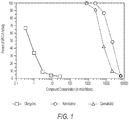
- cannabidiol was found to be a potent inhibitor of MAO-A, in fact to an even greater extent than nornicotine (values appearing more leftward in FIG. 1 indicate a higher potency).
- CBD inhibited approximately 50% of the MAO-A activity.
- the MAO-A inhibition activity for the positive control, clorgyline, can be seen in the left-hand portion of FIG. 1 .
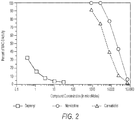
- FIG. 2 shows that CBD also inhibits MAO-B activity, although to a lesser extent than MAO-A activity. At a concentration of 7.5 mM (7,500 micromolar), CBD inhibited approximately 30% of the MAO-B activity.
- the MAO-B inhibition activity for the positive control, deprenyl can be seen in the left-hand portion of FIG. 2 .
- This example illustrates the treatment of an individual who was a habitual user of smokeless tobacco products for more than 20 years. The individual previously had several unsuccessful attempts to quit his use of smokeless tobacco products, including nicotine replacement therapy and even hypnosis.
- Example 1 The individual began daily use of the chewing gum described in Example 1 at periodic intervals during each day to satisfy cravings. The individual ceased the use of tobacco products immediately upon beginning treatment. Following eight weeks of treatment, the individual still had not used tobacco products.
- This example reports the results of a trial involving a group of ten individuals who were habitual and chronic users of smokeless tobacco products. Each of the ten individuals was given a supply of the chewing gum as described in Example 1 and instructed to use the gum as often as needed over a period of 24 hours. At the conclusion of this period, all of the subjects (10/10) reported that they used the chewing gum in lieu of the smokeless tobacco products they normally would have consumed; and all of the subjects (10/10) reported that the chewing gum was effective to significantly block cravings for smokeless tobacco.
Landscapes
- Health & Medical Sciences (AREA)
- Life Sciences & Earth Sciences (AREA)
- Veterinary Medicine (AREA)
- Animal Behavior & Ethology (AREA)
- General Health & Medical Sciences (AREA)
- Public Health (AREA)
- Chemical & Material Sciences (AREA)
- Medicinal Chemistry (AREA)
- Pharmacology & Pharmacy (AREA)
- Epidemiology (AREA)
- Bioinformatics & Cheminformatics (AREA)
- Engineering & Computer Science (AREA)
- Dermatology (AREA)
- Physiology (AREA)
- Otolaryngology (AREA)
- Nutrition Science (AREA)
- Zoology (AREA)
- Addiction (AREA)
- Biomedical Technology (AREA)
- General Chemical & Material Sciences (AREA)
- Nuclear Medicine, Radiotherapy & Molecular Imaging (AREA)
- Organic Chemistry (AREA)
- Chemical Kinetics & Catalysis (AREA)
- Neurosurgery (AREA)
- Neurology (AREA)
- Psychiatry (AREA)
- Medicinal Preparation (AREA)
- Pharmaceuticals Containing Other Organic And Inorganic Compounds (AREA)
- Acyclic And Carbocyclic Compounds In Medicinal Compositions (AREA)
Priority Applications (1)
| Application Number | Priority Date | Filing Date | Title |
|---|---|---|---|
| EP21191842.0A EP3936129A1 (en) | 2016-05-16 | 2017-05-02 | Pharmaceutical formulations containing cannabidiol and nicotine for treating smokeless tobacco addiction |
Applications Claiming Priority (3)
| Application Number | Priority Date | Filing Date | Title |
|---|---|---|---|
| US201662336990P | 2016-05-16 | 2016-05-16 | |
| US15/426,617 US10653639B2 (en) | 2016-05-16 | 2017-02-07 | Pharmaceutical formulations containing cannabidiol and nicotine for treating smokeless tobacco addiction |
| PCT/US2017/030558 WO2017200740A1 (en) | 2016-05-16 | 2017-05-02 | Pharmaceutical formulations containing cannabidiol and nicotine for treating smokeless tobacco addiction |
Related Child Applications (1)
| Application Number | Title | Priority Date | Filing Date |
|---|---|---|---|
| EP21191842.0A Division EP3936129A1 (en) | 2016-05-16 | 2017-05-02 | Pharmaceutical formulations containing cannabidiol and nicotine for treating smokeless tobacco addiction |
Publications (3)
| Publication Number | Publication Date |
|---|---|
| EP3458057A1 EP3458057A1 (en) | 2019-03-27 |
| EP3458057A4 EP3458057A4 (en) | 2020-02-05 |
| EP3458057B1 true EP3458057B1 (en) | 2021-09-08 |
Family
ID=60297254
Family Applications (2)
| Application Number | Title | Priority Date | Filing Date |
|---|---|---|---|
| EP17799853.1A Not-in-force EP3458057B1 (en) | 2016-05-16 | 2017-05-02 | Pharmaceutical formulations containing cannabidiol and nicotine for treating smokeless tobacco addiction |
| EP21191842.0A Withdrawn EP3936129A1 (en) | 2016-05-16 | 2017-05-02 | Pharmaceutical formulations containing cannabidiol and nicotine for treating smokeless tobacco addiction |
Family Applications After (1)
| Application Number | Title | Priority Date | Filing Date |
|---|---|---|---|
| EP21191842.0A Withdrawn EP3936129A1 (en) | 2016-05-16 | 2017-05-02 | Pharmaceutical formulations containing cannabidiol and nicotine for treating smokeless tobacco addiction |
Country Status (8)
| Country | Link |
|---|---|
| US (2) | US10653639B2 (enExample) |
| EP (2) | EP3458057B1 (enExample) |
| JP (2) | JP6816167B2 (enExample) |
| CN (1) | CN109152773A (enExample) |
| AU (2) | AU2017267927B2 (enExample) |
| CA (1) | CA3021835C (enExample) |
| ES (1) | ES2898342T3 (enExample) |
| WO (1) | WO2017200740A1 (enExample) |
Families Citing this family (6)
| Publication number | Priority date | Publication date | Assignee | Title |
|---|---|---|---|---|
| NL2018504B1 (en) * | 2017-03-13 | 2018-09-21 | Pharma Unlimited B V | Tobacco- and smoke-less products consumable by humans as epicurean or medical products and method of treating smoking addiction |
| US11166910B2 (en) * | 2019-01-25 | 2021-11-09 | Nordiccan A/S | Cannabinoid chewing gum with sugar alcohols |
| US11253473B2 (en) * | 2019-03-01 | 2022-02-22 | Nordiccan A/S | Method of producing tableted cannabinoid chewing gum |
| CN111789881A (zh) * | 2019-04-04 | 2020-10-20 | 昆明医科大学 | 一种工业大麻提取物的用途 |
| EP3946262B1 (en) * | 2019-08-30 | 2024-07-31 | Evie Sa | Loaded granules, their process of production and their uses |
| CN113100490A (zh) * | 2021-05-21 | 2021-07-13 | 张家港外星人新材料科技有限公司 | 生物碱与酚反应合成物、雾化液、雾化弹及电子雾化器 |
Family Cites Families (25)
| Publication number | Priority date | Publication date | Assignee | Title |
|---|---|---|---|---|
| US3901248A (en) | 1970-07-22 | 1975-08-26 | Leo Ab | Chewable smoking substitute composition |
| CA2075517C (en) | 1992-04-01 | 1997-03-11 | John Wick | Transdermal patch incorporating a polymer film incorporated with an active agent |
| US5948433A (en) | 1997-08-21 | 1999-09-07 | Bertek, Inc. | Transdermal patch |
| US20020098264A1 (en) | 1998-11-27 | 2002-07-25 | Cherukuri Subraman R. | Medicated chewing gum delivery system for nicotine |
| FR2788982B1 (fr) * | 1999-02-02 | 2002-08-02 | Synthelabo | Compositions pharmaceutiques contenant de la nicotine et leur application dans le sevrage tabagique |
| US20030159702A1 (en) * | 2002-01-21 | 2003-08-28 | Lindell Katarina E.A. | Formulation and use manufacture thereof |
| FI113340B (fi) | 2002-02-20 | 2004-04-15 | Tomi Jaervinen | Uudet luonnon syklodekstriinin kompleksit |
| GB0712308D0 (en) | 2007-06-25 | 2007-08-01 | Kind Group Ltd | An inhalable composition |
| GB2450753B (en) | 2007-07-06 | 2012-07-18 | Gw Pharma Ltd | New Pharmaceutical formulation |
| WO2009080022A1 (en) * | 2007-12-20 | 2009-07-02 | Fertin Pharma A/S | Compressed chewing gum tablet |
| US9023322B2 (en) | 2008-03-26 | 2015-05-05 | Stichting Sanammad | Chewing gum compositions comprising cannabinoids |
| GB2464752B (en) * | 2008-10-24 | 2010-09-08 | Anna Louise Bullus | Chewing gum composition |
| MX353752B (es) | 2009-01-20 | 2018-01-26 | Los Angeles Biomedical Res Inst Harbor Ucla Medical Ct | Los ácidos sórbico y benzoico y sus derivados aumentan la actividad de un neurofármaco. |
| ES2607209T3 (es) | 2009-02-06 | 2017-03-29 | Egalet Ltd. | Composiciones farmacéuticas resistentes al abuso |
| US20100247586A1 (en) | 2009-03-27 | 2010-09-30 | Andreas Hugerth | Multi-Portion Intra-Oral Dosage Form With Organoleptic Properties |
| EP2233134A1 (en) | 2009-03-27 | 2010-09-29 | McNeil AB | Multi-portion intra-oral dosage form with organoleptic properties |
| US20140166208A1 (en) * | 2011-06-27 | 2014-06-19 | Iq Tec Switzerland Gmbh | Preforming pre-preg |
| US8623332B2 (en) | 2011-07-06 | 2014-01-07 | Fertin Pharma A/S | Chewing gum having sustained release of nicotine |
| WO2013091631A1 (en) | 2011-12-22 | 2013-06-27 | Fertin Pharma A/S | Method of releasing nicotine from chewing gum |
| US20140166028A1 (en) | 2012-12-14 | 2014-06-19 | Richard C. Fuisz | Enhanced Delivery of Nicotine, THC, Tobacco, Cannabidiol or Base Alkaloid from an Electronic Cigarette or Other Vapor or Smoke Producing Device Through Use of an Absorption Conditioning Unit |
| US10639439B2 (en) | 2013-01-30 | 2020-05-05 | Midwest Pharmaceuticals, Llc | Smokeless THC and administration method thereof |
| US10792318B2 (en) | 2013-03-14 | 2020-10-06 | Sc Laboratories, Inc. | Bioactive concentrates and uses thereof |
| WO2015025312A1 (en) | 2013-08-21 | 2015-02-26 | Cannabics Pharmaceuticals Inc | Compositions for combined immediate and sustained release of cannabinoids, methods of manufacture and use thereof |
| US9326967B2 (en) | 2013-08-22 | 2016-05-03 | Stephen C. Perry | Vaporizable cannabinoid compositions |
| US10842786B2 (en) | 2016-04-27 | 2020-11-24 | Apirx Pharmaceutical Usa, Llc | Chewing gum composition comprising cannabinoids and nicotine |
-
2017
- 2017-02-07 US US15/426,617 patent/US10653639B2/en active Active
- 2017-05-02 CA CA3021835A patent/CA3021835C/en active Active
- 2017-05-02 ES ES17799853T patent/ES2898342T3/es active Active
- 2017-05-02 JP JP2018558730A patent/JP6816167B2/ja not_active Expired - Fee Related
- 2017-05-02 WO PCT/US2017/030558 patent/WO2017200740A1/en not_active Ceased
- 2017-05-02 CN CN201780028842.XA patent/CN109152773A/zh active Pending
- 2017-05-02 AU AU2017267927A patent/AU2017267927B2/en not_active Ceased
- 2017-05-02 EP EP17799853.1A patent/EP3458057B1/en not_active Not-in-force
- 2017-05-02 EP EP21191842.0A patent/EP3936129A1/en not_active Withdrawn
-
2020
- 2020-04-07 US US16/841,834 patent/US11191736B2/en not_active Expired - Fee Related
- 2020-10-14 AU AU2020256349A patent/AU2020256349B2/en not_active Ceased
- 2020-12-23 JP JP2020213562A patent/JP7216697B2/ja active Active
Also Published As
| Publication number | Publication date |
|---|---|
| US20170326126A1 (en) | 2017-11-16 |
| JP7216697B2 (ja) | 2023-02-01 |
| CA3021835C (en) | 2022-03-22 |
| AU2020256349B2 (en) | 2022-03-31 |
| US10653639B2 (en) | 2020-05-19 |
| AU2020256349A1 (en) | 2020-11-12 |
| EP3458057A1 (en) | 2019-03-27 |
| US20200230077A1 (en) | 2020-07-23 |
| JP2019514990A (ja) | 2019-06-06 |
| CN109152773A (zh) | 2019-01-04 |
| ES2898342T3 (es) | 2022-03-07 |
| EP3936129A1 (en) | 2022-01-12 |
| WO2017200740A1 (en) | 2017-11-23 |
| US11191736B2 (en) | 2021-12-07 |
| EP3458057A4 (en) | 2020-02-05 |
| JP2021059575A (ja) | 2021-04-15 |
| JP6816167B2 (ja) | 2021-01-20 |
| CA3021835A1 (en) | 2017-11-23 |
| AU2017267927B2 (en) | 2020-07-30 |
| AU2017267927A1 (en) | 2018-11-08 |
Similar Documents
| Publication | Publication Date | Title |
|---|---|---|
| AU2020256349B2 (en) | Pharmaceutical formulations containing cannabidiol and nicotine for treating smokeless tobacco addiction | |
| US8858919B2 (en) | Method of providing fast relief to a user of a nicotine chewing gum | |
| US8529875B2 (en) | Tobacco alkaloid releasing chewing gum | |
| US9884055B2 (en) | Method of treating substance addictions | |
| US9028803B2 (en) | Chewing gum having sustained release of nicotine | |
| US11191720B2 (en) | Chewing gum with improved delivery of cannabinoids | |
| US20200237658A1 (en) | Cannabinoid chewing gum with improved release of cannabinoids | |
| US11331310B2 (en) | Method of treating cocaine addiction | |
| AU2019424012B2 (en) | Cannabinoid chewing gum with high intensity sweeteners | |
| CA3031523A1 (en) | Chewing gum with improved delivery of cannabinoids | |
| AU2019425173B2 (en) | Cannabinoid chewing gum with polyvinyl acetate elastomer plasticizers | |
| AU2019423959B2 (en) | Cannabinoid chewing gum with sugar alcohols | |
| US20200237660A1 (en) | Cannabinoid chewing gum with polyvinyl acetate elastomer plasticizers | |
| WO2020151793A1 (en) | Chewing gum with improved delivery of cannabinoids | |
| JP2011057701A (ja) | ニコチンチューインガム使用者に迅速な緩和をもたらす方法 |
Legal Events
| Date | Code | Title | Description |
|---|---|---|---|
| STAA | Information on the status of an ep patent application or granted ep patent |
Free format text: STATUS: THE INTERNATIONAL PUBLICATION HAS BEEN MADE |
|
| PUAI | Public reference made under article 153(3) epc to a published international application that has entered the european phase |
Free format text: ORIGINAL CODE: 0009012 |
|
| STAA | Information on the status of an ep patent application or granted ep patent |
Free format text: STATUS: REQUEST FOR EXAMINATION WAS MADE |
|
| 17P | Request for examination filed |
Effective date: 20181204 |
|
| AK | Designated contracting states |
Kind code of ref document: A1 Designated state(s): AL AT BE BG CH CY CZ DE DK EE ES FI FR GB GR HR HU IE IS IT LI LT LU LV MC MK MT NL NO PL PT RO RS SE SI SK SM TR |
|
| AX | Request for extension of the european patent |
Extension state: BA ME |
|
| DAV | Request for validation of the european patent (deleted) | ||
| DAX | Request for extension of the european patent (deleted) | ||
| A4 | Supplementary search report drawn up and despatched |
Effective date: 20200109 |
|
| RIC1 | Information provided on ipc code assigned before grant |
Ipc: A61K 9/70 20060101ALI20200102BHEP Ipc: A61K 31/05 20060101ALI20200102BHEP Ipc: A61K 31/047 20060101ALI20200102BHEP Ipc: A61K 9/12 20060101ALI20200102BHEP Ipc: A61K 9/00 20060101ALI20200102BHEP Ipc: A61K 9/68 20060101ALI20200102BHEP Ipc: A61K 31/465 20060101AFI20200102BHEP |
|
| STAA | Information on the status of an ep patent application or granted ep patent |
Free format text: STATUS: EXAMINATION IS IN PROGRESS |
|
| 17Q | First examination report despatched |
Effective date: 20200915 |
|
| GRAP | Despatch of communication of intention to grant a patent |
Free format text: ORIGINAL CODE: EPIDOSNIGR1 |
|
| STAA | Information on the status of an ep patent application or granted ep patent |
Free format text: STATUS: GRANT OF PATENT IS INTENDED |
|
| INTG | Intention to grant announced |
Effective date: 20210416 |
|
| GRAS | Grant fee paid |
Free format text: ORIGINAL CODE: EPIDOSNIGR3 |
|
| GRAA | (expected) grant |
Free format text: ORIGINAL CODE: 0009210 |
|
| STAA | Information on the status of an ep patent application or granted ep patent |
Free format text: STATUS: THE PATENT HAS BEEN GRANTED |
|
| AK | Designated contracting states |
Kind code of ref document: B1 Designated state(s): AL AT BE BG CH CY CZ DE DK EE ES FI FR GB GR HR HU IE IS IT LI LT LU LV MC MK MT NL NO PL PT RO RS SE SI SK SM TR |
|
| REG | Reference to a national code |
Ref country code: GB Ref legal event code: FG4D |
|
| REG | Reference to a national code |
Ref country code: AT Ref legal event code: REF Ref document number: 1427949 Country of ref document: AT Kind code of ref document: T Effective date: 20210915 Ref country code: CH Ref legal event code: EP |
|
| REG | Reference to a national code |
Ref country code: IE Ref legal event code: FG4D |
|
| REG | Reference to a national code |
Ref country code: DE Ref legal event code: R096 Ref document number: 602017045755 Country of ref document: DE |
|
| REG | Reference to a national code |
Ref country code: NL Ref legal event code: FP |
|
| REG | Reference to a national code |
Ref country code: LT Ref legal event code: MG9D |
|
| PG25 | Lapsed in a contracting state [announced via postgrant information from national office to epo] |
Ref country code: NO Free format text: LAPSE BECAUSE OF FAILURE TO SUBMIT A TRANSLATION OF THE DESCRIPTION OR TO PAY THE FEE WITHIN THE PRESCRIBED TIME-LIMIT Effective date: 20211208 Ref country code: BG Free format text: LAPSE BECAUSE OF FAILURE TO SUBMIT A TRANSLATION OF THE DESCRIPTION OR TO PAY THE FEE WITHIN THE PRESCRIBED TIME-LIMIT Effective date: 20211208 Ref country code: LT Free format text: LAPSE BECAUSE OF FAILURE TO SUBMIT A TRANSLATION OF THE DESCRIPTION OR TO PAY THE FEE WITHIN THE PRESCRIBED TIME-LIMIT Effective date: 20210908 Ref country code: SE Free format text: LAPSE BECAUSE OF FAILURE TO SUBMIT A TRANSLATION OF THE DESCRIPTION OR TO PAY THE FEE WITHIN THE PRESCRIBED TIME-LIMIT Effective date: 20210908 Ref country code: RS Free format text: LAPSE BECAUSE OF FAILURE TO SUBMIT A TRANSLATION OF THE DESCRIPTION OR TO PAY THE FEE WITHIN THE PRESCRIBED TIME-LIMIT Effective date: 20210908 Ref country code: HR Free format text: LAPSE BECAUSE OF FAILURE TO SUBMIT A TRANSLATION OF THE DESCRIPTION OR TO PAY THE FEE WITHIN THE PRESCRIBED TIME-LIMIT Effective date: 20210908 Ref country code: FI Free format text: LAPSE BECAUSE OF FAILURE TO SUBMIT A TRANSLATION OF THE DESCRIPTION OR TO PAY THE FEE WITHIN THE PRESCRIBED TIME-LIMIT Effective date: 20210908 |
|
| REG | Reference to a national code |
Ref country code: AT Ref legal event code: MK05 Ref document number: 1427949 Country of ref document: AT Kind code of ref document: T Effective date: 20210908 |
|
| PG25 | Lapsed in a contracting state [announced via postgrant information from national office to epo] |
Ref country code: LV Free format text: LAPSE BECAUSE OF FAILURE TO SUBMIT A TRANSLATION OF THE DESCRIPTION OR TO PAY THE FEE WITHIN THE PRESCRIBED TIME-LIMIT Effective date: 20210908 Ref country code: GR Free format text: LAPSE BECAUSE OF FAILURE TO SUBMIT A TRANSLATION OF THE DESCRIPTION OR TO PAY THE FEE WITHIN THE PRESCRIBED TIME-LIMIT Effective date: 20211209 |
|
| REG | Reference to a national code |
Ref country code: ES Ref legal event code: FG2A Ref document number: 2898342 Country of ref document: ES Kind code of ref document: T3 Effective date: 20220307 |
|
| PG25 | Lapsed in a contracting state [announced via postgrant information from national office to epo] |
Ref country code: AT Free format text: LAPSE BECAUSE OF FAILURE TO SUBMIT A TRANSLATION OF THE DESCRIPTION OR TO PAY THE FEE WITHIN THE PRESCRIBED TIME-LIMIT Effective date: 20210908 |
|
| PG25 | Lapsed in a contracting state [announced via postgrant information from national office to epo] |
Ref country code: IS Free format text: LAPSE BECAUSE OF FAILURE TO SUBMIT A TRANSLATION OF THE DESCRIPTION OR TO PAY THE FEE WITHIN THE PRESCRIBED TIME-LIMIT Effective date: 20220108 Ref country code: SM Free format text: LAPSE BECAUSE OF FAILURE TO SUBMIT A TRANSLATION OF THE DESCRIPTION OR TO PAY THE FEE WITHIN THE PRESCRIBED TIME-LIMIT Effective date: 20210908 Ref country code: SK Free format text: LAPSE BECAUSE OF FAILURE TO SUBMIT A TRANSLATION OF THE DESCRIPTION OR TO PAY THE FEE WITHIN THE PRESCRIBED TIME-LIMIT Effective date: 20210908 Ref country code: RO Free format text: LAPSE BECAUSE OF FAILURE TO SUBMIT A TRANSLATION OF THE DESCRIPTION OR TO PAY THE FEE WITHIN THE PRESCRIBED TIME-LIMIT Effective date: 20210908 Ref country code: PT Free format text: LAPSE BECAUSE OF FAILURE TO SUBMIT A TRANSLATION OF THE DESCRIPTION OR TO PAY THE FEE WITHIN THE PRESCRIBED TIME-LIMIT Effective date: 20220110 Ref country code: PL Free format text: LAPSE BECAUSE OF FAILURE TO SUBMIT A TRANSLATION OF THE DESCRIPTION OR TO PAY THE FEE WITHIN THE PRESCRIBED TIME-LIMIT Effective date: 20210908 Ref country code: EE Free format text: LAPSE BECAUSE OF FAILURE TO SUBMIT A TRANSLATION OF THE DESCRIPTION OR TO PAY THE FEE WITHIN THE PRESCRIBED TIME-LIMIT Effective date: 20210908 Ref country code: CZ Free format text: LAPSE BECAUSE OF FAILURE TO SUBMIT A TRANSLATION OF THE DESCRIPTION OR TO PAY THE FEE WITHIN THE PRESCRIBED TIME-LIMIT Effective date: 20210908 Ref country code: AL Free format text: LAPSE BECAUSE OF FAILURE TO SUBMIT A TRANSLATION OF THE DESCRIPTION OR TO PAY THE FEE WITHIN THE PRESCRIBED TIME-LIMIT Effective date: 20210908 |
|
| REG | Reference to a national code |
Ref country code: DE Ref legal event code: R097 Ref document number: 602017045755 Country of ref document: DE |
|
| PLBE | No opposition filed within time limit |
Free format text: ORIGINAL CODE: 0009261 |
|
| STAA | Information on the status of an ep patent application or granted ep patent |
Free format text: STATUS: NO OPPOSITION FILED WITHIN TIME LIMIT |
|
| PG25 | Lapsed in a contracting state [announced via postgrant information from national office to epo] |
Ref country code: DK Free format text: LAPSE BECAUSE OF FAILURE TO SUBMIT A TRANSLATION OF THE DESCRIPTION OR TO PAY THE FEE WITHIN THE PRESCRIBED TIME-LIMIT Effective date: 20210908 |
|
| 26N | No opposition filed |
Effective date: 20220609 |
|
| PG25 | Lapsed in a contracting state [announced via postgrant information from national office to epo] |
Ref country code: SI Free format text: LAPSE BECAUSE OF FAILURE TO SUBMIT A TRANSLATION OF THE DESCRIPTION OR TO PAY THE FEE WITHIN THE PRESCRIBED TIME-LIMIT Effective date: 20210908 |
|
| REG | Reference to a national code |
Ref country code: CH Ref legal event code: PL |
|
| REG | Reference to a national code |
Ref country code: BE Ref legal event code: MM Effective date: 20220531 |
|
| PG25 | Lapsed in a contracting state [announced via postgrant information from national office to epo] |
Ref country code: MC Free format text: LAPSE BECAUSE OF FAILURE TO SUBMIT A TRANSLATION OF THE DESCRIPTION OR TO PAY THE FEE WITHIN THE PRESCRIBED TIME-LIMIT Effective date: 20210908 Ref country code: LU Free format text: LAPSE BECAUSE OF NON-PAYMENT OF DUE FEES Effective date: 20220502 Ref country code: LI Free format text: LAPSE BECAUSE OF NON-PAYMENT OF DUE FEES Effective date: 20220531 Ref country code: CH Free format text: LAPSE BECAUSE OF NON-PAYMENT OF DUE FEES Effective date: 20220531 |
|
| PG25 | Lapsed in a contracting state [announced via postgrant information from national office to epo] |
Ref country code: IE Free format text: LAPSE BECAUSE OF NON-PAYMENT OF DUE FEES Effective date: 20220502 |
|
| PG25 | Lapsed in a contracting state [announced via postgrant information from national office to epo] |
Ref country code: BE Free format text: LAPSE BECAUSE OF NON-PAYMENT OF DUE FEES Effective date: 20220531 |
|
| P01 | Opt-out of the competence of the unified patent court (upc) registered |
Effective date: 20230505 |
|
| PG25 | Lapsed in a contracting state [announced via postgrant information from national office to epo] |
Ref country code: HU Free format text: LAPSE BECAUSE OF FAILURE TO SUBMIT A TRANSLATION OF THE DESCRIPTION OR TO PAY THE FEE WITHIN THE PRESCRIBED TIME-LIMIT; INVALID AB INITIO Effective date: 20170502 |
|
| PG25 | Lapsed in a contracting state [announced via postgrant information from national office to epo] |
Ref country code: MK Free format text: LAPSE BECAUSE OF FAILURE TO SUBMIT A TRANSLATION OF THE DESCRIPTION OR TO PAY THE FEE WITHIN THE PRESCRIBED TIME-LIMIT Effective date: 20210908 Ref country code: CY Free format text: LAPSE BECAUSE OF FAILURE TO SUBMIT A TRANSLATION OF THE DESCRIPTION OR TO PAY THE FEE WITHIN THE PRESCRIBED TIME-LIMIT Effective date: 20210908 |
|
| PG25 | Lapsed in a contracting state [announced via postgrant information from national office to epo] |
Ref country code: MT Free format text: LAPSE BECAUSE OF FAILURE TO SUBMIT A TRANSLATION OF THE DESCRIPTION OR TO PAY THE FEE WITHIN THE PRESCRIBED TIME-LIMIT Effective date: 20210908 |
|
| PGFP | Annual fee paid to national office [announced via postgrant information from national office to epo] |
Ref country code: NL Payment date: 20241113 Year of fee payment: 8 |
|
| PGFP | Annual fee paid to national office [announced via postgrant information from national office to epo] |
Ref country code: DE Payment date: 20241202 Year of fee payment: 8 |
|
| PGFP | Annual fee paid to national office [announced via postgrant information from national office to epo] |
Ref country code: GB Payment date: 20241113 Year of fee payment: 8 |
|
| PGFP | Annual fee paid to national office [announced via postgrant information from national office to epo] |
Ref country code: FR Payment date: 20241112 Year of fee payment: 8 |
|
| PGFP | Annual fee paid to national office [announced via postgrant information from national office to epo] |
Ref country code: IT Payment date: 20241113 Year of fee payment: 8 Ref country code: ES Payment date: 20241202 Year of fee payment: 8 |
|
| REG | Reference to a national code |
Ref country code: DE Ref legal event code: R119 Ref document number: 602017045755 Country of ref document: DE |
|
| PG25 | Lapsed in a contracting state [announced via postgrant information from national office to epo] |
Ref country code: TR Free format text: LAPSE BECAUSE OF FAILURE TO SUBMIT A TRANSLATION OF THE DESCRIPTION OR TO PAY THE FEE WITHIN THE PRESCRIBED TIME-LIMIT Effective date: 20210908 |
|
| REG | Reference to a national code |
Ref country code: NL Ref legal event code: MM Effective date: 20250601 |
|
| GBPC | Gb: european patent ceased through non-payment of renewal fee |
Effective date: 20250502 |
|
| PG25 | Lapsed in a contracting state [announced via postgrant information from national office to epo] |
Ref country code: NL Free format text: LAPSE BECAUSE OF NON-PAYMENT OF DUE FEES Effective date: 20250601 |
|
| PG25 | Lapsed in a contracting state [announced via postgrant information from national office to epo] |
Ref country code: GB Free format text: LAPSE BECAUSE OF NON-PAYMENT OF DUE FEES Effective date: 20250502 |
|
| PG25 | Lapsed in a contracting state [announced via postgrant information from national office to epo] |
Ref country code: DE Free format text: LAPSE BECAUSE OF NON-PAYMENT OF DUE FEES Effective date: 20251202 |
|
| PG25 | Lapsed in a contracting state [announced via postgrant information from national office to epo] |
Ref country code: IT Free format text: LAPSE BECAUSE OF NON-PAYMENT OF DUE FEES Effective date: 20250502 |
|
| PG25 | Lapsed in a contracting state [announced via postgrant information from national office to epo] |
Ref country code: FR Free format text: LAPSE BECAUSE OF NON-PAYMENT OF DUE FEES Effective date: 20250531 |
|
| REG | Reference to a national code |
Ref country code: ES Ref legal event code: FD2A Effective date: 20260626 |
|
| PG25 | Lapsed in a contracting state [announced via postgrant information from national office to epo] |
Ref country code: ES Free format text: LAPSE BECAUSE OF NON-PAYMENT OF DUE FEES Effective date: 20250503 |