EP3453333B1 - Dentale 3d-datenverarbeitungsvorrichtung und verfahren dafür - Google Patents
Dentale 3d-datenverarbeitungsvorrichtung und verfahren dafür Download PDFInfo
- Publication number
- EP3453333B1 EP3453333B1 EP17792922.1A EP17792922A EP3453333B1 EP 3453333 B1 EP3453333 B1 EP 3453333B1 EP 17792922 A EP17792922 A EP 17792922A EP 3453333 B1 EP3453333 B1 EP 3453333B1
- Authority
- EP
- European Patent Office
- Prior art keywords
- data
- teeth
- image data
- movement
- dental
- Prior art date
- Legal status (The legal status is an assumption and is not a legal conclusion. Google has not performed a legal analysis and makes no representation as to the accuracy of the status listed.)
- Active
Links
Images


Classifications
-
- G—PHYSICS
- G06—COMPUTING OR CALCULATING; COUNTING
- G06T—IMAGE DATA PROCESSING OR GENERATION, IN GENERAL
- G06T7/00—Image analysis
- G06T7/0002—Inspection of images, e.g. flaw detection
- G06T7/0012—Biomedical image inspection
-
- G—PHYSICS
- G16—INFORMATION AND COMMUNICATION TECHNOLOGY [ICT] SPECIALLY ADAPTED FOR SPECIFIC APPLICATION FIELDS
- G16H—HEALTHCARE INFORMATICS, i.e. INFORMATION AND COMMUNICATION TECHNOLOGY [ICT] SPECIALLY ADAPTED FOR THE HANDLING OR PROCESSING OF MEDICAL OR HEALTHCARE DATA
- G16H50/00—ICT specially adapted for medical diagnosis, medical simulation or medical data mining; ICT specially adapted for detecting, monitoring or modelling epidemics or pandemics
- G16H50/50—ICT specially adapted for medical diagnosis, medical simulation or medical data mining; ICT specially adapted for detecting, monitoring or modelling epidemics or pandemics for simulation or modelling of medical disorders
-
- A—HUMAN NECESSITIES
- A61—MEDICAL OR VETERINARY SCIENCE; HYGIENE
- A61B—DIAGNOSIS; SURGERY; IDENTIFICATION
- A61B6/00—Apparatus or devices for radiation diagnosis; Apparatus or devices for radiation diagnosis combined with radiation therapy equipment
-
- A—HUMAN NECESSITIES
- A61—MEDICAL OR VETERINARY SCIENCE; HYGIENE
- A61B—DIAGNOSIS; SURGERY; IDENTIFICATION
- A61B6/00—Apparatus or devices for radiation diagnosis; Apparatus or devices for radiation diagnosis combined with radiation therapy equipment
- A61B6/50—Apparatus or devices for radiation diagnosis; Apparatus or devices for radiation diagnosis combined with radiation therapy equipment specially adapted for specific body parts; specially adapted for specific clinical applications
- A61B6/51—Apparatus or devices for radiation diagnosis; Apparatus or devices for radiation diagnosis combined with radiation therapy equipment specially adapted for specific body parts; specially adapted for specific clinical applications for dentistry
-
- A—HUMAN NECESSITIES
- A61—MEDICAL OR VETERINARY SCIENCE; HYGIENE
- A61B—DIAGNOSIS; SURGERY; IDENTIFICATION
- A61B6/00—Apparatus or devices for radiation diagnosis; Apparatus or devices for radiation diagnosis combined with radiation therapy equipment
- A61B6/52—Devices using data or image processing specially adapted for radiation diagnosis
- A61B6/5211—Devices using data or image processing specially adapted for radiation diagnosis involving processing of medical diagnostic data
- A61B6/5223—Devices using data or image processing specially adapted for radiation diagnosis involving processing of medical diagnostic data generating planar views from image data, e.g. extracting a coronal view from a 3D image
-
- A—HUMAN NECESSITIES
- A61—MEDICAL OR VETERINARY SCIENCE; HYGIENE
- A61C—DENTISTRY; APPARATUS OR METHODS FOR ORAL OR DENTAL HYGIENE
- A61C7/00—Orthodontics, i.e. obtaining or maintaining the desired position of teeth, e.g. by straightening, evening, regulating, separating, or by correcting malocclusions
- A61C7/002—Orthodontic computer assisted systems
-
- A—HUMAN NECESSITIES
- A61—MEDICAL OR VETERINARY SCIENCE; HYGIENE
- A61C—DENTISTRY; APPARATUS OR METHODS FOR ORAL OR DENTAL HYGIENE
- A61C9/00—Impression cups, i.e. impression trays; Impression methods
- A61C9/004—Means or methods for taking digitized impressions
- A61C9/0046—Data acquisition means or methods
- A61C9/0053—Optical means or methods, e.g. scanning the teeth by a laser or light beam
-
- G—PHYSICS
- G06—COMPUTING OR CALCULATING; COUNTING
- G06F—ELECTRIC DIGITAL DATA PROCESSING
- G06F30/00—Computer-aided design [CAD]
- G06F30/20—Design optimisation, verification or simulation
-
- G—PHYSICS
- G06—COMPUTING OR CALCULATING; COUNTING
- G06T—IMAGE DATA PROCESSING OR GENERATION, IN GENERAL
- G06T17/00—Three-dimensional [3D] modelling for computer graphics
-
- A—HUMAN NECESSITIES
- A61—MEDICAL OR VETERINARY SCIENCE; HYGIENE
- A61C—DENTISTRY; APPARATUS OR METHODS FOR ORAL OR DENTAL HYGIENE
- A61C19/00—Dental auxiliary appliances
- A61C19/04—Measuring instruments specially adapted for dentistry
- A61C19/045—Measuring instruments specially adapted for dentistry for recording mandibular movement, e.g. face bows
-
- G—PHYSICS
- G06—COMPUTING OR CALCULATING; COUNTING
- G06T—IMAGE DATA PROCESSING OR GENERATION, IN GENERAL
- G06T2207/00—Indexing scheme for image analysis or image enhancement
- G06T2207/10—Image acquisition modality
- G06T2207/10072—Tomographic images
- G06T2207/10081—Computed x-ray tomography [CT]
-
- G—PHYSICS
- G06—COMPUTING OR CALCULATING; COUNTING
- G06T—IMAGE DATA PROCESSING OR GENERATION, IN GENERAL
- G06T2207/00—Indexing scheme for image analysis or image enhancement
- G06T2207/10—Image acquisition modality
- G06T2207/10072—Tomographic images
- G06T2207/10088—Magnetic resonance imaging [MRI]
-
- G—PHYSICS
- G06—COMPUTING OR CALCULATING; COUNTING
- G06T—IMAGE DATA PROCESSING OR GENERATION, IN GENERAL
- G06T2207/00—Indexing scheme for image analysis or image enhancement
- G06T2207/30—Subject of image; Context of image processing
- G06T2207/30004—Biomedical image processing
- G06T2207/30036—Dental; Teeth
Definitions
- the present disclosure relates to a dental three-dimensional data processing device and a method thereof, and more particularly, to a dental three-dimensional data processing device and a method thereof, which can diagnose the occlusion state thereof by determining a correlation between teeth and temporomandibular joint based on teeth data and image data of a face, and analyze the movements of the teeth and the temporomandibular joint.
- the temporomandibular joint and the occlusion state of the teeth, for each human, are different and a masticatory habit is different, while the articulator has a certain shape and thereby cannot be corresponded to all humans, such that although the teeth model is corrected according to information on the occlusion state extracted from the articulator and is used to treat a patient, there has been a limitation to apply it to all patients.
- Korean Patent Publication No. 10-2015-0082428 (published on July 15, 2015 ) is disclosed as the related art that relates to a technology for estimating the movement trajectory from a specific scan to a next scan through three-dimensional scan in the oral cavity and compensating for the movement trajectory.
- US 2014/294273 A1 discloses a method and system for designing orthoses for the correction of dentition by dental practitioners.
- the present disclosure relates to a dental three-dimensional data processing device and a method thereof, and an object of the present disclosure is to provide a dental three-dimensional data processing device and a method thereof, which diagnose the occlusion state by determining a correlation between teeth and temporomandibular joint based on teeth data and image data of a face, and diagnose a patient's condition by analyzing the movements of the teeth and the temporomandibular joint, thus generating and correcting a teeth model.
- the invention pertains to a dental three-dimensional data processing device as defined in claim 1, and to a dental three-dimensional data processing method as defined in claim 11. Further embodiments are set out in the appended dependent claims.
- a dental three-dimensional data processing device in accordance with the present disclosure includes an input unit for receiving teeth data, and image data of a human face, wherein the image data are image data scanning a face where the teeth are exposed a control unit for generating three-dimensional alignment data by combining and aligning the teeth data and the image data; a movement extraction unit for generating trajectory data by analyzing the movement of teeth or temporomandibular joint from the image data, wherein the control unit aligns them by matching the teeth included in the image data with the teeth data, and a simulation unit for simulating the movement of the teeth or the temporomandibular joint by applying the trajectory data to the alignment data.
- the teeth data can include any one of scan data through a dental scanner, and facial bone data having the shape of the teeth measured through a Computed Tomography (CT) or a Magnetic Resonance Imaging (MRI).
- CT Computed Tomography
- MRI Magnetic Resonance Imaging
- the image data can be successive data acquired in real time.
- the dental three-dimensional data processing device can further include a model generation unit for generating a teeth model reflecting the shape and movement of the teeth by designing the teeth based on the alignment data, the trajectory data, and the simulation result of the simulation unit.
- a model generation unit for generating a teeth model reflecting the shape and movement of the teeth by designing the teeth based on the alignment data, the trajectory data, and the simulation result of the simulation unit.
- the dental three-dimensional data processing device can further include a model correction unit for delivering it to the model generation unit by determining an interference factor of the teeth model generated by the model generation unit.
- model correction unit can input the correction data to the model generation unit by testing the teeth model according to the trajectory data to determine whether or not interference occurs.
- control unit can align the scan data and the image data, and determine the occlusion state accordingly.
- control unit can track the location and movement of the temporomandibular joint by aligning the facial bone data and the image data.
- the movement extraction unit can extract a feature point by analyzing the image data with respect to the moving teeth in real time, and can detect the movement of the teeth by tracking the movement of the feature point.
- the movement extraction unit can detect the movement of the teeth by scanning a target attached to the teeth to analyze the movement of the target.
- the dental three-dimensional data processing device can further include an output unit for outputting the result simulating so that the alignment data move according to the trajectory data in the simulation unit.
- the simulation unit can display the movement trajectory of the teeth data and an interference surface on a screen, and the control unit can detect the rotation shaft of the temporomandibular joint through the simulation.
- a dental three-dimensional data processing method in accordance with another aspect of the present disclosure includes receiving at least one of scan data through a dental scanner, and facial bone data having the shape of teeth measured through a CT or a MRI; receiving image data of a human face, wherein the image data are image data scanning a face where the teeth are exposed, generating alignment data by combining and aligning any one of the scan data and the facial bone data, and the image data, wherein aligning includes matching the teeth included in the image data with teeth data, generating trajectory data by analyzing the movement of the teeth or temporomandibular joint from the image data; and simulating the movement of the teeth or the temporomandibular joint by applying the trajectory data to the alignment data.
- the dental three-dimensional data processing method can further include generating a teeth model reflecting the shape and movement of the teeth by designing the teeth in response to the alignment data, the trajectory data, and the simulation result.
- the image data can include at least one of primary image data scanning a face where a human closes a mouth and is kept silent, and secondary image data scanning a face where human teeth are exposed.
- the receiving the image data can recognize a distance using data scanning the human face, generate facial three-dimensional data as the image data by performing color texture mapping, and extract a Frankfurt's plane, a Camper's plane, and an occlusion reference plane.
- the generating the alignment data can align them by matching any one of the scan data and the facial bone data with the teeth included in the image data.
- the generating the alignment data can align the scan data and the image data, and determine the occlusion state accordingly.
- the generating the trajectory data can track the movement of the teeth or the temporomandibular joint from the image data input in real time.
- the image data can be data scanning a target attached to the teeth, and the generating the trajectory data can detect the movement of the teeth by detecting the target from the image data.
- the generating the trajectory data can extract a feature point of the teeth from the image data, and can generate the trajectory data by tracking the movement of the feature point.
- the dental three-dimensional data processing method can further include correcting the teeth model by sensing teeth interference using the trajectory data with respect to the teeth model.
- the dental three-dimensional data processing device and the method thereof in accordance with the present disclosure configured as described above, it is possible to extract the movements of the teeth and the temporomandibular joint to apply them to the teeth model, thus diagnosing the teeth state more accurately and precisely and analyzing the occlusion state according to the movements of the teeth and the temporomandibular joint; to accurately analyze the patient's condition based on the movement and the occlusion state, thus establishing treatment measures; and to generate and correct the teeth model suitable for the patient's condition, thus enhancing the treatment effect.
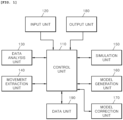
- FIG. 1 is a block diagram schematically illustrating a configuration of a dental three-dimensional data processing device in accordance with the present disclosure.
- the dental three-dimensional data processing device in accordance with the present disclosure includes an input unit 120, a data analysis unit 130, a movement extraction unit 140, a simulation unit 150, a model generation unit 160, a control unit 110, a model correction unit 170, an output unit 180, and a data unit 190.
- the input unit 120 includes at least one input means for receiving data for generating a teeth model.
- the input unit 120 receives teeth data and image data of a human face.
- the teeth data includes any one of scan data through a dental scanner and facial bone data having the shape of the teeth measured through a CT or a MRI.
- the input unit 120 can use the dental scanner or a dental three-dimensional scanner, and can also include a photographing means for photographing the movement.
- the input unit 120 receives the two-dimensional or three-dimensional scan data acquired through the scanner or the photographing means.
- the input unit 120 can be connected to a device such as an X-ray, a Computed Tomography (CT), or a Magnetic Resonance Imaging (MRI) to receive the facial bone data having the shape of the teeth, and to receive the previously photographed and stored data.
- a device such as an X-ray, a Computed Tomography (CT), or a Magnetic Resonance Imaging (MRI) to receive the facial bone data having the shape of the teeth, and to receive the previously photographed and stored data.
- CT Computed Tomography
- MRI Magnetic Resonance Imaging
- the input unit 120 receives image data of the human face photographed with different expressions separately from the teeth data.
- the image data includes image data (primary image data) scanning a face where a human closes a mouth and is kept silent, and image data (secondary image data) scanning a face where the teeth are exposed.
- the image data are data input in real time, preferably successive data, and can be the two-dimensional or three-dimensional scan data.
- the output unit 180 outputs the teeth data or the image data input through the input unit 120 to a screen, and outputs the progressing state of the entire procedure of data processing. In addition, the output unit 180 outputs the movement of the teeth according to the movement extraction or the simulation to the screen.
- the output unit 180 can include a display means for outputting and displaying data, and can further include a speaker or an operation lamp for outputting a progressing state and a warning sound.
- the data unit 190 stores the teeth data and the image data input through the input unit 120, data generated during operations of the data analysis unit 130 and the control unit 110, and data of a teeth model generated by the model generation unit 160 that will be described later.
- the data analysis unit 130 analyzes the teeth data and the image data of the human face input through the input unit 120 so that the combination of the teeth data and the image data is easy. Specifically, the data analysis unit 130 can recognize a distance based on the image data scanning the human face, generate facial three-dimensional data as the image data by performing color texture mapping, and extract a Frankfurt's plane, a Camper's plane, an occlusion reference plane, etc.
- the movement extraction unit 140 extracts a feature point by analyzing the image data with respect to the moving teeth in real time, and detects the movement of the teeth by tracking the movement of the feature point.
- the movement extraction unit 140 generates the trajectory data of the teeth by tracking the movement of the feature point.
- the movement extraction unit 140 acquires a three-dimensional coordinate by analyzing the teeth data of the movement in real time through the image data of the face input in real time.
- the movement extraction unit 140 can generate the trajectory data by tracking the movement of the acquired coordinate, and extract the movements of the teeth and the temporomandibular joint that are different for each human.
- the control unit 110 aligns them by receiving the input teeth data and image data, and data having the movement of the teeth, and determines the occlusion state accordingly.
- control unit 110 can determine the occlusion state accordingly by aligning the scan data in the teeth data and the image data, thus utilizing them for diagnosis.
- control unit 110 can track the location and movement of the temporomandibular joint by aligning the facial bone data in the teeth data and the image data.
- the image data are data measuring an actual human face, such that it is possible to accurately perform the determination of the occlusion state or the tracking of the location and movement of the temporomandibular joint, thus further increasing accuracy of diagnosis.
- control unit 110 generates three-dimensional data occluded by aligning the input teeth data, that is, the scan data or the facial bone data photographed by a CT, and the facial image data.
- the control unit 110 aligns them based on the temporomandibular joint.
- the control unit 110 receives secondary image data scanning a face where a human bites the teeth with a mouth opened or opens a mouth, in addition to primary image data scanning a face where the human closes the mouth and is kept silent, to be used as merge reference data of jawbone and the teeth. That is, the secondary image data are data scanning the face where the human opens the mouth to expose the teeth, and unlike the primary image data, includes the scan information of the teeth, such that it can become a reference for the combination upon alignment, and the control unit 110 can diagnose the occlusion state of the teeth and the state of the temporomandibular joint accurately and quickly by matching the teeth included in the secondary image data with the teeth data.
- the control unit 110 transmits three-dimensional alignment data aligned with the trajectory data of the movement extraction unit 140 to the simulation unit 150.
- the simulation unit 150 outputs it through the output unit 180 by simulating so that the aligned three-dimensional alignment data move according to the trajectory data.
- the simulation unit 150 simulates the movement of the temporomandibular joint.
- the simulation unit 150 displays the movement trajectory of the teeth data and an interference surface on a screen, and the control unit 110 detects the rotation shaft of the temporomandibular joint through the simulation.
- the control unit 110 transmits the three-dimensional alignment data based on the trajectory data, the rotation shaft of the temporomandibular joint, the scan data, or the facial bone data photographed by the CT to the model generation unit 160.
- the model generation unit 160 generates a teeth model reflecting the shape and movement of the teeth by designing the teeth based on the received alignment data, the trajectory data, and the simulation result (rotation shaft of the temporomandibular joint, etc.).
- the model correction unit 170 determines whether or not interference occurs by testing the teeth model generated by the model generation unit 160 according to the trajectory data.
- the model correction unit 170 delivers information on the location where the interference occurs or the intensity thereof to the model generation unit 160 and accordingly, the model generation unit 160 generates a final teeth model that avoids the interference by applying data of the interference thereto.
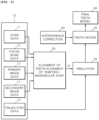
- FIG. 2 is a diagram illustrating a data flow of the dental three-dimensional data processing device in accordance with the present disclosure.
- the dental three-dimensional data processing device receives a plurality of data 10 through the input unit 120.
- scan data 11 through a dental scanner and facial bone data 12 having the shape of the teeth measured through a CT or a MRI are input as basic teeth data thereto.
- the teeth state can be diagnosed.
- primary and secondary image data 13, 14 of the human face are input through the input unit 120.
- the primary and secondary image data are all data scanning the human face; and the primary image data are scan data photographed while the mouth is closed and the secondary image data are data that scan the face where the teeth are exposed, for example, that are photographed while the human bites the teeth with a mouth opened or opens the mouth.
- the primary and secondary image data applies color texture to the three-dimensional data of the face, and is used to find a Frankfurt's plane, a Camper's plane, an occlusion reference plane (an occlusion plane), etc.
- a part of the teeth is included therein, such that it can become a reference for the combination upon alignment.
- trajectory data 15 of the teeth are input by tracking the movement of the teeth through the movement extraction unit 140.
- alignment data are generated 21.
- the alignment of the teeth is performed from the scan data 11 in the teeth data and the secondary image data 14, and the alignment of the temporomandibular joint is performed from the facial bone data 12 and the secondary image data 14.
- the simulation unit 150 simulates the movement of the teeth of the three-dimensional data of the alignment data 21 based on the trajectory data 15 30.
- the control unit 110 finds the shaft of the temporomandibular joint.
- the control unit 110 finds the shaft of the temporomandibular joint based on the teeth data, and for the alignment data of the temporomandibular joint using the facial bone data 12 and the secondary image data 14, the control unit 110 finds the shaft of the temporomandibular joint from the CT data.
- a teeth design 40 is performed based on the shaft of the temporomandibular joint detected through the simulation, the alignment data, and the trajectory data, and accordingly, a teeth model is generated.
- the model correction unit 170 inputs correction data 51 to the model generation unit 160 by detecting teeth interference, and accordingly, the model generation unit 160 generates a final teeth model for solving the teeth interference 60.
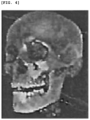
- FIGS. 3 and 4 are diagrams illustrating an example of data processed by the dental three-dimensional data processing device in accordance with the present disclosure.
- FIG. 3 illustrates three-dimensional scan data through a dental scanner in the teeth data, and the scan data are used for diagnosing the teeth.
- the shape of the human teeth By generating the shape of the human teeth as a pattern to scan it through a three-dimensional scanner, it is input through the input unit 120.
- the three-dimensional scan data of the teeth can be divided into data of maxillary and mandibular to be input thereto, respectively, and data where the maxillary and the mandibular are occluded can be generated through the secondary image data in the image data scanning the human face.
- the shape combined through alignment can be generated or the three-dimensional image data illustrated through a separate combination procedure can be generated.
- FIG. 4 is acquired by CT photographing. Data of the teeth and the temporomandibular joint are included upon the CT photographing, such that the alignment of the temporomandibular joint and the simulation based on the temporomandibular joint are possible.
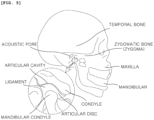
- FIG. 5 illustrates the teeth and the temporomandibular joint in a human skull, and the teeth, which are divided into maxilla and mandible, moves according to the movement of the temporomandibular joint to perform masticatory activity.
- the trajectory data for the movement of the teeth can be generated, and as illustrated in FIG. 4 , when the facial bone data (the CT data) are used, the trajectory data for the movement of the temporomandibular joint can be generated.
- FIG. 6 is a diagram illustrating an example of a face scan of the dental three-dimensional data processing device in accordance with the present disclosure.
- a method for extracting the movement of the teeth or the temporomandibular joint through the movement of the feature point is not only simple as compared with the method for attaching the target but also has relatively little interference with masticatory motion of the teeth.
- the feature point extracted from the image data can be used for aligning the location between the three-dimensional teeth data and the image data.
- SIFT Scale Invariant Feature Transform
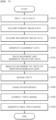
- FIG. 7 is a flowchart illustrating a dental three-dimensional data processing method in accordance with the present disclosure.
- the teeth data are input through the input unit 120 S310.
- the input unit 120 can be a scanner or a three-dimensional scanner, or can be connected to the scanner or the three-dimensional scanner to receive scanned data.
- the CT data separately photographed can be input thereto. That is, the teeth data use any one of the scan data through the dental scanner and the facial bone data having the shape of the teeth measured through a CT or a MRI.
- primary image data are acquired by scanning a human face where a human closes a mouth and is kept silent S320
- secondary image data are acquired by scanning a human face where the human bites the teeth with the mouth opened or opens the mouth S330.
- a distance is recognized through the primary image data, and facial three-dimensional data are generated by mapping color texture.
- the primary image data are used to find a Frankfurt's plane, a Camper's plane, or an occlusion reference plane.
- the facial three-dimensional data having front teeth are generated as the front teeth or the mandible is scanned together.
- the teeth can be scanned by attaching a target thereto in order to detect it more easily.
- Three-dimensional alignment data are generated by performing alignment using the teeth data and the image data of the face S340.
- the alignment of the teeth is performed by using the scan data through the dental scanner and the secondary image data.
- the CT data include the temporomandibular joint, such that the alignment of the temporomandibular joint is performed by using the facial bone data and the secondary image data. That is, the temporomandibular joint included in the facial bone data and one surface of the scanned teeth included in the secondary image data are aligned with each other.
- the three-dimensional data (hereinafter, the 'alignment data') of the teeth that are occlusion-aligned through the alignment are generated.
- the movement extraction unit 140 generates the trajectory data by tracking the movement of the teeth or the temporomandibular joint S350.
- the tracking of the movement of the teeth or the temporomandibular joint can be performed before scanning the teeth model, and can be also performed during the alignment.
- the movement extraction unit 140 photographs or scans the moving human face in real time to receive it in real time, thus tracking the movement of the teeth or the temporomandibular joint. In this time, it is possible to track the movement of the teeth or the temporomandibular joint through the movement of a target by attaching the target to the teeth, or in addition, to track the movement by extracting the feature point without attaching the target thereto separately.
- the movement extraction unit 140 generates the trajectory data by tracking the movement of the target or the feature point. Simulation is performed by applying the thus generated trajectory data to the alignment data or the occlusion-aligned three-dimensional data S360.
- the simulation unit 150 displays it through the output unit 180 by reflecting the movement according to the trajectory data on the alignment data to simulate the masticatory activity of the human.
- the trajectory and an interference factor can be displayed together with the simulation data, and in addition, the rotation shaft of the temporomandibular joint can be detected through the simulation.
- the model generation unit 160 designs the teeth considering the alignment data, the trajectory data, and the simulation result, that is, the interference factor and the rotation shaft of the temporomandibular joint S370.
- the model correction unit 170 generates correction data by sensing the teeth interference of the teeth model generated through the teeth design once again using the trajectory S380.
- the model generation unit 160 corrects the initially designed teeth model based on the correction data S390, and generates a final teeth model S400.
- the occlusion-aligned three-dimensional alignment data can be generated by combining and aligning the teeth data (the scan data through the dental scanner or the facial bone data) and the image data scanning the face, and the teeth model can be generated considering the trajectory of the movement or the interference by performing simulation using the movement of the teeth or the temporomandibular joint.
- the dental three-dimensional data processing device which can extract the movements of the teeth and the temporomandibular joint to apply them to the teeth model, thus diagnosing the teeth state more accurately and precisely and analyzing the occlusion state according to the movements of the teeth and the temporomandibular joint, and can accurately analyze a patient's condition based on the movement and the occlusion state, thus establishing treatment measures.
Landscapes
- Health & Medical Sciences (AREA)
- Engineering & Computer Science (AREA)
- Life Sciences & Earth Sciences (AREA)
- Medical Informatics (AREA)
- Physics & Mathematics (AREA)
- General Health & Medical Sciences (AREA)
- Public Health (AREA)
- Animal Behavior & Ethology (AREA)
- Veterinary Medicine (AREA)
- Optics & Photonics (AREA)
- Radiology & Medical Imaging (AREA)
- Nuclear Medicine, Radiotherapy & Molecular Imaging (AREA)
- Biomedical Technology (AREA)
- Pathology (AREA)
- Heart & Thoracic Surgery (AREA)
- Molecular Biology (AREA)
- Biophysics (AREA)
- High Energy & Nuclear Physics (AREA)
- Surgery (AREA)
- Oral & Maxillofacial Surgery (AREA)
- Dentistry (AREA)
- Theoretical Computer Science (AREA)
- General Physics & Mathematics (AREA)
- Epidemiology (AREA)
- Computer Vision & Pattern Recognition (AREA)
- Geometry (AREA)
- General Engineering & Computer Science (AREA)
- Quality & Reliability (AREA)
- Computer Graphics (AREA)
- Software Systems (AREA)
- Computer Hardware Design (AREA)
- Evolutionary Computation (AREA)
- Data Mining & Analysis (AREA)
- Databases & Information Systems (AREA)
- Primary Health Care (AREA)
- Apparatus For Radiation Diagnosis (AREA)
- Dental Tools And Instruments Or Auxiliary Dental Instruments (AREA)
Claims (13)
- Vorrichtung zur Verarbeitung von dreidimensionalen Zahndaten, die Folgendes umfasst:eine Eingabeeinheit (120), die so konfiguriert ist, dass sie Zahndaten und Bilddaten eines menschlichen Gesichts empfängt, wobei die Bilddaten Bilddaten sind, die ein Gesicht abtasten, bei dem ein Mensch den Mund öffnet, um Zähne freizulegen, und wobei die Bilddaten aufeinanderfolgende Daten sind, die in Echtzeit erfasst werden;eine Steuereinheit (110), die so konfiguriert ist, dass sie dreidimensionale Ausrichtungsdaten durch Kombinieren und Ausrichten der Zahndaten und der Bilddaten erzeugt, wobei die Steuereinheit (110) so konfiguriert ist, dass sie diese durch Abgleichen der in den Bilddaten enthaltenen Zähne mit den Zahndaten ausrichtet;eine Bewegungsextraktionseinheit (140), die so konfiguriert ist, dass sie Trajektoriendaten durch Analysieren einer Bewegung der Zähne oder eines Kiefergelenks, mit dem die Zähne verbunden sind, aus den Bilddaten erzeugt; undeine Simulationseinheit (150), die so konfiguriert ist, dass sie die Bewegung der Zähne oder des Kiefergelenks durch Anwendung der Trajektoriendaten auf die Ausrichtungsdaten simuliert.
- Dentale dreidimensionale Datenverarbeitungsvorrichtung nach Anspruch 1,
wobei die Zahndaten entweder Scandaten durch einen Zahnscanner oder Gesichtsknochendaten mit einer durch eine Computertomographie (CT) oder eine Magnetresonanztomographie (MRT) gemessenen Zahnform umfassen. - Dentale dreidimensionale Datenverarbeitungsvorrichtung nach Anspruch 2, die ferner eine Modellerzeugungseinheit (160) umfasst, die so konfiguriert ist, dass sie ein Zahnmodell erzeugt, das die Form und Bewegung der Zähne widerspiegelt, indem sie die Zähne auf der Grundlage der Ausrichtungsdaten, der Trajektoriendaten und eines Simulationsergebnisses der Simulationseinheit (150) entwirft.
- Dentale dreidimensionale Datenverarbeitungsvorrichtung nach Anspruch 3 umfasst ferner eine Modellkorrektureinheit (170), die so konfiguriert ist, dass sie Korrekturdaten in die Modellerzeugungseinheit (160) eingibt, indem sie das Zahnmodell entsprechend den Trajektoriendaten testet, um festzustellen, ob eine Interferenz auftritt oder nicht.
- Dentale dreidimensionale Datenverarbeitungsvorrichtung nach Anspruch 4, wobei die Modellkorrektureinheit (170) so konfiguriert ist, dass sie Informationen über einen Ort, an dem eine Interferenz auftritt, oder eine Intensität davon an die Modellerzeugungseinheit (160) liefert, indem sie einen Interferenzfaktor des von der Modellerzeugungseinheit (160) erzeugten Zahnmodells bestimmt.
- Dentale dreidimensionale Datenverarbeitungsvorrichtung nach Anspruch 2,
wobei die Steuereinheit (110) so konfiguriert ist, dass sie die Abtastdaten und die Bilddaten abgleicht und entsprechend einen Verdeckungszustand bestimmt. - Dentale dreidimensionale Datenverarbeitungsvorrichtung nach Anspruch 2,
wobei die Steuereinheit (110) so konfiguriert ist, dass sie eine Position und die Bewegung des Kiefergelenks durch Ausrichten der Gesichtsknochendaten und der Bilddaten verfolgt. - Dreidimensionale Zahndatenverarbeitungsvorrichtung nach Anspruch 1,
wobei die Bewegungsextraktionseinheit (140) so konfiguriert ist, dass sie einen Merkmalspunkt durch Analysieren der Bilddaten in Bezug auf die sich bewegenden Zähne in Echtzeit extrahiert und die Bewegung der Zähne durch Verfolgen einer Bewegung des Merkmalspunkts erfasst. - Dentale dreidimensionale Datenverarbeitungsvorrichtung nach Anspruch 1,
wobei die Bewegungsextraktionseinheit (140) so konfiguriert ist, dass sie die Bewegung der Zähne erkennt, indem sie ein an den Zähnen angebrachtes Ziel abtastet, um eine Bewegung des Ziels zu analysieren. - Dentale dreidimensionale Datenverarbeitungsvorrichtung nach Anspruch 1, die ferner eine Ausgabeeinheit (180) umfasst, die so konfiguriert ist, dass sie das Simulationsergebnis ausgibt, so dass die Ausrichtungsdaten so konfiguriert sind, dass sie sich entsprechend den Trajektoriendaten in der Simulationseinheit (150) bewegen,
wobei vorzugsweise die Simulationseinheit (150) so konfiguriert ist, dass sie die Bewegungstrajektorie der Zahndaten und eine Interferenzfläche auf einem Bildschirm anzeigt, und die Steuereinheit (110) so konfiguriert ist, dass sie eine Rotationswelle des Kiefergelenks durch die Simulation erkennt. - Verfahren zur Verarbeitung von dreidimensionalen Zahndaten, umfassend:Empfang von Scandaten durch einen Dentalscanner und/oder von Gesichtsknochendaten mit einer durch ein CT oder ein MRT gemessenen Zahnform;Empfangen von Bilddaten eines menschlichen Gesichts , wobei die Bilddaten Bilddaten sind, die ein Gesicht abtasten, bei dem ein Mensch den Mund öffnet, um die Zähne freizulegen, und wobei die Bilddaten aufeinanderfolgende Daten sind, die in Echtzeit erfasst werden;Erzeugen von Ausrichtungsdaten durch Kombinieren und Ausrichten von einem der Abtastdaten und der Gesichtsknochendaten und der Bilddaten, wobei das Ausrichten das Abgleichen der in den Bilddaten enthaltenen Zähne mit Zahndaten umfasst,Erzeugen von Trajektoriendaten durch Analysieren einer Bewegung der Zähne oder eines Kiefergelenks, mit dem die Zähne verbunden sind, anhand der Bilddaten; undSimulation der Bewegung der Zähne oder des Kiefergelenks durch Anwendung der Trajektoriendaten auf die Ausrichtungsdaten.
- Verfahren zur dreidimensionalen Verarbeitung von Zahndaten nach Anspruch 11,
wobei die Bilddaten mindestens eines von primären Bilddaten, die das Gesicht abtasten, wenn der Mensch den Mund schließt, um zu schweigen, und sekundären Bilddaten, die das Gesicht abtasten, wenn der Mensch den Mund öffnet, um die Zähne freizulegen, umfassen. - Verfahren zur dreidimensionalen Verarbeitung von Zahndaten nach Anspruch 11,
wobei der Empfang der Bilddaten so konfiguriert ist, dass eine Entfernung unter Verwendung von Daten, die das menschliche Gesicht scannen, erkannt wird, dreidimensionale Gesichtsdaten als die Bilddaten erzeugt werden, indem eine Farbtexturzuordnung durchgeführt wird, und eine Frankfurter Ebene, eine Camper-Ebene oder eine Okklusionsreferenzebene extrahiert wird.
Applications Claiming Priority (2)
| Application Number | Priority Date | Filing Date | Title |
|---|---|---|---|
| KR1020160055609A KR101840444B1 (ko) | 2016-05-04 | 2016-05-04 | 치과용 3차원 데이터 처리장치 및 그 방법 |
| PCT/KR2017/004714 WO2017192020A1 (ko) | 2016-05-04 | 2017-05-04 | 치과용 3차원 데이터 처리장치 및 그 방법 |
Publications (3)
| Publication Number | Publication Date |
|---|---|
| EP3453333A1 EP3453333A1 (de) | 2019-03-13 |
| EP3453333A4 EP3453333A4 (de) | 2019-12-04 |
| EP3453333B1 true EP3453333B1 (de) | 2023-08-23 |
Family
ID=60203600
Family Applications (1)
| Application Number | Title | Priority Date | Filing Date |
|---|---|---|---|
| EP17792922.1A Active EP3453333B1 (de) | 2016-05-04 | 2017-05-04 | Dentale 3d-datenverarbeitungsvorrichtung und verfahren dafür |
Country Status (5)
| Country | Link |
|---|---|
| US (1) | US11030741B2 (de) |
| EP (1) | EP3453333B1 (de) |
| KR (1) | KR101840444B1 (de) |
| CN (1) | CN109069097B (de) |
| WO (1) | WO2017192020A1 (de) |
Families Citing this family (32)
| Publication number | Priority date | Publication date | Assignee | Title |
|---|---|---|---|---|
| KR101802917B1 (ko) * | 2016-05-04 | 2017-11-29 | 주식회사 메디트 | 치아 움직임 추적 장치 및 그 방법 |
| JP7248680B2 (ja) | 2017-08-10 | 2023-03-29 | ディーフォーディー テクノロジーズ エルエルシー | 口腔内走査装置 |
| WO2019172476A1 (ko) * | 2018-03-08 | 2019-09-12 | 주식회사 쓰리디산업영상 | 환자 측두하악 관절 움직임 기반 구강 교합 분석 방법 및 장치 |
| KR102073479B1 (ko) * | 2018-06-25 | 2020-02-04 | 오스템임플란트 주식회사 | 치아 셋업 과정에서 악궁 라인을 자동으로 생성하는 장치 및 그 방법 |
| KR102091836B1 (ko) * | 2018-07-09 | 2020-04-23 | 오스템임플란트 주식회사 | 치아 셋업 과정의 공간 확보 술식 결정 장치 및 그 방법 |
| KR20200075623A (ko) * | 2018-12-18 | 2020-06-26 | (주)제노레이 | 2차원 의료 영상 및 3차원 의료 영상의 정합을 이용한 치과 치료 계획 장치 및 방법 |
| KR102152423B1 (ko) | 2019-02-18 | 2020-09-04 | 부산대학교 산학협력단 | 개인맞춤형 임플란트 식립 가이드 제작을 위한 장치 및 방법 |
| CN113645902B (zh) * | 2019-04-11 | 2024-08-02 | 株式会社迪耀 | 牙齿目标检测方法及利用牙齿目标的影像整合方法及装置 |
| US11000349B2 (en) | 2019-06-05 | 2021-05-11 | Dentsply Sirona Inc. | Method, system and computer readable storage media for determining articulation parameters |
| CN110852161B (zh) * | 2019-10-08 | 2024-09-17 | 上海淡竹体育科技有限公司 | 实时识别运动中人员身份的方法、装置及系统 |
| CN110811873B (zh) * | 2019-11-28 | 2021-07-06 | 四川大学 | 一种数字化磨牙咬合面龋齿修复方法 |
| GB201918008D0 (en) | 2019-12-09 | 2020-01-22 | Univ Leeds Innovations Ltd | Determining spatial relationship between upper teeth and facial skeleton |
| EP4062865A4 (de) | 2019-12-26 | 2024-08-14 | Medit Corp. | Verfahren zum ausrichten von gruppierten daten |
| KR102728458B1 (ko) * | 2020-01-07 | 2024-11-11 | 주식회사 메디트 | 데이터 정합을 통한 3차원 모델 생성 장치 및 방법 |
| KR102332451B1 (ko) * | 2020-01-08 | 2021-11-30 | 울산대학교 산학협력단 | 하악 운동 모델 생성 장치 및 방법 |
| KR102575216B1 (ko) | 2020-02-28 | 2023-09-06 | 주식회사 메디트 | 스캔 데이터의 후처리 시스템 및 스캔 데이터의 후처리 방법 |
| CN111759506B (zh) * | 2020-07-23 | 2021-12-07 | 茵伯特(上海)医疗技术有限公司 | 一种种植牙全数字化种植修复方法及系统 |
| CN112017211B (zh) * | 2020-07-28 | 2024-11-22 | 上海涛影医疗科技有限公司 | 一种颞颌关节运动追踪方法及系统 |
| KR102460621B1 (ko) * | 2020-09-23 | 2022-10-28 | 주식회사 메디트 | 구강 이미지 처리 장치, 및 구강 이미지 처리 방법 |
| CN116507296B (zh) * | 2020-10-28 | 2026-02-24 | 株式会社美迪特 | 处理三维口腔模型的方法和装置以及计算机可读记录介质 |
| KR102488096B1 (ko) * | 2020-11-11 | 2023-01-13 | 주식회사 메디트 | 구강 이미지 처리 장치 및 구강 이미지 처리 방법 |
| US12131462B2 (en) * | 2021-01-14 | 2024-10-29 | Motahare Amiri Kamalabad | System and method for facial and dental photography, landmark detection and mouth design generation |
| KR102501665B1 (ko) * | 2021-02-15 | 2023-02-17 | 연세대학교 산학협력단 | 입술 움직임 정보 분석 방법 및 장치 |
| KR102539577B1 (ko) * | 2021-02-23 | 2023-06-05 | 오스템임플란트 주식회사 | 대상체에 대한 인공치아의 모델링 데이터를 제공하는 방법, 디바이스 및 기록매체 |
| CN114668538A (zh) * | 2022-03-29 | 2022-06-28 | 杭州丰雅医疗科技有限公司 | 三维模块化颅颌骨医学影像的数字颌型架及构建方法 |
| KR102742606B1 (ko) * | 2022-04-01 | 2024-12-16 | 주식회사 레이 | 하악골 움직임 시뮬레이션 처리 방법 |
| US11633260B1 (en) | 2022-06-03 | 2023-04-25 | Sdc U.S. Smilepay Spv | Positioning individual three-dimensional model teeth based on two-dimensional images |
| CN115018881A (zh) * | 2022-06-17 | 2022-09-06 | 先临三维科技股份有限公司 | 颌骨运动轨迹追踪方法、装置、设备及介质 |
| CN114998349B (zh) * | 2022-08-04 | 2022-11-11 | 首都医科大学宣武医院 | 颞下颌关节数字化三维测量评价方法 |
| CN116227235B (zh) * | 2023-05-05 | 2023-07-18 | 北京大学口腔医学院 | 颞下颌关节运动模拟仿真方法 |
| CN118379469B (zh) * | 2024-05-28 | 2024-11-29 | 先临三维科技股份有限公司 | 扫描方法、电子设备和计算机可读存储介质 |
| CN119169154B (zh) * | 2024-11-20 | 2025-03-14 | 先临三维科技股份有限公司 | 一种视频展示方法、装置、电子设备及存储介质 |
Family Cites Families (14)
| Publication number | Priority date | Publication date | Assignee | Title |
|---|---|---|---|---|
| JP3903228B2 (ja) * | 1997-04-23 | 2007-04-11 | 東風 巧 | 審美的咬合平面の決定装置 |
| US6144875A (en) | 1999-03-16 | 2000-11-07 | Accuray Incorporated | Apparatus and method for compensating for respiratory and patient motion during treatment |
| US9421074B2 (en) * | 2001-04-13 | 2016-08-23 | Orametrix, Inc. | Unified three dimensional virtual craniofacial and dentition model and uses thereof |
| US20070207441A1 (en) * | 2006-03-03 | 2007-09-06 | Lauren Mark D | Four dimensional modeling of jaw and tooth dynamics |
| US20090305185A1 (en) * | 2008-05-05 | 2009-12-10 | Lauren Mark D | Method Of Designing Custom Articulator Inserts Using Four-Dimensional Data |
| JP5157918B2 (ja) * | 2009-01-06 | 2013-03-06 | コニカミノルタホールディングス株式会社 | 動画像表示装置およびプログラム |
| JP5859986B2 (ja) * | 2010-02-25 | 2016-02-16 | 3シェイプ アー/エス | 動的仮想咬合器 |
| KR20130008236A (ko) | 2011-07-12 | 2013-01-22 | (주)쓰리디아이티 | 악교정수술을 위한 영상 매칭정보 생성 방법 및 이를 이용한 악교정 모의 수술 방법 |
| FR2979226B1 (fr) | 2011-08-31 | 2014-11-21 | Maxime Jaisson | Procede de conception d'un appareil dentaire |
| DE102012104912A1 (de) * | 2012-05-25 | 2013-11-28 | Sicat Gmbh & Co. Kg | Verfahren zum Erstellen eines virtuellen Kieferabbildes |
| US8948482B2 (en) | 2012-11-01 | 2015-02-03 | Align Technology, Inc. | Motion compensation in a three dimensional scan |
| US9844324B2 (en) * | 2013-03-14 | 2017-12-19 | X-Nav Technologies, LLC | Image guided navigation system |
| KR101600609B1 (ko) * | 2014-05-23 | 2016-03-21 | (주)제노레이 | 엑스선 촬영장치의 정렬 바이트 및 이를 갖는 엑스선 촬영장치 |
| CN105447908B (zh) * | 2015-12-04 | 2018-04-17 | 山东山大华天软件有限公司 | 基于口腔扫描数据和cbct数据的牙列模型生成方法 |
-
2016
- 2016-05-04 KR KR1020160055609A patent/KR101840444B1/ko active Active
-
2017
- 2017-05-04 CN CN201780027581.XA patent/CN109069097B/zh active Active
- 2017-05-04 EP EP17792922.1A patent/EP3453333B1/de active Active
- 2017-05-04 US US16/098,931 patent/US11030741B2/en active Active
- 2017-05-04 WO PCT/KR2017/004714 patent/WO2017192020A1/ko not_active Ceased
Also Published As
| Publication number | Publication date |
|---|---|
| KR101840444B1 (ko) | 2018-03-20 |
| US11030741B2 (en) | 2021-06-08 |
| US20190147591A1 (en) | 2019-05-16 |
| KR20170125599A (ko) | 2017-11-15 |
| EP3453333A4 (de) | 2019-12-04 |
| EP3453333A1 (de) | 2019-03-13 |
| CN109069097B (zh) | 2022-03-18 |
| CN109069097A (zh) | 2018-12-21 |
| WO2017192020A1 (ko) | 2017-11-09 |
Similar Documents
| Publication | Publication Date | Title |
|---|---|---|
| US11030741B2 (en) | Dental three-dimensional data processing device and method thereof | |
| Rangel et al. | Integration of digital dental casts in 3-dimensional facial photographs | |
| JP4446094B2 (ja) | 人体情報抽出装置 | |
| US10646317B2 (en) | Occlusal state identifying method, occlusal state identifying apparatus, and storage medium | |
| JP5989234B2 (ja) | 顎部バーチャル像の作成方法 | |
| Atresh et al. | Three-dimensional treatment outcomes in Class II patients with different vertical facial patterns treated with the Herbst appliance | |
| EP3453360B1 (de) | Vorrichtung zur verfolgung der bewegung von zähnen und verfahren dafür | |
| CN104955399B (zh) | 产生假体影像的方法和系统 | |
| KR102372962B1 (ko) | 자연 두부 위치에서 촬영된 3차원 cbct 영상에서 기계 학습 기반 치아 교정 진단을 위한 두부 계측 파라미터 도출방법 | |
| US11090014B2 (en) | Dental image processing device, dental imaging system, dental image processing method, and program | |
| KR101785586B1 (ko) | 동적 가상 교합기 | |
| EP2134290A1 (de) | Computergestützte erstellung der zahnstruktur eines individuums über gesichtsanalyse | |
| KR20110100141A (ko) | 치과 진단 시스템 및 치과 치료 시스템 | |
| US20240245495A1 (en) | Accurate scanning of patient bite | |
| EP4364094B1 (de) | Nichtinvasive parodontale untersuchung | |
| US20250295480A1 (en) | Method for monitoring changes in bite | |
| WO2016003256A1 (ko) | 치아 교정 시술을 위한 모의시술 방법 | |
| KR101742582B1 (ko) | 수술용 턱뼈 위치 계측 장치 및 이를 운용하는 방법 | |
| US11654002B2 (en) | Method for determining and visualizing tooth movements and planned instances of tooth repositioning | |
| US20250169922A1 (en) | Means for Managing a Dental Aligner Treatment in Dependence of Magnetic Resonance Data | |
| CN120302926A (zh) | 数据生成程序、数据生成方法、数据生成装置以及x射线拍摄装置 |
Legal Events
| Date | Code | Title | Description |
|---|---|---|---|
| STAA | Information on the status of an ep patent application or granted ep patent |
Free format text: STATUS: THE INTERNATIONAL PUBLICATION HAS BEEN MADE |
|
| PUAI | Public reference made under article 153(3) epc to a published international application that has entered the european phase |
Free format text: ORIGINAL CODE: 0009012 |
|
| STAA | Information on the status of an ep patent application or granted ep patent |
Free format text: STATUS: REQUEST FOR EXAMINATION WAS MADE |
|
| 17P | Request for examination filed |
Effective date: 20181106 |
|
| AK | Designated contracting states |
Kind code of ref document: A1 Designated state(s): AL AT BE BG CH CY CZ DE DK EE ES FI FR GB GR HR HU IE IS IT LI LT LU LV MC MK MT NL NO PL PT RO RS SE SI SK SM TR |
|
| AX | Request for extension of the european patent |
Extension state: BA ME |
|
| DAV | Request for validation of the european patent (deleted) | ||
| DAX | Request for extension of the european patent (deleted) | ||
| A4 | Supplementary search report drawn up and despatched |
Effective date: 20191107 |
|
| RIC1 | Information provided on ipc code assigned before grant |
Ipc: A61C 7/00 20060101ALI20191031BHEP Ipc: A61B 6/14 20060101AFI20191031BHEP Ipc: A61B 6/00 20060101ALI20191031BHEP Ipc: G16H 50/50 20180101ALI20191031BHEP |
|
| STAA | Information on the status of an ep patent application or granted ep patent |
Free format text: STATUS: EXAMINATION IS IN PROGRESS |
|
| 17Q | First examination report despatched |
Effective date: 20210526 |
|
| GRAP | Despatch of communication of intention to grant a patent |
Free format text: ORIGINAL CODE: EPIDOSNIGR1 |
|
| STAA | Information on the status of an ep patent application or granted ep patent |
Free format text: STATUS: GRANT OF PATENT IS INTENDED |
|
| INTG | Intention to grant announced |
Effective date: 20230313 |
|
| GRAS | Grant fee paid |
Free format text: ORIGINAL CODE: EPIDOSNIGR3 |
|
| GRAA | (expected) grant |
Free format text: ORIGINAL CODE: 0009210 |
|
| STAA | Information on the status of an ep patent application or granted ep patent |
Free format text: STATUS: THE PATENT HAS BEEN GRANTED |
|
| P01 | Opt-out of the competence of the unified patent court (upc) registered |
Effective date: 20230711 |
|
| AK | Designated contracting states |
Kind code of ref document: B1 Designated state(s): AL AT BE BG CH CY CZ DE DK EE ES FI FR GB GR HR HU IE IS IT LI LT LU LV MC MK MT NL NO PL PT RO RS SE SI SK SM TR |
|
| REG | Reference to a national code |
Ref country code: GB Ref legal event code: FG4D |
|
| REG | Reference to a national code |
Ref country code: CH Ref legal event code: EP |
|
| REG | Reference to a national code |
Ref country code: DE Ref legal event code: R096 Ref document number: 602017073144 Country of ref document: DE |
|
| REG | Reference to a national code |
Ref country code: IE Ref legal event code: FG4D |
|
| REG | Reference to a national code |
Ref country code: DE Ref legal event code: R079 Ref document number: 602017073144 Country of ref document: DE Free format text: PREVIOUS MAIN CLASS: A61B0006140000 Ipc: A61B0006510000 |
|
| REG | Reference to a national code |
Ref country code: LT Ref legal event code: MG9D |
|
| REG | Reference to a national code |
Ref country code: NL Ref legal event code: MP Effective date: 20230823 |
|
| REG | Reference to a national code |
Ref country code: AT Ref legal event code: MK05 Ref document number: 1601623 Country of ref document: AT Kind code of ref document: T Effective date: 20230823 |
|
| PG25 | Lapsed in a contracting state [announced via postgrant information from national office to epo] |
Ref country code: GR Free format text: LAPSE BECAUSE OF FAILURE TO SUBMIT A TRANSLATION OF THE DESCRIPTION OR TO PAY THE FEE WITHIN THE PRESCRIBED TIME-LIMIT Effective date: 20231124 |
|
| PG25 | Lapsed in a contracting state [announced via postgrant information from national office to epo] |
Ref country code: IS Free format text: LAPSE BECAUSE OF FAILURE TO SUBMIT A TRANSLATION OF THE DESCRIPTION OR TO PAY THE FEE WITHIN THE PRESCRIBED TIME-LIMIT Effective date: 20231223 |
|
| PG25 | Lapsed in a contracting state [announced via postgrant information from national office to epo] |
Ref country code: SE Free format text: LAPSE BECAUSE OF FAILURE TO SUBMIT A TRANSLATION OF THE DESCRIPTION OR TO PAY THE FEE WITHIN THE PRESCRIBED TIME-LIMIT Effective date: 20230823 Ref country code: RS Free format text: LAPSE BECAUSE OF FAILURE TO SUBMIT A TRANSLATION OF THE DESCRIPTION OR TO PAY THE FEE WITHIN THE PRESCRIBED TIME-LIMIT Effective date: 20230823 Ref country code: PT Free format text: LAPSE BECAUSE OF FAILURE TO SUBMIT A TRANSLATION OF THE DESCRIPTION OR TO PAY THE FEE WITHIN THE PRESCRIBED TIME-LIMIT Effective date: 20231226 Ref country code: NO Free format text: LAPSE BECAUSE OF FAILURE TO SUBMIT A TRANSLATION OF THE DESCRIPTION OR TO PAY THE FEE WITHIN THE PRESCRIBED TIME-LIMIT Effective date: 20231123 Ref country code: NL Free format text: LAPSE BECAUSE OF FAILURE TO SUBMIT A TRANSLATION OF THE DESCRIPTION OR TO PAY THE FEE WITHIN THE PRESCRIBED TIME-LIMIT Effective date: 20230823 Ref country code: LV Free format text: LAPSE BECAUSE OF FAILURE TO SUBMIT A TRANSLATION OF THE DESCRIPTION OR TO PAY THE FEE WITHIN THE PRESCRIBED TIME-LIMIT Effective date: 20230823 Ref country code: LT Free format text: LAPSE BECAUSE OF FAILURE TO SUBMIT A TRANSLATION OF THE DESCRIPTION OR TO PAY THE FEE WITHIN THE PRESCRIBED TIME-LIMIT Effective date: 20230823 Ref country code: IS Free format text: LAPSE BECAUSE OF FAILURE TO SUBMIT A TRANSLATION OF THE DESCRIPTION OR TO PAY THE FEE WITHIN THE PRESCRIBED TIME-LIMIT Effective date: 20231223 Ref country code: HR Free format text: LAPSE BECAUSE OF FAILURE TO SUBMIT A TRANSLATION OF THE DESCRIPTION OR TO PAY THE FEE WITHIN THE PRESCRIBED TIME-LIMIT Effective date: 20230823 Ref country code: GR Free format text: LAPSE BECAUSE OF FAILURE TO SUBMIT A TRANSLATION OF THE DESCRIPTION OR TO PAY THE FEE WITHIN THE PRESCRIBED TIME-LIMIT Effective date: 20231124 Ref country code: FI Free format text: LAPSE BECAUSE OF FAILURE TO SUBMIT A TRANSLATION OF THE DESCRIPTION OR TO PAY THE FEE WITHIN THE PRESCRIBED TIME-LIMIT Effective date: 20230823 Ref country code: AT Free format text: LAPSE BECAUSE OF FAILURE TO SUBMIT A TRANSLATION OF THE DESCRIPTION OR TO PAY THE FEE WITHIN THE PRESCRIBED TIME-LIMIT Effective date: 20230823 |
|
| PG25 | Lapsed in a contracting state [announced via postgrant information from national office to epo] |
Ref country code: PL Free format text: LAPSE BECAUSE OF FAILURE TO SUBMIT A TRANSLATION OF THE DESCRIPTION OR TO PAY THE FEE WITHIN THE PRESCRIBED TIME-LIMIT Effective date: 20230823 |
|
| PG25 | Lapsed in a contracting state [announced via postgrant information from national office to epo] |
Ref country code: ES Free format text: LAPSE BECAUSE OF FAILURE TO SUBMIT A TRANSLATION OF THE DESCRIPTION OR TO PAY THE FEE WITHIN THE PRESCRIBED TIME-LIMIT Effective date: 20230823 |
|
| PG25 | Lapsed in a contracting state [announced via postgrant information from national office to epo] |
Ref country code: SM Free format text: LAPSE BECAUSE OF FAILURE TO SUBMIT A TRANSLATION OF THE DESCRIPTION OR TO PAY THE FEE WITHIN THE PRESCRIBED TIME-LIMIT Effective date: 20230823 Ref country code: RO Free format text: LAPSE BECAUSE OF FAILURE TO SUBMIT A TRANSLATION OF THE DESCRIPTION OR TO PAY THE FEE WITHIN THE PRESCRIBED TIME-LIMIT Effective date: 20230823 Ref country code: ES Free format text: LAPSE BECAUSE OF FAILURE TO SUBMIT A TRANSLATION OF THE DESCRIPTION OR TO PAY THE FEE WITHIN THE PRESCRIBED TIME-LIMIT Effective date: 20230823 Ref country code: EE Free format text: LAPSE BECAUSE OF FAILURE TO SUBMIT A TRANSLATION OF THE DESCRIPTION OR TO PAY THE FEE WITHIN THE PRESCRIBED TIME-LIMIT Effective date: 20230823 Ref country code: DK Free format text: LAPSE BECAUSE OF FAILURE TO SUBMIT A TRANSLATION OF THE DESCRIPTION OR TO PAY THE FEE WITHIN THE PRESCRIBED TIME-LIMIT Effective date: 20230823 Ref country code: CZ Free format text: LAPSE BECAUSE OF FAILURE TO SUBMIT A TRANSLATION OF THE DESCRIPTION OR TO PAY THE FEE WITHIN THE PRESCRIBED TIME-LIMIT Effective date: 20230823 Ref country code: SK Free format text: LAPSE BECAUSE OF FAILURE TO SUBMIT A TRANSLATION OF THE DESCRIPTION OR TO PAY THE FEE WITHIN THE PRESCRIBED TIME-LIMIT Effective date: 20230823 |
|
| REG | Reference to a national code |
Ref country code: DE Ref legal event code: R097 Ref document number: 602017073144 Country of ref document: DE |
|
| PG25 | Lapsed in a contracting state [announced via postgrant information from national office to epo] |
Ref country code: IT Free format text: LAPSE BECAUSE OF FAILURE TO SUBMIT A TRANSLATION OF THE DESCRIPTION OR TO PAY THE FEE WITHIN THE PRESCRIBED TIME-LIMIT Effective date: 20230823 |
|
| PLBE | No opposition filed within time limit |
Free format text: ORIGINAL CODE: 0009261 |
|
| STAA | Information on the status of an ep patent application or granted ep patent |
Free format text: STATUS: NO OPPOSITION FILED WITHIN TIME LIMIT |
|
| 26N | No opposition filed |
Effective date: 20240524 |
|
| PG25 | Lapsed in a contracting state [announced via postgrant information from national office to epo] |
Ref country code: SI Free format text: LAPSE BECAUSE OF FAILURE TO SUBMIT A TRANSLATION OF THE DESCRIPTION OR TO PAY THE FEE WITHIN THE PRESCRIBED TIME-LIMIT Effective date: 20230823 |
|
| PG25 | Lapsed in a contracting state [announced via postgrant information from national office to epo] |
Ref country code: BG Free format text: LAPSE BECAUSE OF FAILURE TO SUBMIT A TRANSLATION OF THE DESCRIPTION OR TO PAY THE FEE WITHIN THE PRESCRIBED TIME-LIMIT Effective date: 20230823 |
|
| PG25 | Lapsed in a contracting state [announced via postgrant information from national office to epo] |
Ref country code: BG Free format text: LAPSE BECAUSE OF FAILURE TO SUBMIT A TRANSLATION OF THE DESCRIPTION OR TO PAY THE FEE WITHIN THE PRESCRIBED TIME-LIMIT Effective date: 20230823 |
|
| REG | Reference to a national code |
Ref country code: CH Ref legal event code: PL |
|
| PG25 | Lapsed in a contracting state [announced via postgrant information from national office to epo] |
Ref country code: MC Free format text: LAPSE BECAUSE OF FAILURE TO SUBMIT A TRANSLATION OF THE DESCRIPTION OR TO PAY THE FEE WITHIN THE PRESCRIBED TIME-LIMIT Effective date: 20230823 |
|
| PG25 | Lapsed in a contracting state [announced via postgrant information from national office to epo] |
Ref country code: LU Free format text: LAPSE BECAUSE OF NON-PAYMENT OF DUE FEES Effective date: 20240504 |
|
| PG25 | Lapsed in a contracting state [announced via postgrant information from national office to epo] |
Ref country code: MC Free format text: LAPSE BECAUSE OF FAILURE TO SUBMIT A TRANSLATION OF THE DESCRIPTION OR TO PAY THE FEE WITHIN THE PRESCRIBED TIME-LIMIT Effective date: 20230823 Ref country code: LU Free format text: LAPSE BECAUSE OF NON-PAYMENT OF DUE FEES Effective date: 20240504 Ref country code: CH Free format text: LAPSE BECAUSE OF NON-PAYMENT OF DUE FEES Effective date: 20240531 |
|
| REG | Reference to a national code |
Ref country code: BE Ref legal event code: MM Effective date: 20240531 |
|
| PG25 | Lapsed in a contracting state [announced via postgrant information from national office to epo] |
Ref country code: IE Free format text: LAPSE BECAUSE OF NON-PAYMENT OF DUE FEES Effective date: 20240504 |
|
| PG25 | Lapsed in a contracting state [announced via postgrant information from national office to epo] |
Ref country code: BE Free format text: LAPSE BECAUSE OF NON-PAYMENT OF DUE FEES Effective date: 20240531 |
|
| PGFP | Annual fee paid to national office [announced via postgrant information from national office to epo] |
Ref country code: FR Payment date: 20250521 Year of fee payment: 9 |
|
| PG25 | Lapsed in a contracting state [announced via postgrant information from national office to epo] |
Ref country code: CY Free format text: LAPSE BECAUSE OF FAILURE TO SUBMIT A TRANSLATION OF THE DESCRIPTION OR TO PAY THE FEE WITHIN THE PRESCRIBED TIME-LIMIT; INVALID AB INITIO Effective date: 20170504 |
|
| PG25 | Lapsed in a contracting state [announced via postgrant information from national office to epo] |
Ref country code: HU Free format text: LAPSE BECAUSE OF FAILURE TO SUBMIT A TRANSLATION OF THE DESCRIPTION OR TO PAY THE FEE WITHIN THE PRESCRIBED TIME-LIMIT; INVALID AB INITIO Effective date: 20170504 |
|
| PGFP | Annual fee paid to national office [announced via postgrant information from national office to epo] |
Ref country code: DE Payment date: 20250725 Year of fee payment: 9 |
|
| PGFP | Annual fee paid to national office [announced via postgrant information from national office to epo] |
Ref country code: GB Payment date: 20260324 Year of fee payment: 10 |