EP3450590A1 - Plastic surface treatment method - Google Patents
Plastic surface treatment method Download PDFInfo
- Publication number
- EP3450590A1 EP3450590A1 EP17789112.4A EP17789112A EP3450590A1 EP 3450590 A1 EP3450590 A1 EP 3450590A1 EP 17789112 A EP17789112 A EP 17789112A EP 3450590 A1 EP3450590 A1 EP 3450590A1
- Authority
- EP
- European Patent Office
- Prior art keywords
- plastic
- sulfuric acid
- solution
- treatment
- treating
- Prior art date
- Legal status (The legal status is an assumption and is not a legal conclusion. Google has not performed a legal analysis and makes no representation as to the accuracy of the status listed.)
- Withdrawn
Links
Images
Classifications
-
- C—CHEMISTRY; METALLURGY
- C23—COATING METALLIC MATERIAL; COATING MATERIAL WITH METALLIC MATERIAL; CHEMICAL SURFACE TREATMENT; DIFFUSION TREATMENT OF METALLIC MATERIAL; COATING BY VACUUM EVAPORATION, BY SPUTTERING, BY ION IMPLANTATION OR BY CHEMICAL VAPOUR DEPOSITION, IN GENERAL; INHIBITING CORROSION OF METALLIC MATERIAL OR INCRUSTATION IN GENERAL
- C23C—COATING METALLIC MATERIAL; COATING MATERIAL WITH METALLIC MATERIAL; SURFACE TREATMENT OF METALLIC MATERIAL BY DIFFUSION INTO THE SURFACE, BY CHEMICAL CONVERSION OR SUBSTITUTION; COATING BY VACUUM EVAPORATION, BY SPUTTERING, BY ION IMPLANTATION OR BY CHEMICAL VAPOUR DEPOSITION, IN GENERAL
- C23C18/00—Chemical coating by decomposition of either liquid compounds or solutions of the coating forming compounds, without leaving reaction products of surface material in the coating; Contact plating
- C23C18/16—Chemical coating by decomposition of either liquid compounds or solutions of the coating forming compounds, without leaving reaction products of surface material in the coating; Contact plating by reduction or substitution, e.g. electroless plating
- C23C18/18—Pretreatment of the material to be coated
- C23C18/20—Pretreatment of the material to be coated of organic surfaces, e.g. resins
- C23C18/22—Roughening, e.g. by etching
- C23C18/24—Roughening, e.g. by etching using acid aqueous solutions
-
- C—CHEMISTRY; METALLURGY
- C25—ELECTROLYTIC OR ELECTROPHORETIC PROCESSES; APPARATUS THEREFOR
- C25B—ELECTROLYTIC OR ELECTROPHORETIC PROCESSES FOR THE PRODUCTION OF COMPOUNDS OR NON-METALS; APPARATUS THEREFOR
- C25B1/00—Electrolytic production of inorganic compounds or non-metals
- C25B1/01—Products
- C25B1/28—Per-compounds
- C25B1/29—Persulfates
-
- C—CHEMISTRY; METALLURGY
- C25—ELECTROLYTIC OR ELECTROPHORETIC PROCESSES; APPARATUS THEREFOR
- C25B—ELECTROLYTIC OR ELECTROPHORETIC PROCESSES FOR THE PRODUCTION OF COMPOUNDS OR NON-METALS; APPARATUS THEREFOR
- C25B15/00—Operating or servicing cells
- C25B15/08—Supplying or removing reactants or electrolytes; Regeneration of electrolytes
-
- C—CHEMISTRY; METALLURGY
- C25—ELECTROLYTIC OR ELECTROPHORETIC PROCESSES; APPARATUS THEREFOR
- C25B—ELECTROLYTIC OR ELECTROPHORETIC PROCESSES FOR THE PRODUCTION OF COMPOUNDS OR NON-METALS; APPARATUS THEREFOR
- C25B15/00—Operating or servicing cells
- C25B15/08—Supplying or removing reactants or electrolytes; Regeneration of electrolytes
- C25B15/085—Removing impurities
-
- C—CHEMISTRY; METALLURGY
- C23—COATING METALLIC MATERIAL; COATING MATERIAL WITH METALLIC MATERIAL; CHEMICAL SURFACE TREATMENT; DIFFUSION TREATMENT OF METALLIC MATERIAL; COATING BY VACUUM EVAPORATION, BY SPUTTERING, BY ION IMPLANTATION OR BY CHEMICAL VAPOUR DEPOSITION, IN GENERAL; INHIBITING CORROSION OF METALLIC MATERIAL OR INCRUSTATION IN GENERAL
- C23C—COATING METALLIC MATERIAL; COATING MATERIAL WITH METALLIC MATERIAL; SURFACE TREATMENT OF METALLIC MATERIAL BY DIFFUSION INTO THE SURFACE, BY CHEMICAL CONVERSION OR SUBSTITUTION; COATING BY VACUUM EVAPORATION, BY SPUTTERING, BY ION IMPLANTATION OR BY CHEMICAL VAPOUR DEPOSITION, IN GENERAL
- C23C18/00—Chemical coating by decomposition of either liquid compounds or solutions of the coating forming compounds, without leaving reaction products of surface material in the coating; Contact plating
- C23C18/16—Chemical coating by decomposition of either liquid compounds or solutions of the coating forming compounds, without leaving reaction products of surface material in the coating; Contact plating by reduction or substitution, e.g. electroless plating
- C23C18/1601—Process or apparatus
- C23C18/1633—Process of electroless plating
- C23C18/1635—Composition of the substrate
- C23C18/1639—Substrates other than metallic, e.g. inorganic or organic or non-conductive
- C23C18/1641—Organic substrates, e.g. resin, plastic
Definitions
- the present invention relates to a method for treating a surface of a plastic (resin molded product), the method being performed prior to metallization of a surface of a plastic.
- plastics are substituted for the metals utilizing advantages of the plastics, such as weight saving, reduction in cost, freedom of shape and ease of mass production.
- advantages of the plastics such as weight saving, reduction in cost, freedom of shape and ease of mass production.
- plastics are widely used not only for decoration but also for exterior or interior trim parts, home appliances, and the like.
- the plastic surface is subjected to plating in many cases in order to enhance rigidity, abrasion resistance, weathering resistance, heat resistance, etc.
- Plastics are non-conductive, and therefore, in order to carry out plating, it is necessary to form a metal film, which becomes a conductor, on plastics first.
- the methods are broadly classified into dry methods such as CVD and PVD and wet methods such as electroless nickel plating. In most of the dry methods, film formation is carried out under vacuum, and they are not suitable for mass production or application to large components, so that the wet methods have been adopted so far.
- Chromic acid is H 2 CrO 4
- etching solution that is a mixed solution of chromic acid and concentrated sulfuric acid
- equilibrium of 2CrO 4 2- + 2H 3 O + ⁇ Cr 2 O 7 2- + 3H 2 O is present, but Cr is hexavalent in any case.
- hexavalent Cr is an object of REACH regulation and RoHS regulation, hexavalent Cr does not remain in the products and is not subject to regulation. In recent years, however, concern about environmental issues is increasing, and environmentally friendly technology using no hexavalent Cr has been strongly desired.
- the present inventors have intensively studied, and as a result, they have completed the present invention comprising treating a plastic surface with a sulfuric acid solution containing persulfuric acid (oxidizing agent) obtained by electrolyzing sulfuric acid which thereby can provide a plating film sufficiently adhered to the plastic surface when the subsequent plating treatment is performed.
- the present invention is based on such knowledge, and the gist of the present invention is as follows.
- a plating film sufficiently adhered to the plastic surface can be obtained.
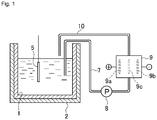
- Fig. 1 is a structural view of a pretreatment equipment.
- the plastic of interest is not particularly limited, and examples thereof include plastics having high difficulty in etching, which can not be etched unless a chromic acid-sulfuric acid solution is used, such as acrylonitrile-butadienestyrene (ABS) resin, polyether ether ketone (PEEK) resin, polyethylene naphthalate (PEN) resin, polyethylene terephthalate (PET) resin and polyphenylene sulfide (PPS) resin.
- ABS acrylonitrile-butadienestyrene
- PEEK polyether ether ketone
- PEN polyethylene naphthalate
- PET polyethylene terephthalate
- PPS polyphenylene sulfide
- the plastic is degreased first, and thereafter, the plastic is immersed in a sulfuric acid solution obtained by electrolyzing sulfuric acid, thereby treating the plastic surface.
- the sulfuric acid concentration of this sulfuric acid solution be 50 to 92 wt%, particularly 70 to 85 wt%
- the persulfuric acid concentration be not less than 3 g/L, for example, 3 to 20 g/L, particularly 3 to 10 g/L
- the treatment temperature be not lower than 80°C, for example, 80 to 140°C, particularly 100 to 130°C.
- Fig. 1 is a schematic sectional view showing an example of electrolysis equipment suitable for carrying out electrolysis of such sulfuric acid.
- a thermostatic heater 2 On the outer periphery of a treatment tank 1, a thermostatic heater 2 is provided.
- a plastic plate 5 is arranged as a plastic to be treated in such a manner that the respective plate surfaces are directed upward and downward.
- a stirring means to stir the solution such as a diffuser tube, may be installed.
- the solution in the treatment tank 1 is circulated through a pipe 7, a pump 8, an electrolytic cell 9 and a pipe 10.
- an anode 9a and a cathode 9b each of which is formed of a diamond electrode, and a bipolar electrode 9c arranged between them are installed.
- a predetermined current is allowed to flow from a power supply unit, and sulfuric acid is electrolyzed, thereby forming persulfuric acid such as peroxodisulfuric acid.
- the surface treatment of the plastic plate 5 is carried out by placing sulfuric acid in the treatment tank 1, operating the pump 8 and the electrolytic cell 9 to form a sulfuric acid and persulfuric acid-containing treatment solution having a sulfuric acid concentration and a persulfuric acid concentration in the above ranges, and thereafter immersing the plastic plate 5 in the treatment solution in the treatment tank 1 for a predetermined time while operating the pump 8 and the electrolytic cell 9.
- the plastic plate 5 taken out of the treatment tank 1 is subjected to washing with water and drying, and then subjected to plating treatment.
- plating treatment methods there are electroless plating with autocatalysis and electroless plating without autocatalysis, and any of them is available.
- a metal for plating may be any of nickel, copper, cobalt and alloys thereof.
- the total concentration of oxidizing agents contained in the treatment solution was measured by iodometric titration.
- This iodometric titration is a method in which KI is added to liberate I 2 , then I 2 is titrated with a sodium thiosulfate standard solution to determine the amount of I 2 , and from the amount of I 2 , an oxidizing agent concentration is determined.
- only the hydrogen peroxide concentration was determined by potassium permanganate titration, and the potassium permanganate titration value was subtracted from the iodometric titration value, thereby determining the persulfuric acid concentration.
- volume of treatment tank 1 40 L Size of PEEK resin plate: 500 mm ⁇ 500 mm ⁇ thickness 5 mm
- Example Sulfuric acid concentration (50 to 92 wt%) Treatment temperature (100 to 130°C) Persulfuric acid concentration (not less than 3 g/L) Treatment time (1 to 10 min)
- Adhesion test result Ex. 1 85 120 10 1 class 0 Ex. 2 75 130 5 10 class 0 Ex. 3 92 100 3 2 class 0 Com p. Ex. 1 85 140 5 3 class 1 Com p. Ex. 2 45 100 10 10 class 3 Comp. Ex. 3 85 120 1 10 class 4 Comp. Ex. 4 96 100 0 10 class 4 Comp. Ex. 5 96 100 10 1 class 3
Landscapes
- Chemical & Material Sciences (AREA)
- Chemical Kinetics & Catalysis (AREA)
- Engineering & Computer Science (AREA)
- Materials Engineering (AREA)
- Metallurgy (AREA)
- Organic Chemistry (AREA)
- Electrochemistry (AREA)
- General Chemical & Material Sciences (AREA)
- Mechanical Engineering (AREA)
- Inorganic Chemistry (AREA)
- Chemically Coating (AREA)
- Electrolytic Production Of Non-Metals, Compounds, Apparatuses Therefor (AREA)
Abstract
Description
- The present invention relates to a method for treating a surface of a plastic (resin molded product), the method being performed prior to metallization of a surface of a plastic.
- In portions of structural materials and component materials where metals are used, plastics are substituted for the metals utilizing advantages of the plastics, such as weight saving, reduction in cost, freedom of shape and ease of mass production. At present, plastics are widely used not only for decoration but also for exterior or interior trim parts, home appliances, and the like. In such uses, the plastic surface is subjected to plating in many cases in order to enhance rigidity, abrasion resistance, weathering resistance, heat resistance, etc.
- Plastics are non-conductive, and therefore, in order to carry out plating, it is necessary to form a metal film, which becomes a conductor, on plastics first. The methods are broadly classified into dry methods such as CVD and PVD and wet methods such as electroless nickel plating. In most of the dry methods, film formation is carried out under vacuum, and they are not suitable for mass production or application to large components, so that the wet methods have been adopted so far.
- Pretreatment of an ABS resin and a PEEK resin has been heretofore thought to be difficult, and in the etching process for them, a chromic acid-sulfuric acid solution has been used to thereby achieve the purpose.
- Chromic acid is H2CrO4, and in the etching solution that is a mixed solution of chromic acid and concentrated sulfuric acid, equilibrium of
2CrO4 2- + 2H3O+ → Cr2O7 2- + 3H2O
is present, but Cr is hexavalent in any case. Although hexavalent Cr is an object of REACH regulation and RoHS regulation, hexavalent Cr does not remain in the products and is not subject to regulation. In recent years, however, concern about environmental issues is increasing, and environmentally friendly technology using no hexavalent Cr has been strongly desired. - As environmentally friendly technology substituted for chromic acid, it is described in a
PTL 1 that etching with a mixed solution of permanganate and an inorganic salt is carried out. In the method of thisPTL 1, however, surface treatment of a PEEK resin and an ABS resin is difficult, and there occurs a problem in adhesion to a metal. - PTL 1:
JP 2008-31513 A - It is an object of the present invention to provide a Cr-free pre-plating treatment method which can provide a plating film sufficiently adhered to a surface of a plastic.
- In order to solve the above problem, the present inventors have intensively studied, and as a result, they have completed the present invention comprising treating a plastic surface with a sulfuric acid solution containing persulfuric acid (oxidizing agent) obtained by electrolyzing sulfuric acid which thereby can provide a plating film sufficiently adhered to the plastic surface when the subsequent plating treatment is performed.
- The present invention is based on such knowledge, and the gist of the present invention is as follows.
- [1] A method for treating a surface of a plastic comprising treating a plastic with a solution obtained by electrolyzing sulfuric acid.
- [2] The method for treating a surface of a plastic according to [1], wherein the solution has a concentration of the sulfuric acid of 50 to 92 wt%.
- [3] The method for treating a surface of a plastic according to [1] or [2], wherein a treatment temperature is 80 to 140°C.
- [4] The method for treating a surface of a plastic according to any one of [1] to [3], wherein the solution contains persulfuric acid at a concentration of 3 to 20 g/L.
- [5] The method for treating a surface of a plastic according to any one of [1] to [4], the plastic being treated in a treatment equipment comprising a treatment tank for storing a sulfuric acid-containing treatment solution and an electrolytic cell for forming persulfuric acid, the sulfuric acid-containing treatment solution being circulated between the treatment tank and the electrolytic cell, wherein the plastic is immersed in the treatment tank to treat the surface of the plastic.
- According to the method for treating a surface of a plastic of the present invention, a plating film sufficiently adhered to the plastic surface can be obtained.
- [
Fig. 1] Fig. 1 is a structural view of a pretreatment equipment. - In the method for treating a surface of a plastic of the present invention, the plastic of interest is not particularly limited, and examples thereof include plastics having high difficulty in etching, which can not be etched unless a chromic acid-sulfuric acid solution is used, such as acrylonitrile-butadienestyrene (ABS) resin, polyether ether ketone (PEEK) resin, polyethylene naphthalate (PEN) resin, polyethylene terephthalate (PET) resin and polyphenylene sulfide (PPS) resin.
- In the present invention, the plastic is degreased first, and thereafter, the plastic is immersed in a sulfuric acid solution obtained by electrolyzing sulfuric acid, thereby treating the plastic surface. It is preferable that the sulfuric acid concentration of this sulfuric acid solution be 50 to 92 wt%, particularly 70 to 85 wt%, the persulfuric acid concentration be not less than 3 g/L, for example, 3 to 20 g/L, particularly 3 to 10 g/L, and the treatment temperature be not lower than 80°C, for example, 80 to 140°C, particularly 100 to 130°C. By the immersion in this sulfuric acid solution for 1 to 10 minutes, hydrophilic functional groups are exposed on the surface of the plastic. In the case of a PEEK resin, hydroxyl groups and carboxyl groups appear on the plastic surface.
-
Fig. 1 is a schematic sectional view showing an example of electrolysis equipment suitable for carrying out electrolysis of such sulfuric acid. - On the outer periphery of a
treatment tank 1, athermostatic heater 2 is provided. In thetank 1, aplastic plate 5 is arranged as a plastic to be treated in such a manner that the respective plate surfaces are directed upward and downward. In thetreatment tank 1, a stirring means to stir the solution, such as a diffuser tube, may be installed. - The solution in the
treatment tank 1 is circulated through a pipe 7, apump 8, anelectrolytic cell 9 and apipe 10. In theelectrolytic cell 9, ananode 9a and acathode 9b each of which is formed of a diamond electrode, and abipolar electrode 9c arranged between them are installed. To theanode 9a and thecathode 9b, a predetermined current is allowed to flow from a power supply unit, and sulfuric acid is electrolyzed, thereby forming persulfuric acid such as peroxodisulfuric acid. - Using the equipment shown in
Fig. 1 , the surface treatment of theplastic plate 5 is carried out by placing sulfuric acid in thetreatment tank 1, operating thepump 8 and theelectrolytic cell 9 to form a sulfuric acid and persulfuric acid-containing treatment solution having a sulfuric acid concentration and a persulfuric acid concentration in the above ranges, and thereafter immersing theplastic plate 5 in the treatment solution in thetreatment tank 1 for a predetermined time while operating thepump 8 and theelectrolytic cell 9. - The
plastic plate 5 taken out of thetreatment tank 1 is subjected to washing with water and drying, and then subjected to plating treatment. As plating treatment methods, there are electroless plating with autocatalysis and electroless plating without autocatalysis, and any of them is available. A metal for plating may be any of nickel, copper, cobalt and alloys thereof. - Hereinafter, the present invention will be more specifically described with reference to the examples and the comparative examples. However, the present invention is in no way limited by these descriptions. In the examples and the comparative examples below, the persulfuric acid concentration measurement and the adhesion test were carried out in the following manner.
- First, the total concentration of oxidizing agents contained in the treatment solution was measured by iodometric titration. This iodometric titration is a method in which KI is added to liberate I2, then I2 is titrated with a sodium thiosulfate standard solution to determine the amount of I2, and from the amount of I2, an oxidizing agent concentration is determined. Next, only the hydrogen peroxide concentration was determined by potassium permanganate titration, and the potassium permanganate titration value was subtracted from the iodometric titration value, thereby determining the persulfuric acid concentration.
- On the surface, 6 cuts penetrating down to the PEEK resin are perpendicularly made at intervals of 2 mm in each direction, and using a prescribed transparent pressure-sensitive adhesive tape, the degree of peeling is checked. The peeled portion is compared with the illustrated example and subjected to six-grade evaluation of classes 0 to 5. The class 0 means that most excellent adhesion without any peeling is exhibited. The cuts are made at 3 positions.
- Using the equipment shown in
Fig. 1 , surface treatment of a PEEK resin plate was carried out. The specification of the treatment tank and the conditions are as follows. - Volume of treatment tank 1: 40 L
Size of PEEK resin plate: 500 mm × 500 mm ×thickness 5 mm - Cell volume: 0.5 L
Anode and cathode: diamond electrode (diameter 150 mm)
Bipolar electrode material: same as anode and cathode
Current density: 50 A/dm2
Solution flow rate: 52 L/h - Sulfuric acid concentration: 85 wt%
Persulfuric acid concentration: 10 g/L
Treatment temperature: 120°C
Treatment time: 51 minutes - First, a sulfuric acid solution of 85 wt% was placed in the
treatment tank 1, and after the persulfuric acid concentration became not less than 3 g/L by operating thepump 8 and theelectrolytic cell 9, the PEEK resin plate was immersed. After the resin plate was immersed for 5 minutes, the resin plate was taken out of thetreatment tank 1, washed with pure water, then dried, and subjected to electroless nickel plating by way of a catalyst application process and an activation process. The treatment conditions of each process are shown in Table 1. - From the electroless nickel-plated plate, a sample of 150 mm × 100 mm was cut out, and the adhesion was examined by the aforementioned method.
[Table 1] Process name Bath composition Concentration Treatment temperature (°C) Treatment time (min) Catalyst application hydrochloric acid 100 mL/L 60 10 tin chloride 20 g/L palladium chloride 0.2 g/L Activation sulfuric acid 300 mL/L 50 10 Electroless nickel plating Top Nicolon TOM-S 200 mL/L 60 10 aqueous ammonia adjusted to pH=8 - A test was carried out in the same manner as in Example 1, except that the surface treatment conditions were set as shown in Table 2. The results are shown in Table 2. In Table 2, the results of Example 1 are also shown.
[Table 2] Example Sulfuric acid concentration (50 to 92 wt%) Treatment temperature (100 to 130°C) Persulfuric acid concentration (not less than 3 g/L) Treatment time (1 to 10 min) Adhesion test result Ex. 1 85 120 10 1 class 0 Ex. 2 75 130 5 10 class 0 Ex. 3 92 100 3 2 class 0 Com p. Ex. 1 85 140 5 3 class 1Com p. Ex. 2 45 100 10 10 class 3 Comp. Ex. 3 85 120 1 10 class 4 Comp. Ex. 4 96 100 0 10 class 4 Comp. Ex. 5 96 100 10 1 class 3 - As shown in Table 2, it is seen that excellent adhesion is obtained according to the example method.
- The present invention has been described in detail by using a specific embodiment, but it is obvious to those skilled in the art that various modifications can be made without departing from the spirit and scope of the present invention.
- The present application is based on
JP 2016-091178
Claims (5)
- A method for treating a surface of a plastic comprising treating a plastic with a solution obtained by electrolyzing sulfuric acid.
- The method for treating a surface of a plastic according to claim 1, wherein the solution has a concentration of the sulfuric acid of 50 to 92 wt%.
- The method for treating a surface of a plastic according to claim 1 or 2, wherein a treatment temperature is 80 to 140°C.
- The method for treating a surface of a plastic according to any one of claims 1 to 3, wherein the solution contains persulfuric acid at a concentration of 3 to 20 g/L.
- The method for treating a surface of a plastic according to any one of claims 1 to 4, the plastic being treated in a treatment equipment comprising a treatment tank for storing a sulfuric acid-containing treatment solution and an electrolytic cell for forming persulfuric acid, the sulfuric acid-containing treatment solution being circulated between the treatment tank and the electrolytic cell, wherein the plastic is immersed in the treatment tank to treat the surface of the plastic.
Applications Claiming Priority (2)
| Application Number | Priority Date | Filing Date | Title |
|---|---|---|---|
| JP2016091178A JP6750293B2 (en) | 2016-04-28 | 2016-04-28 | How to treat plastic surface |
| PCT/JP2017/010208 WO2017187823A1 (en) | 2016-04-28 | 2017-03-14 | Plastic surface treatment method |
Publications (2)
| Publication Number | Publication Date |
|---|---|
| EP3450590A1 true EP3450590A1 (en) | 2019-03-06 |
| EP3450590A4 EP3450590A4 (en) | 2019-10-02 |
Family
ID=60160408
Family Applications (1)
| Application Number | Title | Priority Date | Filing Date |
|---|---|---|---|
| EP17789112.4A Withdrawn EP3450590A4 (en) | 2016-04-28 | 2017-03-14 | PROCESS FOR TREATING PLASTIC SURFACE |
Country Status (6)
| Country | Link |
|---|---|
| US (1) | US20190136380A1 (en) |
| EP (1) | EP3450590A4 (en) |
| JP (1) | JP6750293B2 (en) |
| KR (1) | KR102401889B1 (en) |
| CN (1) | CN108884569B (en) |
| WO (1) | WO2017187823A1 (en) |
Cited By (1)
| Publication number | Priority date | Publication date | Assignee | Title |
|---|---|---|---|---|
| EP3677703A4 (en) * | 2017-09-01 | 2021-05-26 | Kurita Water Industries Ltd. | METHOD OF PLATING PRE-TREATMENT FOR ABS RESIN SURFACE, METHOD OF PLATING TREATMENT FOR ABS RESIN SURFACE, AND ABS RESIN PLATED PRODUCT |
Families Citing this family (5)
| Publication number | Priority date | Publication date | Assignee | Title |
|---|---|---|---|---|
| JP6477831B1 (en) * | 2017-10-31 | 2019-03-06 | 栗田工業株式会社 | Method for hydrophilizing polyphenylene sulfide resin |
| JP6540843B1 (en) * | 2018-03-06 | 2019-07-10 | 栗田工業株式会社 | Hydrophilization treatment method of polypropylene resin |
| JP6551563B1 (en) * | 2018-03-06 | 2019-07-31 | 栗田工業株式会社 | Pre-plating method for ABS resin surface, plating method for ABS resin surface, and ABS resin plating product |
| JP6566064B1 (en) * | 2018-03-06 | 2019-08-28 | 栗田工業株式会社 | Method for treating polyphenylene sulfide resin surface |
| JP7484407B2 (en) * | 2020-05-18 | 2024-05-16 | 栗田工業株式会社 | Method for starting up an electrolytic sulfuric acid solution production system |
Family Cites Families (15)
| Publication number | Priority date | Publication date | Assignee | Title |
|---|---|---|---|---|
| US3597336A (en) * | 1968-04-22 | 1971-08-03 | Phillips Petroleum Co | Electroplating plastics |
| DE4326540A1 (en) * | 1993-08-07 | 1995-02-09 | Basf Ag | Process for the preparation of peroxodisulphuric acid and peroxomonosulphuric acid |
| JP2002530529A (en) * | 1998-11-13 | 2002-09-17 | エントン・オーエムアイ・インコーポレイテッド | Metallization process for plastic surfaces |
| JP2006070319A (en) * | 2004-09-01 | 2006-03-16 | Toyota Motor Corp | Resin plating method |
| JP4462146B2 (en) * | 2004-09-17 | 2010-05-12 | 栗田工業株式会社 | Sulfuric acid recycling type cleaning system and sulfuric acid recycling type persulfuric acid supply device |
| JP4275157B2 (en) | 2006-07-27 | 2009-06-10 | 荏原ユージライト株式会社 | Metallization method for plastic surfaces |
| JP5207529B2 (en) * | 2008-06-30 | 2013-06-12 | クロリンエンジニアズ株式会社 | Sulfuric acid electrolytic tank and sulfuric acid recycling type cleaning system using sulfuric acid electrolytic tank |
| JP5358303B2 (en) * | 2008-06-30 | 2013-12-04 | クロリンエンジニアズ株式会社 | Method of cleaning with electrolytic sulfuric acid and method of manufacturing semiconductor device |
| JP2010189748A (en) * | 2009-02-20 | 2010-09-02 | Osaka Prefecture | Method for producing polymer material having metal salient |
| JP5376152B2 (en) * | 2009-09-05 | 2013-12-25 | 栗田工業株式会社 | Sulfuric acid electrolysis method |
| PT2360294E (en) * | 2010-02-12 | 2013-06-28 | Atotech Deutschland Gmbh | Method for metallising objects with at least two different plastics on their surface |
| US8992691B2 (en) * | 2011-04-05 | 2015-03-31 | International Business Machines Corporation | Partial solution replacement in recyclable persulfuric acid cleaning systems |
| US10260000B2 (en) * | 2012-01-23 | 2019-04-16 | Macdermid Acumen, Inc. | Etching of plastic using acidic solutions containing trivalent manganese |
| EP2853619A1 (en) * | 2013-09-25 | 2015-04-01 | ATOTECH Deutschland GmbH | Method for treatment of recessed structures in dielectric materials for smear removal |
| HUE050423T2 (en) * | 2016-02-12 | 2020-12-28 | Biconex Gmbh | Process for pretreating plastic parts for galvanic coating |
-
2016
- 2016-04-28 JP JP2016091178A patent/JP6750293B2/en active Active
-
2017
- 2017-03-14 EP EP17789112.4A patent/EP3450590A4/en not_active Withdrawn
- 2017-03-14 WO PCT/JP2017/010208 patent/WO2017187823A1/en not_active Ceased
- 2017-03-14 CN CN201780022812.8A patent/CN108884569B/en active Active
- 2017-03-14 US US16/091,388 patent/US20190136380A1/en not_active Abandoned
- 2017-03-14 KR KR1020187028806A patent/KR102401889B1/en active Active
Cited By (1)
| Publication number | Priority date | Publication date | Assignee | Title |
|---|---|---|---|---|
| EP3677703A4 (en) * | 2017-09-01 | 2021-05-26 | Kurita Water Industries Ltd. | METHOD OF PLATING PRE-TREATMENT FOR ABS RESIN SURFACE, METHOD OF PLATING TREATMENT FOR ABS RESIN SURFACE, AND ABS RESIN PLATED PRODUCT |
Also Published As
| Publication number | Publication date |
|---|---|
| CN108884569A (en) | 2018-11-23 |
| JP2017197831A (en) | 2017-11-02 |
| KR20190003487A (en) | 2019-01-09 |
| JP6750293B2 (en) | 2020-09-02 |
| CN108884569B (en) | 2021-02-26 |
| EP3450590A4 (en) | 2019-10-02 |
| KR102401889B1 (en) | 2022-05-24 |
| WO2017187823A1 (en) | 2017-11-02 |
| US20190136380A1 (en) | 2019-05-09 |
Similar Documents
| Publication | Publication Date | Title |
|---|---|---|
| US20190136380A1 (en) | Method for treating surface of plastic | |
| KR101807100B1 (en) | Composition for etching treatment of resin material | |
| CN105453337B (en) | Built-in antenna manufacturing method capable of improving plating reliability | |
| EP3536821A1 (en) | Method for treating plastic surface | |
| CN102560571B (en) | Non-cyanide silver coating stable electrical plating solution, preparation method and silver-plated method thereof | |
| US3616280A (en) | Nonaqueous electroplating solutions and processing | |
| EP3677703A1 (en) | Plating pretreatment method for abs resin surface, plating treatment method for abs resin surface, and abs resin plated product | |
| JPWO2007116493A1 (en) | Surface modification liquid for plastic and method for metallizing plastic surface using the same | |
| JP6551563B1 (en) | Pre-plating method for ABS resin surface, plating method for ABS resin surface, and ABS resin plating product | |
| JP6953484B2 (en) | ABS-based resin surface plating pretreatment method, ABS-based resin surface plating treatment method, and ABS-based resin plating products | |
| JP6947783B2 (en) | ABS-based resin surface plating pretreatment method and ABS-based resin surface plating treatment method | |
| JP6477832B1 (en) | Method for hydrophilic treatment of polypropylene resin | |
| JP2019203204A5 (en) | ||
| JP6477831B1 (en) | Method for hydrophilizing polyphenylene sulfide resin | |
| JP2010159457A (en) | Method of forming metal coating film on plastic base material to be plated |
Legal Events
| Date | Code | Title | Description |
|---|---|---|---|
| STAA | Information on the status of an ep patent application or granted ep patent |
Free format text: STATUS: THE INTERNATIONAL PUBLICATION HAS BEEN MADE |
|
| PUAI | Public reference made under article 153(3) epc to a published international application that has entered the european phase |
Free format text: ORIGINAL CODE: 0009012 |
|
| STAA | Information on the status of an ep patent application or granted ep patent |
Free format text: STATUS: REQUEST FOR EXAMINATION WAS MADE |
|
| 17P | Request for examination filed |
Effective date: 20181023 |
|
| AK | Designated contracting states |
Kind code of ref document: A1 Designated state(s): AL AT BE BG CH CY CZ DE DK EE ES FI FR GB GR HR HU IE IS IT LI LT LU LV MC MK MT NL NO PL PT RO RS SE SI SK SM TR |
|
| AX | Request for extension of the european patent |
Extension state: BA ME |
|
| DAV | Request for validation of the european patent (deleted) | ||
| DAX | Request for extension of the european patent (deleted) | ||
| A4 | Supplementary search report drawn up and despatched |
Effective date: 20190903 |
|
| RIC1 | Information provided on ipc code assigned before grant |
Ipc: C25B 1/28 20060101ALI20190828BHEP Ipc: C25B 1/30 20060101ALI20190828BHEP Ipc: C23C 18/24 20060101AFI20190828BHEP Ipc: C25B 15/08 20060101ALI20190828BHEP |
|
| STAA | Information on the status of an ep patent application or granted ep patent |
Free format text: STATUS: EXAMINATION IS IN PROGRESS |
|
| 17Q | First examination report despatched |
Effective date: 20220413 |
|
| STAA | Information on the status of an ep patent application or granted ep patent |
Free format text: STATUS: THE APPLICATION IS DEEMED TO BE WITHDRAWN |
|
| 18D | Application deemed to be withdrawn |
Effective date: 20220824 |